EP3036737B1 - Audiovisuelles dialogsystem und verfahren - Google Patents
Audiovisuelles dialogsystem und verfahren Download PDFInfo
- Publication number
- EP3036737B1 EP3036737B1 EP14756113.8A EP14756113A EP3036737B1 EP 3036737 B1 EP3036737 B1 EP 3036737B1 EP 14756113 A EP14756113 A EP 14756113A EP 3036737 B1 EP3036737 B1 EP 3036737B1
- Authority
- EP
- European Patent Office
- Prior art keywords
- time
- voice
- filter characteristics
- audio signal
- varying filter
- Prior art date
- Legal status (The legal status is an assumption and is not a legal conclusion. Google has not performed a legal analysis and makes no representation as to the accuracy of the status listed.)
- Active
Links
Images




Classifications
-
- G—PHYSICS
- G10—MUSICAL INSTRUMENTS; ACOUSTICS
- G10L—SPEECH ANALYSIS TECHNIQUES OR SPEECH SYNTHESIS; SPEECH RECOGNITION; SPEECH OR VOICE PROCESSING TECHNIQUES; SPEECH OR AUDIO CODING OR DECODING
- G10L19/00—Speech or audio signals analysis-synthesis techniques for redundancy reduction, e.g. in vocoders; Coding or decoding of speech or audio signals, using source filter models or psychoacoustic analysis
- G10L19/04—Speech or audio signals analysis-synthesis techniques for redundancy reduction, e.g. in vocoders; Coding or decoding of speech or audio signals, using source filter models or psychoacoustic analysis using predictive techniques
- G10L19/08—Determination or coding of the excitation function; Determination or coding of the long-term prediction parameters
- G10L19/12—Determination or coding of the excitation function; Determination or coding of the long-term prediction parameters the excitation function being a code excitation, e.g. in code excited linear prediction [CELP] vocoders
- G10L19/125—Pitch excitation, e.g. pitch synchronous innovation CELP [PSI-CELP]
-
- G—PHYSICS
- G06—COMPUTING OR CALCULATING; COUNTING
- G06T—IMAGE DATA PROCESSING OR GENERATION, IN GENERAL
- G06T13/00—Animation
- G06T13/20—Three-dimensional [3D] animation
- G06T13/205—Three-dimensional [3D] animation driven by audio data
-
- G—PHYSICS
- G06—COMPUTING OR CALCULATING; COUNTING
- G06T—IMAGE DATA PROCESSING OR GENERATION, IN GENERAL
- G06T13/00—Animation
- G06T13/20—Three-dimensional [3D] animation
- G06T13/40—Three-dimensional [3D] animation of characters, e.g. humans, animals or virtual beings
-
- G—PHYSICS
- G10—MUSICAL INSTRUMENTS; ACOUSTICS
- G10L—SPEECH ANALYSIS TECHNIQUES OR SPEECH SYNTHESIS; SPEECH RECOGNITION; SPEECH OR VOICE PROCESSING TECHNIQUES; SPEECH OR AUDIO CODING OR DECODING
- G10L13/00—Speech synthesis; Text to speech systems
- G10L13/08—Text analysis or generation of parameters for speech synthesis out of text, e.g. grapheme to phoneme translation, prosody generation or stress or intonation determination
- G10L13/10—Prosody rules derived from text; Stress or intonation
-
- G—PHYSICS
- G10—MUSICAL INSTRUMENTS; ACOUSTICS
- G10L—SPEECH ANALYSIS TECHNIQUES OR SPEECH SYNTHESIS; SPEECH RECOGNITION; SPEECH OR VOICE PROCESSING TECHNIQUES; SPEECH OR AUDIO CODING OR DECODING
- G10L19/00—Speech or audio signals analysis-synthesis techniques for redundancy reduction, e.g. in vocoders; Coding or decoding of speech or audio signals, using source filter models or psychoacoustic analysis
- G10L19/04—Speech or audio signals analysis-synthesis techniques for redundancy reduction, e.g. in vocoders; Coding or decoding of speech or audio signals, using source filter models or psychoacoustic analysis using predictive techniques
- G10L19/06—Determination or coding of the spectral characteristics, e.g. of the short-term prediction coefficients
-
- G—PHYSICS
- G10—MUSICAL INSTRUMENTS; ACOUSTICS
- G10L—SPEECH ANALYSIS TECHNIQUES OR SPEECH SYNTHESIS; SPEECH RECOGNITION; SPEECH OR VOICE PROCESSING TECHNIQUES; SPEECH OR AUDIO CODING OR DECODING
- G10L25/00—Speech or voice analysis techniques not restricted to a single one of groups G10L15/00 - G10L21/00
- G10L25/03—Speech or voice analysis techniques not restricted to a single one of groups G10L15/00 - G10L21/00 characterised by the type of extracted parameters
- G10L25/24—Speech or voice analysis techniques not restricted to a single one of groups G10L15/00 - G10L21/00 characterised by the type of extracted parameters the extracted parameters being the cepstrum
-
- G—PHYSICS
- G10—MUSICAL INSTRUMENTS; ACOUSTICS
- G10L—SPEECH ANALYSIS TECHNIQUES OR SPEECH SYNTHESIS; SPEECH RECOGNITION; SPEECH OR VOICE PROCESSING TECHNIQUES; SPEECH OR AUDIO CODING OR DECODING
- G10L21/00—Speech or voice signal processing techniques to produce another audible or non-audible signal, e.g. visual or tactile, in order to modify its quality or its intelligibility
- G10L21/06—Transformation of speech into a non-audible representation, e.g. speech visualisation or speech processing for tactile aids
- G10L21/10—Transforming into visible information
- G10L2021/105—Synthesis of the lips movements from speech, e.g. for talking heads
Definitions
- the present invention relates to an audio-visual dialogue system and method.
- aspects of the present invention relate to an audio-visual dialogue system and method including real-time voice conversion, facial animation and voice customisation.
- Spoken dialogue systems are regularly used in a wide range of technical fields, for example, in mobile telephone devices to process the user's speech and transmit it to a receiving communications device.
- Spoken dialogue systems commonly employ a combination of speech synthesis and speech recognition techniques.
- Speech synthesis techniques are often used in entertainment productions such as video games and animated files, but it can also be a useful tool in assistive technology for people with a range of disabilities, for example, visual and speech impairment, and dyslexia.
- a common speech synthesis technique is a text-to-speech (TTS) system, wherein raw text is analysed, converted into phonetic representations and then converted via wave form generation into speech.
- TTS text-to-speech
- problems identifying the correct pronunciation for certain aspects of text for example, numbers, abbreviations, and spellings that have different pronunciations depending on the context of the word.
- TTS can be a lengthy and complex process, and therefore, it is often necessary to know the text well in advance of the speech synthesis.
- TTS systems are not suitable for real-time voice conversion.
- a further BBC news article (http://www.bbc.co.uk/news/science-environment-23144208) reports how the technology used in the clinical trial is able to tune the voice of the virtual avatar, supplied by the therapist, to match the voice of the patient's auditory hallucination.
- the present invention provides an audio-visual dialogue system that allows a user to create an 'avatar' which may be customised to look and sound a particular way.
- the avatar may be created to resemble, for example, a person, animal or mythical creature, and generated to have a variable voice which may be female or male.
- the system then employs a real-time voice conversion in order to transform an audio input, for example, spoken word, into a target voice that is selected and customised by the user.
- the system is arranged to facially animate the avatar using a real-time lip-synching algorithm such that the generated avatar and the target voice are synchronised. That is to say, the avatar appears to say the words of an audio input in the target voice.
- the present invention may be used for multiple applications, for example, gaming software and film animation.
- One particular application of the present invention is the treatment of schizophrenia, wherein patients who suffer from hearing voices may create a visual and audio representation of their auditory hallucination in the form of the avatar.
- the patient can customise the visual appearance of the avatar and customise the avatar's voice so that it closely resembles their auditory hallucination.
- a therapist can speak to the patient via the avatar so that the patient can confront their hallucination and engage in conversation with it, thus enabling them to gain control of the illness.
- an audio-visual dialogue system comprising: an audio input device; an audio output device; a visual output device; and a processor, the processor being arranged to: receive an input audio signal representing a source voice from the audio input device; perform substantially real-time voice conversion on the input audio signal to produce an output audio signal representing a target voice, wherein the output audio signal is provided to the audio output device, and wherein the real-time voice conversion process includes: i) decomposing the input audio signal into a set of time-varying filter characteristics and a residual excitation signal; ii) spectrally transforming the time-varying filter characteristics, and/or modifying the pitch of the residual excitation signal; and iii) synthesising the output audio signal in dependence on the transformed time-varying filter characteristics and/or the pitch modified residual excitation signal; generate an avatar, wherein the avatar is visually displayed on the visual output device; and facially animate the generated avatar, wherein the animation is synchronised with the output audio signal; wherein the processor is further
- the substantially real-time voice conversion includes decomposing the input audio signal into a set of time-varying filter characteristics and a residual excitation signal, spectrally transforming the time-varying filter characteristics, and/or modifying the pitch of the residual excitation signal, and synthesising the output audio signal in dependence on the transformed time-varying filter characteristics and/or the pitch modified residual excitation signal.
- decomposing the input audio signal is performed via a linear prediction coding process.
- time-varying filter characteristics relate to the prediction coefficients of the linear prediction speech processing.
- the time-varying filter characteristics are estimated over short windowed sections of the input audio signal.
- the short windowed sections of the input audio signal are 20 to 40ms in duration and overlapping by 5 to 15ms.
- the prediction error of the linear prediction coding may be calculated separately for short windowed sections, the prediction errors being subsequently overlapped and added to produce the residual excitation signal.
- the time-varying filter characteristics are Fourier transformed into a multiple point, for example, 256 point, amplitude response prior to spectral transformation of the time-varying filter characteristics.
- the spectrally transformed amplitude response is then inverse Fourier transformed back into the time-varying filter characteristics.
- modifying the pitch includes re-sampling the residual excitation signal, and changing the fundamental frequency of the re-sampled residual excitation signal by a constant pitch scaling factor. Furthermore, the change in duration of the residual excitation signal caused by the re-sampling may be corrected by compressing or stretching the residual excitation signal in time to restore the original duration.
- spectrally transforming the time-varying filter characteristics is performed by a set of linear transformations.
- Sets of linear transformations may then be generated between the input audio signal and a plurality of predefined target voices.
- more than 50 predefined target voices are used to generate the sets of linear transformations.
- at least 82 target voices are used, including at least 40 males target speakers and at least 42 female target speakers.
- a set of 8 linear transforms may be generated between the input audio signal and a predefined target voice. In other embodiments, 16, 24 or other numbers may be used.
- a plurality of sentences may be spoken by both the plurality of predefined target voices and the input audio signal and preferably, in one embodiment, at least 20 sentences are spoken.
- the plurality of sentences spoken by the input audio signal and the plurality of sentences spoken by the plurality of predefined target voices are then temporally aligned.
- the plurality of sentences may be temporally aligned using the mel-frequency cepstrum coefficients in combination with a dynamic programming algorithm.
- the prediction coefficients and linear prediction coding spectrum are calculated, and the optimum frequency mapping is found using a dynamic programming algorithm.
- the frequency mappings for the plurality of signal sections for the input audio signal are used to find the set of linear transforms which minimise the mean squared transformation error.
- a set of 8 linear transformations may be found. Other numbers of transformations may be used in other embodiments.
- the selected predefined target voice may be associated with a set of linear transformations.
- the transform vectors of the set of linear transforms are reduced to a mean transform vector and a plurality of orthogonal change vectors, wherein a slider may be used to adjust the amount by which a change vector is added into the mean vector such that the time-varying filter characteristics are adjusted.
- the processor is further arranged to facially customise the generated avatar, wherein facially customising the generated avatar may include providing a visual array of distinct faces for selection.
- the visual array of distinct faces includes at least 250 distinct faces.
- the visual array of distinct faces may vary in gender, age, ethnicity and hairstyle, and a range of accessories and further hairstyles may be available for selection.
- the present invention proposes a highly novel speech-technology system for delivering CBT-based therapy for auditory hallucinations, which is termed 'Avatar Therapy'.
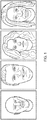
- the basis of the system is a series of components for creating and operating an individualised avatar that "speaks" in the voice that the patient hears, and visually resembles the face that the patient perceives. In cases where the patient does not clearly perceive a face, he/she is asked to choose a face which they would feel comfortable talking to. Characteristics of the avatar are chosen in consultation with each patient beforehand using a series of computerised tools. A sample set of avatar images chosen by patients is shown in Figure 1 .
- the therapist and the patient sit in front of a computer screen in separate rooms and communicate via a two-way audio link.
- the avatar's utterances are voiced by the therapist, and the patient's responses to the avatar are fed back (audio only), so that the patient can interact with and challenge the avatar.
- the voice of the avatar is produced by modifying the therapist's speech in real time, so that the therapist's speech is voiced by the avatar in the simulated voice on the client's computer with lip synchronisation.
- the therapist can also communicate instructions or advice and encouragement to the patient in his/her own voice, as would be the case in a standard therapy session. Results of a small-scale RCT study funded by NIHR are reported in [9] and further discussed in [10].
- auditory hallucinations The phenomenon of auditory hallucinations (“hearing voices”) is an enduring problem in the treatment of serious mental illness such as schizophrenia. About 30% of people with this diagnosis continue to experience hallucinations and delusions despite treatment with antipsychotic medication [1]. Hearing voices is not only distressing to the sufferers, it also has a serious impact on their carers and members of the public with whom they come into contact. Auditory hallucinations manifest in a number of ways, including voices that speak aloud what the patient is thinking, voices giving a running commentary on the patient's actions or external imagined events, two or more persons conversing, often referring to the patient in the third person, and commands ordering the patient to perform certain actions (often violent).
- VR virtual reality
- An important parameter in the design of a dialogue system with a synthetic voice is the method of generating the synthetic utterances, either by directly synthesising speech with the desired characteristics, or by transforming natural speech to produce a different quality to that of the original speaker. Since the content of the therapist's utterances to be voiced by the avatar cannot be known in advance, a standard text-to speech (TTS) system is of no use in the present invention. Typing in text during the therapy sessions would introduce frequent unacceptably long delays, disrupting the flow of the dialogue. Therefore, to allow as near real-time interaction as possible, a system based on voice conversion rather than speech synthesis is utilised.
- TTS text-to speech
- the design parameters of the experimental study required that the target voice and face be generated in an initial enrolment session with each patient, lasting no more than an hour. Ideally this would be followed by the first of the series of therapy sessions, meaning that the avatar must be obtained in its final form during the enrolment session. Subjects were recruited continuously throughout the study and so the target voices and voices were not available in advance of the technology development.
- mapping In conventional applications of voice conversion where the set of target speakers is known in advance, a training procedure is applied to produce the mapping, or transform, from the source to the target voice. This requires the availability of speech training data from both source and target speakers.
- the major technical problem was the fact that the target voices are not known until the patients have been enrolled and, of course, no actual samples could be obtained in any case.
- the mappings cannot be trained individually and that a set of predetermined voice transforms must be developed instead, using the therapist's voice as the source. While this limits the range of voices that can be delivered in good quality, a variety of different voices can still be produced, provided some additional means of fine-tuning the transforms is available.
- the system comprises a combination of off-line and on-line procedures and includes a real-time voice conversion system, voice and face customization (enrolment) systems, a customizable facial animation system with real-time lip-synching, and a two-way audio channel with switching between therapist and avatar voice.
- the patient chooses the appropriate voice and face using a set of computer-based tools, assisted by a trained operator and supervised by the therapist. It should be noted that some of these tools are commercially available products or software toolkits that have been customised to suit the needs of the present invention.
- Speech signals are produced by excitation signals produced in the throat which are the modified depending on the shape of the vocal tract.
- the speech signals In order to analyse and synthesise speech, the speech signals must be decomposed into its separate components and considered independently.
- One way of achieving this is linear prediction speech processing [19,20] wherein the speech signal is modeled as a weighted sum of the p previous samples of speech, plus a residual excitation waveform, which may also be referred to as the prediction error.
- x(n) is the speech signal
- ⁇ ( n ) is the prediction error
- a k are the prediction coefficients
- ⁇ k 1 p a k y n ⁇ k is the weighted sum of the p previous samples of speech.
- the inverse of the transfer function may be applied, allowing the speech signal to be reconstructed, as shown by Figure 5b . That is to say, it is possible to model the excitation signal that led to the speech signal.
- the speech signal is sampled over short windowed sections, and in order to decompose or reconstruct the speech signal, prediction coefficients a k for the transfer function must be calculated such that they minimise the mean-squared prediction error ⁇ ( n ).
- the prediction error of the linear prediction model is essentially the difference between the actual speech signal and the predicted speech signal, and its mean-squared value is indicative of the energy in the residual excitation waveform.
- Two common techniques of minimising the mean-squared prediction error and calculating the prediction coefficients include the covariance method and the autocorrelation method. Both techniques result in a matrix of equations which may be solved via some universal algorithm. Once these prediction coefficients have been calculated it is possible to decompose the speech signal, manipulate the components of the speech signal and then reconstruct the speech signal.
- the frequency response of the linear prediction model corresponds to the spectral envelope of the speech signal and is free from pitch harmonics. It is the spectral envelope that provides the characteristics of the vocal tract.
- the shape of the spectral envelope depends on the number of parameters that are used in the linear prediction model, that is the number of p previous samples used to model the speech signal. As p increases, the more pitch harmonics are captured. Therefore, if p is chosen to be too high, the spectral peaks capture these pitch harmonics. However, if p is chosen to be too low, the key areas of resonance will be missing from the spectra. As a general rule, p should be chosen as twice the number of vocal tract resonances (formants) in the signal bandwidth. It should also be noted that the number of linear prediction parameters (p) has no appreciable affect on the mean-squared error of the linear prediction model.
- the voice conversion technology is broadly based on the approach described by Stylianou [11].
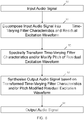
- speech is decomposed into two elements: a time-varying filter and a residual excitation waveform (step 81).
- Spectral transformations of the filter combined with pitch modification (step 82) of the residual allow the synthesis (step 83) of versions of an utterance in which the characteristics of the speaker seem to have changed.
- Decomposition of the speech is performed by linear prediction, as described above, with the prediction filter being estimated over short windowed sections of the signal 30ms in duration, and overlapping by 10ms. In other embodiments, other window lengths and overlaps may be used.
- the prediction error of the filter is then calculated separately for each window, and then overlapped and added to create the excitation residual waveform.
- the prediction coefficients are Fourier transformed into a multi-point, for example, 256 point, amplitude response. This transformation is just a mathematical convenience, allowing the filter response to be adjusted by a spectral warping function for transformation of the voice characteristics. For synthesis, the warped spectrum is then converted back to predictor coefficients. With a uniform spectral warping, the conversion to and from the amplitude response does not introduce noticeable signal distortion.
- Spectral manipulation of the filter response is performed by a set of linear transforms (step 82).
- a set of 8 transforms is used for each target voice, the exact forms of which are found during the training and customization procedure described below.
- the signal spectral envelope for the source speaker is modeled using a Gaussian Mixture Model (GMM) of 8 mixtures.
- GMM Gaussian Mixture Model
- Performance can be improved with 64 mixtures [11,12], but as the voice conversion system of the present invention is designed for flexibility and real-time operation, with no concept of "accurately" recreating a specific voice, 8 mixtures constitute the best compromise between the required quality and minimal computational load.
- Each mixture is then associated with a linear transform and the final transform applied to the filter is found from the sum of transforms weighted according to the mixture probability for the corresponding source speech signal envelope. See [11] for a mathematical description.
- the residual signal from the source speaker is first re-sampled to change the fundamental frequency by a constant factor.
- the residual is then compressed or stretched in time to restore the original duration using Waveform-Similarity Overlap-Add (WSOLA, see [13]).
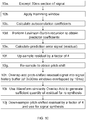
- Figures 9 to 11 illustrate, by way of example, procedures for spectral warping, residual pitch shifting and generation of the spectral warping function that are to be used in the voice conversion.
- the voice conversion begins by sampling the source speech signal in signal sections of 30ms (9-11a), overlapping by 10ms. These signal sections are then windowed using a Hamming window function (9-11b) in order to set all values outside of 0 ⁇ n ⁇ N to zero. From this windowed signal, the spectral warping procedure shown in Figure 9 , and the pitch shifting procedure shown in Figure 10 can be performed.
- the prediction filter coefficients of the windowed signal are calculated via the autocorrelation method to first find a set of autocorrelation coefficients (9-10c), and the Levinson-Durbin Recursive Method to then find the prediction coefficients (9-10d). Once these have been found, the prediction coefficients are Fourier transformed to obtain the amplitude response (9e), and the amplitude response can then be warped using a spectral warping function (9f), calculated for that windowed signal.
- the mel-scaled cepstral coefficients (MFCC) (11c) for the windowed signal are calculated.
- the spectral enveloped for the windowed signal is modelled by a Gaussian Mixture Model (GMM) of 8 mixtures and the probabilities that the MFCC data could have been generated by each mixture of the GMM are found (11d).
- GMM Gaussian Mixture Model
- Each mixture is associated with a linear transform (corresponding to target voices), and the sum of these linear transforms weighted by the above probabilities gives the spectral warping function to be applied to the amplitude response (11e).
- the resulting warped amplitude response is inverse Fourier transformed to obtain a corresponding set of autocorrelation coefficients (9g). Then, using the Levinson-Durbin recursive method, the autocorrelation coefficients are used to obtain a set of warped prediction coefficients (9h).
- the second stage of the voice conversion is to modify the pitch of the speech signal.
- the prediction coefficients of each windowed signal as described above, are used to calculate the prediction error of the windowed signals, and then the prediction errors are overlapped and added to obtain the residual signal of the speech signal (10e).
- This residual signal is up-sampled by a factor of 4 (10f) such that the sample rate is increased, and the up-sampled residual signal is re-sampled to obtain the shift the pitch of the residual signal (10g).
- the pitch-shifted residual signal is then overlap-added into a signal history buffer of 3x30ms windows overlapped by 10ms (10h).
- waveform-similarity overlap-add is used to modify the time scale without affecting the pitch (10i).
- the pitch-shifted residual is then down-sampled by a factor of 4 (10j).
- the warped prediction coefficients and pitch-shifted residual signal can then be used to synthesise the output signal (9i) which relates to the target voice.
- the input to the voice customization process is a large number of trained voice transformations generated between the single source speaker (the therapist) and a number of training speakers.
- the single source speaker the therapist
- 55 speakers were taken from the Accents of British English corpus [14] and 27 speakers were taken from the UCL Speaker Variability corpus [15].
- 40 male and 42 female target speakers were used and in each case, a selection of 20 sentences spoken by each speaker and a matching set of 20 sentences spoken by the source speaker were obtained.
- the spoken materials from the source speaker were used to build an 8-mixture GMM based on MFCC features of the signal [16].
- This GMM was then used to train all 82 linear transform sets using the Stylianou method. This first involved, for the source speaker and each target speaker, a temporal alignment between each matching pair of sentences. The MFCC vectors were used for this alignment in combination with a dynamic programming algorithm. Then for each matched pair of signal sections, the predictor coefficients and LPC spectrum were calculated and the optimum frequency mapping found for that pair of frames using a dynamic programming algorithm. Given all the mappings for all paired frames in all sentences together with the set of GMM mixture probabilities for each source frame, it is possible to find the set of 8 average transforms which minimize the mean squared transformation error.
- the training procedure generates a set of 8 linear frequency transforms and a pitch scaling factor, which taken together makes the best attempt at morphing the source speaker's voice characteristics to the target speaker (step 83).
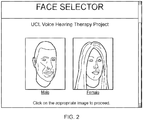
- the face selection procedure is based around the FaceGen ⁇ Modeller software developed by Singular Inversions, as illustrated by Figure 2 . This allows a virtually infinite range of 3-D faces to be created and saved in various file formats. As a starting point in the selection, a visual array or "palette" of around 250 distinct faces was created, covering a broad range of features. The faces are chosen to cover a broad range of face types which vary in gender, age and ethnic group, as well as various common hairstyles.
- Each of the images on the face selector site has an associated FaceGen model file, stored in a parallel directory structure. Once the client has chosen a suitable starting face, the corresponding face model file is easily located for further refinement in FaceGen as the client wishes.
- the resulting face image is exported as a set of animation targets in the .OBJ 3D graphics format. These are essentially a set of image and texture files for the pre-selected set of visemes, which are used in the facial animation system described below.
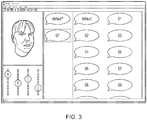
- the client manipulates the chosen transform set using a small set of sliders which alters the pitch scaling factor and the transform coefficients which may be integrated into the screen of Figure 3 .
- principal components analysis is performed on the 82 transforms estimated during training. This reduces a chosen transform vector to a mean transform vector plus a number of orthogonal change vectors.
- Each slider manipulates the amount by which each change vector is added in to the mean vector, and a separate slider manipulates the pitch scaling factor.
- the user interface is designed to allow the client to experiment with multiple variants of the chosen voice, and to keep copies of promising alternatives, such that at the end of the process, the best transform possible can be saved.
- Delivery of the real-time converted voice is performed using custom software running on two PCs connected over a network: a "server” process running at the clinician end, and a “client” process running at the patient end.
- a "server” process running at the clinician end
- a "client” process running at the patient end.
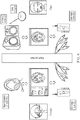
- Figure 4 A schematic illustration of the experimental layout is shown in Figure 4 .
- the server process captures audio from the therapist's microphone, and performs all the signal processing and speech conversion.
- the output speech is then transferred over the network to the client computer.
- the client process replays the converted speech and captures the patient's speech, uploading it to the therapist's computer.
- the therapist uses two "push-to-talk" buttons which control whether his/her natural voice or the converted voice is output to the client.
- the therapist listens on headphones, so that the client's responses are not fed back via the therapist's own microphone.
- the client's microphone is muted while audio is being sent from the server, again to avoid feedback through the system. This has a limited but acceptable effect on the dialogue.
- the client end is equipped with a panic button which turns off the avatar immediately when pressed, displays a scenic image and plays soothing music.
- a panic button which turns off the avatar immediately when pressed, displays a scenic image and plays soothing music.
- the strengths of the audio system are that voice customization and real-time delivery of a customized voice have been achieved.
- the target voice is male and the transform not too large, the quality of transformation is good and relatively undistorted.
- the main weakness is that the range of available voices of good quality is somewhat limited, and when the required transforms are too great, there is also a loss in quality.
- the female voices generated from a male therapist's voice may sound somewhat strained and unconvincing to some patients.
- the processing system adds about 50ms of delay into the dialogue. Additionally, variable delays introduced by the network link can cause more serious problems that interfere with the conduct of the session. For this reason, the system has been re-implemented to work with a direct audio link, with the audio processing re-engineered to use the Windows core audio platform, resulting in much lower latencies.
- the term 'real-time voice conversion' should be interpreted to mean that the voice conversion is conducted live such that dialogue can be exchanged between two individuals, for example, between a therapist and a patient for the treatment of auditory hallucinations. It should be clear to the skilled person that any delay added by the processing system is acceptable provided that it has no appreciable effect on the flow of conversation between the two individuals. As mentioned above, an acceptable delay may be a delay of about 50ms or, by way of example, a delay in the range of 20ms to 250ms.
- the animation application is based on the real-time lip-sync SDK from Annosoft LLC [17]. Typically used for animating 3D talking characters in video games or films, this toolkit allows 3D characters designed in other applications to be imported in a range of formats and passed to a real-time phonetic speech recognizer which outputs lip movements.
- the system can work from both direct audio input and from prerecorded speech.
- Character information and animation targets are loaded from a simple plain-text configuration file linked to a set of graphic files, and can be pre-compiled into a binary format for faster loading and display. In the present invention, a set of 12 visemes (see, for example, [18]) may be used, including one for silence.
- the configuration file for each character simply specifies which animation target of the 3D model is to be used for each viseme, and which audio transform to use. Creation of the configuration files is built into the enrolment programs, based on a predetermined list of phoneme-viseme mappings.
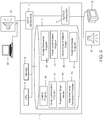
- FIG. 6 illustrates an example of a general computer system 1 that may form the platform for embodiments of the invention.
- the computer system 1 comprises a central processing unit (CPU) 5, a working memory 6, and input interface 2 arranged to receive control inputs from a user via an input device 22 such as a keyboard, mouse, or other controller and output hardware 3 arranged to provide output information to a user.
- the input interface 2 is further arranged to receive audio inputs from the user via an audio input device 21 such as a microphone or other device capable of capturing sound.
- the output hardware 3 includes a visual display unit 32 such as a computer screen, television or other visual display, and an audio output device 31 such as a speaker or other device capable of producing sound.
- the computer system 1 is also provided with a computer readable storage medium 4 such as hard disk drive (HDD), flash drive, solid state drive, or any other form of general purpose data storage, upon which stored data 43, 46 and various control programs are arranged to control the computer system 1 to operate in accordance with embodiments of the present invention.
- a control program 40 is provided and arranged to provide overall control of the system to perform the embodiments of the present invention.
- This control program 40 may, for example, receive user inputs and launch other programs to perform specific tasks.
- the other programs under the control of the control program 40 include an avatar generation program 42 and facial customisation program 44 which are arranged to generate an avatar according the specifications of the user's inputs, as described above in the face selection and customisation section.
- a visual array of distinct faces 46 is also provided, from which the user can choose and customise.
- a set of predefined target voices 43 are provided from which the user may select, and subsequently customise using a voice customisation program 41 as described in the voice enrolment section.
- a real-time voice conversion program 45 in accordance with the voice conversion technique described previously, is also provided whereby audio inputs received via the audio input device 21 are transformed into the target voice, as customised by the user.
- a facial animation program 47 is provided and arranged to animate the facial movements of the generated avatar and to synchronise the lip movements of the avatar according to the output of the real-time voice conversion program 45. The facial animation procedure is described above.
- the computer system is capable of performing the audio-visual dialogue system described by the present invention and illustrated by the steps of Figure 7 .
- a patient suffering from auditory hallucinations may provide control inputs via the input device 22 instructing the computer system 1 to generate an avatar (step 71).
- the computer system 1 may comprise a readable storage medium 4 including a control program 40 arranged to provide overall control of the system.
- the control program 40 receives the patient's inputs, and launches an avatar generation program 42 which is arranged to generate an avatar (step 71).
- the control program 40 may then launch a face customisation program 44 allowing the patient to customise the generated avatar using a visual array of distinct faces 46 stored in the computer readable medium 4. Once the patient has completed facial customisation, the completed avatar is displayed on a visual display unit 32 (step 71).
- the control program 40 may also launch a voice customisation program 41 which is arranged to allow the patient to choose the target voice of the generated avatar such that it closely resembles their auditory hallucination (step 70).
- the voice customisation program 41 uses a set of predefined target voices 43 which includes a range of male and female voices from which the patient may select. The patient is then able to customise the parameters of the selected target voice, as demonstrated in Figure 3 , using a selection of sliders displayed on the input device 22 until it is a close match to the auditory hallucination.
- a therapist and the patient may engage in conversation via the generated avatar.
- the therapist provides an audio input (step 72) via an audio input device 21 and the control program 40 launches a real-time voice conversion program 45 arranged to transform the audio input, that is the therapist's voice, into the target voice using the customised parameters chosen by the patient (step 73), wherein the voice conversion program employs the voice conversion technique described above.
- the output of the real-time voice conversion program 45 is then provided to the patient via an audio output device 31.
- the control program 40 launches a facial animation program 47 which is arranged to animate the facial movements of the generated avatar, specifically, lip-synching the avatar in real-time with the output of the real-time voice conversion program 45 (step 74).
- a facial animation program 47 which is arranged to animate the facial movements of the generated avatar, specifically, lip-synching the avatar in real-time with the output of the real-time voice conversion program 45 (step 74).
Landscapes
- Engineering & Computer Science (AREA)
- Physics & Mathematics (AREA)
- Multimedia (AREA)
- Computational Linguistics (AREA)
- Health & Medical Sciences (AREA)
- Audiology, Speech & Language Pathology (AREA)
- Human Computer Interaction (AREA)
- Acoustics & Sound (AREA)
- General Physics & Mathematics (AREA)
- Theoretical Computer Science (AREA)
- Signal Processing (AREA)
- Spectroscopy & Molecular Physics (AREA)
- Electrically Operated Instructional Devices (AREA)
- Processing Or Creating Images (AREA)
Claims (12)
- Audiovisuelles Dialogsystem (1), mit:einer Audioeingabevorrichtung (21);einer Audioausgabevorrichtung (31);einer visuellen Ausgabevorrichtung (32); undeinem Prozessor (5), wobei der Prozessor eingerichtet ist zum:Empfangen (72) eines Eingangsaudiosignals, das eine Quellsprache aus der Audioeingabevorrichtung darstellt.Durchführen (73) einer Sprachumwandlung im Wesentlichen in Echtzeit an dem Eingangsaudiosignal, um ein Ausgabeaudiosignal zu erzeugen, das eine Zielsprache repräsentiert, wobei das Ausgabeaudiosignal der Audioausgabevorrichtung bereitgestellt wird und wobei der Echtzeit-Sprachumwandlungsprozess Folgendes beinhaltet:i) Zerlegen des Eingangsaudiosignals in einen Satz von zeitvariablen Filtereigenschaften und ein Resterregungssignal;ii) spektrale Transformation der zeitvariablen Filtereigenschaften und/oder Modifizieren der Neigung des Resterregungssignals; undiii) Synthetisieren des Ausgangsaudiosignals in Abhängigkeit von den transformierten zeitvariablen Filtereigenschaften und/oder der Neigung des modifizierten Resterregungssignals;Erzeugen (71) eines Avatars, wobei der Avatar visuell auf der visuellen Ausgabevorrichtung angezeigt wird;gesichtsmäßige Animation des erzeugten Avatars (74), wobei die Animation mit dem Ausgabeaudiosignal synchronisiert ist;wobei der Prozessor ferner dazu eingerichtet ist, die Echtzeit-Sprachumwandlung anzupassen, wobei die Anpassung umfasst:1) Auswählen eines aus einer Vielzahl von vordefinierten Ziel-Sprachen, wobei die vordefinierten Zielsprachen durch einen Satz von jeweiligen linearen Transformationen dargestellt werden, die einen Satz von zeitvariablen Filtereigenschaften und einen Neigungsskalierungsfaktor beinhalten; und2) Anpassen (82) der transformationszeitvariablen Filtereigenschaften und/oder des Neigungsskalierungsfaktors der ausgewählten vordefinierten Zielsprache, um benutzerdefinierte Zielsprachparameter zu erhalten,wobei die zeitvariablen Filtereigenschaften und/oder der Neigungsskalierungsfaktor der ausgewählten vordefinierten Zielsprache mit einer Vielzahl von auf der Benutzeroberfläche angezeigten Reglern (A, B, C, D) eingestellt werden, die bei Aktivierung durch den Benutzer einen Änderungsbetrag einstellen, um den die zeitvariablen Filtereigenschaften und/oder der Neigungsskalierungsfaktor eingestellt werden.
- System nach Anspruch 1, worin die zeitvariablen Filtereigenschaften über kurzgefensterte Abschnitte des Eingangsaudiosignals geschätzt werden, worin die kurzgefensterten Abschnitte des Eingangsaudiosignals 20 bis 40 ms lang sind und sich um 5 bis 15 ms überlappen.
- System nach einem der vorhergehenden Ansprüche, bei dem die zeitvariablen Filtereigenschaften vor der spektralen Transformation der zeitvariablen Filtereigenschaften in eine multiple Punktamplitudenempfindlichkeit Fourier-transformiert werden, und bei dem die spektral transformierte Amplitudenempfindlichkeit zurück in zeitvariable Filtereigenschaften Fourier-transformiert wird.
- System nach einem der vorhergehenden Ansprüche, bei dem ein Satz von mindestens 8 linearen Transformierungen zwischen dem Eingangsaudiosignal und einer vordefinierten Zielsprache erzeugt werden, und wobei mehr als 50 vordefinierte Zielsprachen verwendet werden, um die Mengen linearer Transformationen zu erzeugen.
- System nach einem der vorhergehenden Ansprüche, bei dem eine Vielzahl von Sätzen sowohl durch die Vielzahl der vordefinierten Zielsprachen als auch durch das Eingangsaudiosignal gesprochen wird und wobei mindestens 20 Sätze gesprochen werden.
- System nach Anspruch 5, wobei die Vielzahl der durch das Eingangsaudiosignal gesprochenen Sätze und die Vielzahl von Sätzen, die von der Vielzahl von vordefinierten Zielstimmen gesprochen werden, zeitlich ausgerichtet sind, wobei die Vielzahl von Sätzen zeitlich ausgerichtet sind unter Verwendung der Melfrequenz-Cepstrum-Koeffizienten des Eingangsaudiosignals in Kombination mit einem dynamischen Programmieralgorithmus.
- System nach Anspruch 6, wobei für eine Vielzahl von Signalabschnitten innerhalb der zeitlich ausgerichteten Vielzahl von Sätzen:a) die Vorhersagekoeffizienten und das lineare Vorhersagecodierungsspektrum berechnet sind; undb) die optimale Frequenzabbildung mit Hilfe eines dynamischen Programmierungs- Algorithmus gefunden wird.
- System nach einem der vorhergehenden Ansprüche, bei dem die Transformationsvektoren des Satzes linearer Transformationen auf einen mittleren Transformationsvektor und eine Vielzahl orthogonaler Änderungsvektoren reduziert sind.
- System nach Anspruch 8, bei dem ein Schieberegler verwendet wird, um den Betrag einzustellen, um den ein Änderungsvektor in den Mittelwerttransformationsvektor eingefügt wird, so dass die zeitvariablen Filtereigenschaften angepasst werden.
- System nach einem der vorhergehenden Ansprüche, bei dem der Prozessor ferner dazu eingerichtet ist, den erzeugten Avatar gesichtsmäßig anzupassen, wobei das gesichtsmäßige Anpassen des erzeugten Avatars das Bereitstellen einer visuellen Anordnung von verschiedenen Gesichtern zur Auswahl beinhaltet.
- System nach einem vorhergehenden Anspruch, wobei die Audioeingabevorrichtung und die Audioausgabevorrichtung verbindbar sind, um einen Zweiwege-Audiokanal zu bilden.
- Verfahren zum audiovisuellen Dialog, mit den Schritten:Empfangen (72) eines Eingangsaudiosignals, das eine Quellsprache von einem Audio- Eingabegerät darstellt;Durchführen (73) einer im Wesentlichen Echtzeit-Sprachumwandlung des Eingangsaudiosignals, um ein Ausgangsaudiosignal zu erzeugen, das eine Zielsprache repräsentiert, wobei das Audioausgangssignal einer Audioausgabevorrichtung zugeführt wird, und wobei die im Wesentlichen Echtzeit-Sprachumwandlung Folgendes beinhaltet:i) Zerlegen (81) des Eingangsaudiosignals in einen Satz von zeitvariablen Filtereigenschaften und ein Resterregungssignal;ii) spektrale Transformation (82) der zeitvariablen Filtereigenschaften und/oder Modifizierung der Neigung des Resterregungssignals; undiii) Synthetisieren (83) des Ausgangsaudiosignals in Abhängigkeit von den transformierten zeitvariablen Filtereigenschaften und/oder dem neigungsmodifizierten Resterregungssignal;Erzeugen eines Avatars (71), wobei der Avatar visuell auf einer Bild-Ausgabevorrichtung angezeigt wird;Gesichtsmäßiges Animieren (74) des erzeugten Avatars, wobei die Animation mit dem Ausgangsaudiosignal synchronisiert ist;wobei das Verfahren ferner das Anpassen der Echtzeit-Sprachumwandlung umfasst, wobei diese Anpassung folgende Schritte beinhaltet:1) Auswählen einer aus einer Vielzahl von vordefinierten Zielstimmen, wobei die vordefinierten Zielstimmen durch einen Satz von jeweiligen linearen Transformationen dargestellt werden, die einen Satz von zeitvariablen Filtereigenschaften und einen Neigungsskalierungsfaktor beinhalten; und2) Anpassen (82) der Transformationszeit-veränderlichen Filtereigenschaften und/oder des Neigungsskalierungsfaktors der ausgewählten vordefinierten Zielsprache, um benutzerdefinierte Zielsprachparameter zu erhalten,wobei die zeitvariablen Filtereigenschaften und/oder der Neigungsskalierungsfaktor der ausgewählten vordefinierten Zielsprache mit einer Vielzahl von Reglern (A, B, C, D) eingestellt werden, die auf einer Benutzeroberfläche angezeigt werden, die bei Aktivierung durch den Benutzer einen Änderungsbetrag festlegen, um den die zeitvariablen Filtereigenschaften und/oder der Neigungsskalierungsfaktor angepasst werden.
Applications Claiming Priority (2)
| Application Number | Priority Date | Filing Date | Title |
|---|---|---|---|
| GBGB1315142.8A GB201315142D0 (en) | 2013-08-23 | 2013-08-23 | Audio-Visual Dialogue System and Method |
| PCT/GB2014/052544 WO2015025155A1 (en) | 2013-08-23 | 2014-08-19 | Audio-visual dialogue system and method |
Publications (2)
| Publication Number | Publication Date |
|---|---|
| EP3036737A1 EP3036737A1 (de) | 2016-06-29 |
| EP3036737B1 true EP3036737B1 (de) | 2019-03-13 |
Family
ID=49355865
Family Applications (1)
| Application Number | Title | Priority Date | Filing Date |
|---|---|---|---|
| EP14756113.8A Active EP3036737B1 (de) | 2013-08-23 | 2014-08-19 | Audiovisuelles dialogsystem und verfahren |
Country Status (5)
| Country | Link |
|---|---|
| US (1) | US9837091B2 (de) |
| EP (1) | EP3036737B1 (de) |
| ES (1) | ES2728708T3 (de) |
| GB (1) | GB201315142D0 (de) |
| WO (1) | WO2015025155A1 (de) |
Families Citing this family (43)
| Publication number | Priority date | Publication date | Assignee | Title |
|---|---|---|---|---|
| WO2013152453A1 (en) | 2012-04-09 | 2013-10-17 | Intel Corporation | Communication using interactive avatars |
| US9830728B2 (en) | 2014-12-23 | 2017-11-28 | Intel Corporation | Augmented facial animation |
| US10380062B1 (en) * | 2015-03-19 | 2019-08-13 | Hrl Laboratories, Llc | Efficient cognitive signal denoising with sparse output layers |
| US10720949B1 (en) | 2015-03-19 | 2020-07-21 | Hrl Laboratories, Llc | Real-time time-difference-of-arrival (TDOA) estimation via multi-input cognitive signal processor |
| US10712425B1 (en) * | 2015-03-19 | 2020-07-14 | Hrl Laboratories, Llc | Cognitive denoising of nonstationary signals using time varying reservoir computer |
| US10128820B2 (en) * | 2015-03-19 | 2018-11-13 | Hrl Laboratories, Llc | Cognitive signal processor for simultaneous denoising and blind source separation |
| US10153806B1 (en) * | 2015-03-19 | 2018-12-11 | Hrl Laboratories, Llc | Cognitive architecture for wideband, low-power, real-time signal denoising |
| US10404299B1 (en) | 2016-03-07 | 2019-09-03 | Hrl Laboratories, Llc | System for parallelized cognitive signal denoising |
| US10162378B1 (en) * | 2015-03-19 | 2018-12-25 | Hrl Laboratories, Llc | Neuromorphic processor for wideband signal analysis |
| US10484043B1 (en) | 2015-03-19 | 2019-11-19 | Hrl Laboratories, Llc | Adaptive blind source separator for ultra-wide bandwidth signal tracking |
| US10475225B2 (en) | 2015-12-18 | 2019-11-12 | Intel Corporation | Avatar animation system |
| US10325395B2 (en) * | 2016-01-20 | 2019-06-18 | Facebook, Inc. | Techniques for animating stickers with sound |
| CN108780643B (zh) * | 2016-11-21 | 2023-08-25 | 微软技术许可有限责任公司 | 自动配音方法和装置 |
| US10770092B1 (en) * | 2017-09-22 | 2020-09-08 | Amazon Technologies, Inc. | Viseme data generation |
| US10910001B2 (en) * | 2017-12-25 | 2021-02-02 | Casio Computer Co., Ltd. | Voice recognition device, robot, voice recognition method, and storage medium |
| US20190043239A1 (en) * | 2018-01-07 | 2019-02-07 | Intel Corporation | Methods, systems, articles of manufacture and apparatus for generating a response for an avatar |
| US10586369B1 (en) | 2018-01-31 | 2020-03-10 | Amazon Technologies, Inc. | Using dialog and contextual data of a virtual reality environment to create metadata to drive avatar animation |
| US20210202096A1 (en) * | 2018-05-30 | 2021-07-01 | Tiktalk To Me Ltd. | Method and systems for speech therapy computer-assisted training and repository |
| US10699705B2 (en) * | 2018-06-22 | 2020-06-30 | Adobe Inc. | Using machine-learning models to determine movements of a mouth corresponding to live speech |
| US11531639B2 (en) | 2018-07-26 | 2022-12-20 | The Boeing Company | Pipelined cognitive signal processor |
| GB2579208B (en) * | 2018-11-23 | 2023-01-25 | Sony Interactive Entertainment Inc | Method and system for determining identifiers for tagging video frames with |
| JP7500582B2 (ja) * | 2019-01-25 | 2024-06-17 | ソウル マシーンズ リミティド | 発話アニメーションのリアルタイム生成 |
| US11030479B2 (en) * | 2019-04-30 | 2021-06-08 | Sony Interactive Entertainment Inc. | Mapping visual tags to sound tags using text similarity |
| US10847186B1 (en) | 2019-04-30 | 2020-11-24 | Sony Interactive Entertainment Inc. | Video tagging by correlating visual features to sound tags |
| US11289067B2 (en) * | 2019-06-25 | 2022-03-29 | International Business Machines Corporation | Voice generation based on characteristics of an avatar |
| KR102430020B1 (ko) * | 2019-08-09 | 2022-08-08 | 주식회사 하이퍼커넥트 | 단말기 및 그것의 동작 방법 |
| CN112905754B (zh) * | 2019-12-16 | 2024-09-06 | 腾讯科技(深圳)有限公司 | 基于人工智能的视觉对话方法、装置及电子设备 |
| US11694084B2 (en) | 2020-04-14 | 2023-07-04 | Sony Interactive Entertainment Inc. | Self-supervised AI-assisted sound effect recommendation for silent video |
| US12499355B1 (en) | 2020-07-13 | 2025-12-16 | Hrl Laboratories, Llc | Complex neuromorphic adaptive core (neuracore) and physics enhanced neuromorphic adaptive controller |
| US12566244B1 (en) * | 2020-07-13 | 2026-03-03 | Hrl Laboratories, Llc | System and method for real-time radar range-doppler map learning |
| US11863221B1 (en) | 2020-07-14 | 2024-01-02 | Hrl Laboratories, Llc | Low size, weight and power (swap) efficient hardware implementation of a wide instantaneous bandwidth neuromorphic adaptive core (NeurACore) |
| US12057989B1 (en) * | 2020-07-14 | 2024-08-06 | Hrl Laboratories, Llc | Ultra-wide instantaneous bandwidth complex neuromorphic adaptive core processor |
| US20220181004A1 (en) * | 2020-12-08 | 2022-06-09 | Happify Inc. | Customizable therapy system and process |
| JP7254114B2 (ja) | 2020-12-18 | 2023-04-07 | ハイパーコネクト リミテッド ライアビリティ カンパニー | 音声合成装置およびその方法 |
| US11948550B2 (en) * | 2021-05-06 | 2024-04-02 | Sanas.ai Inc. | Real-time accent conversion model |
| US12443859B2 (en) | 2021-08-25 | 2025-10-14 | Hyperconnect LLC | Dialogue model training method and device therefor |
| US12475881B2 (en) | 2021-08-25 | 2025-11-18 | Hyperconnect LLC | Method of generating conversation information using examplar-based generation model and apparatus for the same |
| US11996113B2 (en) * | 2021-10-29 | 2024-05-28 | Snap Inc. | Voice notes with changing effects |
| US12367862B2 (en) | 2021-11-15 | 2025-07-22 | Hyperconnect LLC | Method of generating response using utterance and apparatus therefor |
| US12566924B2 (en) | 2022-01-14 | 2026-03-03 | Hyperconnect LLC | Apparatus for evaluating and improving response, method and computer readable recording medium thereof |
| US20250140280A1 (en) * | 2022-03-04 | 2025-05-01 | Sony Group Corporation | Voice processing device, voice processing method, information terminal, information processing device, and computer program |
| CN114581567B (zh) * | 2022-05-06 | 2022-08-02 | 成都市谛视无限科技有限公司 | 一种声音驱动虚拟形象口型方法、装置及介质 |
| US12469509B2 (en) * | 2023-04-04 | 2025-11-11 | Meta Platforms Technologies, Llc | Voice avatars in extended reality environments |
Family Cites Families (12)
| Publication number | Priority date | Publication date | Assignee | Title |
|---|---|---|---|---|
| JPH04158397A (ja) * | 1990-10-22 | 1992-06-01 | A T R Jido Honyaku Denwa Kenkyusho:Kk | 声質変換方式 |
| WO1993018505A1 (en) * | 1992-03-02 | 1993-09-16 | The Walt Disney Company | Voice transformation system |
| EP0970466B1 (de) * | 1997-01-27 | 2004-09-22 | Microsoft Corporation | Stimmumwandlung |
| US6336092B1 (en) * | 1997-04-28 | 2002-01-01 | Ivl Technologies Ltd | Targeted vocal transformation |
| US6970820B2 (en) * | 2001-02-26 | 2005-11-29 | Matsushita Electric Industrial Co., Ltd. | Voice personalization of speech synthesizer |
| US20070074114A1 (en) * | 2005-09-29 | 2007-03-29 | Conopco, Inc., D/B/A Unilever | Automated dialogue interface |
| US9250703B2 (en) * | 2006-03-06 | 2016-02-02 | Sony Computer Entertainment Inc. | Interface with gaze detection and voice input |
| FR2906056B1 (fr) * | 2006-09-15 | 2009-02-06 | Cantoche Production Sa | Procede et systeme d'animation d'un avatar en temps reel a partir de la voix d'un interlocuteur. |
| US20080151786A1 (en) * | 2006-12-21 | 2008-06-26 | Motorola, Inc. | Method and apparatus for hybrid audio-visual communication |
| WO2009067560A1 (en) * | 2007-11-20 | 2009-05-28 | Big Stage Entertainment, Inc. | Systems and methods for generating 3d head models and for using the same |
| US9330720B2 (en) * | 2008-01-03 | 2016-05-03 | Apple Inc. | Methods and apparatus for altering audio output signals |
| US20100201693A1 (en) * | 2009-02-11 | 2010-08-12 | Disney Enterprises, Inc. | System and method for audience participation event with digital avatars |
-
2013
- 2013-08-23 GB GBGB1315142.8A patent/GB201315142D0/en not_active Ceased
-
2014
- 2014-08-19 ES ES14756113T patent/ES2728708T3/es active Active
- 2014-08-19 EP EP14756113.8A patent/EP3036737B1/de active Active
- 2014-08-19 US US14/913,876 patent/US9837091B2/en active Active
- 2014-08-19 WO PCT/GB2014/052544 patent/WO2015025155A1/en not_active Ceased
Non-Patent Citations (1)
| Title |
|---|
| None * |
Also Published As
| Publication number | Publication date |
|---|---|
| GB201315142D0 (en) | 2013-10-09 |
| US20160203827A1 (en) | 2016-07-14 |
| US9837091B2 (en) | 2017-12-05 |
| ES2728708T3 (es) | 2019-10-28 |
| EP3036737A1 (de) | 2016-06-29 |
| WO2015025155A1 (en) | 2015-02-26 |
Similar Documents
| Publication | Publication Date | Title |
|---|---|---|
| US9837091B2 (en) | Audio-visual dialogue system and method | |
| CN111276120B (zh) | 语音合成方法、装置和计算机可读存储介质 | |
| Gonzalez et al. | A silent speech system based on permanent magnet articulography and direct synthesis | |
| Massaro et al. | Perceiving affect from the voice and the face | |
| Huckvale et al. | Avatar therapy: an audio-visual dialogue system for treating auditory hallucinations. | |
| Zhao et al. | Voice conversion for persons with amyotrophic lateral sclerosis | |
| CN120318437B (zh) | 基于深度学习和声音克隆的实时交互3d数字全息舱方法 | |
| CN120807731B (zh) | 数字人视频生成方法、装置及计算机设备 | |
| CN120163907A (zh) | 基于多模态信息交互人脸合成方法、装置及设备 | |
| Gilbert et al. | Restoring speech following total removal of the larynx by a learned transformation from sensor data to acoustics | |
| Pan et al. | Vocal: Vowel and consonant layering for expressive animator-centric singing animation | |
| Caponetti et al. | Biologically inspired emotion recognition from speech | |
| Holbrow et al. | Vocal vibrations | |
| JP3413384B2 (ja) | 調音状態の推定表示方法およびそのためのコンピュータプログラムを記録したコンピュータ読取可能な記録媒体 | |
| Athanasopoulos et al. | King's speech: pronounce a foreign language with style | |
| Lee et al. | The Sound of Hallucinations: Toward a more convincing emulation of internalized voices | |
| Lin et al. | A face robot for autonomous simplified musical notation reading and singing | |
| Viera et al. | The challenge project: Fighting auditory hallucinations by using virtual reality | |
| Athanasopoulos et al. | 3D immersive karaoke for the learning of foreign language pronunciation | |
| Moore | Speech Recognition for Individuals with Voice Disorders | |
| Mayor et al. | Kaleivoicecope: voice transformation from interactive installations to video games | |
| Huckvale | Avatar Therapy: an audio | |
| Liu | Speech-driven gesture generation of social robot and embodied agents | |
| Leff et al. | Avatar therapy for auditory hallucinations | |
| Huc | Avatar Therapy: an au |
Legal Events
| Date | Code | Title | Description |
|---|---|---|---|
| PUAI | Public reference made under article 153(3) epc to a published international application that has entered the european phase |
Free format text: ORIGINAL CODE: 0009012 |
|
| 17P | Request for examination filed |
Effective date: 20160223 |
|
| AK | Designated contracting states |
Kind code of ref document: A1 Designated state(s): AL AT BE BG CH CY CZ DE DK EE ES FI FR GB GR HR HU IE IS IT LI LT LU LV MC MK MT NL NO PL PT RO RS SE SI SK SM TR |
|
| AX | Request for extension of the european patent |
Extension state: BA ME |
|
| DAX | Request for extension of the european patent (deleted) | ||
| STAA | Information on the status of an ep patent application or granted ep patent |
Free format text: STATUS: EXAMINATION IS IN PROGRESS |
|
| 17Q | First examination report despatched |
Effective date: 20170913 |
|
| GRAP | Despatch of communication of intention to grant a patent |
Free format text: ORIGINAL CODE: EPIDOSNIGR1 |
|
| STAA | Information on the status of an ep patent application or granted ep patent |
Free format text: STATUS: GRANT OF PATENT IS INTENDED |
|
| INTG | Intention to grant announced |
Effective date: 20181001 |
|
| RIN1 | Information on inventor provided before grant (corrected) |
Inventor name: HUCKVALE, MARK Inventor name: WILLIAMS, GEOFFREY Inventor name: LEFF, JULIAN |
|
| GRAS | Grant fee paid |
Free format text: ORIGINAL CODE: EPIDOSNIGR3 |
|
| GRAA | (expected) grant |
Free format text: ORIGINAL CODE: 0009210 |
|
| STAA | Information on the status of an ep patent application or granted ep patent |
Free format text: STATUS: THE PATENT HAS BEEN GRANTED |
|
| AK | Designated contracting states |
Kind code of ref document: B1 Designated state(s): AL AT BE BG CH CY CZ DE DK EE ES FI FR GB GR HR HU IE IS IT LI LT LU LV MC MK MT NL NO PL PT RO RS SE SI SK SM TR |
|
| REG | Reference to a national code |
Ref country code: GB Ref legal event code: FG4D |
|
| REG | Reference to a national code |
Ref country code: CH Ref legal event code: EP Ref country code: AT Ref legal event code: REF Ref document number: 1108792 Country of ref document: AT Kind code of ref document: T Effective date: 20190315 |
|
| REG | Reference to a national code |
Ref country code: IE Ref legal event code: FG4D |
|
| REG | Reference to a national code |
Ref country code: DE Ref legal event code: R096 Ref document number: 602014042849 Country of ref document: DE |
|
| REG | Reference to a national code |
Ref country code: NL Ref legal event code: MP Effective date: 20190313 |
|
| REG | Reference to a national code |
Ref country code: LT Ref legal event code: MG4D |
|
| PG25 | Lapsed in a contracting state [announced via postgrant information from national office to epo] |
Ref country code: SE Free format text: LAPSE BECAUSE OF FAILURE TO SUBMIT A TRANSLATION OF THE DESCRIPTION OR TO PAY THE FEE WITHIN THE PRESCRIBED TIME-LIMIT Effective date: 20190313 Ref country code: LT Free format text: LAPSE BECAUSE OF FAILURE TO SUBMIT A TRANSLATION OF THE DESCRIPTION OR TO PAY THE FEE WITHIN THE PRESCRIBED TIME-LIMIT Effective date: 20190313 Ref country code: NO Free format text: LAPSE BECAUSE OF FAILURE TO SUBMIT A TRANSLATION OF THE DESCRIPTION OR TO PAY THE FEE WITHIN THE PRESCRIBED TIME-LIMIT Effective date: 20190613 Ref country code: FI Free format text: LAPSE BECAUSE OF FAILURE TO SUBMIT A TRANSLATION OF THE DESCRIPTION OR TO PAY THE FEE WITHIN THE PRESCRIBED TIME-LIMIT Effective date: 20190313 |
|
| PG25 | Lapsed in a contracting state [announced via postgrant information from national office to epo] |
Ref country code: GR Free format text: LAPSE BECAUSE OF FAILURE TO SUBMIT A TRANSLATION OF THE DESCRIPTION OR TO PAY THE FEE WITHIN THE PRESCRIBED TIME-LIMIT Effective date: 20190614 Ref country code: BG Free format text: LAPSE BECAUSE OF FAILURE TO SUBMIT A TRANSLATION OF THE DESCRIPTION OR TO PAY THE FEE WITHIN THE PRESCRIBED TIME-LIMIT Effective date: 20190613 Ref country code: NL Free format text: LAPSE BECAUSE OF FAILURE TO SUBMIT A TRANSLATION OF THE DESCRIPTION OR TO PAY THE FEE WITHIN THE PRESCRIBED TIME-LIMIT Effective date: 20190313 Ref country code: RS Free format text: LAPSE BECAUSE OF FAILURE TO SUBMIT A TRANSLATION OF THE DESCRIPTION OR TO PAY THE FEE WITHIN THE PRESCRIBED TIME-LIMIT Effective date: 20190313 Ref country code: LV Free format text: LAPSE BECAUSE OF FAILURE TO SUBMIT A TRANSLATION OF THE DESCRIPTION OR TO PAY THE FEE WITHIN THE PRESCRIBED TIME-LIMIT Effective date: 20190313 Ref country code: HR Free format text: LAPSE BECAUSE OF FAILURE TO SUBMIT A TRANSLATION OF THE DESCRIPTION OR TO PAY THE FEE WITHIN THE PRESCRIBED TIME-LIMIT Effective date: 20190313 |
|
| REG | Reference to a national code |
Ref country code: AT Ref legal event code: MK05 Ref document number: 1108792 Country of ref document: AT Kind code of ref document: T Effective date: 20190313 |
|
| REG | Reference to a national code |
Ref country code: ES Ref legal event code: FG2A Ref document number: 2728708 Country of ref document: ES Kind code of ref document: T3 Effective date: 20191028 |
|
| PG25 | Lapsed in a contracting state [announced via postgrant information from national office to epo] |
Ref country code: AL Free format text: LAPSE BECAUSE OF FAILURE TO SUBMIT A TRANSLATION OF THE DESCRIPTION OR TO PAY THE FEE WITHIN THE PRESCRIBED TIME-LIMIT Effective date: 20190313 Ref country code: RO Free format text: LAPSE BECAUSE OF FAILURE TO SUBMIT A TRANSLATION OF THE DESCRIPTION OR TO PAY THE FEE WITHIN THE PRESCRIBED TIME-LIMIT Effective date: 20190313 Ref country code: CZ Free format text: LAPSE BECAUSE OF FAILURE TO SUBMIT A TRANSLATION OF THE DESCRIPTION OR TO PAY THE FEE WITHIN THE PRESCRIBED TIME-LIMIT Effective date: 20190313 Ref country code: PT Free format text: LAPSE BECAUSE OF FAILURE TO SUBMIT A TRANSLATION OF THE DESCRIPTION OR TO PAY THE FEE WITHIN THE PRESCRIBED TIME-LIMIT Effective date: 20190713 Ref country code: SK Free format text: LAPSE BECAUSE OF FAILURE TO SUBMIT A TRANSLATION OF THE DESCRIPTION OR TO PAY THE FEE WITHIN THE PRESCRIBED TIME-LIMIT Effective date: 20190313 Ref country code: EE Free format text: LAPSE BECAUSE OF FAILURE TO SUBMIT A TRANSLATION OF THE DESCRIPTION OR TO PAY THE FEE WITHIN THE PRESCRIBED TIME-LIMIT Effective date: 20190313 |
|
| PG25 | Lapsed in a contracting state [announced via postgrant information from national office to epo] |
Ref country code: SM Free format text: LAPSE BECAUSE OF FAILURE TO SUBMIT A TRANSLATION OF THE DESCRIPTION OR TO PAY THE FEE WITHIN THE PRESCRIBED TIME-LIMIT Effective date: 20190313 Ref country code: PL Free format text: LAPSE BECAUSE OF FAILURE TO SUBMIT A TRANSLATION OF THE DESCRIPTION OR TO PAY THE FEE WITHIN THE PRESCRIBED TIME-LIMIT Effective date: 20190313 |
|
| REG | Reference to a national code |
Ref country code: DE Ref legal event code: R097 Ref document number: 602014042849 Country of ref document: DE |
|
| PG25 | Lapsed in a contracting state [announced via postgrant information from national office to epo] |
Ref country code: IS Free format text: LAPSE BECAUSE OF FAILURE TO SUBMIT A TRANSLATION OF THE DESCRIPTION OR TO PAY THE FEE WITHIN THE PRESCRIBED TIME-LIMIT Effective date: 20190713 Ref country code: AT Free format text: LAPSE BECAUSE OF FAILURE TO SUBMIT A TRANSLATION OF THE DESCRIPTION OR TO PAY THE FEE WITHIN THE PRESCRIBED TIME-LIMIT Effective date: 20190313 |
|
| PLBE | No opposition filed within time limit |
Free format text: ORIGINAL CODE: 0009261 |
|
| STAA | Information on the status of an ep patent application or granted ep patent |
Free format text: STATUS: NO OPPOSITION FILED WITHIN TIME LIMIT |
|
| PG25 | Lapsed in a contracting state [announced via postgrant information from national office to epo] |
Ref country code: DK Free format text: LAPSE BECAUSE OF FAILURE TO SUBMIT A TRANSLATION OF THE DESCRIPTION OR TO PAY THE FEE WITHIN THE PRESCRIBED TIME-LIMIT Effective date: 20190313 |
|
| 26N | No opposition filed |
Effective date: 20191216 |
|
| PG25 | Lapsed in a contracting state [announced via postgrant information from national office to epo] |
Ref country code: SI Free format text: LAPSE BECAUSE OF FAILURE TO SUBMIT A TRANSLATION OF THE DESCRIPTION OR TO PAY THE FEE WITHIN THE PRESCRIBED TIME-LIMIT Effective date: 20190313 |
|
| PG25 | Lapsed in a contracting state [announced via postgrant information from national office to epo] |
Ref country code: TR Free format text: LAPSE BECAUSE OF FAILURE TO SUBMIT A TRANSLATION OF THE DESCRIPTION OR TO PAY THE FEE WITHIN THE PRESCRIBED TIME-LIMIT Effective date: 20190313 |
|
| PG25 | Lapsed in a contracting state [announced via postgrant information from national office to epo] |
Ref country code: MC Free format text: LAPSE BECAUSE OF FAILURE TO SUBMIT A TRANSLATION OF THE DESCRIPTION OR TO PAY THE FEE WITHIN THE PRESCRIBED TIME-LIMIT Effective date: 20190313 Ref country code: LU Free format text: LAPSE BECAUSE OF NON-PAYMENT OF DUE FEES Effective date: 20190819 Ref country code: LI Free format text: LAPSE BECAUSE OF NON-PAYMENT OF DUE FEES Effective date: 20190831 Ref country code: CH Free format text: LAPSE BECAUSE OF NON-PAYMENT OF DUE FEES Effective date: 20190831 |
|
| REG | Reference to a national code |
Ref country code: BE Ref legal event code: MM Effective date: 20190831 |
|
| PG25 | Lapsed in a contracting state [announced via postgrant information from national office to epo] |
Ref country code: IE Free format text: LAPSE BECAUSE OF NON-PAYMENT OF DUE FEES Effective date: 20190819 |
|
| PG25 | Lapsed in a contracting state [announced via postgrant information from national office to epo] |
Ref country code: BE Free format text: LAPSE BECAUSE OF NON-PAYMENT OF DUE FEES Effective date: 20190831 |
|
| PG25 | Lapsed in a contracting state [announced via postgrant information from national office to epo] |
Ref country code: CY Free format text: LAPSE BECAUSE OF FAILURE TO SUBMIT A TRANSLATION OF THE DESCRIPTION OR TO PAY THE FEE WITHIN THE PRESCRIBED TIME-LIMIT Effective date: 20190313 |
|
| PG25 | Lapsed in a contracting state [announced via postgrant information from national office to epo] |
Ref country code: HU Free format text: LAPSE BECAUSE OF FAILURE TO SUBMIT A TRANSLATION OF THE DESCRIPTION OR TO PAY THE FEE WITHIN THE PRESCRIBED TIME-LIMIT; INVALID AB INITIO Effective date: 20140819 Ref country code: MT Free format text: LAPSE BECAUSE OF FAILURE TO SUBMIT A TRANSLATION OF THE DESCRIPTION OR TO PAY THE FEE WITHIN THE PRESCRIBED TIME-LIMIT Effective date: 20190313 |
|
| PG25 | Lapsed in a contracting state [announced via postgrant information from national office to epo] |
Ref country code: MK Free format text: LAPSE BECAUSE OF FAILURE TO SUBMIT A TRANSLATION OF THE DESCRIPTION OR TO PAY THE FEE WITHIN THE PRESCRIBED TIME-LIMIT Effective date: 20190313 |
|
| P01 | Opt-out of the competence of the unified patent court (upc) registered |
Effective date: 20230522 |
|
| P02 | Opt-out of the competence of the unified patent court (upc) changed |
Effective date: 20230526 |
|
| PGFP | Annual fee paid to national office [announced via postgrant information from national office to epo] |
Ref country code: ES Payment date: 20250917 Year of fee payment: 12 |
|
| PGFP | Annual fee paid to national office [announced via postgrant information from national office to epo] |
Ref country code: DE Payment date: 20250819 Year of fee payment: 12 |
|
| PGFP | Annual fee paid to national office [announced via postgrant information from national office to epo] |
Ref country code: IT Payment date: 20250829 Year of fee payment: 12 |
|
| PGFP | Annual fee paid to national office [announced via postgrant information from national office to epo] |
Ref country code: GB Payment date: 20250814 Year of fee payment: 12 |
|
| PGFP | Annual fee paid to national office [announced via postgrant information from national office to epo] |
Ref country code: FR Payment date: 20250821 Year of fee payment: 12 |