EP3035432A1 - Battery cell bending apparatus comprising heating member - Google Patents
Battery cell bending apparatus comprising heating member Download PDFInfo
- Publication number
- EP3035432A1 EP3035432A1 EP14847746.6A EP14847746A EP3035432A1 EP 3035432 A1 EP3035432 A1 EP 3035432A1 EP 14847746 A EP14847746 A EP 14847746A EP 3035432 A1 EP3035432 A1 EP 3035432A1
- Authority
- EP
- European Patent Office
- Prior art keywords
- battery cell
- bending
- outer edges
- battery
- battery case
- Prior art date
- Legal status (The legal status is an assumption and is not a legal conclusion. Google has not performed a legal analysis and makes no representation as to the accuracy of the status listed.)
- Granted
Links
Images


Classifications
-
- B—PERFORMING OPERATIONS; TRANSPORTING
- B29—WORKING OF PLASTICS; WORKING OF SUBSTANCES IN A PLASTIC STATE IN GENERAL
- B29C—SHAPING OR JOINING OF PLASTICS; SHAPING OF MATERIAL IN A PLASTIC STATE, NOT OTHERWISE PROVIDED FOR; AFTER-TREATMENT OF THE SHAPED PRODUCTS, e.g. REPAIRING
- B29C65/00—Joining or sealing of preformed parts, e.g. welding of plastics materials; Apparatus therefor
- B29C65/02—Joining or sealing of preformed parts, e.g. welding of plastics materials; Apparatus therefor by heating, with or without pressure
- B29C65/18—Joining or sealing of preformed parts, e.g. welding of plastics materials; Apparatus therefor by heating, with or without pressure using heated tools
-
- H—ELECTRICITY
- H01—ELECTRIC ELEMENTS
- H01M—PROCESSES OR MEANS, e.g. BATTERIES, FOR THE DIRECT CONVERSION OF CHEMICAL ENERGY INTO ELECTRICAL ENERGY
- H01M10/00—Secondary cells; Manufacture thereof
- H01M10/04—Construction or manufacture in general
- H01M10/045—Cells or batteries with folded plate-like electrodes
-
- B—PERFORMING OPERATIONS; TRANSPORTING
- B29—WORKING OF PLASTICS; WORKING OF SUBSTANCES IN A PLASTIC STATE IN GENERAL
- B29C—SHAPING OR JOINING OF PLASTICS; SHAPING OF MATERIAL IN A PLASTIC STATE, NOT OTHERWISE PROVIDED FOR; AFTER-TREATMENT OF THE SHAPED PRODUCTS, e.g. REPAIRING
- B29C66/00—General aspects of processes or apparatus for joining preformed parts
- B29C66/40—General aspects of joining substantially flat articles, e.g. plates, sheets or web-like materials; Making flat seams in tubular or hollow articles; Joining single elements to substantially flat surfaces
- B29C66/41—Joining substantially flat articles ; Making flat seams in tubular or hollow articles
- B29C66/43—Joining a relatively small portion of the surface of said articles
- B29C66/433—Casing-in, i.e. enclosing an element between two sheets by an outlined seam
- B29C66/4332—Casing-in, i.e. enclosing an element between two sheets by an outlined seam by folding a sheet over
-
- H—ELECTRICITY
- H01—ELECTRIC ELEMENTS
- H01M—PROCESSES OR MEANS, e.g. BATTERIES, FOR THE DIRECT CONVERSION OF CHEMICAL ENERGY INTO ELECTRICAL ENERGY
- H01M10/00—Secondary cells; Manufacture thereof
- H01M10/05—Accumulators with non-aqueous electrolyte
- H01M10/058—Construction or manufacture
- H01M10/0583—Construction or manufacture of accumulators with folded construction elements except wound ones, i.e. folded positive or negative electrodes or separators, e.g. with "Z"-shaped electrodes or separators
-
- H—ELECTRICITY
- H01—ELECTRIC ELEMENTS
- H01M—PROCESSES OR MEANS, e.g. BATTERIES, FOR THE DIRECT CONVERSION OF CHEMICAL ENERGY INTO ELECTRICAL ENERGY
- H01M50/00—Constructional details or processes of manufacture of the non-active parts of electrochemical cells other than fuel cells, e.g. hybrid cells
- H01M50/10—Primary casings; Jackets or wrappings
- H01M50/116—Primary casings; Jackets or wrappings characterised by the material
- H01M50/124—Primary casings; Jackets or wrappings characterised by the material having a layered structure
-
- B—PERFORMING OPERATIONS; TRANSPORTING
- B29—WORKING OF PLASTICS; WORKING OF SUBSTANCES IN A PLASTIC STATE IN GENERAL
- B29L—INDEXING SCHEME ASSOCIATED WITH SUBCLASS B29C, RELATING TO PARTICULAR ARTICLES
- B29L2031/00—Other particular articles
- B29L2031/712—Containers; Packaging elements or accessories, Packages
- B29L2031/7146—Battery-cases
-
- H—ELECTRICITY
- H01—ELECTRIC ELEMENTS
- H01M—PROCESSES OR MEANS, e.g. BATTERIES, FOR THE DIRECT CONVERSION OF CHEMICAL ENERGY INTO ELECTRICAL ENERGY
- H01M50/00—Constructional details or processes of manufacture of the non-active parts of electrochemical cells other than fuel cells, e.g. hybrid cells
- H01M50/10—Primary casings; Jackets or wrappings
- H01M50/102—Primary casings; Jackets or wrappings characterised by their shape or physical structure
- H01M50/105—Pouches or flexible bags
-
- Y—GENERAL TAGGING OF NEW TECHNOLOGICAL DEVELOPMENTS; GENERAL TAGGING OF CROSS-SECTIONAL TECHNOLOGIES SPANNING OVER SEVERAL SECTIONS OF THE IPC; TECHNICAL SUBJECTS COVERED BY FORMER USPC CROSS-REFERENCE ART COLLECTIONS [XRACs] AND DIGESTS
- Y02—TECHNOLOGIES OR APPLICATIONS FOR MITIGATION OR ADAPTATION AGAINST CLIMATE CHANGE
- Y02E—REDUCTION OF GREENHOUSE GAS [GHG] EMISSIONS, RELATED TO ENERGY GENERATION, TRANSMISSION OR DISTRIBUTION
- Y02E60/00—Enabling technologies; Technologies with a potential or indirect contribution to GHG emissions mitigation
- Y02E60/10—Energy storage using batteries
-
- Y—GENERAL TAGGING OF NEW TECHNOLOGICAL DEVELOPMENTS; GENERAL TAGGING OF CROSS-SECTIONAL TECHNOLOGIES SPANNING OVER SEVERAL SECTIONS OF THE IPC; TECHNICAL SUBJECTS COVERED BY FORMER USPC CROSS-REFERENCE ART COLLECTIONS [XRACs] AND DIGESTS
- Y02—TECHNOLOGIES OR APPLICATIONS FOR MITIGATION OR ADAPTATION AGAINST CLIMATE CHANGE
- Y02P—CLIMATE CHANGE MITIGATION TECHNOLOGIES IN THE PRODUCTION OR PROCESSING OF GOODS
- Y02P70/00—Climate change mitigation technologies in the production process for final industrial or consumer products
- Y02P70/50—Manufacturing or production processes characterised by the final manufactured product
Definitions
- the present invention relates to a battery cell bending device, and more particularly to a battery cell bending device for bending outer edges of a battery cell configured to have a structure in which an electrode assembly including a positive electrode, a separator, and a negative electrode is mounted in a battery case, and the battery case is sealed by thermal bonding, the battery cell bending device including a base plate, on which the battery cell is loaded, a pair of bending guides inserted respectively between left and right outer edges of a battery case and an outer surface of an electrode assembly receiving part in a state in which the battery cell is loaded on the base plate, pressing rollers for pressing the outer edges of the battery case toward the bending guides to bend the outer edges of the battery case such that the outer edges of the battery case are adjacent to the outer surface of the electrode assembly receiving part, and heating members disposed adjacent to the pressing rollers for heating the bent outer edges of the battery case.
- secondary batteries may be classified based on the structure of an electrode assembly having a positive electrode/separator/negative electrode structure.
- the electrode assembly may be configured to have a jelly-roll (wound) type structure in which a long sheet type positive electrode and a long sheet type negative electrode are wound in a state in which a separator is disposed between the positive electrode and the negative electrode, a stacked type structure in which pluralities of positive electrodes and negative electrodes each having a predetermined size are sequentially stacked in a state in which separators are disposed respectively between the positive electrodes and the negative electrodes, or a stacked/folded type structure in which predetermined numbers of positive electrodes and negative electrodes are sequentially stacked in a state in which separators are disposed respectively between the positive electrodes and the negative electrodes to constitute a bi-cell or a full cell, and then a plurality of bi-cells or full cells is folded using a separation film.
- FIG. 1 is an exploded perspective view typically showing a general structure of a conventional representative pouch-shaped secondary battery.
- a pouch-shaped secondary battery 10 includes an electrode assembly 30, electrode tabs 40 and 50 extending from the electrode assembly 30, electrode leads 60 and 70 connected respectively to the electrode tabs 40 and 50 by welding, and a battery case 20 for receiving the electrode assembly 30.
- the electrode assembly 30 is a power generating element including positive electrodes and negative electrodes sequentially stacked in a state in which separators are disposed respectively between the positive electrodes and the negative electrodes.
- the electrode assembly 30 is configured to have a stacked type structure or a stacked/folded type structure.
- the electrode tabs 40 and 50 extend from corresponding electrode plates of the electrode assembly 30.
- the electrode leads 60 and 70 are electrically connected to the electrode tabs 40 and 50, extending from the corresponding electrode plates of the electrode assembly 30, respectively, for example, by welding.
- the electrode leads 60 and 70 are partially exposed outward from the battery case 20.
- insulating films 80 for improving sealability between the battery case 20 and the electrode leads 60 and 70 and, at the same time, securing electrical insulation between the battery case 20 and the electrode leads 60 and 70 are partially attached to the upper and lower surfaces of the electrode leads 60 and 70.
- the battery case 20 is made of an aluminum laminate sheet.
- the battery case 20 has a space defined therein to receive the electrode assembly 30.
- the battery case 20 is formed generally in the shape of a pouch.
- the electrode assembly 30 is a stacked type electrode assembly as shown in FIG. 1
- the inner upper end of the battery case 20 is spaced apart from the electrode assembly 30 such that the positive electrode tabs 40 and the negative electrode tabs 50 can be coupled to the electrode leads 60 and 70, respectively.
- the pouch-shaped battery with the above-stated construction is manufactured by receiving the electrode assembly in the battery case made of the laminate sheet, pouring an electrolytic solution into the battery case, sealing the battery case by thermal bonding, receiving the battery cell in a bending device in order to perpendicularly bend the outer edge or the thermally bonded portion (i.e. the sealed portion) of the battery cell such that the bent outer edge of the bent sealed portion comes into tight contact with the side wall of a receiving part of the battery case, and pressing the sealed portion to bend the sealed portion using the bending device.
- the sealed portion is bent using the bending device, however, the bent region of the sealed portion returns to the original state thereof as time passes. As a result, errors occur in designing the dimensions of the battery cell. For this reason, it is necessary to carry out the above-described process again.
- the present invention has been made to solve the above problems, and other technical problems that have yet to be resolved.
- a battery cell bending device including heating members for heating the outer edges of a battery cell in a process of perpendicularly bending the outer edges of the battery cell such that the outer edges of the battery cell tightly contact side walls of an electrode assembly receiving part, whereby it is possible to prevent the occurrence of errors in designing the dimensions of the battery cell, which may be caused due to restoration of the bent regions of the outer edges of the battery cell over time.
- a battery cell bending device for bending outer edges of a battery cell configured to have a structure in which an electrode assembly including a positive electrode, a separator, and a negative electrode is mounted in a battery case, and the battery case is sealed by thermal bonding
- the battery cell bending device including a base plate, on which the battery cell is loaded, a pair of bending guides inserted respectively between left and right outer edges of a battery case and an outer surface of an electrode assembly receiving part in a state in which the battery cell is loaded on the base plate, pressing rollers for pressing the outer edges of the battery case toward the bending guides to bend the outer edges of the battery case such that the outer edges of the battery case are adjacent to the outer surface of the electrode assembly receiving part, and heating members disposed adjacent to the pressing rollers for heating the bent outer edges of the battery case.
- the battery cell bending device includes heating members for heating the outer edges of a battery cell in a process of perpendicularly bending the outer edges of the battery cell such that the outer edges of the battery cell tightly contact side walls of an electrode assembly receiving part. Consequently, the outer edges of the battery cell is bent and, at the same time, heated, whereby it is possible to prevent the occurrence of errors in designing the dimensions of the battery cell, which may be caused due to restoration of the bent regions of the outer edges of the battery cell over time.
- the electrode assembly is not particularly restricted so long as a plurality of electrode tabs is connected to constitute a positive electrode and a negative electrode.
- the electrode assembly may be configured to have a folded type structure, a stacked type structure, or a stacked/folded type structure.
- the details of the stacked/folded type electrode assembly are disclosed in Korean Patent Application Publication No. 2001-0082058 , No. 2001-0082059 , and No. 2001-0082060 , which have been filed in the name of the applicant of the present patent application. The disclosures of the applications are incorporated herein by reference.
- the battery cell bending device may be preferably applied to a pouch-shaped secondary battery having an electrode assembly mounted in a receiving part of a pouch-shaped battery case made of a laminate sheet, such as an aluminum laminate sheet, including a metal layer and a resin layer.
- the bending guides may be configured to have a structure in which the distance between the bending guides is adjustable in response to the size of the battery cell. In this structure, it is possible to stably bend battery cells having various sizes.
- the bending guides may be configured to have a structure in which a diameter of each of the bending guides gradually decreases in a direction in which the bending guides are inserted respectively between the outer edges of the battery case and the outer surface of the electrode assembly receiving part.
- the outer edges of the battery case may be bent such that at the outer edges of the battery cell tightly contact the outer surface of the electrode assembly receiving part, and desired positions to be bent may be guided.
- each of the bending guides may be formed to have a triangular shape in vertical section.
- Each of the heating members may be provided with a temperature controller for controlling a heating temperature.
- the optimum temperature for heating the bent regions may be set, and heating may be carried out simultaneously with pressing.
- the battery cell according to the present invention may be preferably applied to a lithium secondary battery, such as a lithium ion secondary battery having an electrode assembly impregnated with an electrolytic solution containing lithium or a lithium ion polymer battery having an electrode assembly impregnated with an electrolytic solution containing lithium in a gel state.
- a lithium secondary battery such as a lithium ion secondary battery having an electrode assembly impregnated with an electrolytic solution containing lithium or a lithium ion polymer battery having an electrode assembly impregnated with an electrolytic solution containing lithium in a gel state.
- a lithium secondary battery includes a positive electrode, a negative electrode, a separator, and a non-aqueous electrolytic solution containing lithium salt.
- the positive electrode may be manufactured, for example, by applying a mixture of a positive electrode active material, a conductive agent, and a binder to a positive electrode current collector and drying the mixture.
- a filler may be further added to the mixture as needed.
- the conductive agent is generally added so that the conductive agent has 1 to 30 weight % based on the total weight of the compound including the positive electrode active material.
- the conductive agent is not particularly restricted so long as the conductive agent exhibits high conductivity while the conductive agent does not induce any chemical change in a battery to which the conductive agent is applied.
- graphite such as natural graphite or artificial graphite
- carbon black such as carbon black, acetylene black, Ketjen black, channel black, furnace black, lamp black, or summer black
- conductive fiber such as carbon fiber or metallic fiber
- metallic powder such as carbon fluoride powder, aluminum powder, or nickel powder
- conductive whisker such as zinc oxide or potassium titanate
- conductive metal oxide such as titanium oxide
- conductive materials such as polyphenylene derivatives
- the binder is a component assisting in binding between the active material and the conductive agent and in binding with the current collector.
- the binder is generally added in an amount of 1 to 30 weight % based on the total weight of the compound including the positive electrode active material.
- the binder there may be used polyvinylidene fluoride, polyvinyl alcohol, carboxymethylcellulose (CMC), starch, hydroxypropylcellulose, regenerated cellulose, polyvinyl pyrollidone, tetrafluoroethylene, polyethylene, polypropylene, ethylene-propylene-diene terpolymer (EPDM), sulfonated EPDM, styrene butadiene rubber, fluoro rubber, and various copolymers.
- CMC carboxymethylcellulose
- EPDM ethylene-propylene-diene terpolymer
- EPDM ethylene-propylene-diene terpolymer
- sulfonated EPDM styrene butadiene rubber
- the filler is an optional component used to inhibit expansion of the positive electrode.
- the filler there is no particular limit to the filler so long as it does not cause chemical changes in a battery to which the filler is applied and is made of a fibrous material.
- the filler there may be used olefin polymers, such as polyethylene and polypropylene; and fibrous materials, such as glass fiber and carbon fiber.
- the negative electrode may be manufactured by applying and drying a negative electrode active material to a negative electrode current collector.
- the above-described components may be selectively added to the negative electrode active material as needed.
- the negative electrode active material for example, there may be used carbon, such as non-graphitizing carbon or a graphite-based carbon; a metal composite oxide, such as Li x Fe 2 O 3 (0 ⁇ x ⁇ 1), Li x WO 2 (0 ⁇ x ⁇ 1), Sn x Me 1-x Me' y O z (Me: Mn, Fe, Pb, Ge; Me': Al, B, P, Si, Group 1, 2 and 3 elements of the periodic table, halogen; 0 ⁇ x ⁇ 1; 1 ⁇ y ⁇ 3; 1 ⁇ z ⁇ 8); lithium metal; lithium alloy; silicon-based alloy; tin-based alloy; metal oxide, such as SnO, SnO 2 , PbO, PbO 2 , Pb 2 O 3 , Pb 3 O 4 , Sb 2 O 3 , Sb 2 O 4 , Sb 2 O 5 , GeO, GeO 2 , Bi 2 O 3 , Bi 2 O 4 , or Bi 2 O 5 ; conductive polymer, such as polyacet
- the separator is interposed between the positive electrode and the negative electrode.
- the separator for example, an insulative thin film exhibiting high ion permeability and high mechanical strength may be used.
- the separator generally has a pore diameter of 0.01 to 10 ⁇ m and a thickness of 5 to 300 ⁇ m.
- a sheet or non-woven fabric made of olefin polymer, such as polypropylene, which exhibits chemical resistance and hydrophobicity, glass fiber, or polyethylene is used.
- a solid electrolyte such as polymer
- the solid electrolyte may also function as the separator.
- the non-aqueous electrolytic solution containing lithium salt is composed of a polar organic electrolytic solution and lithium salt.
- a non-aqueous liquid electrolytic solution an organic solid electrolyte, or an inorganic solid electrolyte may be used.
- non-protic organic solvents such as N-methyl-2-pyrollidinone, propylene carbonate, ethylene carbonate, butylene carbonate, dimethyl carbonate, diethyl carbonate, gamma-butyro lactone, 1,2-dimethoxy ethane, tetrahydroxy Franc, 2-methyl tetrahydrofuran, dimethylsulfoxide, 1,3-dioxolane, formamide, dimethylformamide, dioxolane, acetonitrile, nitromethane, methyl formate, methyl acetate, phosphoric acid triester, trimethoxy methane, dioxolane derivatives, sulfolane, methyl sulfolane, 1,3-dimethyl-2-imidazolidinone, propylene carbonate derivatives, tetrahydrofuran derivatives, ether, methyl propionate, and ethyl propylene carbonate derivatives, tetrahydrofuran derivatives,
- organic solid electrolyte examples include polyethylene derivatives, polyethylene oxide derivatives, polypropylene oxide derivatives, phosphoric acid ester polymers, poly agitation lysine, polyester sulfide, polyvinyl alcohols, polyvinylidene fluoride, and polymers containing ionic dissociation groups.
- lithium Li
- Li lithium
- Li nitrides, halides, and sulphates of lithium (Li), such as Li 3 N, LiI, Li 5 NI 2 , Li 3 N-LiI-LiOH, LiSiO 4 , LiSiO 4 -LiI-LiOH, Li 2 SiS 3 , Li 4 SiO 4 , Li 4 SiO 4 -LiI-LiOH, and Li 3 PO 4 -Li 2 S-SiS 2 .
- Li lithium
- the lithium salt is a material that is readily soluble in the above-mentioned non-aqueous electrolyte, and may include, for example, LiCl, LiBr, LiI, LiClO 4 , LiBF 4 , LiB 10 Cl 10 , LiPF 6 , LiCF 3 SO 3 , LiCF 3 CO 2 , LiAsF 6 , LiSbF 6 , LiAlCl 4 , CH 3 SO 3 Li, CF 3 SO 3 Li, (CF 3 SO 2 ) 2 NLi, chloroborane lithium, lower aliphatic carboxylic acid lithium, lithium tetraphenyl borate, and imide.
- pyridine triethylphosphite, triethanolamine, cyclic ether, ethylenediamine, n-glyme, hexaphosphoric triamide, nitrobenzene derivatives, sulfur, quinone imine dyes, N-substituted oxazolidinone, N,N-substituted imidazolidine, ethylene glycol dialkyl ether, ammonium salts, pyrrole, 2-methoxy ethanol, aluminum trichloride, or the like may be added to the non-aqueous electrolytic solution.
- the non-aqueous electrolytic solution may further include halogen-containing solvents, such as carbon tetrachloride and ethylene trifluoride. Furthermore, in order to improve high-temperature retention characteristics, the non-aqueous electrolytic solution may further include carbon dioxide gas.
- a method of bending outer edges of a battery cell using the battery cell bending device with the above-stated construction including (a) a first bending process for positioning the battery cell on the battery cell bending device and bending outer edges of the battery cell, (b) a second bending process for adjusting the distance between bending guides and pressing the outer edges of the battery cell, and (c) a third bending process for positioning heating members on the outer edges of the battery cell and bending the outer edges of the battery cell simultaneously with heating the outer edges of the battery cell in a state in which the outer edges of the battery cell is pressed by the bending guides.
- process (c) may be carried out at a heating temperature of 150 °C to 190 °C, preferably 170 °C to 190 °C.
- the heating temperature is too low, it is not possible to effectively restrain the restoration of the bent regions, which is not desirable.
- the heating temperature is too high, a battery case, which is made of a laminate sheet including a resin layer and a metal layer, may be thermally damaged, which is also not desirable.
- process (c) may be carried out for a heating time of 1 to 3 seconds.
- the heating members may be located on the outer edges of the battery cell in order to bend the outer edges of the battery cell simultaneously with heating the outer edges of the battery cell twice at an interval of 1.5 seconds.
- a battery pack including a battery cell having outer edges bent using the battery cell bending method as described above.
- the battery pack may be used as a battery cell which is used as a power source of a small-sized device.
- the battery pack may be preferably used as a unit cell of a battery pack including a plurality of battery cells that is used as a power source of a device.
- the device may be a mobile phone, a portable computer, a smart phone, a tablet PC, a smart pad, a netbook computer, a light electronic vehicle (LEV), an electric vehicle, a hybrid electric vehicle, a plug-in hybrid electric vehicle, or a power storage apparatus.
- LEV light electronic vehicle
- the present invention is not limited thereto.
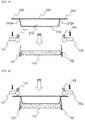
- FIG. 2 is a typical view showing a battery cell bending device according to an embodiment of the present invention.
- a battery cell bending device 100 includes a base plate 110, on which a battery cell is loaded, a pair of bending guides 121 and 123 inserted respectively between left and right outer edges of a battery case and the outer surface of an electrode assembly receiving part in a state in which the battery cell is loaded on the base plate 110, pressing rollers 131 and 132 for pressing the outer edges of the battery case toward the bending guides 121 and 123 to bend the outer edges of the battery case such that the outer edges of the battery case are adjacent to the outer surface of the electrode assembly receiving part, and heating members 141 and 142 disposed adjacent to the pressing rollers 131 and 132 for heating the bent outer edges of the battery case.
- FIGS. 3 to 5 are typical views showing the sequence of a method according to an embodiment of the present invention.
- a battery cell 200 is manufactured by placing an electrode assembly (not shown) having a positive electrode/separator/negative electrode structure in a receiving part 212 of a first sheet type case 210 and connecting the first sheet type case 210 to a second sheet type case 220 by thermal bonding. During thermal bonding, sealed portions 230 and 240 are formed at the outer edges of the receiving part 212.
- the first sheet type case 210 and the second sheet type case 220 may be integrally formed using a single member. Alternatively, the first sheet type case 210 and the second sheet type case 220 may be individually formed using two separate members.
- the battery cell 200 is loaded on the base plate 110 formed at the battery cell bending device 100, the sealed portions 230 and 240 are fixed by the bending guides 121 and 122, respectively, and the pressing rollers 131 and 132 move downward to bend the sealed portions 230 and 240 perpendicularly downward.
- the sealed portions 230 and 240 of the battery cell 200 are heated by the heating members 141 and 142 mounted adjacent to the pressing rollers 131 and 132 simultaneously when the sealed portions 230 and 240 are bent by the pressing rollers 131 and 132, respectively.
- the bent regions of the sealed portions 230 and 240 tightly contact side walls 212a and 212b of the battery cell 200, respectively.
- Cell Guard TM was used as a separator.
- the positive electrode, the negative electrode, and the separator were sequentially stacked to constitute an electrode assembly.
- the electrode assembly was placed in a battery case made of a laminate sheet, an electrolytic solution was poured into the battery case, and the battery case was sealed to manufacture a battery cell.
- a battery cell bending device for bending the outer edges of a battery cell configured to have a structure in which an electrode assembly including a positive electrode, a separator, and a negative electrode is mounted in a battery case, and the battery case is sealed by thermal bonding was constructed.
- the battery cell bending device was configured to include a base plate, on which the battery cell is loaded, a pair of bending guides inserted respectively between left and right outer edges of a battery case and the outer surface of an electrode assembly receiving part in a state in which the battery cell is loaded on the base plate, pressing rollers for pressing the outer edges of the battery case toward the bending guides to bend the outer edges of the battery case such that the outer edges of the battery case are adjacent to the outer surface of the electrode assembly receiving part, and heating members disposed adjacent to the pressing rollers for heating the bent outer edges of the battery case.
- the outer edges of the battery case of the battery cell manufactured as described above were bent using the battery cell bending device. At this time, the outer edges of the battery case were pressed twice at an interval of 1.5 seconds while being heated by the heating members at a temperature of 150 °C to manufacture a battery cell having bent outer edges.
- a battery cell was manufactured in the same manner as in Example 1 except that the temperature of the heating members was set to 180 °C.
- a battery cell was manufactured in the same manner as in Example 1 except that the temperature of the heating members was set to 25 °C.
- a restoration degree of the bent regions of the battery cells manufactured according to Examples 1 and 2 and Comparative example 1 was measured over time. The measurement results are shown in Table 1 and FIG. 6 .
- the battery cell bending device includes heating members for heating the outer edges of a battery cell in a process of perpendicularly bending the outer edges of the battery cell such that the outer edges of the battery cell tightly contact side walls of an electrode assembly receiving part. Consequently, the outer edges of the battery cell is bent and, at the same time, heated, whereby it is possible to fundamentally prevent the occurrence of errors in designing the dimensions of the battery cell, which may be caused due to restoration of the bent regions of the outer edges of the battery cell over time.
Landscapes
- Engineering & Computer Science (AREA)
- Chemical & Material Sciences (AREA)
- Chemical Kinetics & Catalysis (AREA)
- Electrochemistry (AREA)
- General Chemical & Material Sciences (AREA)
- Manufacturing & Machinery (AREA)
- Mechanical Engineering (AREA)
- Secondary Cells (AREA)
- Sealing Battery Cases Or Jackets (AREA)
Abstract
Description
- The present invention relates to a battery cell bending device, and more particularly to a battery cell bending device for bending outer edges of a battery cell configured to have a structure in which an electrode assembly including a positive electrode, a separator, and a negative electrode is mounted in a battery case, and the battery case is sealed by thermal bonding, the battery cell bending device including a base plate, on which the battery cell is loaded, a pair of bending guides inserted respectively between left and right outer edges of a battery case and an outer surface of an electrode assembly receiving part in a state in which the battery cell is loaded on the base plate, pressing rollers for pressing the outer edges of the battery case toward the bending guides to bend the outer edges of the battery case such that the outer edges of the battery case are adjacent to the outer surface of the electrode assembly receiving part, and heating members disposed adjacent to the pressing rollers for heating the bent outer edges of the battery case.
- In recent years, secondary batteries have been increasingly used. In terms of the shape of batteries, the demand for prismatic secondary batteries or pouch-shaped secondary batteries, which are thin enough to be applied to products, such as mobile phones, is very high. In terms of the material for batteries, on the other hand, the demand for lithium secondary batteries, such as lithium ion batteries and lithium ion polymer batteries, which exhibit high energy density, discharge voltage, and output stability, is very high.
- In addition, secondary batteries may be classified based on the structure of an electrode assembly having a positive electrode/separator/negative electrode structure. For example, the electrode assembly may be configured to have a jelly-roll (wound) type structure in which a long sheet type positive electrode and a long sheet type negative electrode are wound in a state in which a separator is disposed between the positive electrode and the negative electrode, a stacked type structure in which pluralities of positive electrodes and negative electrodes each having a predetermined size are sequentially stacked in a state in which separators are disposed respectively between the positive electrodes and the negative electrodes, or a stacked/folded type structure in which predetermined numbers of positive electrodes and negative electrodes are sequentially stacked in a state in which separators are disposed respectively between the positive electrodes and the negative electrodes to constitute a bi-cell or a full cell, and then a plurality of bi-cells or full cells is folded using a separation film.
- In recent years, much interest has been taken in a pouch-shaped battery configured to have a structure in which such a stacked or stacked/folded type electrode assembly is mounted in a pouch-shaped battery case made of an aluminum laminate sheet because of low manufacturing costs, light weight, easy modification in shape, etc. In addition, the use of such a pouch-shaped battery has gradually increased.
-
FIG. 1 is an exploded perspective view typically showing a general structure of a conventional representative pouch-shaped secondary battery. - Referring to
FIG. 1 , a pouch-shapedsecondary battery 10 includes anelectrode assembly 30,electrode tabs electrode assembly 30, electrode leads 60 and 70 connected respectively to theelectrode tabs battery case 20 for receiving theelectrode assembly 30. - The
electrode assembly 30 is a power generating element including positive electrodes and negative electrodes sequentially stacked in a state in which separators are disposed respectively between the positive electrodes and the negative electrodes. Theelectrode assembly 30 is configured to have a stacked type structure or a stacked/folded type structure. Theelectrode tabs electrode assembly 30. The electrode leads 60 and 70 are electrically connected to theelectrode tabs electrode assembly 30, respectively, for example, by welding. The electrode leads 60 and 70 are partially exposed outward from thebattery case 20. In addition,insulating films 80 for improving sealability between thebattery case 20 and the electrode leads 60 and 70 and, at the same time, securing electrical insulation between thebattery case 20 and the electrode leads 60 and 70 are partially attached to the upper and lower surfaces of the electrode leads 60 and 70. - The
battery case 20 is made of an aluminum laminate sheet. Thebattery case 20 has a space defined therein to receive theelectrode assembly 30. Thebattery case 20 is formed generally in the shape of a pouch. In a case in which theelectrode assembly 30 is a stacked type electrode assembly as shown inFIG. 1 , the inner upper end of thebattery case 20 is spaced apart from theelectrode assembly 30 such that thepositive electrode tabs 40 and thenegative electrode tabs 50 can be coupled to the electrode leads 60 and 70, respectively. - The pouch-shaped battery with the above-stated construction is manufactured by receiving the electrode assembly in the battery case made of the laminate sheet, pouring an electrolytic solution into the battery case, sealing the battery case by thermal bonding, receiving the battery cell in a bending device in order to perpendicularly bend the outer edge or the thermally bonded portion (i.e. the sealed portion) of the battery cell such that the bent outer edge of the bent sealed portion comes into tight contact with the side wall of a receiving part of the battery case, and pressing the sealed portion to bend the sealed portion using the bending device. In a case in which the sealed portion is bent using the bending device, however, the bent region of the sealed portion returns to the original state thereof as time passes. As a result, errors occur in designing the dimensions of the battery cell. For this reason, it is necessary to carry out the above-described process again.
- Therefore, there is a high necessity for a technology that is capable of fundamentally solving problems caused in a case in which a sealed portion of a pouch-shaped battery is bent.
- Therefore, the present invention has been made to solve the above problems, and other technical problems that have yet to be resolved.
- That is, it is an object of the present invention to provide a battery cell bending device including heating members for heating the outer edges of a battery cell in a process of perpendicularly bending the outer edges of the battery cell such that the outer edges of the battery cell tightly contact side walls of an electrode assembly receiving part, whereby it is possible to prevent the occurrence of errors in designing the dimensions of the battery cell, which may be caused due to restoration of the bent regions of the outer edges of the battery cell over time.
- It is another object of the present invention to provide a battery cell bending method that is capable of simplifying a conventional bending process, preventing the deterioration in external appearance of a battery cell, achieving a high yield rate, and enabling easy manufacture of the battery cell.
- In accordance with one aspect of the present invention, the above and other objects can be accomplished by the provision of a battery cell bending device for bending outer edges of a battery cell configured to have a structure in which an electrode assembly including a positive electrode, a separator, and a negative electrode is mounted in a battery case, and the battery case is sealed by thermal bonding, the battery cell bending device including a base plate, on which the battery cell is loaded, a pair of bending guides inserted respectively between left and right outer edges of a battery case and an outer surface of an electrode assembly receiving part in a state in which the battery cell is loaded on the base plate, pressing rollers for pressing the outer edges of the battery case toward the bending guides to bend the outer edges of the battery case such that the outer edges of the battery case are adjacent to the outer surface of the electrode assembly receiving part, and heating members disposed adjacent to the pressing rollers for heating the bent outer edges of the battery case.
- The battery cell bending device according to the present invention includes heating members for heating the outer edges of a battery cell in a process of perpendicularly bending the outer edges of the battery cell such that the outer edges of the battery cell tightly contact side walls of an electrode assembly receiving part. Consequently, the outer edges of the battery cell is bent and, at the same time, heated, whereby it is possible to prevent the occurrence of errors in designing the dimensions of the battery cell, which may be caused due to restoration of the bent regions of the outer edges of the battery cell over time.
- The electrode assembly is not particularly restricted so long as a plurality of electrode tabs is connected to constitute a positive electrode and a negative electrode. For example, the electrode assembly may be configured to have a folded type structure, a stacked type structure, or a stacked/folded type structure. The details of the stacked/folded type electrode assembly are disclosed in
Korean Patent Application Publication No. 2001-0082058 2001-0082059 2001-0082060 - The battery cell bending device according to the present invention may be preferably applied to a pouch-shaped secondary battery having an electrode assembly mounted in a receiving part of a pouch-shaped battery case made of a laminate sheet, such as an aluminum laminate sheet, including a metal layer and a resin layer.
- In a concrete example, the bending guides may be configured to have a structure in which the distance between the bending guides is adjustable in response to the size of the battery cell. In this structure, it is possible to stably bend battery cells having various sizes.
- In another concrete example, the bending guides may be configured to have a structure in which a diameter of each of the bending guides gradually decreases in a direction in which the bending guides are inserted respectively between the outer edges of the battery case and the outer surface of the electrode assembly receiving part. In this structure, the outer edges of the battery case may be bent such that at the outer edges of the battery cell tightly contact the outer surface of the electrode assembly receiving part, and desired positions to be bent may be guided. Specifically, each of the bending guides may be formed to have a triangular shape in vertical section.
- Each of the heating members may be provided with a temperature controller for controlling a heating temperature. The optimum temperature for heating the bent regions may be set, and heating may be carried out simultaneously with pressing.
- In addition, the battery cell according to the present invention may be preferably applied to a lithium secondary battery, such as a lithium ion secondary battery having an electrode assembly impregnated with an electrolytic solution containing lithium or a lithium ion polymer battery having an electrode assembly impregnated with an electrolytic solution containing lithium in a gel state.
- For reference, a lithium secondary battery includes a positive electrode, a negative electrode, a separator, and a non-aqueous electrolytic solution containing lithium salt.
- The positive electrode may be manufactured, for example, by applying a mixture of a positive electrode active material, a conductive agent, and a binder to a positive electrode current collector and drying the mixture. A filler may be further added to the mixture as needed.
- The positive electrode active material may be, but is not limited to, a layered compound, such as a lithium cobalt oxide (LiCoO2) or a lithium nickel oxide (LiNiO2), or a compound replaced by one or more transition metals; a lithium manganese oxide represented by a chemical formula Li1+xMn2-xO4 (where x = 0 to 0.33) or a lithium manganese oxide, such as LiMnO3, LiMn2O3, or LiMnO2; a lithium copper oxide (Li2CuO2); a vanadium oxide, such as LiV3O8, LiFe3O4, V2O5, or Cu2V2O7; an Ni-sited lithium nickel oxide represented by a chemical formula LiNi1-xMxO2 (where M= Co, Mn, Al, Cu, Fe, Mg, B, or Ga, and x = 0.01 to 0.3); a lithium manganese composite oxide represented by a chemical formula LiMn2-xMxO2 (where M= Co, Ni, Fe, Cr, Zn, or Ta, and x = 0.01 to 0.1) or a chemical formula Li2Mn3MO8 (where M= Fe, Co, Ni, Cu, or Zn); LiMn2O4 having Li of a chemical formula partially replaced by alkaline earth metal ions; a disulfide compound; or Fe2(MoO4)3.
- The conductive agent is generally added so that the conductive agent has 1 to 30 weight % based on the total weight of the compound including the positive electrode active material. The conductive agent is not particularly restricted so long as the conductive agent exhibits high conductivity while the conductive agent does not induce any chemical change in a battery to which the conductive agent is applied. For example, graphite, such as natural graphite or artificial graphite; carbon black, such as carbon black, acetylene black, Ketjen black, channel black, furnace black, lamp black, or summer black; conductive fiber, such as carbon fiber or metallic fiber; metallic powder, such as carbon fluoride powder, aluminum powder, or nickel powder; conductive whisker, such as zinc oxide or potassium titanate; conductive metal oxide, such as titanium oxide; or conductive materials, such as polyphenylene derivatives may be used as the conductive agent.
- The binder is a component assisting in binding between the active material and the conductive agent and in binding with the current collector. The binder is generally added in an amount of 1 to 30 weight % based on the total weight of the compound including the positive electrode active material. As examples of the binder, there may be used polyvinylidene fluoride, polyvinyl alcohol, carboxymethylcellulose (CMC), starch, hydroxypropylcellulose, regenerated cellulose, polyvinyl pyrollidone, tetrafluoroethylene, polyethylene, polypropylene, ethylene-propylene-diene terpolymer (EPDM), sulfonated EPDM, styrene butadiene rubber, fluoro rubber, and various copolymers.
- The filler is an optional component used to inhibit expansion of the positive electrode. There is no particular limit to the filler so long as it does not cause chemical changes in a battery to which the filler is applied and is made of a fibrous material. As examples of the filler, there may be used olefin polymers, such as polyethylene and polypropylene; and fibrous materials, such as glass fiber and carbon fiber.
- On the other hand, the negative electrode may be manufactured by applying and drying a negative electrode active material to a negative electrode current collector. The above-described components may be selectively added to the negative electrode active material as needed.
- As the negative electrode active material, for example, there may be used carbon, such as non-graphitizing carbon or a graphite-based carbon; a metal composite oxide, such as LixFe2O3 (0≤x≤1), LixWO2 (0≤x≤1), SnxMe1-xMe'yOz (Me: Mn, Fe, Pb, Ge; Me': Al, B, P, Si,
Group - The separator is interposed between the positive electrode and the negative electrode. As the separator, for example, an insulative thin film exhibiting high ion permeability and high mechanical strength may be used. The separator generally has a pore diameter of 0.01 to 10 µm and a thickness of 5 to 300 µm. As the material for the separator, for example, a sheet or non-woven fabric made of olefin polymer, such as polypropylene, which exhibits chemical resistance and hydrophobicity, glass fiber, or polyethylene is used. In a case in which a solid electrolyte, such as polymer, is used as an electrolyte, the solid electrolyte may also function as the separator.
- The non-aqueous electrolytic solution containing lithium salt is composed of a polar organic electrolytic solution and lithium salt. As the electrolytic solution, a non-aqueous liquid electrolytic solution, an organic solid electrolyte, or an inorganic solid electrolyte may be used.
- As examples of the non-aqueous liquid electrolytic solution, mention may be made of non-protic organic solvents, such as N-methyl-2-pyrollidinone, propylene carbonate, ethylene carbonate, butylene carbonate, dimethyl carbonate, diethyl carbonate, gamma-butyro lactone, 1,2-dimethoxy ethane, tetrahydroxy Franc, 2-methyl tetrahydrofuran, dimethylsulfoxide, 1,3-dioxolane, formamide, dimethylformamide, dioxolane, acetonitrile, nitromethane, methyl formate, methyl acetate, phosphoric acid triester, trimethoxy methane, dioxolane derivatives, sulfolane, methyl sulfolane, 1,3-dimethyl-2-imidazolidinone, propylene carbonate derivatives, tetrahydrofuran derivatives, ether, methyl propionate, and ethyl propionate.
- As examples of the organic solid electrolyte, mention may be made of polyethylene derivatives, polyethylene oxide derivatives, polypropylene oxide derivatives, phosphoric acid ester polymers, poly agitation lysine, polyester sulfide, polyvinyl alcohols, polyvinylidene fluoride, and polymers containing ionic dissociation groups.
- As examples of the inorganic solid electrolyte, mention may be made of nitrides, halides, and sulphates of lithium (Li), such as Li3N, LiI, Li5NI2, Li3N-LiI-LiOH, LiSiO4, LiSiO4-LiI-LiOH, Li2SiS3, Li4SiO4, Li4SiO4-LiI-LiOH, and Li3PO4-Li2S-SiS2.
- The lithium salt is a material that is readily soluble in the above-mentioned non-aqueous electrolyte, and may include, for example, LiCl, LiBr, LiI, LiClO4, LiBF4, LiB10Cl10, LiPF6, LiCF3SO3, LiCF3CO2, LiAsF6, LiSbF6, LiAlCl4, CH3SO3Li, CF3SO3Li, (CF3SO2)2NLi, chloroborane lithium, lower aliphatic carboxylic acid lithium, lithium tetraphenyl borate, and imide.
- In addition, in order to improve charge and discharge characteristics and flame retardancy, for example, pyridine, triethylphosphite, triethanolamine, cyclic ether, ethylenediamine, n-glyme, hexaphosphoric triamide, nitrobenzene derivatives, sulfur, quinone imine dyes, N-substituted oxazolidinone, N,N-substituted imidazolidine, ethylene glycol dialkyl ether, ammonium salts, pyrrole, 2-methoxy ethanol, aluminum trichloride, or the like may be added to the non-aqueous electrolytic solution. According to circumstances, in order to impart incombustibility, the non-aqueous electrolytic solution may further include halogen-containing solvents, such as carbon tetrachloride and ethylene trifluoride. Furthermore, in order to improve high-temperature retention characteristics, the non-aqueous electrolytic solution may further include carbon dioxide gas.
- In accordance with another aspect of the present invention, there is provided a method of bending outer edges of a battery cell using the battery cell bending device with the above-stated construction, the battery cell bending method including (a) a first bending process for positioning the battery cell on the battery cell bending device and bending outer edges of the battery cell, (b) a second bending process for adjusting the distance between bending guides and pressing the outer edges of the battery cell, and (c) a third bending process for positioning heating members on the outer edges of the battery cell and bending the outer edges of the battery cell simultaneously with heating the outer edges of the battery cell in a state in which the outer edges of the battery cell is pressed by the bending guides.
- In a concrete example, process (c) may be carried out at a heating temperature of 150 °C to 190 °C, preferably 170 °C to 190 °C.
- If the heating temperature is too low, it is not possible to effectively restrain the restoration of the bent regions, which is not desirable. On the other hand, if the heating temperature is too high, a battery case, which is made of a laminate sheet including a resin layer and a metal layer, may be thermally damaged, which is also not desirable.
- Specifically, process (c) may be carried out for a heating time of 1 to 3 seconds. In a state in which the outer edges of the battery cell are pressed by the bending guides, the heating members may be located on the outer edges of the battery cell in order to bend the outer edges of the battery cell simultaneously with heating the outer edges of the battery cell twice at an interval of 1.5 seconds.
- In accordance with a further aspect of the present invention, there is provided a battery pack including a battery cell having outer edges bent using the battery cell bending method as described above.
- The battery pack may be used as a battery cell which is used as a power source of a small-sized device. In addition, the battery pack may be preferably used as a unit cell of a battery pack including a plurality of battery cells that is used as a power source of a device.
- In a preferred example, the device may be a mobile phone, a portable computer, a smart phone, a tablet PC, a smart pad, a netbook computer, a light electronic vehicle (LEV), an electric vehicle, a hybrid electric vehicle, a plug-in hybrid electric vehicle, or a power storage apparatus. However, the present invention is not limited thereto.
- The above and other objects, features and other advantages of the present invention will be more clearly understood from the following detailed description taken in conjunction with the accompanying drawings, in which:
-
FIG. 1 is an exploded perspective showing a general structure of a conventional pouch-shaped battery; -
FIG. 2 is a typical view showing a battery cell bending device according to an embodiment of the present invention; -
FIGS. 3 to 5 are typical views showing the sequence of a method according to an embodiment of the present invention; and -
FIG. 6 is a graph showing a restoration degree of a bent region according to experimental example 1. - Now, exemplary embodiments of the present invention will be described in detail with reference to the accompanying drawings. It should be noted, however, that the scope of the present invention is not limited by the illustrated embodiments.
-
FIG. 2 is a typical view showing a battery cell bending device according to an embodiment of the present invention. - Referring to
FIG. 2 , a batterycell bending device 100 according to the present invention includes abase plate 110, on which a battery cell is loaded, a pair of bending guides 121 and 123 inserted respectively between left and right outer edges of a battery case and the outer surface of an electrode assembly receiving part in a state in which the battery cell is loaded on thebase plate 110, pressingrollers heating members pressing rollers -
FIGS. 3 to 5 are typical views showing the sequence of a method according to an embodiment of the present invention. - Referring to these figures, first, a battery cell 200 is manufactured by placing an electrode assembly (not shown) having a positive electrode/separator/negative electrode structure in a receiving
part 212 of a firstsheet type case 210 and connecting the firstsheet type case 210 to a secondsheet type case 220 by thermal bonding. During thermal bonding, sealedportions part 212. The firstsheet type case 210 and the secondsheet type case 220 may be integrally formed using a single member. Alternatively, the firstsheet type case 210 and the secondsheet type case 220 may be individually formed using two separate members. - Subsequently, the battery cell 200 is loaded on the
base plate 110 formed at the batterycell bending device 100, the sealedportions pressing rollers portions portions heating members pressing rollers portions pressing rollers portions side walls - Now, the present invention will be described in more detail with reference to the following examples. It should be noted, however, that the scope of the present invention is not limited by the examples.
- 95 weight % of Li2CoO2 as a positive electrode active material, 2.5 weight % of Super-P (a conductive agent), and 2.5 weight % of PVdF (a binder) were added to NMP (N-methyl-2-pyrrolidone) as a solvent to prepare a positive electrode mixture slurry, and 95 weight % of artificial graphite as a negative electrode active material, 2.5 weight % of Super-P (a conductive agent), 2.5 weight % of PVdF (a binder) were added to NMP as a solvent to prepare a negative electrode mixture slurry. Subsequently, the positive electrode mixture slurry was coated, dried, pressed over one surface of aluminum foil to manufacture a positive electrode, and the negative electrode mixture slurry was coated, dried, pressed over one surface of copper foil to manufacture a negative electrode.
- Cell Guard ™ was used as a separator. The positive electrode, the negative electrode, and the separator were sequentially stacked to constitute an electrode assembly. The electrode assembly was placed in a battery case made of a laminate sheet, an electrolytic solution was poured into the battery case, and the battery case was sealed to manufacture a battery cell.
- A battery cell bending device for bending the outer edges of a battery cell configured to have a structure in which an electrode assembly including a positive electrode, a separator, and a negative electrode is mounted in a battery case, and the battery case is sealed by thermal bonding was constructed. The battery cell bending device was configured to include a base plate, on which the battery cell is loaded, a pair of bending guides inserted respectively between left and right outer edges of a battery case and the outer surface of an electrode assembly receiving part in a state in which the battery cell is loaded on the base plate, pressing rollers for pressing the outer edges of the battery case toward the bending guides to bend the outer edges of the battery case such that the outer edges of the battery case are adjacent to the outer surface of the electrode assembly receiving part, and heating members disposed adjacent to the pressing rollers for heating the bent outer edges of the battery case.
- The outer edges of the battery case of the battery cell manufactured as described above were bent using the battery cell bending device. At this time, the outer edges of the battery case were pressed twice at an interval of 1.5 seconds while being heated by the heating members at a temperature of 150 °C to manufacture a battery cell having bent outer edges.
- A battery cell was manufactured in the same manner as in Example 1 except that the temperature of the heating members was set to 180 °C.
- A battery cell was manufactured in the same manner as in Example 1 except that the temperature of the heating members was set to 25 °C.
- A restoration degree of the bent regions of the battery cells manufactured according to Examples 1 and 2 and Comparative example 1 was measured over time. The measurement results are shown in Table 1 and
FIG. 6 .[Table 1] Restoration degree over elapsed time 2 hours 4 hours 1 day 2 days 4 days Example 1 0.4 1.2 1.3 1.2 1.6 Example 2 0.4 0.4 0.9 0.9 0.8 Comparative example 1 2.3 2.4 3.6 3.4 3.6 - It can be seen from Table 1 and
FIG. 6 that the restoration degree of the bent regions over time was not great for the battery cell of Example 1, whereas the restoration degree of the bent regions over time was relatively great for the battery cell of Comparative example 1. It reveals that, in a case in which the battery cell bending device including the heating members are used when the outer edges of the battery cell are perpendicularly bent such that the outer edges of the battery cell tightly contact side walls of the electrode assembly receiving part, restoration of the bent regions over time is restrained. In addition, it reveals that an excellent restraining effect is achieved at a heating temperature of 150 °C to 180 °C. - Although the exemplary embodiments of the present invention have been disclosed for illustrative purposes, those skilled in the art will appreciate that various modifications, additions and substitutions are possible, without departing from the scope and spirit of the invention as disclosed in the accompanying claims.
- As is apparent from the above description, the battery cell bending device according to the present invention includes heating members for heating the outer edges of a battery cell in a process of perpendicularly bending the outer edges of the battery cell such that the outer edges of the battery cell tightly contact side walls of an electrode assembly receiving part. Consequently, the outer edges of the battery cell is bent and, at the same time, heated, whereby it is possible to fundamentally prevent the occurrence of errors in designing the dimensions of the battery cell, which may be caused due to restoration of the bent regions of the outer edges of the battery cell over time.
Claims (16)
- A battery cell bending device for bending outer edges of a battery cell configured to have a structure in which an electrode assembly comprising a positive electrode, a separator, and a negative electrode is mounted in a battery case, and the battery case is sealed by thermal bonding, the battery cell bending device comprising:a base plate, on which the battery cell is loaded;a pair of bending guides inserted respectively between left and right outer edges of a battery case and an outer surface of an electrode assembly receiving part in a state in which the battery cell is loaded on the base plate;pressing rollers for pressing the outer edges of the battery case toward the bending guides to bend the outer edges of the battery case such that the outer edges of the battery case are adjacent to the outer surface of the electrode assembly receiving part; andheating members disposed adjacent to the pressing rollers for heating the bent outer edges of the battery case.
- The battery cell bending device according to claim 1, wherein the electrode assembly is configured to have a folded type structure, a stacked type structure, or a stacked/folded type structure.
- The battery cell bending device according to claim 1, wherein the battery case is made of a laminate sheet comprising a resin layer and a metal layer.
- The battery cell bending device according to claim 3, wherein the laminate sheet is an aluminum laminate sheet.
- The battery cell bending device according to claim 1, wherein the bending guides are configured to have a structure in which a distance between the bending guides is adjustable in response to a size of the battery cell.
- The battery cell bending device according to claim 1, wherein the bending guides are configured to have a structure in which a diameter of each of the bending guides gradually decreases in a direction in which the bending guides are inserted respectively between the outer edges of the battery case and the outer surface of the electrode assembly receiving part.
- The battery cell bending device according to claim 6, wherein each of the bending guides is formed to have a triangular shape in vertical section.
- The battery cell bending device according to claim 1, wherein each of the heating members is provided with a temperature controller for controlling a heating temperature.
- A method of bending outer edges of a battery cell using a battery cell bending device according to any one of claims 1 to 8, the battery cell bending method comprising:(a) a first bending process for positioning the battery cell on the battery cell bending device and bending outer edges of the battery cell;(b) a second bending process for adjusting a distance between bending guides and pressing the outer edges of the battery cell; and(c) a third bending process for positioning heating members on the outer edges of the battery cell and bending the outer edges of the battery cell simultaneously with heating the outer edges of the battery cell in a state in which the outer edges of the battery cell is pressed by the bending guides.
- The battery cell bending method according to claim 9, wherein process (c) is carried out at a heating temperature of 150 °C to 190°C.
- The battery cell bending method according to claim 10, wherein process (c) is carried out at a heating temperature of 170 °C to 190°C.
- The battery cell bending method according to claim 9, wherein process (c) is carried out for a heating time of 1 to 3 seconds.
- The battery cell bending method according to claim 12, wherein heating in process (c) is carried out twice at an interval of 1.5 seconds.
- A battery pack comprising a battery cell having outer edges bent using a battery cell bending method according to claim 9.
- A device comprising a battery pack according to claim 14 as a power source.
- The device according to claim 15, wherein the device is selected from a group consisting of a mobile phone, a portable computer, a smart phone, a tablet PC, a smart pad, a netbook computer, a light electronic vehicle (LEV), an electric vehicle, a hybrid electric vehicle, a plug-in hybrid electric vehicle, and a power storage apparatus.
Applications Claiming Priority (2)
| Application Number | Priority Date | Filing Date | Title |
|---|---|---|---|
| KR1020130115338A KR101603074B1 (en) | 2013-09-27 | 2013-09-27 | Folding Device for Battery Cell having Heating Member |
| PCT/KR2014/004988 WO2015046709A1 (en) | 2013-09-27 | 2014-06-05 | Battery cell bending apparatus comprising heating member |
Publications (3)
| Publication Number | Publication Date |
|---|---|
| EP3035432A4 EP3035432A4 (en) | 2016-06-22 |
| EP3035432A1 true EP3035432A1 (en) | 2016-06-22 |
| EP3035432B1 EP3035432B1 (en) | 2018-09-19 |
Family
ID=52743801
Family Applications (1)
| Application Number | Title | Priority Date | Filing Date |
|---|---|---|---|
| EP14847746.6A Active EP3035432B1 (en) | 2013-09-27 | 2014-06-05 | Battery cell bending apparatus comprising heating member |
Country Status (5)
| Country | Link |
|---|---|
| EP (1) | EP3035432B1 (en) |
| JP (1) | JP6246375B2 (en) |
| KR (1) | KR101603074B1 (en) |
| CN (1) | CN105556735B (en) |
| WO (1) | WO2015046709A1 (en) |
Cited By (8)
| Publication number | Priority date | Publication date | Assignee | Title |
|---|---|---|---|---|
| CN108886118A (en) * | 2017-01-06 | 2018-11-23 | 株式会社Lg化学 | Battery cell manufacturing apparatus using induction heating |
| US10497983B2 (en) | 2016-12-07 | 2019-12-03 | Lg Chem, Ltd. | Folding device for manufacturing electrode assembly and method for manufacturing stack/folding type electrode assembly |
| CN113767495A (en) * | 2020-04-03 | 2021-12-07 | 株式会社快乐福 | Sizing roller device for folding process of battery unit |
| US20220255113A1 (en) * | 2021-02-10 | 2022-08-11 | Lg Energy Solution, Ltd. | Apparatus and Method for Folding Battery Cell |
| WO2023204774A1 (en) * | 2022-04-21 | 2023-10-26 | İzmi̇r Eği̇ti̇m Sağlik Sanayi̇ Yatirim A.Ş. | Thermoplastic based composite material used for cathode in secondary batteries |
| EP4094928A4 (en) * | 2020-09-23 | 2023-11-01 | LG Energy Solution, Ltd. | Side folding apparatus and method |
| EP4129624A4 (en) * | 2020-04-02 | 2024-04-03 | SK On Co., Ltd. | POCKET FOLDING GUIDE APPARATUS AND POCKET FOLDING METHOD FOR SECONDARY BATTERY PACKAGING SYSTEM |
| US11955591B2 (en) | 2019-10-07 | 2024-04-09 | Lg Energy Solution, Ltd. | Method for manufacturing secondary battery and apparatus for manufacturing secondary battery |
Families Citing this family (16)
| Publication number | Priority date | Publication date | Assignee | Title |
|---|---|---|---|---|
| JP6935784B2 (en) * | 2018-05-18 | 2021-09-15 | トヨタ自動車株式会社 | How to manufacture a secondary battery |
| KR102684811B1 (en) * | 2019-02-22 | 2024-07-12 | 산진 옵토일렉트로닉스 (난징) 컴퍼니 리미티드 | Apparatus of aligning a panel |
| KR102015898B1 (en) | 2019-04-25 | 2019-08-28 | 백영진 | Folding Device for electrode lead Part of Battery Cell |
| KR102061664B1 (en) | 2019-08-05 | 2020-01-02 | 김태승 | Sealing part folding device of pouch type secondary battery |
| KR102146944B1 (en) * | 2020-01-23 | 2020-08-21 | 주식회사 와이에이치티 | Sizing roller apparature included in folding system for evenly sizing folded terrace of secondary battery cell |
| CN111883847B (en) * | 2020-07-09 | 2022-08-09 | 合肥国轩高科动力能源有限公司 | Packaging method and packaging structure for reserved air guide port of soft package battery |
| KR102868063B1 (en) * | 2020-09-23 | 2025-10-13 | 주식회사 엘지에너지솔루션 | The Apparatus And The Method For Folding Side |
| CN112467156A (en) * | 2020-11-05 | 2021-03-09 | 苏州中弘智能装备有限公司 | Battery hem device |
| DE102021103376A1 (en) * | 2021-02-12 | 2022-08-18 | Volkswagen Aktiengesellschaft | Battery cell and method for manufacturing a battery cell |
| CN112786972A (en) * | 2021-03-02 | 2021-05-11 | 合肥北恒新能源科技有限公司 | Intelligent cap packaging machine for producing lithium battery and packaging mode thereof |
| ES3040578T3 (en) | 2021-08-20 | 2025-11-03 | Lg Energy Solution Ltd | Pouch-type battery cell, and apparatus for bending pouch wing of pouch-type battery cell |
| JP7714836B2 (en) * | 2021-08-31 | 2025-07-30 | エルジー エナジー ソリューション リミテッド | Pouch-type cell and method for forming its sealing portion |
| KR102851359B1 (en) * | 2021-09-29 | 2025-08-26 | 주식회사 엘지에너지솔루션 | Manufacturing Method of Electrode Assembly and Manufacturing Apparatus thereof |
| KR20230082462A (en) | 2021-12-01 | 2023-06-08 | 주식회사 엘지에너지솔루션 | Pre folding device for pouch type battery |
| US20250144696A1 (en) * | 2022-02-25 | 2025-05-08 | Lg Energy Solution, Ltd. | Pouch Folding Device for Secondary Battery and Secondary Battery |
| JP7852595B2 (en) * | 2022-11-04 | 2026-04-28 | トヨタ自動車株式会社 | Manufacturing equipment for secondary batteries |
Family Cites Families (21)
| Publication number | Priority date | Publication date | Assignee | Title |
|---|---|---|---|---|
| JP2000223083A (en) * | 1999-01-27 | 2000-08-11 | Toshiba Battery Co Ltd | Exterior molding method and exterior molding apparatus for polymer battery |
| KR100515571B1 (en) | 2000-02-08 | 2005-09-20 | 주식회사 엘지화학 | Stacked electrochemical cell |
| KR100497147B1 (en) | 2000-02-08 | 2005-06-29 | 주식회사 엘지화학 | Multiply stacked electrochemical cell and method for preparing the same |
| KR100515572B1 (en) | 2000-02-08 | 2005-09-20 | 주식회사 엘지화학 | Stacked electrochemical cell and method for preparing the same |
| JP2003031264A (en) * | 2001-07-12 | 2003-01-31 | Toshiba Corp | Thin plate bending method and apparatus, and method of manufacturing lithium ion secondary battery |
| KR100667891B1 (en) * | 2002-05-03 | 2007-01-11 | 주식회사 에스에프에이 | Folding device for pouch type secondary battery |
| KR20030093362A (en) * | 2002-05-29 | 2003-12-11 | 아이램테크(주) | Roll folding apparatus of polymer battery |
| JP4636223B2 (en) * | 2003-09-30 | 2011-02-23 | 日本電気株式会社 | LAMINATE FILM HEAT FUSION METHOD, FILM PACKAGE BATTERY MANUFACTURING METHOD, AND LAMINATE FILM HEAT FUSION DEVICE |
| JP4788889B2 (en) * | 2003-10-07 | 2011-10-05 | 日本電気株式会社 | Film-clad battery and method for producing film-clad battery |
| US7736801B2 (en) * | 2004-03-23 | 2010-06-15 | Nec Corporation | Film covered electric device and method of manufacturing the same |
| JP2006134604A (en) * | 2004-11-02 | 2006-05-25 | Ngk Spark Plug Co Ltd | Method for manufacturing power storage device |
| KR100878703B1 (en) * | 2005-11-28 | 2009-01-14 | 주식회사 엘지화학 | Small battery pack with PCM in side sealing part |
| KR101141058B1 (en) * | 2007-07-16 | 2012-07-12 | 주식회사 엘지화학 | Secondary Battery with Improved Thermal Stability |
| JP5196900B2 (en) * | 2007-07-30 | 2013-05-15 | 三洋電機株式会社 | Laminated battery |
| JP4491753B2 (en) * | 2007-11-30 | 2010-06-30 | トヨタ自動車株式会社 | Sealed battery |
| JP5157500B2 (en) * | 2008-02-06 | 2013-03-06 | ソニー株式会社 | Nonaqueous electrolyte battery and manufacturing method thereof |
| JP5480726B2 (en) * | 2010-06-11 | 2014-04-23 | 日新製鋼株式会社 | Manufacturing method for battery case |
| JP2012074321A (en) * | 2010-09-30 | 2012-04-12 | Nisshin Steel Co Ltd | Metallic bottomed or closed container and method for manufacturing the same |
| KR101304870B1 (en) * | 2010-12-02 | 2013-09-06 | 주식회사 엘지화학 | Method for Manufacturing Battery Cell and Battery Cell Manufactured Thereby |
| KR101306190B1 (en) * | 2010-12-02 | 2013-09-09 | 주식회사 엘지화학 | Secondary Battery of Improved Insulating Property |
| CN103123982B (en) * | 2013-01-30 | 2016-02-03 | 东莞市鸿宝锂电科技有限公司 | Full-automatic five-in-one lithium battery forming machine |
-
2013
- 2013-09-27 KR KR1020130115338A patent/KR101603074B1/en active Active
-
2014
- 2014-06-05 CN CN201480052093.0A patent/CN105556735B/en active Active
- 2014-06-05 WO PCT/KR2014/004988 patent/WO2015046709A1/en not_active Ceased
- 2014-06-05 JP JP2016544278A patent/JP6246375B2/en active Active
- 2014-06-05 EP EP14847746.6A patent/EP3035432B1/en active Active
Cited By (12)
| Publication number | Priority date | Publication date | Assignee | Title |
|---|---|---|---|---|
| US10497983B2 (en) | 2016-12-07 | 2019-12-03 | Lg Chem, Ltd. | Folding device for manufacturing electrode assembly and method for manufacturing stack/folding type electrode assembly |
| CN108886118A (en) * | 2017-01-06 | 2018-11-23 | 株式会社Lg化学 | Battery cell manufacturing apparatus using induction heating |
| EP3422435A4 (en) * | 2017-01-06 | 2019-06-19 | LG Chem, Ltd. | BATTERY ELEMENT MANUFACTURING DEVICE USING INDUCTION HEATING |
| US10863590B2 (en) | 2017-01-06 | 2020-12-08 | Lg Chem, Ltd. | Battery cell manufacturing device using induction heating |
| CN108886118B (en) * | 2017-01-06 | 2021-03-12 | 株式会社Lg化学 | Battery cell manufacturing equipment utilizing induction heating |
| US11955591B2 (en) | 2019-10-07 | 2024-04-09 | Lg Energy Solution, Ltd. | Method for manufacturing secondary battery and apparatus for manufacturing secondary battery |
| EP4129624A4 (en) * | 2020-04-02 | 2024-04-03 | SK On Co., Ltd. | POCKET FOLDING GUIDE APPARATUS AND POCKET FOLDING METHOD FOR SECONDARY BATTERY PACKAGING SYSTEM |
| CN113767495A (en) * | 2020-04-03 | 2021-12-07 | 株式会社快乐福 | Sizing roller device for folding process of battery unit |
| EP4094928A4 (en) * | 2020-09-23 | 2023-11-01 | LG Energy Solution, Ltd. | Side folding apparatus and method |
| US20220255113A1 (en) * | 2021-02-10 | 2022-08-11 | Lg Energy Solution, Ltd. | Apparatus and Method for Folding Battery Cell |
| US12555816B2 (en) * | 2021-02-10 | 2026-02-17 | Lg Energy Solution, Ltd. | Apparatus and method for folding battery cell |
| WO2023204774A1 (en) * | 2022-04-21 | 2023-10-26 | İzmi̇r Eği̇ti̇m Sağlik Sanayi̇ Yatirim A.Ş. | Thermoplastic based composite material used for cathode in secondary batteries |
Also Published As
| Publication number | Publication date |
|---|---|
| WO2015046709A1 (en) | 2015-04-02 |
| CN105556735B (en) | 2017-12-29 |
| EP3035432B1 (en) | 2018-09-19 |
| JP2016534538A (en) | 2016-11-04 |
| EP3035432A4 (en) | 2016-06-22 |
| JP6246375B2 (en) | 2017-12-13 |
| KR20150035123A (en) | 2015-04-06 |
| CN105556735A (en) | 2016-05-04 |
| KR101603074B1 (en) | 2016-03-14 |
Similar Documents
| Publication | Publication Date | Title |
|---|---|---|
| EP3035432B1 (en) | Battery cell bending apparatus comprising heating member | |
| EP3163647B1 (en) | Prismatic battery cell comprising two or more case members | |
| CN108028415B (en) | Battery cell and battery pack including the same | |
| EP2955771B1 (en) | Method for manufacturing pouch-type battery cell of which sealing part is insulated by curable material | |
| EP3024084B1 (en) | Method for manufacturing rectangular battery cell using metal plates | |
| EP3062379B1 (en) | Hybrid electrode assembly having stepped structure | |
| EP2922135B1 (en) | Battery cell having amorphous structure | |
| JP2018530133A (en) | Pouch-type battery cell including unit electrode in which a plurality of electrode tabs are formed | |
| EP2958178B1 (en) | Electrode assembly having sloped structure, and battery cell comprising same | |
| KR101163392B1 (en) | Process for Preparation of Pouch-typed Battery having Sealing Part Coated with UV-Curing Material | |
| EP3285317A1 (en) | Secondary battery binder including magnetic material | |
| US10868285B2 (en) | Pouch type battery cell including electrode lead of bending structure | |
| KR101811837B1 (en) | Pouch-Type Battery Cell Having Residue Sealing Portion | |
| KR101750085B1 (en) | Apparatus for Manufacturing Battery Cell and Method for Preparation of Battery Cell Using The Same | |
| KR101650044B1 (en) | Battery Cell Having Structure for Coating with Electrical Insulating Material On End of Sealing Part Bended According to Shape of Receiving Portion in Case | |
| KR102232117B1 (en) | Secondary Battery Pack Comprising Enforcement Tape | |
| KR101675929B1 (en) | Battery Cell Having Structure for Coating with Electrical Insulating Material On End of Sealing Part Bended In A Horizontal Direction | |
| KR20140035605A (en) | Plate-typed battery cell | |
| KR102201632B1 (en) | Battery Cell Having Different Receiving Sizes between Upper Case and Lower Case | |
| KR101995038B1 (en) | Hybrid Electrode Assembly Having Sticking Typed Unit Cell | |
| KR102053092B1 (en) | Polymer Battery Cell Comprising Jelly-roll Typed Electrode Assembly |
Legal Events
| Date | Code | Title | Description |
|---|---|---|---|
| PUAI | Public reference made under article 153(3) epc to a published international application that has entered the european phase |
Free format text: ORIGINAL CODE: 0009012 |
|
| 17P | Request for examination filed |
Effective date: 20160316 |
|
| A4 | Supplementary search report drawn up and despatched |
Effective date: 20160503 |
|
| AK | Designated contracting states |
Kind code of ref document: A1 Designated state(s): AL AT BE BG CH CY CZ DE DK EE ES FI FR GB GR HR HU IE IS IT LI LT LU LV MC MK MT NL NO PL PT RO RS SE SI SK SM TR |
|
| AX | Request for extension of the european patent |
Extension state: BA ME |
|
| DAX | Request for extension of the european patent (deleted) | ||
| STAA | Information on the status of an ep patent application or granted ep patent |
Free format text: STATUS: EXAMINATION IS IN PROGRESS |
|
| 17Q | First examination report despatched |
Effective date: 20170718 |
|
| RIC1 | Information provided on ipc code assigned before grant |
Ipc: H01M 10/0583 20100101ALI20180430BHEP Ipc: H01M 10/058 20100101AFI20180430BHEP Ipc: H01M 2/02 20060101ALI20180430BHEP Ipc: H01M 10/04 20060101ALI20180430BHEP |
|
| GRAP | Despatch of communication of intention to grant a patent |
Free format text: ORIGINAL CODE: EPIDOSNIGR1 |
|
| STAA | Information on the status of an ep patent application or granted ep patent |
Free format text: STATUS: GRANT OF PATENT IS INTENDED |
|
| INTG | Intention to grant announced |
Effective date: 20180704 |
|
| GRAS | Grant fee paid |
Free format text: ORIGINAL CODE: EPIDOSNIGR3 |
|
| GRAA | (expected) grant |
Free format text: ORIGINAL CODE: 0009210 |
|
| STAA | Information on the status of an ep patent application or granted ep patent |
Free format text: STATUS: THE PATENT HAS BEEN GRANTED |
|
| AK | Designated contracting states |
Kind code of ref document: B1 Designated state(s): AL AT BE BG CH CY CZ DE DK EE ES FI FR GB GR HR HU IE IS IT LI LT LU LV MC MK MT NL NO PL PT RO RS SE SI SK SM TR |
|
| REG | Reference to a national code |
Ref country code: GB Ref legal event code: FG4D |
|
| REG | Reference to a national code |
Ref country code: CH Ref legal event code: EP |
|
| REG | Reference to a national code |
Ref country code: AT Ref legal event code: REF Ref document number: 1044307 Country of ref document: AT Kind code of ref document: T Effective date: 20181015 |
|
| REG | Reference to a national code |
Ref country code: IE Ref legal event code: FG4D |
|
| REG | Reference to a national code |
Ref country code: DE Ref legal event code: R096 Ref document number: 602014032733 Country of ref document: DE |
|
| REG | Reference to a national code |
Ref country code: NL Ref legal event code: MP Effective date: 20180919 |
|
| PG25 | Lapsed in a contracting state [announced via postgrant information from national office to epo] |
Ref country code: BG Free format text: LAPSE BECAUSE OF FAILURE TO SUBMIT A TRANSLATION OF THE DESCRIPTION OR TO PAY THE FEE WITHIN THE PRESCRIBED TIME-LIMIT Effective date: 20181219 Ref country code: SE Free format text: LAPSE BECAUSE OF FAILURE TO SUBMIT A TRANSLATION OF THE DESCRIPTION OR TO PAY THE FEE WITHIN THE PRESCRIBED TIME-LIMIT Effective date: 20180919 Ref country code: NO Free format text: LAPSE BECAUSE OF FAILURE TO SUBMIT A TRANSLATION OF THE DESCRIPTION OR TO PAY THE FEE WITHIN THE PRESCRIBED TIME-LIMIT Effective date: 20181219 Ref country code: GR Free format text: LAPSE BECAUSE OF FAILURE TO SUBMIT A TRANSLATION OF THE DESCRIPTION OR TO PAY THE FEE WITHIN THE PRESCRIBED TIME-LIMIT Effective date: 20181220 Ref country code: LT Free format text: LAPSE BECAUSE OF FAILURE TO SUBMIT A TRANSLATION OF THE DESCRIPTION OR TO PAY THE FEE WITHIN THE PRESCRIBED TIME-LIMIT Effective date: 20180919 Ref country code: RS Free format text: LAPSE BECAUSE OF FAILURE TO SUBMIT A TRANSLATION OF THE DESCRIPTION OR TO PAY THE FEE WITHIN THE PRESCRIBED TIME-LIMIT Effective date: 20180919 Ref country code: FI Free format text: LAPSE BECAUSE OF FAILURE TO SUBMIT A TRANSLATION OF THE DESCRIPTION OR TO PAY THE FEE WITHIN THE PRESCRIBED TIME-LIMIT Effective date: 20180919 |
|
| REG | Reference to a national code |
Ref country code: LT Ref legal event code: MG4D |
|
| PG25 | Lapsed in a contracting state [announced via postgrant information from national office to epo] |
Ref country code: HR Free format text: LAPSE BECAUSE OF FAILURE TO SUBMIT A TRANSLATION OF THE DESCRIPTION OR TO PAY THE FEE WITHIN THE PRESCRIBED TIME-LIMIT Effective date: 20180919 Ref country code: AL Free format text: LAPSE BECAUSE OF FAILURE TO SUBMIT A TRANSLATION OF THE DESCRIPTION OR TO PAY THE FEE WITHIN THE PRESCRIBED TIME-LIMIT Effective date: 20180919 Ref country code: LV Free format text: LAPSE BECAUSE OF FAILURE TO SUBMIT A TRANSLATION OF THE DESCRIPTION OR TO PAY THE FEE WITHIN THE PRESCRIBED TIME-LIMIT Effective date: 20180919 |
|
| REG | Reference to a national code |
Ref country code: AT Ref legal event code: MK05 Ref document number: 1044307 Country of ref document: AT Kind code of ref document: T Effective date: 20180919 |
|
| PG25 | Lapsed in a contracting state [announced via postgrant information from national office to epo] |
Ref country code: RO Free format text: LAPSE BECAUSE OF FAILURE TO SUBMIT A TRANSLATION OF THE DESCRIPTION OR TO PAY THE FEE WITHIN THE PRESCRIBED TIME-LIMIT Effective date: 20180919 Ref country code: AT Free format text: LAPSE BECAUSE OF FAILURE TO SUBMIT A TRANSLATION OF THE DESCRIPTION OR TO PAY THE FEE WITHIN THE PRESCRIBED TIME-LIMIT Effective date: 20180919 Ref country code: EE Free format text: LAPSE BECAUSE OF FAILURE TO SUBMIT A TRANSLATION OF THE DESCRIPTION OR TO PAY THE FEE WITHIN THE PRESCRIBED TIME-LIMIT Effective date: 20180919 Ref country code: IT Free format text: LAPSE BECAUSE OF FAILURE TO SUBMIT A TRANSLATION OF THE DESCRIPTION OR TO PAY THE FEE WITHIN THE PRESCRIBED TIME-LIMIT Effective date: 20180919 Ref country code: ES Free format text: LAPSE BECAUSE OF FAILURE TO SUBMIT A TRANSLATION OF THE DESCRIPTION OR TO PAY THE FEE WITHIN THE PRESCRIBED TIME-LIMIT Effective date: 20180919 Ref country code: CZ Free format text: LAPSE BECAUSE OF FAILURE TO SUBMIT A TRANSLATION OF THE DESCRIPTION OR TO PAY THE FEE WITHIN THE PRESCRIBED TIME-LIMIT Effective date: 20180919 Ref country code: NL Free format text: LAPSE BECAUSE OF FAILURE TO SUBMIT A TRANSLATION OF THE DESCRIPTION OR TO PAY THE FEE WITHIN THE PRESCRIBED TIME-LIMIT Effective date: 20180919 Ref country code: IS Free format text: LAPSE BECAUSE OF FAILURE TO SUBMIT A TRANSLATION OF THE DESCRIPTION OR TO PAY THE FEE WITHIN THE PRESCRIBED TIME-LIMIT Effective date: 20190119 Ref country code: PL Free format text: LAPSE BECAUSE OF FAILURE TO SUBMIT A TRANSLATION OF THE DESCRIPTION OR TO PAY THE FEE WITHIN THE PRESCRIBED TIME-LIMIT Effective date: 20180919 |
|
| PG25 | Lapsed in a contracting state [announced via postgrant information from national office to epo] |
Ref country code: SK Free format text: LAPSE BECAUSE OF FAILURE TO SUBMIT A TRANSLATION OF THE DESCRIPTION OR TO PAY THE FEE WITHIN THE PRESCRIBED TIME-LIMIT Effective date: 20180919 Ref country code: PT Free format text: LAPSE BECAUSE OF FAILURE TO SUBMIT A TRANSLATION OF THE DESCRIPTION OR TO PAY THE FEE WITHIN THE PRESCRIBED TIME-LIMIT Effective date: 20190119 Ref country code: SM Free format text: LAPSE BECAUSE OF FAILURE TO SUBMIT A TRANSLATION OF THE DESCRIPTION OR TO PAY THE FEE WITHIN THE PRESCRIBED TIME-LIMIT Effective date: 20180919 |
|
| REG | Reference to a national code |
Ref country code: DE Ref legal event code: R097 Ref document number: 602014032733 Country of ref document: DE |
|
| PLBE | No opposition filed within time limit |
Free format text: ORIGINAL CODE: 0009261 |
|
| STAA | Information on the status of an ep patent application or granted ep patent |
Free format text: STATUS: NO OPPOSITION FILED WITHIN TIME LIMIT |
|
| PG25 | Lapsed in a contracting state [announced via postgrant information from national office to epo] |
Ref country code: DK Free format text: LAPSE BECAUSE OF FAILURE TO SUBMIT A TRANSLATION OF THE DESCRIPTION OR TO PAY THE FEE WITHIN THE PRESCRIBED TIME-LIMIT Effective date: 20180919 |
|
| 26N | No opposition filed |
Effective date: 20190620 |
|
| PG25 | Lapsed in a contracting state [announced via postgrant information from national office to epo] |
Ref country code: SI Free format text: LAPSE BECAUSE OF FAILURE TO SUBMIT A TRANSLATION OF THE DESCRIPTION OR TO PAY THE FEE WITHIN THE PRESCRIBED TIME-LIMIT Effective date: 20180919 |
|
| PG25 | Lapsed in a contracting state [announced via postgrant information from national office to epo] |
Ref country code: MC Free format text: LAPSE BECAUSE OF FAILURE TO SUBMIT A TRANSLATION OF THE DESCRIPTION OR TO PAY THE FEE WITHIN THE PRESCRIBED TIME-LIMIT Effective date: 20180919 |
|
| REG | Reference to a national code |
Ref country code: CH Ref legal event code: PL |
|
| REG | Reference to a national code |
Ref country code: BE Ref legal event code: MM Effective date: 20190630 |
|
| PG25 | Lapsed in a contracting state [announced via postgrant information from national office to epo] |
Ref country code: TR Free format text: LAPSE BECAUSE OF FAILURE TO SUBMIT A TRANSLATION OF THE DESCRIPTION OR TO PAY THE FEE WITHIN THE PRESCRIBED TIME-LIMIT Effective date: 20180919 |
|
| PG25 | Lapsed in a contracting state [announced via postgrant information from national office to epo] |
Ref country code: IE Free format text: LAPSE BECAUSE OF NON-PAYMENT OF DUE FEES Effective date: 20190605 |
|
| PG25 | Lapsed in a contracting state [announced via postgrant information from national office to epo] |
Ref country code: LU Free format text: LAPSE BECAUSE OF NON-PAYMENT OF DUE FEES Effective date: 20190605 Ref country code: BE Free format text: LAPSE BECAUSE OF NON-PAYMENT OF DUE FEES Effective date: 20190630 Ref country code: CH Free format text: LAPSE BECAUSE OF NON-PAYMENT OF DUE FEES Effective date: 20190630 Ref country code: LI Free format text: LAPSE BECAUSE OF NON-PAYMENT OF DUE FEES Effective date: 20190630 |
|
| PG25 | Lapsed in a contracting state [announced via postgrant information from national office to epo] |
Ref country code: CY Free format text: LAPSE BECAUSE OF FAILURE TO SUBMIT A TRANSLATION OF THE DESCRIPTION OR TO PAY THE FEE WITHIN THE PRESCRIBED TIME-LIMIT Effective date: 20180919 |
|
| PG25 | Lapsed in a contracting state [announced via postgrant information from national office to epo] |
Ref country code: MT Free format text: LAPSE BECAUSE OF FAILURE TO SUBMIT A TRANSLATION OF THE DESCRIPTION OR TO PAY THE FEE WITHIN THE PRESCRIBED TIME-LIMIT Effective date: 20180919 Ref country code: HU Free format text: LAPSE BECAUSE OF FAILURE TO SUBMIT A TRANSLATION OF THE DESCRIPTION OR TO PAY THE FEE WITHIN THE PRESCRIBED TIME-LIMIT; INVALID AB INITIO Effective date: 20140605 |
|
| PG25 | Lapsed in a contracting state [announced via postgrant information from national office to epo] |
Ref country code: MK Free format text: LAPSE BECAUSE OF FAILURE TO SUBMIT A TRANSLATION OF THE DESCRIPTION OR TO PAY THE FEE WITHIN THE PRESCRIBED TIME-LIMIT Effective date: 20180919 |
|
| P01 | Opt-out of the competence of the unified patent court (upc) registered |
Effective date: 20230512 |
|
| REG | Reference to a national code |
Ref country code: DE Ref legal event code: R081 Ref document number: 602014032733 Country of ref document: DE Owner name: LG ENERGY SOLUTION, LTD., KR Free format text: FORMER OWNER: LG CHEM, LTD., SEOUL, KR |
|
| REG | Reference to a national code |
Ref country code: GB Ref legal event code: 732E Free format text: REGISTERED BETWEEN 20230824 AND 20230831 |
|
| PGFP | Annual fee paid to national office [announced via postgrant information from national office to epo] |
Ref country code: DE Payment date: 20250520 Year of fee payment: 12 |
|
| PGFP | Annual fee paid to national office [announced via postgrant information from national office to epo] |
Ref country code: GB Payment date: 20250520 Year of fee payment: 12 |
|
| PGFP | Annual fee paid to national office [announced via postgrant information from national office to epo] |
Ref country code: FR Payment date: 20250521 Year of fee payment: 12 |