EP3033086B1 - Combination therapy for the treatment of cancer - Google Patents
Combination therapy for the treatment of cancer Download PDFInfo
- Publication number
- EP3033086B1 EP3033086B1 EP14752433.4A EP14752433A EP3033086B1 EP 3033086 B1 EP3033086 B1 EP 3033086B1 EP 14752433 A EP14752433 A EP 14752433A EP 3033086 B1 EP3033086 B1 EP 3033086B1
- Authority
- EP
- European Patent Office
- Prior art keywords
- compound
- cancer
- letrozole
- dose
- combination
- Prior art date
- Legal status (The legal status is an assumption and is not a legal conclusion. Google has not performed a legal analysis and makes no representation as to the accuracy of the status listed.)
- Active
Links
- RHXHGRAEPCAFML-UHFFFAOYSA-N CN(C)C(c1cc2cnc(Nc(cc3)ncc3N3CCNCC3)nc2[n]1C1CCCC1)=O Chemical compound CN(C)C(c1cc2cnc(Nc(cc3)ncc3N3CCNCC3)nc2[n]1C1CCCC1)=O RHXHGRAEPCAFML-UHFFFAOYSA-N 0.000 description 2
- CWHUFRVAEUJCEF-UHFFFAOYSA-N Nc(nc1)cc(C(F)(F)F)c1-c1nc(N2CCOCC2)nc(N2CCOCC2)c1 Chemical compound Nc(nc1)cc(C(F)(F)F)c1-c1nc(N2CCOCC2)nc(N2CCOCC2)c1 CWHUFRVAEUJCEF-UHFFFAOYSA-N 0.000 description 1
Images


Classifications
-
- A—HUMAN NECESSITIES
- A61—MEDICAL OR VETERINARY SCIENCE; HYGIENE
- A61K—PREPARATIONS FOR MEDICAL, DENTAL OR TOILETRY PURPOSES
- A61K31/00—Medicinal preparations containing organic active ingredients
- A61K31/13—Amines
- A61K31/135—Amines having aromatic rings, e.g. ketamine, nortriptyline
- A61K31/138—Aryloxyalkylamines, e.g. propranolol, tamoxifen, phenoxybenzamine
-
- A—HUMAN NECESSITIES
- A61—MEDICAL OR VETERINARY SCIENCE; HYGIENE
- A61K—PREPARATIONS FOR MEDICAL, DENTAL OR TOILETRY PURPOSES
- A61K31/00—Medicinal preparations containing organic active ingredients
- A61K31/33—Heterocyclic compounds
- A61K31/395—Heterocyclic compounds having nitrogen as a ring hetero atom, e.g. guanethidine or rifamycins
- A61K31/41—Heterocyclic compounds having nitrogen as a ring hetero atom, e.g. guanethidine or rifamycins having five-membered rings with two or more ring hetero atoms, at least one of which being nitrogen, e.g. tetrazole
- A61K31/4196—1,2,4-Triazoles
-
- A—HUMAN NECESSITIES
- A61—MEDICAL OR VETERINARY SCIENCE; HYGIENE
- A61K—PREPARATIONS FOR MEDICAL, DENTAL OR TOILETRY PURPOSES
- A61K31/00—Medicinal preparations containing organic active ingredients
- A61K31/33—Heterocyclic compounds
- A61K31/395—Heterocyclic compounds having nitrogen as a ring hetero atom, e.g. guanethidine or rifamycins
- A61K31/41—Heterocyclic compounds having nitrogen as a ring hetero atom, e.g. guanethidine or rifamycins having five-membered rings with two or more ring hetero atoms, at least one of which being nitrogen, e.g. tetrazole
- A61K31/425—Thiazoles
- A61K31/427—Thiazoles not condensed and containing further heterocyclic rings
-
- A—HUMAN NECESSITIES
- A61—MEDICAL OR VETERINARY SCIENCE; HYGIENE
- A61K—PREPARATIONS FOR MEDICAL, DENTAL OR TOILETRY PURPOSES
- A61K31/00—Medicinal preparations containing organic active ingredients
- A61K31/33—Heterocyclic compounds
- A61K31/395—Heterocyclic compounds having nitrogen as a ring hetero atom, e.g. guanethidine or rifamycins
- A61K31/435—Heterocyclic compounds having nitrogen as a ring hetero atom, e.g. guanethidine or rifamycins having six-membered rings with one nitrogen as the only ring hetero atom
- A61K31/4353—Heterocyclic compounds having nitrogen as a ring hetero atom, e.g. guanethidine or rifamycins having six-membered rings with one nitrogen as the only ring hetero atom ortho- or peri-condensed with heterocyclic ring systems
- A61K31/436—Heterocyclic compounds having nitrogen as a ring hetero atom, e.g. guanethidine or rifamycins having six-membered rings with one nitrogen as the only ring hetero atom ortho- or peri-condensed with heterocyclic ring systems the heterocyclic ring system containing a six-membered ring having oxygen as a ring hetero atom, e.g. rapamycin
-
- A—HUMAN NECESSITIES
- A61—MEDICAL OR VETERINARY SCIENCE; HYGIENE
- A61K—PREPARATIONS FOR MEDICAL, DENTAL OR TOILETRY PURPOSES
- A61K31/00—Medicinal preparations containing organic active ingredients
- A61K31/33—Heterocyclic compounds
- A61K31/395—Heterocyclic compounds having nitrogen as a ring hetero atom, e.g. guanethidine or rifamycins
- A61K31/435—Heterocyclic compounds having nitrogen as a ring hetero atom, e.g. guanethidine or rifamycins having six-membered rings with one nitrogen as the only ring hetero atom
- A61K31/44—Non condensed pyridines; Hydrogenated derivatives thereof
- A61K31/4427—Non condensed pyridines; Hydrogenated derivatives thereof containing further heterocyclic ring systems
- A61K31/4439—Non condensed pyridines; Hydrogenated derivatives thereof containing further heterocyclic ring systems containing a five-membered ring with nitrogen as a ring hetero atom, e.g. omeprazole
-
- A—HUMAN NECESSITIES
- A61—MEDICAL OR VETERINARY SCIENCE; HYGIENE
- A61K—PREPARATIONS FOR MEDICAL, DENTAL OR TOILETRY PURPOSES
- A61K31/00—Medicinal preparations containing organic active ingredients
- A61K31/33—Heterocyclic compounds
- A61K31/395—Heterocyclic compounds having nitrogen as a ring hetero atom, e.g. guanethidine or rifamycins
- A61K31/495—Heterocyclic compounds having nitrogen as a ring hetero atom, e.g. guanethidine or rifamycins having six-membered rings with two or more nitrogen atoms as the only ring heteroatoms, e.g. piperazine or tetrazines
-
- A—HUMAN NECESSITIES
- A61—MEDICAL OR VETERINARY SCIENCE; HYGIENE
- A61K—PREPARATIONS FOR MEDICAL, DENTAL OR TOILETRY PURPOSES
- A61K31/00—Medicinal preparations containing organic active ingredients
- A61K31/33—Heterocyclic compounds
- A61K31/395—Heterocyclic compounds having nitrogen as a ring hetero atom, e.g. guanethidine or rifamycins
- A61K31/495—Heterocyclic compounds having nitrogen as a ring hetero atom, e.g. guanethidine or rifamycins having six-membered rings with two or more nitrogen atoms as the only ring heteroatoms, e.g. piperazine or tetrazines
- A61K31/505—Pyrimidines; Hydrogenated pyrimidines, e.g. trimethoprim
- A61K31/506—Pyrimidines; Hydrogenated pyrimidines, e.g. trimethoprim not condensed and containing further heterocyclic rings
-
- A—HUMAN NECESSITIES
- A61—MEDICAL OR VETERINARY SCIENCE; HYGIENE
- A61K—PREPARATIONS FOR MEDICAL, DENTAL OR TOILETRY PURPOSES
- A61K31/00—Medicinal preparations containing organic active ingredients
- A61K31/33—Heterocyclic compounds
- A61K31/395—Heterocyclic compounds having nitrogen as a ring hetero atom, e.g. guanethidine or rifamycins
- A61K31/495—Heterocyclic compounds having nitrogen as a ring hetero atom, e.g. guanethidine or rifamycins having six-membered rings with two or more nitrogen atoms as the only ring heteroatoms, e.g. piperazine or tetrazines
- A61K31/505—Pyrimidines; Hydrogenated pyrimidines, e.g. trimethoprim
- A61K31/519—Pyrimidines; Hydrogenated pyrimidines, e.g. trimethoprim ortho- or peri-condensed with heterocyclic rings
-
- A—HUMAN NECESSITIES
- A61—MEDICAL OR VETERINARY SCIENCE; HYGIENE
- A61K—PREPARATIONS FOR MEDICAL, DENTAL OR TOILETRY PURPOSES
- A61K31/00—Medicinal preparations containing organic active ingredients
- A61K31/33—Heterocyclic compounds
- A61K31/395—Heterocyclic compounds having nitrogen as a ring hetero atom, e.g. guanethidine or rifamycins
- A61K31/535—Heterocyclic compounds having nitrogen as a ring hetero atom, e.g. guanethidine or rifamycins having six-membered rings with at least one nitrogen and one oxygen as the ring hetero atoms, e.g. 1,2-oxazines
- A61K31/5375—1,4-Oxazines, e.g. morpholine
- A61K31/5377—1,4-Oxazines, e.g. morpholine not condensed and containing further heterocyclic rings, e.g. timolol
-
- A—HUMAN NECESSITIES
- A61—MEDICAL OR VETERINARY SCIENCE; HYGIENE
- A61K—PREPARATIONS FOR MEDICAL, DENTAL OR TOILETRY PURPOSES
- A61K31/00—Medicinal preparations containing organic active ingredients
- A61K31/33—Heterocyclic compounds
- A61K31/395—Heterocyclic compounds having nitrogen as a ring hetero atom, e.g. guanethidine or rifamycins
- A61K31/55—Heterocyclic compounds having nitrogen as a ring hetero atom, e.g. guanethidine or rifamycins having seven-membered rings, e.g. azelastine, pentylenetetrazole
- A61K31/551—Heterocyclic compounds having nitrogen as a ring hetero atom, e.g. guanethidine or rifamycins having seven-membered rings, e.g. azelastine, pentylenetetrazole having two nitrogen atoms, e.g. dilazep
-
- A—HUMAN NECESSITIES
- A61—MEDICAL OR VETERINARY SCIENCE; HYGIENE
- A61K—PREPARATIONS FOR MEDICAL, DENTAL OR TOILETRY PURPOSES
- A61K31/00—Medicinal preparations containing organic active ingredients
- A61K31/33—Heterocyclic compounds
- A61K31/395—Heterocyclic compounds having nitrogen as a ring hetero atom, e.g. guanethidine or rifamycins
- A61K31/55—Heterocyclic compounds having nitrogen as a ring hetero atom, e.g. guanethidine or rifamycins having seven-membered rings, e.g. azelastine, pentylenetetrazole
- A61K31/551—Heterocyclic compounds having nitrogen as a ring hetero atom, e.g. guanethidine or rifamycins having seven-membered rings, e.g. azelastine, pentylenetetrazole having two nitrogen atoms, e.g. dilazep
- A61K31/5513—1,4-Benzodiazepines, e.g. diazepam or clozapine
-
- A—HUMAN NECESSITIES
- A61—MEDICAL OR VETERINARY SCIENCE; HYGIENE
- A61K—PREPARATIONS FOR MEDICAL, DENTAL OR TOILETRY PURPOSES
- A61K31/00—Medicinal preparations containing organic active ingredients
- A61K31/56—Compounds containing cyclopenta[a]hydrophenanthrene ring systems; Derivatives thereof, e.g. steroids
-
- A—HUMAN NECESSITIES
- A61—MEDICAL OR VETERINARY SCIENCE; HYGIENE
- A61K—PREPARATIONS FOR MEDICAL, DENTAL OR TOILETRY PURPOSES
- A61K31/00—Medicinal preparations containing organic active ingredients
- A61K31/56—Compounds containing cyclopenta[a]hydrophenanthrene ring systems; Derivatives thereof, e.g. steroids
- A61K31/565—Compounds containing cyclopenta[a]hydrophenanthrene ring systems; Derivatives thereof, e.g. steroids not substituted in position 17 beta by a carbon atom, e.g. estrane, estradiol
-
- A—HUMAN NECESSITIES
- A61—MEDICAL OR VETERINARY SCIENCE; HYGIENE
- A61K—PREPARATIONS FOR MEDICAL, DENTAL OR TOILETRY PURPOSES
- A61K31/00—Medicinal preparations containing organic active ingredients
- A61K31/56—Compounds containing cyclopenta[a]hydrophenanthrene ring systems; Derivatives thereof, e.g. steroids
- A61K31/565—Compounds containing cyclopenta[a]hydrophenanthrene ring systems; Derivatives thereof, e.g. steroids not substituted in position 17 beta by a carbon atom, e.g. estrane, estradiol
- A61K31/568—Compounds containing cyclopenta[a]hydrophenanthrene ring systems; Derivatives thereof, e.g. steroids not substituted in position 17 beta by a carbon atom, e.g. estrane, estradiol substituted in positions 10 and 13 by a chain having at least one carbon atom, e.g. androstanes, e.g. testosterone
- A61K31/5685—Compounds containing cyclopenta[a]hydrophenanthrene ring systems; Derivatives thereof, e.g. steroids not substituted in position 17 beta by a carbon atom, e.g. estrane, estradiol substituted in positions 10 and 13 by a chain having at least one carbon atom, e.g. androstanes, e.g. testosterone having an oxo group in position 17, e.g. androsterone
-
- A—HUMAN NECESSITIES
- A61—MEDICAL OR VETERINARY SCIENCE; HYGIENE
- A61K—PREPARATIONS FOR MEDICAL, DENTAL OR TOILETRY PURPOSES
- A61K45/00—Medicinal preparations containing active ingredients not provided for in groups A61K31/00 - A61K41/00
- A61K45/06—Mixtures of active ingredients without chemical characterisation, e.g. antiphlogistics and cardiaca
-
- A—HUMAN NECESSITIES
- A61—MEDICAL OR VETERINARY SCIENCE; HYGIENE
- A61P—SPECIFIC THERAPEUTIC ACTIVITY OF CHEMICAL COMPOUNDS OR MEDICINAL PREPARATIONS
- A61P35/00—Antineoplastic agents
-
- A—HUMAN NECESSITIES
- A61—MEDICAL OR VETERINARY SCIENCE; HYGIENE
- A61P—SPECIFIC THERAPEUTIC ACTIVITY OF CHEMICAL COMPOUNDS OR MEDICINAL PREPARATIONS
- A61P35/00—Antineoplastic agents
- A61P35/02—Antineoplastic agents specific for leukemia
-
- A—HUMAN NECESSITIES
- A61—MEDICAL OR VETERINARY SCIENCE; HYGIENE
- A61P—SPECIFIC THERAPEUTIC ACTIVITY OF CHEMICAL COMPOUNDS OR MEDICINAL PREPARATIONS
- A61P43/00—Drugs for specific purposes, not provided for in groups A61P1/00-A61P41/00
-
- A—HUMAN NECESSITIES
- A61—MEDICAL OR VETERINARY SCIENCE; HYGIENE
- A61P—SPECIFIC THERAPEUTIC ACTIVITY OF CHEMICAL COMPOUNDS OR MEDICINAL PREPARATIONS
- A61P5/00—Drugs for disorders of the endocrine system
-
- A—HUMAN NECESSITIES
- A61—MEDICAL OR VETERINARY SCIENCE; HYGIENE
- A61P—SPECIFIC THERAPEUTIC ACTIVITY OF CHEMICAL COMPOUNDS OR MEDICINAL PREPARATIONS
- A61P5/00—Drugs for disorders of the endocrine system
- A61P5/24—Drugs for disorders of the endocrine system of the sex hormones
- A61P5/32—Antioestrogens
-
- A—HUMAN NECESSITIES
- A61—MEDICAL OR VETERINARY SCIENCE; HYGIENE
- A61K—PREPARATIONS FOR MEDICAL, DENTAL OR TOILETRY PURPOSES
- A61K2300/00—Mixtures or combinations of active ingredients, wherein at least one active ingredient is fully defined in groups A61K31/00 - A61K41/00
Definitions
- the present invention relates to a pharmaceutical combination
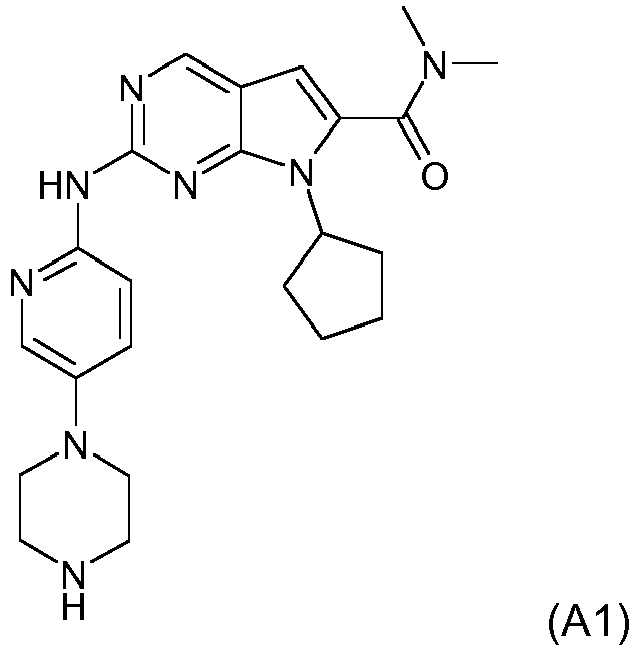
- a pharmaceutical combination comprising (1) Compound A1, described by Formula A1 below: or a pharmaceutically acceptable salt thereof, and (2) letrozole and the uses of such combinations in the treatment of cancer as described in the claims.
- CDKs The function of CDKs is to phosphorylate and thus activate or deactivate certain proteins, including e.g. retinoblastoma proteins, lamins, histone H1, and components of the mitotic spindle.
- the catalytic step mediated by CDKs involves a phospho-transfer reaction from ATP to the macromolecular enzyme substrate.
- Several groups of compounds (reviewed in e.g. Fischer, P. M. Curr. Opin. Drug Discovery Dev. 2001, 4, 623-634 ) have been found to possess anti-proliferative properties by virtue of CDK-specific ATP antagonism.
- CDK phosphorylation is performed by a group of CDK activating kinases (CAKs) and/or kinases such as wee1, Myt1 and Mik1.
- Dephosphorylation is performed by phosphatases such as cdc25(a & c), pp2a, or KAP.
- CDK/cyclin complex activity may be further regulated by two families of endogenous cellular proteinaceous inhibitors: the Kip/Cip family, or the INK family.
- the INK proteins specifically bind CDK4 and CDK6.
- p16ink4 also known as MTS1
- MTS1 is a potential tumour suppressor gene that is mutated, or deleted, in a large number of primary cancers.
- the Kip/Cip family contains proteins such as p21Cip1,Waf1, p27Kip1 and p57kip2, where p21 is induced by p53 and is able to inactivate the CDK2/cyclin(E/A) complex.
- Atypically low levels of p27 expression have been observed in breast, colon and prostate cancers.
- Conversely over expression of cyclin E in solid tumours has been shown to correlate with poor patient prognosis.
- Over expression of cyclin D1 has been associated with oesophageal, breast, squa
- CDKs The pivotal roles of CDKs, and their associated proteins, in co-ordinating and driving the cell cycle in proliferating cells have been outlined above. Some of the biochemical pathways in which CDKs play a key role have also been described. The development of monotherapies for the treatment of proliferative disorders, such as cancers, using therapeutics targeted generically at CDKs, or at specific CDKs, is therefore potentially highly desirable. Thus, there is a continued need to find new therapeutic agents to treat human diseases.
- Anti-hormonal agent works in two ways: (1) by lowering the amount of the hormone in the body or (2) by blocking the action of hormone on cells.
- Aromatase inhibitors work by inhibiting the action of the enzyme aromatase, which converts androgens into estrogens by a process called aromatization. As breast tissue is stimulated by estrogens, decreasing their production is a way of suppressing recurrence of the breast tumor tissue.
- the main source of estrogen is the ovaries in premenopausal women, while in post-menopausal women most of the body's estrogen is produced in peripheral tissues (outside the CNS), and also a few CNS sites in various regions within the brain.
- Estrogen is produced and acts locally in these tissues, but any circulating estrogen, which exerts systemic estrogenic effects in men and women, is the result of estrogen escaping local metabolism and spreading to the circulatory system.
- aromatase inhibitors There are two types: (1) steroidal inhibitors, such as exemestane (Aromasin) which forms a permanent and deactivating bond with the aromatase enzyme; and (2) non-steroidal inhibitors, such as anastrozole (Arimidex) or Letrozole (Femara) which inhibit the synthesis of estrogen via reversible competition for the aromatase enzyme.
- estrogen receptor antagonist Another type of anti-hormonal agent is estrogen receptor antagonist.
- An example of an estrogen receptor antagonist is fulvestrant (Faslodex).
- Estrogen receptors are found in and on breast cells. Estrogen binds to estrogen receptors, like a key fitting into a lock. This can activate the receptor and cause hormone receptor-positive tumors to grow. Fulvestrant binds to and blocks estrogen receptors and reduces the number of estrogen receptors in breast cells.
- SERMs selective estrogen receptor modulators
- tamoxifen is an estrogen receptor agonist at bone and uterus, but an antagonist at breast.
- Phosphatidylinositol 3-kinases are widely expressed lipid kinases that catalyze the transfer of phosphate to the D-3' position of inositol lipids to produce phosphoinositol-3-phosphate (PIP), phosphoinositol-3,4-diphosphate (PIP 2 ) and phosphoinositol-3,4,5-triphosphate (PIP 3 ).
- PIP phosphoinositol-3-phosphate
- PIP 2 phosphoinositol-3,4-diphosphate
- PIP 3 phosphoinositol-3,4,5-triphosphate
- Class 1A PI3Ks are heterodimers composed of a catalytic p110 subunit ( ⁇ , ⁇ , ⁇ isoforms) constitutively associated with a regulatory subunit that can be p85 ⁇ , p55 ⁇ , p50 ⁇ , p85 ⁇ or p55 ⁇ .
- the Class 1B sub-class has one family member, a heterodimer composed of a catalytic p110 ⁇ subunit associated with one of two regulatory subunits, p101 or p84 ( Fruman et al., Annu Rev. Biochem. 67:481 (1998 ); Suire et al., Curr. Biol. 15:566 (2005 )).
- PIP2 and PIP3 recruit AKT to the plasma membrane where it acts as a nodal point for many intracellular signaling pathways important for growth and survival ( Fantl et al., Cell 69:413-423(1992 ); Bader et al., Nature Rev. Cancer 5:921 (2005 ); Vivanco and Sawyer, Nature Rev. Cancer 2:489 (2002 )).
- Aberrant regulation of PI3K which often increases survival through AKT activation, is one of the most prevalent events in human cancer and has been shown to occur at multiple levels.
- the tumor suppressor gene PTEN which dephosphorylates phosphoinositides at the 3' position of the inositol ring and in so doing antagonizes PI3K activity, is functionally deleted in a variety of tumors.
- the genes for the p110 ⁇ isoform, PIK3CA, and for AKT are amplified and increased protein expression of their gene products has been demonstrated in several human cancers.
- somatic missense mutations in PIK3CA that activate downstream signaling pathways have been described at significant frequencies in a wide diversity of human cancers ( Kang at el., Proc. Natl. Acad. Sci.
- inhibitors of PI3K alpha are known to be of particular value in the treatment of cancer and other disorders.
- mTOR is a kinase protein predominantly found in the cytoplasm of the cell. It acts as a central regulator of many biological processes related to cell proliferation, angiogenesis, and cell metabolism. mTOR exerts its effects primarily by turning on and off the cell's translational machinery, which includes the ribosomes, and is responsible for protein synthesis. mTOR is a key intracellular point of convergence for a number of cellular signaling pathways. mTOR performs its regulatory function in response to activating or inhibitory signals transmitted through these pathways, which are located upstream from mTOR in the cell.
- VEGFs vascular endothelial growth factors
- PDGF platelet-derived growth factor
- EGF epidermal growth factor
- IGF-1 insulin-like growth factor 1
- hormones estrogen, progesterone
- glucose glucose
- one or more of these signaling pathways may be abnormally activated in patients with many different types of cancer, resulting in deregulated cell proliferation, tumor angiogenesis, and abnormal cell metabolism.
- Van Tine et al disclose thatigand-independent ER activity promotes the growth of breast cancer cells through CDK4/E2F and the phosphatidylinositol 3-kinase (PI3K) pathway is also upregulated in endocrine therapy-resistant cells as an independent event.
- PI3K phosphatidylinositol 3-kinase
- WO2013/006532 relates to the combination of a CDK inhibitor and a PI3K/Akt/mTOR regulator.
- the present invention relates to a pharmaceutical combination
- a pharmaceutical combination comprising (1) a first agent which is Compound A1 described by Formula A1 below or a pharmaceutically acceptable salt thereof: and (2) a second agent which is letrozole or a pharmaceutically acceptable salt thereof
- Compound A1 is also described by the chemical name 7-Cyclopentyl-2-(5-piperazin-1-yl-pyridin-2-ylamino)-7H-pyrrolo[2,3-d]pyrimidine-6-carboxylic acid dimethylamide.
- a method for the treatment of a cancer comprising administering the above pharmaceutical combination(s) in jointly therapeutically effective amount, to a warm-blooded animal, preferably a human, in need thereof is also described.
- the compounds in the pharmaceutical combination(s) may be administered either as a single pharmaceutical composition, as separate compositions, or sequentially.
- the invention provides a pharmaceutical combination comprising (1) a first agent which is Compound A1 described by Formula A1 below or a pharmaceutically acceptable salt thereof: and (2) a second agent which is letrozole.
- the invention relates to a pharmaceutical combination
- a pharmaceutical combination comprising (1) a first agent which is Compound A1 described by Formula A1 below or a pharmaceutically acceptable salt thereof: and (2) a second agent which is letrozolefor for use in treating HR+, HER2- breast cancer.
- the invention in another embodiment, relates to a pharmaceutical combination
- a pharmaceutical combination comprising (1) a first agent which is Compound A1 described by Formula A1 below or a pharmaceutically acceptable salt thereof: and (2) a second agent which is letrozole for use in treating ER+, HER2- advanced breast cancer.
- the present disclosure further relates to a kit comprising the pharmaceutical combination.
- Aromatase inhibitor used herein relates to compounds which inhibit the estrogen production, i.e. the conversion of the substrates androstenedione and testosterone to estrone and estradiol, respectively. Such compounds will be referred to as “aromatase inhibitors”.
- SERM selective estrogen receptor modulator
- PI3K inhibitor is defined herein to refer to a compound which targets, decreases or inhibits phosphatidylinositol 3-kinase. Phosphatidylinositol 3-kinase activity has been shown to increase in response to a number of hormonal and growth factor stimuli, including insulin, platelet-derived growth factor, insulin-like growth factor, epidermal growth factor, colony-stimulating factor, and hepatocyte growth factor, and has been implicated in processes related to cellular growth and transformation.
- Combination refers to either a fixed combination in one dosage unit form, or a non-fixed combination (or kit of parts) for the combined administration where a compound and a combination partner (e.g. another drug as explained below, also referred to as “therapeutic agent” or “co-agent”) may be administered independently at the same time or separately within time intervals, especially where these time intervals allow that the combination partners show a cooperative, e.g. synergistic effect.
- a combination partner e.g. another drug as explained below, also referred to as “therapeutic agent” or “co-agent”
- therapeutic agent e.g. another drug as explained below, also referred to as "therapeutic agent” or “co-agent”
- combined administration or the like as utilized herein are meant to encompass administration of the selected combination partner to a single subject in need thereof (e.g. a patient), and are intended to include treatment regimens in which the agents are not necessarily administered by the same route of administration or at the same time.
- fixed combination means that the active ingredients, e.g. a compound of formula A1 and a combination partner, are both administered to a patient simultaneously in the form of a single entity or dosage.
- non-fixed combination or “kit of parts” mean that the active ingredients, e.g. a compound of formula A1 and a combination partner, are both administered to a patient as separate entities either simultaneously, concurrently or sequentially with no specific time limits, wherein such administration provides therapeutically effective levels of the two compounds in the body of the patient.
- Treatment includes prophylactic and therapeutic treatment (including but not limited to palliative, curing, symptom-alleviating, symptom-reducing) as well as the delay of progression of a cancer disease or disorder.
- prophylactic means the prevention of the onset or recurrence of a cancer.
- delay of progression means administration of the combination to patients being in a pre-stage or in an early phase of the cancer to be treated, a pre-form of the corresponding cancer is diagnosed and/or in a patient diagnosed with a condition under which it is likely that a corresponding cancer will develop.
- “Pharmaceutical preparation” or “pharmaceutical composition” refers to a mixture or solution containing at least one therapeutic agent to be administered to a warm-bloodeded, e.g., a human.
- Co-administer means to encompass administration of the selected therapeutic agents to a single patient, and are intended to include treatment regimens in which the agents are not necessarily administered by the same route of administration or at the same time.
- “Pharmaceutically acceptable” refers to those compounds, materials, compositions and/or dosage forms, which are, within the scope of sound medical judgment, suitable for contact with the tissues of mammals, especially humans, without excessive toxicity, irritation, allergic response and other problem complications commensurate with a reasonable benefit/risk ratio.
- “Therapeutically effective” preferably relates to an amount of a therapeutic agent that is therapeutically or in a broader sense also prophylactically effective against the progression of a cancer.
- “Jointly therapeutically effective” means that the therapeutic agents may be given separately (in a chronologically staggered manner, especially a sequence-specific manner) in such time intervals that they prefer, in the warm-blooded animal, especially human, to be treated, still show a (preferably synergistic) interaction. Whether this is the case can, inter alia, be determined by following the blood levels, showing that both compounds are present in the blood of the human to be treated at least during certain time intervals.
- Single pharmaceutical composition refers to a single carrier or vehicle formulated to deliver effective amounts of both therapeutic agents to a patient.
- the single vehicle is designed to deliver an effective amount of each of the agents, along with any pharmaceutically acceptable carriers or excipients.
- the vehicle is a tablet, capsule, pill, or a patch. In other embodiments, the vehicle is a solution or a suspension.
- Dose range refers to an upper and a lower limit of an acceptable variation of the amount of therapeutic agent specified. Typically, a dose of the agent in any amount within the specified range can be administered to patients undergoing treatment.
- Subject is intended to include animals.
- subjects include mammals, e.g., humans, dogs, cows, horses, pigs, sheep, goats, cats, mice, rabbits, rats, and transgenic non-human animals.
- the subject is a human, e.g., a human suffering from, at risk of suffering from, or potentially capable of suffering from a brain tumor disease.
- the subject or warm-blooded animal is human.
- the terms “about” or “approximately” usually means within 20%, more preferably within 10%, and most preferably still within 5% of a given value or range. Alternatively, especially in biological systems, the term “about” means within about a log (i.e., an order of magnitude) preferably within a factor of two of a given value.
- the present disclosure relates to a pharmaceutical combination comprising (1) a CDK inhibitor or a pharmaceutically acceptable salt thereof and (2) an anti-hormonal agent or a pharmaceutically acceptable salt thereof.
- the present disclosure also relates to a pharmaceutical combination
- a pharmaceutical combination comprising (1) a CDK inhibitor or a pharmaceutically acceptable salt thereof, (2) an anti-hormonal agent or a pharmaceutically acceptable salt thereof, and (3) an agent that regulates the PI3K/Akt/mTOR pathway or a pharmaceutically acceptable salt thereof.
- Such combination may be for simultaneous, separate or sequential use for the treatment of a cancer.
- the CDK inhibitor is CDK4/6 inhibitor.
- CDK4/6 inhibitor examples include Compound A1, described by Formula A1 below: or, Compound A2, described by Formula A2 below: or, palbociclib (hereinafter referred as Compound A3, also known as PD-0332991).
- Compound A1 is also described by the chemical name 7-Cyclopentyl-2-(5-piperazin-1-yl-pyridin-2-ylamino)-7H-pyrrolo[2,3-d]pyrimidine-6-carboxylic acid dimethylamide.
- Compound A2 is also described by the chemical name 7-cyclopentyl-N,N-dimethyl-2-(5-((1R,6S)-9-methyl-4-oxo-3,9-diazabicyclo[4.2.1]nonan-3-yl)pyridin-2-ylamino)-7H-pyrrolo[2,3-d]pyrimidine-6-carboxamide.
- Compound A3 is also described by the chemical name 6-Acetyl-8-cyclopentyl-5-methyl-2- ⁇ [5-(1-piperazinyl)-2-pyridinyl]amino ⁇ pyrido[2,3-d]pyrimidin-7(8H)-one.
- an anti-hormonal agent is an aromatase inhibitor.
- aromatase inhibitor can be either a non-steroidal aromatase inhibitor or a steroidal aromatase inhibitor.
- Letrozole (hereinafter referred as Compound B1) is an example of a non-steroidal aromatase inhibitor.
- Exemestane (hereinafter referred as Compound B2) is an example of a steroidal aromatase inhibitor.
- the anti-hormonal agent is an estrogen receptor antagonist.
- Fulvestrant (hereinafter referred as Compound B3) is an example of an estrogen receptor antagonist.
- the anti-hormonal agent is a selective estrogen receptor modulator.
- Tamoxifen (hereinafter referred as Compound B4) is an example of a selective estrogen receptor modulator.
- the agent that regulates the PI3K/Akt/mTOR pathway is a PI3K inhibitor.
- the PI3K inhibitor can be, for example, Compound C1, described by Formula C1 below: or, Compound C2, described by Formula C2 below:
- Compound C1 is also described by the chemical name (S)-Pyrrolidine-1,2-dicarboxylic acid 2-amide 1-( ⁇ 4-methyl-5-[2-(2,2,2-trifluoro-1,1-dimethyl-ethyl)-pyridin-4-yl]-thiazol-2-yl ⁇ -amide).
- Compound C2 is also described by the chemical name 5-(2,6-di-4-morpholinyl-4-pyrimidinyl) - 4- (trifluoromethyl)-2-pyrimidinamine.
- the agent that regulates the PI3K/Akt/mTOR pathway is a mTOR inhibitor.
- Everolimus (hereinafter referred as Compound C3) is an example of a mTOR inhibitor.
- the present disclosure further relates to the above pharmaceutical combination(s) for use in the treatment of a cancer.
- the present disclosure further relates to a method for the treatment of a cancer comprising administering the above pharmaceutical combination(s) in jointly therapeutically effective amount, to a warm-blooded animal, preferably a human, in need thereof.
- the compounds in the pharmaceutical combination(s) may be administered either as a single pharmaceutical composition, as separate compositions, or sequentially.
- the present disclosure further relates to a kit comprising the pharmaceutical combination.
- the Compounds A1-A3, B1-B4, C1-C3 may be incorporated in the combination of the present disclosure in either the form of its free base or any salt thereof.
- Salts can be present alone or in mixture with free compound, e.g. the compound of the formula A1, and are preferably pharmaceutically acceptable salts.
- Such salts of the compounds of formula A1 are formed, for example, as acid addition salts, preferably with organic or inorganic acids, from compounds of formula A1 with a basic nitrogen atom.
- Suitable inorganic acids are, for example, halogen acids, such as hydrochloric acid, sulfuric acid, or phosphoric acid.
- Suitable organic acids are, e.g., succinic acid, carboxylic acids or sulfonic acids, such as fumaric acid or methansulfonic acid.
- succinic acid carboxylic acids or sulfonic acids, such as fumaric acid or methansulfonic acid.
- carboxylic acids or sulfonic acids such as fumaric acid or methansulfonic acid.
- pharmaceutically unacceptable salts for example picrates or perchlorates.
- only pharmaceutically acceptable salts or free compounds are employed (where applicable in the form of pharmaceutical preparations), and these are therefore preferred.
- Compounds A1-A3, B1-B4, C1-C3 can be synthesized by one skilled in the art. Specifically, Compound A1 is disclosed as Example 74 of WO2010/020675 ; Compound A2 is disclosed in WO2011/101409 ; Compound C1 is disclosed as Example 15 of WO2010/029082 ; and Compound C2 is disclosed as Example 10 of WO2007/084786 .
- Suitable aromatase inhibitors include, but are not limited to,
- Exemestane can be administered, e.g., in the form as it is marketed, e.g. under the trademark AROMASIN®.
- Formestane can be administered, e.g., in the form as it is marketed, e.g. under the trademark LENTARON®.
- Fadrozole can be administered, e.g., in the form as it is marketed, e.g. under the trademark AFEMA®.
- Anastrozole can be administered, e.g., in the form as it is marketed, e.g. under the trademark ARIMIDEX®.
- Letrozole can be administered, e.g., in the form as it is marketed, e.g. under the trademark FEMARA® or FEMAR®.
- Aminoglutethimide can be administered, e.g., in the form as it is marketed, e.g. under the trademark ORIMETEN®.
- Comprised are likewise the pharmaceutically acceptable salts thereof, the corresponding racemates, diastereoisomers, enantiomers, tautomers, as well as the corresponding crystal modifications of above disclosed compounds where present, e.g. solvates, hydrates and polymorphs, which are disclosed therein.
- the compounds used as active ingredients in the combinations of the present disclosure can be prepared and administered as described in the cited documents, respectively. Also within the scope of this disclosure is the combination of more than two separate active ingredients as set forth above, i.e., a pharmaceutical combination within the scope of this disclosure could include three active ingredients or more.
- the combination of the present disclosure possesses beneficial therapeutic properties, e.g. synergistic interaction, strong in vitro or in vivo anti-proliferative activity and/or strong in vitro or in vivo antitumor response, which render it particularly useful for the treatment of cancer.
- Suitable cancers that can be treated with the combination of the present disclosure include, but are not limited to, sarcoma, lymphomas, cancer of the lung, bronchus, prostate, breast (including sporadic breast cancers and sufferers of Cowden disease), pancreas, gastrointestine, colon, rectum, colon, colorectal adenoma, thyroid, liver, intrahepatic bile duct, hepatocellular, adrenal gland, stomach, gastric, glioma, glioblastoma, endometrial, melanoma, kidney, renal pelvis, urinary bladder, uterine corpus, cervix, vagina, ovary, multiple myeloma, esophagus, a leukaemia, acute myelogenous leukemia, chronic myelogenous leukemia, lymphocytic leukemia, myeloid leukemia, brain, a carcinoma of the brain, oral cavity and pharynx, larynx, small
- metastasis in the original organ or tissue and/or in any other location are implied alternatively or in addition, whatever the location of the tumor and/or metastasis.
- the combination of the present disclosure is particularly useful for the treatment of a cancer mediated by phosphatidylinositol 3-kinase (PI3K), particularly the alpha-subunit of PI3K.
- Proliferative diseases may include those showing overexpression or amplification of PI3K alpha, somatic mutation of PIK3CA or germline mutations or somatic mutation of PTEN or mutations and translocation of p85 ⁇ that serve to up-regulate the p85-p110 complex.
- the cancer is a tumor and/or cancerous growth mediated by the alpha isoform of PI3K.
- Disease may include those showing overexpression or amplification of the alpha-isoform of PI3K and/or somatic mutation of PIK3CA.
- Hormone sensitive cancers may include, but are not limited to, breast cancer, endometrial cancer, ovarian cancer, and/or cervical cancer.
- Hormone-receptor positive cancers may include estrogen receptor positive cancers (i.e., cancer that grows in response to the hormone estrogen) or progesterone receptor positive cancers (ie., cancer that grows in response to the hormone progesterone.
- the hormone receptor positive cancer is estrogen receptor positive breast cancer.
- the cancer is a solid tumor.
- the cancer is selected from the group consisting of cancer of the breast, endometrial, ovary and cervix.
- the cancer is a cancer showing both (a) overexpression or amplification of the alpha-isoform of PI3K and/or somatic mutation of PIK3CA, and (b) hormone receptor positive status.
- the cancer is breast cancer.
- the cancer is a breast cancer having either hormone receptor positive, a mutation in the PIK3CA, or a combination thereof. More preferably, the cancer is estrogen receptor positive (+) breast cancer.
- the cancer is a hormone receptor positive (+) breast cancer resistant to treatment with hormone therapy (e.g., estrogen or progesterone).
- hormone therapy e.g., estrogen or progesterone
- a cancer "resistant to treatment with hormone therapy” refers to a cancer or tumor that either fails to respond favorably to treatment with prior hormone therapy, or alternatively, recurs or relapses after responding favorably to hormone therapy. Said hormone therapy is understood to be in the absence of a PI3K inhibitor.
- the cancer or tumor may be resistant or refractory at the beginning of treatment or it may become resistant or refractory during treatment.
- It is one objective of this disclosure to provide a pharmaceutical composition comprising a quantity, which is jointly therapeutically effective at targeting or preventing a cancer, of each therapeutic agent of the disclosure.
- agents in the composition of the present disclosure may be administered together in a single pharmaceutical composition, separately in two or more separate unit dosage forms, or sequentially.
- the unit dosage form may also be a fixed combination.
- compositions for separate administration of agents or for the administration in a fixed combination may be prepared in a manner known per se and are those suitable for enteral, such as oral or rectal, topical, and parenteral administration to subjects, including mammals (warm-blooded animals) such as humans, comprising a therapeutically effective amount of at least one pharmacologically active combination partner alone, e.g., as indicated above, or in combination with one or more pharmaceutically acceptable carriers or diluents, especially suitable for enteral or parenteral application.
- Suitable pharmaceutical compositions contain, e.g., from about 0.1% to about 99.9%, preferably from about 1% to about 60%, of the active ingredient(s).
- compositions for the combination therapy for enteral or parenteral administration are, e.g., those in unit dosage forms, such as sugar-coated tablets, tablets, capsules or suppositories, ampoules, injectable solutions or injectable suspensions.
- Topical administration is e.g. to the skin or the eye, e.g. in the form of lotions, gels, ointments or creams, or in a nasal or a suppository form. If not indicated otherwise, these are prepared in a manner known per se, e.g., by means of conventional mixing, granulating, sugar-coating, dissolving or lyophilizing processes. It will be appreciated that the unit content of each agent contained in an individual dose of each dosage form need not in itself constitute an effective amount since the necessary effective amount can be reached by administration of a plurality of dosage units.
- compositions may comprise one or more pharmaceutical acceptable carriers or diluents and may be manufactured in conventional manner by mixing one or both combination partners with a pharmaceutically acceptable carrier or diluent.
- pharmaceutically acceptable diluents include, but are not limited to, lactose, dextrose, mannitol, and/or glycerol, and/or lubricants and/or polyethylene glycol.
- Examples of pharmaceutically acceptable acceptable binders include, but are not limited to, magnesium aluminum silicate, starches, such as corn, wheat or rice starch, gelatin, methylcellulose, sodium carboxymethylcellulose and/or polyvinylpyrrolidone, and, if desired, pharmaceutically acceptable disintegrators include, but are not limited to, starches, agar, alginic acid or a salt thereof, such as sodium alginate, and/or effervescent mixtures, or adsorbents, dyes, flavorings and sweeteners. It is also possible to use the compounds of the present disclosure in the form of parenterally administrable compositions or in the form of infusion solutions.
- compositions may be sterilized and/or may comprise excipients, for example preservatives, stabilizers, wetting compounds and/or emulsifiers, solubilisers, salts for regulating the osmotic pressure and/or buffers.
- excipients for example preservatives, stabilizers, wetting compounds and/or emulsifiers, solubilisers, salts for regulating the osmotic pressure and/or buffers.
- a therapeutically effective amount of each of the combination partner of the combination of the disclosure may be administered simultaneously or sequentially and in any order, and the components may be administered separately or as a fixed combination.
- the method of preventing or treating a cancer according to the disclosure may comprise: (i) administration of the first agent in free or pharmaceutically acceptable salt form; and (ii) administration of a second agent in free or pharmaceutically acceptable salt form, simultaneously or sequentially in any order, in jointly therapeutically effective amounts, preferably in synergistically effective amounts, e.g., in daily or intermittently dosages corresponding to the amounts described herein.
- the individual combination partners of the combination of the disclosure may be administered separately at different times during the course of therapy or concurrently in divided or single combination forms.
- administering also encompasses the use of a pro-drug of a combination partner that convert in vivo to the combination partner as such.
- the instant disclosure is therefore to be understood as embracing all such regimens of simultaneous or alternating treatment and the term "administering" is to be interpreted accordingly.
- each of combination partner agents employed in the combination of the invention may vary depending on the particular compound or pharmaceutical composition employed, the mode of administration, the condition being treated, the severity of the condition being treated.
- the dosage regimen of the combination of the disclosure is selected in accordance with a variety of factors including type, species, age, weight, sex and medical condition of the patient; the severity of the condition to be treated; the route of administration; the renal and hepatic function of the patient; and the particular compound employed.
- a physician, clinician or veterinarian of ordinary skill can readily determine and prescribe the effective amount of the drug required to prevent, counter or arrest the progress of the condition.
- Optimal precision in achieving concentration of drug within the range that yields efficacy requires a regimen based on the kinetics of the drug's availability to target sites. This involves a consideration of the distribution, equilibrium, and elimination of a drug.
- a further benefit is that lower doses of the active ingredients of the combination of the disclosure can be used, e.g., that the dosages need not only often be smaller but are also applied less frequently, or can be used in order to diminish the incidence of side effects. This is in accordance with the desires and requirements of the patients to be treated.
- the combination of the agents can be combined in the same pharmaceutical preparation or in the form of combined preparations "kit of parts" in the sense that the combination partners can be dosed independently or by use of different fixed combinations with distinguished amounts of the combination partners, i.e., simultaneously or at different time points.
- the parts of the kit of parts can then, e.g., be administered simultaneously or chronologically staggered, that is at different time points and with equal or different time intervals for any part of the kit of parts.
- the present disclosure further relates to a kit comprising a first compound selected from the group consisting of Compounds A1-A3 or pharmaceutically acceptable salts thereof, a second compound selected from the group consisting of Compounds B1-B4 or pharmaceutically acceptable salts thereof, and a package insert or other labeling including directions for treating a cancer.
- the present disclosure further relates to a kit comprising a first compound selected from the group consisting of Compounds A1-A3 or pharmaceutically acceptable salts thereof, a second compound selected from the group consisting of Compounds B1-B4 or pharmaceutically acceptable salts thereof, a third compound selected from the group consisting of Compounds C1-C3 or pharmaceutically acceptable salts thereof, and a package insert or other labeling including directions for treating a cancer.
- Compound A1 (a CDK4/6 inhibitor, 10mM), Compound B1 (Letrozole, Sigma, 10mM), Compound B3 (Fulvestrant, Sigma, 10mM), Compound B2 (Exemestane, Sigma, 10mM), Compound C1 (a PI3K inhibitor, 10mM), Compound C3 (an mTor inhibitor, 10mM) and Compound C2 (a PI3K inhibitor, 10mM) were dissolved in DMSO.
- ⁇ 4A the precursor androstenedione10mM
- All these reagents were stored in aliquots at -20°C.
- MCF7 human breast carcinoma cells were provided by Dr. Chen Shiuan (City of Hope National Medical Center, CA, USA) , which were stably transfected with the aromatase expression vector bearing the neomycin (G418) resistance gene (also named MCF7/Aro).
- Aromatase converts the precursor androstenedione ( ⁇ 4A) into 17 ⁇ -estradiol (E2), which is required for the proliferation of the host cell line. Unless otherwise mentioned, all cell culture reagents were obtained from Invitrogen.
- Cells were maintained in MEM (# 11095-080) supplemented with 10 % v/v fetal bovine serum (FBS, #10099-141), 1 mM sodium pyruvate (#11360-070), 1% v/v non-essential amino acids (#11140-050) and G418 (geneticin, #10131) in a humidified incubator at 37°C in 5 % CO2. The cells were passaged twice a week and the medium was changed every 2 to 3 days. To assess estrogen driven cell proliferation, it was necessary to deplete the medium of steroids.
- SD steroid-depleted
- MEM steroid-depleted medium
- charcoal stripped FBS #12676-029
- Glutamax #35050-061
- MCF7/Aro cells were steroid deprived for 3 days before trypsinized using TryPLE Express (#12604-013, without phenol red) and 1500 cells/well were plated on clear-bottom 384-well black plates (Greiner, #781091) in triplicates with 30 ⁇ l/well growth media, cells were allowed to attach overnight and were followed by 6 days of incubation with 10nM of ⁇ 4A and various concentrations of drugs or drug combinations (10 ⁇ l/well).
- Cell viability was determined by measuring cellular ATP content using the CellTiter-Glo® (CTG) luminescent cell viability assay (Promega). Each single agent and combination treatment of cells was compared to controls (cells treated with an equivalent volume of medium).
- Compound A1 Compoud B1 (Letrozole), Compoud B2 (Exemestane) and Compoud B3 (Fulvestant) were in multiple doses, and Compoud C1, Compoud C2 and Compoud C3 were in a single dose as a background compounds (doses as labeled above) in all the triple combinations.
- the "dose matrix, Compound A1/Compound B1, Compound A1/Compound B3 and Compound A1/Compound B2" were consisted of the followings:
- Example 1 The results from Example 1 are shown in Figures 1-7 .
- Compound A2 (a CDK4/6 inhibitotor, 10mM), Compound A3 (a CDK4/6 inhibitor, 10mM), Compound B1 (Letrozole, Sigma, 10mM), Compound B3 (Fulvestrant, Sigma, 10mM), Compound B2 (Exemestane, Sigma, 10mM), Compound C1 (a PI3K inhibitor, 10mM), and Compound C3 (an mTor inhibitor, 10mM) were dissolved in DMSO.
- ⁇ 4A the precursor androstenedione, 10mM
- All these reagents were stored in aliquots at -20°C.
- MCF7 human breast carcinoma cells were provided by Dr. Chen Shiuan (City of Hope National Medical Center, CA, USA) , which were stably transfected with the aromatase expression vector bearing the neomycin (G418) resistance gene (also named MCF7/Aro).
- Aromatase converts the precursor androstenedione ( ⁇ 4A) into 17 ⁇ -estradiol (E2), which is required for the proliferation of the host cell line. Unless otherwise mentioned, all cell culture reagents were obtained from Invitrogen.
- Cells were maintained in MEM (# 11095-080) supplemented with 10 % v/v fetal bovine serum (FBS, #10099-141), 1 mM sodium pyruvate (#11360-070), 1% v/v non-essential amino acids (#11140-050) and G418 (geneticin, #10131) in a humidified incubator at 37°C in 5 % CO2. The cells were passaged twice a week and the medium was changed every 2 to 3 days. To assess estrogen driven cell proliferation, it was necessary to deplete the medium of steroids.
- SD steroid-depleted
- MEM steroid-depleted medium
- charcoal stripped FBS #12676-029
- Glutamax #35050-061
- MCF7/Aro cells were steroid deprived for 3 days before trypsinized using TryPLE Express (#12604-013, without phenol red) and 1500 cells/well were plated on clear-bottom 384-well black plates (Greiner, #781091) in triplicates with 30 ⁇ l/well growth media, cells were allowed to attach overnight and were followed by 6days of incubation with 10nM of ⁇ 4A and various concentrations of drugs or drug combinations (10 ⁇ l/well). Cell viability was determined by measuring cellular ATP content using the CellTiter-Glo® (CTG) luminescent cell viability assay (Promega). Each single agent and combination treatment of cells was compared to controls (cells treated with an equivalent volume of medium).
- CTG CellTiter-Glo®
- Compound A2 Compound A3, Letrozole (Compound B1), Exemestane (Compound B2) and Fulvestant (Compound B3) were in multiple doses, and Compound C1 (1uM) and Compound C2 (20nM) were in a single dose as a background in all the triple combinations.
- Example 2 The results from Example 2 are shown in Figures 8-19 .
- Phase Ib part is a three-part dose escalation study to estimate the MTD and/or RP2D for two double combinations: Compound A1 with letrozole and Compound C1 with letrozole followed by estimation of the MTD and/or RP2D of the triple combination of Compound A1 + Compound C1 with letrozole.
- the three-part Phase Ib will be followed by a randomized Phase II study to assess the preliminary anti-tumor activity of the two double combination regimens (Compound A1+letrozole and Compound C1+letrozole) versus the triple combination (Compound A1+Compound C1 with letrozole) and to further evaluate their safety in patients with ER+/HER2- locally advanced or metastatic breast cancer.
- a multi-center, pre-surgical, randomized, phase II study is planned, to assess the biological activity of Compound A1, 400 mg or 600 mg daily, in combination with letrozole 2.5 mg daily, as compared to single agent letrozole daily in postmenopausal patients with newly diagnosed HR+, HER2-negative, early breast cancer.
- a total of approximately 120 patients will be randomized. Patients will receive trial therapy for 14 days ( ⁇ 3 days) and then undergo surgery. Patients will be randomly assigned to treatment with:
- the primary objective of the study is to assess the cell cycle response rate defined as the percentage of patients who achieve a reduction in Ki67 expression to natural logarithm of percentage positive Ki67 of less than 1 (Baselga 2009). Although the trial is designed as open label, all pharmacodynamics and clinical pharmacology endpoints will be assessed by experts who are blinded to randomized treatment.
- a Phase Ib/II Trial of Compound A1 with everolimus and exemestane in the treatment of ER+ Her2- Advanced Breast Cancer is on-going.
- the purpose of the trial is to estimate the MTD(s) and/ or RP2D of Compound A1 in combination with everolimus + exemestane, and Compound A1 in combination with exemestane, and to characterize the safety and tolerability of the combinations of everolimus + exemestane ⁇ Compound A1 and Compound A1 + exemestane in patients with ER+ HER2- advanced breast cancer.
- the study consists of 3 arms: Arms Assigned Interventions Compound A1 +everolimus + exemestane triple combination Compound A1 is taken orally once per day for 21 days of each 28 day cycle. Exemestane is taken orally once per day. Everolimus is taken orally once per day. Compound A1 + exemestane double combination Compound A1 is taken orally once per day for 21 days of each 28 day cycle Exemestane is taken orally once per day. everolimus + exemestane double combination Exemestane is taken orally once per day. Everolimus is taken orally once per day.
- Compound A1 comes in 50 mg and 200 mg capsules. Exemestane comes in 25 mg tablets. Everolimus comes in 2.5 mg, 5mg, and 7.5 mg tablets.
- a Phase Ib/II trial is planned.
- the trial will have 3 arms as described below: Arm Assigned Interventions Compound A1 and Fulvestrant Compound A1: 600mg each day, 21 days on , 7 days off; Fulvestrant: 500mg IM Day 1 and 15, followed by Q month Compound A1 and Compound C2 and Fulvestrant Compound A1: 400mg each day, 21 days on , 7 days off; Compound C2: 20mg each day continuous; Fulvestrant: 500mg IM Day 1 and 15, followed by Q month Compound A1 and Compound C1 and Fulvestrant Compound A1: 400mg each day, 21 days on , 7 days off; Compound C1: 100mg each day continuous; Fulvestrant: 500mg IM Day 1 and 15, followed by Q month
- This on-going study aims at determining antitumor efficacy of various compounds used as single agent, in double or in triple combination in the HBCx-34 human breast patient-derived xenograft model.
- HBCx-34 The xenograft model proposed in this study is HBCx-34.
- HBCx-34 is a ductal carcinoma with wild type P53, no HER2 overexpression and PR and ER ⁇ overexpression.
- the tumor is highly responsive to adriamycine/cyclophosphamide and responsive to docetaxel and capecitabine.
- HBCx-34 has got no cachexia properties, but no body weight gain is observed for HBCx-34 bearing mice.
- HBCx-34 breast tumor-bearing mice will receive estrogen diluted in drinking water ( ⁇ -oestradiol, 8.5 mg/l), from the date of tumor implant to the date of inclusion. No estrogen will be added during the rest of the study.
- mice Female athymic nude mice (Hsd:Athymic Nude-Fox1nu), 6- to 9-week-old at the beginning of the experimental phase, will be obtained from Harlan Laboratories (Gannat, France). Animals will be maintained in specific pathogen-free animal housing at the Center for Exploration and Experimental Functional Research (CERFE, Evry, France) animal facility. Animals will be delivered to the laboratory at least 7 days before the experiments during which time they are acclimatized to laboratory conditions. Mice will be housed in groups of a maximum of 7 animals during acclimation period and 5 animals during experimental phase.
- CERFE Exploration and Experimental Functional Research
- mice will be housed inside individually ventilated cages (IVC) of Polysulfone (PSU) plastic (mm 213 W x 362 D x 185 H, Allentown, USA) with sterilized and dust-free bedding cobs. Food and water will be sterilized. Animals will be housed under a light-dark cycle (14-hour circadian cycle of artificial light) and controlled room temperature and humidity.
- Compound A1 75 mg/kg free base, p.o. Volume of administration: 5 ml/kg (i.e. 125 ⁇ l for a 25g mouse) Route of administration: p.o.
- Form solution Vehicle: 0.5% Methylcellulose in water Concentration: 15 mg/ml free base Compound C2: 30 and 20 mg/kg free base, p.o. Volume of administration: 5 ml/kg (i.e. 125 ⁇ l for a 25g mouse) Route of administration: p.o.
- Dosing volume will be individually adjusted to the body weight. In each experimental group, the mentioned dose will be applied for all mice.
- Tumors of the same passage will be transplanted subcutaneously onto 5-10 mice (donor mice, passage (n-1)). When these tumors reach 1000 to 2000 mm 3 , donor mice will be sacrificed by cervical dislocation, tumors will be aseptically excised and dissected. After removing necrotic areas, tumors will be cut into fragments measuring approximately 20 mm 3 and transferred in culture medium before grafting.
- Mice will be anaesthetized with ketamine/xylazine, and then skin will be aseptized with a chlorhexidine solution, incised at the level of the interscapular region, and a 20 mm 3 tumor fragment will be placed in the subcutaneous tissue. Skin will be closed with clips.
- mice from the same experiment will be implanted on the same day.
- mice Healthy mice aged 6 to 9 weeks and weighing at least 20 g will be included in the study. Mice will be allocated to different groups according to their tumor volume to give homogenous mean and median tumor volume in each treatment arms. Treatments will be randomly attributed to cages housing up to 5 mice.
- mice with established tumors and average tumor volume ranging 108 (6x6) to 288 (9x8) mm 3 will be included in the study.
- group size may be reduced (up to 8 mice /group) and/or inclusion may be staggered.
- Tumor volume will be evaluated by measuring tumor diameters, with a calliper, biweekly during the treatment period and once a week during the follow-up period.
- the formula TV (mm 3 ) [length (mm) x width (mm) 2 ]/2 will be used, where the length and the width are the longest and the shortest diameters of the tumor, respectively.
- Tumors will not be weighed at the end of experimental phase.
- All animals will be weighted biweekly during the treatment period and once a week during the follow-up period.
- Day 0 will be always considered the first day of treatment.
- the days of the experiment will be subsequently numbered according to this definition. Recordings will be expressed as mean +/- standard error of the mean (mean +/-sem) and median +/- interquartile (median +/-IQR).
Landscapes
- Health & Medical Sciences (AREA)
- General Health & Medical Sciences (AREA)
- Chemical & Material Sciences (AREA)
- Veterinary Medicine (AREA)
- Medicinal Chemistry (AREA)
- Public Health (AREA)
- Pharmacology & Pharmacy (AREA)
- Life Sciences & Earth Sciences (AREA)
- Animal Behavior & Ethology (AREA)
- Epidemiology (AREA)
- Organic Chemistry (AREA)
- General Chemical & Material Sciences (AREA)
- Chemical Kinetics & Catalysis (AREA)
- Nuclear Medicine, Radiotherapy & Molecular Imaging (AREA)
- Engineering & Computer Science (AREA)
- Bioinformatics & Cheminformatics (AREA)
- Endocrinology (AREA)
- Diabetes (AREA)
- Oncology (AREA)
- Hematology (AREA)
- Pharmaceuticals Containing Other Organic And Inorganic Compounds (AREA)
- Acyclic And Carbocyclic Compounds In Medicinal Compositions (AREA)
- Medicines That Contain Protein Lipid Enzymes And Other Medicines (AREA)
- Medicines Containing Plant Substances (AREA)
Description
- The present invention relates to a pharmaceutical combination comprising (1) Compound A1, described by Formula A1 below:

- Tumor development is closely associated with genetic alteration and deregulation of CDKs and their regulators, suggesting that inhibitors of CDKs may be useful anti-cancer therapeutics. Indeed, early results suggest that transformed and normal cells differ in their requirement for, e.g., cyclin D/CDK4/6 and that it may be possible to develop novel antineoplastic agents devoid of the general host toxicity observed with conventional cytotoxic and cytostatic drugs.
- The function of CDKs is to phosphorylate and thus activate or deactivate certain proteins, including e.g. retinoblastoma proteins, lamins, histone H1, and components of the mitotic spindle. The catalytic step mediated by CDKs involves a phospho-transfer reaction from ATP to the macromolecular enzyme substrate. Several groups of compounds (reviewed in e.g. Fischer, P. M. Curr. Opin. Drug Discovery Dev. 2001, 4, 623-634) have been found to possess anti-proliferative properties by virtue of CDK-specific ATP antagonism.
- At a molecular level mediation of CDK/cyclin complex activity requires a series of stimulatory and inhibitory phosphorylation, or dephosphorylation, events. CDK phosphorylation is performed by a group of CDK activating kinases (CAKs) and/or kinases such as wee1, Myt1 and Mik1. Dephosphorylation is performed by phosphatases such as cdc25(a & c), pp2a, or KAP.
- CDK/cyclin complex activity may be further regulated by two families of endogenous cellular proteinaceous inhibitors: the Kip/Cip family, or the INK family. The INK proteins specifically bind CDK4 and CDK6. p16ink4 (also known as MTS1) is a potential tumour suppressor gene that is mutated, or deleted, in a large number of primary cancers. The Kip/Cip family contains proteins such as p21Cip1,Waf1, p27Kip1 and p57kip2, where p21 is induced by p53 and is able to inactivate the CDK2/cyclin(E/A) complex. Atypically low levels of p27 expression have been observed in breast, colon and prostate cancers. Conversely over expression of cyclin E in solid tumours has been shown to correlate with poor patient prognosis. Over expression of cyclin D1 has been associated with oesophageal, breast, squamous, and non-small cell lung carcinomas.
- The pivotal roles of CDKs, and their associated proteins, in co-ordinating and driving the cell cycle in proliferating cells have been outlined above. Some of the biochemical pathways in which CDKs play a key role have also been described. The development of monotherapies for the treatment of proliferative disorders, such as cancers, using therapeutics targeted generically at CDKs, or at specific CDKs, is therefore potentially highly desirable. Thus, there is a continued need to find new therapeutic agents to treat human diseases.
- Anti-hormonal agent works in two ways: (1) by lowering the amount of the hormone in the body or (2) by blocking the action of hormone on cells.
- Various types of anti-hormonal agents are known.
- One type of anti-hormonal agents is known as aromatase inhibitors. Aromatase inhibitors work by inhibiting the action of the enzyme aromatase, which converts androgens into estrogens by a process called aromatization. As breast tissue is stimulated by estrogens, decreasing their production is a way of suppressing recurrence of the breast tumor tissue. The main source of estrogen is the ovaries in premenopausal women, while in post-menopausal women most of the body's estrogen is produced in peripheral tissues (outside the CNS), and also a few CNS sites in various regions within the brain. Estrogen is produced and acts locally in these tissues, but any circulating estrogen, which exerts systemic estrogenic effects in men and women, is the result of estrogen escaping local metabolism and spreading to the circulatory system. There are two types of aromatase inhibitors: (1) steroidal inhibitors, such as exemestane (Aromasin) which forms a permanent and deactivating bond with the aromatase enzyme; and (2) non-steroidal inhibitors, such as anastrozole (Arimidex) or Letrozole (Femara) which inhibit the synthesis of estrogen via reversible competition for the aromatase enzyme.
- Another type of anti-hormonal agent is estrogen receptor antagonist. An example of an estrogen receptor antagonist is fulvestrant (Faslodex). Estrogen receptors are found in and on breast cells. Estrogen binds to estrogen receptors, like a key fitting into a lock. This can activate the receptor and cause hormone receptor-positive tumors to grow. Fulvestrant binds to and blocks estrogen receptors and reduces the number of estrogen receptors in breast cells.
- Another type of anti-hormonal agent is selective estrogen receptor modulators (SERMs) are a class of compounds that act on the estrogen receptor. A characteristic that distinguishes these substances from pure receptor agonists and antagonists is that their action is different in various tissues, thereby granting the possibility to selectively inhibit or stimulate estrogen-like action in various tissues An example of a SERM is tamoxifen. Tamoxifen is an estrogen receptor agonist at bone and uterus, but an antagonist at breast.
- Slamon, Dennis J, "2013 Breast Cancer Highlight", 15 May 2013, pages 1-3, reports on clinical trials of the combination of palbociclib (PD-0332991) and letrozole.
- The PI3K/Akt/mTOR pathway is an important, tightly regulated survival pathway for the normal cell. Phosphatidylinositol 3-kinases (PI3Ks) are widely expressed lipid kinases that catalyze the transfer of phosphate to the D-3' position of inositol lipids to produce phosphoinositol-3-phosphate (PIP), phosphoinositol-3,4-diphosphate (PIP2) and phosphoinositol-3,4,5-triphosphate (PIP3). These products of the PI3K-catalyzed reactions act as second messengers and have central roles in key cellular processes, including cell growth, differentiation, mobility, proliferation and survival.
- Of the two
Class 1 PI3Ks, Class 1A PI3Ks are heterodimers composed of a catalytic p110 subunit (α, β, δ isoforms) constitutively associated with a regulatory subunit that can be p85α, p55α, p50α, p85β or p55γ. The Class 1B sub-class has one family member, a heterodimer composed of a catalytic p110γ subunit associated with one of two regulatory subunits, p101 or p84 (Fruman et al., Annu Rev. Biochem. 67:481 (1998); Suire et al., Curr. Biol. 15:566 (2005)). - In many cases, PIP2 and PIP3 recruit AKT to the plasma membrane where it acts as a nodal point for many intracellular signaling pathways important for growth and survival (Fantl et al., Cell 69:413-423(1992); Bader et al., Nature Rev. Cancer 5:921 (2005); Vivanco and Sawyer, Nature Rev. Cancer 2:489 (2002)). Aberrant regulation of PI3K, which often increases survival through AKT activation, is one of the most prevalent events in human cancer and has been shown to occur at multiple levels. The tumor suppressor gene PTEN, which dephosphorylates phosphoinositides at the 3' position of the inositol ring and in so doing antagonizes PI3K activity, is functionally deleted in a variety of tumors. In other tumors, the genes for the p110α isoform, PIK3CA, and for AKT are amplified and increased protein expression of their gene products has been demonstrated in several human cancers. Further, somatic missense mutations in PIK3CA that activate downstream signaling pathways have been described at significant frequencies in a wide diversity of human cancers (Kang at el., Proc. Natl. Acad. Sci. USA 102:802 (2005); Samuels et al., Science 304:554 (2004); Samuels et al., Cancer Cell 7:561-573 (2005)). Thus, inhibitors of PI3K alpha are known to be of particular value in the treatment of cancer and other disorders.
- mTOR is a kinase protein predominantly found in the cytoplasm of the cell. It acts as a central regulator of many biological processes related to cell proliferation, angiogenesis, and cell metabolism. mTOR exerts its effects primarily by turning on and off the cell's translational machinery, which includes the ribosomes, and is responsible for protein synthesis. mTOR is a key intracellular point of convergence for a number of cellular signaling pathways. mTOR performs its regulatory function in response to activating or inhibitory signals transmitted through these pathways, which are located upstream from mTOR in the cell. These diverse signaling pathways are activated by a variety of growth factors (including vascular endothelial growth factors (VEGFs), platelet-derived growth factor (PDGF), epidermal growth factor (EGF), insulin-like growth factor 1 (IGF-1)), hormones (estrogen, progesterone), and the presence or absence of nutrients (glucose, amino acids) or oxygen. One or more of these signaling pathways may be abnormally activated in patients with many different types of cancer, resulting in deregulated cell proliferation, tumor angiogenesis, and abnormal cell metabolism.
- Van Tine et al, Cancer Discovery, 2011, vol.1, no.4, pages 287-284, disclose thatigand-independent ER activity promotes the growth of breast cancer cells through CDK4/E2F and the phosphatidylinositol 3-kinase (PI3K) pathway is also upregulated in endocrine therapy-resistant cells as an independent event.
-
WO2013/006532 relates to the combination of a CDK inhibitor and a PI3K/Akt/mTOR regulator. - In spite of numerous treatment options for cancer patients, there remains a need for effective and safe therapeutic agents and a need for their preferential use in combination therapy.
- The present invention relates to a pharmaceutical combination comprising (1) a first agent which is Compound A1 described by Formula A1 below or a pharmaceutically acceptable salt thereof:

- Compound A1 is also described by the chemical name 7-Cyclopentyl-2-(5-piperazin-1-yl-pyridin-2-ylamino)-7H-pyrrolo[2,3-d]pyrimidine-6-carboxylic acid dimethylamide.
- There is also provided the above pharmaceutical combination(s) for use in the treatment of an estrogen receptor positive cancer.
- A method for the treatment of a cancer comprising administering the above pharmaceutical combination(s) in jointly therapeutically effective amount, to a warm-blooded animal, preferably a human, in need thereof is also described.
- In accordance with the present invention, the compounds in the pharmaceutical combination(s) may be administered either as a single pharmaceutical composition, as separate compositions, or sequentially.
- The invention provides a pharmaceutical combination comprising (1) a first agent which is Compound A1 described by Formula A1 below or a pharmaceutically acceptable salt thereof:

- In one embodiment, the invention relates to a pharmaceutical combination comprising (1) a first agent which is Compound A1 described by Formula A1 below or a pharmaceutically acceptable salt thereof:

- In another embodiment, the invention relates to a pharmaceutical combination comprising (1) a first agent which is Compound A1 described by Formula A1 below or a pharmaceutically acceptable salt thereof:
- The present disclosure further relates to a kit comprising the pharmaceutical combination.
-
-
Figure 1 shows an extended dose matrix and isobologram demonstrating the effects of combining Compound A1 and Compound B1 doses on proliferation of MCF7/ARO human breast carcinoma cells with Δ4A. -
Figure 2 shows an extended dose matrix and isobologram demonstrating the effects of combining Compound A1 and Compound B2 doses on proliferation of MCF7/ARO human breast carcinoma cells with Δ4A. -
Figure 3 shows an extended dose matrix and isobologram demonstrating the effects of combining Compound A1 and Compound B3 doses on proliferation of MCF7/ARO human breast carcinoma cells with Δ4A. -
Figure 4 shows an extended dose matrix demonstrating the effects of combining Compound A1 and Compound B1 with or without the presence of Compound C1, Compound C2 or Compound C3 on proliferation of MCF7/ARO human breast carcinoma cells with Δ4A. -
Figure 5 shows an extended dose matrix demonstrating the effects of combining Compound A1 and Compound B2 with or without the presence of Compound C1, Compound C2 or Compound C3 on proliferation of MCF7/ARO human breast carcinoma cells with Δ4A. -
Figure 6 shows an extended dose matrix demonstrating the effects of combining Compound A1 and Compound B3 with or without the presence of Compound C1, Compound C2 or Compound C3 on proliferation of MCF7/ARO human breast carcinoma cells with Δ4A. -
Figure 7 shows the MCF7/Aro Cell Growth for 6 Days w Δ4A with the CTG Assay. -
Figure 8 shows an extended dose matrix and isobologram demonstrating the effects of combining Compound A3 and Compound B1 doses on proliferation of MCF7/ARO human breast carcinoma cells with Δ4A. -
Figure 9 shows an extended dose matrix and isobologram demonstrating the effects of combining Compound A2 and Compound B1 doses on proliferation of MCF7/ARO human breast carcinoma cells with Δ4A. -
Figure 10 shows an extended dose matrix demonstrating the effects of combining Compound A3 and Compound B1 with or without the presence of Compound C1 or Compound C3 on proliferation of MCF7/ARO human breast carcinoma cells with Δ4A. -
Figure 11 shows an extended dose matrix demonstrating the effects of combining Compound A2 and Compound B1 with or without the presence of Compound C1 or Compound C3 on proliferation of MCF7/ARO human breast carcinoma cells with Δ4A. -
Figure 12 shows an extended dose matrix and isobologram demonstrating the effects of combining Compound A3 and Compound B2 doses on proliferation of MCF7/ARO human breast carcinoma cells with Δ4A. -
Figure 13 shows an extended dose matrix and isobologram demonstrating the effects of combining Compound A2 and Compound B2 doses on proliferation of MCF7/ARO human breast carcinoma cells with Δ4A. -
Figure 14 shows an extended dose matrix demonstrating the effects of combining Compound A3 and Compound B2 with or without the presence of Compound C1 or Compound C3 on proliferation of MCF7/ARO human breast carcinoma cells with Δ4A. -
Figure 15 shows an extended dose matrix demonstrating the effects of combining Compound A2 and Compound B2 with or without the presence of Compound C1 or Compound C3 on proliferation of MCF7/ARO human breast carcinoma cells with Δ4A. -
Figure 16 shows an extended dose matrix and isobologram demonstrating the effects of combining Compound A3 and Compound B3 doses on proliferation of MCF7/ARO human breast carcinoma cells with Δ4A. -
Figure 17 shows an extended dose matrix and isobologram demonstrating the effects of combining Compound A2 and Compound B3 doses on proliferation of MCF7/ARO human breast carcinoma cells with Δ4A. -
Figure 18 shows an extended dose matrix demonstrating the effects of combining Compound A3 and Compound B3 with or without the presence of Compound C1 or Compound C3 on proliferation of MCF7/ARO human breast carcinoma cells with Δ4A. -
Figure 19 shows an extended dose matrix demonstrating the effects of combining Compound A2 and Compound B3 with or without the presence of Compound C1 or Compound C3 on proliferation of MCF7/ARO human breast carcinoma cells with Δ4A. -
Figures 20-22 show antitumor efficacy of various compounds used as single agent, in double or in triple combination in the HBCx-34 human breast patient-derived xenograft model. -
Figure 23 illustrates the study design of clinical trial described in Example 3. -
Figures 24 and25 show the duration of exposure to treatment in ARM1 and ARM2 of the clinical trial described in Example 3 (interim results). -
Figure 26 shows the partial response observed for patient with metastatic breast carcinoma treated with Compound A1 and Letrozole. -
Figure 27 illustrates the study design of clinical trial described in Example 5. -
Figures 28 and29 show the Mean plasma concentration-time profiles for Compound A1 and EVE in patients treated with Compound A1 + EVE + EXE on C1D15. -
Figure 30 shows the duration of exposure to treatment of the clinical trial described in Example 5 (interim results). -
Figure 31 shows improvement in soft tissue metastases in a patient with lymph node, plura, lung, and soft tissue metastases who had received 1 prior line of anastrozole and 1 prior line of fulvestrant in the advanced/metastatic setting. - The following general definitions are provided to better understand the invention:
"Aromatase inhibitor" used herein relates to compounds which inhibit the estrogen production, i.e. the conversion of the substrates androstenedione and testosterone to estrone and estradiol, respectively. Such compounds will be referred to as "aromatase inhibitors". - "Selective estrogen receptor modulator (SERM)" refers to compound(s) that act on the estrogen receptor. A characteristic that distinguishes SERMs from pure receptor agonists and antagonists is that their action is different in various tissues, thereby granting the possibility to selectively inhibit or stimulate estrogen-like action in various tissues.
- "PI3K inhibitor" is defined herein to refer to a compound which targets, decreases or inhibits phosphatidylinositol 3-kinase. Phosphatidylinositol 3-kinase activity has been shown to increase in response to a number of hormonal and growth factor stimuli, including insulin, platelet-derived growth factor, insulin-like growth factor, epidermal growth factor, colony-stimulating factor, and hepatocyte growth factor, and has been implicated in processes related to cellular growth and transformation.
- "Combination" refers to either a fixed combination in one dosage unit form, or a non-fixed combination (or kit of parts) for the combined administration where a compound and a combination partner (e.g. another drug as explained below, also referred to as "therapeutic agent" or "co-agent") may be administered independently at the same time or separately within time intervals, especially where these time intervals allow that the combination partners show a cooperative, e.g. synergistic effect. The term "combined administration" or the like as utilized herein are meant to encompass administration of the selected combination partner to a single subject in need thereof (e.g. a patient), and are intended to include treatment regimens in which the agents are not necessarily administered by the same route of administration or at the same time. The term "fixed combination" means that the active ingredients, e.g. a compound of formula A1 and a combination partner, are both administered to a patient simultaneously in the form of a single entity or dosage. The terms "non-fixed combination" or "kit of parts" mean that the active ingredients, e.g. a compound of formula A1 and a combination partner, are both administered to a patient as separate entities either simultaneously, concurrently or sequentially with no specific time limits, wherein such administration provides therapeutically effective levels of the two compounds in the body of the patient.
- "Treatment" includes prophylactic and therapeutic treatment (including but not limited to palliative, curing, symptom-alleviating, symptom-reducing) as well as the delay of progression of a cancer disease or disorder. The term "prophylactic" means the prevention of the onset or recurrence of a cancer. The term "delay of progression" as used herein means administration of the combination to patients being in a pre-stage or in an early phase of the cancer to be treated, a pre-form of the corresponding cancer is diagnosed and/or in a patient diagnosed with a condition under which it is likely that a corresponding cancer will develop.
- "Pharmaceutical preparation" or "pharmaceutical composition" refers to a mixture or solution containing at least one therapeutic agent to be administered to a warm-bloodeded, e.g., a human.
- "Co-administer", "co-administration" or "combined administration" or the like are meant to encompass administration of the selected therapeutic agents to a single patient, and are intended to include treatment regimens in which the agents are not necessarily administered by the same route of administration or at the same time.
- "Pharmaceutically acceptable" refers to those compounds, materials, compositions and/or dosage forms, which are, within the scope of sound medical judgment, suitable for contact with the tissues of mammals, especially humans, without excessive toxicity, irritation, allergic response and other problem complications commensurate with a reasonable benefit/risk ratio.
- "Therapeutically effective" preferably relates to an amount of a therapeutic agent that is therapeutically or in a broader sense also prophylactically effective against the progression of a cancer.
- "Jointly therapeutically effective" means that the therapeutic agents may be given separately (in a chronologically staggered manner, especially a sequence-specific manner) in such time intervals that they prefer, in the warm-blooded animal, especially human, to be treated, still show a (preferably synergistic) interaction. Whether this is the case can, inter alia, be determined by following the blood levels, showing that both compounds are present in the blood of the human to be treated at least during certain time intervals.
- "Single pharmaceutical composition" refers to a single carrier or vehicle formulated to deliver effective amounts of both therapeutic agents to a patient. The single vehicle is designed to deliver an effective amount of each of the agents, along with any pharmaceutically acceptable carriers or excipients. In some embodiments, the vehicle is a tablet, capsule, pill, or a patch. In other embodiments, the vehicle is a solution or a suspension.
- "Dose range" refers to an upper and a lower limit of an acceptable variation of the amount of therapeutic agent specified. Typically, a dose of the agent in any amount within the specified range can be administered to patients undergoing treatment.
- "Subject", "patient", or "warm-blooded animal" is intended to include animals. Examples of subjects include mammals, e.g., humans, dogs, cows, horses, pigs, sheep, goats, cats, mice, rabbits, rats, and transgenic non-human animals. In certain embodiments, the subject is a human, e.g., a human suffering from, at risk of suffering from, or potentially capable of suffering from a brain tumor disease. Particularly preferred, the subject or warm-blooded animal is human.
- The terms "about" or "approximately" usually means within 20%, more preferably within 10%, and most preferably still within 5% of a given value or range. Alternatively, especially in biological systems, the term "about" means within about a log (i.e., an order of magnitude) preferably within a factor of two of a given value.
- The present disclosure relates to a pharmaceutical combination comprising (1) a CDK inhibitor or a pharmaceutically acceptable salt thereof and (2) an anti-hormonal agent or a pharmaceutically acceptable salt thereof.
- The present disclosure also relates to a pharmaceutical combination comprising (1) a CDK inhibitor or a pharmaceutically acceptable salt thereof, (2) an anti-hormonal agent or a pharmaceutically acceptable salt thereof, and (3) an agent that regulates the PI3K/Akt/mTOR pathway or a pharmaceutically acceptable salt thereof.
- Such combination may be for simultaneous, separate or sequential use for the treatment of a cancer.
- In one embodiment, the CDK inhibitor is CDK4/6 inhibitor.
- Examples of a CDK4/6 inhibitor are
Compound A1, described by Formula A1 below:
Compound A2, described by Formula A2 below: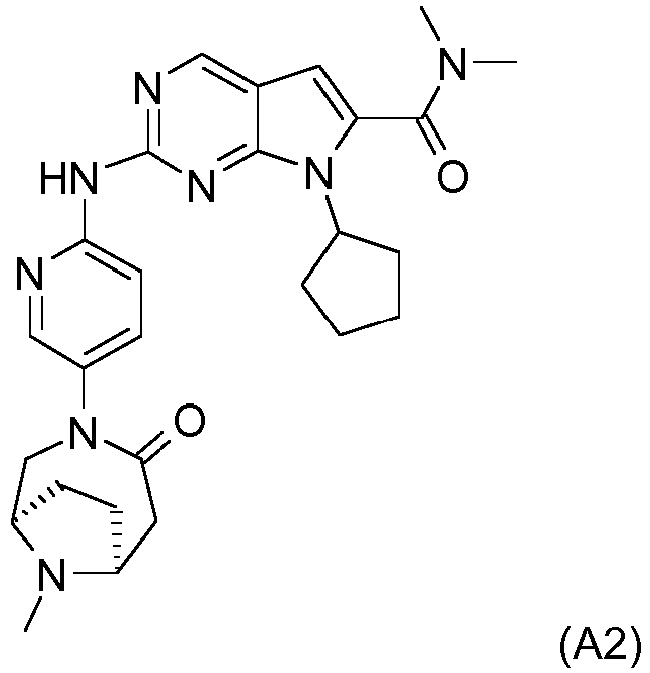
palbociclib (hereinafter referred as Compound A3, also known as PD-0332991). - Compound A1 is also described by the chemical name 7-Cyclopentyl-2-(5-piperazin-1-yl-pyridin-2-ylamino)-7H-pyrrolo[2,3-d]pyrimidine-6-carboxylic acid dimethylamide.
- Compound A2 is also described by the chemical name 7-cyclopentyl-N,N-dimethyl-2-(5-((1R,6S)-9-methyl-4-oxo-3,9-diazabicyclo[4.2.1]nonan-3-yl)pyridin-2-ylamino)-7H-pyrrolo[2,3-d]pyrimidine-6-carboxamide.
- Compound A3 is also described by the chemical name 6-Acetyl-8-cyclopentyl-5-methyl-2-{[5-(1-piperazinyl)-2-pyridinyl]amino}pyrido[2,3-d]pyrimidin-7(8H)-one.
- An example of ananti-hormonal agent is an aromatase inhibitor. Such aromatase inhibitor can be either a non-steroidal aromatase inhibitor or a steroidal aromatase inhibitor.
- Letrozole (hereinafter referred as Compound B1) is an example of a non-steroidal aromatase inhibitor.
- Exemestane (hereinafter referred as Compound B2) is an example of a steroidal aromatase inhibitor.
- In another reference embodiment, the anti-hormonal agent is an estrogen receptor antagonist.
- Fulvestrant (hereinafter referred as Compound B3) is an example of an estrogen receptor antagonist.
- In yet another reference embodiment, the anti-hormonal agent is a selective estrogen receptor modulator.
- Tamoxifen (hereinafter referred as Compound B4) is an example of a selective estrogen receptor modulator.
- In one reference embodiment, the agent that regulates the PI3K/Akt/mTOR pathway is a PI3K inhibitor.
- The PI3K inhibitor can be, for example,
Compound C1, described by Formula C1 below:
Compound C2, described by Formula C2 below:
- Compound C1 is also described by the chemical name (S)-Pyrrolidine-1,2-dicarboxylic acid 2-amide 1-({4-methyl-5-[2-(2,2,2-trifluoro-1,1-dimethyl-ethyl)-pyridin-4-yl]-thiazol-2-yl}-amide).
- Compound C2 is also described by the chemical name 5-(2,6-di-4-morpholinyl-4-pyrimidinyl) - 4- (trifluoromethyl)-2-pyrimidinamine.
- In another reference embodiment, the agent that regulates the PI3K/Akt/mTOR pathway is a mTOR inhibitor.
- Everolimus (hereinafter referred as Compound C3) is an example of a mTOR inhibitor.
- The present disclosure further relates to the above pharmaceutical combination(s) for use in the treatment of a cancer.
- The present disclosure further relates to a method for the treatment of a cancer comprising administering the above pharmaceutical combination(s) in jointly therapeutically effective amount, to a warm-blooded animal, preferably a human, in need thereof.
- In accordance with the present disclosure, the compounds in the pharmaceutical combination(s) may be administered either as a single pharmaceutical composition, as separate compositions, or sequentially.
- The present disclosure further relates to a kit comprising the pharmaceutical combination.
- The Compounds A1-A3, B1-B4, C1-C3 may be incorporated in the combination of the present disclosure in either the form of its free base or any salt thereof. Salts can be present alone or in mixture with free compound, e.g. the compound of the formula A1, and are preferably pharmaceutically acceptable salts. Such salts of the compounds of formula A1 are formed, for example, as acid addition salts, preferably with organic or inorganic acids, from compounds of formula A1 with a basic nitrogen atom. Suitable inorganic acids are, for example, halogen acids, such as hydrochloric acid, sulfuric acid, or phosphoric acid. Suitable organic acids are, e.g., succinic acid, carboxylic acids or sulfonic acids, such as fumaric acid or methansulfonic acid. For isolation or purification purposes it is also possible to use pharmaceutically unacceptable salts, for example picrates or perchlorates. For therapeutic use, only pharmaceutically acceptable salts or free compounds are employed (where applicable in the form of pharmaceutical preparations), and these are therefore preferred.
- The Compounds A1-A3, B1-B4, C1-C3 can be synthesized by one skilled in the art. Specifically, Compound A1 is disclosed as Example 74 of
WO2010/020675 ; Compound A2 is disclosed inWO2011/101409 ; Compound C1 is disclosed as Example 15 ofWO2010/029082 ; and Compound C2 is disclosed as Example 10 ofWO2007/084786 . - Suitable aromatase inhibitors include, but are not limited to,
- (a) steroids, such as exemestane and formestane; and
- (b) non-steroids, such as aminoglutethimide, vorozole, fadrozole, anastrozole and, especially, letrozole.
- Exemestane can be administered, e.g., in the form as it is marketed, e.g. under the trademark AROMASIN®. Formestane can be administered, e.g., in the form as it is marketed, e.g. under the trademark LENTARON®. Fadrozole can be administered, e.g., in the form as it is marketed, e.g. under the trademark AFEMA®. Anastrozole can be administered, e.g., in the form as it is marketed, e.g. under the trademark ARIMIDEX®. Letrozole can be administered, e.g., in the form as it is marketed, e.g. under the trademark FEMARA® or FEMAR®. Letrozole has been specifically described in the
European patent No. 0 236 940 published on September 16, 1987 , as well as inUnited States patent No. 4,978,672 published on December 18, 1990 , andJapanese Patent No. 2018112 - The structure of the active agents identified by code nos., generic or trade names may be taken from the actual edition of the standard compendium "The Merck Index" or from databases, e.g., Patents International (e.g., IMS World Publications).
- Comprised are likewise the pharmaceutically acceptable salts thereof, the corresponding racemates, diastereoisomers, enantiomers, tautomers, as well as the corresponding crystal modifications of above disclosed compounds where present, e.g. solvates, hydrates and polymorphs, which are disclosed therein. The compounds used as active ingredients in the combinations of the present disclosure can be prepared and administered as described in the cited documents, respectively. Also within the scope of this disclosure is the combination of more than two separate active ingredients as set forth above, i.e., a pharmaceutical combination within the scope of this disclosure could include three active ingredients or more.
- It is believed that the combination of the present disclosure possesses beneficial therapeutic properties, e.g. synergistic interaction, strong in vitro or in vivo anti-proliferative activity and/or strong in vitro or in vivo antitumor response, which render it particularly useful for the treatment of cancer.
- Suitable cancers that can be treated with the combination of the present disclosure include, but are not limited to, sarcoma, lymphomas, cancer of the lung, bronchus, prostate, breast (including sporadic breast cancers and sufferers of Cowden disease), pancreas, gastrointestine, colon, rectum, colon, colorectal adenoma, thyroid, liver, intrahepatic bile duct, hepatocellular, adrenal gland, stomach, gastric, glioma, glioblastoma, endometrial, melanoma, kidney, renal pelvis, urinary bladder, uterine corpus, cervix, vagina, ovary, multiple myeloma, esophagus, a leukaemia, acute myelogenous leukemia, chronic myelogenous leukemia, lymphocytic leukemia, myeloid leukemia, brain, a carcinoma of the brain, oral cavity and pharynx, larynx, small intestine, non-Hodgkin lymphoma, melanoma, villous colon adenoma, a neoplasia, a neoplasia of epithelial character, a mammary carcinoma, basal cell carcinoma, squamous cell carcinoma, actinic keratosis, tumor diseases (including solid tumors), a tumor of the neck or head, polycythemia vera, essential thrombocythemia, myelofibrosis with myeloid metaplasia, and Waldenstroem disease. Where a cancer, a tumor, a tumor disease, sarcoma, or a cancer are mentioned, also metastasis in the original organ or tissue and/or in any other location are implied alternatively or in addition, whatever the location of the tumor and/or metastasis.
- The combination of the present disclosure is particularly useful for the treatment of a cancer mediated by phosphatidylinositol 3-kinase (PI3K), particularly the alpha-subunit of PI3K. Proliferative diseases may include those showing overexpression or amplification of PI3K alpha, somatic mutation of PIK3CA or germline mutations or somatic mutation of PTEN or mutations and translocation of p85α that serve to up-regulate the p85-p110 complex. In a preferred embodiment, the cancer is a tumor and/or cancerous growth mediated by the alpha isoform of PI3K. Disease may include those showing overexpression or amplification of the alpha-isoform of PI3K and/or somatic mutation of PIK3CA.
- The combination of the present invention is also particularly useful for the treatment of a hormone sensitive and/or hormone receptor positive cancers. Hormone sensitive cancers may include, but are not limited to, breast cancer, endometrial cancer, ovarian cancer, and/or cervical cancer. Hormone-receptor positive cancers may include estrogen receptor positive cancers (i.e., cancer that grows in response to the hormone estrogen) or progesterone receptor positive cancers (ie., cancer that grows in response to the hormone progesterone. Preferably, the hormone receptor positive cancer is estrogen receptor positive breast cancer.
- In one embodiment, the cancer is a solid tumor.
- In a further embodiment of the invention, the cancer is selected from the group consisting of cancer of the breast, endometrial, ovary and cervix.
- In a further embodiment of the disclosure, the cancer is a cancer showing both (a) overexpression or amplification of the alpha-isoform of PI3K and/or somatic mutation of PIK3CA, and (b) hormone receptor positive status.
- In a further embodiment, the cancer is breast cancer. Preferably, the cancer is a breast cancer having either hormone receptor positive, a mutation in the PIK3CA, or a combination thereof. More preferably, the cancer is estrogen receptor positive (+) breast cancer.
- In a further embodiment, the cancer is a hormone receptor positive (+) breast cancer resistant to treatment with hormone therapy (e.g., estrogen or progesterone). A cancer "resistant to treatment with hormone therapy" refers to a cancer or tumor that either fails to respond favorably to treatment with prior hormone therapy, or alternatively, recurs or relapses after responding favorably to hormone therapy. Said hormone therapy is understood to be in the absence of a PI3K inhibitor. The cancer or tumor may be resistant or refractory at the beginning of treatment or it may become resistant or refractory during treatment.
- It is one objective of this disclosure to provide a pharmaceutical composition comprising a quantity, which is jointly therapeutically effective at targeting or preventing a cancer, of each therapeutic agent of the disclosure.
- In accordance with the present disclosure, agents in the composition of the present disclosure may be administered together in a single pharmaceutical composition, separately in two or more separate unit dosage forms, or sequentially. The unit dosage form may also be a fixed combination.
- The pharmaceutical compositions for separate administration of agents or for the administration in a fixed combination (i.e., a single galenical composition comprising at least two therapeutic agents according to the invention may be prepared in a manner known per se and are those suitable for enteral, such as oral or rectal, topical, and parenteral administration to subjects, including mammals (warm-blooded animals) such as humans, comprising a therapeutically effective amount of at least one pharmacologically active combination partner alone, e.g., as indicated above, or in combination with one or more pharmaceutically acceptable carriers or diluents, especially suitable for enteral or parenteral application. Suitable pharmaceutical compositions contain, e.g., from about 0.1% to about 99.9%, preferably from about 1% to about 60%, of the active ingredient(s).
- Pharmaceutical compositions for the combination therapy for enteral or parenteral administration are, e.g., those in unit dosage forms, such as sugar-coated tablets, tablets, capsules or suppositories, ampoules, injectable solutions or injectable suspensions. Topical administration is e.g. to the skin or the eye, e.g. in the form of lotions, gels, ointments or creams, or in a nasal or a suppository form. If not indicated otherwise, these are prepared in a manner known per se, e.g., by means of conventional mixing, granulating, sugar-coating, dissolving or lyophilizing processes. It will be appreciated that the unit content of each agent contained in an individual dose of each dosage form need not in itself constitute an effective amount since the necessary effective amount can be reached by administration of a plurality of dosage units.
- Pharmaceutical compositions may comprise one or more pharmaceutical acceptable carriers or diluents and may be manufactured in conventional manner by mixing one or both combination partners with a pharmaceutically acceptable carrier or diluent. Examples of pharmaceutically acceptable diluents include, but are not limited to, lactose, dextrose, mannitol, and/or glycerol, and/or lubricants and/or polyethylene glycol. Examples of pharmaceutically acceptable acceptable binders include, but are not limited to, magnesium aluminum silicate, starches, such as corn, wheat or rice starch, gelatin, methylcellulose, sodium carboxymethylcellulose and/or polyvinylpyrrolidone, and, if desired, pharmaceutically acceptable disintegrators include, but are not limited to, starches, agar, alginic acid or a salt thereof, such as sodium alginate, and/or effervescent mixtures, or adsorbents, dyes, flavorings and sweeteners. It is also possible to use the compounds of the present disclosure in the form of parenterally administrable compositions or in the form of infusion solutions. The pharmaceutical compositions may be sterilized and/or may comprise excipients, for example preservatives, stabilizers, wetting compounds and/or emulsifiers, solubilisers, salts for regulating the osmotic pressure and/or buffers.
- In particular, a therapeutically effective amount of each of the combination partner of the combination of the disclosure may be administered simultaneously or sequentially and in any order, and the components may be administered separately or as a fixed combination. For example, the method of preventing or treating a cancer according to the disclosure may comprise: (i) administration of the first agent in free or pharmaceutically acceptable salt form; and (ii) administration of a second agent in free or pharmaceutically acceptable salt form, simultaneously or sequentially in any order, in jointly therapeutically effective amounts, preferably in synergistically effective amounts, e.g., in daily or intermittently dosages corresponding to the amounts described herein. The individual combination partners of the combination of the disclosure may be administered separately at different times during the course of therapy or concurrently in divided or single combination forms. Furthermore, the term administering also encompasses the use of a pro-drug of a combination partner that convert in vivo to the combination partner as such. The instant disclosure is therefore to be understood as embracing all such regimens of simultaneous or alternating treatment and the term "administering" is to be interpreted accordingly.
- The effective dosage of each of combination partner agents employed in the combination of the invention may vary depending on the particular compound or pharmaceutical composition employed, the mode of administration, the condition being treated, the severity of the condition being treated. Thus, the dosage regimen of the combination of the disclosure is selected in accordance with a variety of factors including type, species, age, weight, sex and medical condition of the patient; the severity of the condition to be treated; the route of administration; the renal and hepatic function of the patient; and the particular compound employed. A physician, clinician or veterinarian of ordinary skill can readily determine and prescribe the effective amount of the drug required to prevent, counter or arrest the progress of the condition. Optimal precision in achieving concentration of drug within the range that yields efficacy requires a regimen based on the kinetics of the drug's availability to target sites. This involves a consideration of the distribution, equilibrium, and elimination of a drug.
- A further benefit is that lower doses of the active ingredients of the combination of the disclosure can be used, e.g., that the dosages need not only often be smaller but are also applied less frequently, or can be used in order to diminish the incidence of side effects. This is in accordance with the desires and requirements of the patients to be treated.
- The combination of the agents can be combined in the same pharmaceutical preparation or in the form of combined preparations "kit of parts" in the sense that the combination partners can be dosed independently or by use of different fixed combinations with distinguished amounts of the combination partners, i.e., simultaneously or at different time points. The parts of the kit of parts can then, e.g., be administered simultaneously or chronologically staggered, that is at different time points and with equal or different time intervals for any part of the kit of parts.
- The present disclosure further relates to a kit comprising a first compound selected from the group consisting of Compounds A1-A3 or pharmaceutically acceptable salts thereof, a second compound selected from the group consisting of Compounds B1-B4 or pharmaceutically acceptable salts thereof, and a package insert or other labeling including directions for treating a cancer.
- The present disclosure further relates to a kit comprising a first compound selected from the group consisting of Compounds A1-A3 or pharmaceutically acceptable salts thereof, a second compound selected from the group consisting of Compounds B1-B4 or pharmaceutically acceptable salts thereof, a third compound selected from the group consisting of Compounds C1-C3 or pharmaceutically acceptable salts thereof, and a package insert or other labeling including directions for treating a cancer.
- The present invention provides following embodiments:
- 1. A pharmaceutical combination comprising (1) a first agent which is a CDK inhibitor described by formula A1 below
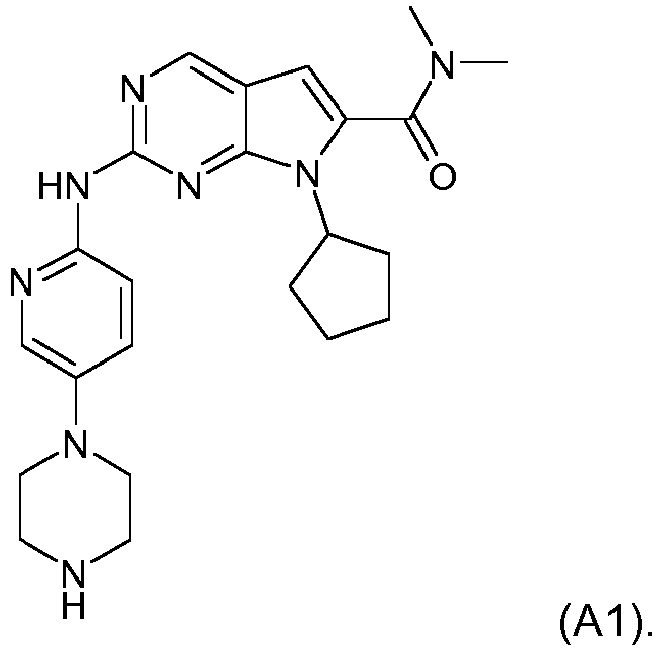
- 2. The combination of 1 , wherein the agents are administered simultaneously, separately or sequentially.
- 3. The pharmaceutical combination of 1 or 2 for use in treating hormone-sensitive and/or hormone-receptor positive cancer, such as a solid tumor or a cancer selected from the group consisting of breast cancer, endometrial cancer, ovarian cancer, and cervical cancer.
- 4. The pharmaceutical combination for use according to
embodiment 3, wherein the cancer is breast cancer. - 5. The pharmaceutical combination for use according to
embodiment 3, wherein the cancer is an estrogen receptor positive cancer. - 6. The pharmaceutical combination for use according to
embodiment 4, wherein the breast cancer is estrogen receptor positive breast cancer. - 7. A pharmaceutical combination comprising (1) a first agent which is Compound A1 described by Formula A1 below or a pharmaceutically acceptable salt thereof:

- 8. A pharmaceutical combination comprising (1) a first agent which is Compound A1 described by Formula A1 below or a pharmaceutically acceptable salt thereof:

- The following Examples illustrate the disclosure described above. The beneficial effects of the pharmaceutical combination of the present disclosure can also be determined by other test models known as such to the person skilled in the pertinent art.
- The following experimental procedure is performed to demonstrate the efficacy and anti-proliferative activity of Compound A1 in double or triple combination in the treatment of breast cancer:
- Compound A1 (a CDK4/6 inhibitor, 10mM), Compound B1 (Letrozole, Sigma, 10mM), Compound B3 (Fulvestrant, Sigma, 10mM), Compound B2 (Exemestane, Sigma, 10mM), Compound C1 (a PI3K inhibitor, 10mM), Compound C3 (an mTor inhibitor, 10mM) and Compound C2 (a PI3K inhibitor, 10mM) were dissolved in DMSO. Δ4A (the precursor androstenedione10mM) were dissolved in ethanol. All these reagents were stored in aliquots at -20°C.
- MCF7 human breast carcinoma cells were provided by Dr. Chen Shiuan (City of Hope National Medical Center, CA, USA) , which were stably transfected with the aromatase expression vector bearing the neomycin (G418) resistance gene (also named MCF7/Aro). Aromatase converts the precursor androstenedione (Δ4A) into 17β-estradiol (E2), which is required for the proliferation of the host cell line. Unless otherwise mentioned, all cell culture reagents were obtained from Invitrogen. Cells were maintained in MEM (# 11095-080) supplemented with 10 % v/v fetal bovine serum (FBS, #10099-141), 1 mM sodium pyruvate (#11360-070), 1% v/v non-essential amino acids (#11140-050) and G418 (geneticin, #10131) in a humidified incubator at 37°C in 5 % CO2. The cells were passaged twice a week and the medium was changed every 2 to 3 days. To assess estrogen driven cell proliferation, it was necessary to deplete the medium of steroids. To do so, the steroid-depleted (SD) medium, MEM (#51200-038, no phenol red & no glutamine) supplemented with charcoal stripped FBS (#12676-029) and Glutamax (#35050-061) was used. Medium without phenol red (pH indicator) was required since it is a structural homologue of estrogen. Moreover, normal FBS need to be replaced by charcoal-stripped FBS in order to remove steroids. TryPLE Express (12604-013, no phenal red) was used for cell dissociation during SD treatment.
- MCF7/Aro cells were steroid deprived for 3 days before trypsinized using TryPLE Express (#12604-013, without phenol red) and 1500 cells/well were plated on clear-bottom 384-well black plates (Greiner, #781091) in triplicates with 30 µl/well growth media, cells were allowed to attach overnight and were followed by 6 days of incubation with 10nM of Δ4A and various concentrations of drugs or drug combinations (10 µl/well). Cell viability was determined by measuring cellular ATP content using the CellTiter-Glo® (CTG) luminescent cell viability assay (Promega). Each single agent and combination treatment of cells was compared to controls (cells treated with an equivalent volume of medium). 30ul/well of the CTG reagents was added to each well at the end of the compound treatment and luminescence was recorded on an Envision plate reader (Perkin Elmer). Reduced and enhanced luminescent signal values (responses) were calculated relative to untreated (control) cells.
- The following combinations were tested:
- (a) Compound A1 / Compoud B1 (Letrozole);
- (b) Compound A1 / Compoud B1 (Letrozole) / Compound C1 (1uM or 500nM);
- (c) Compound A1 / Compoud B1 (Letrozole) / Compound C3 (20nM or 2nM);
- (d) Compound A1 / Compoud B1 (Letrozole) / Compound C2 (333nM);
- (e) Compound A1 / Compound B3 (Fulvestrant);
- (f) Compound A1 / Compound B3 (Fulvestrant) / Compound C1 (1uM or 500nM);
- (g) Compound A1 / Compound B3 (Fulvestrant) / Compound C3 (20nM or 2nM);
- (h) Compound A1 / Compound B3 (Fulvestrant) / Compound C2 (333nM);
- (i) Compound A1 / Compound B2 (Exemestane);
- (j) Compound A1 / Compound B2 (Exemestane) / Compound C1 (1uM or 500nM);
- (k) Compound A1 / Compound B2 (Exemestane) / Compound C3 (20nM or 2nM); and
- (l) Compound A1 / Compound B2 (Exemestane) / Compound C2 (333nM).
- Compound A1, Compoud B1 (Letrozole), Compoud B2 (Exemestane) and Compoud B3 (Fulvestant) were in multiple doses, and Compoud C1, Compoud C2 and Compoud C3 were in a single dose as a background compounds (doses as labeled above) in all the triple combinations.
- To evaluate the anti-proliferative activity of all the combinations in a non-bias way, as well as to identify synergistic effect at all possible concentrations, the studies were conducted with a "dose matrix." This utilized all possible permutations of serially-diluted Compound A1 / Compound B1 (Letrozole), Compound A1 / Compound B3 (Fulvestant) and Compound A1 / Compound B2 (Exemestane) (with a single dose background compound). In all combination assays, agents were applied simultaneously.
- The "dose matrix, Compound A1/Compound B1, Compound A1/Compound B3 and Compound A1/Compound B2" were consisted of the followings:
- (a) Compound A1 (in the combination of Compound A1/Compound B1 and Compound A1/Compound B2), which was subjected to a 6 dose 3X serial dilution with a high dose of 10uM and a low dose of approximately 41nM
- (b) Compound A1 (in the combination of Compound A1/Compound B3), which was subjected to a 5 or 6 dose 3X serial dilution with a high dose of 1 or 3uM and a low dose of approximately 12nM
- (c) Compound B1, which was subjected to a 7 dose 3X serial dilution with a high dose of 5uM and a low dose of approximately 7nM
- (d) Compound B3, which was subjected to a 6 dose 3X serial dilution with a high dose of 800nM and a low dose of approximately 3nM
- (e) Compound B2, which was subjected to a 7 dose 3X serial dilution with a high dose of 10uM and a low dose of approximately 14nM.
- The synergistic interaction (analyzed using Chalice software [CombinatoRx, Cambridge MA]) was calculated by comparing the response from a combination to the response of the agent acting alone, against the drug-with-itself dose-additive reference model. Deviations from dose additives can be assessed numerically with a Combination Index (CI), which quantifies the overall strength of combination effect. This calculation (esentially a volume score) is as follows: V HSA=ΣX,YIn f X InfY ( I data - I HSA). Additionally, Cl is calculated between the data and the highest single-agent surface, normalized for single agent dilution factors (Lehar et al, 2009):
- Data evaluation and graph generation were performed using Microsoft Excel software, and Chalice software.
- To investigate the activity of double or triple combinations of Compound A1 with antiestrogen therapeutics such as fulvestrant (Compound B3), letrozole (Compound B1) and exemestane (Compound B2), with or without PI3K or mTOR inhibitor Compound C1, Compound C2 or Compound C3 on cell proliferation, various combos as described in the method section were tested in androstenedione driven, aromatase overexpressing MCF7 cells. Synergy was observed between Compound A1 and all three antihormonal therapies in a 7x8 dose matrix combination setting, with synergy score each at 4.12, 2.41 and 1.43, for letrozole (Compound B1), exemestane (Compound B2) and fulvestrant (Compound B3), respectively. Various does of PI3K and mTOR inhibitor was also added to the same 7X8 does matrix setting as a background compounds to test the efficacy of triple combinations, in all cases, the triple combo significantly enhanced the maximum level of inhibition achieved by single or double reagents, and greatly reduced the doses needed for achieving the same levels of inhibition. Those results solidly support the concept of combining two or three reagents targeting cell cycle, mTOR/PI3K and estrogen pathway in ER positive breast cancer.
- The results from Example 1 are shown in
Figures 1-7 . - The following experimental procedure is performed to demonstrate the efficacy and anti-proliferative activity of Compound A2 or Compound A3 in double or triple combination in the treatment of breast cancer:
- Compound A2 (a CDK4/6 inhibitotor, 10mM), Compound A3 (a CDK4/6 inhibitor, 10mM), Compound B1 (Letrozole, Sigma, 10mM), Compound B3 (Fulvestrant, Sigma, 10mM), Compound B2 (Exemestane, Sigma, 10mM), Compound C1 (a PI3K inhibitor, 10mM), and Compound C3 (an mTor inhibitor, 10mM) were dissolved in DMSO. Δ4A (the precursor androstenedione, 10mM) were dissolved in ethanol. All these reagents were stored in aliquots at -20°C.
- MCF7 human breast carcinoma cells were provided by Dr. Chen Shiuan (City of Hope National Medical Center, CA, USA) , which were stably transfected with the aromatase expression vector bearing the neomycin (G418) resistance gene (also named MCF7/Aro). Aromatase converts the precursor androstenedione (Δ4A) into 17β-estradiol (E2), which is required for the proliferation of the host cell line. Unless otherwise mentioned, all cell culture reagents were obtained from Invitrogen. Cells were maintained in MEM (# 11095-080) supplemented with 10 % v/v fetal bovine serum (FBS, #10099-141), 1 mM sodium pyruvate (#11360-070), 1% v/v non-essential amino acids (#11140-050) and G418 (geneticin, #10131) in a humidified incubator at 37°C in 5 % CO2. The cells were passaged twice a week and the medium was changed every 2 to 3 days. To assess estrogen driven cell proliferation, it was necessary to deplete the medium of steroids. To do so, the steroid-depleted (SD) medium, MEM (#51200-038, no phenol red & no glutamine) supplemented with charcoal stripped FBS (#12676-029) and Glutamax (#35050-061) was used. Medium without phenol red (pH indicator) was required since it is a structural homologue of estrogen. Moreover, normal FBS need to be replaced by charcoal-stripped FBS in order to remove steroids. TryPLE Express (12604-013, no phenal red) was used for cell dissociation during SD treatment.
- MCF7/Aro cells were steroid deprived for 3 days before trypsinized using TryPLE Express (#12604-013, without phenol red) and 1500 cells/well were plated on clear-bottom 384-well black plates (Greiner, #781091) in triplicates with 30 µl/well growth media, cells were allowed to attach overnight and were followed by 6days of incubation with 10nM of Δ4A and various concentrations of drugs or drug combinations (10 µl/well). Cell viability was determined by measuring cellular ATP content using the CellTiter-Glo® (CTG) luminescent cell viability assay (Promega). Each single agent and combination treatment of cells was compared to controls (cells treated with an equivalent volume of medium). 30ul/well of the CTG reagents was added to each well at the end of the compound treatment and luminescence was recorded on an Envision plate reader (Perkin Elmer). Reduced and enhanced luminescent signal values (responses) were calculated relative to untreated (control) cells.
- The following combinations were tested:
- (a) Compound A2 / Compound B1 (Letrozole);
- (b) Compound A2 / Compound B1 (Letrozole) / Compound C1;
- (c) Compound A2 / Compound B1 (Letrozole) / Compound C3;
- (d) Compound A2 / Compound B3 (Fulvestrant);
- (e) Compound A2 / Compound B3 (Fulvestrant) / Compound C1;
- (f) Compound A2 / Compound B3 (Fulvestrant) / Compound C3;
- (g) Compound A2 / Compound B3 (Exemestane);
- (h) Compound A2 / Compound B3 (Exemestane) / Compound C1;
- (i) Compound A2 / Compound B3 (Exemestane) / Compound C3;
- (j) Compound A3 / Compound B1 (Letrozole);
- (k) Compound A3 / Compound B1 (Letrozole) / Compound C1;
- (l) Compound A3 / Compound B1 (Letrozole) / Compound C3;
- (m) Compound A3 / Compound B3 (Fulvestrant);
- (n) Compound A3 / Compound B3 (Fulvestrant) / Compound C1;
- (o) Compound A3 / Compound B3 (Fulvestrant) / Compound C3;
- (p) Compound A3 / Compound B3 (Exemestane);
- (q) Compound A3 / Compound B3 (Exemestane) / Compound C1; and
- (r) Compound A3 / Compound B3 (Exemestane) / Compound C3.
- Compound A2, Compound A3, Letrozole (Compound B1), Exemestane (Compound B2) and Fulvestant (Compound B3) were in multiple doses, and Compound C1 (1uM) and Compound C2 (20nM) were in a single dose as a background in all the triple combinations.
- To evaluate the anti-proliferative activity of all the combinations in a non-bias way, as well as to identify synergistic effect at all possible concentrations, the studies were conducted with a "dose matrix." This utilized all possible permutations of serially-diluted Compound A2 / Compound B1 (Letrozole), Compound A2 / Compond B3 (Fulvestant), Compound A2 / Compound B2 (Exemestane), Compound A3 / Compound B1 (Letrozole), Compound A3 / Compund B3 (Fulvestant) and Compound A3 / Compound B2 (Exemestane) (with a single dose background compound). In all combination assays, agents were applied simultaneously.
- The "dose matrix, Compound A2 / Compound B1, Compound A2/Compound B3, Compound A2/Compound B2, Compound A3/Compound B1, Compound A3/Compound B3 and Compound A3/Compound B2" were consisted of the followings:
- (a) Compound A2, which was subjected to a 7 dose 3X serial dilution with a high dose of 3uM and a low dose of approximately 4.1nM
- (b) Compound A3, which was subjected to a 7 dose 3X serial dilution with a high dose of 3uM and a low dose of approximately 4.1nM
- (c) Compound B1, which was subjected to a 6 dose 3X serial dilution with a high dose of 5uM and a low dose of approximately 20.6nM
- (d) Compound B3, which was subjected to a 6 dose 3X serial dilution with a high dose of 100nM and a low dose of approximately 0.4nM
- (e) Compound B2, which was subjected to a 6 dose 3X serial dilution with a high dose of 10uM and a low dose of approximately 41.2nM
- The synergistic interaction (analyzed using Chalice software [CombinatoRx, Cambridge MA]) was calculated by comparing the response from a combination to the response of the agent acting alone, against the drug-with-itself dose-additive reference model. Deviations from dose additives can be assessed numerically with a Combination Index (CI), which quantifies the overall strength of combination effect. This calculation (esentially a volume score) is as follows: V HSA=ΣX,YIn f X InfY ( I data - I HSA). Additionally, Cl is calculated between the data and the highest single-agent surface, normalized for single agent dilution factors (Lehar et al, 2009):
- Data evaluation and graph generation were performed using Microsoft Excel software, and Chalice software.
- To investigate the activity of double or triple combinations of Compound A2 and Compound A3 with antiestrogen therapeutics such as fulvestrant (Compound B3), letrozole (Compound B1) and exemestane (Compound B2), with or without PI3K or mTOR inhibitor Compound C1 or Compound C3 on cell proliferation, various combos as described in the method section were tested in androstenedione driven, aromatase overexpressing MCF7 cells. Synergy was observed between Compound A3 and all three antihormonal therapies in a 7x8 dose matrix combination setting, with score each at 3.7, 1.2 and 1.7 for letrozole, exemestane and fulvestrant respectively. And synergy was also observed in Compound A2 /Letrozole and Compound A2 /Fulvestrant combinations with score each at 3.2 and 1.4. Single dose of PI3K and mTOR inhibitor was also added to the same 7X8 does matrix setting as a background compounds to test the efficacy of triple combinations, in all cases, the triple combo significantly enhanced the maximum level of inhibition achieved by single or double reagents, and greatly reduced the doses needed for achieving the same levels of inhibition. Those results solidly support the concept of combining two or three reagents targeting cell cycle, mTOR/PI3K and estrogen pathway in ER positive breast cancer.
- The results from Example 2 are shown in
Figures 8-19 . - The Table below summerizes the synergy score of the various combinations tested in Example 2.
Combo synergy score Compound A3/Compound B1 3.7 Compound A3/ Compound B1 /Compound C1 1.7 Compound A3/ Compound B1 /Compound C3 4.5 Compound A3/Compound B2 1.2 Compound A3/Compound B2/Compound C1 1.5 Compound A3/Compound B2 /Compound C3 2.8 Compound A3/Compound B3 1.7 Compound A3/Compound B3/Compound C1 3.0 Compound A3/Compound B3 /Compound C3 1.7 Compound A2/Compound B1 3.2 Compound A2/ Compound B1 /Compound C1 1.9 Compound A2/ Compound B1 /Compound C3 4.4 Compound A2/Compound B2 0.8 Compound A2/Compound B2/Compound C1 1.3 Compound A2/Compound B2 /Compound C3 2.4 Compound A2/Compound B3 1.4 Compound A2/Compound B3/Compound C1 3.2 Compound A2/Compound B3 /Compound C3 1.5 - A clinical trial is currently on going to further the clinical development of the two investigational agents in ER+ breast cancer, Compound A1 (CDK4/6 inhibitor) and Compound C1 (PI3K inhibitor). This is a multi-center, open-label, dose finding Phase Ib/II trial. The Phase Ib part is a three-part dose escalation study to estimate the MTD and/or RP2D for two double combinations: Compound A1 with letrozole and Compound C1 with letrozole followed by estimation of the MTD and/or RP2D of the triple combination of Compound A1 + Compound C1 with letrozole.
- The three-part Phase Ib will be followed by a randomized Phase II study to assess the preliminary anti-tumor activity of the two double combination regimens (Compound A1+letrozole and Compound C1+letrozole) versus the triple combination (Compound A1+Compound C1 with letrozole) and to further evaluate their safety in patients with ER+/HER2- locally advanced or metastatic breast cancer.
- Approximately 290 adult women with ER+/HER2- locally advanced or metastatic breast cancer will be enrolled.
- The starting dose for the study drug combination doublets and triplet are described below. The standard dose of letrozole will be used throughout this study (2.5 mg/day).
Starting doses for each arm: Arm Compound A1 (3 weeks followed by a one week break) Compound C1 (QD) Letrozole (QD) Compound A1 and Letrozole 600mg - 2.5mg Compound C1 and Letrozole - 300mg 2.5mg Compound A1 and Compound C1 and Letrozole 400mg 100mg 2.5mg - The objectives of the Phase Ib portion of the study are:
-
- To estimate the maximum tolerated dose (MTD) and/or recommended Phase II dose (RP2D) of the following combinations:
- Arm 1: Compound A1 + letrozole (2.5 mg)
- Arm 2: Compound C1 + letrozole (2.5 mg)
- Arm 3: Compound A1 + Compound C1 + letrozole (2.5 mg).
-
- To characterize the pharmacokinetic (PK) profiles of Compound A1, Compound C1, and letrozole when used in combination.
- To characterize the safety and tolerability in
Arms - To assess preliminary clinical antitumor activity in
Arms -
- In the Phase portion of this multicenter, open-label study, postmenopausal women with ER+/human epidermal growth factor receptor negative (HER2-) advanced BC are being treated with once-daily doses of Compound A1 (3-weeks-on/1-week-off) + letrozole (2.5 mg) or Compound C1 + letrozole (2.5 mg).
- Dose escalation is guided by the adaptive Bayesian Logistic Regression Model (BLRM) along with the Escalation With Overdose Control principle.
- PK assessments were conducted prior to dose-escalation decisions during the study to monitor exposure and evaluate possibility of cytochrome P450-mediated drug-drug interactions.
- Upon determination of the MTD/RP2D in
Arms Arms Arm 3. -
- Postmenopausal women with metastatic or locally advanced ER+/HER2- BC.
- Any number of prior lines of endocrine therapy.
- Up to 1 prior cytotoxic regimen in the metastatic or locally advanced setting.
- Representative tumor specimen (archival or new) available for molecular testing (unless otherwise agreed).
- Newly obtained, matched pre- and on-therapy tumor samples are mandatory in the Phase dose-escalation part of the study.
-
- Prior treatment with a CDK4/6, AKT, mTOR, or PI3K inhibitor and failure to benefit.
- Current symptomatic brain metastases.
- Clinically manifest diabetes mellitus, history of gestational diabetes mellitus, or documented steroid-induced diabetes mellitus.
- QT corrected with Fridericia's formula (QTcF) >470 ms.
-
- Routine safety assessments conducted at baseline and at regular intervals throughout the study, and adverse events (AEs) assessed continuously according to Common Terminology Criteria for Adverse Events v4.03.
- Tumor response evaluated locally by the investigator, using computerized tomography and magnetic resonance imaging, based on Response Evaluation Criteria In Solid Tumors v1.1. Evaluations conducted at baseline, every 8 weeks through to
Cycle 6, every 12 weeks thereafter (or sooner if there is clinical evidence of disease progression), and at end of treatment. - Samples for PK evaluations collected on
Days Cycle 1 and onDay 15 of Cycles 2-6. Real-time PK assessments were conducted to guide dose escalation (in addition to BLRM). -
• 10 patients have been treated with Compound A1 and letrozole (Arm 1), and 7 patients have been treated with Compound C1 and letrozole (Arm 2). The patients details are shown in Table 1.Table 1. Patient Characteristics and Disposition Characteristic Arm 1: Compound A1 600 mg + letrozole (n=10) Arm 2: Compound C1 300 mg + letrozole (n=7) All subjects (N =17) Median age, years (range) 59 (45-67) 61 (51-72) 60 (45-72) WHO performance status, n (%) 0 5 (50) 4 (57) 9 (53) 1 5 (50) 3 (43) 8 (47) Median time since initial diagnosis to first dose of treatment, months (range) 123 (9-173) 49 (2-295) 104 (2-295) Pts who received prior antineoplastic regimens, n (%) 10 (100) 7 (100) 17 (100) Number of regimens, n (%) 1 2(20) 3(43) 5(29) 2 1(10) 2(29) 3(18) 4 0 1(14) 1(6) 5 2(20) 0 2(12) >5 5(50) 1(14) 6(35) Prior therapies received in the advanced/metastatic setting, n (%) Chemotherapy 4 (40) 0 4 (24) Anastrozole 4 (40) 3 (43) 7 (41) Fulvestrant 6 (60) 2 (29) 8 (47) Letrozole 4 (40) 3 (43) 7 (41) Tamoxifen 1 (10) 0 1 (6) Exemestane 3 (30) 2 (29) 5 (29) PI3K/AKT/mTOR inhibitors 5 (50) 1(14) 6 (35) Other 7 (70) 2 (29) 9 (53) Number of pts who received prior surgery, n (%) 9 (90) 7 (100) 16 (94) Number of pts who received prior radiotherapy, n (%) 8 (80) 4 (57) 12 (71) mTOR, mammalian target of rapamycin; PI3K, phosphatidylinositol 3-kinase; pts, patients; WHO, World Health Organization.
• At the time of study entry, all patients had stage IV ER+/HER2- BC.
• Treatment has been discontinued in 2 (20%) patients inArm 1 due to disease progression. At the cut-off date, treatment was ongoing for all 7 (100%) patients inArm 2. -
• Of 12 patients evaluable as part of the dose-determining set (6 in each arm), 3 dose-limiting toxicities (DLTs) were observed: 1Grade 4 neutropenia inArm Grade 2 hyperglycemia inArm 2.
• The most common (>30% patients) all-grade adverse events suspected to be study drug-related were (see Table 2): - Arm 1: neutropenia (90%) and nausea (40%)
- Arm 2: hyperglycemia (57%), nausea (43%), decreased appetite (43%), and diarrhea (43%).
- Arm 1: neutropenia (50%)
- Arm 2: lymphopenia (14%), fatigue (14%), and hyperglycemia (14%).
-
- Preliminary PK data for Compound A1, Compound C1, and letrozole are as follows (Table 3):
- PK for Compound A1 and Compound C1 on
Days - PK for letrozole on
Day 1 are comparable with those observed in single-agent studies. - Additional data are being gathered from patients currently enrolled in the trial to further evaluate letrozole PK in combination with Compound A1.
- PK for Compound A1 and Compound C1 on
-
- Duration of exposure to treatment is shown in
Figures 24 and25 . - In
Arm 1, there was 1 patient with a confirmed partial response (Figure 26 ), 2 patients with stable disease (SD), and 1 patient without measurable disease had neither complete response nor progressive disease (NCRNPD;Figure 24 ). - In
Arm 2, there were 2 patients with SD and 3 patients had NCRNPD (Figure 25 ). - Both arms of the study have demonstrated an acceptable safety profile and preliminary signs of clinical activity in postmenopausal women with ER+/HER2- advanced BC.
- Neutropenia is an anticipated side effect of Compound A1, potentially due to inhibition of proliferation via CDK4/6 inhibition.
- Hyperglycemia observed in Arm 2 (Compound C1 + letrozole) may be an on-target effect of PI3K inhibition.
- Dose escalation continues to determine the MTD/RP2D.
- Upon determination of the MTD/RP2D in
Arms Arm 3 will commence. Following the Phase portion of the study a randomized Phase II portion will compare Compound A1 + letrozole and Compound C1 + letrozole with Compound A1 + Compound C1 + letrozole. - A multi-center, pre-surgical, randomized, phase II study is planned, to assess the biological activity of Compound A1, 400 mg or 600 mg daily, in combination with letrozole 2.5 mg daily, as compared to single agent letrozole daily in postmenopausal patients with newly diagnosed HR+, HER2-negative, early breast cancer. A total of approximately 120 patients will be randomized. Patients will receive trial therapy for 14 days (± 3 days) and then undergo surgery. Patients will be randomly assigned to treatment with:
- a. Letrozole (2.5 mg once daily); OR
- b. Letrozole (2.5mg once daily) +
Compound A1 400 mg daily; OR - c. Letrozole (2.5mg once daily) +
Compound A1 600 mg daily - The primary objective of the study is to assess the cell cycle response rate defined as the percentage of patients who achieve a reduction in Ki67 expression to natural logarithm of percentage positive Ki67 of less than 1 (Baselga 2009). Although the trial is designed as open label, all pharmacodynamics and clinical pharmacology endpoints will be assessed by experts who are blinded to randomized treatment.
- A Phase Ib/II Trial of Compound A1 with everolimus and exemestane in the treatment of ER+ Her2- Advanced Breast Cancer is on-going. The purpose of the trial is to estimate the MTD(s) and/ or RP2D of Compound A1 in combination with everolimus + exemestane, and Compound A1 in combination with exemestane, and to characterize the safety and tolerability of the combinations of everolimus + exemestane ± Compound A1 and Compound A1 + exemestane in patients with ER+ HER2- advanced breast cancer. The study consists of 3 arms:
Arms Assigned Interventions Compound A1 +everolimus + exemestane triple combination Compound A1 is taken orally once per day for 21 days of each 28 day cycle. Exemestane is taken orally once per day. Everolimus is taken orally once per day. Compound A1 + exemestane double combination Compound A1 is taken orally once per day for 21 days of each 28 day cycle Exemestane is taken orally once per day. everolimus + exemestane double combination Exemestane is taken orally once per day. Everolimus is taken orally once per day. - Compound A1 comes in 50 mg and 200 mg capsules. Exemestane comes in 25 mg tablets. Everolimus comes in 2.5 mg, 5mg, and 7.5 mg tablets.
- The objectives of the Phase portion of this study are:
-
- Determine the maximum tolerated dose (MTD)/recommended Phase II dose (RP2D) of Compound A1 + everolimus (EVE) + exemestane (EXE) in patients with ER+/human epidermal growth factor receptor 2-negative (HER2-) advanced BC.
-
- Determine the safety and tolerability of Compound A1 + EVE + EXE and Compound A1 + EXE.
- Characterize the pharmacokinetics (PK) of Compound A1 and/or EVE when administered in combination with EXE.
- Assess preliminary antitumor activity of Compound A1 + EVE + EXE and Compound A1 + EXE.
- Evaluate the relationship between antitumor activity and molecular aberrations in the cyclin D-CDK4/6-INK-Rb, PI3K/AKT/mTOR, and other cancer-related pathways.
-
- In the Phase portion of this Phase Ib/II multicenter, open-label study, postmenopausal women with ER+/HER2- advanced BC, resistant to letrozole or anastrozole, are being treated with escalating doses of Compound A1 + EVE + EXE (25 mg/day) or a safety run-in of Compound A1 (600 mg/day) + EXE (25 mg/day;
Figure 27 ). - Dose escalation is being guided by the adaptive Bayesian Logistic Regression Model along with the Escalation with Overdose Control principle and PK was assessed prior to dose-escalation decisions.
- Upon determination of the MTD/RP2D, the Phase II portion of the study will compare Compound A1 + EVE + EXE triplet) and Compound A1 + EXE (doublet) with EVE + EXE.
-
- Postmenopausal women with ER+/HER2- locally advanced or metastatic BC.
- Recurrence while on, or within 12 months of end of, adjuvant treatment with letrozole or anastrozole OR progression while on, or within 1 month of end of, treatment with letrozole or anastrozole treatment for locally advanced or metastatic BC. Letrozole or anastrozole need not be the last treatment prior to study start.
- Previous treatment with a CDK4/6 inhibitor, EXE, or mTOR inhibitor allowed (for Phase but not Phase II).
- Representative tumor specimen (archival or new) available for molecular testing.
-
- >2 chemotherapy lines for advanced BC.
- Absolute neutrophil count ≤1.5 x 10⁹/L.
- QT corrected with Fridericia's formula >470 ms.
-
- Routine safety assessments conducted at baseline and at regular intervals throughout the study. Adverse events (AEs) are being assessed continuously according to Common Terminology Criteria for Adverse Events v4.03.
- Tumor response assessed locally by the investigator using computerized tomography or magnetic resonance imaging according to Response Evaluation Criteria In Solid Tumors v1.1 at baseline and on Day (D) 1 of Cycles (C) 3, 5, and 7, on D1 of every 4th subsequent cycle (or sooner if clinically indicated), and at the end of treatment.
- PK evaluations for Compound A1 and EVE performed in patients treated with Compound A1 + EVE + EXE during C1 on D1, 2, 8, 15, 16, and 21, and D1 of each subsequent cycle up to and including C6.
- Tumor samples analyzed by next-generation sequencing to determine any alterations in genes of interest.
-
- As of the interim report cut of date, 16 patients have been treated: 3 patients with
Compound A1 600 mg +EXE 25 mg and 13 patients with Compound A1 (200 mg [6 patients]; 300 mg [6 patients]; 250 mg [1 patient]) + EVE 2.5 mg +EXE 25 mg. - Treatment has been discontinued in 5 (31%) patients. The primary reasons for discontinuation were: disease progression (4 patients) and death (1 patient).
- In the advanced/metastatic setting, previous treatment with letrozole or anastrozole was reported in 10 (63%) and 5 (31%) patients, respectively, while 6 (38%) and 3 (19%) patients had received prior EXE and EVE, respectively (Table 4).
-
- Among 13 patients evaluable for dose-limiting toxicities (DLTs), 3 DLTs were observed, all with
Compound A1 300 mg + EVE 2.5 mg +EXE 25 mg: 1Grade 3 febrile neutropenia and 2Grade 3 alanine aminotransferase (ALT) elevation. - Hematologic AEs were the most common toxicity across all cohorts (Table 5).
- The most common (≥10%)
Grade 3/4 study drug-related AEs were neutropenia (50%), leukopenia (31%), ALT increased (13%), and hypophosphatemia (13%). -
- Mean plasma concentration-time profiles for Compound A1 and EVE in patients treated with Compound A1 + EVE + EXE on C1D15 are shown in
Figures 28 and29 . - Both Compound A1 and EVE were rapidly absorbed at steady state (C1D15); median Tmax of Compound A1 and EVE was 2 and 1 hours, respectively, across dose ranges.
- At steady state, treatment with Compound A1 (200 and 300 mg) + EVE 2.5 mg +
EXE 25 mg resulted in Compound A1 exposure similar to that of single-agent Compound A1, while EVE exposure was approximately 1.5- to 2-fold and 2- to 3-fold higher than historical single-agent data when administered withCompound A1 -
- Of 13 patients evaluable for response, 1 patient had a confirmed partial response (
Compound A1 300 mg + EVE 2.5 mg +EXE 25 mg), 7 patients had stable disease (SD;Compound A1 600 mg +EXE 25 mg: 1 patient;Compound A1 200 mg + EVE 2.5 mg +EXE 25 mg: 2 patients;Compound A1 300 mg + EVE 2.5 mg +EXE 25 mg: 4 patients), and 1 patient had neither complete response nor progressive disease (Compound A1 300 mg + EVE 2.5 mg +EXE 25 mg;Figure 30 andFigure 31 ). - One patient with a p16 (CDKN2A) deletion, and cyclin D1 (CCND1) and insulin-like growth factor receptor 1 (IGFR1) amplification treated with
Compound A1 200 mg + EVE 2.5 mg + EXE had SD >6 months (Figure 30 ). -
- Preliminary data suggest that the combinations of Compound A1 + EXE and Compound A1 + EVE + EXE are feasible, and clinical signs of activity have been observed in both arms of the study.
- Preliminary PK analysis suggests that the 300-mg dose of Compound A1 resulted in increased EVE exposure at steady state, but EVE does not affect Compound A1 exposure.
- The most common AEs were hematologic as anticipated with CDK4/6 inhibitors, and were mild to moderate.
- A Phase Ib/II trial is planned. The trial will have 3 arms as described below:
Arm Assigned Interventions Compound A1 and Fulvestrant Compound A1: 600mg each day, 21 days on , 7 days off; Fulvestrant: 500mg IM Day Compound A1 and Compound C2 and Fulvestrant Compound A1: 400mg each day, 21 days on , 7 days off; Compound C2: 20mg each day continuous; Fulvestrant: 500mg IM Day Compound A1 and Compound C1 and Fulvestrant Compound A1: 400mg each day, 21 days on , 7 days off; Compound C1: 100mg each day continuous; Fulvestrant: 500mg IM Day - This on-going study aims at determining antitumor efficacy of various compounds used as single agent, in double or in triple combination in the HBCx-34 human breast patient-derived xenograft model.
- The xenograft model proposed in this study is HBCx-34. HBCx-34 is a ductal carcinoma with wild type P53, no HER2 overexpression and PR and ERα overexpression. The tumor is highly responsive to adriamycine/cyclophosphamide and responsive to docetaxel and capecitabine. HBCx-34 has got no cachexia properties, but no body weight gain is observed for HBCx-34 bearing mice.
- HBCx-34 breast tumor-bearing mice will receive estrogen diluted in drinking water (β-oestradiol, 8.5 mg/l), from the date of tumor implant to the date of inclusion. No estrogen will be added during the rest of the study.
- Female athymic nude mice (Hsd:Athymic Nude-Fox1nu), 6- to 9-week-old at the beginning of the experimental phase, will be obtained from Harlan Laboratories (Gannat, France). Animals will be maintained in specific pathogen-free animal housing at the Center for Exploration and Experimental Functional Research (CERFE, Evry, France) animal facility. Animals will be delivered to the laboratory at least 7 days before the experiments during which time they are acclimatized to laboratory conditions. Mice will be housed in groups of a maximum of 7 animals during acclimation period and 5 animals during experimental phase. Mice will be housed inside individually ventilated cages (IVC) of Polysulfone (PSU) plastic (mm 213 W x 362 D x 185 H, Allentown, USA) with sterilized and dust-free bedding cobs. Food and water will be sterilized. Animals will be housed under a light-dark cycle (14-hour circadian cycle of artificial light) and controlled room temperature and humidity.
Compound A1: 75 mg/kg free base, p.o. Volume of administration: 5 ml/kg (i.e. 125 µl for a 25g mouse) Route of administration: p.o. Form: solution Vehicle: 0.5% Methylcellulose in water Concentration: 15 mg/ml free base Compound C2: 30 and 20 mg/kg free base, p.o. Volume of administration: 5 ml/kg (i.e. 125 µl for a 25g mouse) Route of administration: p.o. Form: solution Vehicle: 10% NMP / 90% PEG300 Concentration: 6 mg/ml free base = 6.534 mg/ ml salt base 4 mg/ml free base = 4.356 mg/ml salt base Compound C1: 35 mg/kg, p.o. Volume of administration: 5 ml/kg (i.e. 125 µl for a 25g mouse) Route of administration: p.o. Form: suspension Vehicle: 0.5% Methylcellulose in water Concentration: 7 mg/ml Vehicle: NaCl 0.9% Volume of administration: 5 ml/kg (i.e. 125 µl for a 25g mouse) Route of administration: p.o. -
Letrozole (Compound B1) 2.5 mg/kg (Femara®, Novartis) Volume of administration: 5 ml/kg (i.e. 125 µl for a 25 g mouse) Route of administration: p.o. Form: Suspension Vehicle: 0.9% NaCl Concentration: 0.5 mg/ ml Exemestane 25 mg/kg (Compound B2, Aromasine®, Pharmacia) Dose: 25 mg/kg Volume of administration: 5 ml/kg (i.e. 125 µl for a 25 g mouse) Route of administration: p.o. Form: Suspension Vehicle: 0.9% NaCl Concentration: 5 mg/ml Study Groups and Regimen Gr. N 1 Drug/Testing Agent 2 Drug/Testing Agent 3 Drug/Testing Agent Agent mg/kg Route Schedule Agent mg/kg Route Schedule Agent mg/kg Route Schedule 1 10 Vehicle - PO qd x 56* - - - - - - - - 2 10 Letrozole (Compound B1) 2.5 PO qd x 56* - - - - - - - - 3 10 - - - - Compound A1 75 PO qd x 56* - - - - 4 10 - - - - - - - - Compound C2 30-20 PO qd x 26-30** 5 10 - - - - - - - - Compound C1 35 PO qd x 56* 6 10 Letrozole (Compound B1) 2.5 PO qd x 56* Compound A1 75 PO qd x 56* - - - - 7 10 Letrozole (Compound B1) 2.5 PO qd x 56* - - - - Compound C2 30-20 PO qd x 26-30** 8 10 Letrozole (Compound B1) 2.5 PO qd x 56* - - - - Compound C1 35 PO qd x 56* 9 10 Letrozole (Compound B1) 2.5 PO qd x 56* Compound A1 75 PO qd x 56* Compound C2 30-20 PO qd x 26-30** 10 10 Letrozole (Compound B1) 2.5 PO qd x 56* Compound A1 75 PO qd x 56* Compound C1 35 PO qd x 56* (*) qd x56: from D0 to D55
(**) qd x26-30: from D0 to D25 at 30 mg/kg then from D26 to D56 at 20 mg/kg In combination groups, the 2 or 3 compounds will be administered without delay. - Dosing volume will be individually adjusted to the body weight. In each experimental group, the mentioned dose will be applied for all mice.
- Tumors of the same passage will be transplanted subcutaneously onto 5-10 mice (donor mice, passage (n-1)). When these tumors reach 1000 to 2000 mm3, donor mice will be sacrificed by cervical dislocation, tumors will be aseptically excised and dissected. After removing necrotic areas, tumors will be cut into fragments measuring approximately 20 mm3 and transferred in culture medium before grafting.
- Mice will be anaesthetized with ketamine/xylazine, and then skin will be aseptized with a chlorhexidine solution, incised at the level of the interscapular region, and a 20 mm3 tumor fragment will be placed in the subcutaneous tissue. Skin will be closed with clips.
- All mice from the same experiment will be implanted on the same day.
- Healthy mice aged 6 to 9 weeks and weighing at least 20 g will be included in the study. Mice will be allocated to different groups according to their tumor volume to give homogenous mean and median tumor volume in each treatment arms. Treatments will be randomly attributed to cages housing up to 5 mice.
- For each group, 10 mice with established tumors and average tumor volume ranging 108 (6x6) to 288 (9x8) mm3 will be included in the study. In the case that tumor growth is heterogeneous, group size may be reduced (up to 8 mice /group) and/or inclusion may be staggered.
- From grafting day to study termination, animals will be observed every day, for physical appearance, behavior and clinical changes.
- Tumor volume will be evaluated by measuring tumor diameters, with a calliper, biweekly during the treatment period and once a week during the follow-up period. The formula TV (mm3) = [length (mm) x width (mm)2]/2 will be used, where the length and the width are the longest and the shortest diameters of the tumor, respectively.
- Tumors will not be weighed at the end of experimental phase.
- All animals will be weighted biweekly during the treatment period and once a week during the follow-up period.
- Unless specified otherwise by the Sponsor, in case that body weight loss reaches 15% compared to the 1st day of treatment, DietGel Recovery® will be given for the entire group in which the body weight loss is observed.
- Each animal will be sacrificed if one of the following conditions is met:
- Body weight loss (BWL) ≥ 20% compared to the 1st day of treatment for 3 consecutive measurements (2 days or 48 hours).
- General alteration of behaviour or clinical signs.
- Tumor volume ≥ 2000 mm3.
- Unless specified otherwise, no necropsy will be performed at sacrifice.
- Each group of animals will be sacrificed if the two following conditions are met:
- A tumor volume of 2000mm3 is reached for at least one animal
- And the initial median tumor volume has been increased by 3 to 5-fold.
- The endpoints for the experiment are:
- a treatment phase of 8 weeks*
- and a follow-up phase of 57 days.
-
Day 0 will be always considered the first day of treatment. The days of the experiment will be subsequently numbered according to this definition. Recordings will be expressed as mean +/- standard error of the mean (mean +/-sem) and median +/- interquartile (median +/-IQR). - Statistical analysis will be done for each measurement by Mann-Whitney non parametric comparison test using GraphPad Prism software. Each treated group will be compared with control group.
-
Figures 20-22 illustrates some results of this study.
| Adverse event | Arm 1 Compound A1 600 mg + letrozole (n=10) | Arm 2: Compound C1 300 mg + letrozole (n=7) | All subjects (N=17) | |||
| All grades, n (%) | Grade ¾, n (%) | All grades, n (%) | Grade ¾, n (%) | All grades, n (%) | Grade ¾, n (%) | |
| Hematologic adverse events | ||||||
| Neutropenia | 9 (90) | 5 (50) | 0 | 0 | 9 (53) | 5 (29) |
| Leukopenia | 2 (20) | 0 | 0 | 0 | 2 (12) | 0 |
| Lymphopenia | 0 | 0 | 1 (14) | 1 (14) | 1 (6) | 1 (6) |
| Non-hematologic adverse events | ||||||
| Nausea | 4 (40) | 0 | 3 (43) | 0 | 7 (41) | 0 |
| Fatigue | 3 (30) | 0 | 2 (29) | 1 (14) | 5 (29) | 1 (6) |
| Decreased appetite | 1 (10) | 0 | 3 (43) | 0 | 4 (24) | 0 |
| Diarrhea | 1 (10) | 0 | 3 (43) | 0 | 4 (24) | 0 |
| Hyperglycemia | 0 | 0 | 4 (57) | 1 (14) | 4 (24) | 1 (6) |
| Weight decreased | 1 (10) | 0 | 2 (29) | 0 | 3 (18) | 0 |
| Dysgeusia | 0 | 0 | 2 (29) | 0 | 2 (12) | 0 |
• QTcF prolongation (>470 ms) was not observed in
•
• Dose reductions occurred in 5 patients: 1 patient in
| Analyte | n | AUC all (h*ng/ml), mean (SD) | Cmax (ng/ml), mean (SD) | Tmax (h), median (range) |
|
| ||||
| Compound A1 | ||||
| 6 | 13072 (9458) | 1320 (859) | 3.0 (1.9-4.2) | |
| |
6 | 421 (115) | 25 (4) | 2.0 |
|
| ||||
| Compound A1 | ||||
| 3 | 32038 (16586) | 2780 (767) | 4.0 (1.9-4.0) | |
| |
3 | 1364 (785) | 79 (12) | 4.0 (4.0-7.5) |
|
| ||||
| Compound C1 | ||||
| 5 | 29102 (8251) | 2480 (922) | 3.8 (1.2-4.1) | |
| |
5 | 330 (115) | 27 (13) | 2.0 (1.2-4.0) |
|
| ||||
| Compound C1 | ||||
| 3 | 40358 (6329) | 3167 (314) | 2.0 (2.0-3.8) | |
| |
3 | 2412 (189) | 118 (9) | 2.0 (1.9-2.0) |
| AUC, area under the curve; C, cycle; Cmax, maximum concentration; D, day; Tmax, time to reach maximum concentration. |
| Characteristic | All (N=16) |
| Median age, years (range) 57 (41-84) | 57 (41-84) |
| Time since initial diagnosis of primary site to first dose of drug (months), median (range) | 83 (8-355) |
| Site of metastases, n (%) | |
| Bone (no visceral disease) | 3 (25) |
| Bone and visceral | 9 (50) |
| Visceral (no bone disease) | 4 (25) |
| Others | 9 (56) |
| Setting at last medication, n (%) | |
| Adjuvant | 2 (13) |
| Neoadjuvant | 1 (6) |
| Advanced/metastatic disease | 14 (88) |
| Number of prior regimens in the advanced/metastatic setting, n (%) | |
| 0 | 2 (13) |
| 1-2 | 5 (31) |
| 3-4 | 7 (44) |
| >4 | 2(13) |
| Number of prior chemotherapy regimens in the advanced/metastatic setting, n (%) | |
| 0 | 10 (63) |
| 1 | 2 (13) |
| 2 | 4 (25) |
| Prior therapies received in the advanced/metastatic setting, n (%) | |
| Letrozole | 10 (63) |
| Anastrozole | 5 (31) |
| Fulvestrant | 11 (69) |
| Chemotherapy | 6 (38) |
| Exemestane | 6 (38) |
| Everolimus | 3 (19) |
| Other PI3K/AKT/mTOR pathway inhibitors | 4 (25) |
| Tamoxifen | 2 (13) |
| Others | 5 (31) |
| PI3K, phosphatidylinositol 3-kinase; mTOR, mammalian target of rapamycin. |
| Adverse Event | Comp A1 (600 mg) + EXE (25 mg) n=3 | Comp A1 (200 mg) + EVE (2.5 mg) + EXE (25 mg) n=6 | Comp A1 (250 mg) + EVE (2.5 mg) + EXE (25 mg) n=1 | Comp A1 (300 mg) + EVE (2.5 mg) + EXE (25 mg) n=6 | All pts treated with Comp A1 + EVE + EXE n=13 | All pts N=16 | |
| Hematologic toxicities | |||||||
| Neutropenia | All | 3 (100) | 4 (67) | 0 | 5 (83) | 9 (69) | 12 (75) |
| G3/4 | 2 (67) | 3 (33) | 0 | 4 (67)* | 6 (46) | 8(50) | |
| Thrombocytopenia | All | 3 (100) | 3 (50) | 0 | 5 (83) | 8 (62) | 11 (69) |
| G3/4 | 0 | 1 (17) | 0 | 0 | 1 (8) | 1 (6) | |
| Anemia | All | 3 (100) | 2 (33) | 0 | 5 (83) | 7 (54) | 10 (63) |
| G3/4 | 0 | 0 | 0 | 0 | 0 | 0 | |
| Leukopenia | All | 3 (100) | 1 (17) | 1 (100) | 5 (83) | 7 (54) | 10 (63) |
| G3/4 | 2 (67) | 1 (17) | 0 | 2 (33) | 3 (23) | 5 (31) | |
| Lymphopenia | All | 0 | 3 (50) | 0 | 2 (33) | 5 (39) | 5 (31) |
| G3/4 | 0 | 1 (17) | 0 | 0 | 1 (8) | 1 (6) | |
| Hypophosphatemia | All | 0 | 1 (17) | 1 (100) | 1 (17) | 3 (23) | 3 (19) |
| G3/4 | 0 | 0 | 1 (100) | 1 (17) | 2 (15) | 2 (13) | |
| Non-hematologic toxicities | |||||||
| ALT increased | All | 1 (33) | 2(33) | 0 | 4 (67) | 6 (46) | 7 (44) |
| G3/4 | 0 | 0 | 0 | 2 (33)* | 2 (15) | 2 (13) | |
| AST increased | All | 1 (33) | 1 (17) | 0 | 4 (67) | 5 (39) | 6 (38) |
| G3/4 | 0 | 0 | 0 | 1 (17) | 1 (8) | 1 (6) | |
| Stomatitis | All | 2 (67) | 3 (50) | 0 | 1 (17) | 4 (31) | 6 (38) |
| G3/4 | 0 | 0 | 0 | 0 | 0 | 0 | |
| Blood alkaline phosphatase increased | All | 0 | 2 (33) | 0 | 2 (33) | 4 (31) | 4 (25) |
| G3/4 | 0 | 0 | 0 | 0 | 0 | 0 | |
| Diarrhea | All | 2 (67) | 1 (17) | 0 | 1 (17) | 2(15) | 4 (25) |
| G3/4 | 0 | 0 | 0 | 0 | 0 | 0 | |
| Nausea | All | 1 (33) | 1 (17) | 0 | 2 (33) | 3 (23) | 4 (25) |
| G3/4 | 0 | 0 | 0 | 0 | 0 | 0 | |
| Fatigue | All | 0 | 0 | 0 | 3 (50) | 3 (23) | 3 (19) |
| G3/4 | 0 | 0 | 0 | 1 (17) | 1 (8) | 1 (6) | |
| Headache | All | 1 (33) | 1 (17) | 0 | 1 (17) | 2 (15) | 3 (19) |
| G3/4 | 0 | 0 | 0 | 0 | 0 | 0 | |
| ALT, alanine aminotransferase; AST, aspartate aminotransferase; EVE, everolimus; EXE, exemestane; pt, patient; Comp A1, Compound A1. *Dose-limiting toxicities included 1 |
Claims (15)
- A pharmaceutical combination comprising(a) Compound A1, described by Formula A1 below:
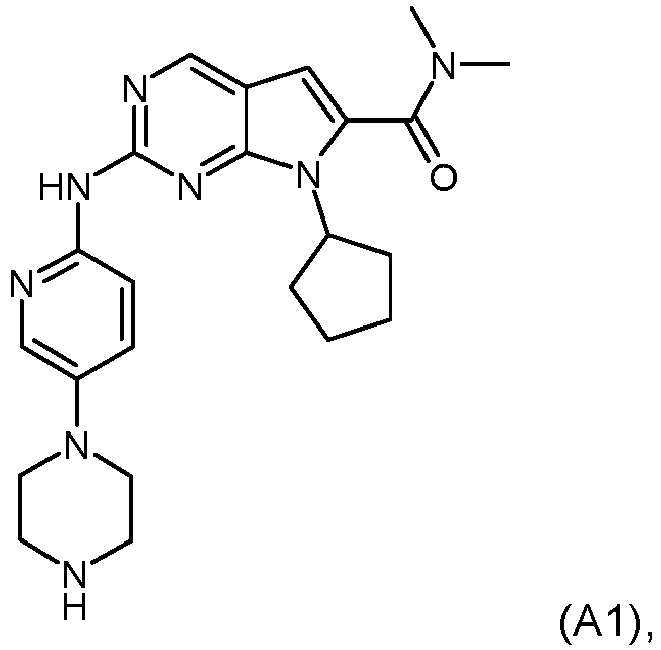
and(b) letrozole, or a pharmaceutically acceptable salt thereof. - The pharmaceutical combination according to claim 1 comprising (a) Compound A1, or a pharmaceutically acceptable salt thereof, and (b) letrozole.
- The pharmaceutical combination according to claim 1 or 2 for use in treating hormone-sensitive and/or hormone-receptor positive cancer.
- The pharmaceutical combination according to claim 1 or 2 for use according to claim 3, wherein the agents are administered simultaneously, separately or sequentially.
- The pharmaceutical combination according to claim 1 or 2 for use according to claim 3 or 4, wherein the cancer is a solid tumor.
- The pharmaceutical combination according to claim 1 or 2, for use according to claim 3 or 4, wherein the cancer is selected from the group consisting of breast cancer, endometrial cancer, ovarian cancer and cervical cancer.
- The pharmaceutical combination according to claim 1 or 2 for use according to claim 6, wherein the cancer is breast cancer.
- The pharmaceutical combination according to claim 1 or 2 for use according to claim 6, wherein the cancer is an estrogen receptor positive cancer.
- The pharmaceutical combination according to claim 1 or 2 for use according to claim 7, wherein the breast cancer is estrogen receptor positive breast cancer.
- The pharmaceutical combination according to claim 1 or claim 2 for use in treating HR+, HER2- breast cancer.
- The pharmaceutical combination according to claim 1 or claim 2 for use in treating HR+, HER2- breast cancer, wherein the agents are administered simultaneously, separately or sequentially.
- The pharmaceutical combination according to claim 1 or claim 2 for use in treating ER+, HER2- advanced breast cancer.
- The pharmaceutical combination according to claim 1 or claim 2 for use in treating ER+, HER2- advanced breast cancer, wherein the agents are administered simultaneously, separately or sequentially.
- A compound which is Compound A1, described by Formula A1 below:

for use in treating hormone-sensitive and/or hormone-receptor positive cancer breast cancer by simultaneous, separate or sequential administration with letrozole. - A compound for use according to claim 14, wherein the breast cancer is HR+, HER2-breast cancer.
Priority Applications (4)
| Application Number | Priority Date | Filing Date | Title |
|---|---|---|---|
| SI201431926T SI3033086T1 (en) | 2013-08-14 | 2014-08-07 | Combination therapy for cancer treatment |
| EP21193408.8A EP4005573A1 (en) | 2013-08-14 | 2014-08-07 | Combination therapy for the treatment of cancer |
| HRP20211879TT HRP20211879T1 (en) | 2013-08-14 | 2014-08-07 | Combination therapy for the treatment of cancer |
| PL14752433T PL3033086T3 (en) | 2013-08-14 | 2014-08-07 | Combination therapy for the treatment of cancer |
Applications Claiming Priority (3)
| Application Number | Priority Date | Filing Date | Title |
|---|---|---|---|
| US201361865804P | 2013-08-14 | 2013-08-14 | |
| US201361894029P | 2013-10-22 | 2013-10-22 | |
| PCT/IB2014/063782 WO2015022609A1 (en) | 2013-08-14 | 2014-08-07 | Combination therapy for the treatment of cancer |
Related Child Applications (1)
| Application Number | Title | Priority Date | Filing Date |
|---|---|---|---|
| EP21193408.8A Division EP4005573A1 (en) | 2013-08-14 | 2014-08-07 | Combination therapy for the treatment of cancer |
Publications (2)
| Publication Number | Publication Date |
|---|---|
| EP3033086A1 EP3033086A1 (en) | 2016-06-22 |
| EP3033086B1 true EP3033086B1 (en) | 2021-09-22 |
Family
ID=51355593
Family Applications (2)
| Application Number | Title | Priority Date | Filing Date |
|---|---|---|---|
| EP14752433.4A Active EP3033086B1 (en) | 2013-08-14 | 2014-08-07 | Combination therapy for the treatment of cancer |
| EP21193408.8A Pending EP4005573A1 (en) | 2013-08-14 | 2014-08-07 | Combination therapy for the treatment of cancer |
Family Applications After (1)
| Application Number | Title | Priority Date | Filing Date |
|---|---|---|---|
| EP21193408.8A Pending EP4005573A1 (en) | 2013-08-14 | 2014-08-07 | Combination therapy for the treatment of cancer |
Country Status (20)
| Country | Link |
|---|---|
| US (9) | US20160184311A1 (en) |
| EP (2) | EP3033086B1 (en) |
| JP (2) | JP2016528246A (en) |
| KR (4) | KR102529049B1 (en) |
| CN (2) | CN110368497B (en) |
| AU (3) | AU2014307633A1 (en) |
| BR (1) | BR112016002465B1 (en) |
| CA (1) | CA2918190C (en) |
| CY (1) | CY1124810T1 (en) |
| DK (1) | DK3033086T3 (en) |
| ES (1) | ES2900829T3 (en) |
| HR (1) | HRP20211879T1 (en) |
| HU (1) | HUE057061T2 (en) |
| LT (1) | LT3033086T (en) |
| MX (2) | MX378263B (en) |
| PL (1) | PL3033086T3 (en) |
| PT (1) | PT3033086T (en) |
| RU (1) | RU2680714C2 (en) |
| SI (1) | SI3033086T1 (en) |
| WO (1) | WO2015022609A1 (en) |
Families Citing this family (36)
| Publication number | Priority date | Publication date | Assignee | Title |
|---|---|---|---|---|
| HUE047477T2 (en) * | 2015-06-04 | 2020-04-28 | Pfizer | Solid dosage forms of Palbociclib |
| CN105130992B (en) * | 2015-07-16 | 2018-02-09 | 苏州大学 | Nitrogen-containing heterocycle compound, preparation method and purposes with kinase inhibiting activity |
| WO2017021177A1 (en) * | 2015-08-04 | 2017-02-09 | Universitat De Barcelona | Pharmaceutical combinations for use in the treatment of cancer |
| US10328065B2 (en) * | 2015-08-28 | 2019-06-25 | Novartis Ag | Pharmaceutical combination comprising the PI3K inhibitor alpelisib and the B-RAF inhibitor dabrafenib; the use of such combination in the treatment or prevention of cancer |
| CN108348514A (en) * | 2015-08-28 | 2018-07-31 | 诺华股份有限公司 | The pharmaceutical composition of the ALPELISIB of inhibitor containing PI3K and CDK4/6 inhibitor RIBOCICLIB and its application in treatment/pre- anti-cancer |
| CA3239447A1 (en) * | 2016-01-11 | 2017-07-20 | Syndevrx, Inc. | Treatment for tumors driven by metabolic dysfunction |
| CN107137409A (en) * | 2016-03-01 | 2017-09-08 | 江苏恒瑞医药股份有限公司 | A kind of CDK4/6 inhibitor combines the purposes in the medicine for preparing treatment breast cancer with estrogen receptor antagon |
| CN107137408A (en) * | 2016-03-01 | 2017-09-08 | 江苏恒瑞医药股份有限公司 | A kind of CDK4/6 inhibitor combines the purposes in the medicine for preparing treatment breast cancer with arimedex |
| AU2017235450A1 (en) * | 2016-03-15 | 2018-08-16 | Merrimack Pharmaceuticals, Inc. | Methods for treating ER+, HER2-, HRG+ breast cancer using combination therapies comprising an anti-ErbB3 antibody |
| US10449195B2 (en) | 2016-03-29 | 2019-10-22 | Shenzhen Pharmacin Co., Ltd. | Pharmaceutical formulation of palbociclib and a preparation method thereof |
| WO2018001270A1 (en) * | 2016-06-30 | 2018-01-04 | Noratech Pharmaceuticals, Inc. | Palbociclib prodrugs and composition thereof |
| WO2018017410A1 (en) | 2016-07-22 | 2018-01-25 | Eli Lilly And Company | Combination therapy of abemaciclib and a pi3 kinase/mtor dual inhibitor for use in the treatment of breast cancer |
| IL264950B2 (en) * | 2016-08-23 | 2024-01-01 | Eisai R&D Man Co Ltd | Combination therapies for the treatment of hepatocellular carcinoma |
| CN110636862A (en) * | 2017-03-16 | 2019-12-31 | 卫材 R&D 管理有限公司 | Combination therapy for the treatment of breast cancer |
| EP3434272A1 (en) * | 2017-07-25 | 2019-01-30 | Sanofi | Combination comprising palbociclib and 6-(2,4-dichlorophenyl)-5-[4-[(3s)-1-(3-fluoropropyl)pyrrolidin-3-yl]oxyphenyl]-8,9-dihydro-7h-benzo[7]annulene-2-carboxylic acid |
| CN110996962A (en) * | 2017-08-03 | 2020-04-10 | 诺华股份有限公司 | Therapeutic combination of a third-generation EGFR tyrosine kinase inhibitor and a cyclin D kinase inhibitor |
| JP2021503448A (en) | 2017-11-16 | 2021-02-12 | ノバルティス アーゲー | Pharmaceutical combination containing LSZ102 and ribociclib |
| US10695333B2 (en) | 2017-12-01 | 2020-06-30 | Novartis Ag | Pharmaceutical combination comprising LSZ102 and alpelisib |
| AU2019335542A1 (en) | 2018-09-07 | 2021-04-01 | Sanofi | Process for the preparation of methyl 6-(2,4-dichlorophenyl)-5-(4-((3s)-1-(3-fluoropropyl)pyrrolidin-3-yl)oxyphenyl)-8,9-dihydro-7H-benzo(7)annulene-2-carboxylate |
| EP3870231A1 (en) | 2018-10-26 | 2021-09-01 | Syndevrx, Inc. | Biomarkers of metap2 inhibitors and applications thereof |
| WO2021110122A1 (en) * | 2019-12-05 | 2021-06-10 | 基石药业(苏州)有限公司 | Combination therapy of cdk4/6 inhibitor |
| TW202146007A (en) | 2020-02-27 | 2021-12-16 | 法商賽諾菲公司 | Combination comprising alpelisib and 6-(2,4-dichlorophenyl)-5-[4-[(3s)-1-(3-fluoropropyl)pyrrolidin-3-yl]oxyphenyl]-8,9-dihydro-7h-benzo[7]annulene-2-carboxylic acid |
| JP2023500558A (en) * | 2020-05-12 | 2023-01-10 | ジェネンテック, インコーポレイテッド | Breast Cancer Treatment Using Combination Therapies Containing GDC-9545 and CDK4/6 Inhibitors |
| CN114306245A (en) | 2020-09-29 | 2022-04-12 | 深圳市药欣生物科技有限公司 | Pharmaceutical composition of amorphous solid dispersion and preparation method thereof |
| MX2023009962A (en) * | 2021-03-03 | 2023-09-05 | Chia Tai Tianqing Pharmaceutical Group Co Ltd | COMBINED PHARMACEUTICAL COMPOSITION CONTAINING CDK4/6 INHIBITOR AND ITS USE. |
| TW202300145A (en) * | 2021-03-24 | 2023-01-01 | 大陸商貝達藥業股份有限公司 | Pharmaceutical combination, kit containing same, and use thereof |
| TW202304424A (en) * | 2021-04-12 | 2023-02-01 | 法商賽諾菲公司 | Combination comprising everolimus and amcenestrant |
| TW202304425A (en) * | 2021-04-12 | 2023-02-01 | 法商賽諾菲公司 | Combination comprising ribociclib and amcenestrant |
| WO2023046200A1 (en) * | 2021-09-27 | 2023-03-30 | 正大天晴药业集团股份有限公司 | Combined pharmaceutical composition of cdk4/6 inhibitor and aromatase inhibitor |
| KR102658209B1 (en) * | 2021-10-05 | 2024-04-18 | 재단법인 아산사회복지재단 | Pharmaceutical composition for preventing or treating bladder cancer comprising a CDK inhibitor and an ID2 activator |
| EP4433060A1 (en) * | 2021-11-18 | 2024-09-25 | Onconova Therapeutics, Inc. | Methods and compositions for treating cancer |
| US20250041298A1 (en) * | 2021-12-02 | 2025-02-06 | Pfizer Inc. | Cdk4 inhibitor for the treatment of cancer |
| EP4618992A1 (en) * | 2022-11-17 | 2025-09-24 | Onconova Therapeutics, Inc. | Methods and compositions for treating cancer |
| EP4626890A1 (en) | 2022-12-01 | 2025-10-08 | KRKA, d.d., Novo mesto | Ribociclib salts and formulations thereof |
| AU2024244511A1 (en) | 2023-03-27 | 2025-09-25 | Novartis Ag | Method of treating early breast cancer with ribociclib in combination with an aromatase inhibitor |
| WO2025219830A1 (en) | 2024-04-15 | 2025-10-23 | Novartis Ag | Pharmaceutical compositions of ribociclib |
Citations (4)
| Publication number | Priority date | Publication date | Assignee | Title |
|---|---|---|---|---|
| WO2010020675A1 (en) | 2008-08-22 | 2010-02-25 | Novartis Ag | Pyrrolopyrimidine compounds as cdk inhibitors |
| WO2011010409A1 (en) | 2009-07-23 | 2011-01-27 | 株式会社アドバンテスト | Test apparatus, additional circuit, and board for testing |
| WO2011101417A1 (en) | 2010-02-19 | 2011-08-25 | Novartis Ag | Deuterated pyrrolopyrimidine compounds as inhibitors of cdk4/6 |
| WO2013006532A1 (en) | 2011-07-01 | 2013-01-10 | Novartis Ag | Combination therapy comprising a cdk4/6 inhibitor and a pi3k inhibitor for use in the treatment of cancer |
Family Cites Families (15)
| Publication number | Priority date | Publication date | Assignee | Title |
|---|---|---|---|---|
| US4978672A (en) | 1986-03-07 | 1990-12-18 | Ciba-Geigy Corporation | Alpha-heterocyclc substituted tolunitriles |
| US4749713A (en) | 1986-03-07 | 1988-06-07 | Ciba-Geigy Corporation | Alpha-heterocycle substituted tolunitriles |
| JP2710053B2 (en) | 1988-07-05 | 1998-02-10 | スズキ株式会社 | Car body structure |
| US7605155B2 (en) * | 2002-09-04 | 2009-10-20 | Schering Corporation | Substituted pyrazolo[1,5-a]pyrimidines as protein kinase inhibitors |
| US7196092B2 (en) * | 2002-09-04 | 2007-03-27 | Schering Corporation | N-heteroaryl pyrazolopyrimidines as cyclin dependent kinase inhibitors |
| PE20070763A1 (en) * | 2005-11-04 | 2007-08-08 | Wyeth Corp | ANTINEOPLASTIC COMBINATIONS OF AN INHIBITOR OF mTOR, TRASTUZUMAB AND / OR HKI-272 |
| RU2008118144A (en) * | 2005-11-11 | 2009-11-20 | Пфайзер Инк. (US) | COMBINATIONS OF IMMUNOMODULATING OLIGODESOXINUCLEOTIDES AND WAYS OF THEIR APPLICATION |
| JO2660B1 (en) | 2006-01-20 | 2012-06-17 | نوفارتيس ايه جي | PI-3 Kinase inhibitors and methods of their use |
| WO2008009927A1 (en) * | 2006-07-18 | 2008-01-24 | Astrazeneca Ab | Use of fulvestrant and an aromatase inhibitor for treating breast cancer |
| UA104147C2 (en) | 2008-09-10 | 2014-01-10 | Новартис Аг | PYROLIDINDICARBONIC ACID DERIVATIVE AND ITS APPLICATION IN THE TREATMENT OF PROLIFERATIVE DISEASES |
| CA2754917A1 (en) * | 2009-03-11 | 2010-09-16 | Research Development Foundation | Low molecular weight cyclin e (lmw-e) as a biomarker for personalization of cancer therapies |
| UY33227A (en) | 2010-02-19 | 2011-09-30 | Novartis Ag | PIRROLOPIRIMIDINE COMPOUNDS AS INHIBITORS OF THE CDK4 / 6 |
| US20130035336A1 (en) * | 2010-04-13 | 2013-02-07 | Novartis Ag | Combination comprising a cyclin dependent kinase 4 or cyclin dependent kinase (cdk4/6) inhibitor for treating cancer |
| UY34072A (en) * | 2011-05-17 | 2013-01-03 | Novartis Ag | INDOL SUBSTITUTED DERIVATIVES |
| JP2021503448A (en) * | 2017-11-16 | 2021-02-12 | ノバルティス アーゲー | Pharmaceutical combination containing LSZ102 and ribociclib |
-
2014
- 2014-08-07 MX MX2016001793A patent/MX378263B/en unknown
- 2014-08-07 PT PT147524334T patent/PT3033086T/en unknown
- 2014-08-07 EP EP14752433.4A patent/EP3033086B1/en active Active
- 2014-08-07 CA CA2918190A patent/CA2918190C/en active Active
- 2014-08-07 US US14/911,160 patent/US20160184311A1/en not_active Abandoned
- 2014-08-07 JP JP2016533973A patent/JP2016528246A/en not_active Withdrawn
- 2014-08-07 RU RU2016108667A patent/RU2680714C2/en active
- 2014-08-07 EP EP21193408.8A patent/EP4005573A1/en active Pending
- 2014-08-07 HU HUE14752433A patent/HUE057061T2/en unknown
- 2014-08-07 PL PL14752433T patent/PL3033086T3/en unknown
- 2014-08-07 DK DK14752433.4T patent/DK3033086T3/en active
- 2014-08-07 SI SI201431926T patent/SI3033086T1/en unknown
- 2014-08-07 KR KR1020217034188A patent/KR102529049B1/en active Active
- 2014-08-07 WO PCT/IB2014/063782 patent/WO2015022609A1/en not_active Ceased
- 2014-08-07 KR KR1020237014750A patent/KR102736746B1/en active Active
- 2014-08-07 LT LTEPPCT/IB2014/063782T patent/LT3033086T/en unknown
- 2014-08-07 ES ES14752433T patent/ES2900829T3/en active Active
- 2014-08-07 KR KR1020247036571A patent/KR20240160682A/en active Pending
- 2014-08-07 BR BR112016002465-6A patent/BR112016002465B1/en active IP Right Grant
- 2014-08-07 CN CN201910784658.9A patent/CN110368497B/en active Active
- 2014-08-07 CN CN201480056526.XA patent/CN105828822B/en active Active
- 2014-08-07 KR KR1020167003387A patent/KR102318306B1/en active Active
- 2014-08-07 MX MX2020002150A patent/MX384403B/en unknown
- 2014-08-07 HR HRP20211879TT patent/HRP20211879T1/en unknown
- 2014-08-07 AU AU2014307633A patent/AU2014307633A1/en not_active Abandoned
-
2017
- 2017-08-11 AU AU2017213541A patent/AU2017213541B2/en active Active
-
2018
- 2018-08-16 US US15/998,710 patent/US20190046533A1/en not_active Abandoned
-
2019
- 2019-03-12 JP JP2019045031A patent/JP2019131570A/en active Pending
- 2019-04-17 AU AU2019202674A patent/AU2019202674B2/en active Active
-
2021
- 2021-10-18 US US17/504,177 patent/US20220193079A1/en not_active Abandoned
- 2021-12-15 CY CY20211101103T patent/CY1124810T1/en unknown
-
2023
- 2023-08-16 US US18/450,594 patent/US20230398121A1/en not_active Abandoned
- 2023-08-16 US US18/450,559 patent/US20230405011A1/en not_active Abandoned
- 2023-09-19 US US18/469,975 patent/US20240016808A1/en active Pending
- 2023-10-02 US US18/479,410 patent/US20240066034A1/en active Pending
-
2025
- 2025-01-28 US US19/039,164 patent/US20250177402A1/en not_active Abandoned
- 2025-01-28 US US19/039,174 patent/US20250170134A1/en not_active Abandoned
Patent Citations (4)
| Publication number | Priority date | Publication date | Assignee | Title |
|---|---|---|---|---|
| WO2010020675A1 (en) | 2008-08-22 | 2010-02-25 | Novartis Ag | Pyrrolopyrimidine compounds as cdk inhibitors |
| WO2011010409A1 (en) | 2009-07-23 | 2011-01-27 | 株式会社アドバンテスト | Test apparatus, additional circuit, and board for testing |
| WO2011101417A1 (en) | 2010-02-19 | 2011-08-25 | Novartis Ag | Deuterated pyrrolopyrimidine compounds as inhibitors of cdk4/6 |
| WO2013006532A1 (en) | 2011-07-01 | 2013-01-10 | Novartis Ag | Combination therapy comprising a cdk4/6 inhibitor and a pi3k inhibitor for use in the treatment of cancer |
Non-Patent Citations (31)
| Title |
|---|
| AJAY S. BHATNAGAR: "The discovery and mechanism of action of letrozole", BREAST CANCER RESEARCH AND TREATMENT, vol. 105, no. 1, 3 October 2007 (2007-10-03), Bo , pages 7 - 17, XP019549110, ISSN: 1573-7217 |
| ANGUS LIU: "SABCS: Novartis touts Kisqali's 5-year breast cancer survival, advantage over Pfizer's Ibrance", FIERCE PHARMA - MARKETING, FIERCE PHARMA, 9 December 2020 (2020-12-09), pages 1 - 4, XP093153087, Retrieved from the Internet <URL:https://www.fiercepharma.com/marketing/sabcs-novartis-touts-kisqali-s-5-year-breast-cancer-survival-advantage-over-pfizer-s> |
| ANONYMOUS: "Arzneimittel und therapie nach palbocilib folgt ribociclib", DEUTSCHE APOTHEKER ZEITUNG, 2017, pages 1 - 5, XP055938027 |
| ANONYMOUS: "Novartis Kisqali® NATALEE analysis reinforces consistent reduction in risk of recurrence across key subgroups of patients with early breast cancer", MEDIA & INVESTOR RELEASE, NOVARTIS INTERNATIONAL AG NOVARTIS GLOBAL COMMUNICATIONS, CH-4002 BASEL SWITZERLAND, 20 October 2023 (2023-10-20), CH-4002 Basel Switzerland, pages 1 - 6, XP093153082, Retrieved from the Internet <URL:https://www.novartis.com/news/media-releases/novartis-kisqali-natalee-analysis-reinforces-consistent-reduction-risk-recurrence-across-key-subgroups-patients-early-breast-cancer> |
| ANONYMOUS: "Two Years of Adjuvant Palbociclib Added to Endocrine Therapy Does Not Improve Outcomes in Early Breast Cancer", ESMO - ONCOLOGY NEWS, EUROPEAN SOCIETY FOR MEDICAL ONCOLOGY, 9 October 2021 (2021-10-09), pages 1 - 1, XP093153083, Retrieved from the Internet <URL:https://www.esmo.org/oncology-news/two-years-of-adjuvant-palbociclib-added-to-endocrine-therapy-does-not-improve-outcomes-in-early-breast-cancer> |
| B. A. VAN TINE, R. J. CROWDER, M. J. ELLIS: "ER and PI3K Independently Modulate Endocrine Resistance in ER-Positive Breast Cancer", CANCER DISCOVERY, vol. 1, no. 4, 1 September 2011 (2011-09-01), pages 287 - 288, XP055145623, ISSN: 21598274, DOI: 10.1158/2159-8290.CD-11-0192 |
| BUTCHER LOLA, ONCOLOGY TIMES: "First-in-Kind Study Documents Improved Outcomes with Multidisciplinary Care", ONCOLOGY TIMES, vol. 36, no. 3, 10 February 2014 (2014-02-10), pages 38 - 40, XP055938655 |
| CARLSON ROBERT H: "Metastatic Breast Cancer: PD 0332991 + Letrozole Triples PFS", ONCOLOGY TIMES SPECIAL EDITION SABCS MEETING, 10 February 2013 (2013-02-10), pages 24 - 24, XP055938668 |
| CESAR G SANCHEZ; CYNTHIA X MA; ROBERT J CROWDER; THERESE GUINTOLI; CHANPHENG PHOMMALY; FENG GAO; LI LIN; MATTHEW J ELLIS: "Preclinical modeling of combined phosphatidylinositol-3-kinase inhibition with endocrine therapy for estrogen receptor-positive breast cancer", BREAST CANCER RESEARCH, vol. 13, 2011 - R21, pages 1 - 17, XP021097579 |
| CHIRON DAVID, ET AL: "Induction of prolonged early G1 arrest by CDK4/CDK6 inhibition reprograms lymphoma cells for durable PI3K8 inhibition through PIK3IP1", CELL CYCLE, vol. 12, no. 12, 15 June 2013 (2013-06-15), pages 1892 - 1900, XP055938650 |
| DAI ET AL.: "Breast Cancer Cell Line Classification and Its Relevance with Breast Tumor Subtyping", BIODRUGS, vol. 33, 2019, pages 125 - 135, XP055939978 |
| DENNIS J. SLAMON: "2013 Breast Cancer Highlight - Palbociclib (PD-0332991), a "Breakthrough Therapy" for Breast Cancer, Breast Cancer Research Program, Congressionally Directed Medical Research Programs", 15 May 2013 (2013-05-15), pages 1 - 2, XP055158107, Retrieved from the Internet <URL:http://cdmrp.army.mil/bcrp/research_highlights/13slamon_highlight.shtml> [retrieved on 20141211] |
| EUROPEAN MEDICINES AGENCY: "EMA Public Assessment Report for Kisqali Procedure No.: EMEA/H/C/004213/0000", EMA ASSESSMENT REPORT, 22 June 2017 (2017-06-22), pages 1 - 121, XP055938682 |
| FINN R. S., ET AL.: "GENERAL SESSION ABSTRACTS| DECEMBER 15 2012 Abstract S1-6: Results of a randomized phase 2 study of PD 0332991, a cyclin-dependent kinase (CDK) 4/6 inhibitor, in combination with letrozole vs letrozole alone for first-line treatment of ER+/HER2− advanced breast cancer (BC)", CANCER RES, 1 January 2012 (2012-01-01), pages 1 - 6, XP055937715 |
| FINN R.S., CROWN J.P., BOER K., LANG I., PARIKH R.J., BREAZNA A., HO S.N., KIM S.T., RANDOLPH S., SLAMON D.J.: "100O Results of A Randomized Phase 2 Study of Pd 0332991, A Cyclin-Dependent Kinase (Cdk) 4/6 Inhibitor, In Combination with Letrozole vs Letrozole Alone For First-Line Treatment of ER + /Her2- Advanced Breast Cancer (Bc)", ANNALS OF ONCOLOGY, KLUWER DORDRECHT, NL, vol. 23, 1 May 2012 (2012-05-01), NL , pages ii43, XP055939976, ISSN: 0923-7534, DOI: 10.1093/annonc/mds045 |
| FINN RICHARD S; DERING JUDY; CONKLIN DYLAN; KALOUS ONDREJ; COHEN DAVID J; DESAI AMRITA J; GINTHER CHARLES; ATEFI MOHAMMAD; CHEN IS: "PD 0332991, a selective cyclin D kinase 4/6 inhibitor, preferentially inhibits proliferation of luminal estrogen receptor-positive human breast cancer cell lines in vitro", BREAST CANCER RESEARCH, CURRENT MEDICINE GROUP LTD., GB, vol. 11, no. 5, 29 October 2009 (2009-10-29), GB , pages R77, XP021065288, ISSN: 1465-5411, DOI: 10.1186/bcr2419 |
| GRINDE M. T., NIRMA SKRBO, SIVER A MOESTUE, EINAR A RØDLAND, ELDRID BORGAN, ALEXANDR KRISTIAN, BEATHE SITTER, TONE F BATHEN, ANNE-: "Interplay of choline metabolites and genes in patient-derived breast cancer xenografts", BREAST CANCER RESEARCH, vol. 16, 21 January 2014 (2014-01-21), pages R5, XP055939970 |
| GUHA MALINI: "Blockbuster dreams for Pfizer’s CDK inhibitor", NATURE BIOTECHNOLOGY, vol. 31, no. 3, 1 March 2013 (2013-03-01), pages 187 - 187, XP055938539 |
| JOSÉ BASELGA, MARIO CAMPONE, MARTINE PICCART, HOWARD A. BURRIS, HOPE S. RUGO, TAREK SAHMOUD, SHINZABURO NOGUCHI, MICHAEL GNANT, : "Everolimus in Postmenopausal Hormone-Receptor-Positive Advanced Breast Cancer", THE NEW ENGLAND JOURNAL OF MEDICINE, MASSACHUSETTS MEDICAL SOCIETY, US, vol. 366, no. 6, 9 February 2012 (2012-02-09), US , pages 520 - 529, XP002684647, ISSN: 0028-4793, DOI: 10.1056/nejmoall09653 |
| LØNNING PER EYSTEIN, EIKESDAL HANS PETTER: "Aromatase inhibition 2013: clinical state of the art and questions that remain to be solved", ENDOCRINE RELATED CANCER, BIOSCIENTIFICA LTD., GB, vol. 20, no. 4, 26 April 2013 (2013-04-26), GB , pages R183 - R201, XP055937711, ISSN: 1351-0088, DOI: 10.1530/ERC-13-0099 |
| LØNNING PER EYSTEIN, EIKESDAL HANS PETTER: "Aromatase inhibition 2013: clinical state of the art and questions that remain to be solved", ENDOCRINE-RELATED CANCER, vol. 20, no. 4, 26 April 2013 (2013-04-26), pages R183 - 201, XP055937711 |
| M. GUHA.: "Cyclin-dependent kinase inhibitors move into phase III", NATURE, vol. 11, December 2012 (2012-12-01), pages 892 - 894, XP055937717 |
| MARY CAFFREY: "NATALEE: Ribociclib With Hormonal Therapy Cuts Recurrence Risk by 25% in Most Common Type of Breast Cancer", ASCO: AMERICAN SOCIETY OF CLINICAL ONCOLOGY, AJMC, 2 June 2023 (2023-06-02), pages 1 - 5, XP093153080, Retrieved from the Internet <URL:https://www.ajmc.com/view/natalee-ribociclib-with-hormonal-therapy-cuts-recurrence-risk-by-25-in-most-common-type-of-breast-cancer> |
| PETRELLI FAUSTO ET AL: "Comparative efficacy of palbociclib, ribociclib and abemaciclib for ER+ metastatic breast cancer: an adjusted indirect analysis of randomized controlled trials", BREAST CANCER RESEARCH AND TREATMENT, vol. 174, no. 3, 18 January 2019 (2019-01-18), New York, pages 597 - 604, XP036744128, ISSN: 0167-6806, DOI: 10.1007/s10549-019-05133-y |
| R.S. FINN ET AL.: "GENERAL SESSION ABSTRACTS| DECEMBER 15 2012 Abstract S1-6: Results of a randomized phase 2 study of PD 0332991, a cyclin-dependent kinase (CDK) 4/6 inhibitor, in combination with letrozole vs letrozole alone for first-line treatment of ER+/HER2− advanced breast cancer (BC)", CANCER RES, vol. 72, 2012, pages 1 - 6, XP055937715 |
| ROBERT L SUTHERLAND, ELIZABETH A MUSGROVE: "CDK inhibitors as potential breast cancer therapeutics: new evidence for enhanced efficacy in ER+ disease", BREAST CANCER RESEARCH : BCR, BIOMED CENTRAL, ENGLAND, 1 January 2009 (2009-01-01), England , pages 112 - 112, XP055145540, Retrieved from the Internet <URL:http://www.pubmedcentral.nih.gov/articlerender.fcgi?artid=2815549&tool=pmcentrez&rendertype=abstract> DOI: 10.1186/bcr2454 |
| ROBERT L SUTHERLAND, ELIZABETH A MUSGROVE: "CDK inhibitors as potential breast cancer therapeutics: new evidence for enhanced efficacy in ER+ disease", BREAST CANCER RESEARCH, 1 January 2009 (2009-01-01), England , pages 112 - 112, XP055145540, Retrieved from the Internet <URL:http://www.pubmedcentral.nih.gov/articlerender.fcgi?artid=2815549&tool=pmcentrez&rendertype=abstract> DOI: 10.1186/bcr2454 |
| S VORA ET AL: "CDK 4/6 Inhibitors Sensitize PIK3CA Mutant Breast Cancer to PI3K Inhibitors; supplementary information included", CANCER CELL, 1 July 2014 (2014-07-01), pages 136 - 149, XP055314327, Retrieved from the Internet <URL:https://www.ncbi.nlm.nih.gov/pmc/articles/PMC4155598/pdf/nihms612211.pdf> [retrieved on 20161026], DOI: 10.1016/j.ccr.2014.05.020 |
| SCOTT N VANDERWEL, PATRICIA J HARVEY, DENNIS J MCNAMARA, JOSEPH T REPINE, PAUL R KELLER, JOHN QUIN 3RD, R JOHN BOOTH, WILLIAM L EL: "Pyrido[2,3-d]pyrimidin-7-ones as Specific Inhibitors of Cyclin-Dependent Kinase 4", JOURNAL OF MEDICINAL CHEMISTRY, AMERICAN CHEMICAL SOCIETY, US, vol. 48, no. 7, 3 February 2005 (2005-02-03), US , pages 2371 - 2387, XP002540183, ISSN: 0022-2623, DOI: 10.1021/jm049355+ |
| TODD W. MILLER ET AL: "ER[alpha]-dependent E2F transcription can mediate resistance to estrogen deprivation in human breast cancer.", CANCER DISCOVERY, vol. 1, no. 4, 1 September 2011 (2011-09-01), US , pages 338 - 351, XP002683182, ISSN: 2159-8274, DOI: 10.1158/2159-8290.CD-11-0101 |
| TODD W. MILLER, JUSTIN M. BALKO, EMILY M. FOX, ZARA GHAZOUI, ANITA DUNBIER, HELEN ANDERSON, MITCH DOWSETT, AIXIANG JIANG, R. ADAM : "ER[alpha]-dependent E2F transcription can mediate resistance to estrogen deprivation in human breast cancer.", CANCER DISCOVERY, AMERICAN ASSOCIATION FOR CANCER RESEARCH, US, vol. 1, no. 4, 1 September 2011 (2011-09-01), US , pages 338 - 351, XP002683182, ISSN: 2159-8274, DOI: 10.1158/2159-8290.CD-11-0101 |
Also Published As
Similar Documents
| Publication | Publication Date | Title |
|---|---|---|
| US20250177402A1 (en) | Combination therapy for the treatment of cancer | |
| AU2019200881A1 (en) | Combination therapy | |
| US20230330106A1 (en) | Treatment of breast cancer using combination therapies comprising an atp competitive akt inhibitor, a cdk4/6 inhibitor, and fulvestrant | |
| CN115397415A (en) | Therapeutic agent for breast cancer | |
| DK2897644T3 (en) | Pharmaceutical combination comprising a phosphatidylinositol 3-kinase inhibitor and an aromatase inhibitor | |
| RU2805145C2 (en) | Combination therapy for cancer treatment | |
| TW202110447A (en) | Method for reducing clinical toxicity of apatinib |
Legal Events
| Date | Code | Title | Description |
|---|---|---|---|
| REG | Reference to a national code |
Ref country code: HR Ref legal event code: TUEP Ref document number: P20211879 Country of ref document: HR |
|
| PUAI | Public reference made under article 153(3) epc to a published international application that has entered the european phase |
Free format text: ORIGINAL CODE: 0009012 |
|
| 17P | Request for examination filed |
Effective date: 20160314 |
|
| AK | Designated contracting states |
Kind code of ref document: A1 Designated state(s): AL AT BE BG CH CY CZ DE DK EE ES FI FR GB GR HR HU IE IS IT LI LT LU LV MC MK MT NL NO PL PT RO RS SE SI SK SM TR |
|
| AX | Request for extension of the european patent |
Extension state: BA ME |
|
| DAX | Request for extension of the european patent (deleted) | ||
| STAA | Information on the status of an ep patent application or granted ep patent |
Free format text: STATUS: EXAMINATION IS IN PROGRESS |
|
| 17Q | First examination report despatched |
Effective date: 20161222 |
|
| GRAP | Despatch of communication of intention to grant a patent |
Free format text: ORIGINAL CODE: EPIDOSNIGR1 |
|
| STAA | Information on the status of an ep patent application or granted ep patent |
Free format text: STATUS: GRANT OF PATENT IS INTENDED |
|
| RIC1 | Information provided on ipc code assigned before grant |
Ipc: A61K 31/551 20060101ALI20200828BHEP Ipc: A61P 35/00 20060101ALI20200828BHEP Ipc: A61K 31/519 20060101AFI20200828BHEP Ipc: A61K 45/06 20060101ALI20200828BHEP |
|
| INTG | Intention to grant announced |
Effective date: 20200923 |
|
| GRAJ | Information related to disapproval of communication of intention to grant by the applicant or resumption of examination proceedings by the epo deleted |
Free format text: ORIGINAL CODE: EPIDOSDIGR1 |
|
| STAA | Information on the status of an ep patent application or granted ep patent |
Free format text: STATUS: EXAMINATION IS IN PROGRESS |
|
| INTC | Intention to grant announced (deleted) | ||
| GRAP | Despatch of communication of intention to grant a patent |
Free format text: ORIGINAL CODE: EPIDOSNIGR1 |
|
| STAA | Information on the status of an ep patent application or granted ep patent |
Free format text: STATUS: GRANT OF PATENT IS INTENDED |
|
| INTG | Intention to grant announced |
Effective date: 20210329 |
|
| GRAS | Grant fee paid |
Free format text: ORIGINAL CODE: EPIDOSNIGR3 |
|
| GRAA | (expected) grant |
Free format text: ORIGINAL CODE: 0009210 |
|
| STAA | Information on the status of an ep patent application or granted ep patent |
Free format text: STATUS: THE PATENT HAS BEEN GRANTED |
|
| AK | Designated contracting states |
Kind code of ref document: B1 Designated state(s): AL AT BE BG CH CY CZ DE DK EE ES FI FR GB GR HR HU IE IS IT LI LT LU LV MC MK MT NL NO PL PT RO RS SE SI SK SM TR |
|
| REG | Reference to a national code |
Ref country code: GB Ref legal event code: FG4D |
|
| REG | Reference to a national code |
Ref country code: DE Ref legal event code: R096 Ref document number: 602014080253 Country of ref document: DE |
|
| REG | Reference to a national code |
Ref country code: IE Ref legal event code: FG4D |
|
| REG | Reference to a national code |
Ref country code: CH Ref legal event code: EP Ref country code: AT Ref legal event code: REF Ref document number: 1431765 Country of ref document: AT Kind code of ref document: T Effective date: 20211015 |
|
| REG | Reference to a national code |
Ref country code: PT Ref legal event code: SC4A Ref document number: 3033086 Country of ref document: PT Date of ref document: 20211215 Kind code of ref document: T Free format text: AVAILABILITY OF NATIONAL TRANSLATION Effective date: 20211207 |
|
| REG | Reference to a national code |
Ref country code: FI Ref legal event code: FGE |
|
| REG | Reference to a national code |
Ref country code: SE Ref legal event code: TRGR |
|
| REG | Reference to a national code |
Ref country code: DK Ref legal event code: T3 Effective date: 20211220 |
|
| REG | Reference to a national code |
Ref country code: NL Ref legal event code: FP |
|
| REG | Reference to a national code |
Ref country code: SK Ref legal event code: T3 Ref document number: E 38714 Country of ref document: SK |
|
| PG25 | Lapsed in a contracting state [announced via postgrant information from national office to epo] |
Ref country code: RS Free format text: LAPSE BECAUSE OF FAILURE TO SUBMIT A TRANSLATION OF THE DESCRIPTION OR TO PAY THE FEE WITHIN THE PRESCRIBED TIME-LIMIT Effective date: 20210922 |
|
| REG | Reference to a national code |
Ref country code: GR Ref legal event code: EP Ref document number: 20210403294 Country of ref document: GR Effective date: 20220113 |
|
| REG | Reference to a national code |
Ref country code: NO Ref legal event code: T2 Effective date: 20210922 |
|
| REG | Reference to a national code |
Ref country code: EE Ref legal event code: FG4A Ref document number: E021749 Country of ref document: EE Effective date: 20211217 |
|
| REG | Reference to a national code |
Ref country code: HR Ref legal event code: T1PR Ref document number: P20211879 Country of ref document: HR |
|
| REG | Reference to a national code |
Ref country code: ES Ref legal event code: FG2A Ref document number: 2900829 Country of ref document: ES Kind code of ref document: T3 Effective date: 20220318 |
|
| REG | Reference to a national code |
Ref country code: HU Ref legal event code: AG4A Ref document number: E057061 Country of ref document: HU |
|
| PG25 | Lapsed in a contracting state [announced via postgrant information from national office to epo] |
Ref country code: AL Free format text: LAPSE BECAUSE OF FAILURE TO SUBMIT A TRANSLATION OF THE DESCRIPTION OR TO PAY THE FEE WITHIN THE PRESCRIBED TIME-LIMIT Effective date: 20210922 |
|
| REG | Reference to a national code |
Ref country code: DE Ref legal event code: R026 Ref document number: 602014080253 Country of ref document: DE |
|
| PLBI | Opposition filed |
Free format text: ORIGINAL CODE: 0009260 |
|
| PLAB | Opposition data, opponent's data or that of the opponent's representative modified |
Free format text: ORIGINAL CODE: 0009299OPPO |
|
| REG | Reference to a national code |
Ref country code: FI Ref legal event code: MDE Opponent name: BACHELIN, MARTIN Ref country code: FI Ref legal event code: MDE Opponent name: GENERICS (UK) LIMITED Ref country code: FI Ref legal event code: MDE Opponent name: HOFFMAN EITLE PATENT- UND RECHTSANWAELTE PARTNERSCHAFTSGESELLSCHAFT MBB Ref country code: FI Ref legal event code: MDE Opponent name: STADA-ARZNEIMITTEL AKTIENGESELLSCHAFT Ref country code: FI Ref legal event code: MDE Opponent name: TEVA PHARMACEUTICAL INDUSTRIES, LTD. |
|
| 26 | Opposition filed |
Opponent name: BACHELIN, MARTIN Effective date: 20220622 Opponent name: HOFFMAN EITLE PATENT- UND RECHTSANWAELTE PARTNERSCHAFTSGESELLSCHAFT MBB Effective date: 20220621 Opponent name: GENERICS (UK) LIMITED Effective date: 20220621 Opponent name: STADA-ARZNEIMITTEL AKTIENGESELLSCHAFT Effective date: 20220620 Opponent name: TEVA PHARMACEUTICAL INDUSTRIES, LTD. Effective date: 20220620 |
|
| PLAX | Notice of opposition and request to file observation + time limit sent |
Free format text: ORIGINAL CODE: EPIDOSNOBS2 |
|
| R26 | Opposition filed (corrected) |
Opponent name: BACHELIN, MARTIN Effective date: 20220622 |
|
| PLAF | Information modified related to communication of a notice of opposition and request to file observations + time limit |
Free format text: ORIGINAL CODE: EPIDOSCOBS2 |
|
| REG | Reference to a national code |
Ref country code: HR Ref legal event code: ODRP Ref document number: P20211879 Country of ref document: HR Payment date: 20220801 Year of fee payment: 9 |
|
| PLBB | Reply of patent proprietor to notice(s) of opposition received |
Free format text: ORIGINAL CODE: EPIDOSNOBS3 |
|
| PG25 | Lapsed in a contracting state [announced via postgrant information from national office to epo] |
Ref country code: MC Free format text: LAPSE BECAUSE OF FAILURE TO SUBMIT A TRANSLATION OF THE DESCRIPTION OR TO PAY THE FEE WITHIN THE PRESCRIBED TIME-LIMIT Effective date: 20210922 |
|
| P01 | Opt-out of the competence of the unified patent court (upc) registered |
Effective date: 20230514 |
|
| REG | Reference to a national code |
Ref country code: HR Ref legal event code: ODRP Ref document number: P20211879 Country of ref document: HR Payment date: 20230728 Year of fee payment: 10 |
|
| REG | Reference to a national code |
Ref country code: AT Ref legal event code: UEP Ref document number: 1431765 Country of ref document: AT Kind code of ref document: T Effective date: 20210922 |
|
| APAW | Appeal reference deleted |
Free format text: ORIGINAL CODE: EPIDOSDREFNO |
|
| APAY | Date of receipt of notice of appeal deleted |
Free format text: ORIGINAL CODE: EPIDOSDNOA2O |
|
| APBM | Appeal reference recorded |
Free format text: ORIGINAL CODE: EPIDOSNREFNO |
|
| APBP | Date of receipt of notice of appeal recorded |
Free format text: ORIGINAL CODE: EPIDOSNNOA2O |
|
| APAH | Appeal reference modified |
Free format text: ORIGINAL CODE: EPIDOSCREFNO |
|
| APBM | Appeal reference recorded |
Free format text: ORIGINAL CODE: EPIDOSNREFNO |
|
| APBP | Date of receipt of notice of appeal recorded |
Free format text: ORIGINAL CODE: EPIDOSNNOA2O |
|
| PG25 | Lapsed in a contracting state [announced via postgrant information from national office to epo] |
Ref country code: SM Free format text: LAPSE BECAUSE OF FAILURE TO SUBMIT A TRANSLATION OF THE DESCRIPTION OR TO PAY THE FEE WITHIN THE PRESCRIBED TIME-LIMIT Effective date: 20210922 |
|
| APBM | Appeal reference recorded |
Free format text: ORIGINAL CODE: EPIDOSNREFNO |
|
| APBP | Date of receipt of notice of appeal recorded |
Free format text: ORIGINAL CODE: EPIDOSNNOA2O |
|
| APBM | Appeal reference recorded |
Free format text: ORIGINAL CODE: EPIDOSNREFNO |
|
| APBP | Date of receipt of notice of appeal recorded |
Free format text: ORIGINAL CODE: EPIDOSNNOA2O |
|
| APBM | Appeal reference recorded |
Free format text: ORIGINAL CODE: EPIDOSNREFNO |
|
| APBP | Date of receipt of notice of appeal recorded |
Free format text: ORIGINAL CODE: EPIDOSNNOA2O |
|
| PG25 | Lapsed in a contracting state [announced via postgrant information from national office to epo] |
Ref country code: MK Free format text: LAPSE BECAUSE OF FAILURE TO SUBMIT A TRANSLATION OF THE DESCRIPTION OR TO PAY THE FEE WITHIN THE PRESCRIBED TIME-LIMIT Effective date: 20210922 |
|
| APBQ | Date of receipt of statement of grounds of appeal recorded |
Free format text: ORIGINAL CODE: EPIDOSNNOA3O |
|
| REG | Reference to a national code |
Ref country code: HR Ref legal event code: ODRP Ref document number: P20211879 Country of ref document: HR Payment date: 20240724 Year of fee payment: 11 |
|
| PGFP | Annual fee paid to national office [announced via postgrant information from national office to epo] |
Ref country code: CY Payment date: 20240730 Year of fee payment: 11 |
|
| PGFP | Annual fee paid to national office [announced via postgrant information from national office to epo] |
Ref country code: NL Payment date: 20250724 Year of fee payment: 12 Ref country code: LU Payment date: 20250725 Year of fee payment: 12 |
|
| REG | Reference to a national code |
Ref country code: HR Ref legal event code: ODRP Ref document number: P20211879 Country of ref document: HR Payment date: 20250729 Year of fee payment: 12 |
|
| PGFP | Annual fee paid to national office [announced via postgrant information from national office to epo] |
Ref country code: HU Payment date: 20250813 Year of fee payment: 12 |
|
| PGFP | Annual fee paid to national office [announced via postgrant information from national office to epo] |
Ref country code: ES Payment date: 20250909 Year of fee payment: 12 Ref country code: PT Payment date: 20250807 Year of fee payment: 12 Ref country code: FI Payment date: 20250814 Year of fee payment: 12 |
|
| PGFP | Annual fee paid to national office [announced via postgrant information from national office to epo] |
Ref country code: LT Payment date: 20250723 Year of fee payment: 12 Ref country code: DK Payment date: 20250814 Year of fee payment: 12 Ref country code: DE Payment date: 20250722 Year of fee payment: 12 |
|
| PGFP | Annual fee paid to national office [announced via postgrant information from national office to epo] |
Ref country code: NO Payment date: 20250808 Year of fee payment: 12 Ref country code: GR Payment date: 20250725 Year of fee payment: 12 |
|
| PGFP | Annual fee paid to national office [announced via postgrant information from national office to epo] |
Ref country code: PL Payment date: 20250724 Year of fee payment: 12 Ref country code: TR Payment date: 20250725 Year of fee payment: 12 Ref country code: IT Payment date: 20250728 Year of fee payment: 12 |
|
| PGFP | Annual fee paid to national office [announced via postgrant information from national office to epo] |
Ref country code: BG Payment date: 20250729 Year of fee payment: 12 Ref country code: BE Payment date: 20250724 Year of fee payment: 12 Ref country code: GB Payment date: 20250717 Year of fee payment: 12 |
|
| PGFP | Annual fee paid to national office [announced via postgrant information from national office to epo] |
Ref country code: HR Payment date: 20250729 Year of fee payment: 12 |
|
| PGFP | Annual fee paid to national office [announced via postgrant information from national office to epo] |
Ref country code: FR Payment date: 20250721 Year of fee payment: 12 Ref country code: AT Payment date: 20250725 Year of fee payment: 12 |
|
| PGFP | Annual fee paid to national office [announced via postgrant information from national office to epo] |
Ref country code: CH Payment date: 20250901 Year of fee payment: 12 Ref country code: MT Payment date: 20250819 Year of fee payment: 12 Ref country code: SE Payment date: 20250728 Year of fee payment: 12 |
|
| PGFP | Annual fee paid to national office [announced via postgrant information from national office to epo] |
Ref country code: EE Payment date: 20250730 Year of fee payment: 12 Ref country code: CZ Payment date: 20250729 Year of fee payment: 12 Ref country code: IE Payment date: 20250723 Year of fee payment: 12 |
|
| PGFP | Annual fee paid to national office [announced via postgrant information from national office to epo] |
Ref country code: RO Payment date: 20250728 Year of fee payment: 12 |
|
| PGFP | Annual fee paid to national office [announced via postgrant information from national office to epo] |
Ref country code: SK Payment date: 20250723 Year of fee payment: 12 |
|
| PGFP | Annual fee paid to national office [announced via postgrant information from national office to epo] |
Ref country code: IS Payment date: 20250811 Year of fee payment: 12 |
|
| PGFP | Annual fee paid to national office [announced via postgrant information from national office to epo] |
Ref country code: LV Payment date: 20250721 Year of fee payment: 12 |
|
| PGFP | Annual fee paid to national office [announced via postgrant information from national office to epo] |
Ref country code: SI Payment date: 20250724 Year of fee payment: 12 |