EP3031922A1 - Minicircle dna recombinant parental plasmid having genetically engineered antibody gene expression cassette, a minicircle dna having the expression cassette, and applications - Google Patents
Minicircle dna recombinant parental plasmid having genetically engineered antibody gene expression cassette, a minicircle dna having the expression cassette, and applications Download PDFInfo
- Publication number
- EP3031922A1 EP3031922A1 EP14834580.4A EP14834580A EP3031922A1 EP 3031922 A1 EP3031922 A1 EP 3031922A1 EP 14834580 A EP14834580 A EP 14834580A EP 3031922 A1 EP3031922 A1 EP 3031922A1
- Authority
- EP
- European Patent Office
- Prior art keywords
- genetically engineered
- seq
- engineered antibody
- linker1
- minicircle dna
- Prior art date
- Legal status (The legal status is an assumption and is not a legal conclusion. Google has not performed a legal analysis and makes no representation as to the accuracy of the status listed.)
- Withdrawn
Links
- 239000013612 plasmid Substances 0.000 title claims abstract description 335
- 230000014509 gene expression Effects 0.000 title claims abstract description 268
- 108020004414 DNA Proteins 0.000 claims description 561
- 210000004027 cell Anatomy 0.000 claims description 319
- 108090000623 proteins and genes Proteins 0.000 claims description 277
- 239000000427 antigen Substances 0.000 claims description 112
- 108091007433 antigens Proteins 0.000 claims description 112
- 102000036639 antigens Human genes 0.000 claims description 112
- 102000018120 Recombinases Human genes 0.000 claims description 104
- 108010091086 Recombinases Proteins 0.000 claims description 104
- 230000006798 recombination Effects 0.000 claims description 101
- 238000005215 recombination Methods 0.000 claims description 101
- 238000000034 method Methods 0.000 claims description 94
- 230000027455 binding Effects 0.000 claims description 88
- 239000002773 nucleotide Substances 0.000 claims description 87
- 125000003729 nucleotide group Chemical group 0.000 claims description 87
- 108010076504 Protein Sorting Signals Proteins 0.000 claims description 73
- 239000012634 fragment Substances 0.000 claims description 57
- 102000004533 Endonucleases Human genes 0.000 claims description 55
- 108010042407 Endonucleases Proteins 0.000 claims description 55
- 108020004705 Codon Proteins 0.000 claims description 49
- 210000004881 tumor cell Anatomy 0.000 claims description 39
- 239000012642 immune effector Substances 0.000 claims description 38
- 229940121354 immunomodulator Drugs 0.000 claims description 38
- 238000010367 cloning Methods 0.000 claims description 35
- 102000012960 Immunoglobulin kappa-Chains Human genes 0.000 claims description 31
- 108010090227 Immunoglobulin kappa-Chains Proteins 0.000 claims description 31
- 210000001744 T-lymphocyte Anatomy 0.000 claims description 29
- 206010028980 Neoplasm Diseases 0.000 claims description 28
- 241000894006 Bacteria Species 0.000 claims description 25
- 230000008685 targeting Effects 0.000 claims description 23
- 108020004638 Circular DNA Proteins 0.000 claims description 18
- 238000000338 in vitro Methods 0.000 claims description 17
- 238000000746 purification Methods 0.000 claims description 17
- 238000002560 therapeutic procedure Methods 0.000 claims description 16
- 238000013459 approach Methods 0.000 claims description 14
- 201000011510 cancer Diseases 0.000 claims description 13
- 238000001890 transfection Methods 0.000 claims description 12
- 238000005520 cutting process Methods 0.000 claims description 11
- 210000002540 macrophage Anatomy 0.000 claims description 11
- 210000000822 natural killer cell Anatomy 0.000 claims description 11
- FWMNVWWHGCHHJJ-SKKKGAJSSA-N 4-amino-1-[(2r)-6-amino-2-[[(2r)-2-[[(2r)-2-[[(2r)-2-amino-3-phenylpropanoyl]amino]-3-phenylpropanoyl]amino]-4-methylpentanoyl]amino]hexanoyl]piperidine-4-carboxylic acid Chemical compound C([C@H](C(=O)N[C@H](CC(C)C)C(=O)N[C@H](CCCCN)C(=O)N1CCC(N)(CC1)C(O)=O)NC(=O)[C@H](N)CC=1C=CC=CC=1)C1=CC=CC=C1 FWMNVWWHGCHHJJ-SKKKGAJSSA-N 0.000 claims description 10
- 229940079593 drug Drugs 0.000 claims description 9
- 239000003814 drug Substances 0.000 claims description 9
- 206010005003 Bladder cancer Diseases 0.000 claims description 7
- 206010006187 Breast cancer Diseases 0.000 claims description 7
- 208000026310 Breast neoplasm Diseases 0.000 claims description 7
- 206010009944 Colon cancer Diseases 0.000 claims description 7
- 208000001333 Colorectal Neoplasms Diseases 0.000 claims description 7
- 208000000461 Esophageal Neoplasms Diseases 0.000 claims description 7
- 206010058467 Lung neoplasm malignant Diseases 0.000 claims description 7
- 206010030155 Oesophageal carcinoma Diseases 0.000 claims description 7
- 206010061902 Pancreatic neoplasm Diseases 0.000 claims description 7
- 208000005718 Stomach Neoplasms Diseases 0.000 claims description 7
- 208000024770 Thyroid neoplasm Diseases 0.000 claims description 7
- 208000007097 Urinary Bladder Neoplasms Diseases 0.000 claims description 7
- 210000003719 b-lymphocyte Anatomy 0.000 claims description 7
- 238000001815 biotherapy Methods 0.000 claims description 7
- 238000002512 chemotherapy Methods 0.000 claims description 7
- 201000004101 esophageal cancer Diseases 0.000 claims description 7
- 206010017758 gastric cancer Diseases 0.000 claims description 7
- 238000009169 immunotherapy Methods 0.000 claims description 7
- 208000032839 leukemia Diseases 0.000 claims description 7
- 201000007270 liver cancer Diseases 0.000 claims description 7
- 208000014018 liver neoplasm Diseases 0.000 claims description 7
- 201000005202 lung cancer Diseases 0.000 claims description 7
- 208000020816 lung neoplasm Diseases 0.000 claims description 7
- 208000015486 malignant pancreatic neoplasm Diseases 0.000 claims description 7
- 201000002528 pancreatic cancer Diseases 0.000 claims description 7
- 208000008443 pancreatic carcinoma Diseases 0.000 claims description 7
- 201000011549 stomach cancer Diseases 0.000 claims description 7
- 238000001356 surgical procedure Methods 0.000 claims description 7
- 201000002510 thyroid cancer Diseases 0.000 claims description 7
- 201000005112 urinary bladder cancer Diseases 0.000 claims description 7
- 244000045947 parasite Species 0.000 claims description 6
- 238000001959 radiotherapy Methods 0.000 claims description 6
- 208000037265 diseases, disorders, signs and symptoms Diseases 0.000 claims description 4
- 210000000130 stem cell Anatomy 0.000 claims description 4
- 230000001131 transforming effect Effects 0.000 claims description 4
- 125000003275 alpha amino acid group Chemical group 0.000 claims 36
- 238000002360 preparation method Methods 0.000 abstract description 17
- 150000001413 amino acids Chemical group 0.000 description 157
- 102000017420 CD3 protein, epsilon/gamma/delta subunit Human genes 0.000 description 152
- 239000013598 vector Substances 0.000 description 94
- 108090000765 processed proteins & peptides Proteins 0.000 description 37
- 108091028043 Nucleic acid sequence Proteins 0.000 description 36
- 210000004405 cytokine-induced killer cell Anatomy 0.000 description 34
- 239000013600 plasmid vector Substances 0.000 description 31
- 230000001580 bacterial effect Effects 0.000 description 30
- 102100022005 B-lymphocyte antigen CD20 Human genes 0.000 description 28
- 101000897405 Homo sapiens B-lymphocyte antigen CD20 Proteins 0.000 description 28
- 239000013604 expression vector Substances 0.000 description 28
- 102000007260 Deoxyribonuclease I Human genes 0.000 description 25
- 108010008532 Deoxyribonuclease I Proteins 0.000 description 25
- 102000004190 Enzymes Human genes 0.000 description 25
- 108090000790 Enzymes Proteins 0.000 description 25
- 239000012636 effector Substances 0.000 description 25
- 150000007523 nucleic acids Chemical group 0.000 description 25
- DHMQDGOQFOQNFH-UHFFFAOYSA-N Glycine Chemical compound NCC(O)=O DHMQDGOQFOQNFH-UHFFFAOYSA-N 0.000 description 24
- 229920001184 polypeptide Polymers 0.000 description 24
- 102000004196 processed proteins & peptides Human genes 0.000 description 24
- 241000588724 Escherichia coli Species 0.000 description 23
- 238000010276 construction Methods 0.000 description 21
- PXHVJJICTQNCMI-UHFFFAOYSA-N Nickel Chemical compound [Ni] PXHVJJICTQNCMI-UHFFFAOYSA-N 0.000 description 19
- 230000002147 killing effect Effects 0.000 description 19
- 241000701022 Cytomegalovirus Species 0.000 description 18
- 102100024222 B-lymphocyte antigen CD19 Human genes 0.000 description 17
- 101000980825 Homo sapiens B-lymphocyte antigen CD19 Proteins 0.000 description 17
- 238000001727 in vivo Methods 0.000 description 17
- IAZDPXIOMUYVGZ-UHFFFAOYSA-N Dimethylsulphoxide Chemical compound CS(C)=O IAZDPXIOMUYVGZ-UHFFFAOYSA-N 0.000 description 16
- 108700039691 Genetic Promoter Regions Proteins 0.000 description 15
- 230000015572 biosynthetic process Effects 0.000 description 15
- 239000000243 solution Substances 0.000 description 15
- 102000004169 proteins and genes Human genes 0.000 description 14
- 230000009870 specific binding Effects 0.000 description 14
- 108010006025 bovine growth hormone Proteins 0.000 description 13
- 230000002085 persistent effect Effects 0.000 description 13
- 102000040430 polynucleotide Human genes 0.000 description 13
- 108091033319 polynucleotide Proteins 0.000 description 13
- 239000002157 polynucleotide Substances 0.000 description 13
- 238000003786 synthesis reaction Methods 0.000 description 13
- MTCFGRXMJLQNBG-REOHCLBHSA-N (2S)-2-Amino-3-hydroxypropansäure Chemical compound OC[C@H](N)C(O)=O MTCFGRXMJLQNBG-REOHCLBHSA-N 0.000 description 12
- 239000004471 Glycine Substances 0.000 description 12
- 101100495232 Homo sapiens MS4A1 gene Proteins 0.000 description 12
- MTCFGRXMJLQNBG-UHFFFAOYSA-N Serine Natural products OCC(N)C(O)=O MTCFGRXMJLQNBG-UHFFFAOYSA-N 0.000 description 12
- RAXXELZNTBOGNW-UHFFFAOYSA-N imidazole Natural products C1=CNC=N1 RAXXELZNTBOGNW-UHFFFAOYSA-N 0.000 description 12
- 230000006698 induction Effects 0.000 description 12
- 230000010076 replication Effects 0.000 description 12
- 238000001415 gene therapy Methods 0.000 description 11
- 238000011534 incubation Methods 0.000 description 11
- 239000002953 phosphate buffered saline Substances 0.000 description 11
- 238000003259 recombinant expression Methods 0.000 description 11
- 238000012216 screening Methods 0.000 description 11
- 230000008901 benefit Effects 0.000 description 10
- 210000004962 mammalian cell Anatomy 0.000 description 10
- 239000006228 supernatant Substances 0.000 description 10
- 238000013518 transcription Methods 0.000 description 10
- 230000035897 transcription Effects 0.000 description 10
- 238000000684 flow cytometry Methods 0.000 description 9
- 210000005260 human cell Anatomy 0.000 description 9
- 238000004519 manufacturing process Methods 0.000 description 9
- 238000002835 absorbance Methods 0.000 description 8
- 230000009286 beneficial effect Effects 0.000 description 8
- 238000004113 cell culture Methods 0.000 description 8
- 239000013611 chromosomal DNA Substances 0.000 description 8
- 238000011109 contamination Methods 0.000 description 8
- 239000001963 growth medium Substances 0.000 description 8
- 230000007774 longterm Effects 0.000 description 8
- 239000003550 marker Substances 0.000 description 8
- 230000008569 process Effects 0.000 description 8
- 230000001225 therapeutic effect Effects 0.000 description 8
- 102000053602 DNA Human genes 0.000 description 7
- 102000012410 DNA Ligases Human genes 0.000 description 7
- 108010061982 DNA Ligases Proteins 0.000 description 7
- 102000005720 Glutathione transferase Human genes 0.000 description 7
- 108010070675 Glutathione transferase Proteins 0.000 description 7
- 241001529936 Murinae Species 0.000 description 7
- 238000000246 agarose gel electrophoresis Methods 0.000 description 7
- PYMYPHUHKUWMLA-WDCZJNDASA-N arabinose Chemical compound OC[C@@H](O)[C@@H](O)[C@H](O)C=O PYMYPHUHKUWMLA-WDCZJNDASA-N 0.000 description 7
- PYMYPHUHKUWMLA-UHFFFAOYSA-N arabinose Natural products OCC(O)C(O)C(O)C=O PYMYPHUHKUWMLA-UHFFFAOYSA-N 0.000 description 7
- SRBFZHDQGSBBOR-UHFFFAOYSA-N beta-D-Pyranose-Lyxose Natural products OC1COC(O)C(O)C1O SRBFZHDQGSBBOR-UHFFFAOYSA-N 0.000 description 7
- 239000000872 buffer Substances 0.000 description 7
- 238000001514 detection method Methods 0.000 description 7
- MHMNJMPURVTYEJ-UHFFFAOYSA-N fluorescein-5-isothiocyanate Chemical compound O1C(=O)C2=CC(N=C=S)=CC=C2C21C1=CC=C(O)C=C1OC1=CC(O)=CC=C21 MHMNJMPURVTYEJ-UHFFFAOYSA-N 0.000 description 7
- 238000009126 molecular therapy Methods 0.000 description 7
- 229910052759 nickel Inorganic materials 0.000 description 7
- 230000028327 secretion Effects 0.000 description 7
- 238000010186 staining Methods 0.000 description 7
- 239000013603 viral vector Substances 0.000 description 7
- 108091003079 Bovine Serum Albumin Proteins 0.000 description 6
- 108091029865 Exogenous DNA Proteins 0.000 description 6
- 108060003951 Immunoglobulin Proteins 0.000 description 6
- ROHFNLRQFUQHCH-YFKPBYRVSA-N L-leucine Chemical compound CC(C)C[C@H](N)C(O)=O ROHFNLRQFUQHCH-YFKPBYRVSA-N 0.000 description 6
- ROHFNLRQFUQHCH-UHFFFAOYSA-N Leucine Natural products CC(C)CC(N)C(O)=O ROHFNLRQFUQHCH-UHFFFAOYSA-N 0.000 description 6
- 102100038895 Myc proto-oncogene protein Human genes 0.000 description 6
- 101710135898 Myc proto-oncogene protein Proteins 0.000 description 6
- 108020005091 Replication Origin Proteins 0.000 description 6
- PXIPVTKHYLBLMZ-UHFFFAOYSA-N Sodium azide Chemical compound [Na+].[N-]=[N+]=[N-] PXIPVTKHYLBLMZ-UHFFFAOYSA-N 0.000 description 6
- 101710150448 Transcriptional regulator Myc Proteins 0.000 description 6
- 238000001042 affinity chromatography Methods 0.000 description 6
- 229940098773 bovine serum albumin Drugs 0.000 description 6
- 210000004899 c-terminal region Anatomy 0.000 description 6
- 230000008859 change Effects 0.000 description 6
- 238000006243 chemical reaction Methods 0.000 description 6
- 239000000945 filler Substances 0.000 description 6
- 230000030279 gene silencing Effects 0.000 description 6
- 102000018358 immunoglobulin Human genes 0.000 description 6
- 230000003362 replicative effect Effects 0.000 description 6
- 238000011160 research Methods 0.000 description 6
- 239000000725 suspension Substances 0.000 description 6
- 230000009466 transformation Effects 0.000 description 6
- LTFMZDNNPPEQNG-KVQBGUIXSA-N 2'-deoxyguanosine 5'-monophosphate Chemical compound C1=2NC(N)=NC(=O)C=2N=CN1[C@H]1C[C@H](O)[C@@H](COP(O)(O)=O)O1 LTFMZDNNPPEQNG-KVQBGUIXSA-N 0.000 description 5
- 108010051219 Cre recombinase Proteins 0.000 description 5
- 206010061218 Inflammation Diseases 0.000 description 5
- 206010025323 Lymphomas Diseases 0.000 description 5
- 101000702488 Rattus norvegicus High affinity cationic amino acid transporter 1 Proteins 0.000 description 5
- 210000004978 chinese hamster ovary cell Anatomy 0.000 description 5
- GYOZYWVXFNDGLU-XLPZGREQSA-N dTMP Chemical compound O=C1NC(=O)C(C)=CN1[C@@H]1O[C@H](COP(O)(O)=O)[C@@H](O)C1 GYOZYWVXFNDGLU-XLPZGREQSA-N 0.000 description 5
- KHWCHTKSEGGWEX-UHFFFAOYSA-N deoxyadenylic acid Natural products C1=NC=2C(N)=NC=NC=2N1C1CC(O)C(COP(O)(O)=O)O1 KHWCHTKSEGGWEX-UHFFFAOYSA-N 0.000 description 5
- LTFMZDNNPPEQNG-UHFFFAOYSA-N deoxyguanylic acid Natural products C1=2NC(N)=NC(=O)C=2N=CN1C1CC(O)C(COP(O)(O)=O)O1 LTFMZDNNPPEQNG-UHFFFAOYSA-N 0.000 description 5
- 230000004054 inflammatory process Effects 0.000 description 5
- 239000002609 medium Substances 0.000 description 5
- 102000039446 nucleic acids Human genes 0.000 description 5
- 108020004707 nucleic acids Proteins 0.000 description 5
- 238000011144 upstream manufacturing Methods 0.000 description 5
- AZKSAVLVSZKNRD-UHFFFAOYSA-M 3-(4,5-dimethylthiazol-2-yl)-2,5-diphenyltetrazolium bromide Chemical compound [Br-].S1C(C)=C(C)N=C1[N+]1=NC(C=2C=CC=CC=2)=NN1C1=CC=CC=C1 AZKSAVLVSZKNRD-UHFFFAOYSA-M 0.000 description 4
- 108010087230 Sincalide Proteins 0.000 description 4
- 108700019146 Transgenes Proteins 0.000 description 4
- 230000001464 adherent effect Effects 0.000 description 4
- AVKUERGKIZMTKX-NJBDSQKTSA-N ampicillin Chemical compound C1([C@@H](N)C(=O)N[C@H]2[C@H]3SC([C@@H](N3C2=O)C(O)=O)(C)C)=CC=CC=C1 AVKUERGKIZMTKX-NJBDSQKTSA-N 0.000 description 4
- 229960000723 ampicillin Drugs 0.000 description 4
- 238000010171 animal model Methods 0.000 description 4
- 238000010609 cell counting kit-8 assay Methods 0.000 description 4
- 230000022534 cell killing Effects 0.000 description 4
- 238000005119 centrifugation Methods 0.000 description 4
- 238000002648 combination therapy Methods 0.000 description 4
- 239000013078 crystal Substances 0.000 description 4
- 239000003547 immunosorbent Substances 0.000 description 4
- 210000005259 peripheral blood Anatomy 0.000 description 4
- 239000011886 peripheral blood Substances 0.000 description 4
- 239000000047 product Substances 0.000 description 4
- 238000012163 sequencing technique Methods 0.000 description 4
- 238000012795 verification Methods 0.000 description 4
- 101100383038 Homo sapiens CD19 gene Proteins 0.000 description 3
- 241000699670 Mus sp. Species 0.000 description 3
- FAPWRFPIFSIZLT-UHFFFAOYSA-M Sodium chloride Chemical compound [Na+].[Cl-] FAPWRFPIFSIZLT-UHFFFAOYSA-M 0.000 description 3
- 241000700605 Viruses Species 0.000 description 3
- 239000003153 chemical reaction reagent Substances 0.000 description 3
- 230000000295 complement effect Effects 0.000 description 3
- LOKCTEFSRHRXRJ-UHFFFAOYSA-I dipotassium trisodium dihydrogen phosphate hydrogen phosphate dichloride Chemical compound P(=O)(O)(O)[O-].[K+].P(=O)(O)([O-])[O-].[Na+].[Na+].[Cl-].[K+].[Cl-].[Na+] LOKCTEFSRHRXRJ-UHFFFAOYSA-I 0.000 description 3
- 230000000694 effects Effects 0.000 description 3
- 108010027881 endodeoxyribonuclease SpeI Proteins 0.000 description 3
- 238000002347 injection Methods 0.000 description 3
- 239000007924 injection Substances 0.000 description 3
- 238000003780 insertion Methods 0.000 description 3
- 230000037431 insertion Effects 0.000 description 3
- 239000007788 liquid Substances 0.000 description 3
- 238000010172 mouse model Methods 0.000 description 3
- 238000002703 mutagenesis Methods 0.000 description 3
- 231100000350 mutagenesis Toxicity 0.000 description 3
- VMGAPWLDMVPYIA-HIDZBRGKSA-N n'-amino-n-iminomethanimidamide Chemical compound N\N=C\N=N VMGAPWLDMVPYIA-HIDZBRGKSA-N 0.000 description 3
- BOLDJAUMGUJJKM-LSDHHAIUSA-N renifolin D Natural products CC(=C)[C@@H]1Cc2c(O)c(O)ccc2[C@H]1CC(=O)c3ccc(O)cc3O BOLDJAUMGUJJKM-LSDHHAIUSA-N 0.000 description 3
- 239000012679 serum free medium Substances 0.000 description 3
- 239000011780 sodium chloride Substances 0.000 description 3
- 230000004083 survival effect Effects 0.000 description 3
- 108020000946 Bacterial DNA Proteins 0.000 description 2
- 238000002965 ELISA Methods 0.000 description 2
- 108060002716 Exonuclease Proteins 0.000 description 2
- 108010043121 Green Fluorescent Proteins Proteins 0.000 description 2
- 102000004144 Green Fluorescent Proteins Human genes 0.000 description 2
- 108010068204 Peptide Elongation Factors Proteins 0.000 description 2
- 102000002508 Peptide Elongation Factors Human genes 0.000 description 2
- 241000714474 Rous sarcoma virus Species 0.000 description 2
- 108091023040 Transcription factor Proteins 0.000 description 2
- 102000040945 Transcription factor Human genes 0.000 description 2
- 230000010261 cell growth Effects 0.000 description 2
- 238000004440 column chromatography Methods 0.000 description 2
- 230000003013 cytotoxicity Effects 0.000 description 2
- 231100000135 cytotoxicity Toxicity 0.000 description 2
- 238000004520 electroporation Methods 0.000 description 2
- 239000003480 eluent Substances 0.000 description 2
- 102000013165 exonuclease Human genes 0.000 description 2
- 239000005090 green fluorescent protein Substances 0.000 description 2
- 230000005847 immunogenicity Effects 0.000 description 2
- 230000001939 inductive effect Effects 0.000 description 2
- 230000002401 inhibitory effect Effects 0.000 description 2
- 230000001404 mediated effect Effects 0.000 description 2
- 238000000926 separation method Methods 0.000 description 2
- 238000002415 sodium dodecyl sulfate polyacrylamide gel electrophoresis Methods 0.000 description 2
- 230000002194 synthesizing effect Effects 0.000 description 2
- 238000002626 targeted therapy Methods 0.000 description 2
- 230000004565 tumor cell growth Effects 0.000 description 2
- 238000000108 ultra-filtration Methods 0.000 description 2
- MASUWVVNWALEEM-UHFFFAOYSA-M 1-methoxy-5-methylphenazin-5-ium;methyl sulfate Chemical compound COS([O-])(=O)=O.C1=CC=C2N=C3C(OC)=CC=CC3=[N+](C)C2=C1 MASUWVVNWALEEM-UHFFFAOYSA-M 0.000 description 1
- 208000023275 Autoimmune disease Diseases 0.000 description 1
- 241000193830 Bacillus <bacterium> Species 0.000 description 1
- 208000005623 Carcinogenesis Diseases 0.000 description 1
- 102000004127 Cytokines Human genes 0.000 description 1
- 108090000695 Cytokines Proteins 0.000 description 1
- 101710088194 Dehydrogenase Proteins 0.000 description 1
- 108010054576 Deoxyribonuclease EcoRI Proteins 0.000 description 1
- 108091006149 Electron carriers Proteins 0.000 description 1
- 102000015212 Fas Ligand Protein Human genes 0.000 description 1
- 108010039471 Fas Ligand Protein Proteins 0.000 description 1
- 241000233866 Fungi Species 0.000 description 1
- 101710154606 Hemagglutinin Proteins 0.000 description 1
- 108010093488 His-His-His-His-His-His Proteins 0.000 description 1
- 102000008949 Histocompatibility Antigens Class I Human genes 0.000 description 1
- 108010088652 Histocompatibility Antigens Class I Proteins 0.000 description 1
- 241000124008 Mammalia Species 0.000 description 1
- 101710093908 Outer capsid protein VP4 Proteins 0.000 description 1
- 101710135467 Outer capsid protein sigma-1 Proteins 0.000 description 1
- KHGNFPUMBJSZSM-UHFFFAOYSA-N Perforine Natural products COC1=C2CCC(O)C(CCC(C)(C)O)(OC)C2=NC2=C1C=CO2 KHGNFPUMBJSZSM-UHFFFAOYSA-N 0.000 description 1
- 101710176177 Protein A56 Proteins 0.000 description 1
- 230000003213 activating effect Effects 0.000 description 1
- 238000004458 analytical method Methods 0.000 description 1
- 230000036952 cancer formation Effects 0.000 description 1
- 231100000504 carcinogenesis Toxicity 0.000 description 1
- 230000004663 cell proliferation Effects 0.000 description 1
- 239000006285 cell suspension Substances 0.000 description 1
- 230000007541 cellular toxicity Effects 0.000 description 1
- 210000000349 chromosome Anatomy 0.000 description 1
- 238000004140 cleaning Methods 0.000 description 1
- 210000001072 colon Anatomy 0.000 description 1
- 239000000356 contaminant Substances 0.000 description 1
- 239000012228 culture supernatant Substances 0.000 description 1
- 210000004443 dendritic cell Anatomy 0.000 description 1
- 206010012601 diabetes mellitus Diseases 0.000 description 1
- 201000010099 disease Diseases 0.000 description 1
- 238000005516 engineering process Methods 0.000 description 1
- 238000002474 experimental method Methods 0.000 description 1
- GNBHRKFJIUUOQI-UHFFFAOYSA-N fluorescein Chemical compound O1C(=O)C2=CC=CC=C2C21C1=CC=C(O)C=C1OC1=CC(O)=CC=C21 GNBHRKFJIUUOQI-UHFFFAOYSA-N 0.000 description 1
- 239000000185 hemagglutinin Substances 0.000 description 1
- HNDVDQJCIGZPNO-UHFFFAOYSA-N histidine Natural products OC(=O)C(N)CC1=CN=CN1 HNDVDQJCIGZPNO-UHFFFAOYSA-N 0.000 description 1
- 230000028993 immune response Effects 0.000 description 1
- 238000007912 intraperitoneal administration Methods 0.000 description 1
- 150000002540 isothiocyanates Chemical class 0.000 description 1
- 230000002045 lasting effect Effects 0.000 description 1
- 238000011068 loading method Methods 0.000 description 1
- 230000007246 mechanism Effects 0.000 description 1
- 239000000203 mixture Substances 0.000 description 1
- 238000010369 molecular cloning Methods 0.000 description 1
- 238000012544 monitoring process Methods 0.000 description 1
- 235000015097 nutrients Nutrition 0.000 description 1
- 238000004806 packaging method and process Methods 0.000 description 1
- 239000002245 particle Substances 0.000 description 1
- 229930192851 perforin Natural products 0.000 description 1
- 238000004321 preservation Methods 0.000 description 1
- 239000012474 protein marker Substances 0.000 description 1
- 230000005855 radiation Effects 0.000 description 1
- 108091008146 restriction endonucleases Proteins 0.000 description 1
- 230000001177 retroviral effect Effects 0.000 description 1
- 229920006395 saturated elastomer Polymers 0.000 description 1
- IZTQOLKUZKXIRV-YRVFCXMDSA-N sincalide Chemical compound C([C@@H](C(=O)N[C@@H](CCSC)C(=O)NCC(=O)N[C@@H](CC=1C2=CC=CC=C2NC=1)C(=O)N[C@@H](CCSC)C(=O)N[C@@H](CC(O)=O)C(=O)N[C@@H](CC=1C=CC=CC=1)C(N)=O)NC(=O)[C@@H](N)CC(O)=O)C1=CC=C(OS(O)(=O)=O)C=C1 IZTQOLKUZKXIRV-YRVFCXMDSA-N 0.000 description 1
- VSIVTUIKYVGDCX-UHFFFAOYSA-M sodium;4-[2-(2-methoxy-4-nitrophenyl)-3-(4-nitrophenyl)tetrazol-2-ium-5-yl]benzene-1,3-disulfonate Chemical compound [Na+].COC1=CC([N+]([O-])=O)=CC=C1[N+]1=NC(C=2C(=CC(=CC=2)S([O-])(=O)=O)S([O-])(=O)=O)=NN1C1=CC=C([N+]([O-])=O)C=C1 VSIVTUIKYVGDCX-UHFFFAOYSA-M 0.000 description 1
- 230000010473 stable expression Effects 0.000 description 1
- 239000012085 test solution Substances 0.000 description 1
- 238000012360 testing method Methods 0.000 description 1
- 231100000419 toxicity Toxicity 0.000 description 1
- 238000012546 transfer Methods 0.000 description 1
- 238000005199 ultracentrifugation Methods 0.000 description 1
- 241000712461 unidentified influenza virus Species 0.000 description 1
- 238000010200 validation analysis Methods 0.000 description 1
Images


Classifications
-
- C—CHEMISTRY; METALLURGY
- C12—BIOCHEMISTRY; BEER; SPIRITS; WINE; VINEGAR; MICROBIOLOGY; ENZYMOLOGY; MUTATION OR GENETIC ENGINEERING
- C12N—MICROORGANISMS OR ENZYMES; COMPOSITIONS THEREOF; PROPAGATING, PRESERVING, OR MAINTAINING MICROORGANISMS; MUTATION OR GENETIC ENGINEERING; CULTURE MEDIA
- C12N15/00—Mutation or genetic engineering; DNA or RNA concerning genetic engineering, vectors, e.g. plasmids, or their isolation, preparation or purification; Use of hosts therefor
- C12N15/09—Recombinant DNA-technology
- C12N15/63—Introduction of foreign genetic material using vectors; Vectors; Use of hosts therefor; Regulation of expression
- C12N15/64—General methods for preparing the vector, for introducing it into the cell or for selecting the vector-containing host
-
- A—HUMAN NECESSITIES
- A61—MEDICAL OR VETERINARY SCIENCE; HYGIENE
- A61P—SPECIFIC THERAPEUTIC ACTIVITY OF CHEMICAL COMPOUNDS OR MEDICINAL PREPARATIONS
- A61P35/00—Antineoplastic agents
-
- C—CHEMISTRY; METALLURGY
- C12—BIOCHEMISTRY; BEER; SPIRITS; WINE; VINEGAR; MICROBIOLOGY; ENZYMOLOGY; MUTATION OR GENETIC ENGINEERING
- C12N—MICROORGANISMS OR ENZYMES; COMPOSITIONS THEREOF; PROPAGATING, PRESERVING, OR MAINTAINING MICROORGANISMS; MUTATION OR GENETIC ENGINEERING; CULTURE MEDIA
- C12N15/00—Mutation or genetic engineering; DNA or RNA concerning genetic engineering, vectors, e.g. plasmids, or their isolation, preparation or purification; Use of hosts therefor
- C12N15/09—Recombinant DNA-technology
- C12N15/10—Processes for the isolation, preparation or purification of DNA or RNA
-
- C—CHEMISTRY; METALLURGY
- C12—BIOCHEMISTRY; BEER; SPIRITS; WINE; VINEGAR; MICROBIOLOGY; ENZYMOLOGY; MUTATION OR GENETIC ENGINEERING
- C12N—MICROORGANISMS OR ENZYMES; COMPOSITIONS THEREOF; PROPAGATING, PRESERVING, OR MAINTAINING MICROORGANISMS; MUTATION OR GENETIC ENGINEERING; CULTURE MEDIA
- C12N15/00—Mutation or genetic engineering; DNA or RNA concerning genetic engineering, vectors, e.g. plasmids, or their isolation, preparation or purification; Use of hosts therefor
- C12N15/09—Recombinant DNA-technology
- C12N15/63—Introduction of foreign genetic material using vectors; Vectors; Use of hosts therefor; Regulation of expression
- C12N15/70—Vectors or expression systems specially adapted for E. coli
-
- C—CHEMISTRY; METALLURGY
- C12—BIOCHEMISTRY; BEER; SPIRITS; WINE; VINEGAR; MICROBIOLOGY; ENZYMOLOGY; MUTATION OR GENETIC ENGINEERING
- C12N—MICROORGANISMS OR ENZYMES; COMPOSITIONS THEREOF; PROPAGATING, PRESERVING, OR MAINTAINING MICROORGANISMS; MUTATION OR GENETIC ENGINEERING; CULTURE MEDIA
- C12N15/00—Mutation or genetic engineering; DNA or RNA concerning genetic engineering, vectors, e.g. plasmids, or their isolation, preparation or purification; Use of hosts therefor
- C12N15/09—Recombinant DNA-technology
- C12N15/63—Introduction of foreign genetic material using vectors; Vectors; Use of hosts therefor; Regulation of expression
- C12N15/79—Vectors or expression systems specially adapted for eukaryotic hosts
- C12N15/85—Vectors or expression systems specially adapted for eukaryotic hosts for animal cells
Definitions
- the present invention relates to the field of biotechnology, particularly to a minicircle DNA recombinant parental plasmid having genetically engineered antibody gene expression cassette, preparation and use thereof, a minicircle DNA having genetically engineered antibody gene expression cassette, preparation and use thereof, a host cell having genetically engineered antibody gene expression cassette, and use thereof, and a genetically engineered antibody, and expression methods and use thereof.
- recombinant antibody has been used to treat a variety of diseases, including cancer and autoimmune diseases.
- genetically engineered antibody is generally produced in vitro and then injected into the body for treatment.
- this approach has many disadvantages, such as: (1) high cost of the production, packaging, transportation, etc; (2) low purity of protein antibody medicines, side-effects caused by contaminant, potential safety hazard; (3) antibody should be injected repeatedly due to its short half-life period.
- the vectors used in clinical practice mainly comprise recombinant adenoviral vectors, retroviral vectors and plasmid vectors.
- the viral vectors have high transfection rate, however, it is high in production cost, and its risk of insertion mutagenesis and immunogenicity will bring the risk of carcinogenesis and fatal immune response in patients.
- Traditional virus vector plasmid vectors are safer than viral vectors, but lower in transfection rate. Further, exogenous genes can only be transiently expressed.
- the vectors must be integrated into the host cell chromosome suffering from the possibility of insertion mutagenesis and exogenous genes silencing.
- traditional plasmid vectors contain some hidden signals such as bacterial replication sequences, resistance genes and unmethylated CpG gene sequences, which are necessary in plasmid replications and may cause severe biological safety issues in gene therapy.
- a first aspect of the present invention provides a minicircle DNA recombinant parental plasmid having genetically engineered antibody gene expression cassette, wherein minicircle DNA parental plasmid completes the process of recombination of minicircle DNA in host strains, eliminating prokaryotic plasmid elements.
- a second aspect of the present invention provides a method for preparing minicircle DNA recombinant parental plasmid having genetically engineered antibody gene expression cassette.
- a third aspect of the present invention provides a minicircle DNA having genetically engineered antibody gene expression cassette, wherein the minicircle DNA is separate from host cell genome DNA, providing stable and persistent expression of genetically engineered antibody genes.
- a forth aspect of the present invention provides a method for preparing a minicircle DNA having genetically engineered antibody gene expression cassette.
- a fifth aspect of the present invention provides host cell containing a minicircle DNA having genetically engineered antibody gene expression cassette.
- a sixth aspect of the present invention provides a genetically engineered antibody.
- a seventh aspect of the present invention provides an expression method of a genetically engineered antibody.
- An eighth aspect of the present invention provides use of minicircle DNA recombinant parental plasmid having genetically engineered antibody gene expression cassette, use of minicircle DNA having genetically engineered antibody gene expression cassette, use of host cell containing a minicircle DNA having genetically engineered antibody gene expression cassette, and use of a genetically engineered antibody.
- the present invention provides a minicircle DNA recombinant parental plasmid having genetically engineered antibody gene expression cassette, wherein said minicircle DNA recombinant parental plasmid is obtained by inserting a gene sequence of genetically engineered antibody gene expression cassette into multiple cloning sites of a minicircle DNA empty plasmid, and said genetically engineered antibody gene expression cassette comprises genetically engineered antibody gene.
- minicircle DNA empty plasmid refers to a plasmid vector having site-specific recombination sites.
- plasmid vector in genetically engineered research refers to a DNA structure possible to insert exogenous DNA and capable of replicating in a recipient cell.
- plasmid and "plasmid vector” are used interchangeably.
- minicircle DNA recombinant parental plasmid has site-specific recombination sites
- minicircle DNA recombinant parental plasmid refers to a recombinant parental plasmid that can produce minicircle DNA and backbone DNA through a site-specific recombination of site-specific recombination sites.
- minicircle DNA recombinant parental plasmid and “minicircle DNA parental plasmid” are used interchangeably.
- minicircle DNA refers to a vector that exists mainly in a superhelical structure and is devoid of prokaryotic plasmid backbone DNA sequences.
- the minicircle DNA which is free from chromosomal DNA of human and mammalian cells, could provide stable and persistent expression of transcription or target genes.
- target gene is preferably a genetically engineered antibody gene, and the genetically engineered antibody gene is a gene coding for genetically engineered antibody.
- minicircle DNA and “minicircle DNA vector” are used interchangeably.
- minicircle DNA Compared with viral vectors and plasmid vectors, minicircle DNA reduce the possibility of occurrence of inflammation and silencing of gene expression in vitro or in vivo due to the removal of backbone DNA sequences derived from bacterial, thus providing a more long-term and stronger expression. In addition, clinical safety is improved for the lack of bacterial sequences including resistance marker genes and replication origin in minicircle DNA.
- backbone DNA sequences have DNA sequences functioning replication of bacterial plasmid in a standard plasmid or screening for host containing plasmid.
- DNA sequences include bacterial replication sequences, resistance genes and unmethylated CpG gene sequences, etc.
- backbone DNA and “backbone DNA vector” are used interchangeably.
- minicircle DNA parental plasmid is transformed into a host cell, after the induction, the minicircle DNA parental plasmid produces minicircle DNA and backbone DNA through site-specific recombination event of site-specific recombination sites.
- the host cell is E. coli.
- the site-specific recombination sites are phiC31 site-specific recombination sites, parA site-specific recombination sites or Cre site-specific recombination sites.
- site-specific recombination preferably employs the phiC31 ( ⁇ C31) recombinase system, parA recombinase system or Cre recombinase system reported by Hu Chunsheng, etc. in “Letters in Biotechnology (22 (1): 104-109 (2011 ))”.
- the backbone DNA contains at least one DNA endonuclease site.
- the DNA endonuclease is I-Sce1 endonuclease.
- the backbone DNA is able to be cut and degraded by DNA endonuclease in the host cell, thereby facilitating purification of minicircle DNA.
- the unrecombined minicircle DNA parental plasmid is also able to be cut and degraded by DNA endonuclease in the host cell because it likewise has DNA endonuclease sites.
- phiC31 recombinase is employed to prepare minicircle DNA, wherein site-specific recombination sites of the minicircle DNA empty plasmid are attB and attP sites.
- site-specific recombination sites of the minicircle DNA empty plasmid are attB and attP sites.
- Preferred attB and attP sites are minimal recognition sequences that can be recognized by phiC31 recombinase (attB, attP minimal recognition sequences are shown as SEQ ID NO: 31 and SEQ ID NO: 32).
- minicircle DNA parental plasmid constructed herein has attB and attP sites, and the attB and attP sites are presented between the nucleotide sequences of backbone DNA and minicircle DNA.
- the attB and attP sites can be recombinated in the presence of ⁇ C31 recombinase, making minicircle parental plasmid non-reversibly produce plasmid backbone DNA containing attL site and minicircle DNA containing attR site.
- the skilled person in the art can select an appropriate recombinase system as needed, and select appropriate host strains capable of expressing corresponding recombinase, and construct minicircle DNA empty vector that has corresponding site-specific recombination sites.
- the ⁇ C31 recombinase expression cassette may be located on minicircle DNA empty plasmid or minicircle DNA recombinant parental plasmid, expressed by minicircle DNA recombinant parental plasmid during the minicircle DNA preparation.
- the ⁇ C31 recombinase expression cassette may be located in the host cell genes and expressed by the host cell.
- the minicircle DNA empty plasmid is p2 ⁇ C31 plasmid or pMC.BESPX plasmid.
- p2 ⁇ C31 empty plasmid has attB and attP sites that can be recombinated in the presence of ⁇ C31 recombinase.
- pMC.BESPX empty plasmid has attB and attP sites that can be recombinated in the presence of ⁇ C31 recombinase.
- the p2 ⁇ C31 plasmid and pMC.BESPX plasmid employed in the preferred embodiments of the present invention differ in that: p2 ⁇ C31 vector has nucleotide sequence encoding ⁇ C31 recombinase and I-Sce1 endonuclease, while pMC.BESPX vector has no nucleotide sequence encoding ⁇ C31 recombinase and I-Sce1 endonuclease, such that minicircle DNA parental plasmids prepared by employing pMC.BESPX vector have better quality and reduce contaminations of nucleotide sequence of recombinase and endonuclease.
- pMC.BESPX vector should be used with the E.coli ZYCY10P3S2T engineered bacteria having function to encode ⁇ C31 recombinase and I-Sce1 endonuclease.
- the pMC.BESPX without nucleotide sequence encoding ⁇ C31 recombinase (i.e. phiC31 recombinase) and I-Sce1 endonuclease should be used with ZYCY10P3S2T engineered bacteria to generate in vivo site-specific recombination (E.coli TOP 10 has no such function) and ultimately produce a minicircle DNA.
- the p2 ⁇ C31 vector should be used with TOP 10 to generate site-specific recombination in TOP 10, and ultimately produce a minicircle DNA.
- genetically engineered antibody gene encodes genetically engineered antibody, and the genetically engineered antibody includes, but is not limited to natural antibody and recombinant antibody.
- genetically engineered antibody gene encodes genetically engineered antibody, and the genetically engineered antibody includes, but is not limited to human and murine antibody.
- genetically engineered antibody gene encodes genetically engineered antibody, and the genetically engineered antibody includes, but is not limited to therapeutic antibody.
- genetically engineered antibody gene encodes genetically engineered antibody, and the genetically engineered antibody can be single targeting antibody, dual-targeting antibody or multi-targeting antibody.
- targeting it is meant an antibody specifically binds to an antigen.
- dual-targeting it is meant an antibody has two antigen specific binding sites.
- multi-targeting it is meant an antibody has more than two antigen specific binding sites.
- backbone DNA and “backbone DNA vector” are used interchangeably.
- the genetically engineered antibody gene expression cassette comprises a promoter operably linked to genetically engineered antibody gene.
- the promoter is operably linked to genetically engineered antibody gene by at least one of gene sequence of signal peptides and gene sequence of tag.
- the signal peptides are immunoglobulin ⁇ chain signal peptides.
- the tag is at least one of a His tag, GST tag, c-myc tag and Flag tag.
- signal peptides and tags are preferred in the present invention.
- the skilled person in the art can select an appropriate signal peptide and label as needed.
- genetically engineered antibody gene expression cassette refers to a gene expression system containing all the necessary elements required for expression of the target polypeptide (genetically engineered antibody in the present invention).
- the gene expression system normally includes the following elements: promoter, gene sequences encoding polypeptide and terminator. Moreover, coding sequences of signal peptide may be optionally included. These elements are operably linked.
- operably linked refers to a functional arrangement of two or more nucleic acid region or nucleic acid sequences.
- a promoter region is positioned in certain specific positions with respect to the target nucleic acid sequences, such that the promoter region directs the transcription of the nucleic acid sequences, and the promoter region is "operably linked" to the nucleic acid sequences.
- the present invention provides a minicircle DNA recombinant parental plasmid having genetically engineered antibody gene expression cassette, wherein said minicircle DNA recombinant parental plasmid is obtained by inserting a gene sequence of genetically engineered antibody gene expression cassette into multiple cloning sites of a minicircle DNA empty plasmid, and said minicircle DNA empty plasmid is p2 ⁇ C31 plasmid or pMC.BESPX plasmid, and said genetically engineered antibody gene expression cassette comprises a nucleotide sequence selected from the group consisting of:
- nucleotide sequence refers to a gene or a nucleotide sequence of one strand of a double-stranded DNA. It is understood that, for example, the “genetically engineered antibody gene expression cassette comprises a nucleotide sequence selected from the group consisting of." means “the genetically engineered antibody gene expression cassette” comprises gene fragments of "the nucleotide sequence selected from the group consisting of"
- DNA is deoxyribonucleic acid that consists of four deoxynucleotides (dAMP, dGMP, dCMT and dTMP) connected together by 3,5-phosphodiester bonds. It is understood that "base sequence” is used to represent the nucleotide sequence of genes.
- the present invention provides a minicircle DNA recombinant parental plasmid having genetically engineered antibody gene expression cassette, wherein said minicircle DNA recombinant parental plasmid is obtained by inserting a gene sequence of genetically engineered antibody gene expression cassette into multiple cloning sites (MCS) of a minicircle DNA empty plasmid, and said minicircle DNA empty plasmid is p2 ⁇ C31 plasmid or pMC.BESPX plasmid, and said genetically engineered antibody gene expression cassette comprises a promoter, base sequence encoding immunoglobulin ⁇ chain signal peptide, base sequence encoding Flag tag, genetically engineered antibody genes, base sequence encoding His6 tag, stop codon and polyA tailing signal linked sequentially.
- MCS multiple cloning sites
- base sequence refers to a gene or a nucleotide sequence of one strand of a double-stranded DNA. It is understood that, for example, the "genetically engineered antibody gene expression cassette comprises base sequence encoding immunoglobulin ⁇ chain signal peptide” means the genetically engineered antibody gene expression cassette comprises gene fragments of "the base sequence encoding an immunoglobulin ⁇ chain signal peptide”.
- the genetically engineered antibody genes have base sequence encoding genetically engineered antibody, and the genetically engineered antibody is a dual-targeting specific antibody, and the dual-targeting specific antibody has targeting immune effector cell antigen epitope binding sites and tumor cell antigen epitope binding sites.
- the immune effector cell is one selected from the group consisting of T lymphocytes, natural killer cells and macrophages.
- the tumor cell is one selected from the group consisting of B lymphocytes of tumor cells, leukemia cells, lung cancer cells, gastric cancer cells, colorectal cancer cells, liver cancer cells, esophageal cancer cells, breast cancer cells, pancreatic cancer cells, bladder cancer cells and thyroid cancer cells.
- the dual-targeting specific antibody combines with at least one antigen epitope of the tumor cells.
- methods for constructing empty plasmid p2 ⁇ C31 can be found in Chen ZY et al., Minicircle DNA vectors devoid of bacterial DNA result in persistent and high-level transgene expression in vivo, Molecular Therapy, 2003, Volume8, Number3, 495-500 , Chen ZY et al., Improved production and purification of minicircle DNA vector free of plasmid bacterial sequences and capable of persistent transgene expression in vivo, Human Gene Therapy, 2005, Volume 16, Number 1,126-131 and US Patent US7897380 B2 .
- the promoter comprises cytomegalovirus CMV promoter, Rous sarcoma virus RSV promoter, ubiquitin UBC promoter, and elongation factor EF1 ⁇ promoter.
- the promoter is the cytomegalovirus CMV promoter.
- nucleotide sequence of the cytomegalovirus CMV promoter is shown in SEQ ID NO: 23.
- the promoter of the present invention can be a eukaryotic promoter, such as cytomegalovirus CMV, RSV, UBC and EF1 ⁇ , etc.
- CMV promoter is more preferred for construction of a minicircle DNA parental plasmid.
- the present invention constructs minicircle DNA parented plasmid by employing different promoters according to different host cells.
- Immunoglobulin ⁇ chain signal peptides provided by the present invention is of benefit to secretion of the genetically engineered antibody genes.
- the base sequence encoding immunoglobulin ⁇ chain signal peptide is shown in SEQ ID NO: 24.
- Flag tag provided in the present invention is of benefit to expression of genetically engineered antibody genes, and is better than other commonly used labels such as c-myc, glutathione-S transferase (GST), influenza virus hemagglutinin epitope (HA) and green fluorescent protein (GFP).
- GST glutathione-S transferase
- HA influenza virus hemagglutinin epitope
- GFP green fluorescent protein
- base sequence of the Flag tag is shown in SEQ ID NO: 25.
- His6 tag provided in the present invention is a six-histidine peptide which is of benefit to purification and validation of antibodies in vitro.
- base sequence of the His6 tag is shown in SEQ ID NO: 26.
- Flag tag and histidine tag provided in the present invention are located at upstream and downstream of the genetically engineered antibody genes, respectively. In a particular vector construction process, their positions can be exchanged.
- base sequence of the stop codon is TTA.
- the polyA tailing signal is bovine growth hormone polynucleotide bpA or SV40.
- the polyA tailing signal is bovine growth hormone polynucleotide bpA.
- base sequence of the bovine growth hormone polynucleotide bpA is shown in SEQ ID NO: 27.
- the polyA tailing signal of the present invention can be SV40, etc.
- bpA tailing signal is more preferred for construction of a minicircle DNA parental plasmid.
- the present invention constructs minicircle DNA parented plasmid by employing different tailing signals according to different host cells.
- the genetically engineered antibody genes have base sequence encoding bispecific single chain antibody amino acid sequence, and connection form of amino acid sequence of the bispecific single chain antibody is one selected from the group consisting of (a)-(h):
- the bispecific single chain antibody amino acid sequence is an amino acid sequence which shows more than 95% identity (preferably ⁇ 98%) to any sequence represented by (a)-(e).
- genetically engineered antibody gene provided in the present invention encodes genetically engineered antibody containing amino acid sequence as follows:
- genetically engineered antibody genes of the present invention have the base sequence shown below:
- All the base sequences represented by (a'), (b'), (c'), (d'), (e') and (f) herein are nucleotide sequence of one strand of two single-stranded genes (DNA fragments), and the notation "-" represents sequential linking between base sequences.
- the genetically engineered antibody genes is a base sequence which shows more than 95% identity (preferably ⁇ 98%) to any sequence represented by (a')-(e').
- the genetically engineered antibody genes is a base sequence which shows more than 95% identity (preferably ⁇ 98%) to any sequence represented by (a')-(e').
- the coding amino acid sequence of the genetically engineered antibody genes is completely or basically identical to coding amino acid sequence of any sequence represented by (a')-(e').
- the genetically engineered antibody genes are obtained from total gene synthesis or PCR cloning approach.
- minicircle DNA recombinant parental plasmid having genetically engineered antibody gene expression cassette of the present invention has the genes encoding bispecific single chain antibody, wherein the bispecific single chain antibody has four different domains, namely variable domain of the light chain of binding to human CD 19 antigens (VLCD19), variable domain of the heavy chain of binding to human CD 19 antigens (V H CD19), variable domain of the light chain of binding to human CD3 antigens (V L CD3), variable domain of the heavy chain of binding to human CD3 antigens (V H CD3).
- VLCD19 variable domain of the light chain of binding to human CD 19 antigens
- V H CD19 variable domain of the heavy chain of binding to human CD 19 antigens
- V L CD3 antigens variable domain of the light chain of binding to human CD3 antigens
- V L CD19, V H CD19, V L CD3 and V H CD3 polypeptide is obtained by screening antibody library, whereinV L CD19 and V H CD19 constitutes functional domain binding to human CD 19 antigens, V L CD3 and V H CD3 constitutes functional domain binding to human CD3 antigens, therefore the genetically engineered antibody of the present invention is preferably an anti-CD19 ⁇ CD3 bispecific single chain antibody (i.e., anti-CD19 ⁇ CD3 BiTE);
- preferred structure forms of the anti-CD19 ⁇ CD3 bispecific single chain antibody are:
- Linker is a linker peptide employing polypeptide sequence that is mainly constituted by glycine and serine.
- Glycine is the smallest amino acid, and it can increase flexibility of side chain due to its minimal side chain.
- serine could increase hydrophilicity of peptide chain.
- the genetically engineered antibody gene expression cassette of the present invention has base sequence encoding immunoglobulin ⁇ chain signal peptides and base sequence encoding Flag tag, which makes it possible to add immunoglobulin light ⁇ chain secretion signal peptides and Flag tag at the N-terminal of the genetically engineered antibody. It ensures that antibody is expressed and secreted outside the host cell.
- a His6 tag connects the genetically engineered antibody at C-terminal, which is of benefit to purifying antibody by nickel column affinity chromatography.
- the anti-CD20 ⁇ CD3 bispecific single chain antibody (i.e. CD20 ⁇ CD3 BiTE) has four different domains, namely variable domain of the light chain of binding to human CD20 antigens (V L CD20), variable domain of the heavy chain of binding to human CD20 antigens (V H CD20), variable domain of the light chain of binding to human CD3 antigens (V L CD3), variable domain of the heavy chain of binding to human CD3 antigens (V L CD20).
- the present invention provides a method for preparing minicircle DNA recombinant parental plasmid having genetically engineered antibody gene expression cassette, comprising:
- minicircle DNA empty plasmid refers to a plasmid vector having site-specific recombination sites.
- plasmid vector in genetically engineered research refers to a DNA structure possible to insert exogenous DNA and capable of replicating in a recipient cell.
- plasmid and "plasmid vector” are used interchangeably.
- minicircle DNA recombinant parental plasmid has site-specific recombination sites
- minicircle DNA recombinant parental plasmid refers to a recombinant parental plasmid that can produce minicircle DNA and backbone DNA through a site-specific recombination of site-specific recombination sites.
- minicircle DNA recombinant parental plasmid and “minicircle DNA parental plasmid” are used interchangeably.
- minicircle DNA refers to a vector that exists mainly in a superhelical structure and is devoid of prokaryotic plasmid backbone DNA sequences.
- the minicircle DNA which is free from chromosomal DNA of human and mammalian cells, could provide stable and persistent expression of transcription or target genes.
- target gene is preferably a genetically engineered antibody gene, and the genetically engineered antibody gene is a gene coding for genetically engineered antibody.
- minicircle DNA and “minicircle DNA vector” are used interchangeably.
- minicircle DNA Compared with viral vectors and plasmid vectors, minicircle DNA reduce the possibility of occurrence of inflammation and silencing of gene expression in vitro or in vivo due to the removal of backbone DNA sequences derived from bacterial, thus providing a more long-term and stronger expression. In addition, clinical safety is improved for the lack of bacterial sequences including resistance marker genes and replication origin in minicircle DNA.
- backbone DNA sequences have DNA sequences functioning replication of bacterial plasmid in a standard plasmid or screening for host containing plasmid.
- DNA sequences include bacterial replication sequences, resistance genes, unmethylated CpG gene sequences, etc.
- backbone DNA and “backbone DNA vector” are used interchangeably.
- minicircle DNA parental plasmid is transformed into a host cell, after the induction, the minicircle DNA parental plasmid produces minicircle DNA and backbone DNA through site-specific recombination event of site-specific recombination sites.
- the host cell is E. coli.
- the site-specific recombination sites are phiC31 site-specific recombination sites, parA site-specific recombination sites or Cre site-specific recombination sites.
- site-specific recombination preferably employs the phiC31 ( ⁇ C31) recombinase system, parA recombinase system or Cre recombinase system reported by Hu Chunsheng, etc. in “Letters in Biotechnology (22 (1): 104-109 (2011 ))”.
- the backbone DNA contains at least one DNA endonuclease site.
- the DNA endonuclease is I-Sce1 endonuclease.
- the backbone DNA is able to be cut and degraded by DNA endonuclease in the host cell, thereby facilitating purification of minicircle DNA.
- the unrecombined minicircle DNA parental plasmid is also able to be cut and degraded by DNA endonuclease in the host cell because it likewise has DNA endonuclease sites.
- phiC31 recombinase is employed to prepare minicircle DNA, wherein site-specific recombination sites of the minicircle DNA empty plasmid are attB and attP sites.
- site-specific recombination sites of the minicircle DNA empty plasmid are attB and attP sites.
- Preferred attB and attP sites are minimal recognition sequences that can be recognized by phiC31 recombinase (attB, attP minimal recognition sequences are shown as SEQ ID NO: 31 and SEQ ID NO: 32).
- minicircle DNA parental plasmid constructed herein has attB and attP sites, and the attB and attP sites are presented between the nucleotide sequences of backbone DNA and minicircle DNA.
- the attB and attP sites can be recombinated in the presence of ⁇ C31 recombinase, making minicircle parental plasmid non-reversibly produce plasmid backbone DNA containing attL site and minicircle DNA containing attR site.
- the skilled person in the art can select an appropriate recombinase system as needed, and select appropriate host strains capable of expressing corresponding recombinase, and construct minicircle DNA empty vector that has corresponding site-specific recombination sites.
- the ⁇ C31 recombinase expression cassette may be located on minicircle DNA empty plasmid or minicircle DNA recombinant parental plasmid, expressed by minicircle DNA recombinant parental plasmid during the minicircle DNA preparation.
- the ⁇ C31 recombinase expression cassette may be located in the host cell genes and expressed by the host cell.
- the minicircle DNA empty plasmid is p2 ⁇ C31 plasmid or pMC.BESPX plasmid.
- p2 ⁇ C31 empty plasmid has attB and attP sites that can be recombinated in the presence of ⁇ C31 recombinase.
- pMC.BESPX empty plasmid has attB and attP sites that can be recombinated in the presence of ⁇ C31 recombinase.
- the p2 ⁇ C31 plasmid and pMC.BESPX plasmid employed in the preferred embodiments of the present invention differ in that: p2 ⁇ C31 vector has nucleotide sequence encoding ⁇ C31 recombinase and I-Sce1 endonuclease, while pMC.BESPX vector has no nucleotide sequence encoding ⁇ C31 recombinase and I-Sce1 endonuclease, such that minicircle DNA parental plasmids prepared by employing pMC.BESPX vector have better quality and reduce contaminations of nucleotide sequence of recombinase and endonuclease.
- pMC.BESPX vector should be used with the E.coli ZYCY10P3S2T engineered bacteria having function to encode ⁇ C31 recombinase and I-Sce1 endonuclease.
- the pMC.BESPX without nucleotide sequence encoding ⁇ C31 recombinase (i.e. phiC31 recombinase) and I-Sce1 endonuclease should be used with ZYCY10P3S2T engineered bacteria to generate in vivo site-specific recombination (E.coli TOP 10 has no such function) and ultimately produce a minicircle DNA.
- the p2 ⁇ C31 vector should be used with TOP 10 to generate site-specific recombination in TOP10, and ultimately produce a minicircle DNA.
- genetically engineered antibody gene encodes genetically engineered antibody, and the genetically engineered antibody includes, but is not limited to natural antibody and recombinant antibody.
- genetically engineered antibody gene encodes genetically engineered antibody, and the genetically engineered antibody includes, but is not limited to human and murine antibody.
- genetically engineered antibody gene encodes genetically engineered antibody, and the genetically engineered antibody includes, but is not limited to therapeutic antibody.
- genetically engineered antibody gene encodes genetically engineered antibody, and the genetically engineered antibody can be single targeting antibody, dual-targeting antibody or multi-targeting antibody.
- targeting it is meant an antibody specifically binds to an antigen.
- dual-targeting it is meant an antibody has two antigen specific binding sites.
- multi-targeting it is meant an antibody has more than two antigen specific binding sites.
- backbone DNA and “backbone DNA vector” are used interchangeably.
- the genetically engineered antibody gene expression cassette comprises a promoter operably linked to genetically engineered antibody gene.
- the promoter is operably linked to genetically engineered antibody gene by at least one of gene sequence of signal peptides and gene sequence of tag.
- the signal peptides are immunoglobulin ⁇ chain signal peptides.
- the tag is at least one of a His tag, GST tag, c-myc tag and Flag tag.
- signal peptides and tags are preferred in the present invention.
- the skilled person in the art can select an appropriate signal peptide and label as needed.
- genetically engineered antibody gene expression cassette refers to a gene expression system containing all the necessary elements required for expression of the target polypeptide (genetically engineered antibody in the present invention).
- the gene expression system normally includes the following elements: promoter, gene sequences encoding polypeptide and terminator. Moreover, coding sequences of signal peptide may be optionally included. These elements are operably linked.
- operably linked refers to a functional arrangement of two or more nucleic acid region or nucleic acid sequences.
- a promoter region is positioned in certain specific positions with respect to the target nucleic acid sequences, such that the promoter region directs the transcription of the nucleic acid sequences, and the promoter region is "operably linked" to the nucleic acid sequences.
- the present invention provides a method for preparing minicircle DNA recombinant parental plasmid having genetically engineered antibody gene expression cassette, comprising:
- DNA is deoxyribonucleic acid that consists of four deoxynucleotides (dAMP, dGMP, dCMT and dTMP) connected together by 3,5-phosphodiester bonds. It is understood that "base sequence” is used to represent the nucleotide sequence of genes.
- the present invention provides a method for preparing minicircle DNA recombinant parental plasmid having genetically engineered antibody gene expression cassette, comprising:
- the immune effector cell is one selected from the group consisting of T lymphocytes, natural killer cells and macrophages.
- the tumor cell is one selected from the group consisting of B lymphocytes of tumor cells, leukemia cells, lung cancer cells, gastric cancer cells, colorectal cancer cells, liver cancer cells, esophageal cancer cells, breast cancer cells, pancreatic cancer cells, bladder cancer cells and thyroid cancer cells.
- the dual-targeting specific antibody combines with at least one antigen epitope of the tumor cells.
- the promoter expression vector comprises cytomegalovirus CMV promoter, Rous sarcoma virus RSV promoter, ubiquitin UBC promoter, and elongation factor EF1 ⁇ promoter.
- the promoter expression vector is the cytomegalovirus CMV promoter.
- the polyA tailing signal expression vector is bovine growth hormone polynucleotide bpA or SV40.
- the polyA tailing signal expression vector is bovine growth hormone polynucleotide bpA.
- the promoter of the present invention can be a eukaryotic promoter, such as cytomegalovirus CMV, RSV, UBC and EF1 ⁇ , etc.
- CMV promoter is more preferred for construction of a minicircle DNA parental plasmid.
- the present invention constructs minicircle DNA parental plasmid by employing different promoters according to different host cells.
- the polyA tailing signal of the present invention can be SV40, etc.
- bpA tailing signal is more preferred for construction of a minicircle DNA parental plamid.
- the present invention constructs minicircle DNA parental plasmid by employing different tailing signals according to different host cells.
- the expression vector carries cytomegalovirus CMV promoter and bovine growth hormone polynucleotide bpA tailing signal. Multiple cloning sites present between the CMV and bpA of the expression vector, and may be inserted gene fragment of interest.
- multiple cloning sites refers to a synthesis sequence of vector that contains multiple restriction endonuclease recognition sites and provides multiple inserting sites and solutions for exogenous DNA.
- gene fragment of interest it is meant targeting gene.
- the target gene is a gene coding for genetically engineered antibody.
- genetically engineered antibody includes, but is not limited to natural antibody, antigen, and antigen epitope, and recombinant antibody, antigen, and antigen epitope.
- genetically engineered antibody includes, but is not limited to human and murine antibody.
- genetically engineered antibody gene includes, but is not limited to therapeutic antibody.
- genetically engineered antibody gene can be single targeting antibody, dual-targeting antibody or multi-targeting antibody.
- the expression vector is pCMV.bpA expression vector.
- pCMV.bpA expression vector refers to a plasmid vector capable of replicating and amplifying gene fragments that are inserted into multiple cloning sites of colon bacillus.
- the "pCMV.bpA expression vector” multiple cloning site have CMV promotor in upstream and bpA tailing signal in downstream.
- CMV upstream of the pCMV.bpA expression vector and downstream of the bpA tailing signal have SpeI and OMI endonuclease sites (shown in Fig. 1-b ), respectively.
- the SpeI and OMI endonuclease sites are constructed according to the method described in Molecular Cloning: A Laboratory Manual (version 4).
- the method for constructing pCMV.bpA expression vector containing CMV promotor, bpA tailing signal, SpeI and OMI endonuclease sites comprises the following steps: (a) selecting an empty plasmid vector; (b) inserting CMV promotor and bpA tailing signal into different multiple cloning sites, wherein there are multiple cloning sites for exogenous genes between the CMV promotor and the bpA tailing signal; upstream of the CMV promotor have SpeI endonuclease sites, while downstream of the bpA tailing signal have Psp OMI endonuclease sites.
- the pCMV.bpA expression vector has SpeI endonuclease sites and Psp OMI endonuclease sites.
- step (1) involves:
- step (2) the DNA fragment obtained from step (1) is inserted into HindIII and EcoRI sites of pCMV. bpA vector to obtain pCMV.bpA. Bab recombinant expression vector.
- step (3) the recombinant expression vector obtained from step (2) is cut with two enzymes to obtain DNA fragment having genetically engineered antibody gene cassette.
- the step of inserting the DNA fragment having genetically engineered antibody gene cassette into p2 ⁇ C31 plasmid or pMC.BESPX plasmid comprises:
- the DNA ligase is T4 DNA ligase.
- the genetically engineered antibody genes have base sequence encoding bispecific single chain antibody amino acid sequence, and connection form of amino acid sequence of the bispecific single chain antibody is one selected from the group consisting of (a)-(h):
- the bispecific single chain antibody amino acid sequence is an amino acid sequence which shows more than 95% identity (preferably ⁇ 98%) to any sequence represented by (a)-(e).
- genetically engineered antibody gene provided in the present invention encodes genetically engineered antibody containing amino acid sequence as follows:
- genetically engineered antibody genes of the present invention have the base sequence shown below:
- All the base sequences represented by (a'), (b'), (c'), (d'), (e') and (f) herein are nucleotide sequence of one strand of two single-stranded genes (DNA fragments), and the notation "-" represents sequential linking between base sequences.
- the genetically engineered antibody genes is a base sequence which shows more than 95% identity (preferably ⁇ 98%) to any sequence represented by (a')-(e').
- the genetically engineered antibody genes is a base sequence which shows more than 95% identity (preferably ⁇ 98%) to any sequence represented by (a')-(e').
- the coding amino acid sequence of the genetically engineered antibody genes is completely or basically identical to coding amino acid sequence of any sequence represented by (a')-(e').
- the genetically engineered antibody genes are obtained from total gene synthesis or PCR cloning approach.
- minicircle DNA recombinant parental plasmid having genetically engineered antibody gene expression cassette of the present invention has the genes encoding bispecific single chain antibody, wherein the bispecific single chain antibody has four different domains, namely variable domain of the light chain of binding to human CD 19 antigens (VLCD19), variable domain of the heavy chain of binding to human CD 19 antigens (V H CD19), variable domain of the light chain of binding to human CD3 antigens (V L CD3), variable domain of the heavy chain of binding to human CD3 antigens (V H CD3).
- VLCD19 variable domain of the light chain of binding to human CD 19 antigens
- V H CD19 variable domain of the heavy chain of binding to human CD 19 antigens
- V L CD3 antigens variable domain of the light chain of binding to human CD3 antigens
- V L CD19, V H CD19, V L CD3 and V H CD3 polypeptide is obtained by screening antibody library, wherein V L CD19 and V H CD19 consititues functional domain binding to human CD19 antigens, V L CD3 and V H CD3 constitutes functional domain binding to human CD3 antigens, therefore the genetically engineered antibody of the present invention is preferably an anti-CD19 ⁇ CD3 bispecific single chain antibody (i.e., anti-CD19 ⁇ CD3 BiTE);
- preferred structure forms of the anti-CD19 ⁇ CD3 bispecific single chain antibody are:
- the genetically engineered antibody gene expression cassette of the present invention has base sequence encoding immunoglobulin ⁇ chain signal peptides and base sequence encoding Flag tag, which makes it possible to add immunoglobulin light ⁇ chain secretion signal peptides and Flag tag at the N-terminal of the genetically engineered antibody. It ensures that antibody is expressed and secreted outside the host cell.
- a His6 tag connects the genetically engineered antibody at C-terminal, which is of benefit to purifying antibody by nickel column affinity chromatography.
- the anti-CD20 ⁇ CD3 bispecific single chain antibody (i.e. CD20 ⁇ CD3 BiTE) has four different domains, namely variable domain of the light chain of binding to human CD20 antigens (V L CD20), variable domain of the heavy chain of binding to human CD20 antigens (V H CD20), variable domain of the light chain of binding to human CD3 antigens (V L CD3), variable domain of the heavy chain of binding to human CD3 antigens (V L CD20).
- the p2 ⁇ C31 plasmid and pMC.BESPX plasmid of the present invention differ in that: p2 ⁇ C31 vector has nucleotide sequence encoding ⁇ C31 recombinase and I-Sce1 endonuclease, while pMC.BESPX vector has no nucleotide sequence encoding ⁇ C31 recombinase and I-Sce1 endonuclease, such that minicircle DNA parental plasmids prepared by employing pMC.BESPX vector have better quality and reduce contaminations of nucleotide sequence of recombinase and endonuclease.
- pMC.BESPX vector should be used with the E.coli ZYCY10P3S2T engineered bacteria having function to encode ⁇ C31 recombinase and I-Sce1 endonuclease.
- the pMC.BESPX without nucleotide sequence encoding ⁇ C31 recombinase (i.e. phiC31 recombinase) and I-Sce1 endonuclease should be used with ZYCY10P3S2T engineered bacteria to generate in vivo site-specific recombination (E.coli TOP 10 has no such function) and ultimately produce a minicircle DNA.
- the p2 ⁇ C31 vector should be used with TOP 10 to generate site-specific recombination in TOP10, and ultimately produce a minicircle DNA.
- the minicircle DNA having genetically engineered antibody gene expression cassette of the present invention can be used for preparing medicines for cancers.
- the minicircle DNA having genetically engineered antibody gene expression cassette of the present invention can be used for preparing medicines for CD 19 positive cancer disease.
- the present invention provides a minicircle DNA having genetically engineered antibody gene expression cassette, wherein said minicircle DNA is circular DNA having genetically engineered antibody gene expression cassette, and said genetically engineered antibody gene expression cassette comprises genetically engineered antibody gene.
- minicircle DNA refers to a vector that exists mainly in a superhelical structure and is devoid of prokaryotic plasmid backbone DNA sequences.
- the minicircle DNA which is free from chromosomal DNA of human and mammalian cells, could provide stable and persistent expression of transcription or target genes.
- minicircle DNA and “minicircle DNA vector” are used interchangeably.
- minicircle DNA Compared with viral vectors and plasmid vectors, minicircle DNA reduce the possibility of occurrence of inflammation and silencing of gene expression in vitro or in vivo due to the removal of backbone DNA sequences derived from bacterial, thus providing a more long-term and stronger expression. In addition, clinical safety is improved for the lack of bacterial sequences including resistance marker genes and replication origin in minicircle DNA.
- the minicircle DNA is produced from minicircle DNA recombinant parental plasmid through a site-specific recombination of site-specific recombination sites.
- the minicircle DNA recombinant parental plasmid is obtained by inserting a gene sequence of genetically engineered antibody gene expression cassette into multiple cloning sites of a minicircle DNA empty plasmid, and said genetically engineered antibody gene expression cassette comprises genetically engineered antibody gene.
- minicircle DNA empty plasmid refers to a plasmid vector having site-specific recombination sites.
- plasmid vector in genetically engineered research refers to a DNA structure possible to insert exogenous DNA and capable of replicating in a recipient cell.
- plasmid and "plasmid vector” are used interchangeably.
- minicircle DNA recombinant parental plasmid has site-specific recombination sites
- minicircle DNA recombinant parental plasmid refers to a recombinant parental plasmid that can produce minicircle DNA and backbone DNA through a site-specific recombination of site-specific recombination sites.
- minicircle DNA recombinant parental plasmid and “minicircle DNA parental plasmid” are used interchangeably.
- backbone DNA sequences have DNA sequences functioning replication of bacterial plasmid in a standard plasmid or screening for host containing plasmid.
- DNA sequences include bacterial replication sequences, resistance genes, unmethylated CpG gene sequences, etc.
- backbone DNA and “backbone DNA vector” are used interchangeably.
- minicircle DNA parental plasmid is transformed into a host cell, after the induction, the minicircle DNA parental plasmid produces minicircle DNA and backbone DNA through site-specific recombination event of site-specific recombination sites.
- the host cell is E. coli.
- the site-specific recombination sites are phiC31 site-specific recombination sites, parA site-specific recombination sites or Cre site-specific recombination sites.
- site-specific recombination preferably employs the phiC31 ( ⁇ C31) recombinase system, parA recombinase system or Cre recombinase system reported by Hu Chunsheng, etc. in “Letters in Biotechnology (22 (1): 104-109 (2011 ))”.
- the backbone DNA contains at least one DNA endonuclease site.
- the DNA endonuclease is I-Sce1 endonuclease.
- the backbone DNA is able to be cut and degraded by DNA endonuclease in the host cell, thereby facilitating purification of minicircle DNA.
- the unrecombined minicircle DNA parental plasmid is also able to be cut and degraded by DNA endonuclease in the host cell because it likewise has DNA endonuclease sites.
- phiC31 recombinase is employed to prepare minicircle DNA, wherein site-specific recombination sites of the minicircle DNA empty plasmid are attB and attP sites.
- site-specific recombination sites of the minicircle DNA empty plasmid are attB and attP sites.
- Preferred attB and attP sites are minimal recognition sequences that can be recognized by phiC31 recombinase (attB, attP minimal recognition sequences are shown as SEQ ID NO: 31 and SEQ ID NO: 32).
- minicircle DNA parental plasmid constructed herein has attB and attP sites, and the attB and attP sites are presented between the nucleotide sequences of backbone DNA and minicircle DNA.
- the attB and attP sites can be recombinated in the presence of ⁇ C31 recombinase, making minicircle parental plasmid non-reversibly produce plasmid backbone DNA containing attL site and minicircle DNA containing attR site.
- the skilled person in the art can select an appropriate recombinase system as needed, and select appropriate host strains capable of expressing corresponding recombinase, and construct minicircle DNA empty vector that has corresponding site-specific recombination sites.
- the ⁇ C31 recombinase expression cassette may be located on minicircle DNA empty plasmid or minicircle DNA recombinant parental plasmid, expressed by minicircle DNA recombinant parental plasmid during the minicircle DNA preparation.
- the ⁇ C31 recombinase expression cassette may be located in the host cell genes and expressed by the host cell.
- the minicircle DNA empty plasmid is p2 ⁇ C31 plasmid or pMC.BESPX plasmid.
- p2 ⁇ C31 empty plasmid has attB and attP sites that can be recombinated in the presence of ⁇ C31 recombinase.
- pMC.BESPX empty plasmid has attB and attP sites that can be recombinated in the presence of ⁇ C31 recombinase.
- the p2 ⁇ C31 plasmid and pMC.BESPX plasmid employed in the preferred embodiments of the present invention differ in that: p2 ⁇ C31 vector has nucleotide sequence encoding ⁇ C31 recombinase and I-Sce1 endonuclease, while pMC.BESPX vector has no nucleotide sequence encoding ⁇ C31 recombinase and I-Sce1 endonuclease, such that minicircle DNA parental plasmids prepared by employing pMC.BESPX vector have better quality and reduce contaminations of nucleotide sequence of recombinase and endonuclease.
- pMC.BESPX vector should be used with the E.coli ZYCY10P3S2T engineered bacteria having function to encode ⁇ C31 recombinase and I-Sce1 endonuclease.
- the pMC.BESPX without nucleotide sequence encoding ⁇ C31 recombinase (i.e. phiC31 recombinase) and I-Sce1 endonuclease should be used with ZYCY10P3S2T engineered bacteria to generate in vivo site-specific recombination (E.coli TOP 10 has no such function) and ultimately produce a minicircle DNA.
- the p2 ⁇ C31 vector should be used with TOP 10 to generate site-specific recombination in TOP10, and ultimately produce a minicircle DNA.
- genetically engineered antibody gene encodes genetically engineered antibody, and the genetically engineered antibody includes, but is not limited to natural antibody and recombinant antibody.
- genetically engineered antibody gene encodes genetically engineered antibody, and the genetically engineered antibody includes, but is not limited to human and murine antibody.
- genetically engineered antibody gene encodes genetically engineered antibody, and the genetically engineered antibody includes, but is not limited to therapeutic antibody.
- genetically engineered antibody gene encodes genetically engineered antibody, and the genetically engineered antibody can be single targeting antibody, dual-targeting antibody or multi-targeting antibody.
- targeting it is meant an antibody specifically binds to an antigen.
- dual-targeting it is meant an antibody has two antigen specific binding sites.
- multi-targeting it is meant an antibody has more than two antigen specific binding sites.
- backbone DNA and “backbone DNA vector” are used interchangeably.
- the genetically engineered antibody gene expression cassette comprises a promoter operably linked to genetically engineered antibody gene.
- the promoter is operably linked to genetically engineered antibody gene by at least one of gene sequence of signal peptides and gene sequence of tag.
- the signal peptides are immunoglobulin ⁇ chain signal peptides.
- the tag is at least one of a His tag, GST tag, c-myc tag and Flag tag.
- signal peptides and tags are preferred in the present invention.
- the skilled person in the art can select an appropriate signal peptide and label as needed.
- genetically engineered antibody gene expression cassette refers to a gene expression system containing all the necessary elements required for expression of the target polypeptide (genetically engineered antibody in the present invention).
- the gene expression system normally includes the following elements: promoter, gene sequences encoding polypeptide and terminator. Moreover, coding sequences of signal peptide may be optionally included. These elements are operably linked.
- operably linked refers to a functional arrangement of two or more nucleic acid region or nucleic acid sequences.
- a promoter region is positioned in certain specific positions with respect to the target nucleic acid sequences, such that the promoter region directs the transcription of the nucleic acid sequences, and the promoter region is "operably linked" to the nucleic acid sequences.
- the present invention provides a minicircle DNA having genetically engineered antibody gene expression cassette, wherein the minicircle DNA is circular DNA having attR site and genetically engineered antibody gene expression cassette, and said gene expression cassette comprises a nucleotide sequence selected from the group consisting of:
- DNA is deoxyribonucleic acid that consists of four deoxynucleotides (dAMP, dGMP, dCMT and dTMP) connected together by 3,5-phosphodiester bonds. It is understood that "base sequence” is used to represent the nucleotide sequence of genes.
- the present invention provides a minicircle DNA having genetically engineered antibody gene expression cassette, wherein the minicircle DNA is circular DNA having attR site and genetically engineered antibody gene expression cassette, and said gene expression cassette comprises a promoter, base sequence encoding immunoglobulin ⁇ chain signal peptide, base sequence encoding Flag tag, genetically engineered antibody genes, base sequence encoding His6 tag, stop codon and polyA tailing signal linked sequentially.
- the genetically engineered antibody genes have base sequence encoding genetically engineered antibody, and the genetically engineered antibody is a dual-targeting specific antibody, and the dual-targeting specific antibody has targeting immune effector cell antigen epitope binding sites and tumor cell antigen epitope binding sites.
- the immune effector cell is one selected from the group consisting of T lymphocytes, natural killer cells and macrophages.
- the tumor cell is one selected from the group consisting of B lymphocytes of tumor cells, leukemia cells, lung cancer cells, gastric cancer cells, colorectal cancer cells, liver cancer cells, esophageal cancer cells, breast cancer cells, pancreatic cancer cells, bladder cancer cells and thyroid cancer cells.
- the dual-targeting specific antibody combines with at least one antigen epitope of the tumor cells.
- the promoter comprises cytomegalovirus CMV promoter, RSV promoter, UBC promoter, and EF1 ⁇ promoter.
- the promoter is the cytomegalovirus CMV promoter.
- the polyA tailing signal is bovine growth hormone polynucleotide bpA or SV40.
- the polyA tailing signal is bovine growth hormone polynucleotide bpA.
- the promoter of the present invention can be a eukaryotic promoter, such as cytomegalovirus CMV, RSV, UBC and EF1 ⁇ , etc.
- CMV promoter is more preferred for construction of a minicircle DNA.
- the present invention constructs minicircle DNA by employing different promoters according to different host cells.
- the polyA tailing signal of the present invention can be SV40, etc.
- bpA tailing signal is more preferred for construction of a minicircle DNA.
- the present invention constructs minicircle DNA by employing different tailing signals according to different host cells.
- the genetically engineered antibody genes have base sequence encoding bispecific single chain antibody amino acid sequence
- the bispecific single chain antibody genes have base sequence encoding bispecific single chain antibody amino acid sequence
- connection form of amino acid sequence of the bispecific single chain antibody is one selected from the group consisting of (a)-(h):
- the bispecific single chain antibody amino acid sequence is an amino acid sequence which shows more than 95% identity (preferably ⁇ 98%) to any sequence represented by (a)-(e).
- the minicircle DNA having genetically engineered antibody gene expression cassette is produced from minicircle DNA recombinant parental plasmid through a site-specific recombination in host strains.
- base sequence of the attR site is shown in SEQ ID NO:28.
- genetically engineered antibody gene provided in the present invention encodes genetically engineered antibody containing amino acid sequence as follows:
- genetically engineered antibody genes of the present invention have the base sequence shown below:
- All the base sequences represented by (a'), (b'), (c'), (d'), (e') and (f) herein are nucleotide sequence of one strand of two single-stranded genes (DNA fragments), and the notation "-" represents sequential linking between base sequences.
- the genetically engineered antibody genes is a base sequence which shows more than 95% identity (preferably ⁇ 98%) to any sequence represented by (a')-(e').
- the genetically engineered antibody genes is a base sequence which shows more than 95% identity (preferably ⁇ 98%) to any sequence represented by (a')-(e').
- the coding amino acid sequence of the genetically engineered antibody genes is completely or basically identical to coding amino acid sequence of any sequence represented by (a')-(e').
- the genetically engineered antibody genes are obtained from total gene synthesis or PCR cloning approach.
- minicircle DNA recombinant parental plasmid having genetically engineered antibody gene expression cassette of the present invention has the genes encoding bispecific single chain antibody, wherein the bispecific single chain antibody has four different domains, namely variable domain of the light chain of binding to human CD 19 antigens (VLCD19), variable domain of the heavy chain of binding to human CD 19 antigens (V H CD19), variable domain of the light chain of binding to human CD3 antigens (V L CD3), variable domain of the heavy chain of binding to human CD3 antigens (V H CD3).
- VLCD19 variable domain of the light chain of binding to human CD 19 antigens
- V H CD19 variable domain of the heavy chain of binding to human CD 19 antigens
- V L CD3 antigens variable domain of the light chain of binding to human CD3 antigens
- V L CD19, V H CD19, V L CD3 and V H CD3 polypeptide is obtained by screening antibody library, wherein V L CD19 and V H CD19 consititues functional domain binding to human CD 19 antigens, V L CD3 and V H CD3 constitutes functional domain binding to human CD3 antigens, therefore the genetically engineered antibody of the present invention is preferably an anti-CD19 ⁇ CD3 bispecific single chain antibody (i.e., anti-CD19 ⁇ CD3 BiTE);
- preferred structure forms of the anti-CD19 ⁇ CD3 bispecific single chain antibody are:
- the genetically engineered antibody gene expression cassette of the present invention has base sequence encoding immunoglobulin ⁇ chain signal peptides and base sequence encoding Flag tag, which makes it possible to add immunoglobulin light ⁇ chain secretion signal peptides and Flag tag at the N-terminal of the genetically engineered antibody. It ensures that antibody is expressed and secreted outside the host cell.
- a His6 tag connects the genetically engineered antibody at C-terminal, which is of benefit to purifying antibody by nickel column affinity chromatography.
- the anti-CD20 ⁇ CD3 bispecific single chain antibody i.e. CD20 ⁇ CD3 BiTE
- CD20 ⁇ CD3 BiTE has four different domains, namely variable domain of the light chain of binding to human CD20 antigens (V L CD20), variable domain of the heavy chain of binding to human CD20 antigens (V H CD20), variable domain of the light chain of binding to human CD3 antigens (V L CD3), variable domain of the heavy chain of binding to human CD3 antigens (V L CD3).
- minicircle DNA having genetically engineered antibody of the present invention improve the clinical safety for the lack of bacterial sequences including resistance marker genes and replication origin in minicircle DNA, thus improving clinical safety and providing a more long-term and stronger expression of genetically engineered antibody genes.
- minicircle DNA without the risk of insertion mutagenesis and immunogenicity is low-cost. Therefore, minicircle DNA containing genetically engineered antibody of the present invention is a kind of safe, efficient and economical therapy vector.
- the present invention provides a method for preparing a minicircle DNA having genetically engineered antibody gene expression cassette, comprising:
- minicircle DNA refers to a vector that exists mainly in a superhelical structure and is devoid of prokaryotic plasmid backbone DNA sequences.
- the minicircle DNA which is free from chromosomal DNA of human and mammalian cells, could provide stable and persistent expression of transcription or target genes.
- minicircle DNA and “minicircle DNA vector” are used interchangeably.
- minicircle DNA Compared with viral vectors and plasmid vectors, minicircle DNA reduce the possibility of occurrence of inflammation and silencing of gene expression in vitro or in vivo due to the removal of backbone DNA sequences derived from bacterial, thus providing a more long-term and stronger expression. In addition, clinical safety is improved for the lack of bacterial sequences including resistance marker genes and replication origin in minicircle DNA.
- the minicircle DNA recombinant parental plasmid is obtained by inserting a gene sequence of genetically engineered antibody gene expression cassette into multiple cloning sites of a minicircle DNA empty plasmid, and said genetically engineered antibody gene expression cassette comprises genetically engineered antibody gene.
- minicircle DNA empty plasmid refers to a plasmid vector having site-specific recombination sites.
- plasmid vector in genetically engineered research refers to a DNA structure possible to insert exogenous DNA and capable of replicating in a recipient cell.
- plasmid and "plasmid vector” are used interchangeably.
- minicircle DNA recombinant parental plasmid has site-specific recombination sites
- minicircle DNA recombinant parental plasmid refers to a recombinant parental plasmid that can produce minicircle DNA and backbone DNA through a site-specific recombination of site-specific recombination sites.
- minicircle DNA recombinant parental plasmid and “minicircle DNA parental plasmid” are used interchangeably.
- backbone DNA sequences have DNA sequences functioning replication of bacterial plasmid in a standard plasmid or screening for host containing plasmid.
- DNA sequences include bacterial replication sequences, resistance genes, unmethylated CpG gene sequences, etc.
- backbone DNA and “backbone DNA vector” are used interchangeably.
- host cell When bacteria or fungus are employed as host cells, the "host cell” and “host strains” are used interchangeably.
- the host cell is E. coli.
- the site-specific recombination sites are phiC31 site-specific recombination sites, parA site-specific recombination sites or Cre site-specific recombination sites.
- site-specific recombination preferably employs the phiC31 ( ⁇ C31) recombinase system, parA recombinase system or Cre recombinase system reported by Hu Chunsheng, etc. in “Letters in Biotechnology (22 (1): 104-109 (2011 ))”.
- the backbone DNA contains at least one DNA endonuclease site.
- the DNA endonuclease is I-Sce1 endonuclease.
- the backbone DNA is able to be cut and degraded by DNA endonuclease in the host cell, thereby facilitating purification of minicircle DNA.
- the unrecombined minicircle DNA parental plasmid is also able to be cut and degraded by DNA endonuclease in the host cell because it likewise has DNA endonuclease sites.
- phiC31 recombinase is employed to prepare minicircle DNA, wherein site-specific recombination sites of the minicircle DNA empty plasmid are attB and attP sites.
- site-specific recombination sites of the minicircle DNA empty plasmid are attB and attP sites.
- Preferred attB and attP sites are minimal recognition sequences that can be recognized by phiC31 recombinase (attB, attP minimal recognition sequences are shown as SEQ ID NO: 31 and SEQ ID NO: 32).
- minicircle DNA parental plasmid constructed herein has attB and attP sites, and the attB and attP sites are presented between the nucleotide sequences of backbone DNA and minicircle DNA.
- the attB and attP sites can be recombinated in the presence of ⁇ C31 recombinase, making minicircle parental plasmid non-reversibly produce plasmid backbone DNA containing attL site and minicircle DNA containing attR site.
- the skilled person in the art can select an appropriate recombinase system as needed, and select appropriate host strains capable of expressing corresponding recombinase, and construct minicircle DNA empty vector that has corresponding site-specific recombination sites.
- the ⁇ C31 recombinase expression cassette may be located on minicircle DNA empty plasmid or minicircle DNA recombinant parental plasmid, expressed by minicircle DNA recombinant parental plasmid during the minicircle DNA preparation.
- the ⁇ C31 recombinase expression cassette may be located in the host cell genes and expressed by the host cell.
- the minicircle DNA empty plasmid is p2 ⁇ C31 plasmid or pMC.BESPX plasmid.
- p2 ⁇ C31 empty plasmid has attB and attP sites that can be recombinated in the presence of ⁇ C31 recombinase.
- pMC.BESPX empty plasmid has attB and attP sites that can be recombinated in the presence of ⁇ C31 recombinase.
- the p2 ⁇ C31 plasmid and pMC.BESPX plasmid employed in the preferred embodiments of the present invention differ in that: p2 ⁇ C31 vector has nucleotide sequence encoding ⁇ C31 recombinase and I-Sce1 endonuclease, while pMC.BESPX vector has no nucleotide sequence encoding ⁇ C31 recombinase and I-Sce1 endonuclease, such that minicircle DNA parental plasmids prepared by employing pMC.BESPX vector have better quality and reduce contaminations of nucleotide sequence of recombinase and endonuclease.
- pMC.BESPX vector should be used with the E.coli ZYCY10P3S2T engineered bacteria having function to encode ⁇ C31 recombinase and I-Sce1 endonuclease.
- the pMC.BESPX without nucleotide sequence encoding ⁇ C31 recombinase (i.e. phiC31 recombinase) and I-Sce1 endonuclease should be used with ZYCY10P3S2T engineered bacteria to generate in vivo site-specific recombination (E.coli TOP 10 has no such function) and ultimately produce a minicircle DNA.
- the p2 ⁇ C31 vector should be used with TOP 10 to generate site-specific recombination in TOP10, and ultimately produce a minicircle DNA.
- genetically engineered antibody gene encodes genetically engineered antibody, and the genetically engineered antibody includes, but is not limited to natural antibody and recombinant antibody.
- genetically engineered antibody gene encodes genetically engineered antibody, and the genetically engineered antibody includes, but is not limited to human and murine antibody.
- genetically engineered antibody gene encodes genetically engineered antibody, and the genetically engineered antibody includes, but is not limited to therapeutic antibody.
- genetically engineered antibody gene encodes genetically engineered antibody, and the genetically engineered antibody can be single targeting antibody, dual-targeting antibody or multi-targeting antibody.
- targeting it is meant an antibody specifically binds to an antigen.
- dual-targeting it is meant an antibody has two antigen specific binding sites.
- multi-targeting it is meant an antibody has more than two antigen specific binding sites.
- backbone DNA and “backbone DNA vector” are used interchangeably.
- the genetically engineered antibody gene expression cassette comprises a promoter operably linked to genetically engineered antibody gene.
- the promoter is operably linked to genetically engineered antibody gene by at least one of gene sequence of signal peptides and gene sequence of tag.
- the signal peptides are immunoglobulin ⁇ chain signal peptides.
- the tag is at least one of a His tag, GST tag, c-myc tag and Flag tag.
- signal peptides and tags are preferred in the present invention.
- the skilled person in the art can select an appropriate signal peptide and label as needed.
- genetically engineered antibody gene expression cassette refers to a gene expression system containing all the necessary elements required for expression of the target polypeptide (genetically engineered antibody in the present invention).
- the gene expression system normally includes the following elements: promoter, gene sequences encoding polypeptide and terminator. Moreover, coding sequences of signal peptide may be optionally included. These elements are operably linked.
- operably linked refers to a functional arrangement of two or more nucleic acid region or nucleic acid sequences.
- a promoter region is positioned in certain specific positions with respect to the target nucleic acid sequences, such that the promoter region directs the transcription of the nucleic acid sequences, and the promoter region is "operably linked" to the nucleic acid sequences.
- the present invention provides a method for preparing minicircle DNA having genetically engineered antibody gene expression cassette, wherein the site-specific recombination sites are attB and attP sites, and said genetically engineered antibody gene expression cassette comprises a nucleotide sequence selected from the group consisting of:
- DNA is deoxyribonucleic acid that consists of four deoxynucleotides (dAMP, dGMP, dCMT and dTMP) connected together by 3,5-phosphodiester bonds. It is understood that "base sequence” is used to represent the nucleotide sequence of genes.
- the present invention provides a method for preparing minicircle DNA having genetically engineered antibody gene expression cassette, comprising:
- the genetically engineered antibody genes have base sequence encoding genetically engineered antibody, and the genetically engineered antibody is a dual-targeting specific antibody, and the dual-targeting specific antibody has targeting immune effector cell antigen epitope binding sites and tumor cell antigen epitope binding sites.
- the immune effector cell is one selected from the group consisting of T lymphocytes, natural killer cells and macrophages.
- the tumor cell is one selected from the group consisting of B lymphocytes of tumor cells, leukemia cells, lung cancer cells, gastric cancer cells, colorectal cancer cells, liver cancer cells, esophageal cancer cells, breast cancer cells, pancreatic cancer cells, bladder cancer cells and thyroid cancer cells.
- the dual-targeting specific antibody combines with at least one antigen epitope of the tumor cells.
- the promoter comprises cytomegalovirus CMV promoter, RSV promoter, UBC promoter, and EF1 ⁇ promoter.
- the promoter is the cytomegalovirus CMV promoter.
- the polyA tailing signal is bovine growth hormone polynucleotide bpA or SV40.
- the polyA tailing signal is bovine growth hormone polynucleotide bpA.
- the promoter of the present invention can be a eukaryotic promoter, such as cytomegalovirus CMV, RSV, UBC and EF1 ⁇ , etc.
- CMV promoter is more preferred for construction of a minicircle DNA.
- the present invention constructs minicircle DNA by employing different promoters according to different host cells.
- the polyA tailing signal of the present invention can be SV40, etc.
- bpA tailing signal is more preferred for construction of a minicircle DNA.
- the present invention constructs minicircle DNA by employing different tailing signals according to different host cells.
- the genetically engineered antibody genes have base sequence encoding bispecific single chain antibody amino acid sequence, and connection form of amino acid sequence of the bispecific single chain antibody is one selected from the group consisting of (a)-(h):
- the bispecific single chain antibody amino acid sequence is an amino acid sequence which shows more than 95% identity (preferably ⁇ 98%) to any sequence represented by (a)-(e).
- the bispecific single chain antibody amino acid sequence is an amino acid sequence which shows more than 95% identity (preferably ⁇ 98%) to any sequence represented by (a)-(e).
- base sequence of the attR site is shown in SEQ ID NO:28.
- genetically engineered antibody gene provided in the present invention encodes genetically engineered antibody containing amino acid sequence as follows:
- genetically engineered antibody genes of the present invention have the base sequence shown below:
- All the base sequences represented by (a'), (b'), (c'), (d'), (e') and (f) herein are nucleotide sequence of one strand of two single-stranded genes (DNA fragments), and the notation "-" represents sequential linking between base sequences.
- the genetically engineered antibody genes is a base sequence which shows more than 95% identity (preferably ⁇ 98%) to any sequence represented by (a')-(e').
- the genetically engineered antibody genes is a base sequence which shows more than 95% identity (preferably ⁇ 98%) to any sequence represented by (a')-(e').
- the coding amino acid sequence of the genetically engineered antibody genes is completely or basically identical to coding amino acid sequence of any sequence represented by (a')-(e').
- the genetically engineered antibody genes are obtained from total gene synthesis or PCR cloning approach.
- minicircle DNA recombinant parental plasmid having genetically engineered antibody gene expression cassette of the present invention has the genes encoding bispecific single chain antibody, wherein the bispecific single chain antibody has four different domains, namely variable domain of the light chain of binding to human CD19 antigens (VLCD19), variable domain of the heavy chain of binding to human CD 19 antigens (V H CD19), variable domain of the light chain of binding to human CD3 antigens (V L CD3), variable domain of the heavy chain of binding to human CD3 antigens (V H CD3).
- VLCD19 variable domain of the light chain of binding to human CD19 antigens
- V H CD19 variable domain of the heavy chain of binding to human CD 19 antigens
- V L CD3 antigens variable domain of the light chain of binding to human CD3 antigens
- V H CD3 antigens variable domain of the heavy chain of binding to human CD3 antigens
- V L CD19, V H CD19, V L CD3 and V H CD3 polypeptide is obtained by screening antibody library, whereinV L CD19 and V H CD19 consititues functional domain binding to human CD 19 antigens, V L CD3 and V H CD3 constitutes functional domain binding to human CD3 antigens, therefore the genetically engineered antibody of the present invention is preferably an anti-CD19 ⁇ CD3 bispecific single chain antibody (i.e., anti-CD19 ⁇ CD3 BiTE);
- preferred structure forms of the anti-CD19 ⁇ CD3 bispecific single chain antibody are:
- the genetically engineered antibody gene expression cassette of the present invention has base sequence encoding immunoglobulin ⁇ chain signal peptides and base sequence encoding Flag tag, which makes it possible to add immunoglobulin light ⁇ chain secretion signal peptides and Flag tag at the N-terminal of the genetically engineered antibody. It ensures that antibody is expressed and secreted outside the host cell.
- a His6 tag connects the genetically engineered antibody at C-terminal, which is of benefit to purifying antibody by nickel column affinity chromatography.
- the anti-CD20 ⁇ CD3 bispecific single chain antibody (i.e. CD20 ⁇ CD3 BiTE) has four different domains, namely variable domain of the light chain of binding to human CD20 antigens (V L CD20), variable domain of the heavy chain of binding to human CD20 antigens (V H CD20), variable domain of the light chain of binding to human CD3 antigens (V L CD3), variable domain of the heavy chain of binding to human CD3 antigens (V L CD20).
- the recombinase is ⁇ C31 recombinase.
- the host strains are Top 10.
- the host strains are ZYCY10P3S2T engineered bacteria.
- the process of the site-specific recombination event of the minicircle DNA recombinant parental plasmid having genetically engineered antibody gene expression cassette occurs in host strains and comprises: recombinant expression vector having genetically engineered antibody gene expression cassette contains attB and attP sites that can be recombinated in the presence of ⁇ C31 recombinase, making minicircle parental plasmid non-reversibly produce bacteria plasmid DNA containing attL site and minicircle DNA containing attR site.
- the minicircle DNA containing attR site is devoid of sequence of pronucleus plasmid and free from chromosomal DNA of human and mammalian cells, providing stable and persistent expression of genetically engineered antibody.
- the bacteria plasmid DNA containing attL site is cut with I-Sce endonuclease to produce linear DNA, and the plasmid is degraded in host strains.
- the present invention further provides a method for administrating the minicircle DNA having genetically engineered antibody gene expression cassette of the third aspect or the method for preparing a minicircle DNA having genetically engineered antibody gene expression cassette of the forth aspect, wherein the method is one selected from (1)-(4):
- the immune effector cell is one selected from the group consisting of T lymphocytes, natural killer cells, macrophages and stem cells.
- the immune effector cell is CIK cell or D-CIK cell.
- the minicircle DNA containing attR site is devoid of sequence of pronucleus plasmid and free from chromosomal DNA of human and mammalian cells, providing stable and persistent expression of genetically engineered antibody.
- the minicircle DNA can be used alone for targeted therapy, such as delivery to a patient for expression of genetically engineered antibody, leading T cell to specifically kill tumor cell.
- the minicircle DNA of the present invention can be used for transfecting immune effector cell of a patient in vitro, and then the immune effector cell transfected with the minicircle DNA is transported into the patient for therapy.
- the minicircle DNA of the present invention can be used for therapy in combination with chemotherapy, radiotherapy, surgery, biotherapy and immunotherapy.
- the present invention provides a host comprising the minicircle DNA as described in the third aspect or forth aspect.
- the host is human or mammal.
- the host is human or mammalian cell.
- the mammalian cell is CHO cell.
- the present invention provides a genetically engineered antibody which is a dual-targeting specific antibody, and the dual-targeting specific antibody has targeting immune effector cell antigen epitope binding sites and tumor cell antigen epitope binding sites.
- genetically engineered antibody includes, but is not limited to natural antibody and recombinant antibody.
- genetically engineered antibody includes, but is not limited to human and murine antibody.
- genetically engineered antibody gene includes, but is not limited to therapeutic antibody.
- genetically engineered antibody gene can be single targeting antibody, dual-targeting antibody or multi-targeting antibody.
- targeting it is meant an antibody specifically binds to an antigen.
- dual-targeting it is meant an antibody has two antigen specific binding sites.
- multi-targeting it is meant an antibody has more than two antigen specific binding sites.
- the immune effector cell is one selected from the group consisting of T lymphocytes, natural killer cells and macrophages.
- the tumor cell is one selected from the group consisting of B lymphocytes of tumor cells, leukemia cells, lung cancer cells, gastric cancer cells, colorectal cancer cells, liver cancer cells, esophageal cancer cells, breast cancer cells, pancreatic cancer cells, bladder cancer cells and thyroid cancer cells.
- the dual-targeting specific antibody combines with at least one antigen epitope of the tumor cells.
- the genetically engineered antibody is a bispecific single chain antibody, and connection form of amino acid sequence of the bispecific single chain antibody is one selected from the group consisting of (a)-(h):
- the bispecific single chain antibody amino acid sequence is an amino acid sequence which shows more than 95% identity (preferably ⁇ 98%) to any sequence represented by (a)-(e).
- genetically engineered antibody genes of the present invention have the base sequence shown below:
- All the base sequences represented by (a'), (b'), (c'), (d'), (e') and (f) herein are nucleotide sequence of one strand of two single-stranded genes (DNA fragments), and the notation "-" represents sequential linking between base sequences.
- the genetically engineered antibody genes is a base sequence which shows more than 95% identity (preferably ⁇ 98%) to any sequence represented by (a')-(e').
- the genetically engineered antibody genes is a base sequence which shows more than 95% identity (preferably ⁇ 98%) to any sequence represented by (a')-(e').
- the coding amino acid sequence of the genetically engineered antibody genes is completely or basically identical to coding amino acid sequence of any sequence represented by (a')-(e').
- the genetically engineered antibody genes are obtained from total gene synthesis or PCR cloning approach.
- minicircle DNA recombinant parental plasmid having genetically engineered antibody gene expression cassette of the present invention has the genes encoding bispecific single chain antibody, wherein the bispecific single chain antibody has four different domains, namely variable domain of the light chain of binding to human CD 19 antigens (VLCD19), variable domain of the heavy chain of binding to human CD 19 antigens (V H CD19), variable domain of the light chain of binding to human CD3 antigens (V L CD3), variable domain of the heavy chain of binding to human CD3 antigens (V H CD3).
- VLCD19 variable domain of the light chain of binding to human CD 19 antigens
- V H CD19 variable domain of the heavy chain of binding to human CD 19 antigens
- V L CD3 antigens variable domain of the light chain of binding to human CD3 antigens
- V L CD19, V H CD19, V L CD3 and V H CD3 polypeptide is obtained by screening antibody library, whereinV L CD19 and V H CD19 consititues functional domain binding to human CD 19 antigens, V L CD3 and V H CD3 constitutes functional domain binding to human CD3 antigens, therefore the genetically engineered antibody of the present invention is preferably an anti-CD19 ⁇ CD3 bispecific single chain antibody (i.e., anti-CD19 ⁇ CD3 BiTE);
- preferred structure forms of the anti-CD19 ⁇ CD3 bispecific single chain antibody are:
- the genetically engineered antibody gene expression cassette of the present invention has base sequence encoding immunoglobulin ⁇ chain signal peptides and base sequence encoding Flag tag, which makes it possible to add immunoglobulin light ⁇ chain secretion signal peptides and Flag tag at the N-terminal of the genetically engineered antibody. It ensures that antibody is expressed and secreted outside the host cell.
- a His6 tag connects the genetically engineered antibody at C-terminal, which is of benefit to purifying antibody by nickel column affinity chromatography.
- the anti-CD20 ⁇ CD3 bispecific single chain antibody (i.e. CD20 ⁇ CD3 BiTE) has four different domains, namely variable domain of the light chain of binding to human CD20 antigens (V L CD20), variable domain of the heavy chain of binding to human CD20 antigens (V H CD20), variable domain of the light chain of binding to human CD3 antigens (V L CD3), variable domain of the heavy chain of binding to human CD3 antigens (V L CD20).
- the present invention provides a method for preparing genetically engineered antibody, comprising:
- minicircle DNA refers to a vector that exists mainly in a superhelical structure and is devoid of prokaryotic plasmid backbone DNA sequences.
- the minicircle DNA which is free from chromosomal DNA of human and mammalian cells, could provide stable and persistent expression of transcription or target genes.
- minicircle DNA and “minicircle DNA vector” are used interchangeably.
- minicircle DNA Compared with viral vectors and plasmid vectors, minicircle DNA reduce the possibility of occurrence of inflammation and silencing of gene expression in vitro or in vivo due to the removal of backbone DNA sequences derived from bacterial, thus providing a more long-term and stronger expression. In addition, clinical safety is improved for the lack of bacterial sequences including resistance marker genes and replication origin in minicircle DNA.
- the minicircle DNA is produced from minicircle DNA recombinant parental plasmid through a site-specific recombination of site-specific recombination sites.
- the minicircle DNA recombinant parental plasmid is obtained by inserting a gene sequence of genetically engineered antibody gene expression cassette into multiple cloning sites of a minicircle DNA empty plasmid, and said genetically engineered antibody gene expression cassette comprises genetically engineered antibody gene.
- minicircle DNA empty plasmid refers to a plasmid vector having site-specific recombination sites.
- plasmid vector in genetically engineered research refers to a DNA structure possible to insert exogenous DNA and capable of replicating in a recipient cell.
- plasmid and "plasmid vector” are used interchangeably.
- minicircle DNA recombinant parental plasmid has site-specific recombination sites
- minicircle DNA recombinant parental plasmid refers to a recombinant parental plasmid that can produce minicircle DNA and backbone DNA through a site-specific recombination of site-specific recombination sites.
- minicircle DNA recombinant parental plasmid and “minicircle DNA parental plasmid” are used interchangeably.
- backbone DNA sequences have DNA sequences functioning replication of bacterial plasmid in a standard plasmid or screening for host containing plasmid.
- DNA sequences include bacterial replication sequences, resistance genes, unmethylated CpG gene sequences, etc.
- backbone DNA and “backbone DNA vector” are used interchangeably.
- minicircle DNA parental plasmid is transformed into a host cell, after the induction, the minicircle DNA parental plasmid produces minicircle DNA and backbone DNA through site-specific recombination event of site-specific recombination sites.
- the host cell is E. coli.
- the site-specific recombination sites are phiC31 site-specific recombination sites, parA site-specific recombination sites or Cre site-specific recombination sites.
- site-specific recombination preferably employs the phiC31 ( ⁇ C31) recombinase system, parA recombinase system or Cre recombinase system reported by Hu Chunsheng, etc. in “Letters in Biotechnology (22 (1): 104-109 (2011 ))”.
- the backbone DNA contains at least one DNA endonuclease site.
- the DNA endonuclease is I-Sce1 endonuclease.
- the backbone DNA is able to be cut and degraded by DNA endonuclease in the host cell, thereby facilitating purification of minicircle DNA.
- the unrecombined minicircle DNA parental plasmid is also able to be cut and degraded by DNA endonuclease in the host cell because it likewise has DNA endonuclease sites.
- phiC31 recombinase is employed to prepare minicircle DNA, wherein site-specific recombination sites of the minicircle DNA empty plasmid are attB and attP sites.
- site-specific recombination sites of the minicircle DNA empty plasmid are attB and attP sites.
- Preferred attB and attP sites are minimal recognition sequences that can be recognized by phiC31 recombinase (attB, attP minimal recognition sequences are shown as SEQ ID NO: 31 and SEQ ID NO: 32).
- minicircle DNA parental plasmid constructed herein has attB and attP sites, and the attB and attP sites are presented between the nucleotide sequences of backbone DNA and minicircle DNA.
- the attB and attP sites can be recombinated in the presence of ⁇ C31 recombinase, making minicircle parental plasmid non-reversibly produce plasmid backbone DNA containing attL site and minicircle DNA containing attR site.
- the skilled person in the art can select an appropriate recombinase system as needed, and select appropriate host strains capable of expressing corresponding recombinase, and construct minicircle DNA empty vector that has corresponding site-specific recombination sites.
- the ⁇ C31 recombinase expression cassette may be located on minicircle DNA empty plasmid or minicircle DNA recombinant parental plasmid, expressed by minicircle DNA recombinant parental plasmid during the minicircle DNA preparation.
- the ⁇ C31 recombinase expression cassette may be located in the host cell genes and expressed by the host cell.
- the minicircle DNA empty plasmid is p2 ⁇ C31 plasmid or pMC.BESPX plasmid.
- p2 ⁇ C31 empty plasmid has attB and attP sites that can be recombinated in the presence of ⁇ C31 recombinase.
- pMC.BESPX empty plasmid has attB and attP sites that can be recombinated in the presence of ⁇ C31 recombinase.
- the p2 ⁇ C31 plasmid and pMC.BESPX plasmid employed in the preferred embodiments of the present invention differ in that: p2 ⁇ C31 vector has nucleotide sequence encoding ⁇ C31 recombinase and I-Sce1 endonuclease, while pMC.BESPX vector has no nucleotide sequence encoding ⁇ C31 recombinase and I-Sce1 endonuclease, such that minicircle DNA parental plasmids prepared by employing pMC.BESPX vector have better quality and reduce contaminations of nucleotide sequence of recombinase and endonuclease.
- pMC.BESPX vector should be used with the E.coli ZYCY10P3S2T engineered bacteria having function to encode ⁇ C31 recombinase and I-Sce1 endonuclease.
- the pMC.BESPX without nucleotide sequence encoding ⁇ C31 recombinase (i.e. phiC31 recombinase) and I-Sce1 endonuclease should be used with ZYCY10P3S2T engineered bacteria to generate in vivo site-specific recombination (E.coli TOP 10 has no such function) and ultimately produce a minicircle DNA.
- the p2 ⁇ C31 vector should be used with TOP 10 to generate site-specific recombination in TOP10, and ultimately produce a minicircle DNA.
- genetically engineered antibody includes, but is not limited to natural antibody and recombinant antibody.
- genetically engineered antibody includes, but is not limited to human and murine antibody.
- genetically engineered antibody gene includes, but is not limited to therapeutic antibody.
- genetically engineered antibody gene can be single targeting antibody, dual-targeting antibody or multi-targeting antibody.
- targeting it is meant an antibody specifically binds to an antigen.
- dual-targeting it is meant an antibody has two antigen specific binding sites.
- multi-targeting it is meant an antibody has more than two antigen specific binding sites.
- backbone DNA and “backbone DNA vector” are used interchangeably.
- the genetically engineered antibody gene expression cassette comprises a promoter operably linked to genetically engineered antibody gene.
- the promoter is operably linked to genetically engineered antibody gene by at least one of gene sequence of signal peptides and gene sequence of tag.
- the signal peptides are immunoglobulin ⁇ chain signal peptides.
- the tag is at least one of a His tag, GST tag, c-myc tag and Flag tag.
- signal peptides and tags are preferred in the present invention.
- the skilled person in the art can select an appropriate signal peptide and label as needed.
- genetically engineered antibody gene expression cassette refers to a gene expression system containing all the necessary elements required for expression of the target polypeptide (genetically engineered antibody in the present invention).
- the gene expression system normally includes the following elements: promoter, gene sequences encoding polypeptide and terminator. Moreover, coding sequences of signal peptide may be optionally included. These elements are operably linked.
- operably linked refers to a functional arrangement of two or more nucleic acid region or nucleic acid sequences.
- a promoter region is positioned in certain specific positions with respect to the target nucleic acid sequences, such that the promoter region directs the transcription of the nucleic acid sequences, and the promoter region is "operably linked" to the nucleic acid sequences.
- the present invention provides a method for preparing genetically engineered antibody, comprising:
- DNA is deoxyribonucleic acid that consists of four deoxynucleotides (dAMP, dGMP, dCMT and dTMP) connected together by 3,5-phosphodiester bonds. It is understood that "base sequence” is used to represent the nucleotide sequence of genes.
- the present invention provides a method for preparing genetically engineered antibody, comprising:
- the genetically engineered antibody genes have base sequence encoding genetically engineered antibody, and the genetically engineered antibody is a dual-targeting specific antibody, and the dual-targeting specific antibody has targeting immune effector cell antigen epitope binding sites and tumor cell antigen epitope binding sites.
- the immune effector cell is one selected from the group consisting of T lymphocytes, natural killer cells and macrophages.
- the tumor cell is one selected from the group consisting of B lymphocytes of tumor cells, leukemia cells, lung cancer cells, gastric cancer cells, colorectal cancer cells, liver cancer cells, esophageal cancer cells, breast cancer cells, pancreatic cancer cells, bladder cancer cells and thyroid cancer cells.
- the dual-targeting specific antibody combines with at least one antigen epitope of the tumor cells.
- the genetically engineered antibody is a bispecific single chain antibody, and connection form of amino acid sequence of the bispecific single chain antibody is one selected from the group consisting of (a)-(h):
- the bispecific single chain antibody amino acid sequence is an amino acid sequence which shows more than 95% identity (preferably ⁇ 98%) to any sequence represented by (a)-(e).
- the minicircle DNA having genetically engineered antibody gene expression cassette is produced from minicircle DNA recombinant parental plasmid through a site-specific recombination in host strains.
- base sequence of the attR site is shown in SEQ ID NO:28.
- genetically engineered antibody genes of the present invention have the base sequence shown below:
- All the base sequences represented by (a'), (b'), (c'), (d'), (e') and (f) herein are nucleotide sequence of one strand of two single-stranded genes (DNA fragments), and the notation "-" represents sequential linking between base sequences.
- the genetically engineered antibody genes is a base sequence which shows more than 95% identity (preferably ⁇ 98%) to any sequence represented by (a')-(e').
- the genetically engineered antibody genes is a base sequence which shows more than 95% identity (preferably ⁇ 98%) to any sequence represented by (a')-(e').
- the coding amino acid sequence of the genetically engineered antibody genes is completely or basically identical to coding amino acid sequence of any sequence represented by (a')-(e').
- the genetically engineered antibody genes are obtained from total gene synthesis or PCR cloning approach.
- minicircle DNA recombinant parental plasmid having genetically engineered antibody gene expression cassette of the present invention has the genes encoding bispecific single chain antibody, wherein the bispecific single chain antibody has four different domains, namely variable domain of the light chain of binding to human CD 19 antigens (VLCD19), variable domain of the heavy chain of binding to human CD 19 antigens (V H CD19), variable domain of the light chain of binding to human CD3 antigens (V L CD3), variable domain of the heavy chain of binding to human CD3 antigens (V H CD3).
- VLCD19 variable domain of the light chain of binding to human CD 19 antigens
- V H CD19 variable domain of the heavy chain of binding to human CD 19 antigens
- V L CD3 antigens variable domain of the light chain of binding to human CD3 antigens
- V L CD19, V H CD19, V L CD3 and V H CD3 polypeptide is obtained by screening antibody library, wherein V L CD19 and V H CD19 consititues functional domain binding to human CD19 antigens, V L CD3 and V H CD3 constitutes functional domain binding to human CD3 antigens, therefore the genetically engineered antibody of the present invention is preferably an anti-CD19 ⁇ CD3 bispecific single chain antibody (i.e., anti-CD19 ⁇ CD3 BiTE);
- preferred structure forms of the anti-CD19 ⁇ CD3 bispecific single chain antibody are:
- the genetically engineered antibody gene expression cassette of the present invention has base sequence encoding immunoglobulin ⁇ chain signal peptides and base sequence encoding Flag tag, which makes it possible to add immunoglobulin light ⁇ chain secretion signal peptides and Flag tag at the N-terminal of the genetically engineered antibody. It ensures that antibody is expressed and secreted outside the host cell.
- a His6 tag connects the genetically engineered antibody at C-terminal, which is of benefit to purifying antibody by nickel column affinity chromatography.
- the anti-CD20 ⁇ CD3 bispecific single chain antibody i.e. CD20 ⁇ CD3 BiTE
- CD20 ⁇ CD3 BiTE has four different domains, namely variable domain of the light chain of binding to human CD20 antigens (V L CD20), variable domain of the heavy chain of binding to human CD20 antigens (V H CD20), variable domain of the light chain of binding to human CD3 antigens (V L CD3), variable domain of the heavy chain of binding to human CD3 antigens (V L CD3).
- the promoter comprises cytomegalovirus CMV promoter, RSV promoter, UBC promoter, and EF1 ⁇ promoter.
- the promoter is the cytomegalovirus CMV promoter.
- the polyA tailing signal is bovine growth hormone polynucleotide bpA or SV40.
- the polyA tailing signal is bovine growth hormone polynucleotide bpA.
- the promoter of the present invention can be a eukaryotic promoter, such as cytomegalovirus CMV, RSV, UBC and EF1 ⁇ , etc.
- CMV promoter is more preferred for construction of a minicircle DNA.
- the present invention constructs minicircle DNA by employing different promoters according to different host cells.
- the polyA tailing signal of the present invention can be SV40, etc.
- bpA tailing signal is more preferred for construction of a minicircle DNA.
- the present invention constructs minicircle DNA by employing different tailing signals according to different host cells.
- VLCD19 and VHCD19 constitute functional domains binding to human CD 19 antigen
- VLCD3 and VHCD3 constitute functional domains binding to human CD3 antigen. Therefore the anti-CD 19 ⁇ CD3 bispecific single chain antibody can effectively combine T cells (with CD3 antigen) and CD19 positive cancer cells, activating T lymphocytes and releasing cytokines, perforin, particle enzyme and Fas / FasL to kill tumor cells. It is not bound by MHC I molecules, and does not require co-stimulatory molecules.
- the present invention provides use of the minicircle DNA having genetically engineered antibody gene expression cassette as described in the third aspect, use of the preparation method of the minicircle DNA having genetically engineered antibody gene expression cassette as described in the forth aspect, use of the host as described in the fifth aspect, use of the genetically engineered antibody as described in the sixth aspect, and use of the preparation method of the genetically engineered antibody as described in the seventh aspect.
- the minicircle DNA having genetically engineered antibody gene expression cassette as described in the third aspect, the preparation method of the minicircle DNA having genetically engineered antibody gene expression cassette as described in the forth aspect, the host as described in the fifth aspect, the genetically engineered antibody as described in the sixth aspect, and the preparation method of the genetically engineered antibody as described in the seventh aspect can be used in preparing medicines for cancers.
- the minicircle DNA having genetically engineered antibody gene expression cassette as described in the third aspect, the preparation method of the minicircle DNA having genetically engineered antibody gene expression cassette as described in the forth aspect, the host as described in the fifth aspect, the genetically engineered antibody as described in the sixth aspect, and the preparation method of the genetically engineered antibody as described in the seventh aspect can be used in preparing medicines for CD 19 or CD20 positive cancer disease.
- the present invention provides a method for administrating the genetically engineered antibody of the seventh aspect, comprising any one or more methods selected from the group consisting of:
- the immune effector cell is one selected from the group consisting of T lymphocytes, natural killer cells, macrophages and stem cells
- the immune effector cell is CIK cell or D-CIK cell.
- the present invention provides methods for using genetically engineered antibody to treat cancer or tumor, comprising any one method selected from the group consisting of:
- the genetically engineered antibody is as described in the seventh aspect of the present invention, or the genetically engineered antibody is prepared by the method as described in the eighth aspect of the present invention.
- the immune effector cell is one selected from the group consisting of T lymphocytes, natural killer cells, macrophages and stem cells.
- the immune effector cell is CIK cell or D-CIK cell.
- genetically engineered antibodies of 0.01-0.04ug/ul are mixed with immune effector cells of 4 ⁇ 10 4 ⁇ 16 ⁇ 10 4 .
- the genetically engineered antibody is at least one of anti-CD20 ⁇ CD3 genetically engineered antibody and CD19 ⁇ CD3 genetically engineered antibody.
- the genetically engineered antibody is at least one genetically engineered antibody described in the seventh aspect of the present invention.
- the genetically engineered antibody is at least one genetically engineered antibody prepared as the method described in the eighth aspect of the present invention.
- ratio of the number of the immune effector cell to targeted cells is in a range of 2-8:1, wherein the targeted cells are cancer cells or tumor cells.
- the minicircle DNA containing attR site is devoid of sequence of pronucleus plasmid and free from chromosomal DNA of human and mammalian cells, providing stable and persistent expression of genetically engineered antibody.
- the minicircle DNA can be used alone for targeted therapy, such as delivery to a patient for expression of genetically engineered antibody, leading T cell to specifically kill tumor cell.
- the minicircle DNA of the present invention can be used for transfecting immune effector cell of a patient in vitro, and then the immune effector cell transfected with the minicircle DNA is transported into the patient for therapy.
- the minicircle DNA of the present invention can be used for therapy in combination with chemotherapy, radiotherapy, surgery, biotherapy and immunotherapy.
- the plasmid vector pUC57, pCMV.bpA, strains DH5 ⁇ and E.coli TOP10 employed in the embodiments of the present invention were purchased from Invitrogen Company.
- the ZYCY10P3S2T engineered strains (E.coli) was purchased from SBI Company.
- the empty p2 ⁇ C31 was constructed according to the methods described in Chen ZY et al., Minicircle DNA vectors devoid of bacterial DNA result in persistent and high-level transgene expression in vivo, Molecular Therapy, 2003, Volume8, Number3, 495-500 ; Chen ZY et al., Improved production and purification of minicircle DNA vector free of plasmid bacterial sequences and capable of persistent transgene expression in vivo, Human Gene Therapy, 2005, Volume 16, Number 1,126-131 and patent US7897380 B2 .
- a method for constructing minicircle DNA recombinant parental plasmid p2 ⁇ C31.Bab having genetically engineered antibody gene expression cassette comprises the following steps.
- the embodiment provides a method for preparing minicircle DNA having genetically engineered antibody gene cassette, comprising the following steps.
- Example 3 differs from Example 1 in that the base sequences of BiTE in Example 3 (step (1a)) are as follows:
- Example 4 differs from Example 1 in that the base sequences of BiTE in Example 4 (step (1a)) are as follows:
- Example 5 differs from Example 1 in that the base sequences of BiTE in Example 5 (step (1a)) are as follows:
- Examples 3-5 minicircle DNA parental plasmid having genetically engineered antibody gene expression cassette were constructed according to the method described in Example 2.
- the obtained minicircle DNA parental plasmid having CD20 ⁇ CD3 BiTE were constructed according to the method described in Example 2.
- a method for constructing minicircle DNA recombinant parental plasmid pMC.Bab having genetically engineered antibody gene expression cassette comprises the following steps.
- the embodiment provides a method for preparing minicircle DNA having genetically engineered antibody gene cassette, comprising the following steps.
- pMC.BESPX has no base sequences encoding ⁇ C31 recombinase and I-Sce1 endonuclease that presents in p2 ⁇ C31 vectors, thus reducing base sequences contamination on minicircle DNA, making the minicircle DNA parental plasmid have better quality. Since the pMC.BESPX has no base sequences encoding ⁇ C31 recombinase and I-Sce1 endonuclease, it may reduce contaminations of nucleotide sequence of recombinase and endonuclease to minicircle DNA. However, minicircle DNA parental plasmid of Example 6 was used to produce minicircle DNA with ZYCY10P3S2T engineered strains.
- pMC.Bab without nucleotide sequence encoding ⁇ C31 recombinase and I-Sce1 endonuclease should be used with ZYCY10P3S2T engineered bacteria to generate in vivo site-specific recombination and ultimately produce a minicircle DNA, i.e. MC.Rab.
- lane 1 is the results of cutting the purified plasmid induced by arabinose with EcoRI and SacII.
- the appearance of the only band indicates successful recombination of parental plasmid pMC.Bab and production of two kinds of circles.
- the circle with bacterial sequence is degraded by the enzyme in bacterial, while the remaining minicircle DNA(2640) without EcoRI and SacII cannot be cut, i.e. the band shows in lane 1.
- Lane 2 is DNA marker, 1 Kb Plus DNA Ladder( purchased from Invitrogen).
- Lane 3 is the results of cutting the purified plasmid before the induction by arabinose with EcoRI and XCMI. The appearance of two bands indicates that parental plasmid pMC.Bab exists in ZYCY10P3S2T before the induction.
- Lane 4 is the results of cutting the purified plasmid before the induction by arabinose with EcoRI. The appearance of the only band indicates successful transformation of parental plasmid pMC.Bab in ZYCY10P3S2T.
- Example 8 differs from Example 6 in that the base sequences of BiTE in Example 8 (step (1a)) are as follows:
- Example 9 differs from Example 6 in that the base sequences of BiTE in Example 9 (step (1a)) are as follows:
- Example 10 differs from Example 6 in that the base sequences of BiTE in Example 10 (step (1a)) are as follows:
- Examples 8-10 minicircle DNA parental plasmid having genetically engineered antibody gene expression cassette were constructed according to the method described in Example 7.
- the obtained minicircle DNA parental plasmid having CD20 ⁇ CD3 BiTE were constructed according to the method described in Example 7.
- lane 1 is DNA marker, 1 Kb Plus DNA Ladder( purchased from Invitrogen, NO. 10787026).
- Lane 2 is the results of cutting the purified plasmid induced by arabinose with EcoRI and SacII. The appearance of the only band indicates successful recombination of parental plasmid pMC.Bab and production of two kinds of circles.
- Lane 3 is the results of cutting the purified plasmid before the induction by arabinose with EcoRI and XCMI. The appearance of two bands indicates existence of parental plasmid pMC.Bab in ZYCY10P3S2T before the induction and successful transformation of parental plasmid pMC.Bab-2 in ZYCY10P3S2T.
- a method for expressing and purifying anti-CD19 ⁇ CD3 genetically engineered antibody comprises the following steps.
- a method for binding activity in vitro using anti-CD19 ⁇ CD3 genetically engineered antibody comprises the following steps.
- a method of inhibiting tumor cell growth activity in vitro using anti-CD19 ⁇ CD3 genetically engineered antibody comprises the following steps.
- Anti-CD19 ⁇ CD3 genetically engineered antibody of the invention can effectively activate T lymphocytes.
- a method of inhibiting tumor cell growth activity in vitro using minicircle DNA having anti-CD19 ⁇ CD3 genetically engineered antibody expression cassette comprises the following steps.
- MC.Rab of the invention can effectively transfect T lymphocytes.
- a method by using anti-CD 19 ⁇ CD3 genetically engineered antibody and CIK cells mediated cytotoxicity for Raji cells comprises the following steps.
- a Raji cell killing method by using anti-CD19 ⁇ CD3 genetically engineered antibody and CIK cells comprises the following steps.
- a method for expressing and purifying anti-CD19 ⁇ CD3 genetically engineered antibody and anti-CD20 ⁇ CD3 genetically engineered antibody comprises the following steps.
- the supernatants containing anti-CD19 ⁇ CD3 genetically engineered antibody and supernatants containing anti-CD20 ⁇ CD3 genetically engineered antibody obtained from step (1) were subjected to the following steps.
- an SDS-PAGE image of the purified anti-CD19 ⁇ CD3 genetically engineered antibody is provided.
- lanes 1-3 are anti-CD19 ⁇ CD3 genetically engineered antibodies of different loading amounts.
- Lane 4 is protein Marker(Thermo Fisher, No.: 26616).
- Fig. 13 indicates the production of purified anti-CD19 ⁇ CD3 genetically engineered antibody, 55Ka.
- a method for binding activity in vitro using anti-CD19 ⁇ CD3 genetically engineered antibody comprises the following steps.
- a method by using genetically engineered antibody and CIK cells mediated cytotoxicity for Raji cells comprises the following steps.
- CCK-8 cell counting kits (DOJINDO , NO.: CK04) were used in this embodiment.
- the reagent containing WST-8 can be reduced to water-soluble yellow formazan dye by dehydrogenase in the presence of electron carrier 1-Methoxy PMS.
- the amount of formazan is proportional to the number of living cells, while the amount of formazan is proportional to its absorbance (absorbance at 450nm wavelength). Therefore, ELISA may be used to detect absorbance of each well at 450nm wavelength, and the results may be used for analysis of cell proliferation and toxicity characteristics.
- CCK-8 cell counting kit was tested in advance to confirm whether it is suitable for D-CIK cells and Raji cells. Experimental results are shown in Fig. 15 . From Fig. 15 , it can be seen that the CCK-8 cell counting kit can be used in this embodiment because there is a linear relation between the number of D-CIK cells (or Raji cells) and the absorbance value at 450nm.
- Killing efficiency is calculated according to the number of cells after conversion according to the OD values, using the following formula:
- Fig 16 Parameters in Fig 16 , such as concentration of effector cells, concentration of target cells, ratio of the number of effector cells to target cells, concentration of the minicircle DNA that transfected into effector cells are shown in Table 1.
- the experimental group 1 was designed to kill Raji cells by anti-CD19 ⁇ CD3 genetically engineered antibody and CIK cells.
- the experimental group 2 was designed to kill Raji cells by anti-CD20 ⁇ CD3 genetically engineered antibody and CIK cells.
- y-axis is ratio of the number of effector cells and target cells.
- 2-1, 4-1 and 8-1 means 2:1, 4:1 and 8:1, respectively.
- X-axis is percent of killing cells. From Fig. 16 , it can be seen that experimental group 1 and 2 may obviously enhance the ability of CIK cells on killing Raji cells.
- CIK cells show stronger ability on killing Raji cells. That is, CIK cells activated by anti-CD19 ⁇ CD3 genetically engineered antibody or anti-CD20 ⁇ CD3 genetically engineered antibody show stronger ability on killing Raji cells.
- Fig 17 Parameters in Fig 17 , such as concentration of effector cells, concentration of target cells, and concentration of genetically engineered antibody are shown in Table 2.
- Experimental group 1 CD19 ⁇ CD3 BiTE 0.01 16 2 8:1 0.02 16 2 8:1 0.04 16 2 8:1
- Experimental group 2 (CD20) CD20 ⁇ CD3 BiTE 0.01 16 2 8:1 0.02 16 2 8:1 0.04 16 2 8:1
- Experimental group 3 (CD19 ⁇ CD20) CD19 ⁇ CD3 BiTE and CD20 ⁇ CD3 BiTE 0.01 16 2 8:1 0.02 16 2 8:1 - - - Control group T551 - - 2 - - - 2 - - - 2 -
- the experimental group 1 was designed to kill Raji cells by CD19 ⁇ CD3 BiTE and CIK cells.
- the experimental group 2 was designed to kill Raji cells by CD20 ⁇ CD3 BiTE of different concentrations combined with CIK cells.
- the experimental group 3 was designed to kill Raji cells by mixed antibodies (CD19 ⁇ CD3 BiTE and CD20 ⁇ CD3 BiTE) of different concentrations combined with CIK cells.
- Fig. 17 the notation "**" represents P ⁇ 0.01, x-axis is percent of killing cells. From Fig. 17 , it can be seen that experimental group 1-3 may obviously enhance the ability of CIK cells on killing Raji cells.
- ratio of effector/target cells 8 1, transfection concentration of genetically engineered antibody 0.01-0.04 ug / ul, CIK cells of the experimental groups 1 -3 show stronger ability on killing Raji cells.
- anti-CD 19 ⁇ CD3 genetically engineered antibody anti-CD20 ⁇ CD3 genetically engineered antibody
- mixed antibodies of anti CD 19 ⁇ CD3 and anti-CD20 ⁇ CD3 genetically engineered antibody may significantly activate T cells, thus improving ability of T cells on killing tumor cells and cancer cells.
- a method for treating tumor using minicircle DNA having anti-CD19 ⁇ CD3 genetically engineered antibody gene expression cassette and CIK cells comprises the following steps.
- FIG. 18 Survival curves of B lymphoma mice treated with minicircle DNA having anti-CD19 ⁇ CD3 genetically engineered antibody gene expression cassette are shown in Fig. 18 (in days) and Fig. 19 (in weeks). From Fig. 18 and Fig. 19 , it can be seen that, compared with control group and tumor animal model group, the therapy group and combination therapy group of the present application show ability on killing tumors. However, the combination therapy group achieves a better result and prolongs survival time of mouse model of lymphoma.
- the minicircle DNA having anti-CD 19 ⁇ CD3 genetically engineered antibody gene expression cassette of the present invention may be used for the treatment of tumors.
- the minicircle DNA having anti-CD19 ⁇ CD3 genetically engineered antibody gene expression cassette of the present invention may activate CIK cells and enhance its ability on killing tumors.
Landscapes
- Health & Medical Sciences (AREA)
- Genetics & Genomics (AREA)
- Life Sciences & Earth Sciences (AREA)
- Engineering & Computer Science (AREA)
- Chemical & Material Sciences (AREA)
- Organic Chemistry (AREA)
- Biotechnology (AREA)
- Wood Science & Technology (AREA)
- Biomedical Technology (AREA)
- General Engineering & Computer Science (AREA)
- Bioinformatics & Cheminformatics (AREA)
- Zoology (AREA)
- General Health & Medical Sciences (AREA)
- Molecular Biology (AREA)
- Biochemistry (AREA)
- Biophysics (AREA)
- Plant Pathology (AREA)
- Physics & Mathematics (AREA)
- Microbiology (AREA)
- Cell Biology (AREA)
- Crystallography & Structural Chemistry (AREA)
- Medicinal Chemistry (AREA)
- Veterinary Medicine (AREA)
- Pharmacology & Pharmacy (AREA)
- Animal Behavior & Ethology (AREA)
- Public Health (AREA)
- Chemical Kinetics & Catalysis (AREA)
- Nuclear Medicine, Radiotherapy & Molecular Imaging (AREA)
- General Chemical & Material Sciences (AREA)
- Micro-Organisms Or Cultivation Processes Thereof (AREA)
- Immunology (AREA)
- Peptides Or Proteins (AREA)
- Medicines That Contain Protein Lipid Enzymes And Other Medicines (AREA)
- Proteomics, Peptides & Aminoacids (AREA)
- Medicines Containing Antibodies Or Antigens For Use As Internal Diagnostic Agents (AREA)
- Epidemiology (AREA)
- Pharmaceuticals Containing Other Organic And Inorganic Compounds (AREA)
Abstract
Description
- The present application claims priority to
Chinese Application No. 201310339305.0, entitled Minicircle DNA Recombinant Parental Plasmid Having Genetically Engineered Antibody Gene Expression Cassette, A Minicircle DNA Having the Expression Cassette, and Applications, filed on August 6, 2013 - The present invention relates to the field of biotechnology, particularly to a minicircle DNA recombinant parental plasmid having genetically engineered antibody gene expression cassette, preparation and use thereof, a minicircle DNA having genetically engineered antibody gene expression cassette, preparation and use thereof, a host cell having genetically engineered antibody gene expression cassette, and use thereof, and a genetically engineered antibody, and expression methods and use thereof.
- In clinical practice, recombinant antibody has been used to treat a variety of diseases, including cancer and autoimmune diseases. Currently, genetically engineered antibody is generally produced in vitro and then injected into the body for treatment. However, this approach has many disadvantages, such as: (1) high cost of the production, packaging, transportation, etc; (2) low purity of protein antibody medicines, side-effects caused by contaminant, potential safety hazard; (3) antibody should be injected repeatedly due to its short half-life period. Sometimes, we need to maintain the effective concentration in vivo via a micropump administration, making it more difficult to apply antibody in clinical practice.
- One effective way to avoid the problems caused by a direct injection of protein antibody medicines is to transfect human target cells with therapeutic genes, which is known as gene therapy. In the gene therapy, it is very important to transfer the target genes effectively and safely to host cells for expression via an effective vector. The vectors used in clinical practice mainly comprise recombinant adenoviral vectors, retroviral vectors and plasmid vectors. The viral vectors have high transfection rate, however, it is high in production cost, and its risk of insertion mutagenesis and immunogenicity will bring the risk of carcinogenesis and fatal immune response in patients. Traditional virus vector plasmid vectors are safer than viral vectors, but lower in transfection rate. Further, exogenous genes can only be transiently expressed. If you want a stable and lasting expression of exogenous genes, the vectors must be integrated into the host cell chromosome suffering from the possibility of insertion mutagenesis and exogenous genes silencing. In addition, traditional plasmid vectors contain some hidden signals such as bacterial replication sequences, resistance genes and unmethylated CpG gene sequences, which are necessary in plasmid replications and may cause severe biological safety issues in gene therapy.
- In view of this, a first aspect of the present invention provides a minicircle DNA recombinant parental plasmid having genetically engineered antibody gene expression cassette, wherein minicircle DNA parental plasmid completes the process of recombination of minicircle DNA in host strains, eliminating prokaryotic plasmid elements.
- A second aspect of the present invention provides a method for preparing minicircle DNA recombinant parental plasmid having genetically engineered antibody gene expression cassette.
- A third aspect of the present invention provides a minicircle DNA having genetically engineered antibody gene expression cassette, wherein the minicircle DNA is separate from host cell genome DNA, providing stable and persistent expression of genetically engineered antibody genes.
- A forth aspect of the present invention provides a method for preparing a minicircle DNA having genetically engineered antibody gene expression cassette.
- A fifth aspect of the present invention provides host cell containing a minicircle DNA having genetically engineered antibody gene expression cassette.
- A sixth aspect of the present invention provides a genetically engineered antibody.
- A seventh aspect of the present invention provides an expression method of a genetically engineered antibody.
- An eighth aspect of the present invention provides use of minicircle DNA recombinant parental plasmid having genetically engineered antibody gene expression cassette, use of minicircle DNA having genetically engineered antibody gene expression cassette, use of host cell containing a minicircle DNA having genetically engineered antibody gene expression cassette, and use of a genetically engineered antibody.
- In a first aspect, the present invention provides a minicircle DNA recombinant parental plasmid having genetically engineered antibody gene expression cassette, wherein said minicircle DNA recombinant parental plasmid is obtained by inserting a gene sequence of genetically engineered antibody gene expression cassette into multiple cloning sites of a minicircle DNA empty plasmid, and said genetically engineered antibody gene expression cassette comprises genetically engineered antibody gene.
- As used herein, "minicircle DNA empty plasmid" refers to a plasmid vector having site-specific recombination sites.
- As used herein, "plasmid vector" in genetically engineered research refers to a DNA structure possible to insert exogenous DNA and capable of replicating in a recipient cell.
- As used herein, the terms "plasmid" and "plasmid vector" are used interchangeably.
- As used herein, "minicircle DNA recombinant parental plasmid" has site-specific recombination sites, and "minicircle DNA recombinant parental plasmid" refers to a recombinant parental plasmid that can produce minicircle DNA and backbone DNA through a site-specific recombination of site-specific recombination sites.
- As used herein, the terms "minicircle DNA recombinant parental plasmid" and "minicircle DNA parental plasmid" are used interchangeably.
- As used herein, "minicircle DNA" refers to a vector that exists mainly in a superhelical structure and is devoid of prokaryotic plasmid backbone DNA sequences. The minicircle DNA, which is free from chromosomal DNA of human and mammalian cells, could provide stable and persistent expression of transcription or target genes.
- As used herein, "target gene" is preferably a genetically engineered antibody gene, and the genetically engineered antibody gene is a gene coding for genetically engineered antibody.
- As used herein, the terms "minicircle DNA" and "minicircle DNA vector" are used interchangeably.
- Compared with viral vectors and plasmid vectors, minicircle DNA reduce the possibility of occurrence of inflammation and silencing of gene expression in vitro or in vivo due to the removal of backbone DNA sequences derived from bacterial, thus providing a more long-term and stronger expression. In addition, clinical safety is improved for the lack of bacterial sequences including resistance marker genes and replication origin in minicircle DNA.
- As used herein, "backbone DNA sequences" have DNA sequences functioning replication of bacterial plasmid in a standard plasmid or screening for host containing plasmid. Such DNA sequences include bacterial replication sequences, resistance genes and unmethylated CpG gene sequences, etc.
- As used herein the terms "backbone DNA" and "backbone DNA vector" are used interchangeably.
- In a preferred embodiment, minicircle DNA parental plasmid is transformed into a host cell, after the induction, the minicircle DNA parental plasmid produces minicircle DNA and backbone DNA through site-specific recombination event of site-specific recombination sites.
- Preferably, the host cell is E. coli.
- Preferably, the site-specific recombination sites are phiC31 site-specific recombination sites, parA site-specific recombination sites or Cre site-specific recombination sites.
- As used herein, "site-specific recombination" preferably employs the phiC31 (ΦC31) recombinase system, parA recombinase system or Cre recombinase system reported by Hu Chunsheng, etc. in "Letters in Biotechnology (22 (1): 104-109 (2011))".
- Preferably, the backbone DNA contains at least one DNA endonuclease site.
- Further preferably, the DNA endonuclease is I-Sce1 endonuclease.
- Under such preferred conditions, the backbone DNA is able to be cut and degraded by DNA endonuclease in the host cell, thereby facilitating purification of minicircle DNA. Furthermore, the unrecombined minicircle DNA parental plasmid is also able to be cut and degraded by DNA endonuclease in the host cell because it likewise has DNA endonuclease sites.
- In another preferred embodiment, phiC31 recombinase is employed to prepare minicircle DNA, wherein site-specific recombination sites of the minicircle DNA empty plasmid are attB and attP sites. Preferred attB and attP sites are minimal recognition sequences that can be recognized by phiC31 recombinase (attB, attP minimal recognition sequences are shown as SEQ ID NO: 31 and SEQ ID NO: 32).
- In yet another preferred embodiment, minicircle DNA parental plasmid constructed herein has attB and attP sites, and the attB and attP sites are presented between the nucleotide sequences of backbone DNA and minicircle DNA.
- In particular, the attB and attP sites can be recombinated in the presence of ΦC31 recombinase, making minicircle parental plasmid non-reversibly produce plasmid backbone DNA containing attL site and minicircle DNA containing attR site.
- The skilled person in the art can select an appropriate recombinase system as needed, and select appropriate host strains capable of expressing corresponding recombinase, and construct minicircle DNA empty vector that has corresponding site-specific recombination sites.
- Preferably, the ΦC31 recombinase expression cassette may be located on minicircle DNA empty plasmid or minicircle DNA recombinant parental plasmid, expressed by minicircle DNA recombinant parental plasmid during the minicircle DNA preparation.
- Preferably, the ΦC31 recombinase expression cassette may be located in the host cell genes and expressed by the host cell.
- Preferably, the minicircle DNA empty plasmid is p2ΦC31 plasmid or pMC.BESPX plasmid.
- As used herein, "p2ΦC31 empty plasmid" has attB and attP sites that can be recombinated in the presence of ΦC31 recombinase.
- In particular, methods for constructing empty plasmid p2ΦC31 can be found in Chen ZY et al., Molecular Therapy, 8 (3), 495-500 (2003); Chen ZY, et al., Human Gene Therapy, 16 (1), 126-131 (2005) and U.S. Patent
US7897380 B2 . - As used herein, "pMC.BESPX empty plasmid" has attB and attP sites that can be recombinated in the presence of ΦC31 recombinase.
- In particular, methods for constructing empty plasmid pMC.BESPX and complete genome sequence can be found in Chen ZY et al., Nature Biotechnology, 28, (12), 1289-1291 (2010).
- The p2ΦC31 plasmid and pMC.BESPX plasmid employed in the preferred embodiments of the present invention differ in that: p2ΦC31 vector has nucleotide sequence encoding ΦC31 recombinase and I-Sce1 endonuclease, while pMC.BESPX vector has no nucleotide sequence encoding ΦC31 recombinase and I-Sce1 endonuclease, such that minicircle DNA parental plasmids prepared by employing pMC.BESPX vector have better quality and reduce contaminations of nucleotide sequence of recombinase and endonuclease. However, pMC.BESPX vector should be used with the E.coli ZYCY10P3S2T engineered bacteria having function to encode ΦC31 recombinase and I-Sce1 endonuclease. The pMC.BESPX without nucleotide sequence encoding ΦC31 recombinase (i.e. phiC31 recombinase) and I-Sce1 endonuclease should be used with ZYCY10P3S2T engineered bacteria to generate in vivo site-specific recombination (E.coli TOP 10 has no such function) and ultimately produce a minicircle DNA. Accordingly, the p2ΦC31 vector should be used with
TOP 10 to generate site-specific recombination inTOP 10, and ultimately produce a minicircle DNA. - As used herein, "genetically engineered antibody gene" encodes genetically engineered antibody, and the genetically engineered antibody includes, but is not limited to natural antibody and recombinant antibody.
- As used herein, "genetically engineered antibody gene" encodes genetically engineered antibody, and the genetically engineered antibody includes, but is not limited to human and murine antibody.
- As used herein, "genetically engineered antibody gene" encodes genetically engineered antibody, and the genetically engineered antibody includes, but is not limited to therapeutic antibody.
- As used herein, "genetically engineered antibody gene" encodes genetically engineered antibody, and the genetically engineered antibody can be single targeting antibody, dual-targeting antibody or multi-targeting antibody.
- By "targeting" it is meant an antibody specifically binds to an antigen. By "dual-targeting" it is meant an antibody has two antigen specific binding sites. By "multi-targeting" it is meant an antibody has more than two antigen specific binding sites.
- As used herein, "backbone DNA" and "backbone DNA vector" are used interchangeably.
- Preferably, the genetically engineered antibody gene expression cassette comprises a promoter operably linked to genetically engineered antibody gene.
- More preferably, the promoter is operably linked to genetically engineered antibody gene by at least one of gene sequence of signal peptides and gene sequence of tag.
- Still more preferably, the signal peptides are immunoglobulin κ chain signal peptides.
- Still more preferably, the tag is at least one of a His tag, GST tag, c-myc tag and Flag tag.
- Above signal peptides and tags are preferred in the present invention. The skilled person in the art can select an appropriate signal peptide and label as needed.
- As used herein, "genetically engineered antibody gene expression cassette" refers to a gene expression system containing all the necessary elements required for expression of the target polypeptide (genetically engineered antibody in the present invention). The gene expression system normally includes the following elements: promoter, gene sequences encoding polypeptide and terminator. Moreover, coding sequences of signal peptide may be optionally included. These elements are operably linked.
- As used herein, "operably linked" refers to a functional arrangement of two or more nucleic acid region or nucleic acid sequences. For example: a promoter region is positioned in certain specific positions with respect to the target nucleic acid sequences, such that the promoter region directs the transcription of the nucleic acid sequences, and the promoter region is "operably linked" to the nucleic acid sequences.
- As a preferred form of the first aspect of the present invention, the present invention provides a minicircle DNA recombinant parental plasmid having genetically engineered antibody gene expression cassette, wherein said minicircle DNA recombinant parental plasmid is obtained by inserting a gene sequence of genetically engineered antibody gene expression cassette into multiple cloning sites of a minicircle DNA empty plasmid, and said minicircle DNA empty plasmid is p2ΦC31 plasmid or pMC.BESPX plasmid, and said genetically engineered antibody gene expression cassette comprises a nucleotide sequence selected from the group consisting of:
- (a) A-a-B-d-e
- (b) A-b-B-d-e
- (c) A -B-c-d -e
- (d) A-a-b-B-c-d-e
- (e) A- a -B-c-d-e
- (f)A-a-b-B-d-e
- (g) A-b-B-c-d-e
- The term "nucleotide sequence" used herein refers to a gene or a nucleotide sequence of one strand of a double-stranded DNA. It is understood that, for example, the "genetically engineered antibody gene expression cassette comprises a nucleotide sequence selected from the group consisting of..." means "the genetically engineered antibody gene expression cassette" comprises gene fragments of "the nucleotide sequence selected from the group consisting of..."
- DNA is deoxyribonucleic acid that consists of four deoxynucleotides (dAMP, dGMP, dCMT and dTMP) connected together by 3,5-phosphodiester bonds. It is understood that "base sequence" is used to represent the nucleotide sequence of genes.
- As a preferred form of the first aspect of the present invention, the present invention provides a minicircle DNA recombinant parental plasmid having genetically engineered antibody gene expression cassette, wherein said minicircle DNA recombinant parental plasmid is obtained by inserting a gene sequence of genetically engineered antibody gene expression cassette into multiple cloning sites (MCS) of a minicircle DNA empty plasmid, and said minicircle DNA empty plasmid is p2ΦC31 plasmid or pMC.BESPX plasmid, and said genetically engineered antibody gene expression cassette comprises a promoter, base sequence encoding immunoglobulin κ chain signal peptide, base sequence encoding Flag tag, genetically engineered antibody genes, base sequence encoding His6 tag, stop codon and polyA tailing signal linked sequentially.
- The term "base sequence" used herein refers to a gene or a nucleotide sequence of one strand of a double-stranded DNA. It is understood that, for example, the "genetically engineered antibody gene expression cassette comprises base sequence encoding immunoglobulin κ chain signal peptide" means the genetically engineered antibody gene expression cassette comprises gene fragments of "the base sequence encoding an immunoglobulin κ chain signal peptide".
- Preferably, the genetically engineered antibody genes have base sequence encoding genetically engineered antibody, and the genetically engineered antibody is a dual-targeting specific antibody, and the dual-targeting specific antibody has targeting immune effector cell antigen epitope binding sites and tumor cell antigen epitope binding sites.
- More preferably, the immune effector cell is one selected from the group consisting of T lymphocytes, natural killer cells and macrophages.
- Further preferably, the tumor cell is one selected from the group consisting of B lymphocytes of tumor cells, leukemia cells, lung cancer cells, gastric cancer cells, colorectal cancer cells, liver cancer cells, esophageal cancer cells, breast cancer cells, pancreatic cancer cells, bladder cancer cells and thyroid cancer cells.
- The above preferred immune effector cells and tumor cells would not restrict the use of other immune effector cells and tumor cells in practice.
- More preferably, the dual-targeting specific antibody combines with at least one antigen epitope of the tumor cells.
- Preferably, methods for constructing empty plasmid p2ΦC31 can be found in Chen ZY et al., Minicircle DNA vectors devoid of bacterial DNA result in persistent and high-level transgene expression in vivo, Molecular Therapy, 2003, Volume8, Number3, 495-500, Chen ZY et al., Improved production and purification of minicircle DNA vector free of plasmid bacterial sequences and capable of persistent transgene expression in vivo, Human Gene Therapy, 2005, Volume 16, Number 1,126-131 and US Patent
US7897380 B2 . - Preferably, complete genome sequence of the pMC.BESPX plasmid is described in Chen ZY et al., A robust system for production of minicircle DNA vectors, Nature Biotechnology, 2010, Volume 28, .
- Preferably, the promoter comprises cytomegalovirus CMV promoter, Rous sarcoma virus RSV promoter, ubiquitin UBC promoter, and elongation factor EF1α promoter.
- More preferably, the promoter is the cytomegalovirus CMV promoter.
- Preferably, nucleotide sequence of the cytomegalovirus CMV promoter is shown in SEQ ID NO: 23.
- The promoter of the present invention can be a eukaryotic promoter, such as cytomegalovirus CMV, RSV, UBC and EF1α, etc. In the present invention, CMV promoter is more preferred for construction of a minicircle DNA parental plasmid. The present invention constructs minicircle DNA parented plasmid by employing different promoters according to different host cells.
- Immunoglobulin κ chain signal peptides provided by the present invention is of benefit to secretion of the genetically engineered antibody genes.
- Preferably, the base sequence encoding immunoglobulin κ chain signal peptide is shown in SEQ ID NO: 24.
- Flag tag provided in the present invention is of benefit to expression of genetically engineered antibody genes, and is better than other commonly used labels such as c-myc, glutathione-S transferase (GST), influenza virus hemagglutinin epitope (HA) and green fluorescent protein (GFP).
- Preferably, base sequence of the Flag tag is shown in SEQ ID NO: 25.
- His6 tag provided in the present invention is a six-histidine peptide which is of benefit to purification and validation of antibodies in vitro.
- Preferably, base sequence of the His6 tag is shown in SEQ ID NO: 26.
- Flag tag and histidine tag provided in the present invention are located at upstream and downstream of the genetically engineered antibody genes, respectively. In a particular vector construction process, their positions can be exchanged.
- Preferably, base sequence of the stop codon is TTA.
- Preferably, the polyA tailing signal is bovine growth hormone polynucleotide bpA or SV40.
- Further preferably, the polyA tailing signal is bovine growth hormone polynucleotide bpA.
- Preferably, base sequence of the bovine growth hormone polynucleotide bpA is shown in SEQ ID NO: 27.
- The polyA tailing signal of the present invention can be SV40, etc. In the present invention, bpA tailing signal is more preferred for construction of a minicircle DNA parental plasmid. The present invention constructs minicircle DNA parented plasmid by employing different tailing signals according to different host cells.
- Preferably, the genetically engineered antibody genes have base sequence encoding bispecific single chain antibody amino acid sequence, and connection form of amino acid sequence of the bispecific single chain antibody is one selected from the group consisting of (a)-(h):
- (a) VLCD 19-1inker1-VHCD 19-linker2-VLCD3-linker1-VHCD3,
- (b) VHCD 19-linker1-VLCD 19-linker2-VLCD3-linker1-VHCD3,
- (c) VLCD19-linker1-VHCD19-linker2-VHCD3-linker1-VLCD3,
- (d) VHCD19-linker1-VLCD19-linker2-VHCD3-linker1-VLCD3,
- (e) VLCD20-linker1-VHCD20-linker2-VLCD3-linker1-VHCD3,
- (f) VHCD20-linker1-VLCD20-linker2-VLCD3-linker1-VHCD3,
- (g) VLCD20-linker1-VHCD20-linker2-VHCD3-linkerl-VLCD3,
- (h) VHCD20-linkerl-VLCD20-linker2-VHCD3-linker1-VLCD3,
- The notation "-" shown between bases, amino acid sequences and polypeptides hereinafter represents sequential linking between bases, amino acid sequences and polypeptides.
- Preferably, the bispecific single chain antibody amino acid sequence is an amino acid sequence which shows more than 95% identity (preferably ≥98%) to any sequence represented by (a)-(e).
- More preferably, genetically engineered antibody gene provided in the present invention encodes genetically engineered antibody containing amino acid sequence as follows:
- (a) amino acid sequence of VLCD19-linkerl-VHCD19-linker2-VLCD3-linkerl-VHCD3:
- SEQ ID NO:1-SEQ ID NO:9-SEQ ID NO:2-SEQ ID NO:11-SEQ ID NO:4- SEQ ID NO:10-SEQ ID NO:6;
- (b) amino acid sequence of VHCD19-linkerl-VLCD19-linker2-VLCD3-linker1-VHCD3:
- SEQ ID NO:2-SEQ ID NO:10-SEQ ID NO:1-SEQ ID NO:11-SEQ ID NO:3- SEQ ID NO:8-SEQ ID NO:5;
- (c) amino acid sequence of VLCD19-linkerl-VHCD19-linker2-VHCD3-linkerl-VLCD3:
- SEQ ID NO:1-SEQ ID NO:10-SEQ ID NO:2-SEQ ID NO:11-SEQ ID NO:5- SEQ ID NO:8-SEQ ID NO:3;
- (d) amino acid sequence of VHCD19-linker1-VLCD19-linker2-VHCD3-linkerl-VLCD3:
- SEQ ID NO:2-SEQ ID NO:8-SEQ ID NO:1-SEQ ID NO:11-SEQ ID NO:7- SEQ ID NO:9-SEQ ID NO:4;
- (e) amino acid sequence of VHCD20-linkerl-VLCD20-linker2-VHCD3-linkerl-VLCD3:
- SEQ ID NO: 29-SEQ ID NO:10-SEQ ID NO:30-SEQ ID NO:11-SEQ ID NO:7- SEQ ID NO:9-SEQ ID NO:4;
- More preferably, genetically engineered antibody genes of the present invention have the base sequence shown below:
- (a') base sequence encoding VLCD19-linkerl-VHCD19-linker2-VLCD3-linker1-VHCD3:
- SEQ ID NO:12-SEQ ID NO:20-SEQ ID NO:13-SEQ ID NO:22-SEQ ID NO:15-SEQ ID NO:21-SEQ ID NO:17;
- (b') base sequence encoding VHCD19-linkerl-VLCD19-linker2-VLCD3-linker1-VHCD3:
- SEQ ID NO:13-SEQ ID NO:21-SEQ ID NO:12-SEQ ID NO:22-SEQ ID NO:14-SEQ ID NO:19-SEQ ID NO:16;
- (c') base sequence encoding VLCD19-linkerl-VHCD19-linker2-VHCD3-linker1-VLCD3:
- SEQ ID NO:12-SEQ ID NO:21-SEQ ID NO:13-SEQ ID NO:22-SEQ ID NO:16-SEQ ID NO:19-SEQ ID NO:14;
- (d') base sequence encoding VHCD19-linker1-VLCD19-linker2-VHCD3-linker1-VLCD3:
- SEQ ID NO:13-SEQ ID NO:19-SEQ ID NO:12-SEQ ID NO:22-SEQ ID NO:18-SEQ ID NO:20-SEQ ID NO:15;
- (e') base sequence encoding VLCD20-linker1-VHCD20-linker2-VHCD3-linker1-VLCD3:
- SEQ ID NO:33-SEQ ID NO:21-SEQ ID NO:34-SEQ ID NO:22-SEQ ID NO:18-SEQ ID NO:20-SEQ ID NO:15;
- All the base sequences represented by (a'), (b'), (c'), (d'), (e') and (f) herein are nucleotide sequence of one strand of two single-stranded genes (DNA fragments), and the notation "-" represents sequential linking between base sequences.
- It is understood that one of ordinary skill in the art may adjust the base due to the possibility that nucleotide sequences degenerate or mutate. Although the change of base would lead to changes in codon, it would not cause changes in the amino acid translated by the codon. Commonly encountered leucine codons have various codons, such as UUA, UUG, and CUU.
- Preferably, the genetically engineered antibody genes is a base sequence which shows more than 95% identity (preferably ≥98%) to any sequence represented by (a')-(e').
- Preferably, the genetically engineered antibody genes is a base sequence which shows more than 95% identity (preferably ≥98%) to any sequence represented by (a')-(e'). Further, the coding amino acid sequence of the genetically engineered antibody genes is completely or basically identical to coding amino acid sequence of any sequence represented by (a')-(e').
- Preferably, the genetically engineered antibody genes are obtained from total gene synthesis or PCR cloning approach.
- Preferably, minicircle DNA recombinant parental plasmid having genetically engineered antibody gene expression cassette of the present invention has the genes encoding bispecific single chain antibody, wherein the bispecific single chain antibody has four different domains, namely variable domain of the light chain of binding to human CD 19 antigens (VLCD19), variable domain of the heavy chain of binding to human CD 19 antigens (VHCD19), variable domain of the light chain of binding to human CD3 antigens (VLCD3), variable domain of the heavy chain of binding to human CD3 antigens (VHCD3). Coding genes of VLCD19, VHCD19, VLCD3 and VHCD3 polypeptide is obtained by screening antibody library, whereinVLCD19 and VHCD19 constitutes functional domain binding to human CD 19 antigens, VLCD3 and VHCD3 constitutes functional domain binding to human CD3 antigens, therefore the genetically engineered antibody of the present invention is preferably an anti-CD19×CD3 bispecific single chain antibody (i.e., anti-CD19×CD3 BiTE);
- Preferably, preferred structure forms of the anti-CD19×CD3 bispecific single chain antibody are:
- VLCD19-linkerl-VHCD19-linker2-VHCD3-linker1-VLCD3, where Linker is a linker peptide employing polypeptide sequence that is mainly constituted by glycine and serine. Glycine is the smallest amino acid, and it can increase flexibility of side chain due to its minimal side chain. As the most hydrophilic amino acid, serine could increase hydrophilicity of peptide chain.
- Secondly, the genetically engineered antibody gene expression cassette of the present invention has base sequence encoding immunoglobulin κ chain signal peptides and base sequence encoding Flag tag, which makes it possible to add immunoglobulin light κ chain secretion signal peptides and Flag tag at the N-terminal of the genetically engineered antibody. It ensures that antibody is expressed and secreted outside the host cell. In addition, a His6 tag connects the genetically engineered antibody at C-terminal, which is of benefit to purifying antibody by nickel column affinity chromatography.
- The anti-CD20×CD3 bispecific single chain antibody (i.e. CD20×CD3 BiTE) has four different domains, namely variable domain of the light chain of binding to human CD20 antigens (VLCD20), variable domain of the heavy chain of binding to human CD20 antigens (VHCD20), variable domain of the light chain of binding to human CD3 antigens (VLCD3), variable domain of the heavy chain of binding to human CD3 antigens (VLCD20).
- It is understood that base sequences described herein represent the nucleotide sequence of the gene.
- In a second aspect, the present invention provides a method for preparing minicircle DNA recombinant parental plasmid having genetically engineered antibody gene expression cassette, comprising:
- (1) providing or preparing DNA fragment having a gene sequence of genetically engineered antibody gene expression cassette, the genetically engineered antibody gene expression cassette comprising genetically engineered antibody gene;
- (2) inserting the DNA fragment obtained from step (1) into multiple cloning sites of a minicircle DNA empty plasmid to obtain a minicircle DNA recombinant parental plasmid having genetically engineered antibody gene expression cassette.
- As used herein, "minicircle DNA empty plasmid" refers to a plasmid vector having site-specific recombination sites.
- As used herein, "plasmid vector" in genetically engineered research refers to a DNA structure possible to insert exogenous DNA and capable of replicating in a recipient cell.
- As used herein, the terms "plasmid" and "plasmid vector" are used interchangeably.
- As used herein, "minicircle DNA recombinant parental plasmid" has site-specific recombination sites, and "minicircle DNA recombinant parental plasmid" refers to a recombinant parental plasmid that can produce minicircle DNA and backbone DNA through a site-specific recombination of site-specific recombination sites.
- As used herein, the terms "minicircle DNA recombinant parental plasmid" and "minicircle DNA parental plasmid" are used interchangeably.
- As used herein, "minicircle DNA" refers to a vector that exists mainly in a superhelical structure and is devoid of prokaryotic plasmid backbone DNA sequences. The minicircle DNA, which is free from chromosomal DNA of human and mammalian cells, could provide stable and persistent expression of transcription or target genes.
- As used herein, "target gene" is preferably a genetically engineered antibody gene, and the genetically engineered antibody gene is a gene coding for genetically engineered antibody.
- As used herein, the terms "minicircle DNA" and "minicircle DNA vector" are used interchangeably.
- Compared with viral vectors and plasmid vectors, minicircle DNA reduce the possibility of occurrence of inflammation and silencing of gene expression in vitro or in vivo due to the removal of backbone DNA sequences derived from bacterial, thus providing a more long-term and stronger expression. In addition, clinical safety is improved for the lack of bacterial sequences including resistance marker genes and replication origin in minicircle DNA.
- As used herein, "backbone DNA sequences" have DNA sequences functioning replication of bacterial plasmid in a standard plasmid or screening for host containing plasmid. Such DNA sequences include bacterial replication sequences, resistance genes, unmethylated CpG gene sequences, etc.
- As used herein the terms "backbone DNA" and "backbone DNA vector" are used interchangeably.
- In a preferred embodiment, minicircle DNA parental plasmid is transformed into a host cell, after the induction, the minicircle DNA parental plasmid produces minicircle DNA and backbone DNA through site-specific recombination event of site-specific recombination sites.
- Preferably, the host cell is E. coli.
- Preferably, the site-specific recombination sites are phiC31 site-specific recombination sites, parA site-specific recombination sites or Cre site-specific recombination sites.
- As used herein, "site-specific recombination" preferably employs the phiC31 (ΦC31) recombinase system, parA recombinase system or Cre recombinase system reported by Hu Chunsheng, etc. in "Letters in Biotechnology (22 (1): 104-109 (2011))".
- Preferably, the backbone DNA contains at least one DNA endonuclease site.
- Further preferably, the DNA endonuclease is I-Sce1 endonuclease.
- Under such preferred conditions, the backbone DNA is able to be cut and degraded by DNA endonuclease in the host cell, thereby facilitating purification of minicircle DNA. Furthermore, the unrecombined minicircle DNA parental plasmid is also able to be cut and degraded by DNA endonuclease in the host cell because it likewise has DNA endonuclease sites.
- In another preferred embodiment, phiC31 recombinase is employed to prepare minicircle DNA, wherein site-specific recombination sites of the minicircle DNA empty plasmid are attB and attP sites. Preferred attB and attP sites are minimal recognition sequences that can be recognized by phiC31 recombinase (attB, attP minimal recognition sequences are shown as SEQ ID NO: 31 and SEQ ID NO: 32).
- In yet another preferred embodiment, minicircle DNA parental plasmid constructed herein has attB and attP sites, and the attB and attP sites are presented between the nucleotide sequences of backbone DNA and minicircle DNA.
- In particular, the attB and attP sites can be recombinated in the presence of ΦC31 recombinase, making minicircle parental plasmid non-reversibly produce plasmid backbone DNA containing attL site and minicircle DNA containing attR site.
- The skilled person in the art can select an appropriate recombinase system as needed, and select appropriate host strains capable of expressing corresponding recombinase, and construct minicircle DNA empty vector that has corresponding site-specific recombination sites.
- Preferably, the ΦC31 recombinase expression cassette may be located on minicircle DNA empty plasmid or minicircle DNA recombinant parental plasmid, expressed by minicircle DNA recombinant parental plasmid during the minicircle DNA preparation.
- Preferably, the ΦC31 recombinase expression cassette may be located in the host cell genes and expressed by the host cell.
- Preferably, the minicircle DNA empty plasmid is p2ΦC31 plasmid or pMC.BESPX plasmid.
- As used herein, "p2ΦC31 empty plasmid" has attB and attP sites that can be recombinated in the presence of ΦC31 recombinase.
- In particular, methods for constructing empty plasmid p2ΦC31 can be found in Chen ZY et al., Molecular Therapy, 8 (3), 495-500 (2003); Chen ZY, et al., Human Gene Therapy, 16 (1), 126-131 (2005) and U.S. Patent
US7897380 B2 . - As used herein, "pMC.BESPX empty plasmid" has attB and attP sites that can be recombinated in the presence of ΦC31 recombinase.
- In particular, methods for constructing empty plasmid pMC.BESPX and complete genome sequence can be found in Chen ZY et al., Nature Biotechnology, 28, (12), 1289-1291 (2010).
- The p2ΦC31 plasmid and pMC.BESPX plasmid employed in the preferred embodiments of the present invention differ in that: p2ΦC31 vector has nucleotide sequence encoding ΦC31 recombinase and I-Sce1 endonuclease, while pMC.BESPX vector has no nucleotide sequence encoding ΦC31 recombinase and I-Sce1 endonuclease, such that minicircle DNA parental plasmids prepared by employing pMC.BESPX vector have better quality and reduce contaminations of nucleotide sequence of recombinase and endonuclease. However, pMC.BESPX vector should be used with the E.coli ZYCY10P3S2T engineered bacteria having function to encode ΦC31 recombinase and I-Sce1 endonuclease. The pMC.BESPX without nucleotide sequence encoding ΦC31 recombinase (i.e. phiC31 recombinase) and I-Sce1 endonuclease should be used with ZYCY10P3S2T engineered bacteria to generate in vivo site-specific recombination (
E.coli TOP 10 has no such function) and ultimately produce a minicircle DNA. Accordingly, the p2ΦC31 vector should be used withTOP 10 to generate site-specific recombination in TOP10, and ultimately produce a minicircle DNA. - As used herein, "genetically engineered antibody gene" encodes genetically engineered antibody, and the genetically engineered antibody includes, but is not limited to natural antibody and recombinant antibody.
- As used herein, "genetically engineered antibody gene" encodes genetically engineered antibody, and the genetically engineered antibody includes, but is not limited to human and murine antibody.
- As used herein, "genetically engineered antibody gene" encodes genetically engineered antibody, and the genetically engineered antibody includes, but is not limited to therapeutic antibody.
- As used herein, "genetically engineered antibody gene" encodes genetically engineered antibody, and the genetically engineered antibody can be single targeting antibody, dual-targeting antibody or multi-targeting antibody.
- By "targeting" it is meant an antibody specifically binds to an antigen. By "dual-targeting" it is meant an antibody has two antigen specific binding sites. By "multi-targeting" it is meant an antibody has more than two antigen specific binding sites.
- As used herein, "backbone DNA" and "backbone DNA vector" are used interchangeably.
- Preferably, the genetically engineered antibody gene expression cassette comprises a promoter operably linked to genetically engineered antibody gene.
- More preferably, the promoter is operably linked to genetically engineered antibody gene by at least one of gene sequence of signal peptides and gene sequence of tag.
- Still more preferably, the signal peptides are immunoglobulin κ chain signal peptides.
- Still more preferably, the tag is at least one of a His tag, GST tag, c-myc tag and Flag tag.
- Above signal peptides and tags are preferred in the present invention. The skilled person in the art can select an appropriate signal peptide and label as needed.
- As used herein, "genetically engineered antibody gene expression cassette" refers to a gene expression system containing all the necessary elements required for expression of the target polypeptide (genetically engineered antibody in the present invention). The gene expression system normally includes the following elements: promoter, gene sequences encoding polypeptide and terminator. Moreover, coding sequences of signal peptide may be optionally included. These elements are operably linked.
- As used herein, "operably linked" refers to a functional arrangement of two or more nucleic acid region or nucleic acid sequences. For example: a promoter region is positioned in certain specific positions with respect to the target nucleic acid sequences, such that the promoter region directs the transcription of the nucleic acid sequences, and the promoter region is "operably linked" to the nucleic acid sequences.
- As a preferred form of the second aspect of the present invention, the present invention provides a method for preparing minicircle DNA recombinant parental plasmid having genetically engineered antibody gene expression cassette, comprising:
- (1) providing or preparing DNA fragment having a gene sequence of genetically engineered antibody gene expression cassette, the genetically engineered antibody gene expression cassette comprising genetically engineered antibody gene;
- (2) inserting the DNA fragment obtained from step (1) into multiple cloning sites of a minicircle DNA empty plasmid to obtain a minicircle DNA recombinant parental plasmid having genetically engineered antibody gene expression cassette;
and the minicircle DNA empty plasmid is p2ΦC31 plasmid or pMC.BESPX plasmid, and said genetically engineered antibody gene expression cassette comprises a nucleotide sequence selected from the group consisting of:- (a) A-a-B-d-e
- (b) A-b-B-d-e
- (c) A -B-c-d -e
- (d) A-α- b-B-c-d-e
- (e) A- a -B-c-d-e
- (f)A-a-b-B-d-e
- (g) A-b-B-c-d-e
- DNA is deoxyribonucleic acid that consists of four deoxynucleotides (dAMP, dGMP, dCMT and dTMP) connected together by 3,5-phosphodiester bonds. It is understood that "base sequence" is used to represent the nucleotide sequence of genes.
- As another preferred form of the second aspect of the present invention, the present invention provides a method for preparing minicircle DNA recombinant parental plasmid having genetically engineered antibody gene expression cassette, comprising:
- (1) providing or preparing DNA fragment having base sequence encoding immunoglobulin κ chain signal peptides, base sequence encoding Flag tag, genetically engineered antibody gene, base sequence encoding His6 tag and stop codon linked sequentially;
- (2) inserting the DNA fragment obtained from step (1) into multiple cloning sites of expression vector to obtain recombinant expression vector having genetically engineered antibody gene expression cassette, a promoter and polyA tailing signal presenting at the ends of the multiple cloning sites of expression vector;
- (3) cutting the recombinant expression vector obtained from step (2) with two enzymes to produce DNA fragments containing genetically engineered antibody gene expression cassette, and then inserting the DNA fragments containing genetically engineered antibody gene expression cassette into p2ΦC31 plasmid or pMC.BESPX plasmid to obtain minicircle DNA recombinant parental plasmid having genetically engineered antibody gene expression cassette, where the genetically engineered antibody gene expression cassette comprises a promoter, base sequence encoding immunoglobulin κ chain signal peptide, base sequence encoding Flag tag, genetically engineered antibody genes, base sequence encoding His6 tag, stop codon and polyA tailing signal linked sequentially. Preferably, the genetically engineered antibody genes have base sequence encoding genetically engineered antibody, and the genetically engineered antibody is a dual-targeting specific antibody, and the dual-targeting specific antibody has targeting immune effector cell antigen epitope binding sites and tumor cell antigen epitope binding sites.
- More preferably, the immune effector cell is one selected from the group consisting of T lymphocytes, natural killer cells and macrophages.
- Further preferably, the tumor cell is one selected from the group consisting of B lymphocytes of tumor cells, leukemia cells, lung cancer cells, gastric cancer cells, colorectal cancer cells, liver cancer cells, esophageal cancer cells, breast cancer cells, pancreatic cancer cells, bladder cancer cells and thyroid cancer cells.
- More preferably, the dual-targeting specific antibody combines with at least one antigen epitope of the tumor cells.
- Preferably, in step (2), the promoter expression vector comprises cytomegalovirus CMV promoter, Rous sarcoma virus RSV promoter, ubiquitin UBC promoter, and elongation factor EF1α promoter.
- More preferably, in step (2), the promoter expression vector is the cytomegalovirus CMV promoter.
- Preferably, in step (2), the polyA tailing signal expression vector is bovine growth hormone polynucleotide bpA or SV40.
- Further preferably, in step (2), the polyA tailing signal expression vector is bovine growth hormone polynucleotide bpA.
- The promoter of the present invention can be a eukaryotic promoter, such as cytomegalovirus CMV, RSV, UBC and EF1α, etc. In the present invention, CMV promoter is more preferred for construction of a minicircle DNA parental plasmid. The present invention constructs minicircle DNA parental plasmid by employing different promoters according to different host cells. The polyA tailing signal of the present invention can be SV40, etc. In the present invention, bpA tailing signal is more preferred for construction of a minicircle DNA parental plamid. The present invention constructs minicircle DNA parental plasmid by employing different tailing signals according to different host cells.
- Preferably, in step (2), the expression vector carries cytomegalovirus CMV promoter and bovine growth hormone polynucleotide bpA tailing signal. Multiple cloning sites present between the CMV and bpA of the expression vector, and may be inserted gene fragment of interest.
- As used herein, "multiple cloning sites" refers to a synthesis sequence of vector that contains multiple restriction endonuclease recognition sites and provides multiple inserting sites and solutions for exogenous DNA.
- By "gene fragment of interest" it is meant targeting gene.
- Preferably, the target gene is a gene coding for genetically engineered antibody.
- As used herein, "genetically engineered antibody" includes, but is not limited to natural antibody, antigen, and antigen epitope, and recombinant antibody, antigen, and antigen epitope.
- As used herein, "genetically engineered antibody" includes, but is not limited to human and murine antibody.
- As used herein, "genetically engineered antibody gene" includes, but is not limited to therapeutic antibody.
- As used herein, "genetically engineered antibody gene" can be single targeting antibody, dual-targeting antibody or multi-targeting antibody.
- By "targeting" it is meant an antibody specifically binds to an antigen. By "dual-targeting" it is meant an antibody has two antigen specific binding sites. By "multi-targeting" it is meant an antibody has more than two antigen specific binding sites. Preferably, in step (2), the expression vector is pCMV.bpA expression vector.
- The term "pCMV.bpA expression vector" as described herein refers to a plasmid vector capable of replicating and amplifying gene fragments that are inserted into multiple cloning sites of colon bacillus. The "pCMV.bpA expression vector" multiple cloning site have CMV promotor in upstream and bpA tailing signal in downstream.
- It is understood that the skilled person in the art can select an alternative expression vector of pCMV.bpA as needed, thus adding different promotor to upstream of the DNA fragments from step (1).
- Preferably, CMV upstream of the pCMV.bpA expression vector and downstream of the bpA tailing signal have SpeI and OMI endonuclease sites (shown in
Fig. 1-b ), respectively. The SpeI and OMI endonuclease sites are constructed according to the method described in Molecular Cloning: A Laboratory Manual (version 4). More preferably, the method for constructing pCMV.bpA expression vector containing CMV promotor, bpA tailing signal, SpeI and OMI endonuclease sites comprises the following steps: (a) selecting an empty plasmid vector; (b) inserting CMV promotor and bpA tailing signal into different multiple cloning sites, wherein there are multiple cloning sites for exogenous genes between the CMV promotor and the bpA tailing signal; upstream of the CMV promotor have SpeI endonuclease sites, while downstream of the bpA tailing signal have Psp OMI endonuclease sites. - In a preferred embodiment of the present invention, the pCMV.bpA expression vector has SpeI endonuclease sites and Psp OMI endonuclease sites. There are nucleotide sequence of CMV promotor and nucleotide sequence of bpA tailing signal between SpeI endonuclease sites and Psp OMI endonuclease sites. There are HindIII endonuclease sites and EcoRI endonuclease sites between nucleotide sequence of CMV promotor and nucleotide sequence of bpA tailing signal.
- In another preferred embodiment of the present invention, the step of providing or preparing DNA fragments (step (1)) involves:
- (1-1) synthesizing DNA fragments by using complete genome sequence or PCR cloning approach, the DNA fragments comprise HindIII enzyme sites, base sequence encoding immunoglobulin κ chain signal peptide, base sequence encoding Flag tag, genetically engineered antibody genes, base sequence encoding His6 tag, stop codon and EcoRI enzyme linked sequentially;
- (1-2) inserting the DNA fragments obtained from (1-1) into HindIII and EcoRI sites of pUC57 vector (plasmid map see
Fig. 1-a ) to amplify, cutting the target fragment with two enzymes and recovering the DNA fragment. - Preferably, in step (2), the DNA fragment obtained from step (1) is inserted into HindIII and EcoRI sites of pCMV. bpA vector to obtain pCMV.bpA. Bab recombinant expression vector.
- Preferably, in step (3), the recombinant expression vector obtained from step (2) is cut with two enzymes to obtain DNA fragment having genetically engineered antibody gene cassette. The step of inserting the DNA fragment having genetically engineered antibody gene cassette into p2ΦC31 plasmid or pMC.BESPX plasmid comprises:
- (1-4) providing p2ΦC31 plasmid or pMC.BESPX plasmid;
- (1-5) cutting the p2ΦC31 plasmid or pMC.BESPX plasmid with SpeI and Psp OMI endonuclease, and recovering linear plasmid;
- (1-6) cutting pCMV. bpA. Bab recombinant expression vector with SpeI and Psp OMI endonuclease, and recovering DNA fragment having genetically engineered antibody gene cassette;
- (1-7) connecting the linear plasmid recovered from step (1-5) with the DNA fragment recovered from step (1-6) using DNA ligase to obtain minicircle DNA recombinant parental plasmid p2C31.Bab or pMC.Bab having genetically engineered antibody gene cassette, wherein the genetically engineered antibody gene cassette comprises cytomegalovirus CMV promoter, base sequence encoding immunoglobulin κ chain signal peptide, base sequence encoding Flag tag, genetically engineered antibody genes, base sequence encoding His6 tag, stop codon, polyA tailing signal and bovine growth hormone polynucleotide bpA tailing signal linked sequentially.
- Preferably, in step (1-7), the DNA ligase is T4 DNA ligase.
- Preferably, the genetically engineered antibody genes have base sequence encoding bispecific single chain antibody amino acid sequence, and connection form of amino acid sequence of the bispecific single chain antibody is one selected from the group consisting of (a)-(h):
- (a) VLCD 19-linker1-VHCD19-1inker2-VLCD3-linker1-VHCD3,
- (b) VHCD 19-linker1 -VLCD19-linker2-VLCD3-linkerl-VHCD3,
- (c) VLCD 19-linker1 -VHCD19-linker2-VHCD3-linker1-VLCD3,
- (d) VHCD19-linkerl-VLCD19-linker2-VHCD3-linkerl-VLCD3,
- (e) VLCD20-linker1-VHCD20-linker2-VLCD3-linker1-VHCD3,
- (f) VHCD20-linker1-VLCD20-linker2-VLCD3-linker1-VHCD3,
- (g) VLCD20-linker1-VHCD20-linker2-VHCD3-linker1-VLCD3,
- (h) VHCD20-linkerl-VLCD20-linker2-VHCD3-linker1-VLCD3,
- Preferably, the bispecific single chain antibody amino acid sequence is an amino acid sequence which shows more than 95% identity (preferably ≥98%) to any sequence represented by (a)-(e).
- More preferably, genetically engineered antibody gene provided in the present invention encodes genetically engineered antibody containing amino acid sequence as follows:
- (a) amino acid sequence of VLCD19-linkerl-VHCD19-linker2-VLCD3-linker1-VHCD3:
- SEQ ID NO:1-SEQ ID NO:9-SEQ ID NO:2-SEQ ID NO:11-SEQ ID NO:4- SEQ ID NO:10-SEQ ID NO:6;
- (b) amino acid sequence of VHCD19-linkerl-VLCD19-linker2-VLCD3-linker1-VHCD3:
- SEQ ID NO:2-SEQ ID NO:10-SEQ ID NO:1-SEQ ID NO:11-SEQ ID NO:3- SEQ ID NO:8-SEQ ID NO:5;
- (c) amino acid sequence of VLCD19-linkerl-VHCD19-linker2-VHCD3-linker1-VLCD3:
- SEQ ID NO:1-SEQ ID NO:10-SEQ ID NO:2-SEQ ID NO:11-SEQ ID NO:5- SEQ ID NO:8-SEQ ID NO:3;
- (d) amino acid sequence of VHCD19-linkerl-VLCD19-linker2-VHCD3-linker1-VLCD3:
- SEQ ID NO:2-SEQ ID NO:8-SEQ ID NO:1-SEQ ID NO:11-SEQ ID NO:7- SEQ ID NO:9-SEQ ID NO:4.
- (e) amino acid sequence of VHCD20-linkerl-VLCD20-linker2-VHCD3-linkerl-VLCD3:
- SEQ ID NO: 29-SEQ ID NO:10-SEQ ID NO:30-SEQ ID NO:11-SEQ ID NO:7- SEQ ID NO:9-SEQ ID NO:4.
- More preferably, genetically engineered antibody genes of the present invention have the base sequence shown below:
- (a') base sequence encoding VLCD19-linker1-VHCD19-linker2-VLCD3-linker1-VHCD3:
- SEQ ID NO:12-SEQ ID NO:20-SEQ ID NO:13-SEQ ID NO:22-SEQ ID NO:15-SEQ ID NO:21-SEQ ID NO:17;
- (b') base sequence encoding VHCD19-linlcer1-VLCD19-linker2-VLCD3-linker1-VHCD3:
- SEQ ID NO:13-SEQ ID NO:21-SEQ ID NO:12-SEQ ID NO:22-SEQ ID NO:14-SEQ ID NO:19-SEQ ID NO:16;
- (c') base sequence encoding VLCD19-linker1-VHCD19-linker2-VHCD3-linker1-VLCD3:
- SEQ ID NO:12-SEQ ID NO:21-SEQ ID NO:13-SEQ ID NO:22-SEQ ID NO:16-SEQ ID NO:19-SEQ ID NO:14;
- (d') base sequence encoding VHCD19-linker1-VLCD19-linker2-VHCD3-linker1-VLCD3:
- SEQ ID NO:13-SEQ ID NO:19-SEQ ID NO:12-SEQ ID NO:22-SEQ ID NO:18-SEQ ID NO:20-SEQ ID NO:15;
- (e') base sequence encoding VLCD20-linker1-VHCD20-linker2-VHCD3-linker1-VLCD3:
- SEQ ID NO:33-SEQ ID NO:21-SEQ ID NO:34-SEQ ID NO:22-SEQ ID NO:18-SEQ ID NO:20-SEQ ID NO:15;
- All the base sequences represented by (a'), (b'), (c'), (d'), (e') and (f) herein are nucleotide sequence of one strand of two single-stranded genes (DNA fragments), and the notation "-" represents sequential linking between base sequences.
- It is understood that one of ordinary skill in the art may adjust the base due to the possibility that nucleotide sequences degenerate or mutate. Although the change of base would lead to changes in codon, it would not cause changes in the amino acid translated by the codon. Commonly encountered leucine codons have various codons, such as UUA, UUG, and CUU.
- Preferably, the genetically engineered antibody genes is a base sequence which shows more than 95% identity (preferably ≥98%) to any sequence represented by (a')-(e').
- Preferably, the genetically engineered antibody genes is a base sequence which shows more than 95% identity (preferably ≥98%) to any sequence represented by (a')-(e'). Further, the coding amino acid sequence of the genetically engineered antibody genes is completely or basically identical to coding amino acid sequence of any sequence represented by (a')-(e').
- Preferably, the genetically engineered antibody genes are obtained from total gene synthesis or PCR cloning approach.
- Preferably, minicircle DNA recombinant parental plasmid having genetically engineered antibody gene expression cassette of the present invention has the genes encoding bispecific single chain antibody, wherein the bispecific single chain antibody has four different domains, namely variable domain of the light chain of binding to human CD 19 antigens (VLCD19), variable domain of the heavy chain of binding to human CD 19 antigens (VHCD19), variable domain of the light chain of binding to human CD3 antigens (VLCD3), variable domain of the heavy chain of binding to human CD3 antigens (VHCD3). Coding genes of VLCD19, VHCD19, VLCD3 and VHCD3 polypeptide is obtained by screening antibody library, wherein VLCD19 and VHCD19 consititues functional domain binding to human CD19 antigens, VLCD3 and VHCD3 constitutes functional domain binding to human CD3 antigens, therefore the genetically engineered antibody of the present invention is preferably an anti-CD19×CD3 bispecific single chain antibody (i.e., anti-CD19×CD3 BiTE);
- Preferably, preferred structure forms of the anti-CD19×CD3 bispecific single chain antibody are:
- VLCD19-linkerl-VHCD19-linker2-VHCD3-linker1-VLCD3, where Linker is a linker peptide employing polypeptide sequence that is mainly constituted by glycine and serine. Glycine is the smallest amino acid, and it can increase flexibility of side chain due to its minimal side chain. As the most hydrophilic amino acid, serine could increase hydrophilicity of peptide chain.
- Secondly, the genetically engineered antibody gene expression cassette of the present invention has base sequence encoding immunoglobulin κ chain signal peptides and base sequence encoding Flag tag, which makes it possible to add immunoglobulin light κ chain secretion signal peptides and Flag tag at the N-terminal of the genetically engineered antibody. It ensures that antibody is expressed and secreted outside the host cell. In addition, a His6 tag connects the genetically engineered antibody at C-terminal, which is of benefit to purifying antibody by nickel column affinity chromatography.
- The anti-CD20×CD3 bispecific single chain antibody (i.e. CD20×CD3 BiTE) has four different domains, namely variable domain of the light chain of binding to human CD20 antigens (VLCD20), variable domain of the heavy chain of binding to human CD20 antigens (VHCD20), variable domain of the light chain of binding to human CD3 antigens (VLCD3), variable domain of the heavy chain of binding to human CD3 antigens (VLCD20).
- It is understood that base sequences described herein represent the nucleotide sequence of the gene.
- The p2ΦC31 plasmid and pMC.BESPX plasmid of the present invention differ in that: p2ΦC31 vector has nucleotide sequence encoding ΦC31 recombinase and I-Sce1 endonuclease, while pMC.BESPX vector has no nucleotide sequence encoding ΦC31 recombinase and I-Sce1 endonuclease, such that minicircle DNA parental plasmids prepared by employing pMC.BESPX vector have better quality and reduce contaminations of nucleotide sequence of recombinase and endonuclease. However, pMC.BESPX vector should be used with the E.coli ZYCY10P3S2T engineered bacteria having function to encode ΦC31 recombinase and I-Sce1 endonuclease. The pMC.BESPX without nucleotide sequence encoding ΦC31 recombinase (i.e. phiC31 recombinase) and I-Sce1 endonuclease should be used with ZYCY10P3S2T engineered bacteria to generate in vivo site-specific recombination (
E.coli TOP 10 has no such function) and ultimately produce a minicircle DNA. Accordingly, the p2ΦC31 vector should be used withTOP 10 to generate site-specific recombination in TOP10, and ultimately produce a minicircle DNA. - Preferably, the minicircle DNA having genetically engineered antibody gene expression cassette of the present invention can be used for preparing medicines for cancers.
- Preferably, the minicircle DNA having genetically engineered antibody gene expression cassette of the present invention can be used for preparing medicines for CD 19 positive cancer disease.
- In a third aspect, the present invention provides a minicircle DNA having genetically engineered antibody gene expression cassette, wherein said minicircle DNA is circular DNA having genetically engineered antibody gene expression cassette, and said genetically engineered antibody gene expression cassette comprises genetically engineered antibody gene.
- As used herein, "minicircle DNA" refers to a vector that exists mainly in a superhelical structure and is devoid of prokaryotic plasmid backbone DNA sequences. The minicircle DNA, which is free from chromosomal DNA of human and mammalian cells, could provide stable and persistent expression of transcription or target genes.
- As used herein, the terms "minicircle DNA" and "minicircle DNA vector" are used interchangeably.
- Compared with viral vectors and plasmid vectors, minicircle DNA reduce the possibility of occurrence of inflammation and silencing of gene expression in vitro or in vivo due to the removal of backbone DNA sequences derived from bacterial, thus providing a more long-term and stronger expression. In addition, clinical safety is improved for the lack of bacterial sequences including resistance marker genes and replication origin in minicircle DNA.
- In a preferred embodiment, the minicircle DNA is produced from minicircle DNA recombinant parental plasmid through a site-specific recombination of site-specific recombination sites.
- As used herein, the minicircle DNA recombinant parental plasmid is obtained by inserting a gene sequence of genetically engineered antibody gene expression cassette into multiple cloning sites of a minicircle DNA empty plasmid, and said genetically engineered antibody gene expression cassette comprises genetically engineered antibody gene.
- As used herein, "minicircle DNA empty plasmid" refers to a plasmid vector having site-specific recombination sites.
- As used herein, "plasmid vector" in genetically engineered research refers to a DNA structure possible to insert exogenous DNA and capable of replicating in a recipient cell.
- As used herein, the terms "plasmid" and "plasmid vector" are used interchangeably.
- As used herein, "minicircle DNA recombinant parental plasmid" has site-specific recombination sites, and "minicircle DNA recombinant parental plasmid" refers to a recombinant parental plasmid that can produce minicircle DNA and backbone DNA through a site-specific recombination of site-specific recombination sites.
- As used herein, the terms "minicircle DNA recombinant parental plasmid" and "minicircle DNA parental plasmid" are used interchangeably.
- As used herein, "backbone DNA sequences" have DNA sequences functioning replication of bacterial plasmid in a standard plasmid or screening for host containing plasmid. Such DNA sequences include bacterial replication sequences, resistance genes, unmethylated CpG gene sequences, etc.
- As used herein the terms "backbone DNA" and "backbone DNA vector" are used interchangeably.
- In a preferred embodiment, minicircle DNA parental plasmid is transformed into a host cell, after the induction, the minicircle DNA parental plasmid produces minicircle DNA and backbone DNA through site-specific recombination event of site-specific recombination sites.
- Preferably, the host cell is E. coli.
- Preferably, the site-specific recombination sites are phiC31 site-specific recombination sites, parA site-specific recombination sites or Cre site-specific recombination sites.
- As used herein, "site-specific recombination" preferably employs the phiC31 (ΦC31) recombinase system, parA recombinase system or Cre recombinase system reported by Hu Chunsheng, etc. in "Letters in Biotechnology (22 (1): 104-109 (2011))".
- Preferably, the backbone DNA contains at least one DNA endonuclease site.
- Further preferably, the DNA endonuclease is I-Sce1 endonuclease.
- Under such preferred conditions, the backbone DNA is able to be cut and degraded by DNA endonuclease in the host cell, thereby facilitating purification of minicircle DNA. Furthermore, the unrecombined minicircle DNA parental plasmid is also able to be cut and degraded by DNA endonuclease in the host cell because it likewise has DNA endonuclease sites.
- In another preferred embodiment, phiC31 recombinase is employed to prepare minicircle DNA, wherein site-specific recombination sites of the minicircle DNA empty plasmid are attB and attP sites. Preferred attB and attP sites are minimal recognition sequences that can be recognized by phiC31 recombinase (attB, attP minimal recognition sequences are shown as SEQ ID NO: 31 and SEQ ID NO: 32).
- In yet another preferred embodiment, minicircle DNA parental plasmid constructed herein has attB and attP sites, and the attB and attP sites are presented between the nucleotide sequences of backbone DNA and minicircle DNA.
- In particular, the attB and attP sites can be recombinated in the presence of ΦC31 recombinase, making minicircle parental plasmid non-reversibly produce plasmid backbone DNA containing attL site and minicircle DNA containing attR site.
- The skilled person in the art can select an appropriate recombinase system as needed, and select appropriate host strains capable of expressing corresponding recombinase, and construct minicircle DNA empty vector that has corresponding site-specific recombination sites.
- Preferably, the ΦC31 recombinase expression cassette may be located on minicircle DNA empty plasmid or minicircle DNA recombinant parental plasmid, expressed by minicircle DNA recombinant parental plasmid during the minicircle DNA preparation.
- Preferably, the ΦC31 recombinase expression cassette may be located in the host cell genes and expressed by the host cell.
- Preferably, the minicircle DNA empty plasmid is p2ΦC31 plasmid or pMC.BESPX plasmid.
- As used herein, "p2ΦC31 empty plasmid" has attB and attP sites that can be recombinated in the presence of ΦC31 recombinase.
- In particular, methods for constructing empty plasmid p2ΦC31 can be found in Chen ZY et al., Molecular Therapy, 8 (3), 495-500 (2003); Chen ZY, et al., Human Gene Therapy, 16 (1), 126-131 (2005) and U.S. Patent
US7897380 B2 . - As used herein, "pMC.BESPX empty plasmid" has attB and attP sites that can be recombinated in the presence of ΦC31 recombinase.
- In particular, methods for constructing empty plasmid pMC.BESPX and complete genome sequence can be found in Chen ZY et al., Nature Biotechnology, 28, (12), 1289-1291 (2010).
- The p2ΦC31 plasmid and pMC.BESPX plasmid employed in the preferred embodiments of the present invention differ in that: p2ΦC31 vector has nucleotide sequence encoding ΦC31 recombinase and I-Sce1 endonuclease, while pMC.BESPX vector has no nucleotide sequence encoding ΦC31 recombinase and I-Sce1 endonuclease, such that minicircle DNA parental plasmids prepared by employing pMC.BESPX vector have better quality and reduce contaminations of nucleotide sequence of recombinase and endonuclease. However, pMC.BESPX vector should be used with the E.coli ZYCY10P3S2T engineered bacteria having function to encode ΦC31 recombinase and I-Sce1 endonuclease. The pMC.BESPX without nucleotide sequence encoding ΦC31 recombinase (i.e. phiC31 recombinase) and I-Sce1 endonuclease should be used with ZYCY10P3S2T engineered bacteria to generate in vivo site-specific recombination (
E.coli TOP 10 has no such function) and ultimately produce a minicircle DNA. Accordingly, the p2ΦC31 vector should be used withTOP 10 to generate site-specific recombination in TOP10, and ultimately produce a minicircle DNA. - As used herein, "genetically engineered antibody gene" encodes genetically engineered antibody, and the genetically engineered antibody includes, but is not limited to natural antibody and recombinant antibody.
- As used herein, "genetically engineered antibody gene" encodes genetically engineered antibody, and the genetically engineered antibody includes, but is not limited to human and murine antibody.
- As used herein, "genetically engineered antibody gene" encodes genetically engineered antibody, and the genetically engineered antibody includes, but is not limited to therapeutic antibody.
- As used herein, "genetically engineered antibody gene" encodes genetically engineered antibody, and the genetically engineered antibody can be single targeting antibody, dual-targeting antibody or multi-targeting antibody.
- By "targeting" it is meant an antibody specifically binds to an antigen. By "dual-targeting" it is meant an antibody has two antigen specific binding sites. By "multi-targeting" it is meant an antibody has more than two antigen specific binding sites.
- As used herein, "backbone DNA" and "backbone DNA vector" are used interchangeably.
- Preferably, the genetically engineered antibody gene expression cassette comprises a promoter operably linked to genetically engineered antibody gene.
- More preferably, the promoter is operably linked to genetically engineered antibody gene by at least one of gene sequence of signal peptides and gene sequence of tag.
- Still more preferably, the signal peptides are immunoglobulin κ chain signal peptides.
- Still more preferably, the tag is at least one of a His tag, GST tag, c-myc tag and Flag tag.
- Above signal peptides and tags are preferred in the present invention. The skilled person in the art can select an appropriate signal peptide and label as needed.
- As used herein, "genetically engineered antibody gene expression cassette" refers to a gene expression system containing all the necessary elements required for expression of the target polypeptide (genetically engineered antibody in the present invention). The gene expression system normally includes the following elements: promoter, gene sequences encoding polypeptide and terminator. Moreover, coding sequences of signal peptide may be optionally included. These elements are operably linked.
- As used herein, "operably linked" refers to a functional arrangement of two or more nucleic acid region or nucleic acid sequences. For example: a promoter region is positioned in certain specific positions with respect to the target nucleic acid sequences, such that the promoter region directs the transcription of the nucleic acid sequences, and the promoter region is "operably linked" to the nucleic acid sequences.
- As a preferred form of the third aspect of the present invention, the present invention provides a minicircle DNA having genetically engineered antibody gene expression cassette, wherein the minicircle DNA is circular DNA having attR site and genetically engineered antibody gene expression cassette, and said gene expression cassette comprises a nucleotide sequence selected from the group consisting of:
- (a) A-a-B-d-e
- (b) A-b-B-d-e
- (c) A -B-c-d -e
- (d) A-a-b-B-c-d-e
- (e) A- a -B-c-d-e
- (f)A-a-b-B-d-e
- (g) A-b-B-c-d-e
- DNA is deoxyribonucleic acid that consists of four deoxynucleotides (dAMP, dGMP, dCMT and dTMP) connected together by 3,5-phosphodiester bonds. It is understood that "base sequence" is used to represent the nucleotide sequence of genes.
- As a preferred form of the third aspect of the present invention, the present invention provides a minicircle DNA having genetically engineered antibody gene expression cassette, wherein the minicircle DNA is circular DNA having attR site and genetically engineered antibody gene expression cassette, and said gene expression cassette comprises a promoter, base sequence encoding immunoglobulin κ chain signal peptide, base sequence encoding Flag tag, genetically engineered antibody genes, base sequence encoding His6 tag, stop codon and polyA tailing signal linked sequentially.
- Preferably, the genetically engineered antibody genes have base sequence encoding genetically engineered antibody, and the genetically engineered antibody is a dual-targeting specific antibody, and the dual-targeting specific antibody has targeting immune effector cell antigen epitope binding sites and tumor cell antigen epitope binding sites.
- More preferably, the immune effector cell is one selected from the group consisting of T lymphocytes, natural killer cells and macrophages.
- Further preferably, the tumor cell is one selected from the group consisting of B lymphocytes of tumor cells, leukemia cells, lung cancer cells, gastric cancer cells, colorectal cancer cells, liver cancer cells, esophageal cancer cells, breast cancer cells, pancreatic cancer cells, bladder cancer cells and thyroid cancer cells.
- More preferably, the dual-targeting specific antibody combines with at least one antigen epitope of the tumor cells.
- Preferably, the promoter comprises cytomegalovirus CMV promoter, RSV promoter, UBC promoter, and EF1α promoter.
- More preferably, the promoter is the cytomegalovirus CMV promoter.
- Preferably, the polyA tailing signal is bovine growth hormone polynucleotide bpA or SV40.
- Further preferably, the polyA tailing signal is bovine growth hormone polynucleotide bpA.
- The promoter of the present invention can be a eukaryotic promoter, such as cytomegalovirus CMV, RSV, UBC and EF1α, etc. In the present invention, CMV promoter is more preferred for construction of a minicircle DNA. The present invention constructs minicircle DNA by employing different promoters according to different host cells. The polyA tailing signal of the present invention can be SV40, etc. In the present invention, bpA tailing signal is more preferred for construction of a minicircle DNA. The present invention constructs minicircle DNA by employing different tailing signals according to different host cells.
- Preferably, the genetically engineered antibody genes have base sequence encoding bispecific single chain antibody amino acid sequence, and the bispecific single chain antibody genes have base sequence encoding bispecific single chain antibody amino acid sequence, and connection form of amino acid sequence of the bispecific single chain antibody is one selected from the group consisting of (a)-(h):
- (a) VLCD19-linker1-VHCD19-linker2-VLCD3-linker1-VHCD3,
- (b) VHCD 19-linker1-VLCD 19-linker2-VLCD3-linker1-VHCD3,
- (c) VLCD 19-linker1-VHCD 19-linker2-VHCD3-linker1-VLCD3,
- (d) VHCD 19-linker1-VLCD19-1inker2-VHCD3-linker1--VLCD3,
- (e) VLCD20-linker1-VHCD20-linker2-VLCD3-linker1-VHCD3,
- (f) VHCD20-linker1-VLCD20-linker2-VLCD3-linker1-VHCD3,
- (g) VLCD20-linker1-VHCD20-linker2-VHCD3-linkerl-VLCD3,
- (h) VHCD20-linker1-VLCD20-linker2-VHCD3-linker1-VLCD3,
- Preferably, the bispecific single chain antibody amino acid sequence is an amino acid sequence which shows more than 95% identity (preferably ≥98%) to any sequence represented by (a)-(e).
- Preferably, the minicircle DNA having genetically engineered antibody gene expression cassette is produced from minicircle DNA recombinant parental plasmid through a site-specific recombination in host strains.
- Preferably, base sequence of the attR site is shown in SEQ ID NO:28.
- More preferably, genetically engineered antibody gene provided in the present invention encodes genetically engineered antibody containing amino acid sequence as follows:
- (a) amino acid sequence of VLCD19-linkerl-VHCD19-linker2-VLCD3-linker1-VHCD3:
- SEQ ID NO:1-SEQ ID NO:9-SEQ ID NO:2-SEQ ID NO:11-SEQ ID NO:4- SEQ ID NO:10-SEQ ID NO:6;
- (b) amino acid sequence of VHCD19-linkerl-VLCD19-linker2-VLCD3-linker1-VHCD3:
- SEQ ID NO:2-SEQ ID NO:10-SEQ ID NO:1-SEQ ID NO:11-SEQ ID NO:3- SEQ ID NO:8-SEQ ID NO:5;
- (c) amino acid sequence of VLCD19-linkerl-VHCD19-linker2-VHCD3-linkerl-VLCD3:
- SEQ ID NO:1-SEQ ID NO:10-SEQ ID NO:2-SEQ ID NO:11-SEQ ID NO:5- SEQ ID NO:8-SEQ ID NO:3;
- (d) amino acid sequence of VHCD19-linker1-VLCD19-linker2-VHCD3-linker1-VLCD3:
- SEQ ID NO:2-SEQ ID NO:8-SEQ ID NO:1-SEQ ID NO:11-SEQ ID NO:7- SEQ ID NO:9-SEQ ID NO:4;
- (e) amino acid sequence of VHCD20-linker1-VLCD20-linker2-VHCD3-linker1-VLCD3:
- SEQ ID NO: 29-SEQ ID NO:10-SEQ ID NO:30-SEQ ID NO:11-SEQ ID NO:7- SEQ ID NO:9-SEQ ID NO:4;
- More preferably, genetically engineered antibody genes of the present invention have the base sequence shown below:
- (a') base sequence encoding VLCD19-linker1-VHCD19-linker2-VLCD3-linker1-VHCD3:
- SEQ ID NO:12-SEQ ID NO:20-SEQ ID NO:13-SEQ ID NO:22-SEQ ID NO:15-SEQ ID NO:21-SEQ ID NO:17;
- (b') base sequence encoding VHCD19-linker1-VLCD19-linker2-VLCD3-linker1-VHCD3:
- SEQ ID NO:13-SEQ ID NO:21-SEQ ID NO:12-SEQ ID NO:22-SEQ ID NO:14-SEQ ID NO:19-SEQ ID NO:16;
- (c') base sequence encoding VLCD19-linkerl-VHCD19-linker2-VHCD3-linker1-VLCD3:
- SEQ ID NO:12-SEQ ID NO:21-SEQ ID NO:13-SEQ ID NO:22-SEQ ID NO:16-SEQ ID NO:19-SEQ ID NO:14;
- (d') base sequence encoding VHCD19-linkerl-VLCD19-linker2-VHCD3-linker1-VLCD3:
- SEQ ID NO:13-SEQ ID NO:19-SEQ ID NO:12-SEQ ID NO:22-SEQ ID NO:18-SEQ ID NO:20-SEQ ID NO:15;
- (e') base sequence encoding VLCD20-linker1-VHCD20-linker2-VHCD3-linker1-VLCD3:
- SEQ ID NO:33-SEQ ID NO:21-SEQ ID NO:34-SEQ ID NO:22-SEQ ID NO:18-SEQ ID NO:20-SEQ ID NO:15;
- All the base sequences represented by (a'), (b'), (c'), (d'), (e') and (f) herein are nucleotide sequence of one strand of two single-stranded genes (DNA fragments), and the notation "-" represents sequential linking between base sequences.
- It is understood that one of ordinary skill in the art may adjust the base due to the possibility that nucleotide sequences degenerate or mutate. Although the change of base would lead to changes in codon, it would not cause changes in the amino acid translated by the codon. Commonly encountered leucine codons have various codons, such as UUA, UUG, and CUU.
- Preferably, the genetically engineered antibody genes is a base sequence which shows more than 95% identity (preferably ≥98%) to any sequence represented by (a')-(e').
- Preferably, the genetically engineered antibody genes is a base sequence which shows more than 95% identity (preferably ≥98%) to any sequence represented by (a')-(e'). Further, the coding amino acid sequence of the genetically engineered antibody genes is completely or basically identical to coding amino acid sequence of any sequence represented by (a')-(e').
- Preferably, the genetically engineered antibody genes are obtained from total gene synthesis or PCR cloning approach.
- Preferably, minicircle DNA recombinant parental plasmid having genetically engineered antibody gene expression cassette of the present invention has the genes encoding bispecific single chain antibody, wherein the bispecific single chain antibody has four different domains, namely variable domain of the light chain of binding to human CD 19 antigens (VLCD19), variable domain of the heavy chain of binding to human CD 19 antigens (VHCD19), variable domain of the light chain of binding to human CD3 antigens (VLCD3), variable domain of the heavy chain of binding to human CD3 antigens (VHCD3). Coding genes of VLCD19, VHCD19, VLCD3 and VHCD3 polypeptide is obtained by screening antibody library, wherein VLCD19 and VHCD19 consititues functional domain binding to human CD 19 antigens, VLCD3 and VHCD3 constitutes functional domain binding to human CD3 antigens, therefore the genetically engineered antibody of the present invention is preferably an anti-CD19×CD3 bispecific single chain antibody (i.e., anti-CD19×CD3 BiTE);
- Preferably, preferred structure forms of the anti-CD19×CD3 bispecific single chain antibody are:
- VLCD19-linker1-VHCD19-linker2-VHCD3-linker1-VLCD3, where Linker is a linker peptide employing polypeptide sequence that is mainly constituted by glycine and serine. Glycine is the smallest amino acid, and it can increase flexibility of side chain due to its minimal side chain. As the most hydrophilic amino acid, serine could increase hydrophilicity of peptide chain.
- Secondly, the genetically engineered antibody gene expression cassette of the present invention has base sequence encoding immunoglobulin κ chain signal peptides and base sequence encoding Flag tag, which makes it possible to add immunoglobulin light κ chain secretion signal peptides and Flag tag at the N-terminal of the genetically engineered antibody. It ensures that antibody is expressed and secreted outside the host cell. In addition, a His6 tag connects the genetically engineered antibody at C-terminal, which is of benefit to purifying antibody by nickel column affinity chromatography.
- The anti-CD20×CD3 bispecific single chain antibody (i.e. CD20×CD3 BiTE) has four different domains, namely variable domain of the light chain of binding to human CD20 antigens (VLCD20), variable domain of the heavy chain of binding to human CD20 antigens (VHCD20), variable domain of the light chain of binding to human CD3 antigens (VLCD3), variable domain of the heavy chain of binding to human CD3 antigens (VLCD3).
- It is understood that base sequences described herein represent the nucleotide sequence of the gene.
- Compared with traditional plasmid vectors, minicircle DNA having genetically engineered antibody of the present invention improve the clinical safety for the lack of bacterial sequences including resistance marker genes and replication origin in minicircle DNA, thus improving clinical safety and providing a more long-term and stronger expression of genetically engineered antibody genes. Compared with virus vectors, the minicircle DNA without the risk of insertion mutagenesis and immunogenicity is low-cost. Therefore, minicircle DNA containing genetically engineered antibody of the present invention is a kind of safe, efficient and economical therapy vector.
- In a forth aspect, the present invention provides a method for preparing a minicircle DNA having genetically engineered antibody gene expression cassette, comprising:
- (1) providing or preparing minicircle DNA recombinant parental plasmid having genetically engineered antibody gene expression cassette, said minicircle DNA recombinant parental plasmid is obtained by inserting a gene sequence of genetically engineered antibody gene expression cassette into multiple cloning sites of a minicircle DNA empty plasmid, the minicircle DNA recombinant parental plasmid having site-specific recombination sites;
- (2) transforming host strains with the minicircle DNA recombinant parental plasmid having genetically engineered antibody gene expression cassette obtained from step (1), producing minicircle DNA and backbone DNA through a site-specific recombination of site-specific recombination sites in the presence of a recombinase;
- (3) isolating and purifying the minicircle DNA and backbone DNA obtained from step (2), the minicircle DNA is circular DNA having genetically engineered antibody gene expression cassette, and said genetically engineered antibody gene expression cassette comprises genetically engineered antibody gene.
- As used herein, "minicircle DNA" refers to a vector that exists mainly in a superhelical structure and is devoid of prokaryotic plasmid backbone DNA sequences. The minicircle DNA, which is free from chromosomal DNA of human and mammalian cells, could provide stable and persistent expression of transcription or target genes.
- As used herein, the terms "minicircle DNA" and "minicircle DNA vector" are used interchangeably.
- Compared with viral vectors and plasmid vectors, minicircle DNA reduce the possibility of occurrence of inflammation and silencing of gene expression in vitro or in vivo due to the removal of backbone DNA sequences derived from bacterial, thus providing a more long-term and stronger expression. In addition, clinical safety is improved for the lack of bacterial sequences including resistance marker genes and replication origin in minicircle DNA.
- As used herein, the minicircle DNA recombinant parental plasmid is obtained by inserting a gene sequence of genetically engineered antibody gene expression cassette into multiple cloning sites of a minicircle DNA empty plasmid, and said genetically engineered antibody gene expression cassette comprises genetically engineered antibody gene.
- As used herein, "minicircle DNA empty plasmid" refers to a plasmid vector having site-specific recombination sites.
- As used herein, "plasmid vector" in genetically engineered research refers to a DNA structure possible to insert exogenous DNA and capable of replicating in a recipient cell.
- As used herein, the terms "plasmid" and "plasmid vector" are used interchangeably.
- As used herein, "minicircle DNA recombinant parental plasmid" has site-specific recombination sites, and "minicircle DNA recombinant parental plasmid" refers to a recombinant parental plasmid that can produce minicircle DNA and backbone DNA through a site-specific recombination of site-specific recombination sites.
- As used herein, the terms "minicircle DNA recombinant parental plasmid" and "minicircle DNA parental plasmid" are used interchangeably.
- As used herein, "backbone DNA sequences" have DNA sequences functioning replication of bacterial plasmid in a standard plasmid or screening for host containing plasmid. Such DNA sequences include bacterial replication sequences, resistance genes, unmethylated CpG gene sequences, etc.
- As used herein the terms "backbone DNA" and "backbone DNA vector" are used interchangeably.
- When bacteria or fungus are employed as host cells, the "host cell" and "host strains" are used interchangeably.
- Preferably, the host cell is E. coli.
- Preferably, the site-specific recombination sites are phiC31 site-specific recombination sites, parA site-specific recombination sites or Cre site-specific recombination sites.
- As used herein, "site-specific recombination" preferably employs the phiC31 (ΦC31) recombinase system, parA recombinase system or Cre recombinase system reported by Hu Chunsheng, etc. in "Letters in Biotechnology (22 (1): 104-109 (2011))".
- Preferably, the backbone DNA contains at least one DNA endonuclease site.
- Further preferably, the DNA endonuclease is I-Sce1 endonuclease.
- Under such preferred conditions, the backbone DNA is able to be cut and degraded by DNA endonuclease in the host cell, thereby facilitating purification of minicircle DNA. Furthermore, the unrecombined minicircle DNA parental plasmid is also able to be cut and degraded by DNA endonuclease in the host cell because it likewise has DNA endonuclease sites.
- In another preferred embodiment, phiC31 recombinase is employed to prepare minicircle DNA, wherein site-specific recombination sites of the minicircle DNA empty plasmid are attB and attP sites. Preferred attB and attP sites are minimal recognition sequences that can be recognized by phiC31 recombinase (attB, attP minimal recognition sequences are shown as SEQ ID NO: 31 and SEQ ID NO: 32).
- In yet another preferred embodiment, minicircle DNA parental plasmid constructed herein has attB and attP sites, and the attB and attP sites are presented between the nucleotide sequences of backbone DNA and minicircle DNA.
- In particular, the attB and attP sites can be recombinated in the presence of ΦC31 recombinase, making minicircle parental plasmid non-reversibly produce plasmid backbone DNA containing attL site and minicircle DNA containing attR site.
- The skilled person in the art can select an appropriate recombinase system as needed, and select appropriate host strains capable of expressing corresponding recombinase, and construct minicircle DNA empty vector that has corresponding site-specific recombination sites.
- Preferably, the ΦC31 recombinase expression cassette may be located on minicircle DNA empty plasmid or minicircle DNA recombinant parental plasmid, expressed by minicircle DNA recombinant parental plasmid during the minicircle DNA preparation.
- Preferably, the ΦC31 recombinase expression cassette may be located in the host cell genes and expressed by the host cell.
- Preferably, the minicircle DNA empty plasmid is p2ΦC31 plasmid or pMC.BESPX plasmid.
- As used herein, "p2ΦC31 empty plasmid" has attB and attP sites that can be recombinated in the presence of ΦC31 recombinase.
- In particular, methods for constructing empty plasmid p2ΦC31 can be found in Chen ZY et al., Molecular Therapy, 8 (3), 495-500 (2003); Chen ZY, et al., Human Gene Therapy, 16 (1), 126-131 (2005) and U.S. Patent
US7897380 B2 . - As used herein, "pMC.BESPX empty plasmid" has attB and attP sites that can be recombinated in the presence of ΦC31 recombinase.
- In particular, methods for constructing empty plasmid pMC.BESPX and complete genome sequence can be found in Chen ZY et al., Nature Biotechnology, 28, (12), 1289-1291 (2010).
- The p2ΦC31 plasmid and pMC.BESPX plasmid employed in the preferred embodiments of the present invention differ in that: p2ΦC31 vector has nucleotide sequence encoding ΦC31 recombinase and I-Sce1 endonuclease, while pMC.BESPX vector has no nucleotide sequence encoding ΦC31 recombinase and I-Sce1 endonuclease, such that minicircle DNA parental plasmids prepared by employing pMC.BESPX vector have better quality and reduce contaminations of nucleotide sequence of recombinase and endonuclease. However, pMC.BESPX vector should be used with the E.coli ZYCY10P3S2T engineered bacteria having function to encode ΦC31 recombinase and I-Sce1 endonuclease. The pMC.BESPX without nucleotide sequence encoding ΦC31 recombinase (i.e. phiC31 recombinase) and I-Sce1 endonuclease should be used with ZYCY10P3S2T engineered bacteria to generate in vivo site-specific recombination (
E.coli TOP 10 has no such function) and ultimately produce a minicircle DNA. Accordingly, the p2ΦC31 vector should be used withTOP 10 to generate site-specific recombination in TOP10, and ultimately produce a minicircle DNA. - As used herein, "genetically engineered antibody gene" encodes genetically engineered antibody, and the genetically engineered antibody includes, but is not limited to natural antibody and recombinant antibody.
- As used herein, "genetically engineered antibody gene" encodes genetically engineered antibody, and the genetically engineered antibody includes, but is not limited to human and murine antibody.
- As used herein, "genetically engineered antibody gene" encodes genetically engineered antibody, and the genetically engineered antibody includes, but is not limited to therapeutic antibody.
- As used herein, "genetically engineered antibody gene" encodes genetically engineered antibody, and the genetically engineered antibody can be single targeting antibody, dual-targeting antibody or multi-targeting antibody.
- By "targeting" it is meant an antibody specifically binds to an antigen. By "dual-targeting" it is meant an antibody has two antigen specific binding sites. By "multi-targeting" it is meant an antibody has more than two antigen specific binding sites.
- As used herein, "backbone DNA" and "backbone DNA vector" are used interchangeably.
- Preferably, the genetically engineered antibody gene expression cassette comprises a promoter operably linked to genetically engineered antibody gene.
- More preferably, the promoter is operably linked to genetically engineered antibody gene by at least one of gene sequence of signal peptides and gene sequence of tag.
- Still more preferably, the signal peptides are immunoglobulin κ chain signal peptides.
- Still more preferably, the tag is at least one of a His tag, GST tag, c-myc tag and Flag tag.
- Above signal peptides and tags are preferred in the present invention. The skilled person in the art can select an appropriate signal peptide and label as needed.
- As used herein, "genetically engineered antibody gene expression cassette" refers to a gene expression system containing all the necessary elements required for expression of the target polypeptide (genetically engineered antibody in the present invention). The gene expression system normally includes the following elements: promoter, gene sequences encoding polypeptide and terminator. Moreover, coding sequences of signal peptide may be optionally included. These elements are operably linked.
- As used herein, "operably linked" refers to a functional arrangement of two or more nucleic acid region or nucleic acid sequences. For example: a promoter region is positioned in certain specific positions with respect to the target nucleic acid sequences, such that the promoter region directs the transcription of the nucleic acid sequences, and the promoter region is "operably linked" to the nucleic acid sequences.
- As a preferred form of the forth aspect of the present invention, the present invention provides a method for preparing minicircle DNA having genetically engineered antibody gene expression cassette, wherein the site-specific recombination sites are attB and attP sites, and said genetically engineered antibody gene expression cassette comprises a nucleotide sequence selected from the group consisting of:
- (a)A-α-B-d-e
- (b)A-b-B-d-e
- (c)A -B-c-d -e
- (d)A-a- b-B-c-d-e
- (e)A- a -B-c-d-e
- (f)A- a- b-B -d-e
- (g)A- b -B-c -d-e
- DNA is deoxyribonucleic acid that consists of four deoxynucleotides (dAMP, dGMP, dCMT and dTMP) connected together by 3,5-phosphodiester bonds. It is understood that "base sequence" is used to represent the nucleotide sequence of genes.
- As another preferred form of the forth aspect of the present invention, the present invention provides a method for preparing minicircle DNA having genetically engineered antibody gene expression cassette, comprising:
- (1) providing or preparing minicircle DNA recombinant parental plasmid having genetically engineered antibody gene expression cassette, said minicircle DNA recombinant parental plasmid is obtained by inserting a gene sequence of genetically engineered antibody gene expression cassette into multiple cloning sites of a minicircle DNA empty plasmid, and the minicircle DNA empty plasmid is p2ΦC31 plasmid or pMC.BESPX plasmid, and said genetically engineered antibody gene expression cassette comprises a promoter, base sequence encoding immunoglobulin κ chain signal peptide, base sequence encoding Flag tag, genetically engineered antibody genes, base sequence encoding His6 tag, stop codon and polyA tailing signal linked sequentially;
- (2) transforming host strains with the minicircle DNA recombinant parental plasmid having genetically engineered antibody gene expression cassette obtained from step (1), non-reversibly producing bacteria plasmid DNA containing attL site and minicircle DNA containing attR site in the presence of ΦC31 recombinase;
- (3) cutting the bacteria plasmid DNA containing attL site and obtained from step (2) with I-Sce endonuclease to produce linear DNA fragments; after the plasmid is degraded in host strains, purifying the minicircle DNA containing attR site with normal plasmid purification kits; the minicircle DNA is circular DNA having attR site and genetically engineered antibody gene expression cassette, and the genetically engineered antibody gene expression cassette comprises a promoter, base sequence encoding immunoglobulin κ chain signal peptide, base sequence encoding Flag tag, genetically engineered antibody genes, base sequence encoding His6 tag, stop codon and polyA tailing signal linked sequentially.
- Preferably, the genetically engineered antibody genes have base sequence encoding genetically engineered antibody, and the genetically engineered antibody is a dual-targeting specific antibody, and the dual-targeting specific antibody has targeting immune effector cell antigen epitope binding sites and tumor cell antigen epitope binding sites.
- More preferably, the immune effector cell is one selected from the group consisting of T lymphocytes, natural killer cells and macrophages.
- Further preferably, the tumor cell is one selected from the group consisting of B lymphocytes of tumor cells, leukemia cells, lung cancer cells, gastric cancer cells, colorectal cancer cells, liver cancer cells, esophageal cancer cells, breast cancer cells, pancreatic cancer cells, bladder cancer cells and thyroid cancer cells.
- More preferably, the dual-targeting specific antibody combines with at least one antigen epitope of the tumor cells.
- Preferably, the promoter comprises cytomegalovirus CMV promoter, RSV promoter, UBC promoter, and EF1α promoter.
- More preferably, the promoter is the cytomegalovirus CMV promoter.
- Preferably, the polyA tailing signal is bovine growth hormone polynucleotide bpA or SV40.
- Further preferably, the polyA tailing signal is bovine growth hormone polynucleotide bpA.
- The promoter of the present invention can be a eukaryotic promoter, such as cytomegalovirus CMV, RSV, UBC and EF1α, etc. In the present invention, CMV promoter is more preferred for construction of a minicircle DNA. The present invention constructs minicircle DNA by employing different promoters according to different host cells. The polyA tailing signal of the present invention can be SV40, etc. In the present invention, bpA tailing signal is more preferred for construction of a minicircle DNA. The present invention constructs minicircle DNA by employing different tailing signals according to different host cells.
- Preferably, the genetically engineered antibody genes have base sequence encoding bispecific single chain antibody amino acid sequence, and connection form of amino acid sequence of the bispecific single chain antibody is one selected from the group consisting of (a)-(h):
- (a) VLCD19-linker1-VHCD19-linker2-VLCD3-linker1-VHCD3,
- (b) VHCD19-linker -VLCD 19-linker2-VLCD3-linker 1-VHCD3,
- (c) VLCD19-linker1-VHCD19-linker2-VHCD3-linker1-VLCD3,
- (d) VHCD19-linker1-VLCD19-linker2-VHCD3-linker1-VLCD3,
- (e) VLCD20-linker1-VHCD20-linker2-VLCD3-linker1-VHCD3,
- (f) VHCD20-linker1-VLCD20-linker2-VLCD3-linker1-VHCD3,
- (g) VLCD20-linker1-VHCD20-linker2-VHCD3-linker1-VLCD3,
- (h) VHCD20-linker1-VLCD20-linker2-VHCD3-linker1-VLCD3,
- Preferably, the bispecific single chain antibody amino acid sequence is an amino acid sequence which shows more than 95% identity (preferably ≥98%) to any sequence represented by (a)-(e).
- Preferably, the bispecific single chain antibody amino acid sequence is an amino acid sequence which shows more than 95% identity (preferably ≥98%) to any sequence represented by (a)-(e).
- Preferably, base sequence of the attR site is shown in SEQ ID NO:28.
- More preferably, genetically engineered antibody gene provided in the present invention encodes genetically engineered antibody containing amino acid sequence as follows:
- (a) amino acid sequence of VLCD19-linkerl-VHCD19-linker2-VLCD3-linkerl-VHCD3:
- SEQ ID NO:1-SEQ ID NO:9-SEQ ID NO:2-SEQ ID NO:11-SEQ ID NO:4- SEQ ID NO:10-SEQ ID NO:6;
- (b) amino acid sequence of VHCD19-linker1-VLCD19-linker2-VLCD3-linker1-VHCD3:
- SEQ ID NO:2-SEQ ID NO:10-SEQ ID NO:1-SEQ ID NO:11-SEQ ID NO:3- SEQ ID NO:8-SEQ ID NO:5;
- (c) amino acid sequence of VLCD19-linkerl-VHCD19-linker2-VHCD3-linker1-VLCD3:
- SEQ ID NO:1-SEQ ID NO:10-SEQ ID NO:2-SEQ ID NO:11-SEQ ID NO:5- SEQ ID NO:8-SEQ ID NO:3;
- (d) amino acid sequence of VHCD19-linkerl-VLCD19-linker2-VHCD3-linker1-VLCD3:
- SEQ ID NO:2-SEQ ID NO:8-SEQ ID NO:1-SEQ ID NO:11-SEQ ID NO:7- SEQ ID NO:9-SEQ ID NO:4;
- (e) amino acid sequence of VHCD20-linkerl-VLCD20-linker2-VHCD3-linker1-VLCD3:
- SEQ ID NO: 29-SEQ ID NO:10-SEQ ID NO:30-SEQ ID NO:11-SEQ ID NO:7- SEQ ID NO:9-SEQ ID NO:4;
- More preferably, genetically engineered antibody genes of the present invention have the base sequence shown below:
- (a') base sequence encoding VLCD19-linker1-VHCD19-linker2-VLCD3-linker1-VHCD3:
- SEQ ID NO:12-SEQ ID NO:20-SEQ ID NO:13-SEQ ID NO:22-SEQ ID NO:15-SEQ ID NO:21-SEQ ID NO:17;
- (b') base sequence encoding VHCD19-linker1-VLCD19-linker2-VLCD3-linker1-VHCD3:
- SEQ ID NO:13-SEQ ID NO:21-SEQ ID NO:12-SEQ ID NO:22-SEQ ID NO:14-SEQ ID NO:19-SEQ ID NO:16;
- (c') base sequence encoding VLCD19-linker1-VHCD19-linker2-VHCD3-linker1-VLCD3:
- SEQ ID NO:12-SEQ ID NO:21-SEQ ID NO:13-SEQ ID NO:22-SEQ ID NO:16-SEQ ID NO:19-SEQ ID NO:14;
- (d') base sequence encoding VHCD19-linkerl-VLCD19-linker2-VHCD3-linker1-VLCD3:
- SEQ ID NO:13-SEQ ID NO:19-SEQ ID NO:12-SEQ ID NO:22-SEQ ID NO:18-SEQ ID NO:20-SEQ ID NO:15;
- (e') base sequence encoding VLCD20-linkerl-VHCD20-linker2-VHCD3-linker1-VLCD3:
- SEQ ID NO:33-SEQ ID NO:21-SEQ ID NO:34-SEQ ID NO:22-SEQ ID NO:18-SEQ ID NO:20-SEQ ID NO:15;
- All the base sequences represented by (a'), (b'), (c'), (d'), (e') and (f) herein are nucleotide sequence of one strand of two single-stranded genes (DNA fragments), and the notation "-" represents sequential linking between base sequences.
- It is understood that one of ordinary skill in the art may adjust the base due to the possibility that nucleotide sequences degenerate or mutate. Although the change of base would lead to changes in codon, it would not cause changes in the amino acid translated by the codon. Commonly encountered leucine codons have various codons, such as UUA, UUG, and CUU.
- Preferably, the genetically engineered antibody genes is a base sequence which shows more than 95% identity (preferably ≥98%) to any sequence represented by (a')-(e').
- Preferably, the genetically engineered antibody genes is a base sequence which shows more than 95% identity (preferably ≥98%) to any sequence represented by (a')-(e'). Further, the coding amino acid sequence of the genetically engineered antibody genes is completely or basically identical to coding amino acid sequence of any sequence represented by (a')-(e').
- Preferably, the genetically engineered antibody genes are obtained from total gene synthesis or PCR cloning approach.
- Preferably, minicircle DNA recombinant parental plasmid having genetically engineered antibody gene expression cassette of the present invention has the genes encoding bispecific single chain antibody, wherein the bispecific single chain antibody has four different domains, namely variable domain of the light chain of binding to human CD19 antigens (VLCD19), variable domain of the heavy chain of binding to human CD 19 antigens (VHCD19), variable domain of the light chain of binding to human CD3 antigens (VLCD3), variable domain of the heavy chain of binding to human CD3 antigens (VHCD3). Coding genes of VLCD19, VHCD19, VLCD3 and VHCD3 polypeptide is obtained by screening antibody library, whereinVLCD19 and VHCD19 consititues functional domain binding to human CD 19 antigens, VLCD3 and VHCD3 constitutes functional domain binding to human CD3 antigens, therefore the genetically engineered antibody of the present invention is preferably an anti-CD19×CD3 bispecific single chain antibody (i.e., anti-CD19×CD3 BiTE);
- Preferably, preferred structure forms of the anti-CD19×CD3 bispecific single chain antibody are:
- VLCD19-linker1-VHCD19-linker2-VHCD3-linker1-VLCD3, where Linker is a linker peptide employing polypeptide sequence that is mainly constituted by glycine and serine. Glycine is the smallest amino acid, and it can increase flexibility of side chain due to its minimal side chain. As the most hydrophilic amino acid, serine could increase hydrophilicity of peptide chain.
- Secondly, the genetically engineered antibody gene expression cassette of the present invention has base sequence encoding immunoglobulin κ chain signal peptides and base sequence encoding Flag tag, which makes it possible to add immunoglobulin light κ chain secretion signal peptides and Flag tag at the N-terminal of the genetically engineered antibody. It ensures that antibody is expressed and secreted outside the host cell. In addition, a His6 tag connects the genetically engineered antibody at C-terminal, which is of benefit to purifying antibody by nickel column affinity chromatography.
- The anti-CD20×CD3 bispecific single chain antibody (i.e. CD20×CD3 BiTE) has four different domains, namely variable domain of the light chain of binding to human CD20 antigens (VLCD20), variable domain of the heavy chain of binding to human CD20 antigens (VHCD20), variable domain of the light chain of binding to human CD3 antigens (VLCD3), variable domain of the heavy chain of binding to human CD3 antigens (VLCD20).
- It is understood that base sequences described herein represent the nucleotide sequence of the gene.
- Preferably, the recombinase is ΦC31 recombinase.
- Preferably, the host strains are
Top 10. - Preferably, the host strains are ZYCY10P3S2T engineered bacteria.
- Preferably, the process of the site-specific recombination event of the minicircle DNA recombinant parental plasmid having genetically engineered antibody gene expression cassette occurs in host strains and comprises: recombinant expression vector having genetically engineered antibody gene expression cassette contains attB and attP sites that can be recombinated in the presence of ΦC31 recombinase, making minicircle parental plasmid non-reversibly produce bacteria plasmid DNA containing attL site and minicircle DNA containing attR site. The minicircle DNA containing attR site is devoid of sequence of pronucleus plasmid and free from chromosomal DNA of human and mammalian cells, providing stable and persistent expression of genetically engineered antibody. The bacteria plasmid DNA containing attL site is cut with I-Sce endonuclease to produce linear DNA, and the plasmid is degraded in host strains.
- The present invention further provides a method for administrating the minicircle DNA having genetically engineered antibody gene expression cassette of the third aspect or the method for preparing a minicircle DNA having genetically engineered antibody gene expression cassette of the forth aspect, wherein the method is one selected from (1)-(4):
- (1) administrating the minicircle DNA alone;
- (2) administrating the minicircle DNA in combination with one of chemotherapy, radiotherapy, surgery, biotherapy and immunotherapy, or with their combinations.
- (3) delivering the minicircle DNA into a patient for therapy by a targeted delivery approach;
- (4) transfecting immune effector cell with the minicircle DNA by an in vitro transfection technique, and then transporting the immune effector cell transfected with the minicircle DNA into a patient for therapy.
- Preferably, in method (4), the immune effector cell is one selected from the group consisting of T lymphocytes, natural killer cells, macrophages and stem cells.
- In method (4), the immune effector cell is CIK cell or D-CIK cell.
- The minicircle DNA containing attR site is devoid of sequence of pronucleus plasmid and free from chromosomal DNA of human and mammalian cells, providing stable and persistent expression of genetically engineered antibody. The minicircle DNA can be used alone for targeted therapy, such as delivery to a patient for expression of genetically engineered antibody, leading T cell to specifically kill tumor cell.
- The minicircle DNA of the present invention can be used for transfecting immune effector cell of a patient in vitro, and then the immune effector cell transfected with the minicircle DNA is transported into the patient for therapy.
- The minicircle DNA of the present invention can be used for therapy in combination with chemotherapy, radiotherapy, surgery, biotherapy and immunotherapy.
- In a fifth aspect, the present invention provides a host comprising the minicircle DNA as described in the third aspect or forth aspect.
- Preferably, the host is human or mammal.
- Preferably, the host is human or mammalian cell.
- More preferably, the mammalian cell is CHO cell.
- In a sixth aspect, the present invention provides a genetically engineered antibody which is a dual-targeting specific antibody, and the dual-targeting specific antibody has targeting immune effector cell antigen epitope binding sites and tumor cell antigen epitope binding sites.
- As used herein, "genetically engineered antibody" includes, but is not limited to natural antibody and recombinant antibody.
- As used herein, "genetically engineered antibody" includes, but is not limited to human and murine antibody.
- As used herein, "genetically engineered antibody gene" includes, but is not limited to therapeutic antibody.
- As used herein, "genetically engineered antibody gene" can be single targeting antibody, dual-targeting antibody or multi-targeting antibody.
- By "targeting" it is meant an antibody specifically binds to an antigen. By "dual-targeting" it is meant an antibody has two antigen specific binding sites. By "multi-targeting" it is meant an antibody has more than two antigen specific binding sites.
- Preferably, the immune effector cell is one selected from the group consisting of T lymphocytes, natural killer cells and macrophages.
- Preferably, the tumor cell is one selected from the group consisting of B lymphocytes of tumor cells, leukemia cells, lung cancer cells, gastric cancer cells, colorectal cancer cells, liver cancer cells, esophageal cancer cells, breast cancer cells, pancreatic cancer cells, bladder cancer cells and thyroid cancer cells.
- Preferably, the dual-targeting specific antibody combines with at least one antigen epitope of the tumor cells.
- Preferably, the genetically engineered antibody is a bispecific single chain antibody, and connection form of amino acid sequence of the bispecific single chain antibody is one selected from the group consisting of (a)-(h):
- (a) VLCD19-linker1-VHCD 19-linker2-VLCD3-linker1-VHCD3,
- (b) VHCD 19-linker-VLCD 19-linker2-VLCD3-linker1-VHCD3,
- (c) VLCD19-linker1-VHCD19-linker2-VHCD3-linker1-VLCD3,
- (d) VHCD19-linker1-VLCD19-linker2-VHCD3-linker1-VLCD3,
- (e) VLCD20-linker1-VHCD20-linker2-VLCD3-linker1-VHCD3,
- (f) VHCD20-linker1-VLCD20-linker2-VLCD3-linker1-VHCD3,
- (g) VLCD20-linker1-VHCD20-linker2-VHCD3-linker1-VLCD3,
- (h) VHCD20-linker1-VLCD20-linker2-VHCD3-linker1-VLCD3,
- Preferably, the bispecific single chain antibody amino acid sequence is an amino acid sequence which shows more than 95% identity (preferably ≥98%) to any sequence represented by (a)-(e).
- More preferably, genetically engineered antibody gene provided in the present invention has amino acid sequence as follows:
- (a) amino acid sequence of VLCD19-linker1-VHCD19-linker2-VLCD3-linker1-VHCD3:
- SEQ ID NO:1-SEQ ID NO:9-SEQ ID NO:2-SEQ ID NO:11-SEQ ID NO:4- SEQ ID NO:10-SEQ ID NO:6;
- (b) amino acid sequence of VHCD19-linkerl-VLCD19-linker2-VLCD3-linker1-VHCD3:
- SEQ ID NO:2-SEQ ID NO:10-SEQ ID NO:1-SEQ ID NO:11-SEQ ID NO:3- SEQ ID NO:8-SEQ ID NO:5;
- (c) amino acid sequence of VLCD19-linkerl-VHCD19-linker2-VHCD3-linker1-VLCD3:
- SEQ ID NO:1-SEQ ID NO:10-SEQ ID NO:2-SEQ ID NO:11-SEQ ID NO:5- SEQ ID NO:8-SEQ ID NO:3;
- (d) amino acid sequence of VHCD19-linker1-VLCD19-linker2-VHCD3-linker1-VLCD3:
- SEQ ID NO:2-SEQ ID NO:8-SEQ ID NO:1-SEQ ID NO:11-SEQ ID NO:7- SEQ ID NO:9-SEQ ID NO:4;
- (e) amino acid sequence of VHCD20-linker1-VLCD20-linker2-VHCD3-linker1-VLCD3:
- SEQ ID NO: 29-SEQ ID NO:10-SEQ ID NO:30-SEQ ID NO:11-SEQ ID NO:7- SEQ ID NO:9-SEQ ID NO:4;
- More preferably, genetically engineered antibody genes of the present invention have the base sequence shown below:
- (a') base sequence encoding VLCD19-linker1-VHCD19-linker2-VLCD3-linker1-VHCD3:
- SEQ ID NO:12-SEQ ID NO:20-SEQ ID NO:13-SEQ ID NO:22-SEQ ID NO:15-SEQ ID NO:21-SEQ ID NO:17;
- (b') base sequence encoding VHCD19-linker1-VLCD19-linker2-VLCD3-linker1-VHCD3:
- SEQ ID NO:13-SEQ ID NO:21-SEQ ID NO:12-SEQ ID NO:22-SEQ ID NO:14-SEQ ID NO:19-SEQ ID NO:16;
- (c') base sequence encoding VLCD19-linker1-VHCD19-linker2-VHCD3-linker1-VLCD3:
- SEQ ID NO:12-SEQ ID NO:21-SEQ ID NO:13-SEQ ID NO:22-SEQ ID NO:16-SEQ ID NO:19-SEQ ID NO:14;
- (d') base sequence encoding VHCD19-linker1-VLCD19-linker2-VHCD3-linker1-VLCD3:
- SEQ ID NO:13-SEQ ID NO:19-SEQ ID NO:12-SEQ ID NO:22-SEQ ID NO:18-SEQ ID NO:20-SEQ ID NO:15;
- (e') base sequence encoding VLCD20-linker1-VHCD20-linker2-VHCD3-linker1-VLCD3:
- SEQ ID NO:33-SEQ ID NO:21-SEQ ID NO:34-SEQ ID NO:22-SEQ ID NO:18-SEQ ID NO:20-SEQ ID NO:15;
- All the base sequences represented by (a'), (b'), (c'), (d'), (e') and (f) herein are nucleotide sequence of one strand of two single-stranded genes (DNA fragments), and the notation "-" represents sequential linking between base sequences.
- It is understood that one of ordinary skill in the art may adjust the base due to the possibility that nucleotide sequences degenerate or mutate. Although the change of base would lead to changes in codon, it would not cause changes in the amino acid translated by the codon. Commonly encountered leucine codons have various codons, such as UUA, UUG, and CUU.
- Preferably, the genetically engineered antibody genes is a base sequence which shows more than 95% identity (preferably ≥98%) to any sequence represented by (a')-(e').
- Preferably, the genetically engineered antibody genes is a base sequence which shows more than 95% identity (preferably ≥98%) to any sequence represented by (a')-(e'). Further, the coding amino acid sequence of the genetically engineered antibody genes is completely or basically identical to coding amino acid sequence of any sequence represented by (a')-(e').
- Preferably, the genetically engineered antibody genes are obtained from total gene synthesis or PCR cloning approach.
- Preferably, minicircle DNA recombinant parental plasmid having genetically engineered antibody gene expression cassette of the present invention has the genes encoding bispecific single chain antibody, wherein the bispecific single chain antibody has four different domains, namely variable domain of the light chain of binding to human CD 19 antigens (VLCD19), variable domain of the heavy chain of binding to human CD 19 antigens (VHCD19), variable domain of the light chain of binding to human CD3 antigens (VLCD3), variable domain of the heavy chain of binding to human CD3 antigens (VHCD3). Coding genes of VLCD19, VHCD19, VLCD3 and VHCD3 polypeptide is obtained by screening antibody library, whereinVLCD19 and VHCD19 consititues functional domain binding to human CD 19 antigens, VLCD3 and VHCD3 constitutes functional domain binding to human CD3 antigens, therefore the genetically engineered antibody of the present invention is preferably an anti-CD19×CD3 bispecific single chain antibody (i.e., anti-CD19×CD3 BiTE);
- Preferably, preferred structure forms of the anti-CD19×CD3 bispecific single chain antibody are:
- VLCD19-linker1-VHCD19-linker2-VHCD3-linker1-VLCD3, where Linker is a linker peptide employing polypeptide sequence that is mainly constituted by glycine and serine. Glycine is the smallest amino acid, and it can increase flexibility of side chain due to its minimal side chain. As the most hydrophilic amino acid, serine could increase hydrophilicity of peptide chain.
- Secondly, the genetically engineered antibody gene expression cassette of the present invention has base sequence encoding immunoglobulin κ chain signal peptides and base sequence encoding Flag tag, which makes it possible to add immunoglobulin light κ chain secretion signal peptides and Flag tag at the N-terminal of the genetically engineered antibody. It ensures that antibody is expressed and secreted outside the host cell. In addition, a His6 tag connects the genetically engineered antibody at C-terminal, which is of benefit to purifying antibody by nickel column affinity chromatography.
- The anti-CD20×CD3 bispecific single chain antibody (i.e. CD20×CD3 BiTE) has four different domains, namely variable domain of the light chain of binding to human CD20 antigens (VLCD20), variable domain of the heavy chain of binding to human CD20 antigens (VHCD20), variable domain of the light chain of binding to human CD3 antigens (VLCD3), variable domain of the heavy chain of binding to human CD3 antigens (VLCD20).
- It is understood that base sequences described herein represent the nucleotide sequence of the gene.
- In a seventh aspect, the present invention provides a method for preparing genetically engineered antibody, comprising:
- (1) providing or preparing minicircle DNA, the minicircle DNA is circular DNA having genetically engineered antibody gene expression cassette, and the genetically engineered antibody gene expression cassette comprises genetically engineered antibody gene;
- (2) transfecting host cell with the minicircle DNA having genetically engineered antibody gene expression cassette obtained from step (1), expressing and producing genetically engineered antibody in the host cell.
- As used herein, "minicircle DNA" refers to a vector that exists mainly in a superhelical structure and is devoid of prokaryotic plasmid backbone DNA sequences. The minicircle DNA, which is free from chromosomal DNA of human and mammalian cells, could provide stable and persistent expression of transcription or target genes.
- As used herein, the terms "minicircle DNA" and "minicircle DNA vector" are used interchangeably.
- Compared with viral vectors and plasmid vectors, minicircle DNA reduce the possibility of occurrence of inflammation and silencing of gene expression in vitro or in vivo due to the removal of backbone DNA sequences derived from bacterial, thus providing a more long-term and stronger expression. In addition, clinical safety is improved for the lack of bacterial sequences including resistance marker genes and replication origin in minicircle DNA.
- In a preferred embodiment, the minicircle DNA is produced from minicircle DNA recombinant parental plasmid through a site-specific recombination of site-specific recombination sites.
- As used herein, the minicircle DNA recombinant parental plasmid is obtained by inserting a gene sequence of genetically engineered antibody gene expression cassette into multiple cloning sites of a minicircle DNA empty plasmid, and said genetically engineered antibody gene expression cassette comprises genetically engineered antibody gene.
- As used herein, "minicircle DNA empty plasmid" refers to a plasmid vector having site-specific recombination sites.
- As used herein, "plasmid vector" in genetically engineered research refers to a DNA structure possible to insert exogenous DNA and capable of replicating in a recipient cell.
- As used herein, the terms "plasmid" and "plasmid vector" are used interchangeably.
- As used herein, "minicircle DNA recombinant parental plasmid" has site-specific recombination sites, and "minicircle DNA recombinant parental plasmid" refers to a recombinant parental plasmid that can produce minicircle DNA and backbone DNA through a site-specific recombination of site-specific recombination sites.
- As used herein, the terms "minicircle DNA recombinant parental plasmid" and "minicircle DNA parental plasmid" are used interchangeably.
- As used herein, "backbone DNA sequences" have DNA sequences functioning replication of bacterial plasmid in a standard plasmid or screening for host containing plasmid. Such DNA sequences include bacterial replication sequences, resistance genes, unmethylated CpG gene sequences, etc.
- As used herein the terms "backbone DNA" and "backbone DNA vector" are used interchangeably.
- In a preferred embodiment, minicircle DNA parental plasmid is transformed into a host cell, after the induction, the minicircle DNA parental plasmid produces minicircle DNA and backbone DNA through site-specific recombination event of site-specific recombination sites.
- Preferably, the host cell is E. coli.
- Preferably, the site-specific recombination sites are phiC31 site-specific recombination sites, parA site-specific recombination sites or Cre site-specific recombination sites.
- As used herein, "site-specific recombination" preferably employs the phiC31 (ΦC31) recombinase system, parA recombinase system or Cre recombinase system reported by Hu Chunsheng, etc. in "Letters in Biotechnology (22 (1): 104-109 (2011))".
- Preferably, the backbone DNA contains at least one DNA endonuclease site.
- Further preferably, the DNA endonuclease is I-Sce1 endonuclease.
- Under such preferred conditions, the backbone DNA is able to be cut and degraded by DNA endonuclease in the host cell, thereby facilitating purification of minicircle DNA. Furthermore, the unrecombined minicircle DNA parental plasmid is also able to be cut and degraded by DNA endonuclease in the host cell because it likewise has DNA endonuclease sites.
- In another preferred embodiment, phiC31 recombinase is employed to prepare minicircle DNA, wherein site-specific recombination sites of the minicircle DNA empty plasmid are attB and attP sites. Preferred attB and attP sites are minimal recognition sequences that can be recognized by phiC31 recombinase (attB, attP minimal recognition sequences are shown as SEQ ID NO: 31 and SEQ ID NO: 32).
- In yet another preferred embodiment, minicircle DNA parental plasmid constructed herein has attB and attP sites, and the attB and attP sites are presented between the nucleotide sequences of backbone DNA and minicircle DNA.
- In particular, the attB and attP sites can be recombinated in the presence of ΦC31 recombinase, making minicircle parental plasmid non-reversibly produce plasmid backbone DNA containing attL site and minicircle DNA containing attR site.
- The skilled person in the art can select an appropriate recombinase system as needed, and select appropriate host strains capable of expressing corresponding recombinase, and construct minicircle DNA empty vector that has corresponding site-specific recombination sites.
- Preferably, the ΦC31 recombinase expression cassette may be located on minicircle DNA empty plasmid or minicircle DNA recombinant parental plasmid, expressed by minicircle DNA recombinant parental plasmid during the minicircle DNA preparation.
- Preferably, the ΦC31 recombinase expression cassette may be located in the host cell genes and expressed by the host cell.
- Preferably, the minicircle DNA empty plasmid is p2ΦC31 plasmid or pMC.BESPX plasmid.
- As used herein, "p2ΦC31 empty plasmid" has attB and attP sites that can be recombinated in the presence of ΦC31 recombinase.
- In particular, methods for constructing empty plasmid p2ΦC31 can be found in Chen ZY et al., Molecular Therapy, 8 (3), 495-500 (2003); Chen ZY, et al., Human Gene Therapy, 16 (1), 126-131 (2005) and U.S. Patent
US7897380 B2 . - As used herein, "pMC.BESPX empty plasmid" has attB and attP sites that can be recombinated in the presence of ΦC31 recombinase.
- In particular, methods for constructing empty plasmid pMC.BESPX and complete genome sequence can be found in Chen ZY et al., Nature Biotechnology, 28, (12), 1289-1291 (2010).
- The p2ΦC31 plasmid and pMC.BESPX plasmid employed in the preferred embodiments of the present invention differ in that: p2ΦC31 vector has nucleotide sequence encoding ΦC31 recombinase and I-Sce1 endonuclease, while pMC.BESPX vector has no nucleotide sequence encoding ΦC31 recombinase and I-Sce1 endonuclease, such that minicircle DNA parental plasmids prepared by employing pMC.BESPX vector have better quality and reduce contaminations of nucleotide sequence of recombinase and endonuclease. However, pMC.BESPX vector should be used with the E.coli ZYCY10P3S2T engineered bacteria having function to encode ΦC31 recombinase and I-Sce1 endonuclease. The pMC.BESPX without nucleotide sequence encoding ΦC31 recombinase (i.e. phiC31 recombinase) and I-Sce1 endonuclease should be used with ZYCY10P3S2T engineered bacteria to generate in vivo site-specific recombination (
E.coli TOP 10 has no such function) and ultimately produce a minicircle DNA. Accordingly, the p2ΦC31 vector should be used withTOP 10 to generate site-specific recombination in TOP10, and ultimately produce a minicircle DNA. - As used herein, "genetically engineered antibody" includes, but is not limited to natural antibody and recombinant antibody.
- As used herein, "genetically engineered antibody" includes, but is not limited to human and murine antibody.
- As used herein, "genetically engineered antibody gene" includes, but is not limited to therapeutic antibody.
- As used herein, "genetically engineered antibody gene" can be single targeting antibody, dual-targeting antibody or multi-targeting antibody.
- By "targeting" it is meant an antibody specifically binds to an antigen. By "dual-targeting" it is meant an antibody has two antigen specific binding sites. By "multi-targeting" it is meant an antibody has more than two antigen specific binding sites.
- As used herein the terms "backbone DNA" and "backbone DNA vector" are used interchangeably.
- Preferably, the genetically engineered antibody gene expression cassette comprises a promoter operably linked to genetically engineered antibody gene.
- More preferably, the promoter is operably linked to genetically engineered antibody gene by at least one of gene sequence of signal peptides and gene sequence of tag.
- Still more preferably, the signal peptides are immunoglobulin κ chain signal peptides.
- Still more preferably, the tag is at least one of a His tag, GST tag, c-myc tag and Flag tag.
- Above signal peptides and tags are preferred in the present invention. The skilled person in the art can select an appropriate signal peptide and label as needed.
- As used herein, "genetically engineered antibody gene expression cassette" refers to a gene expression system containing all the necessary elements required for expression of the target polypeptide (genetically engineered antibody in the present invention). The gene expression system normally includes the following elements: promoter, gene sequences encoding polypeptide and terminator. Moreover, coding sequences of signal peptide may be optionally included. These elements are operably linked.
- As used herein, "operably linked" refers to a functional arrangement of two or more nucleic acid region or nucleic acid sequences. For example: a promoter region is positioned in certain specific positions with respect to the target nucleic acid sequences, such that the promoter region directs the transcription of the nucleic acid sequences, and the promoter region is "operably linked" to the nucleic acid sequences.
- As a preferred form of the seventh aspect of the present invention, the present invention provides a method for preparing genetically engineered antibody, comprising:
- (1) providing or preparing minicircle DNA, the minicircle DNA is circular DNA having attR site and genetically engineered antibody gene expression cassette, and said gene expression cassette comprises a nucleotide sequence selected from the group consisting of:
- (a)A-a-B-d-e
- (b)A-b-B-d-e
- (c)A-B-c-d-e
- (d)A-a-b-B-c-d-e
- (e)A-a-B-c-d-e
- (f)A-a-b-B -d-e
- (g)A-b-B-c -d-e
- (2) transfecting host cell with the minicircle DNA having genetically engineered antibody gene expression cassette obtained from step (1), expressing and producing genetically engineered antibody in the host cell.
- DNA is deoxyribonucleic acid that consists of four deoxynucleotides (dAMP, dGMP, dCMT and dTMP) connected together by 3,5-phosphodiester bonds. It is understood that "base sequence" is used to represent the nucleotide sequence of genes.
- As another preferred form of the seventh aspect of the present invention, the present invention provides a method for preparing genetically engineered antibody, comprising:
- (1) providing or preparing minicircle DNA having genetically engineered antibody gene expression cassette, and the minicircle DNA is circular DNA having attR site and genetically engineered antibody gene expression cassette, and the genetically engineered antibody gene expression cassette comprises a promoter, base sequence encoding immunoglobulin κ chain signal peptide, base sequence encoding Flag tag, genetically engineered antibody genes, base sequence encoding His6 tag, stop codon and polyA tailing signal linked sequentially;
- (2) transfecting host cell with the minicircle DNA having genetically engineered antibody gene expression cassette obtained from step (1), expressing and producing genetically engineered antibody in the host cell.
- Preferably, the genetically engineered antibody genes have base sequence encoding genetically engineered antibody, and the genetically engineered antibody is a dual-targeting specific antibody, and the dual-targeting specific antibody has targeting immune effector cell antigen epitope binding sites and tumor cell antigen epitope binding sites.
- More preferably, the immune effector cell is one selected from the group consisting of T lymphocytes, natural killer cells and macrophages.
- Further preferably, the tumor cell is one selected from the group consisting of B lymphocytes of tumor cells, leukemia cells, lung cancer cells, gastric cancer cells, colorectal cancer cells, liver cancer cells, esophageal cancer cells, breast cancer cells, pancreatic cancer cells, bladder cancer cells and thyroid cancer cells.
- More preferably, the dual-targeting specific antibody combines with at least one antigen epitope of the tumor cells.
- Preferably, the genetically engineered antibody is a bispecific single chain antibody, and connection form of amino acid sequence of the bispecific single chain antibody is one selected from the group consisting of (a)-(h):
- (a) VLCD19-linker1-VHCD19-linker2-VLCD3-linker1-VHCD3,
- (b) VHCD19-linker1-VLCD19-linker2-VLCD3-linker1- VHCD3,
- (c) VLCD19-linker1-VHCD19-linker2-VHCD3-linker1-VLCD3,
- (d) VHCD19-linker1--VLCD19-linker2-VHCD3-linker1-VLCD3,
- (e) VLCD20-linker1-VHCD20-linker2-VLCD3-linker1-VHCD3,
- (f) VHCD20-linker1-VLCD20-linker2-VLCD3-linker1-VHCD3,
- (g) VLCD20-linker1-VHCD20-linker2-VHCD3-linker1-VLCD3,
- (h) VHCD20-linkerl-VLCD20-linker2-VHCD3-linkerl-VLCD3,
- Preferably, the bispecific single chain antibody amino acid sequence is an amino acid sequence which shows more than 95% identity (preferably ≥98%) to any sequence represented by (a)-(e).
- Preferably, the minicircle DNA having genetically engineered antibody gene expression cassette is produced from minicircle DNA recombinant parental plasmid through a site-specific recombination in host strains.
- Preferably, base sequence of the attR site is shown in SEQ ID NO:28.
- More preferably, genetically engineered antibody gene provided in the present invention has amino acid sequence as follows:
- (a) amino acid sequence of VLCD19-linker1-VHCD19-linker2-VLCD3-linker1-VHCD3:
- SEQ ID NO:1-SEQ ID NO:9-SEQ ID NO:2-SEQ ID NO:11-SEQ ID NO:4- SEQ ID NO:10-SEQ ID NO:6;
- (b) amino acid sequence of VHCD19-linker1-VLCD19-linker2-VLCD3-linker1-VHCD3:
- SEQ ID NO:2-SEQ ID NO:10-SEQ ID NO:1-SEQ ID NO:11-SEQ ID NO:3- SEQ ID NO:8-SEQ ID NO:5;
- (c) amino acid sequence of VLCD19-linker1-VHCD19-linker2-VHCD3-linker1-VLCD3:
- SEQ ID NO:1-SEQ ID NO:10-SEQ ID NO:2-SEQ ID NO:11-SEQ ID NO:5- SEQ ID NO:8-SEQ ID NO:3;
- (d) amino acid sequence of VHCD19-linker1-VLCD19-linker2-VHCD3-linker1-VLCD3:
- SEQ ID NO:2-SEQ ID NO:8-SEQ ID NO:1-SEQ ID NO:11-SEQ ID NO:7- SEQ ID NO:9-SEQ ID NO:4;
- (e) amino acid sequence of VHCD20-linker1-VLCD20-linker2-VHCD3-linker1-VLCD3:
- SEQ ID NO: 29-SEQ ID NO:10-SEQ ID NO:30-SEQ ID NO:11-SEQ ID NO:7- SEQ ID NO:9-SEQ ID NO:4;
- More preferably, genetically engineered antibody genes of the present invention have the base sequence shown below:
- (a') base sequence encoding VLCD19-linker1-VHCD19-linker2-VLCD3-linker1-VHCD3:
- SEQ ID NO:12-SEQ ID NO:20-SEQ ID NO:13-SEQ ID NO:22-SEQ ID NO:15-SEQ ID NO:21-SEQ ID NO:17;
- (b') base sequence encoding VHCD19-linker1-VLCD19-linker2-VLCD3-linker1-VHCD3:
- SEQ ID NO:13-SEQ ID NO:21-SEQ ID NO:12-SEQ ID NO:22-SEQ ID NO:14-SEQ ID NO:19-SEQ ID NO:16;
- (c') base sequence encoding VLCD19-linker1-VHCD19-linker2-VHCD3-linker1-VLCD3:
- SEQ ID NO:12-SEQ ID NO:21-SEQ ID NO:13-SEQ ID NO:22-SEQ ID NO:16-SEQ ID NO:19-SEQ ID NO:14;
- (d') base sequence encoding VHCD19-linker1-VLCD19-linker2-VHCD3-linkerl-VLCD3:
- SEQ ID NO:13-SEQ ID NO:19-SEQ ID NO:12-SEQ ID NO:22-SEQ ID NO:18-SEQ ID NO:20-SEQ ID NO:15;
- (e') base sequence encoding VLCD20-linker1-VHCD20-linker2-VHCD3-linker1-VLCD3:
- SEQ ID NO:33-SEQ ID NO:21-SEQ ID NO:34-SEQ ID NO:22-SEQ ID NO:18-SEQ ID NO:20-SEQ ID NO:15;
- All the base sequences represented by (a'), (b'), (c'), (d'), (e') and (f) herein are nucleotide sequence of one strand of two single-stranded genes (DNA fragments), and the notation "-" represents sequential linking between base sequences.
- It is understood that one of ordinary skill in the art may adjust the base due to the possibility that nucleotide sequences degenerate or mutate. Although the change of base would lead to changes in codon, it would not cause changes in the amino acid translated by the codon. Commonly encountered leucine codons have various codons, such as UUA, UUG, and CUU
- Preferably, the genetically engineered antibody genes is a base sequence which shows more than 95% identity (preferably ≥98%) to any sequence represented by (a')-(e').
- Preferably, the genetically engineered antibody genes is a base sequence which shows more than 95% identity (preferably ≥98%) to any sequence represented by (a')-(e'). Further, the coding amino acid sequence of the genetically engineered antibody genes is completely or basically identical to coding amino acid sequence of any sequence represented by (a')-(e').
- Preferably, the genetically engineered antibody genes are obtained from total gene synthesis or PCR cloning approach.
- Preferably, minicircle DNA recombinant parental plasmid having genetically engineered antibody gene expression cassette of the present invention has the genes encoding bispecific single chain antibody, wherein the bispecific single chain antibody has four different domains, namely variable domain of the light chain of binding to human CD 19 antigens (VLCD19), variable domain of the heavy chain of binding to human CD 19 antigens (VHCD19), variable domain of the light chain of binding to human CD3 antigens (VLCD3), variable domain of the heavy chain of binding to human CD3 antigens (VHCD3). Coding genes of VLCD19, VHCD19, VLCD3 and VHCD3 polypeptide is obtained by screening antibody library, wherein VLCD19 and VHCD19 consititues functional domain binding to human CD19 antigens, VLCD3 and VHCD3 constitutes functional domain binding to human CD3 antigens, therefore the genetically engineered antibody of the present invention is preferably an anti-CD19×CD3 bispecific single chain antibody (i.e., anti-CD19×CD3 BiTE);
- Preferably, preferred structure forms of the anti-CD19×CD3 bispecific single chain antibody are:
- VLCD19-linker1-VHCD19-linker2-VHCD3-linker1-VLCD3, where Linker is a linker peptide employing polypeptide sequence that is mainly constituted by glycine and serine. Glycine is the smallest amino acid, and it can increase flexibility of side chain due to its minimal side chain. As the most hydrophilic amino acid, serine could increase hydrophilicity of peptide chain.
- Secondly, the genetically engineered antibody gene expression cassette of the present invention has base sequence encoding immunoglobulin κ chain signal peptides and base sequence encoding Flag tag, which makes it possible to add immunoglobulin light κ chain secretion signal peptides and Flag tag at the N-terminal of the genetically engineered antibody. It ensures that antibody is expressed and secreted outside the host cell. In addition, a His6 tag connects the genetically engineered antibody at C-terminal, which is of benefit to purifying antibody by nickel column affinity chromatography.
- The anti-CD20×CD3 bispecific single chain antibody (i.e. CD20×CD3 BiTE) has four different domains, namely variable domain of the light chain of binding to human CD20 antigens (VLCD20), variable domain of the heavy chain of binding to human CD20 antigens (VHCD20), variable domain of the light chain of binding to human CD3 antigens (VLCD3), variable domain of the heavy chain of binding to human CD3 antigens (VLCD3).
- It is understood that base sequences described herein represent the nucleotide sequence of the gene.
- Preferably, the promoter comprises cytomegalovirus CMV promoter, RSV promoter, UBC promoter, and EF1α promoter.
- More preferably, the promoter is the cytomegalovirus CMV promoter.
- Preferably, the polyA tailing signal is bovine growth hormone polynucleotide bpA or SV40.
- Further preferably, the polyA tailing signal is bovine growth hormone polynucleotide bpA.
- The promoter of the present invention can be a eukaryotic promoter, such as cytomegalovirus CMV, RSV, UBC and EF1α, etc. In the present invention, CMV promoter is more preferred for construction of a minicircle DNA. The present invention constructs minicircle DNA by employing different promoters according to different host cells. The polyA tailing signal of the present invention can be SV40, etc. In the present invention, bpA tailing signal is more preferred for construction of a minicircle DNA. The present invention constructs minicircle DNA by employing different tailing signals according to different host cells.
- In the anti-CD 19 × CD3 bispecific single chain antibodies, VLCD19 and VHCD19 constitute functional domains binding to human CD 19 antigen, while VLCD3 and VHCD3 constitute functional domains binding to human CD3 antigen. Therefore the anti-CD 19 × CD3 bispecific single chain antibody can effectively combine T cells (with CD3 antigen) and CD19 positive cancer cells, activating T lymphocytes and releasing cytokines, perforin, particle enzyme and Fas / FasL to kill tumor cells. It is not bound by MHC I molecules, and does not require co-stimulatory molecules.
- In an eighth aspect, the present invention provides use of the minicircle DNA having genetically engineered antibody gene expression cassette as described in the third aspect, use of the preparation method of the minicircle DNA having genetically engineered antibody gene expression cassette as described in the forth aspect, use of the host as described in the fifth aspect, use of the genetically engineered antibody as described in the sixth aspect, and use of the preparation method of the genetically engineered antibody as described in the seventh aspect.
- Preferably, the minicircle DNA having genetically engineered antibody gene expression cassette as described in the third aspect, the preparation method of the minicircle DNA having genetically engineered antibody gene expression cassette as described in the forth aspect, the host as described in the fifth aspect, the genetically engineered antibody as described in the sixth aspect, and the preparation method of the genetically engineered antibody as described in the seventh aspect can be used in preparing medicines for cancers.
- More preferably, the minicircle DNA having genetically engineered antibody gene expression cassette as described in the third aspect, the preparation method of the minicircle DNA having genetically engineered antibody gene expression cassette as described in the forth aspect, the host as described in the fifth aspect, the genetically engineered antibody as described in the sixth aspect, and the preparation method of the genetically engineered antibody as described in the seventh aspect can be used in preparing medicines for CD 19 or CD20 positive cancer disease.
- In a ninth aspect, the present invention provides a method for administrating the genetically engineered antibody of the seventh aspect, comprising any one or more methods selected from the group consisting of:
- (1) administrating the minicircle DNA alone;
- (2) administrating the minicircle DNA with one of chemotherapy, radiotherapy, surgery, biotherapy and immunotherapy, or with their combinations.
- (3) delivering the minicircle DNA into a patient for therapy by a targeted delivery approach;
- (4) transfecting immune effector cell with the minicircle DNA by an in vitro transfection technique, and then transporting the immune effector cell transfected with the minicircle DNA into a patient for therapy.
- Preferably, in method (4), the immune effector cell is one selected from the group consisting of T lymphocytes, natural killer cells, macrophages and stem cells
- Preferably, in method (4), the immune effector cell is CIK cell or D-CIK cell.
- In a tenth aspect, the present invention provides methods for using genetically engineered antibody to treat cancer or tumor, comprising any one method selected from the group consisting of:
- (1) administrating the minicircle DNA alone to treat cancer or tumor;
- (2) administrating the minicircle DNA with one of chemotherapy, radiotherapy, surgery, biotherapy and immunotherapy, or with their combinations to treat cancer or tumor;
- (3) delivering the minicircle DNA into a patient for therapy by a targeted delivery approach to treat cancer or tumor;
- (4) transfecting immune effector cell with the minicircle DNA by an in vitro transfection technique, and then transporting the immune effector cell transfected with the minicircle DNA into a patient to treat cancer or tumor.
- Preferably, the genetically engineered antibody is as described in the seventh aspect of the present invention, or the genetically engineered antibody is prepared by the method as described in the eighth aspect of the present invention.
- Preferably, in method (4), the immune effector cell is one selected from the group consisting of T lymphocytes, natural killer cells, macrophages and stem cells.
- In method (4), the immune effector cell is CIK cell or D-CIK cell.
- Preferably, in method (4), genetically engineered antibodies of 0.01-0.04ug/ul are mixed with immune effector cells of 4×10⁴∼16×104.
- More preferably, the genetically engineered antibody is at least one of anti-CD20×CD3 genetically engineered antibody and CD19×CD3 genetically engineered antibody.
- Preferably, in method (4), the genetically engineered antibody is at least one genetically engineered antibody described in the seventh aspect of the present invention.
- Preferably, in method (4), the genetically engineered antibody is at least one genetically engineered antibody prepared as the method described in the eighth aspect of the present invention.
- Under such preferred conditions, ratio of the number of the immune effector cell to targeted cells is in a range of 2-8:1, wherein the targeted cells are cancer cells or tumor cells.
- The minicircle DNA containing attR site is devoid of sequence of pronucleus plasmid and free from chromosomal DNA of human and mammalian cells, providing stable and persistent expression of genetically engineered antibody. The minicircle DNA can be used alone for targeted therapy, such as delivery to a patient for expression of genetically engineered antibody, leading T cell to specifically kill tumor cell.
- The minicircle DNA of the present invention can be used for transfecting immune effector cell of a patient in vitro, and then the immune effector cell transfected with the minicircle DNA is transported into the patient for therapy.
- The minicircle DNA of the present invention can be used for therapy in combination with chemotherapy, radiotherapy, surgery, biotherapy and immunotherapy.
- The present invention provides the following advantages:
- (1) The minicircle DNA recombinant parental plasmid having genetically engineered antibody gene expression cassette provided by the present invention completes the process of recombination in host strains, eliminating prokaryotic plasmid elements to form minicircle DNA having genetically engineered antibody.
- (2) The minicircle DNA having genetically engineered antibody gene cassette provides a long-term and stable expression of genetically engineered antibody gene in host cells. The minicircle DNA is a kind of effective, safe, economical gene therapy vector, since it is safer, more economical than virus vectors, more effective than normal vectors. In addition, the minicircle DNA expresses genetically engineered antibody with Flag tag and his6 tag, benefiting purification and subsequent research.
- (3) The genetically engineered antibody of the present invention is capable of combining T cells (with CD3 antigen) with tumor cells, and guiding T cells to kill tumor cells.
- (4) The minicircle DNA having genetically engineered antibody gene cassette, host containing the minicircle DNA, and genetically engineered antibody expressed by the minicircle DNA can be used alone, or combined with one or more therapy approaches of chemotherapy, radiation, surgery, biotherapy and immunotherapy, for cancer patients.
-
-
Fig. 1 shows pUC57 and pCMV.bpA vector provided in Example 1. -
Fig. 2 shows process of constructing the minicircle DNA recombinant parental plasmid p2ΦC31.Bab having genetically engineered antibody gene expression cassette provided in Example 1. -
Fig. 3 shows the minicircle DNA recombinant parental plasmid pUC57.Bab provided in Example 1. -
Fig. 4 shows the recombination expression vector pCMV. bpA. Bab provided in Example 1. -
Fig. 5 shows the minicircle DNA recombinant parental plasmid p2ΦC31.Bab provided in Example 1. -
Fig. 6 shows process of preparing the minicircle DNA MC.Rab with the minicircle DNA recombinant parental plasmid p2ΦC31.Bab provided in Example 2. -
Fig. 7 shows minicircle DNA MC.Rab provided in Example 2. -
Fig. 8 shows process of constructing the minicircle DNA recombinant parental plasmid pMC.Bab having genetically engineered antibody gene expression cassette provided in Example 6. -
Fig. 9 shows the minicircle DNA recombinant parental plasmid pMC.Bab provided in Example 6. -
Fig. 10 shows process of preparing the minicircle DNA MC.Rab with the minicircle DNA recombinant parental plasmid pMC.Bab provided in Example 6. -
Fig. 11 shows an agarose gel electrophoresis of minicircle DNA recombinant plasmid p2ΦC31.Bab of Example 2 cut with enzyme before and after induction. -
Fig. 12 shows flow cytometry analysis of binding of anti-CD19×CD3 genetically engineered antibody of Example 12 to Raji. -
Fig. 13 shows SDS-PAGE of purified anti-CD19×CD3 genetically engineered antibody of Example 17. -
Fig. 14 shows flow cytometry analysis of anti-CD20×CD3 genetically engineered antibody of Example 18. -
Fig. 16 and Fig. 17 show the detection results of killing Raji cells with D-CIK enhanced by CD19×CD3 and CD20×CD3 BiTE. -
Fig. 18 and Fig. 19 show survival curves of B lymphoma mice. - The invention will now be described in detail on the basis of preferred embodiments. It is to be understood that various changes may be made without departing from the spirit and scope of the inventions.
- The plasmid vector pUC57, pCMV.bpA, strains DH5α and E.coli TOP10 employed in the embodiments of the present invention were purchased from Invitrogen Company. The ZYCY10P3S2T engineered strains (E.coli) was purchased from SBI Company. The empty p2ΦC31 was constructed according to the methods described in Chen ZY et al., Minicircle DNA vectors devoid of bacterial DNA result in persistent and high-level transgene expression in vivo, Molecular Therapy, 2003, Volume8, Number3, 495-500; Chen ZY et al., Improved production and purification of minicircle DNA vector free of plasmid bacterial sequences and capable of persistent transgene expression in vivo, Human Gene Therapy, 2005, Volume 16, Number 1,126-131 and patent
US7897380 B2 . Methods for constructing empty plasmid pMC.BESPX and complete genome sequence can be found in Chen ZY et al., A robust system for production of minicircle DNA vectros, Nature Biotechnology, 2010, Volume 28, . All the reagents used herein can be purchased from the market. - A method for constructing minicircle DNA recombinant parental plasmid p2ΦC31.Bab having genetically engineered antibody gene expression cassette comprises the following steps.
- (1) Construction of recombinant vector pUC57.Bab having genetically engineered antibody anti-CD19×CD3 gene (i.e. CD19×CD3 BiTE) as shown in
Fig. 2-a . - (1a) We synthesized Hind□ enzyme site-base sequence encoding immunoglobulin κ chain signal peptide (SEQ ID NO:24)-base sequence encoding Flag tag (SEQ ID NO:25)-gene sequence of BiTE (SEQ ID NO:12-SEQ ID NO:21-SEQ ID NO:13-SEQ ID NO:22-SEQ ID NO:16-SEQ ID NO:19-SEQ ID NO:14)-base sequence encoding His6 tag (SEQ ID NO:26)-stop codon (TTA)-base sequence of EcoR□ enzyme site linked sequentially, in the manner of complete genome sequence synthesis, wherein SEQ ID NO:12-SEQ ID NO:21-SEQ ID NO:13-SEQ ID NO:22-SEQ ID NO:16-SEQ ID NO:19-SEQ ID NO:14 correspond to VLCD19-linker1-VHCD19-linker2- VHCD3-linker1-VLCD3 base sequences encoding BiTE, respectively. The base sequences linked sequentially is only one strain of the double strains of complete genome synthesis genes (DNA fragment), and the other strain is complementary to the base sequences linked sequentially.
- (1b) pUC57 vector and the base sequences synthesized from step (1a) were cut with Hind□ and EcoR□. The results were characterized by agarose gel electrophoresis. The linear pUC57 vectors and nucleotide fragments were recovered.
- (1c) We connected the nucleotide fragments and linear pUC57 vectors obtained from step (1b) in a molar ratio of 3:1 with T4 DNA ligase at 16°C overnight or at room temperature for 2 hours, followed by adding the product to E.coli DH5α strains competent cells suspensions for transformation, and inoculated into a LB plate containing ampicillin. The reaction was incubated at 37°C overnight. Single colonies were picked up for recombinant plasmid vector verification with two enzymes (HindIII and EcoRI). We further confirmed the positive cloning by sequencing. The vector inserted with nucleotide fragment identical to the base sequences synthesized from step (1a) was named as pUC57.Bab (4240bp), of which the plasmid map is shown in
Fig. 3 . - (2) Construction of recombinant expression vector pCMV. bpA. Bab having genetically engineered antibody gene expression cassette as shown in
Fig. 2-b . - (2a) pCMV. bpA vector and pUC57.Bad were cut with Hind□ and EcoR□. The results were characterized by agarose gel electrophoresis. The linear pCMV.bpA vectors and nucleotide fragments were recovered.
- (2b) We connected the nucleotide fragments and linear pCMV.bpA vectors obtained from step (2a) in a molar ratio of 3:1 with T4 DNA ligase at 16°C overnight or at room temperature for 2 hours, followed by adding the product to E.coli DH5α strains competent cells suspensions for transformation, and inoculated into a LB plate containing ampicillin. The reaction was incubated at 37°C overnight. Single colonies were picked up for recombinant plasmid vector verification with two enzymes (HindIII and EcoRI). We further confirmed the positive cloning by sequencing. The vector inserted with nucleotide fragment identical to the base sequences synthesized from step (1a) was named as pCMV. bpA. Bab(4814bp), of which the plasmid map is shown in
Fig. 4 . - (3) Construction of minicircle DNA recombinant parental plasmid p2ΦC31.Bab having genetically engineered antibody gene expression cassette as shown in
Fig. 2-c . - (3a) The positive cloning picked up from step (1c) was incubated. The pCMV.bpA. Bab recombinant expression vectors were purified using plasmid purification kits (OMEGA Company).
- (3b) p2ΦC31 vector and pCMV. bpA. Bab recombinant expression vector obtained from step (2a) were cut with SpeI and Psp OMI endonuclease. The results were characterized by agarose gel electrophoresis. The linear p2ΦC31 vectors and nucleotide fragments (DNA fragments containing genetically engineered antibody gene expression cassette) were recovered.
- (3c) We connected the nucleotide fragments and linear p2ΦC31 plasmid obtained from step (2) in a molar ratio of 3:1 with T4 DNA ligase at 16°C overnight or at room temperature for 2 hours, followed by adding the product to E.coli DH5α strains competent cells suspensions for transformation, and inoculated into a LB plate containing ampicillin. The reaction was incubated at 37°C overnight. Single colonies were picked up for recombinant plasmid vector verification with two enzymes (HindIII and EcoRI). We further confirmed the positive cloning by sequencing. p2ΦC31.Bab (12290bp) was obtained. The p2ΦC31.Bab is the minicircle DNA recombinant parental plasmid having genetically engineered antibody gene expression cassette, of which the plasmid map is shown in
Fig. 5 . - Combined with the flowchart of minicircle DNA having genetically engineered antibody gene cassette as shown in
Fig. 6 , the embodiment provides a method for preparing minicircle DNA having genetically engineered antibody gene cassette, comprising the following steps. - (1a)
TOP 10 was transformed with p2ΦC31.Bab plasmid obtained from the Example 1, and incubated overnight. - (1b) The bacteria of the culture medium obtained from step (1a) were suspended in fresh inducing medium containing 1% arabinose and incubated at 32°C with shaking at 250rpm for 2 hours. We induced the expression of ΦC31 recombinase to mediate the formation of bacterial plasmid (pBackbone) DNA containing attL site and minicircle DNA containing attR site.
- (1c) The incubation temperature was then elevated to 37°C. We induced I-Sce1 endonuclease to cut pBackbone at I-Sce1 sites. The pBackbone DNA chain was rapidly degraded by exonuclease of bacteria. Minicircle DNA, as the only extrachromosomal circular DNA, was extracted with affinity column. The plasmid map of minicircle DNA having genetically engineered gene expression cassette (MC.Rab(2640bp)) is shown in
Fig. 7 . - In order to fully illustrate the beneficial effects of the present invention, we also provide Examples 3 to 5, wherein Example 3 differs from Example 1 in that the base sequences of BiTE in Example 3 (step (1a)) are as follows:
- SEQ ID NO:12-SEQ ID NO:20-SEQ ID NO:13-SEQ ID NO:22-SEQ ID NO:15-SEQ ID NO:21-SEQ ID NO:17
- Example 4 differs from Example 1 in that the base sequences of BiTE in Example 4 (step (1a)) are as follows:
- SEQ ID NO:13-SEQ ID NO:21-SEQ ID NO:12-SEQ ID NO:22-SEQ ID NO:14-SEQ ID NO:19-SEQ ID NO:16
- Example 5 differs from Example 1 in that the base sequences of BiTE in Example 5 (step (1a)) are as follows:
- SEQ ID NO:13-SEQ ID NO:19-SEQ ID NO:12-SEQ ID NO:22-SEQ ID NO:18-SEQ ID NO:20-SEQ ID NO:15;
- In Examples 3-5, minicircle DNA parental plasmid having genetically engineered antibody gene expression cassette were constructed according to the method described in Example 2.
- In order to fully illustrate the beneficial effects of the present invention, we also provide an embodiment of constructing minicircle DNA containing genetically engineered antibody (CD20×CD3 BiTE), wherein this embodiment differs from Example 1 in that the base sequences of BiTE of this embodiment (step (1a)) are as follows:
- SEQ ID NO:33-SEQ ID NO:21-SEQ ID NO:34-SEQ ID NO:22-SEQ ID NO:18-SEQ ID NO:20-SEQ ID NO:15
- Specifically, synthesizing Hind□ enzyme site-base sequence encoding immunoglobulin κ chain signal peptide (SEQ ID NO:24)-base sequence encoding Flag tag (SEQ ID NO:25)-gene sequence of BiTE (SEQ ID NO:33-SEQ ID NO:21-SEQ ID NO:34-SEQ ID NO:22- SEQ ID NO:18-SEQ ID NO:20-SEQ ID NO:15)-base sequence encoding His6 tag (SEQ ID NO:26)-stop codon (TTA)-base sequence of EcoR□ enzyme site linked sequentially, in the manner of complete genome sequence synthesis, wherein SEQ ID NO:33-SEQ ID NO:21-SEQ ID NO:34-SEQ ID NO:22-SEQ ID NO:18-SEQ ID NO:20-SEQ ID NO:15 correspond to VLCD20-linker1-VHCD20-linker2-VHCD3-linker1-VLCD3 base sequences encoding BiTE, respectively. The base sequences linked sequentially was only one strain of the double strains of complete genome synthesis genes (DNA fragment), and the other strain is complementary to the base sequences linked sequentially.
- The obtained minicircle DNA parental plasmid having CD20×CD3 BiTE were constructed according to the method described in Example 2.
- A method for constructing minicircle DNA recombinant parental plasmid pMC.Bab having genetically engineered antibody gene expression cassette comprises the following steps.
- (1) Construction of pUC57.Bab recombinant vector having anti-CD19×CD3 genetically engineered antibody (BiTE) gene, according to the method described in Example 1 (step 1).
- (2) Construction of pCMV. bpA. Bab recombinant vector having genetically engineered antibody gene expression cassette, according to the method described in Example 1 (step 2).
- (3) Construction of minicircle DNA recombinant parental plasmid pMC.Bab having genetically engineered antibody gene expression cassette as shown in
Fig. 8 .- (3a) The positive cloning picked up from step (1c) was incubated. The pCMV.bpA. Bab recombinant expression vectors were purified using plasmid purification kits (OMEGA Company).
- (3b) pMC.BESPX vector and pCMV. bpA. Bap recombinant expression vector obtained from step (2a) were cut with SpeI and Psp OMI endonuclease. The results were characterized by agarose gel electrophoresis. The linear pMC.BESPX vectors and nucleotide fragments were recovered.
- (3c) We connected the nucleotide fragments and linear pMC.BESPX plasmids obtained from step (2) in a molar ratio of 3:1 with T4 DNA ligase at 16°C overnight or at room temperature for 2 hours, followed by adding the product to E.coli DH5α strains competent cells suspensions for transformation, and inoculated into a LB plate containing ampicillin. The reaction was incubated at 37°C overnight. Single colonies were picked up for recombinant plasmid vector verification with two enzymes (HindIII and EcoRI). We further confirmed the positive cloning by sequencing. pMC.Bab (6639bp) was obtained. The pMC.Bab is the minicircle DNA recombinant parental plasmid having genetically engineered antibody gene expression cassette, of which the plasmid map is shown in
Fig. 9 .
- Combined with the flowchart of minicircle DNA having genetically engineered antibody gene cassette as shown in
Fig. 10 , the embodiment provides a method for preparing minicircle DNA having genetically engineered antibody gene cassette, comprising the following steps. - (1a) Engineered strains ZYCY10P3S2T was transformed with pMC.Bab plasmid obtained from the Example 6, and incubated overnight.
- (1b) The bacteria of the culture medium obtained from step (1a) were suspended in fresh inducing medium containing 1% arabinose and incubated at 32°C with shaking at 250rpm for 2 hours. We induced the expression of ΦC31 recombinase to mediate the formation of bacterial plasmid (pBackbone) DNA containing attL site and minicircle DNA containing attR site.
- (1c) The incubation temperature was then elevated to 37°C. We induced I-Sce1 endonuclease to cut pBackbone at I-Sce1 sites. The pBackbone DNA chain was rapidly degraded by exonuclease of bacteria. Minicircle DNA, as the only extrachromosomal circular DNA, was extracted with affinity column. The plasmid map of minicircle DNA having genetically engineered gene expression cassette (MC.Rab(2640bp)) is shown in
Fig. 7 . - pMC.BESPX has no base sequences encoding ΦC31 recombinase and I-Sce1 endonuclease that presents in p2ΦC31 vectors, thus reducing base sequences contamination on minicircle DNA, making the minicircle DNA parental plasmid have better quality. Since the pMC.BESPX has no base sequences encoding ΦC31 recombinase and I-Sce1 endonuclease, it may reduce contaminations of nucleotide sequence of recombinase and endonuclease to minicircle DNA. However, minicircle DNA parental plasmid of Example 6 was used to produce minicircle DNA with ZYCY10P3S2T engineered strains. Because the pMC.Bab without nucleotide sequence encoding ΦC31 recombinase and I-Sce1 endonuclease should be used with ZYCY10P3S2T engineered bacteria to generate in vivo site-specific recombination and ultimately produce a minicircle DNA, i.e. MC.Rab.
- In order to fully illustrate the beneficial effects of the present invention, an agarose gel electrophoresis of minicircle DNA recombinant parental plasmid pMC.Bab(6639bp) of Example 6 cut with enzyme before and after induction is provided. As shown in
Fig. 11(a) ,lane 1 is the results of cutting the purified plasmid induced by arabinose with EcoRI and SacII. The appearance of the only band indicates successful recombination of parental plasmid pMC.Bab and production of two kinds of circles. The circle with bacterial sequence is degraded by the enzyme in bacterial, while the remaining minicircle DNA(2640) without EcoRI and SacII cannot be cut, i.e. the band shows inlane 1.Lane 2 is DNA marker, 1 Kb Plus DNA Ladder( purchased from Invitrogen).Lane 3 is the results of cutting the purified plasmid before the induction by arabinose with EcoRI and XCMI. The appearance of two bands indicates that parental plasmid pMC.Bab exists in ZYCY10P3S2T before the induction.Lane 4 is the results of cutting the purified plasmid before the induction by arabinose with EcoRI. The appearance of the only band indicates successful transformation of parental plasmid pMC.Bab in ZYCY10P3S2T. - In order to fully illustrate the beneficial effects of the present invention, we also provide Examples 8 to 10, wherein Example 8 differs from Example 6 in that the base sequences of BiTE in Example 8 (step (1a)) are as follows:
- SEQ ID NO:12-SEQ ID NO:20-SEQ ID NO:13-SEQ ID NO:22-SEQ ID NO:15-SEQ ID NO:21-SEQ ID NO:17
- Example 9 differs from Example 6 in that the base sequences of BiTE in Example 9 (step (1a)) are as follows:
- SEQ ID NO:13-SEQ ID NO:21-SEQ ID NO:12-SEQ ID NO:22-SEQ ID NO:14-SEQ ID NO:19-SEQ ID NO:16
- Example 10 differs from Example 6 in that the base sequences of BiTE in Example 10 (step (1a)) are as follows:
- SEQ ID NO:13-SEQ ID NO:19-SEQ ID NO:12-SEQ ID NO:22-SEQ ID NO:18-SEQ ID NO:20-SEQ ID NO:15;
- In Examples 8-10, minicircle DNA parental plasmid having genetically engineered antibody gene expression cassette were constructed according to the method described in Example 7.
- In order to fully illustrate the beneficial effects of the present invention, we also provide an embodiment of constructing minicircle DNA containing genetically engineered antibody (CD20×CD3 BiTE), wherein this embodiment differs from Example 6 in that the base sequences of BiTE of this embodiment (step (1a)) are as follows:
- SEQ ID NO:33-SEQ ID NO:21-SEQ ID NO:34-SEQ ID NO:22-SEQ ID NO:16-SEQ ID NO:19-SEQ ID NO:14
- Specifically, we synthesized Hind□ enzyme site-base sequence encoding immunoglobulin κ chain signal peptide (SEQ ID NO:24)-base sequence encoding Flag tag (SEQ ID NO:25)-gene sequence of BiTE (SEQ ID NO:33-SEQ ID NO:21-SEQ ID NO:34-SEQ ID NO:22-SEQ ID NO:16-SEQ ID NO:19-SEQ ID NO:14)-base sequence encoding His6 tag (SEQ ID NO:26)-stop codon (TTA)-base sequence of EcoR□ enzyme site linked sequentially, in the manner of complete genome sequence synthesis, wherein SEQ ID NO:33-SEQ ID NO:21-SEQ ID NO:34-SEQ ID NO:22-SEQ ID NO:16-SEQ ID NO:19-SEQ ID NO:14 correspond to VLCD20-linker1-VHCD20-linker2-VHCD3-linker1-VLCD3 base sequences encoding BiTE, respectively. The base sequences linked sequentially was only one strain of the double strains of complete genome synthesis genes (DNA fragment), and the other strain is complementary to the base sequences linked sequentially.
- The obtained minicircle DNA parental plasmid having CD20×CD3 BiTE were constructed according to the method described in Example 7.
- In order to fully illustrate the beneficial effects of the present invention, an agarose gel electrophoresis of minicircle DNA recombinant parental plasmid pMC.Bab-CD20 having CD20×CD3 BiTE cut with enzyme before and after induction is provided. As shown in
Fig. 11(b) ,lane 1 is DNA marker, 1 Kb Plus DNA Ladder( purchased from Invitrogen, NO. 10787026).Lane 2 is the results of cutting the purified plasmid induced by arabinose with EcoRI and SacII. The appearance of the only band indicates successful recombination of parental plasmid pMC.Bab and production of two kinds of circles. The circle with bacterial sequence is degraded by the enzyme in bacterial, while the remaining minicircle DNA without EcoRI and SacII cannot be cut, i.e. the band shows inlane 2.Lane 3 is the results of cutting the purified plasmid before the induction by arabinose with EcoRI and XCMI. The appearance of two bands indicates existence of parental plasmid pMC.Bab in ZYCY10P3S2T before the induction and successful transformation of parental plasmid pMC.Bab-2 in ZYCY10P3S2T. - A method for expressing and purifying anti-CD19×CD3 genetically engineered antibody comprises the following steps.
- (1) Expression of recombinant antibody in CHO cells and CIK cells.
CHO cells and CIK cells were transfected with p2ΦC31.Bab or MC.Rab by using superfect plasmid transfection kits (Invitrogen Company). After a three-day incubation in serum-free medium, supernatant of CHO cells and CIK cells were collected and subjected to flow cytometry for detecting the expression of CD19×CD3 genetically engineered antibody. - (2) Purification of anti-CD19×CD3 genetically engineered antibody.
CHO cell culture supernatant was subjected to cold ultracentrifugation, and the supernatant was collected. The collected supernatant was then subjected to nickel column chromatography, monitoring at 280nm. The unbound proteins were eluted with a cleaning liquid, while the bounded proteins were eluted with an eluent to obtain purified anti-CD19×CD3 genetically engineered antibody. We detected protein concentration by ELISA approach. The obtained eluent comprising an anti-CD19×CD3 genetically engineered antibody was desalted, purified, lyophilized, and then placed in -20°C for a long-term preservation. - A method for binding activity in vitro using anti-CD19×CD3 genetically engineered antibody comprises the following steps.
- (1) Detection of binding activity of anti-CD19×CD3 genetically engineered antibody to Raji cells by flow cytometry
- (1a) As an experimental group, anti-CD19×CD3 genetically engineered antibody and Raji cells were mixed with 1% bovine serum albumin (BSA) and phosphate buffered saline (staining buffer) containing 0.02% sodium azide. As a control group, Raji cells were transfected with p2ΦC31 empty plasmid, and incubated on ice for 30 minutes.
- (1b) The incubation solution obtained from step (1a) was subjected to centrifugation. The obtained cells were washed with PBS twice. Fluorescein His6 antibody marked by isothiocyanate (FITC) were added, and incubated on ice for 30 minutes.
- (1c) After the incubation solution obtained from step (1b) was centrifugated, the obtained cells were washed with PBS twice. We resuspended the cells with 200µl staining buffer, and detected by flow cytometry. Results are shown in
Fig. 12 .Curve 1 shows the control group, whilecurve 2 shows the experimental group. It indicates that the anti-CD19×CD3 genetically engineered antibody of the present invention is capable of binding CD 19 positive Raji cells.
- (2) Detection of binding activity of anti-CD19×CD3 genetically engineered antibody to Jurkat cells by flow cytometry
- (2a) As an experimental group, anti-CD19×CD3 genetically engineered antibody and Jurkat cells were mixed with 1% bovine serum albumin (BSA) and phosphate buffered saline (staining buffer) containing 0.02% sodium azide, and incubated on ice for 30 minutes.
- (2b) The incubation solution obtained from step (2a) was subjected to centrifugation. The obtained cells were washed with PBS twice. Anti-mouse His6 antibody marked by fluorescein isothiocyanate (FITC) were added, and incubated on ice for 30 minutes.
- (2c) After the incubation solution obtained from step (2b) was centrifugated, the obtained cells were washed with PBS twice. We resuspended the cells with 200µl of staining buffer and detected by flow cytometry. Results indicate that the anti-CD19×CD3 genetically engineered antibody of the present invention is capable of binding CD19 positive Raji cells.
- A method of inhibiting tumor cell growth activity in vitro using anti-CD19×CD3 genetically engineered antibody comprises the following steps.
- (1) We extracted peripheral blood of healthy volunteers, and separated the peripheral blood T lymphocytes with T lymphocyte separation liquid, which were then inoculated in a 96-well cell culture plate (1 × 10⁴ / hole, 200µl).
- (2) We prepared anti-CD19 × CD3 genetically engineered antibody at different concentrations, followed by adding to the T-lymphocyte culture wells of the step (1). It was incubated for 48 hours, and then 20µl of MTT thiazolyl blue solution at a concentration of 5mg/mL were added to each well, and then incubated for 4 hours.
- (3) The incubated T lymphocytes of step (2) were centrifuged at a speed of 1000rpm / min for 10 minutes. The supernatant in the culture wells was removed, and then 200µl of dimethyl sulfoxide (DMSO) were added to each well with shaking for 10 minutes, dissolving the crystals completely. Subsequently, an enzyme-linked immunosorbent detector was used to measure absorbance at 570nm wavelength and produce cell growth curve.
- Anti-CD19×CD3 genetically engineered antibody of the invention can effectively activate T lymphocytes.
- A method of inhibiting tumor cell growth activity in vitro using minicircle DNA having anti-CD19×CD3 genetically engineered antibody expression cassette comprises the following steps.
- (1) We extracted peripheral blood of healthy volunteers, and separated the peripheral blood T lymphocytes with T lymphocyte separation liquid, which were then transfected with minicircle DNA having .anti-CD19×CD3 genetically engineered antibody expression cassette (MC.Rab) and empty vector (p2ΦC31) separately, using BIO-RAD electroporation system device.
- (2) The transfected T lymphocytes of step (1) were inoculated in a 96-well cell culture plate (1×10⁴/hole, 200µl), followed by a 48-hour incubation. After that, 20µl of MTT thiazolyl blue solution at a concentration of 5mg/mL were added to each well, and then incubated for 4 hours.
- (3) The incubated T lymphocytes of step (2) were centrifuged at a speed of 1000rpm / min for 10 minutes. The supernatant in the culture wells was removed, and then 200µl of dimethyl sulfoxide (DMSO) were added to each well with shaking for 10min, dissolving the crystals completely. Subsequently, an enzyme-linked immunosorbent detector was used to measure absorbance at 570nm wavelength and produce cell growth curve.
- MC.Rab of the invention can effectively transfect T lymphocytes.
- A method by using anti-CD 19 × CD3 genetically engineered antibody and CIK cells mediated cytotoxicity for Raji cells comprises the following steps.
- (1) Raji cells were inoculated on a 96-well cell culture plate (1×10⁴/hole,200µl). After the appearance of adherent cells, CIK cells were added to culture plates separately according to ratios of CIK cells (effector cell, E) to Raji cells (target cells, T) 10:1, 20:1 and 40:1 (E:T), while recombinant antibody at different concentrations were added to the cell culture wells. Effector cells and target cells were incubated separately and used as control (T).
- (2) After the cells were incubated for 96 hours, 20µl of MTT thiazolyl blue solution at a concentration of 5mg/mL were added to each well, and then incubated for 4 hours, followed by centrifuging at a speed of 1000rpm / min for 10 minutes. The supernatant in the culture wells was removed, and then 200µl of dimethyl sulfoxide (DMSO) were added to each well with shaking for 10 minutes, dissolving the crystals completely.
- (3) An enzyme-linked immunosorbent detector was used to measure absorbance at 570nm wavelength and produce cell killing curve. According to the formula ODT-(ODE:T-ODF)/ODT×100%, killing efficiency was calculated. The results show that recombinant antibody of the present invention is able to increase killing activity of CIK cells to kill Raji cells.
- A Raji cell killing method by using anti-CD19×CD3 genetically engineered antibody and CIK cells comprises the following steps.
- (1) Raji cells were inoculated on a 96-well cell culture plate (1×10⁴/hole,200µl). After the appearance of adherent cells, CIK cells were transfected with minicircle DNA having anti-CD19×CD3 genetically engineered antibody gene expression cassette (MC.Rab) and empty vector (p2ΦC31) by BIO-RAD electroporation system device, and then were added to culture plates separately according to ratios of CIK cells (effector cell, E) to Raji cells (target cells, T) 10:1, 20:1 and 40:1 (E:T). Effector cells (E) and target cells (T) were incubated separately and used as control.
- (2) After the cells were incubated for 96 hours, 20µl of MTT thiazolyl blue solution at a concentration of 5mg/mL were added to each well, and then incubated for 4 hours, followed by centrifuging at a speed of 1000rpm / min for 10 minutes. The supernatant in the culture wells was removed, and then 200µl of dimethyl sulfoxide (DMSO) were added to each well with shaking for 10 minutes, dissolving the crystals completely.
- (3) An enzyme-linked immunosorbent detector was used to measure absorbance at 570nm wavelength and produce cell killing curve. According to the formula ODT-(ODE:T-ODF)/ODT×100%, killing efficiency was calculated. The results show that MC.Rab of the present invention is able to increase killing activity of CIK cells to kill Raji cells.
- A method for expressing and purifying anti-CD19×CD3 genetically engineered antibody and anti-CD20×CD3 genetically engineered antibody comprises the following steps.
- (1) Expression of recombinant antibody in 293F cell.
- 1.1 Habituated 293F
293T cells were incubated in Expi 293 Expression Medium. The 293T cells were subcultured to adapt to Expression Medium. The cells grew from adherent cells to suspension. - 1.2 Transfection system
Cell density of the habituated 293F cells were adjusted to 1×10⁶ cells/ml with Expression Medium. 27mL of cell suspensions were added to each 75cm2 culture flask. - 1.3 Steps of transfection (conducted according to guidelines of Expi293™ Expression System Kit, Life technologies, USA)
Minicircle DNA having anti-CD19×CD3 genetically engineered antibody gene expression cassette and minicircle DNA having anti-CD20×CD3 genetically engineered antibody gene expression cassette were subjected to the following steps.- (1') 30ug of minicircle DNA were mixed with 1500ul of Opti serum-free medium, and reacted at room temperature for 5 minutes. 81ul of 293 reagent were mixed with 1500ul of Opti serum-free medium, and reacted at room temperature for 5 minutes.
- (2') After the reaction, the two test solution were mixed and incubated at room temperature for 30 minutes.
- (3') The resulting solution was added to the culture flask containing 293F cells.
- (4') The cells were incubated in a cell incubator under the conditions of 37°C,
CO 2 5% (saturated humidity) for a period of 16 hours to 18 hours. After that, 150ul of ExpiFectamin 293 Transfection Enhancer1 and 1500ul of ExpiFectamin 293 Transfection Enhancer2 were added to each culture flask. - (5') The cells were continued to be incubated for 48 hours. The supernatants were collected and subjected to detection or subsequent test.
- 1.1 Habituated 293F
- (2) Purification of anti-CD19×CD3 genetically engineered antibody and anti-CD20×CD3 genetically engineered antibody
- The supernatants containing anti-CD19×CD3 genetically engineered antibody and supernatants containing anti-CD20×CD3 genetically engineered antibody obtained from step (1) were subjected to the following steps.
- 1.1 Mechanism: Target protein has His protein tag that can be combined with Ni filler and eluted with imidazole in a high concentration, thus achieving purification of target protein.
- 1.2 Steps of purification
- (1) Culture medium containing target protein were mixed with Ni filler and placed in a shaking table at 4°C overnight, making the target protein combine with Ni filler completely.
- (2) Mixture of culture medium and Ni filler were subject to column chromatography, and the Ni filler were collected.
- (3) The collected filler were washed with 20mM of imidazole to remove un-target protein.
- (4) 500mM of imidazole were used to wash 10mL of target protein.
- (5) The eluated target protein were concentrated by a 10K ultra-filtration column, and then washed with PBS to remove imidazole. After that, it was centrifugated. The target protein on the ultra-filtration column were dissolved with T551 culture medium, and preserved. Purified anti-CD19×CD3 genetically engineered antibody and anti-CD20×CD3 genetically engineered antibody were obtained.
- In order to fully illustrate the beneficial effects of the present invention, an SDS-PAGE image of the purified anti-CD19×CD3 genetically engineered antibody is provided. As shown in
Fig. 13 , lanes 1-3 are anti-CD19×CD3 genetically engineered antibodies of different loading amounts.Lane 4 is protein Marker(Thermo Fisher, No.: 26616).Fig. 13 indicates the production of purified anti-CD19×CD3 genetically engineered antibody, 55Ka. - A method for binding activity in vitro using anti-CD19×CD3 genetically engineered antibody comprises the following steps.
- (1) Detection of binding activity of anti-CD20×CD3 genetically engineered antibody and Raji cell by flow cytometry
- (1a) Experimental group,
control group 1 andcontrol group 3
Experimental group: The purified anti-CD20×CD3 genetically engineered antibody obtained from Example 17 was mixed with 1% bovine serum albumin (BSA) and phosphate buffered saline (staining buffer) containing 0.02% sodium azide, and incubated on ice for 30 minutes.
The incubation solution was subjected to centrifugation. The obtained cells were washed with PBS twice. Anti-mouse His6 antibody marked by fluorescein isothiocyanate (FITC) were added, and incubated on ice for 30 minutes.- Control group 1: Raji cells were transfected with p2ΦC31 empty plasmid.
- Control group 2: Raji cells were transfected with p2ΦC31 empty plasmid, and then incubated on ice for 30 minutes.
The incubation solution was subjected to centrifugation. The obtained cells were washed with PBS twice. Anti-mouse His6 antibody marked by fluorescein isothiocyanate (FITC) were added, and incubated on ice for 30 minutes. - (1b) The incubation solutions of step (1a) were centrifugated, and the obtained cells were washed with staining buffer twice. We resuspended the cells with 200µl of staining buffer and detected by flow cytometry. Results are shown in
Fig. 14 , wherecurve 1 iscontrol group 1,curve 2 iscontrol group 2 andcurve 3 is experimental group. Results indicate that the anti-CD19×CD3 genetically engineered antibody of the present invention is capable of binding CD20 positive Raji cells.
- (1a) Experimental group,
- A method by using genetically engineered antibody and CIK cells mediated cytotoxicity for Raji cells comprises the following steps.
- (1) Raji cells were inoculated on a 96-well cell culture plate (2×10⁴/hole,200µl). After the appearance of adherent cells, CIK cells were added to culture plates (culture medium was T551) separately according to ratios of CIK cells (effector cell, E) to Raji cells (target cells, T) 2:1, 40:1 and 8:1 (E:T), while recombinant antibody at different concentrations were added to the cell culture wells. Effector cells and target cells were incubated separately and used as control (T). The purified anti-CD19×CD3 genetically engineered antibody of Example 17 (denoted as CD19×CD3 BiTE), anti-CD20×CD3 genetically engineered antibody (denoted as CD20×CD3 BiTE), binding of CD19×CD3 BiTE and CD20×CD3 BiTE were added. A blank control, to which only T551 culture medium was added, was designed as set out in Table 1 and Table 2.
Effector cells (E) and target cells (T) were incubated separately and used as control. The control groups were used to compare with the experimental group and calculate cell killing efficiency. There were three effector cell (E) control groups: 4×10⁴/ hole CIK cells (200µl), 8×10⁴/ hole CIK cells (200µl) and 16×104/ hole CIK cells (200µl). There was one target cell (T) control group: 2×10⁴/ hole Raji cells (200µl).
The CIK cell of the embodiment is D-CIK cell, i.e. dendritic cell activated and cytokine induced killer cell. - (2) After the cells were incubated for 8 hours, CCK-8 was added. After 24 hours, we conducted a detection at 450nm and calculated killing efficiency.
- CCK-8 cell counting kits (DOJINDO , NO.: CK04) were used in this embodiment.
- The reagent containing WST-8 can be reduced to water-soluble yellow formazan dye by dehydrogenase in the presence of electron carrier 1-Methoxy PMS. The amount of formazan is proportional to the number of living cells, while the amount of formazan is proportional to its absorbance (absorbance at 450nm wavelength). Therefore, ELISA may be used to detect absorbance of each well at 450nm wavelength, and the results may be used for analysis of cell proliferation and toxicity characteristics.
- In order to fully explain the beneficial effects of the present invention, CCK-8 cell counting kit was tested in advance to confirm whether it is suitable for D-CIK cells and Raji cells. Experimental results are shown in
Fig. 15 . FromFig. 15 , it can be seen that the CCK-8 cell counting kit can be used in this embodiment because there is a linear relation between the number of D-CIK cells (or Raji cells) and the absorbance value at 450nm. - Killing efficiency is calculated according to the number of cells after conversion according to the OD values, using the following formula:
- Killing efficiency =[1-(effector cells and target cells -corresponding effector cells)/corresponding target cells] ×100%
- Herein the "effector cells and target cells" represents experimental group that contains effector cells and target cells, "corresponding effector cells" and "corresponding target cells" represents control group that only contains effector cells or target cells.
- The detection results of killing Raji cells with D-CIK enhanced by CD19×CD3 and CD20×CD3 BiTE are shown in
Fig. 16 and Fig. 17 . - Parameters in
Fig 16 , such as concentration of effector cells, concentration of target cells, ratio of the number of effector cells to target cells, concentration of the minicircle DNA that transfected into effector cells are shown in Table 1.Table 1 Group No. BiTE Concentration of BiTE (ug/ul) Concentration of effector cells (1×10⁴/hole) Concentration of target cells (1×10⁴/hole ) ratio of effector cells to target cells (x-axis of Fig. 16 )Experimental group 1CD19×CD3 BiTE 0.02 4 2 2:1 0.02 8 2 4:1 0.02 16 2 8:1 Experimental group 2CD20×CD3 BiTE 0.02 4 2 2:1 0.02 8 2 4:1 0.02 16 2 8:1 Control group T551 culture medium - - 2 - - - 2 - - - 2 - - In Table 1, the
experimental group 1 was designed to kill Raji cells by anti-CD19×CD3 genetically engineered antibody and CIK cells. - The
experimental group 2 was designed to kill Raji cells by anti-CD20×CD3 genetically engineered antibody and CIK cells. - In the control group, Raji cells were incubated normally.
- In
Fig. 16 , the notation "**" represents P<0.01, y-axis is ratio of the number of effector cells and target cells. 2-1, 4-1 and 8-1 means 2:1, 4:1 and 8:1, respectively. X-axis is percent of killing cells. FromFig. 16 , it can be seen thatexperimental group - Further, under the same concentration of genetically engineered antibody, the higher the efficiency of the ratio of effector/target, CIK cells show stronger ability on killing Raji cells. That is, CIK cells activated by anti-CD19×CD3 genetically engineered antibody or anti-CD20×CD3 genetically engineered antibody show stronger ability on killing Raji cells.
- Parameters in
Fig 17 , such as concentration of effector cells, concentration of target cells, and concentration of genetically engineered antibody are shown in Table 2.Table 2 Group No. (y-axis of Fig. 17 )BiTE and its combination Concentration of BiTE (ug/ul) Concentration of effector cells (1×10⁴/hole) Concentration of target cells (1×10⁴/hol w) ratio of effector cells to target cells Experimental group 1 (CD 19) CD19×CD3 BiTE 0.01 16 2 8:1 0.02 16 2 8:1 0.04 16 2 8:1 Experimental group 2 (CD20) CD20×CD3 BiTE 0.01 16 2 8:1 0.02 16 2 8:1 0.04 16 2 8:1 Experimental group 3 (CD19×CD20) CD19×CD3 BiTE and CD20×CD3 BiTE 0.01 16 2 8:1 0.02 16 2 8:1 - - - - Control group T551 - - 2 - - - 2 - - - 2 - - In Table 1, the
experimental group 1 was designed to kill Raji cells by CD19×CD3 BiTE and CIK cells. - The
experimental group 2 was designed to kill Raji cells by CD20×CD3 BiTE of different concentrations combined with CIK cells. - The
experimental group 3 was designed to kill Raji cells by mixed antibodies (CD19×CD3 BiTE and CD20×CD3 BiTE) of different concentrations combined with CIK cells. - In the control group, Raji cells were incubated normally.
- In
Fig. 17 , the notation "**" represents P<0.01, x-axis is percent of killing cells. FromFig. 17 , it can be seen that experimental group 1-3 may obviously enhance the ability of CIK cells on killing Raji cells. - In addition, under a condition of: ratio of effector/target cells 8: 1, transfection concentration of genetically engineered antibody 0.01-0.04 ug / ul, CIK cells of the experimental groups 1 -3 show stronger ability on killing Raji cells.
- These results indicated that the anti-CD 19 × CD3 genetically engineered antibody, anti-CD20 × CD3 genetically engineered antibody, and mixed antibodies of anti CD 19 × CD3 and anti-CD20 × CD3 genetically engineered antibody may significantly activate T cells, thus improving ability of T cells on killing tumor cells and cancer cells.
- A method for treating tumor using minicircle DNA having anti-CD19×CD3 genetically engineered antibody gene expression cassette and CIK cells comprises the following steps.
- Experimental animals obtained from Chinese Medicine Laboratory Animal Center (NOD/SCID, nonobese diabetic/severe combined immunodeficien).
- Experimental groups:
- (a) Control: saline of the same volume;
- (b) tumor animal model group: injected
Raji cells 5*E06/each; - (c) therapy group: injected
Raji cells 5*E06/each, injected D-CIK cells 5*E06/each, 3 times (once a day, 3 times); - (d) combination therapy group: injected CD19×CD3 minicircle DNA ,once injection; injected
Raji cells 5*E06/each, injected D-CIK cells 5*E06/each, 3 times (once a day, 3 times). -
- (1) A (0.7∼1.9)×106cell/mL suspension of tumor cells were prepared with a nutrient solution (PBS solution). 40 mice were intraperitoneal injected with
Raji cells 5 * E06 (in a control group saline of the same volume were injected). After 9 to 21 days, lymphoma mouse model was established. - (2) The mouse model of lymphoma obtained from step (1) were subjected to the procedure as described in the Experimental groups(c) and (d). The therapy group was injected with D-CIK cells (once a day, 3 times); combination therapy group was injected with CD19×CD3 minicircle DNA, once injection; injected with D-CIK cells (5*E06/each, once a day, 3 times). The control group and tumor animal model group were injected with saline of the same volume.
- Survival curves of B lymphoma mice treated with minicircle DNA having anti-CD19×CD3 genetically engineered antibody gene expression cassette are shown in
Fig. 18 (in days) andFig. 19 (in weeks). FromFig. 18 and Fig. 19 , it can be seen that, compared with control group and tumor animal model group, the therapy group and combination therapy group of the present application show ability on killing tumors. However, the combination therapy group achieves a better result and prolongs survival time of mouse model of lymphoma. These indicated that the minicircle DNA having anti-CD 19×CD3 genetically engineered antibody gene expression cassette of the present invention may be used for the treatment of tumors. In addition, the minicircle DNA having anti-CD19×CD3 genetically engineered antibody gene expression cassette of the present invention may activate CIK cells and enhance its ability on killing tumors.
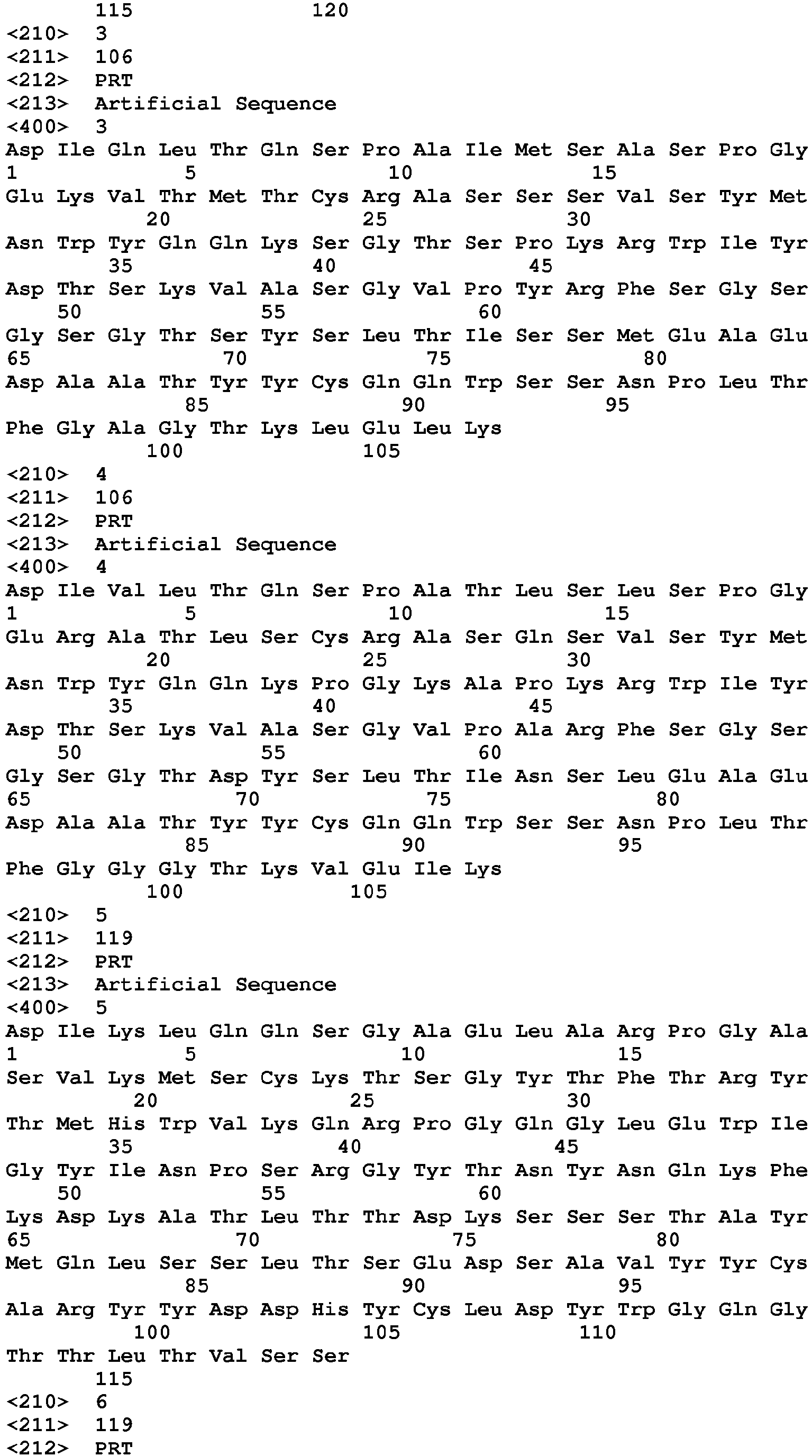


Claims (30)
- A minicircle DNA recombinant parental plasmid having genetically engineered antibody gene expression cassette, wherein said minicircle DNA recombinant parental plasmid is obtained by inserting a gene sequence of genetically engineered antibody gene expression cassette into multiple cloning sites of a minicircle DNA empty plasmid, and said genetically engineered antibody gene expression cassette comprises genetically engineered antibody gene.
- A method for preparing minicircle DNA recombinant parental plasmid having genetically engineered antibody gene expression cassette, comprising:(1) providing or preparing DNA fragment having a gene sequence of genetically engineered antibody gene expression cassette, the genetically engineered antibody gene expression cassette comprising genetically engineered antibody gene;(2) inserting the DNA fragment obtained from step (1) into multiple cloning sites of a minicircle DNA empty plasmid to obtain a minicircle DNA recombinant parental plasmid having genetically engineered antibody gene expression cassette.
- A minicircle DNA having genetically engineered antibody gene expression cassette, wherein said minicircle DNA is circular DNA having genetically engineered antibody gene expression cassette, and said genetically engineered antibody gene expression cassette comprises genetically engineered antibody gene.
- The minicircle DNA having genetically engineered antibody gene expression cassette according to claim 3, wherein said genetically engineered antibody gene expression cassette comprises a promoter operably linked to genetically engineered antibody gene by gene sequence of signal peptides and/or gene sequence of tag.
- The minicircle DNA having genetically engineered antibody gene expression cassette according to claim 3, wherein said minicircle DNA is circular DNA having attR site and genetically engineered antibody gene expression cassette, and said genetically engineered antibody gene expression cassette comprises a nucleotide sequence selected from the group consisting of:(a) A-a-B-d-e(b) A-b-B-d-e(c) A-B-c-d -e(d) A-a- b-B-c-d-e(e) A- a -B-c-d-e(f) A- a- b-B -d-e(g) A- b -B-c -d-ewhere A is a nucleotide sequence encoding a promoter, B is a nucleotide sequence encoding genetically engineered antibody; a, b, c, d, e represent base sequence encoding signal peptides, base sequence encoding Flag tag, base sequence encoding His6 tag, stop codon and polyA tailing signal, respectively; "-" represents "operatively linked" between the gene fragments represented by each base sequence.
- A minicircle DNA having genetically engineered antibody gene expression cassette, wherein the minicircle DNA is circular DNA having attR site and genetically engineered antibody gene expression cassette, and said gene expression cassette comprises a promoter, base sequence encoding immunoglobulin κ chain signal peptide, base sequence encoding Flag tag, genetically engineered antibody genes, base sequence encoding His6 tag, stop codon and polyA tailing signal linked sequentially.
- The minicircle DNA having genetically engineered antibody gene expression cassette according to claim 6, wherein have base sequence encoding genetically engineered antibody, and the genetically engineered antibody is a dual-targeting specific antibody, and the dual-targeting specific antibody has targeting immune effector cell antigen epitope binding sites and tumor cell antigen epitope binding sites.
- The minicircle DNA having genetically engineered antibody gene expression cassette according to claim 7, wherein the immune effector cell is one selected from the group consisting of T lymphocytes, natural killer cells and macrophages.
- The minicircle DNA having genetically engineered antibody gene expression cassette according to claim 7, wherein the tumor cell is one selected from the group consisting of B lymphocytes of tumor cells, leukemia cells, lung cancer cells, gastric cancer cells, colorectal cancer cells, liver cancer cells, esophageal cancer cells, breast cancer cells, pancreatic cancer cells, bladder cancer cells and thyroid cancer cells.
- The minicircle DNA having genetically engineered antibody gene expression cassette according to claim 7, wherein the dual-targeting specific antibody combines with at least one antigen epitope of the tumor cells.
- The minicircle DNA having genetically engineered antibody gene expression cassette according to claim 6, wherein the genetically engineered antibody genes have base sequence encoding bispecific single chain antibody amino acid sequence, and connection form of amino acid sequence of the bispecific single chain antibody is one selected from the group consisting of (a)-(h):(a) VLCD19-linker1-VHCD19-linker2-VLCD3-linker1-VHCD3,(b) VHCD19-linker1-VLCD19-linker2-VLCD3-linker1-VHCD3,(c) VLCD 19-linker1-VHCD19-linker2-VHCD3-linker1-VLCD3,(d) VHCD19-linker-VLCD19-linker2-VHCD3-linker1-VLCD3,(e) VLCD20-linker1-VHCD20-linker1-VLCD3-linker1-VHCD3,(f) VHCD20-linker1-VLCD20-linker2-VLCD3-linker1-VHCD3,(g) VLCD20-linker1-VHCD20-linker2-VHCD3-linker1-VLCD3,(h) VHCD20-linkerl-VLCD20-linker2-VHCD3-linkerl-VLCD3,where amino acid sequence of the VLCD19 is shown in SEQ ID NO: 1; amino acid sequence of the VHCD19 is shown in SEQ ID NO: 2; amino acid sequence of the VLCD3 is one selected from the sequences shown in SEQ ID NO: 3 and SEQ ID NO: 4; amino acid sequence of the VHCD3 is one selected from the sequences shown in SEQ ID NO:5, SEQ ID NO:6 and SEQ ID NO:7; amino acid sequence of the linker1 is one selected from the sequences shown in SEQ ID NO:8, SEQ ID NO:9 and SEQ ID NO:10; amino acid sequence of the linker2 is shown in SEQ ID NO: 11; amino acid sequence of the VLCD20 is shown in SEQ ID NO: 29; amino acid sequence of the VHCD20 is shown in SEQ ID NO: 30.
- The minicircle DNA having genetically engineered antibody gene expression cassette according to claim 6, wherein the minicircle DNA having genetically engineered antibody gene expression cassette is produced from minicircle DNA recombinant parental plasmid through a site-specific recombination in host strains.
- A method for preparing a minicircle DNA having genetically engineered antibody gene expression cassette, comprising:(1) providing or preparing minicircle DNA recombinant parental plasmid having genetically engineered antibody gene expression cassette, said minicircle DNA recombinant parental plasmid is obtained by inserting a gene sequence of genetically engineered antibody gene expression cassette into multiple cloning sites of a minicircle DNA empty plasmid, the minicircle DNA recombinant parental plasmid having site-specific recombination sites;(2) transforming host strains with the minicircle DNA recombinant parental plasmid having genetically engineered antibody gene expression cassette obtained from step (1), producing minicircle DNA and backbone DNA through a site-specific recombination of site-specific recombination sites in the presence of a recombinase;(3) isolating and purifying the minicircle DNA and backbone DNA obtained from step (2), the minicircle DNA is circular DNA having genetically engineered antibody gene expression cassette, and said genetically engineered antibody gene expression cassette comprises genetically engineered antibody gene.
- The method for preparing a minicircle DNA having genetically engineered antibody gene expression cassette according to claim 13, wherein the site-specific recombination sites are phiC31 site-specific recombination sites, parA site-specific recombination sites or Cre site-specific recombination sites.
- The method for preparing a minicircle DNA having genetically engineered antibody gene expression cassette according to claim 13, wherein the genetically engineered antibody gene expression cassette comprises a promoter operably linked to genetically engineered antibody gene, and the promoter is operably linked to genetically engineered antibody gene by at least one of gene sequence of signal peptides and gene sequence of tag.
- The method for preparing a minicircle DNA having genetically engineered antibody gene expression cassette according to claim 13, wherein the site-specific recombination sites are attB and attP sites, and said genetically engineered antibody gene expression cassette comprises a nucleotide sequence selected from the group consisting of:(a) A-a-B-d-e(b) A-b-B-d-e(c) A-B-c-d -e(d) A-a-b-B-c-d-e(e) A- a -B-c-d-e(f) A- a- b-B -d-e(g) A- b -B-c -d-ewhere A is a nucleotide sequence encoding a promoter, B is a nucleotide sequence encoding genetically engineered antibody; a, b, c, d, e represent base sequence encoding signal peptides, base sequence encoding Flag tag, base sequence encoding His6 tag, stop codon and polyA tailing signal, respectively; "-" represents "operatively linked" between the gene fragments represented by each base sequence.
- A method for preparing a minicircle DNA having genetically engineered antibody gene expression cassette, comprising:(1) providing or preparing minicircle DNA recombinant parental plasmid having genetically engineered antibody gene expression cassette, said minicircle DNA recombinant parental plasmid is obtained by inserting a gene sequence of genetically engineered antibody gene expression cassette into multiple cloning sites of a minicircle DNA empty plasmid, and the minicircle DNA empty plasmid is p2ΦC31 plasmid or pMC.BESPX plasmid, and said genetically engineered antibody gene expression cassette comprises a promoter, base sequence encoding immunoglobulin κ chain signal peptide, base sequence encoding Flag tag, genetically engineered antibody genes, base sequence encoding His6 tag, stop codon and polyA tailing signal linked sequentially;(2) transforming host strains with the minicircle DNA recombinant parental plasmid having genetically engineered antibody gene expression cassette obtained from step (1), non-reversibly producing bacteria plasmid DNA containing attL site and minicircle DNA containing attR site in the presence of ΦC31 recombinase;(3) cutting the bacteria plasmid DNA containing attL site and obtained from step (2) with I-Sce endonuclease to produce linear DNA fragments; after the plasmid is degraded in host strains, purifying the minicircle DNA containing attR site with normal plasmid purification kits; the minicircle DNA is circular DNA having attR site and genetically engineered antibody gene expression cassette, and the genetically engineered antibody gene expression cassette comprises a promoter, base sequence encoding immunoglobulin κ chain signal peptide, base sequence encoding Flag tag, genetically engineered antibody genes, base sequence encoding His6 tag, stop codon and polyA tailing signal linked sequentially.
- The method for preparing a minicircle DNA having genetically engineered antibody gene expression cassette according to claim 17, wherein the genetically engineered antibody genes have base sequence encoding bispecific single chain antibody amino acid sequence, and connection form of amino acid sequence of the bispecific single chain antibody is one selected from the group consisting of (a)-(h):(a) VLCD19-linker1-VHCD19-linker2-VLCD3-linker1-VHCD3,(b) VHCD19-linker1-VLCD19-linker2-VLCD3-linker1-VHCD3,(c) VLCD 19-linker1-VHCD19-linker2-VHCD3-linker1-VLCD3,(d) VHCD19-linker1-VLCD19-linker2-VHCD3-linker1-VLCD3,(e) VLCD20-linker1-VHCD20-linker2-VLCD3-linker1-VHCD3,(f) VHCD20-linker1-VLCD20-linker2-VLCD3-linker1-VHCD3,(g) VLCD20-linker1-VHCD20-linker2-VHCD3-linker1-VLCD3,(h) VHCD20-linkerl-VLCD20-linker2-VHCD3-linkerl-VLCD3,where amino acid sequence of the VLCD19 is shown in SEQ ID NO: 1; amino acid sequence of the VHCD19 is shown in SEQ ID NO: 2; amino acid sequence of the VLCD3 is one selected from the sequences shown in SEQ ID NO: 3 and SEQ ID NO: 4; amino acid sequence of the VHCD3 is one selected from the sequences shown in SEQ ID NO:5, SEQ ID NO:6 and SEQ ID NO:7; amino acid sequence of the linker1 is one selected from the sequences shown in SEQ ID NO:8, SEQ ID NO:9 and SEQ ID NO:10; amino acid sequence of the linker2 is shown in SEQ ID NO: 11; amino acid sequence of the VLCD20 is shown in SEQ ID NO: 29; amino acid sequence of the VHCD20 is shown in SEQ ID NO: 30.
- A method for administrating the minicircle DNA of claim 3, wherein said method is one selected from (1)-(4):(1) administrating the minicircle DNA alone;(2) administrating the minicircle DNA with one of chemotherapy, radiotherapy, surgery, biotherapy and immunotherapy, or with their combinations;(3) delivering the minicircle DNA into a patient for therapy by a targeted delivery approach;(4) transfecting immune effector cell with the minicircle DNA by an in vitro transfection technique, and then transporting the immune effector cell transfected with the minicircle DNA into a patient for therapy.
- The method for administrating the minicircle DNA having genetically engineered antibody gene expression cassette according to claim 19, the immune effector cell in (4) is one selected from the group consisting of T lymphocytes, natural killer cells, macrophages and stem cells.
- A host comprising minicircle DNA according to claim 3.
- A genetically engineered antibody, wherein the genetically engineered antibody is a dual-targeting specific antibody, and the dual-targeting specific antibody has targeting immune effector cell antigen epitope binding sites and tumor cell antigen epitope binding sites.
- The genetically engineered antibody according to claim 22, wherein the genetically engineered antibody is a bispecific single chain antibody, and connection form of amino acid sequence of the bispecific single chain antibody is one selected from the group consisting of (a)-(h):(a) VLCD 19-linker1-VHCD 19-linker2-VLCD3-linker1-VHCD3,(b) VHCD19-linker1-VLCD19-linker2-VLCD3-linker1-VHCD3,(c) VLCD 19-linker1-VHCD19-linker2-VHCD3-linker1-VLCD3,(d) VHCD19-linker1-VLCD19-linker2-VHCD3-linker1-VLCD3,(e) VLCD20-linker1-VHCD20-linker2-VLCD3-linker1-VHCD3,(f) VHCD20-linker1-VLCD20-linker2-VLCD3-linker1-VHCD3,(g) VLCD20-linkerl-VHCD20-linker2-VHCD3-linkerl-VLCD3,(h) VHCD20-linkerl-VLCD20-linker2-VHCD3-linkerl-VLCD3,where amino acid sequence of the VLCD19 is shown in SEQ ID NO: 1; amino acid sequence of the VHCD19 is shown in SEQ ID NO: 2; amino acid sequence of the VLCD3 is one selected from the sequences shown in SEQ ID NO: 3 and SEQ ID NO: 4; amino acid sequence of the VHCD3 is one selected from the sequences shown in SEQ ID NO:5, SEQ ID NO:6 and SEQ ID NO:7; amino acid sequence of the linker1 is one selected from the sequences shown in SEQ ID NO:8, SEQ ID NO:9 and SEQ ID NO:10; amino acid sequence of the linker2 is shown in SEQ ID NO: 11; amino acid sequence of the VLCD20 is shown in SEQ ID NO: 29; amino acid sequence of the VHCD20 is shown in SEQ ID NO: 30.
- A method for preparing genetically engineered antibody, comprising:(1) providing or preparing minicircle DNA, the minicircle DNA is circular DNA having genetically engineered antibody gene expression cassette, and the genetically engineered antibody gene expression cassette comprises genetically engineered antibody gene;(2) transfecting host cell with the minicircle DNA having genetically engineered antibody gene expression cassette obtained from step (1), expressing and producing genetically engineered antibody in the host cell.
- The method for preparing genetically engineered antibody according to claim 24, wherein the genetically engineered antibody gene expression cassette comprises a promoter operably linked to genetically engineered antibody gene, and the promoter is operably linked to genetically engineered antibody gene by at least one of gene sequence of signal peptides and gene sequence of tag.
- The method for preparing genetically engineered antibody according to claim 24, wherein the minicircle DNA is circular DNA having attR site and genetically engineered antibody gene expression cassette, and said gene expression cassette comprises a nucleotide sequence selected from the group consisting of:(a) A-a-B-d-e(b) A-b-B-d-e(c) A -B-c-d -e(d) A-a- b-B-c-d-e(e) A- a -B-c-d-e(f) A- a- b-B -d-e(g) A- b -B-c -d-ewhere A is a nucleotide sequence encoding a promoter, B is a nucleotide sequence encoding genetically engineered antibody; a, b, c, d, e represent base sequence encoding signal peptides, base sequence encoding Flag tag, base sequence encoding His6 tag, stop codon and polyA tailing signal, respectively; "-" represents "operatively linked" between the gene fragments represented by each base sequence.
- A method for preparing genetically engineered antibody, comprising:(1) providing or preparing minicircle DNA having genetically engineered antibody gene expression cassette, and the minicircle DNA is circular DNA having attR site and genetically engineered antibody gene expression cassette, and the genetically engineered antibody gene expression cassette comprises a promoter, base sequence encoding immunoglobulin κ chain signal peptide, base sequence encoding Flag tag, genetically engineered antibody genes, base sequence encoding His6 tag, stop codon and polyA tailing signal linked sequentially;(2) transfecting host cell with the minicircle DNA having genetically engineered antibody gene expression cassette obtained from step (1), expressing and producing genetically engineered antibody in the host cell.
- The method for preparing genetically engineered antibody according to claim 27, wherein the genetically engineered antibody is a bispecific single chain antibody, and connection form of amino acid sequence of the bispecific single chain antibody is one selected from the group consisting of (a), (b), (c) and (d):(a) VLCD 19-linker1-VHCD19-linker2-VLCD3-linker1-VHCD3,(b) VHCD19-linker1-VLCD19-linker2-VLCD3-linker1-VHCD3,(c) VLCD 19-linker1-VHCD19-linker2-VHCD3-linker1-VLCD3,(d) VHCD19-linker1-VLCD19-linker2-VHCD3-linker1-VLCD3,where amino acid sequence of the VLCD19 is shown in SEQ ID NO: 1; amino acid sequence of the VHCD19 is shown in SEQ ID NO: 2; amino acid sequence of the VLCD3 is one selected from the sequences shown in SEQ ID NO: 3 and SEQ ID NO: 4; amino acid sequence of the VHCD3 is one selected from the sequences shown in SEQ ID NO:5, SEQ ID NO:6 and SEQ ID NO:7; amino acid sequence of the linker1 is one selected from the sequences shown in SEQ ID NO:8, SEQ ID NO:9 and SEQ ID NO:10; amino acid sequence of the linker2 is shown in SEQ ID NO: 11.
- Use of the minicircle DNA having genetically engineered antibody gene expression cassette according to claim 3 in preparing medicines for cancers.
- Use of the minicircle DNA having genetically engineered antibody gene expression cassette according to claim 3 in preparing medicines for CD 19 positive cancer disease.
Applications Claiming Priority (2)
| Application Number | Priority Date | Filing Date | Title |
|---|---|---|---|
| CN201310339305.0A CN104342453A (en) | 2013-08-06 | 2013-08-06 | Minicircle DNA recombinant parent plasmid containing genetically engineered antibody gene expression cassette, minicircle DNA containing the expression cassette and application thereof |
| PCT/CN2014/083741 WO2015018331A1 (en) | 2013-08-06 | 2014-08-05 | Minicircle dna recombinant parental plasmid having genetically engineered antibody gene expression cassette, a minicircle dna having the expression cassette, and applications |
Publications (2)
| Publication Number | Publication Date |
|---|---|
| EP3031922A1 true EP3031922A1 (en) | 2016-06-15 |
| EP3031922A4 EP3031922A4 (en) | 2017-06-07 |
Family
ID=52460664
Family Applications (1)
| Application Number | Title | Priority Date | Filing Date |
|---|---|---|---|
| EP14834580.4A Withdrawn EP3031922A4 (en) | 2013-08-06 | 2014-08-05 | Minicircle dna recombinant parental plasmid having genetically engineered antibody gene expression cassette, a minicircle dna having the expression cassette, and applications |
Country Status (7)
| Country | Link |
|---|---|
| US (1) | US10280425B2 (en) |
| EP (1) | EP3031922A4 (en) |
| JP (1) | JP2016526915A (en) |
| KR (1) | KR20160030317A (en) |
| CN (1) | CN104342453A (en) |
| CA (1) | CA2920408A1 (en) |
| WO (1) | WO2015018331A1 (en) |
Cited By (1)
| Publication number | Priority date | Publication date | Assignee | Title |
|---|---|---|---|---|
| WO2019084319A1 (en) * | 2017-10-25 | 2019-05-02 | The Regents Of The University Of California | Antibodies against cdcp1 for the treatment and detection of cancer |
Families Citing this family (26)
| Publication number | Priority date | Publication date | Assignee | Title |
|---|---|---|---|---|
| CN104342453A (en) * | 2013-08-06 | 2015-02-11 | 深圳先进技术研究院 | Minicircle DNA recombinant parent plasmid containing genetically engineered antibody gene expression cassette, minicircle DNA containing the expression cassette and application thereof |
| CN106349391A (en) * | 2015-07-17 | 2017-01-25 | 中国科学院深圳先进技术研究院 | HBV specific double-targeted antibody as well as preparation method and application thereof, minicircle DNA containing double-targeted antibody expression box and application of minicircle DNA |
| AU2016373365B2 (en) * | 2015-12-14 | 2021-07-08 | GenomeFrontier Therapeutics TW Co., Ltd. | Transposon system, kit comprising the same, and uses thereof |
| EP3519436A4 (en) * | 2016-09-30 | 2020-09-09 | Baylor College of Medicine | ANTIBODY-BASED GENE THERAPY WITH TISSUE-DIRECTED EXPRESSION |
| CN108728463A (en) * | 2017-04-14 | 2018-11-02 | 深圳新诺微环生物科技有限公司 | A kind of minicircle dna carrier and its preparation method and application of expression IgG antibody |
| CN108728465A (en) * | 2017-04-14 | 2018-11-02 | 深圳新诺微环生物科技有限公司 | A kind of minicircle dna carrier and its preparation method and application of expression target cell-effector cell's bridge |
| CN108728464A (en) * | 2017-04-14 | 2018-11-02 | 深圳新诺微环生物科技有限公司 | A kind of minicircle dna carrier and its preparation method and application of expression AntiHIV1 RT activity bispecific antibody |
| CN109706164A (en) * | 2017-10-26 | 2019-05-03 | 深圳新诺微环生物科技有限公司 | The bridging molecules and its application of minicircle dna expression connection people and monkey CD20 and effector cell's antigen |
| CN108949791B (en) * | 2017-10-26 | 2021-09-07 | 深圳新诺微环生物科技有限公司 | Micro-ring DNA expression anti-HPV therapeutic engineering antibody and application thereof |
| CN109706163A (en) * | 2017-10-26 | 2019-05-03 | 深圳新诺微环生物科技有限公司 | Bridging molecules and its application of minicircle dna expression connection people and animal target cells and effector cell |
| CN108410823B (en) * | 2018-03-26 | 2019-11-01 | 安徽中盛溯源生物科技有限公司 | A kind of method that micro-loop episomal vector efficiently reprograms blood cell generation iPSC |
| US20210346306A1 (en) | 2018-05-23 | 2021-11-11 | Modernatx, Inc. | Delivery of dna |
| KR102559149B1 (en) * | 2018-10-26 | 2023-07-24 | 에프. 호프만-라 로슈 아게 | Multispecific antibody screening method using recombinase-mediated cassette exchange |
| US12180487B2 (en) * | 2019-02-06 | 2024-12-31 | Fred Hutchinson Cancer Center | Minicircle producing bacteria engineered to differentially methylate nucleic acid molecules therein |
| US12098429B2 (en) | 2019-03-25 | 2024-09-24 | The Chinese University Of Hong Kong | Determining linear and circular forms of circulating nucleic acids |
| BR112021022682A2 (en) | 2019-05-14 | 2022-02-22 | Provention Bio Inc | Methods and compositions for preventing type 1 diabetes |
| CA3140287A1 (en) * | 2019-06-19 | 2020-12-24 | Johannes Auer | Method for the generation of a trivalent antibody expressing cell by targeted integration of multiple expression cassettes in a defined organization |
| CN110684798A (en) * | 2019-09-03 | 2020-01-14 | 深圳新诺微环生物科技有限公司 | Muscle-targeted minicircle DNA gene therapy |
| CN110564751A (en) * | 2019-09-03 | 2019-12-13 | 深圳新诺微环生物科技有限公司 | Design and application of micro-ring DNA vaccine |
| GB2606844B (en) | 2019-09-18 | 2025-08-06 | Aldevron Llc | Synthetic DNA vectors and methods of use |
| CA3184474A1 (en) | 2020-06-01 | 2021-12-09 | Modernatx, Inc. | Phenylalanine hydroxylase variants and uses thereof |
| US12006366B2 (en) | 2020-06-11 | 2024-06-11 | Provention Bio, Inc. | Methods and compositions for preventing type 1 diabetes |
| CN111850018B (en) * | 2020-07-02 | 2021-06-22 | 北京大学人民医院 | Multi-MHC genotype and antigen MiniGene combinatorial library and its construction method and application |
| EP4337177A1 (en) | 2021-05-11 | 2024-03-20 | Modernatx, Inc. | Non-viral delivery of dna for prolonged polypeptide expression in vivo |
| WO2022251253A1 (en) | 2021-05-24 | 2022-12-01 | Provention Bio, Inc. | Methods for treating type 1 diabetes |
| AU2022211795A1 (en) * | 2021-08-06 | 2023-02-23 | Syte.Bio Inc. | Hairpin loop ended self-complementary double-stranded covalently closed linear dna vector, manufacturing system and process, and uses of said resulting dna vector |
Family Cites Families (21)
| Publication number | Priority date | Publication date | Assignee | Title |
|---|---|---|---|---|
| KR100508289B1 (en) * | 1998-04-21 | 2005-08-17 | 마이크로메트 에이지 | Cd19×cd3 specific polypeptides and uses thereof |
| ES2386775T3 (en) | 2001-07-23 | 2012-08-30 | The Board Of Trustees Of The Leland Stanford Junior University | Methods and compositions for RNAi-mediated inhibition of mammalian gene expression |
| US10590418B2 (en) | 2001-07-23 | 2020-03-17 | The Board Of Trustees Of The Leland Stanford Junior University | Methods and compositions for RNAi mediated inhibition of gene expression in mammals |
| WO2004020605A2 (en) | 2002-08-29 | 2004-03-11 | The Board Of Trustees Of The Leland Stanford Junior University | Circular nucleic acid vectors, and methods for making and using the same |
| CN1812999A (en) * | 2003-05-31 | 2006-08-02 | 麦克罗梅特股份公司 | Pharmaceutical composition comprising a bispecific antibody specific for EpCAM |
| AU2004242846A1 (en) * | 2003-05-31 | 2004-12-09 | Micromet Ag | Pharmaceutical compositions comprising bispecific anti-CD3, anti-CD19 antibody constructs for the treatment of B-cell related disorders |
| EP1629013B1 (en) * | 2003-05-31 | 2018-01-24 | Amgen Research (Munich) GmbH | Pharmaceutical composition comprising a bispecific antibody specific for epcam |
| ZA200601699B (en) * | 2003-10-16 | 2007-05-30 | Micromet Ag | Multispecific deimmunized CD3-binders |
| US20060160178A1 (en) * | 2003-11-17 | 2006-07-20 | Jonathan Rothberg | Methods of generating antibody diversity in vitro |
| DK2304025T3 (en) * | 2008-07-03 | 2016-02-08 | Univ Leland Stanford Junior | MINI CIRCULAR DNA vector compositions and methods for their preparation and use |
| US20120183477A1 (en) * | 2009-06-26 | 2012-07-19 | Five Prime Therapeutics, Inc. | Therapeutic Antibody Target Validation and Screening In Vivo |
| BR112012009778A2 (en) * | 2009-10-27 | 2017-06-13 | Micromet Ag | Dosage regimen for administering a bispecific cd19xcd3 antibody |
| CN102250245B (en) * | 2010-05-27 | 2014-05-14 | 四川大学 | Bispecific antibody capable of resisting B cell lymphoma and application thereof |
| CN102888426B (en) * | 2011-07-19 | 2014-04-16 | 中国科学院深圳先进技术研究院 | Minicircle gene vector and its preparation method and use |
| EP3321286B1 (en) * | 2011-08-23 | 2021-01-06 | Roche Glycart AG | Bispecific t cell activating antigen binding molecules |
| CN102978226B (en) * | 2011-09-05 | 2015-03-04 | 中国科学院深圳先进技术研究院 | Micro-ring DNA gene vector composition, and preparation method and application thereof |
| KR101466874B1 (en) * | 2012-05-11 | 2014-12-03 | 가톨릭대학교 산학협력단 | Minicircle expressing anti-IL-6R antibody for preventing and treating autoimmune disease |
| KR101482237B1 (en) * | 2012-05-11 | 2015-01-14 | 가톨릭대학교 산학협력단 | A pharmaceutical composition for preventing and treating autoimmune disease comprising minicircle vector expressing bispecific protein comprising anti-IL-6R and TNFR2 |
| PL2870247T3 (en) * | 2012-07-05 | 2019-10-31 | Hoffmann La Roche | Expression and secretion system |
| JP6693872B2 (en) * | 2013-07-25 | 2020-05-13 | シトムクス セラピューティクス,インコーポレイティド | Multispecific antibodies, multispecific activatable antibodies, and methods of use thereof |
| CN104342453A (en) * | 2013-08-06 | 2015-02-11 | 深圳先进技术研究院 | Minicircle DNA recombinant parent plasmid containing genetically engineered antibody gene expression cassette, minicircle DNA containing the expression cassette and application thereof |
-
2013
- 2013-08-06 CN CN201310339305.0A patent/CN104342453A/en active Pending
-
2014
- 2014-08-05 WO PCT/CN2014/083741 patent/WO2015018331A1/en not_active Ceased
- 2014-08-05 KR KR1020167004369A patent/KR20160030317A/en not_active Ceased
- 2014-08-05 CA CA2920408A patent/CA2920408A1/en not_active Abandoned
- 2014-08-05 US US14/909,060 patent/US10280425B2/en active Active
- 2014-08-05 EP EP14834580.4A patent/EP3031922A4/en not_active Withdrawn
- 2014-08-05 JP JP2016532225A patent/JP2016526915A/en active Pending
Cited By (2)
| Publication number | Priority date | Publication date | Assignee | Title |
|---|---|---|---|---|
| WO2019084319A1 (en) * | 2017-10-25 | 2019-05-02 | The Regents Of The University Of California | Antibodies against cdcp1 for the treatment and detection of cancer |
| US11603412B2 (en) | 2017-10-25 | 2023-03-14 | The Regents Of The University Of California | Antibodies against CDCP1 for the treatment and detection of cancer |
Also Published As
| Publication number | Publication date |
|---|---|
| CN104342453A (en) | 2015-02-11 |
| JP2016526915A (en) | 2016-09-08 |
| US10280425B2 (en) | 2019-05-07 |
| WO2015018331A1 (en) | 2015-02-12 |
| KR20160030317A (en) | 2016-03-16 |
| CA2920408A1 (en) | 2015-02-12 |
| EP3031922A4 (en) | 2017-06-07 |
| US20160312230A1 (en) | 2016-10-27 |
Similar Documents
| Publication | Publication Date | Title |
|---|---|---|
| US10280425B2 (en) | Minicircle DNA recombinant parental plasmid having genetically engineered antibody gene expression cassette, a minicircle DNA having the expression cassette, and applications | |
| JP7700159B2 (en) | Chimeric antigen receptors for axl or rorr2 and methods of use thereof | |
| ES2968880T3 (en) | Chimeric antigen receptor (CAR) that binds BCMA, and uses thereof | |
| AU2019384523B2 (en) | Split interleukin mimetics and their use | |
| JP7262403B2 (en) | Expression of novel cellular tags | |
| US12544440B2 (en) | IL-36 secreting immunoresponsive cells and uses thereof | |
| WO2021211633A2 (en) | Modular binding proteins for extracellular vesicles and uses thereof | |
| US20230242879A1 (en) | Il-33 secreting immunoresponsive cells and uses thereof | |
| IL295405A (en) | Chimeric antigen receptors with cd28 mutations and their use | |
| AU2020346887A1 (en) | Antigen recognizing receptors targeting CD371 and uses thereof | |
| JP6920786B2 (en) | RNA virus for immunoviral therapy | |
| TW202241937A (en) | Peptide markers to track genetically engineered cells | |
| WO2024153120A1 (en) | Mutated pd1 ectodomain fragment and car containing same, and nk cell | |
| CN105399832A (en) | Label-free single-chain type anthropogenic double-specificity antibody and application thereof | |
| CN105985444B (en) | Chimeric antigen receptor, and method and application for rapidly constructing chimeric antigen receptor | |
| CN112480262B (en) | Fusion protein and preparation and application thereof | |
| CN121294358A (en) | A therapeutic cell, its preparation method and application | |
| CN121406676A (en) | Nucleic acid and pharmaceutical compositions for immune cell adjuvants | |
| CN122038427A (en) | Construction and application of targeted exosome chimeric antigen receptor molecule |
Legal Events
| Date | Code | Title | Description |
|---|---|---|---|
| PUAI | Public reference made under article 153(3) epc to a published international application that has entered the european phase |
Free format text: ORIGINAL CODE: 0009012 |
|
| 17P | Request for examination filed |
Effective date: 20160223 |
|
| AK | Designated contracting states |
Kind code of ref document: A1 Designated state(s): AL AT BE BG CH CY CZ DE DK EE ES FI FR GB GR HR HU IE IS IT LI LT LU LV MC MK MT NL NO PL PT RO RS SE SI SK SM TR |
|
| AX | Request for extension of the european patent |
Extension state: BA ME |
|
| DAX | Request for extension of the european patent (deleted) | ||
| RIC1 | Information provided on ipc code assigned before grant |
Ipc: C12N 15/66 20060101ALI20170131BHEP Ipc: C12N 15/10 20060101ALI20170131BHEP Ipc: A61P 35/00 20060101ALI20170131BHEP Ipc: C07K 16/18 20060101ALI20170131BHEP Ipc: A61K 48/00 20060101ALI20170131BHEP Ipc: A61K 39/395 20060101ALI20170131BHEP Ipc: C12N 15/85 20060101AFI20170131BHEP Ipc: C12N 15/11 20060101ALI20170131BHEP |
|
| A4 | Supplementary search report drawn up and despatched |
Effective date: 20170510 |
|
| RIC1 | Information provided on ipc code assigned before grant |
Ipc: A61P 35/00 20060101ALI20170503BHEP Ipc: C12N 15/11 20060101ALI20170503BHEP Ipc: C12N 15/10 20060101ALI20170503BHEP Ipc: C12N 15/66 20060101ALI20170503BHEP Ipc: C07K 16/18 20060101ALI20170503BHEP Ipc: A61K 48/00 20060101ALI20170503BHEP Ipc: C12N 15/85 20060101AFI20170503BHEP Ipc: A61K 39/395 20060101ALI20170503BHEP |
|
| STAA | Information on the status of an ep patent application or granted ep patent |
Free format text: STATUS: THE APPLICATION IS DEEMED TO BE WITHDRAWN |
|
| 18D | Application deemed to be withdrawn |
Effective date: 20171209 |