EP3031782A1 - Plant and method for the abatement of pollutants in fumes and process water coming from a recycling unit of rubber residues - Google Patents
Plant and method for the abatement of pollutants in fumes and process water coming from a recycling unit of rubber residues Download PDFInfo
- Publication number
- EP3031782A1 EP3031782A1 EP15195277.7A EP15195277A EP3031782A1 EP 3031782 A1 EP3031782 A1 EP 3031782A1 EP 15195277 A EP15195277 A EP 15195277A EP 3031782 A1 EP3031782 A1 EP 3031782A1
- Authority
- EP
- European Patent Office
- Prior art keywords
- water
- tank
- plant
- fumes
- treatment
- Prior art date
- Legal status (The legal status is an assumption and is not a legal conclusion. Google has not performed a legal analysis and makes no representation as to the accuracy of the status listed.)
- Granted
Links
- XLYOFNOQVPJJNP-UHFFFAOYSA-N water Substances O XLYOFNOQVPJJNP-UHFFFAOYSA-N 0.000 title claims abstract description 126
- 238000000034 method Methods 0.000 title claims abstract description 87
- 230000008569 process Effects 0.000 title claims abstract description 67
- 239000003517 fume Substances 0.000 title claims abstract description 48
- 229920001971 elastomer Polymers 0.000 title claims abstract description 17
- 239000003344 environmental pollutant Substances 0.000 title claims abstract description 16
- 239000005060 rubber Substances 0.000 title claims abstract description 16
- 231100000719 pollutant Toxicity 0.000 title claims abstract description 14
- 238000004064 recycling Methods 0.000 title claims abstract description 11
- 238000005406 washing Methods 0.000 claims abstract description 28
- 239000007789 gas Substances 0.000 claims abstract description 15
- 238000009825 accumulation Methods 0.000 claims abstract description 14
- 238000000746 purification Methods 0.000 claims abstract description 13
- 238000000926 separation method Methods 0.000 claims abstract description 13
- MHAJPDPJQMAIIY-UHFFFAOYSA-N Hydrogen peroxide Chemical compound OO MHAJPDPJQMAIIY-UHFFFAOYSA-N 0.000 claims abstract description 12
- 239000007788 liquid Substances 0.000 claims abstract description 12
- 229920000642 polymer Polymers 0.000 claims abstract description 12
- 239000004636 vulcanized rubber Substances 0.000 claims abstract description 11
- 238000011084 recovery Methods 0.000 claims abstract description 9
- 239000000203 mixture Substances 0.000 claims abstract description 7
- 239000007790 solid phase Substances 0.000 claims abstract 5
- 239000000463 material Substances 0.000 claims description 15
- 238000001816 cooling Methods 0.000 claims description 10
- 239000012071 phase Substances 0.000 claims description 10
- 239000010802 sludge Substances 0.000 claims description 10
- 239000000843 powder Substances 0.000 claims description 9
- OKTJSMMVPCPJKN-UHFFFAOYSA-N Carbon Chemical compound [C] OKTJSMMVPCPJKN-UHFFFAOYSA-N 0.000 claims description 8
- 230000000694 effects Effects 0.000 claims description 5
- 238000001914 filtration Methods 0.000 claims description 5
- 239000008394 flocculating agent Substances 0.000 claims description 5
- 230000005484 gravity Effects 0.000 claims description 4
- 239000003921 oil Substances 0.000 claims description 4
- 239000011044 quartzite Substances 0.000 claims description 4
- 230000006833 reintegration Effects 0.000 claims description 3
- 239000007787 solid Substances 0.000 claims description 3
- 239000006228 supernatant Substances 0.000 claims description 2
- 230000001172 regenerating effect Effects 0.000 claims 2
- 239000000126 substance Substances 0.000 description 17
- 230000008929 regeneration Effects 0.000 description 12
- 238000011069 regeneration method Methods 0.000 description 12
- 238000004519 manufacturing process Methods 0.000 description 7
- NINIDFKCEFEMDL-UHFFFAOYSA-N Sulfur Chemical group [S] NINIDFKCEFEMDL-UHFFFAOYSA-N 0.000 description 6
- 229910052717 sulfur Inorganic materials 0.000 description 6
- 239000011593 sulfur Substances 0.000 description 6
- 239000004033 plastic Substances 0.000 description 5
- 230000008901 benefit Effects 0.000 description 4
- 238000011161 development Methods 0.000 description 4
- 230000018109 developmental process Effects 0.000 description 4
- 238000001125 extrusion Methods 0.000 description 4
- 238000012545 processing Methods 0.000 description 4
- 239000000047 product Substances 0.000 description 4
- 230000000593 degrading effect Effects 0.000 description 3
- 230000008030 elimination Effects 0.000 description 3
- 238000003379 elimination reaction Methods 0.000 description 3
- 238000005516 engineering process Methods 0.000 description 3
- 230000007613 environmental effect Effects 0.000 description 3
- 238000012423 maintenance Methods 0.000 description 3
- 239000007800 oxidant agent Substances 0.000 description 3
- 229910001220 stainless steel Inorganic materials 0.000 description 3
- 239000010935 stainless steel Substances 0.000 description 3
- 239000002699 waste material Substances 0.000 description 3
- 239000004677 Nylon Substances 0.000 description 2
- QAOWNCQODCNURD-UHFFFAOYSA-N Sulfuric acid Chemical compound OS(O)(=O)=O QAOWNCQODCNURD-UHFFFAOYSA-N 0.000 description 2
- 239000002253 acid Chemical class 0.000 description 2
- 150000001412 amines Chemical class 0.000 description 2
- 238000007872 degassing Methods 0.000 description 2
- 230000006872 improvement Effects 0.000 description 2
- 229920001778 nylon Polymers 0.000 description 2
- 239000002245 particle Substances 0.000 description 2
- 230000009467 reduction Effects 0.000 description 2
- 238000005201 scrubbing Methods 0.000 description 2
- 238000005200 wet scrubbing Methods 0.000 description 2
- RWSOTUBLDIXVET-UHFFFAOYSA-N Dihydrogen sulfide Chemical class S RWSOTUBLDIXVET-UHFFFAOYSA-N 0.000 description 1
- 229910000831 Steel Inorganic materials 0.000 description 1
- 238000010521 absorption reaction Methods 0.000 description 1
- 230000009471 action Effects 0.000 description 1
- 238000005273 aeration Methods 0.000 description 1
- QVGXLLKOCUKJST-UHFFFAOYSA-N atomic oxygen Chemical compound [O] QVGXLLKOCUKJST-UHFFFAOYSA-N 0.000 description 1
- 230000033228 biological regulation Effects 0.000 description 1
- 230000015572 biosynthetic process Effects 0.000 description 1
- 239000003153 chemical reaction reagent Substances 0.000 description 1
- 239000003795 chemical substances by application Substances 0.000 description 1
- 238000004140 cleaning Methods 0.000 description 1
- 150000001875 compounds Chemical class 0.000 description 1
- 238000010276 construction Methods 0.000 description 1
- 238000011109 contamination Methods 0.000 description 1
- 239000000498 cooling water Substances 0.000 description 1
- 239000002781 deodorant agent Substances 0.000 description 1
- 239000000806 elastomer Substances 0.000 description 1
- 235000012438 extruded product Nutrition 0.000 description 1
- 238000009472 formulation Methods 0.000 description 1
- 125000000524 functional group Chemical group 0.000 description 1
- 239000007792 gaseous phase Substances 0.000 description 1
- 239000003673 groundwater Substances 0.000 description 1
- 239000002920 hazardous waste Substances 0.000 description 1
- 238000010438 heat treatment Methods 0.000 description 1
- 150000002440 hydroxy compounds Chemical class 0.000 description 1
- 238000010297 mechanical methods and process Methods 0.000 description 1
- 230000005226 mechanical processes and functions Effects 0.000 description 1
- 238000002156 mixing Methods 0.000 description 1
- 238000012986 modification Methods 0.000 description 1
- 230000004048 modification Effects 0.000 description 1
- 230000007935 neutral effect Effects 0.000 description 1
- 238000005457 optimization Methods 0.000 description 1
- 229910052760 oxygen Inorganic materials 0.000 description 1
- 239000001301 oxygen Substances 0.000 description 1
- 229920001021 polysulfide Polymers 0.000 description 1
- 239000005077 polysulfide Substances 0.000 description 1
- 150000008117 polysulfides Polymers 0.000 description 1
- 229920000915 polyvinyl chloride Polymers 0.000 description 1
- 239000004800 polyvinyl chloride Substances 0.000 description 1
- 230000003389 potentiating effect Effects 0.000 description 1
- 238000004801 process automation Methods 0.000 description 1
- 230000001105 regulatory effect Effects 0.000 description 1
- 238000011160 research Methods 0.000 description 1
- 238000010057 rubber processing Methods 0.000 description 1
- 229920002379 silicone rubber Polymers 0.000 description 1
- 239000002689 soil Substances 0.000 description 1
- 239000010959 steel Substances 0.000 description 1
- 238000006467 substitution reaction Methods 0.000 description 1
- 230000001629 suppression Effects 0.000 description 1
- 229920003051 synthetic elastomer Polymers 0.000 description 1
- 239000005061 synthetic rubber Substances 0.000 description 1
- 238000012360 testing method Methods 0.000 description 1
- 230000000930 thermomechanical effect Effects 0.000 description 1
- 150000003568 thioethers Chemical class 0.000 description 1
- 238000004073 vulcanization Methods 0.000 description 1
Images


Classifications
-
- C—CHEMISTRY; METALLURGY
- C02—TREATMENT OF WATER, WASTE WATER, SEWAGE, OR SLUDGE
- C02F—TREATMENT OF WATER, WASTE WATER, SEWAGE, OR SLUDGE
- C02F9/00—Multistage treatment of water, waste water or sewage
-
- B—PERFORMING OPERATIONS; TRANSPORTING
- B01—PHYSICAL OR CHEMICAL PROCESSES OR APPARATUS IN GENERAL
- B01D—SEPARATION
- B01D53/00—Separation of gases or vapours; Recovering vapours of volatile solvents from gases; Chemical or biological purification of waste gases, e.g. engine exhaust gases, smoke, fumes, flue gases, aerosols
- B01D53/14—Separation of gases or vapours; Recovering vapours of volatile solvents from gases; Chemical or biological purification of waste gases, e.g. engine exhaust gases, smoke, fumes, flue gases, aerosols by absorption
- B01D53/1425—Regeneration of liquid absorbents
-
- B—PERFORMING OPERATIONS; TRANSPORTING
- B29—WORKING OF PLASTICS; WORKING OF SUBSTANCES IN A PLASTIC STATE IN GENERAL
- B29C—SHAPING OR JOINING OF PLASTICS; SHAPING OF MATERIAL IN A PLASTIC STATE, NOT OTHERWISE PROVIDED FOR; AFTER-TREATMENT OF THE SHAPED PRODUCTS, e.g. REPAIRING
- B29C48/00—Extrusion moulding, i.e. expressing the moulding material through a die or nozzle which imparts the desired form; Apparatus therefor
- B29C48/25—Component parts, details or accessories; Auxiliary operations
- B29C48/36—Means for plasticising or homogenising the moulding material or forcing it through the nozzle or die
- B29C48/50—Details of extruders
- B29C48/76—Venting, drying means; Degassing means
-
- B—PERFORMING OPERATIONS; TRANSPORTING
- B01—PHYSICAL OR CHEMICAL PROCESSES OR APPARATUS IN GENERAL
- B01D—SEPARATION
- B01D2252/00—Absorbents, i.e. solvents and liquid materials for gas absorption
- B01D2252/10—Inorganic absorbents
- B01D2252/103—Water
-
- B—PERFORMING OPERATIONS; TRANSPORTING
- B01—PHYSICAL OR CHEMICAL PROCESSES OR APPARATUS IN GENERAL
- B01D—SEPARATION
- B01D2257/00—Components to be removed
- B01D2257/30—Sulfur compounds
-
- B—PERFORMING OPERATIONS; TRANSPORTING
- B01—PHYSICAL OR CHEMICAL PROCESSES OR APPARATUS IN GENERAL
- B01D—SEPARATION
- B01D2257/00—Components to be removed
- B01D2257/30—Sulfur compounds
- B01D2257/306—Organic sulfur compounds, e.g. mercaptans
-
- B—PERFORMING OPERATIONS; TRANSPORTING
- B01—PHYSICAL OR CHEMICAL PROCESSES OR APPARATUS IN GENERAL
- B01D—SEPARATION
- B01D2257/00—Components to be removed
- B01D2257/70—Organic compounds not provided for in groups B01D2257/00 - B01D2257/602
-
- B—PERFORMING OPERATIONS; TRANSPORTING
- B29—WORKING OF PLASTICS; WORKING OF SUBSTANCES IN A PLASTIC STATE IN GENERAL
- B29C—SHAPING OR JOINING OF PLASTICS; SHAPING OF MATERIAL IN A PLASTIC STATE, NOT OTHERWISE PROVIDED FOR; AFTER-TREATMENT OF THE SHAPED PRODUCTS, e.g. REPAIRING
- B29C2791/00—Shaping characteristics in general
- B29C2791/004—Shaping under special conditions
- B29C2791/006—Using vacuum
-
- B—PERFORMING OPERATIONS; TRANSPORTING
- B29—WORKING OF PLASTICS; WORKING OF SUBSTANCES IN A PLASTIC STATE IN GENERAL
- B29C—SHAPING OR JOINING OF PLASTICS; SHAPING OF MATERIAL IN A PLASTIC STATE, NOT OTHERWISE PROVIDED FOR; AFTER-TREATMENT OF THE SHAPED PRODUCTS, e.g. REPAIRING
- B29C48/00—Extrusion moulding, i.e. expressing the moulding material through a die or nozzle which imparts the desired form; Apparatus therefor
- B29C48/022—Extrusion moulding, i.e. expressing the moulding material through a die or nozzle which imparts the desired form; Apparatus therefor characterised by the choice of material
-
- B—PERFORMING OPERATIONS; TRANSPORTING
- B29—WORKING OF PLASTICS; WORKING OF SUBSTANCES IN A PLASTIC STATE IN GENERAL
- B29C—SHAPING OR JOINING OF PLASTICS; SHAPING OF MATERIAL IN A PLASTIC STATE, NOT OTHERWISE PROVIDED FOR; AFTER-TREATMENT OF THE SHAPED PRODUCTS, e.g. REPAIRING
- B29C48/00—Extrusion moulding, i.e. expressing the moulding material through a die or nozzle which imparts the desired form; Apparatus therefor
- B29C48/03—Extrusion moulding, i.e. expressing the moulding material through a die or nozzle which imparts the desired form; Apparatus therefor characterised by the shape of the extruded material at extrusion
-
- B—PERFORMING OPERATIONS; TRANSPORTING
- B29—WORKING OF PLASTICS; WORKING OF SUBSTANCES IN A PLASTIC STATE IN GENERAL
- B29K—INDEXING SCHEME ASSOCIATED WITH SUBCLASSES B29B, B29C OR B29D, RELATING TO MOULDING MATERIALS OR TO MATERIALS FOR MOULDS, REINFORCEMENTS, FILLERS OR PREFORMED PARTS, e.g. INSERTS
- B29K2023/00—Use of polyalkenes or derivatives thereof as moulding material
- B29K2023/16—EPM, i.e. ethylene-propylene copolymers; EPDM, i.e. ethylene-propylene-diene copolymers; EPT, i.e. ethylene-propylene terpolymers
-
- B—PERFORMING OPERATIONS; TRANSPORTING
- B29—WORKING OF PLASTICS; WORKING OF SUBSTANCES IN A PLASTIC STATE IN GENERAL
- B29K—INDEXING SCHEME ASSOCIATED WITH SUBCLASSES B29B, B29C OR B29D, RELATING TO MOULDING MATERIALS OR TO MATERIALS FOR MOULDS, REINFORCEMENTS, FILLERS OR PREFORMED PARTS, e.g. INSERTS
- B29K2105/00—Condition, form or state of moulded material or of the material to be shaped
- B29K2105/26—Scrap or recycled material
-
- C—CHEMISTRY; METALLURGY
- C02—TREATMENT OF WATER, WASTE WATER, SEWAGE, OR SLUDGE
- C02F—TREATMENT OF WATER, WASTE WATER, SEWAGE, OR SLUDGE
- C02F1/00—Treatment of water, waste water, or sewage
- C02F1/28—Treatment of water, waste water, or sewage by sorption
- C02F1/283—Treatment of water, waste water, or sewage by sorption using coal, charred products, or inorganic mixtures containing them
-
- C—CHEMISTRY; METALLURGY
- C02—TREATMENT OF WATER, WASTE WATER, SEWAGE, OR SLUDGE
- C02F—TREATMENT OF WATER, WASTE WATER, SEWAGE, OR SLUDGE
- C02F1/00—Treatment of water, waste water, or sewage
- C02F1/40—Devices for separating or removing fatty or oily substances or similar floating material
-
- C—CHEMISTRY; METALLURGY
- C02—TREATMENT OF WATER, WASTE WATER, SEWAGE, OR SLUDGE
- C02F—TREATMENT OF WATER, WASTE WATER, SEWAGE, OR SLUDGE
- C02F1/00—Treatment of water, waste water, or sewage
- C02F1/52—Treatment of water, waste water, or sewage by flocculation or precipitation of suspended impurities
- C02F1/5281—Installations for water purification using chemical agents
-
- C—CHEMISTRY; METALLURGY
- C02—TREATMENT OF WATER, WASTE WATER, SEWAGE, OR SLUDGE
- C02F—TREATMENT OF WATER, WASTE WATER, SEWAGE, OR SLUDGE
- C02F1/00—Treatment of water, waste water, or sewage
- C02F1/66—Treatment of water, waste water, or sewage by neutralisation; pH adjustment
-
- C—CHEMISTRY; METALLURGY
- C02—TREATMENT OF WATER, WASTE WATER, SEWAGE, OR SLUDGE
- C02F—TREATMENT OF WATER, WASTE WATER, SEWAGE, OR SLUDGE
- C02F1/00—Treatment of water, waste water, or sewage
- C02F1/72—Treatment of water, waste water, or sewage by oxidation
- C02F1/722—Oxidation by peroxides
-
- C—CHEMISTRY; METALLURGY
- C02—TREATMENT OF WATER, WASTE WATER, SEWAGE, OR SLUDGE
- C02F—TREATMENT OF WATER, WASTE WATER, SEWAGE, OR SLUDGE
- C02F11/00—Treatment of sludge; Devices therefor
- C02F11/12—Treatment of sludge; Devices therefor by de-watering, drying or thickening
- C02F11/121—Treatment of sludge; Devices therefor by de-watering, drying or thickening by mechanical de-watering
- C02F11/123—Treatment of sludge; Devices therefor by de-watering, drying or thickening by mechanical de-watering using belt or band filters
-
- C—CHEMISTRY; METALLURGY
- C02—TREATMENT OF WATER, WASTE WATER, SEWAGE, OR SLUDGE
- C02F—TREATMENT OF WATER, WASTE WATER, SEWAGE, OR SLUDGE
- C02F1/00—Treatment of water, waste water, or sewage
- C02F2001/007—Processes including a sedimentation step
-
- C—CHEMISTRY; METALLURGY
- C02—TREATMENT OF WATER, WASTE WATER, SEWAGE, OR SLUDGE
- C02F—TREATMENT OF WATER, WASTE WATER, SEWAGE, OR SLUDGE
- C02F2101/00—Nature of the contaminant
- C02F2101/10—Inorganic compounds
- C02F2101/101—Sulfur compounds
-
- C—CHEMISTRY; METALLURGY
- C02—TREATMENT OF WATER, WASTE WATER, SEWAGE, OR SLUDGE
- C02F—TREATMENT OF WATER, WASTE WATER, SEWAGE, OR SLUDGE
- C02F2101/00—Nature of the contaminant
- C02F2101/30—Organic compounds
- C02F2101/32—Hydrocarbons, e.g. oil
-
- C—CHEMISTRY; METALLURGY
- C02—TREATMENT OF WATER, WASTE WATER, SEWAGE, OR SLUDGE
- C02F—TREATMENT OF WATER, WASTE WATER, SEWAGE, OR SLUDGE
- C02F2101/00—Nature of the contaminant
- C02F2101/30—Organic compounds
- C02F2101/32—Hydrocarbons, e.g. oil
- C02F2101/325—Emulsions
-
- C—CHEMISTRY; METALLURGY
- C02—TREATMENT OF WATER, WASTE WATER, SEWAGE, OR SLUDGE
- C02F—TREATMENT OF WATER, WASTE WATER, SEWAGE, OR SLUDGE
- C02F2103/00—Nature of the water, waste water, sewage or sludge to be treated
- C02F2103/18—Nature of the water, waste water, sewage or sludge to be treated from the purification of gaseous effluents
-
- C—CHEMISTRY; METALLURGY
- C02—TREATMENT OF WATER, WASTE WATER, SEWAGE, OR SLUDGE
- C02F—TREATMENT OF WATER, WASTE WATER, SEWAGE, OR SLUDGE
- C02F2303/00—Specific treatment goals
- C02F2303/02—Odour removal or prevention of malodour
Definitions
- the present invention relates to a plant and method for the abatement of pollutants in fumes and process water coming from a recycling unit of rubber residues.
- EPDM extruded products have a series of physical-mechanical characteristics indicated as being definitive when a step technically defined as “vulcanization” is effected after their extrusion (Goodyear process).
- the rubber molecules are chemically bound to sulfur by heating with a modification in the molecular structure of the polymer.
- EPDM ethylene-propylene-diene polymer
- scraps of products produced with this vulcanized material are currently considered as being unusable and are disposed of in landfills or attempts are made to treat them but with intolerably high costs for allowing their re-use.
- treatment must be applied which is capable of breaking the sulfur-based bonds (devulcanization process) obtaining a "regenerated" material.
- WO 02/38276 A1 relates to a plant for the abatement of pollutants in extruder emissions in which scraps of plastic material are treated for the recovery of the plastic material.
- DATABASE WPI Week 201465 Thomson Scientific London GB AN 2014-R93482 & CN 203 694 857 U relates to the treatment of gases emitted by the treatment of plastic material in a washing tower in which the washing liquid is sent back to the tower.
- a general objective of the present invention is to solve the drawbacks of the known art described above in an extremely simple, economic and particularly functional manner.
- Another objective of the present invention is to provide a plant and method for the abatement of pollutants in fumes and process water coming from a recycling unit of rubber residues, in particular EPDM vulcanized rubber (ethylene-propylene-diene polymer).
- EPDM vulcanized rubber ethylene-propylene-diene polymer
- a further objective of the present invention is to provide a plant with easy and simple maintenance and which has relatively low functioning costs.
- Yet another objective of the present invention is to identify a plant and method for the abatement of pollutants in fumes and process water coming from a recycling unit of rubber residues, which is capable of eliminating all problems of pollution of both the air and water, avoiding the collection and elimination of process water.
- a new method for the abatement of pollutants in fumes has also been conceived, with the use of a Venturi system in the inlet chamber of the gaseous effluent.
- the elimination of the polluting substances and continued abatement efficiency of the Venturi system take place through the removal, by clariflocculation with a suitable denaturing flocculant, of the substances present in the emulsified and oily phase, and degrading the presence of odorous organic substances in the water used, through appropriate oxidizing agents.
- the portion of the group used for the wet scrubbing of fumes consists of at least one washing tower 11, for example of the Scrubber-Venturi type, capable of treating a significant quantity of gaseous effluent.
- Said group is capable of lowering the concentration of substances present in a gaseous stream, normally powders and acid micro-pollutants.
- the presence of a second washing tower 11A also enables powders and micro-pollutants coming from a production plant of EPDM vulcanized rubber (ethylene-propylene-diene polymer) to be abated, such as profiled sections or the like, schematically indicated in 19.
- the second washing tower 11A can alternatively and advantageously potentiate the abatement action exerted by the first washing tower 11 by passing the fumes emitted and coming from the first washing tower, through the same (according to the dashed and dotted line 20) for a "deeper" treatment of the product coming from the regeneration unit.
- the washing tower 11 receives, in an inlet pipe 12, the fumes (gas and powders) coming from the processings, from a regeneration extruder 13 (for the sake of convenience, schematized in the upper part of the scheme) captured by a suction hood schematized in 14.
- Said regeneration extruder 13 treats finely shredded processing scraps of EPDM vulcanized rubber (ethylene-propylene-diene polymer).
- the wet scrubbing group of fumes envisages the implementation of a new and original abatement process of fumes and recovery and purification of water for cooling the extruder.
- the fumes and powders coming from at least one suction hood 14, positioned above the regeneration extruder 13, are first of all sent to the washing tower 11 through the fume inlet pipe 12 into a specific abatement chamber (not shown).
- a Venturi water jet 15 fed by an atomizing pump 16 is envisaged in said inlet pipe 12, to try and effect the abatement of the content of all the contents of the fumes extracted.
- the atomizing pump 16 is connected on the suction side to a water tank 17, fed at least with water leaving the washing tower 11 specifically envisaged for feeding the fume abatement.
- Said water tank 17 also mixes clean network water with hydrogen peroxide introduced by means of a dosage pump 18 fed from a specific hydrogen peroxide tank (not shown for the sake of simplicity).
- a dosage pump 18 fed from a specific hydrogen peroxide tank (not shown for the sake of simplicity).
- Venturi water jet 15 With respect to the presence of the Venturi water jet 15, it causes the particles contained in the inlet fumes to come into close contact with the water jet, which is pressurized, pressurized water that has been sucked from the fume abatement water tank 17 by means of an atomizing pump 16.
- the water, containing the extracted powders, is sent, as can be seen more clearly further on, from the scrubber to the fume abatement water tank 17 generally containing "dirty water".
- the polluting substances must be subsequently eliminated and the abatement efficiency of the washing towers 11, 11A (with a Scrubber-Venturi system), maintained.
- a method for recovering the water used in the recovery and regeneration process of the rubber residues indicated above, lowering water consumptions and avoiding the elimination of more or less polluted water.
- This subgroup of the water treatment plant is composed of a process tank 28, for example circular, divided into two parts by a steel septum 29.
- the water is subjected to a first oil-removal treatment in a first part of the process tank 28, aimed at removing the supernatant portion of the oils with separation by density.
- the treated water is decanted to allow the sludge separated by gravity to settle on the tilted bottom of the second part of the process tank 28.
- the treated water leaving the process tank 28 is sent by means of a pipe 32 and joined in a collection well 33 and is then sent into the accumulation tank 25 indicated above.
- the sludge produced is sent by means of the booster pump 34 to a filter tape 35 which allows separation between the solid fraction (sludge) in a specific disposal container 36, and the residual liquid fraction evacuated from the pipe 32.
- the latter for example, is dropped into the above-mentioned collection well 33 and in turn, is lifted by means of a submerged pump 37 into the accumulation tank 25.
- Rainwater and water deriving from possible losses or leakages of the plant are also collected in said collection and convergence well 33, in addition to the water arriving from the process tank 28 and from the filter tape 35 of the part of the plant suitable for water purification. All of these flows are then sent through the pipe 38 into the above-mentioned accumulation tank 25.
- the water present in said accumulation tank 25 is sent by means of a pump 40 to a specific combined "quartzite-activated carbon" double-column filtration unit 39 which completes the purification phase.
- This unit 39 removes any possible entrainments of sludge and particles and residues of oil and organic substances, in particular odorous substances still possibly present.
- the water purified by the combined quartzite-activated carbon double-column filtration unit 39 is boosted by means of a pump into a line 41 and feeds the water collection tank 17 for the abatement of the fumes at the service of the two towers 11, 11A, thus creating a closed system and eliminating the necessity of disposing of the process water due to an excess of oily charge.
- An oxidizing agent capable of degrading possible organic substances still present, is dosed along the line 41, if necessary.
- the sludge produced and contained in the disposal container 36 is disposed of according to the normal regulations in force.
- This second process water treatment and recovery group envisages that the water and gas mixture leaving a liquid ring vacuum pump 50 be sent to a separator tank 51 capable of separating water and gas.
- the process water is collected on the bottom of the separator tank 51 envisaged, and is pumped by a booster pump 52 to a specific collection tank 53 through a stainless steel line 54.
- the process gas leaving the separator tank 51 is pushed by means of stainless steel pipes 55 as far as the collection tank 53 where it is bubbled onto the bottom, purifying it additionally.
- Oily waste substances accumulate on the surface of the process water contained therein, which are eliminated or disposed of periodically by means of a specific discharge valve 56. Reintegration with clean water coming from an aqueduct is also effected in this collection tank 53, by means of a specific feed schematized in 57.
- the pH of the water inside the collection tank 53 is regulated by means of a pump 58 which feeds sulfuric acid with the respective pipe 59 and keeps the pH of the water at values considered as being neutral (about 7.0).
- a booster pump 60 brings the process water back to the vacuum pump 50, through a stainless steel pipe 61, after cooling in a tube-bundle exchanger 62 with water coming from pipes 63 of cooling towers.
- Part of the process water directed towards the vacuum pump 50 is diverted and sent into the fume abatement water tank 17 where it is mixed, as previously indicated, with hydrogen peroxide and deodorant, pumped and atomized inside the pipe or duct 12 where the sucked fumes arrive.
- the atomized water is collected on the bottom inside the fume abatement tower 11 and thrown back into the tank 17 whereas the purified fumes are expelled to the outside, as already mentioned.
Landscapes
- Engineering & Computer Science (AREA)
- Chemical & Material Sciences (AREA)
- Organic Chemistry (AREA)
- Environmental & Geological Engineering (AREA)
- Water Supply & Treatment (AREA)
- Hydrology & Water Resources (AREA)
- Life Sciences & Earth Sciences (AREA)
- Mechanical Engineering (AREA)
- Analytical Chemistry (AREA)
- General Chemical & Material Sciences (AREA)
- Oil, Petroleum & Natural Gas (AREA)
- Chemical Kinetics & Catalysis (AREA)
- Treating Waste Gases (AREA)
- Water Treatment By Sorption (AREA)
Abstract
Description
- The present invention relates to a plant and method for the abatement of pollutants in fumes and process water coming from a recycling unit of rubber residues.
- Technologies and plants for the production of seals and extruded profiles in PVC, nylon, silicon rubber and EPDM, for a wide variety of industrial sectors, among which the building industry, shipbuilding, automotive industry and household appliances, have been developed over the years.
- EPDM extruded products have a series of physical-mechanical characteristics indicated as being definitive when a step technically defined as "vulcanization" is effected after their extrusion (Goodyear process).
- In this phase, the rubber molecules are chemically bound to sulfur by heating with a modification in the molecular structure of the polymer.
- This causes an increase in the elasticity and tensile strength, with the suppression of negative properties, such as abrasiveness and tackiness, in addition to a greater resistance to the effects of atmospheric oxygen and numerous chemical substances.
- At the end of the working process, the scraps of vulcanized rubber are currently disposed of in landfills, as the type of bond between the molecular chains prevents them from being re-used with traditional methods. As far as PVC plastic residues (plastic material) and Nylon (engineering polymer) are concerned, these can be recycled and treated so as to obtain virgin material to be re-introduced into the production cycle.
- The problem of the disposal of EPDM (ethylene-propylene-diene polymer) vulcanized rubber is, however, different.
- As already indicated, in fact, scraps of products produced with this vulcanized material are currently considered as being unusable and are disposed of in landfills or attempts are made to treat them but with intolerably high costs for allowing their re-use.
- This also creates a considerable problem of an environmental nature, in addition, as already mentioned, to a constant and significant cost item, due to both the waste of potentially recoverable material and also with respect to the increasingly difficult and costly disposal, also polluting for the environment.
- In view of what is indicated above, a search for innovative technologies is underway, which is suitable for finding solutions that allow the recycling of rubber scraps of this particular material, such as EPDM, which is among the most-widely used synthetic rubbers in the world.
- This research tends to find and develop an alternative solution to that of traditional disposal in landfills, which is naturally capable of respecting motivated requests of the environmental type, in addition to having a return and economic advantage, and also to be able to re-use the scraps, in substitution, for example, of virgin polymer, avoiding their current disposal in landfills and consequently management as hazardous waste.
- For this purpose, the development of specific operational lines is envisaged, for the treatment, by means of appropriate thermal and mechanical processes, of EPDM vulcanized rubber residues, for obtaining a de-vulcanized material. The material obtained from a regeneration process is almost similar to the characteristics of the original elastomer and which can therefore be used for the formulation of blends and for the production of articles with similar characteristics.
- In these lines, treatment must be applied which is capable of breaking the sulfur-based bonds (devulcanization process) obtaining a "regenerated" material.
- Some tested solutions and attempts so far made, exploit the extruder technology.
- In order to implement this, efforts have been mainly focused on the development of the chemical component of the process, examining and testing various devulcanizing agents (such as amines, CO2, etc.) and various introduction modes of these into the extrusion cycle, ignoring, however, the thermo-mechanical component of the process.
- The processing of the above materials has so far been effected by means of extrusion devices connected to a specific degassing plant for evacuating the sulfur fumes released during the process. The study and development of extruders is still underway whereas the problem of the exhaust fumes has now been taken into consideration.
- In addition to the study, projecting and development of the parts and components of a special plant of this type, identifying a suitable treatment of the sulfur fumes formed on-line and of the process water is therefore equally important.
- The absence of adequate abatement systems, specific for substances deriving from the regeneration steps of rubber and cooling-treatment water, lead, in fact, to the onset of problems relating to the presence of odorous substances present in significant quantities in both the fumes and process water.
- The construction of a specific and functional plant for the abatement of fumes and aeration of the environment during the production phase appears to be relatively problematic on the basis of current knowledge and technological offers present on the market. The treatment of the process water is equally problematic.
- This is a highly critical phase due to the fact that, as previously indicated, a degassing and fume absorption group is fundamental during the devulcanization process in which sulfur is substantially released. In this process in particular, chemical substances are released with mainly sulfur-based functional groups, such as sulfides, polysulfides, mercaptans, in addition to amines and hydroxy compounds, acid compounds as well as common oil mists typical of rubber processings. This problem can also be extended to the process water englobing these solid and gaseous pollutants.
- It should in fact be pointed out that the lack of a specific purifying system or process leads to the result that the water used in the steps for both the abatement of fumes and for cooling the regeneration plant, reaches saturation in a few hours. This saturation generated by organic and oily substances produced by the abatement of extrusion fumes, causes a loss in the purifying efficiency of the abatement plant and in general acts negatively on the performances of the whole fume abatement process.
-
WO 02/38276 A1 - DATABASE WPI Week 201465 Thomson Scientific London GB AN 2014-R93482 & CN 203 694 857 U relates to the treatment of gases emitted by the treatment of plastic material in a washing tower in which the washing liquid is sent back to the tower.
- A general objective of the present invention is to solve the drawbacks of the known art described above in an extremely simple, economic and particularly functional manner.
- Another objective of the present invention is to provide a plant and method for the abatement of pollutants in fumes and process water coming from a recycling unit of rubber residues, in particular EPDM vulcanized rubber (ethylene-propylene-diene polymer).
- A further objective of the present invention is to provide a plant with easy and simple maintenance and which has relatively low functioning costs.
- Yet another objective of the present invention is to identify a plant and method for the abatement of pollutants in fumes and process water coming from a recycling unit of rubber residues, which is capable of eliminating all problems of pollution of both the air and water, avoiding the collection and elimination of process water.
- In view of the above objectives, according to the present invention, a plant and method for the abatement of pollutants in fumes and process water coming from a recycling unit of rubber residues has been conceived, having the characteristics indicated in the enclosed claims.
- The structural and functional characteristics of the present invention and its advantages with respect to the known art will appear even more evident from the following description, referring to the enclosed drawings, which, inter alia, show an embodiment of a plant and method for the abatement of pollutants in fumes and process water coming from a recycling unit of rubber residues produced according to the same invention.
- In the drawings:
-
figure 1 is a raised schematic view showing a plant for the abatement of pollutants in fumes and process water produced according to the invention; -
figure 2 is an enlarged raised schematic view of a first part of the group shown infigure 1 for a better understanding; -
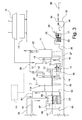
figure 3 is an enlarged raised schematic view of a second part of the group shown infigure 1 for a better understanding; - With reference to what is shown in the figure, this schematically illustrates a plant for the abatement of pollutants in fumes and process water coming from a recycling unit of rubber residues, in particular EPDM vulcanized rubber (ethylene-propylene-diene polymer).
- According to the present invention, in addition to the plant, a new method for the abatement of pollutants in fumes has also been conceived, with the use of a Venturi system in the inlet chamber of the gaseous effluent. In this way, the elimination of the polluting substances and continued abatement efficiency of the Venturi system take place through the removal, by clariflocculation with a suitable denaturing flocculant, of the substances present in the emulsified and oily phase, and degrading the presence of odorous organic substances in the water used, through appropriate oxidizing agents.
- It is thus envisaged that the portion of the group used for the wet scrubbing of fumes consists of at least one
washing tower 11, for example of the Scrubber-Venturi type, capable of treating a significant quantity of gaseous effluent. Said group is capable of lowering the concentration of substances present in a gaseous stream, normally powders and acid micro-pollutants. The presence of asecond washing tower 11A, for example, also enables powders and micro-pollutants coming from a production plant of EPDM vulcanized rubber (ethylene-propylene-diene polymer) to be abated, such as profiled sections or the like, schematically indicated in 19. Thesecond washing tower 11A can alternatively and advantageously potentiate the abatement action exerted by thefirst washing tower 11 by passing the fumes emitted and coming from the first washing tower, through the same (according to the dashed and dotted line 20) for a "deeper" treatment of the product coming from the regeneration unit. - In general, the
washing tower 11 receives, in aninlet pipe 12, the fumes (gas and powders) coming from the processings, from a regeneration extruder 13 (for the sake of convenience, schematized in the upper part of the scheme) captured by a suction hood schematized in 14. Saidregeneration extruder 13 treats finely shredded processing scraps of EPDM vulcanized rubber (ethylene-propylene-diene polymer). - The wet scrubbing group of fumes envisages the implementation of a new and original abatement process of fumes and recovery and purification of water for cooling the extruder.
- Consequently, the fumes and powders coming from at least one
suction hood 14, positioned above theregeneration extruder 13, are first of all sent to thewashing tower 11 through thefume inlet pipe 12 into a specific abatement chamber (not shown). In particular, it has been found that the provision of a Venturiwater jet 15 fed by an atomizingpump 16 is envisaged in saidinlet pipe 12, to try and effect the abatement of the content of all the contents of the fumes extracted. - The atomizing
pump 16 is connected on the suction side to awater tank 17, fed at least with water leaving thewashing tower 11 specifically envisaged for feeding the fume abatement. Saidwater tank 17 also mixes clean network water with hydrogen peroxide introduced by means of adosage pump 18 fed from a specific hydrogen peroxide tank (not shown for the sake of simplicity). Once the purification process has been started, further feeding pipes of filtered recovery water are connected to said fumeabatement water tank 17, as illustrated hereunder. Afirst inlet pipe 21 to saidwater tank 17 is an outlet pipe from thewashing tower 11. - With respect to the presence of the Venturi
water jet 15, it causes the particles contained in the inlet fumes to come into close contact with the water jet, which is pressurized, pressurized water that has been sucked from the fumeabatement water tank 17 by means of an atomizingpump 16. - The separation of the gaseous phase from the powders absorbed takes place by gravity: the liquid part, containing the powders, descends towards the lower area of the chamber of the
washing tower 11, whereas the gaseous part (purified) is sucked by a fan, schematized in 22, and exits from the chimney (not shown). - The water, containing the extracted powders, is sent, as can be seen more clearly further on, from the scrubber to the fume
abatement water tank 17 generally containing "dirty water". - A completely similar arrangement of parts can also be repeated for the
second washing tower 11A where the same elements are indicated with the same reference numbers. - According to the present invention, the polluting substances must be subsequently eliminated and the abatement efficiency of the
washing towers - This is achieved with the removal, by clariflocculation with a suitable denaturing flocculant, of the substances present in the emulsified and oily phase, and degrading the presence of odorous organic substances in the water used, through appropriate oxidizing agents.
- According to the present invention, in addition to optimizing the abatement method of fumes, a method has also been conceived for recovering the water used in the recovery and regeneration process of the rubber residues indicated above, lowering water consumptions and avoiding the elimination of more or less polluted water.
- For this specific purpose, the necessity has been found, in implementing the method of the invention, of providing an
accumulation tank 25, for example with a volume equal to about 5 mc, where both the water from the washing and scrubbing towers (described above) and also the process water for the regeneration of rubber, are sent, and which will be described in more detail hereunder. - This is to ensure that this water is purified with a continuous cycle during the abatement activity and regeneration processing in order to keep it suitable for being re-used, and producing a closed purification cycle according to the present invention.
- As far as the water leaving the fume
abatement water tank 17 is concerned, it can be observed from the schemes that this is sent through aconnection pipe 27 and with anappropriate booster pump 26 to a subgroup of the plant suitable for purifying the water. - This subgroup of the water treatment plant is composed of a
process tank 28, for example circular, divided into two parts by asteel septum 29. - The water is subjected to a first oil-removal treatment in a first part of the
process tank 28, aimed at removing the supernatant portion of the oils with separation by density. - In a second part of the
process tank 28 of the water, using adosage device 30 of a denaturing flocculating agent in powder form and mixing in continuous by means of a low-velocity blade mixer 31, the emulsified oily fraction which cannot be removed by simple separation, is removed. - After the addition of the flocculating agent, the treated water is decanted to allow the sludge separated by gravity to settle on the tilted bottom of the second part of the
process tank 28. - The treated water leaving the
process tank 28 is sent by means of apipe 32 and joined in a collection well 33 and is then sent into theaccumulation tank 25 indicated above. - The sludge produced, on the other hand, is sent by means of the
booster pump 34 to afilter tape 35 which allows separation between the solid fraction (sludge) in aspecific disposal container 36, and the residual liquid fraction evacuated from thepipe 32. In particular, the latter, for example, is dropped into the above-mentioned collection well 33 and in turn, is lifted by means of a submergedpump 37 into theaccumulation tank 25. Rainwater and water deriving from possible losses or leakages of the plant are also collected in said collection and convergence well 33, in addition to the water arriving from theprocess tank 28 and from thefilter tape 35 of the part of the plant suitable for water purification. All of these flows are then sent through thepipe 38 into the above-mentionedaccumulation tank 25. - The water present in said
accumulation tank 25 is sent by means of apump 40 to a specific combined "quartzite-activated carbon" double-column filtration unit 39 which completes the purification phase. Thisunit 39, in fact, removes any possible entrainments of sludge and particles and residues of oil and organic substances, in particular odorous substances still possibly present. - The water purified by the combined quartzite-activated carbon double-
column filtration unit 39 is boosted by means of a pump into aline 41 and feeds thewater collection tank 17 for the abatement of the fumes at the service of the twotowers - An oxidizing agent capable of degrading possible organic substances still present, is dosed along the
line 41, if necessary. - The sludge produced and contained in the
disposal container 36 is disposed of according to the normal regulations in force. - A solution has so far been proposed for the treatment of fumes and water leaving the washing and scrubbing towers, but it was previously specified that the invention also aims at purifying the cooling water and process gases coming directly from the rubber regeneration extruder.
- For this purpose, a specific process water treatment and recovery group has been conceived, which is capable of treating the mixture of water and gas coming from the cooling of the
extruder 13. - This second process water treatment and recovery group envisages that the water and gas mixture leaving a liquid
ring vacuum pump 50 be sent to aseparator tank 51 capable of separating water and gas. The process water is collected on the bottom of theseparator tank 51 envisaged, and is pumped by abooster pump 52 to aspecific collection tank 53 through astainless steel line 54. - The process gas leaving the
separator tank 51 is pushed by means ofstainless steel pipes 55 as far as thecollection tank 53 where it is bubbled onto the bottom, purifying it additionally. - Oily waste substances accumulate on the surface of the process water contained therein, which are eliminated or disposed of periodically by means of a
specific discharge valve 56. Reintegration with clean water coming from an aqueduct is also effected in thiscollection tank 53, by means of a specific feed schematized in 57. The pH of the water inside thecollection tank 53 is regulated by means of apump 58 which feeds sulfuric acid with therespective pipe 59 and keeps the pH of the water at values considered as being neutral (about 7.0). - A
booster pump 60 brings the process water back to thevacuum pump 50, through astainless steel pipe 61, after cooling in a tube-bundle exchanger 62 with water coming frompipes 63 of cooling towers. - Part of the process water directed towards the
vacuum pump 50 is diverted and sent into the fumeabatement water tank 17 where it is mixed, as previously indicated, with hydrogen peroxide and deodorant, pumped and atomized inside the pipe orduct 12 where the sucked fumes arrive. The atomized water is collected on the bottom inside thefume abatement tower 11 and thrown back into thetank 17 whereas the purified fumes are expelled to the outside, as already mentioned. - In this way, a complete purification of the secondary products of the regeneration plant of production waste of EPDM vulcanized rubber products (ethylene-propylene-diene polymer), is obtained.
- The implementation of the purification group described above offers numerous improvements from an economic point of view and also with respect to the process, solving the technical problems previously indicated.
- The advantages are summarized as follows:
- 1) The abatement process combined with the purification steps guarantees the process efficiency over time.
- 2) The formation of a closed cycle minimizes the environmental impacts of the company.
- 3) Maintaining the efficiency of the process reduces the frequency of plant maintenance with significant economic benefits.
- 4) The disposal only relates to the sludge produced by the filter tape, eliminating problems associated with the process water.
- 5) There is process automation with fewer controls and reduced costs.
- 6) There is a reduction in and optimization of the costs relating to the use of reagents.
- 7) A greater duration is obtained of the mechanical systems subject to wear, due to the aggressiveness of the water (pumps, seals, rotors, fans).
- 8) There is a reduction in odours and risks relating to olfactory disturbances in the surrounding areas.
- 9) There is a greater cleaning of the areas surrounding the scrubbers, eliminating risks of contamination of the soil and groundwater.
- 10) There is a considerable improvement in the safety of the operators involved in the management and maintenance of the plant.
- The objective mentioned in the preamble of the description has therefore been achieved.
- The forms of the structure for the production of a group according to the present invention, as also the materials and assembly and management modes, can naturally differ from those shown for purely illustrative and non-limiting purposes in the drawings.
- The protection scope of the invention is therefore defined by the enclosed claims.
Claims (16)
- A plant for the abatement of pollutants in fumes and process water coming from a recycling unit of rubber residues, in particular EPDM (ethylene-propylene-diene polymer) vulcanized rubber, which comprises a first treatment group of the fumes composed of at least one suction hood (14) positioned above at least one extruder (13) for the treatment of recovered EPDM material crushed for the treatment of fumes in at least one washing tower (11, 11A) and a second treatment and recovery group of process water consisting of at least one liquid ring vacuum pump (50) for feeding a mixture of water and gas leaving said extruder (13) towards a separator tank (51) in order to separate water and gas, wherein said washing tower of the scrubber-Venturi type envisages the provision of a Venturi water jet (15) fed by an atomizing pump (16) with water coming from a tank (17) fed at least with water leaving said washing tower (11), a subgroup (28, 35) of the plant also being connected to said tank (17), suitable for purifying the water with separation of the solid phase, and wherein said separator tank (51) is connected to a collection tank (53), in turn connected to said at least one liquid ring vacuum pump (50) and to said tank (17) fed at least with water leaving said washing tower (11), a dosage pump (18) of hydrogen peroxide also being associated with said tank (17), an accumulation tank (25) also being envisaged, connected directly to said subgroup (28, 35) of the plant, suitable for purifying the water, in addition to said tank (17) associated with said at least one washing tower (11, 11A), so as to create a continuous and closed water purification cycle during the abatement activity and regenerating process.
- The plant according to claim 1, characterized in that said subgroup of the plant suitable for purifying the water with separation of the solid phase, is connected to said tank (17) by means of a connection pipe (27) and a booster pump (26) and is composed of a process tank (28) divided into two parts by a septum (29), in which the water is subjected to a first oil-removal treatment in a first part of the process tank (28), and the water is treated with a flocculating agent in the second part of the process tank (28), for the removal of the emulsified oily fraction which cannot be removed by simple separation.
- The plant according to claim 2, characterized in that it also comprises a booster pump (34) for sending the sludge produced to a filter tape (35) and to a disposal container (36) with separation of the residual liquid fraction evacuated, sent to said accumulation tank (25) by means of a pipe (32).
- The plant according to claim 3, characterized in that a collection well (33) is interpositioned between said accumulation tank (25) and said pipe (32), associated with a submerged pump (37) connected directly to said accumulation tank (25).
- The plant according to the previous claims 1 or 2, characterized in that a pump (40) is envisaged between said accumulation tank (25) and said tank (17), associated with a combined "quartzite"-activated carbon double-column filtration unit (39).
- The plant according to the previous claims 1 or 2, characterized in that a feeding (57) associated with said collection tank (53) is also envisaged, for reintegration with clean water coming from the aqueduct.
- The plant according to the previous claims 1 or 2, characterized in that a booster pump (60) associated with said collection tank (53) is also envisaged, which sends process water back to said vacuum pump (50) through a pipe (61), after cooling in a tube-bundle exchanger (62) with water coming from pipes (63) of cooling towers.
- A method for abating pollutants in fumes and process water coming from a recycling unit of rubber residues, in particular EPDM (ethylene-propylene-diene polymer) vulcanized rubber, in a plant according to one or more of the previous claims, which comprises a treatment phase of fumes coming from at least one extruder (13) for the treatment of crushed recovered EPDM material and a treatment and recovery phase of process water, also for separating water and treatment gas, comprising the following phases:- sucking process fumes from said extruder (13) and subjecting them to washing in at least one washing tower (11, 11A) by means of a Venturi water jet (15) fed by an atomizing pump (16) with water coming from a tank (17) fed at least with water leaving said same washing tower (11),- sending water of said tank (17) to a subgroup (28, 35) of the plant, suitable for purifying the water with separation of the solid phase,- feeding a mixture of water and gas leaving said extruder (13) by means of at least one liquid ring vacuum pump (50) towards a separator tank (51) in order to separate water and gas,- feeding water and gas separated in said separator tank (51) to a collection tank (53),- feeding water from said collection tank (53) to said at least one liquid ring vacuum pump (50) and to said tank (17),- dosing hydrogen peroxide in said tank (17),- feeding water from said subgroup (28, 35) to an accumulation tank (25) which, in turn, feeds water to said tank (17) associated with said at least one washing tower (11, 11A), so as to create a continuous and closed water purification cycle during the abatement activity and regenerating process.
- The method according to claim 8, characterized in that said water fed from said tank (17) into a process tank (28), divided into two parts by a septum (29), in which the water is subjected to a first oil-removal treatment in a first part of the process tank (28), in order to remove the most supernatant portion of the oils by separation by density, whereas a dose of denaturing flocculating agent in powder form is added to the water contained in the second part of the process tank (28) and mixed continuously therewith, thus removing the emulsified oily fraction which cannot be removed by simple separation, is subjected to treatment in said subgroup of the plant, suitable for purifying the water with separation of the solid phase.
- The method according to claim 9, characterized in that, after the addition of the flocculating agent, a decanting phase of the treated water is envisaged, in order to allow the sludge separated by gravity on a tilted bottom of the second part of the process tank (28), to settle.
- The method according to claim 10, characterized by sending the sludge separated by gravity to a filter tape (35) which allows the solid fraction (sludge) inside a specific disposal container (36) to be separated from the residual liquid fraction evacuated by a pipe (32).
- The method according to claim 11, characterized by sending the treated water leaving the process tank (28) to a collection well (33) to be subsequently sent into the accumulation tank (25).
- The method according to claim 12, characterized by also sending to said collection well (33), in addition to the water arriving from the process tank (28) and from the filter tape (35) of the part of the plant suitable for water purification, rainwater and water deriving from possible losses or leakages of the plant.
- The method according to one or more of the previous claims, characterized by subjecting said water of said accumulation tank (25) to filtration in a combined "quartzite"-activated carbon double-column filtration unit (39).
- The method according to one or more of the previous claims 8-10, characterized in that it also envisages a reintegration feeding with clean water coming from the aqueduct into said collection tank (53).
- The method according to one or more of the previous claims 8-10, characterized in that it also envisages sending process water back to said vacuum pump (50) after cooling in a tube-bundle exchanger (62) with water coming from pipes (63) of cooling towers.
Applications Claiming Priority (1)
| Application Number | Priority Date | Filing Date | Title |
|---|---|---|---|
| ITMI20142108 | 2014-12-09 |
Publications (3)
| Publication Number | Publication Date |
|---|---|
| EP3031782A1 true EP3031782A1 (en) | 2016-06-15 |
| EP3031782B1 EP3031782B1 (en) | 2017-08-16 |
| EP3031782B8 EP3031782B8 (en) | 2017-11-22 |
Family
ID=52444469
Family Applications (1)
| Application Number | Title | Priority Date | Filing Date |
|---|---|---|---|
| EP15195277.7A Not-in-force EP3031782B8 (en) | 2014-12-09 | 2015-11-19 | Plant and method for the abatement of pollutants in fumes and process water coming from a recycling unit of rubber residues |
Country Status (2)
| Country | Link |
|---|---|
| EP (1) | EP3031782B8 (en) |
| ES (1) | ES2646315T3 (en) |
Cited By (2)
| Publication number | Priority date | Publication date | Assignee | Title |
|---|---|---|---|---|
| CN116040868A (en) * | 2023-01-06 | 2023-05-02 | 中国石油化工股份有限公司 | A kind of saline wastewater treatment system |
| IT202300019917A1 (en) * | 2023-09-27 | 2025-03-27 | Producta S R L | PLANT FOR THE REDUCTION OF POLLUTANTS IN FUMES AND PROCESS WATER FROM RUBBER WASTE RECYCLING |
Citations (4)
| Publication number | Priority date | Publication date | Assignee | Title |
|---|---|---|---|---|
| EP1201389A1 (en) * | 1999-06-08 | 2002-05-02 | Kabushiki Kaisha Toyota Chuo Kenkyusho | Method of reclaiming crosslinked rubber and molded article of reclaimed rubber |
| WO2002038276A1 (en) | 2000-11-01 | 2002-05-16 | Yash Vasant Joshi | Method for direct recycling of plastic wastes |
| DE102011082769A1 (en) * | 2011-09-15 | 2013-03-21 | Lindauer Dornier Gesellschaft Mit Beschränkter Haftung | Method and device for degassing a PET plastic melt in an extrusion plant |
| CN203694857U (en) | 2014-02-24 | 2014-07-09 | 合海橡塑装备制造有限公司 | Waste gas purification and drain-off system device for plastic production |
-
2015
- 2015-11-19 ES ES15195277.7T patent/ES2646315T3/en active Active
- 2015-11-19 EP EP15195277.7A patent/EP3031782B8/en not_active Not-in-force
Patent Citations (4)
| Publication number | Priority date | Publication date | Assignee | Title |
|---|---|---|---|---|
| EP1201389A1 (en) * | 1999-06-08 | 2002-05-02 | Kabushiki Kaisha Toyota Chuo Kenkyusho | Method of reclaiming crosslinked rubber and molded article of reclaimed rubber |
| WO2002038276A1 (en) | 2000-11-01 | 2002-05-16 | Yash Vasant Joshi | Method for direct recycling of plastic wastes |
| DE102011082769A1 (en) * | 2011-09-15 | 2013-03-21 | Lindauer Dornier Gesellschaft Mit Beschränkter Haftung | Method and device for degassing a PET plastic melt in an extrusion plant |
| CN203694857U (en) | 2014-02-24 | 2014-07-09 | 合海橡塑装备制造有限公司 | Waste gas purification and drain-off system device for plastic production |
Non-Patent Citations (2)
| Title |
|---|
| DATABASE WPI Week 201465, Derwent World Patents Index; AN 2014-R93482, XP002743125 * |
| FUKUMORI K ET AL: "DYNAMIC DEVULCANIZATION AND DYNAMIC VULCANIZATION FOR RECYCLING OF CROSSLINKED RUBBER", KAUTSCHUK UND GUMMI - KUNSTSTOFFE, HUTHIG VERLAG, HEIDELBERG, DE, vol. 59, no. 7/08, 1 July 2006 (2006-07-01), pages 405 - 411, XP001244731, ISSN: 0948-3276 * |
Cited By (2)
| Publication number | Priority date | Publication date | Assignee | Title |
|---|---|---|---|---|
| CN116040868A (en) * | 2023-01-06 | 2023-05-02 | 中国石油化工股份有限公司 | A kind of saline wastewater treatment system |
| IT202300019917A1 (en) * | 2023-09-27 | 2025-03-27 | Producta S R L | PLANT FOR THE REDUCTION OF POLLUTANTS IN FUMES AND PROCESS WATER FROM RUBBER WASTE RECYCLING |
Also Published As
| Publication number | Publication date |
|---|---|
| ES2646315T3 (en) | 2017-12-13 |
| EP3031782B8 (en) | 2017-11-22 |
| EP3031782B1 (en) | 2017-08-16 |
Similar Documents
| Publication | Publication Date | Title |
|---|---|---|
| KR100988942B1 (en) | Contaminated soil washing sorting system | |
| US9638417B2 (en) | Apparatus and method for reducing air pollution from exhaust | |
| CN110479731B (en) | Harmless household garbage treatment equipment | |
| CN104230086B (en) | A kind of method that water-borne coatings clean-out system spent solution regeneration utilizes | |
| CN105311931B (en) | Industrial VOCs exhaust gas decomposing, purifying processing method and equipment | |
| EP2835172A1 (en) | Method for treating discharge gas | |
| CN104128083A (en) | Method for degrading malodorous gas by coupling biotrickling filter with dielectric barrier discharge | |
| CN105484685A (en) | Oil-base mud drilling cutting treatment method | |
| JP2648412B2 (en) | Method and apparatus for treating mixed plastic waste | |
| EP3031782B1 (en) | Plant and method for the abatement of pollutants in fumes and process water coming from a recycling unit of rubber residues | |
| KR20180131723A (en) | Pollution gas scrubber | |
| KR20030043404A (en) | Method for removal of volatile organic compounds and odor using non-thermal plasma and apparatus thereof | |
| CN109111032B (en) | A kind of process method of waste emulsion resource disposal | |
| CN205717254U (en) | The high-efficiency environment friendly exhaust gas processing device that a kind of chemical plant is special | |
| KR101362080B1 (en) | The exclusion system for complex bad smell of food and drink waste | |
| CN210711398U (en) | Garbage carbonization treatment system | |
| CN210845784U (en) | Multistage active carbon waste gas filtering and purifying equipment | |
| CN101543834B (en) | System and method for continuously treating soil contaminated by middle and high concentration petroleum hydrocarbon | |
| CN109437350B (en) | Chemical three-waste comprehensive treatment system and method | |
| CN210846641U (en) | Waste crushing cutter set | |
| CN208260511U (en) | Reclaimed rubber waste gas purification apparatus | |
| Bondarenko et al. | Development of an Electroflotation Device for the Purification of Oily Waste from Power Generating Enterprises | |
| CN208898688U (en) | A kind of efficient process equipment of integrated oil-containing waste water | |
| CN205391955U (en) | High -efficient organic waste gas purification device | |
| CN210845578U (en) | Waste gas tar separation and filtration equipment |
Legal Events
| Date | Code | Title | Description |
|---|---|---|---|
| PUAI | Public reference made under article 153(3) epc to a published international application that has entered the european phase |
Free format text: ORIGINAL CODE: 0009012 |
|
| AK | Designated contracting states |
Kind code of ref document: A1 Designated state(s): AL AT BE BG CH CY CZ DE DK EE ES FI FR GB GR HR HU IE IS IT LI LT LU LV MC MK MT NL NO PL PT RO RS SE SI SK SM TR |
|
| AX | Request for extension of the european patent |
Extension state: BA ME |
|
| RBV | Designated contracting states (corrected) |
Designated state(s): AL AT BE BG CH CY CZ DE DK EE ES FI FR GB GR HR HU IE IS IT LI LT LU LV MC MK MT NL NO PL PT RO RS SE SI SK SM TR |
|
| 17P | Request for examination filed |
Effective date: 20161027 |
|
| GRAP | Despatch of communication of intention to grant a patent |
Free format text: ORIGINAL CODE: EPIDOSNIGR1 |
|
| RIC1 | Information provided on ipc code assigned before grant |
Ipc: C02F 101/32 20060101ALN20170210BHEP Ipc: C02F 101/10 20060101ALN20170210BHEP Ipc: C02F 1/28 20060101ALN20170210BHEP Ipc: C02F 1/52 20060101ALN20170210BHEP Ipc: C02F 9/00 20060101AFI20170210BHEP Ipc: C02F 11/12 20060101ALN20170210BHEP Ipc: C02F 1/40 20060101ALN20170210BHEP Ipc: C02F 1/66 20060101ALN20170210BHEP Ipc: C02F 103/18 20060101ALN20170210BHEP Ipc: C02F 1/72 20060101ALN20170210BHEP Ipc: C02F 1/00 20060101ALN20170210BHEP |
|
| INTG | Intention to grant announced |
Effective date: 20170313 |
|
| GRAS | Grant fee paid |
Free format text: ORIGINAL CODE: EPIDOSNIGR3 |
|
| GRAA | (expected) grant |
Free format text: ORIGINAL CODE: 0009210 |
|
| AK | Designated contracting states |
Kind code of ref document: B1 Designated state(s): AL AT BE BG CH CY CZ DE DK EE ES FI FR GB GR HR HU IE IS IT LI LT LU LV MC MK MT NL NO PL PT RO RS SE SI SK SM TR |
|
| REG | Reference to a national code |
Ref country code: GB Ref legal event code: FG4D |
|
| REG | Reference to a national code |
Ref country code: CH Ref legal event code: EP |
|
| REG | Reference to a national code |
Ref country code: IE Ref legal event code: FG4D |
|
| REG | Reference to a national code |
Ref country code: AT Ref legal event code: REF Ref document number: 918857 Country of ref document: AT Kind code of ref document: T Effective date: 20170915 |
|
| REG | Reference to a national code |
Ref country code: DE Ref legal event code: R096 Ref document number: 602015004151 Country of ref document: DE |
|
| RAP2 | Party data changed (patent owner data changed or rights of a patent transferred) |
Owner name: PRODUCTA S.A.S. DI LADIKOS ELEFTHERIOS & C. |
|
| REG | Reference to a national code |
Ref country code: FR Ref legal event code: PLFP Year of fee payment: 3 |
|
| REG | Reference to a national code |
Ref country code: ES Ref legal event code: FG2A Ref document number: 2646315 Country of ref document: ES Kind code of ref document: T3 Effective date: 20171213 |
|
| REG | Reference to a national code |
Ref country code: NL Ref legal event code: MP Effective date: 20170816 |
|
| REG | Reference to a national code |
Ref country code: LT Ref legal event code: MG4D |
|
| PG25 | Lapsed in a contracting state [announced via postgrant information from national office to epo] |
Ref country code: NL Free format text: LAPSE BECAUSE OF FAILURE TO SUBMIT A TRANSLATION OF THE DESCRIPTION OR TO PAY THE FEE WITHIN THE PRESCRIBED TIME-LIMIT Effective date: 20170816 Ref country code: NO Free format text: LAPSE BECAUSE OF FAILURE TO SUBMIT A TRANSLATION OF THE DESCRIPTION OR TO PAY THE FEE WITHIN THE PRESCRIBED TIME-LIMIT Effective date: 20171116 Ref country code: HR Free format text: LAPSE BECAUSE OF FAILURE TO SUBMIT A TRANSLATION OF THE DESCRIPTION OR TO PAY THE FEE WITHIN THE PRESCRIBED TIME-LIMIT Effective date: 20170816 Ref country code: SE Free format text: LAPSE BECAUSE OF FAILURE TO SUBMIT A TRANSLATION OF THE DESCRIPTION OR TO PAY THE FEE WITHIN THE PRESCRIBED TIME-LIMIT Effective date: 20170816 Ref country code: FI Free format text: LAPSE BECAUSE OF FAILURE TO SUBMIT A TRANSLATION OF THE DESCRIPTION OR TO PAY THE FEE WITHIN THE PRESCRIBED TIME-LIMIT Effective date: 20170816 Ref country code: LT Free format text: LAPSE BECAUSE OF FAILURE TO SUBMIT A TRANSLATION OF THE DESCRIPTION OR TO PAY THE FEE WITHIN THE PRESCRIBED TIME-LIMIT Effective date: 20170816 |
|
| PG25 | Lapsed in a contracting state [announced via postgrant information from national office to epo] |
Ref country code: IS Free format text: LAPSE BECAUSE OF FAILURE TO SUBMIT A TRANSLATION OF THE DESCRIPTION OR TO PAY THE FEE WITHIN THE PRESCRIBED TIME-LIMIT Effective date: 20171216 Ref country code: RS Free format text: LAPSE BECAUSE OF FAILURE TO SUBMIT A TRANSLATION OF THE DESCRIPTION OR TO PAY THE FEE WITHIN THE PRESCRIBED TIME-LIMIT Effective date: 20170816 Ref country code: BG Free format text: LAPSE BECAUSE OF FAILURE TO SUBMIT A TRANSLATION OF THE DESCRIPTION OR TO PAY THE FEE WITHIN THE PRESCRIBED TIME-LIMIT Effective date: 20171116 Ref country code: PL Free format text: LAPSE BECAUSE OF FAILURE TO SUBMIT A TRANSLATION OF THE DESCRIPTION OR TO PAY THE FEE WITHIN THE PRESCRIBED TIME-LIMIT Effective date: 20170816 Ref country code: LV Free format text: LAPSE BECAUSE OF FAILURE TO SUBMIT A TRANSLATION OF THE DESCRIPTION OR TO PAY THE FEE WITHIN THE PRESCRIBED TIME-LIMIT Effective date: 20170816 |
|
| PG25 | Lapsed in a contracting state [announced via postgrant information from national office to epo] |
Ref country code: DK Free format text: LAPSE BECAUSE OF FAILURE TO SUBMIT A TRANSLATION OF THE DESCRIPTION OR TO PAY THE FEE WITHIN THE PRESCRIBED TIME-LIMIT Effective date: 20170816 Ref country code: CZ Free format text: LAPSE BECAUSE OF FAILURE TO SUBMIT A TRANSLATION OF THE DESCRIPTION OR TO PAY THE FEE WITHIN THE PRESCRIBED TIME-LIMIT Effective date: 20170816 Ref country code: RO Free format text: LAPSE BECAUSE OF FAILURE TO SUBMIT A TRANSLATION OF THE DESCRIPTION OR TO PAY THE FEE WITHIN THE PRESCRIBED TIME-LIMIT Effective date: 20170816 |
|
| REG | Reference to a national code |
Ref country code: GR Ref legal event code: EP Ref document number: 20170403078 Country of ref document: GR Effective date: 20180420 |
|
| REG | Reference to a national code |
Ref country code: DE Ref legal event code: R097 Ref document number: 602015004151 Country of ref document: DE |
|
| PG25 | Lapsed in a contracting state [announced via postgrant information from national office to epo] |
Ref country code: SM Free format text: LAPSE BECAUSE OF FAILURE TO SUBMIT A TRANSLATION OF THE DESCRIPTION OR TO PAY THE FEE WITHIN THE PRESCRIBED TIME-LIMIT Effective date: 20170816 Ref country code: SK Free format text: LAPSE BECAUSE OF FAILURE TO SUBMIT A TRANSLATION OF THE DESCRIPTION OR TO PAY THE FEE WITHIN THE PRESCRIBED TIME-LIMIT Effective date: 20170816 Ref country code: EE Free format text: LAPSE BECAUSE OF FAILURE TO SUBMIT A TRANSLATION OF THE DESCRIPTION OR TO PAY THE FEE WITHIN THE PRESCRIBED TIME-LIMIT Effective date: 20170816 |
|
| REG | Reference to a national code |
Ref country code: DE Ref legal event code: R119 Ref document number: 602015004151 Country of ref document: DE |
|
| PLBE | No opposition filed within time limit |
Free format text: ORIGINAL CODE: 0009261 |
|
| STAA | Information on the status of an ep patent application or granted ep patent |
Free format text: STATUS: NO OPPOSITION FILED WITHIN TIME LIMIT |
|
| PG25 | Lapsed in a contracting state [announced via postgrant information from national office to epo] |
Ref country code: MC Free format text: LAPSE BECAUSE OF FAILURE TO SUBMIT A TRANSLATION OF THE DESCRIPTION OR TO PAY THE FEE WITHIN THE PRESCRIBED TIME-LIMIT Effective date: 20170816 |
|
| 26N | No opposition filed |
Effective date: 20180517 |
|
| PG25 | Lapsed in a contracting state [announced via postgrant information from national office to epo] |
Ref country code: LU Free format text: LAPSE BECAUSE OF NON-PAYMENT OF DUE FEES Effective date: 20171119 Ref country code: SI Free format text: LAPSE BECAUSE OF FAILURE TO SUBMIT A TRANSLATION OF THE DESCRIPTION OR TO PAY THE FEE WITHIN THE PRESCRIBED TIME-LIMIT Effective date: 20170816 |
|
| REG | Reference to a national code |
Ref country code: BE Ref legal event code: MM Effective date: 20171130 |
|
| REG | Reference to a national code |
Ref country code: IE Ref legal event code: MM4A |
|
| PG25 | Lapsed in a contracting state [announced via postgrant information from national office to epo] |
Ref country code: MT Free format text: LAPSE BECAUSE OF NON-PAYMENT OF DUE FEES Effective date: 20171119 |
|
| PG25 | Lapsed in a contracting state [announced via postgrant information from national office to epo] |
Ref country code: DE Free format text: LAPSE BECAUSE OF NON-PAYMENT OF DUE FEES Effective date: 20180602 Ref country code: IE Free format text: LAPSE BECAUSE OF NON-PAYMENT OF DUE FEES Effective date: 20171119 |
|
| PG25 | Lapsed in a contracting state [announced via postgrant information from national office to epo] |
Ref country code: BE Free format text: LAPSE BECAUSE OF NON-PAYMENT OF DUE FEES Effective date: 20171130 |
|
| PG25 | Lapsed in a contracting state [announced via postgrant information from national office to epo] |
Ref country code: HU Free format text: LAPSE BECAUSE OF FAILURE TO SUBMIT A TRANSLATION OF THE DESCRIPTION OR TO PAY THE FEE WITHIN THE PRESCRIBED TIME-LIMIT; INVALID AB INITIO Effective date: 20151119 |
|
| REG | Reference to a national code |
Ref country code: CH Ref legal event code: PL |
|
| PG25 | Lapsed in a contracting state [announced via postgrant information from national office to epo] |
Ref country code: CH Free format text: LAPSE BECAUSE OF NON-PAYMENT OF DUE FEES Effective date: 20181130 Ref country code: LI Free format text: LAPSE BECAUSE OF NON-PAYMENT OF DUE FEES Effective date: 20181130 |
|
| PG25 | Lapsed in a contracting state [announced via postgrant information from national office to epo] |
Ref country code: CY Free format text: LAPSE BECAUSE OF FAILURE TO SUBMIT A TRANSLATION OF THE DESCRIPTION OR TO PAY THE FEE WITHIN THE PRESCRIBED TIME-LIMIT Effective date: 20170816 |
|
| PG25 | Lapsed in a contracting state [announced via postgrant information from national office to epo] |
Ref country code: MK Free format text: LAPSE BECAUSE OF FAILURE TO SUBMIT A TRANSLATION OF THE DESCRIPTION OR TO PAY THE FEE WITHIN THE PRESCRIBED TIME-LIMIT Effective date: 20170816 |
|
| PG25 | Lapsed in a contracting state [announced via postgrant information from national office to epo] |
Ref country code: TR Free format text: LAPSE BECAUSE OF FAILURE TO SUBMIT A TRANSLATION OF THE DESCRIPTION OR TO PAY THE FEE WITHIN THE PRESCRIBED TIME-LIMIT Effective date: 20170816 |
|
| PG25 | Lapsed in a contracting state [announced via postgrant information from national office to epo] |
Ref country code: PT Free format text: LAPSE BECAUSE OF FAILURE TO SUBMIT A TRANSLATION OF THE DESCRIPTION OR TO PAY THE FEE WITHIN THE PRESCRIBED TIME-LIMIT Effective date: 20170816 |
|
| PG25 | Lapsed in a contracting state [announced via postgrant information from national office to epo] |
Ref country code: AL Free format text: LAPSE BECAUSE OF FAILURE TO SUBMIT A TRANSLATION OF THE DESCRIPTION OR TO PAY THE FEE WITHIN THE PRESCRIBED TIME-LIMIT Effective date: 20170816 |
|
| PGFP | Annual fee paid to national office [announced via postgrant information from national office to epo] |
Ref country code: FR Payment date: 20201125 Year of fee payment: 6 Ref country code: IT Payment date: 20201123 Year of fee payment: 6 Ref country code: GR Payment date: 20201127 Year of fee payment: 6 Ref country code: AT Payment date: 20201103 Year of fee payment: 6 Ref country code: GB Payment date: 20201127 Year of fee payment: 6 Ref country code: ES Payment date: 20201201 Year of fee payment: 6 |
|
| REG | Reference to a national code |
Ref country code: AT Ref legal event code: UEP Ref document number: 918857 Country of ref document: AT Kind code of ref document: T Effective date: 20170816 |
|
| REG | Reference to a national code |
Ref country code: AT Ref legal event code: MM01 Ref document number: 918857 Country of ref document: AT Kind code of ref document: T Effective date: 20211119 |
|
| GBPC | Gb: european patent ceased through non-payment of renewal fee |
Effective date: 20211119 |
|
| PG25 | Lapsed in a contracting state [announced via postgrant information from national office to epo] |
Ref country code: GR Free format text: LAPSE BECAUSE OF NON-PAYMENT OF DUE FEES Effective date: 20220607 Ref country code: AT Free format text: LAPSE BECAUSE OF NON-PAYMENT OF DUE FEES Effective date: 20211119 |
|
| PG25 | Lapsed in a contracting state [announced via postgrant information from national office to epo] |
Ref country code: GB Free format text: LAPSE BECAUSE OF NON-PAYMENT OF DUE FEES Effective date: 20211119 |
|
| PG25 | Lapsed in a contracting state [announced via postgrant information from national office to epo] |
Ref country code: FR Free format text: LAPSE BECAUSE OF NON-PAYMENT OF DUE FEES Effective date: 20211130 |
|
| PG25 | Lapsed in a contracting state [announced via postgrant information from national office to epo] |
Ref country code: IT Free format text: LAPSE BECAUSE OF NON-PAYMENT OF DUE FEES Effective date: 20211119 |
|
| REG | Reference to a national code |
Ref country code: ES Ref legal event code: FD2A Effective date: 20230217 |
|
| PG25 | Lapsed in a contracting state [announced via postgrant information from national office to epo] |
Ref country code: ES Free format text: LAPSE BECAUSE OF NON-PAYMENT OF DUE FEES Effective date: 20211120 |