EP3029614B1 - Parallele entwicklung und einsatz für maschinenlernmodelle - Google Patents
Parallele entwicklung und einsatz für maschinenlernmodelle Download PDFInfo
- Publication number
- EP3029614B1 EP3029614B1 EP15003445.2A EP15003445A EP3029614B1 EP 3029614 B1 EP3029614 B1 EP 3029614B1 EP 15003445 A EP15003445 A EP 15003445A EP 3029614 B1 EP3029614 B1 EP 3029614B1
- Authority
- EP
- European Patent Office
- Prior art keywords
- inputs
- learning
- data set
- operational data
- learning algorithm
- Prior art date
- Legal status (The legal status is an assumption and is not a legal conclusion. Google has not performed a legal analysis and makes no representation as to the accuracy of the status listed.)
- Active
Links
Images



Classifications
-
- G—PHYSICS
- G06—COMPUTING OR CALCULATING; COUNTING
- G06N—COMPUTING ARRANGEMENTS BASED ON SPECIFIC COMPUTATIONAL MODELS
- G06N20/00—Machine learning
-
- G—PHYSICS
- G06—COMPUTING OR CALCULATING; COUNTING
- G06N—COMPUTING ARRANGEMENTS BASED ON SPECIFIC COMPUTATIONAL MODELS
- G06N3/00—Computing arrangements based on biological models
- G06N3/02—Neural networks
- G06N3/04—Architecture, e.g. interconnection topology
- G06N3/045—Combinations of networks
-
- G—PHYSICS
- G06—COMPUTING OR CALCULATING; COUNTING
- G06N—COMPUTING ARRANGEMENTS BASED ON SPECIFIC COMPUTATIONAL MODELS
- G06N3/00—Computing arrangements based on biological models
- G06N3/02—Neural networks
- G06N3/04—Architecture, e.g. interconnection topology
- G06N3/0499—Feedforward networks
-
- G—PHYSICS
- G06—COMPUTING OR CALCULATING; COUNTING
- G06N—COMPUTING ARRANGEMENTS BASED ON SPECIFIC COMPUTATIONAL MODELS
- G06N3/00—Computing arrangements based on biological models
- G06N3/02—Neural networks
- G06N3/08—Learning methods
-
- G—PHYSICS
- G06—COMPUTING OR CALCULATING; COUNTING
- G06N—COMPUTING ARRANGEMENTS BASED ON SPECIFIC COMPUTATIONAL MODELS
- G06N3/00—Computing arrangements based on biological models
- G06N3/02—Neural networks
- G06N3/08—Learning methods
- G06N3/082—Learning methods modifying the architecture, e.g. adding, deleting or silencing nodes or connections
-
- G—PHYSICS
- G06—COMPUTING OR CALCULATING; COUNTING
- G06N—COMPUTING ARRANGEMENTS BASED ON SPECIFIC COMPUTATIONAL MODELS
- G06N3/00—Computing arrangements based on biological models
- G06N3/02—Neural networks
- G06N3/08—Learning methods
- G06N3/088—Non-supervised learning, e.g. competitive learning
-
- G—PHYSICS
- G06—COMPUTING OR CALCULATING; COUNTING
- G06N—COMPUTING ARRANGEMENTS BASED ON SPECIFIC COMPUTATIONAL MODELS
- G06N3/00—Computing arrangements based on biological models
- G06N3/02—Neural networks
- G06N3/08—Learning methods
- G06N3/09—Supervised learning
-
- G—PHYSICS
- G06—COMPUTING OR CALCULATING; COUNTING
- G06N—COMPUTING ARRANGEMENTS BASED ON SPECIFIC COMPUTATIONAL MODELS
- G06N3/00—Computing arrangements based on biological models
- G06N3/02—Neural networks
- G06N3/08—Learning methods
- G06N3/098—Distributed learning, e.g. federated learning
Definitions
- This application relates generally to the field of data processing and, in an example embodiment, to parallel development and deployment of machine learning models or algorithms on multiple processors.
- Machine learning models are widely employed to process large amounts of input data to generate or extract information of interest therefrom, such as, for example, descriptive or predictive information.
- Example uses for machine learning models include, for example, data mining, pattern recognition, "spam” identification, audio transcription, and so on.
- unsupervised learning models the training data is "unlabeled," such that an explicit label or output value is not associated with any of the training data samples. Instead, all observed values of the training data samples may be presumed to be caused by a set of hidden or “latent” variables or values. However, both input and output variables or values may be provided to an unsupervised learning algorithm as observed values to determine a relationship between the inputs and outputs, even though the inputs are not considered in an unsupervised learning algorithm to cause or produce the outputs.
- unsupervised learning models are employed to discover hidden structures or key features of operational data, or cluster together similar instances of operational data. Types of unsupervised learning models may include some ANNs, vector quantization algorithms, cluster analysis algorithms, and outlier detection algorithms.
- Document US 5 909 681 discloses a computer system that splits a data space to partition data between processors or processes using a decision tree.
- the decision tree can have neural networks in each of its non-terminal nodes that are trained on, and are used to partition, training data.
- Each terminal, or leaf, node can have a hidden layer neural network trained on the training data that reaches the terminal node.
- the training of the non-terminal nodes' neural networks can be performed on one processor and the training of the leaf nodes' neural networks can be run on separate processors.
- Each non-terminal node automatically may send a desired ratio of the training records it receives to each of its child nodes, so the leaf node networks each receives approximately the same number of training records.
- the system may automatically configure the tree to have a number of leaf nodes equal to the number of separate processors available to train leaf node networks. After the non-terminal and leaf node networks have been trained, the records of a large data base can be passed through the tree for classification or for estimation of certain parameter values.
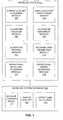
- FIG. 1 is a block diagram of an example modeling system 100 configured to develop and deploy a machine learning model or algorithm on multiple processors.
- the modeling system 100 includes a sample data set accessing module 102, a sample data set partitioning module 104, an algorithm creation module 106, an algorithm assignment module 108, an algorithm training module 110, a decision logic generation module 112, an operational data unit accessing module 114, and an operational output accessing module 116.
- Each of the modules 102-116 may be implemented exclusively in hardware, or in some combination of hardware and software or firmware executed on a hardware processor.
- the modeling system 100 of FIG. 1 may generate multiple learning algorithms from the learning algorithm to be developed and deployed. Each of the generated algorithms may then be trained and deployed on a plurality of processors, thus facilitating parallel operation of the generated algorithms during both the training and deployment phases.
- Other aspects of the various embodiments are discussed in greater detail below. While much of the following discussion involves the use of supervised learning algorithms and, more specifically, ANNs, other types of machine learning models or algorithms, including unsupervised learning algorithms, may also be developed and deployed in other embodiments.
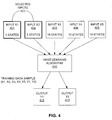
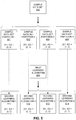
- the sample data set partitioning module 104 may be configured to partition the sample data set 124 into a number of partitions, wherein each of the partitions is to be employed to train a corresponding one of the generated learning algorithms. To perform the partitioning, the sample data set partitioning module 104 may determine a number of states for each of the inputs reflected in the sample data set 124 and select a subset of the inputs. The sample data set partitioning module 104 may then partition the sample data set 124 into a number of partitions equal to the combined number of states of the selected inputs. Examples regarding the selection of the inputs, including considerations related thereto, are discussed in greater detail below.
- the sample data set partitioning module 104 determined a set of inputs (e.g., X1 (401) and X2 (402)) whose combined number of states (e.g., four) was equal to the number of processors of a computing system available for both training and normal operation of the generated second learning algorithms 511-514. In other examples, however, the number of available processors may not be equal to any of the combined number of states that result from any particular selection of inputs. FIGS. 7 and 8 depict methods that address such a possibility.
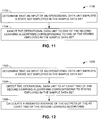
- the operational output accessing module 116 may be configured to calculate a weighted average of the outputs of the at least two of the second learning algorithms 511-514 produced as a result of processing the operational data unit 602 (operation 1206).
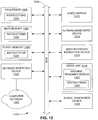
- the methods described herein may be at least partially processor-implemented. For example, at least some of the operations of a method may be performed by one or more processors 1302 or processor-implemented modules. The performance of certain of the operations may be distributed among the one or more processors 1302, not only residing within a single machine but deployed across a number of machines.
- the processors 1302 may be located in a single location (e.g., within a home environment, within an office environment, or as a server farm), while in other embodiments, the processors 1302 may be distributed across a number of locations.
Landscapes
- Engineering & Computer Science (AREA)
- Theoretical Computer Science (AREA)
- Physics & Mathematics (AREA)
- Software Systems (AREA)
- Computing Systems (AREA)
- Artificial Intelligence (AREA)
- Mathematical Physics (AREA)
- General Physics & Mathematics (AREA)
- Data Mining & Analysis (AREA)
- Evolutionary Computation (AREA)
- General Engineering & Computer Science (AREA)
- Biomedical Technology (AREA)
- Molecular Biology (AREA)
- General Health & Medical Sciences (AREA)
- Computational Linguistics (AREA)
- Biophysics (AREA)
- Life Sciences & Earth Sciences (AREA)
- Health & Medical Sciences (AREA)
- Computer Vision & Pattern Recognition (AREA)
- Medical Informatics (AREA)
- Image Analysis (AREA)
Claims (11)
- Ein Verfahren zur Entwicklung eines Lernmodells, wobei das Verfahren (200) Folgendes umfasst:Zugreifen (202) auf einen Beispieldatensatz (124), um das Lernmodell zu trainieren, wobei das Lernmodell einen ersten Lernalgorithmus (400) mit einer Anzahl von Eingängen (401 - 405) und einer Anzahl von Ausgängen (411, 412) umfasst, und wobei jede Probe des Beispieldatensatzes (124) einen Wert für jeden der Eingänge und Ausgänge umfasst;Bestimmen (204) einer Anzahl von Zuständen für jeden der Eingänge (401 - 405) basierend auf dem Beispieldatensatz (124), wobei der Wert jedes der Eingänge (401 - 405) einen möglichen Zustand darstellt;Bestimmen einer Werteverteilung von jedem von mindestens einigen der Eingänge;Auswählen (206) einer Teilmenge (401, 402) der Eingänge (401 - 405) basierend auf der Verfügbarkeit einer Vielzahl von Prozessoren eines Computersystems, wobei mindestens einer der ausgewählten Eingänge (401, 402) eine gleichmäßigere Werteverteilung als mindestens ein nicht ausgewählter Eingang der Vielzahl von Eingängen aufweist;Partitionieren (208) des Beispieldatensatzes (124) in eine Anzahl von Partitionen, die einer kombinierten Anzahl von Zuständen der ausgewählten Eingänge (401, 402) gleicht, wobei jede Probe einer Partition einen Zustand der ausgewählten Eingänge (401, 402) entsprechend der Partition aufweist und wobei die kombinierte Anzahl von Zuständen durch das Produkt der Anzahlen von Zuständen jedes ausgewählten Eingangs gegeben ist;Erzeugen (210) eines zweiten Lernalgorithmus (511 - 514) für jede der Partitionen, wobei der zweite Lernalgorithmus (511 - 514) einer entsprechenden Partition eine Logik des ersten Lernalgorithmus (400) umfasst, in der der Zustand der ausgewählten Eingänge (401, 402) der Partition entspricht, insofern als der zweite Lernalgorithmus (511 - 514) einer entsprechenden Partition erzeugt wird, indem mit dem ersten Lernalgorithmus (400) begonnen wird und dann Teile des ersten Lernalgorithmus (400), die den Zustand der ausgewählten Eingänge (401, 402) testen, und Teile, die ausgeführt werden, wenn der Zustand der ausgewählten Eingänge (401, 402) von dem der Partition entsprechenden Zustand verschieden ist, rationalisiert oder reduziert werden, und wobei der zweite Lernalgorithmus (511 - 514) konfiguriert ist, um als Eingang diejenigen der Eingänge (403 - 405) zu empfangen, die nicht die ausgewählten Eingänge sind;Zuordnen (212) jedes der zweiten Lernalgorithmen (511 - 514) zu einem der mehreren Prozessoren des Computersystems;Trainieren (214) jedes der zweiten Lernalgorithmen (511 - 514) auf dem Prozessor, der dem zweiten Lernalgorithmus zugeordnet ist, unter Verwendung der Proben der Partition, die dem zweiten Lernalgorithmus entspricht; undErzeugen (216) einer Entscheidungslogik, die konfiguriert ist, um jede einer Vielzahl von Betriebsdateneinheiten (126) als Eingang zu einem der zweiten Lernalgorithmen (511 - 514) zu leiten, wobei jede der Betriebsdateneinheiten (126) einen Wert für jeden von einer Vielzahl von Eingängen entsprechend den Eingängen (401 - 405) des Beispieldatensatzes (124) umfasst, und wobei das Leiten der Betriebsdateneinheiten auf einem Zustand der ausgewählten Eingänge entsprechend der Betriebsdateneinheit basiert;wobei:das Bestimmen der Anzahl von Zuständen für jeden der Eingänge (401 - 405) basierend auf dem Beispieldatensatz (124) das Bestimmen einer Anzahl von verwendeten Zuständen für jeden der ausgewählten Eingänge (401, 402) des Beispieldatensatzes (124) umfasst,das Zugreifen auf die Betriebsdateneinheiten (126) das Zugreifen auf eine erste Betriebsdateneinheit umfasst, die einen ersten Eingang der ausgewählten Eingänge (401, 402) mit einem Zustand beinhaltet, der nicht im Beispieldatensatz (124) verwendet wird;die Entscheidungslogik ferner so konfiguriert ist, dass sie die erste Betriebsdateneinheit als Eingang zu mindestens zwei der zweiten Lernalgorithmen leitet, wobei jeder der mindestens zwei der zweiten Lernalgorithmen einem der verwendeten Zustände des ersten Eingangs entspricht; und wobeidas Verfahren ferner das Berechnen eines gewichteten Durchschnitts von entsprechenden Ausgaben der mindestens zwei der zweiten Lernalgorithmen umfasst, um eine Ausgabe für die erste Betriebsdateneinheit zu erzeugen.
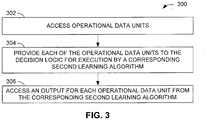
- Das Verfahren nach Anspruch 1, das ferner Folgendes umfasst:Zugreifen auf die Vielzahl von Betriebsdateneinheiten (126);Bereitstellen jeder der Betriebsdateneinheiten (126) für die Entscheidungslogik zur Ausführung durch einen entsprechenden der zweiten Lernalgorithmen (511 - 514) auf einem entsprechenden der Prozessoren; undZugreifen, für jede der Betriebsdateneinheiten (216), auf einen Ausgang für die Betriebsdateneinheit aus dem entsprechenden zweiten Lernalgorithmus (511 - 514).
- Das Verfahren nach Anspruch 1 oder 2, wobei:die kombinierte Anzahl der Zustände der ausgewählten Eingänge (401, 402) eine größte ganze Zahl kleiner oder gleich einer Anzahl der mehreren Prozessoren ist; und wobeidas Zuordnen jedes der zweiten Lernalgorithmen (511 - 514) das Zuordnen jedes der zweiten Lernalgorithmen (511 - 514) zu einem separaten der mehreren Prozessoren umfasst.
- Das Verfahren nach Anspruch 1 oder 2, wobei:die kombinierte Anzahl von Zuständen der ausgewählten Eingänge (401, 402) eine kleinste ganze Zahl größer als eine Anzahl der mehreren Prozessoren des Computersystems ist; unddas Zuweisen jedes der zweiten Lernalgorithmen (511 - 514) das Zuweisen eines ersten der zweiten Lernalgorithmen und eines zweiten der zweiten Lernalgorithmen zu einem selben der mehreren Prozessoren umfasst;wobei optional das Trainieren jedes der zweiten Lernalgorithmen (511 - 514) das Trainieren des ersten der zweiten Lernalgorithmen, gefolgt vom Trainieren des zweiten der zweiten Lernalgorithmen umfasst.
- Das Verfahren nach irgendeinem der Ansprüche von 1 bis 4, wobei:der erste Lernalgorithmus (400) ein erstes künstliches neuronales Netzwerk mit einer ersten Anzahl von versteckten Neuronen umfasst;jeder der zweiten Lernalgorithmen (511 - 514) ein zweites künstliches neuronales Netz umfasst; und wobeidas Verfahren ferner das Setzen einer zweiten Anzahl von versteckten Neuronen von mindestens einem der zweiten künstlichen neuronalen Netze auf der Grundlage der ersten Anzahl von versteckten Neuronen umfasst.
- Das Verfahren nach Anspruch 5, wobei die zweite Anzahl von versteckten Neuronen gleich der ersten Anzahl von versteckten Neuronen ist, basierend darauf, dass die erste Anzahl von versteckten Neuronen weniger als doppelt so viele Eingänge (401 - 405) minus doppelt so viele der ausgewählten Eingänge (401, 402) ist;
oder wobei die zweite Anzahl von versteckten Neuronen gleich der doppelten Anzahl von Eingängen (401 - 405) minus der doppelten Anzahl von ausgewählten Eingängen (401, 402) ist, basierend darauf, dass die erste Anzahl von versteckten Neuronen kleiner oder gleich der vierfachen Anzahl von Eingängen (401 - 405) minus der vierfachen Anzahl von ausgewählten Eingängen (401, 402) ist und größer oder gleich der doppelten Anzahl von Eingängen (401 - 405) minus der doppelten Anzahl von ausgewählten Eingängen (401, 402) ist;
oder wobei die zweite Anzahl von versteckten Neuronen gleich der ersten Anzahl der versteckten Neuronen minus der doppelten Anzahl der Eingänge (401 - 405) ist, minus der doppelten Anzahl der ausgewählten Eingänge (401, 402) ist, basierend darauf, dass die erste Anzahl von versteckten Neuronen größer als die vierfache Anzahl der Eingänge (401 - 405) minus der vierfachen Anzahl der ausgewählten Eingänge (401, 402) ist. - Das Verfahren nach irgendeinem der Ansprüche von 1 bis 6, wobei das Bestimmen der Anzahl der Zustände für jeden der Eingänge (401 - 405) auf der Grundlage des Beispieldatensatzes (124) das Bestimmen einer Anzahl möglicher Zustände für jeden der ausgewählten Eingänge (401, 402) des Beispieldatensatzes (124) umfasst.
- Das Verfahren nach irgendeinem der Ansprüche von 1 bis 7, wobei der erste Lernalgorithmus (400) und jeder der zweiten Lernalgorithmen (511 - 514) ein künstliches neuronales Netzwerk umfasst.
- Das Verfahren nach irgendeinem der Ansprüche von 1 bis 8, wobei der erste Lernalgorithmus (400) und jeder der zweiten Lernalgorithmen (511 - 514) einen überwachten Lernalgorithmus umfasst; oder
wobei der erste Lernalgorithmus (400) und jeder der zweiten Lernalgorithmen (511 - 514) einen unbeaufsichtigten Lernalgorithmus umfasst. - Ein nicht-flüchtiges computerlesbares Speichermedium, das Anweisungen umfasst, die, wenn sie von mindestens einem Prozessor eines Computersystems ausgeführt werden, das Computersystem dazu veranlassen, Operationen gemäß dem Verfahren nach irgendeinem der Ansprüche von 1 bis 9 durchzuführen.
- Ein Computersystem (100), das Folgendes umfasst:ein Beispieldatensatz-Zugriffsmodul (102), das konfiguriert ist, um auf einen Beispieldatensatz (124) zuzugreifen, um ein Lernmodell zu trainieren, wobei das Lernmodell einen ersten Lernalgorithmus (400) mit einer Anzahl von Eingängen (401 - 405) und einer Anzahl von Ausgängen (411, 412) umfasst, und wobei jede Probe des Beispieldatensatzes (124) einen Wert für jeden der Eingänge und der Ausgänge umfasst;ein Beispieldatensatz-Partitionierungsmodul (104), das konfiguriert ist, um Folgendes zu bewerkstelligen:Bestimmen einer Anzahl von Zuständen für jeden der Eingänge (401 - 405) basierend auf dem Beispieldatensatz (124), wobei der Wert jedes der Eingänge (401 - 405) einen möglichen Zustand darstellt, und wobei eine Anzahl von verwendeten Zuständen für jeden der ausgewählten Eingänge (401, 402) des Beispieldatensatzes (124) bestimmt wird,Bestimmen einer Werteverteilung von jedem von mindestens einigen der Eingänge;Auswählen einer Teilmenge (401, 402) der Eingänge (401 - 405) basierend auf der Verfügbarkeit einer Vielzahl von Prozessoren eines Computersystems, wobei mindestens einer der ausgewählten Eingänge (401, 402) eine gleichmäßigere Werteverteilung als mindestens ein nicht ausgewählter Eingang der Vielzahl von Eingängen aufweist;Partitionieren des Beispieldatensatzes (124) in eine Anzahl von Partitionen, die einer kombinierten Anzahl von Zuständen der ausgewählten Eingänge (401, 402) gleicht, wobei jede Probe einer Partition einen Zustand der ausgewählten Eingänge (401, 402) entsprechend der Partition aufweist und wobei die kombinierte Anzahl von Zuständen durch das Produkt der Anzahlen von Zuständen jedes ausgewählten Eingangs gegeben ist;ein Algorithmus-Erzeugungsmodul (106), das konfiguriert ist, um einen zweiten Lernalgorithmus (511 - 514) für jede der Partitionen zu erzeugen, wobei der zweite Lernalgorithmus (511 - 514) einer entsprechenden Partition eine Logik des ersten Lernalgorithmus (400) umfasst, in der der Zustand der ausgewählten Eingänge (401, 402) der Partition entspricht, insofern als der zweite Lernalgorithmus (511 - 514) einer entsprechenden Partition erzeugt wird, indem mit dem ersten Lernalgorithmus (400) begonnen wird und dann Teile des ersten Lernalgorithmus (400), die den Zustand der ausgewählten Eingänge (401, 402) testen, und Teile, die ausgeführt werden, wenn der Zustand der ausgewählten Eingänge (401, 402) von dem der Partition entsprechenden Zustand verschieden ist, rationalisiert oder reduziert werden, und wobei der zweite Lernalgorithmus (511 - 514) konfiguriert ist, um als Eingang diejenigen der Eingänge (403 - 405) zu empfangen, die nicht die ausgewählten Eingänge sind;ein Algorithmuszuweisungsmodul (108), das konfiguriert ist, um jeden der zweiten Lernalgorithmen (511 - 514) einem der mehreren Prozessoren des Computersystems (100) zuzuweisen;ein Algorithmus-Trainingsmodul (110), das so konfiguriert ist, dass es jeden der zweiten Lernalgorithmen (511 - 514) auf dem Prozessor trainiert, der dem zweiten Lernalgorithmus unter Verwendung der Proben der Partition, die dem zweiten Lernalgorithmus entspricht; undein Entscheidungslogik-Erzeugungsmodul (112), das konfiguriert ist, um eine Entscheidungslogik zu erzeugen, die konfiguriert ist, um jede aus einer Vielzahl von Betriebsdateneinheiten (126) als Eingang zu einem der zweiten Lernalgorithmen (511 - 514) zu leiten, wobei jede der Betriebsdateneinheiten (126) einen Wert für jeden aus einer Vielzahl von Eingängen entsprechend den Eingängen (401 - 405) des Beispieldatensatzes (124) umfasst, und wobei das Leiten der Betriebsdateneinheiten auf dem Zustand der ausgewählten Eingänge entsprechend der Betriebsdateneinheit basiert,ferner umfassend:ein Betriebsdateneinheit-Zugriffsmodul (114), das konfiguriert ist, um Folgendes zu bewerkstelligen:Zugreifen auf die Vielzahl von Betriebsdateneinheiten (126), undBereitstellen jeder der Betriebsdateneinheiten (126) für die Entscheidungslogik zur Ausführung durch einen entsprechenden der zweiten Lernalgorithmen (511 - 514) auf einem entsprechenden der Prozessoren; undein Betriebsausgangs-Zugriffsmodul (116), das konfiguriert ist, um für jede der Betriebsdateneinheiten (126) auf einen Ausgang für die Betriebsdateneinheit aus dem entsprechenden zweiten Lernalgorithmus zugreift;wobei:das Zugreifen auf die Betriebsdateneinheiten (126) das Zugreifen auf eine erste Betriebsdateneinheit umfasst, die einen ersten Eingang der ausgewählten Eingänge (401, 402) mit einem Zustand beinhaltet, der nicht im Beispieldatensatz (124) verwendet wird;die Entscheidungslogik ferner so konfiguriert ist, dass sie die erste Betriebsdateneinheit als Eingang zu mindestens zwei der zweiten Lernalgorithmen leitet, wobei jeder der mindestens zwei der zweiten Lernalgorithmen einem der verwendeten Zustände des ersten Eingangs entspricht; und wobeidas Betriebsausgangs-Zugriffsmodul (116) ferner dazu konfiguriert ist, um einen gewichteten Durchschnitt von entsprechenden Ausgaben der mindestens zwei der zweiten Lernalgorithmen zu berechnen, um eine Ausgabe für die erste Betriebsdateneinheit zu erzeugen.
Applications Claiming Priority (1)
| Application Number | Priority Date | Filing Date | Title |
|---|---|---|---|
| US14/560,484 US10482389B2 (en) | 2014-12-04 | 2014-12-04 | Parallel development and deployment for machine learning models |
Publications (2)
| Publication Number | Publication Date |
|---|---|
| EP3029614A1 EP3029614A1 (de) | 2016-06-08 |
| EP3029614B1 true EP3029614B1 (de) | 2018-10-24 |
Family
ID=54782401
Family Applications (1)
| Application Number | Title | Priority Date | Filing Date |
|---|---|---|---|
| EP15003445.2A Active EP3029614B1 (de) | 2014-12-04 | 2015-12-03 | Parallele entwicklung und einsatz für maschinenlernmodelle |
Country Status (2)
| Country | Link |
|---|---|
| US (3) | US10482389B2 (de) |
| EP (1) | EP3029614B1 (de) |
Families Citing this family (22)
| Publication number | Priority date | Publication date | Assignee | Title |
|---|---|---|---|---|
| US10482389B2 (en) | 2014-12-04 | 2019-11-19 | Sap Se | Parallel development and deployment for machine learning models |
| US11886957B2 (en) | 2016-06-10 | 2024-01-30 | Apple Inc. | Artificial intelligence controller that procedurally tailors itself to an application |
| JP6633462B2 (ja) * | 2016-06-29 | 2020-01-22 | 株式会社東芝 | 情報処理装置および情報処理方法 |
| CN106250686B (zh) * | 2016-07-27 | 2018-11-02 | 哈尔滨工业大学 | 一种并行程序的集合通信函数建模方法 |
| CN107798382B (zh) | 2017-11-21 | 2020-09-01 | 南京地平线机器人技术有限公司 | 用于适配卷积神经网络中的特征数据的方法和装置 |
| US11836610B2 (en) * | 2017-12-13 | 2023-12-05 | Advanced Micro Devices, Inc. | Concurrent training of functional subnetworks of a neural network |
| KR20200046145A (ko) * | 2018-10-15 | 2020-05-07 | 펑션베이(주) | 예측 모델 훈련 관리 시스템, 예측 모델 훈련 관리 방법, 예측 모델 학습 관리를 위한 마스터 장치 및 슬레이브 장치 |
| JP6690743B1 (ja) * | 2019-01-23 | 2020-04-28 | トヨタ自動車株式会社 | 機械学習装置 |
| US11210607B2 (en) * | 2019-04-26 | 2021-12-28 | Fmr Llc | Automated predictive analysis and modification of user interaction features using multiple classification models |
| US11886960B2 (en) | 2019-05-07 | 2024-01-30 | International Business Machines Corporation | Elastic training of machine learning models via re-partitioning based on feedback from the training algorithm |
| US11573803B2 (en) | 2019-05-07 | 2023-02-07 | International Business Machines Corporation | Parallel training of machine learning models |
| CN113939779B (zh) * | 2019-06-28 | 2024-06-14 | 欧姆龙株式会社 | 用于操作自动化系统的方法和设备、自动化系统及计算机可读存储介质 |
| KR102238424B1 (ko) * | 2019-07-24 | 2021-04-09 | (주)아인스에스엔씨 | 빅데이터 기계학습을 이용한 시스템 모델링방법 |
| US20210117977A1 (en) * | 2019-10-17 | 2021-04-22 | At&T Intellectual Property I, L.P. | Parallel machine learning models |
| CN111178517B (zh) * | 2020-01-20 | 2023-12-05 | 上海依图网络科技有限公司 | 模型部署方法、系统、芯片、电子设备及介质 |
| US11580455B2 (en) | 2020-04-01 | 2023-02-14 | Sap Se | Facilitating machine learning configuration |
| CN111897660B (zh) * | 2020-09-29 | 2021-01-15 | 深圳云天励飞技术股份有限公司 | 模型部署方法、模型部署装置及终端设备 |
| CN114968547A (zh) * | 2021-02-25 | 2022-08-30 | 华为技术有限公司 | 一种排序装置及方法 |
| US12153879B2 (en) * | 2022-04-19 | 2024-11-26 | International Business Machines Corporation | Syntactic and semantic autocorrect learning |
| CN117896227A (zh) * | 2022-10-14 | 2024-04-16 | 北京三星通信技术研究有限公司 | 接收机执行的方法、无线通信设备及存储介质 |
| US12450622B2 (en) * | 2023-02-10 | 2025-10-21 | Fmr Llc | Automated customer engagement prediction and classification |
| US12316663B2 (en) * | 2023-06-28 | 2025-05-27 | CUBE Security Inc. | Features extraction for blockchain transactions and program protocols |
Family Cites Families (2)
| Publication number | Priority date | Publication date | Assignee | Title |
|---|---|---|---|---|
| US5909681A (en) | 1996-03-25 | 1999-06-01 | Torrent Systems, Inc. | Computer system and computerized method for partitioning data for parallel processing |
| US10482389B2 (en) | 2014-12-04 | 2019-11-19 | Sap Se | Parallel development and deployment for machine learning models |
-
2014
- 2014-12-04 US US14/560,484 patent/US10482389B2/en active Active
-
2015
- 2015-12-03 EP EP15003445.2A patent/EP3029614B1/de active Active
-
2019
- 2019-10-09 US US16/597,477 patent/US11468366B2/en active Active
-
2022
- 2022-08-29 US US17/897,421 patent/US12099906B2/en active Active
Also Published As
| Publication number | Publication date |
|---|---|
| US11468366B2 (en) | 2022-10-11 |
| US10482389B2 (en) | 2019-11-19 |
| US20200042899A1 (en) | 2020-02-06 |
| US12099906B2 (en) | 2024-09-24 |
| EP3029614A1 (de) | 2016-06-08 |
| US20160162800A1 (en) | 2016-06-09 |
| US20220414544A1 (en) | 2022-12-29 |
Similar Documents
| Publication | Publication Date | Title |
|---|---|---|
| US12099906B2 (en) | Parallel development and deployment for machine learning models | |
| JP7482992B2 (ja) | 自動化された人工知能の放射型可視化 | |
| US20190332731A1 (en) | Method and system for quantum computing | |
| Nauck et al. | Predicting basin stability of power grids using graph neural networks | |
| Baldán et al. | Distributed fastshapelet transform: a big data time series classification algorithm | |
| JP5950285B2 (ja) | 予め決められた複数のビット幅のデータに対して操作を行う命令を使用してツリーの検索を行うための方法、並びに、当該命令を使用してツリーの検索を行うためのコンピュータ及びそのコンピュータ・プログラム | |
| JP7756642B2 (ja) | 動的順序付けに基づいた分割による分散テンソルネットワーク縮約方式 | |
| US12228497B2 (en) | Determining material properties based on machine learning models | |
| WO2022105662A1 (en) | Topology-driven completion of chemical data | |
| US20150012465A1 (en) | Decision tree learning | |
| Aksar et al. | Prodigy: Towards unsupervised anomaly detection in production hpc systems | |
| Newcome et al. | Algorithm Selection in Short-Range Molecular Dynamics Simulations | |
| Jeon et al. | Tegviz: Distributed tera-scale graph generation and visualization | |
| JP5555238B2 (ja) | ベイジアンネットワーク構造学習のための情報処理装置及びプログラム | |
| Velázquez-Rodríguez et al. | Mutama: An automated multi-label tagging approach for software libraries on maven | |
| KR20200010631A (ko) | 클라우드 기반의 인공지능 연산 서비스 방법 및 이를 수행하는 장치 | |
| Sarazin et al. | Biclustering using spark-mapreduce | |
| US9361588B2 (en) | Construction of tree-shaped bayesian network | |
| US11676050B2 (en) | Systems and methods for neighbor frequency aggregation of parametric probability distributions with decision trees using leaf nodes | |
| US11231914B1 (en) | Community detection using fast low-cardinality semidefinite programming | |
| CN117608684A (zh) | 可重构架构生成方法、装置、设备、介质和产品 | |
| Romsaiyud | Applying MVC data model on hadoop for delivering the business intelligence | |
| Ho et al. | Quantum-inspired identification of complex cellular automata | |
| EP2856396A2 (de) | Aufbaubare teilepaare in einer unkonfigurierten produktstruktur | |
| US20240403655A1 (en) | Federated learning simulator for flexible local and global training |
Legal Events
| Date | Code | Title | Description |
|---|---|---|---|
| PUAI | Public reference made under article 153(3) epc to a published international application that has entered the european phase |
Free format text: ORIGINAL CODE: 0009012 |
|
| AK | Designated contracting states |
Kind code of ref document: A1 Designated state(s): AL AT BE BG CH CY CZ DE DK EE ES FI FR GB GR HR HU IE IS IT LI LT LU LV MC MK MT NL NO PL PT RO RS SE SI SK SM TR |
|
| AX | Request for extension of the european patent |
Extension state: BA ME |
|
| 17P | Request for examination filed |
Effective date: 20161124 |
|
| RBV | Designated contracting states (corrected) |
Designated state(s): AL AT BE BG CH CY CZ DE DK EE ES FI FR GB GR HR HU IE IS IT LI LT LU LV MC MK MT NL NO PL PT RO RS SE SI SK SM TR |
|
| 17Q | First examination report despatched |
Effective date: 20170317 |
|
| REG | Reference to a national code |
Ref country code: DE Ref legal event code: R079 Ref document number: 602015018519 Country of ref document: DE Free format text: PREVIOUS MAIN CLASS: G06N0003020000 Ipc: G06N0003040000 |
|
| GRAP | Despatch of communication of intention to grant a patent |
Free format text: ORIGINAL CODE: EPIDOSNIGR1 |
|
| RIC1 | Information provided on ipc code assigned before grant |
Ipc: G06N 3/08 20060101ALI20180417BHEP Ipc: G06N 3/04 20060101AFI20180417BHEP |
|
| INTG | Intention to grant announced |
Effective date: 20180514 |
|
| GRAS | Grant fee paid |
Free format text: ORIGINAL CODE: EPIDOSNIGR3 |
|
| GRAA | (expected) grant |
Free format text: ORIGINAL CODE: 0009210 |
|
| AK | Designated contracting states |
Kind code of ref document: B1 Designated state(s): AL AT BE BG CH CY CZ DE DK EE ES FI FR GB GR HR HU IE IS IT LI LT LU LV MC MK MT NL NO PL PT RO RS SE SI SK SM TR |
|
| REG | Reference to a national code |
Ref country code: CH Ref legal event code: EP |
|
| REG | Reference to a national code |
Ref country code: IE Ref legal event code: FG4D |
|
| REG | Reference to a national code |
Ref country code: AT Ref legal event code: REF Ref document number: 1057555 Country of ref document: AT Kind code of ref document: T Effective date: 20181115 |
|
| REG | Reference to a national code |
Ref country code: DE Ref legal event code: R096 Ref document number: 602015018519 Country of ref document: DE |
|
| REG | Reference to a national code |
Ref country code: NL Ref legal event code: MP Effective date: 20181024 |
|
| REG | Reference to a national code |
Ref country code: LT Ref legal event code: MG4D |
|
| REG | Reference to a national code |
Ref country code: AT Ref legal event code: MK05 Ref document number: 1057555 Country of ref document: AT Kind code of ref document: T Effective date: 20181024 |
|
| PG25 | Lapsed in a contracting state [announced via postgrant information from national office to epo] |
Ref country code: NL Free format text: LAPSE BECAUSE OF FAILURE TO SUBMIT A TRANSLATION OF THE DESCRIPTION OR TO PAY THE FEE WITHIN THE PRESCRIBED TIME-LIMIT Effective date: 20181024 |
|
| PG25 | Lapsed in a contracting state [announced via postgrant information from national office to epo] |
Ref country code: AT Free format text: LAPSE BECAUSE OF FAILURE TO SUBMIT A TRANSLATION OF THE DESCRIPTION OR TO PAY THE FEE WITHIN THE PRESCRIBED TIME-LIMIT Effective date: 20181024 Ref country code: PL Free format text: LAPSE BECAUSE OF FAILURE TO SUBMIT A TRANSLATION OF THE DESCRIPTION OR TO PAY THE FEE WITHIN THE PRESCRIBED TIME-LIMIT Effective date: 20181024 Ref country code: HR Free format text: LAPSE BECAUSE OF FAILURE TO SUBMIT A TRANSLATION OF THE DESCRIPTION OR TO PAY THE FEE WITHIN THE PRESCRIBED TIME-LIMIT Effective date: 20181024 Ref country code: FI Free format text: LAPSE BECAUSE OF FAILURE TO SUBMIT A TRANSLATION OF THE DESCRIPTION OR TO PAY THE FEE WITHIN THE PRESCRIBED TIME-LIMIT Effective date: 20181024 Ref country code: LV Free format text: LAPSE BECAUSE OF FAILURE TO SUBMIT A TRANSLATION OF THE DESCRIPTION OR TO PAY THE FEE WITHIN THE PRESCRIBED TIME-LIMIT Effective date: 20181024 Ref country code: BG Free format text: LAPSE BECAUSE OF FAILURE TO SUBMIT A TRANSLATION OF THE DESCRIPTION OR TO PAY THE FEE WITHIN THE PRESCRIBED TIME-LIMIT Effective date: 20190124 Ref country code: ES Free format text: LAPSE BECAUSE OF FAILURE TO SUBMIT A TRANSLATION OF THE DESCRIPTION OR TO PAY THE FEE WITHIN THE PRESCRIBED TIME-LIMIT Effective date: 20181024 Ref country code: LT Free format text: LAPSE BECAUSE OF FAILURE TO SUBMIT A TRANSLATION OF THE DESCRIPTION OR TO PAY THE FEE WITHIN THE PRESCRIBED TIME-LIMIT Effective date: 20181024 Ref country code: IS Free format text: LAPSE BECAUSE OF FAILURE TO SUBMIT A TRANSLATION OF THE DESCRIPTION OR TO PAY THE FEE WITHIN THE PRESCRIBED TIME-LIMIT Effective date: 20190224 Ref country code: NO Free format text: LAPSE BECAUSE OF FAILURE TO SUBMIT A TRANSLATION OF THE DESCRIPTION OR TO PAY THE FEE WITHIN THE PRESCRIBED TIME-LIMIT Effective date: 20190124 |
|
| PG25 | Lapsed in a contracting state [announced via postgrant information from national office to epo] |
Ref country code: GR Free format text: LAPSE BECAUSE OF FAILURE TO SUBMIT A TRANSLATION OF THE DESCRIPTION OR TO PAY THE FEE WITHIN THE PRESCRIBED TIME-LIMIT Effective date: 20190125 Ref country code: RS Free format text: LAPSE BECAUSE OF FAILURE TO SUBMIT A TRANSLATION OF THE DESCRIPTION OR TO PAY THE FEE WITHIN THE PRESCRIBED TIME-LIMIT Effective date: 20181024 Ref country code: PT Free format text: LAPSE BECAUSE OF FAILURE TO SUBMIT A TRANSLATION OF THE DESCRIPTION OR TO PAY THE FEE WITHIN THE PRESCRIBED TIME-LIMIT Effective date: 20190224 Ref country code: AL Free format text: LAPSE BECAUSE OF FAILURE TO SUBMIT A TRANSLATION OF THE DESCRIPTION OR TO PAY THE FEE WITHIN THE PRESCRIBED TIME-LIMIT Effective date: 20181024 Ref country code: SE Free format text: LAPSE BECAUSE OF FAILURE TO SUBMIT A TRANSLATION OF THE DESCRIPTION OR TO PAY THE FEE WITHIN THE PRESCRIBED TIME-LIMIT Effective date: 20181024 |
|
| REG | Reference to a national code |
Ref country code: DE Ref legal event code: R097 Ref document number: 602015018519 Country of ref document: DE |
|
| PG25 | Lapsed in a contracting state [announced via postgrant information from national office to epo] |
Ref country code: DK Free format text: LAPSE BECAUSE OF FAILURE TO SUBMIT A TRANSLATION OF THE DESCRIPTION OR TO PAY THE FEE WITHIN THE PRESCRIBED TIME-LIMIT Effective date: 20181024 Ref country code: CZ Free format text: LAPSE BECAUSE OF FAILURE TO SUBMIT A TRANSLATION OF THE DESCRIPTION OR TO PAY THE FEE WITHIN THE PRESCRIBED TIME-LIMIT Effective date: 20181024 Ref country code: IT Free format text: LAPSE BECAUSE OF FAILURE TO SUBMIT A TRANSLATION OF THE DESCRIPTION OR TO PAY THE FEE WITHIN THE PRESCRIBED TIME-LIMIT Effective date: 20181024 |
|
| REG | Reference to a national code |
Ref country code: CH Ref legal event code: PL |
|
| PG25 | Lapsed in a contracting state [announced via postgrant information from national office to epo] |
Ref country code: SK Free format text: LAPSE BECAUSE OF FAILURE TO SUBMIT A TRANSLATION OF THE DESCRIPTION OR TO PAY THE FEE WITHIN THE PRESCRIBED TIME-LIMIT Effective date: 20181024 Ref country code: MC Free format text: LAPSE BECAUSE OF FAILURE TO SUBMIT A TRANSLATION OF THE DESCRIPTION OR TO PAY THE FEE WITHIN THE PRESCRIBED TIME-LIMIT Effective date: 20181024 Ref country code: EE Free format text: LAPSE BECAUSE OF FAILURE TO SUBMIT A TRANSLATION OF THE DESCRIPTION OR TO PAY THE FEE WITHIN THE PRESCRIBED TIME-LIMIT Effective date: 20181024 Ref country code: LU Free format text: LAPSE BECAUSE OF NON-PAYMENT OF DUE FEES Effective date: 20181203 Ref country code: SM Free format text: LAPSE BECAUSE OF FAILURE TO SUBMIT A TRANSLATION OF THE DESCRIPTION OR TO PAY THE FEE WITHIN THE PRESCRIBED TIME-LIMIT Effective date: 20181024 Ref country code: RO Free format text: LAPSE BECAUSE OF FAILURE TO SUBMIT A TRANSLATION OF THE DESCRIPTION OR TO PAY THE FEE WITHIN THE PRESCRIBED TIME-LIMIT Effective date: 20181024 |
|
| PLBE | No opposition filed within time limit |
Free format text: ORIGINAL CODE: 0009261 |
|
| STAA | Information on the status of an ep patent application or granted ep patent |
Free format text: STATUS: NO OPPOSITION FILED WITHIN TIME LIMIT |
|
| REG | Reference to a national code |
Ref country code: IE Ref legal event code: MM4A |
|
| 26N | No opposition filed |
Effective date: 20190725 |
|
| REG | Reference to a national code |
Ref country code: BE Ref legal event code: MM Effective date: 20181231 |
|
| PG25 | Lapsed in a contracting state [announced via postgrant information from national office to epo] |
Ref country code: SI Free format text: LAPSE BECAUSE OF FAILURE TO SUBMIT A TRANSLATION OF THE DESCRIPTION OR TO PAY THE FEE WITHIN THE PRESCRIBED TIME-LIMIT Effective date: 20181024 Ref country code: IE Free format text: LAPSE BECAUSE OF NON-PAYMENT OF DUE FEES Effective date: 20181203 |
|
| PG25 | Lapsed in a contracting state [announced via postgrant information from national office to epo] |
Ref country code: BE Free format text: LAPSE BECAUSE OF NON-PAYMENT OF DUE FEES Effective date: 20181231 |
|
| PG25 | Lapsed in a contracting state [announced via postgrant information from national office to epo] |
Ref country code: LI Free format text: LAPSE BECAUSE OF NON-PAYMENT OF DUE FEES Effective date: 20181231 Ref country code: CH Free format text: LAPSE BECAUSE OF NON-PAYMENT OF DUE FEES Effective date: 20181231 |
|
| PG25 | Lapsed in a contracting state [announced via postgrant information from national office to epo] |
Ref country code: MT Free format text: LAPSE BECAUSE OF NON-PAYMENT OF DUE FEES Effective date: 20181203 |
|
| PG25 | Lapsed in a contracting state [announced via postgrant information from national office to epo] |
Ref country code: TR Free format text: LAPSE BECAUSE OF FAILURE TO SUBMIT A TRANSLATION OF THE DESCRIPTION OR TO PAY THE FEE WITHIN THE PRESCRIBED TIME-LIMIT Effective date: 20181024 |
|
| PG25 | Lapsed in a contracting state [announced via postgrant information from national office to epo] |
Ref country code: MK Free format text: LAPSE BECAUSE OF NON-PAYMENT OF DUE FEES Effective date: 20181024 Ref country code: CY Free format text: LAPSE BECAUSE OF FAILURE TO SUBMIT A TRANSLATION OF THE DESCRIPTION OR TO PAY THE FEE WITHIN THE PRESCRIBED TIME-LIMIT Effective date: 20181024 Ref country code: HU Free format text: LAPSE BECAUSE OF FAILURE TO SUBMIT A TRANSLATION OF THE DESCRIPTION OR TO PAY THE FEE WITHIN THE PRESCRIBED TIME-LIMIT; INVALID AB INITIO Effective date: 20151203 |
|
| PGFP | Annual fee paid to national office [announced via postgrant information from national office to epo] |
Ref country code: DE Payment date: 20251211 Year of fee payment: 11 |
|
| PGFP | Annual fee paid to national office [announced via postgrant information from national office to epo] |
Ref country code: GB Payment date: 20251219 Year of fee payment: 11 |
|
| PGFP | Annual fee paid to national office [announced via postgrant information from national office to epo] |
Ref country code: FR Payment date: 20251223 Year of fee payment: 11 |