EP3027631B1 - Process for the preparation of bridged metallocene complexes suitable for use in olefin polymerization - Google Patents
Process for the preparation of bridged metallocene complexes suitable for use in olefin polymerization Download PDFInfo
- Publication number
- EP3027631B1 EP3027631B1 EP14747576.8A EP14747576A EP3027631B1 EP 3027631 B1 EP3027631 B1 EP 3027631B1 EP 14747576 A EP14747576 A EP 14747576A EP 3027631 B1 EP3027631 B1 EP 3027631B1
- Authority
- EP
- European Patent Office
- Prior art keywords
- group
- formula
- carbon atoms
- chosen
- butyl
- Prior art date
- Legal status (The legal status is an assumption and is not a legal conclusion. Google has not performed a legal analysis and makes no representation as to the accuracy of the status listed.)
- Active
Links
Classifications
-
- C—CHEMISTRY; METALLURGY
- C08—ORGANIC MACROMOLECULAR COMPOUNDS; THEIR PREPARATION OR CHEMICAL WORKING-UP; COMPOSITIONS BASED THEREON
- C08F—MACROMOLECULAR COMPOUNDS OBTAINED BY REACTIONS ONLY INVOLVING CARBON-TO-CARBON UNSATURATED BONDS
- C08F4/00—Polymerisation catalysts
- C08F4/42—Metals; Metal hydrides; Metallo-organic compounds; Use thereof as catalyst precursors
- C08F4/72—Metals; Metal hydrides; Metallo-organic compounds; Use thereof as catalyst precursors selected from metals not provided for in group C08F4/44
- C08F4/74—Metals; Metal hydrides; Metallo-organic compounds; Use thereof as catalyst precursors selected from metals not provided for in group C08F4/44 selected from refractory metals
- C08F4/76—Metals; Metal hydrides; Metallo-organic compounds; Use thereof as catalyst precursors selected from metals not provided for in group C08F4/44 selected from refractory metals selected from titanium, zirconium, hafnium, vanadium, niobium or tantalum
-
- C—CHEMISTRY; METALLURGY
- C07—ORGANIC CHEMISTRY
- C07F—ACYCLIC, CARBOCYCLIC OR HETEROCYCLIC COMPOUNDS CONTAINING ELEMENTS OTHER THAN CARBON, HYDROGEN, HALOGEN, OXYGEN, NITROGEN, SULFUR, SELENIUM OR TELLURIUM
- C07F17/00—Metallocenes
-
- C—CHEMISTRY; METALLURGY
- C07—ORGANIC CHEMISTRY
- C07C—ACYCLIC OR CARBOCYCLIC COMPOUNDS
- C07C211/00—Compounds containing amino groups bound to a carbon skeleton
- C07C211/43—Compounds containing amino groups bound to a carbon skeleton having amino groups bound to carbon atoms of six-membered aromatic rings of the carbon skeleton
- C07C211/44—Compounds containing amino groups bound to a carbon skeleton having amino groups bound to carbon atoms of six-membered aromatic rings of the carbon skeleton having amino groups bound to only one six-membered aromatic ring
- C07C211/45—Monoamines
- C07C211/48—N-alkylated amines
-
- C—CHEMISTRY; METALLURGY
- C07—ORGANIC CHEMISTRY
- C07C—ACYCLIC OR CARBOCYCLIC COMPOUNDS
- C07C211/00—Compounds containing amino groups bound to a carbon skeleton
- C07C211/43—Compounds containing amino groups bound to a carbon skeleton having amino groups bound to carbon atoms of six-membered aromatic rings of the carbon skeleton
- C07C211/44—Compounds containing amino groups bound to a carbon skeleton having amino groups bound to carbon atoms of six-membered aromatic rings of the carbon skeleton having amino groups bound to only one six-membered aromatic ring
- C07C211/52—Compounds containing amino groups bound to a carbon skeleton having amino groups bound to carbon atoms of six-membered aromatic rings of the carbon skeleton having amino groups bound to only one six-membered aromatic ring the carbon skeleton being further substituted by halogen atoms or by nitro or nitroso groups
-
- C—CHEMISTRY; METALLURGY
- C07—ORGANIC CHEMISTRY
- C07F—ACYCLIC, CARBOCYCLIC OR HETEROCYCLIC COMPOUNDS CONTAINING ELEMENTS OTHER THAN CARBON, HYDROGEN, HALOGEN, OXYGEN, NITROGEN, SULFUR, SELENIUM OR TELLURIUM
- C07F5/00—Compounds containing elements of Groups 3 or 13 of the Periodic Table
- C07F5/02—Boron compounds
-
- C—CHEMISTRY; METALLURGY
- C07—ORGANIC CHEMISTRY
- C07F—ACYCLIC, CARBOCYCLIC OR HETEROCYCLIC COMPOUNDS CONTAINING ELEMENTS OTHER THAN CARBON, HYDROGEN, HALOGEN, OXYGEN, NITROGEN, SULFUR, SELENIUM OR TELLURIUM
- C07F5/00—Compounds containing elements of Groups 3 or 13 of the Periodic Table
- C07F5/02—Boron compounds
- C07F5/025—Boronic and borinic acid compounds
-
- C—CHEMISTRY; METALLURGY
- C08—ORGANIC MACROMOLECULAR COMPOUNDS; THEIR PREPARATION OR CHEMICAL WORKING-UP; COMPOSITIONS BASED THEREON
- C08F—MACROMOLECULAR COMPOUNDS OBTAINED BY REACTIONS ONLY INVOLVING CARBON-TO-CARBON UNSATURATED BONDS
- C08F10/00—Homopolymers and copolymers of unsaturated aliphatic hydrocarbons having only one carbon-to-carbon double bond
- C08F10/02—Ethene
-
- C—CHEMISTRY; METALLURGY
- C08—ORGANIC MACROMOLECULAR COMPOUNDS; THEIR PREPARATION OR CHEMICAL WORKING-UP; COMPOSITIONS BASED THEREON
- C08F—MACROMOLECULAR COMPOUNDS OBTAINED BY REACTIONS ONLY INVOLVING CARBON-TO-CARBON UNSATURATED BONDS
- C08F4/00—Polymerisation catalysts
- C08F4/42—Metals; Metal hydrides; Metallo-organic compounds; Use thereof as catalyst precursors
- C08F4/44—Metals; Metal hydrides; Metallo-organic compounds; Use thereof as catalyst precursors selected from light metals, zinc, cadmium, mercury, copper, silver, gold, boron, gallium, indium, thallium, rare earths or actinides
- C08F4/60—Metals; Metal hydrides; Metallo-organic compounds; Use thereof as catalyst precursors selected from light metals, zinc, cadmium, mercury, copper, silver, gold, boron, gallium, indium, thallium, rare earths or actinides together with refractory metals, iron group metals, platinum group metals, manganese, rhenium technetium or compounds thereof
- C08F4/62—Refractory metals or compounds thereof
- C08F4/64—Titanium, zirconium, hafnium or compounds thereof
- C08F4/659—Component covered by group C08F4/64 containing a transition metal-carbon bond
- C08F4/6592—Component covered by group C08F4/64 containing a transition metal-carbon bond containing at least one cyclopentadienyl ring, condensed or not, e.g. an indenyl or a fluorenyl ring
-
- C—CHEMISTRY; METALLURGY
- C07—ORGANIC CHEMISTRY
- C07C—ACYCLIC OR CARBOCYCLIC COMPOUNDS
- C07C2602/00—Systems containing two condensed rings
- C07C2602/02—Systems containing two condensed rings the rings having only two atoms in common
- C07C2602/04—One of the condensed rings being a six-membered aromatic ring
- C07C2602/08—One of the condensed rings being a six-membered aromatic ring the other ring being five-membered, e.g. indane
-
- C—CHEMISTRY; METALLURGY
- C08—ORGANIC MACROMOLECULAR COMPOUNDS; THEIR PREPARATION OR CHEMICAL WORKING-UP; COMPOSITIONS BASED THEREON
- C08F—MACROMOLECULAR COMPOUNDS OBTAINED BY REACTIONS ONLY INVOLVING CARBON-TO-CARBON UNSATURATED BONDS
- C08F2420/00—Metallocene catalysts
- C08F2420/02—Cp or analog bridged to a non-Cp X anionic donor
-
- C—CHEMISTRY; METALLURGY
- C08—ORGANIC MACROMOLECULAR COMPOUNDS; THEIR PREPARATION OR CHEMICAL WORKING-UP; COMPOSITIONS BASED THEREON
- C08F—MACROMOLECULAR COMPOUNDS OBTAINED BY REACTIONS ONLY INVOLVING CARBON-TO-CARBON UNSATURATED BONDS
- C08F4/00—Polymerisation catalysts
- C08F4/42—Metals; Metal hydrides; Metallo-organic compounds; Use thereof as catalyst precursors
- C08F4/44—Metals; Metal hydrides; Metallo-organic compounds; Use thereof as catalyst precursors selected from light metals, zinc, cadmium, mercury, copper, silver, gold, boron, gallium, indium, thallium, rare earths or actinides
- C08F4/60—Metals; Metal hydrides; Metallo-organic compounds; Use thereof as catalyst precursors selected from light metals, zinc, cadmium, mercury, copper, silver, gold, boron, gallium, indium, thallium, rare earths or actinides together with refractory metals, iron group metals, platinum group metals, manganese, rhenium technetium or compounds thereof
- C08F4/62—Refractory metals or compounds thereof
- C08F4/64—Titanium, zirconium, hafnium or compounds thereof
- C08F4/659—Component covered by group C08F4/64 containing a transition metal-carbon bond
- C08F4/65908—Component covered by group C08F4/64 containing a transition metal-carbon bond in combination with an ionising compound other than alumoxane, e.g. (C6F5)4B-X+
-
- C—CHEMISTRY; METALLURGY
- C08—ORGANIC MACROMOLECULAR COMPOUNDS; THEIR PREPARATION OR CHEMICAL WORKING-UP; COMPOSITIONS BASED THEREON
- C08F—MACROMOLECULAR COMPOUNDS OBTAINED BY REACTIONS ONLY INVOLVING CARBON-TO-CARBON UNSATURATED BONDS
- C08F4/00—Polymerisation catalysts
- C08F4/42—Metals; Metal hydrides; Metallo-organic compounds; Use thereof as catalyst precursors
- C08F4/44—Metals; Metal hydrides; Metallo-organic compounds; Use thereof as catalyst precursors selected from light metals, zinc, cadmium, mercury, copper, silver, gold, boron, gallium, indium, thallium, rare earths or actinides
- C08F4/60—Metals; Metal hydrides; Metallo-organic compounds; Use thereof as catalyst precursors selected from light metals, zinc, cadmium, mercury, copper, silver, gold, boron, gallium, indium, thallium, rare earths or actinides together with refractory metals, iron group metals, platinum group metals, manganese, rhenium technetium or compounds thereof
- C08F4/62—Refractory metals or compounds thereof
- C08F4/64—Titanium, zirconium, hafnium or compounds thereof
- C08F4/659—Component covered by group C08F4/64 containing a transition metal-carbon bond
- C08F4/65912—Component covered by group C08F4/64 containing a transition metal-carbon bond in combination with an organoaluminium compound
-
- C—CHEMISTRY; METALLURGY
- C08—ORGANIC MACROMOLECULAR COMPOUNDS; THEIR PREPARATION OR CHEMICAL WORKING-UP; COMPOSITIONS BASED THEREON
- C08F—MACROMOLECULAR COMPOUNDS OBTAINED BY REACTIONS ONLY INVOLVING CARBON-TO-CARBON UNSATURATED BONDS
- C08F4/00—Polymerisation catalysts
- C08F4/42—Metals; Metal hydrides; Metallo-organic compounds; Use thereof as catalyst precursors
- C08F4/44—Metals; Metal hydrides; Metallo-organic compounds; Use thereof as catalyst precursors selected from light metals, zinc, cadmium, mercury, copper, silver, gold, boron, gallium, indium, thallium, rare earths or actinides
- C08F4/60—Metals; Metal hydrides; Metallo-organic compounds; Use thereof as catalyst precursors selected from light metals, zinc, cadmium, mercury, copper, silver, gold, boron, gallium, indium, thallium, rare earths or actinides together with refractory metals, iron group metals, platinum group metals, manganese, rhenium technetium or compounds thereof
- C08F4/62—Refractory metals or compounds thereof
- C08F4/64—Titanium, zirconium, hafnium or compounds thereof
- C08F4/659—Component covered by group C08F4/64 containing a transition metal-carbon bond
- C08F4/65916—Component covered by group C08F4/64 containing a transition metal-carbon bond supported on a carrier, e.g. silica, MgCl2, polymer
Definitions
- the invention relates to a process to prepare a metallocene complex.
- metallocene complexes are not well established due to difficulties faced in metallocene synthesis and polyolefin production process.
- metallocene complexes for the synthesis of polyolefins, preferably polyethylenes in the industry.
- Bridged metallocene complexes are known in the state of the art and are for instance described in WO94/11406A1 and in US6342622 .
- metallocene complexes are described comprising two cyclopentadienyl or indenyl ligands that are bridged with a bridging group comprising sp3 or sp2 hybridized carbon atoms.
- a different class of metallocene complexes comprising one cyclopentadienyl ligand connected via a bridge with a heteroatom, chosen from oxygen, sulfur, nitrogen or phosphorus. This heteroatom is also bonded to the metal in the metallocene complex.
- the bridging group can comprise carbon atoms, silicon atoms, germanium atoms and boron atoms.
- WO2008/084931 discloses transition metal complexes comprising a bidentate ligand having a monocyclopentadienyl group coupled to an amido group.
- monocyclopentadienyl groups are cyclopentadienyl, 1-indenyl and fluorenyl groups.
- Wu et al. (DOI: 10.1021/om800317v) report on CO 2 -mediated ortho-lithiation of n-alkylanilines and their use in the construction of polymerisation catalysts.
- KR2010113336A reports on catalyst compositions for polyolefins with good heat resistance and narrow polydispersity.
- Lee et al. (DOI:10.1016/j/jorganchem.2007.11.021) report on o-phenylene bridged Cp/amido titanium and zirconium complexes and their polymerisation reactivity.
- WO2007078134A1 reports on half-sandwiched constraint-geometry transition metal phenylene-bridged pendant phosphido and amido complexes as alkene polymerisation and copolymerisation catalysts.
- WO2007078133A1 reports on a catalyst composition comprising group 4 transition metal complexes.
- Cho et al. (DOI: 10.1021/OM0601854) report on o-phenylene-bridged Cp/amido titanium complexes for ethylene/1-hexene copolymerisations.
- KR2010083076A reports on a catalyst composition containing transition metal compounds for heat-resistant polyolefin polymerization.
- JP2011153201A reports on a diarylaminopyrene material, organic electroluminescent device, and ink composition thereof.
- Yang et al. (DOI: 10.1021/jp0517807) report on excited-state behavior of n-phenyl-substituted trans-3-aminostilbenes.
- JP2012028711A reports on a material comprising polycyclic aromatic compound, organic electroluminescent device, and ink composition therefor.
- Lensink et al. DOE: 10.1107/S16005368020
- Suitable metallocene complexes for the synthesis of polyolefins may for example be metallocene complexes according to formula 1 wherein
- the metallocene complex comprises a metal selected from lanthanides or transition metals from group 3, 4, 5 or 6 of the Periodic System of the Elements.
- the Periodic System of the Elements is understood to be the Periodic System of the Elements that can be found at www.chemicool.com.
- the metal M is preferably chosen from the group consisting of Ti, Zr, Hf, V and Sm, more preferably from Ti, Zr and Hf, most preferably the metal is Zr.
- Q is an anionic ligand to M.
- the Q ligands preferably are the same and are selected from the group consisting of halogen (F, CI, Br, I) and hydrocarbyl groups comprising 1 to 20 carbon atoms. More preferably the Q ligands are Cl or a methyl group.
- k is the number of Q groups and equals the valence of M minus 2; k is an integer. Preferably, k is 2.
- X is a cyclic bridging group.
- X is bridging between a carbon atom of the cyclopentadienyl ligand and nitrogen.
- X can contain both sp3 and sp2 hybridized carbon atoms.
- the cyclic bridging group X can be monocyclic or polycyclic.
- the cyclic bridging group X may comprise fused rings.
- cyclic bridging groups are phenylene, cyclopropylene, cyclobutylene, cyclopentylene, cyclohexylene, cyclohexenylene, cyclohexadienylene, tolylene, benzylene, naphthylene, anthrylene, pyrenylene, biphenylene and binaphthylene.
- the cyclic bridging group can be substituted with alkyl groups having 1 to 10 carbon atoms, for example the substituents may be selected from the group of methyl, ethyl, n-propyl, n-butyl, n-pentyl or n-hexyl.
- X carries less than 10 substituents, more preferably less than 5 substituents and most preferably no substituents.
- X preferably is chosen from the group consisting of a phenylene and a biphenylene group. Most preferably X is chosen from the group consisting of a 1,2 phenylene group and a 2,2'-biphenylene group.
- Z 1 and Z 4 are identical or different and can be chosen from the group of hydrogen and a hydrocarbon radical with 1-20 carbon atoms.
- Hydrocarbon radicals can be alkyl, aryl or aryl alkyl substituents.
- alkyl groups are methyl, ethyl, propyl, butyl, hexyl and decyl.
- aryl groups are phenyl, mesityl, tolyl, and cumenyl.
- aryl alkyl substituents are benzyl, pentamethylbenzyl, xylyl, styryl and trityl.
- Adjacent substituents Z 2 and Z 3 are connected to form an indenyl or tetrahydroindenyl ring system together with the carbon atoms of the Cp ring to which they are bound.
- Z 2 and Z 3 are connected to form 6 membered ring such as phenyl, substituted phenyls, hydrogenated phenyls or substituted hydrogenated phenyls, wherein preferred substitutions are alkyl groups, as part of an indenyl or tetrahydroindenyl ring system.
- Z 1 and Z 4 are hydrogen. Most preferably Z 1 and Z 4 are hydrogen and Z 2 and Z 3 are connected, such that a 2-indenyl ligand or a 2-tetrahydroindenyl ligand is formed.
- R is chosen from the group of hydrogen and a hydrocarbon radical with 1-20 carbon atoms.
- Hydrocarbon radicals can be alkyl, aryl or aryl alkyl substituents.
- alkyl groups are methyl, ethyl, propyl, butyl, hexyl and decyl.
- aryl groups are phenyl, mesityl, tolyl, and cumenyl.
- aryl alkyl substituents are benzyl, pentamethylbenzyl, xylyl, styryl and trityl.
- R is preferably an alkyl group with 1-10 carbon atoms, more preferably with 1-6 carbon atoms.
- Preferably R is a branched alkyl, more preferably R is isopropyl or t-butyl. Most preferably R is a t-butyl group.
- Suitable metallocene complexes for the synthesis of polyolefins may for example be according to formula 2 wherein M is chosen from the group of Ti, Zr and Hf, and wherein Z 1 and Z 4 are identical or different and can be chosen from the group consisting of hydrogen or a hydrocarbon radical with 1-20 carbon atoms;adjacent substituents Z 2 and Z 3 are connected to form an indenyl or tetrahydroindenyl ring system together with the carbon atoms of the Cp ring to which they are bound and R is chosen from the group consisting of hydrogen and a hydrocarbon radical with 1-20 carbon atoms, preferably R is a t-butyl group ; Q is Cl or a methyl group; and k is the number of Q groups and equals the valence of M minus 2; k is an integer.
- Suitable metallocene complexes may also for example be according to formula 3 wherein M is chosen from the group of Ti, Zr and Hf, and wherein Z 1 and Z 4 are identical or different and can be chosen from the group consisting of hydrogen or a hydrocarbon radical with 1-20 carbon atoms;adjacent substituents Z 2 and Z 3 are connected to form an indenyl or tetrahydroindenyl ring system together with the carbon atoms of the Cp ring to which they are bound and R is chosen from the group consisting of hydrogen and a hydrocarbon radical with 1-20 carbon atoms, preferably R is a t-butyl group ; Q is Cl or a methyl group; and k is the number of Q groups and equals the valence of M minus 2; k is an integer.
- a suitable metallocene complex may for example contain a 2-indenyl group and is represented by the formula 4 wherein M is chosen from the group of Ti, Zr and Hf, and wherein X is a cyclic bridging group, R is chosen from the group consisting of hydrogen and a hydrocarbon radical with 1-20 carbon atoms ; Q is Cl or a methyl group; and k is the number of Q groups and equals the valence of M minus 2; k is an integer.
- M is Zr
- R is t-butyl
- Q is Cl or methyl
- k 2
- X is chosen from the group consisting of phenylene, cyclopropylene, cyclobutylene, cyclopentylene, cyclohexylene, cyclohexenylene, cyclohexadienylene, tolylene, benzylene, naphthylene, anthrylene, pyrenylene, biphenylene and binaphthylene, most preferably X is chosen from the group of 1,2-phenylene and 2,2'-biphenylene.
- Another suitable metallocene complex may for example be according to formula 6 wherein M is chosen from the group of Ti, Zr and Hf, and wherein R is chosen from the group of hydrogen and a hydrocarbon radical with 1-20 carbon atoms, preferably R is a t-butyl group ; Q is Cl or a methyl group; and k is the number of Q groups and equals the valence of M minus 2; k is an integer.
- M is Zr
- R is t-butyl
- Q is Cl or methyl
- k 2.
- the metallocene complex can be supported on a support.
- the support is preferably an inert support, more preferably a porous inert support.
- porous inert supports materials are talc and inorganic oxides.
- the support material is in a finely divided form.
- Suitable inorganic oxide materials include group 2A, 3A, 4A and 4B metal oxides such as silica, alumina and mixtures thereof.
- Other inorganic oxides that may be employed either alone or in combination with the silica or alumina are magnesia, titania, zirconia and the like.
- Other support materials can be employed, for example finely divided functionalized polyolefins such as finely divided polyethylene.
- the support is a silica having a surface area between 200 and 900 m 2 /g and a pore volume between 0.5 and 4 ml/g.
- the ligands can be prepared in a multiple step process.
- First an intermediate 1 (Formula 7) is prepared by reacting compounds in a solvent at a pH above 7 according to the following scheme:
- LG is a leaving group.
- Examples of LG are halides, like for example Cl or Br, or 2,2,2-trichloroacetimidate group.
- R is chosen from the group consisting of hydrogen and a hydrocarbon radical with 1-20 carbon atoms, preferably R is a t-butyl group.
- This intermediate 1 can react with a compound LF-B(OH) 2 , in the presence of a Pd catalyst and a Lewis base (according to a Suzuki reaction), to arrive at a ligand precursor according to the following scheme:
- LF is a ligand fragment, which is chosen from the group consisting of wherein Z 1 and Z 4 are identical or different and can be chosen from the group consisting of hydrogen or a hydrocarbon radical with 1-20 carbon atoms;adjacent substituents Z 2 and Z 3 are connected to form an indenyl or tetrahydroindenyl ring system together with the carbon atoms of the Cp ring to which they are bound and R is chosen from the group consisting of hydrogen and a hydrocarbon radical with 1-20 carbon atoms, preferably R is a t-butyl group.
- a suitable ligand precursor may have a structure according to formula 8 wherein X is a cyclic bridging group; Z 1 and Z 4 are identical or different and can be chosen from the group consisting of hydrogen or a hydrocarbon radical with 1-20 carbon atoms;adjacent substituents Z 2 and Z 3 are connected to form an indenyl or tetrahydroindenyl ring system together with the carbon atoms of the Cp ring to which they are bound; and R is chosen from the group consisting of hydrogen and a hydrocarbon radical with 1-20 carbon atoms, preferably R is a t-butyl group.
- preferred further suitable ligand precursor may have a structure according to formula 9: , wherein LF is a ligand fragment, which is chosen from the group consisting of wherein Z 1 and Z 4 are identical or different and can be chosen from the group consisting of hydrogen or a hydrocarbon radical with 1-20 carbon atoms;adjacent substituents Z 2 and Z 3 are connected to form an indenyl or tetrahydroindenyl ring system together with the carbon atoms of the Cp ring to which they are bound and R is chosen from the group consisting of hydrogen and a hydrocarbon radical with 1-20 carbon atoms.
- a further suitable ligand precursor may have a structure according to formula 10 or 11
- R is chosen from the group consisting of hydrogen and a hydrocarbon radical with 1-20 carbon atoms, preferably a t-butyl group.
- Metallocene complexes according to formula 1 may for example be prepared by
- organic and inorganic bases that can be used for creating anions of the ligand precursors are methyllithium, butyllithium, sec-butyllithium, t-butyllithium, lithiumdiisopropylamide (LDA), sodiumhydride, isopropylmagnesiumchloride-lithiumchloride, s-butylmagnesiumchloride, sodiumhexamethyldisilazide, potassiumhexamethyldisilazide and combinations thereof.
- LDA lithiumdiisopropylamide
- Metallocene complexes according to formula 12 can be obtained when the following preferred process for the preparation is used.
- n-BuLi was added to a cooled solution of the ligand precursor (formula 10 or 11) in freshly dried diethyl ether under N2 atmosphere at -78°C.
- the cold bath was removed after ⁇ 30min and solution was stirred at room temperature for 4hrs.
- the solution was now again cooled to -78°C and solid ZrCl 4 was added.
- the solution was slowly brought to room temperature and further stirred for 2h.
- the solvent was then removed by filtration and the residue was washed with ether.
- the invention relates to the preparation of the metallocene complexes according to formula 5 comprising the steps of:
- Olefin polymers may be prepared by polymerizing one or more olefins in the presence of the described metallocene complex or in the presence of the described composition, wherein the metallocene complex is present on a support and a cocatalyst
- the cocatalyst employed include aluminium- or boron-containing cocatalysts.
- Suitable aluminium-containing cocatalysts comprise aluminoxanes and alkyl aluminium.
- the aluminoxanes usable are well known and preferably comprise oligomeric linear and/or cyclic alkyl aluminoxanes represented by the formula: R 3 - (AlR 3 -O) n - AlR 3 2 for oligomeric, linear aluminoxanes and (- AlR 3 - O -) m for oligomeric, cyclic aluminoxanes; wherein n is 1-40, preferably n is 10-20; m is 3-40, preferably m is 3-20 and R 3 is a C 1 to C 8 alkyl group and preferably a methyl group.
- organoaluminum compounds can be used such as trimethylaluminum, triethylaluminium, triisopropylaluminum, tri-n-propylaluminum, triisobutylaluminum, tri-n-butylaluminum, triamylaluminium; dimethylaluminium ethoxide, diethylaluminium ethoxide, diisopropylaluminium ethoxide, di-n-propylaluminium ethoxide, diisobutylaluminium ethoxide and di-n-butylaluminium ethoxide; dimethylaluminium hydride, diethylaluminium hydride, diisopropylaluminium hydride, di-n-propylaluminium hydride, diisobutylaluminium hydride and di-n-butylaluminium hydride.
- Suitable boron-containing cocatalysts include trialkylboranes, for example trimethylborane or triethylborane and/or perfluorophenylborane and/or a perfluorophenylborate.
- an organoaluminum cocatalyst is present. More preferably, methylaluminoxane is used as the cocatalyst.
- the process to produce the olefin polymers may start with the reaction of the metallocene complex with the cocatalyst. This reaction can be performed in the same vessel as the reaction vessel wherein the olefin polymers are produced or in a separate vessel, whereafter the mixture of the metallocene complex and the cocatalyst is fed to the reaction vessel. During the reaction described above an inert solvent can be used.
- the cocatalyst is used in an amount of 10 to 100,000 mol, preferably from 10 to 10,000 mol per mol of the transition metal compound.
- the solvent used in the process to produce olefin polymers may be any organic solvent usually used for the polymerization.
- solvents are benzene, toluene, xylene, butane, pentane, hexane, heptane, cyclohexane and methylene chloride.
- the olefin to be polymerized can be used as the solvent.
- the polymerization conditions like for example temperature, time, pressure, monomer concentration can be chosen within wide limits.
- the polymerization temperature is in the range from -100 to 300 °C, preferably 0 to 200 °C, more preferably 10 to 100 °C.
- the polymerization time is in the range of from 10 seconds to 20 hours, preferably from 1 minute to 10 hours, more preferably from 5 minutes to 5 hours.
- the ethylene pressure during polymerization is in the range from 1 to 3500 bar, preferably from 1 to 2500 bar, more preferably from 1 to 1000 bar, even more preferably from 1 to 500 bar, most preferably from 1 to 100 bar.
- the molecular weight of the polymer can be controlled by use of hydrogen in the polymerization.
- the polymerization may be conducted by a batch process, a semicontinuous process or a continuous process and may also be conducted in two or more steps of different polymerization conditions.
- the polyolefin produced is separated from the polymerization solvent and dried by methods known to a person skilled in the art.
- the olefin which is polymerized can be one type of olefin or can be mixtures of different olefins.
- the polymerization thus includes homopolymerization and copolymerization.
- olefins examples include ⁇ -olefins such as ethylene, propylene, 1-butene, 1-pentene, 4-methyl-1-pentene, 1-hexene, 1-octene, 1-nonene, 1-decene and styrene; conjugated and non-conjugated dienes such as butadiene, 1,4-hexadiene, 5-ethylidene-2-norbornene, dicyclopentadiene, 4-methyl-1,4-hexadiene and 7-methyl-1,6-octadiene; and cyclic olefins such as cyclobutene, but is not limited thereto.
- ⁇ -olefins such as ethylene, propylene, 1-butene, 1-pentene, 4-methyl-1-pentene, 1-hexene, 1-octene, 1-nonene, 1-decene and styrene
- At least one of the olefins that is polymerized is ethylene.More preferably, a mixture of ethylene and at least one other olefin of 3 or more carbon atoms is polymerized.
- a high molecular weight of the olefin polymer can be obtained.
- the other olefin of 3 or more carbon atoms is chosen from 1-butene, 1-hexene or 1-octene, more preferably the other olefin is 1-hexene.
- the olefin comonomer is present in an amount of about 5 to about 20 percent by weight of the ethylene-olefin copolymer, more preferably an amount of from about 7 to about 15 percent by weight of the ethylene-alpha olefin copolymer.
- an LLDPE having a melt mass flow rate (also known as melt flow index) as determined using ASTM D1238-10 (190°C/2.16 kg) which ranges from 1 to 125 g/10 min and a density in the range from 900 kg/m 3 to less than 940 kg/m 3 as determined using ASTM D1505-10 may be obtained.
- the density of the linear low density polyethylene ranges from about 915 kg/m 3 to less than 940 kg/m 3 , for example between 915 and 925 kg/m 3 .
- the melt flow index of the linear low density polyethylene ranges from 0.3 to 3 g/10min, for example from 0.5 to 1.5 g/10min.
- the polymerisation may be performed via a gas phase process or via a slurry process.
- the production processes of polyethylene are summarised in " Handbook of Polyethylene” by Andrew Peacock (2000; Dekker; ISBN 0824795466) at pages 43-66 .
- the catalysts can be divided in three different subclasses including Ziegler Natta catalysts, Phillips catalysts and single site catalysts.
- the latter class is a family of different classes of compounds, metallocene catalysts being one of them.
- a Ziegler-Natta catalysed polymer is obtained via the interaction of an organometallic compound or hydride of a Group I-III metal with a derivative of a Group IV-VIII transition metal.
- An example of a (modified) Ziegler-Natta catalyst is a catalyst based on titanium tetra chloride and the organometallic compound triethylaluminium.
- a difference between metallocene catalysts and Ziegler Natta catalysts is the distribution of active sites.
- Ziegler Natta catalysts are heterogeneous and have many active sites. Consequently polymers produced with these different catalysts will be different regarding for example the molecular weight distribution and the comonomer distribution.
- the various processes may be divided into solution polymerisation processes employing homogeneous (soluble) catalysts and processes employing supported (heterogeneous) catalysts.
- the latter processes include both slurry and gas phase processes.
- linear low density polyethylene the term “linear” means that the polymer lacks measurable or demonstrable long chain branches, that is, the polymer is substituted with an average of less than 0.01 long chain branch/1000 carbon atoms.
- Long chain branching means a chain length longer than the short chain branch that results from the incorporation of the ⁇ -olefin(s) into the polymer backbone.
- Each long chain branch will have the same comonomer distribution as the polymer backbones and can be as long as the polymer backbone to which it is attached.
- the amount of incorporation of the at least one other olefin, for example an ⁇ -olefin in the polyethylene is expressed by the amount of branches per 1000 carbon atoms.
- the number average molecular weight (Mn) of the polyolefin, for example polyethylene, for example LLDPE of the invention may vary between wide ranges and may for example be in the range from 1000 to 200000Da.
- the Mn of the polyolefin of the invention may be at least 1500, for example at least 2000, for example at least 20,000, for example at least 50,000 and/or for example at most 150,000, for example at most 110,000, for example at most 100,000, for example at most 70,000.
- the weight average molecular weight (Mw) of the polyolefin, for example polyethylene, for example LLDPE of the invention may also vary between wide ranges and may for example be in the range from 1500 to 500000.
- the Mw of the polyolefin of the invention may be at least 2500, for example at least 10,000, for example at least 50,000, for example at least 100,000 and/or for example at most 400,000, for example at least 350,000, for example at most 300,000, for example at most 250,000.
- the Mw and Mn are determined using SEC (Size Exclusion Chromatography) using 1,2,4-trichlorobenzene as an eluent, and calibrated using linear polyethylene standards.
- the molecular weight distribution (that is Mw/Mn) of the polyolefin of the invention may for example vary from from 2 to 5, from 2.1 to 4 or from 2.5 to 3.5.
- the crystallinity temperature (Tc) of the polyolefin of the invention may for example be in the range from 90 to 120°C.
- the melt temperature (Tm) of the polyolefin of the invention may for example be in the range from 100 to 140°C.
- the T m and T c are determined using Differential Scanning Calorimetry according to ASTM D 3418-08 using a scan rate of 10°C/min on a sample of 10mg and using the second heating cycle
- the polyolefin may be mixed with suitable additives.
- suitable additives for polyethylene include but are not limited to the additives usually used for polyethylene, for example antioxidants, nucleating agents, acid scavengers, processing aids, lubricants, surfactants, blowing agents, ultraviolet light absorbers, quenchers, antistatic agents, slip agents, anti-blocking agents, antifogging agents, pigments, dyes and fillers, and cure agents such as peroxides.
- the additives may be present in the typically effective amounts well known in the art, such as 0.001 weight % to 10 weight % based on the total composition.
- the polyolefins and compositions comprising said polyolefins may suitably be used for the manufacture of articles.
- the polyolefins and compositions may be manufactured into film, for example by compounding, extrusion, film blowing or casting or other methods of film formation to achieve, for example uniaxial or biaxial orientation.
- films include blown or cast films formed by coextrusion (to form multilayer films) or by lamination and may be useful as films for packaging, for example as shrink film, cling film, stretch film, sealing films, oriented films, snack packaging, heavy duty bags, grocery sacks, baked and frozen food packaging, medical packaging, industrial liners, membranes, etc. in food-contact and non-food contact applications, agricultural films and sheets.
- LC-MS liquid chromatograph-mass spectrometer
- An Xterra C18 (50 mm X 4.6 mm; 5 microns) column was used for separating the components by liquid chromatography.
- a H and 13 C NMR spectra for all the compounds were recorded on a 300 MHz Bruker NMR spectrometer.
- CDCl3 was used as the solvent for NMR.
- Step 1 Synthesis of 1-bromo-2-(N- tert -butyl)benzene- tert -butyl 2-bromoaniline
- Step 2 Synthesis of 1-(N- tert butyl)-2-(2-indenyl) benzene:
- the sample was dissolved completely in diethyl ether.
- the solution was cooled to -78°C.
- n-BuLi (2.49ml; 1.6N in hexanes; 0.00399 moles) was added to this solution drop wise.
- the color gradually changed to yellow and the solution became hazy.
- the cold bath was removed after ⁇ 30min and solution left to stir at RT for 4hrs.
- the solution became clear and the color of the solution gradually became brown with a greenish tinch.
- the solution was again cooled to -78°C and solid ZrCl4 (0.442g; 0.0019 moles) was added.
- the temperature of the solution was slowly brought to RT and left the solution for stirring for 2h.
- the color of the solution was turned to brown and solid was precipitated. Stopped the stirring and ether was taken to the other arm of the Schlenk by filtration. Solid was washed with ether and dried.
- the color of the solution became yellow and gradually changed to brown and greenish brown in about 2h.
- the solution was again cooled to -78oC and solid ZrCl4 (0.35 g; 0.0015 moles) was added. Immediately after the addition of ZrCI4, the color of the solution was changed to yellow.
- the temperature of the solution was slowly brought to RT and left the solution for stirring for 2h.
- the color of the solution was turned to brown and solid was precipitated. Stopped the stirring and ether was taken to the other arm of the Schlenk by filtration. Solid was washed with ether and dried.
Landscapes
- Chemical & Material Sciences (AREA)
- Organic Chemistry (AREA)
- Health & Medical Sciences (AREA)
- Chemical Kinetics & Catalysis (AREA)
- Medicinal Chemistry (AREA)
- Polymers & Plastics (AREA)
- Engineering & Computer Science (AREA)
- Materials Engineering (AREA)
- Crystallography & Structural Chemistry (AREA)
- Transition And Organic Metals Composition Catalysts For Addition Polymerization (AREA)
Description
- The invention relates to a process to prepare a metallocene complex.
- The industrial use of metallocene complexes is not well established due to difficulties faced in metallocene synthesis and polyolefin production process. However, there is a growing interest in implementing metallocene complexes for the synthesis of polyolefins, preferably polyethylenes in the industry.
- Bridged metallocene complexes are known in the state of the art and are for instance described in
WO94/11406A1 US6342622 . In these two patent publications metallocene complexes are described comprising two cyclopentadienyl or indenyl ligands that are bridged with a bridging group comprising sp3 or sp2 hybridized carbon atoms. - In
US5272236 a different class of metallocene complexes is described comprising one cyclopentadienyl ligand connected via a bridge with a heteroatom, chosen from oxygen, sulfur, nitrogen or phosphorus. This heteroatom is also bonded to the metal in the metallocene complex. The bridging group can comprise carbon atoms, silicon atoms, germanium atoms and boron atoms. -
WO2008/084931 discloses transition metal complexes comprising a bidentate ligand having a monocyclopentadienyl group coupled to an amido group. Examples of monocyclopentadienyl groups are cyclopentadienyl, 1-indenyl and fluorenyl groups. - Various developments relating to metallocene syntheses have been reported. Wu et al. (DOI: 10.1021/om800317v) report on CO2-mediated ortho-lithiation of n-alkylanilines and their use in the construction of polymerisation catalysts.
KR2010113336A WO2007078134A1 reports on half-sandwiched constraint-geometry transition metal phenylene-bridged pendant phosphido and amido complexes as alkene polymerisation and copolymerisation catalysts.WO2007078133A1 reports on a catalyst composition comprising group 4 transition metal complexes. Cho et al. (DOI: 10.1021/OM0601854) report on o-phenylene-bridged Cp/amido titanium complexes for ethylene/1-hexene copolymerisations.KR2010083076A JP2011153201A JP2012028711A - Suitable metallocene complexes for the synthesis of polyolefins may for example be metallocene complexes according to formula 1

- M is a metal selected from lanthanides or transition metals from group 3, 4, 5 or 6 of the Periodic System of the Elements,
- Q is an anionic ligand to M,
- k is the number of Q groups and equals the valence of M minus 2,
- X is a cyclic bridging group ,
- Z1 and Z4 are identical or different and can be chosen from the group consisting of hydrogen and a hydrocarbon radical with 1-20 carbon atoms; adjacent substituents Z2 and Z3 are connected to form an indenyl or tetrahydroindenyl ring system together with the carbon atoms of the Cp ring to which they are bound and
- R is chosen from the group consisting of hydrogen and a hydrocarbon radical with 1-20 carbon atoms.
- The metallocene complex comprises a metal selected from lanthanides or transition metals from group 3, 4, 5 or 6 of the Periodic System of the Elements. The Periodic System of the Elements is understood to be the Periodic System of the Elements that can be found at www.chemicool.com. The metal M is preferably chosen from the group consisting of Ti, Zr, Hf, V and Sm, more preferably from Ti, Zr and Hf, most preferably the metal is Zr.
- Q is an anionic ligand to M. The Q ligands preferably are the same and are selected from the group consisting of halogen (F, CI, Br, I) and hydrocarbyl groups comprising 1 to 20 carbon atoms. More preferably the Q ligands are Cl or a methyl group.
- k is the number of Q groups and equals the valence of M minus 2; k is an integer. Preferably, k is 2.
- X is a cyclic bridging group. X is bridging between a carbon atom of the cyclopentadienyl ligand and nitrogen. X can contain both sp3 and sp2 hybridized carbon atoms. The cyclic bridging group X can be monocyclic or polycyclic. The cyclic bridging group X may comprise fused rings. Examples of cyclic bridging groups are phenylene, cyclopropylene, cyclobutylene, cyclopentylene, cyclohexylene, cyclohexenylene, cyclohexadienylene, tolylene, benzylene, naphthylene, anthrylene, pyrenylene, biphenylene and binaphthylene. The cyclic bridging group can be substituted with alkyl groups having 1 to 10 carbon atoms, for example the substituents may be selected from the group of methyl, ethyl, n-propyl, n-butyl, n-pentyl or n-hexyl. Preferably, X carries less than 10 substituents, more preferably less than 5 substituents and most preferably no substituents. X preferably is chosen from the group consisting of a phenylene and a biphenylene group. Most preferably X is chosen from the group consisting of a 1,2 phenylene group and a 2,2'-biphenylene group.
- Z1 and Z4 are identical or different and can be chosen from the group of hydrogen and a hydrocarbon radical with 1-20 carbon atoms. Hydrocarbon radicals can be alkyl, aryl or aryl alkyl substituents. Examples of alkyl groups are methyl, ethyl, propyl, butyl, hexyl and decyl. Examples of aryl groups are phenyl, mesityl, tolyl, and cumenyl. Examples of aryl alkyl substituents are benzyl, pentamethylbenzyl, xylyl, styryl and trityl.
- Adjacent substituents Z2 and Z3 are connected to form an indenyl or tetrahydroindenyl ring system together with the carbon atoms of the Cp ring to which they are bound. Z2 and Z3 are connected to form 6 membered ring such as phenyl, substituted phenyls, hydrogenated phenyls or substituted hydrogenated phenyls, wherein preferred substitutions are alkyl groups, as part of an indenyl or tetrahydroindenyl ring system.
- Preferably Z1 and Z4 are hydrogen. Most preferably Z1 and Z4 are hydrogen and Z2 and Z3 are connected, such that a 2-indenyl ligand or a 2-tetrahydroindenyl ligand is formed.
- R is chosen from the group of hydrogen and a hydrocarbon radical with 1-20 carbon atoms. Hydrocarbon radicals can be alkyl, aryl or aryl alkyl substituents. Examples of alkyl groups are methyl, ethyl, propyl, butyl, hexyl and decyl. Examples of aryl groups are phenyl, mesityl, tolyl, and cumenyl. Examples of aryl alkyl substituents are benzyl, pentamethylbenzyl, xylyl, styryl and trityl. R is preferably an alkyl group with 1-10 carbon atoms, more preferably with 1-6 carbon atoms. Preferably R is a branched alkyl, more preferably R is isopropyl or t-butyl. Most preferably R is a t-butyl group.
- Suitable metallocene complexes for the synthesis of polyolefins may for example be according to formula 2

- Suitable metallocene complexes may also for example be according to formula 3

- A suitable metallocene complex may for example contain a 2-indenyl group and is represented by the formula 4

- A suitable metallocene complex may for example be according to formula 5

- Another suitable metallocene complex may for example be according to formula 6

- Most preferably M is Zr, R is t-butyl, Q is Cl or methyl and k = 2.
- The metallocene complex can be supported on a support. The support is preferably an inert support, more preferably a porous inert support. Examples of porous inert supports materials are talc and inorganic oxides. Preferably, the support material is in a finely divided form.
- Suitable inorganic oxide materials include group 2A, 3A, 4A and 4B metal oxides such as silica, alumina and mixtures thereof. Other inorganic oxides that may be employed either alone or in combination with the silica or alumina are magnesia, titania, zirconia and the like. Other support materials, however, can be employed, for example finely divided functionalized polyolefins such as finely divided polyethylene.
- Preferably, the support is a silica having a surface area between 200 and 900 m2/g and a pore volume between 0.5 and 4 ml/g.
- The ligands can be prepared in a multiple step process. First an intermediate 1 (Formula 7) is prepared by reacting compounds in a solvent at a pH above 7 according to the following scheme:

- LG is a leaving group. Examples of LG are halides, like for example Cl or Br, or 2,2,2-trichloroacetimidate group.
- R is chosen from the group consisting of hydrogen and a hydrocarbon radical with 1-20 carbon atoms, preferably R is a t-butyl group.
- This intermediate 1 can react with a compound LF-B(OH)2, in the presence of a Pd catalyst and a Lewis base (according to a Suzuki reaction), to arrive at a ligand precursor according to the following scheme:

- LF is a ligand fragment, which is chosen from the group consisting of

- A suitable ligand precursor may have a structure according to formula 8

- preferred further suitable ligand precursor may have a structure according to formula 9:


- A further suitable ligand precursor may have a structure according to formula 10 or 11

- R is chosen from the group consisting of hydrogen and a hydrocarbon radical with 1-20 carbon atoms, preferably a t-butyl group.
- Metallocene complexes according to formula 1 may for example be prepared by
- a. creating anions of the ligand precursors according to formula 8 with an organic or inorganic base,
- b. reacting the anion of the ligand precursor with (Me2N)aMQk, wherein Me is methyl, M is a metal selected from lanthanides or transition metals from group 3, 4, 5 or 6 of the Periodic System of the Elements, Q is an anionic ligand to M, k is the number of Q groups and equals the valence of M minus 2 and a equals the valence of M minus k, to yield a metallocene complex according to formula 1.
- Examples of organic and inorganic bases that can be used for creating anions of the ligand precursors are methyllithium, butyllithium, sec-butyllithium, t-butyllithium, lithiumdiisopropylamide (LDA), sodiumhydride, isopropylmagnesiumchloride-lithiumchloride, s-butylmagnesiumchloride, sodiumhexamethyldisilazide, potassiumhexamethyldisilazide and combinations thereof.
- Metallocene complexes according to formula 12 can be obtained when the following preferred process for the preparation is used.

- In a general procedure for the synthesis of the complex of formula 12, n-BuLi was added to a cooled solution of the ligand precursor (formula 10 or 11) in freshly dried diethyl ether under N2 atmosphere at -78°C. The cold bath was removed after ~30min and solution was stirred at room temperature for 4hrs. The solution was now again cooled to -78°C and solid ZrCl4 was added. The solution was slowly brought to room temperature and further stirred for 2h. The solvent was then removed by filtration and the residue was washed with ether.
- The invention relates to the preparation of the metallocene complexes according to formula 5 comprising the steps of:
- a. reacting 2-bromophenyl boronic acid with 1,8-diaminonaphthalene to form a protected compound (formula 13),

- b. reacting the protected compound (13) with a compound with the formula 14,

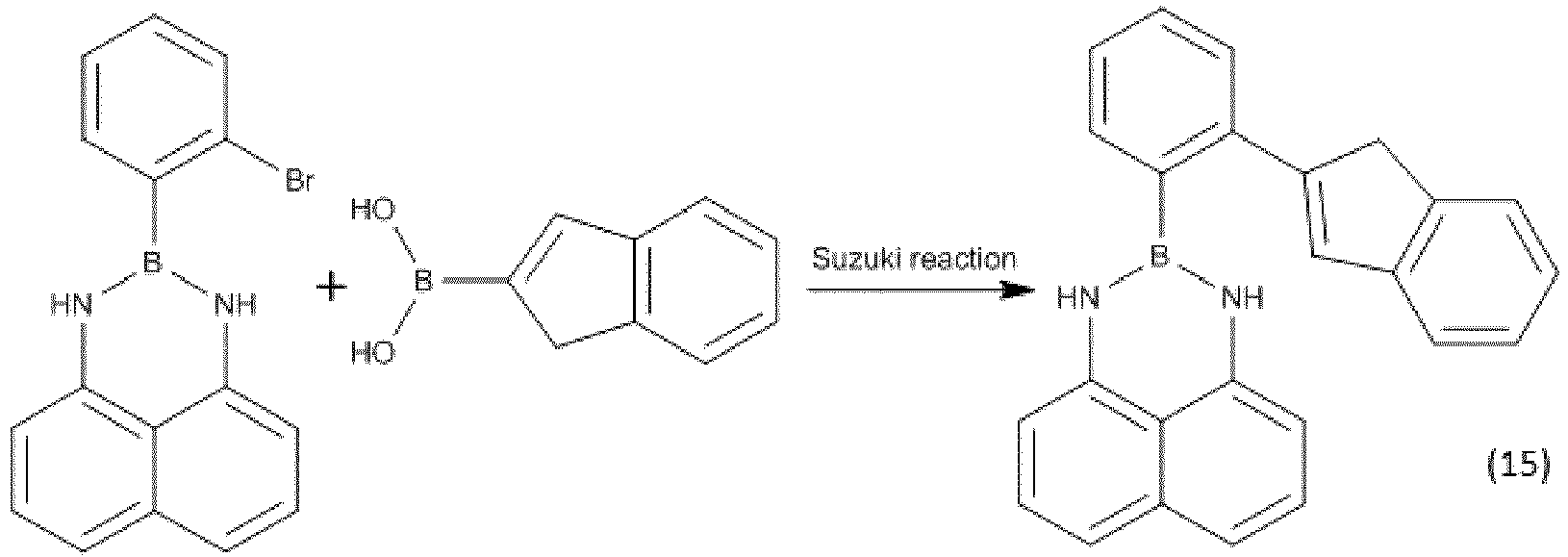
- c. deprotecting the protected compound by reaction with an acid to arrive at the compound according to formula 16,

- d. reacting the compound (formula 16) with N-substituted 2-bromoaniline (formula 7) in the presence of a Pd catalyst in the presence of a base (according to the Suzuki reaction), to form a ligand precursor (formula 11), wherein the substituent R of the N in 2-bromoaniline is chosen from the group of hydrogen and a hydrocarbon radical with 1-20 carbon atoms, preferably t-butyl
- e. creating anions of the ligand precursors (11) with an organic or inorganic base
- f. reacting the anion of the ligand precursor with (Me2N)aMQk, wherein Me is methyl; M is a metal selected from lanthanides or transition metals from group 3, 4, 5 or 6 of the Periodic System of the Elements, preferably M is Zr; Q is an anionic ligand to M, preferably Q is Cl or methyl; k is the number of Q groups and equals the valence of M minus 2; and a equals the valence of M minus k, to yield a metallocene complex according to formula 5.

- Olefin polymers may be prepared by polymerizing one or more olefins in the presence of the described metallocene complex or in the presence of the described composition, wherein the metallocene complex is present on a support and a cocatalyst
- The cocatalyst employed include aluminium- or boron-containing cocatalysts. Suitable aluminium-containing cocatalysts comprise aluminoxanes and alkyl aluminium. The aluminoxanes usable are well known and preferably comprise oligomeric linear and/or cyclic alkyl aluminoxanes represented by the formula: R3 - (AlR3 -O)n - AlR3 2 for oligomeric, linear aluminoxanes and
(- AlR3 - O -)m for oligomeric, cyclic aluminoxanes; wherein n is 1-40, preferably n is 10-20; m is 3-40, preferably m is 3-20 and R3 is a C1 to C8 alkyl group and preferably a methyl group. Further other organoaluminum compounds can be used such as trimethylaluminum, triethylaluminium, triisopropylaluminum, tri-n-propylaluminum, triisobutylaluminum, tri-n-butylaluminum, triamylaluminium; dimethylaluminium ethoxide, diethylaluminium ethoxide, diisopropylaluminium ethoxide, di-n-propylaluminium ethoxide, diisobutylaluminium ethoxide and di-n-butylaluminium ethoxide; dimethylaluminium hydride, diethylaluminium hydride, diisopropylaluminium hydride, di-n-propylaluminium hydride, diisobutylaluminium hydride and di-n-butylaluminium hydride. - Suitable boron-containing cocatalysts include trialkylboranes, for example trimethylborane or triethylborane and/or perfluorophenylborane and/or a perfluorophenylborate.
- In the process to produce olefin polymers by polymerizing one or more olefins in the presence of a metallocene complex preferably an organoaluminum cocatalyst is present. More preferably, methylaluminoxane is used as the cocatalyst.
- The process to produce the olefin polymers may start with the reaction of the metallocene complex with the cocatalyst. This reaction can be performed in the same vessel as the reaction vessel wherein the olefin polymers are produced or in a separate vessel, whereafter the mixture of the metallocene complex and the cocatalyst is fed to the reaction vessel. During the reaction described above an inert solvent can be used.
- In the mixture of the metallocene complex and the cocatalyst, the cocatalyst is used in an amount of 10 to 100,000 mol, preferably from 10 to 10,000 mol per mol of the transition metal compound.
- The solvent used in the process to produce olefin polymers may be any organic solvent usually used for the polymerization. Examples of solvents are benzene, toluene, xylene, butane, pentane, hexane, heptane, cyclohexane and methylene chloride. Also the olefin to be polymerized can be used as the solvent.
- In the process to produce olefin polymers the polymerization conditions, like for example temperature, time, pressure, monomer concentration can be chosen within wide limits. The polymerization temperature is in the range from -100 to 300 °C, preferably 0 to 200 °C, more preferably 10 to 100 °C. The polymerization time is in the range of from 10 seconds to 20 hours, preferably from 1 minute to 10 hours, more preferably from 5 minutes to 5 hours. The ethylene pressure during polymerization is in the range from 1 to 3500 bar, preferably from 1 to 2500 bar, more preferably from 1 to 1000 bar, even more preferably from 1 to 500 bar, most preferably from 1 to 100 bar. The molecular weight of the polymer can be controlled by use of hydrogen in the polymerization. The polymerization may be conducted by a batch process, a semicontinuous process or a continuous process and may also be conducted in two or more steps of different polymerization conditions. The polyolefin produced is separated from the polymerization solvent and dried by methods known to a person skilled in the art.
- In the process to produce olefin polymers the olefin which is polymerized can be one type of olefin or can be mixtures of different olefins. The polymerization thus includes homopolymerization and copolymerization. Examples of olefins are α-olefins such as ethylene, propylene, 1-butene, 1-pentene, 4-methyl-1-pentene, 1-hexene, 1-octene, 1-nonene, 1-decene and styrene; conjugated and non-conjugated dienes such as butadiene, 1,4-hexadiene, 5-ethylidene-2-norbornene, dicyclopentadiene, 4-methyl-1,4-hexadiene and 7-methyl-1,6-octadiene; and cyclic olefins such as cyclobutene, but is not limited thereto.
- Preferably, at least one of the olefins that is polymerized is ethylene.More preferably, a mixture of ethylene and at least one other olefin of 3 or more carbon atoms is polymerized.
- In particular, in the production of LLDPE obtained by copolymerizing ethylene and at least one other olefin of 3 or more carbon atoms a high molecular weight of the olefin polymer can be obtained. Preferably, the other olefin of 3 or more carbon atoms is chosen from 1-butene, 1-hexene or 1-octene, more preferably the other olefin is 1-hexene.
- Preferably, the olefin comonomer is present in an amount of about 5 to about 20 percent by weight of the ethylene-olefin copolymer, more preferably an amount of from about 7 to about 15 percent by weight of the ethylene-alpha olefin copolymer.For example an LLDPE having a melt mass flow rate (also known as melt flow index) as determined using ASTM D1238-10 (190°C/2.16 kg) which ranges from 1 to 125 g/10 min and a density in the range from 900 kg/m3 to less than 940 kg/m3 as determined using ASTM D1505-10 may be obtained.
- For example, the density of the linear low density polyethylene ranges from about 915 kg/m3 to less than 940 kg/m3, for example between 915 and 925 kg/m3 .
- For example, the melt flow index of the linear low density polyethylene ranges from 0.3 to 3 g/10min, for example from 0.5 to 1.5 g/10min.
- The polymerisation may be performed via a gas phase process or via a slurry process.
- The production processes of polyethylene are summarised in "Handbook of Polyethylene" by Andrew Peacock (2000; Dekker; ISBN 0824795466) at pages 43-66. The catalysts can be divided in three different subclasses including Ziegler Natta catalysts, Phillips catalysts and single site catalysts. The latter class is a family of different classes of compounds, metallocene catalysts being one of them. As elucidated at pages 53-54 of said Handbook a Ziegler-Natta catalysed polymer is obtained via the interaction of an organometallic compound or hydride of a Group I-III metal with a derivative of a Group IV-VIII transition metal. An example of a (modified) Ziegler-Natta catalyst is a catalyst based on titanium tetra chloride and the organometallic compound triethylaluminium. A difference between metallocene catalysts and Ziegler Natta catalysts is the distribution of active sites. Ziegler Natta catalysts are heterogeneous and have many active sites. Consequently polymers produced with these different catalysts will be different regarding for example the molecular weight distribution and the comonomer distribution.
- The various processes may be divided into solution polymerisation processes employing homogeneous (soluble) catalysts and processes employing supported (heterogeneous) catalysts. The latter processes include both slurry and gas phase processes.
- As defined herein, in linear low density polyethylene, the term "linear" means that the polymer lacks measurable or demonstrable long chain branches, that is, the polymer is substituted with an average of less than 0.01 long chain branch/1000 carbon atoms. "Long chain branching" (LCB) means a chain length longer than the short chain branch that results from the incorporation of the α-olefin(s) into the polymer backbone. Each long chain branch will have the same comonomer distribution as the polymer backbones and can be as long as the polymer backbone to which it is attached.
- As a practical matter, current 13C nuclear magnetic resonance spectroscopy cannot distinguish the length of a long chain branch in excess of six carbon atoms. However, there are other known techniques useful for determining the presence of long chain branches in ethylene polymers. Two such methods are gel permeation chromatography coupled with a low angle laser light scattering detector (GPC-LALLS) and gel permeation chromatography coupled with a differential viscometer detector (GPCDV). The use of these techniques for long chain branch detection and the underlying theories have been well documented in the literature.
- See, for example, Zimm, G.H. and Stockmayer, W.H., J.Chem. Phys., 17,1301 (1949) and Rudin, A., Modern Methods of Polymer Characterization, John Wiley & Sons, New York (1991 pp. 103-112).
- It has been found that with the metallocene complex or with the composition wherein the metallocene complex is present on a support, it is possible to produce polyethylene from ethylene and at least one other olefin, for example an olefin having up to 8 carbon atoms, with a high incorporation of the at least one other olefin.
- The amount of incorporation of the at least one other olefin, for example an α-olefin in the polyethylene is expressed by the amount of branches per 1000 carbon atoms.
- The presence of short chain branching of up to 6 carbon atoms in length can be determined in ethylene polymers by using 13C nuclear magnetic resonance (NMR) spectroscopy and is quantified using the method described by Randall (Rev. Macromol. Chem. Phys., C.29, V. 2 & 3, p. 285-297).
- The number average molecular weight (Mn) of the polyolefin, for example polyethylene, for example LLDPE of the invention may vary between wide ranges and may for example be in the range from 1000 to 200000Da.
- For example, the Mn of the polyolefin of the invention may be at least 1500, for example at least 2000, for example at least 20,000, for example at least 50,000 and/or for example at most 150,000, for example at most 110,000, for example at most 100,000, for example at most 70,000.
- The weight average molecular weight (Mw) of the polyolefin, for example polyethylene, for example LLDPE of the invention may also vary between wide ranges and may for example be in the range from 1500 to 500000. For example, the Mw of the polyolefin of the invention may be at least 2500, for example at least 10,000, for example at least 50,000, for example at least 100,000 and/or for example at most 400,000, for example at least 350,000, for example at most 300,000, for example at most 250,000.
- For purpose of the invention, the Mw and Mn are determined using SEC (Size Exclusion Chromatography) using 1,2,4-trichlorobenzene as an eluent, and calibrated using linear polyethylene standards.
- The molecular weight distribution (that is Mw/Mn) of the polyolefin of the invention may for example vary from from 2 to 5, from 2.1 to 4 or from 2.5 to 3.5.
- The crystallinity temperature (Tc) of the polyolefin of the invention may for example be in the range from 90 to 120°C. The melt temperature (Tm) of the polyolefin of the invention may for example be in the range from 100 to 140°C.
- For purpose of the invention, the Tm and Tc are determined using Differential Scanning Calorimetry according to ASTM D 3418-08 using a scan rate of 10°C/min on a sample of 10mg and using the second heating cycle
- The polyolefin may be mixed with suitable additives.
- Examples of suitable additives for polyethylene include but are not limited to the additives usually used for polyethylene, for example antioxidants, nucleating agents, acid scavengers, processing aids, lubricants, surfactants, blowing agents, ultraviolet light absorbers, quenchers, antistatic agents, slip agents, anti-blocking agents, antifogging agents, pigments, dyes and fillers, and cure agents such as peroxides. The additives may be present in the typically effective amounts well known in the art, such as 0.001 weight % to 10 weight % based on the total composition.
- The polyolefins and compositions comprising said polyolefins may suitably be used for the manufacture of articles. For example, the polyolefins and compositions may be manufactured into film, for example by compounding, extrusion, film blowing or casting or other methods of film formation to achieve, for example uniaxial or biaxial orientation. Examples of films include blown or cast films formed by coextrusion (to form multilayer films) or by lamination and may be useful as films for packaging, for example as shrink film, cling film, stretch film, sealing films, oriented films, snack packaging, heavy duty bags, grocery sacks, baked and frozen food packaging, medical packaging, industrial liners, membranes, etc. in food-contact and non-food contact applications, agricultural films and sheets.
- It is further noted that the term 'comprising' does not exclude the presence of other elements. However, it is also to be understood that a description on a product comprising certain components also discloses a product consisting of these components. Similarly, it is also to be understood that a description on a process comprising certain steps also discloses a process consisting of these steps.
- The invention will hereafter be elucidated by way of the following examples, without being limited thereto.
- General remarks relating to the experiments which are performed.
- Most of the materials were received from Aldrich. Indene-2-boronic acid was custom synthesized and supplied by Aldrich. The dry solvents used for the reaction were either dried in the lab using standard procedures or obtained from Merck Chemicals India Ltd. 2-bromoindene used in the reactions was procured from TCI, Japan. All materials and reagents used for analysis were of high purity. The reactions were monitored by thin layer chromatograpy (TLC) and High Performance Liquid Chromatography (HPLC). The compounds were purified by different techniques such as by column chromatography, by preparative TLC, by preparative HPLC or by crystallization. The purity of the compounds was analyzed by HPLC. Compounds were characterized by a liquid chromatograph-mass spectrometer (LC-MS) system, comprising a liquid chromatograph and a Quattro Ultima Pt mass spectrometer. An Xterra C18 (50 mm X 4.6 mm; 5 microns) column was used for separating the components by liquid chromatography. aH and 13C NMR spectra for all the compounds were recorded on a 300 MHz Bruker NMR spectrometer. CDCl3 was used as the solvent for NMR.
-

- 64g (0.372moles) of 2-bromoaniline was taken in 500ml of cyclohexane and added to 200g (0.915moles) of tert-butyl-2,2,2-trichloroacetimidate. BF3.ethereate (9.6ml (25.8ml/mol)) was added dropwise, slowly. Care was taken so that the reaction temperature did not rise above the room temperature. The reaction mixture was stirred at room temperature overnight. Next day, the precipitated salt was filtered off and the filtrate was concentrated. The concentrated fraction was purified by column chromatography using hexane as eluent. The impure fraction obtained after the first column was purified again on a second column. Yield: 83.5g (97%).
-

- 42g (0.183moles) of 1-bromo-2-(N-tert-butyl)benzene-tert-butyl 2-bromoaniline was dissolved in 400ml of toluene and added to tetrakis triphenyl phosphine palladium (1.05g; 0.000832 moles; 5mol%). After 15min, aqueous sodium carbonate (117g; 1.098moles, dissolved in 400ml water) was added followed by the indene-2-boronic acid (34.3g; 0.214moles). The reaction mixture was stirred at 115°C overnight. Next day, the reaction mixture was cooled and the organic layer was separated. The organic layer was concentrated and purified by column chromatography using hexane:dichloromethane as eluent (Gradient: 0-20% of dichloromethane). Yield: 21g (44%).
- 500mg (.0019 moles) of the ligand was weighed into one arm of a clean, dry double Schlenk (inside the glove box). The Schlenk was transferred into fumehood and N2 atmosphere was applied. Freshly dried diethyl ether (15ml) was added using a syringe.
- The sample was dissolved completely in diethyl ether. The solution was cooled to -78°C. n-BuLi (2.49ml; 1.6N in hexanes; 0.00399 moles) was added to this solution drop wise. The color gradually changed to yellow and the solution became hazy. The cold bath was removed after ~30min and solution left to stir at RT for 4hrs. The solution became clear and the color of the solution gradually became brown with a greenish tinch. The solution was again cooled to -78°C and solid ZrCl4 (0.442g; 0.0019 moles) was added. The temperature of the solution was slowly brought to RT and left the solution for stirring for 2h. The color of the solution was turned to brown and solid was precipitated. Stopped the stirring and ether was taken to the other arm of the Schlenk by filtration. Solid was washed with ether and dried.
- The reaction for the preparation of 1-bromo-2-(N-tert-butyl)benzene-tert-butyl 2-bromoaniline was performed as in example 1, step 1 above.
- Synthesis of protected 2-bromophenyl boronic acid:

- 100g (0.498moles) of 2-bromophenyl boronic acid was taken in toluene (2L) and added to 86.6g (0.548moles) of 1,8-diaminonaphthalene. The reaction mixture was refluxed and distilled using a Dean-Stark apparatus. The volume was reduced to 100ml and the reaction mixture was cooled. The cooled mixture was recrystallized from hexane. Yield: 152g (95%).
- 2-(2-indenyl) substituted protected phenylboronic acid is synthesized according to the following scheme 4:

- 170g (0.526moles) of the protected 2-bromophenyl boronic (prepared in accordance with example 2) acid was taken in toluene (1.5L) and added to 3.043g (0.00263moles; 5mol%) of tetrakis triphenyl phosphine palladium. The mixture was stirred for 15 min and added to aqueous sodium carbonate (340g, 3.2075moles). Indene-2-boronic acid (101g, 0.6312moles) was now added and the reaction mixture was stirred overnight at reflux. The product started to precipitate in the reaction flask. Next day, the reaction mixture was cooled. The precipitated product was filtered, washed with plenty of water and dried. Yield: 183g (97%).
- 2-(2-indenyl)phenylboronic acid is synthesized according to scheme 5:

- 182g (0,508moles) of 2-(2-indenyl) substituted protected phenylboronic acid (prepared according to example 3) was taken in tetrahydrofuran (THF, 1.5L). Dilute sulphuric acid (2N, 86ml H2SO4 in 1430ml water) was added and heated at reflux (85°) overnight. The reaction mixture was left for cooling and the product precipitated. The product was taken in dichloromethane and precipitated from hexane. Yield: 110g (92%).
- 2-(N-tert-butyl)-2'-(2-indenyl) biphenyl is synthesized according to scheme 6:


- 54g (0.2358moles) of N-tert-butyl- 2-bromoaniline (prepared according to example 1) was dissolved in 500ml of toluene and tetrakis triphenyl phosphine palladium was added (1.3644g; 0.001 moles; 5mol%). After 15min, aqueous sodium carbonate (151g; 1.426moles (dissolved in 500ml water)) was added followed by 2-(2-indenyl)phenylboronic acid (66.8g; 0.283moles) (prepared according to example 4). The reaction mixture was stirred at 115°C overnight. Next day, the reaction mixture was cooled and the organic layer was separated. The organic layer was concentrated and purified by column using hexane: dichloromethane as eluent. Gradient: 0-20% of dichloromethane. Yield: 6.2g (10%).
- 500mg (0.0015 moles) of the ligand was weighed into one arm of a clean, dry double Schlenk (inside the glove box). The Schlenk was transferred into fumehood and N2 atmosphere was applied. Freshly dried diethyl ether (15ml) was added using a syringe. The sample was dissolved completely in diethyl ether. The solution was cooled to -78°C. n-BuLi (1. 96ml; 1.6N in hexanes; 0.00315 moles) was added to this solution drop wise. The color gradually changed to yellow and the solution became hazy with precipitation of yellow solid. The cold bath was removed after ~30min and solution left to stir at RT for 4hrs. The color of the solution became yellow and gradually changed to brown and greenish brown in about 2h. The solution was again cooled to -78oC and solid ZrCl4 (0.35 g; 0.0015 moles) was added. Immediately after the addition of ZrCI4, the color of the solution was changed to yellow. The temperature of the solution was slowly brought to RT and left the solution for stirring for 2h. The color of the solution was turned to brown and solid was precipitated. Stopped the stirring and ether was taken to the other arm of the Schlenk by filtration. Solid was washed with ether and dried.
Claims (4)
- Process for the preparation of the metallocene complexes according to formula 5
 a) reacting 2-bromophenyl boronic acid with 1,8-diaminonaphthalene to form a protected compound (formula 13),
 b) reacting the protected compound (13) with a compound with the formula 14,
 c) deprotecting the protected compound by reaction with an acid to arrive at the compound according to formula 16,
 d) reacting the compound (16) with N-substituted 2-bromoaniline (formula 7)
 e) creating anions of the ligand precursors (11) with an organic or inorganic basef) reacting the anion of the ligand precursor with (Me2N)aMQk, wherein Me is methyl; M is a metal selected from lanthanides or transition metals from group 3, 4, 5 or 6 of the Periodic System of the Elements, preferably M is Zr; Q is an anionic ligand to M, preferably Q is Cl or methyl; k is the number of Q groups and equals the valence of M minus 2; and a equals the valence of M minus k, to yield a metallocene complex according to formula 5.
 - Process according to claim 1, wherein R is t-butyl.
- Process according to any one of claims 1-2, wherein M is Zr.
- Process according to any one of claims 1-3, wherein Q is Cl or methyl.
Priority Applications (1)
| Application Number | Priority Date | Filing Date | Title |
|---|---|---|---|
| EP14747576.8A EP3027631B1 (en) | 2013-08-01 | 2014-07-29 | Process for the preparation of bridged metallocene complexes suitable for use in olefin polymerization |
Applications Claiming Priority (4)
| Application Number | Priority Date | Filing Date | Title |
|---|---|---|---|
| EP13178970.3A EP2832739A1 (en) | 2013-08-01 | 2013-08-01 | Bridged metallocene complex for olefin polymerization |
| US201461929291P | 2014-01-20 | 2014-01-20 | |
| PCT/EP2014/066265 WO2015014832A1 (en) | 2013-08-01 | 2014-07-29 | Bridged metallocene complex for olefin polymerization |
| EP14747576.8A EP3027631B1 (en) | 2013-08-01 | 2014-07-29 | Process for the preparation of bridged metallocene complexes suitable for use in olefin polymerization |
Publications (2)
| Publication Number | Publication Date |
|---|---|
| EP3027631A1 EP3027631A1 (en) | 2016-06-08 |
| EP3027631B1 true EP3027631B1 (en) | 2022-08-24 |
Family
ID=48900876
Family Applications (2)
| Application Number | Title | Priority Date | Filing Date |
|---|---|---|---|
| EP13178970.3A Withdrawn EP2832739A1 (en) | 2013-08-01 | 2013-08-01 | Bridged metallocene complex for olefin polymerization |
| EP14747576.8A Active EP3027631B1 (en) | 2013-08-01 | 2014-07-29 | Process for the preparation of bridged metallocene complexes suitable for use in olefin polymerization |
Family Applications Before (1)
| Application Number | Title | Priority Date | Filing Date |
|---|---|---|---|
| EP13178970.3A Withdrawn EP2832739A1 (en) | 2013-08-01 | 2013-08-01 | Bridged metallocene complex for olefin polymerization |
Country Status (5)
| Country | Link |
|---|---|
| US (1) | US9868797B2 (en) |
| EP (2) | EP2832739A1 (en) |
| KR (1) | KR20160036620A (en) |
| CN (1) | CN105408338A (en) |
| WO (1) | WO2015014832A1 (en) |
Families Citing this family (3)
| Publication number | Priority date | Publication date | Assignee | Title |
|---|---|---|---|---|
| BR112016002926A2 (en) * | 2013-08-20 | 2017-08-01 | Sabic Global Technologies Bv | process for the preparation of 2,2-bis-indenyl biphenyl ligands and their metallocene complexes |
| WO2021048030A1 (en) * | 2019-09-10 | 2021-03-18 | Sabic Global Technologies B.V. | Compounds for use in catalyst compositions for the production of polyolefins |
| CN114423769B (en) * | 2019-09-20 | 2024-04-26 | Sabic环球技术有限责任公司 | Compounds in catalyst compositions for producing polyolefins |
Family Cites Families (9)
| Publication number | Priority date | Publication date | Assignee | Title |
|---|---|---|---|---|
| US5272236A (en) | 1991-10-15 | 1993-12-21 | The Dow Chemical Company | Elastic substantially linear olefin polymers |
| NL9201970A (en) | 1992-11-11 | 1994-06-01 | Dsm Nv | Indenyl compounds and catalyst components for the polymerization of olefins. |
| FI945958A7 (en) * | 1993-12-21 | 1995-06-22 | Targor Gmbh | Method for producing polyolefins |
| US6342622B1 (en) | 1999-06-11 | 2002-01-29 | Dsm B.V. | Indenyl compounds for the polymerization of olefins |
| DE10003581A1 (en) * | 2000-01-28 | 2001-08-02 | Bayer Ag | Organometallic compounds with fused indenyl ligands |
| US7678933B2 (en) * | 2005-12-30 | 2010-03-16 | Lg Chem, Ltd. | Transition metal complexes and preparation methods thereof |
| KR100976131B1 (en) * | 2007-01-10 | 2010-08-16 | 주식회사 엘지화학 | Method for producing a transition metal compound, a transition metal compound prepared by the method and a catalyst composition comprising the transition metal compound |
| KR101217268B1 (en) * | 2009-04-13 | 2012-12-31 | 주식회사 엘지화학 | Catalystic composition for olefin polymerization and olefin polymer using the same |
| CN104080792A (en) * | 2011-12-19 | 2014-10-01 | 沙特基础工业公司 | Process for the preparation of metallocene complexes |
-
2013
- 2013-08-01 EP EP13178970.3A patent/EP2832739A1/en not_active Withdrawn
-
2014
- 2014-07-29 KR KR1020167005287A patent/KR20160036620A/en not_active Ceased
- 2014-07-29 WO PCT/EP2014/066265 patent/WO2015014832A1/en not_active Ceased
- 2014-07-29 CN CN201480042362.5A patent/CN105408338A/en active Pending
- 2014-07-29 EP EP14747576.8A patent/EP3027631B1/en active Active
- 2014-07-29 US US14/907,923 patent/US9868797B2/en not_active Expired - Fee Related
Non-Patent Citations (2)
| Title |
|---|
| DATABASE CA [online] CHEMICAL ABSTRACTS SERVICE, COLUMBUS, OHIO, US; LENSINK, CORNELIS ET AL: "Dichloro{N-[2-(.eta.5-indenyl)ethyl]-p-tolylsulfonamido-.kappa.N}titanium", retrieved from STN Database accession no. 2002:411896 * |
| JYE-SHANE YANG ET AL: "Excited-State Behavior of N -Phenyl-Substituted trans- 3-Aminostilbenes: Where the " m -Amino Effect" Meets the "Amino-Conjugation Effect"", JOURNAL OF PHYSICAL CHEMISTRY. A, MOLECULES, SPECTROSCOPY,KINETICS, ENVIRONMENT AND GENERAL THEORY, vol. 109, no. 29, 1 July 2005 (2005-07-01), US, pages 6450 - 6456, XP055676336, ISSN: 1089-5639, DOI: 10.1021/jp0517807 * |
Also Published As
| Publication number | Publication date |
|---|---|
| WO2015014832A1 (en) | 2015-02-05 |
| US9868797B2 (en) | 2018-01-16 |
| EP3027631A1 (en) | 2016-06-08 |
| US20160168280A1 (en) | 2016-06-16 |
| CN105408338A (en) | 2016-03-16 |
| KR20160036620A (en) | 2016-04-04 |
| EP2832739A1 (en) | 2015-02-04 |
Similar Documents
| Publication | Publication Date | Title |
|---|---|---|
| EP3606931B1 (en) | Dihydrocarbyl-silyl-bridged-substituted cyclopentadienyl metallocene complexes for olefin polymerization | |
| EP3400230B1 (en) | Catalyst comprising a metallocene complex and a co-catalyst | |
| EP3191497B1 (en) | Boron-bridged 2-indenyl metallocene complexes for olefin polymerization | |
| CN110650965B (en) | Dihydrocarbyl-silyl-bridged-1,3 disubstituted-2-indenyl metallocene complexes for olefin polymerization | |
| EP3743431B1 (en) | 1,2-phenylene bridged 1-indenyl-2-indenyl metallocene complexes for olefin polymerisation | |
| EP3606967B1 (en) | Dimethyl-silyl-bridged-1-substituted-2-indenyl metallocene complexes for olefin polymerization | |
| WO2014139949A1 (en) | Bis(2-indenyl) metallocene complex | |
| US10513569B2 (en) | Bridged metallocene complex for olefin polymerization | |
| EP3303354B1 (en) | Catalyst comprising a metallocene complex and a co-catalyst | |
| US9868797B2 (en) | Bridged metallocene complex for olefin polymerization |
Legal Events
| Date | Code | Title | Description |
|---|---|---|---|
| PUAI | Public reference made under article 153(3) epc to a published international application that has entered the european phase |
Free format text: ORIGINAL CODE: 0009012 |
|
| 17P | Request for examination filed |
Effective date: 20151130 |
|
| AK | Designated contracting states |
Kind code of ref document: A1 Designated state(s): AL AT BE BG CH CY CZ DE DK EE ES FI FR GB GR HR HU IE IS IT LI LT LU LV MC MK MT NL NO PL PT RO RS SE SI SK SM TR |
|
| AX | Request for extension of the european patent |
Extension state: BA ME |
|
| DAX | Request for extension of the european patent (deleted) | ||
| RAP3 | Party data changed (applicant data changed or rights of an application transferred) |
Owner name: SAUDI BASIC INDUSTRIES CORPORATION Owner name: SABIC GLOBAL TECHNOLOGIES B.V. |
|
| STAA | Information on the status of an ep patent application or granted ep patent |
Free format text: STATUS: EXAMINATION IS IN PROGRESS |
|
| 17Q | First examination report despatched |
Effective date: 20180703 |
|
| REG | Reference to a national code |
Ref country code: DE Ref legal event code: R079 Ref document number: 602014084723 Country of ref document: DE Free format text: PREVIOUS MAIN CLASS: C07F0017000000 Ipc: C07C0211520000 |
|
| GRAP | Despatch of communication of intention to grant a patent |
Free format text: ORIGINAL CODE: EPIDOSNIGR1 |
|
| STAA | Information on the status of an ep patent application or granted ep patent |
Free format text: STATUS: GRANT OF PATENT IS INTENDED |
|
| RIC1 | Information provided on ipc code assigned before grant |
Ipc: C08F 10/02 20060101ALI20220601BHEP Ipc: C08F 4/659 20060101ALI20220601BHEP Ipc: C07F 5/02 20060101ALI20220601BHEP Ipc: C07C 211/48 20060101ALI20220601BHEP Ipc: C07F 17/00 20060101ALI20220601BHEP Ipc: C07C 211/52 20060101AFI20220601BHEP |
|
| GRAS | Grant fee paid |
Free format text: ORIGINAL CODE: EPIDOSNIGR3 |
|
| GRAA | (expected) grant |
Free format text: ORIGINAL CODE: 0009210 |
|
| STAA | Information on the status of an ep patent application or granted ep patent |
Free format text: STATUS: THE PATENT HAS BEEN GRANTED |
|
| INTG | Intention to grant announced |
Effective date: 20220627 |
|
| AK | Designated contracting states |
Kind code of ref document: B1 Designated state(s): AL AT BE BG CH CY CZ DE DK EE ES FI FR GB GR HR HU IE IS IT LI LT LU LV MC MK MT NL NO PL PT RO RS SE SI SK SM TR |
|
| REG | Reference to a national code |
Ref country code: CH Ref legal event code: EP |
|
| REG | Reference to a national code |
Ref country code: DE Ref legal event code: R096 Ref document number: 602014084723 Country of ref document: DE |
|
| REG | Reference to a national code |
Ref country code: IE Ref legal event code: FG4D |
|
| REG | Reference to a national code |
Ref country code: AT Ref legal event code: REF Ref document number: 1513574 Country of ref document: AT Kind code of ref document: T Effective date: 20220915 |
|
| REG | Reference to a national code |
Ref country code: LT Ref legal event code: MG9D |
|
| REG | Reference to a national code |
Ref country code: NL Ref legal event code: MP Effective date: 20220824 |
|
| PG25 | Lapsed in a contracting state [announced via postgrant information from national office to epo] |
Ref country code: SE Free format text: LAPSE BECAUSE OF FAILURE TO SUBMIT A TRANSLATION OF THE DESCRIPTION OR TO PAY THE FEE WITHIN THE PRESCRIBED TIME-LIMIT Effective date: 20220824 Ref country code: RS Free format text: LAPSE BECAUSE OF FAILURE TO SUBMIT A TRANSLATION OF THE DESCRIPTION OR TO PAY THE FEE WITHIN THE PRESCRIBED TIME-LIMIT Effective date: 20220824 Ref country code: PT Free format text: LAPSE BECAUSE OF FAILURE TO SUBMIT A TRANSLATION OF THE DESCRIPTION OR TO PAY THE FEE WITHIN THE PRESCRIBED TIME-LIMIT Effective date: 20221226 Ref country code: NO Free format text: LAPSE BECAUSE OF FAILURE TO SUBMIT A TRANSLATION OF THE DESCRIPTION OR TO PAY THE FEE WITHIN THE PRESCRIBED TIME-LIMIT Effective date: 20221124 Ref country code: NL Free format text: LAPSE BECAUSE OF FAILURE TO SUBMIT A TRANSLATION OF THE DESCRIPTION OR TO PAY THE FEE WITHIN THE PRESCRIBED TIME-LIMIT Effective date: 20220824 Ref country code: LV Free format text: LAPSE BECAUSE OF FAILURE TO SUBMIT A TRANSLATION OF THE DESCRIPTION OR TO PAY THE FEE WITHIN THE PRESCRIBED TIME-LIMIT Effective date: 20220824 Ref country code: LT Free format text: LAPSE BECAUSE OF FAILURE TO SUBMIT A TRANSLATION OF THE DESCRIPTION OR TO PAY THE FEE WITHIN THE PRESCRIBED TIME-LIMIT Effective date: 20220824 Ref country code: FI Free format text: LAPSE BECAUSE OF FAILURE TO SUBMIT A TRANSLATION OF THE DESCRIPTION OR TO PAY THE FEE WITHIN THE PRESCRIBED TIME-LIMIT Effective date: 20220824 Ref country code: ES Free format text: LAPSE BECAUSE OF FAILURE TO SUBMIT A TRANSLATION OF THE DESCRIPTION OR TO PAY THE FEE WITHIN THE PRESCRIBED TIME-LIMIT Effective date: 20220824 |
|
| REG | Reference to a national code |
Ref country code: AT Ref legal event code: MK05 Ref document number: 1513574 Country of ref document: AT Kind code of ref document: T Effective date: 20220824 |
|
| PG25 | Lapsed in a contracting state [announced via postgrant information from national office to epo] |
Ref country code: PL Free format text: LAPSE BECAUSE OF FAILURE TO SUBMIT A TRANSLATION OF THE DESCRIPTION OR TO PAY THE FEE WITHIN THE PRESCRIBED TIME-LIMIT Effective date: 20220824 Ref country code: IS Free format text: LAPSE BECAUSE OF FAILURE TO SUBMIT A TRANSLATION OF THE DESCRIPTION OR TO PAY THE FEE WITHIN THE PRESCRIBED TIME-LIMIT Effective date: 20221224 Ref country code: HR Free format text: LAPSE BECAUSE OF FAILURE TO SUBMIT A TRANSLATION OF THE DESCRIPTION OR TO PAY THE FEE WITHIN THE PRESCRIBED TIME-LIMIT Effective date: 20220824 Ref country code: GR Free format text: LAPSE BECAUSE OF FAILURE TO SUBMIT A TRANSLATION OF THE DESCRIPTION OR TO PAY THE FEE WITHIN THE PRESCRIBED TIME-LIMIT Effective date: 20221125 |
|
| PG25 | Lapsed in a contracting state [announced via postgrant information from national office to epo] |
Ref country code: SM Free format text: LAPSE BECAUSE OF FAILURE TO SUBMIT A TRANSLATION OF THE DESCRIPTION OR TO PAY THE FEE WITHIN THE PRESCRIBED TIME-LIMIT Effective date: 20220824 Ref country code: RO Free format text: LAPSE BECAUSE OF FAILURE TO SUBMIT A TRANSLATION OF THE DESCRIPTION OR TO PAY THE FEE WITHIN THE PRESCRIBED TIME-LIMIT Effective date: 20220824 Ref country code: DK Free format text: LAPSE BECAUSE OF FAILURE TO SUBMIT A TRANSLATION OF THE DESCRIPTION OR TO PAY THE FEE WITHIN THE PRESCRIBED TIME-LIMIT Effective date: 20220824 Ref country code: CZ Free format text: LAPSE BECAUSE OF FAILURE TO SUBMIT A TRANSLATION OF THE DESCRIPTION OR TO PAY THE FEE WITHIN THE PRESCRIBED TIME-LIMIT Effective date: 20220824 Ref country code: AT Free format text: LAPSE BECAUSE OF FAILURE TO SUBMIT A TRANSLATION OF THE DESCRIPTION OR TO PAY THE FEE WITHIN THE PRESCRIBED TIME-LIMIT Effective date: 20220824 |
|
| REG | Reference to a national code |
Ref country code: DE Ref legal event code: R097 Ref document number: 602014084723 Country of ref document: DE |
|
| PG25 | Lapsed in a contracting state [announced via postgrant information from national office to epo] |
Ref country code: SK Free format text: LAPSE BECAUSE OF FAILURE TO SUBMIT A TRANSLATION OF THE DESCRIPTION OR TO PAY THE FEE WITHIN THE PRESCRIBED TIME-LIMIT Effective date: 20220824 Ref country code: EE Free format text: LAPSE BECAUSE OF FAILURE TO SUBMIT A TRANSLATION OF THE DESCRIPTION OR TO PAY THE FEE WITHIN THE PRESCRIBED TIME-LIMIT Effective date: 20220824 |
|
| PG25 | Lapsed in a contracting state [announced via postgrant information from national office to epo] |
Ref country code: AL Free format text: LAPSE BECAUSE OF FAILURE TO SUBMIT A TRANSLATION OF THE DESCRIPTION OR TO PAY THE FEE WITHIN THE PRESCRIBED TIME-LIMIT Effective date: 20220824 |
|
| PLBE | No opposition filed within time limit |
Free format text: ORIGINAL CODE: 0009261 |
|
| STAA | Information on the status of an ep patent application or granted ep patent |
Free format text: STATUS: NO OPPOSITION FILED WITHIN TIME LIMIT |
|
| P01 | Opt-out of the competence of the unified patent court (upc) registered |
Effective date: 20230529 |
|
| 26N | No opposition filed |
Effective date: 20230525 |
|
| PG25 | Lapsed in a contracting state [announced via postgrant information from national office to epo] |
Ref country code: SI Free format text: LAPSE BECAUSE OF FAILURE TO SUBMIT A TRANSLATION OF THE DESCRIPTION OR TO PAY THE FEE WITHIN THE PRESCRIBED TIME-LIMIT Effective date: 20220824 |
|
| PG25 | Lapsed in a contracting state [announced via postgrant information from national office to epo] |
Ref country code: MC Free format text: LAPSE BECAUSE OF FAILURE TO SUBMIT A TRANSLATION OF THE DESCRIPTION OR TO PAY THE FEE WITHIN THE PRESCRIBED TIME-LIMIT Effective date: 20220824 |
|
| PG25 | Lapsed in a contracting state [announced via postgrant information from national office to epo] |
Ref country code: MC Free format text: LAPSE BECAUSE OF FAILURE TO SUBMIT A TRANSLATION OF THE DESCRIPTION OR TO PAY THE FEE WITHIN THE PRESCRIBED TIME-LIMIT Effective date: 20220824 |
|
| REG | Reference to a national code |
Ref country code: CH Ref legal event code: PL |
|
| REG | Reference to a national code |
Ref country code: BE Ref legal event code: MM Effective date: 20230731 |
|
| PG25 | Lapsed in a contracting state [announced via postgrant information from national office to epo] |
Ref country code: LU Free format text: LAPSE BECAUSE OF NON-PAYMENT OF DUE FEES Effective date: 20230729 |
|
| PG25 | Lapsed in a contracting state [announced via postgrant information from national office to epo] |
Ref country code: LU Free format text: LAPSE BECAUSE OF NON-PAYMENT OF DUE FEES Effective date: 20230729 |
|
| REG | Reference to a national code |
Ref country code: IE Ref legal event code: MM4A |
|
| PG25 | Lapsed in a contracting state [announced via postgrant information from national office to epo] |
Ref country code: CH Free format text: LAPSE BECAUSE OF NON-PAYMENT OF DUE FEES Effective date: 20230731 |
|
| PG25 | Lapsed in a contracting state [announced via postgrant information from national office to epo] |
Ref country code: IT Free format text: LAPSE BECAUSE OF FAILURE TO SUBMIT A TRANSLATION OF THE DESCRIPTION OR TO PAY THE FEE WITHIN THE PRESCRIBED TIME-LIMIT Effective date: 20220824 Ref country code: BE Free format text: LAPSE BECAUSE OF NON-PAYMENT OF DUE FEES Effective date: 20230731 |
|
| PG25 | Lapsed in a contracting state [announced via postgrant information from national office to epo] |
Ref country code: IE Free format text: LAPSE BECAUSE OF NON-PAYMENT OF DUE FEES Effective date: 20230729 |
|
| PG25 | Lapsed in a contracting state [announced via postgrant information from national office to epo] |
Ref country code: IE Free format text: LAPSE BECAUSE OF NON-PAYMENT OF DUE FEES Effective date: 20230729 |
|
| PGFP | Annual fee paid to national office [announced via postgrant information from national office to epo] |
Ref country code: GB Payment date: 20240729 Year of fee payment: 11 |
|
| PGFP | Annual fee paid to national office [announced via postgrant information from national office to epo] |
Ref country code: FR Payment date: 20240725 Year of fee payment: 11 |
|
| PG25 | Lapsed in a contracting state [announced via postgrant information from national office to epo] |
Ref country code: BG Free format text: LAPSE BECAUSE OF FAILURE TO SUBMIT A TRANSLATION OF THE DESCRIPTION OR TO PAY THE FEE WITHIN THE PRESCRIBED TIME-LIMIT Effective date: 20220824 |
|
| PG25 | Lapsed in a contracting state [announced via postgrant information from national office to epo] |
Ref country code: BG Free format text: LAPSE BECAUSE OF FAILURE TO SUBMIT A TRANSLATION OF THE DESCRIPTION OR TO PAY THE FEE WITHIN THE PRESCRIBED TIME-LIMIT Effective date: 20220824 |
|
| PG25 | Lapsed in a contracting state [announced via postgrant information from national office to epo] |
Ref country code: CY Free format text: LAPSE BECAUSE OF FAILURE TO SUBMIT A TRANSLATION OF THE DESCRIPTION OR TO PAY THE FEE WITHIN THE PRESCRIBED TIME-LIMIT; INVALID AB INITIO Effective date: 20140729 |
|
| PG25 | Lapsed in a contracting state [announced via postgrant information from national office to epo] |
Ref country code: HU Free format text: LAPSE BECAUSE OF FAILURE TO SUBMIT A TRANSLATION OF THE DESCRIPTION OR TO PAY THE FEE WITHIN THE PRESCRIBED TIME-LIMIT; INVALID AB INITIO Effective date: 20140729 |
|
| PGFP | Annual fee paid to national office [announced via postgrant information from national office to epo] |
Ref country code: DE Payment date: 20250729 Year of fee payment: 12 |
|
| PG25 | Lapsed in a contracting state [announced via postgrant information from national office to epo] |
Ref country code: TR Free format text: LAPSE BECAUSE OF FAILURE TO SUBMIT A TRANSLATION OF THE DESCRIPTION OR TO PAY THE FEE WITHIN THE PRESCRIBED TIME-LIMIT Effective date: 20220824 |
|
| GBPC | Gb: european patent ceased through non-payment of renewal fee |
Effective date: 20250729 |
|
| PG25 | Lapsed in a contracting state [announced via postgrant information from national office to epo] |
Ref country code: GB Free format text: LAPSE BECAUSE OF NON-PAYMENT OF DUE FEES Effective date: 20250729 |
|
| PG25 | Lapsed in a contracting state [announced via postgrant information from national office to epo] |
Ref country code: FR Free format text: LAPSE BECAUSE OF NON-PAYMENT OF DUE FEES Effective date: 20250731 |