EP3026049B1 - Method for preparing benzamide derivative, novel intermediate used in preparation of benzamide, and method for preparing novel intermediate - Google Patents
Method for preparing benzamide derivative, novel intermediate used in preparation of benzamide, and method for preparing novel intermediate Download PDFInfo
- Publication number
- EP3026049B1 EP3026049B1 EP14829058.8A EP14829058A EP3026049B1 EP 3026049 B1 EP3026049 B1 EP 3026049B1 EP 14829058 A EP14829058 A EP 14829058A EP 3026049 B1 EP3026049 B1 EP 3026049B1
- Authority
- EP
- European Patent Office
- Prior art keywords
- formula
- compound represented
- piperidin
- propyl
- triazol
- Prior art date
- Legal status (The legal status is an assumption and is not a legal conclusion. Google has not performed a legal analysis and makes no representation as to the accuracy of the status listed.)
- Not-in-force
Links
- 0 *CCC[n]1nncc1 Chemical compound *CCC[n]1nncc1 0.000 description 5
- ILHNCSLKNKZCGE-UHFFFAOYSA-N NCC1CCN(CCC[n]2nncc2)CC1 Chemical compound NCC1CCN(CCC[n]2nncc2)CC1 ILHNCSLKNKZCGE-UHFFFAOYSA-N 0.000 description 2
- WVKQECDSKDGQDQ-UHFFFAOYSA-N CCCC[n]1nncc1 Chemical compound CCCC[n]1nncc1 WVKQECDSKDGQDQ-UHFFFAOYSA-N 0.000 description 1
- USAKPHCNXGNOPX-UHFFFAOYSA-N Cc(cc(C(NCC1CCN(CCC[n]2nncc2)CC1)=O)c(OC)c1)c1N Chemical compound Cc(cc(C(NCC1CCN(CCC[n]2nncc2)CC1)=O)c(OC)c1)c1N USAKPHCNXGNOPX-UHFFFAOYSA-N 0.000 description 1
Classifications
-
- C—CHEMISTRY; METALLURGY
- C07—ORGANIC CHEMISTRY
- C07D—HETEROCYCLIC COMPOUNDS
- C07D401/00—Heterocyclic compounds containing two or more hetero rings, having nitrogen atoms as the only ring hetero atoms, at least one ring being a six-membered ring with only one nitrogen atom
- C07D401/02—Heterocyclic compounds containing two or more hetero rings, having nitrogen atoms as the only ring hetero atoms, at least one ring being a six-membered ring with only one nitrogen atom containing two hetero rings
- C07D401/06—Heterocyclic compounds containing two or more hetero rings, having nitrogen atoms as the only ring hetero atoms, at least one ring being a six-membered ring with only one nitrogen atom containing two hetero rings linked by a carbon chain containing only aliphatic carbon atoms
-
- A—HUMAN NECESSITIES
- A61—MEDICAL OR VETERINARY SCIENCE; HYGIENE
- A61P—SPECIFIC THERAPEUTIC ACTIVITY OF CHEMICAL COMPOUNDS OR MEDICINAL PREPARATIONS
- A61P1/00—Drugs for disorders of the alimentary tract or the digestive system
- A61P1/04—Drugs for disorders of the alimentary tract or the digestive system for ulcers, gastritis or reflux esophagitis, e.g. antacids, inhibitors of acid secretion, mucosal protectants
-
- A—HUMAN NECESSITIES
- A61—MEDICAL OR VETERINARY SCIENCE; HYGIENE
- A61P—SPECIFIC THERAPEUTIC ACTIVITY OF CHEMICAL COMPOUNDS OR MEDICINAL PREPARATIONS
- A61P1/00—Drugs for disorders of the alimentary tract or the digestive system
- A61P1/08—Drugs for disorders of the alimentary tract or the digestive system for nausea, cinetosis or vertigo; Antiemetics
-
- A—HUMAN NECESSITIES
- A61—MEDICAL OR VETERINARY SCIENCE; HYGIENE
- A61P—SPECIFIC THERAPEUTIC ACTIVITY OF CHEMICAL COMPOUNDS OR MEDICINAL PREPARATIONS
- A61P1/00—Drugs for disorders of the alimentary tract or the digestive system
- A61P1/10—Laxatives
-
- A—HUMAN NECESSITIES
- A61—MEDICAL OR VETERINARY SCIENCE; HYGIENE
- A61P—SPECIFIC THERAPEUTIC ACTIVITY OF CHEMICAL COMPOUNDS OR MEDICINAL PREPARATIONS
- A61P1/00—Drugs for disorders of the alimentary tract or the digestive system
- A61P1/12—Antidiarrhoeals
-
- A—HUMAN NECESSITIES
- A61—MEDICAL OR VETERINARY SCIENCE; HYGIENE
- A61P—SPECIFIC THERAPEUTIC ACTIVITY OF CHEMICAL COMPOUNDS OR MEDICINAL PREPARATIONS
- A61P1/00—Drugs for disorders of the alimentary tract or the digestive system
- A61P1/14—Prodigestives, e.g. acids, enzymes, appetite stimulants, antidyspeptics, tonics, antiflatulents
-
- A—HUMAN NECESSITIES
- A61—MEDICAL OR VETERINARY SCIENCE; HYGIENE
- A61P—SPECIFIC THERAPEUTIC ACTIVITY OF CHEMICAL COMPOUNDS OR MEDICINAL PREPARATIONS
- A61P11/00—Drugs for disorders of the respiratory system
-
- A—HUMAN NECESSITIES
- A61—MEDICAL OR VETERINARY SCIENCE; HYGIENE
- A61P—SPECIFIC THERAPEUTIC ACTIVITY OF CHEMICAL COMPOUNDS OR MEDICINAL PREPARATIONS
- A61P25/00—Drugs for disorders of the nervous system
-
- A—HUMAN NECESSITIES
- A61—MEDICAL OR VETERINARY SCIENCE; HYGIENE
- A61P—SPECIFIC THERAPEUTIC ACTIVITY OF CHEMICAL COMPOUNDS OR MEDICINAL PREPARATIONS
- A61P25/00—Drugs for disorders of the nervous system
- A61P25/04—Centrally acting analgesics, e.g. opioids
-
- A—HUMAN NECESSITIES
- A61—MEDICAL OR VETERINARY SCIENCE; HYGIENE
- A61P—SPECIFIC THERAPEUTIC ACTIVITY OF CHEMICAL COMPOUNDS OR MEDICINAL PREPARATIONS
- A61P25/00—Drugs for disorders of the nervous system
- A61P25/06—Antimigraine agents
-
- A—HUMAN NECESSITIES
- A61—MEDICAL OR VETERINARY SCIENCE; HYGIENE
- A61P—SPECIFIC THERAPEUTIC ACTIVITY OF CHEMICAL COMPOUNDS OR MEDICINAL PREPARATIONS
- A61P25/00—Drugs for disorders of the nervous system
- A61P25/28—Drugs for disorders of the nervous system for treating neurodegenerative disorders of the central nervous system, e.g. nootropic agents, cognition enhancers, drugs for treating Alzheimer's disease or other forms of dementia
-
- A—HUMAN NECESSITIES
- A61—MEDICAL OR VETERINARY SCIENCE; HYGIENE
- A61P—SPECIFIC THERAPEUTIC ACTIVITY OF CHEMICAL COMPOUNDS OR MEDICINAL PREPARATIONS
- A61P3/00—Drugs for disorders of the metabolism
- A61P3/08—Drugs for disorders of the metabolism for glucose homeostasis
- A61P3/10—Drugs for disorders of the metabolism for glucose homeostasis for hyperglycaemia, e.g. antidiabetics
-
- A—HUMAN NECESSITIES
- A61—MEDICAL OR VETERINARY SCIENCE; HYGIENE
- A61P—SPECIFIC THERAPEUTIC ACTIVITY OF CHEMICAL COMPOUNDS OR MEDICINAL PREPARATIONS
- A61P9/00—Drugs for disorders of the cardiovascular system
-
- A—HUMAN NECESSITIES
- A61—MEDICAL OR VETERINARY SCIENCE; HYGIENE
- A61P—SPECIFIC THERAPEUTIC ACTIVITY OF CHEMICAL COMPOUNDS OR MEDICINAL PREPARATIONS
- A61P9/00—Drugs for disorders of the cardiovascular system
- A61P9/04—Inotropic agents, i.e. stimulants of cardiac contraction; Drugs for heart failure
-
- A—HUMAN NECESSITIES
- A61—MEDICAL OR VETERINARY SCIENCE; HYGIENE
- A61P—SPECIFIC THERAPEUTIC ACTIVITY OF CHEMICAL COMPOUNDS OR MEDICINAL PREPARATIONS
- A61P9/00—Drugs for disorders of the cardiovascular system
- A61P9/06—Antiarrhythmics
-
- C—CHEMISTRY; METALLURGY
- C07—ORGANIC CHEMISTRY
- C07C—ACYCLIC OR CARBOCYCLIC COMPOUNDS
- C07C55/00—Saturated compounds having more than one carboxyl group bound to acyclic carbon atoms
- C07C55/02—Dicarboxylic acids
- C07C55/14—Adipic acid
-
- C—CHEMISTRY; METALLURGY
- C07—ORGANIC CHEMISTRY
- C07C—ACYCLIC OR CARBOCYCLIC COMPOUNDS
- C07C57/00—Unsaturated compounds having carboxyl groups bound to acyclic carbon atoms
- C07C57/02—Unsaturated compounds having carboxyl groups bound to acyclic carbon atoms with only carbon-to-carbon double bonds as unsaturation
- C07C57/13—Dicarboxylic acids
- C07C57/145—Maleic acid
-
- C—CHEMISTRY; METALLURGY
- C07—ORGANIC CHEMISTRY
- C07C—ACYCLIC OR CARBOCYCLIC COMPOUNDS
- C07C57/00—Unsaturated compounds having carboxyl groups bound to acyclic carbon atoms
- C07C57/02—Unsaturated compounds having carboxyl groups bound to acyclic carbon atoms with only carbon-to-carbon double bonds as unsaturation
- C07C57/13—Dicarboxylic acids
- C07C57/15—Fumaric acid
-
- C—CHEMISTRY; METALLURGY
- C07—ORGANIC CHEMISTRY
- C07C—ACYCLIC OR CARBOCYCLIC COMPOUNDS
- C07C59/00—Compounds having carboxyl groups bound to acyclic carbon atoms and containing any of the groups OH, O—metal, —CHO, keto, ether, groups, groups, or groups
- C07C59/235—Saturated compounds containing more than one carboxyl group
- C07C59/245—Saturated compounds containing more than one carboxyl group containing hydroxy or O-metal groups
- C07C59/255—Tartaric acid
-
- C—CHEMISTRY; METALLURGY
- C07—ORGANIC CHEMISTRY
- C07C—ACYCLIC OR CARBOCYCLIC COMPOUNDS
- C07C59/00—Compounds having carboxyl groups bound to acyclic carbon atoms and containing any of the groups OH, O—metal, —CHO, keto, ether, groups, groups, or groups
- C07C59/235—Saturated compounds containing more than one carboxyl group
- C07C59/245—Saturated compounds containing more than one carboxyl group containing hydroxy or O-metal groups
- C07C59/265—Citric acid
Definitions
- the present disclosure relates to a method for preparing N-[[1- ⁇ 3-(1,2,3-triazol-1-yl)propyl ⁇ piperidin-4-yl]methyl]-4-amino-5-chloro-2-methoxybenzamide, which is a benzamide derivative, or a pharmaceutically acceptable salt thereof; to an intermediate capable of being used in the preparation of the compounds; and to a method for preparing the intermediate.
- Serotonin (5-HT) is a neurotransmitter that is widely distributed throughout the body. Serotonin receptors have been known to 7 subtypes up to date, and there has been great interest in identifying 5-HT4 receptor, which is one of the 7 subtypes, and ascertaining pharmacological actions of 5-HT4 receptor.
- 5-HT4 receptor agonist is found to be useful in treating various diseases such as gastroesophageal reflux disease, gastrointestinal disease, gastric motility disorder, non-ulcer dyspepsia, functional dyspepsia, irritable bowel syndrome (IBS), constipation, indigestion, esophagitis, gastroesophageal disease, motion sickness, central nervous system disease, Alzheimer's disease, cognitive disorder, emesis, migraine, neurological disease, pain, cardiovascular disorders, cardiac failure, cardiac arrhythmia, diabetes and apnea syndrome.
- diseases such as gastroesophageal reflux disease, gastrointestinal disease, gastric motility disorder, non-ulcer dyspepsia, functional dyspepsia, irritable bowel syndrome (IBS), constipation, indigestion, esophagitis, gastroesophageal disease, motion sickness, central nervous system disease, Alzheimer's disease, cognitive disorder, emesis, migraine, neurological disease, pain, cardiovascular disorders, cardiac failure, cardiac arrhythmia,
- Benzamide derivatives have several superior pharmacological actions. Superior pharmacological actions of the benzamide derivatives are due to its action on nervous system that is controlled by serotonin, which is a neurotransmitter. The role of serotonin, that is pharmacological actions of benzamide derivatives, has been widely involved in various diseases for several years. Furthermore, researches have been focused on production and storage regions of serotonin as well as on defining relationship between location of serotonin receptor in human body and various disease statuses or diseases. Cisapride, that is a representative 5-HT4 receptor agonist, is one of benzamide derivatives. US Patent - No. 4,962,115 , No. 5,057,525 and No.
- the present inventors secured a method for preparing benzamide derivatives in high yield and purity wherein production of related compounds were markedly reduced compared to the conventional methods and the processing steps is minimized by using a novel intermediate, and completed the present disclosure upon confirmation of its applicability to a large-scale production.
- the present disclosure provides a method for preparing N -[[1- ⁇ 3-(1,2,3-triazol-1-yl)propyl ⁇ piperidin-4-yl]methyl]-4-amino-5-chloro-2-methoxybenzamide, which is a benzamide derivative as a 5-HT4 receptor agonist, or a pharmaceutically acceptable salt thereof.
- the present disclosure also provides a novel intermediate capable of being used in the preparation of N -[[1- ⁇ 3-(1,2,3-triazol-1-yl)propyl ⁇ piperidin-4-yl]methyl]-4-amino-5-chloro-2-methoxybenzamide, or a pharmaceutically acceptable salt thereof.
- the present disclosure also provides a method for preparing the novel intermediate.
- the present disclosure provides a method for preparing a compound represented by Formula 3 below or a pharmaceutically acceptable salt thereof by reacting a compound represented by Formula 1 with a compound represented by Formula 2 or a pharmaceutically acceptable salt thereof.
- the method of the present disclosure can minimize production of related compounds when preparing the compound N -[[1- ⁇ 3-(1,2,3-triazol-1-yl)propyl ⁇ piperidin-4-yl]methyl]-4-amino-5-chloro-2-methoxybenzamide, which is represented by Formula 3, or the pharmaceutically acceptable salt thereof. Therefore, the process can be simplified because there are no needs of performing a plurality of purification processes and accordingly it can be easily applied to a large-scale production.
- the compound N -[[1- ⁇ 3-(1,2,3-triazol-1-yl)propyl ⁇ piperidin-4-yl]methyl]-4-amino-5-chloro-2-methoxybenzamide represented by Formula 3, or the pharmaceutically acceptable salt thereof can be achieved in high purity and yield, reaction processes can be simplified and reaction time can be reduced compared to the conventional methods.
- the compound represented by Formula 3 or the pharmaceutically acceptable salt thereof may be prepared through a peptide bond formed between the compound represented by Formula 1 and the compound represented by Formula 2 or the pharmaceutically acceptable salt thereof.
- the compound represented by Formula 1 can be synthesized via known methods or be obtained commercially.
- reaction of the compound represented by Formula 1 with the compound represented by Formula 2 or the pharmaceutically acceptable salt thereof may be conducted under existence of isobutyl chloroformate, ethyl chloroformate, carbonyldiimidazole, N-(3-dimethylaminopropyl)- N '-ethylcarbodiimide hydrochloride, 1-hydroxybenzotriazole or mixtures thereof.
- the reaction of the compound represented by Formula 1 with the compound represented by Formula 2 or the pharmaceutically acceptable salt thereof may be conducted under existence of bases.
- the base may be a tertiary amine.
- the tertiary amine is not limited in its particular types. It may be N-methylmorpholine, isopropylethylamine, triethylamine, pyridine or mixtures thereof.
- reaction represented by the compound of Formula 1 with the compound represented by Formula 2 or the pharmaceutically acceptable salt thereof may be preferably preformed under both isobutyl chloroformate, ethyl chloroformate, carbonyldiimidazole, N-(3-dimethylaminopropyl)- N '-ethylcarbodiimide hydrochloride, 1-hydroxybenzotriazole or mixtures thereof, and the bases.
- the reaction may be performed under existence of any one selected among isobutyl chloroformate, ethyl chloroformate, carbonyldiimidazole, N-(3-dimethylaminopropyl)- N '-ethylcarbodiimide hydrochloride, 1-hydroxybenzotriazole and mixtures thereof; and the base(s) selected among N -methyl morpholine, isopropylethylamine, triethylamine, pyridine and mixtures thereof.
- a type of a solvent for the reaction between the compound represented by Formula 1 and the compound represented by Formula 2 or the pharmaceutically acceptable salt thereof are not limited unless it inhibits the reaction. It may be acetonitrile, acetone, toluene, tetrahydrofuran, dichloromethane, N,N- dimethylformamide or mixtures thereof.
- the reaction of the compound represented by Formula 1 with the compound represented by Formula 2 or the pharmaceutically acceptable salt thereof may be performed at about -20°C to reflux temperature or below.
- the reaction may be performed at a temperature range from about -20°C to about 120°C, and more preferably the reaction may be performed at a temperature range from about 20°C to about 90 °C .
- a type of the pharmaceutically acceptable salt are not limited in its particular types but it may be an acid addition salt formed by free acid; and the free acid may be an inorganic acid or an organic acid.
- the inorganic acid may be hydrochloric acid, bromic acid, sulfuric acid or phosphoric acid; and the organic acid may be oxalic acid, adipic acid, citric acid, di-p-toluoyl-L-tartaric acid, di-p-toluoyl-D-tartaric acid, citric acid, lactic acid, maleic acid, fumaric acid, gluconic acid, methanesulfonic acid, acetic acid, glycolic acid, succinic acid, L- or D- tartaric acid, tartaric acid, 4-toluenesulfonic acid, trifluoroacetic acid, galacturonic acid, embonic acid, glutamic acid or aspartic acid.
- the pharmaceutically acceptable salt of the compound represented by Formula 2 may be hydrochloride, sulfate, phosphate, oxalate, adipate, citrate, di-p-toluoyl-L-tartarate, di-p-toluoyl-D-tartarate, citrate, lactate, maleate, fumarate, gluconate, methanesulfonate, acetate, glycolate, succinate, L- or D-tartarate, tartarate, 4-toluenesulfonate, trifluoroacetate, galacturonate, embonate, glutamate or aspartate.
- the pharmaceutically acceptable salt of the compound represented by Formula 2 may be oxalate, succinate, adipate, tartarate, L-tartarate, D-tartarate, maleate or hydrochloride.
- the pharmaceutically acceptable salt of the compound of Formula 3 may be preferably inorganic acid salt and more preferably, it may be hydrochloride.
- the pharmaceutically acceptable salt of the compound represented by Formula 3 may be prepared by reacting the compound represented by Formula 3 with an acid.
- Types of the acid are not limited but preferably, it may be hydrochloric acid.
- alcohol, ketone, ether or mixtures thereof may be used as a solvent for preparation of the pharmaceutically acceptable salt of the compound represented by Formula 3. It may be preferable for the solvent to be C 1 -C 5 alcohol, C 3 -C 10 ketone, C 2 -C 10 ether or mixtures thereof.
- the preparation of the hydrochloride of the compound represented by Formula 3 may be performed at about -20 ⁇ to reflux temperature or below.
- the preparation may be performed at a temperature range from about -20°C to about 50°C and more preferably, the preparation may be performed at a temperature range from about 10°C to about 30°C.
- the hydrochloride of the compound represented by Formula 3 may be prepared by adding anhydrous hydrochloric acid or concentrated hydrochloric acid to the compound represented by Formula 3 with use of alcohol, a mixture of alcohol and ketone, or a mixture of alcohol and ether as the solvent at a temperature range from -20°C to reflux temperature or below.
- the hydrochloride of the compound represented by Formula 3 may be prepared by adding anhydrous hydrochloric acid or concentrated hydrochloric acid to the compound represented by Formula 3 with use of alcohol, a mixture of alcohol and ketone, or a mixture of alcohol and ether as the solvent at a temperature range from -20°C to reflux temperature or below; drying to obtain a primary acid addition salt; and then refluxing the acid addition salts in alcohol.
- a preparation of compound represented by Formula 2 or the pharmaceutically acceptable salt thereof may comprise:
- X is the amine protecting group wherein the amine protecting group is butoxycarbonyl (Boc), benzyloxycarbonyl (Cbz), benzyl or 9-fluorenylmethylcarbonyl (Fmoc) and Y is Cl-, Br-, I-, 4-toluenesulfonate (tosylate, CH 3 C 6 H 4 SO 2O -, OTs), or methanesulfonate (mesylate, CH 3 SO 2 O-, OMs) .
- the amine protecting group is butoxycarbonyl (Boc), benzyloxycarbonyl (Cbz), benzyl or 9-fluorenylmethylcarbonyl (Fmoc)
- Y is Cl-, Br-, I-, 4-toluenesulfonate (tosylate, CH 3 C 6 H 4 SO 2O -, OTs), or methanesulfonate (mesylate, CH 3 SO 2 O-
- the compound represented by Formula 4 and the compound represented by Formula 5 may be synthesized via known methods or be obtained commercially.
- the X performs as protecting an amine group to selectively react with -N included in piperidine ring of the compound represented by Formula 4 with the compound represented by formula 5 when preparing the compound represented by Formula 6.
- the X is butoxycarbonyl (Boc) or benzyloxycarbonyl (Cbz), benzyl, 9-fluorenylmethylcarbonyl (Fmoc).
- the Y may be Cl, Br, I, 4-toluenesulfonate (tosylate, CH 3 C 6 H 4 SO 2 O, OTs), or methanesulfonate (mesylate, CH 3 SO 2 O, OMs) and preferably, the Y may be Cl, 4-toluenesulfonate or methanesulfonate.
- reaction between the compound represented by Formula 4 and the compound represented by Formula 5 may be performed under existence of sodium iodide, potassium iodide or mixtures thereof.
- the reaction of the compound represented by Formula 4 with the compound represented by Formula 5 may be performed under existence of bases.
- Types of the bases are not limited unless it inhibits the reaction. It may be an inorganic base, an organic base and the like, and the organic base may be a tertiary amine.
- the base may be sodium carbonate, sodium hydrogen carbonate, potassium carbonate, potassium hydrogen carbonate, N -methyl morpholine, isopropylethylamine, triethylamine, pyridine or mixtures thereof.
- reaction of the compound represented by Formula 4 with the compound represented by Formula 5 may be performed under both existence of one of sodium iodide, potassium iodide and mixtures thereof, and the bases.
- types of solvents for the reaction between the compound represented by Formula 4 and the compound represented by Formula 5 are not limited unless it inhibits the reaction.
- the solvents may be acetonitrile, acetone, toluene, tetrahydrofuran, dichloromethane, N,N -dimethylformamide or mixtures thereof.
- the reaction of the compound represented by Formula 4 with the compound of Formula 5 may be performed at about -20°C to reflux temperature or below.
- the reaction may be performed at a temperature range from about -20°C to about 120°C, and more preferably the reaction may be performed at a temperature range from about 20°C to about 90°C.
- the compound represented by Formula 2 or the pharmaceutically acceptable salt thereof may be prepared by deprotecting the amine protecting group of X from the compound represented by Formula 6. That is, the compound represented by Formula 2 or the pharmaceutically acceptable salt thereof may be prepared by substituting the amine protecting group X of the compound represented by Formula 6 with hydrogen.
- the reaction may be performed at about -20°C to reflux temperature or below.
- the reaction may be performed at a temperature range from about -20°C to about 90°C, and more preferably the reaction may be performed at a temperature range from about 0°C to about 50°C.
- the deprotection of the amine protecting group X from the Formula 6 may be performed by reacting the compound represented by Formula 6 with an acid.
- Type of the acid are not limited if it can effectively deprotecting the amine protecting group.
- the acids may be trifluoroacetic acid, hydrochloric acid, acetyl chloride, trimethylsilyl chloride, sulfuric acid or mixtures thereof.
- a solvents may be dichloromethane, ethyl acetate, diethylether, C 1 -C 4 linear alcohol or branched chain alcohol, or mixtures thereof.
- the acid/solvent may be trifluoroacetic acid/dichloromethane, hydrochloric acid/ethyl acetate, hydrochloric acid/diethylether, hydrochloric acid/dichloromethane or hydrochloric acid/methanol when the X is butoxycarbonyl (Boc).
- the compound represented by Formula 2 or the pharmaceutically acceptable salt thereof may be prepared by deprotecting butoxycarbonyl from Formula 6 by using the combinations of the solvent and the acid above.
- deprotection of the amine protecting group X from Formula 6 may be performed through a hydrogenation of the compound represented by Formula 6. That is, the amine protecting group X may be substituted with hydrogen by hydrogenating the compound represented by Formula 6 in the presence of a metal catalyst.
- the compound represented by Formula 2 or the pharmaceutically acceptable salt thereof may be prepared by substituting benzyloxycarbonyl, which is the amine protecting group, with hydrogen through hydrogenation of the compound represented by Formula 6 under existence of palladium/carbon.
- types of the solvent for the reaction wherein the X is benzyloxycarbonyl (Cbz), are not limited unless it inhibits the reaction.
- the solvents may be ethyl acetate, dichloromethane, C 1 -C 4 alcohol or mixtures thereof.
- types of the pharmaceutically acceptable salt of the compound represented by Formula 2 are not limited, and the types are same as explained hereinbefore.
- the pharmaceutically acceptable salt of the compound represented by Formula 2 may be prepared by using the conventional methods for preparing salts of a free base.
- the pharmaceutically acceptable salt of the compound represented by Formula 2 may be prepared by producing the salt through mixing the compound represented by Formula 2 with an acid in a proper solvent and performing the evaporation to obtain the salt; or precipitating a salt by adding an antisolvent.
- the salts may be prepared through preparing a solution or a suspension by adding the compound represented by Formula 2 to an inactive solvent that does not react with the compound represented by Formula 2; and then adding a desired acid thereto and conducting a concentration under reduced pressure, crystallization or other standard chemical treatments.
- oxalate of the compound represented by Formula 2 may be prepared by dissolving the compound represented by Formula 2 in acetone, adding oxalic acid thereto, and stirring the solution at a room temperature.
- the compound represented by Formula 5 may be prepared through a method comprising:
- Y 1 and Z are independently Cl-, Br-, I-, OH-.
- the Y 1 and Z may be identical or different.
- the Y 1 may be Cl-, OH-, and the Z may be Br.
- the compound represented by Formula 5 may be prepared via a reaction represented by Scheme 3 below.
- the compound represented by Formula 8 may be prepared through substitution of one of the halogen groups of Formula 7 with the azido group via the reaction between the compound represented by Formula 7 and the azide compound.
- the compound represented by Formula 8 may be prepared through substitution of Br or I of the compound represented by Formula 7 with the azido group when reacting with azide compound.
- Y 1 is OH and Z is Br or I in the compound represented by formula 7
- the compound represented by Formula 8 may be prepared through substitution of Br or I of the compound represented by Formula 7 with the azido group when reacting with the azide compound.
- the Y 1 of Formulas 7 and 8 may be identical or different to the Y of Formula 5.
- the Y 1 of Formulas 7 and 8 is Cl-, Br- or I-
- the Y also may be identically Cl-, Br- or I-.
- the Y 1 of Formulas 7 and 8 is OH
- the Y may be 4-toluenesulfonate (tosylate, CH 3 C 6 H 4 SO 2 O, OTs), or methanesulfonate (mesylate, CH 3 SO 2 O, OMs) .
- the azide compound may be sodium azide or potassium azide and preferably, it may be sodium azide.
- types of a solvent for the reaction between the compound represented by Formula 7 and the azide compound are not limited unless it inhibits the reaction.
- the solvent may be dimethyl sulfoxide, acetonitrile, acetone, toluene, tetrahydrofuran, dichloromethane, N,N -dimethylformamide or mixtures thereof.
- the reaction between the compound represented by Formula 7 and the azide compound may be performed at about -20°C to reflux temperature or below.
- the reaction may be perfomred at a temperature range from about -20°C to about 80°C, and more preferably the reaction may be performed at a temperature range from about 0°C to about 30°C.
- a cyclization of the compound represented by Formula 8 may be performed by reacting the compound represented by Formula 8 with a carbide compound under existence of a catalyst.
- the catalyst may be sodium ascorbate and copper iodide.
- the carbide compound may be potassium carbide.
- types of a solvent for the cyclization of the compound represented by Formula 8 are not limited unless it inhibits the cyclization.
- the solvent may be dimethyl sulfoxide, water, acetonitrile, acetone, toluene, tetrahydrofuran, dichloromethane, N,N- dimethylformamide or mixtures thereof.
- the cyclization of the compound represented by Formula 8 may be performed at about -20°C to reflux temperature or below.
- the reaction may be performed at a temperature range from about -20°C to about 50°C, and more preferably the reaction may be conducted at a temperature range from about 0°C to about 20°C.
- the Y 1 of Formulas 7 and 8 may be identical or different to the Y of Formula 5.
- the Y 1 of Formulas 7 and 8 is Cl-, Br- or I-
- the Y also may be Cl-, Br- or I- identically.
- the compound represented by Formula 5 may be prepared through the cyclization of Formula 8.
- the Y may be 4-toluenesulfonate (tosylate, CH 3 C 6 H 4 SO 2 O, OTs), or methanesulfonate (mesylate, CR 3 SO 2 O,OMs).
- a compound represented by Formula 5-1 may be prepared through the cyclization of the compound represented by Formula 8, and then the compound represented by Formula 5 may be prepared by substituting H in -OH of Formula 5-1 with 4-toluenesulfonyl (tosyl, CH 3 C 6 H 4 SO 2 , Ts) or methanesulfonyl (mesyl, CH 3 SO 2 , -Ms) .
- the compound represented by Formula 5 may be prepared through a reaction represented by Scheme 3-1 below.
- the Y may be 4-toluenesulfonate (tosylate, CH 3 C 6 H 4 SO 2 O, OTs) or methanesulfonate (mesylate, CH 3 SO 2 O, OMS) .
- the compound represented by Formula 3 or the pharmaceutically acceptable salt thereof may reduce preparation costs because the processing steps may be markedly decreased compared to the conventional methods even though using a low-priced reagent. Additionally, the purification processes may be minimized because production of related compounds and remaining related compounds may be minimized. Furthermore, the compound represented by Formula 3 or the pharmaceutically acceptable salt thereof may be prepared in high purity and yield despite the simplified process.
- the present disclosure provides a compound represented by Formula 6 below, a compound represented by Formula 2 below or a pharmaceutically acceptable salt thereof.
- types of the X is a functional group that protects the amine group and is selected from butoxycarbonyl (Boc) or benzyloxycarbonyl (Cbz), benzyl, 9-fluorenylmethylcarbonyl (Fmoc).
- the compound represented by Formula 6, the compound represented by Formula 2 or the pharmaceutically acceptable salt thereof may be used as an intermediate for preparing a compound represented by Formula 3 or the pharmaceutically acceptable salt thereof.
- the compound represented by Formula 3 or the pharmaceutically acceptable salt thereof may be prepared in high purity and yield when preparing by using the compound represented by Formula 6, the compound represented by Formula 2 or the pharmaceutically acceptable salts thereof as the intermediate.
- the purification process may be minimized by reducing production of related compounds, and it is economical and proper for a large-scale production because the number of reaction processes is decreased even though using a low-priced reagent.
- the compound represented by Formula 2 or the pharmaceutically acceptable salt thereof may be prepared when deprotecting the amine protecting group X from the compound represented by Formula 6. The deprotection is explained in detail hereinbefore.
- types of the pharmaceutically acceptable salts of the present disclosure are not limited in its particular types, and it may be acid addition salts prepared by adding a free acid.
- the acid addition salts for preparing the salts may be formed by the free acid, and the free acid may be an inorganic or an organic acid.
- the inorganic acid may be hydrochloric acid, bromic acid, sulfuric acid or phosphoric acid; and the organic acid may be oxalic acid, adipic acid, citric acid, di-p-toluoyl-L-tartaric acid, di-p-toluoyl-D-tartaric acid, citric acid, lactic acid, maleic acid, fumaric acid, gluconic acid, methanesulfonic acid, acetic acid, glycolic acid, succinic acid, L- or D- tartaric acid, tartaric acid, 4-toluenesulfonic acid, trifluoroacetic acid, galacturonic acid, embonic acid, glutamic acid or aspartic acid.
- the acid may be hydrochloric acid, oxalic acid, adipic acid, citric acid, maleic acid, fumaric acid, succinic acid, L- or D- tartaric acid or tartaric acid.
- the preparation methods of the present disclosure may be useful for mass production because a compound that could be purchased in large quantities are used and the number of reaction processes is decreased, thereby saving preparation costs and improving the yield and purity.
- Dimethyl sulfoxide (126L) was added to a reaction part, and then 3-bromo-1-chloropropanol (14kg) was added thereto at room temperature.
- a reaction solution was prepared by adding sodiumazide (5.8kg) thereto, washing the reaction part with dimethyl sulfoxide (14L) and prefoming the stirring for 3 hours.
- Water (560L) was added to the reaction solution and then was extracted with dichloromethane (420L). An organic layer was dehydrated with anhydrous sodium sulfate (25kg) and concentrated under reduced pressure to quantitatively obtain the titled compound as pale yellow oil (11.04 kg).
- Acetonitrile (96L) and potable water (53.L) were added to a reactor.
- 1-azido-3-chloropropane (10.6kg) was added thereto at a room temperature.
- the reaction solution was prepared by adding copper iodide (8.52kg) and sodium ascorbate (8.8kg) thereto and then performing the stirring for 2 hours.
- the reaction solution was cooled to 0-10°C.
- Potassium carbide (9.7kg) was slowly added to the reaction solution while not exceeding 20°C of an internal temperature and then resulting solution was filtered using diatomite and concentrated under reduced pressure.
- a mixed solution was prepared by adding water (266L) and charcoal (4.3kg) to the concentrated residue and performing the stirring for 4 hours.
- the mixed solution was filtered using diatomite and extracted with dichloromethane. An organic layer was washed with 5% NaCl aqueous solution, and dehydrated and filtered by using anhydrous sodium sulfate. The filtrate was concentrated under reduced pressure to obtain the titled compound as pale yellow oil (8.86kg; yield: 69%).
- Acetonitrile (303mL) and potable water (190mL) were added to a reaction part.
- 1-azido-3-chloropropane (38g) was added thereto at a room temperature.
- a reaction solution was prepared by adding copper iodide (35.7g) and sodium ascorbate (37.1g) thereto and performing the stirring for 2 hours.
- the reaction solution was cooled to 0-10°C.
- Potassium carbide (48g) was slowly added to the reaction solution while not exceeding 20°C of an internal temperature.
- the resulting solution was filtered through diatomite and concentrated under reduced pressure.
- a mixed solution was prepared by adding water (950mL) and charcoal (15g) to the concentrated residue and performing the stirring for 4 hours.
- the mixed solution was filtered through diatomite and extracted with dichloromethane. An organic layer was washed with 5% NaCl aqueous solution, and dehydrated by using anhydrous sodium sulfate and filtered. The filtrate was concentrated under reduced pressure to obtain the titled compound as pale yellow oil (10g; yield: 21%) .
- the mixed solution was filtered through diatomite and extracted with dichloromethane (102mL). An organic layer was washed with 5% NaCl aqueous solution, and dehydrated by using anhydrous sodium sulfate and filtered. The filtrate was concentrated under reduced pressure to obtain the titled compound as pale yellow oil (4.06g; yield: 50%).
- Acetonitrile (1L) was added to a 2L flask, and then tert -butyl(piperidin-4-ylmethyl)carbamate (35.2g) was added thereto.
- a reaction solution was prepared by sequentially adding potassium iodide (19.1g), calcium carbonate (227.1g) and 1-(3-chloropropyl)-1 H -1,2,3-triazole (35.9g) thereto and performing the stirring under reflux for 7 hours.
- the reaction solution was cooled to a room temperature, and water (1.4L) and 5% sodium thiosulfate solution were sequentially added to the reaction solution.
- a reaction solution was prepared by dissolving tert-butyl[[1- ⁇ 3-(1 H -1,2,3-triazol-1-yl)propyl ⁇ piperidin-4-yl]methyl]carbamate (16.5g) in methanol (83mL) and performing the stirring at a room temperature for 7 hours. 2N hydrochloric acid diethyl ether (124mL) was added to the reaction solution and stirred for 30 minutes. The resulting solution was filtered and dried under reduced pressure to obtain the titled compound (14.9g; yield: quantitative).
- a reaction solution was prepared by dissolving 1-[ ⁇ 3-(1 H -1,2,3-triazol-1-yl)propyl ⁇ piperidin-4-yl]methanamine hydrochloride (5.0g) in water (50mL) and pH of the reaction solution was adjusted to about 10 using 2 N sodium hydroxide.
- a reaction solution was prepared by dissolving benzyl(piperidin-4-ylmethyl)carbamate (300g) in acetonitrile (9L); sequentially adding potassium iodide (201g), calcium carbonate (1680g) and 1-(3-chloropropyl)-1H-1,2,3-triazole (264g) thereto; and performing the stirring under reflux for 16 hours.
- the reaction solution was cooled to a room temperature, and water (12L) and 5% sodium thiosulfate solution (9L) were sequentially added to the reaction solution.
- the resulting solution was extracted with dichloromethane (15L). 2 N hydrochloric acid (1.2L) and water (12L) were added to an organic layer, and then the layer was separated.
- Benzyl[[1- ⁇ 3-(1 H -1,2,3-triazol-1-yl)propyl ⁇ piperidin-4-yl]methyl]carbamate (270g) was added to a hydrogen reactor and was dissolved by adding methanol (1.35L).
- a reaction solution was prepared by adding 10 wt% of palladium/carbon (containing 56 wt% of water) (61g) to the reactor, applying a pressure with hydrogen (10 bar) thereto, and performing the stirring at 50°C for 18 hours.
- the reaction solution was cooled to a room temperature and filtered through diatomite. The filtrate was concentrated under reduced pressure to obtain the titled compound (168.7g; yield: quantitative).
- a solution prepared by adding oxalic acid dihydrate (0.57g) to acetone (10mL) was slowly added into a solution, which was prepared by dissolving 1-[ ⁇ 3-(1 H -1,2,3-triazol-1-yl)propyl ⁇ piperidin-4-yl]methanamine (1.0g) in acetone (10mL) to prepare a reaction solution.
- the reaction solution was stirred for 4 hours, and then the resulting solids were filtered and dried to obtain the titled compound (1.30g; yield: 93%).
- the reaction solution was stirred for 4 hours and cooled to around 0°C, and then diethylether (60mL) was added thereto. The resulting solution was further stirred for 16 hours. The resulting solids were filtered and dried to obtain the titled compound (1.44g; yield: 94%).
- a solution prepared by adding adipic acid (0.65g) to ethanol (20mL) was slowly added into a solution which was prepared by dissolving 1-[ ⁇ 3-(1 H -1,2,3-triazol-1-yl)propyl ⁇ piperidin-4-yl]methanamine (1.0g) in ethanol (lOmL) to prepare a reaction solution.
- the reaction solution was stirred for 4 hours and cooled to around 0°C, and then diethylether (60mL) was added thereto. The resulting solution was further stirred for 16 hours.
- the resulting solids were filtered and dried to obtain the titled compound (1.39g; yield: 84%).
- the reaction solution was stirred for 4 hours, and then the resulting solids were filtered and dried to obtain the titled compound (1.59g; yield: 86%).
- the temperature of the reaction solution was elevated to a room temperature. The reaction solution was further stirred for 14 hours. Water (40mL) was added to the reaction solution and stirred for 5 minutes, and then an organic layer was separated. Dichloromethane (20mL) was added to a aqueous layer and the organic layer was extracted again. The aqueous layer was extracted by collecting the organic layers and adding water (30mL) and 1N hydrochloric acid (15mL) thereto. 2 N sodium hydroxide (7.5mL) was added to the aqueous layer and stirred for 14 hours. The resulting solids were filtered and washed with water, and then was concentrated under reduced pressure at 19-22°C for 6 hours to obtain the titled compound (1.68g; yield: 84%).
- the reaction solution was further stirred for 4 hours. Water (40mL) was added thereto and stirred for 5 minutes and an organic layer was separated. Dichloromethane (20mL) was added to a aqueous layer and the organic layer was extracted again. The aqueous layer was extracted by collecting the organic layers and adding water (30mL) and 1 N hydrochloric acid (15mL). 2 N sodium hydroxide (7.5mL) was added to the aqueous layer and stirred for 11 hours. The resulting solids were filtered, washed with water and then dried under reduced pressure at 19-22°C for 24 hours to obtain the titled compound (1.28g; yield: 63%).
- Dichloromethane (lOmL) was added to an aqueous layer and an organic layer was extracted. Water (lOmL) and 1 N hydrochloric acid (4mL) were added to the collected organic layers to extract the aqueous layer. 2 N sodium hydroxide (about 4mL) was added to the aqueous layer to adjust pH of about 10. The extraction was performed twice with a mixed solvent of dichloromethane (8mL) and 2-propanol (2mL). The collected organic layers were dried with anhydrous magnesium sulfate and filtered, and then washed with dichloromethane (10mL). The solvent was removed by concentrating the filtered organic solution under reduced pressure. The resulting solids were dried under reduced pressure at 19-22°C for 17 hours to obtain the titled compound (0.41g; yield: 100%).
- Dichloromethane (10mL) was added to an aqueous layer and an organic layer was extracted.
- Water (10mL) and 1 N hydrochloric acid (4mL) were added to the collected organic layers to extract the aqueous layer.
- 2 N sodium hydroxide (about 4mL) was added to the aqueous layer adjust pH of about 10.
- the extraction was performed twice with a mixed solvent of dichloromethane (8mL) and 2-propanol (2mL).
- the collected organic layers were dried with anhydrous magnesium sulfate and filtered and then washed with dichloromethane (10mL).
- the solvent was removed by concentrating the filtered organic solution under reduced pressure.
- the resulting solids were dried under reduced pressure at 19-22°C for 17 hours to obtain the titled compound (0.39g; yield: 98%).
- Dichloromethane (lOmL) was added to an aqueous layer and an organic layer was extracted. Water (lOmL) and 1 N hydrochloric acid (4mL) were added to the collected organic layers to extract the aqueous layer. 2 N sodium hydroxide (about 4mL) was added into the aqueous layer to adjust pH of about 10. The extraction was performed twice with a mixed solvent of dichloromethane (8mL) and 2-propanol (2mL). The collected organic layers were dried with anhydrous magnesium sulfate and filtered, and then washed with dichloromethane (10mL). The solvent was removed by concentrating the filtered organic solution under reduced pressure. The resulting solids were dried under reduced pressure at 19-22°C for 17 hours to obtain the titled compound (0.25g; yield: 63%).
- Dichloromethane (10mL) was added to an aqueous layer and an organic layer was extracted.
- Water (10mL) and 1 N hydrochloric acid (4mL) were added to the collected organic layers to extract the aqueous layer.
- 2 N sodium hydroxide (about 4mL) was added into the aqueous layer to adjust pH of about 10.
- the extraction was performed twice with a mixed solvent of dichloromethane (8mL) and 2-propanol (2mL).
- the collected organic layers were dried with anhydrous magnesium sulfate and filtered, and then washed with dichloromethane (10mL).
- the solvent was removed by concentrating the filtered organic solution under reduced pressure.
- the resulting solids were dried under reduced pressure at 19-22°C for 17 hours to obtain the titled compound (0.39g; yield: 98%).
- Dichloromethane (lOmL) was added to an aqueous layer and an organic layer was extracted. Water (10mL) and 1 N hydrochloric acid (4mL) were added to the collected organic layers to extract the aqueous layer. 2 N sodium hydroxide (about 4mL) was added into the aqueous layer to adjust pH of about 10. The extraction was performed twice with a mixed solvent of dichloromethane (8mL) and 2-propanol (2mL). The collected organic layers were dried with anhydrous magnesium sulfate and filtered, and then washed with dichloromethane (10mL). The solvent was removed by concentrating the filtered organic solution under reduced pressure. The resulting solids were dried under reduced pressure at 19-22°C for 17 hours to obtain the titled compound (0.39g; yield: 98%).
- Dichloromethane (lOmL) was added to an aqueous layer and an organic layer was extracted. Water (10mL) and 1 N hydrochloric acid (4mL) were added to the collected organic layers to extract the aqueous layer. 2 N sodium hydroxide (about 4mL) was added into the aqueous layer to adjust pH of about 10. The extraction was performed twice with a mixed solvent of dichloromethane (8mL) and 2-propanol (2mL). The collected organic layers were dried with anhydrous magnesium sulfate and filtered, and then washed with dichloromethane (10mL). The solvent was removed by concentrating the filtered organic solution under reduced pressure. The resulting solids were dried under reduced pressure at 19-22°C for 17 hours to obtain the titled compound (0.35g; yield: 88%).
- Dichloromethane (lOmL) was added to an aqueous layer and an organic layer was extracted. Water (10mL) and 1 N hydrochloric acid (4mL) were added to the collected organic layers to extract the aqueous layer. 2N sodium hydroxide (about 4mL) was added into the aqueous layer to adjust pH of about 10. The extraction was performed twice with a mixed solvent of dichloromethane (8mL) and 2-propanol (2mL). The collected organic layers were dried with anhydrous magnesium sulfate and filtered, and then washed with dichloromethane (10mL). The solvent was removed by concentrating the filtered organic solution under reduced pressure. The resulting solids were dried under reduced pressure at 19-22°C for 17 hours to obtain the titled compound (0.37g; yield: 92.5%).
- a reaction solution was prepared by dissolving N -[[1- ⁇ 3-(1,2,3-triazol-1-yl)propyl ⁇ piperidin-4-yl]methyl]-4-amino-5-chloro-2-methoxybenzamide (3.0g) in 2-propanol (35mL), adding concentrated hydrochloric acid (35%, 0.92mL) thereto, and performing the stirring for 4 hours.
- the reaction solution was cooled to 0°C and further stirred for 1 hour.
- the resulting solids were filtered.
- the solid was washed with 2-propanol (15mL) and dried under reduced pressure for 16 hours to obtain the titled compound (3.08g; yield: 94%).
- the preparation methods of the present disclosure can be useful for mass production because a compound that could be purchased in large quantities are used and the number of reaction processes is decreased, thereby saving preparation costs and improving the yield and purity.
Landscapes
- Health & Medical Sciences (AREA)
- Organic Chemistry (AREA)
- Chemical & Material Sciences (AREA)
- Bioinformatics & Cheminformatics (AREA)
- Engineering & Computer Science (AREA)
- Animal Behavior & Ethology (AREA)
- Public Health (AREA)
- Veterinary Medicine (AREA)
- General Health & Medical Sciences (AREA)
- Chemical Kinetics & Catalysis (AREA)
- General Chemical & Material Sciences (AREA)
- Medicinal Chemistry (AREA)
- Nuclear Medicine, Radiotherapy & Molecular Imaging (AREA)
- Life Sciences & Earth Sciences (AREA)
- Pharmacology & Pharmacy (AREA)
- Neurosurgery (AREA)
- Neurology (AREA)
- Biomedical Technology (AREA)
- Cardiology (AREA)
- Diabetes (AREA)
- Heart & Thoracic Surgery (AREA)
- Hospice & Palliative Care (AREA)
- Pain & Pain Management (AREA)
- Obesity (AREA)
- Emergency Medicine (AREA)
- Hematology (AREA)
- Endocrinology (AREA)
- Psychiatry (AREA)
- Nutrition Science (AREA)
- Pulmonology (AREA)
- Otolaryngology (AREA)
- Pharmaceuticals Containing Other Organic And Inorganic Compounds (AREA)
- Plural Heterocyclic Compounds (AREA)
Description
- The present disclosure relates to a method for preparing N-[[1-{3-(1,2,3-triazol-1-yl)propyl}piperidin-4-yl]methyl]-4-amino-5-chloro-2-methoxybenzamide, which is a benzamide derivative, or a pharmaceutically acceptable salt thereof; to an intermediate capable of being used in the preparation of the compounds; and to a method for preparing the intermediate.
- Serotonin (5-HT) is a neurotransmitter that is widely distributed throughout the body. Serotonin receptors have been known to 7 subtypes up to date, and there has been great interest in identifying 5-HT4 receptor, which is one of the 7 subtypes, and ascertaining pharmacological actions of 5-HT4 receptor. In general, 5-HT4 receptor agonist is found to be useful in treating various diseases such as gastroesophageal reflux disease, gastrointestinal disease, gastric motility disorder, non-ulcer dyspepsia, functional dyspepsia, irritable bowel syndrome (IBS), constipation, indigestion, esophagitis, gastroesophageal disease, motion sickness, central nervous system disease, Alzheimer's disease, cognitive disorder, emesis, migraine, neurological disease, pain, cardiovascular disorders, cardiac failure, cardiac arrhythmia, diabetes and apnea syndrome. (Tips, 1992, 13, 141; Ford A. P.D.W. et al., Med. Res. Rev., 1993, 13. 633; Gullikson G. W. et al., Drug Dev. Res., 1992, 26, 405; Richard M. Eglen et al., Tips, 1995, 16, 391; Bockaert J. et al., CNS Drugs, 1, 6; Romanelli M. N. et al., Arzheim Forsch./ Drug Res., 1993, 43, 913; Kaumann A. et al., Naunyn-Schmiedeberg's. 1991, 344, 150; and Romanelli M, N. et al., Arzheim Forsch./Frug Res., 1993, 43, 913). Although 5-HT4 receptor agonist could be used extensively, barely any 5-HT4 receptor agonist compounds are being used in clinical stage. Therefore 5-HT4 receptor agonist that exhibits superior effects while having minimum side-effects has been required.
- Benzamide derivatives have several superior pharmacological actions. Superior pharmacological actions of the benzamide derivatives are due to its action on nervous system that is controlled by serotonin, which is a neurotransmitter. The role of serotonin, that is pharmacological actions of benzamide derivatives, has been widely involved in various diseases for several years. Furthermore, researches have been focused on production and storage regions of serotonin as well as on defining relationship between location of serotonin receptor in human body and various disease statuses or diseases. Cisapride, that is a representative 5-HT4 receptor agonist, is one of benzamide derivatives.
US Patent - No. 4,962,115 ,No. 5,057,525 andNo. 5,137,896 disclose N-(3-hydroxy-4-piperidinyl)benzamide comprising cisapride. These compounds are known to stimulate gastrointestinal motility.US Patent No. 5,864,039 andKR Patent No. 10-1180174 - As explained above, the need for methods of economically and massively synthesizing benzamide derivatives having superior usability is increasing. Therefore, methods for preparing benzamide derivatives through fewer processing steps than conventional methods, which have improved yield and superior purity, are required.
- The present inventors secured a method for preparing benzamide derivatives in high yield and purity wherein production of related compounds were markedly reduced compared to the conventional methods and the processing steps is minimized by using a novel intermediate, and completed the present disclosure upon confirmation of its applicability to a large-scale production.
-
- (Patent Reference 1)
US Patent No. 4,962,115 - (Patent Reference 2)
US Patent No. 5,057,525 - (Patent Reference 3)
US Patent No. 5,137,896 - (Patent Reference 4)
US Patent No. 5,864,039 - (Patent Reference 5)
KR Patent No. 10-1180174 -
- (Non-Patent Reference 1) Tips, 1992, 13, 141;
- (Non-Patent Reference 2) Med. Res. Rev., 1993, 13. 633
- (Non-Patent Reference 3) Drug Dev. Res., 1992, 26, 405
- (Non-Patent Reference 4) Tips, 1995, 16, 391
- (Non-Patent Reference 5) CNS Drugs, 1, 6
- (Non-Patent Reference 6) Drug Res., 1993, 43, 913
- (Non-Patent Reference 7) Naunyn-Schmiedeberg's. 1991, 344, 150
- (Non-Patent Reference 8) Frug Res., 1993, 43, 913
- The present disclosure provides a method for preparing N-[[1-{3-(1,2,3-triazol-1-yl)propyl}piperidin-4-yl]methyl]-4-amino-5-chloro-2-methoxybenzamide, which is a benzamide derivative as a 5-HT4 receptor agonist, or a pharmaceutically acceptable salt thereof.
- The present disclosure also provides a novel intermediate capable of being used in the preparation of N-[[1-{3-(1,2,3-triazol-1-yl)propyl}piperidin-4-yl]methyl]-4-amino-5-chloro-2-methoxybenzamide, or a pharmaceutically acceptable salt thereof.
- The present disclosure also provides a method for preparing the novel intermediate.
- The present disclosure provides a method for preparing a compound represented by Formula 3 below or a pharmaceutically acceptable salt thereof by reacting a compound represented by Formula 1 with a compound represented by Formula 2 or a pharmaceutically acceptable salt thereof.


- The method of the present disclosure can minimize production of related compounds when preparing the compound N-[[1-{3-(1,2,3-triazol-1-yl)propyl}piperidin-4-yl]methyl]-4-amino-5-chloro-2-methoxybenzamide, which is represented by Formula 3, or the pharmaceutically acceptable salt thereof. Therefore, the process can be simplified because there are no needs of performing a plurality of purification processes and accordingly it can be easily applied to a large-scale production.
- Additionally, according to the method of the present disclosure, the compound N-[[1-{3-(1,2,3-triazol-1-yl)propyl}piperidin-4-yl]methyl]-4-amino-5-chloro-2-methoxybenzamide represented by Formula 3, or the pharmaceutically acceptable salt thereof can be achieved in high purity and yield, reaction processes can be simplified and reaction time can be reduced compared to the conventional methods.
- In the present disclosure, a reaction of the compound represented by Formula 1 with the compound represented by Formula 2 or the pharmaceutically acceptable salt thereof can be represented by Scheme 1 below.

- According to Scheme 1, the compound represented by Formula 3 or the pharmaceutically acceptable salt thereof may be prepared through a peptide bond formed between the compound represented by Formula 1 and the compound represented by Formula 2 or the pharmaceutically acceptable salt thereof.
- The compound represented by Formula 1 can be synthesized via known methods or be obtained commercially.
- In the present disclosure, the reaction of the compound represented by Formula 1 with the compound represented by Formula 2 or the pharmaceutically acceptable salt thereof may be conducted under existence of isobutyl chloroformate, ethyl chloroformate, carbonyldiimidazole, N-(3-dimethylaminopropyl)-N'-ethylcarbodiimide hydrochloride, 1-hydroxybenzotriazole or mixtures thereof.
- In the present disclosure, the reaction of the compound represented by Formula 1 with the compound represented by Formula 2 or the pharmaceutically acceptable salt thereof may be conducted under existence of bases. The base may be a tertiary amine. The tertiary amine is not limited in its particular types. It may be N-methylmorpholine, isopropylethylamine, triethylamine, pyridine or mixtures thereof.
- In the present disclosure, the reaction represented by the compound of Formula 1 with the compound represented by Formula 2 or the pharmaceutically acceptable salt thereof may be preferably preformed under both isobutyl chloroformate, ethyl chloroformate, carbonyldiimidazole, N-(3-dimethylaminopropyl)-N'-ethylcarbodiimide hydrochloride, 1-hydroxybenzotriazole or mixtures thereof, and the bases. For instance, the reaction may be performed under existence of any one selected among isobutyl chloroformate, ethyl chloroformate, carbonyldiimidazole, N-(3-dimethylaminopropyl)-N'-ethylcarbodiimide hydrochloride, 1-hydroxybenzotriazole and mixtures thereof; and the base(s) selected among N-methyl morpholine, isopropylethylamine, triethylamine, pyridine and mixtures thereof.
- In the present disclosure, a type of a solvent for the reaction between the compound represented by Formula 1 and the compound represented by Formula 2 or the pharmaceutically acceptable salt thereof are not limited unless it inhibits the reaction. It may be acetonitrile, acetone, toluene, tetrahydrofuran, dichloromethane, N,N-dimethylformamide or mixtures thereof.
- In the present disclosure, the reaction of the compound represented by Formula 1 with the compound represented by Formula 2 or the pharmaceutically acceptable salt thereof may be performed at about -20°C to reflux temperature or below. Preferably, the reaction may be performed at a temperature range from about -20°C to about 120°C, and more preferably the reaction may be performed at a temperature range from about 20°C to about 90 °C .
- In the present disclosure, a type of the pharmaceutically acceptable salt are not limited in its particular types but it may be an acid addition salt formed by free acid; and the free acid may be an inorganic acid or an organic acid. The inorganic acid may be hydrochloric acid, bromic acid, sulfuric acid or phosphoric acid; and the organic acid may be oxalic acid, adipic acid, citric acid, di-p-toluoyl-L-tartaric acid, di-p-toluoyl-D-tartaric acid, citric acid, lactic acid, maleic acid, fumaric acid, gluconic acid, methanesulfonic acid, acetic acid, glycolic acid, succinic acid, L- or D- tartaric acid, tartaric acid, 4-toluenesulfonic acid, trifluoroacetic acid, galacturonic acid, embonic acid, glutamic acid or aspartic acid.
- In the present disclosure, the pharmaceutically acceptable salt of the compound represented by Formula 2 may be hydrochloride, sulfate, phosphate, oxalate, adipate, citrate, di-p-toluoyl-L-tartarate, di-p-toluoyl-D-tartarate, citrate, lactate, maleate, fumarate, gluconate, methanesulfonate, acetate, glycolate, succinate, L- or D-tartarate, tartarate, 4-toluenesulfonate, trifluoroacetate, galacturonate, embonate, glutamate or aspartate. Preferably, the pharmaceutically acceptable salt of the compound represented by Formula 2 may be oxalate, succinate, adipate, tartarate, L-tartarate, D-tartarate, maleate or hydrochloride.
- In the present disclosure, the pharmaceutically acceptable salt of the compound of Formula 3 may be preferably inorganic acid salt and more preferably, it may be hydrochloride.
- In the present disclosure, the pharmaceutically acceptable salt of the compound represented by Formula 3 may be prepared by reacting the compound represented by Formula 3 with an acid. Types of the acid are not limited but preferably, it may be hydrochloric acid.
- In the present disclosure, alcohol, ketone, ether or mixtures thereof may be used as a solvent for preparation of the pharmaceutically acceptable salt of the compound represented by Formula 3. It may be preferable for the solvent to be C1-C5 alcohol, C3-C10 ketone, C2-C10 ether or mixtures thereof.
- In the present disclosure, the preparation of the hydrochloride of the compound represented by Formula 3 may be performed at about -20□ to reflux temperature or below. Preferably, the preparation may be performed at a temperature range from about -20°C to about 50°C and more preferably, the preparation may be performed at a temperature range from about 10°C to about 30°C.
- The hydrochloride of the compound represented by Formula 3 may be prepared by adding anhydrous hydrochloric acid or concentrated hydrochloric acid to the compound represented by Formula 3 with use of alcohol, a mixture of alcohol and ketone, or a mixture of alcohol and ether as the solvent at a temperature range from -20°C to reflux temperature or below.
- The hydrochloride of the compound represented by Formula 3 may be prepared by adding anhydrous hydrochloric acid or concentrated hydrochloric acid to the compound represented by Formula 3 with use of alcohol, a mixture of alcohol and ketone, or a mixture of alcohol and ether as the solvent at a temperature range from -20°C to reflux temperature or below; drying to obtain a primary acid addition salt; and then refluxing the acid addition salts in alcohol.
- In the present disclosure, a preparation of compound represented by Formula 2 or the pharmaceutically acceptable salt thereof may comprise:
- preparing a compound represented by Formula 6 below by reacting a compound represented by Formula 4 below with a compound represented by Formula 5 below; and
- deprotecting an amine protecting group from the compound represented by Formula 6.


- In Formulas 4 through 6,
X is the amine protecting group wherein the amine protecting group is butoxycarbonyl (Boc), benzyloxycarbonyl (Cbz), benzyl or 9-fluorenylmethylcarbonyl (Fmoc) and Y is Cl-, Br-, I-, 4-toluenesulfonate (tosylate, CH3C6H4SO2O-, OTs), or methanesulfonate (mesylate, CH3SO2O-, OMs) . - The preparation of the compound represented by Formula 2 or the pharmaceutically acceptable salt thereof may be represented as Scheme 2 below.

- X and Y in Scheme 2 are same as defined in Formulas 4 to 6.
- The compound represented by Formula 4 and the compound represented by Formula 5 may be synthesized via known methods or be obtained commercially.
- In the present disclosure, the X performs as protecting an amine group to selectively react with -N included in piperidine ring of the compound represented by Formula 4 with the compound represented by formula 5 when preparing the compound represented by Formula 6.
- The X is butoxycarbonyl (Boc) or benzyloxycarbonyl (Cbz), benzyl, 9-fluorenylmethylcarbonyl (Fmoc).
- In the present disclosure, the Y may be Cl, Br, I, 4-toluenesulfonate (tosylate, CH3C6H4SO2O, OTs), or methanesulfonate (mesylate, CH3SO2O, OMs) and preferably, the Y may be Cl, 4-toluenesulfonate or methanesulfonate.
- In the present disclosure, the reaction between the compound represented by Formula 4 and the compound represented by Formula 5 may be performed under existence of sodium iodide, potassium iodide or mixtures thereof.
- In the present disclosure, the reaction of the compound represented by Formula 4 with the compound represented by Formula 5 may be performed under existence of bases. Types of the bases are not limited unless it inhibits the reaction. It may be an inorganic base, an organic base and the like, and the organic base may be a tertiary amine. For instance, the base may be sodium carbonate, sodium hydrogen carbonate, potassium carbonate, potassium hydrogen carbonate, N-methyl morpholine, isopropylethylamine, triethylamine, pyridine or mixtures thereof.
- In the present disclosure, the reaction of the compound represented by Formula 4 with the compound represented by Formula 5 may be performed under both existence of one of sodium iodide, potassium iodide and mixtures thereof, and the bases.
- In the present disclosure, types of solvents for the reaction between the compound represented by Formula 4 and the compound represented by Formula 5 are not limited unless it inhibits the reaction. The solvents may be acetonitrile, acetone, toluene, tetrahydrofuran, dichloromethane, N,N-dimethylformamide or mixtures thereof.
- In the present disclosure, the reaction of the compound represented by Formula 4 with the compound of Formula 5 may be performed at about -20°C to reflux temperature or below. Preferably, the reaction may be performed at a temperature range from about -20°C to about 120°C, and more preferably the reaction may be performed at a temperature range from about 20°C to about 90°C.
- In the present disclosure, the compound represented by Formula 2 or the pharmaceutically acceptable salt thereof may be prepared by deprotecting the amine protecting group of X from the compound represented by Formula 6. That is, the compound represented by Formula 2 or the pharmaceutically acceptable salt thereof may be prepared by substituting the amine protecting group X of the compound represented by Formula 6 with hydrogen.
- In the present disclosure, the reaction may be performed at about -20°C to reflux temperature or below. Preferably, the reaction may be performed at a temperature range from about -20°C to about 90°C, and more preferably the reaction may be performed at a temperature range from about 0°C to about 50°C.
- In the present disclosure, the deprotection of the amine protecting group X from the Formula 6 may be performed by reacting the compound represented by Formula 6 with an acid. Type of the acid are not limited if it can effectively deprotecting the amine protecting group. The acids may be trifluoroacetic acid, hydrochloric acid, acetyl chloride, trimethylsilyl chloride, sulfuric acid or mixtures thereof.
- When deprotecting the X by reacting the compound represented by Formula 6 with the acid, a solvents may be dichloromethane, ethyl acetate, diethylether, C1-C4 linear alcohol or branched chain alcohol, or mixtures thereof.
- For instance, the acid/solvent may be trifluoroacetic acid/dichloromethane, hydrochloric acid/ethyl acetate, hydrochloric acid/diethylether, hydrochloric acid/dichloromethane or hydrochloric acid/methanol when the X is butoxycarbonyl (Boc). The compound represented by Formula 2 or the pharmaceutically acceptable salt thereof may be prepared by deprotecting butoxycarbonyl from Formula 6 by using the combinations of the solvent and the acid above.
- In the present disclosure, deprotection of the amine protecting group X from Formula 6 may be performed through a hydrogenation of the compound represented by Formula 6. That is, the amine protecting group X may be substituted with hydrogen by hydrogenating the compound represented by Formula 6 in the presence of a metal catalyst.
- For instance, when the X is benzyloxycarbonyl (Cbz), the compound represented by Formula 2 or the pharmaceutically acceptable salt thereof may be prepared by substituting benzyloxycarbonyl, which is the amine protecting group, with hydrogen through hydrogenation of the compound represented by Formula 6 under existence of palladium/carbon.
- In the present disclosure, types of the solvent for the reaction wherein the X is benzyloxycarbonyl (Cbz), are not limited unless it inhibits the reaction. The solvents may be ethyl acetate, dichloromethane, C1-C4 alcohol or mixtures thereof.
- In the present disclosure, types of the pharmaceutically acceptable salt of the compound represented by Formula 2 are not limited, and the types are same as explained hereinbefore.
- In the present disclosure, the pharmaceutically acceptable salt of the compound represented by Formula 2 may be prepared by using the conventional methods for preparing salts of a free base. The pharmaceutically acceptable salt of the compound represented by Formula 2 may be prepared by producing the salt through mixing the compound represented by Formula 2 with an acid in a proper solvent and performing the evaporation to obtain the salt; or precipitating a salt by adding an antisolvent. For instance, the salts may be prepared through preparing a solution or a suspension by adding the compound represented by Formula 2 to an inactive solvent that does not react with the compound represented by Formula 2; and then adding a desired acid thereto and conducting a concentration under reduced pressure, crystallization or other standard chemical treatments. As an example, oxalate of the compound represented by Formula 2 may be prepared by dissolving the compound represented by Formula 2 in acetone, adding oxalic acid thereto, and stirring the solution at a room temperature.
- In the present disclosure, the compound represented by Formula 5 may be prepared through a method comprising:
- preparing a compound represented by Formula 8 by reacting a compound represented by Formula 7 below with an azide compound; and
- cyclizing an azido group of the compound represented by Formula 8.


- In Formulas 7 and 8,
Y1 and Z are independently Cl-, Br-, I-, OH-. - In the present disclosure, the Y1 and Z may be identical or different. Preferably, the Y1 may be Cl-, OH-, and the Z may be Br.
- In the present disclosure, the compound represented by Formula 5 may be prepared via a reaction represented by Scheme 3 below.

- In the present disclosure, the compound represented by Formula 8 may be prepared through substitution of one of the halogen groups of Formula 7 with the azido group via the reaction between the compound represented by Formula 7 and the azide compound. For instance, in case where Y is Cl and Z is Br or I in the compound represented by formula 7, the compound represented by Formula 8 may be prepared through substitution of Br or I of the compound represented by Formula 7 with the azido group when reacting with azide compound. Furthermore, in case where Y1 is OH and Z is Br or I in the compound represented by formula 7, the compound represented by Formula 8 may be prepared through substitution of Br or I of the compound represented by Formula 7 with the azido group when reacting with the azide compound.
- In Scheme 3, the Y1 of Formulas 7 and 8 may be identical or different to the Y of Formula 5. When the Y1 of Formulas 7 and 8 is Cl-, Br- or I-, the Y also may be identically Cl-, Br- or I-. When the Y1 of Formulas 7 and 8 is OH, the Y may be 4-toluenesulfonate (tosylate, CH3C6H4SO2O, OTs), or methanesulfonate (mesylate, CH3SO2O, OMs) .
- The azide compound may be sodium azide or potassium azide and preferably, it may be sodium azide.
- In the present disclosure, types of a solvent for the reaction between the compound represented by Formula 7 and the azide compound are not limited unless it inhibits the reaction. The solvent may be dimethyl sulfoxide, acetonitrile, acetone, toluene, tetrahydrofuran, dichloromethane, N,N-dimethylformamide or mixtures thereof.
- In the present disclosure, the reaction between the compound represented by Formula 7 and the azide compound may be performed at about -20°C to reflux temperature or below. Preferably, the reaction may be perfomred at a temperature range from about -20°C to about 80°C, and more preferably the reaction may be performed at a temperature range from about 0°C to about 30°C.
- In the present disclosure, a cyclization of the compound represented by Formula 8 may be performed by reacting the compound represented by Formula 8 with a carbide compound under existence of a catalyst.
- The catalyst may be sodium ascorbate and copper iodide.
- The carbide compound may be potassium carbide.
- In the present disclosure, types of a solvent for the cyclization of the compound represented by Formula 8 are not limited unless it inhibits the cyclization. The solvent may be dimethyl sulfoxide, water, acetonitrile, acetone, toluene, tetrahydrofuran, dichloromethane, N,N-dimethylformamide or mixtures thereof.
- In the present disclosure, the cyclization of the compound represented by Formula 8 may be performed at about -20°C to reflux temperature or below. Preferably, the reaction may be performed at a temperature range from about -20°C to about 50°C, and more preferably the reaction may be conducted at a temperature range from about 0°C to about 20°C.
- In the present disclosure, the Y1 of Formulas 7 and 8 may be identical or different to the Y of Formula 5.
- When the Y1 of Formulas 7 and 8 is Cl-, Br- or I-, the Y also may be Cl-, Br- or I- identically. In this case, the compound represented by Formula 5 may be prepared through the cyclization of Formula 8.
- When the Y1 of Formulas 7 and 8 is OH, the Y may be 4-toluenesulfonate (tosylate, CH3C6H4SO2O, OTs), or methanesulfonate (mesylate, CR3SO2O,OMs). For instance, when the Y1 is OH, a compound represented by Formula 5-1 may be prepared through the cyclization of the compound represented by Formula 8, and then the compound represented by Formula 5 may be prepared by substituting H in -OH of Formula 5-1 with 4-toluenesulfonyl (tosyl, CH3C6H4SO2, Ts) or methanesulfonyl (mesyl, CH3SO2, -Ms) .

- In this case, the compound represented by Formula 5 may be prepared through a reaction represented by Scheme 3-1 below.
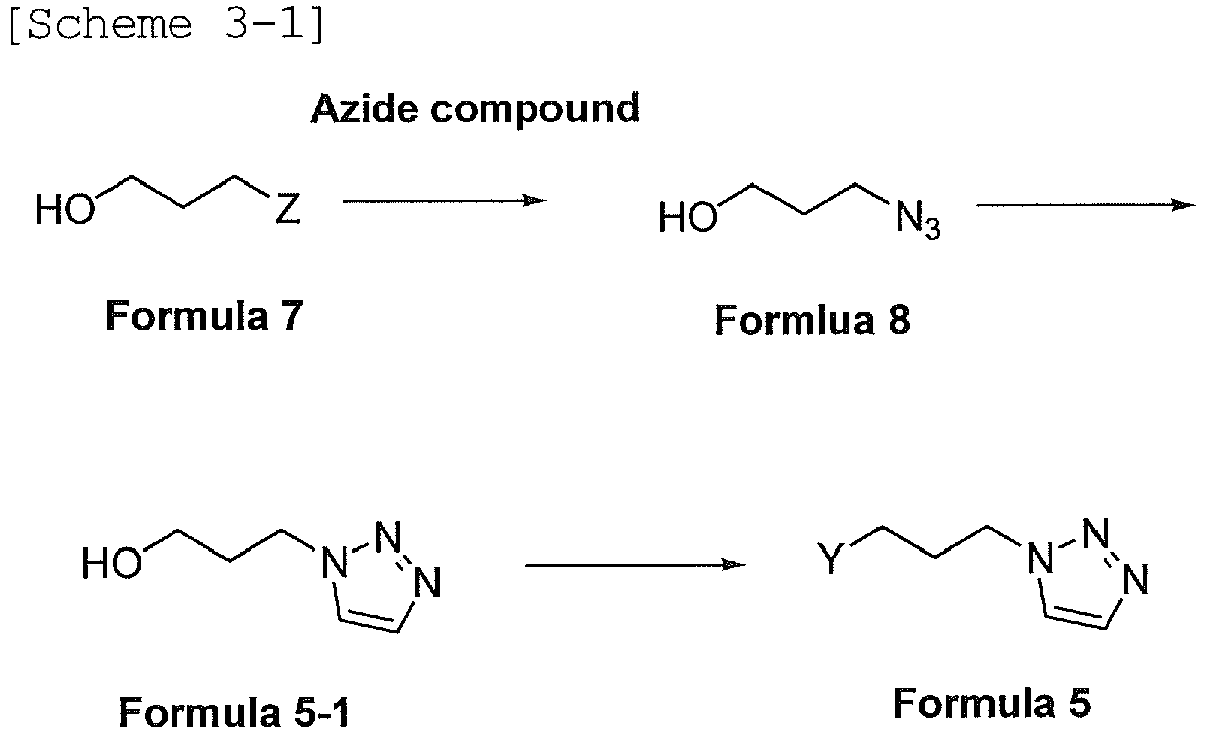
- In Scheme 3-1, the Y may be 4-toluenesulfonate (tosylate, CH3C6H4SO2O, OTs) or methanesulfonate (mesylate, CH3SO2O, OMS) .
- According to the methods of the present disclosure, the compound represented by Formula 3 or the pharmaceutically acceptable salt thereof may reduce preparation costs because the processing steps may be markedly decreased compared to the conventional methods even though using a low-priced reagent. Additionally, the purification processes may be minimized because production of related compounds and remaining related compounds may be minimized. Furthermore, the compound represented by Formula 3 or the pharmaceutically acceptable salt thereof may be prepared in high purity and yield despite the simplified process.
- The present disclosure provides a compound represented by Formula 6 below, a compound represented by Formula 2 below or a pharmaceutically acceptable salt thereof.


- In the above Formulas,
types of the X is a functional group that protects the amine group and is selected from butoxycarbonyl (Boc) or benzyloxycarbonyl (Cbz), benzyl, 9-fluorenylmethylcarbonyl (Fmoc). - The compound represented by Formula 6, the compound represented by Formula 2 or the pharmaceutically acceptable salt thereof may be used as an intermediate for preparing a compound represented by Formula 3 or the pharmaceutically acceptable salt thereof.


- The compound represented by Formula 3 or the pharmaceutically acceptable salt thereof may be prepared in high purity and yield when preparing by using the compound represented by Formula 6, the compound represented by Formula 2 or the pharmaceutically acceptable salts thereof as the intermediate.
- Also, the purification process may be minimized by reducing production of related compounds, and it is economical and proper for a large-scale production because the number of reaction processes is decreased even though using a low-priced reagent.
- The compound represented by Formula 2 or the pharmaceutically acceptable salt thereof may be prepared when deprotecting the amine protecting group X from the compound represented by Formula 6. The deprotection is explained in detail hereinbefore.
- In the present disclosure, types of the pharmaceutically acceptable salts of the present disclosure are not limited in its particular types, and it may be acid addition salts prepared by adding a free acid. The acid addition salts for preparing the salts may be formed by the free acid, and the free acid may be an inorganic or an organic acid. The inorganic acid may be hydrochloric acid, bromic acid, sulfuric acid or phosphoric acid; and the organic acid may be oxalic acid, adipic acid, citric acid, di-p-toluoyl-L-tartaric acid, di-p-toluoyl-D-tartaric acid, citric acid, lactic acid, maleic acid, fumaric acid, gluconic acid, methanesulfonic acid, acetic acid, glycolic acid, succinic acid, L- or D- tartaric acid, tartaric acid, 4-toluenesulfonic acid, trifluoroacetic acid, galacturonic acid, embonic acid, glutamic acid or aspartic acid. Preferably, the acid may be hydrochloric acid, oxalic acid, adipic acid, citric acid, maleic acid, fumaric acid, succinic acid, L- or D- tartaric acid or tartaric acid.
- The compound represented by Formula 6, the compound represented by Formula 2, or the pharmaceutically acceptable salts thereof are as follows:
- tert-butyl[[1-{3-(1H-1,2,3-triazol-1-yl)propyl}piperidin-4-yl]methyl]carbamate;
- benzyl[[1-{3-(1H-1,2,3-triazol-1-yl)propyl}piperidin-4-yl]methyl]carbamate;
- 1-[{3-(1H-1,2,3-triazol-1-yl)propyl}piperidin-4-yl]methanamine hydrochloride;
- 1-[{3-(1H-1,2,3-triazol-1-yl)propyl}piperidin-4-yl]methanamine;
- 1-[13-(1H-1,2,3-triazol-1-yl)propyl}piperidin-4-yl]methanamine oxalate;
- 1-[{3-(1H-1,2,3-triazol-1-yl)propyl}piperidin-4-yl]methanamine succinate;
- 1-[{3-(1H-1,2,3-triazol-1-yl)propyl}piperidin-4-yl]methanamine adipate;
- 1-[{3-(1H-1,2,3-triazol-1-yl)propyl}piperidin-4-yl]methanamine citrate;
- 1-[{3-(1H-1,2,3-triazol-1-yl)propyl}piperidin-4-yl]methanamine L-tartarate;
- 1-[{3-(1H-1,2,3-triazol-1-yl)propyl}piperidin-4-yl]methanamine D-tartarate;
- 1-[{3-(1H-1,2,3-triazol-1-yl)propyl}piperidin-4-yl]methanamine fumarate; and
- 1-[{3-(1H-1,2,3-triazol-1-yl)propyl}piperidin-4-yl]methanamine maleate.
- The method of prearping the compound represented by Formula 6, the compound represented by Formula 2 or the pharmaceutically acceptable salts thereof are same as explained hereinbefore.
- The preparation methods of the present disclosure may be useful for mass production because a compound that could be purchased in large quantities are used and the number of reaction processes is decreased, thereby saving preparation costs and improving the yield and purity.
- The present disclosure will be described more fully hereinafter with reference to the accompanying examples. However, the present disclosure may be embodied in many different forms, and should not be construed as being limited to the embodiments set forth herein. Additionally, 1HNMR data were measured by using a NMR 400 Spectrometer (Varian Instrument).
- Dimethyl sulfoxide (126L) was added to a reaction part, and then 3-bromo-1-chloropropanol (14kg) was added thereto at room temperature. A reaction solution was prepared by adding sodiumazide (5.8kg) thereto, washing the reaction part with dimethyl sulfoxide (14L) and prefoming the stirring for 3 hours. Water (560L) was added to the reaction solution and then was extracted with dichloromethane (420L). An organic layer was dehydrated with anhydrous sodium sulfate (25kg) and concentrated under reduced pressure to quantitatively obtain the titled compound as pale yellow oil (11.04 kg).
- 1H NMR (CDCl3, 400MHz) δ3.62(t,2H), 3.49(t,2H), 2.05(m,2H)

- Acetonitrile (96L) and potable water (53.L) were added to a reactor. 1-azido-3-chloropropane (10.6kg) was added thereto at a room temperature. The reaction solution was prepared by adding copper iodide (8.52kg) and sodium ascorbate (8.8kg) thereto and then performing the stirring for 2 hours. The reaction solution was cooled to 0-10°C. Potassium carbide (9.7kg) was slowly added to the reaction solution while not exceeding 20°C of an internal temperature and then resulting solution was filtered using diatomite and concentrated under reduced pressure. A mixed solution was prepared by adding water (266L) and charcoal (4.3kg) to the concentrated residue and performing the stirring for 4 hours. The mixed solution was filtered using diatomite and extracted with dichloromethane. An organic layer was washed with 5% NaCl aqueous solution, and dehydrated and filtered by using anhydrous sodium sulfate. The filtrate was concentrated under reduced pressure to obtain the titled compound as pale yellow oil (8.86kg; yield: 69%).
- 1H NMR (CDCl3, 400MHz)δ 7.63 (s, 1H), 7.58 (s, 1H), 4.55 (t, 2H), 3.47 (t, 2H), 2.38 (quintet, 2H)

- Dimethyl sulfoxide (1.3L) was added to the reaction part, and then 3-bromo-1-propanol (0.14kg) was added thereto at a room temperature. A reaction solution was prepared by adding sodiumazide (58g) thereto, washing the reaction part with dimethyl sulfoxide (0.2L) and performing the stirring for 3 hours. Water (5.6L) was added to the reaction solution and the resulting solution was extracted with dichloromethane (4.2L). An organic layer was dehydrated with anhydrous sodium sulfate (0.5kg) and concentrated under reduced pressure to quantitatively obtain the titled compound as oil (0.11kg).
- 1H NMR (CDCl3, 400MHz) δ 3.72 (m, 2H), 3.42 (m, 2H), 1.81 (m, 2H)

- Acetonitrile (303mL) and potable water (190mL) were added to a reaction part. 1-azido-3-chloropropane (38g) was added thereto at a room temperature. A reaction solution was prepared by adding copper iodide (35.7g) and sodium ascorbate (37.1g) thereto and performing the stirring for 2 hours. The reaction solution was cooled to 0-10°C. Potassium carbide (48g) was slowly added to the reaction solution while not exceeding 20°C of an internal temperature. The resulting solution was filtered through diatomite and concentrated under reduced pressure. A mixed solution was prepared by adding water (950mL) and charcoal (15g) to the concentrated residue and performing the stirring for 4 hours. The mixed solution was filtered through diatomite and extracted with dichloromethane. An organic layer was washed with 5% NaCl aqueous solution, and dehydrated by using anhydrous sodium sulfate and filtered. The filtrate was concentrated under reduced pressure to obtain the titled compound as pale yellow oil (10g; yield: 21%) .
- 1H NMR (DMSO d6, 400MHz) δ 8.08 (s, 1H), 7.67 (s, 1H), 4.39 (t, 2H), 3.34 (t, 2H), 1.91 (quintet, 2H)

- Dichloromethane (51mL) was added to a reaction part, and then 3-(1H-1,2,3-triazol-1-yl)propan-1-ol (5.1g) was added thereto. The reaction solution was cooled to 0-10°C, triethylamine (11.3mL) was added to the reaction solution and methanesulfonyl chloride (4.7mL) was slowly added thereto. The temperature of the resulting solution was elevated to the room temperature and then the solution was stirred for 2 hours. Potable water (102mL) was added and then was extracted with dichloromethane (255mL) and concentrated under reduced pressure. Potable water (75mL) and charcoal (2.0g) were added to the concentrated residue and stirred for 2 hours. The mixed solution was filtered through diatomite and extracted with dichloromethane (102mL). An organic layer was washed with 5% NaCl aqueous solution, and dehydrated by using anhydrous sodium sulfate and filtered. The filtrate was concentrated under reduced pressure to obtain the titled compound as pale yellow oil (4.06g; yield: 50%).
- 1H NMR (CDCl3, 600MHz) δ 7.68 (s, 1H), 7.61 (s, 1H), 4.52 (t, 2H), 3.0 (s, 3H), 2.36 (quintet, 2H)

- Dichloromethane (49mL) was added to a reaction part, and then 3-(1H-1,2,3-triazol-1-yl)propan-1-ol (4.9g) was added thereto. The reaction solution was cooled to 0-10°C, triethylamine (10.8mL) was added to the reaction solution and 4-methyl benzenesulfonate (11.0g) was slowly added thereto. The temperature of the resulting solution was elevated to a room temperature and the solution was stirred for 2 hours. Potable water (98mL) was added to the resulting solution, and then was extracted with dichloromethane (146mL) and concentrated under reduced pressure. Potable water (75mL) and charcoal (2.0g) were added to the concentrated residue and stirred for 2 hours to prepare a mixed solution. The mixed solution was filtered through diatomite and extracted with dichloromethane (200mL). An organic layer was washed with 5% NaCl aqueous solution, and dehydrated by using anhydrous sodium sulfate and filtered. The filtrate was concentrated under reduced pressure to obtain the titled compound as oil (0.97g; yield: 9%).
- 1H NMR (CDCl3, 600MHz) δ 7.77 (d, 2H), 7.65 (s, 1H), 7.49 (s, 1H), 7.33 (d, 2H), 4.44 (t, 2H), 3.97 (t, 2H), 2.43 (s, 3H), 2.29 (quintet, 2H)

- Acetonitrile (1L) was added to a 2L flask, and then tert-butyl(piperidin-4-ylmethyl)carbamate (35.2g) was added thereto. A reaction solution was prepared by sequentially adding potassium iodide (19.1g), calcium carbonate (227.1g) and 1-(3-chloropropyl)-1H-1,2,3-triazole (35.9g) thereto and performing the stirring under reflux for 7 hours. The reaction solution was cooled to a room temperature, and water (1.4L) and 5% sodium thiosulfate solution were sequentially added to the reaction solution.
- The resulting solution was extracted with dichloromethane (1.5L), and then an organic layer was dehydrated by using magnesium sulfate and filtered. The organic layer was concentrated under reduced pressure to obtain the titled compound (88.0g; yield: quantitative).
- 1H NMR (400MHz, CDCl3)δ 7.68 (s, 1H), 7.55 (s, 1H), 4.59 (br s, 1H), 4.45 (t, 2H), 3.01 (t, 2H), 2.85 (d, 2H), 2.82 (t, 2H),2.07 (m, 2H), 1.89 (m, 2H), 1.67 (d, 2H), 1.43 (s, 9H & m, 1H), 1.23 (m, 2H)

- A reaction solution was prepared by dissolving tert-butyl[[1-{3-(1H-1,2,3-triazol-1-yl)propyl}piperidin-4-yl]methyl]carbamate (16.5g) in methanol (83mL) and performing the stirring at a room temperature for 7 hours. 2N hydrochloric acid diethyl ether (124mL) was added to the reaction solution and stirred for 30 minutes. The resulting solution was filtered and dried under reduced pressure to obtain the titled compound (14.9g; yield: quantitative).
- 1H NMR (400MHz, DMSO-d6)δ 8.20 (s, 1H), 8.17 (br s, 4H), 7.76 (s, 1H), 4.49 (t, 2H), 3.46 (d, 2H), 2.99 (m, 2H), 2.86 (m, 2H), 2.68 (m, 2H), 2.33 (m, 2H), 1.84-1.92 (m, 3H), 1.58 (m, 2H)
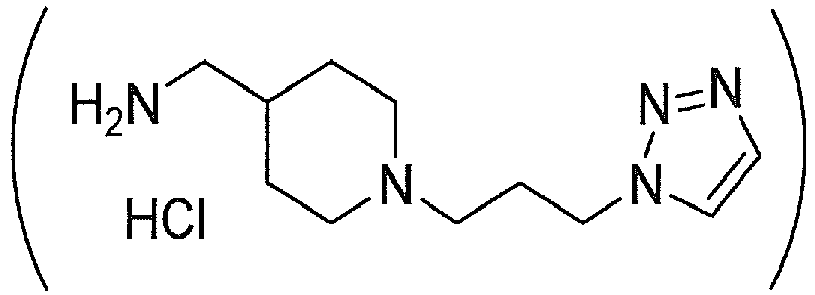
- A reaction solution was prepared by dissolving 1-[{3-(1H-1,2,3-triazol-1-yl)propyl}piperidin-4-yl]methanamine hydrochloride (5.0g) in water (50mL) and pH of the reaction solution was adjusted to about 10 using 2N sodium hydroxide. The reaction solution was extracted with dichloromethane/2-propanol=4/1(volumetric ratio, 250mL), and then dehydrated by using anhydrous magnesium sulfate and filtered. An organic layer was concentrated under reduced pressure to obtain the titled compound (3.1g; yield: 81%).
- 1H NMR (400MHz, CDCl3) δ 7.67 (s, 1H), 7.55 (s, 1H), 4.44 (t, 2H), 2.86 (d, 2H), 2.58 (m, 2H), 2.28 (t, 2H), 2.07 (m, 2H), 1.89 (t, 2H), 1.71 (d, 2H), 1.17-1.30 (m, 3H)

- A reaction solution was prepared by dissolving benzyl(piperidin-4-ylmethyl)carbamate (300g) in acetonitrile (9L); sequentially adding potassium iodide (201g), calcium carbonate (1680g) and 1-(3-chloropropyl)-1H-1,2,3-triazole (264g) thereto; and performing the stirring under reflux for 16 hours. The reaction solution was cooled to a room temperature, and water (12L) and 5% sodium thiosulfate solution (9L) were sequentially added to the reaction solution. The resulting solution was extracted with dichloromethane (15L). 2N hydrochloric acid (1.2L) and water (12L) were added to an organic layer, and then the layer was separated. 2N sodium hydroxide (1.8L) was added to an aqueous layer and the resulting solution was extracted with dichloromethane (12L). An organic layer was treated with charcoal, and then filtered and concentrated under reduced pressure. A reaction solution was prepared by adding hexane (6L) to the concentrated residue. The reaction solution was stirred for 16 hours. The resulting solids were filtered and dried to obtain the titled compound (285g; yield: 66%).
- 1H NMR (400MHz, CDCl3)δ 7.66 (s, 1H), 7.52 (s, 1H), 7.34-7.28 (m, 5H), 5.07 (s, 2H), 4.44 (t, 2H), 3.08 (t, 2H), 2.83 (d, 2H), 2.28 (d, 2H), 2.08-2.01 (m, 2H), 1.90 (t, 2H), 1.67 (d, 2H), 1.46 (m, 1H), 1.26-1.17 (m, 2H)

- Benzyl[[1-{3-(1H-1,2,3-triazol-1-yl)propyl}piperidin-4-yl]methyl]carbamate (270g) was added to a hydrogen reactor and was dissolved by adding methanol (1.35L). A reaction solution was prepared by adding 10 wt% of palladium/carbon (containing 56 wt% of water) (61g) to the reactor, applying a pressure with hydrogen (10 bar) thereto, and performing the stirring at 50°C for 18 hours. The reaction solution was cooled to a room temperature and filtered through diatomite. The filtrate was concentrated under reduced pressure to obtain the titled compound (168.7g; yield: quantitative).
- 1H NMR (400 MHz, CDCl3) δ 7.67 (s,1H), 7.55 (s,1H), 4.44(t,2H), 2.86(d,2H), 2.58(m,2H), 2.28(t,2H), 2.07(m,2H), 1.89(t,2H), 1.71(d,2H), 1.17-1.30(m,3H)

- A solution prepared by adding oxalic acid dihydrate (0.57g) to acetone (10mL) was slowly added into a solution, which was prepared by dissolving 1-[{3-(1H-1,2,3-triazol-1-yl)propyl}piperidin-4-yl]methanamine (1.0g) in acetone (10mL) to prepare a reaction solution. The reaction solution was stirred for 4 hours, and then the resulting solids were filtered and dried to obtain the titled compound (1.30g; yield: 93%).
- 1H NMR (400MHz, DMSO-d6)δ 8.11 (s, 1H), 7.71 (s, 1H), 4.39 (t, 2H), 2.90 (d, 2H), 2.68 (d, 2H), 2.49 (s, 4H), 2.21 (t, 2H), 1.98 (m, 2H),1.82 (t, 2H), 1.66 (d, 2H), 1.46 (m, 1H), 1.18-1.09 (m, 2H)
- A solution prepared by adding succinic acid (0.53g) into ethanol (20mL) was slowly added into a solution, which was prepared by dissolving 1-[{3-(1H-1,2,3-triazol-1-yl)propyl}piperidin-4-yl]methanamine (1.0g) in ethanol (10mL) to prepare a reaction solution. The reaction solution was stirred for 4 hours and cooled to around 0°C, and then diethylether (60mL) was added thereto. The resulting solution was further stirred for 16 hours. The resulting solids were filtered and dried to obtain the titled compound (1.44g; yield: 94%).
- 1H NMR (400MHz, DMSO-d6)δ 8.11 (s, 1H), 7.71 (s, 1H), 4.39 (t, 2H), 2.90 (d, 2H), 2.68 (d, 2H), 2.49 (s, 4H), 2.21 (t, 2H), 1.98 (m, 2H),1.82 (t, 2H), 1.66 (d, 2H), 1.46 (m, 1H), 1.18-1.09 (m, 2H)
- A solution prepared by adding adipic acid (0.65g) to ethanol (20mL) was slowly added into a solution which was prepared by dissolving 1-[{3-(1H-1,2,3-triazol-1-yl)propyl}piperidin-4-yl]methanamine (1.0g) in ethanol (lOmL) to prepare a reaction solution. The reaction solution was stirred for 4 hours and cooled to around 0°C, and then diethylether (60mL) was added thereto. The resulting solution was further stirred for 16 hours. The resulting solids were filtered and dried to obtain the titled compound (1.39g; yield: 84%).
- 1H NMR (400MHz, DMSO-d6)δ 8.10 (s, 1H), 7.69 (s, 1H), 4.38 (t, 2H), 2.80 (d, 2H), 2.52-2.49 (m, 2H), 2.20-2.12 (m, 6H), 1.97 (m, 2H), 1.80 (t, 2H), 1.66 (d, 2H), 1.46 (m, 4H), 1.33 (m, 1H), 1.13-1.05 (m, 2H)
- A solution prepared by adding citric acid (0.94g) to acetone (10mL) was slowly added into a solution which was prepared by dissolving 1-[{3-(1H-1,2,3-triazol-1-yl)propyl}piperidin-4-yl]methanamine (1.0g) in acetone (lOmL) to prepare a reaction solution. The reaction solution was stirred for 4 hours, and then the resulting solids were filtered and dried to obtain the titled compound (1.59g; yield: 86%).
- 1H NMR (400MHz, DMSO-d6)δ 8.10 (s, 1H), 7.71 (s, 1H), 4.39 (t, 2H), 2.89 (d, 2H), 2.69 (d, 2H), 2.56-2.45 (m, 4H), 2.29-2.27 (m, 2H), 2.01-1.88 (m, 6H), 1.68 (d, 2H), 1.52-1.51 (m, 1H), 1.22-1.14 (m, 2H)
- A solution prepared adding L-tartaric acid (0.67g) to ethanol (lOmL) was slowly added to a solution which was prepared by dissolving 1-[{3-(1H-1,2,3-trizol-1-yl)propyl}piperidin-4-yl]methanamine (1.0g) in ethanol (10mL), and then diethylether (40mL) was added to prepare a reaction solution. The reaction solution was stirred for 4 hours, and then the resulting solids were filtered and dried to obtain the titled compound (1.64g; yield: 98%).
- 1H NMR (400MHz, DMSO-d6)δ 8.10 (s, 1H), 7.70 (s, 1H), 4.39 (t, 2H), 3.89 (s, 2H), 2.87 (d, 2H), 2.68 (d, 2H), 2.28 (t, 2H), 2.00-1.85 (m, 4H), 1.68 (d, 2H), 1.53 (m, 1H), 1.21-1.13 (m, 2H)
- A solution prepared by adding D-tartaric acid (0.67g) to ethanol (10mL) was slowly added to a solution which was prepared by dissolving 1-[{3-(1H-1,2,3-trizol-1-yl)propyl}piperidin-4-yl]methanamine (1.0g) in ethanol (10mL), and then diethylether (40mL) was added to prepare a reaction solution. The reaction solution was stirred for 4 hours, and then the resulting solids were filtered and dried to obtain the titled compound (1.65g; yield: 99%).
- 1H NMR (400MHz, DMSO-d6)δ 8.10 (s, 1H), 7.70 (s, 1H), 4.39 (t, 2H), 3.83 (s, 2H), 2.84 (d, 2H), 2.68 (d, 2H), 2.24 (t, 2H), 1.99-1.92 (m, 2H), 1.85 (t, 2H), 1.67 (d, 2H), 1.49 (m, 1H), 1.20-1.12 (m, 2H)
- A solution prepared by adding fumaric acid (0.52g) to ethanol (10mL) was slowly added to a solution which was prepared by dissolving 1-[{3-(1H-1,2,3-trizol-1-yl)propyl}piperidin-4-yl]methanamine (1.0g) in ethanol (10mL), and then diethylether (40mL) was added to prepare a reaction solution. The reaction solution was stirred for 4 hours, and then the resulting solids were filtered and dried to obtain the titled compound (1.49g; yield: 98%).
- 1H NMR (400MHz, DMSO-d6)δ 8.10 (s, 1H), 7.70 (s, 1H), 6.44 (s, 2H), 4.38 (t, 2H), 2.83 (d, 2H), 2.66 (d, 2H), 2.24 (t, 2H), 1.99-1.92 (m, 2H), 1.85 (t, 2H), 1.68 (d, 2H), 1.50 (m, 1H), 1.19-1.11 (m, 2H)
- A solution prepared by adding maleic acid (0.52g) to ethanol (lOmL) was slowly added to a solution which was prepared by dissolving 1-[{3-(1H-1,2,3-trizol-1-yl)propyl}piperidin-4-yl]methanamine (1.0g) in ethanol (10mL), and then diethylether (40mL) was added to prepare a reaction solution. The reaction solution was stirred for 4 hours, and then the resulting solids were filtered and dried to obtain the titled compound (0.96g; yield: 63%).
- 1H NMR (400MHz, DMSO-d6) δ 8.15(s,1H), 7.76(s,1H), 6.02(s,2H), 4.48(t,2H), 2.96(bs,2H), 2.74(bs,2H), 2.24(m,2H), 1.88-1.84(m,2H), 1.85(t,2H), 1.68(d,2H), 1.50(m,1H), 1.19-1.11(m,2H)
- 4-amino-5-chloro-2-methoxybenzoic acid (1.0g) was dissolved in dichloromethane (50mL) and cooled to 0°C . N-(3-dimethylaminopropyl)-N'-ethylcarbodiimide hydrochloride (1.14g) and 1-hydroxybenzotriazole hydrate (0.80g) were sequentially added to the solution and stirred for 3.5 hours. A reaction solution was prepared by sequentially adding diisopropylethylamine (3.21g) and [1-{3-(1H-1,2,3-triazol-1-yl)propyl}piperidin-4-yl]methanamine (1.33g) thereto and performing the stirring for 5 minutes. The temperature of the reaction solution was elevated to a room temperature. The reaction solution was further stirred for 14 hours. Water (40mL) was added to the reaction solution and stirred for 5 minutes, and then an organic layer was separated. Dichloromethane (20mL) was added to a aqueous layer and the organic layer was extracted again. The aqueous layer was extracted by collecting the organic layers and adding water (30mL) and 1N hydrochloric acid (15mL) thereto. 2N sodium hydroxide (7.5mL) was added to the aqueous layer and stirred for 14 hours. The resulting solids were filtered and washed with water, and then was concentrated under reduced pressure at 19-22°C for 6 hours to obtain the titled compound (1.68g; yield: 84%).
- 1H NMR (400MHz, CDCl3) δ 8.08 (s, 1H), 7.72 (m, 1H), 7.66 (s, 1H), 7.54 (s, 1H), 6.27 (s, 1H), 4.43 (t, 2H), 4.36 (s, 1H), 3.88 (s, 3H), 3.30 (t, 2H), 2.83 (d, 2H), 2.27 (t, 2H), 2.06 (t, 2H), 1.90 (t, 2H), 1.70 (m, 2H), 1.58 (m, 1H), 1.29 (m, 2H)

- 4-Amino-5-chloro-2-methoxybenzoic acid (1.0g) was dissolved in tetrahydrofuran (50mL) and cooled to 0-5°C. Diisopropylethylamine (0.76g) and ethyl chloroformic acid (0.64g) were sequentially added to the solution and stirred for 1 hour. A reaction solution was prepared by sequentially adding diisopropylethylamine (2.56g) and [1-{3-(1H-1,2,3-triazol-1-yl)propyl}piperidin-4-yl]methanamine (1.33g) and performing the stirring for 3.5 hours. The temperature of the reaction solution was elevated and the solution was stirred under reflux. The reaction solution was further stirred for 4 hours. Water (40mL) was added thereto and stirred for 5 minutes and an organic layer was separated. Dichloromethane (20mL) was added to a aqueous layer and the organic layer was extracted again. The aqueous layer was extracted by collecting the organic layers and adding water (30mL) and 1N hydrochloric acid (15mL). 2N sodium hydroxide (7.5mL) was added to the aqueous layer and stirred for 11 hours. The resulting solids were filtered, washed with water and then dried under reduced pressure at 19-22°C for 24 hours to obtain the titled compound (1.28g; yield: 63%).
- 1H NMR (400MHz, CDCl3)δ 8.08 (s, 1H), 7.72 (m, 1H), 7.66 (s, 1H), 7.54 (s, 1H), 6.27 (s, 1H), 4.43 (t, 2H), 4.36 (s, 1H), 3.88 (s, 3H), 3.30 (t, 2H), 2.83 (d, 2H), 2.27 (t, 2H), 2.06 (t, 2H), 1.90 (t, 2H), 1.70 (m, 2H), 1.58 (m, 1H), 1.29 (m, 2H)
- 4-Amino-5-chloro-2-methoxybenzoic acid (1.0g) was dissolved in dichloromethane (50mL) at 20°C. Carbonyldiimidazole (0.96g) was added to the solution and stirred for 2.5 hours at the same temperature. A reaction solution was prepared by sequentially adding isopropylamine (2.56g) and [1-{3-(1H-1,2,3-triazol-1-yl)propyl}piperidin-4-yl]methanamine (1.33g) and performing the stirring for 3.5 hours, and then the temperature of the reaction solution was elevated to 40°C. The reaction solution was further stirred for 7 hours and cooled to 20°C. Water (40mL) was added thereto. The stirring was performed for 5 minutes and an organic layer was separated. Dichloromethane (20mL) was added to an aqueous layer and the organic layer was extracted again. The aqueous layer was extracted by collecting the organic layers and adding water (30mL) and 1N hydrochloric acid (15mL) thereto. 2N sodium hydroxide (7.5mL) was added to the aqueous layer and stirred for 15 hours. The resulting solids were filtered, washed with water and diredunder reduced pressure at 19-22°C for 24 hours to obtain the titled compound (1.90g; yield: 95%).
- 1H NMR (400MHz, CDCl3)δ 8.08 (s, 1H), 7.72 (m, 1H), 7.66 (s, 1H), 7.54 (s, 1H), 6.27 (s, 1H), 4.43 (t, 2H), 4.36 (s, 1H), 3.88 (s, 3H), 3.30 (t, 2H), 2.83 (d, 2H), 2.27 (t, 2H), 2.06 (t, 2H), 1.90 (t, 2H), 1.70 (m, 2H), 1.58 (m, 1H), 1.29 (m, 2H)
- 4-Amino-5-chloro-2-methoxybenzoic acid (0.20g) was dissolved in dichloromethane (lOmL) and cooled to 0°C. N-methyl morpholine (0.12g) and isobutyl chloroformate (0.16g) were sequentially added to the solution and stirred for 3 hours. A reaction solution was prepared by sequentially adding triethylamine (0.20g) and [1-{3-(1H-1,2,3-triazol-1-yl)propyl}piperidin-4-yl]methanamine (0.27g) thereto, and the temperature of the reaction solution was elevated to 20°C. The stirring was performed for 14 hours, water (10mL) was added thereto and stirred for 5 minutes, and layers were separated. Dichloromethane (10mL) was added to an aqueous layer and an organic layer was extracted. The aqueous layer was extracted by adding water (10mL) and 1N hydrochloric acid (3mL) to the collected organic layers. 1N sodium hydroxide (4mL) was added to the aqueous layer and the extractsion was performed twice using a mixed solvent of dichloromethane (8ml) and 2-propanol (2ml). The collected organic layers were dried with sodium sulfate and filtered, and then washed with dichloromethane (10mL). The solvent was removed by concentrating the filtered organic solution under the reduced pressure. The resulting solids were dried under reduced pressure at 19-22°C for 18 hours to obtain the titled compound (0.41g; yield: quantitative).
- 1H NMR (400MHz, CDCl3)δ 8.08 (s, 1H), 7.72 (m, 1H), 7.66 (s, 1H), 7.54 (s, 1H), 6.27 (s, 1H), 4.43 (t, 2H), 4.36 (s, 1H), 3.88 (s, 3H), 3.30 (t, 2H), 2.83 (d, 2H), 2.27 (t, 2H), 2.06 (t, 2H), 1.90 (t, 2H), 1.70 (m, 2H), 1.58 (m, 1H), 1.29 (m, 2H)
- 4-Amino-5-chloro-2-methoxybenzoic acid (0.20g) was dissolved in dichloromethane (lOmL) and cooled to 0°C. N-methyl morpholine (0.12g) and isobutyl chloroformate (0.16g) were sequentially added to the solution and stirred for 3 hours. A reaction solution was prepared by sequentially adding triethylamine (0.20g) and [1-{3-(1H-1,2,3-triazol-1-yl)propyl}piperidin-4-yl]methanamine hydrochloride (0.31g) thereto. The temperature of the reaction solution was elevated and the solution was stirred under reflux. After 4 hours of stirring, water (10mL) was added thereto, stirred for 5 minutes and a layer was separated. Dichloromethane (10mL) was added to an aqueous layer and an organic layer was extracted. Water (lOmL) and 1N hydrochloric acid (3mL) were added to the collected organic layers to extract the aqueous layer. 1N sodium hydroxide (4mL) was added to the aqueous layer, and the extraction was performed twice with a mixed solvent of dichloromethane (8mL) and 2-propanol (2mL). The collected organic layers were dried with sodium sulfate and filtered, and then washed with dichloromethane (10mL). The solvent was removed by concentrating the filtered organic solution under reduced pressure. The resulting solids were dried under reduced pressure at 19-22°C for 18 hours to obtain the titled compound (0.39g; yield: 98%).
- 1H NMR (400MHz, CDCl3) δ 8.08(s,1H), 7.72 (m,1H), 7.66(s,1H), 7.54(s,1H), 6.27(s,1H), 4.43(t,2H), 4.36(s,1H), 3.88(s,3H), 3.30(t,2H), 2.83(d,2H), 2.27(t,2H), 2.06(t,2H), 1.90(t,2H), 1.70(m,2H), 1.58(m,1H), 1.29(m,2H)
- 4-Amino-5-chloro-2-methoxybenzoic acid (0.2g) was dissolved in dichloromethane (10mL) and cooled to 0°C. N-methyl morpholine (0.12g) and isobutyl chloroformate (0.16g) were sequentially added to the solution and stirred for 3 hours. A reaction solution was prepared by sequentially adding triethylamine (0.2g) and [1-{3-(1H-1,2,3-triazol-1-yl)propyl}piperidin-4-yl]methanamine oxalate (0.37g) thereto, and the temperature of the reaction solution was elevated. The reaction solution was stirred under reflux. After 4 hours of stirring, water (10m) was added thereto, stirred for 5 minutes, and layers were separated. Dichloromethane (lOmL) was added to an aqueous layer and an organic layer was extracted. Water (lOmL) and 1N hydrochloric acid (3mL) were added to the collected organic layers to extract the aqueous layer. 1N sodium hydroxide (4mL) was added to the aqueous layer and the extraction was performed twice with a mixed solvent of dichloromethane (8mL) and 2-propanol (2mL). The collected organic layers were dried with sodium sulfate and filtered, and then washed with dichloromethane (10mL). The solvent was removed by concentrating the filtered organic solution under reduced pressure. The resulting solids were dried under reduced pressure at 19-22 °C for 18 hours to obtain the titled compound (0.36g; yield: 90%).
- 1H NMR (400MHz, CDCl3)δ 8.08 (s, 1H), 7.72 (m, 1H), 7.66 (s, 1H), 7.54 (s, 1H), 6.27 (s, 1H), 4.43 (t, 2H), 4.36 (s, 1H), 3.88 (s, 3H), 3.30 (t, 2H), 2.83 (d, 2H), 2.27 (t, 2H), 2.06 (t, 2H), 1.90 (t, 2H), 1.70 (m, 2H), 1.58 (m, 1H), 1.29 (m, 2H)
- 4-Amino-5-chloro-2-methoxybenzoic acid (0.20g) was dissolved in dichloromethane (10mL) and cooled to 0°C. N-methyl morpholine (0.12g) and isobutyl chloroformate (0.16g) were sequentially added to the solution and stirred for 3 hours. A reaction solution was prepared by sequentially adding triethylamine (0.20g) and [1-{3-(1H-1,2,3-triazol-1-yl)propyl}piperidin-4-yl]methanamine citrate (0.49g) thereto. The temperature of the reaction solution was elevated and the reaction solution was stirred under reflux. After 14 hours of stirring, water (10mL) was added thereto, stirred for 5 minutes and layers were separated. Dichloromethane (10mL) was added to an aqueous layer and an organic layer was extracted. Water (10mL) and 1N hydrochloric acid (3mL) were added to the collected organic layers to extract the aqueous layer. 1N sodium hydroxide (4mL) was added to the aqueous layer and the extraction was performed twice with a mixed solvent of dichloromethane (8mL) and 2-propanol (2mL). The collected organic layers were dried with sodium sulfate and filtered, and then washed with dichloromethane (10mL). The solvent was removed by concentrating the filtered organic solution under reduced pressure. The resulting solids were dried under reduced pressure at 19-22°C for 18 hours to obtain the titled compound (0.35g; yield: 88%).
- 1H NMR (400MHz, CDCl3) δ 8.08(s,1H), 7. 72(m,1H), 7.66(s,1H), 7.54(s,1H), 6.27(s,1H), 4.43(t,2H), 4.36(s,1H), 3.88(s,3H), 3.30(t,2H), 2.83(d,2H), 2.27(t,2H), 2.06(t,2H), 1.90(t,2H), 1.70(m,2H), 1.58(m,1H), 1.29(m,2H)
- 4-Amino-5-chloro-2-methoxybenzoic acid (0.20g) was dissolved in dichloromethane (10mL) and cooled to 0°C. N-methyl morpholine (0.12g) and isobutyl chloroformate (0.16g) were sequentially added to the solution and stirred for 3 hours. A reaction solution was prepared by sequentially adding triethylamine (0.20g) and [1-{3-(1H-1,2,3-triazol-1-yl)propyl}piperidin-4-yl]methanamine succinate (0.41g) thereto. The temperature of the reaction solution was elevated and the stirring was performed under reflux. After 14 hours of stirring, water (lOmL) was added thereto, stirred for 5 minutes and layers were separated. Dichloromethane (lOmL) was added to an aqueous layer and an organic layer was extracted. Water (lOmL) and 1N hydrochloric acid (3mL) were added to the collected organic layers to extract the aqueous layer. 1N sodium hydroxide (4mL) was added to the aqueous layer and the extraction was performed twice with a mixed solvent of dichloromethane (8mL) and 2-propanol (2mL). The collected organic layers were dried with sodium sulfate and filtered, and then washed with dichloromethane (10mL). The solvent was removed by concentrating the filtered organic solution under reduced pressure. The resulting solids were dried under reduced pressure at 19-22°C for 18 hours to obtain the titled compound (0.36g; yield: 90%).
- 1H NMR (400MHz, CDCl3)δ 8.08 (s, 1H), 7.72 (m, 1H), 7.66 (s, 1H), 7.54 (s, 1H), 6.27 (s, 1H), 4.43 (t, 2H), 4.36 (s, 1H), 3.88 (s, 3H), 3.30 (t, 2H), 2.83 (d, 2H), 2.27 (t, 2H), 2.06 (t, 2H), 1.90 (t, 2H), 1.70 (m, 2H), 1.58 (m, 1H), 1.29 (m, 2H)
- 4-Amino-5-chloro-2-methoxybenzoic acid (0.20g) was dissolved in dichloromethane (lOmL) and cooled to 0°C. N-methyl morpholine (0.12g) and isobutyl chloroformate (0.16g) were sequentially added to the solution and stirred for 3 hours. A reaction solution was prepared by sequentially adding triethylamine (0.20g) and [1-{3-(1H-1,2,3-triazol-1-yl)propyl}piperidin-4-yl]methanamine L-tartrate (0.44g) thereto. The temperature of the reaction solution was elevated and the solution was stirred under reflux. After 14 hours of stirring, water (lOmL) was added thereto, stirred for 5 minutes and layers were separated. Dichloromethane (lOmL) was added to an aqueous layer and an organic layer was extracted. Water (10mL) and 1N hydrochloric acid (3mL) were added to the collected organic layers to extract the aqueous layer. 1N sodium hydroxide (4mL) was added to the aqueous layer and the extraction was performed twice with a mixed solvent of dichloromethane (8mL) and 2-propanol (2mL). The collected organic layers were dried with sodium sulfate and filtered, and then washed with dichloromethane (10mL). The solvent was removed by concentrating the filtered organic solution under reduced pressure. The resulting solids were dried under reduced pressure at 19-22°C for 18 hours to obtain the titled compound (0.40g; yield: 100%).
- 1H NMR (400MHz, CDCl3)8.08 δ (s, 1H), 7.72 (m, 1H), 7.66 (s, 1H), 7.54 (s, 1H), 6.27 (s, 1H), 4.43 (t, 2H), 4.36 (s, 1H), 3.88 (s, 3H), 3.30 (t, 2H), 2.83 (d, 2H), 2.27 (t, 2H), 2.06 (t, 2H), 1.90 (t, 2H), 1.70 (m, 2H), 1.58 (m, 1H), 1.29 (m, 2H)
- 4-Amino-5-chloro-2-methoxybenzoic acid (0.20g) was dissolved in acetonitrile (10mL). Carbonyldiimidazole (0.19g) was added to the solution and stirred at 19-22°C for 4 hours. After triethylamine (0.20g) and [1-{3-(1H-1,2,3-triazol-1-yl)propyl}piperidin-4-yl]methanamine (0.27g) were sequentially added thereto, the temperature of the resulting solution was elevated. Then the solution was stirred under reflux. After 21 hours of stirring, water (lOmL) was added thereto, stirred for 5 minutes, and layers were separated. Dichloromethane (lOmL) was added to an aqueous layer and an organic layer was extracted. Water (lOmL) and 1N hydrochloric acid (4mL) were added to the collected organic layers to extract the aqueous layer. 2N sodium hydroxide (about 4mL) was added to the aqueous layer to adjust pH of about 10. The extraction was performed twice with a mixed solvent of dichloromethane (8mL) and 2-propanol (2mL). The collected organic layers were dried with anhydrous magnesium sulfate and filtered, and then washed with dichloromethane (10mL). The solvent was removed by concentrating the filtered organic solution under reduced pressure. The resulting solids were dried under reduced pressure at 19-22°C for 17 hours to obtain the titled compound (0.41g; yield: 100%).
- 1H NMR (400MHz, CDCl3) δ 8.08 (s, 1H), 7.72 (m, 1H), 7.66 (s, 1H), 7.54 (s, 1H), 6.27 (s, 1H), 4.43 (t, 2H), 4.36 (s, 1H), 3.88 (s, 3H), 3.30 (t, 2H), 2.83 (d, 2H), 2.27 (t, 2H), 2.06 (t, 2H), 1.90 (t, 2H), 1.70 (m, 2H), 1.58 (m, 1H), 1.29 (m, 2H)
- 4-Amino-5-chloro-2-methoxybenzoic acid (0.20g) was dissolved in acetonitrile (10mL). Carbonyldiimidazole (0.19g) was added to the solution and stirred at 19-22°C for 4 hours. After triethylamine (0.20g) and [1-{3-(1H-1,2,3-triazol-1-yl)propyl}piperidin-4-yl]methanamine hydrochloride (0.31g) were sequentially added thereto, the temperature of the resulting solution was elevated, and the solution was stirred under reflux. After 18 hours of stirring, water (lOmL) was added thereto, stirred for 5 minutes, and layers were separated. Dichloromethane (10mL) was added to an aqueous layer and an organic layer was extracted. Water (10mL) and 1N hydrochloric acid (4mL) were added to the collected organic layers to extract the aqueous layer. 2N sodium hydroxide (about 4mL) was added to the aqueous layer adjust pH of about 10. The extraction was performed twice with a mixed solvent of dichloromethane (8mL) and 2-propanol (2mL). The collected organic layers were dried with anhydrous magnesium sulfate and filtered and then washed with dichloromethane (10mL). The solvent was removed by concentrating the filtered organic solution under reduced pressure. The resulting solids were dried under reduced pressure at 19-22°C for 17 hours to obtain the titled compound (0.39g; yield: 98%).
- 1H NMR (400MHz, CDCl3) δ 8.08 (s, 1H), 7.72 (m, 1H), 7.66 (s, 1H), 7.54 (s, 1H), 6.27 (s, 1H), 4.43 (t, 2H), 4.36 (s, 1H), 3.88 (s, 3H), 3.30 (t, 2H), 2.83 (d, 2H), 2.27 (t, 2H), 2.06 (t, 2H), 1.90 (t, 2H), 1.70 (m, 2H), 1.58 (m, 1H), 1.29 (m, 2H)
- 4-Amino-5-chloro-2-methoxybenzoic acid (0.20g) was dissolved in acetonitrile (10mL). Carbonyldiimidazole (0.19g) was added to the solution and stirred at 19-22°C for 4 hours. After triethylamine (0.20g) and [1-{3-(1H-1,2,3-triazol-1-yl)propyl}piperidin-4-yl]methanamine oxalate (0.37g) were sequentially added, the temperature of the resulting solution was elevated. Then the solution was stirred under reflux. After 21 hours of stirring, water (lOmL) was added thereto, stirred for 5 minutes, and layers were separated. Dichloromethane (lOmL) was added to an aqueous layer and an organic layer was extracted. Water (lOmL) and 1N hydrochloric acid (4mL) were added to the collected organic layers to extract the aqueous layer. 2N sodium hydroxide (about 4mL) was added into the aqueous layer to adjust pH of about 10. The extraction was performed twice with a mixed solvent of dichloromethane (8mL) and 2-propanol (2mL). The collected organic layers were dried with anhydrous magnesium sulfate and filtered, and then washed with dichloromethane (10mL). The solvent was removed by concentrating the filtered organic solution under reduced pressure. The resulting solids were dried under reduced pressure at 19-22°C for 17 hours to obtain the titled compound (0.25g; yield: 63%).
- 1H NMR (400MHz, CDCl3)δ 8.08 (s, 1H), 7.72 (m, 1H), 7.66 (s, 1H), 7.54 (s, 1H), 6.27 (s, 1H), 4.43 (t, 2H), 4.36 (s, 1H), 3.88 (s, 3H), 3.30 (t, 2H), 2.83 (d, 2H), 2.27 (t, 2H), 2.06 (t, 2H), 1.90 (t, 2H), 1.70 (m, 2H), 1.58 (m, 1H), 1.29 (m, 2H)
- 4-Amino-5-chloro-2-methoxybenzoic acid (0.20g) was dissolved in acetonitrile (10mL). Carbonyldiimidazole (0.19g) was added to the solution and stirred at 19-22°C for 3 hours. After triethylamine (0.20g) and [1-{3-(1H-1,2,3-triazol-1-yl)propyl}piperidin-4-yl]methanamine citrate (0.49g) were sequentially added thereto, the temperature of the resulting solution was elevated. Then the solution was stirred under reflux. After 16 hours of stirring, water (lOmL) was added thereto, stirred for 5 minutes, and layers were separated. Dichloromethane (10mL) was added to an aqueous layer and an organic layer was extracted. Water (10mL) and 1N hydrochloric acid (4mL) were added to the collected organic layers to extract the aqueous layer. 2N sodium hydroxide (about 4mL) was added into the aqueous layer to adjust pH of about 10. The extraction was performed twice with a mixed solvent of dichloromethane (8mL) and 2-propanol (2mL). The collected organic layers were dried with anhydrous magnesium sulfate and filtered, and then washed with dichloromethane (10mL). The solvent was removed by concentrating the filtered organic solution under reduced pressure. The resulting solids were dried under reduced pressure at 19-22°C for 17 hours to obtain the titled compound (0.39g; yield: 98%).
- 1H NMR (400MHz, CDCl3)δ 8.08 (s, 1H), 7.72 (m, 1H), 7.66 (s, 1H), 7.54 (s, 1H), 6.27 (s, 1H), 4.43 (t, 2H), 4.36 (s, 1H), 3.88 (s, 3H), 3.30 (t, 2H), 2.83 (d, 2H), 2.27 (t, 2H), 2.06 (t, 2H), 1.90 (t, 2H), 1.70 (m, 2H), 1.58 (m, 1H), 1.29 (m, 2H)
- 4-Amino-5-chloro-2-methoxybenzoic acid (0.20g) was dissolved in acetonitrile (10mL). Carbonyldiimidazole (0.19g) was added to the solution and stirred at 19-22°C for 3 hours. After triethylamine (0.20g) and [1-{3-(1H-1,2,3-triazol-1-yl)propyl}piperidin-4-yl]methanamine succinate (0.41g) were sequentially added, the temperature of the resulting solution was elevated. Then the solution was stirred under reflux. After 16 hours of stirring, water (lOmL) was added thereto, stirred for 5 minutes, and layers were separated. Dichloromethane (lOmL) was added to an aqueous layer and an organic layer was extracted. Water (10mL) and 1N hydrochloric acid (4mL) were added to the collected organic layers to extract the aqueous layer. 2N sodium hydroxide (about 4mL) was added into the aqueous layer to adjust pH of about 10. The extraction was performed twice with a mixed solvent of dichloromethane (8mL) and 2-propanol (2mL). The collected organic layers were dried with anhydrous magnesium sulfate and filtered, and then washed with dichloromethane (10mL). The solvent was removed by concentrating the filtered organic solution under reduced pressure. The resulting solids were dried under reduced pressure at 19-22°C for 17 hours to obtain the titled compound (0.39g; yield: 98%).
- 1H NMR (400MHz, CDCl3) δ 8.08(s,1H), 7.72(m,1H), 7.66(s,1H), 7.54(s,1H), 6.27(s,1H), 4.43(t,2H), 4.36(s,1H), 3.88(s,3H), 3.30(t,2H), 2.83(d,2H), 2.27(t,2H), 2.06(t,2H), 1.90(t,2H), 1.70(m,2H), 1.58(m,1H), 1.29(m,2H)
- 4-Amino-5-chloro-2-methoxybenzoic acid (0.20g) was dissolved in acetonitrile (10mL). Carbonyldiimidazole (0.19g) was added to the solution and stirred at 19-22°C for 3 hours. After triethylamine (0.20g) and [1-{3-(1H-1,2,3-triazol-1-yl)propyl}piperidine-4-yl]methanamine L-tartrate (0.44g) were sequentially added thereto, the temperature of the resulting solution was elevated. Then, the solution was stirred under reflux. After 16 hours of stirring, water (10mL) was added thereto, stirred for 5 minutes, and layers were separated. Dichloromethane (lOmL) was added to an aqueous layer and an organic layer was extracted. Water (10mL) and 1N hydrochloric acid (4mL) were added to the collected organic layers to extract the aqueous layer. 2N sodium hydroxide (about 4mL) was added into the aqueous layer to adjust pH of about 10. The extraction was performed twice with a mixed solvent of dichloromethane (8mL) and 2-propanol (2mL). The collected organic layers were dried with anhydrous magnesium sulfate and filtered, and then washed with dichloromethane (10mL). The solvent was removed by concentrating the filtered organic solution under reduced pressure. The resulting solids were dried under reduced pressure at 19-22°C for 17 hours to obtain the titled compound (0.35g; yield: 88%).
- 1H NMR (400MHz, CDCl3)δ 8.08 (s, 1H), 7.72 (m, 1H), 7.66 (s, 1H), 7.54 (s, 1H), 6.27 (s, 1H), 4.43 (t, 2H), 4.36 (s, 1H), 3.88 (s, 3H), 3.30 (t, 2H), 2.83 (d, 2H), 2.27 (t, 2H), 2.06 (t, 2H), 1.90 (t, 2H), 1.70 (m, 2H), 1.58 (m, 1H), 1.29 (m, 2H)
- 4-Amino-5-chloro-2-methoxybenzoic acid (0.20g) was dissolved in tetrahydrofuran (10mL). Carbonyldiimidazole (0.19g) was added to the solution and stirred at 19-22°C for 3 hours. After triethylamine (0.20g) and [1-{3-(1H-1,2,3-triazol-1-yl)propyl}piperidin-4-yl]methanamine succinate (0.41g) were sequentially added, the temperature of the resulting solution was elevated. Then, the solution was stirred under reflux. After 6 hours of stirring, water (lOmL) was added thereto, stirred for 5 minutes, and layers were separated. Dichloromethane (lOmL) was added to an aqueous layer and an organic layer was extracted. Water (10mL) and 1N hydrochloric acid (4mL) were added to the collected organic layers to extract the aqueous layer. 2N sodium hydroxide (about 4mL) was added into the aqueous layer to adjust pH of about 10. The extraction was performed twice with a mixed solvent of dichloromethane (8mL) and 2-propanol (2mL). The collected organic layers were dried with anhydrous magnesium sulfate and filtered, and then washed with dichloromethane (10mL). The solvent was removed by concentrating the filtered organic solution under reduced pressure. The resulting solids were dried under reduced pressure at 19-22°C for 17 hours to obtain the titled compound (0.37g; yield: 92.5%).
- 1H NMR (400MHz, CDCl3) δ 8.08(s,1H), 7.72(m,1H), 7.66(s,1H), 7.54(s,1H), 6.27(s,1H), 4.43(t,2H), 4.36(s,1H), 3.88(s,3H), 3.30(t,2H), 2.83(d,2H), 2.27(t,2H), 2.06(t,2H), 1.90(t,2H), 1.70(m,2H), 1.58(m,1H), 1.29(m,2H)
- N-[[1-{3-(1,2,3-triazol-1-yl)propyl}piperidin-4-yl]methyl]-4-amino-5-chloro-2-methoxybenzamide (2.7g) was dissolved in ethanol (13.5mL) and methylethylketone (27mL), and then 2N-hydrochloric acid diethyl-ether solution (4.98mL) was slowly added thereto. The resulting solution was stirred at a room temperature for 4 hours. The resulting solids were filtered, washed with methylethylketone (13.5mL) and dried under reduced pressure for 18 hours to obtain the titled compound (2.69g; yield: 91%) .
- 1H NMR (400MHz, DMSO-d6) δ 10.28 (br s, 1H), 8.19 and 8.17 (s, 1H), 8.00 (t, J = 5.6 Hz, 1H), 7.75 (s, 1H), 7.64 (s, 1H), 6.67 (s, 1H), 5.95 (br s, 2H), 4.48 (t, J = 6.6 Hz, 2H), 3.81 (s, 3H), 3.43 (m, 2H), 3.15 (m, 2H), 2.97 (m, 2H), 2.83 (m, 2H), 2.30 (m, 2H), 1.70-1.90 (m, 3H), 1.52 (m, 2H)
- N-[[1-(3-(1,2,3-triazol-1-yl)propyl}piperidin-4-yl]methyl]-4-amino-5-chloro-2-methoxybenzamide (2.7g) was dissolved in ethanol (13.5mL) and methylethylketone (27mL), and then concentrated hydrochloric acid (35%, 0.83mL) was added thereto. The resulting solution was stirred for 4 hours. The resulting solids were filtered, washed with methylethylketone (13.5mL), and dried under reduced pressure for 18 hours. 2-propanol (25mL) was added to the dried solids and refluxed for 4 hours. The solids were filtered, washed with 2-propanol (14mL), and dried under reduced pressure for 17 hours to obtain the titled compound (2.49g; yield: 84%).
- 1H NMR (400MHz, DMSO-d6) δ 10.28 (br s, 1H), 8.19 and 8.17 (s, 1H), 8.00 (t, J = 5.6 Hz, 1H), 7.75 (s, 1H), 7.64 (s, 1H), 6.67 (s, 1H), 5.95 (br s, 2H), 4.48 (t, J = 6.6 Hz, 2H), 3.81 (s, 3H), 3.43 (m, 2H), 3.15 (m, 2H), 2.97 (m, 2H), 2.83 (m, 2H), 2.30 (m, 2H), 1.70-1.90 (m, 3H), 1.52 (m, 2H)
- A reaction solution was prepared by dissolving N-[[1-{3-(1,2,3-triazol-1-yl)propyl}piperidin-4-yl]methyl]-4-amino-5-chloro-2-methoxybenzamide (3.0g) in 2-propanol (35mL), adding concentrated hydrochloric acid (35%, 0.92mL) thereto, and performing the stirring for 4 hours. The reaction solution was cooled to 0°C and further stirred for 1 hour. The resulting solids were filtered. The solid was washed with 2-propanol (15mL) and dried under reduced pressure for 16 hours to obtain the titled compound (3.08g; yield: 94%).
- 1H NMR (400MHz, DMSO-d6) δ 10.28 (br s, 1H), 8.19 and 8.17 (s, 1H), 8.00 (t, J = 5.6 Hz, 1H), 7.75 (s, 1H), 7.64 (s, 1H), 6.67 (s, 1H), 5.95 (br s, 2H), 4.48 (t, J = 6.6 Hz, 2H), 3.81 (s, 3H), 3.43 (m, 2H), 3.15 (m, 2H), 2.97 (m, 2H), 2.83 (m, 2H), 2.30 (m, 2H), 1.70-1.90 (m, 3H), 1.52 (m, 2H)
- N-[[1-(3-(1,2,3-triazol-1-yl)propyl}piperidin-4-yl]methyl]-4-amino-5-chloro-2-methoxybenzamide (3.0g) was dissolved in ethanol (45mL), concentrated hydrochloric acid (35%, 0.92mL) was added thereto. The resulting solution was stirred for 4 hours. The resulting solids were filtered. The solid was washed with ethanol (15mL), dried under reduced pressure for 15 hours to obtain the titled compound (2.02g; yield: 62%).
- 1H NMR (400MHz, DMSO-d6) δ 10.28 (br s, 1H), 8.19 and 8.17 (s, 1H), 8.00 (t, J = 5.6 Hz, 1H), 7.75 (s, 1H), 7.64 (s, 1H), 6.67 (s, 1H), 5.95 (br s, 2H), 4.48 (t, J = 6.6 Hz, 2H), 3.81 (s, 3H), 3.43 (m, 2H), 3.15 (m, 2H), 2.97 (m, 2H), 2.83 (m, 2H), 2.30 (m, 2H), 1.70-1.90 (m, 3H), 1.52 (m, 2H)
- N-[[1-{3-(1,2,3-triazol-1-yl)propyl}piperidin-4-yl]methyl]-4-amino-5-chloro-2-methoxybenzamide (3.0g) was dissolved in methanol (15mL), concentrated hydrochloric acid (35%, 0.92mL) was added thereto. The reaction solution was stirred for 1 hour. t-butyl methyl ether (15mL) was added to the reaction solution and further stirred for 2.5 hours. The resulting solids were filtered, washed with t-butyl methyl ether (15mL). Then, ethanol (30mL) was added and refluxed for 4 hours. The solids were filtered, washed with ethanol (15mL), and dried under reduced pressure for 17 hours to obtain the titled compound (2.48g; yield: 73%).
- 1H NMR (400MHz, DMSO-d6) δ 10.28 (br s, 1H), 8.19 and 8.17 (s, 1H), 8.00 (t, J = 5.6 Hz, 1H), 7.75 (s, 1H), 7.64 (s, 1H), 6.67 (s, 1H), 5.95 (br s, 2H), 4.48 (t, J = 6.6 Hz, 2H), 3.81 (s, 3H), 3.43 (m, 2H), 3.15 (m, 2H), 2.97 (m, 2H), 2.83 (m, 2H), 2.30 (m, 2H), 1.70-1.90 (m, 3H), 1.52 (m, 2H)
- The preparation methods of the present disclosure can be useful for mass production because a compound that could be purchased in large quantities are used and the number of reaction processes is decreased, thereby saving preparation costs and improving the yield and purity.
Claims (22)
- A method for preparing a compound represented by Formula 3 or a pharmaceutically acceptable salt thereof by reacting a compound represented by Formula 1 with a compound represented by Formula 2 or a pharmaceutically acceptable salt thereof.


- The method of claim 1, wherein the reaction of the compound represented by Formula 1 with the compound represented by Formula 2 or the pharmaceutically acceptable salt thereof is conducted under existence of at least one compound selected from the group consisting of isobutyl chloroformate, ethyl chloroformate, carbonyldiimidazole, N-(3-dimethylaminopropyl)-N'-ethylcarbodiimide hydrochloride and 1-hydroxybenzotriazole.
- The method of claim 1, wherein the reaction of the compound represented by Formula 1 with the compound represented by Formula 2 or the pharmaceutically acceptable salt thereof is conducted under existence of a base.
- The method of claim 3, wherein the base is a tertiary amine.
- The method of claim 4, wherein the tertiary amine is at least one selected from the group consisting of N-methylmorpholine, triethylamine and pyridine.
- The method of claim 1, wherein the preparation of salt of the compound represented by Formula 3 further comprises:
reacting the compound represented by Formula 3 with an acid. - The method of claim 6, wherein the acid is hydrochloric acid.
- The method of claim 6, wherein the reaction between the compound represented by Formula 3 and the acid is conducted under existence of at least one solvent selected from the group consisting of alcohol, ketone and ether.
- The method of claim 6, wherein the reaction between the compound represented by Formula 3 and the acid is conducted under existence of at least one solvent selected from the group consisting of C1-C5 alcohol, C3-C10 ketone and C2-C10 ether.
- The method of claim 1, wherein the compound represented by Formula 2 or the pharmaceutically acceptable salt thereof is prepared by a method comprising:preparing a compound represented by Formula 6 by reacting a compound represented by Formula 4 with a compound represented by Formula 5; anddeprotecting a protecting group from the compound represented by Formula 6;


 wherein, in Formulas 4 to 6:X is an amine protecting group, wherein the amine protecting group is butoxycarbonyl (Boc), benzyloxycarbonyl (Cbz), benzyl or 9-fluorenylmethylcarbonyl (Fmoc); andY is Cl, Br, I, 4-toluenesulfonate or methanesulfonate.
 - The method of claim 10, wherein the compound represented by Formula 5 is prepared by a method comprising:preparing a compound represented by Formula 8 by reacting a compound represented by Formula 7 with an azide compound; andcyclizing an azido group of the compound represented by Formula 8.


the Y1 and Z are independently Cl, Br, I and OH. - The method of claim 11, wherein the cyclization of the compound represented by Formula 8 comprises reacting the compound represented by Formula 8 with a carbide compound under existence of sodium ascorbate and copper iodide.
- A compound represented by Formula 6, a compound represented by Formula 2 or a pharmaceutically acceptable salt thereof;


- The compound of claim 13, wherein the pharmaceutically acceptable salts are hydrochloride, sulfate, phosphate, oxalate, adipate, citrate, di-p-toluoyl-L-tartarate, di-p-toluoyl-D-tartarate, citrate, lactate, maleate, fumarate, gluconate, methanesulfonate, acetate, glycolate, succinate, L- or D-tartarate, tartarate, 4-toluenesulfonate, trifluoroacetate, galacturonate, embonate, glutamate or aspartate.
- The compound of claim 13, wherein the compound is selected from the group consisting of:1-[{3-(1H-1,2,3-triazol-1-yl)propyl}piperidin-4-yl]methanamine hydrochloride;1-[{3-(1H-1,2,3-triazol-1-yl)propyl}piperidin-4-yl]methanamine;1-[{3-(1H-1,2,3-triazol-1-yl)propyl}piperidin-4-yl]methanamine oxalate;1-[{3-(1H-1,2,3-triazol-1-yl)propyl}piperidin-4-yl]methanamine succinate;1-[{3-(1H-1,2,3-triazol-1-yl)propyl}piperidin-4-yl]methanamine adipate;1-[{3-(1H-1,2,3-triazol-1-yl)propyl}piperidin-4-yl]methanamine citrate;1-[{3-(1H-1,2,3-triazol-1-yl)propyl}piperidin-4-yl]methanamine L-tartarate;1-[{3-(1H-1,2,3-triazol-1-yl)propyl}piperidin-4-yl]methanamine D-tartarate;1-[{3-(1H-1,2,3-triazol-1-yl)propyl}piperidin-4-yl]methanamine fumarate; and1-[{3-(1H-1,2,3-triazol-1-yl)propyl}piperidin-4-yl]methanamine maleate.
- A method for preparing a compound represented by Formula 6 according to claims 13 to 15 or a pharmaceutically acceptable salt thereof comprising reacting a compound represented by Formula 4 with a compound represented by Formula 5;


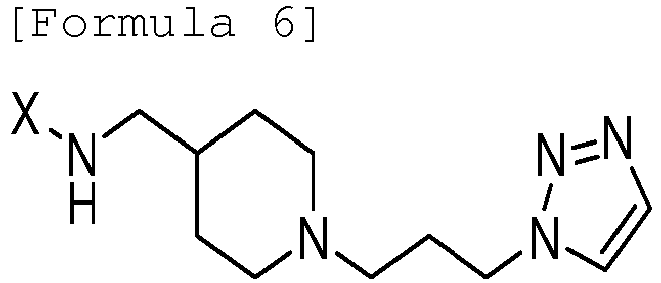 X is an amine protecting group, wherein the amine protecting group is butoxycarbonyl (Boc), benzyloxycarbonyl (Cbz), benzyl or 9-fluorenylmethylcarbonyl (Fmoc), andY is Cl, Br, I, 4-toluenesulfonate, or methanesulfonate.
 - The method of claim 16, wherein the reaction between the compound represented by Formula 4 and the compound represented by Formula 5 is conducted under existence of at least one compound selected from the group consisting of sodium iodide and potassium iodide.
- The method of claim 16, wherein the reaction between the compound represented by Formula 4 and the compound represented by Formula 5 is conducted under existence of a base.
- The method of claim 18, wherein the base is at least one selected from the group consisting of sodium carbonate, sodium hydrogen carbonate, potassium carbonate, potassium hydrogen carbonate, N-methyl morpholine, isopropylethylamine, triethylamine and pyridine.
- A method for preparing a compound represented by Formula 2 according to claims 13 to 15 or the pharmaceutically acceptable salt thereof is comprises:preparing a compound represented by Formula 6 by reacting a compound represented by Formula 4 with a compound represented by Formula 5; anddeprotecting an amine protecting group from the compound represented by Formula 6;


 X is the amine protecting group, wherein the amine protecting group is butoxycarbonyl (Boc), benzyloxycarbonyl (Cbz), benzyl or 9-fluorenylmethylcarbonyl (Fmoc), andY is Cl, Br, I, 4-toluenesulfonate, or methanesulfonate.
 - The method of claim 20, wherein the deprotecting the amine protecting groups comprises reacting the compound represented by Formula 6 with an acid.
- The method of claim 20, wherein the deprotecting the amine protecting groups comprises
performing a hydrogenation of the compound represented by Formula 6 under existence of palladium/carbon.
Applications Claiming Priority (2)
| Application Number | Priority Date | Filing Date | Title |
|---|---|---|---|
| KR20130087992 | 2013-07-25 | ||
| PCT/KR2014/006282 WO2015012515A1 (en) | 2013-07-25 | 2014-07-11 | Method for preparing benzamide derivative, novel intermediate used in preparation of benzamide, and method for preparing novel intermediate |
Publications (3)
| Publication Number | Publication Date |
|---|---|
| EP3026049A1 EP3026049A1 (en) | 2016-06-01 |
| EP3026049A4 EP3026049A4 (en) | 2017-01-04 |
| EP3026049B1 true EP3026049B1 (en) | 2021-09-22 |
Family
ID=52393504
Family Applications (1)
| Application Number | Title | Priority Date | Filing Date |
|---|---|---|---|
| EP14829058.8A Not-in-force EP3026049B1 (en) | 2013-07-25 | 2014-07-11 | Method for preparing benzamide derivative, novel intermediate used in preparation of benzamide, and method for preparing novel intermediate |
Country Status (7)
| Country | Link |
|---|---|
| US (1) | US9771348B2 (en) |
| EP (1) | EP3026049B1 (en) |
| JP (1) | JP6392344B2 (en) |
| KR (1) | KR101595183B1 (en) |
| CN (1) | CN105636946B (en) |
| ES (1) | ES2897946T3 (en) |
| WO (1) | WO2015012515A1 (en) |
Families Citing this family (1)
| Publication number | Priority date | Publication date | Assignee | Title |
|---|---|---|---|---|
| CN117088848A (en) * | 2023-08-16 | 2023-11-21 | 北京中医药大学 | A new type of sulfonamide-1,2,3-triazole compound and its preparation method and application |
Family Cites Families (20)
| Publication number | Priority date | Publication date | Assignee | Title |
|---|---|---|---|---|
| GB1507462A (en) | 1974-03-21 | 1978-04-12 | Gallardo Antonio Sa | N-heterocyclic substituted benzamides methods for their preparation and compositions containing them |
| US5137896A (en) | 1981-10-01 | 1992-08-11 | Janssen Pharmaceutica N.V. | N-(3-hydroxy-4-piperidinyl)benzamide derivatives |
| US5057525A (en) | 1981-10-01 | 1991-10-15 | Janssen Pharmaceutica N.V. | Novel N-(3-hydroxy-4-piperidinyl) benzamide derivatives |
| US4962115A (en) | 1981-10-01 | 1990-10-09 | Janssen Pharmaceutica N.V. | Novel N-(3-hydroxy-4-piperidinyl)benzamide derivatives |
| US5864039A (en) * | 1994-03-30 | 1999-01-26 | Yoshitomi Pharmaceutical Industries, Ltd. | Benzoic acid compounds and use thereof as medicaments |
| EP0774460A1 (en) | 1994-03-30 | 1997-05-21 | Yoshitomi Pharmaceutical Industries, Ltd. | Benzoic acid compound and use thereof as medicine |
| EP0979818B1 (en) * | 1997-03-21 | 2003-02-19 | Mitsubishi Pharma Corporation | Benzoic acid compounds and medicinal use thereof |
| TW402591B (en) * | 1997-07-11 | 2000-08-21 | Janssen Pharmaceutica Nv | Monocyclic benzamides of 3- or 4-substituted 4-(aminomethyl)-piperidine derivatives |
| CA2306565A1 (en) | 1997-10-23 | 1999-04-29 | Merck & Co., Inc. | Carbapenem antibacterial compounds, compositions and methods of treatment |
| JP4590102B2 (en) | 1998-10-06 | 2010-12-01 | ジヤンセン・フアーマシユーチカ・ナームローゼ・フエンノートシヤツプ | Tricyclic Δ3-piperidines as pharmaceuticals |
| KR20010081034A (en) | 1998-11-20 | 2001-08-25 | 프리돌린 클라우스너, 롤란드 비. 보레르 | Piperidine ccr-3 receptor antagonists |
| WO2001025185A1 (en) | 1999-09-30 | 2001-04-12 | Sumika Fine Chemicals Co., Ltd. | Process for the preparation of a piperazine derivative |
| GB0413879D0 (en) | 2004-06-21 | 2004-07-21 | Glaxo Group Ltd | Compounds |
| WO2008089005A2 (en) | 2007-01-12 | 2008-07-24 | Takeda Pharmaceutical Company Limited | Renin inhibitors |
| KR100976063B1 (en) | 2007-03-16 | 2010-08-17 | 동아제약주식회사 | Novel benzamide derivative compounds and preparation methods thereof |
| US8642772B2 (en) * | 2008-10-14 | 2014-02-04 | Sk Biopharmaceuticals Co., Ltd. | Piperidine compounds, pharmaceutical composition comprising the same and its use |
| KR101180174B1 (en) * | 2010-04-23 | 2012-09-05 | 동아제약주식회사 | Novel benzamide derivatives |
| SG190415A1 (en) | 2010-11-24 | 2013-06-28 | Dong A St Co Ltd | Quinoline derivative compound, method for preparing same, and pharmaceutical composition containing same |
| JP5599519B2 (en) | 2010-11-24 | 2014-10-01 | ドン−ア エスティ カンパニー リミテッド | Quinoline derivative compound, process for producing the same and pharmaceutical composition containing the same |
| CA2831143C (en) * | 2011-03-25 | 2019-05-21 | Glaxosmithkline Intellectual Property Development Limited | Cyclopropylamines as lsd1 inhibitors |
-
2014
- 2014-07-11 US US14/907,267 patent/US9771348B2/en not_active Expired - Fee Related
- 2014-07-11 CN CN201480048839.0A patent/CN105636946B/en not_active Expired - Fee Related
- 2014-07-11 EP EP14829058.8A patent/EP3026049B1/en not_active Not-in-force
- 2014-07-11 ES ES14829058T patent/ES2897946T3/en active Active
- 2014-07-11 KR KR1020140087722A patent/KR101595183B1/en not_active Expired - Fee Related
- 2014-07-11 JP JP2016529701A patent/JP6392344B2/en not_active Expired - Fee Related
- 2014-07-11 WO PCT/KR2014/006282 patent/WO2015012515A1/en not_active Ceased
Also Published As
| Publication number | Publication date |
|---|---|
| JP6392344B2 (en) | 2018-09-19 |
| WO2015012515A1 (en) | 2015-01-29 |
| US20160185751A1 (en) | 2016-06-30 |
| JP2016528215A (en) | 2016-09-15 |
| US9771348B2 (en) | 2017-09-26 |
| ES2897946T3 (en) | 2022-03-03 |
| KR20150013018A (en) | 2015-02-04 |
| CN105636946A (en) | 2016-06-01 |
| EP3026049A4 (en) | 2017-01-04 |
| CN105636946B (en) | 2017-12-19 |
| EP3026049A1 (en) | 2016-06-01 |
| KR101595183B1 (en) | 2016-02-17 |
Similar Documents
| Publication | Publication Date | Title |
|---|---|---|
| CA2614334C (en) | Crystalline forms of 4-methyl-n-[3-(4-methyl-imidazol-1-yl)-5-trifluoromethyl-phenyl]-3-(4-pyridin-3-yl-pyrimidin-2-ylamino)-benzamide | |
| EP3645518B1 (en) | Synthesis of omecamtiv mecarbil | |
| EP3089976B1 (en) | Crystalline forms of afatinib dimaleate | |
| OA13248A (en) | Benzimidazolone coumpounds having 5-HT4 receptor agonistic activity. | |
| EP3376870B1 (en) | Process for the preparation of kinase inhibitors and intermediates thereof | |
| JP2009502796A (en) | 4-methyl-N- [3- (4-methyl-imidazol-1-yl) -5-trifluoromethyl-phenyl] -3- (4-pyridin-3-yl-pyrimidin-2-ylamino) -benzamide salt | |
| JP5727482B2 (en) | Synthesis of neurostimulatory piperazine | |
| EP2346850A1 (en) | A method for the preparation of dabigatran and its intermediates | |
| EP3115362B1 (en) | Piperidine derivatives as orexin receptor antagonist | |
| KR20090081028A (en) | X2- [1- (3,5-Bis-trifluoromethyl-benzyl) -5-pyridin-4-yl-1H- [1,2,3] triazol-4-yl] -pyridine-3- Novel Intermediates and Methods Useful in the Preparation of Il- (2-Chlorophenyl) -Methanone | |
| JP2025143402A (en) | Salt of triazine compound, its crystalline form and production method | |
| JP3269574B2 (en) | Methananoanthracene compounds, pharmaceutical compositions containing the same for treating neuropsychiatric disorders, and methods and intermediates for producing the compounds | |
| EP2142531B1 (en) | Benzimidazole cannabinoid agonists | |
| US20070232657A1 (en) | Novel compounds | |
| CN101522197B (en) | Urotensin II receptor antagonists | |
| EP3026049A1 (en) | Method for preparing benzamide derivative, novel intermediate used in preparation of benzamide, and method for preparing novel intermediate | |
| US6469172B2 (en) | Process for the preparation of chemical compounds | |
| JP2013521308A (en) | Process for producing 2- (cyclohexylmethyl) -N- {2-[(2S) -1-methylpyrrolidin-2-yl] ethyl} -1,2,3,4-tetrahydroisoquinoline-7-sulfonamide | |
| EP4330229B1 (en) | Method for producing pyrrolidine compound | |
| US20260042778A1 (en) | Polymorphs of N-Desmethyl Ruboxistaurin and Salts Thereof | |
| WO2007048643A1 (en) | Novel compound | |
| JP2020536898A (en) | Process for preparing spiro derivatives | |
| KR20200092945A (en) | Lenalidomide Crystalline Form | |
| JP2023033201A (en) | Method for producing olaparib | |
| WO2025029769A1 (en) | Solid forms of a kv1.3 potassium shaker channel blockers and method of using the same |
Legal Events
| Date | Code | Title | Description |
|---|---|---|---|
| PUAI | Public reference made under article 153(3) epc to a published international application that has entered the european phase |
Free format text: ORIGINAL CODE: 0009012 |
|
| 17P | Request for examination filed |
Effective date: 20160225 |
|
| AK | Designated contracting states |
Kind code of ref document: A1 Designated state(s): AL AT BE BG CH CY CZ DE DK EE ES FI FR GB GR HR HU IE IS IT LI LT LU LV MC MK MT NL NO PL PT RO RS SE SI SK SM TR |
|
| AX | Request for extension of the european patent |
Extension state: BA ME |
|
| DAX | Request for extension of the european patent (deleted) | ||
| A4 | Supplementary search report drawn up and despatched |
Effective date: 20161201 |
|
| RIC1 | Information provided on ipc code assigned before grant |
Ipc: C07D 401/06 20060101AFI20161125BHEP Ipc: A61P 1/04 20060101ALI20161125BHEP Ipc: A61K 31/454 20060101ALI20161125BHEP |
|
| STAA | Information on the status of an ep patent application or granted ep patent |
Free format text: STATUS: EXAMINATION IS IN PROGRESS |
|
| 17Q | First examination report despatched |
Effective date: 20180205 |
|
| GRAP | Despatch of communication of intention to grant a patent |
Free format text: ORIGINAL CODE: EPIDOSNIGR1 |
|
| STAA | Information on the status of an ep patent application or granted ep patent |
Free format text: STATUS: GRANT OF PATENT IS INTENDED |
|
| INTG | Intention to grant announced |
Effective date: 20210415 |
|
| GRAS | Grant fee paid |
Free format text: ORIGINAL CODE: EPIDOSNIGR3 |
|
| GRAA | (expected) grant |
Free format text: ORIGINAL CODE: 0009210 |
|
| STAA | Information on the status of an ep patent application or granted ep patent |
Free format text: STATUS: THE PATENT HAS BEEN GRANTED |
|
| AK | Designated contracting states |
Kind code of ref document: B1 Designated state(s): AL AT BE BG CH CY CZ DE DK EE ES FI FR GB GR HR HU IE IS IT LI LT LU LV MC MK MT NL NO PL PT RO RS SE SI SK SM TR |
|
| REG | Reference to a national code |
Ref country code: GB Ref legal event code: FG4D |
|
| REG | Reference to a national code |
Ref country code: DE Ref legal event code: R096 Ref document number: 602014080286 Country of ref document: DE |
|
| REG | Reference to a national code |
Ref country code: IE Ref legal event code: FG4D |
|
| REG | Reference to a national code |
Ref country code: CH Ref legal event code: EP Ref country code: AT Ref legal event code: REF Ref document number: 1432252 Country of ref document: AT Kind code of ref document: T Effective date: 20211015 |
|
| REG | Reference to a national code |
Ref country code: SE Ref legal event code: TRGR |
|
| REG | Reference to a national code |
Ref country code: LT Ref legal event code: MG9D |
|
| REG | Reference to a national code |
Ref country code: NL Ref legal event code: MP Effective date: 20210922 |
|
| PG25 | Lapsed in a contracting state [announced via postgrant information from national office to epo] |
Ref country code: RS Free format text: LAPSE BECAUSE OF FAILURE TO SUBMIT A TRANSLATION OF THE DESCRIPTION OR TO PAY THE FEE WITHIN THE PRESCRIBED TIME-LIMIT Effective date: 20210922 Ref country code: HR Free format text: LAPSE BECAUSE OF FAILURE TO SUBMIT A TRANSLATION OF THE DESCRIPTION OR TO PAY THE FEE WITHIN THE PRESCRIBED TIME-LIMIT Effective date: 20210922 Ref country code: FI Free format text: LAPSE BECAUSE OF FAILURE TO SUBMIT A TRANSLATION OF THE DESCRIPTION OR TO PAY THE FEE WITHIN THE PRESCRIBED TIME-LIMIT Effective date: 20210922 Ref country code: NO Free format text: LAPSE BECAUSE OF FAILURE TO SUBMIT A TRANSLATION OF THE DESCRIPTION OR TO PAY THE FEE WITHIN THE PRESCRIBED TIME-LIMIT Effective date: 20211222 Ref country code: BG Free format text: LAPSE BECAUSE OF FAILURE TO SUBMIT A TRANSLATION OF THE DESCRIPTION OR TO PAY THE FEE WITHIN THE PRESCRIBED TIME-LIMIT Effective date: 20211222 Ref country code: LT Free format text: LAPSE BECAUSE OF FAILURE TO SUBMIT A TRANSLATION OF THE DESCRIPTION OR TO PAY THE FEE WITHIN THE PRESCRIBED TIME-LIMIT Effective date: 20210922 |
|
| REG | Reference to a national code |
Ref country code: AT Ref legal event code: MK05 Ref document number: 1432252 Country of ref document: AT Kind code of ref document: T Effective date: 20210922 |
|
| PG25 | Lapsed in a contracting state [announced via postgrant information from national office to epo] |
Ref country code: LV Free format text: LAPSE BECAUSE OF FAILURE TO SUBMIT A TRANSLATION OF THE DESCRIPTION OR TO PAY THE FEE WITHIN THE PRESCRIBED TIME-LIMIT Effective date: 20210922 Ref country code: GR Free format text: LAPSE BECAUSE OF FAILURE TO SUBMIT A TRANSLATION OF THE DESCRIPTION OR TO PAY THE FEE WITHIN THE PRESCRIBED TIME-LIMIT Effective date: 20211223 |
|
| REG | Reference to a national code |
Ref country code: ES Ref legal event code: FG2A Ref document number: 2897946 Country of ref document: ES Kind code of ref document: T3 Effective date: 20220303 |
|
| PG25 | Lapsed in a contracting state [announced via postgrant information from national office to epo] |
Ref country code: AT Free format text: LAPSE BECAUSE OF FAILURE TO SUBMIT A TRANSLATION OF THE DESCRIPTION OR TO PAY THE FEE WITHIN THE PRESCRIBED TIME-LIMIT Effective date: 20210922 |
|
| PG25 | Lapsed in a contracting state [announced via postgrant information from national office to epo] |
Ref country code: IS Free format text: LAPSE BECAUSE OF FAILURE TO SUBMIT A TRANSLATION OF THE DESCRIPTION OR TO PAY THE FEE WITHIN THE PRESCRIBED TIME-LIMIT Effective date: 20220122 Ref country code: SK Free format text: LAPSE BECAUSE OF FAILURE TO SUBMIT A TRANSLATION OF THE DESCRIPTION OR TO PAY THE FEE WITHIN THE PRESCRIBED TIME-LIMIT Effective date: 20210922 Ref country code: RO Free format text: LAPSE BECAUSE OF FAILURE TO SUBMIT A TRANSLATION OF THE DESCRIPTION OR TO PAY THE FEE WITHIN THE PRESCRIBED TIME-LIMIT Effective date: 20210922 Ref country code: PT Free format text: LAPSE BECAUSE OF FAILURE TO SUBMIT A TRANSLATION OF THE DESCRIPTION OR TO PAY THE FEE WITHIN THE PRESCRIBED TIME-LIMIT Effective date: 20220124 Ref country code: PL Free format text: LAPSE BECAUSE OF FAILURE TO SUBMIT A TRANSLATION OF THE DESCRIPTION OR TO PAY THE FEE WITHIN THE PRESCRIBED TIME-LIMIT Effective date: 20210922 Ref country code: NL Free format text: LAPSE BECAUSE OF FAILURE TO SUBMIT A TRANSLATION OF THE DESCRIPTION OR TO PAY THE FEE WITHIN THE PRESCRIBED TIME-LIMIT Effective date: 20210922 Ref country code: EE Free format text: LAPSE BECAUSE OF FAILURE TO SUBMIT A TRANSLATION OF THE DESCRIPTION OR TO PAY THE FEE WITHIN THE PRESCRIBED TIME-LIMIT Effective date: 20210922 Ref country code: CZ Free format text: LAPSE BECAUSE OF FAILURE TO SUBMIT A TRANSLATION OF THE DESCRIPTION OR TO PAY THE FEE WITHIN THE PRESCRIBED TIME-LIMIT Effective date: 20210922 Ref country code: AL Free format text: LAPSE BECAUSE OF FAILURE TO SUBMIT A TRANSLATION OF THE DESCRIPTION OR TO PAY THE FEE WITHIN THE PRESCRIBED TIME-LIMIT Effective date: 20210922 |
|
| REG | Reference to a national code |
Ref country code: DE Ref legal event code: R097 Ref document number: 602014080286 Country of ref document: DE |
|
| PG25 | Lapsed in a contracting state [announced via postgrant information from national office to epo] |
Ref country code: DK Free format text: LAPSE BECAUSE OF FAILURE TO SUBMIT A TRANSLATION OF THE DESCRIPTION OR TO PAY THE FEE WITHIN THE PRESCRIBED TIME-LIMIT Effective date: 20210922 |
|
| PLBE | No opposition filed within time limit |
Free format text: ORIGINAL CODE: 0009261 |
|
| STAA | Information on the status of an ep patent application or granted ep patent |
Free format text: STATUS: NO OPPOSITION FILED WITHIN TIME LIMIT |
|
| 26N | No opposition filed |
Effective date: 20220623 |
|
| PG25 | Lapsed in a contracting state [announced via postgrant information from national office to epo] |
Ref country code: SI Free format text: LAPSE BECAUSE OF FAILURE TO SUBMIT A TRANSLATION OF THE DESCRIPTION OR TO PAY THE FEE WITHIN THE PRESCRIBED TIME-LIMIT Effective date: 20210922 |
|
| PG25 | Lapsed in a contracting state [announced via postgrant information from national office to epo] |
Ref country code: MC Free format text: LAPSE BECAUSE OF FAILURE TO SUBMIT A TRANSLATION OF THE DESCRIPTION OR TO PAY THE FEE WITHIN THE PRESCRIBED TIME-LIMIT Effective date: 20210922 |
|
| REG | Reference to a national code |
Ref country code: CH Ref legal event code: PL |
|
| REG | Reference to a national code |
Ref country code: BE Ref legal event code: MM Effective date: 20220731 |
|
| PG25 | Lapsed in a contracting state [announced via postgrant information from national office to epo] |
Ref country code: LU Free format text: LAPSE BECAUSE OF NON-PAYMENT OF DUE FEES Effective date: 20220711 Ref country code: LI Free format text: LAPSE BECAUSE OF NON-PAYMENT OF DUE FEES Effective date: 20220731 Ref country code: CH Free format text: LAPSE BECAUSE OF NON-PAYMENT OF DUE FEES Effective date: 20220731 |
|
| PG25 | Lapsed in a contracting state [announced via postgrant information from national office to epo] |
Ref country code: BE Free format text: LAPSE BECAUSE OF NON-PAYMENT OF DUE FEES Effective date: 20220731 |
|
| PG25 | Lapsed in a contracting state [announced via postgrant information from national office to epo] |
Ref country code: IE Free format text: LAPSE BECAUSE OF NON-PAYMENT OF DUE FEES Effective date: 20220711 |
|
| PGFP | Annual fee paid to national office [announced via postgrant information from national office to epo] |
Ref country code: IT Payment date: 20230717 Year of fee payment: 10 Ref country code: GB Payment date: 20230718 Year of fee payment: 10 Ref country code: ES Payment date: 20230807 Year of fee payment: 10 |
|
| PGFP | Annual fee paid to national office [announced via postgrant information from national office to epo] |
Ref country code: SE Payment date: 20230713 Year of fee payment: 10 Ref country code: FR Payment date: 20230710 Year of fee payment: 10 Ref country code: DE Payment date: 20230717 Year of fee payment: 10 |
|
| PG25 | Lapsed in a contracting state [announced via postgrant information from national office to epo] |
Ref country code: HU Free format text: LAPSE BECAUSE OF FAILURE TO SUBMIT A TRANSLATION OF THE DESCRIPTION OR TO PAY THE FEE WITHIN THE PRESCRIBED TIME-LIMIT; INVALID AB INITIO Effective date: 20140711 |
|
| PG25 | Lapsed in a contracting state [announced via postgrant information from national office to epo] |
Ref country code: SM Free format text: LAPSE BECAUSE OF FAILURE TO SUBMIT A TRANSLATION OF THE DESCRIPTION OR TO PAY THE FEE WITHIN THE PRESCRIBED TIME-LIMIT Effective date: 20210922 Ref country code: MK Free format text: LAPSE BECAUSE OF FAILURE TO SUBMIT A TRANSLATION OF THE DESCRIPTION OR TO PAY THE FEE WITHIN THE PRESCRIBED TIME-LIMIT Effective date: 20210922 Ref country code: CY Free format text: LAPSE BECAUSE OF FAILURE TO SUBMIT A TRANSLATION OF THE DESCRIPTION OR TO PAY THE FEE WITHIN THE PRESCRIBED TIME-LIMIT Effective date: 20210922 |
|
| PG25 | Lapsed in a contracting state [announced via postgrant information from national office to epo] |
Ref country code: TR Free format text: LAPSE BECAUSE OF FAILURE TO SUBMIT A TRANSLATION OF THE DESCRIPTION OR TO PAY THE FEE WITHIN THE PRESCRIBED TIME-LIMIT Effective date: 20210922 |
|
| PG25 | Lapsed in a contracting state [announced via postgrant information from national office to epo] |
Ref country code: MT Free format text: LAPSE BECAUSE OF FAILURE TO SUBMIT A TRANSLATION OF THE DESCRIPTION OR TO PAY THE FEE WITHIN THE PRESCRIBED TIME-LIMIT Effective date: 20210922 |
|
| REG | Reference to a national code |
Ref country code: DE Ref legal event code: R119 Ref document number: 602014080286 Country of ref document: DE |
|
| REG | Reference to a national code |
Ref country code: SE Ref legal event code: EUG |
|
| GBPC | Gb: european patent ceased through non-payment of renewal fee |
Effective date: 20240711 |
|
| PG25 | Lapsed in a contracting state [announced via postgrant information from national office to epo] |
Ref country code: DE Free format text: LAPSE BECAUSE OF NON-PAYMENT OF DUE FEES Effective date: 20250201 |
|
| PG25 | Lapsed in a contracting state [announced via postgrant information from national office to epo] |
Ref country code: FR Free format text: LAPSE BECAUSE OF NON-PAYMENT OF DUE FEES Effective date: 20240731 |
|
| PG25 | Lapsed in a contracting state [announced via postgrant information from national office to epo] |
Ref country code: GB Free format text: LAPSE BECAUSE OF NON-PAYMENT OF DUE FEES Effective date: 20240711 |
|
| PG25 | Lapsed in a contracting state [announced via postgrant information from national office to epo] |
Ref country code: IT Free format text: LAPSE BECAUSE OF NON-PAYMENT OF DUE FEES Effective date: 20240711 |
|
| REG | Reference to a national code |
Ref country code: ES Ref legal event code: FD2A Effective date: 20250829 |
|
| PG25 | Lapsed in a contracting state [announced via postgrant information from national office to epo] |
Ref country code: ES Free format text: LAPSE BECAUSE OF NON-PAYMENT OF DUE FEES Effective date: 20240712 |
|
| PG25 | Lapsed in a contracting state [announced via postgrant information from national office to epo] |
Ref country code: SE Free format text: LAPSE BECAUSE OF NON-PAYMENT OF DUE FEES Effective date: 20240712 |