EP3025205B1 - Schätzungsverfahren eines relevanten punktes auf einer kurve zur erkennung von anomalien eines motors und datenverarbeitungssystem zur implementierung davon - Google Patents
Schätzungsverfahren eines relevanten punktes auf einer kurve zur erkennung von anomalien eines motors und datenverarbeitungssystem zur implementierung davon Download PDFInfo
- Publication number
- EP3025205B1 EP3025205B1 EP14755870.4A EP14755870A EP3025205B1 EP 3025205 B1 EP3025205 B1 EP 3025205B1 EP 14755870 A EP14755870 A EP 14755870A EP 3025205 B1 EP3025205 B1 EP 3025205B1
- Authority
- EP
- European Patent Office
- Prior art keywords
- curve
- characteristic points
- computer
- profile
- relevant point
- Prior art date
- Legal status (The legal status is an assumption and is not a legal conclusion. Google has not performed a legal analysis and makes no representation as to the accuracy of the status listed.)
- Active
Links
Images


Classifications
-
- G—PHYSICS
- G07—CHECKING-DEVICES
- G07C—TIME OR ATTENDANCE REGISTERS; REGISTERING OR INDICATING THE WORKING OF MACHINES; GENERATING RANDOM NUMBERS; VOTING OR LOTTERY APPARATUS; ARRANGEMENTS, SYSTEMS OR APPARATUS FOR CHECKING NOT PROVIDED FOR ELSEWHERE
- G07C5/00—Registering or indicating the working of vehicles
- G07C5/08—Registering or indicating performance data other than driving, working, idle, or waiting time, with or without registering driving, working, idle or waiting time
- G07C5/0808—Diagnosing performance data
-
- F—MECHANICAL ENGINEERING; LIGHTING; HEATING; WEAPONS; BLASTING
- F01—MACHINES OR ENGINES IN GENERAL; ENGINE PLANTS IN GENERAL; STEAM ENGINES
- F01D—NON-POSITIVE DISPLACEMENT MACHINES OR ENGINES, e.g. STEAM TURBINES
- F01D21/00—Shutting-down of machines or engines, e.g. in emergency; Regulating, controlling, or safety means not otherwise provided for
- F01D21/003—Arrangements for testing or measuring
-
- G—PHYSICS
- G05—CONTROLLING; REGULATING
- G05B—CONTROL OR REGULATING SYSTEMS IN GENERAL; FUNCTIONAL ELEMENTS OF SUCH SYSTEMS; MONITORING OR TESTING ARRANGEMENTS FOR SUCH SYSTEMS OR ELEMENTS
- G05B23/00—Testing or monitoring of control systems or parts thereof
- G05B23/02—Electric testing or monitoring
-
- F—MECHANICAL ENGINEERING; LIGHTING; HEATING; WEAPONS; BLASTING
- F02—COMBUSTION ENGINES; HOT-GAS OR COMBUSTION-PRODUCT ENGINE PLANTS
- F02C—GAS-TURBINE PLANTS; AIR INTAKES FOR JET-PROPULSION PLANTS; CONTROLLING FUEL SUPPLY IN AIR-BREATHING JET-PROPULSION PLANTS
- F02C7/00—Features, components parts, details or accessories, not provided for in, or of interest apart form groups F02C1/00 - F02C6/00; Air intakes for jet-propulsion plants
-
- G—PHYSICS
- G05—CONTROLLING; REGULATING
- G05B—CONTROL OR REGULATING SYSTEMS IN GENERAL; FUNCTIONAL ELEMENTS OF SUCH SYSTEMS; MONITORING OR TESTING ARRANGEMENTS FOR SUCH SYSTEMS OR ELEMENTS
- G05B17/00—Systems involving the use of models or simulators of said systems
-
- G—PHYSICS
- G05—CONTROLLING; REGULATING
- G05B—CONTROL OR REGULATING SYSTEMS IN GENERAL; FUNCTIONAL ELEMENTS OF SUCH SYSTEMS; MONITORING OR TESTING ARRANGEMENTS FOR SUCH SYSTEMS OR ELEMENTS
- G05B23/00—Testing or monitoring of control systems or parts thereof
- G05B23/02—Electric testing or monitoring
- G05B23/0205—Electric testing or monitoring by means of a monitoring system capable of detecting and responding to faults
- G05B23/0218—Electric testing or monitoring by means of a monitoring system capable of detecting and responding to faults characterised by the fault detection method dealing with either existing or incipient faults
- G05B23/0243—Electric testing or monitoring by means of a monitoring system capable of detecting and responding to faults characterised by the fault detection method dealing with either existing or incipient faults model based detection method, e.g. first-principles knowledge model
-
- G—PHYSICS
- G05—CONTROLLING; REGULATING
- G05B—CONTROL OR REGULATING SYSTEMS IN GENERAL; FUNCTIONAL ELEMENTS OF SUCH SYSTEMS; MONITORING OR TESTING ARRANGEMENTS FOR SUCH SYSTEMS OR ELEMENTS
- G05B23/00—Testing or monitoring of control systems or parts thereof
- G05B23/02—Electric testing or monitoring
- G05B23/0205—Electric testing or monitoring by means of a monitoring system capable of detecting and responding to faults
- G05B23/0218—Electric testing or monitoring by means of a monitoring system capable of detecting and responding to faults characterised by the fault detection method dealing with either existing or incipient faults
- G05B23/0243—Electric testing or monitoring by means of a monitoring system capable of detecting and responding to faults characterised by the fault detection method dealing with either existing or incipient faults model based detection method, e.g. first-principles knowledge model
- G05B23/0254—Electric testing or monitoring by means of a monitoring system capable of detecting and responding to faults characterised by the fault detection method dealing with either existing or incipient faults model based detection method, e.g. first-principles knowledge model based on a quantitative model, e.g. mathematical relationships between inputs and outputs; functions: observer, Kalman filter, residual calculation, Neural Networks
-
- G—PHYSICS
- G07—CHECKING-DEVICES
- G07C—TIME OR ATTENDANCE REGISTERS; REGISTERING OR INDICATING THE WORKING OF MACHINES; GENERATING RANDOM NUMBERS; VOTING OR LOTTERY APPARATUS; ARRANGEMENTS, SYSTEMS OR APPARATUS FOR CHECKING NOT PROVIDED FOR ELSEWHERE
- G07C5/00—Registering or indicating the working of vehicles
- G07C5/08—Registering or indicating performance data other than driving, working, idle, or waiting time, with or without registering driving, working, idle or waiting time
- G07C5/0816—Indicating performance data, e.g. occurrence of a malfunction
- G07C5/0825—Indicating performance data, e.g. occurrence of a malfunction using optical means
-
- G—PHYSICS
- G07—CHECKING-DEVICES
- G07C—TIME OR ATTENDANCE REGISTERS; REGISTERING OR INDICATING THE WORKING OF MACHINES; GENERATING RANDOM NUMBERS; VOTING OR LOTTERY APPARATUS; ARRANGEMENTS, SYSTEMS OR APPARATUS FOR CHECKING NOT PROVIDED FOR ELSEWHERE
- G07C5/00—Registering or indicating the working of vehicles
- G07C5/08—Registering or indicating performance data other than driving, working, idle, or waiting time, with or without registering driving, working, idle or waiting time
- G07C5/12—Registering or indicating performance data other than driving, working, idle, or waiting time, with or without registering driving, working, idle or waiting time in graphical form
-
- F—MECHANICAL ENGINEERING; LIGHTING; HEATING; WEAPONS; BLASTING
- F05—INDEXING SCHEMES RELATING TO ENGINES OR PUMPS IN VARIOUS SUBCLASSES OF CLASSES F01-F04
- F05D—INDEXING SCHEME FOR ASPECTS RELATING TO NON-POSITIVE-DISPLACEMENT MACHINES OR ENGINES, GAS-TURBINES OR JET-PROPULSION PLANTS
- F05D2260/00—Function
- F05D2260/80—Diagnostics
-
- F—MECHANICAL ENGINEERING; LIGHTING; HEATING; WEAPONS; BLASTING
- F05—INDEXING SCHEMES RELATING TO ENGINES OR PUMPS IN VARIOUS SUBCLASSES OF CLASSES F01-F04
- F05D—INDEXING SCHEME FOR ASPECTS RELATING TO NON-POSITIVE-DISPLACEMENT MACHINES OR ENGINES, GAS-TURBINES OR JET-PROPULSION PLANTS
- F05D2260/00—Function
- F05D2260/82—Forecasts
- F05D2260/821—Parameter estimation or prediction
Definitions
- the invention generally relates to the field of monitoring the operating state of an engine.
- the invention relates more precisely to a method of estimating on a curve of a relevant point for the detection of abnormality of an engine as well as the data processing system for its implementation.
- Monitoring tools have been developed to identify anomalies that alter engine operation from measurements of physical parameters describing the engine condition, as for example in the document US2005 / 0267702 .
- Methods have also been described for measuring operating parameters of the engine to be monitored, calculating indicators representative of the operating state of the engine, and identifying operating anomalies of the engine from said indicators.
- An example of such methods is described in the applicant's patents FR2939924 and FR2942001 . These indicators are defined by engine behavior experts.
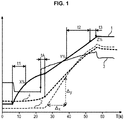
- indicators such as opening time of the start valve, a time to reach a maximum acceleration of the high pressure compressor, times t1, t2 and t3 of the first, second and third start-up phase, an ignition time of the engine, a closing time of the starting valve, a gradient of the temperature of the exhaust gas or a stopping time of the engine can be defined .
- the Figure 1 shows the evolution of the speed 1 of the high-pressure compressor, the exhaust gas temperature 2 EGT (Exhaust Gas Temperature), the fuel flow 3 sent to the injectors and the pressure 4, as well as the durations t1, t2 and t3.
- Such indicators can be calculated according to relevant times on the curves of the measurements of the engine operating parameters. Such relevant moments are identified on these curves by the experts.
- Some of these tools can in particular extract a particular relevant moment from the descriptions of this moment provided by experts during the development of the tool. Nevertheless, such solutions require developing a different tool for each type of moment relevant to detect. They also have the disadvantage of requiring the expert to finely describe the characteristics of the relevant time, in a manner understandable to the designer of the tool, so that it retranscribes these characteristics in algorithmic form.
- Such a method makes it possible to quickly determine a relevant point on a curve, whatever the type of relevant point, without calling on an expert. Such a method also makes it possible to take account of the entire shape of the curve, while minimizing the amount of information to be stored by storing only the characteristic points of this curve.
- Such a process makes it possible to characterize a relevant point automatically, without requiring an expert to precisely describe the characteristics of such a point and without requiring that a particular algorithm be defined for each type of relevant point.
- the invention relates to a computer program product comprising program code instructions for executing the steps of the method according to the first aspect when said program is executed on a computer;
- the invention relates to a data processing system comprising a computer, input means, at least one display device characterized in that it is configured to implement the steps of the method according to the first aspect.
- an implementation for the invention relates to a method for estimating on a curve of a point that is relevant for an anomaly detection of a motor 9, said curve representing an evolution as a function of time of physical parameters of operation of the motor measured by at least one sensor 10 on said motor 9.
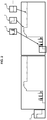
- Such a method is implemented by a computer 11 comprising calculation means 12, a memory 13 and a communication interface 14.
- This interface can enable the computer to communicate with sensors 10 able to acquire measurements of operating parameters of the computer. motor at different times.
- Such an interface can be a wired interface of Ethernet, USB, FireWire, serial or parallel type or a Wi-Fi or Bluetooth wireless interface.
- the estimation by the calculator 11 of a relevant point on a curve is made from comparisons to curve models called profiles.
- the analyzed curves are not always similar, the process uses several profiles.
- the analysis of the temperature of Outlet gas can use two profiles, one for cold starts and one for hot starts.
- Such profiles can be determined by a learning process and stored in first storage means 15.
- These first storage means can be in the form of a device external to the computer such as a USB external hard disk or a hard disk. Network (“NAS").
- the first storage means then communicate with the computer via a communication interface such as the communication interface 14.
- the first storage means can be integrated in the computer 11.
- the memorization of the profiles in the first means storage can take the form of a database stored in the first storage means.
- the said learning process may involve an aircraft engine operation expert to select a relevant point on learning curves.
- the expert has a graphical interface 16 such as that represented in FIG. figure 4 calculated by the computer 11.
- a graphical interface has a curve 17 in a selection window 18.
- This interface is displayed on a display device 19 which can be any type of screen such as an LCD screen, plasma, OLED or a videoprojection screen coupled to a video projector.
- a display device is connected to the computer 11 by an analog or digital video connection such as Scart, VGA, DVI, DisplayPort or HDMI connection.
- the expert uses input means 20 to select a relevant point on a learning curve 17 displayed in the selection window 18.
- Such input means may consist of a keyboard and a mouse, a trackpad, a trackball or any other pointing means allowing it to specify a point on the curve 17 such as a motion detection interface.
- the data stored during the learning process can be stored on second means of storage 21 similar to the first storage means 15 and similarly connected to the computer 11.
- said learning process comprises the steps E1 to E11 described below.
- a learning curves a can be presented to the expert. These curves are displayed in a selection window 18 of the graphical interface 16. These curves are all similar although not identical and all correspond to the same type of curve on which a relevant point must be able to be determined automatically. These curves can for example be curves of temperature, pressure, air flow or fuel measured at different points of an aircraft engine or else rotational speed curves of different rotating elements of such a device. engine as high and low pressure compressors.
- a preselection of such a batch of similar curves may have been carried out automatically by a machine or manually by an expert from a set of curves measured on one or more aircraft engines, for example by selecting a type of size and separating curves measured over an entire flight cycle and those measured only during the start-up phase.
- a relevant point may correspond to a particular moment of the curve such as a moment of opening of a valve, a moment of net variation of a temperature or a pressure, a moment of reaching a certain speed by the high pressure compressor or the low pressure compressor, a moment of disengagement of the starter.
- the determination of such instants can make it possible to calculate specific indicators useful for estimating the operating state of an engine such as the duration of the different engine start-up phases, the ignition time, the stopping time or the maximum and average gradients of exhaust gas temperature.
- the learning curves a are stored with their relevant point selected by the expert in the second storage means 21.
- the selected relevant point can be stored in the form of its abscissa on the learning curve.
- a filter consists of a filtering function adapted to modify a curve so as to simplify the detection thereon of a characteristic point.
- filtering may consist of a smoothing, a simple or double derivation or even a treatment of accentuation of the irregularities of the curve.
- the corresponding filtering functions can be a Gaussian, square-shaped, triangle, Haar or Daubechies wavelet distribution.
- the selection of a filter F and a model M can be performed automatically by the computer 11, possibly randomly from a filter base and possible ranges of the regression coefficients, or such a selection can involve the expert.
- a fifth step E5 the filter F selected in the fourth step E4 is applied to each of the learning curves at.
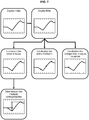
- the application of the filter may consist of a convolutional calculation between each curve and the filtering function of the filter so as to obtain filtered learning curves as shown in FIG. Figure 7 .
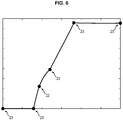
- the computer 11 determines the characteristic points of each of the filtered learning curves.
- these characteristic points may correspond to local extrema, points of inflection, that is to say having a maximum of the first derivative, or points of abrupt change of slope, that is, say having a maximum second derivative between a local extremum and the point of inflection, and between the point of inflection and the other local extremum.
- the determination of local extrema it is possible to minimize the number of points retained by retaining at the end of this determination only consecutive local extrema whose difference in ordinate is greater than a first predetermined threshold.
- Advantageously only the abscissa of these characteristic points is memorized.
- the calculator determines among the set of characteristic points of the learning curves has filtered, recurring characteristic points. These recurring points are characteristic points detected in the majority of filtered filtered learning curves. According to one variant, these recurring characteristic points are determined solely from the local extrema of learning curves. In this variant, the recurring characteristic points other than the consecutive recurrent local extrema are determined a posteriori and in the following manner: a point of inflection is chosen between two consecutive local extrema, and if there are several, we choose the one having the maximum ordinate on the first derivative. A point representing a sudden change in variation is chosen between a local extremum and a point of inflection, and a point of inflection and a local extremum. If there are several points of sudden variation, one chooses the one having the maximum ordinate on the second derivative.
- the computer 11 also determines a binary code C, each component of which codes the direction of variation between two consecutive recurring characteristic points. For example a "1" can encode the fact that a characteristic point of ordinate y1 is followed by a characteristic point of ordinate y2 greater than y1, and a "0" can then code the fact that a characteristic point of ordinate y1 is followed by a characteristic point of ordinate y2 lower than y1. Such a code then constitutes a binary representation of the ordinate profile of the recurring characteristic points common to the majority of the learning curves. at.
- the filtered learning curves on which the identified recurring characteristic points do not appear may be set aside and may be used to determine another profile during a subsequent learning process. A first profile is thus determined from a maximum of learning curves and a second profile is determined from a maximum of curves among the remaining curves ...
- an eighth step E8 the computer 11 determines the abscissa of a relevant point P 'on one or more of the learning curves a from the recurring characteristic points, in particular from their abscissae, determined at the seventh step E7 and from the model M chosen at the fourth step E4.
- a ninth step E9 the computer 11 estimates an error in determining each of the relevant points determined in the eighth step E8 by comparing the abscissa of a relevant point P 'determined at the eighth step E8 and the abscissa of the relevant point P selected by the expert on the same learning curve in the second step E2.
- the calculator determines the root mean square of all the estimated determination errors. This average determination error is associated with the filter F and the model M selected in the fourth step E4.
- the calculator determines whether the average error for determining the relevant point estimated at the ninth step E9 is sufficiently small to consider the determination of the relevant points made at the eighth step E8 as satisfactory.
- the computer compares the average error of determination with a second predetermined threshold. As long as the average error of determination is greater than this second predetermined threshold, the computer rejects the filter F and the model M selected in step E4, selects a new filter and a new model, and then performs the steps again. E5 to E10 with this new filter and this new model.
- the computer implements the steps E4 to E10 a predetermined number of times and selects the filter pair F / model M to obtain the lowest average error for determining the relevant point.
- the computer 11 stores in a profile the filter F and the model M selected in the tenth step E10 and the binary code C determined in the seventh step E7.
- the profile may also include the first predetermined threshold used in the sixth step E6 for the determination of local extrema. This profile is recorded in the first storage means 15.
- the preceding steps are applied according to each of the dimensions.
- a profile is stored at the end of the eleventh step E11 for each of the dimensions.
- only a profile including the filter / model pair of the dimension having the lowest determination error is stored at the end of the eleventh step E11.
- each profile then integrates an indication of the dimension to which it relates.
- Such characteristic points are then determined in the sixth step E6 for each of the dimensions of each learning curve. Similarly, the recurring characteristic points and the binary code are then determined during the seventh step E7 for each of these dimensions. These binary codes are also stored in a multidimensional profile in the eleventh step E11, associated with an indication of the dimension to which they relate.
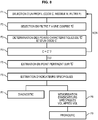
- the estimation process on a curve a relevant point for the detection of motor anomaly 9, using profiles determined according to the learning process described above, can be implemented by the computer 11, according to steps F1 to F9.
- This curve is obtained from measurements of engine operating parameters acquired at different times by at least one sensor 10.
- a first step F1 the computer selects a profile from the profiles generated by the learning process described above and stored in the first storage means 15.
- the calculator 11 applies to the curve the filter F associated with the profile selected in the first step F1 and obtains a filtered curve.
- a third step F3 the computer 11 determines the characteristic points of the filtered curve obtained in the second step F2. Determination of local extrema of the curve can use the first predetermined threshold associated with the profile selected in the first step F1. From these characteristic points, the computer then determines the binary code C ', each component of which codes the direction of variation of two consecutive characteristic points. Said code is determined in the same manner as the binary code determined in the seventh step E7 for the recurring characteristic points of a learning curve.
- a fourth step F4 the calculator determines whether the code C 'obtained in the third step F3 is identical to the code C associated with the profile selected in the first step F1. Where appropriate, the shape of the curve corresponds to the selected curve profile and the computer then realizes the fifth step F5 during which the selected profile is used to determine a relevant point on the curve . Otherwise, the curve does not correspond to the selected profile and the computer 11 again implements steps F1 to F4.
- the calculator determines a relevant point, for example its abscissa, on the curve from the points characteristics determined in the third step F3 and the model M associated with the profile selected in the first step F1.
- the curve can also be multidimensional. According to a first variant, if the profiles memorized during the learning phase are all relative to one and the same dimension, steps F1 to F5 above are applied to this dimension. According to a second variant, if profiles each associated with one dimension have been memorized during the learning phase for at least two of the dimensions of the curve , steps F1 to F5 are applied separately to each of these dimensions and an average relevant point is determined from the relevant points determined according to each of the dimensions, the abscissa of the average relevant point being able for example to be an average of the abscissas of the relevant points. determined according to each dimension.
- the steps F1 to F5 described above are then applied so that, during the third step F3, the characteristic points of the curve and a code binary are determined for each dimension of the curve.
- the computer determines in the fourth step F4 the most appropriate multidimensional profile to the curve from these binary codes and binary codes recorded in the selected multidimensional profile.
- the computer 11 can use one or more relevant points determined by the implementation of steps F1 to F5 to estimate at least one specific indicator representative of the operating state of the engine 9.
- such indicators can be the duration of the various engine starting phases, the ignition time, the stopping time or the maximum and average gradients of the exhaust gas temperature.
- a first treatment may consist of a diagnosis of the state of the engine at the moment of acquisition of the curves used to determine said indicators.
- the computer thus uses the indicators to estimate whether the engine has a malfunction that could justify a return to the workshop for maintenance, for example to replace a defective part.
- a second treatment may consist of a prognosis of a future degradation of the operation of the engine from successive measurements.
- the indicators determined from measurements relating to an engine flight are thus stored and this step is repeated flight after flight in order to obtain a succession of indicators whose evolution over time is representative. the evolution of the operating state of the engine 9.
- the computer then implements a prognostic process of a future deterioration of the state of the engine from the evolution in the time of the indicators memorized flight after flight at the eighth step F8.
Landscapes
- Engineering & Computer Science (AREA)
- Physics & Mathematics (AREA)
- General Physics & Mathematics (AREA)
- Automation & Control Theory (AREA)
- Mechanical Engineering (AREA)
- Combustion & Propulsion (AREA)
- Chemical & Material Sciences (AREA)
- General Engineering & Computer Science (AREA)
- Artificial Intelligence (AREA)
- Evolutionary Computation (AREA)
- Mathematical Physics (AREA)
- Combined Controls Of Internal Combustion Engines (AREA)
- Testing And Monitoring For Control Systems (AREA)
- Testing Of Devices, Machine Parts, Or Other Structures Thereof (AREA)
Claims (14)
- Verfahren zum Schätzen eines relevanten Punktes auf einer Kurve zum Erkennen einer Anomalie eines Motors (9), wobei die Kurve eine zeitabhängige Entwicklung von physikalischen Betriebsparametern des Motors darstellt, die von zumindest einem Sensor (10) am Motor gemessen und von einem Rechner (11) verwendet werden, der mit ersten Speichermitteln (15) verbunden ist,
wobei die ersten Speichermittel (15) zumindest ein Profil speichern, das einen Binärcode enthält, dessen jede Komponente eine Variationsrichtung zwischen zwei aufeinanderfolgenden charakteristischen Punkten zumindest einer Lernkurve codiert, wobei ein Modell ermöglicht, einen relevanten Punkt aus einem Satz charakteristischer Punkte einer Kurve zu schätzen, und ein Filter umfasst,
wobei das Verfahren Folgendes umfasst:a/ (F1) Auswahl eines in den ersten Speichermitteln (15) gespeicherten Profils;b/ (F2) Anwendung des Filters des ausgewählten Profils auf die Kurve;c/ (F3) Bestimmung eines Satzes von charakteristischen Punkten der gefilterten Kurve und eines Binärcodes, dessen jede Komponente die Variationsrichtung von zwei aufeinanderfolgenden charakteristischen Punkten codiert, die zum Satz von charakteristischen Punkten gehören;d/ (F4) Vergleich des ermittelten Codes mit dem Code des gewählten Profilcodes;e/ (F5) Je nach dem Vergleich die Schätzung des relevanten Punktes auf der Kurve ausgehend von den charakteristischen Punkten der gefilterten Kurve und dem Modell des ausgewählten Profils; - Verfahren nach Anspruch 1, wobei, wenn sich der ermittelte Code von dem Code des ausgewählten Profils unterscheidet, ein neues Profil ausgewählt wird, das auf dem ersten Speichermedium gespeichert ist, und der Rechner die Schritte b/ bis e/ erneut ausführt;
- Verfahren nach einem der Ansprüche 1 bis 2, wobei der relevante Punkt aus einer Ventilöffnungszeit, einer deutlichen Temperatur- oder Druckänderungszeit, einem Moment des Erreichens einer bestimmten Drehzahl durch einen Hochdruckverdichter oder einen Niederdruckverdichter, einem Starterabschaltmoment ausgewählt wird;
- Verfahren nach einem beliebigen der vorstehenden Ansprüche 1 bis 3, wobei die charakteristischen Punkte von Kurven aus Wendepunkten, lokalen Extremen, plötzlichen Gefälleänderungen ausgewählt werden;
- Verfahren nach einem beliebigen der vorstehenden Ansprüche 1 bis 4, wobei ein Profil ferner einen Schwellenwert umfasst, und wobei die charakteristischen Punkte aufeinanderfolgende lokale Extreme sind, deren Ordinatendifferenz größer als der Schwellenwert ist;
- Verfahren nach einem beliebigen der vorstehenden Ansprüche 1 bis 5, wobei die Modelle verallgemeinerte lineare Modelle mit Auswahl von Variablen sind;
- Verfahren nach einem beliebigen der vorstehenden Ansprüche 1 bis 6, wobei die Modelle die Gleichung t = AX bestätigen,
wobei- t die Abszisse des zu schätzenden relevanten Punktes ist,- A ein Linienvektor mit Regressionskoeffizienten ist,- X ein Spaltenvektor ist, dessen Komponenten Abszissen der charakteristischen Punkte und deren Transformationen sind; - Verfahren nach einem beliebigen der vorstehenden Ansprüche 1 bis 7, das ferner (F6) einen Schritt mit Schätzung des Betriebszustands des Motors ausgehend von den geschätzten relevanten Punkten spezifischer Indikatoren umfasst, die für ihre Repräsentativität ausgewählt wurden;
- Verfahren nach Anspruch 8, das ferner (F7) einen Schritt mit Motordiagnose basierend auf den geschätzten spezifischen Indikatoren umfasst;
- Verfahren nach Anspruch 8, das (F8) einen Schritt mit Speichern der geschätzten spezifischen Indikatoren in Speichermitteln nach jedem Flug umfasst und (F9) einen Schritt mit Prognose einer Verschlechterung des Betriebszustandes des Motors ausgehend von der Fortentwicklung der gespeicherten spezifischen Indikatoren;
- Verfahren nach einem beliebigen der vorstehenden Ansprüche 1 bis 10, wobei jedes in den ersten Speichermitteln gespeicherte Profil durch einen Lernprozess bestimmt wird;
- Verfahren nach Anspruch 11, wobei der Lernprozess für ein Profil Folgendes umfasst:a/ (E1) Anzeige mehrerer Lernkurven durch eine Anzeigevorrichtung (19);b/ (E2) Bestimmung eines relevanten Punktes durch den Rechner (11) zum Erkennen von Anomalien auf jeder der Lernkurven, wobei der relevante Punkt jeder der Lernkurven von einem Experten unter Verwendung von Eingabemitteln (20) ausgewählt wird;c/ (E3) Speicherung jeder der Lernkurven, die dem bestimmten relevanten Punkt zugeordnet sind, in zweiten Speichermitteln (21);d/ (E4) Auswahl eines Filters und eines Modells durch den Rechner (11);e/ (E5) Anwendung des ausgewählten Filters auf jede der Lernkurven durch den Rechner (11);f/ (E6) Bestimmung der charakteristischen Punkte jeder der gefilterten Lernkurven durch den Rechner (11);g/ (E7) Bestimmung durch den Rechner (11) von wiederkehrenden charakteristischen Punkten unter den auf jeder gefilterten Lernkurve erscheinenden bestimmten charakteristischen Punkten und eines Binärcodes, dessen jede Komponente die Variationsrichtung zwischen zwei aufeinanderfolgenden wiederkehrenden charakteristischen Punkten codiert;h/ (E8) ausgehend von den ermittelten wiederkehrenden charakteristischen Punkten und dem ausgewählten Modell, die Schätzung des relevanten Punktes durch den Rechner (11);i/ (E9) Schätzung durch den Rechner (11) des Fehlers, der mit den in Schritt d/ ausgewählten Filtern und Modellen verbunden ist, durch Vergleich des geschätzten relevanten Punktes mit dem in Schritt b/ vom Experten ausgewählten relevanten Punkt;j/ (E11) Speicherung eines Profils in den ersten Speichermitteln (15), das den bestimmten Binärcode umfasst, wobei das Filter und das Modell ermöglichen, den geschätzten Fehler zu minimieren oder einen geschätzten Fehler unter einem bestimmten Schwellenwert (E10) zu erzielen;
- Rechnerprogramm-Produkt mit Programmcode-Anweisungen zum Durchführen der Verfahrensschritte nach einem beliebigen der vorstehenden Ansprüche, wenn das Programm auf einem Rechner läuft;
- Datenverarbeitungssystem umfassend einen Rechner (11), Eingabemittel (20), zumindest eine Anzeigevorrichtung (19), dadurch gekennzeichnet, dass es so konfiguriert ist, dass es die Schritte des Verfahrens nach einem beliebigen der vorstehenden Ansprüche 1 bis 12 durchführt.
Applications Claiming Priority (2)
| Application Number | Priority Date | Filing Date | Title |
|---|---|---|---|
| FR1357252A FR3009021B1 (fr) | 2013-07-23 | 2013-07-23 | Procede d'estimation sur une courbe d'un point pertinent pour la detection d'anomalie d'un moteur et systeme de traitement de donnees pour sa mise en oeuvre |
| PCT/FR2014/051882 WO2015011395A1 (fr) | 2013-07-23 | 2014-07-21 | Procede d'estimation sur une courbe d'un point pertinent pour la detection d'anomalie d'un moteur et systeme de traitement de donnees pour sa mise en oeuvre |
Publications (2)
| Publication Number | Publication Date |
|---|---|
| EP3025205A1 EP3025205A1 (de) | 2016-06-01 |
| EP3025205B1 true EP3025205B1 (de) | 2018-09-05 |
Family
ID=49378473
Family Applications (1)
| Application Number | Title | Priority Date | Filing Date |
|---|---|---|---|
| EP14755870.4A Active EP3025205B1 (de) | 2013-07-23 | 2014-07-21 | Schätzungsverfahren eines relevanten punktes auf einer kurve zur erkennung von anomalien eines motors und datenverarbeitungssystem zur implementierung davon |
Country Status (8)
| Country | Link |
|---|---|
| US (1) | US9792741B2 (de) |
| EP (1) | EP3025205B1 (de) |
| CN (1) | CN105408828B (de) |
| BR (1) | BR112016001482B1 (de) |
| CA (1) | CA2918215C (de) |
| FR (1) | FR3009021B1 (de) |
| RU (1) | RU2667794C2 (de) |
| WO (1) | WO2015011395A1 (de) |
Families Citing this family (6)
| Publication number | Priority date | Publication date | Assignee | Title |
|---|---|---|---|---|
| FR3043802A1 (fr) * | 2015-11-13 | 2017-05-19 | Peugeot Citroen Automobiles Sa | Procede pour etablir des diagnostics de fonctionnement d'au moins une boucle de regulation par portraits de phase |
| US10496086B2 (en) | 2016-12-12 | 2019-12-03 | General Electric Company | Gas turbine engine fleet performance deterioration |
| FR3089501B1 (fr) | 2018-12-07 | 2021-09-17 | Safran Aircraft Engines | Système d’environnement informatique pour la surveillance de moteurs d’aéronefs |
| EP3935581A4 (de) | 2019-03-04 | 2022-11-30 | Iocurrents, Inc. | Datenkompression und -kommunikation mit maschinenlernung |
| CN112380100B (zh) * | 2020-12-01 | 2025-01-24 | 北京威努特技术有限公司 | 基于方向偏差的业务异常检测方法、装置和介质 |
| JP7506960B2 (ja) * | 2021-06-02 | 2024-06-27 | 株式会社Tmeic | データ管理装置 |
Family Cites Families (15)
| Publication number | Priority date | Publication date | Assignee | Title |
|---|---|---|---|---|
| RU2187711C1 (ru) * | 2000-11-22 | 2002-08-20 | Открытое акционерное общество "Авиадвигатель" | Способ диагностики помпажа компрессора газотурбинного двигателя |
| US20030065409A1 (en) * | 2001-09-28 | 2003-04-03 | Raeth Peter G. | Adaptively detecting an event of interest |
| US6973396B1 (en) * | 2004-05-28 | 2005-12-06 | General Electric Company | Method for developing a unified quality assessment and providing an automated fault diagnostic tool for turbine machine systems and the like |
| FR2937079B1 (fr) * | 2008-10-10 | 2011-08-26 | Snecma | Procede et systeme de surveillance d'un turboreacteur |
| FR2939170B1 (fr) * | 2008-11-28 | 2010-12-31 | Snecma | Detection d'anomalie dans un moteur d'aeronef. |
| FR2939928B1 (fr) * | 2008-12-15 | 2012-08-03 | Snecma | Standardisation de donnees utilisees pour la surveillance d'un moteur d'aeronef |
| US20100161196A1 (en) * | 2008-12-23 | 2010-06-24 | Honeywell International Inc. | Operations support systems and methods with engine diagnostics |
| US9650909B2 (en) * | 2009-05-07 | 2017-05-16 | General Electric Company | Multi-stage compressor fault detection and protection |
| US9046000B2 (en) * | 2011-06-18 | 2015-06-02 | Prime Photonics, Lc | Method for detecting foreign object damage in turbomachinery |
| US8538626B2 (en) * | 2011-09-15 | 2013-09-17 | General Electric Company | Systems and methods for diagnosing an engine |
| US9020689B2 (en) | 2011-09-19 | 2015-04-28 | The Boeing Company | Method for real-time model based structural anomaly detection |
| US9916538B2 (en) * | 2012-09-15 | 2018-03-13 | Z Advanced Computing, Inc. | Method and system for feature detection |
| WO2013077861A1 (en) * | 2011-11-22 | 2013-05-30 | Electric Power Research Institute, Inc. | System and method for anomaly detection |
| US9147296B2 (en) * | 2012-03-14 | 2015-09-29 | Flextronics Ap, Llc | Customization of vehicle controls and settings based on user profile data |
| US9418493B1 (en) * | 2015-04-30 | 2016-08-16 | The Boeing Company | Methods and systems for data analytics |
-
2013
- 2013-07-23 FR FR1357252A patent/FR3009021B1/fr active Active
-
2014
- 2014-07-21 RU RU2016105851A patent/RU2667794C2/ru active
- 2014-07-21 US US14/906,470 patent/US9792741B2/en active Active
- 2014-07-21 BR BR112016001482-0A patent/BR112016001482B1/pt active IP Right Grant
- 2014-07-21 EP EP14755870.4A patent/EP3025205B1/de active Active
- 2014-07-21 CN CN201480042127.8A patent/CN105408828B/zh active Active
- 2014-07-21 CA CA2918215A patent/CA2918215C/fr active Active
- 2014-07-21 WO PCT/FR2014/051882 patent/WO2015011395A1/fr not_active Ceased
Also Published As
| Publication number | Publication date |
|---|---|
| RU2667794C2 (ru) | 2018-09-24 |
| RU2016105851A (ru) | 2017-08-29 |
| RU2016105851A3 (de) | 2018-05-08 |
| BR112016001482A2 (de) | 2017-07-25 |
| EP3025205A1 (de) | 2016-06-01 |
| CA2918215A1 (fr) | 2015-01-29 |
| WO2015011395A1 (fr) | 2015-01-29 |
| FR3009021B1 (fr) | 2015-08-21 |
| CN105408828B (zh) | 2018-01-05 |
| US9792741B2 (en) | 2017-10-17 |
| CN105408828A (zh) | 2016-03-16 |
| BR112016001482B1 (pt) | 2022-09-13 |
| CA2918215C (fr) | 2022-10-04 |
| US20160163132A1 (en) | 2016-06-09 |
| FR3009021A1 (fr) | 2015-01-30 |
Similar Documents
| Publication | Publication Date | Title |
|---|---|---|
| EP3025205B1 (de) | Schätzungsverfahren eines relevanten punktes auf einer kurve zur erkennung von anomalien eines motors und datenverarbeitungssystem zur implementierung davon | |
| EP3039497B1 (de) | Überwachung eines flugzeugmotors zur vorausplanung von wartungsoperationen | |
| CA2746537C (fr) | Standardisation de donnees utilisees pour la surveillance d'un moteur d'aeronef | |
| CA2746543C (fr) | Identification de defaillances dans un moteur d'aeronef | |
| CA2744977C (fr) | Detection d'anomalie dans un moteur d'aeronef | |
| CA2826608C (fr) | Surveillance d'un moteur d'aeronef pour anticiper les operations de maintenance | |
| CA2914819C (fr) | Procedes de creation d'une base de donnees et d'elaboration d'une carte d'etats de fonctionnement d'aeronefs, et un procede de surveillance du fonctionnement d'un aeronef associe | |
| CA2943397C (fr) | Procede d'estimation du caractere normal ou non d'une valeur mesuree d'un parametre physique d'un moteur d'aeronef | |
| EP2872956B1 (de) | Verfahren zum feststellen der verschlechterung einer turbomaschine durch überwachung der leistung dieser turbomaschine | |
| FR3095424A1 (fr) | Système et procédé de surveillance d’un moteur d’aéronef | |
| FR3035232A1 (fr) | Systeme de surveillance de l'etat de sante d'un moteur et procede de configuration associe | |
| EP3066445B1 (de) | Technisches testverfahren | |
| FR3093804A1 (fr) | Correction de la mesure de pression d’un capteur de pression de cylindre | |
| FR3018546A1 (fr) | Procede de surveillance de l'etat d'un moteur par surveillance des gaz d'echappement | |
| FR3094485A1 (fr) | Procédé de prévision d’une panne d’un composant électromécanique |
Legal Events
| Date | Code | Title | Description |
|---|---|---|---|
| PUAI | Public reference made under article 153(3) epc to a published international application that has entered the european phase |
Free format text: ORIGINAL CODE: 0009012 |
|
| 17P | Request for examination filed |
Effective date: 20160222 |
|
| AK | Designated contracting states |
Kind code of ref document: A1 Designated state(s): AL AT BE BG CH CY CZ DE DK EE ES FI FR GB GR HR HU IE IS IT LI LT LU LV MC MK MT NL NO PL PT RO RS SE SI SK SM TR |
|
| AX | Request for extension of the european patent |
Extension state: BA ME |
|
| DAX | Request for extension of the european patent (deleted) | ||
| GRAP | Despatch of communication of intention to grant a patent |
Free format text: ORIGINAL CODE: EPIDOSNIGR1 |
|
| STAA | Information on the status of an ep patent application or granted ep patent |
Free format text: STATUS: GRANT OF PATENT IS INTENDED |
|
| INTG | Intention to grant announced |
Effective date: 20180405 |
|
| RAP1 | Party data changed (applicant data changed or rights of an application transferred) |
Owner name: SAFRAN AIRCRAFT ENGINES |
|
| GRAS | Grant fee paid |
Free format text: ORIGINAL CODE: EPIDOSNIGR3 |
|
| GRAA | (expected) grant |
Free format text: ORIGINAL CODE: 0009210 |
|
| STAA | Information on the status of an ep patent application or granted ep patent |
Free format text: STATUS: THE PATENT HAS BEEN GRANTED |
|
| AK | Designated contracting states |
Kind code of ref document: B1 Designated state(s): AL AT BE BG CH CY CZ DE DK EE ES FI FR GB GR HR HU IE IS IT LI LT LU LV MC MK MT NL NO PL PT RO RS SE SI SK SM TR |
|
| REG | Reference to a national code |
Ref country code: GB Ref legal event code: FG4D Free format text: NOT ENGLISH |
|
| REG | Reference to a national code |
Ref country code: CH Ref legal event code: EP |
|
| REG | Reference to a national code |
Ref country code: AT Ref legal event code: REF Ref document number: 1038553 Country of ref document: AT Kind code of ref document: T Effective date: 20180915 |
|
| REG | Reference to a national code |
Ref country code: IE Ref legal event code: FG4D Free format text: LANGUAGE OF EP DOCUMENT: FRENCH |
|
| REG | Reference to a national code |
Ref country code: DE Ref legal event code: R096 Ref document number: 602014031817 Country of ref document: DE |
|
| REG | Reference to a national code |
Ref country code: SE Ref legal event code: TRGR |
|
| REG | Reference to a national code |
Ref country code: NL Ref legal event code: MP Effective date: 20180905 |
|
| REG | Reference to a national code |
Ref country code: LT Ref legal event code: MG4D |
|
| PG25 | Lapsed in a contracting state [announced via postgrant information from national office to epo] |
Ref country code: FI Free format text: LAPSE BECAUSE OF FAILURE TO SUBMIT A TRANSLATION OF THE DESCRIPTION OR TO PAY THE FEE WITHIN THE PRESCRIBED TIME-LIMIT Effective date: 20180905 Ref country code: LT Free format text: LAPSE BECAUSE OF FAILURE TO SUBMIT A TRANSLATION OF THE DESCRIPTION OR TO PAY THE FEE WITHIN THE PRESCRIBED TIME-LIMIT Effective date: 20180905 Ref country code: NO Free format text: LAPSE BECAUSE OF FAILURE TO SUBMIT A TRANSLATION OF THE DESCRIPTION OR TO PAY THE FEE WITHIN THE PRESCRIBED TIME-LIMIT Effective date: 20181205 Ref country code: BG Free format text: LAPSE BECAUSE OF FAILURE TO SUBMIT A TRANSLATION OF THE DESCRIPTION OR TO PAY THE FEE WITHIN THE PRESCRIBED TIME-LIMIT Effective date: 20181205 Ref country code: RS Free format text: LAPSE BECAUSE OF FAILURE TO SUBMIT A TRANSLATION OF THE DESCRIPTION OR TO PAY THE FEE WITHIN THE PRESCRIBED TIME-LIMIT Effective date: 20180905 Ref country code: GR Free format text: LAPSE BECAUSE OF FAILURE TO SUBMIT A TRANSLATION OF THE DESCRIPTION OR TO PAY THE FEE WITHIN THE PRESCRIBED TIME-LIMIT Effective date: 20181206 |
|
| REG | Reference to a national code |
Ref country code: AT Ref legal event code: MK05 Ref document number: 1038553 Country of ref document: AT Kind code of ref document: T Effective date: 20180905 |
|
| PG25 | Lapsed in a contracting state [announced via postgrant information from national office to epo] |
Ref country code: HR Free format text: LAPSE BECAUSE OF FAILURE TO SUBMIT A TRANSLATION OF THE DESCRIPTION OR TO PAY THE FEE WITHIN THE PRESCRIBED TIME-LIMIT Effective date: 20180905 Ref country code: LV Free format text: LAPSE BECAUSE OF FAILURE TO SUBMIT A TRANSLATION OF THE DESCRIPTION OR TO PAY THE FEE WITHIN THE PRESCRIBED TIME-LIMIT Effective date: 20180905 Ref country code: AL Free format text: LAPSE BECAUSE OF FAILURE TO SUBMIT A TRANSLATION OF THE DESCRIPTION OR TO PAY THE FEE WITHIN THE PRESCRIBED TIME-LIMIT Effective date: 20180905 |
|
| PG25 | Lapsed in a contracting state [announced via postgrant information from national office to epo] |
Ref country code: AT Free format text: LAPSE BECAUSE OF FAILURE TO SUBMIT A TRANSLATION OF THE DESCRIPTION OR TO PAY THE FEE WITHIN THE PRESCRIBED TIME-LIMIT Effective date: 20180905 Ref country code: EE Free format text: LAPSE BECAUSE OF FAILURE TO SUBMIT A TRANSLATION OF THE DESCRIPTION OR TO PAY THE FEE WITHIN THE PRESCRIBED TIME-LIMIT Effective date: 20180905 Ref country code: RO Free format text: LAPSE BECAUSE OF FAILURE TO SUBMIT A TRANSLATION OF THE DESCRIPTION OR TO PAY THE FEE WITHIN THE PRESCRIBED TIME-LIMIT Effective date: 20180905 Ref country code: NL Free format text: LAPSE BECAUSE OF FAILURE TO SUBMIT A TRANSLATION OF THE DESCRIPTION OR TO PAY THE FEE WITHIN THE PRESCRIBED TIME-LIMIT Effective date: 20180905 Ref country code: CZ Free format text: LAPSE BECAUSE OF FAILURE TO SUBMIT A TRANSLATION OF THE DESCRIPTION OR TO PAY THE FEE WITHIN THE PRESCRIBED TIME-LIMIT Effective date: 20180905 Ref country code: IS Free format text: LAPSE BECAUSE OF FAILURE TO SUBMIT A TRANSLATION OF THE DESCRIPTION OR TO PAY THE FEE WITHIN THE PRESCRIBED TIME-LIMIT Effective date: 20190105 Ref country code: PL Free format text: LAPSE BECAUSE OF FAILURE TO SUBMIT A TRANSLATION OF THE DESCRIPTION OR TO PAY THE FEE WITHIN THE PRESCRIBED TIME-LIMIT Effective date: 20180905 Ref country code: ES Free format text: LAPSE BECAUSE OF FAILURE TO SUBMIT A TRANSLATION OF THE DESCRIPTION OR TO PAY THE FEE WITHIN THE PRESCRIBED TIME-LIMIT Effective date: 20180905 |
|
| PG25 | Lapsed in a contracting state [announced via postgrant information from national office to epo] |
Ref country code: PT Free format text: LAPSE BECAUSE OF FAILURE TO SUBMIT A TRANSLATION OF THE DESCRIPTION OR TO PAY THE FEE WITHIN THE PRESCRIBED TIME-LIMIT Effective date: 20190105 Ref country code: SK Free format text: LAPSE BECAUSE OF FAILURE TO SUBMIT A TRANSLATION OF THE DESCRIPTION OR TO PAY THE FEE WITHIN THE PRESCRIBED TIME-LIMIT Effective date: 20180905 Ref country code: SM Free format text: LAPSE BECAUSE OF FAILURE TO SUBMIT A TRANSLATION OF THE DESCRIPTION OR TO PAY THE FEE WITHIN THE PRESCRIBED TIME-LIMIT Effective date: 20180905 |
|
| REG | Reference to a national code |
Ref country code: DE Ref legal event code: R097 Ref document number: 602014031817 Country of ref document: DE |
|
| PLBE | No opposition filed within time limit |
Free format text: ORIGINAL CODE: 0009261 |
|
| STAA | Information on the status of an ep patent application or granted ep patent |
Free format text: STATUS: NO OPPOSITION FILED WITHIN TIME LIMIT |
|
| PG25 | Lapsed in a contracting state [announced via postgrant information from national office to epo] |
Ref country code: DK Free format text: LAPSE BECAUSE OF FAILURE TO SUBMIT A TRANSLATION OF THE DESCRIPTION OR TO PAY THE FEE WITHIN THE PRESCRIBED TIME-LIMIT Effective date: 20180905 |
|
| 26N | No opposition filed |
Effective date: 20190606 |
|
| PG25 | Lapsed in a contracting state [announced via postgrant information from national office to epo] |
Ref country code: SI Free format text: LAPSE BECAUSE OF FAILURE TO SUBMIT A TRANSLATION OF THE DESCRIPTION OR TO PAY THE FEE WITHIN THE PRESCRIBED TIME-LIMIT Effective date: 20180905 |
|
| PG25 | Lapsed in a contracting state [announced via postgrant information from national office to epo] |
Ref country code: MC Free format text: LAPSE BECAUSE OF FAILURE TO SUBMIT A TRANSLATION OF THE DESCRIPTION OR TO PAY THE FEE WITHIN THE PRESCRIBED TIME-LIMIT Effective date: 20180905 |
|
| REG | Reference to a national code |
Ref country code: CH Ref legal event code: PL |
|
| PG25 | Lapsed in a contracting state [announced via postgrant information from national office to epo] |
Ref country code: TR Free format text: LAPSE BECAUSE OF FAILURE TO SUBMIT A TRANSLATION OF THE DESCRIPTION OR TO PAY THE FEE WITHIN THE PRESCRIBED TIME-LIMIT Effective date: 20180905 |
|
| REG | Reference to a national code |
Ref country code: BE Ref legal event code: MM Effective date: 20190731 |
|
| PG25 | Lapsed in a contracting state [announced via postgrant information from national office to epo] |
Ref country code: LI Free format text: LAPSE BECAUSE OF NON-PAYMENT OF DUE FEES Effective date: 20190731 Ref country code: LU Free format text: LAPSE BECAUSE OF NON-PAYMENT OF DUE FEES Effective date: 20190721 Ref country code: BE Free format text: LAPSE BECAUSE OF NON-PAYMENT OF DUE FEES Effective date: 20190731 Ref country code: CH Free format text: LAPSE BECAUSE OF NON-PAYMENT OF DUE FEES Effective date: 20190731 |
|
| PG25 | Lapsed in a contracting state [announced via postgrant information from national office to epo] |
Ref country code: IE Free format text: LAPSE BECAUSE OF NON-PAYMENT OF DUE FEES Effective date: 20190721 |
|
| PG25 | Lapsed in a contracting state [announced via postgrant information from national office to epo] |
Ref country code: CY Free format text: LAPSE BECAUSE OF FAILURE TO SUBMIT A TRANSLATION OF THE DESCRIPTION OR TO PAY THE FEE WITHIN THE PRESCRIBED TIME-LIMIT Effective date: 20180905 |
|
| PG25 | Lapsed in a contracting state [announced via postgrant information from national office to epo] |
Ref country code: HU Free format text: LAPSE BECAUSE OF FAILURE TO SUBMIT A TRANSLATION OF THE DESCRIPTION OR TO PAY THE FEE WITHIN THE PRESCRIBED TIME-LIMIT; INVALID AB INITIO Effective date: 20140721 Ref country code: MT Free format text: LAPSE BECAUSE OF FAILURE TO SUBMIT A TRANSLATION OF THE DESCRIPTION OR TO PAY THE FEE WITHIN THE PRESCRIBED TIME-LIMIT Effective date: 20180905 |
|
| PG25 | Lapsed in a contracting state [announced via postgrant information from national office to epo] |
Ref country code: MK Free format text: LAPSE BECAUSE OF FAILURE TO SUBMIT A TRANSLATION OF THE DESCRIPTION OR TO PAY THE FEE WITHIN THE PRESCRIBED TIME-LIMIT Effective date: 20180905 |
|
| PGFP | Annual fee paid to national office [announced via postgrant information from national office to epo] |
Ref country code: DE Payment date: 20250722 Year of fee payment: 12 |
|
| PGFP | Annual fee paid to national office [announced via postgrant information from national office to epo] |
Ref country code: IT Payment date: 20250731 Year of fee payment: 12 |
|
| PGFP | Annual fee paid to national office [announced via postgrant information from national office to epo] |
Ref country code: GB Payment date: 20250724 Year of fee payment: 12 |
|
| PGFP | Annual fee paid to national office [announced via postgrant information from national office to epo] |
Ref country code: FR Payment date: 20250722 Year of fee payment: 12 |
|
| PGFP | Annual fee paid to national office [announced via postgrant information from national office to epo] |
Ref country code: SE Payment date: 20250723 Year of fee payment: 12 |