EP3024067A1 - Compounds for battery electrodes, energy storage devices, and methods - Google Patents
Compounds for battery electrodes, energy storage devices, and methods Download PDFInfo
- Publication number
- EP3024067A1 EP3024067A1 EP15192846.2A EP15192846A EP3024067A1 EP 3024067 A1 EP3024067 A1 EP 3024067A1 EP 15192846 A EP15192846 A EP 15192846A EP 3024067 A1 EP3024067 A1 EP 3024067A1
- Authority
- EP
- European Patent Office
- Prior art keywords
- weight
- germanium
- active material
- anode
- anode material
- Prior art date
- Legal status (The legal status is an assumption and is not a legal conclusion. Google has not performed a legal analysis and makes no representation as to the accuracy of the status listed.)
- Granted
Links
Images

Classifications
-
- H—ELECTRICITY
- H01—ELECTRIC ELEMENTS
- H01M—PROCESSES OR MEANS, e.g. BATTERIES, FOR THE DIRECT CONVERSION OF CHEMICAL ENERGY INTO ELECTRICAL ENERGY
- H01M4/00—Electrodes
- H01M4/02—Electrodes composed of, or comprising, active material
- H01M4/36—Selection of substances as active materials, active masses, active liquids
- H01M4/38—Selection of substances as active materials, active masses, active liquids of elements or alloys
-
- H—ELECTRICITY
- H01—ELECTRIC ELEMENTS
- H01G—CAPACITORS; CAPACITORS, RECTIFIERS, DETECTORS, SWITCHING DEVICES, LIGHT-SENSITIVE OR TEMPERATURE-SENSITIVE DEVICES OF THE ELECTROLYTIC TYPE
- H01G11/00—Hybrid capacitors, i.e. capacitors having different positive and negative electrodes; Electric double-layer [EDL] capacitors; Processes for the manufacture thereof or of parts thereof
- H01G11/04—Hybrid capacitors
- H01G11/06—Hybrid capacitors with one of the electrodes allowing ions to be reversibly doped thereinto, e.g. lithium ion capacitors [LIC]
-
- H—ELECTRICITY
- H01—ELECTRIC ELEMENTS
- H01G—CAPACITORS; CAPACITORS, RECTIFIERS, DETECTORS, SWITCHING DEVICES, LIGHT-SENSITIVE OR TEMPERATURE-SENSITIVE DEVICES OF THE ELECTROLYTIC TYPE
- H01G11/00—Hybrid capacitors, i.e. capacitors having different positive and negative electrodes; Electric double-layer [EDL] capacitors; Processes for the manufacture thereof or of parts thereof
- H01G11/08—Structural combinations, e.g. assembly or connection, of hybrid or EDL capacitors with other electric components, at least one hybrid or EDL capacitor being the main component
-
- H—ELECTRICITY
- H01—ELECTRIC ELEMENTS
- H01G—CAPACITORS; CAPACITORS, RECTIFIERS, DETECTORS, SWITCHING DEVICES, LIGHT-SENSITIVE OR TEMPERATURE-SENSITIVE DEVICES OF THE ELECTROLYTIC TYPE
- H01G11/00—Hybrid capacitors, i.e. capacitors having different positive and negative electrodes; Electric double-layer [EDL] capacitors; Processes for the manufacture thereof or of parts thereof
- H01G11/22—Electrodes
- H01G11/30—Electrodes characterised by their material
- H01G11/50—Electrodes characterised by their material specially adapted for lithium-ion capacitors, e.g. for lithium-doping or for intercalation
-
- H—ELECTRICITY
- H01—ELECTRIC ELEMENTS
- H01G—CAPACITORS; CAPACITORS, RECTIFIERS, DETECTORS, SWITCHING DEVICES, LIGHT-SENSITIVE OR TEMPERATURE-SENSITIVE DEVICES OF THE ELECTROLYTIC TYPE
- H01G11/00—Hybrid capacitors, i.e. capacitors having different positive and negative electrodes; Electric double-layer [EDL] capacitors; Processes for the manufacture thereof or of parts thereof
- H01G11/52—Separators
-
- H—ELECTRICITY
- H01—ELECTRIC ELEMENTS
- H01G—CAPACITORS; CAPACITORS, RECTIFIERS, DETECTORS, SWITCHING DEVICES, LIGHT-SENSITIVE OR TEMPERATURE-SENSITIVE DEVICES OF THE ELECTROLYTIC TYPE
- H01G11/00—Hybrid capacitors, i.e. capacitors having different positive and negative electrodes; Electric double-layer [EDL] capacitors; Processes for the manufacture thereof or of parts thereof
- H01G11/54—Electrolytes
- H01G11/56—Solid electrolytes, e.g. gels; Additives therein
-
- H—ELECTRICITY
- H01—ELECTRIC ELEMENTS
- H01G—CAPACITORS; CAPACITORS, RECTIFIERS, DETECTORS, SWITCHING DEVICES, LIGHT-SENSITIVE OR TEMPERATURE-SENSITIVE DEVICES OF THE ELECTROLYTIC TYPE
- H01G11/00—Hybrid capacitors, i.e. capacitors having different positive and negative electrodes; Electric double-layer [EDL] capacitors; Processes for the manufacture thereof or of parts thereof
- H01G11/54—Electrolytes
- H01G11/58—Liquid electrolytes
-
- H—ELECTRICITY
- H01—ELECTRIC ELEMENTS
- H01G—CAPACITORS; CAPACITORS, RECTIFIERS, DETECTORS, SWITCHING DEVICES, LIGHT-SENSITIVE OR TEMPERATURE-SENSITIVE DEVICES OF THE ELECTROLYTIC TYPE
- H01G11/00—Hybrid capacitors, i.e. capacitors having different positive and negative electrodes; Electric double-layer [EDL] capacitors; Processes for the manufacture thereof or of parts thereof
- H01G11/74—Terminals, e.g. extensions of current collectors
-
- H—ELECTRICITY
- H01—ELECTRIC ELEMENTS
- H01M—PROCESSES OR MEANS, e.g. BATTERIES, FOR THE DIRECT CONVERSION OF CHEMICAL ENERGY INTO ELECTRICAL ENERGY
- H01M10/00—Secondary cells; Manufacture thereof
- H01M10/05—Accumulators with non-aqueous electrolyte
- H01M10/052—Li-accumulators
-
- H—ELECTRICITY
- H01—ELECTRIC ELEMENTS
- H01M—PROCESSES OR MEANS, e.g. BATTERIES, FOR THE DIRECT CONVERSION OF CHEMICAL ENERGY INTO ELECTRICAL ENERGY
- H01M10/00—Secondary cells; Manufacture thereof
- H01M10/05—Accumulators with non-aqueous electrolyte
- H01M10/052—Li-accumulators
- H01M10/0525—Rocking-chair batteries, i.e. batteries with lithium insertion or intercalation in both electrodes; Lithium-ion batteries
-
- H—ELECTRICITY
- H01—ELECTRIC ELEMENTS
- H01M—PROCESSES OR MEANS, e.g. BATTERIES, FOR THE DIRECT CONVERSION OF CHEMICAL ENERGY INTO ELECTRICAL ENERGY
- H01M10/00—Secondary cells; Manufacture thereof
- H01M10/05—Accumulators with non-aqueous electrolyte
- H01M10/056—Accumulators with non-aqueous electrolyte characterised by the materials used as electrolytes, e.g. mixed inorganic/organic electrolytes
- H01M10/0564—Accumulators with non-aqueous electrolyte characterised by the materials used as electrolytes, e.g. mixed inorganic/organic electrolytes the electrolyte being constituted of organic materials only
- H01M10/0565—Polymeric materials, e.g. gel-type or solid-type
-
- H—ELECTRICITY
- H01—ELECTRIC ELEMENTS
- H01M—PROCESSES OR MEANS, e.g. BATTERIES, FOR THE DIRECT CONVERSION OF CHEMICAL ENERGY INTO ELECTRICAL ENERGY
- H01M10/00—Secondary cells; Manufacture thereof
- H01M10/05—Accumulators with non-aqueous electrolyte
- H01M10/056—Accumulators with non-aqueous electrolyte characterised by the materials used as electrolytes, e.g. mixed inorganic/organic electrolytes
- H01M10/0564—Accumulators with non-aqueous electrolyte characterised by the materials used as electrolytes, e.g. mixed inorganic/organic electrolytes the electrolyte being constituted of organic materials only
- H01M10/0566—Liquid materials
- H01M10/0569—Liquid materials characterised by the solvents
-
- H—ELECTRICITY
- H01—ELECTRIC ELEMENTS
- H01M—PROCESSES OR MEANS, e.g. BATTERIES, FOR THE DIRECT CONVERSION OF CHEMICAL ENERGY INTO ELECTRICAL ENERGY
- H01M4/00—Electrodes
- H01M4/02—Electrodes composed of, or comprising, active material
- H01M4/13—Electrodes for accumulators with non-aqueous electrolyte, e.g. for lithium-accumulators; Processes of manufacture thereof
- H01M4/133—Electrodes based on carbonaceous material, e.g. graphite-intercalation compounds or CFx
-
- H—ELECTRICITY
- H01—ELECTRIC ELEMENTS
- H01M—PROCESSES OR MEANS, e.g. BATTERIES, FOR THE DIRECT CONVERSION OF CHEMICAL ENERGY INTO ELECTRICAL ENERGY
- H01M4/00—Electrodes
- H01M4/02—Electrodes composed of, or comprising, active material
- H01M4/13—Electrodes for accumulators with non-aqueous electrolyte, e.g. for lithium-accumulators; Processes of manufacture thereof
- H01M4/134—Electrodes based on metals, Si or alloys
-
- H—ELECTRICITY
- H01—ELECTRIC ELEMENTS
- H01M—PROCESSES OR MEANS, e.g. BATTERIES, FOR THE DIRECT CONVERSION OF CHEMICAL ENERGY INTO ELECTRICAL ENERGY
- H01M4/00—Electrodes
- H01M4/02—Electrodes composed of, or comprising, active material
- H01M4/13—Electrodes for accumulators with non-aqueous electrolyte, e.g. for lithium-accumulators; Processes of manufacture thereof
- H01M4/136—Electrodes based on inorganic compounds other than oxides or hydroxides, e.g. sulfides, selenides, tellurides, halogenides or LiCoFy
-
- H—ELECTRICITY
- H01—ELECTRIC ELEMENTS
- H01M—PROCESSES OR MEANS, e.g. BATTERIES, FOR THE DIRECT CONVERSION OF CHEMICAL ENERGY INTO ELECTRICAL ENERGY
- H01M4/00—Electrodes
- H01M4/02—Electrodes composed of, or comprising, active material
- H01M4/36—Selection of substances as active materials, active masses, active liquids
- H01M4/362—Composites
- H01M4/364—Composites as mixtures
-
- H—ELECTRICITY
- H01—ELECTRIC ELEMENTS
- H01M—PROCESSES OR MEANS, e.g. BATTERIES, FOR THE DIRECT CONVERSION OF CHEMICAL ENERGY INTO ELECTRICAL ENERGY
- H01M4/00—Electrodes
- H01M4/02—Electrodes composed of, or comprising, active material
- H01M4/36—Selection of substances as active materials, active masses, active liquids
- H01M4/38—Selection of substances as active materials, active masses, active liquids of elements or alloys
- H01M4/386—Silicon or alloys based on silicon
-
- H—ELECTRICITY
- H01—ELECTRIC ELEMENTS
- H01M—PROCESSES OR MEANS, e.g. BATTERIES, FOR THE DIRECT CONVERSION OF CHEMICAL ENERGY INTO ELECTRICAL ENERGY
- H01M4/00—Electrodes
- H01M4/02—Electrodes composed of, or comprising, active material
- H01M4/36—Selection of substances as active materials, active masses, active liquids
- H01M4/58—Selection of substances as active materials, active masses, active liquids of inorganic compounds other than oxides or hydroxides, e.g. sulfides, selenides, tellurides, halogenides or LiCoFy; of polyanionic structures, e.g. phosphates, silicates or borates
- H01M4/583—Carbonaceous material, e.g. graphite-intercalation compounds or CFx
- H01M4/587—Carbonaceous material, e.g. graphite-intercalation compounds or CFx for inserting or intercalating light metals
-
- H—ELECTRICITY
- H01—ELECTRIC ELEMENTS
- H01M—PROCESSES OR MEANS, e.g. BATTERIES, FOR THE DIRECT CONVERSION OF CHEMICAL ENERGY INTO ELECTRICAL ENERGY
- H01M4/00—Electrodes
- H01M4/02—Electrodes composed of, or comprising, active material
- H01M4/62—Selection of inactive substances as ingredients for active masses, e.g. binders, fillers
- H01M4/621—Binders
- H01M4/622—Binders being polymers
-
- H—ELECTRICITY
- H01—ELECTRIC ELEMENTS
- H01M—PROCESSES OR MEANS, e.g. BATTERIES, FOR THE DIRECT CONVERSION OF CHEMICAL ENERGY INTO ELECTRICAL ENERGY
- H01M4/00—Electrodes
- H01M4/02—Electrodes composed of, or comprising, active material
- H01M4/62—Selection of inactive substances as ingredients for active masses, e.g. binders, fillers
- H01M4/621—Binders
- H01M4/622—Binders being polymers
- H01M4/623—Binders being polymers fluorinated polymers
-
- H—ELECTRICITY
- H01—ELECTRIC ELEMENTS
- H01M—PROCESSES OR MEANS, e.g. BATTERIES, FOR THE DIRECT CONVERSION OF CHEMICAL ENERGY INTO ELECTRICAL ENERGY
- H01M4/00—Electrodes
- H01M4/02—Electrodes composed of, or comprising, active material
- H01M4/62—Selection of inactive substances as ingredients for active masses, e.g. binders, fillers
- H01M4/624—Electric conductive fillers
- H01M4/625—Carbon or graphite
-
- H—ELECTRICITY
- H01—ELECTRIC ELEMENTS
- H01M—PROCESSES OR MEANS, e.g. BATTERIES, FOR THE DIRECT CONVERSION OF CHEMICAL ENERGY INTO ELECTRICAL ENERGY
- H01M4/00—Electrodes
- H01M4/02—Electrodes composed of, or comprising, active material
- H01M2004/026—Electrodes composed of, or comprising, active material characterised by the polarity
- H01M2004/027—Negative electrodes
-
- H—ELECTRICITY
- H01—ELECTRIC ELEMENTS
- H01M—PROCESSES OR MEANS, e.g. BATTERIES, FOR THE DIRECT CONVERSION OF CHEMICAL ENERGY INTO ELECTRICAL ENERGY
- H01M2220/00—Batteries for particular applications
- H01M2220/20—Batteries in motive systems, e.g. vehicle, ship, plane
-
- H—ELECTRICITY
- H01—ELECTRIC ELEMENTS
- H01M—PROCESSES OR MEANS, e.g. BATTERIES, FOR THE DIRECT CONVERSION OF CHEMICAL ENERGY INTO ELECTRICAL ENERGY
- H01M2220/00—Batteries for particular applications
- H01M2220/30—Batteries in portable systems, e.g. mobile phone, laptop
-
- H—ELECTRICITY
- H01—ELECTRIC ELEMENTS
- H01M—PROCESSES OR MEANS, e.g. BATTERIES, FOR THE DIRECT CONVERSION OF CHEMICAL ENERGY INTO ELECTRICAL ENERGY
- H01M50/00—Constructional details or processes of manufacture of the non-active parts of electrochemical cells other than fuel cells, e.g. hybrid cells
- H01M50/40—Separators; Membranes; Diaphragms; Spacing elements inside cells
- H01M50/409—Separators, membranes or diaphragms characterised by the material
- H01M50/411—Organic material
- H01M50/414—Synthetic resins, e.g. thermoplastics or thermosetting resins
- H01M50/417—Polyolefins
-
- Y—GENERAL TAGGING OF NEW TECHNOLOGICAL DEVELOPMENTS; GENERAL TAGGING OF CROSS-SECTIONAL TECHNOLOGIES SPANNING OVER SEVERAL SECTIONS OF THE IPC; TECHNICAL SUBJECTS COVERED BY FORMER USPC CROSS-REFERENCE ART COLLECTIONS [XRACs] AND DIGESTS
- Y02—TECHNOLOGIES OR APPLICATIONS FOR MITIGATION OR ADAPTATION AGAINST CLIMATE CHANGE
- Y02E—REDUCTION OF GREENHOUSE GAS [GHG] EMISSIONS, RELATED TO ENERGY GENERATION, TRANSMISSION OR DISTRIBUTION
- Y02E60/00—Enabling technologies; Technologies with a potential or indirect contribution to GHG emissions mitigation
- Y02E60/10—Energy storage using batteries
Definitions
- the present disclosure relates to electrode active materials used in lithium ion devices, such as rechargeable lithium ion batteries.
- Lithium ion batteries also known as Li-ion Batteries or LIB's are widely used in consumer electronics, for example in mobile telephones, tablets and laptops. LIB's are also used in other fields, such as military uses, electric vehicles and aerospace applications.
- Li-ions lithium ions
- energy is used to transfer the Li-ions back to the high-energy anode assembly.
- the charge and discharge processes in batteries are slow processes, and can degrade the chemical compounds inside the battery over time. Rapid charging causes accelerated degradation of the battery constituents, as well as a potential fire hazard due to a localized, over-potential build-up and increased heat generation - which can ignite the internal components, and lead to explosion.
- Typical Li-ion battery anodes contain mostly graphite.
- Silicon or germanium as anode-alloying components, generally exhibit higher lithium absorption capacities in comparison to anodes containing only graphite.
- Such silicon-containing or germanium-containing electrodes usually exhibit poor life cycle and poor coulombic efficiency due to the mechanical expansion of silicon and germanium upon alloying with lithium, and upon lithium extraction from the alloy, which reduce the silicon alloy volume. Such mechanical instability results in the material breaking into fragments.
- An anode material for a lithium ion device may include an active material including germanium and boron.
- the weight percentage of the germanium may be between about 5 to 80 weight % of the total weight of the anode material and the weight percentage of the boron may be between about 2 to 20 weight % of the total weight of the anode material.
- the weight percentage of the germanium may be between about 60 to about 75 weight % of the total weight of the anode material and the weight percentage of the boron may be between about 3 to about 6 weight % of the total weight of the anode material.
- An active material for producing anodes for Li-ion devices may include germanium at a weight percentage of about between 6.5 to 94 weight % of the total weight of the active material and boron at a weight percentage of about between 1.5 to 15 weight % of the total weight of the active material.
- the active material may include carbon.
- the active material may further include tungsten at a weight percentage of between about 6 to about 25 weight % tungsten of the total weight of the active material.
- the lithium ion device may include an anode having an active material comprising germanium and boron.
- the weight percentage of the germanium may be between about 5 to 80 weight % of the total weight of the anode and the weight percentage of the boron may be between about 2 to 20 weight % of the total weight of the anode.
- the lithium ion device may further include a cathode and an electrolyte.
- Some embodiments of the invention may be directed to a method for making an anode material for a lithium ion device.
- the method may include forming an alloy from germanium powder, carbon, and a boron-containing compound to form an active material, and adding the active material to a matrix to form the anode material.
- the weight percentage of the germanium is between about 5 to about 80 weight % of the total weight of the anode material and the weight percentage of the boron is between about 2 to about 20 weight % of the total weight of the anode material.
- Embodiments of the invention describe anodes for lithium ion devices, an active material (anode intercalation compounds) for manufacturing the anodes and the lithium ion devices.
- active material refers herein to an alloying material that is chemically active with lithium ions.
- the lithium ion devices may include lithium ion batteries (Li-ion battery or LIB), Li-ion capacitors (LIC), Li-ion hybrid system including both a battery and a capacitor or the like.
- the active material may include an alloy comprising graphite (C), germanium (Ge) and boron (B).
- the carbon, germanium and boron may be milled together to form an alloy. Other methods for forming alloys may be used.
- the active material may further include silicon (Si) and tungsten (W) in the form of tungsten carbide (WC) particles.
- the active material may include an alloy comprising graphite (C), germanium (Ge) and tungsten (W).
- alloy includes an intimate mixture of metal powders, as described above.
- the composition of the anode may comprise an active anode material as detailed herein, a binder and/or plasticizer (e.g. polyvinylidene fluoride (PVDF)) and a conductive agent (e.g. carbon black and carbon-nano-tubes (CNT)).
- a binder and/or plasticizer e.g. polyvinylidene fluoride (PVDF)
- PVDF polyvinylidene fluoride
- CNT carbon black and carbon-nano-tubes
- the weight percentage of the germanium may be between about 5 to 80 weight % of the total weight of the anode material and the weight percentage of the boron may be between about 2 to 20 weight % of the total weight of the anode material.
- the anode material may further include tungsten. The percentage of the tungsten may be between about 2 to 20 weight % of the total weight of the anode material.
- the weight percentage of the germanium may be between about 60 to 75 weight % of the total weight of the anode material
- the weight percentage of the boron may be between about 3 to 6 weight % of the total weight of the anode material.
- the weight percentage of the carbon (in the form of graphite) within the active material may be between about 0.5 to 5 weight % of the total weight of the anode material.
- the weight percentage of the tungsten may be between 7 to about 11 weight % of the total weight of the anode material.
- the active material within the anode material may further include silicon.
- the amount of silicon is added such that the weight ratio between the germanium and the silicon is at least 4 to 1, for example, 5 to 1, 6 to 1 or more.
- An exemplary anode material having 60 weight % germanium of the total weight of the anode material may include 12 weight % silicon of the total weight of the anode material.
- a lithium ion device 100 may include an anode 110 as detailed herein, a cathode 120 and an electrolyte 130 suitable for lithium ion devices.
- a non-limiting list of exemplary lithium ion devices may be Li-ion batteries, Li-ion capacitors and Li-ion hybrid system including both a battery and a capacitor.
- Electrolyte 130 may be in the form of a liquid, solid or gel. Examples of solid electrolytes include polymeric electrolytes such as polyethylene oxide, fluorine-containing polymers and copolymers (e.g., polytetrafluoroethylene), and combinations thereof.
- liquid electrolytes examples include ethylene carbonate, diethyl carbonate, propylene carbonate, fluoroethylene carbonate (FEC), and combinations thereof.
- the electrolyte may be provided with a lithium electrolyte salt.
- suitable salts include LiPF 6 , LiBF 4 , lithium bis(oxalato)borate, LiN(CF 3 SO 2 ) 2 , LiN(C 2 F 5 SO 2 ) 2 , LiAsF 6 , LiC(CF 3 SO 2 ) 3 , LiClO 4 , and LiTFSI.
- Cathode 120 may include cathode compositions suitable for the use in lithium ion devices. Examples of suitable cathode compositions may include LiCoO 2 , LiCo 0.33 Mn 0.33 Ni 0.33 O 2 , LiMn 2 O 4 , and LiFePO 4 .
- lithium ion device 100 may further include a separator (not illustrated).
- the separator may be configured to separate between the anode and the cathode.
- An exemplary separator according to some embodiments of the invention may include poly ethylene (PE), polypropylene (PP) or the like.
- Anode 110 according to embodiments of the invention when incorporated in a lithium ion device, such as battery, exhibits improved cycle-life and coulombic efficiency over common anodes.
- the mechanical stability of the anode (achieved after the first cycle, or after several initial cycles), and hence of the lithium ion device, is also improved.
- Such stability is assumed to be attributed to the incorporation of the tungsten and/or boron into the expanding germanium-lithium alloy during the charge-discharge process.
- Such incorporation may help prevent metallization of the lithium during charging due to the relatively strong lithium-tungsten and/or lithium-boron binding. Such strong binding may result in a partly-charged assembly which may contribute to the enhanced stability and cycle life of the anode.
- boron and/or tungsten may facilitate the electrochemical utilization of the germanium (and the silicon in a Si-Ge anode material), and substantially may reduce the migration of germanium into the electrode substrate.
- boron carbide may enhance the binding energy of Li atoms, (boron's binding energy is greater than the cohesive energy of lithium metal) and may prevent lithium from clustering at high lithium doping concentrations.
- Li-Ge-C alloys may stabilize the overall structure externally and/or internally.
- External stabilization may occur as a result of preventing lithium metallization by keeping the lithium as a tetraborate salt.
- Internal stabilization may occur as a result of leaving the internal germanium alloy structure with ⁇ + centers, and hence providing a stable matrix for lithium ion transport inside the germanium structure, during the extraction and insertion of lithium ions.
- Tungsten carbide with naturally-occurring germanium oxide-carbon composites may improve the electrochemical behavior of the anode.
- the tungsten-carbide may act as hydron (H + ) ion barrier.
- Tungsten carbide is highly conductive and inert substance, therefore, may further stabilize the conductivity of the electrode over the life cycle and therefore, may stabilize the conductivity of the electrode.
- Preparation of the anode may include milling and/or mixing processes.
- a germanium powder and graphite powder may be inserted into a high-energy ball-miller to be milled under protective atmosphere or non-protective atmosphere.
- a boron-carbide (B 4 C) powder may be added to the pre-milled Ge/C mixture inside the miller.
- Si powder may further be added to the Ge/C mixture inside the miller.
- the miller may include hardened alumina media that may be agitated at 1000-1500 RPM.
- the milling stage may produce an alloy having nano-size particles of around 20-100 nm particle size.
- an emulsion containing nano-sized tungsten carbide (WC) particles may be added to the as milled powder (Ge/C or Ge/C/B alloy) at the end of the milling process to produce the active material for the anode.
- the tungsten carbide particle size may be between around 20 to 60 nm.
- nano-sized particles means particles having an average particle size less than one micron, in embodiments "nano-sized” means particles having an average particle size less than 100 nm.
- the active material for making anodes for Li-ions devices may include a germanium-carbon-boron-tungsten alloy, a germanium -carbon-boron alloy, germanium- silicon-carbon-boron alloy or a germanium-carbon-tungsten alloy. Additional polymeric binders and conductive additives may be added to the alloy to form the final anode material.
- An exemplary anode may include conductive materials at a weight percentage of about between 5 to 10 weight % of the total weight of the anode material and binder material at a weight percentage of about between 0.01 to 5 weight % of the total weight of the anode material.
- Exemplary conductive elements may include spherical carbon, carbon nano-tubes and/or graphene particles.
- the active material may include a germanium-carbon-boron alloy, in which the weight percentage of the germanium may be between about 6.5 to about 94 weight % of the total weight of the active material, the weight percentage of the boron may be between about 1.5 to about 15 weight % of the total weight of the active material and the weight percentage of the carbon may be between about 6.5 to about 25 weight % of the total weight of the active material.
- the active material may further include tungsten and/or silicon. The weight percentage of the tungsten may be between 8-30 weight % of the total weight of the active material and the silicon may be added such that the weight ratio between the germanium and the silicon is at least 4 to 1.
- the active material may include a germanium-carbon-boron-tungsten alloy, in which the weight percentage of the germanium may be between about 72 to about 96 weight % of the total weight of the active material, the weight percentage of the boron may be between about 3 to about 6 weight % of the total weight of the active material, the weight percentage of the carbon may be between about 0.66 to about 6.6 weight % of the total weight of the active material. In some embodiments, when the active material includes tungsten, the weight percentage of the tungsten may be between about 6 to 25 weight % of the total weight of the active material.
- the active material may include a germanium-carbon- tungsten alloy, in which the weight percentage of the germanium may be between about 6.5 to about 94 weight % of the total weight of the active material, the weight percentage of the carbon may be between about 0.67 to about 6.7 weight % of the total weight of the active material and the weight percentage of the tungsten may be between about 6 to about 25 weight % of the total weight of the active material.
- the anode material may further include carbon nano-tubes (CNT) at a weight percentage of about between 0.05 to 0.5 weight % of the total weight of the anode.
- the carbon nano-tubes may replace the tungsten carbide particles or be added to the anode material in addition to the tungsten carbide particles.
- the alloy material may include between 0.06-0.8 weight % carbon nano-tubes of the total weight of the anode material.
- An exemplary anode material may include 0.1-0.3 weight % single-rod carbon nano-tubes.
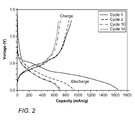
- Fig. 2 presenting first-cycle charge-discharge curves of an exemplary lithium-ion half-cell for a germanium-based anode containing boron and tungsten according to some embodiments of the invention.
- the voltage of the half-cell is presented as a function of the charge values in mAh/g.
- the exemplary anode material included (in weight percentage from the total weight of the anode) 69% Ge, 3 % C, 10% W, 5% B, 10% binder and 3 % conductive additives (Ge 0.69 C 0.03 W 0.10 B 0.050 Binder 0.1 ConductiveAditive 0.03 ).
- the as-milled Ge/C/W/B alloy i.e.
- the active material included 79% Ge, 3% C, 12% W and 6% B weight percent of the total weight of the alloy (Ge 0.79 C 0.03 W 0.12 B 0.06 ).
- the first-cycle efficiency is defined as the first discharge yield divided by the first charge yield.
- the first charge capacity is much higher than the theoretical first charge capacity of 1,143mAh/g known for germanium. This behavior is probably due to the reaction between available lithium ions and boron and/or tungsten, as explained above.
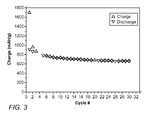
- Fig. 3 presenting charge-discharge graph as a function of the cycle for a germanium-based anode containing boron and tungsten according to some embodiments of the invention.
- the same type of half-cell with the same anode that was tested to create the graph presented in Fig. 2 was used again in a multi cycle charge-discharge tests.
- At the first 6 cycles there is a drop in capacitance that may be attributed to the expansion/contraction of the germanium particles.
- the anode stabilized, resulting in a very high coulombic efficiency (99%) and a stable cyclic response.
Landscapes
- Chemical & Material Sciences (AREA)
- Engineering & Computer Science (AREA)
- Chemical Kinetics & Catalysis (AREA)
- Electrochemistry (AREA)
- General Chemical & Material Sciences (AREA)
- Power Engineering (AREA)
- Materials Engineering (AREA)
- Microelectronics & Electronic Packaging (AREA)
- Manufacturing & Machinery (AREA)
- Inorganic Chemistry (AREA)
- Composite Materials (AREA)
- Physics & Mathematics (AREA)
- Condensed Matter Physics & Semiconductors (AREA)
- General Physics & Mathematics (AREA)
- Dispersion Chemistry (AREA)
- Battery Electrode And Active Subsutance (AREA)
Abstract
Description
- The present disclosure relates to electrode active materials used in lithium ion devices, such as rechargeable lithium ion batteries.
- Lithium ion batteries, also known as Li-ion Batteries or LIB's are widely used in consumer electronics, for example in mobile telephones, tablets and laptops. LIB's are also used in other fields, such as military uses, electric vehicles and aerospace applications. During discharge of the battery, lithium ions (Li-ions) travel from a high-energy anode material through an electrolyte and a separator to a low-energy cathode material. During charging, energy is used to transfer the Li-ions back to the high-energy anode assembly. The charge and discharge processes in batteries are slow processes, and can degrade the chemical compounds inside the battery over time. Rapid charging causes accelerated degradation of the battery constituents, as well as a potential fire hazard due to a localized, over-potential build-up and increased heat generation - which can ignite the internal components, and lead to explosion.
- Typical Li-ion battery anodes contain mostly graphite. Silicon or germanium, as anode-alloying components, generally exhibit higher lithium absorption capacities in comparison to anodes containing only graphite. Such silicon-containing or germanium-containing electrodes, however, usually exhibit poor life cycle and poor coulombic efficiency due to the mechanical expansion of silicon and germanium upon alloying with lithium, and upon lithium extraction from the alloy, which reduce the silicon alloy volume. Such mechanical instability results in the material breaking into fragments.
- Some embodiments of the invention may be directed to lithium- ion devices and in particular to anodes for lithium- ion devices. An anode material for a lithium ion device according to some embodiments of the invention may include an active material including germanium and boron. In some embodiments, the weight percentage of the germanium may be between about 5 to 80 weight % of the total weight of the anode material and the weight percentage of the boron may be between about 2 to 20 weight % of the total weight of the anode material. In some embodiments, the weight percentage of the germanium may be between about 60 to about 75 weight % of the total weight of the anode material and the weight percentage of the boron may be between about 3 to about 6 weight % of the total weight of the anode material.
- An active material for producing anodes for Li-ion devices may include germanium at a weight percentage of about between 6.5 to 94 weight % of the total weight of the active material and boron at a weight percentage of about between 1.5 to 15 weight % of the total weight of the active material. In some embodiments, the active material may include carbon. In some embodiments, the active material may further include tungsten at a weight percentage of between about 6 to about 25 weight % tungsten of the total weight of the active material.
- Some embodiments of the invention may be directed to a lithium ion device. The lithium ion device may include an anode having an active material comprising germanium and boron. In some embodiments, the weight percentage of the germanium may be between about 5 to 80 weight % of the total weight of the anode and the weight percentage of the boron may be between about 2 to 20 weight % of the total weight of the anode. The lithium ion device may further include a cathode and an electrolyte.
- Some embodiments of the invention may be directed to a method for making an anode material for a lithium ion device. The method may include forming an alloy from germanium powder, carbon, and a boron-containing compound to form an active material, and adding the active material to a matrix to form the anode material. In some embodiments, the weight percentage of the germanium is between about 5 to about 80 weight % of the total weight of the anode material and the weight percentage of the boron is between about 2 to about 20 weight % of the total weight of the anode material.
- The subject matter regarded as the invention is particularly pointed out and distinctly claimed in the concluding portion of the specification. The invention, however, both as to organization and method of operation, together with objects, features, and advantages thereof, may best be understood by reference to the following detailed description when read with the accompanying drawings in which:
-
Fig. 1 is an illustration of an exemplary lithium ion device according to some embodiments of the invention; -
Fig. 2 is a graph presenting first-cycle charge-discharge curves of an exemplary lithium-ion half-cell for a germanium-based anode containing boron and tungsten according to some embodiments of the invention; and -
Fig. 3 is a graph presenting charge-discharge graph as a function of the cycle for a germanium-based anode containing boron and tungsten according to some embodiments of the invention. - It will be appreciated that for simplicity and clarity of illustration, elements shown in the figures have not necessarily been drawn to scale. For example, the dimensions of some of the elements may be exaggerated relative to other elements for clarity. Further, where considered appropriate, reference numerals may be repeated among the figures to indicate corresponding or analogous elements.
- In the following detailed description, numerous specific details are set forth in order to provide a thorough understanding of the invention. However, it will be understood by those skilled in the art that the present invention may be practiced without these specific details. In other instances, well-known methods, procedures, and components have not been described in detail so as not to obscure the present invention.
- Embodiments of the invention describe anodes for lithium ion devices, an active material (anode intercalation compounds) for manufacturing the anodes and the lithium ion devices. The term active material refers herein to an alloying material that is chemically active with lithium ions. The lithium ion devices may include lithium ion batteries (Li-ion battery or LIB), Li-ion capacitors (LIC), Li-ion hybrid system including both a battery and a capacitor or the like.
- The active material may include an alloy comprising graphite (C), germanium (Ge) and boron (B). The carbon, germanium and boron may be milled together to form an alloy. Other methods for forming alloys may be used. In some embodiments, the active material may further include silicon (Si) and tungsten (W) in the form of tungsten carbide (WC) particles. In some embodiments, the active material may include an alloy comprising graphite (C), germanium (Ge) and tungsten (W). As used herein, "alloy" includes an intimate mixture of metal powders, as described above.
- According to embodiments of the invention, the composition of the anode may comprise an active anode material as detailed herein, a binder and/or plasticizer (e.g. polyvinylidene fluoride (PVDF)) and a conductive agent (e.g. carbon black and carbon-nano-tubes (CNT)).
- According to some embodiments, the weight percentage of the germanium may be between about 5 to 80 weight % of the total weight of the anode material and the weight percentage of the boron may be between about 2 to 20 weight % of the total weight of the anode material. According to other embodiments, the anode material may further include tungsten. The percentage of the tungsten may be between about 2 to 20 weight % of the total weight of the anode material.
- In some embodiments, the weight percentage of the germanium may be between about 60 to 75 weight % of the total weight of the anode material, the weight percentage of the boron may be between about 3 to 6 weight % of the total weight of the anode material. The weight percentage of the carbon (in the form of graphite) within the active material may be between about 0.5 to 5 weight % of the total weight of the anode material. In some embodiments, the weight percentage of the tungsten may be between 7 to about 11 weight % of the total weight of the anode material.
- In some embodiments, the active material within the anode material may further include silicon. The amount of silicon is added such that the weight ratio between the germanium and the silicon is at least 4 to 1, for example, 5 to 1, 6 to 1 or more. An exemplary anode material having 60 weight % germanium of the total weight of the anode material may include 12 weight % silicon of the total weight of the anode material.
- Reference is made to
Fig. 1 , illustrating an exemplary lithium ion device according to some embodiments of the invention. Alithium ion device 100 may include ananode 110 as detailed herein, acathode 120 and anelectrolyte 130 suitable for lithium ion devices. A non-limiting list of exemplary lithium ion devices may be Li-ion batteries, Li-ion capacitors and Li-ion hybrid system including both a battery and a capacitor.Electrolyte 130 may be in the form of a liquid, solid or gel. Examples of solid electrolytes include polymeric electrolytes such as polyethylene oxide, fluorine-containing polymers and copolymers (e.g., polytetrafluoroethylene), and combinations thereof. Examples of liquid electrolytes include ethylene carbonate, diethyl carbonate, propylene carbonate, fluoroethylene carbonate (FEC), and combinations thereof. The electrolyte may be provided with a lithium electrolyte salt. Examples of suitable salts include LiPF6, LiBF4, lithium bis(oxalato)borate, LiN(CF3SO2)2, LiN(C2F5SO2)2, LiAsF6, LiC(CF3SO2)3, LiClO4, and LiTFSI.Cathode 120 may include cathode compositions suitable for the use in lithium ion devices. Examples of suitable cathode compositions may include LiCoO2, LiCo0.33Mn0.33Ni0.33O2, LiMn2O4, and LiFePO4. - In some embodiments,
lithium ion device 100 may further include a separator (not illustrated). The separator may be configured to separate between the anode and the cathode. An exemplary separator according to some embodiments of the invention may include poly ethylene (PE), polypropylene (PP) or the like. -
Anode 110 according to embodiments of the invention, when incorporated in a lithium ion device, such as battery, exhibits improved cycle-life and coulombic efficiency over common anodes. The mechanical stability of the anode (achieved after the first cycle, or after several initial cycles), and hence of the lithium ion device, is also improved. Such stability is assumed to be attributed to the incorporation of the tungsten and/or boron into the expanding germanium-lithium alloy during the charge-discharge process. Such incorporation may help prevent metallization of the lithium during charging due to the relatively strong lithium-tungsten and/or lithium-boron binding. Such strong binding may result in a partly-charged assembly which may contribute to the enhanced stability and cycle life of the anode. - The presence of boron and/or tungsten may facilitate the electrochemical utilization of the germanium (and the silicon in a Si-Ge anode material), and substantially may reduce the migration of germanium into the electrode substrate. Moreover, boron carbide may enhance the binding energy of Li atoms, (boron's binding energy is greater than the cohesive energy of lithium metal) and may prevent lithium from clustering at high lithium doping concentrations.
- Boron carbide, which is inert to oxidation at the anode in the electrochemical reaction, interacts with germanium, germanium oxide and lithium. Lithium ions may react with boron carbide and germanium oxide to form lithium carbide, lithium boride, lithium oxide and mainly lithium tetraborate, thus leaving the Li ions partly charged. Such partial surface charges in Li-Ge-C alloys may stabilize the overall structure externally and/or internally. External stabilization may occur as a result of preventing lithium metallization by keeping the lithium as a tetraborate salt. Internal stabilization may occur as a result of leaving the internal germanium alloy structure with δ+ centers, and hence providing a stable matrix for lithium ion transport inside the germanium structure, during the extraction and insertion of lithium ions.
- Tungsten carbide with naturally-occurring germanium oxide-carbon composites may improve the electrochemical behavior of the anode. The tungsten-carbide may act as hydron (H+) ion barrier. Tungsten carbide is highly conductive and inert substance, therefore, may further stabilize the conductivity of the electrode over the life cycle and therefore, may stabilize the conductivity of the electrode.
- Preparation of the anode may include milling and/or mixing processes. In some embodiments, a germanium powder and graphite powder may be inserted into a high-energy ball-miller to be milled under protective atmosphere or non-protective atmosphere. In some embodiments, a boron-carbide (B4C) powder may be added to the pre-milled Ge/C mixture inside the miller. In some embodiments, Si powder may further be added to the Ge/C mixture inside the miller. The miller may include hardened alumina media that may be agitated at 1000-1500 RPM. The milling stage may produce an alloy having nano-size particles of around 20-100 nm particle size. In some embodiments, an emulsion containing nano-sized tungsten carbide (WC) particles may be added to the as milled powder (Ge/C or Ge/C/B alloy) at the end of the milling process to produce the active material for the anode. The tungsten carbide particle size may be between around 20 to 60 nm. As used herein, "nano-sized" particles means particles having an average particle size less than one micron, in embodiments "nano-sized" means particles having an average particle size less than 100 nm.
- The active material for making anodes for Li-ions devices (e.g., device 100), such as batteries may include a germanium-carbon-boron-tungsten alloy, a germanium -carbon-boron alloy, germanium- silicon-carbon-boron alloy or a germanium-carbon-tungsten alloy. Additional polymeric binders and conductive additives may be added to the alloy to form the final anode material. An exemplary anode, according to embodiments of the invention, may include conductive materials at a weight percentage of about between 5 to 10 weight % of the total weight of the anode material and binder material at a weight percentage of about between 0.01 to 5 weight % of the total weight of the anode material. Exemplary conductive elements may include spherical carbon, carbon nano-tubes and/or graphene particles.
- In some embodiments, the active material may include a germanium-carbon-boron alloy, in which the weight percentage of the germanium may be between about 6.5 to about 94 weight % of the total weight of the active material, the weight percentage of the boron may be between about 1.5 to about 15 weight % of the total weight of the active material and the weight percentage of the carbon may be between about 6.5 to about 25 weight % of the total weight of the active material. In some embodiments, the active material may further include tungsten and/or silicon. The weight percentage of the tungsten may be between 8-30 weight % of the total weight of the active material and the silicon may be added such that the weight ratio between the germanium and the silicon is at least 4 to 1.
- In some embodiments, the active material may include a germanium-carbon-boron-tungsten alloy, in which the weight percentage of the germanium may be between about 72 to about 96 weight % of the total weight of the active material, the weight percentage of the boron may be between about 3 to about 6 weight % of the total weight of the active material, the weight percentage of the carbon may be between about 0.66 to about 6.6 weight % of the total weight of the active material. In some embodiments, when the active material includes tungsten, the weight percentage of the tungsten may be between about 6 to 25 weight % of the total weight of the active material. In some embodiments, the active material may include a germanium-carbon- tungsten alloy, in which the weight percentage of the germanium may be between about 6.5 to about 94 weight % of the total weight of the active material, the weight percentage of the carbon may be between about 0.67 to about 6.7 weight % of the total weight of the active material and the weight percentage of the tungsten may be between about 6 to about 25 weight % of the total weight of the active material.
- In some embodiments, the anode material may further include carbon nano-tubes (CNT) at a weight percentage of about between 0.05 to 0.5 weight % of the total weight of the anode. The carbon nano-tubes may replace the tungsten carbide particles or be added to the anode material in addition to the tungsten carbide particles. Accordingly, the alloy material may include between 0.06-0.8 weight % carbon nano-tubes of the total weight of the anode material. An exemplary anode material may include 0.1-0.3 weight % single-rod carbon nano-tubes.
- Reference is made to
Fig. 2 presenting first-cycle charge-discharge curves of an exemplary lithium-ion half-cell for a germanium-based anode containing boron and tungsten according to some embodiments of the invention. The voltage of the half-cell is presented as a function of the charge values in mAh/g. The exemplary anode material included (in weight percentage from the total weight of the anode) 69% Ge, 3 % C, 10% W, 5% B, 10% binder and 3 % conductive additives (Ge0.69C0.03W0.10B0.050Binder0.1ConductiveAditive0.03). The as-milled Ge/C/W/B alloy (i.e. the active material) included 79% Ge, 3% C, 12% W and 6% B weight percent of the total weight of the alloy (Ge0.79C0.03W0.12B0.06). Looking at the graphs ofFig. 2 , the first charge yielded 1,705 mAh/g, and the discharge produced 913 mAh/g, resulting in a 53.5% first-cycle efficiency. The first-cycle efficiency is defined as the first discharge yield divided by the first charge yield. The first charge capacity is much higher than the theoretical first charge capacity of 1,143mAh/g known for germanium. This behavior is probably due to the reaction between available lithium ions and boron and/or tungsten, as explained above. - Reference is made to
Fig. 3 , presenting charge-discharge graph as a function of the cycle for a germanium-based anode containing boron and tungsten according to some embodiments of the invention. The same type of half-cell with the same anode that was tested to create the graph presented inFig. 2 was used again in a multi cycle charge-discharge tests. At the first 6 cycles there is a drop in capacitance that may be attributed to the expansion/contraction of the germanium particles. However, already after 7 cycles the anode stabilized, resulting in a very high coulombic efficiency (99%) and a stable cyclic response. - While certain features of the invention have been illustrated and described herein, many modifications, substitutions, changes, and equivalents will now occur to those of ordinary skill in the art. It is, therefore, to be understood that the appended claims are intended to cover all such modifications and changes as fall within the true spirit of the invention.
Claims (15)
- An anode material for a lithium ion device, comprising:an active material comprising germanium and boron,wherein the weight percentage of the germanium is between about 5 to about 80 weight % of the total weight of the anode material and the weight percentage of the boron is between about 2 to about 20 weight % of the total weight of the anode material.
- An anode material according to claim 1, wherein the active material further comprises carbon at a weight percentage of about between 0.5 to about 5 weight % of the total weight of the anode material.
- An anode material according to claim 1 or 2, wherein the active material further comprises tungsten at a weight percentage of between about 5 to about 20 weight % of the total weight of the anode material.
- An anode material according to claim 1 or 2, wherein the active material further comprises tungsten at a weight percentage of between about 7 to about 11 weight % of the total weight of the anode material.
- An anode material according to any one of the preceding claims, wherein the active material further comprises silicon and a weight ratio of germanium to silicon in the active material is at least 4 to 1.
- An anode material according to any one of the preceding claims, wherein the weight percentage of the germanium is between about 60 to about 75 weight % of the total weight of the anode material and the weight percentage of the boron is between about 3 to about 6 weight % of the total weight of the anode material.
- An anode material according to any one of the preceding claims, further comprising:one or more conductive materials, wherein the weight percentage of the conductive materials is between about 0.01 to about 5 weight % of the total weight of the anode material.
- A lithium ion device comprising:an anode having an active material comprising germanium and boron, wherein the weight percentage of the germanium is between about 5 to about 80 weight % of the total weight of the anode material and the weight percentage of the boron is between about 2 to about 20 weight % of the total weight of the anode material;a cathode; andan electrolyte.
- A lithium ion device according to claim 8, wherein the active material further comprises carbon at a weight percentage of about between 0.5 to about 5 weight % of the total weight of the anode material.
- A lithium ion device according to claims 8 or 9, wherein the active material further comprises tungsten at a weight percentage of about between 5 to about 20 weight % of the total weight of the anode.
- A lithium ion device according to any of claims 8 to 10, wherein the active material further comprises silicon and a weight ratio of germanium to silicon in the active material is at least 4 to 1.
- A method for making an anode material for a lithium ion device, comprising:forming an alloy from germanium powder, carbon, and a boron-containing compound to form an active material, and adding the active material to a matrix to form the anode material;wherein the weight percentage of the germanium is between about 5 to about 80 weight % of the total weight of the anode material and the weight percentage of the boron is between about 2 to about 20 weight % of the total weight of the anode material.
- A method according to claim 12, wherein the active material comprises carbon at a weight percentage of between about 0.5 to about 5 weight % of the total weight of the anode material.
- A method according to claim 12 or 13, wherein the active material further comprises tungsten at a weight percentage of between about 5 to about 20 weight % of the total weight of the anode material.
- A method according to any one of claims 12 to 14, wherein the active material further comprising silicon and a weight ratio of germanium to silicon in the active material is at least 4 to 1.
Applications Claiming Priority (2)
| Application Number | Priority Date | Filing Date | Title |
|---|---|---|---|
| US201462081043P | 2014-11-18 | 2014-11-18 | |
| US14/926,012 US9472804B2 (en) | 2014-11-18 | 2015-10-29 | Anodes comprising germanium for lithium-ion devices |
Publications (2)
| Publication Number | Publication Date |
|---|---|
| EP3024067A1 true EP3024067A1 (en) | 2016-05-25 |
| EP3024067B1 EP3024067B1 (en) | 2018-04-25 |
Family
ID=54366090
Family Applications (1)
| Application Number | Title | Priority Date | Filing Date |
|---|---|---|---|
| EP15192846.2A Active EP3024067B1 (en) | 2014-11-18 | 2015-11-03 | Compounds for battery electrodes, energy storage devices, and methods |
Country Status (4)
| Country | Link |
|---|---|
| US (4) | US9472804B2 (en) |
| EP (1) | EP3024067B1 (en) |
| KR (1) | KR102413376B1 (en) |
| CN (1) | CN105609748B (en) |
Families Citing this family (33)
| Publication number | Priority date | Publication date | Assignee | Title |
|---|---|---|---|---|
| US10293704B2 (en) | 2014-04-08 | 2019-05-21 | StoreDot Ltd. | Electric vehicles with adaptive fast-charging, utilizing supercapacitor-emulating batteries |
| US10110036B2 (en) | 2016-12-15 | 2018-10-23 | StoreDot Ltd. | Supercapacitor-emulating fast-charging batteries and devices |
| US11128152B2 (en) | 2014-04-08 | 2021-09-21 | StoreDot Ltd. | Systems and methods for adaptive fast-charging for mobile devices and devices having sporadic power-source connection |
| US10549650B2 (en) | 2014-04-08 | 2020-02-04 | StoreDot Ltd. | Internally adjustable modular single battery systems for power systems |
| US10199646B2 (en) | 2014-07-30 | 2019-02-05 | StoreDot Ltd. | Anodes for lithium-ion devices |
| WO2016063281A1 (en) | 2014-10-21 | 2016-04-28 | Ramot At Tel-Aviv University Ltd | High-capacity silicon nanowire based anode for lithium-ion batteries |
| US9472804B2 (en) * | 2014-11-18 | 2016-10-18 | StoreDot Ltd. | Anodes comprising germanium for lithium-ion devices |
| US10367191B2 (en) | 2016-04-07 | 2019-07-30 | StoreDot Ltd. | Tin silicon anode active material |
| US10367192B2 (en) | 2016-04-07 | 2019-07-30 | StoreDot Ltd. | Aluminum anode active material |
| US10680289B2 (en) | 2016-04-07 | 2020-06-09 | StoreDot Ltd. | Buffering zone for preventing lithium metallization on the anode of lithium ion batteries |
| US11205796B2 (en) | 2016-04-07 | 2021-12-21 | StoreDot Ltd. | Electrolyte additives in lithium-ion batteries |
| US10916811B2 (en) | 2016-04-07 | 2021-02-09 | StoreDot Ltd. | Semi-solid electrolytes with flexible particle coatings |
| US10355271B2 (en) | 2016-04-07 | 2019-07-16 | StoreDot Ltd. | Lithium borates and phosphates coatings |
| US10096859B2 (en) | 2016-04-07 | 2018-10-09 | StoreDot Ltd. | Electrolytes with ionic liquid additives for lithium ion batteries |
| US10454101B2 (en) | 2017-01-25 | 2019-10-22 | StoreDot Ltd. | Composite anode material made of core-shell particles |
| US10199677B2 (en) | 2016-04-07 | 2019-02-05 | StoreDot Ltd. | Electrolytes for lithium ion batteries |
| US10290864B2 (en) | 2016-04-07 | 2019-05-14 | StoreDot Ltd. | Coated pre-lithiated anode material particles and cross-linked polymer coatings |
| US10818919B2 (en) | 2016-04-07 | 2020-10-27 | StoreDot Ltd. | Polymer coatings and anode material pre-lithiation |
| EP3336937B1 (en) | 2016-12-15 | 2020-02-05 | StoreDot Ltd. | Electric vehicles with adaptive fast-charging, utilizing supercapacitor-emulating batteries |
| US11569499B2 (en) | 2019-01-23 | 2023-01-31 | StoreDot Ltd. | Aerogel-based electrodes |
| US10608463B1 (en) | 2019-01-23 | 2020-03-31 | StoreDot Ltd. | Direct charging of battery cell stacks |
| US10586977B1 (en) | 2019-01-23 | 2020-03-10 | StoreDot Ltd. | Electrodes made of electrically conductive metallic porous structure with embedded active material particles |
| US10862104B2 (en) | 2019-01-28 | 2020-12-08 | StoreDot Ltd. | Mono-cell batteries |
| US10581065B1 (en) | 2019-01-28 | 2020-03-03 | StoreDot Ltd. | Production of metalloid-based anodes for lithium ion batteries using dry etching |
| US11495835B2 (en) | 2019-03-06 | 2022-11-08 | StoreDot Ltd. | Management of large stacks of battery cells |
| US11264810B2 (en) | 2019-03-21 | 2022-03-01 | StoreDot Ltd. | Balancing charging of lithium ion batteries by a switching circuitry |
| US11831012B2 (en) | 2019-04-25 | 2023-11-28 | StoreDot Ltd. | Passivated silicon-based anode material particles |
| CN110380036B (en) * | 2019-07-24 | 2022-04-12 | 福州大学 | A kind of alloy material composite carbon nanotube and its preparation method and application |
| US11658279B2 (en) | 2020-01-07 | 2023-05-23 | StoreDot Ltd. | Method for configuring and prelithiating a fast charging cell |
| RU2743576C1 (en) * | 2020-08-12 | 2021-02-20 | Федеральное государственное бюджетное учреждение науки Институт физической химии и электрохимии им. А.Н. Фрумкина Российской академии наук (ИФХЭ РАН) | Anode of lithium-ion battery for operation at lower temperatures and method for producing it |
| KR102416184B1 (en) * | 2020-08-26 | 2022-07-05 | 경상국립대학교산학협력단 | Super capacitor electrode material and manufacturing method thereof |
| US11901564B2 (en) | 2022-02-09 | 2024-02-13 | Socpra Sciences Et Génie S.E.C. | Anisotropic porous germanium nanostructures achieved with fast bipolar electrochemical etching and chemical etching |
| KR102800994B1 (en) * | 2023-11-06 | 2025-04-29 | 주식회사 엘지에너지솔루션 | Anodeless coating layer and All-solid-state battery including the same |
Citations (5)
| Publication number | Priority date | Publication date | Assignee | Title |
|---|---|---|---|---|
| US3778254A (en) * | 1971-11-18 | 1973-12-11 | Atomic Energy Commission | Brazing filler metal for molybdenum |
| US20040219428A1 (en) * | 2003-05-01 | 2004-11-04 | Nissan Motor Co., Ltd. | High-speed charging/discharging electrode and battery |
| US20100190059A1 (en) * | 2004-04-22 | 2010-07-29 | Graetz Jason A | High-capacity nanostructured germanium-containing materials and lithium alloys thereof |
| US20110257001A1 (en) * | 2010-04-15 | 2011-10-20 | Hoya Corporation | Optical glass, preform for precision press molding, optical element, and method for manufacturing optical element |
| US20130260285A1 (en) * | 2010-12-09 | 2013-10-03 | Nhk Spring Co., Ltd. | Brazing material for bonding in atmosphere, bonded article, and current collecting material |
Family Cites Families (9)
| Publication number | Priority date | Publication date | Assignee | Title |
|---|---|---|---|---|
| US6555272B2 (en) * | 1998-09-11 | 2003-04-29 | Nippon Steel Corporation | Lithium secondary battery and active material for negative electrode in lithium secondary battery |
| TW431002B (en) * | 1998-09-11 | 2001-04-21 | Nippon Steel Corp | Lithium secondary battery and active material for negative electrode in lithium secondary battery |
| CN1257568C (en) * | 1999-10-22 | 2006-05-24 | 三洋电机株式会社 | Electrode of rechargeable lithium battery and rechargeable lithium battery |
| JP4940571B2 (en) | 2005-04-08 | 2012-05-30 | ソニー株式会社 | Lithium ion secondary battery |
| US8679679B2 (en) * | 2008-01-11 | 2014-03-25 | A123 Systems, Inc. | Silicon based composite material |
| CN101728513B (en) * | 2009-12-03 | 2012-07-04 | 武汉大学 | Compound for anode material of lithium ion secondary battery and preparation method thereof |
| JP5623783B2 (en) * | 2010-05-13 | 2014-11-12 | 日本発條株式会社 | Brazing material for air bonding, bonded body, and current collecting material |
| JP6006662B2 (en) * | 2013-03-05 | 2016-10-12 | 信越化学工業株式会社 | Method for producing silicon-containing particles, method for producing negative electrode material for non-aqueous electrolyte secondary battery, and method for producing non-aqueous electrolyte secondary battery |
| US9472804B2 (en) * | 2014-11-18 | 2016-10-18 | StoreDot Ltd. | Anodes comprising germanium for lithium-ion devices |
-
2015
- 2015-10-29 US US14/926,012 patent/US9472804B2/en active Active
- 2015-11-03 EP EP15192846.2A patent/EP3024067B1/en active Active
- 2015-11-12 CN CN201510772042.1A patent/CN105609748B/en active Active
- 2015-11-17 KR KR1020150161083A patent/KR102413376B1/en active Active
-
2016
- 2016-09-13 US US15/263,399 patent/US9728776B2/en not_active Expired - Fee Related
- 2016-09-14 US US15/264,641 patent/US9583761B2/en active Active
- 2016-09-21 US US15/271,234 patent/US9871247B2/en not_active Expired - Fee Related
Patent Citations (5)
| Publication number | Priority date | Publication date | Assignee | Title |
|---|---|---|---|---|
| US3778254A (en) * | 1971-11-18 | 1973-12-11 | Atomic Energy Commission | Brazing filler metal for molybdenum |
| US20040219428A1 (en) * | 2003-05-01 | 2004-11-04 | Nissan Motor Co., Ltd. | High-speed charging/discharging electrode and battery |
| US20100190059A1 (en) * | 2004-04-22 | 2010-07-29 | Graetz Jason A | High-capacity nanostructured germanium-containing materials and lithium alloys thereof |
| US20110257001A1 (en) * | 2010-04-15 | 2011-10-20 | Hoya Corporation | Optical glass, preform for precision press molding, optical element, and method for manufacturing optical element |
| US20130260285A1 (en) * | 2010-12-09 | 2013-10-03 | Nhk Spring Co., Ltd. | Brazing material for bonding in atmosphere, bonded article, and current collecting material |
Also Published As
| Publication number | Publication date |
|---|---|
| US20160141612A1 (en) | 2016-05-19 |
| EP3024067B1 (en) | 2018-04-25 |
| KR102413376B1 (en) | 2022-06-24 |
| US9472804B2 (en) | 2016-10-18 |
| US9871247B2 (en) | 2018-01-16 |
| US20170005330A1 (en) | 2017-01-05 |
| US9728776B2 (en) | 2017-08-08 |
| CN105609748B (en) | 2020-08-18 |
| US20160380258A1 (en) | 2016-12-29 |
| US20170012279A1 (en) | 2017-01-12 |
| US9583761B2 (en) | 2017-02-28 |
| KR20160059440A (en) | 2016-05-26 |
| CN105609748A (en) | 2016-05-25 |
Similar Documents
| Publication | Publication Date | Title |
|---|---|---|
| US9871247B2 (en) | Germanium-containing active material for anodes for lithium-ion devices | |
| US20160036045A1 (en) | Anodes for lithium-ion devices | |
| US10199646B2 (en) | Anodes for lithium-ion devices | |
| KR102543109B1 (en) | Lithium secondary battery and method of manufacturing the same | |
| US11114696B2 (en) | Electrolyte system for lithium-chalcogen batteries | |
| US20160261002A1 (en) | Solid-state multi-layer electrolyte, electrochemical cell and battery including the electrolyte, and method of forming same | |
| CN101017915A (en) | Nonaqueous electrolyte secondary battery | |
| JP2010135329A (en) | Cathode and lithium battery adopting this | |
| CN110800134B (en) | Method for improving the life of lithium-sulfur batteries | |
| CN106716685B (en) | Positive electrode for non-aqueous electrolyte secondary battery and non-aqueous electrolyte secondary battery using the same | |
| WO2016147607A1 (en) | Anode for sodium-ion and potassium-ion batteries | |
| CN107004842A (en) | Composite anode and Li-ion batteries piles and the preparation method of composite anode including composite anode | |
| KR101445019B1 (en) | Anode active material, method for preparing the same, and secondary battery using the anode active material | |
| CN110603672A (en) | Method for stabilizing Lithium Titanate Oxide (LTO) by surface coating | |
| WO2023081523A2 (en) | Bipolar lithium ion cathodes and cells and batteries containing lithium ion cathodes | |
| WO2013035829A1 (en) | Battery | |
| JP2022544975A (en) | Lithium-sulfur secondary battery capsule and lithium-sulfur secondary battery containing the same | |
| KR101953228B1 (en) | Secondary Battery | |
| US20190280294A1 (en) | Active material for a positive electrode of a battery cell, positive electrode, and battery cell | |
| CN114556617A (en) | Lithium ion battery and method for producing a lithium ion battery | |
| CN115699354A (en) | Cathode active material and lithium ion battery having the same | |
| KR102446269B1 (en) | lithium secondary battery | |
| CN108878882A (en) | Non-aqueous secondary batteries negative electrode active material and non-aqueous secondary batteries | |
| KR20260043766A (en) | Electrode for energy storage device and energy storage device comprising same | |
| KR20160018039A (en) | Cathod active material composition for magnesium rechargeable batteries and magnesium rechargeable batteries including the same |
Legal Events
| Date | Code | Title | Description |
|---|---|---|---|
| AK | Designated contracting states |
Kind code of ref document: A1 Designated state(s): AL AT BE BG CH CY CZ DE DK EE ES FI FR GB GR HR HU IE IS IT LI LT LU LV MC MK MT NL NO PL PT RO RS SE SI SK SM TR |
|
| AX | Request for extension of the european patent |
Extension state: BA ME |
|
| PUAI | Public reference made under article 153(3) epc to a published international application that has entered the european phase |
Free format text: ORIGINAL CODE: 0009012 |
|
| STAA | Information on the status of an ep patent application or granted ep patent |
Free format text: STATUS: REQUEST FOR EXAMINATION WAS MADE |
|
| 17P | Request for examination filed |
Effective date: 20161117 |
|
| RBV | Designated contracting states (corrected) |
Designated state(s): AL AT BE BG CH CY CZ DE DK EE ES FI FR GB GR HR HU IE IS IT LI LT LU LV MC MK MT NL NO PL PT RO RS SE SI SK SM TR |
|
| STAA | Information on the status of an ep patent application or granted ep patent |
Free format text: STATUS: EXAMINATION IS IN PROGRESS |
|
| 17Q | First examination report despatched |
Effective date: 20170530 |
|
| REG | Reference to a national code |
Ref country code: DE Ref legal event code: R079 Ref document number: 602015010355 Country of ref document: DE Free format text: PREVIOUS MAIN CLASS: H01M0004133000 Ipc: H01G0011060000 |
|
| RIC1 | Information provided on ipc code assigned before grant |
Ipc: H01M 2/16 20060101ALI20171013BHEP Ipc: H01M 10/0525 20100101ALI20171013BHEP Ipc: H01M 4/136 20100101ALI20171013BHEP Ipc: H01M 10/0569 20100101ALI20171013BHEP Ipc: H01G 11/50 20130101ALI20171013BHEP Ipc: H01G 11/56 20130101ALI20171013BHEP Ipc: H01G 11/08 20130101ALI20171013BHEP Ipc: H01M 4/02 20060101ALI20171013BHEP Ipc: H01G 11/74 20130101ALI20171013BHEP Ipc: H01M 10/0565 20100101ALI20171013BHEP Ipc: H01G 11/06 20130101AFI20171013BHEP Ipc: H01G 11/58 20130101ALI20171013BHEP Ipc: H01M 4/62 20060101ALI20171013BHEP Ipc: H01G 11/52 20130101ALI20171013BHEP |
|
| GRAP | Despatch of communication of intention to grant a patent |
Free format text: ORIGINAL CODE: EPIDOSNIGR1 |
|
| STAA | Information on the status of an ep patent application or granted ep patent |
Free format text: STATUS: GRANT OF PATENT IS INTENDED |
|
| INTG | Intention to grant announced |
Effective date: 20171124 |
|
| RIN1 | Information on inventor provided before grant (corrected) |
Inventor name: BURSHTAIN, DORON Inventor name: ARONOV, DANIEL Inventor name: COSTI, RONNY Inventor name: OPHIR, CARMIT |
|
| GRAS | Grant fee paid |
Free format text: ORIGINAL CODE: EPIDOSNIGR3 |
|
| GRAA | (expected) grant |
Free format text: ORIGINAL CODE: 0009210 |
|
| STAA | Information on the status of an ep patent application or granted ep patent |
Free format text: STATUS: THE PATENT HAS BEEN GRANTED |
|
| AK | Designated contracting states |
Kind code of ref document: B1 Designated state(s): AL AT BE BG CH CY CZ DE DK EE ES FI FR GB GR HR HU IE IS IT LI LT LU LV MC MK MT NL NO PL PT RO RS SE SI SK SM TR |
|
| REG | Reference to a national code |
Ref country code: GB Ref legal event code: FG4D |
|
| REG | Reference to a national code |
Ref country code: CH Ref legal event code: EP |
|
| REG | Reference to a national code |
Ref country code: AT Ref legal event code: REF Ref document number: 993724 Country of ref document: AT Kind code of ref document: T Effective date: 20180515 |
|
| REG | Reference to a national code |
Ref country code: IE Ref legal event code: FG4D |
|
| REG | Reference to a national code |
Ref country code: DE Ref legal event code: R096 Ref document number: 602015010355 Country of ref document: DE |
|
| REG | Reference to a national code |
Ref country code: NL Ref legal event code: MP Effective date: 20180425 |
|
| REG | Reference to a national code |
Ref country code: LT Ref legal event code: MG4D |
|
| PG25 | Lapsed in a contracting state [announced via postgrant information from national office to epo] |
Ref country code: NL Free format text: LAPSE BECAUSE OF FAILURE TO SUBMIT A TRANSLATION OF THE DESCRIPTION OR TO PAY THE FEE WITHIN THE PRESCRIBED TIME-LIMIT Effective date: 20180425 |
|
| PG25 | Lapsed in a contracting state [announced via postgrant information from national office to epo] |
Ref country code: ES Free format text: LAPSE BECAUSE OF FAILURE TO SUBMIT A TRANSLATION OF THE DESCRIPTION OR TO PAY THE FEE WITHIN THE PRESCRIBED TIME-LIMIT Effective date: 20180425 Ref country code: LT Free format text: LAPSE BECAUSE OF FAILURE TO SUBMIT A TRANSLATION OF THE DESCRIPTION OR TO PAY THE FEE WITHIN THE PRESCRIBED TIME-LIMIT Effective date: 20180425 Ref country code: PL Free format text: LAPSE BECAUSE OF FAILURE TO SUBMIT A TRANSLATION OF THE DESCRIPTION OR TO PAY THE FEE WITHIN THE PRESCRIBED TIME-LIMIT Effective date: 20180425 Ref country code: SE Free format text: LAPSE BECAUSE OF FAILURE TO SUBMIT A TRANSLATION OF THE DESCRIPTION OR TO PAY THE FEE WITHIN THE PRESCRIBED TIME-LIMIT Effective date: 20180425 Ref country code: NO Free format text: LAPSE BECAUSE OF FAILURE TO SUBMIT A TRANSLATION OF THE DESCRIPTION OR TO PAY THE FEE WITHIN THE PRESCRIBED TIME-LIMIT Effective date: 20180725 Ref country code: BG Free format text: LAPSE BECAUSE OF FAILURE TO SUBMIT A TRANSLATION OF THE DESCRIPTION OR TO PAY THE FEE WITHIN THE PRESCRIBED TIME-LIMIT Effective date: 20180725 Ref country code: FI Free format text: LAPSE BECAUSE OF FAILURE TO SUBMIT A TRANSLATION OF THE DESCRIPTION OR TO PAY THE FEE WITHIN THE PRESCRIBED TIME-LIMIT Effective date: 20180425 |
|
| PG25 | Lapsed in a contracting state [announced via postgrant information from national office to epo] |
Ref country code: GR Free format text: LAPSE BECAUSE OF FAILURE TO SUBMIT A TRANSLATION OF THE DESCRIPTION OR TO PAY THE FEE WITHIN THE PRESCRIBED TIME-LIMIT Effective date: 20180726 Ref country code: RS Free format text: LAPSE BECAUSE OF FAILURE TO SUBMIT A TRANSLATION OF THE DESCRIPTION OR TO PAY THE FEE WITHIN THE PRESCRIBED TIME-LIMIT Effective date: 20180425 Ref country code: LV Free format text: LAPSE BECAUSE OF FAILURE TO SUBMIT A TRANSLATION OF THE DESCRIPTION OR TO PAY THE FEE WITHIN THE PRESCRIBED TIME-LIMIT Effective date: 20180425 Ref country code: HR Free format text: LAPSE BECAUSE OF FAILURE TO SUBMIT A TRANSLATION OF THE DESCRIPTION OR TO PAY THE FEE WITHIN THE PRESCRIBED TIME-LIMIT Effective date: 20180425 |
|
| REG | Reference to a national code |
Ref country code: AT Ref legal event code: MK05 Ref document number: 993724 Country of ref document: AT Kind code of ref document: T Effective date: 20180425 |
|
| PG25 | Lapsed in a contracting state [announced via postgrant information from national office to epo] |
Ref country code: PT Free format text: LAPSE BECAUSE OF FAILURE TO SUBMIT A TRANSLATION OF THE DESCRIPTION OR TO PAY THE FEE WITHIN THE PRESCRIBED TIME-LIMIT Effective date: 20180827 |
|
| REG | Reference to a national code |
Ref country code: DE Ref legal event code: R097 Ref document number: 602015010355 Country of ref document: DE |
|
| PG25 | Lapsed in a contracting state [announced via postgrant information from national office to epo] |
Ref country code: SK Free format text: LAPSE BECAUSE OF FAILURE TO SUBMIT A TRANSLATION OF THE DESCRIPTION OR TO PAY THE FEE WITHIN THE PRESCRIBED TIME-LIMIT Effective date: 20180425 Ref country code: AT Free format text: LAPSE BECAUSE OF FAILURE TO SUBMIT A TRANSLATION OF THE DESCRIPTION OR TO PAY THE FEE WITHIN THE PRESCRIBED TIME-LIMIT Effective date: 20180425 Ref country code: DK Free format text: LAPSE BECAUSE OF FAILURE TO SUBMIT A TRANSLATION OF THE DESCRIPTION OR TO PAY THE FEE WITHIN THE PRESCRIBED TIME-LIMIT Effective date: 20180425 Ref country code: EE Free format text: LAPSE BECAUSE OF FAILURE TO SUBMIT A TRANSLATION OF THE DESCRIPTION OR TO PAY THE FEE WITHIN THE PRESCRIBED TIME-LIMIT Effective date: 20180425 Ref country code: CZ Free format text: LAPSE BECAUSE OF FAILURE TO SUBMIT A TRANSLATION OF THE DESCRIPTION OR TO PAY THE FEE WITHIN THE PRESCRIBED TIME-LIMIT Effective date: 20180425 Ref country code: RO Free format text: LAPSE BECAUSE OF FAILURE TO SUBMIT A TRANSLATION OF THE DESCRIPTION OR TO PAY THE FEE WITHIN THE PRESCRIBED TIME-LIMIT Effective date: 20180425 |
|
| PG25 | Lapsed in a contracting state [announced via postgrant information from national office to epo] |
Ref country code: IT Free format text: LAPSE BECAUSE OF FAILURE TO SUBMIT A TRANSLATION OF THE DESCRIPTION OR TO PAY THE FEE WITHIN THE PRESCRIBED TIME-LIMIT Effective date: 20180425 Ref country code: SM Free format text: LAPSE BECAUSE OF FAILURE TO SUBMIT A TRANSLATION OF THE DESCRIPTION OR TO PAY THE FEE WITHIN THE PRESCRIBED TIME-LIMIT Effective date: 20180425 |
|
| PLBE | No opposition filed within time limit |
Free format text: ORIGINAL CODE: 0009261 |
|
| STAA | Information on the status of an ep patent application or granted ep patent |
Free format text: STATUS: NO OPPOSITION FILED WITHIN TIME LIMIT |
|
| 26N | No opposition filed |
Effective date: 20190128 |
|
| PG25 | Lapsed in a contracting state [announced via postgrant information from national office to epo] |
Ref country code: SI Free format text: LAPSE BECAUSE OF FAILURE TO SUBMIT A TRANSLATION OF THE DESCRIPTION OR TO PAY THE FEE WITHIN THE PRESCRIBED TIME-LIMIT Effective date: 20180425 |
|
| REG | Reference to a national code |
Ref country code: CH Ref legal event code: PL |
|
| PG25 | Lapsed in a contracting state [announced via postgrant information from national office to epo] |
Ref country code: MC Free format text: LAPSE BECAUSE OF FAILURE TO SUBMIT A TRANSLATION OF THE DESCRIPTION OR TO PAY THE FEE WITHIN THE PRESCRIBED TIME-LIMIT Effective date: 20180425 Ref country code: LU Free format text: LAPSE BECAUSE OF NON-PAYMENT OF DUE FEES Effective date: 20181103 |
|
| REG | Reference to a national code |
Ref country code: BE Ref legal event code: MM Effective date: 20181130 |
|
| REG | Reference to a national code |
Ref country code: IE Ref legal event code: MM4A |
|
| PG25 | Lapsed in a contracting state [announced via postgrant information from national office to epo] |
Ref country code: CH Free format text: LAPSE BECAUSE OF NON-PAYMENT OF DUE FEES Effective date: 20181130 Ref country code: LI Free format text: LAPSE BECAUSE OF NON-PAYMENT OF DUE FEES Effective date: 20181130 |
|
| PG25 | Lapsed in a contracting state [announced via postgrant information from national office to epo] |
Ref country code: FR Free format text: LAPSE BECAUSE OF NON-PAYMENT OF DUE FEES Effective date: 20181130 Ref country code: IE Free format text: LAPSE BECAUSE OF NON-PAYMENT OF DUE FEES Effective date: 20181103 |
|
| PG25 | Lapsed in a contracting state [announced via postgrant information from national office to epo] |
Ref country code: AL Free format text: LAPSE BECAUSE OF FAILURE TO SUBMIT A TRANSLATION OF THE DESCRIPTION OR TO PAY THE FEE WITHIN THE PRESCRIBED TIME-LIMIT Effective date: 20180425 Ref country code: BE Free format text: LAPSE BECAUSE OF NON-PAYMENT OF DUE FEES Effective date: 20181130 |
|
| PG25 | Lapsed in a contracting state [announced via postgrant information from national office to epo] |
Ref country code: MT Free format text: LAPSE BECAUSE OF NON-PAYMENT OF DUE FEES Effective date: 20181103 |
|
| PG25 | Lapsed in a contracting state [announced via postgrant information from national office to epo] |
Ref country code: TR Free format text: LAPSE BECAUSE OF FAILURE TO SUBMIT A TRANSLATION OF THE DESCRIPTION OR TO PAY THE FEE WITHIN THE PRESCRIBED TIME-LIMIT Effective date: 20180425 |
|
| PG25 | Lapsed in a contracting state [announced via postgrant information from national office to epo] |
Ref country code: HU Free format text: LAPSE BECAUSE OF FAILURE TO SUBMIT A TRANSLATION OF THE DESCRIPTION OR TO PAY THE FEE WITHIN THE PRESCRIBED TIME-LIMIT; INVALID AB INITIO Effective date: 20151103 Ref country code: MK Free format text: LAPSE BECAUSE OF NON-PAYMENT OF DUE FEES Effective date: 20180425 Ref country code: CY Free format text: LAPSE BECAUSE OF FAILURE TO SUBMIT A TRANSLATION OF THE DESCRIPTION OR TO PAY THE FEE WITHIN THE PRESCRIBED TIME-LIMIT Effective date: 20180425 |
|
| PG25 | Lapsed in a contracting state [announced via postgrant information from national office to epo] |
Ref country code: IS Free format text: LAPSE BECAUSE OF FAILURE TO SUBMIT A TRANSLATION OF THE DESCRIPTION OR TO PAY THE FEE WITHIN THE PRESCRIBED TIME-LIMIT Effective date: 20180825 |
|
| GBPC | Gb: european patent ceased through non-payment of renewal fee |
Effective date: 20191103 |
|
| PG25 | Lapsed in a contracting state [announced via postgrant information from national office to epo] |
Ref country code: GB Free format text: LAPSE BECAUSE OF NON-PAYMENT OF DUE FEES Effective date: 20191103 |
|
| PGFP | Annual fee paid to national office [announced via postgrant information from national office to epo] |
Ref country code: DE Payment date: 20251119 Year of fee payment: 11 |