EP3023419A1 - Method for continuously producing cyclic carbonate - Google Patents
Method for continuously producing cyclic carbonate Download PDFInfo
- Publication number
- EP3023419A1 EP3023419A1 EP14825786.8A EP14825786A EP3023419A1 EP 3023419 A1 EP3023419 A1 EP 3023419A1 EP 14825786 A EP14825786 A EP 14825786A EP 3023419 A1 EP3023419 A1 EP 3023419A1
- Authority
- EP
- European Patent Office
- Prior art keywords
- catalyst
- reaction
- cyclic carbonate
- production method
- reactor
- Prior art date
- Legal status (The legal status is an assumption and is not a legal conclusion. Google has not performed a legal analysis and makes no representation as to the accuracy of the status listed.)
- Granted
Links
Images


Classifications
-
- C—CHEMISTRY; METALLURGY
- C07—ORGANIC CHEMISTRY
- C07D—HETEROCYCLIC COMPOUNDS
- C07D317/00—Heterocyclic compounds containing five-membered rings having two oxygen atoms as the only ring hetero atoms
- C07D317/08—Heterocyclic compounds containing five-membered rings having two oxygen atoms as the only ring hetero atoms having the hetero atoms in positions 1 and 3
- C07D317/10—Heterocyclic compounds containing five-membered rings having two oxygen atoms as the only ring hetero atoms having the hetero atoms in positions 1 and 3 not condensed with other rings
- C07D317/32—Heterocyclic compounds containing five-membered rings having two oxygen atoms as the only ring hetero atoms having the hetero atoms in positions 1 and 3 not condensed with other rings with hetero atoms or with carbon atoms having three bonds to hetero atoms with at the most one bond to halogen, e.g. ester or nitrile radicals, directly attached to ring carbon atoms
- C07D317/34—Oxygen atoms
- C07D317/36—Alkylene carbonates; Substituted alkylene carbonates
- C07D317/38—Ethylene carbonate
-
- B—PERFORMING OPERATIONS; TRANSPORTING
- B01—PHYSICAL OR CHEMICAL PROCESSES OR APPARATUS IN GENERAL
- B01J—CHEMICAL OR PHYSICAL PROCESSES, e.g. CATALYSIS OR COLLOID CHEMISTRY; THEIR RELEVANT APPARATUS
- B01J31/00—Catalysts comprising hydrides, coordination complexes or organic compounds
- B01J31/02—Catalysts comprising hydrides, coordination complexes or organic compounds containing organic compounds or metal hydrides
- B01J31/0231—Halogen-containing compounds
-
- B—PERFORMING OPERATIONS; TRANSPORTING
- B01—PHYSICAL OR CHEMICAL PROCESSES OR APPARATUS IN GENERAL
- B01J—CHEMICAL OR PHYSICAL PROCESSES, e.g. CATALYSIS OR COLLOID CHEMISTRY; THEIR RELEVANT APPARATUS
- B01J31/00—Catalysts comprising hydrides, coordination complexes or organic compounds
- B01J31/02—Catalysts comprising hydrides, coordination complexes or organic compounds containing organic compounds or metal hydrides
- B01J31/0234—Nitrogen-, phosphorus-, arsenic- or antimony-containing compounds
- B01J31/0235—Nitrogen containing compounds
- B01J31/0239—Quaternary ammonium compounds
-
- B—PERFORMING OPERATIONS; TRANSPORTING
- B01—PHYSICAL OR CHEMICAL PROCESSES OR APPARATUS IN GENERAL
- B01J—CHEMICAL OR PHYSICAL PROCESSES, e.g. CATALYSIS OR COLLOID CHEMISTRY; THEIR RELEVANT APPARATUS
- B01J31/00—Catalysts comprising hydrides, coordination complexes or organic compounds
- B01J31/02—Catalysts comprising hydrides, coordination complexes or organic compounds containing organic compounds or metal hydrides
- B01J31/0234—Nitrogen-, phosphorus-, arsenic- or antimony-containing compounds
- B01J31/0235—Nitrogen containing compounds
- B01J31/0254—Nitrogen containing compounds on mineral substrates
-
- B—PERFORMING OPERATIONS; TRANSPORTING
- B01—PHYSICAL OR CHEMICAL PROCESSES OR APPARATUS IN GENERAL
- B01J—CHEMICAL OR PHYSICAL PROCESSES, e.g. CATALYSIS OR COLLOID CHEMISTRY; THEIR RELEVANT APPARATUS
- B01J31/00—Catalysts comprising hydrides, coordination complexes or organic compounds
- B01J31/02—Catalysts comprising hydrides, coordination complexes or organic compounds containing organic compounds or metal hydrides
- B01J31/0234—Nitrogen-, phosphorus-, arsenic- or antimony-containing compounds
- B01J31/0255—Phosphorus containing compounds
- B01J31/0267—Phosphines or phosphonium compounds, i.e. phosphorus bonded to at least one carbon atom, including e.g. sp2-hybridised phosphorus compounds such as phosphabenzene, the other atoms bonded to phosphorus being either carbon or hydrogen
- B01J31/0268—Phosphonium compounds, i.e. phosphine with an additional hydrogen or carbon atom bonded to phosphorous so as to result in a formal positive charge on phosphorous
-
- B—PERFORMING OPERATIONS; TRANSPORTING
- B01—PHYSICAL OR CHEMICAL PROCESSES OR APPARATUS IN GENERAL
- B01J—CHEMICAL OR PHYSICAL PROCESSES, e.g. CATALYSIS OR COLLOID CHEMISTRY; THEIR RELEVANT APPARATUS
- B01J31/00—Catalysts comprising hydrides, coordination complexes or organic compounds
- B01J31/02—Catalysts comprising hydrides, coordination complexes or organic compounds containing organic compounds or metal hydrides
- B01J31/0234—Nitrogen-, phosphorus-, arsenic- or antimony-containing compounds
- B01J31/0255—Phosphorus containing compounds
- B01J31/0269—Phosphorus containing compounds on mineral substrates
-
- B—PERFORMING OPERATIONS; TRANSPORTING
- B01—PHYSICAL OR CHEMICAL PROCESSES OR APPARATUS IN GENERAL
- B01J—CHEMICAL OR PHYSICAL PROCESSES, e.g. CATALYSIS OR COLLOID CHEMISTRY; THEIR RELEVANT APPARATUS
- B01J31/00—Catalysts comprising hydrides, coordination complexes or organic compounds
- B01J31/02—Catalysts comprising hydrides, coordination complexes or organic compounds containing organic compounds or metal hydrides
- B01J31/0234—Nitrogen-, phosphorus-, arsenic- or antimony-containing compounds
- B01J31/0271—Nitrogen-, phosphorus-, arsenic- or antimony-containing compounds also containing elements or functional groups covered by B01J31/0201 - B01J31/0231
-
- B—PERFORMING OPERATIONS; TRANSPORTING
- B01—PHYSICAL OR CHEMICAL PROCESSES OR APPARATUS IN GENERAL
- B01J—CHEMICAL OR PHYSICAL PROCESSES, e.g. CATALYSIS OR COLLOID CHEMISTRY; THEIR RELEVANT APPARATUS
- B01J2231/00—Catalytic reactions performed with catalysts classified in B01J31/00
- B01J2231/30—Addition reactions at carbon centres, i.e. to either C-C or C-X multiple bonds
- B01J2231/34—Other additions, e.g. Monsanto-type carbonylations, addition to 1,2-C=X or 1,2-C-X triplebonds, additions to 1,4-C=C-C=X or 1,4-C=-C-X triple bonds with X, e.g. O, S, NH/N
- B01J2231/341—1,2-additions, e.g. aldol or Knoevenagel condensations
-
- B—PERFORMING OPERATIONS; TRANSPORTING
- B01—PHYSICAL OR CHEMICAL PROCESSES OR APPARATUS IN GENERAL
- B01J—CHEMICAL OR PHYSICAL PROCESSES, e.g. CATALYSIS OR COLLOID CHEMISTRY; THEIR RELEVANT APPARATUS
- B01J2531/00—Additional information regarding catalytic systems classified in B01J31/00
- B01J2531/90—Catalytic systems characterized by the solvent or solvent system used
-
- B—PERFORMING OPERATIONS; TRANSPORTING
- B01—PHYSICAL OR CHEMICAL PROCESSES OR APPARATUS IN GENERAL
- B01J—CHEMICAL OR PHYSICAL PROCESSES, e.g. CATALYSIS OR COLLOID CHEMISTRY; THEIR RELEVANT APPARATUS
- B01J27/00—Catalysts comprising the elements or compounds of halogens, sulfur, selenium, tellurium, phosphorus or nitrogen; Catalysts comprising carbon compounds
- B01J27/06—Halogens; Compounds thereof
- B01J27/08—Halides
Definitions
- the present invention relates to a method for continuously producing a cyclic carbonate.
- Cyclic carbonates are used as organic solvents, agents for processing synthetic fibers, raw materials for medicaments, cosmetic additives and electrolyte solvents for lithium batteries, and are also utilized for the synthesis of alkylene glycols and dialkyl carbonates, and the like (Patent Literature 1), and thus are one of important compounds that are used in a wide variety of applications.
- the cyclic carbonates have been synthesized by reacting an epoxide and carbon dioxide in the presence of a homogeneous system catalyst under a suitable pressurized condition.
- a homogeneous system catalyst halides of alkali metals and onium salts such as quaternary ammonium salts have been conventionally known (Patent Literature 2), and are industrially used.
- a heterogenous catalyst in which quaternary phosphonium each having a halide ion as a counterion are immobilized on a support such as a silica gel, and a heterogenous catalyst in which an alkali metal element or an alkaline earth metal element has been formed into a composite oxide with phosphorus, silica or the like, have been suggested (Patent Literatures 3 to 5).
- Patent Literatures 6 and 7 In order to increase the purity of the cyclic carbonate, rectification using a rectification column having many stages, and removal of a glycol by using means other than distillation such as crystallization and adsorption have been performed (Patent Literatures 6 and 7). However, as the stages of the purification step increases, more days for the steps are required, and the yield of the obtained cyclic carbonate is also decreased. Since the reaction heat of the reaction between the epoxide and carbon dioxide is high, circulation of a reaction liquid is generally performed (Patent Literature 2). However, if a reaction liquid in which a glycol exists together is circulated, a problem occurs that the activity of the catalyst is decreased.
- water adsorbed by a heterogenous catalyst is removed in advance before a reaction by heating a catalyst in a gas flow of an inert gas such as nitrogen at a high temperature in advance, or the like.
- the organic chain is thermally decomposed even by heating at about 200°C (about 150°C in some cases), and thus there is a problem that the catalyst activity is rather decreased by heating. Furthermore, at such a low temperature that the catalyst is not deteriorated, even if heating is performed, the water adsorbed by the catalyst is not sufficiently removed, and thus a large amount of glycol is generated at an earlier stage of the reaction.
- An object of the present invention is to provide a method for continuously producing a cyclic carbonate, by which generation of a glycol in a reaction for synthesizing a cyclic carbonate is suppressed, and a cyclic carbonate having a high purity can be efficiently obtained even by simple purification.
- the present inventors conducted intensive studies, and found that, in a method for continuously producing a cyclic carbonate by a fixed bed continuous flow process, by bringing apre-treatment liquid containing a cyclic carbonate into contact with a catalyst before feeding a carbon dioxide and an epoxide to a fixed-bed tube reactor, and removing the generated glycol outside of the system in advance, the generation of the glycol in the subsequent continuous reaction is significantly suppressed, and a cyclic carbonate having a high purity can be efficiently obtained even by simple purification, and thus completed the present invention.
- the present invention provides a method for continuously producing a cyclic carbonate, the method including filling a catalyst in a fixed-bed tube reactor, and continuously feeding carbon dioxide and an epoxide to the fixed-bed tube reactor to thereby bring the carbon dioxide and the epoxide into contact with the catalyst, while continuously withdrawing the reaction liquid in the fixed-bed tube reactor, in which the method includes a pre-treatment step in which a pre-treatment liquid containing a cyclic carbonate is brought into contact with the catalyst before feeding the carbon dioxide and the epoxide to the fixed-bed tube reactor, and the generated glycol is removed out of the system.
- the generation of a glycol in a reaction for the synthesis of a cyclic carbonate is suppressed, and thus a cyclic carbonate having a high purity can be efficiently obtained even by a simple purification.
- the method for continuously producing a cyclic carbonate of the present invention is characterized by including a pre-treatment step in which a pre-treatment liquid containing a cyclic carbonate is brought into contact with the catalyst filled in a fixed-bed tube reactor before feeding the carbon dioxide and the epoxide to the fixed-bed tube reactor, and the generated glycol is removed out of the system.
- a pre-treatment liquid containing a cyclic carbonate is brought into contact with the catalyst filled in a fixed-bed tube reactor before feeding the carbon dioxide and the epoxide to the fixed-bed tube reactor, and the generated glycol is removed out of the system.
- a reactor in which the catalyst is filled may be subjected to preliminary drying with vacuum exhausting and/or an inert gas.
- the treatment time by the pre-treatment liquid can be shortened. It is preferable to perform the preliminary drying at a temperature close to the temperature when the pre-treatment liquid mentioned below is brought into contact with the above-mentioned catalyst.
- inert gas helium, argon, nitrogen, carbon dioxide or the like can be used.
- the temperature when the pre-treatment liquid is brought into contact with the above-mentioned catalyst is preferably in the range of from 20 to 140°C, more preferably from 50 to 130°C, and further more preferably from 80 to 120°C.
- the temperature is preferably in the range of from 20 to 140°C, more preferably from 50 to 130°C, and further more preferably from 80 to 120°C.
- the contact time is generally from 1, to 40 hours From the viewpoint of sufficiently removing the water adsorbed by the catalyst, it is preferable to perform it until the total content of the glycol in the effluent from the reactor is 150 ppm or less, and more preferable to perform it until the total content becomes 100 ppm or less.
- the cyclic carbonate contained in the pre-treatment liquid is not especially limited. Examples include ethylene carbonate, propylene carbonate, butylene carbonate, isobutylene carbonate, trifluoromethylethylene carbonate, vinylethylene carbonate, cyclohexene carbonate, styrene carbonate, butadiene monocarbonate, butadiene dicarbonate, chloromethyl carbonate, pinene carbonate, tetracyanoethylene carbonate and the like, and these can be used alone or in combination of two or more kinds.
- cyclic carbonates those represented by the following formula (1) are preferable. Furthermore, in view of the purity of the cyclic carbonate to be synthesized, it is preferable to use the same cyclic carbonate as those to be synthesized.
- R 1 and R 2 each independently represents a hydrogen atom, alkyl having carbon number of from 1 to 6, haloalkyl having carbon number of from 1 to 6, alkenyl having carbon number of from 2 to 6, haloalkenyl having carbon number of from 2 to 6, aryl having carbon number of from 6 to 12 or cyano
- R 3 and R 4 each independently represents a hydrogen atom, cyano or aryl having carbon number of from 6 to 12, provided that either R 3 or R 4 may form cycloalkyl together with either R 1 or R 2 .
- the carbon number of the alkyl and haloalkyl represented by the above-mentioned R 1 and R 2 are each preferably from 1 to 4.
- Examples of the alkyl include methyl, ethyl, propyl and butyl, preferably methyl and ethyl, and more preferably methyl.
- the carbon number of the alkenyl and haloalkenyl represented by the above-mentioned R 1 and R 2 are each preferably from 2 to 4, and vinyl and the like are specifically exemplified.
- halogen atom in the haloalkyl and haloalkenyl examples include fluorine, chlorine, bromine, iodine and the like.
- phenyl is preferable.
- R 1 and R 2 as mentioned above, hydrogen, alkyl having a carbon number of from 1 to 6, and haloalkyl having a carbon number of from 1 to 6 are preferable.
- hydrogen is preferable as R 3 and R 4 .
- cyclic carbonate a commercially available cyclic carbonate can be purchased and used, and the cost can be decreased by using the reaction liquid before the renewal of the catalyst obtained in the synthesis of the cyclic carbonate, the circulation liquid, or liquids obtained by purifying these, or the like.
- the catalyst used in the production method of the present invention is not specifically limited as long as it has an activity on the synthesis of the cyclic carbonate from the epoxide and carbon dioxide and can be filled in a fixed-bed tube reactor, and a solid catalyst in which an organic compound (preferably an ionic organic compound) is immobilized on a support is preferable in view of the reaction efficiency.
- a solid catalyst in which an organic compound (preferably an ionic organic compound) is immobilized on a support is preferable in view of the reaction efficiency.
- the temperature of the above-mentioned pre-treatment is 140°C or lower, the decrease of the catalyst activity by the thermal decomposition of the organic chain can be suppressed, and thus the reaction efficiency is dramatically improved.
- Examples of the above-mentioned ionic organic compound include quaternary organic onium salts selected from quaternary organic ammonium salts each having a halide anion as a counterion and quaternary organic phosphonium salts each having a halide anion as a counterion, and these can be used alone or in combination of two or more kinds.
- Examples of the halogen in the above-mentioned halide anion include fluorine, chlorine, bromine and iodine.
- examples of the organic groups that are bound to the nitrogen atom or phosphorus atom in the above-mentioned quaternary organic onium salt include groups that induce R 5 mentioned below, R 6 to R 8 .
- tetraalkylammonium salts such as tetraalkylammonium chlorides and tetraalkylammonium bromides
- tetraalkylphosphonium salts such as tetraalkylphosphonium chlorides and tetraalkylphosphonium bromides are preferable, and tetraalkylphosphonium salts are more preferable.
- Examples of the above-mentioned support include inorganic oxide supports and organic polymer supports.
- the shape thereof ispreferablyaparticulate form, andaporous formispreferable.
- oxides of silicon, aluminum, titanium, magnesium, zirconium, boron, calcium, zinc, barium, iron and the like are preferable, and one kind or two or more kinds of such oxides may be contained.
- oxides include SiO 2 , Al 2 O 3 , TiO 2 , MgO, ZrO 2 , B 2 O 3 , CaO, ZnO, BaO, and Fe 2 O 3 .
- the inorganic oxide support include a silica gel (gelled silica), mesoporous silica, ceramics, zeolite and porous glass, and a silica gel and mesoporous silica are preferable.
- examples of the above-mentioned organic polymer support include polystyrenes, polystyrene copolymers, poly(meth)acrylate, poly(meth)acrylamide, polyimides, polybenzimidazole, polybenzoxazole, polybenzothiazole, polyethylene glycol and polypropylene glycol, or copolymers and polymer blends containing these polymers as maj or components, and the like.
- R 5 represents alkylene, arylene, alkarylene, arylenealkylene or alkylenearylene
- R 6 to R 8 each independently represents alkyl, aryl, aralkyl, alkoxyalkyl, aryl having alkoxy as substituent, or a group in which one or more of the hydrogen atom contained in any of these groups has/have been substituted with group(s) containing hetero atom(s)
- X represents a phosphorus atom or a nitrogen atom
- Y represents a halogen atom
- * represents a bond.
- the alkylene represented by R 5 may have either a linear form or a branched chain form, and the carbon number thereof is preferably from 1 to 8, more preferably from 1 to 6, and further more preferably from 2 to 4.
- alkylene examples include methylene, ethylene, trimethylene, propylene, tetramethylene, pentamethylene, hexamethylene, heptamethylene, octamethylene and the like.
- the carbon number of the arylene of R 5 is preferably from 6 to 14, more preferably from 6 to 12 , and further more preferably from 6 to 10.
- Examples include bivalent groups derived from benzene, naphthalene, anthracene, phenanthrene, biphenyl and the like.
- alkarylene represented by R 5 is preferably alkarylene having a carbon number of from 8 to 10, and examples include xylylene and the like.
- the carbon numbers of the arylenealkylene and alkylenearylene represented by R 5 are each preferably from 7 to 12, and more preferably from 7 to 10.
- arylenealkylene examples include phenylenemethylene, phenyleneethylene, phenylenetrimethylene, naphthylenemethylene, naphthyleneethylene and the like.
- alkylenearylene examples include methylenephenylene,ethylenephenylene, trimethylenephenylene, methylenenaphthylene, ethylenenaphthylene and the like.
- alkylene, arylene and arylenealkylene are preferable, and alkylene ismorepreferable.
- the alkyl represented by R 6 to R 8 in the formula (2) may have either a linear form, a branched chain form or a cyclic form, and the carbon number thereof are each preferably from 1 to 8, more preferably from 1 to 6, and further more preferably from 2 to 4.
- alkyl examples include methyl, ethyl, propyl, isopropyl, butyl, isobutyl, pentyl, hexyl, heptyl, octyl, cyclohexyl and the like.
- the carbon numbers of the aryl represented by R 6 to R 8 are each preferably from 6 to 14, more preferably from 6 to 12, and further more preferably from 6 to 10. Examples include phenol, naphthyl, anthryl, biphenyl, phenanthryl and the like.
- the carbon number of aralkyl represented by R 6 to R 8 are each preferably from 7 to 12, and more preferably from 7 to 10. Examples include benzyl, phenethyl, phenylpropyl, naphthylmethyl, naphthylethyl and the like.
- the alkoxyalkyl represented by R 6 to R 8 are each preferably alkoxyalkyl having a carbon number of from 2 to 8, and examples include methoxyethyl and the like.
- the aryl having alkoxy(s) as substituent(s) of R 6 to R 8 are each preferably alkoxyaryl having carbon number of from 7 to 14, and examples include methoxyphenyl, dimethoxyphenyl and the like.
- the number and position (s) of the alkoxy possessed by the aryl are optional, and the number of the alkoxy is a preferably from 1 to 4, and more preferably from 1 or 2.
- one or more of hydrogen atom(s) included in any of these groups may be substituted with group (s) containing hetero atom (s).
- group (s) containing hetero atom include nitrogen, oxygen, phosphorus, sulfur, halogen atoms (a fluorine atom and the like) and the like.
- Examples of the above-mentioned groups containing hetero atom(s) include nitrogen-containing groups such as amino, hydrazino, nitro, cyano, isocyano and amidino; oxygen-containing groups such as alkanoyl, carboxy, alkoxycarbonyl and hydroxy; phosphorus-containing groups such as phosphanyl, phosphono and phosphinyl; sulfur-containing groups such as sulfo, sulfanyl, alkylsulfanyl, alkylsulfonyl, alkylsulfonylamino, alkylaminosulfonyl, alkylsulfinyl, alkylaminosulfinyl, alkylsulfinylamino and thiocarboxy, and the like.
- nitrogen-containing groups such as amino, hydrazino, nitro, cyano, isocyano and amidino
- oxygen-containing groups such as alkanoyl, carboxy,
- alkyl, aryl and aralkyl are preferable.
- a phosphorus atom is preferable as X.
- examples of the halogen atom of Y include a fluorine atom, a chlorine atom, a bromine atom and an iodine atom, and a chlorine atom and a bromine atom are preferable.
- the group represented by the above-mentioned formula (2) may be directly bound to the support by a covalent bond or the like, or may be bound through a linker as in the following formula (3).
- R 9 represents methyl or ethyl
- n represents an integer of 0 to 2
- m represents an integer of 1 to 3
- ** represents a part that is linked to the support, and the other symbols are as defined above.
- a catalyst having a halogen modification amount of from 0.25 to 0.8 mmol/g and a phosphorus or nitrogen modification amount of from 0.25 to 0.6 mmol/g is preferable.
- the amount of the catalyst to be filled in the reactor is generally from 0.01 to 10 parts by mass, preferably from 0.03 to 10 parts by mass with respect to 100 parts by mass of the whole amount of the epoxide to be fed.
- the catalyst used in the product ion method of the present invention a commercially available catalyst may be used, or the catalyst may be prepared by, for example, reacting a silane compound containing a halogen with a silica gel, and reacting this with an organic phosphine such as a trialkylphosphine to form a phosphonium salt, according to the methods described in WO 2005/084801 A and JP 2008-296066 A .
- the method for continuously producing a cyclic carbonate of the present invention employs carbon dioxide and an epoxide as raw materials, and it is preferable to feed these to a fixed-bed tube reactor so that these are mixed.
- a liquid of a cyclic carbonate is continuously fed to the reactor, prior to a continuous reaction, after the above-mentioned pre-treatment step, and this liquid of the cyclic carbonate is continuously withdrawn from the reactor and circulated in advance, and the carbon dioxide and the epoxide are fed to the reactor under the condition.
- the cyclic carbonate contained in the above-mentioned pre-treatment liquid may be used.
- the above-mentioned epoxide is not especially limited as long as it contains at least one epoxy ring (a three-membered ring formed of two carbon atoms and one oxygen atom) in the structural formula.
- examples include ethylene oxide, propylene oxide, butylene oxide, isobutylene oxide, vinylethylene oxide, trifluoromethylethylene oxide, cyclohexene oxide, styrene oxide, butadiene monoxide, butadiene dioxide, 2-methyl-3-phenylbutene oxide, pinene oxide, tetracyanoethylene oxide and the like.
- epoxides those represented by the following formula (4) are preferable, and ethylene oxide and propylene oxide are more preferable.
- R 1 to R 4 are as defined above.
- the total feed amount of the carbon dioxide is generally from 1.0 to 10 mol equivalent amount, preferably from 1.1 to 2.0 mol equivalent amount with respect to the whole amount of the epoxide to be fed.
- a solvent may be used in the continuous reaction step.
- a solvent besides the above-mentioned cyclic carbonates, aliphatic hydrocarbons such as pentane, hexane and heptane; aromatic hydrocarbons such as benzene and toluene; alcohols such as methanol and ethanol; ketones such as acetone and methyl ethyl ketone; ethers such as diethyl ether, methyl-tert-butyl ether, tetrahydrofuran and dioxane; amides such as dimethylformamide and dimethylacetamide; esters such as ethyl acetate; tertiaryamines suchas triethylamine, pyridine, methylpyridazine and N,N'-dimethylpyridazinone; sulfides such as dibutylsulfide; phosphines such as tributylphosphine,
- the use amount of the above-mentioned solvent is an amount that the concentration of the epoxide in the reactor is generally 1.0 to 20% by mass.
- an agent for suppressing catalyst deterioration may be fed to the reactor together with the above-mentioned raw materials.
- an organic halide is preferable as the agent for suppressing catalyst deterioration.
- the organic halide include alcohol halides such as bromoethanol and chloroethanol; alkyl halides; ether halides; carbonyl halide compounds, and the like, and one kind may be used alone, or two or more kinds may be used in combination.
- the above-mentioned agent for suppressing catalyst deterioration is generally added so that the concentration of the agent for suppressing catalyst deterioration in the reactor is 0.01 to 0.2% by mass.
- the reaction temperature in the continuous reaction step is preferably in the range of from 20 to 1660°C, and more preferably from 50 to 150°C in view of reaction efficiency.
- the reaction temperature is further preferably in the range of from 80 to 140°C, more preferably from 80 to 130°C, and especially preferably from 80 to 120°C.
- reaction pressure is not especially limited, and is preferably in the range of from 0.1 to 100 MPa, more preferably from 0.5 to 50 MPa, and further more preferably from 1 to 25 MPa.
- the production method of the present invention it is preferable to feed a part of the reaction liquid that has been continuously withdrawn from the fixed-bed tube reactor to the fixed-bed tube reactor, and circulate the reaction liquid.
- the activity of the catalyst is hardly reduced even with the circulation as mentioned above, and the inside of the reactor is diluted with cyclic carbonate by conducting the circulation, and thus the temperature in the reactor is easily controlled.
- the production method of the present invention can be performed by using a continuous production apparatus having a fixed-bed tube reactor, and the continuous production apparatus shown in Fig. 1 is exemplified as an example of such continuous production apparatus.
- This apparatus includes pumps (3a) and (3c) that respectively send an epoxide and carbon dioxide to a reactor (6), and a circulation pump (3d).
- the reaction liquid that has flown out of the reactor (6) is once stored in a gas-liquid separation bath (10), and a predetermined amount is fed therefrom to the reactor (6) by the pump (3d), whereby the reaction liquid is circulated.
- the residual reaction liquid is sent to a receiving tank (12).
- a cyclic carbonate having a high purity can be obtained by collecting the reaction liquid of the abode-mentioned continuous reaction.
- a reaction liquid may be separated and purified as necessary by suitably combining conventional means such as general methods such as distillation, adsorption and crystallization, and these methods may be either of a batch system or a continuous system. Since the reaction liquid contains the cyclic carbonate at a high purity and contains the glycol at a low amount, in the case when separation and purification are performed, a cyclic carbonate having a high purity can be obtained even by a simple means.
- the glycol concentration in the collected reaction liquid is generally 100 ppm or less, preferably 50 ppm or less, more preferably 20 ppm or less, and especially preferably 10 ppm or less.
- the obtained cyclic carbonate has a structure in which the epoxy ring of the epoxide has been converted to a carbonate ring (a 5-membered ring having an O-CO-O bond), and specific examples include those cyclic carbonate contained in the pre-treatment liquid, as described above.
- An ethylene carbonate was produced by using the continuous circulation-type reaction apparatus shown in Fig. 1 .
- valve 8a was then opened, nitrogen was fed to the reactor 6 at 1 L/min, and boiled water was further flowed into a reactor jacket 7 to thereby raise the temperature of the reactor 6 to 100°C.
- the catalyst was subjected to preliminary drying while the nitrogen was continuously flowed for 8 hours, and the catalyst drying by the nitrogen circulation was stopped by closing the valve 8a.
- the concentration of the monoethylene glycol (hereinafter MEG) in the pre-treatment liquid that had been ejected from the reactor 6 after 8 hours had passed from the initiation of the liquid sending of the pre-treatment liquid was 43 ppm, and the concentration of the diethylene glycol (hereinafter DEG) was 29 ppm. After the glycol concentration had been confirmed, the pre-treatment was completed by closing the valve 8b by opening the valve 8c.
- the flow amount of the carbon dioxide was adjusted to 45 g/h and the flow amount of the ethylene carbonate in which the carbon dioxide was dissolved was adjusted to 1,400 g/h, respectively, by the pumps 3c and 3d, and the pressures of the preheater 4 and reactor 6 were adjusted to 7.5 MPa by the back pressure valve 9a.
- the 2 -bromoethanol and ethylene oxide were mixed with the ethylene carbonate by a static mixer 5a, and fed to the reactor 6. That is, all of the ethylene oxide, carbon dioxide and 2-bromoethanol are fed to the reactor 6 in the state that they are dissolved in the ethylene carbonate.
- the reaction state can be deemed as a pseudo liquid-solid reaction with the catalyst.
- the reaction liquid at 195 hours' time after the initiation of the above-mentioned reaction was subjected to distillation purification by using a batch type Oldershaw rectification column with ten actual stages under conditions of a column top pressure of 10 torr, a column bottom temperature of 120 to 122°C and a reflux rate of 60 (up to a distillation rate of 5% by mass with respect to the charged liquid amount), and distillation purification was further performed by changing the reflux rate to 4.
- the obtained purified ethylene carbonate had a purity of 99.99%, and neither MEG nor DEG was detected (both were at a detection lower limit of 4 ppm).
- a continuous reaction was performed by similar operations to those in Example 1, except that the above-mentioned step (1-3) was not conducted.
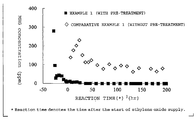
- the transitions of the concentrations of MEG and DEG in the effluent from the reactor 6 from the initiation to the completion of the reaction were plotted. The results are shown in Figs. 2 and 3 , respectively.
- the concentration of the ethylene carbonate in the reaction liquid at 192 hours after the initiation of the reaction was 99.0%
- the concentration of MEG was 80 ppm
- the concentration of DEG was 241 ppm.
- the reaction liquid at 192 hours' time after the initiation of the above-mentioned reaction was subjected to distillation purification by using a batch type Oldershaw rectification column with ten actual stages in a similar manner to that in Example 1.
- the obtained purified ethylene carbonate had a purity of 99.95%, the concentration of MEGwas 32 ppm, and the concentration of DEG was 256 ppm.
- the following batch-type ethylene carbonate synthesis reaction shows that glycols cause decrease in the activity of a catalyst.
- a tributylphosphonium bromide surface-modified silica gel catalyst (average fine pore diameter: 10 nm, particle diameter: 1.2 to 2.4mm, bromine modification amount 0.28mmol/g, phosphorus modification amount: 0.30 mmol/g), which was synthesized in a similar manner to that in the above-mentioned Synthesis Example, was charged in a 50 mL autoclave containing a stirrer, and dried at 120°C for 1 hour under a reduced pressure. The inside of the autoclave was returned to atmospheric pressure and room temperature with nitrogen, and 3 g of ethylene oxide (about 68 mmol) and the glycol shown in Table 1 were charged.
- Carbon dioxide was then temporarily filled up to 1.5 MPa, and the inside of the autoclave was then heated to 120°C while stirring was conducted by a rotor at 800 rpm, the inner pressure was adjusted to 4.5 MPa by further filling carbon dioxide, and a reaction was conducted for 1 hours. After the cooling, the residual carbon dioxide was released, and the inside of the autoclave was depressurized. The obtained reaction liquid was analyzed by gas chromatography, and the conversion rate of the ethylene oxide and the yield of the ethylene carbonate were obtained. The result is shown in Table 1.
Landscapes
- Chemical & Material Sciences (AREA)
- Organic Chemistry (AREA)
- Engineering & Computer Science (AREA)
- Materials Engineering (AREA)
- Chemical Kinetics & Catalysis (AREA)
- Low-Molecular Organic Synthesis Reactions Using Catalysts (AREA)
- Organic Low-Molecular-Weight Compounds And Preparation Thereof (AREA)
- Catalysts (AREA)
Description
- The present invention relates to a method for continuously producing a cyclic carbonate.
- Cyclic carbonates are used as organic solvents, agents for processing synthetic fibers, raw materials for medicaments, cosmetic additives and electrolyte solvents for lithium batteries, and are also utilized for the synthesis of alkylene glycols and dialkyl carbonates, and the like (Patent Literature 1), and thus are one of important compounds that are used in a wide variety of applications.
- Conventionally, the cyclic carbonates have been synthesized by reacting an epoxide and carbon dioxide in the presence of a homogeneous system catalyst under a suitable pressurized condition. As such homogeneous system catalyst, halides of alkali metals and onium salts such as quaternary ammonium salts have been conventionally known (Patent Literature 2), and are industrially used.
- However, in the case when such homogeneous system catalyst is used, a separation operation to separate the reaction mixture and catalyst by distillation, or the like is generally required, and thus the production steps become complex, and there are problems of the decomposition of the catalyst during the separation step and the generation of by-products.
- Therefore, for the purpose of simplifying the catalyst separation process, a heterogenous catalyst in which quaternary phosphonium each having a halide ion as a counterion are immobilized on a support such as a silica gel, and a heterogenous catalyst in which an alkali metal element or an alkaline earth metal element has been formed into a composite oxide with phosphorus, silica or the like, have been suggested (Patent Literatures 3 to 5).
-
- Patent Literature 1:
JP S55-145623 A - Patent Literature 2:
JP S63-17072 B - Patent Literature 3:
WO 2005/084801 A - Patent Literature 4:
JP 2008-296066 A - Patent Literature 5:
WO 2005/085224 A - Patent Literature 6:
JP H9-227550 A - Patent Literature 7:
JP 2007-284427 A - However, water in the air is adsorbed by these heterogenous catalysts during production and storage. In the case when a reaction of an epoxide and carbon dioxide is performed while water is adsorbed by a catalyst, a glycol is generated by the side reaction of the epoxide and water, and thus there is a problem that it is difficult to obtain a cyclic carbonate having a high purity, or it is necessary to separate the glycol after the completion of the reaction depending on the use of the cyclic carbonate.
- since the generated glycol has small difference in the boiling point from the cyclic carbonate, and they form an azeotropic mixture, separation by distillation is typically difficult. In order to increase the purity of the cyclic carbonate, rectification using a rectification column having many stages, and removal of a glycol by using means other than distillation such as crystallization and adsorption have been performed (
Patent Literatures 6 and 7). However, as the stages of the purification step increases, more days for the steps are required, and the yield of the obtained cyclic carbonate is also decreased. Since the reaction heat of the reaction between the epoxide and carbon dioxide is high, circulation of a reaction liquid is generally performed (Patent Literature 2). However, if a reaction liquid in which a glycol exists together is circulated, a problem occurs that the activity of the catalyst is decreased. - Since it is difficult to separate thus-generated glycol from the cyclic carbonate in a simple manner, water adsorbed by a heterogenous catalyst is removed in advance before a reaction by heating a catalyst in a gas flow of an inert gas such as nitrogen at a high temperature in advance, or the like.
- However, in a case when a catalyst in which an organic compound is immobilized on a support or the like is used, the organic chain is thermally decomposed even by heating at about 200°C (about 150°C in some cases), and thus there is a problem that the catalyst activity is rather decreased by heating. Furthermore, at such a low temperature that the catalyst is not deteriorated, even if heating is performed, the water adsorbed by the catalyst is not sufficiently removed, and thus a large amount of glycol is generated at an earlier stage of the reaction.
- An object of the present invention is to provide a method for continuously producing a cyclic carbonate, by which generation of a glycol in a reaction for synthesizing a cyclic carbonate is suppressed, and a cyclic carbonate having a high purity can be efficiently obtained even by simple purification.
- The present inventors conducted intensive studies, and found that, in a method for continuously producing a cyclic carbonate by a fixed bed continuous flow process, by bringing apre-treatment liquid containing a cyclic carbonate into contact with a catalyst before feeding a carbon dioxide and an epoxide to a fixed-bed tube reactor, and removing the generated glycol outside of the system in advance, the generation of the glycol in the subsequent continuous reaction is significantly suppressed, and a cyclic carbonate having a high purity can be efficiently obtained even by simple purification, and thus completed the present invention.
- That is, the present invention provides a method for continuously producing a cyclic carbonate, the method including filling a catalyst in a fixed-bed tube reactor, and continuously feeding carbon dioxide and an epoxide to the fixed-bed tube reactor to thereby bring the carbon dioxide and the epoxide into contact with the catalyst, while continuously withdrawing the reaction liquid in the fixed-bed tube reactor, in which the method includes a pre-treatment step in which a pre-treatment liquid containing a cyclic carbonate is brought into contact with the catalyst before feeding the carbon dioxide and the epoxide to the fixed-bed tube reactor, and the generated glycol is removed out of the system.
- According to the production method of the present invention, the generation of a glycol in a reaction for the synthesis of a cyclic carbonate is suppressed, and thus a cyclic carbonate having a high purity can be efficiently obtained even by a simple purification.
-
-
Fig. 1 is a schematic drawing showing an example of the continuous reaction apparatus used in the production method of the present invention. -
Fig. 2 is a drawing showing the change over time of the concentration of the monoethylene glycol in the effluent in Example. -
Fig. 3 is a drawing showing the change over time of the concentration of the diethylene glycol in the effluent in Example. - The method for continuously producing a cyclic carbonate of the present invention is characterized by including a pre-treatment step in which a pre-treatment liquid containing a cyclic carbonate is brought into contact with the catalyst filled in a fixed-bed tube reactor before feeding the carbon dioxide and the epoxide to the fixed-bed tube reactor, and the generated glycol is removed out of the system. By bringing the pre-treatment liquid containing a cyclic carbonate into contact with the catalyst, the water adsorbed by the catalyst and the cyclic carbonate cause a reaction, and are converted to a glycol. Furthermore, by removing the generated glycol out of the system before feeding the rawmaterials, the incorporation of the glycol into the reaction system for the synthesis of the cyclic carbonate can be prevented. Furthermore, the liquid permeation of the pre-treatment liquid and the removal of the glycol may be performed continuously or intermittently, and it is preferable to perform continuously.
- In addition, prior to the pre-treatment step, a reactor in which the catalyst is filled may be subjected to preliminary drying with vacuum exhausting and/or an inert gas. By such preliminary drying, the treatment time by the pre-treatment liquid can be shortened. It is preferable to perform the preliminary drying at a temperature close to the temperature when the pre-treatment liquid mentioned below is brought into contact with the above-mentioned catalyst. As the above-mentioned inert gas, helium, argon, nitrogen, carbon dioxide or the like can be used.
- Furthermore, the temperature when the pre-treatment liquid is brought into contact with the above-mentioned catalyst is preferably in the range of from 20 to 140°C, more preferably from 50 to 130°C, and further more preferably from 80 to 120°C. By adjusting the temperature to be 20°C or higher, the reaction between the cyclic carbonate and the water contained in the catalyst is promoted. Furthermore, according to the production method of the present invention, it is possible to sufficiently remove the water content in the catalyst by a glycol-generation reaction even when the temperature of the pre-treatment is a low temperature of 140°C or lower, and the decomposition of the cyclic carbonate is rather suppressed by setting the temperature to 140°C or lower, and the water in the catalyst can be removed more efficiently.
- Furthermore, the contact time is generally from 1, to 40 hours From the viewpoint of sufficiently removing the water adsorbed by the catalyst, it is preferable to perform it until the total content of the glycol in the effluent from the reactor is 150 ppm or less, and more preferable to perform it until the total content becomes 100 ppm or less.
- The cyclic carbonate contained in the pre-treatment liquid is not especially limited. Examples include ethylene carbonate, propylene carbonate, butylene carbonate, isobutylene carbonate, trifluoromethylethylene carbonate, vinylethylene carbonate, cyclohexene carbonate, styrene carbonate, butadiene monocarbonate, butadiene dicarbonate, chloromethyl carbonate, pinene carbonate, tetracyanoethylene carbonate and the like, and these can be used alone or in combination of two or more kinds.
- Among such cyclic carbonates, those represented by the following formula (1) are preferable. Furthermore, in view of the purity of the cyclic carbonate to be synthesized, it is preferable to use the same cyclic carbonate as those to be synthesized.

- in the formula (1), R1 and R2 each independently represents a hydrogen atom, alkyl having carbon number of from 1 to 6, haloalkyl having carbon number of from 1 to 6, alkenyl having carbon number of from 2 to 6, haloalkenyl having carbon number of from 2 to 6, aryl having carbon number of from 6 to 12 or cyano, and R3 and R4 each independently represents a hydrogen atom, cyano or aryl having carbon number of from 6 to 12, provided that either R3 or R4 may form cycloalkyl together with either R1 or R2 .
- The carbon number of the alkyl and haloalkyl represented by the above-mentioned R1 and R2 are each preferably from 1 to 4. Examples of the alkyl include methyl, ethyl, propyl and butyl, preferably methyl and ethyl, and more preferably methyl.
- The carbon number of the alkenyl and haloalkenyl represented by the above-mentioned R1 and R2 are each preferably from 2 to 4, and vinyl and the like are specifically exemplified.
- Examples of the halogen atom in the haloalkyl and haloalkenyl include fluorine, chlorine, bromine, iodine and the like.
- As the aryl represented by the above-mentioned R1, R2, R3 and R4, phenyl is preferable.
- Among R1 and R2 as mentioned above, hydrogen, alkyl having a carbon number of from 1 to 6, and haloalkyl having a carbon number of from 1 to 6 are preferable.
- Furthermore, hydrogen is preferable as R3 and R4.
- As the above-mentioned cyclic carbonate, a commercially available cyclic carbonate can be purchased and used, and the cost can be decreased by using the reaction liquid before the renewal of the catalyst obtained in the synthesis of the cyclic carbonate, the circulation liquid, or liquids obtained by purifying these, or the like.
- The catalyst used in the production method of the present invention is not specifically limited as long as it has an activity on the synthesis of the cyclic carbonate from the epoxide and carbon dioxide and can be filled in a fixed-bed tube reactor, and a solid catalyst in which an organic compound (preferably an ionic organic compound) is immobilized on a support is preferable in view of the reaction efficiency. In the case when the above-mentioned solid catalyst is used as the catalyst, and the temperature of the above-mentioned pre-treatment is 140°C or lower, the decrease of the catalyst activity by the thermal decomposition of the organic chain can be suppressed, and thus the reaction efficiency is dramatically improved.
- Examples of the above-mentioned ionic organic compound include quaternary organic onium salts selected from quaternary organic ammonium salts each having a halide anion as a counterion and quaternary organic phosphonium salts each having a halide anion as a counterion, and these can be used alone or in combination of two or more kinds. Examples of the halogen in the above-mentioned halide anion include fluorine, chlorine, bromine and iodine. Furthermore, examples of the organic groups that are bound to the nitrogen atom or phosphorus atom in the above-mentioned quaternary organic onium salt include groups that induce R5 mentioned below, R6 to R8.
- Among the above-mentioned quaternary organic onium salts, tetraalkylammonium salts such as tetraalkylammonium chlorides and tetraalkylammonium bromides; and tetraalkylphosphonium salts such as tetraalkylphosphonium chlorides and tetraalkylphosphonium bromides are preferable, and tetraalkylphosphonium salts are more preferable.
- Examples of the above-mentioned support include inorganic oxide supports and organic polymer supports. The shape thereof ispreferablyaparticulate form, andaporous formispreferable.
- As the above-mentioned inorganic oxide support, those containing oxides of silicon, aluminum, titanium, magnesium, zirconium, boron, calcium, zinc, barium, iron and the like are preferable, and one kind or two or more kinds of such oxides may be contained. Examples of such oxides include SiO2, Al2O3, TiO2, MgO, ZrO2, B2O3, CaO, ZnO, BaO, and Fe2O3.
- Preferable specific examples of the inorganic oxide support include a silica gel (gelled silica), mesoporous silica, ceramics, zeolite and porous glass, and a silica gel and mesoporous silica are preferable.
- Furthermore, examples of the above-mentioned organic polymer support include polystyrenes, polystyrene copolymers, poly(meth)acrylate, poly(meth)acrylamide, polyimides, polybenzimidazole, polybenzoxazole, polybenzothiazole, polyethylene glycol and polypropylene glycol, or copolymers and polymer blends containing these polymers as maj or components, and the like.
- As a preferable specific example of the catalyst used in the production method of the present invention, a catalyst in which the group of the following formula (2) is bound to the above-mentioned support is exemplified.

- in the formula (2), R5 represents alkylene, arylene, alkarylene, arylenealkylene or alkylenearylene, R6 to R8 each independently represents alkyl, aryl, aralkyl, alkoxyalkyl, aryl having alkoxy as substituent, or a group in which one or more of the hydrogen atom contained in any of these groups has/have been substituted with group(s) containing hetero atom(s), X represents a phosphorus atom or a nitrogen atom, Y represents a halogen atom, and * represents a bond.
- In the above-mentioned formula (2), the alkylene represented by R5 may have either a linear form or a branched chain form, and the carbon number thereof is preferably from 1 to 8, more preferably from 1 to 6, and further more preferably from 2 to 4.
- Examples of the above-mentioned alkylene include methylene, ethylene, trimethylene, propylene, tetramethylene, pentamethylene, hexamethylene, heptamethylene, octamethylene and the like.
- Furthermore, the carbon number of the arylene of R5 is preferably from 6 to 14, more preferably from 6 to 12 , and further more preferably from 6 to 10. Examples include bivalent groups derived from benzene, naphthalene, anthracene, phenanthrene, biphenyl and the like.
- Furthermore, the alkarylene represented by R5 is preferably alkarylene having a carbon number of from 8 to 10, and examples include xylylene and the like.
- Furthermore, the carbon numbers of the arylenealkylene and alkylenearylene represented by R5 are each preferably from 7 to 12, and more preferably from 7 to 10.
- Examples of the above-mentioned arylenealkylene include phenylenemethylene, phenyleneethylene, phenylenetrimethylene, naphthylenemethylene, naphthyleneethylene and the like.
- Furthermore, examples of the above-mentioned alkylenearyleneinclude methylenephenylene,ethylenephenylene, trimethylenephenylene, methylenenaphthylene, ethylenenaphthylene and the like.
- Among R5 mentioned above, alkylene, arylene and arylenealkylene are preferable, and alkylene ismorepreferable.
- The alkyl represented by R6 to R8 in the formula (2) may have either a linear form, a branched chain form or a cyclic form, and the carbon number thereof are each preferably from 1 to 8, more preferably from 1 to 6, and further more preferably from 2 to 4.
- Examples of the above-mentioned alkyl include methyl, ethyl, propyl, isopropyl, butyl, isobutyl, pentyl, hexyl, heptyl, octyl, cyclohexyl and the like.
- The carbon numbers of the aryl represented by R6 to R8 are each preferably from 6 to 14, more preferably from 6 to 12, and further more preferably from 6 to 10. Examples include phenol, naphthyl, anthryl, biphenyl, phenanthryl and the like.
- The carbon number of aralkyl represented by R6 to R8 are each preferably from 7 to 12, and more preferably from 7 to 10. Examples include benzyl, phenethyl, phenylpropyl, naphthylmethyl, naphthylethyl and the like.
- The alkoxyalkyl represented by R6 to R8 are each preferably alkoxyalkyl having a carbon number of from 2 to 8, and examples include methoxyethyl and the like. The aryl having alkoxy(s) as substituent(s) of R6 to R8 are each preferably alkoxyaryl having carbon number of from 7 to 14, and examples include methoxyphenyl, dimethoxyphenyl and the like. Furthermore, the number and position (s) of the alkoxy possessed by the aryl are optional, and the number of the alkoxy is a preferably from 1 to 4, and more preferably from 1 or 2.
- In addition, in the above-mentioned alkyl, aryl, aralkyl, alkoxyalkyl and aryl having alkoxy as substituent, one or more of hydrogen atom(s) included in any of these groups may be substituted with group (s) containing hetero atom (s). Examples of the hetero atoms include nitrogen, oxygen, phosphorus, sulfur, halogen atoms (a fluorine atom and the like) and the like.
- Examples of the above-mentioned groups containing hetero atom(s) include nitrogen-containing groups such as amino, hydrazino, nitro, cyano, isocyano and amidino; oxygen-containing groups such as alkanoyl, carboxy, alkoxycarbonyl and hydroxy; phosphorus-containing groups such as phosphanyl, phosphono and phosphinyl; sulfur-containing groups such as sulfo, sulfanyl, alkylsulfanyl, alkylsulfonyl, alkylsulfonylamino, alkylaminosulfonyl, alkylsulfinyl, alkylaminosulfinyl, alkylsulfinylamino and thiocarboxy, and the like.
- Among R6 to R8 as mentioned above, alkyl, aryl and aralkyl are preferable.
- In the formula (2), a phosphorus atom is preferable as X. Furthermore, examples of the halogen atom of Y include a fluorine atom, a chlorine atom, a bromine atom and an iodine atom, and a chlorine atom and a bromine atom are preferable.
- In addition, the group represented by the above-mentioned formula (2) may be directly bound to the support by a covalent bond or the like, or may be bound through a linker as in the following formula (3).

- in the formula (3), R9 represents methyl or ethyl, n represents an integer of 0 to 2, and m represents an integer of 1 to 3, and when n + m = 3 is satisfied and n is 2, the two R9s may be the same or different. ** represents a part that is linked to the support, and the other symbols are as defined above.
- Among these, those having structures in which n = 0 and m = 3 are preferable.
- Furthermore, as the above-mentioned catalyst, a catalyst having a halogen modification amount of from 0.25 to 0.8 mmol/g and a phosphorus or nitrogen modification amount of from 0.25 to 0.6 mmol/g is preferable.
- Furthermore, the amount of the catalyst to be filled in the reactor is generally from 0.01 to 10 parts by mass, preferably from 0.03 to 10 parts by mass with respect to 100 parts by mass of the whole amount of the epoxide to be fed.
- As the catalyst used in the product ion method of the present invention, a commercially available catalyst may be used, or the catalyst may be prepared by, for example, reacting a silane compound containing a halogen with a silica gel, and reacting this with an organic phosphine such as a trialkylphosphine to form a phosphonium salt, according to the methods described in
WO 2005/084801 A andJP 2008-296066 A - The method for continuously producing a cyclic carbonate of the present invention employs carbon dioxide and an epoxide as raw materials, and it is preferable to feed these to a fixed-bed tube reactor so that these are mixed.
- Furthermore, it is preferable that a liquid of a cyclic carbonate is continuously fed to the reactor, prior to a continuous reaction, after the above-mentioned pre-treatment step, and this liquid of the cyclic carbonate is continuously withdrawn from the reactor and circulated in advance, and the carbon dioxide and the epoxide are fed to the reactor under the condition. By this way, the above-mentioned raw material and the agent for suppressing catalyst deterioration mentioned below are put into a state that they are dissolved in the cyclic carbonate (the cyclic carbonate acts as a solvent), and the reaction state can be deemed as a pseudo liquid-solid reaction with the catalyst. Therefore, the temperature rising due to the reaction heat is mitigated, the wettability of the catalyst is improved, and the drifting of the carbon dioxide gas is suppressed. As the cyclic carbonate, the cyclic carbonate contained in the above-mentioned pre-treatment liquid may be used.
- The above-mentioned epoxide is not especially limited as long as it contains at least one epoxy ring (a three-membered ring formed of two carbon atoms and one oxygen atom) in the structural formula. Examples include ethylene oxide, propylene oxide, butylene oxide, isobutylene oxide, vinylethylene oxide, trifluoromethylethylene oxide, cyclohexene oxide, styrene oxide, butadiene monoxide, butadiene dioxide, 2-methyl-3-phenylbutene oxide, pinene oxide, tetracyanoethylene oxide and the like.
- Among such epoxides, those represented by the following formula (4) are preferable, and ethylene oxide and propylene oxide are more preferable.

- in the formula (4), R1 to R4 are as defined above.
- The total feed amount of the carbon dioxide is generally from 1.0 to 10 mol equivalent amount, preferably from 1.1 to 2.0 mol equivalent amount with respect to the whole amount of the epoxide to be fed.
- Furthermore, a solvent may be used in the continuous reaction step. As such a solvent, besides the above-mentioned cyclic carbonates, aliphatic hydrocarbons such as pentane, hexane and heptane; aromatic hydrocarbons such as benzene and toluene; alcohols such as methanol and ethanol; ketones such as acetone and methyl ethyl ketone; ethers such as diethyl ether, methyl-tert-butyl ether, tetrahydrofuran and dioxane; amides such as dimethylformamide and dimethylacetamide; esters such as ethyl acetate; tertiaryamines suchas triethylamine, pyridine, methylpyridazine and N,N'-dimethylpyridazinone; sulfides such as dibutylsulfide; phosphines such as tributylphosphine, and the like can be used. These solvents may be used by one kind alone or in combination of two or more kinds.
- Furthermore, the use amount of the above-mentioned solvent is an amount that the concentration of the epoxide in the reactor is generally 1.0 to 20% by mass.
- Furthermore, in the production method of the present invention, an agent for suppressing catalyst deterioration may be fed to the reactor together with the above-mentioned raw materials. In the case when the above-mentioned solid catalyst in which a quartenary organic onium salt is immobilized on a support is used, an organic halide is preferable as the agent for suppressing catalyst deterioration. Examples of the organic halide include alcohol halides such as bromoethanol and chloroethanol; alkyl halides; ether halides; carbonyl halide compounds, and the like, and one kind may be used alone, or two or more kinds may be used in combination.
- Furthermore, the above-mentioned agent for suppressing catalyst deterioration is generally added so that the concentration of the agent for suppressing catalyst deterioration in the reactor is 0.01 to 0.2% by mass.
- The reaction temperature in the continuous reaction step is preferably in the range of from 20 to 1660°C, and more preferably from 50 to 150°C in view of reaction efficiency. In the case when a solid catalyst in which an organic compound is immobilized on a support is used, the reaction temperature is further preferably in the range of from 80 to 140°C, more preferably from 80 to 130°C, and especially preferably from 80 to 120°C.
- Furthermore, the reaction pressure is not especially limited, and is preferably in the range of from 0.1 to 100 MPa, more preferably from 0.5 to 50 MPa, and further more preferably from 1 to 25 MPa.
- In the production method of the present invention, it is preferable to feed a part of the reaction liquid that has been continuously withdrawn from the fixed-bed tube reactor to the fixed-bed tube reactor, and circulate the reaction liquid. In the present invention, due to low amount of glycol in the obtained reaction liquid, the activity of the catalyst is hardly reduced even with the circulation as mentioned above, and the inside of the reactor is diluted with cyclic carbonate by conducting the circulation, and thus the temperature in the reactor is easily controlled.
- The production method of the present invention can be performed by using a continuous production apparatus having a fixed-bed tube reactor, and the continuous production apparatus shown in
Fig. 1 is exemplified as an example of such continuous production apparatus. This apparatus includes pumps (3a) and (3c) that respectively send an epoxide and carbon dioxide to a reactor (6), and a circulation pump (3d). The reaction liquid that has flown out of the reactor (6) is once stored in a gas-liquid separation bath (10), and a predetermined amount is fed therefrom to the reactor (6) by the pump (3d), whereby the reaction liquid is circulated. The residual reaction liquid is sent to a receiving tank (12). - Then, a cyclic carbonate having a high purity can be obtained by collecting the reaction liquid of the abode-mentioned continuous reaction. Such a reaction liquid may be separated and purified as necessary by suitably combining conventional means such as general methods such as distillation, adsorption and crystallization, and these methods may be either of a batch system or a continuous system. Since the reaction liquid contains the cyclic carbonate at a high purity and contains the glycol at a low amount, in the case when separation and purification are performed, a cyclic carbonate having a high purity can be obtained even by a simple means. In addition, the glycol concentration in the collected reaction liquid is generally 100 ppm or less, preferably 50 ppm or less, more preferably 20 ppm or less, and especially preferably 10 ppm or less.
- The obtained cyclic carbonate has a structure in which the epoxy ring of the epoxide has been converted to a carbonate ring (a 5-membered ring having an O-CO-O bond), and specific examples include those cyclic carbonate contained in the pre-treatment liquid, as described above.
- The present invention will be explained below in detail with exemplifying Examples. However, the present invention is not limited to these Examples.
- The analysis methods used in the respective Examples and Comparative Examples are as follows.
- For the measurement of the bromine, chlorine and phosphorus modification amounts of the catalyst, a fluorescence X-ray analysis was used (apparatus: product name "System 3270" (manufactured by Rigaku Corporation), measurement conditions : Rh bulb tube,
tube voltage 50 kV, tube current 50 mV, vacuum atmosphere, detector: SC, F-PC). - Gas chromatography was used for the analysis of the compositions of the reaction liquid and the like. The conditions for the analysis are as follows.
- Apparatus: product name "GC-2010 Plus" (manufactured by Shimadzu Corporation)
- Detector: FID
- INJ temperature: 150°C
- DET temperature: 260°C
- Sample amount: 0.3 µL
- Split ratio: 5
- Column: DB-624 (60 m, 0.32 mmID, 1.8 µm, manufactured by Agilent Technologies)
- Column temperature: 70°C, 3 minutes - 5°C/min - 120°C - 10°C/min - 250°C, 5 minutes (31 minutes in total)
- 2,000 g of a bead-like silica gel (CARiACT Q-10 manufactured by Fuji Silycia Chemical, Ltd. (average
fine pore diameter 10 nm, particle diameter 1.2 to 2.4 mm, specific surface area 300 m2/g)) and 5,000 mL of xylene were charged into a 10 L three-necked flask with agitator blades equipped with a Dean-Stark trap, and azeotropic dehydration of xylene-water was performed under reflux at 140°C for 2 hours to thereby remove the water in the silica gel. The Dean-Stark trap was then removed, the inside of the flask was purged with nitrogen, and 219 g (0. 846 mol) of 3-bromopropyltrimethoxysilane was added dropwise thereto. This was directly refluxed under heating at 135°C for 7 hours to perform a silanation reaction. The obtained reaction product was then separated by filtration, and washed twice with xylene to give 3,810 g of a catalyst precursor containing xylene (a bromopropylated silica gel). The obtained catalyst precursor and 5,000 mL of xylene were then charged into a 10 L three-necked flask with agitator blades, the inside of the flask was purged with nitrogen, and 453 g of tri-n-butylphosphine was added dropwise thereto. This was directly heated at 7.20°C for 2 5 hours to perform a quaternaryphosphoniumi zat ion reaction. After the reaction, the reaction product was separated by filtration, and washed with acetone six times. The obtained reaction product was dried under a nitrogen airflow at 120°C for 5 hours under a reduced pressure to give 2,328 g of the intended tributylphosphonium bromide surface-modified silica gel. The bromine modification amount in the catalyst was 0.35 mmol/g, and the phosphorus modification amount was 0.32 mmol/g. - An ethylene carbonate was produced by using the continuous circulation-type reaction apparatus shown in
Fig. 1 . - (1-1) A
reactor 6 having an inner diameter of 50 mm, a length of 100 cm and a volume of 2, 000 mL was filled with 530 g (an amount that fills up to the scale of 1,000 mL of the reactor 6) of the catalyst obtained in Catalyst Synthesis Example 1, and the front and back of the catalyst were each filled with glass beads having a particle diameter of 4 mm. - (1-2) A
valve 8a was then opened, nitrogen was fed to thereactor 6 at 1 L/min, and boiled water was further flowed into areactor jacket 7 to thereby raise the temperature of thereactor 6 to 100°C. The catalyst was subjected to preliminary drying while the nitrogen was continuously flowed for 8 hours, and the catalyst drying by the nitrogen circulation was stopped by closing thevalve 8a. - (1-3) Subsequently, 10 kg of an ethylene carbonate that had been dissolved by heating at 70°C in advance as a pre-treatment liquid was put into a gas-
liquid separation bath 10, and this liquid was transferred to thepreheater 4 andreactor 6 by thepump 3d at 1,250 g/h for 8 hours. At that time, the pre-treatment liquid that was fed to thereactor 6 was heated in thepreheater 4 at a temperature at which the temperature of the reactor inlet was 100°C, and the pre-treatment liquid that has been ejected from thereactor 6 was continuously withdrawn out of the system from thebubble 8b by closing thevalve 8c. - The concentration of the monoethylene glycol (hereinafter MEG) in the pre-treatment liquid that had been ejected from the
reactor 6 after 8 hours had passed from the initiation of the liquid sending of the pre-treatment liquid was 43 ppm, and the concentration of the diethylene glycol (hereinafter DEG) was 29 ppm. After the glycol concentration had been confirmed, the pre-treatment was completed by closing thevalve 8b by opening thevalve 8c. - (2-1) 7 kg of an ethylene carbonate that had been dissolved by heating at 70°C in advance was put into the gas-
liquid separation bath 10, and this was transferred to thepreheater 4 andreactor 6 at 1,200 g/h by thepump 3d. At that time, the ethylene carbonate that was fed to thereactor 6 was heated in thepreheater 4 at a temperature at which the temperature of the reactor inlet was 100°C. The effluent from thereactor 6 was circulated in the system through thevalve 8c. - (2-2) Next, carbon dioxide was fed to the
reactor 6 by thepump 3c at 300 g/h, and the pressures of the gas-liquid separation bath 10,preheater 4 andreactor 6 were adjusted so as to be 7 MPa by aback pressure valve 9b. At that time, the carbon dioxide was stirred by astatic mixer 5b, and fed to thepreheater 4 andreactor 6 in the state that the carbon dioxide was dissolved in the ethylene carbonate. - Subsequently, the flow amount of the carbon dioxide was adjusted to 45 g/h and the flow amount of the ethylene carbonate in which the carbon dioxide was dissolved was adjusted to 1,400 g/h, respectively, by the
pumps preheater 4 andreactor 6 were adjusted to 7.5 MPa by theback pressure valve 9a. - (2-3) About 20 hours after the initiation of the circulation of the ethylene carbonate in the above-mentioned step (2-1), 2-bromoethanol was fed to the
reactor 6 at 0.43 g/h by thepump 3b, and the ethylene oxide was fed to thereactor 6 at 30 g/h by thepump 3a, whereby a continuous circulation-type reaction was initiated. - In addition, in the feeding of the 2-bromoethanol and ethylene oxide, the 2 -bromoethanol and ethylene oxide were mixed with the ethylene carbonate by a
static mixer 5a, and fed to thereactor 6. That is, all of the ethylene oxide, carbon dioxide and 2-bromoethanol are fed to thereactor 6 in the state that they are dissolved in the ethylene carbonate. By circulating the ethylene carbonate in this way, the reaction state can be deemed as a pseudo liquid-solid reaction with the catalyst. - (2-4) 6 after the initiation of the reaction, the flow amount of the 2-bromoethanol was adjusted to 0.024 g/h by the
pump 3b so that the feed amount of the 2-bromoethanol to thereactor 6 became constant at 2-bromoethanol/ethylene oxide = 5 mmol/mol, and the reaction was continued. The ethylene carbonate generated by the reaction was withdrawn to a receivingtank 12 by a liquid level-adjustingvalve 11. - The transitions of the concentrations of MEG and DEG in the effluent from the
reactor 6 from the initiation of the above-mentioned step (1-3) to the completion of the reaction were plotted. The results are shown inFigs. 2 and3 , respectively. Furthermore, the concentration of the ethylene carbonate in the reaction liquid at 195 hours after the initiation of the reaction was 99.6%, MEG was not detected (detection lower limit: 4 ppm), and the concentration of DEG was 7 ppm. - The reaction liquid at 195 hours' time after the initiation of the above-mentioned reaction was subjected to distillation purification by using a batch type Oldershaw rectification column with ten actual stages under conditions of a column top pressure of 10 torr, a column bottom temperature of 120 to 122°C and a reflux rate of 60 (up to a distillation rate of 5% by mass with respect to the charged liquid amount), and distillation purification was further performed by changing the reflux rate to 4. The obtained purified ethylene carbonate had a purity of 99.99%, and neither MEG nor DEG was detected (both were at a detection lower limit of 4 ppm).
- A continuous reaction was performed by similar operations to those in Example 1, except that the above-mentioned step (1-3) was not conducted. The transitions of the concentrations of MEG and DEG in the effluent from the
reactor 6 from the initiation to the completion of the reaction were plotted. The results are shown inFigs. 2 and3 , respectively. Furthermore, the concentration of the ethylene carbonate in the reaction liquid at 192 hours after the initiation of the reaction was 99.0%, the concentration of MEG was 80 ppm, and the concentration of DEG was 241 ppm. - The reaction liquid at 192 hours' time after the initiation of the above-mentioned reaction was subjected to distillation purification by using a batch type Oldershaw rectification column with ten actual stages in a similar manner to that in Example 1. The obtained purified ethylene carbonate had a purity of 99.95%, the concentration of MEGwas 32 ppm, and the concentration of DEG was 256 ppm.
- The following batch-type ethylene carbonate synthesis reaction shows that glycols cause decrease in the activity of a catalyst.
- 200 mg of a tributylphosphonium bromide surface-modified silica gel catalyst (average fine pore diameter: 10 nm, particle diameter: 1.2 to 2.4mm, bromine modification amount 0.28mmol/g, phosphorus modification amount: 0.30 mmol/g), which was synthesized in a similar manner to that in the above-mentioned Synthesis Example, was charged in a 50 mL autoclave containing a stirrer, and dried at 120°C for 1 hour under a reduced pressure. The inside of the autoclave was returned to atmospheric pressure and room temperature with nitrogen, and 3 g of ethylene oxide (about 68 mmol) and the glycol shown in Table 1 were charged.
- Carbon dioxide was then temporarily filled up to 1.5 MPa, and the inside of the autoclave was then heated to 120°C while stirring was conducted by a rotor at 800 rpm, the inner pressure was adjusted to 4.5 MPa by further filling carbon dioxide, and a reaction was conducted for 1 hours. After the cooling, the residual carbon dioxide was released, and the inside of the autoclave was depressurized. The obtained reaction liquid was analyzed by gas chromatography, and the conversion rate of the ethylene oxide and the yield of the ethylene carbonate were obtained. The result is shown in Table 1.
[Table 1] Glycol Addition amount of glycol (mmol) Conversion rate of ethylene oxide (%) Yield of ethylene carbonate (%) Detection amount of 2-bromoethanol (mmol) None 0 27 27 3 MEG 1.5 23 23 9 MEG 7 18 18 20 MEG 14 14 14 34 DEG 1 24 24 6 DEG 4 20 20 9 DEG 8 19 19 11 -
- 1: ethylene oxide storage tank
- 2 : carbon dioxide storage tank
- 3a to 3d: pump
- 4: preheater
- 5a to 5b: static mixer
- 6 : reactor
- 7: reactor jacket
- 8a to 8c: valve
- 9a to 9b: back pressure valve
- 10: gas-liquid separation bath
- 11: liquid level-adjusting valve
- 12: receiving tank
Claims (8)
- A method for continuously producing a cyclic carbonate, the method comprising:filling a catalyst in a fixed-bed tube reactor, andcontinuously feeding carbon dioxide and an epoxide to the fixed-bed tube reactor to thereby bringing the carbon dioxide and the epoxide into contact with the catalyst, while continuously withdrawing the reaction liquid in the fixed-bed tube reactor,wherein the method comprises a pre-treatment step in which a pre-treatment liquid containing a cyclic carbonate is brought into contact with the catalyst before feeding the carbon dioxide and the epoxide to the fixed-bed tube reactor, and the generated glycol is removed out of the system.
- The production method according to claim 1, wherein the pre-treatment liquid and the catalyst are brought into contact until the total content of the glycol in an effluent from the fixed-bed tube reactor is 100 ppm or lower.
- The production method according to claim 1 or 2, wherein the pre-treatment liquid and the catalyst are brought into contact in the range of from 20°C to 140°C.
- The production method according to any one of claims 1 to 3, wherein a part of the reaction liquid that has been continuously withdrawn from the fixed-bed tube reactor is circulated by feeding to the fixed-bed tube reactor.
- The production method according to any one of claims 1 to 4, wherein the catalyst is a solid catalyst in which quartenary organic onium salt (s) selected from quartenary organic ammonium salts each having a halide anion as a counterion and quaternary organic phosphonium salts each having a halide anion as a counterion has/have been immobilized on a support.
- The production method according to claim 5, wherein the quartenary organic onium salt is a quaternary organic phosphonium salt having a bromine ion as a counterion.
- The production method according to claim 5 or 6, wherein the support is an inorganic oxide selected from a silica gel, mesoporous silica, ceramics, zeolite and porous glass.
- The production method according to any one of claims 1 to 7, wherein the epoxide is represented by the following formula (4):

Applications Claiming Priority (2)
| Application Number | Priority Date | Filing Date | Title |
|---|---|---|---|
| JP2013150334 | 2013-07-19 | ||
| PCT/JP2014/069151 WO2015008853A1 (en) | 2013-07-19 | 2014-07-18 | Method for continuously producing cyclic carbonate |
Publications (3)
| Publication Number | Publication Date |
|---|---|
| EP3023419A1 true EP3023419A1 (en) | 2016-05-25 |
| EP3023419A4 EP3023419A4 (en) | 2017-05-03 |
| EP3023419B1 EP3023419B1 (en) | 2018-01-31 |
Family
ID=52346294
Family Applications (1)
| Application Number | Title | Priority Date | Filing Date |
|---|---|---|---|
| EP14825786.8A Active EP3023419B1 (en) | 2013-07-19 | 2014-07-18 | Method for continuously producing cyclic carbonate |
Country Status (8)
| Country | Link |
|---|---|
| US (1) | US9586927B2 (en) |
| EP (1) | EP3023419B1 (en) |
| JP (1) | JP6281881B2 (en) |
| KR (1) | KR102239682B1 (en) |
| CN (1) | CN105377829B (en) |
| ES (1) | ES2659384T3 (en) |
| TW (1) | TWI623525B (en) |
| WO (1) | WO2015008853A1 (en) |
Cited By (3)
| Publication number | Priority date | Publication date | Assignee | Title |
|---|---|---|---|---|
| CN106076410A (en) * | 2016-06-16 | 2016-11-09 | 同济大学 | A kind of preparation method of the ionic-liquid catalyst being carried on multilevel size material with carbon element |
| EP3023418A4 (en) * | 2013-07-19 | 2017-01-18 | National Institute of Advanced Industrial Science and Technology | Method for manufacturing cyclic carbonate |
| EP2990114A4 (en) * | 2013-04-23 | 2017-02-08 | National Institute of Advanced Industrial Science and Technology | Method for producing catalyst for cyclic carbonate synthesis |
Families Citing this family (12)
| Publication number | Priority date | Publication date | Assignee | Title |
|---|---|---|---|---|
| US10011621B2 (en) | 2013-04-23 | 2018-07-03 | Maruzen Petrochemical Co., Ltd. | Method for producing silica gel-immobolized phosphonium salt catalysts |
| EP2990113B1 (en) * | 2013-04-23 | 2020-03-25 | Maruzen Petrochemical Co., Ltd. | Method for producing catalyst for cyclic carbonate synthesis |
| CN106414422B (en) | 2014-05-30 | 2019-01-08 | 丸善石油化学株式会社 | Manufacturing apparatus and manufacturing method of cyclic carbonate |
| JP6483499B2 (en) * | 2015-03-31 | 2019-03-13 | 大日精化工業株式会社 | Method for producing 5-membered cyclic carbonate compound |
| KR102108791B1 (en) * | 2017-10-20 | 2020-05-11 | 전남대학교산학협력단 | Organic-Inorganic Hybrid Materials as Functional Catalysts, their preparation method and application for manufacturing organic carbonates |
| CN109678838A (en) * | 2018-12-13 | 2019-04-26 | 郑州轻工业学院 | The method and its catalyst of carbon dioxide and epoxide synthesis of cyclic carbonic acid styrene esters |
| CN109704995B (en) * | 2019-01-25 | 2024-01-23 | 吉林凯莱英制药有限公司 | Serialization device for Fushan reduction reaction and serialization Fushan reduction method |
| CN112705124B (en) * | 2019-10-25 | 2022-07-12 | 中国石油化工股份有限公司 | Reactor, system for synthesizing carbonate ester, and method for synthesizing carbonate ester |
| JPWO2024214491A1 (en) * | 2023-04-14 | 2024-10-17 | ||
| CN116764665B (en) * | 2023-08-22 | 2023-10-27 | 中国科学院过程工程研究所 | A composite nitrogen-doped carbon catalyst and its preparation method and application |
| CN117563512B (en) * | 2023-11-21 | 2024-12-03 | 惠州市绿色能源与新材料研究院 | A device system and method for preparing cyclic carbonate by cyclic esterification of diols |
| ES3032246A1 (en) * | 2024-01-16 | 2025-07-16 | Univ Madrid Autonoma | PROCEDURE FOR OBTAINING ORGANIC CARBONATES, WATER AND INORGANIC CARBONATES BY FIXING CARBON DIOXIDE IN BRINE |
Family Cites Families (17)
| Publication number | Priority date | Publication date | Assignee | Title |
|---|---|---|---|---|
| US4314945A (en) | 1977-12-22 | 1982-02-09 | Union Carbide Corporation | Alkylene carbonate process |
| JPS5822448B2 (en) | 1979-05-02 | 1983-05-09 | 昭和電工株式会社 | Method for producing alkylene glycol |
| JPS6317072A (en) | 1986-07-08 | 1988-01-25 | Sharp Corp | Print erasing method for thermal transfer printer |
| JPH0832700B2 (en) * | 1989-10-03 | 1996-03-29 | 旭化成工業株式会社 | Method for producing alkylene carbonate |
| JPH0967365A (en) * | 1995-08-29 | 1997-03-11 | Mitsubishi Chem Corp | Method for producing alkylene carbonate |
| JPH09227550A (en) | 1996-02-22 | 1997-09-02 | Mitsui Petrochem Ind Ltd | Method for purifying ethylene carbonate |
| JP3951006B2 (en) * | 2001-05-31 | 2007-08-01 | 独立行政法人産業技術総合研究所 | Process for producing alkylene carbonate and catalyst used therefor |
| JP4247380B2 (en) * | 2003-02-18 | 2009-04-02 | 独立行政法人産業技術総合研究所 | Method for producing alkylene carbonate |
| US20080214386A1 (en) | 2004-03-01 | 2008-09-04 | Toshikazu Takahashi | Catalyst for Cyclic Carbonate Synthesis |
| WO2005084801A1 (en) * | 2004-03-04 | 2005-09-15 | National Institute Of Advanced Industrial Science And Technology | Catalyst for cyclic carbonate synthesis |
| WO2005085224A1 (en) * | 2004-03-04 | 2005-09-15 | National Institute Of Advanced Industrial Science And Technology | Process for production of cyclic carbonates |
| TWI387584B (en) * | 2006-03-13 | 2013-03-01 | Shell Int Research | Process for the production of alkylene carbonate and use of alkylene carbonate thus produced in the manufacture of an alkane diol and a dialkyl carbonate |
| JP5282366B2 (en) | 2006-03-20 | 2013-09-04 | 三菱化学株式会社 | Method for purifying ethylene carbonate, method for producing purified ethylene carbonate, and ethylene carbonate |
| EP2374803A1 (en) | 2006-03-20 | 2011-10-12 | Mitsubishi Chemical Corporation | Method for purifying ethylene carbonate, process for producing purified ethylene carbonate, and ethylene carbonate |
| JP4984139B2 (en) | 2007-05-29 | 2012-07-25 | 国立大学法人 岡山大学 | Method for producing catalyst cross-linking agent used for immobilization catalyst for synthesis of cyclic carbonate, method for producing immobilization catalyst, catalyst cross-linking agent used for immobilization catalyst, and immobilization catalyst |
| CN102060657A (en) * | 2009-11-13 | 2011-05-18 | 中国科学院兰州化学物理研究所 | A kind of preparation method of glycol |
| TWI422429B (en) * | 2010-12-22 | 2014-01-11 | Ind Tech Res Inst | Carbon nanomaterial-supported catalyst and its application in carbonate synthesis |
-
2014
- 2014-07-17 TW TW103124586A patent/TWI623525B/en not_active IP Right Cessation
- 2014-07-18 EP EP14825786.8A patent/EP3023419B1/en active Active
- 2014-07-18 JP JP2015527345A patent/JP6281881B2/en active Active
- 2014-07-18 ES ES14825786.8T patent/ES2659384T3/en active Active
- 2014-07-18 CN CN201480039970.0A patent/CN105377829B/en not_active Expired - Fee Related
- 2014-07-18 WO PCT/JP2014/069151 patent/WO2015008853A1/en not_active Ceased
- 2014-07-18 KR KR1020167000568A patent/KR102239682B1/en not_active Expired - Fee Related
- 2014-07-18 US US14/903,225 patent/US9586927B2/en active Active
Non-Patent Citations (1)
| Title |
|---|
| See references of WO2015008853A1 * |
Cited By (5)
| Publication number | Priority date | Publication date | Assignee | Title |
|---|---|---|---|---|
| EP2990114A4 (en) * | 2013-04-23 | 2017-02-08 | National Institute of Advanced Industrial Science and Technology | Method for producing catalyst for cyclic carbonate synthesis |
| US9834536B2 (en) | 2013-04-23 | 2017-12-05 | National Institute Of Advanced Industrial Science And Technology | Method for producing catalyst for cyclic carbonate synthesis |
| EP3023418A4 (en) * | 2013-07-19 | 2017-01-18 | National Institute of Advanced Industrial Science and Technology | Method for manufacturing cyclic carbonate |
| US9856229B2 (en) | 2013-07-19 | 2018-01-02 | National Institute Of Advanced Industrial Science And Technology | Method for producing cyclic carbonate |
| CN106076410A (en) * | 2016-06-16 | 2016-11-09 | 同济大学 | A kind of preparation method of the ionic-liquid catalyst being carried on multilevel size material with carbon element |
Also Published As
| Publication number | Publication date |
|---|---|
| CN105377829A (en) | 2016-03-02 |
| JPWO2015008853A1 (en) | 2017-03-02 |
| WO2015008853A1 (en) | 2015-01-22 |
| KR102239682B1 (en) | 2021-04-12 |
| KR20160033099A (en) | 2016-03-25 |
| ES2659384T3 (en) | 2018-03-15 |
| US20160168112A1 (en) | 2016-06-16 |
| CN105377829B (en) | 2017-11-28 |
| EP3023419B1 (en) | 2018-01-31 |
| TW201509930A (en) | 2015-03-16 |
| TWI623525B (en) | 2018-05-11 |
| JP6281881B2 (en) | 2018-02-21 |
| US9586927B2 (en) | 2017-03-07 |
| EP3023419A4 (en) | 2017-05-03 |
Similar Documents
| Publication | Publication Date | Title |
|---|---|---|
| EP3023419B1 (en) | Method for continuously producing cyclic carbonate | |
| JP6511688B2 (en) | Method for producing cyclic carbonate | |
| EP3150588B1 (en) | Apparatus and method for producing cyclic carbonate | |
| KR102452490B1 (en) | Continuous manufacturing method of cyclic carbonates | |
| US20160060242A1 (en) | Method for producing catalyst for cyclic carbonate synthesis | |
| ES3010305T3 (en) | Method for producing aromatic nitrile compound and method for producing carbonate ester | |
| WO2012144856A2 (en) | Method for preparing dialkyl carbonate | |
| JP6371276B2 (en) | Method for producing catalyst for synthesis of cyclic carbonate | |
| KR20120120075A (en) | Preparation method of dialkyl carbonate | |
| JPH0967365A (en) | Method for producing alkylene carbonate | |
| US20160108071A1 (en) | Method for producing catalyst for cyclic carbonate synthesis | |
| RU2467995C2 (en) | Method of producing alkylene glycol | |
| Van Den Berg et al. | Continuous-flow alcohol protection and deprotection reactions catalyzed by silica-supported sulfonic acid | |
| CN117447438A (en) | A kind of preparation method of cyclic carbonate compounds | |
| JP2004244509A (en) | Keggin-type heteropolyoxometallate anion salt and preparation method of epoxy compound | |
| CN1620426A (en) | Process for preparing quaternary phenolate solutions and process for regenerating and recycling quaternary phenolate solutions from reaction mixtures | |
| JP2011195480A (en) | Method for producing n-acyl-(2s)-oxycarbonyl-(5r)-phosphonylpyrrolidine derivative |
Legal Events
| Date | Code | Title | Description |
|---|---|---|---|
| PUAI | Public reference made under article 153(3) epc to a published international application that has entered the european phase |
Free format text: ORIGINAL CODE: 0009012 |
|
| 17P | Request for examination filed |
Effective date: 20151221 |
|
| AK | Designated contracting states |
Kind code of ref document: A1 Designated state(s): AL AT BE BG CH CY CZ DE DK EE ES FI FR GB GR HR HU IE IS IT LI LT LU LV MC MK MT NL NO PL PT RO RS SE SI SK SM TR |
|
| AX | Request for extension of the european patent |
Extension state: BA ME |
|
| RIN1 | Information on inventor provided before grant (corrected) |
Inventor name: TAKAHASHI, TOSHIKAZU Inventor name: HARUNA, TAKESHI Inventor name: HAYASHI, YASUNORI Inventor name: FURUKAWA, TAKURO Inventor name: SAWADA, GORO Inventor name: YASUDA, HIROYUKI Inventor name: YAMAMOTO, SHOUJI Inventor name: NANIKI, TAKASHI |
|
| DAX | Request for extension of the european patent (deleted) | ||
| RIC1 | Information provided on ipc code assigned before grant |
Ipc: B01J 31/02 20060101ALI20170321BHEP Ipc: B01J 27/08 20060101ALN20170321BHEP Ipc: C07D 317/38 20060101AFI20170321BHEP |
|
| A4 | Supplementary search report drawn up and despatched |
Effective date: 20170404 |
|
| RIC1 | Information provided on ipc code assigned before grant |
Ipc: C07D 317/38 20060101AFI20170328BHEP Ipc: B01J 27/08 20060101ALN20170328BHEP Ipc: B01J 31/02 20060101ALI20170328BHEP |
|
| RIC1 | Information provided on ipc code assigned before grant |
Ipc: B01J 27/08 20060101ALN20170630BHEP Ipc: B01J 31/02 20060101ALI20170630BHEP Ipc: C07D 317/38 20060101AFI20170630BHEP |
|
| GRAP | Despatch of communication of intention to grant a patent |
Free format text: ORIGINAL CODE: EPIDOSNIGR1 |
|
| INTG | Intention to grant announced |
Effective date: 20170818 |
|
| GRAS | Grant fee paid |
Free format text: ORIGINAL CODE: EPIDOSNIGR3 |
|
| GRAA | (expected) grant |
Free format text: ORIGINAL CODE: 0009210 |
|
| RIN1 | Information on inventor provided before grant (corrected) |
Inventor name: YASUDA, HIROYUKI Inventor name: NANIKI, TAKASHI Inventor name: TAKAHASHI, TOSHIKAZU Inventor name: HAYASHI, YASUNORI Inventor name: YAMAMOTO, SHOUJI Inventor name: FURUKAWA, TAKURO Inventor name: SAWADA, GORO Inventor name: HARUNA, TAKESHI |
|
| AK | Designated contracting states |
Kind code of ref document: B1 Designated state(s): AL AT BE BG CH CY CZ DE DK EE ES FI FR GB GR HR HU IE IS IT LI LT LU LV MC MK MT NL NO PL PT RO RS SE SI SK SM TR |
|
| REG | Reference to a national code |
Ref country code: GB Ref legal event code: FG4D Ref country code: CH Ref legal event code: EP |
|
| REG | Reference to a national code |
Ref country code: AT Ref legal event code: REF Ref document number: 967256 Country of ref document: AT Kind code of ref document: T Effective date: 20180215 |
|
| REG | Reference to a national code |
Ref country code: IE Ref legal event code: FG4D |
|
| REG | Reference to a national code |
Ref country code: DE Ref legal event code: R096 Ref document number: 602014020610 Country of ref document: DE |
|
| REG | Reference to a national code |
Ref country code: ES Ref legal event code: FG2A Ref document number: 2659384 Country of ref document: ES Kind code of ref document: T3 Effective date: 20180315 |
|
| REG | Reference to a national code |
Ref country code: NL Ref legal event code: MP Effective date: 20180131 |
|
| REG | Reference to a national code |
Ref country code: LT Ref legal event code: MG4D |
|
| REG | Reference to a national code |
Ref country code: AT Ref legal event code: MK05 Ref document number: 967256 Country of ref document: AT Kind code of ref document: T Effective date: 20180131 |
|
| PG25 | Lapsed in a contracting state [announced via postgrant information from national office to epo] |
Ref country code: HR Free format text: LAPSE BECAUSE OF FAILURE TO SUBMIT A TRANSLATION OF THE DESCRIPTION OR TO PAY THE FEE WITHIN THE PRESCRIBED TIME-LIMIT Effective date: 20180131 Ref country code: FI Free format text: LAPSE BECAUSE OF FAILURE TO SUBMIT A TRANSLATION OF THE DESCRIPTION OR TO PAY THE FEE WITHIN THE PRESCRIBED TIME-LIMIT Effective date: 20180131 Ref country code: NO Free format text: LAPSE BECAUSE OF FAILURE TO SUBMIT A TRANSLATION OF THE DESCRIPTION OR TO PAY THE FEE WITHIN THE PRESCRIBED TIME-LIMIT Effective date: 20180430 Ref country code: LT Free format text: LAPSE BECAUSE OF FAILURE TO SUBMIT A TRANSLATION OF THE DESCRIPTION OR TO PAY THE FEE WITHIN THE PRESCRIBED TIME-LIMIT Effective date: 20180131 Ref country code: NL Free format text: LAPSE BECAUSE OF FAILURE TO SUBMIT A TRANSLATION OF THE DESCRIPTION OR TO PAY THE FEE WITHIN THE PRESCRIBED TIME-LIMIT Effective date: 20180131 |
|
| PG25 | Lapsed in a contracting state [announced via postgrant information from national office to epo] |
Ref country code: RS Free format text: LAPSE BECAUSE OF FAILURE TO SUBMIT A TRANSLATION OF THE DESCRIPTION OR TO PAY THE FEE WITHIN THE PRESCRIBED TIME-LIMIT Effective date: 20180131 Ref country code: SE Free format text: LAPSE BECAUSE OF FAILURE TO SUBMIT A TRANSLATION OF THE DESCRIPTION OR TO PAY THE FEE WITHIN THE PRESCRIBED TIME-LIMIT Effective date: 20180131 Ref country code: LV Free format text: LAPSE BECAUSE OF FAILURE TO SUBMIT A TRANSLATION OF THE DESCRIPTION OR TO PAY THE FEE WITHIN THE PRESCRIBED TIME-LIMIT Effective date: 20180131 Ref country code: BG Free format text: LAPSE BECAUSE OF FAILURE TO SUBMIT A TRANSLATION OF THE DESCRIPTION OR TO PAY THE FEE WITHIN THE PRESCRIBED TIME-LIMIT Effective date: 20180430 Ref country code: IS Free format text: LAPSE BECAUSE OF FAILURE TO SUBMIT A TRANSLATION OF THE DESCRIPTION OR TO PAY THE FEE WITHIN THE PRESCRIBED TIME-LIMIT Effective date: 20180531 Ref country code: PL Free format text: LAPSE BECAUSE OF FAILURE TO SUBMIT A TRANSLATION OF THE DESCRIPTION OR TO PAY THE FEE WITHIN THE PRESCRIBED TIME-LIMIT Effective date: 20180131 Ref country code: AT Free format text: LAPSE BECAUSE OF FAILURE TO SUBMIT A TRANSLATION OF THE DESCRIPTION OR TO PAY THE FEE WITHIN THE PRESCRIBED TIME-LIMIT Effective date: 20180131 Ref country code: GR Free format text: LAPSE BECAUSE OF FAILURE TO SUBMIT A TRANSLATION OF THE DESCRIPTION OR TO PAY THE FEE WITHIN THE PRESCRIBED TIME-LIMIT Effective date: 20180501 |
|
| PG25 | Lapsed in a contracting state [announced via postgrant information from national office to epo] |
Ref country code: AL Free format text: LAPSE BECAUSE OF FAILURE TO SUBMIT A TRANSLATION OF THE DESCRIPTION OR TO PAY THE FEE WITHIN THE PRESCRIBED TIME-LIMIT Effective date: 20180131 Ref country code: RO Free format text: LAPSE BECAUSE OF FAILURE TO SUBMIT A TRANSLATION OF THE DESCRIPTION OR TO PAY THE FEE WITHIN THE PRESCRIBED TIME-LIMIT Effective date: 20180131 Ref country code: IT Free format text: LAPSE BECAUSE OF FAILURE TO SUBMIT A TRANSLATION OF THE DESCRIPTION OR TO PAY THE FEE WITHIN THE PRESCRIBED TIME-LIMIT Effective date: 20180131 Ref country code: EE Free format text: LAPSE BECAUSE OF FAILURE TO SUBMIT A TRANSLATION OF THE DESCRIPTION OR TO PAY THE FEE WITHIN THE PRESCRIBED TIME-LIMIT Effective date: 20180131 |
|
| REG | Reference to a national code |
Ref country code: DE Ref legal event code: R097 Ref document number: 602014020610 Country of ref document: DE |
|
| PG25 | Lapsed in a contracting state [announced via postgrant information from national office to epo] |
Ref country code: SK Free format text: LAPSE BECAUSE OF FAILURE TO SUBMIT A TRANSLATION OF THE DESCRIPTION OR TO PAY THE FEE WITHIN THE PRESCRIBED TIME-LIMIT Effective date: 20180131 Ref country code: CZ Free format text: LAPSE BECAUSE OF FAILURE TO SUBMIT A TRANSLATION OF THE DESCRIPTION OR TO PAY THE FEE WITHIN THE PRESCRIBED TIME-LIMIT Effective date: 20180131 Ref country code: DK Free format text: LAPSE BECAUSE OF FAILURE TO SUBMIT A TRANSLATION OF THE DESCRIPTION OR TO PAY THE FEE WITHIN THE PRESCRIBED TIME-LIMIT Effective date: 20180131 Ref country code: SM Free format text: LAPSE BECAUSE OF FAILURE TO SUBMIT A TRANSLATION OF THE DESCRIPTION OR TO PAY THE FEE WITHIN THE PRESCRIBED TIME-LIMIT Effective date: 20180131 |
|
| PLBE | No opposition filed within time limit |
Free format text: ORIGINAL CODE: 0009261 |
|
| STAA | Information on the status of an ep patent application or granted ep patent |
Free format text: STATUS: NO OPPOSITION FILED WITHIN TIME LIMIT |
|
| 26N | No opposition filed |
Effective date: 20181102 |
|
| PG25 | Lapsed in a contracting state [announced via postgrant information from national office to epo] |
Ref country code: SI Free format text: LAPSE BECAUSE OF FAILURE TO SUBMIT A TRANSLATION OF THE DESCRIPTION OR TO PAY THE FEE WITHIN THE PRESCRIBED TIME-LIMIT Effective date: 20180131 |
|
| REG | Reference to a national code |
Ref country code: CH Ref legal event code: PL |
|
| GBPC | Gb: european patent ceased through non-payment of renewal fee |
Effective date: 20180718 |
|
| PG25 | Lapsed in a contracting state [announced via postgrant information from national office to epo] |
Ref country code: LU Free format text: LAPSE BECAUSE OF NON-PAYMENT OF DUE FEES Effective date: 20180718 Ref country code: MC Free format text: LAPSE BECAUSE OF FAILURE TO SUBMIT A TRANSLATION OF THE DESCRIPTION OR TO PAY THE FEE WITHIN THE PRESCRIBED TIME-LIMIT Effective date: 20180131 |
|
| REG | Reference to a national code |
Ref country code: BE Ref legal event code: MM Effective date: 20180731 |
|
| REG | Reference to a national code |
Ref country code: IE Ref legal event code: MM4A |
|
| PG25 | Lapsed in a contracting state [announced via postgrant information from national office to epo] |
Ref country code: LI Free format text: LAPSE BECAUSE OF NON-PAYMENT OF DUE FEES Effective date: 20180731 Ref country code: IE Free format text: LAPSE BECAUSE OF NON-PAYMENT OF DUE FEES Effective date: 20180718 Ref country code: CH Free format text: LAPSE BECAUSE OF NON-PAYMENT OF DUE FEES Effective date: 20180731 Ref country code: FR Free format text: LAPSE BECAUSE OF NON-PAYMENT OF DUE FEES Effective date: 20180731 Ref country code: GB Free format text: LAPSE BECAUSE OF NON-PAYMENT OF DUE FEES Effective date: 20180718 |
|
| PG25 | Lapsed in a contracting state [announced via postgrant information from national office to epo] |
Ref country code: BE Free format text: LAPSE BECAUSE OF NON-PAYMENT OF DUE FEES Effective date: 20180731 |
|
| PG25 | Lapsed in a contracting state [announced via postgrant information from national office to epo] |
Ref country code: MT Free format text: LAPSE BECAUSE OF NON-PAYMENT OF DUE FEES Effective date: 20180718 |
|
| PG25 | Lapsed in a contracting state [announced via postgrant information from national office to epo] |
Ref country code: TR Free format text: LAPSE BECAUSE OF FAILURE TO SUBMIT A TRANSLATION OF THE DESCRIPTION OR TO PAY THE FEE WITHIN THE PRESCRIBED TIME-LIMIT Effective date: 20180131 |
|
| PG25 | Lapsed in a contracting state [announced via postgrant information from national office to epo] |
Ref country code: PT Free format text: LAPSE BECAUSE OF FAILURE TO SUBMIT A TRANSLATION OF THE DESCRIPTION OR TO PAY THE FEE WITHIN THE PRESCRIBED TIME-LIMIT Effective date: 20180131 |
|
| PG25 | Lapsed in a contracting state [announced via postgrant information from national office to epo] |
Ref country code: MK Free format text: LAPSE BECAUSE OF NON-PAYMENT OF DUE FEES Effective date: 20180131 Ref country code: HU Free format text: LAPSE BECAUSE OF FAILURE TO SUBMIT A TRANSLATION OF THE DESCRIPTION OR TO PAY THE FEE WITHIN THE PRESCRIBED TIME-LIMIT; INVALID AB INITIO Effective date: 20140718 Ref country code: CY Free format text: LAPSE BECAUSE OF FAILURE TO SUBMIT A TRANSLATION OF THE DESCRIPTION OR TO PAY THE FEE WITHIN THE PRESCRIBED TIME-LIMIT Effective date: 20180131 |
|
| P01 | Opt-out of the competence of the unified patent court (upc) registered |
Effective date: 20230510 |
|
| PGFP | Annual fee paid to national office [announced via postgrant information from national office to epo] |
Ref country code: ES Payment date: 20230801 Year of fee payment: 10 |
|
| REG | Reference to a national code |
Ref country code: DE Ref legal event code: R081 Ref document number: 602014020610 Country of ref document: DE Owner name: NATIONAL INSTITUTE OF ADVANCED INDUSTRIAL SCIE, JP Free format text: FORMER OWNERS: MARUZEN PETROCHEMICAL CO., LTD., TOKIO/TOKYO, JP; NATIONAL INSTITUTE OF ADVANCED INDUSTRIAL SCIENCE AND TECHNOLOGY, TOKIO/TOKYO, JP |
|
| REG | Reference to a national code |
Ref country code: ES Ref legal event code: FD2A Effective date: 20250902 |
|
| PG25 | Lapsed in a contracting state [announced via postgrant information from national office to epo] |
Ref country code: ES Free format text: LAPSE BECAUSE OF NON-PAYMENT OF DUE FEES Effective date: 20240719 |
|
| PGFP | Annual fee paid to national office [announced via postgrant information from national office to epo] |
Ref country code: DE Payment date: 20250520 Year of fee payment: 12 |