EP3021968B1 - Verfahren und vorrichtung für bioassays - Google Patents
Verfahren und vorrichtung für bioassays Download PDFInfo
- Publication number
- EP3021968B1 EP3021968B1 EP14737223.9A EP14737223A EP3021968B1 EP 3021968 B1 EP3021968 B1 EP 3021968B1 EP 14737223 A EP14737223 A EP 14737223A EP 3021968 B1 EP3021968 B1 EP 3021968B1
- Authority
- EP
- European Patent Office
- Prior art keywords
- biosensor
- nanoslit
- biomolecules
- biomarkers
- functionalized
- Prior art date
- Legal status (The legal status is an assumption and is not a legal conclusion. Google has not performed a legal analysis and makes no representation as to the accuracy of the status listed.)
- Active
Links
Images



Classifications
-
- B—PERFORMING OPERATIONS; TRANSPORTING
- B01—PHYSICAL OR CHEMICAL PROCESSES OR APPARATUS IN GENERAL
- B01L—CHEMICAL OR PHYSICAL LABORATORY APPARATUS FOR GENERAL USE
- B01L3/00—Containers or dishes for laboratory use, e.g. laboratory glassware; Droppers
- B01L3/50—Containers for the purpose of retaining a material to be analysed, e.g. test tubes
- B01L3/502—Containers for the purpose of retaining a material to be analysed, e.g. test tubes with fluid transport, e.g. in multi-compartment structures
- B01L3/5027—Containers for the purpose of retaining a material to be analysed, e.g. test tubes with fluid transport, e.g. in multi-compartment structures by integrated microfluidic structures, i.e. dimensions of channels and chambers are such that surface tension forces are important, e.g. lab-on-a-chip
- B01L3/502707—Containers for the purpose of retaining a material to be analysed, e.g. test tubes with fluid transport, e.g. in multi-compartment structures by integrated microfluidic structures, i.e. dimensions of channels and chambers are such that surface tension forces are important, e.g. lab-on-a-chip characterised by the manufacture of the container or its components
-
- G—PHYSICS
- G01—MEASURING; TESTING
- G01N—INVESTIGATING OR ANALYSING MATERIALS BY DETERMINING THEIR CHEMICAL OR PHYSICAL PROPERTIES
- G01N21/00—Investigating or analysing materials by the use of optical means, i.e. using sub-millimetre waves, infrared, visible or ultraviolet light
- G01N21/62—Systems in which the material investigated is excited whereby it emits light or causes a change in wavelength of the incident light
- G01N21/63—Systems in which the material investigated is excited whereby it emits light or causes a change in wavelength of the incident light optically excited
- G01N21/64—Fluorescence; Phosphorescence
- G01N21/6428—Measuring fluorescence of fluorescent products of reactions or of fluorochrome labelled reactive substances, e.g. measuring quenching effects, using measuring "optrodes"
-
- G—PHYSICS
- G01—MEASURING; TESTING
- G01N—INVESTIGATING OR ANALYSING MATERIALS BY DETERMINING THEIR CHEMICAL OR PHYSICAL PROPERTIES
- G01N21/00—Investigating or analysing materials by the use of optical means, i.e. using sub-millimetre waves, infrared, visible or ultraviolet light
- G01N21/62—Systems in which the material investigated is excited whereby it emits light or causes a change in wavelength of the incident light
- G01N21/63—Systems in which the material investigated is excited whereby it emits light or causes a change in wavelength of the incident light optically excited
- G01N21/64—Fluorescence; Phosphorescence
- G01N21/645—Specially adapted constructive features of fluorimeters
- G01N21/6452—Individual samples arranged in a regular 2D-array, e.g. multiwell plates
-
- G—PHYSICS
- G01—MEASURING; TESTING
- G01N—INVESTIGATING OR ANALYSING MATERIALS BY DETERMINING THEIR CHEMICAL OR PHYSICAL PROPERTIES
- G01N33/00—Investigating or analysing materials by specific methods not covered by groups G01N1/00 - G01N31/00
- G01N33/48—Biological material, e.g. blood, urine; Haemocytometers
- G01N33/50—Chemical analysis of biological material, e.g. blood, urine; Testing involving biospecific ligand binding methods; Immunological testing
- G01N33/53—Immunoassay; Biospecific binding assay; Materials therefor
- G01N33/543—Immunoassay; Biospecific binding assay; Materials therefor with an insoluble carrier for immobilising immunochemicals
- G01N33/54366—Apparatus specially adapted for solid-phase testing
- G01N33/54373—Apparatus specially adapted for solid-phase testing involving physiochemical end-point determination, e.g. wave-guides, FETS, gratings
-
- G—PHYSICS
- G01—MEASURING; TESTING
- G01N—INVESTIGATING OR ANALYSING MATERIALS BY DETERMINING THEIR CHEMICAL OR PHYSICAL PROPERTIES
- G01N33/00—Investigating or analysing materials by specific methods not covered by groups G01N1/00 - G01N31/00
- G01N33/48—Biological material, e.g. blood, urine; Haemocytometers
- G01N33/50—Chemical analysis of biological material, e.g. blood, urine; Testing involving biospecific ligand binding methods; Immunological testing
- G01N33/53—Immunoassay; Biospecific binding assay; Materials therefor
- G01N33/543—Immunoassay; Biospecific binding assay; Materials therefor with an insoluble carrier for immobilising immunochemicals
- G01N33/54366—Apparatus specially adapted for solid-phase testing
- G01N33/54386—Analytical elements
-
- B—PERFORMING OPERATIONS; TRANSPORTING
- B01—PHYSICAL OR CHEMICAL PROCESSES OR APPARATUS IN GENERAL
- B01L—CHEMICAL OR PHYSICAL LABORATORY APPARATUS FOR GENERAL USE
- B01L2300/00—Additional constructional details
- B01L2300/06—Auxiliary integrated devices, integrated components
- B01L2300/0627—Sensor or part of a sensor is integrated
- B01L2300/0636—Integrated biosensor, microarrays
-
- B—PERFORMING OPERATIONS; TRANSPORTING
- B01—PHYSICAL OR CHEMICAL PROCESSES OR APPARATUS IN GENERAL
- B01L—CHEMICAL OR PHYSICAL LABORATORY APPARATUS FOR GENERAL USE
- B01L2300/00—Additional constructional details
- B01L2300/08—Geometry, shape and general structure
- B01L2300/0896—Nanoscaled
-
- B—PERFORMING OPERATIONS; TRANSPORTING
- B01—PHYSICAL OR CHEMICAL PROCESSES OR APPARATUS IN GENERAL
- B01L—CHEMICAL OR PHYSICAL LABORATORY APPARATUS FOR GENERAL USE
- B01L2400/00—Moving or stopping fluids
- B01L2400/04—Moving fluids with specific forces or mechanical means
- B01L2400/0403—Moving fluids with specific forces or mechanical means specific forces
- B01L2400/0406—Moving fluids with specific forces or mechanical means specific forces capillary forces
Definitions
- the present invention relates to a method and to a device for the detection of various fluorescently labeled biomolecules in selectively functionalized nanofluidic biosensors, by means of an optical system.
- the present invention may for example be advantageously used for rapid quantification of biomedical and biological samples.
- Nanofluidic biosensors are fluidic systems with nanometer-sized confinements and/or lateral apertures, which are used to quantify the presence of biomolecules in a solution. Most nanofluidic biosensor developments are intended for bioengineering and biotechnology applications. In the scope of this invention, the biosensors are used for example to quantify the presence of biomolecules in a solution for in vitro diagnostic applications.
- Swiss patent application CH 01824/09 discloses biosensors with lateral apertures for the detection of biomolecular interactions
- PCT application WO 2011/107916 discloses the use of such biosensors with simple optical systems
- PCT application WO 2012/120387 discloses a method for avoiding long waiting times to attain stable measurement conditions.
- the number of type of biomarker was limited to one per nanofluidic biosensor.
- Biomarkers also called biological markers, are substances used as specific indicators for detecting the presence of specific biomolecules. It is a characteristic that is objectively measured and evaluated as an indicator of biological processes, pathogenic processes, or pharmacologic responses to a therapeutic intervention.
- Methods for the detection of specific biomolecules can be divided in two categories: (a) the labeled techniques and (b) the label-free techniques.
- labeled techniques the widely used ones are fluorescence, colorimetry, radioactivity, phosphorescence, bioluminescence and chemiluminescence.
- Functionalized magnetic beads can also be considered as labeling techniques.
- Advantages of labeled techniques in comparison to label-free methods are the sensitivity and the molecular recognition due to specific labeling.
- electrochemical biosensors referring to amperometric, capacitive, conductometric or impedimetric sensors, which have the advantage of being rapid and inexpensive. They measure the change in electrical properties of electrode structures as biomolecules become entrapped or immobilized onto or near the electrode. These technologies however lack molecular specific contrast, sensitivity and reliability.
- Enzyme linked immunosorbent assay is an important biochemical technique mainly used to detect the presence of soluble biomolecules in serum, and is thus widely used as a diagnostic tool in medicine and quality control checks in various industries. ELISA analysis are however expensive, require large amounts of solution and are time consuming.
- biomolecular diagnostics are Western and Northern blots, protein electrophoresis and polymerase chain reaction (PCR). However, these methods require highly concentrated analytes and do not allow high throughput samples testing.
- An object of the present invention is to provide inexpensive and fast self-calibrated or multiplexed nanofluidic biosensors, which do not require complex manipulations.
- Still another object of the present invention is to geometrically confine the optical measurement volume down to the nanometer scale and to obtain a multiplexed high sensitive biosensor.
- Still another object of the invention is to provide a biosensor able to provide a calibration curve, which can then be used to subtract the biosensor background and to provide quantitative measurements with the concentration value of specific measurements.
- the invention relates to a biosensor as defined in the claims.
- system is intended to be a generic term, which includes for example (but not limited to) a capsule, a surface, a disc or any environment that can immobilize nanofluidic biosensors.
- biomolecules is intended to be a generic term, which includes for example (but not limited to) proteins such as antibodies or cytokines, peptides, nucleic acids, lipid molecules, polysaccharides and virus.
- nanoslit is intended to be a generic term, which means well-defined microfabricated structure with one nanometer-sized dimension.
- the nanometer-sized dimension of the nanoslit is defined to be higher than 2 nm because of the size of the smallest biomolecules to be detected that have to enter into the slit and that are in the same order of magnitude.
- the present invention is limited to nanoslit with only one dimension lower than one micron, because of the range of the detection volume of the optical system that are typically in the same order of magnitude.
- An object of the present invention is to allow the detection of several substances, in particular of several biomolecules in a single nanofluidic biosensor.
- nanofluidic biosensors 200 are immobilized in a system 100.
- a mixed solution 300 containing fluorescently-labeled biomolecules of interest is deposited inside the system 100 for example with a pipet system 400.
- An optical unit 500 is used to measure the biomolecular interactions inside the biosensors 200 by focusing the laser beam 510 inside the biosensors' nanoslit.
- FIGURE 2 illustrates the structure of a nanofluidic biosensor according to an embodiment.
- a layer 230 of a thickness ranging for example from 2 to 1,000 nm is deposited on a lower substrate 220 and structured using standard photolithography techniques in order to define the geometry of a nanoslit 223.
- An upper substrate 210 is added, or stacked, onto the lower substrate 220. At least one of the lower or upper substrates has to be compatible with the microscope objective in terms of transparency and optical aberrations.
- the nanofluidic biosensor also comprises an input lateral aperture 221 and an output lateral aperture 222.
- the nanoslit 223 is in fluidic communication with said lateral apertures 222, 223 and links the input lateral aperture 221 with the output lateral aperture 222.
- the nanoslit's height is determined by the spacing between the upper and the lower substrates 210, 220, i.e. by the thickness of layer 230.
- the layer 230 thus acts as a spacer to define the height of the nanoslit 223.
- Several areas 240 inside the nanoslit 223 are functionalized for the detection of biomolecules.
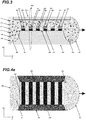
- FIGURE 3 illustrates the principle of detection and the cross-section of a nanoslit 223 of a nanofluidic biosensor according to an embodiment of the invention.
- the biosensor comprises a nanoslit 223 extending from a lateral input aperture 221 to a lateral output aperture 222, thereby creating a fluidic connection between said apertures.
- a fluidic solution 300 containing fluorescently labeled specific biomolecules (311, 312, 313, 314, 315) and non-specific biomolecules 320 is filled into the biosensor, entering the biosensor from the input lateral aperture 221, flowing through the nanoslit 223 and to the output lateral aperture 222 with a flow front 301.
- various biomarkers (331, 332, 333, 334, 335, 336) are immobilized on various selectively functionalized structured surfaces 240. Remaining surfaces 250 of the nanofluidic biosensor are for example treated to avoid unwanted functionalization of biomarkers or non-specific binding of biomolecules.
- biomolecules (311, 312, 313, 314, 315, 320) interact with the biomarkers (331, 332, 333, 334, 335, 336) immobilized inside the nanochannel 223 and may create molecular complexes (341, 342, 343, 344, 346).
- the non-specific biomolecules 320 will also diffuse in the nanoslit 222 but will not form molecular complexes with the immobilized biomarkers (331, 332, 333, 334, 335, 336).
- a detection volume 520 is focused inside the nanoslit 223 such that the intersection volume defined by the volume of the nanoslit 223 and the detection volume 520 is maximal, and located in one of the functionalized areas 240.
- the immobilized fluorescently emitting complexes 341, 342, 343, 344, 346, respectively, and the diffusing fluorescently emitting biomolecules 320 diffusing across the optical detection volume 520 are both detected by the optical system.
- the present invention thus allows detecting and/or measuring different biomarkers or different concentrations of the same biomarker in a single nanofluidic biosensor. This allows benefiting from the potential of multiplexing detections or of performing calibration.
- FIGURES 4a to 4c show a top-view cross section of a nanofluidic biosensor according to embodiments of the invention.
- a nanoslit 223 with a height defined by the thickness of a layer 230 is linked to an input lateral aperture 221 and to an output lateral aperture 222.
- a solution 300 containing biomolecules is filling the biosensor with a flow front 301.
- the nanoslit 223 comprises functionalized areas 240, 241, 242 and non-functionalized areas 250.
- the functionalized areas may be lines or rectangles 240, small polygon structures 241 as illustrated in FIGURE 4b or round or oval structures 242 as proposed in FIGURE 4c . Any other shape is however possible within the scope of the invention.
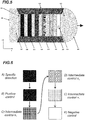
- FIGURE 5 illustrates an example of another embodiment of the present invention.
- a first functionalized area 240 is prepared with a first type of biomarker, and the other functionalized areas 243, 244, 245, 246, 247 with another type of biomarker and are used to calibrate the result obtained with the first functionalized area 240.
- a functionalized area 243 is 100% covered with a positive control biomarker and a functionalized area 247 is 100% covered with a negative control biomarker.
- Functionalized areas 244, 245 and 246 are only partially covered with a positive control biomarker.
- the partial coverage is for example performed by applying different patterns during the microfabrication of the functionalized areas 244, 245, 246 or by varying the concentration of the biomarker during the immobilization process.
- the laser spot 520 measuring the concentration of biomolecules is illustrated in the negative control functionalized area 247 in FIGURE 5 .
- FIGURE 6 schematically illustrates the method of calibrating a nanofluidic biosensor according to embodiments of the invention.
- the laser beam measures the specific detection in the first functionalized area (A).
- it measures a positive control (B), several intermediate control n1 (C), n2 (D), nx (E) and finally a negative control (F).
- Microfabricated patterns of the functionalized areas (in black) are also represented for each step.
- FIGURE 7 illustrates a calibration curve.
- the specific detection value CA is for example adjusted in function of the biosensor environment (background, maximum value, etc.) and of the characteristics of the solution 300, such as for example the solution's viscosity, the density of biomolecules, etc.
- the definition of precise functionalization areas in a nanoslit provides for great improvements to the multiplexed detection and calibration of biomolecules interacting or not with other immobilized biomolecules.
- Applications of the present invention for example include biomedical, biological or food analysis as well as fundamental studies in analytical and bioanalytical chemistry.
Landscapes
- Health & Medical Sciences (AREA)
- Immunology (AREA)
- Life Sciences & Earth Sciences (AREA)
- Chemical & Material Sciences (AREA)
- Engineering & Computer Science (AREA)
- Physics & Mathematics (AREA)
- General Health & Medical Sciences (AREA)
- Hematology (AREA)
- Analytical Chemistry (AREA)
- Urology & Nephrology (AREA)
- Biochemistry (AREA)
- General Physics & Mathematics (AREA)
- Pathology (AREA)
- Molecular Biology (AREA)
- Biomedical Technology (AREA)
- Nuclear Medicine, Radiotherapy & Molecular Imaging (AREA)
- Cell Biology (AREA)
- Biotechnology (AREA)
- Microbiology (AREA)
- Chemical Kinetics & Catalysis (AREA)
- Food Science & Technology (AREA)
- Medicinal Chemistry (AREA)
- Optics & Photonics (AREA)
- Dispersion Chemistry (AREA)
- Clinical Laboratory Science (AREA)
- Investigating, Analyzing Materials By Fluorescence Or Luminescence (AREA)
Claims (15)
- Biosensor (200) zum Nachweisen und Quantifizieren von fluoreszenzmarkierten Biomolekülen (311-320), wobei der Biosensor (200) umfasst:- ein unteres Substrat (220);- ein oberes Substrat (210) gestapelt auf dem unteren Substrat (220);- einen Nanoschlitz (223), wobei es sich um eine mikrogefertigte Struktur mit einer einen Nanometer großen Abmessung handelt, die zwischen dem unteren Substrat (220) und dem oberen Substrat (210) ausgebildet ist, wobei der Nanoschlitz (223) mehrere örtliche strukturierte Bereichen (240-247) umfasst, die entlang des Nanoschlitzes (223) angeordnet sind;- eine seitliche Eingangsöffnung (221) in direktem Kontakt mit dem Nanoschlitz (223) zum Einlassen einer Lösung mit Biomolekülen in den Nanoschlitz (223); und- eine seitliche Ausgangsöffnung (222) in direktem Kontakt mit dem Nanoschlitz (223) zum Treiben der Lösung durch den Nanoschlitz (223),dadurch gekennzeichnet, dass die mehreren örtlichen strukturierten Bereiche (240-247) jeweils durch verschiedene Biomarker (331-336) funktionalisiert sind.
- Biosensor (200) nach Anspruch 1, wobei die mehreren funktionalisierten Bereiche (240-247) sich insofern voneinander unterscheiden, als sie durch verschiedene Typen von Biomarkern funktionalisiert sind.
- Biosensor (200) nach Anspruch 1 oder 2, wobei die mehreren funktionalisierten Bereiche (240-247) sich insofern voneinander unterscheiden, als sie durch verschiedene Dichten von Biomarkern funktionalisiert sind.
- Biosensor (200) nach einem der vorhergehenden Ansprüche, wobei die mehreren Biomarker (331-336) so ausgelegt sind, dass sie mit spezifischen Biomolekülen (311-315), die in der Lösung (300) enthalten sind, biologisch oder chemisch interagieren.
- Biosensor (200) nach einem der vorhergehenden Ansprüche, wobei die mehreren Biomarker (331-336) so ausgelegt sind, dass sie mit nichtspezifischen Biomolekülen (320), die in der Lösung (300) enthalten sind, nicht biologisch oder chemisch interagieren.
- Biosensor (200) nach einem der vorhergehenden Ansprüche, wobei das untere und das obere Substrat (201, 202) aus einem Material hergestellt sind, das aus der Gruppe bestehend aus Silicium, Glas, Kunststoff und Oxidverbindungen ausgewählt ist.
- Biosensor (200) nach einem der vorhergehenden Ansprüche, wobei die seitliche Eingangsöffnung (221) und die seitliche Ausgangsöffnung (222) jeweils eine Fläche von 100 nm2 bis 20 mm2 aufweisen, und der Nanoschlitz (223) mindestens eine Abmessung von 2 nm bis 1000 nm aufweist.
- Array, umfassend mehrere Biosensoren (200) nach einem der vorhergehenden Ansprüche, wobei die Biosensoren (200) innerhalb eines Systems (100) in einer festen Position in Bezug aufeinander sind.
- Anordnung, umfassend mindestens einen Biosensor (200) nach einem der vorhergehenden Ansprüche und ferner umfassend optische Mittel (500) für Fluoreszenzanregung und -nachweis.
- Anordnung nach Anspruch 9, wobei das optische Mittel (500) eine Fluoreszenzmesseinheit ist, die einen Einzelphotonendetektor umfasst.
- Anordnung nach Anspruch 9, wobei es sich bei dem Einzelphotonendetektor um ein CMOS- oder CCD-Detektor-Array handelt.
- Anordnung nach Anspruch 9, wobei der Einzelphotonendetektor eine Lawinen-Fotodiode (APD) ist.
- Anordnung nach Anspruch 9, wobei der Einzelphotonendetektor eine Photovervielfacherröhre (PMT) ist.
- Verfahren zum Nachweisen und Quantifizieren des Vorhandenseins von fluoreszenzmarkierten Biomolekülen (311-320) in einer Lösung (300), wobei das Verfahren die folgenden Schritte umfasst:a) Bereitstellen mindestens eines Biosensors (200) nach einem der Ansprüche 1 bis 5;b) Füllen des mindestens einen Biosensors (200) mit einer wässrigen Lösung (300) von einer seitlichen Eingangsöffnung (210) des mindestens einen Biosensors (200) über einen Nanoschlitz (223), wobei es sich um eine mikrogefertigte Struktur mit einer einen Nanometer großen Abmessung handelt, (200), zu einer seitlichen Ausgangsöffnung (220) des mindestens einen Biosensors (200) durch Abscheiden der wässrigen Lösung (300) in die seitliche Eingangsöffnung (210), wobei die wässrige Lösung (300) fluoreszenzmarkierte Biomoleküle (311-320) umfasst, die für mehrere Biomarker (331-336) spezifisch sein können, die auf mehreren funktionalisierten Bereichen (240-247) des Nanoschlitzes (223) immobilisiert sind;c) Nachweisen spezifischer Biomoleküle (341-346), die auf den mehreren Biomarkern (331-336) innerhalb des Nanoschlitzes (223) immobilisiert sind, durch Messen der Fluoreszenzintensität von Luminophoren, die an die spezifischen Biomoleküle (341-346) gebunden sind, mit einem optischen System (500), wobei die mehreren funktionalisierten Bereiche (240-247) zum Immobilisieren verschiedener Dichten von Biomarkern (250-254) gemustert sind.
- Verfahren nach Anspruch 14, wobei es sich bei den fluoreszenzmarkierten Biomolekülen (311-320) um Proteine, DNA, RNA, Antikörper, Aminosäuren, Nucleinsäuren, Enzyme, Lipidmoleküle, Peptide Polysaccharide und/oder Viren handelt.
Priority Applications (1)
| Application Number | Priority Date | Filing Date | Title |
|---|---|---|---|
| EP14737223.9A EP3021968B1 (de) | 2013-07-17 | 2014-07-07 | Verfahren und vorrichtung für bioassays |
Applications Claiming Priority (3)
| Application Number | Priority Date | Filing Date | Title |
|---|---|---|---|
| EP13176794 | 2013-07-17 | ||
| EP14737223.9A EP3021968B1 (de) | 2013-07-17 | 2014-07-07 | Verfahren und vorrichtung für bioassays |
| PCT/EP2014/064482 WO2015007559A1 (en) | 2013-07-17 | 2014-07-07 | Method and device for bioassays |
Publications (2)
| Publication Number | Publication Date |
|---|---|
| EP3021968A1 EP3021968A1 (de) | 2016-05-25 |
| EP3021968B1 true EP3021968B1 (de) | 2018-09-26 |
Family
ID=48793078
Family Applications (1)
| Application Number | Title | Priority Date | Filing Date |
|---|---|---|---|
| EP14737223.9A Active EP3021968B1 (de) | 2013-07-17 | 2014-07-07 | Verfahren und vorrichtung für bioassays |
Country Status (6)
| Country | Link |
|---|---|
| US (1) | US9989526B2 (de) |
| EP (1) | EP3021968B1 (de) |
| ES (1) | ES2702361T3 (de) |
| PT (1) | PT3021968T (de) |
| TR (1) | TR201819992T4 (de) |
| WO (1) | WO2015007559A1 (de) |
Families Citing this family (2)
| Publication number | Priority date | Publication date | Assignee | Title |
|---|---|---|---|---|
| US10983135B2 (en) | 2016-02-01 | 2021-04-20 | Prevencio, Inc. | Diagnostic and prognostic methods for cardiovascular diseases and events |
| US12480934B1 (en) * | 2020-10-23 | 2025-11-25 | Mary Hitchcock Memorial Hospital, For Itself And On Behalf Of Dartmouth-Hitchcock Clinic | System and method for monitoring molecular agents in vivo by estimating magnetic nanoparticle aggregation |
Family Cites Families (3)
| Publication number | Priority date | Publication date | Assignee | Title |
|---|---|---|---|---|
| DE19725050C2 (de) * | 1997-06-13 | 1999-06-24 | Fraunhofer Ges Forschung | Anordnung zur Detektion biochemischer oder chemischer Substanzen mittels Fluoreszenzlichtanregung und Verfahren zu deren Herstellung |
| CN102762971B (zh) * | 2009-11-27 | 2015-05-27 | 洛桑联邦理工学院 | 纳米流体生物传感器及其对于快速测量溶液中的生物分子相互作用的应用及方法 |
| WO2012120387A1 (en) * | 2011-03-09 | 2012-09-13 | Abionic Sa | Rapid quantification of biomolecules in a selectively functionalized nanofluidic biosensor and method thereof |
-
2014
- 2014-07-07 US US14/905,069 patent/US9989526B2/en active Active
- 2014-07-07 TR TR2018/19992T patent/TR201819992T4/tr unknown
- 2014-07-07 ES ES14737223T patent/ES2702361T3/es active Active
- 2014-07-07 PT PT14737223T patent/PT3021968T/pt unknown
- 2014-07-07 EP EP14737223.9A patent/EP3021968B1/de active Active
- 2014-07-07 WO PCT/EP2014/064482 patent/WO2015007559A1/en not_active Ceased
Non-Patent Citations (1)
| Title |
|---|
| None * |
Also Published As
| Publication number | Publication date |
|---|---|
| HK1219456A1 (en) | 2017-04-07 |
| TR201819992T4 (tr) | 2019-02-21 |
| PT3021968T (pt) | 2018-12-19 |
| US20160153980A1 (en) | 2016-06-02 |
| ES2702361T3 (es) | 2019-02-28 |
| US9989526B2 (en) | 2018-06-05 |
| WO2015007559A1 (en) | 2015-01-22 |
| EP3021968A1 (de) | 2016-05-25 |
Similar Documents
| Publication | Publication Date | Title |
|---|---|---|
| EP2684027B1 (de) | Schnelle quantifizierung von biomolekülen in einem selektiv funktionalisierten nanofluidischen biosensor und verfahren dafür | |
| CN102762971B (zh) | 纳米流体生物传感器及其对于快速测量溶液中的生物分子相互作用的应用及方法 | |
| US9989526B2 (en) | Method and device for bioassays | |
| AU2014363071B2 (en) | Gas evacuation system for nanofluidic biosensor | |
| HK1219456B (en) | Method and device for bioassays | |
| HK1187982B (en) | Rapid quantification of biomolecules in a selectively functionalized nanofluidic biosensor and method thereof | |
| HK1227104A1 (zh) | 用於纳米流体生物传感器的气体排空系统 | |
| HK1227104B (en) | Gas evacuation system for nanofluidic biosensor | |
| HK1175527B (en) | Nanofluidic biosensor and its use for rapid measurement of biomolecular interactions in solution and methods |
Legal Events
| Date | Code | Title | Description |
|---|---|---|---|
| PUAI | Public reference made under article 153(3) epc to a published international application that has entered the european phase |
Free format text: ORIGINAL CODE: 0009012 |
|
| 17P | Request for examination filed |
Effective date: 20160104 |
|
| AK | Designated contracting states |
Kind code of ref document: A1 Designated state(s): AL AT BE BG CH CY CZ DE DK EE ES FI FR GB GR HR HU IE IS IT LI LT LU LV MC MK MT NL NO PL PT RO RS SE SI SK SM TR |
|
| AX | Request for extension of the european patent |
Extension state: BA ME |
|
| RIN1 | Information on inventor provided before grant (corrected) |
Inventor name: MAERKI, IWAN Inventor name: DURAND, NICOLAS Inventor name: BROILLET, STEPHANE Inventor name: MAYOR, ANNICK |
|
| DAX | Request for extension of the european patent (deleted) | ||
| STAA | Information on the status of an ep patent application or granted ep patent |
Free format text: STATUS: EXAMINATION IS IN PROGRESS |
|
| 17Q | First examination report despatched |
Effective date: 20161031 |
|
| REG | Reference to a national code |
Ref country code: HK Ref legal event code: DE Ref document number: 1219456 Country of ref document: HK |
|
| RAP1 | Party data changed (applicant data changed or rights of an application transferred) |
Owner name: ABIONIC SA |
|
| GRAP | Despatch of communication of intention to grant a patent |
Free format text: ORIGINAL CODE: EPIDOSNIGR1 |
|
| STAA | Information on the status of an ep patent application or granted ep patent |
Free format text: STATUS: GRANT OF PATENT IS INTENDED |
|
| INTG | Intention to grant announced |
Effective date: 20180528 |
|
| GRAS | Grant fee paid |
Free format text: ORIGINAL CODE: EPIDOSNIGR3 |
|
| GRAA | (expected) grant |
Free format text: ORIGINAL CODE: 0009210 |
|
| STAA | Information on the status of an ep patent application or granted ep patent |
Free format text: STATUS: THE PATENT HAS BEEN GRANTED |
|
| AK | Designated contracting states |
Kind code of ref document: B1 Designated state(s): AL AT BE BG CH CY CZ DE DK EE ES FI FR GB GR HR HU IE IS IT LI LT LU LV MC MK MT NL NO PL PT RO RS SE SI SK SM TR |
|
| REG | Reference to a national code |
Ref country code: GB Ref legal event code: FG4D |
|
| REG | Reference to a national code |
Ref country code: CH Ref legal event code: EP |
|
| REG | Reference to a national code |
Ref country code: AT Ref legal event code: REF Ref document number: 1045355 Country of ref document: AT Kind code of ref document: T Effective date: 20181015 |
|
| REG | Reference to a national code |
Ref country code: IE Ref legal event code: FG4D |
|
| REG | Reference to a national code |
Ref country code: DE Ref legal event code: R096 Ref document number: 602014032998 Country of ref document: DE |
|
| REG | Reference to a national code |
Ref country code: CH Ref legal event code: NV Representative=s name: KATZAROV SA, CH |
|
| REG | Reference to a national code |
Ref country code: PT Ref legal event code: SC4A Ref document number: 3021968 Country of ref document: PT Date of ref document: 20181219 Kind code of ref document: T Free format text: AVAILABILITY OF NATIONAL TRANSLATION Effective date: 20181213 |
|
| REG | Reference to a national code |
Ref country code: NL Ref legal event code: FP |
|
| REG | Reference to a national code |
Ref country code: SE Ref legal event code: TRGR |
|
| PG25 | Lapsed in a contracting state [announced via postgrant information from national office to epo] |
Ref country code: BG Free format text: LAPSE BECAUSE OF FAILURE TO SUBMIT A TRANSLATION OF THE DESCRIPTION OR TO PAY THE FEE WITHIN THE PRESCRIBED TIME-LIMIT Effective date: 20181226 Ref country code: GR Free format text: LAPSE BECAUSE OF FAILURE TO SUBMIT A TRANSLATION OF THE DESCRIPTION OR TO PAY THE FEE WITHIN THE PRESCRIBED TIME-LIMIT Effective date: 20181227 Ref country code: RS Free format text: LAPSE BECAUSE OF FAILURE TO SUBMIT A TRANSLATION OF THE DESCRIPTION OR TO PAY THE FEE WITHIN THE PRESCRIBED TIME-LIMIT Effective date: 20180926 Ref country code: LT Free format text: LAPSE BECAUSE OF FAILURE TO SUBMIT A TRANSLATION OF THE DESCRIPTION OR TO PAY THE FEE WITHIN THE PRESCRIBED TIME-LIMIT Effective date: 20180926 Ref country code: FI Free format text: LAPSE BECAUSE OF FAILURE TO SUBMIT A TRANSLATION OF THE DESCRIPTION OR TO PAY THE FEE WITHIN THE PRESCRIBED TIME-LIMIT Effective date: 20180926 Ref country code: NO Free format text: LAPSE BECAUSE OF FAILURE TO SUBMIT A TRANSLATION OF THE DESCRIPTION OR TO PAY THE FEE WITHIN THE PRESCRIBED TIME-LIMIT Effective date: 20181226 |
|
| REG | Reference to a national code |
Ref country code: LT Ref legal event code: MG4D |
|
| PG25 | Lapsed in a contracting state [announced via postgrant information from national office to epo] |
Ref country code: LV Free format text: LAPSE BECAUSE OF FAILURE TO SUBMIT A TRANSLATION OF THE DESCRIPTION OR TO PAY THE FEE WITHIN THE PRESCRIBED TIME-LIMIT Effective date: 20180926 Ref country code: HR Free format text: LAPSE BECAUSE OF FAILURE TO SUBMIT A TRANSLATION OF THE DESCRIPTION OR TO PAY THE FEE WITHIN THE PRESCRIBED TIME-LIMIT Effective date: 20180926 Ref country code: AL Free format text: LAPSE BECAUSE OF FAILURE TO SUBMIT A TRANSLATION OF THE DESCRIPTION OR TO PAY THE FEE WITHIN THE PRESCRIBED TIME-LIMIT Effective date: 20180926 |
|
| REG | Reference to a national code |
Ref country code: ES Ref legal event code: FG2A Ref document number: 2702361 Country of ref document: ES Kind code of ref document: T3 Effective date: 20190228 |
|
| PG25 | Lapsed in a contracting state [announced via postgrant information from national office to epo] |
Ref country code: RO Free format text: LAPSE BECAUSE OF FAILURE TO SUBMIT A TRANSLATION OF THE DESCRIPTION OR TO PAY THE FEE WITHIN THE PRESCRIBED TIME-LIMIT Effective date: 20180926 Ref country code: CZ Free format text: LAPSE BECAUSE OF FAILURE TO SUBMIT A TRANSLATION OF THE DESCRIPTION OR TO PAY THE FEE WITHIN THE PRESCRIBED TIME-LIMIT Effective date: 20180926 Ref country code: EE Free format text: LAPSE BECAUSE OF FAILURE TO SUBMIT A TRANSLATION OF THE DESCRIPTION OR TO PAY THE FEE WITHIN THE PRESCRIBED TIME-LIMIT Effective date: 20180926 Ref country code: PL Free format text: LAPSE BECAUSE OF FAILURE TO SUBMIT A TRANSLATION OF THE DESCRIPTION OR TO PAY THE FEE WITHIN THE PRESCRIBED TIME-LIMIT Effective date: 20180926 Ref country code: IS Free format text: LAPSE BECAUSE OF FAILURE TO SUBMIT A TRANSLATION OF THE DESCRIPTION OR TO PAY THE FEE WITHIN THE PRESCRIBED TIME-LIMIT Effective date: 20190126 |
|
| PG25 | Lapsed in a contracting state [announced via postgrant information from national office to epo] |
Ref country code: SK Free format text: LAPSE BECAUSE OF FAILURE TO SUBMIT A TRANSLATION OF THE DESCRIPTION OR TO PAY THE FEE WITHIN THE PRESCRIBED TIME-LIMIT Effective date: 20180926 Ref country code: SM Free format text: LAPSE BECAUSE OF FAILURE TO SUBMIT A TRANSLATION OF THE DESCRIPTION OR TO PAY THE FEE WITHIN THE PRESCRIBED TIME-LIMIT Effective date: 20180926 |
|
| REG | Reference to a national code |
Ref country code: DE Ref legal event code: R097 Ref document number: 602014032998 Country of ref document: DE |
|
| PG25 | Lapsed in a contracting state [announced via postgrant information from national office to epo] |
Ref country code: DK Free format text: LAPSE BECAUSE OF FAILURE TO SUBMIT A TRANSLATION OF THE DESCRIPTION OR TO PAY THE FEE WITHIN THE PRESCRIBED TIME-LIMIT Effective date: 20180926 |
|
| PLBE | No opposition filed within time limit |
Free format text: ORIGINAL CODE: 0009261 |
|
| STAA | Information on the status of an ep patent application or granted ep patent |
Free format text: STATUS: NO OPPOSITION FILED WITHIN TIME LIMIT |
|
| 26N | No opposition filed |
Effective date: 20190627 |
|
| PG25 | Lapsed in a contracting state [announced via postgrant information from national office to epo] |
Ref country code: SI Free format text: LAPSE BECAUSE OF FAILURE TO SUBMIT A TRANSLATION OF THE DESCRIPTION OR TO PAY THE FEE WITHIN THE PRESCRIBED TIME-LIMIT Effective date: 20180926 |
|
| PG25 | Lapsed in a contracting state [announced via postgrant information from national office to epo] |
Ref country code: MC Free format text: LAPSE BECAUSE OF FAILURE TO SUBMIT A TRANSLATION OF THE DESCRIPTION OR TO PAY THE FEE WITHIN THE PRESCRIBED TIME-LIMIT Effective date: 20180926 |
|
| PG25 | Lapsed in a contracting state [announced via postgrant information from national office to epo] |
Ref country code: LU Free format text: LAPSE BECAUSE OF NON-PAYMENT OF DUE FEES Effective date: 20190707 |
|
| PG25 | Lapsed in a contracting state [announced via postgrant information from national office to epo] |
Ref country code: IE Free format text: LAPSE BECAUSE OF NON-PAYMENT OF DUE FEES Effective date: 20190707 |
|
| PG25 | Lapsed in a contracting state [announced via postgrant information from national office to epo] |
Ref country code: CY Free format text: LAPSE BECAUSE OF FAILURE TO SUBMIT A TRANSLATION OF THE DESCRIPTION OR TO PAY THE FEE WITHIN THE PRESCRIBED TIME-LIMIT Effective date: 20180926 |
|
| REG | Reference to a national code |
Ref country code: AT Ref legal event code: UEP Ref document number: 1045355 Country of ref document: AT Kind code of ref document: T Effective date: 20180926 |
|
| PG25 | Lapsed in a contracting state [announced via postgrant information from national office to epo] |
Ref country code: MT Free format text: LAPSE BECAUSE OF FAILURE TO SUBMIT A TRANSLATION OF THE DESCRIPTION OR TO PAY THE FEE WITHIN THE PRESCRIBED TIME-LIMIT Effective date: 20180926 Ref country code: HU Free format text: LAPSE BECAUSE OF FAILURE TO SUBMIT A TRANSLATION OF THE DESCRIPTION OR TO PAY THE FEE WITHIN THE PRESCRIBED TIME-LIMIT; INVALID AB INITIO Effective date: 20140707 |
|
| PG25 | Lapsed in a contracting state [announced via postgrant information from national office to epo] |
Ref country code: MK Free format text: LAPSE BECAUSE OF FAILURE TO SUBMIT A TRANSLATION OF THE DESCRIPTION OR TO PAY THE FEE WITHIN THE PRESCRIBED TIME-LIMIT Effective date: 20180926 |
|
| REG | Reference to a national code |
Ref country code: GB Ref legal event code: 732E Free format text: REGISTERED BETWEEN 20230810 AND 20230816 |
|
| REG | Reference to a national code |
Ref country code: NL Ref legal event code: RC Free format text: DETAILS LICENCE OR PLEDGE: RIGHT OF PLEDGE, ESTABLISHED Name of requester: MARCEL SEVERIN Effective date: 20230901 |
|
| REG | Reference to a national code |
Ref country code: GB Ref legal event code: 732E Free format text: REGISTERED BETWEEN 20231012 AND 20231018 |
|
| REG | Reference to a national code |
Ref country code: BE Ref legal event code: RC Free format text: DETAILS PLEDGE: RIGHT OF PLEDGE, ESTABLISHED Effective date: 20231023 |
|
| PGFP | Annual fee paid to national office [announced via postgrant information from national office to epo] |
Ref country code: SE Payment date: 20250612 Year of fee payment: 12 |
|
| PGFP | Annual fee paid to national office [announced via postgrant information from national office to epo] |
Ref country code: ES Payment date: 20250801 Year of fee payment: 12 |
|
| PGFP | Annual fee paid to national office [announced via postgrant information from national office to epo] |
Ref country code: DE Payment date: 20250923 Year of fee payment: 12 |
|
| PGFP | Annual fee paid to national office [announced via postgrant information from national office to epo] |
Ref country code: AT Payment date: 20250722 Year of fee payment: 12 |
|
| PGFP | Annual fee paid to national office [announced via postgrant information from national office to epo] |
Ref country code: CH Payment date: 20250801 Year of fee payment: 12 |
|
| PGFP | Annual fee paid to national office [announced via postgrant information from national office to epo] |
Ref country code: GB Payment date: 20260619 Year of fee payment: 13 |
|
| PGFP | Annual fee paid to national office [announced via postgrant information from national office to epo] |
Ref country code: IT Payment date: 20260624 Year of fee payment: 13 |
|
| PGFP | Annual fee paid to national office [announced via postgrant information from national office to epo] |
Ref country code: BE Payment date: 20260617 Year of fee payment: 13 |
|
| PGFP | Annual fee paid to national office [announced via postgrant information from national office to epo] |
Ref country code: PT Payment date: 20260618 Year of fee payment: 13 |
|
| PGFP | Annual fee paid to national office [announced via postgrant information from national office to epo] |
Ref country code: NL Payment date: 20260617 Year of fee payment: 13 Ref country code: TR Payment date: 20260618 Year of fee payment: 13 |
|
| PGFP | Annual fee paid to national office [announced via postgrant information from national office to epo] |
Ref country code: FR Payment date: 20260612 Year of fee payment: 13 |
|
| REG | Reference to a national code |
Ref country code: CH Ref legal event code: U11 Free format text: ST27 STATUS EVENT CODE: U-0-0-U10-U11 (AS PROVIDED BY THE NATIONAL OFFICE) Effective date: 20260801 |