EP3020717A1 - P2x4 receptor antagonist - Google Patents
P2x4 receptor antagonist Download PDFInfo
- Publication number
- EP3020717A1 EP3020717A1 EP14822292.0A EP14822292A EP3020717A1 EP 3020717 A1 EP3020717 A1 EP 3020717A1 EP 14822292 A EP14822292 A EP 14822292A EP 3020717 A1 EP3020717 A1 EP 3020717A1
- Authority
- EP
- European Patent Office
- Prior art keywords
- group
- carbon atoms
- ring
- substituted
- atoms
- Prior art date
- Legal status (The legal status is an assumption and is not a legal conclusion. Google has not performed a legal analysis and makes no representation as to the accuracy of the status listed.)
- Granted
Links
- 0 CCC*(c1c(*(c2cc(*)c(*3C(NN)=*C=C3)cc2)C(C2)=O)ccc3ccccc13)C2=O Chemical compound CCC*(c1c(*(c2cc(*)c(*3C(NN)=*C=C3)cc2)C(C2)=O)ccc3ccccc13)C2=O 0.000 description 2
Images
Classifications
-
- C—CHEMISTRY; METALLURGY
- C07—ORGANIC CHEMISTRY
- C07D—HETEROCYCLIC COMPOUNDS
- C07D403/00—Heterocyclic compounds containing two or more hetero rings, having nitrogen atoms as the only ring hetero atoms, not provided for by group C07D401/00
- C07D403/02—Heterocyclic compounds containing two or more hetero rings, having nitrogen atoms as the only ring hetero atoms, not provided for by group C07D401/00 containing two hetero rings
- C07D403/10—Heterocyclic compounds containing two or more hetero rings, having nitrogen atoms as the only ring hetero atoms, not provided for by group C07D401/00 containing two hetero rings linked by a carbon chain containing aromatic rings
-
- A—HUMAN NECESSITIES
- A61—MEDICAL OR VETERINARY SCIENCE; HYGIENE
- A61P—SPECIFIC THERAPEUTIC ACTIVITY OF CHEMICAL COMPOUNDS OR MEDICINAL PREPARATIONS
- A61P25/00—Drugs for disorders of the nervous system
- A61P25/04—Centrally acting analgesics, e.g. opioids
-
- A—HUMAN NECESSITIES
- A61—MEDICAL OR VETERINARY SCIENCE; HYGIENE
- A61P—SPECIFIC THERAPEUTIC ACTIVITY OF CHEMICAL COMPOUNDS OR MEDICINAL PREPARATIONS
- A61P43/00—Drugs for specific purposes, not provided for in groups A61P1/00-A61P41/00
-
- C—CHEMISTRY; METALLURGY
- C07—ORGANIC CHEMISTRY
- C07D—HETEROCYCLIC COMPOUNDS
- C07D401/00—Heterocyclic compounds containing two or more hetero rings, having nitrogen atoms as the only ring hetero atoms, at least one ring being a six-membered ring with only one nitrogen atom
- C07D401/02—Heterocyclic compounds containing two or more hetero rings, having nitrogen atoms as the only ring hetero atoms, at least one ring being a six-membered ring with only one nitrogen atom containing two hetero rings
- C07D401/04—Heterocyclic compounds containing two or more hetero rings, having nitrogen atoms as the only ring hetero atoms, at least one ring being a six-membered ring with only one nitrogen atom containing two hetero rings directly linked by a ring-member-to-ring-member bond
-
- C—CHEMISTRY; METALLURGY
- C07—ORGANIC CHEMISTRY
- C07D—HETEROCYCLIC COMPOUNDS
- C07D401/00—Heterocyclic compounds containing two or more hetero rings, having nitrogen atoms as the only ring hetero atoms, at least one ring being a six-membered ring with only one nitrogen atom
- C07D401/14—Heterocyclic compounds containing two or more hetero rings, having nitrogen atoms as the only ring hetero atoms, at least one ring being a six-membered ring with only one nitrogen atom containing three or more hetero rings
-
- C—CHEMISTRY; METALLURGY
- C07—ORGANIC CHEMISTRY
- C07D—HETEROCYCLIC COMPOUNDS
- C07D403/00—Heterocyclic compounds containing two or more hetero rings, having nitrogen atoms as the only ring hetero atoms, not provided for by group C07D401/00
- C07D403/02—Heterocyclic compounds containing two or more hetero rings, having nitrogen atoms as the only ring hetero atoms, not provided for by group C07D401/00 containing two hetero rings
- C07D403/08—Heterocyclic compounds containing two or more hetero rings, having nitrogen atoms as the only ring hetero atoms, not provided for by group C07D401/00 containing two hetero rings linked by a carbon chain containing alicyclic rings
-
- C—CHEMISTRY; METALLURGY
- C07—ORGANIC CHEMISTRY
- C07D—HETEROCYCLIC COMPOUNDS
- C07D403/00—Heterocyclic compounds containing two or more hetero rings, having nitrogen atoms as the only ring hetero atoms, not provided for by group C07D401/00
- C07D403/14—Heterocyclic compounds containing two or more hetero rings, having nitrogen atoms as the only ring hetero atoms, not provided for by group C07D401/00 containing three or more hetero rings
-
- C—CHEMISTRY; METALLURGY
- C07—ORGANIC CHEMISTRY
- C07D—HETEROCYCLIC COMPOUNDS
- C07D405/00—Heterocyclic compounds containing both one or more hetero rings having oxygen atoms as the only ring hetero atoms, and one or more rings having nitrogen as the only ring hetero atom
- C07D405/14—Heterocyclic compounds containing both one or more hetero rings having oxygen atoms as the only ring hetero atoms, and one or more rings having nitrogen as the only ring hetero atom containing three or more hetero rings
-
- C—CHEMISTRY; METALLURGY
- C07—ORGANIC CHEMISTRY
- C07D—HETEROCYCLIC COMPOUNDS
- C07D409/00—Heterocyclic compounds containing two or more hetero rings, at least one ring having sulfur atoms as the only ring hetero atoms
- C07D409/14—Heterocyclic compounds containing two or more hetero rings, at least one ring having sulfur atoms as the only ring hetero atoms containing three or more hetero rings
Definitions
- the present invention relates to a diazepine derivative having a P2X4 receptor antagonist activity.
- the ATP receptors are roughly classified into the P2X family of the ion channel type receptors, and the P2Y family of the G protein coupling type receptors, and.seven kinds (P2X 1 to P2X 7 ) and eight kinds (P2Y 1 , P2Y 2 , P2Y 4 , P2Y 6 , and P2Y 11 to P2Y 14 ) of subtypes have so far been reported for each family.
- the P2X4 receptor (Genebank No. X87763), a subtype of the P2X family, has been reported to be widely expressed in the central nervous system, and the like (Non-patent documents 1 to 5).
- NSAID s non-steroidal anti-inflammatory drugs
- morphine a non-steroidal anti-inflammatory drugs
- Neuropathic pain is often caused by injury of a peripheral nerve or the central nerve, and it is caused by, for example, after-trouble of operation, cancer, spinal cord injury, herpes zoster, diabetic neuritis, trigeminal neuralgia, and the like.
- a substance that inhibits the activity of the P2X4 receptor is expected to be a prophylactic or therapeutic agent for pains of nociceptive pain, inflammatory pain, and neuropathic pain caused by after-trouble of operation, cancers, spinal cord injury, herpes zoster, diabetic neuritis, trigeminal neuralgia, and the like.
- Patent document 2 reported that a benzofuro-1,4-diazepin-2-one derivative represented by the following general formula (A): (in the formula, R 1 is a halogen, and R 2 is hydrogen, a halogen, nitro, cyano, C(O)-OR 3 , C(O)-NR 4 R 5, SO 2 -OR 3 , or SO 2 -NR 4 R 5 , or R 1 is hydrogen, and R 2 is a halogen, nitro, cyano, C(O)-OR 3 , C(O)-NR 4 R 5 , SO 2 -OR 3 , or SO 2 -NR 4 R 5 ) has a P2X4 receptor antagonist activity.
- A benzofuro-1,4-diazepin-2-one derivative represented by the following general formula (A): (in the formula, R 1 is a halogen, and R 2 is hydrogen, a halogen, nitro, cyano, C(O)-OR 3 , C(O)-
- paroxetine which is an antidepressant, has a P2X4 receptor antagonist activity (Non-patent document 8).
- Patent documents 3 to 10 mentioned above do not specifically describe any naphtho[1,2-e][1,4]diazepin-2-one derivative represented by the aforementioned formula (B), nor naphtho[1,2-b] [1,4]diazepin-2,4-dione derivative represented by the aforementioned general formula (C) in which tetrazole group or the like substitutes on the phenyl group or the like at the 5-position, and benzyl group or the like substitutes on the tetrazole group or the like.
- any safe medicament in the form of a preparation for oral administration has not been provided which can be easily taken and has a superior P2X4 receptor antagonist activity.
- An object of the present invention is to provide a diazepine derivative represented by the following general formula (I) or (II) and having a P2X4 receptor antagonist activity.
- the present invention thus relates to a compound represented by the following general formula (I), a tautomer or a stereoisomer of the compound, or a pharmacologically acceptable salt thereof, or a solvate of any of the foregoing:
- the present invention also relates to a compound represented by the following general formula (II), a tautomer or a stereoisomer of the compound, or a pharmacologically acceptable salt thereof, or a solvate of any of the foregoing:
- the present invention also relates to a P2X4 receptor antagonist containing a compound represented by the aforementioned general formula (I) or (II), a tautomer or a stereoisomer of the compound, or a pharmacologically acceptable salt thereof, or a solvate of any of the foregoing as an active ingredient.
- the present invention further relates to a prophylactic or therapeutic agent for nociceptive pain, inflammatory pain, or neuropathic pain containing a compound represented by the aforementioned general formula (I) or (II), a tautomer or a stereoisomer of the compound, or a pharmacologically acceptable salt thereof, or a solvate of any of the foregoing as an active ingredient.
- a prophylactic or therapeutic agent for nociceptive pain, inflammatory pain, or neuropathic pain containing a compound represented by the aforementioned general formula (I) or (II), a tautomer or a stereoisomer of the compound, or a pharmacologically acceptable salt thereof, or a solvate of any of the foregoing as an active ingredient.
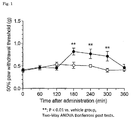
- FIG. 1 shows results of measurement of the analgesic activity of the compound of the present invention (Example 86).
- examples of the alkyl group having 1 to 8 carbon atoms include methyl group, ethyl group, propyl group, isopropyl group, butyl group, i-butyl group, t-butyl group, pentyl group, hexyl group, and the like.
- Examples of the 5- to 8-membered cycloalkyl ring include cyclopentyl ring, cyclohexyl ring, and the like.
- Examples of the cycloalkyl group having 3 to 8 carbon atoms include cyclopropyl group, cyclohexyl group, and the like.
- alkenyl group having 2 to 8 carbon atoms examples include allyl group, and the like.
- alkoxy group having 1 to 8 carbon atoms examples include methoxy group, ethoxy group, propoxy group, isopropoxy group, butoxy group, i-butoxy group, t-butoxy group, pentyloxy group, hexyloxy group, and the like.
- alkyl group having 1 to 8 carbon atoms and substituted with 1 to 3 halogen atoms examples include methyl group, ethyl group, propyl group, isopropyl group, butyl group, t-butyl group, and the like, which are substituted with 1 to 3 of halogen atoms such as fluorine atom, chlorine atom, and bromine atom, and preferred examples include trifluoromethyl group, chloromethyl group, 2-chloroethyl group, 2-bromoethyl group, 2-fluoroethyl group, and the like.
- alkoxy group having 1 to 8 carbon atoms and substituted with 1 to 3 halogen atoms examples include methoxy group, ethoxy group, propoxy group, isopropoxy group, butoxy group, t-butoxy group, and the like, which are substituted with 1 to 3 of halogen atoms such as fluorine atom, chlorine atom, and bromine atom, and preferred examples include trifluoromethoxy group, chloromethoxy group, 2-chloroethoxy group, 2-bromoethoxy group, 2-fluoroethoxy group, and the like.
- halogen atom examples include fluorine atom, chlorine atom, bromine atom, and the like.
- alkylamino group having 1 to 8 carbon atoms examples include methylamino group, ethylamino group, and the like.
- dialkylamino group having 2 to 8 carbon atoms examples include dimethylamino group, diethylamino group, and the like.
- acylamino group having 2 to 8 carbon atoms examples include acetylamino group.
- acyl group having 2 to 8 carbon atoms examples include acetyl group, and the like.
- alkoxycarbonyl group examples include methoxycarbonyl group, and the like.
- Examples of the aralkyl group include benzyl group, and the like.
- alkyl group having 1 to 8 carbon atoms and substituted with hydroxyl group examples include 2-hydroxyethyl group, and the like.
- Examples of the substituent of the phenyl group which may be substituted, and the pyridyl group which may be substituted include a halogen atom, an alkyl group having 1 to 8 carbon atoms, an alkoxy group having 1 to 8 carbon atoms, an alkyl group having 1 to 8 carbon atoms and substituted with 1 to 3 halogen atoms, an alkoxy group having 1 to 8 carbon atoms and substituted with 1 to 3 halogen atoms, and the like.
- R9 and R10 may bind together to form an ethylene chain
- R 9a and R 10a may bind together to form an ethylene chain
- E and E a may contain a double bond
- the pyridine ring when A is pyridine ring which may be substituted, the pyridine ring binds to X a at the 3-position thereof, and binds to D a at the 6-position thereof.
- Examples of the pharmacologically acceptable salts of the compounds represented by the aforementioned general formula (I) or (II) include hydrochlorides, and alkali metal salts such as those of sodium, potassium, and lithium.
- stereoisomers of the compounds of the present invention such as cis- and trans-isomers, optically active substances, and racemates, and all of these substances fall within the scope of the present invention.
- the compounds of the present invention represented by the aforementioned general formula (I) or (II) can be prepared by referring to the aforementioned synthesis methods and the examples mentioned later, as well as the aforementioned patent documents, prior art references, and the like.
- R C , E, and G are as mentioned in Tables 1 to 3.
- R c E G H CH 2 (2-OMe)Phenyl H CH 2 (2-OH)Phenyl H CH 2 -CH 2 Pyridin-3-yl H CH 2 -CH 2 Phenyl H CH 2 Pyridin-4-yl H CH 2 Phenyl H CH 2 Pyridin-3-yl H CH 2 -CH 2 Cyclohexyl H CH 2 -CH 2 Pyridin-4-yl H CH 2 Pyridin-2-yl H CH 2 -CH 2 Pyridin-2-yl H CH 2 Imidazol-1-yl I [Table 2] R c E G H CH 2 -CH 2 Imidazol-1-yl H CH 2 -CH 2 (2-OMe)Phenyl H CH 2 -CH 2 -CH 2 Phenyl H NH-CH 2 Pyridin-2-yl H CH 2 -NH Phenyl H CH 2 -O Ph
- R C , E, and G are as mentioned in Tables 4 to 6.
- R c E G H CH 2 (2-OMe)Phenyl H CH 2 (2-OH)Phenyl H CH 2 -CH 2 Pyridin-3-yl H CH 2 -CH 2 Phenyl H CH 2 Pyridin-4-yl H CH 2 Phenyl H CH 2 Pyridin-3-yl H CH 2 -CH 2 Cyclohexyl H CH 2 -CH 2 Pyridin-4-yl H CH 2 Pyridin-2-yl H CH 2 Pyridin-2-yl [Table 5]
- R a R c E G 7-OMe H CH 2 (2-OMe)Phenyl 6-OMe H CH 2 (2-OH)Phenyl 6,7-OMe H CH 2 -CH 2 Pyridin-3-yl 7-Me H CH 2 -CH 2 Phenyl 7-Et H CH 2 Pyridin-4-yl 7-Pr H CH 2 Phenyl 7-iPr H CH 2 Pyridin-3-yl 7-tBu H CH 2 -CH 2 Cyclohexyl 7-CN H CH 2 -CH 2 Pyridin-4-yl 7-CF 3 H CH 2 Pyridin-2-yl 7-OCF 3 H CH 2 -CH 2 Pyridin-2-yl [Table 8] R a R c E G 7,8-OMe H CH 2 Imidazol-1-yl 6,7-Me H CH 2 -CH 2 Imidazol
- R C , E, and G are as mentioned in Tables 10 to 12.
- R c E G H CH 2 -CH 2 Phenyl H CH 2 (2-OMe)Phenyl H CH 2 (2-OH)Phenyl H CH 2 -CH 2 Pyridin-2-yl H CH 2 -CH 2 Pyridin-3-yl H CH 2 -CH 2 (2-CF 3 )Phenyl H CH 2 -CH 2 (2-F)Phenyl H CH 2 -CH 2 (2-OMe)Phenyl H CH 2 Pyridin-4-yl H CH 2 Phenyl H CH 2 Pyridin-3-yl H CH 2 Cyclohexyl H CH 2 Pyridin-4-yl [Table 11] R c E G H CH 2 Pyridin-2-yl H CH 2 -CH 2 Pyridin-2-yl H CH 2 -CH 2 (4-SO 2 Me)Phenyl H CH 2 -CH 2 (4-F)Phenyl H CH 2 -CH 2 (4-
- R C , E, and G are as mentioned in Tables 13 to 15.
- R c E G H CH 2 -CH 2 Phenyl H CH 2 (2-OMe)Phenyl H CH 2 (2-OH)Phenyl H CH 2 -CH 2 Pyridin-3-yl H CH 2 -CH 2 Phenyl H CH 2 Pyridin-4-yl H CH 2 Phenyl H CH 2 Pyridin-3-yl H CH 2 -CH 2 Cyclohexyl H CH 2 -CH 2 Pyridin-4-yl H CH 2 Pyridin-2-yl H CH 2 -CH 2 Pyridin-2-yl [Table 14] R c E G H CH 2 Imidazol-1-yl H CH 2 -CH 2 Imidazol-1-yl H CH 2 -CH 2 (2-OMe)Phenyl H CH 2 -CH 2 -CH 2 Phenyl H CH 2 (6-F)P
- R c E G H CH 2 -CH 2 Pyridin-2-yl H CH 2 (2-OMe)Phenyl H CH 2 (2-OH)Phenyl H CH 2 -CH 2 Pyridin-3-yl H CH 2 -CH 2 Phenyl H CH 2 Pyridin-4-yl H CH 2 Phenyl H CH 2 Pyridin-3-yl H CH 2 -CH 2 Cyclohexyl H CH 2 -CH 2 Pyridin-4-yl H CH 2 Pyridin-2-yl H CH 2 Imidazol-1-yl [Table 17] R c E G H CH 2 -CH 2 Imidazol-1-yl H CH 2 -CH 2 (2-OMe)Phenyl H CH 2 (2-OMe)Phenyl H CH 2 -CH 2 -CH 2 Phenyl H CH 2 (6-F)Pyridin-2-yl H CH 2
- R c E G H CH 2 -CH 2 Phenyl H CH 2 (2-OMe)Phenyl H CH 2 (2-OH)Phenyl H CH 2 -CH 2 Pyridin-3-yl H CH 2 -CH 2 Phenyl H CH 2 Pyridin-4-yl H CH 2 Phenyl H CH 2 Pyridin-3-yl H CH 2 Cyclohexyl H CH 2 -CH 2 Pyridin-4-yl H CH 2 Pyridin-2-yl H CH 2 -CH 2 Pyridin-2-yl [Table 20] R c E G H CH 2 Imidazol-1-yl H CH 2 -CH 2 Imidazol-1-yl H CH 2 -CH 2 (2-OMe)Phenyl H CH 2 -CH 2 -CH 2 Phenyl H CH 2 (6-F)Pyrid
- the P2X4 receptor antagonist activities of the compounds of the present invention were measured as follows.
- the ATP receptor (human P2X4) was introduced into the 1321N1 cells, and the cells were used as a stable ATP receptor expression system.
- the P2X4-expressing 1321N1 cells were seeded on a 96-well plate, cultured under the conditions of 37°C and 5% CO 2 for 24 hours, and used for calcium measurement.
- Fura-2 AM which is a calcium fluorescent indicator, was dissolved in an extracellular fluid for calcium imaging, and the seeded cells were treated with the solution, and left standing at room temperature for 45 minutes so that Fura-2 AM was incorporated into the cells.
- a microplate reader Fluostar Optima (BMG Labtech), was used.
- the light emitted from a xenon lamp was passed through 340 nm and 380 nm filters, respectively, and irradiated on the cells, fluorescences of 510 nm, F 340 and F 380 , emitted from the cells were measured, and change of the ratio F 340 /F 380 was used as an index of change of intracellular calcium level.
- the measurement was performed by adding ATP to each well at a final concentration of 1 ⁇ M, and observing the ATP-induced Ca 2+ response over time. In the measurement, a treatment with a test substance was performed 15 minutes before the addition ofATP, and the inhibitory activity of the test substance was calculated by comparison of the result with the result obtained in the absence of the test substance.
- analgesic activities of the compounds of the present invention were measured by orally administering them to a mouse neuropathic pain model. As a result, it became clear that the compounds have superior analgesic activity (Example 86, Fig. 1 ).
- the diazepine derivatives represented by the aforementioned general formula (I) or (II), and pharmacologically acceptable salts thereof have a P2X4 receptor antagonist activity, and accordingly, it is considered that they are useful as prophylactic or therapeutic agents for pains of nociceptive pain, inflammatory pain, and neuropathic pain. More specifically, they are useful as prophylactic and therapeutic agents for pains accompanying various cancers, pains accompanying diabetic nerve damage, pains accompanying viral diseases such as herpes, arthrosis deformans, and the like.
- the prophylactic or therapeutic agent of the present invention may be used together with other medicaments if needed, and may be used together with, for example, opioid analgesics (morphine, fentanyl), sodium channel blockers (Novocain, lidocaine), NSAIDs (aspirin, ibuprofen), and the like. Further, when it is used for cancerous pain, it may be used together with, for example, anticancer agents such as anticancer chemotherapeutic agents.
- the compounds of the present invention can be administered to a human by an appropriate administration method, such as oral administration or parenteral administration, but oral administration is preferred.
- dosage forms such as tablets, granules, powders, capsules, suspensions, injections, and suppositories can be prepared by the methods usually used in the field of pharmaceutical manufacturing.
- excipients for manufacturing such preparations, in the case of tablets, for example, usual excipients, disintegrating agents, binders, lubricants, dyes, and the like are used.
- excipient include lactose, D-mannitol, crystalline cellulose, glucose, and the like
- disintegrating agent include starch, carboxymethylcellulose calcium (CMC-Ca), and the like
- examples of lubricant include magnesium stearate, talc, and the like
- binder include hydroxypropylcellulose (HPC), gelatin, polyvinylpyrrolidone (PVP), and the like.
- solvents, stabilizers, dissolving aids, suspending agents, emulsifiers, soothing agents, buffering agents, preservatives, and the like are used.
- the compounds of the present invention as the active ingredient can usually be administered to an adult in a daily dose of about 0.01 to 100 mg in the case of injection, or a daily dose of 1 to 2000 mg in the case of oral administration, but the dose may be increased or decreased depending on age, symptoms, and the like.
- the compounds of the present invention include highly safe compounds such as those not showing the hERG potassium ion channel inhibitory activity, and they are also superior P2X4 receptor antagonists that can be made into easily-taken preparations for oral administration. Therefore, they are useful as prophylactic and therapeutic agents for nociceptive pain, inflammatory pain, and neuropathic pain.
- 1-Nitro-2-naphthyl trifluoromethanesulfonate (20.26 g, 63.07 mmol), tert-butyl 4-aminophenylcarbamate (13.13 g, 63.07 mmol), triphenylphosphine (1.65 g, 6.31 mmol), tetrakis(triphenylphosphine)palladium(0) (3.64 g, 3.15 mmol), potassium carbonate (8.72 g, 63.07 mmol), and degassed dry toluene (600 mL) were mixed, and the mixture was refluxed by heating for 6 hours under a nitrogen atmosphere.
- 1-Nitro-2-naphthyl trifluoromethanesulfonate (1.61 g, 5 mmol), p-phenylenediamine (2.70 g, 25 mmol), triphenylphosphine (0.13 g, 0.5 mmol), tetrakis(triphenylphosphine)palladium(0) (0.29 g, 0.25 mmol), potassium carbonate (0.69 g, 5 mmol), and dry tetrahydrofuran (50 mL) were mixed, and the mixture was refluxed by heating for 4 hours under a nitrogen atmosphere.
- reaction mixture was left to cool, then water was added to the mixture, the resulting mixture was extracted with ethyl acetate, and the insoluble matter was separated by filtration. The ethyl acetate layer was washed with saturated brine, and dried over anhydrous sodium sulfate. The solvent was evaporated under reduced pressure, and the residue was purified by silica gel column chromatography (chloroform) to obtain the title compound (1.18 g, yield 84%) as red crystals.
- N 1 -(1-Nitronaphthalen-2-yl)benzene-1,4-diamine (80 mg, 0.286 mmol) obtained above, 3-(3-pyridinyl)propionic acid (47 mg, 0.314 mmol), N,N,N',N'-tetramethyl-0-(7-azabenzotriazol-1-yl)uronium hexafluorophosphate (163 mg, 0.429 mmol), diisopropylethylamine (255 ⁇ L, 1.43 mmol), and dichloromethane (5 mL) were mixed, and the mixture was stirred at room temperature for 2 hours under a nitrogen atmosphere.
- reaction mixture was left to cool to room temperature, then saturated aqueous sodium hydrogencarbonate was added to the reaction mixture with stirring under ice cooling, the resulting mixture was extracted with chloroform, and the organic layer was washed with saturated brine, and dried over anhydrous sodium sulfate.
- N 1 -(1-Nitronaphthalen-2-yl)benzene-1,4-diamine 60 mg, 0.215 mmol obtained in Example 3, (1), phenylacetyl chloride (34 ⁇ L, 0.257 mmol), triethylamine (90 ⁇ L, 0.645 mmol), and dichloromethane (2 mL) were mixed, and the mixture was stirred at room temperature for 3 hours under a nitrogen atmosphere. To the reaction mixture, saturated aqueous sodium hydrogencarbonate was added, the resulting mixture was extracted with chloroform, and the organic layer was washed with saturated brine, and dried over anhydrous sodium sulfate.
- Example 3 N 1 -(1-nitronaphthalen-2-yl)benzene-1,4-diamine (57 mg, 0.204 mmol) obtained in Example 3, (1), and 2-(pyridin-3-yl)acetic acid (31 mg, 0.226 mmol), the title compound was obtained as pale yellow powder in the same manner as that of Example 3, (3), (4), (5), and (6).
- This 2-methoxyphenylacetyl chloride was dissolved in dry tetrahydrofuran (20 mL), the solution was added dropwise to a solution of 2-amino-5-nitropyridine (2.78 g, 20 mmol) in dry pyridine (20 mL) at room temperature over 10 minutes with stirring, and then the resulting mixture was stirred at room temperature for 19 hours.
- This reaction mixture was poured into cold water (160 mL), and the precipitates were ground, after stirring of the mixture for 1 hour, collected by filtration, and washed several times with water to obtain yellowish brown crystals.
- 6-[5-(2-Methoxybenzyl)-1H-tetrazol-1-yl]pyridin-3-amine (907 mg, 3.2 mmol), 1-nitro-2-naphthyl trifluoromethanesulfonate (1028 mg, 3.2 mmol), triphenylphosphine (85 mg, 0.32 mmol), tetrakis(triphenylphosphine)palladium(0) (185 mg, 0.16 mmol), potassium carbonate (442 mg, 3.2 mmol), and dry tetrahydrofuran (16 mL) were mixed, and the mixture was refluxed by heating for 6 hours under a nitrogen atmosphere.
- reaction mixture was left to cool, then water was added to the reaction mixture, the resulting mixture was extracted with ethyl acetate, and the organic layer was washed with saturated brine, and dried over anhydrous sodium sulfate. The solvent was evaporated under reduced pressure, and the residue was washed with acetone, and then with hexane to obtain the title compound (1.23 g, yield 85%) as pale yellow crystals.
- N 2 -[6-[5-(2-methoxybenzyl)-1H-tetrazol-1-yl]pyridin-3-yl]naphthalene-1,2-diamine was obtained as brown oil in the same manner as that of Example 1, (3).
- Example 3 By using N 1 -(1-nitronaphthalen-2-yl)benzene-1,4-diamine (60 mg, 0.215 mol) obtained in Example 3, (1), and 3-cyclohexylpropionic acid (41 ⁇ L, 0.233 mmol), the title compound was obtained as slightly brown powder in the same manner as that of Example 3, (3), (4), (5), and (6).
- Example 3 By using N 1 -(1-nitronaphthalen-2-yl)benzene-1,4-diamine (80 mg, 0.286 mol) obtained in Example 3, (1), and 3-(4-pyridinyl)propionic acid (47 mg, 0.314 mmol), the title compound was obtained as white crystals in the same manner as that of Example 3, (3), (4), (5), and (6).
- Example 3 N 1 -(1-nitronaphthalen-2-yl)benzene-1,4-diamine (60 mg, 0.215 mmol) obtained in Example 3, (1), and 2-(pyridin-2-yl)acetic acid hydrochloride (41 mg, 0.233 mmol), the title compound was obtained as brown powder in the same manner as that of Example 3, (3), (4), (5), and (6).
- Example 3 By using N 1 -(1-nitronaphthalen-2-yl)benzene-1,4-diamine (300 mg, 1.07 mmol) obtained in Example 3, (1), and 3-(imidazol-1-yl)propionic acid (165 mg, 1.20 mmol), the title compound was obtained as pale yellow crystals in the same manner as that of Example 3, (3), (4), (5), and (6).
- reaction mixture was left to cool to room temperature, then saturated aqueous sodium hydrogencarbonate was added to the mixture, and the resulting mixture was extracted with chloroform.
- the insoluble matter was separated by filtration, then the organic layer was dried over anhydrous sodium sulfate, and the solvent was evaporated under reduced pressure.
- Example 3 By using N 1 -(1-nitronaphthalen-2-yl)benzene-1,4-diamine (80 mg, 0.286 mol) obtained in Example 3, (1), and 3-(2-methoxyphenyl)propionic acid (56 mg, 0.314 mmol), the title compound was obtained in the same manner as that of Example 3, (3), (4), (5), and (6) as a slightly brown amorphous substance.
- Example 3 By using N 1 -(1-nitronaphthalen-2-yl)benzene-1,4-diamine (60 mg, 0.215 mmol) obtained in Example 3, (1), and 4-phenylbutyric acid (39 mg, 0.236 mmol), the title compound was obtained as a pale yellow amorphous substance in the same manner as that of Example 3.
- N-[4-(1-Nitronaphthalen-2-ylamino)phenyl]-3-phenylpropanethioamide (190 mg, 0.44 mmol) obtained above was dissolved in ethanol (1 mL) and THF (1 mL), aminoacetal (640 ⁇ L, 4.44 mmol) was added to the solution, and the resulting mixture was stirred with heating at 90°C for 16 hours.
- the reaction mixture was left to cool to room temperature, then saturated aqueous sodium hydrogencarbonate was added to the reaction mixture with stirring under ice cooling, the resulting mixture was extracted with chloroform, and the organic layer was washed with saturated brine, and dried over anhydrous sodium sulfate.
- reaction mixture was left to cool to room temperature, then saturated aqueous sodium hydrogencarbonate was added to the reaction mixture with stirring under ice cooling, the resulting mixture was extracted with chloroform, and the organic layer was washed with saturated brine, and dried over anhydrous sodium sulfate.
- Example 26 By using 5-[4-[1-(3-methoxyphenethyl)-1H-imidazol-2-yl]phenyl]-1H-naphtho[1,2-b][1,4]diazepine-2,4(3H,5H)-dione (12 mg, 0.024 mmol) obtained in Example 26, the title compound was obtained as white powder in the same manner as that of Example 2 (6 mg, yield 50%).
- N-(1-Nitronaphthalen-2-yl)-benzene-1,3-diamine 300 mg, 0.790 mmol
- 3-(pyridin-2-yl)propionic acid 131 mg, 0.869 mmol
- 1-ethyl-3-(3-dimethylaminopropyl)carbodiimide hydrochloride 197 mg, 1.027 mmol
- the solvent was evaporated under reduced pressure, saturated aqueous citric acid was added to the residue, and the resulting mixture was extracted with chloroform.
- N-[3-[5-[2-(Pyridin-2-yl)ethyl]-1H-tetrazol-1-yl]phenyl]naphthalene-1,2-diamine (106.7 mg, 0.261 mol) obtained above, and sodium carbonate (27.66 mg, 0.271 mmol) were dissolved in dichloromethane (2 mL) and water (0.5 mL), and ethyl chloroglyoxylate (32 ⁇ L, 0.288 mmol) was added dropwise to the solution with stirring under ice cooling. This reaction mixture was stirred overnight at room temperature.
- Example 17 5-[4-[5-[2-(Pyridin-2-yl)ethyl]-1H-tetrazol-1-yl]phenyl]-1H-naphtho[1,2-e][1,4]diazepin-2(3H)-one (28 mg, 0.061 mmol) obtained in Example 17 was dissolved in ethyl acetate (1 mL), a 4 M solution of hydrogen chloride in ethyl acetate (100 ⁇ L) was added to the solution, and the resulting mixture was stirred at room temperature for 0.5 hour.
- Example 17 By using 5-(4-aminophenyl)-1H-naphtho[1,2-e][1,4]diazepin-2(3H)-one obtained in Example 17, (2), the title compound was obtained as a pale yellow amorphous substance in the same manner as that of Example 17, (3), (4), (5), and (6).
- Example 3 By using N 1 -(1-nitronaphthalen-2-yl)benzene-1,4-diamine obtained in Example 3, (1), and 3-(3-(methoxy)phenyl)propionic acid, the title compound (109 mg, yield 26%) was obtained as white crystals in the same manner as that of Example 3, (2), (4), (5), (6), Example 21, (1), (2), and (3).
- Example 3 By using N 1 -(1-nitronaphthalen-2-yl)benzene-1,4-diamine (100 mg, 0.36 mmol) obtained in Example 3, (1), and 3-(2-methoxypyridin-3-yl)propionic acid (78 mg, 0.43 mmol), the title compound was obtained as a pale yellow amorphous substance in the same manner as that of Example 3, (2), (3), (4), (5), and (6).
- Example 3 N 1 -(1-nitronaphthalen-2-yl)benzene-1,4-diamine (60 mg, 0.22 mmol) obtained in Example 3, (1), and 2-[2-(dimethylamino)phenyl]acetic acid (42 mg, 0.24 mmol), the title compound was obtained in the same manner as that of Example 3, (2), (3), (4), (5), and (6).
- Example 3 By using N 1 -(1-nitronaphthalen-2-yl)benzene-1,4-diamine (100 mg, 0.36 mmol) obtained in Example 3, (1), and 3-(4-cyanophenyl)propionic acid (75 mg, 0.43 mmol), the title compound was obtained as a slightly brown amorphous substance in the same manner as that of Example 3, (2), (4), (5), (6), Example 21, (1), (2), and (3).
- Example 3 By using N 1 -(1-nitronaphthalen-2-yl)benzene-1,4-diamine (150 mg, 0.54 mmol) obtained in Example 3, (1), and 3-(2-cyanophenyl)propionic acid (113 mg, 0.64 mmol), the title compound was obtained as white crystals in the same manner as that of Example 3, (2), (4), (5), (6), Example 21, (1), (2), and (3).
- Example 3 By using N 1 -(1-nitronaphthalen-2-yl)benzene-1,4-diamine (100 mg, 0.36 mmol) obtained in Example 3, (1), and 3-(3-cyanophenyl)propionic acid (75 mg, 0.43 mmol), the title compound was obtained as a slightly brown amorphous substance in the same manner as that of Example 3, (2), (4), (5), (6), Example 21, (1), (2), and (3).
- Example 56 By using 3-[2-[1-[4-(2,4-dioxo-3,4-dihydro-1H-naphtho[1,2-b][1,4]diazepin-5(2H)-yl)phenyl]-1H-imidazol-2-yl]ethyl]benzonitrile (186.8 mg, 0.38 mmol) obtained in Example 56, the title compound was obtained as a slightly brown amorphous substance in the same manner as that of Example 49.
- Example 3 By using N 1 -(1-nitronaphthalen-2-yl)benzene-1,4-diamine (150 mg, 0.54 mmol) obtained in Example 3, (1), and 3-[4-(methylsulfonyl)phenyl]propionic acid (147 mg, 0.64 mmol), the title compound was obtained in the same manner as that of Example 3, (2), (4), (5), (6), Example 21, (1), (2), and (3).
- Example 3 By using N 1 -(1-nitronaphthalen-2-yl)benzene-1,4-diamine (150 mg, 0.54 mmol) obtained in Example 3, (1), and 3-(2-fluoro-3-methoxyphenyl)propionic acid (128 mg, 0.65 mmol), the title compound was obtained in the same manner as that of Example 3, (2), (4), (5), (6), Example 21, (1), (2), and (3).
- This crude product was treated with trifluoroacetic acid in dichloromethane, then subjected to post treatments in a conventional manner, and purified by silica gel column chromatography to obtain the title compound (44 mg) as a brown amorphous substance.
- Example 64 By using 5-[3-methoxy-4-(1-phenethyl-1H-imidazol-2-yl)-phenyl]-1H-naphtho[1,2-b][1,4]diazepine-2,4(3H,5H)-dione (47 mg, 0.094 mmol) obtained in Example 64, the title compound (20 mg, yield 43%) was obtained as a pale red amorphous substance in the same manner as that of Example 2.
- Example 3 N 1 -(1-nitronaphthalen-2-yl)benzene-1,4-diamine obtained in Example 3, (1), and 3-(furan-2-yl)propionic acid, the title compound (23 mg) was obtained as a purple amorphous substance in the same manner as that of Example 3, (2), (4), (5), (6), Example 21, (1), (2), and (3).
- Example 3 By using N 1 -(1-nitronaphthalen-2-yl)benzene-1,4-diamine (200 mg, 0.72 mol) obtained in Example 3, (1), and 2-phenoxyacetic acid (131 mg, 0.86 mmol), the title compound was obtained as white crystals in the same manner as that of Example 3, (2), (4), (5), (6), Example 21, (1), (2), and (3).
- Example 3 By using N 1 -(1-nitronaphthalen-2-yl)benzene-1,4-diamine (138 mg, 0.50 mol) obtained in Example 3, (1), and 3-methyl-3-(pyridin-2-yl)butyric acid (80 mg, 0.45 mmol), the title compound was obtained in the same manner as that of Example 3, (2), (3), (4), (5), and (6).
- Example 3 By using N 1 -(1-nitronaphthalen-2-yl)benzene-1,4-diamine (150 mg, 0.54 mol) obtained in Example 3, (1), and 3-(3-methoxypyridin-2-yl)propionic acid (98 mg, 0.54 mmol), the title compound was obtained in the same manner as that of Example 3, (2), (3), (4), (5), and (6).
- Example 3 By using N 1 -(1-nitronaphthalen-2-yl)benzene-1,4-diamine (200 mg, 0.71 mol) obtained in Example 3, (1), and 3-(pyridin-2-yl)propionic acid (119 mg, 0.79 mmol), the title compound was obtained in the same manner as that of Example 3, (2), (4), (5), (6), Example 21, (1), (2), and (3).
- 1-Nitro-2-naphthyl trifluoromethanesulfonate (733 mg, 2.28 mmol), 4-(phenylethynyl)aniline (440 mg, 2.28 mmol), palladium(II) acetate (51 mg, 0.028 mmol), 4,5-bis(diphenylphosphino)-9,9-dimethylxanthene triphenylphosphine (264 mg, 0.456 mmol), and potassium carbonate (473 mg, 3.42 mmol) were dissolved in dry toluene (10 mL), and the solution was refluxed by heating for 16 hours under a nitrogen atmosphere.
- reaction mixture was left to cool, and then evaporated, and the residue was diluted with ethyl acetate.
- the organic layer was washed with aqueous sodium hydrogencarbonate, water, and saturated brine, and dried over sodium sulfate.
- N-(2-Methoxyphenyl)-1-(4-nitrophenyl)-1H-imidazol-2-amine (80 mg, 0.26 mmol) obtained above was dissolved in dimethylformamide (3 mL), and 60% sodium hydride (11 mg, 0.29 mmol) was added to the solution under ice cooling. After the mixture was stirred for 10 minutes, benzyl bromide (37 ⁇ L, 0.31 mmol) was added to the mixture, and the resulting mixture was stirred at room temperature for 16 hours under a nitrogen atmosphere. The reaction mixture was diluted with ethyl acetate, and the organic layer was washed with water and saturated brine, and dried over sodium sulfate.
- Example 77 5-[4-[1-[(6-Methoxypyridin-2-yl)methyl]-1H-imidazol-2-yl]phenyl]-1H-naphtho[1,2-b][1,4]diazepine-2,4(3H,5H)-dione (30 mg, 0.061 mmol) obtained in Example 77 was dissolved in acetonitrile (0.5 mL), chlorotrimethylsilane (32 ⁇ L, 0.25 mmol), and sodium iodide (22 mg, 0.15 mmol) were added to the solution, and the mixture was refluxed by heating at 70°C for 16 hours under a nitrogen atmosphere.
- Example 3 By using N 1 -(1-nitronaphthalen-2-yl)benzene-1,4-diamine (300 mg, 1.18 mol) obtained in Example 3, (1), and N-phenylglycine (155 mg, 1.18 mmol), the title compound (1.1 mg) was obtained as white powder in the same manner as that of Example 3, (2), (4), (5), (6), Example 21, (1), (2), and (3).
- Example 81 By using 3-[[2-[4-[2,4-dioxo-3,4-dihydro-1H-naphtho[2,1-b][1,4]diazepin-5-(2H)-yl]phenyl]-1H-imidazol-1-yl]methyl]benzonitrile obtained in Example 81, the title compound (35 mg) was obtained as a slightly brown amorphous substance in the same manner as that of Example 45.
- Example 3 N 1 -(1-nitronaphthalen-2-yl)benzene-1,4-diamine obtained in Example 3, (1), and 3-(3-fluoro-2-methoxyphenyl)propionic acid, the title compound (67.3 mg) was obtained as a white amorphous substance in the same manner as that of Example 3, (2), (4), (5), (6), (7), Example 21, (1), (2), and (3).
- the P2X4 receptor antagonist activities of the compounds of the present invention were measured as follows.
- the 1321N1 cells stably expressing human P2X4 receptor were seeded on a 96-well plate, cultured under the conditions of 37°C and 5% CO 2 for 24 hours, and then used for intracellular calcium measurement.
- Fura-2AM which is a calcium fluorescent indicator, was used for the intracellular calcium measurement.
- Fura-2 AM dissolved in an assay buffer was added to the cells, the cells were left standing at room temperature for 45 minutes so that Fura-2 AM was incorporated into the cells, and then the plate was used for the fluorescence measurement.
- the treatment of the cells with each test substance was performed 15 minutes before the addition of ATP, and inflow of calcium into the cells as a response induced by the addition of ATP was measured over time by using a microplate reader.
- the ratio of fluorescence values obtained with excitation lights of 340 nm and 380 nm was used as an index of the change of intracellular calcium level, and the inhibitory activity of the test substance was calculated on the basis of the comparison with the value obtained in the absence of the test substance (control).
- the test results are shown in Table 29.
- Example 84 In the same manner as that of Example 84, the P2X4 receptor antagonist activities of the compound of Example 22 and other compounds were measured. The results are shown in Tables 30 and 31.
- Example 30 Test compound Inhibitory activity IC 50 ( ⁇ M) Example 22 0.091 Example 23 0.30 Example 25 0.082 Example 27 0.078 Example 30 0.27 Example 31 0.051 Example 32 0.18 Example 37 0.079 Example 38 0.55 Example 40 0.63 Example 41 0.65 Example 42 0.092 Example 43 0.053 Example 43 0.19 Example 47 0.094 Example 50 3.7 Example 51 1.7 Example 53 0.59 Example 54 0.19 [Table 31] Test compound Inhibitory activity IC 50 ( ⁇ M) Example 55 0.34 Example 57 0.13 Example 61 0.074 Example 62 0.088 Example 64 0.52 Example 65 0.13 Example 66 0.55 Example 67 0.053 Example 68 0.79 Example 69 5.4 Example 71 0.59 Example 72 3.4 Example 73 0.32 Example 74 2.5 Example 79 0.039 Example 80 1.3 Example 83 0.087 Paroxetine 4.0
- the analgesic activities of the compounds of the present invention were measured by the following method.
- Mouse neuropathic pain model was prepared according to the method of Tozaki-Saitoh H. et al. ( Tozaki-Saitoh H., Tsuda M., Miyata H., Ueda K., Kohsaka S. and Inoue K.; P2Y12 Receptors in Spinal Microglia Are Required for Neuropathic Pain after Peripheral Nerve Injury. Neuroscience, 28(19): 4949-4956 (2008 )). Under isoflurane anesthesia, back hair of mice was extensively shaved, the shaved parts were wiped with rubbing alcohol, and the mice were fixed in the prone position on a heating pad.
- the skins were cut and opened along the dorsal median line on the upper and lower sides of the head end of the sacroiliac bone in a length of about 1 cm each, with confirming the head end of the bone with fingers.
- the left lateral paravertebral muscle was separated in the sacral region, and then the ligament was separated.
- the sacroiliae rim and the upper part thereof were cut and opened along the pyramid, and the transverse process of the first sacral vertebra (S1) was confirmed.
- the transverse process of S1 was removed, the fourth lumber nerve (L4) running just under the transverse process was confirmed and cut, and the operative wound was sutured.
- Mice that showed a 50% pain threshold of 0.6 g or lower in the von Frey filament test were defined to have allodynia.
- the measurement of the pain threshold was performed after the mice were moved to a cage for pain threshold measurement, and they substantially no longer showed exploratory behavior.
- the pain threshold (paw withdrawal threshold (g)) was measured by stimulating the soles of mice with each of seven von Frey filaments (Stoelting Co., TOUCH-TEST SENSORY EVALUATOR) that gave different stimulation strengths, and determining presence or absence of withdrawal response.
- the 50% threshold was calculated according to the up down method with reference to the method of Chaplan et al. ( Chaplan SR, Bach FW, Pogrel JW, Chung JM, Yaksh TL: Quantitative assessment of tactile allodynia in the rat paw, J. Neurosci. Method, 53:55-63 (1994 )).
- each of the compounds described in Examples 21 and 42 was orally administered to the neuropathic pain model mice with a sonde for oral administration in mice, and effect thereof on the pain threshold measured in the von Frey filament test was observed.
- oral administration of 30 mg/kg of each of the compounds described in Examples 21 and 42 increased the pain threshold of diseased limb, and provided significant difference with respect to the vehicle administration group. From the results shown in Fig. 1 , it became clear that the compound described in Example 21 has superior analgesic activity.
Landscapes
- Chemical & Material Sciences (AREA)
- Organic Chemistry (AREA)
- Health & Medical Sciences (AREA)
- Life Sciences & Earth Sciences (AREA)
- General Health & Medical Sciences (AREA)
- General Chemical & Material Sciences (AREA)
- Medicinal Chemistry (AREA)
- Nuclear Medicine, Radiotherapy & Molecular Imaging (AREA)
- Bioinformatics & Cheminformatics (AREA)
- Pharmacology & Pharmacy (AREA)
- Engineering & Computer Science (AREA)
- Animal Behavior & Ethology (AREA)
- Chemical Kinetics & Catalysis (AREA)
- Public Health (AREA)
- Veterinary Medicine (AREA)
- Pain & Pain Management (AREA)
- Biomedical Technology (AREA)
- Neurology (AREA)
- Neurosurgery (AREA)
- Pharmaceuticals Containing Other Organic And Inorganic Compounds (AREA)
- Plural Heterocyclic Compounds (AREA)
Abstract
Description
- The present invention relates to a diazepine derivative having a P2X4 receptor antagonist activity.
- The ATP receptors are roughly classified into the P2X family of the ion channel type receptors, and the P2Y family of the G protein coupling type receptors, and.seven kinds (P2X1 to P2X7) and eight kinds (P2Y1, P2Y2, P2Y4, P2Y6, and P2Y11 to P2Y14) of subtypes have so far been reported for each family.
- The P2X4 receptor (Genebank No. X87763), a subtype of the P2X family, has been reported to be widely expressed in the central nervous system, and the like (Non-patent documents 1 to 5).
- The onset mechanisms of chronic or intractable pains including neuropathic pain have not been fully elucidated, and if non-steroidal anti-inflammatory drugs (NSAIDs) and morphine are not effective for such a pain, no therapy is available for that pain. Therefore, very heavy physical and mental burdens are given to patients and people around them. Neuropathic pain is often caused by injury of a peripheral nerve or the central nerve, and it is caused by, for example, after-trouble of operation, cancer, spinal cord injury, herpes zoster, diabetic neuritis, trigeminal neuralgia, and the like.
- Recently, Inoue et al. verified the involvement of the P2X receptor in neuropathic pain by using a spinal nerve-damaged animal model in which allodynia can be detected, and they described that nerve-damaged type unusual pain (especially allodynia) is induced through the P2X4 receptor expressed in the microglia cells of the spinal cord (Non-patent documents 6 and 7, and Patent document 1).
- Therefore, a substance that inhibits the activity of the P2X4 receptor is expected to be a prophylactic or therapeutic agent for pains of nociceptive pain, inflammatory pain, and neuropathic pain caused by after-trouble of operation, cancers, spinal cord injury, herpes zoster, diabetic neuritis, trigeminal neuralgia, and the like.
- Patent document 2 reported that a benzofuro-1,4-diazepin-2-one derivative represented by the following general formula (A):

- It was also reported that paroxetine, which is an antidepressant, has a P2X4 receptor antagonist activity (Non-patent document 8).
- The inventors of the present invention also found that a naphtho[1,2-e][1,4]diazepin-2-one derivative represented by the following formula (B):


a naphtho[1,2-b][1,4]diazepin-2,4-dione derivative represented by the following general formula (C):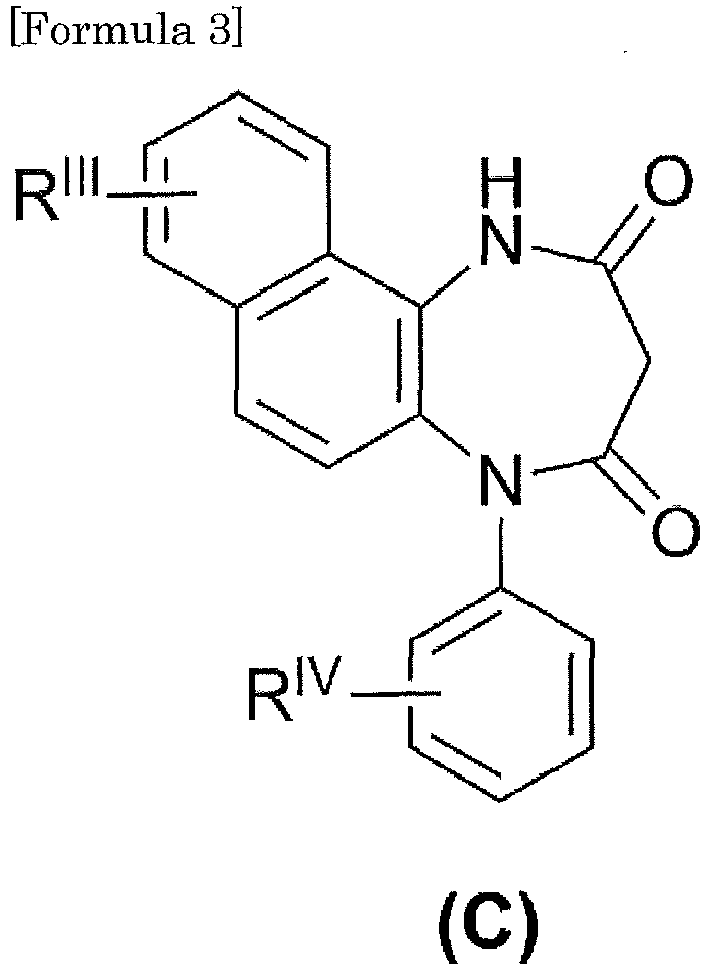
- Patent documents 3 to 10 mentioned above do not specifically describe any naphtho[1,2-e][1,4]diazepin-2-one derivative represented by the aforementioned formula (B), nor naphtho[1,2-b] [1,4]diazepin-2,4-dione derivative represented by the aforementioned general formula (C) in which tetrazole group or the like substitutes on the phenyl group or the like at the 5-position, and benzyl group or the like substitutes on the tetrazole group or the like.
-
- Patent document 1: Published
U.S. Patent Application No. 20050074819 - Patent document 2:
WO2004/085440 - Patent document 3:
WO2008/023847 - Patent document 4:
WO2010/093061 - Patent document 5:
WO2010/090300 - Patent document 6:
WO2012/008478 - Patent document 7:
WO2012/11549 - Patent document 8:
WO2012/14910 - Patent document 9:
WO2012/17876 - Patent document 10:
WO2013/105608 -
- Non-patent document 1: Buell et al. (1996) EMBO J., 15:55-62
- Non-patent document 2: Seguela et al. (1996) J. Neurosci., 16:448-455
- Non-patent document 3: Bo et al. (1995) FEBS Lett., 375:129-133
- Non-patent document 4: Soto et al. (1996) Proc. Natl. Acad. Sci. USA, 93:3684-3788
- Non-patent document 5: Wang et al. (1996) Biochem. Res. Commun., 220:196-202
- Non-patent document 6: M. Tsuda et al. (2003) Nature, 424, 778-783
- Non-patent document 7: Jeffrey A.M. Coull et al. (2005) Nature, 438, 1017-1021
- Non-patent document 8: The 49th Convention of The Japanese Society for
- Neurochemistry (2006), Program Lecture Abstract P3-N-114
- So far to date, any safe medicament in the form of a preparation for oral administration has not been provided which can be easily taken and has a superior P2X4 receptor antagonist activity.
- An object of the present invention is to provide a diazepine derivative represented by the following general formula (I) or (II) and having a P2X4 receptor antagonist activity.
- The present invention thus relates to a compound represented by the following general formula (I), a tautomer or a stereoisomer of the compound, or a pharmacologically acceptable salt thereof, or a solvate of any of the foregoing:

- (wherein, in the formula, R1 and R2 may be the same or different, and represent hydrogen atom, an alkyl group having 1 to 8 carbon atoms, a cycloalkyl group having 3 to 8 carbon atoms, an alkenyl group having 2 to 8 carbon atoms, an alkoxy group having 1 to 8 carbon atoms, an alkyl group having 1 to 8 carbon atoms and substituted with 1 to 3 halogen atoms, an alkoxy group having 1 to 8 carbon atoms and substituted with 1 to 3 halogen atoms, a halogen atom, hydroxyl group, nitro group, cyano group, amino group, an alkylamino group having 1 to 8 carbon atoms, a dialkylamino group having 2 to 8 carbon atoms, an acylamino group having 2 to 8 carbon atoms, carboxyl group, an acyl group having 2 to 8 carbon atoms, an alkoxycarbonyl group (the alkoxy moiety has 1 to 8 carbon atoms), a phenyl group which may be substituted, a pyridyl group which may be substituted, or an aralkyl group (the aryl moiety has 6 to 10 carbon atoms, and the alkylene moiety has 1 to 8 carbon atoms),
- or
- R1 and R2 may bind together to form a condensed ring selected from naphthalene ring, quinoline ring, isoquinoline ring, tetrahydronaphthalene ring, indane ring, tetrahydroquinoline ring and tetrahydroisoquinoline ring together with the benzene ring to which they bind, the ring constituted by R1 and R2, bound to each other, together with the carbon atoms to which R1 and R2 bind, may be substituted with the same or different 1 to 4 substituents selected from an alkyl group having 1 to 8 carbon atoms, a cycloalkyl group having 3 to 8 carbon atoms, an alkenyl group having 2 to 8 carbon atoms, an alkoxy group having 1 to 8 carbon atoms, an alkyl group having 1 to 8 carbon atoms and substituted with 1 to 3 halogen atoms, an alkoxy group having 1 to 8 carbon atoms and substituted with 1 to 3 halogen atoms, a halogen atom, hydroxyl group, nitro group, cyano group, amino group, an alkylamino group having 1 to 8 carbon atoms, a dialkylamino group having 2 to 8 carbon atoms, an acylamino group having 2 to 8 carbon atoms, carboxyl group, an acyl group having 2 to 8 carbon atoms, an alkoxycarbonyl group (the alkoxy moiety has 1 to 8 carbon atoms), and an aralkyl group (the aryl moiety has 6 to 10 carbon atoms, and the alkylene moiety has 1 to 8 carbon atoms),
- R3 and R4 may be the same or different, and represent hydrogen atom, an alkyl group having 1 to 8 carbon atoms, an alkenyl group having 2 to 8 carbon atoms, an alkoxy group having 1 to 8 carbon atoms, an alkyl group having 1 to 8 carbon atoms and substituted with 1 to 3 halogen atoms, an alkoxy group having 1 to 8 carbon atoms and substituted with 1 to 3 halogen atoms, a halogen atom, hydroxyl group, nitro group, cyano group, amino group, an alkylamino group having 1 to 8 carbon atoms, a dialkylamino group having 2 to 8 carbon atoms, an acylamino group having 2 to 8 carbon atoms, carboxyl group, an acyl group having 2 to 8 carbon atoms, an alkoxycarbonyl group (the alkoxy moiety has 1 to 8 carbon atoms), or an aralkyl group (the aryl moiety has 6 to 10 carbon atoms, and the alkylene moiety has 1 to 8 carbon atoms),
- R5 represents hydrogen atom, an alkyl group having 1 to 8 carbon atoms, an alkenyl group having 2 to 8 carbon atoms, an alkyl group having 1 to 8 carbon atoms and substituted with 1 to 3 halogen atoms, an alkyl group having 1 to 8 carbon atoms and substituted with hydroxyl group, or an aralkyl group (the aryl moiety has 6 to 10 carbon atoms, and the alkylene moiety has 1 to 8 carbon atoms),
- R6 and R7 may be the same or different, and represent hydrogen atom, an alkyl group having 1 to 8 carbon atoms, an alkenyl group having 2 to 8 carbon atoms, an alkoxy group having 1 to 8 carbon atoms, an alkyl group having 1 to 8 carbon atoms and substituted with 1 to 3 halogen atoms, an alkoxy group having 1 to 8 carbon atoms and substituted with 1 to 3 halogen atoms, a halogen atom, hydroxyl group, or amino group,
- X represents C or N,
- Y represents N or C(=O),
- provided that when X is C, Y represents N, and
- when X is N, Y represents C(=O),
- the double line consisting of the solid line and the broken line represents a single bond or double bond,
- Z represents O, S or NH,
- A represents benzene ring, pyridine ring, pyrimidine ring, pyridazine ring, thiophene ring, furan ring, pyrazole ring, imidazole ring, quinoline ring, benzimidazole ring, or indane ring, which may have the same or different 1 to 4 substituents selected from an alkyl group having 1 to 8 carbon atoms, an alkenyl group having 2 to 8 carbon atoms, an alkoxy group having 1 to 8 carbon atoms, an alkyl group having 1 to 8 carbon atoms and substituted with 1 to 3 halogen atoms, an alkoxy group having 1 to 8 carbon atoms and substituted with 1 to 3 halogen atoms, a halogen atom, hydroxyl group, nitro group, cyano group, amino group, an alkylamino group having 1 to 8 carbon atoms, and a dialkylamino group having 2 to 8 carbon atoms, as a substituent,
- B represents O, S, NR8, or an atomic bond,
- wherein R8 represents hydrogen atom, or an alkyl group having 1 to 8 carbon atoms,
- D represents benzene ring, pyridine ring, pyrimidine ring, pyridazine ring, thiophene ring, furan ring, tetrazole ring, imidazole ring, imidazoline ring, triazole ring, thiazole ring, oxazole ring, isoxazole ring, pyrazole ring, pyrrole ring, pyrrolidine ring, piperazine ring, piperidine ring, or a 5- to 8-membered cycloalkyl ring, which may have the same or different 1 to 4 substituents selected from an alkyl group having 1 to 8 carbon atoms, an alkenyl group having 2 to 8 carbon atoms, an alkoxy group having 1 to 8 carbon atoms, an alkyl group having 1 to 8 carbon atoms and substituted with 1 to 3 halogen atoms, an alkoxy group having 1 to 8 carbon atoms and substituted with 1 to 3 halogen atoms, a halogen atom, hydroxyl group, nitro group, cyano group, amino group, an alkylamino group having 1 to 8 carbon atoms, and a dialkylamino group having 2 to 8 carbon atoms, as a substituent,
- E represents -(CR9R10)n-T-,
- wherein R9 and R10 may be the same or different, and represent hydrogen atom, hydroxyl group, or an alkyl group having 1 to 8 carbon atoms, or R9 and R10 may bind together to form an ethylene chain,
- n represents an integer of 0 to 8, and
- T represents O, S, NR11, or an atomic bond,
- wherein R11 represents hydrogen atom, or an alkyl group having 1 to 8 carbon atoms,
- G represents benzene ring, pyridine ring, imidazole ring, pyrrole ring, pyrazole ring, thiophene ring, furan ring, thiazole ring, oxazole ring, pyrimidine ring, pyridazine ring, pyrazine ring, naphthalene ring, quinoline ring, quinazoline ring, indole ring, indoline ring, piperazine ring, piperidine ring, morpholine ring, or a 5- to 8-membered cycloalkyl ring, which may have the same or different 1 to 5 substituents selected from an alkyl group having 1 to 8 carbon atoms, an alkenyl group having 2 to 8 carbon atoms, an alkoxy group having 1 to 8 carbon atoms, an alkyl group having 1 to 8 carbon atoms and substituted with 1 to 3 halogen atoms, an alkoxy group having 1 to 8 carbon atoms and substituted with 1 to 3 halogen atoms, a halogen atom, hydroxyl group, nitro group, cyano group, amino group, an alkylamino group having 1 to 8 carbon atoms, a dialkylamino group having 2 to 8 carbon atoms, carbamoyl group, and methanesulfonyl group, as a substituent, and
- m represents an integer of 0 to 2).
- The present invention also relates to a compound represented by the following general formula (II), a tautomer or a stereoisomer of the compound, or a pharmacologically acceptable salt thereof, or a solvate of any of the foregoing:

- (wherein, in the formula, R1a, R2a, R3a, R4a, R5a and R6a may be the same or different, and represent hydrogen atom, an alkyl group having 1 to 8 carbon atoms, a cycloalkyl group having 3 to 8 carbon atoms, an alkenyl group having 2 to 8 carbon atoms, an alkoxy group having 1 to 8 carbon atoms, an alkyl group having 1 to 8 carbon atoms and substituted with 1 to 3 halogen atoms, an alkoxy group having 1 to 8 carbon atoms and substituted with 1 to 3 halogen atoms, a halogen atom, hydroxyl group, nitro group, cyano group, amino group, an alkylamino group having 1 to 8 carbon atoms, a dialkylamino group having 2 to 8 carbon atoms, an acylamino group having 2 to 8 carbon atoms, carboxyl group, an acyl group having 2 to 8 carbon atoms, an alkoxycarbonyl group (the alkoxy moiety has 1 to 8 carbon atoms), a phenyl group which may be substituted, a pyridyl group which may be substituted, or an aralkyl group (the aryl moiety has 6 to 10 carbon atoms, and the alkylene moiety has 1 to 8 carbon atoms),
- Xa represents C or N,
- Ya represents N or C(=O),
- provided that when Xa is C, Ya represents N, and
- when Xa is N, Ya represents C(=O),
- the double line consisting of the solid line and the broken line represents a single bond or double bond,
- Aa represents benzene ring, pyridine ring, pyrimidine ring, pyridazine ring, thiophene ring, furan ring, pyrazole ring, imidazole ring, quinoline ring, benzimidazole ring, or indane ring, which may have the same or different 1 to 4 substituents selected from an alkyl group having 1 to 8 carbon atoms, an alkenyl group having 2 to 8 carbon atoms, an alkoxy group having 1 to 8 carbon atoms, an alkyl group having 1 to 8 carbon atoms and substituted with 1 to 3 halogen atoms, an alkoxy group having 1 to 8 carbon atoms and substituted with 1 to 3 halogen atoms, a halogen atom, hydroxyl group, nitro group, cyano group, amino group, an alkylamino group having 1 to 8 carbon atoms, and a dialkylamino group having 2 to 8 carbon atoms, as a substituent,
- Da represents benzene ring, pyridine ring, pyrimidine ring, pyridazine ring, thiophene ring, furan ring, tetrazole ring, imidazole ring, imidazoline ring, triazole ring, thiazole ring, oxazole ring, isoxazole ring, pyrazole ring, pyrrole ring, pyrrolidine ring, piperazine ring, piperidine ring, or a 5- to 8-membered cycloalkyl ring, which may have the same or different 1 to 4 substituents selected from an alkyl group having 1 to 8 carbon atoms, an alkenyl group having 2 to 8 carbon atoms, an alkoxy group having 1 to 8 carbon atoms, an alkyl group having 1 to 8 carbon atoms and substituted with 1 to 3 halogen atoms, an alkoxy group having 1 to 8 carbon atoms and substituted with 1 to 3 halogen atoms, a halogen atom, hydroxyl group, nitro group, cyano group, amino group, an alkylamino group having 1 to 8 carbon atoms, and a dialkylamino group having 2 to 8 carbon atoms, as a substituent,
- Ea represents -(CR9aR10a)p-Ta-,
- wherein R9a and R10a are the same or different, and represent hydrogen atom, hydroxyl group, or an alkyl group having 1 to 8 carbon atoms, or R9a and R10a may bind together to form an ethylene chain,
- p represents an integer of 0 to 8, and
- Ta represents O, S, NR11a, or an atomic bond,
- wherein R11a represents hydrogen atom, or an alkyl group having 1 to 8 carbon atoms, and
- Ga represents benzene ring, pyridine ring, imidazole ring, pyrrole ring, pyrazole ring, thiophene ring, furan ring, thiazole ring, oxazole ring, pyrimidine ring, pyridazine ring, pyrazine ring, naphthalene ring, quinoline ring, quinazoline ring, indole ring, indoline ring, piperazine ring, piperidine ring, morpholine ring, or a 5- to 8- membered cycloalkyl ring, which may have the same or different 1 to 5 substituents selected from an alkyl group having 1 to 8 carbon atoms, an alkenyl group having 2 to 8 carbon atoms, an alkoxy group having 1 to 8 carbon atoms, an alkyl group having 1 to 8 carbon atoms and substituted with 1 to 3 halogen atoms, an alkoxy group having 1 to 8 carbon atoms and substituted with 1 to 3 halogen atoms, a halogen atom, hydroxyl group, nitro group, cyano group, amino group, an alkylamino group having 1 to 8 carbon atoms, a dialkylamino group having 2 to 8 carbon atoms, carbamoyl group, and methanesulfonyl group, as a substituent).
- The present invention also relates to a P2X4 receptor antagonist containing a compound represented by the aforementioned general formula (I) or (II), a tautomer or a stereoisomer of the compound, or a pharmacologically acceptable salt thereof, or a solvate of any of the foregoing as an active ingredient.
- The present invention further relates to a prophylactic or therapeutic agent for nociceptive pain, inflammatory pain, or neuropathic pain containing a compound represented by the aforementioned general formula (I) or (II), a tautomer or a stereoisomer of the compound, or a pharmacologically acceptable salt thereof, or a solvate of any of the foregoing as an active ingredient.
- [
Fig. 1 ]
Fig. 1 shows results of measurement of the analgesic activity of the compound of the present invention (Example 86). - Hereafter, the present invention will be explained in detail.
- In this specification, examples of the alkyl group having 1 to 8 carbon atoms include methyl group, ethyl group, propyl group, isopropyl group, butyl group, i-butyl group, t-butyl group, pentyl group, hexyl group, and the like.
- Examples of the 5- to 8-membered cycloalkyl ring include cyclopentyl ring, cyclohexyl ring, and the like.
- Examples of the cycloalkyl group having 3 to 8 carbon atoms include cyclopropyl group, cyclohexyl group, and the like.
- Examples of the alkenyl group having 2 to 8 carbon atoms include allyl group, and the like.
- Examples of the alkoxy group having 1 to 8 carbon atoms include methoxy group, ethoxy group, propoxy group, isopropoxy group, butoxy group, i-butoxy group, t-butoxy group, pentyloxy group, hexyloxy group, and the like.
- Examples of the alkyl group having 1 to 8 carbon atoms and substituted with 1 to 3 halogen atoms include methyl group, ethyl group, propyl group, isopropyl group, butyl group, t-butyl group, and the like, which are substituted with 1 to 3 of halogen atoms such as fluorine atom, chlorine atom, and bromine atom, and preferred examples include trifluoromethyl group, chloromethyl group, 2-chloroethyl group, 2-bromoethyl group, 2-fluoroethyl group, and the like.
- Examples of the alkoxy group having 1 to 8 carbon atoms and substituted with 1 to 3 halogen atoms include methoxy group, ethoxy group, propoxy group, isopropoxy group, butoxy group, t-butoxy group, and the like, which are substituted with 1 to 3 of halogen atoms such as fluorine atom, chlorine atom, and bromine atom, and preferred examples include trifluoromethoxy group, chloromethoxy group, 2-chloroethoxy group, 2-bromoethoxy group, 2-fluoroethoxy group, and the like.
- Examples of the halogen atom include fluorine atom, chlorine atom, bromine atom, and the like.
- Examples of the alkylamino group having 1 to 8 carbon atoms include methylamino group, ethylamino group, and the like.
- Examples of the dialkylamino group having 2 to 8 carbon atoms include dimethylamino group, diethylamino group, and the like.
- Examples of the acylamino group having 2 to 8 carbon atoms include acetylamino group.
- Examples of the acyl group having 2 to 8 carbon atoms include acetyl group, and the like.
- Examples of the alkoxycarbonyl group (the alkoxy moiety has 1 to 8 carbon atoms) include methoxycarbonyl group, and the like.
- Examples of the aralkyl group (the aryl moiety has 6 to 10 carbon atoms, and the alkylene moiety has 1 to 8 carbon atoms) include benzyl group, and the like.
- Examples of the alkyl group having 1 to 8 carbon atoms and substituted with hydroxyl group include 2-hydroxyethyl group, and the like.
- Examples of the substituent of the phenyl group which may be substituted, and the pyridyl group which may be substituted include a halogen atom, an alkyl group having 1 to 8 carbon atoms, an alkoxy group having 1 to 8 carbon atoms, an alkyl group having 1 to 8 carbon atoms and substituted with 1 to 3 halogen atoms, an alkoxy group having 1 to 8 carbon atoms and substituted with 1 to 3 halogen atoms, and the like.
- The expression "R9 and R10 may bind together to form an ethylene chain" and "R9a and R10a may bind together to form an ethylene chain" in the definitions of E and Ea included in the aforementioned general formulas (I) and (II) means that E and Ea may contain a double bond.
- As the compounds of the present invention represented by the aforementioned general formula (I), the compounds mentioned below are preferred.
- (1) The compound represented by the aforementioned general formula (I), a tautomer or a stereoisomer of the compound, or a pharmacologically acceptable salt thereof, or a solvate of any of the foregoing, wherein m is 1.
- (2) The compound represented by the aforementioned general formula (I) or the compound according to (1) mentioned above, a tautomer or a stereoisomer of the compound, or a pharmacologically acceptable salt thereof, or a solvate of any of the foregoing, wherein R1 and R2 bind together to form naphthalene ring together with the benzene ring to which they bind, and the naphthalene ring may be substituted with the same or different 1 to 4 substituents selected from an alkyl group having 1 to 8 carbon atoms, a cycloalkyl group having 3 to 8 carbon atoms, an alkenyl group having 2 to 8 carbon atoms, an alkoxy group having 1 to 8 carbon atoms, an alkyl group having 1 to 8 carbon atoms and substituted with 1 to 3 halogen atoms, an alkoxy group having 1 to 8 carbon atoms and substituted with 1 to 3 halogen atoms, a halogen atom, hydroxyl group, nitro group, cyano group, amino group, an alkylamino group having 1 to 8 carbon atoms, and a dialkylamino group having 2 to 8 carbon atoms.
- (3) The compound represented by the aforementioned general formula (I) or the compound according to (1) or (2) mentioned above, a tautomer or a stereoisomer of the compound, or a pharmacologically acceptable salt thereof, or a solvate of any of the foregoing, wherein R3 and R4 may be the same or different, and are hydrogen atom, an alkyl group having 1 to 8 carbon atoms, an alkenyl group having 2 to 8 carbon atoms, an alkoxy group having 1 to 8 carbon atoms, an alkyl group having 1 to 8 carbon atoms and substituted with 1 to 3 halogen atoms, an alkoxy group having 1 to 8 carbon atoms and substituted with 1 to 3 halogen atoms, a halogen atom, hydroxyl group, nitro group, cyano group, amino group, an alkylamino group having 1 to 8 carbon atoms, or a dialkylamino group having 2 to 8 carbon atoms.
- (4) The compound represented by the aforementioned general formula (I) or the compound according to any one of (1) to (3) mentioned above, a tautomer or a stereoisomer of the compound, or a pharmacologically acceptable salt thereof, or a solvate of any of the foregoing, wherein R5 is hydrogen atom.
- (5) The compound represented by the aforementioned general formula (I) or the compound according to any one of (1) to (4) mentioned above, a tautomer or a stereoisomer of the compound, or a pharmacologically acceptable salt thereof, or a solvate of any of the foregoing, wherein R6 and R7 are hydrogen atoms.
- (6) The compound represented by the aforementioned general formula (I) or the compound according to any one of (1) to (5) mentioned above, a tautomer or a stereoisomer of the compound, or a pharmacologically acceptable salt thereof, or a solvate of any of the foregoing, wherein X is N, and Y is C(=O).
- (7) The compound represented by the aforementioned general formula (I) or the compound according to any one of (1) to (6) mentioned above, a tautomer or a stereoisomer of the compound, or a pharmacologically acceptable salt thereof, or a solvate of any of the foregoing, wherein Z is O.
- (8) The compound represented by the aforementioned general formula (I) or the compound according to any one of (1) to (7) mentioned above, a tautomer or a stereoisomer of the compound, or a pharmacologically acceptable salt thereof, or a solvate of any of the foregoing, wherein A is benzene ring, or pyridine ring, which may have the same or different 1 to 4 substituents selected from an alkyl group having 1 to 8 carbon atoms, an alkenyl group having 2 to 8 carbon atoms, an alkoxy group having 1 to 8 carbon atoms, an alkyl group having 1 to 8 carbon atoms and substituted with 1 to 3 halogen atoms, an alkoxy group having 1 to 8 carbon atoms and substituted with 1 to 3 halogen atoms, a halogen atom, hydroxyl group, nitro group, cyano group, amino group, an alkylamino group having 1 to 8 carbon atoms, and a dialkylamino group having 2 to 8 carbon atoms, as a substituent.
- (9) The compound represented by the aforementioned general formula (I) or the compound according to any one of (1) to (8) mentioned above, a tautomer or a stereoisomer of the compound, or a pharmacologically acceptable salt thereof, or a solvate of any of the foregoing, wherein D is tetrazole ring, imidazole ring, imidazoline ring, triazole ring, pyrrole ring, pyrrolidine ring, piperazine ring, or piperidine ring, which may have the same or different 1 to 4 substituents selected from an alkyl group having 1 to 8 carbon atoms, an alkenyl group having 2 to 8 carbon atoms, an alkoxy group having 1 to 8 carbon atoms, an alkyl group having 1 to 8 carbon atoms and substituted with 1 to 3 halogen atoms, an alkoxy group having 1 to 8 carbon atoms and substituted with 1 to 3 halogen atoms, a halogen atom, hydroxyl group, nitro group, cyano group, amino group, an alkylamino group having 1 to 8 carbon atoms, and a dialkylamino group having 2 to 8 carbon atoms, as a substituent.
- (10) The compound represented by the aforementioned general formula (I) or the compound according to any one of (1) to (9) mentioned above, a tautomer or a stereoisomer of the compound, or a pharmacologically acceptable salt thereof, or a solvate of any of the foregoing, wherein B is an atomic bond.
- (11) The compound according to (10) mentioned above, a tautomer or a stereoisomer of the compound, or a pharmacologically acceptable salt thereof, or a solvate of any of the foregoing, wherein D binds to A via nitrogen atom.
- (12) The compound represented by the aforementioned general formula (I) or the compound according to any one of (1) to (11) mentioned above, a tautomer or a stereoisomer of the compound, or a pharmacologically acceptable salt thereof, or a solvate of any of the foregoing, wherein E is an alkylene chain having 1 to 5 carbon atoms.
- (13) The compound represented by the aforementioned general formula (I), or the compound according to any one of (1) to (12) mentioned above, a tautomer or a stereoisomer of the compound, or a pharmacologically acceptable salt thereof, or a solvate of any of the foregoing, wherein G is benzene ring, pyridine ring, imidazole ring, pyrrole ring, pyrazole ring, pyrimidine ring, pyridazine ring, pyrazine ring, or a 5- to 7- membered cycloalkyl ring, which may have the same or different 1 to 5 substituents selected from an alkyl group having 1 to 8 carbon atoms, an alkenyl group having 2 to 8 carbon atoms, an alkoxy group having 1 to 8 carbon atoms, an alkyl group having 1 to 8 carbon atoms and substituted with 1 to 3 halogen atoms, an alkoxy group having 1 to 8 carbon atoms and substituted with 1 to 3 halogen atoms, a halogen atom, hydroxyl group, nitro group, cyano group, amino group, an alkylamino group having 1 to 8 carbon atoms, a dialkylamino group having 2 to 8 carbon atoms, carbamoyl group, and methanesulfonyl group.
- (14) The compound represented by the aforementioned general formula (I), a tautomer or a stereoisomer of the compound, or a pharmacologically acceptable salt thereof, or a solvate of any of the foregoing, wherein:
- R1 and R2 bind together to form naphthalene ring, or indane ring together with the benzene ring to which they bind, and
- the naphthalene ring, or indane ring may be substituted with the same or different 1 to 4 substituents selected from an alkyl group having 1 to 8 carbon atoms, a cycloalkyl group having 3 to 8 carbon atoms, an alkenyl group having 2 to 8 carbon atoms, an alkoxy group having 1 to 8 carbon atoms, an alkyl group having 1 to 8 carbon atoms and substituted with 1 to 3 halogen atoms, an alkoxy group having 1 to 8 carbon atoms and substituted with 1 to 3 halogen atoms, a halogen atom, hydroxyl group, nitro group, cyano group, amino group, an alkylamino group having 1 to 8 carbon atoms, a dialkylamino group having 2 to 8 carbon atoms, an acylamino group having 2 to 8 carbon atoms, carboxyl group, an acyl group having 2 to 8 carbon atoms, an alkoxycarbonyl group (the alkoxy moiety has 1 to 8 carbon atoms), and an aralkyl group (the aryl moiety has 6 to 10 carbon atoms, and the alkylene moiety has 1 to 8 carbon atoms),
- R3 and R4 may be the same or different, and are hydrogen atom, an alkyl group having 1 to 8 carbon atoms, an alkenyl group having 2 to 8 carbon atoms, an alkoxy group having 1 to 8 carbon atoms, an alkyl group having 1 to 8 carbon atoms and substituted with 1 to 3 halogen atoms, an alkoxy group having 1 to 8 carbon atoms and substituted with 1 to 3 halogen atoms, a halogen atom, hydroxyl group, nitro group, cyano group, amino group, an alkylamino group having 1 to 8 carbon atoms, a dialkylamino group having 2 to 8 carbon atoms, an acylamino group having 2 to 8 carbon atoms, carboxyl group, an acyl group having 2 to 8 carbon atoms, an alkoxycarbonyl group (the alkoxy moiety has 1 to 8 carbon atoms), or an aralkyl group (the aryl moiety has 6 to 10 carbon atoms, and the alkylene moiety has 1 to 8 carbon atoms),
- R5 is hydrogen atom, an alkyl group having 1 to 8 carbon atoms, an alkenyl group having 2 to 8 carbon atoms, an alkyl group having 1 to 8 carbon atoms and substituted with 1 to 3 halogen atoms, an alkyl group having 1 to 8 carbon atoms and substituted with hydroxyl group, or an aralkyl group (the aryl moiety has 6 to 10 carbon atoms, and the alkylene moiety has 1 to 8 carbon atoms),
- R6 and R7 may be the same or different, and are hydrogen atom, an alkyl group having 1 to 8 carbon atoms, an alkenyl group having 2 to 8 carbon atoms, an alkoxy group having 1 to 8 carbon atoms, an alkyl group having 1 to 8 carbon atoms and substituted with 1 to 3 halogen atoms, an alkoxy group having 1 to 8 carbon atoms and substituted with 1 to 3 halogen atoms, a halogen atom, hydroxyl group, or amino group,
- X is N,
- Y is C(=O),
- the double line consisting of the solid line and the broken line is a single bond,
- Z is O,
- A is benzene ring, or pyridine ring, which may have the same or different 1 to 4 substituents selected from an alkyl group having 1 to 8 carbon atoms, an alkenyl group having 2 to 8 carbon atoms, an alkoxy group having 1 to 8 carbon atoms, an alkyl group having 1 to 8 carbon atoms and substituted with 1 to 3 halogen atoms, an alkoxy group having 1 to 8 carbon atoms and substituted with 1 to 3 halogen atoms, a halogen atom, hydroxyl group, nitro group, cyano group, amino group, an alkylamino group having 1 to 8 carbon atoms, and a dialkylamino group having 2 to 8 carbon atoms, as a substituent,
- B is an atomic bond,
- D is tetrazole ring, or imidazole ring, which may have the same or different 1 or 2 substituents selected from an alkyl group having 1 to 8 carbon atoms, an alkenyl group having 2 to 8 carbon atoms, an alkoxy group having 1 to 8 carbon atoms, an alkyl group having 1 to 8 carbon atoms and substituted with 1 to 3 halogen atoms, an alkoxy group having 1 to 8 carbon atoms and substituted with 1 to 3 halogen atoms, a halogen atom, hydroxyl group, nitro group, cyano group, amino group, an alkylamino group having 1 to 8 carbon atoms, and a dialkylamino group having 2 to 8 carbon atoms,
- D binds to A via nitrogen atom of D, and binds to E via carbon atom of D,
- E is -(CR9R10)n-,
- wherein R9 and R10 may be the same or different, and are hydrogen atom, hydroxyl group, or an alkyl group having 1 to 8 carbon atoms, and
- n is an integer of 1 to 8,
- G is benzene ring, which may have the same or different 1 to 5 substituents selected from an alkyl group having 1 to 8 carbon atoms, an alkenyl group having 2 to 8 carbon atoms, an alkoxy group having 1 to 8 carbon atoms, an alkyl group having 1 to 8 carbon atoms and substituted with 1 to 3 halogen atoms, an alkoxy group having 1 to 8 carbon atoms and substituted with 1 to 3 halogen atoms, a halogen atom, hydroxyl group, nitro group, cyano group, amino group, an alkylamino group having 1 to 8 carbon atoms, a dialkylamino group having 2 to 8 carbon atoms, carbamoyl group, and methanesulfonyl group, as a substituent, and
- m is 1.
- (15) The compound represented by the aforementioned general formula (I), a tautomer or a stereoisomer of the compound, or a pharmacologically acceptable salt thereof, or a solvate of any of the foregoing, wherein:
- R1 and R2 bind together to form naphthalene ring, or indane ring together with the benzene ring to which they bind,
- R3 and R4 are hydrogen atoms,
- R5 is hydrogen atom,
- R6 and R7 are hydrogen atoms,
- X is N,
- Y is C(=O),
- the double line consisting of the solid line and the broken line is a single bond,
- Z is O,
- A is benzene ring, which may have the same or different 1 to 4 substituents selected from an alkyl group having 1 to 8 carbon atoms, an alkoxy group having 1 to 8 carbon atoms, an alkyl group having 1 to 8 carbon atoms and substituted with 1 to 3 halogen atoms, an alkoxy group having 1 to 8 carbon atoms and substituted with 1 to 3 halogen atoms, a halogen atom, hydroxyl group, nitro group, cyano group, amino group, an alkylamino group having 1 to 8 carbon atoms, and a dialkylamino group having 2 to 8 carbon atoms, as a substituent,
- B is an atomic bond,
- D is tetrazole ring, or imidazole ring, which may have, as a substituent, 1 or 2 substituents selected from an alkyl groups having 1 to 8 carbon atom, and an alkyl group having 1 to 8 carbon atoms and substituted with 1 to 3 halogen atoms,
- D binds to A via nitrogen atom of D, and binds to E via carbon atom of D,
- E is -(CR9R10)n-,
- wherein R9 and R10 are the same or different, and are hydrogen atom, or an alkyl group having 1 to 8 carbon atoms, and
- n is an integer of 1 to 4,
- G is benzene ring, which may have the same or different 1 to 5 substituents selected from an alkyl group having 1 to 8 carbon atoms, an alkoxy group having 1 to 8 carbon atoms, an alkyl group having 1 to 8 carbon atoms and substituted with 1 to 3 halogen atoms, an alkoxy group having 1 to 8 carbon atoms and substituted with 1 to 3 halogen atoms, a halogen atom, hydroxyl group, nitro group, cyano group, amino group, an alkylamino group having 1 to 8 carbon atoms, a dialkylamino group having 2 to 8 carbon atoms, and carbamoyl group, as a substituent, and
- m is 1.
- (16) The compound represented by the aforementioned general formula (I), a tautomer or a stereoisomer of the compound, or a pharmacologically acceptable salt thereof, or a solvate of any of the foregoing, wherein:
- R1 and R2 bind together to form naphthalene ring, or indane ring together with the benzene ring to which they bind,
- R3 and R4 are hydrogen atoms,
- R5 is hydrogen atom,
- R6 and R7 are hydrogen atoms,
- X is N,
- Y is C(=O),
- the double line consisting of the solid line and the broken line is a single bond,
- Z is O,
- A is benzene ring, which may have the same or different 1 to 4 substituents selected from an alkyl group having 1 to 8 carbon atoms, an alkoxy group having 1 to 8 carbon atoms, an alkyl group having 1 to 8 carbon atoms and substituted with 1 to 3 halogen atoms, an alkoxy group having 1 to 8 carbon atoms and substituted with 1 to 3 halogen atoms, a halogen atom, hydroxyl group, nitro group, cyano group, amino group, an alkylamino group having 1 to 8 carbon atoms, and a dialkylamino group having 2 to 8 carbon atoms, as a substituent,
- B is an atomic bond,
- D is imidazole ring, which may have, as a substituent, 1 or 2 substituents selected from an alkyl groups having 1 to 8 carbon atom, and an alkyl group having 1 to 8 carbon atoms and substituted with 1 to 3 halogen atoms,
- D binds to A at the 2-position of the imidazole ring, and binds to E via nitrogen atom of the imidazole ring,
- E is -(CR9R10)n-,
- wherein R9 and R10 are the same or different, and are hydrogen atom, or an alkyl group having 1 to 8 carbon atoms, and
- n is an integer of 1 to 4,
- G is benzene ring, which may have the same or different 1 to 5 substituents selected from an alkyl group having 1 to 8 carbon atoms, an alkoxy group having 1 to 8 carbon atoms, an alkyl group having 1 to 8 carbon atoms and substituted with 1 to 3 halogen atoms, an alkoxy group having 1 to 8 carbon atoms and substituted with 1 to 3 halogen atoms, a halogen atom, hydroxyl group, nitro group, cyano group, amino group, an alkylamino group having 1 to 8 carbon atoms, a dialkylamino group having 2 to 8 carbon atoms, and carbamoyl group, as a substituent, and
- m is 1.
- (17) The compound represented by the aforementioned general formula (II), a tautomer or a stereoisomer of the compound, or a pharmacologically acceptable salt thereof, or a solvate of any of the foregoing, wherein R1a, R2a , R3a , R4a , R5a , and R6a may be the same or different, and are hydrogen atom, an alkyl group having 1 to 8 carbon atoms, an alkoxy group having 1 to 8 carbon atoms, an alkyl group having 1 to 8 carbon atoms and substituted with 1 to 3 halogen atoms, an alkoxy group having 1 to 8 carbon atoms and substituted with 1 to 3 halogen atoms, a halogen atom, or hydroxyl group.
- (18) The compound represented by the aforementioned general formula (II) or the compound according to (17) mentioned above, a tautomer or a stereoisomer of the compound, or a pharmacologically acceptable salt thereof, or a solvate of any of the foregoing, wherein Xa is N, and Ya is C(=O).
- (19) The compound represented by the aforementioned general formula (II) or the compound according to (17) or (18) mentioned above, a tautomer or a stereoisomer of the compound, or a pharmacologically acceptable salt thereof, or a solvate of any of the foregoing, wherein Aa is benzene ring, or pyridine ring, which may have the same or different 1 to 4 substituents selected from an alkyl group having 1 to 8 carbon atoms, an alkenyl group having 2 to 8 carbon atoms, an alkoxy group having 1 to 8 carbon atoms, an alkyl group having 1 to 8 carbon atoms and substituted with 1 to 3 halogen atoms, an alkoxy group having 1 to 8 carbon atoms and substituted with 1 to 3 halogen atoms, a halogen atom, hydroxyl group, nitro group, cyano group, amino group, an alkylamino group having 1 to 8 carbon atoms, and a dialkylamino group having 2 to 8 carbon atoms, as a substituent.
- (20) The compound represented by the aforementioned general formula (II) or the compound according to (17) or (18) mentioned above, a tautomer or a stereoisomer of the compound, or a pharmacologically acceptable salt thereof, or a solvate of any of the foregoing, wherein Aa is benzene ring, which may have the same or different 1 to 4 substituents selected from an alkyl group having 1 to 8 carbon atoms, an alkoxy group having 1 to 8 carbon atoms, an alkyl group having 1 to 8 carbon atoms and substituted with 1 to 3 halogen atoms, an alkoxy group having 1 to 8 carbon atoms and substituted with 1 to 3 halogen atoms, a halogen atom, hydroxyl group, nitro group, cyano group, and amino group, as a substituent.
- (21) The compound represented by the aforementioned general formula (II) or the compound according to any one of (17) to (20) mentioned above, a tautomer or a stereoisomer of the compound, or a pharmacologically acceptable salt thereof, or a solvate of any of the foregoing, wherein Da is tetrazole ring, imidazole ring, imidazoline ring, triazole ring, pyrrole ring, pyrrolidine ring, piperazine ring, or piperidine ring, which may have the same or different 1 to 4 substituents selected from an alkyl group having 1 to 8 carbon atoms, an alkenyl group having 2 to 8 carbon atoms, an alkoxy group having 1 to 8 carbon atoms, an alkyl group having 1 to 8 carbon atoms and substituted with 1 to 3 halogen atoms, an alkoxy group having 1 to 8 carbon atoms and substituted with 1 to 3 halogen atoms, a halogen atom, hydroxyl group, nitro group, cyano group, amino group, an alkylamino group having 1 to 8 carbon atoms, and a dialkylamino group having 2 to 8 carbon atoms, as a substituent.
- (22) The compound represented by the aforementioned general formula (II) or the compound according to any one of (17) to (20) mentioned above, a tautomer or a stereoisomer of the compound, or a pharmacologically acceptable salt thereof, or a solvate of any of the foregoing, wherein Da is tetrazole ring.
- (23) The compound according to (21) or (22) mentioned above, a tautomer or a stereoisomer of the compound, or a pharmacologically acceptable salt thereof, or a solvate of any of the foregoing, wherein Da binds to Aa via nitrogen atom.
- (24) The compound represented by the aforementioned general formula (II) or the compound according to any one of (17) to (23) mentioned above, a tautomer or a stereoisomer of the compound, or a pharmacologically acceptable salt thereof, or a solvate of any of the foregoing, wherein Ea is an alkylene chain having 1 to 5 carbon atoms.
- (25) The compound represented by the aforementioned general formula (II) or the compound according to any one of (17) to (24) mentioned above, a tautomer or a stereoisomer of the compound, or a pharmacologically acceptable salt thereof, or a solvate of any of the foregoing, wherein Ga is benzene ring, pyridine ring, imidazole ring, pyrrole ring, pyrazole ring, pyrimidine ring, pyridazine ring, pyrazine ring, or a 5- to 7-membered cycloalkyl ring, which may have the same or different 1 to 5 substituents selected from an alkyl group having 1 to 8 carbon atoms, an alkenyl group having 2 to 8 carbon atoms, an alkoxy group having 1 to 8 carbon atoms, an alkyl group having 1 to 8 carbon atoms and substituted with 1 to 3 halogen atoms, an alkoxy group having 1 to 8 carbon atoms and substituted with 1 to 3 halogen atoms, a halogen atom, hydroxyl group, nitro group, cyano group, amino group, an alkylamino group having 1 to 8 carbon atoms, a dialkylamino group having 2 to 8 carbon atoms, carbamoyl group, and methanesulfonyl group, as a substituent.
- It is preferred that, in the aforementioned general formula (I), when A is benzene ring which may be substituted, and B is an atomic bond, X and D are mutually at para-positions on the benzene ring.
- It is also preferred that, in the aforementioned general formula (I), when A is pyridine ring which may be substituted, and B is an atomic bond, the pyridine ring binds to X at the 3-position thereof, and binds to D at the 6-position thereof.
- It is also preferred that, in the aforementioned general formula (II), when Aa is benzene ring which may be substituted, and B is an atomic bond, Xa and Da are mutually at para-positions on the benzene ring.
- It is also preferred that, in the aforementioned general formula (II), when A is pyridine ring which may be substituted, the pyridine ring binds to Xa at the 3-position thereof, and binds to Da at the 6-position thereof.
- Examples of the pharmacologically acceptable salts of the compounds represented by the aforementioned general formula (I) or (II) include hydrochlorides, and alkali metal salts such as those of sodium, potassium, and lithium.
- Further, there may be stereoisomers of the compounds of the present invention, such as cis- and trans-isomers, optically active substances, and racemates, and all of these substances fall within the scope of the present invention.
- The synthetic schemes of the compounds of the present invention represented by the aforementioned general formula (I) or (II) are shown below.
-
- (1) Compounds represented by the aforementioned general formula (II) in which Xa is N, Ya is C(=O), the double line consisting of the solid line and the broken line is a single bond, and Da is tetrazolyl group

- (2) Compounds represented by the aforementioned general formula (II) in which Xa is N, Ya is C(=O), the double line consisting of the solid line and the broken line is a single bond, and Da is tetrazolyl group

- (3) Compounds represented by the aforementioned general formula (II) in which Xa is N, Ya is C(=O), the double line consisting of the solid line and the broken line is a single bond, and Da is imidazolyl group

- (4) Compounds represented by the aforementioned general formula (II) in which Xa is N, Ya is C(=O), the double line consisting of the solid line and the broken line is a single bond, and Da is tetrazolyl group

- (5) Compounds represented by the aforementioned general formula (II) in which Xa is N, Ya is C(=O), the double line consisting of the solid line and the broken line is a single bond, and Da is imidazolyl group
Synthesis method D-1
Synthesis method D-2
Synthesis method D-3
Synthesis method D-4
- (5) Compounds represented by the aforementioned general formula (II) in which Xa is N, Ya is C(=O), the double line consisting of the solid line and the broken line is a single bond, and Da is 4,5-dihydroimidazole group
Synthesis method E
-
- (1) Compounds represented by the aforementioned general formula (I) in which X is N, Y is C(=O), the double line consisting of the solid line and the broken line is a single bond, D is tetrazolyl group, and m = 0

-
- (1) Compounds represented by the aforementioned general formula (I) in which X is N, Y is C(=O), the double line consisting of the solid line and the broken line is a single bond, D is tetrazolyl group, and m = 1


-
- (5) Compounds represented by the aforementioned general formula (II) in which Xa is C, Ya is N, the double line consisting of the solid line and the broken line is a double bond, and Da is tetrazolyl group

- (6) Compounds represented by the aforementioned general formula (II) in which Xa is C, Ya is N, the double line consisting of the solid line and the broken line is a double bond, and Da is tetrazolyl group
(In the formulas, Ph represents phenyl group, Me represents methyl group, and R1a to R6a, Aa, Ea, and Ga have the same meanings as those defined above.) - The compounds of the present invention represented by the aforementioned general formula (I) or (II) can be prepared by referring to the aforementioned synthesis methods and the examples mentioned later, as well as the aforementioned patent documents, prior art references, and the like.
- Examples of typical compounds of the present invention obtained as described above are mentioned below.
-

[Table 1] Rc E G H CH2 (2-OMe)Phenyl H CH2 (2-OH)Phenyl H CH2-CH2 Pyridin-3-yl H CH2-CH2 Phenyl H CH2 Pyridin-4-yl H CH2 Phenyl H CH2 Pyridin-3-yl H CH2-CH2 Cyclohexyl H CH2-CH2 Pyridin-4-yl H CH2 Pyridin-2-yl H CH2-CH2 Pyridin-2-yl H CH2 Imidazol-1-yl I [Table 2] Rc E G H CH2-CH2 Imidazol-1-yl H CH2-CH2 (2-OMe)Phenyl H CH2-CH2-CH2 Phenyl H NH-CH2 Pyridin-2-yl H CH2-NH Phenyl H CH2-O Phenyl H CH2 (6-F)Pyridin-2-yl H CH2-CH2 (6-F)Pyridin-2-yl H C(Me)2 (2-OMe)Phenyl H C(Me)-CH2 Pyridin-2-yl H CH2-C(Me)2 Pyridin-2-yl H CH2-CH2 Pyrimidin-2-yl [Table 3] Rc E G H CH2-CH2 Pyrazin-2-yl H CH2-CH2 Pyridazin-3-yl H CH2-C(Me)2 Pyridin-3-yl 3-F CH(Me) (2-OMe)Phenyl 3-Me CH2-CH2 Pyridin-3-yl 3-OMe CH2-CH2 Phenyl 3,5-F CH2 Pyridin-4-yl 3-NH2 CH2 Phenyl 3, 6-F CH2 Pyridin-3-yl 3-OMe CH2-CH2 Pyridin-2-yl 3-CN CH2-CH2 Pyridin-2-yl 3-CF3 CH2-CH2 Pyridin-2-yl -

[Table 4] Rc E G H CH2 (2-OMe)Phenyl H CH2 (2-OH)Phenyl H CH2-CH2 Pyridin-3-yl H CH2-CH2 Phenyl H CH2 Pyridin-4-yl H CH2 Phenyl H CH2 Pyridin-3-yl H CH2-CH2 Cyclohexyl H CH2-CH2 Pyridin-4-yl H CH2 Pyridin-2-yl H CH2 Pyridin-2-yl [Table 5] Rc E G H CH2 Imidazol-1-yl H CH2-CH2 Imidazol-1-yl H CH2-CH2 (2-OMe)Phenyl H CH2 (2-OMe)Phenyl H CH2-CH2-CH2 Phenyl H CH2 (6-F)Pyridin-2-yl H CH2-CH2 (6-F)Pyridin-2-yl H C(Me)2 (2-OMe)Phenyl H C(Me)-CH2 Pyridin-2-yl H CH2-C(Me)2 Pyridin-2-yl H CH2-CH2 Pyrimidin-2-yl [Table 6] Rc E G H CH2-CH2 Pyrazin-2-yl H CH2-CH2 Pyridazin-3-yl H CH2-C(Me)2 Pyridin-3-yl F CH(Me) (2-OMe)Phenyl Me CH2-CH2 Pyridin-3-yl OMe CH2-CH2 Phenyl F CH2 Pyridin-4-yl Me CH2 Phenyl OMe CH2 Pyridin-3-yl F CH2-CH2 Pyridin-2-yl CN CH2-CH2 Pyridin-2-yl F CH2-CH2 Pyridin-2-yl -

[Table 7] Ra Rc E G 7-OMe H CH2 (2-OMe)Phenyl 6-OMe H CH2 (2-OH)Phenyl 6,7-OMe H CH2-CH2 Pyridin-3-yl 7-Me H CH2-CH2 Phenyl 7-Et H CH2 Pyridin-4-yl 7-Pr H CH2 Phenyl 7-iPr H CH2 Pyridin-3-yl 7-tBu H CH2-CH2 Cyclohexyl 7-CN H CH2-CH2 Pyridin-4-yl 7-CF3 H CH2 Pyridin-2-yl 7-OCF3 H CH2-CH2 Pyridin-2-yl [Table 8] Ra Rc E G 7,8-OMe H CH2 Imidazol-1-yl 6,7-Me H CH2-CH2 Imidazol-1-yl 6,7-Cl H CH2-CH2 (2-OMe)Phenyl 7,8-Me H CH2 (2-OMe)Phenyl 7,8-Et H CH2-CH2-CH2 Phenyl 7-Cl H CH2 (6-F)Pyridin-2-yl 6-OMe H CH2-CH2 (6-F)Pyridin-2-yl 6,7-OMe H C(Me)2 (2-OMe)Phenyl 7-Me H C(Me)-CH2 Pyridin-2-yl 7-Et H CH2-C(Me)2 Pyridin-2-yl 7-Pr H CH2-C(Me)2 Pyridin-3-yl [Table 9] Ra Rc E G 7-iPr 3-F CH(Me) (2-OMe)Phenyl 7-tBu 3-Me CH2-CH2 Pyridin-3-yl 7-CN 3-OMe CH2-CH2 Phenyl 7-CF3 3,5-F CH2 Pyridin-4-yl 7-OCF3 3-NH2 CH2 Phenyl 7,8-OMe 3,6-F CH2 Pyridin-3-yl 6,7-Me 3-OMe CH2-CH2 Pyridin-2-yl 6,7-Et 3-CN CH2-CH2 Pyridin-2-yl 7,8-Me 3-CF3 CH2-CH2 Pyridin-2-yl -

[Table 10] Rc E G H CH2-CH2 Phenyl H CH2 (2-OMe)Phenyl H CH2 (2-OH)Phenyl H CH2-CH2 Pyridin-2-yl H CH2-CH2 Pyridin-3-yl H CH2-CH2 (2-CF3)Phenyl H CH2-CH2 (2-F)Phenyl H CH2-CH2 (2-OMe)Phenyl H CH2 Pyridin-4-yl H CH2 Phenyl H CH2 Pyridin-3-yl H CH2 Cyclohexyl H CH2 Pyridin-4-yl [Table 11] Rc E G H CH2 Pyridin-2-yl H CH2-CH2 Pyridin-2-yl H CH2-CH2 (4-SO2Me)Phenyl H CH2-CH2 (4-F)Phenyl H CH2-CH2 (4-CF3)Phenyl H CH2-CH2 (4-CONH2)Phenyl H CH2-CH2-CH2 Phenyl H CH2 (6-F)Pyridin-2-yl H CH2-CH2 (6-F)Pyridin-2-yl H C(Me)2 (2-OMe)Phenyl H C(Me)-CH2 Pyridin-2-yl H CH2-C(Me)2 Pyridin-2-yl H CH2-CH2 Pyrimidin-2-yl [Table 12] Rc E G H CH2-CH2 Pyrazin-2-yl H CH2-CH2 Pyridazin-3-yl H CH2-C(Me)2 Pyridin-3-yl 3-F CH(Me) (2-OMe)Phenyl 3-Me CH2-CH2 Pyridin-3-yl 3-OMe CH2-CH2 Phenyl 3,5-F CH2 Pyridin-4-yl 3-NH2 CH2 Phenyl 3,6-F CH2 Pyridin-3-yl 3-OMe CH2-CH2 Pyridin-2-yl 3-CN CH2-CH2 Pyridin-2-yl 3-CF3 CH2-CH2 Pyridin-2-yl -

[Table 13] Rc E G H CH2-CH2 Phenyl H CH2 (2-OMe)Phenyl H CH2 (2-OH)Phenyl H CH2-CH2 Pyridin-3-yl H CH2-CH2 Phenyl H CH2 Pyridin-4-yl H CH2 Phenyl H CH2 Pyridin-3-yl H CH2-CH2 Cyclohexyl H CH2-CH2 Pyridin-4-yl H CH2 Pyridin-2-yl H CH2-CH2 Pyridin-2-yl [Table 14] Rc E G H CH2 Imidazol-1-yl H CH2-CH2 Imidazol-1-yl H CH2-CH2 (2-OMe)Phenyl H CH2 (2-OMe)Phenyl H CH2-CH2-CH2 Phenyl H CH2 (6-F)Pyridin-2-yl H CH2-CH2 (6-F)Pyridin-2-yl H C(Me)2 (2-OMe)Phenyl H C(Me)-CH2 Pyridin-2-yl H CH2-C(Me)2 Pyridin-2-yl H CH2-CH2 Pyrimidin-2-yl H CH2-CH2 Pyrazin-2-yl [Table 15] Rc E G H CH2-CH2 Pyridazin-3-yl H CH2-C(Me)2 Pyridin-3-yl 3-F CH(Me) (2-OMe)Phenyl 3-Me CH2-CH2 Pyridin-3-yl 3-OMe CH2-CH2 Phenyl 3,5-F CH2 Pyridin-4-yl 3-NH2 CH2 Phenyl 3,6-F CH2 Pyridin-3-yl 3-OMe CH2-CH2 Pyridin-2-yl 3-CN CH2-CH2 Pyridin-2-yl 3-CF3 CH2-CH2 Pyridin-2-yl -

[Table 16] Rc E G H CH2-CH2 Pyridin-2-yl H CH2 (2-OMe)Phenyl H CH2 (2-OH)Phenyl H CH2-CH2 Pyridin-3-yl H CH2-CH2 Phenyl H CH2 Pyridin-4-yl H CH2 Phenyl H CH2 Pyridin-3-yl H CH2-CH2 Cyclohexyl H CH2-CH2 Pyridin-4-yl H CH2 Pyridin-2-yl H CH2 Imidazol-1-yl [Table 17] Rc E G H CH2-CH2 Imidazol-1-yl H CH2-CH2 (2-OMe)Phenyl H CH2 (2-OMe)Phenyl H CH2-CH2-CH2 Phenyl H CH2 (6-F)Pyridin-2-yl H CH2-CH2 (6-F)Pyridin-2-yl H C(Me)2 (2-OMe)Phenyl H C(Me)-CH2 Pyridin-2-yl H CH2-C(Me)2 Pyridin-2-yl H CH2-C(Me)2 Pyridin-3-yl 3-F CH(Me) (2-OMe)Phenyl 3-Me CH2-CH2 Pyridin-3-yl [Table 18] Rc E G 3-OMe CH2-CH2 Phenyl 3,5-F CH2 Pyridin-4-yl 3-NH2 CH2 Phenyl 3,6-F CH2 Pyridin-3-yl 3-OMe CH2-CH2 Pyridin-2-yl 3-CN CH2-CH2 Pyridin-2-yl 3-CF3 CH2-CH2 Pyridin-2-yl -

[Table 19] Rc E G H CH2-CH2 Phenyl H CH2 (2-OMe)Phenyl H CH2 (2-OH)Phenyl H CH2-CH2 Pyridin-3-yl H CH2-CH2 Phenyl H CH2 Pyridin-4-yl H CH2 Phenyl H CH2 Pyridin-3-yl H CH2 Cyclohexyl H CH2-CH2 Pyridin-4-yl H CH2 Pyridin-2-yl H CH2-CH2 Pyridin-2-yl [Table 20] Rc E G H CH2 Imidazol-1-yl H CH2-CH2 Imidazol-1-yl H CH2-CH2 (2-OMe)Phenyl H CH2 (2-OMe)Phenyl H CH2-CH2-CH2 Phenyl H CH2 (6-F)Pyridin-2-yl H CH2-CH2 (6-F)Pyridin-2-yl H C(Me)2 (2-OMe)Phenyl H C(Me)-CH2 Pyridin-2-yl H CH2-C(Me)2 Pyridin-2-yl H CH2-CH2 Pyrimidin-2-yl H CH2-CH2 Pyrazin-2-yl [Table 21] Rc E G H CH2-CH2 Pyridazin-3-yl H CH2-C(Me)2 Pyridin-3-yl 3-F CH(Me) (2-OMe)Phenyl 3-Me CH2-CH2 Pyridin-3-yl 3-OMe CH2-CH2 Phenyl 3,5-F CH2 Pyridin-4-yl 3-NH2 CH2 Phenyl 3,6-F CH2 Pyridin-3-yl 3-OMe CH2-CH2 Pyridin-2-yl 3-CN CH2-CH2 Pyridin-2-yl 3-CF3 CH2-CH2 Pyridin-2-yl -

[Table 22] Substitution position of tetrazole ring E-G n Salt 3 CH2CH2(2-Py) 0 4 CH2CH2(6-methylpyridin-2-yl) 1 4 CH2CH2(3- CN)Ph 1 4 CH2CH2(3-CONH2)Ph 1 4 CH2CH2(2-methoxypyridin-3-yl) 1 4 CH2(2-NMe2)Ph 1 MsOH 4 CH2C(Me)2(2-Py) 1 HCl 4 CH2CH2(3-methoxypyridin-2-yl) 1 HCl 3 CH2CH2CH2(6-methylpyridin-2-yl) 1 3 CH2CH2CH2(3- CN)Ph 1 3 CH2CH2CH2(3-CONH2)Ph 1 3 CH2CH2CH2(2-methoxypyridin-3-yl) 1 3 CH2CH2(2-NMe2)Ph 1 3 CH2CH2C(Me)2(2-Py) 0 3 CH2CH2CH2(3-methoxypyridin-2-yl) 0 -

-

[Table 23] Naphthalene type or indane type E-G R Salt Naphthalene type CH2CH2(3-F)Ph H HCl Naphthalene type CH2CH2(2-OMe)Ph H HCl Naphthalene type CH2CH2(4-F)Ph H HCl Naphthalene type CH2CH2(2-F)Ph H HCl Naphthalene type CH2CH2(4-CF3)Ph H HCl Naphthalene type CH2CH2(2,6- Me)Ph H HCl Naphthalene type CH2CH2(3-CF3)Ph H HCl Naphthalene type CH2CH2(3-OMe)Ph H HCl Naphthalene type CH2CH2(3-OH)Ph H HCl Naphthalene type CH2CH2(4-CN)Ph H Naphthalene type CH2CH2(4-CONH2)Ph H Naphthalene type CH2CH2(2-CN)Ph H Naphthalene type CH2CH2(2-CONH2)Ph H Naphthalene type CH2CH2(3-CN)Ph H Naphthalene type CH2CH2(3-CONH2)Ph H Naphthalene type CH2CH2(3-CONH2)Ph H HCl Naphthalene type CH2CH2(4-SO2Me)Ph H HCl Naphthalene type CH2CH2(3-OMe, 2-F)Ph H HCl [Table 24] Naphthalene type or indane type E-G R Salt Indane type CH2CH2(3-OMe, 2-F)Ph H HCl Naphthalene type CH2CH2(3-thienyl) H HCl Naphthalene type CH2CH2(2-furanyl) H HCl Indane type CH2CH2(2-F)Ph H Naphthalene type CH2CH2(2-pyridyl) H 2HCl Indane type CH2CH2(3-F)Ph H HCl Naphthalene type CH2CH2(2-Ome,3-F)Ph H HCl Naphthalene type CH2CH2(3-F)Ph F Naphthalene type CH2CH2(2-OMe)Ph OH Naphthalene type CH2CH2(4-F)Ph H Naphthalene type CH2CH2(2-F)Ph F Naphthalene type CH2CH2(4-CFs)Ph OH Naphthalene type CH2CH2(2,6- Me)Ph H Naphthalene type CH2CH2(3-CF3)Ph F Naphthalene type CH2CH2(3-OMe)Ph OH Naphthalene type CH2CH2(3-OH)Ph H Naphthalene type CH2CH2(4-CN)Ph F Indane type CH2CH2(2,6- Me)Ph H Indane type CH2CH2(3-CF3)Ph F Indane type CH2CH2(3-OMe)Ph OH Indane type CH2CH2(3-OH)Ph H Indane type CH2CH2(4-CN)Ph F -

[Table 25] E-G R bond-Ph H bond-(2-OMe)Ph H CH2OPh H NH-(2-OMe)Ph H NH-Ph H CH2SPh F CH2NHPh OH bond-(2-F)Ph F bond-(2CF3)Ph OH bond-(2Cl)Ph F bond-(2-Me)Ph OH bond-(2,6-Me)Ph F bond-(2,6-F)Ph OH bond-(2-OH)Ph F CH2O(2-F)Ph OH NH-(2,6-Me)Ph F NH-(2CF3)Ph OH bond-(3-F)Ph F -
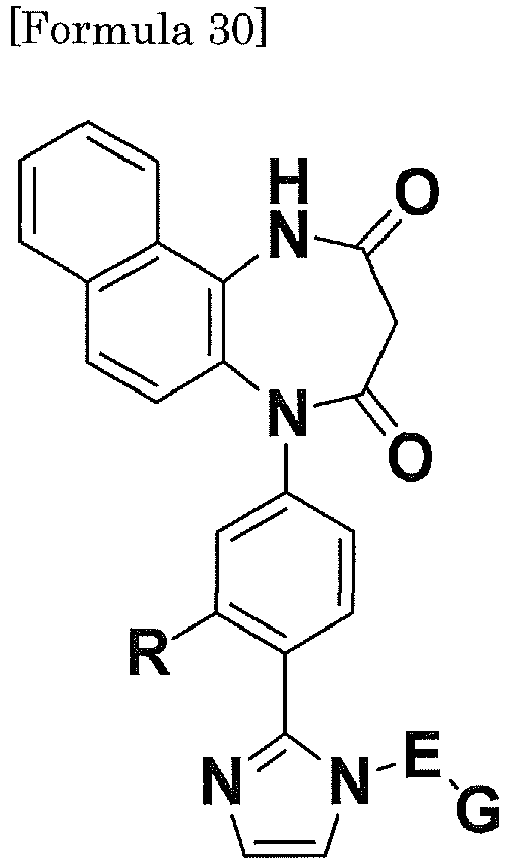
[Table 26] E-G R Salt CH2CH2Ph H HCl CH2(4-Cl)Ph H HCl CH2(2-OMe)Ph H CH2CH2(3-OMe)Ph H CH2CH2(3-OMe)Ph H HCl CH2CH2(3-OH)Ph H CH2(2,4,6-Me)Ph H HCl CH2(2-CF3)Ph H HCl CH2(2-CN)Ph H CH2(2-CONH2)Ph H CH2(2-NH2)Ph H CH2CH2Ph OMe CH2CH2Ph OH CH2(3-CN)Ph H CH2(3-CONH2)Ph H CH2CH2(3-OMe)Ph F CH2CH2(3-OH)Ph F CH2CH2(3-F)Ph H CH2CH2(2-F)Ph F CH2CH2(2-F)Ph H -

[Table 27] E-G R Salt bond-Ph H HCl CH2CH2Ph H HCl CH2CH2(2-F)Ph H CH2CH2(3-F)Ph F CH2CH2(2-OMe)Ph F CH2CH2(3-OMe)Ph F CH2CH2(2-OH)Ph F CH2CH2(3-OH)Ph F -

[Table 28] E-G R Salt CH2CH2Ph H HCl CH2CH2(2-F)Ph H CH2CH2(3-F)Ph F CH2CH2(2-OMe)Ph F CH2CH2(3-OMe)Ph F CH2CH2(2-OH)Ph F CH2CH2(3-OH)Ph F - Hereafter, the pharmacological efficacies of the compounds of the present invention will be described.
- The P2X4 receptor antagonist activities of the compounds of the present invention were measured as follows.
- The ATP receptor (human P2X4) was introduced into the 1321N1 cells, and the cells were used as a stable ATP receptor expression system. The P2X4-expressing 1321N1 cells were seeded on a 96-well plate, cultured under the conditions of 37°C and 5% CO2 for 24 hours, and used for calcium measurement. Fura-2 AM, which is a calcium fluorescent indicator, was dissolved in an extracellular fluid for calcium imaging, and the seeded cells were treated with the solution, and left standing at room temperature for 45 minutes so that Fura-2 AM was incorporated into the cells. For the measurement, a microplate reader, Fluostar Optima (BMG Labtech), was used. The light emitted from a xenon lamp was passed through 340 nm and 380 nm filters, respectively, and irradiated on the cells, fluorescences of 510 nm, F340 and F380, emitted from the cells were measured, and change of the ratio F340/F380 was used as an index of change of intracellular calcium level. The measurement was performed by adding ATP to each well at a final concentration of 1 µM, and observing the ATP-induced Ca2+ response over time. In the measurement, a treatment with a test substance was performed 15 minutes before the addition ofATP, and the inhibitory activity of the test substance was calculated by comparison of the result with the result obtained in the absence of the test substance.
- As clearly seen from the results for the compounds of Examples 84 and 85, the compounds of the present invention showed superior P2X4 receptor antagonist activity (Tables 29 to 31).
- Further, analgesic activities of the compounds of the present invention (compounds of Examples 21 and 42) were measured by orally administering them to a mouse neuropathic pain model. As a result, it became clear that the compounds have superior analgesic activity (Example 86,
Fig. 1 ). - Therefore, the diazepine derivatives represented by the aforementioned general formula (I) or (II), and pharmacologically acceptable salts thereof have a P2X4 receptor antagonist activity, and accordingly, it is considered that they are useful as prophylactic or therapeutic agents for pains of nociceptive pain, inflammatory pain, and neuropathic pain. More specifically, they are useful as prophylactic and therapeutic agents for pains accompanying various cancers, pains accompanying diabetic nerve damage, pains accompanying viral diseases such as herpes, arthrosis deformans, and the like. The prophylactic or therapeutic agent of the present invention may be used together with other medicaments if needed, and may be used together with, for example, opioid analgesics (morphine, fentanyl), sodium channel blockers (Novocain, lidocaine), NSAIDs (aspirin, ibuprofen), and the like. Further, when it is used for cancerous pain, it may be used together with, for example, anticancer agents such as anticancer chemotherapeutic agents.
- The compounds of the present invention can be administered to a human by an appropriate administration method, such as oral administration or parenteral administration, but oral administration is preferred.
- For manufacturing pharmaceutical preparations containing the compounds of the present invention, dosage forms such as tablets, granules, powders, capsules, suspensions, injections, and suppositories can be prepared by the methods usually used in the field of pharmaceutical manufacturing.
- For manufacturing such preparations, in the case of tablets, for example, usual excipients, disintegrating agents, binders, lubricants, dyes, and the like are used. Examples of excipient include lactose, D-mannitol, crystalline cellulose, glucose, and the like, examples of disintegrating agent include starch, carboxymethylcellulose calcium (CMC-Ca), and the like, examples of lubricant include magnesium stearate, talc, and the like, and examples of binder include hydroxypropylcellulose (HPC), gelatin, polyvinylpyrrolidone (PVP), and the like. For manufacturing injection, solvents, stabilizers, dissolving aids, suspending agents, emulsifiers, soothing agents, buffering agents, preservatives, and the like are used.
- As for the administration dose, the compounds of the present invention as the active ingredient can usually be administered to an adult in a daily dose of about 0.01 to 100 mg in the case of injection, or a daily dose of 1 to 2000 mg in the case of oral administration, but the dose may be increased or decreased depending on age, symptoms, and the like.
- The compounds of the present invention include highly safe compounds such as those not showing the hERG potassium ion channel inhibitory activity, and they are also superior P2X4 receptor antagonists that can be made into easily-taken preparations for oral administration. Therefore, they are useful as prophylactic and therapeutic agents for nociceptive pain, inflammatory pain, and neuropathic pain.
- Hereafter, the present invention will be explained in more detail with reference to examples. However, the present invention is not limited to these examples.
- 1-Nitro-2-naphthyl trifluoromethanesulfonate (20.26 g, 63.07 mmol), tert-butyl 4-aminophenylcarbamate (13.13 g, 63.07 mmol), triphenylphosphine (1.65 g, 6.31 mmol), tetrakis(triphenylphosphine)palladium(0) (3.64 g, 3.15 mmol), potassium carbonate (8.72 g, 63.07 mmol), and degassed dry toluene (600 mL) were mixed, and the mixture was refluxed by heating for 6 hours under a nitrogen atmosphere. The reaction mixture was left to cool, and then the insoluble matter was separated by filtration, and washed with ethyl acetate. The organic layer was washed with saturated aqueous sodium hydrogencarbonate, and dried over anhydrous sodium sulfate. The solvent was evaporated under reduced pressure, the residue was purified by silica gel column chromatography (hexane/ethyl acetate = 4/1), and then the resultant was recrystallized from ethyl acetate/hexane to obtain the title compound (18.67 g, yield 78%) as yellow crystals.
1H NMR (CDCl3, 400 MHz) δ: 1.54 (9H, s), 6.53 (1H, s), 7.21 (2H, d, J=9Hz), 7.21 (1H, d, J=9Hz), 7.37 (1H, t, J=7Hz), 7.44 (2H, d, J=9Hz), 7.62 (1H, dt, J=1Hz, 9Hz), 7.68 (1H, d, J=7Hz), 7.70 (1H, d, J=9Hz), 8.61 (1H, d, J=9Hz), 9.67 (1H, s) - tert-Butyl 4-(1-nitro-2-naphthylamino)phenylcarbamate (18.67 g, 49.21 mmol) was dissolved in tetrahydrofuran (180 mL) and methanol (180 mL), platinum oxide (360 mg) was added to the solution, and the resulting mixture was stirred at room temperature for 2 hours under a hydrogen atmosphere. The catalyst was separated by filtration, then the solvent was evaporated under reduced pressure, and the residue was washed with methanol to obtain the title compound (15.67 g, yield 91%) as grayish white crystals.
1H NMR (DMSO-d6, 400 MHz) δ: 1.45 (9H, s), 5.25 (2H, br s), 6.62 (2H, d, J=9Hz), 7.0-7.3 (5H, m), 7.3-7.4 (2H, m), 7.72 (1H, d, J=8Hz), 8.06 (1H, d, J=8Hz), 8.90 (1H, br s) - tert-Butyl 4-(1-amino-2-naphthylamino)phenylcarbamate (3.00 g, 8.58 mmol), and sodium hydrogencarbonate (2.16 g, 25.7 mmol) were suspended in chloroform (60 mL), ethyl (chloroformyl)acetate (1.22 mL, 9.5 mmol) was added dropwise to the suspension over 1 minute with stirring under ice cooling. This reaction mixture was stirred for 1 hour under ice cooling, then water was added to the reaction mixture, the resulting mixture was stirred for 10 minutes, and the chloroform layer was dried over anhydrous sodium sulfate. The solvent was evaporated under reduced pressure to obtain a crude product of ethyl 3-[[2-[[4-[(tert-butoxycarbonyl)amino]phenyl]amino]-1-naphthyl]amino]-3-oxopropionate (4 g) as brown crystals. This crude product (4 g) was dissolved in dry tetrahydrofuran (172 mL), 60% sodium hydride (1.72 g, 42.9 mmol) was added to the solution over 1 minute with stirring under ice cooling, and the resulting mixture was stirred under ice cooling for 30 minutes, and then at room temperature for 3 hours. Saturated aqueous ammonium chloride was added to this reaction mixture with stirring under ice cooling, and the organic layer was dried over anhydrous sodium sulfate. The solvent was evaporated under reduced pressure to obtain a crude product of 5-(4-tert-butoxycarbonylaminophenyl)-1H-naphtho[1,2-b][1,4]diazepine-2,4(3H,5H)-dione (4 g) as pale brown crystals. This crude product (4 g) was suspended in dichloromethane (176 mL), trifluoroacetic acid (13.1 mL, 176 mL) was added dropwise to the suspension over 10 minutes with stirring under ice cooling, and then the resulting mixture was stirred under ice cooling for 1 hour, and then at room temperature for 16 hours. The solvent was evaporated at room temperature, saturated aqueous sodium hydrogencarbonate and ethyl acetate were added to the residue, and the mixture was stirred at room temperature for 2 hours. The deposited crystals were collected by filtration, and washed with water and then with ethyl acetate to obtain the title compound (1.23 g, yield 45%) as brown crystals.
1H NMR (DMSO-d6, 400 MHz) δ: 3.10 (1H, d, J=12Hz), 3.61 (1H, d, J=12Hz), 5.26 (2H, s), 6.58 (2H, d, J=9Hz), 6.84 (2H, d, J=8Hz), 7.04 (1H, d, J=9Hz), 7.57 (1H, t, J=7Hz), 7.6-7.7 (2H, m), 7.90 (1H, d, J=8Hz), 8.22 (1H, d, J=8Hz), 10.80 (1H, s) - 2-Methoxyphenylacetic acid (75 mg, 0.45 mmol) was treated with thionyl chloride, and thereby made into 2-methoxyphenylacetyl chloride, and the resultant and 5-(4-aminophenyl)-1H-naphtho[1,2-b][1,4]diazepine-2,4(3H,5H)-dione (95 mg, 0.3 mmol) were heated in pyridine to obtain the title compound (83 mg, yield 60%) as pale yellow crystals.
1H NMR (DMSO-d6, 400 MHz) δ: 3.14 (1H, d, J=12Hz), 3.64 (2H, s), 3.69 (1H, d, J=12Hz), 3.77 (3H, s), 6.90 (1H, t, J=7Hz), 6.9-7.0 (2H, m), 7.15 (2H, d, J=8Hz), 7.2-7.3 (2H, m), 7.59 (1H, t, J=8Hz), 7.6-7.7 (4H, m), 7.91 (1H, d, J=8Hz), 8.25 (1H, d, J=8Hz), 10.17 (1H, s), 10.86 (1H, s) - Sodium azide (215 mg, 3.3 mmol), silicon tetrachloride (0.25 mL, 2.2 mmol), and dry acetonitrile (11 mL) were mixed, and the mixture was stirred at room temperature for 1 hour. To this suspension, 5-[4-[(2-Methoxyphenylacetyl)amino]phenyl]-1H-naphtho[1,2-b][1,4]diazepine-2,4(3H,5H)-dione (102 mg, 0.22 mmol) was added, and the resulting mixture was stirred at room temperature for 70 hours. To this reaction mixture, ice flakes, saturated aqueous sodium hydrogencarbonate, and ethyl acetate were added, and the resulting mixture was stirred for 10 minutes. The ethyl acetate layer was washed with saturated brine, and dried over anhydrous sodium sulfate. The solvent was evaporated under reduced pressure, and the residue was purified by silica gel column chromatography (methanol/chloroform = 1/100) to obtain the title compound (18 mg, yield 17%) as pale yellow powder.
1H NMR (DMSO-d6 , 400 MHz) δ: 3.20 (1H, d, J=12Hz), 3.57 (3H, s), 3.77 (1H, d, J=12Hz), 4.28 (2H, s), 6.86 (1H, t, J=7Hz), 6.90 (1H, d, J=8Hz), 6.97 (1H, d, J=9Hz), 7.12 (1H, d, J=7Hz), 7.25 (1H, t, J=7Hz), 7.46 (2H, d, J=8Hz), 7.6-7.7 (4H, m), 7.78 (1H, d, J=9Hz), 7.97 (1H, d, J=8Hz), 8.29 (1H, d, J=8Hz), 10.96 (1H, s) - 5-[4-[5-(2-Methoxybenzyl)]-1H-tetrazol-1-yl]phenyl]-1H-naphtho[1,2-b][1,4]diazepine-2,4(3H,5H)-dione (18 mg, 0.037 mmol) was dissolved in dry dichloromethane (1.8 mL), a 1 M solution of boron tribromide in dichloromethane (0.18 mL) was added to the solution, and the mixture was stirred at room temperature for 16 hours. The solvent was evaporated, saturated aqueous sodium hydrogencarbonate was added to the residue, and the mixture was extracted with ethyl acetate. The ethyl acetate layer was washed with saturated brine, and dried over anhydrous sodium sulfate. The solvent was evaporated under reduced pressure, and the residue was recrystallized from ethyl acetate/hexane to obtain the title compound (9 mg, yield 54%) as slightly brown crystals.
1H NMR (DMSO-d6, 400 MHz) δ: 3.19 (1H, d, J=12Hz), 3.77 (1H, d, J=12Hz), 4.24 (2H, s), 6.7-6.8 (2H, m), 6.96 (1H, d, J=9Hz), 7.00 (1H, d, J=7Hz), 7.07 (1H, dd, J=1Hz, 7Hz), 7.45 (2H, d, J=9Hz), 7.6-7.7 (4H, m), 7.78 (1H, d, J=9Hz), 7.97 (1H, d, J=8Hz), 8.29 (1H, d, J=9Hz), 9.51 (1H, s), 10.96 (1H, s) - 1-Nitro-2-naphthyl trifluoromethanesulfonate (1.61 g, 5 mmol), p-phenylenediamine (2.70 g, 25 mmol), triphenylphosphine (0.13 g, 0.5 mmol), tetrakis(triphenylphosphine)palladium(0) (0.29 g, 0.25 mmol), potassium carbonate (0.69 g, 5 mmol), and dry tetrahydrofuran (50 mL) were mixed, and the mixture was refluxed by heating for 4 hours under a nitrogen atmosphere. The reaction mixture was left to cool, then water was added to the mixture, the resulting mixture was extracted with ethyl acetate, and the insoluble matter was separated by filtration. The ethyl acetate layer was washed with saturated brine, and dried over anhydrous sodium sulfate. The solvent was evaporated under reduced pressure, and the residue was purified by silica gel column chromatography (chloroform) to obtain the title compound (1.18 g, yield 84%) as red crystals.
1H NMR (CDCl3, 400 MHz) δ: 3.77 (2H, s), 6.7-6.8 (2H, m), 7.0-7.1 (2H, m), 7.13 (1H, d, J=9Hz), 7.35 (1H, dt, J=1Hz, 8Hz), 7.61 (1H, ddd, J=1Hz, 7Hz, 8Hz), 7.6-7.7 (2H, m), 8.71 (1H, d, J=9Hz), 9.88 (1H, s) - N1-(1-Nitronaphthalen-2-yl)benzene-1,4-diamine (80 mg, 0.286 mmol) obtained above, 3-(3-pyridinyl)propionic acid (47 mg, 0.314 mmol), N,N,N',N'-tetramethyl-0-(7-azabenzotriazol-1-yl)uronium hexafluorophosphate (163 mg, 0.429 mmol), diisopropylethylamine (255 µL, 1.43 mmol), and dichloromethane (5 mL) were mixed, and the mixture was stirred at room temperature for 2 hours under a nitrogen atmosphere. To the reaction mixture, saturated aqueous sodium hydrogencarbonate was added, the resulting mixture was extracted with chloroform, and the organic layer was washed with saturated brine, and dried over anhydrous sodium sulfate. The solvent was evaporated under reduced pressure, and the residue was purified by silica gel chromatography (methanol/chloroform = 2/100) to obtain the title compound (116 mg, yield 99%) as reddish brown oil.
1H NMR (CDCl3, 400 MHz) δ: 2.71 (2H, t, J=7Hz), 3.09 (2H, t, J=7Hz), 7.2-7.3 (4H, m), 7.38 (1H, t, J=9Hz), 7.55 (2H, d, J=9Hz), 7.6-7.7 (2H, m), 7.71 (3H, t, J=9Hz), 8.49 (2H, d, J=2Hz), 8.58 (1H, d, J=9Hz), 9.59 (1H, s) - Sodium azide (278 mg, 4.29 mmol) was suspended in acetonitrile (2 mL), silicon tetrachloride (327 µL, 2.86 mmol) was added to the suspension, and the mixture was stirred at room temperature for 1 hour under a nitrogen atmosphere. To this reaction mixture, N-[4-(1-nitronaphthalen-2-ylamino)phenyl]-3-(pyridin-3-yl)propanamide (116 mg, 0.286 mmol) suspended in acetonitrile (4 mL) was added with stirring, and the resulting mixture was stirred with heating at 80°C for 18 hours. The reaction mixture was left to cool to room temperature, then saturated aqueous sodium hydrogencarbonate was added to the reaction mixture with stirring under ice cooling, the resulting mixture was extracted with chloroform, and the organic layer was washed with saturated brine, and dried over anhydrous sodium sulfate. The solvent was evaporated under reduced pressure, and the residue was purified by silica gel chromatography (methanol/ethyl acetate = 5/100) to obtain the title compound (94 mg, yield 76%) as reddish brown oil.
1H NMR (CDCl3, 400 MHz) δ: 3.22 (4H, s), 7,2-7.3 (3H, m), 7.36 (2H, d, J=9Hz), 7.4-7.5 (3H, m), 7.67 (1H, d, J=7Hz), 7.79 (1H, d, J=9Hz), 7.89 (1H, d, J=9Hz), 8.38 (1H, d, J=9Hz), 8.40 (1H, d, J=2Hz), 8.45 (1H, dd, J=2,5Hz), 8.97 (1H, s) - 1-Nitro-N-[4-[5-[2-(pyridin-3-yl)ethyl]-1H-tetrazol-1-yl]phenyl]naphthalen-2-amine (94 mg, 0.216 mmol) obtained above was dissolved in tetrahydrofuran (1 mL) and methanol (1 mL), 10% palladium carbon (90 mg) was added to the solution, and the resulting mixture was stirred at room temperature for 30 minutes under a hydrogen atmosphere. The catalyst was separated by filtration, then the solvent was evaporated under reduced pressure, and the residue was purified by silica gel chromatography (methanol/chloroform = 1/100) to obtain the title compound (75 mg, yield 86%) as pale yellow oil.
1H NMR (CDCl3, 400 MHz) δ: 3.15 (4H, s), 5.66 (1H, s), 6.74 (2H, d, J=9Hz), 7.01 (2H, d, J=9Hz), 7.1-7.5 (7H, m), 7.8-7.9 (2H, m), 8.38 (1H, d, J=2Hz), 8.45 (1H, dd, J=2Hz, 5Hz) - N2-[4-[5-[2-(Pyridin-3-yl)ethyl]-1H-tetrazol-1-yl]phenyl]naphthalene-1,2-diamine (75 mg, 0.185 mmol) obtained above, and triethylamine (77 µL, 0.555 mmol) were dissolved in dichloromethane (2 mL), and ethyl (chloroformyl)acetate (35 µL, 0.277 mmol) was added dropwise to the mixture with stirring under ice cooling. This reaction mixture was stirred at room temperature for 1 hour. To the reaction mixture, saturated aqueous sodium hydrogencarbonate was added, the resulting mixture was extracted with chloroform, and the organic layer was washed with saturated brine, and dried over anhydrous sodium sulfate. The solvent was evaporated under reduced pressure, and the residue was purified by silica gel chromatography (methanol/chloroform = 1/100) to obtain the title compound (38 mg, yield 40%) as pale yellow oil.
1H NMR (CDCl3, 400 MHz) δ: 1.37 (3H, t, J=7Hz), 3.17 (4H, s), 3.68 (2H, s), 4.34 (2H, q, J=7Hz), 7.0-7.2 (6H, m), 7.4-7.6 (4H, m), 7.81 (1H, d, J=9Hz), 7.85 (1H, d, J=9Hz), 7.98 (1H, d, J=9Hz), 8.37 (1H, d, J=2Hz), 8.46 (1H, dd, J=2Hz, 5Hz), 9.72 (1H, s) - Ethyl 3-oxo-3-[2-[4-[5-[2-(pyridin-3-yl)ethyl]-1H-tetrazol-1-yl]phenylamino]naphthalen-1-ylamino]propionate (38 mg, 0.0741 mmol) obtained above was dissolved in dry tetrahydrofuran (1 mL), 60% sodium hydride (9.7 mg, 0.244 mmol) was added to the solution with stirring under ice cooling, and the mixture was stirred under ice cooling for 10 minutes, and then at room temperature for 1 hour. To this reaction mixture, saturated aqueous ammonium chloride was added with stirring under ice cooling, the resulting mixture was extracted with chloroform, and the organic layer was washed with saturated brine, and dried over anhydrous sodium sulfate. The solvent was evaporated under reduced pressure, and the residue was purified by silica gel chromatography (methanol/chloroform = 5/100) to obtain the title compound (34 mg, yield 97%) as a slightly brown amorphous substance.
1H NMR (DMSO-d6, 400 MHz) δ: 3.09 (2H, t, J=7Hz), 3.20 (1H, d, J=12Hz), 3.3-3.4 (2H, m), 3.78 (1H, d, J=12Hz), 7.06 (1H, d, J=9Hz), 7.2-7.3 (1H, m), 7.49 (2H, d, J=9Hz), 7.6-7.8 (6H, m), 7.95 (1H, d, J=7Hz), 8.29 (1H, d, J=9Hz), 8.39 (2H, dd, J=2Hz, 5Hz), 10.97 (1H, s) - 5-[4-[5-(Pyridin-3-ylethyl)-1H-tetrazol-1-yl]phenyl]-1H-naphtho[1,2-b][1,4]diazepine-2,4(3H,5H)-dione (34 mg, 0.073 mmol) obtained above was dissolved in methanol (1 mL), a 2 M solution of hydrogen chloride in methanol (1 mL) was added to the solution, and the solvent was evaporated under reduced pressure. The residue was concentrated from water under reduced pressure, and then dried at 60°C for 3 hours under reduced pressure to obtain the title compound (28 mg, yield 75%) as a slightly brown amorphous substance.
1H NMR (DMSO-d6, 400 MHz) δ: 3.20 (1H, d, J=12Hz), 3.3-3.4 (4H, m), 3.78 (1H, d, J=12Hz), 7.05 (1H, d, J=9Hz), 7.51 (2H, d, J=9Hz), 7.63 (1H, t, J=7Hz), 7.6-7.7 (4H, m), 7.82 (1H, t, J=7Hz), 7.95 (1H, d, J=9Hz), 8.31 (2H, t, J=7Hz), 8.69 (1H, d, J=5Hz), 8.78 (1H, s), 10.97 (1H, s) - By using N1-(1-nitronaphthalen-2-yl)benzene-1,4-diamine (60 mg, 0.215 mmol) obtained in Example 3, (1), and 3-phenylpropionic acid (35 mg, 0.233 mmol), the title compound was obtained as pale yellow powder in the same manner as that of Example 3.
1H NMR (DMSO-d6 , 400 MHz) δ: 3.05 (2H, t, J=8Hz), 3.21 (1H, d, J=12Hz), 3.24 (2H, t, J=8Hz), 3.77 (1H, d, J=12Hz), 7.04 (1H, d, J=9Hz), 7.1-7.3 (5H, m), 7.47 (2H, d, J=9Hz), 7.6-7.7 (4H, m), 7.75 (1H, d, J=9Hz), 7.95 (1H, d, J=7Hz), 8.29 (1H, d, J=9Hz), 10.97 (1H, s) - By using N1-(1-nitronaphthalen-2-yl)benzene-1,4-diamine (60 mg, 0.215 mmol) obtained in Example 3, (1), and 2-(pyridin-4-yl)acetic acid hydrochloride (41 mg, 0.233 mmol), the title compound was obtained as pale yellow powder in the same manner as that of Example 3.
1H NMR (DMSO-d6, 400 MHz) δ: 3.20 (1H, d, J=12Hz), 3.77 (1H, d, J=12Hz), 4.46 (2H, s), 6.95 (1H, d, J=9Hz), 7.19 (2H, d, J=5Hz), 7.47 (2H, d, J=9Hz), 7.5-7.8 (4H, m), 7.77 (1H, d, J=9Hz), 7.97 (1H, d, J=8Hz), 8.29 (1H, d, J=9Hz), 8.47 (2H, d, J=5Hz), 10.97 (1H, s) - N1-(1-Nitronaphthalen-2-yl)benzene-1,4-diamine (60 mg, 0.215 mmol) obtained in Example 3, (1), phenylacetyl chloride (34 µL, 0.257 mmol), triethylamine (90 µL, 0.645 mmol), and dichloromethane (2 mL) were mixed, and the mixture was stirred at room temperature for 3 hours under a nitrogen atmosphere. To the reaction mixture, saturated aqueous sodium hydrogencarbonate was added, the resulting mixture was extracted with chloroform, and the organic layer was washed with saturated brine, and dried over anhydrous sodium sulfate. The solvent was evaporated under reduced pressure, and the residue was purified by silica gel chromatography (chloroform) to obtain reddish brown powder (98 mg, yield 100%). The resulting product was treated in the same manner as that of Example 3, (3), (4), (5), and (6) to obtain the title compound as pale red powder.
1H NMR (DMSO-d6, 400 MHz) δ: 3.20 (1H, d, J=12Hz), 3.76 (1H, d, J=12Hz), 4.40 (2H, s), 6.95 (1H, d, J=9Hz), 7.0-7.1 (2H, m), 7.2-7.3 (3H, m), 7.45 (2H, d, J=9Hz), 7.6-7.7 (4H, m), 7.78 (1H, d, J=9Hz), 7.97 (1H, d, J=8Hz), 8.29 (1H, d, J=8Hz), 10.96 (1H, s) - By using N1-(1-nitronaphthalen-2-yl)benzene-1,4-diamine (57 mg, 0.204 mmol) obtained in Example 3, (1), and 2-(pyridin-3-yl)acetic acid (31 mg, 0.226 mmol), the title compound was obtained as pale yellow powder in the same manner as that of Example 3, (3), (4), (5), and (6).
1H NMR (DMSO-d6, 400 MHz) δ: 3.20 (1H, d, J=12Hz), 3.77 (1H, d, J=12Hz), 4.45 (2H, s), 6.99 (1H, d, J=9Hz), 7.31 (1H, dd, J=4Hz, 8Hz), 7.48 (2H, d, J=9Hz), 7.6-7.8 (6H, m), 7.97 (1H, d, J=8Hz), 8.29 (1H, d, J=8Hz), 8.40 (1H, d, J=2Hz), 8.47 (1H, dd, J=2Hz, 4Hz), 10.96 (1H, s) - By using N-(4-methoxy-2-nitrobenzen-1-yl)-benzene-1,4-diamine (100 mg, 0.39 mmol), and 2-methoxyphenylacetic acid (64 mg, 0.47 mmol), the title compound was obtained as pale yellow crystals in the same manner as that of Example 3, (3), (4), (5), and (6).
1H NMR (DMSO-d6 , 400 MHz) δ: 3.10 (1H, br s), 3.56 (3H, s), 3.70 (1H, br s), 3.77 (3H, s), 4.25 (2H, s), 6.7-6.9 (5H, m), 7.11 (1H, d, J=7Hz), 7.22 (1H, d, J=8Hz), 7.38 (2H, d, J=9Hz), 7.63 (2H, d, J=8Hz), 10.57 (1H, br s) - 2-Methoxyphenylacetic acid (3.99 g, 24 mmol), ethyl acetate (40 mL), and thionyl chloride (3.46 mL, 48 mmol) were mixed, and the mixture was refluxed by heating for 4 hours. The solvent was evaporated under reduced pressure, and the residue was concentrated twice from dry tetrahydrofuran (10 mL) under reduced pressure to obtain brown oil. This 2-methoxyphenylacetyl chloride was dissolved in dry tetrahydrofuran (20 mL), the solution was added dropwise to a solution of 2-amino-5-nitropyridine (2.78 g, 20 mmol) in dry pyridine (20 mL) at room temperature over 10 minutes with stirring, and then the resulting mixture was stirred at room temperature for 19 hours. This reaction mixture was poured into cold water (160 mL), and the precipitates were ground, after stirring of the mixture for 1 hour, collected by filtration, and washed several times with water to obtain yellowish brown crystals. The crystals were dissolved in ethyl acetate, and the solution was washed with saturated aqueous sodium hydrogencarbonate, and then with saturated brine, and dried over anhydrous sodium sulfate. The solvent was evaporated under reduced pressure, and the residue was recrystallized from ethyl acetate/hexane to obtain the title compound (3.93 g, yield 73%) as pale brown crystals.
1H NMR (CDCl3, 400 MHz) δ: 3.79 (2H, s), 3.97 (3H, s), 6.9-7.1 (2H, m), 7.3-7.4 (2H, m), 8.36 (1H, d, J=9Hz), 8.44 (1H, dd, J=2Hz, 9Hz), 8.85 (1H, brs), 9.08 (1H, d, J=2Hz) - Sodium azide (3.90 g, 60 mmol), silicon tetrachloride (4.6 mL, 40 mmol), and dry acetonitrile (16mL) were mixed, and the mixture was stirred at room temperature for 1 hour and 30 minutes. To this suspension, 2-(2-methoxyphenyl)-N-(5-nitropyridin-2-yl)acetamide (1.09 g, 4 mmol), and dry acetonitrile (4 mL) were added, and the resulting mixture was stirred at room temperature for 23 hours,. This reaction mixture was poured into a mixture of saturated aqueous sodium hydrogencarbonate (200 mL) and ice, and the resulting mixture was stirred for 1 hour. The mixture was extracted with ethyl acetate, and the organic layer was washed with saturated brine, and dried over anhydrous sodium sulfate. The solvent was evaporated under reduced pressure, and the residue was recrystallized from ethyl acetate/hexane to obtain the title compound (1.08 g, yield 86%) as yellow crystals.
1H NMR (CDCl3, 400 MHz) δ: 3.70 (3H, s), 4.77 (2H, s), 6.8-6.9 (2H, m), 7.08 (1H, d, J=6Hz), 7.24 (1H, t, J=9Hz), 8.26 (1H, d, J=9Hz), 8.74 (1H, dd, J=3Hz, 9Hz), 9.36 (1H, d, J=3Hz) - 2-[5-(2-Methoxybenzyl)-1H-tetrazol-1-yl]-5-nitropyridine (1.08 g, 3.45 mmol) was dissolved in tetrahydrofuran (10 mL) and methanol (2 mL), platinum oxide (11 mg) was added to the solution, and the mixture was stirred at room temperature for 16 hours under a hydrogen atmosphere. The solvent was evaporated under reduced pressure, and the residue was purified by silica gel column chromatography (chloroform/methanol = 50/1) to obtain the title compound (0.93 g, yield 95%) as grayish white crystals.
1H NMR (CDCl3, 400 MHz) δ: 3.66 (3H, s), 4.01 (2H, bs), 4.56 (2H, s), 6.80 (1H, d, J=8Hz), 6.84 (1H, dt, J=1Hz, 8Hz), 7.08 (1H, d, J=8Hz), 7.13 (1H, dd, J=3Hz, 8Hz), 7.20 (1H, dt, J=2Hz, 8Hz), 7.52 (1H, d, J=9Hz), 7.96 (1H, d, J=3Hz) - 6-[5-(2-Methoxybenzyl)-1H-tetrazol-1-yl]pyridin-3-amine (907 mg, 3.2 mmol), 1-nitro-2-naphthyl trifluoromethanesulfonate (1028 mg, 3.2 mmol), triphenylphosphine (85 mg, 0.32 mmol), tetrakis(triphenylphosphine)palladium(0) (185 mg, 0.16 mmol), potassium carbonate (442 mg, 3.2 mmol), and dry tetrahydrofuran (16 mL) were mixed, and the mixture was refluxed by heating for 6 hours under a nitrogen atmosphere. The reaction mixture was left to cool, then water was added to the reaction mixture, the resulting mixture was extracted with ethyl acetate, and the organic layer was washed with saturated brine, and dried over anhydrous sodium sulfate. The solvent was evaporated under reduced pressure, and the residue was washed with acetone, and then with hexane to obtain the title compound (1.23 g, yield 85%) as pale yellow crystals.
1H NMR (DMSO-d6, 400 MHz) δ: 3.61 (3H, s), 4.47 (2H, s), 6.87 (1H, t, J=8Hz), 6.94 (1H, d, J=8Hz), 7.13 (1H, d, J=7Hz), 7.25 (1H, t, J=7Hz), 7.5-7.7 (2H, m), 7.71 (1H, t, J=8Hz), 7.7-7.9 (3H, m), 8.05 (1H, d, J=8Hz), 8.16 (1H, d, J=9Hz), 8.43 (1H, d, J=1Hz), 9.23 (1H, s) - By using 6-[5-(2-methoxybenzyl)-1H-tetrazol-1-yl]-N-(1-nitronaphthalen-2-yl)pyridin-3-amine (1.23 g, 2.71 mmol), N2-[6-[5-(2-methoxybenzyl)-1H-tetrazol-1-yl]pyridin-3-yl]naphthalene-1,2-diamine was obtained as brown oil in the same manner as that of Example 1, (3). This product was dissolved in chloroform (5.4 mL), 0.5 M aqueous sodium carbonate was added to the solution, and ethyl (chloroformyl) acetate (0.41 mL, 3.2 mmol) was added dropwise to the mixture over 1 minute with stirring under ice cooling. This mixture was stirred at room temperature for 1 hour, and then the chloroform layer was washed with saturated brine, and dried over anhydrous sodium sulfate. The solvent was evaporated under reduced pressure to obtain a crude product of ethyl 3-[2-[6-[5-(2-methoxybenzyl)-1H-tetrazol-1-yl]pyridin-3-ylamino]naphthalen-1-ylamino]-3-oxopropionate (1.8 g) as dark brown oil.
- This product was dissolved in dry tetrahydrofuran (14 mL), 60% sodium hydride (216 mg, 5.4 mmol) was added to the solution over 1 minute with stirring under ice cooling, and the resulting mixture was stirred for 1 hour under ice cooling. To this reaction mixture, saturated aqueous ammonium chloride was added, the resulting mixture was extracted with tetrahydrofuran and ethyl acetate, and the organic layer was washed with saturated brine, and dried over anhydrous sodium sulfate. The solvent was evaporated under reduced pressure, and the residue was purified by silica gel column chromatography (methanol/chloroform = 1/50), and the eluted substance was recrystallized from ethyl acetate/hexane to obtain the title compound (0.56 g, yield 42%) as brown crystals.
1H NMR (CDCl3, 400 MHz) δ: 3.65 (3H, s), 3.6-3.7 (2H, m), 4.68 (2H, s), 6.81 (1H, d, J=8Hz), 6.86 (1H, t, J=8Hz), 6.96 (1H, d, J=9Hz), 7.11 (1H, d, J=7Hz), 7.22 (1H, t, J=8Hz), 7.6-7.7 (2H, m), 7.75 (1H, t, J=8Hz), 7.8-8.0 (2H, m), 7.97 (1H, d, J=9Hz), 8.13 (1H, d, J=9Hz), 8.48 (1H, s), 8.74 (1H, s) - By using N1 -(1-nitronaphthalen-2-yl)benzene-1,4-diamine (60 mg, 0.215 mol) obtained in Example 3, (1), and 3-cyclohexylpropionic acid (41 µL, 0.233 mmol), the title compound was obtained as slightly brown powder in the same manner as that of Example 3, (3), (4), (5), and (6).
1H NMR (DMSO-d6, 400 MHz) δ: 0.8-0.9 (2H, m), 1.0-1.3 (4H, m), 1.5-1.7 (7H, m), 2.93 (2H, t, J=8Hz), 3.21 (1H, d, J=12Hz), 3.78 (1H, d, J=12Hz), 7.03 (1H, d, J=9Hz), 7.52 (2H, d, J=9Hz), 7.6-7.8 (5H, m), 7.95 (1H, d, J=8Hz), 8.30 (1H, d, J=8Hz), 10.97 (1H, s) - By using 5-[6-[5-(2-methoxybenzyl)]-1H-tetrazol-1-yl]pyridin-3-yl]-1H-naphtho[1,2-b][1,4]diazepine-2,4(3H,5H)-dione (98 mg, 0.2 mmol), the title compound was obtained as slightly red crystals (41 mg, yield 43%) in the same manner as that of Example 2.
1H NMR (CDCl3, 400 MHz) δ: 3.6-3.8 (2H, m), 4.66 (1H, d, J=14Hz), 4.71 (1H, d, J=14Hz), 6.8-6.9 (2H, m), 7.00 (1H, d, J=9Hz), 7.17 (1H, t, J=7Hz), 7.34 (1H, d, J=7Hz), 7.6-7.8 (3H, m), 7.9-8.0 (2H, m), 7.99 (1H, d, J=9Hz), 8.0-8.2 (2H, m), 8.47 (1H, br s), 8.59 (1H, s) - By using N1 -(1-nitronaphthalen-2-yl)benzene-1,4-diamine (80 mg, 0.286 mol) obtained in Example 3, (1), and 3-(4-pyridinyl)propionic acid (47 mg, 0.314 mmol), the title compound was obtained as white crystals in the same manner as that of Example 3, (3), (4), (5), and (6).
1H NMR (DMSO-d6, 400 MHz) δ: 3.20 (1H, d, J=12Hz), 3.3-3.4 (4H, m), 3.79 (1H, d, J=12Hz), 7.05 (1H, d, J=9Hz), 7.51 (2H, d, J=9Hz), 7.6-7.8 (7H, m), 7.95 (1H, d, J=7Hz), 8.30 (1H, d, J=7Hz), 8.65 (2H, s), 10.97 (1H, s) - By using N1 -(1-nitronaphthalen-2-yl)benzene-1,4-diamine (60 mg, 0.215 mmol) obtained in Example 3, (1), and 2-(pyridin-2-yl)acetic acid hydrochloride (41 mg, 0.233 mmol), the title compound was obtained as brown powder in the same manner as that of Example 3, (3), (4), (5), and (6).
1H NMR (DMSO-d6, 400 MHz) δ: 3.18 (1H, d, J=12Hz), 3.75 (1H, d, J=12Hz), 4.61 (2H, s), 6.87 (1H, d, J=9Hz), 7.25 (1H, dd, J=5Hz, 7Hz), 7.32 (1H, d, J=8Hz), 7.40 (2H, d, J=9Hz), 7.6-7.8 (6H, m), 7.96 (1H, d, J=8Hz), 8.28 (1H, d, J=8Hz), 8.37 (1H, d, J=5Hz), 10.95 (1H, s) - By using N1-(1-nitronaphthalen-2-yl)benzene-1,4-diamine (170 mg, 0.608 mol) obtained in Example 3, (1), and 3-(2-pyridinyl)propionic acid (101 mg, 0.668 mmol), the title compound was obtained as a slightly brown amorphous substance in the same manner as that of Example 3, (3), (4), (5), and (6).
1H NMR (DMSO-d6, 400 MHz) δ: 3.20 (1H, d, J=11Hz) 3.3-3.4 (4H, m), 3.78 (1H,d, J=11Hz) 7.05 (1H, d, J=9Hz), 7.52 (3H, d, J=9Hz), 7.6-7.8 (6H, m), 7.95 (2H, d, J=7Hz), 8.29 (1H, d, J=7Hz), 8.57 (1H, s), 10.99 (1H, s) - By using N1 -(1-nitronaphthalen-2-yl)benzene-1,4-diamine (100 mg, 0.358 mmol) obtained in Example 3, (1), and chloroacetyl chloride (43 µL, 0.537 mmol), the title compound was obtained as reddish brown solid (112 mg, yield 88%) in the same manner as that of Example 6, (1).
1H NMR (CDCl3, 400 MHz) δ: 4.23 (2H, s), 7.2-7.3 (3H, m), 7.40 (1H, t, J=8Hz), 7.6-7.7 (3H, m), 7.71 (1H, d, J=8Hz), 7.75 (1H, d, J=9Hz), 8.29 (1H, br s), 8.56 (1H, d, J=9Hz), 9.54 (1H, s) - 2-Chloro-N-[4-(1-nitronaphthalen-2-ylamino)phenyl]acetamide (112 mg, 0.315 mmol), imidazole (26 mg, 0.378 mmol), cesium carbonate (154 mg, 0.473 mmol), and acetonitrile (3 mL) were mixed, and the mixture was stirred at room temperature for 2 hours under a nitrogen atmosphere. To the reaction mixture, distilled water was added, the resulting mixture was extracted with chloroform, and the organic layer was dried over anhydrous sodium sulfate. The solvent was evaporated under reduced pressure, and the residue was purified by silica gel chromatography (methanol/chloroform = 1/10) to obtain the title compound (122 mg, yield 100%) as reddish brown solid.
1H NMR (CDCl3, 400 MHz) δ: 4.85 (2H, s), 7.11 (2H, d, J=12Hz), 7.2-7.3 (3H, m), 7.39 (1H, t, J=8Hz), 7.51 (2H, d, J=9Hz), 7.6-7.8 (4H, m), 8.54 (1H,d, J=8Hz), 9.50 (1H, s) - By using 2-(1H-imidazol-1-yl)-N-[4-(1-nitronaphthalen-2-ylamino)phenyl]acetamide (122 mg, 0.314 mmol) obtained above, the title compound was obtained as a slightly brown amorphous substance in the same manner as that of Example 3, (3), (4), (5), and (6).
1H NMR (DMSO-d6, 400 MHz) δ: 3.21 (1H, d, J=12Hz), 3.78 (1H, d, J=12Hz), 5.76 (2H, s), 6.89 (1H, s), 7.05 (1H, d, J=9Hz), 7.10 (1H, s), 7.50 (2H, d, J=9Hz), 7.6-7.8 (6H, m), 7.97 (1H, d, J=8Hz), 8.29 (1H, d, J=9Hz), 10.98 (1H, s) - By using N1 -(1-nitronaphthalen-2-yl)benzene-1,4-diamine (300 mg, 1.07 mmol) obtained in Example 3, (1), and 3-(imidazol-1-yl)propionic acid (165 mg, 1.20 mmol), the title compound was obtained as pale yellow crystals in the same manner as that of Example 3, (3), (4), (5), and (6).
1H NMR (DMSO-d6, 400 MHz) δ: 3.21 (1H, d, J=12Hz), 3.63 (2H, t, J=6Hz), 3.79 (1H, t, J=12Hz), 4.73 (2H, t, J=6Hz), 7.05 (1H, d, J=9Hz), 7.53 (2H, d, J=8Hz), 7.6-7.9 (7H, m), 7.95 (1H, d, J=8Hz), 8.30 (1H, d, J=8Hz), 9.21 (1H, s), 11.0 (1H, s) - By using 1-nitro-2-naphthaldehyde, and 1-bromo-4-iodobenzene, the title compound was obtained in the same manner as that of the method described in
WO2008/023847 .
1H NMR (DMSO-d6, 400 MHz) δ: 3.80 (1H,d, J=9Hz), 4.58 (1H,d, J=9Hz), 7.26 (1H, d, J=8Hz), 7.48 (2H, d, J=8Hz), 7.6-7.8 (5H, m), 8.01 (1H, d, J=8Hz), 8.36 (1H, d, J=9Hz), 10.85 (1H,br s) - 5-(4-Bromophenyl)-1H-naphtho[1,2-e][1,4]diazepin-2(3H)-one (380 mg, 1.04 mmol), benzophenone imine (349 mg, 2.08 mmol), sodium tert-butoxide (200 mg, 2.08 mmol), palladium(II) acetate (23 mg, 0.104 mmol), and 4,5-bis(diphenylphosphino)-9,9-dimethylxanthene (60 mg, 0.208 mmol) were dissolved in anhydrous dioxane (5 mL), and the solution was stirred at 110°C for 16 hours. The reaction mixture was left to cool, and then poured into water, and the resulting mixture was extracted with chloroform. The organic layer was washed with saturated brine, and dried over anhydrous sodium sulfate. The solvent was evaporated under reduced pressure, and the residue was purified by silica gel column chromatography (chloroform/methanol = 100/1) to obtain the title compound (154 mg, yield 49%).
1H NMR (DMSO-d6, 400 MHz) δ: 3.67 (1H, d, J=10Hz), 4.42 (1H, d, J=10Hz), 5.57 (2H, s), 6.54 (2H, d, J=8Hz), 7.24 (2H, d, J=8Hz), 7.33 (1H, d, J=9Hz), 7.6-7.8 (3H, m), 7.9-8.1 (1H,m), 8.3-8.4 (1H, m), 10.67 (1H, br s) - 5-(4-Aminophenyl)-1H-naphtho[1,2-e][1,4]diazepin-2(3H)-one (400 mg, 1.33 mmol) was dissolved in anhydrous DMF (15 mL) by heating. The reaction mixture was left to cool to room temperature, then 3-pyridin-2-yl-propanoic acid (221 mg, 1.46 mmol), and 1-(3-dimethylaminopropyl)-3-ethylcarbodiimide hydrochloride (382 mg, 1.99 mmol) were added to the mixture, and the resulting mixture was stirred at room temperature for 16 hours. To the reaction mixture, saturated aqueous sodium hydrogencarbonate was added, the resulting mixture was extracted with ethyl acetate, and the organic layer was dried over anhydrous sodium sulfate. The solvent was evaporated under reduced pressure, chloroform was added to the residue, and the deposited crystals were collected by filtration, and washed with chloroform and hexane to obtain the title compound (408 mg, yield 71%) as grayish white crystals.
1H NMR (DMSO-d6, 400 MHz) δ: 2.79 (2H, t, J=7Hz), 3.06 (2H, t, J=7Hz), 3.76 (1H, d, J=10Hz), 4.53 (1H, d, J=10Hz), 7.19 (1H, dd, J=2Hz, 5Hz), 7.27 (1H, d, J=6Hz), 7.29 (1H, d, J=4Hz), 7.47 (2H, d, J=9Hz), 7.6-7.8 (6H, m), 7.9-8.1 (1H, m), 8.35 (1H, d, J=9Hz), 8.35 (1H, d, J=9Hz), 8.47 (1H, d, J=4Hz), 10.18 (1H, s), 10.80 (1H, s) - N-[4-(2-Oxo-2,3-dihydro-1H-naphtho[1,2-e][1,4]diazepin-5-yl)phenyl]-3-(pyridin-2-yl)propanamide (100 mg, 0.230 mmol) was dissolved in anhydrous DMF (1.5 mL) by heating, and the solution was left to cool to room temperature. Potassium carbonate (95 mg, 0.69 mmol), and 4-methoxybenzyl chloride (33 µL, 0.242 mmol) were added to the solution, and the mixture was stirred at room temperature for 16 hours. To the reaction mixture, water was added, and the resulting mixture was extracted with ethyl acetate. The organic layer was dried over anhydrous sodium sulfate, and the solvent was evaporated under reduced pressure. The residue was purified by silica gel column chromatography (chloroform/methanol = 9/1) to obtain the title compound (124 mg, yield 97%) as a pale yellow amorphous substance.
1H NMR (CDCl3, 400 MHz) δ: 2.8-3.0 (2H, m), 3.2-3.3 (2H, m), 3.55 (3H, s), 3.80 (1H, d, J=10Hz), 4.43 (1H, d, J=14Hz), 4.85 (1H, d, J=10Hz), 5.93 (1H, d, J=14Hz), 6.39 (2H, d, J=9Hz), 6.64 (2H, d, J=9Hz), 7.13 (2H, dd, J=1Hz, 8Hz), 7.1-7.2 (1H, m), 7.2-7.3 (2H, m), 7.46 (2H, d, J=8Hz), 7.6-7.8 (4H, m), 7.93 (1H, d, J=8Hz), 8.17 (1H, d, J=8Hz), 8.61 (1H, d, J=5Hz), 9.75 (1H, br s) - Sodium azide (218 mg, 3.35 mmol) was suspended in acetonitrile (3 mL), silicon chloride (257 µL, 2.24 mmol) was added to the suspension under a nitrogen atmosphere, and the mixture was stirred at room temperature for 1 hour. A solution of N-[4-[1-(4-methoxybenzyl)-2-oxo-2,3-dihydro-1H-naphtho[1,2-e][1,4]diazepin-5-yl]phenyl]-3-(pyridin-2-yl)propanamide (124 mg, 0.224 mmol) in acetonitrile (1 mL) was added to the mixture, and the resulting mixture was refluxed by heating for 9 hours. The reaction mixture was left to cool to room temperature, then saturated aqueous sodium hydrogencarbonate was added to the mixture, and the resulting mixture was extracted with chloroform. The insoluble matter was separated by filtration, then the organic layer was dried over anhydrous sodium sulfate, and the solvent was evaporated under reduced pressure. The residue was purified by silica gel column chromatography (chloroform/methanol = 19/1) to obtain the title compound (25 mg, yield 19%) as a pale yellow amorphous substance.
1H NMR (CDCl3, 400 MHz) δ: 3.43 (4H, s), 3.52 (3H, s), 3.86 (1H, d, J=10Hz), 4.43 (1H, d, J=14Hz), 4.95 (1H, d, J=10Hz), 5.99 (1H, d, J=14Hz), 6.41 (2H, d, J=9Hz), 6.64 (2H, d, J=8Hz), 7.1-7.4 (7H, m), 7.59 (1H, dt, J=2Hz, 8Hz), 7.6-7.8 (3H, m), 7.97 (1H, d, J=8Hz), 8.20 (1H, d, J=8Hz), 8.4-8.5 (1H, m) - 1-(4-Methoxybenzyl)-5-[4-[5-[2-(pyridin-2-yl)ethyl]-1H-tetrazol-1-yl]phenyl]-1H-naphtho[1,2-e][1,4]diazepin-2(3H)-one (25 mg, 0.043 mmol) was dissolved in anisole (0.5 mL), and aluminum chloride (23 mg, 0.172 mmol) was added to the solution. The resulting mixture was stirred at 85°C for 2 hours, and left to cool to room temperature. To the reaction mixture, saturated aqueous sodium hydrogencarbonate was added, and the resulting mixture was extracted with chloroform. The organic layer was dried over anhydrous sodium sulfate, and the solvent was evaporated under reduced pressure. The residue was purified by silica gel column chromatography (chloroform/methanol = 19/1) and amino-silica gel column chromatography (chloroform) to obtain the title compound (15 mg, yield 76%) as white crystals.
1H NMR (DMSO-d6, 400 MHz) δ: 2.8-3.2 (4H, m), 3.88 (1H, br s), 4.63 (1H, br s), 7.17 (1H, dd, J=2Hz, 5Hz), 7.25 (1H, d, J=8Hz), 7.34 (1H, d, J=8Hz), 7.66 (1H, dt, J=2Hz, 8Hz), 7.6-7.8 (6H, m), 7.78 (1H, t, J=8Hz), 8.0-8.1 (1H, m), 8.3-8.4 (2H, m), 10.92 (1H, br s) - 5-[4-[5-[2-(Pyridin-2-yl)ethyl]-1H-tetrazol-1-yl]phenyl]-1H-naphtho[1,2-e][1,4]diazepin-2(3H)-one (28 mg, 0.061 mmol) was dissolved in ethyl acetate (1 mL), a 4 M solution of hydrogen chloride in ethyl acetate (100 µL) was added to the solution, and the resulting mixture was stirred at room temperature for 0.5 hour. The deposited crystals were collected by filtration, washed with ethyl acetate, and then air-dried to obtain the title compound (24 mg, yield 74%) as yellow crystals.
1H NMR (DMSO-d6, 400 MHz) δ: 3.0-3.8 (4H, m), 3.90 (1H, br s), 4.64 (1H, br s), 7.33 (1H, d, J=9Hz), 7.6-7.9 (9H, m), 8.0-8.1 (1H, m), 8.22 (1H, br s), 8.40 (1H, d, J=9Hz), 8.67 (1H, d, J=5Hz), 10.96 (1H, s) - By using N1 -(1-nitronaphthalen-2-yl)benzene-1,4-diamine (80 mg, 0.286 mol) obtained in Example 3, (1), and 3-(2-methoxyphenyl)propionic acid (56 mg, 0.314 mmol), the title compound was obtained in the same manner as that of Example 3, (3), (4), (5), and (6) as a slightly brown amorphous substance.
1H NMR (DMSO-d6 , 400 MHz) δ: 2.95 (2H, t, J=8Hz), 3.1-3.2 (3H, m), 3.64 (3H, s), 3.78 (1H, d, J=12Hz), 6.80 (1H, t, J=8Hz), 6.87 (1H, d, J=8Hz), 6.98 (1H, dd, J=2Hz, 5Hz), 7.03 (1H, d, J=9Hz), 7.17 (1H, t, J=8Hz), 7.47 (2H, d, J=9Hz), 7.55 (2H, d, J=9Hz), 7.6-7.7 (2H, m), 7.76 (1H, d, J=9Hz), 7.95 (1H, d, J=8Hz), 8.29 (1H, d, J=9Hz), 10.98 (1H, s) - 5-(4-Aminophenyl)-1H-naphtho[1,2-e][1,4]diazepin-2(3H)-one (151 mg, 0.5 mmol), 2-methoxyphenylacetic acid (100 mg, 0.6 mmol), HATU (228 mg, 0.6 mmol), diisopropylethylamine (0.1 mL, 0.6 mmol), and dry dimethylformamide (5 mL) were mixed, and the mixture was stirred at room temperature for 16 hours. To this reaction mixture, water was added, the resulting mixture was extracted with ethyl acetate, and the organic layer was washed with saturated aqueous sodium hydrogencarbonate, and then with saturated brine, and dried over anhydrous sodium sulfate. The solvent was evaporated under reduced pressure, and the residue was washed with chloroform, and then with hexane to obtain the title compound (116 mg) as pale yellow crystals. This washing solution was concentrated under reduced pressure, and the residue was purified by silica gel column chromatography (chloroform/methanol = 50/1) to obtain the title compound (63 mg) as white crystals (total 179 mg, yield 80%).
1H NMR (DMSO-d6 , 400 MHz) δ: 3.66 (2H, s), 3.7-3.8 (4H, m), 4.54 (1H, d, J=10Hz), 6.90 (1H, t, J=7Hz), 6.98 (1H, d, J=8Hz), 7.2-7.3 (3H, m), 7.49 (2H, d, J=8Hz), 7.6-7.8 (5H, m), 8.01 (1H, d, J=6Hz), 8.36 (1H, d, J=7Hz), 10.26 (1H, s), 10.81 (1H, s) - By using 2-(2-methoxyphenyl)-N-[4-(2-oxo-2,3-dihydro-1H-naphtho[1,2-e][1,4]diazepin-5-yl)phenyl]acetamide (179 mg, 0.4 mmol), the title compound (3 mg, yield 2%) was obtained as pale brown powder in the same manner as that of Example 1, (5).
1H NMR (CDCl3, 400 MHz) δ: 3.67 (3H, s), 4.28 (2H, s), 6.80 (1H, d, J=8Hz), 6.89 (1H, t, J=7Hz), 7.08 (1H, d, J=7Hz), 7.2-7.3 (1H,m), 7.44 (2H, d, J=8Hz), 7.6-7.8 (6H, m), 7.9-8.0 (1H, m), 8.1-8.2 (1H,m), 8.31 (1H, s) - By using N1-(1-nitronaphthalen-2-yl)benzene-1,4-diamine (60 mg, 0.215 mmol) obtained in Example 3, (1), and 4-phenylbutyric acid (39 mg, 0.236 mmol), the title compound was obtained as a pale yellow amorphous substance in the same manner as that of Example 3.
1H NMR (DMSO-d6, 400 MHz) δ: 2.01 (2H, quint, J=8Hz), 2.63 (2H, t, J=8Hz), 2.91 (2H, t, J=8Hz), 3.21 (1H, d, J=12Hz), 3.79 (1H, d, J=12Hz), 7.02 (1H, d, J=9Hz), 7.13 (2H, d, J=7Hz), 7.16 (1H, d, J=7Hz), 7.2-7.3 (2H, m), 7.49 (2H, d, J=9Hz), 7.6-7.7 (1H, m), 7.7-7.8 (4H, m), 7.96 (1H, d, J=8Hz), 8.30 (1H, d, J=9Hz), 11.00 (1H, s) - By using N1 -(1-nitronaphthalen-2-yl)benzene-1,4-diamine (300 mg, 1.07 mmol) obtained in Example 3, (1), and 3-phenylpropionic acid (177 mg, 1.20 mmol), a crude product of N-[4-(1-nitronaphthalen-2-ylamino)phenyl]-3-phenylpropanamide was obtained as orange powder in the same manner as that of Example 3, (2). The resulting crude product was dissolved in toluene (5 mL) and THF (5 mL), 2,4-bis(4-methoxyphenyl)-1,3-dithia-2,4-diphosphetane-2,4-disulfide (433 mg, 1.07 mmol) was added to the solution, and the mixture was stirred with heating at 100°C for 16 hours with. The reaction mixture was left to cool to room temperature, then saturated aqueous sodium hydrogencarbonate was added to the reaction mixture with stirring under ice cooling, the resulting mixture was extracted with chloroform, and the organic layer was washed with saturated brine, and dried over anhydrous sodium sulfate. The solvent was evaporated under reduced pressure, and the residue was purified by silica gel chromatography (methanol/chloroform = 1/100) to obtain the title compound (290 mg, yield 63%) as reddish brown oil.
1H NMR (CDCl3, 400 MHz) δ: 3.13 (2H, t, J=7Hz), 3.22 (2H, t, J=7Hz), 7.20-7.45 (9H, m), 7.49 (2H, d, J=8Hz), 7.63 (1H, d, J=7Hz), 7.73 (1H, d, J=8Hz), 7.77 (1H, d, J=9Hz), 8.30 (1H, br s), 8.51 (1H, d, J=9Hz), 9.41 (1H, br s) - N-[4-(1-Nitronaphthalen-2-ylamino)phenyl]-3-phenylpropanethioamide (190 mg, 0.44 mmol) obtained above was dissolved in ethanol (1 mL) and THF (1 mL), aminoacetal (640 µL, 4.44 mmol) was added to the solution, and the resulting mixture was stirred with heating at 90°C for 16 hours. The reaction mixture was left to cool to room temperature, then saturated aqueous sodium hydrogencarbonate was added to the reaction mixture with stirring under ice cooling, the resulting mixture was extracted with chloroform, and the organic layer was washed with saturated brine, and dried over anhydrous sodium sulfate. The solvent was evaporated under reduced pressure, and the residue was purified by silica gel chromatography (methanol/chloroform = 1/100) to obtain the title compound (290 mg, yield 63%) as reddish brown oil.
1H NMR (CDCl3 , 400 MHz) δ:1.24 (6H, t, J=7Hz), 2.58 (2H, t, J=7Hz), 2.78 (2H, t, J=7Hz), 3.4-3.6 (4H, m), 3.6-3.8 (2H, m), 4.5-4.7 (2H, m), 6.71 (2H, d, J=8Hz), 7.0-7.4 (9H, m), 7.61 (1H, t, J=8Hz), 7.68 (1H, d, J=9Hz), 7.69 (1H, d, J=9Hz), 8.68 (1H, d, J=9Hz), 9.89 (1H, br s) - (Z)-N'-(2,2-Diethoxyethyl)-N-4-[(1-nitronaphthalen-2-ylamino)phenyl]-3-phenylpropanimidamide (230 mg, 0.44 mmol) obtained above was dissolved in toluene (10 mL) and THF (1 mL), 10-camphorsulfonic acid (204 mg, 0.88 mmol) was added to the solution, and the resulting mixture was stirred with heating at 110°C for 16 hours. The reaction mixture was left to cool to room temperature, then saturated aqueous sodium hydrogencarbonate was added to the reaction mixture with stirring under ice cooling, the resulting mixture was extracted with chloroform, and the organic layer was washed with saturated brine, and dried over anhydrous sodium sulfate. The solvent was evaporated under reduced pressure, and the residue was purified by silica gel chromatography (methanol/chloroform = 1/100) to obtain the title compound (191 mg, yield 100%) as reddish brown oil.
1H NMR (CDCl3, 400 MHz) δ: 2.9-3.0 (2H, m), 3.0-3.2 (2H, m), 6.97 (1H, d, J=1Hz), 7.0-7.3 (10H, m), 7.4-7.5 (2H, m), 7.65 (1H, dt, J=2Hz, 7Hz), 7.75 (1H, d, J=9Hz), 7.82 (1H, d, J=9Hz), 8.45 (1H, d, J=9Hz), 9.25 (1H, br s) - By using 1-nitro-N-[4-(2-phenethyl-1H-imidazol-1-yl)phenyl]naphthalen-2-amine (240 mg, 0.55 mmol) obtained above, the title compound (222 mg, yield 100%) was obtained as a slightly brown amorphous substance in the same manner as that of Example 3, (4).
1H NMR (CDCl3 , 400 MHz) δ: 2.8-3.0 (2H, m), 3.0-3.1 (2H, m), 4.29 (2H, br s), 5.57 (1H, br s), 6.67 (2H, d, J=9Hz), 6.8-7.0 (3H, m), 7.0-7.4 (8H, m), 7.4-7.6 (2H, m), 7.7-7.9 (2H, m) - By using N2-[4-[2-phenethyl-1H-imidazol-1-yl]phenyl]naphthalene-1,2-diamine (222 mg, 0.55 mmol) obtained above, the title compound (207 mg, yield 73%) was obtained as a slightly brown amorphous substance in the same manner as that of Example 3, (5).
1H NMR (CDCl3, 400 MHz) δ: 1.35 (3H, t, J=7Hz), 2.80-2.95 (2H, m), 2.95-3.10 (2H, m), 3.67 (2H, s), 4.32 (2H, q, J=7Hz), 6.8-7.3 (11H, m), 7.42 (1H, t, J=7Hz), 7.55 (1H, t, J=7Hz), 7.61 (1H, d, J=9Hz), 7.76 (1H, d, J=9), 7.81 (1H, d, J=8Hz), 7.94 (1H, d, J=8Hz), 9.66 (1H, br s) - By using ethyl 3-oxo-3-[2-[4-(2-phenethyl-1H-imidazol-1-yl)phenylaminolnaphthalen-1-ylaminolpropionate (207 mg, 0.40 mmol) obtained above, the title compound (23 mg, yield 12%) was obtained as pale yellow crystals in the same manner as that of Example 3, (6).
1H NMR (CDCl3, 400 MHz) δ: 2.9-3.0 (2H, m), 3.0-3.1 (2H, m), 3.64 (2H, s), 6.9-7.4 (12H, m), 7.6-7.7 (2H, m), 7.72 (1H, t, J=7Hz), 7.88 (1H, d, J=8Hz), 8.12 (1H, d, J=8Hz), 8.92 (1H, br s) - By using 5-[4-(2-phenethyl-1H-imidazol-1-yl)phenyl]-1H-naphtho[1,2-b][1,4]diazepine-2,4(3H,5H)-dione (207 mg, 0.40 mmol) obtained above, the title compound (25 mg, yield 100%) was obtained as pale yellow crystals in the same manner as that of Example 3, (7).
1H NMR (DMSO-d6 , 400 MHz) δ: 2.97 (2H, br s), 3.1-3.3 (3H, m), 3.78 (1H, d, J=12Hz), 6.9-7.1 (3H, m), 7.1-7.3 (3H, m), 7.4-7.6 (4H, m), 7.63 (1H, t, J=8Hz), 7.70 (1H, t, J=8Hz), 7.76 (1H, d, J=9Hz), 7.83 (1H, s), 7.92 (1H, s), 7.96 (1H, d, J=8Hz), 8.30 (1H, d, J=8Hz), 11.0 (1H, br s) - 2-(4-Nitrophenyl)-1H-imidazole [Heterocycles, 76, 507 (2008)] (0.89 g, 4.7 mmol), (2-bromoethyl)benzene (1.74 g, 9.4 mmol), potassium carbonate (0.97 g, 7.05 mmol), and dimethylformamide (9 mL) were mixed, and the mixture was stirred at 120°C for 24 hours. To this reaction mixture, ice flakes were added, the resulting mixture was extracted with ethyl acetate, and the organic layer was washed twice with water, and then with saturated brine, and dried over anhydrous sodium sulfate. The solvent was evaporated under reduced pressure, and the residue was purified by silica gel column chromatography (methanol/chloroform = 1/100) to obtain the title compound (0.37 g, yield 27%) as yellow oil.
1H NMR (CDCl3, 400 MHz) δ: 3.03 (2H, t, J=7Hz), 4.28 (2H, t, J=7Hz), 6.9-7.0 (2H, m), 7.06 (1H, d, J=1Hz), 7.19 (1H, d, J=1Hz), 7.2-7.3 (3H, m), 7.4-7.5 (2H, m), 8.1-8.3 (2H, m) - 2-(4-Nitrophenyl)-1-phenethyl-1H-imidazole (390 mg, 1.33 mmol) obtained above was dissolved in methanol (4 mL), platinum oxide (4 mg) was added to the solution, and the resulting mixture was stirred at room temperature for 17 hours under a hydrogen atmosphere. The solvent was evaporated under reduced pressure, and the residue was purified by silica gel column chromatography (methanol/chloroform = 1/50) to obtain the title compound (274 mg, yield 78%) as brown oil.
1H NMR (CDCl3, 400 MHz) δ: 2.99 (2H, dd, J=7Hz, 8Hz), 3.80 (2H, bs), 4.18 (2H, dd, J=7Hz, 8Hz), 6.6-6.7 (2H, m), 6.88 (1H, d, J=1Hz), 7.0-7.1 (2H, m), 7.06 (1H, d, J=1Hz), 7.2-7.3 (5H, m) - By using 4-(1-phenethyl-1H-imidazol-2-yl)aniline (274 mg, 1.04 mmol) obtained above, and 1-nitro-2-naphthyl trifluoromethanesulfonate (321 mg, 1 mmol), the title compound (280 mg, yield 64%) was obtained in the same manner as that of Example 9, (4) as red crystals.
1H NMR (CDCl3, 400 MHz) δ: 3.03 (2H, t, J=7Hz), 4.26 (2H, t, J=7Hz), 6.9-7.1 (3H, m), 7.14 (1H, d, J=1Hz), 7.2-7.3 (5H, m), 7.3-7.5 (4H, m), 7.63 (1H, t, J=7Hz), 7.73 (1H, d, J=8Hz), 7.79 (1H, d, J=9Hz), 8.49 (1H, d, J=9Hz), 9.41 (1H, s) - 1-Nitro-N-[4-(1-phenethyl-1H-imidazol-2-yl)phenyl]naphthalen-2-amine (102 mg, 0.23 mmol) obtained above was dissolved in tetrahydrofuran (5 mL), methanol (5 mL) and platinum oxide (2 mg) were added to the solution, and the mixture was stirred at room temperature for 20 hours under a hydrogen atmosphere. The catalyst was separated by filtration, and then the solvent was evaporated under reduced pressure to obtain brown oil. This N2-[4-(1-phenethyl-1H-imidazol-2-yl)phenyl]naphthalene-1,2-diamine was dissolved in chloroform (5 mL), and 0.5 M aqueous sodium carbonate (0.5 mL) was added to the solution. To this mixture, ethyl (chloroformyl)acetate (0.04 mL, 0.32 mmol) was added with stirring under ice cooling, and the mixture was stirred at room temperature for 2 hours. The chloroform layer was washed with saturated brine, and dried over anhydrous sodium sulfate. The solvent was evaporated under reduced pressure, and the residue was purified by silica gel column chromatography (methanol/chloroform = 1/50) to obtain the title compound (69 mg, yield 55%) as pale yellow oil.
1H NMR (CDCl3, 400 MHz) δ: 1.30 (3H, t, J=7Hz), 2.95 (2H, t, J=7Hz), 3.62 (2H, s), 4.16 (2H, t, J=7Hz), 4.26 (2H, q, J=7Hz), 6.8-6.9 (4H, m), 6.9-7.0 (2H, m), 7.05 (2H, d, J=8Hz), 7.11 (1H, d, J=1Hz), 7.2-7.3 (3H, m), 7.38 (1H, t, J=8Hz), 7.50 (1H, t, J=7Hz), 7.58 (1H, d, J=9Hz), 7.72 (1H, d, J=9Hz), 7.79 (1H, d, J=8Hz), 7.99 (1H, d, J=8Hz), 10.61 (1H, s) - By using ethyl 3-oxo-3-[2-[4-(1-phenethyl-1H-imidazol-2-yl)phenylaminolnaphthalen-1-ylaminolpropionate (69 mg, 0.13 mmol) obtained above, the title compound was obtained in the same manner as that of Example 3, (6) (20 mg, yield 32%) as white oil.
1H NMR (CDCl3, 400 MHz) δ: 3.01 (2H, t, J=7Hz), 3.63 (2H, s), 4.24 (2H, t, J=7Hz), 6.98 (4H, d, J=9Hz), 7.13 (1H, d, J=1Hz), 7.2-7.3 (5H, m), 7.37 (2H, d, J=8Hz), 7.5-7.6 (2H, m), 7.69 (1H, t, J=7Hz), 7.86 (1H, d, J=8Hz), 8.17 (1H, d, J=8Hz), 9.36 (1H, s) - 5-[4-(1-Phenethyl-1H-imidazol-2-yl)phenyl]-1H-naphtho[1,2-b][1,4]diazepine-2,4(3H,5H)-dione (20 mg, 0.042 mmol) obtained above was dissolved in chloroform (2 mL), a 4 M solution of hydrogen chloride in ethyl acetate (0.05 mL) was added to the solution, and the solvent was evaporated under reduced pressure. The residue was washed with ethyl acetate, and concentrated from water under reduced pressure to
obtain the title compound (18 mg, yield 83%) as a slightly brown amorphous substance. 1H NMR (CDCl3, 400 MHz) δ: 3.05 (2H, s), 3.60 (2H, q, J=12Hz), 4.44 (2H, s), 6.85 (2H, s), 6.96 (1H, d, J=8Hz), 7.2-7.4 (9H, m), 7.6-7.7 (2H, m), 7.72 (1H, t, J=8Hz), 7.87 (1H, d, J=8Hz), 8.20 (1H, d, J=8Hz), 9.20 (1H, s) - By using 2-(4-nitrophenyl)-1H-imidazole [Heterocycles, 76, 507 (2008)] (378 mg, 2 mmol), and 4-chlorobenzyl bromide (616 mg, 3 mmol), the title compound (320 mg, yield 51%) was obtained as yellow crystals in the same manner as that of Example 22, (1).
1H NMR (CDCl3, 400 MHz) δ: 5.26 (2H, s), 7.01 (2H, d, J=8Hz), 7.06 (1H, d, J=1Hz), 7.27 (1H, d, J=1Hz), 7.35 (2H, d, J=8Hz), 7.73 (2H, d, J=9Hz), 8.26 (2H, d, J=9Hz) - 1-(4-Chlorobenzyl)-2-(4-nitrophenyl)-1H-imidazole (320 mg, 1.02 mmol) obtained above was dissolved in methanol (32 mL), platinum oxide (3 mg) was added to the solution, and the mixture was stirred at room temperature for 17 hours under a hydrogen atmosphere. The catalyst was separated by filtration, and then the solvent was evaporated under reduced pressure to obtain a brown amorphous substance. By using this 4-[1-(4-chlorobenzyl)-1H-imidazol-2-yl]aniline, and 1-nitro-2-naphthyl trifluoromethanesulfonate (321 mg, 1 mmol), the title compound (243 mg, yield 53%) was obtained as a red amorphous substance in the same manner as that of Example 9, (4).
1H NMR (CDCl3, 400 MHz) δ: 5.23 (2H, s), 6.98 (1H, d, J=1Hz), 7.03 (2H, d, J=8Hz), 7.21 (1H, d, J=1Hz), 7.29 (2H, d, J=9Hz), 7.34 (2H, d, J=8Hz), 7.4-7.5 (2H, m), 7.56 (2H, d, J=9Hz), 7.6-7.7 (2H, m), 7.73 (1H, d, J=8Hz), 7.79 (1H, d, J=9Hz), 8.47 (1H, d, J=9Hz), 9.35 (1H, s) - By using N-[4-[1-(4-chlorobenzyl)-1H-imidazol-2-yl]phenyl]-1-nitronaphthalen-2-amine (243 mg, 0.53 mmol) obtained above, the title compound (157 mg, yield 70%) was obtained as pale brown crystals in the same manner as that of Example 22, (2).
1H NMR (CDCl3, 400 MHz) δ: 4.38 (2H, s), 5.17 (2H, s), 5.43 (1H, s), 6.69 (2H, d, J=9Hz), 6.90 (1H, d, J=1Hz), 7.00 (2H, d, J=8Hz), 7.15 (1H, d, J=1Hz), 7.2-7.4 (6H, m), 7.4-7.5 (2H, m), 7.8-7.9 (2H, m) - By using N2 - -[4-[1-(4-chlorobenzyl)-1H-imidazol-2-yl]phenyl]naphthalene-1,2-diamine (157 mg, 0.37 mmol) obtained above, and ethyl (chloroformyl)acetate (0.06 mL, 0.47 mmol), the title compound (152 mg, yield 76%) was obtained as pale yellow oil in the same manner as that of Example 22, (4).
1H NMR (CDCl3, 400 MHz) δ: 1.28 (3H, t, J=7Hz), 3.61 (2H, s), 4.24 (2H, q, J=7Hz), 5.09 (2H, s), 6.8-6.9 (4H, m), 6.93 (2H, d, J=8Hz), 7.1-7.2 (3H, m), 7.2-7.3 (2H, m), 7.36 (1H, t, J=8Hz), 7.48 (1H, t, J=8Hz), 7.54 (1H, d, J=9Hz), 7.69 (1H, d, J=9Hz), 7.76 (1H, d, J=8Hz), 7.97 (1H, d, J=8Hz), 10.59 (1H, s) - By using ethyl 3-[[2-[[4-[1-(4-chlorobenzyl)-1H-imidazol-2-yl]phenyl]amino]naphthalen-1-yl]amino]-3-oxopropionate (152 mg, 0.28 mmol) obtained above, the title compound (44 mg, yield 32%) was obtained as grayish white crystals in the same manner as that of Example 3, (6).
1H NMR (DMSO-d6 , 400 MHz) δ: 3.16 (1H, d, J=12Hz), 3.73 (1H, d, J=12Hz), 5.38 (2H, s), 6.95 (1H, d, J=9Hz), 7.03 (2H, d, J=9Hz), 7.09 (1H, d, J=1Hz), 7.27 (2H, d, J=9Hz), 7.3-7.4 (3H, m), 7.6-7.8 (5H, m), 7.93 (1H, d, J=8Hz), 8.27 (1H, d, J=9Hz), 10.94 (1H, s) - By using 5-[4-[1-(4-chlorobenzyl)-1H-imidazol-2-yl]phenyl]-1H-naphtho[1,2-b][1,4]diazepine-2,4(3H,5H)-dione (36 mg, 0.073 mmol) obtained above, the title compound (37 mg, yield 96%) was obtained as slightly brown powder in the same manner as that of Example 22, (6).
1H NMR (DMSO-d6 , 400 MHz) δ: 3.18 (1H, d, J=12Hz), 3.76 (1H, d, J=12Hz), 5.46 (2H, s), 6.93 (1H, d, J=9Hz), 7.12 (2H, d, J=8Hz), 7.40 (4H, d, J=8Hz), 7.5-7.8 (7H, m), 7.95 (1H, d, J=8Hz), 8.29 (1H, d, J=9Hz), 10.97 (1H, s) - By using ethyl 3-[[2-[[4-[1-(2-methoxybenzyl)-1H-imidazol-2-yl]phenyl]amino]naphthalen-1-yl]amino]-3-oxopropionate (255 mg, 0.48 mmol) obtained by using 2-(4-nitrophenyl)-1H-imidazole [Heterocycles, 76, 507 (2008)], and 2-methoxybenzyl chloride in the same manner as that of Example 23, (1), (2), (3), and (4), the title compound (4 mg, yield 2%) was obtained as pale brown powder in the same manner as that of Example 3, (6).
1H NMR (CDCl3, 400 MHz) δ: 3.61 (2H, s), 3.80 (3H, s), 5.22 (2H, s), 6.8-6.9 (4H, m), 6.98 (1H, s), 6.99 (1H, d, J=9Hz), 7.18 (1H, s), 7.2-7.3 (2H, m), 7.6-7.7 (5H, m), 7.86 (1H, d, J=8Hz), 8.08 (1H, d, J=9Hz), 8.68 (1H, s) - By using ethyl 3-oxo-3-[2-[4-[1-(3-methoxyphenethyl-1H-imidazol-2-yl)phenylamino]naphthalen-1-ylamino]propionate (80 mg, 0.15 mmol) obtained by using 2-(4-nitrophenyl)-1H-imidazole [Heterocycles, 76, 507 (2008)], and 1-(2-bromoethyl)-3-methoxybenzene in the same manner as that of Example 22, (1), (2), (3), and (4), the title compound (25 mg, yield 33%) was obtained as grayish white powder in the same manner as that of Example 3, (6).
1H NMR (CDCl3, 400 MHz) δ: 2.98 (2H, t, J=7Hz), 3.62 (2H, s), 3.71 (3H, s), 4.25 (2H, t, J=7Hz), 6.47 (1H, s), 6.58 (1H, d, J=7Hz), 6.74 (1H, d, J=8Hz), 6.98 (1H, s), 6.99 (1H, d, J=7Hz), 7.1-7.2 (2H, m), 7.28 (2H, d, J=8Hz), 7.38 (2H, d, J=8Hz), 7.60 (1H, d, J=8Hz), 7.61 (1H, t, J=7Hz), 7.70 (1H, t, J=8Hz), 7.87 (1H, d, J=8Hz), 8.10 (1H, d, J=8Hz), 8.73 (1H, s) - By using 5-[4-[1-(3-methoxyphenethyl)-1H-imidazol-2-yl]phenyl]-1H-naphtho[1,2-b][1,4]diazepine-2,4(3H,5H)-dione (25 mg, 0.05 mmol) obtained in Example 25, the title compound (23 mg, yield 86%) was obtained as brown powder in the same manner as that of Example 22, (6).
1H NMR (DMSO-d6, 400 MHz) δ: 3.03 (2H, t, J=7Hz), 3.20 (1H, d, J=12Hz), 3.63 (3H, s), 3.79 (1H, d, J=12Hz), 4.43 (2H, t, J=7Hz), 6.53 (1H, d, J=7Hz), 6.54 (1H, s), 6.75 (1H, d, J=9Hz), 6.98 (1H, d, J=9Hz), 7.11 (1H, t, J=8Hz), 7.4-7.5 (4H, m), 7.64 (1H, t, J=8Hz), 7.71 (1H, t, J=8Hz), 7.77 (1H, d, J=9Hz), 7.82 (1H, s), 7.96 (1H, s), 7.97 (1H, d, J=8Hz), 8.30 (1H, d, J=9Hz), 11.01 (1H, s) - By using 5-[4-[1-(3-methoxyphenethyl)-1H-imidazol-2-yl]phenyl]-1H-naphtho[1,2-b][1,4]diazepine-2,4(3H,5H)-dione (12 mg, 0.024 mmol) obtained in Example 26, the title compound was obtained as white powder in the same manner as that of Example 2 (6 mg, yield 50%).
1H NMR (CDCl3, 400 MHz) δ: 2.7-2.9 (2H, m), 3.49 (1H, br s), 3.65 (2H, s), 4.1-4.3 (2H, m), 6.08 (1H, s), 6.43 (1H, d, J=7Hz), 6.67 (1H, dd, J=2, 7Hz), 7.0-7.1 (3H, m), 7.12 (1H, d, J=1Hz), 7.2-7.3 (2H, m), 7.38 (2H, d, J=8Hz), 7.6-7.7 (2H, m), 7.72 (1H, t, J=7Hz), 7.88 (1H, d, J=8Hz), 8.11 (1H, d, J=8Hz), 8.61 (1H, s) - By using ethyl 3-[[2-[[4-[1-(2,4,6-trimethylbenzyl)-1H-imidazol-2-yl]phenyl]amino]naphthalen-1-yl]amino]-3-oxopropionate (40 mg, 0.073 mmol) obtained by using 2-(4-nitrophenyl)-1H-imidazole [Heterocycles, 76, 507 (2008)], and 2,4,6-trimethylbenzyl chloride in the same manner as that of Example 23, (1), (2), (3), and (4), the title compound (16 mg, yield 44%) was obtained as pale brown powder in the same manner as that of Example 3, (6).
1H NMR (CDCl3, 400 MHz) δ: 2.15 (6H, s), 2.29 (3H, s), 3.64 (2H, s), 5.16 (2H, s), 6.48 (1H, s), 6.89 (2H, s), 7.0-7.1 (2H, m), 7.40 (2H, d, J=8Hz), 7.6-7.7 (2H, m), 7.71 (1H, t, J=8Hz), 7.78 (2H, d, J=8Hz), 7.88 (1H, d, J=8Hz), 8.06 (1H, d, J=8Hz), 8.17 (1H, s) - By using 5-[4-[1-(2,4,6-trimethylbenzyl)-1H-imidazol-2-yl]phenyl]-1H-naphtho[1,2-b][1,4]diazepine-2,4(3H,5H)-dione (16 mg, 0.032 mmol) obtained above, the title compound (17 mg, yield 100%) was obtained as slightly brown crystals in the same manner as that of Example 22, (6).
1H NMR (DMSO-d6, 400 MHz) δ: 2.10 (6H, s), 2.23 (3H, s), 3.21 (1H, d, J=12Hz), 3.79 (1H, d, J=12Hz), 5.3-5.4 (2H, m), 6.93 (2H, s), 7.01 (1H, d, J=9Hz), 7.08 (1H, s), 7.53 (2H, d, J=8Hz), 7.63 (1H, t, J=7Hz), 7.70 (2H, t, J=7Hz), 7.77 (1H, d, J=9Hz), 7.91 (2H, d, J=8Hz), 7.96 (1H, d, J=8Hz), 8.30 (1H, d, J=9Hz), 10.99 (1H, s) - N-(1-Nitronaphthalen-2-yl)-benzene-1,3-diamine (300 mg, 0.790 mmol), 3-(pyridin-2-yl)propionic acid (131 mg, 0.869 mmol), and 1-ethyl-3-(3-dimethylaminopropyl)carbodiimide hydrochloride (197 mg, 1.027 mmol) were mixed with acetonitrile (8 mL), and the mixture was stirred at room temperature for 2 days under a nitrogen atmosphere. The solvent was evaporated under reduced pressure, saturated aqueous citric acid was added to the residue, and the resulting mixture was extracted with chloroform. The organic layer was washed with saturated brine, and dried over anhydrous sodium sulfate. The solvent was evaporated under reduced pressure, and the residue was purified by silica gel chromatography (methanol/chloroform = 1/100) to obtain the title compound (325 mg, yield 99%) as reddish brown oil.
1H NMR (CDCl3, 400 MHz) δ: 2.88 (2H, t, J=7Hz), 3.23 (2H, t, J=7Hz), 6.97 (1H, d, J=8Hz), 7.2-7.4 (6H, m), 7.6-7.8 (5H, m), 8.5-8.6 (2H, m), 9.49 (1H, s), 9.80 (1H, s) - By using N-[3-[(1-nitronaphthalen-2-yl)amino]phenyl]-3-(pyridin-2-yl)propanamide (325 mg, 0.790 mol) obtained above, the title compound was obtained as reddish brown oil in the same manner as that of Example 3, (3).
1H NMR (CDCl3, 400 MHz) δ: 3.41 (4H, s), 7.0-7.1 (1H, m), 7.13 (1H, d, J=8Hz), 7.2-7.3 (2H, m), 7.4-7.5 (3H, m), 7.55 (2H, dd, J=8Hz), 7.66 (1H, t, J=8Hz), 7.76 (1H, d, J=8Hz), 7.82 (1H, d, J=9Hz), 8.38 (2H, d, J=9Hz), 9.05 (1H, s) - By using 1-nitro-N-[3-[5-[2-(pyridin-2-yl)ethyl]-1H-tetrazol-1-yl]phenyl]naphthalen-2-amine (351 mg, 0.803 mol) obtained above, the title compound was obtained as a reddish brown amorphous substance in the same manner as that of Example 3, (4).
1H NMR (CDCl3, 400 MHz) δ: 3.39 (4H, s), 3.48 (2H, s), 5.82 (1H, s), 6.63 (1H, s), 6.77 (1H, d, J=7Hz), 6.84 (1H, d, J=8Hz), 7.16 (1H, t, J=6Hz), 7.2-7.3 (4H, m), 7.4-7.5 (2H, m), 7.65 (1H, t, J=8Hz), 7.7-7.8 (2H, m), 8.45 (1H, s) - N-[3-[5-[2-(Pyridin-2-yl)ethyl]-1H-tetrazol-1-yl]phenyl]naphthalene-1,2-diamine (106.7 mg, 0.261 mol) obtained above, and sodium carbonate (27.66 mg, 0.271 mmol) were dissolved in dichloromethane (2 mL) and water (0.5 mL), and ethyl chloroglyoxylate (32 µL, 0.288 mmol) was added dropwise to the solution with stirring under ice cooling. This reaction mixture was stirred overnight at room temperature. To the reaction mixture, saturated aqueous sodium hydrogencarbonate was added, the resulting mixture was extracted with chloroform, and the organic layer was washed with saturated brine, and dried over anhydrous sodium sulfate. The solvent was evaporated under reduced pressure, and the residue was purified by silica gel chromatography (ethyl acetate/hexane = 1/1) to obtain the title compound (128 mg, yield 96%) as pale yellow oil.
- By using ethyl 2-oxo-2-[[2-[[3-[5-[2-(pyridin-2-yl)ethyl]-1H-tetrazol-1-yl]phenyl]amino]naphthalen-1-yl]amino]acetate (128 mg, 0.252 mol) obtained above, the title compound (32.4 mg, yield 28%) was obtained as gray solid in the same manner as that of Example 3, (6).
- By using 4-[3-[5-[2-(pyridin-2-yl)ethyl]-1H-tetrazol-1-yl]phenyl]-benzo[f]quinoxaline-2,3(1H,4H)-dione (32.4 mg, 0.0702 mmol) obtained above, the title compound (31.4 mg) was obtained as slightly brown crystals in the same manner as that of Example 3, (7).
1H NMR (DMSO-d6, 400 MHz) δ: 3.4-3.5 (4H, m), 6.72 (1H, d, J=9Hz), 7.4-7.8 (6H, m), 7.9-8.0 (4H, m), 8.0-8.2 (1H, m), 8.62 (1H, d, J=2Hz), 8.69 (1H, d, J=8Hz), 12.39 (1H, s) - By using ethyl 3-[[2-[[4-[5-[2-(6-methylpyridin-2-yl)ethyl]-1H-tetrazol-2-yl]phenyl]amino]naphthalen-1-yl]amino]-3-oxopropionate (105 mg, 0.197 mmol) obtained by using N1 -(1-nitronaphthalen-2-yl)benzene-1,4-diamine obtained in Example 3, (1), and 3-(6-methylpyridin-2-yl)propionic acid in the same manner as that of Example 3, (2), (3), (4), and (5), the title compound (72 mg, yield 74%) was obtained as pale yellow oil in the same manner as that of Example 3, (6).
1H NMR (DMSO-d6, 400 MHz) δ: 2.32 (3H, s), 3.2-3.3 (3H, m), 3.3-3.4 (2H, m), 3.78 (1H, d, J=12Hz), 7.02 (2H, d, J=8Hz), 7.05 (1H, d, J=10Hz), 7.5-7.6 (3H, m), 7.62 (1H, t, J=7Hz), 7.7-7.8 (4H, m), 7.95 (1H, d, J=8Hz), 8.30 (1H, d, J=11Hz), 10.98 (1H, s) - By using 5-[4-[5-[2-(6-methylpyridin-2-ylethyl)-1H-tetrazol-1-yl]-phenyl]-1H-naphtho[1,2-b][1,4]diazepine-2,4(3H,5H)-dione (72 mg, 0.146 mmol) obtained above, the title compound (65 mg, yield 85%) was obtained as a slightly brown amorphous substance in the same manner as that of Example 3, (7).
1H NMR (DMSO-d6, 400 MHz) δ: 2.68 (3H, s), 3.21 (1H, d, J=12Hz), 3.51 (4H, t, J=6Hz), 3.79 (1H, d, J=12Hz), 7.06 (1H, d, J=8Hz), 7.53 (2H, d, J=8Hz), 7.6-7.8 (7H, m), 7.96 (1H, d, J=8Hz), 8.2-8.3 (2H, m), 10.99 (1H, s) - By using ethyl 3-[[2-[[4-[2-(3-fluorophenylethyl)-1H-imidazol-1-yl]phenyl]amino]naphthalen-1-yl]amino]-3-oxopropionate (34 mg, 0.0644 mmol) obtained by using N1 -(1-nitronaphthalen-2-yl)benzene-1,4-diamine obtained in Example 3, (1), and 3-(2-fluorophenyl)propionic acid in the same manner as that of Example 3, (2), (4), (5), Example 21, (1), (2), and (3), the title compound (14 mg, yield 44%) was obtained as pale yellow oil in the same manner as that of Example 3, (6). 1H NMR (DMSO-d6, 400 MHz) δ: 2.95 (4H, s), 3.18 (1H, d, J=12Hz), 3.74 (1H, d, J=12Hz), 6.9-7.1 (5H, m), 7.25 (1H, dt, J=7Hz, 8Hz), 7.3-7.5 (5H, m), 7.6-7.8 (3H, m), 7.94 (1H, d, J=7Hz), 8.28 (1H, d, J=9Hz), 10.95 (1H, s)
- By using 5-[4-[(2-(3-fluorophenyl)ethyl)-1H-imidazol-1-yl]phenyl]-1H-naphtho[1,2-b][1,4]diazepine-2,4(3H,5H)-dione (14 mg, 0.0285 mmol) obtained above, the title compound (9 mg, yield 65%) was obtained as a slightly brown amorphous substance in the same manner as that of Example 3, (7).
1H NMR (DMSO-d6, 400 MHz) δ: 2.96 (2H, t, J=7Hz), 3.2-3.3 (3H, m), 3.78 (1H, d, J=12Hz), 6.85 (1H, d, J=7Hz), 6.91 (1H, d, J=10Hz), 7.0-7.1 (2H, m), 7.28 (1H, dt, J=6Hz, 7Hz), 7.48 (2H, d, J=8Hz), 7.54 (2H, d, J=8Hz), 7.6-7.8 (3H, m), 7.82 (1H, s), 7.9-8.0 (2H, m), 8.30 (1H, d, J=9Hz), 10.99 (1H, s) - By using ethyl 3-[[2-[[4-[2-(2-methoxyphenylethyl)-1H-imidazol-1-yl]phenyl]amino]naphthalen-1-yl]amino]-3-oxopropionate (99 mg, 0.180 mmol) obtained by using N1 -(1-nitronaphthalen-2-yl)benzene-1,4-diamine obtained in Example 3, (1), and 3-(2-methoxyphenyl)propionic acid in the same manner as that of Example 3, (2), (4), (5), Example 21, (1), (2), and (3), the title compound (27 mg, yield 31%) was obtained as colorless oil in the same manner as that of Example 3, (6).
1H NMR (DMSO-d6 , 400 MHz) δ: 2.85 (4H, s), 3.18 (1H, d, J=12Hz), 3.67 (3H, s), 3.75 (1H, d, J=12Hz), 6.79 (1H, t, J=7Hz), 6.88 (1H, d, J=8Hz), 6.9-7.0 (2H, m), 7.02 (1H, d, J=9Hz), 7.15 (1H, t, J=8Hz), 7.28 (1H, d, J=1Hz), 7.35 (4H, s), 7.61 (1H, t, J=8Hz), 7.68 (1H, t, J=7Hz), 7.74 (1H, d, J=9Hz), 7.94 (1H, d, J=8Hz), 8.28 (1H, d, J=8Hz), 10.96 (1H, s) - By using 5-[4-[(2-(2-methoxyphenyl)ethyl)-1H-imidazol-1-yl]phenyl]-1H-naphtho[1,2-b][1,4]diazepine-2,4(3H,5H)-dione (24 mg, 0.0481 mmol) obtained above, the title compound (15 mg, yield 57%) was obtained as a white amorphous substance in the same manner as that of Example 3, (7).
1H NMR (DMSO-d6, 400 MHz) δ: 2.89 (2H, t, J=7Hz), 3.15 (2H, t, J=7Hz), 3.20 (1H, d, J=12Hz), 3.59 (3H, s), 3.78 (1H, d, J=12Hz), 6.81 (1H, t, J=7Hz), 6.8-6.9 (2H, m), 6.99 (1H, d, J=9Hz), 7.20 (1H, t, J=8Hz), 7.39 (2H, d, J=8Hz), 7.46 (2H, d, J=8Hz), 7.63 (1H, d, J=8Hz), 7.70 (1H, t, J=8Hz), 7.76 (1H, d, J=9Hz), 7.82 (1H, d, J=2Hz), 7.87 (1H, d, J=2Hz), 7.95 (1H, d, J=8Hz), 8.30 (1H, d, J=8Hz), 10.99 (1H, s) - By using ethyl 3-[[2-[[4-[2-(4-fluorophenylethyl)-1H-imidazol-1-yl]phenyl]amino]naphthalen-1-yl]amino]-3-oxopropionate (141 mg, 0.263 mmol) obtained by using N1 -(1-nitronaphthalen-2-yl)benzene-1,4-diamine obtained in Example 3, (1), and 3-(4-fluorophenyl)propionic acid in the same manner as that of Example 3, (2), (4), (5), Example 21, (1), (2), and (3), the title compound (39 mg, yield 22%) was obtained as pale yellow oil in the same manner as that of Example 3, (6).
1H NMR (DMSO-d6, 400 MHz) δ: 2.91 (4H, s), 3.18 (1H, d, J=12Hz), 3.75 (1H, d, J=12Hz), 7.0-7.2 (6H, m), 7.3-7.4 (5H, m), 7.61 (1H, t, J=8Hz), 7.68 (1H, t, J=8Hz), 7.74 (1H, d, J=9z), 7.94 (1H, d, J=8Hz), 8.28 (1H, d, J=9Hz), 10.96 (1H, s) - By using 5-[4-[(2-(4-fluorophenyl)ethyl)-1H-imidazol-1-yl]phenyl]-1H-naphtho[1,2-b][1,4]diazepine-2,4(3H,5H)-dione (39 mg, 0.0784 mmol) obtained above, the title compound (32 mg, yield 77%) was obtained as a slightly brown amorphous substance in the same manner as that of Example 3, (7).
1H NMR (DMSO-d6, 400 MHz) δ: 2.93 (2H, t, J=7Hz), 3.1-3.2 (3H, m), 3.78 (1H, d, J=12Hz), 7.01 (1H, d, J=7Hz), 7.06 (4H, d, J=7Hz), 7.48 (2H, d, J=9Hz), 7.55 (2H, d, J=9Hz), 7.63 (1H, t, J=7Hz), 7.70 (1H, t, J=9Hz), 7.76 (1H, d, J=9Hz), 7.82 (1H, d, J=2Hz), 7.92 (1H, d, J=2Hz), 7.96 (1H, d, J=8Hz), 8.30 (1H, d, J=8Hz), 10.98 (1H, s) - By using ethyl 3-[[2-[[4-[2-(2-fluorophenylethyl)-1H-imidazol-1-yl]phenyl]amino]naphthalen-1-yl]amino]-3-oxopropionate (147 mg, 0.275 mmol) obtained by using N1 -(1-nitronaphthalen-2-yl)benzene-1,4-diamine obtained in Example 3, (1), and 3-(2-fluorophenyl)propionic acid in the same manner as that of Example 3, (2), (4), (5), Example 21, (1), (2), and (3), the title compound (59 mg, yield 44%) was obtained as a pale yellow amorphous substance in the same manner as that of Example 3, (6).
1H NMR (DMSO-d6, 400 MHz) δ: 2.93 (4H, s), 3.18 (1H, d, J=12Hz), 3.75 (1H, d, J=12Hz), 7.0-7.3 (6H, m), 7.36 (3H, d, J=9Hz), 7.42 (2H, d, J=9Hz), 7.61 (1H, t, J=8Hz), 7.68 (1H, t, J=8Hz), 7.75 (1H, d, J=9Hz), 7.95 (1H, d, J=8Hz), 8.28 (1H, d, J=8Hz), 10.94 (1H, s) - By using 5- [4-[(2-(2-fluorophenyl)ethyl)-1H-imidazol-1-yl]phenyl]-1H-naphtho[1,2-b][1,4]diazepine-2,4(3H,5H)-dione (59 mg, 0.121 mmol) obtained above, the title compound (43 mg, yield 68%) was obtained as a slightly brown amorphous substance in the same manner as that of Example 3, (7).
1H NMR (DMSO-d6 , 400 MHz) δ: 2.95 (2H, t, J=7Hz), 3.1-3.2 (3H, m), 3.78 (1H, d, J=12Hz), 6.99 (1H, d, J=9Hz), 7.0-7.1 (3H, m), 7.2-7.3 (1H, m), 7.46 (2H, d, J=9Hz), 7.50 (2H, d, J=9Hz), 7.63 (1H, t, J=8Hz), 7.70 (1H, t, J=8Hz), 7.7-7.8 (2H, m), 7.90 (1H, s), 7.97 (1H, d, J=8Hz), 8.30 (1H, d, J=9Hz), 10.97 (1H, s) - By using ethyl 3-[[2-[[4-[1-[2-(trifluoromethyl)benzyl]-1H-imidazol-2-yl]phenyl]amino]naphthalen-1-yl]amino]-3-oxopropionate (260 mg, 0.454 mmol) obtained by using 2-(4-nitrophenyl)-1H-imidazole [Heterocycles, 76, 507 (2008)], and 2-(trifluoromethyl)benzyl bromide in the same manner as that of Example 23, (1), (2), (3), and (4), the title compound (91 mg, yield 38%) was obtained as pale yellow crystals in the same manner as that of Example 3, (6).
1H NMR (DMSO-d6, 400 MHz) δ: 3.14 (1H, d, J=12Hz), 3.70 (1H, d, J=12Hz), 5.56 (2H, s), 6.75 (1H, d, J=7Hz), 6.86 (1H, d, J=9Hz), 7.15 (1H, d, J=1Hz), 7.23 (2H, d, J=9Hz), 7.37 (1H, d, J=1Hz), 7.5-7.7 (7H, m), 7.78 (1H, d, J=8Hz), 7.93 (1H, d, J=8Hz), 8.25 (1H, d, J=8Hz), 10.91 (1H, s) - By using 5-[4-[1-[2-(trifluoromethyl)benzyl]-1H-imidazol-2-yl]phenyl]-1H-naphtho[1,2-b][1,4]diazepine-2,4(3H,5H)-dione (91 mg, 0.173 mmol) obtained above, the title compound (83 mg, yield 85%) was obtained as a pale yellow amorphous substance in the same manner as that of Example 3, (7).
1H NMR (DMSO-d6 , 400 MHz) δ: 3.17 (1H, d, J=12Hz), 3.74 (1H, d, J=12Hz), 5.68 (2H, s), 6.77 (1H, d, J=9Hz), 7.13 (1H, d, J=8Hz), 7.43 (2H, d, J=8Hz), 7.6-7.8 (7H, m), 7.8-8.0 (4H, m), 8.28 (1H, d, J=8Hz), 10.95 (1H, s) - By using ethyl 3-[[2-[[4-[2-[4-(trifluoromethyl)phenylethyl]-1H-imidazol-1-yl]phenyl]amino]naphthalen-1-yl]amino]-3-oxopropionate (253 mg, 0.431 mmol) obtained by using N1 -(1-nitronaphthalen-2-yl)benzene-1,4-diamine obtained in Example 3, (1), and 3-(4-(trifluoromethyl)phenyl)propionic acid in the same manner as that of Example 3, (2), (4), (5), Example 21, (1), (2), and (3), the title compound (92 mg, yield 40%) was obtained as colorless oil in the same manner as that of Example 3, (6).
1H NMR (DMSO-d6 , 400 MHz) δ: 2.9-3.1 (4H, m), 3.19 (1H, d, J=12Hz), 3.75 (1H, d, J=12Hz), 6.99 (1H, d, J=2Hz), 7.02 (1H, d, J=9Hz), 7.2-7.3 (7H, m), 7.56 (2H, d, J=8Hz), 7.61 (1H, t, J=8Hz), 7.68 (1H, dt, J=2Hz, 8Hz), 7.74 (1H, d, J=9Hz), 7.93 (1H, d, J=8Hz), 8.28 (1H, d, J=9Hz) - By using 5-[4-[1-[4-(trifluoromethyl)phenylethyl]-1H-imidazol-1-yl]phenyl]-1H-naphtho[1,2-b][1,4]diazepine-2,4(3H,5H)-dione (23 mg, 0.0421 mmol) obtained above, the title compound (14 mg, yield 57%) was obtained as a white amorphous substance in the same manner as that of Example 3, (7).
1H NMR (DMSO-d6, 400 MHz) δ: 3.04 (2H, t, J=7Hz), 3.2-3.3 (3H, m), 3.78 (1H, d, J=12Hz), 7.01 (1H, d, J=9Hz), 7.26 (2H, d, J=8Hz), 7.45 (2H, d, J=9Hz), 7.52 (2H, d, J=9Hz), 7.6-7.8 (6H, m), 7.89 (1H, s), 7.95 (1H, d, J=8Hz), 8.30 (1H, d, J=8Hz), 10.97 (1H, s) - By using ethyl 3-[[2-[[4-[2-(2,6-dimethylphenylethyl)-1H-imidazol-1-yl]phenyl]amino]naphthalen-1-yl]amino]-3-oxopropionate (128 mg, 0.233 mmol) obtained by using N1 -(1-nitronaphthalen-2-yl)benzene-1,4-diamine obtained in Example 3, (1), and 3-(2,6-dimethylphenyl)propionic acid in the same manner as that of Example 3, (2), (4), (5), Example 21, (1), (2), and (3), the title compound (48 mg, yield 41%) was obtained as colorless oil in the same manner as that of Example 3, (6).
1H NMR (DMSO-d6, 400 MHz) δ: 2.07 (6H, s), 2.79 (4H, s), 3.18 (1H, d, J=12Hz), 3.75 (1H, d, J=12Hz), 6.9-7.0 (3H, m), 7.0-7.1 (2H, m), 7.34 (3H, d, J=9Hz), 7.40 (2H, d, J=9Hz), 7.62 (1H, t, J=7Hz), 7.69 (1H, t, J=8Hz), 7.79 (1H, d, J=9Hz), 7.97 (1H, d, J=7Hz), 8.28 (1H, d, J=8Hz), 10.95 (1H, s) - By using 5-[4-[2-(2,6-dimethylphenylethyl)-1H-imidazol-1-yl]phenyl]-1H-naphtho[1,2-b][1,4]diazepine-2,4(3H,5H)-dione (48 mg, 0.0956 mmol) obtained above, the title compound (40 mg, yield 78%) was obtained as a slightly brown amorphous substance in the same manner as that of Example 3, (7).
1H NMR (DMSO-d6, 400 MHz) δ: 2.03 (6H, s), 2.84 (2H, t, J=8Hz), 3.03 (2H, t, J=8Hz), 3.20 (1H, d, J=12Hz), 3.78 (1H, d, J=12Hz), 6.9-7.0 (4H, m), 7.47 (2H, d, J=7Hz), 7.6-7.8 (4H, m), 7.82 (1H, d, J=9Hz), 7.88 (1H, s), 7.9-8.0 (2H, m), 8.30 (1H, d, J=8Hz), 10.97 (1H, s) - By using ethyl 3-[[2-[[4-[2-[3-(trifluoromethyl)phenylethyl]-1H-imidazol-1-yl]phenyl]amino]naphthalen-1-yl]amino]-3-oxopropionate (420 mg, 0.717 mmol) obtained by using N1 -(1-nitronaphthalen-2-yl)benzene-1,4-diamine obtained in Example 3, (1), and 3-(3-(trifluoromethyl)phenyl)propionic acid in the same manner as that of Example 3, (2), (4), (5), Example 21, (1), (2), and (3), the title compound (45 mg, yield 12%) was obtained as slightly brown oil in the same manner as that of Example 3, (6).
1H NMR (DMSO-d6 , 400 MHz) δ: 2.9-3.1 (4H, m), 3.18 (1H, d, J=12Hz), 3.74 (1H, d, J=12Hz), 7.0-7.1 (2H, m), 7.3-7.5 (9H, m), 7.61 (1H, t, J=7Hz), 7.7-7.8 (2H, m), 7.93 (1H, d, J=8Hz), 8.28 (1H, d, J=9Hz), 10.93 (1H, s) - By using 5-[4-[3-(trifluoromethyl)phenylethyl]-1H-imidazol-1-yl]phenyl]-1H-naphtho[1,2-b][1,4]diazepine-2,4(3H,5H)-dione (45 mg, 0.0834 mmol) obtained above, the title compound (42 mg, yield 88%) was obtained as a slightly brown amorphous substance in the same manner as that of Example 3, (7).
1H NMR (DMSO-d6 , 400 MHz) δ: 3.08 (2H, t, J=7Hz), 3.2-3.3 (3H, m), 3.78 (1H, d, J=12Hz), 7.00 (1H, d, J=9Hz), 7.36 (1H, d, J=8Hz), 7.4-7.6 (7H, m), 7.6-7.8 (3H, m), 7.82 (1H, s), 7.9-8.0 (2H, m), 8.30 (1H, d, J=9Hz), 10.97 (1H, s) - 5-[4-[5-[2-(Pyridin-2-yl)ethyl]-1H-tetrazol-1-yl]phenyl]-1H-naphtho[1,2-e][1,4]diazepin-2(3H)-one (28 mg, 0.061 mmol) obtained in Example 17 was dissolved in ethyl acetate (1 mL), a 4 M solution of hydrogen chloride in ethyl acetate (100 µL) was added to the solution, and the resulting mixture was stirred at room temperature for 0.5 hour. The deposited crystals were collected by filtration, washed with ethyl acetate, and then air-dried to obtain the title compound (24 mg, yield 74%) as yellow crystals.
1H NMR (DMSO-d6, 400 MHz) δ: 2.5-3.5 (2H, m), 3.90 (1H, br s), 4.64 (1H, br s), 7.33 (1H, d, J=9Hz), 7.6-7.9 (9H, m), 8.0-8.1 (1H, m), 8.22 (1H, br s), 8.40 (1H, d, J=9Hz), 8.67 (1H, d, J=5Hz), 10.96 (1H, s) - By using 5-(4-aminophenyl)-1H-naphtho[1,2-e][1,4]diazepin-2(3H)-one obtained in Example 17, (2), the title compound was obtained as a pale yellow amorphous substance in the same manner as that of Example 17, (3), (4), (5), and (6).
1H NMR (DMSO-d6, 400 MHz) δ: 3.04 (2H, t, J=8Hz), 3.24 (2H, t, J=8Hz), 3.88 (1H, br s), 4.62 (1H, br s), 7.1-7.3 (5H, m), 7.32 (1H, d, J=9Hz), 7.59 (2H, d, J=9Hz), 7.6-7.8 (5H, m), 8.0-8.1 (1H, m), 8.3-8.4 (1H, m), 10.92 (1H, s) - With reference to information described in a reference [J. Am. Chem. Soc, 134, 9796 (2012)], 5-(4-Aminophenyl)-1H-naphtho[1,2-e][1,4]diazepin-2(3H)-one (50 mg, 0.160 mmol) obtained in Example 17, (2) was dissolved in anhydrous DMF (2.5 mL), 3-phenylproionaldehyde (64 mg, 0.486 mmol), and ammonium hydrogencarbonate (64 mg, 0.480 mmol) were added to the solution, and the resulting mixture was stirred at room temperature for 0.5 hour. 8.8 M aqueous glyoxal (55 µL, 0.48 mmol) was added to the mixture, and the resulting mixture was stirred at room temperature for 16 hours. To the reaction mixture, water was added, the resulting mixture was extracted with chloroform, and the organic layer was dried over anhydrous sodium sulfate. The solvent was evaporated under reduced pressure, and the residue was purified by silica gel chromatography (methanol/chloroform = 3/100) to obtain the title compound (8 mg) as yellow oil.
1H NMR (CDCl3, 400 MHz) δ: 2.95 (2H, t, J=8Hz), 3.06 (2H, t, J=8Hz), 3.97 (1H, br s), 4.87 (1H, br s), 6.98 (1H, d, J=1Hz), 7.05 (2H, d, J=7Hz), 7.1-7.3 (5H, m), 7.33 (1H, d, J=8Hz), 7.6-7.8 (5H, m), 7.94 (1H, m), 8.27 (1H, d, J=8Hz), 9.49 (1H, s) - By using 5-[4-(2-phenethyl-1H-imidazol-1-yl)phenyl]-1H-naphtho[1,2-e][1,4]diazepin-2(3H)-one obtained above, the title compound was obtained as a yellow amorphous substance in the same manner as that of Example 39.
1H NMR (DMSO-d6 , 400 MHz) δ: 2.95 (2H, t, J=8Hz), 3.21 (2H, t, J=8Hz), 3.88 (1H, br s), 4.63 (1H, br s), 7.02 (2H, d, J=7Hz), 7.1-7.3 (4H, m), 7.47 (2H, d, J=8Hz), 7.7-7.8 (5H, m), 7.85 (1H, d, J=2Hz), 7.90 (1H, d, J=2Hz), 8.0-8.1 (1H, m), 8.39 (1H, d, J=9Hz), 10.96 (1H, s) - By using N1-(1-nitronaphthalen-2-yl)benzene-1,4-diamine obtained in Example 3, (1), and 3-(3-(methoxy)phenyl)propionic acid, the title compound (109 mg, yield 26%) was obtained as white crystals in the same manner as that of Example 3, (2), (4), (5), (6), Example 21, (1), (2), and (3).
1H NMR (CDCl3, 400 MHz) δ: 1.5-1.6 (4H, m), 2.9-3.0 (2H, m), 3.0-3.1 (2H, m), 3.64 (2H, s), 3.72 (3H, s), 6.58 (1H, s), 6.64 (1H, d, J=3Hz), 6.71 (1H, dd, J=2Hz, 3Hz), 6.97 (1H, s), 7.03 (1H, d, J=4Hz), 7.0-7.2 (4H, m), 7.3-7.4 (2H, m), 7.6-7.7 (2H, m), 7.72 (1H, t, J=3Hz), 7.88 (1H, d, J=3Hz), 8.11 (1H, br s) - The title compound (19 mg, yield 37%) was obtained as brown crystals in the same manner as that of Example 3, (7).
1H NMR (DMSO-d6, 400 MHz) δ: 2.92 (2H, t, J=8Hz), 3.1-3.2 (3H, m), 3.64 (3H, s), 3.76 (1H, s), 6.5-6.6 (2H, m), 6.75 (1H, d, J=8Hz), 6.99 (1H, d, J=9Hz), 7.13 (1H, t, J=8Hz), 7.46 (4H, s), 7.62 (1H, t, J=7Hz), 7.69 (1H, t, J=7Hz), 7.74 (1H, d, J=9Hz), 7.83 (1H, d, J=2Hz), 7.90 (1H, d, J=2Hz), 7.95 (1H, d, J=8Hz), 8.29 (1H, d, 8Hz), 10.97 (1H, br s) - By using 5-[4-[2-(3-methoxyphenethyl)-1H-imidazol-1-yl]phenyl]-1H-naphtho[1,2-b][1,4]diazepine-2,4(3H,5H)-dione obtained above, the title compound (97 mg, yield 88%) was obtained as a slightly brown amorphous substance in the same manner as that of Example 2.
1H NMR (CDCl3, 400 MHz) δ: 2.6-2.9 (2H, m), 2.95 (2H, t, J=3Hz), 3.49 (1H, br s), 3.66 (2H, s), 6.23 (1H, s), 6.50 (1H, d, J=3Hz), 6.65 (1H, d, J=3Hz), 7.0-7.2 (5H, m), 7.34 (2H, d, J=3Hz), 7.6-7.7 (2H, m), 7.74 (1H, t, J=3Hz), 7.89 (1H, d, J=3Hz), 8.13 (1H, br s), 8.63 (1H, br s) - By using 5-[4-[2-(3-hydroxyphenethyl)-1H-imidazol-1-yl]phenyl]-1H-naphtho[1,2-b][1,4]diazepine-2,4(3H,5H)-dione obtained above, the title compound (57 mg, yield 55%) was obtained as a pale yellow amorphous substance in the same manner as that of Example 3, (7).
1H NMR (DMSO-d6, 400 MHz) δ: 2.84 (2H, t, J=8Hz), 3.0-3.2 (3H, m), 3.77 (1H, d, J=12Hz), 6.40 (1H, d, J=8Hz), 6.41 (1H, s), 6.59 (1H, d, J=8Hz), 6.9-7.1 (2H, m), 7.49 (2H, q, J=9Hz), 7.61 (1H, t, J=7Hz), 7.69 (1H, t, J=7Hz), 7.75 (1H, d, J=9Hz), 7.81 (1H, s), 7.9-8.0 (2H, m), 8.29 (1H, d, 9Hz), 9.36 (1H, br s), 10.97 (1H, br s) - By using N1-(1-nitronaphthalen-2-yl)benzene-1,4-diamine (1.0 g, 3.58 mmol) obtained in Example 3, (1), and 3-(3-cyanophenyl)propionic acid (735 mg, 4.30 mmol), the title compound was obtained as a pale yellow amorphous substance in the same manner as that of Example 3, (1), (2), (3), (4), (5), and (6).
1H NMR (DMSO-d6, 400 MHz) δ: 3.1-3.2 (3H, m), 3.2-3.3 (2H, m), 3.77 (1H, d, J=12Hz), 7.03 (1H, d, J=9Hz), 7.4-7.8 (11H, m), 7.94 (1H, d, J=8Hz), 8.28 (1H, d, J=8Hz), 10.97 - To 3-[2-[1-[4-(2,4-dioxo-3,4-dihydro-1H-naphtho[1,2-b][1,4]diazepin-5(2H)-yl)phenyl]-1H-tetrazol-5-yl]ethyl]benzonitrile (536 mg, 1.07 mmol) obtained in Example 44, 105% polyphosphoric acid (5 mL) was added, and the mixture was stirred at 115°C for 1.5 hours. The reaction mixture was left to cool, then diluted with chloroform, and neutralized by using 1 M aqueous sodium hydroxide. The organic layer was dried over anhydrous sodium sulfate, then the solvent was evaporated under reduced pressure, and the residue was purified by silica gel column chromatography (chloroform/methanol = 100/3) to obtain the title compound (402 mg, yield 73%) as a pale yellow amorphous substance.
1H NMR (DMSO-d6, 400 MHz) δ: 3.11 (2H, t, J=8Hz), 3.19 (1H, d, J=12Hz), 3.2-3.3 (2H, m), 3.76 (1H, d, J=12Hz), 7.03 (1H, d, J=9Hz), 7.2-7.4 (3H, m), 7.47 (2H, d, J=9Hz), 7.5-7.7 (6H, m), 7.74 (1H, d, J=9Hz), 7.90 (1H, br s), 7.94 (1H, d, J=8Hz), 8.28 (1H, d, J=9Hz), 10.96 (1H, br s) - By using N1 -(1-nitronaphthalen-2-yl)benzene-1,4-diamine (100 mg, 0.36 mmol) obtained in Example 3, (1), and 3-(2-methoxypyridin-3-yl)propionic acid (78 mg, 0.43 mmol), the title compound was obtained as a pale yellow amorphous substance in the same manner as that of Example 3, (2), (3), (4), (5), and (6).
1H NMR (DMSO-d6, 400 MHz) δ: 2.95 (2H, t, J=7Hz), 3.20 (1H, d, J=12Hz), 3.24 (2H, t, J=7Hz), 3.74 (3H, s), 3.78 (1H, d, J=12Hz), 6.86 (1H, dd, J=5Hz, 7Hz), 7.07 (1H, d, J=9Hz), 7.43 (1H, d, J=7Hz), 7.49 (2H, d, J=8Hz), 7.6-7.7 (3H, m), 7.69 (1H, t, J=7Hz), 7.76 (1H, d, J=9Hz), 7.96 (1H, d, J=8Hz), 7.99 (1H, dd, J=1Hz, 5Hz), 8.29 (1H, d, J=8Hz), 10.97 (1H, s) - By using N1-(1-nitronaphthalen-2-yl)benzene-1,4-diamine (60 mg, 0.22 mmol) obtained in Example 3, (1), and 2-[2-(dimethylamino)phenyl]acetic acid (42 mg, 0.24 mmol), the title compound was obtained in the same manner as that of Example 3, (2), (3), (4), (5), and (6).
1H NMR (DMSO-d6, 400 MHz) δ: 2.38 (6H, s), 3.18 (1H, d, J=12Hz), 3.74 (1H, d, J=12Hz), 4.43 (2H, s), 6.86 (1H, d, J=9Hz), 6.95 (1H, t, J=7Hz), 7.03 (1H, d, J=8Hz), 7.08 (1H, d, J=8Hz), 7.22 (1H, t, J=7Hz), 7.38 (2H, d, J=9Hz), 7.57 (2H, d, J=9Hz), 7.62 (1H, t, J=8Hz), 7.69 (1H, t, J=7Hz), 7.77 (1H, d, J=9Hz), 7.97 (1H, d, J=8Hz), 8.27 (1H, d, J=8Hz), 10.94 (1H, s) - 5-[4-[5-[2-(Dimethylamino)benzyl]-1H-tetrazol-1-yl]phenyl]-1H-naphtho[1,2-b][1,4]diazepine-2,4(3H,5H)-dione (33.3 mg, 0.066 mmol) obtained above was dissolved in methanol, a 0.5 M solution of methanesulfonic acid in ethyl acetate (132 µM, 0.066 mmol) was added to the solution, and the solvent was evaporated under reduced pressure to obtain the title compound as a slightly brown amorphous substance.
1H NMR (DMSO-d6, 400 MHz) δ: 2.32 (3H, s), 2.5-2.7 (6H, m), 3.19 (1H, d, J=12Hz), 3.76 (1H, d, J=12Hz), 4.50 (2H, s), 6.91 (1H, d, J=9Hz), 7.15 (2H, br s), 7.34 (2H, br s), 7.44 (1H, d, J=8Hz), 7.6-7.7 (4H, m), 7.77 (1H, d, J=9Hz), 7.97 (1H, d, J=8Hz), 8.28 (1H, d, J=8Hz), 10.96 (1H, s) - By using N1 -(1-nitronaphthalen-2-yl)benzene-1,4-diamine (100 mg, 0.36 mmol) obtained in Example 3, (1), and 3-(4-cyanophenyl)propionic acid (75 mg, 0.43 mmol), the title compound was obtained as a slightly brown amorphous substance in the same manner as that of Example 3, (2), (4), (5), (6), Example 21, (1), (2), and (3).
1H NMR (DMSO-d6, 400 MHz) δ: 2.9-3.0 (4H, m), 3.19 (1H, dd, J=1Hz, 12Hz), 3.75 (1H, d, J=12Hz), 7.02 (2H, d, J=9Hz), 7.31 (2H, d, J=8Hz), 7.37 (3H, d, J=9Hz), 7.43 (2H, d, J=9Hz), 7.62 (1H, t, J=7Hz), 7.68 (3H, d, J=8Hz), 7.74 (1H, d, J=9Hz), 7.94 (1H, d, J=7Hz), 8.28 (1H, d, J=9Hz), 10.95 (1H, s) - 4-[2-[1-[4-(2,4-Dioxo-3,4-dihydro-1H-naphtho[1,2-b][1,4]diazepin-5(2H)-yl)phenyl]-1H-imidazol-2-yl]ethyl]benzonitrile (12 mg, 0.023 mmol) obtained in Example 48, and 105% polyphosphoric acid (0.14 ml) were mixed, and the mixture was stirred with heating at 115°C for 1 hour under a nitrogen atmosphere. The reaction mixture was left to cool, then saturated aqueous sodium hydrogencarbonate was added to the reaction mixture, the resulting mixture was extracted with chloroform, and the organic layer was dried over sodium sulfate. The solvent was evaporated under reduced pressure, and the residue was purified by silica gel column chromatography (chloroform/methanol = 20/1) to obtain the title compound (7 mg, yield 61%) as a slightly brown amorphous substance.
1H NMR (DMSO-d6, 400 MHz) δ: 2.9-3.0 (4H, m), 3.18 (1H, d, J=12Hz), 3.75 (1H, d, J=12Hz), 6.98 (1H, d, J=1Hz), 7.02 (1H, d, J=9Hz), 7.16 (2H, d, J=8Hz), 7.23 (1H, s), 7.32 (1H, d, J=1Hz), 7.36 (2H, d, J=9Hz), 7.42 (2H, d, J=9Hz), 7.61 (1H, t, J=7Hz), 7.68 (1H, t, J=8Hz), 7.7-7.8 (3H, m), 7.85 (1H, s), 7.94 (1H, d, J=8Hz), 8.28 (1H, d, J=9Hz), 10.94 (1H, s) - 2-Phenyl-1H-imidazole (500 mg, 3.46 mmol), and potassium carbonate (960 mg, 6.95 mmol) were suspended in dry dimethyl sulfoxide (28 mL), and the suspension was stirred at room temperature for 15 minutes under a nitrogen atmosphere. To this reaction mixture, 1-fluoro-4-nitrobenzene (610 mg, 4.32 mmol) was added with stirring, and the resulting mixture was stirred with heating at 130°C for 17 hours. The reaction mixture was left to cool, and then poured into ice water, and the resulting mixture was extracted with ethyl acetate. The organic layer was washed with saturated brine, and dried over anhydrous sodium sulfate. The solvent was evaporated under reduced pressure to obtain the title compound.
1H NMR (CDCl3, 400 MHz) δ: 7.22 (1H, d, J=1Hz), 7.3-7.4 (8H, m), 8.27 (2H, d, J=9Hz) - By using 1-(4-nitrophenyl)-2-phenyl-1H-imidazole obtained above, the title compound was obtained in the same manner as that of Example 3, (4).
1H NMR (CDCl3, 400 MHz) δ: 3.82 (2H, s), 6.66 (2H, d, J=8Hz), 7.00 (2H, d, J=9Hz), 7.08 (1H, d, J=1Hz), 7.21 (1H, d, J=1Hz), 7.2-7.3 (3H, m), 7.4-7.5 (2H, m) - By using 4-(2-phenyl-1H-imidazol-1-yl)aniline (120 mg, 0.51 mmol) obtained above, and 1-nitro-2-naphthyl trifluoromethanesulfonate (136 mg, 0.43 mmol), the title compound was obtained (60 mg, yield 29% for three steps) in the same manner as that of Example 3, (1), (4), and (5).
1 H NMR (CDCl3, 400 MHz) δ: 1.37 (3H, t, J=7Hz), 3.68 (2H, s), 4.35 (2H, q, J=7Hz), 6.09 (1H, s), 7.00 (2H, d, J=9Hz), 7.09 (2H, d, J=9Hz), 7.12 (1H, d, J=1Hz), 7.23 (1H, d, J=1Hz), 7.2-7.3 (3H, m), 7.42 (1H, t, J=7Hz), 7.4-7.5 (2H, m), 7.55 (1H, t, J=7Hz), 7.62 (1H, d, J=9Hz), 7.76 (1H, d, J=9Hz), 7.82 (1H, d, J=8Hz), 7.93 (1H, d, J=8Hz), 9.58 (1H, s) - By using ethyl 3-[[2-[[4-(2-phenyl-1H-imidazol-1-yl)phenyl]amino]naphthalen-1-yl]amino]-3-oxopropionate (60 mg, 0.12 mmol) obtained above, the title compound (10 mg, yield 19%) was obtained as a slightly brown amorphous substance in the same manner as that of Example 3, (6).
1 H NMR (DMSO-d6, 400 MHz) δ: 3.18 (1H, d, J=12Hz), 3.74 (1H, d, J=12Hz), 6.99 (1H, d, J=9Hz), 7.19 (1H, d, J=1Hz), 7.3-7.4 (9H, m), 7.55 (1H, d, J=1Hz), 7.61 (1H, t, J=7Hz), 7.68 (1H, t, J=7Hz), 7.76 (1H, d, J=9Hz), 7.94 (1H, d, J=8Hz), 8.27 (1H, d, J=8Hz), 10.94 (1H, s) - With reference to information described in a reference [J. Am. Chem. Soc., 134, 9796 (2012)], 5-(4-aminophenyl)-1H-naphtho[1,2-b][1,4]diazepine-2,4(3H)-dione (25 mg, 0.079 mmol) [
WO2013/105608 , Example 1, (3)], and 2-methoxybenzaldehyde (20 µL, 0.16 mmol) were dissolved in methanol (1 mL), ammonium carbonate (13 mg, 0.16 mmol), and glyoxal (18 µL, 0.16 mmol) were added to the solution, and the resulting mixture was stirred with heating at 60°C for 9 hours under a nitrogen atmosphere. After the reaction, the solvent was evaporated, water was added to the residue, and the mixture was extracted with chloroform. The organic layer was dried over anhydrous sodium sulfate, then the solvent was evaporated under reduced pressure, and the residue was purified by silica gel column chromatography (chloroform/methanol = 30/1) to obtain the title compound (4.6 mg, yield 12%) as a slightly brown amorphous substance.
1 H NMR (DMSO-d6, 400 MHz) δ: 3.14 (1H, d, J=12Hz), 3.25 (3H, s), 3.71 (1H, d, J=12Hz), 6.92 (2H, t, J=9Hz), 7.04 (1H, t, J=8Hz), 7.1-7.2 (5H, m), 7.38 (1H, t, J=7Hz), 7.51 (1H, d, J=6Hz), 7.6-7.7 (2H, m), 7.67 (1H, t, J=7Hz), 7.72 (1H, d, J=9Hz), 7.93 (1H, d, J=8Hz), 8.25 (1H, d, J=9Hz), 10.91 (1H, s) - By using 2-(4-nitrophenyl)-1H-imidazole [Heterocycles, 76, 507 (2008)] (50 mg, 0.26 mmol), and 2-(bromomethyl)benzonitrile (62 mg, 0.32 mmol), the title compound was obtained as a slightly brown amorphous substance in the same manner as that of Example 24, (1), (2), (3), and (4).
1 H NMR (DMSO-d6, 400 MHz) δ: 3.16 (1H, d, J=12Hz), 3.72 (1H, d, J=12Hz), 5.58 (2H, s), 6.91 (1H, d, J=7Hz), 6.93 (1H, d, J=9Hz), 7.11 (1H, d, J=1Hz), 7.27 (2H, d, J=8Hz), 7.32 (1H, s), 7.49 (1H, t, J=7Hz), 7.6-7.8 (6H, m), 7.85 (1H, d, J=8Hz), 7.94 (1H, d, J=8Hz), 8.26 (1H, d, J=9Hz), 10.92 (1H, s) - By using 2-[[2-[4-(2,4-dioxo-3,4-dihydro-1H-naphtho[1,2-b][1,4]diazepin-5(2H)-yl)phenyl]-1H-imidazol-1-yl]methyl]benzonitrile (6.9 mg, 0.014 mmol) obtained in Example 52, the title compound was obtained as white crystals in the same manner as that of Example 49.
1 H NMR (DMSO-d6, 400 MHz) δ: 3.16 (1H, d, J=12Hz), 3.72 (1H, d, J=12Hz), 5.55 (2H, s), 6.68 (1H, d, J=7Hz), 6.98 (1H, d, J=9Hz), 7.10 (1H, s), 7.26 (2H, d, J=8Hz), 7.31 (1H, s), 7.3-7.4 (2H, m), 7.48 (1H, s), 7.5-7.6 (4H, m), 7.66 (1H, d, J=8Hz), 7.70 (1H, d, J=9Hz), 7.9-8.0 (2H, m), 8.26 (1H, d, J=8Hz), 10.93 (1H, s) - By using N1 -(1-nitronaphthalen-2-yl)benzene-1,4-diamine (150 mg, 0.54 mmol) obtained in Example 3, (1), and 3-(2-cyanophenyl)propionic acid (113 mg, 0.64 mmol), the title compound was obtained as white crystals in the same manner as that of Example 3, (2), (4), (5), (6), Example 21, (1), (2), and (3).
1 H NMR (DMSO-d6, 400 MHz) δ: 3.0-3.1 (2H, m), 3.1-3.2 (3H, m), 3.75 (1H, d, J=12Hz), 6.99 (1H, d, J=1Hz), 7.05 (1H, d, J=9Hz), 7.3-7.4 (7H, m), 7.56 (1H, dt, J=1Hz, 8Hz), 7.61 (1H, t, J=7Hz), 7.68 (2H, t, J=8Hz), 7.75 (1H, d, J=9Hz), 7.95 (1H, d, J=8Hz), 8.27 (1H, d, J=8Hz), 10.95 (1H, s) - By using 2-[2-[1-[4-(2,4-dioxo-3,4-dihydro-1H-naphtho[1,2-b][1,4]diazepin-5(2H)-yl)phenyl]-1H-imidazol-2-yl]ethyl]benzonitrile (28.5 mg, 0.057 mmol) obtained in Example 54, the title compound was obtained as a slightly brown amorphous substance in the same manner as that of Example 49.
1 H NMR (DMSO-d6, 400 MHz) δ: 2.93 (1H, dd, J=3Hz, 8Hz), 2.95 (1H, d, J=6Hz), 3.09 (2H, t, J=8Hz), 3.18 (1H, d, J=12Hz), 3.74 (1H, d, J=12Hz), 6.97 (1H, d, J=1Hz), 7.04 (1H, d, J=9Hz), 7.10 (1H, d, J=7Hz), 7.20 (1H, t, J=7Hz), 7.2-7.3 (4H, m), 7.36 (2H, d, J=9Hz), 7.41 (2H, d, J=9Hz), 7.61 (1H, t, J=7Hz), 7.68 (1H, t, J=7Hz), 7.73 (1H, d, J=9Hz), 7.83 (1H, s), 7.93 (1H, d, J=8Hz), 8.27 (1H, d, J=8Hz), 10.96 (1H, s) - By using N1-(1-nitronaphthalen-2-yl)benzene-1,4-diamine (100 mg, 0.36 mmol) obtained in Example 3, (1), and 3-(3-cyanophenyl)propionic acid (75 mg, 0.43 mmol), the title compound was obtained as a slightly brown amorphous substance in the same manner as that of Example 3, (2), (4), (5), (6), Example 21, (1), (2), and (3).
1 H NMR (DMSO-d6, 400 MHz) δ: 2.9-3.0 (4H, m), 3.18 (1H, d, J=12Hz), 3.74 (1H, d, J=12Hz), 6.98 (1H, d, J=1Hz), 7.03 (1H, d, J=9Hz), 7.33 (1H, d, J=1Hz), 7.36 (2H, d, J=9Hz), 7.4-7.5 (4H, m), 7.6-7.7 (3H, m), 7.68 (1H, t, J=7Hz), 7.74 (1H, d, J=9Hz), 7.93 (1H, d, J=7Hz), 8.28 (1H, d, J=8Hz), 10.94 (1H, s) - By using 3-[2-[1-[4-(2,4-dioxo-3,4-dihydro-1H-naphtho[1,2-b][1,4]diazepin-5(2H)-yl)phenyl]-1H-imidazol-2-yl]ethyl]benzonitrile (186.8 mg, 0.38 mmol) obtained in Example 56, the title compound was obtained as a slightly brown amorphous substance in the same manner as that of Example 49.
1 H NMR (DMSO-d6, 400 MHz) δ: 2.9-3.0 (4H, m), 3.18 (1H, d, J=12Hz), 3.74 (1H, d, J=12Hz), 6.98 (1H, s), 7.03 (1H, d, J=9Hz), 7.23 (1H, d, J=7Hz), 7.2-7.3 (3H, m), 7.36 (2H, d, J=8Hz), 7.43 (2H, d, J=8Hz), 7.61 (1H, t, J=7Hz), 7.6-7.7 (3H, m), 7.74 (1H, d, J=9Hz), 7.88 (1H, s), 7.94 (1H, d, J=8Hz), 8.27 (1H, d, J=9Hz), 10.94 (1H, s) - By using 3-[2-[1-[4-(2,4-dioxo-3,4-dihydro-1H-naphtho[1,2-b][1,4]diazepin-5(2H)-yl)phenyl]-1H-imidazol-2-yl]ethyl]benzamide (126.2 mg, 0.24 mmol) obtained in Example 57, the title compound was obtained as a slightly brown amorphous substance in the same manner as that of Example 3, (7).
1 H NMR (DMSO-d6, 400 MHz) δ: 3.00 (2H, t, J=7Hz), 3.2-3.3 (3H, m), 3.77 (1H, d, J=12Hz), 7.01 (1H, d, J=9Hz), 7.16 (1H, d, J=7Hz), 7.31 (2H, t, J=8Hz), 7.46 (2H, d, J=9Hz), 7.53 (2H, d, J=9Hz), 7.6-7.7 (2H, m), 7.68 (2H, t, J=8Hz), 7.76 (1H, d, J=9Hz), 7.82 (1H, s), 7.9-8.0 (3H, m), 8.29 (1H, d, J=8Hz), 10.96 (1H, s) - By using N1 -(1-nitronaphthalen-2-yl)benzene-1,4-diamine (150 mg, 0.54 mmol) obtained in Example 3, (1), and 3-[4-(methylsulfonyl)phenyl]propionic acid (147 mg, 0.64 mmol), the title compound was obtained in the same manner as that of Example 3, (2), (4), (5), (6), Example 21, (1), (2), and (3).
1 H NMR (DMSO-d6, 400 MHz) δ: 2.9-3.1 (4H, m), 3.15 (3H, s), 3.18 (1H, d, J=12Hz), 3.75 (1H, d, J=12Hz), 6.99 (1H, d, J=1Hz), 7.02 (1H, d, J=9Hz), 7.33 (1H, d, J=2Hz), 7.34 (2H, d, J=9Hz), 7.37 (2H, d, J=8Hz), 7.43 (2H, d, J=9Hz), 7.61 (1H, t, J=7Hz), 7.68 (1H, t, J=7Hz), 7.7-7.8 (3H, m), 7.94 (1H, d, J=7Hz), 8.28 (1H, d, J=9Hz), 10.94 (1H, s) - By using 5-[4-[2-[4-(methylsulfonyl)phenethyl]-1H-imidazol-1-yl]phenyl]-1H-naphtho[1,2-b][1,4]diazepine-2,4(3H,5H)-dione (71.5 mg, 0.13 mmol) obtained above, the title compound was obtained as a slightly brown amorphous substance in the same manner as that of Example 3, (7).
1 H NMR (DMSO-d6, 400 MHz) δ: 3.06 (2H, t, J=8Hz), 3.16 (3H, s), 3.2-3.3 (3H, m), 3.77 (1H, d, J=12Hz), 7.01 (1H, d, J=9Hz), 7.32 (2H, d, J=8Hz), 7.47 (2H, d, J=9Hz), 7.55 (2H, d, J=9Hz), 7.63 (1H, t, J=8Hz), 7.70 (1H, t, J=8Hz), 7.76 (1H, d, J=9Hz), 7.80 (3H, d, J=8Hz), 7.90 (1H, s), 7.95 (1H, d, J=8Hz), 8.30 (1H, d, J=8Hz), 10.97 (1H, s) - By using N1 -(1-nitronaphthalen-2-yl)benzene-1,4-diamine (150 mg, 0.54 mmol) obtained in Example 3, (1), and 3-(2-fluoro-3-methoxyphenyl)propionic acid (128 mg, 0.65 mmol), the title compound was obtained in the same manner as that of Example 3, (2), (4), (5), (6), Example 21, (1), (2), and (3).
1 H NMR (DMSO-d6, 400 MHz) δ: 2.90 (4H, s), 3.18 (1H, d, J=12Hz), 3.75 (1H, d, J=12Hz), 3.78 (3H, s), 6.6-6.7 (1H, m), 6.9-7.0 (3H, m), 7.04 (1H, d, J=9Hz), 7.31 (1H, d, J=2Hz), 7.35 (2H, d, J=9Hz), 7.41 (2H, d, J=9Hz), 7.61 (1H, t, J=7Hz), 7.68 (1H, t, J=7Hz), 7.73 (1H, d, J=9Hz), 7.94 (1H, d, J=8Hz), 8.28 (1H, d, J=8Hz), 10.94 (1H, s) - By using 5-[4-[2-(2-fluoro-3-methoxyphenethyl)-1H-imidazol-1-yl]phenyl]-1H-naphtho[1,2-b][1,4]diazepine-2,4(3H,5H)-dione obtained above, the title compound was obtained as a slightly brown amorphous substance in the same manner as that of Example 3, (7).
1 H NMR (DMSO-d6, 400 MHz) δ: 2.9-3.0 (2H, m), 3.1-3.2 (3H, m), 3.78 (1H, d, J=12Hz), 3.78 (3H, s), 6.5-6.6 (1H, m), 7.0-7.1 (3H, m), 7.46 (2H, d, J=9Hz), 7.49 (2H, d, J=9Hz), 7.63 (1H, t, J=7Hz), 7.70 (1H, t, J=7Hz), 7.75 (1H, d, J=9Hz), 7.78 (1H, s), 7.90 (1H, s), 7.96 (1H, d, J=8Hz), 8.30 (1H, d, J=8Hz), 10.97 (1H, s) - 4-Nitro-2,3-dihydro-1H-inden-5-yl trifluoromethanesulfonate (3.72 g, 12 mmol) [
WO2012/008478 , Example 4, (1)], p-phenylenediamine (13.0 g, 120 mmol), potassium carbonate (1.66 g, 12 mmol), tetrakis(triphenylphosphine)palladium (0.69 g, 0.6 mmol), triphenylphosphine (0.31 g, 1.2 mmol), and dry tetrahydrofuran (120 mL) were mixed, and the mixture was refluxed by heating for 12 hours under a nitrogen atmosphere.
The reaction mixture was left to cool, then water was added to the mixture, and the resulting mixture was extracted with ethyl acetate. The organic layer was washed with saturated brine, and dried over anhydrous sodium sulfate. The solvent was evaporated under reduced pressure, and the residue was purified by silica gel column chromatography (chloroform), and washed with hexane to obtain the title compound (2.80 g, yield 87%) as dark brown crystals.
1 H NMR (CDCl3, 400 MHz) δ: 2.08 (2H, tt, J=7Hz, 8Hz), 2.83 (2H, t, J=7Hz), 3.35 (2H, t, J=8Hz), 3.69 (2H, s), 6.7-6.8 (2H, m), 6.83 (1H, d, J=9Hz), 7.0-7.1 (2H, m), 7.13 (1H, d, J=9Hz), 8.97 (1H, s) - By using N1 -(4-nitro-2,3-dihydro-1H-inden-5-yl)benzene-1,4-diamine (200 mg, 0.74 mmol) obtained above, and 3-(3-methoxyphenyl)propionic acid (161 mg, 0.89 mmol), the title compound was obtained in the same manner as that of Example 3, (2), (4), (5), (6), Example 21, (1), (2), and (3).
1 H NMR (DMSO-d6, 400 MHz) δ: 2.07 (2H, t, J=7Hz), 2.8-2.9 (8H, m), 3.08 (1H, d, J=12Hz), 3.63 (1H, d, J=12Hz), 3.66 (3H, s), 6.6-6.7 (4H, m), 6.97 (1H, d, J=2Hz), 7.01 (1H, d, J=8Hz), 7.12 (1H, t, J=8Hz), 7.28 (3H, t, J=8Hz), 7.35 (2H, d, J=8Hz), 10.24 (1H, s) - By using 5-[4-[2-(3-methoxyphenethyl)-1H-imidazol-1-yl]phenyl]-5,8,9,10-tetrahydroindeno[4,5-b][1,4]diazepine-2,4(1H,3H)-dione (13.2 mg, 0.027 mmol) obtained above, the title compound was obtained as yellow powder in the same manner as that of Example 3, (7).
1 H NMR (DMSO-d6, 400 MHz) δ: 2.0-2.1 (2H, m), 2.8-3.0 (6H, m), 3.1-3.2 (3H, m), 3.66 (1H, d, J=12Hz), 3.66 (3H, s), 6.54 (2H, d, J=7Hz), 6.68 (1H, d, J=8Hz), 6.76 (1H, dd, J=1Hz, 7Hz), 7.03 (1H, d, J=8Hz), 7.14 (1H, t, J=8Hz), 7.38 (2H, d, J=9Hz), 7.44 (2H, d, J=9Hz), 7.75 (1H, s), 7.85 (1H, s), 10.28 (1H, s) - By using N1 -(1-nitronaphthalen-2-yl)benzene-1,4-diamine obtained in Example 3, (1), and 3-(thiophen-3-yl)propionic acid, the title compound was obtained in the same manner as that of Example 3, (2), Example 21, (1), (2), and (3).
1 H NMR (CDCl3, 400 MHz) δ: 2.95 (2H, t, J=8Hz), 3.12 (2H, t, J=8Hz), 6.79 (1H, d, J=5Hz), 6.86 (1H, s), 6.98 (1H, s), 7.0-7.2 (4H, m), 7.30 (2H, d, J=9Hz), 7.4-7.5 (2H, m), 7.66 (1H, t, J=7Hz), 7.76 (1H, d, J=8Hz), 7.83 (1H, d, J=8Hz), 8.46 (1H, d, J=9Hz), 9.26 (1H, s) - To calcium chloride (44 mg, 0.40 mmol), and zinc (1.11 g, 17.04 mmol), ethanol (5.7 mL) and water (0.6 mL) were added, and to the resulting mixture, a solution of 1-nitro-N-[4-[2-[2-(thiophen-3-yl)ethyl]-1H-imidazol-1-yl]phenyl]naphthalen-2-amine (250 mg, 0.57 mmol) obtained above in ethanol was added dropwise with heating at 80°C and stirring under a nitrogen atmosphere. After completion of the reaction was confirmed, the reaction mixture was filtered through Celite, the solvent was evaporated under reduced pressure, and then the residue was purified by silica gel column chromatography (chloroform/methanol = 10/1) to obtain the title compound.
- By using N2 -[4-[2-[2-(thiophen-3-yl)ethyl]-1H-imidazol-1-yl]phenyl]naphthalene-1,2-diamine obtained above, the title compound was obtained in the same manner as that of Example 3, (5), and Example 3, (6).
1 H NMR (DMSO-d6, 400 MHz) δ: 2.93 (4H, s), 3.18 (1H, d, J=12Hz), 3.75 (1H, d, J=12Hz), 6.83 (1H, d, J=5Hz), 6.99 (1H, d, J=1Hz), 7.03 (1H, d, J=9Hz), 7.06 (1H, s), 7.33 (1H, d, J=1Hz), 7.3-7.4 (5H, m), 7.61 (1H, t, J=7Hz), 7.68 (1H, t, J=8Hz), 7.74 (1H, d, J=9Hz), 7.94 (1H, d, J=8Hz), 8.28 (1H, d, J=8Hz), 10.96 (1H, s) - By using 5-[4-[2-[2-(thiophen-3-yl)ethyl]-1H-imidazol-1-yl]phenyl]-1H-naphtho[1,2-b][1,4]diazepine-2,4(3H,5H)-dione obtained above, the title compound was obtained as a slightly brown amorphous substance in the same manner as that of Example 3, (7).
1 H NMR (DMSO-d6, 400 MHz) δ: 2.96 (2H, t, J=8Hz), 3.19 (2H, t, J=8Hz), 3.20 (1H, d, J=12Hz), 3.78 (1H, d, J=12Hz), 6.79 (1H, dd, J=1Hz, 5Hz), 7.01 (1H, d, J=9Hz), 7.07 (1H, d, J=2Hz), 7.42 (1H, dd, J=3Hz, 5Hz), 7.48 (2H, d, J=9Hz), 7.53 (2H, d, J=9Hz), 7.63 (1H, t, J=7Hz), 7.70 (1H, t, J=7Hz), 7.71 (1H, d, J=9Hz), 7.78 (1H, s), 7.90 (1H, s), 7.95 (1H, d, J=8Hz), 8.30 (1H, d, J=8Hz), 10.98 (1H, s) - By using 2-(4-nitrophenyl)-1H-imidazole [Heterocycles, 76, 507 (2008)], and t-butyl [2-(bromoethyl)phenyl]carbamate, a crude product of t-butyl [2-[[2-[4-(2,4-dioxo-3,4-dihydro-1H-naphtho[2,1-b][1,4]diazepin-5(2H)-yl)phenyl]-1H-imidazol-1-yl]methyl]phenyl]carbamate was obtained in the same manner as that of Example 23, (1), (2), (3), (4), and (5). This crude product was treated with trifluoroacetic acid in dichloromethane, then subjected to post treatments in a conventional manner, and purified by silica gel column chromatography to obtain the title compound (44 mg) as a brown amorphous substance.
1 H NMR (CDCl3 , 400 MHz) δ: 3.51 (2H, s), 3.59 (1H, d, J=13Hz), 3.62 (1H, d, J=12Hz), 5.07 (2H, s), 6.69 (1H, d, J=8Hz), 6.75 (1H, t, J=8Hz), 6.84 (1H, d, J=7Hz), 6.94 (1H, s), 6.98 (1H, d, J=9Hz), 7.13 (1H, t, J=8Hz), 7.18 (1H, d, J=1Hz), 7.30 (2H, d, J=9Hz), 7.58 (2H, d, J=9Hz), 7.61 (2H, d, J=9Hz), 7.68 (1H, t, J=8Hz), 7.84 (1H, d, J=8Hz), 8.17 (1H, d, J=9Hz), 9.47 (1H, s) - By using 2-(2-methoxy-4-nitrophenyl)-1H-imidazole synthesized with reference to information described in a publication [Heterocycles, 76, 507 (2008)], the title compound (52 mg) was obtained as white powder in the same manner as that of Example 23, (1), (2), (3), (4), and (5).
1 H NMR (CDCl3 , 400 MHz) δ: 2.94 (2H, t, J=7Hz), 3.63 (2H, s), 3.73 (3H, s), 4.05 (2H, t, J=7Hz), 6.79 (1H, d, J=8Hz), 6.9-7.0 (4H, m), 7.06 (1H, d, J=9Hz), 7.1-7.3 (5H, m), 7.6-7.7 (2H, m), 7.71 (1H, t, J=7Hz), 7.89 (1H, d, J=8Hz), 8.08 (1H, d, J=8Hz), 8.46 (1H, s) - By using 5-[3-methoxy-4-(1-phenethyl-1H-imidazol-2-yl)-phenyl]-1H-naphtho[1,2-b][1,4]diazepine-2,4(3H,5H)-dione (47 mg, 0.094 mmol) obtained in Example 64, the title compound (20 mg, yield 43%) was obtained as a pale red amorphous substance in the same manner as that of Example 2.
1 H NMR (CDCl3 , 400 MHz) δ: 3.16 (2H, t, J=7Hz), 3.61 (2H, s), 4.55 (2H, t, J=7Hz), 6.78 (1H, d, J=1Hz), 6.87 (1H, dd, J=2Hz, 9Hz), 6.93 (1H, d, J=2Hz), 7.05 (1H, d, J=1Hz), 7.1-7.2 (3H, m), 7.2-7.3 (3H, m), 7.47 (1H, d, J=8Hz), 7.6-7.6 (2H, m), 7.70 (1H, t, J=8Hz), 7.86 (1H, d, J=8Hz), 8.09 (1H, d, J=8Hz), 8.58 (1H, s) - By using N1 -(1-nitronaphthalen-2-yl)benzene-1,4-diamine obtained in Example 3, (1), and 3-(furan-2-yl)propionic acid, the title compound (23 mg) was obtained as a purple amorphous substance in the same manner as that of Example 3, (2), (4), (5), (6), Example 21, (1), (2), and (3).
1 H NMR (DMSO-d6, 400 MHz) δ: 3.0-3.1 (2H, m), 3.1-3.2 (3H, m), 3.77 (1H, d, J=12Hz), 6.04 (1H, d, J=2Hz), 6.30 (1H, dd, J=2Hz, 3Hz), 6.99 (1H, d, J=9Hz), 7.46 (1H, d, J=1Hz), 7.49 (2H, d, J=9Hz), 7.56 (2H, d, J=9Hz), 7.62 (1H, t, J=7Hz), 7.69 (1H, dt, J=1Hz, 8Hz), 7.75 (1H, d, J=9Hz), 7.82 (1H, s), 7.93 (1H, d, J=2Hz), 7.94 (1H, d, J=9Hz), 8.29 (1H, d, J=9Hz), 10.98 (1H, s) - By using N1 -(4-nitro-2,3-dihydro-1H-inden-5-yl)benzene-1,4-diamine obtained in Example 61, (1), and 3-(2-fluorophenyl)propionic acid, the title compound (3.8 mg) was obtained as pale yellow oil in the same manner as that of Example 3, (2), (4), (5), (6), Example 21, (1), (2), and (3).
1 H NMR (CDCl3, 400 MHz) δ: 2.1-2.3 (2H, m), 2.9-3.1 (8H, m), 3.5-3.6 (2H, m), 6.76 (1H, d, J=8Hz), 6.9-7.2 (9H, m), 7.2-7.3 (2H, m), 8.09 (1H, s) - By using N1 -(1-nitronaphthalen-2-yl)benzene-1,4-diamine (200 mg, 0.72 mol) obtained in Example 3, (1), and 2-phenoxyacetic acid (131 mg, 0.86 mmol), the title compound was obtained as white crystals in the same manner as that of Example 3, (2), (4), (5), (6), Example 21, (1), (2), and (3).
1 H NMR (CDCl3, 400 MHz) δ: 3.62 (2H, s), 5.05 (2H, d, J=3Hz), 6.95 (2H, d, J=8Hz), 6.98 (2H, d, J=9Hz), 7.19 (2H, dd, J=1Hz, 9Hz), 7.2-7.3 (2H, m), 7.36 (2H, d, J=9Hz), 7.51 (2H, d, J=9Hz), 7.61 (1H, d, J=9Hz), 7.63 (1H, t, J=7Hz), 7.71 (1H, t, J=7Hz), 7.88 (1H, d, J=8Hz), 8.07 (1H, d, J=9Hz), 8.41 (1H, s) - By using N1 -(1-nitronaphthalen-2-yl)benzene-1,4-diamine (138 mg, 0.50 mol) obtained in Example 3, (1), and 3-methyl-3-(pyridin-2-yl)butyric acid (80 mg, 0.45 mmol), the title compound was obtained in the same manner as that of Example 3, (2), (3), (4), (5), and (6).
1 H NMR (CDCl3 , 400 MHz) δ: 1.54 (6H, s), 3.39 (1H, d, J=15Hz), 3.47 (1H, d, J=15Hz), 3.66 (1H, d, J=12Hz), 3.70 (1H, d, J=12Hz), 7.0-7.1 (2H, m), 7.17 (1H, d, J=8Hz), 7.32 (2H, d, J=8Hz), 7.45 (2H, d, J=9Hz), 7.52 (1H, t, J=8Hz), 7.6-7.7 (2H, m), 7.74 (1H, t, J=8Hz), 7.89 (1H, d, J=8Hz), 8.2-8.3 (1H, m), 8.27 (1H, d, J=4Hz), 9.4-9.7 (1H, br s) - By using 5-[4-[5-[2-methyl-2-(pyridin-2-yl)propyl]-1H-tetrazol-1-yl]phenyl]-1H-naphtho[1,2-b][1,4]diazepine-2,4(3H,5H)-dione (30 mg, 0.06 mmol) obtained above, the title compound (29 mg, yield 90%) was obtained as pale yellow powder in the same manner as that of Example 3, (7).
1 H NMR (DMSO-d6 , 400 MHz) δ: 1.50 (6H, s), 2.50 (2H, s), 3.22 (1H, d, J=12Hz), 3.80 (1H, d, J=12Hz), 7.07 (1H, d, J=9Hz), 7.49 (3H, d, J=8Hz), 7.6-7.7 (4H, m), 7.70 (1H, t, J=8Hz), 7.78 (1H, d, J=9Hz), 7.9-8.1 (2H, d, J=8Hz), 8.31 (1H, d, J=8Hz), 8.48 (1H, s), 11.00 (1H, s) - By using N1 -(1-nitronaphthalen-2-yl)benzene-1,4-diamine (150 mg, 0.54 mol) obtained in Example 3, (1), and 3-(3-methoxypyridin-2-yl)propionic acid (98 mg, 0.54 mmol), the title compound was obtained in the same manner as that of Example 3, (2), (3), (4), (5), and (6).
1 H NMR (CDCl3 , 400 MHz) δ: 3.3-3.4 (4H, m), 3.64 (1H, d, J=12Hz), 3.68 (1H, d, J=12Hz), 3.78 (3H, s), 7.0-7.1 (3H, m), 7.49 (2H, d, J=9Hz), 7.57 (2H, d, J=9Hz), 7.6-7.7 (2H, m), 7.73 (1H, t, J=7Hz), 7.89 (1H, d, J=8Hz), 7.97 (1H, d, J=4Hz), 8.1-8.2 (1H, m), 8.9-9.1 (1H, br s) - By using 5-[4-[5-[2-(3-methoxypyridin-2-yl)ethyl]-1H-tetrazol-1-yl]phenyl]-1H-naphtho[1,2-b][1,4]diazepine-2,4(3H,5H)-dione (20 mg, 0.04 mmol) obtained above, the title compound (21 mg, yield 97%) was obtained as yellow crystals in the same manner as that of Example 3, (7).
1 H NMR (DMSO-d6, 400 MHz) δ: 3.20 (1H, d, J=12Hz), 3.36 (4H, q, J=5Hz), 3.78 (1H, d, J=12Hz), 3.85 (3H, s), 7.05 (1H, d, J=9Hz), 7.51 (2H, d, J=9Hz), 7.60 (1H, s), 7.61 (1H, t, J=8Hz), 7.69 (1H, t, J=8Hz), 7.75 (4H, d, J=8Hz), 7.94 (1H, d, J=8Hz), 8.16 (1H, d, J=5Hz), 8.29 (1H, d, J=8Hz), 10.98 (1H, s) - By using N1 -(1-nitronaphthalen-2-yl)benzene-1,4-diamine (200 mg, 0.71 mol) obtained in Example 3, (1), and 3-(pyridin-2-yl)propionic acid (119 mg, 0.79 mmol), the title compound was obtained in the same manner as that of Example 3, (2), (4), (5), (6), Example 21, (1), (2), and (3).
1H NMR (CDCl3, 400 MHz) δ: 3.13 (2H, t, J=8Hz), 3.29 (2H, t, J=8Hz), 3.64 (2H, s), 6.97 (1H, s), 7.1-7.2 (4H, m), 7.21 (2H, d, J=8Hz), 7.36 (2H, d, J=9Hz), 7.53 (1H, t, J=7Hz), 7.6-7.8 (3H, m), 7.88 (1H, d, J=8Hz), 8.19 (1H, d, J=7Hz), 8.45 (1H, d, J=4Hz), 9.3-9.5 (1H, br s) - By using 5-[4-[[(pyridin-2-yl)ethyl]-1H-imidazol-1-yl]phenyl]-1H-naphtho[1,2-b][1,4]diazepine-2,4(3H,5H)-dione (20 mg, 0.042 mmol) obtained above, the title compound (17 mg, yield 74%) was obtained as slightly brown crystals in the same manner as that of Example 3, (7).
1 H NMR (DMSO-d6, 400 MHz) δ: 3.20 (1H, d, J=12Hz), 3.3-3.4 (4H, m), 3.78 (1H, d, J=12Hz), 7.03 (1H, d, J=9Hz), 7.49 (4H, d, J=9Hz), 7.6-7.7 (3H, m), 7.70 (1H, t, J=8Hz), 7.76 (1H, d, J=9Hz), 7.83 (1H, d, J=2Hz), 7.93 (1H, d, J=12Hz), 7.96 (1H, d, J=8Hz), 8.04 (1H, s), 8.30 (1H, d, J=8Hz), 8.55 (1H, s), 10.99 (1H, s) - 1-Nitro-2-naphthyl trifluoromethanesulfonate (733 mg, 2.28 mmol), 4-(phenylethynyl)aniline (440 mg, 2.28 mmol), palladium(II) acetate (51 mg, 0.028 mmol), 4,5-bis(diphenylphosphino)-9,9-dimethylxanthene triphenylphosphine (264 mg, 0.456 mmol), and potassium carbonate (473 mg, 3.42 mmol) were dissolved in dry toluene (10 mL), and the solution was refluxed by heating for 16 hours under a nitrogen atmosphere. The reaction mixture was left to cool, and then the insoluble matter was separated by filtration, and washed away with ethyl acetate. The organic layer was washed with saturated aqueous sodium hydrogencarbonate, and dried over anhydrous sodium sulfate. The solvent was evaporated under reduced pressure, and the residue was purified by silica gel column chromatography (hexane/ethyl acetate = 4/1) to obtain the title compound (830 mg, yield 100%).
1 H NMR (CDCl3, 400 MHz) δ: 7.2-7.3 (2H, m), 7.3-7.4 (3H, m), 7.43 (2H, d, J=8Hz), 7.5-7.6 (4H, m), 7.64 (1H, t, J=9Hz), 7.74 (1H, d, J=8Hz), 7.80 (1H, d, J=9Hz), 8.48 (1H, d, J=9Hz), 9.37 (1H, s) - 1-Nitro-N-[4-(phenylethynyl)phenyl]naphthalen-2-amine (830 mg, 2.28 mmol) obtained above was dissolved in ethanol (22 mL) and water (3 mL), zinc powder (4.47 g, 68.4 mmol), and calcium chloride (361 mg, 1.6 mmol) were added to the solution, and the mixture was refluxed by heating for 2 hours under a nitrogen atmosphere. The reaction mixture was left to cool, and then the insoluble matter was separated by filtration, and washed away with ethanol. The organic layer was evaporated to obtain N2 -[4-(phenylethynyl)benzyl]naphthalene-1,2-diamine as a crude product. The resulting crude product was purified in the same manner as that of Example 3, (5), and (6) to obtain the title compound (700 mg, 76%),
1 H NMR (CDCl3, 400 MHz) δ: 3.62 (2H, s), 7.01 (1H, d, J=9Hz), 7.26 (2H, d, J=8Hz), 7.3-7.4 (3H, m), 7.5-7.7 (6H, m), 7.70 (1H, t, J=8Hz), 7.86 (1H, d, J=8Hz), 8.15 (1H, d, J=8Hz), 9.18 (1H, s) - 5-[4-(Phenylethynyl)-1,5-dihydro-2H-naphtho[1,2-b][1,4]diazepine-2,4(3H)-dione (100 mg, 0.25 mmol) obtained above was dissolved in acetone (3 mL), and 0.22% aqueous sodium hydrogencarbonate (1.7 mL), and 2.2% aqueous magnesium sulfate (1.7 mmol) were added to the solution. Potassium permanganate (99 mg, 0.63 mmol) was further added to the mixture, and the resulting mixture was stirred at room temperature for 16 hours under a nitrogen atmosphere. The reaction mixture was left to cool, and then the insoluble matter was separated by filtration, and washed away with ethyl acetate. The organic layer was washed with saturated aqueous sodium hydrogencarbonate, and dried over anhydrous sodium sulfate. The solvent was evaporated under reduced pressure, and the residue was purified by silica gel column chromatography (hexane/ethyl acetate = 20/1) to obtain the title compound (37 mg, yield 34%).
1 H NMR (CDCl3, 400 MHz) δ: 3.62 (2H, s), 7.01 (1H, d, J=9Hz), 7.2-7.3 (2H, m), 7.3-7.4 (3H, m), 7.5-7.7 (6H, m), 7.71 (1H, t, J=7Hz), 7.87 (1H, d, J=8Hz), 8.10 (1H, d, J=9Hz), 8.67 (1H, s) - 5-[4-(2-Oxo-2-phenylacetyl)phenyl]-1,5-dihydro-2H-naphtho[1,2-b][1,4]diazepine-2,4(3H)-dione (37 mg, 0.085 mmol) obtained above was dissolved in acetic acid (2 mL), ammonium acetate (131 mg, 1.7 mmol), and paraformaldehyde (5 mg, 0.17 mmol) were added to the solution, and the mixture was stirred at room temperature for 12 hours under a nitrogen atmosphere. The reaction mixture was left to cool, and then evaporated, and the residue was neutralized with aqueous potassium carbonate. The aqueous layer was extracted with chloroform, and the organic layer was dried over sodium sulfate. The solvent was evaporated under reduced pressure, and the residue was purified by silica gel column chromatography (chloroform/methanol = 20/1) to obtain the title compound (15 mg, yield 40%).
1 H NMR (CDCl3, 400 MHz) δ: 3.58 (2H, s), 6.6-6.8 (3H, m), 6.82 (1H, t, J=7Hz), 6.97 (1H, d, J=1Hz), 7.1-7.4 (6H, m), 7.6-7.7 (2H, m), 7.69 (1H, dt, J=1Hz, 7Hz), 7.88 (1H, d, J=7Hz), 8.13 (1H, d, J=8Hz), 9.07 (1H, s) - By using 5-[4-(5-phenyl-1H-imidazol-4-yl)phenyl]-1H-naphtho[1,2-b][1,4]diazepine-2,4(3H,5H)-dione obtained above, the title compound (12 mg, yield 74%) was obtained in the same manner as that of Example 3, (7).
1 H NMR (DMSO-d6, 400 MHz) δ: 3.17 (1H, d, J=12Hz), 3.74 (1H, d, J=12Hz), 6.99 (1H, d, J=9Hz), 7.35 (2H, d, J=8Hz), 7.4-7.5 (5H, m), 7.56 (2H, d, J=8Hz), 7.61 (1H, t, J=7Hz), 7.68 (1H, t, J=7Hz), 7.74 (1H, d, J=9Hz), 7.93 (1H, d, J=8Hz), 8.28 (1H, d, J=8Hz), 9.23 (1H, s), 10.95 (1H, s) - 4-Iodoaniline (0.5 g, 2.28 mmol), 3-butynylbenzene (0.64 ml, 4.56 mmol), bis(triphenylphosphine)palladium(II) dichloride (80 mg, 0.11 mmol), copper(I) iodide (87 mg, 0.46 mmol), and diisopropylethylamine (1.57 mL, 9.12 mmol) were dissolved in dimethylformamide (10 mL), and the solution was refluxed by heating for 16 hours under a nitrogen atmosphere. The reaction mixture was left to cool, and then the insoluble matter was separated by filtration, and washed away with ethyl acetate. The organic layer was washed with saturated aqueous sodium hydrogencarbonate, and dried over anhydrous sodium sulfate. The solvent was evaporated under reduced pressure, and the residue was purified by silica gel column chromatography (hexane/ethyl acetate = 10/1) to obtain the title compound (504 mg, yield 100%).
1 H NMR (CDCl3, 400 MHz) δ: 2.66 (2H, t, J=7Hz), 2.90 (2H, t, J=7Hz), 3.72 (2H, s), 6.57 (2H, d, J=8Hz), 7.18 (2H, d, J=8Hz), 7.22 (1H, d, J=7Hz), 7.2-7.3 (4H, m) - By using 1-nitro-2-naphthyl trifluoromethanesulfonate (733 mg, 2.28 mmol), and 4-(4-phenylbut-1-yn-1-yl)aniline (504 mg, 2.28 mmol) obtained above, the title compound (15 mg) was obtained in the same manner as that of Example 72.
1 H NMR (CDCl3, 400 MHz) δ: 1.76 (4H, s), 4.81 (1H, d, J=15Hz), 4.87 (1H, d, J=15Hz), 6.6-6.7 (3H, m), 6.75 (1H, d, J=2Hz), 6.92 (1H, d, J=2Hz), 7.03 (2H, d, J=9Hz), 7.1-7.3 (3H, m), 7.49 (2H, d, J=7Hz), 7.6-7.7 (2H, m), 7.70 (1H, t, J=7Hz), 7.89 (1H, d, J=8Hz), 8.13 (1H, d, J=8Hz), 8.95 (1H, s) - By using 5-[4-[(5-phenylethyl)-1H-imidazol-4-yl]phenyl]-1H-naphtho[1,2-b][1,4]diazepine-2,4(3H,5H)-dione (15 mg, 0.032 mmol) obtained above, the title compound (14 mg, yield 86%) was obtained as yellow powder in the same manner as that of Example 3, (7).
1 H NMR (DMSO-d6, 400 MHz) δ: 2.98 (2H, t, J=7Hz), 3.08 (2H, t, J=7Hz), 3.18 (1H, d, J=11Hz) 3.75 (1H, d, J=12Hz), 6.98 (1H, d, J=9Hz), 7.14 (2H, d, J=7Hz), 7.18 (1H, d, J=7Hz), 7.25 (2H, t, J=7Hz), 7.36 (2H, d, J=8Hz), 7.46 (2H, d, J=8Hz), 7.62 (1H, t, J=7Hz), 7.69 (1H, t, J=7Hz), 7.74 (1H, d, J=9Hz), 7.94 (1H, d, J=8Hz), 8.29 (1H, d, J=8Hz), 9.19 (1H, s), 10.96 (1H, s), 14.68 (1H, s) - 4-Fluoronitrobenzene (0.5 mL, 4.69 mmol), and 2-methylpropane-1,2-diamine (0.59 mL, 5.63 mmol) were dissolved in dimethylformamide (10 mL), potassium carbonate (1.94 g, 14.1 mmol) was added to the solution, and the mixture was refluxed by heating for 16 hours under a nitrogen atmosphere. The reaction mixture was left to cool, and then diluted with ethyl acetate, and the organic layer was washed with water and saturated brine. The organic layer was dried over sodium sulfate, then the solvent was evaporated under reduced pressure, and the residue was purified by silica gel column chromatography (chloroform/methanol = 20/1) to obtain the title compound (0.98 g, yield 100%).
1 H NMR (CDCl3, 400 MHz) δ: 1.1-1.4 (2H, m), 1.22 (6H, s), 3.03 (2H, d, J=5Hz), 5.24 (1H, s), 6.55 (2H, d, J=9Hz), 8.08 (2H, d, J=9Hz) - By using 2-methyl-N1 -(4-nitrophenyl)propane-1,2-diamine (0.98 g, 4.69 mmol) obtained above, and 3-phenylpropionic acid (0.948 g, 6.31 mmol), a crude product of N-[2-methyl-1-[(4-nitrophenyl)aminolpropan-2-yl]-3-phenylpropanamide was obtained in the same manner as that of Example 3, (2). The resulting crude product was dissolved in acetonitrile (100 mL), phosphorus(V) oxychloride (15.7 mL, 168.3 mmol) was added to the solution, and the mixture was refluxed by heating for 16 hours under a nitrogen atmosphere. The reaction mixture was left to cool, and then evaporated, and the residue was diluted with ethyl acetate. The organic layer was washed with aqueous sodium hydrogencarbonate, water, and saturated brine, and dried over sodium sulfate. The solvent was evaporated under reduced pressure, and the residue was purified by silica gel column chromatography (hexane/ethyl acetate = 10/1) to obtain the title compound (1.51 g, yield 100%).
1 H NMR (CDCl3, 400 MHz) δ: 1.32 (6H, s), 2.82 (2H, t, J=8Hz), 2.99 (2H, t, J=7Hz), 3.58 (2H, s), 6.97 (2H, d, J=9Hz), 7.15 (2H, d, J=7Hz), 7.21 (1H, d, J=7Hz), 7.2-7.3 (2H, m), 8.16 (2H, d, J=9Hz) - 4,4-Dimethyl-1-(4-nitrophenyl)-2-phenethyl-4,5-dihydro-1H-imidazole (1.51 g, 4.69 mmol) obtained above was dissolved in methanol (50 mL), after the atmosphere was substituted with nitrogen, 10% Pd-C (200 mg) was added to the solution, and the resulting mixture was stirred at room temperature for 2 hours under a hydrogen atmosphere. The insoluble matter was separated by filtration, and washed with ethyl acetate. The organic layer was washed with saturated aqueous sodium hydrogencarbonate, and dried over anhydrous sodium sulfate. The solvent was evaporated under reduced pressure to obtain a crude product of 4-(4,4-dimethyl-2-phenethyl-4,5-dihydro-1H-imidazol-1-yl)aniline. By using the resulting crude product (321 mg), and 1-nitro-2-naphthyl trifluoromethanesulfonate (293 mg, 1 mmol), the title compound (465 mg, yield 100%) was obtained in the same manner as that of Example 73, (1).
1 H NMR (CDCl3, 400 MHz) δ: 1.33 (6H, s), 2.62 (2H, t, J=8Hz), 2.94 (2H, t, J=7Hz), 3.54 (2H, s), 7.03 (2H, d, J=9Hz), 7.1-7.2 (2H, m), 7.2-7.3 (6H, m), 7.39 (1H, dt, J=1Hz, 8Hz), 7.63 (1H, dt, J=1Hz, 7Hz), 7.71 (1H, d, J=8Hz), 7.75 (1H, d, J=9Hz), 8.57 (1H, d, J=9Hz), 9.55 (1H, s) - By using N-[4-(4,4-dimethyl-2-phenethyl-4,5-dihydro-1H-imidazol-1-yl)phenyl]-1-nitronaphthalen-2-amine (465 mg, 1 mmol) obtained above, the title compound (50 mg, 17%) was obtained in the same manner as that of Example 74, (3), Example 3, (5), and (6).
1 H NMR (CDCl3, 400 MHz) δ: 1.31 (6H, s), 2.65 (2H, t, J=8Hz), 2.92 (2H, t, J=9Hz), 3.53 (2H, s), 3.61 (2H, s), 7.0-7.1 (3H, m), 7.1-7.3 (7H, m), 7.61 (2H, d, J=9Hz), 7.70 (1H, t, J=8Hz), 7.85 (1H, d, J=8Hz), 8.16 (1H, d, J=8Hz), 9.20 (1H, s) - By using 5-[4-(4,4-dimethyl-2-phenethyl-4,5-dihydro-1H-imidazol-1-yl)phenyl]-1H-naphtho[1,2-b][1,4]diazepine-2,4(3H,5H)-dione (50 mg, 0.1 mmol) obtained above, the title compound (47 mg, yield 88%) was obtained in the same manner as that of Example 3, (7).
1 H NMR (DMSO-d6 , 400 MHz) δ: 1.42 (6H, s), 2.85 (4H, s), 3.18 (1H, d, J=12Hz), 3.75 (1H, d, J=12Hz), 4.06 (2H, s), 6.98 (1H, d, J=9Hz), 7.12 (2H, d, J=7Hz), 7.2-7.3 (3H, m), 7.38 (2H, d, J=9Hz), 7.50 (2H, d, J=9Hz), 7.6-7.8 (3H, m), 7.95 (1H, d, J=8Hz), 8.29 (1H, d, J=9Hz), 10.96 (1H, s), 11.25 (1H, s) - 1-Fluoro-4-nitrobenzene (0.36 mL, 3.4 mmol), 2-bromoimidazole (0.5 g, 3.4 mmol), and potassium carbonate (1.46 g, 10.2 mmol) were dissolved in dimethylformamide (10 mL), and the solution was heated at 110°C for 16 hours under a nitrogen atmosphere. The reaction mixture was left to cool, and then evaporated, and the residue was diluted with ethyl acetate. The organic layer was washed with aqueous sodium hydrogencarbonate, water, and saturated brine, and dried over sodium sulfate. The solvent was evaporated under reduced pressure, and the residue was purified by silica gel column chromatography (chloroform/methanol = 20/1) to obtain the title compound (0.8 g, yield 88%).
1H NMR (CDCl3, 400 MHz) δ: 7.20 (2H, d, J=2Hz), 7.61 (2H, d, J=9Hz), 8.40 (2H, d, J=9Hz) - 2-Bromo-1-(4-nitrophenyl)-1H-imidazole (0.1 g, 0.37 mmol) obtained above, o-anisidine (62 µL, 0.56 mmol), and p-toluenesulfonic acid (0.14 g, 0.74 mmol) were dissolved in toluene (4 mL), and the solution was refluxed by heating for 16 hours under a nitrogen atmosphere. The reaction mixture was left to cool, and then evaporated, and the residue was diluted with ethyl acetate. The organic layer was washed with aqueous sodium hydrogencarbonate, water, and saturated brine, and dried over sodium sulfate. The solvent was evaporated under reduced pressure, and the residue was purified by silica gel column chromatography (chloroform/methanol = 20/1) to obtain the title compound (95 mg, yield 83%).
1 H NMR (CDCl3 , 400 MHz) δ: 3.82 (3H, s), 6.76 (1H, s), 6.84 (1H, dd, J=2Hz, 8Hz), 6.8-6.9 (2H, m), 6.96 (1H, dt, J=2Hz, 8Hz), 7.02 (1H, d, J=2Hz), 7.66 (2H, d, J=9Hz), 7.98 (1H, dd, J=2Hz, 8Hz), 8.39 (2H, d, J=9Hz) - N-(2-Methoxyphenyl)-1-(4-nitrophenyl)-1H-imidazol-2-amine (80 mg, 0.26 mmol) obtained above was dissolved in dimethylformamide (3 mL), and 60% sodium hydride (11 mg, 0.29 mmol) was added to the solution under ice cooling. After the mixture was stirred for 10 minutes, benzyl bromide (37 µL, 0.31 mmol) was added to the mixture, and the resulting mixture was stirred at room temperature for 16 hours under a nitrogen atmosphere. The reaction mixture was diluted with ethyl acetate, and the organic layer was washed with water and saturated brine, and dried over sodium sulfate. The solvent was evaporated under reduced pressure, and then the residue was purified by silica gel column chromatography (chloroform/methanol = 20/1) to obtain the title compound (67 mg, yield 64%).
1 H NMR (CDCl3, 400 MHz) δ: 3.79 (3H, s), 4.82 (2H, s), 6.6-6.7 (3H, m), 6.8-6.9 (2H, m), 6.97 (1H, s), 7.2-7.3 (3H, m), 7.36 (2H, d, J=9Hz), 7.50 (2H, d, J=8Hz), 8.00 (2H, d, J=9Hz) - By using N-benzyl-N-(2-methoxyphenyl)-1-(4-nitrophenyl)-1H-imidazol-2-amine (67 mg, 0.17 mmol) obtained above, a crude product of the title compound was obtained in the same manner as that of Example 73, (2), Example 3, (5), and (6).
- The crude product of 5-[4-[2-[benzyl(2-methoxyphenyl)amino]-1H-imidazol-1-yl]phenyl]-1,5-dihydro-2H-naphtho[1,2-b][1,4]diazepine-2,4(3H,5H)-dione obtained above was dissolved in acetic acid, and 10% palladium hydroxide-activated carbon (5 mg) was added to the solution under a nitrogen atmosphere. The resulting mixture was stirred at room temperature for 2 hours under a hydrogen atmosphere, and then the insoluble matter was separated by filtration, and washed with ethyl acetate. The organic layer was evaporated under reduced pressure, and the residue was neutralized with aqueous potassium carbonate. The resulting mixture was extracted with chloroform, the organic layer was dried over anhydrous sodium sulfate, the solvent was evaporated under reduced pressure, and then the residue was purified by silica gel column chromatography (chloroform/methanol = 20/1) to obtain the title compound (2 mg, yield 9%) as a yellow amorphous substance.
1 H NMR (CDCl3 , 400 MHz) δ: 3.64 (2H, s), 3.78 (3H, s), 6.8-7.0 (7H, m), 7.4-7.5 (3H, m), 7.62 (1H, d, J=8Hz), 7.66 (1H, d, J=3Hz), 7.72 (1H, t, J=9Hz), 7.89 (1H, d, J=8Hz), 8.07 (1H, d, J=8Hz), 8.12 (1H, d, J=8Hz), 8.69 (1H, s) - By using 2-bromo-1-(4-nitrophenyl)-1H-imidazole (400 mg, 1.49 mmol) obtained in Example 75, (1), and aniline (0.2 mL, 2.24 mmol), the title compound (2.3 mg) was obtained as a yellow amorphous substance in the same manner as that of Example 75, (2), (3), (4), and (5).
1 H NMR (CDCl3, 400 MHz) δ: 3.63 (2H, s), 6.21 (1H, s), 6.87 (1H, d, J=2Hz), 6.9-7.0 (1H, m), 6.96 (1H, d, J=1Hz), 6.97 (1H, d, J=8Hz), 7.2-7.3 (4H, m), 7.37 (2H, d, J=9Hz), 7.45 (2H, d, J=9Hz), 7.6-7.7 (2H, m), 7.72 (1H, t, J=7Hz), 7.88 (1H, d, J=8Hz), 8.13 (1H, d, J=8Hz), 8.87 (1H, s) - By using 2-(4-nitrophenyl)-1H-imidazole [Heterocycles, 76, 507 (2008)], and 2-(bromomethyl)-6-methoxypyridine, the title compound (48.4 mg) was obtained in the same manner as that of Example 23, (1), (2), (3), (4), and (5).
1 H NMR (CDCl3 , 400 MHz) δ: 3.62 (2H, s), 3.86 (3H, s), 5.18 (1H, d, J=16Hz), 5.23 (1H, d, J=16Hz), 6.58 (1H, d, J=7Hz), 6.66 (1H, d, J=8Hz), 6.99 (1H, d, J=9Hz), 7.09 (1H, d, J=1Hz), 7.20 (1H, d, J=1Hz), 7.32 (2H, d, J=8Hz), 7.52 (1H, t, J=8Hz), 7.59 (1H, d, J=9Hz), 7.60 (1H, d, J=7Hz), 7.68 (1H, dt, J=1Hz, 8Hz), 7.72 (2H, d, J=9Hz), 7.85 (1H, d, J=8Hz), 8.14 (1H, d, J=8Hz), 9.22 (1H, s) - By using 5-[4-[1-[(6-methoxypyridin-2-yl)methyl]-1H-imidazol-2-yl]phenyl]-1H-naphtho[1,2-b][1,4]diazepine-2,4(3H,5H)-dione (18.4 mg, 0.038 mmol) obtained above, the title compound (8.4 mg, yield 42%) was obtained as pale yellow powder in the same manner as that of Example 3, (7).
1 H NMR (DMSO-d6 , 400 MHz) δ: 3.19 (1H, d, J=12Hz), 3.66 (3H, s), 3.77 (1H, d, J=12Hz), 5.51 (2H, s), 6.79 (1H, d, J=8Hz), 6.91 (1H, d, J=9Hz), 7.03 (1H, d, J=7Hz), 7.51 (2H, d, J=9Hz), 7.63 (1H, t, J=7Hz), 7.7-7.8 (3H, m), 7.9-8.0 (5H, m), 8.30 (1H, d, J=8Hz), 10.97 (1H, s) - 5-[4-[1-[(6-Methoxypyridin-2-yl)methyl]-1H-imidazol-2-yl]phenyl]-1H-naphtho[1,2-b][1,4]diazepine-2,4(3H,5H)-dione (30 mg, 0.061 mmol) obtained in Example 77 was dissolved in acetonitrile (0.5 mL), chlorotrimethylsilane (32 µL, 0.25 mmol), and sodium iodide (22 mg, 0.15 mmol) were added to the solution, and the mixture was refluxed by heating at 70°C for 16 hours under a nitrogen atmosphere. The reaction mixture was left to cool, and then diluted with ethyl acetate, the organic layer was washed with water and saturated brine, and the organic layer was dried over sodium sulfate. The solvent was evaporated under reduced pressure, and then the residue was purified by silica gel column chromatography (chloroform/methanol = 20/1) to obtain the title compound (20 mg, yield 84%).
1 H NMR (CDCl3 , 400 MHz) δ: 3.6-3.7 (2H, m), 5.08 (1H, d, J=19Hz), 5.17 (1H, d, J=19Hz), 5.77 (1H, d, J=7Hz), 6.39 (1H, d, J=9Hz), 6.96 (1H, d, J=9Hz), 7.06 (1H, d, J=1Hz), 7.2-7.3 (1H, m), 7.3-7.4 (3H, m), 7.5-7.6 (4H, m), 7.74 (1H, t, J=7Hz), 7.82 (1H, d, J=8Hz), 8.46 (1H, d, J=9Hz), 11.74 (1H, s), 14.02 (1H, s) - By using 5-[4-[1-[(6-hydroxypyridin-2-yl)methyl]-1H-imidazol-2-yl]phenyl]-1H-naphtho[1,2-b][1,4]diazepine-2,4(3H,5H)-dione (20 mg, 0.042 mmol) obtained above, the title compound (17 mg, yield 79%) was obtained as pale yellow powder in the same manner as that of Example 3, (7).
1 H NMR (DMSO-d6 , 400 MHz) δ: 3.19 (1H, d, J=12Hz), 3.77 (1H, d, J=12Hz), 5.34 (2H, s), 6.43 (1H, d, J=7Hz), 6.92 (1H, d, J=9Hz), 7.4-7.5 (3H, m), 7.62 (1H, t, J=8Hz), 7.69 (1H, t, J=8Hz), 7.74 (1H, d, J=9Hz), 7.8-8.0 (6H, m), 8.29 (1H, d, J=9Hz), 10.98 (1H, s) - By using N1 -(4-nitro-2,3-dihydro-1H-inden-5-yl)benzene-1,4-diamine (400 mg, 1.48 mmol) obtained in Example 61, (1), and 3-(3-fluorophenyl)propionic acid (309 mg, 1.84 mmol), the title compound (80 mg) was obtained in the same manner as that of Example 3, (2), (4), (5), (6), Example 21, (1), (2), and (3).
1 H NMR (CDCl3, 400 MHz) δ: 2.2-2.3 (2H, m), 2.9-3.1 (8H, m), 3.56 (2H, d, J=12Hz), 6.7-6.8 (2H, m), 6.8-6.9 (2H, m), 6.96 (1H, d, J=1Hz), 7.01 (1H, d, J=8Hz), 7.1-7.2 (3H, m), 7.2-7.3 (3H, m), 8.79 (1H, s) - By using 5-[4-[2-(3-fluorophenethyl)-1H-imidazol-1-yl]phenyl]-5,8,9,10-tetrahydroindeno[4,5-b][1,4]diazepine-2,4(1H,3H)-dione (80 mg, 0.166 mmol) obtained above, the title compound (70 mg, yield 82%) was obtained as pale yellow powder in the same manner as that of Example 3, (7).
1 H NMR (DMSO-d6, 400 MHz) δ: 2.08 (2H, t, J=7Hz), 2.8-2.9 (3H, m), 3.00 (2H, t, J=7Hz), 3.11 (1H, d, J=12Hz), 3.22 (3H, d, J=5Hz), 3.67 (1H, d, J=12Hz), 6.68 (1H, d, J=8Hz), 6.86 (1H, d, J=7Hz), 6.91 (1H, d, J=10Hz), 7.04 (2H, d, J=8Hz), 7.28 (1H, q, J=7Hz), 7.41 (2H, d, J=8Hz), 7.51 (2H, d, J=8Hz), 7.84 (1H, s), 7.91 (1H, s), 10.29 (1H, s) - By using N1-(1-nitronaphthalen-2-yl)benzene-1,4-diamine (300 mg, 1.18 mol) obtained in Example 3, (1), and N-phenylglycine (155 mg, 1.18 mmol), the title compound (1.1 mg) was obtained as white powder in the same manner as that of Example 3, (2), (4), (5), (6), Example 21, (1), (2), and (3).
1 H NMR (DMSO-d6, 400 MHz) δ: 3.65 (2H, s), 4.3-4.4 (3H, m), 6.62 (2H, d, J=8Hz), 6.73 (1H, t, J=7Hz), 7.04 (1H, d, J=9Hz), 7.10 (1H, d, J=1Hz), 7.1-7.2 (3H, m), 7.4-7.5 (4H, m), 7.6-7.8 (3H, m), 7.90 (1H, d, J=8Hz), 8.08 (1H, d, J=8Hz), 8.40 (1H, s) - By using 2-(4-nitrophenyl)-1H-imidazole [Heterocycles, 76, 507 (2008)], and 3-cyanobenzyl chloride, the title compound (164 mg) was obtained as a slightly brown amorphous substance in the same manner as that of Example 23, (1), (2), (3), (4), and (5).
1 H NMR (CDCl3, 400 MHz) δ: 3.61 (2H, s), 5.30 (2H, s), 6.98 (2H, d, J=9Hz), 7.2-7.3 (5H, m), 7.47 (1H, t, J=8Hz), 7.54 (2H, d, J=9Hz), 7.6-7.6 (3H, m), 7.78 (1H, t, J=2Hz), 7.87 (1H, d, J=8Hz), 8.07 (1H, d, J=8Hz), 8.47 (1H, s) - By using 3-[[2-[4-[2,4-dioxo-3,4-dihydro-1H-naphtho[2,1-b][1,4]diazepin-5-(2H)-yl]phenyl]-1H-imidazol-1-yl]methyl]benzonitrile obtained in Example 81, the title compound (35 mg) was obtained as a slightly brown amorphous substance in the same manner as that of Example 45.
1 H NMR (CDCl3, 400 MHz) δ: 3.58 (1H, d, J=12Hz), 3.61 (1H, d, J=12Hz), 5.25 (2H, s), 5.75 (1H, br s), 6.25 (1H, br s), 6.97 (1H, d, J=9Hz), 7.03 (1H, d, J=1Hz), 7.19 (2H, d, J=9Hz), 7.26 (2H, d, J=8Hz), 7.40 (1H, t, J=7Hz), 7.46 (1H, s), 7.51 (2H, d, J=8Hz), 7.5-7.6 (2H, m), 7.6-7.7 (2H, m), 7.85 (1H, d, J=8Hz), 8.11 (1H, d, J=8Hz), 8.84 (1H, br s) - By using N1 -(1-nitronaphthalen-2-yl)benzene-1,4-diamine obtained in Example 3, (1), and 3-(3-fluoro-2-methoxyphenyl)propionic acid, the title compound (67.3 mg) was obtained as a white amorphous substance in the same manner as that of Example 3, (2), (4), (5), (6), (7), Example 21, (1), (2), and (3).
1 H NMR (CD3 OD, 400 MHz) δ: 2.9-3.0 (2H, m), 3.2-3.3 (2H, m), 3.39 (1H, d, J=12Hz), 3.76 (3H, s), 3.78 (1H, d, J=15Hz), 6.74 (1H, d, J=7Hz), 6.88-6.95 (1H, m), 7.0-7.1 (1H, m), 7.08 (1H, d, J=9Hz), 7.36 (2H, d, J=9Hz), 7.50 (2H, d, J=9Hz), 7.6-7.7 (5H, m), 7.93 (1H, d, J=8Hz), 8.26 (1H, d, J=9Hz) - The P2X4 receptor antagonist activities of the compounds of the present invention were measured as follows.
- The 1321N1 cells stably expressing human P2X4 receptor were seeded on a 96-well plate, cultured under the conditions of 37°C and 5% CO2 for 24 hours, and then used for intracellular calcium measurement. Fura-2AM, which is a calcium fluorescent indicator, was used for the intracellular calcium measurement. Fura-2 AM dissolved in an assay buffer was added to the cells, the cells were left standing at room temperature for 45 minutes so that Fura-2 AM was incorporated into the cells, and then the plate was used for the fluorescence measurement. The treatment of the cells with each test substance was performed 15 minutes before the addition of ATP, and inflow of calcium into the cells as a response induced by the addition of ATP was measured over time by using a microplate reader. The ratio of fluorescence values obtained with excitation lights of 340 nm and 380 nm was used as an index of the change of intracellular calcium level, and the inhibitory activity of the test substance was calculated on the basis of the comparison with the value obtained in the absence of the test substance (control). The test results are shown in Table 29.
-
[Table 29] Test compound Inhibitory activity IC50 (µM) Example 1 0.025 Example 2 0.037 Example 3 0.38 Example 4 0.044 Example 11 0.077 Example 19 0.32 Example 21 0.078 Paroxetine 4.0 - As clearly seen from the results shown in Table 29, it was found that the compounds of the present invention have superior P2X4 receptor antagonist activity.
- In the same manner as that of Example 84, the P2X4 receptor antagonist activities of the compound of Example 22 and other compounds were measured. The results are shown in Tables 30 and 31.
-
[Table 30] Test compound Inhibitory activity IC50 (µM) Example 22 0.091 Example 23 0.30 Example 25 0.082 Example 27 0.078 Example 30 0.27 Example 31 0.051 Example 32 0.18 Example 37 0.079 Example 38 0.55 Example 40 0.63 Example 41 0.65 Example 42 0.092 Example 43 0.053 Example 43 0.19 Example 47 0.094 Example 50 3.7 Example 51 1.7 Example 53 0.59 Example 54 0.19 [Table 31] Test compound Inhibitory activity IC50 (µM) Example 55 0.34 Example 57 0.13 Example 61 0.074 Example 62 0.088 Example 64 0.52 Example 65 0.13 Example 66 0.55 Example 67 0.053 Example 68 0.79 Example 69 5.4 Example 71 0.59 Example 72 3.4 Example 73 0.32 Example 74 2.5 Example 79 0.039 Example 80 1.3 Example 83 0.087 Paroxetine 4.0 - As clearly seen from the results shown in Tables 30 and 31, it was found that the compounds of the present invention described in the examples have superior P2X4 receptor antagonist activity.
- The analgesic activities of the compounds of the present invention were measured by the following method.
- Mouse neuropathic pain model was prepared according to the method of Tozaki-Saitoh H. et al. (Tozaki-Saitoh H., Tsuda M., Miyata H., Ueda K., Kohsaka S. and Inoue K.; P2Y12 Receptors in Spinal Microglia Are Required for Neuropathic Pain after Peripheral Nerve Injury. Neuroscience, 28(19): 4949-4956 (2008)). Under isoflurane anesthesia, back hair of mice was extensively shaved, the shaved parts were wiped with rubbing alcohol, and the mice were fixed in the prone position on a heating pad. The skins were cut and opened along the dorsal median line on the upper and lower sides of the head end of the sacroiliac bone in a length of about 1 cm each, with confirming the head end of the bone with fingers. The left lateral paravertebral muscle was separated in the sacral region, and then the ligament was separated. The sacroiliae rim and the upper part thereof were cut and opened along the pyramid, and the transverse process of the first sacral vertebra (S1) was confirmed. The transverse process of S1 was removed, the fourth lumber nerve (L4) running just under the transverse process was confirmed and cut, and the operative wound was sutured. Mice that showed a 50% pain threshold of 0.6 g or lower in the von Frey filament test were defined to have allodynia.
- The measurement of the pain threshold was performed after the mice were moved to a cage for pain threshold measurement, and they substantially no longer showed exploratory behavior. The pain threshold (paw withdrawal threshold (g)) was measured by stimulating the soles of mice with each of seven von Frey filaments (Stoelting Co., TOUCH-TEST SENSORY EVALUATOR) that gave different stimulation strengths, and determining presence or absence of withdrawal response. The 50% threshold was calculated according to the up down method with reference to the method of Chaplan et al. (Chaplan SR, Bach FW, Pogrel JW, Chung JM, Yaksh TL: Quantitative assessment of tactile allodynia in the rat paw, J. Neurosci. Method, 53:55-63 (1994)).
- For evaluation of efficacy, each of the compounds described in Examples 21 and 42 was orally administered to the neuropathic pain model mice with a sonde for oral administration in mice, and effect thereof on the pain threshold measured in the von Frey filament test was observed. As a result, it was observed that oral administration of 30 mg/kg of each of the compounds described in Examples 21 and 42 increased the pain threshold of diseased limb, and provided significant difference with respect to the vehicle administration group. From the results shown in
Fig. 1 , it became clear that the compound described in Example 21 has superior analgesic activity. - In
Fig. 1 , the open circles (○) indicate the results obtained with administration of the vehicle (n = 16), and the black solid circles (●) indicate the results obtained with administration of 30 mg/kg of the compound described in Example 21 (n = 13).
Claims (29)
- A compound represented by the following general formula (I), a tautomer or a stereoisomer of the compound, or a pharmacologically acceptable salt thereof, or a solvate of any of the foregoing:
 (wherein, in the formula, R1 and R2 may be the same or different, and represent hydrogen atom, an alkyl group having 1 to 8 carbon atoms, a cycloalkyl group having 3 to 8 carbon atoms, an alkenyl group having 2 to 8 carbon atoms, an alkoxy group having 1 to 8 carbon atoms, an alkyl group having 1 to 8 carbon atoms and substituted with 1 to 3 halogen atoms, an alkoxy group having 1 to 8 carbon atoms and substituted with 1 to 3 halogen atoms, a halogen atom, hydroxyl group, nitro group, cyano group, amino group, an alkylamino group having 1 to 8 carbon atoms, a dialkylamino group having 2 to 8 carbon atoms, an acylamino group having 2 to 8 carbon atoms, carboxyl group, an acyl group having 2 to 8 carbon atoms, an alkoxycarbonyl group (the alkoxy moiety has 1 to 8 carbon atoms), a phenyl group which may be substituted, a pyridyl group which may be substituted, or an aralkyl group (the aryl moiety has 6 to 10 carbon atoms, and the alkylene moiety has 1 to 8 carbon atoms),orR1 and R2 may bind together to form a condensed ring selected from naphthalene ring, quinoline ring, isoquinoline ring, tetrahydronaphthalene ring, indane ring, tetrahydroquinoline ring and tetrahydroisoquinoline ring together with the benzene ring to which they bind, the ring constituted by R1 and R2, bound to each other, together with the carbon atoms to which R1 and R2 bind may be substituted with the same or different 1 to 4 substituents selected from an alkyl group having 1 to 8 carbon atoms, a cycloalkyl group having 3 to 8 carbon atoms, an alkenyl group having 2 to 8 carbon atoms, an alkoxy group having 1 to 8 carbon atoms, an alkyl group having 1 to 8 carbon atoms and substituted with 1 to 3 halogen atoms, an alkoxy group having 1 to 8 carbon atoms and substituted with 1 to 3 halogen atoms, a halogen atom, hydroxyl group, nitro group, cyano group, amino group, an alkylamino group having 1 to 8 carbon atoms, a dialkylamino group having 2 to 8 carbon atoms, an acylamino group having 2 to 8 carbon atoms, carboxyl group, an acyl group having 2 to 8 carbon atoms, an alkoxycarbonyl group (the alkoxy moiety has 1 to 8 carbon atoms), and an aralkyl group (the aryl moiety has 6 to 10 carbon atoms, and the alkylene moiety has 1 to 8 carbon atoms),R3 and R4 may be the same or different, and represent hydrogen atom, an alkyl group having 1 to 8 carbon atoms, an alkenyl group having 2 to 8 carbon atoms, an alkoxy group having 1 to 8 carbon atoms, an alkyl group having 1 to 8 carbon atoms and substituted with 1 to 3 halogen atoms, an alkoxy group having 1 to 8 carbon atoms and substituted with 1 to 3 halogen atoms, a halogen atom, hydroxyl group, nitro group, cyano group, amino group, an alkylamino group having 1 to 8 carbon atoms, a dialkylamino group having 2 to 8 carbon atoms, an acylamino group having 2 to 8 carbon atoms, carboxyl group, an acyl group having 2 to 8 carbon atoms, an alkoxycarbonyl group (the alkoxy moiety has 1 to 8 carbon atoms), or an aralkyl group (the aryl moiety has 6 to 10 carbon atoms, and the alkylene moiety has 1 to 8 carbon atoms),R5 represents hydrogen atom, an alkyl group having 1 to 8 carbon atoms, an alkenyl group having 2 to 8 carbon atoms, an alkyl group having 1 to 8 carbon atoms and substituted with 1 to 3 halogen atoms, an alkyl group having 1 to 8 carbon atoms and substituted with hydroxyl group, or an aralkyl group (the aryl moiety has 6 to 10 carbon atoms, and the alkylene moiety has 1 to 8 carbon atoms),R6 and R7 may be the same or different, and represent hydrogen atom, an alkyl group having 1 to 8 carbon atoms, an alkenyl group having 2 to 8 carbon atoms, an alkoxy group having 1 to 8 carbon atoms, an alkyl group having 1 to 8 carbon atoms and substituted with 1 to 3 halogen atoms, an alkoxy group having 1 to 8 carbon atoms and substituted with 1 to 3 halogen atoms, a halogen atom, hydroxyl group, or amino group,X represents C or N,Y represents N or C(=O),provided that when X is C, Y represents N, andwhen X is N, Y represents C(=O),the double line consisting of the solid line and the broken line represents a single bond or double bond,Z represents O, S or NH,A represents benzene ring, pyridine ring, pyrimidine ring, pyridazine ring, thiophene ring, furan ring, pyrazole ring, imidazole ring, quinoline ring, benzimidazole ring, or indane ring, which may have the same or different 1 to 4 substituents selected from an alkyl group having 1 to 8 carbon atoms, an alkenyl group having 2 to 8 carbon atoms, an alkoxy group having 1 to 8 carbon atoms, an alkyl group having 1 to 8 carbon atoms and substituted with 1 to 3 halogen atoms, an alkoxy group having 1 to 8 carbon atoms and substituted with 1 to 3 halogen atoms, a halogen atom, hydroxyl group, nitro group, cyano group, amino group, an alkylamino group having 1 to 8 carbon atoms, and a dialkylamino group having 2 to 8 carbon atoms, as a substituent,B represents O, S, NR8, or an atomic bond,wherein R8 represents hydrogen atom, or an alkyl group having 1 to 8 carbon atoms,D represents benzene ring, pyridine ring, pyrimidine ring, pyridazine ring, thiophene ring, furan ring, tetrazole ring, imidazole ring, imidazoline ring, triazole ring, thiazole ring, oxazole ring, isoxazole ring, pyrazole ring, pyrrole ring, pyrrolidine ring, piperazine ring, piperidine ring, or a 5- to 8-membered cycloalkyl ring, which may have the same or different 1 to 4 substituents selected from an alkyl group having 1 to 8 carbon atoms, an alkenyl group having 2 to 8 carbon atoms, an alkoxy group having 1 to 8 carbon atoms, an alkyl group having 1 to 8 carbon atoms and substituted with 1 to 3 halogen atoms, an alkoxy group having 1 to 8 carbon atoms and substituted with 1 to 3 halogen atoms, a halogen atom, hydroxyl group, nitro group, cyano group, amino group, an alkylamino group having 1 to 8 carbon atoms, and a dialkylamino group having 2 to 8 carbon atoms, as a substituent,E represents -(CR9 R10)n -T-,wherein R9 and R10 may be the same or different, and represent hydrogen atom, hydroxyl group, or an alkyl group having 1 to 8 carbon atoms, or R9 and R10 may bind together to form an ethylene chain,n represents an integer of 0 to 8, andT represents O, S, NR11, or an atomic bond,wherein R11 represents hydrogen atom, or an alkyl group having 1 to 8 carbon atoms,G represents benzene ring, pyridine ring, imidazole ring, pyrrole ring, pyrazole ring, thiophene ring, furan ring, thiazole ring, oxazole ring, pyrimidine ring, pyridazine ring, pyrazine ring, naphthalene ring, quinoline ring, quinazoline ring, indole ring, indoline ring, piperazine ring, piperidine ring, morpholine ring, or a 5- to 8-membered cycloalkyl ring, which may have the same or different 1 to 5 substituents selected from an alkyl group having 1 to 8 carbon atoms, an alkenyl group having 2 to 8 carbon atoms, an alkoxy group having 1 to 8 carbon atoms, an alkyl group having 1 to 8 carbon atoms and substituted with 1 to 3 halogen atoms, an alkoxy group having 1 to 8 carbon atoms and substituted with 1 to 3 halogen atoms, a halogen atom, hydroxyl group, nitro group, cyano group, amino group, an alkylamino group having 1 to 8 carbon atoms, a dialkylamino group having 2 to 8 carbon atoms, carbamoyl group, and methanesulfonyl group, as a substituent, andm represents an integer of 0 to 2).
 - The compound according to claim 1, a tautomer or a stereoisomer of the compound, or a pharmacologically acceptable salt thereof, or a solvate of any of the foregoing, wherein m is 1.
- The compound according to claim 1 or 2, a tautomer or a stereoisomer of the compound, or a pharmacologically acceptable salt thereof, or a solvate of any of the foregoing, wherein R1 and R2 bind together to form naphthalene ring together with the benzene ring to which they bind, and the naphthalene ring may be substituted with the same or different 1 to 4 substituents selected from an alkyl group having 1 to 8 carbon atoms, a cycloalkyl group having 3 to 8 carbon atoms, an alkenyl group having 2 to 8 carbon atoms, an alkoxy group having 1 to 8 carbon atoms, an alkyl group having 1 to 8 carbon atoms and substituted with 1 to 3 halogen atoms, an alkoxy group having 1 to 8 carbon atoms and substituted with 1 to 3 halogen atoms, a halogen atom, hydroxyl group, nitro group, cyano group, amino group, an alkylamino group having 1 to 8 carbon atoms, and a dialkylamino group having 2 to 8 carbon atoms.
- The compound according to any one of claims 1 to 3, a tautomer or a stereoisomer of the compound, or a pharmacologically acceptable salt thereof, or a solvate of any of the foregoing, wherein R3 and R4 may be the same or different, and are hydrogen atom, an alkyl group having 1 to 8 carbon atoms, an alkenyl group having 2 to 8 carbon atoms, an alkoxy group having 1 to 8 carbon atoms, an alkyl group having 1 to 8 carbon atoms and substituted with 1 to 3 halogen atoms, an alkoxy group having 1 to 8 carbon atoms and substituted with 1 to 3 halogen atoms, a halogen atom, hydroxyl group, nitro group, cyano group, amino group, an alkylamino group having 1 to 8 carbon atoms, or a dialkylamino group having 2 to 8 carbon atoms.
- The compound according to any one of claims 1 to 4, a tautomer or a stereoisomer of the compound, or a pharmacologically acceptable salt thereof, or a solvate of any of the foregoing, wherein R5 is hydrogen atom.
- The compound according to any one of claims 1 to 5, a tautomer or a stereoisomer of the compound, or a pharmacologically acceptable salt thereof, or a solvate of any of the foregoing, wherein R6 and R7 are hydrogen atoms.
- The compound according to any one of claims 1 to 6, a tautomer or a stereoisomer of the compound, or a pharmacologically acceptable salt thereof, or a solvate of any of the foregoing, wherein X is N, and Y is C(=O).
- The compound according to any one of claims 1 to 7, a tautomer or a stereoisomer of the compound, or a pharmacologically acceptable salt thereof, or a solvate of any of the foregoing, wherein Z is O.
- The compound according to any one of claims 1 to 8, a tautomer or a stereoisomer of the compound, or a pharmacologically acceptable salt thereof, or a solvate of any of the foregoing, wherein A is benzene ring, or pyridine ring, which may have the same or different 1 to 4 substituents selected from an alkyl group having 1 to 8 carbon atoms, an alkenyl group having 2 to 8 carbon atoms, an alkoxy group having 1 to 8 carbon atoms, an alkyl group having 1 to 8 carbon atoms and substituted with 1 to 3 halogen atoms, an alkoxy group having 1 to 8 carbon atoms and substituted with 1 to 3 halogen atoms, a halogen atom, hydroxyl group, nitro group, cyano group, amino group, an alkylamino group having 1 to 8 carbon atoms, and a dialkylamino group having 2 to 8 carbon atoms, as a substituent.
- The compound according to any one of claims 1 to 9, a tautomer or a stereoisomer of the compound, or a pharmacologically acceptable salt thereof, or a solvate of any of the foregoing, wherein D is tetrazole ring, imidazole ring, imidazoline ring, triazole ring, pyrrole ring, pyrrolidine ring, piperazine ring, or piperidine ring, which may have the same or different 1 to 4 substituents selected from an alkyl group having 1 to 8 carbon atoms, an alkenyl group having 2 to 8 carbon atoms, an alkoxy group having 1 to 8 carbon atoms, an alkyl group having 1 to 8 carbon atoms and substituted with 1 to 3 halogen atoms, an alkoxy group having 1 to 8 carbon atoms and substituted with 1 to 3 halogen atoms, a halogen atom, hydroxyl group, nitro group, cyano group, amino group, an alkylamino group having 1 to 8 carbon atoms, and a dialkylamino group having 2 to 8 carbon atoms, as a substituent.
- The compound according to any one of claims 1 to 10, a tautomer or a stereoisomer of the compound, or a pharmacologically acceptable salt thereof, or a solvate of any of the foregoing, wherein B is an atomic bond.
- The compound according to claim 11, a tautomer or a stereoisomer of the compound, or a pharmacologically acceptable salt thereof, or a solvate of any of the foregoing, wherein D binds to A via nitrogen atom.
- The compound according to any one of claims 1 to 12, a tautomer or a stereoisomer of the compound, or a pharmacologically acceptable salt thereof, or a solvate of any of the foregoing, wherein E is an alkylene chain having 1 to 5 carbon atoms.
- The compound according to any one of claims 1 to 13, a tautomer or a stereoisomer of the compound, or a pharmacologically acceptable salt thereof, or a solvate of any of the foregoing, wherein G is benzene ring, pyridine ring, imidazole ring, pyrrole ring, pyrazole ring, pyrimidine ring, pyridazine ring, pyrazine ring, or a 5- to 7-membered cycloalkyl ring, which may have the same or different 1 to 5 substituents selected from an alkyl group having 1 to 8 carbon atoms, an alkenyl group having 2 to 8 carbon atoms, an alkoxy group having 1 to 8 carbon atoms, an alkyl group having 1 to 8 carbon atoms and substituted with 1 to 3 halogen atoms, an alkoxy group having 1 to 8 carbon atoms and substituted with 1 to 3 halogen atoms, a halogen atom, hydroxyl group, nitro group, cyano group, amino group, an alkylamino group having 1 to 8 carbon atoms, a dialkylamino group having 2 to 8 carbon atoms, carbamoyl group, and methanesulfonyl group, as a substituent.
- The compound according to claim 1, a tautomer or a stereoisomer of the compound, or a pharmacologically acceptable salt thereof, or a solvate of any of the foregoing, wherein:R1 and R2 bind together to form naphthalene ring, or indane ring together with the benzene ring to which they bind,the naphthalene ring, or indane ring may be substituted with the same or different 1 to 4 substituents selected from an alkyl group having 1 to 8 carbon atoms, a cycloalkyl group having 3 to 8 carbon atoms, an alkenyl group having 2 to 8 carbon atoms, an alkoxy group having 1 to 8 carbon atoms, an alkyl group having 1 to 8 carbon atoms and substituted with 1 to 3 halogen atoms, an alkoxy group having 1 to 8 carbon atoms and substituted with 1 to 3 halogen atoms, a halogen atom, hydroxyl group, nitro group, cyano group, amino group, an alkylamino group having 1 to 8 carbon atoms, a dialkylamino group having 2 to 8 carbon atoms, an acylamino group having 2 to 8 carbon atoms, carboxyl group, an acyl group having 2 to 8 carbon atoms, an alkoxycarbonyl group (the alkoxy moiety has 1 to 8 carbon atoms), and an aralkyl group (the aryl moiety has 6 to 10 carbon atoms, and the alkylene moiety has 1 to 8 carbon atoms),R3 and R4 may be the same or different, and are hydrogen atom, an alkyl group having 1 to 8 carbon atoms, an alkenyl group having 2 to 8 carbon atoms, an alkoxy group having 1 to 8 carbon atoms, an alkyl group having 1 to 8 carbon atoms and substituted with 1 to 3 halogen atoms, an alkoxy group having 1 to 8 carbon atoms and substituted with 1 to 3 halogen atoms, a halogen atom, hydroxyl group, nitro group, cyano group, amino group, an alkylamino group having 1 to 8 carbon atoms, a dialkylamino group having 2 to 8 carbon atoms, an acylamino group having 2 to 8 carbon atoms, carboxyl group, an acyl group having 2 to 8 carbon atoms, an alkoxycarbonyl group (the alkoxy moiety has 1 to 8 carbon atoms), or an aralkyl group (the aryl moiety has 6 to 10 carbon atoms, and the alkylene moiety has 1 to 8 carbon atoms),R5 is hydrogen atom, an alkyl group having 1 to 8 carbon atoms, an alkenyl group having 2 to 8 carbon atoms, an alkyl group having 1 to 8 carbon atoms and substituted with 1 to 3 halogen atoms, an alkyl group having 1 to 8 carbon atoms and substituted with hydroxyl group, or an aralkyl group (the aryl moiety has 6 to 10 carbon atoms, and the alkylene moiety has 1 to 8 carbon atoms),R6 and R7 may be the same or different, and are hydrogen atom, an alkyl group having 1 to 8 carbon atoms, an alkenyl group having 2 to 8 carbon atoms, an alkoxy group having 1 to 8 carbon atoms, an alkyl group having 1 to 8 carbon atoms and substituted with 1 to 3 halogen atoms, an alkoxy group having 1 to 8 carbon atoms and substituted with 1 to 3 halogen atoms, a halogen atom, hydroxyl group, or amino group,X is N,Y is C(=O),the double line consisting of the solid line and the broken line is a single bond,Z is OA is benzene ring, or pyridine ring, which may have the same or different 1 to 4 substituents selected from an alkyl group having 1 to 8 carbon atoms, an alkenyl group having 2 to 8 carbon atoms, an alkoxy group having 1 to 8 carbon atoms, an alkyl group having 1 to 8 carbon atoms and substituted with 1 to 3 halogen atoms, an alkoxy group having 1 to 8 carbon atoms and substituted with 1 to 3 halogen atoms, a halogen atom, hydroxyl group, nitro group, cyano group, amino group, an alkylamino group having 1 to 8 carbon atoms, and a dialkylamino group having 2 to 8 carbon atoms, as a substituent,B is an atomic bond,D is tetrazole ring, or imidazole ring, which may have the same or different 1 or 2 substituents selected from an alkyl group having 1 to 8 carbon atoms, an alkenyl group having 2 to 8 carbon atoms, an alkoxy group having 1 to 8 carbon atoms, an alkyl group having 1 to 8 carbon atoms and substituted with 1 to 3 halogen atoms, an alkoxy group having 1 to 8 carbon atoms and substituted with 1 to 3 halogen atoms, a halogen atom, hydroxyl group, nitro group, cyano group, amino group, an alkylamino group having 1 to 8 carbon atoms, and a dialkylamino group having 2 to 8 carbon atoms, as a substituent,D binds to A via nitrogen atom of D, and binds to E via carbon atom of D,E is -(CR9R10)n -,wherein R9 and R10 may be the same or different, and are hydrogen atom, hydroxyl group, or an alkyl group having 1 to 8 carbon atoms, andn is an integer of 1 to 8,G is benzene ring, which may have the same or different 1 to 5 substituents selected from an alkyl group having 1 to 8 carbon atoms, an alkenyl group having 2 to 8 carbon atoms, an alkoxy group having 1 to 8 carbon atoms, an alkyl group having 1 to 8 carbon atoms and substituted with 1 to 3 halogen atoms, an alkoxy group having 1 to 8 carbon atoms and substituted with 1 to 3 halogen atoms, a halogen atom, hydroxyl group, nitro group, cyano group, amino group, an alkylamino group having 1 to 8 carbon atoms, a dialkylamino group having 2 to 8 carbon atoms, carbamoyl group, and methanesulfonyl group, as a substituent, andm is 1.
- The compound according to claim 1, a tautomer or a stereoisomer of the compound, or a pharmacologically acceptable salt thereof, or a solvate of any of the foregoing, wherein:R1 and R2 bind together to form naphthalene ring, or indane ring together with the benzene ring to which they bind,R3 and R4 are hydrogen atoms,R5 is hydrogen atom,R6 and R7 are hydrogen atoms,X is N,Y is C(=O),the double line consisting of the solid line and the broken line is a single bond,Z is O,A is benzene ring, which may have the same or different 1 to 4 substituents selected from an alkyl group having 1 to 8 carbon atoms, an alkoxy group having 1 to 8 carbon atoms, an alkyl group having 1 to 8 carbon atoms and substituted with 1 to 3 halogen atoms, an alkoxy group having 1 to 8 carbon atoms and substituted with 1 to 3 halogen atoms, a halogen atom, hydroxyl group, nitro group, cyano group, amino group, an alkylamino group having 1 to 8 carbon atoms, and a dialkylamino group having 2 to 8 carbon atoms, as a substituent,B is an atomic bond,D is tetrazole ring, or imidazole ring, which may have 1 or 2 substituents selected from an alkyl group having 1 to 8 carbon atoms, and an alkyl group having 1 to 8 carbon atoms and substituted with 1 to 3 halogen atoms, as a substituent,D binds to A via nitrogen atom of D, and binds to E via carbon atom of D,E is -(CR9R10)n-,wherein R9 and R10 are the same or different, and are hydrogen atom, or an alkyl group having 1 to 8 carbon atoms, andn is an integer of 1 to 4,G is benzene ring, which may have the same or different 1 to 5 substituents selected from an alkyl group having 1 to 8 carbon atoms, an alkoxy group having 1 to 8 carbon atoms, an alkyl group having 1 to 8 carbon atoms and substituted with 1 to 3 halogen atoms, an alkoxy group having 1 to 8 carbon atoms and substituted with 1 to 3 halogen atoms, a halogen atom, hydroxyl group, nitro group, cyano group, amino group, an alkylamino group having 1 to 8 carbon atoms, a dialkylamino group having 2 to 8 carbon atoms, and carbamoyl group, as a substituent, andm is 1.
- The compound according to claim 1, a tautomer or a stereoisomer of the compound, or a pharmacologically acceptable salt thereof, or a solvate of any of the foregoing, wherein:R1 and R2 bind together to form naphthalene ring, or indane ring together with the benzene ring to which they bind,R3 and R4 are hydrogen atoms,R5 is hydrogen atom,R6 and R7 are hydrogen atoms,X is N,Y is C(=O),the double line consisting of the solid line and the broken line is a single bond,Z is O,A is benzene ring, which may have the same or different 1 to 4 substituents selected from an alkyl group having 1 to 8 carbon atoms, an alkoxy group having 1 to 8 carbon atoms, an alkyl group having 1 to 8 carbon atoms and substituted with 1 to 3 halogen atoms, an alkoxy group having 1 to 8 carbon atoms and substituted with 1 to 3 halogen atoms, a halogen atom, hydroxyl group, nitro group, cyano group, amino group, an alkylamino group having 1 to 8 carbon atoms, and a dialkylamino group having 2 to 8 carbon atoms, as a substituent,B is an atomic bond,D is imidazole ring, which may have 1 or 2 substituents selected from an alkyl group having 1 to 8 carbon atoms, and an alkyl group having 1 to 8 carbon atoms and substituted with 1 to 3 halogen atoms, as a substituent,D binds to A at the 2-position of the imidazole ring, and binds to E via nitrogen atom of the imidazole ring,E is -(CR9R10)n-,wherein R9 and R10 are the same or different, and are hydrogen atom, or an alkyl group having 1 to 8 carbon atoms, andn is an integer of 1 to 4,G is benzene ring, which may have the same or different 1 to 5 substituents selected from an alkyl group having 1 to 8 carbon atoms, an alkoxy group having 1 to 8 carbon atoms, an alkyl group having 1 to 8 carbon atoms and substituted with 1 to 3 halogen atoms, an alkoxy group having 1 to 8 carbon atoms and substituted with 1 to 3 halogen atoms, a halogen atom, hydroxyl group, nitro group, cyano group, amino group, an alkylamino group having 1 to 8 carbon atoms, a dialkylamino group having 2 to 8 carbon atoms, and carbamoyl group, as a substituent, andm is 1.
- A compound represented by the following general formula (II), a tautomer or a stereoisomer of the compound, or a pharmacologically acceptable salt thereof, or a solvate of any of the foregoing:
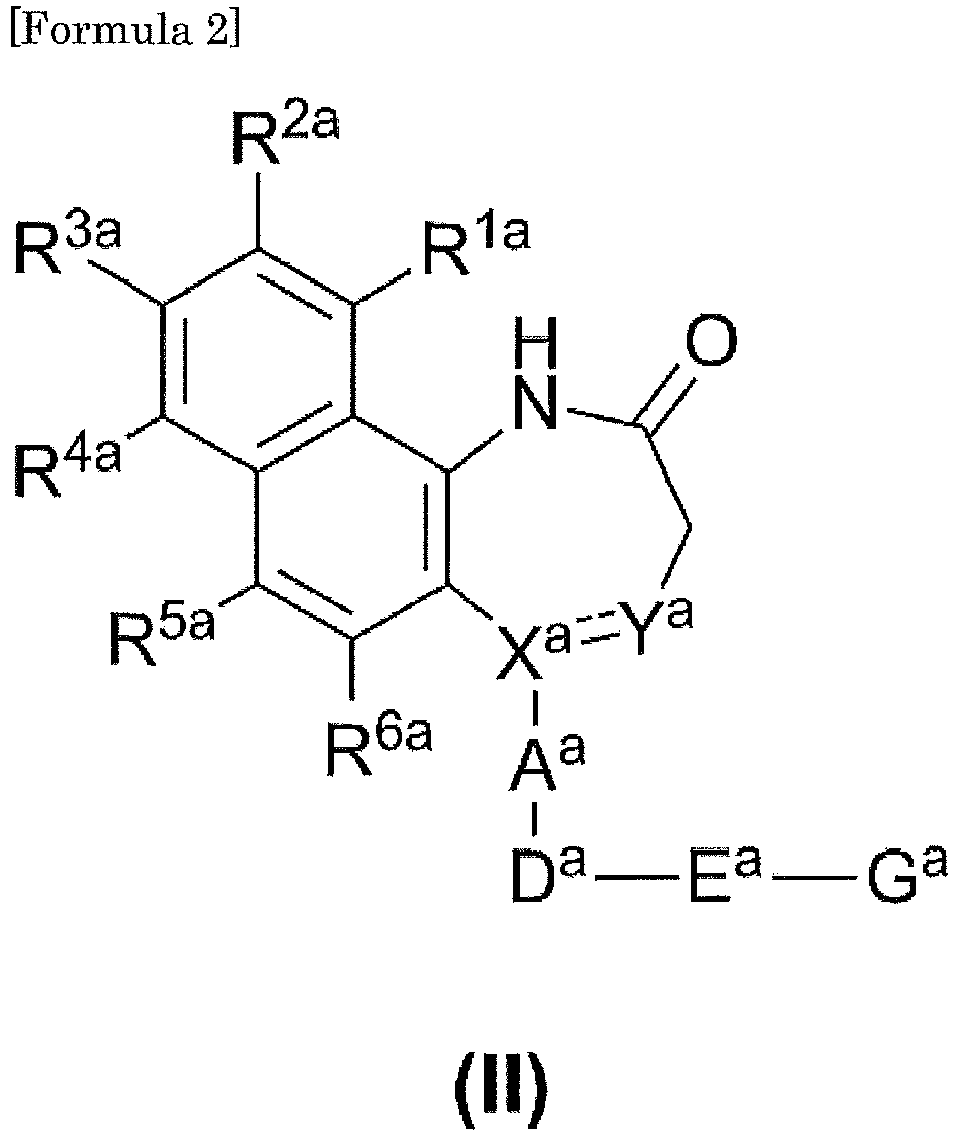 (wherein, in the formula, R1a, R2a, R3a, R4a, R5a, and R6a may be the same or different, and represent hydrogen atom, an alkyl group having 1 to 8 carbon atoms, a cycloalkyl group having 3 to 8 carbon atoms, an alkenyl group having 2 to 8 carbon atoms, an alkoxy group having 1 to 8 carbon atoms, an alkyl group having 1 to 8 carbon atoms and substituted with 1 to 3 halogen atoms, an alkoxy group having 1 to 8 carbon atoms and substituted with 1 to 3 halogen atoms, a halogen atom, hydroxyl group, nitro group, cyano group, amino group, an alkylamino group having 1 to 8 carbon atoms, a dialkylamino group having 2 to 8 carbon atoms, an acylamino group having 2 to 8 carbon atoms, carboxyl group, an acyl group having 2 to 8 carbon atoms, an alkoxycarbonyl group (the alkoxy moiety has 1 to 8 carbon atoms), a phenyl group which may be substituted, a pyridyl group which may be substituted, or an aralkyl group (the aryl moiety has 6 to 10 carbon atoms, and the alkylene moiety has 1 to 8 carbon atoms),Xa represents C or N,Ya represents N or C(=O),provided that when Xa is C, Ya represents N, andwhen Xa is N, Ya represents C(=O),the double line consisting of the solid line and the broken line represents a single bond or double bond,Aa represents benzene ring, pyridine ring, pyrimidine ring, pyridazine ring, thiophene ring, furan ring, pyrazole ring, imidazole ring, quinoline ring, benzimidazole ring, or indane ring, which may have the same or different 1 to 4 substituents selected from an alkyl group having 1 to 8 carbon atoms, an alkenyl group having 2 to 8 carbon atoms, an alkoxy group having 1 to 8 carbon atoms, an alkyl group having 1 to 8 carbon atoms and substituted with 1 to 3 halogen atoms, an alkoxy group having 1 to 8 carbon atoms and substituted with 1 to 3 halogen atoms, a halogen atom, hydroxyl group, nitro group, cyano group, amino group, an alkylamino group having 1 to 8 carbon atoms, and a dialkylamino group having 2 to 8 carbon atoms, as a substituent,Da represents benzene ring, pyridine ring, pyrimidine ring, pyridazine ring, thiophene ring, furan ring, tetrazole ring, imidazole ring, imidazoline ring, triazole ring, thiazole ring, oxazole ring, isoxazole ring, pyrazole ring, pyrrole ring, pyrrolidine ring, piperazine ring, piperidine ring, or a 5- to 8-membered cycloalkyl ring, which may have the same or different 1 to 4 substituents selected from an alkyl group having 1 to 8 carbon atoms, an alkenyl group having 2 to 8 carbon atoms, an alkoxy group having 1 to 8 carbon atoms, an alkyl group having 1 to 8 carbon atoms and substituted with 1 to 3 halogen atoms, an alkoxy group having 1 to 8 carbon atoms and substituted with 1 to 3 halogen atoms, a halogen atom, hydroxyl group, nitro group, cyano group, amino group, an alkylamino group having 1 to 8 carbon atoms, and a dialkylamino group having 2 to 8 carbon atoms, as a substituent,Ea represents -(CR9aR10a)p -Ta -,wherein R9a and R10a are the same or different, and represent hydrogen atom, hydroxyl group, or an alkyl group having 1 to 8 carbon atoms, or R9a and R10a may bind together to form an ethylene chain,p represents an integer of 0 to 8, andTa represents O, S, NR11a, or an atomic bond,wherein R11a represents hydrogen atom, or an alkyl group having 1 to 8 carbon atoms, andGa represents benzene ring, pyridine ring, imidazole ring, pyrrole ring, pyrazole ring, thiophene ring, furan ring, thiazole ring, oxazole ring, pyrimidine ring, pyridazine ring, pyrazine ring, naphthalene ring, quinoline ring, quinazoline ring, indole ring, indoline ring, piperazine ring, piperidine ring, morpholine ring, or a 5- to 8-membered cycloalkyl ring, which may have the same or different 1 to 5 substituents selected from an alkyl group having 1 to 8 carbon atoms, an alkenyl group having 2 to 8 carbon atoms, an alkoxy group having 1 to 8 carbon atoms, an alkyl group having 1 to 8 carbon atoms and substituted with 1 to 3 halogen atoms, an alkoxy group having 1 to 8 carbon atoms and substituted with 1 to 3 halogen atoms, a halogen atom, hydroxyl group, nitro group, cyano group, amino group, an alkylamino group having 1 to 8 carbon atoms, a dialkylamino group having 2 to 8 carbon atoms, carbamoyl group, and methanesulfonyl group, as a substituent).
 - The compound according to claim 18, a tautomer or a stereoisomer of the compound, or a pharmacologically acceptable salt thereof, or a solvate of any of the foregoing, wherein R1a, R2a, R3a, R4a, R5a, and R6a may be the same or different, and represent hydrogen atom, an alkyl group having 1 to 8 carbon atoms, an alkoxy group having 1 to 8 carbon atoms, an alkyl group having 1 to 8 carbon atoms and substituted with 1 to 3 halogen atoms, an alkoxy group having 1 to 8 carbon atoms and substituted with 1 to 3 halogen atoms, a halogen atom, or hydroxyl group.
- The compound according to claim 18 or 19, a tautomer or a stereoisomer of the compound, or a pharmacologically acceptable salt thereof, or a solvate of any of the foregoing, wherein Xa is N, and Ya is C(=O).
- The compound according to any one of claims 18 to 20, a tautomer or a stereoisomer of the compound, or a pharmacologically acceptable salt thereof, or a solvate of any of the foregoing, wherein Aa is benzene ring, or pyridine ring, which may have the same or different 1 to 4 substituents selected from an alkyl group having 1 to 8 carbon atoms, an alkenyl group having 2 to 8 carbon atoms, an alkoxy group having 1 to 8 carbon atoms, an alkyl group having 1 to 8 carbon atoms and substituted with 1 to 3 halogen atoms, an alkoxy group having 1 to 8 carbon atoms and substituted with 1 to 3 halogen atoms, a halogen atom, hydroxyl group, nitro group, cyano group, amino group, an alkylamino group having 1 to 8 carbon atoms, and a dialkylamino group having 2 to 8 carbon atoms, as a substituent.
- The compound according to any one of claims 18 to 20, a tautomer or a stereoisomer of the compound, or a pharmacologically acceptable salt thereof, or a solvate of any of the foregoing, wherein Aa is benzene ring, which may have the same or different 1 to 4 substituents selected from an alkyl group having 1 to 8 carbon atoms, an alkoxy group having 1 to 8 carbon atoms, an alkyl group having 1 to 8 carbon atoms and substituted with 1 to 3 halogen atoms, an alkoxy group having 1 to 8 carbon atoms and substituted with 1 to 3 halogen atoms, a halogen atom, hydroxyl group, nitro group, cyano group, and amino group, as a substituent.
- The compound according to any one of claims 18 to 22, a tautomer or a stereoisomer of the compound, or a pharmacologically acceptable salt thereof, or a solvate of any of the foregoing, wherein Da is tetrazole ring, imidazole ring, imidazoline ring, triazole ring, pyrrole ring, pyrrolidine ring, piperazine ring, or piperidine ring, which may have the same or different 1 to 4 substituents selected from an alkyl group having 1 to 8 carbon atoms, an alkenyl group having 2 to 8 carbon atoms, an alkoxy group having 1 to 8 carbon atoms, an alkyl group having 1 to 8 carbon atoms and substituted with 1 to 3 halogen atoms, an alkoxy group having 1 to 8 carbon atoms and substituted with 1 to 3 halogen atoms, a halogen atom, hydroxyl group, nitro group, cyano group, amino group, an alkylamino group having 1 to 8 carbon atoms, and a dialkylamino group having 2 to 8 carbon atoms, as a substituent.
- The compound according to any one of claims 18 to 22, a tautomer or a stereoisomer of the compound, or a pharmacologically acceptable salt thereof, or a solvate of any of the foregoing, wherein Da is tetrazole ring.
- The compound according to claim 23 or 24, a tautomer or a stereoisomer of the compound, or a pharmacologically acceptable salt thereof, or a solvate of any of the foregoing, wherein Da binds to Aa via nitrogen atom.
- The compound according to any one of claims 18 to 25, a tautomer or a stereoisomer of the compound, or a pharmacologically acceptable salt thereof, or a solvate of any of the foregoing, wherein Ea is an alkylene chain having 1 to 5 carbon atoms.
- The compound according to any one of claims 18 to 26, a tautomer or a stereoisomer of the compound, or a pharmacologically acceptable salt thereof, or a solvate of any of the foregoing, wherein Ga is benzene ring, pyridine ring, imidazole ring, pyrrole ring, pyrazole ring, pyrimidine ring, pyridazine ring, pyrazine ring, or a 5-to 7-membered cycloalkyl ring, which may have the same or different 1 to 5 substituents selected from an alkyl group having 1 to 8 carbon atoms, an alkenyl group having 2 to 8 carbon atoms, an alkoxy group having 1 to 8 carbon atoms, an alkyl group having 1 to 8 carbon atoms and substituted with 1 to 3 halogen atoms, an alkoxy group having 1 to 8 carbon atoms and substituted with 1 to 3 halogen atoms, a halogen atom, hydroxyl group, nitro group, cyano group, amino group, an alkylamino group having 1 to 8 carbon atoms, a dialkylamino group having 2 to 8 carbon atoms, carbamoyl group, and methanesulfonyl group, as a substituent.
- A P2X4 receptor antagonist containing the compound according to any one of claims 1 to 27, a tautomer or a stereoisomer of the compound, or a pharmacologically acceptable salt thereof, or a solvate of any of the foregoing as an active ingredient.
- A prophylactic or therapeutic agent for nociceptive pain, inflammatory pain, or neuropathic pain containing the compound according to any one of claims 1 to 27, a tautomer or a stereoisomer of the compound, or a pharmacologically acceptable salt thereof, or a solvate of any of the foregoing as an active ingredient.
Applications Claiming Priority (2)
| Application Number | Priority Date | Filing Date | Title |
|---|---|---|---|
| JP2013146213 | 2013-07-12 | ||
| PCT/JP2014/068541 WO2015005468A1 (en) | 2013-07-12 | 2014-07-11 | P2x4 receptor antagonist |
Publications (3)
| Publication Number | Publication Date |
|---|---|
| EP3020717A1 true EP3020717A1 (en) | 2016-05-18 |
| EP3020717A4 EP3020717A4 (en) | 2017-01-25 |
| EP3020717B1 EP3020717B1 (en) | 2021-12-15 |
Family
ID=52280145
Family Applications (1)
| Application Number | Title | Priority Date | Filing Date |
|---|---|---|---|
| EP14822292.0A Not-in-force EP3020717B1 (en) | 2013-07-12 | 2014-07-11 | P2x4 receptor antagonist |
Country Status (6)
| Country | Link |
|---|---|
| US (1) | US9873683B2 (en) |
| EP (1) | EP3020717B1 (en) |
| JP (1) | JP6357475B2 (en) |
| AU (1) | AU2014288116B2 (en) |
| CA (1) | CA2921203C (en) |
| WO (1) | WO2015005468A1 (en) |
Cited By (4)
| Publication number | Priority date | Publication date | Assignee | Title |
|---|---|---|---|---|
| EP3020707A4 (en) * | 2013-07-12 | 2016-12-07 | Nippon Chemiphar Co | ANTAGONIST OF P2X4 RECEPTORS |
| EP3848051A4 (en) * | 2018-09-03 | 2022-06-08 | Nippon Chemiphar Co., Ltd. | Medicine for diabetic peripheral neuropathy |
| EP4190356A4 (en) * | 2020-08-03 | 2024-11-06 | Nippon Chemiphar Co., Ltd. | Pharmaceutical composition for preventing, suppressing, or treating symptoms associated with allergic reaction |
| US12629379B2 (en) | 2020-08-03 | 2026-05-19 | Nippon Chemiphar Co., Ltd. | Pharmaceutical composition for preventing, suppressing, or treating symptom associated with allergic reaction |
Families Citing this family (14)
| Publication number | Priority date | Publication date | Assignee | Title |
|---|---|---|---|---|
| PL2559690T3 (en) | 2005-05-10 | 2016-09-30 | Modulators of indoleamine 2,3-dioxygenase and methods of using the same | |
| US20180338980A1 (en) | 2015-06-10 | 2018-11-29 | Bayer Pharma Aktiengesellschaft | Aromatic sulfonamide derivatives |
| JP7116679B2 (en) * | 2016-04-28 | 2022-08-10 | 日本ケミファ株式会社 | Medicine for the treatment of multiple sclerosis |
| US10844016B2 (en) | 2016-05-03 | 2020-11-24 | Bayer Pharma Aktiengesellschaft | Aromatic sulfonamide derivatives |
| WO2018104307A1 (en) | 2016-12-09 | 2018-06-14 | Bayer Pharma Aktiengesellschaft | Aromatic sulfonamide derivatives and their use as anatagon i sts or negative allosteric modulators of p2x4 |
| WO2018104305A1 (en) | 2016-12-09 | 2018-06-14 | Bayer Pharma Aktiengesellschaft | Field of application of the invention |
| WO2018210729A1 (en) | 2017-05-18 | 2018-11-22 | Bayer Pharma Aktiengesellschaft | Aromatic sulfonamide derivatives as antagonists or negative allosteric modulators of p2x4 receptor |
| CN111902146B (en) | 2018-03-14 | 2024-04-12 | 日本化学药品株式会社 | Medicinal products for treating cough |
| WO2022002860A1 (en) | 2020-06-30 | 2022-01-06 | Bayer Aktiengesellschaft | Use of n-phenylacetamides having p2x4 receptor antagonistic activity for treating certain ocular disorders |
| AU2021302525A1 (en) | 2020-06-30 | 2022-11-17 | Bayer Aktiengesellschaft | Substituted N-phenylacetamides having P2X4 receptor antagonistic activity |
| WO2022049253A1 (en) | 2020-09-07 | 2022-03-10 | Bayer Aktiengesellschaft | Substituted n-heteroaryl-n-pyridinylacetamides as p2x4 modulators |
| WO2022072783A1 (en) | 2020-10-02 | 2022-04-07 | Incyte Corporation | Bicyclic dione compounds as inhibitors of kras |
| JPWO2023054578A1 (en) | 2021-09-30 | 2023-04-06 | ||
| IT202100025124A1 (en) | 2021-09-30 | 2023-03-30 | Univ Degli Studi Di Firenze | MEDICINAL PRODUCT FOR USE IN THE PREVENTION OR TREATMENT OF NOCICEPTIVE AND/OR VISCERAL PAIN |
Family Cites Families (14)
| Publication number | Priority date | Publication date | Assignee | Title |
|---|---|---|---|---|
| WO2004041258A2 (en) * | 2002-10-30 | 2004-05-21 | Neuro3D | Cyclic nucleotide phosphodiesterase inhibitors, preparation and uses |
| DE10312969A1 (en) | 2003-03-24 | 2004-10-07 | Bayer Healthcare Ag | Benzofuro-1,4-diazepin-2-one derivatives |
| JP2005074819A (en) | 2003-09-01 | 2005-03-24 | Mitsubishi Gas Chem Co Inc | Copper-clad laminate and multilayer board using the same. |
| CA2444161A1 (en) | 2003-10-01 | 2005-04-01 | Japan Health Sciences Foundation | A screening method of drug for treatment of neuropathic pain |
| KR20090055001A (en) | 2006-08-25 | 2009-06-01 | 닛뽕 케미파 가부시키가이샤 | P2X4 receptor antagonist |
| JP2012087053A (en) | 2009-02-03 | 2012-05-10 | Nippon Chemiphar Co Ltd | Diazepinedione derivative |
| PL2397480T3 (en) * | 2009-02-16 | 2014-01-31 | Nippon Chemiphar Co | Diazepinedione derivative |
| CA2807354C (en) * | 2010-07-13 | 2018-06-05 | Nippon Chemiphar Co., Ltd. | P2x4 receptor antagonist |
| JP2013209292A (en) | 2010-07-23 | 2013-10-10 | Nippon Chemiphar Co Ltd | P2x4 receptor antagonist |
| US8673915B2 (en) * | 2010-07-29 | 2014-03-18 | Nippon Chemiphar Co., Ltd. | P 2×4 receptor antagonist |
| US8680110B2 (en) | 2010-08-03 | 2014-03-25 | Nippon Chemiphar Co., Ltd. | P2X4 receptor antagonist |
| JP6247004B2 (en) * | 2010-11-05 | 2017-12-13 | 国立大学法人九州大学 | Preventive or therapeutic agent for acute pain associated with herpes zoster |
| ES2653244T3 (en) * | 2011-05-25 | 2018-02-06 | Nippon Chemiphar Co., Ltd. | Prophylactic or therapeutic agent for neuropathic pain associated with Guillain-Barré Syndrome |
| EP2803662B1 (en) | 2012-01-13 | 2017-03-01 | Nippon Chemiphar Co., Ltd. | P2x4 receptor antagonist |
-
2014
- 2014-07-11 US US14/903,382 patent/US9873683B2/en not_active Expired - Fee Related
- 2014-07-11 WO PCT/JP2014/068541 patent/WO2015005468A1/en not_active Ceased
- 2014-07-11 AU AU2014288116A patent/AU2014288116B2/en not_active Ceased
- 2014-07-11 EP EP14822292.0A patent/EP3020717B1/en not_active Not-in-force
- 2014-07-11 CA CA2921203A patent/CA2921203C/en active Active
- 2014-07-11 JP JP2015526442A patent/JP6357475B2/en active Active
Cited By (7)
| Publication number | Priority date | Publication date | Assignee | Title |
|---|---|---|---|---|
| EP3020707A4 (en) * | 2013-07-12 | 2016-12-07 | Nippon Chemiphar Co | ANTAGONIST OF P2X4 RECEPTORS |
| US10150744B2 (en) | 2013-07-12 | 2018-12-11 | Nippon Chemiphar Co., Ltd | P2X4 receptor antagonist |
| US10472333B2 (en) | 2013-07-12 | 2019-11-12 | Nippon Chemiphar Co., Ltd. | P2X4 receptor antagonist |
| EP3848051A4 (en) * | 2018-09-03 | 2022-06-08 | Nippon Chemiphar Co., Ltd. | Medicine for diabetic peripheral neuropathy |
| US12090158B2 (en) | 2018-09-03 | 2024-09-17 | Nippon Chemiphar Co., Ltd. | Medicine for diabetic peripheral neuropathy |
| EP4190356A4 (en) * | 2020-08-03 | 2024-11-06 | Nippon Chemiphar Co., Ltd. | Pharmaceutical composition for preventing, suppressing, or treating symptoms associated with allergic reaction |
| US12629379B2 (en) | 2020-08-03 | 2026-05-19 | Nippon Chemiphar Co., Ltd. | Pharmaceutical composition for preventing, suppressing, or treating symptom associated with allergic reaction |
Also Published As
| Publication number | Publication date |
|---|---|
| JP6357475B2 (en) | 2018-07-11 |
| CA2921203A1 (en) | 2015-01-15 |
| AU2014288116A1 (en) | 2016-03-03 |
| CA2921203C (en) | 2021-07-27 |
| US20160244434A1 (en) | 2016-08-25 |
| JPWO2015005468A1 (en) | 2017-03-02 |
| WO2015005468A1 (en) | 2015-01-15 |
| EP3020717A4 (en) | 2017-01-25 |
| AU2014288116B2 (en) | 2018-05-17 |
| EP3020717B1 (en) | 2021-12-15 |
| US9873683B2 (en) | 2018-01-23 |
Similar Documents
| Publication | Publication Date | Title |
|---|---|---|
| EP3020717B1 (en) | P2x4 receptor antagonist | |
| EP3020707B1 (en) | P2x4 receptor antagonist | |
| EP2803662B1 (en) | P2x4 receptor antagonist | |
| FI111460B (en) | Process for Preparation of 5-HT1A and 5-HT2 Antagonistic Benzimidazolone Derivatives | |
| KR20140015267A (en) | Alpha-7 nicotinic receptor modulators for the treatment of pain, a psychotic disorder, cognitive impairment or alzheimer's disease | |
| US20050176699A1 (en) | Benzodiazepine derivatives, preparation thereof and use thereof | |
| CA2213197C (en) | Certain bridged 4-phenyl-2-aminomethylimidazoles; new dopamine receptor subtype specific ligands | |
| US5773616A (en) | Certain bridged 4-phenyl-2-aminomethylimidazoles; new dopamine receptor subtype specific ligands | |
| US5948912A (en) | Certain bridged 4-phenyl-2-aminomethylimidazoles; new dopamine receptor subtype specific ligands | |
| HK1203191B (en) | P2x4 receptor antagonist |
Legal Events
| Date | Code | Title | Description |
|---|---|---|---|
| PUAI | Public reference made under article 153(3) epc to a published international application that has entered the european phase |
Free format text: ORIGINAL CODE: 0009012 |
|
| 17P | Request for examination filed |
Effective date: 20160211 |
|
| AK | Designated contracting states |
Kind code of ref document: A1 Designated state(s): AL AT BE BG CH CY CZ DE DK EE ES FI FR GB GR HR HU IE IS IT LI LT LU LV MC MK MT NL NO PL PT RO RS SE SI SK SM TR |
|
| AX | Request for extension of the european patent |
Extension state: BA ME |
|
| DAX | Request for extension of the european patent (deleted) | ||
| A4 | Supplementary search report drawn up and despatched |
Effective date: 20170103 |
|
| RIC1 | Information provided on ipc code assigned before grant |
Ipc: A61K 31/551 20060101ALI20161221BHEP Ipc: A61P 25/04 20060101ALI20161221BHEP Ipc: C07D 403/08 20060101ALI20161221BHEP Ipc: A61P 43/00 20060101ALI20161221BHEP Ipc: C07D 401/04 20060101ALI20161221BHEP Ipc: C07D 403/10 20060101AFI20161221BHEP |
|
| STAA | Information on the status of an ep patent application or granted ep patent |
Free format text: STATUS: EXAMINATION IS IN PROGRESS |
|
| 17Q | First examination report despatched |
Effective date: 20200121 |
|
| GRAP | Despatch of communication of intention to grant a patent |
Free format text: ORIGINAL CODE: EPIDOSNIGR1 |
|
| STAA | Information on the status of an ep patent application or granted ep patent |
Free format text: STATUS: GRANT OF PATENT IS INTENDED |
|
| INTG | Intention to grant announced |
Effective date: 20200722 |
|
| GRAJ | Information related to disapproval of communication of intention to grant by the applicant or resumption of examination proceedings by the epo deleted |
Free format text: ORIGINAL CODE: EPIDOSDIGR1 |
|
| STAA | Information on the status of an ep patent application or granted ep patent |
Free format text: STATUS: EXAMINATION IS IN PROGRESS |
|
| GRAP | Despatch of communication of intention to grant a patent |
Free format text: ORIGINAL CODE: EPIDOSNIGR1 |
|
| STAA | Information on the status of an ep patent application or granted ep patent |
Free format text: STATUS: GRANT OF PATENT IS INTENDED |
|
| INTC | Intention to grant announced (deleted) | ||
| INTG | Intention to grant announced |
Effective date: 20201217 |
|
| GRAJ | Information related to disapproval of communication of intention to grant by the applicant or resumption of examination proceedings by the epo deleted |
Free format text: ORIGINAL CODE: EPIDOSDIGR1 |
|
| STAA | Information on the status of an ep patent application or granted ep patent |
Free format text: STATUS: EXAMINATION IS IN PROGRESS |
|
| INTC | Intention to grant announced (deleted) | ||
| GRAP | Despatch of communication of intention to grant a patent |
Free format text: ORIGINAL CODE: EPIDOSNIGR1 |
|
| STAA | Information on the status of an ep patent application or granted ep patent |
Free format text: STATUS: GRANT OF PATENT IS INTENDED |
|
| GRAJ | Information related to disapproval of communication of intention to grant by the applicant or resumption of examination proceedings by the epo deleted |
Free format text: ORIGINAL CODE: EPIDOSDIGR1 |
|
| GRAP | Despatch of communication of intention to grant a patent |
Free format text: ORIGINAL CODE: EPIDOSNIGR1 |
|
| INTG | Intention to grant announced |
Effective date: 20210610 |
|
| INTG | Intention to grant announced |
Effective date: 20210616 |
|
| INTG | Intention to grant announced |
Effective date: 20210706 |
|
| GRAS | Grant fee paid |
Free format text: ORIGINAL CODE: EPIDOSNIGR3 |
|
| GRAA | (expected) grant |
Free format text: ORIGINAL CODE: 0009210 |
|
| STAA | Information on the status of an ep patent application or granted ep patent |
Free format text: STATUS: THE PATENT HAS BEEN GRANTED |
|
| AK | Designated contracting states |
Kind code of ref document: B1 Designated state(s): AL AT BE BG CH CY CZ DE DK EE ES FI FR GB GR HR HU IE IS IT LI LT LU LV MC MK MT NL NO PL PT RO RS SE SI SK SM TR |
|
| REG | Reference to a national code |
Ref country code: GB Ref legal event code: FG4D Ref country code: CH Ref legal event code: EP |
|
| REG | Reference to a national code |
Ref country code: IE Ref legal event code: FG4D Ref country code: DE Ref legal event code: R096 Ref document number: 602014081760 Country of ref document: DE |
|
| REG | Reference to a national code |
Ref country code: AT Ref legal event code: REF Ref document number: 1455426 Country of ref document: AT Kind code of ref document: T Effective date: 20220115 |
|
| REG | Reference to a national code |
Ref country code: LT Ref legal event code: MG9D |
|
| REG | Reference to a national code |
Ref country code: NL Ref legal event code: MP Effective date: 20211215 |
|
| PG25 | Lapsed in a contracting state [announced via postgrant information from national office to epo] |
Ref country code: RS Free format text: LAPSE BECAUSE OF FAILURE TO SUBMIT A TRANSLATION OF THE DESCRIPTION OR TO PAY THE FEE WITHIN THE PRESCRIBED TIME-LIMIT Effective date: 20211215 Ref country code: LT Free format text: LAPSE BECAUSE OF FAILURE TO SUBMIT A TRANSLATION OF THE DESCRIPTION OR TO PAY THE FEE WITHIN THE PRESCRIBED TIME-LIMIT Effective date: 20211215 Ref country code: FI Free format text: LAPSE BECAUSE OF FAILURE TO SUBMIT A TRANSLATION OF THE DESCRIPTION OR TO PAY THE FEE WITHIN THE PRESCRIBED TIME-LIMIT Effective date: 20211215 Ref country code: BG Free format text: LAPSE BECAUSE OF FAILURE TO SUBMIT A TRANSLATION OF THE DESCRIPTION OR TO PAY THE FEE WITHIN THE PRESCRIBED TIME-LIMIT Effective date: 20220315 |
|
| REG | Reference to a national code |
Ref country code: AT Ref legal event code: MK05 Ref document number: 1455426 Country of ref document: AT Kind code of ref document: T Effective date: 20211215 |
|
| PG25 | Lapsed in a contracting state [announced via postgrant information from national office to epo] |
Ref country code: SE Free format text: LAPSE BECAUSE OF FAILURE TO SUBMIT A TRANSLATION OF THE DESCRIPTION OR TO PAY THE FEE WITHIN THE PRESCRIBED TIME-LIMIT Effective date: 20211215 Ref country code: NO Free format text: LAPSE BECAUSE OF FAILURE TO SUBMIT A TRANSLATION OF THE DESCRIPTION OR TO PAY THE FEE WITHIN THE PRESCRIBED TIME-LIMIT Effective date: 20220315 Ref country code: LV Free format text: LAPSE BECAUSE OF FAILURE TO SUBMIT A TRANSLATION OF THE DESCRIPTION OR TO PAY THE FEE WITHIN THE PRESCRIBED TIME-LIMIT Effective date: 20211215 Ref country code: HR Free format text: LAPSE BECAUSE OF FAILURE TO SUBMIT A TRANSLATION OF THE DESCRIPTION OR TO PAY THE FEE WITHIN THE PRESCRIBED TIME-LIMIT Effective date: 20211215 Ref country code: GR Free format text: LAPSE BECAUSE OF FAILURE TO SUBMIT A TRANSLATION OF THE DESCRIPTION OR TO PAY THE FEE WITHIN THE PRESCRIBED TIME-LIMIT Effective date: 20220316 |
|
| PG25 | Lapsed in a contracting state [announced via postgrant information from national office to epo] |
Ref country code: NL Free format text: LAPSE BECAUSE OF FAILURE TO SUBMIT A TRANSLATION OF THE DESCRIPTION OR TO PAY THE FEE WITHIN THE PRESCRIBED TIME-LIMIT Effective date: 20211215 |
|
| PG25 | Lapsed in a contracting state [announced via postgrant information from national office to epo] |
Ref country code: SM Free format text: LAPSE BECAUSE OF FAILURE TO SUBMIT A TRANSLATION OF THE DESCRIPTION OR TO PAY THE FEE WITHIN THE PRESCRIBED TIME-LIMIT Effective date: 20211215 Ref country code: SK Free format text: LAPSE BECAUSE OF FAILURE TO SUBMIT A TRANSLATION OF THE DESCRIPTION OR TO PAY THE FEE WITHIN THE PRESCRIBED TIME-LIMIT Effective date: 20211215 Ref country code: RO Free format text: LAPSE BECAUSE OF FAILURE TO SUBMIT A TRANSLATION OF THE DESCRIPTION OR TO PAY THE FEE WITHIN THE PRESCRIBED TIME-LIMIT Effective date: 20211215 Ref country code: PT Free format text: LAPSE BECAUSE OF FAILURE TO SUBMIT A TRANSLATION OF THE DESCRIPTION OR TO PAY THE FEE WITHIN THE PRESCRIBED TIME-LIMIT Effective date: 20220418 Ref country code: ES Free format text: LAPSE BECAUSE OF FAILURE TO SUBMIT A TRANSLATION OF THE DESCRIPTION OR TO PAY THE FEE WITHIN THE PRESCRIBED TIME-LIMIT Effective date: 20211215 Ref country code: EE Free format text: LAPSE BECAUSE OF FAILURE TO SUBMIT A TRANSLATION OF THE DESCRIPTION OR TO PAY THE FEE WITHIN THE PRESCRIBED TIME-LIMIT Effective date: 20211215 Ref country code: CZ Free format text: LAPSE BECAUSE OF FAILURE TO SUBMIT A TRANSLATION OF THE DESCRIPTION OR TO PAY THE FEE WITHIN THE PRESCRIBED TIME-LIMIT Effective date: 20211215 |
|
| PG25 | Lapsed in a contracting state [announced via postgrant information from national office to epo] |
Ref country code: PL Free format text: LAPSE BECAUSE OF FAILURE TO SUBMIT A TRANSLATION OF THE DESCRIPTION OR TO PAY THE FEE WITHIN THE PRESCRIBED TIME-LIMIT Effective date: 20211215 Ref country code: AT Free format text: LAPSE BECAUSE OF FAILURE TO SUBMIT A TRANSLATION OF THE DESCRIPTION OR TO PAY THE FEE WITHIN THE PRESCRIBED TIME-LIMIT Effective date: 20211215 |
|
| REG | Reference to a national code |
Ref country code: DE Ref legal event code: R097 Ref document number: 602014081760 Country of ref document: DE |
|
| PG25 | Lapsed in a contracting state [announced via postgrant information from national office to epo] |
Ref country code: IS Free format text: LAPSE BECAUSE OF FAILURE TO SUBMIT A TRANSLATION OF THE DESCRIPTION OR TO PAY THE FEE WITHIN THE PRESCRIBED TIME-LIMIT Effective date: 20220415 |
|
| PLBE | No opposition filed within time limit |
Free format text: ORIGINAL CODE: 0009261 |
|
| STAA | Information on the status of an ep patent application or granted ep patent |
Free format text: STATUS: NO OPPOSITION FILED WITHIN TIME LIMIT |
|
| PG25 | Lapsed in a contracting state [announced via postgrant information from national office to epo] |
Ref country code: DK Free format text: LAPSE BECAUSE OF FAILURE TO SUBMIT A TRANSLATION OF THE DESCRIPTION OR TO PAY THE FEE WITHIN THE PRESCRIBED TIME-LIMIT Effective date: 20211215 Ref country code: AL Free format text: LAPSE BECAUSE OF FAILURE TO SUBMIT A TRANSLATION OF THE DESCRIPTION OR TO PAY THE FEE WITHIN THE PRESCRIBED TIME-LIMIT Effective date: 20211215 |
|
| 26N | No opposition filed |
Effective date: 20220916 |
|
| PG25 | Lapsed in a contracting state [announced via postgrant information from national office to epo] |
Ref country code: SI Free format text: LAPSE BECAUSE OF FAILURE TO SUBMIT A TRANSLATION OF THE DESCRIPTION OR TO PAY THE FEE WITHIN THE PRESCRIBED TIME-LIMIT Effective date: 20211215 |
|
| PG25 | Lapsed in a contracting state [announced via postgrant information from national office to epo] |
Ref country code: MC Free format text: LAPSE BECAUSE OF FAILURE TO SUBMIT A TRANSLATION OF THE DESCRIPTION OR TO PAY THE FEE WITHIN THE PRESCRIBED TIME-LIMIT Effective date: 20211215 |
|
| REG | Reference to a national code |
Ref country code: CH Ref legal event code: PL |
|
| REG | Reference to a national code |
Ref country code: BE Ref legal event code: MM Effective date: 20220731 |
|
| PG25 | Lapsed in a contracting state [announced via postgrant information from national office to epo] |
Ref country code: LU Free format text: LAPSE BECAUSE OF NON-PAYMENT OF DUE FEES Effective date: 20220711 Ref country code: LI Free format text: LAPSE BECAUSE OF NON-PAYMENT OF DUE FEES Effective date: 20220731 Ref country code: CH Free format text: LAPSE BECAUSE OF NON-PAYMENT OF DUE FEES Effective date: 20220731 |
|
| PG25 | Lapsed in a contracting state [announced via postgrant information from national office to epo] |
Ref country code: IT Free format text: LAPSE BECAUSE OF FAILURE TO SUBMIT A TRANSLATION OF THE DESCRIPTION OR TO PAY THE FEE WITHIN THE PRESCRIBED TIME-LIMIT Effective date: 20211215 Ref country code: BE Free format text: LAPSE BECAUSE OF NON-PAYMENT OF DUE FEES Effective date: 20220731 |
|
| PG25 | Lapsed in a contracting state [announced via postgrant information from national office to epo] |
Ref country code: IE Free format text: LAPSE BECAUSE OF NON-PAYMENT OF DUE FEES Effective date: 20220711 |
|
| PG25 | Lapsed in a contracting state [announced via postgrant information from national office to epo] |
Ref country code: HU Free format text: LAPSE BECAUSE OF FAILURE TO SUBMIT A TRANSLATION OF THE DESCRIPTION OR TO PAY THE FEE WITHIN THE PRESCRIBED TIME-LIMIT; INVALID AB INITIO Effective date: 20140711 |
|
| PG25 | Lapsed in a contracting state [announced via postgrant information from national office to epo] |
Ref country code: MK Free format text: LAPSE BECAUSE OF FAILURE TO SUBMIT A TRANSLATION OF THE DESCRIPTION OR TO PAY THE FEE WITHIN THE PRESCRIBED TIME-LIMIT Effective date: 20211215 Ref country code: CY Free format text: LAPSE BECAUSE OF FAILURE TO SUBMIT A TRANSLATION OF THE DESCRIPTION OR TO PAY THE FEE WITHIN THE PRESCRIBED TIME-LIMIT Effective date: 20211215 |
|
| PGFP | Annual fee paid to national office [announced via postgrant information from national office to epo] |
Ref country code: GB Payment date: 20240530 Year of fee payment: 11 |
|
| PGFP | Annual fee paid to national office [announced via postgrant information from national office to epo] |
Ref country code: FR Payment date: 20240611 Year of fee payment: 11 |
|
| PG25 | Lapsed in a contracting state [announced via postgrant information from national office to epo] |
Ref country code: MT Free format text: LAPSE BECAUSE OF FAILURE TO SUBMIT A TRANSLATION OF THE DESCRIPTION OR TO PAY THE FEE WITHIN THE PRESCRIBED TIME-LIMIT Effective date: 20211215 |
|
| PGFP | Annual fee paid to national office [announced via postgrant information from national office to epo] |
Ref country code: DE Payment date: 20240529 Year of fee payment: 11 |
|
| PG25 | Lapsed in a contracting state [announced via postgrant information from national office to epo] |
Ref country code: TR Free format text: LAPSE BECAUSE OF FAILURE TO SUBMIT A TRANSLATION OF THE DESCRIPTION OR TO PAY THE FEE WITHIN THE PRESCRIBED TIME-LIMIT Effective date: 20211215 |
|
| REG | Reference to a national code |
Ref country code: DE Ref legal event code: R119 Ref document number: 602014081760 Country of ref document: DE |
|
| GBPC | Gb: european patent ceased through non-payment of renewal fee |
Effective date: 20250711 |
|
| PG25 | Lapsed in a contracting state [announced via postgrant information from national office to epo] |
Ref country code: GB Free format text: LAPSE BECAUSE OF NON-PAYMENT OF DUE FEES Effective date: 20250711 |
|
| PG25 | Lapsed in a contracting state [announced via postgrant information from national office to epo] |
Ref country code: DE Free format text: LAPSE BECAUSE OF NON-PAYMENT OF DUE FEES Effective date: 20260203 |
|
| PG25 | Lapsed in a contracting state [announced via postgrant information from national office to epo] |
Ref country code: FR Free format text: LAPSE BECAUSE OF NON-PAYMENT OF DUE FEES Effective date: 20250731 |