EP3018116B1 - Vitamin k2 intermediates - Google Patents
Vitamin k2 intermediates Download PDFInfo
- Publication number
- EP3018116B1 EP3018116B1 EP15193746.3A EP15193746A EP3018116B1 EP 3018116 B1 EP3018116 B1 EP 3018116B1 EP 15193746 A EP15193746 A EP 15193746A EP 3018116 B1 EP3018116 B1 EP 3018116B1
- Authority
- EP
- European Patent Office
- Prior art keywords
- mmol
- compound
- reaction
- added
- mixture
- Prior art date
- Legal status (The legal status is an assumption and is not a legal conclusion. Google has not performed a legal analysis and makes no representation as to the accuracy of the status listed.)
- Revoked
Links
- DKHGMERMDICWDU-GHDNBGIDSA-N menaquinone-4 Chemical compound C1=CC=C2C(=O)C(C/C=C(C)/CC/C=C(C)/CC/C=C(C)/CCC=C(C)C)=C(C)C(=O)C2=C1 DKHGMERMDICWDU-GHDNBGIDSA-N 0.000 title description 9
- 239000000543 intermediate Substances 0.000 title 1
- 229960005481 menatetrenone Drugs 0.000 title 1
- 150000001875 compounds Chemical class 0.000 claims description 72
- 238000006243 chemical reaction Methods 0.000 claims description 50
- 238000000034 method Methods 0.000 claims description 28
- PFRQBZFETXBLTP-UHFFFAOYSA-N Vitamin K2 Natural products C1=CC=C2C(=O)C(CC=C(C)CCC=C(C)CCC=C(C)CCC=C(C)CCC=C(C)CCC=C(C)C)=C(C)C(=O)C2=C1 PFRQBZFETXBLTP-UHFFFAOYSA-N 0.000 claims description 25
- 239000011700 menaquinone-7 Substances 0.000 claims description 20
- RAKQPZMEYJZGPI-LJWNYQGCSA-N menaquinone-7 Chemical compound C1=CC=C2C(=O)C(C/C=C(C)/CC/C=C(C)/CC/C=C(C)/CC/C=C(C)/CC/C=C(C)/CC/C=C(C)/CCC=C(C)C)=C(C)C(=O)C2=C1 RAKQPZMEYJZGPI-LJWNYQGCSA-N 0.000 claims description 19
- 230000008569 process Effects 0.000 claims description 16
- XMPZTFVPEKAKFH-UHFFFAOYSA-P ceric ammonium nitrate Chemical compound [NH4+].[NH4+].[Ce+4].[O-][N+]([O-])=O.[O-][N+]([O-])=O.[O-][N+]([O-])=O.[O-][N+]([O-])=O.[O-][N+]([O-])=O.[O-][N+]([O-])=O XMPZTFVPEKAKFH-UHFFFAOYSA-P 0.000 claims description 7
- 238000002360 preparation method Methods 0.000 claims description 7
- 125000001495 ethyl group Chemical group [H]C([H])([H])C([H])([H])* 0.000 claims description 5
- RTZKZFJDLAIYFH-UHFFFAOYSA-N Diethyl ether Chemical compound CCOCC RTZKZFJDLAIYFH-UHFFFAOYSA-N 0.000 description 41
- IMNFDUFMRHMDMM-UHFFFAOYSA-N N-Heptane Chemical compound CCCCCCC IMNFDUFMRHMDMM-UHFFFAOYSA-N 0.000 description 38
- XEKOWRVHYACXOJ-UHFFFAOYSA-N Ethyl acetate Chemical compound CCOC(C)=O XEKOWRVHYACXOJ-UHFFFAOYSA-N 0.000 description 36
- HEDRZPFGACZZDS-MICDWDOJSA-N Trichloro(2H)methane Chemical compound [2H]C(Cl)(Cl)Cl HEDRZPFGACZZDS-MICDWDOJSA-N 0.000 description 34
- 239000000243 solution Substances 0.000 description 34
- OKKJLVBELUTLKV-UHFFFAOYSA-N Methanol Chemical compound OC OKKJLVBELUTLKV-UHFFFAOYSA-N 0.000 description 33
- 239000010410 layer Substances 0.000 description 30
- 239000000203 mixture Substances 0.000 description 30
- 230000015572 biosynthetic process Effects 0.000 description 29
- XLYOFNOQVPJJNP-UHFFFAOYSA-N water Substances O XLYOFNOQVPJJNP-UHFFFAOYSA-N 0.000 description 28
- YMWUJEATGCHHMB-UHFFFAOYSA-N Dichloromethane Chemical compound ClCCl YMWUJEATGCHHMB-UHFFFAOYSA-N 0.000 description 24
- 239000003921 oil Substances 0.000 description 23
- 150000003505 terpenes Chemical group 0.000 description 23
- 239000007832 Na2SO4 Substances 0.000 description 21
- PMZURENOXWZQFD-UHFFFAOYSA-L Sodium Sulfate Chemical compound [Na+].[Na+].[O-]S([O-])(=O)=O PMZURENOXWZQFD-UHFFFAOYSA-L 0.000 description 21
- 229910052938 sodium sulfate Inorganic materials 0.000 description 21
- 235000019143 vitamin K2 Nutrition 0.000 description 21
- 239000011728 vitamin K2 Substances 0.000 description 21
- 235000019439 ethyl acetate Nutrition 0.000 description 18
- 239000000284 extract Substances 0.000 description 18
- KDLHZDBZIXYQEI-UHFFFAOYSA-N Palladium Chemical compound [Pd] KDLHZDBZIXYQEI-UHFFFAOYSA-N 0.000 description 17
- 229930192627 Naphthoquinone Natural products 0.000 description 15
- 150000002791 naphthoquinones Chemical class 0.000 description 15
- UIIMBOGNXHQVGW-UHFFFAOYSA-M Sodium bicarbonate Chemical compound [Na+].OC([O-])=O UIIMBOGNXHQVGW-UHFFFAOYSA-M 0.000 description 14
- 239000012267 brine Substances 0.000 description 14
- 238000002390 rotary evaporation Methods 0.000 description 14
- HPALAKNZSZLMCH-UHFFFAOYSA-M sodium;chloride;hydrate Chemical compound O.[Na+].[Cl-] HPALAKNZSZLMCH-UHFFFAOYSA-M 0.000 description 14
- 238000003786 synthesis reaction Methods 0.000 description 14
- HYPYXGZDOYTYDR-HAJWAVTHSA-N 2-methyl-3-[(2e,6e,10e,14e)-3,7,11,15,19-pentamethylicosa-2,6,10,14,18-pentaenyl]naphthalene-1,4-dione Chemical compound C1=CC=C2C(=O)C(C/C=C(C)/CC/C=C(C)/CC/C=C(C)/CC/C=C(C)/CCC=C(C)C)=C(C)C(=O)C2=C1 HYPYXGZDOYTYDR-HAJWAVTHSA-N 0.000 description 13
- FRASJONUBLZVQX-UHFFFAOYSA-N naphthoquinone group Chemical group C1(C=CC(C2=CC=CC=C12)=O)=O FRASJONUBLZVQX-UHFFFAOYSA-N 0.000 description 13
- 125000003170 phenylsulfonyl group Chemical group C1(=CC=CC=C1)S(=O)(=O)* 0.000 description 13
- 239000000047 product Substances 0.000 description 13
- WEVYAHXRMPXWCK-UHFFFAOYSA-N Acetonitrile Chemical compound CC#N WEVYAHXRMPXWCK-UHFFFAOYSA-N 0.000 description 12
- 238000005577 Kumada cross-coupling reaction Methods 0.000 description 12
- VYPSYNLAJGMNEJ-UHFFFAOYSA-N Silicium dioxide Chemical compound O=[Si]=O VYPSYNLAJGMNEJ-UHFFFAOYSA-N 0.000 description 12
- 239000011541 reaction mixture Substances 0.000 description 12
- 239000000725 suspension Substances 0.000 description 12
- 238000005859 coupling reaction Methods 0.000 description 11
- 125000000695 menaquinone group Chemical group 0.000 description 11
- 238000005160 1H NMR spectroscopy Methods 0.000 description 10
- LFQSCWFLJHTTHZ-UHFFFAOYSA-N Ethanol Chemical compound CCO LFQSCWFLJHTTHZ-UHFFFAOYSA-N 0.000 description 10
- 239000012043 crude product Substances 0.000 description 10
- 150000004820 halides Chemical group 0.000 description 10
- 125000002887 hydroxy group Chemical group [H]O* 0.000 description 10
- SHUZOJHMOBOZST-UHFFFAOYSA-N phylloquinone Natural products CC(C)CCCCC(C)CCC(C)CCCC(=CCC1=C(C)C(=O)c2ccccc2C1=O)C SHUZOJHMOBOZST-UHFFFAOYSA-N 0.000 description 10
- MZRVEZGGRBJDDB-UHFFFAOYSA-N N-Butyllithium Chemical compound [Li]CCCC MZRVEZGGRBJDDB-UHFFFAOYSA-N 0.000 description 9
- 230000008878 coupling Effects 0.000 description 9
- 238000010168 coupling process Methods 0.000 description 9
- 238000003818 flash chromatography Methods 0.000 description 9
- VLKZOEOYAKHREP-UHFFFAOYSA-N n-Hexane Chemical compound CCCCCC VLKZOEOYAKHREP-UHFFFAOYSA-N 0.000 description 9
- JPJALAQPGMAKDF-UHFFFAOYSA-N selenium dioxide Chemical compound O=[Se]=O JPJALAQPGMAKDF-UHFFFAOYSA-N 0.000 description 9
- NLXLAEXVIDQMFP-UHFFFAOYSA-N Ammonia chloride Chemical compound [NH4+].[Cl-] NLXLAEXVIDQMFP-UHFFFAOYSA-N 0.000 description 8
- 238000006069 Suzuki reaction reaction Methods 0.000 description 8
- 229930003448 Vitamin K Natural products 0.000 description 8
- 239000003480 eluent Substances 0.000 description 8
- -1 isoprenyl Chemical group 0.000 description 8
- 235000019168 vitamin K Nutrition 0.000 description 8
- 239000011712 vitamin K Substances 0.000 description 8
- 150000003721 vitamin K derivatives Chemical class 0.000 description 8
- 229940046010 vitamin k Drugs 0.000 description 8
- CPELXLSAUQHCOX-UHFFFAOYSA-M Bromide Chemical group [Br-] CPELXLSAUQHCOX-UHFFFAOYSA-M 0.000 description 7
- PXHVJJICTQNCMI-UHFFFAOYSA-N Nickel Chemical compound [Ni] PXHVJJICTQNCMI-UHFFFAOYSA-N 0.000 description 7
- 239000003054 catalyst Substances 0.000 description 7
- 239000005457 ice water Substances 0.000 description 7
- 238000000746 purification Methods 0.000 description 7
- 229910000030 sodium bicarbonate Inorganic materials 0.000 description 7
- 229940088594 vitamin Drugs 0.000 description 7
- 239000011782 vitamin Substances 0.000 description 7
- 229940041603 vitamin k 3 Drugs 0.000 description 7
- RRHGJUQNOFWUDK-UHFFFAOYSA-N Isoprene Chemical compound CC(=C)C=C RRHGJUQNOFWUDK-UHFFFAOYSA-N 0.000 description 6
- 230000003647 oxidation Effects 0.000 description 6
- 238000007254 oxidation reaction Methods 0.000 description 6
- 229920001550 polyprenyl Polymers 0.000 description 6
- 125000001185 polyprenyl group Polymers 0.000 description 6
- WGYKZJWCGVVSQN-UHFFFAOYSA-N propylamine Chemical compound CCCN WGYKZJWCGVVSQN-UHFFFAOYSA-N 0.000 description 6
- 239000000376 reactant Substances 0.000 description 6
- 230000009467 reduction Effects 0.000 description 6
- 229930003231 vitamin Natural products 0.000 description 6
- 235000013343 vitamin Nutrition 0.000 description 6
- 238000001644 13C nuclear magnetic resonance spectroscopy Methods 0.000 description 5
- 229910052681 coesite Inorganic materials 0.000 description 5
- 239000010949 copper Substances 0.000 description 5
- 229910052906 cristobalite Inorganic materials 0.000 description 5
- 229910052744 lithium Inorganic materials 0.000 description 5
- 229910052763 palladium Inorganic materials 0.000 description 5
- 239000000377 silicon dioxide Substances 0.000 description 5
- 229910052682 stishovite Inorganic materials 0.000 description 5
- 229910052905 tridymite Inorganic materials 0.000 description 5
- CRDAMVZIKSXKFV-FBXUGWQNSA-N (2-cis,6-cis)-farnesol Chemical compound CC(C)=CCC\C(C)=C/CC\C(C)=C/CO CRDAMVZIKSXKFV-FBXUGWQNSA-N 0.000 description 4
- 239000000260 (2E,6E)-3,7,11-trimethyldodeca-2,6,10-trien-1-ol Substances 0.000 description 4
- PWXIIJPKDYZUBN-UHFFFAOYSA-N 2-bromo-1,4-dimethoxy-3-methylnaphthalene Chemical compound C1=CC=C2C(OC)=C(C)C(Br)=C(OC)C2=C1 PWXIIJPKDYZUBN-UHFFFAOYSA-N 0.000 description 4
- XKRFYHLGVUSROY-UHFFFAOYSA-N Argon Chemical compound [Ar] XKRFYHLGVUSROY-UHFFFAOYSA-N 0.000 description 4
- IJGRMHOSHXDMSA-UHFFFAOYSA-N Atomic nitrogen Chemical compound N#N IJGRMHOSHXDMSA-UHFFFAOYSA-N 0.000 description 4
- CURLTUGMZLYLDI-UHFFFAOYSA-N Carbon dioxide Chemical compound O=C=O CURLTUGMZLYLDI-UHFFFAOYSA-N 0.000 description 4
- QUSNBJAOOMFDIB-UHFFFAOYSA-N Ethylamine Chemical compound CCN QUSNBJAOOMFDIB-UHFFFAOYSA-N 0.000 description 4
- GLZPCOQZEFWAFX-UHFFFAOYSA-N Geraniol Chemical compound CC(C)=CCCC(C)=CCO GLZPCOQZEFWAFX-UHFFFAOYSA-N 0.000 description 4
- FYYHWMGAXLPEAU-UHFFFAOYSA-N Magnesium Chemical compound [Mg] FYYHWMGAXLPEAU-UHFFFAOYSA-N 0.000 description 4
- 229910020667 PBr3 Inorganic materials 0.000 description 4
- XYFCBTPGUUZFHI-UHFFFAOYSA-N Phosphine Chemical compound P XYFCBTPGUUZFHI-UHFFFAOYSA-N 0.000 description 4
- DHXVGJBLRPWPCS-UHFFFAOYSA-N Tetrahydropyran Chemical compound C1CCOCC1 DHXVGJBLRPWPCS-UHFFFAOYSA-N 0.000 description 4
- 125000000217 alkyl group Chemical group 0.000 description 4
- 125000001797 benzyl group Chemical group [H]C1=C([H])C([H])=C(C([H])=C1[H])C([H])([H])* 0.000 description 4
- 239000003153 chemical reaction reagent Substances 0.000 description 4
- 229910052802 copper Inorganic materials 0.000 description 4
- 229940043259 farnesol Drugs 0.000 description 4
- 229930002886 farnesol Natural products 0.000 description 4
- 150000004795 grignard reagents Chemical class 0.000 description 4
- NFHFRUOZVGFOOS-UHFFFAOYSA-N palladium;triphenylphosphane Chemical compound [Pd].C1=CC=CC=C1P(C=1C=CC=CC=1)C1=CC=CC=C1.C1=CC=CC=C1P(C=1C=CC=CC=1)C1=CC=CC=C1.C1=CC=CC=C1P(C=1C=CC=CC=1)C1=CC=CC=C1.C1=CC=CC=C1P(C=1C=CC=CC=1)C1=CC=CC=C1 NFHFRUOZVGFOOS-UHFFFAOYSA-N 0.000 description 4
- IPNPIHIZVLFAFP-UHFFFAOYSA-N phosphorus tribromide Chemical compound BrP(Br)Br IPNPIHIZVLFAFP-UHFFFAOYSA-N 0.000 description 4
- 125000006239 protecting group Chemical group 0.000 description 4
- YGSDEFSMJLZEOE-UHFFFAOYSA-N salicylic acid Chemical compound OC(=O)C1=CC=CC=C1O YGSDEFSMJLZEOE-UHFFFAOYSA-N 0.000 description 4
- 239000002904 solvent Substances 0.000 description 4
- 239000007858 starting material Substances 0.000 description 4
- 238000003756 stirring Methods 0.000 description 4
- CRDAMVZIKSXKFV-UHFFFAOYSA-N trans-Farnesol Natural products CC(C)=CCCC(C)=CCCC(C)=CCO CRDAMVZIKSXKFV-UHFFFAOYSA-N 0.000 description 4
- 150000003722 vitamin derivatives Chemical class 0.000 description 4
- RYGMFSIKBFXOCR-UHFFFAOYSA-N Copper Chemical compound [Cu] RYGMFSIKBFXOCR-UHFFFAOYSA-N 0.000 description 3
- 239000007818 Grignard reagent Substances 0.000 description 3
- WHXSMMKQMYFTQS-UHFFFAOYSA-N Lithium Chemical compound [Li] WHXSMMKQMYFTQS-UHFFFAOYSA-N 0.000 description 3
- 208000001132 Osteoporosis Diseases 0.000 description 3
- 229910018162 SeO2 Inorganic materials 0.000 description 3
- YXFVVABEGXRONW-UHFFFAOYSA-N Toluene Chemical compound CC1=CC=CC=C1 YXFVVABEGXRONW-UHFFFAOYSA-N 0.000 description 3
- ZMANZCXQSJIPKH-UHFFFAOYSA-N Triethylamine Chemical compound CCN(CC)CC ZMANZCXQSJIPKH-UHFFFAOYSA-N 0.000 description 3
- 125000000746 allylic group Chemical group 0.000 description 3
- 239000008346 aqueous phase Substances 0.000 description 3
- UHOVQNZJYSORNB-UHFFFAOYSA-N benzene Substances C1=CC=CC=C1 UHOVQNZJYSORNB-UHFFFAOYSA-N 0.000 description 3
- 125000001246 bromo group Chemical group Br* 0.000 description 3
- 239000012230 colorless oil Substances 0.000 description 3
- 230000000694 effects Effects 0.000 description 3
- 229910052739 hydrogen Inorganic materials 0.000 description 3
- 239000001257 hydrogen Substances 0.000 description 3
- 125000004435 hydrogen atom Chemical group [H]* 0.000 description 3
- 210000000936 intestine Anatomy 0.000 description 3
- 230000004048 modification Effects 0.000 description 3
- 238000012986 modification Methods 0.000 description 3
- 229910052759 nickel Inorganic materials 0.000 description 3
- 239000007787 solid Substances 0.000 description 3
- RMVRSNDYEFQCLF-UHFFFAOYSA-N thiophenol Chemical compound SC1=CC=CC=C1 RMVRSNDYEFQCLF-UHFFFAOYSA-N 0.000 description 3
- JSCUZAYKVZXKQE-JXMROGBWSA-N (2e)-1-bromo-3,7-dimethylocta-2,6-diene Chemical compound CC(C)=CCC\C(C)=C\CBr JSCUZAYKVZXKQE-JXMROGBWSA-N 0.000 description 2
- OJISWRZIEWCUBN-QIRCYJPOSA-N (E,E,E)-geranylgeraniol Chemical compound CC(C)=CCC\C(C)=C\CC\C(C)=C\CC\C(C)=C\CO OJISWRZIEWCUBN-QIRCYJPOSA-N 0.000 description 2
- QFMZQPDHXULLKC-UHFFFAOYSA-N 1,2-bis(diphenylphosphino)ethane Chemical compound C=1C=CC=CC=1P(C=1C=CC=CC=1)CCP(C=1C=CC=CC=1)C1=CC=CC=C1 QFMZQPDHXULLKC-UHFFFAOYSA-N 0.000 description 2
- PAAZPARNPHGIKF-UHFFFAOYSA-N 1,2-dibromoethane Chemical compound BrCCBr PAAZPARNPHGIKF-UHFFFAOYSA-N 0.000 description 2
- LVEYOSJUKRVCCF-UHFFFAOYSA-N 1,3-Bis(diphenylphosphino)propane Substances C=1C=CC=CC=1P(C=1C=CC=CC=1)CCCP(C=1C=CC=CC=1)C1=CC=CC=C1 LVEYOSJUKRVCCF-UHFFFAOYSA-N 0.000 description 2
- SDTORDSXCYSNTD-UHFFFAOYSA-N 1-methoxy-4-[(4-methoxyphenyl)methoxymethyl]benzene Chemical compound C1=CC(OC)=CC=C1COCC1=CC=C(OC)C=C1 SDTORDSXCYSNTD-UHFFFAOYSA-N 0.000 description 2
- YHTCXUSSQJMLQD-UHFFFAOYSA-N 3,7,11,15,19-pentamethylicosa-2,6,10,14,18-pentaen-1-ol Chemical compound CC(C)=CCCC(C)=CCCC(C)=CCCC(C)=CCCC(C)=CCO YHTCXUSSQJMLQD-UHFFFAOYSA-N 0.000 description 2
- RZILHFLMHHFNTO-UHFFFAOYSA-N 3,7,11-trimethyl-12-phenylmethoxydodeca-2,6,10-trien-1-ol Chemical compound C(C1=CC=CC=C1)OCC(=CCCC(=CCCC(=CCO)C)C)C RZILHFLMHHFNTO-UHFFFAOYSA-N 0.000 description 2
- DQQNMIPXXNPGCV-UHFFFAOYSA-N 3-hexyne Chemical compound CCC#CCC DQQNMIPXXNPGCV-UHFFFAOYSA-N 0.000 description 2
- YYROPELSRYBVMQ-UHFFFAOYSA-N 4-toluenesulfonyl chloride Chemical compound CC1=CC=C(S(Cl)(=O)=O)C=C1 YYROPELSRYBVMQ-UHFFFAOYSA-N 0.000 description 2
- DRXBPDNOLVKFGG-UHFFFAOYSA-N 8-(1,4-dimethoxy-3-methylnaphthalen-2-yl)-2,6-dimethylocta-2,6-dien-1-ol Chemical compound C1=CC=C2C(OC)=C(C)C(CC=C(C)CCC=C(C)CO)=C(OC)C2=C1 DRXBPDNOLVKFGG-UHFFFAOYSA-N 0.000 description 2
- 241000894006 Bacteria Species 0.000 description 2
- VEXZGXHMUGYJMC-UHFFFAOYSA-M Chloride anion Chemical compound [Cl-] VEXZGXHMUGYJMC-UHFFFAOYSA-M 0.000 description 2
- GUUVPOWQJOLRAS-UHFFFAOYSA-N Diphenyl disulfide Chemical compound C=1C=CC=CC=1SSC1=CC=CC=C1 GUUVPOWQJOLRAS-UHFFFAOYSA-N 0.000 description 2
- 239000005792 Geraniol Substances 0.000 description 2
- GLZPCOQZEFWAFX-YFHOEESVSA-N Geraniol Natural products CC(C)=CCC\C(C)=C/CO GLZPCOQZEFWAFX-YFHOEESVSA-N 0.000 description 2
- ABSPRNADVQNDOU-UHFFFAOYSA-N Menaquinone 1 Natural products C1=CC=C2C(=O)C(CC=C(C)C)=C(C)C(=O)C2=C1 ABSPRNADVQNDOU-UHFFFAOYSA-N 0.000 description 2
- AFVFQIVMOAPDHO-UHFFFAOYSA-N Methanesulfonic acid Chemical class CS(O)(=O)=O AFVFQIVMOAPDHO-UHFFFAOYSA-N 0.000 description 2
- 229910021586 Nickel(II) chloride Inorganic materials 0.000 description 2
- 229910002666 PdCl2 Inorganic materials 0.000 description 2
- NINIDFKCEFEMDL-UHFFFAOYSA-N Sulfur Chemical class [S] NINIDFKCEFEMDL-UHFFFAOYSA-N 0.000 description 2
- XXROGKLTLUQVRX-UHFFFAOYSA-N allyl alcohol Chemical compound OCC=C XXROGKLTLUQVRX-UHFFFAOYSA-N 0.000 description 2
- 229910052786 argon Inorganic materials 0.000 description 2
- 125000004429 atom Chemical group 0.000 description 2
- 230000009286 beneficial effect Effects 0.000 description 2
- 230000023555 blood coagulation Effects 0.000 description 2
- 125000004432 carbon atom Chemical group C* 0.000 description 2
- 238000006555 catalytic reaction Methods 0.000 description 2
- 125000001309 chloro group Chemical group Cl* 0.000 description 2
- 238000001816 cooling Methods 0.000 description 2
- LSXWFXONGKSEMY-UHFFFAOYSA-N di-tert-butyl peroxide Chemical compound CC(C)(C)OOC(C)(C)C LSXWFXONGKSEMY-UHFFFAOYSA-N 0.000 description 2
- 125000001891 dimethoxy group Chemical group [H]C([H])([H])O* 0.000 description 2
- 229940113087 geraniol Drugs 0.000 description 2
- 229910052736 halogen Inorganic materials 0.000 description 2
- 150000002367 halogens Chemical class 0.000 description 2
- 238000002955 isolation Methods 0.000 description 2
- AMXOYNBUYSYVKV-UHFFFAOYSA-M lithium bromide Chemical compound [Li+].[Br-] AMXOYNBUYSYVKV-UHFFFAOYSA-M 0.000 description 2
- 239000002207 metabolite Substances 0.000 description 2
- NSPJNIDYTSSIIY-UHFFFAOYSA-N methoxy(methoxymethoxy)methane Chemical compound COCOCOC NSPJNIDYTSSIIY-UHFFFAOYSA-N 0.000 description 2
- 125000002496 methyl group Chemical group [H]C([H])([H])* 0.000 description 2
- QMMRZOWCJAIUJA-UHFFFAOYSA-L nickel dichloride Chemical compound Cl[Ni]Cl QMMRZOWCJAIUJA-UHFFFAOYSA-L 0.000 description 2
- 229910052757 nitrogen Inorganic materials 0.000 description 2
- 230000000269 nucleophilic effect Effects 0.000 description 2
- 239000012044 organic layer Substances 0.000 description 2
- PIBWKRNGBLPSSY-UHFFFAOYSA-L palladium(II) chloride Chemical compound Cl[Pd]Cl PIBWKRNGBLPSSY-UHFFFAOYSA-L 0.000 description 2
- FJKROLUGYXJWQN-UHFFFAOYSA-N papa-hydroxy-benzoic acid Natural products OC(=O)C1=CC=C(O)C=C1 FJKROLUGYXJWQN-UHFFFAOYSA-N 0.000 description 2
- 125000003356 phenylsulfanyl group Chemical group [*]SC1=C([H])C([H])=C([H])C([H])=C1[H] 0.000 description 2
- 229910000073 phosphorus hydride Inorganic materials 0.000 description 2
- MBWXNTAXLNYFJB-NKFFZRIASA-N phylloquinone Chemical compound C1=CC=C2C(=O)C(C/C=C(C)/CCC[C@H](C)CCC[C@H](C)CCCC(C)C)=C(C)C(=O)C2=C1 MBWXNTAXLNYFJB-NKFFZRIASA-N 0.000 description 2
- 235000019175 phylloquinone Nutrition 0.000 description 2
- 239000011772 phylloquinone Substances 0.000 description 2
- 229960001898 phytomenadione Drugs 0.000 description 2
- 239000002243 precursor Substances 0.000 description 2
- 238000010992 reflux Methods 0.000 description 2
- 229960004889 salicylic acid Drugs 0.000 description 2
- 239000000741 silica gel Substances 0.000 description 2
- 229910002027 silica gel Inorganic materials 0.000 description 2
- 229960001866 silicon dioxide Drugs 0.000 description 2
- 241000894007 species Species 0.000 description 2
- ILMRJRBKQSSXGY-UHFFFAOYSA-N tert-butyl(dimethyl)silicon Chemical group C[Si](C)C(C)(C)C ILMRJRBKQSSXGY-UHFFFAOYSA-N 0.000 description 2
- CIHOLLKRGTVIJN-UHFFFAOYSA-N tert‐butyl hydroperoxide Chemical compound CC(C)(C)OO CIHOLLKRGTVIJN-UHFFFAOYSA-N 0.000 description 2
- JOXIMZWYDAKGHI-UHFFFAOYSA-N toluene-4-sulfonic acid Chemical compound CC1=CC=C(S(O)(=O)=O)C=C1 JOXIMZWYDAKGHI-UHFFFAOYSA-N 0.000 description 2
- 125000000025 triisopropylsilyl group Chemical group C(C)(C)[Si](C(C)C)(C(C)C)* 0.000 description 2
- WLAUCMCTKPXDIY-JXMROGBWSA-N (2e)-1-chloro-3,7-dimethylocta-2,6-diene Chemical compound CC(C)=CCC\C(C)=C\CCl WLAUCMCTKPXDIY-JXMROGBWSA-N 0.000 description 1
- GPAAEZIXSQCCES-UHFFFAOYSA-N 1-methoxy-2-(2-methoxyethoxymethoxymethoxy)ethane Chemical compound COCCOCOCOCCOC GPAAEZIXSQCCES-UHFFFAOYSA-N 0.000 description 1
- YQTCQNIPQMJNTI-UHFFFAOYSA-N 2,2-dimethylpropan-1-one Chemical group CC(C)(C)[C]=O YQTCQNIPQMJNTI-UHFFFAOYSA-N 0.000 description 1
- IMZCDSHEDSNDJA-BEJJLWFZSA-N 2-[(2E,6E,10E)-3,7,11,15-tetramethylhexadeca-2,6,10,14-tetraenoxy]thiophene Chemical compound S1C(=CC=C1)OC/C=C(/CC/C=C(/CC\C=C(/C)\CCC=C(C)C)\C)\C IMZCDSHEDSNDJA-BEJJLWFZSA-N 0.000 description 1
- PLKAKCXVZMGSKI-UHFFFAOYSA-N 2-thiophen-2-yloxythiophene Chemical compound C=1C=CSC=1OC1=CC=CS1 PLKAKCXVZMGSKI-UHFFFAOYSA-N 0.000 description 1
- 208000020084 Bone disease Diseases 0.000 description 1
- BBULCSKGTAARGX-UHFFFAOYSA-N Br.C1=CC=C2C(=O)C=CC(=O)C2=C1 Chemical compound Br.C1=CC=C2C(=O)C=CC(=O)C2=C1 BBULCSKGTAARGX-UHFFFAOYSA-N 0.000 description 1
- 238000006418 Brown reaction Methods 0.000 description 1
- DCERHCFNWRGHLK-UHFFFAOYSA-N C[Si](C)C Chemical compound C[Si](C)C DCERHCFNWRGHLK-UHFFFAOYSA-N 0.000 description 1
- 208000024172 Cardiovascular disease Diseases 0.000 description 1
- JPVYNHNXODAKFH-UHFFFAOYSA-N Cu2+ Chemical compound [Cu+2] JPVYNHNXODAKFH-UHFFFAOYSA-N 0.000 description 1
- 238000003747 Grignard reaction Methods 0.000 description 1
- 239000012359 Methanesulfonyl chloride Substances 0.000 description 1
- 206010028980 Neoplasm Diseases 0.000 description 1
- 102000004067 Osteocalcin Human genes 0.000 description 1
- 108090000573 Osteocalcin Proteins 0.000 description 1
- YNHIGQDRGKUECZ-UHFFFAOYSA-L PdCl2(PPh3)2 Substances [Cl-].[Cl-].[Pd+2].C1=CC=CC=C1P(C=1C=CC=CC=1)C1=CC=CC=C1.C1=CC=CC=C1P(C=1C=CC=CC=1)C1=CC=CC=C1 YNHIGQDRGKUECZ-UHFFFAOYSA-L 0.000 description 1
- 239000005864 Sulphur Substances 0.000 description 1
- 229910021626 Tin(II) chloride Inorganic materials 0.000 description 1
- 125000002777 acetyl group Chemical group [H]C([H])([H])C(*)=O 0.000 description 1
- 239000002253 acid Chemical group 0.000 description 1
- 230000002378 acidificating effect Effects 0.000 description 1
- 230000009471 action Effects 0.000 description 1
- 150000001298 alcohols Chemical class 0.000 description 1
- 125000001931 aliphatic group Chemical group 0.000 description 1
- 150000001412 amines Chemical class 0.000 description 1
- 150000001450 anions Chemical class 0.000 description 1
- 239000002246 antineoplastic agent Substances 0.000 description 1
- 229940041181 antineoplastic drug Drugs 0.000 description 1
- 230000006907 apoptotic process Effects 0.000 description 1
- 238000013459 approach Methods 0.000 description 1
- 150000001543 aryl boronic acids Chemical group 0.000 description 1
- 125000004391 aryl sulfonyl group Chemical group 0.000 description 1
- 230000008901 benefit Effects 0.000 description 1
- 230000010072 bone remodeling Effects 0.000 description 1
- ZADPBFCGQRWHPN-UHFFFAOYSA-N boronic acid Chemical compound OBO ZADPBFCGQRWHPN-UHFFFAOYSA-N 0.000 description 1
- 150000001642 boronic acid derivatives Chemical class 0.000 description 1
- 150000001649 bromium compounds Chemical class 0.000 description 1
- 201000011510 cancer Diseases 0.000 description 1
- 235000011089 carbon dioxide Nutrition 0.000 description 1
- 230000005792 cardiovascular activity Effects 0.000 description 1
- 239000012141 concentrate Substances 0.000 description 1
- 230000007812 deficiency Effects 0.000 description 1
- 238000011161 development Methods 0.000 description 1
- 235000005911 diet Nutrition 0.000 description 1
- 230000000378 dietary effect Effects 0.000 description 1
- VAYGXNSJCAHWJZ-UHFFFAOYSA-N dimethyl sulfate Chemical compound COS(=O)(=O)OC VAYGXNSJCAHWJZ-UHFFFAOYSA-N 0.000 description 1
- KPUWHANPEXNPJT-UHFFFAOYSA-N disiloxane Chemical compound [SiH3]O[SiH3] KPUWHANPEXNPJT-UHFFFAOYSA-N 0.000 description 1
- 238000009826 distribution Methods 0.000 description 1
- 239000012039 electrophile Substances 0.000 description 1
- YFXCNIVBAVFOBX-UHFFFAOYSA-N ethenylboronic acid Chemical compound OB(O)C=C YFXCNIVBAVFOBX-UHFFFAOYSA-N 0.000 description 1
- 150000002170 ethers Chemical class 0.000 description 1
- 125000001153 fluoro group Chemical group F* 0.000 description 1
- 235000013305 food Nutrition 0.000 description 1
- 125000002485 formyl group Chemical group [H]C(*)=O 0.000 description 1
- 125000000524 functional group Chemical group 0.000 description 1
- 125000002350 geranyl group Chemical group [H]C([*])([H])/C([H])=C(C([H])([H])[H])/C([H])([H])C([H])([H])C([H])=C(C([H])([H])[H])C([H])([H])[H] 0.000 description 1
- GNOIPBMMFNIUFM-UHFFFAOYSA-N hexamethylphosphoric triamide Chemical compound CN(C)P(=O)(N(C)C)N(C)C GNOIPBMMFNIUFM-UHFFFAOYSA-N 0.000 description 1
- 150000004678 hydrides Chemical class 0.000 description 1
- 230000002209 hydrophobic effect Effects 0.000 description 1
- 230000001939 inductive effect Effects 0.000 description 1
- 230000002401 inhibitory effect Effects 0.000 description 1
- 238000002347 injection Methods 0.000 description 1
- 239000007924 injection Substances 0.000 description 1
- 230000031891 intestinal absorption Effects 0.000 description 1
- 238000011835 investigation Methods 0.000 description 1
- 125000002346 iodo group Chemical group I* 0.000 description 1
- 150000002500 ions Chemical class 0.000 description 1
- 239000003446 ligand Substances 0.000 description 1
- DLEDOFVPSDKWEF-UHFFFAOYSA-N lithium butane Chemical compound [Li+].CCC[CH2-] DLEDOFVPSDKWEF-UHFFFAOYSA-N 0.000 description 1
- UBJFKNSINUCEAL-UHFFFAOYSA-N lithium;2-methylpropane Chemical compound [Li+].C[C-](C)C UBJFKNSINUCEAL-UHFFFAOYSA-N 0.000 description 1
- HPFQTCRYSOTMDJ-UHFFFAOYSA-M lithium;benzenethiolate Chemical compound [Li+].[S-]C1=CC=CC=C1 HPFQTCRYSOTMDJ-UHFFFAOYSA-M 0.000 description 1
- IHLVCKWPAMTVTG-UHFFFAOYSA-N lithium;carbanide Chemical compound [Li+].[CH3-] IHLVCKWPAMTVTG-UHFFFAOYSA-N 0.000 description 1
- 238000004519 manufacturing process Methods 0.000 description 1
- 230000010534 mechanism of action Effects 0.000 description 1
- 230000001404 mediated effect Effects 0.000 description 1
- 229910052987 metal hydride Inorganic materials 0.000 description 1
- 150000004681 metal hydrides Chemical class 0.000 description 1
- QARBMVPHQWIHKH-UHFFFAOYSA-N methanesulfonyl chloride Chemical compound CS(Cl)(=O)=O QARBMVPHQWIHKH-UHFFFAOYSA-N 0.000 description 1
- 125000000956 methoxy group Chemical group [H]C([H])([H])O* 0.000 description 1
- AGJSNMGHAVDLRQ-HUUJSLGLSA-N methyl (2s)-2-[[(2r)-2-[[(2s)-2-[[(2r)-2-amino-3-sulfanylpropanoyl]amino]-3-methylbutanoyl]amino]-3-(4-hydroxy-2,3-dimethylphenyl)propanoyl]amino]-4-methylsulfanylbutanoate Chemical compound SC[C@H](N)C(=O)N[C@@H](C(C)C)C(=O)N[C@@H](C(=O)N[C@@H](CCSC)C(=O)OC)CC1=CC=C(O)C(C)=C1C AGJSNMGHAVDLRQ-HUUJSLGLSA-N 0.000 description 1
- 150000005217 methyl ethers Chemical class 0.000 description 1
- CPZBTYRIGVOOMI-UHFFFAOYSA-N methylsulfanyl(methylsulfanylmethoxy)methane Chemical compound CSCOCSC CPZBTYRIGVOOMI-UHFFFAOYSA-N 0.000 description 1
- 239000002547 new drug Substances 0.000 description 1
- BMGNSKKZFQMGDH-FDGPNNRMSA-L nickel(2+);(z)-4-oxopent-2-en-2-olate Chemical compound [Ni+2].C\C([O-])=C\C(C)=O.C\C([O-])=C\C(C)=O BMGNSKKZFQMGDH-FDGPNNRMSA-L 0.000 description 1
- 238000005580 one pot reaction Methods 0.000 description 1
- 125000002524 organometallic group Chemical group 0.000 description 1
- SNZXFRFQGXSSGN-UHFFFAOYSA-N phenylsulfanyloxysulfanylbenzene Chemical compound C=1C=CC=CC=1SOSC1=CC=CC=C1 SNZXFRFQGXSSGN-UHFFFAOYSA-N 0.000 description 1
- 230000004481 post-translational protein modification Effects 0.000 description 1
- 102000004169 proteins and genes Human genes 0.000 description 1
- 108090000623 proteins and genes Proteins 0.000 description 1
- 238000010791 quenching Methods 0.000 description 1
- 150000004053 quinones Chemical class 0.000 description 1
- 150000003839 salts Chemical class 0.000 description 1
- 239000012279 sodium borohydride Substances 0.000 description 1
- 229910000033 sodium borohydride Inorganic materials 0.000 description 1
- SRJQTHAZUNRMPR-UYQKXTDMSA-N spinosyn A Chemical compound O([C@H]1CCC[C@@H](OC(=O)C[C@H]2[C@@H]3C=C[C@@H]4C[C@H](C[C@H]4[C@@H]3C=C2C(=O)[C@@H]1C)O[C@H]1[C@@H]([C@H](OC)[C@@H](OC)[C@H](C)O1)OC)CC)[C@H]1CC[C@H](N(C)C)[C@@H](C)O1 SRJQTHAZUNRMPR-UYQKXTDMSA-N 0.000 description 1
- 235000011150 stannous chloride Nutrition 0.000 description 1
- 230000009897 systematic effect Effects 0.000 description 1
- 230000001225 therapeutic effect Effects 0.000 description 1
- 150000003568 thioethers Chemical class 0.000 description 1
- AXZWODMDQAVCJE-UHFFFAOYSA-L tin(II) chloride (anhydrous) Chemical compound [Cl-].[Cl-].[Sn+2] AXZWODMDQAVCJE-UHFFFAOYSA-L 0.000 description 1
- 210000001519 tissue Anatomy 0.000 description 1
- 125000005490 tosylate group Chemical group 0.000 description 1
- 238000006478 transmetalation reaction Methods 0.000 description 1
- TUQOTMZNTHZOKS-UHFFFAOYSA-N tributylphosphine Chemical compound CCCCP(CCCC)CCCC TUQOTMZNTHZOKS-UHFFFAOYSA-N 0.000 description 1
- ITMCEJHCFYSIIV-UHFFFAOYSA-M triflate Chemical compound [O-]S(=O)(=O)C(F)(F)F ITMCEJHCFYSIIV-UHFFFAOYSA-M 0.000 description 1
- 150000008648 triflates Chemical class 0.000 description 1
- 125000000026 trimethylsilyl group Chemical group [H]C([H])([H])[Si]([*])(C([H])([H])[H])C([H])([H])[H] 0.000 description 1
- 235000013311 vegetables Nutrition 0.000 description 1
- 150000003716 vitamin K3 derivatives Chemical class 0.000 description 1
- 235000019195 vitamin supplement Nutrition 0.000 description 1
- 239000003039 volatile agent Substances 0.000 description 1
- 238000010626 work up procedure Methods 0.000 description 1
Classifications
-
- C—CHEMISTRY; METALLURGY
- C07—ORGANIC CHEMISTRY
- C07C—ACYCLIC OR CARBOCYCLIC COMPOUNDS
- C07C46/00—Preparation of quinones
- C07C46/02—Preparation of quinones by oxidation giving rise to quinoid structures
-
- C—CHEMISTRY; METALLURGY
- C07—ORGANIC CHEMISTRY
- C07C—ACYCLIC OR CARBOCYCLIC COMPOUNDS
- C07C46/00—Preparation of quinones
-
- C—CHEMISTRY; METALLURGY
- C07—ORGANIC CHEMISTRY
- C07C—ACYCLIC OR CARBOCYCLIC COMPOUNDS
- C07C17/00—Preparation of halogenated hydrocarbons
- C07C17/093—Preparation of halogenated hydrocarbons by replacement by halogens
- C07C17/16—Preparation of halogenated hydrocarbons by replacement by halogens of hydroxyl groups
-
- C—CHEMISTRY; METALLURGY
- C07—ORGANIC CHEMISTRY
- C07C—ACYCLIC OR CARBOCYCLIC COMPOUNDS
- C07C21/00—Acyclic unsaturated compounds containing halogen atoms
- C07C21/02—Acyclic unsaturated compounds containing halogen atoms containing carbon-to-carbon double bonds
- C07C21/215—Halogenated polyenes with more than two carbon-to-carbon double bonds
-
- C—CHEMISTRY; METALLURGY
- C07—ORGANIC CHEMISTRY
- C07C—ACYCLIC OR CARBOCYCLIC COMPOUNDS
- C07C315/00—Preparation of sulfones; Preparation of sulfoxides
- C07C315/04—Preparation of sulfones; Preparation of sulfoxides by reactions not involving the formation of sulfone or sulfoxide groups
-
- C—CHEMISTRY; METALLURGY
- C07—ORGANIC CHEMISTRY
- C07C—ACYCLIC OR CARBOCYCLIC COMPOUNDS
- C07C317/00—Sulfones; Sulfoxides
- C07C317/14—Sulfones; Sulfoxides having sulfone or sulfoxide groups bound to carbon atoms of six-membered aromatic rings
-
- C—CHEMISTRY; METALLURGY
- C07—ORGANIC CHEMISTRY
- C07C—ACYCLIC OR CARBOCYCLIC COMPOUNDS
- C07C319/00—Preparation of thiols, sulfides, hydropolysulfides or polysulfides
- C07C319/14—Preparation of thiols, sulfides, hydropolysulfides or polysulfides of sulfides
- C07C319/20—Preparation of thiols, sulfides, hydropolysulfides or polysulfides of sulfides by reactions not involving the formation of sulfide groups
-
- C—CHEMISTRY; METALLURGY
- C07—ORGANIC CHEMISTRY
- C07C—ACYCLIC OR CARBOCYCLIC COMPOUNDS
- C07C41/00—Preparation of ethers; Preparation of compounds having groups, groups or groups
- C07C41/01—Preparation of ethers
- C07C41/18—Preparation of ethers by reactions not forming ether-oxygen bonds
-
- C—CHEMISTRY; METALLURGY
- C07—ORGANIC CHEMISTRY
- C07C—ACYCLIC OR CARBOCYCLIC COMPOUNDS
- C07C41/00—Preparation of ethers; Preparation of compounds having groups, groups or groups
- C07C41/01—Preparation of ethers
- C07C41/18—Preparation of ethers by reactions not forming ether-oxygen bonds
- C07C41/22—Preparation of ethers by reactions not forming ether-oxygen bonds by introduction of halogens; by substitution of halogen atoms by other halogen atoms
-
- C—CHEMISTRY; METALLURGY
- C07—ORGANIC CHEMISTRY
- C07C—ACYCLIC OR CARBOCYCLIC COMPOUNDS
- C07C41/00—Preparation of ethers; Preparation of compounds having groups, groups or groups
- C07C41/01—Preparation of ethers
- C07C41/18—Preparation of ethers by reactions not forming ether-oxygen bonds
- C07C41/26—Preparation of ethers by reactions not forming ether-oxygen bonds by introduction of hydroxy or O-metal groups
-
- C—CHEMISTRY; METALLURGY
- C07—ORGANIC CHEMISTRY
- C07C—ACYCLIC OR CARBOCYCLIC COMPOUNDS
- C07C41/00—Preparation of ethers; Preparation of compounds having groups, groups or groups
- C07C41/01—Preparation of ethers
- C07C41/18—Preparation of ethers by reactions not forming ether-oxygen bonds
- C07C41/30—Preparation of ethers by reactions not forming ether-oxygen bonds by increasing the number of carbon atoms, e.g. by oligomerisation
-
- C—CHEMISTRY; METALLURGY
- C07—ORGANIC CHEMISTRY
- C07C—ACYCLIC OR CARBOCYCLIC COMPOUNDS
- C07C43/00—Ethers; Compounds having groups, groups or groups
- C07C43/02—Ethers
- C07C43/20—Ethers having an ether-oxygen atom bound to a carbon atom of a six-membered aromatic ring
- C07C43/215—Ethers having an ether-oxygen atom bound to a carbon atom of a six-membered aromatic ring having unsaturation outside the six-membered aromatic rings
-
- C—CHEMISTRY; METALLURGY
- C07—ORGANIC CHEMISTRY
- C07C—ACYCLIC OR CARBOCYCLIC COMPOUNDS
- C07C46/00—Preparation of quinones
- C07C46/02—Preparation of quinones by oxidation giving rise to quinoid structures
- C07C46/04—Preparation of quinones by oxidation giving rise to quinoid structures of unsubstituted ring carbon atoms in six-membered aromatic rings
-
- C—CHEMISTRY; METALLURGY
- C07—ORGANIC CHEMISTRY
- C07C—ACYCLIC OR CARBOCYCLIC COMPOUNDS
- C07C50/00—Quinones
- C07C50/10—Quinones the quinoid structure being part of a condensed ring system containing two rings
- C07C50/14—Quinones the quinoid structure being part of a condensed ring system containing two rings with unsaturation outside the ring system, e.g. vitamin K1
-
- C—CHEMISTRY; METALLURGY
- C07—ORGANIC CHEMISTRY
- C07B—GENERAL METHODS OF ORGANIC CHEMISTRY; APPARATUS THEREFOR
- C07B2200/00—Indexing scheme relating to specific properties of organic compounds
- C07B2200/13—Crystalline forms, e.g. polymorphs
Definitions
- This application relates to the synthesis of a novel intermediate compound.
- Vitamin K denotes a group of lipophilic and hydrophobic vitamins that are needed for the post-translational modification of certain proteins, mostly required for blood coagulation. Chemically they are 2-methyl-1,4-naphthoquinone derivatives.
- Vitamin K is not a single compound, rather it is a series of related analogues.
- Vitamin K1 is called phylloquinone and has the systematic name all-E-2-methyl-3-(3,7,11,15-tetramethylhexadec-2-enyl)naphthalene-1,4-dione.
- Vitamin K2 (menaquinone) is normally produced by bacteria in the intestines, and dietary deficiency is extremely rare unless the intestines are heavily damaged or are unable to absorb the molecule.
- Vitamin K2 is a mixture of different molecules based on a naphthoquinone structure and varying lengths of isoprenoid chains.
- the compound MK-7 i.e. 7 isoprenyl groups
- Menaquinones have side chains composed of all-E polyprenyl residues; generally they are designated as MK-n, where n specifies the number of isoprenoid repeating units. The minimum value of n is 2.
- All members of the vitamin K group of vitamins share a methylated naphthoquinone ring structure, and vary in the aliphatic side chain attached at the 3-position.
- the naphthoquinone is the main functional group of the vitamin, so that the mechanism of action is similar for all K-vitamins. Substantial differences may be expected, however, with respect to intestinal absorption, transport, tissue distribution, and bio-availability when variations in the side chain take place. These differences are caused by the different lipophilicity of the various side chains and by the different food matrices in which they occur.
- vitamin K2 occurs naturally in various vegetables and can be produced by bacteria in the intestines, it is still an interesting synthetic target as isolation of the vitamin from a natural source is complex and concentrations of the vitamin are low. Moreover, synthesis allows the preparation of particular menaquinones rather than the isolation of a mixture of different menaquinones.
- menaquinone compounds which form part of vitamin K2 or components thereof.
- the first synthesis of menaquinones reported by Isler et al., Helv. Chim Acta 1958, 41, 786-807 , used a nonstereospecific approach. Tso and Chen, J Chem Res 1995, 104-105 describes a one pot synthesis of vitamin K although he concentrates on the formation of the naphthoquinone ring as opposed to the side chain of the molecule. His chemistry involves the reaction of 3-substituted isobenzofuranones with vinylic sulphones to form the naphthoquinone ring structure.
- the present inventors have devised a synthetic strategy for the formation of MK-7 and other menaquinones.
- the method utilises Kumada or Suzuki chemistry to connect a side chain to the naphthoquinone ring.
- the side chain can be further manipulated, e.g. using Biellmann chemistry to produce the desired compounds.
- the invention furthermore provides a process for the preparation of MK-7 comprising converting a compound wherein R is an ethyl group; into MK-7:
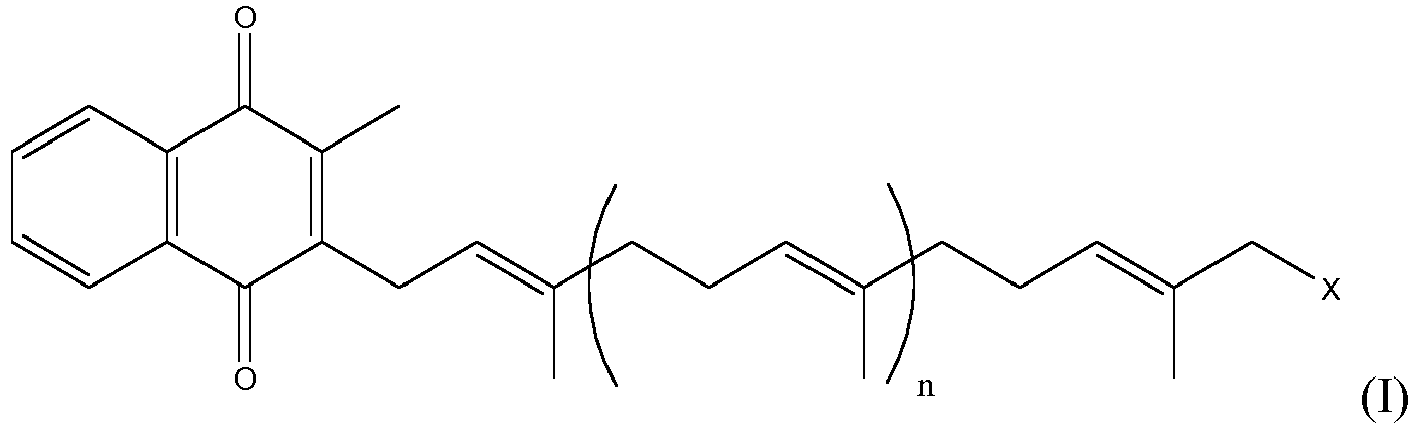
- a compound of formula (I) may be prepared by a process comprising a step in which (i) a compound of formula (II) is reacted with a compound of formula (III)
- a compound of formula (I) may be prepared by a process comprising a step in which (i) a compound of formula (IV) where R is an alkyl group; is reacted with a compound of formula (III) wherein LG is a leaving group, m is an integer of from 0 to 8, n is 0 to 9 and X is hydrogen, halide, hydroxyl, or optionally protected hydroxyl; in the presence of a Pd (0) catalyst.
- reaction of a compound of formula (II) or (IV) with a compound of formula (III) may however be only one step in the formation of a compound of formula (I).
- the reaction of compounds (II) and (III) or (II) and (IV) yields the compound (I')
- the process may therefore incorporate further steps before or after the reaction as described below in order to allow the formation of a compound of formula (I), especially MK-7.
- a polyprenyl side chain is one which derives from the polymerisation of isoprene: 2-methyl-1,3-butadiene.
- an alkyl group can contain 1 to 6 carbon atoms, preferably 1 to 4 carbon atoms, especially methyl or ethyl.
- Halide (Hal) includes fluoro, chloro, bromo and iodo, preferably chloro or bromo.
- Halides employed as Grignard reagents are preferably bromo.
- protecting group covers any known protecting group for the group in question.
- Hydroxyl protecting groups include acetyl (Ac), benzyl, ⁇ -methoxyethoxymethyl ether (MEM), methoxymethyl ether (MOM), p-methoxybenzyl ether (PMB), methylthiomethyl ether, pivaloyl (Piv), tetrahydropyran (THP), Silyl ether (most popular ones include trimethylsilyl (TMS), t-butyldimethylsilyl (TBDMS), and triisopropylsilyl (TIPS) ethers), and methyl ethers.
- Preferred protecting groups are benzyl or THP.
- leaving group is well known in the art and denotes an atom or group of atoms that readily leaves a molecule due to the relative stability of the ion formed.
- Useful leaving groups include halides, tosylates, mesylates and triflates.
- Preferred leaving groups are halides.
- n is 0 to 9, preferably 1 to 8, more preferably 4 to 7, e.g. 6, 7 or 8 isoprenoid units. Values of n which are not compatible with the formation of the claimed intermediate or with the formation of MK-7 from that intermediate are not within the scope of the invention.
- m is 0 to 8, e.g. 0 to 7, preferably 0 to 5, more preferably 1 to 4, e.g. 2, 3 or 4 isoprenoid units.
- Values of m which are not compatible with the formation of the claimed intermediate or with the formation of MK-7 from that intermediate are not within the scope of the invention. It will be appreciated that the sum of the various m values of the starting materials will add up to the value of n in the compound of formula (I) taking into account any units formed in the reactions in question. Thus if one isoprene unit is formed by the reactions then n-1 is the total of all m's. Where a reaction process involves multiple reactants in which the variable m is present, it will be appreciated that each m can be different.
- X is preferably hydrogen.
- the present disclosure relates to the synthesis of compounds of formula (I), i.e. menaquinone derivatives having varying length of a polyprenyl side chain in their backbone. Whilst the length of the polyprenyl chain in the compound of formula (I) can vary, it is preferred if there are at least 6 isoprenoid units, more preferably at least 7 isoprenoid units in the compound of formula (I). It is preferred therefore if n is at least 3, preferably 4, 5 or 6.
- the compound of formula (III) required to effect the reaction above can contain different numbers of isoprenoid units.
- the compound of formula (III) is typically not commercially available and itself needs to be synthesised from compounds with a smaller number of isoprenoid units.
- a particular challenge faced by the synthetic chemist is preparing menaquinone compounds having different numbers of isoprenoid units. In order to manufacture higher menaquinones, i.e. those of 7 isoprenoid units or more, it is normally necessary to have at least one reactant which comprises 4 or more isoprenoid units. Such compounds are still not readily available and therefore need to be synthesised themselves. It will be seen therefore that the synthesis of higher menaquinones is not simple.
- Biellmann chemistry provides an ideal way to make even longer vitamin K2 side chain molecules which can then be coupled to a naphthoquinone ring following the chemistry described above.
- this chemistry can be used to increase the size of a side chain already attached to the naphthoquinone ring.
- the most common starting materials for the formation of the isoprenoid side chains are polyprenyl alcohols. It is possible to convert an alcohol into a better leaving group and effect addition of the phenythio or phenylsulfonyl group via a nucleophilic attack of the thiophenyl ion or phenylsulfonyl- ion on the leaving group.
- phenylthio group the inventors have found another method based on the reaction of the alcohol directly with diphenyldisulfide in the presence of a trialkyl phosphine, e.g. PBu 3 .
- Suitable bases include BuLi.
- Scheme 1 examplifies this type of reaction with a bromide and a phenylthio substituted derivative.
- the bromide reactant in scheme 1 can be conveniently synthesised from farnesol (A). Protection of farnesol with a benzyl group allows the introduction of a terminal OH group using selenium dioxide in t-butylperoxide. This can then be converted to the bromide using known chemistry (scheme 2)
- the reduction of the phenythio or phenylsulfonyl group also simultaneously removes any protection present, e.g. the benzyl protecting group leaving an alcohol.
- Reduction is conveniently effected using lithium metal in an amine solvent such as propylamine or ethylamine or using palladium catalysis with a borohydride, e.g. PdCl 2 (dppp) and lithium triethyl borohydride. Any other method for reduction of the phenythio or phenylsulfonyl group could also be employed.
- the naphthoquinone group must be introduced.
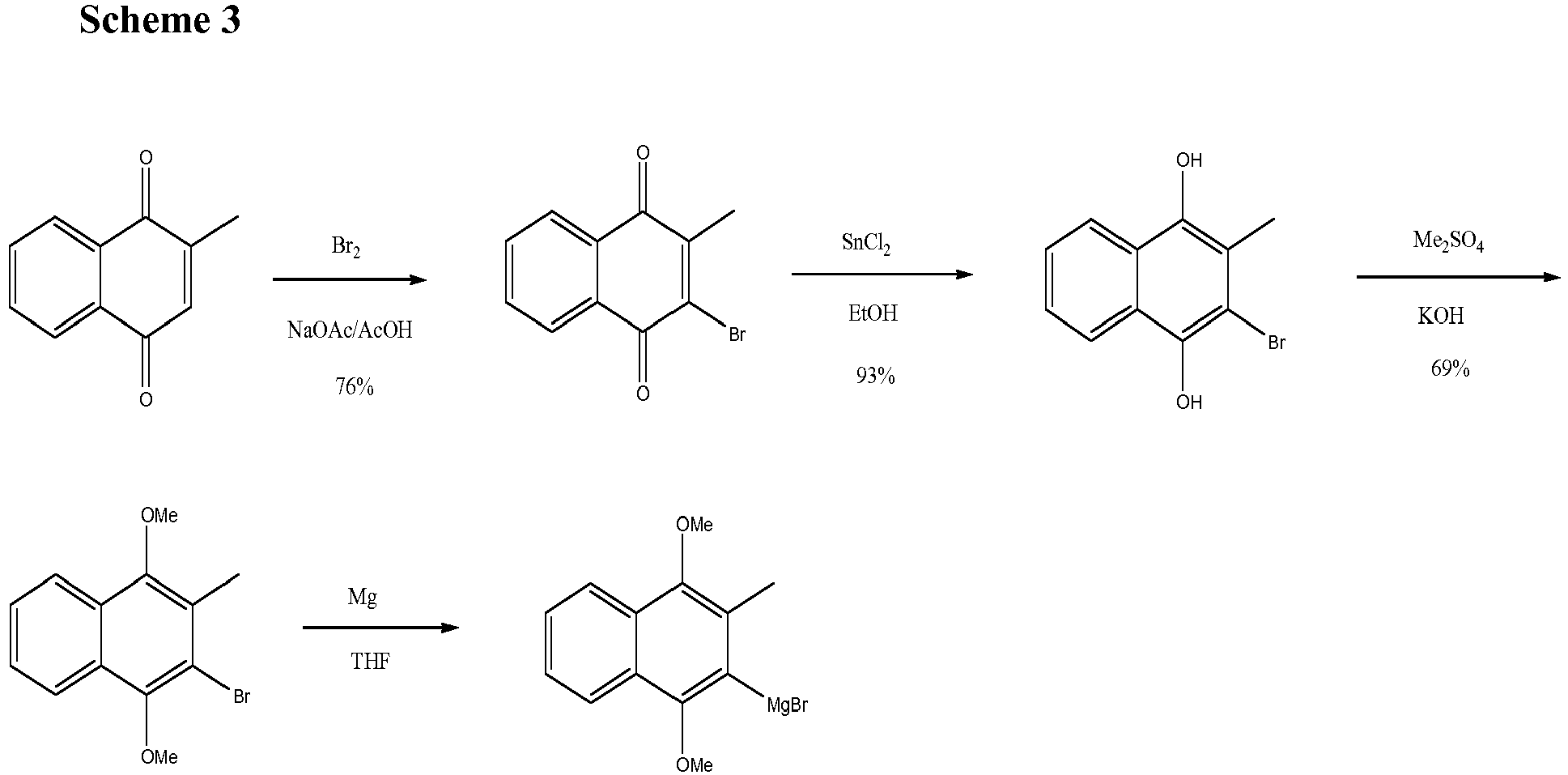
- This compound can be prepared from commercially available 2-methylnaphtoquinone as starting material as outlined in scheme 3.
- This brominated intermediate is converted to its dimethoxy analogue using tin dichloride in ethanol and subsequent treatment with dimethylsulphate and base.
- This dimethoxy derivative can then form the corresponding Grignard reagent.
- This chemistry is well established ( Snyder and Rapoport, J Am Chem. Soc 1974, 96, 8046-8054 ) .
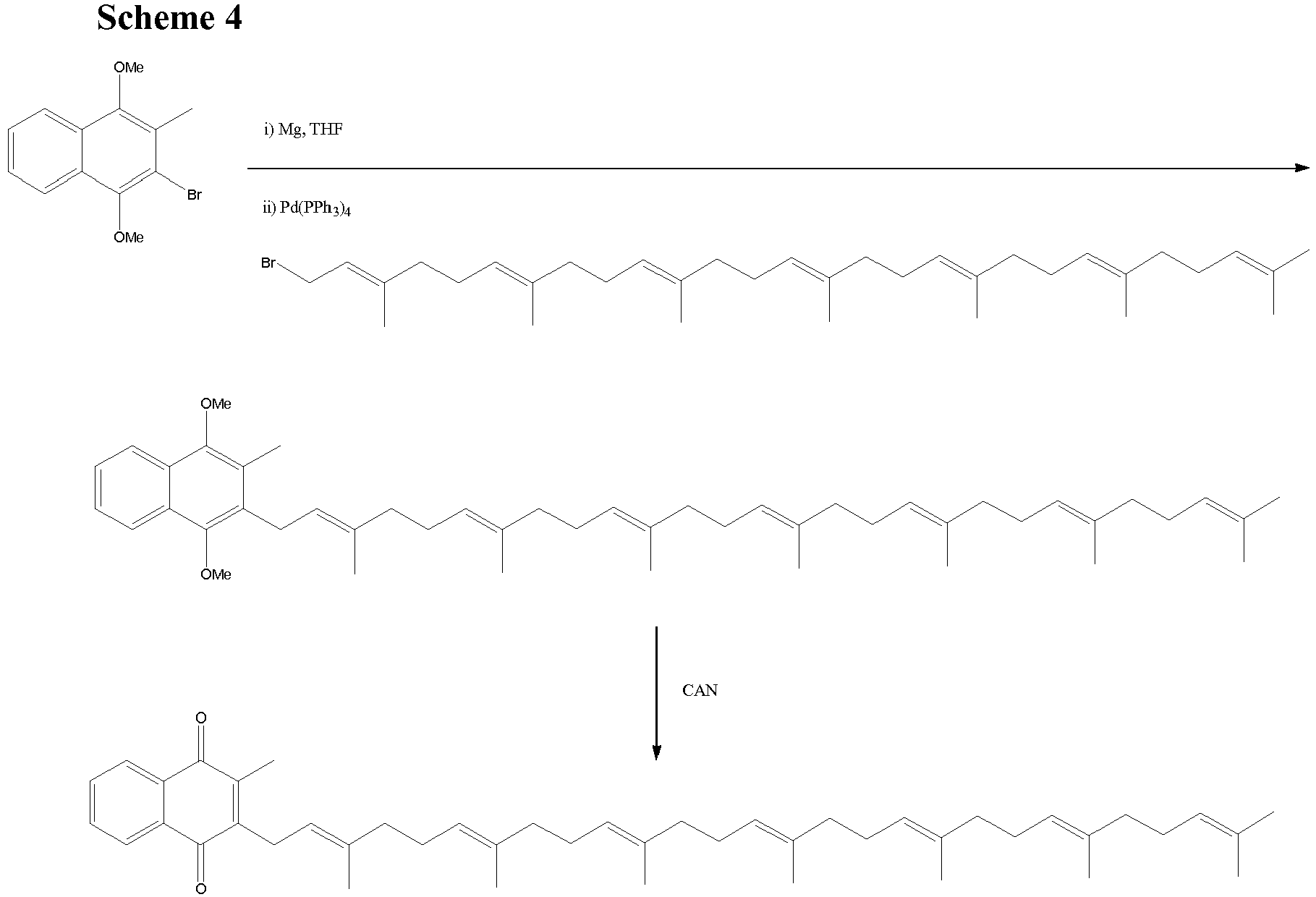
- the alcohol XV is converted to a halide, but the subsequent coupling to the naphthoquinone derivative using a classical Grignard reaction is not very useful. It is highly preferred if the reaction of the naphthoquinone derivative with the isoprenyl side chain is effected by Kumada coupling chemistry, as described previously. The inventors have found that Kumada chemistry improves yields and again prevents any loss of stereochemistry during the formation of the menaquinone. The coupling proceeds smoothly and the menaquinone MK-7 was obtained after oxidation of the methoxy groups on the naphthoquinone ring by cerium ammonium nitrate (CAN) or other oxidation methods (scheme 4).
- CAN cerium ammonium nitrate
- the catalyst used in the Kumada coupling can be a Cu (II), Ni (II) or (Pd(0) species.
- Suitable compounds include nickel chloride with two dppe ligands (NiCl 2 (1,2-bis(diphenylphosphino)ethane) 2 ), nickel(II) acetylacetonate and tetrakis(triphenylphosphine)palladium(0).
- the Kumada coupling is actually used twice as outlined in scheme 5.
- the Grignard reagent reacts with commercially available geranyl chloride providing the geranyl substituted derivative. Oxidation with SeO 2 affords the alcohol which is transformed into the bromide.
- the second Kumada coupling between this bromide and the Grignard reagent from pentaisoprenyl compound completed the synthesis of MK-7.
- Scheme 5b is an alternative use of the Kumada coupling strategy using a prohydroxyl reactant during the Kumada coupling stage to readily afford a reactive X group for further reaction.
- the inventors also envisage the use of Suzuki coupling chemistry to effect the menaquinone synthesis.
- the Suzuki reaction involves the reaction of an aryl- or vinyl-boronic acid with an aryl- or vinyl-halide catalyzed by a palladium(0) complex.
- the naphthoquinone bromide can be converted into a boronic acid using known techniques, e.g. by transmetallation with lithium.
- this boronic acid can be coupled with a suitable halide, triflate or tosylate under Suzuki conditions, i.e. using Pd(0) catalysis.
- the palladium catalyst is preferably 4-coordinate, and usually involves phosphine supporting groups, e.g.
- the Kumada or Suzuki coupling reaction can therefore yield only a relatively short side chain which can then be built up to form a compound of formula (I).
- Suzuki or any other chemistry can be used.
- a compound of formula (I) may be prepared by a process comprising (i) reacting a compound of formula (II) or (IV) with a compound of formula (III) as hereinbefore defined;
- the catalyst used here is chosen depending on the reaction in question, e.g. Pd(0) for a Suzuki coupling, Cu(II), Ni (II) or Pd(0) for Kumada.
- the compound of formula (I) may be prepared by a process comprising (i) reacting a compound of formula (II) or (IV) with a compound of formula (III) as hereinbefore defined;
- MK-7 is produced especially where 2 units come from compound (III), 4 units from compound (V) or (VI) (the 7th being formed by the reaction).
- the preferred process is therefore wherein any leaving group may be substituted for Br (e.g. other halogens, tosylate, mesylate etc).
- a benefit of preparing MK-7 using this "2+5" strategy is that the selenium dioxide reduction step used to form the napthoquinone reactant takes place more readily on a naphthoquinone carrying on 2 isoprenoid units than on a longer chain molecule.
- This "2+5" method also gives better stereochemistry and has been found to allow the formation of solid, in particular crystalline MK-7.
- Reduction of all phenythio or phenylsulfonyl substituted compounds present can take place as a final step to yield a side chain suitable for coupling to a naphthoquinone related molecule, e.g. using Kumada or Suzuki chemistry. This reaction is highly flexible and allows the formation of side chains for MK-7.
- This "double Biellmann” chemistry may be used to form the polyisoprenoid chain. This may involve a process for the preparation of a compound comprising an isoprenoid repeating unit comprising (i) reacting a compound of formula with a compound Where PG is a protecting group and n, LG and X are as hereinbefore defined to form (ii) converting said OPG group into a leaving group and reacting with a compound so as to form (iii) and optionally reducing said SPh groups to hydride.
- the Biellmann reaction can be carried out on a molecule in which the protected analogue of the naphthoquinone ring is present. It may be therefore that the phenylthioether required in the Biellmann reaction already carries a protected analogue of naphthoquinone.
- the side chain terminus is converted to a hydroxyl using selenium dioxide and this hydroxyl can be converted to a halide and coupled with phenythio or phenylsulfonyl substituted derivatives using chemistry described above.
- the compound of formula (I) as hereinbefore defined may be prepared by a process comprising (i) reacting a compound of formula (II) or (IV) with a compound of formula (III) in the presence of a copper, nickel or palladium catalyst; (ii) converting X into a phenythio or phenylsulfonyl group to form compound (VII) (iii) deprotonating (alpha to the sulphur) and reacting with a compound where m is independently as hereinbefore defined;
- This reaction can also be carried out using other R groups to protect the naphthoquinone and again it will be appreciated that the sum of the various n values of the starting materials will add up to the value of n in the compound of formula (I) taking into account any units formed in the reactions.
- the final products of the formula (1) formed by the processes described above are generally known compounds and have well documented therapeutic applications.
- the formed compounds may therefore be formulated as pharmaceutically acceptable compositions.
- the compounds of formula (I) have utility in the treatment of osteoporosis, cancer or cardio-vascular disease.
- the compounds may also be used as vitamin supplements or in any other known application of vitamin K, e.g. for injection into new-born infants to aid blood clotting.
- the MK-7 product achieved is highly pure. It has excellent stereochemical integrity and can be manufactured as solids as opposed to oils.
- the MK-7 compound manufactured according to the invention can be crystalline.
- Benzyloxyfarnesol was prepared as described in the literature ( Naruta, Y. J. Org. Chem. (1980), 45, 4097 .
- reaction mixture was poured into ice-water (600 ml) and the aqueous layer separated and extracted with ether (3x300 ml). The combined organic extracts were washed with ice-cold NaHCO 3 (400 ml) and brine (400 ml), dried (Na 2 SO 4 ), filtered and concentrated to give 25.47 g (98%) of the product as a colorless oil used directly in the next step.
- Heptaprenol was converted to heptaprenyl bromide as described above or by applying PBr 3 in DCM or ether.
- the orange mixture was stirred at 0 °C for 40 min. and at room temperature for 16.5 h over night.
- the yellow mixture was poured into 100 ml ice water.
- the layers were separated and the aqueous layer was extracted with CH 2 Cl 2 .
- the combined organic extracts were washed with ice water, dried over Na 2 SO 4 , filtered and concentrated in vacuo by rotary evaporation at 40 °C to give 8.50 g of yellow oil. It was purified by dry flash.
Landscapes
- Chemical & Material Sciences (AREA)
- Organic Chemistry (AREA)
- Chemical Kinetics & Catalysis (AREA)
- Organic Low-Molecular-Weight Compounds And Preparation Thereof (AREA)
- Low-Molecular Organic Synthesis Reactions Using Catalysts (AREA)
- Steroid Compounds (AREA)
- Pharmaceuticals Containing Other Organic And Inorganic Compounds (AREA)
Description
- This application relates to the synthesis of a novel intermediate compound.
- Vitamin K denotes a group of lipophilic and hydrophobic vitamins that are needed for the post-translational modification of certain proteins, mostly required for blood coagulation. Chemically they are 2-methyl-1,4-naphthoquinone derivatives.
- Vitamin K is not a single compound, rather it is a series of related analogues. Vitamin K1 is called phylloquinone and has the systematic name all-E-2-methyl-3-(3,7,11,15-tetramethylhexadec-2-enyl)naphthalene-1,4-dione. Vitamin K2 (menaquinone) is normally produced by bacteria in the intestines, and dietary deficiency is extremely rare unless the intestines are heavily damaged or are unable to absorb the molecule.
- Vitamin K2 is a mixture of different molecules based on a naphthoquinone structure and varying lengths of isoprenoid chains. The compound MK-7 (i.e. 7 isoprenyl groups) is depicted below but other components of the vitamin have different numbers of isoprenoid links. Menaquinones have side chains composed of all-E polyprenyl residues; generally they are designated as MK-n, where n specifies the number of isoprenoid repeating units. The minimum value of n is 2.

- All members of the vitamin K group of vitamins share a methylated naphthoquinone ring structure, and vary in the aliphatic side chain attached at the 3-position.
- It is generally accepted that the naphthoquinone is the main functional group of the vitamin, so that the mechanism of action is similar for all K-vitamins. Substantial differences may be expected, however, with respect to intestinal absorption, transport, tissue distribution, and bio-availability when variations in the side chain take place. These differences are caused by the different lipophilicity of the various side chains and by the different food matrices in which they occur.
- A recent paper (Suhara et al., Biorganic Med. Chem Lett. 17 (2007) 1622-1625) suggests the use of certain vitamin K metabolites as biologically active compound which can lead to the development of new drugs based on side-chain modification of the alkyl group. Suhara targets compounds of structure similar to metabolites of vitamin K, i.e. compounds carrying acidic (or other strongly hydrophilic groups) at the terminus of the 3-position side chain. Some of the analogues have apoptosis-inducing properties.
- It is known that γ-carboxylated osteocalcin is involved in the bone remodeling system, and there are strong indications that vitamin K has a beneficial effect on bone diseases such as osteoporosis. There is interest therefore in the investigation of various vitamin K2 type compounds for inhibitory effects on osteoporosis, as potential anti-cancer drugs and for beneficial cardio-vascular activity.
- Whilst vitamin K2 occurs naturally in various vegetables and can be produced by bacteria in the intestines, it is still an interesting synthetic target as isolation of the vitamin from a natural source is complex and concentrations of the vitamin are low. Moreover, synthesis allows the preparation of particular menaquinones rather than the isolation of a mixture of different menaquinones.
- Various individuals have synthesised the menaquinone compounds which form part of vitamin K2 or components thereof. The first synthesis of menaquinones, reported by Isler et al., Helv. Chim Acta 1958, 41, 786-807, used a nonstereospecific approach. Tso and Chen, J Chem Res 1995, 104-105 describes a one pot synthesis of vitamin K although he concentrates on the formation of the naphthoquinone ring as opposed to the side chain of the molecule. His chemistry involves the reaction of 3-substituted isobenzofuranones with vinylic sulphones to form the naphthoquinone ring structure.
- Suhara et al, Bioorg Med Chem Lett 17, (2007) 1622-1625, describe various syntheses of menaquinone analogues in which the terminal methyl group is converted to a hydroxyl, aldehyde or acid group.
- Naruta, J Org Chem 1980, 45, 4097-4104, describes the synthesis of some vitamin K2 analogues using trialkylallylstannane chemistry to bond the preformed side-chain to the naphthoquinone group.
-
US 4089873 describes the preparation of menaquinones using a copper-mediated coupling reaction. -
US 4199531 describes the preparation of quinones using arylsulfonyl/halogen coupling chemistry. - The present inventors have devised a synthetic strategy for the formation of MK-7 and other menaquinones. The method utilises Kumada or Suzuki chemistry to connect a side chain to the naphthoquinone ring. The side chain can be further manipulated, e.g. using Biellmann chemistry to produce the desired compounds.
- The process described herein allows formation of menaquinones in high yield and crucially with stereochemical integrity. In particular, the inventors do not see any presence of Z-isomers during their reactions. A key intermediate in the above reactions, shown below, is new and forms the key aspect of the invention. The invention therefore provides a compound of formula:

- The invention furthermore provides a process for the preparation of MK-7 comprising converting a compound

into MK-7:
- The Kumada, Suzuki, and Bielmann reactions discussed below enable the preparation of the intermediate shown above. Processes or compounds which do not relate to the intermediate above or which do not relate to the process for the formation of MK-7 from this intermediate are not within the scope of the invention but are included to enable the invention.
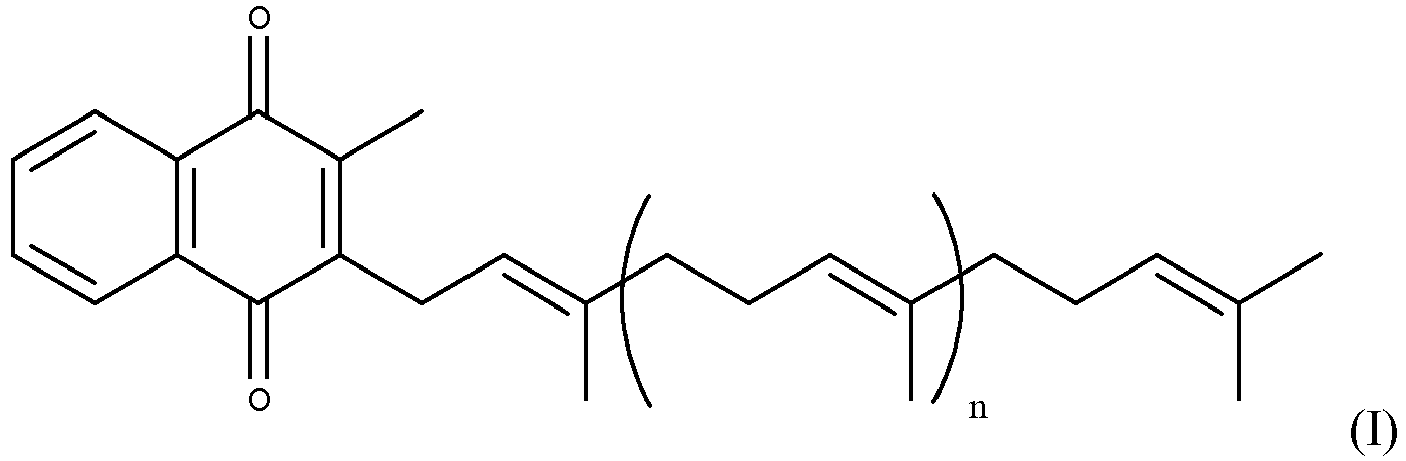
- A compound of formula (I)

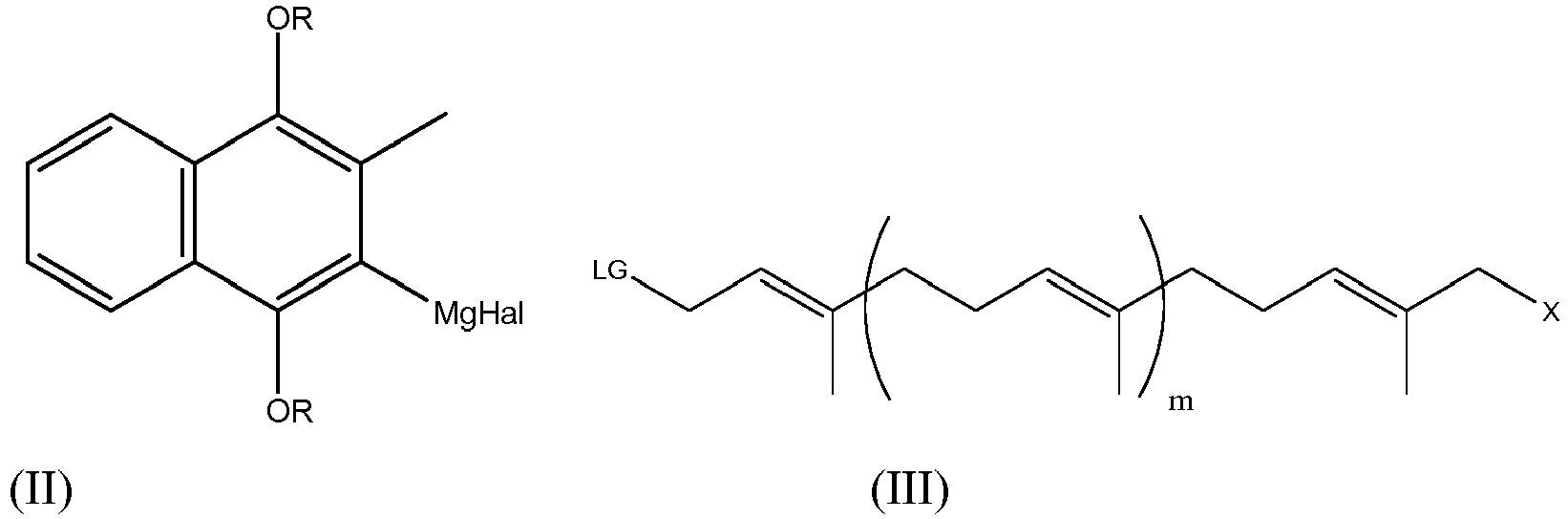
- wherein R is an alkyl group;
- LG is a leaving group;
- m is an integer of from 0 to 8;
- n is an integer of from 0 to 9; and
- X is hydrogen, halide, hydroxyl, or protected hydroxyl;
- A compound of formula (I)


in the presence of a Pd (0) catalyst. - The successful use of either Kumada or Suzuki coupling for preparing the vitamin K2 compounds depends on the availability of a precursor for the all-E polyprenyl side chains. To reach this objective the inventors have employed Biellmann chemistry. This reaction involves the formation of phenythio or phenylsulfonyl substituted compounds and reaction of these sulphur compounds with an electrophile, such as a halide, in the presence of a base. Suitable bases include n-butyl lithium, tert butyl lithium, and non nucleophilic bases such as tertbutoxides. After coupling, the phenythio or phenylsulfonyl groups are removed reductively for example with lithium metal or a metal hydride. The inventors have found that this method is ideal for coupling together two isoprenoid chains to make a new isoprenoid chain of, for example, 7 or more units.
- The reaction of a compound of formula (II) or (IV) with a compound of formula (III) may however be only one step in the formation of a compound of formula (I). The reaction of compounds (II) and (III) or (II) and (IV) yields the compound (I')

- It will be appreciated that to complete the synthesis of a compound of formula (I) it is necessary to convert the diprotected naphthoquinone (I') back to naphthoquinone. This can be achieved by any convenient oxidation method although typically cerium ammonium nitrate (CAN) can be used.
- The process may therefore incorporate further steps before or after the reaction as described below in order to allow the formation of a compound of formula (I), especially MK-7.
- A polyprenyl side chain is one which derives from the polymerisation of isoprene: 2-methyl-1,3-butadiene.
- Unless otherwise stated, an alkyl group can contain 1 to 6 carbon atoms, preferably 1 to 4 carbon atoms, especially methyl or ethyl.
- Halide (Hal) includes fluoro, chloro, bromo and iodo, preferably chloro or bromo. Halides employed as Grignard reagents are preferably bromo.
- The term protecting group covers any known protecting group for the group in question. Hydroxyl protecting groups include acetyl (Ac), benzyl, β-methoxyethoxymethyl ether (MEM), methoxymethyl ether (MOM), p-methoxybenzyl ether (PMB), methylthiomethyl ether, pivaloyl (Piv), tetrahydropyran (THP), Silyl ether (most popular ones include trimethylsilyl (TMS), t-butyldimethylsilyl (TBDMS), and triisopropylsilyl (TIPS) ethers), and methyl ethers. Preferred protecting groups are benzyl or THP.
- The term leaving group is well known in the art and denotes an atom or group of atoms that readily leaves a molecule due to the relative stability of the ion formed. Useful leaving groups include halides, tosylates, mesylates and triflates. Preferred leaving groups are halides.
- In any particular embodiment "n" is 0 to 9, preferably 1 to 8, more preferably 4 to 7, e.g. 6, 7 or 8 isoprenoid units. Values of n which are not compatible with the formation of the claimed intermediate or with the formation of MK-7 from that intermediate are not within the scope of the invention.
- In any particular embodiment "m" is 0 to 8, e.g. 0 to 7, preferably 0 to 5, more preferably 1 to 4, e.g. 2, 3 or 4 isoprenoid units. Values of m which are not compatible with the formation of the claimed intermediate or with the formation of MK-7 from that intermediate are not within the scope of the invention. It will be appreciated that the sum of the various m values of the starting materials will add up to the value of n in the compound of formula (I) taking into account any units formed in the reactions in question. Thus if one isoprene unit is formed by the reactions then n-1 is the total of all m's. Where a reaction process involves multiple reactants in which the variable m is present, it will be appreciated that each m can be different.
- In compounds of formula (I), X is preferably hydrogen.
- The present disclosure relates to the synthesis of compounds of formula (I), i.e. menaquinone derivatives having varying length of a polyprenyl side chain in their backbone. Whilst the length of the polyprenyl chain in the compound of formula (I) can vary, it is preferred if there are at least 6 isoprenoid units, more preferably at least 7 isoprenoid units in the compound of formula (I). It is preferred therefore if n is at least 3, preferably 4, 5 or 6.
- The compound of formula (III) required to effect the reaction above can contain different numbers of isoprenoid units. The compound of formula (III) is typically not commercially available and itself needs to be synthesised from compounds with a smaller number of isoprenoid units. A particular challenge faced by the synthetic chemist is preparing menaquinone compounds having different numbers of isoprenoid units. In order to manufacture higher menaquinones, i.e. those of 7 isoprenoid units or more, it is normally necessary to have at least one reactant which comprises 4 or more isoprenoid units. Such compounds are still not readily available and therefore need to be synthesised themselves. It will be seen therefore that the synthesis of higher menaquinones is not simple. Starting from commercially available farnesol (A) methods have been devised for extending this molecule stereoselectively by one isoprenoid unit at a time (see Coates et al Org. Synth. 2007, 84, 43-57)

- However, where the number of units is high, it may not be practical to add just one unit at a time to compound (A). If 10 units are required, the overall yield of the process might be too low to be of commercial interest. The inventors have therefore sought more ways of forming the menaquinone side chain having multiple isoprenoid units.
- The inventors have found that Biellmann chemistry provides an ideal way to make even longer vitamin K2 side chain molecules which can then be coupled to a naphthoquinone ring following the chemistry described above. Alternatively this chemistry can be used to increase the size of a side chain already attached to the naphthoquinone ring.
- The most common starting materials for the formation of the isoprenoid side chains are polyprenyl alcohols. It is possible to convert an alcohol into a better leaving group and effect addition of the phenythio or phenylsulfonyl group via a nucleophilic attack of the thiophenyl ion or phenylsulfonyl- ion on the leaving group. For phenylthio group, the inventors have found another method based on the reaction of the alcohol directly with diphenyldisulfide in the presence of a trialkyl phosphine, e.g. PBu3.
- The resulting phenythio or phenylsulfonyl substituted compounds are readily deprotonated with base forming the corresponding anions which can be reacted with a compound having a suitable leaving group yielding the basis of the isoprenoid carbon chain. Suitable bases include BuLi.
- Scheme 1 examplifies this type of reaction with a bromide and a phenylthio substituted derivative.


- The bromide reactant in scheme 1 can be conveniently synthesised from farnesol (A). Protection of farnesol with a benzyl group allows the introduction of a terminal OH group using selenium dioxide in t-butylperoxide. This can then be converted to the bromide using known chemistry (scheme 2)

- Once the coupling has been completed it is preferred that the reduction of the phenythio or phenylsulfonyl group also simultaneously removes any protection present, e.g. the benzyl protecting group leaving an alcohol. Reduction is conveniently effected using lithium metal in an amine solvent such as propylamine or ethylamine or using palladium catalysis with a borohydride, e.g. PdCl2(dppp) and lithium triethyl borohydride. Any other method for reduction of the phenythio or phenylsulfonyl group could also be employed.
- Reduction of the product in scheme 1 yields compound XV

- To complete the synthesis, the naphthoquinone group must be introduced. This compound can be prepared from commercially available 2-methylnaphtoquinone as starting material as outlined in scheme 3. This brominated intermediate is converted to its dimethoxy analogue using tin dichloride in ethanol and subsequent treatment with dimethylsulphate and base. This dimethoxy derivative can then form the corresponding Grignard reagent. This chemistry is well established (Snyder and Rapoport, J Am Chem. Soc 1974, 96, 8046-8054) .
- The alcohol XV is converted to a halide, but the subsequent coupling to the naphthoquinone derivative using a classical Grignard reaction is not very useful. It is highly preferred if the reaction of the naphthoquinone derivative with the isoprenyl side chain is effected by Kumada coupling chemistry, as described previously. The inventors have found that Kumada chemistry improves yields and again prevents any loss of stereochemistry during the formation of the menaquinone. The coupling proceeds smoothly and the menaquinone MK-7 was obtained after oxidation of the methoxy groups on the naphthoquinone ring by cerium ammonium nitrate (CAN) or other oxidation methods (scheme 4).
- The catalyst used in the Kumada coupling can be a Cu (II), Ni (II) or (Pd(0) species. Suitable compounds include nickel chloride with two dppe ligands (NiCl2(1,2-bis(diphenylphosphino)ethane)2), nickel(II) acetylacetonate and tetrakis(triphenylphosphine)palladium(0). For a detailed discussion of Kumada chemistry see Yamamura, M., Moritani, I. and Murahashi, S-I. Journal of Organometallic Chemistry, 91 (2), 1975, C39-C42.
- In another strategy leading to MK-7 the Kumada coupling is actually used twice as outlined in scheme 5. In the first Kumada coupling the Grignard reagent reacts with commercially available geranyl chloride providing the geranyl substituted derivative. Oxidation with SeO2 affords the alcohol which is transformed into the bromide. The second Kumada coupling between this bromide and the Grignard reagent from pentaisoprenyl compound completed the synthesis of MK-7.


- Scheme 5b is an alternative use of the Kumada coupling strategy using a prohydroxyl reactant during the Kumada coupling stage to readily afford a reactive X group for further reaction.

- The inventors also envisage the use of Suzuki coupling chemistry to effect the menaquinone synthesis. The Suzuki reaction involves the reaction of an aryl- or vinyl-boronic acid with an aryl- or vinyl-halide catalyzed by a palladium(0) complex. In the menaquinone synthesis therefore the naphthoquinone bromide


- In scheme 6, Suzuki chemistry is used in the formation of the MK-7 compound. Moreover, both schemes 5 and 6 introduce an alternative method of forming the menaquinone side chain, i.e. by building it up actually on the naphthoquinone structure rather than preforming the entire side chain, as depicted in scheme 6.
- The Kumada or Suzuki coupling reaction can therefore yield only a relatively short side chain which can then be built up to form a compound of formula (I). To complete the synthesis of a longer chain menaquinone further Kumada, Suzuki or any other chemistry can be used.
- A compound of formula (I)
- (iii) if necessary, converting X into a leaving group;
- (iv) reacting with a compound

- The catalyst used here is chosen depending on the reaction in question, e.g. Pd(0) for a Suzuki coupling, Cu(II), Ni (II) or Pd(0) for Kumada.
- The compound of formula (I)
- (iii) if necessary, converting X into a leaving group;
- (iv) reacting with a compound (V) or (VI)


in the presence of a base;- (v) reductively removing the phenythio or phenylsulfonyl groups in the resulting compounds and
- (vi) converting by oxidation the diprotected naphthoquinone into a naphthoquinone.
- By varying the number of isoprene units in either molecule coupled using the Biellmann reaction, Suzuki coupling or Kumada coupling all manner of different menaquinone compounds can be produced. It will be appreciated therefore that the values of n in the reactants must be selected to match the number of repeating units desired in the compound of formula (I) bearing in mind, of course, that some isoprenoid units are formed during the reactions themselves. This will be readily achieved by the skilled man.
- Ideally, MK-7 is produced especially where 2 units come from compound (III), 4 units from compound (V) or (VI) (the 7th being formed by the reaction). The preferred process is therefore

- Tthe inventors have realised that different side chains can be prepared using a double Biellmann coupling (or triple Bielmann etc). Initially, therefore two shorter chain molecules can be combined. By using appropriate protection strategies, the coupled species can then be deprotected to reveal an alcohol which can be converted to phenythio or phenylsulfonyl substituted compounds ready for a second Biellmann coupling. In this way, the isoprenoid units needed to form the complete side chain of a long menaquinone can be joined together from shorter starting blocks. Reduction of all phenythio or phenylsulfonyl substituted compounds present can take place as a final step to yield a side chain suitable for coupling to a naphthoquinone related molecule, e.g. using Kumada or Suzuki chemistry. This reaction is highly flexible and allows the formation of side chains for MK-7.
- One such reaction is depicted below in scheme 7


- This "double Biellmann" chemistry may be used to form the polyisoprenoid chain. This may involve a process for the preparation of a compound comprising an isoprenoid repeating unit comprising (i) reacting a compound of formula


to form
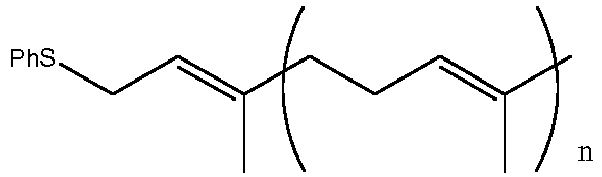

- The inventors have also found however, that the Biellmann reaction can be carried out on a molecule in which the protected analogue of the naphthoquinone ring is present. It may be therefore that the phenylthioether required in the Biellmann reaction already carries a protected analogue of naphthoquinone. In scheme 8, after an initial Kumada coupling reaction, the side chain terminus is converted to a hydroxyl using selenium dioxide and this hydroxyl can be converted to a halide and coupled with phenythio or phenylsulfonyl substituted derivatives using chemistry described above.
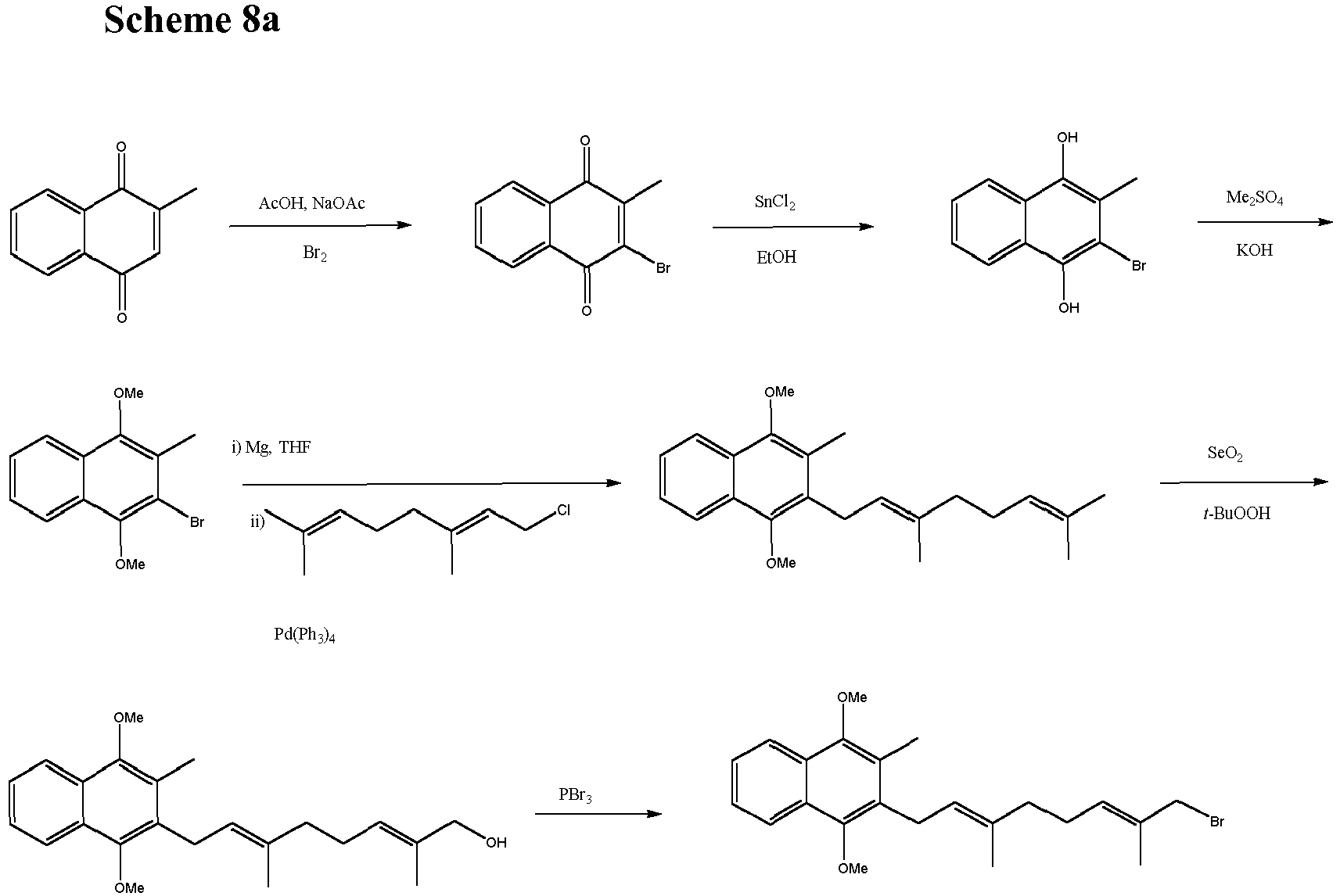
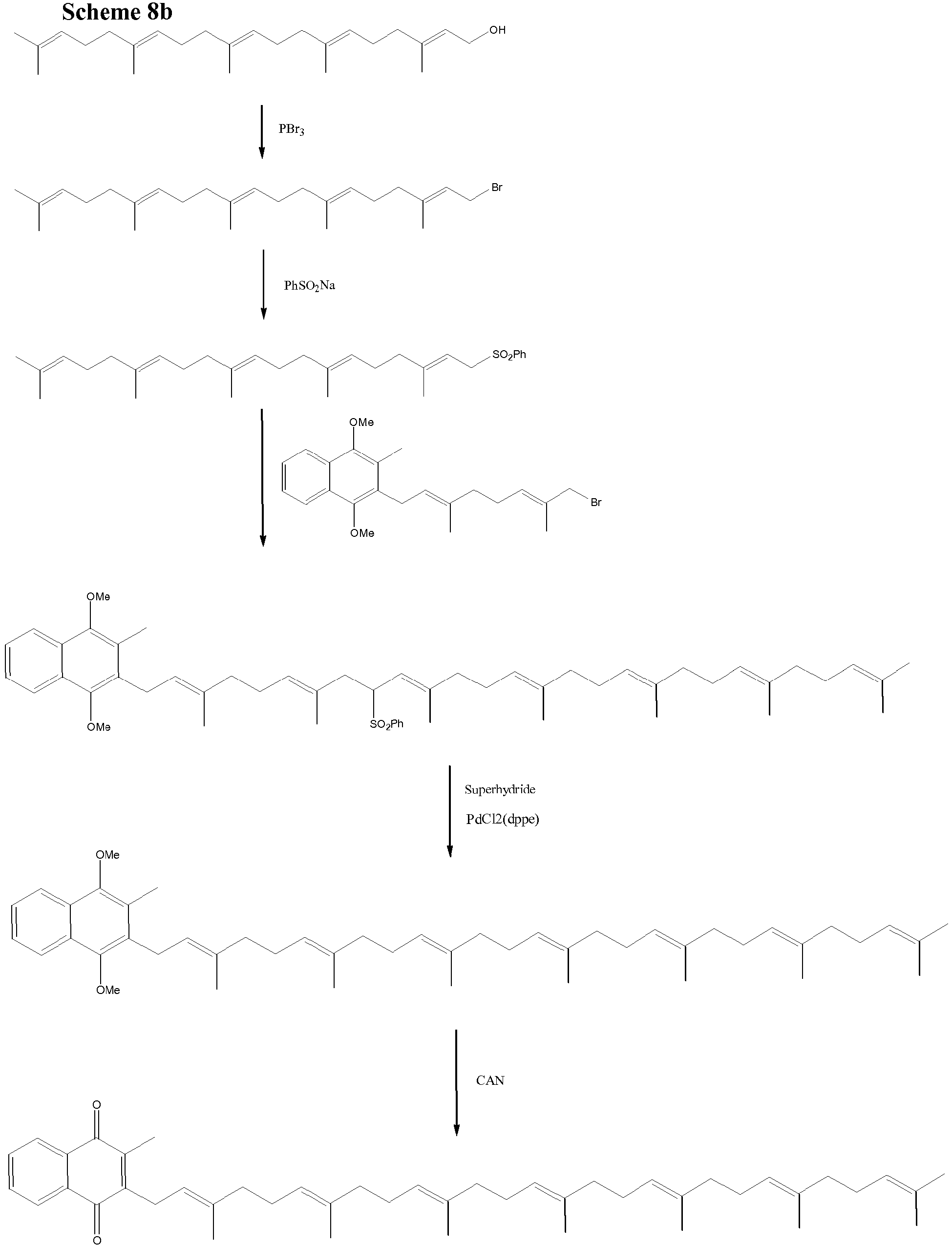
- Conversion of the hydroxyl into phenythio or phenylsulfonyl group using the chemistry above gives an intermediate which can itself partake in a Biellmann coupling reaction to form a menaquinone molecule upon suitable work up procedures.
- The compound of formula (I) as hereinbefore defined

(ii) converting X into a phenythio or phenylsulfonyl group to form compound (VII)

- (iv) reductively removing the phenythio or phenylsulfonyl groups; and
- (v) converting by oxidation the diprotected naphthoquinone into a naphthoquinone.
- This reaction can also be carried out using other R groups to protect the naphthoquinone and again it will be appreciated that the sum of the various n values of the starting materials will add up to the value of n in the compound of formula (I) taking into account any units formed in the reactions.
- A key intermediate in the above reaction is new and forms a particular aspect of the invention. The compound is:

- By varying the number of isoprenoid units in either molecule coupled using the Biellmann reaction, Suzuki coupling or Kumada coupling all manner of different menaquinone compounds can be produced.
- The final products of the formula (1) formed by the processes described above are generally known compounds and have well documented therapeutic applications. The formed compounds may therefore be formulated as pharmaceutically acceptable compositions. The compounds of formula (I) have utility in the treatment of osteoporosis, cancer or cardio-vascular disease. The compounds may also be used as vitamin supplements or in any other known application of vitamin K, e.g. for injection into new-born infants to aid blood clotting.
- It is a particular feature of the invention that the MK-7 product achieved is highly pure. It has excellent stereochemical integrity and can be manufactured as solids as opposed to oils. In particular, the MK-7 compound manufactured according to the invention can be crystalline.
- In the schemes above, specific reaction conditions and reagents are disclosed to aid the skilled man in carrying out the reactions described herein. The chemistry could however be carried out under different conditions and using various reagents and the skilled man is aware of this. The reactions disclosed in the schemes are therefore disclosed per se and should not be considered as being limited to the use of the particular reagents mentioned in those schemes. The reactions in the schemes are disclosed irrespective of how each reaction is accomplished as well as in conjunction with the specific reagents mentioned.
- The invention will now be further described with reference to the following non limiting examples:
-


- To a solution of (E,E,E)-geranylgeraniol (1.45 g, 5.00 mmol) in 3:1 dry ether/HMPA was added methyllitium (3.3 ml, 1.6 M in ether, 5.2 mmol) at 0 °C under nitrogen followed by p-toluenesulfonyl chloride (1.11 g, 5.82 mmol) . After 2 hours at 0 °C lithium thiophenoxide (5.76 mmol, prepared from thiophenol and n-BuLi in THF) was added. The reaction mixture was allowed to reach room temperature and stirred for 2 hours. Water was added and the aqueous phase extracted with heptane (x3). The combined organic extract was washed with NaHCO3 (aq) and brine, dried (Na2SO4), filtered and concentrated. The residue was purified by flash chromatography (heptane : EtOAc 95:5) to give 1.42 g (74%) of the product.
-

- Benzyloxyfarnesol was prepared as described in the literature (Naruta, Y. J. Org. Chem. (1980), 45, 4097.

- To a solution of benzyloxyfarnesol (50.0 g, 0.16 mol) in DCM (200 ml) was added SeO2 (1.00 g, 9.01 mmol) and salicylic acid (2.24 g, 16.2 mmol) follwed by t-BuOOH (67 ml, 80% in di t-butylperoxide:H2O) at room temperature. The reaction mixture was stirred for 3.5 hours, silicagel added and the reaction mixture concentrated and purified directly by flash chromatography (heptane :EtOAc 7:1-4:1 gradient) to give 21.7 g (41%) as a colorless oil.
-

- To a solution of the product from above (21.7 g, 66.0 mmol) in dry THF (220 ml) at -45 °C under argon was added slowly methanesulfonyl chloride (9.75 g, 85.1 mmol), followed by triethylamine (13.3 g, 131 mmol). The thus obtained white suspension was stirred at -45 °C for 45 min. A solution of lithium bromide (22.9 g, 264 mmol) in dry THF (75 ml) was added slowly. The dry ice/acetonitrile bath was replaced by an ice-bath and stirring continued for 1.5 hrs. The reaction mixture was poured into ice-water (600 ml) and the aqueous layer separated and extracted with ether (3x300 ml). The combined organic extracts were washed with ice-cold NaHCO3 (400 ml) and brine (400 ml), dried (Na2SO4), filtered and concentrated to give 25.47 g (98%) of the product as a colorless oil used directly in the next step.
-
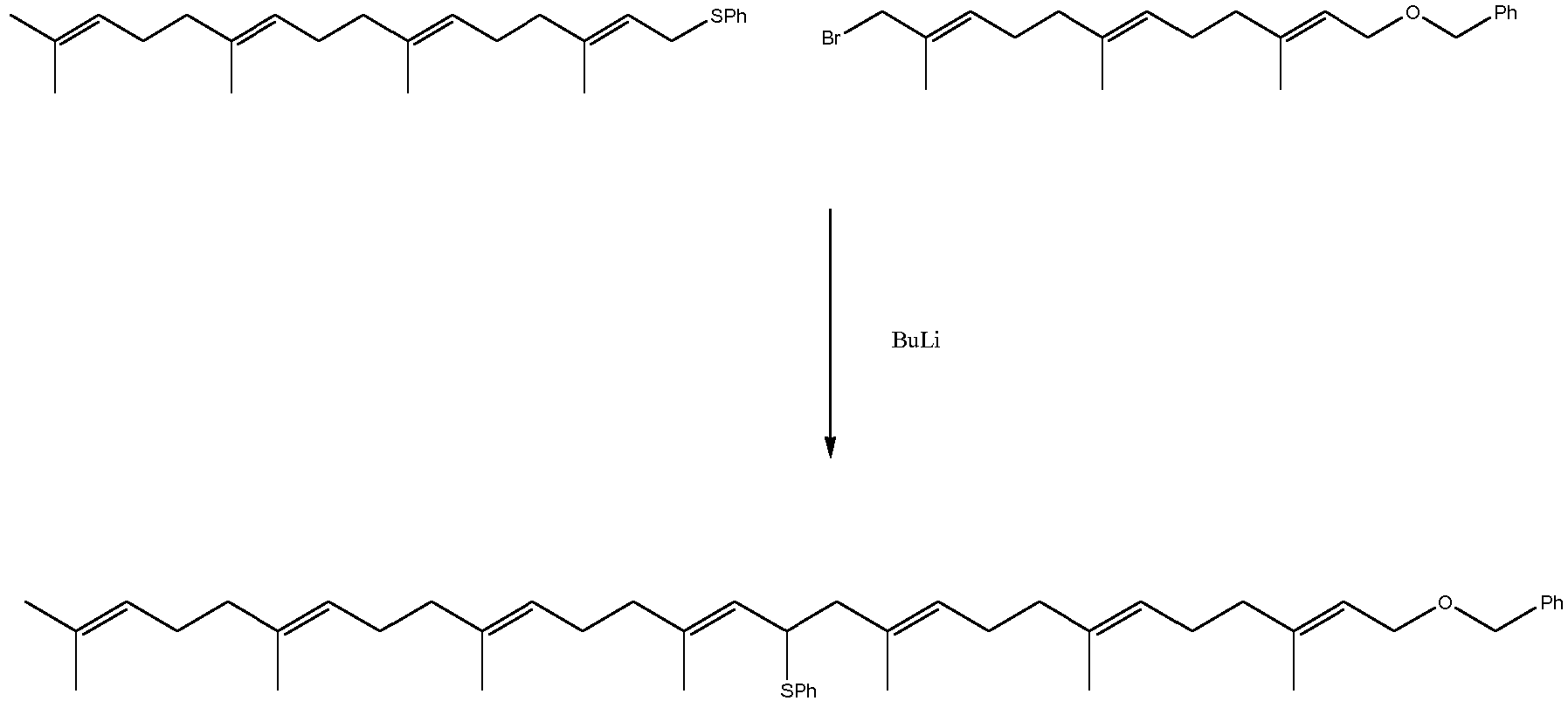
- (E,E,E)-geranylgeraniol thiophenyl ether (2.11 g, 5.51 mmol) was dissolved in dry THF (35 ml), cooled to -78 °C and butyllithium added with stirring. The thus obtained bright yellow reaction mixture was stirred at - 78°C for 2.5 hrs under nitrogen. The product from the above reaction (1.78 g, 4.54 mmol) in dry THF (10 ml) was added and stirring continued at -78 °C for another 1.5 hrs. 4 ml 1:1 MeOH/ether was added and the reaction mixture allowed to reach room temperature at which point equal amounts of water and ether were added. The aqueous phase was extracted with ether (x3) and the combined extracts washed with brine, dried (Na2SO4), filtered and concentrated. Flash chromatography (heptane : EtOAc gradient) afforded 2.50 g (80%) of the product as a colourless oil.
-

- Under argon a reaction flask was charged with ethylamine (300 ml) at - 78 °C. Lithium (3.30 g, 476 mmol) in small pieces was added and the temperature raised to 0 °C for 45 min. The dark blue solution was cooled to -78 °C and a solution of the product from above (7.50 g, 10.8 mmol) in dry THF (60 ml) was added. After TLC showed complete conversion, 3-hexyne was added until complete dissipation of the blue colour. Methanol was added slowly until the reaction mixture became colourless. The reaction mixture was subsequently poured into ice-water and the aqueous phases extracted with ether (x3). The combined organic extract was washed with water, brine, dried (Na2SO4), filtered and concentrated. Flash chromatography (heptane:EtOAc 80:20) afforded 4.20 g (78%) product as a pale yellow oil.
- Heptaprenol was converted to heptaprenyl bromide as described above or by applying PBr3 in DCM or ether.
- 2-Bromo-1,4-dimethoxy-3-methyl naphthalene was prepared by a modification of a method described in the literature (Adams, R., Geissman, B. R., Baker, B. R., Teeter, H. M. JACS (1941) 61, 528.)

- 0.37 g (15.3 mmol) magnesium turnings were covered with dry THF and 30 µl 1,2-dibromoethane was added via septum and syringe. The mixture stood for 30 min. 1.43 g (5.08 mmol) 2-bromo-1,4-dimethoxy-3-methyl naphthalene dissolved in 3 ml of dry THF was added drop wise to the magnesium turnings over 30 min. The reaction mixture was cooled with a water bath, when it started to reflux. After that, the mixture was stirred at 35°C for 1.5 hrs in a water bath until TLC showed complete conversion. The Grignard solution was used for the next step.
-

- To heptaprenyl bromide (2.83 g, 5.08 mmol) dissolved in 5 ml of dry THF was added Pd(Ph3)4 (200 mg). To this yellow suspension, Grignard solution was added portion wise at room temperature after 5 min.. The mixture was stirred over night. The reaction was quenched at room temperature by addition of NH4Cl, the layers were separated and the aqueous layer was extracted with Et2O. The combined organic extracts were dried over Na2SO4, filtered and concentrated in vacuo. The crude product was filtered through a short plug of silica gel to give 3.45 g of a pale yellow oil used directly in the final step.
-

- 2-(3,7,11,15,19,23,27-heptamethyl-octacosa-2,6,10,14,18,22,26-heptaenyl)-1,4-dimethoxy-3-methyl-naphtalene (3.45 g, 5.08 mmol) was suspended in 10 ml of acetonitrile, 10 ml of heptane and 10 ml of H2O and the suspension was cooled to 0 °C with an ice bath. At 0 °C, CAN (7.00 g, 12.77 mmol) was added portion wise. The orange mixture was stirred at 0 °C for 30 min. and at room temperature for 30 min. The yellow mixture was poured into 100 ml ice water. The layers were separated and the aqueous layer was extracted with EtOAc (x3). The combined organic extracts were washed with brine, dried over Na2SO4, filtered and concentrated. Flash chromatography (heptane : EtOAc 99:1-97.5:2.5-95:5) afforded 1.83 g (56%) of the product.
1H NMR (200 MHz, CDCl3) δ 8.07-8.00 (m, 2H), 7.69-7.63 (m, 2H), 5.08-4.97 (m, 7H), 3.35 (d, 3J=6.9 Hz, 2H) 2.16 (s, 3H), 2.05-1.81 (m, 24H), 1.77 (s, 3H), 1.65 (s, 3H), 1.57 (s, 12H), 1.54 (s, 6H); 13C NMR (50 MHz, CDCl3) δ 185.34, 184.40, 146.08, 143.27, 137.48, 135.15, 134.84, 133.25, 133.19, 132.13, 132.09, 131.15, 126.24, 126.13, 124.37, 124.23, 124.11, 123.80, 119.05, 39.68, 26.72, 26.65, 26.45, 25.96, 25.65, 17.63, 16.38, 15.97, 12.62 -
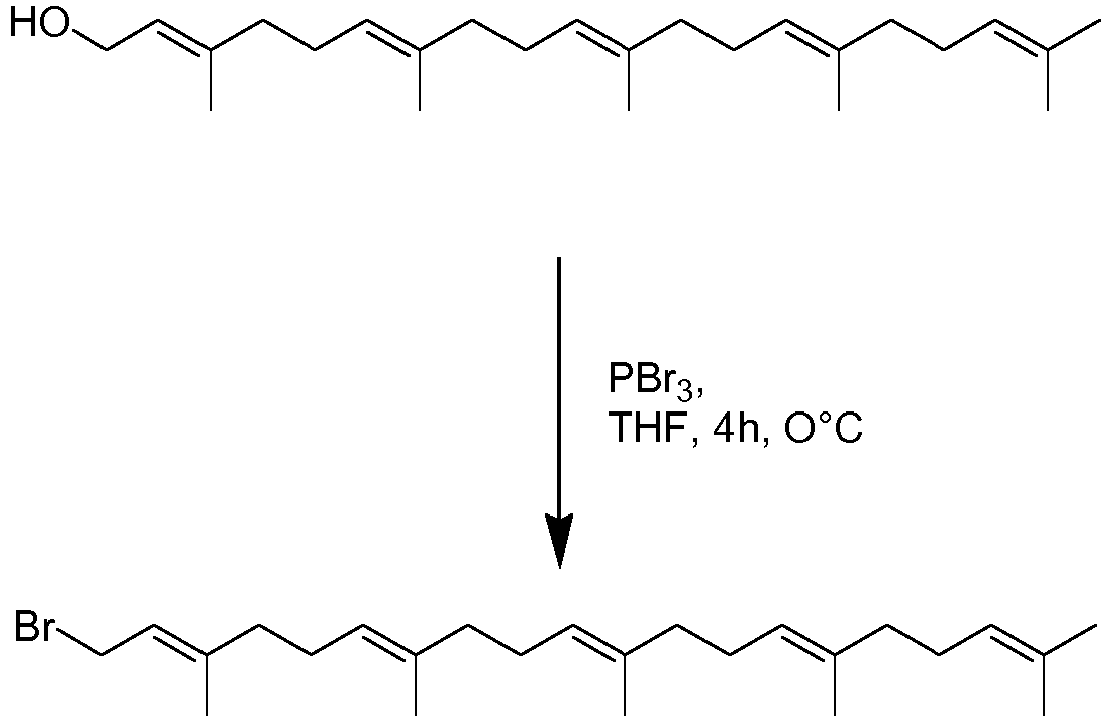
- 10.83 g (30.20 mmol) 3,7,11,15,19-pentamethyl-eicosa-2,6,10,14,18-pentaen-1-ol was dissolved in 60 ml of dry THF. At 0 °C, 1.5 ml (4.32 g, 15.96 mmol) PBr3 were added drop wise via septum and syringe and the clear, colourless solution was stirred at 0°C for 4 h. The reaction was quenched by addition of ice cold water. The layers were separated and the aqueous layer was extracted with ether. The combined organic extracts were washed with NaHCO3 and brine, dried over Na2SO4, filtered and concentrated in vacuo to give 1-bromo-3,7,11,15,19-pentamethyl-eicosa-2,6,10,14,18-pentaene as a colourless oil (10.89 g, 25.84 mmol, 86%). The crude product was used for the next step without further purification.
-

- 10.89 g (25.84 mmol) allylic bromide was dissolved in 200 ml of DMF and 21.30 g (129.75 mmol) benzene sulfinic acid sodium salt was added in one portion at room temperature. The suspension was stirred at room temperature for 18h over night. The mixture was poured into ice water. The layers were separated and the aqueous layer was extracted with EtOAc. The combined organic extracts were washed with ice water and ice cold brine, dried over Na2SO4, filtered and concentrated in vacuo by rotary evaporation at 40 °C. The residue was purified by dry flash. A gradient heptane : EtOAc (90 : 10) to heptane : EtOAc (70 :30) was used as eluent to afford 6.14 g (12.71 mmol, 50%) of pure (3,7,11,15,19-pentamethyl-eicosa-2,6,10,14,18-pentaene-1-sulfonyl)-benzene (as colourless oil and 2.92 g (6.05 mmol, 24%) of mixed fractions containing mostly (3,7,11,15,19-pentamethyl-eicosa-2,6,10,14,18-pentaene-1-sulfonyl)-benzene as colourless oil.
1H NMR (200 MHz, CDCl3) δ 7.86-7.81 (m, 2H), 7.60-7.45 (m, 3H), 5.20-5.04 (m, 5H), 3.77 (d, 3J=8.0 Hz, 2H), 2.05-1.87 (m, 16H), 1.65 (s, 3H), 1.56 (s, 12H), 1.27 (s, 3H); 13C NMR (50 MHz, CDCl3) δ 146.33, 138.60, 135.65, 134.94, 134.80, 133.42, 131.13, 128.85, 128.48, 124.32, 124.15, 124.03, 123.24, 124.37, 110.23, 56.01, 39.63, 31.80, 26.68, 26.57, 26.11, 25.62, 22.61, 17.60, 16.09, 15.93, 14.04. -

- 10.02 g (64.96 mmol) geraniol was dissolved in 120 ml of dry THF. At 0 °C, 3.1 ml (8.93 g, 32.98 mmol) PBr3 were added drop wise via septum and syringe and the clear, colorless solution was stirred at 0°C for 3 h. The reaction was quenched by addition of ice cold water. The layers were separated and the aqueous layer was extracted with ether. The combined organic extracts were washed with NaHCO3 and brine, dried over Na2SO4, filtered and concentrated in vacuo to give geranyl bromide as a colourless oil (13.59 g, 62.63 mmol, 96%). The crude product was used for the next step without further purification.
- 2-Bromo-1,4-dimethoxy-3-methyl naphthalene was prepared by a modification of a method described in the literature (Adams, R., Geissman, B. R., Baker, B. R., Teeter, H. M. JACS (1941) 61, 528.)

- 4.68 g (195 mmol) magnesium turnings were covered with dry THF and 0.5 ml (1.09 g, 5.80 mmol) 1,2-dibromo ethane was added via septum and syringe. The mixture stood for 30 min. 18.37 g (65.37 mmol) 2-bromo-1,4-dimethoxy-3-methyl naphthalene dissolved in 30 ml of dry THF was added drop wise to the magnesium turnings over 30 min. The reaction mixture was cooled with a water bath, when it started to reflux. After that, the mixture was stirred at 35°C for 1,5h in a water bath until TLC showed complete conversion. The Grignard solution was used for the next step.
-

- 13.59 g (62.63 mmol) geranyl bromide dissolved in 100 ml of dry THF was added to 0.91 g (1.297 mmol) PdCl2(PPh3)2. To this yellow suspension, Grignard solution was added portion wise at room temperature. The mixture was stirred over night for 18h. The reaction was quenched at room temperature by addition of NH4Cl, the layers were separated and the aqueous layer was extracted with Et2O. The combined organic extracts were dried over Na2SO4, filtered and concentrated in vacuo to give 23.44 g of a brown oil. The residue was dissolved in little CH2Cl2 and was filtered through a plug of SiO2 (50-60 g) to remove palladium residues. The plug was washed with CH2Cl2 until all product was washed out (checked by TLC). The combined fractions were concentrated in vacuo. The crude product 2-(3,7-dimethyl-octa-2,6-dienyl)-1,4-dimethoxy-3-methyl-naphtalene was used in the next step without further purification.
1H NMR (200 MHz, CDCl3) δ 8.07-8.03 (m, 2H), 7.47-7.42 (m, 2H), 5.13-5.07 (m, 2H), 3.88 (s, 3H), 3.86 (s, 3H), 3.56 (d, 3J=6.1 Hz, 2H), 2.37 (s, 3H), 2.03 (m, 4H), 1.82 (s, 3H), 1.63 (s, 3H), 1.56 (s, 3H); 13C NMR (50 MHz, CDCl3) δ 150.07, 149.71, 135.63, 131.37, 130.91, 127.46, 127.24, 126.93, 125.36, 125.23, 124.20, 122.90, 122.25, 122.08, 62.15, 61.28, 39.63, 26.53, 26.31, 25.65, 17.64, 16.32, 12.32 -

- 0.37 g (3.34 mmol) SeO2, 0.94 g (6.81 mmol) salicylic acid and 23 ml of t-BuOOH (70 wt% in water) were suspended in 85 ml of CH2Cl2. The suspension was stirred at room temperature for 40 min and then cooled to 0 °C with an ice bath. At 0 °C, 21.08 g (62.37 mmol) crude 2-(3,7-dimethyl-octa-2,6-dienyl)-1,4-dimethoxy-3-methyl-naphtalene dissolved in 45 ml of CH2Cl2 was added in one portion. After stirring at 0 °C for 5h the suspension was diluted with 150 ml of toluene and the solvent was removed in vacuo by rotary evaporation at 40 °C. The residue was taken up in 150 ml of CH2Cl2 and the red brown solution was washed with NaHCO3, dried over Na2SO4, filtered and concentrated in vacuo by rotary evaporation at 30 °C. The residue was dissolved in 140 ml of dry THF and 7 ml of MeOH, cooled to 0 °C with an ice bath and 2.44 g (64.50 mmol) NaBH4 was added portion wise. The mixture was stirred at 0 °C for 30 min and 50 ml of ice cold saturated NH4Cl was added portion wise at 0 °C to quench the reaction. The layers were separated and the aqueous layer was extracted with Et2O. The combined organic extracts were washed with brine, dried over Na2SO4, filtered and concentrated in vacuo by rotary evaporation at 30 °C to give a dark brown oil (21.48 g). The residue was purified by dry flash. A gradient heptane : EtOAc (80 : 20) to heptane : EtOAc (60 : 40) was used as eluent to afford 6.43 g (18.17 mmol, 28% over 3 steps from geraniol) of 8-(1,4-dimethoxy-3-methyl-naphtalen-2-yl)-2,6-dimethyl-octa-2,6-dien-1-ol as a oil.
1H NMR (200 MHz, CDCl3) δ 8.06-8.01 (m, 2H), 7.48-7.40 (m, 2H), 5.34-5.28 (m, 1H), 5.12-5.05 (m, 1H), 3.92 (m, 2H), 3.86 (s, 3H), 3.54 (d, 3J=5.9 Hz, 2H), 2.36 (s, 3H), 2.14-2.03 (m, 4H), 1.70 (s, 3H), 1.61 (s, 3H). -

- 6.45 g (18.22 mmol) of 8-(1,4-dimethoxy-3-methyl-naphtalen-2-yl)-2,6-dimethyl-octa-2,6-dien-1-ol was dissolved in 45 ml of dry THF. At 0 °C, 0.9 ml (2.59 g, 9.58 mmol) PBr3 was added drop wise via septum and syringe and the clear, colourless solution was stirred at 0°C for 3 h. The reaction was quenched by addition of ice cold water. The layers were separated and the aqueous layer was extracted with ether. The combined organic extracts were washed with NaHCO3 and brine, dried over Na2SO4, filtered and concentrated in vacuo to give 2-(8-bromo-3,7-dimethyl-octa-2,6-dienyl)-1,4-dimethoxy-3-methyl-naphtalene as a colorless oil (6.29 g, 15.08 mmol, 83%). The crude product was used for the next step without further purification.
-
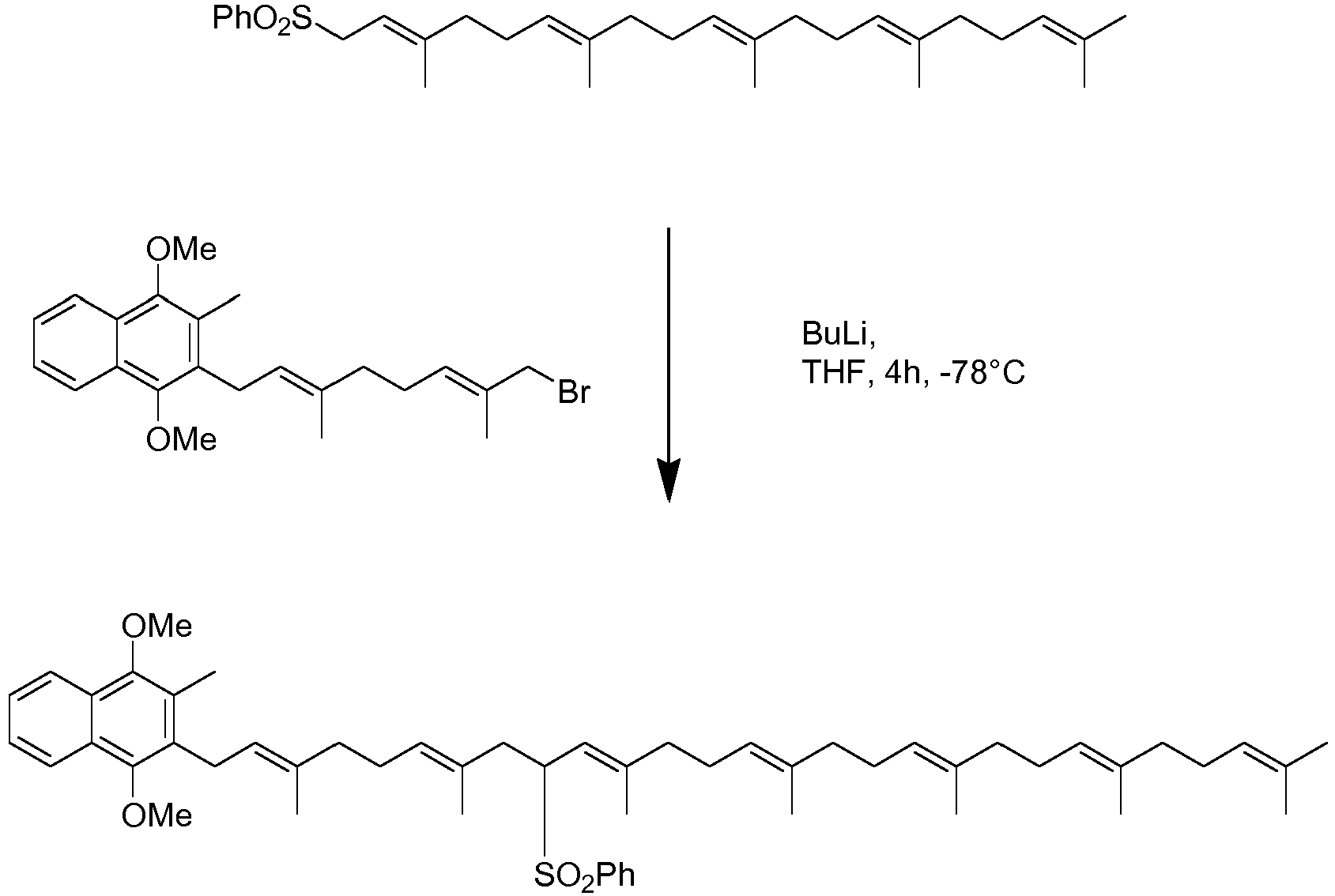
- 9.06 g (18.76 mmol) (3,7,11,15,19-pentamethyl-eicosa-2,6,10,14,18-pentaene-1-sulfonyl)-benzene were dissolved in 80 ml of dry THF and the solution was cooled to -78 °C with CO2 / MeOH. At -78 °C, 11.80 ml (18.88 mmol) BuLi (1.6 M solution in hexane) was added drop wise via septum and syringe over 10 min. The orange solution was stirred for 2.5 h at -78 °C. 6.07 g (14.56 mmol) 2-(8-bromo-3,7-dimethyl-octa-2,6-dienyl)-1,4-dimethoxy-3-methyl-naphtalene dissolved in 30 ml of dry THF was added via dropping funnel over 10 min. The brown reaction mixture was stirred at -78 °C for 1.5 h. At -78 °C, the reaction was quenched by addition of 50 ml of a Et2O/MeOH mixture (1:1 v/v). The mixture was allowed to reach room temperature and after that 100 ml of saturated NH4Cl solution was added. The layers were separated and the aqueous layer was extracted with Et2O. The combined organic extracts were washed with brine, dried over Na2SO4, filtered and concentrated in vacuo by rotary evaporation at 30 °C to give 16.21 g of 2-(9-benzenesulfonyl-3,7,11,15,19,23,27-heptamethyl-octacosa-2,6,10,14,18,22,26-heptaenyl)-1,4-dimethoxy-3-methyl-naphtalene as a brownish yellow oil, which was used in the next step without further purification.
-
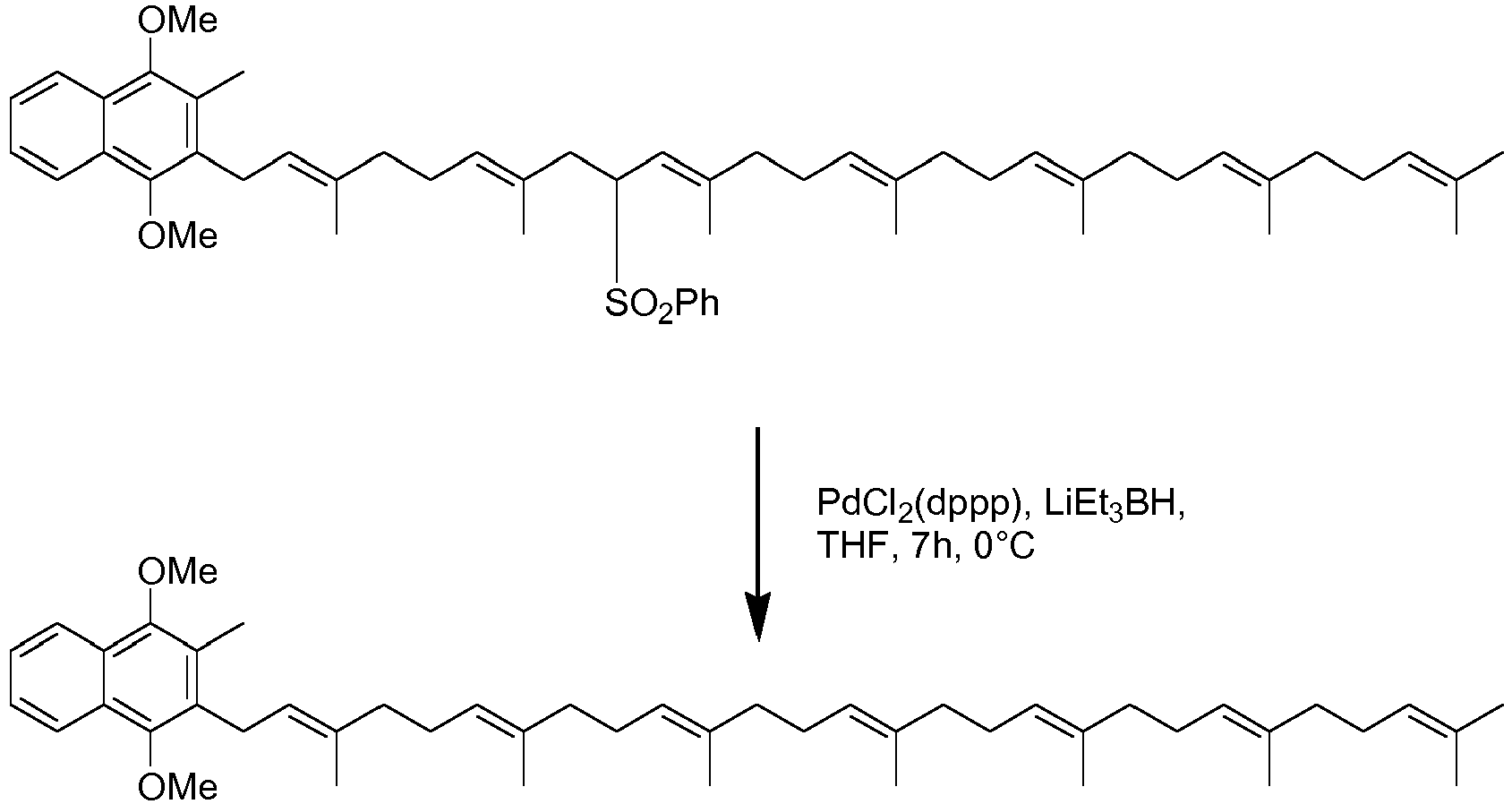
- 16.21 g 2-(9-benzenesulfonyl-3,7,11,15,19,23,27-heptamethyl-octacosa-2,6,10,14,18,22,26-heptaenyl)-1,4-dimethoxy-3-methyl-naphtalene mixture was dissolved in 120 ml of dry THF and 0.57 g (0.96 mmol) PdCl2(dppp) was added in one portion and the suspension was cooled to 0 °C with an ice bath. At 0 °C, 42.00 ml (42.00 mmol) LiEt3BH (1.0 M solution in THF) were added portion wise via septum and syringe over 20 min. The dark brown solution was stirred at 0 °C for 7 h. At 0 °C, the reaction was quenched by addition 100 ml of saturated NH4Cl solution. The layers were separated and the aqueous layer was extracted with Et2O. The combined organic extracts were washed with saturated NH4Cl solution, dried over Na2SO4, filtered and concentrated in vacuo by rotary evaporation at 30 °C to give 18.18 g of dark brown oil. It was purified by dry flash with CH2Cl2 as eluent to afford 11.01 g of yellow oil, which was used in the next step without further purification.
1H NMR (200 MHz, CDCl3) δ 8.09-8.01 (m, 2H), 7.49-7.41 (m, 2H), 5.11-5.08 (m, 7H), 3.88 (s, 3H), 3.86 (s, 3H), 3.57 (d, 3J=6.3 Hz, 2H) 2.38 (s, 3H), 2.05-1.85 (m, 24H), 1.83 (s, 3H), 1.68 (s, 3H), 1.60 (s, 12H), 1.57 (s, 6H); 13C NMR (50 MHz, CDCl3) δ 150.07, 149.71, 135.71, 135.08, 134.92, 134.86, 127.46, 127.23, 126.89, 125.35, 125.23, 124.40, 124.25, 124.16, 124.01, 122.80, 122.25, 122.08, 62.14, 61.27, 39.71, 26.75, 26.65, 26.54, 26.31, 25.66, 17.66, 16.39, 15.99, 12.37 -

- 2-(3,7,11,15,19,23,27-heptamethyl-octacosa-2,6,10,14,18,22,26-heptaenyl)-1,4-dimethoxy-3-methyl-naphtalene (8.50 g, 12.54 mmol) was suspended in 45 ml of acetonitrile, 45 ml of CH2Cl2 and 20 ml of H2O and the suspension was cooled to 0 °C with an ice bath. At 0 °C, an ice cold solution of 17.26 g (31.48 mmol) CAN in 32 ml of acetonitrile and 32 ml of H2O was added portion wise via dropping funnel over 20 min. The orange mixture was stirred at 0 °C for 40 min. and at room temperature for 16.5 h over night. The yellow mixture was poured into 100 ml ice water. The layers were separated and the aqueous layer was extracted with CH2Cl2. The combined organic extracts were washed with ice water, dried over Na2SO4, filtered and concentrated in vacuo by rotary evaporation at 40 °C to give 8.50 g of yellow oil. It was purified by dry flash. A gradient heptane : EtOAc (100 : 1) to heptane : EtOAc (95 : 5) was used as eluent to afford 4.93 g (7.61 mmol, 42% over 4 steps from 2-(8-bromo-3,7-dimethyl-octa-2,6-dienyl)-1,4-dimethoxy-3-methyl-naphtalene) of brownish yellow oil, which solidified in the fridge and was recrystallized from EtOAc and ethanol to give 3.5 g of MK7 as a bright yellow solid.
1H NMR (200 MHz, CDCl3) δ 8.07-8.00 (m, 2H), 7.69-7.63 (m, 2H), 5.08-4.97 (m, 7H), 3.35 (d, 3J=6.9 Hz, 2H) 2.16 (s, 3H), 2.05-1.81 (m, 24H), 1.77 (s, 3H), 1.65 (s, 3H), 1.57 (s, 12H), 1.54 (s, 6H); 13C NMR (50 MHz, CDCl3) δ 185.34, 184.40, 146.08, 143.27, 137.48, 135.15, 134.84, 133.25, 133.19, 132.13, 132.09, 131.15, 126.24, 126.13, 124.37, 124.23, 124.11, 123.80, 119.05, 39.68, 26.72, 26.65, 26.45, 25.96, 25.65, 17.63, 16.38, 15.97, 12.62 - The synthesis of allylic thioether from literature known compounds is outlined in Scheme A.


- 1.80 g (5.20 mmol) thioether was dissolved in 30 ml of dry THF. The solution was cooled to -78°C with a CO2/MeOH cooling bath and at -78°C; 3.30 ml (5.28 mmol) BuLi (1.6 M solution in hexane) was added drop wise via septum and syringe. The clear, yellow orange solution was stirred at -78°C for 2.5 h and then 1.20 g (4.32 mmol) allylic chloride dissolved in 10 ml of dry THF was added drop wise via septum and syringe at -78°C. The clear solution was stirred at -78°C for 1.5 h. At - 78°C, 10 ml of a MeOH/Et2O mixture (1:1 v/v) was added and the mixture was allowed to reach room temperature and then 35 ml of sat. NH4Cl solution was added. The layers were separated and the aqueous layer was extracted with diethyl ether (3 x 40 ml). The organic layers were dried over Na2SO4, filtered and concentrated in vacuo by rotary evaporation at 30°C to give 3.15 g of yellow oil. The crude product was further purified by flash column chromatography on SiO2 using a mixture of heptane:EtOAc (9/1 v/v) as eluent to give a yellow oil (2.09 g, 3.56 mmol, 83%).
1H NMR (200 MHz, CDCl3) δ 7.42-7.21 (m, 10H), 5.39-5.34 (m, 2H), 5.16-5.14 (m, 1H), 5.01-4.96 (m, 1H), 4.57 (m, 1H), 4.49 (s, 2H), 4.11-3.77 (m, 6H), 3.59-3.41 (m, 1H), 2.35-1.70 (m, 12H), 1.63 (s, 6H), 1.58 (m, 3H), 1.34 (s, 3H) -
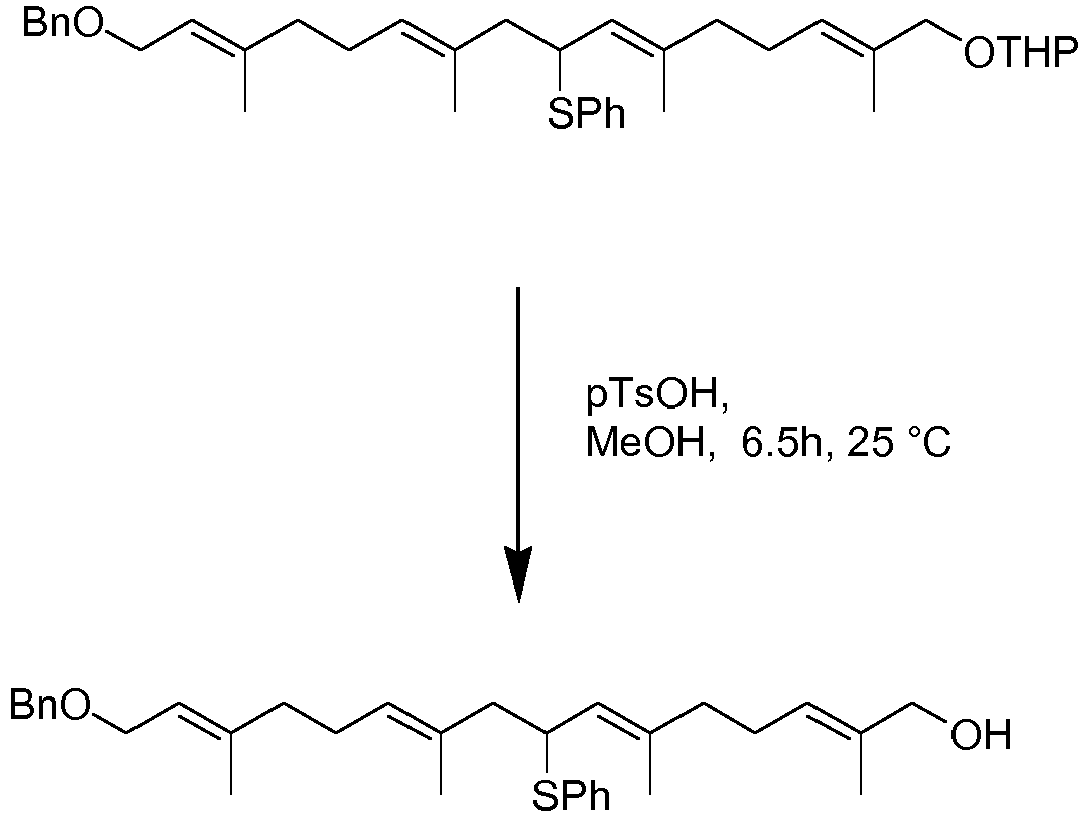
- 2.09 g (3.55 mmol) THP ether was dissolved in 25 ml of dry MeOH. 0.21 g (1.10 mmol) pTsOH monohydrate was added in one portion. The clear mixture was stirred at room temperature for 6.5 h. After that, the reaction mixture was concentrated in vacuo by rotary evaporation at 40°C and the residue was dissolved in 50 ml of CH2Cl2 and washed with 50 ml of NaHCO3 solution. The aqueous layer was extracted with CH2Cl2 (50 ml). The combined organic extracts washed with brine (50 ml), dried over Na2SO4, filtered and concentrated in vacuo by rotary evaporation at 30°C to give 1.81 g of yellow oil. The crude product was further purified by flash column chromatography on SiO2 using a mixture of heptane:EtOAc (60/40 v/v) as eluent to give a yellow oil (1.50 g, 2.98 mmol, 84%).
1H NMR (200 MHz, CDCl3) δ 7.40-7.18 (m, 10H), 5.37-5.28 (m, 2H), 5.14-5.13 (m, 1H), 5.00-4.94 (m, 1H), 4.48 (s, 2H), 4.06-3.92 (m, 5H), 2.34-1.90 (m, 10H), 1.62 (s, 6H), 1.56 (m, 3H), 1.36 (s, 3H) -

- 0.74 g (5.54 mmol) NCS were suspended in 20 ml of dry CH2Cl2. At 0°C, 0.55 ml (0.47 g, 7.41 mmol) DMS was added neat via syringe. The colourless suspension was stirred for 15 min. and then 1.5 g (2.98 mmol) allylic alcohol was added. The mixture was stirred at 0°C for 4 h. The mixture was poured into 50 ml of ice cold brine. The layers were separated and the aqueous layer was extracted with heptane (2 x 50 ml). The combined organic extracts were diluted with 100 ml of heptane washed with brine (2 x 100 ml), dried over Na2SO4, filtered and concentrated in vacuo by rotary evaporation at 40 °C to give the product as a bright yellow oil (1.51 g, 2.89 mmol, 97%). The crude product was used in the next step without further purification.
1H NMR (200 MHz, CDCl3) δ 7.76-7.20 (m, 10H), 5.42-5.35 (m, 2H), 5.18-5.10 (m, 1H), 5.00-4.95 (m, 1H), 4.48 (s, 2H), 4.02-3.94 (m, 5H), 2.55-1.95 (m, 10H), 1.76-1.57 (m, 12H).
CDCl3 solvent peak: δ 7.24. -

- 1.18 g (3.76 mmol) farnesol thiophenylether was dissolved in 20 ml of dry THF. The solution was cooled to -78°C with a CO2/MeOH cooling bath and at -78°C; 2.30 ml (3.68 mmol) BuLi (1.6 M solution in hexane) was added drop wise via septum and syringe. The clear, yellow orange solution was stirred at -78°C for 2.5 h and then 1.51 g (2.89 mmol) allylic chloride dissolved in 7 ml of dry THF was added drop wise via septum and syringe at -78°C. The clear solution was stirred at - 78°C for 1.5 h. At -78°C, 18 ml of a MeOH/Et2O mixture (1:1 v/v) was added and the mixture was allowed to reach room temperature and then 30 ml of sat. NH4Cl solution was added. The layers were separated and the aqueous layer was extracted with diethyl ether (3 x 30 ml). The organic layers were dried over Na2SO4, filtered and concentrated in vacuo by rotary evaporation at 30°C to give 2.64 g of yellow oil. The crude product was further purified by flash column chromatography on SiO2 using a mixture of heptane:EtOAc (9/1 v/v) as eluent to give a yellow oil (1.55 g, 1.93 mmol, 67%).
1H NMR (200 MHz, CDCl3) δ 7.55-7.20 (m, 15H), 5.42-5.35 (m, 1H), 5.14-4.95 (m, 6H), 4.48 (s, 2H), 4.02-3.92 (m, 4H), 2.44-1.76 (m, 20H), 1.71-1.52 (m, 18H), 1.34-1.25 (m, 6H).
CDCl3 solvent peak: δ 7.24. -
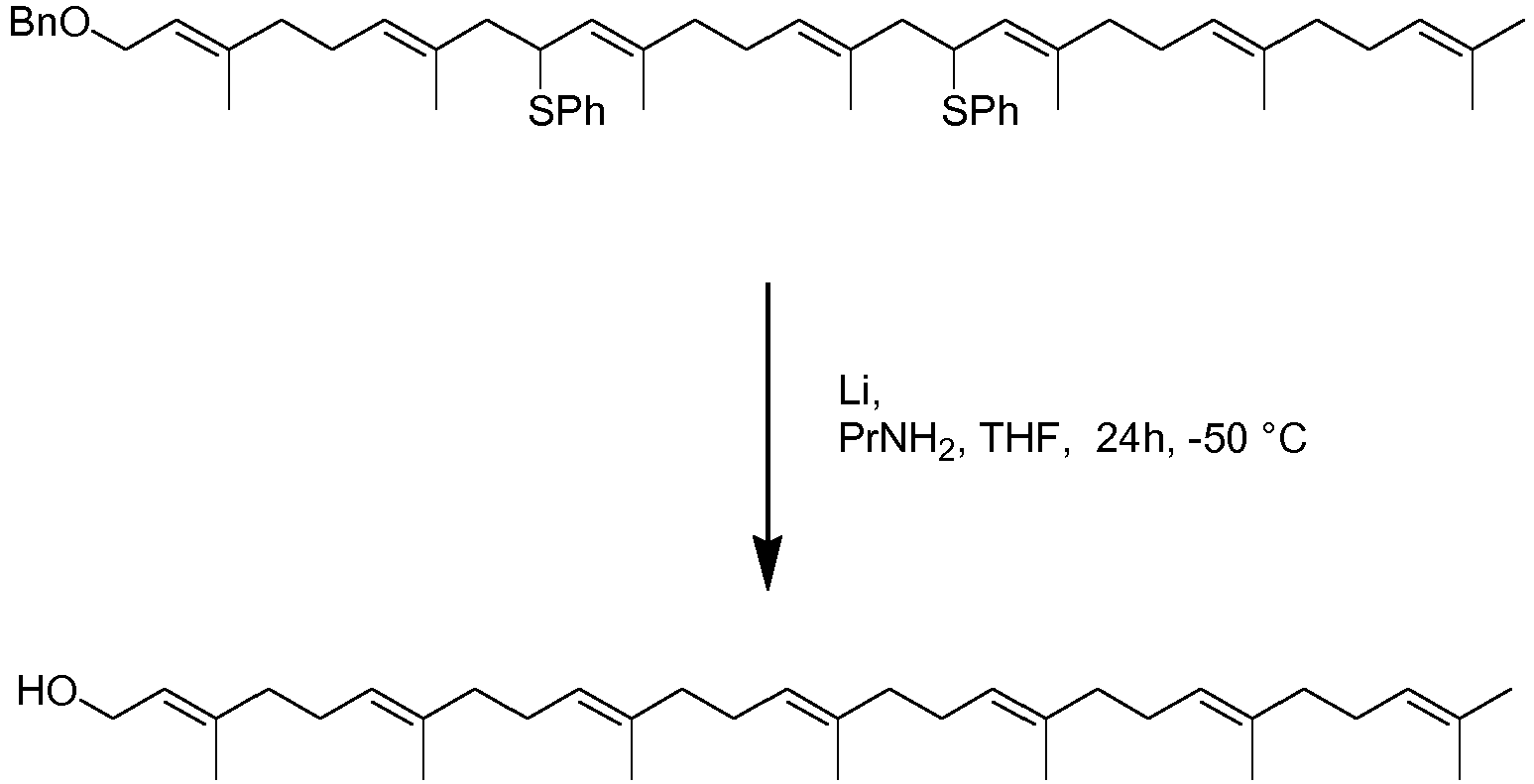
- At -50°C, 0.16 g of Li-wire was added to 10 ml of propylamine and 1.57 g (1.96 mmol) dissolved in 16 ml of propylamine was added portion wise. The mixture was stirred at -50°C for 24 h. Excess Li was removed and the blue color was dissipated by addition of 3-hexyne. To the resulting yellowish suspension, MeOH was added at -50°C until a colourless suspension was obtained. The resulting salts were dissolved in water. The volatiles were removed by rotary evaporation and the residue was extracted with diethyl ether (3 x 30 ml). The combined organic extracts were dried over Na2SO4, filtered and concentrated in vacuo by rotary evaporation at 30°C.The crude product was further purified by flash column chromatography on SiO2 using a mixture of heptane:EtOAc (9/1 v/v) as eluent.
in the presence of a Ni, Cu or Pd catalyst; and
(v) converting the diprotected naphthoquinone into a naphthoquinone.
Claims (3)
- The compound

- A process for the preparation of MK-7 comprising converting a compound

into MK-7:
- A process as claimed in claim 2 wherein conversion is achieved using cerium ammonium nitrate.
Priority Applications (1)
| Application Number | Priority Date | Filing Date | Title |
|---|---|---|---|
| PL15193746T PL3018116T3 (en) | 2008-09-24 | 2009-09-24 | Vitamin k2 intermediates |
Applications Claiming Priority (3)
| Application Number | Priority Date | Filing Date | Title |
|---|---|---|---|
| GBGB0817528.3A GB0817528D0 (en) | 2008-09-24 | 2008-09-24 | Process |
| EP09785160.4A EP2346806B1 (en) | 2008-09-24 | 2009-09-24 | Process for the preparation of vitamin k2 |
| PCT/GB2009/002282 WO2010035000A1 (en) | 2008-09-24 | 2009-09-24 | Process for the preparation of vitamin k2 |
Related Parent Applications (2)
| Application Number | Title | Priority Date | Filing Date |
|---|---|---|---|
| EP09785160.4A Division-Into EP2346806B1 (en) | 2008-09-24 | 2009-09-24 | Process for the preparation of vitamin k2 |
| EP09785160.4A Division EP2346806B1 (en) | 2008-09-24 | 2009-09-24 | Process for the preparation of vitamin k2 |
Publications (2)
| Publication Number | Publication Date |
|---|---|
| EP3018116A1 EP3018116A1 (en) | 2016-05-11 |
| EP3018116B1 true EP3018116B1 (en) | 2020-10-28 |
Family
ID=39952163
Family Applications (2)
| Application Number | Title | Priority Date | Filing Date |
|---|---|---|---|
| EP15193746.3A Revoked EP3018116B1 (en) | 2008-09-24 | 2009-09-24 | Vitamin k2 intermediates |
| EP09785160.4A Active EP2346806B1 (en) | 2008-09-24 | 2009-09-24 | Process for the preparation of vitamin k2 |
Family Applications After (1)
| Application Number | Title | Priority Date | Filing Date |
|---|---|---|---|
| EP09785160.4A Active EP2346806B1 (en) | 2008-09-24 | 2009-09-24 | Process for the preparation of vitamin k2 |
Country Status (7)
| Country | Link |
|---|---|
| US (3) | US9012693B2 (en) |
| EP (2) | EP3018116B1 (en) |
| CN (2) | CN102216248A (en) |
| DK (2) | DK2346806T3 (en) |
| GB (3) | GB0817528D0 (en) |
| PL (2) | PL2346806T3 (en) |
| WO (2) | WO2010034999A1 (en) |
Families Citing this family (18)
| Publication number | Priority date | Publication date | Assignee | Title |
|---|---|---|---|---|
| GB0817528D0 (en) * | 2008-09-24 | 2008-10-29 | Syntavit As | Process |
| GB201004876D0 (en) * | 2010-03-23 | 2010-05-05 | Syntavit As | Process for the preparation of vitamin K2 |
| CN102485709B (en) * | 2010-12-01 | 2014-10-22 | 天津康鸿医药科技发展有限公司 | Preparation method of vitamin K2 compound |
| GB201203705D0 (en) | 2012-03-02 | 2012-04-18 | Kappa Bioscience As | Prodrugs |
| PL401195A1 (en) * | 2012-10-12 | 2014-04-14 | Instytut Farmaceutyczny | Process for the preparation of vitamin K2 in the form of MK-7 |
| EP2868658B1 (en) | 2013-11-01 | 2018-05-02 | Dilip Mehta | Method of preparation of stereospecific quinone derivatives |
| ES2863048T3 (en) | 2014-05-05 | 2021-10-08 | Basf Se | Fat-soluble vitamin formulation |
| CN104058946B (en) * | 2014-06-30 | 2017-02-08 | 重庆第二师范学院 | Emodin transition metal complex with anti-tumor activity, preparation method of emodin transition metal complex and application of emodin transition metal complex |
| PL424875A1 (en) * | 2018-03-12 | 2019-09-23 | Vitasynth Spółka Z Ograniczoną Odpowiedzialnością | Method for synthesis of vitamin K2 |
| WO2019237054A1 (en) | 2018-06-08 | 2019-12-12 | Epizon Pharma, Inc. | Methods and compositions for preventing or treating calciphylaxis |
| MX2020013302A (en) | 2018-06-08 | 2021-05-12 | Epizon Pharma Inc | METHODS AND COMPOSITIONS TO PREVENT OR TREAT TISSUE CALCIFICATION. |
| US10822295B2 (en) | 2018-09-12 | 2020-11-03 | Epizon Pharma, Inc. | Menaquinol compositions and methods of treatment |
| PL243187B1 (en) * | 2020-07-16 | 2023-07-10 | Vitasynth Spolka Z Ograniczona Odpowiedzialnoscia | Method and intermediates for preparation of menaquinone MK-7 |
| GB202103137D0 (en) | 2021-03-05 | 2021-04-21 | Kappa Bioscience As | Process for the preparation of vitamin K2 and novel intermediates |
| WO2023031841A1 (en) * | 2021-09-03 | 2023-03-09 | Synergia Life Sciences Pvt. Ltd. | A process for the stereospecific synthesis of vitamin k2 and its intermediates |
| US11912654B2 (en) | 2021-09-03 | 2024-02-27 | Synergia Life Sciences Pvt. Ltd. | Process for stereospecific synthesis of vitamin K2 and its novel intermediates |
| WO2025074315A2 (en) | 2023-10-05 | 2025-04-10 | Synergia Life Sciences Pvt. Ltd. | An improved process for the synthesis of all (e)-hepta prenol (c35-oh) |
| CN118026833A (en) * | 2023-12-30 | 2024-05-14 | 江苏东欣医疗科技有限公司 | Vitamin K2 preparation method and solution PH value adjusting equipment |
Citations (7)
| Publication number | Priority date | Publication date | Assignee | Title |
|---|---|---|---|---|
| US4089873A (en) | 1975-01-13 | 1978-05-16 | The Regents Of The University Of California | Preparation of menaquinones |
| US4199531A (en) | 1976-10-19 | 1980-04-22 | Takeda Chemical Industries, Ltd. | Intermediates for the production of quinones |
| US4270003A (en) | 1978-08-02 | 1981-05-26 | Kuraray Co., Ltd. | Hydroquinone derivatives and preparation thereof |
| JPS5795932A (en) | 1980-12-05 | 1982-06-15 | Kuraray Co Ltd | Preparation of hydroquinone derivative |
| US4388312A (en) | 1979-09-12 | 1983-06-14 | Takeda Chemical Industries, Ltd. | Quinone derivatives, their production and use |
| US5229385A (en) | 1986-01-30 | 1993-07-20 | Takeda Chemical Industries, Ltd. | Quinone derivatives, their production and use |
| WO2014058330A2 (en) | 2012-10-12 | 2014-04-17 | Instytut Farmaceutyczny | Process for preparation of mk-7 type of vitamin k2 |
Family Cites Families (13)
| Publication number | Priority date | Publication date | Assignee | Title |
|---|---|---|---|---|
| US4159993A (en) * | 1975-04-07 | 1979-07-03 | The Regents Of The University Of California | 3-Metallo substituted naphthalenes |
| US4234746A (en) * | 1975-01-13 | 1980-11-18 | The Regents Of The University Of California | Metallo-substituted naphthalene |
| FR2508451A1 (en) * | 1981-06-26 | 1982-12-31 | Interox | PROCESS FOR THE PRODUCTION OF EPOXYDES |
| JPH1132787A (en) * | 1997-07-23 | 1999-02-09 | Kikkoman Corp | Method for producing menaquinone-7-containing substance and food and drink containing same |
| JP2001136959A (en) * | 1999-11-17 | 2001-05-22 | Hiroyuki Sumi | Culture product containing bacillus subtilis cell and/or product thereof, water-soluble vitamin k derivative originated from the same, medicine, food and feed containing the same and method for producing the same |
| JP2001204400A (en) * | 2000-01-19 | 2001-07-31 | Hiroyuki Sumi | Method for producing menaquinone-7 |
| JP3431573B2 (en) * | 2000-05-26 | 2003-07-28 | 三和酒類株式会社 | Method for producing menaquinone-7 |
| JP3783915B2 (en) * | 2000-06-15 | 2006-06-07 | 洋行 須見 | Physiologically active substance derived from Bacillus natto |
| JP2002058468A (en) * | 2000-08-18 | 2002-02-26 | Nariwa Ozeki Shuzo Kk | Vitamin k-containing liquors and method for producing the same |
| ATE434666T1 (en) * | 2005-12-29 | 2009-07-15 | Gnosis Spa | METHOD FOR PRODUCING VITAMIN K2 |
| US20080220094A1 (en) * | 2006-11-01 | 2008-09-11 | Wyeth | Compositions and methods for the treatment and/or prevention of osteoporosis |
| CN101029003A (en) * | 2007-04-13 | 2007-09-05 | 北京化工大学 | Method for synthesizing vitamin k solanine |
| GB0817528D0 (en) | 2008-09-24 | 2008-10-29 | Syntavit As | Process |
-
2008
- 2008-09-24 GB GBGB0817528.3A patent/GB0817528D0/en not_active Ceased
-
2009
- 2009-09-24 DK DK09785160.4T patent/DK2346806T3/en active
- 2009-09-24 WO PCT/GB2009/002281 patent/WO2010034999A1/en not_active Ceased
- 2009-09-24 GB GB0916849A patent/GB2463981B/en active Active
- 2009-09-24 CN CN2009801381116A patent/CN102216248A/en active Pending
- 2009-09-24 GB GB0916848A patent/GB2464797A/en not_active Withdrawn
- 2009-09-24 EP EP15193746.3A patent/EP3018116B1/en not_active Revoked
- 2009-09-24 EP EP09785160.4A patent/EP2346806B1/en active Active
- 2009-09-24 WO PCT/GB2009/002282 patent/WO2010035000A1/en not_active Ceased
- 2009-09-24 PL PL09785160T patent/PL2346806T3/en unknown
- 2009-09-24 CN CN201410755904.5A patent/CN104725205A/en active Pending
- 2009-09-24 PL PL15193746T patent/PL3018116T3/en unknown
- 2009-09-24 DK DK15193746.3T patent/DK3018116T3/en active
- 2009-09-24 US US13/119,585 patent/US9012693B2/en active Active
-
2015
- 2015-04-08 US US14/681,717 patent/US20150210620A1/en not_active Abandoned
-
2017
- 2017-06-20 US US15/627,627 patent/US10472314B2/en active Active
Patent Citations (7)
| Publication number | Priority date | Publication date | Assignee | Title |
|---|---|---|---|---|
| US4089873A (en) | 1975-01-13 | 1978-05-16 | The Regents Of The University Of California | Preparation of menaquinones |
| US4199531A (en) | 1976-10-19 | 1980-04-22 | Takeda Chemical Industries, Ltd. | Intermediates for the production of quinones |
| US4270003A (en) | 1978-08-02 | 1981-05-26 | Kuraray Co., Ltd. | Hydroquinone derivatives and preparation thereof |
| US4388312A (en) | 1979-09-12 | 1983-06-14 | Takeda Chemical Industries, Ltd. | Quinone derivatives, their production and use |
| JPS5795932A (en) | 1980-12-05 | 1982-06-15 | Kuraray Co Ltd | Preparation of hydroquinone derivative |
| US5229385A (en) | 1986-01-30 | 1993-07-20 | Takeda Chemical Industries, Ltd. | Quinone derivatives, their production and use |
| WO2014058330A2 (en) | 2012-10-12 | 2014-04-17 | Instytut Farmaceutyczny | Process for preparation of mk-7 type of vitamin k2 |
Non-Patent Citations (10)
| Title |
|---|
| ALEXANDER LINWOOD SIMMONS: "Quinone Formation via Ceric Ammonium Nitrate Oxidations of 2-Alkyl-1,4-dialkoxybenzenes", THESIS EAST CAROLINA UNIVERSITY, 1 April 2016 (2016-04-01), pages 1 - 106, XP055933883, ISBN: 978-1-339-98714-9 |
| B. C. BRINDABAN ET AL.: "Dealkylation of ethers. A review", ORGANIC PREPARATION AND PROCEDURES INTERNATIONAL, vol. 28, no. 4, 1996, pages 387, XP009515416, DOI: 10.1080/00304949609356549 |
| J.-H. MIN ET AL.: "The Friedel-Crafts Allylation of a Prenyl Group Stabilized by a Sulfone Moiety: Expeditious Syntheses of Ubiquinones and Menaquinones", J. ORG. CHEM., 2003, pages 7925 - 7927, XP002342639, DOI: 10.1021/jo0350155 |
| JACOB ET AL.: "A Convenient Synthesis of Quinones from Hydroquinone Dimethyl Ethers, Oxidative Demethylation with Ceric Ammonium Nitrate", J. ORG. CHEM., vol. 41, no. 22, 1 January 1976 (1976-01-01), pages 3627 - 3629, XP055933648 |
| JARRAHPOUR ET AL.: "Synthesis of Novel N-(4-Ethoxyphenyl) Azetidin-2-ones and Their Oxidative N-Deprotection by Ceric Ammonium Nitrate", MOLECULES, vol. 12, no. 10, 1 January 2007 (2007-01-01), pages 2364 - 2379, XP055933601, DOI: 10.3390/12102364 |
| O. ISLER ET AL.: "94. Synthese und Isolierung von Vitamin K2 und isoprenologen Verbindungen", H ELVETICA CHIMICA ACTA., 1958, pages 786 - 807, XP008161462, DOI: 10.1002/hlca.660410323 |
| RANU ET AL.: "Dealkylation of Ethers. A Review", ORGANIC PREPARATIONS AND PROCEDURES INTERNATIONAL, vol. 28, 1996, pages 371 - 409, XP009515416, DOI: 10.1080/00304949609356549 |
| SUHARA ET AL.: "Method for the determination of vitamin K homologues in human plasma using high-performance liquid chromatography-tandem mass spectrometry", ANALYTICAL CHEMISTRY, vol. 77, 2005, pages 757 - 763, XP055441579, DOI: 10.1021/ac0489667 |
| SYPER ET AL.: "Synthesis of ubiquinone and menaquinone analogues by oxidative demethylation of alkenylhydroquinone ethers with argentic oxide or ceric ammonium nitrat", TETRAHEDRON, vol. 36, no. 1, 1 January 1980 (1980-01-01), AMSTERDAM, NL , pages 123 - 129, XP028087074, ISSN: 0040-4020, DOI: 10.1016/0040-4020(80)85034-4 |
| Y. MASAKI ET AL.: "Synthetic Studies on Isoprenoidquinones. II. Syntheses of Ubiquinone-10, Phylloquinone, and Menaquinone-4 by a Chain-Extending Method Utilizing Terminally Functionalized Isoprenoidhydroquinones", CHEM. PHARM. BULL, 1984, pages 3959 - 3967, XP008057512 |
Also Published As
| Publication number | Publication date |
|---|---|
| US10472314B2 (en) | 2019-11-12 |
| EP2346806A1 (en) | 2011-07-27 |
| GB2464797A (en) | 2010-05-05 |
| GB2463981B (en) | 2011-05-25 |
| EP2346806B1 (en) | 2016-01-06 |
| GB2463981A (en) | 2010-04-07 |
| US20110207967A1 (en) | 2011-08-25 |
| US20170283354A1 (en) | 2017-10-05 |
| GB0916848D0 (en) | 2009-11-04 |
| EP3018116A1 (en) | 2016-05-11 |
| US20150210620A1 (en) | 2015-07-30 |
| DK3018116T3 (en) | 2021-01-25 |
| CN102216248A (en) | 2011-10-12 |
| PL3018116T3 (en) | 2021-06-28 |
| DK2346806T3 (en) | 2016-02-08 |
| WO2010035000A1 (en) | 2010-04-01 |
| WO2010035000A8 (en) | 2011-04-14 |
| WO2010034999A1 (en) | 2010-04-01 |
| GB0916849D0 (en) | 2009-11-04 |
| PL2346806T3 (en) | 2016-06-30 |
| CN104725205A (en) | 2015-06-24 |
| GB0817528D0 (en) | 2008-10-29 |
| US9012693B2 (en) | 2015-04-21 |
Similar Documents
| Publication | Publication Date | Title |
|---|---|---|
| EP3018116B1 (en) | Vitamin k2 intermediates | |
| WO2011117324A2 (en) | Process for the preparation of vitamin k2 | |
| Snyder et al. | Synthesis of menaquinones | |
| EP2917171B1 (en) | Process for preparation of mk-7 type of vitamin k2 | |
| CA2026671C (en) | 24-homo vitamin d derivatives, process for their production and pharmaceutical preparations obtained therefrom | |
| CN107406375A (en) | The method for preparing beta-unsaturated ketone compound | |
| NZ206134A (en) | Polyene derivatives and pharmaceutical compositions | |
| JPS646189B2 (en) | ||
| KR100514494B1 (en) | Synthetic method of the para-hydroquinone compound containing allylic sulfone moiety that can be efficiently utilized for the preparation of coenzyme Q and vitamin K | |
| WO2021071372A1 (en) | Process of vitamin k2 derivatives preparation | |
| JP2003327574A (en) | Method for producing shogools and intermediate for synthesis | |
| EP4301721A1 (en) | Process for the preparation of vitamin k2 and novel intermediates | |
| KR100669167B1 (en) | Process for the preparation of coenzyme Qn and intermediates thereof | |
| WO2019016315A1 (en) | Process of production of 3,7-dimethyl-9-(2,6,6-trimethyl-1-cyclohexen-1-yl)-nona-2z,7e-dien-4-yne-1,6-diol | |
| CN101243031A (en) | Process for the preparation of ubihydroquinone and ubiquinone | |
| KR100570279B1 (en) | Intermediates of coenzyme Qn and methods for preparing the intermediate | |
| JPH0254338B2 (en) | ||
| KR20050071927A (en) | Carotinoid intermediate compound, preparing method thereof, and method for preparing carotinoid compound, astaxanthin and astacene using the same | |
| CN102131795A (en) | Improved synthesis of hexahydrodibenzopyranones |
Legal Events
| Date | Code | Title | Description |
|---|---|---|---|
| PUAI | Public reference made under article 153(3) epc to a published international application that has entered the european phase |
Free format text: ORIGINAL CODE: 0009012 |
|
| AC | Divisional application: reference to earlier application |
Ref document number: 2346806 Country of ref document: EP Kind code of ref document: P |
|
| AK | Designated contracting states |
Kind code of ref document: A1 Designated state(s): AT BE BG CH CY CZ DE DK EE ES FI FR GB GR HR HU IE IS IT LI LT LU LV MC MK MT NL NO PL PT RO SE SI SK SM TR |
|
| 17P | Request for examination filed |
Effective date: 20160708 |
|
| RBV | Designated contracting states (corrected) |
Designated state(s): AT BE BG CH CY CZ DE DK EE ES FI FR GB GR HR HU IE IS IT LI LT LU LV MC MK MT NL NO PL PT RO SE SI SK SM TR |
|
| STAA | Information on the status of an ep patent application or granted ep patent |
Free format text: STATUS: EXAMINATION IS IN PROGRESS |
|
| 17Q | First examination report despatched |
Effective date: 20170725 |
|
| TPAC | Observations filed by third parties |
Free format text: ORIGINAL CODE: EPIDOSNTIPA |
|
| TPAC | Observations filed by third parties |
Free format text: ORIGINAL CODE: EPIDOSNTIPA |
|
| TPAC | Observations filed by third parties |
Free format text: ORIGINAL CODE: EPIDOSNTIPA |
|
| TPAC | Observations filed by third parties |
Free format text: ORIGINAL CODE: EPIDOSNTIPA |
|
| TPAC | Observations filed by third parties |
Free format text: ORIGINAL CODE: EPIDOSNTIPA |
|
| GRAP | Despatch of communication of intention to grant a patent |
Free format text: ORIGINAL CODE: EPIDOSNIGR1 |
|
| STAA | Information on the status of an ep patent application or granted ep patent |
Free format text: STATUS: GRANT OF PATENT IS INTENDED |
|
| INTG | Intention to grant announced |
Effective date: 20200525 |
|
| GRAS | Grant fee paid |
Free format text: ORIGINAL CODE: EPIDOSNIGR3 |
|
| GRAA | (expected) grant |
Free format text: ORIGINAL CODE: 0009210 |
|
| STAA | Information on the status of an ep patent application or granted ep patent |
Free format text: STATUS: THE PATENT HAS BEEN GRANTED |
|
| AC | Divisional application: reference to earlier application |
Ref document number: 2346806 Country of ref document: EP Kind code of ref document: P |
|
| AK | Designated contracting states |
Kind code of ref document: B1 Designated state(s): AT BE BG CH CY CZ DE DK EE ES FI FR GB GR HR HU IE IS IT LI LT LU LV MC MK MT NL NO PL PT RO SE SI SK SM TR |
|
| REG | Reference to a national code |
Ref country code: GB Ref legal event code: FG4D |
|
| REG | Reference to a national code |
Ref country code: CH Ref legal event code: EP |
|
| REG | Reference to a national code |
Ref country code: AT Ref legal event code: REF Ref document number: 1328065 Country of ref document: AT Kind code of ref document: T Effective date: 20201115 |
|
| REG | Reference to a national code |
Ref country code: DE Ref legal event code: R096 Ref document number: 602009062991 Country of ref document: DE |
|
| REG | Reference to a national code |
Ref country code: IE Ref legal event code: FG4D |
|
| REG | Reference to a national code |
Ref country code: DK Ref legal event code: T3 Effective date: 20210122 |
|
| REG | Reference to a national code |
Ref country code: SE Ref legal event code: TRGR |
|
| REG | Reference to a national code |
Ref country code: NL Ref legal event code: FP |
|
| REG | Reference to a national code |
Ref country code: AT Ref legal event code: MK05 Ref document number: 1328065 Country of ref document: AT Kind code of ref document: T Effective date: 20201028 |
|
| REG | Reference to a national code |
Ref country code: NO Ref legal event code: T2 Effective date: 20201028 |
|
| PG25 | Lapsed in a contracting state [announced via postgrant information from national office to epo] |
Ref country code: GR Free format text: LAPSE BECAUSE OF FAILURE TO SUBMIT A TRANSLATION OF THE DESCRIPTION OR TO PAY THE FEE WITHIN THE PRESCRIBED TIME-LIMIT Effective date: 20210129 Ref country code: FI Free format text: LAPSE BECAUSE OF FAILURE TO SUBMIT A TRANSLATION OF THE DESCRIPTION OR TO PAY THE FEE WITHIN THE PRESCRIBED TIME-LIMIT Effective date: 20201028 Ref country code: PT Free format text: LAPSE BECAUSE OF FAILURE TO SUBMIT A TRANSLATION OF THE DESCRIPTION OR TO PAY THE FEE WITHIN THE PRESCRIBED TIME-LIMIT Effective date: 20210301 |
|
| REG | Reference to a national code |
Ref country code: LT Ref legal event code: MG4D |
|
| PG25 | Lapsed in a contracting state [announced via postgrant information from national office to epo] |
Ref country code: LV Free format text: LAPSE BECAUSE OF FAILURE TO SUBMIT A TRANSLATION OF THE DESCRIPTION OR TO PAY THE FEE WITHIN THE PRESCRIBED TIME-LIMIT Effective date: 20201028 Ref country code: IS Free format text: LAPSE BECAUSE OF FAILURE TO SUBMIT A TRANSLATION OF THE DESCRIPTION OR TO PAY THE FEE WITHIN THE PRESCRIBED TIME-LIMIT Effective date: 20210228 Ref country code: ES Free format text: LAPSE BECAUSE OF FAILURE TO SUBMIT A TRANSLATION OF THE DESCRIPTION OR TO PAY THE FEE WITHIN THE PRESCRIBED TIME-LIMIT Effective date: 20201028 Ref country code: AT Free format text: LAPSE BECAUSE OF FAILURE TO SUBMIT A TRANSLATION OF THE DESCRIPTION OR TO PAY THE FEE WITHIN THE PRESCRIBED TIME-LIMIT Effective date: 20201028 Ref country code: BG Free format text: LAPSE BECAUSE OF FAILURE TO SUBMIT A TRANSLATION OF THE DESCRIPTION OR TO PAY THE FEE WITHIN THE PRESCRIBED TIME-LIMIT Effective date: 20210128 |
|
| PG25 | Lapsed in a contracting state [announced via postgrant information from national office to epo] |
Ref country code: HR Free format text: LAPSE BECAUSE OF FAILURE TO SUBMIT A TRANSLATION OF THE DESCRIPTION OR TO PAY THE FEE WITHIN THE PRESCRIBED TIME-LIMIT Effective date: 20201028 |
|
| REG | Reference to a national code |
Ref country code: DE Ref legal event code: R026 Ref document number: 602009062991 Country of ref document: DE |
|
| PG25 | Lapsed in a contracting state [announced via postgrant information from national office to epo] |
Ref country code: LT Free format text: LAPSE BECAUSE OF FAILURE TO SUBMIT A TRANSLATION OF THE DESCRIPTION OR TO PAY THE FEE WITHIN THE PRESCRIBED TIME-LIMIT Effective date: 20201028 Ref country code: SK Free format text: LAPSE BECAUSE OF FAILURE TO SUBMIT A TRANSLATION OF THE DESCRIPTION OR TO PAY THE FEE WITHIN THE PRESCRIBED TIME-LIMIT Effective date: 20201028 Ref country code: RO Free format text: LAPSE BECAUSE OF FAILURE TO SUBMIT A TRANSLATION OF THE DESCRIPTION OR TO PAY THE FEE WITHIN THE PRESCRIBED TIME-LIMIT Effective date: 20201028 Ref country code: CZ Free format text: LAPSE BECAUSE OF FAILURE TO SUBMIT A TRANSLATION OF THE DESCRIPTION OR TO PAY THE FEE WITHIN THE PRESCRIBED TIME-LIMIT Effective date: 20201028 Ref country code: EE Free format text: LAPSE BECAUSE OF FAILURE TO SUBMIT A TRANSLATION OF THE DESCRIPTION OR TO PAY THE FEE WITHIN THE PRESCRIBED TIME-LIMIT Effective date: 20201028 Ref country code: SM Free format text: LAPSE BECAUSE OF FAILURE TO SUBMIT A TRANSLATION OF THE DESCRIPTION OR TO PAY THE FEE WITHIN THE PRESCRIBED TIME-LIMIT Effective date: 20201028 |
|
| PLBI | Opposition filed |
Free format text: ORIGINAL CODE: 0009260 |
|
| PLAX | Notice of opposition and request to file observation + time limit sent |
Free format text: ORIGINAL CODE: EPIDOSNOBS2 |
|
| 26 | Opposition filed |
Opponent name: NATTOPHARMA ASA Effective date: 20210727 Opponent name: LESAFFRE INTERNATIONAL Effective date: 20210727 |
|
| PG25 | Lapsed in a contracting state [announced via postgrant information from national office to epo] |
Ref country code: IT Free format text: LAPSE BECAUSE OF FAILURE TO SUBMIT A TRANSLATION OF THE DESCRIPTION OR TO PAY THE FEE WITHIN THE PRESCRIBED TIME-LIMIT Effective date: 20201028 |
|
| PG25 | Lapsed in a contracting state [announced via postgrant information from national office to epo] |
Ref country code: SI Free format text: LAPSE BECAUSE OF FAILURE TO SUBMIT A TRANSLATION OF THE DESCRIPTION OR TO PAY THE FEE WITHIN THE PRESCRIBED TIME-LIMIT Effective date: 20201028 |
|
| PLBB | Reply of patent proprietor to notice(s) of opposition received |
Free format text: ORIGINAL CODE: EPIDOSNOBS3 |
|
| REG | Reference to a national code |
Ref country code: CH Ref legal event code: PL |
|
| REG | Reference to a national code |
Ref country code: BE Ref legal event code: MM Effective date: 20210930 |
|
| PG25 | Lapsed in a contracting state [announced via postgrant information from national office to epo] |
Ref country code: IS Free format text: LAPSE BECAUSE OF FAILURE TO SUBMIT A TRANSLATION OF THE DESCRIPTION OR TO PAY THE FEE WITHIN THE PRESCRIBED TIME-LIMIT Effective date: 20210228 Ref country code: MC Free format text: LAPSE BECAUSE OF FAILURE TO SUBMIT A TRANSLATION OF THE DESCRIPTION OR TO PAY THE FEE WITHIN THE PRESCRIBED TIME-LIMIT Effective date: 20201028 |
|
| PG25 | Lapsed in a contracting state [announced via postgrant information from national office to epo] |
Ref country code: LU Free format text: LAPSE BECAUSE OF NON-PAYMENT OF DUE FEES Effective date: 20210924 Ref country code: BE Free format text: LAPSE BECAUSE OF NON-PAYMENT OF DUE FEES Effective date: 20210930 |
|
| PG25 | Lapsed in a contracting state [announced via postgrant information from national office to epo] |
Ref country code: LI Free format text: LAPSE BECAUSE OF NON-PAYMENT OF DUE FEES Effective date: 20210930 Ref country code: CH Free format text: LAPSE BECAUSE OF NON-PAYMENT OF DUE FEES Effective date: 20210930 |
|
| PGFP | Annual fee paid to national office [announced via postgrant information from national office to epo] |
Ref country code: SE Payment date: 20220922 Year of fee payment: 14 Ref country code: NO Payment date: 20220923 Year of fee payment: 14 Ref country code: NL Payment date: 20220926 Year of fee payment: 14 Ref country code: GB Payment date: 20220920 Year of fee payment: 14 Ref country code: DE Payment date: 20220926 Year of fee payment: 14 |
|
| PGFP | Annual fee paid to national office [announced via postgrant information from national office to epo] |
Ref country code: FR Payment date: 20220921 Year of fee payment: 14 |
|
| REG | Reference to a national code |
Ref country code: DE Ref legal event code: R103 Ref document number: 602009062991 Country of ref document: DE Ref country code: DE Ref legal event code: R064 Ref document number: 602009062991 Country of ref document: DE |
|
| RDAF | Communication despatched that patent is revoked |
Free format text: ORIGINAL CODE: EPIDOSNREV1 |
|
| PG25 | Lapsed in a contracting state [announced via postgrant information from national office to epo] |
Ref country code: HU Free format text: LAPSE BECAUSE OF FAILURE TO SUBMIT A TRANSLATION OF THE DESCRIPTION OR TO PAY THE FEE WITHIN THE PRESCRIBED TIME-LIMIT; INVALID AB INITIO Effective date: 20090924 Ref country code: CY Free format text: LAPSE BECAUSE OF FAILURE TO SUBMIT A TRANSLATION OF THE DESCRIPTION OR TO PAY THE FEE WITHIN THE PRESCRIBED TIME-LIMIT Effective date: 20201028 |
|
| P01 | Opt-out of the competence of the unified patent court (upc) registered |
Effective date: 20230518 |
|
| PGFP | Annual fee paid to national office [announced via postgrant information from national office to epo] |
Ref country code: DK Payment date: 20230627 Year of fee payment: 15 |
|
| RDAG | Patent revoked |
Free format text: ORIGINAL CODE: 0009271 |
|
| STAA | Information on the status of an ep patent application or granted ep patent |
Free format text: STATUS: PATENT REVOKED |
|
| REG | Reference to a national code |
Ref country code: CH Ref legal event code: PL |
|
| PGFP | Annual fee paid to national office [announced via postgrant information from national office to epo] |
Ref country code: PL Payment date: 20230630 Year of fee payment: 15 |
|
| 27W | Patent revoked |
Effective date: 20230331 |
|
| GBPR | Gb: patent revoked under art. 102 of the ep convention designating the uk as contracting state |
Effective date: 20230331 |
|
| REG | Reference to a national code |
Ref country code: NO Ref legal event code: MMEP |
|
| PGFP | Annual fee paid to national office [announced via postgrant information from national office to epo] |
Ref country code: IE Payment date: 20230710 Year of fee payment: 15 |
|
| REG | Reference to a national code |
Ref country code: SE Ref legal event code: ECNC |
|
| PG25 | Lapsed in a contracting state [announced via postgrant information from national office to epo] |
Ref country code: MK Free format text: LAPSE BECAUSE OF FAILURE TO SUBMIT A TRANSLATION OF THE DESCRIPTION OR TO PAY THE FEE WITHIN THE PRESCRIBED TIME-LIMIT Effective date: 20201028 |
|
| PG25 | Lapsed in a contracting state [announced via postgrant information from national office to epo] |
Ref country code: TR Free format text: LAPSE BECAUSE OF FAILURE TO SUBMIT A TRANSLATION OF THE DESCRIPTION OR TO PAY THE FEE WITHIN THE PRESCRIBED TIME-LIMIT Effective date: 20201028 |
|
| PG25 | Lapsed in a contracting state [announced via postgrant information from national office to epo] |
Ref country code: MT Free format text: LAPSE BECAUSE OF FAILURE TO SUBMIT A TRANSLATION OF THE DESCRIPTION OR TO PAY THE FEE WITHIN THE PRESCRIBED TIME-LIMIT Effective date: 20201028 |