EP3017859A1 - Exhaust gas purifying catalyst for selective reduction of nox and exhaust gas purifying method - Google Patents
Exhaust gas purifying catalyst for selective reduction of nox and exhaust gas purifying method Download PDFInfo
- Publication number
- EP3017859A1 EP3017859A1 EP15193865.1A EP15193865A EP3017859A1 EP 3017859 A1 EP3017859 A1 EP 3017859A1 EP 15193865 A EP15193865 A EP 15193865A EP 3017859 A1 EP3017859 A1 EP 3017859A1
- Authority
- EP
- European Patent Office
- Prior art keywords
- exhaust gas
- nox
- gas purifying
- composite oxide
- selective reduction
- Prior art date
- Legal status (The legal status is an assumption and is not a legal conclusion. Google has not performed a legal analysis and makes no representation as to the accuracy of the status listed.)
- Withdrawn
Links
Images

Classifications
-
- B—PERFORMING OPERATIONS; TRANSPORTING
- B01—PHYSICAL OR CHEMICAL PROCESSES OR APPARATUS IN GENERAL
- B01D—SEPARATION
- B01D53/00—Separation of gases or vapours; Recovering vapours of volatile solvents from gases; Chemical or biological purification of waste gases, e.g. engine exhaust gases, smoke, fumes, flue gases, aerosols
- B01D53/34—Chemical or biological purification of waste gases
- B01D53/74—General processes for purification of waste gases; Apparatus or devices specially adapted therefor
- B01D53/86—Catalytic processes
- B01D53/8621—Removing nitrogen compounds
- B01D53/8625—Nitrogen oxides
- B01D53/8628—Processes characterised by a specific catalyst
-
- B—PERFORMING OPERATIONS; TRANSPORTING
- B01—PHYSICAL OR CHEMICAL PROCESSES OR APPARATUS IN GENERAL
- B01J—CHEMICAL OR PHYSICAL PROCESSES, e.g. CATALYSIS OR COLLOID CHEMISTRY; THEIR RELEVANT APPARATUS
- B01J23/00—Catalysts comprising metals or metal oxides or hydroxides, not provided for in group B01J21/00
- B01J23/70—Catalysts comprising metals or metal oxides or hydroxides, not provided for in group B01J21/00 of the iron group metals or copper
- B01J23/76—Catalysts comprising metals or metal oxides or hydroxides, not provided for in group B01J21/00 of the iron group metals or copper combined with metals, oxides or hydroxides provided for in groups B01J23/02 - B01J23/36
- B01J23/84—Catalysts comprising metals or metal oxides or hydroxides, not provided for in group B01J21/00 of the iron group metals or copper combined with metals, oxides or hydroxides provided for in groups B01J23/02 - B01J23/36 with arsenic, antimony, bismuth, vanadium, niobium, tantalum, polonium, chromium, molybdenum, tungsten, manganese, technetium or rhenium
- B01J23/889—Manganese, technetium or rhenium
-
- B—PERFORMING OPERATIONS; TRANSPORTING
- B01—PHYSICAL OR CHEMICAL PROCESSES OR APPARATUS IN GENERAL
- B01D—SEPARATION
- B01D53/00—Separation of gases or vapours; Recovering vapours of volatile solvents from gases; Chemical or biological purification of waste gases, e.g. engine exhaust gases, smoke, fumes, flue gases, aerosols
- B01D53/34—Chemical or biological purification of waste gases
- B01D53/46—Removing components of defined structure
- B01D53/54—Nitrogen compounds
- B01D53/56—Nitrogen oxides
-
- B—PERFORMING OPERATIONS; TRANSPORTING
- B01—PHYSICAL OR CHEMICAL PROCESSES OR APPARATUS IN GENERAL
- B01D—SEPARATION
- B01D53/00—Separation of gases or vapours; Recovering vapours of volatile solvents from gases; Chemical or biological purification of waste gases, e.g. engine exhaust gases, smoke, fumes, flue gases, aerosols
- B01D53/34—Chemical or biological purification of waste gases
- B01D53/92—Chemical or biological purification of waste gases of engine exhaust gases
- B01D53/94—Chemical or biological purification of waste gases of engine exhaust gases by catalytic processes
- B01D53/9404—Removing only nitrogen compounds
- B01D53/9409—Nitrogen oxides
- B01D53/9413—Processes characterised by a specific catalyst
- B01D53/9418—Processes characterised by a specific catalyst for removing nitrogen oxides by selective catalytic reduction [SCR] using a reducing agent in a lean exhaust gas
-
- B—PERFORMING OPERATIONS; TRANSPORTING
- B01—PHYSICAL OR CHEMICAL PROCESSES OR APPARATUS IN GENERAL
- B01J—CHEMICAL OR PHYSICAL PROCESSES, e.g. CATALYSIS OR COLLOID CHEMISTRY; THEIR RELEVANT APPARATUS
- B01J23/00—Catalysts comprising metals or metal oxides or hydroxides, not provided for in group B01J21/00
- B01J23/005—Spinels
-
- B—PERFORMING OPERATIONS; TRANSPORTING
- B01—PHYSICAL OR CHEMICAL PROCESSES OR APPARATUS IN GENERAL
- B01J—CHEMICAL OR PHYSICAL PROCESSES, e.g. CATALYSIS OR COLLOID CHEMISTRY; THEIR RELEVANT APPARATUS
- B01J23/00—Catalysts comprising metals or metal oxides or hydroxides, not provided for in group B01J21/00
- B01J23/70—Catalysts comprising metals or metal oxides or hydroxides, not provided for in group B01J21/00 of the iron group metals or copper
- B01J23/76—Catalysts comprising metals or metal oxides or hydroxides, not provided for in group B01J21/00 of the iron group metals or copper combined with metals, oxides or hydroxides provided for in groups B01J23/02 - B01J23/36
- B01J23/84—Catalysts comprising metals or metal oxides or hydroxides, not provided for in group B01J21/00 of the iron group metals or copper combined with metals, oxides or hydroxides provided for in groups B01J23/02 - B01J23/36 with arsenic, antimony, bismuth, vanadium, niobium, tantalum, polonium, chromium, molybdenum, tungsten, manganese, technetium or rhenium
- B01J23/889—Manganese, technetium or rhenium
- B01J23/8892—Manganese
-
- B—PERFORMING OPERATIONS; TRANSPORTING
- B01—PHYSICAL OR CHEMICAL PROCESSES OR APPARATUS IN GENERAL
- B01J—CHEMICAL OR PHYSICAL PROCESSES, e.g. CATALYSIS OR COLLOID CHEMISTRY; THEIR RELEVANT APPARATUS
- B01J35/00—Catalysts, in general, characterised by their form or physical properties
- B01J35/70—Catalysts, in general, characterised by their form or physical properties characterised by their crystalline properties, e.g. semi-crystalline
-
- B—PERFORMING OPERATIONS; TRANSPORTING
- B01—PHYSICAL OR CHEMICAL PROCESSES OR APPARATUS IN GENERAL
- B01D—SEPARATION
- B01D2255/00—Catalysts
- B01D2255/20—Metals or compounds thereof
- B01D2255/207—Transition metals
- B01D2255/2073—Manganese
-
- B—PERFORMING OPERATIONS; TRANSPORTING
- B01—PHYSICAL OR CHEMICAL PROCESSES OR APPARATUS IN GENERAL
- B01D—SEPARATION
- B01D2255/00—Catalysts
- B01D2255/20—Metals or compounds thereof
- B01D2255/207—Transition metals
- B01D2255/20738—Iron
-
- B—PERFORMING OPERATIONS; TRANSPORTING
- B01—PHYSICAL OR CHEMICAL PROCESSES OR APPARATUS IN GENERAL
- B01D—SEPARATION
- B01D2255/00—Catalysts
- B01D2255/40—Mixed oxides
- B01D2255/405—Spinels
-
- B—PERFORMING OPERATIONS; TRANSPORTING
- B01—PHYSICAL OR CHEMICAL PROCESSES OR APPARATUS IN GENERAL
- B01D—SEPARATION
- B01D2257/00—Components to be removed
- B01D2257/40—Nitrogen compounds
-
- B—PERFORMING OPERATIONS; TRANSPORTING
- B01—PHYSICAL OR CHEMICAL PROCESSES OR APPARATUS IN GENERAL
- B01D—SEPARATION
- B01D2258/00—Sources of waste gases
- B01D2258/01—Engine exhaust gases
- B01D2258/012—Diesel engines and lean burn gasoline engines
-
- B—PERFORMING OPERATIONS; TRANSPORTING
- B01—PHYSICAL OR CHEMICAL PROCESSES OR APPARATUS IN GENERAL
- B01J—CHEMICAL OR PHYSICAL PROCESSES, e.g. CATALYSIS OR COLLOID CHEMISTRY; THEIR RELEVANT APPARATUS
- B01J2235/00—Indexing scheme associated with group B01J35/00, related to the analysis techniques used to determine the catalysts form or properties
- B01J2235/15—X-ray diffraction
-
- B—PERFORMING OPERATIONS; TRANSPORTING
- B01—PHYSICAL OR CHEMICAL PROCESSES OR APPARATUS IN GENERAL
- B01J—CHEMICAL OR PHYSICAL PROCESSES, e.g. CATALYSIS OR COLLOID CHEMISTRY; THEIR RELEVANT APPARATUS
- B01J37/00—Processes, in general, for preparing catalysts; Processes, in general, for activation of catalysts
- B01J37/02—Impregnation, coating or precipitation
- B01J37/03—Precipitation; Co-precipitation
-
- Y—GENERAL TAGGING OF NEW TECHNOLOGICAL DEVELOPMENTS; GENERAL TAGGING OF CROSS-SECTIONAL TECHNOLOGIES SPANNING OVER SEVERAL SECTIONS OF THE IPC; TECHNICAL SUBJECTS COVERED BY FORMER USPC CROSS-REFERENCE ART COLLECTIONS [XRACs] AND DIGESTS
- Y02—TECHNOLOGIES OR APPLICATIONS FOR MITIGATION OR ADAPTATION AGAINST CLIMATE CHANGE
- Y02T—CLIMATE CHANGE MITIGATION TECHNOLOGIES RELATED TO TRANSPORTATION
- Y02T10/00—Road transport of goods or passengers
- Y02T10/10—Internal combustion engine [ICE] based vehicles
- Y02T10/12—Improving ICE efficiencies
Definitions
- the present inventors have found that divalent manganese (Mn) has excellent NOx adsorption characteristics under low temperature, and accomplished the present invention. That is, the present invention is as follows.
- the production method of the exhaust gas purifying catalyst for selective reduction of NOx of the present invention may be any method as long as a spinel-type composite oxide phase represented by formula MnFe 2 O 4 can be formed, and the production method includes, for example, a complex polymerization method, a coprecipitation method, and an alkoxide method.
- a complex polymerization method in particular a citric acid complex polymerization method is more preferred.
- the complex polymerization method is, for example, a method including the following steps:
- the salt of manganese and the salt of iron include, for example, an inorganic salt such as sulfate, nitrate, chloride and phosphate; an organic acid salt such as acetate and oxalate; and a combination thereof. Among these, an acetate and a nitrate are preferred.
- the sulfate includes, for example, manganese(II) sulfate and iron(III) sulfate;
- the nitrite includes, for example, manganese(II) nitrate and iron(III) nitrate;
- the chloride includes, for example, manganese(II) chloride and iron(III) chloride;
- the phosphate includes, for example, manganese phosphate and iron phosphate.
- the acetate includes, for example, manganese(II) acetate and iron(III) acetate; and the oxalate includes manganese(II) oxalate, iron(III) oxalate, etc.
- manganese salt and iron salt may form a hydrate and may form, for example, manganese acetate tetrahydrate or iron nitrate nonahydrate.
- citric acid because of a carboxylic acid having a hydroxy group, citric acid, lactic acid, malic acid, tartaric acid, glycol acid, salicylic acid, etc. are more preferred, and citric acid is still more preferred.
- One of these polydentate ligands may be used alone, or two or more thereof may be mixed and used.
- the molar ratio of manganese salt:iron salt is, for example, preferably from 0.2:0.8 to 0.7:0.3, more preferably from 0.3:0.7 to 0.6:0.4, still more preferably from 0.4:0.6 to 0.5:0.5.
- the molar ratio of manganese salt/iron salt:polydentate ligand is, for example, preferably from 1:1 to 1:10, more preferably from 1:1 to 1:5, still more preferably from 1:1 to 1:3.
- the solvent may be an any solvent as long as it can dissolve the manganese salt, the iron salt and the polydentate ligand.
- the solvent includes, for example, a polar solvent such as distilled water, ion-exchanged water and pure water.
- the method of the present invention for purifying an exhaust gas includes bringing an ammonia (NH 3 ) and an exhaust gas containing NOx into contact with the above-described exhaust gas purifying catalyst for selective reduction of NOx of the present invention to selectively reduce and purify NOx.
- NH 3 ammonia
- an optional method can be employed.
- a method of spraying ammonia, aqueous ammonia, etc., on an exhaust gas generated, for example, by a gasoline engine, a diesel engine or a lean burn engine, and then brining these into contact with the exhaust gas purifying catalyst for selective reduction of NOx of the present invention may be employed.
- Fig. 1 shows the results when XRD measurement was performed on the composite oxides of Examples 1 to 3 and Comparative Examples 1 and 2.
- Fig. 1 is a view illustrating X-ray diffraction patterns when the molar ratio of Mn:Fe in the composite oxide was changed.
- the black diamond ( ⁇ ) indicates the diffraction pattern of Fe 2 O 3
- the black circle ( ⁇ ) indicates the diffraction pattern of the spinel structure MnFe 2 O 4
- the white circle ( ⁇ ) indicates the diffraction pattern of Mn 2 O 3 .
- the composite oxide of Example 1 is considered to consist of a crystal phase of Fe 2 O 3 and a small amount of a crystal phase of the pinel structure MnFe 2 O 4 .
- the activity of the catalyst was evaluated using a catalytic activity evaluation device (manufactured by Best Instruments Co., Ltd.). The evaluation was performed by putting a test gas into contact with each of the composite oxides above while continuously raising the temperature at a rate of 20°C/min starting from 50°C.
- the composition of the test gas was set to contain NH 3 : 500 ppm, NO: 500 ppm, H 2 O: 5%, O 2 : 10%, and N 2 : 84.9%.
- the volume of each composite oxide used for the evaluation activity was set uniformly to 5 cc, and the space velocity (SV) at the time of evaluation was set to 180,000 h -1 .
- the space velocity means a value obtained by dividing the flow rate (cc/h) of the test gas by the volume (cc) of the composite oxide.
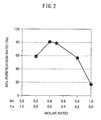
- Fig. 2 shows the results of the evaluation of activity.
- Fig. 2 is a view showing the relationship between the molar ratio of Mn:Fe in the composite oxide and the NOx purification ratio (%) at 150°C.
Landscapes
- Chemical & Material Sciences (AREA)
- Engineering & Computer Science (AREA)
- Chemical Kinetics & Catalysis (AREA)
- Environmental & Geological Engineering (AREA)
- Materials Engineering (AREA)
- Organic Chemistry (AREA)
- Health & Medical Sciences (AREA)
- Biomedical Technology (AREA)
- Analytical Chemistry (AREA)
- General Chemical & Material Sciences (AREA)
- Oil, Petroleum & Natural Gas (AREA)
- Combustion & Propulsion (AREA)
- Catalysts (AREA)
- Exhaust Gas Treatment By Means Of Catalyst (AREA)
Abstract
An object of the present invention is to provide an exhaust gas purifying catalyst for selective reduction of NOx, where the NOx adsorption capacity under low temperature, for example, at the time of engine starting, is improved and the selective catalytic reduction (SCR) activity is enhanced, and an exhaust gas purifying method using the catalyst.
The exhaust gas purifying catalyst for selective reduction of NOx of the present invention contains a spinel-type composite oxide phase represented by formula MnFe2O4.
Description
- The present invention relates to an exhaust gas purifying catalyst for selective reduction of NOx and an exhaust gas purifying method. More specifically, the present invention relates to an exhaust gas purifying catalyst for selective reduction of NOx, where the NOx adsorption capacity under low temperature, for example, at the time of engine starting, is improved to enhance selective catalytic reduction (SCR) activity; and an exhaust gas purifying method using the catalyst.
- In recent years, purification of an exhaust gas discharged to the atmosphere is an important issue from an environmental aspect, and exhaust emission regulations have been tightened with the objective of preventing air pollution. An automobile, for example, a diesel automobile, is not exempt from exhaust emission regulations.
- A diesel automobile is an automobile having a diesel engine as an internal combustion engine. In a diesel engine using light oil as the fuel, since the temperature is elevated to the ignition point of the light oil, a large amount of air is compressed and the light oil is combusted in a lean (excess oxygen) atmosphere, whereby high combustion efficiency is realized.
- On the other hand, the diesel engine is characterized in that hydrocarbon (HC) and carbon monoxide (CO) are purified into H2O and CO2 with an excessive amount of oxygen but nitrogen oxide (NOx) and a particulate matter (PM) are likely to be produced and cannot be easily purified.
- In order to purify NOx, PM, etc., an exhaust gas purifying catalyst for selective reduction is mounted on a diesel automobile. The exhaust gas purifying catalyst for selective reduction is a catalyst capable of selectively reducing NOx into N2 even in a lean atmosphere by the combination use with ammonia.
- However, the conventional exhaust gas purifying catalyst for selective reduction can hardly achieve sufficient selective catalytic reduction activity when the reaction temperature is low, for example, at the time of cold starting, and a large amount of NOx is sometimes discharged to the atmosphere. Solving this problem has been sought.
- For example, in the low-temperature denitration catalyst of Patent Document 1, at least one metal oxide of Mn, Fe, Co and Ni is supported on an active carbon fiber, where NO is converted to NO2 through adsorption and oxidation by the metal oxide and NO2 reacts with NH3 and is thereby decomposed into N2 and H2O. In this technique, reaction substances are condensed with each other in micropores of 2 nm or less of the active carbon fiber, and the decomposition reaction above is caused to proceed under a high-pressure environment in a micro region.
- [Patent Document 1]
Japanese Unexamined Patent Publication No. 10-225641 - However, in the low-temperature denitration catalyst of Patent Document 1, the NOx adsorption amount of the metal oxide itself is not large and in turn, the NOx purification performance is limited.
- An object of the present invention is to provide an exhaust gas purifying catalyst for selective reduction of NOx, where the NOx adsorption capacity under low temperature, for example, at the time of engine starting, is improved and the selective catalytic reduction activity is enhanced, and an exhaust gas purifying method using the catalyst.
- The present inventors have found that divalent manganese (Mn) has excellent NOx adsorption characteristics under low temperature, and accomplished the present invention. That is, the present invention is as follows.
- <1> An exhaust gas purifying catalyst for selective reduction of NOx, containing a spinel-type composite oxide phase represented by formula MnFe2O4.
- <2> An exhaust gas purifying method, including bringing an ammonia and an exhaust gas containing NOx into contact with the exhaust gas purifying catalyst according to item <1> above to selectively reduce and purify the NOx.
- According to the present invention, an exhaust gas purifying catalyst for selective reduction of NOx, where the NOx adsorption capacity under low temperature, for example, at the time of engine starting, is improved and the selective catalytic reduction activity is enhanced, and an exhaust gas purifying method using the catalyst, can be provided.
-
- [
Fig. 1] Fig. 1 is a view illustrating X-ray diffraction patterns when the molar ratio of Mn:Fe in the composite oxide is changed. - [
Fig. 2] Fig. 2 is a view showing the relationship between the molar ratio of Mn:Fe in the composite oxide and the NOx purification ratio (%) at 150°C. - The embodiment of the present invention is described in detail below. However, the present invention is not limited to the following embodiment and can be implemented by making various modifications within the scope of the present invention.
- The rich, stoichiometric and lean atmospheres as used in the present invention means atmospheres where the air-fuel ratio is less than the theoretical air-fuel ratio, is the theoretical air-fuel ratio, and is more than the theoretical air-fuel ratio, respectively.
- Furthermore, in the present invention, the air-fuel mixture means a gas where air and vaporized fuel are mixed; the air-fuel ratio means a dimensionless value obtained by dividing the mass of air by the mass of vaporized fuel in the air-fuel mixture; and the theoretical air-fuel ratio means an air-fuel ratio when air and vaporized fuel are reacted without excess or deficiency.
- The exhaust gas purifying catalyst for selective reduction of NOx of the present invention contains a spinel-type composite oxide phase represented by formula MnFe2O4.
- It can be confirmed by an X-ray diffraction pattern having peaks at 35.0±0.5°, 30.1±0.5° and 43.0±0.5° that the exhaust gas purifying catalyst for selective reduction of NOx of the present invention contains a spinel-type composite oxide phase represented by formula MnFe2O4.
- Although not limited in theory, the reason why the exhaust gas purifying catalyst for selective reduction of NOx of the present invention succeeds in improving the NOx adsorption capacity under low temperature, for example, at the time of engine starting, and enhancing the selective catalytic reduction (SCR) activity is described below.
- The spinel structure represented by formula MnFe2O4 can hold active divalent Mn in its structure. This is thought to be due to the ionic radius of divalent Mn being larger than the ionic radius of trivalent Fe ion, and therefore divalent Mn and trivalent Fe enter the A site and the B site, respectively, of an energetically advantageous spinel structure (AB2O4) and are stabilized in this state.
- In addition, the active divalent Mn has an excellent effect as the NOx adsorption site under low temperature and can efficiently adsorb a lot of NOx. Accordingly, the spinel structure represented by formula MnFe2O4 can efficiently adsorb a lot of NOx by virtue of holding active divalent Mn.
- A so-called L-H mechanism (Langmuir-Hinshelwood mechanism) reaction becomes dominant under low temperature. The L-H mechanism is a mechanism where different chemical species adsorbed to the catalyst surface come close to each other and react there.
- In this way, since the spinel structure represented by formula MnFe2O4 efficiently adsorbs a lot of NOx under low temperature and reduces the adsorbed NOx by the L-H mechanism above, it is considered that the selective catalytic reduction activity can be enhanced.
- The MnFe2O4 of the exhaust gas purifying catalyst for selective reduction of NOx of the present invention need not be a spinel structure in its entirety, and may be sufficient if a spinel-type composite oxide phase of MnFe2O4 is formed at least in part of the composite oxide.
- Accordingly, from the standpoint of facilitating the formation of a spinel-type composite oxide phase represented by MnFe2O4, the molar ratio of Mn and Fe in the exhaust gas purifying catalyst of the present invention is, for example, preferably from 0.2:0.8 to 0.7:0.3, more preferably from 0.3:0.7 to 0.6:0.4, still more preferably from 0.4:0.6 to 0.5:0.5.
- The production method of the exhaust gas purifying catalyst for selective reduction of NOx of the present invention may be any method as long as a spinel-type composite oxide phase represented by formula MnFe2O4 can be formed, and the production method includes, for example, a complex polymerization method, a coprecipitation method, and an alkoxide method. Among these, a complex polymerization method, in particular a citric acid complex polymerization method is more preferred.
- The complex polymerization method is, for example, a method including the following steps:
- (1) a solution preparation step of dissolving a salt of manganese, a salt of iron, and a polydentate ligand such as citric acid, in a solvent to prepare a mixed salt solution;
- (2) a complex forming step of desiccating the mixed salt solution to form a complex containing a salt of manganese, a salt of iron and a polydentate ligand; and
- (3) a firing step of drying and firing the complex to form a composite oxide.
- The salt of manganese and the salt of iron include, for example, an inorganic salt such as sulfate, nitrate, chloride and phosphate; an organic acid salt such as acetate and oxalate; and a combination thereof. Among these, an acetate and a nitrate are preferred.
- The sulfate includes, for example, manganese(II) sulfate and iron(III) sulfate; the nitrite includes, for example, manganese(II) nitrate and iron(III) nitrate; the chloride includes, for example, manganese(II) chloride and iron(III) chloride; and the phosphate includes, for example, manganese phosphate and iron phosphate.
- The acetate includes, for example, manganese(II) acetate and iron(III) acetate; and the oxalate includes manganese(II) oxalate, iron(III) oxalate, etc.
- Furthermore, these manganese salt and iron salt may form a hydrate and may form, for example, manganese acetate tetrahydrate or iron nitrate nonahydrate.
- The polydentate ligand includes, for example, polyvalent carboxylic acids such as citric acid and oxalic acid; diols such as glycol and pinacol; diamines such as ethylenediamine; and esters having two carbonyl groups, such as ethyl acetoacetate. The polydentate ligand is a molecule having two or more coordination atoms coordinated to a metal.
- Specifically, for example, citric acid, oxalic acid, succinic acid, maleic acid, malic acid, adipic acid, tartaric acid, malonic acid, fumaric acid, aconitic acid, glutaric acid, ethylenediaminetetraacetic acid, lactic acid, glycolic acid, glyceric acid, salicylic acid, mevalonic acid, ethylenediamine, ethyl acetoacetate, malonic acid ester, glycol, and pinacol are preferred as the polydentate ligand.
- Among these, because of a carboxylic acid having a hydroxy group, citric acid, lactic acid, malic acid, tartaric acid, glycol acid, salicylic acid, etc. are more preferred, and citric acid is still more preferred. One of these polydentate ligands may be used alone, or two or more thereof may be mixed and used.
- The molar ratio among manganese salt, iron salt and polydentate ligand may be an any molar ratio as long as a spinel-type composite oxide phase can be formed at least in part of MnFe2O4.
- The molar ratio of manganese salt:iron salt is, for example, preferably from 0.2:0.8 to 0.7:0.3, more preferably from 0.3:0.7 to 0.6:0.4, still more preferably from 0.4:0.6 to 0.5:0.5.
- The molar ratio of manganese salt/iron salt:polydentate ligand is, for example, preferably from 1:1 to 1:10, more preferably from 1:1 to 1:5, still more preferably from 1:1 to 1:3.
- The solvent may be an any solvent as long as it can dissolve the manganese salt, the iron salt and the polydentate ligand. The solvent includes, for example, a polar solvent such as distilled water, ion-exchanged water and pure water.
- The desiccation temperature and desiccation time can be freely selected but are, for example, preferably from 60 to 120°C and from 4 to 24 hours.
- The drying temperature and drying time can be freely selected but are, for example, preferably from 60 to 150°C and from 12 to 24 hours.
- The firing temperature and firing time can be freely selected but are, for example, preferably from 300 to 600°C and from 1 to 24 hours. The firing temperature is more preferably from 400 to 500°C.
- The method of the present invention for purifying an exhaust gas includes bringing an ammonia (NH3) and an exhaust gas containing NOx into contact with the above-described exhaust gas purifying catalyst for selective reduction of NOx of the present invention to selectively reduce and purify NOx.
- As the method for bringing an ammonia and an exhaust gas containing NOx into contact with the exhaust gas purifying catalyst for selective reduction of NOx of the present invention, an optional method can be employed. As such a method, a method of spraying ammonia, aqueous ammonia, etc., on an exhaust gas generated, for example, by a gasoline engine, a diesel engine or a lean burn engine, and then brining these into contact with the exhaust gas purifying catalyst for selective reduction of NOx of the present invention may be employed.
- The method of the present invention is preferably applied to an internal combustion engine operating in a lean atmosphere, particularly, to a diesel engine. Because, in the lean atmosphere, HC and CO are easily oxidized and purified, while NOx is not easily reduced and purified.
- Furthermore, the method of the present invention is preferably applied to an exhaust gas at the time of cold starting and/or under low temperature. Because, the exhaust gas purifying catalyst for selective reduction of NOx of the present invention can improve the NOx adsorption capacity under low temperature, for example, at the time of engine starting, and enhance the selective catalytic reduction activity.
- The present invention is described in greater detail below by referring to Examples, but the scope of the present invention is of course not limited by these Examples.
- In Example 1, a composite oxide was produced by employing a citric acid complex polymerization method. The production process is specifically as follows.
- 0.04 mol (9.80 g) of manganese acetate tetrahydrate as a manganese salt and 0.16 mol (64.64 g) of iron nitrate nonahydrate as an iron salt were dissolved in 18 mol (324.00 g) of distilled water as a solvent by using a magnetic stirrer to obtain a mixture. Thereafter, 0.20 mol (38.43 g) of anhydrous citric acid was added to the mixture, thereby obtaining a solution working out to a precursor of a composite oxide.
- Incidentally, the anhydrous citric acid was added to prepare the solution so that the number of moles of anhydrous citric acid is the same as the total number of moles of manganese acetate tetrahydrate and iron nitrate nonahydrate.
- Thereafter, the solution was desiccated at 100°C over 6 hours to evaporate the water and obtain a solid. The solid was dried at 120°C over 12 hours and further fired at 500°C over 10 hours to obtain a powdered composite oxide. In addition, a pellet-shaped composite oxide was obtained by pressing the powder at a press pressure of 1 ton.
- Pellet-shaped composite oxides were obtained in the same manner as in Example 1 with the exception that the amount used of each of manganese acetate tetrahydrate as a manganese salt and iron nitrate nonahydrate as an iron salt was changed as shown in Table 1 below.
[Table 1] Table 1: Relationship of Number of Moles Between Mn and Fe Mn (mol) Fe (mol) Mn:Fe (molar ratio) Example 1 0.04 0.16 0.2:0.8 Example 2 0.08 0.12 0.4:0.6 Example 3 0.10 0.10 0.5:0.5 Comparative Example 1 0.16 0.04 0.8:0.2 Comparative Example 2 0.20 0.00 1.0:0.0 -
Fig. 1 shows the results when XRD measurement was performed on the composite oxides of Examples 1 to 3 and Comparative Examples 1 and 2.Fig. 1 is a view illustrating X-ray diffraction patterns when the molar ratio of Mn:Fe in the composite oxide was changed. InFig. 1 , the black diamond (◆) indicates the diffraction pattern of Fe2O3, the black circle (●) indicates the diffraction pattern of the spinel structure MnFe2O4, and the white circle (○) indicates the diffraction pattern of Mn2O3. - It is seen from Table 1 and
Fig. 1 that when the molar ratio of Mn:Fe in the composite oxide is 0.2:0.8 (Example 1), the composite oxide mainly contains an Fe2O3 crystal phase and, albeit slightly, exhibits the diffraction peak of the spinel structure MnFe2O4. Accordingly, the composite oxide of Example 1 is considered to consist of a crystal phase of Fe2O3 and a small amount of a crystal phase of the pinel structure MnFe2O4. - In addition, it is seen from Table 1 and
Fig. 1 that when the molar ratio of Mn:Fe in the composite oxide is 0.4:0.6 (Example 2) or 0.5:0.5 (Example 3), the composite oxide mainly contains a crystal phase of the spinel structure MnFe2O4. - Furthermore, it is seen from Table 1 and
Fig. 1 that when the molar ratio of Mn:Fe in the composite oxide is 0.8:0.2 (Comparative Example 1) or 1.0:0.0 (Comparative Example 2), the composite oxide mainly contains a crystal phase of Mn2O3. - The activity of the catalyst was evaluated using a catalytic activity evaluation device (manufactured by Best Instruments Co., Ltd.). The evaluation was performed by putting a test gas into contact with each of the composite oxides above while continuously raising the temperature at a rate of 20°C/min starting from 50°C.
- The composition of the test gas was set to contain NH3: 500 ppm, NO: 500 ppm, H2O: 5%, O2: 10%, and N2: 84.9%. The volume of each composite oxide used for the evaluation activity was set uniformly to 5 cc, and the space velocity (SV) at the time of evaluation was set to 180,000 h-1. Here, the space velocity means a value obtained by dividing the flow rate (cc/h) of the test gas by the volume (cc) of the composite oxide.
-
Fig. 2 shows the results of the evaluation of activity.Fig. 2 is a view showing the relationship between the molar ratio of Mn:Fe in the composite oxide and the NOx purification ratio (%) at 150°C. - It is seen from
Fig. 2 that as the molar ratio of Mn:Fe in the composite oxide approaches about 0.33:0.67 corresponding to the chemical equivalent of MnFe2O4, the NOx purification ratio (%) of the composite oxide increases. - Furthermore, it is seen from
Fig. 2 that the NOx purification ratio (%) when the molar ratio of Mn:Fe in the composite oxide is 0.4:0.6 (Example 2) or 0.5:0.5 (Example 3) is larger than the NOx purification ratio (%) when the molar ratio of Mn:Fe in the composite oxide is 0.8:0.2 (Comparative Example 1) or 1.0:0.0 (Comparative Example 2). - This is considered to be attributable to the fact that the composite oxide having a spinel structure MnFe2O4 (Examples 2 and 3) is more excellent in the NOx adsorption capacity and more enhanced in the selective catalytic reduction activity, than the composite oxide not having a spinel structure MnFe2O4 (Comparative Examples 1 and 2).
- When the composite oxides of Example 1 and Comparative Example 1 are compared, the NOx purification ratio (%) of the composite oxide of Example 1 is slightly higher. This is considered to result because a crystal phase of the pinel structure MnFe2O4 is present in part of the composite oxide of Example 1 and this crystal phase has excellent NOx adsorption capacity and enhances the selective catalytic reduction activity.
Claims (2)
- An exhaust gas purifying catalyst for selective reduction of NOx, containing a spinel-type composite oxide phase represented by formula MnFe2O4.
- An exhaust gas purifying method, comprising bringing an ammonia and an exhaust gas containing NOx into contact with the exhaust gas purifying catalyst according to claim 1 to selectively reduce and purify the NOx.
Applications Claiming Priority (1)
| Application Number | Priority Date | Filing Date | Title |
|---|---|---|---|
| JP2014228359A JP2016087587A (en) | 2014-11-10 | 2014-11-10 | EXHAUST GAS PURIFYING CATALYST FOR NOx SELECTIVE REDUCTION AND EXHAUST GAS PURIFYING METHOD |
Publications (1)
| Publication Number | Publication Date |
|---|---|
| EP3017859A1 true EP3017859A1 (en) | 2016-05-11 |
Family
ID=54478666
Family Applications (1)
| Application Number | Title | Priority Date | Filing Date |
|---|---|---|---|
| EP15193865.1A Withdrawn EP3017859A1 (en) | 2014-11-10 | 2015-11-10 | Exhaust gas purifying catalyst for selective reduction of nox and exhaust gas purifying method |
Country Status (4)
| Country | Link |
|---|---|
| US (1) | US20160129425A1 (en) |
| EP (1) | EP3017859A1 (en) |
| JP (1) | JP2016087587A (en) |
| CN (1) | CN105582955A (en) |
Cited By (1)
| Publication number | Priority date | Publication date | Assignee | Title |
|---|---|---|---|---|
| CN105289286A (en) * | 2015-11-14 | 2016-02-03 | 华玉叶 | Flue gas purifying process |
Families Citing this family (12)
| Publication number | Priority date | Publication date | Assignee | Title |
|---|---|---|---|---|
| CN107552066B (en) * | 2017-10-31 | 2020-05-26 | 山东大学 | Fe-Mn-Zr composite oxide catalyst and preparation method and application thereof |
| CN107983354B (en) * | 2017-11-24 | 2020-04-21 | 武汉理工大学 | A kind of preparation method of anti-alkali poisoning copper-based spinel low-temperature denitration catalyst |
| CN108649239B (en) * | 2018-05-14 | 2021-06-15 | 陕西科技大学 | A method for regulating the lattice stress of oxide-type electrocatalysts |
| CN108889301B (en) * | 2018-08-07 | 2021-09-14 | 太原理工大学 | Spinel type catalyst and preparation method thereof |
| CN109529886A (en) * | 2018-12-03 | 2019-03-29 | 黑河学院 | A kind of efficient wide warm manganese base NH3SCR catalyst and preparation method thereof |
| WO2020153156A1 (en) * | 2019-01-21 | 2020-07-30 | 日本碍子株式会社 | Porous ceramic structural body |
| CN110404543B (en) * | 2019-07-12 | 2022-06-14 | 上海大学 | VOC catalyst with characteristic of ordered arrangement of composite metal oxide and ferroferric oxide and preparation method thereof |
| CN112337460A (en) * | 2020-10-22 | 2021-02-09 | 中海油天津化工研究设计院有限公司 | Method for preparing Mn-based spinel low-temperature denitration catalyst by using complex acid solution |
| JP7420087B2 (en) * | 2021-01-19 | 2024-01-23 | トヨタ自動車株式会社 | Exhaust gas purification system |
| CN115228478A (en) * | 2022-06-29 | 2022-10-25 | 昆明理工大学 | A kind of anti-sulfur denitration magnetic catalyst and its preparation method and application |
| CN115920889B (en) * | 2022-11-07 | 2024-12-06 | 上海交通大学 | Preparation and application of a foamy spinel catalyst |
| CN116532129B (en) * | 2023-06-27 | 2025-07-22 | 四川大学 | Three-way catalyst capable of stabilizing dynamic air-fuel ratio, preparation method thereof and application thereof in tail gas purification |
Citations (4)
| Publication number | Priority date | Publication date | Assignee | Title |
|---|---|---|---|---|
| JPS5980318A (en) * | 1982-10-27 | 1984-05-09 | Seitetsu Kagaku Co Ltd | Reduction of nitrogen oxide in exhaust gas of urban garbage incinerator |
| JPH10225641A (en) | 1997-02-14 | 1998-08-25 | Osaka Gas Co Ltd | Low temperature denitration catalyst and its production and low temperature denitration method |
| FR2896436A1 (en) * | 2006-01-26 | 2007-07-27 | Peugeot Citroen Automobiles Sa | Catalytic coating useful for automobile industries to purify exhaust fumes, comprises nanoparticles having a core and an envelope in a metal or oxide with catalytic properties |
| WO2014038504A1 (en) * | 2012-09-04 | 2014-03-13 | 独立行政法人産業技術総合研究所 | Catalyst supporting body loaded with gold nanoparticles and method for producing same |
Family Cites Families (6)
| Publication number | Priority date | Publication date | Assignee | Title |
|---|---|---|---|---|
| JPS5315473B2 (en) * | 1973-03-29 | 1978-05-25 | ||
| JPS5243615B2 (en) * | 1974-05-30 | 1977-11-01 | ||
| KR100962082B1 (en) * | 2008-07-31 | 2010-06-09 | 희성촉매 주식회사 | Reduction removal catalyst of nitrogen oxide using hydrogen and reduction removal method of nitrogen oxide using the same |
| CN102407113A (en) * | 2011-12-30 | 2012-04-11 | 湘潭大学 | Microwave catalyst and application method thereof |
| CN102836717B (en) * | 2012-09-10 | 2014-10-29 | 中南大学 | Application of spinel-type oxide and method for catalytic desulfurization and denitrification |
| CN103752323B (en) * | 2014-01-02 | 2016-04-27 | 上海大学 | There is the preparation method of the denitrating catalyst of nanometer many squashes shape spinel structure |
-
2014
- 2014-11-10 JP JP2014228359A patent/JP2016087587A/en active Pending
-
2015
- 2015-10-21 US US14/919,171 patent/US20160129425A1/en not_active Abandoned
- 2015-11-10 EP EP15193865.1A patent/EP3017859A1/en not_active Withdrawn
- 2015-11-10 CN CN201510760534.9A patent/CN105582955A/en active Pending
Patent Citations (4)
| Publication number | Priority date | Publication date | Assignee | Title |
|---|---|---|---|---|
| JPS5980318A (en) * | 1982-10-27 | 1984-05-09 | Seitetsu Kagaku Co Ltd | Reduction of nitrogen oxide in exhaust gas of urban garbage incinerator |
| JPH10225641A (en) | 1997-02-14 | 1998-08-25 | Osaka Gas Co Ltd | Low temperature denitration catalyst and its production and low temperature denitration method |
| FR2896436A1 (en) * | 2006-01-26 | 2007-07-27 | Peugeot Citroen Automobiles Sa | Catalytic coating useful for automobile industries to purify exhaust fumes, comprises nanoparticles having a core and an envelope in a metal or oxide with catalytic properties |
| WO2014038504A1 (en) * | 2012-09-04 | 2014-03-13 | 独立行政法人産業技術総合研究所 | Catalyst supporting body loaded with gold nanoparticles and method for producing same |
Cited By (1)
| Publication number | Priority date | Publication date | Assignee | Title |
|---|---|---|---|---|
| CN105289286A (en) * | 2015-11-14 | 2016-02-03 | 华玉叶 | Flue gas purifying process |
Also Published As
| Publication number | Publication date |
|---|---|
| JP2016087587A (en) | 2016-05-23 |
| CN105582955A (en) | 2016-05-18 |
| US20160129425A1 (en) | 2016-05-12 |
Similar Documents
| Publication | Publication Date | Title |
|---|---|---|
| EP3017859A1 (en) | Exhaust gas purifying catalyst for selective reduction of nox and exhaust gas purifying method | |
| Dhal et al. | Preparation and application of effective different catalysts for simultaneous control of diesel soot and NO x emissions: An overview | |
| US9180432B2 (en) | NOx storage and reduction catalyst, preparation method, and NOx removing system | |
| JP5718269B2 (en) | Compositions based on alumina, cerium and barium and / or strontium, in particular used for trapping nitrogen oxides (NOX) | |
| US20140336045A1 (en) | Perovskite and Mullite-like Structure Catalysts for Diesel Oxidation and Method of Making Same | |
| US20100086458A1 (en) | Method and architecture for oxidizing nitric oxide in exhaust gas from hydrocarbon fuel source with a fuel lean combustion mixture | |
| KR100377891B1 (en) | Composition Based on Manganese and Use for Trapping NOx for Treating Exhaust Gases | |
| KR20130123311A (en) | Mixed oxide catalyst materials for treating an exhaust gas, preparing methods thereof and methods for treating the exhaust gas using the same | |
| JP2009255057A (en) | Particulate material combustion catalyst, its manufacturing method, and filter for purifying exhaust gas | |
| JP6538053B2 (en) | Oxygen storage material | |
| JP6087784B2 (en) | Oxygen storage / release material and exhaust gas purification catalyst containing the same | |
| JP2005087781A (en) | Exhaust gas purification catalyst, method for producing the same, and exhaust gas purification catalyst device for vehicles | |
| JP3843102B2 (en) | Exhaust gas purification catalyst, method for producing the same, and exhaust gas purification catalyst device | |
| US20180193819A1 (en) | Exhaust gas purification catalyst and production method thereof | |
| JP3556824B2 (en) | DeNOx catalyst and exhaust gas treatment method | |
| JP4647406B2 (en) | Exhaust gas purification catalyst | |
| JP6501778B2 (en) | Use of mixed oxides as oxygen storage components | |
| JP2006035018A (en) | Catalyst support and catalyst using the same | |
| JP2017189761A (en) | Method for producing catalyst for exhaust purification | |
| JP6217423B2 (en) | Method for producing exhaust gas purification catalyst | |
| JP2005205280A (en) | Exhaust gas purification catalyst, production method thereof, and exhaust gas purification catalyst device for vehicles | |
| JP2011046567A (en) | Oxygen storage/release material | |
| JP2006176346A (en) | Oxygen storage material | |
| JP5071840B2 (en) | Exhaust gas purification catalyst | |
| KR20080048681A (en) | Alumina occlusion type catalyst in which potassium oxide with improved nitric oxide occlusion capacity is bonded at high temperature, and method for preparing same |
Legal Events
| Date | Code | Title | Description |
|---|---|---|---|
| PUAI | Public reference made under article 153(3) epc to a published international application that has entered the european phase |
Free format text: ORIGINAL CODE: 0009012 |
|
| 17P | Request for examination filed |
Effective date: 20151110 |
|
| AK | Designated contracting states |
Kind code of ref document: A1 Designated state(s): AL AT BE BG CH CY CZ DE DK EE ES FI FR GB GR HR HU IE IS IT LI LT LU LV MC MK MT NL NO PL PT RO RS SE SI SK SM TR |
|
| AX | Request for extension of the european patent |
Extension state: BA ME |
|
| STAA | Information on the status of an ep patent application or granted ep patent |
Free format text: STATUS: REQUEST FOR EXAMINATION WAS MADE |
|
| 18D | Application deemed to be withdrawn |
Effective date: 20161112 |
|
| STAA | Information on the status of an ep patent application or granted ep patent |
Free format text: STATUS: THE APPLICATION IS DEEMED TO BE WITHDRAWN |