EP3015458A1 - Process for preparing 3,5-bis(haloalkyl)pyrazole derivatives from a,a-dihaloamines and ketimines - Google Patents
Process for preparing 3,5-bis(haloalkyl)pyrazole derivatives from a,a-dihaloamines and ketimines Download PDFInfo
- Publication number
- EP3015458A1 EP3015458A1 EP14191501.7A EP14191501A EP3015458A1 EP 3015458 A1 EP3015458 A1 EP 3015458A1 EP 14191501 A EP14191501 A EP 14191501A EP 3015458 A1 EP3015458 A1 EP 3015458A1
- Authority
- EP
- European Patent Office
- Prior art keywords
- alkyl
- independently selected
- formula
- cycloalkyl
- benzyl
- Prior art date
- Legal status (The legal status is an assumption and is not a legal conclusion. Google has not performed a legal analysis and makes no representation as to the accuracy of the status listed.)
- Ceased
Links
- 238000004519 manufacturing process Methods 0.000 title claims abstract description 7
- 125000001188 haloalkyl group Chemical group 0.000 title abstract description 6
- 150000004658 ketimines Chemical class 0.000 title abstract description 5
- -1 CH2COOC1-C8-alkyl Chemical group 0.000 claims description 107
- 150000001875 compounds Chemical class 0.000 claims description 49
- 125000004400 (C1-C12) alkyl group Chemical group 0.000 claims description 26
- 125000006552 (C3-C8) cycloalkyl group Chemical group 0.000 claims description 23
- 125000001797 benzyl group Chemical group [H]C1=C([H])C([H])=C(C([H])=C1[H])C([H])([H])* 0.000 claims description 23
- 125000001449 isopropyl group Chemical group [H]C([H])([H])C([H])(*)C([H])([H])[H] 0.000 claims description 16
- 238000000034 method Methods 0.000 claims description 16
- 125000001495 ethyl group Chemical group [H]C([H])([H])C([H])([H])* 0.000 claims description 15
- 125000002496 methyl group Chemical group [H]C([H])([H])* 0.000 claims description 15
- 229910052801 chlorine Inorganic materials 0.000 claims description 13
- 229910052731 fluorine Inorganic materials 0.000 claims description 13
- 125000001997 phenyl group Chemical group [H]C1=C([H])C([H])=C(*)C([H])=C1[H] 0.000 claims description 11
- 125000002023 trifluoromethyl group Chemical group FC(F)(F)* 0.000 claims description 11
- OAKJQQAXSVQMHS-UHFFFAOYSA-N Hydrazine Chemical compound NN OAKJQQAXSVQMHS-UHFFFAOYSA-N 0.000 claims description 9
- 125000003118 aryl group Chemical group 0.000 claims description 9
- 229910052757 nitrogen Inorganic materials 0.000 claims description 9
- 150000003217 pyrazoles Chemical class 0.000 claims description 8
- 125000000217 alkyl group Chemical group 0.000 claims description 7
- 125000000113 cyclohexyl group Chemical group [H]C1([H])C([H])([H])C([H])([H])C([H])(*)C([H])([H])C1([H])[H] 0.000 claims description 7
- 125000001511 cyclopentyl group Chemical group [H]C1([H])C([H])([H])C([H])([H])C([H])(*)C1([H])[H] 0.000 claims description 7
- 238000007363 ring formation reaction Methods 0.000 claims description 7
- 125000000999 tert-butyl group Chemical group [H]C([H])([H])C(*)(C([H])([H])[H])C([H])([H])[H] 0.000 claims description 7
- VSCWAEJMTAWNJL-UHFFFAOYSA-K aluminium chloride Substances Cl[Al](Cl)Cl VSCWAEJMTAWNJL-UHFFFAOYSA-K 0.000 claims description 6
- 229910052794 bromium Inorganic materials 0.000 claims description 6
- 125000001028 difluoromethyl group Chemical group [H]C(F)(F)* 0.000 claims description 6
- 125000004433 nitrogen atom Chemical group N* 0.000 claims description 6
- 125000001559 cyclopropyl group Chemical group [H]C1([H])C([H])([H])C1([H])* 0.000 claims description 5
- 125000000959 isobutyl group Chemical group [H]C([H])([H])C([H])(C([H])([H])[H])C([H])([H])* 0.000 claims description 5
- 125000004108 n-butyl group Chemical group [H]C([H])([H])C([H])([H])C([H])([H])C([H])([H])* 0.000 claims description 5
- 125000006340 pentafluoro ethyl group Chemical group FC(F)(F)C(F)(F)* 0.000 claims description 5
- 125000002914 sec-butyl group Chemical group [H]C([H])([H])C([H])([H])C([H])(*)C([H])([H])[H] 0.000 claims description 5
- 125000004209 (C1-C8) alkyl group Chemical group 0.000 claims description 4
- 125000001995 cyclobutyl group Chemical group [H]C1([H])C([H])([H])C([H])(*)C1([H])[H] 0.000 claims description 4
- 229910052739 hydrogen Inorganic materials 0.000 claims description 4
- 125000004076 pyridyl group Chemical group 0.000 claims description 4
- 125000004776 1-fluoroethyl group Chemical group [H]C([H])([H])C([H])(F)* 0.000 claims description 3
- 125000000453 2,2,2-trichloroethyl group Chemical group [H]C([H])(*)C(Cl)(Cl)Cl 0.000 claims description 3
- 125000004206 2,2,2-trifluoroethyl group Chemical group [H]C([H])(*)C(F)(F)F 0.000 claims description 3
- 125000004781 2,2-dichloro-2-fluoroethyl group Chemical group [H]C([H])(*)C(F)(Cl)Cl 0.000 claims description 3
- 125000004778 2,2-difluoroethyl group Chemical group [H]C([H])(*)C([H])(F)F 0.000 claims description 3
- 125000004779 2-chloro-2-fluoroethyl group Chemical group [H]C([H])(*)C([H])(F)Cl 0.000 claims description 3
- 125000004777 2-fluoroethyl group Chemical group [H]C([H])(F)C([H])([H])* 0.000 claims description 3
- 125000004775 chlorodifluoromethyl group Chemical group FC(F)(Cl)* 0.000 claims description 3
- 125000004773 chlorofluoromethyl group Chemical group [H]C(F)(Cl)* 0.000 claims description 3
- 125000004774 dichlorofluoromethyl group Chemical group FC(Cl)(Cl)* 0.000 claims description 3
- 229910052736 halogen Inorganic materials 0.000 claims description 3
- 150000002367 halogens Chemical class 0.000 claims description 3
- 125000001280 n-hexyl group Chemical group C(CCCCC)* 0.000 claims description 3
- 125000000740 n-pentyl group Chemical group [H]C([H])([H])C([H])([H])C([H])([H])C([H])([H])C([H])([H])* 0.000 claims description 3
- 125000000286 phenylethyl group Chemical group [H]C1=C([H])C([H])=C(C([H])=C1[H])C([H])([H])C([H])([H])* 0.000 claims description 3
- 125000003944 tolyl group Chemical group 0.000 claims description 3
- 239000011592 zinc chloride Substances 0.000 claims description 3
- 125000006527 (C1-C5) alkyl group Chemical group 0.000 claims description 2
- 125000000171 (C1-C6) haloalkyl group Chemical group 0.000 claims description 2
- KLZUFWVZNOTSEM-UHFFFAOYSA-K Aluminum fluoride Inorganic materials F[Al](F)F KLZUFWVZNOTSEM-UHFFFAOYSA-K 0.000 claims description 2
- 125000006337 tetrafluoro ethyl group Chemical group 0.000 claims description 2
- 125000000896 monocarboxylic acid group Chemical group 0.000 claims 1
- WEVYAHXRMPXWCK-UHFFFAOYSA-N Acetonitrile Chemical compound CC#N WEVYAHXRMPXWCK-UHFFFAOYSA-N 0.000 description 44
- YXFVVABEGXRONW-UHFFFAOYSA-N Toluene Chemical compound CC1=CC=CC=C1 YXFVVABEGXRONW-UHFFFAOYSA-N 0.000 description 33
- 239000000243 solution Substances 0.000 description 28
- 239000000203 mixture Substances 0.000 description 25
- RTZKZFJDLAIYFH-UHFFFAOYSA-N Diethyl ether Chemical compound CCOCC RTZKZFJDLAIYFH-UHFFFAOYSA-N 0.000 description 24
- LFQSCWFLJHTTHZ-UHFFFAOYSA-N Ethanol Chemical compound CCO LFQSCWFLJHTTHZ-UHFFFAOYSA-N 0.000 description 21
- YMWUJEATGCHHMB-UHFFFAOYSA-N Dichloromethane Chemical compound ClCCl YMWUJEATGCHHMB-UHFFFAOYSA-N 0.000 description 20
- HEDRZPFGACZZDS-MICDWDOJSA-N Trichloro(2H)methane Chemical compound [2H]C(Cl)(Cl)Cl HEDRZPFGACZZDS-MICDWDOJSA-N 0.000 description 20
- XEKOWRVHYACXOJ-UHFFFAOYSA-N Ethyl acetate Natural products CCOC(C)=O XEKOWRVHYACXOJ-UHFFFAOYSA-N 0.000 description 19
- WYURNTSHIVDZCO-UHFFFAOYSA-N Tetrahydrofuran Chemical compound C1CCOC1 WYURNTSHIVDZCO-UHFFFAOYSA-N 0.000 description 16
- XLYOFNOQVPJJNP-UHFFFAOYSA-N water Substances O XLYOFNOQVPJJNP-UHFFFAOYSA-N 0.000 description 16
- BZLVMXJERCGZMT-UHFFFAOYSA-N Methyl tert-butyl ether Chemical compound COC(C)(C)C BZLVMXJERCGZMT-UHFFFAOYSA-N 0.000 description 13
- 239000000460 chlorine Substances 0.000 description 12
- MVPPADPHJFYWMZ-UHFFFAOYSA-N chlorobenzene Chemical compound ClC1=CC=CC=C1 MVPPADPHJFYWMZ-UHFFFAOYSA-N 0.000 description 12
- UAEPNZWRGJTJPN-UHFFFAOYSA-N methylcyclohexane Chemical compound CC1CCCCC1 UAEPNZWRGJTJPN-UHFFFAOYSA-N 0.000 description 12
- VLKZOEOYAKHREP-UHFFFAOYSA-N n-Hexane Chemical compound CCCCCC VLKZOEOYAKHREP-UHFFFAOYSA-N 0.000 description 12
- 239000000047 product Substances 0.000 description 12
- VIRGYRZBWQFJGJ-UHFFFAOYSA-N 1,1,2,2-tetrafluoro-n,n-dimethylethanamine Chemical compound CN(C)C(F)(F)C(F)F VIRGYRZBWQFJGJ-UHFFFAOYSA-N 0.000 description 11
- 238000005160 1H NMR spectroscopy Methods 0.000 description 11
- WEVYAHXRMPXWCK-FIBGUPNXSA-N acetonitrile-d3 Chemical compound [2H]C([2H])([2H])C#N WEVYAHXRMPXWCK-FIBGUPNXSA-N 0.000 description 11
- 238000006243 chemical reaction Methods 0.000 description 11
- 239000011541 reaction mixture Substances 0.000 description 11
- 239000002904 solvent Substances 0.000 description 10
- UHOVQNZJYSORNB-UHFFFAOYSA-N Benzene Chemical compound C1=CC=CC=C1 UHOVQNZJYSORNB-UHFFFAOYSA-N 0.000 description 9
- ZMXDDKWLCZADIW-UHFFFAOYSA-N N,N-Dimethylformamide Chemical compound CN(C)C=O ZMXDDKWLCZADIW-UHFFFAOYSA-N 0.000 description 9
- IMNFDUFMRHMDMM-UHFFFAOYSA-N N-Heptane Chemical compound CCCCCCC IMNFDUFMRHMDMM-UHFFFAOYSA-N 0.000 description 9
- JFDZBHWFFUWGJE-UHFFFAOYSA-N benzonitrile Chemical compound N#CC1=CC=CC=C1 JFDZBHWFFUWGJE-UHFFFAOYSA-N 0.000 description 9
- YYPFZXBEOCAFDL-UHFFFAOYSA-N 3,5-bis(difluoromethyl)-1h-pyrazole Chemical compound FC(F)C=1C=C(C(F)F)NN=1 YYPFZXBEOCAFDL-UHFFFAOYSA-N 0.000 description 8
- 150000003254 radicals Chemical class 0.000 description 8
- CTQNGGLPUBDAKN-UHFFFAOYSA-N O-Xylene Chemical compound CC1=CC=CC=C1C CTQNGGLPUBDAKN-UHFFFAOYSA-N 0.000 description 7
- 229940093499 ethyl acetate Drugs 0.000 description 7
- 239000000543 intermediate Substances 0.000 description 7
- 238000002360 preparation method Methods 0.000 description 7
- 239000008096 xylene Substances 0.000 description 7
- HEDRZPFGACZZDS-UHFFFAOYSA-N Chloroform Chemical compound ClC(Cl)Cl HEDRZPFGACZZDS-UHFFFAOYSA-N 0.000 description 6
- XDTMQSROBMDMFD-UHFFFAOYSA-N Cyclohexane Chemical compound C1CCCCC1 XDTMQSROBMDMFD-UHFFFAOYSA-N 0.000 description 6
- XTHFKEDIFFGKHM-UHFFFAOYSA-N Dimethoxyethane Chemical compound COCCOC XTHFKEDIFFGKHM-UHFFFAOYSA-N 0.000 description 6
- YCKRFDGAMUMZLT-UHFFFAOYSA-N Fluorine atom Chemical compound [F] YCKRFDGAMUMZLT-UHFFFAOYSA-N 0.000 description 6
- CSNNHWWHGAXBCP-UHFFFAOYSA-L Magnesium sulfate Chemical compound [Mg+2].[O-][S+2]([O-])([O-])[O-] CSNNHWWHGAXBCP-UHFFFAOYSA-L 0.000 description 6
- OKKJLVBELUTLKV-UHFFFAOYSA-N Methanol Chemical compound OC OKKJLVBELUTLKV-UHFFFAOYSA-N 0.000 description 6
- RDOXTESZEPMUJZ-UHFFFAOYSA-N anisole Chemical compound COC1=CC=CC=C1 RDOXTESZEPMUJZ-UHFFFAOYSA-N 0.000 description 6
- NNBZCPXTIHJBJL-UHFFFAOYSA-N decalin Chemical compound C1CCCC2CCCCC21 NNBZCPXTIHJBJL-UHFFFAOYSA-N 0.000 description 6
- GYNNXHKOJHMOHS-UHFFFAOYSA-N methyl-cycloheptane Natural products CC1CCCCCC1 GYNNXHKOJHMOHS-UHFFFAOYSA-N 0.000 description 6
- 238000003756 stirring Methods 0.000 description 6
- 239000002841 Lewis acid Substances 0.000 description 5
- 239000002253 acid Substances 0.000 description 5
- 150000002170 ethers Chemical class 0.000 description 5
- 235000019439 ethyl acetate Nutrition 0.000 description 5
- 239000011737 fluorine Substances 0.000 description 5
- 125000001183 hydrocarbyl group Chemical group 0.000 description 5
- 150000007517 lewis acids Chemical class 0.000 description 5
- 239000007787 solid Substances 0.000 description 5
- 239000000725 suspension Substances 0.000 description 5
- QAOWNCQODCNURD-UHFFFAOYSA-N Sulfuric acid Chemical compound OS(O)(=O)=O QAOWNCQODCNURD-UHFFFAOYSA-N 0.000 description 4
- 150000001412 amines Chemical class 0.000 description 4
- 125000004122 cyclic group Chemical group 0.000 description 4
- 150000002148 esters Chemical class 0.000 description 4
- 125000005842 heteroatom Chemical group 0.000 description 4
- IKDUDTNKRLTJSI-UHFFFAOYSA-N hydrazine hydrate Chemical compound O.NN IKDUDTNKRLTJSI-UHFFFAOYSA-N 0.000 description 4
- JJWLVOIRVHMVIS-UHFFFAOYSA-N isopropylamine Chemical compound CC(C)N JJWLVOIRVHMVIS-UHFFFAOYSA-N 0.000 description 4
- 150000002576 ketones Chemical class 0.000 description 4
- 150000002825 nitriles Chemical class 0.000 description 4
- 239000012074 organic phase Substances 0.000 description 4
- 229910052717 sulfur Inorganic materials 0.000 description 4
- UOCLXMDMGBRAIB-UHFFFAOYSA-N 1,1,1-trichloroethane Chemical compound CC(Cl)(Cl)Cl UOCLXMDMGBRAIB-UHFFFAOYSA-N 0.000 description 3
- SCYULBFZEHDVBN-UHFFFAOYSA-N 1,1-Dichloroethane Chemical compound CC(Cl)Cl SCYULBFZEHDVBN-UHFFFAOYSA-N 0.000 description 3
- LZDKZFUFMNSQCJ-UHFFFAOYSA-N 1,2-diethoxyethane Chemical compound CCOCCOCC LZDKZFUFMNSQCJ-UHFFFAOYSA-N 0.000 description 3
- RYHBNJHYFVUHQT-UHFFFAOYSA-N 1,4-Dioxane Chemical compound C1COCCO1 RYHBNJHYFVUHQT-UHFFFAOYSA-N 0.000 description 3
- OCJBOOLMMGQPQU-UHFFFAOYSA-N 1,4-dichlorobenzene Chemical compound ClC1=CC=C(Cl)C=C1 OCJBOOLMMGQPQU-UHFFFAOYSA-N 0.000 description 3
- 238000001644 13C nuclear magnetic resonance spectroscopy Methods 0.000 description 3
- 238000004293 19F NMR spectroscopy Methods 0.000 description 3
- ZAMOUSCENKQFHK-UHFFFAOYSA-N Chlorine atom Chemical compound [Cl] ZAMOUSCENKQFHK-UHFFFAOYSA-N 0.000 description 3
- ZAFNJMIOTHYJRJ-UHFFFAOYSA-N Diisopropyl ether Chemical compound CC(C)OC(C)C ZAFNJMIOTHYJRJ-UHFFFAOYSA-N 0.000 description 3
- IAZDPXIOMUYVGZ-UHFFFAOYSA-N Dimethylsulphoxide Chemical compound CS(C)=O IAZDPXIOMUYVGZ-UHFFFAOYSA-N 0.000 description 3
- FXHOOIRPVKKKFG-UHFFFAOYSA-N N,N-Dimethylacetamide Chemical compound CN(C)C(C)=O FXHOOIRPVKKKFG-UHFFFAOYSA-N 0.000 description 3
- SECXISVLQFMRJM-UHFFFAOYSA-N N-Methylpyrrolidone Chemical compound CN1CCCC1=O SECXISVLQFMRJM-UHFFFAOYSA-N 0.000 description 3
- AJZKCZBXGUUREN-UHFFFAOYSA-N N-benzyl-1,1-difluoropropan-2-imine Chemical compound FC(C(C)=NCC1=CC=CC=C1)F AJZKCZBXGUUREN-UHFFFAOYSA-N 0.000 description 3
- 238000005481 NMR spectroscopy Methods 0.000 description 3
- 125000002723 alicyclic group Chemical group 0.000 description 3
- 125000001931 aliphatic group Chemical group 0.000 description 3
- 125000002877 alkyl aryl group Chemical group 0.000 description 3
- 150000001408 amides Chemical class 0.000 description 3
- 150000004945 aromatic hydrocarbons Chemical class 0.000 description 3
- 125000003710 aryl alkyl group Chemical group 0.000 description 3
- 125000004429 atom Chemical group 0.000 description 3
- KVNRLNFWIYMESJ-UHFFFAOYSA-N butyronitrile Chemical compound CCCC#N KVNRLNFWIYMESJ-UHFFFAOYSA-N 0.000 description 3
- 229950005499 carbon tetrachloride Drugs 0.000 description 3
- 229940117389 dichlorobenzene Drugs 0.000 description 3
- 229960001760 dimethyl sulfoxide Drugs 0.000 description 3
- 150000008282 halocarbons Chemical class 0.000 description 3
- GNOIPBMMFNIUFM-UHFFFAOYSA-N hexamethylphosphoric triamide Chemical compound CN(C)P(=O)(N(C)C)N(C)C GNOIPBMMFNIUFM-UHFFFAOYSA-N 0.000 description 3
- LRDFRRGEGBBSRN-UHFFFAOYSA-N isobutyronitrile Chemical compound CC(C)C#N LRDFRRGEGBBSRN-UHFFFAOYSA-N 0.000 description 3
- 229910052943 magnesium sulfate Inorganic materials 0.000 description 3
- UZKWTJUDCOPSNM-UHFFFAOYSA-N methoxybenzene Substances CCCCOC=C UZKWTJUDCOPSNM-UHFFFAOYSA-N 0.000 description 3
- BNTFCVMJHBNJAR-UHFFFAOYSA-N n,n-diethyl-1,1,2,3,3,3-hexafluoropropan-1-amine Chemical compound CCN(CC)C(F)(F)C(F)C(F)(F)F BNTFCVMJHBNJAR-UHFFFAOYSA-N 0.000 description 3
- JIKUXBYRTXDNIY-UHFFFAOYSA-N n-methyl-n-phenylformamide Chemical compound O=CN(C)C1=CC=CC=C1 JIKUXBYRTXDNIY-UHFFFAOYSA-N 0.000 description 3
- 229910052760 oxygen Inorganic materials 0.000 description 3
- 239000003208 petroleum Substances 0.000 description 3
- 229910052698 phosphorus Inorganic materials 0.000 description 3
- 239000002244 precipitate Substances 0.000 description 3
- FVSKHRXBFJPNKK-UHFFFAOYSA-N propionitrile Chemical compound CCC#N FVSKHRXBFJPNKK-UHFFFAOYSA-N 0.000 description 3
- 230000035484 reaction time Effects 0.000 description 3
- 239000000126 substance Substances 0.000 description 3
- 125000001424 substituent group Chemical group 0.000 description 3
- HXJUTPCZVOIRIF-UHFFFAOYSA-N sulfolane Chemical compound O=S1(=O)CCCC1 HXJUTPCZVOIRIF-UHFFFAOYSA-N 0.000 description 3
- 125000001174 sulfone group Chemical group 0.000 description 3
- HVZJRWJGKQPSFL-UHFFFAOYSA-N tert-Amyl methyl ether Chemical compound CCC(C)(C)OC HVZJRWJGKQPSFL-UHFFFAOYSA-N 0.000 description 3
- VZGDMQKNWNREIO-UHFFFAOYSA-N tetrachloromethane Chemical compound ClC(Cl)(Cl)Cl VZGDMQKNWNREIO-UHFFFAOYSA-N 0.000 description 3
- YLQBMQCUIZJEEH-UHFFFAOYSA-N tetrahydrofuran Natural products C=1C=COC=1 YLQBMQCUIZJEEH-UHFFFAOYSA-N 0.000 description 3
- PXXNTAGJWPJAGM-UHFFFAOYSA-N vertaline Natural products C1C2C=3C=C(OC)C(OC)=CC=3OC(C=C3)=CC=C3CCC(=O)OC1CC1N2CCCC1 PXXNTAGJWPJAGM-UHFFFAOYSA-N 0.000 description 3
- ZEXXEODAXHSRDJ-UHFFFAOYSA-N 2-[(ethanesulfonyl)amino]-5-fluoro-4-[4-methyl-5-oxo-3-(trifluoromethyl)-4,5-dihydro-1H-1,2,4-triazol-1-yl]benzene-1-carbothioamide Chemical compound CS(=O)(=O)OC1=CC=CC(Cl)=C1C1ON=C(C=2N=C(SC=2)C2CCN(CC2)C(=O)CN2C(=CC(=N2)C(F)F)C(F)F)C1 ZEXXEODAXHSRDJ-UHFFFAOYSA-N 0.000 description 2
- 125000003903 2-propenyl group Chemical group [H]C([*])([H])C([H])=C([H])[H] 0.000 description 2
- BHUCBSRSWDMNIM-UHFFFAOYSA-N 3,5-bis(difluoromethyl)-1-methylpyrazole Chemical compound CN1N=C(C(F)F)C=C1C(F)F BHUCBSRSWDMNIM-UHFFFAOYSA-N 0.000 description 2
- QTBSBXVTEAMEQO-UHFFFAOYSA-N Acetic acid Chemical compound CC(O)=O QTBSBXVTEAMEQO-UHFFFAOYSA-N 0.000 description 2
- WKBOTKDWSSQWDR-UHFFFAOYSA-N Bromine atom Chemical compound [Br] WKBOTKDWSSQWDR-UHFFFAOYSA-N 0.000 description 2
- NICRTVVFOCBIKC-UHFFFAOYSA-N CC(C)N=C(C)C(F)F Chemical compound CC(C)N=C(C)C(F)F NICRTVVFOCBIKC-UHFFFAOYSA-N 0.000 description 2
- ULGZDMOVFRHVEP-RWJQBGPGSA-N Erythromycin Chemical class O([C@@H]1[C@@H](C)C(=O)O[C@@H]([C@@]([C@H](O)[C@@H](C)C(=O)[C@H](C)C[C@@](C)(O)[C@H](O[C@H]2[C@@H]([C@H](C[C@@H](C)O2)N(C)C)O)[C@H]1C)(C)O)CC)[C@H]1C[C@@](C)(OC)[C@@H](O)[C@H](C)O1 ULGZDMOVFRHVEP-RWJQBGPGSA-N 0.000 description 2
- KFZMGEQAYNKOFK-UHFFFAOYSA-N Isopropanol Chemical compound CC(C)O KFZMGEQAYNKOFK-UHFFFAOYSA-N 0.000 description 2
- LRHPLDYGYMQRHN-UHFFFAOYSA-N N-Butanol Chemical compound CCCCO LRHPLDYGYMQRHN-UHFFFAOYSA-N 0.000 description 2
- OFBQJSOFQDEBGM-UHFFFAOYSA-N Pentane Chemical compound CCCCC OFBQJSOFQDEBGM-UHFFFAOYSA-N 0.000 description 2
- CDBYLPFSWZWCQE-UHFFFAOYSA-L Sodium Carbonate Chemical compound [Na+].[Na+].[O-]C([O-])=O CDBYLPFSWZWCQE-UHFFFAOYSA-L 0.000 description 2
- 150000001252 acrylic acid derivatives Chemical class 0.000 description 2
- 125000003342 alkenyl group Chemical group 0.000 description 2
- 125000002947 alkylene group Chemical group 0.000 description 2
- 125000000304 alkynyl group Chemical group 0.000 description 2
- WGQKYBSKWIADBV-UHFFFAOYSA-N benzylamine Chemical compound NCC1=CC=CC=C1 WGQKYBSKWIADBV-UHFFFAOYSA-N 0.000 description 2
- GDTBXPJZTBHREO-UHFFFAOYSA-N bromine Substances BrBr GDTBXPJZTBHREO-UHFFFAOYSA-N 0.000 description 2
- 125000004432 carbon atom Chemical group C* 0.000 description 2
- 125000003178 carboxy group Chemical group [H]OC(*)=O 0.000 description 2
- 239000003153 chemical reaction reagent Substances 0.000 description 2
- 239000002131 composite material Substances 0.000 description 2
- 125000000753 cycloalkyl group Chemical group 0.000 description 2
- 125000005594 diketone group Chemical group 0.000 description 2
- OFRIPBLMPRXVMH-UHFFFAOYSA-N ethyl 2-[3,5-bis(difluoromethyl)pyrazol-1-yl]acetate Chemical compound CCOC(=O)CN1N=C(C(F)F)C=C1C(F)F OFRIPBLMPRXVMH-UHFFFAOYSA-N 0.000 description 2
- 239000000284 extract Substances 0.000 description 2
- 230000000855 fungicidal effect Effects 0.000 description 2
- 125000005843 halogen group Chemical group 0.000 description 2
- 150000002429 hydrazines Chemical class 0.000 description 2
- 239000004615 ingredient Substances 0.000 description 2
- 238000002955 isolation Methods 0.000 description 2
- 239000007788 liquid Substances 0.000 description 2
- 238000002844 melting Methods 0.000 description 2
- 230000008018 melting Effects 0.000 description 2
- SWADNLFRTHBCLE-UHFFFAOYSA-N n,n-diethyl-1,1,2,2-tetrafluoroethanamine Chemical compound CCN(CC)C(F)(F)C(F)F SWADNLFRTHBCLE-UHFFFAOYSA-N 0.000 description 2
- YKYONYBAUNKHLG-UHFFFAOYSA-N n-Propyl acetate Natural products CCCOC(C)=O YKYONYBAUNKHLG-UHFFFAOYSA-N 0.000 description 2
- MYVITOFBNPFGNU-UHFFFAOYSA-N n-benzyl-1,1,1-trifluoropropan-2-imine Chemical compound FC(F)(F)C(C)=NCC1=CC=CC=C1 MYVITOFBNPFGNU-UHFFFAOYSA-N 0.000 description 2
- 230000003287 optical effect Effects 0.000 description 2
- 239000012071 phase Substances 0.000 description 2
- 229940090181 propyl acetate Drugs 0.000 description 2
- 238000000746 purification Methods 0.000 description 2
- 239000002002 slurry Substances 0.000 description 2
- CYRMSUTZVYGINF-UHFFFAOYSA-N trichlorofluoromethane Chemical compound FC(Cl)(Cl)Cl CYRMSUTZVYGINF-UHFFFAOYSA-N 0.000 description 2
- NQPDZGIKBAWPEJ-UHFFFAOYSA-N valeric acid Chemical compound CCCCC(O)=O NQPDZGIKBAWPEJ-UHFFFAOYSA-N 0.000 description 2
- 238000010626 work up procedure Methods 0.000 description 2
- NWZSZGALRFJKBT-KNIFDHDWSA-N (2s)-2,6-diaminohexanoic acid;(2s)-2-hydroxybutanedioic acid Chemical compound OC(=O)[C@@H](O)CC(O)=O.NCCCC[C@H](N)C(O)=O NWZSZGALRFJKBT-KNIFDHDWSA-N 0.000 description 1
- 125000006710 (C2-C12) alkenyl group Chemical group 0.000 description 1
- 125000006711 (C2-C12) alkynyl group Chemical group 0.000 description 1
- YTBBOHJDGLEWEF-UHFFFAOYSA-N 1,1,1-trifluoro-n-propan-2-ylpropan-2-imine Chemical compound CC(C)N=C(C)C(F)(F)F YTBBOHJDGLEWEF-UHFFFAOYSA-N 0.000 description 1
- COLOHWPRNRVWPI-UHFFFAOYSA-N 1,1,1-trifluoroethane Chemical compound [CH2]C(F)(F)F COLOHWPRNRVWPI-UHFFFAOYSA-N 0.000 description 1
- DLDBAVFXKUQZOE-UHFFFAOYSA-N 1,1,2,3,3,3-hexafluoro-n,n-dimethylpropan-1-amine Chemical compound CN(C)C(F)(F)C(F)C(F)(F)F DLDBAVFXKUQZOE-UHFFFAOYSA-N 0.000 description 1
- XHILZHAQBOLGFD-UHFFFAOYSA-N 1,1-difluoropropan-2-one Chemical compound CC(=O)C(F)F XHILZHAQBOLGFD-UHFFFAOYSA-N 0.000 description 1
- 125000001607 1,2,3-triazol-1-yl group Chemical group [*]N1N=NC([H])=C1[H] 0.000 description 1
- 125000001766 1,2,4-oxadiazol-3-yl group Chemical group [H]C1=NC(*)=NO1 0.000 description 1
- 125000004505 1,2,4-oxadiazol-5-yl group Chemical group O1N=CN=C1* 0.000 description 1
- 125000004515 1,2,4-thiadiazol-3-yl group Chemical group S1N=C(N=C1)* 0.000 description 1
- 125000004516 1,2,4-thiadiazol-5-yl group Chemical group S1N=CN=C1* 0.000 description 1
- 125000003626 1,2,4-triazol-1-yl group Chemical group [*]N1N=C([H])N=C1[H] 0.000 description 1
- 125000001305 1,2,4-triazol-3-yl group Chemical group [H]N1N=C([*])N=C1[H] 0.000 description 1
- 125000004509 1,3,4-oxadiazol-2-yl group Chemical group O1C(=NN=C1)* 0.000 description 1
- 125000004521 1,3,4-thiadiazol-2-yl group Chemical group S1C(=NN=C1)* 0.000 description 1
- 125000004317 1,3,5-triazin-2-yl group Chemical group [H]C1=NC(*)=NC([H])=N1 0.000 description 1
- 125000006083 1-bromoethyl group Chemical group 0.000 description 1
- 125000004973 1-butenyl group Chemical group C(=CCC)* 0.000 description 1
- 125000001478 1-chloroethyl group Chemical group [H]C([H])([H])C([H])(Cl)* 0.000 description 1
- 125000001462 1-pyrrolyl group Chemical group [*]N1C([H])=C([H])C([H])=C1[H] 0.000 description 1
- KOPFEFZSAMLEHK-UHFFFAOYSA-N 1h-pyrazole-5-carboxylic acid Chemical class OC(=O)C=1C=CNN=1 KOPFEFZSAMLEHK-UHFFFAOYSA-N 0.000 description 1
- 125000004974 2-butenyl group Chemical group C(C=CC)* 0.000 description 1
- OOJZGFFJNPGACA-UHFFFAOYSA-N 2-chloro-1,1,2-trifluoro-n,n-dimethylethanamine Chemical compound CN(C)C(F)(F)C(F)Cl OOJZGFFJNPGACA-UHFFFAOYSA-N 0.000 description 1
- BDZHKUAKSMWSAJ-UHFFFAOYSA-N 2-chloro-n,n-diethyl-1,1,2-trifluoroethanamine Chemical compound CCN(CC)C(F)(F)C(F)Cl BDZHKUAKSMWSAJ-UHFFFAOYSA-N 0.000 description 1
- 125000002941 2-furyl group Chemical group O1C([*])=C([H])C([H])=C1[H] 0.000 description 1
- 125000000389 2-pyrrolyl group Chemical group [H]N1C([*])=C([H])C([H])=C1[H] 0.000 description 1
- 125000000175 2-thienyl group Chemical group S1C([*])=C([H])C([H])=C1[H] 0.000 description 1
- 125000004975 3-butenyl group Chemical group C(CC=C)* 0.000 description 1
- 125000003682 3-furyl group Chemical group O1C([H])=C([*])C([H])=C1[H] 0.000 description 1
- 125000001397 3-pyrrolyl group Chemical group [H]N1C([H])=C([*])C([H])=C1[H] 0.000 description 1
- 125000001541 3-thienyl group Chemical group S1C([H])=C([*])C([H])=C1[H] 0.000 description 1
- KDDQRKBRJSGMQE-UHFFFAOYSA-N 4-thiazolyl Chemical group [C]1=CSC=N1 KDDQRKBRJSGMQE-UHFFFAOYSA-N 0.000 description 1
- JNZMCMSGSKHZQW-UHFFFAOYSA-N 5-(difluoromethyl)-3-(trifluoromethyl)-1h-pyrazole Chemical compound FC(F)C1=CC(C(F)(F)F)=NN1 JNZMCMSGSKHZQW-UHFFFAOYSA-N 0.000 description 1
- CWDWFSXUQODZGW-UHFFFAOYSA-N 5-thiazolyl Chemical group [C]1=CN=CS1 CWDWFSXUQODZGW-UHFFFAOYSA-N 0.000 description 1
- 229910021630 Antimony pentafluoride Inorganic materials 0.000 description 1
- 0 CC(C(*)=NC)=C(*)N* Chemical compound CC(C(*)=NC)=C(*)N* 0.000 description 1
- DBRRIXVCVVWMSZ-UHFFFAOYSA-N CS(=O)(=O)OC1=C(C(=CC=C1)Cl)C1CC(=NO1)C=1N=C(SC=1)C1CCN(CC1)C(CCl)=O Chemical compound CS(=O)(=O)OC1=C(C(=CC=C1)Cl)C1CC(=NO1)C=1N=C(SC=1)C1CCN(CC1)C(CCl)=O DBRRIXVCVVWMSZ-UHFFFAOYSA-N 0.000 description 1
- OKTJSMMVPCPJKN-UHFFFAOYSA-N Carbon Chemical group [C] OKTJSMMVPCPJKN-UHFFFAOYSA-N 0.000 description 1
- JNCMHMUGTWEVOZ-UHFFFAOYSA-N F[CH]F Chemical compound F[CH]F JNCMHMUGTWEVOZ-UHFFFAOYSA-N 0.000 description 1
- AFVFQIVMOAPDHO-UHFFFAOYSA-N Methanesulfonic acid Chemical compound CS(O)(=O)=O AFVFQIVMOAPDHO-UHFFFAOYSA-N 0.000 description 1
- 239000007832 Na2SO4 Substances 0.000 description 1
- NBIIXXVUZAFLBC-UHFFFAOYSA-N Phosphoric acid Chemical compound OP(O)(O)=O NBIIXXVUZAFLBC-UHFFFAOYSA-N 0.000 description 1
- VYPSYNLAJGMNEJ-UHFFFAOYSA-N Silicium dioxide Chemical compound O=[Si]=O VYPSYNLAJGMNEJ-UHFFFAOYSA-N 0.000 description 1
- PMZURENOXWZQFD-UHFFFAOYSA-L Sodium Sulfate Chemical compound [Na+].[Na+].[O-]S([O-])(=O)=O PMZURENOXWZQFD-UHFFFAOYSA-L 0.000 description 1
- DTQVDTLACAAQTR-UHFFFAOYSA-N Trifluoroacetic acid Chemical compound OC(=O)C(F)(F)F DTQVDTLACAAQTR-UHFFFAOYSA-N 0.000 description 1
- 230000002378 acidificating effect Effects 0.000 description 1
- 150000007513 acids Chemical class 0.000 description 1
- 150000001298 alcohols Chemical class 0.000 description 1
- 150000001299 aldehydes Chemical class 0.000 description 1
- HSFWRNGVRCDJHI-UHFFFAOYSA-N alpha-acetylene Natural products C#C HSFWRNGVRCDJHI-UHFFFAOYSA-N 0.000 description 1
- 125000002178 anthracenyl group Chemical group C1(=CC=CC2=CC3=CC=CC=C3C=C12)* 0.000 description 1
- VBVBHWZYQGJZLR-UHFFFAOYSA-I antimony pentafluoride Chemical compound F[Sb](F)(F)(F)F VBVBHWZYQGJZLR-UHFFFAOYSA-I 0.000 description 1
- VMPVEPPRYRXYNP-UHFFFAOYSA-I antimony(5+);pentachloride Chemical compound Cl[Sb](Cl)(Cl)(Cl)Cl VMPVEPPRYRXYNP-UHFFFAOYSA-I 0.000 description 1
- 230000015572 biosynthetic process Effects 0.000 description 1
- WTEOIRVLGSZEPR-UHFFFAOYSA-N boron trifluoride Chemical compound FB(F)F WTEOIRVLGSZEPR-UHFFFAOYSA-N 0.000 description 1
- 239000012267 brine Substances 0.000 description 1
- 125000005997 bromomethyl group Chemical group 0.000 description 1
- KFVUXNKQQOUCAH-UHFFFAOYSA-N butan-1-ol;propan-2-ol Chemical compound CC(C)O.CCCCO KFVUXNKQQOUCAH-UHFFFAOYSA-N 0.000 description 1
- 238000001460 carbon-13 nuclear magnetic resonance spectrum Methods 0.000 description 1
- 238000012993 chemical processing Methods 0.000 description 1
- 239000003795 chemical substances by application Substances 0.000 description 1
- 125000004218 chloromethyl group Chemical group [H]C([H])(Cl)* 0.000 description 1
- 238000004440 column chromatography Methods 0.000 description 1
- 239000013058 crude material Substances 0.000 description 1
- 125000001316 cycloalkyl alkyl group Chemical group 0.000 description 1
- 125000002188 cycloheptatrienyl group Chemical group C1(=CC=CC=CC1)* 0.000 description 1
- 125000004772 dichloromethyl group Chemical group [H]C(Cl)(Cl)* 0.000 description 1
- 238000010790 dilution Methods 0.000 description 1
- 239000012895 dilution Substances 0.000 description 1
- 238000004821 distillation Methods 0.000 description 1
- 239000003480 eluent Substances 0.000 description 1
- HZZRIIPYFPIKHR-UHFFFAOYSA-N ethyl 2-hydrazinylacetate;hydron;chloride Chemical compound Cl.CCOC(=O)CNN HZZRIIPYFPIKHR-UHFFFAOYSA-N 0.000 description 1
- 125000002534 ethynyl group Chemical group [H]C#C* 0.000 description 1
- 238000001914 filtration Methods 0.000 description 1
- 125000004216 fluoromethyl group Chemical group [H]C([H])(F)* 0.000 description 1
- 239000000417 fungicide Substances 0.000 description 1
- 150000004820 halides Chemical class 0.000 description 1
- 238000001052 heteronuclear multiple bond coherence spectrum Methods 0.000 description 1
- 238000000990 heteronuclear single quantum coherence spectrum Methods 0.000 description 1
- QAMFBRUWYYMMGJ-UHFFFAOYSA-N hexafluoroacetylacetone Chemical compound FC(F)(F)C(=O)CC(=O)C(F)(F)F QAMFBRUWYYMMGJ-UHFFFAOYSA-N 0.000 description 1
- 125000004435 hydrogen atom Chemical group [H]* 0.000 description 1
- 230000007062 hydrolysis Effects 0.000 description 1
- 238000006460 hydrolysis reaction Methods 0.000 description 1
- 150000007975 iminium salts Chemical class 0.000 description 1
- 239000011261 inert gas Substances 0.000 description 1
- 229910052500 inorganic mineral Inorganic materials 0.000 description 1
- 230000003993 interaction Effects 0.000 description 1
- PNDPGZBMCMUPRI-UHFFFAOYSA-N iodine Chemical compound II PNDPGZBMCMUPRI-UHFFFAOYSA-N 0.000 description 1
- 239000011707 mineral Substances 0.000 description 1
- 125000002950 monocyclic group Chemical group 0.000 description 1
- HDZGCSFEDULWCS-UHFFFAOYSA-N monomethylhydrazine Chemical compound CNN HDZGCSFEDULWCS-UHFFFAOYSA-N 0.000 description 1
- 238000003541 multi-stage reaction Methods 0.000 description 1
- 125000003136 n-heptyl group Chemical group [H]C([H])([H])C([H])([H])C([H])([H])C([H])([H])C([H])([H])C([H])([H])C([H])([H])* 0.000 description 1
- 125000001624 naphthyl group Chemical group 0.000 description 1
- 150000007524 organic acids Chemical class 0.000 description 1
- 235000005985 organic acids Nutrition 0.000 description 1
- 239000012044 organic layer Substances 0.000 description 1
- 239000002243 precursor Substances 0.000 description 1
- 125000004307 pyrazin-2-yl group Chemical group [H]C1=C([H])N=C(*)C([H])=N1 0.000 description 1
- 125000002206 pyridazin-3-yl group Chemical group [H]C1=C([H])C([H])=C(*)N=N1 0.000 description 1
- 125000004940 pyridazin-4-yl group Chemical group N1=NC=C(C=C1)* 0.000 description 1
- 125000000246 pyrimidin-2-yl group Chemical group [H]C1=NC(*)=NC([H])=C1[H] 0.000 description 1
- 125000004527 pyrimidin-4-yl group Chemical group N1=CN=C(C=C1)* 0.000 description 1
- 125000004528 pyrimidin-5-yl group Chemical group N1=CN=CC(=C1)* 0.000 description 1
- 230000035945 sensitivity Effects 0.000 description 1
- 239000000741 silica gel Substances 0.000 description 1
- 229910002027 silica gel Inorganic materials 0.000 description 1
- 229910000029 sodium carbonate Inorganic materials 0.000 description 1
- 229910052938 sodium sulfate Inorganic materials 0.000 description 1
- HPALAKNZSZLMCH-UHFFFAOYSA-M sodium;chloride;hydrate Chemical compound O.[Na+].[Cl-] HPALAKNZSZLMCH-UHFFFAOYSA-M 0.000 description 1
- 238000003860 storage Methods 0.000 description 1
- 238000003786 synthesis reaction Methods 0.000 description 1
- 239000006188 syrup Substances 0.000 description 1
- 235000020357 syrup Nutrition 0.000 description 1
- JRMUNVKIHCOMHV-UHFFFAOYSA-M tetrabutylammonium bromide Chemical compound [Br-].CCCC[N+](CCCC)(CCCC)CCCC JRMUNVKIHCOMHV-UHFFFAOYSA-M 0.000 description 1
- JOXIMZWYDAKGHI-UHFFFAOYSA-N toluene-4-sulfonic acid Chemical compound CC1=CC=C(S(O)(=O)=O)C=C1 JOXIMZWYDAKGHI-UHFFFAOYSA-N 0.000 description 1
- 231100000331 toxic Toxicity 0.000 description 1
- 230000002588 toxic effect Effects 0.000 description 1
- 125000003866 trichloromethyl group Chemical group ClC(Cl)(Cl)* 0.000 description 1
- ITMCEJHCFYSIIV-UHFFFAOYSA-N triflic acid Chemical compound OS(=O)(=O)C(F)(F)F ITMCEJHCFYSIIV-UHFFFAOYSA-N 0.000 description 1
- 125000000391 vinyl group Chemical group [H]C([*])=C([H])[H] 0.000 description 1
- 229920002554 vinyl polymer Polymers 0.000 description 1
- 238000005406 washing Methods 0.000 description 1
- JIAARYAFYJHUJI-UHFFFAOYSA-L zinc dichloride Chemical compound [Cl-].[Cl-].[Zn+2] JIAARYAFYJHUJI-UHFFFAOYSA-L 0.000 description 1
Classifications
-
- C—CHEMISTRY; METALLURGY
- C07—ORGANIC CHEMISTRY
- C07D—HETEROCYCLIC COMPOUNDS
- C07D231/00—Heterocyclic compounds containing 1,2-diazole or hydrogenated 1,2-diazole rings
- C07D231/02—Heterocyclic compounds containing 1,2-diazole or hydrogenated 1,2-diazole rings not condensed with other rings
- C07D231/10—Heterocyclic compounds containing 1,2-diazole or hydrogenated 1,2-diazole rings not condensed with other rings having two or three double bonds between ring members or between ring members and non-ring members
- C07D231/12—Heterocyclic compounds containing 1,2-diazole or hydrogenated 1,2-diazole rings not condensed with other rings having two or three double bonds between ring members or between ring members and non-ring members with only hydrogen atoms, hydrocarbon or substituted hydrocarbon radicals, directly attached to ring carbon atoms
Definitions
- the present invention relates to a novel process for preparing 3,5-bis(haloalkyl)pyrazole derivatives from ⁇ , ⁇ -dihaloamines and ketimines.
- Polyfluoroalkylpyrazolylcarboxylic acid derivatives and 3,5-bis(haloalkyl)pyrazoles are valuable precursors of active fungicidal ingredients ( WO 2003/070705 , WO 2008/013925 , WO 2012/025557 ).
- Pyrazolecarboxylic acid derivatives are typically prepared by reacting acrylic acid derivatives having two leaving groups with hydrazines ( WO 2009/112157 and WO 2009/106230 ).
- WO 2005/042468 discloses a process for preparing 2-dihaloacyl-3-aminoactylic esters by reacting acid halides with dialkylaminoacrylic esters and subsequent cyclization thereof with alkyl hydrazines.
- WO 2008/022777 describes a process for preparing 3-dihalomethylpyrazole-4-carboxylic acid derivatives by reacting ⁇ , ⁇ -difluoroamines in the presence of Lewis acids with acrylic acid derivatives and subsequent reaction thereof with alkylhydrazines.
- 3,5-bis(fluoroalkyl)pyrazoles are prepared by reacting bisperfluoroalkyl diketones (e.g. 1,1,1,5,5,5-hexafluoroacetylacetone) with hydrazines (cf. Pashkevich et al., Zhurnal Vsesoyuznogo Khimicheskogo Obshchestva im. D. I. Mendeleeva (1981), 26(1), 105-7 ), the yield being only 27 - 40%.
- the synthesis, isolation and purification of the polyfluoroalkyl diketones is very complex since the compounds are generally very volatile and highly toxic.
- Mote preferred is a process according to the invention, where the radicals in formula (Ia), (Ib), (II), (III), (IV) and (V) are defined as follows:
- the pyrazoles of the formula (I) can be prepared under the inventive conditions with good yields and in high purity, which means that the process according to the invention overcomes the abovementioned disadvantages of the preparation processes previously described in the prior art.
- a further aspect of the present invention are compounds of formula (III-a): in which
- a further aspect of the present invention are compounds of formula (V-1): in which the radicals are as defined above.
- a further aspect of the present invention are compounds of formula (V-2): in which the radicals are as defined above.
- a further aspect of the present invention are compounds of formula (V-3): in which the radicals are as defined above.
- a further aspect of the present invention are compounds of formula (V-4): in which the radicals are as defined above.
- a further aspect of the present invention are compounds of formula (V-5): in which
- halogen comprises those elements which are selected from the group comprising fluorine, chlorine, bromine and iodine, preferably fluorine, chlorine and bromine, more preferably fluorine and chlorine.
- Optionally substituted groups may be mono- or polysubstituted, where the substituents in the case of polysubstitutions may be the same or different.
- Haloalkyl straight-chain or branched alkyl groups having 1 to 6 and preferably 1 to 3 carbon atoms (as specified above), where some or all of the hydrogen atoms in these groups may be replaced by halogen atoms as specified above, for example (but not limited to) C 1 -C 3 -haloalkyl such as chloromethyl, bromomethyl, dichloromethyl, trichloromethyl, fluoromethyl, difluoromethyl, trifluoromethyl, chlorofluoromethyl, dichlorofluoromethyl, chlorodifluoromethyl, 1-chloroethyl, 1-bromoethyl, 1-fluoroethyl, 2-fluoroethyl, 2,2-difluoroethyl, 2,2,2-trifluoroethyl, 2-chloro-2-fluoroethyl, 2-chloro,2-difluoroethyl, 2,2-dichloro-2-fluoroethyl,
- haloalkyl as part of a composite substituent, for example haloalkylaminoalkyl etc., unless defined elsewhere.
- Alkyl groups in the context of the present invention are linear, branched or cyclic saturated hydrocarbyl groups.
- the definition C 1 -C 12 -alkyl encompasses the widest range defined herein for an alkyl group.
- this definition encompasses, for example, the meanings of methyl, ethyl, n-, isopropyl, n-, iso-, sec- and t-butyl, n-pentyl, n-hexyl, 1,3-dimethylbutyl, 3,3-dimethylbutyl, n-heptyl, n-nonyl, n-decyl, n-undecyl or n-dodecyl.
- Alkenyl groups in the context of the present invention are linear, branched or cyclic hydrocarbyl groups containing at least one single unsaturation (double bond).
- the definition C 2 -C 12 -alkenyl encompasses the widest range defined herein for an alkenyl group.
- this definition encompasses, for example, the meanings of vinyl; allyl (2-propenyl), isopropenyl (1-methylethenyl); but-1-enyl (crotyl), but-2-enyl, but-3-enyl; hex-1-enyl, hex-2-enyl, hex-3-enyl, hex-4-enyl, hex-5-enyl; hept-1-enyl, hept-2-enyl, hept-3-enyl, hept-4-enyl, hept-5-enyl, hept-6-enyl; oct-1-enyl, oct-2-enyl, oct-3-enyl, oct-4-enyl, oct-5-enyl, oct-6-enyl, oct-7-enyl; non-1-enyl, non-2-enyl, non-3-eny
- Alkynyl groups in the context of the present invention are linear, branched or cyclic hydrocarbyl groups containing at least one double unsaturation (triple bond).
- the definition C 2 -C 12 -alkynyl encompasses the widest range defined herein for an alkynyl group. Specifically, this definition encompasses, for example, the meanings of ethynyl (acetylenyl); prop-1-ynyl and prop-2-ynyl.
- Cycloalkyl monocyclic, saturated hydrocarbyl groups having 3 to 8 and preferably 3 to 6 carbon ring members, for example (but not limited to) cyclopropyl, cyclopentyl and cyclohexyl. This definition also applies to cycloalkyl as part of a composite substituent, for example cycloalkylalkyl etc., unless defined elsewhere.
- Aryl groups in the context of the present invention are aromatic hydrocarbyl groups which may have one, two or more heteroatoms selected from O, N, P and S.
- the definition C 6-18 -aryl encompasses the widest range defined herein for an aryl group having 5 to 18 skeleton atoms, where the carbon atoms may be exchanged for heteroatoms.
- this definition encompasses, for example, the meanings of phenyl, cycloheptatrienyl, cyclooctatetraenyl, naphthyl and anthracenyl; 2-furyl, 3-furyl, 2-thienyl, 3-thienyl, 2-pyrrolyl, 3-pyrrolyl, 3-isoxazolyl, 4-isoxazolyl, 5-isoxazolyl, 3-isothiazolyl, 4-isothiazolyl, 5-isothiazolyl, 3-pyrazolyl, 4-pyrazolyl, 5-pyrazolyl, 2-oxazolyl, 4-oxazolyl, 5-oxazolyl, 2-thiazolyl, 4-thiazolyl, 5-thiazolyl, 2-imidazolyl, 4-imidazolyl, 1,2,4-oxadiazol-3-yl, 1,2,4-oxadiazol-5-yl, 1,2,4-thiadiazol-3-yl, 1,2,4-thiadiazol-5-
- Arylalkyl groups in the context of the present invention, unless defined differently, are alkyl groups which are substituted by aryl groups, may have one C 1-8 -alkylene chain and may have, in the aryl skeleton, one or more heteroatoms selected from O, N, P and S.
- the definition C 7-19 -aralkyl group encompasses the widest range defined herein for an arylalkyl group having a total of 7 to 19 atoms in the skeleton and alkylene chain. Specifically, this definition encompasses, for example, the meanings of benzyl and phenylethyl.
- Alkylaryl groups in the context of the present invention, unless defined differently, are aryl groups which are substituted by alkyl groups, may have one C 1-8 -alkylene chain and may have, in the aryl skeleton, one or more heteroatoms selected from O, N, P and S.
- the definition C 7-19 -alkylaryl group encompasses the widest range defined herein for an alkylaryl group having a total of 7 to 19 atoms in the skeleton and alkylene chain. Specifically, this definition encompasses, for example, the meanings of tolyl or 2,3-, 2,4-, 2,5-, 2,6-, 3,4- or 3,5-dimethylphenyl.
- intermediate used in the context of the present invention describes the substances which occur in the process according to the invention and are prepared for further chemical processing and are consumed or used therein in order to be converted to another substance.
- the intermediates can often be isolated and intermediately stored or are used without prior isolation in the subsequent reaction step.
- intermediate also encompasses the generally unstable and short-lived intermediates which occur transiently in multistage reactions (staged reactions) and to which local minima in the energy profile of the reaction can be assigned.
- inventive compounds may be present as mixtures of any different isomeric forms possible, especially of stereoisomers, for example E and Z isomers, threo and erythro isomers, and optical isomers, but if appropriate also of tautomers.
- stereoisomers for example E and Z isomers, threo and erythro isomers, and optical isomers, but if appropriate also of tautomers.
- E and the Z isomers are disclosed and claimed, as are the threo and erythro isomers, and also the optical isomers, any mixtures of these isomers, and also the possible tautomeric forms.
- step (A) ⁇ , ⁇ -dihaloamines of the formula (II) are first reacted, in the presence of a Lewis acid [L], with compounds of the formula (III).
- Preferred compounds of the general formula (II) are 1,1,2,2-tetrafluoroethyl-N,N-dimethylamine (TFEDMA), 1,1,2,2-tetrafluoroethyl-N,N-diethylamine, 1,1,2-trifluoro-2-(trifluoromethyl)ethyl-N,N-dimethylamine, 1,1,2-trifluoro-2-(trifluoromethyl)ethyl-N,N-diethylamine (Ishikawa's reagent), 1,1,2-trifluoro-2-chloroethyl-N,N-dimethylamine and 1,1,2-trifluoro-2-chloroethyl-N,N-diethylamine (Yarovenko's reagent).
- TFEDMA 1,1,2,2-tetrafluoroethyl-N,N-diethylamine
- TFEDMA 1,1,2,2-tetrafluoroethyl-N,N-dimethylamine
- ⁇ , ⁇ -Dihaloamines such as TFEDMA and Ishikawa's reagent are commercially available or can be prepared (cf. Yarovenko et al., Zh. Obshch. Khim. 1959, 29, 2159 , Chem. Abstr. 1960, 54, 9724h or Petrov et al., J. Fluor. Chem. 109 (2011) 25-31 ).
- the ⁇ , ⁇ -dihaloamine is first reacted with Lewis acid [L], for example BF 3 , AlCl 3 , SbCl 5 , SbF 5 , ZnCl 2 , and then the mixture of the compound of the formula (III) is added in substance or dissolved in a suitable solvent (cf. WO 2008/022777 ).
- Lewis acid [L] for example BF 3 , AlCl 3 , SbCl 5 , SbF 5 , ZnCl 2 .
- ⁇ , ⁇ -Dihaloamines are reacted with Lewis acids (preparation of the iminium salts of the formula (V)) according to the teaching of WO 2008/022777 .
- the reaction is effected at temperatures of -20°C to +40°C, preferably at temperatures of -20°C to +30°C, more preferably at -10 to 20°C and under standard pressure. Due to the hydrolysis sensitivity of the ⁇ , ⁇ -dihaloamines, the reaction is conducted in anhydrous apparatuses under inert gas atmosphere.
- the reaction time is not critical and may, according to the batch size and temperature, be selected within a range between a few minutes and several hours.
- Suitable solvents are, for example, aliphatic, alicyclic or aromatic hydrocarbons, for example petroleum ether, n-hexane, n-heptane, cyclohexane, methylcyclohexane, benzene, toluene, xylene or decalin, and halogenated hydrocarbons, for example chlorobenzene, dichlorobenzene, dichloromethane, chloroform, tetrachloromethane, dichloroethane or trichloroethane, ethers such as diethyl ether, diisopropyl ether, methyl tert-butyl ether, methyl tert-amyl ether, dioxane, tetrahydrofuran, 1,2-dimethoxyethane, 1,2-diethoxyethane or anisole; nitriles such as acetonitrile, propionitrile, n- or isobutyronit
- the intermediates of the formula (V) formed can be used in the cyclization step without prior workup.
- the intermediates can be isolated by suitable workup steps, characterized and optionally further purified.
- reaction of compound (VII) and (VI) according to the invention is effected at temperatures of -40 °C to +120 °C, preferably at temperatures of +20 °C to +100 °C, more preferably at 20 °C to +60 °C and under standard pressure.
- R 3 is CF 3 , CF 2 H, CF 2 Cl and R is H it is preferable to use an excess of compound of the formula (VII), 1.02 to 2 mol, preferably 1.01 to 1,8 mol, most preferably 1.01 to 1,2 mol, of the compound of the formula (VII) for 1 mol compound of the formula (VI).
- the reaction time is not critical and may, according to the batch size and temperature, be selected within a range between a few and many hours.
- Suitable solvents are, for example, aliphatic, alicyclic or aromatic hydrocarbons, for example petroleum ether, n-hexane, n-heptane, cyclohexane, methylcyclohexane, benzene, toluene, xylene or decalin, and halogenated hydrocarbons, for example chlorobenzene, dichlorobenzene, dichloromethane, chloroform, tetrachloromethane, dichloroethane or trichloroethane, ethers such as diethyl ether, diisopropyl ether, methyl tert-butyl ether, methyl tert-amyl ether, dioxane, tetrahydrofuran, 1,2-dimethoxyethane, 1,2-diethoxyethane or anisole; nitriles such as acetonitrile, propionitrile, n- or isobutyronit
- ethylacetate THF, acetonitriles, ethers, toluene, xylene, chlorobenzene, n-hexane, cyclohexane or methylcyclohexane, ethanol and very particular preference to ethylaacetate, toluene, acetonitrile, THF, ether, dichloromethane, ethanol. Most preferred is toluene.
- step (B) of the compound of formula (V) is effected at temperatures of -40 °C to +80 °C, preferably at temperatures of +20 °C to +70 °C, more preferably at +60 °C and under standard pressure.
- reaction time is not critical and may, according to the batch size, be selected within a relatively wide range.
- the cyclization step (B) is effected without changing the solvent.
- mineral acids for example H 2 SO 4 , HCl, HF, HBr, HI, H 3 PO 4 or organic acids, for example CH3COOH, CF 3 COOH, p-toluenesulphonic acid, methanesulphonic acid, trifluoromethanesulphonic acid.
- Suitable solvents are, for example, aliphatic, alicyclic or aromatic hydrocarbons, for example petroleum ether, n-hexane, n-heptane, cyclohexane, methylcyclohexane, benzene, toluene, xylene or decalin, and halogenated hydrocarbons, for example chlorobenzene, dichlorobenzene, dichloromethane, chloroform, tetrachloromethane, dichloroethane or trichloroethane, ethers such as diethyl ether, diisopropyl ether, methyl tert-butyl ether, methyl tert-amyl ether, dioxane, tetrahydrofuran, 1,2-dimethoxyethane, 1,2-
- Amine (VI) can be reused for the preparation of compound (III). Alternatively, it is trapped by washing the reaction mixture with acid.
- inventive compounds (Ia) and (Ib) are used for preparation of active fungicidal ingredients.
- the 13 C NMR data were taken from HSQC and HMBC spectra. The data are referenced to CD 3 CN (1.3 ppm).
- 13 C NMR 151 MHz, CD 3 CN
- 1 H NMR (601 MHz, CD 3 CN) ⁇ 8.26 (br.s.
- Example 14 (to demonstrate the use of pyrazoles for the preparation of fungicides)
Landscapes
- Chemical & Material Sciences (AREA)
- Organic Chemistry (AREA)
- Organic Low-Molecular-Weight Compounds And Preparation Thereof (AREA)
Abstract
The present invention relates to a novel process for preparing 3,5-bis(haloalkyl)pyrazole derivatives from α,α-dihaloamines and ketimines.
Description
- The present invention relates to a novel process for preparing 3,5-bis(haloalkyl)pyrazole derivatives from α,α-dihaloamines and ketimines.
- Polyfluoroalkylpyrazolylcarboxylic acid derivatives and 3,5-bis(haloalkyl)pyrazoles are valuable precursors of active fungicidal ingredients (
WO 2003/070705 ,WO 2008/013925 ,WO 2012/025557 ). - Pyrazolecarboxylic acid derivatives are typically prepared by reacting acrylic acid derivatives having two leaving groups with hydrazines (
WO 2009/112157 andWO 2009/106230 ).WO 2005/042468 discloses a process for preparing 2-dihaloacyl-3-aminoactylic esters by reacting acid halides with dialkylaminoacrylic esters and subsequent cyclization thereof with alkyl hydrazines.WO 2008/022777 describes a process for preparing 3-dihalomethylpyrazole-4-carboxylic acid derivatives by reacting α,α-difluoroamines in the presence of Lewis acids with acrylic acid derivatives and subsequent reaction thereof with alkylhydrazines. - 3,5-bis(fluoroalkyl)pyrazoles are prepared by reacting bisperfluoroalkyl diketones (e.g. 1,1,1,5,5,5-hexafluoroacetylacetone) with hydrazines (cf. Pashkevich et al., Zhurnal Vsesoyuznogo Khimicheskogo Obshchestva im. D. I. Mendeleeva (1981), 26(1), 105-7), the yield being only 27 - 40%. The synthesis, isolation and purification of the polyfluoroalkyl diketones is very complex since the compounds are generally very volatile and highly toxic.
- In the light of the prior art described above, it is an object of the present invention to provide a process that does not have the aforementioned disadvantages and hence gives a route to 3,5-bis(haloalkyl)pyrazole derivatives in high yields.
- The object described above was achieved by a process for preparing 3,5-bis(haloalkyl)pyrazoles of the formula (Ia) and (Ib),

- R1 and R3
- are each independently selected from C1-C6-haloalkyl;
- R2
- is selected from H, halogen, COOH, (C=O)OR5, CN and (C=O)NR6R7;
- R4
- is selected from H, C1-C8-alkyl, CH2COOC1-C8-alkyl, aryl, pyridyl;
- R5
- is selected from C1-C12-alkyl, C3-C8-cycloalkyl, C6-C18-aryl, C7-C19-arylalkyl and C7-C19-alkylaryl;
- R6 and R7
- are each independently selected from C1-C12-alkyl, C3-C8-cycloalkyl, C6-C18-aryl, C7-C19-arylalkyl and C7-C19-alkylaryl or where
- R6 and R7
- together with the nitrogen atom to which they are bonded may form a four-, five- or six-membered ring
- R1
- is as defined above;
- X
- is independently selected from F, Cl or Br,
- R10 and R11
- are each independently selected from C1-C12-alkyl, C3-C8-cycloalkyl, C6-C18-aryl, C7-C19-arylalkyl and C7-C19-alkylaryl or where
- R10 and R11
- together with the nitrogen atom to which they are bonded may form a five- or six-membered ring;
- R8
- is selected from C1-C12-alkyl, C3-C8-cycloalkyl, C6-C18-aryl, C7-C19-arylalkyl and C7-C19-alkylaryl, OR9;
- R9
- is selected from C1-C12-alkyl, C3-C8-cycloalkyl, C6-C18-aryl, C7-C19-arylalkyl, C7-C19-alkylaryl;
- R2 and R3
- are as defined above;
- Preferred is a process according to the invention, where the radicals in formula (Ia), (Ib), (II), (III), (IV) and (V) are defined as follows:
- R1 and R3
- are each independently selected from difluoromethyl, trifluoromethyl, chlorofluoromethyl, dichlorofluoromethyl, chlorodifluoromethyl, 1-fluoroethyl, 2-fluoroethyl, 2,2-difluoroethyl, 2,2,2-trifluoroethyl, 2-chloro-2-fluoroethyl, 2-difluoroethyl, 2,2-dichloro-2-fluoroethyl, 2,2,2-trichloroethyl, tetrafluoroethyl (CF3CFH), pentafluoroethyl and 1,1,1-trifluoroprop-2-yl;
- R2
- is selected from H, F, Cl, Br, COOCH3, COOC2H5, COOC3H7, CN and CON(CH3)2, CON(C2H5)2;
- R4
- is selected from H, C1-C8-alkyl, CH2COOC1-C8-alkyl, phenyl, pyridyl;
- R8
- are each independently selected from methyl, ethyl, n-, iso-propyl, n-, iso-, sec- and t-butyl, cyclopropyl, cyclobutyl, cyclopentyl, cyclohexyl, phenyl, benzyl, phenylethyl, C7-C19-alkylaryl, tolyl, 2,3-, 2,4-, 2,5-, 2,6-, 3,4- or 3,5-dimethylphenyl;
- X
- is independently selected from F or Cl;
- R10 and R11
- are each independently selected from C1-C12-alkyl, C3-C8-cycloalkyl, C7-C19-arylalkyl or
- R10 and R11
- together with the nitrogen atom to which they are bonded may form a five- membered ring.
- Mote preferred is a process according to the invention, where the radicals in formula (Ia), (Ib), (II), (III), (IV) and (V) are defined as follows:
- R1 and R3
- are each independently selected from trifluoromethyl, difluoromethyl, difluorochloromethyl, pentafluoroethyl;
- R2
- is selected from H, Cl, CN, COOC2H5;
- R4
- is selected from H, methyl, ethyl, n-, isopropyl, n-, iso-, sec- and t-butyl, n-pentyl, n-hexyl, 1,3-dimethylbutyl, 3,3-dimethylbutyl, phenyl, CH2COOCH3, CH2COOCH2CH3;
- R8
- is selected from methyl, ethyl, n-, iso-propyl, n-, iso-, sec- und t-butyl, cyclopropyl, cyclobutyl, cyclopentyl, cyclohexyl, benzyl, C7-C19-alkylaryl;
- X
- is independently selected from F or Cl;
- R10 and R11
- are each independently selected from C1-C12-alkyl, C3-C8-cycloalkyl.
- Even more preferred is a process according to the invention, where the radicals in formula (Ia), (Ib), (II), (III), (IV) and (V) are defined as follows:
- R1 and R3
- are each independently selected from CF2H and CF3;
- R2
- is selected from H or COOC2H5;
- R4
- is selected form H, methyl, ethyl, CH2COOCH3, CH2COOCH2CH3, phenyl;
- R8
- is selected from ethyl, n-, iso-propyl, n-, cyclopentyl, cyclohexyl, benzyl;
- X
- is F;
- R10 and R11
- are each independently selected from C1-C12-alkyl.
- Most preferred is a process according to the invention, where the radicals in formula (Ia), (Ib), (II), (III), (IV) and (V) are defined as follows:
- R1 and R3
- are CF2H,;
- R2
- is H;
- R4
- is selected from H, methyl, CH2COOCH2CH3, phenyl;
- R8
- is selected from iso-propyl and benzyl;
- X
- is F;
- R10 and R11
- are each independently selected from methyl and ethyl.
- Surprisingly, the pyrazoles of the formula (I) can be prepared under the inventive conditions with good yields and in high purity, which means that the process according to the invention overcomes the abovementioned disadvantages of the preparation processes previously described in the prior art.
- A further aspect of the present invention are compounds of formula (III-a):

- R3a
- is HCF2;
- R2, R8, R9
- are as defined above.
- Preferred are compounds of formula (III-a) in which
- R3a
- is HCF2;
- R2
- is H;
- R8
- is selected from C1-C12-alkyl, C3-C8-cycloalkyl, benzyl.
- Mote preferred are compounds of formula (III-a) in which
- R3a
- is HCF2;
- R2
- is H;
- R8
- is selected from iso-propyl, benzyl.
- A further aspect of the present invention are compounds of formula (V-1):

- Preferred are compounds of formula (V-1) in which
- R1 and R3
- are HCF2;
- R2
- is H;
- R8
- is selected from C1-C12-alkyl, C3-C8-cycloalkyl and benzyl;
- R10 and R11
- are each independently selected from C1-C5 alkyl;
- A -
- is BF4 -.
- Mote Preferred are compounds of formula (V-1) in which
- R1 and R3
- are HCF2;
- R2
- is H;
- R8
- is selected from iso-propyl and benzyl;
- R10 and R11
- are each independently selected from methyl and ethyl;
- A-
- is BF4 -.
- A further aspect of the present invention are compounds of formula (V-2):

- Preferred are compounds of formula (V-2) in which
- R1 and R3
- are HCF2;
- R2
- is H;
- R8
- is selected from C1-C12-alkyl, C3-C8-cycloalkyl and benzyl.
- Mote preferred are compounds of formula (V-2) in which
- R1 and R3
- are HCF2;
- R2
- is H;
- R8
- is selected from iso-propyl and benzyl.
- A further aspect of the present invention are compounds of formula (V-3):

- Preferred are compounds of formula (V-3) in which
- R1 and R3
- are HCF2;
- R2
- is H;
- R8
- is selected from C1-12-alkyl, C3-8-cycloalkyl and benzyl;
- R10 and R11
- are each independently selected from C1-5alkyl.
- More preferred are compounds of formula (V-3) in which
- R1 and R3
- are HCF2;
- R2
- is H;
- R8
- is selected from iso-propyl and benzyl;
- R10 and R11
- are each independently selected from methyl and ethyl.
- A further aspect of the present invention are compounds of formula (V-4):
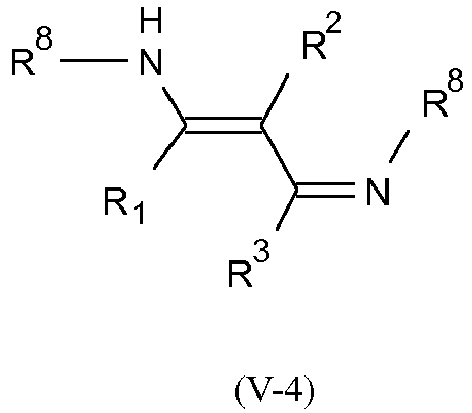
- Preferred are compounds of formula (V-4) in which
- R1 and R3
- are HCF2;
- R2
- is H;
- R8
- is selected from C1-12-alkyl, C3-8-cycloalkyl and benzyl.
- More preferred are compounds of formula (V-4) in which
- R1 and R3
- are HCF2;
- R2
- is H;
- R8
- is selected from iso-propyl and benzyl.
- A further aspect of the present invention are compounds of formula (V-5):

- R1 and R3
- are each independently selected from HCF2, CF3, CF2Cl;
- R2
- is H.
- In the context of the present invention, the term "halogen" (Hal), unless defined differently, comprises those elements which are selected from the group comprising fluorine, chlorine, bromine and iodine, preferably fluorine, chlorine and bromine, more preferably fluorine and chlorine.
- Optionally substituted groups may be mono- or polysubstituted, where the substituents in the case of polysubstitutions may be the same or different.
- Haloalkyl: straight-chain or branched alkyl groups having 1 to 6 and preferably 1 to 3 carbon atoms (as specified above), where some or all of the hydrogen atoms in these groups may be replaced by halogen atoms as specified above, for example (but not limited to) C1-C3-haloalkyl such as chloromethyl, bromomethyl, dichloromethyl, trichloromethyl, fluoromethyl, difluoromethyl, trifluoromethyl, chlorofluoromethyl, dichlorofluoromethyl, chlorodifluoromethyl, 1-chloroethyl, 1-bromoethyl, 1-fluoroethyl, 2-fluoroethyl, 2,2-difluoroethyl, 2,2,2-trifluoroethyl, 2-chloro-2-fluoroethyl, 2-chloro,2-difluoroethyl, 2,2-dichloro-2-fluoroethyl, 2,2,2-trichloroethyl, pentafluoroethyl and 1,1,1-trifluoroprop-2-yl. This definition also applies to haloalkyl as part of a composite substituent, for example haloalkylaminoalkyl etc., unless defined elsewhere. Preference is given to alkyl groups substituted by one or more halogen atoms, for example trifluoromethyl (CF3), difluoromethyl (CHF2), CF3CH2, CF2Cl or CF3CCl2.
- Alkyl groups in the context of the present invention, unless defined differently, are linear, branched or cyclic saturated hydrocarbyl groups. The definition C1-C12-alkyl encompasses the widest range defined herein for an alkyl group. Specifically, this definition encompasses, for example, the meanings of methyl, ethyl, n-, isopropyl, n-, iso-, sec- and t-butyl, n-pentyl, n-hexyl, 1,3-dimethylbutyl, 3,3-dimethylbutyl, n-heptyl, n-nonyl, n-decyl, n-undecyl or n-dodecyl.
- Alkenyl groups in the context of the present invention, unless defined differently, are linear, branched or cyclic hydrocarbyl groups containing at least one single unsaturation (double bond). The definition C2-C12-alkenyl encompasses the widest range defined herein for an alkenyl group. Specifically, this definition encompasses, for example, the meanings of vinyl; allyl (2-propenyl), isopropenyl (1-methylethenyl); but-1-enyl (crotyl), but-2-enyl, but-3-enyl; hex-1-enyl, hex-2-enyl, hex-3-enyl, hex-4-enyl, hex-5-enyl; hept-1-enyl, hept-2-enyl, hept-3-enyl, hept-4-enyl, hept-5-enyl, hept-6-enyl; oct-1-enyl, oct-2-enyl, oct-3-enyl, oct-4-enyl, oct-5-enyl, oct-6-enyl, oct-7-enyl; non-1-enyl, non-2-enyl, non-3-enyl, non-4-enyl, non-5-enyl, non-6-enyl, non-7-enyl, non-8-enyl; dec-1-enyl, dec-2-enyl, dec-3-enyl, dec-4-enyl, dec-5-enyl, dec-6-enyl, dec-7-enyl, dec-8-enyl, dec-9-enyl; undec-1-enyl, undec-2-enyl, undec-3-enyl, undec-4-enyl, undec-5-enyl, undec-6-enyl, undec-7-enyl, undec-8-enyl, undec-9-enyl, undec-10-enyl; dodec-1-enyl, dodec-2-enyl, dodec-3-enyl, dodec-4-enyl, dodec-5-enyl, dodec-6-enyl, dodec-7-enyl, dodec-8-enyl, dodec-9-enyl, dodec-10-enyl, dodec-11-enyl; buta-1,3-dienyl or penta-1,3-dienyl.
- Alkynyl groups in the context of the present invention, unless defined differently, are linear, branched or cyclic hydrocarbyl groups containing at least one double unsaturation (triple bond). The definition C2-C12-alkynyl encompasses the widest range defined herein for an alkynyl group. Specifically, this definition encompasses, for example, the meanings of ethynyl (acetylenyl); prop-1-ynyl and prop-2-ynyl.
- Cycloalkyl: monocyclic, saturated hydrocarbyl groups having 3 to 8 and preferably 3 to 6 carbon ring members, for example (but not limited to) cyclopropyl, cyclopentyl and cyclohexyl. This definition also applies to cycloalkyl as part of a composite substituent, for example cycloalkylalkyl etc., unless defined elsewhere.
- Aryl groups in the context of the present invention, unless defined differently, are aromatic hydrocarbyl groups which may have one, two or more heteroatoms selected from O, N, P and S. The definition C6-18-aryl encompasses the widest range defined herein for an aryl group having 5 to 18 skeleton atoms, where the carbon atoms may be exchanged for heteroatoms. Specifically, this definition encompasses, for example, the meanings of phenyl, cycloheptatrienyl, cyclooctatetraenyl, naphthyl and anthracenyl; 2-furyl, 3-furyl, 2-thienyl, 3-thienyl, 2-pyrrolyl, 3-pyrrolyl, 3-isoxazolyl, 4-isoxazolyl, 5-isoxazolyl, 3-isothiazolyl, 4-isothiazolyl, 5-isothiazolyl, 3-pyrazolyl, 4-pyrazolyl, 5-pyrazolyl, 2-oxazolyl, 4-oxazolyl, 5-oxazolyl, 2-thiazolyl, 4-thiazolyl, 5-thiazolyl, 2-imidazolyl, 4-imidazolyl, 1,2,4-oxadiazol-3-yl, 1,2,4-oxadiazol-5-yl, 1,2,4-thiadiazol-3-yl, 1,2,4-thiadiazol-5-yl, 1,2,4-triazol-3-yl, 1,3,4-oxadiazol-2-yl, 1,3,4-thiadiazol-2-yl and 1,3,4-triazol-2-yl; 1-pyrrolyl, 1-pyrazolyl, 1,2,4-triazol-1-yl, 1-imidazolyl, 1,2,3-triazol-1-yl, 1,3,4-triazol-1-yl; 3-pyridazinyl, 4-pyridazinyl, 2-pyrimidinyl, 4-pyrimidinyl, 5-pyrimidinyl, 2-pyrazinyl, 1,3,5-triazin-2-yl and 1,2,4-triazin-3-yl.
- Arylalkyl groups (aralkyl groups) in the context of the present invention, unless defined differently, are alkyl groups which are substituted by aryl groups, may have one C1-8-alkylene chain and may have, in the aryl skeleton, one or more heteroatoms selected from O, N, P and S. The definition C7-19-aralkyl group encompasses the widest range defined herein for an arylalkyl group having a total of 7 to 19 atoms in the skeleton and alkylene chain. Specifically, this definition encompasses, for example, the meanings of benzyl and phenylethyl.
- Alkylaryl groups (alkaryl groups) in the context of the present invention, unless defined differently, are aryl groups which are substituted by alkyl groups, may have one C1-8-alkylene chain and may have, in the aryl skeleton, one or more heteroatoms selected from O, N, P and S. The definition C7-19-alkylaryl group encompasses the widest range defined herein for an alkylaryl group having a total of 7 to 19 atoms in the skeleton and alkylene chain. Specifically, this definition encompasses, for example, the meanings of tolyl or 2,3-, 2,4-, 2,5-, 2,6-, 3,4- or 3,5-dimethylphenyl.
- The term intermediate used in the context of the present invention describes the substances which occur in the process according to the invention and are prepared for further chemical processing and are consumed or used therein in order to be converted to another substance. The intermediates can often be isolated and intermediately stored or are used without prior isolation in the subsequent reaction step. The term "intermediate" also encompasses the generally unstable and short-lived intermediates which occur transiently in multistage reactions (staged reactions) and to which local minima in the energy profile of the reaction can be assigned.
- The inventive compounds may be present as mixtures of any different isomeric forms possible, especially of stereoisomers, for example E and Z isomers, threo and erythro isomers, and optical isomers, but if appropriate also of tautomers. Both the E and the Z isomers are disclosed and claimed, as are the threo and erythro isomers, and also the optical isomers, any mixtures of these isomers, and also the possible tautomeric forms.
- The process is illustrated in Scheme 1:

- In step (A), α,α-dihaloamines of the formula (II) are first reacted, in the presence of a Lewis acid [L], with compounds of the formula (III).
- Preferred compounds of the general formula (II) are 1,1,2,2-tetrafluoroethyl-N,N-dimethylamine (TFEDMA), 1,1,2,2-tetrafluoroethyl-N,N-diethylamine, 1,1,2-trifluoro-2-(trifluoromethyl)ethyl-N,N-dimethylamine, 1,1,2-trifluoro-2-(trifluoromethyl)ethyl-N,N-diethylamine (Ishikawa's reagent), 1,1,2-trifluoro-2-chloroethyl-N,N-dimethylamine and 1,1,2-trifluoro-2-chloroethyl-N,N-diethylamine (Yarovenko's reagent).
- Compounds of the general formula (II) are used as iminoalkylating agents. Preference is given to 1,1,2,2-tetrafluoroethyl-N,N-dimethylamine (TFEDMA) and 1,1,2,2-tetrafluoroethyl-N,N-diethylamine, and particular preference to 1,1,2,2-tetrafluoroethyl-N,N-dimethylamine. α,α-Dihaloamines such as TFEDMA and Ishikawa's reagent are commercially available or can be prepared (cf. Yarovenko et al., Zh. Obshch. Khim. 1959, 29, 2159, Chem. Abstr. 1960, 54, 9724h or Petrov et al., J. Fluor. Chem. 109 (2011) 25-31).
- Yagupolskii et al. (Zh. Organicheskoi Khim. (1978), 14(12), 2493-6) shows that the reaction of Yarovenko's reagent (FClCHCF2NEt2) with nitriles of the formula RCH2CN (R = CN, CO2Et) affords the derivatives of the formula (NC)RC=C(NEt2)CHFCl in approx. 70% yield. Compounds of the formula (III) do not react with α,α-dihaloamines of the formula (II) under this condition.
- Petrov et al. (J. of Fluorine Chem. (2011), 132(12), 1198-1206) shows that TFEDMA (HCF2CF2NMe2) reacts with cyclic β-diketones to transfer a difluoroacetyl group.
- In a preferred embodiment of the process according to the invention, the α,α-dihaloamine is first reacted with Lewis acid [L], for example BF3, AlCl3, SbCl5, SbF5, ZnCl2, and then the mixture of the compound of the formula (III) is added in substance or dissolved in a suitable solvent (cf.
WO 2008/022777 ). - α,α-Dihaloamines are reacted with Lewis acids (preparation of the iminium salts of the formula (V)) according to the teaching of
WO 2008/022777 . According to the invention, the reaction is effected at temperatures of -20°C to +40°C, preferably at temperatures of -20°C to +30°C, more preferably at -10 to 20°C and under standard pressure. Due to the hydrolysis sensitivity of the α,α-dihaloamines, the reaction is conducted in anhydrous apparatuses under inert gas atmosphere. - The reaction time is not critical and may, according to the batch size and temperature, be selected within a range between a few minutes and several hours.
- According to the invention, 1 mol of the Lewis acid [L] is reacted with equimolar amounts of the α,α-dihaloamine of the formula (II).
- For the process according to the invention 1 to 2 mol, preferred 1 to1,5 mol, most preferred 1 to 1,2 mol of the α,α-dihaloamine of the formula (II) is reacted with 1 mol compound of formula (III).
- Suitable solvents are, for example, aliphatic, alicyclic or aromatic hydrocarbons, for example petroleum ether, n-hexane, n-heptane, cyclohexane, methylcyclohexane, benzene, toluene, xylene or decalin, and halogenated hydrocarbons, for example chlorobenzene, dichlorobenzene, dichloromethane, chloroform, tetrachloromethane, dichloroethane or trichloroethane, ethers such as diethyl ether, diisopropyl ether, methyl tert-butyl ether, methyl tert-amyl ether, dioxane, tetrahydrofuran, 1,2-dimethoxyethane, 1,2-diethoxyethane or anisole; nitriles such as acetonitrile, propionitrile, n- or isobutyronitrile or benzonitrile; amides such as N,N-dimethylformamide, N,N-dimethylacetamide, N-methylformanilide, N-methylpyrrolidone or hexamethylphosphoramide; sulphoxides such as dimethyl sulphoxide or sulphones such as sulpholane. Particular preference is given, for example, to THF, acetonitriles, ethers, toluene, xylene, chlorobenzene, n-hexane, cyclohexane or methylcyclohexane, and very particular preference, for example, to acetonitrile, THF, ether or dichloromethane.
- The intermediates of the formula (V) formed can be used in the cyclization step without prior workup.
- Especially the intermediates of the formula V-2 could be easily isolated from reaction mixture in pure form upon dilution with water. Isolated compounds of the formula V-2 are stable upon storage and react with hydrazine of the formula IV yielding the desired pyrazoles of the formula (I) in high and purity > 95-96 %, so no further purification is needed.
- Alternatively, the intermediates can be isolated by suitable workup steps, characterized and optionally further purified.
- Compounds of formula (III) are partially new. They can be prepared from aldehydes or ketones (VII) according to the scheme shown below, see also Roeschenthaler et al, J.Fluorine.Chem. v. 125, n. 6, 1039-1049 and Tetrahedron, 69 (2013), 3878-3884.

- The reaction of compound (VII) and (VI) according to the invention is effected at temperatures of -40 °C to +120 °C, preferably at temperatures of +20 °C to +100 °C, more preferably at 20 °C to +60 °C and under standard pressure.
- For the process according to the invention 0,9 to 2 mol, preferred 1 to 1,8 mol, most preferred 1 to 1,2 mol of the compound of the formula (VI) is reacted with 1 mol compound of the formula (VII).
- In case R3 is CF3, CF2H, CF2Cl and R is H it is preferable to use an excess of compound of the formula (VII), 1.02 to 2 mol, preferably 1.01 to 1,8 mol, most preferably 1.01 to 1,2 mol, of the compound of the formula (VII) for 1 mol compound of the formula (VI).
- The reaction time is not critical and may, according to the batch size and temperature, be selected within a range between a few and many hours.
- Suitable solvents are, for example, aliphatic, alicyclic or aromatic hydrocarbons, for example petroleum ether, n-hexane, n-heptane, cyclohexane, methylcyclohexane, benzene, toluene, xylene or decalin, and halogenated hydrocarbons, for example chlorobenzene, dichlorobenzene, dichloromethane, chloroform, tetrachloromethane, dichloroethane or trichloroethane, ethers such as diethyl ether, diisopropyl ether, methyl tert-butyl ether, methyl tert-amyl ether, dioxane, tetrahydrofuran, 1,2-dimethoxyethane, 1,2-diethoxyethane or anisole; nitriles such as acetonitrile, propionitrile, n- or isobutyronitrile or benzonitrile; amides such as N,N-dimethylformamide, N,N-dimethylacetamide, N-methylformanilide, N-methylpyrrolidone or hexamethylphosphoramide; sulphoxides such as dimethyl sulphoxide or sulphones such as sulpholane, alkohols such as methanol, ethanol, isopropanol butanol, esters like ethyl- and propylacetate . Particular preference is given to ethylacetate, THF, acetonitriles, ethers, toluene, xylene, chlorobenzene, n-hexane, cyclohexane or methylcyclohexane, ethanol and very particular preference to ethylaacetate, toluene, acetonitrile, THF, ether, dichloromethane, ethanol. Most preferred is toluene.
- According to the invention, 1 mol to 2 mol, preferably 1 to 1.5 mol of the hydrazine of the formula NH2-NHR4 for 1 mol of the compound of formula (V) is used.
- The cyclization in step (B) of the compound of formula (V) is effected at temperatures of -40 °C to +80 °C, preferably at temperatures of +20 °C to +70 °C, more preferably at +60 °C and under standard pressure.
- The reaction time is not critical and may, according to the batch size, be selected within a relatively wide range.
- Typically, the cyclization step (B) is effected without changing the solvent.
- Typically the cyclization of compound of the formula (V) proceeds under acidic condition.
- Preference is given to mineral acids, for example H2SO4, HCl, HF, HBr, HI, H3PO4 or organic acids, for example CH3COOH, CF3COOH, p-toluenesulphonic acid, methanesulphonic acid, trifluoromethanesulphonic acid.
- According to the invention, 0.1 mol to 2 mol, preferably 0.1 to 1.5 mol of the acid for 1 mol of the compound of formula (V) is used. Suitable solvents are, for example, aliphatic, alicyclic or aromatic hydrocarbons, for example petroleum ether, n-hexane, n-heptane, cyclohexane, methylcyclohexane, benzene, toluene, xylene or decalin, and halogenated hydrocarbons, for example chlorobenzene, dichlorobenzene, dichloromethane, chloroform, tetrachloromethane, dichloroethane or trichloroethane, ethers such as diethyl ether, diisopropyl ether, methyl tert-butyl ether, methyl tert-amyl ether, dioxane, tetrahydrofuran, 1,2-dimethoxyethane, 1,2-diethoxyethane or anisole; alcohols such as methanol, ethanol, isopropanol or butanol, nitriles such as acetonitrile, propionitrile, n- or isobutyronitrile or benzonitrile; amides such as N,N-dimethylformamide, N,N-dimethylacetamide, N-methylformanilide, N-methylpyrrolidone or hexamethylphosphoramide; sulphoxides such as dimethyl sulphoxide or sulphones such as sulpholane, esters like ethyl- and propylacetate Particular preference is given, for example, to ethylacetate, acetonitrile, toluene, xylene, chlorobenzene, n-hexane, cyclohexane or methylcyclohexane, and very particular preference, for example, to ethylacetate,acetonitrile, THF, toluene or xylene. After the reaction has ended, for example, the solvents are removed and the product is isolated by filtration or distillation,, or a solution of product is first washed with water , the organic phase is concentrated under reduced pressure.
- The compounds of the formula (Ia/b) where R2 is COOR4 can then be converted to pyrazole acids of the formula (I) with R2 being COOH.
- Amine (VI) can be reused for the preparation of compound (III). Alternatively, it is trapped by washing the reaction mixture with acid.
- The inventive compounds (Ia) and (Ib) are used for preparation of active fungicidal ingredients.
- To the mixture of difluoracetone (94 g, 1 mol) in 500 ml methyltert.butylether (88 g., 1,5 mol) of isopropylamin was added at 10°C. After 1 h (70 g 0,5 mol) of BF3*Et2O was added and the mixture was stirred additionally for 1 h. Organic solution was separated from bottom syrup and solvent was distilled off at atmospheric pressure. The remaining liquid was distilled in vacuum yielding 139 g ketimine with a of b.p. 70-72°C/400 mbar.
1H NMR (601 MHz, CDCl3):□□: 5.83 (t, 1H), 3.74 (m, 1H), 1.92 (s, 3H), 1.15 (d, 6H) ppm.
19F (566 MHz, CDCl3)□□□□□ -121.4 (d, 2F) ppm. - To the mixture of difluoroacetone (94 g, 1 mol) in 500 ml dichloromethane, (107 g , 1 mol) of benzylamine was slowly added at 10°C. After 6 h at 20°C CH2Cl2 was distilled off at reduced pressure and the remains liquid was distilled in vacuum, yielding 161 g ketimine with b.p. 80-82°C/1,3 mbar.
1H NMR (601 MHz, CDCl3) □□ 7.36-7.26 (m, 5H), 5.94 (t, 1H), 4.55 (s, 2H), 2.03 (s, 3H) ppm.
19F (566 MHz, CDCl3)□□□ - -121.2 (dt, 2F) ppm. - N-1,1,1-trifluoropropan-2-ylidene-1-phenylmethanamin (III-4) (preparation see Example 2) b.p. 90-91 °C, 1,5 mbar.
- 300 ml of acetonitrile were placed in a double jacketed flask and cooled to 0°C. AlCl3 74.4 g (0.553 mol) was added portionwise at this temperature under intensive stirring to form yellow suspension. To this suspension a solution of TFEDMA 80 g (0. 553 mol) in 350 ml acetonitrile was added at 10°C. The reaction mixture was stirred for 1 h at room temperature and solution of (53 g, 0,395 mol) of N-1,1(-difluoropropan-2-ylidene) propan-2-amine was added within 1 h at 40°C and the mixture was stirred at this temperature for 12 h. 100 ml HCl (as 5 % water solurtion) and 29 g hydrazinhydrate were added slowly to the reaction solution to keep the temperature under 40°C and the mixture was stirred for 5 h at 60°C forming two phases. The upper organic layer was separated, diluted with 500 ml methyltertbutylether, washed two times with water, dried over MgSO4 and concentrated in vacuum to give an oily product. Vacuum destillation at 92-95°C /1 mbar gave 56,4 g (85 %) of pure 3,5-bis(difluoromethyl)-1H-pyrazole b) as a white solid with a of m.p. 70-71°C.
1H NMR (601 MHz, CDCl3) □ 11.93 (br, 1H), 6.88 (t, 2H, J = 54.8 Hz), 6.79 (s, 1H) ppm.
13C NMR (151 MHz, CDCN)□□ 103.4(p) ; 111.1 (t) ; 143.6 (br) ppm.
19F NMR (566 Mhz), □□□□□112.2 (d, br) ppm.. - BF3 (247 g 0.553 mol) as 15 % Solution in CH3CN3 was placed in the flask and a solution of TFEDMA 80 g (0. 553 mol) in 350 ml acetonitrile was added at 10°C portionwise at this temperature under intensive stirring. The reaction mixture was stirred for 1 h at room temperature and solution of (53 g, 0,395 mol) of N-1,1(-difluoropropan-2-ylidene) propan-2-amine was added within 1 h at 40°C and the mixture was stirred at this temperature for 12 h. 20 ml HCl and 29 g hydrazinhydrate were added slowly to the reaction mixture to keep the temperature under 40°C and the mixture was stirred for 5 h at 60°C. Volitiles were removed in vacuum, 300 ml methyltertbutylether was added to the residues and organic solution was washed two times with water, dried over MgSO4 and concentrated in vakuum to give an oily product. Vacuum destillation at 92-95°C /1 mbar gave 58 g (87 %) of pure 3,5-bis(difluoromethyl)-1H-pyrazole as a white solid with m.p. 70-71°C.
1H NMR (601 MHz, CDCl3) □ 11.93 (br, 1H), 6.88 (t, 2H, J = 54.8 Hz), 6.79 (s, 1H). - 30 ml of acetonitrile were placed in a double jacketed flask and cooled to 0°C. BF3*Et2O 4.8 g (0.055 mol) was added portionwise at this temperature under intensive stirring to form yellow solution. A solution of TFEDMA 8 g (0.0 55 mol) in 35 ml acetonitrile was added at 10°C. and reaction mixture was stirred for 1 h at room temperature. A solution of (5, 3 g, 0,395 mol) of N-(1,1,1-trifluoropropan-2-ylidene]propan-2-amine was added within 1 h at 40°C and the mixture was stirred at 40°C for 12 h. 15 ml HCl (as 5 % water solution) and 2,9 g hydrazinhydrate was added slowly to the reaction solution to keep the temperature under 40°C and the reaction mixture was stirred for 5 h at 60°C. Water (10 mL) was added and the solution was extracted with methyltertbutyletherr (3 x 20 mL). The combined organic extracts were washed with brine (15 mL), dried over Na2SO4 and evaporated under reduced pressure. The crude material was purified by column chromatography on silica gel with pentane/diethyl ether (100:0 to 60:40) as eluent to afford the pure title compound (6,2 g , 85%) as a pale yellow solid.
1H NMR (400 MHz, CDCl3) □ 12.6 (br, 1H), 6.81 (s, 1H), 6.76 (t, 1H, J = 54.5 Hz) ; 13C (101 MHz, CDCl3)□□ 140.7, 128.8, 120.3 (q, J C-F = 266 Hz), 108.5 (t, J C-F = 237 Hz), 103.8 ; 19F (376 MHz, CDCl3)□□ -61.7 (s, 3F), -112.9 (d, 2F, J = 54.7 Hz) ; HRMS (ESI) calculated for C5H4F5N2 [M+H]+ 187.029, found 187.029. - BF3 (2,47 g 0.0553 mol) as 15 % solution in CH3CN3 was placed in the flask and a solution of TFEDMA 8 g (0.0 553 mol) in 35 ml acetonitrile was added at 10°C portionwise at this temperature under intensive stirring. The reaction mixture was stirred for 1 h at room temperature and solution of (10.1 g, 0,0553 mol) of N-1,1-difluoropropan-2-ylidene-1-phenylmethanamine was added within 1 h at 40°C and the mixture was stirred at this temperature for 12 h. The solvent was removed in vakuum 2 mbar. The oily product was anylzed via NMR spectroscopy showing pure compound.
- The 13C NMR data were taken from HSQC and HMBC spectra. The data are referenced to CD3CN (1.3 ppm).
13C NMR (151 MHz, CD3CN) □ 164.8 (s,t), 159.5 (st); 135.1 (s); 129.6 (d), 129.0 (d), 128.4 (d) ; 110.6 (dt), 109.6 (dt), 86.7 (d); 49.2 (t); 46.1 (q,br); 43.7 (q,br) ppm.
1H NMR (601 MHz, CD3CN) □□□□8.26 (br.s. 1H)), 7.42 (m, 2H), 7.37 (m, 3 H), 6.73 (t,1H), 6.64 (t,1H) ,5.09 (s,br, 1H), 4.58 (s, br, 2H), 3.33 (s,br., 6H) ppm. - An interaction of (3 E/Z)-4-(benzylamino)-1,1,5,5-tetrafluoro-N,N-dimethylpent-3-en-2-iminium tetrafluoroborate with N2H4 and HCl in Ethanol according to the conditions in example 5 gave pure 3,5-bis(difluoromethyl)pyrazole in 89 % yield.
- To a solution of 318 g of BF3 (as 15.2 % w.w. solution in CH3CN) 107 g of Tetrafluoroethyldimethylamin was added at 0 to 5°C within 40 minutes. The pale yellow solution was stirred additionally for 1 h at 0°C and the mixture was heated up to 40°C within 1 h. 122.6 g of N-benzyl-1,1-difluoro-propan-2-imine was added at 40°C so fast to maintain the temperature in the reactor between 40-45°C (addition time 45min). The reaction mixture was stirred additionally for 2 h at 40°C to give clear pale/yellow solution. Under stirring 200 ml water were added to this solution at 0°C and after 10-15 min a white precipitates starts to form. The slurry was stirred for 3-4 h at 0°C and the precipitate was filtered off, washed with 100 ml of water and dried at 40°C to give 152.2 g (yield 89 %) of the product as a white solid with a melting point of 86-87°C.
Mixture of E/Z -isomers in ratio 25:75.NMR 19F(566 MHz, CD3CN, CFCl3): E-isomer: -123.2 (d), -125.2 (d) ppm.
Z-isomer : -120.8 (d), -125.9 (d)
1H NMR (601 MHz, CD3CN): E-isomer 25 %: 4.43, (d, 2H); 5.42, (s, 1H); 5.77, (t, 1H); 7.32 (t, 1H), 7.33, (m, 2H); 7.42-7.32, m, (5H); 10.67 (s, br,, 1H) ppm.
Z-isomer 75 %: 4.65, (d, 2H); 5.69, (s, 1H); 5.92, (t,1H); 6.55 (t, 1H), 5.92 (t, 1H), 7.34, (m 2H), 7.42-7.32, (m, 5H); 10.67 (s, br, 1H) ppm. - To a solution of 24.5 of BF3 (as 15.2 % w.w. solution in CH3CN) 8.2 g of Tetrafluoroethyldimethylamin was added at 0 to 5°C within 40 minutes. The pale yellow solution was stirred additionally for 1 h at 0°C and the mixture was heated up to 40°C within 1 h. 6.75 g of N-isopropyl-1,1-difluoro-propan-2-imine was added at 40°C so fast to maintain the temperature in reactor between 40-45°C (addition time 45min). The reaction mixture was stirred additionally for 2 h at 40°C to give clear pale/yellow solution. Under stirring 50 ml water were added to this solution at 0°C and two-phase mixture was stirred for 1 h at 0°C and the product extracted with ethylacetate, Organic extract was washed with 100 ml of water and dried over MgSO4 to give 9,5 g (yield 89 %) of the oil as a mixture of Z/E-isomers in ratio 83:17 .
NMR 19F (566 MHz, CD3CN): Z -isomer : -120.5 (d), -125.7 (d) ppm.
E-isomer: -123.1 (d), -125.0 (d) ppm.
1H NMR (601 MHz, CD3CN) E/Z-isomers: 1.23, 1.27 (D, 6H) ; 3.72, 3.97 (M, 1H); 5.43, 5.57 (S, 1H); 5.85, 7,33, 5.90, 6.53 (T, 1H); 10.52 (S, br, 1H) ppm.
m/z: 213. - 2.4 g of hydrazine-hydrate were added dropwise to the suspension of 10.4 g (4E and 4Z)-benzylimino-1,1,5,5-tetrafluoro-pentan-2-one in 60 ml ethylacetate. The mixture was stirred for 1 h at room temperature and then 15.6 g of 30 % H2SO4 were added dropwise to reaction mixture. The slurry was stirred for 2 h at 20°C, precipitate was filtered off and organic phase washed with water. The solvent was removed in vacuum to give 6.5 g of the product with a melting point of 73-74°C.
1H NMR (601 MHz, CDCl3) □ 12.5 (br, 1H), 6.77 (t, 2H, J 54.8 Hz), 6.74 (s, 1H). - To a suspension of 2,6 g of (4E and 4Z)-benzylimino-1,1,5,5-tetrafluoro-pentan-2-one in 20 ml of ethanol 0,5 g N-methylhydrazine was added at 20°C. The mixture was stirred for 1 h and then acidified by adding of 3.6 g of 30 % H2SO4. After 1 h the mixture was evaporated in vacuum and product extracted with methyltert.butylether. Organic phase was washed with water and concentrated in vacuum to give 1.7 g (yield 94 %) of oily product..
1H NMR (601 MHz, CD3CN) □ 3.95 (s, 3H), 6.77 (t, 1H), 2J=54.7 Hz); 6.78 (s, 1H); 6.95 (t, 1H, 2J=53.4 Hz) ppm.
19F NMR (566 MHz, CD3CN, CFCl3) □: -112.8 (d); 115.4 (d) ppm.
m/z: 182. - To a suspension of 0.7 g of (4E and 4Z)-benzylimino-1,1,5,5-tetrafluoro-pentan-2-one in 20 ml of ethanol 0,45 g of ethyl hydrazinoacetate hydrochloride was added at 20°C. The mixture was stirred for 10 h at 40°C and then acidified by adding of 0.95 g of 30 % H2SO4. After 1 h the mixture was evaporated in vacuum and product extracted with methyltert.butylether. Organic phase was washed with water and concentrated in vacuum to give 1.7 g (yield 94 %) of oily product.
1H NMR (601 MHz, CD3CN)□□: 1.24 (t, 3H), 4.20 (q, 2H), 5.07 (s, 2H) 6.79 (t, 1H, J=54.7 Hz); 6.86 (s, 1H); 6.94 (t, 1H, J=53.5 Hz) ppm.
19F NMR (566 MHz, CD3CN) □: -112.7 (d); -115.4 (d) ppm.
m/z: 254 -

18g of 2-{3-[2-(1-{[3,5-bis(difluoromethyl)-1H-pyrazol-1-yl]acetyl}piperidin-4-yl)-1,3-thiazol-4-yl]-4,5-dihydro-1,2-oxazol-5-yl}-3-chlorophenyl methanesulfonate with a purity of 94% is received (yield: 84%).


 |
 |
| A- is BF4 -, AlCl3F-, AlF2Cl2 -, AlF3Cl- or ZnCl2F- |
| R1, R2, R3, R5, R6, R7, R8, R9, R10, R11 are as defined above |
Claims (9)
- Process for preparing 3,5-bis(haloalkyl)pyrazoles of the formula (Ia) and (Ib)
 R1 and R3 are each independently selected from C1-C6-haloalkyl;R2 is selected from H, halogen, COOH, (C=O)OR5, CN and (C=O)NR6R7;R4 is selected from H, C1-C8-alkyl, CH2COOC1-C8-alkyl, aryl, pyridyl;R5 is selected from C1-C12-alkyl, C3-C8-cycloalkyl, C6-C18-aryl, C7-C19-arylalkyl and C7-C19-alkylaryl;R6 and R7 are each independently selected from C1-C12-alkyl, C3-C8-cycloalkyl, C6-C18-aryl, C7-C19-arylalkyl and C7-C19-alkylaryl or whereR6 and R7 together with the nitrogen atom to which they are bonded may form a four-, five- or six-membered ringcharacterized in that in step (A), α,α-dihaloamines of the formula (II),
 R1 is as defined above;X is independently selected from F, Cl or Br,R10 and R11 are each independently selected from C1-C12-alkyl, C3-C8-cycloalkyl, C6-C18-aryl, C7-C19-arylalkyl and C7-C19-alkylaryl or whereR10 and R11 together with the nitrogen atom to which they are bonded may form a five- or six-membered ring;are reacted with compounds of the formula (III),
 R8 is selected from C1-C12-alkyl, C3-C8-cycloalkyl, C6-C18-aryl, C7-C19-arylalkyl and C7-C19-alkylaryl, OR9;R9 is selected from C1-C12-alkyl, C3-C8-cycloalkyl, C6-C18-aryl, C7-C19-arylalkyl, C7-C19-alkylaryl;R2 and R3 are as defined above;to form the compound of formula (V): (V-1), (V-2), (V-3), (V-4) and (V-5)

A- is BF4 -, AlCl3F-, AlF2Cl2 -, AlF3Cl- or ZnCl2F- R1, R2, R3, R5, R6, R7, R8, R9, R10, R11 are as defined above - Process according to Claim 1, characterized in thatR1 and R3 are each independently selected from difluoromethyl, trifluoromethyl, chlorofluoromethyl, dichlorofluoromethyl, chlorodifluoromethyl, 1-fluoroethyl, 2-fluoroethyl, 2,2-difluoroethyl, 2,2,2-trifluoroethyl, 2-chloro-2-fluoroethyl, 2-difluoroethyl, 2,2-dichloro-2-fluoroethyl, 2,2,2-trichloroethyl, tetrafluoroethyl (CF3CFH), pentafluoroethyl and 1,1,1-trifluoroprop-2-yl;R2 is selected from H, F, Cl, Br, COOCH3, COOC2H5, COOC3H7, CN and CON(CH3)2, CON(C2H5)2;R4 is selected from H, C1-C8-alkyl, CH2COOC1-C8-alkyl, phenyl, pyridyl;R8 are each independently selected from methyl, ethyl, n-, iso-propyl, n-, iso-, sec- and t-butyl, cyclopropyl, cyclobutyl, cyclopentyl, cyclohexyl, phenyl, benzyl, phenylethyl, C7-C19-alkylaryl, tolyl, 2,3-, 2,4-, 2,5-, 2,6-, 3,4- or 3,5-dimethylphenyl;X is independently selected from F or Cl;R10 and R11 are each independently selected from C1-C12-alkyl, C3-C8-cycloalkyl, C7-C19-arylalkyl orR10 and R11 together with the nitrogen atom to which they are bonded may form a five- membered ring.
- Process according to Claim 1, characterized in thatR1 and R3 are each independently selected from trifluoromethyl, difluoromethyl, difluorochloromethyl, pentafluoroethyl;R2 is selected from H, Cl, CN, COOC2H5;R4 is selected from H, methyl, ethyl, n-, isopropyl, n-, iso-, sec- and t-butyl, n-pentyl, n-hexyl, 1,3-dimethylbutyl, 3,3-dimethylbutyl, phenyl, CH2COOCH3, CH2COOCH2CH3;R8 is selected from methyl, ethyl, n-, iso-propyl, n-, iso-, sec- und t-butyl, cyclopropyl, cyclobutyl, cyclopentyl, cyclohexyl, benzyl, C7-C19-alkylaryl;X is independently selected from F or Cl;R10 and R11 are each independently selected from C1-C12-alkyl, C3-C8-cycloalkyl.
- Process according to Claim 1, characterized in thatR1 and R3 are each independently selected from CF2H and CF3;R2 is selected from H or COOC2H5;R4 is selected form H, methyl, ethyl, CH2COOCH3, CH2COOCH2CH3, phenyl;R8 is selected from ethyl, n-, iso-propyl, n-, cyclopentyl, cyclohexyl, benzyl;X is F;R10 and R11 are each independently selected from C1-C12-alkyl.
- Process according to Claim 1, characterized in thatR1 and R3 are CF2H,;R2 is H;R4 is selected from H, methyl, CH2COOCH2CH3, phenyl;R8 is selected from iso-propyl and benzyl;X is F;R10 and R11 are each independently selected from methyl and ethyl.
- Compounds of formula (V-1)
 R1 and R3 are HCF2;R2 is H;R8 is selected from C1-C12-alkyl, C3-C8-cycloalkyl and benzyl;R10 and R11 are each independently selected from C1-C5 alkyl;A- is BF4 -.
 - Compounds of formula (V-2)
 R1 and R3 are HCF2;R2 is H;R8 is selected from C1-C12-alkyl, C3-C8-cycloalkyl and benzyl.
 - Compounds of formula (V-3)
 R1 and R3 are HCF2;R2 is H;R8 is selected from C1-12-alkyl, C3-8-cycloalkyl and benzyl;R10 and R11 are each independently selected from C1-5 alkyl.
 - Compounds of formula (V-4)
 R1 and R3 are HCF2;R2 is H;R8 is selected from C1-12-alkyl, C3-8-cycloalkyl and benzyl.
Priority Applications (13)
| Application Number | Priority Date | Filing Date | Title |
|---|---|---|---|
| EP14191501.7A EP3015458A1 (en) | 2014-11-03 | 2014-11-03 | Process for preparing 3,5-bis(haloalkyl)pyrazole derivatives from a,a-dihaloamines and ketimines |
| PCT/EP2015/055899 WO2015144578A1 (en) | 2014-03-24 | 2015-03-20 | PROCESS FOR PREPARING 3,5-BIS(HALOALKYL)PYRAZOLE DERIVATIVES FROM α,α-DIHALOAMINES AND KETIMINES |
| DK15710805.1T DK3122727T3 (en) | 2014-03-24 | 2015-03-20 | METHOD FOR PREPARING 3,5-BIS (HALOGENAL COOL) PYRAZOLD DERIVATIVES OF ALFA, ALFA-DIHALOGENAMINES AND KETIMINES |
| MX2016011955A MX361769B (en) | 2014-03-24 | 2015-03-20 | PROCESS FOR PREPARING 3,5-BIS(HALOALKYL)PYRAZOLE DERIVATIVES FROM a,a-DIHALOAMINES AND KETIMINES. |
| CN201580015654.4A CN106164049B (en) | 2014-03-24 | 2015-03-20 | Process for the preparation of 3, 5-di (haloalkyl) pyrazole derivatives from α -dihaloamines and ketimines |
| BR112016021874-4A BR112016021874B1 (en) | 2014-03-24 | 2015-03-20 | PROCESS FOR PREPARING PIRAZOL 3,5-BIS (HALOalkyl) DERIVATIVES FROM ALPHA, ALPHA-DIHALOAMINES AND CETIMINES AND COMPOUNDS |
| EP15710805.1A EP3122727B1 (en) | 2014-03-24 | 2015-03-20 | Process for preparing 3,5-bis(haloalkyl)pyrazole derivatives from alpha , alpha-dihaloamines and ketimines |
| JP2016558384A JP6431088B2 (en) | 2014-03-24 | 2015-03-20 | Process for producing 3,5-bis (haloalkyl) pyrazole derivatives from α, α-dihaloamines and ketimines |
| KR1020167029520A KR102410034B1 (en) | 2014-03-24 | 2015-03-20 | PROCESS FOR PREPARING 3,5-BIS(HALOALKYL)PYRAZOLE DERIVATIVES FROM α,α-DIHALOAMINES AND KETIMINES |
| TW104108886A TWI651306B (en) | 2014-03-24 | 2015-03-20 | Method for preparing 3,5-bis(haloalkyl)pyrazole derivatives from α,α-dihaloamines and ketimines |
| US15/127,908 US9701640B2 (en) | 2014-03-24 | 2015-03-20 | Process for preparing 3,5-bis(haloalkyl)pyrazole derivatives from α,α-dihaloamines and ketimines |
| ES15710805.1T ES2663614T3 (en) | 2014-03-24 | 2015-03-20 | Process for preparing 3,5-bis (haloalkyl) pyrazole derivatives from alpha, alpha-dihaloamines and ketimines |
| IL247542A IL247542B (en) | 2014-03-24 | 2016-08-30 | Process for preparing 3,5-bis(haloalkyl)pyrazole derivatives from alpha,alpha-dihaloamines and ketimines |
Applications Claiming Priority (1)
| Application Number | Priority Date | Filing Date | Title |
|---|---|---|---|
| EP14191501.7A EP3015458A1 (en) | 2014-11-03 | 2014-11-03 | Process for preparing 3,5-bis(haloalkyl)pyrazole derivatives from a,a-dihaloamines and ketimines |
Publications (1)
| Publication Number | Publication Date |
|---|---|
| EP3015458A1 true EP3015458A1 (en) | 2016-05-04 |
Family
ID=51897097
Family Applications (1)
| Application Number | Title | Priority Date | Filing Date |
|---|---|---|---|
| EP14191501.7A Ceased EP3015458A1 (en) | 2014-03-24 | 2014-11-03 | Process for preparing 3,5-bis(haloalkyl)pyrazole derivatives from a,a-dihaloamines and ketimines |
Country Status (1)
| Country | Link |
|---|---|
| EP (1) | EP3015458A1 (en) |
Cited By (1)
| Publication number | Priority date | Publication date | Assignee | Title |
|---|---|---|---|---|
| US11873289B2 (en) | 2018-02-01 | 2024-01-16 | MyoKardia, Inc. | Pyrazole compounds and preparation thereof |
Citations (15)
| Publication number | Priority date | Publication date | Assignee | Title |
|---|---|---|---|---|
| WO2003070705A1 (en) | 2002-02-19 | 2003-08-28 | Bayer Cropscience Aktiengesellschaft | Disubstituted pyrazolyl carboxanilides |
| WO2005042468A1 (en) | 2003-10-23 | 2005-05-12 | Bayer Cropscience Aktiengesellschaft | Method for producing 2-dihaloacyl-3-amino-acrylic acid esters and 3-dihalomethyl-pyrazole-4-carboxylic acid esters |
| WO2008013925A2 (en) | 2006-07-27 | 2008-01-31 | E. I. Du Pont De Nemours And Company | Fungicidal azocyclic amides |
| WO2008022777A2 (en) | 2006-08-25 | 2008-02-28 | Bayer Cropscience Ag | Process for preparing 3-dihalomethylpyrazole-4-carboxylic acid derivatives |
| WO2009106230A2 (en) | 2008-02-25 | 2009-09-03 | Bayer Cropscience Aktengesellschaft | Method for the regioselective synthesis of 1-alkyl-3-haloalkyl–pyroazole-4-carboxylic acid derivatives |
| WO2009112157A1 (en) | 2008-03-10 | 2009-09-17 | Bayer Cropscience Aktiengesellschaft | Process for the regioselective synthesis of l-alkyl-3-haloalkylpyrazole-4-carboxylic acid derivatives |
| EP2325173A1 (en) * | 2009-11-19 | 2011-05-25 | Bayer CropScience AG | Method for producing 5-fluor-1-alkyl-3-fluoralkyl-1H-pyrazol-4-carboxylic acid chlorides |
| WO2012025557A1 (en) | 2010-08-25 | 2012-03-01 | Bayer Cropscience Ag | Heteroarylpiperidine and -piperazine derivatives as fungicides |
| WO2012137982A2 (en) * | 2011-04-05 | 2012-10-11 | Takeda Pharmaceutical Company Limited | Sulfonamide derivative and use thereof |
| EP2623496A1 (en) * | 2012-02-01 | 2013-08-07 | Bayer CropScience AG | Method for producing 3,5-bis(fluoralkyl)-pyrazol-4-carboxylic acid derivatives and 3,5-bis(fluoralkyl)-pyrazoles |
| EP2628722A1 (en) * | 2012-02-16 | 2013-08-21 | Bayer CropScience AG | CF3O-containing enaminoketones and their utilization for the preparation of CF3O-containing pyrazoles |
| WO2013135824A2 (en) * | 2012-03-14 | 2013-09-19 | Westfälische Wilhelms-Universität Münster | Ion-conductive polymeric compound for electrochemical cells |
| WO2013142307A1 (en) * | 2012-03-19 | 2013-09-26 | Abide Therapeutics | Carbamate compounds and of making and using same |
| WO2014033164A1 (en) * | 2012-08-30 | 2014-03-06 | Bayer Cropscience Ag | Procedure for the decarboxylation of 3,5-bis(haloalkyl)-pyrazole-4-carboxylic acid derivatives |
| WO2014124878A1 (en) * | 2013-02-15 | 2014-08-21 | Syngenta Participations Ag | Process for the preparation of bis-dihaloalkyl pyrazoles |
-
2014
- 2014-11-03 EP EP14191501.7A patent/EP3015458A1/en not_active Ceased
Patent Citations (15)
| Publication number | Priority date | Publication date | Assignee | Title |
|---|---|---|---|---|
| WO2003070705A1 (en) | 2002-02-19 | 2003-08-28 | Bayer Cropscience Aktiengesellschaft | Disubstituted pyrazolyl carboxanilides |
| WO2005042468A1 (en) | 2003-10-23 | 2005-05-12 | Bayer Cropscience Aktiengesellschaft | Method for producing 2-dihaloacyl-3-amino-acrylic acid esters and 3-dihalomethyl-pyrazole-4-carboxylic acid esters |
| WO2008013925A2 (en) | 2006-07-27 | 2008-01-31 | E. I. Du Pont De Nemours And Company | Fungicidal azocyclic amides |
| WO2008022777A2 (en) | 2006-08-25 | 2008-02-28 | Bayer Cropscience Ag | Process for preparing 3-dihalomethylpyrazole-4-carboxylic acid derivatives |
| WO2009106230A2 (en) | 2008-02-25 | 2009-09-03 | Bayer Cropscience Aktengesellschaft | Method for the regioselective synthesis of 1-alkyl-3-haloalkyl–pyroazole-4-carboxylic acid derivatives |
| WO2009112157A1 (en) | 2008-03-10 | 2009-09-17 | Bayer Cropscience Aktiengesellschaft | Process for the regioselective synthesis of l-alkyl-3-haloalkylpyrazole-4-carboxylic acid derivatives |
| EP2325173A1 (en) * | 2009-11-19 | 2011-05-25 | Bayer CropScience AG | Method for producing 5-fluor-1-alkyl-3-fluoralkyl-1H-pyrazol-4-carboxylic acid chlorides |
| WO2012025557A1 (en) | 2010-08-25 | 2012-03-01 | Bayer Cropscience Ag | Heteroarylpiperidine and -piperazine derivatives as fungicides |
| WO2012137982A2 (en) * | 2011-04-05 | 2012-10-11 | Takeda Pharmaceutical Company Limited | Sulfonamide derivative and use thereof |
| EP2623496A1 (en) * | 2012-02-01 | 2013-08-07 | Bayer CropScience AG | Method for producing 3,5-bis(fluoralkyl)-pyrazol-4-carboxylic acid derivatives and 3,5-bis(fluoralkyl)-pyrazoles |
| EP2628722A1 (en) * | 2012-02-16 | 2013-08-21 | Bayer CropScience AG | CF3O-containing enaminoketones and their utilization for the preparation of CF3O-containing pyrazoles |
| WO2013135824A2 (en) * | 2012-03-14 | 2013-09-19 | Westfälische Wilhelms-Universität Münster | Ion-conductive polymeric compound for electrochemical cells |
| WO2013142307A1 (en) * | 2012-03-19 | 2013-09-26 | Abide Therapeutics | Carbamate compounds and of making and using same |
| WO2014033164A1 (en) * | 2012-08-30 | 2014-03-06 | Bayer Cropscience Ag | Procedure for the decarboxylation of 3,5-bis(haloalkyl)-pyrazole-4-carboxylic acid derivatives |
| WO2014124878A1 (en) * | 2013-02-15 | 2014-08-21 | Syngenta Participations Ag | Process for the preparation of bis-dihaloalkyl pyrazoles |
Non-Patent Citations (14)
| Title |
|---|
| ASHTON, WALLACE T. ET AL: "A regioselective route to 3-alkyl-1-aryl-1H-pyrazole-5-carboxylates: synthetic studies and structural assignments", JOURNAL OF HETEROCYCLIC CHEMISTRY, vol. 30, no. 2, 1993, pages 47 - 56, XP002736785, DOI: 10.1002/JHET.5570300202 * |
| CHEMICAL ABSTRACTS, Columbus, Ohio, US; abstract no. 54, 9724H |
| CLAIRE, PREET P. K. ET AL: "3,5-Bis(trifluoromethyl) pyrazole and some N-substituted derivatives", JOURNAL OF FLUORINE CHEMISTRY, vol. 51, no. 2, 1991, pages 283 - 289, XP002737133, ISSN: 0022-1139, DOI: 10.1016/S0022-1139(00)80298-5 * |
| IGOR I. GERUS ET AL: ""Reported, but Still Unknown." A Closer Look into 3,4-Bis- and 3,4,5-Tris(trifluoromethyl)pyrazoles", THE JOURNAL OF ORGANIC CHEMISTRY, vol. 77, no. 1, 6 January 2012 (2012-01-06), pages 47 - 56, XP055026674, ISSN: 0022-3263, DOI: 10.1021/jo202305c * |
| PASHKEVICH ET AL., ZHURNAL VSESOYUZNOGO KHIMICHESKOGO OBSHCHESTVA IM, vol. 26, no. 1, 1981, pages 105 - 7 |
| PETROV ET AL., J. FLUOR. CHEM., vol. 109, 2011, pages 25 - 31 |
| PETROV ET AL., J. OF FLUORINE CHEM., vol. 132, no. 12, 2011, pages 1198 - 1206 |
| PRUITT, JAMES R. ET AL: "Discovery of 1-(2-Aminomethylphenyl)-3-trifluoromethyl-N-[3-fluoro- 2'-(aminosulfonyl)[1,1'-biphenyl)]-4-yl]-1H-pyrazole-5-carboxamide (DPC602), a Potent, Selective, and Orally Bioavailable Factor Xa Inhibitor", JOURNAL OF MEDICINAL CHEMISTRY, vol. 46, no. 25, 2003, pages 5298 - 5315, XP002736784, DOI: 10.1021/JM030212H * |
| ROESCHENTHALER ET AL., J.FLUORINE.CHEM., vol. 125, no. 6, pages 1039 - 1049 |
| SLOOP, JOSEPH C. ET AL: "Synthesis of fluorinated heterocycles", JOURNAL OF FLUORINE CHEMISTRY, vol. 118, no. 1-2, 2002, pages 135 - 147, XP002737134, ISSN: 0022-1139, DOI: 10.1016/S0022-1139(02)00221-X * |
| TETRAHEDRON, vol. 69, 2013, pages 3878 - 3884 |
| YAGUPOLSKII ET AL., ZH. ORGANICHESKOI KHIM., vol. 14, no. 12, 1978, pages 2493 - 6 |
| YAROVENKO ET AL., ZH. OBSHCH. KHIM., vol. 29, 1959, pages 2159 |
| YU H B ET AL: "A convenient synthesis of 3-polyfluoroalkyl pyrazoles and 6-polyfluoroalkyl pyrimidines from beta-polyfluoroalkyl enaminones", JOURNAL OF FLUORINE CHEMISTRY, ELSEVIER, NL, vol. 84, no. 1, 31 August 1997 (1997-08-31), pages 65 - 67, XP027447290, ISSN: 0022-1139, DOI: 10.1016/S0022-1139(97)00027-4 * |
Cited By (1)
| Publication number | Priority date | Publication date | Assignee | Title |
|---|---|---|---|---|
| US11873289B2 (en) | 2018-02-01 | 2024-01-16 | MyoKardia, Inc. | Pyrazole compounds and preparation thereof |
Similar Documents
| Publication | Publication Date | Title |
|---|---|---|
| KR101652916B1 (en) | Process for the regioselective synthesis of l-alkyl-3-haloalkylpyrazole-4-carboxylic acid derivatives | |
| US10035773B2 (en) | Method for producing 3,5-bis(fluoroalkyl)-pyrazol-4-carboxylic acid derivatives and 3,5-bis(fluoroalkyl)-pyrazoles | |
| EP3122727B1 (en) | Process for preparing 3,5-bis(haloalkyl)pyrazole derivatives from alpha , alpha-dihaloamines and ketimines | |
| EP3068769B1 (en) | Process for preparing 3,5-bis(haloalkyl)pyrazole derivatives from alpha, aplha-dihaloamines | |
| EP3154947B1 (en) | Process for preparing 3,5-bis(haloalkyl)pyrazoles via acylation of ketimines | |
| EP3015458A1 (en) | Process for preparing 3,5-bis(haloalkyl)pyrazole derivatives from a,a-dihaloamines and ketimines | |
| US10273215B2 (en) | Process for preparing substituted pyrazoles containing haloalkoxy- and haloalkylthio groups from alpha,alpha -dihaloalkylamines and ketimines | |
| EP3154946B1 (en) | Process for preparing 3,5-bis(haloalkyl)pyrazole derivatives via acylation of hydrazones |
Legal Events
| Date | Code | Title | Description |
|---|---|---|---|
| PUAI | Public reference made under article 153(3) epc to a published international application that has entered the european phase |
Free format text: ORIGINAL CODE: 0009012 |
|
| AK | Designated contracting states |
Kind code of ref document: A1 Designated state(s): AL AT BE BG CH CY CZ DE DK EE ES FI FR GB GR HR HU IE IS IT LI LT LU LV MC MK MT NL NO PL PT RO RS SE SI SK SM TR |
|
| AX | Request for extension of the european patent |
Extension state: BA ME |
|
| STAA | Information on the status of an ep patent application or granted ep patent |
Free format text: STATUS: THE APPLICATION HAS BEEN REFUSED |
|
| 18R | Application refused |
Effective date: 20160612 |