EP3015044A1 - Adhesive cleaner for organic dirt removal - Google Patents
Adhesive cleaner for organic dirt removal Download PDFInfo
- Publication number
- EP3015044A1 EP3015044A1 EP14818809.7A EP14818809A EP3015044A1 EP 3015044 A1 EP3015044 A1 EP 3015044A1 EP 14818809 A EP14818809 A EP 14818809A EP 3015044 A1 EP3015044 A1 EP 3015044A1
- Authority
- EP
- European Patent Office
- Prior art keywords
- dirt
- psa
- acrylic
- parts
- block copolymer
- Prior art date
- Legal status (The legal status is an assumption and is not a legal conclusion. Google has not performed a legal analysis and makes no representation as to the accuracy of the status listed.)
- Granted
Links
- 230000001070 adhesive effect Effects 0.000 title claims description 45
- 239000000853 adhesive Substances 0.000 title claims description 41
- NIXOWILDQLNWCW-UHFFFAOYSA-N acrylic acid group Chemical group C(C=C)(=O)O NIXOWILDQLNWCW-UHFFFAOYSA-N 0.000 claims abstract description 120
- 229920001400 block copolymer Polymers 0.000 claims abstract description 88
- 229920005601 base polymer Polymers 0.000 claims abstract description 19
- 239000004820 Pressure-sensitive adhesive Substances 0.000 claims description 242
- 239000010410 layer Substances 0.000 claims description 54
- 210000002374 sebum Anatomy 0.000 claims description 53
- 239000000178 monomer Substances 0.000 claims description 52
- 239000004014 plasticizer Substances 0.000 claims description 48
- 229920005989 resin Polymers 0.000 claims description 39
- 239000011347 resin Substances 0.000 claims description 39
- 239000000758 substrate Substances 0.000 claims description 37
- 125000000217 alkyl group Chemical group 0.000 claims description 35
- 125000005250 alkyl acrylate group Chemical group 0.000 claims description 29
- 125000004432 carbon atom Chemical group C* 0.000 claims description 24
- 239000011521 glass Substances 0.000 claims description 13
- 238000005096 rolling process Methods 0.000 claims description 9
- 239000000057 synthetic resin Substances 0.000 claims description 9
- 229920003002 synthetic resin Polymers 0.000 claims description 9
- 229920003217 poly(methylsilsesquioxane) Polymers 0.000 claims description 3
- 229920000058 polyacrylate Polymers 0.000 description 78
- 239000000203 mixture Substances 0.000 description 31
- 238000005259 measurement Methods 0.000 description 30
- GOXQRTZXKQZDDN-UHFFFAOYSA-N 2-Ethylhexyl acrylate Chemical compound CCCCC(CC)COC(=O)C=C GOXQRTZXKQZDDN-UHFFFAOYSA-N 0.000 description 26
- 241000894007 species Species 0.000 description 26
- 238000012360 testing method Methods 0.000 description 25
- -1 methacryloyl Chemical group 0.000 description 24
- AYWLCKHHUFBVGJ-UHFFFAOYSA-N bis(7-methyloctyl) hexanedioate Chemical compound CC(C)CCCCCCOC(=O)CCCCC(=O)OCCCCCCC(C)C AYWLCKHHUFBVGJ-UHFFFAOYSA-N 0.000 description 19
- 239000012943 hotmelt Substances 0.000 description 19
- CQEYYJKEWSMYFG-UHFFFAOYSA-N butyl acrylate Chemical compound CCCCOC(=O)C=C CQEYYJKEWSMYFG-UHFFFAOYSA-N 0.000 description 17
- YXFVVABEGXRONW-UHFFFAOYSA-N Toluene Chemical compound CC1=CC=CC=C1 YXFVVABEGXRONW-UHFFFAOYSA-N 0.000 description 15
- 238000004140 cleaning Methods 0.000 description 15
- 239000000155 melt Substances 0.000 description 15
- 229920000642 polymer Polymers 0.000 description 15
- 230000000694 effects Effects 0.000 description 14
- NIXOWILDQLNWCW-UHFFFAOYSA-M Acrylate Chemical compound [O-]C(=O)C=C NIXOWILDQLNWCW-UHFFFAOYSA-M 0.000 description 12
- VVQNEPGJFQJSBK-UHFFFAOYSA-N Methyl methacrylate Chemical compound COC(=O)C(C)=C VVQNEPGJFQJSBK-UHFFFAOYSA-N 0.000 description 12
- 229920001577 copolymer Polymers 0.000 description 11
- 229920000139 polyethylene terephthalate Polymers 0.000 description 11
- 239000005020 polyethylene terephthalate Substances 0.000 description 11
- 238000000034 method Methods 0.000 description 10
- 239000002904 solvent Substances 0.000 description 10
- 150000003505 terpenes Chemical class 0.000 description 9
- 235000007586 terpenes Nutrition 0.000 description 9
- WYURNTSHIVDZCO-UHFFFAOYSA-N Tetrahydrofuran Chemical compound C1CCOC1 WYURNTSHIVDZCO-UHFFFAOYSA-N 0.000 description 8
- 239000003960 organic solvent Substances 0.000 description 8
- 239000000123 paper Substances 0.000 description 8
- 238000011084 recovery Methods 0.000 description 7
- 239000003431 cross linking reagent Substances 0.000 description 6
- 238000005227 gel permeation chromatography Methods 0.000 description 6
- 239000004745 nonwoven fabric Substances 0.000 description 6
- RSWGJHLUYNHPMX-UHFFFAOYSA-N Abietic-Saeure Natural products C12CCC(C(C)C)=CC2=CCC2C1(C)CCCC2(C)C(O)=O RSWGJHLUYNHPMX-UHFFFAOYSA-N 0.000 description 5
- KHPCPRHQVVSZAH-HUOMCSJISA-N Rosin Natural products O(C/C=C/c1ccccc1)[C@H]1[C@H](O)[C@@H](O)[C@@H](O)[C@@H](CO)O1 KHPCPRHQVVSZAH-HUOMCSJISA-N 0.000 description 5
- 239000002537 cosmetic Substances 0.000 description 5
- 235000014113 dietary fatty acids Nutrition 0.000 description 5
- SUPCQIBBMFXVTL-UHFFFAOYSA-N ethyl 2-methylprop-2-enoate Chemical compound CCOC(=O)C(C)=C SUPCQIBBMFXVTL-UHFFFAOYSA-N 0.000 description 5
- 239000000194 fatty acid Substances 0.000 description 5
- 229930195729 fatty acid Natural products 0.000 description 5
- 239000000835 fiber Substances 0.000 description 5
- 239000000463 material Substances 0.000 description 5
- 238000012986 modification Methods 0.000 description 5
- 230000004048 modification Effects 0.000 description 5
- 229920005604 random copolymer Polymers 0.000 description 5
- 239000000523 sample Substances 0.000 description 5
- 239000000126 substance Substances 0.000 description 5
- KHPCPRHQVVSZAH-UHFFFAOYSA-N trans-cinnamyl beta-D-glucopyranoside Natural products OC1C(O)C(O)C(CO)OC1OCC=CC1=CC=CC=C1 KHPCPRHQVVSZAH-UHFFFAOYSA-N 0.000 description 5
- 125000003647 acryloyl group Chemical group O=C([*])C([H])=C([H])[H] 0.000 description 4
- 239000005354 aluminosilicate glass Substances 0.000 description 4
- 239000003599 detergent Substances 0.000 description 4
- 239000000243 solution Substances 0.000 description 4
- YLQBMQCUIZJEEH-UHFFFAOYSA-N tetrahydrofuran Natural products C=1C=COC=1 YLQBMQCUIZJEEH-UHFFFAOYSA-N 0.000 description 4
- 229920001169 thermoplastic Polymers 0.000 description 4
- XLYOFNOQVPJJNP-UHFFFAOYSA-N water Substances O XLYOFNOQVPJJNP-UHFFFAOYSA-N 0.000 description 4
- 238000004804 winding Methods 0.000 description 4
- SMZOUWXMTYCWNB-UHFFFAOYSA-N 2-(2-methoxy-5-methylphenyl)ethanamine Chemical compound COC1=CC=C(C)C=C1CCN SMZOUWXMTYCWNB-UHFFFAOYSA-N 0.000 description 3
- GPZYYYGYCRFPBU-UHFFFAOYSA-N 6-Hydroxyflavone Chemical compound C=1C(=O)C2=CC(O)=CC=C2OC=1C1=CC=CC=C1 GPZYYYGYCRFPBU-UHFFFAOYSA-N 0.000 description 3
- 239000004215 Carbon black (E152) Substances 0.000 description 3
- 239000004593 Epoxy Substances 0.000 description 3
- LFQSCWFLJHTTHZ-UHFFFAOYSA-N Ethanol Chemical compound CCO LFQSCWFLJHTTHZ-UHFFFAOYSA-N 0.000 description 3
- XEKOWRVHYACXOJ-UHFFFAOYSA-N Ethyl acetate Chemical compound CCOC(C)=O XEKOWRVHYACXOJ-UHFFFAOYSA-N 0.000 description 3
- 238000005481 NMR spectroscopy Methods 0.000 description 3
- PRXRUNOAOLTIEF-ADSICKODSA-N Sorbitan trioleate Chemical compound CCCCCCCC\C=C/CCCCCCCC(=O)OC[C@@H](OC(=O)CCCCCCC\C=C/CCCCCCCC)[C@H]1OC[C@H](O)[C@H]1OC(=O)CCCCCCC\C=C/CCCCCCCC PRXRUNOAOLTIEF-ADSICKODSA-N 0.000 description 3
- 239000004147 Sorbitan trioleate Substances 0.000 description 3
- 239000000654 additive Substances 0.000 description 3
- 150000001278 adipic acid derivatives Chemical class 0.000 description 3
- 230000008901 benefit Effects 0.000 description 3
- 239000003795 chemical substances by application Substances 0.000 description 3
- 239000011248 coating agent Substances 0.000 description 3
- 238000000576 coating method Methods 0.000 description 3
- 239000000428 dust Substances 0.000 description 3
- 229920001971 elastomer Polymers 0.000 description 3
- 239000004744 fabric Substances 0.000 description 3
- 239000011888 foil Substances 0.000 description 3
- 229930195733 hydrocarbon Natural products 0.000 description 3
- 150000002430 hydrocarbons Chemical class 0.000 description 3
- 238000010550 living polymerization reaction Methods 0.000 description 3
- 238000000691 measurement method Methods 0.000 description 3
- 229910052751 metal Inorganic materials 0.000 description 3
- 239000002184 metal Substances 0.000 description 3
- VLKZOEOYAKHREP-UHFFFAOYSA-N n-Hexane Chemical compound CCCCCC VLKZOEOYAKHREP-UHFFFAOYSA-N 0.000 description 3
- ISWSIDIOOBJBQZ-UHFFFAOYSA-N phenol group Chemical group C1(=CC=CC=C1)O ISWSIDIOOBJBQZ-UHFFFAOYSA-N 0.000 description 3
- 239000000049 pigment Substances 0.000 description 3
- 229920000728 polyester Polymers 0.000 description 3
- 238000006116 polymerization reaction Methods 0.000 description 3
- 229920000098 polyolefin Polymers 0.000 description 3
- 235000019337 sorbitan trioleate Nutrition 0.000 description 3
- 229960000391 sorbitan trioleate Drugs 0.000 description 3
- 239000004416 thermosoftening plastic Substances 0.000 description 3
- 125000000391 vinyl group Chemical group [H]C([*])=C([H])[H] 0.000 description 3
- GRWFGVWFFZKLTI-IUCAKERBSA-N (-)-α-pinene Chemical compound CC1=CC[C@@H]2C(C)(C)[C@H]1C2 GRWFGVWFFZKLTI-IUCAKERBSA-N 0.000 description 2
- IANQTJSKSUMEQM-UHFFFAOYSA-N 1-benzofuran Chemical compound C1=CC=C2OC=CC2=C1 IANQTJSKSUMEQM-UHFFFAOYSA-N 0.000 description 2
- CUXGDKOCSSIRKK-UHFFFAOYSA-N 7-methyloctyl prop-2-enoate Chemical compound CC(C)CCCCCCOC(=O)C=C CUXGDKOCSSIRKK-UHFFFAOYSA-N 0.000 description 2
- IJGRMHOSHXDMSA-UHFFFAOYSA-N Atomic nitrogen Chemical compound N#N IJGRMHOSHXDMSA-UHFFFAOYSA-N 0.000 description 2
- 239000004342 Benzoyl peroxide Substances 0.000 description 2
- OMPJBNCRMGITSC-UHFFFAOYSA-N Benzoylperoxide Chemical compound C=1C=CC=CC=1C(=O)OOC(=O)C1=CC=CC=C1 OMPJBNCRMGITSC-UHFFFAOYSA-N 0.000 description 2
- 229920002799 BoPET Polymers 0.000 description 2
- SOGAXMICEFXMKE-UHFFFAOYSA-N Butylmethacrylate Chemical compound CCCCOC(=O)C(C)=C SOGAXMICEFXMKE-UHFFFAOYSA-N 0.000 description 2
- 239000013032 Hydrocarbon resin Substances 0.000 description 2
- CERQOIWHTDAKMF-UHFFFAOYSA-M Methacrylate Chemical compound CC(=C)C([O-])=O CERQOIWHTDAKMF-UHFFFAOYSA-M 0.000 description 2
- BAPJBEWLBFYGME-UHFFFAOYSA-N Methyl acrylate Chemical compound COC(=O)C=C BAPJBEWLBFYGME-UHFFFAOYSA-N 0.000 description 2
- FAPWRFPIFSIZLT-UHFFFAOYSA-M Sodium chloride Chemical compound [Na+].[Cl-] FAPWRFPIFSIZLT-UHFFFAOYSA-M 0.000 description 2
- PPBRXRYQALVLMV-UHFFFAOYSA-N Styrene Chemical compound C=CC1=CC=CC=C1 PPBRXRYQALVLMV-UHFFFAOYSA-N 0.000 description 2
- HEDRZPFGACZZDS-MICDWDOJSA-N Trichloro(2H)methane Chemical compound [2H]C(Cl)(Cl)Cl HEDRZPFGACZZDS-MICDWDOJSA-N 0.000 description 2
- XTXRWKRVRITETP-UHFFFAOYSA-N Vinyl acetate Chemical compound CC(=O)OC=C XTXRWKRVRITETP-UHFFFAOYSA-N 0.000 description 2
- 239000006096 absorbing agent Substances 0.000 description 2
- 230000003712 anti-aging effect Effects 0.000 description 2
- 239000003963 antioxidant agent Substances 0.000 description 2
- 230000003078 antioxidant effect Effects 0.000 description 2
- 239000002216 antistatic agent Substances 0.000 description 2
- 235000019400 benzoyl peroxide Nutrition 0.000 description 2
- 230000000740 bleeding effect Effects 0.000 description 2
- 238000006243 chemical reaction Methods 0.000 description 2
- 239000003086 colorant Substances 0.000 description 2
- 239000013065 commercial product Substances 0.000 description 2
- 239000006071 cream Substances 0.000 description 2
- 238000005520 cutting process Methods 0.000 description 2
- DOIRQSBPFJWKBE-UHFFFAOYSA-N dibutyl phthalate Chemical compound CCCCOC(=O)C1=CC=CC=C1C(=O)OCCCC DOIRQSBPFJWKBE-UHFFFAOYSA-N 0.000 description 2
- BXKDSDJJOVIHMX-UHFFFAOYSA-N edrophonium chloride Chemical compound [Cl-].CC[N+](C)(C)C1=CC=CC(O)=C1 BXKDSDJJOVIHMX-UHFFFAOYSA-N 0.000 description 2
- 230000006353 environmental stress Effects 0.000 description 2
- 239000005357 flat glass Substances 0.000 description 2
- 239000006260 foam Substances 0.000 description 2
- 238000010528 free radical solution polymerization reaction Methods 0.000 description 2
- LNMQRPPRQDGUDR-UHFFFAOYSA-N hexyl prop-2-enoate Chemical compound CCCCCCOC(=O)C=C LNMQRPPRQDGUDR-UHFFFAOYSA-N 0.000 description 2
- 229920006270 hydrocarbon resin Polymers 0.000 description 2
- 238000005984 hydrogenation reaction Methods 0.000 description 2
- 239000004973 liquid crystal related substance Substances 0.000 description 2
- ANISOHQJBAQUQP-UHFFFAOYSA-N octyl prop-2-enoate Chemical compound CCCCCCCCOC(=O)C=C ANISOHQJBAQUQP-UHFFFAOYSA-N 0.000 description 2
- 239000003208 petroleum Substances 0.000 description 2
- 229920002647 polyamide Polymers 0.000 description 2
- 229920001296 polysiloxane Polymers 0.000 description 2
- 239000000047 product Substances 0.000 description 2
- 230000001681 protective effect Effects 0.000 description 2
- 235000012424 soybean oil Nutrition 0.000 description 2
- 239000003549 soybean oil Substances 0.000 description 2
- 229910001220 stainless steel Inorganic materials 0.000 description 2
- 239000010935 stainless steel Substances 0.000 description 2
- 229920000428 triblock copolymer Polymers 0.000 description 2
- 235000015112 vegetable and seed oil Nutrition 0.000 description 2
- 239000008158 vegetable oil Substances 0.000 description 2
- 239000002699 waste material Substances 0.000 description 2
- 239000002759 woven fabric Substances 0.000 description 2
- WTARULDDTDQWMU-RKDXNWHRSA-N (+)-β-pinene Chemical compound C1[C@H]2C(C)(C)[C@@H]1CCC2=C WTARULDDTDQWMU-RKDXNWHRSA-N 0.000 description 1
- WTARULDDTDQWMU-IUCAKERBSA-N (-)-Nopinene Natural products C1[C@@H]2C(C)(C)[C@H]1CCC2=C WTARULDDTDQWMU-IUCAKERBSA-N 0.000 description 1
- ZORQXIQZAOLNGE-UHFFFAOYSA-N 1,1-difluorocyclohexane Chemical compound FC1(F)CCCCC1 ZORQXIQZAOLNGE-UHFFFAOYSA-N 0.000 description 1
- KPAPHODVWOVUJL-UHFFFAOYSA-N 1-benzofuran;1h-indene Chemical compound C1=CC=C2CC=CC2=C1.C1=CC=C2OC=CC2=C1 KPAPHODVWOVUJL-UHFFFAOYSA-N 0.000 description 1
- WDQMWEYDKDCEHT-UHFFFAOYSA-N 2-ethylhexyl 2-methylprop-2-enoate Chemical compound CCCCC(CC)COC(=O)C(C)=C WDQMWEYDKDCEHT-UHFFFAOYSA-N 0.000 description 1
- RUMACXVDVNRZJZ-UHFFFAOYSA-N 2-methylpropyl 2-methylprop-2-enoate Chemical compound CC(C)COC(=O)C(C)=C RUMACXVDVNRZJZ-UHFFFAOYSA-N 0.000 description 1
- CFVWNXQPGQOHRJ-UHFFFAOYSA-N 2-methylpropyl prop-2-enoate Chemical compound CC(C)COC(=O)C=C CFVWNXQPGQOHRJ-UHFFFAOYSA-N 0.000 description 1
- XZIIFPSPUDAGJM-UHFFFAOYSA-N 6-chloro-2-n,2-n-diethylpyrimidine-2,4-diamine Chemical compound CCN(CC)C1=NC(N)=CC(Cl)=N1 XZIIFPSPUDAGJM-UHFFFAOYSA-N 0.000 description 1
- JTHZUSWLNCPZLX-UHFFFAOYSA-N 6-fluoro-3-methyl-2h-indazole Chemical compound FC1=CC=C2C(C)=NNC2=C1 JTHZUSWLNCPZLX-UHFFFAOYSA-N 0.000 description 1
- XFZOHDFQOOTHRH-UHFFFAOYSA-N 7-methyloctyl 2-methylprop-2-enoate Chemical compound CC(C)CCCCCCOC(=O)C(C)=C XFZOHDFQOOTHRH-UHFFFAOYSA-N 0.000 description 1
- RYGMFSIKBFXOCR-UHFFFAOYSA-N Copper Chemical compound [Cu] RYGMFSIKBFXOCR-UHFFFAOYSA-N 0.000 description 1
- 229920000742 Cotton Polymers 0.000 description 1
- MQIUGAXCHLFZKX-UHFFFAOYSA-N Di-n-octyl phthalate Natural products CCCCCCCCOC(=O)C1=CC=CC=C1C(=O)OCCCCCCCC MQIUGAXCHLFZKX-UHFFFAOYSA-N 0.000 description 1
- ZVFDTKUVRCTHQE-UHFFFAOYSA-N Diisodecyl phthalate Chemical compound CC(C)CCCCCCCOC(=O)C1=CC=CC=C1C(=O)OCCCCCCCC(C)C ZVFDTKUVRCTHQE-UHFFFAOYSA-N 0.000 description 1
- JIGUQPWFLRLWPJ-UHFFFAOYSA-N Ethyl acrylate Chemical compound CCOC(=O)C=C JIGUQPWFLRLWPJ-UHFFFAOYSA-N 0.000 description 1
- IAYPIBMASNFSPL-UHFFFAOYSA-N Ethylene oxide Chemical class C1CO1 IAYPIBMASNFSPL-UHFFFAOYSA-N 0.000 description 1
- 244000043261 Hevea brasiliensis Species 0.000 description 1
- DGAQECJNVWCQMB-PUAWFVPOSA-M Ilexoside XXIX Chemical compound C[C@@H]1CC[C@@]2(CC[C@@]3(C(=CC[C@H]4[C@]3(CC[C@@H]5[C@@]4(CC[C@@H](C5(C)C)OS(=O)(=O)[O-])C)C)[C@@H]2[C@]1(C)O)C)C(=O)O[C@H]6[C@@H]([C@H]([C@@H]([C@H](O6)CO)O)O)O.[Na+] DGAQECJNVWCQMB-PUAWFVPOSA-M 0.000 description 1
- 240000000907 Musa textilis Species 0.000 description 1
- 101100023550 Mycobacterium bovis (strain ATCC BAA-935 / AF2122/97) cmaD gene Proteins 0.000 description 1
- WHNWPMSKXPGLAX-UHFFFAOYSA-N N-Vinyl-2-pyrrolidone Chemical compound C=CN1CCCC1=O WHNWPMSKXPGLAX-UHFFFAOYSA-N 0.000 description 1
- CTQNGGLPUBDAKN-UHFFFAOYSA-N O-Xylene Chemical compound CC1=CC=CC=C1C CTQNGGLPUBDAKN-UHFFFAOYSA-N 0.000 description 1
- 239000004952 Polyamide Substances 0.000 description 1
- 239000004698 Polyethylene Substances 0.000 description 1
- 239000004793 Polystyrene Substances 0.000 description 1
- 229920005830 Polyurethane Foam Polymers 0.000 description 1
- 239000004372 Polyvinyl alcohol Substances 0.000 description 1
- ZLMJMSJWJFRBEC-UHFFFAOYSA-N Potassium Chemical compound [K] ZLMJMSJWJFRBEC-UHFFFAOYSA-N 0.000 description 1
- WTARULDDTDQWMU-UHFFFAOYSA-N Pseudopinene Natural products C1C2C(C)(C)C1CCC2=C WTARULDDTDQWMU-UHFFFAOYSA-N 0.000 description 1
- 229920000297 Rayon Polymers 0.000 description 1
- HVUMOYIDDBPOLL-XWVZOOPGSA-N Sorbitan monostearate Chemical compound CCCCCCCCCCCCCCCCCC(=O)OC[C@@H](O)[C@H]1OC[C@H](O)[C@H]1O HVUMOYIDDBPOLL-XWVZOOPGSA-N 0.000 description 1
- 229910000831 Steel Inorganic materials 0.000 description 1
- BZHJMEDXRYGGRV-UHFFFAOYSA-N Vinyl chloride Chemical compound ClC=C BZHJMEDXRYGGRV-UHFFFAOYSA-N 0.000 description 1
- 229920006221 acetate fiber Polymers 0.000 description 1
- 125000004018 acid anhydride group Chemical group 0.000 description 1
- 229920006243 acrylic copolymer Polymers 0.000 description 1
- 125000002723 alicyclic group Chemical group 0.000 description 1
- 229920006271 aliphatic hydrocarbon resin Polymers 0.000 description 1
- 125000003545 alkoxy group Chemical group 0.000 description 1
- XCPQUQHBVVXMRQ-UHFFFAOYSA-N alpha-Fenchene Natural products C1CC2C(=C)CC1C2(C)C XCPQUQHBVVXMRQ-UHFFFAOYSA-N 0.000 description 1
- MVNCAPSFBDBCGF-UHFFFAOYSA-N alpha-pinene Natural products CC1=CCC23C1CC2C3(C)C MVNCAPSFBDBCGF-UHFFFAOYSA-N 0.000 description 1
- 229910052782 aluminium Inorganic materials 0.000 description 1
- XAGFODPZIPBFFR-UHFFFAOYSA-N aluminium Chemical compound [Al] XAGFODPZIPBFFR-UHFFFAOYSA-N 0.000 description 1
- 125000003368 amide group Chemical group 0.000 description 1
- 125000003277 amino group Chemical group 0.000 description 1
- 229920006272 aromatic hydrocarbon resin Polymers 0.000 description 1
- 125000003118 aryl group Chemical group 0.000 description 1
- 230000009286 beneficial effect Effects 0.000 description 1
- 229930006722 beta-pinene Natural products 0.000 description 1
- 230000015572 biosynthetic process Effects 0.000 description 1
- BJQHLKABXJIVAM-UHFFFAOYSA-N bis(2-ethylhexyl) phthalate Chemical compound CCCCC(CC)COC(=O)C1=CC=CC=C1C(=O)OCC(CC)CCCC BJQHLKABXJIVAM-UHFFFAOYSA-N 0.000 description 1
- ZFMQKOWCDKKBIF-UHFFFAOYSA-N bis(3,5-difluorophenyl)phosphane Chemical compound FC1=CC(F)=CC(PC=2C=C(F)C=C(F)C=2)=C1 ZFMQKOWCDKKBIF-UHFFFAOYSA-N 0.000 description 1
- 229920005549 butyl rubber Polymers 0.000 description 1
- 125000003178 carboxy group Chemical group [H]OC(*)=O 0.000 description 1
- 230000015556 catabolic process Effects 0.000 description 1
- 239000012986 chain transfer agent Substances 0.000 description 1
- 239000002131 composite material Substances 0.000 description 1
- 238000007334 copolymerization reaction Methods 0.000 description 1
- 239000011889 copper foil Substances 0.000 description 1
- 238000004132 cross linking Methods 0.000 description 1
- 125000004093 cyano group Chemical group *C#N 0.000 description 1
- 230000003247 decreasing effect Effects 0.000 description 1
- GTBGXKPAKVYEKJ-UHFFFAOYSA-N decyl 2-methylprop-2-enoate Chemical compound CCCCCCCCCCOC(=O)C(C)=C GTBGXKPAKVYEKJ-UHFFFAOYSA-N 0.000 description 1
- FWLDHHJLVGRRHD-UHFFFAOYSA-N decyl prop-2-enoate Chemical compound CCCCCCCCCCOC(=O)C=C FWLDHHJLVGRRHD-UHFFFAOYSA-N 0.000 description 1
- 238000006731 degradation reaction Methods 0.000 description 1
- 238000013461 design Methods 0.000 description 1
- 238000001514 detection method Methods 0.000 description 1
- 238000010586 diagram Methods 0.000 description 1
- HBGGXOJOCNVPFY-UHFFFAOYSA-N diisononyl phthalate Chemical compound CC(C)CCCCCCOC(=O)C1=CC=CC=C1C(=O)OCCCCCCC(C)C HBGGXOJOCNVPFY-UHFFFAOYSA-N 0.000 description 1
- 238000007323 disproportionation reaction Methods 0.000 description 1
- 238000009826 distribution Methods 0.000 description 1
- GMSCBRSQMRDRCD-UHFFFAOYSA-N dodecyl 2-methylprop-2-enoate Chemical compound CCCCCCCCCCCCOC(=O)C(C)=C GMSCBRSQMRDRCD-UHFFFAOYSA-N 0.000 description 1
- 238000001035 drying Methods 0.000 description 1
- 239000000806 elastomer Substances 0.000 description 1
- 230000008030 elimination Effects 0.000 description 1
- 238000003379 elimination reaction Methods 0.000 description 1
- 239000003480 eluent Substances 0.000 description 1
- 125000003700 epoxy group Chemical group 0.000 description 1
- ZWEDFBKLJILTMC-UHFFFAOYSA-N ethyl 4,4,4-trifluoro-3-hydroxybutanoate Chemical compound CCOC(=O)CC(O)C(F)(F)F ZWEDFBKLJILTMC-UHFFFAOYSA-N 0.000 description 1
- 230000001815 facial effect Effects 0.000 description 1
- 150000004665 fatty acids Chemical class 0.000 description 1
- 239000010419 fine particle Substances 0.000 description 1
- 239000005329 float glass Substances 0.000 description 1
- NBVXSUQYWXRMNV-UHFFFAOYSA-N fluoromethane Chemical compound FC NBVXSUQYWXRMNV-UHFFFAOYSA-N 0.000 description 1
- 229920001821 foam rubber Polymers 0.000 description 1
- 125000000524 functional group Chemical group 0.000 description 1
- LCWMKIHBLJLORW-UHFFFAOYSA-N gamma-carene Natural products C1CC(=C)CC2C(C)(C)C21 LCWMKIHBLJLORW-UHFFFAOYSA-N 0.000 description 1
- 239000007789 gas Substances 0.000 description 1
- 239000011086 glassine Substances 0.000 description 1
- 150000002391 heterocyclic compounds Chemical class 0.000 description 1
- LNCPIMCVTKXXOY-UHFFFAOYSA-N hexyl 2-methylprop-2-enoate Chemical compound CCCCCCOC(=O)C(C)=C LNCPIMCVTKXXOY-UHFFFAOYSA-N 0.000 description 1
- 125000002887 hydroxy group Chemical group [H]O* 0.000 description 1
- 230000006872 improvement Effects 0.000 description 1
- 238000002347 injection Methods 0.000 description 1
- 239000007924 injection Substances 0.000 description 1
- 239000011256 inorganic filler Substances 0.000 description 1
- 229910003475 inorganic filler Inorganic materials 0.000 description 1
- 239000012948 isocyanate Substances 0.000 description 1
- 150000002513 isocyanates Chemical class 0.000 description 1
- DOULWWSSZVEPIN-UHFFFAOYSA-N isoproturon-monodemethyl Chemical compound CNC(=O)NC1=CC=C(C(C)C)C=C1 DOULWWSSZVEPIN-UHFFFAOYSA-N 0.000 description 1
- 150000002576 ketones Chemical class 0.000 description 1
- 239000002655 kraft paper Substances 0.000 description 1
- PBOSTUDLECTMNL-UHFFFAOYSA-N lauryl acrylate Chemical compound CCCCCCCCCCCCOC(=O)C=C PBOSTUDLECTMNL-UHFFFAOYSA-N 0.000 description 1
- 235000021388 linseed oil Nutrition 0.000 description 1
- 239000000944 linseed oil Substances 0.000 description 1
- 239000007788 liquid Substances 0.000 description 1
- 238000010551 living anionic polymerization reaction Methods 0.000 description 1
- 239000000314 lubricant Substances 0.000 description 1
- 230000007246 mechanism Effects 0.000 description 1
- 101150024128 mmaA1 gene Proteins 0.000 description 1
- 238000010295 mobile communication Methods 0.000 description 1
- 230000003020 moisturizing effect Effects 0.000 description 1
- 238000000465 moulding Methods 0.000 description 1
- 229920003052 natural elastomer Polymers 0.000 description 1
- 229920001194 natural rubber Polymers 0.000 description 1
- 229910052757 nitrogen Inorganic materials 0.000 description 1
- LKEDKQWWISEKSW-UHFFFAOYSA-N nonyl 2-methylprop-2-enoate Chemical compound CCCCCCCCCOC(=O)C(C)=C LKEDKQWWISEKSW-UHFFFAOYSA-N 0.000 description 1
- MDYPDLBFDATSCF-UHFFFAOYSA-N nonyl prop-2-enoate Chemical compound CCCCCCCCCOC(=O)C=C MDYPDLBFDATSCF-UHFFFAOYSA-N 0.000 description 1
- HMZGPNHSPWNGEP-UHFFFAOYSA-N octadecyl 2-methylprop-2-enoate Chemical compound CCCCCCCCCCCCCCCCCCOC(=O)C(C)=C HMZGPNHSPWNGEP-UHFFFAOYSA-N 0.000 description 1
- NZIDBRBFGPQCRY-UHFFFAOYSA-N octyl 2-methylprop-2-enoate Chemical compound CCCCCCCCOC(=O)C(C)=C NZIDBRBFGPQCRY-UHFFFAOYSA-N 0.000 description 1
- 239000012766 organic filler Substances 0.000 description 1
- GYDSPAVLTMAXHT-UHFFFAOYSA-N pentyl 2-methylprop-2-enoate Chemical compound CCCCCOC(=O)C(C)=C GYDSPAVLTMAXHT-UHFFFAOYSA-N 0.000 description 1
- ULDDEWDFUNBUCM-UHFFFAOYSA-N pentyl prop-2-enoate Chemical compound CCCCCOC(=O)C=C ULDDEWDFUNBUCM-UHFFFAOYSA-N 0.000 description 1
- PNJWIWWMYCMZRO-UHFFFAOYSA-N pent‐4‐en‐2‐one Natural products CC(=O)CC=C PNJWIWWMYCMZRO-UHFFFAOYSA-N 0.000 description 1
- 150000003021 phthalic acid derivatives Chemical class 0.000 description 1
- 229920001084 poly(chloroprene) Polymers 0.000 description 1
- 229920006122 polyamide resin Polymers 0.000 description 1
- 229920000573 polyethylene Polymers 0.000 description 1
- 229920001721 polyimide Polymers 0.000 description 1
- 239000009719 polyimide resin Substances 0.000 description 1
- 229920002223 polystyrene Polymers 0.000 description 1
- 229920002635 polyurethane Polymers 0.000 description 1
- 239000004814 polyurethane Substances 0.000 description 1
- 239000011496 polyurethane foam Substances 0.000 description 1
- 229920002451 polyvinyl alcohol Polymers 0.000 description 1
- 229910052700 potassium Inorganic materials 0.000 description 1
- 239000011591 potassium Substances 0.000 description 1
- BOQSSGDQNWEFSX-UHFFFAOYSA-N propan-2-yl 2-methylprop-2-enoate Chemical compound CC(C)OC(=O)C(C)=C BOQSSGDQNWEFSX-UHFFFAOYSA-N 0.000 description 1
- LYBIZMNPXTXVMV-UHFFFAOYSA-N propan-2-yl prop-2-enoate Chemical compound CC(C)OC(=O)C=C LYBIZMNPXTXVMV-UHFFFAOYSA-N 0.000 description 1
- NHARPDSAXCBDDR-UHFFFAOYSA-N propyl 2-methylprop-2-enoate Chemical compound CCCOC(=O)C(C)=C NHARPDSAXCBDDR-UHFFFAOYSA-N 0.000 description 1
- PNXMTCDJUBJHQJ-UHFFFAOYSA-N propyl prop-2-enoate Chemical compound CCCOC(=O)C=C PNXMTCDJUBJHQJ-UHFFFAOYSA-N 0.000 description 1
- 238000000425 proton nuclear magnetic resonance spectrum Methods 0.000 description 1
- GRWFGVWFFZKLTI-UHFFFAOYSA-N rac-alpha-Pinene Natural products CC1=CCC2C(C)(C)C1C2 GRWFGVWFFZKLTI-UHFFFAOYSA-N 0.000 description 1
- 239000002964 rayon Substances 0.000 description 1
- 230000009467 reduction Effects 0.000 description 1
- 150000003839 salts Chemical class 0.000 description 1
- 150000003329 sebacic acid derivatives Chemical class 0.000 description 1
- 229910052708 sodium Inorganic materials 0.000 description 1
- 239000011734 sodium Substances 0.000 description 1
- 239000011780 sodium chloride Substances 0.000 description 1
- 229940035044 sorbitan monolaurate Drugs 0.000 description 1
- 239000001593 sorbitan monooleate Substances 0.000 description 1
- 235000011069 sorbitan monooleate Nutrition 0.000 description 1
- 229940035049 sorbitan monooleate Drugs 0.000 description 1
- 239000001587 sorbitan monostearate Substances 0.000 description 1
- 235000011076 sorbitan monostearate Nutrition 0.000 description 1
- 229940035048 sorbitan monostearate Drugs 0.000 description 1
- 238000003892 spreading Methods 0.000 description 1
- 230000007480 spreading Effects 0.000 description 1
- 239000010959 steel Substances 0.000 description 1
- 230000000475 sunscreen effect Effects 0.000 description 1
- 239000000516 sunscreening agent Substances 0.000 description 1
- 238000004381 surface treatment Methods 0.000 description 1
- 239000004094 surface-active agent Substances 0.000 description 1
- 230000002194 synthesizing effect Effects 0.000 description 1
- SJMYWORNLPSJQO-UHFFFAOYSA-N tert-butyl 2-methylprop-2-enoate Chemical compound CC(=C)C(=O)OC(C)(C)C SJMYWORNLPSJQO-UHFFFAOYSA-N 0.000 description 1
- ISXSCDLOGDJUNJ-UHFFFAOYSA-N tert-butyl prop-2-enoate Chemical compound CC(C)(C)OC(=O)C=C ISXSCDLOGDJUNJ-UHFFFAOYSA-N 0.000 description 1
- 229920002725 thermoplastic elastomer Polymers 0.000 description 1
- 239000005341 toughened glass Substances 0.000 description 1
- 238000012546 transfer Methods 0.000 description 1
- 125000005590 trimellitic acid group Chemical class 0.000 description 1
- JNXDCMUUZNIWPQ-UHFFFAOYSA-N trioctyl benzene-1,2,4-tricarboxylate Chemical compound CCCCCCCCOC(=O)C1=CC=C(C(=O)OCCCCCCCC)C(C(=O)OCCCCCCCC)=C1 JNXDCMUUZNIWPQ-UHFFFAOYSA-N 0.000 description 1
- 239000003981 vehicle Substances 0.000 description 1
- 229920001567 vinyl ester resin Polymers 0.000 description 1
- 239000002023 wood Substances 0.000 description 1
- 239000008096 xylene Substances 0.000 description 1
Images



Classifications
-
- A—HUMAN NECESSITIES
- A47—FURNITURE; DOMESTIC ARTICLES OR APPLIANCES; COFFEE MILLS; SPICE MILLS; SUCTION CLEANERS IN GENERAL
- A47L—DOMESTIC WASHING OR CLEANING; SUCTION CLEANERS IN GENERAL
- A47L25/00—Domestic cleaning devices not provided for in other groups of this subclass
- A47L25/005—Domestic cleaning devices not provided for in other groups of this subclass using adhesive or tacky surfaces to remove dirt, e.g. lint removers
-
- C—CHEMISTRY; METALLURGY
- C08—ORGANIC MACROMOLECULAR COMPOUNDS; THEIR PREPARATION OR CHEMICAL WORKING-UP; COMPOSITIONS BASED THEREON
- C08F—MACROMOLECULAR COMPOUNDS OBTAINED BY REACTIONS ONLY INVOLVING CARBON-TO-CARBON UNSATURATED BONDS
- C08F297/00—Macromolecular compounds obtained by successively polymerising different monomer systems using a catalyst of the ionic or coordination type without deactivating the intermediate polymer
- C08F297/02—Macromolecular compounds obtained by successively polymerising different monomer systems using a catalyst of the ionic or coordination type without deactivating the intermediate polymer using a catalyst of the anionic type
-
- C—CHEMISTRY; METALLURGY
- C08—ORGANIC MACROMOLECULAR COMPOUNDS; THEIR PREPARATION OR CHEMICAL WORKING-UP; COMPOSITIONS BASED THEREON
- C08F—MACROMOLECULAR COMPOUNDS OBTAINED BY REACTIONS ONLY INVOLVING CARBON-TO-CARBON UNSATURATED BONDS
- C08F297/00—Macromolecular compounds obtained by successively polymerising different monomer systems using a catalyst of the ionic or coordination type without deactivating the intermediate polymer
- C08F297/02—Macromolecular compounds obtained by successively polymerising different monomer systems using a catalyst of the ionic or coordination type without deactivating the intermediate polymer using a catalyst of the anionic type
- C08F297/026—Macromolecular compounds obtained by successively polymerising different monomer systems using a catalyst of the ionic or coordination type without deactivating the intermediate polymer using a catalyst of the anionic type polymerising acrylic acid, methacrylic acid or derivatives thereof
-
- C—CHEMISTRY; METALLURGY
- C09—DYES; PAINTS; POLISHES; NATURAL RESINS; ADHESIVES; COMPOSITIONS NOT OTHERWISE PROVIDED FOR; APPLICATIONS OF MATERIALS NOT OTHERWISE PROVIDED FOR
- C09J—ADHESIVES; NON-MECHANICAL ASPECTS OF ADHESIVE PROCESSES IN GENERAL; ADHESIVE PROCESSES NOT PROVIDED FOR ELSEWHERE; USE OF MATERIALS AS ADHESIVES
- C09J153/00—Adhesives based on block copolymers containing at least one sequence of a polymer obtained by reactions only involving carbon-to-carbon unsaturated bonds; Adhesives based on derivatives of such polymers
-
- C—CHEMISTRY; METALLURGY
- C11—ANIMAL OR VEGETABLE OILS, FATS, FATTY SUBSTANCES OR WAXES; FATTY ACIDS THEREFROM; DETERGENTS; CANDLES
- C11D—DETERGENT COMPOSITIONS; USE OF SINGLE SUBSTANCES AS DETERGENTS; SOAP OR SOAP-MAKING; RESIN SOAPS; RECOVERY OF GLYCEROL
- C11D17/00—Detergent materials or soaps characterised by their shape or physical properties
- C11D17/04—Detergent materials or soaps characterised by their shape or physical properties combined with or containing other objects
-
- C—CHEMISTRY; METALLURGY
- C11—ANIMAL OR VEGETABLE OILS, FATS, FATTY SUBSTANCES OR WAXES; FATTY ACIDS THEREFROM; DETERGENTS; CANDLES
- C11D—DETERGENT COMPOSITIONS; USE OF SINGLE SUBSTANCES AS DETERGENTS; SOAP OR SOAP-MAKING; RESIN SOAPS; RECOVERY OF GLYCEROL
- C11D3/00—Other compounding ingredients of detergent compositions covered in group C11D1/00
- C11D3/16—Organic compounds
- C11D3/37—Polymers
- C11D3/3746—Macromolecular compounds obtained by reactions only involving carbon-to-carbon unsaturated bonds
- C11D3/3757—(Co)polymerised carboxylic acids, -anhydrides, -esters in solid and liquid compositions
- C11D3/3761—(Co)polymerised carboxylic acids, -anhydrides, -esters in solid and liquid compositions in solid compositions
Definitions
- the present invention relates to a sticky cleaner used for removing organic dirt.
- a sticky cleaner used for removing sebum and other organic dirt from a surface e.g. a surface of a touch panel display/input screen
- a portable device such as a tablet terminal, smartphone and the like.
- Displays typically formed of liquid crystal panels or an organic EL panels are placed on surfaces of portable devices, for instance, portable PCs such as notebook PCs; tablet terminal such as electronic books; mobile phones such as smartphones; mobile gaming devices; various types of PDA (personal digital assistant); and the like.
- portable PCs such as notebook PCs
- tablet terminal such as electronic books
- mobile phones such as smartphones
- mobile gaming devices various types of PDA (personal digital assistant); and the like.
- PDA personal digital assistant
- portable devices are carried and used on a daily basis, and thus easily attract dust and organic dirt such as finger marks, cosmetics and sebum.
- touch-screen portable devices comprise display/input members and are operated with a direct finger touch by a user to the display/input members with the displays functioning also as input devices, and thus are more likely to attract organic dirt such as finger marks, sebum, etc.
- Not just these portable devices but also show window glass, glass tables, showcases and the like accumulate organic dirt, leading to degradation of their exterior to make them unsightly.
- a wipe made of paper, woven fabric or non-woven fabric is used.
- the dirt includes an oily component such as sebum and the like
- wiping off dirt with a wipe is not necessarily convenient to use, possibly spreading the dirt depending on how it is done, etc.
- the wipe gradually accumulates dirt with continuous use, requiring regular cleaning or replacement of wipes, which can be troublesome.
- a suitable material e.g. sponge or gauze
- a suitable detergent e.g. see Patent Document 2
- Patent Document 1 discloses a sticky cleaner for a plate surface. However, there has been some room for further improvement in terms of the convenience of use, etc.
- the present invention has been made to solve the conventional problem.
- An objective thereof is to provide a sticky cleaner that can conveniently remove sebum and other organic dirt stuck on a surface of an article.
- the present invention provides a sticky cleaner used for removing sebum and organic dirt stuck on a surface of an article.
- the sticky cleaner comprises a dirt-collecting member that collects the organic dirt as it makes contact with the surface of the article.
- the dirt-collecting member comprises a pressure-sensitive adhesive (PSA) at a part where it makes contact with the surface of the article.
- PSA comprises, as its base polymer, an acrylic block copolymer having a hard segment (A) and a soft segment (B) in one molecule.
- the sticky cleaner dirt-collecting device
- the monomer units that constitute the soft segment (B) preferably comprise an alkyl acrylate having 6 or more carbon atoms in its alkyl group, and preferably comprise, for instance, the alkyl acrylate having 6 or more carbon atoms in its alkyl group as its primary component.
- the PSA comprising an acrylic block copolymer having such a soft segment (B) as its base polymer can make a sticky cleaner of higher performance.
- a preferable example of the alkyl acrylate having 6 or more carbon atoms in its alkyl group is 2-ethylhexyl acrylate (2EHA).
- the PSA preferably further comprises a plasticizer.
- the plasticizer added to the acrylic block copolymer can increase the dirt-collecting ability
- the inclusion of the plasticizer may facilitate the release from the surface to be cleaned to increase the dirt-collecting workability.
- the effect (dirt-removing ability recovery effect) to regain its dirt-collecting capability in relatively short time e.g. in several minutes or several hours
- the inclusion of the plasticizer in the PSA is preferable also from the standpoint of lowering the viscosity of the PSA.
- the PSA can further comprise a tackifier resin.
- the tackifier resin content may reduce the viscosity (typically the melt viscosity) of the PSA, thereby facilitating the application of the PSA. Especially, it can facilitate the hot melt application. This is advantageous from the standpoint of increasing the productivity of the sticky cleaner and reducing environmental stress.
- the inclusion of the tackifier resin in the PSA may be useful in increasing the dirt-collecting capability as well
- the surface-contacting part of the dirt-collecting member preferably exhibits an adhesive strength of 1 N/25 mm or less. This means that the dirt-collecting member is easy-release.
- a cleaner having such an easy-release dirt-collecting member provides excellent dirt-removing workability since it requires little force to do the dirt-removing work on the surface.
- the protection film is less likely to get peeled off while cleaning the article's surface covered with the protection film (i.e. the surface of the protection film).
- it can sufficiently remove organic dirt.
- organic dirt include sebum from the skin, and as evident from this, it may include inorganic substances such as sodium and potassium as well as their salts, etc.
- the adhesive strength refers to the 180° peel strength to SUS measured based on the 180° peel test described later.
- the sticky cleaner disclosed herein comprises a cylindrical rolling member and the dirt-collecting member is arranged along the lateral surface of the rolling member. According to a cleaner thus constructed, when the rolling member is allowed to rotate in the circumferential direction of the cylinder, the dirt-collecting member on the lateral surface can efficiently collect and remove organic dirt from the article's surface.
- the sticky cleaner disclosed herein may further comprise a grip member that supports the rolling member in a freely rotatable manner. With this configuration, a user can hold the grip member and rotate the rolling member to efficiently remove organic dirt from the article's surface.
- the dirt-collecting member is constituted as an adhesively single-faced PSA sheet comprising a sheet of support substrate and a PSA layer placed on or above the support substrate.
- the single-faced PSA sheet can be wound with the PSA layer on the outside to form a PSA sheet roll.
- the lateral surface of the PSA sheet roll can be used to remove dirt from the article's surface.
- the lateral surface used for dirt removal can be eliminated from (typically peeled off) the roll to expose an unused section of the PSA layer on the lateral surface.
- the PSA layer can be easily refreshed to expose an unused section to the outer surface. Accordingly, a desirable level of dirt-removing ability can be consistently maintained.
- a sticky cleaner having the prescribed configuration disclosed herein can effectively remove organic dirt (typically sebum dirt of animal origin, e.g. human sebum dirt). Accordingly, a preferable embodiment of the sticky cleaner disclosed herein is a sticky cleaner used for removing sebum dirt as the organic dirt.
- the sebum dirt in this description refers to dirt comprising sebum and means to encompass dirt being a mixture of sebum and other organic components as well as inorganic components.
- sebum dirt may include dirt from hands and fingerprints as well as, for instance, a mixture of sebum and inorganic components such as pigment in foundation cream, a mixture of sebum and inorganic components in perspiration such as sodium chloride, a mixture of sebum and organic components such as of moisturizing cream and sunscreen, etc.
- the article is a portable device having a display with a surface (typically a smooth, flat surface) formed of glass or synthetic resin.
- the portable device is carried and used on a daily basis and is likely to attract organic dirt such as finger marks, cosmetics and sebum.
- a portable device having a touch panel display (display/input member) is operated with a direct finger touch to the display/input portion, and thus is more likely to attract organic dirt such as finger marks, cosmetics, sebum, etc.
- the sticky cleaner disclosed herein can easily remove such organic dirt; and therefore, it is particularly preferably used for removing dirt from a portable device having a display as described above (e.g. a touch panel display).
- Sticky cleaners have been conventionally used (e.g. see Patent Document 3). However, conventional roller cleaners are used for cleaning floors and carpets, but not intended for cleaning surfaces (e.g. touch panel display/input portions) of portable devices (e.g. tablet terminals and smartphones) as described above.
- portable devices e.g. tablet terminals and smartphones
- the sticky cleaner disclosed herein is different from conventional sticky cleaners used for cleaning floors and carpets. For instance, it is used to remove organic dirt stuck on the surface of an article such as a portable device. In particular, it is preferable for removing organic dirt stuck on a smooth surface of an article.
- the article on which the sticky cleaner disclosed herein is used is not particularly limited.
- An article having a smooth surface (typically a smooth, flat surface) is preferable. Examples of such an article include show window glass, glass tables, showcases, mirrors, tanks (aquariums), various types of display (displays of mounted, free-standing or portable TVs and PCs, etc.), and various types of devices having touch panel display/input members (e.g.
- the sticky cleaner disclosed herein can be preferably used.
- the article on which the sticky cleaner disclosed herein is used include various portable devices.
- the term portable device herein refers to a mobile device and is not limited to a particular device.
- a preferable portable device has a smooth surface (typically a smooth, flat surface) at least partially on the outside.
- portable devices such as portable PCs such as notebook PCs; tablet terminals such as electronic books, etc.; smartphones and other mobile phones; mobile gaming devices; PDAs (personal digital assistants) such as electronic organizers; digital cameras, digital photo frames, hand-held mirrors and the like. Since these are carried and used on a daily basis, they are likely to attract dust and especially organic dirt such as finger marks, cosmetics and sebum.
- Some of these portable devices have smooth surfaces (typically glass or synthetic resin surfaces) serving as displays such as liquid crystal displays and organic EL displays.
- Organic dirt on the displays makes information displayed thereon hard to see, thereby hindering the use. Moreover, depending on the amount of organic dirt stuck thereon, it might give a filthy impression.
- the sticky cleaner disclosed herein can be preferably used.
- the sticky cleaner disclosed herein can be preferably used on them.
- tablet terminals such as electronic books and the like have relatively large displays; and therefore, they are considered as particularly preferable articles on which the sticky cleaner is used.
- the sticky cleaner disclosed herein can be preferably used on a smartphone and other mobile phone.
- a mobile phone When a mobile phone is brought close to one's ear and mouth for a telephone call, etc., it tends to accumulate organic dirt such as facial sebum and cosmetics on contact with the face. Since the device is used in contact with or in the vicinity of a face, it is greatly significant to remove organic dirt from the surface and keep it looking clean. Thus, these devices are thought as particularly preferable objects on which the sticky cleaner is used.
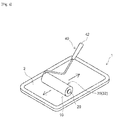
- a sticky cleaner (or simply cleaner, hereinafter) 10 comprises a cylindrical holding member (core) 20 and a PSA sheet roll 30 held on the outer periphery of holding member 20. These holding member 20 and PSA sheet roll 30 are assembled to form a cylindrical rolling member.
- the holding member material is not particularly limited.
- a holding member made of a polyolefin or other synthetic resin as well as paper can be preferably used.
- Cleaner 10 further comprises a grip member 40 in a form of a pole that supports holding member 20 in a freely rotatable manner.
- holding member 20 has a center hole (not shown in the drawings) formed where the central axis of the cylinder is located.
- a terminal section (one end) of grip member 40 is inserted through the center hole, whereby holding member 20 is installed on grip member 40 in a freely rotatable manner.
- a handle 42 is attached to the other end of grip member 40.
- the materials of grip member and handle are not particularly limited. For instance, metal or synthetic resin pieces can be used.
- PSA sheet roll 30 in cleaner 10 is formed by winding a PSA sheet 31 that serves as the dirt-collecting member.
- PSA sheet (dirt-collecting member) 31 is constituted as a single-faced PSA sheet 31 comprising, as shown in Fig. 3 , a support substrate 36 in a form of a long sheet (band) and a PSA layer 32 placed on one face 36A of the support substrate 36.
- Single-faced PSA sheet 31 is wound with the PSA layer 32 on the outside and formed as a PSA sheet roll 30.
- cleaner 10 is used for removing organic dirt stuck on a display 2 of a portable device 1.
- Display 2 in portable device 1 has a smooth, flat surface.
- An operator places cleaner 10 on the display 2 of portable device 1, grip a handle 42, and applies a prescribed amount of external force to cleaner 10.
- the force is then transmitted from grip member 40 to holding member 20, and the PSA layer 32 (a section of the dirt-collecting member that makes contact with the smooth, flat surface) placed on the outer periphery of holding member 20 rotationally moves on display 2.
- PSA sheet roll 30 moves on display 2 in the direction shown by the arrow.
- the PSA layer 32 collects dust, fine particles, and especially organic dirt (e.g. sebum dirt such as sebum-containing dirt from hands, fingerprints, etc.) present on the display 2.
- organic dirt e.g. sebum dirt such as sebum-containing dirt from hands, fingerprints, etc.
- the portable device in this embodiment is a tablet terminal whose display is entirely formed with tempered glass such as aluminosilicate glass and the like although it is not limited to this as indicated earlier.
- the size of the cylindrical PSA sheet roll is not particularly limited. When it is used on portable devices such as tablet terminals, etc., its diameter (which refers to the diameter (outer diameter) before used; the same applies hereinafter) is preferably 4 mm or larger (more preferably 10 mm or larger, e.g. 15 mm or larger, typically 20 mm or larger). From the standpoint of the maneuverability and portability, the diameter is preferably 50 mm or smaller (e.g. 35 mm or smaller, typically 30 mm or smaller).
- the PSA sheet constituting the PSA sheet roll preferably has cut lines (not shown in the drawings) at an interval of a length approximately equal to the circumference of the roll.
- the cut lines provide cutting means for efficiently refresh the PSA layer surface (outer surface of the dirt-collecting member) with a reduced cleaning (dirt-removing) ability after the cleaner is used several times.
- the cut lines can be, for instance, lines of long holes or wavy slits; intermittent slits such as perforation; and the like.
- the cut lines are preferably arranged to run across the PSA sheet in the width direction (direction perpendicular to the length direction). Refreshing the outer surface (lateral surface) of the dirt-collecting member is not limited to the cutting means.
- intermittent slits such as perforation can be spirally formed in a direction intersecting the winding direction of the PSA sheet roll (typically, in a direction intersecting the width direction at an angle between 30° and 60°).
- the PSA sheet constituting the PSA sheet roll may comprise slits (continuous cut lines) at a prescribed interval.
- the PSA sheet constituting the PSA sheet roll is fully cut in advance at the prescribed intervals in the winding direction of the roll.
- the outer surface of the PSA sheet roll can be peeled over the length of the prescribed interval to easily refresh the outer surface.
- the cleaner 10 can be produced by suitably employing heretofore known techniques.
- PSA sheet roll 30 of cleaner 10 can be fabricated in the same manner as conventional roller cleaners.
- a PSA composition is applied to the surface 36A of a long sheet of support substrate 36 by various heretofore known coating means and allowed to dry as necessary to form a PSA layer 32.
- a hot melt PSA thermoplastic PSA
- the PSA heated into a molten state can be applied as the PSA composition and the PSA is allowed to cool to near room temperature to form a PSA layer.
- the drying can be omitted.
- the PSA sheet 31 is wound around holding member 20 with the PSA layer 32 on the outside to form PSA sheet roll 30 in a form of a roll.
- a terminal section of grip member 40 is further attached to holding member 20 in a freely rotatable manner to construct cleaner 10.
- the structure of attachment of grip member 40 to holding member 20 can be similar to those in conventional roller cleaners and does not characterize the present invention. Accordingly, detailed description is omitted.
- the sticky cleaner is not limited to the embodiment above.
- the sticky cleaner may be formed, for instance, solely with a dirt-collecting member.
- Examples of such a sticky cleaner include a cleaner formed solely with a dirt-collecting member in a form of a sphere, column, cylinder, hexahedron (e.g. cuboid), sheet, etc.
- the dirt-collecting member is formed with the support substrate and PSA layer, but the sticky cleaner is not limited to this embodiment.
- the dirt-collecting member may be formed solely with a PSA (substrate-free PSA).
- the shape of the support substrate is not particularly limited.
- the dirt-collecting member may have a PSA layer on the outer surface of a spherical support substrate.
- the grip member supports the holding member in a freely rotatable manner, but the sticky cleaner is not limited to this embodiment.
- the grip member may be directly or indirectly joined (connected or detachably joined) to the dirt-collecting member.
- a columnar or cuboid PSA body is fastened to one end of a pole-shaped grip member.
- the grip member may have a flat portion and the dirt-collecting member may be fastened to one face of the flat portion.
- the PSA in the art disclosed herein comprises, as its base polymer, an acrylic block copolymer having a hard segment (A) (or a "A-block” hereinafter) and a soft segment (B) (or a "B-block” hereinafter) in one molecule.
- the hard segment (A) refers to the relatively hard block in relation to the soft segment (B) in the acrylic copolymer.
- the soft segment (B) refers to the relatively soft block in relation to the hard segment (A) in the structure of the acrylic block copolymer.
- the acrylic block copolymer may show characteristics of thermoplastic polymers (typically thermoplastic elastomers).
- the PSA disclosed herein comprises the acrylic block copolymer as the base polymer and thus may be a PSA suited for hot melt application (i.e. a hot melt PSA).
- the hot melt PSA is preferable from the standpoint of reducing environmental stress, etc., because the amount of organic solvents used can be reduced as compared with a general organic solvent-based acrylic PSA (typically a PSA comprising, as the base polymer, a random copolymer synthesized from starting monomers including an acrylic monomer as the primary monomer by solution polymerization).
- the acrylic block copolymer refers to a polymer having a block structure that comprises, as a monomer unit (monomeric component) constituting the copolymer, a monomer unit derived from a monomer having at least one (meth)acryloyl group per molecule (or an "acrylic monomer” hereinafter).
- a monomer unit derived from a monomer having at least one (meth)acryloyl group per molecule or an "acrylic monomer” hereinafter.
- it refers to a block copolymer comprising a monomer unit derived from an acrylic monomer.
- 50 % or more of all monomer units are derived from an acrylic monomer.
- Such an acrylic block copolymer can be preferably synthesized from starting monomer(s) comprising, as the primary monomer, an alkyl (meth)acrylate having an alkyl group.
- the primary monomer herein refers to a monomer that accounts for 50 % by mass or more of all the monomers.
- (meth)acryloyl comprehensively refers to acryloyl and methacryloyl.
- (meth)acrylate comprehensively refer to acrylate and methacrylate.
- a preferable acrylic block copolymer comprises at least one acrylate block (which hereinafter may be referred to as an Ac block) and at least one methacrylate block (which hereinafter may be referred to as an MAc block).
- a preferable block copolymer has a structure in which Ac blocks and MAc blocks are positioned alternately.
- the total block number of Ac blocks and MAc blocks comprised in one polymer molecule can be about 2.5 to 5 in average (e.g. about 2.7 to 3.3, typically about 3).
- the Ac block preferably comprises an alkyl acrylate as the primary monomer.
- 50 % by mass or more of all monomeric units constituting the Ac block are preferably monomer units derived from an alkyl acrylate.
- 75 % by mass or more (e.g. 90 % by mass or more) of the monomer units can be derived from an alkyl acrylate as well.
- the Ac block in the acrylic block copolymer is a polymer essentially formed of one, two or more species (typically one species) of alkyl acrylate.
- the Ac block may be a copolymer of an alkyl acrylate and other monomer (e.g. an alkyl methacrylate, etc.).
- an example of the Ac block-constituting alkyl acrylate is an alkyl acrylate having 1 to 20 (preferably 4 to 14, e.g. 6 to 12) carbon atoms in its alkyl group.
- alkyl acrylate having 1 to 20 (preferably 4 to 14, e.g. 6 to 12) carbon atoms in its alkyl group.
- examples include methyl acrylate, ethyl acrylate, n-propyl acrylate, isopropyl acrylate, n-butyl acrylate (BA), isobutyl acrylate, tert-butyl acrylate, n-pentyl acrylate, n-hexyl acrylate, n-heptyl acrylate, n-octyl acrylate, 2-ethylhexyl acrylate (2EHA), nonyl acrylate, isononyl acrylate, decyl acrylate, dodecyl acryl
- 50 % by mass or more of monomers constituting the Ac block is an alkyl acrylate having 4 to 14 carbon atoms in its alkyl group.
- the ratio of alkyl acrylate having 4 to 14 carbon atoms in alkyl group can be 75 % by mass or greater or can be essentially 100 % by mass (e.g. greater than 99 % by mass, but 100 % by mass or less).
- the weight ratio of BA to 2EHA is not particularly limited. For instance, it can be 10/90 to 90/10, preferably 80/20 to 20/80, or more preferably 30/70 to 70/30, for example, 60/40 to 40/60.
- the MAc block comprises an alkyl methacrylate as the primary monomer.
- 75 % by mass or more e.g. 90 % by mass or more
- the MAc block in the acrylic block copolymer is essentially formed of one, two or more species (typically one species) of alkyl methacrylate.
- the MAc block may be a copolymer of an alkyl methacrylate and other monomer (e.g., an alkyl acrylate).
- the alkyl methacrylate constituting the MAc block may be an alkyl methacrylate whose alkyl group has 1 to 20 (preferably 1 to 14) carbon atoms. Specific examples thereof include methyl methacrylate, ethyl methacrylate, n-propyl methacrylate, isopropyl methacrylate, n-butyl methacrylate, isobutyl methacrylate, tert-butyl methacrylate, n-pentyl methacrylate, n-hexyl methacrylate, n-heptyl methacrylate, n-octyl methacrylate, 2-ethylhexyl methacrylate, nonyl methacrylate, isononyl methacrylate, decyl methacrylate, dodecyl methacrylate, stearyl methacrylate, etc. These can be used singly as one species or in a combination of two or more species.
- 50 % by mass or more of the monomers constituting the MAc block is an alkyl methacrylate having an alkyl group with 1 to 4 (preferably 1 to 3) carbon atoms.
- the ratio of the alkyl methacrylate having 1 to 4 carbon atoms in its alkyl group can be 75 % by mass or greater, or essentially 100 % by mass (e.g. greater than 99 % by mass, but 100 % by mass or less).
- Especially preferable alkyl methacrylates include methyl methacrylate (MMA) and ethyl methacrylate (EMA).
- the monomers preferably employed may consist essentially of MMA alone, EMA alone, both MMA and EMA, or the like.
- the acrylic block copolymer may be a copolymer comprising A blocks (hard segments (A)) and B blocks (soft segments (B)) positioned alternately such as AB structure, ABA structure, ABAB structure, ABABA structure, etc., with the A block having been formed of a polymer having a rigid structure with excellent cohesive strength and elasticity, and the B block having been formed of a polymer having a flexible structure with excellent viscosity.
- a PSA comprising as its base polymer an acrylic block copolymer having such a structure may form a PSA layer combining cohesive strength and elasticity as well as viscosity at high levels.
- a PSA having such a composition can be preferably used as a hot melt PSA.
- An acrylic block copolymer having a structure (such as ABA structure, ABABA structure, etc.) with A blocks at both termini of the molecule can be preferably used.
- An acrylic block copolymer having such a structure is preferable because it is likely to have a good balance of cohesion and thermoplasticity.
- the compositions, molecular weights (polymerization degrees), structures, etc., of these A blocks can be the same with or different from each other.
- the acrylic block copolymer comprises two or more B blocks, the same applies to the B blocks.
- the acrylic block copolymer is a triblock copolymer having a structure ofMAc-Ac-MAc (ABA structure). For instance, can be preferably used a triblock copolymer with two MAc blocks having essentially identical monomer compositions.
- a preferable acrylic block copolymer in the art disclosed herein has, as the soft segment (B), an Ac block comprising an alkyl acrylate having 6 or more (e.g. 6 to 12) carbon atoms in its alkyl group.
- the ratio of the alkyl acrylate having 6 or more carbon atoms in its alkyl group can be, for instance, 10 % by mass or higher, or it is preferably 20 % by mass or higher, more preferably 30 % by mass or higher, or yet more preferably 40 % by mass or higher.
- an acrylic block copolymer that has an Ac block comprising as its primary monomer the alkyl acrylate having 6 or more (e.g. 6 to 12) carbon atoms in its alkyl group can be used.
- the alkyl acrylate having 6 or more carbon atoms in its alkyl group account for 50 % by mass or more of the monomer units constituting the Ac block.
- the ratio of alkyl acrylate having 6 or more carbon atoms in its alkyl group can be, for instance, 55 % by mass or higher, or 60 % by mass or higher.
- a preferable acrylic block copolymer has, as the soft segment (B), an Ac block constituted solely with 2EHA as the monomer unit.
- alkyl acrylate having 6 or more carbon atoms in its alkyl group include 2-ethylhexyl acrylate (2EHA), n-octyl acrylate, isononyl acrylate and n-hexyl acrylate.
- EHA 2-ethylhexyl acrylate
- n-octyl acrylate isononyl acrylate
- n-hexyl acrylate n-hexyl acrylate
- An acrylic block copolymer that has as the soft segment (B) an Ac block comprising an alkyl acrylate having 6 or more carbon atoms in its alkyl group may have an excellent organic dirt-collecting ability. Thus, for instance, it may bring about a higher sebum dirt removal rate in the sebum dirt removability test described later.
- the acrylic block copolymer that has as the soft segment (B) an Ac block comprising an alkyl acrylate having 6 or more carbon atoms in its alkyl group may have excellent compatibility with plasticizer.
- a PSA having a composition that includes the copolymer and a plasticizer this is preferable from the standpoint of reducing the bleeding (bleed-out) of the plasticizer. Because it allows suitable inclusion of a greater amount of plasticizer, it leads to advantages such as permitting great latitude in selecting the amount of plasticizer added and easy adjustment of the adhesive strength.
- the mass ratio of hard segment (A) to soft segment (B) is not particularly limited in the acrylic block copolymer.
- the mass ratio (A/B) of hard segment (A) to soft segment (B) can be in a range of 4/96 to 90/10, or it is usually suitably in a range of 7/93 to 70/30 or preferably in a range of 10/90 to 50/50 (e.g. 15/85 to 40/60).
- the ratio of total mass of these hard segments (A) to mass of soft segment (B) is preferably in these ranges.
- the acrylic block copolymer comprising two or more soft segments (B) When the ratio of hard segment (A) (e.g. MAc block) is high, the adhesive strength tends to decrease, likely providing easy-release properties. When the ratio of soft segment (B) (e.g. Ac block) is high, the organic dirt-collecting ability tends to increase.
- the starting monomers corresponding to all the monomer units constituting the acrylic block copolymer comprise an alkyl (meth)acrylate (X) having 1 to 3 carbon atoms in its alkyl group and an alkyl (meth)acrylate (Y) having 6 or more (e.g. 6 to 12) carbon atoms in its alkyl group.
- the mass ratio (X/Y) of alkyl (meth)acrylate (X) to alkyl (meth)acrylate (Y) can be, for instance, 4/96 to 90/10.
- An acrylic block copolymer with the mass ratio being 7/93 to 70/30 is preferable, a species with 10/90 to 50/50 is more preferable, a species with 15/85 to 40/60 is yet more preferable, and a species with15/85 to 30/70 (e.g. 15/85 to 25/75) is particularly preferable.
- the ratio of alkyl (meth)acrylate (X) is high, the adhesive strength tends to decrease, likely providing easy-release properties.
- the ratio of alkyl (meth)acrylate (Y) is high, the organic dirt-collecting ability tends to increase.
- the alkyl (meth)acrylate (X) an alkyl methacrylate having 1 to 3 carbon atoms in its alkyl group is preferable.
- an alkyl (meth)acrylate (Y) an alkyl acrylate having 6 or more (e.g. 6 to 12) carbon atoms in its alkyl group is preferable.
- the starting monomers corresponding to all the monomer units constituting the acrylic block copolymer comprise methyl methacrylate (MMA) and 2-ethylhexyl acrylate (2EHA) at a mass ratio (MMA/2EHA) of their contents of 4/96 to 90/10.
- MMA methyl methacrylate
- 2EHA 2-ethylhexyl acrylate
- An acrylic block copolymer with the mass ratio being 7/93 to 70/30 is preferable, a species with 10/90 to 50/50 is more preferable, a species with 15/85 to 40/60 is yet more preferable, and a species with 15/85 to 30/70 (e.g. 15/85 to 25/75) is particularly preferable.
- the MMA content is high, the adhesive strength tends to decrease, likely providing easy-release properties.
- 2EHA content the organic dirt-collecting ability tends to increase.
- the composition of monomer units constituting an acrylic block copolymer can be determined based on the results of NMR analysis.
- the NMR analysis can be carried out, using, for instance, "AVAVCEIII-600 (with Cryo Probe)" available from Bruker Biospin as the NMR system, under the conditions shown below.
- the mass ratio of MMA to 2EHA in the starting monomers can be determined based on the ratio of integrated intensities of peaks at 4.0 ppm (2EHA1) and 3.6 ppm (MMA1) in the 1 H NMR spectrum.
- the weight average molecular weight (Mw) of the acrylic block copolymer is not particularly limited.
- a species having a Mw of about 3 ⁇ 10 4 to 30 ⁇ 10 4 can be preferably used.
- the acrylic block copolymer has a Mw in a range of preferably about 3.5 ⁇ 10 4 to 25 ⁇ 10 4 or more preferably in a range of about 4 ⁇ 10 4 to 20 ⁇ 10 4 (e.g., 4.5 ⁇ 10 4 to 15 ⁇ 10 4 ).
- a higher Mw of the acrylic block copolymer is advantageous from the standpoint of increasing the adhesive properties (e.g. cohesion) and increasing the organic dirt-collecting ability.
- the amount of plasticizer that can be suitably included tends to increase.
- a low Mw of the acrylic block copolymer is advantageous from the standpoint of reducing the viscosity (melt viscosity) of the PSA.
- Lower melt viscosity of the PSA is particularly meaningful when the PSA is a hot melt type.
- the Mw of an acrylic block copolymer herein refers to the value based on standard polystyrene that is determined by gel permeation chromatography (GPC) with respect to a sample prepared by dissolving the copolymer in tetrahydrofuran (THF).
- GPC gel permeation chromatography
- the GPC measurement can be performed, using, for instance, trade name "HLC-8120GPC” available from Tosoh Corporation as the GPC measurement system, under the conditions shown below.
- a monomer (other monomer) other than an alkyl acrylate and an alkyl methacrylate may be copolymerized.
- the other monomer include vinyl compounds having functional groups such as alkoxy group, epoxy group, hydroxyl group, amino group, amide group, cyano group, carboxyl group, acid anhydride group, etc.; vinyl esters such as vinyl acetate; aromatic vinyl compounds such as styrene; vinyl group-containing heterocyclic compounds such as N-vinylpyrrolidone and the like.
- the acrylic block copolymer is essentially free of the other monomers.
- the other monomer content is less than 1 % by mass (typically 0 to 0.5 % by mass) of all monomers or under the detection limit.
- Such an acrylic block copolymer can be readily synthesized by a known method (e.g. see Japanese Patent Application Publication Nos. 2001-234146 and H11-323072 ), or a commercial product is readily available.
- the commercial product include trade name "LA POLYMER” series (e.g., those with product numbers LA2140e, LA2250, etc.) available from Kuraray Co., Ltd., trade name "NABSTAR” available from Kaneka Corporation, and the like.
- living polymerization method can be preferably employed as the method for synthesizing the acrylic block copolymer.
- an acrylic block copolymer having excellent thermoplasticity can be synthesized. Since the molecular weight distribution can be controlled in a narrow range, insufficient cohesion caused by the presence of low molecular weight components can be reduced to obtain an easily releasable PSA (and thereby a PSA sheet (dirt-collecting member)).
- the acrylic block copolymer solely one species or a combination of two or more species can be used.
- an acrylic block copolymer (H) that has a relatively high Mw and an acrylic block copolymer (L) that has a lower Mw than the acrylic block copolymer (H) can be used at a suitable mass ratio.
- the mass ratio (H/L) of acrylic block copolymer (H) to acrylic block copolymer (L) is in a range of 5/95 to 95/5 (preferably 10/90 to 90/10).
- Each of the acrylic block copolymers used in such combination preferably has a Mw in a range of 3 ⁇ 10 4 to 30 ⁇ 10 4 .
- a preferable combination includes an acrylic block copolymer (H) having a Mw in a range of 5 ⁇ 10 4 to 20 ⁇ 10 4 (e.g. 7 ⁇ 10 4 to 20 ⁇ 10 4 ) and an acrylic block copolymer (L) having a Mw in a range of 3 ⁇ 10 4 to 8 ⁇ 10 4 and lower than the Mw of the acrylic block copolymer (H).
- a more preferable example of the combination includes an acrylic block copolymer (H) having a Mw in a range of 6 x 10 4 to 15 ⁇ 10 4 (e.g.
- acrylic block copolymer (L) having a Mw in a range of 4 ⁇ 10 4 to 6 ⁇ 10 4 and lower than the Mw of the acrylic block copolymer (H).
- the mass ratio (H/L) of these acrylic block copolymers can be, for instance, 40/60 to 90/10, or it is preferably 45/65 to 85/15.
- the inclusion (presence) of two or more species of acrylic block copolymer with different Mw values, the Mw values of the respective copolymers and their mass ratio can be assessed, for instance, through the GPC measurement described earlier.
- the PSA in the art disclosed herein preferably comprises a plasticizer.
- plasticizer increases the ease of release. It also lowers the melt viscosity of the PSA and thus the application is further facilitated.
- the inclusion of plasticizer also increases the organic dirt-collecting ability on the PSA surface. This can bring about, for instance, a higher removal rate of sebum dirt.
- the organic dirt collected on the PSA surface is absorbed into the PSA (e.g. PSA layer) and dispersed therein.
- the dirt-collecting ability may recover in relatively short time (e.g. several minutes or several hours) as a unique effect (dirt-collecting ability recovery effect).
- the dirt-collecting ability recovery effect is described with reference to Fig. 5 .
- the PSA layer 32 in dirt-collecting member (PSA sheet) 31 is allowed to make contact with a surface 2 of an article 1 such as a portable device, etc.
- the PSA layer 32 collects organic dirt 50 stuck on the surface 2.
- the PSA layer 32 has a property to not only collect organic dirt 50, but also causes it to migrate into the layer.
- the organic dirt 50 stuck on the surface of PSA layer 32 migrates with time into the PSA layer 32, leading to a lower presence of organic dirt 50 on the surface of PSA layer 32; and eventually, the surface of PSA layer 32 will be essentially free of the presence of organic dirt 50.
- the surface regains the same state as before the sticky cleaner is used.
- the term "recovery effect” refers to an effect such that when the PSA collects organic dirt and the dirt-collecting ability is temporarily reduced, the dirt-collecting ability recovers in a prescribed time period (e.g. several minutes, preferably several hours) and the PSA (e.g. PSA layer) regains the ability to collect dirt. It encompasses that the dirt-collecting ability requires short time for recovery.
- plasticizer examples include phthalic acid esters such as dioctyl phthalate, diisononyl phthalate, diisodecyl phthalate, dibutyl phthalate, etc.; adipic acid esters such as dioctyl adipate, diisononyl adipate, etc.; trimellitic acid esters such as trioctyl trimellitate, etc.; sebacic acid esters; epoxidized vegetable oils such as epoxidized soybean oil and epoxidized flax seed oil; epoxidized fatty acid alkyl esters such as epoxidized fatty acid octyl esters; cyclic fatty acid esters such as sorbitan monolaurate, sorbitan monostearate, sorbitan monooleate, sorbitan trioleate and their ethylene oxide adducts as well as their derivatives; and the like.
- phthalic acid esters such as diocty
- plasticizer among them include adipic acid esters, epoxidized vegetable oils and epoxidized fatty acid alkyl esters.
- adipic acid esters are preferable.
- plasticizer for instance, in a PSA that comprises, as the base polymer, an acrylic block copolymer having as the soft segment (B) an Ac block comprising an alkyl acrylate having 6 or more (6 to 12) carbon atoms in its alkyl group, it may bring about the effect to decrease the melt viscosity and adhesive strength of the PSA and the effect to increase the organic dirt-collecting ability at a high level.
- the amount of plasticizer added is not particularly limited. From the standpoint of reducing the melt viscosity, providing easy-release properties, increasing the dirt-collecting ability, etc., the amount of plasticizer added to 100 parts by mass of the base polymer (acrylic block copolymer) is, for instance, suitably 1 part by mass or greater. Its amount added is preferably 5 parts by mass or greater, more preferably 10 parts by mass or greater, yet more preferably 15 parts by mass or greater, or particularly preferably 20 parts by mass or greater.
- the amount added is suitably 150 parts by mass or less, preferably 120 parts by mass or less, more preferably 100 parts by mass or less, yet more preferably 80 parts by mass or less, or particularly preferably 60 parts by mass or less.
- the amount of plasticizer added is, for instance, preferably 10 to 80 parts by mass (e.g. 20 to 70 parts by mass, typically 25 to 60 parts by mass) relative to 100 parts by mass of the base polymer.
- the PSA in the art disclosed herein may include a tackifier as necessary.
- the addition of the tackifier may be beneficial in increasing the thermoplasticity (e.g. reducing the melt viscosity) of the PSA.
- tackifier resins commonly known in the field ofacrylic PSA and the like can be used. Examples include a hydrocarbon-based tackifier resin, terpene-based tackifier resin, rosin-based tackifier resin, phenolic tackifier resin, epoxy-based tackifier resin, polyamide-based tackifier resin, elastomer-based tackifier resin and ketone-based tackifier resin. These can be used singly as one species or in a combination of two or more species.
- hydrocarbon-based tackifier resin examples include various hydrocarbon-based resins such as aliphatic hydrocarbon resins, aromatic hydrocarbon resins (xylene resins, etc.), alicyclic hydrocarbon resins, aliphatic-aromatic petroleum resins (styrene-olefin-based copolymers, etc.), aliphatic-alicyclic petroleum resins, hydrogenated hydrocarbon resins, coumarone-based resins, coumarone-indene-based resins, and the like.
- the terpene-based tackifier resin include terpene-based resins such as ⁇ -pinene polymers, ⁇ -pinene polymers, etc.; modified terpene-based resins (e.g.
- terpenophenolic resins styrene-modified terpene-based resins, hydrogenated terpene-based resins, hydrogenated terpenophenolic resins, etc.
- modification phenol modification, aromatic modification, hydrogenation modification, etc.
- rosin-based tackifier resin examples include unmodified rosins (raw rosins) such as gum rosin, wood rosin, etc.; modified rosins (hydrogenated rosins, disproportioned rosins, polymerized rosins, other chemically modified rosins, etc.) obtained by subjecting these unmodified rosins to hydrogenation, disproportionation, polymerization, etc.; various other rosin derivatives; and so on.
- phenolic tackifier resins include resol-type and novolac-type alkylphenolic resins. Preferable tackifiers among these are terpene-based resins, modified terpene-based resins and alkylphenolic resins.
- the softening point of the tackifier is not particularly limited. From the standpoint of reducing the melt viscosity, it is preferably 160 °C or lower, or more preferably 140 °C or lower. From the standpoint of avoiding an excessive increase in adhesive strength, it is preferably 60 °C or higher, or more preferably 80 °C or higher.
- the amount of tackifier added is not particularly limited. From the standpoint of avoiding an excessive increase in adhesive strength, for instance, to 100 parts by mass of the base polymer (acrylic block copolymer), it can be 50 parts by mass or less, or it is usually suitably 40 parts by mass or less, or preferably 30 parts by mass or less. From the standpoint of obtaining greater effects of the tackifier (e.g. the effect to reduce the melt viscosity), the amount added to 100 parts by mass of the base polymer is suitably, for instance, 1 part by mass or greater. Alternatively, the PSA may be essentially free of such a tackifier.
- the PSA in the art disclosed herein may comprise, as an optional component, other polymer or oligomer that is not an acrylic block copolymer, for instance, for purposes of adjusting the viscosity (e.g. reducing the melt viscosity) of the PSA, controlling the adhesive properties (e.g. reducing the adhesive strength) and so on.
- a polymer or oligomer for instance, an acrylic random copolymer having a Mw of about 500 to 10000 (typically about 800 to 5000) can be used.
- the amount of the optional polymer added is, relative to 100 parts by mass of the acrylic block copolymer, for instance, suitably 50 parts by mass or less, preferably 10 parts by mass or less, or more preferably 5 parts by mass or less.
- the PSA layer may be essentially free of other polymer that is not an acrylic block copolymer.
- the amount of the other polymer that is not an acrylic block copolymer is less than 1 % by mass (typically 0 to 0.5 % by mass) relative to 100 parts by mass of the acrylic block copolymer.
- the PSA in the art disclosed herein can include various additives known in the PSA field as well, such as tackifier, surfactant, chain transfer agent, anti-aging agent, antioxidant, UV ray absorber, photostabilizer, antistatic agent, colorant (pigment, dye, etc.) and so on.
- additives known in the PSA field as well, such as tackifier, surfactant, chain transfer agent, anti-aging agent, antioxidant, UV ray absorber, photostabilizer, antistatic agent, colorant (pigment, dye, etc.) and so on.
- tackifier surfactant
- chain transfer agent anti-aging agent
- antioxidant antioxidant
- UV ray absorber UV ray absorber
- photostabilizer antistatic agent
- colorant pigment, dye, etc.
- the formation method is not particularly limited. For instance, it is preferable to apply a method where a PSA (thermoplastic PSA) heated into a molten state is directly applied to a support substrate by a heretofore known application means such as a roll coater, die coater, gravure coater, etc.; and the PSA is allowed to cool to near room temperature to form a PSA layer.
- the PSA is typically provided to the substrate, in a form of PSA essentially free of an organic solvent (i.e. solvent-free PSA).
- the PSA can be crosslinked by a suitable means after provided to the support substrate, it is usually easy and preferable to use it as a non-crosslinked PSA (i.e. thermoplastic PSA) without applying a special crosslinking means.
- the PSA disclosed herein may be formed as a PSA layer by applying (typically at room temperature) to the support substrate the PSA in a form of PSA composition in which the PSA is dissolved or dispersed in a suitable liquid medium and allowing the applied composition to dry.
- the PSA composition can be, for instance, a solvent-based PSA composition where the PSA disclosed herein is dissolved in an organic solvent, a waterdispersed PSA composition where the PSA is dispersed in water, and so on.
- organic solvent general organic solvents can be used, such as ethyl acetate, toluene, hexane and ethanol.
- For the organic solvent solely one species or a combination of two or more species can be used.
- the PSA composition may comprise, but not particularly limited to, for instance, about 30 to 70 % by mass of solvent(s) (typically organic solvent(s)).
- solvent(s) typically organic solvent(s)
- the PSA layer may be placed on the support substrate by applying the composition to a releasable surface (release face) and allowing it to dry to form a PSA layer on the release face and adhering the PSA layer to a non-releasable surface of the support substrate.
- the PSA disclosed herein suitably has, but not particularly limited to, a melt viscosity at 180 °C of 200 Pa s or lower, preferably 100 Pa s or lower, or more preferably 50 Pa s or lower (typically 20 Pa s or lower, e.g. 10 Pa s or lower).
- the lower limit of the melt viscosity at 180 °C is not particularly limited. In view of the balance between the ease of application and adhesive properties, it is usually suitably 0.1 Pa s or higher, preferably 1 Pa s or higher, for instance, preferably 5 Pa s or higher.
- melt viscosity can be measured by the following melt viscosity measurement method.
- the thickness of the PSA layer can be suitably selected in accordance with the purpose and is not particularly limited. From the standpoints of making sufficient use of the dirt-collecting ability and of increasing the recovery of the dirt-collecting ability, the thickness of the PSA layer is preferably about 10 ⁇ m or larger (e.g. 20 ⁇ m or larger, preferably 30 ⁇ m or larger, typically 40 ⁇ m or larger). When it is important to reduce the weight or size, etc., the thickness of the PSA layer is preferably 300 ⁇ m or smaller (e.g. 100 ⁇ m or smaller, preferably 70 ⁇ m or smaller, typically 60 ⁇ m or smaller).
- the PSA layer may be formed entirely over one face of the support substrate. Alternatively, for instance, a non-sticky region (dry edge) free of the PSA layer may be included along each edge of the support substrate's width direction.
- the dirt-collecting member disclosed herein comprises a support substrate as in this embodiment
- materials formed with various types of synthetic resin, non-woven fabric or paper can be used as the support substrate.
- the material of the support substrate can be a fabric, rubber sheet, foam sheet, metal foil, a composite of these, etc.
- Examples of synthetic resin include a polyolefin (polyethylene, polypropylene, ethylene-propylene copolymers, etc.), polyester (polyethylene terephthalate, etc.), vinyl chloride resin, vinyl acetate resin, polyimide resin, polyamide resin, fluorocarbon resin, and the like.
- a support substrate made of polyethylene terephthalate (PET) can be preferably used.
- Examples of paper include Japanese paper (washi), kraft paper, glassine paper, high-grade paper, synthetic paper, top-coated paper, and the like.
- Examples of a fabric include a woven fabric and a non-woven fabric of a single species or a blend, etc., of various fibrous substances.
- fibrous substance examples include cotton, staple fiber, Manila hemp, pulp, rayon, acetate fiber, polyester fiber, polyvinyl alcohol fiber, polyamide fiber, polyolefin fiber, and the like.
- a rubber sheet examples include a natural rubber sheet, a butyl rubber sheet, and the like.
- a foam sheet examples include a polyurethane foam sheet, a polychloroprene rubber foam sheet, and the like.
- metal foil examples include aluminum foil, copper foil, and the like.
- the support substrate may contain as necessary various additives such as fller (inorganic filler, organic filler, etc.), anti-aging agent, antioxidant, UV ray absorber, photostabilizer, antistatic agent, lubricant, plasticizer., colorant (pigment, dye, etc.), and the like.
- fller inorganic filler, organic filler, etc.
- anti-aging agent antioxidant
- UV ray absorber photostabilizer
- antistatic agent antistatic agent
- lubricant plasticizer
- colorant pigment, dye, etc.
- the dirt-collecting member is a single-faced PSA sheet having a PSA layer formed on a single face of a support substrate
- the back face (PSA layerfree face) of the support substrate is preferably subjected to a surface treatment such as coating of a silicone-based release agent and the like to adjust the unwinding force of the PSA sheet roll to a suitable range (typically a release treatment to prevent the unwinding force from becoming excessively high).
- the thickness of the support substrate can be suitably selected in accordance with the purpose and is not particularly limited. In general, the thickness is preferably about 20 ⁇ m or larger (e.g. 30 ⁇ m or larger, typically 35 ⁇ m or larger), but suitably about 200 ⁇ m or smaller (more preferably 100 ⁇ m or smaller, typically 70 ⁇ m or smaller, e.g. 50 ⁇ m or smaller).
- the part e.g. PSA layer-side surface
- the part e.g. PSA layer-side surface
- the adhesive strength is preferably less than 1 N/25mm.
- a cleaner having such an easy-release dirt-collecting member provides excellent dirt-removing workability since it requires little force to do the dirt-removing work on the surface. More specifically, the cleaner can be moved more smoothly on the surface (surface to be cleaned) of an article. For instance, it has advantages such that the cleaner can be easily separated from the surface after the dirt-removing operation. Even when the surface of the article (e.g.
- protection film e.g. protection film made of a silicone-based or polyester-based synthetic resin, etc.
- the protection film is less likely to peel off the article while cleaning the article's surface covered with the protection film (i.e. the surface of the protection film).
- the surface to be cleaned is the protection film surface and such a surface is included in the concept of the article's surface referred to herein.
- the adhesive strength is, as described earlier, preferably less than 1 N/25mm, more preferably 0.80 N/25mm or less, or yet more preferably 0.60 N/25mm or less. From the standpoint of the maneuverability in cleaning protective film surfaces, etc., the adhesive strength is suitably 0.50 N/25mm or less, preferably 0.30 N/25mm or less, more preferably 0.20 N/25mm or less, or particularly preferably less than 0.10 N/25mm.
- the adhesive strength is usually suitably 0.001 N/25mm or greater (typically 0.005 N/25mm or greater), preferably 0.01 N/25mm or greater, more preferably 0.02 N/25mm or greater, or yet more preferably 0.03 N/25mm or greater.
- the adhesive strength refers to the 180° peel strength measured based on the following 180° peel test, using a stainless steel (SUS) plate as the adherend.
- SUS stainless steel
- the part (e.g. adhesive face) that makes contact with the surface to be cleaned may have, but not particularly limited to, a 180° peel strength to glass of less than 1 N/25mm (more preferably 0.80 N/25mm or less, yet more preferably 0.60 N/25mm or less).
- a cleaner having such an easy-release dirt-collecting member provides excellent dirt-removing workability.
- the adhesive strength is suitably 0.50 N/25mm or less, preferably 0.30 N/25mm or less, more preferably 0.20 N/25mm or less, or particularly preferably less than 0.10 N/25mm.
- the adhesive strength is usually suitably 0.001 N/25mm or greater (typically 0.005 N/25mm or greater), preferably 0.01 N/25mm or greater, more preferably 0.02 N/25mm or greater, or yet more preferably 0.03 N/25mm or greater.
- the 180° peel strength to the glass plate can be measured similarly to the measurement of the 180° peel strength to SUS except that the glass plate (e.g. a commercial float glass plate) is used as the adherend.
- the part (e.g. adhesive face) that makes contact with the surface to be cleaned may have, but not particularly limited to, a 180° peel strength to polyethylene terephthalate (PET) film of less than 1 N/25mm (more preferably 0.80 N/25mm or less, or yet more preferably 0.60 N/25mm or less).
- PET polyethylene terephthalate
- a cleaner having such an easy-release dirt-collecting member provides excellent dirt-removing workability.
- the adhesive strength is suitably 0.50 N/25mm or less, preferably 0.30 N/25mm or less, more preferably 0.20 N/25mm or less, or particularly preferably less than 0.10 N/25mm.
- the adhesive strength is usually suitably 0.001 N/25mm or greater (typically 0.005 N/25mm or greater), preferably 0.01 N/25mm or greater, more preferably 0.02 N/25mm or greater, or yet more preferably 0.03 N/25mm or greater.
- the 180° peel strength to PET film can be measured similarly to the measurement of the 180° peel strength to SUS except that PET film is used as the adherend.
- the PSA sheet roll is preferably constituted to deter rail drawing.
- the rail drawing refers to a phenomenon such that when the sheet roll is rolled (rotated) reversely to the winding direction (typically in a direction in which the wound single-faced PSA sheet is peeled) on the surface to be cleaned, a band of the PSA sheet is left stuck on the surface being cleaned, beginning from the outer circumferential end of the roll
- Reduced occurrence of rail drawing allows for stress-free, smooth rotation of the roll on the surface being cleaned, leading to great usability.
- it can also prevent wasteful use of the PSA sheet due to the occurrence of rail drawing (i.e. waste of the sheet due to unintentional adhesion of the PSA sheet to the surface).
- the adhesive strength e.g. the value measured based on the 180° peel test
- the unwinding force are preferably at a balance so as to inhibit the occurrence of rail drawing on the surface (e.g. a surface made of glass such as aluminosilicate glass or a synthetic resin) being cleaned.
- the unwinding force herein refers to the force required to pull out the PSA sheet from the PSA sheet roll (i.e. resistive force against unwinding).
- the unwinding force can be perceived as the adhesive strength to the back face of the PSA sheet (typically the back face of the support substrate).
- the unwinding force when the unwinding force is excessively low as compared with the adhesive strength, if the PSA sheet roll is rotated on the surface being cleaned, the unwinding force may succumb to the adhesive strength between the PSA sheet (typically the PSA layer) and the surface being cleaned to cause rail drawing.
- the unwinding force tends to result in unsmooth unwinding of the PSA sheet.
- the unwinding force can be assessed as follows.
- the PSA sheet roll is set in a prescribed tensile tester.
- the outer circumferential end of the wound PSA sheet is mounted to the chuck of the tester and pulled at a rate of 300 mm/min to unwind the PSA sheet roll in the tangential direction.
- the unwinding force during this can be converted to and determined as the value per width (e.g. 150 mm) of PSA layer of the PSA sheet (N/150mm).
- a preferable PSA sheet roll has an unwinding force of about 0.5 N/150mm to 2.5 N/150mm.
- acrylic block copolymer the following acrylic polymers A to C synthesized by a known living anionic polymerization method were used.
- acrylic polymer A was used an acrylic block copolymer having a triblock structure of poly(methylmethacrylate(MAA)) block-poly(2-ethylhexyl acrylate(2EHA)/n-butylacrylate(BA)) block-polyMMA block (or "MMA-2EHA/BA-MAA” hereinafter).
- This copolymer had a 2EHA to BA weight ratio (i.e.
- acrylic polymer B was used an acrylic block copolymer having a triblock structure of MMA-2EHA/BA-MMA.
- This copolymer had a 2EHA to BA weight ratio of 50/50 in the poly(2EHA/BA) block, a ratio ((2EHA+BA)/MMA) of weight of poly(2EHA/BA) block to weight of polyMMA block (combined weight of the two polyMMA blocks) of 81/19, a Mw of 5 ⁇ 10 4 and a Mn of 4.4 ⁇ 10 4 at a Mw/Mn of 1.13.
- acrylic polymer C was used a commercial acrylic block copolymer under trade name "LA POLYMER LA2140e” (available from Kuraray Co., Ltd.) having a triblock structure of polyMMA block-poly(n-butylacrylate(BA)) block-polyMMA block (or “MMA-BA-MMA” hereinafter).
- This copolymer had a ratio (BA/MMA) of weight of polyBA block to weight of polyMMA block (combined weight of the two polyMMA blocks) of 78/22 and a Mw of 8 ⁇ 10 4 and a Mn of 6 ⁇ 10 4 at a Mw/Mn of 1.3.
- the acrylic polymer A heated into a molten state was applied to a surface of a 38 ⁇ m thick PET support substrate sheet (width: approximately 8 cm) to fabricate a single-faced PSA sheet having a PSA layer of about 50 ⁇ m in thickness (adhesive thickness) formed on one face of the support substrate.
- the resulting single-faced PSA sheet was wound around the surface of a drum-shaped holding member (20 mm diameter) to form a PSA sheet roll.
- the holding member was installed on an end of a grip member in a freely rotatable (rolling) manner to construct a cleaner as schematically shown in Figs. 1 and 2 .
- a hot melt acrylic PSA 100 parts of the acrylic polymer A and 30 parts of a plasticizer "MONOCIZER W-242" (diisononyl adipate) available from DIC Corporation were mixed to prepare a hot melt acrylic PSA.
- the acrylic PSA in a molten state was applied to a surface of a 38 ⁇ m thick PET support substrate sheet (width: approximately 8 cm) to fabricate a single-faced PSA sheet in which a PSA layer of about 50 ⁇ m thickness is formed on one face of the support substrate.
- a cleaner according to this example was constructed.
- the acrylic polymer As the acrylic polymer, the acrylic polymer A and acrylic polymer B were used at a mass ratio of 50:50. 100 parts of the acrylic polymer (comprising 50 parts of the acrylic polymer A and 50 parts of the acrylic polymer B) and 30 parts of plasticizer "MONOCIZER W-242" were mixed to prepare a hot melt acrylic PSA. Otherwise in the same manner as Example 3, a cleaner according to this example was constructed.
- An acrylic polymer D was synthesized by a solution polymerization method.
- toluene as a polymerization solvent
- acrylic acid AA
- BPO benzoyl peroxide
- the mixture was heated to 60 °C and the reaction was carried out for two hours; and was further heated to 80 °C and the reaction was carried out for one hour to prepare a toluene solution of an acrylic polymer D (random copolymer of the monomers) having a weight average molecular weight (Mw) of 50 ⁇ 10 4 to 60 ⁇ 10 4 .
- Mw weight average molecular weight
- the acrylic PSA composition (S1) was applied to a surface of a 38 ⁇ m thick PET support substrate sheet (width: approximately 8 cm) and allowed to dry to fabricate a single-faced PSA sheet in which an approximately 50 ⁇ m thick PSA layer is formed on one face of the support substrate. Using this single-faced PSA sheet, but otherwise in the same manner as Example 1, a cleaner according to this example was constructed.
- a tackifier (a terpenophenolic resin "K-125" available from Yasuhara Chemical Co., Ltd.) was further mixed in. Otherwise in the same manner as Example 13, a cleaner according to this example was constructed.
- the tackifier "K-125" was used in amounts of 10 parts (Example 15), 15 parts (Example 16) and 20 parts (Example 17), but otherwise in the same manner as Example 14, cleaners according to Examples 15 to 17 were constructed, respectively.
- the acrylic polymer As the acrylic polymer, the acrylic polymer A and acrylic polymer B were used at a mass ratio of 80:20. Were mixed 100 parts of the acrylic polymer (comprising 80 parts of the acrylic polymer A and 20 parts of the acrylic polymer B), 70 parts of plasticizer "MONOCIZER W-242" and 30 parts of a tackifier (hydrogenated terpenophenolic resin "UH-115" available from Yasuhara Chemical Co., Ltd.) to prepare a hot melt acrylic PSA. Otherwise in the same manner as Example 3, a cleaner according to this example was constructed.
- a tackifier hydrogenated terpenophenolic resin "UH-115" available from Yasuhara Chemical Co., Ltd.
- Example 20 Were mixed 100 parts of the same acrylic polymer as Example 20 (comprising 80 parts of the acrylic polymer A and 20 parts of the acrylic polymer B), 50 parts of plasticizer "MONOCIZER W-242,” 20 parts of tackifier "UH-115,” and 20 parts of an acrylic oligomer ("UP-1000" available from Tbagosei Co., Ltd., functional group-free type, Mw about 3000) to prepare a hot melt acrylic PSA. Otherwise in the same manner as Example 3, a cleaner according to this example was constructed.
- Example 20 Were mixed 100 parts of the same acrylic polymer as Example 20 (comprising 80 parts of the acrylic polymer A and 20 parts of the acrylic polymer B), 50 parts of plasticizer "MONOCIZER W-242,” and 15 parts of tackifier "UH-115" to prepare a hot melt acrylic PSA.
- a cleaner according to this example was constructed.
- Example 20 Were mixed 100 parts of the same acrylic polymer as Example 20 (comprising 80 parts of the acrylic polymer A and 20 parts of the acrylic polymer B), 30 parts of plasticizer "MONOCIZER W-242," 10 parts of tackifier "UH-115" and 50 parts of acrylic oligomer "UP-1000" to prepare a hot melt acrylic PSA. Otherwise in the same manner as Example 3, a cleaner according to this example was constructed.
- the acrylic polymer As the acrylic polymer, the acrylic polymer A and acrylic polymer B were used at a mass ratio of 65:35. Were mixed 100 parts of the acrylic polymer (comprising 65 parts of the acrylic polymer A and 35 parts of the acrylic polymer B), 70 parts of plasticizer "MONOCIZER W-242," 20 parts of tackifier "UH-115" and 50 parts of acrylic oligomer "UP-1000" to prepare a hot melt acrylic PSA. Otherwise in the same manner as Example 3, a cleaner according to this example was constructed.
- Example 24 Were mixed 100 parts of the same acrylic polymer as Example 24 (comprising 65 parts of the acrylic polymer A and 35 parts of the acrylic polymer B), 50 parts of plasticizer "MONOCIZER W-242" and 10 parts of tackifier "UH-115" to prepare a hot melt acrylic PSA. Otherwise in the same manner as Example 3, a cleaner according to this example was constructed.
- Example 24 Were mixed 100 parts of the same acrylic polymer as Example 24 (comprising 65 parts of the acrylic polymer A and 35 parts of the acrylic polymer B), 30 parts of plasticizer "MONOCIZER W-242,” 30 parts of tackifier "UH-115" and 20 parts of acrylic oligomer "UP-1000" to prepare a hot melt acrylic PSA. Otherwise in the same manner as Example 3, a cleaner according to this example was constructed.
- the acrylic polymer As the acrylic polymer, the acrylic polymer A and acrylic polymer B were used at a mass ratio of 50:50. Were mixed 100 parts of the acrylic polymer (comprising 50 parts of the acrylic polymer A and 50 parts of the acrylic polymer B), 70 parts of plasticizer "MONOCIZER W-242," 10 parts of tackifier "UH-115" and 20 parts of acrylic oligomer "UP-1000" to prepare a hot melt acrylic PSA. Otherwise in the same manner as Example 3, a cleaner according to this example was constructed.
- Example 27 Were mixed 100 parts of the same acrylic polymer as Example 27 (comprising 50 parts of the acrylic polymer A and 50 parts of the acrylic polymer B), 50 parts of plasticizer "MONOCIZER W-242," 30 parts of tackifier "UH-115" and 50 parts of acrylic oligomer "UP-1000" to prepare a hot melt acrylic PSA. Otherwise in the same manner as Example 3, a cleaner according to this example was constructed.
- Example 27 Were mixed 100 parts of the same acrylic polymer as Example 27 (comprising 50 parts of the acrylic polymer A and 50 parts of the acrylic polymer B), 30 parts of plasticizer "MONOCIZER W-242" and 20 parts of tackifier "UR-115" to prepare a hot melt acrylic PSA. Otherwise in the same manner as Example 3, a cleaner according to this example was constructed.
- the PSA sheet according to each example was measured for 180° peel strength.
- the PSA sheet according to each example was cut into a 200 mm by 25 mm strip to obtain a test piece.
- the test piece was adhered over its sticky surface (the PSA layer surface) to a stainless steel (SUS304) plate with a 2 kg roller moved back and forth once.
- the resultant was stored in an environment at 23 °C and 50 % RH for 30 minutes.
- JIS Z0237 using a tensile tester, in an environment at 23 °C and 50 % RH, the 180° peel strength (N/25mm) to SUS was measured at a peel angle of 180° and at a tensile speed of 300 mm/min. Measurements were made with "TENSILON' available from Shimadzu Corporation. The results are shown in Tables 1 to 3.
- a smartphone (docomo NEXT series "Xperia® Z SO-02E” available from Sony Mobile Communications AB) was obtained, with protection film applied to its display (a smooth surface made of aluminosilicate glass).
- protection film included with a jacket (a hard coating, gradation, shell jacket available from Ray-Out Co., Ltd.) for the smartphone was used
- the protection film was measured for glossiness (blank gloss value G0) at a measurement angle of 60°, using a handy gloss meter "Gloss Checker IG-331" available from Horiba, Ltd. Subsequently, sebum components on the tester's face (cheeks) were rubbed onto fingers and the organic dirt formed of sebum components on the fingers was rubbed and transferred onto the surface of the protection film adhered on the display The amount of the organic dirt transferred was adjusted so that the gloss value (gloss value G1 when dirty) at a measurement angle of 60° was approximately equal to the value shown in each table relative to the blank gloss value G0 (i.e. about 70 % in Table 1, about 80 % in Table 3).
- the protection film surface with the sebum dirt was then cleaned with the cleaner according to each example.
- the PSA sheet roll of the cleaner according to each example was allowed to rotate once in one direction over the surface of the protection film.
- the rotational speed was about 0.5 m/sec and the pressure applied by the operator for the rotation was about 700 g.
- a tablet terminal (iPad®, a product of Apple Inc.) was obtained. Its display (a smooth surface made of aluminosilicate glass) was thoroughly wiped with a non-woven fabric wipe to remove any dirt and then measured for glossiness (blank gloss value G0) at a measurement angle of 60°, using the gloss meter "Gloss Checker IG-331.” Subsequently, sebum components on the tester's face (cheeks) were rubbed onto fingers and the organic dirt formed of sebum components on the fingers was rubbed and transferred onto the display. The amount of the organic dirt transferred was adjusted so that the gloss value (gloss value G1 when dirty) at a measurement angle of 60° was equal to approximately 50 % of the blank gloss value G0.
- the display with the sebum dirt was then cleaned with the cleaner according to each example.
- the PSA sheet roll of the cleaner according to each example was allowed to rotate once in one direction over the display.
- the rotational speed was about 0.5 m/sec and the pressure applied by the operator for the rotation was about 700 g.
- a smartphone was obtained with protection film adhered on the display.
- As the smartphone and protection film the same pieces used in the sebum dirt removal rate test were used.
- the protection film surface was thoroughly wiped with a non-woven fabric wipe to remove any dirt. Subsequently, sebum components on the tester's face (cheeks) were rubbed onto a finger (index finger) and the finger was firmly pressed on the protection film surface for two seconds to transfer the organic dirt (fingerprint) formed of sebum components on the finger to the protection film.
- the protection film surface with the fingerprint was then cleaned with the cleaner according to each example.
- the PSA sheet roll of the cleaner according to each example was allowed to rotate three times in one direction over the protection film surface.
- the rotational speed was about 0.5 m/sec and the pressure applied by the operator for the rotation was about 700 g.
- the cleaned protection film surface was visually inspected and graded according to the following three levels. The results are shown in Table 1 and Table 3.
- the cleaners of Examples 3 to 10 using plasticizer exhibited sebum dirt removal rates of 80 % or higher despite that they were easy-release with their adhesive strength at or below 0.80 N/25mm.
- the cleaners according to Examples 3 to 8 using acrylic polymers A and B in combination with plasticizer while they are easy-release with their adhesive strength at or below 0.20 N/25mm, they achieved at least 93 % sebum dirt removal rates.
- the cleaners of Examples 20 to 29 having a PSA that comprised an acrylic block copolymer as the base polymer all evidently exhibited excellent organic dirt removability with sebum dirt removal rates of at least 94 % despite that they were easy-release with their adhesive strength below 0.20 N/25mm.
Landscapes
- Chemical & Material Sciences (AREA)
- Organic Chemistry (AREA)
- Chemical Kinetics & Catalysis (AREA)
- Life Sciences & Earth Sciences (AREA)
- Engineering & Computer Science (AREA)
- Oil, Petroleum & Natural Gas (AREA)
- Wood Science & Technology (AREA)
- Health & Medical Sciences (AREA)
- Medicinal Chemistry (AREA)
- Polymers & Plastics (AREA)
- Inorganic Chemistry (AREA)
- Adhesives Or Adhesive Processes (AREA)
- Adhesive Tapes (AREA)
- Laminated Bodies (AREA)
Abstract
Description
- The present invention relates to a sticky cleaner used for removing organic dirt. In particular, it relates to a sticky cleaner used for removing sebum and other organic dirt from a surface (e.g. a surface of a touch panel display/input screen) in a portable device such as a tablet terminal, smartphone and the like.
- The present application claims priority based on
Japanese Patent Application No. 2013-133202 filed on June 25, 2013 - Displays typically formed of liquid crystal panels or an organic EL panels are placed on surfaces of portable devices, for instance, portable PCs such as notebook PCs; tablet terminal such as electronic books; mobile phones such as smartphones; mobile gaming devices; various types of PDA (personal digital assistant); and the like. These portable devices are carried and used on a daily basis, and thus easily attract dust and organic dirt such as finger marks, cosmetics and sebum. In particular, recently widespread touch-screen portable devices comprise display/input members and are operated with a direct finger touch by a user to the display/input members with the displays functioning also as input devices, and thus are more likely to attract organic dirt such as finger marks, sebum, etc. Not just these portable devices, but also show window glass, glass tables, showcases and the like accumulate organic dirt, leading to degradation of their exterior to make them unsightly.
- As means to remove organic dirt stuck on the surface (screen) of the display member, a wipe (waste cloth) made of paper, woven fabric or non-woven fabric is used. For instance, when the dirt includes an oily component such as sebum and the like, wiping off dirt with a wipe is not necessarily convenient to use, possibly spreading the dirt depending on how it is done, etc. The wipe gradually accumulates dirt with continuous use, requiring regular cleaning or replacement of wipes, which can be troublesome. There is also a means where organic dirt is removed by wiping the surface with a suitable material (e.g. sponge or gauze) containing a suitable detergent (e.g. see Patent Document 2). However, not only is careful handling of the detergent necessary, but some remaining detergent could also alter the surface. This method thus requires elimination of the detergent and thus is not advantageous in terms of workability.
Patent Document 1 discloses a sticky cleaner for a plate surface. However, there has been some room for further improvement in terms of the convenience of use, etc. -
- [Patent Document 1]
WO 2013/015075 - [Patent Document 2]
Japanese Patent Application Publication No. 2009-503161 - [Patent Document 3]
Japanese Patent Application Publication No. 2004-237023 - The present invention has been made to solve the conventional problem. An objective thereof is to provide a sticky cleaner that can conveniently remove sebum and other organic dirt stuck on a surface of an article.
- To achieve the objective, the present invention provides a sticky cleaner used for removing sebum and organic dirt stuck on a surface of an article. The sticky cleaner comprises a dirt-collecting member that collects the organic dirt as it makes contact with the surface of the article. The dirt-collecting member comprises a pressure-sensitive adhesive (PSA) at a part where it makes contact with the surface of the article. The PSA comprises, as its base polymer, an acrylic block copolymer having a hard segment (A) and a soft segment (B) in one molecule.
- When the PSA constituting the dirt-collecting member is allowed to make contact with the surface (surface to be cleaned) of the article, the sticky cleaner (dirt-collecting device) thus constructed can catch organic dirt stuck on the surface and easily remove it from the surface.
- The monomer units that constitute the soft segment (B) preferably comprise an alkyl acrylate having 6 or more carbon atoms in its alkyl group, and preferably comprise, for instance, the alkyl acrylate having 6 or more carbon atoms in its alkyl group as its primary component. The PSA comprising an acrylic block copolymer having such a soft segment (B) as its base polymer can make a sticky cleaner of higher performance. A preferable example of the alkyl acrylate having 6 or more carbon atoms in its alkyl group is 2-ethylhexyl acrylate (2EHA).
- The PSA preferably further comprises a plasticizer. The plasticizer added to the acrylic block copolymer can increase the dirt-collecting ability The inclusion of the plasticizer may facilitate the release from the surface to be cleaned to increase the dirt-collecting workability. In addition, even when the dirt-collecting capability degrades as a result of its use, the effect (dirt-removing ability recovery effect) to regain its dirt-collecting capability in relatively short time (e.g. in several minutes or several hours) can be preferably produced. The inclusion of the plasticizer in the PSA is preferable also from the standpoint of lowering the viscosity of the PSA.
- The PSA can further comprise a tackifier resin. The tackifier resin content may reduce the viscosity (typically the melt viscosity) of the PSA, thereby facilitating the application of the PSA. Especially, it can facilitate the hot melt application. This is advantageous from the standpoint of increasing the productivity of the sticky cleaner and reducing environmental stress. The inclusion of the tackifier resin in the PSA may be useful in increasing the dirt-collecting capability as well
- The surface-contacting part of the dirt-collecting member preferably exhibits an adhesive strength of 1 N/25 mm or less. This means that the dirt-collecting member is easy-release. A cleaner having such an easy-release dirt-collecting member provides excellent dirt-removing workability since it requires little force to do the dirt-removing work on the surface. Furthermore, because of the easy-release nature, even when the article's surface (e.g. tablet terminal's display) is covered with removable protection film, the protection film is less likely to get peeled off while cleaning the article's surface covered with the protection film (i.e. the surface of the protection film). In addition, despite such easy-release nature, it can sufficiently remove organic dirt. As described above, the examples of organic dirt include sebum from the skin, and as evident from this, it may include inorganic substances such as sodium and potassium as well as their salts, etc. The adhesive strength refers to the 180° peel strength to SUS measured based on the 180° peel test described later.
- In a preferable embodiment, the sticky cleaner disclosed herein comprises a cylindrical rolling member and the dirt-collecting member is arranged along the lateral surface of the rolling member. According to a cleaner thus constructed, when the rolling member is allowed to rotate in the circumferential direction of the cylinder, the dirt-collecting member on the lateral surface can efficiently collect and remove organic dirt from the article's surface.
- The sticky cleaner disclosed herein may further comprise a grip member that supports the rolling member in a freely rotatable manner. With this configuration, a user can hold the grip member and rotate the rolling member to efficiently remove organic dirt from the article's surface.
- In a preferable embodiment of the sticky cleaner disclosed herein, the dirt-collecting member is constituted as an adhesively single-faced PSA sheet comprising a sheet of support substrate and a PSA layer placed on or above the support substrate. The single-faced PSA sheet can be wound with the PSA layer on the outside to form a PSA sheet roll. With a sticky cleaner having such a constitution, the lateral surface of the PSA sheet roll can be used to remove dirt from the article's surface. In accordance with the usage and the amount of dirt caught on the PSA layer, the lateral surface used for dirt removal can be eliminated from (typically peeled off) the roll to expose an unused section of the PSA layer on the lateral surface. In other words, the PSA layer can be easily refreshed to expose an unused section to the outer surface. Accordingly, a desirable level of dirt-removing ability can be consistently maintained.
- A sticky cleaner having the prescribed configuration disclosed herein can effectively remove organic dirt (typically sebum dirt of animal origin, e.g. human sebum dirt). Accordingly, a preferable embodiment of the sticky cleaner disclosed herein is a sticky cleaner used for removing sebum dirt as the organic dirt. The sebum dirt in this description refers to dirt comprising sebum and means to encompass dirt being a mixture of sebum and other organic components as well as inorganic components. Thus, the concept of sebum dirt may include dirt from hands and fingerprints as well as, for instance, a mixture of sebum and inorganic components such as pigment in foundation cream, a mixture of sebum and inorganic components in perspiration such as sodium chloride, a mixture of sebum and organic components such as of moisturizing cream and sunscreen, etc.
- In a preferable embodiment of the sticky cleaner disclosed herein, the article is a portable device having a display with a surface (typically a smooth, flat surface) formed of glass or synthetic resin. The portable device is carried and used on a daily basis and is likely to attract organic dirt such as finger marks, cosmetics and sebum. In particular, a portable device having a touch panel display (display/input member) is operated with a direct finger touch to the display/input portion, and thus is more likely to attract organic dirt such as finger marks, cosmetics, sebum, etc. The sticky cleaner disclosed herein can easily remove such organic dirt; and therefore, it is particularly preferably used for removing dirt from a portable device having a display as described above (e.g. a touch panel display). Sticky cleaners have been conventionally used (e.g. see Patent Document 3). However, conventional roller cleaners are used for cleaning floors and carpets, but not intended for cleaning surfaces (e.g. touch panel display/input portions) of portable devices (e.g. tablet terminals and smartphones) as described above.
-
-
Fig. 1 shows a front view schematically illustrating the sticky cleaner according to an embodiment. -
Fig. 2 shows a side view schematically illustrating the sticky cleaner according to an embodiment. -
Fig. 3 shows a cross-sectional view schematically illustrating the dirt-collecting member constituting the sticky cleaner according to an embodiment. -
Fig. 4 shows a perspective view schematically illustrating an example of usage of the sticky cleaner according to an embodiment. -
Fig. 5 shows a diagram schematically illustrating the mechanism of dirt-removing ability recovery effect of the sticky cleaner according to an embodiment. - Preferred embodiments of the present invention are described below. Matters necessary to practice this invention other than those specifically referred to in this description may be understood as design matters to a person of ordinary skill in the art based on the conventional art in the pertinent field. The present invention can be practiced based on the contents disclosed in this description and technical common knowledge in the subject field. In this description, the terms "weight," "% by weight" and "parts by weight" are treated synonymously to "mass," "% by mass" and "parts by mass," respectively. In the drawings referenced below, a common reference numeral may be assigned to members or sites producing the same effects, and duplicated descriptions may be omitted or simplified.
- The sticky cleaner disclosed herein is different from conventional sticky cleaners used for cleaning floors and carpets. For instance, it is used to remove organic dirt stuck on the surface of an article such as a portable device. In particular, it is preferable for removing organic dirt stuck on a smooth surface of an article. The article on which the sticky cleaner disclosed herein is used is not particularly limited. An article having a smooth surface (typically a smooth, flat surface) is preferable. Examples of such an article include show window glass, glass tables, showcases, mirrors, tanks (aquariums), various types of display (displays of mounted, free-standing or portable TVs and PCs, etc.), and various types of devices having touch panel display/input members (e.g. free-standing or portable devices such as automated teller machines (ATM), operation terminals of vehicle navigation systems, guide boards, etc.). As organic dirt stuck on their smooth surfaces (typically transparent glass surfaces) is unsightly, if found any, its quick removal is desirable. Thus, on their surface, the sticky cleaner disclosed herein can be preferably used.
- Preferable examples of the article on which the sticky cleaner disclosed herein is used include various portable devices. The term portable device herein refers to a mobile device and is not limited to a particular device. A preferable portable device has a smooth surface (typically a smooth, flat surface) at least partially on the outside. Examples of such a portable device include portable devices such as portable PCs such as notebook PCs; tablet terminals such as electronic books, etc.; smartphones and other mobile phones; mobile gaming devices; PDAs (personal digital assistants) such as electronic organizers; digital cameras, digital photo frames, hand-held mirrors and the like. Since these are carried and used on a daily basis, they are likely to attract dust and especially organic dirt such as finger marks, cosmetics and sebum. Some of these portable devices have smooth surfaces (typically glass or synthetic resin surfaces) serving as displays such as liquid crystal displays and organic EL displays. Organic dirt on the displays makes information displayed thereon hard to see, thereby hindering the use. Moreover, depending on the amount of organic dirt stuck thereon, it might give a filthy impression. On portable devices having such displays, the sticky cleaner disclosed herein can be preferably used.
- Devices having touch panel display/input portions are likely to attract the organic dirt since users directly touch the displays with fingers. Thus, the sticky cleaner disclosed herein can be preferably used on them. Among them, tablet terminals such as electronic books and the like have relatively large displays; and therefore, they are considered as particularly preferable articles on which the sticky cleaner is used.
- The sticky cleaner disclosed herein can be preferably used on a smartphone and other mobile phone. When a mobile phone is brought close to one's ear and mouth for a telephone call, etc., it tends to accumulate organic dirt such as facial sebum and cosmetics on contact with the face. Since the device is used in contact with or in the vicinity of a face, it is greatly significant to remove organic dirt from the surface and keep it looking clean. Thus, these devices are thought as particularly preferable objects on which the sticky cleaner is used.
- The sticky cleaner according to an embodiment is described below with reference to drawings. As shown in
Figs. 1 and 2 , a sticky cleaner (or simply cleaner, hereinafter) 10 comprises a cylindrical holding member (core) 20 and aPSA sheet roll 30 held on the outer periphery of holdingmember 20. These holdingmember 20 andPSA sheet roll 30 are assembled to form a cylindrical rolling member. The holding member material is not particularly limited. A holding member made of a polyolefin or other synthetic resin as well as paper can be preferably used. -
Cleaner 10 further comprises agrip member 40 in a form of a pole that supports holdingmember 20 in a freely rotatable manner. In particular, holdingmember 20 has a center hole (not shown in the drawings) formed where the central axis of the cylinder is located. A terminal section (one end) ofgrip member 40 is inserted through the center hole, whereby holdingmember 20 is installed ongrip member 40 in a freely rotatable manner. To the other end ofgrip member 40, ahandle 42 is attached. The materials of grip member and handle are not particularly limited. For instance, metal or synthetic resin pieces can be used. -
PSA sheet roll 30 in cleaner 10 is formed by winding aPSA sheet 31 that serves as the dirt-collecting member. In particular, PSA sheet (dirt-collecting member) 31 is constituted as a single-facedPSA sheet 31 comprising, as shown inFig. 3 , asupport substrate 36 in a form of a long sheet (band) and aPSA layer 32 placed on oneface 36A of thesupport substrate 36. Single-facedPSA sheet 31 is wound with thePSA layer 32 on the outside and formed as aPSA sheet roll 30. - With respect to cleaner 10 having a constitution as described above, some applications are now described. As shown in
Fig. 4 , cleaner 10 is used for removing organic dirt stuck on adisplay 2 of aportable device 1.Display 2 inportable device 1 has a smooth, flat surface. An operator places cleaner 10 on thedisplay 2 ofportable device 1, grip ahandle 42, and applies a prescribed amount of external force to cleaner 10. The force is then transmitted fromgrip member 40 to holdingmember 20, and the PSA layer 32 (a section of the dirt-collecting member that makes contact with the smooth, flat surface) placed on the outer periphery of holdingmember 20 rotationally moves ondisplay 2. InFig. 4 ,PSA sheet roll 30 moves ondisplay 2 in the direction shown by the arrow. During this, thePSA layer 32 collects dust, fine particles, and especially organic dirt (e.g. sebum dirt such as sebum-containing dirt from hands, fingerprints, etc.) present on thedisplay 2. By this means, cleaning (dirt removal) ofdisplay 2 is easily and certainly accomplished in the rotation direction of PSA sheet roll 30 (more specifically, the PSA sheet (dirt-collecting member) 31). The portable device in this embodiment is a tablet terminal whose display is entirely formed with tempered glass such as aluminosilicate glass and the like although it is not limited to this as indicated earlier. - The size of the cylindrical PSA sheet roll is not particularly limited. When it is used on portable devices such as tablet terminals, etc., its diameter (which refers to the diameter (outer diameter) before used; the same applies hereinafter) is preferably 4 mm or larger (more preferably 10 mm or larger, e.g. 15 mm or larger, typically 20 mm or larger). From the standpoint of the maneuverability and portability, the diameter is preferably 50 mm or smaller (e.g. 35 mm or smaller, typically 30 mm or smaller).
- The PSA sheet constituting the PSA sheet roll preferably has cut lines (not shown in the drawings) at an interval of a length approximately equal to the circumference of the roll. The cut lines provide cutting means for efficiently refresh the PSA layer surface (outer surface of the dirt-collecting member) with a reduced cleaning (dirt-removing) ability after the cleaner is used several times. The cut lines can be, for instance, lines of long holes or wavy slits; intermittent slits such as perforation; and the like. The cut lines are preferably arranged to run across the PSA sheet in the width direction (direction perpendicular to the length direction). Refreshing the outer surface (lateral surface) of the dirt-collecting member is not limited to the cutting means. For instance, intermittent slits such as perforation can be spirally formed in a direction intersecting the winding direction of the PSA sheet roll (typically, in a direction intersecting the width direction at an angle between 30° and 60°). Alternatively, instead of intermittent slits such as perforation, the PSA sheet constituting the PSA sheet roll may comprise slits (continuous cut lines) at a prescribed interval. In this embodiment, the PSA sheet constituting the PSA sheet roll is fully cut in advance at the prescribed intervals in the winding direction of the roll. Thus, the outer surface of the PSA sheet roll can be peeled over the length of the prescribed interval to easily refresh the outer surface.
- The cleaner 10 can be produced by suitably employing heretofore known techniques. For instance,
PSA sheet roll 30 of cleaner 10 can be fabricated in the same manner as conventional roller cleaners. In other words, a PSA composition is applied to thesurface 36A of a long sheet ofsupport substrate 36 by various heretofore known coating means and allowed to dry as necessary to form aPSA layer 32. As for a hot melt PSA (thermoplastic PSA), the PSA heated into a molten state can be applied as the PSA composition and the PSA is allowed to cool to near room temperature to form a PSA layer. Thus, the drying can be omitted. ThePSA sheet 31 is wound around holdingmember 20 with thePSA layer 32 on the outside to formPSA sheet roll 30 in a form of a roll. A terminal section ofgrip member 40 is further attached to holdingmember 20 in a freely rotatable manner to construct cleaner 10. The structure of attachment ofgrip member 40 to holdingmember 20 can be similar to those in conventional roller cleaners and does not characterize the present invention. Accordingly, detailed description is omitted. - The sticky cleaner is not limited to the embodiment above. The sticky cleaner may be formed, for instance, solely with a dirt-collecting member. Examples of such a sticky cleaner include a cleaner formed solely with a dirt-collecting member in a form of a sphere, column, cylinder, hexahedron (e.g. cuboid), sheet, etc.
- In the above embodiment, the dirt-collecting member is formed with the support substrate and PSA layer, but the sticky cleaner is not limited to this embodiment. For instance, the dirt-collecting member may be formed solely with a PSA (substrate-free PSA). When the dirt-collecting member has a support substrate, the shape of the support substrate is not particularly limited. For instance, the dirt-collecting member may have a PSA layer on the outer surface of a spherical support substrate.
- In the above embodiment, the grip member supports the holding member in a freely rotatable manner, but the sticky cleaner is not limited to this embodiment. For instance, the grip member may be directly or indirectly joined (connected or detachably joined) to the dirt-collecting member. In an example of such a sticky cleaner, a columnar or cuboid PSA body is fastened to one end of a pole-shaped grip member. Alternatively, the grip member may have a flat portion and the dirt-collecting member may be fastened to one face of the flat portion.
- The PSA in the art disclosed herein comprises, as its base polymer, an acrylic block copolymer having a hard segment (A) (or a "A-block" hereinafter) and a soft segment (B) (or a "B-block" hereinafter) in one molecule. In the structure of the acrylic block copolymer, the hard segment (A) refers to the relatively hard block in relation to the soft segment (B) in the acrylic copolymer. The soft segment (B) refers to the relatively soft block in relation to the hard segment (A) in the structure of the acrylic block copolymer.
- The acrylic block copolymer may show characteristics of thermoplastic polymers (typically thermoplastic elastomers). The PSA disclosed herein comprises the acrylic block copolymer as the base polymer and thus may be a PSA suited for hot melt application (i.e. a hot melt PSA). The hot melt PSA is preferable from the standpoint of reducing environmental stress, etc., because the amount of organic solvents used can be reduced as compared with a general organic solvent-based acrylic PSA (typically a PSA comprising, as the base polymer, a random copolymer synthesized from starting monomers including an acrylic monomer as the primary monomer by solution polymerization).
- Herein, the acrylic block copolymer refers to a polymer having a block structure that comprises, as a monomer unit (monomeric component) constituting the copolymer, a monomer unit derived from a monomer having at least one (meth)acryloyl group per molecule (or an "acrylic monomer" hereinafter). In other words, it refers to a block copolymer comprising a monomer unit derived from an acrylic monomer. For instance, in a preferable acrylic block copolymer, 50 % or more of all monomer units are derived from an acrylic monomer. Such an acrylic block copolymer can be preferably synthesized from starting monomer(s) comprising, as the primary monomer, an alkyl (meth)acrylate having an alkyl group. The primary monomer herein refers to a monomer that accounts for 50 % by mass or more of all the monomers.
- As used herein, the term "(meth)acryloyl" comprehensively refers to acryloyl and methacryloyl. Similarly, the terms "(meth)acrylate" comprehensively refer to acrylate and methacrylate.
- A preferable acrylic block copolymer comprises at least one acrylate block (which hereinafter may be referred to as an Ac block) and at least one methacrylate block (which hereinafter may be referred to as an MAc block). For instance, a preferable block copolymer has a structure in which Ac blocks and MAc blocks are positioned alternately. The total block number of Ac blocks and MAc blocks comprised in one polymer molecule can be about 2.5 to 5 in average (e.g. about 2.7 to 3.3, typically about 3).
- In typical, the Ac block preferably comprises an alkyl acrylate as the primary monomer. In other words, 50 % by mass or more of all monomeric units constituting the Ac block are preferably monomer units derived from an alkyl acrylate. 75 % by mass or more (e.g. 90 % by mass or more) of the monomer units can be derived from an alkyl acrylate as well. In a preferable embodiment, the Ac block in the acrylic block copolymer is a polymer essentially formed of one, two or more species (typically one species) of alkyl acrylate. Alternatively, the Ac block may be a copolymer of an alkyl acrylate and other monomer (e.g. an alkyl methacrylate, etc.).
- An example of the Ac block-constituting alkyl acrylate is an alkyl acrylate having 1 to 20 (preferably 4 to 14, e.g. 6 to 12) carbon atoms in its alkyl group. Examples include methyl acrylate, ethyl acrylate, n-propyl acrylate, isopropyl acrylate, n-butyl acrylate (BA), isobutyl acrylate, tert-butyl acrylate, n-pentyl acrylate, n-hexyl acrylate, n-heptyl acrylate, n-octyl acrylate, 2-ethylhexyl acrylate (2EHA), nonyl acrylate, isononyl acrylate, decyl acrylate, dodecyl acrylate, stearyl acrylate, etc. These can be used singly as one species or in a combination of two or more species.
- In a preferable embodiment, 50 % by mass or more of monomers constituting the Ac block is an alkyl acrylate having 4 to 14 carbon atoms in its alkyl group. The ratio of alkyl acrylate having 4 to 14 carbon atoms in alkyl group can be 75 % by mass or greater or can be essentially 100 % by mass (e.g. greater than 99 % by mass, but 100 % by mass or less). For instance, it is preferable to use a structure in which the monomer unit(s) constituting the Ac block essentially consist of BA or 2EHA, or comprise the two species, BA and 2EHA, and so on. The weight ratio of BA to 2EHA is not particularly limited. For instance, it can be 10/90 to 90/10, preferably 80/20 to 20/80, or more preferably 30/70 to 70/30, for example, 60/40 to 40/60.
- It is typically preferable that the MAc block comprises an alkyl methacrylate as the primary monomer. Of all the monomer units constituting the MAc, 75 % by mass or more (e.g. 90 % by mass or more) can be derived from an alkyl methacrylate. In a preferable embodiment, the MAc block in the acrylic block copolymer is essentially formed of one, two or more species (typically one species) of alkyl methacrylate. Alternatively, the MAc block may be a copolymer of an alkyl methacrylate and other monomer (e.g., an alkyl acrylate).
- The alkyl methacrylate constituting the MAc block may be an alkyl methacrylate whose alkyl group has 1 to 20 (preferably 1 to 14) carbon atoms. Specific examples thereof include methyl methacrylate, ethyl methacrylate, n-propyl methacrylate, isopropyl methacrylate, n-butyl methacrylate, isobutyl methacrylate, tert-butyl methacrylate, n-pentyl methacrylate, n-hexyl methacrylate, n-heptyl methacrylate, n-octyl methacrylate, 2-ethylhexyl methacrylate, nonyl methacrylate, isononyl methacrylate, decyl methacrylate, dodecyl methacrylate, stearyl methacrylate, etc. These can be used singly as one species or in a combination of two or more species.
- In a preferable embodiment, 50 % by mass or more of the monomers constituting the MAc block is an alkyl methacrylate having an alkyl group with 1 to 4 (preferably 1 to 3) carbon atoms. The ratio of the alkyl methacrylate having 1 to 4 carbon atoms in its alkyl group can be 75 % by mass or greater, or essentially 100 % by mass (e.g. greater than 99 % by mass, but 100 % by mass or less). Especially preferable alkyl methacrylates include methyl methacrylate (MMA) and ethyl methacrylate (EMA). For example, the monomers preferably employed may consist essentially of MMA alone, EMA alone, both MMA and EMA, or the like.
- The acrylic block copolymer may be a copolymer comprising A blocks (hard segments (A)) and B blocks (soft segments (B)) positioned alternately such as AB structure, ABA structure, ABAB structure, ABABA structure, etc., with the A block having been formed of a polymer having a rigid structure with excellent cohesive strength and elasticity, and the B block having been formed of a polymer having a flexible structure with excellent viscosity. A PSA comprising as its base polymer an acrylic block copolymer having such a structure may form a PSA layer combining cohesive strength and elasticity as well as viscosity at high levels. A PSA having such a composition can be preferably used as a hot melt PSA. An acrylic block copolymer having a structure (such as ABA structure, ABABA structure, etc.) with A blocks at both termini of the molecule can be preferably used. An acrylic block copolymer having such a structure is preferable because it is likely to have a good balance of cohesion and thermoplasticity.
- When the acrylic block copolymer comprises two or more A blocks, the compositions, molecular weights (polymerization degrees), structures, etc., of these A blocks can be the same with or different from each other. When the acrylic block copolymer comprises two or more B blocks, the same applies to the B blocks.
- As the A block, an MAc block as those described above can be preferably used. As the B block, an Ac block as those described above can be preferably used. In a preferable embodiment, the acrylic block copolymer is a triblock copolymer having a structure ofMAc-Ac-MAc (ABA structure). For instance, can be preferably used a triblock copolymer with two MAc blocks having essentially identical monomer compositions.
- A preferable acrylic block copolymer in the art disclosed herein has, as the soft segment (B), an Ac block comprising an alkyl acrylate having 6 or more (e.g. 6 to 12) carbon atoms in its alkyl group. In the monomer units constituting the Ac block, the ratio of the alkyl acrylate having 6 or more carbon atoms in its alkyl group can be, for instance, 10 % by mass or higher, or it is preferably 20 % by mass or higher, more preferably 30 % by mass or higher, or yet more preferably 40 % by mass or higher.
- In a preferable embodiment, as the soft segment (B), an acrylic block copolymer that has an Ac block comprising as its primary monomer the alkyl acrylate having 6 or more (e.g. 6 to 12) carbon atoms in its alkyl group can be used. In other words, it is preferable that one, two or more species of alkyl acrylate having 6 or more carbon atoms in its alkyl group account for 50 % by mass or more of the monomer units constituting the Ac block. Of the monomer units that constitute the Ac block, the ratio of alkyl acrylate having 6 or more carbon atoms in its alkyl group can be, for instance, 55 % by mass or higher, or 60 % by mass or higher. It is preferably 70 % by mass or higher, more preferably 85 % by mass or higher, yet more preferably 95 % by mass or higher, or it can be essentially 100 % by mass as well. For instance, a preferable acrylic block copolymer has, as the soft segment (B), an Ac block constituted solely with 2EHA as the monomer unit.
- Preferable examples of the alkyl acrylate having 6 or more carbon atoms in its alkyl group include 2-ethylhexyl acrylate (2EHA), n-octyl acrylate, isononyl acrylate and n-hexyl acrylate.
- An acrylic block copolymer that has as the soft segment (B) an Ac block comprising an alkyl acrylate having 6 or more carbon atoms in its alkyl group may have an excellent organic dirt-collecting ability. Thus, for instance, it may bring about a higher sebum dirt removal rate in the sebum dirt removability test described later.
- The acrylic block copolymer that has as the soft segment (B) an Ac block comprising an alkyl acrylate having 6 or more carbon atoms in its alkyl group may have excellent compatibility with plasticizer. In a PSA having a composition that includes the copolymer and a plasticizer, this is preferable from the standpoint of reducing the bleeding (bleed-out) of the plasticizer. Because it allows suitable inclusion of a greater amount of plasticizer, it leads to advantages such as permitting great latitude in selecting the amount of plasticizer added and easy adjustment of the adhesive strength.
- The mass ratio of hard segment (A) to soft segment (B) is not particularly limited in the acrylic block copolymer. For instance, the mass ratio (A/B) of hard segment (A) to soft segment (B) can be in a range of 4/96 to 90/10, or it is usually suitably in a range of 7/93 to 70/30 or preferably in a range of 10/90 to 50/50 (e.g. 15/85 to 40/60). In the acrylic block copolymer comprising two or more hard segments (A), the ratio of total mass of these hard segments (A) to mass of soft segment (B) is preferably in these ranges. The same applies to the acrylic block copolymer comprising two or more soft segments (B). When the ratio of hard segment (A) (e.g. MAc block) is high, the adhesive strength tends to decrease, likely providing easy-release properties. When the ratio of soft segment (B) (e.g. Ac block) is high, the organic dirt-collecting ability tends to increase.
- In a preferable example of the acrylic block copolymer disclosed herein, the starting monomers corresponding to all the monomer units constituting the acrylic block copolymer comprise an alkyl (meth)acrylate (X) having 1 to 3 carbon atoms in its alkyl group and an alkyl (meth)acrylate (Y) having 6 or more (e.g. 6 to 12) carbon atoms in its alkyl group. The mass ratio (X/Y) of alkyl (meth)acrylate (X) to alkyl (meth)acrylate (Y) can be, for instance, 4/96 to 90/10. An acrylic block copolymer with the mass ratio being 7/93 to 70/30 is preferable, a species with 10/90 to 50/50 is more preferable, a species with 15/85 to 40/60 is yet more preferable, and a species with15/85 to 30/70 (e.g. 15/85 to 25/75) is particularly preferable. When the ratio of alkyl (meth)acrylate (X) is high, the adhesive strength tends to decrease, likely providing easy-release properties. When the ratio of alkyl (meth)acrylate (Y) is high, the organic dirt-collecting ability tends to increase. As the alkyl (meth)acrylate (X), an alkyl methacrylate having 1 to 3 carbon atoms in its alkyl group is preferable. As the alkyl (meth)acrylate (Y), an alkyl acrylate having 6 or more (e.g. 6 to 12) carbon atoms in its alkyl group is preferable.
- In another preferable example of the acrylic block copolymer disclosed herein, the starting monomers corresponding to all the monomer units constituting the acrylic block copolymer comprise methyl methacrylate (MMA) and 2-ethylhexyl acrylate (2EHA) at a mass ratio (MMA/2EHA) of their contents of 4/96 to 90/10. An acrylic block copolymer with the mass ratio being 7/93 to 70/30 is preferable, a species with 10/90 to 50/50 is more preferable, a species with 15/85 to 40/60 is yet more preferable, and a species with 15/85 to 30/70 (e.g. 15/85 to 25/75) is particularly preferable. When the MMA content is high, the adhesive strength tends to decrease, likely providing easy-release properties. When the 2EHA content is high, the organic dirt-collecting ability tends to increase.
- The composition of monomer units constituting an acrylic block copolymer can be determined based on the results of NMR analysis. In particular, the NMR analysis can be carried out, using, for instance, "AVAVCEIII-600 (with Cryo Probe)" available from Bruker Biospin as the NMR system, under the conditions shown below. For instance, the mass ratio of MMA to 2EHA in the starting monomers can be determined based on the ratio of integrated intensities of peaks at 4.0 ppm (2EHA1) and 3.6 ppm (MMA1) in the 1H NMR spectrum.
-
- Measurement frequency: 1H;600MHz
- Flip angle: 30°
- Measurement solvent: CDCl3
- Measurement temperature: 300 K
- Standard chemical shift: measurement solvent (CDCl3,1H: 7.25 ppm)
- In the art disclosed herein, the weight average molecular weight (Mw) of the acrylic block copolymer is not particularly limited. For instance, a species having a Mw of about 3 × 10⁴ to 30 × 104 can be preferably used. Usually, the acrylic block copolymer has a Mw in a range of preferably about 3.5 × 10⁴ to 25 × 104 or more preferably in a range of about 4 × 10⁴ to 20 × 104 (e.g., 4.5 × 10⁴ to 15 × 104). A higher Mw of the acrylic block copolymer is advantageous from the standpoint of increasing the adhesive properties (e.g. cohesion) and increasing the organic dirt-collecting ability. With increasing Mw of the acrylic block copolymer, the amount of plasticizer that can be suitably included tends to increase. On the other hand, a low Mw of the acrylic block copolymer is advantageous from the standpoint of reducing the viscosity (melt viscosity) of the PSA. Lower melt viscosity of the PSA is particularly meaningful when the PSA is a hot melt type.
- The Mw of an acrylic block copolymer herein refers to the value based on standard polystyrene that is determined by gel permeation chromatography (GPC) with respect to a sample prepared by dissolving the copolymer in tetrahydrofuran (THF). In particular, the GPC measurement can be performed, using, for instance, trade name "HLC-8120GPC" available from Tosoh Corporation as the GPC measurement system, under the conditions shown below.
-
- Columns: available from Tosoh Corporation, TSK gel Super HZM-H / HZ4000 HZ3000 / HZ2000
- Column size: 6.0 mm I.D. × 150 mm each
- Eluent: THF
- Flow rate: 0.6 mL/min
- Detector: differential refractometer (RI)
- Column temperature (measurement temperature): 40 °C
- Sample concentration: about 2.0 g/L (THF solution)
- Sample injection volume: 20 µL
- In the acrylic block copolymer in the art disclosed herein, a monomer (other monomer) other than an alkyl acrylate and an alkyl methacrylate may be copolymerized. Examples of the other monomer include vinyl compounds having functional groups such as alkoxy group, epoxy group, hydroxyl group, amino group, amide group, cyano group, carboxyl group, acid anhydride group, etc.; vinyl esters such as vinyl acetate; aromatic vinyl compounds such as styrene; vinyl group-containing heterocyclic compounds such as N-vinylpyrrolidone and the like. Alternatively, it can be an alkyl acrylate having a structure with an acryloyl group coupled to a fluorinated alkyl group, a fluorinated alkyl acrylate and a fluorinated alkyl methacrylate. The other monomer may be used, for instance, to adjust the properties (adhesive properties, ease of molding, etc.) of the PSA layer and its content is suitably 20 % by mass or less (e.g. 10 % by mass or less, typically 5 % by mass or less) of all the monomers constituting the acrylic block copolymer. In a preferable embodiment, the acrylic block copolymer is essentially free of the other monomers. For instance, in a preferable acrylic block copolymer, the other monomer content is less than 1 % by mass (typically 0 to 0.5 % by mass) of all monomers or under the detection limit.
- Such an acrylic block copolymer can be readily synthesized by a known method (e.g. see
Japanese Patent Application Publication Nos. 2001-234146 H11-323072 - In the art disclosed herein, for the acrylic block copolymer, solely one species or a combination of two or more species can be used. For instance, an acrylic block copolymer (H) that has a relatively high Mw and an acrylic block copolymer (L) that has a lower Mw than the acrylic block copolymer (H) can be used at a suitable mass ratio. By this, while curbing the increase in viscosity (melt viscosity) of the PSA, the organic dirt-collecting ability can be effectively increased. From the standpoint of obtaining greater effects of the combined use of the acrylic block copolymer (H) and acrylic block copolymer (L), they are preferable used so that the mass ratio (H/L) of acrylic block copolymer (H) to acrylic block copolymer (L) is in a range of 5/95 to 95/5 (preferably 10/90 to 90/10).
- Each of the acrylic block copolymers used in such combination preferably has a Mw in a range of 3 × 10⁴ to 30 × 104. For example, a preferable combination includes an acrylic block copolymer (H) having a Mw in a range of 5 × 10⁴ to 20 × 104 (e.g. 7 × 10⁴ to 20 × 104) and an acrylic block copolymer (L) having a Mw in a range of 3 × 10⁴ to 8 × 10⁴ and lower than the Mw of the acrylic block copolymer (H). A more preferable example of the combination includes an acrylic block copolymer (H) having a Mw in a range of 6 x 10⁴ to 15 × 104 (e.g. 7 × 10⁴ to 15 × 104) and an acrylic block copolymer (L) having a Mw in a range of 4 × 10⁴ to 6 × 10⁴ and lower than the Mw of the acrylic block copolymer (H). The mass ratio (H/L) of these acrylic block copolymers can be, for instance, 40/60 to 90/10, or it is preferably 45/65 to 85/15.
- The inclusion (presence) of two or more species of acrylic block copolymer with different Mw values, the Mw values of the respective copolymers and their mass ratio can be assessed, for instance, through the GPC measurement described earlier.
- The PSA in the art disclosed herein preferably comprises a plasticizer. The inclusion of plasticizer increases the ease of release. It also lowers the melt viscosity of the PSA and thus the application is further facilitated. In yet another aspect, the inclusion of plasticizer also increases the organic dirt-collecting ability on the PSA surface. This can bring about, for instance, a higher removal rate of sebum dirt.
- With the inclusion of plasticizer in the PSA, the organic dirt collected on the PSA surface is absorbed into the PSA (e.g. PSA layer) and dispersed therein. Thus, even when the dirt-collecting ability is reduced by repeated use, the dirt-collecting ability may recover in relatively short time (e.g. several minutes or several hours) as a unique effect (dirt-collecting ability recovery effect).
- The dirt-collecting ability recovery effect is described with reference to
Fig. 5 . As schematically illustrated inFig. 5 , when thePSA layer 32 in dirt-collecting member (PSA sheet) 31 is allowed to make contact with asurface 2 of anarticle 1 such as a portable device, etc., thePSA layer 32 collectsorganic dirt 50 stuck on thesurface 2. ThePSA layer 32 has a property to not only collectorganic dirt 50, but also causes it to migrate into the layer. Thus, theorganic dirt 50 stuck on the surface ofPSA layer 32 migrates with time into thePSA layer 32, leading to a lower presence oforganic dirt 50 on the surface ofPSA layer 32; and eventually, the surface ofPSA layer 32 will be essentially free of the presence oforganic dirt 50. In other words, the surface regains the same state as before the sticky cleaner is used. Accordingly, the term "recovery effect" refers to an effect such that when the PSA collects organic dirt and the dirt-collecting ability is temporarily reduced, the dirt-collecting ability recovers in a prescribed time period (e.g. several minutes, preferably several hours) and the PSA (e.g. PSA layer) regains the ability to collect dirt. It encompasses that the dirt-collecting ability requires short time for recovery. - Examples of plasticizer include phthalic acid esters such as dioctyl phthalate, diisononyl phthalate, diisodecyl phthalate, dibutyl phthalate, etc.; adipic acid esters such as dioctyl adipate, diisononyl adipate, etc.; trimellitic acid esters such as trioctyl trimellitate, etc.; sebacic acid esters; epoxidized vegetable oils such as epoxidized soybean oil and epoxidized flax seed oil; epoxidized fatty acid alkyl esters such as epoxidized fatty acid octyl esters; cyclic fatty acid esters such as sorbitan monolaurate, sorbitan monostearate, sorbitan monooleate, sorbitan trioleate and their ethylene oxide adducts as well as their derivatives; and the like. These can be used singly as one species or in a combination of two or more species. Preferable examples of plasticizer among them include adipic acid esters, epoxidized vegetable oils and epoxidized fatty acid alkyl esters. In particular, adipic acid esters are preferable.
- When such plasticizer is included, for instance, in a PSA that comprises, as the base polymer, an acrylic block copolymer having as the soft segment (B) an Ac block comprising an alkyl acrylate having 6 or more (6 to 12) carbon atoms in its alkyl group, it may bring about the effect to decrease the melt viscosity and adhesive strength of the PSA and the effect to increase the organic dirt-collecting ability at a high level.
- The amount of plasticizer added is not particularly limited. From the standpoint of reducing the melt viscosity, providing easy-release properties, increasing the dirt-collecting ability, etc., the amount of plasticizer added to 100 parts by mass of the base polymer (acrylic block copolymer) is, for instance, suitably 1 part by mass or greater. Its amount added is preferably 5 parts by mass or greater, more preferably 10 parts by mass or greater, yet more preferably 15 parts by mass or greater, or particularly preferably 20 parts by mass or greater. From the standpoint of preventing the plasticizer from bleeding out, etc., its amount added is suitably 150 parts by mass or less, preferably 120 parts by mass or less, more preferably 100 parts by mass or less, yet more preferably 80 parts by mass or less, or particularly preferably 60 parts by mass or less. For instance, in a PSA that comprises as the base polymer an acrylic block copolymer that has as the soft segment (B) an Ac block comprising an alkyl acrylate having 6 or more (e.g. 6 to 12) carbon atoms in its alkyl group (e.g. an Ac block comprising the alkyl acrylate as the primary monomer), the amount of plasticizer added is, for instance, preferably 10 to 80 parts by mass (e.g. 20 to 70 parts by mass, typically 25 to 60 parts by mass) relative to 100 parts by mass of the base polymer.
- The PSA in the art disclosed herein may include a tackifier as necessary. The addition of the tackifier may be beneficial in increasing the thermoplasticity (e.g. reducing the melt viscosity) of the PSA. As the tackifier, tackifier resins commonly known in the field ofacrylic PSA and the like can be used. Examples include a hydrocarbon-based tackifier resin, terpene-based tackifier resin, rosin-based tackifier resin, phenolic tackifier resin, epoxy-based tackifier resin, polyamide-based tackifier resin, elastomer-based tackifier resin and ketone-based tackifier resin. These can be used singly as one species or in a combination of two or more species.
- Examples of the hydrocarbon-based tackifier resin include various hydrocarbon-based resins such as aliphatic hydrocarbon resins, aromatic hydrocarbon resins (xylene resins, etc.), alicyclic hydrocarbon resins, aliphatic-aromatic petroleum resins (styrene-olefin-based copolymers, etc.), aliphatic-alicyclic petroleum resins, hydrogenated hydrocarbon resins, coumarone-based resins, coumarone-indene-based resins, and the like. Examples of the terpene-based tackifier resin include terpene-based resins such as α-pinene polymers, β-pinene polymers, etc.; modified terpene-based resins (e.g. terpenophenolic resins, styrene-modified terpene-based resins, hydrogenated terpene-based resins, hydrogenated terpenophenolic resins, etc.) obtained by subjecting these terpene-based resins to modification (phenol modification, aromatic modification, hydrogenation modification, etc.); and so on. Examples of the rosin-based tackifier resin include unmodified rosins (raw rosins) such as gum rosin, wood rosin, etc.; modified rosins (hydrogenated rosins, disproportioned rosins, polymerized rosins, other chemically modified rosins, etc.) obtained by subjecting these unmodified rosins to hydrogenation, disproportionation, polymerization, etc.; various other rosin derivatives; and so on. Examples of phenolic tackifier resins include resol-type and novolac-type alkylphenolic resins. Preferable tackifiers among these are terpene-based resins, modified terpene-based resins and alkylphenolic resins.
- The softening point of the tackifier is not particularly limited. From the standpoint of reducing the melt viscosity, it is preferably 160 °C or lower, or more preferably 140 °C or lower. From the standpoint of avoiding an excessive increase in adhesive strength, it is preferably 60 °C or higher, or more preferably 80 °C or higher.
- The amount of tackifier added is not particularly limited. From the standpoint of avoiding an excessive increase in adhesive strength, for instance, to 100 parts by mass of the base polymer (acrylic block copolymer), it can be 50 parts by mass or less, or it is usually suitably 40 parts by mass or less, or preferably 30 parts by mass or less. From the standpoint of obtaining greater effects of the tackifier (e.g. the effect to reduce the melt viscosity), the amount added to 100 parts by mass of the base polymer is suitably, for instance, 1 part by mass or greater. Alternatively, the PSA may be essentially free of such a tackifier.
- In addition to the acrylic block copolymer (base polymer), the PSA in the art disclosed herein may comprise, as an optional component, other polymer or oligomer that is not an acrylic block copolymer, for instance, for purposes of adjusting the viscosity (e.g. reducing the melt viscosity) of the PSA, controlling the adhesive properties (e.g. reducing the adhesive strength) and so on. As such a polymer or oligomer (or an optional polymer hereinafter), for instance, an acrylic random copolymer having a Mw of about 500 to 10000 (typically about 800 to 5000) can be used.
- The amount of the optional polymer added is, relative to 100 parts by mass of the acrylic block copolymer, for instance, suitably 50 parts by mass or less, preferably 10 parts by mass or less, or more preferably 5 parts by mass or less. In a preferable embodiment, the PSA layer may be essentially free of other polymer that is not an acrylic block copolymer. In a preferable PSA layer, the amount of the other polymer that is not an acrylic block copolymer is less than 1 % by mass (typically 0 to 0.5 % by mass) relative to 100 parts by mass of the acrylic block copolymer.
- The PSA in the art disclosed herein can include various additives known in the PSA field as well, such as tackifier, surfactant, chain transfer agent, anti-aging agent, antioxidant, UV ray absorber, photostabilizer, antistatic agent, colorant (pigment, dye, etc.) and so on. The types and amounts of these non-essential additives can be the same as usual types and amounts in this type of PSA.
- When the PSA is formed as a PSA layer placed on or above a support substrate, the formation method is not particularly limited. For instance, it is preferable to apply a method where a PSA (thermoplastic PSA) heated into a molten state is directly applied to a support substrate by a heretofore known application means such as a roll coater, die coater, gravure coater, etc.; and the PSA is allowed to cool to near room temperature to form a PSA layer. In this case, the PSA is typically provided to the substrate, in a form of PSA essentially free of an organic solvent (i.e. solvent-free PSA). While the PSA can be crosslinked by a suitable means after provided to the support substrate, it is usually easy and preferable to use it as a non-crosslinked PSA (i.e. thermoplastic PSA) without applying a special crosslinking means.
- The PSA disclosed herein may be formed as a PSA layer by applying (typically at room temperature) to the support substrate the PSA in a form of PSA composition in which the PSA is dissolved or dispersed in a suitable liquid medium and allowing the applied composition to dry. The PSA composition can be, for instance, a solvent-based PSA composition where the PSA disclosed herein is dissolved in an organic solvent, a waterdispersed PSA composition where the PSA is dispersed in water, and so on. As the organic solvent, general organic solvents can be used, such as ethyl acetate, toluene, hexane and ethanol. For the organic solvent, solely one species or a combination of two or more species can be used. The PSA composition may comprise, but not particularly limited to, for instance, about 30 to 70 % by mass of solvent(s) (typically organic solvent(s)). Instead of directly applying the PSA composition to the support substrate, the PSA layer may be placed on the support substrate by applying the composition to a releasable surface (release face) and allowing it to dry to form a PSA layer on the release face and adhering the PSA layer to a non-releasable surface of the support substrate.
- From the standpoint of the ease of application, the PSA disclosed herein suitably has, but not particularly limited to, a melt viscosity at 180 °C of 200 Pa s or lower, preferably 100 Pa s or lower, or more preferably 50 Pa s or lower (typically 20 Pa s or lower, e.g. 10 Pa s or lower). The lower limit of the melt viscosity at 180 °C is not particularly limited. In view of the balance between the ease of application and adhesive properties, it is usually suitably 0.1 Pa s or higher, preferably 1 Pa s or higher, for instance, preferably 5 Pa s or higher.
- Herein, the melt viscosity can be measured by the following melt viscosity measurement method.
-
- Measurement device: programmable viscometer (DV-II+Pro) available from Brookfield Engineering
- Measurement conditions: measurement temperature 180 °C, speed of rotation 2.5 rpm, spindle SC4-27
- Measurement procedure: 14 g of PSA is placed in a sample chamber and heated to melt at 180 °C. The spindle is immersed in the molten PSA and rotated. A melt viscosity reading is taken at 30 minutes from the start of the rotation.
- The thickness of the PSA layer can be suitably selected in accordance with the purpose and is not particularly limited. From the standpoints of making sufficient use of the dirt-collecting ability and of increasing the recovery of the dirt-collecting ability, the thickness of the PSA layer is preferably about 10 µm or larger (e.g. 20 µm or larger, preferably 30 µm or larger, typically 40 µm or larger). When it is important to reduce the weight or size, etc., the thickness of the PSA layer is preferably 300 µm or smaller (e.g. 100 µm or smaller, preferably 70 µm or smaller, typically 60 µm or smaller). The PSA layer may be formed entirely over one face of the support substrate. Alternatively, for instance, a non-sticky region (dry edge) free of the PSA layer may be included along each edge of the support substrate's width direction.
- When the dirt-collecting member disclosed herein comprises a support substrate as in this embodiment, as the support substrate, materials formed with various types of synthetic resin, non-woven fabric or paper can be used. The material of the support substrate can be a fabric, rubber sheet, foam sheet, metal foil, a composite of these, etc.
- Examples of synthetic resin include a polyolefin (polyethylene, polypropylene, ethylene-propylene copolymers, etc.), polyester (polyethylene terephthalate, etc.), vinyl chloride resin, vinyl acetate resin, polyimide resin, polyamide resin, fluorocarbon resin, and the like. In particular, a support substrate made of polyethylene terephthalate (PET) can be preferably used. Examples of paper include Japanese paper (washi), kraft paper, glassine paper, high-grade paper, synthetic paper, top-coated paper, and the like. Examples of a fabric include a woven fabric and a non-woven fabric of a single species or a blend, etc., of various fibrous substances. Examples of the fibrous substance include cotton, staple fiber, Manila hemp, pulp, rayon, acetate fiber, polyester fiber, polyvinyl alcohol fiber, polyamide fiber, polyolefin fiber, and the like. Examples of a rubber sheet include a natural rubber sheet, a butyl rubber sheet, and the like. Examples of a foam sheet include a polyurethane foam sheet, a polychloroprene rubber foam sheet, and the like. Examples of metal foil include aluminum foil, copper foil, and the like. The support substrate may contain as necessary various additives such as fller (inorganic filler, organic filler, etc.), anti-aging agent, antioxidant, UV ray absorber, photostabilizer, antistatic agent, lubricant, plasticizer., colorant (pigment, dye, etc.), and the like.
- When the dirt-collecting member is a single-faced PSA sheet having a PSA layer formed on a single face of a support substrate, the back face (PSA layerfree face) of the support substrate is preferably subjected to a surface treatment such as coating of a silicone-based release agent and the like to adjust the unwinding force of the PSA sheet roll to a suitable range (typically a release treatment to prevent the unwinding force from becoming excessively high).
- The thickness of the support substrate can be suitably selected in accordance with the purpose and is not particularly limited. In general, the thickness is preferably about 20 µm or larger (e.g. 30 µm or larger, typically 35 µm or larger), but suitably about 200 µm or smaller (more preferably 100 µm or smaller, typically 70 µm or smaller, e.g. 50 µm or smaller).
- In the dirt-collecting member (e.g. a PSA sheet), the part (e.g. PSA layer-side surface) that makes contact with the surface to be cleaned may exhibit an adhesive strength of, for instance, 2 N/25mm or less (typically 1 N/25mm or less). The adhesive strength is preferably less than 1 N/25mm. This means that the dirt-collecting member is easy-release. A cleaner having such an easy-release dirt-collecting member provides excellent dirt-removing workability since it requires little force to do the dirt-removing work on the surface. More specifically, the cleaner can be moved more smoothly on the surface (surface to be cleaned) of an article. For instance, it has advantages such that the cleaner can be easily separated from the surface after the dirt-removing operation. Even when the surface of the article (e.g. display of a tablet terminal) is covered with removable protection film (e.g. protection film made of a silicone-based or polyester-based synthetic resin, etc.), because of the easy-release nature, the protection film is less likely to peel off the article while cleaning the article's surface covered with the protection film (i.e. the surface of the protection film). Thus, there is an advantage that the cleaning can be easily carried out while keeping the article's surface covered with the protection film. In this case, the surface to be cleaned is the protection film surface and such a surface is included in the concept of the article's surface referred to herein.
- From the standpoint of the dirt-removing workability, the adhesive strength is, as described earlier, preferably less than 1 N/25mm, more preferably 0.80 N/25mm or less, or yet more preferably 0.60 N/25mm or less. From the standpoint of the maneuverability in cleaning protective film surfaces, etc., the adhesive strength is suitably 0.50 N/25mm or less, preferably 0.30 N/25mm or less, more preferably 0.20 N/25mm or less, or particularly preferably less than 0.10 N/25mm.
- From the standpoint of the dirt-collecting ability, the adhesive strength is usually suitably 0.001 N/25mm or greater (typically 0.005 N/25mm or greater), preferably 0.01 N/25mm or greater, more preferably 0.02 N/25mm or greater, or yet more preferably 0.03 N/25mm or greater.
- Herein, the adhesive strength refers to the 180° peel strength measured based on the following 180° peel test, using a stainless steel (SUS) plate as the adherend.
-
- (1) As the test plate (adherend), a SUS304 steel plate polished with water-resistant sandpaper is used. The dimensions of the test plate is 2 mm or greater in thickness, about 50 mm in width and about 125 mm in length. The test plate is polished over its entire length evenly in the length direction with #360 water-resistant sandpaper.
- (2) Before the adhesive strength measurement, the test plate polished with the water resistant sandpaper is cleaned. In the cleaning procedure, the surface of the test plate is wiped with a wipe wet with reagent-grade toluene and further wiped vigorously with a dry wipe until the surface of the test plate dries out. Such cleaning procedure is repeated three times or more until the surface of the test plate is visually considered clean.
- (3) The cleaned test plate (SUS plate) is left standing at a temperature oaf 23 ± 2 °C and 50 % relative humidity (RH) for five minutes or more and then used for the adhesive strength measurement.
- (4) The dirt-collecting member (typically a PSA sheet) is cut into a rectangular sheet to obtain a test piece. The test piece is preferably about 100 mm to 300 mm long and about 15 mm to 30 mm wide. When the width is not 25 mm, the 180° peel strength (N/25mm) is determined (converted) based on the ratio of actual width to 25 mm. The thickness of the test piece is not particularly limited.
- (5) The resulting test piece is applied over its adhesive face (e.g. PSA layer-side surface) to the test plate (SUS plate) with a 2 kg roller moved back and forth once. When the test piece is adhesive over each face such as in a double-faced PSA sheet, it is preferable to apply about 25 µm thick polyethylene terephthalate (PET) film for backing to the surface opposite from the measured face.
- (6) The resultant is stored in an environment at 23 °C and 50 % RH for 30 minutes. Then, using a tensile tester, based on JIS Z0237, in an environment at 23 °C and 50 % RH, 180° peel strength to the SUS plate (to-SUS 180° peel strength) (N/25mn) is measured at a peel angle of 180°, at a tensile speed of 300 mm/min. The tensile tester is not particularly limited. A heretofore known tensile tester can be used. For instance, measurements can be made with trade name "TENSILON" available from Shimadzu Corporation.
- In the dirt-collecting member (e.g. a PSA sheet) disclosed herein, the part (e.g. adhesive face) that makes contact with the surface to be cleaned may have, but not particularly limited to, a 180° peel strength to glass of less than 1 N/25mm (more preferably 0.80 N/25mm or less, yet more preferably 0.60 N/25mm or less). A cleaner having such an easy-release dirt-collecting member provides excellent dirt-removing workability. The adhesive strength is suitably 0.50 N/25mm or less, preferably 0.30 N/25mm or less, more preferably 0.20 N/25mm or less, or particularly preferably less than 0.10 N/25mm. From the standpoint of the dirt-collecting ability, the adhesive strength is usually suitably 0.001 N/25mm or greater (typically 0.005 N/25mm or greater), preferably 0.01 N/25mm or greater, more preferably 0.02 N/25mm or greater, or yet more preferably 0.03 N/25mm or greater. The 180° peel strength to the glass plate (180° peel strength to glass) can be measured similarly to the measurement of the 180° peel strength to SUS except that the glass plate (e.g. a commercial float glass plate) is used as the adherend.
- In the dirt-collecting member (e.g. a PSA sheet) disclosed herein, the part (e.g. adhesive face) that makes contact with the surface to be cleaned may have, but not particularly limited to, a 180° peel strength to polyethylene terephthalate (PET) film of less than 1 N/25mm (more preferably 0.80 N/25mm or less, or yet more preferably 0.60 N/25mm or less). A cleaner having such an easy-release dirt-collecting member provides excellent dirt-removing workability. From the standpoint of the maneuverability in cleaning protective film surfaces, etc., the adhesive strength is suitably 0.50 N/25mm or less, preferably 0.30 N/25mm or less, more preferably 0.20 N/25mm or less, or particularly preferably less than 0.10 N/25mm. From the standpoint of the dirt-collecting ability, the adhesive strength is usually suitably 0.001 N/25mm or greater (typically 0.005 N/25mm or greater), preferably 0.01 N/25mm or greater, more preferably 0.02 N/25mm or greater, or yet more preferably 0.03 N/25mm or greater. The 180° peel strength to PET film (180° peel strength to PET) can be measured similarly to the measurement of the 180° peel strength to SUS except that PET film is used as the adherend.
- When the sticky cleaner disclosed herein has a PSA sheet roll, the PSA sheet roll is preferably constituted to deter rail drawing. Herein, the rail drawing refers to a phenomenon such that when the sheet roll is rolled (rotated) reversely to the winding direction (typically in a direction in which the wound single-faced PSA sheet is peeled) on the surface to be cleaned, a band of the PSA sheet is left stuck on the surface being cleaned, beginning from the outer circumferential end of the roll Reduced occurrence of rail drawing allows for stress-free, smooth rotation of the roll on the surface being cleaned, leading to great usability. In addition, it can also prevent wasteful use of the PSA sheet due to the occurrence of rail drawing (i.e. waste of the sheet due to unintentional adhesion of the PSA sheet to the surface).
- For instance, in the PSA sheet, the adhesive strength (e.g. the value measured based on the 180° peel test) and the unwinding force are preferably at a balance so as to inhibit the occurrence of rail drawing on the surface (e.g. a surface made of glass such as aluminosilicate glass or a synthetic resin) being cleaned. The unwinding force herein refers to the force required to pull out the PSA sheet from the PSA sheet roll (i.e. resistive force against unwinding). The unwinding force can be perceived as the adhesive strength to the back face of the PSA sheet (typically the back face of the support substrate). For instance, when the unwinding force is excessively low as compared with the adhesive strength, if the PSA sheet roll is rotated on the surface being cleaned, the unwinding force may succumb to the adhesive strength between the PSA sheet (typically the PSA layer) and the surface being cleaned to cause rail drawing. On the other hand, an excessively high unwinding force tends to result in unsmooth unwinding of the PSA sheet.
- The unwinding force can be assessed as follows. In particular, the PSA sheet roll is set in a prescribed tensile tester. In an environment at a temperature of 23 °C and 50 % RH, the outer circumferential end of the wound PSA sheet is mounted to the chuck of the tester and pulled at a rate of 300 mm/min to unwind the PSA sheet roll in the tangential direction. The unwinding force during this can be converted to and determined as the value per width (e.g. 150 mm) of PSA layer of the PSA sheet (N/150mm). For instance, a preferable PSA sheet roll has an unwinding force of about 0.5 N/150mm to 2.5 N/150mm.
- Several working examples related to the present invention are described below although the present invention is not to be limited to these specific examples. In the following explanation, the terms "parts" and "%" are by mass unless specifically stated otherwise.
- In the examples shown below, as the acrylic block copolymer, the following acrylic polymers A to C synthesized by a known living anionic polymerization method were used.
- As the acrylic polymer A, was used an acrylic block copolymer having a triblock structure of poly(methylmethacrylate(MAA)) block-poly(2-ethylhexyl acrylate(2EHA)/n-butylacrylate(BA)) block-polyMMA block (or "MMA-2EHA/BA-MAA" hereinafter). This copolymer had a 2EHA to BA weight ratio (i.e. copolymerization ratio by weight) of 50/50 in the poly(2EHA/BA) block and a ratio ((2EHA+BA)/MMA) of weight of poly(2EHA/BA) block to weight of polyMMA block (combined weight of the two polyMMA blocks) of 82/18, a Mw of 10 × 104 and a Mn of 8.4 × 10⁴ at a Mw/Mn of 1.21.
- As the acrylic polymer B, was used an acrylic block copolymer having a triblock structure of MMA-2EHA/BA-MMA. This copolymer had a 2EHA to BA weight ratio of 50/50 in the poly(2EHA/BA) block, a ratio ((2EHA+BA)/MMA) of weight of poly(2EHA/BA) block to weight of polyMMA block (combined weight of the two polyMMA blocks) of 81/19, a Mw of 5 × 10⁴ and a Mn of 4.4 × 10⁴ at a Mw/Mn of 1.13.
- As the acrylic polymer C, was used a commercial acrylic block copolymer under trade name "LA POLYMER LA2140e" (available from Kuraray Co., Ltd.) having a triblock structure of polyMMA block-poly(n-butylacrylate(BA)) block-polyMMA block (or "MMA-BA-MMA" hereinafter). This copolymer had a ratio (BA/MMA) of weight of polyBA block to weight of polyMMA block (combined weight of the two polyMMA blocks) of 78/22 and a Mw of 8 × 10⁴ and a Mn of 6 × 10⁴ at a Mw/Mn of 1.3.
- The acrylic polymer A heated into a molten state was applied to a surface of a 38 µm thick PET support substrate sheet (width: approximately 8 cm) to fabricate a single-faced PSA sheet having a PSA layer of about 50 µm in thickness (adhesive thickness) formed on one face of the support substrate. The resulting single-faced PSA sheet was wound around the surface of a drum-shaped holding member (20 mm diameter) to form a PSA sheet roll. The holding member was installed on an end of a grip member in a freely rotatable (rolling) manner to construct a cleaner as schematically shown in
Figs. 1 and 2 . - Using the acrylic polymer B in place of the acrylic polymer A, but otherwise in the same manner as Example 1, a cleaner according to this example was constructed.
- 100 parts of the acrylic polymer A and 30 parts of a plasticizer "MONOCIZER W-242" (diisononyl adipate) available from DIC Corporation were mixed to prepare a hot melt acrylic PSA. The acrylic PSA in a molten state was applied to a surface of a 38 µm thick PET support substrate sheet (width: approximately 8 cm) to fabricate a single-faced PSA sheet in which a PSA layer of about 50 µm thickness is formed on one face of the support substrate. Using this single-faced PSA sheet, but otherwise in the same manner as Example 1, a cleaner according to this example was constructed.
- Using the acrylic polymer B in place of the acrylic polymer A, but otherwise in the same manner as Example 3, a cleaner according to this example was constructed.
- In this example, as the acrylic polymer, the acrylic polymer A and acrylic polymer B were used at a mass ratio of 50:50. 100 parts of the acrylic polymer (comprising 50 parts of the acrylic polymer A and 50 parts of the acrylic polymer B) and 30 parts of plasticizer "MONOCIZER W-242" were mixed to prepare a hot melt acrylic PSA. Otherwise in the same manner as Example 3, a cleaner according to this example was constructed.
- As the plasticizer, in place of "MONOCIZER W-242," "RHEODOL SP-030V" (sorbitan trioleate) available from Kao Corporation was used. Otherwise in the same manner as Examples 3 to 5, cleaners according to Examples 6 to 8 were constructed.
- Using the acrylic polymer C in place of the acrylic polymer A, but otherwise in the same manner as Example 3 and Example 6, cleaners according to Example 9 and Example 10 were constructed, respectively.
- An acrylic polymer D was synthesized by a solution polymerization method. In particular, into a three-neck flask, were placed toluene as a polymerization solvent, 2EHA and acrylic acid (AA) as monomers at a 2EHA:AA mass ratio of 95:5. The mixture was gently stirred under nitrogen flow for at least one hour. Subsequently, was added benzoyl peroxide (BPO) (available from NOF Corporation, "NYPER BW"). The mixture was heated to 60 °C and the reaction was carried out for two hours; and was further heated to 80 °C and the reaction was carried out for one hour to prepare a toluene solution of an acrylic polymer D (random copolymer of the monomers) having a weight average molecular weight (Mw) of 50 × 104 to 60 × 104.
- To 100 parts of the acrylic polymer D in the toluene solution, were mixed 30 parts of plasticizer "MONOCIZER W-242", 0.1 part of an epoxy-based crosslinking agent (available from Mitsubishi Gas Chemical, Inc., "TETRAD-C") and 2 parts of an isocyanate-based crosslinking agent (available from Nippon Polyurethane Industry Co., Ltd., "CORONATE L") to prepare a solvent-based acrylic PSA composition (S1).
- The acrylic PSA composition (S1) was applied to a surface of a 38 µm thick PET support substrate sheet (width: approximately 8 cm) and allowed to dry to fabricate a single-faced PSA sheet in which an approximately 50 µm thick PSA layer is formed on one face of the support substrate. Using this single-faced PSA sheet, but otherwise in the same manner as Example 1, a cleaner according to this example was constructed.
- The amount ofplasticizer "MONOCIZER W-242" was changed to 60 parts and the amount of the epoxy-based crosslinking agent "TETRAD-C" was changed to 0.5 part. Otherwise in the same manner as Example 11, a solvent-based acrylic PSA composition (S2) was prepared. Using this PSA composition (S2), but otherwise in the same manner as Example 11, a cleaner according to this example was constructed.
- The amount of plasticizer "MONOCIZER W-242" was changed to 50 parts relative to 100 parts of the acrylic polymer. Otherwise in the same manner as Example 5, a cleaner according to this example was constructed.
- To 100 parts of the acrylic polymer, 5 parts of a tackifier (a terpenophenolic resin "K-125" available from Yasuhara Chemical Co., Ltd.) was further mixed in. Otherwise in the same manner as Example 13, a cleaner according to this example was constructed.
- The tackifier "K-125" was used in amounts of 10 parts (Example 15), 15 parts (Example 16) and 20 parts (Example 17), but otherwise in the same manner as Example 14, cleaners according to Examples 15 to 17 were constructed, respectively.
- In place of plasticizer "MONOCIZER W-242," a plasticizer "EPOCIZER W-121" (epoxidized fatty acid) available from DIC Corporation was used. Otherwise in the same manner as Example 13, a cleaner according to this example was constructed.
- In place ofplasticizer "MONOCIZER W-242," a plasticizer "EPOCIZER W-100-EL" (epoxidized soybean oil) available from DIC Corporation was used. Otherwise in the same manner as Example 13, a cleaner according to this example was constructed.
- In this example, as the acrylic polymer, the acrylic polymer A and acrylic polymer B were used at a mass ratio of 80:20. Were mixed 100 parts of the acrylic polymer (comprising 80 parts of the acrylic polymer A and 20 parts of the acrylic polymer B), 70 parts of plasticizer "MONOCIZER W-242" and 30 parts of a tackifier (hydrogenated terpenophenolic resin "UH-115" available from Yasuhara Chemical Co., Ltd.) to prepare a hot melt acrylic PSA. Otherwise in the same manner as Example 3, a cleaner according to this example was constructed.
- Were mixed 100 parts of the same acrylic polymer as Example 20 (comprising 80 parts of the acrylic polymer A and 20 parts of the acrylic polymer B), 50 parts of plasticizer "MONOCIZER W-242," 20 parts of tackifier "UH-115," and 20 parts of an acrylic oligomer ("UP-1000" available from Tbagosei Co., Ltd., functional group-free type, Mw about 3000) to prepare a hot melt acrylic PSA. Otherwise in the same manner as Example 3, a cleaner according to this example was constructed.
- Were mixed 100 parts of the same acrylic polymer as Example 20 (comprising 80 parts of the acrylic polymer A and 20 parts of the acrylic polymer B), 50 parts of plasticizer "MONOCIZER W-242," and 15 parts of tackifier "UH-115" to prepare a hot melt acrylic PSA. The melt viscosity of the acrylic PSA measured at 180 °C according to the melt viscosity measurement method described above was about 10 Pa·s. Using this acrylic PSA, but otherwise in the same manner as Example 3, a cleaner according to this example was constructed.
- Were mixed 100 parts of the same acrylic polymer as Example 20 (comprising 80 parts of the acrylic polymer A and 20 parts of the acrylic polymer B), 30 parts of plasticizer "MONOCIZER W-242," 10 parts of tackifier "UH-115" and 50 parts of acrylic oligomer "UP-1000" to prepare a hot melt acrylic PSA. Otherwise in the same manner as Example 3, a cleaner according to this example was constructed.
- In this example, as the acrylic polymer, the acrylic polymer A and acrylic polymer B were used at a mass ratio of 65:35. Were mixed 100 parts of the acrylic polymer (comprising 65 parts of the acrylic polymer A and 35 parts of the acrylic polymer B), 70 parts of plasticizer "MONOCIZER W-242," 20 parts of tackifier "UH-115" and 50 parts of acrylic oligomer "UP-1000" to prepare a hot melt acrylic PSA. Otherwise in the same manner as Example 3, a cleaner according to this example was constructed.
- Were mixed 100 parts of the same acrylic polymer as Example 24 (comprising 65 parts of the acrylic polymer A and 35 parts of the acrylic polymer B), 50 parts of plasticizer "MONOCIZER W-242" and 10 parts of tackifier "UH-115" to prepare a hot melt acrylic PSA. Otherwise in the same manner as Example 3, a cleaner according to this example was constructed.
- Were mixed 100 parts of the same acrylic polymer as Example 24 (comprising 65 parts of the acrylic polymer A and 35 parts of the acrylic polymer B), 30 parts of plasticizer "MONOCIZER W-242," 30 parts of tackifier "UH-115" and 20 parts of acrylic oligomer "UP-1000" to prepare a hot melt acrylic PSA. Otherwise in the same manner as Example 3, a cleaner according to this example was constructed.
- In this example, as the acrylic polymer, the acrylic polymer A and acrylic polymer B were used at a mass ratio of 50:50. Were mixed 100 parts of the acrylic polymer (comprising 50 parts of the acrylic polymer A and 50 parts of the acrylic polymer B), 70 parts of plasticizer "MONOCIZER W-242," 10 parts of tackifier "UH-115" and 20 parts of acrylic oligomer "UP-1000" to prepare a hot melt acrylic PSA. Otherwise in the same manner as Example 3, a cleaner according to this example was constructed.
- Were mixed 100 parts of the same acrylic polymer as Example 27 (comprising 50 parts of the acrylic polymer A and 50 parts of the acrylic polymer B), 50 parts of plasticizer "MONOCIZER W-242," 30 parts of tackifier "UH-115" and 50 parts of acrylic oligomer "UP-1000" to prepare a hot melt acrylic PSA. Otherwise in the same manner as Example 3, a cleaner according to this example was constructed.
- Were mixed 100 parts of the same acrylic polymer as Example 27 (comprising 50 parts of the acrylic polymer A and 50 parts of the acrylic polymer B), 30 parts of plasticizer "MONOCIZER W-242" and 20 parts of tackifier "UR-115" to prepare a hot melt acrylic PSA. Otherwise in the same manner as Example 3, a cleaner according to this example was constructed.
- Based on the 180° peel test described above, the PSA sheet according to each example was measured for 180° peel strength. In particular, the PSA sheet according to each example was cut into a 200 mm by 25 mm strip to obtain a test piece. The test piece was adhered over its sticky surface (the PSA layer surface) to a stainless steel (SUS304) plate with a 2 kg roller moved back and forth once. The resultant was stored in an environment at 23 °C and 50 % RH for 30 minutes. Based on JIS Z0237, using a tensile tester, in an environment at 23 °C and 50 % RH, the 180° peel strength (N/25mm) to SUS was measured at a peel angle of 180° and at a tensile speed of 300 mm/min. Measurements were made with "TENSILON' available from Shimadzu Corporation. The results are shown in Tables 1 to 3.
- A smartphone (docomo NEXT series "Xperia® Z SO-02E" available from Sony Mobile Communications AB) was obtained, with protection film applied to its display (a smooth surface made of aluminosilicate glass). As the protection film, protection film included with a jacket (a hard coating, gradation, shell jacket available from Ray-Out Co., Ltd.) for the smartphone was used
- After the surface of the protection film was thoroughly wiped with a non-woven fabric wipe to remove any dirt, the protection film was measured for glossiness (blank gloss value G0) at a measurement angle of 60°, using a handy gloss meter "Gloss Checker IG-331" available from Horiba, Ltd. Subsequently, sebum components on the tester's face (cheeks) were rubbed onto fingers and the organic dirt formed of sebum components on the fingers was rubbed and transferred onto the surface of the protection film adhered on the display The amount of the organic dirt transferred was adjusted so that the gloss value (gloss value G1 when dirty) at a measurement angle of 60° was approximately equal to the value shown in each table relative to the blank gloss value G0 (i.e. about 70 % in Table 1, about 80 % in Table 3).
- The protection film surface with the sebum dirt was then cleaned with the cleaner according to each example. In particular, the PSA sheet roll of the cleaner according to each example was allowed to rotate once in one direction over the surface of the protection film. The rotational speed was about 0.5 m/sec and the pressure applied by the operator for the rotation was about 700 g. The cleaned protection film surface was measured for glossiness (gloss value G2 after cleaned) at a measurement angle of 60° in the same manner as above. From these measurement results, based on the next equation: sebum dirt removal rate (%) = (G2/G0) × 100, the sebum dirt removal rate (%) was determined. Two measurements were taken and their average value was recorded. The results are shown in Table 1 and Table 3.
- A tablet terminal (iPad®, a product of Apple Inc.) was obtained. Its display (a smooth surface made of aluminosilicate glass) was thoroughly wiped with a non-woven fabric wipe to remove any dirt and then measured for glossiness (blank gloss value G0) at a measurement angle of 60°, using the gloss meter "Gloss Checker IG-331." Subsequently, sebum components on the tester's face (cheeks) were rubbed onto fingers and the organic dirt formed of sebum components on the fingers was rubbed and transferred onto the display. The amount of the organic dirt transferred was adjusted so that the gloss value (gloss value G1 when dirty) at a measurement angle of 60° was equal to approximately 50 % of the blank gloss value G0.
- The display with the sebum dirt was then cleaned with the cleaner according to each example. In particular, the PSA sheet roll of the cleaner according to each example was allowed to rotate once in one direction over the display. The rotational speed was about 0.5 m/sec and the pressure applied by the operator for the rotation was about 700 g. The cleaned display was measured for glossiness (gloss value G2 after cleaned) at a measurement angle of 60° in the same manner as above. From these measurement results, based on the next equation: sebum dirt removal rate (%) = (G2/G0) × 100, the sebum dirt removal rate (%) was determined. Two measurements were taken and their average value was recorded. The results are shown in Table 2.
- A smartphone was obtained with protection film adhered on the display. As the smartphone and protection film, the same pieces used in the sebum dirt removal rate test were used.
- The protection film surface was thoroughly wiped with a non-woven fabric wipe to remove any dirt. Subsequently, sebum components on the tester's face (cheeks) were rubbed onto a finger (index finger) and the finger was firmly pressed on the protection film surface for two seconds to transfer the organic dirt (fingerprint) formed of sebum components on the finger to the protection film.
- The protection film surface with the fingerprint was then cleaned with the cleaner according to each example. In particular, the PSA sheet roll of the cleaner according to each example was allowed to rotate three times in one direction over the protection film surface. The rotational speed was about 0.5 m/sec and the pressure applied by the operator for the rotation was about 700 g. The cleaned protection film surface was visually inspected and graded according to the following three levels. The results are shown in Table 1 and Table 3.
- 3: The fingerprint mark mostly disappeared.
- 2: The fingerprint mark partially disappeared.
- 1: The fingerprint mark faded, but did not disappear.
- [Table 1]
Table 1 Ex. 1 Ex.2 Ex.3 Ex.4 Ex. 5 Ex.6 Ex. 7 Ex. 8 Ex. 9 Ex. 10 Ex. 11 PSA composition (parts) Acrylic polymer A MMA-2EHA/BA-MMA, Mw 10×104 100 - 100 - 50 100 - 50 - - - Acrylic polymer B MMA-2EHA/BA-MMA, Mw 5×10⁴ - 100 - 100 50 - 100 50 - - - Acrylic polymer C MMA-BA-MMA, Mw 6×10⁴ - - - - - - - - 100 100 - Acrylic polymer D Random copolymer, Mw 50×104-60×104 - - - - - - - - - - 100 Plasticizer W-242 - - 30 30 30 - - - 30 - 30 SP-O30V - - - - - 30 30 30 - 30 - Crosslinking agent TETRAD-C - - - - - - - - - - 0.1 CORONATE L - - - - - - - - - - 2 Thickness of PSA layer (µm) 50 50 50 50 50 50 50 50 50 50 50 Properties Sebum dirt removal rate (%) Protection film surface (G1 = -70 %) 91 95 95 96 94 95 93 94 90 80 100 180° peel strength to SUS (N/25mm) 7.10 3.00 0.14 0.07 0.07 0.02 0.01 0.02 0.53 0.01 0.90 Fingerprint Removability 3 3 3 2 3 3 1 1 2 1 3 - [Table 2]
Table 2 Ex.11 Ex. 12 Ex 13 Ex. 14 Ex. 15 Ex. 16 Ex. 17 Ex. 18 Ex. 19 PSA composition (parts) Acrylic polymer A MMA-2EHA/BA-MMA, Mw 10×104- - 50 50 50 50 50 50 50 Acrylic polymer B MMA-2EHA/BA-MMA, Mw 5×10⁴ - - 50 50 50 50 50 50 50 Acrylic polymer D Random copolymer, Mw 50×104-60×104100 100 - - - - - - - Plasticizer W-242 30 60 50 50 50 50 50 - - W-121 - - - - - - - 50 - W-100-EL - - - - - - - - 50 Tackifier K-125 - - - 5 10 15 20 - - Crosslinking agent TETRAD-C 0.1 0.5 - - - - - - - CORONATEL L 2 2 - - - - - - - Thickness of PSA layer (µm) 50 50 50 50 50 50 50 50 50 Properties Sebum dirt removal rate (%) Glass surface (G1 = ∼50 %) 99 83 96 97 94 95 92 92 90 180° peel strength to SUS (N/25mm) 0.90 0.06 0.07 0.05 0.07 0.09 0.09 - - - [Table 3]
Table 3 Ex. 20 Ex. 21 Ex 22 Ex 23 Ex. 24 Ex. 25 Ex 26 Ex 27 Ex. 28 Ex. 29 PSA composition (parts) Acrylic polymer A MMA-2EHA/BA-MMA, Mw 10×10480 80 80 80 65 65 65 50 50 50 Acrylic polymer B MMA-2EHA/BA-MMA, Mw 5×10⁴ 20 20 20 20 35 35 35 50 50 50 Plasticizer W-242 70 50 50 30 70 50 30 70 50 30 Tackifier UH-115 30 20 15 10 20 10 30 10 30 20 Oligomer UP-1000 - 20 - 50 50 - 20 20 50 - Thickness of PSA layer (µm) 50 50 50 50 50 50 50 50 50 50 Properties Sebum dirt removal rate (%) Protection film surface (G1 = -80 %) 94 96 95 96 95 94 94 94 95 96 180° peel strength to SUS (N/25mm) 0.05 0.06 0.04 0.09 0.03 0.06 0.18 0.04 0.06 0.17 Fingerprint removability 2 3 3 3 2 2 3 2 2 3 - As shown in Table 1, the cleaners of Examples 1 to 10 having a PSA that comprised an acrylic block copolymer as the base polymer all exhibited sebum dirt removal rates of 80 % or higher. In particular, with respect to the cleaners of Examples 1 to 8 using one or each of acrylic polymers A and B as the base polymer, the sebum removal rates were above 90 %, performing comparably to the cleaner of Example 11 having a PSA layer formed from a solvent-based acrylic PSA composition.
- The cleaners of Examples 3 to 10 using plasticizer exhibited sebum dirt removal rates of 80 % or higher despite that they were easy-release with their adhesive strength at or below 0.80 N/25mm. In particular, by the cleaners according to Examples 3 to 8 using acrylic polymers A and B in combination with plasticizer, while they are easy-release with their adhesive strength at or below 0.20 N/25mm, they achieved at least 93 % sebum dirt removal rates.
- From comparison of Example 1 with Example 3 and comparison of Example 2 with Example 4, it can be seen that the inclusion of plasticizer allows reduction of adhesive strength while increasing the sebum dirt removal rate. From comparison of Examples 3 to 5 with Examples 6 to 8, it can be seen that "MONOCIZER W-242" (diisononyl adipate) is superior in fingerprint removability to "RHEODOL SP·O30V" (sorbitan trioleate). From comparison of Examples 3 to 5, it can be seen that a PSA comprising the acrylic polymer A having a higher Mw is superior in fingerprint removability.
- As shown in Table 2, the cleaners of Examples 13 to 19 having a PSA that comprised an acrylic block copolymer as the base polymer all exhibited excellent organic dirt removability with sebum dirt removal rates of at least 90 % despite that they were easy-release with their adhesive strength below 0.10 N/25mm. The cleaners of Examples 13 to 19 performed comparably to the cleaner of Example 11 (solvent-based) in terms of the sebum dirt removal rate, yet they provided excellent dirt-removing workability because of their significantly lower adhesive strength as compared to Example 11. with respect to the cleaner of Example 12 (solvent-based) where the amounts of plasticizer and crosslinking agent in the PSA composition of Example 11 were increased, they were comparable to the cleaners of Examples 13 to 19 in terms of the adhesive strength, they fell short of the performance of Examples 13 to 19 in terms of the sebum dirt removal rate. The symbol "-" for the adhesive strength of Examples 18 and 19 indicates that it was not measured. Although not shown in the tables, by comparison of Examples 13 to 17, with increasing tackifier content, the melt viscosity of PSA decreased and the ease of application increased.
- As shown in Table 3, the cleaners of Examples 20 to 29 having a PSA that comprised an acrylic block copolymer as the base polymer all evidently exhibited excellent organic dirt removability with sebum dirt removal rates of at least 94 % despite that they were easy-release with their adhesive strength below 0.20 N/25mm.
- Although specific embodiments of the present invention have been described in detail above, these are merely for illustrations and do not limit the scope of patent claims. The art according to the patent claims includes various modifications and changes made to the specific embodiments illustrated above.
-
- 1
- portable device (article)
- 2
- surface (display)
- 10
- sticky cleaner
- 20
- holding member
- 30
- PSA sheet roll
- 31
- PSA sheet (dirt-collecting member)
- 32
- PSA layer
- 36
- support substrate
- 40
- grip member
- 42
- handle
- 50
- organic dirt
Claims (9)
- A sticky cleaner used for removing organic dirt stuck on a surface of an article,
the sticky cleaner comprising a dirt-collecting member that collects the organic dirt as it makes contact with the surface of the article,
the dirt-collecting member comprising a pressure-sensitive adhesive at a part where it makes contact with the surface of the article, and
the pressure-sensitive adhesive comprising, as its base polymer, an acrylic block copolymer having a hard segment (A) and a soft segment (B) in one molecule. - The sticky cleaner according to Claim 1, wherein monomer units constituting the soft segment (B) comprises an alkyl acrylate having 6 or more carbon atoms in its alkyl group.
- The sticky cleaner according to Claim 1 or 2, wherein the pressure-sensitive adhesive further comprises a plasticizer.
- The sticky cleaner according to any one of Claims 1 to 3, wherein the pressure-sensitive adhesive further comprises a tackifier resin.
- The sticky cleaner according to any one of Claims 1 to 4, wherein the part that makes contact with the surface in the dirt-collecting member exhibits an adhesive strength of 1 N/25 mm or less.
- The sticky cleaner according to any one of Claims 1 to 5, wherein the sticky cleaner comprises a cylindrical rolling member, and the dirt-collecting member is arranged along the lateral surface of the rolling member.
- The sticky cleaner according to any one of Claims 1 to 6, wherein
the dirt-collecting member is constituted as an adhesively single-faced pressure-sensitive adhesive sheet comprising a sheet of support substrate and a pressure-sensitive adhesive layer placed on or above the support substrate, and
the single-faced pressure-sensitive adhesive sheet is wound with the pressure-sensitive adhesive layer on the outside to form a pressure-sensitive adhesive sheet roll. - The sticky cleaner according to any one of Claims 1 to 7, used for removing sebum dirt as the organic dirt.
- The sticky cleaner according to any one of Claims 1 to 8, wherein the article is a portable device having a display with a surface formed of glass or synthetic resin.
Applications Claiming Priority (2)
| Application Number | Priority Date | Filing Date | Title |
|---|---|---|---|
| JP2013133202 | 2013-06-25 | ||
| PCT/JP2014/066561 WO2014208500A1 (en) | 2013-06-25 | 2014-06-23 | Adhesive cleaner for organic dirt removal |
Publications (3)
| Publication Number | Publication Date |
|---|---|
| EP3015044A1 true EP3015044A1 (en) | 2016-05-04 |
| EP3015044A4 EP3015044A4 (en) | 2017-03-15 |
| EP3015044B1 EP3015044B1 (en) | 2019-08-07 |
Family
ID=52141835
Family Applications (1)
| Application Number | Title | Priority Date | Filing Date |
|---|---|---|---|
| EP14818809.7A Active EP3015044B1 (en) | 2013-06-25 | 2014-06-23 | Sticky cleaner for removing organic dirt |
Country Status (6)
| Country | Link |
|---|---|
| US (1) | US10213090B2 (en) |
| EP (1) | EP3015044B1 (en) |
| JP (1) | JP6704729B2 (en) |
| KR (1) | KR102140999B1 (en) |
| CN (1) | CN105407779A (en) |
| WO (1) | WO2014208500A1 (en) |
Cited By (1)
| Publication number | Priority date | Publication date | Assignee | Title |
|---|---|---|---|---|
| EP3238601A4 (en) * | 2014-12-24 | 2018-05-30 | Kabushiki Kaisha Nitoms | Adhesive cleaner |
Families Citing this family (10)
| Publication number | Priority date | Publication date | Assignee | Title |
|---|---|---|---|---|
| JP6814528B2 (en) * | 2015-02-27 | 2021-01-20 | 株式会社ニトムズ | Adhesive cleaner |
| US20180208700A1 (en) * | 2015-07-22 | 2018-07-26 | Kuraray Co., Ltd. | (meth)acrylic block copolymer |
| JP6872907B2 (en) * | 2017-01-06 | 2021-05-19 | リンテック株式会社 | Adhesive body |
| JP2017214596A (en) * | 2017-08-30 | 2017-12-07 | 株式会社クラレ | Adhesive composition |
| JP2018003035A (en) * | 2017-10-16 | 2018-01-11 | 株式会社クラレ | Pressure-sensitive adhesive composition |
| US10154773B1 (en) | 2017-11-02 | 2018-12-18 | Chinh Duy Pham | Adhesive cleaning system |
| CN110053247B (en) * | 2019-03-29 | 2021-05-25 | 深圳市魔膜贴科技有限公司 | Self-service intelligent mobile device sticking film machine |
| KR102415526B1 (en) | 2021-12-20 | 2022-07-05 | 이성일 | Eco-Friendly Adhesive Cleanser |
| CN114795025A (en) * | 2022-03-17 | 2022-07-29 | 山东艺成复合材料有限公司 | Super-strong cleaning and decontaminating cleaning cloth for roller brush of cut pile electrical appliance and manufacturing method thereof |
| JP2025105156A (en) * | 2023-12-28 | 2025-07-10 | 株式会社ニトムズ | Adhesive sheet for application to the skin |
Family Cites Families (27)
| Publication number | Priority date | Publication date | Assignee | Title |
|---|---|---|---|---|
| US3208093A (en) | 1960-05-31 | 1965-09-28 | Fred M Greider | Tack cloth coated with plasticized synthetic resin and method for preparing same |
| JP3333609B2 (en) | 1993-10-28 | 2002-10-15 | 日東電工株式会社 | Method of removing oil film from anti-reflection layer |
| JP4021054B2 (en) | 1998-05-18 | 2007-12-12 | 株式会社クラレ | Block copolymer composition and its adhesive application |
| JP4607274B2 (en) | 2000-02-24 | 2011-01-05 | 日東電工株式会社 | Adhesive composition, its adhesive sheet and method for producing them |
| US6550092B1 (en) * | 2000-04-26 | 2003-04-22 | S. C. Johnson & Son, Inc. | Cleaning sheet with particle retaining cavities |
| JP4964394B2 (en) | 2000-09-28 | 2012-06-27 | 株式会社クラレ | Block copolymer |
| JP2004237023A (en) | 2002-02-28 | 2004-08-26 | Kao Corp | Adhesive roll cleaner |
| US20030171051A1 (en) * | 2002-03-08 | 2003-09-11 | 3M Innovative Properties Company | Wipe |
| JP3998548B2 (en) | 2002-09-25 | 2007-10-31 | 日東電工株式会社 | Adhesive dust removal cleaner |
| US6806320B2 (en) * | 2002-11-15 | 2004-10-19 | 3M Innovative Properties Company | Block copolymer melt-processable compositions, methods of their preparation, and articles therefrom |
| JP2005027945A (en) | 2003-07-08 | 2005-02-03 | Nitto Denko Corp | Rotating adhesive dust remover, adhesive dust cleaner and adhesive tape adapter |
| US7560398B2 (en) | 2003-07-18 | 2009-07-14 | 3M Innovative Properties Company | Cleaning wipe and method of manufacture |
| JP2008507375A (en) * | 2004-07-26 | 2008-03-13 | ザ プロクター アンド ギャンブル カンパニー | Cleaning tool, cleaning system including cleaning tool, and method for cleaning hard surfaces |
| US20060173124A1 (en) * | 2005-02-01 | 2006-08-03 | National Starch And Chemical Investment Holding Corporation | Solution pressure sensitive adhesives based on acrylic block copolymers |
| WO2007017098A1 (en) | 2005-07-25 | 2007-02-15 | Rhodia Chimie | Process for removing dirt or make-up from surfaces |
| KR20080053937A (en) * | 2005-10-25 | 2008-06-16 | 닛토덴코 가부시키가이샤 | Cleaning sheet, cleaning function carrying member and substrate processing apparatus |
| US7794832B2 (en) * | 2006-05-18 | 2010-09-14 | Neenah Paper, Inc. | Self-releasing lint tape |
| JP2008106176A (en) * | 2006-10-26 | 2008-05-08 | Nippon Nsc Ltd | Self-adhesive composition |
| JP5167195B2 (en) * | 2009-04-30 | 2013-03-21 | 日東電工株式会社 | Cleaning sheet, conveying member with cleaning function, cleaning method for substrate processing apparatus, and substrate processing apparatus |
| JP3160823U (en) * | 2010-04-27 | 2010-07-08 | 王子タック株式会社 | Adhesive dust removal sheet |
| WO2012169501A1 (en) * | 2011-06-09 | 2012-12-13 | Dic株式会社 | Adhesive composition and highly dismantlable adhesive tape |
| CN201768726U (en) | 2010-07-07 | 2011-03-23 | 柏盈实业股份有限公司 | Pen Type Screen Cleaner |
| US20120110760A1 (en) | 2010-11-04 | 2012-05-10 | Su-Shan Chen | Rotary screen cleaner |
| CN103443228B (en) * | 2011-03-24 | 2016-05-18 | 3M创新有限公司 | Flame retardant tape |
| CN202135878U (en) | 2011-06-17 | 2012-02-08 | 罗昊然 | Fast screen cleaner |
| EP2737840B1 (en) | 2011-07-26 | 2018-03-28 | Kabushiki Kaisha Nitoms | Adhesive cleaner for plate surfaces |
| US9334423B2 (en) * | 2012-08-31 | 2016-05-10 | Basf Se | Compositions comprising an acrylic block copolymer and a UV-curable copolymer and methods of making and using the same |
-
2014
- 2014-06-23 CN CN201480035881.9A patent/CN105407779A/en active Pending
- 2014-06-23 EP EP14818809.7A patent/EP3015044B1/en active Active
- 2014-06-23 JP JP2015524038A patent/JP6704729B2/en active Active
- 2014-06-23 KR KR1020157036719A patent/KR102140999B1/en active Active
- 2014-06-23 WO PCT/JP2014/066561 patent/WO2014208500A1/en not_active Ceased
- 2014-06-23 US US14/392,272 patent/US10213090B2/en not_active Expired - Fee Related
Cited By (2)
| Publication number | Priority date | Publication date | Assignee | Title |
|---|---|---|---|---|
| EP3238601A4 (en) * | 2014-12-24 | 2018-05-30 | Kabushiki Kaisha Nitoms | Adhesive cleaner |
| US10478043B2 (en) | 2014-12-24 | 2019-11-19 | Kabushiki Kaisha Nitoms | Sticky cleaner |
Also Published As
| Publication number | Publication date |
|---|---|
| JPWO2014208500A1 (en) | 2017-02-23 |
| EP3015044B1 (en) | 2019-08-07 |
| KR102140999B1 (en) | 2020-08-04 |
| JP6704729B2 (en) | 2020-06-03 |
| US10213090B2 (en) | 2019-02-26 |
| US20160213222A1 (en) | 2016-07-28 |
| WO2014208500A1 (en) | 2014-12-31 |
| EP3015044A4 (en) | 2017-03-15 |
| CN105407779A (en) | 2016-03-16 |
| KR20160023722A (en) | 2016-03-03 |
Similar Documents
| Publication | Publication Date | Title |
|---|---|---|
| EP3015044B1 (en) | Sticky cleaner for removing organic dirt | |
| JP6181225B2 (en) | Adhesive cleaner for plate surface | |
| EP3238600A1 (en) | Adhesive cleaner for use in antibacterial treatment | |
| JP6100539B2 (en) | Adhesive cleaner for organic dirt removal | |
| US10478043B2 (en) | Sticky cleaner |
Legal Events
| Date | Code | Title | Description |
|---|---|---|---|
| PUAI | Public reference made under article 153(3) epc to a published international application that has entered the european phase |
Free format text: ORIGINAL CODE: 0009012 |
|
| 17P | Request for examination filed |
Effective date: 20160115 |
|
| AK | Designated contracting states |
Kind code of ref document: A1 Designated state(s): AL AT BE BG CH CY CZ DE DK EE ES FI FR GB GR HR HU IE IS IT LI LT LU LV MC MK MT NL NO PL PT RO RS SE SI SK SM TR |
|
| AX | Request for extension of the european patent |
Extension state: BA ME |
|
| DAX | Request for extension of the european patent (deleted) | ||
| A4 | Supplementary search report drawn up and despatched |
Effective date: 20170210 |
|
| RIC1 | Information provided on ipc code assigned before grant |
Ipc: C11D 17/04 20060101ALI20170206BHEP Ipc: A47L 25/00 20060101AFI20170206BHEP Ipc: C11D 3/37 20060101ALI20170206BHEP Ipc: C08F 297/02 20060101ALI20170206BHEP |
|
| STAA | Information on the status of an ep patent application or granted ep patent |
Free format text: STATUS: EXAMINATION IS IN PROGRESS |
|
| 17Q | First examination report despatched |
Effective date: 20180122 |
|
| GRAP | Despatch of communication of intention to grant a patent |
Free format text: ORIGINAL CODE: EPIDOSNIGR1 |
|
| STAA | Information on the status of an ep patent application or granted ep patent |
Free format text: STATUS: GRANT OF PATENT IS INTENDED |
|
| INTG | Intention to grant announced |
Effective date: 20190410 |
|
| GRAS | Grant fee paid |
Free format text: ORIGINAL CODE: EPIDOSNIGR3 |
|
| GRAA | (expected) grant |
Free format text: ORIGINAL CODE: 0009210 |
|
| STAA | Information on the status of an ep patent application or granted ep patent |
Free format text: STATUS: THE PATENT HAS BEEN GRANTED |
|
| AK | Designated contracting states |
Kind code of ref document: B1 Designated state(s): AL AT BE BG CH CY CZ DE DK EE ES FI FR GB GR HR HU IE IS IT LI LT LU LV MC MK MT NL NO PL PT RO RS SE SI SK SM TR |
|
| REG | Reference to a national code |
Ref country code: GB Ref legal event code: FG4D |
|
| REG | Reference to a national code |
Ref country code: CH Ref legal event code: EP Ref country code: AT Ref legal event code: REF Ref document number: 1162562 Country of ref document: AT Kind code of ref document: T Effective date: 20190815 |
|
| REG | Reference to a national code |
Ref country code: DE Ref legal event code: R096 Ref document number: 602014051459 Country of ref document: DE |
|
| REG | Reference to a national code |
Ref country code: IE Ref legal event code: FG4D |
|
| REG | Reference to a national code |
Ref country code: NL Ref legal event code: MP Effective date: 20190807 |
|
| REG | Reference to a national code |
Ref country code: LT Ref legal event code: MG4D |
|
| PG25 | Lapsed in a contracting state [announced via postgrant information from national office to epo] |
Ref country code: SE Free format text: LAPSE BECAUSE OF FAILURE TO SUBMIT A TRANSLATION OF THE DESCRIPTION OR TO PAY THE FEE WITHIN THE PRESCRIBED TIME-LIMIT Effective date: 20190807 Ref country code: BG Free format text: LAPSE BECAUSE OF FAILURE TO SUBMIT A TRANSLATION OF THE DESCRIPTION OR TO PAY THE FEE WITHIN THE PRESCRIBED TIME-LIMIT Effective date: 20191107 Ref country code: NL Free format text: LAPSE BECAUSE OF FAILURE TO SUBMIT A TRANSLATION OF THE DESCRIPTION OR TO PAY THE FEE WITHIN THE PRESCRIBED TIME-LIMIT Effective date: 20190807 Ref country code: HR Free format text: LAPSE BECAUSE OF FAILURE TO SUBMIT A TRANSLATION OF THE DESCRIPTION OR TO PAY THE FEE WITHIN THE PRESCRIBED TIME-LIMIT Effective date: 20190807 Ref country code: LT Free format text: LAPSE BECAUSE OF FAILURE TO SUBMIT A TRANSLATION OF THE DESCRIPTION OR TO PAY THE FEE WITHIN THE PRESCRIBED TIME-LIMIT Effective date: 20190807 Ref country code: PT Free format text: LAPSE BECAUSE OF FAILURE TO SUBMIT A TRANSLATION OF THE DESCRIPTION OR TO PAY THE FEE WITHIN THE PRESCRIBED TIME-LIMIT Effective date: 20191209 Ref country code: FI Free format text: LAPSE BECAUSE OF FAILURE TO SUBMIT A TRANSLATION OF THE DESCRIPTION OR TO PAY THE FEE WITHIN THE PRESCRIBED TIME-LIMIT Effective date: 20190807 Ref country code: NO Free format text: LAPSE BECAUSE OF FAILURE TO SUBMIT A TRANSLATION OF THE DESCRIPTION OR TO PAY THE FEE WITHIN THE PRESCRIBED TIME-LIMIT Effective date: 20191107 |
|
| REG | Reference to a national code |
Ref country code: AT Ref legal event code: MK05 Ref document number: 1162562 Country of ref document: AT Kind code of ref document: T Effective date: 20190807 |
|
| PG25 | Lapsed in a contracting state [announced via postgrant information from national office to epo] |
Ref country code: ES Free format text: LAPSE BECAUSE OF FAILURE TO SUBMIT A TRANSLATION OF THE DESCRIPTION OR TO PAY THE FEE WITHIN THE PRESCRIBED TIME-LIMIT Effective date: 20190807 Ref country code: AL Free format text: LAPSE BECAUSE OF FAILURE TO SUBMIT A TRANSLATION OF THE DESCRIPTION OR TO PAY THE FEE WITHIN THE PRESCRIBED TIME-LIMIT Effective date: 20190807 Ref country code: GR Free format text: LAPSE BECAUSE OF FAILURE TO SUBMIT A TRANSLATION OF THE DESCRIPTION OR TO PAY THE FEE WITHIN THE PRESCRIBED TIME-LIMIT Effective date: 20191108 Ref country code: LV Free format text: LAPSE BECAUSE OF FAILURE TO SUBMIT A TRANSLATION OF THE DESCRIPTION OR TO PAY THE FEE WITHIN THE PRESCRIBED TIME-LIMIT Effective date: 20190807 Ref country code: RS Free format text: LAPSE BECAUSE OF FAILURE TO SUBMIT A TRANSLATION OF THE DESCRIPTION OR TO PAY THE FEE WITHIN THE PRESCRIBED TIME-LIMIT Effective date: 20190807 Ref country code: IS Free format text: LAPSE BECAUSE OF FAILURE TO SUBMIT A TRANSLATION OF THE DESCRIPTION OR TO PAY THE FEE WITHIN THE PRESCRIBED TIME-LIMIT Effective date: 20191207 |
|
| PG25 | Lapsed in a contracting state [announced via postgrant information from national office to epo] |
Ref country code: TR Free format text: LAPSE BECAUSE OF FAILURE TO SUBMIT A TRANSLATION OF THE DESCRIPTION OR TO PAY THE FEE WITHIN THE PRESCRIBED TIME-LIMIT Effective date: 20190807 |
|
| PG25 | Lapsed in a contracting state [announced via postgrant information from national office to epo] |
Ref country code: RO Free format text: LAPSE BECAUSE OF FAILURE TO SUBMIT A TRANSLATION OF THE DESCRIPTION OR TO PAY THE FEE WITHIN THE PRESCRIBED TIME-LIMIT Effective date: 20190807 Ref country code: IT Free format text: LAPSE BECAUSE OF FAILURE TO SUBMIT A TRANSLATION OF THE DESCRIPTION OR TO PAY THE FEE WITHIN THE PRESCRIBED TIME-LIMIT Effective date: 20190807 Ref country code: AT Free format text: LAPSE BECAUSE OF FAILURE TO SUBMIT A TRANSLATION OF THE DESCRIPTION OR TO PAY THE FEE WITHIN THE PRESCRIBED TIME-LIMIT Effective date: 20190807 Ref country code: EE Free format text: LAPSE BECAUSE OF FAILURE TO SUBMIT A TRANSLATION OF THE DESCRIPTION OR TO PAY THE FEE WITHIN THE PRESCRIBED TIME-LIMIT Effective date: 20190807 Ref country code: PL Free format text: LAPSE BECAUSE OF FAILURE TO SUBMIT A TRANSLATION OF THE DESCRIPTION OR TO PAY THE FEE WITHIN THE PRESCRIBED TIME-LIMIT Effective date: 20190807 Ref country code: DK Free format text: LAPSE BECAUSE OF FAILURE TO SUBMIT A TRANSLATION OF THE DESCRIPTION OR TO PAY THE FEE WITHIN THE PRESCRIBED TIME-LIMIT Effective date: 20190807 |
|
| PG25 | Lapsed in a contracting state [announced via postgrant information from national office to epo] |
Ref country code: SK Free format text: LAPSE BECAUSE OF FAILURE TO SUBMIT A TRANSLATION OF THE DESCRIPTION OR TO PAY THE FEE WITHIN THE PRESCRIBED TIME-LIMIT Effective date: 20190807 Ref country code: SM Free format text: LAPSE BECAUSE OF FAILURE TO SUBMIT A TRANSLATION OF THE DESCRIPTION OR TO PAY THE FEE WITHIN THE PRESCRIBED TIME-LIMIT Effective date: 20190807 Ref country code: IS Free format text: LAPSE BECAUSE OF FAILURE TO SUBMIT A TRANSLATION OF THE DESCRIPTION OR TO PAY THE FEE WITHIN THE PRESCRIBED TIME-LIMIT Effective date: 20200224 Ref country code: CZ Free format text: LAPSE BECAUSE OF FAILURE TO SUBMIT A TRANSLATION OF THE DESCRIPTION OR TO PAY THE FEE WITHIN THE PRESCRIBED TIME-LIMIT Effective date: 20190807 |
|
| REG | Reference to a national code |
Ref country code: DE Ref legal event code: R097 Ref document number: 602014051459 Country of ref document: DE |
|
| PLBE | No opposition filed within time limit |
Free format text: ORIGINAL CODE: 0009261 |
|
| STAA | Information on the status of an ep patent application or granted ep patent |
Free format text: STATUS: NO OPPOSITION FILED WITHIN TIME LIMIT |
|
| PG2D | Information on lapse in contracting state deleted |
Ref country code: IS |
|
| 26N | No opposition filed |
Effective date: 20200603 |
|
| PG25 | Lapsed in a contracting state [announced via postgrant information from national office to epo] |
Ref country code: SI Free format text: LAPSE BECAUSE OF FAILURE TO SUBMIT A TRANSLATION OF THE DESCRIPTION OR TO PAY THE FEE WITHIN THE PRESCRIBED TIME-LIMIT Effective date: 20190807 |
|
| REG | Reference to a national code |
Ref country code: DE Ref legal event code: R119 Ref document number: 602014051459 Country of ref document: DE |
|
| PG25 | Lapsed in a contracting state [announced via postgrant information from national office to epo] |
Ref country code: MC Free format text: LAPSE BECAUSE OF FAILURE TO SUBMIT A TRANSLATION OF THE DESCRIPTION OR TO PAY THE FEE WITHIN THE PRESCRIBED TIME-LIMIT Effective date: 20190807 |
|
| REG | Reference to a national code |
Ref country code: CH Ref legal event code: PL |
|
| GBPC | Gb: european patent ceased through non-payment of renewal fee |
Effective date: 20200623 |
|
| PG25 | Lapsed in a contracting state [announced via postgrant information from national office to epo] |
Ref country code: LU Free format text: LAPSE BECAUSE OF NON-PAYMENT OF DUE FEES Effective date: 20200623 |
|
| REG | Reference to a national code |
Ref country code: BE Ref legal event code: MM Effective date: 20200630 |
|
| PG25 | Lapsed in a contracting state [announced via postgrant information from national office to epo] |
Ref country code: LI Free format text: LAPSE BECAUSE OF NON-PAYMENT OF DUE FEES Effective date: 20200630 Ref country code: FR Free format text: LAPSE BECAUSE OF NON-PAYMENT OF DUE FEES Effective date: 20200630 Ref country code: GB Free format text: LAPSE BECAUSE OF NON-PAYMENT OF DUE FEES Effective date: 20200623 Ref country code: IE Free format text: LAPSE BECAUSE OF NON-PAYMENT OF DUE FEES Effective date: 20200623 Ref country code: CH Free format text: LAPSE BECAUSE OF NON-PAYMENT OF DUE FEES Effective date: 20200630 |
|
| PG25 | Lapsed in a contracting state [announced via postgrant information from national office to epo] |
Ref country code: BE Free format text: LAPSE BECAUSE OF NON-PAYMENT OF DUE FEES Effective date: 20200630 Ref country code: DE Free format text: LAPSE BECAUSE OF NON-PAYMENT OF DUE FEES Effective date: 20210101 |
|
| PG25 | Lapsed in a contracting state [announced via postgrant information from national office to epo] |
Ref country code: MT Free format text: LAPSE BECAUSE OF FAILURE TO SUBMIT A TRANSLATION OF THE DESCRIPTION OR TO PAY THE FEE WITHIN THE PRESCRIBED TIME-LIMIT Effective date: 20190807 Ref country code: CY Free format text: LAPSE BECAUSE OF FAILURE TO SUBMIT A TRANSLATION OF THE DESCRIPTION OR TO PAY THE FEE WITHIN THE PRESCRIBED TIME-LIMIT Effective date: 20190807 |
|
| PG25 | Lapsed in a contracting state [announced via postgrant information from national office to epo] |
Ref country code: MK Free format text: LAPSE BECAUSE OF FAILURE TO SUBMIT A TRANSLATION OF THE DESCRIPTION OR TO PAY THE FEE WITHIN THE PRESCRIBED TIME-LIMIT Effective date: 20190807 |