EP3013045A1 - Beleuchtungsschätzungsvorrichtung, beleuchtungsschätzungsverfahren und beleuchtungsschätzungsprogramm - Google Patents
Beleuchtungsschätzungsvorrichtung, beleuchtungsschätzungsverfahren und beleuchtungsschätzungsprogramm Download PDFInfo
- Publication number
- EP3013045A1 EP3013045A1 EP14814071.8A EP14814071A EP3013045A1 EP 3013045 A1 EP3013045 A1 EP 3013045A1 EP 14814071 A EP14814071 A EP 14814071A EP 3013045 A1 EP3013045 A1 EP 3013045A1
- Authority
- EP
- European Patent Office
- Prior art keywords
- illumination
- distribution
- subspace
- information
- estimation
- Prior art date
- Legal status (The legal status is an assumption and is not a legal conclusion. Google has not performed a legal analysis and makes no representation as to the accuracy of the status listed.)
- Granted
Links
Images



Classifications
-
- G—PHYSICS
- G01—MEASURING; TESTING
- G01N—INVESTIGATING OR ANALYSING MATERIALS BY DETERMINING THEIR CHEMICAL OR PHYSICAL PROPERTIES
- G01N21/00—Investigating or analysing materials by the use of optical means, i.e. using sub-millimetre waves, infrared, visible or ultraviolet light
- G01N21/17—Systems in which incident light is modified in accordance with the properties of the material investigated
- G01N21/25—Colour; Spectral properties, i.e. comparison of effect of material on the light at two or more different wavelengths or wavelength bands
- G01N21/27—Colour; Spectral properties, i.e. comparison of effect of material on the light at two or more different wavelengths or wavelength bands using photo-electric detection ; circuits for computing concentration
-
- G—PHYSICS
- G06—COMPUTING OR CALCULATING; COUNTING
- G06T—IMAGE DATA PROCESSING OR GENERATION, IN GENERAL
- G06T7/00—Image analysis
- G06T7/90—Determination of colour characteristics
-
- H—ELECTRICITY
- H04—ELECTRIC COMMUNICATION TECHNIQUE
- H04N—PICTORIAL COMMUNICATION, e.g. TELEVISION
- H04N23/00—Cameras or camera modules comprising electronic image sensors; Control thereof
- H04N23/56—Cameras or camera modules comprising electronic image sensors; Control thereof provided with illuminating means
-
- G—PHYSICS
- G06—COMPUTING OR CALCULATING; COUNTING
- G06T—IMAGE DATA PROCESSING OR GENERATION, IN GENERAL
- G06T2207/00—Indexing scheme for image analysis or image enhancement
- G06T2207/10—Image acquisition modality
- G06T2207/10024—Color image
Definitions
- the present invention relates to an image processing technique, and more particularly, to an illumination estimation device, an illumination estimation method, and an illumination estimation program for estimating spectral characteristics of illumination from an image.
- a method employing a multispectral image recorded with multi-wavelength light as a technique for grasping various pieces of information such as the kind, the material, and the state of an object in a captured scene with high precision.
- the behavior of light of each wavelength when the light is reflected on the surface of an object differs depending on the kind or the state of the object. Therefore, it is possible to grasp the kind or the state of an object by obtaining reflection characteristics of the object from observed spectra, which are observation values to be recorded at the respective pixels of the multispectral image.
- observed spectra include characteristics of illumination light in addition to reflection characteristics of an object.
- Observed spectra to be recorded at the respective pixels of a multispectral image is a result obtained by capturing the light reflected on the surface of an object irradiated with illumination light by a sensor. Therefore, the observed spectra include characteristics of illumination light in addition to reflection characteristics of an object.
- the observed spectra vary by an influence of illumination light in the environment where illumination varies such as outdoors. It is impossible to accurately acquire object information even with use of the observed spectra as described above.
- spectral characteristics characteristics of light expressed as a spectral configuration are referred to as spectral characteristics.
- a method for directly measuring illumination light can be considered as one of the methods for acquiring spectral characteristics of illumination at the time of capturing image.
- this method it is necessary to configure a system, in which an image sensor and an illumination light measuring sensor are integrated, in addition to the necessity of separately installing a sensor for measuring illumination light.
- This method causes disadvantages such as a cost increase and system oversizing.
- a color temperature of illumination is estimated by correlating an area of illumination with points on a black body locus, and by calculating and optimizing the energy necessary for satisfying the following assumption while changing the color temperature.
- PTL 1 uses an assumption that a skin color area or a gray color area of an object is large within an observed scene. If the color temperature of illumination can be estimated, it is possible to estimate spectral characteristics of illumination light from the estimated color temperature.
- a spectral reflectance of an object to be observed can be expressed by using a model whose spectral reflectance is known, and spectral characteristics of illumination are estimated based on the assumption. Therefore, this method involves the following drawbacks. Specifically, a spectral reflectance of an object is a value unique to the object, which is determined by the material or a like property of the object. The value of spectral reflectance varies depending on an object to be observed. Therefore, the assumption that it is possible to express the spectral reflectance of an intended object to be observed by using a model whose spectral reflectance is known is not always useful. Thus, in the method based on the aforementioned assumption, it is not always possible to accurately estimate spectral characteristics of illumination with respect to an intended object to be observed.
- a dichromatic reflection model is a model, in which reflected light from an object is expressed as the sum of two kinds of reflection components i.e. a specular reflection component and a diffuse reflection component.
- the specular reflection component is a component of reflected light that is generated by specular reflection, which is a phenomenon that light is reflected on the interface between an object and a medium through which light is transmitted.
- specular reflection light having a large intensity is emitted in a direction in which the angle of incidence and the angle of reflection are equal to each other.
- the specular reflection component has the same spectral characteristics as incident light.
- the diffuse reflection component is a component of reflected light that is generated by diffuse reflection, which is a phenomenon that light incident on an object is emitted to the outside of the object after having undergone complicated reflections within the object near the interface between the object and a medium through which light is transmitted. Absorption and scattering of wavelength components which differ among the objects are generated in the process of reflecting light within the object. Therefore, the diffuse reflection component has different spectral characteristics from those of incident light.
- Eq. (1) is an example of an equation expressing a dichromatic reflection model.
- the dichromatic reflection model is expressed by the following Eq. (1).
- ⁇ represents a wavelength.
- ⁇ with an arrow represents an angle vector having the angle of incidence, the angle of reflection, and the angle of phase as components (in the following, the vector is expressed as ⁇ in the description other than the equations. The same notation is applied to the other vectors).
- m s ( ⁇ ) represents the amount of specular reflection
- m b ( ⁇ ) represents the amount of diffuse reflection.
- i( ⁇ ) represents spectral characteristics of incident light
- I obj ( ⁇ ) represents spectral characteristics of diffuse reflection light.
- the observation value I( ⁇ , ⁇ ) is expressed as the sum of a specular reflection component "m s ( ⁇ )i( ⁇ )" and a diffuse reflection component "m b ( ⁇ )I obj ( ⁇ )".
- all the vectors described in the present specification are N-th order vectors having the values at wavelengths ⁇ 1 , ... , and ⁇ n as components. Further, the N-th order vector space is called as a spectral space.
- NPL 1 when considering a distribution of observation values that follows a dichromatic reflection model in a three-dimensional spectral space constituted of intensity information on light of wavelengths corresponding to three colors of red, green, and blue, particularly, when it is assumed that observation values are distributed in a T-shape, spectral characteristics of illumination are estimated from observation values based on the aforementioned assumption.
- Fig. 10 is a schematic diagram illustrating a distribution of observation values L( ⁇ ) in a three-dimensional color space, which is assumed in NPL 1.
- NPL 1 a specular reflection component and a diffuse reflection component are separated from each other based on an assumption that observation values L( ⁇ ) are distributed in a T-shape in a three-dimensional color space.
- this assumption is not always useful in a condition other than the condition in which an object has isotropic reflection characteristics under a single light source.
- the amounts of the two reflection components simultaneously vary on an object having a complicated surface configuration such as a wavy water surface.
- observation values L( ⁇ ) are distributed on a two-dimensional plane where a vector I representing spectral characteristics of illumination, and a vector L obj representing spectral characteristics of diffuse reflection light exist.
- the distribution configuration of observation values L( ⁇ ) does not always have a T-shape. Therefore, in the method described in NPL 1, it is impossible to accurately separate a specular reflection component and a diffuse reflection component in a condition other than the condition in which a smooth surface object is observed, and it is impossible to estimate illumination.
- NPL 2 discloses a method, in which spectral characteristics of illumination are estimated while avoiding the aforementioned problem on separation of reflection components.
- the method described in NPL 2 employs that a three-dimensional color space can be transformed into a space constituted of one-dimensional brightness and two-dimensional chromaticity. With use of this method, it is possible to express spectral characteristics at three wavelengths corresponding to red, green, and blue as points on a two-dimensional plane representing chromaticity (called as a chromaticity diagram).
- a chromaticity diagram two-dimensional plane representing chromaticity
- illumination is modeled into a curve on the chromaticity diagram.
- the estimated chromaticity of illumination is output as information representing spectral characteristics of illumination at the time of observation.
- a chromaticity diagram is a two-dimensional plane to be expressed based on a three-dimensional color space of red, green, and blue.
- spectral characteristics of light at three wavelengths corresponding to red, green, and blue, it is not possible to uniquely express spectral characteristics including multi-wavelength light information.
- NPL 2 there is a problem that it is hard to estimate spectral characteristics of illumination by using a multispectral image including multi-wavelength information.
- color distribution characteristics by diffuse reflection and specular reflection are approximated as a straight line on a chromaticity diagram by assuming that the model of observation values is a simple dichromatic reflection model.
- color distribution characteristics by diffuse reflection and specular reflection may not be approximated as a straight line on a chromaticity diagram depending on the light environment at the time of capturing image. In such a case, there is a problem that it may be impossible to accurately estimate spectral characteristics of illumination only by assuming that the model of observation values follows a simple dichromatic reflection model.
- observation values may not always follow a simple dichromatic reflection model as described above. In this case, observation values are not linearly distributed on a chromaticity diagram. Therefore, it is difficult to estimate spectral characteristics of illumination by the method described in NPL 2.
- the invention has been made in view of the above, and aims to provide an illumination estimation device, an illumination estimation method, and an illumination estimation program that enable to precisely estimate spectral characteristics of illumination from a multispectral image including multi-wavelength information, without restricting the light environment at the time of capturing image or restricting the surface configuration of an object.
- An exemplary illumination estimation device includes: target object area extraction means which extracts an object area from a multispectral image, the object area being an area, including specular reflection, of an object; distribution characteristics estimation means which estimates information representing a subspace that approximates a distribution of observation values in a spectral space, as distribution characteristics, the distribution characteristics being characteristics of a spreading manner of the observation values in the object area within the spectral space; dimension reduction means which selects a distribution characteristic to be used from among the distribution characteristics estimated by the distribution characteristics estimation means depending on the number of dimensions to be reduced, the number of dimensions to be reduced being determined in advance by a light environment; and illumination estimation means which estimates spectral characteristics of illumination based on the subspace information to be represented by the distribution characteristic selected by the dimension reduction means.
- An exemplary illumination estimation method includes, by an information processing device: extracting an object area from a multispectral image, the object area being an area, including specular reflection, of an object; estimating information representing a subspace that approximates a distribution of observation values in a spectral space, as distribution characteristics, the distribution characteristics being characteristics of a spreading manner of the observation values in the object area within the spectral space; selecting a distribution characteristic to be used from among the estimated distribution characteristics depending on the number of dimensions to be reduced, the number of dimensions to be reduced being determined in advance by a light environment; and estimating spectral characteristics of illumination based on the subspace information to be represented by the selected distribution characteristic.
- An exemplary illumination estimation program causes a computer to execute: a target object area extraction process of extracting an object area from a multispectral image, the object area being an area, including specular reflection, of an object; a distribution characteristics estimation process of estimating information representing a subspace that approximates a distribution of observation values in a spectral space, as distribution characteristics, the distribution characteristics being characteristics of a spreading manner of the observation values in the object area within the spectral space; a dimension reduction process of selecting a distribution characteristic to be used from among the distribution characteristics estimated in the distribution characteristics estimation process depending on the number of dimensions to be reduced, the number of dimensions to be reduced being determined in advance by a light environment; and an illumination estimation process of estimating spectral characteristics of illumination based on the subspace information to be represented by the distribution characteristic selected in the dimension reduction process.
- the present invention enables to estimate spectral characteristics of illumination from a multispectral image including multi-wavelength information, without restricting the light environment at the time of capturing image or restricting the surface configuration of an object. For instance, even when illumination includes ambient light, or even when the surface of an object to be observed is not smooth, it is possible to precisely estimate spectral characteristics of illumination from a multispectral image including multi-wavelength information.
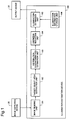
- FIG. 1 is a block diagram illustrating a configuration example of an illumination estimation device in the first exemplary embodiment of the invention.
- An illumination estimation device 100 illustrated in Fig. 1 includes an image reading unit 101, a target object area extraction unit 102, a distribution characteristics estimation unit 103, a dimension reduction unit 104, an illumination estimation unit 105, and an illumination information storage unit 106.
- the image reading unit 101 reads an image captured by an image capturing device 20.
- the target object area extraction unit 102 extracts an area including a specular reflection component of an object (hereinafter, referred to as an object area) from the image read by the image reading unit 101. It is possible to use an existing method as the object area extraction method.
- the distribution characteristics estimation unit 103 estimates characteristics of the spreading manner of observation values in a spectral space, as distribution characteristics, based on observation values to be obtained from the respective pixels in an object area, which is extracted by the target object area extraction unit 102. For instance, when observation values have a distribution in the N-dimensional spectral space, the distribution characteristics estimation unit 103 may extract, as distribution characteristics, feature vectors constituting a subspace for each dimension, which is obtained by approximating a distribution of observation values in the spectral space to the subspace. Further, the distribution characteristics estimation unit 103 may extract main component vectors in a set of observation values, as distribution characteristics, for instance. Further, in outputting distribution characteristics, the distribution characteristics estimation unit 103 may rearrange feature vectors or main component vectors for each dimension, which are extracted as the distribution characteristics, in the descending order of eigenvalues for output.
- the dimension reduction unit 104 selects a distribution characteristic to be used from among the distribution characteristics extracted by the distribution characteristics estimation unit 103 depending on the number of dimensions to be reduced, which is determined by the light environment.
- the dimension reduction unit 104 thus determines the dimension of a subspace that approximates a distribution of observation values in a spectral space.
- the illumination information storage unit 106 stores information necessary for configuring an illumination model to be used by the illumination estimation unit 105.
- the illumination information storage unit 106 stores parameters and the like for use in an illumination model.
- the illumination model is not specifically limited.
- the illumination model may be a model that expresses spectral characteristics of illumination based on a physical quantity that does not depend on an object to be observed such as a correlated color temperature.
- the illumination estimation unit 105 estimates spectral characteristics of illumination at the time of capturing image, with use of a subspace to be defined by the reduced number of dimensions, which is represented by the distribution characteristic selected by the dimension reduction unit 104, and with use of an illumination model configured based on the information stored in the illumination information storage unit 106.
- the estimated spectral characteristics are output via an output device 30, for instance.
- the image reading unit 101, the target object area extraction unit 102, the distribution characteristics estimation unit 103, the dimension reduction unit 104, and the illumination estimation unit 105 are implemented by a CPU which operates according to a program, for instance. Further, the illumination information storage unit 106 is implemented by a storage device, for instance.
- the illumination estimation device 100 may be an information processing device provided with a CPU (Central Processing Unit) which operates according to a program, various types of storage devices (such as a hard disk drive, a non-volatile memory, a volatile memory, and an SSD (Solid State Drive)), and a communication interface between the image capturing device 20 and the output device 30.
- Fig. 1 illustrates the illumination estimation device 100, the image capturing device 20, and the output device 30 as separate devices.
- the illumination estimation device 100 may be provided with the image capturing device 20 and the output device 30, or may be provided with one of the image capturing device 20 and the output device 30.
- FIG. 1 illustrates a configuration such that one device is provided with the image reading unit 101, the target object area extraction unit 102, the distribution characteristics estimation unit 103, the dimension reduction unit 104, and the illumination estimation unit 105, a part of these units may be implemented in another information processing device.
- the information processing devices are communicatively connected to each other.
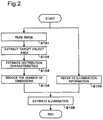
- Fig. 2 is a flowchart illustrating an example of an operation to be performed by the illumination estimation device 100 in the exemplary embodiment.
- the image reading unit 101 reads an image captured by the image capturing device 20 (Step S101).
- the target object area extraction unit 102 extracts an object area including a specular reflection component from the image read by the image reading unit 101 (Step S102).
- the distribution characteristics estimation unit 103 estimates characteristics of the spreading manner of observation values in a spectral space, as distribution characteristics, based on observation values to be obtained from the object area, which is extracted by the target object area extraction unit 102 (Step S103).
- the dimension reduction unit 104 selects a distribution characteristic to be used from among the distribution characteristics estimated by the distribution characteristics estimation unit 103 depending on the number of dimensions to be reduced, which is determined by the light environment (Step S104).
- the illumination estimation unit 105 reads the information stored in the illumination information storage unit 106, and configures an illumination model (Step S105).
- the operation of Step S105 may be performed in advance, or may be concurrently performed with the aforementioned operation.
- the illumination estimation unit 105 estimates spectral characteristics of illumination, with use of a subspace which is represented by the distribution characteristic selected by the dimension reduction unit 104, and with use of the illumination model configured based on the information stored in the illumination information storage unit 106 (Step S106).
- observation values have a distribution of an intended shape on a two-dimensional plane where the vector I representing spectral characteristics of illumination, and the vector L obj representing spectral characteristics of diffuse reflection light exist.
- spectral characteristics of illumination are precisely estimated in an environment where the aforementioned observed spectra are obtained, even when the wavelengths to be observed from a captured multispectral image are not three wavelengths corresponding to red, green, and blue. Further, there is also described an example, in which spectral characteristics of illumination are precisely estimated from a captured multispectral image, even in a condition where ambient light included in illumination is not negligible such as an outdoor environment during the description of the aforementioned example.
- the distribution characteristics estimation unit 103 extracts characteristics of the spreading manner of observation values in the N-dimensional space, with use of observation values to be obtained from a target object area including a specular reflection component. For instance, the distribution characteristics estimation unit 103 extracts feature vectors v 1 , v 2 , ... , and v N which include the origin, and which constitute a space where observation values are distributed, based on an assumption that observation values are distributed in a space including the origin.
- These vectors can be calculated based on a set of observation values and expressed as eigenvectors of XX T , when a set of observation values constituted of N wavelengths at M pixels belonging to a target object area is expressed as a matrix X of N-rows and M-columns.
- d represents a unit vector of N dimensions.
- the distribution characteristics estimation unit 103 may perform a main component analysis with respect to a set X of observation values, and may set the first main component vector, the second main component vector, ... , and the N-th main component vector obtained by the analysis in order, as feature vectors v 1 , v 2 , ... , and V N .
- the dimension reduction unit 104 selects a feature vector to be used from among the feature vectors v 1 , v 2 , ... , and v N which constitute a space that approximates a distribution of observation values, which is estimated to be distribution characteristics by the distribution characteristics estimation unit 103, depending on the number P of dimensions to be reduced, which is determined by the expected light environment.
- the feature vectors v 1 , v 2 , ... ,and v p are selected in the order in which the characteristics of the spreading manner of observation values are clearly expressed, based on an assumption that feature vectors of dimensions up to the dimension number P are used.
- the number P of dimensions to be reduced is determined to be the number of dimensions of a subspace that clearly expresses a distribution of observation values depending on the light environment at the time of capturing image within a spectral space, more specifically, is determined to be the same value as the number of vector components constituting an observation model depending on the light environment.
- the observation model is a model based on a dichromatic reflection model. Specifically, the model that expresses observation values with use of two kinds of reflection components i.e. a specular reflection component and a diffuse reflection component is used as exemplified by a dichromatic reflection model. In this observation model, unlike the dichromatic reflection model described in NPL 1, however, reflection by ambient light is also considered as reflected light.
- the observation model to be used in the exemplary embodiment may not necessarily be a model based on a dichromatic reflection model, as far as the model expresses observation values with use of a component capable of specifying at least spectral characteristics of illumination.
- the number of vector components constituting an observation model differs depending on the light environment in which the observation model is supposed to be placed.
- the number of vector components constituting an observation model depends on the number of illumination light (including ambient light) having different spectral characteristics, or depends on the presence or absence of a specular reflection component and a diffuse reflection component on an object to be observed in the light environment.
- the number P of dimensions to be reduced may be determined by setting a plurality of light environments in advance, taking into consideration the number of illumination light, or taking into consideration the presence or absence of each of the reflection components, and may be determined for each of the light environments depending on the set contents.
- the number P of dimensions to be reduced can be set by allowing an operator who inputs an image to designate a light environment to be expected from the image. Further, the number P of dimensions to be reduced may be directly designated by the operator.
- an appropriate value from 1 to N is set for the number P of dimensions to be reduced depending on the light environment.
- the following two examples are examples regarding the number P of dimensions to be reduced depending on the light environment, and a distribution characteristic to be selected. For instance, when the light environment is supposed to be such that observation values are expressed by the dichromatic reflection model expressed by the above Eq. (2), two feature vectors v 1 and v 2 are selected from among the distribution characteristics estimated by the distribution characteristics estimation unit 103, assuming that the number P of dimensions to be reduced is 2.
- observation values are distributed on a two-dimensional plane in the N-dimensional spectral space, which is constituted by two vector components i.e. spectral characteristics I of illumination and spectral characteristics L obj of reflected light from an object, and in which the two vectors exist.
- the illumination estimation unit 105 in the exemplary embodiment utilizes the characteristic that spectral characteristics I of illumination at the time of capturing image can be expressed as vectors on a two-dimensional plane where the feature vectors v 1 and v 2 exist.
- a light environment in which illumination includes uniform ambient light from the sky, in other words, skylight, and the amount of skylight is not negligible.
- illumination includes uniform ambient light from the sky, in other words, skylight, and the amount of skylight is not negligible.
- four feature vectors v 1 , v 2 , v 3 , and v 4 are selected from among the distribution characteristics estimated by the distribution characteristics estimation unit 103, assuming that the number P of dimensions to be reduced is 4. This is because, in this example, it is assumed that observation values include four vector components i.e.
- the illumination estimation unit 105 in the exemplary embodiment utilizes the characteristic that it is possible to express a specular reflection component I of a light source having the same spectral characteristics as the spectral characteristics of illumination at the time of capturing image, as vectors on a four-dimensional plane where the feature vectors v 1 , v 2 , v 3 , and v 4 exist.
- m ss ( ⁇ ) and m sb ( ⁇ ) respectively represent the amount of specular reflection and the amount of diffuse reflection of skylight.
- I s and L obj_s respectively represent a specular reflection component and a diffuse reflection component of skylight.
- Weight coefficients M 1 and M 2 of the main component vectors in Eq. (5) are determined by a function using a correlated color temperature T C as an input.
- the illumination information storage unit 106 may store functional parameters for use in calculating the weight coefficients M 1 and M 2 from the average vector So, the first main component vector S 1 , the second main component vector S 2 , and the correlated color temperature T C , as illumination information.
- the illumination estimation unit 105 may select an illumination condition, which is most analogous to a subspace that approximates a distribution of observation values to be represented by the selected feature vectors, from the illumination model to be configured based on the information stored in the illumination information storage unit 106, and may set spectral characteristics I est of illumination to be specified by the illumination condition, as an estimated value.
- Fig. 3 is a conceptual diagram illustrating an illumination estimation method in the exemplary embodiment.
- Fig. 3 illustrates a conceptual diagram of an illumination estimation method to be used when two vectors v 1 and v 2 are selected as feature vectors, which constitute a subspace that approximates observation values.
- the illumination estimation unit 105 may set the intersection point between a two-dimensional plane where the feature vectors v 1 and v 2 exist in a spectral space, and an approximation curve of illumination expressed by an illumination model in a spectral space, as an estimated value of illumination.
- the illumination model may be an illumination model other than the CIE daylight model.
- a physical model representing daylight by Bird et al. as described in " R.E. Bird, C. Riordan, "Simple Solar Spectral Model for Direct and Diffuse Irradiance on Horizontal and Tilted Planes at the Earth's Surface for Cloudless Atmospheres", Journal of Applied Meteorology and Climatology, Vol. 25, Issue 1, 1986 .” (NPL 3).
- direct sunlight and atmospheric scattering light are simulated with use of the zenith angle of the sun to be calculated from the place and the time, or with use of a parameter representing the state of the atmosphere for calculating daylight in a fine weather.
- N feature vectors are estimated based on an assumption that the feature vectors represent characteristics (distribution characteristics) of the spreading manner of observation values in a state that a specular reflection component and a diffuse reflection component are included, and illumination is estimated from a subspace that approximates a distribution of observation values to be expressed by feature vectors by the amount corresponding to the reduced number of dimensions, out of the estimated feature vectors, and from the illumination model to be configured based on illumination information.
- illumination while avoiding the problem on separation of a specular reflection component and a diffuse reflection component, which is difficult to be solved when illumination includes ambient light or when the surface configuration of an object to be observed is complicated.
- the distribution characteristics estimation unit 103 extracts distribution characteristics of observation values in a spectral space, and then, the dimension reduction unit 104 selects a distribution characteristic to be used depending on the number of dimensions to be reduced, which is determined by the light environment. Therefore, it is possible to estimate illumination based on projection of observation values onto a subspace of an intended variable dimensions depending on an input image, without using a fixed two-dimensional subspace such as a chromaticity plane. Thus, it is possible to estimate spectral characteristics of illumination with use of a subspace depending on an input image, without restricting the component of information (such as a wavelength) to be used, even if the input image is a multispectral image including multi-wavelength light information.
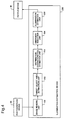
- FIG. 4 is a block diagram illustrating a configuration example of an illumination estimation device in the second exemplary embodiment of the invention.
- An illumination estimation device 200 illustrated in Fig. 4 includes the image reading unit 101, the target object area extraction unit 102, a distribution characteristics estimation unit 203, a dimension reduction unit 204, and an illumination estimation unit 205.
- the image reading unit 101 and the target object area extraction unit 102 in the second exemplary embodiment may be the same as those in the first exemplary embodiment. Therefore, the image reading unit 101 and the target object area extraction unit 102 in the second exemplary embodiment are indicated with the same reference signs as those in the first exemplary embodiment, and description thereof is omitted herein.
- the illumination information storage unit 106 is not necessary in the exemplary embodiment.
- the distribution characteristics estimation unit 203 estimates characteristics of the spreading manner of observation values in a spectral space, as distribution characteristics, based on observation values in an object area including a specular reflection component extracted by the target object area extraction unit 102.
- the dimension reduction unit 204 selects a distribution characteristic to be used from among the distribution characteristics estimated by the distribution characteristics estimation unit 203 depending on the number of dimensions to be reduced, which is determined by the light environment.
- the illumination estimation unit 205 estimates spectral characteristics of illumination with use of a subspace to be defined by the reduced number of dimensions, which is represented by the distribution characteristic selected by the dimension reduction unit 204.
- the illumination estimation unit 205 in the exemplary embodiment does not use an illumination model.
- the illumination estimation unit 205 estimates spectral characteristics of illumination from a distribution of observation values in a subspace, which is expressed by feature vectors selected by the dimension reduction unit 204.
- the dimension reduction unit 204 selects a distribution characteristic of such a dimension that a distribution of observation values in the subspace clearly expresses spectral characteristics of illumination included in the observation values.
- the distribution characteristics estimation unit 203 extracts distribution characteristics in such a manner that at least the aforementioned dimension is included.
- a process of extracting distribution characteristics, a process of reducing the number of dimensions, and a process of estimating spectral characteristics of illumination may be executed according to respective predetermined methods, in the second exemplary embodiment as well as in the first exemplary embodiment.
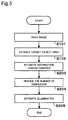
- Fig. 5 is a flowchart illustrating an example of an operation to be performed by the illumination estimation device 200 in the exemplary embodiment.
- the image reading unit 101 reads an image photographed by a image capturing device 20 (Step S101). Subsequently, the target object area extraction unit 102 extracts an object area including a specular reflection component from the image read by the image reading unit 101 (Step S102).
- the distribution characteristics estimation unit 203 outputs, as distribution characteristics, characteristics of the spreading manner of observation values in a spectral space based on observation values in the object area including the specular reflection component, which is extracted by the target object area extraction unit 102 (Step S203).
- the dimension reduction unit 204 selects a distribution characteristic to be used from among the distribution characteristics estimated by the distribution characteristics estimation unit 203 depending on the number of dimensions to be reduced, which is determined by the light environment (Step S204).
- the illumination estimation unit 205 estimates spectral characteristics of illumination with use of the subspace, which is represented by the distribution characteristic selected by the dimension reduction unit 204 (Step S205).
- Eq. (8) An example of a mathematical model of observation values in the aforementioned case is expressed by the following Eq. (8).
- m ss ( ⁇ ) represents the amount of specular reflection of ambient light from the sky, in other words, the amount of specular reflection of skylight
- m sb ( ⁇ ) represents the amount of diffuse reflection of skylight.
- I s represents a specular reflection component of skylight
- L obj_s represents a diffuse reflection component of skylight.
- L ⁇ cloudy ⁇ ⁇ m ss ⁇ ⁇ I ⁇ s + m s b ⁇ ⁇ L ⁇ obj _s
- illumination light does not include direct sunlight from the sun as a light source. Therefore, a specular reflection component and a diffuse reflection component of direct sunlight can be ignored. Further, when it is assumed that in many water areas in the nature such as a sea surface or a lake surface, the ratio of the sky with respect to the expanse is large, and that the state of the sky is uniform, spectral characteristics of illumination become spectral characteristics of a specular reflection component I s of ambient light from the sky i.e. of skylight.
- observation light on the water surface can be expressed as the sum of a specular reflection component I s of skylight and a diffuse reflection component L obj_s of skylight, as expressed by Eq. (8).
- a specular reflection component I s of skylight and a diffuse reflection component L obj_s of skylight, as expressed by Eq. (8).
- observation values are distributed on a two-dimensional plane where two vectors exist.
- Fig. 6 is a conceptual diagram illustrating the present case, in other words, how observation values to be obtained from an image of a water surface, which is photographed outdoors in a cloudy weather, are distributed in a spectral space.
- the observation values are plotted in the N-dimensional space based on the aforementioned assumption, it is possible to approximate a distribution of observation values, with use of the two-dimensional plane as illustrated in Fig. 6 .
- the vector I s of skylight is a vector on the two-dimensional plane.
- Observation values are likely to be widely distributed in the direction I s toward skylight especially in an environment such a cloudy weather.
- Fig. 7 is a conceptual diagram illustrating a relationship between a distribution of observation values, and vectors representing distribution characteristics in the present case.
- Fig. 8 is an explanatory diagram illustrating an example of a distribution of observation values in the present case, when it is assumed that a wavelength is expressed as a dimension.
- the example illustrated in Fig. 8 is a distribution example of observation values when the amount of specular reflection greatly varies.
- a vector L 1 representing a direction in which the variation is largest is the first main component vector of observation value L cloudy ( ⁇ ), and is a vector in the same direction as the vector I s representing skylight.
- a vector whose direction is the same in a spectral space has the same spectral configuration.
- spectral characteristics I of illumination are estimated with use of the aforementioned characteristics.
- the distribution characteristics estimation unit 203 in the exemplary embodiment estimates an average vector of the observation values, and the first to the N-th main component vectors L 1 , L 2 , ... , and L N , as information representing the characteristics of the spreading manner (variation) of observation values in a spectral space, in other words, distribution characteristics.
- the dimension reduction unit 204 extracts the first main component vector L 1 from among the vectors representing the distribution characteristics estimated by the distribution characteristics estimation unit 203.
- the illumination estimation unit 205 sets the vector L 1 extracted by the dimension reduction unit 204, as an estimated value of spectral characteristics I s of illumination.
- observation values are projected onto a subspace of an intended variable number of dimensions depending on an input image, without using a fixed two-dimensional subspace such as a chromaticity plane, and thereby illumination is estimated based on the subspace.
- FIG. 9 is a block diagram illustrating a minimum configuration example of the illumination estimation device in the invention.
- the illumination estimation device in the invention includes, as minimum constituent elements, target object area extraction means 501, distribution characteristics estimation means 502, dimension reduction means 503, and illumination estimation means 504.
- the target object area extraction means 501 e.g. the target object area extraction unit 102 extracts an object area, including specular reflection, of an object, from a multispectral image.
- the distribution characteristics estimation means 502 (e.g. the distribution characteristics estimation unit 103, 203) estimates information representing a subspace that approximates a distribution of observation values in a spectral space, as distribution characteristics, which are characteristics of the spreading manner of observation values in the object area within a spectral space.
- the dimension reduction means 503 selects a distribution characteristic to be used from among the distribution characteristics estimated by the distribution characteristics estimation means 502 depending on the number of dimensions to be reduced, which is determined in advance by the light environment.
- the illumination estimation means 504 (e.g. the illumination estimation unit 105, 205) estimates spectral characteristics of illumination based on subspace information to be represented by the distribution characteristic selected by the dimension reduction means 503. Therefore, according to the illumination estimation device having a minimum configuration, spectral characteristics of illumination are estimated based on a subspace that approximates a distribution of observation values by the number of dimensions to be reduced depending on the light environment, wherein the distribution is particularly selected from among the estimated characteristics (distribution characteristics) of the spreading manner of observation values in the object area. Therefore, the illumination estimation device makes it possible to precisely estimate spectral characteristics of illumination from a multispectral image including multi-wavelength information, even when illumination includes ambient light or even when the surface configuration of an object to be observed is complicated.
- each component may be implemented by a computer program.
- a processor which operates by a program stored in a program memory implements the same functions and operations as those of each of the aforementioned exemplary embodiments.
- An illumination estimation device including:
- the illumination estimation device further including:
- the illumination estimation device according to Supplemental Note 1 or 2, wherein the distribution characteristics estimation means estimates a main component vector in a set of the observation values, as the distribution characteristics.
- the illumination estimation device according to Supplemental Note 1 or 2, wherein the distribution characteristics estimation means estimates, as the distribution characteristics, vectors constituting the subspace, the subspace being obtained by approximating the distribution of the observation values in the spectral space as the subspace including an origin.
- An illumination estimation method including, by an information processing device:
- the illumination estimation method wherein the information processing device stores in advance information representing parameters for use in configuring an illumination model, and the information processing device estimates the spectral characteristics of the illumination based on the subspace information and the illumination model configured based on the stored information.
- the illumination estimation method according to Supplemental Note 5 or 6, wherein the information processing device estimates a main component vector in a set of the observation values, as the distribution characteristics.
- the illumination estimation method according to Supplemental Note 5 or 6, wherein the information processing device estimates, as the distribution characteristics, vectors constituting the subspace, the subspace being obtained by approximating the distribution of the observation values in the spectral space as the subspace including an origin.
- An illumination estimation program which causes a computer to execute:
- the illumination estimation program causes the computer comprising illumination information storage means which stores information representing parameters for use in configuring an illumination model to estimate the spectral characteristics of the illumination based on the subspace information and the illumination model configured based on the information stored in the illumination information storage means in the illumination estimation process.
- the illumination estimation program according to Supplemental Note 9 or 10, wherein the program causes the computer to estimate a main component vector in a set of the observation values as the distribution characteristics in the distribution characteristics estimation process.
- the illumination estimation program causes the computer to estimate, as the distribution characteristics, vectors constituting the subspace to be obtained by approximating the distribution of the observation values in the spectral space as the subspace including an origin in the distribution characteristics estimation process.
- the invention it is possible to estimate spectral characteristics of illumination at the time of capturing an image, only with use of the image as information at the time of capturing. Therefore, the invention is advantageously applicable for use in obtaining various pieces of information such as the kind, the material, and the state of an object within a multispectral image with use of the multispectral image with high precision, for instance.
Landscapes
- Engineering & Computer Science (AREA)
- Physics & Mathematics (AREA)
- General Physics & Mathematics (AREA)
- Theoretical Computer Science (AREA)
- Computer Vision & Pattern Recognition (AREA)
- Life Sciences & Earth Sciences (AREA)
- Analytical Chemistry (AREA)
- Mathematical Physics (AREA)
- Spectroscopy & Molecular Physics (AREA)
- Health & Medical Sciences (AREA)
- Multimedia (AREA)
- Chemical & Material Sciences (AREA)
- Signal Processing (AREA)
- Biochemistry (AREA)
- General Health & Medical Sciences (AREA)
- Immunology (AREA)
- Pathology (AREA)
- Investigating Or Analysing Materials By Optical Means (AREA)
- Spectrometry And Color Measurement (AREA)
- Color Television Image Signal Generators (AREA)
- Image Analysis (AREA)
Applications Claiming Priority (2)
| Application Number | Priority Date | Filing Date | Title |
|---|---|---|---|
| JP2013128754 | 2013-06-19 | ||
| PCT/JP2014/002683 WO2014203453A1 (ja) | 2013-06-19 | 2014-05-22 | 照明推定装置、照明推定方法および照明推定プログラム |
Publications (3)
| Publication Number | Publication Date |
|---|---|
| EP3013045A1 true EP3013045A1 (de) | 2016-04-27 |
| EP3013045A4 EP3013045A4 (de) | 2017-01-25 |
| EP3013045B1 EP3013045B1 (de) | 2021-07-07 |
Family
ID=52104207
Family Applications (1)
| Application Number | Title | Priority Date | Filing Date |
|---|---|---|---|
| EP14814071.8A Active EP3013045B1 (de) | 2013-06-19 | 2014-05-22 | Beleuchtungsschätzungsvorrichtung, beleuchtungsschätzungsverfahren und beleuchtungsschätzungsprogramm |
Country Status (4)
| Country | Link |
|---|---|
| US (1) | US9692993B2 (de) |
| EP (1) | EP3013045B1 (de) |
| JP (1) | JP6376128B2 (de) |
| WO (1) | WO2014203453A1 (de) |
Cited By (1)
| Publication number | Priority date | Publication date | Assignee | Title |
|---|---|---|---|---|
| US12329491B2 (en) | 2018-07-31 | 2025-06-17 | Deutsches Krebsforschungszentrum Stiftung des öffentlichen Rechts | Method and system for augmented imaging in open treatment using multispectral information |
Families Citing this family (9)
| Publication number | Priority date | Publication date | Assignee | Title |
|---|---|---|---|---|
| US9792522B2 (en) * | 2015-12-01 | 2017-10-17 | Bloomsky, Inc. | Weather information extraction using sequential images |
| WO2018013703A1 (en) * | 2016-07-12 | 2018-01-18 | Mindshare Medical, Inc. | Medical analytics system |
| KR102727706B1 (ko) * | 2020-03-30 | 2024-11-06 | 쉔젠 하이퍼나노 옵틱스 테크놀로지 코., 엘티디 | 측정 대상 물질의 스펙트럼 정보를 추출하는 방법 |
| CN111753407A (zh) * | 2020-06-09 | 2020-10-09 | 中国人民解放军63921部队 | 一种水域照明系统的照度计算方法 |
| TW202303511A (zh) | 2021-01-29 | 2023-01-16 | 日商索尼半導體解決方案公司 | 圖像處理裝置、圖像處理方法及圖像處理程式 |
| KR102710265B1 (ko) * | 2021-05-24 | 2024-09-27 | 에이아이루덴스 주식회사 | 딥러닝을 통한 광학 환경 제공 시스템 및 제공 방법 |
| JP7700856B2 (ja) * | 2021-07-01 | 2025-07-01 | 日本電気株式会社 | 学習システム、推定システム、学習方法、及びコンピュータプログラム |
| CN118946912A (zh) * | 2022-03-22 | 2024-11-12 | 昕诺飞控股有限公司 | 用于空间中对象入侵估计的安全系统和方法 |
| WO2025126817A1 (ja) * | 2023-12-12 | 2025-06-19 | ソニーセミコンダクタソリューションズ株式会社 | 情報処理装置、情報処理方法、プログラム |
Family Cites Families (11)
| Publication number | Priority date | Publication date | Assignee | Title |
|---|---|---|---|---|
| US7123844B2 (en) * | 1999-04-06 | 2006-10-17 | Myrick Michael L | Optical computational system |
| JP4529210B2 (ja) * | 1999-12-27 | 2010-08-25 | 凸版印刷株式会社 | 測色変換係数算出方法と測色画像変換方法、及び、測色変換係数算出装置と測色画像変換装置、並びに、測色変換係数算出プログラム又は測色的撮像プログラムを記録したコンピュータ読み取り可能な情報記録媒体 |
| JP3853224B2 (ja) | 2001-11-08 | 2006-12-06 | 富士写真フイルム株式会社 | ホワイトバランス補正方法 |
| JP2005311581A (ja) * | 2004-04-20 | 2005-11-04 | Konica Minolta Holdings Inc | 画像入力システム、変換マトリックス算出方法、及びプログラム |
| US8644911B1 (en) * | 2006-06-30 | 2014-02-04 | Hypermed Imaging, Inc. | OxyVu-1 hyperspectral tissue oxygenation (HTO) measurement system |
| US8538195B2 (en) * | 2007-09-17 | 2013-09-17 | Raytheon Company | Hyperspectral image dimension reduction system and method |
| US9572494B2 (en) * | 2008-08-12 | 2017-02-21 | New Jersy Institute of Technology | Method and apparatus for multi-spectral imaging and analysis of skin lesions and biological tissues |
| JP2011022044A (ja) * | 2009-07-16 | 2011-02-03 | Canon Inc | 光源推定装置および光源推定方法 |
| US9087266B2 (en) * | 2009-09-03 | 2015-07-21 | National Ict Australia Limited | Illumination spectrum recovery |
| JP5725968B2 (ja) * | 2011-05-10 | 2015-05-27 | キヤノン株式会社 | 色処理装置およびその方法 |
| US9593982B2 (en) * | 2012-05-21 | 2017-03-14 | Digimarc Corporation | Sensor-synchronized spectrally-structured-light imaging |
-
2014
- 2014-05-22 WO PCT/JP2014/002683 patent/WO2014203453A1/ja not_active Ceased
- 2014-05-22 US US14/895,585 patent/US9692993B2/en active Active
- 2014-05-22 JP JP2015522499A patent/JP6376128B2/ja active Active
- 2014-05-22 EP EP14814071.8A patent/EP3013045B1/de active Active
Non-Patent Citations (1)
| Title |
|---|
| See references of WO2014203453A1 * |
Cited By (1)
| Publication number | Priority date | Publication date | Assignee | Title |
|---|---|---|---|---|
| US12329491B2 (en) | 2018-07-31 | 2025-06-17 | Deutsches Krebsforschungszentrum Stiftung des öffentlichen Rechts | Method and system for augmented imaging in open treatment using multispectral information |
Also Published As
| Publication number | Publication date |
|---|---|
| EP3013045B1 (de) | 2021-07-07 |
| WO2014203453A1 (ja) | 2014-12-24 |
| US9692993B2 (en) | 2017-06-27 |
| JP6376128B2 (ja) | 2018-08-22 |
| EP3013045A4 (de) | 2017-01-25 |
| US20160119558A1 (en) | 2016-04-28 |
| JPWO2014203453A1 (ja) | 2017-02-23 |
Similar Documents
| Publication | Publication Date | Title |
|---|---|---|
| EP3013045B1 (de) | Beleuchtungsschätzungsvorrichtung, beleuchtungsschätzungsverfahren und beleuchtungsschätzungsprogramm | |
| AU2023251482B2 (en) | Hyperspectral imager method and apparatus | |
| US10832390B2 (en) | Atmospheric compensation in satellite imagery | |
| US8670620B2 (en) | Decomposing hyperspectral or multispectral image data | |
| EP2728337B1 (de) | Vorrichtung, verfahren und computerprogramm zur identifikation von pflanzenarten | |
| US9530188B2 (en) | Image processing method, image processing system, and image processing program | |
| Altmann et al. | Supervised nonlinear spectral unmixing using a polynomial post nonlinear model for hyperspectral imagery | |
| Broadwater et al. | Kernel methods for unmixing hyperspectral imagery | |
| JP7059930B2 (ja) | 画像処理装置および画像処理方法 | |
| Sundberg | The Impact of Cloud Shadows on Subpixel Target Detection | |
| KR20240115168A (ko) | 조명 스펙트럼 복원 | |
| Altmann et al. | A post nonlinear mixing model for hyperspectral images unmixing | |
| Sundberg et al. | Full Spectrum Cloudy Scene Simulation for Remote Sensing Algorithm Development | |
| Ientilucci | Using a new GUI tool to leverage LiDAR data to aid in hyperspectral image material detection in the radiance domain on RIT SHARE LiDAR/HSI data | |
| Melnikova | LANDSAT IMAGE PROCESSING AND CLASSIFICATION IN IDRISI SELVA | |
| Lind et al. | MIST Final Report: Multi-sensor Imaging Science and Technology |
Legal Events
| Date | Code | Title | Description |
|---|---|---|---|
| PUAI | Public reference made under article 153(3) epc to a published international application that has entered the european phase |
Free format text: ORIGINAL CODE: 0009012 |
|
| 17P | Request for examination filed |
Effective date: 20160101 |
|
| AK | Designated contracting states |
Kind code of ref document: A1 Designated state(s): AL AT BE BG CH CY CZ DE DK EE ES FI FR GB GR HR HU IE IS IT LI LT LU LV MC MK MT NL NO PL PT RO RS SE SI SK SM TR |
|
| AX | Request for extension of the european patent |
Extension state: BA ME |
|
| DAX | Request for extension of the european patent (deleted) | ||
| A4 | Supplementary search report drawn up and despatched |
Effective date: 20170102 |
|
| RIC1 | Information provided on ipc code assigned before grant |
Ipc: G06T 7/40 20170101ALI20161221BHEP Ipc: H04N 1/60 20060101ALI20161221BHEP Ipc: G01N 21/27 20060101AFI20161221BHEP |
|
| STAA | Information on the status of an ep patent application or granted ep patent |
Free format text: STATUS: EXAMINATION IS IN PROGRESS |
|
| 17Q | First examination report despatched |
Effective date: 20190212 |
|
| REG | Reference to a national code |
Ref country code: DE Ref legal event code: R079 Ref document number: 602014078641 Country of ref document: DE Free format text: PREVIOUS MAIN CLASS: H04N0009040000 Ipc: G06T0007900000 |
|
| RIC1 | Information provided on ipc code assigned before grant |
Ipc: G01N 21/27 20060101ALN20201125BHEP Ipc: G06T 7/90 20170101AFI20201125BHEP |
|
| GRAP | Despatch of communication of intention to grant a patent |
Free format text: ORIGINAL CODE: EPIDOSNIGR1 |
|
| STAA | Information on the status of an ep patent application or granted ep patent |
Free format text: STATUS: GRANT OF PATENT IS INTENDED |
|
| INTG | Intention to grant announced |
Effective date: 20210118 |
|
| INTG | Intention to grant announced |
Effective date: 20210122 |
|
| GRAS | Grant fee paid |
Free format text: ORIGINAL CODE: EPIDOSNIGR3 |
|
| GRAA | (expected) grant |
Free format text: ORIGINAL CODE: 0009210 |
|
| STAA | Information on the status of an ep patent application or granted ep patent |
Free format text: STATUS: THE PATENT HAS BEEN GRANTED |
|
| AK | Designated contracting states |
Kind code of ref document: B1 Designated state(s): AL AT BE BG CH CY CZ DE DK EE ES FI FR GB GR HR HU IE IS IT LI LT LU LV MC MK MT NL NO PL PT RO RS SE SI SK SM TR |
|
| REG | Reference to a national code |
Ref country code: GB Ref legal event code: FG4D |
|
| REG | Reference to a national code |
Ref country code: AT Ref legal event code: REF Ref document number: 1409327 Country of ref document: AT Kind code of ref document: T Effective date: 20210715 |
|
| REG | Reference to a national code |
Ref country code: DE Ref legal event code: R096 Ref document number: 602014078641 Country of ref document: DE |
|
| REG | Reference to a national code |
Ref country code: IE Ref legal event code: FG4D |
|
| REG | Reference to a national code |
Ref country code: LT Ref legal event code: MG9D |
|
| REG | Reference to a national code |
Ref country code: NL Ref legal event code: MP Effective date: 20210707 |
|
| REG | Reference to a national code |
Ref country code: AT Ref legal event code: MK05 Ref document number: 1409327 Country of ref document: AT Kind code of ref document: T Effective date: 20210707 |
|
| PG25 | Lapsed in a contracting state [announced via postgrant information from national office to epo] |
Ref country code: SE Free format text: LAPSE BECAUSE OF FAILURE TO SUBMIT A TRANSLATION OF THE DESCRIPTION OR TO PAY THE FEE WITHIN THE PRESCRIBED TIME-LIMIT Effective date: 20210707 Ref country code: RS Free format text: LAPSE BECAUSE OF FAILURE TO SUBMIT A TRANSLATION OF THE DESCRIPTION OR TO PAY THE FEE WITHIN THE PRESCRIBED TIME-LIMIT Effective date: 20210707 Ref country code: HR Free format text: LAPSE BECAUSE OF FAILURE TO SUBMIT A TRANSLATION OF THE DESCRIPTION OR TO PAY THE FEE WITHIN THE PRESCRIBED TIME-LIMIT Effective date: 20210707 Ref country code: PT Free format text: LAPSE BECAUSE OF FAILURE TO SUBMIT A TRANSLATION OF THE DESCRIPTION OR TO PAY THE FEE WITHIN THE PRESCRIBED TIME-LIMIT Effective date: 20211108 Ref country code: NL Free format text: LAPSE BECAUSE OF FAILURE TO SUBMIT A TRANSLATION OF THE DESCRIPTION OR TO PAY THE FEE WITHIN THE PRESCRIBED TIME-LIMIT Effective date: 20210707 Ref country code: NO Free format text: LAPSE BECAUSE OF FAILURE TO SUBMIT A TRANSLATION OF THE DESCRIPTION OR TO PAY THE FEE WITHIN THE PRESCRIBED TIME-LIMIT Effective date: 20211007 Ref country code: ES Free format text: LAPSE BECAUSE OF FAILURE TO SUBMIT A TRANSLATION OF THE DESCRIPTION OR TO PAY THE FEE WITHIN THE PRESCRIBED TIME-LIMIT Effective date: 20210707 Ref country code: FI Free format text: LAPSE BECAUSE OF FAILURE TO SUBMIT A TRANSLATION OF THE DESCRIPTION OR TO PAY THE FEE WITHIN THE PRESCRIBED TIME-LIMIT Effective date: 20210707 Ref country code: BG Free format text: LAPSE BECAUSE OF FAILURE TO SUBMIT A TRANSLATION OF THE DESCRIPTION OR TO PAY THE FEE WITHIN THE PRESCRIBED TIME-LIMIT Effective date: 20211007 Ref country code: AT Free format text: LAPSE BECAUSE OF FAILURE TO SUBMIT A TRANSLATION OF THE DESCRIPTION OR TO PAY THE FEE WITHIN THE PRESCRIBED TIME-LIMIT Effective date: 20210707 Ref country code: LT Free format text: LAPSE BECAUSE OF FAILURE TO SUBMIT A TRANSLATION OF THE DESCRIPTION OR TO PAY THE FEE WITHIN THE PRESCRIBED TIME-LIMIT Effective date: 20210707 |
|
| PG25 | Lapsed in a contracting state [announced via postgrant information from national office to epo] |
Ref country code: PL Free format text: LAPSE BECAUSE OF FAILURE TO SUBMIT A TRANSLATION OF THE DESCRIPTION OR TO PAY THE FEE WITHIN THE PRESCRIBED TIME-LIMIT Effective date: 20210707 Ref country code: LV Free format text: LAPSE BECAUSE OF FAILURE TO SUBMIT A TRANSLATION OF THE DESCRIPTION OR TO PAY THE FEE WITHIN THE PRESCRIBED TIME-LIMIT Effective date: 20210707 Ref country code: GR Free format text: LAPSE BECAUSE OF FAILURE TO SUBMIT A TRANSLATION OF THE DESCRIPTION OR TO PAY THE FEE WITHIN THE PRESCRIBED TIME-LIMIT Effective date: 20211008 |
|
| REG | Reference to a national code |
Ref country code: DE Ref legal event code: R097 Ref document number: 602014078641 Country of ref document: DE |
|
| PG25 | Lapsed in a contracting state [announced via postgrant information from national office to epo] |
Ref country code: DK Free format text: LAPSE BECAUSE OF FAILURE TO SUBMIT A TRANSLATION OF THE DESCRIPTION OR TO PAY THE FEE WITHIN THE PRESCRIBED TIME-LIMIT Effective date: 20210707 |
|
| PLBE | No opposition filed within time limit |
Free format text: ORIGINAL CODE: 0009261 |
|
| STAA | Information on the status of an ep patent application or granted ep patent |
Free format text: STATUS: NO OPPOSITION FILED WITHIN TIME LIMIT |
|
| PG25 | Lapsed in a contracting state [announced via postgrant information from national office to epo] |
Ref country code: SM Free format text: LAPSE BECAUSE OF FAILURE TO SUBMIT A TRANSLATION OF THE DESCRIPTION OR TO PAY THE FEE WITHIN THE PRESCRIBED TIME-LIMIT Effective date: 20210707 Ref country code: SK Free format text: LAPSE BECAUSE OF FAILURE TO SUBMIT A TRANSLATION OF THE DESCRIPTION OR TO PAY THE FEE WITHIN THE PRESCRIBED TIME-LIMIT Effective date: 20210707 Ref country code: RO Free format text: LAPSE BECAUSE OF FAILURE TO SUBMIT A TRANSLATION OF THE DESCRIPTION OR TO PAY THE FEE WITHIN THE PRESCRIBED TIME-LIMIT Effective date: 20210707 Ref country code: EE Free format text: LAPSE BECAUSE OF FAILURE TO SUBMIT A TRANSLATION OF THE DESCRIPTION OR TO PAY THE FEE WITHIN THE PRESCRIBED TIME-LIMIT Effective date: 20210707 Ref country code: CZ Free format text: LAPSE BECAUSE OF FAILURE TO SUBMIT A TRANSLATION OF THE DESCRIPTION OR TO PAY THE FEE WITHIN THE PRESCRIBED TIME-LIMIT Effective date: 20210707 Ref country code: AL Free format text: LAPSE BECAUSE OF FAILURE TO SUBMIT A TRANSLATION OF THE DESCRIPTION OR TO PAY THE FEE WITHIN THE PRESCRIBED TIME-LIMIT Effective date: 20210707 |
|
| 26N | No opposition filed |
Effective date: 20220408 |
|
| PG25 | Lapsed in a contracting state [announced via postgrant information from national office to epo] |
Ref country code: IT Free format text: LAPSE BECAUSE OF FAILURE TO SUBMIT A TRANSLATION OF THE DESCRIPTION OR TO PAY THE FEE WITHIN THE PRESCRIBED TIME-LIMIT Effective date: 20210707 |
|
| REG | Reference to a national code |
Ref country code: CH Ref legal event code: PL |
|
| REG | Reference to a national code |
Ref country code: BE Ref legal event code: MM Effective date: 20220531 |
|
| PG25 | Lapsed in a contracting state [announced via postgrant information from national office to epo] |
Ref country code: MC Free format text: LAPSE BECAUSE OF FAILURE TO SUBMIT A TRANSLATION OF THE DESCRIPTION OR TO PAY THE FEE WITHIN THE PRESCRIBED TIME-LIMIT Effective date: 20210707 Ref country code: LU Free format text: LAPSE BECAUSE OF NON-PAYMENT OF DUE FEES Effective date: 20220522 Ref country code: LI Free format text: LAPSE BECAUSE OF NON-PAYMENT OF DUE FEES Effective date: 20220531 Ref country code: CH Free format text: LAPSE BECAUSE OF NON-PAYMENT OF DUE FEES Effective date: 20220531 |
|
| PG25 | Lapsed in a contracting state [announced via postgrant information from national office to epo] |
Ref country code: IE Free format text: LAPSE BECAUSE OF NON-PAYMENT OF DUE FEES Effective date: 20220522 Ref country code: FR Free format text: LAPSE BECAUSE OF NON-PAYMENT OF DUE FEES Effective date: 20220531 |
|
| PG25 | Lapsed in a contracting state [announced via postgrant information from national office to epo] |
Ref country code: BE Free format text: LAPSE BECAUSE OF NON-PAYMENT OF DUE FEES Effective date: 20220531 |
|
| PG25 | Lapsed in a contracting state [announced via postgrant information from national office to epo] |
Ref country code: HU Free format text: LAPSE BECAUSE OF FAILURE TO SUBMIT A TRANSLATION OF THE DESCRIPTION OR TO PAY THE FEE WITHIN THE PRESCRIBED TIME-LIMIT; INVALID AB INITIO Effective date: 20140522 |
|
| PG25 | Lapsed in a contracting state [announced via postgrant information from national office to epo] |
Ref country code: MK Free format text: LAPSE BECAUSE OF FAILURE TO SUBMIT A TRANSLATION OF THE DESCRIPTION OR TO PAY THE FEE WITHIN THE PRESCRIBED TIME-LIMIT Effective date: 20210707 Ref country code: CY Free format text: LAPSE BECAUSE OF FAILURE TO SUBMIT A TRANSLATION OF THE DESCRIPTION OR TO PAY THE FEE WITHIN THE PRESCRIBED TIME-LIMIT Effective date: 20210707 |
|
| PG25 | Lapsed in a contracting state [announced via postgrant information from national office to epo] |
Ref country code: TR Free format text: LAPSE BECAUSE OF FAILURE TO SUBMIT A TRANSLATION OF THE DESCRIPTION OR TO PAY THE FEE WITHIN THE PRESCRIBED TIME-LIMIT Effective date: 20210707 |
|
| PG25 | Lapsed in a contracting state [announced via postgrant information from national office to epo] |
Ref country code: MT Free format text: LAPSE BECAUSE OF FAILURE TO SUBMIT A TRANSLATION OF THE DESCRIPTION OR TO PAY THE FEE WITHIN THE PRESCRIBED TIME-LIMIT Effective date: 20210707 |
|
| PGFP | Annual fee paid to national office [announced via postgrant information from national office to epo] |
Ref country code: DE Payment date: 20250521 Year of fee payment: 12 |
|
| PGFP | Annual fee paid to national office [announced via postgrant information from national office to epo] |
Ref country code: GB Payment date: 20250527 Year of fee payment: 12 |