EP3011462B1 - Verfahren zum initiieren einer datenübertragung - Google Patents
Verfahren zum initiieren einer datenübertragung Download PDFInfo
- Publication number
- EP3011462B1 EP3011462B1 EP14727708.1A EP14727708A EP3011462B1 EP 3011462 B1 EP3011462 B1 EP 3011462B1 EP 14727708 A EP14727708 A EP 14727708A EP 3011462 B1 EP3011462 B1 EP 3011462B1
- Authority
- EP
- European Patent Office
- Prior art keywords
- slave
- master
- line
- current
- data
- Prior art date
- Legal status (The legal status is an assumption and is not a legal conclusion. Google has not performed a legal analysis and makes no representation as to the accuracy of the status listed.)
- Not-in-force
Links
Images

Classifications
-
- G—PHYSICS
- G06—COMPUTING OR CALCULATING; COUNTING
- G06F—ELECTRIC DIGITAL DATA PROCESSING
- G06F13/00—Interconnection of, or transfer of information or other signals between, memories, input/output devices or central processing units
- G06F13/38—Information transfer, e.g. on bus
- G06F13/42—Bus transfer protocol, e.g. handshake; Synchronisation
- G06F13/4282—Bus transfer protocol, e.g. handshake; Synchronisation on a serial bus, e.g. I2C bus, SPI bus
- G06F13/4291—Bus transfer protocol, e.g. handshake; Synchronisation on a serial bus, e.g. I2C bus, SPI bus using a clocked protocol
-
- Y—GENERAL TAGGING OF NEW TECHNOLOGICAL DEVELOPMENTS; GENERAL TAGGING OF CROSS-SECTIONAL TECHNOLOGIES SPANNING OVER SEVERAL SECTIONS OF THE IPC; TECHNICAL SUBJECTS COVERED BY FORMER USPC CROSS-REFERENCE ART COLLECTIONS [XRACs] AND DIGESTS
- Y02—TECHNOLOGIES OR APPLICATIONS FOR MITIGATION OR ADAPTATION AGAINST CLIMATE CHANGE
- Y02D—CLIMATE CHANGE MITIGATION TECHNOLOGIES IN INFORMATION AND COMMUNICATION TECHNOLOGIES [ICT], I.E. INFORMATION AND COMMUNICATION TECHNOLOGIES AIMING AT THE REDUCTION OF THEIR OWN ENERGY USE
- Y02D10/00—Energy efficient computing, e.g. low power processors, power management or thermal management
Definitions
- the present invention describes a method for initiating data transmission between at least two communication participants, e.g. a master and a slave connected via a data link, e.g. a bus system are interconnected.
- a bus system such as e.g. a Serial Peripheral Interface, abbreviated to SPI, known which allows a data connection by means of three or four lines in the half or full duplex method.
- SPI uses a full-duplex line to select a slave, a clock line, a line to transfer data from a master to a slave, and a line to transfer data from a slave to the master.
- a common line is used for data transmission between master and slave.
- the problem with SPI is that there is no way that the slave can signal to the master that it wants to transfer data to the master. This means that the slave can only send data to the master when the master asks the slave to do so. If a fast reaction of the slave to a request of the master is desired, the master must inquire with the slave several times within a short time whether the slave has already prepared a response to the request and whether the slave can already send the answer to the master. This has the disadvantage that the master spends a lot of time only with requests to the slave. Furthermore, the frequent demands on master and slave costs a lot of energy, which is especially true for portable Devices, such as a mobile phone or a laptop, etc. leads to increased power consumption without benefit.
- GB2488223 and EP1237090 SPI reveal slaves which can signal communication readiness to the master with the help of an additional line. Based on the disadvantages of the prior art, it is an object of the invention to provide a solution for a fast and energy-saving method for data transmission.
- the invention discloses a method for initiating a data transfer between an electronic circuit which acts as a master, and at least one other electronic circuit which acts as a slave, wherein master and slave are connected via a bus system, wherein the bus system at least one Clock line, a line for selecting a slave, a line for transmitting data from a master to a slave and a line for transmitting data from a slave to the master comprises, wherein the invention is characterized in that after the master data transmission to the slave has completed and the master waits for a response from the slave, the slave signals to the master a request to transmit its response on at least one line of the bus system, the signaling of the transmission request is done below a threshold which an active level on a line of the bus system equivalent.
- the method has the advantage that the slave is able independently to notify the master of its request to send without waiting for the next query of the master with regard to its readiness for transmission. Furthermore, the method according to the invention saves energy, since data is only transmitted from the slave to the master when data is ready for transmission. A repeated queries by the Master with the result that the slave is not ready for data transmission, thus no longer occurs with the present invention and thus saves unnecessary power consumption by master and slave.
- An advantageous embodiment of the invention is that the slave, in order to signal the transmission request to the master, causes an electric current on at least one line of the bus system.
- Resistivity can be understood here to mean any active and passive element, e.g. to influence the current with which the slave signals the master to send his request.
- a passive element here is called an ohmic resistance.
- the slave causes the current on the clock line or the line for selecting a slave.
- any other suitable line can be used to signal to the master the transmission request of the slave by means of the current.
- Another advantageous embodiment of the invention is that as soon as the master detects that a current is flowing on the clock line, the master issues a clock signal in order to retrieve data from the slave.
- a further advantageous embodiment of the invention is that with the first change of the clock signal output from the master to the active level on the clock line, the slave terminates the change of the current on the clock line.
- a further advantageous embodiment of the invention is that as soon as the master recognizes that a current is flowing on the line for selecting a slave, the master issues a signal on the line for selecting a slave in order to select the slave which has the send request and retrieve data from it.
- Another advantageous embodiment of the invention is that the slave stops changing the stream on the line to select a slave once the master has selected the slave to fetch data from the slave.
- Another advantageous embodiment of the invention is that it is a synchronous data transmission. Alternatively, it can also be an asynchronous data connection.
- a further advantageous embodiment of the invention is that the lines of the bus system are inactive and de-energized as long as there is no data transmission between master and slave. This has the advantage that energy is saved.
- bus system is a serial peripheral interface.
- FIG. 1 an embodiment of the invention with reference to a master 2 and a slave 4 according to a bus system according to a serial peripheral interface standard, abbreviated SPI described.
- Master 2 and slave 4 are connected via a clock line SCLK, a line for selecting a slave! SS, a line for transmitting data from a master to a slave MOSI, and a line for transmitting data from a slave to the master MISO.
- the transmission direction is indicated by the arrows.
- a first variant of the embodiment of the invention describes how the slave 4 changes a current I on the clock line SCLK in order to notify the master 2 of its transmission request.
- the master 2 After the master 2 is finished with a data transfer to the slave 4, the master 2 has thus driven a last signal edge in the direction of slave 4, and waits for a response from the slave 4, the master 2 observes by means of a suitable circuit (eg a current mirror) , which is not shown in FIG. 1 , a current I flowing on the clock line SCLK.
- a suitable circuit eg a current mirror
- the slave 4 changes or effects the course 4 of the current I by means of a suitable circuit, which is not shown, for example in the simplest case by means of a resistor To indicate send request.
- the current I can by the slave 4 so be changed so that the current I is increased. According to the invention, only a current I flows when a data exchange or a signaling of the transmission request of the slave 4 takes place. Otherwise no current I flows to save energy. It is essential for the invention that the slave 4 changes the current I so that the current I is always smaller than the threshold or value corresponding to an active level or active value on a line, eg a bus system according to SPI, here Clock line SCLK, corresponds.
- the master 2 has a circuit to detect the change 6 of the current I, the circuit not being shown.
- the master 2 detects a change 6 of the current I, then the master 2 outputs a clock signal to the slave 4 via the clock line SCLK in order to query the data of the slave 4, which the slave 4 has announced in accordance with its transmission request.
- the slave 4 ends the change 6 of the current I in order to notify its transmission request to the master 2.
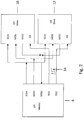
- FIG. 2 shows a further embodiment with a master 8 and two slaves 10,12, wherein the notification of a transmission request to the master 8 by means of the line to select a slave! SS1 or! SS2 takes place.
- a current I has a change 14 on the line for selecting a slave! SS2, the change 14 being effected by the slave 12.
- master 8 observes the current I, for example, on the line! SS2. If the master 8 accordingly detects a change 14 of the current I on the line SS2, then the master 8 outputs on the line SS2 a signal to select the slave 12 for the transmission of data to the master 8.
- the slave 12 terminates the variation 14 of the current I, in accordance with the above description of FIG. 1 ,
- the great advantage of the invention is that the power consumption for the time while the master 2, 8 waits for a response from the slave 4,12, is significantly reduced because the master 2, 8 is not constantly at the slave 4,12 after a Result must ask.
- the present invention may be used to advantage in applications such as e.g. in smart card applications or mobile devices, e.g. Mobile phones, where unnecessary energy consumption should be avoided as far as possible.
Landscapes
- Engineering & Computer Science (AREA)
- Theoretical Computer Science (AREA)
- Physics & Mathematics (AREA)
- General Engineering & Computer Science (AREA)
- General Physics & Mathematics (AREA)
- Small-Scale Networks (AREA)
- Information Transfer Systems (AREA)
Description
- Die vorliegende Erfindung beschreibt ein Verfahren zur Initiierung einer Datenübertragung zwischen mindestens zwei Kommunikationsteilnehmern, z.B. einem Master und einem Slave, welche über eine Datenverbindung, z.B. ein Bussystem miteinander verbunden sind.
- Aus dem Stand der Technik ist als ein Beispiel für eine Datenverbindung ein Bussystem, wie z.B. ein Serial Peripheral Interface, abgekürzt mit SPI, bekannt, welches eine Datenverbindung mittels drei oder vier Leitungen im Halb- oder Vollduplexverfahren ermöglicht. Bei SPI werden bei Vollduplex eine Leitung zur Auswahl eines Slaves, eine Taktleitung, eine Leitung zur Übertragung von Daten von einem Master an einen Slave und eine Leitung zur Übertragung von Daten von einem Slave an den Master verwendet. Bei Halbduplex wird zur Datenübertragung zwischen Master und Slave eine gemeinsame Leitung verwendet.
- Problematisch bei SPI ist, dass es keine Möglichkeit gibt, dass der Slave dem Master signalisieren kann, dass er Daten an den Master übertragen möchte. Das bedeutet, dass der Slave erst dann Daten an den Master senden kann, wenn der Master den Slave dazu auffordert. Falls eine schnelle Reaktion des Slaves auf eine Anfrage des Masters gewünscht wird, dann muss der Master innerhalb kurzer Zeit mehrmals beim Slave anfragen, ob der Slave bereits eine Antwort auf die Anfrage vorbereitet hat und ob der Slave die Antwort schon an den Master senden kann. Dies hat den Nachteil, dass der Master viel Zeit nur mit Nachfragen beim Slave verbringt. Ferner kostet das häufige Nachfragen bei Master und Slave viel Energie, was insbesondere bei tragbaren Geräten, wie z.B. einem Mobiltelefon oder einem Laptop, etc. zu einem erhöhten Stromverbrauch ohne Nutzen führt.
GB2488223 EP1237090 offenbaren SPI Slaves, welche mit Hilfe einer zusätzlichen Leitung Kommunikationsbereitschaft an den Master signalisieren können. Ausgehend von den Nachteilen des Stands der Technik ist es Aufgabe der Erfindung eine Lösung für ein schnelles und energiesparendes Verfahren zur Datenübertragung zur Verfügung zu stellen. - Die Aufgabe der Erfindung wird durch den unabhängigen Anspruch gelöst. Vorteilhafte Ausführungen sind in den abhängigen Ansprüchen beschrieben.
- Zur Lösung der Aufgabe offenbart die Erfindung ein Verfahren zum Initiieren einer Datenübertragung zwischen einer elektronischen Schaltung, die als Master wirkt, und mindestens einer anderen elektronischen Schaltung, die als Slave wirkt, wobei Master und Slave über ein Bussystem verbunden sind, wobei das Bussystem mindestens eine Taktleitung, eine Leitung zur Auswahl eines Slaves, eine Leitung zur Übertragung von Daten von einem Master an einen Slave und eine Leitung zur Übertragung von Daten von einem Slave an den Master umfasst, wobei sich die Erfindung dadurch auszeichnet, dass nachdem der Master eine Datenübertragung an den Slave abgeschlossen hat und der Master auf eine Antwort von dem Slave wartet, der Slave dem Master einen Sendewunsch seiner Antwort auf mindestens einer Leitung des Bussystems signalisiert, wobei die Signalisierung des Sendewunsches unterhalb einer Schwelle geschieht, welche einem aktiven Pegel auf einer Leitung des Bussystems entspricht. Das Verfahren hat den Vorteil, dass der Slave in der Lage ist, selbständig dem Master seinen Sendewunsch mitzuteilen ohne auf die nächste Abfrage des Masters hinsichtlich seiner Sendebereitschaft zu warten. Ferner spart das erfindungsgemäße Verfahren Energie, da nur dann Daten vom Slave zum Master übertragen werden, wenn Daten zur Übertragung bereit sind. Ein mehrmaliges Abfragen durch den Master mit dem Ergebnis, dass der Slave noch nicht bereit ist zur Datenübertragung, kommt mit der vorliegenden Erfindung somit nicht mehr vor und spart damit einen unnötigen Energieverbrauch durch Master und Slave.
- Ein vorteilhaftes Ausführungsbeispiel der Erfindung ist, dass der Slave, um dem Master den Sendewunsch zu signalisieren, einen elektrischen Strom auf mindestens einer Leitung des Bussystems bewirkt.
- Ein weiteres vorteilhaftes Ausführungsbeispiel der Erfindung ist, dass der Slave den Strom über einen Widerstand verändert. Als Widerstand kann hier jedes aktive und passive Element verstanden werden, um z.B. den Strom zu beeinflussen, mit welchem der Slave dem Master seinen Sendewunsch signalisiert. Als Beispiel für ein passives Element ist hier ein ohmscher Widerstand genannt.
- Ein weiteres vorteilhaftes Ausführungsbeispiel der Erfindung ist, dass der Slave den Strom auf der Taktleitung oder der Leitung zur Auswahl eines Slaves bewirkt. Neben den beiden genannten Leitungen kann jede andere geeignete Leitung verwendet werden, um dem Master den Sendewunsch des Slaves mittels des Stroms zu signalisieren.
- Ein weiteres vorteilhaftes Ausführungsbeispiel der Erfindung ist, dass sobald der Master erkennt, dass auf der Taktleitung ein Strom fließt, gibt der Master ein Taktsignal aus, um vom Slave Daten abzurufen.
- Ein weiteres vorteilhaftes Ausführungsbeispiel der Erfindung ist, dass mit dem ersten Wechsel des vom Master ausgegebenen Taktsignals zum aktiven Pegel auf der Taktleitung der Slave die Veränderung des Stroms auf der Taktleitung beendet.
- Ein weiteres vorteilhaftes Ausführungsbeispiel der Erfindung ist, dass sobald der Master erkennt, dass auf der Leitung zur Auswahl eines Slaves ein Strom fließt, gibt der Master ein Signal auf der Leitung zur Auswahl eines Slaves aus, um den Slave, welcher den Sendewunsch hat, auszuwählen und von diesem Daten abzurufen.
- Ein weiteres vorteilhaftes Ausführungsbeispiel der Erfindung ist, dass der Slave die Veränderung des Stroms auf der Leitung zur Auswahl eines Slaves beendet, sobald der Master den Slave ausgewählt hat, um Daten von dem Slave abzurufen.
- Ein weiteres vorteilhaftes Ausführungsbeispiel der Erfindung ist, dass es sich um eine synchrone Datenübertragung handelt. Alternativ kann es sich auch um eine asynchrone Datenverbindung handeln.
- Ein weiteres vorteilhaftes Ausführungsbeispiel der Erfindung ist, dass die Leitungen des Bussystems inaktiv und stromlos sind, solange zwischen Master und Slave keine Datenübertragung stattfindet. Dies hat den Vorteil, dass Energie gespart wird.
- Ein weiteres vorteilhaftes Ausführungsbeispiel der Erfindung ist, dass es sich bei dem Bussystem um ein Serial Peripheral Interface handelt.
- Im Folgenden wird ein Ausführungsbeispiel der Erfindung anhand der beigefügten Figuren detailliert beschrieben.
-
Figur 1 zeigt ein Ausführungsbeispiel der Erfindung mit einem Master und einem Slave, wobei der Slave einen Strom auf der Taktleitung SCLK verändert, um dem Master einen Sendewunsch mitzuteilen. -
Figur 2 zeigt ein weiteres Ausführungsbeispiel mit einem Master und zwei Slaves, wobei die Mitteilung des Sendewunsches an den Master mittels der Leitung zur Auswahl eines Slaves !SS1 oder !SS2 erfolgt. - In
Figur 1 wird ein Ausführungsbeispiel der Erfindung anhand von einem Master 2 und einem Slave 4 gemäß einem Bussystem nach einem Serial-Peripheral-Interface-Standard, abgekürzt SPI, beschrieben. Master 2 und Slave 4 sind über eine Taktleitung SCLK, eine Leitung zur Auswahl eines Slaves !SS, eine Leitung zur Übertragung von Daten von einem Master an einen Slave MOSI und eine Leitung zur Übertragung von Daten von einem Slave an den Master MISO verbunden. Die Übertragungsrichtung ist mittels der Pfeile angedeutet. - Eine erste Variante des Ausführungsbeispiels der Erfindung beschreibt, wie der Slave 4 einen Strom I auf der Taktleitung SCLK verändert, um dem Master 2 seinen Sendewunsch mitzuteilen. Nachdem der Master 2 mit einer Datenübertragung an den Slave 4 fertig ist, der Master 2 also eine letzte Signalflanke in Richtung Slave 4 getrieben hat, und auf eine Antwort vom Slave 4 wartet, beobachtet der Master 2 mittels einer geeigneten Schaltung (z.B. einen Stromspiegel), welche nicht dargestellt ist in
Figur 1 , einen Strom I, welcher auf der Taktleitung SCLK fließt. Sobald der Slave 4 die Antwort an den Master 2 vorbereitet hat, verändert oder bewirkt der Slave 4 mittels einer geeigneten Schaltung, welche nicht dargestellt ist, z.B. im einfachsten Fall mittels eines Widerstands, einen Verlauf 6 des Stroms I, um den Master 2 auf seinen Sendewunsch hinzuweisen. Der Strom I kann durch den Slave 4 so verändert werden, dass der Strom I erhöht wird. Erfindungsgemäß fließt nur dann ein Strom I, wenn ein Datenaustausch oder eine Signalisierung des Sendewunsches des Slaves 4 stattfindet. Ansonsten fließt kein Strom I um Energie zu sparen. Wesentlich für die Erfindung ist, dass der Slave 4 den Strom I so verändert, dass der Strom I immer kleiner ist, als die Schwelle bzw. Wert, welcher einem aktiven Pegel oder aktiven Wert auf einer Leitung, z.B. eines Bussystems gemäß SPI, hier der Taktleitung SCLK, entspricht. Der Master 2 weist eine Schaltung auf, um die Veränderung 6 des Stroms I zu erkennen, wobei die Schaltung nicht dargestellt ist. Wenn der Master 2 eine Veränderung 6 des Stroms I erkennt, dann gibt der Master 2 über die Taktleitung SCLK ein Taktsignal an den Slave 4 aus, um die Daten des Slaves 4 abzufragen, welche der Slave 4 gemäß seinem Sendewunsch angekündigt hat. Beim ersten Wechsel zum aktiven Pegel oder aktiven Wert auf der Taktleitung SCLK beendet der Slave 4 die Veränderung 6 des Stroms I um seinen Sendewunsch dem Master 2 mitzuteilen. -
Figur 2 zeigt ein weiteres Ausführungsbeispiel mit einem Master 8 und zwei Slaves 10,12, wobei die Mitteilung eines Sendewunsches an den Master 8 mittels der Leitung zur Auswahl eines Slaves !SS1 oder !SS2 erfolgt. Beispielsweise weist ein Strom I eine Veränderung 14 auf der Leitung zur Auswahl eines Slaves !SS2 auf, wobei die Veränderung 14 durch den Slave 12 bewirkt wird. Entsprechend der oben beiFigur 1 beschriebenen ersten Variante beobachtet der Master 8 den Strom I beispielsweise auf der Leitung !SS2. Wenn der Master 8 entsprechend eine Veränderung 14 des Stroms I auf der Leitung !SS2 erkennt, dann gibt der Master 8 auf der Leitung !SS2 ein Signal aus, um den Slave 12 zur Übertragung von Daten an den Master 8 auszuwählen. Sobald der Slave 12 vom Master 8 über die Leitung !SS2 ausgewählt wurde, beendet der Slave 12 die Veränderung 14 des Stroms I, entsprechend der obigen Beschreibung vonFigur 1 . - Somit ist der große Vorteil der Erfindung, dass der Stromverbrauch für die Zeit, während der Master 2, 8 auf eine Antwort vom Slave 4,12 wartet, deutlich verringert wird, da der Master 2, 8 nicht ständig beim Slave 4,12 nach einem Ergebnis fragen muss.
- Beispielsweise kann die vorliegende Erfindung vorteilhaft bei Anwendungen eingesetzt werden, wie z.B. bei Chipkartenanwendungen oder bei mobilen Geräten, z.B. Mobiltelefonen, wo ein unnötiger Energieverbrauch möglichst vermieden werden soll.
Claims (8)
- Verfahren zum Initiieren einer Datenübertragung zwischen einer elektronischen Schaltung, die als Master (2, 8) wirkt, und mindestens einer anderen elektronischen Schaltung, die als Slave (4,10,12) wirkt, wobei Master (2, 8) und Slave (4,10,12) über ein Bussystem verbunden sind,
wobei das Bussystem mindestens- eine Taktleitung (SCLK),- eine Leitung zur Auswahl eines Slaves (!SS),- eine Leitung zur Übertragung von Daten von einem Master an einen Slave (MOSI) und- eine Leitung zur Übertragung von Daten von einem Slave an den Master (MISO) umfasst,wobei nachdem der Master (2, 8) eine Datenübertragung an den Slave (4,10,12) abgeschlossen hat und der Master (2, 8) auf eine Antwort von dem Slave (4, 10, 12) wartet, der Slave (4,10,12) dem Master (2,8) einen Sendewunsch seiner Antwort auf mindestens einer Leitung des Bussystems signalisiert,
wobei der Slave (4,10,12), um dem Master (2, 8) den Sendewunsch zu signalisieren, einen elektrischen Strom (I) auf mindestens einer Leitung des Bussystems bewirkt, dadurch gekennzeichnet, dass der Slave (4,10,12) den Strom (I) auf der Taktleitung (SCLK) oder der Leitung zur Auswahl eines Slaves (!SS) bewirkt. - Verfahren nach Anspruch 1, dadurch gekennzeichnet, dass der Slave (4, 10, 12) den Strom (I) über einen Widerstand verändert (6).
- Verfahren nach Anspruch 1 oder 2, dadurch gekennzeichnet, dass sobald der Master (2, 8) erkennt, dass auf der Taktleitung (SCLK) ein Strom (I) fließt, gibt der Master (2,8) ein Taktsignal aus, um vom Slave (4,10,12) Daten abzurufen.
- Verfahren nach Anspruch 3, dadurch gekennzeichnet, dass mit dem ersten Wechsel des vom Master (2,8) ausgegebenen Taktsignals auf der Taktleitung (SCLK) der Slave (4,10,12) die Veränderung (6) des Stroms (I) auf der Taktleitung (SCLK) beendet.
- Verfahren nach Anspruch 1 oder 2, dadurch gekennzeichnet, dass sobald der Master (2, 8) erkennt, dass auf der Leitung zur Auswahl eines Slaves (!SS) ein Strom (I) fließt, gibt der Master (2, 8) ein Signal auf der Leitung zur Auswahl eines Slaves (!SS) aus, um den Slave (4,10,12), welcher den Sendewunsch hat, auszuwählen und von diesem Daten abzurufen.
- Verfahren nach Anspruch 5, dadurch gekennzeichnet, dass der Slave (4,10,12) die Veränderung (6) des Stroms (I) auf der Leitung zur Auswahl eines Slaves (!SS) beendet, sobald der Master (2, 8) den Slave (4, 10, 12) ausgewählt hat, um Daten von dem Slave (4,10,12) abzurufen.
- Verfahren nach einem der vorherigen Ansprüche, dadurch gekennzeichnet, dass es sich um eine synchrone Datenübertragung zwischen Master (2,8) und Slave (4,10,12) handelt.
- Verfahren nach einem der vorherigen Ansprüche, dadurch gekennzeichnet, dass es sich bei dem Bussystem um ein Serial Peripheral Interface handelt.
Applications Claiming Priority (2)
| Application Number | Priority Date | Filing Date | Title |
|---|---|---|---|
| DE102013010277.4A DE102013010277A1 (de) | 2013-06-19 | 2013-06-19 | Verfahren zum Initiieren einer Datenübertragung |
| PCT/EP2014/001358 WO2014202171A1 (de) | 2013-06-19 | 2014-05-20 | Verfahren zum initiieren einer daten?bertragung |
Publications (2)
| Publication Number | Publication Date |
|---|---|
| EP3011462A1 EP3011462A1 (de) | 2016-04-27 |
| EP3011462B1 true EP3011462B1 (de) | 2017-09-20 |
Family
ID=50884334
Family Applications (1)
| Application Number | Title | Priority Date | Filing Date |
|---|---|---|---|
| EP14727708.1A Not-in-force EP3011462B1 (de) | 2013-06-19 | 2014-05-20 | Verfahren zum initiieren einer datenübertragung |
Country Status (3)
| Country | Link |
|---|---|
| EP (1) | EP3011462B1 (de) |
| DE (1) | DE102013010277A1 (de) |
| WO (1) | WO2014202171A1 (de) |
Families Citing this family (3)
| Publication number | Priority date | Publication date | Assignee | Title |
|---|---|---|---|---|
| DE102017101493B3 (de) * | 2017-01-26 | 2018-04-19 | Eaton Electrical Ip Gmbh & Co. Kg | Busanordnung und Verfahren zum Betreiben einer Busanordnung |
| CN112860613B (zh) * | 2021-04-06 | 2024-04-19 | 北京集创北方科技股份有限公司 | 通信系统 |
| CN113987555B (zh) * | 2021-12-23 | 2022-03-18 | 北京辰光融信技术有限公司 | 一种通信接口电路、数据通信方法及系统 |
Family Cites Families (7)
| Publication number | Priority date | Publication date | Assignee | Title |
|---|---|---|---|---|
| US4831358A (en) * | 1982-12-21 | 1989-05-16 | Texas Instruments Incorporated | Communications system employing control line minimization |
| EP0183273B1 (de) * | 1984-11-30 | 1992-09-23 | Nec Corporation | Flexibel anwendbares serielles Interface-System für eine Verbindung zwischen einer und mehreren Einheiten |
| US5630152A (en) * | 1992-05-18 | 1997-05-13 | Motorola, Inc. | Communication protocol between master and slave device with register information sharing |
| US5928345A (en) * | 1996-09-30 | 1999-07-27 | Rosemont Inc. | Field instrument with data bus communications protocol |
| EP1237090A1 (de) * | 2001-02-28 | 2002-09-04 | Alcatel | Serielles Peripherieschnittstellenmastergerät, serielles Peripherieschnittstellenslavegerät und serielle Peripherieschnittstelle |
| US7395362B2 (en) * | 2006-02-03 | 2008-07-01 | Standard Microsystems Corporation | Method for a slave device to convey an interrupt and interrupt source information to a master device |
| GB201102594D0 (en) * | 2011-02-15 | 2011-03-30 | Nordic Semiconductor Asa | Serial interface |
-
2013
- 2013-06-19 DE DE102013010277.4A patent/DE102013010277A1/de not_active Withdrawn
-
2014
- 2014-05-20 EP EP14727708.1A patent/EP3011462B1/de not_active Not-in-force
- 2014-05-20 WO PCT/EP2014/001358 patent/WO2014202171A1/de not_active Ceased
Non-Patent Citations (1)
| Title |
|---|
| None * |
Also Published As
| Publication number | Publication date |
|---|---|
| WO2014202171A1 (de) | 2014-12-24 |
| DE102013010277A1 (de) | 2014-12-24 |
| EP3011462A1 (de) | 2016-04-27 |
Similar Documents
| Publication | Publication Date | Title |
|---|---|---|
| EP3433981B1 (de) | Effiziente steuerungsanordnung und steuerungsverfahren | |
| DE102019101892B4 (de) | Kommunikationsvorrichtungen und -verfahren | |
| DE2708656A1 (de) | Verfahren zum wahlweisen abrufen von daten von einer von mehreren datenerfassungsstellen, und datensammelanlage zur ausfuehrung dieses verfahrens | |
| EP3031042B1 (de) | Verfahren zum bereitstellen von mindestens einer positionsinformation über ein geparktes kraftfahrzeug und kraftfahrzeug | |
| WO2019034511A1 (de) | Verfahren zum betreiben einer sensoranordnung in einem kraftfahrzeug auf basis eines dsi-protokolls | |
| DE10131307B4 (de) | Verfahren und Bussystem zum Synchronisieren eines Datenaustausches zwischen einer Datenquelle und einer Steuereinrichtung | |
| EP3011462A1 (de) | Verfahren zum initiieren einer datenübertragung | |
| DE10313787A1 (de) | Verfahren zur Datenkommunikation | |
| EP2740329B2 (de) | Busspannungsversorgung mit verringerter verlustleistung | |
| EP3070551A1 (de) | Datenbuskoppler und Verfahren zum Betrieb | |
| DE102011081640A1 (de) | Steuersystem | |
| DE102019116657B4 (de) | System und Verfahren zur kombinierten Energieübertragung und Datenübertragung in einem Automatisierungssystem | |
| DE112016002363T5 (de) | Kommunikationseinrichtung und kommunikationsverfahren | |
| DE102011055738B4 (de) | Kommunikationsverfahren zwischen elektronischen Geräten und entsprechende Geräte | |
| EP3032779B1 (de) | Verfahren zur bestimmung der signalqualität in einem can-protokoll basierten netzwerk | |
| DE102018221233A1 (de) | Poe-energieversorgungssystem | |
| EP2713680B1 (de) | Verfahren zur Ermittlung der Verfügbarkeit einer Busleitung und Kommunikationssteuereinheit | |
| DE102020113663A1 (de) | Geräteeinheit, Mastereinheit und eine Verbindungsanordnung zur Punkt-zu-Punkt Kommunikation gemäß dem IO-Link Kommunikationsstandard | |
| DE102011105966A1 (de) | Kommunikationsvorrichtung und -verfahren einer speicherprogrammierbaren Steuerung | |
| DE102016209580A1 (de) | Elektronische vorrichtung | |
| DE102017000513B4 (de) | SPS-Wartungsunterstützungsvorrichtung und SPS-Wartungsunterstützungsprogramm | |
| DE2917822A1 (de) | Schaltungsanordnung zur zweirichtungsuebertragung von signalen | |
| DE102020206267A1 (de) | Kommunikationsvorrichtung | |
| EP3067989B1 (de) | Installationsgerät für ein gebäudetechnisches elektrisches installationssystem sowie verfahren zum erkennen eines an ein primärmodul einer solchen installation angeschlossenes sekundärmodul | |
| EP3504841B1 (de) | Teilnehmer für ein digitales kommunikationssystem und zugehöriges kommunikationssystem |
Legal Events
| Date | Code | Title | Description |
|---|---|---|---|
| PUAI | Public reference made under article 153(3) epc to a published international application that has entered the european phase |
Free format text: ORIGINAL CODE: 0009012 |
|
| 17P | Request for examination filed |
Effective date: 20160119 |
|
| AK | Designated contracting states |
Kind code of ref document: A1 Designated state(s): AL AT BE BG CH CY CZ DE DK EE ES FI FR GB GR HR HU IE IS IT LI LT LU LV MC MK MT NL NO PL PT RO RS SE SI SK SM TR |
|
| AX | Request for extension of the european patent |
Extension state: BA ME |
|
| DAX | Request for extension of the european patent (deleted) | ||
| GRAP | Despatch of communication of intention to grant a patent |
Free format text: ORIGINAL CODE: EPIDOSNIGR1 |
|
| INTG | Intention to grant announced |
Effective date: 20170405 |
|
| GRAS | Grant fee paid |
Free format text: ORIGINAL CODE: EPIDOSNIGR3 |
|
| RAP1 | Party data changed (applicant data changed or rights of an application transferred) |
Owner name: GIESECKE+DEVRIENT MOBILE SECURITY GMBH |
|
| GRAA | (expected) grant |
Free format text: ORIGINAL CODE: 0009210 |
|
| AK | Designated contracting states |
Kind code of ref document: B1 Designated state(s): AL AT BE BG CH CY CZ DE DK EE ES FI FR GB GR HR HU IE IS IT LI LT LU LV MC MK MT NL NO PL PT RO RS SE SI SK SM TR |
|
| REG | Reference to a national code |
Ref country code: GB Ref legal event code: FG4D Free format text: NOT ENGLISH |
|
| REG | Reference to a national code |
Ref country code: CH Ref legal event code: EP |
|
| REG | Reference to a national code |
Ref country code: AT Ref legal event code: REF Ref document number: 930666 Country of ref document: AT Kind code of ref document: T Effective date: 20171015 |
|
| REG | Reference to a national code |
Ref country code: IE Ref legal event code: FG4D Free format text: LANGUAGE OF EP DOCUMENT: GERMAN |
|
| REG | Reference to a national code |
Ref country code: DE Ref legal event code: R096 Ref document number: 502014005523 Country of ref document: DE |
|
| REG | Reference to a national code |
Ref country code: NL Ref legal event code: MP Effective date: 20170920 |
|
| PG25 | Lapsed in a contracting state [announced via postgrant information from national office to epo] |
Ref country code: SE Free format text: LAPSE BECAUSE OF FAILURE TO SUBMIT A TRANSLATION OF THE DESCRIPTION OR TO PAY THE FEE WITHIN THE PRESCRIBED TIME-LIMIT Effective date: 20170920 Ref country code: LT Free format text: LAPSE BECAUSE OF FAILURE TO SUBMIT A TRANSLATION OF THE DESCRIPTION OR TO PAY THE FEE WITHIN THE PRESCRIBED TIME-LIMIT Effective date: 20170920 Ref country code: FI Free format text: LAPSE BECAUSE OF FAILURE TO SUBMIT A TRANSLATION OF THE DESCRIPTION OR TO PAY THE FEE WITHIN THE PRESCRIBED TIME-LIMIT Effective date: 20170920 Ref country code: HR Free format text: LAPSE BECAUSE OF FAILURE TO SUBMIT A TRANSLATION OF THE DESCRIPTION OR TO PAY THE FEE WITHIN THE PRESCRIBED TIME-LIMIT Effective date: 20170920 Ref country code: NO Free format text: LAPSE BECAUSE OF FAILURE TO SUBMIT A TRANSLATION OF THE DESCRIPTION OR TO PAY THE FEE WITHIN THE PRESCRIBED TIME-LIMIT Effective date: 20171220 |
|
| REG | Reference to a national code |
Ref country code: LT Ref legal event code: MG4D |
|
| PG25 | Lapsed in a contracting state [announced via postgrant information from national office to epo] |
Ref country code: GR Free format text: LAPSE BECAUSE OF FAILURE TO SUBMIT A TRANSLATION OF THE DESCRIPTION OR TO PAY THE FEE WITHIN THE PRESCRIBED TIME-LIMIT Effective date: 20171221 Ref country code: LV Free format text: LAPSE BECAUSE OF FAILURE TO SUBMIT A TRANSLATION OF THE DESCRIPTION OR TO PAY THE FEE WITHIN THE PRESCRIBED TIME-LIMIT Effective date: 20170920 Ref country code: BG Free format text: LAPSE BECAUSE OF FAILURE TO SUBMIT A TRANSLATION OF THE DESCRIPTION OR TO PAY THE FEE WITHIN THE PRESCRIBED TIME-LIMIT Effective date: 20171220 Ref country code: RS Free format text: LAPSE BECAUSE OF FAILURE TO SUBMIT A TRANSLATION OF THE DESCRIPTION OR TO PAY THE FEE WITHIN THE PRESCRIBED TIME-LIMIT Effective date: 20170920 |
|
| PG25 | Lapsed in a contracting state [announced via postgrant information from national office to epo] |
Ref country code: NL Free format text: LAPSE BECAUSE OF FAILURE TO SUBMIT A TRANSLATION OF THE DESCRIPTION OR TO PAY THE FEE WITHIN THE PRESCRIBED TIME-LIMIT Effective date: 20170920 |
|
| PG25 | Lapsed in a contracting state [announced via postgrant information from national office to epo] |
Ref country code: CZ Free format text: LAPSE BECAUSE OF FAILURE TO SUBMIT A TRANSLATION OF THE DESCRIPTION OR TO PAY THE FEE WITHIN THE PRESCRIBED TIME-LIMIT Effective date: 20170920 Ref country code: PL Free format text: LAPSE BECAUSE OF FAILURE TO SUBMIT A TRANSLATION OF THE DESCRIPTION OR TO PAY THE FEE WITHIN THE PRESCRIBED TIME-LIMIT Effective date: 20170920 Ref country code: RO Free format text: LAPSE BECAUSE OF FAILURE TO SUBMIT A TRANSLATION OF THE DESCRIPTION OR TO PAY THE FEE WITHIN THE PRESCRIBED TIME-LIMIT Effective date: 20170920 Ref country code: ES Free format text: LAPSE BECAUSE OF FAILURE TO SUBMIT A TRANSLATION OF THE DESCRIPTION OR TO PAY THE FEE WITHIN THE PRESCRIBED TIME-LIMIT Effective date: 20170920 |
|
| REG | Reference to a national code |
Ref country code: FR Ref legal event code: PLFP Year of fee payment: 5 |
|
| PG25 | Lapsed in a contracting state [announced via postgrant information from national office to epo] |
Ref country code: SM Free format text: LAPSE BECAUSE OF FAILURE TO SUBMIT A TRANSLATION OF THE DESCRIPTION OR TO PAY THE FEE WITHIN THE PRESCRIBED TIME-LIMIT Effective date: 20170920 Ref country code: EE Free format text: LAPSE BECAUSE OF FAILURE TO SUBMIT A TRANSLATION OF THE DESCRIPTION OR TO PAY THE FEE WITHIN THE PRESCRIBED TIME-LIMIT Effective date: 20170920 Ref country code: IS Free format text: LAPSE BECAUSE OF FAILURE TO SUBMIT A TRANSLATION OF THE DESCRIPTION OR TO PAY THE FEE WITHIN THE PRESCRIBED TIME-LIMIT Effective date: 20180120 Ref country code: IT Free format text: LAPSE BECAUSE OF FAILURE TO SUBMIT A TRANSLATION OF THE DESCRIPTION OR TO PAY THE FEE WITHIN THE PRESCRIBED TIME-LIMIT Effective date: 20170920 Ref country code: SK Free format text: LAPSE BECAUSE OF FAILURE TO SUBMIT A TRANSLATION OF THE DESCRIPTION OR TO PAY THE FEE WITHIN THE PRESCRIBED TIME-LIMIT Effective date: 20170920 |
|
| REG | Reference to a national code |
Ref country code: DE Ref legal event code: R097 Ref document number: 502014005523 Country of ref document: DE |
|
| PLBE | No opposition filed within time limit |
Free format text: ORIGINAL CODE: 0009261 |
|
| STAA | Information on the status of an ep patent application or granted ep patent |
Free format text: STATUS: NO OPPOSITION FILED WITHIN TIME LIMIT |
|
| PG25 | Lapsed in a contracting state [announced via postgrant information from national office to epo] |
Ref country code: DK Free format text: LAPSE BECAUSE OF FAILURE TO SUBMIT A TRANSLATION OF THE DESCRIPTION OR TO PAY THE FEE WITHIN THE PRESCRIBED TIME-LIMIT Effective date: 20170920 |
|
| 26N | No opposition filed |
Effective date: 20180621 |
|
| PG25 | Lapsed in a contracting state [announced via postgrant information from national office to epo] |
Ref country code: MT Free format text: LAPSE BECAUSE OF FAILURE TO SUBMIT A TRANSLATION OF THE DESCRIPTION OR TO PAY THE FEE WITHIN THE PRESCRIBED TIME-LIMIT Effective date: 20170920 |
|
| PG25 | Lapsed in a contracting state [announced via postgrant information from national office to epo] |
Ref country code: SI Free format text: LAPSE BECAUSE OF FAILURE TO SUBMIT A TRANSLATION OF THE DESCRIPTION OR TO PAY THE FEE WITHIN THE PRESCRIBED TIME-LIMIT Effective date: 20170920 |
|
| REG | Reference to a national code |
Ref country code: CH Ref legal event code: PL |
|
| REG | Reference to a national code |
Ref country code: BE Ref legal event code: MM Effective date: 20180531 |
|
| PG25 | Lapsed in a contracting state [announced via postgrant information from national office to epo] |
Ref country code: MC Free format text: LAPSE BECAUSE OF FAILURE TO SUBMIT A TRANSLATION OF THE DESCRIPTION OR TO PAY THE FEE WITHIN THE PRESCRIBED TIME-LIMIT Effective date: 20170920 |
|
| REG | Reference to a national code |
Ref country code: IE Ref legal event code: MM4A |
|
| PG25 | Lapsed in a contracting state [announced via postgrant information from national office to epo] |
Ref country code: CH Free format text: LAPSE BECAUSE OF NON-PAYMENT OF DUE FEES Effective date: 20180531 Ref country code: LI Free format text: LAPSE BECAUSE OF NON-PAYMENT OF DUE FEES Effective date: 20180531 |
|
| PG25 | Lapsed in a contracting state [announced via postgrant information from national office to epo] |
Ref country code: LU Free format text: LAPSE BECAUSE OF NON-PAYMENT OF DUE FEES Effective date: 20180520 |
|
| PG25 | Lapsed in a contracting state [announced via postgrant information from national office to epo] |
Ref country code: IE Free format text: LAPSE BECAUSE OF NON-PAYMENT OF DUE FEES Effective date: 20180520 |
|
| PG25 | Lapsed in a contracting state [announced via postgrant information from national office to epo] |
Ref country code: BE Free format text: LAPSE BECAUSE OF NON-PAYMENT OF DUE FEES Effective date: 20180531 |
|
| PG25 | Lapsed in a contracting state [announced via postgrant information from national office to epo] |
Ref country code: TR Free format text: LAPSE BECAUSE OF FAILURE TO SUBMIT A TRANSLATION OF THE DESCRIPTION OR TO PAY THE FEE WITHIN THE PRESCRIBED TIME-LIMIT Effective date: 20170920 |
|
| PG25 | Lapsed in a contracting state [announced via postgrant information from national office to epo] |
Ref country code: PT Free format text: LAPSE BECAUSE OF FAILURE TO SUBMIT A TRANSLATION OF THE DESCRIPTION OR TO PAY THE FEE WITHIN THE PRESCRIBED TIME-LIMIT Effective date: 20170920 |
|
| PG25 | Lapsed in a contracting state [announced via postgrant information from national office to epo] |
Ref country code: MK Free format text: LAPSE BECAUSE OF NON-PAYMENT OF DUE FEES Effective date: 20170920 Ref country code: CY Free format text: LAPSE BECAUSE OF FAILURE TO SUBMIT A TRANSLATION OF THE DESCRIPTION OR TO PAY THE FEE WITHIN THE PRESCRIBED TIME-LIMIT Effective date: 20170920 Ref country code: HU Free format text: LAPSE BECAUSE OF FAILURE TO SUBMIT A TRANSLATION OF THE DESCRIPTION OR TO PAY THE FEE WITHIN THE PRESCRIBED TIME-LIMIT; INVALID AB INITIO Effective date: 20140520 |
|
| PG25 | Lapsed in a contracting state [announced via postgrant information from national office to epo] |
Ref country code: AL Free format text: LAPSE BECAUSE OF FAILURE TO SUBMIT A TRANSLATION OF THE DESCRIPTION OR TO PAY THE FEE WITHIN THE PRESCRIBED TIME-LIMIT Effective date: 20170920 |
|
| REG | Reference to a national code |
Ref country code: AT Ref legal event code: MM01 Ref document number: 930666 Country of ref document: AT Kind code of ref document: T Effective date: 20190520 |
|
| PG25 | Lapsed in a contracting state [announced via postgrant information from national office to epo] |
Ref country code: AT Free format text: LAPSE BECAUSE OF NON-PAYMENT OF DUE FEES Effective date: 20190520 |
|
| P01 | Opt-out of the competence of the unified patent court (upc) registered |
Effective date: 20230520 |
|
| REG | Reference to a national code |
Ref country code: DE Ref legal event code: R081 Ref document number: 502014005523 Country of ref document: DE Owner name: GIESECKE+DEVRIENT EPAYMENTS GMBH, DE Free format text: FORMER OWNER: GIESECKE+DEVRIENT MOBILE SECURITY GMBH, 81677 MUENCHEN, DE |
|
| PGFP | Annual fee paid to national office [announced via postgrant information from national office to epo] |
Ref country code: GB Payment date: 20240522 Year of fee payment: 11 |
|
| PGFP | Annual fee paid to national office [announced via postgrant information from national office to epo] |
Ref country code: DE Payment date: 20240531 Year of fee payment: 11 |
|
| PGFP | Annual fee paid to national office [announced via postgrant information from national office to epo] |
Ref country code: FR Payment date: 20240522 Year of fee payment: 11 |
|
| REG | Reference to a national code |
Ref country code: DE Ref legal event code: R119 Ref document number: 502014005523 Country of ref document: DE |
|
| GBPC | Gb: european patent ceased through non-payment of renewal fee |
Effective date: 20250520 |
|
| PG25 | Lapsed in a contracting state [announced via postgrant information from national office to epo] |
Ref country code: GB Free format text: LAPSE BECAUSE OF NON-PAYMENT OF DUE FEES Effective date: 20250520 |
|
| PG25 | Lapsed in a contracting state [announced via postgrant information from national office to epo] |
Ref country code: DE Free format text: LAPSE BECAUSE OF NON-PAYMENT OF DUE FEES Effective date: 20251202 |
|
| PG25 | Lapsed in a contracting state [announced via postgrant information from national office to epo] |
Ref country code: FR Free format text: LAPSE BECAUSE OF NON-PAYMENT OF DUE FEES Effective date: 20250531 |