EP3008577B1 - Virtualisieren von anwendungen für multi-monitor umgebungen - Google Patents
Virtualisieren von anwendungen für multi-monitor umgebungen Download PDFInfo
- Publication number
- EP3008577B1 EP3008577B1 EP13773995.9A EP13773995A EP3008577B1 EP 3008577 B1 EP3008577 B1 EP 3008577B1 EP 13773995 A EP13773995 A EP 13773995A EP 3008577 B1 EP3008577 B1 EP 3008577B1
- Authority
- EP
- European Patent Office
- Prior art keywords
- monitor
- space
- monitors
- dpi
- origin
- Prior art date
- Legal status (The legal status is an assumption and is not a legal conclusion. Google has not performed a legal analysis and makes no representation as to the accuracy of the status listed.)
- Active
Links
Images





Classifications
-
- G—PHYSICS
- G06—COMPUTING OR CALCULATING; COUNTING
- G06F—ELECTRIC DIGITAL DATA PROCESSING
- G06F3/00—Input arrangements for transferring data to be processed into a form capable of being handled by the computer; Output arrangements for transferring data from processing unit to output unit, e.g. interface arrangements
- G06F3/14—Digital output to display device ; Cooperation and interconnection of the display device with other functional units
- G06F3/1423—Digital output to display device ; Cooperation and interconnection of the display device with other functional units controlling a plurality of local displays, e.g. CRT and flat panel display
- G06F3/1446—Digital output to display device ; Cooperation and interconnection of the display device with other functional units controlling a plurality of local displays, e.g. CRT and flat panel display display composed of modules, e.g. video walls
-
- G—PHYSICS
- G06—COMPUTING OR CALCULATING; COUNTING
- G06F—ELECTRIC DIGITAL DATA PROCESSING
- G06F3/00—Input arrangements for transferring data to be processed into a form capable of being handled by the computer; Output arrangements for transferring data from processing unit to output unit, e.g. interface arrangements
- G06F3/14—Digital output to display device ; Cooperation and interconnection of the display device with other functional units
- G06F3/1423—Digital output to display device ; Cooperation and interconnection of the display device with other functional units controlling a plurality of local displays, e.g. CRT and flat panel display
-
- G—PHYSICS
- G06—COMPUTING OR CALCULATING; COUNTING
- G06F—ELECTRIC DIGITAL DATA PROCESSING
- G06F3/00—Input arrangements for transferring data to be processed into a form capable of being handled by the computer; Output arrangements for transferring data from processing unit to output unit, e.g. interface arrangements
- G06F3/14—Digital output to display device ; Cooperation and interconnection of the display device with other functional units
- G06F3/1423—Digital output to display device ; Cooperation and interconnection of the display device with other functional units controlling a plurality of local displays, e.g. CRT and flat panel display
- G06F3/1431—Digital output to display device ; Cooperation and interconnection of the display device with other functional units controlling a plurality of local displays, e.g. CRT and flat panel display using a single graphics controller
-
- G—PHYSICS
- G06—COMPUTING OR CALCULATING; COUNTING
- G06T—IMAGE DATA PROCESSING OR GENERATION, IN GENERAL
- G06T3/00—Geometric image transformations in the plane of the image
- G06T3/40—Scaling of whole images or parts thereof, e.g. expanding or contracting
-
- G—PHYSICS
- G09—EDUCATION; CRYPTOGRAPHY; DISPLAY; ADVERTISING; SEALS
- G09G—ARRANGEMENTS OR CIRCUITS FOR CONTROL OF INDICATING DEVICES USING STATIC MEANS TO PRESENT VARIABLE INFORMATION
- G09G5/00—Control arrangements or circuits for visual indicators common to cathode-ray tube indicators and other visual indicators
- G09G5/36—Control arrangements or circuits for visual indicators common to cathode-ray tube indicators and other visual indicators characterised by the display of a graphic pattern, e.g. using an all-points-addressable [APA] memory
- G09G5/37—Details of the operation on graphic patterns
- G09G5/373—Details of the operation on graphic patterns for modifying the size of the graphic pattern
-
- G—PHYSICS
- G09—EDUCATION; CRYPTOGRAPHY; DISPLAY; ADVERTISING; SEALS
- G09G—ARRANGEMENTS OR CIRCUITS FOR CONTROL OF INDICATING DEVICES USING STATIC MEANS TO PRESENT VARIABLE INFORMATION
- G09G2300/00—Aspects of the constitution of display devices
- G09G2300/02—Composition of display devices
- G09G2300/026—Video wall, i.e. juxtaposition of a plurality of screens to create a display screen of bigger dimensions
-
- G—PHYSICS
- G09—EDUCATION; CRYPTOGRAPHY; DISPLAY; ADVERTISING; SEALS
- G09G—ARRANGEMENTS OR CIRCUITS FOR CONTROL OF INDICATING DEVICES USING STATIC MEANS TO PRESENT VARIABLE INFORMATION
- G09G2340/00—Aspects of display data processing
- G09G2340/04—Changes in size, position or resolution of an image
-
- G—PHYSICS
- G09—EDUCATION; CRYPTOGRAPHY; DISPLAY; ADVERTISING; SEALS
- G09G—ARRANGEMENTS OR CIRCUITS FOR CONTROL OF INDICATING DEVICES USING STATIC MEANS TO PRESENT VARIABLE INFORMATION
- G09G2340/00—Aspects of display data processing
- G09G2340/04—Changes in size, position or resolution of an image
- G09G2340/0407—Resolution change, inclusive of the use of different resolutions for different screen areas
- G09G2340/0414—Vertical resolution change
-
- G—PHYSICS
- G09—EDUCATION; CRYPTOGRAPHY; DISPLAY; ADVERTISING; SEALS
- G09G—ARRANGEMENTS OR CIRCUITS FOR CONTROL OF INDICATING DEVICES USING STATIC MEANS TO PRESENT VARIABLE INFORMATION
- G09G2340/00—Aspects of display data processing
- G09G2340/04—Changes in size, position or resolution of an image
- G09G2340/0407—Resolution change, inclusive of the use of different resolutions for different screen areas
- G09G2340/0421—Horizontal resolution change
-
- G—PHYSICS
- G09—EDUCATION; CRYPTOGRAPHY; DISPLAY; ADVERTISING; SEALS
- G09G—ARRANGEMENTS OR CIRCUITS FOR CONTROL OF INDICATING DEVICES USING STATIC MEANS TO PRESENT VARIABLE INFORMATION
- G09G2356/00—Detection of the display position w.r.t. other display screens
Definitions
- a system DPI is established at which all content is rendered. More specifically, if a computer monitor is 192 DPI and an attached projector has a 96 DPI resolution, 192 DPI may be used as a default system DPI. Thus, all content will be rendered at 192 DPI, which, again, has the problem of content showing up much larger (or not at all) on the projector.
- US 2012/092305 A1 discloses a computer system that drives a first display and a second display, wherein the second display has a higher pixel density than the first display.
- the system provides a set of backing stores for windows in the computer system.
- the system enables a first set of clients to draw to the backing stores using a virtual coordinate system, and uses the backing stores to drive the first and second displays to that a given distance in the virtual coordinate system is the same size on both displays.
- This document describes per-monitor rendering of application content on one or more of a plurality of monitors having different pixel densities.
- a virtualized coordinate system is created for the plurality of monitors and information for rendering application content is virtualized to the virtualized coordinate space.
- the virtualized rendering information may be scaled for display on at least one of the monitors.
- a drawback of static DPI-aware applications is that, like the DPI unaware applications, they render to a single, static system DPI. This system DPI can be changed, allowing better performance on higher resolution applications.
- static DPI-aware applications (like DPI-unaware applications) cannot accommodate different DPIs within a single system.
- a user running an application on a high resolution, high-density monitor desiring to show the content on his monitor to others via a low-resolution, low-density projector will find that the content is displayed completely differently (and often unacceptably so) on one or the other of the monitor and the projector, usually depending upon the system DPI.
- an application may be properly mapped on one or more of multiple monitors or on the same monitor, even when the monitor's applied DPI is changed during use, by providing a virtualized coordinate system to the application.
- virtualizing the rendering information i.e., by supplying coordinates in the virtualized coordinate space
- the content may be correctly displayed on any of the monitors.
- the content rendered in the virtualized coordinate space may be scaled with respect to an origin of the monitor on which it is to be displayed.
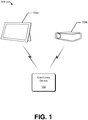
- FIG. 1 illustrates an example environment 100 in which per-monitor mapping of application content may be implemented.
- the example environment 100 includes a computing device 102, communicatively coupled to two monitors 104a, 104b.
- the monitor 104a is embodied as a digital display, such as a computer monitor, and the monitor 104b is embodied as a projector.
- the monitors 104a, 104b are representative display devices only. This disclosure is not limited to two monitors. For example, implementations will be described below in the context of three monitors. The disclosure also is not limited to the illustrated monitor-types.
- Other monitors may include, by way of non-limiting example, monitors associated with mobile phones, tablet computer systems, electronic book readers, multifunctional devices, desktop computer systems, laptop computer systems, game console systems, and personal media players.
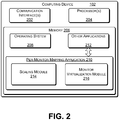
- FIG. 2 illustrates components of an example of the computing device 102 implementing per-monitor mapping as described herein.
- the computing device 102 represents any type of device that may render content required to be displayed at different resolutions, including, but not limited to, a desktop computer system, a laptop computer system, a tablet computer system, a mobile computing device, and so on.
- the example computing device 102 includes one or more communication interfaces 202, one or more processors 204, and a memory 206.
- Communication interfaces 202 enable computing device 102 to communicate with other devices, such as the monitor 104a and the projector 104b.
- Communication interfaces 302 may include, but are not limited to, a network interface, audio/video inputs/outputs, a wired interface, and a wireless interface.
- the processors 204 are communicatively coupled to the memory 206.
- the memory 206 may be configured to store one or more software and/or firmware modules, which are executable on the processor(s) 204 to implement various functions. While the modules are described herein as being software and/or firmware executable on a processor, in other embodiments, any or all of the modules may be implemented in whole or in part by hardware (e.g., as an ASIC, a specialized processing unit, etc.) to execute the described functions.
- An operating system 208, a per-monitor mapping application 210, and one or more other applications 212 are stored in the memory 206 as computer-readable instructions, and are executed, at least in part, on the processors 204.
- the per-monitor mapping application 210 includes a scaling module 214 and a monitor virtualization module 216.
- the scaling module 214 scales rendering information for proper display of content on each of a plurality of monitors.
- the monitor virtualization module 216 virtualizes a monitor space, which in some implementations includes a plurality of monitors, by creating a virtualized coordinate system describing the monitor space.
- the per-monitor mapping application 210 may be implemented using any form of computer-readable media that is accessible by computing device 102.
- one or more components of the operating system 208, the per-monitor mapping application 210, and other applications 212 may be implemented as part of an integrated circuit that is part of, or accessible to, the computing device 102.
- Computer-readable media includes, at least, two types of computer-readable media, namely computer storage media and communications media.
- Computer storage media includes volatile and non-volatile, removable and non-removable media implemented in any method or technology for storage of information such as computer readable instructions, data structures, program modules, or other data.
- Computer storage media includes, but is not limited to, random-access memory (RAM), read-only memory (ROM), electrically erasable programmable read-only memory (EEPROM), flash memory or other memory technology, compact disc read-only memory (CD-ROM), digital versatile disks (DVD) or other optical storage, magnetic cassettes, magnetic tape, magnetic disk storage or other magnetic storage devices, or any other non-transmission medium that can be used to store information for access by a computing device.
- communication media includes computer readable instructions, data structures, program modules, or other data in a modulated data signal, such as a carrier wave, or other transmission mechanism.
- computer storage media does not include communication media.
- FIG. 3 is a representation of an array 300 of three monitors: first monitor 302, second monitor 304, and third monitor 306.
- the first monitor 302 has a resolution of 144 DPI
- the second monitor 304 has a resolution of 96 DPI
- the third monitor 306 has a resolution of 192 DPI.
- the three monitors 302, 304, 306 are representative in number, size, and DPI, and will be used for purposes of describing embodiments of this disclosure. As will be appreciated by those having the benefit of this disclosure, implementations of the disclosure may include more or fewer monitors and those monitors may be of different sizes and resolutions.
- the monitor array 300 has a screen space origin 308, which in one embodiment is a (0,0) coordinate for the monitor space that includes all monitors 302, 304, 306. Each monitor also has its own origin. Specifically, the first monitor 302 has a first monitor origin 310, the second monitor 304 has a second monitor origin 312, and the third monitor has a third monitor origin 314. In this example, the screen space origin 308 is the same physical position as the first monitor origin 310.
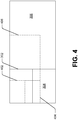
- FIG. 4 illustrates a system-wide virtualization scheme in which content is displayed at a system-wide DPI.
- the same array 300 of monitors 302, 304, 306 is provided.
- the first monitor 302, having a DPI of 144 is determined to be the primary monitor and its DPI, again 144, is used as the system DPI. Because content in a maximized window rendered at 144 DPI will not fit on the second monitor 304, for example, it is necessary to first virtualize the monitor space that includes all monitors.
- alternate monitor spaces 402, 404, 406 for each of the monitor spaces are illustrated in dashed lines.
- the alternate monitor spaces 402, 404, 406 are a scaled down (by a 2/3 factor, which is the ratio of the system DPI to the largest per-monitor DPI) version of the original monitor space.
- a coordinate system describing the alternate monitor spaces 402, 404, 406 is exposed to applications, so any content to be rendered is given in terms of that coordinate system.
- the rendered information provided by the application is then scaled up to the original monitor space, i.e., for display at 144 DPI to the user.
- FIG. 5 is a flowchart illustrating a process 500 by which content can be rendered on a per-monitor basis.
- This process (and others described below) is illustrated as a collection of blocks in a logical flow graph, which represent sequences of operations that can be implemented in hardware, software, or a combination thereof.
- the blocks represent computer-executable instructions stored on one or more computer storage media that, when executed by one or more processors, cause the processors to perform the recited operations.
- the order in which the processes are described is not intended to be construed as a limitation, and any number of the described process blocks can be combined in any order to implement the processes, or alternate processes.
- these processes are described with reference to the computing device 102 described above with reference to FIGs. 1 and 2 , other computer architectures may implement one or more portions of these processes, in whole or in part.
- an alternate monitor space is determined for each monitor.
- each alternate monitor space, and how it is calculated may vary depending upon the type of application. More specifically, a different process for determining each alternate monitor space may be employed for DPI-unaware applications than for static DPI-aware applications.
- a virtualized coordinate system is determined that describes the alternate monitor space(s), and in block 506 the virtualized coordinate system is exposed to applications.
- the application will provide, in block 508, all rendering information in a space defined by the virtualized coordinate system.
- the application understands the display space to be different than it actually is, which allows for, at block 510, scaling of the content for appropriate display across monitors of the different DPIs.
- FIG. 6 will now be used to describe the process of FIG. 6 in the context of per-monitor display of content from DPI-unaware applications.
- DPI-unaware applications render all content at 96 DPI.
- FIG. 6 the array 300 of monitors 302, 304, 306 introduced in FIG. 3 is illustrated.
- content from a DPI-unaware application would appear correctly on the second (96 DPI) monitor 304, it would appear smaller than intended on the first monitor 302 and smaller still on the third monitor 306.
- first, second, and third alternate monitor spaces 602, 604, 606 are defined for the respective first, second, and third monitors 302, 304, 306.
- Each alternate monitor space 602, 604, 606 corresponds to an actual or original monitor space, scaled by the ratio of the respective monitor 302, 304, 306 to 96 DPI - the resolution at which DPI-unaware apps render content.
- the physical size of the first monitor 302 is scaled by a factor of two-thirds (96/144) and the third monitor 306 is scaled by a factor of one-half (96/192) to define the respective first and third alternate monitor spaces 602, 606.
- the second monitor 304 is a 96 DPI monitor, its scale factor is 1.
- each monitor is scaled relative to its respective monitor origin 310, 314, 316 instead of the screen space origin 308.
- Scaling relative to the screen space origin 308 may yield unsatisfactory results in some implementations, inasmuch as alternate monitor spaces may overlap, which can lead to errors.
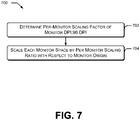
- FIG. 7 illustrates the just-described process 700 of determining the alternate monitor spaces for DPI-unaware applications. Specifically, at block 702 a per-monitor scaling ratio is determined. In this embodiment, the scaling ratio is the ratio of a respective monitor's DPI to 96 DPI.
- the original monitor space of the respective monitor is scaled by the scaling ratio determined in block 702 to determine the alternate monitor space.
- the original monitor space is scaled with respect to the monitor origin.
- any content output by the application will have coordinates in one of the alternate monitor spaces 602, 604, 606.
- content having coordinates in either of the first or third alternate monitor spaces 602, 606 can be scaled up before mapping to the respective first or third monitor 302, 306, i.e., to display as intended on a 96-DPI monitor.
- Content having coordinates in the second alternate monitor space 604 will be rendered directly, as the second monitor is a 96-DPI monitor.
- the process just described with reference to FIGs. 5-7 may be used to render content from DPI-unaware apps.
- application content i.e., rendering information
- the virtualized resolution is always smaller than (or equal to) the physical resolution.
- content from static DPI-aware applications may require scaling down, i.e., scaling by a factor of less than one.
- scaling down i.e., scaling by a factor of less than one.
- all content is rendered at a single, system DPI.
- a system DPI is determined to be 150
- displaying content rendered at that DPI on a monitor with a density of 96-DPI will lead to unsatisfactory results. The user will likely see less than all of the content on her monitor.
- FIGS. 8-11 describe and illustrate an implementation of per-monitor mapping of application content for static DPI-aware applications.
- the process described above with reference to FIG. 5 applies equally for per-monitor rendering of content from DPI-aware applications, as for content from DPI-unaware applications.
- the application is exposed to a virtualized coordinate system describing an alternate monitor space and it uses the virtualized coordinate system to define content to be rendered. The content then may be scaled with respect to the respective monitor origin.
- the alternate monitor space is determined differently for static DPI-aware applications than for DPI-unaware applications.
- FIG. 8 is a flow diagram depicting a process 800 showing one such implementation.
- a downscale factor is determined.
- the downscale factor is the largest of the ratios of the system DPI to each respective monitor DPI. So, assuming a system DPI of 144 and the array 300 of FIG. 3 , the downscale factor is the largest of 1.0 (144:144 (the DPI of the first monitor 302)), 1.5 (144:96 (the DPI of the second monitor 304)), or 0.75 (144:192 (the DPI of the third monitor 306)); or 1.5.
- a monitor space defining each of the monitors 302, 304, 306 is expanded by the downscale factor, relative to the virtual screen space origin 308 to create an expanded monitor space.
- FIGs. 9 and 10 The concept of the expanded monitor space is illustrated in FIGs. 9 and 10 , wherein each of the monitors 302, 304, 306, and thus a composite monitor space, is expanded by the downscale factor to create respective expanded monitor spaces 902, 904, 906, each shown in dashed lines.
- a scaling factor is determined for each monitor space.
- the scaling factor is the ratio of the respective monitor's DPI to the system DPI.
- the scaling ratio is 1.0 (144:144) for the first monitor 302, 0.75 (192:144) for the second monitor 304, and 1.5 (96:144) for the third monitor 306.
- each of the physical monitor sizes is scaled by its respective scaling factor, with respect to each respective monitor origin 310, 312, 314, to determine an alternate monitor space for each monitor.
- the textured boxes in FIG. 11 represent an alternate monitor spaces 1102, 1104, 1106 for each of respective monitors 302, 304, 306.
- a virtualized coordinate system can be assigned to describe that space.
- the virtualized coordinate system is exposed to applications, which read and provide coordinates relative to that system. Accordingly, any content output by the application will have coordinates in one of the alternate monitor spaces 1102, 1104, 1106.
- content having coordinates in the third alternate monitor space 1106 may be scaled up before mapping to the third monitor 306, i.e., to display as intended on a 144-DPI monitor.
- content having coordinates in the second alternate monitor space 1104 may be scaled down before mapping to the second monitor 304.
- Content having coordinates in the first alternate monitor space 1102 will be rendered directly, as the first monitor is a 144-DPI monitor.
- a monitor may be capable of displaying content at more than one resolution, which resolution may be dictated by a user.
- virtualization of rendering information may be implemented upon a user changing a property of a monitor, such as its resolution. This may enable a more user-friendly experience, inasmuch as the change in resolution will take effect immediately, instead of requiring a reboot of the user's computing device.
Landscapes
- Engineering & Computer Science (AREA)
- Theoretical Computer Science (AREA)
- Physics & Mathematics (AREA)
- General Physics & Mathematics (AREA)
- Human Computer Interaction (AREA)
- General Engineering & Computer Science (AREA)
- Computer Graphics (AREA)
- Computer Hardware Design (AREA)
- Multimedia (AREA)
- Controls And Circuits For Display Device (AREA)
- User Interface Of Digital Computer (AREA)
- Processing Or Creating Images (AREA)
Claims (3)
- System, umfassend:eine Mehrzahl von Monitoren (104a, 104b), die in einer Anordnung mit einem Bildschirmraumausgangspunkt (308) für einen Monitorraum angebracht sind, der Monitorräume für alle Monitore aufweist, wobei jeder Monitor einen jeweiligen Monitorausgangspunkt (310, 312, 314) aufweist, wobei mindestens zwei der Monitore (104a, 104b) voneinander verschiedene Pixeldichten aufweisen;eine Computervorrichtung (102), die mit der Mehrzahl von Monitoren (104a, 104b) für eine Kommunikation verbunden ist, wobei die Computervorrichtung (102) umfasst:eine Monitorkommunikationsschnittstelle (202), die geeignet ist zum Empfangen von jedem aus der Mehrzahl von Monitoren (104a, 104b) einer Pixeldichte und eines Monitorausgangspunkts für den jeweiligen Monitor (104a, 104b);eine Monitorvirtualisierungsmodul (216), das geeignet ist zum Definieren eines virtualisierten Koordinatensystems, das einen alternativen Monitorraum für jeden aus der Mehrzahl von Monitoren (104a, 104b) beschreibt, wobei jeder alternative Monitorraum einem aktuellen Monitorraum entspricht, wobei jeder Monitorraum relativ zu dem Bildschirmraumausgangspunkt durch das größte Verhältnis einer vordefinierten Systempixeldichte zu jeder entsprechenden Monitorpixeldichte skaliert wird, um einen entsprechend skalierten Monitorraum zu erzeugen, wobei der jeweilige Monitorraum innerhalb des entsprechend skalierten Monitorraums vertikal und horizontal verschoben wird, um räumliche Beziehungen zwischen den skalierten Monitorräumen zu bewahren, und außerdem relativ zu jedem entsprechend verschobenen Monitorausgangspunkt durch das Verhältnis der entsprechenden Monitorpixeldichte zur vordefinierten Systempixeldichte skaliert wird, um den entsprechenden alternativen Monitorraum zu erzeugen;eine Anwendungsschnittstelle, die geeignet ist zum Bereitstellen des virtualisierten Koordinatensystems für eine Anwendung und zum Empfangen von der Anwendung von virtualisierten Wiedergabeinformationen, die Wiedergabeinformationen eines Anwendungsinhalts umfassen, der auf der Mehrzahl von Monitoren in dem virtualisierten Koordinatensystem angezeigt werden soll; undein Skalierungsmodul (214), das geeignet ist zum Skalieren der virtualisierten Wiedergabeinformationen für eine Anzeige auf der Mehrzahl von Monitoren (104a, 104b) auf denen der Anwendungsinhalt angezeigt werden soll.
- Verfahrens zum Betreiben eines Systems nach Anspruch 1, umfassend:virtuelles Erweitern eines Monitorraums von mindestens zwei Monitoren (104a, 104b), auf denen ein Inhalt angezeigt werden soll, um einen erweiterten Monitorraum zu bilden, wobei die Monitore in einer Anordnung mit einem Bildschirmraumausgangspunkt (308) für einen Monitorraum angebracht sind, der Monitorräume für alle Monitore aufweist, wobei jeder Monitor einen jeweiligen Monitorausgangspunkt (310, 312, 314) aufweist, wobei mindestens zwei der Monitore (104a, 104b) voneinander verschiedene Pixeldichten aufweisen, wobei das Erweitern des Monitorraums ein Skalieren von jedem Monitorraum relativ zu dem Bildschirmraumausgangspunkt durch das größte Verhältnis einer vordefinierten Systempixeldichte zu jeder Monitorpixeldichte umfasst, um einen entsprechend skalierten Monitorraum zu erzeugen, wobei der jeweilige Monitorraum innerhalb des entsprechend skalierten Monitorraums vertikal und horizontal verschoben wird, um räumliche Beziehungen zwischen den skalierten Monitorräumen zu bewahren;Ermitteln eines alternativen Monitorraums mindestens teilweise in dem erweiterten Monitorraum und in weiteren alternativen Monitorräumen, wobei jeder Monitorraum außerdem relativ zu jedem verschobenen Monitorausgangspunkt durch das Verhältnis der entsprechenden Monitorpixeldichte zur vordefinierten Pixeldichte skaliert wird;Ermitteln eines virtualisierten Koordinatensystems, das die alternativen Monitorräume beschreibt;Bereitstellen des virtualisierten Koordinatensystems für eine Anwendung, die einen anzuzeigenden Inhalt bereitstellt;Empfangen von Wiedergabeinformationen von der Anwendung, die Koordinaten in dem virtualisierten Koordinatensystem umfassen; undSkalieren der Wiedergabeinformationen für eine Anzeige auf der Mehrzahl von Monitoren (104a, 104b).
- Verfahren nach Anspruch 2, das außerdem ein Empfangen einer Benutzereingabe umfasst, die eine Änderung einer Anzeigeauflösung des Inhalts benötigt.
Applications Claiming Priority (2)
| Application Number | Priority Date | Filing Date | Title |
|---|---|---|---|
| US13/917,294 US9342863B2 (en) | 2013-06-13 | 2013-06-13 | Virtualizing applications for per-monitor displaying |
| PCT/US2013/061018 WO2014200543A1 (en) | 2013-06-13 | 2013-09-20 | Virtualizing applications for multi-monitor environments |
Publications (2)
| Publication Number | Publication Date |
|---|---|
| EP3008577A1 EP3008577A1 (de) | 2016-04-20 |
| EP3008577B1 true EP3008577B1 (de) | 2020-07-01 |
Family
ID=49305176
Family Applications (1)
| Application Number | Title | Priority Date | Filing Date |
|---|---|---|---|
| EP13773995.9A Active EP3008577B1 (de) | 2013-06-13 | 2013-09-20 | Virtualisieren von anwendungen für multi-monitor umgebungen |
Country Status (4)
| Country | Link |
|---|---|
| US (3) | US9342863B2 (de) |
| EP (1) | EP3008577B1 (de) |
| CN (1) | CN105378645B (de) |
| WO (1) | WO2014200543A1 (de) |
Families Citing this family (5)
| Publication number | Priority date | Publication date | Assignee | Title |
|---|---|---|---|---|
| US9342863B2 (en) | 2013-06-13 | 2016-05-17 | Microsoft Technology Licensing, Llc | Virtualizing applications for per-monitor displaying |
| RU2689431C2 (ru) * | 2015-02-26 | 2019-05-28 | Хуавэй Текнолоджиз Ко., Лтд. | Способ адаптации dpi и электронное устройство |
| CN114115619B (zh) * | 2020-08-31 | 2024-07-05 | 华为技术有限公司 | 一种应用程序界面显示的方法及电子设备 |
| CN112820232A (zh) * | 2021-01-27 | 2021-05-18 | 联想(北京)有限公司 | 数据处理方法及设备 |
| CN120892001A (zh) * | 2021-07-31 | 2025-11-04 | 华为技术有限公司 | 一种显示方法及电子设备 |
Family Cites Families (7)
| Publication number | Priority date | Publication date | Assignee | Title |
|---|---|---|---|---|
| US5923307A (en) | 1997-01-27 | 1999-07-13 | Microsoft Corporation | Logical monitor configuration in a multiple monitor environment |
| US7420618B2 (en) | 2003-12-23 | 2008-09-02 | Genesis Microchip Inc. | Single chip multi-function display controller and method of use thereof |
| US7557774B2 (en) | 2004-08-13 | 2009-07-07 | Microsoft Corporation | Displaying visually correct pointer movements on a multi-monitor display system |
| US20060253797A1 (en) | 2005-05-06 | 2006-11-09 | Microsoft Corporation | Presentation of user-specified display regions |
| US10056059B2 (en) | 2010-10-19 | 2018-08-21 | Apple Inc. | Resolution-independent virtual display |
| US20120151403A1 (en) | 2010-12-10 | 2012-06-14 | International Business Machines Corporation | Mapping virtual desktops to physical monitors |
| US9342863B2 (en) | 2013-06-13 | 2016-05-17 | Microsoft Technology Licensing, Llc | Virtualizing applications for per-monitor displaying |
-
2013
- 2013-06-13 US US13/917,294 patent/US9342863B2/en active Active
- 2013-09-20 EP EP13773995.9A patent/EP3008577B1/de active Active
- 2013-09-20 CN CN201380077385.5A patent/CN105378645B/zh active Active
- 2013-09-20 WO PCT/US2013/061018 patent/WO2014200543A1/en not_active Ceased
-
2016
- 2016-05-16 US US15/156,204 patent/US9671993B2/en active Active
-
2017
- 2017-05-11 US US15/593,122 patent/US10127001B2/en active Active
Non-Patent Citations (1)
| Title |
|---|
| None * |
Also Published As
| Publication number | Publication date |
|---|---|
| US20170315773A1 (en) | 2017-11-02 |
| US9342863B2 (en) | 2016-05-17 |
| EP3008577A1 (de) | 2016-04-20 |
| US20140368548A1 (en) | 2014-12-18 |
| US20160259615A1 (en) | 2016-09-08 |
| CN105378645A (zh) | 2016-03-02 |
| US9671993B2 (en) | 2017-06-06 |
| WO2014200543A1 (en) | 2014-12-18 |
| CN105378645B (zh) | 2019-05-03 |
| US10127001B2 (en) | 2018-11-13 |
Similar Documents
| Publication | Publication Date | Title |
|---|---|---|
| US10127001B2 (en) | Virtualizing applications for per-monitor displaying | |
| EP2756481B1 (de) | System und verfahren zum schichten mit tile-basierten renderern | |
| US20100302249A1 (en) | Apparatus, systems and methods for layout of scene graphs using node bounding areas | |
| US8922582B2 (en) | Text rendering and display using composite bitmap images | |
| EP3407300A1 (de) | Verfahren und vorrichtung zur umsetzung von farbzwischenanimation | |
| US20160154564A1 (en) | Electronic device and method for providing desktop user interface | |
| US20160171642A1 (en) | Overlap Aware Reordering of Rendering Operations for Efficiency | |
| US9983764B2 (en) | Method, electronic device, and non-transitory storage medium for adjusting icons | |
| CN114041111A (zh) | 笔迹绘制方法、装置、电子设备、介质和程序产品 | |
| US10832442B2 (en) | Displaying smart guides for object placement based on sub-objects of reference objects | |
| WO2022089421A1 (en) | ReLU COMPRESSION TO REDUCE GPU MEMORY | |
| US9811945B2 (en) | On-demand transformation aware shape tessellation | |
| CN104571796B (zh) | 信息处理方法及电子设备 | |
| CN115731313A (zh) | Svg格式的图片的处理方法、装置、设备、介质及产品 | |
| CN111338827B (zh) | 表格数据的粘贴方法、装置以及电子设备 | |
| US20130063482A1 (en) | Application programming interface for a bitmap composition engine | |
| CN108182656B (zh) | 一种图像处理方法及终端 | |
| US10846878B2 (en) | Multi-axis equal spacing smart guides | |
| CN113703653A (zh) | 图像处理方法、装置、设备和计算机可读存储介质 | |
| CN107832028A (zh) | 多屏显示系统及方法 | |
| EP3321793A1 (de) | Verfahren und system für die echtzeit-anzeige eines abgetasteten bildes in form einer diashow | |
| US9483443B2 (en) | Tiled display list | |
| CN114676367A (zh) | 屏幕多页自适应展示方法、存储介质及电子设备 | |
| CN103809972A (zh) | 一种信息处理方法及电子设备 | |
| CN111198858A (zh) | 一种文件处理的方法、装置、计算机存储介质及终端 |
Legal Events
| Date | Code | Title | Description |
|---|---|---|---|
| PUAI | Public reference made under article 153(3) epc to a published international application that has entered the european phase |
Free format text: ORIGINAL CODE: 0009012 |
|
| 17P | Request for examination filed |
Effective date: 20151120 |
|
| AK | Designated contracting states |
Kind code of ref document: A1 Designated state(s): AL AT BE BG CH CY CZ DE DK EE ES FI FR GB GR HR HU IE IS IT LI LT LU LV MC MK MT NL NO PL PT RO RS SE SI SK SM TR |
|
| AX | Request for extension of the european patent |
Extension state: BA ME |
|
| DAX | Request for extension of the european patent (deleted) | ||
| STAA | Information on the status of an ep patent application or granted ep patent |
Free format text: STATUS: EXAMINATION IS IN PROGRESS |
|
| 17Q | First examination report despatched |
Effective date: 20170629 |
|
| GRAP | Despatch of communication of intention to grant a patent |
Free format text: ORIGINAL CODE: EPIDOSNIGR1 |
|
| STAA | Information on the status of an ep patent application or granted ep patent |
Free format text: STATUS: GRANT OF PATENT IS INTENDED |
|
| INTG | Intention to grant announced |
Effective date: 20200127 |
|
| GRAS | Grant fee paid |
Free format text: ORIGINAL CODE: EPIDOSNIGR3 |
|
| GRAA | (expected) grant |
Free format text: ORIGINAL CODE: 0009210 |
|
| STAA | Information on the status of an ep patent application or granted ep patent |
Free format text: STATUS: THE PATENT HAS BEEN GRANTED |
|
| AK | Designated contracting states |
Kind code of ref document: B1 Designated state(s): AL AT BE BG CH CY CZ DE DK EE ES FI FR GB GR HR HU IE IS IT LI LT LU LV MC MK MT NL NO PL PT RO RS SE SI SK SM TR |
|
| REG | Reference to a national code |
Ref country code: CH Ref legal event code: EP Ref country code: AT Ref legal event code: REF Ref document number: 1286796 Country of ref document: AT Kind code of ref document: T Effective date: 20200715 |
|
| REG | Reference to a national code |
Ref country code: DE Ref legal event code: R096 Ref document number: 602013070338 Country of ref document: DE |
|
| REG | Reference to a national code |
Ref country code: IE Ref legal event code: FG4D |
|
| REG | Reference to a national code |
Ref country code: LT Ref legal event code: MG4D |
|
| PG25 | Lapsed in a contracting state [announced via postgrant information from national office to epo] |
Ref country code: BG Free format text: LAPSE BECAUSE OF FAILURE TO SUBMIT A TRANSLATION OF THE DESCRIPTION OR TO PAY THE FEE WITHIN THE PRESCRIBED TIME-LIMIT Effective date: 20201001 |
|
| REG | Reference to a national code |
Ref country code: NL Ref legal event code: MP Effective date: 20200701 |
|
| REG | Reference to a national code |
Ref country code: AT Ref legal event code: MK05 Ref document number: 1286796 Country of ref document: AT Kind code of ref document: T Effective date: 20200701 |
|
| PG25 | Lapsed in a contracting state [announced via postgrant information from national office to epo] |
Ref country code: CZ Free format text: LAPSE BECAUSE OF FAILURE TO SUBMIT A TRANSLATION OF THE DESCRIPTION OR TO PAY THE FEE WITHIN THE PRESCRIBED TIME-LIMIT Effective date: 20200701 Ref country code: ES Free format text: LAPSE BECAUSE OF FAILURE TO SUBMIT A TRANSLATION OF THE DESCRIPTION OR TO PAY THE FEE WITHIN THE PRESCRIBED TIME-LIMIT Effective date: 20200701 Ref country code: LT Free format text: LAPSE BECAUSE OF FAILURE TO SUBMIT A TRANSLATION OF THE DESCRIPTION OR TO PAY THE FEE WITHIN THE PRESCRIBED TIME-LIMIT Effective date: 20200701 Ref country code: PT Free format text: LAPSE BECAUSE OF FAILURE TO SUBMIT A TRANSLATION OF THE DESCRIPTION OR TO PAY THE FEE WITHIN THE PRESCRIBED TIME-LIMIT Effective date: 20201102 Ref country code: AT Free format text: LAPSE BECAUSE OF FAILURE TO SUBMIT A TRANSLATION OF THE DESCRIPTION OR TO PAY THE FEE WITHIN THE PRESCRIBED TIME-LIMIT Effective date: 20200701 Ref country code: NO Free format text: LAPSE BECAUSE OF FAILURE TO SUBMIT A TRANSLATION OF THE DESCRIPTION OR TO PAY THE FEE WITHIN THE PRESCRIBED TIME-LIMIT Effective date: 20201001 Ref country code: HR Free format text: LAPSE BECAUSE OF FAILURE TO SUBMIT A TRANSLATION OF THE DESCRIPTION OR TO PAY THE FEE WITHIN THE PRESCRIBED TIME-LIMIT Effective date: 20200701 Ref country code: FI Free format text: LAPSE BECAUSE OF FAILURE TO SUBMIT A TRANSLATION OF THE DESCRIPTION OR TO PAY THE FEE WITHIN THE PRESCRIBED TIME-LIMIT Effective date: 20200701 Ref country code: GR Free format text: LAPSE BECAUSE OF FAILURE TO SUBMIT A TRANSLATION OF THE DESCRIPTION OR TO PAY THE FEE WITHIN THE PRESCRIBED TIME-LIMIT Effective date: 20201002 Ref country code: SE Free format text: LAPSE BECAUSE OF FAILURE TO SUBMIT A TRANSLATION OF THE DESCRIPTION OR TO PAY THE FEE WITHIN THE PRESCRIBED TIME-LIMIT Effective date: 20200701 |
|
| PG25 | Lapsed in a contracting state [announced via postgrant information from national office to epo] |
Ref country code: RS Free format text: LAPSE BECAUSE OF FAILURE TO SUBMIT A TRANSLATION OF THE DESCRIPTION OR TO PAY THE FEE WITHIN THE PRESCRIBED TIME-LIMIT Effective date: 20200701 Ref country code: LV Free format text: LAPSE BECAUSE OF FAILURE TO SUBMIT A TRANSLATION OF THE DESCRIPTION OR TO PAY THE FEE WITHIN THE PRESCRIBED TIME-LIMIT Effective date: 20200701 Ref country code: PL Free format text: LAPSE BECAUSE OF FAILURE TO SUBMIT A TRANSLATION OF THE DESCRIPTION OR TO PAY THE FEE WITHIN THE PRESCRIBED TIME-LIMIT Effective date: 20200701 Ref country code: IS Free format text: LAPSE BECAUSE OF FAILURE TO SUBMIT A TRANSLATION OF THE DESCRIPTION OR TO PAY THE FEE WITHIN THE PRESCRIBED TIME-LIMIT Effective date: 20201101 |
|
| PG25 | Lapsed in a contracting state [announced via postgrant information from national office to epo] |
Ref country code: NL Free format text: LAPSE BECAUSE OF FAILURE TO SUBMIT A TRANSLATION OF THE DESCRIPTION OR TO PAY THE FEE WITHIN THE PRESCRIBED TIME-LIMIT Effective date: 20200701 |
|
| REG | Reference to a national code |
Ref country code: DE Ref legal event code: R097 Ref document number: 602013070338 Country of ref document: DE |
|
| PG25 | Lapsed in a contracting state [announced via postgrant information from national office to epo] |
Ref country code: MC Free format text: LAPSE BECAUSE OF FAILURE TO SUBMIT A TRANSLATION OF THE DESCRIPTION OR TO PAY THE FEE WITHIN THE PRESCRIBED TIME-LIMIT Effective date: 20200701 Ref country code: SM Free format text: LAPSE BECAUSE OF FAILURE TO SUBMIT A TRANSLATION OF THE DESCRIPTION OR TO PAY THE FEE WITHIN THE PRESCRIBED TIME-LIMIT Effective date: 20200701 Ref country code: RO Free format text: LAPSE BECAUSE OF FAILURE TO SUBMIT A TRANSLATION OF THE DESCRIPTION OR TO PAY THE FEE WITHIN THE PRESCRIBED TIME-LIMIT Effective date: 20200701 Ref country code: IT Free format text: LAPSE BECAUSE OF FAILURE TO SUBMIT A TRANSLATION OF THE DESCRIPTION OR TO PAY THE FEE WITHIN THE PRESCRIBED TIME-LIMIT Effective date: 20200701 Ref country code: DK Free format text: LAPSE BECAUSE OF FAILURE TO SUBMIT A TRANSLATION OF THE DESCRIPTION OR TO PAY THE FEE WITHIN THE PRESCRIBED TIME-LIMIT Effective date: 20200701 Ref country code: EE Free format text: LAPSE BECAUSE OF FAILURE TO SUBMIT A TRANSLATION OF THE DESCRIPTION OR TO PAY THE FEE WITHIN THE PRESCRIBED TIME-LIMIT Effective date: 20200701 |
|
| REG | Reference to a national code |
Ref country code: CH Ref legal event code: PL |
|
| PLBE | No opposition filed within time limit |
Free format text: ORIGINAL CODE: 0009261 |
|
| STAA | Information on the status of an ep patent application or granted ep patent |
Free format text: STATUS: NO OPPOSITION FILED WITHIN TIME LIMIT |
|
| PG25 | Lapsed in a contracting state [announced via postgrant information from national office to epo] |
Ref country code: AL Free format text: LAPSE BECAUSE OF FAILURE TO SUBMIT A TRANSLATION OF THE DESCRIPTION OR TO PAY THE FEE WITHIN THE PRESCRIBED TIME-LIMIT Effective date: 20200701 |
|
| 26N | No opposition filed |
Effective date: 20210406 |
|
| REG | Reference to a national code |
Ref country code: BE Ref legal event code: MM Effective date: 20200930 |
|
| PG25 | Lapsed in a contracting state [announced via postgrant information from national office to epo] |
Ref country code: LU Free format text: LAPSE BECAUSE OF NON-PAYMENT OF DUE FEES Effective date: 20200920 Ref country code: SK Free format text: LAPSE BECAUSE OF FAILURE TO SUBMIT A TRANSLATION OF THE DESCRIPTION OR TO PAY THE FEE WITHIN THE PRESCRIBED TIME-LIMIT Effective date: 20200701 |
|
| PG25 | Lapsed in a contracting state [announced via postgrant information from national office to epo] |
Ref country code: BE Free format text: LAPSE BECAUSE OF NON-PAYMENT OF DUE FEES Effective date: 20200930 Ref country code: CH Free format text: LAPSE BECAUSE OF NON-PAYMENT OF DUE FEES Effective date: 20200930 Ref country code: SI Free format text: LAPSE BECAUSE OF FAILURE TO SUBMIT A TRANSLATION OF THE DESCRIPTION OR TO PAY THE FEE WITHIN THE PRESCRIBED TIME-LIMIT Effective date: 20200701 Ref country code: LI Free format text: LAPSE BECAUSE OF NON-PAYMENT OF DUE FEES Effective date: 20200930 Ref country code: IE Free format text: LAPSE BECAUSE OF NON-PAYMENT OF DUE FEES Effective date: 20200920 |
|
| PG25 | Lapsed in a contracting state [announced via postgrant information from national office to epo] |
Ref country code: TR Free format text: LAPSE BECAUSE OF FAILURE TO SUBMIT A TRANSLATION OF THE DESCRIPTION OR TO PAY THE FEE WITHIN THE PRESCRIBED TIME-LIMIT Effective date: 20200701 Ref country code: MT Free format text: LAPSE BECAUSE OF FAILURE TO SUBMIT A TRANSLATION OF THE DESCRIPTION OR TO PAY THE FEE WITHIN THE PRESCRIBED TIME-LIMIT Effective date: 20200701 Ref country code: CY Free format text: LAPSE BECAUSE OF FAILURE TO SUBMIT A TRANSLATION OF THE DESCRIPTION OR TO PAY THE FEE WITHIN THE PRESCRIBED TIME-LIMIT Effective date: 20200701 |
|
| PG25 | Lapsed in a contracting state [announced via postgrant information from national office to epo] |
Ref country code: MK Free format text: LAPSE BECAUSE OF FAILURE TO SUBMIT A TRANSLATION OF THE DESCRIPTION OR TO PAY THE FEE WITHIN THE PRESCRIBED TIME-LIMIT Effective date: 20200701 |
|
| P01 | Opt-out of the competence of the unified patent court (upc) registered |
Effective date: 20230512 |
|
| PGFP | Annual fee paid to national office [announced via postgrant information from national office to epo] |
Ref country code: DE Payment date: 20250820 Year of fee payment: 13 |
|
| PGFP | Annual fee paid to national office [announced via postgrant information from national office to epo] |
Ref country code: GB Payment date: 20250822 Year of fee payment: 13 |
|
| PGFP | Annual fee paid to national office [announced via postgrant information from national office to epo] |
Ref country code: FR Payment date: 20250821 Year of fee payment: 13 |