EP3006248A1 - Procédé de détermination du mode cinématique d'une transmission hybride - Google Patents
Procédé de détermination du mode cinématique d'une transmission hybride Download PDFInfo
- Publication number
- EP3006248A1 EP3006248A1 EP15185799.2A EP15185799A EP3006248A1 EP 3006248 A1 EP3006248 A1 EP 3006248A1 EP 15185799 A EP15185799 A EP 15185799A EP 3006248 A1 EP3006248 A1 EP 3006248A1
- Authority
- EP
- European Patent Office
- Prior art keywords
- ratio
- mth
- mode
- traction
- hybrid
- Prior art date
- Legal status (The legal status is an assumption and is not a legal conclusion. Google has not performed a legal analysis and makes no representation as to the accuracy of the status listed.)
- Granted
Links
Images

Classifications
-
- B—PERFORMING OPERATIONS; TRANSPORTING
- B60—VEHICLES IN GENERAL
- B60K—ARRANGEMENT OR MOUNTING OF PROPULSION UNITS OR OF TRANSMISSIONS IN VEHICLES; ARRANGEMENT OR MOUNTING OF PLURAL DIVERSE PRIME-MOVERS IN VEHICLES; AUXILIARY DRIVES FOR VEHICLES; INSTRUMENTATION OR DASHBOARDS FOR VEHICLES; ARRANGEMENTS IN CONNECTION WITH COOLING, AIR INTAKE, GAS EXHAUST OR FUEL SUPPLY OF PROPULSION UNITS IN VEHICLES
- B60K6/00—Arrangement or mounting of plural diverse prime-movers for mutual or common propulsion, e.g. hybrid propulsion systems comprising electric motors and internal combustion engines
- B60K6/20—Arrangement or mounting of plural diverse prime-movers for mutual or common propulsion, e.g. hybrid propulsion systems comprising electric motors and internal combustion engines the prime-movers consisting of electric motors and internal combustion engines, e.g. HEVs
- B60K6/50—Architecture of the driveline characterised by arrangement or kind of transmission units
- B60K6/54—Transmission for changing ratio
- B60K6/547—Transmission for changing ratio the transmission being a stepped gearing
-
- B—PERFORMING OPERATIONS; TRANSPORTING
- B60—VEHICLES IN GENERAL
- B60K—ARRANGEMENT OR MOUNTING OF PROPULSION UNITS OR OF TRANSMISSIONS IN VEHICLES; ARRANGEMENT OR MOUNTING OF PLURAL DIVERSE PRIME-MOVERS IN VEHICLES; AUXILIARY DRIVES FOR VEHICLES; INSTRUMENTATION OR DASHBOARDS FOR VEHICLES; ARRANGEMENTS IN CONNECTION WITH COOLING, AIR INTAKE, GAS EXHAUST OR FUEL SUPPLY OF PROPULSION UNITS IN VEHICLES
- B60K6/00—Arrangement or mounting of plural diverse prime-movers for mutual or common propulsion, e.g. hybrid propulsion systems comprising electric motors and internal combustion engines
- B60K6/20—Arrangement or mounting of plural diverse prime-movers for mutual or common propulsion, e.g. hybrid propulsion systems comprising electric motors and internal combustion engines the prime-movers consisting of electric motors and internal combustion engines, e.g. HEVs
- B60K6/42—Arrangement or mounting of plural diverse prime-movers for mutual or common propulsion, e.g. hybrid propulsion systems comprising electric motors and internal combustion engines the prime-movers consisting of electric motors and internal combustion engines, e.g. HEVs characterised by the architecture of the hybrid electric vehicle
- B60K6/48—Parallel type
-
- B—PERFORMING OPERATIONS; TRANSPORTING
- B60—VEHICLES IN GENERAL
- B60K—ARRANGEMENT OR MOUNTING OF PROPULSION UNITS OR OF TRANSMISSIONS IN VEHICLES; ARRANGEMENT OR MOUNTING OF PLURAL DIVERSE PRIME-MOVERS IN VEHICLES; AUXILIARY DRIVES FOR VEHICLES; INSTRUMENTATION OR DASHBOARDS FOR VEHICLES; ARRANGEMENTS IN CONNECTION WITH COOLING, AIR INTAKE, GAS EXHAUST OR FUEL SUPPLY OF PROPULSION UNITS IN VEHICLES
- B60K6/00—Arrangement or mounting of plural diverse prime-movers for mutual or common propulsion, e.g. hybrid propulsion systems comprising electric motors and internal combustion engines
- B60K6/20—Arrangement or mounting of plural diverse prime-movers for mutual or common propulsion, e.g. hybrid propulsion systems comprising electric motors and internal combustion engines the prime-movers consisting of electric motors and internal combustion engines, e.g. HEVs
- B60K6/42—Arrangement or mounting of plural diverse prime-movers for mutual or common propulsion, e.g. hybrid propulsion systems comprising electric motors and internal combustion engines the prime-movers consisting of electric motors and internal combustion engines, e.g. HEVs characterised by the architecture of the hybrid electric vehicle
- B60K6/48—Parallel type
- B60K2006/4808—Electric machine connected or connectable to gearbox output shaft
-
- B—PERFORMING OPERATIONS; TRANSPORTING
- B60—VEHICLES IN GENERAL
- B60K—ARRANGEMENT OR MOUNTING OF PROPULSION UNITS OR OF TRANSMISSIONS IN VEHICLES; ARRANGEMENT OR MOUNTING OF PLURAL DIVERSE PRIME-MOVERS IN VEHICLES; AUXILIARY DRIVES FOR VEHICLES; INSTRUMENTATION OR DASHBOARDS FOR VEHICLES; ARRANGEMENTS IN CONNECTION WITH COOLING, AIR INTAKE, GAS EXHAUST OR FUEL SUPPLY OF PROPULSION UNITS IN VEHICLES
- B60K6/00—Arrangement or mounting of plural diverse prime-movers for mutual or common propulsion, e.g. hybrid propulsion systems comprising electric motors and internal combustion engines
- B60K6/20—Arrangement or mounting of plural diverse prime-movers for mutual or common propulsion, e.g. hybrid propulsion systems comprising electric motors and internal combustion engines the prime-movers consisting of electric motors and internal combustion engines, e.g. HEVs
- B60K6/42—Arrangement or mounting of plural diverse prime-movers for mutual or common propulsion, e.g. hybrid propulsion systems comprising electric motors and internal combustion engines the prime-movers consisting of electric motors and internal combustion engines, e.g. HEVs characterised by the architecture of the hybrid electric vehicle
- B60K6/48—Parallel type
- B60K2006/4833—Step up or reduction gearing driving generator, e.g. to operate generator in most efficient speed range
- B60K2006/4841—Step up or reduction gearing driving generator, e.g. to operate generator in most efficient speed range the gear provides shifting between multiple ratios
-
- B—PERFORMING OPERATIONS; TRANSPORTING
- B60—VEHICLES IN GENERAL
- B60W—CONJOINT CONTROL OF VEHICLE SUB-UNITS OF DIFFERENT TYPE OR DIFFERENT FUNCTION; CONTROL SYSTEMS SPECIALLY ADAPTED FOR HYBRID VEHICLES; ROAD VEHICLE DRIVE CONTROL SYSTEMS FOR PURPOSES NOT RELATED TO THE CONTROL OF A PARTICULAR SUB-UNIT
- B60W20/00—Control systems specially adapted for hybrid vehicles
-
- B—PERFORMING OPERATIONS; TRANSPORTING
- B60—VEHICLES IN GENERAL
- B60W—CONJOINT CONTROL OF VEHICLE SUB-UNITS OF DIFFERENT TYPE OR DIFFERENT FUNCTION; CONTROL SYSTEMS SPECIALLY ADAPTED FOR HYBRID VEHICLES; ROAD VEHICLE DRIVE CONTROL SYSTEMS FOR PURPOSES NOT RELATED TO THE CONTROL OF A PARTICULAR SUB-UNIT
- B60W20/00—Control systems specially adapted for hybrid vehicles
- B60W20/30—Control strategies involving selection of transmission gear ratio
-
- B—PERFORMING OPERATIONS; TRANSPORTING
- B60—VEHICLES IN GENERAL
- B60W—CONJOINT CONTROL OF VEHICLE SUB-UNITS OF DIFFERENT TYPE OR DIFFERENT FUNCTION; CONTROL SYSTEMS SPECIALLY ADAPTED FOR HYBRID VEHICLES; ROAD VEHICLE DRIVE CONTROL SYSTEMS FOR PURPOSES NOT RELATED TO THE CONTROL OF A PARTICULAR SUB-UNIT
- B60W2510/00—Input parameters relating to a particular sub-units
- B60W2510/06—Combustion engines, Gas turbines
- B60W2510/0638—Engine speed
-
- B—PERFORMING OPERATIONS; TRANSPORTING
- B60—VEHICLES IN GENERAL
- B60W—CONJOINT CONTROL OF VEHICLE SUB-UNITS OF DIFFERENT TYPE OR DIFFERENT FUNCTION; CONTROL SYSTEMS SPECIALLY ADAPTED FOR HYBRID VEHICLES; ROAD VEHICLE DRIVE CONTROL SYSTEMS FOR PURPOSES NOT RELATED TO THE CONTROL OF A PARTICULAR SUB-UNIT
- B60W2510/00—Input parameters relating to a particular sub-units
- B60W2510/08—Electric propulsion units
- B60W2510/081—Speed
-
- B—PERFORMING OPERATIONS; TRANSPORTING
- B60—VEHICLES IN GENERAL
- B60W—CONJOINT CONTROL OF VEHICLE SUB-UNITS OF DIFFERENT TYPE OR DIFFERENT FUNCTION; CONTROL SYSTEMS SPECIALLY ADAPTED FOR HYBRID VEHICLES; ROAD VEHICLE DRIVE CONTROL SYSTEMS FOR PURPOSES NOT RELATED TO THE CONTROL OF A PARTICULAR SUB-UNIT
- B60W2510/00—Input parameters relating to a particular sub-units
- B60W2510/10—Change speed gearings
- B60W2510/1005—Transmission ratio engaged
-
- B—PERFORMING OPERATIONS; TRANSPORTING
- B60—VEHICLES IN GENERAL
- B60W—CONJOINT CONTROL OF VEHICLE SUB-UNITS OF DIFFERENT TYPE OR DIFFERENT FUNCTION; CONTROL SYSTEMS SPECIALLY ADAPTED FOR HYBRID VEHICLES; ROAD VEHICLE DRIVE CONTROL SYSTEMS FOR PURPOSES NOT RELATED TO THE CONTROL OF A PARTICULAR SUB-UNIT
- B60W40/00—Estimation or calculation of non-directly measurable driving parameters for road vehicle drive control systems not related to the control of a particular sub unit, e.g. by using mathematical models
- B60W40/12—Estimation or calculation of non-directly measurable driving parameters for road vehicle drive control systems not related to the control of a particular sub unit, e.g. by using mathematical models related to parameters of the vehicle itself, e.g. tyre models
-
- Y—GENERAL TAGGING OF NEW TECHNOLOGICAL DEVELOPMENTS; GENERAL TAGGING OF CROSS-SECTIONAL TECHNOLOGIES SPANNING OVER SEVERAL SECTIONS OF THE IPC; TECHNICAL SUBJECTS COVERED BY FORMER USPC CROSS-REFERENCE ART COLLECTIONS [XRACs] AND DIGESTS
- Y02—TECHNOLOGIES OR APPLICATIONS FOR MITIGATION OR ADAPTATION AGAINST CLIMATE CHANGE
- Y02T—CLIMATE CHANGE MITIGATION TECHNOLOGIES RELATED TO TRANSPORTATION
- Y02T10/00—Road transport of goods or passengers
- Y02T10/60—Other road transportation technologies with climate change mitigation effect
- Y02T10/62—Hybrid vehicles
Definitions
- the present invention relates to the control of hybrid transmissions of a motor vehicle.
- It relates to the control of the kinematic mode of a hybrid transmission comprising a gearbox with discrete ratios gathering the couples of at least one engine and an electric machine, towards the wheels of the vehicle.
- this invention relates to a method for determining the current kinematic mode of a hybrid transmission which groups on a differential output to the wheels of the vehicle, a thermal traction chain transmitting the torque of a heat engine on reports discrete reduction gear set by a first gearbox, and an electric power train transmitting the torque of an electric machine on several discrete reduction ratios, established by a second gearbox.
- gear changes depend on the movement inside the gearbox, jaws actuated by an internal control mechanism from the driver's instructions. These claws control the coupling and decoupling gears, with or without the intervention of synchronization means. Their position determines the engaged relationship. It can be controlled by sensors, returning the current report information to a controller, such as a transmission computer. But the reliability of this information is not assured in case of failure or drift measuring sensors, or mechanical breakage in the box.
- the kinematics is more complex because the current kinematic mode depends both on the state of the elements coupling of the electric traction chain, and the thermal traction chain.
- transition from one kinematic mode to another is based essentially on the control of the two coupling means, the position of which can be indicated by sensors. To ensure the safe operation of the transmission, any sensor failure must be detectable at all times.
- the present invention aims to verify the current kinematic mode of a hybrid GMP, by observing the speed of rotating elements.
- the kinematic mode be identified by the state of a vector with at least two components, representing the reduction ratio achieved on each transmission chain of the transmission.
- This vector take reference values on each report made by the traction chains, within two families of feasible discrete reports.
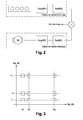
- a hybrid GMP combining a heat engine, an electric machine, and a gearbox with discrete ratios can be modeled according to the diagram of the figure 2 .
- There is a thermal traction chain comprising the heat engine Mth , connected to a reducer Red (Mth) by coupling means Coup (Mth), an electric traction chain comprising the electric machine ME , connected to a reducer Red (ME) by coupling means Coup ( ME ), and a differential unit bringing together the movement of the two traction chains in the direction of the wheels.
- the transmission gathers on an output differential towards the wheels of the vehicle, a traction chain transmitting the torque of a heat engine on discrete reduction ratios established by a first gearbox, and an electric traction chain transmitting the torque of an electric machine on several discrete reduction ratios established by a second reducer.
- the proposed method makes it possible to determine the current kinematic mode of any hybrid transmission that can be modeled in the same scheme, as in particular that of the publication WO 2012/131259 .
- the links between the various elements constituting this hybrid power train are mechanical links.
- Rat Mth the discrete ratios achievable by the reducer of the thermal chain Red (Mth)
- ME electric chain Red
- Rat_ME another reduction ratio
- the components [Ratio_Mth] and [Ratio_ME] of the vector take reference values on each report realized by the two chains of traction, within each family of feasible discrete reports.
- Each kinematic mode of the transmission is defined by the combination of state variables identifying the configuration of the GMP.
- the kinematic mode can be represented by a vector of the type [Coupler_status_mth; Ratio_Mth ; EC_coupler_state; Ratio_ME], including the state of the two input couplers. Whatever its size, the exploitation of this vector realizes a software sensor of the state of the actuators of the transmission.
- the current kinematic mode can thus be identified from the observation of the rotation speed of the heat engine (N-Mth), the speed of rotation of the electric machine (N_ME) , and the wheel rotation speed (N_Wheels) of the vehicle.
- R1, R2 and R3 are called the gear ratios for each interconnection position of the three idle gears. Both ratios are identified on each report achievable by the traction chains. They are zero in neutral and in charge mode. The first ratio is inoperative in thermal mode (" motorway thermal"), while the second is inoperative in electric mode, since the corresponding traction chains are inactive.
- the determination of the current kinematic mode is carried out by comparing the operating ratios [Ratio_Mth] and [Ratio_ME], computed from the three observed regimes (N-Mth), (N_ME) and (N_Roues) (N_Roues), with the table of values below. This table indicates the modes where one of the ratios is inoperative.
- the invention proposes a method of observing the states, or cinematic modes, of a hybrid transmission.
- This method is based on the creation of a "software sensor", in several dimensions. It makes it possible to detect any anomaly in the information delivered by box sensors, in particular the failure of one of the jaw position sensors, without doubling these sensors.
- the impact of this invention in terms of operational safety, cost, and mechanical integration is considerable.
Landscapes
- Engineering & Computer Science (AREA)
- Chemical & Material Sciences (AREA)
- Combustion & Propulsion (AREA)
- Transportation (AREA)
- Mechanical Engineering (AREA)
- Electric Propulsion And Braking For Vehicles (AREA)
- Control Of Transmission Device (AREA)
- Hybrid Electric Vehicles (AREA)
Abstract
Description
- La présente invention se rapporte au contrôle des transmissions hybrides de véhicule automobile.
- Elle concerne le contrôle du mode cinématique d'une transmission hybride comprenant une boîte de vitesses à rapports discrets rassemblant les couples d'au moins un moteur thermique et une machine électrique, en direction des roues du véhicule.
- Plus précisément, cette invention a pour objet un procédé de détermination du mode cinématique courant d'une transmission hybride qui regroupe sur un différentiel de sortie vers les roues du véhicule, une chaîne de traction thermique transmettant le couple d'un moteur thermique sur des rapports discrets de réduction établis par un premier réducteur, et une chaîne de traction électrique transmettant le couple d'une machine électrique sur plusieurs rapports discrets de réduction, établis par un deuxième réducteur.
- Dans la plupart des boîtes de vitesses, les changements de rapport dépendent du déplacement à l'intérieur de la boîte, de crabots actionnés par un mécanisme de commande interne à partir des instructions du conducteur. Ces crabots commandent le couplage et le découplage de pignons de vitesses, avec ou sans l'intervention de moyens de synchronisation. Leur position détermine le rapport engagé. Elle peut être contrôlée par des capteurs, renvoyant l'information de rapport courant sur un organe de contrôle, tel qu'un calculateur de transmission. Mais la fiabilité de cette information n'est pas assurée en cas de défaillance ou de dérive de mesure des capteurs, ou encore de casse mécanique dans la boîte.
- Sur un véhicule thermique disposant, comme seule source d'énergie motrice, d'un moteur thermique relié aux roues du véhicule par une boîte de vitesses à rapports discrets, le rapport courant se déduit directement du ratio entre le régime primaire et le rapport secondaire de celle-ci. La cohérence de cette seule information avec la position supposée des crabots dans la boîte, suffit pour vérifier le rapport engagé.
- Dans les groupes motopropulseurs (GMP) hybrides, où la boîte de vitesses rassemble les couples d'au moins un moteur thermique et une machine électrique, la cinématique est plus complexe, car le mode cinématique courant dépend à la fois de l'état des éléments de couplage de la chaîne de traction électrique, et de la chaîne de traction thermique.
- Par la publication
WO2012/131259 , on connaît une transmission hybride pour véhicule automobile constituée principalement d'un moteur thermique et d'une machine électrique d'entraînement, comportant deux arbres primaires concentriques portant chacun au moins un pignon de descente sur un arbre secondaire relié aux roues du véhicule. Cette transmission présente un premier moyen de couplage entre les deux arbres primaires pouvant occuper trois positions dans lesquelles : - le moteur thermique est découplé de la chaîne cinématique reliant la machine électrique aux roues,
- le moteur thermique entraîne les roues indépendamment de la machine électrique,
- le moteur thermique et la machine électrique sont couplés de manière à additionner en direction des roues leurs couples respectifs.
- Il y a également trois positions pour relier directement l'arbre primaire lié au moteur électrique et l'arbre secondaire :
- le moteur électrique n'est pas directement couplé au secondaire,
- le moteur électrique est directement lié au secondaire avec un 1er rapport, ou
- le moteur électrique est directement lié au secondaire avec un 2ème rapport.
- En combinant les trois positions de chaque coupleur, une telle transmission dispose en tout de neuf modes cinématiques, illustrés par la
figure 1 : un point mort, deux rapports électriques intitulés « ZEV ville » et « ZEV route », deux rapports hybrides ou thermiques intitulés respectivement « Hybride ville ou Thermique Ville » et « Hybride Route ou Thermique Route », un rapport thermique intitulé « Autoroute Thermique », deux modes hybrides intitulés respectivement « Hybride Autoroute 1 » et « Hybride Autoroute 2 » et un mode « Recharge ». Ces états sont établis en fonction de l'activation d'un moteur thermique et/ou d'une machine électrique, et de la position des deux coupleurs placés respectivement sur un arbre primaire et sur un arbre secondaire de la boîte. - Le passage d'un mode cinématique à un autre, repose essentiellement sur le pilotage des deux moyens de couplage, dont la position peut être renseignée par des capteurs. Pour assurer la sécurité de fonctionnement de la transmission, une défaillance éventuelle de capteur doit pouvoir être détectée à chaque instant.
- La présente invention vise à vérifier le mode cinématique courant d'un GMP hybride, par observation de la vitesse d'éléments tournants.
- Dans ce but, elle propose que le mode cinématique soit identifié par l'état d'un vecteur à au moins deux composantes, représentant le rapport de réduction réalisé sur chaque chaîne de traction de la transmission.
- Les composantes de ce vecteur prennent des valeurs de référence sur chaque rapport réalisé par les chaînes de traction, au sein de deux familles de rapports discrets réalisables.
- La présente invention sera mieux comprise à la lecture de la description suivante d'un mode de réalisation non limitatif de celle-ci, en se reportant aux dessins annexés, sur lesquels :
- la
figure 1 illustre les modes cinématiques d'une transmission hybride connue, - la
figure 2 est un schéma de modélisation général de transmission hybride, et - la
figure 3 illustre la méthode proposée. - Un GMP hybride réunissant un moteur thermique, une machine électrique, et une boîte de vitesses à rapports discrets, peut être modélisé selon le schéma de la
figure 2 . On distingue une chaîne de traction thermique comprenant le moteur thermique Mth, relié à un réducteur Red(Mth) par un moyen de couplage Coup(Mth), une chaîne de traction électrique comprenant la machine électrique ME, reliée à un réducteur Red (ME) par un moyen de couplage Coup(ME), et un différentiel rassemblant le mouvement des deux chaînes de traction en direction des roues. Selon ce modèle, la transmission regroupe sur un différentiel de sortie vers les roues du véhicule, une chaîne de traction transmettant le couple d'un moteur thermique sur des rapports discrets de réduction établis par un premier réducteur, et une chaîne de traction électrique transmettant le couple d'une machine électrique sur plusieurs rapports de réduction discrets établis par un deuxième réducteur. - La méthode proposée permet de déterminer le mode cinématique courant de toute transmission hybride modélisable dans le même schéma, comme en particulier, celle de la publication
WO 2012/131259 . Les liens entre les différents éléments constituant cette chaîne de traction hybride, sont des liens mécaniques. A chacun des rapports discrets réalisables par le réducteur de la chaîne thermique Red(Mth), on sait affecter un ratio de réduction de celle-ci, Rat Mth appartenant à une première famille : (0, R1, R2, ..., Rm). De même, à chacun des rapports discrets réalisables par le réducteur de la chaîne électrique Red(ME), on sait affecter un autre ratio de réduction Rat_ME, qui prend une valeur appartenant à une deuxième famille (0, r1, r2, ..., rn). Les composantes [Ratio_Mth] et [Ratio_ME] du vecteur prennent des valeurs de référence sur chaque rapport réalisé par les deux chaînes de traction, au sein de chaque famille de rapports discrets réalisables. - Chaque mode cinématique de la transmission se définit par la combinaison de grandeurs d'état identifiant la configuration du GMP. Dans le cas où le moteur thermique et la machine électrique sont reliés à la boîte de vitesses par un coupleur d'entrée, le mode cinématique peut être représenté par un vecteur du type [Etat_coupleur_mth ; Ratio_Mth ; Etat_coupleur_ME ; Ratio_ME], incluant l'état des deux coupleurs d'entrée. Quelle que soit sa dimension, l'exploitation de ce vecteur réalise un capteur logiciel de l'état des actionneurs de la transmission.
- Lorsque les coupleurs d'entrée sont fermés, ou bien dans le cas particulier où le GMP hybride en est dépourvu (comme dans l'exemple cité), une liaison mécanique directe est établie entre les moteurs et leurs réducteurs). Le vecteur qui permet d'identifier le mode cinématique de la transmission n'a plus que deux composantes : [Ratio_Mth ; Ratio_ME], représentant le rapport de réduction sur chacune des deux chaînes de traction.
- En appelant N_Mth, le régime de rotation du moteur thermique, N_ME le régime de rotation du moteur électrique, et N_Roues le régime de rotation des roues motrices du véhicule, les ratios s'écrivent :
- Rat_ Mth = N _ Mth/N _ Roues et Rat_ME = N_ME/N_Roues.
- Si le GMP peut prendre m valeurs de ratio thermique et n valeurs de ratio électrique, les modes cinématiques se déduisent de la matrice de la
figure 3 . Cette matrice, traduit les résultats du capteur logiciel. Dans le cas d'une transmission à deux arbres parallèles (arbre primaire et arbre secondaire), ce capteur peut se baser sur les trois informations suivantes : - le régime de l'arbre primaire (= régime du moteur thermique), nommé Nprim,
- le régime de la machine électrique, nommé Nme, et
- le régime de l'arbre secondaire, nommé Nsec.
- Le mode cinématique courant peut ainsi être identifié à partir de l'observation du régime de rotation du moteur thermique (N-Mth), du régime de rotation de la machine électrique (N_ME), et du régime de rotation des roues (N_Roues) du véhicule.
- En se référant à l'exemple de la
figure 1 , le véhicule peut être immobilisé (Nsec .= 0) dans plusieurs des modes cinématiques identifiés, en particulier : - ZEV ville
- ZEV route
- Neutre
- Recharge
- L'observation des trois régimes Nprim, Nme, Nsec, ne suffit donc pas pour identifier le mode cinématique établi dans cette transmission à vitesse nulle. En revanche, lorsque le véhicule est en déplacement, on peut s'appuyer sur le capteur logiciel pour déterminer le mode cinématique courant sur la seule base des deux ratios suivants :

- Dans la transmission citée, on appelle R1, R2 et R3 les rapports de démultiplication pour chaque position de crabotage des trois pignons fous. Les deux ratios sont identifiés sur chaque rapport réalisable par les chaînes de traction. Ils sont nuls au neutre et en mode recharge. Le premier ratio est inopérant en mode thermique (« thermique autoroute »), tandis que le deuxième est inopérant en mode électrique, puisque les chaînes de traction correspondantes sont inactives. La détermination du mode cinématique courant s'effectue en comparant les ratios opérants [Ratio_Mth] et [Ratio_ME], calculés à partir des trois régimes observés (N-Mth), (N_ME) et (N_Roues) (N_Roues), à la table de valeurs ci-dessous. Cette table indique les modes où l'un des ratios est inopérant. Dans les autres cas, elle donne la valeur des ratios de réduction imposés aux chaînes de traction par la position des crabots :
Mode cinématique Rat1 Rat2 Neutre 0 0 Recharge 0 0 ZEV ville R1 ZEV route R2 - Hybride ville R1 R1 Hybride route R2 R2 Thermique autoroute - R3 Hybride autoroute 1 R1 R3 Hybride autoroute 2 R2 R3 - En conclusion, l'invention propose une méthode d'observation des états, ou modes cinématiques, courants d'une transmission hybride. Cette méthode repose sur la création d'un « capteur logiciel », à plusieurs dimensions. Elle permet de détecter toute anomalie dans l'information délivrée par des capteurs de boîte, notamment la défaillance d'un des capteurs de position des crabots, sans doubler ces capteurs. L'impact de cette invention en termes de sécurité de fonctionnement, de coût, et d'intégration mécanique, est considérable.
Claims (5)
- Procédé de détermination du mode cinématique courant d'une transmission hybride qui regroupe sur un différentiel de sortie vers les roues du véhicule une chaîne de traction transmettant le couple d'un moteur thermique sur des rapports discrets de réduction établis par un premier réducteur et une chaîne de traction électrique transmettant le couple d'une machine électrique sur plusieurs rapports de réduction discrets établis par un deuxième réducteur, caractérisé en ce que le mode cinématique est identifié par l'état d'un vecteur à au moins deux composantes [Ratio_Mth ; Ratio_ME], représentant le rapport de réduction sur chacune des deux chaînes de traction.
- Procédé de détermination selon la revendication 1, caractérisé en ce que les composantes [Ratio_Mth] et [Ratio_ME] du vecteur prennent des valeurs de référence sur chaque rapport réalisé par les deux chaînes de traction, au sein de deux familles de rapports discrets réalisables.
- Procédé de détermination selon la revendication 1 ou 2, dans lequel le vecteur prend la forme [Etat_coupleur_Mth ; Ratio_Mth ; [Etat_coupleur_Mth ; Ratio_ME] incluant l'état d'un coupleur d'entrée de la chaîne de traction thermique [Etat _ coupleur _ Mth] et d'un coupleur d'entrée de la chaîne de traction électrique [Etat_coupleur_Mth].
- Procédé de détermination selon la revendication 1 2 ou 3, caractérisé en ce que le mode cinématique courant est identifié à partir de l'observation du régime de rotation du moteur thermique (N-Mth), du régime de rotation de la machine électrique (N_ME), et du régime de rotation des roues (N_Roues) du véhicule.
- Procédé de détermination du rapport courant selon la revendication 4, caractérisé en ce que le mode cinématique courant est identifié en comparant les ratios [Ratio_Mth] et [Ratio_ME] calculés à partir des régimes observés (N-Mth), (N_ME) et (N_Roues) (N_Roues), à une table de valeurs de réduction imposée aux chaînes de traction par la position de coupleurs contrôlant l'établissement des rapports réalisables en mode thermique, en mode électrique et en mode hybride.
Applications Claiming Priority (1)
| Application Number | Priority Date | Filing Date | Title |
|---|---|---|---|
| FR1459548A FR3026707B1 (fr) | 2014-10-06 | 2014-10-06 | Procede de determination du mode cinematique d'une transmission hybride |
Publications (2)
| Publication Number | Publication Date |
|---|---|
| EP3006248A1 true EP3006248A1 (fr) | 2016-04-13 |
| EP3006248B1 EP3006248B1 (fr) | 2021-02-03 |
Family
ID=52684315
Family Applications (1)
| Application Number | Title | Priority Date | Filing Date |
|---|---|---|---|
| EP15185799.2A Active EP3006248B1 (fr) | 2014-10-06 | 2015-09-18 | Procédé de détermination du mode cinématique d'une transmission hybride |
Country Status (2)
| Country | Link |
|---|---|
| EP (1) | EP3006248B1 (fr) |
| FR (1) | FR3026707B1 (fr) |
Citations (4)
| Publication number | Priority date | Publication date | Assignee | Title |
|---|---|---|---|---|
| DE10133695A1 (de) * | 2000-07-18 | 2002-03-07 | Luk Lamellen & Kupplungsbau | Getriebe |
| DE102008041985A1 (de) * | 2008-09-11 | 2010-03-18 | Robert Bosch Gmbh | Hybridantriebssystem |
| WO2012131259A1 (fr) | 2011-04-01 | 2012-10-04 | Renault S.A.S. | Transmission hybride pour vehicule automobile et procede de commande |
| DE102012024677A1 (de) * | 2012-12-18 | 2014-06-18 | Getrag Getriebe- Und Zahnradfabrik Hermann Hagenmeyer Gmbh & Cie Kg | Hybrid-Antriebsstrang und Gangstufenwechselverfahren |
-
2014
- 2014-10-06 FR FR1459548A patent/FR3026707B1/fr not_active Expired - Fee Related
-
2015
- 2015-09-18 EP EP15185799.2A patent/EP3006248B1/fr active Active
Patent Citations (4)
| Publication number | Priority date | Publication date | Assignee | Title |
|---|---|---|---|---|
| DE10133695A1 (de) * | 2000-07-18 | 2002-03-07 | Luk Lamellen & Kupplungsbau | Getriebe |
| DE102008041985A1 (de) * | 2008-09-11 | 2010-03-18 | Robert Bosch Gmbh | Hybridantriebssystem |
| WO2012131259A1 (fr) | 2011-04-01 | 2012-10-04 | Renault S.A.S. | Transmission hybride pour vehicule automobile et procede de commande |
| DE102012024677A1 (de) * | 2012-12-18 | 2014-06-18 | Getrag Getriebe- Und Zahnradfabrik Hermann Hagenmeyer Gmbh & Cie Kg | Hybrid-Antriebsstrang und Gangstufenwechselverfahren |
Also Published As
| Publication number | Publication date |
|---|---|
| EP3006248B1 (fr) | 2021-02-03 |
| FR3026707A1 (fr) | 2016-04-08 |
| FR3026707B1 (fr) | 2016-11-04 |
Similar Documents
| Publication | Publication Date | Title |
|---|---|---|
| KR100951967B1 (ko) | 자동화 수동변속기를 갖춘 하이브리드 전기자동차의파워트레인 | |
| ES2655892T3 (es) | Aparato para control de par de accionamiento híbrido | |
| EP3013618B1 (fr) | Transmission hybride avec une machine electrique additionnelle | |
| CN104442341B (zh) | 用于混合电动机动车的后驱动单元 | |
| US20170190246A1 (en) | Speed transmission device for moving a motor vehicle, notably a two-wheeled motor vehicle | |
| CN104648117B (zh) | 用于车辆的混合动力系 | |
| US20160023653A1 (en) | Control apparatus for vehicle | |
| SE0402237D0 (sv) | Antrieb für ein Kettenfahrzeug | |
| EP3891487B1 (fr) | Banc d'essai pour un groupe motopropulseur hybride de vehicule automobile | |
| US8701523B2 (en) | Coupling device for a hybrid power train that operates in at least two, electrical/combustion-electrical modes, intended for a vehicle | |
| CN101535077A (zh) | 连结装置、具有该连结装置的动力输出装置以及混合动力车辆 | |
| WO2013129053A1 (fr) | Dispositif de commande de changement de vitesse de véhicule | |
| US8020461B2 (en) | Travel drive system for hybrid vehicle and method using same | |
| CN103687740B (zh) | 手动变速器 | |
| JP5801068B2 (ja) | 手動変速機 | |
| US20180022205A1 (en) | Method for controlling a variable-speed transmission device with epicyclic gear trains of a power train, in particular for a hybrid vehicle | |
| CN103603883A (zh) | 一种拉线式自动离合器执行机构 | |
| EP3006248B1 (fr) | Procédé de détermination du mode cinématique d'une transmission hybride | |
| CN103687741A (zh) | 手动变速器 | |
| CN105882380B (zh) | 混合动力装置 | |
| US9273777B2 (en) | Vehicle control apparatus | |
| EP4058315B1 (fr) | Groupe motopropulseur hybride comportant deux moteurs électriques et un moteur thermique non coaxiaux, et ses procédés de commande | |
| CN108278334A (zh) | 用于混合动力系的变速器 | |
| CN102042395A (zh) | 用于双离合器变速器的齿轮致动器控制系统和方法 | |
| WO2011055050A1 (fr) | Groupe motopropulseur hybride multirapports a deux machines electriques |
Legal Events
| Date | Code | Title | Description |
|---|---|---|---|
| PUAI | Public reference made under article 153(3) epc to a published international application that has entered the european phase |
Free format text: ORIGINAL CODE: 0009012 |
|
| AK | Designated contracting states |
Kind code of ref document: A1 Designated state(s): AL AT BE BG CH CY CZ DE DK EE ES FI FR GB GR HR HU IE IS IT LI LT LU LV MC MK MT NL NO PL PT RO RS SE SI SK SM TR |
|
| AX | Request for extension of the european patent |
Extension state: BA ME |
|
| 17P | Request for examination filed |
Effective date: 20160915 |
|
| RBV | Designated contracting states (corrected) |
Designated state(s): AL AT BE BG CH CY CZ DE DK EE ES FI FR GB GR HR HU IE IS IT LI LT LU LV MC MK MT NL NO PL PT RO RS SE SI SK SM TR |
|
| STAA | Information on the status of an ep patent application or granted ep patent |
Free format text: STATUS: EXAMINATION IS IN PROGRESS |
|
| 17Q | First examination report despatched |
Effective date: 20180312 |
|
| APBK | Appeal reference recorded |
Free format text: ORIGINAL CODE: EPIDOSNREFNE |
|
| APBN | Date of receipt of notice of appeal recorded |
Free format text: ORIGINAL CODE: EPIDOSNNOA2E |
|
| APBR | Date of receipt of statement of grounds of appeal recorded |
Free format text: ORIGINAL CODE: EPIDOSNNOA3E |
|
| APAF | Appeal reference modified |
Free format text: ORIGINAL CODE: EPIDOSCREFNE |
|
| RIC1 | Information provided on ipc code assigned before grant |
Ipc: B60W 40/12 20120101ALI20151211BHEP Ipc: B60K 6/48 20071001AFI20151211BHEP Ipc: B60W 20/00 20160101ALI20151211BHEP Ipc: B60K 6/547 20071001ALI20151211BHEP |
|
| APBT | Appeal procedure closed |
Free format text: ORIGINAL CODE: EPIDOSNNOA9E |
|
| GRAP | Despatch of communication of intention to grant a patent |
Free format text: ORIGINAL CODE: EPIDOSNIGR1 |
|
| STAA | Information on the status of an ep patent application or granted ep patent |
Free format text: STATUS: GRANT OF PATENT IS INTENDED |
|
| INTG | Intention to grant announced |
Effective date: 20200824 |
|
| RIN1 | Information on inventor provided before grant (corrected) |
Inventor name: TRINQUECOSTES, VALERIE Inventor name: VESPASIEN, JEAN-MARIE |
|
| GRAS | Grant fee paid |
Free format text: ORIGINAL CODE: EPIDOSNIGR3 |
|
| GRAA | (expected) grant |
Free format text: ORIGINAL CODE: 0009210 |
|
| STAA | Information on the status of an ep patent application or granted ep patent |
Free format text: STATUS: THE PATENT HAS BEEN GRANTED |
|
| AK | Designated contracting states |
Kind code of ref document: B1 Designated state(s): AL AT BE BG CH CY CZ DE DK EE ES FI FR GB GR HR HU IE IS IT LI LT LU LV MC MK MT NL NO PL PT RO RS SE SI SK SM TR |
|
| REG | Reference to a national code |
Ref country code: GB Ref legal event code: FG4D Free format text: NOT ENGLISH |
|
| REG | Reference to a national code |
Ref country code: AT Ref legal event code: REF Ref document number: 1359629 Country of ref document: AT Kind code of ref document: T Effective date: 20210215 Ref country code: CH Ref legal event code: EP |
|
| REG | Reference to a national code |
Ref country code: DE Ref legal event code: R096 Ref document number: 602015065401 Country of ref document: DE |
|
| REG | Reference to a national code |
Ref country code: IE Ref legal event code: FG4D Free format text: LANGUAGE OF EP DOCUMENT: FRENCH |
|
| REG | Reference to a national code |
Ref country code: NL Ref legal event code: MP Effective date: 20210203 |
|
| REG | Reference to a national code |
Ref country code: LT Ref legal event code: MG9D |
|
| REG | Reference to a national code |
Ref country code: AT Ref legal event code: MK05 Ref document number: 1359629 Country of ref document: AT Kind code of ref document: T Effective date: 20210203 |
|
| PG25 | Lapsed in a contracting state [announced via postgrant information from national office to epo] |
Ref country code: LT Free format text: LAPSE BECAUSE OF FAILURE TO SUBMIT A TRANSLATION OF THE DESCRIPTION OR TO PAY THE FEE WITHIN THE PRESCRIBED TIME-LIMIT Effective date: 20210203 Ref country code: PT Free format text: LAPSE BECAUSE OF FAILURE TO SUBMIT A TRANSLATION OF THE DESCRIPTION OR TO PAY THE FEE WITHIN THE PRESCRIBED TIME-LIMIT Effective date: 20210604 Ref country code: HR Free format text: LAPSE BECAUSE OF FAILURE TO SUBMIT A TRANSLATION OF THE DESCRIPTION OR TO PAY THE FEE WITHIN THE PRESCRIBED TIME-LIMIT Effective date: 20210203 Ref country code: FI Free format text: LAPSE BECAUSE OF FAILURE TO SUBMIT A TRANSLATION OF THE DESCRIPTION OR TO PAY THE FEE WITHIN THE PRESCRIBED TIME-LIMIT Effective date: 20210203 Ref country code: GR Free format text: LAPSE BECAUSE OF FAILURE TO SUBMIT A TRANSLATION OF THE DESCRIPTION OR TO PAY THE FEE WITHIN THE PRESCRIBED TIME-LIMIT Effective date: 20210504 Ref country code: BG Free format text: LAPSE BECAUSE OF FAILURE TO SUBMIT A TRANSLATION OF THE DESCRIPTION OR TO PAY THE FEE WITHIN THE PRESCRIBED TIME-LIMIT Effective date: 20210503 Ref country code: NO Free format text: LAPSE BECAUSE OF FAILURE TO SUBMIT A TRANSLATION OF THE DESCRIPTION OR TO PAY THE FEE WITHIN THE PRESCRIBED TIME-LIMIT Effective date: 20210503 |
|
| PG25 | Lapsed in a contracting state [announced via postgrant information from national office to epo] |
Ref country code: LV Free format text: LAPSE BECAUSE OF FAILURE TO SUBMIT A TRANSLATION OF THE DESCRIPTION OR TO PAY THE FEE WITHIN THE PRESCRIBED TIME-LIMIT Effective date: 20210203 Ref country code: PL Free format text: LAPSE BECAUSE OF FAILURE TO SUBMIT A TRANSLATION OF THE DESCRIPTION OR TO PAY THE FEE WITHIN THE PRESCRIBED TIME-LIMIT Effective date: 20210203 Ref country code: NL Free format text: LAPSE BECAUSE OF FAILURE TO SUBMIT A TRANSLATION OF THE DESCRIPTION OR TO PAY THE FEE WITHIN THE PRESCRIBED TIME-LIMIT Effective date: 20210203 Ref country code: RS Free format text: LAPSE BECAUSE OF FAILURE TO SUBMIT A TRANSLATION OF THE DESCRIPTION OR TO PAY THE FEE WITHIN THE PRESCRIBED TIME-LIMIT Effective date: 20210203 Ref country code: AT Free format text: LAPSE BECAUSE OF FAILURE TO SUBMIT A TRANSLATION OF THE DESCRIPTION OR TO PAY THE FEE WITHIN THE PRESCRIBED TIME-LIMIT Effective date: 20210203 Ref country code: SE Free format text: LAPSE BECAUSE OF FAILURE TO SUBMIT A TRANSLATION OF THE DESCRIPTION OR TO PAY THE FEE WITHIN THE PRESCRIBED TIME-LIMIT Effective date: 20210203 |
|
| PG25 | Lapsed in a contracting state [announced via postgrant information from national office to epo] |
Ref country code: IS Free format text: LAPSE BECAUSE OF FAILURE TO SUBMIT A TRANSLATION OF THE DESCRIPTION OR TO PAY THE FEE WITHIN THE PRESCRIBED TIME-LIMIT Effective date: 20210603 |
|
| PG25 | Lapsed in a contracting state [announced via postgrant information from national office to epo] |
Ref country code: CZ Free format text: LAPSE BECAUSE OF FAILURE TO SUBMIT A TRANSLATION OF THE DESCRIPTION OR TO PAY THE FEE WITHIN THE PRESCRIBED TIME-LIMIT Effective date: 20210203 Ref country code: EE Free format text: LAPSE BECAUSE OF FAILURE TO SUBMIT A TRANSLATION OF THE DESCRIPTION OR TO PAY THE FEE WITHIN THE PRESCRIBED TIME-LIMIT Effective date: 20210203 Ref country code: SM Free format text: LAPSE BECAUSE OF FAILURE TO SUBMIT A TRANSLATION OF THE DESCRIPTION OR TO PAY THE FEE WITHIN THE PRESCRIBED TIME-LIMIT Effective date: 20210203 |
|
| REG | Reference to a national code |
Ref country code: DE Ref legal event code: R097 Ref document number: 602015065401 Country of ref document: DE |
|
| PG25 | Lapsed in a contracting state [announced via postgrant information from national office to epo] |
Ref country code: DK Free format text: LAPSE BECAUSE OF FAILURE TO SUBMIT A TRANSLATION OF THE DESCRIPTION OR TO PAY THE FEE WITHIN THE PRESCRIBED TIME-LIMIT Effective date: 20210203 Ref country code: ES Free format text: LAPSE BECAUSE OF FAILURE TO SUBMIT A TRANSLATION OF THE DESCRIPTION OR TO PAY THE FEE WITHIN THE PRESCRIBED TIME-LIMIT Effective date: 20210203 Ref country code: SK Free format text: LAPSE BECAUSE OF FAILURE TO SUBMIT A TRANSLATION OF THE DESCRIPTION OR TO PAY THE FEE WITHIN THE PRESCRIBED TIME-LIMIT Effective date: 20210203 Ref country code: RO Free format text: LAPSE BECAUSE OF FAILURE TO SUBMIT A TRANSLATION OF THE DESCRIPTION OR TO PAY THE FEE WITHIN THE PRESCRIBED TIME-LIMIT Effective date: 20210203 |
|
| PLBE | No opposition filed within time limit |
Free format text: ORIGINAL CODE: 0009261 |
|
| STAA | Information on the status of an ep patent application or granted ep patent |
Free format text: STATUS: NO OPPOSITION FILED WITHIN TIME LIMIT |
|
| 26N | No opposition filed |
Effective date: 20211104 |
|
| PG25 | Lapsed in a contracting state [announced via postgrant information from national office to epo] |
Ref country code: AL Free format text: LAPSE BECAUSE OF FAILURE TO SUBMIT A TRANSLATION OF THE DESCRIPTION OR TO PAY THE FEE WITHIN THE PRESCRIBED TIME-LIMIT Effective date: 20210203 |
|
| PG25 | Lapsed in a contracting state [announced via postgrant information from national office to epo] |
Ref country code: SI Free format text: LAPSE BECAUSE OF FAILURE TO SUBMIT A TRANSLATION OF THE DESCRIPTION OR TO PAY THE FEE WITHIN THE PRESCRIBED TIME-LIMIT Effective date: 20210203 |
|
| PG25 | Lapsed in a contracting state [announced via postgrant information from national office to epo] |
Ref country code: IT Free format text: LAPSE BECAUSE OF FAILURE TO SUBMIT A TRANSLATION OF THE DESCRIPTION OR TO PAY THE FEE WITHIN THE PRESCRIBED TIME-LIMIT Effective date: 20210203 |
|
| REG | Reference to a national code |
Ref country code: CH Ref legal event code: PL |
|
| REG | Reference to a national code |
Ref country code: BE Ref legal event code: MM Effective date: 20210930 |
|
| PG25 | Lapsed in a contracting state [announced via postgrant information from national office to epo] |
Ref country code: IS Free format text: LAPSE BECAUSE OF FAILURE TO SUBMIT A TRANSLATION OF THE DESCRIPTION OR TO PAY THE FEE WITHIN THE PRESCRIBED TIME-LIMIT Effective date: 20210603 Ref country code: MC Free format text: LAPSE BECAUSE OF FAILURE TO SUBMIT A TRANSLATION OF THE DESCRIPTION OR TO PAY THE FEE WITHIN THE PRESCRIBED TIME-LIMIT Effective date: 20210203 |
|
| PG25 | Lapsed in a contracting state [announced via postgrant information from national office to epo] |
Ref country code: LU Free format text: LAPSE BECAUSE OF NON-PAYMENT OF DUE FEES Effective date: 20210918 Ref country code: IE Free format text: LAPSE BECAUSE OF NON-PAYMENT OF DUE FEES Effective date: 20210918 Ref country code: BE Free format text: LAPSE BECAUSE OF NON-PAYMENT OF DUE FEES Effective date: 20210930 |
|
| PG25 | Lapsed in a contracting state [announced via postgrant information from national office to epo] |
Ref country code: LI Free format text: LAPSE BECAUSE OF NON-PAYMENT OF DUE FEES Effective date: 20210930 Ref country code: CH Free format text: LAPSE BECAUSE OF NON-PAYMENT OF DUE FEES Effective date: 20210930 |
|
| PG25 | Lapsed in a contracting state [announced via postgrant information from national office to epo] |
Ref country code: HU Free format text: LAPSE BECAUSE OF FAILURE TO SUBMIT A TRANSLATION OF THE DESCRIPTION OR TO PAY THE FEE WITHIN THE PRESCRIBED TIME-LIMIT; INVALID AB INITIO Effective date: 20150918 |
|
| PG25 | Lapsed in a contracting state [announced via postgrant information from national office to epo] |
Ref country code: CY Free format text: LAPSE BECAUSE OF FAILURE TO SUBMIT A TRANSLATION OF THE DESCRIPTION OR TO PAY THE FEE WITHIN THE PRESCRIBED TIME-LIMIT Effective date: 20210203 |
|
| P01 | Opt-out of the competence of the unified patent court (upc) registered |
Effective date: 20230608 |
|
| REG | Reference to a national code |
Ref country code: GB Ref legal event code: 732E Free format text: REGISTERED BETWEEN 20231228 AND 20240103 |
|
| PG25 | Lapsed in a contracting state [announced via postgrant information from national office to epo] |
Ref country code: MK Free format text: LAPSE BECAUSE OF FAILURE TO SUBMIT A TRANSLATION OF THE DESCRIPTION OR TO PAY THE FEE WITHIN THE PRESCRIBED TIME-LIMIT Effective date: 20210203 |
|
| PG25 | Lapsed in a contracting state [announced via postgrant information from national office to epo] |
Ref country code: MT Free format text: LAPSE BECAUSE OF FAILURE TO SUBMIT A TRANSLATION OF THE DESCRIPTION OR TO PAY THE FEE WITHIN THE PRESCRIBED TIME-LIMIT Effective date: 20210203 |
|
| PGFP | Annual fee paid to national office [announced via postgrant information from national office to epo] |
Ref country code: GB Payment date: 20240919 Year of fee payment: 10 |
|
| REG | Reference to a national code |
Ref country code: GB Ref legal event code: 732E Free format text: REGISTERED BETWEEN 20250313 AND 20250319 |
|
| REG | Reference to a national code |
Ref country code: DE Ref legal event code: R081 Ref document number: 602015065401 Country of ref document: DE Owner name: AMPERE S.A.S., FR Free format text: FORMER OWNER: RENAULT S.A.S., BOULOGNE-BILLANCOURT, FR |
|
| PGFP | Annual fee paid to national office [announced via postgrant information from national office to epo] |
Ref country code: DE Payment date: 20250919 Year of fee payment: 11 |
|
| PGFP | Annual fee paid to national office [announced via postgrant information from national office to epo] |
Ref country code: FR Payment date: 20250922 Year of fee payment: 11 |
|
| PG25 | Lapsed in a contracting state [announced via postgrant information from national office to epo] |
Ref country code: TR Free format text: LAPSE BECAUSE OF FAILURE TO SUBMIT A TRANSLATION OF THE DESCRIPTION OR TO PAY THE FEE WITHIN THE PRESCRIBED TIME-LIMIT Effective date: 20210203 |