EP3003933B1 - Self-adjusting audio detection of medium jam - Google Patents
Self-adjusting audio detection of medium jam Download PDFInfo
- Publication number
- EP3003933B1 EP3003933B1 EP14736149.7A EP14736149A EP3003933B1 EP 3003933 B1 EP3003933 B1 EP 3003933B1 EP 14736149 A EP14736149 A EP 14736149A EP 3003933 B1 EP3003933 B1 EP 3003933B1
- Authority
- EP
- European Patent Office
- Prior art keywords
- sum
- block
- medium
- post roller
- roller sum
- Prior art date
- Legal status (The legal status is an assumption and is not a legal conclusion. Google has not performed a legal analysis and makes no representation as to the accuracy of the status listed.)
- Not-in-force
Links
Images







Classifications
-
- G—PHYSICS
- G01—MEASURING; TESTING
- G01M—TESTING STATIC OR DYNAMIC BALANCE OF MACHINES OR STRUCTURES; TESTING OF STRUCTURES OR APPARATUS, NOT OTHERWISE PROVIDED FOR
- G01M99/00—Subject matter not provided for in other groups of this subclass
- G01M99/005—Testing of complete machines, e.g. washing-machines or mobile phones
-
- B—PERFORMING OPERATIONS; TRANSPORTING
- B65—CONVEYING; PACKING; STORING; HANDLING THIN OR FILAMENTARY MATERIAL
- B65H—HANDLING THIN OR FILAMENTARY MATERIAL, e.g. SHEETS, WEBS, CABLES
- B65H5/00—Feeding articles separated from piles; Feeding articles to machines
- B65H5/06—Feeding articles separated from piles; Feeding articles to machines by rollers or balls, e.g. between rollers
-
- B—PERFORMING OPERATIONS; TRANSPORTING
- B65—CONVEYING; PACKING; STORING; HANDLING THIN OR FILAMENTARY MATERIAL
- B65H—HANDLING THIN OR FILAMENTARY MATERIAL, e.g. SHEETS, WEBS, CABLES
- B65H7/00—Controlling article feeding, separating, pile-advancing, or associated apparatus, to take account of incorrect feeding, absence of articles, or presence of faulty articles
- B65H7/02—Controlling article feeding, separating, pile-advancing, or associated apparatus, to take account of incorrect feeding, absence of articles, or presence of faulty articles by feelers or detectors
- B65H7/06—Controlling article feeding, separating, pile-advancing, or associated apparatus, to take account of incorrect feeding, absence of articles, or presence of faulty articles by feelers or detectors responsive to presence of faulty articles or incorrect separation or feed
-
- G—PHYSICS
- G03—PHOTOGRAPHY; CINEMATOGRAPHY; ANALOGOUS TECHNIQUES USING WAVES OTHER THAN OPTICAL WAVES; ELECTROGRAPHY; HOLOGRAPHY
- G03G—ELECTROGRAPHY; ELECTROPHOTOGRAPHY; MAGNETOGRAPHY
- G03G15/00—Apparatus for electrographic processes using a charge pattern
- G03G15/70—Detecting malfunctions relating to paper handling, e.g. jams
-
- B—PERFORMING OPERATIONS; TRANSPORTING
- B65—CONVEYING; PACKING; STORING; HANDLING THIN OR FILAMENTARY MATERIAL
- B65H—HANDLING THIN OR FILAMENTARY MATERIAL, e.g. SHEETS, WEBS, CABLES
- B65H2511/00—Dimensions; Position; Numbers; Identification; Occurrences
- B65H2511/50—Occurence
- B65H2511/52—Defective operating conditions
- B65H2511/528—Jam
-
- B—PERFORMING OPERATIONS; TRANSPORTING
- B65—CONVEYING; PACKING; STORING; HANDLING THIN OR FILAMENTARY MATERIAL
- B65H—HANDLING THIN OR FILAMENTARY MATERIAL, e.g. SHEETS, WEBS, CABLES
- B65H2515/00—Physical entities not provided for in groups B65H2511/00 or B65H2513/00
- B65H2515/82—Sound; Noise
-
- B—PERFORMING OPERATIONS; TRANSPORTING
- B65—CONVEYING; PACKING; STORING; HANDLING THIN OR FILAMENTARY MATERIAL
- B65H—HANDLING THIN OR FILAMENTARY MATERIAL, e.g. SHEETS, WEBS, CABLES
- B65H2553/00—Sensing or detecting means
- B65H2553/30—Sensing or detecting means using acoustic or ultrasonic elements
-
- B—PERFORMING OPERATIONS; TRANSPORTING
- B65—CONVEYING; PACKING; STORING; HANDLING THIN OR FILAMENTARY MATERIAL
- B65H—HANDLING THIN OR FILAMENTARY MATERIAL, e.g. SHEETS, WEBS, CABLES
- B65H2557/00—Means for control not provided for in groups B65H2551/00 - B65H2555/00
- B65H2557/60—Details of processes or procedures
- B65H2557/63—Optimisation, self-adjustment, self-learning processes or procedures, e.g. during start-up
-
- G—PHYSICS
- G03—PHOTOGRAPHY; CINEMATOGRAPHY; ANALOGOUS TECHNIQUES USING WAVES OTHER THAN OPTICAL WAVES; ELECTROGRAPHY; HOLOGRAPHY
- G03G—ELECTROGRAPHY; ELECTROPHOTOGRAPHY; MAGNETOGRAPHY
- G03G2215/00—Apparatus for electrophotographic processes
- G03G2215/00362—Apparatus for electrophotographic processes relating to the copy medium handling
- G03G2215/00535—Stable handling of copy medium
- G03G2215/00611—Detector details, e.g. optical detector
- G03G2215/00637—Acoustic detector
Definitions
- EP 1 612 168 (A1 ), which is considered the closest prior art, relates to a sheet feeding apparatus which sets a threshold that enables, in double feed detection using ultrasonic waves, the double feed to be detected without fail even in a case that the sensor output is varied by fluctuations in the sensitivity or sound pressure of the ultrasonic sensor and the like.
- the present invention has the advantage that a microphone can detect the sound of a medium jamming over a larger physical area than optical or mechanic methods which are localized in nature. As a result, one microphone can replace the need for several optical or mechanic sensors.
- the present invention has the additional advantage that it processes sound values over the entire medium transport path and at specific locations along the medium transport path thereby improving medium jam detection accuracy and reliability over many prior art methods.
- the present invention has the additional advantage that the sound value processing is simple as it includes computing sums of the sound values produced from the microphone signals. More computationally intensive methods such as transformations into frequency space or signal processing methods such a median filtering are avoided, resulting in sound value processing that requires substantially less computation resources and processing time than many prior art methods.
- the present invention has the additional advantage that jam detection sensitivity is automatically adjusted in response to the sustained loudness of normal movement of a medium along a medium transport path. Since the sustained loudness is both a function of the medium type and the medium transport path, the jam detection process automatically adjusts to changes in either, e.g., switching to a new medium type or machine wear.
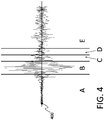
- FIG. 4 is an example of a set of sound values 170 ( FIG. 1 ) produces by a normal passage of the medium 110 ( FIG. 1 ) along the medium transport path 100 ( FIG. 1 ). Detection of the sound of the medium 110 ( FIG. 1 ) by the microphone 130 ( FIG. 1 ) begins at a signal start 400 in FIG. 4 .
- Region A in FIG. 4 corresponds to the medium 110 ( FIG. 1 ) passing from the first roller 120 ( FIG. 1 ) to the second roller 140 ( FIG. 1 ).
- Region B in FIG. 4 corresponds to the medium 110 ( FIG. 1 ) near the second roller 140 ( FIG. 1 ).
- Region C in FIG. 4 corresponds to the medium 110 ( FIG. 1 ) after it passes the second roller 140 ( FIG. 1 ).
- Region D in FIG. 4 corresponds to the medium 110 ( FIG. 1 ) after it passes Region C.
- Region E in FIG. 4 corresponds to the medium 110 ( FIG. 1 ) after it passes Region D.
- the compute moving window sum block 300 computes a sum of the most recent N 1 sound values 170 ( FIG. 1 ) scaled by the sensitivity setting 210 ( FIG. 2 ) where N 1 is typically a thousand.
- the moving sum calculation begins at the signal start 400 ( FIG. 4 ) and continues until a medium jam is detected or the end of the sound values 170 ( FIG. 1 ) has been reached.
- the compute high amplitude count block 320 counts the number of sound values 170 ( FIG. 1 ) scaled by the sensitivity setting 210 ( FIG. 2 ) greater than a high amplitude threshold where the high amplitude threshold is set to be higher than a majority of the sound values 170 ( FIG. 1 ) scaled by the sensitivity setting 210 ( FIG.
- block 520 compares the first post roller sum, P 1 , of the post roller sum 350 ( FIG. 3 ) and the second post roller sum, P 2 , of the post roller sum 350 ( FIG. 3 ) to a first post roller sum threshold, T 12 . If the first post roller sum, P 1 , of the post roller sum 350 ( FIG. 3 ) and the second post roller sum, P 2 , of the post roller sum 350 ( FIG.
- FIG. 6 is a detailed diagram of the detect jam block 220 ( FIG. 2 ) for an alternate embodiment of the present invention.
- a compute moving window sum block 600 produces a moving window sum 610 from the sound values 170 ( FIG. 1 ).
- a compute high amplitude count block 620 produces a high amplitude count 630 from the sound values 170 ( FIG. 1 ).
- a compute post roller sum block 640 produces a post roller sum 650 from the sound values 170 ( FIG. 1 ).
- a jam test block 660 tests the moving window sum 610, the high amplitude count 630, and the post roller sum 650 with the sensitivity setting 210 ( FIG. 2 ) and produces a YES result and indicates a jam 240 ( FIG. 2 ) if a medium jam is detected or a NO result and the medium transport system continues operation 230 ( FIG. 2 ) if a medium jam is not detected.
- FIG. 7 is a detailed diagram of the jam test block 660 ( FIG. 6 ).
- Block 700 compares the moving window sum, W, 610 ( FIG. 6 ) to a moving window sum threshold, T W , scaled by the sensitivity setting 210 ( FIG. 2 ). If the moving window sum, W, 610 ( FIG. 6 ) is greater than the moving window sum threshold, T W , scaled by the sensitivity setting 210 ( FIG. 2 ), a jam 240 ( FIG. 2 ) is indicated. If the moving window sum, W, 610 ( FIG. 6 ) is not greater than the moving window sum threshold, T W , scaled by the sensitivity setting 210 ( FIG. 2 ), then block 710 compares the high amplitude count, A, 630 ( FIG.
- first post roller sum threshold, T 12 scaled by the sensitivity setting 210 ( FIG. 2 ). If the first post roller sum, P 1 , of the post roller sum 650 ( FIG. 6 ) and the second post roller sum, P 2 , of the post roller sum 650 ( FIG. 6 ) are greater than the first post roller sum threshold, T 12 , scaled by the sensitivity setting 210 ( FIG. 2 ), a jam 240 ( FIG. 2 ) is indicated. If the first post roller sum, P 1 , of the post roller sum 650 ( FIG. 6 ) or the second post roller sum, P 2 , of the post roller sum 650 ( FIG.
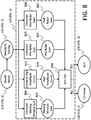
- a jam test block 840 tests the moving window sum 805, the high amplitude count 815, the pre roller sum 825, and the post roller sum 835 and produces a YES result and indicates a jam 240 ( FIG. 2 ) if a medium jam is detected or a NO result and the medium transport system continues operation 230 ( FIG. 2 ) if a medium jam is not detected.
- the compute moving window sum block 800 is as the previously described compute moving window sum block 300 ( FIG. 3 ).
- the compute high amplitude count block 810 is as the previously described compute high amplitude count block 320 ( FIG. 3 ).
- the compute pre roller sum block 820 computes the pre roller sum 825 by computing a moving sum of the most recent N 3 sound values 170 ( FIG. 1 ) scaled by the sensitivity setting 210 ( FIG. 2 ) within Region A in FIG. 4 where N 3 is typically 500.
- the compute post roller sum block 830 is as the previously described compute post roller sum block 340 ( FIG. 3 ).
- FIG. 9 is a detailed diagram of the jam test block 840 ( FIG. 8 ).
- Block 900 compares the moving window sum, W, 805 ( FIG. 8 ) to a moving window sum threshold, T W . If the moving window sum, W, 805 ( FIG. 8 ) is greater than the moving window sum threshold, T W , a jam 240 ( FIG. 2 ) is indicated. If the moving window sum, W, 805 ( FIG. 8 ) is not greater than the moving window sum threshold, T W , then block 910 compares the high amplitude count, A, 815 ( FIG. 8 ) to a high amplitude count threshold, T A . If the high amplitude count, A, 815 ( FIG.
- FIG. 10 is a detailed diagram of the detect jam block 220 ( FIG. 2 ) for an alternate embodiment of the present invention.
- a compute moving window sum block 1000 produces a moving window sum 1005 from the sound values 170 ( FIG. 1 ).
- a compute high amplitude count block 1010 produces a high amplitude count 1015 from the sound values 170 ( FIG. 1 ).
- a compute pre roller sum block 1020 produces a pre roller sum 1025 from the sound values 170 ( FIG. 1 ).
- a compute post roller sum block 1030 produces a post roller sum 1035 from the sound values 170 ( FIG. 1 ).
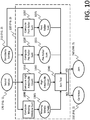
- a jam test block 1040 tests the moving window sum 1005, the high amplitude count 1015, the pre roller sum 1025, and the post roller sum 1035 with the sensitivity setting 210 ( FIG. 2 ) and produces a YES result and indicates a jam 240 ( FIG. 2 ) if a medium jam is detected or a NO result and the medium transport system continues operation 230 ( FIG. 2 )
- the compute moving window sum block 1000 is as the previously described compute moving window sum block 600 ( FIG. 6 ).
- the compute high amplitude count block 1010 is as the previously described compute high amplitude count block 620 ( FIG. 6 ).
- the compute pre roller sum block 1020 computes the pre roller sum 1025 by computing a moving sum of the most recent N 3 sound values 170 ( FIG. 1 ) within Region A in FIG. 4 where N 3 is typically 500.
- the compute post roller sum block 1030 is as the previously described compute post roller sum block 640 ( FIG. 6 ).
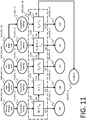
- FIG. 11 is a detailed diagram of the jam test block 1040 ( FIG. 10 ).
- Block 1100 compares the moving window sum, W, 1005 ( FIG. 10 ) to a moving window sum threshold, T W , scaled by the sensitivity setting 210 ( FIG. 2 ). If the moving window sum, W, 1005 ( FIG. 10 ) is greater than the moving window sum threshold, T W , scaled by the sensitivity setting 210 ( FIG. 2 ), a jam 240 ( FIG. 2 ) is indicated. If the moving window sum, W, 1005 ( FIG. 10 ) is not greater than the moving window sum threshold, T W , scaled by the sensitivity setting 210 ( FIG. 2 ), then block 1110 compares the high amplitude count, A, 1015 ( FIG.
- block 1120 compares the pre roller sum 1025 ( FIG. 10 ) to a pre roller sum threshold, T 0 , scaled by the sensitivity setting 210 ( FIG. 2 ).
- block 1130 compares the first post roller sum, P 1 , of the post roller sum 1035 ( FIG. 10 ) and the second post roller sum, P 2 , of the post roller sum 1035 ( FIG. 10 ) to a first post roller sum threshold, T 12 , scaled by the sensitivity setting 210 ( FIG. 2 ).
- block 1140 compares the third post roller sum, P 3 , of the post roller sum 1035 ( FIG. 10 ) to a second post roller sum threshold, T 3 , scaled by the sensitivity setting 210 ( FIG. 2 ). If the third post roller sum, P 3 , of the post roller sum 1035 ( FIG. 10 ) is greater than the second post roller sum threshold, T 3 , scaled by the sensitivity setting 210 ( FIG. 2 ), a jam 240 ( FIG. 2 ) is indicated. If the third post roller sum, P 3 , of the post roller sum 1035 ( FIG. 10 ) is not greater than the second post roller sum threshold, T 3 , scaled by the sensitivity setting 210 ( FIG. 2 ), then the medium transport system continues operation 230 ( FIG. 2 ).
- the coefficients A and B are determined by evaluating a training set of known frequency values for jams and normal feeds and determining the values of A and B that separate the two populations of medium feeds.
- FIG. 14 is a detailed diagram of the detect jam block 220 ( FIG. 2 ) for an alternate non-claimed embodiment of the present disclosure.
- a compute frequency extent block 1400 produces a frequency extent 1410 from the frequency values 1210 ( FIG. 12 ).
- a compute frame energy block 1420 produces a frame energy 1430 from the frequency values 1210 ( FIG. 12 ).
- a compute frame energy threshold block 1440 produces a frame energy threshold 1450 from the frame energy 1430.
- Block 1460 tests the frequency extent, F MAX , 1410 and the frame energy threshold, T E , 1450 scaled by the sensitivity setting 210 ( FIG. 2 ) and produces a YES result and indicates a jam 240 ( FIG.
- the compute frequency block 1400 produces the frequency extent 1410 by searching the frequency values 1210 ( FIG. 12 ) for a lowest frequency with a frequency value less than or equal to a frequency extent threshold.
- the lowest frequency becomes the frequency extent 1410.
- the frequency extent threshold is set at the frequency value where noise begins to dominate.
- the compute frame energy block 1420 produces the frame energy 1430 by summing the frequency values 1210 ( FIG. 12 ) in groups of N F values where N F is typically 64.
- the coefficients A and B are determined by evaluating a training set of known frequency values for jams and normal feeds and determining the values of A and B that separate the two populations of medium feeds.
- a computer program product can include one or more non-transitory, tangible, computer readable storage medium, for example; magnetic storage media such as magnetic disk (such as a floppy disk) or magnetic tape; optical storage media such as optical disk, optical tape, or machine readable bar code; solid-state electronic storage devices such as random access memory (RAM), or read-only memory (ROM); or any other physical device or media employed to store a computer program having instructions for controlling one or more computers to practice the method according to the present invention.
- magnetic storage media such as magnetic disk (such as a floppy disk) or magnetic tape
- optical storage media such as optical disk, optical tape, or machine readable bar code
- solid-state electronic storage devices such as random access memory (RAM), or read-only memory (ROM); or any other physical device or media employed to store a computer program having instructions for controlling one or more computers to practice the method according to the present invention.
Landscapes
- Physics & Mathematics (AREA)
- General Physics & Mathematics (AREA)
- Engineering & Computer Science (AREA)
- Mechanical Engineering (AREA)
- Controlling Sheets Or Webs (AREA)
- Measurement Of Mechanical Vibrations Or Ultrasonic Waves (AREA)
Description
- This application claims priority to
U.S. Patent Application No. 14/263,171; filed April 28, 2014 U.S. Provisional Patent Application No. 61/831,654; filed June 6, 2013 - Reference is also made to commonly assigned, co-pending
U.S. Patent Application Serial No. 13/786,502 filed March 6, 2013 U.S. Patent Application Serial No. 13/312,601 filed December 16, 2011 - This invention pertains to the field of indicating medium jams in a medium transport system and more particularly to a method for detecting and processing sound values in order to indicate a medium jam.
- It is well known to those skilled in the art that the sound a sheet of paper makes as it moves along a paper transport path is a way of diagnosing the condition of the paper. Quiet or uniform sounds can indicate a normal or problem-free passage of the paper along the paper transport path. Loud or non-uniform sounds can indicate a disruption in the passage of the sheet of paper such as a stoppage due to jamming or tearing or other physical damage of the paper. In commonly assigned
U.S. Patent No. 4,463,607 to Hilton et al. , entitled "Apparatus for Detecting the Condition of a Sheet," a paper transport cylinder with a specialized profile is used to enhance the diagnostic qualities of the paper transport noise in order to detect paper wear. The problem with this approach is that the specialized paper transport cylinder is designed to induce stresses into the paper that would interfere with smooth paper transport at high transport speeds. Commonly assignedU.S. Patent 5,393,043 to Nitta , entitled "Image Forming Apparatus with Automatic Paper Supply Mechanism," describes using optical or mechanical sensors in order to detect the times of the passage of a sheet of paper at various locations along the paper transport path. If the paper does not arrive at a given location at a given amount of time after the start of transport, a paper jam is inferred. The problem with this approach is that optical and mechanical sensors are highly localized in physical detection range, requiring the use of several such sensors situated along the paper transport path. - Commonly assigned
U.S. Patent Application Publication No. 2012/0235929 to Hongo et al , entitled "Paper Feeding Device, Image Scanning Device, Paper Feeding Method and Computer Readable Medium," describes placing a microphone near the beginning of a paper feed path in order to detect the sound of a paper jam in progress. The signal from the microphone is processed by counting the number of sound samples above a given threshold within a sampling window of a given width. If the count is sufficiently large, i.e., above a threshold value, a paper jam is signaled. The problem with this approach is the loss of localized information about the paper as it moves along the transport path as provided by the previously discussed prior art methods. An additional problem with this approach is the lack of automatic adjustment of the threshold value due to factors such as a change in paper type or machine wear. - There remains a need for a fast and robust technique to indicate paper jams along a paper transport path that uses a single paper sensor, processes the signals from the paper sensor simply in a way that incorporates the location of the paper along the paper transport path, and automatically adjusts itself in response to changing paper types and machine wear.
-
EP 1 612 168 (A1 ), which is considered the closest prior art, relates to a sheet feeding apparatus which sets a threshold that enables, in double feed detection using ultrasonic waves, the double feed to be detected without fail even in a case that the sensor output is varied by fluctuations in the sensitivity or sound pressure of the ultrasonic sensor and the like. - The present invention represents a method of indicating a medium misfeed along a medium transport path according to claim 1.
- The present invention has the advantage that a microphone can detect the sound of a medium jamming over a larger physical area than optical or mechanic methods which are localized in nature. As a result, one microphone can replace the need for several optical or mechanic sensors.
- The present invention has the additional advantage that it processes sound values over the entire medium transport path and at specific locations along the medium transport path thereby improving medium jam detection accuracy and reliability over many prior art methods.
- The present invention has the additional advantage that the sound value processing is simple as it includes computing sums of the sound values produced from the microphone signals. More computationally intensive methods such as transformations into frequency space or signal processing methods such a median filtering are avoided, resulting in sound value processing that requires substantially less computation resources and processing time than many prior art methods.
- The present invention has the additional advantage that jam detection sensitivity is automatically adjusted in response to the sustained loudness of normal movement of a medium along a medium transport path. Since the sustained loudness is both a function of the medium type and the medium transport path, the jam detection process automatically adjusts to changes in either, e.g., switching to a new medium type or machine wear.
-
-
FIG. 1 is a high-level diagram showing the components of a medium transport system according to an embodiment of the present invention; -
FIG. 2 is a block diagram illustrating a process for indicating a medium jam according to an embodiment of present invention; -
FIG. 3 is a block diagram showing additional details for the detect jam block inFIG. 2 ; -
FIG. 4 is an example of the sound values inFIG. 1 ; -
FIG. 5 is a block diagram showing additional details for the jam test block inFIG. 3 ; -
FIG. 6 is a block diagram showing additional details for the detect jam block inFIG. 2 according to an alternate embodiment of present invention; -
FIG. 7 is a block diagram showing additional details for the jam test block inFIG. 6 ; -
FIG. 8 is a block diagram showing additional details for the detect jam block inFIG. 2 according to an alternate embodiment of present invention; -
FIG. 9 is a block diagram showing additional details for the jam test block inFIG. 8 ; -
FIG. 10 is a block diagram showing additional details for the detect jam block inFIG. 2 according to an alternate embodiment of present invention; -
FIG. 11 is a block diagram showing additional details for the jam test block inFIG. 10 ; -
FIG. 12 is a block diagram illustrating a process for computing frequency values according to an embodiment of present invention; -
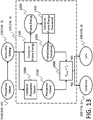
FIG. 13 is a block diagram showing additional details for the detect jam block inFIG. 2 according to an alternate embodiment of present invention; and -
FIG. 14 is a block diagram showing additional details for the detect jam block inFIG. 2 according to an alternate embodiment of present invention. - It is to be understood that the attached drawings are for purposes of illustrating the concepts of the invention and may not be to scale.
- In the following description, some embodiments of the present invention will be described in terms that would ordinarily be implemented as software programs. Those skilled in the art will readily recognize that the equivalent of such software can also be constructed in hardware. Because image manipulation algorithms and systems are well known, the present description will be directed in particular to algorithms and systems forming part of, or cooperating more directly with, the method in accordance with the present invention. Other aspects of such algorithms and systems, together with hardware and software for producing and otherwise processing the signals involved therewith, not specifically shown or described herein can be selected from such systems, algorithms, components, and elements known in the art. Given the system as described according to the invention in the following, software not specifically shown, suggested, or described herein that is useful for implementation of the invention is conventional and within the ordinary skill in such arts.
-
FIG. 1 is a block diagram of a medium transport system for a preferred embodiment of the present invention. Amedium 110 is moved along amedium transport path 100 by a set of rollers collectively referred to as afirst roller 120 and a set of rollers collectively referred to as asecond roller 140. Examples of themedium 110 are paper, photographic film, and magnetic recording media. Other examples of themedium 110 will be evident to those skilled in the art. Amicrophone 130 detects the sound of themedium 110 conveyed along themedium transport path 100 and produces asignal 150 representing the sound. Examples of themicrophone 130 are audio microphones, electrostatic sensors, and piezoelectric sensors. Other examples of themicrophone 130 will be evident to those skilled in the art. Aprocessor 160 producessound values 170 from thesignal 150. -
FIG. 2 is a flowchart of a signal processing portion of the preferred embodiment of the present invention. A computesensitivity setting block 200 produces asensitivity setting 210 from the sound values 170 (FIG. 1 ). Adetect jam block 220 tests the sound values 170 (FIG. 1 ) with thesensitivity setting 210 and produces a YES result and indicates ajam 240 if a medium jam is detected or a NO result and the medium transport system continuesoperation 230 if a medium jam is not detected. Examples of a medium jam are stoppages of medium movement along the medium transport path 100 (FIG. 1 ), multiple sheets of medium 110 (FIG. 1 ) simultaneously fed into the medium transport path 100 (FIG. 1 ) designed to convey only single sheets of medium 110 (FIG. 1 ) at one time, and wrinkling, tearing, or other physical damage to the medium 110 (FIG. 1 ). Other examples of medium jams will be evident to those skilled in the art. - In
FIG. 2 the computesensitivity setting block 200 produces the sensitivity setting 210 responsive to a sustained loudness value of the sound values 170 (FIG. 1 ). In the preferred embodiment of the present invention the sustained loudness value is determined from the sound values 170 (FIG. 1 ) produced by the normal movement (free of jams) of the medium 110 (FIG. 1 ) before the first roller 120 (FIG. 1 ). In an alternate embodiment of the present invention the sustained loudness value is determined from the sound values 170 (FIG. 1 ) produced by the normal movement (free of jams) of the medium 110 (FIG. 1 ) after the second roller 140 (FIG. 1 ). Other ways of determining the sustained loudness value will be evident to those skilled in the art. The sensitivity setting 210 is a ratio of a standard loudness value to the sustained loudness value. The standard loudness value is the expected loudness value for a medium transport path 100 (FIG. 1 ) conveying a medium 110 (FIG. 1 ) in a normal manner without medium jams. -
FIG. 3 is a detailed diagram of the detect jam block 220 (FIG. 2 ). A compute movingwindow sum block 300 produces a movingwindow sum 310 from the sound values 170 (FIG. 1 ) and the sensitivity setting 210 (FIG. 2 ). A compute highamplitude count block 320 produces ahigh amplitude count 330 from the sound values 170 (FIG. 1 ) and the sensitivity setting 210 (FIG. 2 ). A compute postroller sum block 340 produces apost roller sum 350 from the sound values 170 (FIG. 1 ) and the sensitivity setting 210 (FIG. 2 ). A jam test block 360 tests the movingwindow sum 310, thehigh amplitude count 330, and thepost roller sum 350 and produces a YES result and indicates a jam 240 (FIG. 2 ) if a medium jam is detected or a NO result and the medium transport system continues operation 230 (FIG. 2 ) if a medium jam is not detected. -
FIG. 4 is an example of a set of sound values 170 (FIG. 1 ) produces by a normal passage of the medium 110 (FIG. 1 ) along the medium transport path 100 (FIG. 1 ). Detection of the sound of the medium 110 (FIG. 1 ) by the microphone 130 (FIG. 1 ) begins at asignal start 400 inFIG. 4 . Region A inFIG. 4 corresponds to the medium 110 (FIG. 1 ) passing from the first roller 120 (FIG. 1 ) to the second roller 140 (FIG. 1 ). Region B inFIG. 4 corresponds to the medium 110 (FIG. 1 ) near the second roller 140 (FIG. 1 ). Region C inFIG. 4 corresponds to the medium 110 (FIG. 1 ) after it passes the second roller 140 (FIG. 1 ). Region D inFIG. 4 corresponds to the medium 110 (FIG. 1 ) after it passes Region C. Region E inFIG. 4 corresponds to the medium 110 (FIG. 1 ) after it passes Region D. - In
FIG. 3 the compute movingwindow sum block 300 computes a sum of the most recent N1 sound values 170 (FIG. 1 ) scaled by the sensitivity setting 210 (FIG. 2 ) where N1 is typically a thousand. The moving sum calculation begins at the signal start 400 (FIG. 4 ) and continues until a medium jam is detected or the end of the sound values 170 (FIG. 1 ) has been reached. The compute high amplitude count block 320 counts the number of sound values 170 (FIG. 1 ) scaled by the sensitivity setting 210 (FIG. 2 ) greater than a high amplitude threshold where the high amplitude threshold is set to be higher than a majority of the sound values 170 (FIG. 1 ) scaled by the sensitivity setting 210 (FIG. 2 ) produced by a normal passage of the medium 110 (FIG. 1 ) along the medium transport path 100 (FIG. 1 ). The high amplitude count begins at the signal start 400 (FIG. 4 ) and continues until a medium jam is detected or the end of the sound values 170 (FIG. 1 ) has been reached. The compute postroller sum block 340 computes at least one sum of sound values 170 (FIG. 1 ) scaled by the sensitivity setting 210 (FIG. 2 ) corresponding to Regions C, D, and E inFIG. 4 . In the preferred embodiment of the present invention the compute postroller sum block 340 computes three sums of sound values 170 (FIG. 1 ) scaled by the sensitivity setting 210 (FIG. 2 ). The compute postroller sum block 340 computes a first post roller sum by computing a sum of the sound values 170 (FIG. 1 ) scaled by the sensitivity setting 210 (FIG. 2 ) corresponding to Region C inFIG. 4 . Region C inFIG. 4 typically includes 500 sound values 170 (FIG. 1 ). The compute postroller sum block 340 computes a second post roller sum by computing a sum of the sound values 170 (FIG. 1 ) scaled by the sensitivity setting 210 (FIG. 2 ) corresponding to Region D inFIG. 4 . Region D inFIG. 4 typically includes 500 sound values 170 (FIG. 1 ). The compute postroller sum block 340 computes a third post roller sum by computing a moving sum of the most recent N2 sound values 170 (FIG. 1 ) scaled by the sensitivity setting 210 (FIG. 2 ) within Regions C, D, and E inFIG. 4 where N2 is typically 500. -
FIG. 5 is a detailed diagram of the jam test block 360 (FIG. 3 ).Block 500 compares the moving window sum, W, 310 (FIG. 3 ) to a moving window sum threshold, TW. If the moving window sum, W, 310 (FIG. 3 ) is greater than the moving window sum threshold, TW, a jam 240 (FIG. 2 ) is indicated. If the moving window sum, W, 310 (FIG. 3 ) is not greater than the moving window sum threshold, TW, then block 510 compares the high amplitude count, A, 330 (FIG. 3 ) to a high amplitude count threshold, TA. If the high amplitude count, A, 330 (FIG. 3 ) is greater than the high amplitude count threshold, TA, a jam 240 (FIG. 2 ) is indicated. If the high amplitude count, A, 330 (FIG. 3 ) is not greater than the high amplitude count threshold, TA, then block 520 compares the first post roller sum, P1, of the post roller sum 350 (FIG. 3 ) and the second post roller sum, P2, of the post roller sum 350 (FIG. 3 ) to a first post roller sum threshold, T12. If the first post roller sum, P1, of the post roller sum 350 (FIG. 3 ) and the second post roller sum, P2, of the post roller sum 350 (FIG. 3 ) are greater than the first post roller sum threshold, T12, a jam 240 (FIG. 2 ) is indicated. If the first post roller sum, P1, of the post roller sum 350 (FIG. 3 ) or the second post roller sum, P2, of the post roller sum 350 (FIG. 3 ) is not greater than the first post roller sum threshold, T12, then block 530 compares the third post roller sum, P3, of the post roller sum 350 (FIG. 3 ) to a second post roller sum threshold, T3. If the third post roller sum, P3, of the post roller sum 350 (FIG. 3 ) is greater than the second post roller sum threshold, T3, a jam 240 (FIG. 2 ) is indicated. If the third post roller sum, P3, of the post roller sum 350 (FIG. 3 ) is not greater than the second post roller sum threshold, T3, then the medium transport system continues operation 230 (FIG. 2 ). -
FIG. 6 is a detailed diagram of the detect jam block 220 (FIG. 2 ) for an alternate embodiment of the present invention. A compute movingwindow sum block 600 produces a movingwindow sum 610 from the sound values 170 (FIG. 1 ). A compute highamplitude count block 620 produces ahigh amplitude count 630 from the sound values 170 (FIG. 1 ). A compute postroller sum block 640 produces apost roller sum 650 from the sound values 170 (FIG. 1 ). A jam test block 660 tests the movingwindow sum 610, thehigh amplitude count 630, and thepost roller sum 650 with the sensitivity setting 210 (FIG. 2 ) and produces a YES result and indicates a jam 240 (FIG. 2 ) if a medium jam is detected or a NO result and the medium transport system continues operation 230 (FIG. 2 ) if a medium jam is not detected. - In
FIG. 6 the compute movingwindow sum block 600 computes a sum of the most recent N1 sound values 170 (FIG. 1 ) where N1 is typically a thousand. The moving sum calculation begins at the signal start 400 (FIG. 4 ) and continues until a medium jam is detected or the end of the sound values 170 (FIG. 1 ) has been reached. The compute high amplitude count block 620 counts the number of sound values 170 (FIG. 1 ) greater than a high amplitude threshold where the high amplitude threshold is set to be higher than a majority of the sound values 170 (FIG. 1 ) produced by a normal passage of the medium 110 (FIG. 1 ) along the medium transport path 100 (FIG. 1 ). The high amplitude count begins at the signal start 400 (FIG. 4 ) and continues until a medium jam is detected or the end of the sound values 170 (FIG. 1 ) has been reached. The compute postroller sum block 640 computes at least one sum of sound values 170 (FIG. 1 ) corresponding to Regions C, D, and E inFIG. 4 . In the preferred embodiment of the present invention the compute postroller sum block 640 computes three sums of sound values 170 (FIG. 1 ). The compute postroller sum block 640 computes a first post roller sum by computing a sum of the sound values 170 (FIG. 1 ) corresponding to Region C inFIG. 4 . Region C inFIG. 4 typically includes 500 sound values 170 (FIG. 1 ). The compute postroller sum block 640 computes a second post roller sum by computing a sum of the sound values 170 (FIG. 1 ) corresponding to Region D inFIG. 4 . Region D inFIG. 4 typically includes 500 sound values 170 (FIG. 1 ). The compute postroller sum block 640 computes a third post roller sum by computing a moving sum of the most recent N2 sound values 170 (FIG. 1 ) within Regions C, D, and E inFIG. 4 where N2 is typically 500. -
FIG. 7 is a detailed diagram of the jam test block 660 (FIG. 6 ).Block 700 compares the moving window sum, W, 610 (FIG. 6 ) to a moving window sum threshold, TW, scaled by the sensitivity setting 210 (FIG. 2 ). If the moving window sum, W, 610 (FIG. 6 ) is greater than the moving window sum threshold, TW, scaled by the sensitivity setting 210 (FIG. 2 ), a jam 240 (FIG. 2 ) is indicated. If the moving window sum, W, 610 (FIG. 6 ) is not greater than the moving window sum threshold, TW, scaled by the sensitivity setting 210 (FIG. 2 ), then block 710 compares the high amplitude count, A, 630 (FIG. 6 ) to a high amplitude count threshold, TA, scaled by the sensitivity setting 210 (FIG. 2 ). If the high amplitude count, A, 630 (FIG. 6 ) is greater than the high amplitude count threshold, TA, scaled by the sensitivity setting 210 (FIG. 2 ), a jam 240 (FIG. 2 ) is indicated. If the high amplitude count, A, 630 (FIG. 6 ) is not greater than the high amplitude count threshold, TA, scaled by the sensitivity setting 210 (FIG. 2 ), then block 720 compares the first post roller sum, P1, of the post roller sum 650 (FIG. 6 ) and the second post roller sum, P2, of the post roller sum 650 (FIG. 6 ) to a first post roller sum threshold, T12, scaled by the sensitivity setting 210 (FIG. 2 ). If the first post roller sum, P1, of the post roller sum 650 (FIG. 6 ) and the second post roller sum, P2, of the post roller sum 650 (FIG. 6 ) are greater than the first post roller sum threshold, T12, scaled by the sensitivity setting 210 (FIG. 2 ), a jam 240 (FIG. 2 ) is indicated. If the first post roller sum, P1, of the post roller sum 650 (FIG. 6 ) or the second post roller sum, P2, of the post roller sum 650 (FIG. 6 ) is not greater than the first post roller sum threshold, T12, scaled by the sensitivity setting 210 (FIG. 2 ), then block 730 compares the third post roller sum, P3, of the post roller sum 650 (FIG. 6 ) to a second post roller sum threshold, T3, scaled by the sensitivity setting 210 (FIG. 2 ). If the third post roller sum, P3, of the post roller sum 650 (FIG. 6 ) is greater than the second post roller sum threshold, T3, scaled by the sensitivity setting 210 (FIG. 2 ), a jam 240 (FIG. 2 ) is indicated. If the third post roller sum, P3, of the post roller sum 650 (FIG. 6 ) is not greater than the second post roller sum threshold, T3, scaled by the sensitivity setting 210 (FIG. 2 ), then the medium transport system continues operation 230 (FIG. 2 ). -
FIG. 8 is a detailed diagram of the detect jam block 220 (FIG. 2 ) for an alternate embodiment of the present invention. A compute movingwindow sum block 800 produces a movingwindow sum 805 from the sound values 170 (FIG. 1 ) and the sensitivity setting 210 (FIG. 2 ). A compute highamplitude count block 810 produces ahigh amplitude count 815 from the sound values 170 (FIG. 1 ) and the sensitivity setting 210 (FIG. 2 ). A compute preroller sum block 820 produces apre roller sum 825 from the sound values 170 (FIG. 1 ) and the sensitivity setting 210 (FIG. 2 ). A compute postroller sum block 830 produces apost roller sum 835 from the sound values 170 (FIG. 1 ) and the sensitivity setting 210 (FIG. 2 ). A jam test block 840 tests the movingwindow sum 805, thehigh amplitude count 815, thepre roller sum 825, and thepost roller sum 835 and produces a YES result and indicates a jam 240 (FIG. 2 ) if a medium jam is detected or a NO result and the medium transport system continues operation 230 (FIG. 2 ) if a medium jam is not detected. - In
FIG. 8 the compute movingwindow sum block 800 is as the previously described compute moving window sum block 300 (FIG. 3 ). The compute highamplitude count block 810 is as the previously described compute high amplitude count block 320 (FIG. 3 ). The compute preroller sum block 820 computes thepre roller sum 825 by computing a moving sum of the most recent N3 sound values 170 (FIG. 1 ) scaled by the sensitivity setting 210 (FIG. 2 ) within Region A inFIG. 4 where N3 is typically 500. The compute postroller sum block 830 is as the previously described compute post roller sum block 340 (FIG. 3 ). -
FIG. 9 is a detailed diagram of the jam test block 840 (FIG. 8 ).Block 900 compares the moving window sum, W, 805 (FIG. 8 ) to a moving window sum threshold, TW. If the moving window sum, W, 805 (FIG. 8 ) is greater than the moving window sum threshold, TW, a jam 240 (FIG. 2 ) is indicated. If the moving window sum, W, 805 (FIG. 8 ) is not greater than the moving window sum threshold, TW, then block 910 compares the high amplitude count, A, 815 (FIG. 8 ) to a high amplitude count threshold, TA. If the high amplitude count, A, 815 (FIG. 8 ) is greater than the high amplitude count threshold, TA, a jam 240 (FIG. 2 ) is indicated. If the high amplitude count, A, 815 (FIG. 8 ) is not greater than the high amplitude count threshold, TA, then block 920 compares the pre roller sum 825 (FIG. 8 ) to a pre roller sum threshold, T0. If the pre roller sum 825 (FIG. 8 ) is greater than the pre roller sum threshold, T0, a jam 240 (FIG. 2 ) is indicated. If the pre roller sum 825 (FIG. 8 ) is not greater than the pre roller sum threshold, T0, then block 930 compares the first post roller sum, P1, of the post roller sum 835 (FIG. 8 ) and the second post roller sum, P2, of the post roller sum 835 (FIG. 8 ) to a first post roller sum threshold, T12. If the first post roller sum, P1, of the post roller sum 835 (FIG. 8 ) and the second post roller sum, P2, of the post roller sum 835 (FIG. 8 ) are greater than the first post roller sum threshold, T12, a jam 240 (FIG. 2 ) is indicated. If the first post roller sum, P1, of the post roller sum 835 (FIG. 8 ) or the second post roller sum, P2, of the post roller sum 835 (FIG. 8 ) are not greater than the first post roller sum threshold, T12, then block 940 compares the third post roller sum, P3, of the post roller sum 835 (FIG. 8 ) to a second post roller sum threshold, T3. If the third post roller sum, P3, of the post roller sum 835 (FIG. 8 ) is greater than the second post roller sum threshold, T3, a jam 240 (FIG. 2 ) is indicated. If the third post roller sum, P3, of the post roller sum 835 (FIG. 8 ) is not greater than the second post roller sum threshold, T3, then the medium transport system continues operation 230 (FIG. 2 ). -
FIG. 10 is a detailed diagram of the detect jam block 220 (FIG. 2 ) for an alternate embodiment of the present invention. A compute movingwindow sum block 1000 produces a movingwindow sum 1005 from the sound values 170 (FIG. 1 ). A compute highamplitude count block 1010 produces ahigh amplitude count 1015 from the sound values 170 (FIG. 1 ). A compute preroller sum block 1020 produces apre roller sum 1025 from the sound values 170 (FIG. 1 ). A compute postroller sum block 1030 produces apost roller sum 1035 from the sound values 170 (FIG. 1 ). Ajam test block 1040 tests the movingwindow sum 1005, thehigh amplitude count 1015, thepre roller sum 1025, and thepost roller sum 1035 with the sensitivity setting 210 (FIG. 2 ) and produces a YES result and indicates a jam 240 (FIG. 2 ) if a medium jam is detected or a NO result and the medium transport system continues operation 230 (FIG. 2 ) if a medium jam is not detected. - In
FIG. 10 the compute movingwindow sum block 1000 is as the previously described compute moving window sum block 600 (FIG. 6 ). The compute highamplitude count block 1010 is as the previously described compute high amplitude count block 620 (FIG. 6 ). The compute preroller sum block 1020 computes thepre roller sum 1025 by computing a moving sum of the most recent N3 sound values 170 (FIG. 1 ) within Region A inFIG. 4 where N3 is typically 500. The compute postroller sum block 1030 is as the previously described compute post roller sum block 640 (FIG. 6 ). -
FIG. 11 is a detailed diagram of the jam test block 1040 (FIG. 10 ).Block 1100 compares the moving window sum, W, 1005 (FIG. 10 ) to a moving window sum threshold, TW, scaled by the sensitivity setting 210 (FIG. 2 ). If the moving window sum, W, 1005 (FIG. 10 ) is greater than the moving window sum threshold, TW, scaled by the sensitivity setting 210 (FIG. 2 ), a jam 240 (FIG. 2 ) is indicated. If the moving window sum, W, 1005 (FIG. 10 ) is not greater than the moving window sum threshold, TW, scaled by the sensitivity setting 210 (FIG. 2 ), then block 1110 compares the high amplitude count, A, 1015 (FIG. 10 ) to a high amplitude count threshold, TA, scaled by the sensitivity setting 210 (FIG. 2 ). If the high amplitude count, A, 1015 (FIG. 10 ) is greater than the high amplitude count threshold, TA, scaled by the sensitivity setting 210 (FIG. 2 ), a jam 240 (FIG. 2 ) is indicated. If the high amplitude count, A, 1015 (FIG. 10 ) is not greater than the high amplitude count threshold, TA, scaled by the sensitivity setting 210 (FIG. 2 ), then block 1120 compares the pre roller sum 1025 (FIG. 10 ) to a pre roller sum threshold, T0, scaled by the sensitivity setting 210 (FIG. 2 ). If the pre roller sum 1025 (FIG. 10 ) is greater than the pre roller sum threshold, T0, scaled by the sensitivity setting 210 (FIG. 2 ), a jam 240 (FIG. 2 ) is indicated. If the pre roller sum 1025 (FIG. 10 ) is not greater than the pre roller sum threshold, T0, scaled by the sensitivity setting 210 (FIG. 2 ), then block 1130 compares the first post roller sum, P1, of the post roller sum 1035 (FIG. 10 ) and the second post roller sum, P2, of the post roller sum 1035 (FIG. 10 ) to a first post roller sum threshold, T12, scaled by the sensitivity setting 210 (FIG. 2 ). If the first post roller sum, P1, of the post roller sum 1035 (FIG. 10 ) and the second post roller sum, P2, of the post roller sum 1035 (FIG. 10 ) are greater than the first post roller sum threshold, T12, scaled by the sensitivity setting 210 (FIG. 2 ), a jam 240 (FIG. 2 ) is indicated. If the first post roller sum, P1, of the post roller sum 1035 (FIG. 10 ) or the second post roller sum, P2, of the post roller sum 1035 (FIG. 10 ) are not greater than the first post roller sum threshold, T12, scaled by the sensitivity setting 210 (FIG. 2 ), then block 1140 compares the third post roller sum, P3, of the post roller sum 1035 (FIG. 10 ) to a second post roller sum threshold, T3, scaled by the sensitivity setting 210 (FIG. 2 ). If the third post roller sum, P3, of the post roller sum 1035 (FIG. 10 ) is greater than the second post roller sum threshold, T3, scaled by the sensitivity setting 210 (FIG. 2 ), a jam 240 (FIG. 2 ) is indicated. If the third post roller sum, P3, of the post roller sum 1035 (FIG. 10 ) is not greater than the second post roller sum threshold, T3, scaled by the sensitivity setting 210 (FIG. 2 ), then the medium transport system continues operation 230 (FIG. 2 ). -
FIG. 12 is a flowchart of a signal processing portion of an alternate non-claimed embodiment of the present disclosure. A compute frequency values block 1200 producesfrequency values 1210 from the sound values 170 (FIG. 1 ). The compute frequency values block 1200 produces thefrequency values 1210 using Fourier Transform techniques well known in the art. Other ways of computing thefrequency values 1210 such as with wavelets will be evident to those skilled in the art. -
FIG. 13 is a detailed diagram of the detect jam block 220 (FIG. 2 ) for an alternate non-claimed embodiment of the present disclosure. A computefrequency extent block 1300 produces afrequency extent 1310 from the frequency values 1210 (FIG. 12 ) and the sensitivity setting 210 (FIG. 2 ). A computeframe energy block 1320 produces aframe energy 1330 from the frequency values 1210 (FIG. 12 ) and the sensitivity setting 210 (FIG. 2 ). A compute frameenergy threshold block 1340 produces aframe energy threshold 1350 from theframe energy 1330.Block 1360 tests the frequency extent, FMAX, 1310 and the frame energy threshold, TE, 1350 and produces a YES result and indicates a jam 240 (FIG. 2 ) if FMAX is greater than TE or a NO result and the medium transport system continues operation 230 (FIG. 2 ) if FMAX is less than or equal to TE. - In
FIG. 13 thecompute frequency block 1300 produces thefrequency extent 1310 by searching the frequency values 1210 (FIG. 12 ) that are scaled by the sensitivity setting 210 (FIG. 2 ) for a lowest frequency with a frequency value less than or equal to a frequency extent threshold. The lowest frequency becomes thefrequency extent 1310. The frequency extent threshold is set at the frequency value scaled by the sensitivity setting 210 (FIG. 2 ) where noise begins to dominate. The computeframe energy block 1320 produces theframe energy 1330 by summing the frequency values 1210 (FIG. 12 ) that are scaled by the sensitivity setting 210 (FIG. 2 ) in groups of NF values where NF is typically 64. The compute frameenergy threshold block 1340 produces the frame energy threshold, TE, 1350 by a linear transform of theframe energy 1330 of the form TE = A × frame energy + B. The coefficients A and B are determined by evaluating a training set of known frequency values for jams and normal feeds and determining the values of A and B that separate the two populations of medium feeds. -
FIG. 14 is a detailed diagram of the detect jam block 220 (FIG. 2 ) for an alternate non-claimed embodiment of the present disclosure. A computefrequency extent block 1400 produces afrequency extent 1410 from the frequency values 1210 (FIG. 12 ). A computeframe energy block 1420 produces aframe energy 1430 from the frequency values 1210 (FIG. 12 ). A compute frameenergy threshold block 1440 produces aframe energy threshold 1450 from theframe energy 1430.Block 1460 tests the frequency extent, FMAX, 1410 and the frame energy threshold, TE, 1450 scaled by the sensitivity setting 210 (FIG. 2 ) and produces a YES result and indicates a jam 240 (FIG. 2 ) if FMAX is greater than TE scaled by the sensitivity setting 210 (FIG. 2 ) or a NO result and the medium transport system continues operation 230 (FIG. 2 ) if FMAX is less than or equal to TE scaled by the sensitivity setting 210 (FIG. 2 ). - In
FIG. 14 thecompute frequency block 1400 produces thefrequency extent 1410 by searching the frequency values 1210 (FIG. 12 ) for a lowest frequency with a frequency value less than or equal to a frequency extent threshold. The lowest frequency becomes thefrequency extent 1410. The frequency extent threshold is set at the frequency value where noise begins to dominate. The computeframe energy block 1420 produces theframe energy 1430 by summing the frequency values 1210 (FIG. 12 ) in groups of NF values where NF is typically 64. The compute frameenergy threshold block 1440 produces the frame energy threshold, TE, 1450 by a linear transform of theframe energy 1430 of the form TE = A × frame energy + B. The coefficients A and B are determined by evaluating a training set of known frequency values for jams and normal feeds and determining the values of A and B that separate the two populations of medium feeds. - A computer program product can include one or more non-transitory, tangible, computer readable storage medium, for example; magnetic storage media such as magnetic disk (such as a floppy disk) or magnetic tape; optical storage media such as optical disk, optical tape, or machine readable bar code; solid-state electronic storage devices such as random access memory (RAM), or read-only memory (ROM); or any other physical device or media employed to store a computer program having instructions for controlling one or more computers to practice the method according to the present invention.
- The invention has been described in detail with particular reference to certain preferred embodiments thereof, but it will be understood that variations and modifications can be effected within the scope of the appended claims.
-
- 100
- medium transport path
- 110
- medium
- 120
- first roller
- 130
- microphone
- 140
- second roller
- 150
- signal
- 160
- processor
- 170
- sound values
- 200
- compute sensitivity setting block
- 210
- sensitivity setting
- 220
- detect jam block
- 230
- continue
- 240
- jam
- 300
- compute moving window sum block
- 310
- moving window sum
- 320
- compute high amplitude count block
- 330
- high amplitude count
- 340
- compute post roller sum block
- 350
- post roller sum
- 360
- jam test block
- 400
- signal start
- 500
- moving window sum comparison block
- 510
- high amplitude count comparison block
-
- 520
- first and second post roller sum comparison block
- 530
- third post roller sum comparison block
- 600
- compute moving window sum block
- 610
- moving window sum
- 620
- compute high amplitude count block
- 630
- high amplitude count
- 640
- compute post roller sum block
- 650
- post roller sum
- 660
- jam test block
- 700
- moving window sum comparison block
- 710
- high amplitude count comparison block
- 720
- first and second post roller sum comparison block
- 730
- third post roller sum comparison block
- 800
- compute moving window sum block
- 805
- moving window sum
- 810
- compute high amplitude count block
- 815
- high amplitude count
- 820
- compute pre roller sum block
- 825
- pre roller sum
- 830
- compute post roller sum block
- 835
- post roller sum
- 840
- jam test block
- 900
- moving window sum comparison block
- 910
- high amplitude count comparison block
- 920
- pre roller sum comparison block
- 930
- first and second post roller sum comparison block
- 940
- third post roller sum comparison block
- 1000
- compute moving window sum block
- 1005
- moving window sum
- 1010
- compute high amplitude count block
- 1015
- high amplitude count
- 1020
- compute pre roller sum block
-
- 1025
- pre roller sum
- 1030
- compute post roller sum block
- 1035
- post roller sum
- 1040
- jam test block
- 1100
- moving window sum comparison block
- 1110
- high amplitude count comparison block
- 1120
- pre roller sum comparison block
- 1130
- first and second post roller sum comparison block
- 1140
- third post roller sum comparison block
- 1200
- compute frequency values block
- 1210
- frequency values
- 1300
- compute frequency extent block
- 1310
- frequency extent
- 1320
- compute frame energy block
- 1330
- frame energy
- 1340
- compute frame energy threshold block
- 1350
- frame energy threshold
- 1360
- frequency extent comparison block
- 1400
- compute frequency extent block
- 1410
- frequency extent
- 1420
- compute frame energy block
- 1430
- frame energy
- 1440
- compute frame energy threshold block
- 1450
- frame energy threshold
- 1460
- frequency extent comparison block
Claims (6)
- A method of indicating a medium misfeed along a medium transport path (100) comprising:(a) conveying, via one or more rollers (120, 140), the medium (110) along the medium transport path (100);(b) detecting, via a microphone (130), the sound of the conveyed medium (110) and producing a signal (150) representing the sound;(c) producing, via a processor (160), sound values from the signal (150); and(i) providing, via the processor (160), a sensitivity setting responsive to the sound values;(ii) computing, via the processor (160), a moving window sum responsive to the sound values;(iii) computing, via the processor (160), a high amplitude count responsive to the sound values;(iv) computing, via the processor (160), a pre roller sum responsive to the sound values;(v) computing, via the processor (160), a post roller sum responsive to the sound values; and(d) indicating the medium jam responsive to the sensitivity setting, moving window sum, high amplitude count, pre roller sum, or post roller sum.
- The method of claim 1 wherein (c) (ii) includes computing the sum of sound values using a given window width.
- The method of claim 1 wherein (c) (iii) includes computing the sum of sound values that are greater than a high amplitude sound threshold value.
- The method of claim 1 wherein (c) (iv) includes computing a sum of sound values from a region of the medium transport path (100) before one of the rollers (120, 140).
- The method of claim 1 wherein (c) (v) includes computing a sum of sound values from a region of the medium transport path (100) after one of the rollers (120, 140).
- The method of claim 1 wherein (d) includes indicating a medium jam responsive to a moving window sum threshold value, a high amplitude count threshold value, a pre roller sum threshold value, or a post roller sum threshold value.
Priority Applications (1)
| Application Number | Priority Date | Filing Date | Title |
|---|---|---|---|
| EP20184863.7A EP3753880B1 (en) | 2013-06-06 | 2014-06-05 | Self-adjusting audio detection of medium jam |
Applications Claiming Priority (3)
| Application Number | Priority Date | Filing Date | Title |
|---|---|---|---|
| US201361831654P | 2013-06-06 | 2013-06-06 | |
| US14/263,171 US9395277B2 (en) | 2011-12-06 | 2014-04-28 | Self-adjusting audio detection of medium jam |
| PCT/US2014/041069 WO2014197683A1 (en) | 2013-06-06 | 2014-06-05 | Self-adjusting audio detection of medium jam |
Related Child Applications (1)
| Application Number | Title | Priority Date | Filing Date |
|---|---|---|---|
| EP20184863.7A Division EP3753880B1 (en) | 2013-06-06 | 2014-06-05 | Self-adjusting audio detection of medium jam |
Publications (2)
| Publication Number | Publication Date |
|---|---|
| EP3003933A1 EP3003933A1 (en) | 2016-04-13 |
| EP3003933B1 true EP3003933B1 (en) | 2020-07-29 |
Family
ID=51134336
Family Applications (2)
| Application Number | Title | Priority Date | Filing Date |
|---|---|---|---|
| EP14736149.7A Not-in-force EP3003933B1 (en) | 2013-06-06 | 2014-06-05 | Self-adjusting audio detection of medium jam |
| EP20184863.7A Not-in-force EP3753880B1 (en) | 2013-06-06 | 2014-06-05 | Self-adjusting audio detection of medium jam |
Family Applications After (1)
| Application Number | Title | Priority Date | Filing Date |
|---|---|---|---|
| EP20184863.7A Not-in-force EP3753880B1 (en) | 2013-06-06 | 2014-06-05 | Self-adjusting audio detection of medium jam |
Country Status (5)
| Country | Link |
|---|---|
| US (1) | US9395277B2 (en) |
| EP (2) | EP3003933B1 (en) |
| JP (1) | JP2016528122A (en) |
| CN (1) | CN105358460B (en) |
| WO (1) | WO2014197683A1 (en) |
Families Citing this family (11)
| Publication number | Priority date | Publication date | Assignee | Title |
|---|---|---|---|---|
| US9260261B2 (en) * | 2013-03-06 | 2016-02-16 | Kodak Alaris Inc. | Audio detection of medium jam |
| JP5404881B1 (en) * | 2012-09-14 | 2014-02-05 | 株式会社Pfu | Document feeder, jam determination method, and computer program |
| CN105849018B (en) * | 2013-12-26 | 2018-04-10 | 株式会社Pfu | Paper Conveying Device and Paper Jam Determination Method |
| US9617097B2 (en) | 2014-12-30 | 2017-04-11 | Kodak Alaris Inc. | System and method for metallic object detection in a media transport system |
| US9938100B2 (en) * | 2014-12-30 | 2018-04-10 | Kodak Alaris Inc. | System and method for metallic object detection in a media transport system |
| US10150632B2 (en) | 2014-12-30 | 2018-12-11 | Kodak Alaris Inc. | System and method for metallic object detection in a media transport system |
| US9850084B2 (en) * | 2015-10-21 | 2017-12-26 | Kodak Alaris Inc. | Detection of process abnormalities in a media processing system |
| CN111410066B (en) * | 2016-06-24 | 2022-04-08 | 柯达阿拉里斯股份有限公司 | System and method for metal object detection in a media transport system |
| JP7041390B2 (en) * | 2018-02-20 | 2022-03-24 | セイコーエプソン株式会社 | Media carrier, image reader, program |
| CN114385106A (en) * | 2020-10-22 | 2022-04-22 | 深圳市万普拉斯科技有限公司 | Anti-blocking hole control method, control device, electronic equipment and storage medium |
| US12043509B2 (en) * | 2020-12-08 | 2024-07-23 | Imaging Business Machines Llc | System and method for determining stacking and sorting quality in machine apparatus that process media |
Family Cites Families (18)
| Publication number | Priority date | Publication date | Assignee | Title |
|---|---|---|---|---|
| ATE18705T1 (en) | 1981-08-20 | 1986-04-15 | De La Rue Syst | DEVICE FOR DETERMINING THE CONDITION OF A LEAF. |
| JPH029555A (en) * | 1988-03-24 | 1990-01-12 | Omron Tateisi Electron Co | Tool damage detecting device |
| JP3171472B2 (en) | 1992-01-10 | 2001-05-28 | 株式会社リコー | Automatic paper feed type recording device |
| DE19543674A1 (en) * | 1995-11-23 | 1997-05-28 | Giesecke & Devrient Gmbh | Device and method for determining the stiffness of sheet material, such as. B. banknotes |
| JP2000081813A (en) * | 1998-09-04 | 2000-03-21 | Minolta Co Ltd | Copy machine and centralized control device |
| ES2212648T3 (en) * | 1998-11-13 | 2004-07-16 | Biocompatibles Uk Limited | COMPLEX OF ANIONIC-CATIONIC POLITIONS THAT INCLUDE A DIPOLAR MONOMERO COMPONENT. |
| JP2001302021A (en) | 2000-04-25 | 2001-10-31 | Canon Inc | Paper jam detection device, paper jam detection method, image recording device |
| JP2004269241A (en) | 2003-03-12 | 2004-09-30 | Pfu Ltd | Paper feeder |
| JP4451723B2 (en) | 2004-06-08 | 2010-04-14 | ニスカ株式会社 | Sheet handling equipment |
| JP4134154B2 (en) * | 2005-11-22 | 2008-08-13 | 株式会社Pfu | Sheet feeding device |
| US20070177887A1 (en) * | 2006-01-31 | 2007-08-02 | William Haas | Automatic document feeder sheet misfeed detection system |
| JP2009113926A (en) | 2007-11-07 | 2009-05-28 | Canon Inc | Image forming apparatus |
| JP2011045021A (en) * | 2009-08-24 | 2011-03-03 | Sony Corp | Transmission system, reproduction device, transmission method, and program |
| JP5623317B2 (en) * | 2011-03-18 | 2014-11-12 | 株式会社Pfu | Paper feeding device, image reading device, paper feeding method, and program |
| JP5404874B1 (en) * | 2012-08-24 | 2014-02-05 | 株式会社Pfu | Document feeder, jam determination method, and computer program |
| JP5791575B2 (en) * | 2012-08-28 | 2015-10-07 | 京セラドキュメントソリューションズ株式会社 | Paper transport device, image forming device |
| JP5409859B1 (en) * | 2012-09-05 | 2014-02-05 | 株式会社Pfu | Document conveying apparatus, recovery method, and computer program |
| JP5404881B1 (en) * | 2012-09-14 | 2014-02-05 | 株式会社Pfu | Document feeder, jam determination method, and computer program |
-
2014
- 2014-04-28 US US14/263,171 patent/US9395277B2/en active Active
- 2014-06-05 CN CN201480037961.8A patent/CN105358460B/en not_active Expired - Fee Related
- 2014-06-05 WO PCT/US2014/041069 patent/WO2014197683A1/en not_active Ceased
- 2014-06-05 EP EP14736149.7A patent/EP3003933B1/en not_active Not-in-force
- 2014-06-05 JP JP2016517992A patent/JP2016528122A/en active Pending
- 2014-06-05 EP EP20184863.7A patent/EP3753880B1/en not_active Not-in-force
Non-Patent Citations (1)
| Title |
|---|
| None * |
Also Published As
| Publication number | Publication date |
|---|---|
| US9395277B2 (en) | 2016-07-19 |
| US20140360275A1 (en) | 2014-12-11 |
| EP3753880B1 (en) | 2022-03-02 |
| EP3753880A1 (en) | 2020-12-23 |
| CN105358460A (en) | 2016-02-24 |
| WO2014197683A1 (en) | 2014-12-11 |
| CN105358460B (en) | 2017-10-27 |
| EP3003933A1 (en) | 2016-04-13 |
| JP2016528122A (en) | 2016-09-15 |
Similar Documents
| Publication | Publication Date | Title |
|---|---|---|
| EP3753880B1 (en) | Self-adjusting audio detection of medium jam | |
| EP2964554B1 (en) | Audio detection of medium jam | |
| US10150633B2 (en) | System and method for metallic object detection in a media transport system | |
| US8567777B2 (en) | Combined ultrasonic-based multifeed detection method and sound-based damage detection method | |
| US20130093136A1 (en) | Jam sensing at document feeding station | |
| US9938100B2 (en) | System and method for metallic object detection in a media transport system | |
| US8585050B2 (en) | Combined ultrasonic-based multifeed detection system and sound-based damage detection system | |
| US9335703B1 (en) | Audio detection of medium jam | |
| US20140077447A1 (en) | Paper conveying apparatus, jam detection method, and computer-readable, non-transitory medium | |
| US10150632B2 (en) | System and method for metallic object detection in a media transport system | |
| EP3476112A1 (en) | System and method for metallic object detection in a media transport system |
Legal Events
| Date | Code | Title | Description |
|---|---|---|---|
| PUAI | Public reference made under article 153(3) epc to a published international application that has entered the european phase |
Free format text: ORIGINAL CODE: 0009012 |
|
| 17P | Request for examination filed |
Effective date: 20160106 |
|
| AK | Designated contracting states |
Kind code of ref document: A1 Designated state(s): AL AT BE BG CH CY CZ DE DK EE ES FI FR GB GR HR HU IE IS IT LI LT LU LV MC MK MT NL NO PL PT RO RS SE SI SK SM TR |
|
| AX | Request for extension of the european patent |
Extension state: BA ME |
|
| DAX | Request for extension of the european patent (deleted) | ||
| STAA | Information on the status of an ep patent application or granted ep patent |
Free format text: STATUS: EXAMINATION IS IN PROGRESS |
|
| 17Q | First examination report despatched |
Effective date: 20191107 |
|
| GRAP | Despatch of communication of intention to grant a patent |
Free format text: ORIGINAL CODE: EPIDOSNIGR1 |
|
| STAA | Information on the status of an ep patent application or granted ep patent |
Free format text: STATUS: GRANT OF PATENT IS INTENDED |
|
| INTG | Intention to grant announced |
Effective date: 20200221 |
|
| GRAS | Grant fee paid |
Free format text: ORIGINAL CODE: EPIDOSNIGR3 |
|
| GRAA | (expected) grant |
Free format text: ORIGINAL CODE: 0009210 |
|
| STAA | Information on the status of an ep patent application or granted ep patent |
Free format text: STATUS: THE PATENT HAS BEEN GRANTED |
|
| AK | Designated contracting states |
Kind code of ref document: B1 Designated state(s): AL AT BE BG CH CY CZ DE DK EE ES FI FR GB GR HR HU IE IS IT LI LT LU LV MC MK MT NL NO PL PT RO RS SE SI SK SM TR |
|
| REG | Reference to a national code |
Ref country code: CH Ref legal event code: EP |
|
| REG | Reference to a national code |
Ref country code: AT Ref legal event code: REF Ref document number: 1295549 Country of ref document: AT Kind code of ref document: T Effective date: 20200815 |
|
| REG | Reference to a national code |
Ref country code: IE Ref legal event code: FG4D |
|
| REG | Reference to a national code |
Ref country code: DE Ref legal event code: R096 Ref document number: 602014068270 Country of ref document: DE |
|
| REG | Reference to a national code |
Ref country code: NL Ref legal event code: FP |
|
| REG | Reference to a national code |
Ref country code: LT Ref legal event code: MG4D |
|
| REG | Reference to a national code |
Ref country code: AT Ref legal event code: MK05 Ref document number: 1295549 Country of ref document: AT Kind code of ref document: T Effective date: 20200729 |
|
| PG25 | Lapsed in a contracting state [announced via postgrant information from national office to epo] |
Ref country code: HR Free format text: LAPSE BECAUSE OF FAILURE TO SUBMIT A TRANSLATION OF THE DESCRIPTION OR TO PAY THE FEE WITHIN THE PRESCRIBED TIME-LIMIT Effective date: 20200729 Ref country code: GR Free format text: LAPSE BECAUSE OF FAILURE TO SUBMIT A TRANSLATION OF THE DESCRIPTION OR TO PAY THE FEE WITHIN THE PRESCRIBED TIME-LIMIT Effective date: 20201030 Ref country code: FI Free format text: LAPSE BECAUSE OF FAILURE TO SUBMIT A TRANSLATION OF THE DESCRIPTION OR TO PAY THE FEE WITHIN THE PRESCRIBED TIME-LIMIT Effective date: 20200729 Ref country code: PT Free format text: LAPSE BECAUSE OF FAILURE TO SUBMIT A TRANSLATION OF THE DESCRIPTION OR TO PAY THE FEE WITHIN THE PRESCRIBED TIME-LIMIT Effective date: 20201130 Ref country code: NO Free format text: LAPSE BECAUSE OF FAILURE TO SUBMIT A TRANSLATION OF THE DESCRIPTION OR TO PAY THE FEE WITHIN THE PRESCRIBED TIME-LIMIT Effective date: 20201029 Ref country code: ES Free format text: LAPSE BECAUSE OF FAILURE TO SUBMIT A TRANSLATION OF THE DESCRIPTION OR TO PAY THE FEE WITHIN THE PRESCRIBED TIME-LIMIT Effective date: 20200729 Ref country code: LT Free format text: LAPSE BECAUSE OF FAILURE TO SUBMIT A TRANSLATION OF THE DESCRIPTION OR TO PAY THE FEE WITHIN THE PRESCRIBED TIME-LIMIT Effective date: 20200729 Ref country code: BG Free format text: LAPSE BECAUSE OF FAILURE TO SUBMIT A TRANSLATION OF THE DESCRIPTION OR TO PAY THE FEE WITHIN THE PRESCRIBED TIME-LIMIT Effective date: 20201029 Ref country code: SE Free format text: LAPSE BECAUSE OF FAILURE TO SUBMIT A TRANSLATION OF THE DESCRIPTION OR TO PAY THE FEE WITHIN THE PRESCRIBED TIME-LIMIT Effective date: 20200729 Ref country code: AT Free format text: LAPSE BECAUSE OF FAILURE TO SUBMIT A TRANSLATION OF THE DESCRIPTION OR TO PAY THE FEE WITHIN THE PRESCRIBED TIME-LIMIT Effective date: 20200729 |
|
| PG25 | Lapsed in a contracting state [announced via postgrant information from national office to epo] |
Ref country code: IS Free format text: LAPSE BECAUSE OF FAILURE TO SUBMIT A TRANSLATION OF THE DESCRIPTION OR TO PAY THE FEE WITHIN THE PRESCRIBED TIME-LIMIT Effective date: 20201129 Ref country code: PL Free format text: LAPSE BECAUSE OF FAILURE TO SUBMIT A TRANSLATION OF THE DESCRIPTION OR TO PAY THE FEE WITHIN THE PRESCRIBED TIME-LIMIT Effective date: 20200729 Ref country code: RS Free format text: LAPSE BECAUSE OF FAILURE TO SUBMIT A TRANSLATION OF THE DESCRIPTION OR TO PAY THE FEE WITHIN THE PRESCRIBED TIME-LIMIT Effective date: 20200729 Ref country code: LV Free format text: LAPSE BECAUSE OF FAILURE TO SUBMIT A TRANSLATION OF THE DESCRIPTION OR TO PAY THE FEE WITHIN THE PRESCRIBED TIME-LIMIT Effective date: 20200729 |
|
| PG25 | Lapsed in a contracting state [announced via postgrant information from national office to epo] |
Ref country code: SM Free format text: LAPSE BECAUSE OF FAILURE TO SUBMIT A TRANSLATION OF THE DESCRIPTION OR TO PAY THE FEE WITHIN THE PRESCRIBED TIME-LIMIT Effective date: 20200729 Ref country code: RO Free format text: LAPSE BECAUSE OF FAILURE TO SUBMIT A TRANSLATION OF THE DESCRIPTION OR TO PAY THE FEE WITHIN THE PRESCRIBED TIME-LIMIT Effective date: 20200729 Ref country code: IT Free format text: LAPSE BECAUSE OF FAILURE TO SUBMIT A TRANSLATION OF THE DESCRIPTION OR TO PAY THE FEE WITHIN THE PRESCRIBED TIME-LIMIT Effective date: 20200729 Ref country code: DK Free format text: LAPSE BECAUSE OF FAILURE TO SUBMIT A TRANSLATION OF THE DESCRIPTION OR TO PAY THE FEE WITHIN THE PRESCRIBED TIME-LIMIT Effective date: 20200729 Ref country code: CZ Free format text: LAPSE BECAUSE OF FAILURE TO SUBMIT A TRANSLATION OF THE DESCRIPTION OR TO PAY THE FEE WITHIN THE PRESCRIBED TIME-LIMIT Effective date: 20200729 Ref country code: EE Free format text: LAPSE BECAUSE OF FAILURE TO SUBMIT A TRANSLATION OF THE DESCRIPTION OR TO PAY THE FEE WITHIN THE PRESCRIBED TIME-LIMIT Effective date: 20200729 |
|
| REG | Reference to a national code |
Ref country code: DE Ref legal event code: R097 Ref document number: 602014068270 Country of ref document: DE |
|
| PG25 | Lapsed in a contracting state [announced via postgrant information from national office to epo] |
Ref country code: AL Free format text: LAPSE BECAUSE OF FAILURE TO SUBMIT A TRANSLATION OF THE DESCRIPTION OR TO PAY THE FEE WITHIN THE PRESCRIBED TIME-LIMIT Effective date: 20200729 |
|
| PLBE | No opposition filed within time limit |
Free format text: ORIGINAL CODE: 0009261 |
|
| STAA | Information on the status of an ep patent application or granted ep patent |
Free format text: STATUS: NO OPPOSITION FILED WITHIN TIME LIMIT |
|
| PG25 | Lapsed in a contracting state [announced via postgrant information from national office to epo] |
Ref country code: SK Free format text: LAPSE BECAUSE OF FAILURE TO SUBMIT A TRANSLATION OF THE DESCRIPTION OR TO PAY THE FEE WITHIN THE PRESCRIBED TIME-LIMIT Effective date: 20200729 |
|
| 26N | No opposition filed |
Effective date: 20210430 |
|
| PG25 | Lapsed in a contracting state [announced via postgrant information from national office to epo] |
Ref country code: SI Free format text: LAPSE BECAUSE OF FAILURE TO SUBMIT A TRANSLATION OF THE DESCRIPTION OR TO PAY THE FEE WITHIN THE PRESCRIBED TIME-LIMIT Effective date: 20200729 |
|
| PG25 | Lapsed in a contracting state [announced via postgrant information from national office to epo] |
Ref country code: MC Free format text: LAPSE BECAUSE OF FAILURE TO SUBMIT A TRANSLATION OF THE DESCRIPTION OR TO PAY THE FEE WITHIN THE PRESCRIBED TIME-LIMIT Effective date: 20200729 |
|
| REG | Reference to a national code |
Ref country code: CH Ref legal event code: PL |
|
| REG | Reference to a national code |
Ref country code: BE Ref legal event code: MM Effective date: 20210630 |
|
| PG25 | Lapsed in a contracting state [announced via postgrant information from national office to epo] |
Ref country code: LU Free format text: LAPSE BECAUSE OF NON-PAYMENT OF DUE FEES Effective date: 20210605 |
|
| PG25 | Lapsed in a contracting state [announced via postgrant information from national office to epo] |
Ref country code: LI Free format text: LAPSE BECAUSE OF NON-PAYMENT OF DUE FEES Effective date: 20210630 Ref country code: IE Free format text: LAPSE BECAUSE OF NON-PAYMENT OF DUE FEES Effective date: 20210605 Ref country code: CH Free format text: LAPSE BECAUSE OF NON-PAYMENT OF DUE FEES Effective date: 20210630 |
|
| PG25 | Lapsed in a contracting state [announced via postgrant information from national office to epo] |
Ref country code: FR Free format text: LAPSE BECAUSE OF NON-PAYMENT OF DUE FEES Effective date: 20210630 |
|
| PG25 | Lapsed in a contracting state [announced via postgrant information from national office to epo] |
Ref country code: BE Free format text: LAPSE BECAUSE OF NON-PAYMENT OF DUE FEES Effective date: 20210630 |
|
| PG25 | Lapsed in a contracting state [announced via postgrant information from national office to epo] |
Ref country code: HU Free format text: LAPSE BECAUSE OF FAILURE TO SUBMIT A TRANSLATION OF THE DESCRIPTION OR TO PAY THE FEE WITHIN THE PRESCRIBED TIME-LIMIT; INVALID AB INITIO Effective date: 20140605 |
|
| PG25 | Lapsed in a contracting state [announced via postgrant information from national office to epo] |
Ref country code: CY Free format text: LAPSE BECAUSE OF FAILURE TO SUBMIT A TRANSLATION OF THE DESCRIPTION OR TO PAY THE FEE WITHIN THE PRESCRIBED TIME-LIMIT Effective date: 20200729 |
|
| PGFP | Annual fee paid to national office [announced via postgrant information from national office to epo] |
Ref country code: DE Payment date: 20230509 Year of fee payment: 10 |
|
| PG25 | Lapsed in a contracting state [announced via postgrant information from national office to epo] |
Ref country code: MK Free format text: LAPSE BECAUSE OF FAILURE TO SUBMIT A TRANSLATION OF THE DESCRIPTION OR TO PAY THE FEE WITHIN THE PRESCRIBED TIME-LIMIT Effective date: 20200729 |
|
| PGFP | Annual fee paid to national office [announced via postgrant information from national office to epo] |
Ref country code: NL Payment date: 20240514 Year of fee payment: 11 |
|
| PG25 | Lapsed in a contracting state [announced via postgrant information from national office to epo] |
Ref country code: TR Free format text: LAPSE BECAUSE OF FAILURE TO SUBMIT A TRANSLATION OF THE DESCRIPTION OR TO PAY THE FEE WITHIN THE PRESCRIBED TIME-LIMIT Effective date: 20200729 |
|
| PGFP | Annual fee paid to national office [announced via postgrant information from national office to epo] |
Ref country code: GB Payment date: 20240509 Year of fee payment: 11 |
|
| PG25 | Lapsed in a contracting state [announced via postgrant information from national office to epo] |
Ref country code: MT Free format text: LAPSE BECAUSE OF FAILURE TO SUBMIT A TRANSLATION OF THE DESCRIPTION OR TO PAY THE FEE WITHIN THE PRESCRIBED TIME-LIMIT Effective date: 20200729 |
|
| REG | Reference to a national code |
Ref country code: GB Ref legal event code: 732E Free format text: REGISTERED BETWEEN 20250925 AND 20251001 |
|
| REG | Reference to a national code |
Ref country code: DE Ref legal event code: R119 Ref document number: 602014068270 Country of ref document: DE |
|
| REG | Reference to a national code |
Ref country code: NL Ref legal event code: MM Effective date: 20250701 |
|
| GBPC | Gb: european patent ceased through non-payment of renewal fee |
Effective date: 20250605 |
|
| PG25 | Lapsed in a contracting state [announced via postgrant information from national office to epo] |
Ref country code: NL Free format text: LAPSE BECAUSE OF NON-PAYMENT OF DUE FEES Effective date: 20250701 |
|
| PG25 | Lapsed in a contracting state [announced via postgrant information from national office to epo] |
Ref country code: GB Free format text: LAPSE BECAUSE OF NON-PAYMENT OF DUE FEES Effective date: 20250605 |
|
| PG25 | Lapsed in a contracting state [announced via postgrant information from national office to epo] |
Ref country code: DE Free format text: LAPSE BECAUSE OF NON-PAYMENT OF DUE FEES Effective date: 20260101 |