EP3000835A1 - Catalyst composition for a polyester manufacturing process - Google Patents
Catalyst composition for a polyester manufacturing process Download PDFInfo
- Publication number
- EP3000835A1 EP3000835A1 EP14003298.8A EP14003298A EP3000835A1 EP 3000835 A1 EP3000835 A1 EP 3000835A1 EP 14003298 A EP14003298 A EP 14003298A EP 3000835 A1 EP3000835 A1 EP 3000835A1
- Authority
- EP
- European Patent Office
- Prior art keywords
- catalyst
- zinc
- group
- composition according
- cobalt
- Prior art date
- Legal status (The legal status is an assumption and is not a legal conclusion. Google has not performed a legal analysis and makes no representation as to the accuracy of the status listed.)
- Granted
Links
Classifications
-
- C—CHEMISTRY; METALLURGY
- C08—ORGANIC MACROMOLECULAR COMPOUNDS; THEIR PREPARATION OR CHEMICAL WORKING-UP; COMPOSITIONS BASED THEREON
- C08G—MACROMOLECULAR COMPOUNDS OBTAINED OTHERWISE THAN BY REACTIONS ONLY INVOLVING UNSATURATED CARBON-TO-CARBON BONDS
- C08G63/00—Macromolecular compounds obtained by reactions forming a carboxylic ester link in the main chain of the macromolecule
- C08G63/78—Preparation processes
- C08G63/82—Preparation processes characterised by the catalyst used
- C08G63/85—Germanium, tin, lead, arsenic, antimony, bismuth, titanium, zirconium, hafnium, vanadium, niobium, tantalum, or compounds thereof
-
- C—CHEMISTRY; METALLURGY
- C08—ORGANIC MACROMOLECULAR COMPOUNDS; THEIR PREPARATION OR CHEMICAL WORKING-UP; COMPOSITIONS BASED THEREON
- C08G—MACROMOLECULAR COMPOUNDS OBTAINED OTHERWISE THAN BY REACTIONS ONLY INVOLVING UNSATURATED CARBON-TO-CARBON BONDS
- C08G63/00—Macromolecular compounds obtained by reactions forming a carboxylic ester link in the main chain of the macromolecule
- C08G63/02—Polyesters derived from hydroxycarboxylic acids or from polycarboxylic acids and polyhydroxy compounds
- C08G63/12—Polyesters derived from hydroxycarboxylic acids or from polycarboxylic acids and polyhydroxy compounds derived from polycarboxylic acids and polyhydroxy compounds
- C08G63/16—Dicarboxylic acids and dihydroxy compounds
- C08G63/18—Dicarboxylic acids and dihydroxy compounds the acids or hydroxy compounds containing carbocyclic rings
- C08G63/181—Acids containing aromatic rings
- C08G63/183—Terephthalic acids
-
- C—CHEMISTRY; METALLURGY
- C08—ORGANIC MACROMOLECULAR COMPOUNDS; THEIR PREPARATION OR CHEMICAL WORKING-UP; COMPOSITIONS BASED THEREON
- C08G—MACROMOLECULAR COMPOUNDS OBTAINED OTHERWISE THAN BY REACTIONS ONLY INVOLVING UNSATURATED CARBON-TO-CARBON BONDS
- C08G63/00—Macromolecular compounds obtained by reactions forming a carboxylic ester link in the main chain of the macromolecule
- C08G63/78—Preparation processes
- C08G63/82—Preparation processes characterised by the catalyst used
- C08G63/85—Germanium, tin, lead, arsenic, antimony, bismuth, titanium, zirconium, hafnium, vanadium, niobium, tantalum, or compounds thereof
- C08G63/86—Germanium, antimony, or compounds thereof
- C08G63/866—Antimony or compounds thereof
-
- C—CHEMISTRY; METALLURGY
- C08—ORGANIC MACROMOLECULAR COMPOUNDS; THEIR PREPARATION OR CHEMICAL WORKING-UP; COMPOSITIONS BASED THEREON
- C08G—MACROMOLECULAR COMPOUNDS OBTAINED OTHERWISE THAN BY REACTIONS ONLY INVOLVING UNSATURATED CARBON-TO-CARBON BONDS
- C08G63/00—Macromolecular compounds obtained by reactions forming a carboxylic ester link in the main chain of the macromolecule
- C08G63/78—Preparation processes
- C08G63/82—Preparation processes characterised by the catalyst used
- C08G63/87—Non-metals or inter-compounds thereof
Definitions
- the present invention relates to a catalyst composition for a polyester manufacturing process.
- Polyesters such as, for example, polyethylene terephthalate, polytrimethylene terephthalate and polybutylene terephthalate, are a class of important industrial polymers, used in large quantities in the manufacture of textile fibres, packaging films and containers.
- Polyesters are usually prepared industrially in a two stage catalyzed process.
- the first stage is the esterification reaction between a dicarboxylic acid and a polyol.
- said esterification reaction is followed by a polycondensation step at higher temperatures resulting in the final polyester formation.
- US 2009/0005531 discloses a method for increasing the solid state polymerization rates of organic titanate catalyzed polyester.
- the method comprises in a first step, reacting a dicarboxylic acid or a C 1 -C 3 dicarboxylic diester with a diol at a suitable temperature and pressure to effect esterification or transesterification to prepare a precondensate.
- the precondensate is reacted to effect polycondensation at a suitable temperature and pressure to prepare a high molecular weight polyester.
- the molecular weight and viscosity of the polyester is increased further.
- the presence of phosphinic acid compounds provide for higher molecular weight build up, or viscosity increase during the solid step polymerization step.
- the reaction speed and the color improvement of said catalyst composition is not satisfying.
- US 2013/0131239 discloses a method for producing mixtures of alkylphosphonous acids and dialkylphosphinic acids salts. Said compounds have flame-retardant properties and may therefore be used in polymer compositions as flame-retardant agent. In some applications, these phosphorus-based additives exhibit flame retardancy just as high as the halogenated equivalents thereof.
- US 2013/0184414 discloses a process for preparation of polyester resin in the presence of a catalyst system comprising an antimony compound and inorganic tin compound.
- WO 2005/097321 discloses a composition comprising a titanium compound, a phosphite ester, and optionally a solvent for producing polyesters.
- these catalyst combinations show average activities.
- the phosphites in spite of a good effect on the coloration of the final material, may even slow down the activity of the catalyst they are added to.
- the problem of the present invention is to provide a catalyst composition which is more efficient than the known catalytic systems and provides a reduced coloration of the final polyester product.
- a catalyst composition for a polyester manufacturing process comprising a titanium catalyst and/or an antimony catalyst as main catalyst, and either
- Co-catalyst A is selected from the group consisting of a metal salt of an alkyl or an aryl phosphinic acid, or a metal salt of an alkyl or aryl diphosphinic acid, or a combination thereof.
- Co-catalyst B is selected from the group consisting of an alkyl or aryl phosphinic acid, an alkyl or aryl diphosphinic acid a combination thereof.
- Co-catalyst C is selected from the group consisting of a metal salt, a metal hydroxide or a metal organyl compound.
- the catalytic composition comprises a metal ion as well as an alkyl or an aryl phosphinic acid, or an alkyl or aryl diphosphinic acid or a combination thereof. They are present in the catalyst composition according to the present invention either as mixture or as single molecules.
- the metal ions either in form of the co-catalyst A (since co-catalyst A is a metal salt) or in form of the co-catalyst C plays a key role for the reaction speed and the color improvement.
- Co-catalyst A or the combination of co-catalyst B and co-catalyst B or a combination thereof have a better impact on the catalyst activity of the main catalyst versus the known phosphites.
- the efficiency of polyester manufacturing process could be increased significantly.
- the polymerization time is reduced at all stages of the polyester synthesis, the generation of degradation products is reduced and the physical properties of the polyesters are improved.
- the main catalyst of such a catalyst composition is a titanium catalyst or an antimony catalyst or a combination thereof. Both of them may be the only main catalyst in the catalyst composition, but it is also possible that the catalyst composition comprises a combination of a titanium catalyst and an antimony catalyst.
- a titanium catalyst is preferably a tetrahydrocarbly titanate or a titanium chelate.
- Most preferably tetrahydrocarbyl titanates have the general formula Ti(OR 10 ) 4 , wherein each R 10 is independently from each other selected from the group consisting of C 1 to C 30 , preferably C 2 to C 12 alkyl, cycloalkyl, alkaryl, and aryl, and each R 10 of the four R 10 of Ti(OR 10 ) 4 , may be the same or different.
- Examples are titanium tetraethoxide, titanium tetrapropoxide, titanium tetraisopropoxide, titanium tetra-n-butoxide, titanium tetrahexoxide, titanium tetra 2-ethylhexoxide, titanium tetraoctoxide, and combinations of two or more thereof.
- titanium catalysts are also commercially available. Examples include, but are not limited to, titanium alkoxides such as titanium (IV) n-propoxide (Tilcom ® NPT, Vertec ® NPT, titanium (IV) n-butoxide, titanium chloride, triisopropoxide, titanium (IV) ethoxide, titanium (IV) 2-ethylhexyloxide (Tilcom ® EHT, Vertec ® EHT), TYZOR ® TPT and TYZOR ® TBT (tetra isopropyl titanate and tetra n-butyl titanate, respectively). Titanium tetra n-butoxide is most preferred.
- titanium alkoxides such as titanium (IV) n-propoxide (Tilcom ® NPT, Vertec ® NPT, titanium (IV) n-butoxide, titanium chloride, triisopropoxide, titanium (IV) ethoxide, titanium (IV) 2-ethylhex
- Titanium chelates may be for example commercially available titanium bis-ammonium lactate, bis-acetylacetonate titanate, bis-ethyl acetoacetate titanate, bis triethanolamine titanate, or a combination of two and more thereof.
- titanium chelates are for example titanium bis-ammonium lactate, bis-acetylacetonate titanate, bis-ethyl acetonacetate titanate, bis triethanolaminetitanate or combinations of two or more thereof.
- an antimony catalyst is an antimony oxide, an antimony carboxylate or an antimony halide.
- the antimony catalyst is selected from one or more antimony trioxide, antimony tetraoxides, antimony pentoxides, antimony carboxylates such as antimony triacetate, antimony tristearate, antimony halide, such as antimony trichloride or antimony trifluoride.
- Antimony trioxide and antimony triacetate are most preferred.
- the catalyst composition comprises a titanium catalyst and/or an antimony catalyst as main catalyst, and at least one co-catalyst A, preferably one or two co-catalysts A.
- a catalyst composition can additionally comprise at least one co-catalyst C, which may result in a further color improvement.
- co-catalyst A is selected from the group of the compounds of formula (I) and (II) wherein
- the catalyst composition comprises a titanium catalyst and/or an antimony catalyst as main catalyst and at least one co-catalyst B and at least one co-catalyst C.
- the expression at least stands for one or two co-catalysts B or C, respectively.
- co-catalyst B is selected from the group of the compounds of formula (III) and (IV) wherein
- Co-catalyst C is preferably selected from the group consisting of a metal salt, a metal hydroxide or a metal organyl compound, whereby the metal of said metal salt, metal hydroxide or metal organyl compound is preferably selected from the group of aluminum, cobalt, zirconium or zinc.
- co-catalyst C is selected from the group consisting of zinc acetate, zinc chloride, zinc nitrate, zinc sulfate, aluminum chloride, aluminum hydroxide, aluminum acetate, aluminum hydroxychloride, cobalt acetate, cobalt nitrate, cobalt chloride, cobalt acetylacetonate, cobalt naphthenate, cobalt hydroxide, cobalt salicate, and combinations thereof.
- co-catalyst C is a color corrector of the polyesters.
- Co-catalyst C may also be present in a catalyst composition comprising co-catalyst A in absence of co-catalyst B.
- R 1 and R 2 are a linear or branched C 1 to C 6 alkyl or a phenyl, and R 1 and R 2 may be the same or different from each other.
- R 1 and R 2 are independently from each other selected from the group consisting of methyl, ethyl, n-propyl, isopropyl, n-butyl, n-pentyl and phenyl.
- Examples of preferred metal phosphonates of formula (I) are zinc dimethylphosphonate, zinc diethylphosphonate, dipropylphosphonate, zinc diisopropylphosphonate, zinc dibutylphosphonate, zinc dipentylphosphonate, zinc diphenylphosphonate, zinc ethyl methylphosphonate, zinc n-propyl methylphosphonate, zinc isopropyl methylphosphonate, zinc n-butyl methylphosphonate, zinc n-pentyl methylphosphonate, zinc phenyl methylphosphonate, zinc n-propyl ethylphosphonate, zinc isopropyl ethylphosphonate, zinc n-butyl ethylphosphonate, zinc n-pentyl ethylphosphonate, zinc phenyl ethylphosphonate, zinc isopropyl propylphosphonate, zinc n-butyl propylphosphon
- Examples of preferred phosphinic acids of formula (III) are dimethylphosphinic acid, diethylphosphinic acid, dipropylphosphinic acid, diisopropylphosphinic acid, dibutylphosphinic acid, dipentylphosphinic acid, diphenylphosphinic acid, ethyl methylphosphinic acid, n-propyl methylphosphinic acid, isopropyl methylphosphinic acid, n-butyl methylphosphinic acid, n-pentyl methylphosphinic acid, phenyl methylphosphinic acid, n-propyl ethylphosphinic acid, isopropyl ethylphosphinic acid, n-butyl ethylphosphinic acid, n-pentyl ethylphosphinic acid, phenyl ethylphosphinic acid, isopropyl
- a catalyst composition according to the present invention comprises diethyl phosphinic acid as co-catalyst B and a zinc salt as co-catalyst C, most preferably a zinc salt selected from the group consisting of zinc acetate, zinc chloride, zinc nitrate and zinc sulfate, ideally zinc acetate.
- the catalyst composition according to the present invention comprises a diphosphinic acid of formula (IV) as co-catalyst B or a metal salt of a diphosphinic acid of formula (II) as co-catalyst A or a combination thereof, wherein R 3 , R 4 , and R 5 , M and n are defined as mentioned above.
- R 3 and R 4 are a linear or branched C 1 to C 6 alkyl or a phenyl, and R 3 and R 4 may be the same or different from each other.
- R 3 and R 4 are independently from each other selected from the group of methyl, ethyl, n-propyl, isopropyl, n-butyl, n-pentyl and phenyl.
- R 5 is selected from the group of methylene, ethylene, n-propylene, isopropylene, n-butylene, n-pentylene, n-octylene, n-dodecyine, phenylene, naphtylene, methylphenylene, ethylphenylene, tert-butylphenylene, methylnaphtylene, ethylnaphtylene, tert-butylnaphtylene, phenylmethylene, phenylethylene, phenylproplynes and phenylbutylene.
- Examples of preferred metal salts diphosphonic acids of formula (II) are zinc ethylene-1,2-bis(ethylphosphonate), zinc 1-methylethylene-1,2-bis(cyclohexylphosponate), zinc phenylene-1,2-bis(ethylphosphonate), zinc methylphenylene-1,2-bis(ethylphosponate), cobalt ethylene-1,2-bis(ethyl-phosphonate), cobalt 1-methylethylene-1,2-bis(cyclohexylphosponate), cobalt phenylene-1,2-bis(ethylphosphonate), cobalt methylphenylene-1,2-bis(ethylphosphonate), aluminum ethylene-1,2-bis(ethylphosphonate), aluminum 1-methylethylene-1,2-bis(cyclohexylphosphonate), aluminum phenylene-1,2-bis(ethylphosphonate), and aluminum methylphenylene-1,2-bis(ethylphosphonate).
- Examples of preferred diphosphonic acids of formula (IV) are ethylene-1,2-bis(ethylphosphinic acid), 1-methylethylene-1,2-bis(cyclohexylphosphinic acid), phenylene-1,2-bis(ethylphosphinic acid) and methylphenylene-1,2-bis(ethylphosphinic acid).
- the catalyst composition may additionally comprise a solvent D.
- Solvent D is preferably selected from the group consisting of monovalent, divalent and polyvalent alcohols.
- solvent D is selected from the group consisting of ethanol, propanol, isopropanol, butanol, preferably n-butanol, ethylene glycol, propylene glycol, isopropylene glycol, butylene glycol, 1-methyl propylene glycol, pentylene glycol, diethylene glycol, triethylene glycol, 2-ethyl hexanol and combinations thereof.
- co-catalyst D is selected from the group of isopropanol, n-butanol and ethylene glycol or a mixture thereof.
- one or more solvents D may be present. However, preferably only one solvent D is present, since this increases the stability of the catalyst composition. If the catalyst composition according to the present invention comprises solvent D it is easy to handle and allows a liquid dosing.
- the catalyst composition is preferably prepared before adding it to the polymerization vessel.
- Such a catalyst composition can be produced by mixing the individual components together.
- co-catalyst B and co-catalyst C are mixed together before adding said mixture to the main catalyst.
- the catalyst composition can also be produced in addition to water, in a second solvent which is compatible with or does not interfere with an esterification or transesterification or polycondensation reaction.
- the catalyst composition comprises the main catalyst and
- the quantities of the main catalyst and co-catalyst A can be such that the molar ratio of the co-catalyst A to main catalyst in the catalyst composition is as follows:
- the quantities of the main catalyst, co-catalyst B and co-catalyst C can be such that the molar ratio of each co-catalyst to main catalyst in the catalyst composition is as follows:
- a solvent D is present in the catalyst composition according to the present invention it may contain preferably about 95 % of solvent D and about 5 % of co-catalyst A, preferably about 99 % of solvent D and about 1 % of co-catalyst A.
- a solvent D is present in the catalyst composition according to the present invention it may contain preferably about 95 % of solvent D and about 5 % co-catalyst B and co-catalyst C, preferably about 99 % of solvent D and 1 % of co-catalyst B and co-catalyst C, whereas co-catalyst B and co-catalyst C are preferably in a ratio as indicated above.
- the present invention also discloses a method for the preparation of a polyester in the presence of the catalyst composition comprising co-catalyst A or a combination of co-catalyst B and co-catalyst C.
- the process comprises the steps of:
- the direct esterification is preferably carried out at a temperature in the range from 150 °C to 500 °C, preferably 200 °C to 400 °C, and most preferably 250 °C to 300 °C under a pressure in the range of from 1 mbar to 1 bar for a time period of from 0.2 to 20 hours, preferably 0.2 to 15 hours, and most preferably 0.5 to 10 hours.
- the molar ratio of the alcohol to carboxyl compound can be any ratio so long as the ratio can effect the production of an ester or polyester. Generally the ratio can be in the range of from 1:1 to 10:1, or 1:1 to 5:1, or 1:1 to 4:1.
- the product of said direct esterification is a low molecular weight oligomer having a total of 1 to 100, preferably 2 to 10 repeating units derived from the carboxyl compound and the alcohol.
- the polymerization reaction is preferably carried out at a temperature in the range from 250 °C to 350 °C, preferably 250 °C to 300 °C, and most preferably 275 °C to 300 °C under a pressure in the range of from 1 mbar to 10 bar for a time period of from 1 to 4 hours.
- a carboxy compound as starting compound of the direct esterification reaction may be any carboxyl compound, which when combined with an alcohol, can produce an ester or polyester.
- Examples include, but are not limited to, acids, esters, amides, acid anhydrides, acid halides, salts of carboxylic acid oligomers or polymers having repeating units derived from an acid, or combinations of two or more thereof.
- the dicarboxylic acid used as starting material of the direct esterification has the formula of HO 2 C-A-CO 2 H in which A is selected from the group consisting of a saturated or unsaturated, linear or branched alkylene group, a substituted or unsubstituted arylene group, substituted or unsubstituted alkenylene group, or combinations of two or more thereof.
- A has 0 to 30, preferably 1 to 25, more preferably 4 to 20, most preferred 4 to 15 carbon atoms.
- dicarboxylic acids include, but are not limited to, terephthalic acid, isophthalic acid, naphthalic acid, succinic acid, adipic acid, phthalic acid, glutaric acid, oxalic acid, maleic acid, and combinations of two or more thereof.
- monoacids may be used as potential chain termination agents in combination with the dicarboxylic acids such as acrylic acid or benzoic acid.
- the ester used as starting material of the direct esterification is selected from the group of the methyl esters of the before mentioned dicarboxylic acids.
- suitable esters include, but are not limited to, dimethyl adipate, dimethyl phthalate, dimethyl terephthalate, methyl benzoate, dimethyl glutarate, and combinations of two or more thereof.
- the carboxylic acid metal salts used as starting material of the direct esterification is a 5-sulfo-isophthalate metal salt and its ester having the formula of (R 11 O 2 C) 2 -A-S(O) 2 M 1 in which each R 11 can be the same or different and is hydrogen or an alkyl group containing 1 to 6, preferably 2, carbon atoms, A is a phenylene group and M1 can be an alkali metal ion such as sodium.
- An example of the ester is bis-glycolate ester of 5-sulfo isophthalate sodium salt.
- polyol is intended to cover any suitable alcohol containing two or more hydroxyl groups known to those skilled in the art. Any alcohol that can esterify a dicarboxylic acid, a mono-ester thereof, a di-ester thereof or a carboxylic acid metal salt to produce a polyester can be used in the present invention.
- suitable alcohols include, but are not limited to ethanol, propanol, isopropanol, butanol, ethylene glycol, propylene glycol, isopropylene glycol, butylene glycol, 1-methyl propylene glycol, pentylene glycol, diethylene glycol, triethylene glycol, 2-ethyl hexanol,1,6-hexanediol, cyclohexyl-1,4-bismethanol and combinations of two or more thereof, whereby monoalcohols may used as potential chain termination agents in combination with di-acids.
- the catalyst composition of the present invention that is,
- co-catalyst A significantly accelerates the direct esterification step as well as the polycondensation step of the polyester production. Therefore, preferably co-catalyst A and the main catalyst are added during the direct esterification step so that the main catalyst and the co-catalyst A are present in both production steps, that is during the direct esterification and during the polycondensation step.
- ingredients such as conventional esterification and trans-esterification catalysts (e.g., manganese) and those enhancing catalyst stability or performance may be introduced to the production process concurrent with, or following, introduction of the catalyst composition of the present invention.
- conventional esterification and trans-esterification catalysts e.g., manganese
- those enhancing catalyst stability or performance may be introduced to the production process concurrent with, or following, introduction of the catalyst composition of the present invention.
- additives during the polymerization reaction such as processing stabilizers, flame retardant additives, antioxidants, UV absorbers, light stabilizers, metal deactivators, peroxide-destroying compounds, stabilization, nucleating agents or other additives.
- an antioxidant selected from the group consisting of a phosphite, phosphonite or other phosphorous based antioxidant may be added.
- Said phosphite or phosphonite can, for example, be triphenyl phosphite, diphenyl alkyl phosphites, phenyl dialkyl phosphites, tris(nonylphenyl) phosphite, trilauryl phosphite, trioctadecyl phosphite, distearyl pentaerythritol diphosphite, tris(2,4-di-tert-butylphenyl) phosphite, diisodecyl pentaerythritol diphosphite, bis(2,4-di-tert-butylphenyl) pentaerythritol diphosphite, bis(2,6-di-tert- butyl-4-methylphenyl) pentaerythritol diphosphite, bisisodecyloxy pentaerythritol diphos
- ⁇ is selected from the group consisting of tris (2,4-di-tert-butylphenyl)phosphite (available under the trade name Irgafos ® 168 or 2,4,8,10-tetraoxa-3,9-diphosphaspiro(5.5)undecane, bis(2,4-di-tert- butylphenyl)pentaerythritol diphosphit (Ultranox ® 626).
- tris (2,4-di-tert-butylphenyl)phosphite available under the trade name Irgafos ® 168 or 2,4,8,10-tetraoxa-3,9-diphosphaspiro(5.5)undecane, bis(2,4-di-tert- butylphenyl)pentaerythritol diphosphit (Ultranox ® 626).
- DSC Differential scanning calorimetry analysis
- DSC is a thermal analysis of the obtained polymer. t allows to determine the melting, crystallization and glass transition temperature.
- the temperature program has a first temperature ramp (from 35 to 275 °C) with a heating rate of 10 °C/min , a cooling step at 10 °C/min and a second heating ramp at 10 °C/min.
- the analysis is run under nitrogen. From the first heating ramp we determine: the cold-crystallization temperature (Tc1), crystallization enthalpie ( ⁇ Hc1), melting temperature (Tm1) and melting enthalpy ( ⁇ Hm1).
- Tc2 melt-crystallization temperature
- ⁇ Hc2 crystallization enthalpy
- Tg3 glass transition temperature
- Tc3 cold-crystallization temperature
- Tc3 crystallization enthalpy
- Tm3 melting temperature
- Tm3 melting enthalpy
- 1 H-NMR is used to quantify the amount of diethylene glycol (so called DEG) in the chain.
- DEG diethylene glycol
- the DEG is formed during the synthesis by an etherification reaction. It is very important to measure the rate of DEG because it can influence the mechanical and thermal properties of PET. A large amount of DEG can reduce the glass transition temperature, melting temperature and the crystallization rate.
- the DEG rate (RDEG) is calculated from the integration of area proton peaks for different forms of DEG in the macromolecular PET chain appearing in between 4 ppm and 5 ppm.
- Rate DEG I c I b + I c + I e + I f ⁇ 100
- the reactor can synthesize around 3 kilograms (3072 g theoretical amount, 16 moles of PET) of polymer for each run (batch), all PETs are synthesized from 16 mol of terephthalic acid (TA) and 19.2 mol of ethylene glycol (EG) monomers that are used in the PET industry.
- TA terephthalic acid
- EG ethylene glycol
- the catalysts based on titanium and antimony, the phosphorus additives and color correction based metal salts were used in the formulation of PET. All products, their chemical structure, properties and quantity were determined by appropriate analytical methods.
- the different components (1), (2), (3) and (4) of the catalytical system can be added separately during the polymerization process or ready-to-use mixtures can be prepared in advance by mixing the constituents following a given ratio in a solvent. This solution is then introduced to the process in the direct esterification or the polycondensation steps.
- 16 mol (2656 g) of Terephthalic acid (AT) is esterified with 19.2 mol of ethylene glycol EG (1190 g) under a nitrogen pressure of 6.6 bar and a temperature of 275 °C.
- the molar ratio EG/AT is equal to 1,2.
- the catalysts and the cocatalysts or the ready-to-use mixture in ethylene glycol are introduced by an adapted device to the reactor.
- the agitator was turned on and the temperature increased to 275 °C over a period of about 2.5 hours.
- the contents were esterified by holding under agitation at 275 °C and a pressure of 120 mm Hg, and at 280 °C and a pressure of 30 mm Hg.
- the polycondensation step consists of coupling the PET oligomers formed during the esterification step, by transesterification reactions (also referred as exchange reactions) alcohol-ester which lead to release the excess of ethylene glycol molecules.
- the reaction takes place at 285 °C under reduced pressure of 0.7 mbar.
- the contents of the kettle were held under agitation at 285 °C at 1 to 2 mm Hg pressure for a time sufficient to reach 15 ounce-inch (0.106 Newton-meter) torque as measured by an Electro-Craft Motomatic torque controller.
- the time for this step was recorded as the Finish Time, and varied with the catalyst system used.
- the polymer melt was then poured into a water bath to solidify the melt, and the resultant solid annealed at 0 °C for 12 hours and ground to pass through a 2 mm filter for color measurements using a spectrophotometer.
- IS 1 co-catalyst introduced at DE step.
- IS 2 main catalyst introduced at PC step.
- DE direct esterification.
- PC polycondensation Example "(1)" (Ti) ppm IS “(2)" (P) ppm "(3)" (M) ppm IS PET color 1a Ti(OBu) 4 7 2 none 0 none 0 - yellow 1b Ti(OBu) 4 7 1 none 0 none 0 - yellow 2 Ti(OBu) 4 7 2 DEPS 5 Co(OAc) 2 25 1 Light yellow 3 Ti(OBu) 4 7 2 DiPOS 5 Co(OAc) 2 25 1 Light yellow 4 Ti(OBu) 4 7 1 DEPS 5 Co(OAc) 2 25 1 Light yellow 5 Ti(OBu) 4 7 1 DEPS 10 Co(OAc) 2 25 1 Light yellow 6 Ti(OBu) 4 7 1 DEPS 2.5 Co(OAc) 2 25 1 Light yellow 7 Ti(OBu) 4 7 1 DiPOS 5 Co(OAc) 2 25 1 Light yellow 8 Ti(OBu) 4 7 1 Di
- IS 1 co-catalyst introduced at DE step.
- IS 2 main catalyst introduced at PC step.
- DE direct esterification.
- PC polycondensation.
- t1 DE time/min.
- t2 PC time/min Example "(1)" (Sb) ppm IS “(2)" (P) ppm "(3)” (M) ppm IS t1 t2 t1+t2 ⁇ 17a Sb 2 O 3 200 1 none 0 none 0 90 80 170 -19 17b Sb 2 O 3 200 2 none 0 none 0 1 105 189 0 18 Sb 2 O 3 200 2 DEPS 5 Co(OAc) 2 25 1 100 55 155 -34 19 Sb 2 O 3 200 1 DEPS 5 Co(OAc) 2 25 1 85 63 148 -41 20 Sb 2 O 3 200 1 DiPOS 5 Co(OAc) 2 25 1 90 67 157 -32 23 Sb 2 O 3 200 1 AI(DEP)3 5 Co(OAc) 2 25 1 90
- IS 1 co-catalyst introduced at DE step.
- IS 2 main catalyst introduced at PC step.
- DE direct esterification.
- PC polycondensation Example "(1)" (Sb) ppm IS “(2)" (P) ppm "(3)” (M) ppm IS color 17a Sb 2 O 3 200 1 none 0 none 0 Light yellow 17b Sb 2 O 3 200 2 none 0 none 0 Light yellow 18 Sb 2 O 3 200 2 DEPS 5 Co(OAc) 2 25 1 Light yellow 19 Sb 2 O 3 200 1 DEPS 5 Co(OAc) 2 25 1 Light yellow 20 Sb 2 O 3 200 1 DiPOS 5 Co(OAc) 2 25 1 Light grey 21 Sb 2 O 3 200 1 Al(DEP) 3 5 none 0 Light grey 22 Sb(OAc) 3 200 1 Al(DEP) 3 5 none 0 Light grey 22 Sb(OAc) 3 200 1 Al(DEP) 3 5 none 0 Light grey 22 Sb(OAc) 3 200 1 Al(DEP) 3 5 none 0
- Polyesterification experiments of Ref 1 to 4 are conducted only with main catalysts. These catalysts were introduced either in the step 1 or the step 2.
- Ref 5 to 13 are conducted with a phosphorus source.
- the phosphorus source can be a phosphinite like Hostanox P-EPQ (PEPQ) or a phosphite like Irganox 168 (IRG 168).
- Carboxyethyl phosphinic acid (CEPA) was also evaluated. As described in the following table, the full reaction time improvements (sum) are quite limited.
- Example catalyst IS Phosphorus IS DE (Min) PC (Min) Sum (Min) ref 1 Ti(OBu) 4 1 none "-" 90 80 170 ref 2 Sb 2 O 3 1 none "-" 90 80 170 ref 3 Ti(OBu) 4 2 none "-" 105 76 181 ref 4 Sb 2 O 3 2 none "-" 105 84 189 ref 5 Ti(OBu) 4 2 P-EPQ 1 100 113 213 ref 6 Ti(OBu) 4 2 CEPA 1 95 89 184 ref 7 Sb 2 O 3 2 P-EPQ 1 100 89 189 ref 8 Sb 2 O 3 2 CEPA 1 95 90 185 ref 9 Ti(OBu) 4 1 P-EPQ 1 90 113 203 ref 10 Ti(OBu) 4 2 CEPA 2 95 67 162 ref 11 Ti(OBu) 4 2 P-EPQ 2 100 77 177 ref 12 Ti(OBu) 4 2 IRG 168 2 105 71 176 ref 13 Ti(OBu) 4 2 IRG 168 1 97 87 184
- Example catalyst IS Phosphorus IS DE (Min) PC (Min) Sum (Min) Ref 14 Sb 2 O 3 2 Co(OAc) 2 1 100 58 158 Ref 15 Ti(OBu) 4 2 Co(OAc) 2 1 100 57 157 Ref 16 Ti(OBu) 4 1 Co(OAc) 2 1 85 58 143 Ref 17 Sb 2 O 3 1 Co(OAc) 2 1 95 60 155 Ref 18 Ti(OBu) 4 1 Zn(OAc) 2 1 90 56 146 Ref 19 Sb 2 O 3 1 Zn(OAc) 2 1 90 50 140 Ref 20 Ti(OBu) 4 2 Zn(OAc) 2 1 90 52 142
Landscapes
- Chemical & Material Sciences (AREA)
- Health & Medical Sciences (AREA)
- Chemical Kinetics & Catalysis (AREA)
- Medicinal Chemistry (AREA)
- Polymers & Plastics (AREA)
- Organic Chemistry (AREA)
- Polyesters Or Polycarbonates (AREA)
- Catalysts (AREA)
Abstract
(i) at least one co-catalyst A, or
(ii) at least one co-catalyst B and at least one co-catalyst C, or
(iii) a combination thereof, and
wherein co-catalyst A is selected from the group consisting of a metal salt of an alkyl or an aryl phosphinic acid, or a metal salt of an alkyl or aryl diphosphinic acid, or a combination thereof, and co-catalyst B is selected from the group consisting of an alkyl or aryl phosphinic acid, an alkyl or aryl diphosphinic acid a combination thereof, and co-catalyst C selected from the group of a metal salt, a metal hydroxide or a metal organyl compound.
Description
- The present invention relates to a catalyst composition for a polyester manufacturing process.
- Polyesters such as, for example, polyethylene terephthalate, polytrimethylene terephthalate and polybutylene terephthalate, are a class of important industrial polymers, used in large quantities in the manufacture of textile fibres, packaging films and containers.
- Polyesters are usually prepared industrially in a two stage catalyzed process. The first stage is the esterification reaction between a dicarboxylic acid and a polyol. In a second stage said esterification reaction is followed by a polycondensation step at higher temperatures resulting in the final polyester formation.
- Numerous compounds have been proposed as esterification, transesterification or polycondensation catalysts. Antimony and titanium complexes, preferably in the form of alcoholic solutions, are the most frequently used catalysts in the polyester process. However, in some cases, certain drawbacks in reactivity, stability and appearance of the final product occur.
-
US 2009/0005531 discloses a method for increasing the solid state polymerization rates of organic titanate catalyzed polyester. The method comprises in a first step, reacting a dicarboxylic acid or a C1-C3 dicarboxylic diester with a diol at a suitable temperature and pressure to effect esterification or transesterification to prepare a precondensate. In a second step the precondensate is reacted to effect polycondensation at a suitable temperature and pressure to prepare a high molecular weight polyester. In a third step, the molecular weight and viscosity of the polyester is increased further. The presence of phosphinic acid compounds provide for higher molecular weight build up, or viscosity increase during the solid step polymerization step. However, the reaction speed and the color improvement of said catalyst composition is not satisfying. -
US 2013/0131239 discloses a method for producing mixtures of alkylphosphonous acids and dialkylphosphinic acids salts. Said compounds have flame-retardant properties and may therefore be used in polymer compositions as flame-retardant agent. In some applications, these phosphorus-based additives exhibit flame retardancy just as high as the halogenated equivalents thereof. - In
EP 0 699 708 calcium phosphinates and aluminum phosphinates are described to have excellent flame-retardant action in polyester plastics, while other metal salts of the same phosphinic or diphosphinic acids result in a considerably poorer flame-retardant action. -
US 2013/0184414 discloses a process for preparation of polyester resin in the presence of a catalyst system comprising an antimony compound and inorganic tin compound. -
WO 2005/097321 discloses a composition comprising a titanium compound, a phosphite ester, and optionally a solvent for producing polyesters. However, these catalyst combinations show average activities. As an example, the phosphites, in spite of a good effect on the coloration of the final material, may even slow down the activity of the catalyst they are added to. - The problem of the present invention is to provide a catalyst composition which is more efficient than the known catalytic systems and provides a reduced coloration of the final polyester product.
- The problem is solved with the use of a co-catalyst A according to claim 1. Further preferred embodiments are subject of the dependent claims.
- Surprisingly, it was found a catalyst composition for a polyester manufacturing process, comprising a titanium catalyst and/or an antimony catalyst as main catalyst, and either
- (i) at least one co-catalyst A, or
- (ii) at least one co-catalyst B and at least one co-catalyst C
- (iii) or a combination of least one co-catalyst A, at least one co-catalyst B and at least one co-catalyst C
- Co-catalyst A is selected from the group consisting of a metal salt of an alkyl or an aryl phosphinic acid, or a metal salt of an alkyl or aryl diphosphinic acid, or a combination thereof. Co-catalyst B is selected from the group consisting of an alkyl or aryl phosphinic acid, an alkyl or aryl diphosphinic acid a combination thereof. Co-catalyst C is selected from the group consisting of a metal salt, a metal hydroxide or a metal organyl compound. That is, in all cases (i), (ii) and (iii), the catalytic composition comprises a metal ion as well as an alkyl or an aryl phosphinic acid, or an alkyl or aryl diphosphinic acid or a combination thereof. They are present in the catalyst composition according to the present invention either as mixture or as single molecules. In particular the presence of the metal ions, either in form of the co-catalyst A (since co-catalyst A is a metal salt) or in form of the co-catalyst C plays a key role for the reaction speed and the color improvement.
- Co-catalyst A or the combination of co-catalyst B and co-catalyst B or a combination thereof have a better impact on the catalyst activity of the main catalyst versus the known phosphites. In addition, the efficiency of polyester manufacturing process could be increased significantly. The polymerization time is reduced at all stages of the polyester synthesis, the generation of degradation products is reduced and the physical properties of the polyesters are improved.
- The main catalyst of such a catalyst composition is a titanium catalyst or an antimony catalyst or a combination thereof. Both of them may be the only main catalyst in the catalyst composition, but it is also possible that the catalyst composition comprises a combination of a titanium catalyst and an antimony catalyst.
- Within the context of the present invention a titanium catalyst is preferably a tetrahydrocarbly titanate or a titanium chelate. Most preferably tetrahydrocarbyl titanates have the general formula Ti(OR10)4, wherein each R10 is independently from each other selected from the group consisting of C1 to C30, preferably C2 to C12 alkyl, cycloalkyl, alkaryl, and aryl, and each R10 of the four R10 of Ti(OR10)4, may be the same or different. Examples are titanium tetraethoxide, titanium tetrapropoxide, titanium tetraisopropoxide, titanium tetra-n-butoxide, titanium tetrahexoxide, titanium tetra 2-ethylhexoxide, titanium tetraoctoxide, and combinations of two or more thereof.
- Said titanium catalysts are also commercially available. Examples include, but are not limited to, titanium alkoxides such as titanium (IV) n-propoxide (Tilcom® NPT, Vertec® NPT, titanium (IV) n-butoxide, titanium chloride, triisopropoxide, titanium (IV) ethoxide, titanium (IV) 2-ethylhexyloxide (Tilcom® EHT, Vertec® EHT), TYZOR® TPT and TYZOR® TBT (tetra isopropyl titanate and tetra n-butyl titanate, respectively). Titanium tetra n-butoxide is most preferred.
- Titanium chelates may be for example commercially available titanium bis-ammonium lactate, bis-acetylacetonate titanate, bis-ethyl acetoacetate titanate, bis triethanolamine titanate, or a combination of two and more thereof.
- Commercially available titanium chelates are for example titanium bis-ammonium lactate, bis-acetylacetonate titanate, bis-ethyl acetonacetate titanate, bis triethanolaminetitanate or combinations of two or more thereof.
- Within the context of the present invention an antimony catalyst is an antimony oxide, an antimony carboxylate or an antimony halide.
- Preferably, the antimony catalyst is selected from one or more antimony trioxide, antimony tetraoxides, antimony pentoxides, antimony carboxylates such as antimony triacetate, antimony tristearate, antimony halide, such as antimony trichloride or antimony trifluoride. Antimony trioxide and antimony triacetate are most preferred.
- In a preferred embodiment the catalyst composition comprises a titanium catalyst and/or an antimony catalyst as main catalyst, and at least one co-catalyst A, preferably one or two co-catalysts A. Optionally, such a catalyst composition can additionally comprise at least one co-catalyst C, which may result in a further color improvement. Preferably, co-catalyst A is selected from the group of the compounds of formula (I) and (II)

- R1, R2, R3 and R4
- are independently from each other linear or branched, saturated or unsaturated C1 to C6 alkyl and/or aryl residues and may be the same or different from each other, and
- R5
- is a linear or branched, saturated or unsaturated C1 to C12 alkylene, C6 to C18 arylene, C6 to C18 alkyl arylene or C6 to C18 arylalkylene,
- M
- is selected from the group consisting of aluminum, cobalt and zinc ions,
- m
- is 2, 3 or 4, and
- n
- is 1 or 2.
- In another preferred embodiment of the present invention the catalyst composition comprises a titanium catalyst and/or an antimony catalyst as main catalyst and at least one co-catalyst B and at least one co-catalyst C. Preferably the expression at least stands for one or two co-catalysts B or C, respectively. Preferably, co-catalyst B is selected from the group of the compounds of formula (III) and (IV)

- R1, R2, R3 and R4
- are independently from each other linear or branched, saturated or unsaturated C1 to C6 alkyl and/or aryl residues and may be the same or different from each other, and
- R5
- is a linear or branched, saturated or unsaturated C1 to C12 alkylene, C6 to C18 arylene, C6 to C18 alkyl arylene or C6 to C18 arylalkylene.
- Co-catalyst C is preferably selected from the group consisting of a metal salt, a metal hydroxide or a metal organyl compound, whereby the metal of said metal salt, metal hydroxide or metal organyl compound is preferably selected from the group of aluminum, cobalt, zirconium or zinc. Preferably said co-catalyst C is selected from the group consisting of zinc acetate, zinc chloride, zinc nitrate, zinc sulfate, aluminum chloride, aluminum hydroxide, aluminum acetate, aluminum hydroxychloride, cobalt acetate, cobalt nitrate, cobalt chloride, cobalt acetylacetonate, cobalt naphthenate, cobalt hydroxide, cobalt salicate, and combinations thereof. In the catalyst combination one or more co-catalyst C may be present. Co-catalyst C is a color corrector of the polyesters. In addition, it can also play the role of a precursor for the metal complexes with phosphinic acids or diphosphinic acids, especially in case of cobalt and zinc complexes with phosphinic acid. Co-catalyst C may also be present in a catalyst composition comprising co-catalyst A in absence of co-catalyst B.
- Most preferably in compounds of formula (I), (II), (III) and (IV), that is in co-catalyst A and in co-catalyst B, R1 and R2 are a linear or branched C1 to C6 alkyl or a phenyl, and R1 and R2 may be the same or different from each other. Ideally, R1 and R2 are independently from each other selected from the group consisting of methyl, ethyl, n-propyl, isopropyl, n-butyl, n-pentyl and phenyl.
- Examples of preferred metal phosphonates of formula (I) are zinc dimethylphosphonate, zinc diethylphosphonate, dipropylphosphonate, zinc diisopropylphosphonate, zinc dibutylphosphonate, zinc dipentylphosphonate, zinc diphenylphosphonate, zinc ethyl methylphosphonate, zinc n-propyl methylphosphonate, zinc isopropyl methylphosphonate, zinc n-butyl methylphosphonate, zinc n-pentyl methylphosphonate, zinc phenyl methylphosphonate, zinc n-propyl ethylphosphonate, zinc isopropyl ethylphosphonate, zinc n-butyl ethylphosphonate, zinc n-pentyl ethylphosphonate, zinc phenyl ethylphosphonate, zinc isopropyl propylphosphonate, zinc n-butyl propylphosphonate, zinc n-pentyl propylphosphonate, zinc phenyl propylphosphonate, zinc n-butyl isopropylphosphonate, zinc n-pentyl iso-propylphosphonate, zinc phenyl isopropylphosphonate, zinc n-pentyl butylphosphonate, zinc phenyl butylphosphonate, zinc phenyl pentylphosphonate, cobalt dimethylphosphonate, cobalt diethylphosphonate, dipropylphosphonate, cobalt diisopropylphosphonate, cobalt dibutylphosphonate, cobalt dipentylphosphonate, cobalt diphenylphosphonate, cobalt ethyl methylphosphonate, cobalt n-propyl methylphosphonate, cobalt isopropyl methylphosphonate, cobalt n-butyl methylphosphonate, cobalt n-pentyl methylphosphonate, cobalt phenyl methylphosphonate, cobalt n-propyl ethylphosphonate, cobalt isopropyl ethylphosphonate, cobalt n-butyl ethylphosphonate, cobalt n-pentyl ethylphosphonate, cobalt phenyl ethylphosphonate, cobalt isopropyl propylphosphonate, cobalt n-butyl propylphosphonate, cobalt n-pentyl propylphosphonate, cobalt phenyl propylphosphonate, cobalt n-butyl isopropylphosphonate, cobalt n-pentyl isopropylphosphonate, cobalt phenyl isopropylphosphonate, cobalt n-pentyl butylphosphonate, cobalt phenyl butylphosphonate, cobalt phenyl pentylphosphonate, aluminum dimethylphosphonate, aluminum diethylphosphonate, dipropylphosphonate, aluminum diisopropylphosphonate, aluminum dibutylphosphonate, aluminum dipentylphosphonate, aluminum diphenylphosphonate, aluminum ethyl methylphosphonate, aluminum n-propyl methylphosphonate, aluminum isopropyl methylphosphonate, aluminum n-butyl methylphosphonate, aluminum n-pentyl methylphosphonate, aluminum phenyl methylphosphonate, aluminum n-propyl ethylphosphonate, aluminum isopropyl ethylphosphonate, aluminum n-butyl ethylphosphonate, aluminum n-pentyl ethylphosphonate, aluminum phenyl ethylphosphonate, aluminum isopropyl propylphosphonate, aluminum n-butyl propylphosphonate, aluminum n-pentyl propylphosphonate, aluminum phenyl propylphosphonate, aluminum n-butyl isopropylphosphonate, aluminum n-pentyl isopropylphosphonate, aluminum phenyl isopropylphosphonate, aluminum n-pentyl butylphosphonate, aluminum phenyl butylphosphonate, and aluminum phenyl pentylphosphonate. Most preferred are aluminum diethylphosphinate and/or zinc diethylphosphinate.
- Examples of preferred phosphinic acids of formula (III) are dimethylphosphinic acid, diethylphosphinic acid, dipropylphosphinic acid, diisopropylphosphinic acid, dibutylphosphinic acid, dipentylphosphinic acid, diphenylphosphinic acid, ethyl methylphosphinic acid, n-propyl methylphosphinic acid, isopropyl methylphosphinic acid, n-butyl methylphosphinic acid, n-pentyl methylphosphinic acid, phenyl methylphosphinic acid, n-propyl ethylphosphinic acid, isopropyl ethylphosphinic acid, n-butyl ethylphosphinic acid, n-pentyl ethylphosphinic acid, phenyl ethylphosphinic acid, isopropyl propylphosphinic acid, n-butyl propylphosphinic acid, n-pentyl propylphosphinic acid, phenyl propylphosphinic acid, n-butyl isopropylphosphinic acid, n-pentyl isopropylphosphinic acid, phenyl isopropylphosphinic acid, n-pentyl butylphosphinic acid, phenyl butylphosphinic acid, and phenyl pentylphosphinic acid. Most preferred is diethyl phosphinic acid. Most preferably, a catalyst composition according to the present invention comprises diethyl phosphinic acid as co-catalyst B and a zinc salt as co-catalyst C, most preferably a zinc salt selected from the group consisting of zinc acetate, zinc chloride, zinc nitrate and zinc sulfate, ideally zinc acetate.
- In another preferred embodiment the catalyst composition according to the present invention comprises a diphosphinic acid of formula (IV) as co-catalyst B or a metal salt of a diphosphinic acid of formula (II) as co-catalyst A or a combination thereof, wherein R3, R4, and R5, M and n are defined as mentioned above. Most preferably, R3 and R4 are a linear or branched C1 to C6 alkyl or a phenyl, and R3 and R4 may be the same or different from each other. Preferably, R3 and R4 are independently from each other selected from the group of methyl, ethyl, n-propyl, isopropyl, n-butyl, n-pentyl and phenyl. Most preferably R5 is selected from the group of methylene, ethylene, n-propylene, isopropylene, n-butylene, n-pentylene, n-octylene, n-dodecyine, phenylene, naphtylene, methylphenylene, ethylphenylene, tert-butylphenylene, methylnaphtylene, ethylnaphtylene, tert-butylnaphtylene, phenylmethylene, phenylethylene, phenylproplynes and phenylbutylene. Each individual combination of R3, R4 and R5 of the compound of formula (II) or (IV) is part of the present invention and the compound may also be a corresponding aluminum salt, a corresponding cobalt salt or a corresponding zinc salt.
- Examples of preferred metal salts diphosphonic acids of formula (II) are zinc ethylene-1,2-bis(ethylphosphonate), zinc 1-methylethylene-1,2-bis(cyclohexylphosponate), zinc phenylene-1,2-bis(ethylphosphonate), zinc methylphenylene-1,2-bis(ethylphosponate), cobalt ethylene-1,2-bis(ethyl-phosphonate), cobalt 1-methylethylene-1,2-bis(cyclohexylphosponate), cobalt phenylene-1,2-bis(ethylphosphonate), cobalt methylphenylene-1,2-bis(ethylphosphonate), aluminum ethylene-1,2-bis(ethylphosphonate), aluminum 1-methylethylene-1,2-bis(cyclohexylphosphonate), aluminum phenylene-1,2-bis(ethylphosphonate), and aluminum methylphenylene-1,2-bis(ethylphosphonate).
- Examples of preferred diphosphonic acids of formula (IV) are ethylene-1,2-bis(ethylphosphinic acid), 1-methylethylene-1,2-bis(cyclohexylphosphinic acid), phenylene-1,2-bis(ethylphosphinic acid) and methylphenylene-1,2-bis(ethylphosphinic acid).
- Optionally, the catalyst composition may additionally comprise a solvent D. Solvent D is preferably selected from the group consisting of monovalent, divalent and polyvalent alcohols. Preferably solvent D is selected from the group consisting of ethanol, propanol, isopropanol, butanol, preferably n-butanol, ethylene glycol, propylene glycol, isopropylene glycol, butylene glycol, 1-methyl propylene glycol, pentylene glycol, diethylene glycol, triethylene glycol, 2-ethyl hexanol and combinations thereof. Most preferably co-catalyst D is selected from the group of isopropanol, n-butanol and ethylene glycol or a mixture thereof. In the catalyst composition one or more solvents D may be present. However, preferably only one solvent D is present, since this increases the stability of the catalyst composition. If the catalyst composition according to the present invention comprises solvent D it is easy to handle and allows a liquid dosing.
- Although it is possible to introduce the different catalytic ingredients of the catalyst composition successively into the polymerization vessel, the catalyst composition is preferably prepared before adding it to the polymerization vessel. Such a catalyst composition can be produced by mixing the individual components together. In addition, it is also possible that co-catalyst B and co-catalyst C are mixed together before adding said mixture to the main catalyst.
- The catalyst composition can also be produced in addition to water, in a second solvent which is compatible with or does not interfere with an esterification or transesterification or polycondensation reaction.
- Preferably, the catalyst composition comprises the main catalyst and
- (i) at least one co-catalyst A, or
- (ii) at least one co-catalyst B and at least one co-catalyst C
- (iii) at least one co-catalyst A, at least one co-catalyst B and at least one co-catalyst C
- The mixing of the
- (i) main catalyst and the co-catalyst A, or of
- (ii) the main catalyst, co-catalyst B and co-catalyst C or of
- (iii) the main catalyst, co-catalyst A, co-catalyst B and co-catalyst C, and
- The quantities of the main catalyst and co-catalyst A can be such that the molar ratio of the co-catalyst A to main catalyst in the catalyst composition is as follows:
- Co-catalyst A: main catalyst is in the range of 0.1:1 to 50:1, preferably of 0.1:1 to 10:1, and most preferably from 1:1 to 4:1.
- The quantities of the main catalyst, co-catalyst B and co-catalyst C can be such that the molar ratio of each co-catalyst to main catalyst in the catalyst composition is as follows:
- Co-catalyst B: main catalyst is in the range of 0.1:1 to 50:1, preferably of 0.1:1 to 10:1, and most preferably from 1:1 to 4:1.
- Co-catalyst C: main catalyst is in the range of 0.1:1 to 50:1, preferably of 0.5:1 to 10:1, and most preferably from 1:1 to 8:1.
- If a solvent D is present in the catalyst composition according to the present invention it may contain preferably about 95 % of solvent D and about 5 % of co-catalyst A, preferably about 99 % of solvent D and about 1 % of co-catalyst A.
- Alternatively, if a solvent D is present in the catalyst composition according to the present invention it may contain preferably about 95 % of solvent D and about 5 % co-catalyst B and co-catalyst C, preferably about 99 % of solvent D and 1 % of co-catalyst B and co-catalyst C, whereas co-catalyst B and co-catalyst C are preferably in a ratio as indicated above.
- The present invention also discloses a method for the preparation of a polyester in the presence of the catalyst composition comprising co-catalyst A or a combination of co-catalyst B and co-catalyst C. The process comprises the steps of:
- a) esterifying a carboxy compound preferably selected from the group consisting of dicarboxylic acid, a mono-ester thereof, a di-ester thereof or a carboxylic acid metal salt and an alcohol selected from the group of a monoalcohol, a diol or polyol by transesterification to obtain an esterified mixture (said reaction is called a direct esterification, DE)
- b) polymerizing the esterified mixture at temperatures in the range of preferably 260 °C to 300 °C to obtain a polyester (said reaction is called polycondensation, PC).
- The direct esterification is preferably carried out at a temperature in the range from 150 °C to 500 °C, preferably 200 °C to 400 °C, and most preferably 250 °C to 300 °C under a pressure in the range of from 1 mbar to 1 bar for a time period of from 0.2 to 20 hours, preferably 0.2 to 15 hours, and most preferably 0.5 to 10 hours. The molar ratio of the alcohol to carboxyl compound can be any ratio so long as the ratio can effect the production of an ester or polyester. Generally the ratio can be in the range of from 1:1 to 10:1, or 1:1 to 5:1, or 1:1 to 4:1. The product of said direct esterification is a low molecular weight oligomer having a total of 1 to 100, preferably 2 to 10 repeating units derived from the carboxyl compound and the alcohol.
- The polymerization reaction is preferably carried out at a temperature in the range from 250 °C to 350 °C, preferably 250 °C to 300 °C, and most preferably 275 °C to 300 °C under a pressure in the range of from 1 mbar to 10 bar for a time period of from 1 to 4 hours.
- A carboxy compound as starting compound of the direct esterification reaction may be any carboxyl compound, which when combined with an alcohol, can produce an ester or polyester. Examples include, but are not limited to, acids, esters, amides, acid anhydrides, acid halides, salts of carboxylic acid oligomers or polymers having repeating units derived from an acid, or combinations of two or more thereof.
- Preferably, the dicarboxylic acid used as starting material of the direct esterification has the formula of
HO2C-A-CO2H
in which A is selected from the group consisting of a saturated or unsaturated, linear or branched alkylene group, a substituted or unsubstituted arylene group, substituted or unsubstituted alkenylene group, or combinations of two or more thereof. A has 0 to 30, preferably 1 to 25, more preferably 4 to 20, most preferred 4 to 15 carbon atoms. Examples of suitable dicarboxylic acids include, but are not limited to, terephthalic acid, isophthalic acid, naphthalic acid, succinic acid, adipic acid, phthalic acid, glutaric acid, oxalic acid, maleic acid, and combinations of two or more thereof. - In addition, monoacids may be used as potential chain termination agents in combination with the dicarboxylic acids such as acrylic acid or benzoic acid.
- Preferably, the ester used as starting material of the direct esterification is selected from the group of the methyl esters of the before mentioned dicarboxylic acids. Examples of suitable esters include, but are not limited to, dimethyl adipate, dimethyl phthalate, dimethyl terephthalate, methyl benzoate, dimethyl glutarate, and combinations of two or more thereof.
- Preferably, the carboxylic acid metal salts used as starting material of the direct esterification is a 5-sulfo-isophthalate metal salt and its ester having the formula of (R11O2C)2-A-S(O)2M1 in which each R11 can be the same or different and is hydrogen or an alkyl group containing 1 to 6, preferably 2, carbon atoms, A is a phenylene group and M1 can be an alkali metal ion such as sodium. An example of the ester is bis-glycolate ester of 5-sulfo isophthalate sodium salt.
- The term polyol is intended to cover any suitable alcohol containing two or more hydroxyl groups known to those skilled in the art. Any alcohol that can esterify a dicarboxylic acid, a mono-ester thereof, a di-ester thereof or a carboxylic acid metal salt to produce a polyester can be used in the present invention. Examples of suitable alcohols include, but are not limited to ethanol, propanol, isopropanol, butanol, ethylene glycol, propylene glycol, isopropylene glycol, butylene glycol, 1-methyl propylene glycol, pentylene glycol, diethylene glycol, triethylene glycol, 2-ethyl hexanol,1,6-hexanediol, cyclohexyl-1,4-bismethanol and combinations of two or more thereof, whereby monoalcohols may used as potential chain termination agents in combination with di-acids.
- The catalyst composition of the present invention, that is,
- (i) sum of the main catalyst and co-catalyst A, or
- (ii) sum of the main catalyst, co-catalyst B and co-catalyst C, or
- (iii) sum of the main catalyst, co-catalyst A, co-catalyst B and co-catalyst C,
- It was found that the co-catalyst A significantly accelerates the direct esterification step as well as the polycondensation step of the polyester production. Therefore, preferably co-catalyst A and the main catalyst are added during the direct esterification step so that the main catalyst and the co-catalyst A are present in both production steps, that is during the direct esterification and during the polycondensation step.
- Other ingredients such as conventional esterification and trans-esterification catalysts (e.g., manganese) and those enhancing catalyst stability or performance may be introduced to the production process concurrent with, or following, introduction of the catalyst composition of the present invention.
- It is possible to add additives during the polymerization reaction such as processing stabilizers, flame retardant additives, antioxidants, UV absorbers, light stabilizers, metal deactivators, peroxide-destroying compounds, stabilization, nucleating agents or other additives. Preferably, in particular an antioxidant selected from the group consisting of a phosphite, phosphonite or other phosphorous based antioxidant may be added. Said phosphite or phosphonite can, for example, be triphenyl phosphite, diphenyl alkyl phosphites, phenyl dialkyl phosphites, tris(nonylphenyl) phosphite, trilauryl phosphite, trioctadecyl phosphite, distearyl pentaerythritol diphosphite, tris(2,4-di-tert-butylphenyl) phosphite, diisodecyl pentaerythritol diphosphite, bis(2,4-di-tert-butylphenyl) pentaerythritol diphosphite, bis(2,6-di-tert- butyl-4-methylphenyl) pentaerythritol diphosphite, bisisodecyloxy pentaerythritol diphosphite, bis(2,4-di-tert-butyl-6-methylphenyl) pentaerythritol diphosphite, bis(2,4,6-tri-tert-butylphenyl) pentaerythritol diphosphite, tristearyl sorbitol triphosphite, tetrakis(2,4-di-tert-butylphenyl) 4,4'-biphenylenediphosphonite, 6-isooctyloxy-2,4,8,10-tetra-tert-butyl-12H-dibenzo[d,g]-1,3,2-dioxaphosphocin, 6-fluoro-2,4,8,10-tetra-tert-butyl-12-methyl-dibenzo[d,g]-1,3,2-dioxaphosphocin, bis(2,4-di-tert-butyl-6-methylphenyl) methyl phosphite, bis(2,4-di-tert-butyl-6- methylphenyl) ethyl phosphite, tris(2-tert-butyl-4-thio(2'-methyl-4,-hydroxy-5'-tert- butyl)phenyl-5-methyl) phenyl phosphite, 2,2',2"-nitrilo[triethyl tris(3,3',5,5'-tetra- tert-butyl-1,1'-biphenyl-2,2'-diyl) phosphite] and/or bis[2-methyl-4,6-bis(1 ,1- dimethylethyl)phenol]phosphorous acid ethyl ester. Most preferably, it is selected from the group consisting of tris (2,4-di-tert-butylphenyl)phosphite (available under the trade name Irgafos® 168 or 2,4,8,10-tetraoxa-3,9-diphosphaspiro(5.5)undecane, bis(2,4-di-tert- butylphenyl)pentaerythritol diphosphit (Ultranox® 626).
- Reaction conditions and analytical evaluation of the polyesters:
- The polycondensation progress is controlled by measuring of differential torque value (ΔC) of the mixing device. This parameter depends on the viscosity change of reaction mixture. For every PET synthesized, ΔC is set to 15 Nm as a typical value for PET with a reduced viscosity between 70-78 mL/g. Once this value is attained, the reactor is opened and the polymer collected.The time of beginning of polycondensation (t0=0 min) is taken when the reactor pressure reaches 20 mbar.
- Three experimental techniques are used to determine properties of PET obtained during this study.
- This technique allows the measurement of the intrinsic viscosity of PET in solution from the study of the flow time of pure solvent (t0) and of polymer solution (t). Different data characterizing the polymer viscosity can be calculated by this method:


- The other model was developed for the determination of molar mass of PET, with the following equations:


- DSC is a thermal analysis of the obtained polymer. t allows to determine the melting, crystallization and glass transition temperature. The temperature program has a first temperature ramp (from 35 to 275 °C) with a heating rate of 10 °C/min , a cooling step at 10 °C/min and a second heating ramp at 10 °C/min. The analysis is run under nitrogen. From the first heating ramp we determine: the cold-crystallization temperature (Tc1), crystallization enthalpie (ΔHc1), melting temperature (Tm1) and melting enthalpy (ΔHm1). The degree of crystallization (χc1) is calculated using the following equation:
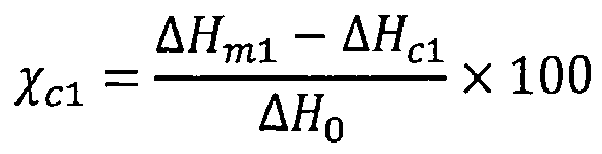
Δ H0: melting enthalpy of pure single crystal of PET (117.6 J/g) - From the cooling ramp we find the melt-crystallization temperature (Tc2) and crystallization enthalpy (ΔHc2). From the second heating ramp we determine: the glass transition temperature (Tg3), the cold-crystallization temperature (Tc3), crystallization enthalpy (ΔHc3), the degree of crystallinity (χc3), melting temperature (Tm3), and melting enthalpy (ΔHm3).

- 1 H-NMR is used to quantify the amount of diethylene glycol (so called DEG) in the chain. The DEG is formed during the synthesis by an etherification reaction. It is very important to measure the rate of DEG because it can influence the mechanical and thermal properties of PET. A large amount of DEG can reduce the glass transition temperature, melting temperature and the crystallization rate.
- All analyzes are performed in a solvent mixture of deuterated chloroform (CDCl3) / trifluoroacetic acid (TFA) (3/1) (V/V)
- The DEG rate (RDEG) is calculated from the integration of area proton peaks for different forms of DEG in the macromolecular PET chain appearing in between 4 ppm and 5 ppm.

- The reactor can synthesize around 3 kilograms (3072 g theoretical amount, 16 moles of PET) of polymer for each run (batch), all PETs are synthesized from 16 mol of terephthalic acid (TA) and 19.2 mol of ethylene glycol (EG) monomers that are used in the PET industry. The catalysts based on titanium and antimony, the phosphorus additives and color correction based metal salts were used in the formulation of PET. All products, their chemical structure, properties and quantity were determined by appropriate analytical methods.
- The different components (1), (2), (3) and (4) of the catalytical system can be added separately during the polymerization process or ready-to-use mixtures can be prepared in advance by mixing the constituents following a given ratio in a solvent. This solution is then introduced to the process in the direct esterification or the polycondensation steps.
- Typical quantities used per batch in polymerization for each individual component (Monomers (M) and catalysis formulations)
Type Products Amount used per batch M Terephthalic acid 16 mol. M Ethylene glycol 19.2 mol. 1 Tetrabutyl titanate 7 ppm Ti 1 Antimony acetate 250 ppm Sb 1 Antimony trioxide 250 ppm Sb 2 diethylphosphinic acid - (DEPS) 5 ppm P 2 Aluminum(III)diethylphosphinate - (Al(DEP)3) 5 ppm P 2 Ethylen-1,2-bis(ethylphosphinic acid) - (DiPOS) 5 ppm P 3 Cobalt (II) acetate tetrahydrate 25 ppm Co 3 Zinc (II) acetate 56 ppm Zn 3 Zinc (II) diethylphosphinate (Zn(DEP)2) 56 ppm Zn 4 Ethylene glycol 

- In a typical titanium based catalyst preparation, 0.15 grams of Ti(OBu)4, 0.32 grams of Cobalt acetate tetrahydrate and 0.06 grams of diethylphosphinic acid (DEPS) are diluted into 10 ml of ethylene glycol. The transparent violet solution is stirred for 90 minutes at room temperature and used as catalyst for the example 4 (table 1).
- An equivalent formulation is stored for one additional week and evaluate in another polymerization trial. The aged solution is shown to perform similarly to the freshly prepared one.
- In a typical antimony based catalyst preparation, 0.92 grams of Sb(OAc)3, 0.32 grams of Cobalt acetate tetrahydrate and 0.05 grams of diethylphosphinic acid (DEPS) are diluted into 10 ml of ethylene glycol. The transparent violet solution is stirred for 90 minutes at room temperature and used as catalyst for the example 19 (table 3).
- An equivalent formulation is stored for one additional week and evaluate in another polymerization trial. The aged solution is shown to perform similarly to the freshly prepared one.
- 16 mol (2656 g) of Terephthalic acid (AT) is esterified with 19.2 mol of ethylene glycol EG (1190 g) under a nitrogen pressure of 6.6 bar and a temperature of 275 °C. The molar ratio EG/AT is equal to 1,2. The catalysts and the cocatalysts or the ready-to-use mixture in ethylene glycol are introduced by an adapted device to the reactor. The agitator was turned on and the temperature increased to 275 °C over a period of about 2.5 hours. The contents were esterified by holding under agitation at 275 °C and a pressure of 120 mm Hg, and at 280 °C and a pressure of 30 mm Hg.
- The progress of the reaction is controlled by the amount of water recovered named the "conversion". When the direct esterification step was completed (no water distilled off), the polycondensation step is started.
- The polycondensation step consists of coupling the PET oligomers formed during the esterification step, by transesterification reactions (also referred as exchange reactions) alcohol-ester which lead to release the excess of ethylene glycol molecules. The reaction takes place at 285 °C under reduced pressure of 0.7 mbar. The contents of the kettle were held under agitation at 285 °C at 1 to 2 mm Hg pressure for a time sufficient to reach 15 ounce-inch (0.106 Newton-meter) torque as measured by an Electro-Craft Motomatic torque controller. The time for this step was recorded as the Finish Time, and varied with the catalyst system used. The polymer melt was then poured into a water bath to solidify the melt, and the resultant solid annealed at 0 °C for 12 hours and ground to pass through a 2 mm filter for color measurements using a spectrophotometer.
-
Table 1 Polymerisation results with titanium based catalysts (1 a and 1 b being the references) Abreviations - IS: introduction step of the ingredients. IS 1: co-catalyst introduced at DE step. IS 2: main catalyst introduced at PC step. DE: direct esterification. PC: polycondensation. t1: DE time/min. t2: PC time/min Example "(1)" (Ti) ppm IS "(2)" (P) ppm "(3)" (M) ppm IS t1 t2 t1+t2 Δ 1a Ti(OBu)4 7 2 none 0 none 0 - 105 76 181 0 1b Ti(OBu)4 7 1 none 0 none 0 - 90 80 170 -11 2 Ti(OBu)4 7 2 DEPS 5 Co(OAc)2 25 1 95 52 147 -34 3 Ti(OBu)4 7 2 DiPOS 5 Co(OAc)2 25 1 90 60 150 -31 4 Ti(OBu)4 7 1 DEPS 5 Co(OAc)2 25 1 85 52 137 -44 5 Ti(OBu)4 7 1 DEPS 10 Co(OAc)2 25 1 85 61 146 -35 6 Ti(OBu)4 7 1 DEPS 2.5 Co(OAc)2 25 1 85 54 139 -42 7 Ti(OBu)4 7 1 DiPOS 5 Co(OAc)2 25 1 85 61 146 -35 8 Ti(OBu)4 7 1 DiPOS 2.5 Co(OAc)2 25 1 90 61 151 -30 9 Ti(OBu)4 7 2 DEPS 5 Co(OAc)2 25 1 90 50 140 -41 10 Ti(OBu)4 7 1 AI(DEP)3 5 Co(OAc)2 25 1 95 52 147 -34 11 Ti(OBu)4 7 1 DEPS 5 Zn(OAc)2 56 1 90 37 127 -54 12 Ti(OBu)4 7 1 DEPS 5 Co(OAc)2 25 1 85 51 136 -45 13 Ti(OBu)4 7 1 DiPOS 5 Zn(OAc)2 56 1 90 37 127 -54 14 Ti(OBu)4 7 2 DEPS 5 Zn(OAc)2 56 1 90 37 127 -54 15 Ti(OBu)4 7 2 DiPOS 5 Zn(OAc)2 56 1 85 39 124 -57 16 Ti(OBu)4 7 1 none 0 Zn(OAc)2 56 - 85 43 128 -53 Table 2 Qualitiative color measurement (1 a and 1 b being the references) Abreviations - IS: introduction step of the ingredients. IS 1: co-catalyst introduced at DE step. IS 2: main catalyst introduced at PC step. DE: direct esterification. PC: polycondensation Example "(1)" (Ti) ppm IS "(2)" (P) ppm "(3)" (M) ppm IS PET color 1a Ti(OBu)4 7 2 none 0 none 0 - yellow 1b Ti(OBu)4 7 1 none 0 none 0 - yellow 2 Ti(OBu)4 7 2 DEPS 5 Co(OAc)2 25 1 Light yellow 3 Ti(OBu)4 7 2 DiPOS 5 Co(OAc)2 25 1 Light yellow 4 Ti(OBu)4 7 1 DEPS 5 Co(OAc)2 25 1 Light yellow 5 Ti(OBu)4 7 1 DEPS 10 Co(OAc)2 25 1 Light yellow 6 Ti(OBu)4 7 1 DEPS 2.5 Co(OAc)2 25 1 Light yellow 7 Ti(OBu)4 7 1 DiPOS 5 Co(OAc)2 25 1 Light yellow 8 Ti(OBu)4 7 1 DiPOS 2.5 Co(OAc)2 25 1 Light yellow 9 Ti(OBu)4 7 2 DEPS 5 Co(OAc)2 25 1 Light yellow 10 Ti(OBu)4 7 1 Al(DEP)3 5 Co(OAc)2 25 1 Light yellow 11 Ti(OBu)4 7 1 DEPS 5 Zn(OAc)2 56 1 grey 12 Ti(OBu)4 7 1 DEPS 5 Co(OAc)2 25 1 Light yellow 13 Ti(OBu)4 7 1 DiPOS 5 Zn(OAc)2 56 1 grey 14 Ti(OBu)4 7 2 DEPS 5 Zn(OAc)2 56 1 grey 15 Ti(OBu)4 7 2 DiPOS 5 Zn(OAc)2 56 1 grey 16 Ti(OBu)4 7 1 none 0 Zn(DEP)2 56 1 Light grey Table 3 Polymerisation results with antimony based catalysts (17a and 17b being the references) Abreviations - IS: introduction step of the ingredients. IS 1: co-catalyst introduced at DE step. IS 2: main catalyst introduced at PC step. DE: direct esterification. PC: polycondensation. t1: DE time/min. t2: PC time/min Example "(1)" (Sb) ppm IS "(2)" (P) ppm "(3)" (M) ppm IS t1 t2 t1+t2 Δ 17a Sb2O3 200 1 none 0 none 0 90 80 170 -19 17b Sb2O3 200 2 none 0 none 0 1 105 84 189 0 18 Sb2O3 200 2 DEPS 5 Co(OAc)2 25 1 100 55 155 -34 19 Sb2O3 200 1 DEPS 5 Co(OAc)2 25 1 85 63 148 -41 20 Sb2O3 200 1 DiPOS 5 Co(OAc)2 25 1 90 67 157 -32 23 Sb2O3 200 1 AI(DEP)3 5 Co(OAc)2 25 1 90 62 152 -37 24 Sb(OAc)3 200 1 none 0 Zn(DEP)2 56 1 85 45 130 -59 Table 4 Qualitative color measurement (17a and 17b being the references) Abreviations - IS: introduction step of the ingredients. IS 1: co-catalyst introduced at DE step. IS 2: main catalyst introduced at PC step. DE: direct esterification. PC: polycondensation Example "(1)" (Sb) ppm IS "(2)" (P) ppm "(3)" (M) ppm IS color 17a Sb2O3 200 1 none 0 none 0 Light yellow 17b Sb2O3 200 2 none 0 none 0 Light yellow 18 Sb2O3 200 2 DEPS 5 Co(OAc)2 25 1 Light yellow 19 Sb2O3 200 1 DEPS 5 Co(OAc)2 25 1 Light yellow 20 Sb2O3 200 1 DiPOS 5 Co(OAc)2 25 1 Light grey 21 Sb2O3 200 1 Al(DEP)3 5 none 0 Light grey 22 Sb(OAc)3 200 1 Al(DEP)3 5 none 0 Light yellow 23 Sb2O3 200 1 Al(DEP)3 5 Co(OAc)2 25 1 Light grey 24 Sb(OAc)3 200 1 none 0 Zn(DEP)2 56 1 white Table 5 Thermal and crystallization properties of PET synthesized with the new catalysts mixtures - DEG content measurements in %. Example Tc1, ΔHc1 Tm1, ΔHm1 χc1 Tc2, ΔHc2 Tc3, ΔHc3 Tm3, ΔHm3 χc3 RDEG (°C, J.g-1) (°C, J.g-1) (%) (°C, J.g-1) (°C, J.g-1) (°C, J.g-1) (%) (%) 1a 142/33 244/39 5.1 148/26 147/5 243/37 27 6.6 1b 145/37 245/40 2.5 148/26 149/11 244/38 23 6.2 2 142/34 247/40 5.1 145/18 146/12 246/37 21 5.3 4 145/37 248/43 5.1 156/34 149/6 247/40 29 5 6 144/33 249/39 5.1 152/25 148/7 247/36 24 4.8 5 142/35 249/39 3.4 150/23 147/9 246/35 22 5 3 140/37 247/43 5.1 154/34 148/7 246/41 29 5.2 7 143/33 249/38 4.2 156/28 146/7 248/35 24 4.8 16 143/36 249/42 5.1 156/24 149/13 248/40 23 4.9 24 133/34 249/42 6.8 181/42 ND*/0 248/39 33 4.9 - Comparison examples: Polyesterification experiments of Ref 1 to 4 are conducted only with main catalysts. These catalysts were introduced either in the step 1 or the step 2. Ref 5 to 13 are conducted with a phosphorus source. The phosphorus source can be a phosphinite like Hostanox P-EPQ (PEPQ) or a phosphite like Irganox 168 (IRG 168). Carboxyethyl phosphinic acid (CEPA) was also evaluated. As described in the following table, the full reaction time improvements (sum) are quite limited.
Example catalyst IS Phosphorus IS DE (Min) PC (Min) Sum (Min) ref 1 Ti(OBu)4 1 none "-" 90 80 170 ref 2 Sb2O3 1 none "-" 90 80 170 ref 3 Ti(OBu)4 2 none "-" 105 76 181 ref 4 Sb2O3 2 none "-" 105 84 189 ref 5 Ti(OBu)4 2 P-EPQ 1 100 113 213 ref 6 Ti(OBu)4 2 CEPA 1 95 89 184 ref 7 Sb2O3 2 P-EPQ 1 100 89 189 ref 8 Sb2O3 2 CEPA 1 95 90 185 ref 9 Ti(OBu)4 1 P-EPQ 1 90 113 203 ref 10 Ti(OBu)4 2 CEPA 2 95 67 162 ref 11 Ti(OBu)4 2 P-EPQ 2 100 77 177 ref 12 Ti(OBu)4 2 IRG 168 2 105 71 176 ref 13 Ti(OBu)4 2 IRG 168 1 97 87 184 - Comparison examples: Polyesterification experiments of Ref 14 to 20 are conducted with reported cocatalysts (Zn and Co acetates). These cocatalysts were introduced either in the step 1 or the step 2. As described in the following table, the full reaction time is improved especially for the Zinc cocatalyst but the overall quality of the obtained polyester is rather poor (severe yellowing and low viscosity).
Example catalyst IS Phosphorus IS DE (Min) PC (Min) Sum (Min) Ref 14 Sb2O3 2 Co(OAc)2 1 100 58 158 Ref 15 Ti(OBu)4 2 Co(OAc)2 1 100 57 157 Ref 16 Ti(OBu)4 1 Co(OAc)2 1 85 58 143 Ref 17 Sb2O3 1 Co(OAc)2 1 95 60 155 Ref 18 Ti(OBu)4 1 Zn(OAc)2 1 90 56 146 Ref 19 Sb2O3 1 Zn(OAc)2 1 90 50 140 Ref 20 Ti(OBu)4 2 Zn(OAc)2 1 90 52 142
Claims (15)
- Catalyst composition for a polyester manufacturing process, comprising a titanium catalyst and/or an antimony catalyst as main catalyst, and either(i) at least one co-catalyst A, or(ii) at least one co-catalyst B and at least one co-catalyst C, or(iii) a combination of at least one co-catalyst A, at least one co-catalyst B and at least one co-catalyst C, and whereinco-catalyst A is selected from the group consisting of
a metal salt of an alkyl or an aryl phosphinic acid, or
a metal salt of an alkyl or aryl diphosphinic acid, or
a combination thereof, and
co-catalyst B is selected from the group consisting of
an alkyl or aryl phosphinic acid,
an alkyl or aryl diphosphinic acid
a combination thereof, and
co-catalyst C selected from the group of a metal salt, a metal hydroxide or a metal organyl compound. - Catalyst composition according to claim 1, comprising
a titanium catalyst and/or an antimony catalyst as main catalyst, and
at least one co-catalyst A, and
optionally co-catalyst C. - Catalyst composition according to claim 1 or 2, wherein co-catalyst A is selected from the group consisting of compounds of formula (I) and (II)
 R1, R2, R3 and R4 are independently from each other linear or branched, saturated or unsaturated C1 to C6 alkyl and/or aryl residues and may be the same or different from each other, andR5 is C1 to C12 a linear or branched, saturated or unsaturated alkylene, C6 to C18 arylene, C6 to C18 alkyl arylene or C6 to C18 arylalkylene,M is selected from the group consisting of aluminum, cobalt and zinc ions, preferably zinc ions,m is 2, 3 or 4, andn is 1 or 2.
 - Catalyst composition according to claim 1, comprising a titanium catalyst and/or an antimony catalyst as main catalyst, and at least one co-catalyst B and at least one co-catalyst C.
- Catalyst composition according to claim 1 or 4, wherein co-catalyst B is selected from the group consisting of compounds of formula (III) and (IV)
 R1, R2, R3 and R4 are independently from each other linear or branched, saturated or unsaturated C1 to C6 alkyl and/or aryl residues and may be the same or different from each other, andR5 is a linear or branched, saturated or unsaturated C1 to C12 alkylene, C6 to C18 arylene, C6 to C18 alkyl arylene or C6 to C18 arylalkylene.
 - Catalyst composition according to any of the preceding claims, wherein the co-catalyst C is selected from the group consisting of zinc acetate, zinc chloride, zinc nitrate, zinc sulfate, aluminum chloride, aluminum hydroxide, aluminum acetate, aluminum hydroxychloride, cobalt acetate, cobalt nitrate, cobalt chloride, cobalt acetylacetonate, cobalt naphthenate, cobalt hydroxide, cobalt salicate, and combinations thereof, preferably zinc acetate, zinc chloride, zinc nitrate, zinc sulfate, most preferably zinc acetate.
- Catalyst composition according to any of the preceding claims, wherein in the compounds of formula (I), (II), (III) and (IV) R1, R2, R3 and R4 are independently from each other linear or branched saturated or unsaturated C1 to C6 alkyl residues or phenyl and may be the same or different from each other.
- Catalyst composition according to claim 7, wherein in the compounds of formula (I), (II), (III) and (IV) R1 and R2 are independently from each other methyl, ethyl, n-propyl, isopropyl, n-butyl, tert-butyl, n-pentyl and/or phenyl.
- Catalyst composition according to any of the preceding claims, wherein in the compounds of formula (II) and (IV) R5 is selected from the group consisting of methylene, ethylene, n-propylene, isopropylene, n-butylene, tert-butylene, n-pentylene, n-octylene, n-dodecylene, phenylene, methylphenylene, ethylphenylene, tert-butylphenylene, methylnaphthylene, ethylnaphtylene, tert-butylnaphthylene, phenylmethylene, phenylethylene and phenylbutylene.
- Catalyst composition according to any of the preceding claims, wherein co-catalyst B is diethylphosphinic acid and co-catalyst C is selected from the group consisting of zinc acetate, zinc chloride, zinc nitrate, zinc sulfate, preferably zinc acetate.
- Catalyst composition according to any of the preceding claims, wherein co-catalyst A is zinc diethylphosphinate.
- Catalyst composition according to any of the preceding claims, wherein in the composition comprises a solvent D selected from the group consisting of monovalent, divalent and polyvalent alcohols.
- Catalyst composition according to claim 12, wherein solvent D is selected from the group consisting of ethanol, propanol, isopropanol, butanol, preferably n-butanol, ethylene glycol, propylene glycol, isopropylene glycol, butylene glycol, 1-methyl propylene glycol, pentylene glycol, diethylene glycol, triethylene glycol, 2-ethyl hexanol and combinations thereof, preferably selected from the group consisting of n-butanol and ethylene glycol or a mixture thereof.
- Catalyst composition according to any of the preceding claims in absence of a carboxy compound as starting compound of the polyester manufacturing process.
- Use of a catalyst composition according to any of the preceding claims for the production of a polyester, preferably of polyethylene terephthalate.
Priority Applications (11)
| Application Number | Priority Date | Filing Date | Title |
|---|---|---|---|
| ES14003298T ES2851624T3 (en) | 2014-09-24 | 2014-09-24 | Catalyst composition for a polyester manufacturing process |
| EP14003298.8A EP3000835B1 (en) | 2014-09-24 | 2014-09-24 | Catalyst composition for a polyester manufacturing process |
| ES15757286T ES2768928T3 (en) | 2014-09-24 | 2015-09-02 | Catalyst composition for a polyester manufacturing process |
| CN201580051277.XA CN107075097B (en) | 2014-09-24 | 2015-09-02 | Catalyst composition for polyester production process |
| JP2017515832A JP6773647B2 (en) | 2014-09-24 | 2015-09-02 | Catalyst composition for polyester manufacturing process |
| PCT/EP2015/070075 WO2016045923A1 (en) | 2014-09-24 | 2015-09-02 | Catalyst composition for a polyester manufacturing process |
| US15/513,925 US10982045B2 (en) | 2014-09-24 | 2015-09-02 | Catalyst composition for a polyester manufacturing process |
| EP15757286.8A EP3197934B1 (en) | 2014-09-24 | 2015-09-02 | Catalyst composition for a polyester manufacturing process |
| CN202110114850.4A CN112778511B (en) | 2014-09-24 | 2015-09-02 | Catalyst composition for polyester production process |
| US17/213,601 US20210214491A1 (en) | 2014-09-24 | 2021-03-26 | Catalyst composition for a polyester manufacturing process |
| US18/392,095 US20240166808A1 (en) | 2014-09-24 | 2023-12-21 | Catalyst Composition For A Polyester Manufacturing Process |
Applications Claiming Priority (1)
| Application Number | Priority Date | Filing Date | Title |
|---|---|---|---|
| EP14003298.8A EP3000835B1 (en) | 2014-09-24 | 2014-09-24 | Catalyst composition for a polyester manufacturing process |
Publications (2)
| Publication Number | Publication Date |
|---|---|
| EP3000835A1 true EP3000835A1 (en) | 2016-03-30 |
| EP3000835B1 EP3000835B1 (en) | 2020-11-25 |
Family
ID=51687764
Family Applications (2)
| Application Number | Title | Priority Date | Filing Date |
|---|---|---|---|
| EP14003298.8A Active EP3000835B1 (en) | 2014-09-24 | 2014-09-24 | Catalyst composition for a polyester manufacturing process |
| EP15757286.8A Active EP3197934B1 (en) | 2014-09-24 | 2015-09-02 | Catalyst composition for a polyester manufacturing process |
Family Applications After (1)
| Application Number | Title | Priority Date | Filing Date |
|---|---|---|---|
| EP15757286.8A Active EP3197934B1 (en) | 2014-09-24 | 2015-09-02 | Catalyst composition for a polyester manufacturing process |
Country Status (6)
| Country | Link |
|---|---|
| US (3) | US10982045B2 (en) |
| EP (2) | EP3000835B1 (en) |
| JP (1) | JP6773647B2 (en) |
| CN (2) | CN107075097B (en) |
| ES (2) | ES2851624T3 (en) |
| WO (1) | WO2016045923A1 (en) |
Cited By (1)
| Publication number | Priority date | Publication date | Assignee | Title |
|---|---|---|---|---|
| EP4101817A1 (en) | 2021-06-11 | 2022-12-14 | Clariant International Ltd | New titanium catalyst for the polyester manufacturing process |
Families Citing this family (6)
| Publication number | Priority date | Publication date | Assignee | Title |
|---|---|---|---|---|
| ES2851624T3 (en) * | 2014-09-24 | 2021-09-08 | Clariant Int Ltd | Catalyst composition for a polyester manufacturing process |
| CN108484895B (en) * | 2018-04-09 | 2020-06-30 | 福建锦兴环保科技有限公司 | Phosphorus-titanium composite polyester catalyst and preparation process thereof |
| TWI744750B (en) * | 2019-12-23 | 2021-11-01 | 財團法人工業技術研究院 | Method for degradating thermosetting resin, catalyst composition used therein and resin composition obtained thereby |
| CN111171295B (en) * | 2020-02-12 | 2022-06-14 | 东华大学 | High-efficiency flame-retardant resin and preparation method and application thereof |
| DE102024111075A1 (en) | 2024-04-19 | 2025-10-23 | Christian-Albrechts-Universität zu Kiel, Körperschaft des öffentlichen Rechts | CRYSTALLINE ALUMINUM DIACETATE COMPOUNDS, CRYSTALLINE ALUMINUM DIACETATE COMPOUND PRODUCTION PROCESS AND USE |
| CN122145779A (en) * | 2026-05-09 | 2026-06-05 | 山东旺林新材料有限公司 | A catalyst and its preparation and preparation of a saturated resin for molding. |
Citations (6)
| Publication number | Priority date | Publication date | Assignee | Title |
|---|---|---|---|---|
| EP0699708A2 (en) | 1994-08-31 | 1996-03-06 | Hoechst Aktiengesellschaft | Flame retardant polyester moulding compositions |
| WO1999054379A1 (en) * | 1998-04-17 | 1999-10-28 | E.I. Du Pont De Nemours And Company | Poly(alkylene arylates) having optical properties |
| WO2005097321A1 (en) | 2004-03-26 | 2005-10-20 | E.I. Dupont De Nemours And Company | Esterification catalyst and process therewith |
| US20090005531A1 (en) | 2007-06-28 | 2009-01-01 | Thomspon Thomas F | Solid state polymerization process for polyester |
| US20130131239A1 (en) | 2010-04-29 | 2013-05-23 | Clariant Finance (Bvi) Limited | Method for Producing Mixtures of Alkylphosphonous Acid Salts And Dialkylphosphinic Acid Salts |
| US20130184414A1 (en) | 2010-03-17 | 2013-07-18 | Reliance Industries Limited | Catalyst system and process for preparing of polyester resins, fibre, filaments and yarn using said catalyst system |
Family Cites Families (21)
| Publication number | Priority date | Publication date | Assignee | Title |
|---|---|---|---|---|
| DE2708790C2 (en) * | 1977-03-01 | 1982-02-25 | Akzo Gmbh, 5600 Wuppertal | Linear homo- or copolyesters, process for making the polyesters and their uses |
| US4829113A (en) * | 1986-02-25 | 1989-05-09 | Celanese Corporation | Stabilized aromatic polyester compositions |
| US5008230A (en) * | 1989-05-22 | 1991-04-16 | Hoechst Celanese Corporation | Catalyst for preparing high clarity, colorless polyethylene terephthalate |
| US5596069A (en) * | 1995-06-08 | 1997-01-21 | E. I. Du Pont De Nemours And Company | Catalyst and process for producing catalyst |
| JP3749601B2 (en) * | 1997-09-12 | 2006-03-01 | 帝人ファイバー株式会社 | Block copolymer polyester and method for producing the same |
| US6255441B1 (en) * | 1998-04-17 | 2001-07-03 | E. I. Du Pont De Nemours And Company | Titanium-containing catalyst composition and processes therefor and therewith |
| US5981690A (en) * | 1998-04-17 | 1999-11-09 | E. I. Du Pont De Nemours And Company | Poly(alkylene arylates) having improved optical properties |
| US6020421A (en) * | 1998-09-01 | 2000-02-01 | Unitika Ltd. | Polyester composition and method for producing the same |
| US6034203A (en) * | 1999-04-08 | 2000-03-07 | E. I. Du Pont De Nemours And Company | Catalysis with titanium oxides |
| US6080834A (en) * | 1999-04-16 | 2000-06-27 | E. I. Du Pont De Nemours And Company | Titanium-containing catalyst composition and processes therefor and therewith |
| TW548291B (en) * | 1999-06-24 | 2003-08-21 | Teijin Ltd | Catalyst for producing a polyester and process for producing the polyester by using same |
| JP2002212277A (en) * | 2001-01-23 | 2002-07-31 | Toyobo Co Ltd | Wadding |
| US6998462B2 (en) * | 2003-06-11 | 2006-02-14 | E.I. Du Pont De Nemours And Company | Polyester process |
| JP2005126450A (en) * | 2003-10-21 | 2005-05-19 | Toyobo Co Ltd | Polymerization catalyst for polyester, polyester manufactured using the same and manufacturing method of polyester |
| JP2005126449A (en) * | 2003-10-21 | 2005-05-19 | Toyobo Co Ltd | Polymerization catalyst for polyester, polyester manufactured using the same and manufacturing method of polyester |
| US7138356B2 (en) * | 2004-03-26 | 2006-11-21 | E. I. Du Pont De Nemours And Company | Alkoxylated phosphite ester and process therefor |
| KR100895634B1 (en) * | 2004-11-30 | 2009-05-07 | 아사히 가세이 케미칼즈 가부시키가이샤 | Polyester resin, molded object thereof, and processes for producing these |
| JP2008266359A (en) * | 2007-04-16 | 2008-11-06 | Toyobo Co Ltd | Polyester polymerization catalyst, polyester manufactured by using the same, and method for manufacturing polyester |
| CN103122062A (en) * | 2008-04-03 | 2013-05-29 | 巴斯夫欧洲公司 | Solid state polymerization process for polyester with phosphinic acid compounds |
| JP5326741B2 (en) * | 2008-09-29 | 2013-10-30 | 東レ株式会社 | Polyester polymerization catalyst and method for producing polyester using the same |
| ES2851624T3 (en) * | 2014-09-24 | 2021-09-08 | Clariant Int Ltd | Catalyst composition for a polyester manufacturing process |
-
2014
- 2014-09-24 ES ES14003298T patent/ES2851624T3/en active Active
- 2014-09-24 EP EP14003298.8A patent/EP3000835B1/en active Active
-
2015
- 2015-09-02 EP EP15757286.8A patent/EP3197934B1/en active Active
- 2015-09-02 JP JP2017515832A patent/JP6773647B2/en active Active
- 2015-09-02 WO PCT/EP2015/070075 patent/WO2016045923A1/en not_active Ceased
- 2015-09-02 US US15/513,925 patent/US10982045B2/en active Active
- 2015-09-02 CN CN201580051277.XA patent/CN107075097B/en active Active
- 2015-09-02 ES ES15757286T patent/ES2768928T3/en active Active
- 2015-09-02 CN CN202110114850.4A patent/CN112778511B/en active Active
-
2021
- 2021-03-26 US US17/213,601 patent/US20210214491A1/en not_active Abandoned
-
2023
- 2023-12-21 US US18/392,095 patent/US20240166808A1/en active Pending
Patent Citations (6)
| Publication number | Priority date | Publication date | Assignee | Title |
|---|---|---|---|---|
| EP0699708A2 (en) | 1994-08-31 | 1996-03-06 | Hoechst Aktiengesellschaft | Flame retardant polyester moulding compositions |
| WO1999054379A1 (en) * | 1998-04-17 | 1999-10-28 | E.I. Du Pont De Nemours And Company | Poly(alkylene arylates) having optical properties |
| WO2005097321A1 (en) | 2004-03-26 | 2005-10-20 | E.I. Dupont De Nemours And Company | Esterification catalyst and process therewith |
| US20090005531A1 (en) | 2007-06-28 | 2009-01-01 | Thomspon Thomas F | Solid state polymerization process for polyester |
| US20130184414A1 (en) | 2010-03-17 | 2013-07-18 | Reliance Industries Limited | Catalyst system and process for preparing of polyester resins, fibre, filaments and yarn using said catalyst system |
| US20130131239A1 (en) | 2010-04-29 | 2013-05-23 | Clariant Finance (Bvi) Limited | Method for Producing Mixtures of Alkylphosphonous Acid Salts And Dialkylphosphinic Acid Salts |
Cited By (2)
| Publication number | Priority date | Publication date | Assignee | Title |
|---|---|---|---|---|
| EP4101817A1 (en) | 2021-06-11 | 2022-12-14 | Clariant International Ltd | New titanium catalyst for the polyester manufacturing process |
| WO2022258518A1 (en) | 2021-06-11 | 2022-12-15 | Clariant International Ltd | Titanium catalyst for the polyester manufacturing process |
Also Published As
| Publication number | Publication date |
|---|---|
| WO2016045923A1 (en) | 2016-03-31 |
| US20170283549A1 (en) | 2017-10-05 |
| CN112778511A (en) | 2021-05-11 |
| CN107075097B (en) | 2021-02-05 |
| ES2768928T3 (en) | 2020-06-24 |
| CN107075097A (en) | 2017-08-18 |
| US20240166808A1 (en) | 2024-05-23 |
| ES2851624T3 (en) | 2021-09-08 |
| JP2017530225A (en) | 2017-10-12 |
| EP3197934A1 (en) | 2017-08-02 |
| JP6773647B2 (en) | 2020-10-21 |
| US10982045B2 (en) | 2021-04-20 |
| US20210214491A1 (en) | 2021-07-15 |
| EP3000835B1 (en) | 2020-11-25 |
| CN112778511B (en) | 2023-03-28 |
| EP3197934B1 (en) | 2019-11-06 |
Similar Documents
| Publication | Publication Date | Title |
|---|---|---|
| EP3197934B1 (en) | Catalyst composition for a polyester manufacturing process | |
| KR100840089B1 (en) | Metal-containing compositions and methods of using the same | |
| US6998462B2 (en) | Polyester process | |
| KR20010108508A (en) | Titanium-containing Catalyst Composition and Processes Therefor and Therewith | |
| JP5702065B2 (en) | Non-precipitating alkali / alkaline earth metal and aluminum compositions prepared using organic hydroxy acids | |
| JP2004175838A (en) | Polyester polymerization catalyst and method for producing polyester using the same | |
| US7138356B2 (en) | Alkoxylated phosphite ester and process therefor | |
| US20090215933A1 (en) | Alicyclic Polyester and Process for Producing the Same, and Resin Composition Using the Same | |
| US20050215426A1 (en) | Esterification catalyst and process therewith | |
| US7226888B2 (en) | Composition comprising titanium and aluminium and polyester production | |
| JP2004256719A (en) | Polyester polymerization catalyst and method for producing polyester using the same | |
| WO2022258518A1 (en) | Titanium catalyst for the polyester manufacturing process | |
| MXPA00010106A (en) | Catalytic composition comprising a titanium compound, an amine and a phosphorus compound;preparation and use thereof |
Legal Events
| Date | Code | Title | Description |
|---|---|---|---|
| PUAI | Public reference made under article 153(3) epc to a published international application that has entered the european phase |
Free format text: ORIGINAL CODE: 0009012 |
|
| AK | Designated contracting states |
Kind code of ref document: A1 Designated state(s): AL AT BE BG CH CY CZ DE DK EE ES FI FR GB GR HR HU IE IS IT LI LT LU LV MC MK MT NL NO PL PT RO RS SE SI SK SM TR |
|
| AX | Request for extension of the european patent |
Extension state: BA ME |
|
| RAP1 | Party data changed (applicant data changed or rights of an application transferred) |
Owner name: CLARIANT INTERNATIONAL LTD |
|
| 17P | Request for examination filed |
Effective date: 20160930 |
|
| RBV | Designated contracting states (corrected) |
Designated state(s): AL AT BE BG CH CY CZ DE DK EE ES FI FR GB GR HR HU IE IS IT LI LT LU LV MC MK MT NL NO PL PT RO RS SE SI SK SM TR |
|
| GRAP | Despatch of communication of intention to grant a patent |
Free format text: ORIGINAL CODE: EPIDOSNIGR1 |
|
| STAA | Information on the status of an ep patent application or granted ep patent |
Free format text: STATUS: GRANT OF PATENT IS INTENDED |
|
| INTG | Intention to grant announced |
Effective date: 20200617 |
|
| GRAS | Grant fee paid |
Free format text: ORIGINAL CODE: EPIDOSNIGR3 |
|
| GRAA | (expected) grant |
Free format text: ORIGINAL CODE: 0009210 |
|
| STAA | Information on the status of an ep patent application or granted ep patent |
Free format text: STATUS: THE PATENT HAS BEEN GRANTED |
|
| AK | Designated contracting states |
Kind code of ref document: B1 Designated state(s): AL AT BE BG CH CY CZ DE DK EE ES FI FR GB GR HR HU IE IS IT LI LT LU LV MC MK MT NL NO PL PT RO RS SE SI SK SM TR |
|
| REG | Reference to a national code |
Ref country code: GB Ref legal event code: FG4D |
|
| REG | Reference to a national code |
Ref country code: CH Ref legal event code: EP |
|
| REG | Reference to a national code |
Ref country code: AT Ref legal event code: REF Ref document number: 1338231 Country of ref document: AT Kind code of ref document: T Effective date: 20201215 |
|
| REG | Reference to a national code |
Ref country code: DE Ref legal event code: R096 Ref document number: 602014072622 Country of ref document: DE |
|
| REG | Reference to a national code |
Ref country code: IE Ref legal event code: FG4D |
|
| REG | Reference to a national code |
Ref country code: AT Ref legal event code: MK05 Ref document number: 1338231 Country of ref document: AT Kind code of ref document: T Effective date: 20201125 |
|
| REG | Reference to a national code |
Ref country code: NL Ref legal event code: MP Effective date: 20201125 |
|
| PG25 | Lapsed in a contracting state [announced via postgrant information from national office to epo] |
Ref country code: GR Free format text: LAPSE BECAUSE OF FAILURE TO SUBMIT A TRANSLATION OF THE DESCRIPTION OR TO PAY THE FEE WITHIN THE PRESCRIBED TIME-LIMIT Effective date: 20210226 Ref country code: FI Free format text: LAPSE BECAUSE OF FAILURE TO SUBMIT A TRANSLATION OF THE DESCRIPTION OR TO PAY THE FEE WITHIN THE PRESCRIBED TIME-LIMIT Effective date: 20201125 Ref country code: RS Free format text: LAPSE BECAUSE OF FAILURE TO SUBMIT A TRANSLATION OF THE DESCRIPTION OR TO PAY THE FEE WITHIN THE PRESCRIBED TIME-LIMIT Effective date: 20201125 Ref country code: NO Free format text: LAPSE BECAUSE OF FAILURE TO SUBMIT A TRANSLATION OF THE DESCRIPTION OR TO PAY THE FEE WITHIN THE PRESCRIBED TIME-LIMIT Effective date: 20210225 Ref country code: PT Free format text: LAPSE BECAUSE OF FAILURE TO SUBMIT A TRANSLATION OF THE DESCRIPTION OR TO PAY THE FEE WITHIN THE PRESCRIBED TIME-LIMIT Effective date: 20210325 |
|
| PG25 | Lapsed in a contracting state [announced via postgrant information from national office to epo] |
Ref country code: SE Free format text: LAPSE BECAUSE OF FAILURE TO SUBMIT A TRANSLATION OF THE DESCRIPTION OR TO PAY THE FEE WITHIN THE PRESCRIBED TIME-LIMIT Effective date: 20201125 Ref country code: PL Free format text: LAPSE BECAUSE OF FAILURE TO SUBMIT A TRANSLATION OF THE DESCRIPTION OR TO PAY THE FEE WITHIN THE PRESCRIBED TIME-LIMIT Effective date: 20201125 Ref country code: IS Free format text: LAPSE BECAUSE OF FAILURE TO SUBMIT A TRANSLATION OF THE DESCRIPTION OR TO PAY THE FEE WITHIN THE PRESCRIBED TIME-LIMIT Effective date: 20210325 Ref country code: LV Free format text: LAPSE BECAUSE OF FAILURE TO SUBMIT A TRANSLATION OF THE DESCRIPTION OR TO PAY THE FEE WITHIN THE PRESCRIBED TIME-LIMIT Effective date: 20201125 Ref country code: AT Free format text: LAPSE BECAUSE OF FAILURE TO SUBMIT A TRANSLATION OF THE DESCRIPTION OR TO PAY THE FEE WITHIN THE PRESCRIBED TIME-LIMIT Effective date: 20201125 Ref country code: BG Free format text: LAPSE BECAUSE OF FAILURE TO SUBMIT A TRANSLATION OF THE DESCRIPTION OR TO PAY THE FEE WITHIN THE PRESCRIBED TIME-LIMIT Effective date: 20210225 |
|
| REG | Reference to a national code |
Ref country code: LT Ref legal event code: MG9D |
|
| PG25 | Lapsed in a contracting state [announced via postgrant information from national office to epo] |
Ref country code: HR Free format text: LAPSE BECAUSE OF FAILURE TO SUBMIT A TRANSLATION OF THE DESCRIPTION OR TO PAY THE FEE WITHIN THE PRESCRIBED TIME-LIMIT Effective date: 20201125 |
|
| PG25 | Lapsed in a contracting state [announced via postgrant information from national office to epo] |
Ref country code: SM Free format text: LAPSE BECAUSE OF FAILURE TO SUBMIT A TRANSLATION OF THE DESCRIPTION OR TO PAY THE FEE WITHIN THE PRESCRIBED TIME-LIMIT Effective date: 20201125 Ref country code: EE Free format text: LAPSE BECAUSE OF FAILURE TO SUBMIT A TRANSLATION OF THE DESCRIPTION OR TO PAY THE FEE WITHIN THE PRESCRIBED TIME-LIMIT Effective date: 20201125 Ref country code: CZ Free format text: LAPSE BECAUSE OF FAILURE TO SUBMIT A TRANSLATION OF THE DESCRIPTION OR TO PAY THE FEE WITHIN THE PRESCRIBED TIME-LIMIT Effective date: 20201125 Ref country code: LT Free format text: LAPSE BECAUSE OF FAILURE TO SUBMIT A TRANSLATION OF THE DESCRIPTION OR TO PAY THE FEE WITHIN THE PRESCRIBED TIME-LIMIT Effective date: 20201125 Ref country code: SK Free format text: LAPSE BECAUSE OF FAILURE TO SUBMIT A TRANSLATION OF THE DESCRIPTION OR TO PAY THE FEE WITHIN THE PRESCRIBED TIME-LIMIT Effective date: 20201125 Ref country code: RO Free format text: LAPSE BECAUSE OF FAILURE TO SUBMIT A TRANSLATION OF THE DESCRIPTION OR TO PAY THE FEE WITHIN THE PRESCRIBED TIME-LIMIT Effective date: 20201125 |
|
| REG | Reference to a national code |
Ref country code: DE Ref legal event code: R097 Ref document number: 602014072622 Country of ref document: DE |
|
| PG25 | Lapsed in a contracting state [announced via postgrant information from national office to epo] |
Ref country code: DK Free format text: LAPSE BECAUSE OF FAILURE TO SUBMIT A TRANSLATION OF THE DESCRIPTION OR TO PAY THE FEE WITHIN THE PRESCRIBED TIME-LIMIT Effective date: 20201125 |
|
| PLBE | No opposition filed within time limit |
Free format text: ORIGINAL CODE: 0009261 |
|
| STAA | Information on the status of an ep patent application or granted ep patent |
Free format text: STATUS: NO OPPOSITION FILED WITHIN TIME LIMIT |
|
| PG25 | Lapsed in a contracting state [announced via postgrant information from national office to epo] |
Ref country code: NL Free format text: LAPSE BECAUSE OF FAILURE TO SUBMIT A TRANSLATION OF THE DESCRIPTION OR TO PAY THE FEE WITHIN THE PRESCRIBED TIME-LIMIT Effective date: 20201125 Ref country code: AL Free format text: LAPSE BECAUSE OF FAILURE TO SUBMIT A TRANSLATION OF THE DESCRIPTION OR TO PAY THE FEE WITHIN THE PRESCRIBED TIME-LIMIT Effective date: 20201125 |
|
| 26N | No opposition filed |
Effective date: 20210826 |
|
| PG25 | Lapsed in a contracting state [announced via postgrant information from national office to epo] |
Ref country code: SI Free format text: LAPSE BECAUSE OF FAILURE TO SUBMIT A TRANSLATION OF THE DESCRIPTION OR TO PAY THE FEE WITHIN THE PRESCRIBED TIME-LIMIT Effective date: 20201125 |
|
| REG | Reference to a national code |
Ref country code: BE Ref legal event code: MM Effective date: 20210930 |
|
| PG25 | Lapsed in a contracting state [announced via postgrant information from national office to epo] |
Ref country code: IS Free format text: LAPSE BECAUSE OF FAILURE TO SUBMIT A TRANSLATION OF THE DESCRIPTION OR TO PAY THE FEE WITHIN THE PRESCRIBED TIME-LIMIT Effective date: 20210325 Ref country code: MC Free format text: LAPSE BECAUSE OF FAILURE TO SUBMIT A TRANSLATION OF THE DESCRIPTION OR TO PAY THE FEE WITHIN THE PRESCRIBED TIME-LIMIT Effective date: 20201125 |
|
| PG25 | Lapsed in a contracting state [announced via postgrant information from national office to epo] |
Ref country code: LU Free format text: LAPSE BECAUSE OF NON-PAYMENT OF DUE FEES Effective date: 20210924 Ref country code: IE Free format text: LAPSE BECAUSE OF NON-PAYMENT OF DUE FEES Effective date: 20210924 Ref country code: BE Free format text: LAPSE BECAUSE OF NON-PAYMENT OF DUE FEES Effective date: 20210930 |
|
| REG | Reference to a national code |
Ref country code: FR Ref legal event code: PLFP Year of fee payment: 9 |
|
| PG25 | Lapsed in a contracting state [announced via postgrant information from national office to epo] |
Ref country code: HU Free format text: LAPSE BECAUSE OF FAILURE TO SUBMIT A TRANSLATION OF THE DESCRIPTION OR TO PAY THE FEE WITHIN THE PRESCRIBED TIME-LIMIT; INVALID AB INITIO Effective date: 20140924 |
|
| P01 | Opt-out of the competence of the unified patent court (upc) registered |
Effective date: 20230505 |
|
| PG25 | Lapsed in a contracting state [announced via postgrant information from national office to epo] |
Ref country code: CY Free format text: LAPSE BECAUSE OF FAILURE TO SUBMIT A TRANSLATION OF THE DESCRIPTION OR TO PAY THE FEE WITHIN THE PRESCRIBED TIME-LIMIT Effective date: 20201125 |
|
| PGFP | Annual fee paid to national office [announced via postgrant information from national office to epo] |
Ref country code: CH Payment date: 20231001 Year of fee payment: 10 |
|
| PG25 | Lapsed in a contracting state [announced via postgrant information from national office to epo] |
Ref country code: MK Free format text: LAPSE BECAUSE OF FAILURE TO SUBMIT A TRANSLATION OF THE DESCRIPTION OR TO PAY THE FEE WITHIN THE PRESCRIBED TIME-LIMIT Effective date: 20201125 |
|
| PG25 | Lapsed in a contracting state [announced via postgrant information from national office to epo] |
Ref country code: MT Free format text: LAPSE BECAUSE OF FAILURE TO SUBMIT A TRANSLATION OF THE DESCRIPTION OR TO PAY THE FEE WITHIN THE PRESCRIBED TIME-LIMIT Effective date: 20201125 |
|
| REG | Reference to a national code |
Ref country code: CH Ref legal event code: PL |
|
| PG25 | Lapsed in a contracting state [announced via postgrant information from national office to epo] |
Ref country code: CH Free format text: LAPSE BECAUSE OF NON-PAYMENT OF DUE FEES Effective date: 20240930 |
|
| PGFP | Annual fee paid to national office [announced via postgrant information from national office to epo] |
Ref country code: DE Payment date: 20250926 Year of fee payment: 12 |
|
| PGFP | Annual fee paid to national office [announced via postgrant information from national office to epo] |
Ref country code: IT Payment date: 20250922 Year of fee payment: 12 |
|
| PGFP | Annual fee paid to national office [announced via postgrant information from national office to epo] |
Ref country code: GB Payment date: 20250923 Year of fee payment: 12 |
|
| PGFP | Annual fee paid to national office [announced via postgrant information from national office to epo] |
Ref country code: FR Payment date: 20250925 Year of fee payment: 12 |
|
| REG | Reference to a national code |
Ref country code: DE Ref legal event code: R082 Ref document number: 602014072622 Country of ref document: DE Representative=s name: PACZKOWSKI, MARCUS, DIPL.-CHEM. DR. RER. NAT., DE |
|
| PG25 | Lapsed in a contracting state [announced via postgrant information from national office to epo] |
Ref country code: TR Free format text: LAPSE BECAUSE OF FAILURE TO SUBMIT A TRANSLATION OF THE DESCRIPTION OR TO PAY THE FEE WITHIN THE PRESCRIBED TIME-LIMIT Effective date: 20201125 |
|
| PGFP | Annual fee paid to national office [announced via postgrant information from national office to epo] |
Ref country code: ES Payment date: 20251015 Year of fee payment: 12 |