EP3000465B1 - T-type calcium channel inhibitor - Google Patents
T-type calcium channel inhibitor Download PDFInfo
- Publication number
- EP3000465B1 EP3000465B1 EP14801611.6A EP14801611A EP3000465B1 EP 3000465 B1 EP3000465 B1 EP 3000465B1 EP 14801611 A EP14801611 A EP 14801611A EP 3000465 B1 EP3000465 B1 EP 3000465B1
- Authority
- EP
- European Patent Office
- Prior art keywords
- group
- methyl
- calcium channel
- type calcium
- prenylnaringenin
- Prior art date
- Legal status (The legal status is an assumption and is not a legal conclusion. Google has not performed a legal analysis and makes no representation as to the accuracy of the status listed.)
- Active
Links
- 0 *c(c(*)c1*)c(*)c(C(C2)=O)c1OC2c1ccccc1 Chemical compound *c(c(*)c1*)c(*)c(C(C2)=O)c1OC2c1ccccc1 0.000 description 1
Images


Classifications
-
- C—CHEMISTRY; METALLURGY
- C07—ORGANIC CHEMISTRY
- C07D—HETEROCYCLIC COMPOUNDS
- C07D311/00—Heterocyclic compounds containing six-membered rings having one oxygen atom as the only hetero atom, condensed with other rings
- C07D311/02—Heterocyclic compounds containing six-membered rings having one oxygen atom as the only hetero atom, condensed with other rings ortho- or peri-condensed with carbocyclic rings or ring systems
- C07D311/04—Benzo[b]pyrans, not hydrogenated in the carbocyclic ring
- C07D311/22—Benzo[b]pyrans, not hydrogenated in the carbocyclic ring with oxygen or sulfur atoms directly attached in position 4
- C07D311/26—Benzo[b]pyrans, not hydrogenated in the carbocyclic ring with oxygen or sulfur atoms directly attached in position 4 with aromatic rings attached in position 2 or 3
- C07D311/28—Benzo[b]pyrans, not hydrogenated in the carbocyclic ring with oxygen or sulfur atoms directly attached in position 4 with aromatic rings attached in position 2 or 3 with aromatic rings attached in position 2 only
- C07D311/32—2,3-Dihydro derivatives, e.g. flavanones
-
- A—HUMAN NECESSITIES
- A61—MEDICAL OR VETERINARY SCIENCE; HYGIENE
- A61P—SPECIFIC THERAPEUTIC ACTIVITY OF CHEMICAL COMPOUNDS OR MEDICINAL PREPARATIONS
- A61P13/00—Drugs for disorders of the urinary system
- A61P13/12—Drugs for disorders of the urinary system of the kidneys
-
- A—HUMAN NECESSITIES
- A61—MEDICAL OR VETERINARY SCIENCE; HYGIENE
- A61P—SPECIFIC THERAPEUTIC ACTIVITY OF CHEMICAL COMPOUNDS OR MEDICINAL PREPARATIONS
- A61P25/00—Drugs for disorders of the nervous system
- A61P25/02—Drugs for disorders of the nervous system for peripheral neuropathies
-
- A—HUMAN NECESSITIES
- A61—MEDICAL OR VETERINARY SCIENCE; HYGIENE
- A61P—SPECIFIC THERAPEUTIC ACTIVITY OF CHEMICAL COMPOUNDS OR MEDICINAL PREPARATIONS
- A61P25/00—Drugs for disorders of the nervous system
- A61P25/04—Centrally acting analgesics, e.g. opioids
-
- A—HUMAN NECESSITIES
- A61—MEDICAL OR VETERINARY SCIENCE; HYGIENE
- A61P—SPECIFIC THERAPEUTIC ACTIVITY OF CHEMICAL COMPOUNDS OR MEDICINAL PREPARATIONS
- A61P3/00—Drugs for disorders of the metabolism
- A61P3/12—Drugs for disorders of the metabolism for electrolyte homeostasis
- A61P3/14—Drugs for disorders of the metabolism for electrolyte homeostasis for calcium homeostasis
-
- A—HUMAN NECESSITIES
- A61—MEDICAL OR VETERINARY SCIENCE; HYGIENE
- A61P—SPECIFIC THERAPEUTIC ACTIVITY OF CHEMICAL COMPOUNDS OR MEDICINAL PREPARATIONS
- A61P43/00—Drugs for specific purposes, not provided for in groups A61P1/00-A61P41/00
-
- A—HUMAN NECESSITIES
- A61—MEDICAL OR VETERINARY SCIENCE; HYGIENE
- A61P—SPECIFIC THERAPEUTIC ACTIVITY OF CHEMICAL COMPOUNDS OR MEDICINAL PREPARATIONS
- A61P5/00—Drugs for disorders of the endocrine system
- A61P5/38—Drugs for disorders of the endocrine system of the suprarenal hormones
- A61P5/42—Drugs for disorders of the endocrine system of the suprarenal hormones for decreasing, blocking or antagonising the activity of mineralocorticosteroids
-
- A—HUMAN NECESSITIES
- A61—MEDICAL OR VETERINARY SCIENCE; HYGIENE
- A61P—SPECIFIC THERAPEUTIC ACTIVITY OF CHEMICAL COMPOUNDS OR MEDICINAL PREPARATIONS
- A61P9/00—Drugs for disorders of the cardiovascular system
-
- A—HUMAN NECESSITIES
- A61—MEDICAL OR VETERINARY SCIENCE; HYGIENE
- A61P—SPECIFIC THERAPEUTIC ACTIVITY OF CHEMICAL COMPOUNDS OR MEDICINAL PREPARATIONS
- A61P9/00—Drugs for disorders of the cardiovascular system
- A61P9/06—Antiarrhythmics
Definitions
- the present disclosure relates to a T-type calcium channel inhibitor which is a flavanone compound.
- the present disclosure also relates to a pharmaceutical product containing the T-type calcium channel inhibitor.
- the present invention relates to the use of the flavone compound of formula (1) in the treatment of neuropathic pain, the effective action of the compound being a T-type calcium channel inhibitory action.
- Ion channels are channels extending through the cell membrane, and are classified broadly into two types: ligand-dependent channels and potential-dependent channels.
- ligand-dependent channels In recent years, as a type of mechanism of neuropathic pains, a potential-dependent sodium channel and a potential-dependent calcium channel have been found as a target.
- drugs targeting a potential-dependent sodium channel for example, lidocaine, carbamazepine, lamotrigine, mexiletine and the like are known.
- drugs targeting a potential-dependent calcium channel for example, gabapentin pregabalin, ziconotide and the like are known.
- the neuropathic pain is refractory, and has the problem of inadequate response to existing analgesic drugs.
- the efficacy of even an established drug therapy is difficult to predict accurately, and other drugs must often be used in combination.
- high-potential-activated calcium channel inhibitors are listed as a primary choice, but in many cases, an adequate therapeutic effect is not obtained. These inhibitors have a problem of causing side effects such as lightheadedness.
- Potential-dependent calcium channels are classified into two types: high-potential-activated types and low-potential-activated types based on a difference in activation and deactivation potentials.
- L-type, N-type, P/Q-type and R-type calcium channels are activated by large depolarization, and therefore classified as high-potential-activated calcium channels.
- T-type calcium channels are activated by small depolarization, and therefore classified as low-potential-activated calcium channels.
- T-type calcium channels have been reported to be involved in onset and development of a neuropathic pain, and potential of T-type calcium channel inhibitors as therapeutic agents for the pain has been suggested.
- T-type calcium channel inhibitor include mibefradil (see, for example, Todorovic, Neuron, 2001, 31 (1), p.
- Non-Patent Document 1 ethosuximide, and (1S,2S)-2-[2-[3-(1H-benzimidazol-2-yl)propyl]methyamino]ethyl]-6-fluoro-1,2,3,4-tetrahydro-1-(1-methylethyl)-2-naphthalenyl-cyclopropane carboxylate hydrochloride (NNC55-0396) (see, for example, Huang, J Pharmacol Exp Ther., 309(1), p. 193-199 (Non-Patent Document 2)).
- NNC55-0396 see, for example, Huang, J Pharmacol Exp Ther., 309(1), p. 193-199 (Non-Patent Document 2).
- Flavanone compounds having a flavanone backbone are compounds contained in natural extracts etc. These flavanone compounds have been found to have various drug efficacies. For example, it has been found that sophoraflavanone G which is a type of flavanone compound can be used as an antibacterial agent having an inhibitory action on proliferation of Propionibacterium acnes and Pityrosporum ovale (Japanese Patent No. 3327699 (Patent Document 1)). For example, Japanese Patent No.
- Patent Document 2 discloses that extracts from Sophora, which contain a flavone selected from the group consisting of 8-prenylnaringenin, kushenol X, 8-prenylkaempferol, leachianone G and kushenol E, an alkaloid, an isoflavone, a chalcone and a pterocarpan are capable of preventing and treating disease conditions caused by abnormal metabolism of estrogen.
- the flavanone compound has a T-type calcium channel inhibitory action.
- WO2011/087755 relates to methods and compositions for reducing Distress Dysfunction by restoring and maintaining homeostatic balance in the neurotransmitter systems underlying the Stress Response and the experience of distress and hedonic tone.
- Distress Dysfunctions include anxiety, depression, anger, insomnia, mood disorders, eating disorders, sexual problems, pain, substance and behavioral addictions, gastrointestinal disorders, autistic spectrum disorders, attention-deficit and hyperactivity disorders, and other emotional and physical distress disorders.
- Receptor Switchers such as ultra- low-dose and very- low-dose opioid antagonists and GMl ganglioside attenuators, are co-administred with Endorphin Enhancers, such as specific cAMP PDE inhibitors and excitatory amino acids
- WO 2011/006073 relates to compounds, compositions, methods, and kits for the treatment of neurogenic inflammation.
- US 2004/137096 relates to an anti-inflammatory pharmaceutical composition that exhibits inhibition of the cycloooxygenase-2 (COX-2) enzyme.
- the compositions may be used for treating conditions that manifest as inflammatory pain, or are impacted by the COX-2 enzyme.
- the recited compositions may be used for treating osteoarthritis and rheumatoid arthritis, and can be used for chronic pain with reduced gastric side-effects.
- the present inventors have searched for a new T-type calcium channel inhibitor towards development of a new analgesic drug targeting a T-type calcium channel for therapeutic use in the treatment of neuropathic pain. As a result, the present inventors have found that a flavanone compound strongly inhibits a T-type calcium channel, as disclosed.
- An object of the present disclosure is to provide a T-type calcium channel inhibitor which is a flavanone compound; a pharmaceutical product containing the T-type calcium channel inhibitor; and a therapeutic agent or prophylactic agent for diseases, the effective action of which is a T-type calcium channel inhibitory action.
- the present invention provides a T-type calcium channel inhibitor for use in the treatment of neuropathic pain, wherein the T-type calcium channel inhibitor is a compound represented by the formula (1): wherein
- R 1 is at the 4-position and is -OH and R 2 is at the 2-position and is H or -OH; each of R 3 and R 4 represents -OH; and one of R 5 and R 6 is H, and the other is a C 2-6 alkenyl group or a 3,7-dimethyl-2,6-octadienyl group or a 5-methyl-2-(1-methylethenyl)-4-hexenyl group.
- the compound for use in the treatment of neuropathic pain is(2S)-5,7-dihydroxy-2,3-dihydro-2-(2,4-dihydroxyphenyl)-8-[(R)-5-methyl-2- (1-methylethenyl)-4-hexenyl]-4H-1-benzopyran-4-one, (2S)-5,7-dihydroxy-2,3-dihydro-2-(2,4- dihydroxyphenyl)-6-[(R)-5-methyl-2-(1-methylethenyl)-4-hexenyl]-4H-1-benzopyran-4-one, or (2S)-5, 7-dihydroxy-2,3-dihydro-2-(4-hydroxyphenyl)-6-(3-methyl-2-butenyl)-4H-1-benzopyran-4-one.
- the present disclosure also provides a pharmaceutical product containing the T-type calcium channel inhibitor, and a therapeutic agent or prophylactic agent for neuropathic pains, which contains the T-type calcium channel inhibitor.
- the T-type calcium channel inhibitor according to the present disclosure which is a flavanone compound has an excellent T-type calcium channel inhibitory action.
- the T-type calcium channel inhibitor according to the present disclosure is very useful in the fields of, for example, medical cares, pharmaceutical products and prophylactic agents.
- halogen atom examples include a fluorine atom, a chlorine atom, a bromine atom and an iodine atom.
- the C 1-3 alkyl group may be a linear C 1-3 alkyl group, a branched C 3 alkyl group or a C 3 cycloalkyl group, and examples thereof include a methyl group, an ethyl group, an n-propyl group, an i-propyl group and a c-propyl group.
- the C 1-3 alkyl group may be substituted or unsubstituted.
- substituents include an alkoxy group, an aryloxy group, a sulfhydryl group, an alkylthio group, an arylthio group, a halogen atom, a hydroxyl group, a fluoroalkyl group, a perfluoroalkyl group, an amino group, an aminoalkyl group, a disubstituted amino group, a hydroxyalkyl group, a carboxyalkyl group and a carboxyl group.
- the C 2-6 alkenyl group includes one that is linear or branched, and examples thereof include an ethenyl group, a 1-propenyl group, a 2-propenyl group, a 1-methyl-1-ethyenyl group, a 1-butenyl group, a 2-butenyl group, a 3-butenyl group, a 2-methyl-1-propenyl group, a 2-methyl-2-propenyl group, a 1-ethylethenyl group, a 1-methyl-1-propenyl group, a 1-methyl-2-propenyl group, a 1-pentenyl group, a 2-pentenyl group, a 3-pentenyl group, a 4-pentenyl group, a 1-n-propylethenyl group, a 1-methyl-1-butenyl group, a 1-methyl-2-butenyl group, a 1-methyl-3-butenyl group, a 2-ethyl-2-propenyl group, a 2-
- a 2-methyl-1-butenyl group, a 2-methyl-2-butenyl group, a 2-methyl-3-butenyl group, a 3-methyl-1-butenyl group, a 3-methyl-2-butenyl group, a 3-methyl-3-butenyl group, a 1,1-dimethyl-2-propenyl group, a 1-i-propylethenyl group, a 1,2-dimethyl-1-propenyl group, a 1,2-dimethyl-2-propenyl group, a 1-hexenyl group, a 2-hexenyl group, a 3-hexenyl group, a 4-hexenyl group, a 5-hexenyl group and the like may be more preferable.
- the C 2-6 alkenyl group may be substituted or unsubstituted.
- substituents include an alkoxy group, an aryloxy group, a sulfhydryl group, an alkylthio group, an arylthio group, a halogen atom, a hydroxyl group, a fluoroalkyl group, a perfluoroalkyl group, an amino group, an aminoalkyl group, a disubstituted amino group, a hydroxyalkyl group, a carboxyalkyl group and a carboxyl group.
- the 3,7-dimethyl-2,6-octadienyl group (number of carbon atoms: 10, geranyl group),and the 5-methyl-2-(1-methylethenyl)-4-hexenyl group (number of carbon atoms: 10), are specific examples of a prenyl group.
- the T-type calcium channel inhibitor according to the present disclosure has a structure as shown in the following formula (1).
- each of R 1 and R 2 independently represents H, -OH, or -OR 11 wherein R 11 represents a C 1-3 alkyl group; each of R 3 and R 4 independently represents H, -OH, or -OR 12 wherein R 12 represents a C 1-3 alkyl group; and one of R 5 and R 6 is H, and the other is a 3, 7-dimethyl-2, 6-octadienyl group or a 5-methyl-2-(1-methylethenyl)-4-hexenyl group.
- R 1 may be at the 4-position and may be -OH
- R 2 may be at the 2-position and may be -OH or H.
- each of R 3 and R 4 independently may represent -OH.
- one of of R 5 and R 6 is H, and the other is a C 2-6 alkenyl group or a 3,7-dimethyl-2,6-octadienyl group or a 5-methyl-2-(1-methylethenyl)-4-hexenyl group.
- examples of the preferred C 2-6 alkenyl group as R 5 or R 6 include a 2-methyl-1-butenyl group, a 2-methyl-2-butenyl group, a 2-methyl-3-butenyl group, a 3-methyl-1-butenyl group, a 3-methyl-2-butenyl group, a 3-methyl-3-butenyl group, a 1,1-dimethyl-2-propenyl group, a 1-i-propylethenyl group, a 1,2-dimethyl-1-propenyl group, a 1,2-dimethyl-2-propenyl group, a 1-hexenyl group, a 2-hexenyl group, a 3-hexenyl group, a 4-hexenyl group and a 5-hexenyl group.
- examples of the especially preferred C 2-6 alkenyl group include a 3-methyl-2-butenyl group.
- Preferred compounds among those represented by the above formula (1) include compounds in which in the above formula (1), R 1 is at the 4-position and is -OH, and R 2 is at the 2-position and is H or -OH; each of R 3 and R 4 represents -OH; and one of R 5 and R 6 may be H, and the other may be a C 2-6 alkenyl group, a 3,7-dimethyl-2,6-octadienyl group or a 5-methyl-2-(1-methylethenyl)-4-hexenyl group.
- Such a compound may also be referred to as naringenin compound.
- the following compounds may be especially preferable as the T-type calcium channel inhibitor for use according to the present invention:
- the compound represented by the formula (1) may be prepared by separation and purification from natural products such as flesh of fruit, or leaves, roots, stalks and seeds of plants, or a commercially available product may be used.
- the compound may also be prepared by organic synthesis.
- An example not according to the invention, naringenin can be prepared by hydrolyzing naringin as a glycoside of naringenin using an enzyme or the like. Naringin can be separated from fruit skin, fruit juice and/or seeds of citrus fruits such as grapefruit using a general solvent extraction means or the like.
- naringenin and naringinase are added in an aqueous solution to react with each other, whereby naringenin can be obtained (see, for example, "Handbook on Use of Enzymes,” Michio KOZAKI, published by Chijinshokan Co., Ltd.).
- naringenin from, for example, Sigma-Aldrich Corporation (St. Louis, MO) may also be used.
- Sophoraflavanone G can be obtained by, for example, subjecting legume-derived phytoalexin to separation and purification by multi-stage chromatography or the like. Sophoraflavanone G can also be obtained by, for example, separation and purification in which Sophora root, i.e. a root of Sophora flavescens, is extracted with chloroform, and the obtained chloroform extract is subjected to silica gel column chromatography with a chloroform/methanol mixed liquid system and a hexane/acetone mixed liquid system.
- 8-Prenylnaringenin can be obtained as a 0.5% acetic acid/methanol (1 : 4) elution fraction by, for example, mixing naringenin and sodium methoxide in a methanol : ether mixed liquid, adding isopentenyl bromide therein, then distilling away the solvent, dissolving the mixture in ether, and then subjecting the solution to Dowex 1-X4 column chromatography.
- Commercially available 8-prenylnaringenin from Sigma-Aldrich Corporation (St. Louis, MO) may also be used.
- 6-Prenylnaringenin can be obtained as a 1.0% acetic acid/methanol (1 : 4) elution fraction by, for example, mixing naringenin and sodium methoxide in a methanol : ether mixed liquid, adding isopentenyl bromide therein, then distilling away the solvent, dissolving the mixture in ether, and then subjecting the solution to Dowex 1-X4 column chromatography.
- a hard resin from a hop plant is subjected to Dowex 1-X4 column chromatography to obtain 1.0% acetic acid/methanol (1 : 4), this acetic acid/methanol is solvent-fractionated with ether and a 10% aqueous sodium carbonate solution, and the obtained 10% aqueous sodium carbonate solution is made acidic with 1 N HCl, then extracted with ether, then washed with water, dried over sodium sulfate, then concentrated, and crystallized, whereby 6-prenylnaringenin can be obtained.
- Commercially available 6-prenylnaringenin from Sigma-Aldrich Corporation (St. Louis, MO) may also be used.
- Hesperetin (not according to the invention) can be prepared by hydrolyzing hesperidin as a glycoside of hesperetin using an enzyme or the like. Hesperidin can be separated from, for example, fruit skin, fruit juice and/or seeds of citrus fruits such as Satsuma orange and summer orange using a general solvent extraction means or the like. Commercially available hesperidin from, for example, Hamari Company Ltd. may also be used. The obtained hesperidin and an enzyme such as hesperidinase, naringinase, rhamnosidase or glucosidase are added in an aqueous solution to react with each other, whereby hesperetin can be obtained.
- an enzyme such as hesperidinase, naringinase, rhamnosidase or glucosidase are added in an aqueous solution to react with each other, whereby hesperetin can be obtained.
- Eriodictyol and sterubin can be obtained by, for example, subjecting extracts of natural products such as Yerba Santa, lemon and rosehip to separation and purification by multi-stage chromatography or the like.
- Pinocembrin (not according to the invention) can be obtained by, for example, subjecting natural products such as honey and propolis to separation and purification by multi-stage chromatography or the like.
- hesperetin, eriodictyol and the like can be obtained from Sigma-Aldrich Corporation (St. Louis, MO).
- the compound represented by the above formula (1) may be in the form of a salt. That is, a pharmaceutically acceptable salt of the compound represented by the above formula (1) can also be used as a T-type calcium channel inhibitor.
- the pharmaceutically acceptable salt include hydrochlorides, sulfates, methanesulfonates, hydrobromates, acetates, benzoates, tartrates, lactates, malates, salicylates, phosphates, maleates and fumarates.
- the compound represented by the above formula (1) may be in the form of a solvate.
- the solvate is not particularly limited as long as it is pharmaceutically acceptable, and examples thereof may include hydrates, and alcoholates such as ethanolates.
- the T-type calcium channel inhibitors according to the present disclosure also include prodrugs of the T-type calcium channel inhibitor represented by the above formula (1).
- prodrug means a compound which is converted into an activated form having a pharmacological action by hydrolysis in the body, for example, in blood. Examples of the pharmacologically acceptable prodrug are described in the documents: T. Higuchi and V. Stella, Prodrugs as Novel Drug Delivery Systems, "Bioreversible Carriers in Drug Design," edited by Edward B. Roche, American Pharmaceutical Association and Pergamon Press, A.C.S. Symposium Series, Vol. 14, (1987 ); and D. Fleisher, R. Bong and B.H.
- prodrug examples include prodrugs such as acyloxy derivatives which are prepared by reacting an acyl halide, an acid anhydride or a halogenated alkyloxy carbonyl compound with the compound represented by the formula (1).
- a therapeutic agent or prophylactic agent for diseases according to the present disclosure can be administered as an orally-administered agent such as a general tablet, capsule, powder, granule, pill or oral liquid (syrup), a transmucosal absorption agent such as a renal administration agent, a nasal absorption agent or a transvaginal absorption agent, a pulmonary absorption agent, an inhalant, an eye drop, a transdermal absorption agent, or an injection.
- the T-type calcium channel inhibitor according to the present disclosure may be used as a single therapeutic agent, or may be used as a mixture with other therapeutic agents.
- the T-type calcium channel inhibitor is generally administered as a pharmaceutical composition.
- the therapeutic agent or prophylactic agent according to the present disclosure can be produced by a method commonly known by those skilled in the art using pharmacologically and pharmaceutically acceptable additives as necessary.
- the therapeutic agent or prophylactic agent can be prepared using additives that are usually used, such as an excipient, a lubricant, a binder, a disintegrator, a wetting agent, a plasticizer and a coating agent.
- the oral liquid may be in the form of an aqueous or oily suspension, a solution, an emulsion, a syrup or an elixir, or may be provided as a dry syrup which is formulated into an oral liquid with water or any other suitable solvent before use.
- Such an oral liquid can be prepared using additives that are usually used, such as a suspending agent, a flavor, a diluent and an emulsifier.
- the suppository can be prepared using additives such as an emulsifier, a suspending agent and a preservative as necessary with a suitable substance as a base, such as cocoa butter, laurin butter, macrogol, glycerogelatin, witepsol, sodium stearate or a mixture thereof.
- the injection can be prepared using a resolvent such as distilled water for injection, physiological saline, a 5% glucose solution or propylene glycol, and additives as necessary such as a solubilizer, a pH regulator, an isotonizing agent and a stabilizer.
- the dose can be adjusted according to the age and conditions of a patient to which the inhibitor is administered.
- the dose is generally about 0.1 to 1000 mg/person/day in the case of an oral agent or intrarectal administration, and generally about 0.05 mg to 500 mg/person/day in the case of an injection. These values are merely illustrative, and the dose of the agent is determined in accordance with conditions etc. of the patient.
- the therapeutic agent or prophylactic agent for diseases according to the present invention is, a therapeutic agent or prophylactic agent for neuropathic pain.
- the therapeutic agent or prophylactic agent for diseases according to the present disclosure, the effective action of which is a T-type calcium channel inhibitory action is not limited to the therapeutic agent or prophylactic agent for neurogenic pains.
- therapeutic agents or prophylactic agents for diseases according to the present disclosure include, for example, therapeutic agents or prophylactic agents for epilepsy, therapeutic agents or prophylactic agents for hyperaldosteronemia, therapeutic agents or prophylactic agents for inflammation, therapeutic agents or prophylactic agents for edemas, therapeutic agents or prophylactic agents for cardiac hypertrophy, therapeutic agents or prophylactic agents for heart failure, therapeutic agents or prophylactic agents for cardiomyopathy, therapeutic agents or prophylactic agents for atrial fibrillation, therapeutic agents or prophylactic agents for tachyarrhythmia, therapeutic agents or prophylactic agents for arteriosclerosis, therapeutic agents or prophylactic agents for nephritis, therapeutic agents or prophylactic agents for renal disorders and therapeutic agents or prophylactic agents for renal failure.
- Sophora root (2 kg) was extracted with chloroform to obtain an extract.
- the obtained chloroform extract was subjected to silica gel column chromatography with a chloroform/methanol mixed liquid system and a hexane/acetone mixed liquid system, and a fraction containing an intended compound was detected by TLC analysis.
- Sophoraflavanone G was then isolated by performing preparative HPLC under the following conditions.
- YMC-Pack ODS-AM 250 ⁇ 20 mm i.d., YMC Co., Ltd.
- mobile phase liquid A; 0.1% acetic acid
- DMSO dimethyl sulfoxide
- 6-Prenylnaringenin was purchased from Sigma-Aldrich Corporation (St. Louis, MO).
- DMSO DMSO was used as a solvent for dissolving 6-prenylnaringenin.
- 8-Prenylnaringenin was purchased from Sigma-Aldrich Corporation (St. Louis, MO).
- DMSO DMSO was used as a solvent for dissolving 8-prenylnaringenin.
- Example 1 T-type Calcium Channel Inhibitory Action of Sophoraflavanone G in Whole-Cell Patch Clamp Method
- a T-type calcium channel inhibitory action of sophoraflavanone G was measured by a whole-cell patch method using a human renal cell-derived cell line: EK 293 cell forced to express a human T-type calcium channel.
- a barium current passing as an inward current was measured in a potential jump from -80 mV to -20 mV with the holding potential set to -80 mV using, as an external solution and an internal solution, ones having the compositions shown below.
- a value obtained by subtracting from a peak current a current 150 ms after the start of stimulation was used as a T-current for data analysis.
- Aqueous solution containing the following:
- Aqueous solution containing the following:
- Fig. 1 Data obtained from the above-described experiment are shown in Fig. 1 .
- the data are shown as a ratio (%) of a T-current at addition of a compound to a T-current at addition of a solvent (DMSO).
- Example 2 T-type Calcium Channel Inhibitory Action of 6-Prenylnaringenin in Whole-Cell Patch Clamp Method
- Example 1 Except that sophoraflavanone G was replaced by 6-prenylnaringenin, the same procedure as in Example 1 was carried out to measure a T-type calcium channel inhibitory action of 6-prenylnaringenin.
- Example 3 T-type Calcium Channel Inhibitory Action of 8-Prenylnaringenin in Whole-Cell Patch Clamp Method
- Example 1 Except that sophoraflavanone G was replaced by 8-prenylnaringenin, the same procedure as in Example 1 was carried out to measure a T-type calcium channel inhibitory action of 6-prenylnaringenin.
- IC50 (nM) Sophoraflavanone G 813.6 6-Prenylnaringenin 800.9 8-Prenylnaringenin 720.9
- H 2 S sodium hydrogen sulfide
- H 2 S is a hyperalgesia-inducing substance which is involved in information transmission of pain through a Ca v 3.2 T-type calcium channel (see Kawabata A. et al. Hydrogen sulfide as a novel nociceptive messenger. Pain. 2007 Nov; 132(1-2): 74-81 . Epub 2007 Mar 7.).
- Treatment Hyperalgesia threshold (g) Average value ⁇ standard error Number of cases Solvent + solvent 0.43 ⁇ 0.07 6 NaHS (0.1 nmol/paw sole) + solvent 0.06 ⁇ 0.01 6 NaHS (0.1 nmol/paw sole) + sophoraflavanone G (1 pmol/paw sole) 0.11 ⁇ 0.04 4 NaHS (0.1 nmol/paw sole) + sophoraflavanone G (10 pmol/paw sole) 0.35 ⁇ 0.07 4 NaHS (0.1 nmol/paw sole) + sophoraflavanone G (30 pmol/paw sole) 0.34 ⁇ 0.10 4
- Treatment Hyperalgesia threshold Average value ⁇ standard error Number of cases Solvent + solvent 0.62 ⁇ 0.00 4 NaHS (0.1 nmol/paw sole) + solvent 0.21 ⁇ 0.04 4 NaHS (0.1 nmol/paw sole) + 6-prenylnaringenin (0.1 nmol/paw sole) 0.28 ⁇ 0.07 4 NaHS (0.1 nmol/paw sole) + 6-prenylnaringenin (1 nmol/paw sole) 0.31 ⁇ 0.06 4 NaHS (0.1 nmol/paw sole) + 6-prenylnaringenin (10 nmol/paw sole) 0.52 ⁇ 0.09 4
- Treatment Hyperalgesia threshold Average value ⁇ standard error Number of cases Solvent + solvent 0.60 ⁇ 0.07 9 NaHS (0.1 nmol/paw sole) + solvent 0.21 ⁇ 0.02 9 NaHS (0.1 nmol/paw sole) + 8-prenylnaringenin (0.1 nmol/paw sole) 0.23 ⁇ 0.04 4 NaHS (0.1 nmol/paw sole) + 8-prenylnaringenin (1 nmol/paw sole) 0.41 ⁇ 0.04 9 NaHS (0.1 nmol/paw sole) + 8-prenylnaringenin (10 nmol/paw sole) 0.55 ⁇ 0.05 8
- the rats were caused to hemorrhage to death by cutting the carotid artery under anesthesia, and the thoracic aorta was extracted. Connective tissues and fat were removed from the thoracic aorta in a cooled modified Kreb's liquid.
- a 1 mm-wide ring preparation was prepared from the thoracic aorta, and the lumen of the specimen was rubbed with rubber to remove the endothelium. Removal of the endothelium was confirmed by the fact that a relaxation response did not occur when acetylcholine (Ach) was made to act on the specimen caused to pre-contract by phenylephrine (Phe).
- tungsten wires were inserted into the lumen of the 1 mm-wide ring preparation, and the ring preparation was transferred to a liquid bath with a volume of 10 mL.
- the liquid bath had a double-glass structure, and warm water heated to 37°C in a thermostatic bath was circulated to the outer layer of the liquid bath to maintain experimental conditions of a fixed temperature.
- the other ends of tungsten wires inserted into the lumen of the ring preparation were fixed to a tension transducer, and a change in tension of the specimen was isometrically measured. Signals from the tension transducer passed through a blood pressure amplifier to be recorded by a pen recorder.
- the reagents used were as follows.
- a contraction experiment using a rat aortic smooth muscle specimen freed of the vascular endothelium was conducted to examine effects of sophoraflavanone G, which had exhibited a T-type calcium channel inhibitory effect, on an L-type Ca 2+ channel. Complete removal of the endothelium was confirmed by the fact that relaxation did not occur when 10 -5 M acetylcholine was made to act on the specimen caused to contract by 10 -6 M phenylephrine.
- sophoraflavanone G did not relax the specimen caused to pre-contract by K50. From this measurement result, it has been confirmed that sophoraflavanone G does not act on an L-type calcium channel.
- Example 8 Action of 6-Prenylnaringenin on L-type Ca 2+ Channel
- Example 7 Except that 6-prenylnaringenin was used in place of sophoraflavanone G, the same procedure as in Example 7 was carried out to examine effects on an L-type Ca 2+ channel. Inhibitory rates (%) on contraction by K50 are shown in the table below, and a measurement chart is shown in Fig. 9 . [Table 10] 6-Prenylnaringenin ( ⁇ M) 0.001 0.003 0.01 0.03 0.1 0.3 1 3 Inhibitory rate (%) 0.0 0.0 4.1 6.1 4.1 4.1 4.1 4.1 4.1
- 6-prenylnaringenin did not relax the specimen caused to pre-contract by K50. From this measurement result, it has been confirmed that 6-prenylnaringenin does not act on an L-type calcium channel.
- Example 7 Except that 8-prenylnaringenin was used in place of sophoraflavanone G, the same procedure as in Example 7 was carried out to examine effects on an L-type Ca 2+ channel. Inhibitory rates (%) on contraction by K50 are shown in the table below, and a measurement chart is shown in Fig. 10 . [Table 11] 8-Prenylnaringenin ( ⁇ M) 0.001 0.003 0.01 0.03 0.1 0.3 1 3 Inhibitory rate (%) 0.0 0.0 7.4 0.0 11.1 14.8 22.2 25.9
- 8-prenylnaringenin did not relax the specimen caused to pre-contract by K50. From this measurement result, it has been confirmed that 8-prenylnaringenin does not act on an L-type calcium channel.
- sophoraflavanone G, 6-prenylnaringenin and 8-prenylnaringenin acts on an L-type calcium channel. That is, sophoraflavanone G, 6-prenylnaringenin and 8-prenylnaringenin have been each confirmed to be a T-type calcium channel-specific inhibitor (T-type calcium channel-selective inhibitor) which does not act on an L-type calcium channel while acting on a T-type calcium channel.
- the T-type calcium channel-specific (selective) inhibitor does not have actions caused by an L-type calcium channel inhibitor, such as a myocardial contraction inhibitory action and a vascular smooth muscle relaxing action, and thus can be used as a safer therapeutic agent (e.g. neurogenic pain therapeutic agent). More specifically, the T-type calcium channel-specific inhibitor does not have a myocardial contraction inhibitory action and a vascular smooth muscle relaxing action, and therefore has the advantage that a decrease in cardiac output and dilation of blood vessels are hard to occur, so that side effects resulting from disorders of cardiovascular systems, such as a decrease in blood pressure, postural hypotension or edemas can be reduced.
- an L-type calcium channel inhibitor such as a myocardial contraction inhibitory action and a vascular smooth muscle relaxing action
- the T-type calcium channel-specific inhibitor does not have a myocardial contraction inhibitory action and a vascular smooth muscle relaxing action, and therefore has the advantage that a decrease in cardiac output and dilation of blood vessels are hard to occur, so
- a granule containing the T-type calcium channel inhibitor for use according to the present invention was produced in accordance with the following procedure.
- 6-Prenylnaringenin and lactose were put through a 60-mesh screen, and corn starch was put through a 120-mesh screen. They were mixed by a V-type mixer. To the mixed powder was added an aqueous solution of low-viscosity hydroxypropyl cellulose (HPC-L), and the mixture was kneaded. The obtained product was granulated (extrusion granulation, pore diameter: 0.5 to 1 mm), and then dried. The obtained dry grains were sieved by a vibrating screen (12/60 mesh) to obtain a granule.
- HPC-L low-viscosity hydroxypropyl cellulose
- the solution of the components is normally intravenously administered to a patient at a rate of 1 ml per minute.
- the T-type calcium channel inhibitor according to the present disclosure which is a flavanone compound has an excellent T-type calcium channel inhibitory action.
- the T-type calcium channel inhibitor according to the present disclosure is very useful in the fields of, for example, medical cares, pharmaceutical products and prophylactic agents.
Landscapes
- Health & Medical Sciences (AREA)
- Chemical & Material Sciences (AREA)
- Organic Chemistry (AREA)
- Veterinary Medicine (AREA)
- Public Health (AREA)
- General Health & Medical Sciences (AREA)
- Animal Behavior & Ethology (AREA)
- Life Sciences & Earth Sciences (AREA)
- Pharmacology & Pharmacy (AREA)
- Medicinal Chemistry (AREA)
- Chemical Kinetics & Catalysis (AREA)
- Bioinformatics & Cheminformatics (AREA)
- General Chemical & Material Sciences (AREA)
- Nuclear Medicine, Radiotherapy & Molecular Imaging (AREA)
- Engineering & Computer Science (AREA)
- Cardiology (AREA)
- Biomedical Technology (AREA)
- Neurology (AREA)
- Endocrinology (AREA)
- Heart & Thoracic Surgery (AREA)
- Diabetes (AREA)
- Neurosurgery (AREA)
- Obesity (AREA)
- Hematology (AREA)
- Rheumatology (AREA)
- Pain & Pain Management (AREA)
- Urology & Nephrology (AREA)
- Pharmaceuticals Containing Other Organic And Inorganic Compounds (AREA)
- Epidemiology (AREA)
Description
- The present disclosure relates to a T-type calcium channel inhibitor which is a flavanone compound. The present disclosure also relates to a pharmaceutical product containing the T-type calcium channel inhibitor. The present invention relates to the use of the flavone compound of formula (1) in the treatment of neuropathic pain, the effective action of the compound being a T-type calcium channel inhibitory action.
- Ion channels are channels extending through the cell membrane, and are classified broadly into two types: ligand-dependent channels and potential-dependent channels. In recent years, as a type of mechanism of neuropathic pains, a potential-dependent sodium channel and a potential-dependent calcium channel have been found as a target. As drugs targeting a potential-dependent sodium channel, for example, lidocaine, carbamazepine, lamotrigine, mexiletine and the like are known. As drugs targeting a potential-dependent calcium channel, for example, gabapentin pregabalin, ziconotide and the like are known.
- The neuropathic pain is refractory, and has the problem of inadequate response to existing analgesic drugs. The efficacy of even an established drug therapy is difficult to predict accurately, and other drugs must often be used in combination. In "Guidelines for the Pharmacologic Management of Neuropathic Pain" from Japan Society of Pain Clinicians, high-potential-activated calcium channel inhibitors are listed as a primary choice, but in many cases, an adequate therapeutic effect is not obtained. These inhibitors have a problem of causing side effects such as lightheadedness.
- Potential-dependent calcium channels are classified into two types: high-potential-activated types and low-potential-activated types based on a difference in activation and deactivation potentials. L-type, N-type, P/Q-type and R-type calcium channels are activated by large depolarization, and therefore classified as high-potential-activated calcium channels. On the other hand, T-type calcium channels are activated by small depolarization, and therefore classified as low-potential-activated calcium channels.
- Recently, T-type calcium channels have been reported to be involved in onset and development of a neuropathic pain, and potential of T-type calcium channel inhibitors as therapeutic agents for the pain has been suggested. Examples of the T-type calcium channel inhibitor include mibefradil (see, for example, Todorovic, Neuron, 2001, 31 (1), p. 75-85 (Non-Patent Document 1)), ethosuximide, and (1S,2S)-2-[2-[3-(1H-benzimidazol-2-yl)propyl]methyamino]ethyl]-6-fluoro-1,2,3,4-tetrahydro-1-(1-methylethyl)-2-naphthalenyl-cyclopropane carboxylate hydrochloride (NNC55-0396) (see, for example, Huang, J Pharmacol Exp Ther., 309(1), p. 193-199 (Non-Patent Document 2)). Thus, some compounds have already been found as T-type calcium channel inhibitors, but further studies on new T-type calcium channel inhibitors are required in view of side effects etc.
- Flavanone compounds having a flavanone backbone are compounds contained in natural extracts etc. These flavanone compounds have been found to have various drug efficacies. For example, it has been found that sophoraflavanone G which is a type of flavanone compound can be used as an antibacterial agent having an inhibitory action on proliferation of Propionibacterium acnes and Pityrosporum ovale (Japanese Patent No.
3327699 4393062 -
- Patent Document 1: Japanese Patent No.
3327699 - Patent Document 2: Japanese Patent No.
4393062 -
- Non-Patent Document 1: Todorovic, Neuron, 2001, 31(1), p. 75-85
- Non-Patent Document 2: Huang, J Pharmacol Exp Ther., 2004, 309(1), p. 193-199
-
WO2011/087755 relates to methods and compositions for reducing Distress Dysfunction by restoring and maintaining homeostatic balance in the neurotransmitter systems underlying the Stress Response and the experience of distress and hedonic tone. Distress Dysfunctions, include anxiety, depression, anger, insomnia, mood disorders, eating disorders, sexual problems, pain, substance and behavioral addictions, gastrointestinal disorders, autistic spectrum disorders, attention-deficit and hyperactivity disorders, and other emotional and physical distress disorders. Receptor Switchers, such as ultra- low-dose and very- low-dose opioid antagonists and GMl ganglioside attenuators, are co-administred with Endorphin Enhancers, such as specific cAMP PDE inhibitors and excitatory amino acids -
WO 2011/006073 relates to compounds, compositions, methods, and kits for the treatment of neurogenic inflammation.US 2004/137096 relates to an anti-inflammatory pharmaceutical composition that exhibits inhibition of the cycloooxygenase-2 (COX-2) enzyme. The compositions may be used for treating conditions that manifest as inflammatory pain, or are impacted by the COX-2 enzyme. The recited compositions may be used for treating osteoarthritis and rheumatoid arthritis, and can be used for chronic pain with reduced gastric side-effects. - The present inventors have searched for a new T-type calcium channel inhibitor towards development of a new analgesic drug targeting a T-type calcium channel for therapeutic use in the treatment of neuropathic pain. As a result, the present inventors have found that a flavanone compound strongly inhibits a T-type calcium channel, as disclosed.
- An object of the present disclosure is to provide a T-type calcium channel inhibitor which is a flavanone compound; a pharmaceutical product containing the T-type calcium channel inhibitor; and a therapeutic agent or prophylactic agent for diseases, the effective action of which is a T-type calcium channel inhibitory action.
- The present invention provides a T-type calcium channel inhibitor for use in the treatment of neuropathic pain, wherein the T-type calcium channel inhibitor is a compound represented by the formula (1):

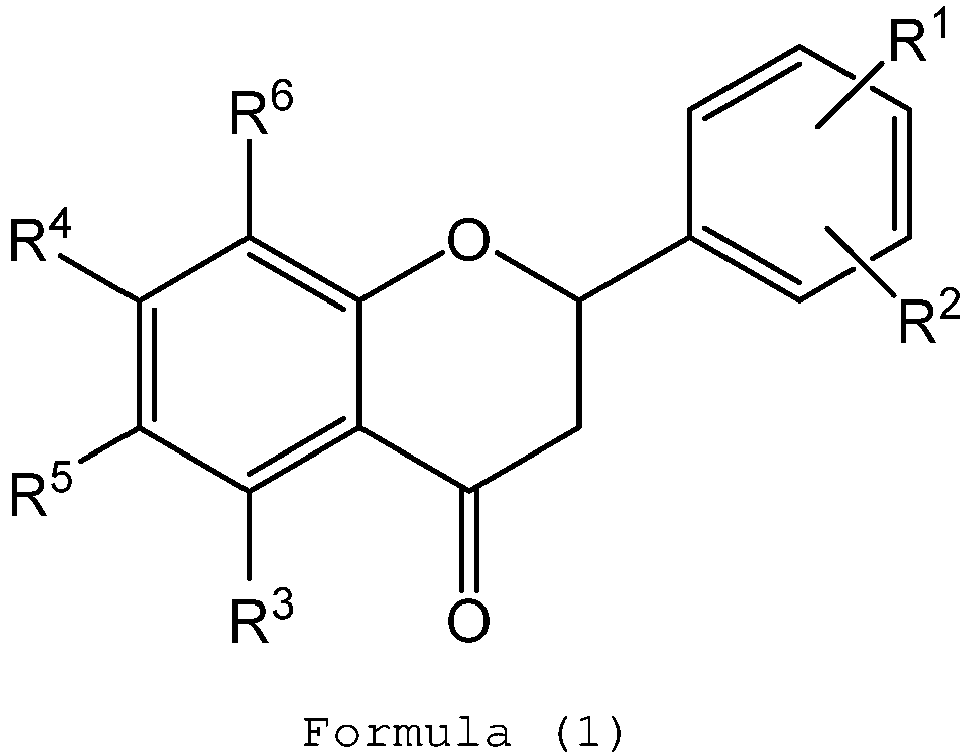
- each of R1 and R2 independently represents H, -OH, or -OR11 wherein R11 represents a C1-3 alkyl group;
- each of R3 and R4 independently represents H, -OH, or -OR12 wherein R12 represents a C1-3 alkyl group; and
- one of R5 and R6 is H, and the other a C2-6 alkenyl group, a 3,7-dimethyl-2,6-octadienyl group or a 5-methyl-2-(1-methylethenyl)-4-hexenyl group, or a pharmaceutically acceptable salt of the compound, or a solvate of the compound.
- Preferably, R1 is at the 4-position and is -OH and R2 is at the 2-position and is H or -OH; each of R3 and R4 represents -OH; and one of R5 and R6 is H, and the other is a C2-6 alkenyl group or a 3,7-dimethyl-2,6-octadienyl group or a 5-methyl-2-(1-methylethenyl)-4-hexenyl group.
- Preferably the compound for use in the treatment of neuropathic pain is(2S)-5,7-dihydroxy-2,3-dihydro-2-(2,4-dihydroxyphenyl)-8-[(R)-5-methyl-2- (1-methylethenyl)-4-hexenyl]-4H-1-benzopyran-4-one, (2S)-5,7-dihydroxy-2,3-dihydro-2-(2,4- dihydroxyphenyl)-6-[(R)-5-methyl-2-(1-methylethenyl)-4-hexenyl]-4H-1-benzopyran-4-one, or (2S)-5, 7-dihydroxy-2,3-dihydro-2-(4-hydroxyphenyl)-6-(3-methyl-2-butenyl)-4H-1-benzopyran-4-one.
- The present disclosure also provides a pharmaceutical product containing the T-type calcium channel inhibitor, and a therapeutic agent or prophylactic agent for neuropathic pains, which contains the T-type calcium channel inhibitor.
- The T-type calcium channel inhibitor according to the present disclosure which is a flavanone compound has an excellent T-type calcium channel inhibitory action. The T-type calcium channel inhibitor according to the present disclosure is very useful in the fields of, for example, medical cares, pharmaceutical products and prophylactic agents.
-
-
Fig. 1 is a graph chart showing experimental results of Example 1. -
Fig. 2 is a graph chart showing experimental results of Example 2. -
Fig. 3 is a graph chart showing experimental results of Example 3. -
Fig. 4 is a graph chart showing experimental results of Example 4. -
Fig. 5 is a graph chart showing experimental results of Example 5. -
Fig. 6 is a graph chart showing experimental results of Example 6. -
Fig. 7 is a graph chart showing effects of DMSO on K50-induced contraction in a ring preparation of a rat aorta. -
Fig. 8 is a graph chart showing effects of sophoraflavanone G on K50-induced contraction in a ring preparation of a rat aorta. -
Fig. 9 is a graph chart showing effects of 6-prenylnaringenin on K50-induced contraction in a ring preparation of a rat aorta. -
Fig. 10 is a graph chart showing effects of 8-prenylnaringenin on K50-induced contraction in a ring preparation of a rat aorta. - In this specification, "n-" denotes normal, "i-" denotes "iso," "s-" denotes "secondary," "t-" denotes "tertiary," and "c-" denotes "cyclo." The substituents will be described below.
- Examples of the halogen atom include a fluorine atom, a chlorine atom, a bromine atom and an iodine atom.
- The C1-3 alkyl group may be a linear C1-3 alkyl group, a branched C3 alkyl group or a C3 cycloalkyl group, and examples thereof include a methyl group, an ethyl group, an n-propyl group, an i-propyl group and a c-propyl group.
- The C1-3 alkyl group may be substituted or unsubstituted. Examples of the substituent include an alkoxy group, an aryloxy group, a sulfhydryl group, an alkylthio group, an arylthio group, a halogen atom, a hydroxyl group, a fluoroalkyl group, a perfluoroalkyl group, an amino group, an aminoalkyl group, a disubstituted amino group, a hydroxyalkyl group, a carboxyalkyl group and a carboxyl group.
- The C2-6 alkenyl group includes one that is linear or branched, and examples thereof include an ethenyl group, a 1-propenyl group, a 2-propenyl group, a 1-methyl-1-ethyenyl group, a 1-butenyl group, a 2-butenyl group, a 3-butenyl group, a 2-methyl-1-propenyl group, a 2-methyl-2-propenyl group, a 1-ethylethenyl group, a 1-methyl-1-propenyl group, a 1-methyl-2-propenyl group, a 1-pentenyl group, a 2-pentenyl group, a 3-pentenyl group, a 4-pentenyl group, a 1-n-propylethenyl group, a 1-methyl-1-butenyl group, a 1-methyl-2-butenyl group, a 1-methyl-3-butenyl group, a 2-ethyl-2-propenyl group, a 2-methyl-1-butenyl group, a 2-methyl-2-butenyl group, a 2-methyl-3-butenyl group, a 3-methyl-1-butenyl group, a 3-methyl-2-butenyl group, a 3-methyl-3-butenyl group, a 1,1-dimethyl-2-propenyl group, a 1-i-propylethenyl group, a 1,2-dimethyl-1-propenyl group, a 1,2-dimethyl-2-propenyl group, a 1-hexenyl group, a 2-hexenyl group, a 3-hexenyl group, a 4-hexenyl group, a 5-hexenyl group, a 1-methyl-1-pentenyl group, a 1-methyl-2-pentenyl group, a 1-methyl-3-pentenyl group, a 1-methyl-4-pentenyl group, a 1-n-butylethenyl group, a 2-methyl-1-pentenyl group, a 2-methyl-2-pentenyl group, a 2-methyl-3-pentenyl group, a 2-methyl-4-pentenyl group, a 2-n-propyl-2-propenyl group, a 3-methyl-1-pentenyl group, a 3-methyl-2-pentenyl group, a 3-methyl-3-pentenyl group, a 3-methyl-4-pentenyl group, a 3-ethyl-3-butenyl group, a 4-methyl-1-pentenyl group, a 4-methyl-2-pentenyl group, a 4-methyl-3-pentenyl group, a 4-methyl-4-pentenyl group, a 1,1-dimethyl-2-butenyl group, a 1,1-dimethyl-3-butenyl group, a 1,2-dimethyl-1-butenyl group, a 1,2-dimethyl-2-butenyl group, a 1,2-dimethyl-3-butenyl group, a 1-methyl-2-ethyl-2-propenyl group, a 1-s-butylethenyl group, a 1,3-dimethyl-1-butenyl group, a 1,3-dimethyl-2-butenyl group, a 1,3-dimethyl-3-butenyl group, a 1-i-butylethenyl group, a 2,2-dimethyl-3-butenyl group, a 2,3-dimethyl-1-butenyl group, a 2,3-dimethyl-2-butenyl group, a 2,3-dimethyl-3-butenyl group, a 2-i-propyl-2-propenyl group, a 3,3-dimethyl-1-butenyl group, a 1-ethyl-1-butenyl group, a 1-ethyl-2-butenyl group, a 1-ethyl-3-butenyl group, a 1-n-propyl-1-propenyl group, a 1-n-propyl-2-propenyl group, a 2-ethyl-1-butenyl group, a 2-ethyl-2-butenyl group, a 2-ethyl-3-butenyl group, a 1,1,2-trimethyl-2-propenyl group, a 1-t-butylethenyl group, a 1-methyl-1-ethyl-2-propenyl group, a 1-ethyl-2-methyl-1-propenyl group, a 1-ethyl-2-methyl-2-propenyl group, a 1-i-propyl-1-propenyl group and a 1-i-propyl-2-propenyl group.
- Among these C2-6 alkenyl groups, a 2-methyl-1-butenyl group, a 2-methyl-2-butenyl group, a 2-methyl-3-butenyl group, a 3-methyl-1-butenyl group, a 3-methyl-2-butenyl group, a 3-methyl-3-butenyl group, a 1,1-dimethyl-2-propenyl group, a 1-i-propylethenyl group, a 1,2-dimethyl-1-propenyl group, a 1,2-dimethyl-2-propenyl group, a 1-hexenyl group, a 2-hexenyl group, a 3-hexenyl group, a 4-hexenyl group, a 5-hexenyl group and the like may be more preferable.
- The C2-6 alkenyl group may be substituted or unsubstituted. Examples of the substituent include an alkoxy group, an aryloxy group, a sulfhydryl group, an alkylthio group, an arylthio group, a halogen atom, a hydroxyl group, a fluoroalkyl group, a perfluoroalkyl group, an amino group, an aminoalkyl group, a disubstituted amino group, a hydroxyalkyl group, a carboxyalkyl group and a carboxyl group.
- The 3,7-dimethyl-2,6-octadienyl group (number of carbon atoms: 10, geranyl group),and the 5-methyl-2-(1-methylethenyl)-4-hexenyl group (number of carbon atoms: 10), are specific examples of a prenyl group.
- The T-type calcium channel inhibitor according to the present disclosure has a structure as shown in the following formula (1).


- In the formula (1),
each of R1 and R2 independently represents H, -OH, or -OR11 wherein R11 represents a C1-3 alkyl group;
each of R3 and R4 independently represents H, -OH, or -OR12 wherein R12 represents a C1-3 alkyl group; and one of R5 and R6 is H, and the other is a 3, 7-dimethyl-2, 6-octadienyl group or a 5-methyl-2-(1-methylethenyl)-4-hexenyl group. - More preferably, in the formula (1), R1 may be at the 4-position and may be -OH, and R2 may be at the 2-position and may be -OH or H.
- More preferably, each of R3 and R4 independently may represent -OH.
- More preferably, one of of R5 and R6 is H, and the other is a C2-6 alkenyl group or a 3,7-dimethyl-2,6-octadienyl group or a 5-methyl-2-(1-methylethenyl)-4-hexenyl group. Here, examples of the preferred C2-6 alkenyl group as R5 or R6 include a 2-methyl-1-butenyl group, a 2-methyl-2-butenyl group, a 2-methyl-3-butenyl group, a 3-methyl-1-butenyl group, a 3-methyl-2-butenyl group, a 3-methyl-3-butenyl group, a 1,1-dimethyl-2-propenyl group, a 1-i-propylethenyl group, a 1,2-dimethyl-1-propenyl group, a 1,2-dimethyl-2-propenyl group, a 1-hexenyl group, a 2-hexenyl group, a 3-hexenyl group, a 4-hexenyl group and a 5-hexenyl group. Examples of the especially preferred C2-6 alkenyl group include a 3-methyl-2-butenyl group.
- Preferred compounds among those represented by the above formula (1) include compounds in which in the above formula (1),
R1 is at the 4-position and is -OH, and R2 is at the 2-position and is H or -OH;
each of R3 and R4 represents -OH; and
one of R5 and R6 may be H, and the other may be a C2-6 alkenyl group, a 3,7-dimethyl-2,6-octadienyl group or a 5-methyl-2-(1-methylethenyl)-4-hexenyl group. - Such a compound may also be referred to as naringenin compound.
- In the present invention, specific examples of the compound represented by the above formula (1) include the following compounds:
- (2S)-5,7-dihydroxy-2,3-dihydro-2-(2,4-dihydroxyphenyl)-8-[(R)-5-methyl-2-(1-methylethenyl)-4-hexenyl]-4H-1-benzopyran-4-one (sophoraflavanone G);
- (2S)-5,7-dihydroxy-2,3-dihydro-2-(2,4-dihydroxyphenyl)-6-[(R)-5-methyl-2-(1-methylethenyl)-4-hexenyl]-4H-1-benzopyran-4-one;
- (2S)-5,7-dihydroxy-2,3-dihydro-2-(4-hydroxyphenyl)-6-(3-methyl-2-butenyl)-4H-1-benzopyran-4-one (6-prenylnaringenin);
- Among the above-listed compounds, the following compounds may be especially preferable as the T-type calcium channel inhibitor for use according to the present invention:
- (2S)-5,7-dihydroxy-2,3-dihydro-2-(2,4-dihydroxyphenyl)-8-[(R)-5-methyl-2-(1-methylethenyl)-4-hexenyl]-4H-1-benzopyran-4-one (sophoraflavanone G);
- (2S)-5,7-dihydroxy-2,3-dihydro-2-(2,4-dihydroxyphenyl)-6-[(R)-5-methyl-2-(1-methylethenyl)-4-hexenyl]-4H-1-benzopyran-4-one;
- (2S)-5,7-dihydroxy-2,3-dihydro-2-(4-hydroxyphenyl)-6-(3-methyl-2-butenyl)-4H-1-benzopyran-4-one (6-prenylnaringenin).
- The compound represented by the formula (1) may be prepared by separation and purification from natural products such as flesh of fruit, or leaves, roots, stalks and seeds of plants, or a commercially available product may be used. The compound may also be prepared by organic synthesis. An example not according to the invention, naringenin, can be prepared by hydrolyzing naringin as a glycoside of naringenin using an enzyme or the like. Naringin can be separated from fruit skin, fruit juice and/or seeds of citrus fruits such as grapefruit using a general solvent extraction means or the like. The obtained naringin and naringinase are added in an aqueous solution to react with each other, whereby naringenin can be obtained (see, for example, "Handbook on Use of Enzymes," Michio KOZAKI, published by Chijinshokan Co., Ltd.). Commercially available naringenin from, for example, Sigma-Aldrich Corporation (St. Louis, MO) may also be used.
- Sophoraflavanone G can be obtained by, for example, subjecting legume-derived phytoalexin to separation and purification by multi-stage chromatography or the like. Sophoraflavanone G can also be obtained by, for example, separation and purification in which Sophora root, i.e. a root of Sophora flavescens, is extracted with chloroform, and the obtained chloroform extract is subjected to silica gel column chromatography with a chloroform/methanol mixed liquid system and a hexane/acetone mixed liquid system.
- 8-Prenylnaringenin can be obtained as a 0.5% acetic acid/methanol (1 : 4) elution fraction by, for example, mixing naringenin and sodium methoxide in a methanol : ether mixed liquid, adding isopentenyl bromide therein, then distilling away the solvent, dissolving the mixture in ether, and then subjecting the solution to Dowex 1-X4 column chromatography. Commercially available 8-prenylnaringenin from Sigma-Aldrich Corporation (St. Louis, MO) may also be used.
- 6-Prenylnaringenin can be obtained as a 1.0% acetic acid/methanol (1 : 4) elution fraction by, for example, mixing naringenin and sodium methoxide in a methanol : ether mixed liquid, adding isopentenyl bromide therein, then distilling away the solvent, dissolving the mixture in ether, and then subjecting the solution to Dowex 1-X4 column chromatography. As another method, a hard resin from a hop plant is subjected to Dowex 1-X4 column chromatography to obtain 1.0% acetic acid/methanol (1 : 4), this acetic acid/methanol is solvent-fractionated with ether and a 10% aqueous sodium carbonate solution, and the obtained 10% aqueous sodium carbonate solution is made acidic with 1 N HCl, then extracted with ether, then washed with water, dried over sodium sulfate, then concentrated, and crystallized, whereby 6-prenylnaringenin can be obtained. Commercially available 6-prenylnaringenin from Sigma-Aldrich Corporation (St. Louis, MO) may also be used.
- Hesperetin (not according to the invention) can be prepared by hydrolyzing hesperidin as a glycoside of hesperetin using an enzyme or the like. Hesperidin can be separated from, for example, fruit skin, fruit juice and/or seeds of citrus fruits such as Satsuma orange and summer orange using a general solvent extraction means or the like. Commercially available hesperidin from, for example, Hamari Company Ltd. may also be used. The obtained hesperidin and an enzyme such as hesperidinase, naringinase, rhamnosidase or glucosidase are added in an aqueous solution to react with each other, whereby hesperetin can be obtained.
- Eriodictyol and sterubin (not according to the invention) can be obtained by, for example, subjecting extracts of natural products such as Yerba Santa, lemon and rosehip to separation and purification by multi-stage chromatography or the like.
- Pinocembrin (not according to the invention) can be obtained by, for example, subjecting natural products such as honey and propolis to separation and purification by multi-stage chromatography or the like.
- For each of these compounds, a commercially available product may be used. For example, hesperetin, eriodictyol and the like can be obtained from Sigma-Aldrich Corporation (St. Louis, MO).
- In the T-type calcium channel inhibitor represented by the above formula (1) according to the present disclosure, the compound represented by the above formula (1) may be in the form of a salt. That is, a pharmaceutically acceptable salt of the compound represented by the above formula (1) can also be used as a T-type calcium channel inhibitor. Examples of the pharmaceutically acceptable salt include hydrochlorides, sulfates, methanesulfonates, hydrobromates, acetates, benzoates, tartrates, lactates, malates, salicylates, phosphates, maleates and fumarates.
- In the T-type calcium channel inhibitor represented by the above formula (1) according to the present disclosure, the compound represented by the above formula (1) may be in the form of a solvate. The solvate is not particularly limited as long as it is pharmaceutically acceptable, and examples thereof may include hydrates, and alcoholates such as ethanolates.
- The T-type calcium channel inhibitors according to the present disclosure also include prodrugs of the T-type calcium channel inhibitor represented by the above formula (1). The term "prodrug" means a compound which is converted into an activated form having a pharmacological action by hydrolysis in the body, for example, in blood. Examples of the pharmacologically acceptable prodrug are described in the documents: T. Higuchi and V. Stella, Prodrugs as Novel Drug Delivery Systems, "Bioreversible Carriers in Drug Design," edited by Edward B. Roche, American Pharmaceutical Association and Pergamon Press, A.C.S. Symposium Series, Vol. 14, (1987); and D. Fleisher, R. Bong and B.H. Stewart, "Improved oral drug delivery: Solubility limitations overcome by the use of prodrugs," Advanced Drug Delivery Reviews (1996) 19(2): 115-130. When the compound represented by the formula (1) has a hydroxyl group, examples of the prodrug include prodrugs such as acyloxy derivatives which are prepared by reacting an acyl halide, an acid anhydride or a halogenated alkyloxy carbonyl compound with the compound represented by the formula (1).
- A therapeutic agent or prophylactic agent for diseases according to the present disclosure, the effective action of which is a T-type calcium channel inhibitory action, can be administered as an orally-administered agent such as a general tablet, capsule, powder, granule, pill or oral liquid (syrup), a transmucosal absorption agent such as a renal administration agent, a nasal absorption agent or a transvaginal absorption agent, a pulmonary absorption agent, an inhalant, an eye drop, a transdermal absorption agent, or an injection. In the therapeutic agent or prophylactic agent according to the present disclosure, the T-type calcium channel inhibitor according to the present disclosure may be used as a single therapeutic agent, or may be used as a mixture with other therapeutic agents. In administration, the T-type calcium channel inhibitor is generally administered as a pharmaceutical composition.
- The therapeutic agent or prophylactic agent according to the present disclosure can be produced by a method commonly known by those skilled in the art using pharmacologically and pharmaceutically acceptable additives as necessary. For example, in the case of a tablet, a capsule or a granule, the therapeutic agent or prophylactic agent can be prepared using additives that are usually used, such as an excipient, a lubricant, a binder, a disintegrator, a wetting agent, a plasticizer and a coating agent. The oral liquid may be in the form of an aqueous or oily suspension, a solution, an emulsion, a syrup or an elixir, or may be provided as a dry syrup which is formulated into an oral liquid with water or any other suitable solvent before use. Such an oral liquid can be prepared using additives that are usually used, such as a suspending agent, a flavor, a diluent and an emulsifier.
- The suppository can be prepared using additives such as an emulsifier, a suspending agent and a preservative as necessary with a suitable substance as a base, such as cocoa butter, laurin butter, macrogol, glycerogelatin, witepsol, sodium stearate or a mixture thereof. The injection can be prepared using a resolvent such as distilled water for injection, physiological saline, a 5% glucose solution or propylene glycol, and additives as necessary such as a solubilizer, a pH regulator, an isotonizing agent and a stabilizer.
- When the T-type calcium channel inhibitor according to the present disclosure is administered to a human, the dose can be adjusted according to the age and conditions of a patient to which the inhibitor is administered. When the patient is an adult, normally the dose is generally about 0.1 to 1000 mg/person/day in the case of an oral agent or intrarectal administration, and generally about 0.05 mg to 500 mg/person/day in the case of an injection. These values are merely illustrative, and the dose of the agent is determined in accordance with conditions etc. of the patient.
- The therapeutic agent or prophylactic agent for diseases according to the present invention, the effective action of which is a T-type calcium channel inhibitory action, is, a therapeutic agent or prophylactic agent for neuropathic pain. The therapeutic agent or prophylactic agent for diseases according to the present disclosure, the effective action of which is a T-type calcium channel inhibitory action, is not limited to the therapeutic agent or prophylactic agent for neurogenic pains. Other therapeutic agents or prophylactic agents for diseases according to the present disclosure, the effective action of which is a T-type calcium channel inhibitory action, include, for example, therapeutic agents or prophylactic agents for epilepsy, therapeutic agents or prophylactic agents for hyperaldosteronemia, therapeutic agents or prophylactic agents for inflammation, therapeutic agents or prophylactic agents for edemas, therapeutic agents or prophylactic agents for cardiac hypertrophy, therapeutic agents or prophylactic agents for heart failure, therapeutic agents or prophylactic agents for cardiomyopathy, therapeutic agents or prophylactic agents for atrial fibrillation, therapeutic agents or prophylactic agents for tachyarrhythmia, therapeutic agents or prophylactic agents for arteriosclerosis, therapeutic agents or prophylactic agents for nephritis, therapeutic agents or prophylactic agents for renal disorders and therapeutic agents or prophylactic agents for renal failure.
- The present invention will be described further in detail by way of examples below, but the present invention is not limited to these examples. In examples, "%" is on a weight basis unless otherwise specified.
- The compounds described below were prepared or obtained in the following manner.
- Sophora root (2 kg) was extracted with chloroform to obtain an extract. The obtained chloroform extract was subjected to silica gel column chromatography with a chloroform/methanol mixed liquid system and a hexane/acetone mixed liquid system, and a fraction containing an intended compound was detected by TLC analysis. Sophoraflavanone G was then isolated by performing preparative HPLC under the following conditions. HPLC: 600 Pump (Waters), 2489 UV/Visible Detector (Waters), column: YMC-Pack ODS-AM (250 × 20 mm i.d., YMC Co., Ltd.), guard column: YMC-Guardpack ODS-AM (50 × 20 mm i.d., YMC Co., Ltd.), mobile phase: liquid A; 0.1% acetic acid, liquid B; acetonitrile (0 min; liquid A : liquid B = 20 : 80, 30 min; liquid A : liquid B = 5 : 95), flow rate: 10.0 mL/min, detection wavelength: UV (280 nm), retention time (tR): 12 min.
- DMSO (dimethyl sulfoxide) was used as a solvent for dissolving sophoraflavanone G.
- 6-Prenylnaringenin was purchased from Sigma-Aldrich Corporation (St. Louis, MO).
- DMSO was used as a solvent for dissolving 6-prenylnaringenin.
- 8-Prenylnaringenin was purchased from Sigma-Aldrich Corporation (St. Louis, MO).
- DMSO was used as a solvent for dissolving 8-prenylnaringenin.
- A T-type calcium channel inhibitory action of sophoraflavanone G was measured by a whole-cell patch method using a human renal cell-derived cell line: EK 293 cell forced to express a human T-type calcium channel.
- In the whole-cell patch method, a barium current passing as an inward current was measured in a potential jump from -80 mV to -20 mV with the holding potential set to -80 mV using, as an external solution and an internal solution, ones having the compositions shown below. Here, for eliminating influences of a high-threshold-activatedtype calcium channel, a value obtained by subtracting from a peak current a current 150 ms after the start of stimulation was used as a T-current for data analysis.
- Aqueous solution containing the following:
- 97 mM N-methyl-D-glucamine (NMDG);
- 10 mM BaCl2;
- 10 mM 4-(2-hydroxyethyl)-1-piperazine ethanesulfonic acid (HEPES);
- 40 mM tetraethylammonium chloride (TEA-Cl); and
- 5 mM glucose
- (pH 7.4).
- Aqueous solution containing the following:
- 4 mM MgCl2;
- 140 mM CsCl;
- 10 mM HEPES; and
- 5 mM glycol ether diamine tetraacetic acid (EGTA)
- (pH 7.2).
- Data obtained from the above-described experiment are shown in the table below.
[Table 1] Compound concentration (nM) Inhibition rate (%) Number of cases 500 25.9 4 1000 61.1 17 3000 97.7 6 - Data obtained from the above-described experiment are shown in
Fig. 1 . InFig. 1 , the data are shown as a ratio (%) of a T-current at addition of a compound to a T-current at addition of a solvent (DMSO). - Except that sophoraflavanone G was replaced by 6-prenylnaringenin, the same procedure as in Example 1 was carried out to measure a T-type calcium channel inhibitory action of 6-prenylnaringenin.
- Data obtained from the above-described experiment are shown in the table below.
[Table 2] Compound concentration (nM) Inhibition rate (%) Number of cases 300 0 6 1000 82.7 6 3000 99.0 6 - Data obtained from the above-described experiment are shown in
Fig. 2 . - Except that sophoraflavanone G was replaced by 8-prenylnaringenin, the same procedure as in Example 1 was carried out to measure a T-type calcium channel inhibitory action of 6-prenylnaringenin.
- Data obtained from the above-described experiment are shown in the table below.
[Table 3] Compound concentration (nM) Inhibition rate (%) Number of cases 300 16.4 8 1000 64.9 12 3000 91.0 7 10000 99.9 6 - Data obtained from the above-described experiment are shown in
Fig. 3 . - The IC50 values (nM) of the compounds in Examples 1 to 3 are shown in the table below. These IC50 values are values calculated by GraphPad Prism® (GraphPad Software, Inc.) using the results of Examples 1 to 3.
[Table 4] IC50 (nM) Sophoraflavanone G 813.6 6-Prenylnaringenin 800.9 8-Prenylnaringenin 720.9 - From the examples, it is apparent that the compounds used in the examples each have an excellent T-type calcium channel inhibitory action.
- Into the paw sole of a male ddY mouse, 0.1 nmol/paw (volume: 10 µL/paw) of NaHS (sodium hydrogen sulfide) was administered alone, or 0.1 nmol/paw of NaHS and 1, 10 or 30 pmol/paw of sophoraflavanone G were administered in combination, and an action of sophoraflavanone G on NaHS-induced hyperalgesia was measured by an up-and-down method using a von Frey filament.
- Here, NaHS (sodium hydrogen sulfide) is used as a H2S donor. H2S is a hyperalgesia-inducing substance which is involved in information transmission of pain through a Cav3.2 T-type calcium channel (see Kawabata A. et al. Hydrogen sulfide as a novel nociceptive messenger. Pain. 2007 Nov; 132(1-2): 74-81. Epub 2007 Mar 7.).
- Data obtained from the above-described experiment are shown in the table below.
[Table 5] Treatment Hyperalgesia threshold (g) Average value ± standard error Number of cases Solvent + solvent 0.43 ± 0.07 6 NaHS (0.1 nmol/paw sole) + solvent 0.06 ± 0.01 6 NaHS (0.1 nmol/paw sole) + sophoraflavanone G (1 pmol/paw sole) 0.11 ± 0.04 4 NaHS (0.1 nmol/paw sole) + sophoraflavanone G (10 pmol/paw sole) 0.35 ± 0.07 4 NaHS (0.1 nmol/paw sole) + sophoraflavanone G (30 pmol/paw sole) 0.34 ± 0.10 4 - Data obtained from the above-described experiment are shown in
Fig. 4 . As shown in the above table andFig. 4 , it is apparent that sophoraflavanone G inhibits NaHS-induced hyperalgesia, and thus exhibits a T-type calcium channel inhibitory action. - Except that 6-prenylnaringenin was used in place of sophoraflavanone G, the same procedure as in Example 4 was carried out to measure an action of 6-prenylnaringenin on NaHS-induced hyperalgesia. The obtained data are shown in the table below.
[Table 6] Treatment Hyperalgesia threshold (g) Average value ± standard error Number of cases Solvent + solvent 0.62 ± 0.00 4 NaHS (0.1 nmol/paw sole) + solvent 0.21 ± 0.04 4 NaHS (0.1 nmol/paw sole) + 6-prenylnaringenin (0.1 nmol/paw sole) 0.28 ± 0.07 4 NaHS (0.1 nmol/paw sole) + 6-prenylnaringenin (1 nmol/paw sole) 0.31 ± 0.06 4 NaHS (0.1 nmol/paw sole) + 6-prenylnaringenin (10 nmol/paw sole) 0.52 ± 0.09 4 - Data obtained from the above-described experiment are shown in
Fig. 5 . As shown in the above table andFig. 5 , it is apparent that 6-prenylnaringenin inhibits NaHS-induced hyperalgesia, and thus exhibits a T-type calcium channel inhibitory action. - Except that 8-prenylnaringenin was used in place of sophoraflavanone G, the same procedure as in Example 4 was carried out to measure an action of 8-prenylnaringenin on NaHS-induced hyperalgesia. The obtained data are shown in the table below.
[Table 7] Treatment Hyperalgesia threshold (g) Average value ± standard error Number of cases Solvent + solvent 0.60 ± 0.07 9 NaHS (0.1 nmol/paw sole) + solvent 0.21 ± 0.02 9 NaHS (0.1 nmol/paw sole) + 8-prenylnaringenin (0.1 nmol/paw sole) 0.23 ± 0.04 4 NaHS (0.1 nmol/paw sole) + 8-prenylnaringenin (1 nmol/paw sole) 0.41 ± 0.04 9 NaHS (0.1 nmol/paw sole) + 8-prenylnaringenin (10 nmol/paw sole) 0.55 ± 0.05 8 - Data obtained from the above-described experiment are shown in
Fig. 6 . As shown in the above table andFig. 6 , it is apparent that 8-prenylnaringenin inhibits NaHS-induced hyperalgesia, and thus exhibits a T-type calcium channel inhibitory action. - For the experiment, 7 to 10 week-old male Wistar rats (Japan SLC, Inc., Shizuoka, Japan) were used. These experimental animals were bred in a chamber with a 12-hour light-dark cycle maintained at a temperature of about 24°C while they were allowed to freely take tap water and a solid feed (Oriental Yeast Co., Ltd., Tokyo, Japan).
- The rats were caused to hemorrhage to death by cutting the carotid artery under anesthesia, and the thoracic aorta was extracted. Connective tissues and fat were removed from the thoracic aorta in a cooled modified Kreb's liquid. A 1 mm-wide ring preparation was prepared from the thoracic aorta, and the lumen of the specimen was rubbed with rubber to remove the endothelium. Removal of the endothelium was confirmed by the fact that a relaxation response did not occur when acetylcholine (Ach) was made to act on the specimen caused to pre-contract by phenylephrine (Phe).
- Two 100 µm tungsten wires were inserted into the lumen of the 1 mm-wide ring preparation, and the ring preparation was transferred to a liquid bath with a volume of 10 mL. The liquid bath had a double-glass structure, and warm water heated to 37°C in a thermostatic bath was circulated to the outer layer of the liquid bath to maintain experimental conditions of a fixed temperature. The other ends of tungsten wires inserted into the lumen of the ring preparation were fixed to a tension transducer, and a change in tension of the specimen was isometrically measured. Signals from the tension transducer passed through a blood pressure amplifier to be recorded by a pen recorder. An initial stretching tension of 1 g was applied in a normal Kreb's liquid, and the specimen was equilibrated for 1 hour, and then caused to contract once by a 10-6 M phenylephrine solution. This procedure was necessary for obtaining stable results. At the end of the experiment, verapamil (Vera) (10-5 M) and papaverine (10-4 M) were added to completely relax the specimen. The level at this time was set to 0 for all the measurements of a change in tension.
- The reagents used were as follows.
- Normal Kreb's liquid: NaCl (118 mM), KCl (4.7 mM), CaCl2 (2.5 mM), MgCl2 (1.2 mM), NaHCO3 (25 mM), KH2PO4 (1.2 mM) and glucose (10 mM) were diluted with H2O to 1 L, and ventilated for 10 minutes with a mixed gas of 95% of O2 and 5% of CO2, and 2.5 mL of a 1 M CaCl2 solution was then added.
- Kreb's liquid (K50): NaCl (73.9 mM), KCl (48.8 mM), CaCl2 (2.5 mM), MgCl2 (1.2 mM), NaHCO3 (25 mM), KH2PO4 (1.2 mM) and glucose (10 mM) were diluted with H2O to 1 L, and ventilated for 10 minutes with a mixed gas of 95% of O2 and 5% of CO2, and 2.5 mL of a 1 M CaCl2 solution was then added.
- Acetylcholine hydrochloride (Ach, manufactured by Sigma)
- Verapamil hydrochloride (Vera, manufactured by Eisai Co., Ltd. (Tokyo))
- Papaverine hydrochloride (manufactured by Sigma)
- A contraction experiment using a rat aortic smooth muscle specimen freed of the vascular endothelium was conducted to examine effects of sophoraflavanone G, which had exhibited a T-type calcium channel inhibitory effect, on an L-type Ca2+ channel. Complete removal of the endothelium was confirmed by the fact that relaxation did not occur when 10-5 M acetylcholine was made to act on the specimen caused to contract by 10-6 M phenylephrine. Thereafter, the specimen was washed three times with the Normal Kreb's liquid, and to the specimen caused to pre-contract by the Kreb's liquid (K50) containing 50 mM potassium ions, 1 µL of 1 µM of sophoraflavanone G (final concentration: 0.001 µM) dissolved in DMSO, 2 µL of 1 µM of the sophoraflavanone G (final concentration: 0.003 µM), 7 µL of 1 µM of the sophoraflavanone G (final concentration: 0.01 µM), 2 µL of 10 µM of the sophoraflavanone G (final concentration: 0.03 µM), 7 µL of 10 µM of the sophoraflavanone G (final concentration: 0.1 µM), 2 µL of 10 µM of the sophoraflavanone G (final concentration: 0.3 µM), 7 µL of 100 µM of the sophoraflavanone G (final concentration: 1 µM) and 2 µL of 1000 µM of the sophoraflavanone G (final concentration: 3 µM) were accumulatively added in a liquid bath containing 10 mL of the Kreb's liquid. A contraction experiment using a rat aortic smooth muscle specimen freed of the vascular endothelium was conducted to examine effects of sophoraflavanone G, which had exhibited a T-type calcium channel inhibitory effect, on an L-type Ca2+ channel. Inhibitory rates (%) on contraction by K50 are shown in the table below, and a measurement chart is shown in
Fig. 8 .[Table 8] Sophoraflavanone G (µM) 0.001 0.003 0.01 0.03 0.1 0.3 1 3 Inhibitory rate (%) 0.0 0.0 5.6 5.6 5.6 5.6 11.1 8.3 - The results of measurement of effects of DMSO, which was used as a solvent for dissolving sophoraflavanone G, on an L-type Ca2+ channel are shown in the table below and
Fig. 7 .[Table 9] DMSO (%) 0.1 0.3 1 1.3 2 2.3 3 3.3 Inhibitory rate (%) 0.0 0.0 0.0 0.0 0.0 0.0 5.6 2.2 - As shown in the above table and
Fig. 8 , sophoraflavanone G did not relax the specimen caused to pre-contract by K50. From this measurement result, it has been confirmed that sophoraflavanone G does not act on an L-type calcium channel. - Except that 6-prenylnaringenin was used in place of sophoraflavanone G, the same procedure as in Example 7 was carried out to examine effects on an L-type Ca2+ channel. Inhibitory rates (%) on contraction by K50 are shown in the table below, and a measurement chart is shown in
Fig. 9 .[Table 10] 6-Prenylnaringenin (µM) 0.001 0.003 0.01 0.03 0.1 0.3 1 3 Inhibitory rate (%) 0.0 0.0 4.1 6.1 4.1 4.1 4.1 4.1 - As shown in the above table and
Fig. 9 , 6-prenylnaringenin did not relax the specimen caused to pre-contract by K50. From this measurement result, it has been confirmed that 6-prenylnaringenin does not act on an L-type calcium channel. - Except that 8-prenylnaringenin was used in place of sophoraflavanone G, the same procedure as in Example 7 was carried out to examine effects on an L-type Ca2+ channel. Inhibitory rates (%) on contraction by K50 are shown in the table below, and a measurement chart is shown in
Fig. 10 .[Table 11] 8-Prenylnaringenin (µM) 0.001 0.003 0.01 0.03 0.1 0.3 1 3 Inhibitory rate (%) 0.0 0.0 7.4 0.0 11.1 14.8 22.2 25.9 - As shown in the above table and
Fig. 10 , 8-prenylnaringenin did not relax the specimen caused to pre-contract by K50. From this measurement result, it has been confirmed that 8-prenylnaringenin does not act on an L-type calcium channel. - From these experiments, it has been confirmed that none of sophoraflavanone G, 6-prenylnaringenin and 8-prenylnaringenin acts on an L-type calcium channel. That is, sophoraflavanone G, 6-prenylnaringenin and 8-prenylnaringenin have been each confirmed to be a T-type calcium channel-specific inhibitor (T-type calcium channel-selective inhibitor) which does not act on an L-type calcium channel while acting on a T-type calcium channel.
- The T-type calcium channel-specific (selective) inhibitor does not have actions caused by an L-type calcium channel inhibitor, such as a myocardial contraction inhibitory action and a vascular smooth muscle relaxing action, and thus can be used as a safer therapeutic agent (e.g. neurogenic pain therapeutic agent). More specifically, the T-type calcium channel-specific inhibitor does not have a myocardial contraction inhibitory action and a vascular smooth muscle relaxing action, and therefore has the advantage that a decrease in cardiac output and dilation of blood vessels are hard to occur, so that side effects resulting from disorders of cardiovascular systems, such as a decrease in blood pressure, postural hypotension or edemas can be reduced.
- A granule containing the T-type calcium channel inhibitor for use according to the present invention was produced in accordance with the following procedure.
[Table 12] 6- Prenylnaringenin 10 mg Lactose 700 mg Corn starch 274 mg HPC-L 16 mg Total 1000 mg - 6-Prenylnaringenin and lactose were put through a 60-mesh screen, and corn starch was put through a 120-mesh screen. They were mixed by a V-type mixer. To the mixed powder was added an aqueous solution of low-viscosity hydroxypropyl cellulose (HPC-L), and the mixture was kneaded. The obtained product was granulated (extrusion granulation, pore diameter: 0.5 to 1 mm), and then dried. The obtained dry grains were sieved by a vibrating screen (12/60 mesh) to obtain a granule.
- An intravenous preparation containing the T-type calcium channel inhibitor for use according to the present invention was produced in accordance with the following procedure.
[Table 13] 6- Prenylnaringenin 100 mg Saturated fatty acid glyceride 1000 ml - The solution of the components is normally intravenously administered to a patient at a rate of 1 ml per minute.
- The T-type calcium channel inhibitor according to the present disclosure which is a flavanone compound has an excellent T-type calcium channel inhibitory action. The T-type calcium channel inhibitor according to the present disclosure is very useful in the fields of, for example, medical cares, pharmaceutical products and prophylactic agents.
Claims (4)
- A compound for use in the treatment of neuropathic pain, wherein the compound is a compound represented by the formula (1):
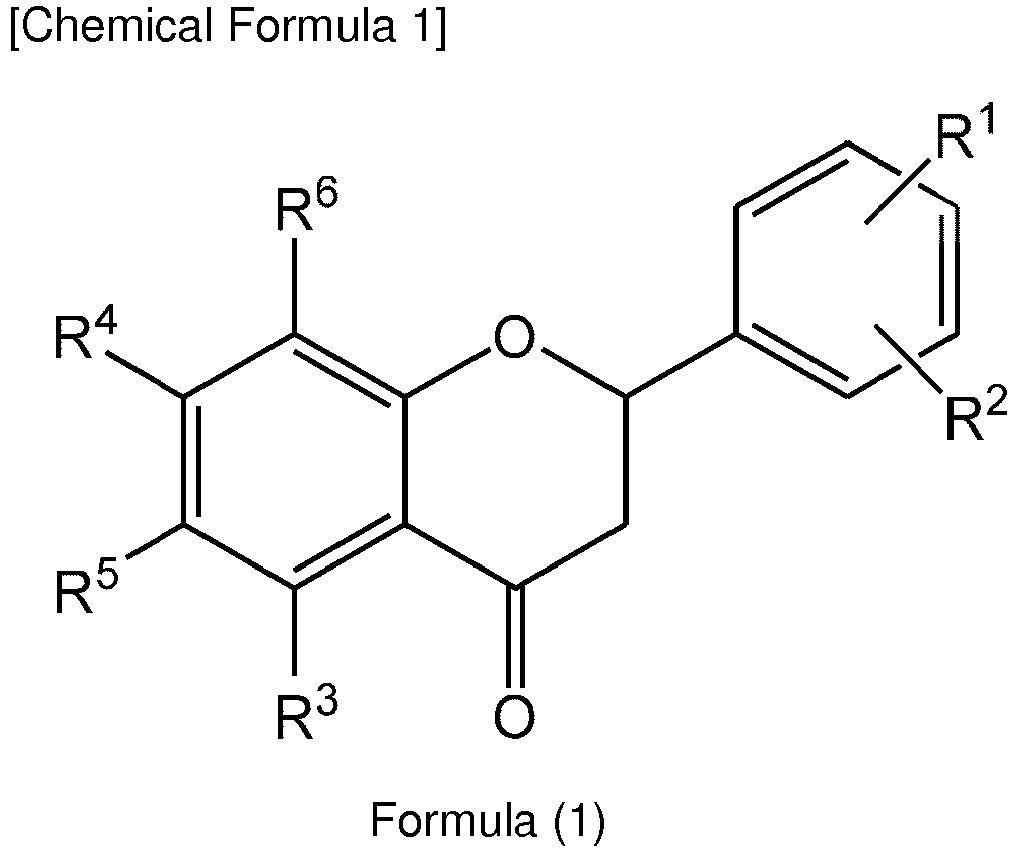 each of R1 and R2 independently represents H, -OH, or -OR11 wherein R11 represents a C1-3 alkyl group;each of R3 and R4 independently represents H, -OH, or -OR12 wherein R12 represents a C1-3 alkyl group; andone of R5 and R6 is H, and the other is C2-6 alkenyl group, a 3,7-dimethyl-2,6-octadienyl group or a 5-methyl-2- (1-methylethenyl)-4-hexenyl group, ora pharmaceutically acceptable salt of the compound, or a solvate of the compound.
 - The compound for use as claimed in claim 1, wherein R1 is at the 4-position and is -OH, and R2 is at the 2-position and is H, or -OH;
each of R3 and R4 represents -OH; and
one of R5 and R6 is H, and the other is C2-6 alkenyl group, a 3,7-dimethyl-2,6-octadienyl group or a 5-methyl-2- (1-methylethenyl)-4-hexenyl group. - The compound for use as claimed in claim 1,
wherein
the compound is (2S)-5,7-dihydroxy-2,3-dihydro-2-(2,4-dihydroxyphenyl)-8-[(R)-5-methyl-2- (1-methylethenyl)-4-hexenyl]-4H-1-benzopyran-4-one, (2S)-5,7-dihydroxy-2,3-dihydro-2-(2,4- dihydroxyphenyl)-6-[(R)-5-methyl-2-(1-methylethenyl)-4-hexenyl]-4H-1-benzopyran-4-one, or (2S)-5,7-dihydroxy-2,3-dihydro-2-(4-hydroxyphenyl)-6-(3-methyl-2-butenyl)-4H-1-benzopyran-4-one. - A pharmaceutical product for use as claimed in claim 1 comprising the compound as claimed in claims 1 to 3.
Applications Claiming Priority (2)
| Application Number | Priority Date | Filing Date | Title |
|---|---|---|---|
| JP2013108512 | 2013-05-23 | ||
| PCT/JP2014/063102 WO2014188980A1 (en) | 2013-05-23 | 2014-05-16 | T-type calcium channel inhibitor |
Publications (3)
| Publication Number | Publication Date |
|---|---|
| EP3000465A1 EP3000465A1 (en) | 2016-03-30 |
| EP3000465A4 EP3000465A4 (en) | 2016-12-07 |
| EP3000465B1 true EP3000465B1 (en) | 2021-03-31 |
Family
ID=51933535
Family Applications (1)
| Application Number | Title | Priority Date | Filing Date |
|---|---|---|---|
| EP14801611.6A Active EP3000465B1 (en) | 2013-05-23 | 2014-05-16 | T-type calcium channel inhibitor |
Country Status (6)
| Country | Link |
|---|---|
| US (2) | US20160096815A1 (en) |
| EP (1) | EP3000465B1 (en) |
| JP (1) | JP6393680B2 (en) |
| AU (1) | AU2014269508B2 (en) |
| CA (1) | CA2912522C (en) |
| WO (1) | WO2014188980A1 (en) |
Families Citing this family (2)
| Publication number | Priority date | Publication date | Assignee | Title |
|---|---|---|---|---|
| KR101751486B1 (en) * | 2016-03-02 | 2017-06-28 | 광주과학기술원 | Composition for Enhancing BKCa Channel |
| JP7193806B2 (en) * | 2017-09-28 | 2022-12-21 | 学校法人近畿大学 | T-type calcium channel inhibitor |
Citations (3)
| Publication number | Priority date | Publication date | Assignee | Title |
|---|---|---|---|---|
| US20050226943A1 (en) * | 2004-04-01 | 2005-10-13 | Xiaoqiang Yan | Extract of sophora flavescens flavonoids and uses thereof |
| KR20090010504A (en) * | 2007-07-23 | 2009-01-30 | 한국생명공학연구원 | A composition for the prevention and treatment of cardiovascular disease, comprising a extract of red ginseng, a soluble extract thereof, a fraction thereof or a flavonoid compound isolated therefrom as an active ingredient |
| WO2012043949A1 (en) * | 2010-09-27 | 2012-04-05 | 한국생명공학연구원 | Composition for enhancing immunity containing compounds represented by chemical formulas 1-8 or sophora flavescens extract as active ingredient |
Family Cites Families (10)
| Publication number | Priority date | Publication date | Assignee | Title |
|---|---|---|---|---|
| JP3327699B2 (en) | 1994-08-31 | 2002-09-24 | 一丸ファルコス株式会社 | Antibacterial / preservative and cosmetics containing kujin extract |
| DE10031651A1 (en) | 2000-06-29 | 2002-01-17 | Schwabe Willmar Gmbh & Co | Extracts from Sophora species, process for their preparation and use |
| US7144590B2 (en) * | 2003-01-09 | 2006-12-05 | Lipoprotein Technologies, Inc. | Bioactive compositions derived from humulus lupulus |
| EP1621201A1 (en) * | 2004-07-28 | 2006-02-01 | NeuroCode AG | Hesperidin for prophylaxis and treatment of diseases of the central nervous system, in particular Alzheimer's and Parkinson's diseases, for therapy after stroke as well as for chronic pain. |
| JP2010195762A (en) * | 2009-01-29 | 2010-09-09 | Genshin Seigi Yakuhin Kofun Yugenkoshi | Prenylflavanone compound and use thereof |
| JP2011140477A (en) * | 2009-03-04 | 2011-07-21 | Tohoku Univ | Cb1 receptor agonist |
| EP2995303A1 (en) * | 2009-07-10 | 2016-03-16 | President and Fellows of Harvard College | Permanently charged sodium and calcium channel blockers as anti-inflammatory agents |
| US8202525B2 (en) * | 2009-12-22 | 2012-06-19 | Pondera Biotechnologies, LLC | Methods and compositions for treating distress dysfunction and enhancing safety and efficacy of specific medications |
| US20120172090A1 (en) * | 2010-12-29 | 2012-07-05 | Capps Adrienne H | Protective Case with Speaker and Microphone |
| WO2012172090A1 (en) | 2011-06-17 | 2012-12-20 | Ludwig Aigner | Chromane-like cyclic prenylflavonoids for the medical intervention in neurological disorders |
-
2014
- 2014-05-16 US US14/892,392 patent/US20160096815A1/en not_active Abandoned
- 2014-05-16 CA CA2912522A patent/CA2912522C/en active Active
- 2014-05-16 EP EP14801611.6A patent/EP3000465B1/en active Active
- 2014-05-16 WO PCT/JP2014/063102 patent/WO2014188980A1/en not_active Ceased
- 2014-05-16 JP JP2015518224A patent/JP6393680B2/en active Active
- 2014-05-16 AU AU2014269508A patent/AU2014269508B2/en active Active
-
2017
- 2017-11-08 US US15/807,064 patent/US10633358B2/en active Active
Patent Citations (4)
| Publication number | Priority date | Publication date | Assignee | Title |
|---|---|---|---|---|
| US20050226943A1 (en) * | 2004-04-01 | 2005-10-13 | Xiaoqiang Yan | Extract of sophora flavescens flavonoids and uses thereof |
| KR20090010504A (en) * | 2007-07-23 | 2009-01-30 | 한국생명공학연구원 | A composition for the prevention and treatment of cardiovascular disease, comprising a extract of red ginseng, a soluble extract thereof, a fraction thereof or a flavonoid compound isolated therefrom as an active ingredient |
| WO2012043949A1 (en) * | 2010-09-27 | 2012-04-05 | 한국생명공학연구원 | Composition for enhancing immunity containing compounds represented by chemical formulas 1-8 or sophora flavescens extract as active ingredient |
| US20130303474A1 (en) * | 2010-09-27 | 2013-11-14 | Korea Research Institute Of Bioscience And Biotech | Composition for enhancing immunity containing compounds represented by chemical formulas 1-8 or sophora flavescens extract as active ingredient |
Also Published As
| Publication number | Publication date |
|---|---|
| WO2014188980A1 (en) | 2014-11-27 |
| AU2014269508A1 (en) | 2015-12-03 |
| EP3000465A4 (en) | 2016-12-07 |
| JP6393680B2 (en) | 2018-09-19 |
| AU2014269508B2 (en) | 2019-08-01 |
| US10633358B2 (en) | 2020-04-28 |
| CA2912522C (en) | 2021-05-11 |
| US20160096815A1 (en) | 2016-04-07 |
| JPWO2014188980A1 (en) | 2017-02-23 |
| EP3000465A1 (en) | 2016-03-30 |
| CA2912522A1 (en) | 2014-11-27 |
| US20180065947A1 (en) | 2018-03-08 |
Similar Documents
| Publication | Publication Date | Title |
|---|---|---|
| ES2640572T3 (en) | Enhanced parenteral formulations of lipophilic pharmaceutical agents and methods of preparation and use thereof | |
| EP1829544A1 (en) | Pharmaceutically active morpholinol | |
| TWI830262B (en) | Use of clemizole compounds for prevention and treatment of liver cancer | |
| EP3838900B1 (en) | 3-aryloxy-3-aryl-propylamine compound and uses thereof | |
| US10765660B2 (en) | Agent containing flavonoid derivatives for treating cancer and inflammation | |
| JP2021091713A (en) | Use of kaurane compounds in manufacture of medicament for treatment of cardiac hypertrophy and pulmonary hypertension | |
| EP3458448A1 (en) | Methods of using fasn inhibitors | |
| AU2022241458B2 (en) | Use of phenoxypropylamine compounds to treat depression | |
| US20170100389A1 (en) | Tetrahydroprotoberbine compounds and uses thereof in the treatment of neurological, psychiatric and neurodegenerative diseases | |
| CN109475559A (en) | Novel quinazolinone derivatives that inhibit PI3K and pharmaceutical compositions containing the same | |
| EP3120859A1 (en) | Composition for preventing, treating, and alleviating urinary disturbances, containing piper longum l. extract | |
| EP3251675B1 (en) | Prevention or treatment of uric acid or gout disease | |
| US10633358B2 (en) | T-type calcium channel inhibitor | |
| CN109476676A (en) | Optically active pyranochromenylphenol derivatives and pharmaceutical compositions containing the same | |
| CN109771411A (en) | Use of dihydroquercetin in preparing medicine for treating fatty liver | |
| CN113248525B (en) | Bermudagrass plant extract and its extraction and separation method and use | |
| BR112015014492B1 (en) | pharmaceutical composition of plant extract for treatment of abuse, addiction and withdrawal symptoms of alcohol and / or opioids | |
| KR101603279B1 (en) | Pharmaceutical composition for prevention or treatment of diseases induced by activation of NFAT5 containing protoberberine derivative or pharmaceutically acceptable salts as an active ingredient | |
| PT86776B (en) | PROCESS FOR THE PREPARATION OF PIPERAZINOCARBOXYLIC ACID AND OF PHARMACEUTICAL COMPOSITIONS CONTAINING IT | |
| Mahendran et al. | Natural-derived compounds and their mechanisms in potential autosomal dominant polycystic kidney disease (ADPKD) treatment | |
| KR102090089B1 (en) | Composition for preventing or treating of depression and anxiety comprising hispidol | |
| KR101620022B1 (en) | Pharmaceuical composition for the prevention and treatment of type 1 diabetes comprising Polyphenols extracted from Broussonetia kazinoki as an active ingredient | |
| Jung et al. | 8-(Tosylamino) quinoline inhibits tumour progression through targeting phosphoinositide-3-kinase/Akt pathway | |
| Chetouani et al. | Comprehensive Insights into Adrenaline: Biological Functions, Physicochemical Properties, and DFT Analysis. | |
| JP6736645B2 (en) | Claudin-5 production promoter and oral composition for promoting claudin-5 production |
Legal Events
| Date | Code | Title | Description |
|---|---|---|---|
| PUAI | Public reference made under article 153(3) epc to a published international application that has entered the european phase |
Free format text: ORIGINAL CODE: 0009012 |
|
| 17P | Request for examination filed |
Effective date: 20151119 |
|
| AK | Designated contracting states |
Kind code of ref document: A1 Designated state(s): AL AT BE BG CH CY CZ DE DK EE ES FI FR GB GR HR HU IE IS IT LI LT LU LV MC MK MT NL NO PL PT RO RS SE SI SK SM TR |
|
| AX | Request for extension of the european patent |
Extension state: BA ME |
|
| DAX | Request for extension of the european patent (deleted) | ||
| A4 | Supplementary search report drawn up and despatched |
Effective date: 20161108 |
|
| RIC1 | Information provided on ipc code assigned before grant |
Ipc: A61P 25/04 20060101ALI20161102BHEP Ipc: A61K 31/352 20060101AFI20161102BHEP Ipc: C07D 311/32 20060101ALI20161102BHEP Ipc: A61P 3/14 20060101ALI20161102BHEP |
|
| STAA | Information on the status of an ep patent application or granted ep patent |
Free format text: STATUS: EXAMINATION IS IN PROGRESS |
|
| 17Q | First examination report despatched |
Effective date: 20171116 |
|
| GRAP | Despatch of communication of intention to grant a patent |
Free format text: ORIGINAL CODE: EPIDOSNIGR1 |
|
| STAA | Information on the status of an ep patent application or granted ep patent |
Free format text: STATUS: GRANT OF PATENT IS INTENDED |
|
| RIC1 | Information provided on ipc code assigned before grant |
Ipc: A61P 3/14 20060101ALI20200911BHEP Ipc: A61P 5/42 20060101ALI20200911BHEP Ipc: A61P 25/02 20060101ALI20200911BHEP Ipc: A61P 13/12 20060101ALI20200911BHEP Ipc: A61P 9/00 20060101ALI20200911BHEP Ipc: A61P 9/06 20060101ALI20200911BHEP Ipc: C07D 311/32 20060101ALI20200911BHEP Ipc: A61K 31/352 20060101AFI20200911BHEP Ipc: A61P 43/00 20060101ALI20200911BHEP Ipc: A61P 25/04 20060101ALI20200911BHEP |
|
| INTG | Intention to grant announced |
Effective date: 20201016 |
|
| GRAS | Grant fee paid |
Free format text: ORIGINAL CODE: EPIDOSNIGR3 |
|
| GRAA | (expected) grant |
Free format text: ORIGINAL CODE: 0009210 |
|
| STAA | Information on the status of an ep patent application or granted ep patent |
Free format text: STATUS: THE PATENT HAS BEEN GRANTED |
|
| AK | Designated contracting states |
Kind code of ref document: B1 Designated state(s): AL AT BE BG CH CY CZ DE DK EE ES FI FR GB GR HR HU IE IS IT LI LT LU LV MC MK MT NL NO PL PT RO RS SE SI SK SM TR |
|
| REG | Reference to a national code |
Ref country code: GB Ref legal event code: FG4D Ref country code: CH Ref legal event code: EP |
|
| REG | Reference to a national code |
Ref country code: DE Ref legal event code: R096 Ref document number: 602014076183 Country of ref document: DE Ref country code: AT Ref legal event code: REF Ref document number: 1376157 Country of ref document: AT Kind code of ref document: T Effective date: 20210415 |
|
| REG | Reference to a national code |
Ref country code: IE Ref legal event code: FG4D |
|
| REG | Reference to a national code |
Ref country code: LT Ref legal event code: MG9D |
|
| PG25 | Lapsed in a contracting state [announced via postgrant information from national office to epo] |
Ref country code: BG Free format text: LAPSE BECAUSE OF FAILURE TO SUBMIT A TRANSLATION OF THE DESCRIPTION OR TO PAY THE FEE WITHIN THE PRESCRIBED TIME-LIMIT Effective date: 20210630 Ref country code: NO Free format text: LAPSE BECAUSE OF FAILURE TO SUBMIT A TRANSLATION OF THE DESCRIPTION OR TO PAY THE FEE WITHIN THE PRESCRIBED TIME-LIMIT Effective date: 20210630 Ref country code: FI Free format text: LAPSE BECAUSE OF FAILURE TO SUBMIT A TRANSLATION OF THE DESCRIPTION OR TO PAY THE FEE WITHIN THE PRESCRIBED TIME-LIMIT Effective date: 20210331 Ref country code: HR Free format text: LAPSE BECAUSE OF FAILURE TO SUBMIT A TRANSLATION OF THE DESCRIPTION OR TO PAY THE FEE WITHIN THE PRESCRIBED TIME-LIMIT Effective date: 20210331 |
|
| PG25 | Lapsed in a contracting state [announced via postgrant information from national office to epo] |
Ref country code: SE Free format text: LAPSE BECAUSE OF FAILURE TO SUBMIT A TRANSLATION OF THE DESCRIPTION OR TO PAY THE FEE WITHIN THE PRESCRIBED TIME-LIMIT Effective date: 20210331 Ref country code: RS Free format text: LAPSE BECAUSE OF FAILURE TO SUBMIT A TRANSLATION OF THE DESCRIPTION OR TO PAY THE FEE WITHIN THE PRESCRIBED TIME-LIMIT Effective date: 20210331 Ref country code: LV Free format text: LAPSE BECAUSE OF FAILURE TO SUBMIT A TRANSLATION OF THE DESCRIPTION OR TO PAY THE FEE WITHIN THE PRESCRIBED TIME-LIMIT Effective date: 20210331 |
|
| REG | Reference to a national code |
Ref country code: NL Ref legal event code: MP Effective date: 20210331 |
|
| REG | Reference to a national code |
Ref country code: AT Ref legal event code: MK05 Ref document number: 1376157 Country of ref document: AT Kind code of ref document: T Effective date: 20210331 |
|
| PG25 | Lapsed in a contracting state [announced via postgrant information from national office to epo] |
Ref country code: AT Free format text: LAPSE BECAUSE OF FAILURE TO SUBMIT A TRANSLATION OF THE DESCRIPTION OR TO PAY THE FEE WITHIN THE PRESCRIBED TIME-LIMIT Effective date: 20210331 Ref country code: NL Free format text: LAPSE BECAUSE OF FAILURE TO SUBMIT A TRANSLATION OF THE DESCRIPTION OR TO PAY THE FEE WITHIN THE PRESCRIBED TIME-LIMIT Effective date: 20210331 Ref country code: LT Free format text: LAPSE BECAUSE OF FAILURE TO SUBMIT A TRANSLATION OF THE DESCRIPTION OR TO PAY THE FEE WITHIN THE PRESCRIBED TIME-LIMIT Effective date: 20210331 Ref country code: CZ Free format text: LAPSE BECAUSE OF FAILURE TO SUBMIT A TRANSLATION OF THE DESCRIPTION OR TO PAY THE FEE WITHIN THE PRESCRIBED TIME-LIMIT Effective date: 20210331 Ref country code: EE Free format text: LAPSE BECAUSE OF FAILURE TO SUBMIT A TRANSLATION OF THE DESCRIPTION OR TO PAY THE FEE WITHIN THE PRESCRIBED TIME-LIMIT Effective date: 20210331 Ref country code: SM Free format text: LAPSE BECAUSE OF FAILURE TO SUBMIT A TRANSLATION OF THE DESCRIPTION OR TO PAY THE FEE WITHIN THE PRESCRIBED TIME-LIMIT Effective date: 20210331 |
|
| PG25 | Lapsed in a contracting state [announced via postgrant information from national office to epo] |
Ref country code: RO Free format text: LAPSE BECAUSE OF FAILURE TO SUBMIT A TRANSLATION OF THE DESCRIPTION OR TO PAY THE FEE WITHIN THE PRESCRIBED TIME-LIMIT Effective date: 20210331 Ref country code: SK Free format text: LAPSE BECAUSE OF FAILURE TO SUBMIT A TRANSLATION OF THE DESCRIPTION OR TO PAY THE FEE WITHIN THE PRESCRIBED TIME-LIMIT Effective date: 20210331 Ref country code: ES Free format text: LAPSE BECAUSE OF FAILURE TO SUBMIT A TRANSLATION OF THE DESCRIPTION OR TO PAY THE FEE WITHIN THE PRESCRIBED TIME-LIMIT Effective date: 20210331 Ref country code: PT Free format text: LAPSE BECAUSE OF FAILURE TO SUBMIT A TRANSLATION OF THE DESCRIPTION OR TO PAY THE FEE WITHIN THE PRESCRIBED TIME-LIMIT Effective date: 20210802 Ref country code: PL Free format text: LAPSE BECAUSE OF FAILURE TO SUBMIT A TRANSLATION OF THE DESCRIPTION OR TO PAY THE FEE WITHIN THE PRESCRIBED TIME-LIMIT Effective date: 20210331 Ref country code: IS Free format text: LAPSE BECAUSE OF FAILURE TO SUBMIT A TRANSLATION OF THE DESCRIPTION OR TO PAY THE FEE WITHIN THE PRESCRIBED TIME-LIMIT Effective date: 20210731 |
|
| REG | Reference to a national code |
Ref country code: CH Ref legal event code: PL |
|
| REG | Reference to a national code |
Ref country code: DE Ref legal event code: R097 Ref document number: 602014076183 Country of ref document: DE |
|
| PG25 | Lapsed in a contracting state [announced via postgrant information from national office to epo] |
Ref country code: DK Free format text: LAPSE BECAUSE OF FAILURE TO SUBMIT A TRANSLATION OF THE DESCRIPTION OR TO PAY THE FEE WITHIN THE PRESCRIBED TIME-LIMIT Effective date: 20210331 Ref country code: AL Free format text: LAPSE BECAUSE OF FAILURE TO SUBMIT A TRANSLATION OF THE DESCRIPTION OR TO PAY THE FEE WITHIN THE PRESCRIBED TIME-LIMIT Effective date: 20210331 Ref country code: CH Free format text: LAPSE BECAUSE OF NON-PAYMENT OF DUE FEES Effective date: 20210531 Ref country code: LU Free format text: LAPSE BECAUSE OF NON-PAYMENT OF DUE FEES Effective date: 20210516 Ref country code: LI Free format text: LAPSE BECAUSE OF NON-PAYMENT OF DUE FEES Effective date: 20210531 Ref country code: MC Free format text: LAPSE BECAUSE OF FAILURE TO SUBMIT A TRANSLATION OF THE DESCRIPTION OR TO PAY THE FEE WITHIN THE PRESCRIBED TIME-LIMIT Effective date: 20210331 |
|
| PLBE | No opposition filed within time limit |
Free format text: ORIGINAL CODE: 0009261 |
|
| STAA | Information on the status of an ep patent application or granted ep patent |
Free format text: STATUS: NO OPPOSITION FILED WITHIN TIME LIMIT |
|
| REG | Reference to a national code |
Ref country code: BE Ref legal event code: MM Effective date: 20210531 |
|
| 26N | No opposition filed |
Effective date: 20220104 |
|
| PG25 | Lapsed in a contracting state [announced via postgrant information from national office to epo] |
Ref country code: IE Free format text: LAPSE BECAUSE OF NON-PAYMENT OF DUE FEES Effective date: 20210516 |
|
| PG25 | Lapsed in a contracting state [announced via postgrant information from national office to epo] |
Ref country code: IS Free format text: LAPSE BECAUSE OF FAILURE TO SUBMIT A TRANSLATION OF THE DESCRIPTION OR TO PAY THE FEE WITHIN THE PRESCRIBED TIME-LIMIT Effective date: 20210731 |
|
| PG25 | Lapsed in a contracting state [announced via postgrant information from national office to epo] |
Ref country code: IT Free format text: LAPSE BECAUSE OF FAILURE TO SUBMIT A TRANSLATION OF THE DESCRIPTION OR TO PAY THE FEE WITHIN THE PRESCRIBED TIME-LIMIT Effective date: 20210331 Ref country code: BE Free format text: LAPSE BECAUSE OF NON-PAYMENT OF DUE FEES Effective date: 20210531 |
|
| PG25 | Lapsed in a contracting state [announced via postgrant information from national office to epo] |
Ref country code: HU Free format text: LAPSE BECAUSE OF FAILURE TO SUBMIT A TRANSLATION OF THE DESCRIPTION OR TO PAY THE FEE WITHIN THE PRESCRIBED TIME-LIMIT; INVALID AB INITIO Effective date: 20140516 |
|
| PG25 | Lapsed in a contracting state [announced via postgrant information from national office to epo] |
Ref country code: CY Free format text: LAPSE BECAUSE OF FAILURE TO SUBMIT A TRANSLATION OF THE DESCRIPTION OR TO PAY THE FEE WITHIN THE PRESCRIBED TIME-LIMIT Effective date: 20210331 |
|
| PG25 | Lapsed in a contracting state [announced via postgrant information from national office to epo] |
Ref country code: GR Free format text: LAPSE BECAUSE OF FAILURE TO SUBMIT A TRANSLATION OF THE DESCRIPTION OR TO PAY THE FEE WITHIN THE PRESCRIBED TIME-LIMIT Effective date: 20210331 |
|
| PG25 | Lapsed in a contracting state [announced via postgrant information from national office to epo] |
Ref country code: MK Free format text: LAPSE BECAUSE OF FAILURE TO SUBMIT A TRANSLATION OF THE DESCRIPTION OR TO PAY THE FEE WITHIN THE PRESCRIBED TIME-LIMIT Effective date: 20210331 |
|
| PG25 | Lapsed in a contracting state [announced via postgrant information from national office to epo] |
Ref country code: TR Free format text: LAPSE BECAUSE OF FAILURE TO SUBMIT A TRANSLATION OF THE DESCRIPTION OR TO PAY THE FEE WITHIN THE PRESCRIBED TIME-LIMIT Effective date: 20210331 |
|
| PG25 | Lapsed in a contracting state [announced via postgrant information from national office to epo] |
Ref country code: MT Free format text: LAPSE BECAUSE OF FAILURE TO SUBMIT A TRANSLATION OF THE DESCRIPTION OR TO PAY THE FEE WITHIN THE PRESCRIBED TIME-LIMIT Effective date: 20210331 |
|
| PGFP | Annual fee paid to national office [announced via postgrant information from national office to epo] |
Ref country code: DE Payment date: 20250530 Year of fee payment: 12 |
|
| PGFP | Annual fee paid to national office [announced via postgrant information from national office to epo] |
Ref country code: GB Payment date: 20260330 Year of fee payment: 13 |
|
| PGFP | Annual fee paid to national office [announced via postgrant information from national office to epo] |
Ref country code: FR Payment date: 20260327 Year of fee payment: 13 |