EP2998879A1 - Grouping device, grouping method, and grouping program - Google Patents
Grouping device, grouping method, and grouping program Download PDFInfo
- Publication number
- EP2998879A1 EP2998879A1 EP13884565.6A EP13884565A EP2998879A1 EP 2998879 A1 EP2998879 A1 EP 2998879A1 EP 13884565 A EP13884565 A EP 13884565A EP 2998879 A1 EP2998879 A1 EP 2998879A1
- Authority
- EP
- European Patent Office
- Prior art keywords
- information
- pieces
- moving body
- relationship
- grouping
- Prior art date
- Legal status (The legal status is an assumption and is not a legal conclusion. Google has not performed a legal analysis and makes no representation as to the accuracy of the status listed.)
- Granted
Links
Images








Classifications
-
- G—PHYSICS
- G06—COMPUTING OR CALCULATING; COUNTING
- G06F—ELECTRIC DIGITAL DATA PROCESSING
- G06F16/00—Information retrieval; Database structures therefor; File system structures therefor
- G06F16/20—Information retrieval; Database structures therefor; File system structures therefor of structured data, e.g. relational data
- G06F16/28—Databases characterised by their database models, e.g. relational or object models
- G06F16/284—Relational databases
- G06F16/285—Clustering or classification
-
- H—ELECTRICITY
- H04—ELECTRIC COMMUNICATION TECHNIQUE
- H04W—WIRELESS COMMUNICATION NETWORKS
- H04W4/00—Services specially adapted for wireless communication networks; Facilities therefor
- H04W4/02—Services making use of location information
- H04W4/023—Services making use of location information using mutual or relative location information between multiple location based services [LBS] targets or of distance thresholds
-
- G—PHYSICS
- G06—COMPUTING OR CALCULATING; COUNTING
- G06F—ELECTRIC DIGITAL DATA PROCESSING
- G06F16/00—Information retrieval; Database structures therefor; File system structures therefor
- G06F16/20—Information retrieval; Database structures therefor; File system structures therefor of structured data, e.g. relational data
- G06F16/24—Querying
- G06F16/245—Query processing
- G06F16/2455—Query execution
-
- H—ELECTRICITY
- H04—ELECTRIC COMMUNICATION TECHNIQUE
- H04W—WIRELESS COMMUNICATION NETWORKS
- H04W4/00—Services specially adapted for wireless communication networks; Facilities therefor
- H04W4/02—Services making use of location information
- H04W4/025—Services making use of location information using location based information parameters
- H04W4/027—Services making use of location information using location based information parameters using movement velocity, acceleration information
-
- H—ELECTRICITY
- H04—ELECTRIC COMMUNICATION TECHNIQUE
- H04W—WIRELESS COMMUNICATION NETWORKS
- H04W4/00—Services specially adapted for wireless communication networks; Facilities therefor
- H04W4/02—Services making use of location information
- H04W4/029—Location-based management or tracking services
-
- H—ELECTRICITY
- H04—ELECTRIC COMMUNICATION TECHNIQUE
- H04W—WIRELESS COMMUNICATION NETWORKS
- H04W4/00—Services specially adapted for wireless communication networks; Facilities therefor
- H04W4/06—Selective distribution of broadcast services, e.g. multimedia broadcast multicast service [MBMS]; Services to user groups; One-way selective calling services
- H04W4/08—User group management
Definitions
- the embodiments discussed herein relate to a grouping apparatus, a grouping method, and a grouping program.
- an advertisement that is displayed on an advertising sign arranged in a certain position and information needed for operating, for example, a type of a personal computer (PC) or PC peripheral equipment in the wireless LAN environment may be examples of "information provided with position information”.
- “Grouping" of these pieces of information refers to putting together into one group a plurality of pieces of information provided with different pieces of position information.
- a purpose of placing an advertising sign is to make an impact on a person who look at the advertising sign, that is, to provide an advertising effectiveness, so it is important to determine how to arrange the advertisement of each design.
- these advertisements may be referred to as grouped advertisements.
- processing includes selecting, from among this group of information devices, a group of devices that are easily accessed from the location of a user and powering up the devices in advance.
- the information on the address that specifies a group of accessible devices corresponds to "grouped pieces of information". Performing such processing permits a user of information devices to use the information devices without moving closer to the devices to power up for himself/herself.
- a content data management device for managing content data that obtains, by use of the position and time that are tagged in two pieces of data from among a plurality of pieces of content data, a speed of movement between two positions in which two pieces of content data have been created and performs grouping of content data on the basis of the speed is known.
- the speed refers to an average speed of movement when a person who captures images moves between the positions in which two images are captured.
- the "speed" includes the information on by which moving means the person moved to acquire a plurality of images, for example, moving by walk, moving by a car, or moving by a train. Grouping the images acquired by moving by sets of moving means whose speed is identical or similar may result in grouping more relevant pieces of content data.
- Patent Document 1 Japanese Laid-open Patent Publication No. 2012-103963
- processing that includes selecting, from among this group of information devices, a group of devices that are easily accessed by a person in a certain location and powering up the devices in advance.
- the devices adjacent to one another across the wall may be powered up when a group of devices simply grouped by use of a direct distance is turned ON. If a route distance is used, grouping may be performed according to different criteria than the accessibility of people, depending on the relationship between the positions of the devices.
- an object of the present invention is to provide a grouping apparatus, a grouping method, and a grouping program that group a plurality of pieces of information so as to improve the efficiency of an information transmission to a moving body.
- the grouping apparatus includes a relationship calculation unit that calculates, at a plurality of times between a first time and a second time, the strength of correlation between each of a plurality of pieces of information and a moving body as a level of relationship for each of the plurality of pieces of information, wherein each of the plurality of pieces of information is provided to each of a plurality of objects arranged in a space and the moving body moves within the space, a similarity calculation unit that, on the basis of the level of relationship for each of the plurality of objects calculated at the plurality of times, calculates similarities for all pairs of the plurality of pieces of information at the plurality of times, integrates the similarities for all pairs of the plurality of pieces of information at the plurality of times, and calculates integrated similarity, and a classification unit that groups the plurality of pieces of information on the basis of the integrated similarity.
- a plurality of pieces of information can be grouped so as to improve the efficiency of an information transmission to a moving body.
- information provided with position information may be information that is arranged in a position in a three-dimensional space that is a living space of a person.
- a personal computer (PC) or PC peripheral equipment in the wireless LAN environment of advertisements, sounds, and images are examples of such information.
- “Grouping” of such information indicates a distribution of a plurality of pieces of information provided with different pieces of position information to a plurality of groups.
- each information device has information provided with position information.
- each information device has information such as an IP address and a MAC address that identifies itself, and configures "information provided with position information" by combining its information with the information on the position in which the information device is placed.
- group of easily accessible devices corresponds to grouped information devices. Performing such processing permits a user of information devices to use the information devices without moving closer to the devices to power up for himself/herself.
- information may be, for example, content data such as image data, audio data, and text data that are stored in an information recording medium as an electronic file.
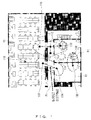
- FIG. 1 illustrates an example of grouping of information based on a direct distance between the positions of pieces of information.
- An office illustrated in FIG. 1 includes rooms R1, R2, and R3, and a passage P1.
- Information devices 102 and 104 are arranged in the room R1.
- Information devices 108 and 110 are arranged in the room R2.
- Information devices 106 and 118 are arranged in the room R3.
- Information 112 and 114 are arranged in the passage P1.
- whether two devices are to be grouped is determined depending on a direct distance between those information devices.
- the direct distance between the information devices is not blocked by a wall in the room.
- a distance between two information devices that are arranged across the wall from each other is a length of a line that passes through the wall to connect the two information devices.
- those two information devices are grouped into the same group (grouping) .
- grouping the following three groups are formed:
- the information devices 102 and 108 that belong to Group 2 above are arranged in different rooms, and the direct distance between them goes through a wall. Even if a communication between information devices is wireless, there may be a great attenuation of signal intensity depending on the structure of the wall when going through a wall, so it is difficult to consider classifying the information devices 102 and 108 into the same group as "natural" grouping. Thus, there is a possibility that grouping by use of a direct distance between information devices is not "natural".
- FIG. 2 illustrates an example of grouping of information based on a route distance between the positions of pieces of information.
- route distance is defined by a distance along a flow line of a person.
- the route distance between the information device 102 (room R1) and the information device 108 (room R2) of Group B passes through the passage P1, and is not small enough for the information devices 102 and 108 to be grouped.
- the information devices 104 and 106 are arranged in the rooms R1 and R3, respectively, but the route distance between them is not so different from the direct distance between them.
- the information devices 104 and 106 are also grouped when it is determined whether they are to be grouped depending on the route distance.
- FIG. 3 illustrates an example of grouping of information based on the sections to which the positions of pieces of information belong.
- FIG. 3 illustrates sections A and B, and information devices in the respect sections are considered to be one group.
- Group F information device 106, information device 116, and information device 118
- Group G (section B) : information device 110, and information device 114
- FIG. 4 illustrates an example of "natural" grouping of information.
- the information devices to be grouped are in the same room, and there is not any wall between the information devices. Further, the route distances from one another are short because the information devices to be grouped are arranged in the same room.
- Classifying according to a distance between information devices is not sufficient in order to perform natural grouping as illustrated in FIG. 4 .
- a plurality of information devices such as a PC and a printer are placed indoors, and when processing is performed that includes selecting, from among this group of information devices, a group of devices that are easily accessed by a person in a certain location and powering up the devices in advance, the devices adjacent to one another across the wall may be powered up when a group of devices grouped by use of a simple distance is turned ON. If a route distance is used, grouping may be performed according to different criteria than the accessibility of a person, depending on the relationship between the positions of the devices, which results in inefficiency.
- FIG. 5A illustrates examples of pieces of information to be discriminated when natural grouping of information is performed
- FIG. 5B illustrates examples of pieces of information to be put together when natural grouping of information is performed.
- FIG. 5A there are two sections, and one object is arranged in each of the sections.
- FIG. 5B two objects are arranged in one section.
- Pieces of information of FIG. 5A that are provided to the two objects belong to different groups and pieces of information of FIG. 5B provided to the two objects belong to the same group.
- “natural grouping” not only the distance between pieces of information but also the structure of the space in which objects provided with pieces of information are arranged, such as an obstacle, is to be considered.
- FIG. 6 illustrates an example of a state in which natural grouping of information is used.
- FIG. 6 illustrates an example of grouping of advertisement.
- "information" is a design of advertisement.
- Information provided with position information may be a design of advertisement that is provided with the information about the position of the advertising sign.
- the advertising signs that are provided with the advertisements having a similar advertising effectiveness to one another may be placed in one group.
- the advertising effectiveness may be an impact that is made on a person who looks at the advertising sign. Advertisements having the same design correspond to "grouped pieces of information".
- a purpose of placing an advertising sign is to make an impact on a person who looks at the advertising sign, so it is important to determine how to arrange advertising signs having the same design.
- advertising signs 302, 304, 306, 308, 310, 312, 314, 316, 318, and 320 are arranged in a certain space.
- the advertisements provided to these advertising signs are divided into one or more groups so as to increase the advertising effectiveness.
- a dotted line indicates a trajectory of a moving body 200 that moves in the space in which the advertising signs are arranged.
- the moving body 200 can be a person, a vehicle, or anything that moves recognizing the advertisements provided to the advertising signs.
- the advertisements may be traffic signs.
- a moving body is able to recognize an advertisement provided to an advertising sign that is included within its field of view.
- the information that is, the advertisement provided to the advertising sign 304, and the advertisement provided to the advertising sign 306 are grouped.
- the advertising signs that are included within the field of view of the moving body and whose distance from the moving body 200 is less than a predetermined value are the advertising signs 314, 316, and 318.
- the advertisements provided to the advertising signs 314, 316, and 318 have distances not greater than the predetermined value (second threshold) from one another.
- the advertisements provided to these advertising signs 314, 316, and 318 are grouped.
- the advertising sign that is included within the field of view of the moving body and whose distance from the moving body is less than a predetermined value is the advertising sign 320.
- the advertising sign 320 forms a group G3.
- FIG. 7 illustrates another example of a state in which natural grouping of information is used.
- advertising signs 502 to 534 are arranged.
- the space in which the advertising signs 502 to 530 are arranged are divided into several sections, that is, rooms R4, R5, R6, and R7, using walls.
- the four advertising signs 502, 504, 506, and 508 are arranged.
- the three advertising signs 510, 512, and 514 are arranged.
- the two advertising signs 516 and 518 are arranged.
- the three advertising signs 520, 522, and 524 are arranged, and in the room R7, the five advertising signs 526, 528, 530, 531, and 534 are arranged.
- the space in which the advertising signs are arranged there are walls in the space in which the advertising signs are arranged, and the space is divided.
- the walls are opaque and that a moving body 400 (person) is not able to confirm visually through the walls.
- Each of the advertising signs is provided with an advertisement.
- the advertising signs that are included within the field of view of the moving body 400 and whose distance from the moving body 400 is less than the predetermined value (first threshold) are the advertisements provided to the advertising signs 506 and 508. Further, a distance between the advertisements provided to the advertising signs 506 and 508 is not greater than the predetermined value (second threshold) from each other. Thus, when performing natural grouping of information, the information provided to these advertising signs 506 and 508 are grouped.
- the advertisements that are included within the field of view of the moving body 400 and whose distance from the moving body 400 is less than the predetermined value (first threshold) are the advertisements provided to the advertising signs 516 and 518 arranged in the passage P2. Further, the distance between the advertisement provided to the advertising sign 516 and the advertisement provided to the advertising sign 518 is less than the predetermined value (second threshold). Thus, when performing natural grouping of information, the information provided to these advertising signs 516 and 518 are grouped.
- the advertising signs that are included within the field of view of the moving body 400 and whose distance from the moving body 400 is less than the predetermined value (first threshold) are the advertising signs 526, 528 and 530.
- the advertisement provided to the advertising signs 534 is included in the field of view but whose distance from the moving body 400 is greater than the predetermined value (first threshold) .
- the advertisements provided to the advertising signs 526, 528, and 530 have a distance less than the predetermined value (second threshold) from one another.
- “Natural grouping of information” is related to the accessibility of an information user to information at the same time.
- the accessibility to information is related to an amount of additional movements to be performed by a user or a recipient of the information in order to access the information.
- the movement of people or vehicles has inertia, and their heading direction is often the same as the center of their field of view.
- a large additional movement may be needed when suddenly changing directions or when looking at a direction that is different from the heading direction.
- the access is easier if a distance between a moving body and an object provided with information is shorter.
- the reason that the accessibility to information at the same time is important is that an information user (recipient) may be in different locations at different times, and it is not easy for the user to associate the pieces of information that were recognized in the different locations at the different times.
- a "user accesses information” may refer to the state in which the advertisement is included in the field of view of that person.
- the information is a printer and the user is a PC user, it may refer to the state in which the printer operates according to the instructions from the PC.
- the accessibility of a user (moving body) to a plurality of pieces of information at a certain time is considered.
- the equality of the accessibility of a user to a plurality of pieces of information at a certain time may be referred to as "simultaneity of the accessibility to information".
- the accessibility can be determined only using the distance between an information user and information provided to an object, that is, the distance between the user and the object. For example, consider that an object A and an object B are away from each other, and that a distance between a moving body and information provided to the object A and a distance between the moving body and information provided to the object B are the same at different times.
- a grouping apparatus that will now be described performs following processing so as to perform natural grouping that is not determined not only using the position of the information, and the distance between a moving body that receives the information and the information.
- the strength relationship between moving bodies 200 and 400 that move in a space in which pieces of information provided with position information exist and each of the pieces of information is obtained at a certain time.
- the strength of relationship between the moving bodies 200 and 400 and each of the pieces of information is designed to change according to the position, direction, and speed of the moving bodies 200 and 400.
- a grouping apparatus 700 according to an embodiment will now be described with reference to FIGS. 8 to 19 .
- a sensor 600 is connected to a grouping apparatus 700.
- the sensor 600 and the grouping apparatus 700 are combined to configure a grouping system.
- the sensor 600 is attached to a moving body 650.
- the moving body 650 may be, for example, the moving body 200 in FIG. 6 , or the moving body 600 in FIG. 7 . Further, the moving body 650 may be a person, or objects such as a vehicle or a carrier of a car or a bicycle that have an orientation.
- the sensor 600 is equipped with, for example, a global positioning system (GPS), which permits identifying of a position of the sensor 600. Further, the sensor 600 may be configured to measure speed.
- GPS global positioning system
- the grouping apparatus 700 includes a position measurement unit 702, a relationship calculation unit 704, an object data storing unit 706, a similarity calculation unit 708, and a classification unit 710.
- the position measurement unit 702 receives data about a position of the moving body 650 that has been measured by the sensor 600. Further, the position measuring unit 702 receives data about a speed of the moving body when the sensor 600 measures the speed of the moving body. Then, the position measurement unit 702 determines a position and a direction of the moving body.
- the position measurement unit 702 measures time.
- the time measured by the position measurement unit 702 can also be shared by the relationship calculation unit 704, the object data storing unit 706, the similarity calculation unit 708, and the classification unit 710.
- the measurement of time may be performed by a unit other than the position measurement unit 702.
- time may be measured by a clock that is not illustrated.
- the time measured by the clock can also be shared by the position measurement unit 702, the relationship calculation unit 704, the object data storing unit 706, the similarity calculation unit 708, and the classification unit 710.
- the object data storing unit 706 stores therein data about an object provided with "positioned information".
- the data may include a position of the object arranged in a space in which the moving body moves, and an orientation of the information. Further, when there is an obstacle such as a wall in the space, the object data storing unit 706 may store therein the information on a position and a material of the obstacle.
- the relationship calculation unit 704 calculates a relationship between the information provided to each object and the moving body 650.
- the position of a certain object is X k
- the position of the moving body 650 is Y
- the monotone decreasing function is F(x)
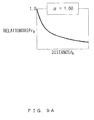
- FIG. 9A is a graph that illustrates an example of a relationship between a moving body and information provided to an object that depends on an inverse of distances
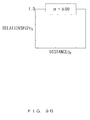
- FIG. 9B is a graph that illustrates another example of a relationship between a moving body and information provided to an object that depends on an inverse of distances.
- when the relationship r k is defined as r k 1 ( X k ⁇ Y + 1 ) ⁇
- ⁇ 1.00
- ⁇ 5.00.
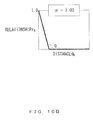
- FIG. 10A is a graph that illustrates an example of a relationship between a moving body and information provided to an object that linearly depends on a distance
- FIG. 10B is a graph that illustrates another example of a relationship between a moving body and information provided to an object that linearly depends on a distance.
- ⁇ 0.25
- ⁇ 1.00.
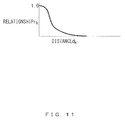
- FIG. 11 is a graph that illustrates a relationship between a moving body and an object using a nearest-neighbor model.
- FIG. 12 illustrates an outline of a nearest-neighbor model.
- FIG. 12 potential contours extend forward in front of a moving body (person) H avoiding a wall that is immovable, in which potential is maximum in the position of the moving body H.
- An area with a limited potential level is related to a range visible to the moving body H.
- the relationship between the moving body H and an information device A, B, or C monotonically decreases with respect to a distance between the moving body H and the information device A, B, or C.
- the relationship decreases steeply along the route via which the moving body H who passes in front of the wall is not able to move.
- the relationship between the moving body H and the information device A is nonzero, but the relationship between the moving body H and the information device C that are separated from each other by the wall is almost zero.
- the Laplacian potential is most generally used to represent potential.
- the ⁇ function is a value when a parameter is zero, but otherwise it is zero.
- the solution of the Laplace equation has the following features and advantages.
- the solution of the Laplace equation is continuous and smooth, and has no extreme values except for a maximum point.
- the solution of the Laplace equation is suitable for naturally representing the shape that extends with the moving body in its center avoiding the wall, by generating a distribution in which the maximum value is the existing position of the moving body and the minimum value is the wall surface.
- the solution of the Laplace equation is a function of location, so there is an amount (elevation of potential) at any point on a map. This is the amount that decreases with distance from the position of the moving body (center of potential), so that is suitable to be used as an indicator of distance in which a route of the moving body is considered.
- the relationship calculation unit 704 When numerically solving a partial differential equation such as Formula 4 above, the relationship calculation unit 704 performs a calculation by dividing space into grid, but the Laplace equation is a partial differential equation of elliptic type and it is not possible to explicitly obtain values of cells of the grid, so a large simultaneous equation whose variable is the number of cells of the grid obtained by the division has to be solved. It takes much time to calculate this.
- the number of cells of the grid (resolution of space) tends to increase in order to represent the potential distributed in a space including an obstacle such as a wall. Further, considering that a simultaneous calculation may be performed with respect to a plurality of moving bodies, it is not possible to use a general grid solution because it needs too much time.
- the relationship calculation unit 704 performs a potential generating calculation using a charge simulation method in order to deal with a problem of the calculation time.
- Using the charge simulation method permits reducing of the time needed for a potential generation.
- the charge simulation method is an approximate solution method for a partial differential equation.
- the charge simulation method is a simple algorithm, so it permits shortening of the calculation time needed for obtaining an approximate solution and permits obtaining of a relatively high accuracy of approximation with respect to a smooth boundary.
- the boundary shape is complicated, it is difficult to use the charge simulation method because the number of errors increases.
- the algorithm of the charge simulation method will now be described.
- a sample point and a charge point are determined.
- the following processes are performed:
- selecting several charge and sample points along a boundary of a space to be analyzed permits calculating of the potential that is smoothly distributed with respect to the boundary and that satisfies the designated condition on the boundary.
- the relationship calculation unit 704 of the grouping apparatus 700 is able to generate a potential distribution that extends along the passable area within the space by arranging the sample points and the corresponding charge points along the surface of the obstacle.
- FIG. 13 illustrates an example of potential that changes in conjunction with a movement of a person.
- FIG. 13 illustrates potential contours having a maximum value in the position P. The contours extend avoiding the wall 920 and the obstacle 902.
- relationship calculation unit 704 may consider the orientation of the information, or the speed or the orientation of the moving body 650 to calculate the relationship r k .
- the position of an object provided with information is X k and the orientation of the information is V k .
- the position of the moving body 650 is Y and its orientation is V Y .
- the orientations V 1 and V Y may be unit vectors of magnitude one.
- r k 1 ⁇ V k ⁇ V Y X k ⁇ Y
- the relationship r k is larger if the distance along the line perpendicular to the potential is shorter, and is large when the orientation V k of the information provided to the object and the orientation V Y of the moving body face each other.
- FIG. 14 illustrates an example of a relationship between a range visible to a moving body and an advertising sign.
- FIG. 14 illustrates an example of how to determine the relationship r k when the spatial structure is considered.
- a moving body is a person 1000, and an area A is a visible range included in the field of view of the person 1000.
- There are objects 1002, 1004, 1006, and 1008 provided with pieces of information in the same space as the person 1000. In this case, with respect to the objects that are not included in the area A, the relationship may be determined to be r k 0.
- the similarity calculation unit 708 calculates similarities C (i,j) with respect to all pairs of pieces of information.
- a collection ⁇ C (i,j) ⁇ of the similarities C (i,j) with respect to all pairs of pieces of information may be referred to as a similarity set.
- the similarity calculation unit 70 calculates a similarity C (i,j) between the information provided to the object positioned in X i and the information provided to the object positioned in X j .
- the similarity C (i,j) has (1/2)n(n-1) independent components.
- a set of (1/2)n(n-1) similarities may be referred to as a similarity set.
- similarity C (i,j) between information provided to the object positioned in X i and information provided to the object positioned in X j preferably has characteristics such that, using a relationship r i between the information provided to an object positioned in X i and a moving body positioned in Y, and a relationship r j between the information provided to an object positioned in X j and the moving body positioned in Y,
- the value of this formula is larger if the values of the relationship r i and the relationship r j are larger and the difference between them is smaller.
- the similarity C (i,j) is zero when either of the relationships is zero.
- a matrix C represents similarity of a relationship with information provided to an object when a moving body is in a certain position Y.
- This similarity C (i,j) indicates to what extent the information provided to the object in the position X i and the information provided to the object in the position X j can equally be recognized from the moving body when the moving body is in the position Y at a certain time t.
- the similarity calculation unit 708 calculates a similarity set that is represented using a matrix C every time the moving body moves and integrates them, so as to calculate integrated similarity.
- the integrated similarity C* is a matrix that includes C* (i,j) as an element.
- Formulas 8 and 9 describe as if time is a continuous variable, but in fact, the sensor 600 acquires the information such as the position and the orientation of the moving body 650 discretely with respect
- the integral range in Formulas 8 and 9 above is from a time to another time, but it may be, for example, a time period during which a moving body arrives at a position from another position.
- the matrix C* may be normalized by dividing each element by a largest element.
- the moving pattern of the moving body is reflected in the matrix C* of similarities obtained by continually integrating during a certain time period.
- the matrix C* provides a set of integrated similarities.
- the classification unit 710 groups pieces of information on the basis of the similarity calculated by the similarity calculation unit 708.
- the classification unit 710 creates a graph of relationships linked to one another by use of links whose strength is represented by an element value in the similarity matrix C*, and performs grouping by severing the links of the elements whose linkage strength is not greater than a threshold.
- FIG. 15 is a table that illustrates an example of a set of integrated similarities.
- the table of FIG. 15 illustrates examples of matrix elements of a 4x4 symmetric matrix C* that represents the set of integrated similarities with respect to pieces of information A, B, C, and D.
- C (A,B) element is 0.9
- C (A,c) element is 0.2.
- FIG. 16 illustrates an example of a relationship graph that is created using the set of integrated similarities illustrated in FIG. 15 .
- the strength of the link that connects a node A and a node B is 0.9, reflecting that the value of C (A,B) element is 0.9.
- the strength of the link that connects the node A and a node C is 0.2
- the strength of the link that connects the node A and a node D is 0.3
- the strength of the link that connects the node B and the node C is 0.3
- the strength of the link that connects the node B and the node D is 0.7.
- the classification unit 710 severs, for example, the links in the graph of FIG. 16 whose strength is less than 0.5 that is a threshold.
- a threshold is a value of a boundary for classifying whether two pieces of information are similar, that is, whether to group them.
- the link that connects the node A and the node B (the strength of the link is 0.9) and the link that connects the node A and the node B (the strength of the link is 0.7) are left. Accordingly, the classification unit 710 groups the information A and the information B as a group Ga and groups the information C and the information D as a group Gb.
- the strength of link is classified using one threshold, but hierarchical grouping may be performed using a plurality of different thresholds for the respective links.
- FIG. 17 is a graph that illustrates another example of a set of integrated similarities.
- the table of FIG. 17 illustrates examples of matrix elements of an 8x8 symmetric matrix C* that represents the set of integrated similarities with respect to pieces of information A, B, C, D, E, F, G, and H.
- a hierarchical classification by gradually relaxing thresholds for classifying the strength of link and by performing a multiple-times classification. It is possible to perform a systematic classification, for example, by visualizing a result of it as a dendrogram. This indicates that "hierarchical grouping" has been performed.
- the theory of hierarchical clustering that is a graph theory may be applied.
- the following processing is performed.
- a state in which there are N clusters only including one target is created as an initial state.
- a distance d(C1,C2) between clusters is calculated from a distance d(xi,xj) between the target x i and the target x j (dissimilarity), and the two clusters having a closest distance from each other are sequentially merged.
- a result of such processing can be represented by a dendrogram.
- the dendrogram is a binary tree in which each non-terminating node represents each target and a cluster obtained by merging is represented by use of non-terminating nodes.
- the distance d(C1,C2) between clusters is defined as a minimum distance from among the distances between the targets included in the cluster C1 and the targets included in the cluster C2.
- the distance d(C1,C2) between clusters is defined as a maximum distance from among the distances between the targets included in the cluster C1 and the targets included in the cluster C2.
- group average method that defines, as the distance d(C1,C2 between clusters, an average of the distances between the targets included in the cluster C1 and the targets included in the cluster C2, and the Ward's method that minimizes the sum of squares of distances from the targets to the centroids of the clusters including the respective targets are known. Any of the methods above can be used for hierarchical grouping.
- FIG. 18 illustrates an example of a dendrogram that is created using the set of integrated similarities illustrated in FIG. 17 .
- the value of the similarity C (A,B) between the information A and the information B is 0.07
- the value of the similarity C (A,C) between the information A and the information C is 0.31
- the value of the similarity C (B,C) between the information B and the information C is 0.21.
- the value of the threshold for classifying whether they are similar that is, whether to group them is gradually increased
- the information B and the information C are grouped.
- the group formed by grouping the information B and the information C is referred to as G (B,C) .
- the value of the threshold is further gradually increased, the information A and the information C are grouped. Grouping of information A and the information C permits hierarchical grouping to be realized because the information C and the information B have been already grouped.
- an area to be grouped is gradually larger if the threshold is larger.
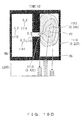
- FIG. 19A illustrates an example of natural grouping of information using a nearest-neighbor model
- FIG. 19B illustrates another example of natural grouping of information using the nearest-neighbor model
- the levels of relationship r k provided to the objects designated with numerals are illustrated in parentheses with the numerals.
- a moving body is in a position P1 at a time t1, and in the same room R8 as the moving body, there are objects 1102, 1104, 1106, and 1108 provided with pieces of information.
- the level of relationship between the moving body and the information provided to the object 1102 is 0.461.
- the level of relationship between the moving body and the information provided to the object 1104 is 0.695.
- the level of relationship between the moving body in the position P1 and each of the pieces of information provided to objects 1110, 1112, and 1114 that are arranged in a room 9 is 0.0.
- the moving body is in a position P2 at a time t2, and in the same room R9 as the moving body, there are objects 1110, 1112, and 1114.
- the level of the relationship between the moving body and the information provided to the object 1110 is 0.422.
- the level of the relationship between the moving body in the position P2 and each of the pieces of information provided to objects 1102, 1104, 1106, and 1108 that are arranged in the room 8 is 0.0.
- the levels of relationship between the moving body and each of the pieces of information provided to the objects 1102, 1104, 1106, and 1108 that are arranged in the same room R8 is high.
- the levels of relationship between the moving body and each of the pieces of information provided to the objects 1102, 1104, 1106, and 1108 that are arranged in the room R8 is low. Accordingly, when a moving body and information exist in positions close to each other at a certain time, the level of their relationship r is high.
- similarity C (i,j) between information positioned in X i and information positioned in X j from among a plurality of pieces of information has characteristics such that, using a relationship r i between the information positioned in X i and a moving body positioned in Y and the relationship r j between the information positioned in X j and the moving body positioned in Y,
- the values level themselves are large and the difference between them are small, so the similarity is high. Further, for example, the similarity between the pieces of information provided to the object 1102 and to the object 1110 that are arranged in the different rooms is zero.
- the classification is based not only on the level of advertising effectiveness but also on the simultaneity.
- the advertising signs that increase the advertising effectiveness simultaneously are to be put together considering the behavioral patterns of people who look at the advertisement.
- this classification scheme if there are signs that are physically close to each other and stand facing in the same direction and if there is an increase in advertising effectiveness for each of the signs, the two signs are not to be grouped unless there is a moment when there is an increase in advertising effectiveness for the two advertising signs at the same time.
- signs that are physically similar may belong to different groups by interpreting as inclusive of behavioral patterns of information users and the spatial structure from the perspective of advertising effectiveness.
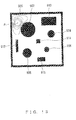
- FIG. 20 illustrates an example of a result of grouping of information with potential using a nearest-neighbor model.
- FIG. 20 the level of relationship between information provided to each object and a moving body is illustrated for each object.
- FIG. 20 illustrates grouping of pieces of information provided to objects when there is a moving body that arrives at a position P via a route Q as represented by a dotted line. Relationships are calculated using the nearest-neighbor model above. As illustrated in FIG. 20 , the level of relationship is high when it is information provided to an object that is close to the route Q of the moving body and near which the moving body stays for a long time. Further, the pieces of information provided to the objects that are arranged across the wall from one another are not grouped.
- a result of the classification is to be organized on the basis of the "accessibility of a user to an information device". This permits perform, by use of the result of the classification, processing that includes sensing a group of devices that have become accessible to a person and powering up the devices in advance.
- FIG. 21 illustrates an example of a configuration of a grouping apparatus 700 according to the embodiment.
- the grouping apparatus 700 can be realized as a general-purpose computer 800.
- the computer 800 includes an MPU 802, a ROM 804, a RAM 806, a hard disk device 808, an input device 810, a display 812, an interface device 814, and a recording medium driving device 816. These components are connected to one another via a bus line 820, and are able to transmit and receive various pieces of data with one another under the control of the MPU 802.
- the MPU (micro processing unit) 802 is an arithmetic processing unit that controls the operation of the entire computer 800 and serves as a control processing unit of the computer 800.
- the ROM (read only memory) 804 is a read only semiconductor memory that has recorded thereon a predetermined basic control program in advance.
- the MPU 802 reads and executes the basic control program when the computer 800 starts, and thereby it is possible to control the operation of each component of the computer 800.
- the RAM (random access memory) 806 is a semiconductor memory that is recordable and readable at any time and which the MPU 802 uses as a working storage area as needed when the MPU 802 executes various control programs.
- the hard disk device 808 is a storage that stores therein various programs and data executed by the MPU 802.
- the MPU 802 is able to perform a variety of various control processes that will be described below, by reading and executing the predetermined control programs stored in the hard disk device 808.
- the input device 810 is, for example, a mouse device or a keyboard device, and when it is operated by a user of the grouping apparatus 700, it acquires an input of various pieces of information associated with the operational contexts and transmits the acquired input information to the MPU 802.
- the display 812 is, for example, a liquid-crystal display, and displays various texts and images according to the display data transmitted from the MPU 802.
- the interface device 814 manages a transmission and a reception of various pieces of information between various devices that are connected to the computer 800.
- the recording medium driving device 816 is a device that reads various programs and data recorded on a portable recording medium 818.
- the MPU 802 is also able to perform the various control processes that will be described below, by reading and executing the predetermined control program stored in the portable recording medium 818 via the recording medium driving device 816.
- a flash memory, a CD-ROM (compact disc read only memory), and a DVD-ROM (digital versatile disc read only memory) that are equipped with a USB (universal serial bus) standard connector are examples of the portable recording medium 818.
- a control program is created that causes the MPU 802 to perform the processing in each of the processing devices described above.
- the created control program is stored in the hard disk device 808 or in the portable recording medium 818 in advance.
- a predetermined instruction is given to the MPU 802 so that the control program is read and executed. This permits the MPU 802 to provide the functions included in the grouping apparatus 700.
- the grouping apparatus 700 permits an improvement of the efficiency of an information transmission to an information user because a plurality of pieces of information whose level of accessibility of the information user at the same time is similar and that are correlated with the information user as long as possible are put together into one group.
- FIG. 22 is a flowchart that illustrates an example of a processing flow of grouping.
- the grouping apparatus 700 is the general-purpose computer 800 illustrated in FIG. 21
- the following description defines a control program that performs such processing.
- the following description is also a description of a control program that causes the general-purpose computer to perform processing described below.
- the position measurement unit 702 of the grouping apparatus 700 advances time by ⁇ t. Then, when the process in this step ends, the process moves on to S106.
- the position measurement unit 702 of the grouping apparatus 700 measures a position of a moving body. Here, it may measure a direction, that is, a heading direction of the moving body. Then, the process moves on to S108.
- the relationship calculation unit 704 of the grouping apparatus 700 calculates a relationship between each object and the moving body referring to the data stored in the object data storing unit 706. Then, when the process in this step ends, the process moves on to S108.
- a position of a certain object is X k
- a position of a moving body 650 is Y
- a monotone decreasing function is F(x)
- Formula 13 described above may be any of Formula 2, Formula 3, or Formula 5. Then, when the process in this step ends, the process moves on to S110.
- the similarity calculation unit 708 of the grouping apparatus 700 calculates similarity C (i,j) with respect to all pairs of objects.
- similarity C (i,j) between information provided to the object positioned in X i and information provided to the object positioned in X j is preferably a function that satisfies (C1) to (C3) described above.
- a collection ⁇ C (i,j) (t) ⁇ of the similarities C (i,j) (t) at a time t with respect to all pairs of objects may be referred to as a similarity set. Then, when the process in this step ends, the process moves on to S112.
- C(t) is a matrix
- Formula 15 described above is a matrix equation. Then, when the process in this step ends, the process moves on to S114.
- the similarity calculation unit 708 of the grouping apparatus 700 normalizes the integrated similarity C*. For the way of normalizing, for example, each element may be divided by a maximum matrix element of the integrated similarity C*. When the process in this step ends, the process moves on to S116.
- the classification unit 710 of the grouping apparatus 700 performs grouping information on the basis of the similarities calculated in S110 to S114. For example, it creates a graph of relationships linked to one another by use of links whose strength is represented by an element value in the similarity matrix C*, and performs grouping by severing the links of the elements whose linkage strength is not greater than a threshold.
- FIG. 16 illustrates an example of grouping.
- the classification unit 710 of the grouping apparatus 700 determines whether the termination condition is satisfied.
- the termination condition may be whether a specific moving body has arrived at a certain position.
- the termination condition may also be whether a predetermined time period has elapsed.
- the process in this step may be performed by a component other than the classification unit 710, for example, by the position measurement unit 702. If a determination result in this step is "Yes”, that is, if it satisfies the termination condition, the processing terminates. If the determination result in this step is "No", that is, if it does not satisfy the termination condition, the process returns to S104.
- Performing such processing permits natural grouping of information provided with position information such as (*) and (**) described above to be performed. It is possible to efficiently report information to an information user because grouping of information is performed on the basis of the accessibility of the information user to pieces of information at the same time.
Landscapes
- Engineering & Computer Science (AREA)
- Computer Networks & Wireless Communication (AREA)
- Signal Processing (AREA)
- Databases & Information Systems (AREA)
- Theoretical Computer Science (AREA)
- Data Mining & Analysis (AREA)
- Physics & Mathematics (AREA)
- General Engineering & Computer Science (AREA)
- General Physics & Mathematics (AREA)
- Computational Linguistics (AREA)
- Multimedia (AREA)
- Information Retrieval, Db Structures And Fs Structures Therefor (AREA)
Abstract
Description
- The embodiments discussed herein relate to a grouping apparatus, a grouping method, and a grouping program.
- There may be a need for grouping of information provided with position information. In this case, an advertisement that is displayed on an advertising sign arranged in a certain position and information needed for operating, for example, a type of a personal computer (PC) or PC peripheral equipment in the wireless LAN environment may be examples of "information provided with position information". "Grouping" of these pieces of information refers to putting together into one group a plurality of pieces of information provided with different pieces of position information.
- For example, consider the case in which, for a series of advertisements having several types of design, a plurality of advertising signs are created for each design. A purpose of placing an advertising sign is to make an impact on a person who look at the advertising sign, that is, to provide an advertising effectiveness, so it is important to determine how to arrange the advertisement of each design. In other words, when arranging the advertisements having the same design in different positions, these advertisements may be referred to as grouped advertisements.
- Further, consider that a plurality of information devices such as a PC and a printer are placed indoors, and that processing is performed that includes selecting, from among this group of information devices, a group of devices that are easily accessed from the location of a user and powering up the devices in advance. In this case, the information on the address that specifies a group of accessible devices corresponds to "grouped pieces of information". Performing such processing permits a user of information devices to use the information devices without moving closer to the devices to power up for himself/herself.
- A content data management device for managing content data that obtains, by use of the position and time that are tagged in two pieces of data from among a plurality of pieces of content data, a speed of movement between two positions in which two pieces of content data have been created and performs grouping of content data on the basis of the speed is known. For example, for image data, the speed refers to an average speed of movement when a person who captures images moves between the positions in which two images are captured. For image data, the "speed" includes the information on by which moving means the person moved to acquire a plurality of images, for example, moving by walk, moving by a car, or moving by a train. Grouping the images acquired by moving by sets of moving means whose speed is identical or similar may result in grouping more relevant pieces of content data.
- Patent Document 1: Japanese Laid-open Patent Publication No.
2012-103963 - When grouping advertising signs, there is a possibility that the classification based on a real situation is not performed for the following reasons when only taking into account positions and directions of advertising signs. In other words, for example, signs that stand closely to one another facing in the same direction may have an advertising effectiveness significantly different from one another depending on the moving patterns of people or the spatial structure around them. Even if a classification is performed using a route distance instead of a direct distance, it is still difficult to perform a classification based on a real situation. In order to accurately conduct real-situation researches on an advertising effectiveness, behavioral patterns of people and a spatial structure also need to be considered when classifying signs.
- Consider that a plurality of information devices such as a PC and a printer are placed indoors, and that processing is performed that includes selecting, from among this group of information devices, a group of devices that are easily accessed by a person in a certain location and powering up the devices in advance. In this case, the devices adjacent to one another across the wall may be powered up when a group of devices simply grouped by use of a direct distance is turned ON. If a route distance is used, grouping may be performed according to different criteria than the accessibility of people, depending on the relationship between the positions of the devices.
- Accordingly, in one aspect, an object of the present invention is to provide a grouping apparatus, a grouping method, and a grouping program that group a plurality of pieces of information so as to improve the efficiency of an information transmission to a moving body.
- A grouping apparatus is provided. The grouping apparatus includes a relationship calculation unit that calculates, at a plurality of times between a first time and a second time, the strength of correlation between each of a plurality of pieces of information and a moving body as a level of relationship for each of the plurality of pieces of information, wherein each of the plurality of pieces of information is provided to each of a plurality of objects arranged in a space and the moving body moves within the space, a similarity calculation unit that, on the basis of the level of relationship for each of the plurality of objects calculated at the plurality of times, calculates similarities for all pairs of the plurality of pieces of information at the plurality of times, integrates the similarities for all pairs of the plurality of pieces of information at the plurality of times, and calculates integrated similarity, and a classification unit that groups the plurality of pieces of information on the basis of the integrated similarity.
- According to an aspect of the embodiments, a plurality of pieces of information can be grouped so as to improve the efficiency of an information transmission to a moving body.
-
-
FIG. 1 illustrates an example of grouping of information based on a direct distance between the positions of pieces of information; -
FIG. 2 illustrates an example of grouping of information based on a route distance between the positions of pieces of information; -
FIG. 3 illustrates an example of grouping of information based on the sections to which the positions of pieces of information belong; -
FIG. 4 illustrates an example of natural grouping of information; -
FIG. 5A illustrates examples of pieces of information to be discriminated when natural grouping of information is performed; -
FIG. 5B illustrates examples of pieces of information to be put together when natural grouping of information is performed; -
FIG. 6 illustrates an example of a state in which natural grouping of information is used; -
FIG. 7 illustrates another example of a state in which natural grouping of information is used; -
FIG. 8 is a functional block diagram that illustrates an example of a grouping apparatus according to an embodiment; -
FIG. 9A is a graph that illustrates an example of a relationship between a moving body and an object that depends on an inverse of distances; -
FIG. 9B is a graph that illustrates another example of a relationship between a moving body and an object that depends on an inverse of distances; -
FIG. 10A is a graph that illustrates an example of a relationship between a moving body and an object that linearly depends on a distance; -
FIG. 10B is a graph that illustrates another example of a relationship between a moving body and an object that linearly depends on a distance; -
FIG. 11 is a graph that illustrates a relationship between a moving body and an object using a nearest-neighbor model; -
FIG. 12 illustrates an outline of a nearest-neighbor model; -
FIG. 13 illustrates an example of a neighborhood that changes in conjunction with a movement of a person; -
FIG. 14 illustrates an example of a relationship between a range visible to a moving body and a sign; -
FIG. 15 is a table that illustrates an example of a set of integrated similarities; -
FIG. 16 illustrates an example of a relationship graph that is created using the set of integrated similarities illustrated inFIG. 15 ; -
FIG. 17 is a graph that illustrates another example of a set of integrated similarities; -
FIG. 18 illustrates an example of a dendrogram that is created using the set of integrated similarities illustrated inFIG. 17 ; -
FIG. 19A illustrates an example of natural grouping of information using a nearest-neighbor model; -
FIG. 19B illustrates another example of natural grouping of information using the nearest-neighbor model; -
FIG. 20 illustrates an example of a result of grouping of information using a nearest-neighbor model with potential; -
FIG. 21 is illustrates an example of a configuration of a grouping apparatus; and -
FIG. 22 is a flowchart that illustrates an example of a processing flow of grouping. - A grouping apparatus and a grouping method according to an embodiment will now be described with reference to the drawings.
- First, referring to
FIGS. 1 to 5 , grouping of information provided with position information will be described. - In this case, "information provided with position information" may be information that is arranged in a position in a three-dimensional space that is a living space of a person. A personal computer (PC) or PC peripheral equipment in the wireless LAN environment of advertisements, sounds, and images are examples of such information. "Grouping" of such information indicates a distribution of a plurality of pieces of information provided with different pieces of position information to a plurality of groups.
- For example, consider that a plurality of information devices such as a PC and a printer are placed indoors, and that processing is performed that includes selecting, from among this group of information devices, a group of devices that are easily accessed by a person in a certain location and powering up the devices in advance. Each information device has information provided with position information. For example, each information device has information such as an IP address and a MAC address that identifies itself, and configures "information provided with position information" by combining its information with the information on the position in which the information device is placed.
- In this case, "group of easily accessible devices" corresponds to grouped information devices. Performing such processing permits a user of information devices to use the information devices without moving closer to the devices to power up for himself/herself.
- Further, "information" may be, for example, content data such as image data, audio data, and text data that are stored in an information recording medium as an electronic file.
- First, referring to
FIGS. 1 to 7 , a concept of "natural" grouping of information provided with position information will be described. -
FIG. 1 illustrates an example of grouping of information based on a direct distance between the positions of pieces of information. - An office illustrated in
FIG. 1 includes rooms R1, R2, and R3, and a passage P1.Information devices Information devices Information devices Information - In
FIG. 1 , whether two devices are to be grouped is determined depending on a direct distance between those information devices. In this case, the direct distance between the information devices is not blocked by a wall in the room. In other words, a distance between two information devices that are arranged across the wall from each other is a length of a line that passes through the wall to connect the two information devices. Then, when the direct distance that connects the two devices is not greater than a predetermined value, those two information devices are grouped into the same group (grouping) . In the example ofFIG. 1 , the following three groups are formed: - Group A: information device 104 (room R1), information device 106 (room R3)
- Group B: information device 102 (room R1), information device 108 (room R2)
- Group C: information device 112 (passage R1), information device 114 (passage P1), information device 110 (room R2), and information device 116 (room R3)
- The
information devices information devices -
FIG. 2 illustrates an example of grouping of information based on a route distance between the positions of pieces of information. - In
FIG. 2 , a distance between two information devices is measured using a route distance. In this case, "route distance" is defined by a distance along a flow line of a person. - When grouping on the basis of a route distance, the following two groups are formed:
- Group D: information device 104 (room R1), information device 106 (room R3)
- Group E: information device 112 (passage P1), information device 114 (passage R1), information device 110 (room R2), information device 116 (room R3)
- In this case, the route distance between the information device 102 (room R1) and the information device 108 (room R2) of Group B passes through the passage P1, and is not small enough for the
information devices information devices information devices - As described above, when grouping on the basis of the route distance, the information devices arranged in the different rooms are also put together into the same group. Thus, there is a possibility that grouping by use of a route distance between information devices is not "natural".
-
FIG. 3 illustrates an example of grouping of information based on the sections to which the positions of pieces of information belong. - In
FIG. 3 illustrates sections A and B, and information devices in the respect sections are considered to be one group. - Group F (section A):
information device 106,information device 116, andinformation device 118 - Group G (section B) :
information device 110, andinformation device 114 - When performing grouping for each of the predetermined sections in this way, an additional work will be needed for classification and the method for determining a section may have arbitrariness.
-
FIG. 4 illustrates an example of "natural" grouping of information. - In
FIG. 4 , the following four groups are formed: - Group H (room R1) :
information device 102, andinformation device 104 - Group I (room R2) :
information device 108, andinformation device 110 - Group J (passage P1):
information device 112, andinformation device 114 - Group K (room R3):
information device 106,information device 116, andinformation device 118 - In this case, the information devices to be grouped are in the same room, and there is not any wall between the information devices. Further, the route distances from one another are short because the information devices to be grouped are arranged in the same room.
- Classifying according to a distance between information devices is not sufficient in order to perform natural grouping as illustrated in
FIG. 4 . When a plurality of information devices such as a PC and a printer are placed indoors, and when processing is performed that includes selecting, from among this group of information devices, a group of devices that are easily accessed by a person in a certain location and powering up the devices in advance, the devices adjacent to one another across the wall may be powered up when a group of devices grouped by use of a simple distance is turned ON. If a route distance is used, grouping may be performed according to different criteria than the accessibility of a person, depending on the relationship between the positions of the devices, which results in inefficiency. -
FIG. 5A illustrates examples of pieces of information to be discriminated when natural grouping of information is performed, andFIG. 5B illustrates examples of pieces of information to be put together when natural grouping of information is performed. - In
FIG. 5A , there are two sections, and one object is arranged in each of the sections. InFIG. 5B , two objects are arranged in one section. Pieces of information ofFIG. 5A that are provided to the two objects belong to different groups and pieces of information ofFIG. 5B provided to the two objects belong to the same group. As described above, when performing "natural grouping", not only the distance between pieces of information but also the structure of the space in which objects provided with pieces of information are arranged, such as an obstacle, is to be considered. -
FIG. 6 illustrates an example of a state in which natural grouping of information is used. -
FIG. 6 illustrates an example of grouping of advertisement. In this example, "information" is a design of advertisement. - It is assumed that, for a series of advertisements having several types of design, there are a plurality of advertising signs for each design. "Information provided with position information" may be a design of advertisement that is provided with the information about the position of the advertising sign.
- For the plurality of advertising signs, the advertising signs that are provided with the advertisements having a similar advertising effectiveness to one another may be placed in one group. The advertising effectiveness may be an impact that is made on a person who looks at the advertising sign. Advertisements having the same design correspond to "grouped pieces of information". A purpose of placing an advertising sign is to make an impact on a person who looks at the advertising sign, so it is important to determine how to arrange advertising signs having the same design.
- In
FIG. 6 ,advertising signs - A dotted line indicates a trajectory of a moving
body 200 that moves in the space in which the advertising signs are arranged. The movingbody 200 can be a person, a vehicle, or anything that moves recognizing the advertisements provided to the advertising signs. When the moving body is a vehicle, the advertisements may be traffic signs. - In
FIG. 6 , the movingbody 200 is in a position x=P1 at a time t=T1. Close to the position x=P1, there are the pieces of information provided to the advertising signs 302, 304, and 306. In this case, "close to a certain position" may be defined as a distance being not greater than a predetermined value. Further, when a potential model is used, as described below, if a difference between the levels of potential is not greater than a predetermined value (first threshold), the two may be defined as close. Furthermore, theseadvertising signs - A moving body is able to recognize an advertisement provided to an advertising sign that is included within its field of view. For example, the moving body is able to recognize the advertisements provided to the advertising signs 304 and 306 at the time t=T1. Thus, when performing natural grouping of information, the information, that is, the advertisement provided to the
advertising sign 304, and the advertisement provided to theadvertising sign 306 are grouped. - Further, the moving
body 200 is in the position x=P2 at the time t=T2. When the movingbody 200 that was in the position x=P1 at the time t=T1 arrives at the position x=P2, the advertising signs that are included within the field of view of the moving body and whose distance from the movingbody 200 is less than a predetermined value are the advertising signs 314, 316, and 318. Further, the advertisements provided to the advertising signs 314, 316, and 318 have distances not greater than the predetermined value (second threshold) from one another. Thus, when performing natural grouping of information, the advertisements provided to theseadvertising signs - In
FIG. 6 , the movingbody 200 has moved to the position x=P3 at the time t=T3. At that time, the advertising sign that is included within the field of view of the moving body and whose distance from the moving body is less than a predetermined value is the advertising sign 320. Thus, the advertising sign 320 forms a group G3. - As described above, it may be important to consider the movement of an information recipient when performing natural grouping of information. In other words, it is preferable to group pieces of information whose level of accessibility at the same time is similar as much as possible. Further, it is preferable to group pieces of information that are correlated with the information user as long as possible.
-
FIG. 7 illustrates another example of a state in which natural grouping of information is used. InFIG. 7 ,advertising signs 502 to 534 are arranged. Further, the space in which theadvertising signs 502 to 530 are arranged are divided into several sections, that is, rooms R4, R5, R6, and R7, using walls. In the room R4, the fouradvertising signs advertising signs advertising signs advertising signs advertising signs FIG. 7 , there are walls in the space in which the advertising signs are arranged, and the space is divided. Here, it is assumed that the walls are opaque and that a moving body 400 (person) is not able to confirm visually through the walls. Each of the advertising signs is provided with an advertisement. - The moving
body 400 is in the position x=P4 at the time t=T4. At that time, the advertising signs that are included within the field of view of the movingbody 400 and whose distance from the movingbody 400 is less than the predetermined value (first threshold) are the advertisements provided to the advertising signs 506 and 508. Further, a distance between the advertisements provided to the advertising signs 506 and 508 is not greater than the predetermined value (second threshold) from each other. Thus, when performing natural grouping of information, the information provided to theseadvertising signs - When the moving
body 400 that was in the position x=P4 at the time t=T4 has moved to the position x=P5 at the time T5. At that time, the advertisements that are included within the field of view of the movingbody 400 and whose distance from the movingbody 400 is less than the predetermined value (first threshold) are the advertisements provided to the advertising signs 516 and 518 arranged in the passage P2. Further, the distance between the advertisement provided to theadvertising sign 516 and the advertisement provided to theadvertising sign 518 is less than the predetermined value (second threshold). Thus, when performing natural grouping of information, the information provided to theseadvertising signs - When the moving
body 400 that was in the position x=P5 at the time t=T5 has moved to the position x=P6 at the time T6. At that time, the advertising signs that are included within the field of view of the movingbody 400 and whose distance from the movingbody 400 is less than the predetermined value (first threshold) are the advertising signs 526, 528 and 530. The advertisement provided to the advertising signs 534 is included in the field of view but whose distance from the movingbody 400 is greater than the predetermined value (first threshold) . Further, the advertisements provided to the advertising signs 526, 528, and 530 have a distance less than the predetermined value (second threshold) from one another. Thus, when performing natural grouping of information, the information provided to theseadvertising signs - As described above, when grouping advertising signs that have a similar advertising effectiveness to one another in order to conduct researches on an advertising effectiveness of a plurality of advertising signs, there is a possibility that the classification based on a real situation is not performed when only taking into account positions and directions of advertising signs. For example, signs that stand closely to one another facing in the same direction may have an advertising effectiveness significantly different from one another depending on the moving patterns of people or the spatial structure around them. Even if a classification is performed using a route distance instead of a direct distance, it is still difficult to perform a classification based on a real situation. In order to accurately conduct real-situation researches on an advertising effectiveness, the behavioral pattern of a person who is a target of the advertisement and the spatial structure also need to be considered when classifying signs.
- "Natural grouping of information" is related to the accessibility of an information user to information at the same time. In this case, the accessibility to information is related to an amount of additional movements to be performed by a user or a recipient of the information in order to access the information. The movement of people or vehicles has inertia, and their heading direction is often the same as the center of their field of view. On the other hand, a large additional movement may be needed when suddenly changing directions or when looking at a direction that is different from the heading direction. Further, the access is easier if a distance between a moving body and an object provided with information is shorter. The reason that the accessibility to information at the same time is important is that an information user (recipient) may be in different locations at different times, and it is not easy for the user to associate the pieces of information that were recognized in the different locations at the different times.
- In this case, when the information is an advertisement and the user is a person, for example, a "user accesses information" may refer to the state in which the advertisement is included in the field of view of that person. Further, in the wireless LAN environment when the information is a printer and the user is a PC user, it may refer to the state in which the printer operates according to the instructions from the PC.
- Further, when performing "natural grouping of information", the accessibility of a user (moving body) to a plurality of pieces of information at a certain time is considered. The equality of the accessibility of a user to a plurality of pieces of information at a certain time may be referred to as "simultaneity of the accessibility to information". For example, the accessibility can be determined only using the distance between an information user and information provided to an object, that is, the distance between the user and the object. For example, consider that an object A and an object B are away from each other, and that a distance between a moving body and information provided to the object A and a distance between the moving body and information provided to the object B are the same at different times. In this case, if there is no need to consider the times, it is possible to equally access the information provided to the object A and the information provided to the object B. However, in reality, they happen at the different times, and the information provided to the object A and the information provided to the object B are not grouped when performing "natural grouping of information" because their "simultaneity of the accessibility to information" is low.
- Further, if a moving user stays longer in an area in which certain information is accessible, he/she can access the information more easily. This may be referred to as "continuity of the accessibility to information". Here, consider two pieces of information A and B. It is assumed that, for a user, the amount of time in which the information A can be accessed and the amount of time in which the information B can be accessed are the same. However, if their time periods do not have any overlapping portion, the information A and the information B are not to be grouped for the user.
- As described above, when performing "natural grouping of information provided with position information", the pieces of information whose level of "simultaneity of the accessibility" and level of "continuity of accessibility" are both high are grouped.
- In other words, "natural grouping of information provided with position information" may be defined as follows:
- "Putting together into one group a plurality of pieces of information to which the accessibility of an information user at the same time is high and that are correlated with the information user as long as possible". ··· (*)
- Further, this definition can be paraphrased as follows:
- "Putting together into one group a plurality of pieces of information whose simultaneity and continuity of accessibility of an information user are both high". ··· (**)
- A grouping apparatus that will now be described performs following processing so as to perform natural grouping that is not determined not only using the position of the information, and the distance between a moving body that receives the information and the information. The strength relationship between moving
bodies bodies bodies bodies bodies - A
grouping apparatus 700 according to an embodiment will now be described with reference toFIGS. 8 to 19 . - A
sensor 600 is connected to agrouping apparatus 700. Thesensor 600 and thegrouping apparatus 700 are combined to configure a grouping system. - The
sensor 600 is attached to a movingbody 650. The movingbody 650 may be, for example, the movingbody 200 inFIG. 6 , or the movingbody 600 inFIG. 7 . Further, the movingbody 650 may be a person, or objects such as a vehicle or a carrier of a car or a bicycle that have an orientation. Thesensor 600 is equipped with, for example, a global positioning system (GPS), which permits identifying of a position of thesensor 600. Further, thesensor 600 may be configured to measure speed. - The
grouping apparatus 700 includes aposition measurement unit 702, arelationship calculation unit 704, an objectdata storing unit 706, asimilarity calculation unit 708, and aclassification unit 710. - The
position measurement unit 702 receives data about a position of the movingbody 650 that has been measured by thesensor 600. Further, theposition measuring unit 702 receives data about a speed of the moving body when thesensor 600 measures the speed of the moving body. Then, theposition measurement unit 702 determines a position and a direction of the moving body. - Further, the
position measurement unit 702 measures time. The time measured by theposition measurement unit 702 can also be shared by therelationship calculation unit 704, the objectdata storing unit 706, thesimilarity calculation unit 708, and theclassification unit 710. However, the measurement of time may be performed by a unit other than theposition measurement unit 702. For example, time may be measured by a clock that is not illustrated. In this case, the time measured by the clock can also be shared by theposition measurement unit 702, therelationship calculation unit 704, the objectdata storing unit 706, thesimilarity calculation unit 708, and theclassification unit 710. - The object
data storing unit 706 stores therein data about an object provided with "positioned information". The data may include a position of the object arranged in a space in which the moving body moves, and an orientation of the information. Further, when there is an obstacle such as a wall in the space, the objectdata storing unit 706 may store therein the information on a position and a material of the obstacle. - Referring to the data stored in the object
data storing unit 706, therelationship calculation unit 704 calculates a relationship between the information provided to each object and the movingbody 650. - For example, when the position of a certain object is Xk, the position of the moving
body 650 is Y, and the monotone decreasing function is F(x), the relationship rk between the information provided to the object positioned in Xk and the movingbody 650 is defined using
-
FIG. 9A is a graph that illustrates an example of a relationship between a moving body and information provided to an object that depends on an inverse of distances, andFIG. 9B is a graph that illustrates another example of a relationship between a moving body and information provided to an object that depends on an inverse of distances. -
FIGS. 9A and9B are graphs that illustrate dependencies of a relationship rk between the information provided to the object positioned in Xk and the movingbody 650 on a distance dk=|Xk-Y| when the relationship rk is defined as
FIG. 9A , α=1.00, and inFIG. 9B , α=5.00. -
FIG. 10A is a graph that illustrates an example of a relationship between a moving body and information provided to an object that linearly depends on a distance, andFIG. 10B is a graph that illustrates another example of a relationship between a moving body and information provided to an object that linearly depends on a distance. -
FIGS. 10A and10B are graphs that illustrate dependencies of a relationship rk between the information provided to the object positioned in Xk and the movingbody 650 on a distance dk=|Xk-Y| when the relationship rk is defined as
FIG. 10A , α=0.25, and inFIG. 10B , α=1.00. -
FIG. 11 is a graph that illustrates a relationship between a moving body and an object using a nearest-neighbor model. - A nearest-neighbor model will now be described.
FIG. 12 illustrates an outline of a nearest-neighbor model. - In
FIG. 12 , potential contours extend forward in front of a moving body (person) H avoiding a wall that is immovable, in which potential is maximum in the position of the moving body H. An area with a limited potential level is related to a range visible to the moving body H. Thus, as illustrated inFIG. 11 , the relationship between the moving body H and an information device A, B, or C monotonically decreases with respect to a distance between the moving body H and the information device A, B, or C. When a nearest-neighbor model is used, the relationship decreases steeply along the route via which the moving body H who passes in front of the wall is not able to move. InFIG. 12 , the relationship between the moving body H and the information device A is nonzero, but the relationship between the moving body H and the information device C that are separated from each other by the wall is almost zero. - The Laplacian potential is most generally used to represent potential. The Laplacian potential can be represented as a solution of the Laplace equation such as

- In this case, using a solution ϕ(x) of the Laplace equation, the relationship rk between the information provided to the object positioned in Xk and the moving
body 650 may be defined as
body 650. In this case, the solution of the Laplace equation satisfies the boundary condition ϕ=0 on the surface of the wall, so the line perpendicular to the equal level contour does not pass through the obstacle. - When numerically solving a partial differential equation such as Formula 4 above, the
relationship calculation unit 704 performs a calculation by dividing space into grid, but the Laplace equation is a partial differential equation of elliptic type and it is not possible to explicitly obtain values of cells of the grid, so a large simultaneous equation whose variable is the number of cells of the grid obtained by the division has to be solved. It takes much time to calculate this. The number of cells of the grid (resolution of space) tends to increase in order to represent the potential distributed in a space including an obstacle such as a wall. Further, considering that a simultaneous calculation may be performed with respect to a plurality of moving bodies, it is not possible to use a general grid solution because it needs too much time. - Thus, the
relationship calculation unit 704 performs a potential generating calculation using a charge simulation method in order to deal with a problem of the calculation time. Using the charge simulation method permits reducing of the time needed for a potential generation. - The charge simulation method is an approximate solution method for a partial differential equation. The charge simulation method is a simple algorithm, so it permits shortening of the calculation time needed for obtaining an approximate solution and permits obtaining of a relatively high accuracy of approximation with respect to a smooth boundary. However, when the boundary shape is complicated, it is difficult to use the charge simulation method because the number of errors increases. The algorithm of the charge simulation method will now be described.
- As described above, in the charge simulation method, a sample point and a charge point are determined. In the charge simulation method, the following processes are performed:
- (Process 1) Set an analysis area for which potential is obtained as an area Ω, and select sample points Xi (i=1, 2,···, n: n is a natural number) inside the area Ω.
- (Process 2) Designate a value bi of the potential that corresponds to the position of each of the selected sample points Xi.
- (Process 3) Select charge points Yi (i=1, 2,···, n: n is a natural number) outside the area Ω.
- (Process 4) Assume a solution u (X) such as Formula 6 below, and determine a coefficient Qi using Formula 2 so that the solution u(Xi) satisfies the designated condition bi.

- In this case, |X-Yi| indicates the distance between the sample point X and the charge point Yi.

- Eventually, this simultaneous equation also needs to be solved in the charge simulation method. However, the time needed for calculation is much shorter because the number of unknowns is fewer compared to the conventional grid solution.
- In the charge simulation method, selecting several charge and sample points along a boundary of a space to be analyzed permits calculating of the potential that is smoothly distributed with respect to the boundary and that satisfies the designated condition on the boundary. Using such characteristics, the
relationship calculation unit 704 of thegrouping apparatus 700 is able to generate a potential distribution that extends along the passable area within the space by arranging the sample points and the corresponding charge points along the surface of the obstacle. -
FIG. 13 illustrates an example of potential that changes in conjunction with a movement of a person. - In
FIG. 13 ,obstacles wall 920. A moving body is assumed to be in a position P.FIG. 13 illustrates potential contours having a maximum value in the position P. The contours extend avoiding thewall 920 and theobstacle 902. - The case in which the relationship rk is determined only using the position of the object provided with information and the position of the moving
body 650 has been described above, but therelationship calculation unit 704 may consider the orientation of the information, or the speed or the orientation of the movingbody 650 to calculate the relationship rk. - For example, it is assumed that the position of an object provided with information is Xk and the orientation of the information is Vk. Further, it is assumed that the position of the moving
body 650 is Y and its orientation is VY. The orientations V1 and VY may be unit vectors of magnitude one. - In this case, the
relationship calculation unit 704 may define the relationship rk between the information provided to the object positioned in Xk and the movingbody 650 using
- Further, the
relationship calculation unit 704 may define the relationship rk between the information provided to the object positioned in Xk and the movingbody 650 using
-
FIG. 14 illustrates an example of a relationship between a range visible to a moving body and an advertising sign.FIG. 14 illustrates an example of how to determine the relationship rk when the spatial structure is considered. - In
FIG. 14 , a moving body is aperson 1000, and an area A is a visible range included in the field of view of theperson 1000. There areobjects person 1000. In this case, with respect to the objects that are not included in the area A, the relationship may be determined to be rk=0. - After the
relationship calculation unit 704 calculates the relationship rk between the information provided to the object positioned in Xk and the movingbody 650, thesimilarity calculation unit 708 calculates similarities C(i,j) with respect to all pairs of pieces of information. A collection {C(i,j)} of the similarities C(i,j) with respect to all pairs of pieces of information may be referred to as a similarity set. For example, the similarity calculation unit 70 calculates a similarity C(i,j) between the information provided to the object positioned in Xi and the information provided to the object positioned in Xj. If the value of the similarity C(i,j) is larger, the information provided to the object positioned in Xi and the information provided to the object positioned in Xj are "more similar", and they are more likely to be grouped. If there are n objects, the similarity C(i,j) has (1/2)n(n-1) independent components. A set of (1/2)n(n-1) similarities may be referred to as a similarity set. - For example, similarity C(i,j) between information provided to the object positioned in Xi and information provided to the object positioned in Xj preferably has characteristics such that, using a relationship ri between the information provided to an object positioned in Xi and a moving body positioned in Y, and a relationship rj between the information provided to an object positioned in Xj and the moving body positioned in Y,
- (C1) symmetric with respect to interchanging between the indexes i and j, that is, C(i,j)=C(j,i),
- (C2) similarity C(i,j) is zero when either of the relationships is zero, and
- (C3) the value is larger when the values of ri and rj are larger and the difference between them is smaller.
- For example, similarity C(i,j) at a certain time t may be defined as
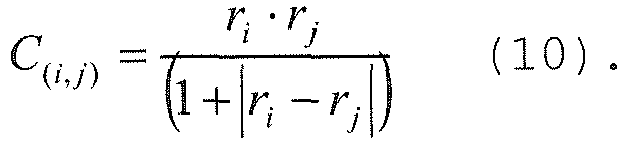

- The similarity C(i,j) between the information provided to the object in the position Xi and the information provided to the object in the position Xj when the moving body is in the position Y has been defined above using Formula 5, but it may be defined using another formula that satisfies (C1) to (C3).
- This similarity C(i,j) indicates to what extent the information provided to the object in the position Xi and the information provided to the object in the position Xj can equally be recognized from the moving body when the moving body is in the position Y at a certain time t.
- Further, the
similarity calculation unit 708 calculates a similarity set that is represented using a matrix C every time the moving body moves and integrates them, so as to calculate integrated similarity. - For example, if a similarity set at a time t is C(t), integrated similarity C* is


sensor 600 acquires the information such as the position and the orientation of the movingbody 650 discretely with respect to time. Thus, in Formulas 8 and 9 above, a discrete system may be approximately represented by use of a continuous variable t, as in Formula 16 below. - The integral range in Formulas 8 and 9 above is from a time to another time, but it may be, for example, a time period during which a moving body arrives at a position from another position.
- Further, the matrix C* may be normalized by dividing each element by a largest element. The moving pattern of the moving body is reflected in the matrix C* of similarities obtained by continually integrating during a certain time period. The matrix C* provides a set of integrated similarities.
- The example of one moving body has been described above. However, the above description may also be readily expanded to the case in which there are a plurality of moving bodies.
- The
classification unit 710 groups pieces of information on the basis of the similarity calculated by thesimilarity calculation unit 708. Theclassification unit 710 creates a graph of relationships linked to one another by use of links whose strength is represented by an element value in the similarity matrix C*, and performs grouping by severing the links of the elements whose linkage strength is not greater than a threshold. -
FIG. 15 is a table that illustrates an example of a set of integrated similarities. - The table of
FIG. 15 illustrates examples of matrix elements of a 4x4 symmetric matrix C* that represents the set of integrated similarities with respect to pieces of information A, B, C, and D. For example, the value of C(A,B) element is 0.9, and the value of C(A,c) element is 0.2. -
FIG. 16 illustrates an example of a relationship graph that is created using the set of integrated similarities illustrated inFIG. 15 . For example, the strength of the link that connects a node A and a node B is 0.9, reflecting that the value of C(A,B) element is 0.9. Likewise, the strength of the link that connects the node A and a node C is 0.2, the strength of the link that connects the node A and a node D is 0.3, the strength of the link that connects the node B and the node C is 0.3, and the strength of the link that connects the node B and the node D is 0.7. - The
classification unit 710 severs, for example, the links in the graph ofFIG. 16 whose strength is less than 0.5 that is a threshold. A threshold is a value of a boundary for classifying whether two pieces of information are similar, that is, whether to group them. In the case of the graph illustrated inFIG. 15 , the link that connects the node A and the node B (the strength of the link is 0.9) and the link that connects the node A and the node B (the strength of the link is 0.7) are left. Accordingly, theclassification unit 710 groups the information A and the information B as a group Ga and groups the information C and the information D as a group Gb. - When the number of pieces of information is large, the size of the similarity matrix C* of Formula 9 becomes large accordingly.
- In
FIG. 16 , the strength of link is classified using one threshold, but hierarchical grouping may be performed using a plurality of different thresholds for the respective links. -
FIG. 17 is a graph that illustrates another example of a set of integrated similarities. - The table of
FIG. 17 illustrates examples of matrix elements of an 8x8 symmetric matrix C* that represents the set of integrated similarities with respect to pieces of information A, B, C, D, E, F, G, and H. In this case, in a graph created from the matrix C* ofFIG. 17 , it is possible to perform a hierarchical classification by gradually relaxing thresholds for classifying the strength of link and by performing a multiple-times classification. It is possible to perform a systematic classification, for example, by visualizing a result of it as a dendrogram. This indicates that "hierarchical grouping" has been performed. In order to perform this "hierarchical grouping", the theory of hierarchical clustering that is a graph theory may be applied. - In the theory of hierarchical clustering, for example, the following processing is performed. When the data formed with N targets x1 to xN is provided, a state in which there are N clusters only including one target is created as an initial state. A distance d(C1,C2) between clusters is calculated from a distance d(xi,xj) between the target xi and the target xj (dissimilarity), and the two clusters having a closest distance from each other are sequentially merged. A result of such processing can be represented by a dendrogram. The dendrogram is a binary tree in which each non-terminating node represents each target and a cluster obtained by merging is represented by use of non-terminating nodes. There are several methods depending on the functions that represent a distance d(C1,C2) between clusters. For example, in the nearest neighbor method, the distance d(C1,C2 between clusters is defined as a minimum distance from among the distances between the targets included in the cluster C1 and the targets included in the cluster C2. In the furthest neighbor method, the distance d(C1,C2) between clusters is defined as a maximum distance from among the distances between the targets included in the cluster C1 and the targets included in the cluster C2. Further, the group average method that defines, as the distance d(C1,C2 between clusters, an average of the distances between the targets included in the cluster C1 and the targets included in the cluster C2, and the Ward's method that minimizes the sum of squares of distances from the targets to the centroids of the clusters including the respective targets are known. Any of the methods above can be used for hierarchical grouping.
-
FIG. 18 illustrates an example of a dendrogram that is created using the set of integrated similarities illustrated inFIG. 17 . - For example, with respect to the pieces of information A, B, and C in
FIG. 18 , the value of the similarity C(A,B) between the information A and the information B is 0.07, the value of the similarity C(A,C) between the information A and the information C is 0.31, and the value of the similarity C(B,C) between the information B and the information C is 0.21. As illustrated inFIG. 18 , if the value of the threshold for classifying whether they are similar, that is, whether to group them is gradually increased, first the information B and the information C are grouped. The group formed by grouping the information B and the information C is referred to as G(B,C). If the value of the threshold is further gradually increased, the information A and the information C are grouped. Grouping of information A and the information C permits hierarchical grouping to be realized because the information C and the information B have been already grouped. - As illustrated in
FIG. 18 , when performing hierarchical grouping, an area to be grouped is gradually larger if the threshold is larger. -
FIG. 19A illustrates an example of natural grouping of information using a nearest-neighbor model, andFIG. 19B illustrates another example of natural grouping of information using the nearest-neighbor model. InFIGS. 19A and19B , the levels of relationship rk provided to the objects designated with numerals are illustrated in parentheses with the numerals. For example, inFIG. 19A , a moving body is in a position P1 at a time t1, and in the same room R8 as the moving body, there areobjects object 1102 is 0.461. The level of relationship between the moving body and the information provided to theobject 1104 is 0.695. The level of relationship between the moving body in the position P1 and each of the pieces of information provided toobjects - Further, for example, as illustrated in
FIG. 19B , the moving body is in a position P2 at a time t2, and in the same room R9 as the moving body, there areobjects object 1110 is 0.422. The level of the relationship between the moving body in the position P2 and each of the pieces of information provided toobjects - As described above, at the time t1, the levels of relationship between the moving body and each of the pieces of information provided to the
objects objects - As described above, with respect to similarity C, similarity C(i,j) between information positioned in Xi and information positioned in Xj from among a plurality of pieces of information has characteristics such that, using a relationship ri between the information positioned in Xi and a moving body positioned in Y and the relationship rj between the information positioned in Xj and the moving body positioned in Y,
- (C1) C(i,j)=C(j,i), that is, symmetric with respect to interchanging between the indexes i and j,
- (C2) C(i,j)=0 when either of the relationship ri or the relationship rj is zero, and
- (C3) the value is larger when the values of the relationships ri and rj are larger and the difference between the relationships ri and rj is smaller.
- For example, with respect to the
objects FIG. 19A , the values level themselves are large and the difference between them are small, so the similarity is high. Further, for example, the similarity between the pieces of information provided to theobject 1102 and to theobject 1110 that are arranged in the different rooms is zero. - Consider integrated similarity C* obtained by time-integrating the relationship r. An element in the integrated similarity C* is larger if a time period during which an object provided with information is included in the field of view of a moving body is longer.
- According to such a
grouping apparatus 700 as described above, "natural grouping of information" based on a movement route of an information user and the accessibility to the information at a certain time can be performed. - For example, when the object is an advertising sign and the information is an advertisement, the classification is based not only on the level of advertising effectiveness but also on the simultaneity. In other words, the advertising signs that increase the advertising effectiveness simultaneously are to be put together considering the behavioral patterns of people who look at the advertisement. According to this classification scheme, if there are signs that are physically close to each other and stand facing in the same direction and if there is an increase in advertising effectiveness for each of the signs, the two signs are not to be grouped unless there is a moment when there is an increase in advertising effectiveness for the two advertising signs at the same time. It will be appreciated that, in other words, signs that are physically similar may belong to different groups by interpreting as inclusive of behavioral patterns of information users and the spatial structure from the perspective of advertising effectiveness.
-
FIG. 20 illustrates an example of a result of grouping of information with potential using a nearest-neighbor model. InFIG. 20 , the level of relationship between information provided to each object and a moving body is illustrated for each object. - In
FIG. 20 illustrates grouping of pieces of information provided to objects when there is a moving body that arrives at a position P via a route Q as represented by a dotted line. Relationships are calculated using the nearest-neighbor model above. As illustrated inFIG. 20 , the level of relationship is high when it is information provided to an object that is close to the route Q of the moving body and near which the moving body stays for a long time. Further, the pieces of information provided to the objects that are arranged across the wall from one another are not grouped. - As illustrated in
FIG. 20 , for the accessibility of a person to an information device, if the strength of relationship between information devices such as a personal computer (PC) and a printer and a user of these information devices is defined, a result of the classification is to be organized on the basis of the "accessibility of a user to an information device". This permits perform, by use of the result of the classification, processing that includes sensing a group of devices that have become accessible to a person and powering up the devices in advance. -
FIG. 21 illustrates an example of a configuration of agrouping apparatus 700 according to the embodiment. Thegrouping apparatus 700 can be realized as a general-purpose computer 800. - The
computer 800 includes anMPU 802, aROM 804, aRAM 806, ahard disk device 808, aninput device 810, adisplay 812, aninterface device 814, and a recordingmedium driving device 816. These components are connected to one another via abus line 820, and are able to transmit and receive various pieces of data with one another under the control of theMPU 802. - The MPU (micro processing unit) 802 is an arithmetic processing unit that controls the operation of the
entire computer 800 and serves as a control processing unit of thecomputer 800. - The ROM (read only memory) 804 is a read only semiconductor memory that has recorded thereon a predetermined basic control program in advance. The
MPU 802 reads and executes the basic control program when thecomputer 800 starts, and thereby it is possible to control the operation of each component of thecomputer 800. - The RAM (random access memory) 806 is a semiconductor memory that is recordable and readable at any time and which the
MPU 802 uses as a working storage area as needed when theMPU 802 executes various control programs. - The
hard disk device 808 is a storage that stores therein various programs and data executed by theMPU 802. TheMPU 802 is able to perform a variety of various control processes that will be described below, by reading and executing the predetermined control programs stored in thehard disk device 808. - The
input device 810 is, for example, a mouse device or a keyboard device, and when it is operated by a user of thegrouping apparatus 700, it acquires an input of various pieces of information associated with the operational contexts and transmits the acquired input information to theMPU 802. - The
display 812 is, for example, a liquid-crystal display, and displays various texts and images according to the display data transmitted from theMPU 802. - The
interface device 814 manages a transmission and a reception of various pieces of information between various devices that are connected to thecomputer 800. - The recording
medium driving device 816 is a device that reads various programs and data recorded on aportable recording medium 818. TheMPU 802 is also able to perform the various control processes that will be described below, by reading and executing the predetermined control program stored in theportable recording medium 818 via the recordingmedium driving device 816. A flash memory, a CD-ROM (compact disc read only memory), and a DVD-ROM (digital versatile disc read only memory) that are equipped with a USB (universal serial bus) standard connector are examples of theportable recording medium 818. - In order to configure the
grouping apparatus 700 by use of such acomputer 800, for example, a control program is created that causes theMPU 802 to perform the processing in each of the processing devices described above. The created control program is stored in thehard disk device 808 or in theportable recording medium 818 in advance. Then, a predetermined instruction is given to theMPU 802 so that the control program is read and executed. This permits theMPU 802 to provide the functions included in thegrouping apparatus 700. - As described above, the
grouping apparatus 700 permits an improvement of the efficiency of an information transmission to an information user because a plurality of pieces of information whose level of accessibility of the information user at the same time is similar and that are correlated with the information user as long as possible are put together into one group. -
FIG. 22 is a flowchart that illustrates an example of a processing flow of grouping. - When the
grouping apparatus 700 is the general-purpose computer 800 illustrated inFIG. 21 , the following description defines a control program that performs such processing. In other words, the following description is also a description of a control program that causes the general-purpose computer to perform processing described below. - When the processing starts, the
position measurement unit 702 of thegrouping apparatus 700 resets the time to t=0 in S102. Then, when the process in this step ends, the process moves on to S104. - In S104, the
position measurement unit 702 of thegrouping apparatus 700 advances time by Δt. Then, when the process in this step ends, the process moves on to S106. - In S106, the
position measurement unit 702 of thegrouping apparatus 700 measures a position of a moving body. Here, it may measure a direction, that is, a heading direction of the moving body. Then, the process moves on to S108. - In S108, the
relationship calculation unit 704 of thegrouping apparatus 700 calculates a relationship between each object and the moving body referring to the data stored in the objectdata storing unit 706. Then, when the process in this step ends, the process moves on to S108. - For example, when it is assumed that a position of a certain object is Xk, a position of a moving
body 650 is Y, and a monotone decreasing function is F(x), a relationship rk between the object positioned in Xk and the movingbody 650 is calculated using
- In S110, the
similarity calculation unit 708 of thegrouping apparatus 700 calculates similarity C(i,j) with respect to all pairs of objects. - Using the relationship ri between an object positioned in Xi and an moving body positioned in Y, and the relationship rj between an object positioned in Xj and the moving body positioned in Y, similarity C(i,j) between information provided to the object positioned in Xi and information provided to the object positioned in Xj is preferably a function that satisfies (C1) to (C3) described above. As an example, the similarity C(i,j) may be
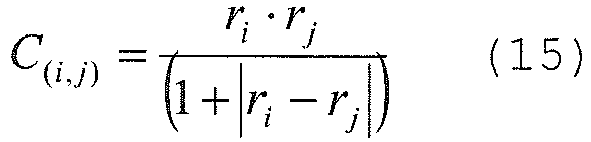
- A collection {C(i,j)(t)} of the similarities C(i,j) (t) at a time t with respect to all pairs of objects may be referred to as a similarity set. Then, when the process in this step ends, the process moves on to S112.
- In S112, the
similarity calculation unit 708 of thegrouping apparatus 700 calculates integrated similarity C* at a time t by adding the similarities C(i,j) calculated in S110 to the existing similarity set, that is,
Formula 15 described above is a matrix equation. Then, when the process in this step ends, the process moves on to S114. - In S114, the
similarity calculation unit 708 of thegrouping apparatus 700 normalizes the integrated similarity C*. For the way of normalizing, for example, each element may be divided by a maximum matrix element of the integrated similarity C*. When the process in this step ends, the process moves on to S116. - In S116, the
classification unit 710 of thegrouping apparatus 700 performs grouping information on the basis of the similarities calculated in S110 to S114. For example, it creates a graph of relationships linked to one another by use of links whose strength is represented by an element value in the similarity matrix C*, and performs grouping by severing the links of the elements whose linkage strength is not greater than a threshold.FIG. 16 illustrates an example of grouping. When the process in this step ends, the process moves on to S118. - In S118, the
classification unit 710 of thegrouping apparatus 700 determines whether the termination condition is satisfied. The termination condition may be whether a specific moving body has arrived at a certain position. The termination condition may also be whether a predetermined time period has elapsed. Further, the process in this step may be performed by a component other than theclassification unit 710, for example, by theposition measurement unit 702. If a determination result in this step is "Yes", that is, if it satisfies the termination condition, the processing terminates. If the determination result in this step is "No", that is, if it does not satisfy the termination condition, the process returns to S104. - Performing such processing permits natural grouping of information provided with position information such as (*) and (**) described above to be performed. It is possible to efficiently report information to an information user because grouping of information is performed on the basis of the accessibility of the information user to pieces of information at the same time.
-
- 600
- sensor
- 700
- grouping apparatus
- 702
- position measurement unit
- 704
- relationship calculation unit
- 706
- object data storing unit
- 708
- similarity calculation unit
- 710
- classification unit
Claims (11)
- A grouping apparatus comprising:a relationship calculation unit (704) configured to calculate, at a plurality of times between a first time and a second time, the strength of correlation between each of a plurality of pieces of information and a moving body as a level of relationship for each of the plurality of pieces of information, wherein each of the plurality of pieces of information is provided to each of a plurality of objects arranged in a space and the moving body moves within the space;a similarity calculation unit (708), on the basis of the level of relationship for each of the plurality of objects calculated at the plurality of times, configured to calculate similarities for all pairs of the plurality of pieces of information at the plurality of times, to integrate the similarities for all pairs of the plurality of pieces of information at the plurality of times, and to calculate integrated similarity; anda classification unit (710) configured to group the plurality of pieces of information on the basis of the integrated similarity.
- The grouping apparatus according to claim 1, further including an object data storing unit (706) that stores therein information on a plurality of objects and the position of a position of an obstacle that exists in the space in which the plurality of objects are arranged and that prevents the movement of the moving body, wherein
the relationship calculation unit (704) calculates the strength of the correlation between each of the plurality of pieces of information and the moving body that moves within the space, on the basis of a distance of a route that is used by the moving body moving within the space and that does not pass through the obstacle. - The grouping apparatus according to claim 1 or 2, wherein
the relationship calculation unit (704) calculates a relationship by use of a monotone decreasing function F(x), using
- The grouping apparatus according to claim 2, wherein
the relationship calculation unit (704) calculates the strength of correlation between information positioned in Xk and the moving body positioned in Y from among the plurality of pieces of information using

- The grouping apparatus according to any one of claims 1 to 4, wherein
the relationship calculation unit (704) calculates the level of relationship considering the orientation of each of the plurality of pieces of information and the orientation of the moving body. - The grouping apparatus according to any one of claims 1 to 5, wherein
the relationship calculation unit (704) calculates the level of relationship by using a function that is maximum when each of the plurality of pieces of information and the moving body are oriented 180 degrees differently from each other. - The grouping apparatus according to any one of claims 1 to 6, wherein
the classification unit (710) performs hierarchical grouping by preparing a plurality of thresholds that are different from one another for the integrated similarities. - The grouping apparatus according to any one of claims 1 to 7, wherein
the classification unit (710) calculates similarity C(i,j) between information positioned in Xi and information positioned in Xj from among the plurality of pieces of information by use of a function such that, using a relationship ri between the information positioned in Xi and the moving body positioned in Y, and a relationship rj between the information positioned in Xj and the moving body positioned in Y,(C1) C(i,j)=C(j,i), that is, symmetric with respect to interchanging between the indexes i and j,(C2) C(i,j)=0 when either of the relationship ri or the relationship rj is zero, and(C3) the value is larger when the values of the relationships ri and rj are larger and the difference between the relationships ri and rj is smaller. - A grouping system comprising:a sensor (600) configured to measure, at a plurality of times between a first time and a second time, a position of a moving body that moves within a space in which a plurality of objects are arranged, wherein each of the plurality of objects is provided with a corresponding one of a plurality of pieces of information;a relationship calculation unit (704) configured to calculate the strength of correlation between each of the plurality of pieces of information and the moving body as a level of relationship for each of the plurality of pieces of information, wherein each of the plurality of pieces of information is provided to each of the plurality of objects and the moving body moves within the space;a similarity calculation unit (708), on the basis of the level of relationship for each of the plurality of objects calculated at the plurality of times, configured to calculate similarities for all pairs of the plurality of pieces of information at the plurality of times, to integrate the similarities for all pairs of the plurality of pieces of information at the plurality of times, and to calculate integrated similarity; anda classification unit (710) configured to group the plurality of pieces of information on the basis of the integrated similarity.
- A grouping method that is executable by a computer, the grouping method comprising:calculating, at a plurality of times between a first time and a second time, the strength of correlation between each of a plurality of pieces of information and a moving body as a level of relationship for each of the plurality of pieces of information, wherein each of the plurality of pieces of information is provided to each of a plurality of objects arranged in a space and the moving body moves within the space;on the basis of the level of relationship for each of the plurality of objects calculated at the plurality of times, calculating similarities for all pairs of the plurality of pieces of information at the plurality of times, integrating the similarities for all pairs of the plurality of pieces of information at the plurality of times, and calculating integrated similarity; andgrouping the plurality of pieces of information on the basis of the integrated similarity.
- A program for causing a computer to execute a process comprising:calculating, at a plurality of times between a first time and a second time, the strength of correlation between each of a plurality of pieces of information and a moving body as a level of relationship for each of the plurality of pieces of information, wherein each of the plurality of pieces of information is provided to each of a plurality of objects arranged in a space and the moving body moves within the space;on the basis of the level of relationship for each of the plurality of objects calculated at the plurality of times, calculating similarities for all pairs of the plurality of pieces of information at the plurality of times, integrating the similarities for all pairs of the plurality of pieces of information at the plurality of times, and calculating integrated similarity; andgrouping the plurality of pieces of information on the basis of the integrated similarity.
Applications Claiming Priority (1)
| Application Number | Priority Date | Filing Date | Title |
|---|---|---|---|
| PCT/JP2013/063378 WO2014184862A1 (en) | 2013-05-14 | 2013-05-14 | Grouping device, grouping method, and grouping program |
Publications (3)
| Publication Number | Publication Date |
|---|---|
| EP2998879A1 true EP2998879A1 (en) | 2016-03-23 |
| EP2998879A4 EP2998879A4 (en) | 2016-03-30 |
| EP2998879B1 EP2998879B1 (en) | 2017-11-01 |
Family
ID=51897883
Family Applications (1)
| Application Number | Title | Priority Date | Filing Date |
|---|---|---|---|
| EP13884565.6A Not-in-force EP2998879B1 (en) | 2013-05-14 | 2013-05-14 | Grouping apparatus, system, method, and program |
Country Status (4)
| Country | Link |
|---|---|
| US (1) | US20160048576A1 (en) |
| EP (1) | EP2998879B1 (en) |
| JP (1) | JP6090438B2 (en) |
| WO (1) | WO2014184862A1 (en) |
Families Citing this family (2)
| Publication number | Priority date | Publication date | Assignee | Title |
|---|---|---|---|---|
| US11157521B2 (en) * | 2016-06-29 | 2021-10-26 | Getac Technology Corporation | Correlating multiple sources |
| KR102888858B1 (en) | 2020-12-23 | 2025-11-21 | 삼성전자주식회사 | Electronic device, and method for grouping external devices by space in electronic device |
Family Cites Families (8)
| Publication number | Priority date | Publication date | Assignee | Title |
|---|---|---|---|---|
| US5917248A (en) * | 1995-01-31 | 1999-06-29 | Denso Corporation | System and method for driving electric vehicle |
| WO2006104033A1 (en) * | 2005-03-28 | 2006-10-05 | Kyushu Institute Of Technology | Operation detection device and operation detection method |
| JP2009260583A (en) * | 2008-04-16 | 2009-11-05 | Nec Corp | Device for visualizing mobile phone information, system for visualizing mobile phone information, and method of using the device and system for visualizing mobile phone information |
| JP5243896B2 (en) * | 2008-09-16 | 2013-07-24 | 株式会社ゼンリンデータコム | Information display system, information display method, and computer program |
| JP2011134225A (en) * | 2009-12-25 | 2011-07-07 | Denso Corp | Information providing system for vehicle |
| JP5202605B2 (en) | 2010-11-11 | 2013-06-05 | 株式会社バッファロー | Content data management apparatus, content data management system, content data management program, and content data management method |
| US8886128B2 (en) * | 2010-12-10 | 2014-11-11 | Verizon Patent And Licensing Inc. | Method and system for providing proximity-relationship group creation |
| US9432805B2 (en) * | 2011-09-28 | 2016-08-30 | Qualcomm Incorporated | Discovering and automatically sizing a place of relevance |
-
2013
- 2013-05-14 EP EP13884565.6A patent/EP2998879B1/en not_active Not-in-force
- 2013-05-14 WO PCT/JP2013/063378 patent/WO2014184862A1/en not_active Ceased
- 2013-05-14 JP JP2015516785A patent/JP6090438B2/en not_active Expired - Fee Related
-
2015
- 2015-10-27 US US14/924,093 patent/US20160048576A1/en not_active Abandoned
Also Published As
| Publication number | Publication date |
|---|---|
| WO2014184862A1 (en) | 2014-11-20 |
| JP6090438B2 (en) | 2017-03-08 |
| JPWO2014184862A1 (en) | 2017-02-23 |
| EP2998879B1 (en) | 2017-11-01 |
| EP2998879A4 (en) | 2016-03-30 |
| US20160048576A1 (en) | 2016-02-18 |
Similar Documents
| Publication | Publication Date | Title |
|---|---|---|
| CN112668525B (en) | People flow counting method and device, electronic equipment and storage medium | |
| Amirian et al. | Opentraj: Assessing prediction complexity in human trajectories datasets | |
| CN103392187B (en) | Scene Activity Analysis Using Statistical and Semantic Features Obtained from Object Trajectory Data | |
| Cheliotis | An agent-based model of public space use | |
| Grubesic | On the application of fuzzy clustering for crime hot spot detection | |
| Demšar et al. | Analysis and visualisation of movement: an interdisciplinary review | |
| US10354406B2 (en) | Method of detecting objects within a 3D environment | |
| Long et al. | A review of quantitative methods for movement data | |
| Dornhege et al. | A frontier-void-based approach for autonomous exploration in 3d | |
| Bandini et al. | Towards an integrated approach to crowd analysis and crowd synthesis: A case study and first results | |
| JP5534007B2 (en) | Feature point detection system, feature point detection method, and program | |
| JP6888484B2 (en) | A search program, a search method, and an information processing device on which the search program operates. | |
| CN111444767A (en) | Pedestrian detection and tracking method based on laser radar | |
| CN114299607A (en) | A method for analyzing the risk of collision between people and vehicles based on autonomous vehicles | |
| CN106407519B (en) | A Modeling Method of Crowd Movement Law | |
| Corcoran et al. | Modelling topological features of swarm behaviour in space and time with persistence landscapes | |
| EP2998879B1 (en) | Grouping apparatus, system, method, and program | |
| CN109784140A (en) | Driver attributes' recognition methods and Related product | |
| Mohd Romlay et al. | Novel CE-CBCE feature extraction method for object classification using a low-density LiDAR point cloud | |
| JP2019174910A (en) | Information acquisition device and information aggregation system and information aggregation device | |
| Stisen et al. | Task phase recognition for highly mobile workers in large building complexes | |
| CN116243803B (en) | Action evaluation method, system, equipment and readable storage medium based on VR technology | |
| JP5450703B2 (en) | Method and apparatus for determining a spatial area in which a target is located | |
| Gharaibeh et al. | Target classification in wireless sensor network using particle swarm optimization (PSO) | |
| Al-Kuwari et al. | Probabilistic vehicular trace reconstruction based on RF-visual data fusion |
Legal Events
| Date | Code | Title | Description |
|---|---|---|---|
| PUAI | Public reference made under article 153(3) epc to a published international application that has entered the european phase |
Free format text: ORIGINAL CODE: 0009012 |
|
| 17P | Request for examination filed |
Effective date: 20151021 |
|
| AK | Designated contracting states |
Kind code of ref document: A1 Designated state(s): AL AT BE BG CH CY CZ DE DK EE ES FI FR GB GR HR HU IE IS IT LI LT LU LV MC MK MT NL NO PL PT RO RS SE SI SK SM TR |
|
| AX | Request for extension of the european patent |
Extension state: BA ME |
|
| A4 | Supplementary search report drawn up and despatched |
Effective date: 20160229 |
|
| RIC1 | Information provided on ipc code assigned before grant |
Ipc: H04W 4/04 20090101ALN20160223BHEP Ipc: H04W 4/08 20090101ALI20160223BHEP Ipc: G06F 17/30 20060101AFI20160223BHEP Ipc: G01S 5/00 20060101ALN20160223BHEP Ipc: H04W 4/02 20090101ALI20160223BHEP |
|
| DAX | Request for extension of the european patent (deleted) | ||
| GRAP | Despatch of communication of intention to grant a patent |
Free format text: ORIGINAL CODE: EPIDOSNIGR1 |
|
| STAA | Information on the status of an ep patent application or granted ep patent |
Free format text: STATUS: GRANT OF PATENT IS INTENDED |
|
| RIC1 | Information provided on ipc code assigned before grant |
Ipc: H04W 4/02 20090101ALI20170419BHEP Ipc: H04W 4/04 20090101ALN20170419BHEP Ipc: G01S 5/00 20060101ALN20170419BHEP Ipc: H04W 4/08 20090101ALI20170419BHEP Ipc: G06F 17/30 20060101AFI20170419BHEP |
|
| RIC1 | Information provided on ipc code assigned before grant |
Ipc: H04W 4/08 20090101ALI20170510BHEP Ipc: H04W 4/02 20090101ALI20170510BHEP Ipc: G06F 17/30 20060101AFI20170510BHEP Ipc: H04W 4/04 20090101ALN20170510BHEP Ipc: G01S 5/00 20060101ALN20170510BHEP |
|
| INTG | Intention to grant announced |
Effective date: 20170524 |
|
| GRAS | Grant fee paid |
Free format text: ORIGINAL CODE: EPIDOSNIGR3 |
|
| GRAA | (expected) grant |
Free format text: ORIGINAL CODE: 0009210 |
|
| STAA | Information on the status of an ep patent application or granted ep patent |
Free format text: STATUS: THE PATENT HAS BEEN GRANTED |
|
| AK | Designated contracting states |
Kind code of ref document: B1 Designated state(s): AL AT BE BG CH CY CZ DE DK EE ES FI FR GB GR HR HU IE IS IT LI LT LU LV MC MK MT NL NO PL PT RO RS SE SI SK SM TR |
|
| REG | Reference to a national code |
Ref country code: GB Ref legal event code: FG4D |
|
| REG | Reference to a national code |
Ref country code: CH Ref legal event code: EP Ref country code: AT Ref legal event code: REF Ref document number: 942691 Country of ref document: AT Kind code of ref document: T Effective date: 20171115 |
|
| REG | Reference to a national code |
Ref country code: IE Ref legal event code: FG4D |
|
| REG | Reference to a national code |
Ref country code: DE Ref legal event code: R096 Ref document number: 602013028974 Country of ref document: DE |
|
| REG | Reference to a national code |
Ref country code: NL Ref legal event code: MP Effective date: 20171101 |
|
| REG | Reference to a national code |
Ref country code: FR Ref legal event code: PLFP Year of fee payment: 6 |
|
| REG | Reference to a national code |
Ref country code: LT Ref legal event code: MG4D |
|
| REG | Reference to a national code |
Ref country code: AT Ref legal event code: MK05 Ref document number: 942691 Country of ref document: AT Kind code of ref document: T Effective date: 20171101 |
|
| PG25 | Lapsed in a contracting state [announced via postgrant information from national office to epo] |
Ref country code: NL Free format text: LAPSE BECAUSE OF FAILURE TO SUBMIT A TRANSLATION OF THE DESCRIPTION OR TO PAY THE FEE WITHIN THE PRESCRIBED TIME-LIMIT Effective date: 20171101 Ref country code: SE Free format text: LAPSE BECAUSE OF FAILURE TO SUBMIT A TRANSLATION OF THE DESCRIPTION OR TO PAY THE FEE WITHIN THE PRESCRIBED TIME-LIMIT Effective date: 20171101 Ref country code: FI Free format text: LAPSE BECAUSE OF FAILURE TO SUBMIT A TRANSLATION OF THE DESCRIPTION OR TO PAY THE FEE WITHIN THE PRESCRIBED TIME-LIMIT Effective date: 20171101 Ref country code: ES Free format text: LAPSE BECAUSE OF FAILURE TO SUBMIT A TRANSLATION OF THE DESCRIPTION OR TO PAY THE FEE WITHIN THE PRESCRIBED TIME-LIMIT Effective date: 20171101 Ref country code: LT Free format text: LAPSE BECAUSE OF FAILURE TO SUBMIT A TRANSLATION OF THE DESCRIPTION OR TO PAY THE FEE WITHIN THE PRESCRIBED TIME-LIMIT Effective date: 20171101 Ref country code: NO Free format text: LAPSE BECAUSE OF FAILURE TO SUBMIT A TRANSLATION OF THE DESCRIPTION OR TO PAY THE FEE WITHIN THE PRESCRIBED TIME-LIMIT Effective date: 20180201 |
|
| PG25 | Lapsed in a contracting state [announced via postgrant information from national office to epo] |
Ref country code: GR Free format text: LAPSE BECAUSE OF FAILURE TO SUBMIT A TRANSLATION OF THE DESCRIPTION OR TO PAY THE FEE WITHIN THE PRESCRIBED TIME-LIMIT Effective date: 20180202 Ref country code: BG Free format text: LAPSE BECAUSE OF FAILURE TO SUBMIT A TRANSLATION OF THE DESCRIPTION OR TO PAY THE FEE WITHIN THE PRESCRIBED TIME-LIMIT Effective date: 20180201 Ref country code: AT Free format text: LAPSE BECAUSE OF FAILURE TO SUBMIT A TRANSLATION OF THE DESCRIPTION OR TO PAY THE FEE WITHIN THE PRESCRIBED TIME-LIMIT Effective date: 20171101 Ref country code: LV Free format text: LAPSE BECAUSE OF FAILURE TO SUBMIT A TRANSLATION OF THE DESCRIPTION OR TO PAY THE FEE WITHIN THE PRESCRIBED TIME-LIMIT Effective date: 20171101 Ref country code: HR Free format text: LAPSE BECAUSE OF FAILURE TO SUBMIT A TRANSLATION OF THE DESCRIPTION OR TO PAY THE FEE WITHIN THE PRESCRIBED TIME-LIMIT Effective date: 20171101 Ref country code: RS Free format text: LAPSE BECAUSE OF FAILURE TO SUBMIT A TRANSLATION OF THE DESCRIPTION OR TO PAY THE FEE WITHIN THE PRESCRIBED TIME-LIMIT Effective date: 20171101 Ref country code: IS Free format text: LAPSE BECAUSE OF FAILURE TO SUBMIT A TRANSLATION OF THE DESCRIPTION OR TO PAY THE FEE WITHIN THE PRESCRIBED TIME-LIMIT Effective date: 20180301 |
|
| PG25 | Lapsed in a contracting state [announced via postgrant information from national office to epo] |
Ref country code: CZ Free format text: LAPSE BECAUSE OF FAILURE TO SUBMIT A TRANSLATION OF THE DESCRIPTION OR TO PAY THE FEE WITHIN THE PRESCRIBED TIME-LIMIT Effective date: 20171101 Ref country code: DK Free format text: LAPSE BECAUSE OF FAILURE TO SUBMIT A TRANSLATION OF THE DESCRIPTION OR TO PAY THE FEE WITHIN THE PRESCRIBED TIME-LIMIT Effective date: 20171101 Ref country code: CY Free format text: LAPSE BECAUSE OF FAILURE TO SUBMIT A TRANSLATION OF THE DESCRIPTION OR TO PAY THE FEE WITHIN THE PRESCRIBED TIME-LIMIT Effective date: 20171101 Ref country code: EE Free format text: LAPSE BECAUSE OF FAILURE TO SUBMIT A TRANSLATION OF THE DESCRIPTION OR TO PAY THE FEE WITHIN THE PRESCRIBED TIME-LIMIT Effective date: 20171101 Ref country code: SK Free format text: LAPSE BECAUSE OF FAILURE TO SUBMIT A TRANSLATION OF THE DESCRIPTION OR TO PAY THE FEE WITHIN THE PRESCRIBED TIME-LIMIT Effective date: 20171101 |
|
| REG | Reference to a national code |
Ref country code: DE Ref legal event code: R097 Ref document number: 602013028974 Country of ref document: DE |
|
| PG25 | Lapsed in a contracting state [announced via postgrant information from national office to epo] |
Ref country code: RO Free format text: LAPSE BECAUSE OF FAILURE TO SUBMIT A TRANSLATION OF THE DESCRIPTION OR TO PAY THE FEE WITHIN THE PRESCRIBED TIME-LIMIT Effective date: 20171101 Ref country code: IT Free format text: LAPSE BECAUSE OF FAILURE TO SUBMIT A TRANSLATION OF THE DESCRIPTION OR TO PAY THE FEE WITHIN THE PRESCRIBED TIME-LIMIT Effective date: 20171101 Ref country code: SM Free format text: LAPSE BECAUSE OF FAILURE TO SUBMIT A TRANSLATION OF THE DESCRIPTION OR TO PAY THE FEE WITHIN THE PRESCRIBED TIME-LIMIT Effective date: 20171101 Ref country code: PL Free format text: LAPSE BECAUSE OF FAILURE TO SUBMIT A TRANSLATION OF THE DESCRIPTION OR TO PAY THE FEE WITHIN THE PRESCRIBED TIME-LIMIT Effective date: 20171101 |
|
| PLBE | No opposition filed within time limit |
Free format text: ORIGINAL CODE: 0009261 |
|
| STAA | Information on the status of an ep patent application or granted ep patent |
Free format text: STATUS: NO OPPOSITION FILED WITHIN TIME LIMIT |
|
| 26N | No opposition filed |
Effective date: 20180802 |
|
| REG | Reference to a national code |
Ref country code: DE Ref legal event code: R079 Ref document number: 602013028974 Country of ref document: DE Free format text: PREVIOUS MAIN CLASS: G06F0017300000 Ipc: G06F0016000000 |
|
| PG25 | Lapsed in a contracting state [announced via postgrant information from national office to epo] |
Ref country code: SI Free format text: LAPSE BECAUSE OF FAILURE TO SUBMIT A TRANSLATION OF THE DESCRIPTION OR TO PAY THE FEE WITHIN THE PRESCRIBED TIME-LIMIT Effective date: 20171101 |
|
| REG | Reference to a national code |
Ref country code: CH Ref legal event code: PL |
|
| REG | Reference to a national code |
Ref country code: BE Ref legal event code: MM Effective date: 20180531 |
|
| PG25 | Lapsed in a contracting state [announced via postgrant information from national office to epo] |
Ref country code: MC Free format text: LAPSE BECAUSE OF FAILURE TO SUBMIT A TRANSLATION OF THE DESCRIPTION OR TO PAY THE FEE WITHIN THE PRESCRIBED TIME-LIMIT Effective date: 20171101 |
|
| REG | Reference to a national code |
Ref country code: IE Ref legal event code: MM4A |
|
| PG25 | Lapsed in a contracting state [announced via postgrant information from national office to epo] |
Ref country code: CH Free format text: LAPSE BECAUSE OF NON-PAYMENT OF DUE FEES Effective date: 20180531 Ref country code: LI Free format text: LAPSE BECAUSE OF NON-PAYMENT OF DUE FEES Effective date: 20180531 |
|
| PG25 | Lapsed in a contracting state [announced via postgrant information from national office to epo] |
Ref country code: LU Free format text: LAPSE BECAUSE OF NON-PAYMENT OF DUE FEES Effective date: 20180514 |
|
| PG25 | Lapsed in a contracting state [announced via postgrant information from national office to epo] |
Ref country code: IE Free format text: LAPSE BECAUSE OF NON-PAYMENT OF DUE FEES Effective date: 20180514 |
|
| PG25 | Lapsed in a contracting state [announced via postgrant information from national office to epo] |
Ref country code: BE Free format text: LAPSE BECAUSE OF NON-PAYMENT OF DUE FEES Effective date: 20180531 |
|
| PG25 | Lapsed in a contracting state [announced via postgrant information from national office to epo] |
Ref country code: MT Free format text: LAPSE BECAUSE OF NON-PAYMENT OF DUE FEES Effective date: 20180514 |
|
| PG25 | Lapsed in a contracting state [announced via postgrant information from national office to epo] |
Ref country code: TR Free format text: LAPSE BECAUSE OF FAILURE TO SUBMIT A TRANSLATION OF THE DESCRIPTION OR TO PAY THE FEE WITHIN THE PRESCRIBED TIME-LIMIT Effective date: 20171101 |
|
| PG25 | Lapsed in a contracting state [announced via postgrant information from national office to epo] |
Ref country code: PT Free format text: LAPSE BECAUSE OF FAILURE TO SUBMIT A TRANSLATION OF THE DESCRIPTION OR TO PAY THE FEE WITHIN THE PRESCRIBED TIME-LIMIT Effective date: 20171101 |
|
| PG25 | Lapsed in a contracting state [announced via postgrant information from national office to epo] |
Ref country code: HU Free format text: LAPSE BECAUSE OF FAILURE TO SUBMIT A TRANSLATION OF THE DESCRIPTION OR TO PAY THE FEE WITHIN THE PRESCRIBED TIME-LIMIT; INVALID AB INITIO Effective date: 20130514 Ref country code: MK Free format text: LAPSE BECAUSE OF NON-PAYMENT OF DUE FEES Effective date: 20171101 |
|
| PG25 | Lapsed in a contracting state [announced via postgrant information from national office to epo] |
Ref country code: AL Free format text: LAPSE BECAUSE OF FAILURE TO SUBMIT A TRANSLATION OF THE DESCRIPTION OR TO PAY THE FEE WITHIN THE PRESCRIBED TIME-LIMIT Effective date: 20171101 |
|
| REG | Reference to a national code |
Ref country code: DE Ref legal event code: R082 Ref document number: 602013028974 Country of ref document: DE Representative=s name: HL KEMPNER PATENTANWAELTE, SOLICITORS (ENGLAND, DE Ref country code: DE Ref legal event code: R082 Ref document number: 602013028974 Country of ref document: DE Representative=s name: HL KEMPNER PATENTANWALT, RECHTSANWALT, SOLICIT, DE |
|
| REG | Reference to a national code |
Ref country code: FR Ref legal event code: PLFP Year of fee payment: 11 |
|
| PGFP | Annual fee paid to national office [announced via postgrant information from national office to epo] |
Ref country code: GB Payment date: 20230330 Year of fee payment: 11 |
|
| PGFP | Annual fee paid to national office [announced via postgrant information from national office to epo] |
Ref country code: FR Payment date: 20230411 Year of fee payment: 11 Ref country code: DE Payment date: 20230331 Year of fee payment: 11 |
|
| REG | Reference to a national code |
Ref country code: DE Ref legal event code: R119 Ref document number: 602013028974 Country of ref document: DE |
|
| GBPC | Gb: european patent ceased through non-payment of renewal fee |
Effective date: 20240514 |
|
| PG25 | Lapsed in a contracting state [announced via postgrant information from national office to epo] |
Ref country code: DE Free format text: LAPSE BECAUSE OF NON-PAYMENT OF DUE FEES Effective date: 20241203 |
|
| PG25 | Lapsed in a contracting state [announced via postgrant information from national office to epo] |
Ref country code: FR Free format text: LAPSE BECAUSE OF NON-PAYMENT OF DUE FEES Effective date: 20240531 |
|
| PG25 | Lapsed in a contracting state [announced via postgrant information from national office to epo] |
Ref country code: GB Free format text: LAPSE BECAUSE OF NON-PAYMENT OF DUE FEES Effective date: 20240514 |