EP2997954B1 - Resin powder including ultraviolet scattering agent, production method therefor, and cosmetic - Google Patents
Resin powder including ultraviolet scattering agent, production method therefor, and cosmetic Download PDFInfo
- Publication number
- EP2997954B1 EP2997954B1 EP14798119.5A EP14798119A EP2997954B1 EP 2997954 B1 EP2997954 B1 EP 2997954B1 EP 14798119 A EP14798119 A EP 14798119A EP 2997954 B1 EP2997954 B1 EP 2997954B1
- Authority
- EP
- European Patent Office
- Prior art keywords
- resin
- particle
- resin powder
- ultraviolet scattering
- polyamide
- Prior art date
- Legal status (The legal status is an assumption and is not a legal conclusion. Google has not performed a legal analysis and makes no representation as to the accuracy of the status listed.)
- Active
Links
- 229920005989 resin Polymers 0.000 title claims description 160
- 239000011347 resin Substances 0.000 title claims description 160
- 239000000843 powder Substances 0.000 title claims description 130
- 239000003795 chemical substances by application Substances 0.000 title claims description 80
- 239000002537 cosmetic Substances 0.000 title claims description 36
- 238000004519 manufacturing process Methods 0.000 title claims description 8
- 239000002245 particle Substances 0.000 claims description 153
- XLOMVQKBTHCTTD-UHFFFAOYSA-N Zinc monoxide Chemical compound [Zn]=O XLOMVQKBTHCTTD-UHFFFAOYSA-N 0.000 claims description 56
- GWEVSGVZZGPLCZ-UHFFFAOYSA-N Titan oxide Chemical compound O=[Ti]=O GWEVSGVZZGPLCZ-UHFFFAOYSA-N 0.000 claims description 44
- OGIDPMRJRNCKJF-UHFFFAOYSA-N titanium oxide Inorganic materials [Ti]=O OGIDPMRJRNCKJF-UHFFFAOYSA-N 0.000 claims description 31
- 229920006122 polyamide resin Polymers 0.000 claims description 29
- 239000011787 zinc oxide Substances 0.000 claims description 28
- 229910044991 metal oxide Inorganic materials 0.000 claims description 20
- 150000004706 metal oxides Chemical class 0.000 claims description 19
- 238000000635 electron micrograph Methods 0.000 claims description 17
- 125000001931 aliphatic group Chemical group 0.000 claims description 6
- 229920006018 co-polyamide Polymers 0.000 claims description 6
- 229920006017 homo-polyamide Polymers 0.000 claims description 6
- 125000002947 alkylene group Chemical group 0.000 claims description 5
- 239000004952 Polyamide Substances 0.000 description 35
- 229920002647 polyamide Polymers 0.000 description 35
- 238000000034 method Methods 0.000 description 21
- 238000002834 transmittance Methods 0.000 description 21
- -1 poly(ethylene terephthalate) Polymers 0.000 description 19
- 239000000049 pigment Substances 0.000 description 17
- 239000000654 additive Substances 0.000 description 14
- 239000011324 bead Substances 0.000 description 13
- VYPSYNLAJGMNEJ-UHFFFAOYSA-N Silicium dioxide Chemical compound O=[Si]=O VYPSYNLAJGMNEJ-UHFFFAOYSA-N 0.000 description 11
- LFQSCWFLJHTTHZ-UHFFFAOYSA-N Ethanol Chemical compound CCO LFQSCWFLJHTTHZ-UHFFFAOYSA-N 0.000 description 10
- 239000011159 matrix material Substances 0.000 description 10
- 229920005992 thermoplastic resin Polymers 0.000 description 10
- 239000003086 colorant Substances 0.000 description 9
- 229920001971 elastomer Polymers 0.000 description 9
- 239000011521 glass Substances 0.000 description 9
- PNEYBMLMFCGWSK-UHFFFAOYSA-N aluminium oxide Inorganic materials [O-2].[O-2].[O-2].[Al+3].[Al+3] PNEYBMLMFCGWSK-UHFFFAOYSA-N 0.000 description 8
- 239000000806 elastomer Substances 0.000 description 8
- 239000000945 filler Substances 0.000 description 8
- 229910052751 metal Inorganic materials 0.000 description 8
- 239000002184 metal Substances 0.000 description 8
- 238000009826 distribution Methods 0.000 description 7
- 238000002360 preparation method Methods 0.000 description 7
- MCMNRKCIXSYSNV-UHFFFAOYSA-N Zirconium dioxide Chemical compound O=[Zr]=O MCMNRKCIXSYSNV-UHFFFAOYSA-N 0.000 description 6
- XLYOFNOQVPJJNP-UHFFFAOYSA-N water Substances O XLYOFNOQVPJJNP-UHFFFAOYSA-N 0.000 description 6
- 239000004953 Aliphatic polyamide Substances 0.000 description 5
- 229920000299 Nylon 12 Polymers 0.000 description 5
- 229920003231 aliphatic polyamide Polymers 0.000 description 5
- 239000006071 cream Substances 0.000 description 5
- 239000000975 dye Substances 0.000 description 5
- 150000002148 esters Chemical class 0.000 description 5
- 239000007788 liquid Substances 0.000 description 5
- VTYYLEPIZMXCLO-UHFFFAOYSA-L Calcium carbonate Chemical compound [Ca+2].[O-]C([O-])=O VTYYLEPIZMXCLO-UHFFFAOYSA-L 0.000 description 4
- UQSXHKLRYXJYBZ-UHFFFAOYSA-N Iron oxide Chemical compound [Fe]=O UQSXHKLRYXJYBZ-UHFFFAOYSA-N 0.000 description 4
- TZCXTZWJZNENPQ-UHFFFAOYSA-L barium sulfate Chemical compound [Ba+2].[O-]S([O-])(=O)=O TZCXTZWJZNENPQ-UHFFFAOYSA-L 0.000 description 4
- 230000000694 effects Effects 0.000 description 4
- 239000000203 mixture Substances 0.000 description 4
- 239000000377 silicon dioxide Substances 0.000 description 4
- ALYNCZNDIQEVRV-UHFFFAOYSA-N 4-aminobenzoic acid Chemical compound NC1=CC=C(C(O)=O)C=C1 ALYNCZNDIQEVRV-UHFFFAOYSA-N 0.000 description 3
- OKTJSMMVPCPJKN-UHFFFAOYSA-N Carbon Chemical compound [C] OKTJSMMVPCPJKN-UHFFFAOYSA-N 0.000 description 3
- KFZMGEQAYNKOFK-UHFFFAOYSA-N Isopropanol Chemical compound CC(C)O KFZMGEQAYNKOFK-UHFFFAOYSA-N 0.000 description 3
- OKKJLVBELUTLKV-UHFFFAOYSA-N Methanol Chemical compound OC OKKJLVBELUTLKV-UHFFFAOYSA-N 0.000 description 3
- 229920000571 Nylon 11 Polymers 0.000 description 3
- 229920002302 Nylon 6,6 Polymers 0.000 description 3
- 238000000149 argon plasma sintering Methods 0.000 description 3
- 239000011230 binding agent Substances 0.000 description 3
- 239000000919 ceramic Substances 0.000 description 3
- 239000011246 composite particle Substances 0.000 description 3
- 230000007423 decrease Effects 0.000 description 3
- 239000006185 dispersion Substances 0.000 description 3
- 230000001815 facial effect Effects 0.000 description 3
- 239000000835 fiber Substances 0.000 description 3
- 239000006210 lotion Substances 0.000 description 3
- 238000002844 melting Methods 0.000 description 3
- 230000008018 melting Effects 0.000 description 3
- 239000004645 polyester resin Substances 0.000 description 3
- 229920005672 polyolefin resin Polymers 0.000 description 3
- 239000011164 primary particle Substances 0.000 description 3
- 239000003223 protective agent Substances 0.000 description 3
- 238000010298 pulverizing process Methods 0.000 description 3
- 239000011342 resin composition Substances 0.000 description 3
- 229910052709 silver Inorganic materials 0.000 description 3
- 239000004332 silver Substances 0.000 description 3
- 239000010936 titanium Substances 0.000 description 3
- 229910052719 titanium Inorganic materials 0.000 description 3
- 239000004408 titanium dioxide Substances 0.000 description 3
- BVKZGUZCCUSVTD-UHFFFAOYSA-L Carbonate Chemical compound [O-]C([O-])=O BVKZGUZCCUSVTD-UHFFFAOYSA-L 0.000 description 2
- XEEYBQQBJWHFJM-UHFFFAOYSA-N Iron Chemical compound [Fe] XEEYBQQBJWHFJM-UHFFFAOYSA-N 0.000 description 2
- PXHVJJICTQNCMI-UHFFFAOYSA-N Nickel Chemical compound [Ni] PXHVJJICTQNCMI-UHFFFAOYSA-N 0.000 description 2
- 229920002292 Nylon 6 Polymers 0.000 description 2
- KDLHZDBZIXYQEI-UHFFFAOYSA-N Palladium Chemical compound [Pd] KDLHZDBZIXYQEI-UHFFFAOYSA-N 0.000 description 2
- 239000004793 Polystyrene Substances 0.000 description 2
- 229910052581 Si3N4 Inorganic materials 0.000 description 2
- QAOWNCQODCNURD-UHFFFAOYSA-L Sulfate Chemical compound [O-]S([O-])(=O)=O QAOWNCQODCNURD-UHFFFAOYSA-L 0.000 description 2
- RTAQQCXQSZGOHL-UHFFFAOYSA-N Titanium Chemical compound [Ti] RTAQQCXQSZGOHL-UHFFFAOYSA-N 0.000 description 2
- 229910021536 Zeolite Inorganic materials 0.000 description 2
- 239000003513 alkali Substances 0.000 description 2
- 229960004050 aminobenzoic acid Drugs 0.000 description 2
- 125000003118 aryl group Chemical group 0.000 description 2
- AYJRCSIUFZENHW-UHFFFAOYSA-L barium carbonate Chemical compound [Ba+2].[O-]C([O-])=O AYJRCSIUFZENHW-UHFFFAOYSA-L 0.000 description 2
- 229910000019 calcium carbonate Inorganic materials 0.000 description 2
- OSGAYBCDTDRGGQ-UHFFFAOYSA-L calcium sulfate Chemical compound [Ca+2].[O-]S([O-])(=O)=O OSGAYBCDTDRGGQ-UHFFFAOYSA-L 0.000 description 2
- 239000006229 carbon black Substances 0.000 description 2
- 150000001875 compounds Chemical class 0.000 description 2
- 239000007822 coupling agent Substances 0.000 description 2
- 150000002009 diols Chemical class 0.000 description 2
- HNPSIPDUKPIQMN-UHFFFAOYSA-N dioxosilane;oxo(oxoalumanyloxy)alumane Chemical compound O=[Si]=O.O=[Al]O[Al]=O HNPSIPDUKPIQMN-UHFFFAOYSA-N 0.000 description 2
- 239000000839 emulsion Substances 0.000 description 2
- 238000005227 gel permeation chromatography Methods 0.000 description 2
- PCHJSUWPFVWCPO-UHFFFAOYSA-N gold Chemical compound [Au] PCHJSUWPFVWCPO-UHFFFAOYSA-N 0.000 description 2
- 229910052737 gold Inorganic materials 0.000 description 2
- 239000010931 gold Substances 0.000 description 2
- 229910052588 hydroxylapatite Inorganic materials 0.000 description 2
- SZVJSHCCFOBDDC-UHFFFAOYSA-N iron(II,III) oxide Inorganic materials O=[Fe]O[Fe]O[Fe]=O SZVJSHCCFOBDDC-UHFFFAOYSA-N 0.000 description 2
- 239000000463 material Substances 0.000 description 2
- 238000005259 measurement Methods 0.000 description 2
- KELHQGOVULCJSG-UHFFFAOYSA-N n,n-dimethyl-1-(5-methylfuran-2-yl)ethane-1,2-diamine Chemical compound CN(C)C(CN)C1=CC=C(C)O1 KELHQGOVULCJSG-UHFFFAOYSA-N 0.000 description 2
- 239000003921 oil Substances 0.000 description 2
- 239000003973 paint Substances 0.000 description 2
- XYJRXVWERLGGKC-UHFFFAOYSA-D pentacalcium;hydroxide;triphosphate Chemical compound [OH-].[Ca+2].[Ca+2].[Ca+2].[Ca+2].[Ca+2].[O-]P([O-])([O-])=O.[O-]P([O-])([O-])=O.[O-]P([O-])([O-])=O XYJRXVWERLGGKC-UHFFFAOYSA-D 0.000 description 2
- BASFCYQUMIYNBI-UHFFFAOYSA-N platinum Chemical compound [Pt] BASFCYQUMIYNBI-UHFFFAOYSA-N 0.000 description 2
- 229920003229 poly(methyl methacrylate) Polymers 0.000 description 2
- 229920002492 poly(sulfone) Polymers 0.000 description 2
- 239000004417 polycarbonate Substances 0.000 description 2
- 229920000515 polycarbonate Polymers 0.000 description 2
- 229920001225 polyester resin Polymers 0.000 description 2
- 229920001721 polyimide Polymers 0.000 description 2
- 229920000069 polyphenylene sulfide Polymers 0.000 description 2
- 229920002223 polystyrene Polymers 0.000 description 2
- 230000008569 process Effects 0.000 description 2
- 230000002829 reductive effect Effects 0.000 description 2
- YGSDEFSMJLZEOE-UHFFFAOYSA-N salicylic acid Chemical compound OC(=O)C1=CC=CC=C1O YGSDEFSMJLZEOE-UHFFFAOYSA-N 0.000 description 2
- HBMJWWWQQXIZIP-UHFFFAOYSA-N silicon carbide Chemical compound [Si+]#[C-] HBMJWWWQQXIZIP-UHFFFAOYSA-N 0.000 description 2
- 229910010271 silicon carbide Inorganic materials 0.000 description 2
- HQVNEWCFYHHQES-UHFFFAOYSA-N silicon nitride Chemical compound N12[Si]34N5[Si]62N3[Si]51N64 HQVNEWCFYHHQES-UHFFFAOYSA-N 0.000 description 2
- 239000007787 solid Substances 0.000 description 2
- 241000894007 species Species 0.000 description 2
- IATRAKWUXMZMIY-UHFFFAOYSA-N strontium oxide Chemical compound [O-2].[Sr+2] IATRAKWUXMZMIY-UHFFFAOYSA-N 0.000 description 2
- 229920002725 thermoplastic elastomer Polymers 0.000 description 2
- 239000006097 ultraviolet radiation absorber Substances 0.000 description 2
- 125000000391 vinyl group Chemical group [H]C([*])=C([H])[H] 0.000 description 2
- 229920002554 vinyl polymer Polymers 0.000 description 2
- 239000010457 zeolite Substances 0.000 description 2
- ODIGIKRIUKFKHP-UHFFFAOYSA-N (n-propan-2-yloxycarbonylanilino) acetate Chemical compound CC(C)OC(=O)N(OC(C)=O)C1=CC=CC=C1 ODIGIKRIUKFKHP-UHFFFAOYSA-N 0.000 description 1
- GUYIZQZWDFCUTA-UHFFFAOYSA-N (pentadecachlorophthalocyaninato(2-))-copper Chemical compound [Cu+2].N1=C([N-]2)C3=C(Cl)C(Cl)=C(Cl)C(Cl)=C3C2=NC(C2=C(Cl)C(Cl)=C(Cl)C(Cl)=C22)=NC2=NC(C2=C(Cl)C(Cl)=C(Cl)C(Cl)=C22)=NC2=NC2=C(C(Cl)=C(C(Cl)=C3)Cl)C3=C1[N-]2 GUYIZQZWDFCUTA-UHFFFAOYSA-N 0.000 description 1
- WBYWAXJHAXSJNI-VOTSOKGWSA-M .beta-Phenylacrylic acid Natural products [O-]C(=O)\C=C\C1=CC=CC=C1 WBYWAXJHAXSJNI-VOTSOKGWSA-M 0.000 description 1
- 229940015975 1,2-hexanediol Drugs 0.000 description 1
- RWNUSVWFHDHRCJ-UHFFFAOYSA-N 1-butoxypropan-2-ol Chemical compound CCCCOCC(C)O RWNUSVWFHDHRCJ-UHFFFAOYSA-N 0.000 description 1
- XNWFRZJHXBZDAG-UHFFFAOYSA-N 2-METHOXYETHANOL Chemical compound COCCO XNWFRZJHXBZDAG-UHFFFAOYSA-N 0.000 description 1
- COBPKKZHLDDMTB-UHFFFAOYSA-N 2-[2-(2-butoxyethoxy)ethoxy]ethanol Chemical compound CCCCOCCOCCOCCO COBPKKZHLDDMTB-UHFFFAOYSA-N 0.000 description 1
- 239000004925 Acrylic resin Substances 0.000 description 1
- 229920000178 Acrylic resin Polymers 0.000 description 1
- 239000005995 Aluminium silicate Substances 0.000 description 1
- 229910052580 B4C Inorganic materials 0.000 description 1
- 229910052582 BN Inorganic materials 0.000 description 1
- 229930185605 Bisphenol Natural products 0.000 description 1
- PZNSFCLAULLKQX-UHFFFAOYSA-N Boron nitride Chemical compound N#B PZNSFCLAULLKQX-UHFFFAOYSA-N 0.000 description 1
- 229920000049 Carbon (fiber) Polymers 0.000 description 1
- ZAMOUSCENKQFHK-UHFFFAOYSA-N Chlorine atom Chemical compound [Cl] ZAMOUSCENKQFHK-UHFFFAOYSA-N 0.000 description 1
- VYZAMTAEIAYCRO-UHFFFAOYSA-N Chromium Chemical compound [Cr] VYZAMTAEIAYCRO-UHFFFAOYSA-N 0.000 description 1
- WBYWAXJHAXSJNI-SREVYHEPSA-N Cinnamic acid Chemical compound OC(=O)\C=C/C1=CC=CC=C1 WBYWAXJHAXSJNI-SREVYHEPSA-N 0.000 description 1
- RYGMFSIKBFXOCR-UHFFFAOYSA-N Copper Chemical compound [Cu] RYGMFSIKBFXOCR-UHFFFAOYSA-N 0.000 description 1
- 239000004606 Fillers/Extenders Substances 0.000 description 1
- 229910000760 Hardened steel Inorganic materials 0.000 description 1
- 239000005909 Kieselgur Substances 0.000 description 1
- 206010058467 Lung neoplasm malignant Diseases 0.000 description 1
- 229920000305 Nylon 6,10 Polymers 0.000 description 1
- 229920000572 Nylon 6/12 Polymers 0.000 description 1
- YBGZDTIWKVFICR-JLHYYAGUSA-N Octyl 4-methoxycinnamic acid Chemical compound CCCCC(CC)COC(=O)\C=C\C1=CC=C(OC)C=C1 YBGZDTIWKVFICR-JLHYYAGUSA-N 0.000 description 1
- BPQQTUXANYXVAA-UHFFFAOYSA-N Orthosilicate Chemical compound [O-][Si]([O-])([O-])[O-] BPQQTUXANYXVAA-UHFFFAOYSA-N 0.000 description 1
- 229920006152 PA1010 Polymers 0.000 description 1
- 229910019142 PO4 Inorganic materials 0.000 description 1
- 239000004696 Poly ether ether ketone Substances 0.000 description 1
- 229930182556 Polyacetal Natural products 0.000 description 1
- 239000004962 Polyamide-imide Substances 0.000 description 1
- 239000004695 Polyether sulfone Substances 0.000 description 1
- 239000004697 Polyetherimide Substances 0.000 description 1
- 239000004698 Polyethylene Substances 0.000 description 1
- 239000004642 Polyimide Substances 0.000 description 1
- 239000004721 Polyphenylene oxide Substances 0.000 description 1
- 239000004743 Polypropylene Substances 0.000 description 1
- 229920001328 Polyvinylidene chloride Polymers 0.000 description 1
- 239000006087 Silane Coupling Agent Substances 0.000 description 1
- BQCADISMDOOEFD-UHFFFAOYSA-N Silver Chemical compound [Ag] BQCADISMDOOEFD-UHFFFAOYSA-N 0.000 description 1
- 229910000831 Steel Inorganic materials 0.000 description 1
- PPBRXRYQALVLMV-UHFFFAOYSA-N Styrene Natural products C=CC1=CC=CC=C1 PPBRXRYQALVLMV-UHFFFAOYSA-N 0.000 description 1
- UCKMPCXJQFINFW-UHFFFAOYSA-N Sulphide Chemical compound [S-2] UCKMPCXJQFINFW-UHFFFAOYSA-N 0.000 description 1
- 206010042496 Sunburn Diseases 0.000 description 1
- NRTOMJZYCJJWKI-UHFFFAOYSA-N Titanium nitride Chemical compound [Ti]#N NRTOMJZYCJJWKI-UHFFFAOYSA-N 0.000 description 1
- WGLPBDUCMAPZCE-UHFFFAOYSA-N Trioxochromium Chemical compound O=[Cr](=O)=O WGLPBDUCMAPZCE-UHFFFAOYSA-N 0.000 description 1
- HCHKCACWOHOZIP-UHFFFAOYSA-N Zinc Chemical compound [Zn] HCHKCACWOHOZIP-UHFFFAOYSA-N 0.000 description 1
- PTFCDOFLOPIGGS-UHFFFAOYSA-N Zinc dication Chemical compound [Zn+2] PTFCDOFLOPIGGS-UHFFFAOYSA-N 0.000 description 1
- 239000005083 Zinc sulfide Substances 0.000 description 1
- QCWXUUIWCKQGHC-UHFFFAOYSA-N Zirconium Chemical compound [Zr] QCWXUUIWCKQGHC-UHFFFAOYSA-N 0.000 description 1
- 239000006096 absorbing agent Substances 0.000 description 1
- 239000002253 acid Substances 0.000 description 1
- 230000000996 additive effect Effects 0.000 description 1
- 125000002723 alicyclic group Chemical group 0.000 description 1
- 229920003232 aliphatic polyester Polymers 0.000 description 1
- 150000001346 alkyl aryl ethers Chemical class 0.000 description 1
- OENHQHLEOONYIE-UKMVMLAPSA-N all-trans beta-carotene Natural products CC=1CCCC(C)(C)C=1/C=C/C(/C)=C/C=C/C(/C)=C/C=C/C=C(C)C=CC=C(C)C=CC1=C(C)CCCC1(C)C OENHQHLEOONYIE-UKMVMLAPSA-N 0.000 description 1
- 229910045601 alloy Inorganic materials 0.000 description 1
- 239000000956 alloy Substances 0.000 description 1
- WNROFYMDJYEPJX-UHFFFAOYSA-K aluminium hydroxide Chemical compound [OH-].[OH-].[OH-].[Al+3] WNROFYMDJYEPJX-UHFFFAOYSA-K 0.000 description 1
- 235000012211 aluminium silicate Nutrition 0.000 description 1
- 238000004458 analytical method Methods 0.000 description 1
- 230000000844 anti-bacterial effect Effects 0.000 description 1
- 239000002518 antifoaming agent Substances 0.000 description 1
- 239000003963 antioxidant agent Substances 0.000 description 1
- 230000003078 antioxidant effect Effects 0.000 description 1
- 235000006708 antioxidants Nutrition 0.000 description 1
- 239000003125 aqueous solvent Substances 0.000 description 1
- 239000004760 aramid Substances 0.000 description 1
- 229920003235 aromatic polyamide Polymers 0.000 description 1
- 239000010425 asbestos Substances 0.000 description 1
- IRERQBUNZFJFGC-UHFFFAOYSA-L azure blue Chemical compound [Na+].[Na+].[Na+].[Na+].[Na+].[Na+].[Na+].[Na+].[Al+3].[Al+3].[Al+3].[Al+3].[Al+3].[Al+3].[S-]S[S-].[O-][Si]([O-])([O-])[O-].[O-][Si]([O-])([O-])[O-].[O-][Si]([O-])([O-])[O-].[O-][Si]([O-])([O-])[O-].[O-][Si]([O-])([O-])[O-].[O-][Si]([O-])([O-])[O-] IRERQBUNZFJFGC-UHFFFAOYSA-L 0.000 description 1
- 230000008901 benefit Effects 0.000 description 1
- 239000000440 bentonite Substances 0.000 description 1
- 229910000278 bentonite Inorganic materials 0.000 description 1
- SVPXDRXYRYOSEX-UHFFFAOYSA-N bentoquatam Chemical compound O.O=[Si]=O.O=[Al]O[Al]=O SVPXDRXYRYOSEX-UHFFFAOYSA-N 0.000 description 1
- 239000001518 benzyl (E)-3-phenylprop-2-enoate Substances 0.000 description 1
- NGHOLYJTSCBCGC-QXMHVHEDSA-N benzyl cinnamate Chemical compound C=1C=CC=CC=1\C=C/C(=O)OCC1=CC=CC=C1 NGHOLYJTSCBCGC-QXMHVHEDSA-N 0.000 description 1
- 239000011648 beta-carotene Substances 0.000 description 1
- 235000013734 beta-carotene Nutrition 0.000 description 1
- TUPZEYHYWIEDIH-WAIFQNFQSA-N beta-carotene Natural products CC(=C/C=C/C=C(C)/C=C/C=C(C)/C=C/C1=C(C)CCCC1(C)C)C=CC=C(/C)C=CC2=CCCCC2(C)C TUPZEYHYWIEDIH-WAIFQNFQSA-N 0.000 description 1
- 229960002747 betacarotene Drugs 0.000 description 1
- 230000015572 biosynthetic process Effects 0.000 description 1
- IISBACLAFKSPIT-UHFFFAOYSA-N bisphenol A Chemical compound C=1C=C(O)C=CC=1C(C)(C)C1=CC=C(O)C=C1 IISBACLAFKSPIT-UHFFFAOYSA-N 0.000 description 1
- INAHAJYZKVIDIZ-UHFFFAOYSA-N boron carbide Chemical compound B12B3B4C32B41 INAHAJYZKVIDIZ-UHFFFAOYSA-N 0.000 description 1
- 239000001506 calcium phosphate Substances 0.000 description 1
- 229910000389 calcium phosphate Inorganic materials 0.000 description 1
- 235000011010 calcium phosphates Nutrition 0.000 description 1
- 239000000378 calcium silicate Substances 0.000 description 1
- 229910052918 calcium silicate Inorganic materials 0.000 description 1
- OYACROKNLOSFPA-UHFFFAOYSA-N calcium;dioxido(oxo)silane Chemical compound [Ca+2].[O-][Si]([O-])=O OYACROKNLOSFPA-UHFFFAOYSA-N 0.000 description 1
- 229910052799 carbon Inorganic materials 0.000 description 1
- 239000004917 carbon fiber Substances 0.000 description 1
- 239000002041 carbon nanotube Substances 0.000 description 1
- 229910021393 carbon nanotube Inorganic materials 0.000 description 1
- 239000001913 cellulose Substances 0.000 description 1
- 229920002678 cellulose Polymers 0.000 description 1
- 229920002301 cellulose acetate Polymers 0.000 description 1
- 229910000420 cerium oxide Inorganic materials 0.000 description 1
- 239000000460 chlorine Substances 0.000 description 1
- 229910052801 chlorine Inorganic materials 0.000 description 1
- 229910000423 chromium oxide Inorganic materials 0.000 description 1
- 229930016911 cinnamic acid Natural products 0.000 description 1
- 235000013985 cinnamic acid Nutrition 0.000 description 1
- NGHOLYJTSCBCGC-UHFFFAOYSA-N cis-cinnamic acid benzyl ester Natural products C=1C=CC=CC=1C=CC(=O)OCC1=CC=CC=C1 NGHOLYJTSCBCGC-UHFFFAOYSA-N 0.000 description 1
- 239000004927 clay Substances 0.000 description 1
- 229910052570 clay Inorganic materials 0.000 description 1
- 229910017052 cobalt Inorganic materials 0.000 description 1
- 239000010941 cobalt Substances 0.000 description 1
- GUTLYIVDDKVIGB-UHFFFAOYSA-N cobalt atom Chemical compound [Co] GUTLYIVDDKVIGB-UHFFFAOYSA-N 0.000 description 1
- 239000002131 composite material Substances 0.000 description 1
- 238000007796 conventional method Methods 0.000 description 1
- 229920001577 copolymer Polymers 0.000 description 1
- 229910052802 copper Inorganic materials 0.000 description 1
- 239000010949 copper Substances 0.000 description 1
- VVOLVFOSOPJKED-UHFFFAOYSA-N copper phthalocyanine Chemical compound [Cu].N=1C2=NC(C3=CC=CC=C33)=NC3=NC(C3=CC=CC=C33)=NC3=NC(C3=CC=CC=C33)=NC3=NC=1C1=CC=CC=C12 VVOLVFOSOPJKED-UHFFFAOYSA-N 0.000 description 1
- PMHQVHHXPFUNSP-UHFFFAOYSA-M copper(1+);methylsulfanylmethane;bromide Chemical compound Br[Cu].CSC PMHQVHHXPFUNSP-UHFFFAOYSA-M 0.000 description 1
- 229910052906 cristobalite Inorganic materials 0.000 description 1
- 239000013078 crystal Substances 0.000 description 1
- 125000004122 cyclic group Chemical group 0.000 description 1
- GUJOJGAPFQRJSV-UHFFFAOYSA-N dialuminum;dioxosilane;oxygen(2-);hydrate Chemical compound O.[O-2].[O-2].[O-2].[Al+3].[Al+3].O=[Si]=O.O=[Si]=O.O=[Si]=O.O=[Si]=O GUJOJGAPFQRJSV-UHFFFAOYSA-N 0.000 description 1
- XXJWXESWEXIICW-UHFFFAOYSA-N diethylene glycol monoethyl ether Chemical compound CCOCCOCCO XXJWXESWEXIICW-UHFFFAOYSA-N 0.000 description 1
- 229940075557 diethylene glycol monoethyl ether Drugs 0.000 description 1
- PPSZHCXTGRHULJ-UHFFFAOYSA-N dioxazine Chemical compound O1ON=CC=C1 PPSZHCXTGRHULJ-UHFFFAOYSA-N 0.000 description 1
- 239000000986 disperse dye Substances 0.000 description 1
- 239000002270 dispersing agent Substances 0.000 description 1
- 239000012153 distilled water Substances 0.000 description 1
- 239000010459 dolomite Substances 0.000 description 1
- 229910000514 dolomite Inorganic materials 0.000 description 1
- 238000002296 dynamic light scattering Methods 0.000 description 1
- 238000004945 emulsification Methods 0.000 description 1
- 239000003995 emulsifying agent Substances 0.000 description 1
- 239000003822 epoxy resin Substances 0.000 description 1
- LYCAIKOWRPUZTN-UHFFFAOYSA-N ethylene glycol Natural products OCCO LYCAIKOWRPUZTN-UHFFFAOYSA-N 0.000 description 1
- 230000005294 ferromagnetic effect Effects 0.000 description 1
- 239000010419 fine particle Substances 0.000 description 1
- 239000010439 graphite Substances 0.000 description 1
- 229910002804 graphite Inorganic materials 0.000 description 1
- 230000005484 gravity Effects 0.000 description 1
- 229910052736 halogen Inorganic materials 0.000 description 1
- 150000002367 halogens Chemical class 0.000 description 1
- 230000009931 harmful effect Effects 0.000 description 1
- 230000036541 health Effects 0.000 description 1
- FHKSXSQHXQEMOK-UHFFFAOYSA-N hexane-1,2-diol Chemical compound CCCCC(O)CO FHKSXSQHXQEMOK-UHFFFAOYSA-N 0.000 description 1
- OGEMCJNRDGZFQF-UHFFFAOYSA-N hexyl 2-benzoyl-4-(diethylamino)-3-hydroxybenzoate Chemical compound CCCCCCOC(=O)C1=CC=C(N(CC)CC)C(O)=C1C(=O)C1=CC=CC=C1 OGEMCJNRDGZFQF-UHFFFAOYSA-N 0.000 description 1
- 239000003906 humectant Substances 0.000 description 1
- 230000002209 hydrophobic effect Effects 0.000 description 1
- WGCNASOHLSPBMP-UHFFFAOYSA-N hydroxyacetaldehyde Natural products OCC=O WGCNASOHLSPBMP-UHFFFAOYSA-N 0.000 description 1
- 239000011256 inorganic filler Substances 0.000 description 1
- 229910003475 inorganic filler Inorganic materials 0.000 description 1
- 229910052500 inorganic mineral Inorganic materials 0.000 description 1
- 239000001023 inorganic pigment Substances 0.000 description 1
- 229910052742 iron Inorganic materials 0.000 description 1
- WTFXARWRTYJXII-UHFFFAOYSA-N iron(2+);iron(3+);oxygen(2-) Chemical compound [O-2].[O-2].[O-2].[O-2].[Fe+2].[Fe+3].[Fe+3] WTFXARWRTYJXII-UHFFFAOYSA-N 0.000 description 1
- JEIPFZHSYJVQDO-UHFFFAOYSA-N iron(III) oxide Inorganic materials O=[Fe]O[Fe]=O JEIPFZHSYJVQDO-UHFFFAOYSA-N 0.000 description 1
- NLYAJNPCOHFWQQ-UHFFFAOYSA-N kaolin Chemical compound O.O.O=[Al]O[Si](=O)O[Si](=O)O[Al]=O NLYAJNPCOHFWQQ-UHFFFAOYSA-N 0.000 description 1
- 238000004898 kneading Methods 0.000 description 1
- 230000000670 limiting effect Effects 0.000 description 1
- 239000007934 lip balm Substances 0.000 description 1
- 239000004973 liquid crystal related substance Substances 0.000 description 1
- 239000000314 lubricant Substances 0.000 description 1
- 201000005202 lung cancer Diseases 0.000 description 1
- 208000020816 lung neoplasm Diseases 0.000 description 1
- ZLNQQNXFFQJAID-UHFFFAOYSA-L magnesium carbonate Chemical compound [Mg+2].[O-]C([O-])=O ZLNQQNXFFQJAID-UHFFFAOYSA-L 0.000 description 1
- 239000001095 magnesium carbonate Substances 0.000 description 1
- 229910000021 magnesium carbonate Inorganic materials 0.000 description 1
- 239000000395 magnesium oxide Substances 0.000 description 1
- CPLXHLVBOLITMK-UHFFFAOYSA-N magnesium oxide Inorganic materials [Mg]=O CPLXHLVBOLITMK-UHFFFAOYSA-N 0.000 description 1
- AXZKOIWUVFPNLO-UHFFFAOYSA-N magnesium;oxygen(2-) Chemical compound [O-2].[Mg+2] AXZKOIWUVFPNLO-UHFFFAOYSA-N 0.000 description 1
- 238000012423 maintenance Methods 0.000 description 1
- 238000000691 measurement method Methods 0.000 description 1
- 229910000000 metal hydroxide Inorganic materials 0.000 description 1
- 150000004692 metal hydroxides Chemical class 0.000 description 1
- 229910052976 metal sulfide Inorganic materials 0.000 description 1
- VNWKTOKETHGBQD-UHFFFAOYSA-N methane Chemical compound C VNWKTOKETHGBQD-UHFFFAOYSA-N 0.000 description 1
- WBYWAXJHAXSJNI-UHFFFAOYSA-N methyl p-hydroxycinnamate Natural products OC(=O)C=CC1=CC=CC=C1 WBYWAXJHAXSJNI-UHFFFAOYSA-N 0.000 description 1
- 239000010445 mica Substances 0.000 description 1
- 229910052618 mica group Inorganic materials 0.000 description 1
- 239000011707 mineral Substances 0.000 description 1
- 239000012046 mixed solvent Substances 0.000 description 1
- 238000002156 mixing Methods 0.000 description 1
- 229910052901 montmorillonite Inorganic materials 0.000 description 1
- 239000002105 nanoparticle Substances 0.000 description 1
- 239000010434 nepheline Substances 0.000 description 1
- 229910052664 nepheline Inorganic materials 0.000 description 1
- 229910052759 nickel Inorganic materials 0.000 description 1
- 150000004767 nitrides Chemical class 0.000 description 1
- 150000007524 organic acids Chemical class 0.000 description 1
- 150000002894 organic compounds Chemical class 0.000 description 1
- 239000012766 organic filler Substances 0.000 description 1
- BMMGVYCKOGBVEV-UHFFFAOYSA-N oxo(oxoceriooxy)cerium Chemical compound [Ce]=O.O=[Ce]=O BMMGVYCKOGBVEV-UHFFFAOYSA-N 0.000 description 1
- DXGLGDHPHMLXJC-UHFFFAOYSA-N oxybenzone Chemical compound OC1=CC(OC)=CC=C1C(=O)C1=CC=CC=C1 DXGLGDHPHMLXJC-UHFFFAOYSA-N 0.000 description 1
- SOQBVABWOPYFQZ-UHFFFAOYSA-N oxygen(2-);titanium(4+) Chemical class [O-2].[O-2].[Ti+4] SOQBVABWOPYFQZ-UHFFFAOYSA-N 0.000 description 1
- RVTZCBVAJQQJTK-UHFFFAOYSA-N oxygen(2-);zirconium(4+) Chemical compound [O-2].[O-2].[Zr+4] RVTZCBVAJQQJTK-UHFFFAOYSA-N 0.000 description 1
- 229910052763 palladium Inorganic materials 0.000 description 1
- FJKROLUGYXJWQN-UHFFFAOYSA-N papa-hydroxy-benzoic acid Natural products OC(=O)C1=CC=C(O)C=C1 FJKROLUGYXJWQN-UHFFFAOYSA-N 0.000 description 1
- 239000008188 pellet Substances 0.000 description 1
- WCVRQHFDJLLWFE-UHFFFAOYSA-N pentane-1,2-diol Chemical compound CCCC(O)CO WCVRQHFDJLLWFE-UHFFFAOYSA-N 0.000 description 1
- 239000010702 perfluoropolyether Substances 0.000 description 1
- 239000002304 perfume Substances 0.000 description 1
- 230000000737 periodic effect Effects 0.000 description 1
- 239000010452 phosphate Substances 0.000 description 1
- NBIIXXVUZAFLBC-UHFFFAOYSA-K phosphate Chemical compound [O-]P([O-])([O-])=O NBIIXXVUZAFLBC-UHFFFAOYSA-K 0.000 description 1
- 230000000704 physical effect Effects 0.000 description 1
- 238000007747 plating Methods 0.000 description 1
- 229910052697 platinum Inorganic materials 0.000 description 1
- 229920001643 poly(ether ketone) Polymers 0.000 description 1
- 229920001652 poly(etherketoneketone) Polymers 0.000 description 1
- 229920000747 poly(lactic acid) Polymers 0.000 description 1
- 229920001515 polyalkylene glycol Polymers 0.000 description 1
- 229920006396 polyamide 1012 Polymers 0.000 description 1
- 229920002312 polyamide-imide Polymers 0.000 description 1
- 229920001230 polyarylate Polymers 0.000 description 1
- 229920001707 polybutylene terephthalate Polymers 0.000 description 1
- 229920005668 polycarbonate resin Polymers 0.000 description 1
- 239000004431 polycarbonate resin Substances 0.000 description 1
- 229920000647 polyepoxide Polymers 0.000 description 1
- 229920000728 polyester Polymers 0.000 description 1
- 229920000570 polyether Polymers 0.000 description 1
- 229920006393 polyether sulfone Polymers 0.000 description 1
- 229920002530 polyetherether ketone Polymers 0.000 description 1
- 229920001601 polyetherimide Polymers 0.000 description 1
- 229920000573 polyethylene Polymers 0.000 description 1
- 229920001223 polyethylene glycol Polymers 0.000 description 1
- 229920000139 polyethylene terephthalate Polymers 0.000 description 1
- 239000005020 polyethylene terephthalate Substances 0.000 description 1
- 239000009719 polyimide resin Substances 0.000 description 1
- 239000004626 polylactic acid Substances 0.000 description 1
- 229920000306 polymethylpentene Polymers 0.000 description 1
- 239000011116 polymethylpentene Substances 0.000 description 1
- 229920006324 polyoxymethylene Polymers 0.000 description 1
- 229920001155 polypropylene Polymers 0.000 description 1
- 229920001296 polysiloxane Polymers 0.000 description 1
- 239000011118 polyvinyl acetate Substances 0.000 description 1
- 229920002689 polyvinyl acetate Polymers 0.000 description 1
- 239000004800 polyvinyl chloride Substances 0.000 description 1
- 229920000915 polyvinyl chloride Polymers 0.000 description 1
- 239000003755 preservative agent Substances 0.000 description 1
- 230000002335 preservative effect Effects 0.000 description 1
- 230000003449 preventive effect Effects 0.000 description 1
- 230000001681 protective effect Effects 0.000 description 1
- 239000010453 quartz Substances 0.000 description 1
- 230000009257 reactivity Effects 0.000 description 1
- 229910052895 riebeckite Inorganic materials 0.000 description 1
- 229960004889 salicylic acid Drugs 0.000 description 1
- 229920002050 silicone resin Polymers 0.000 description 1
- 239000002904 solvent Substances 0.000 description 1
- 239000003381 stabilizer Substances 0.000 description 1
- 239000010935 stainless steel Substances 0.000 description 1
- 229910001220 stainless steel Inorganic materials 0.000 description 1
- 239000010959 steel Substances 0.000 description 1
- 239000004575 stone Substances 0.000 description 1
- 239000000126 substance Substances 0.000 description 1
- 230000000475 sunscreen effect Effects 0.000 description 1
- 239000000516 sunscreening agent Substances 0.000 description 1
- 238000004381 surface treatment Methods 0.000 description 1
- 239000010435 syenite Substances 0.000 description 1
- 238000003786 synthesis reaction Methods 0.000 description 1
- 239000000454 talc Substances 0.000 description 1
- 229910052623 talc Inorganic materials 0.000 description 1
- KKEYFWRCBNTPAC-UHFFFAOYSA-L terephthalate(2-) Chemical compound [O-]C(=O)C1=CC=C(C([O-])=O)C=C1 KKEYFWRCBNTPAC-UHFFFAOYSA-L 0.000 description 1
- 229920001187 thermosetting polymer Polymers 0.000 description 1
- 239000002562 thickening agent Substances 0.000 description 1
- JUWGUJSXVOBPHP-UHFFFAOYSA-B titanium(4+);tetraphosphate Chemical compound [Ti+4].[Ti+4].[Ti+4].[O-]P([O-])([O-])=O.[O-]P([O-])([O-])=O.[O-]P([O-])([O-])=O.[O-]P([O-])([O-])=O JUWGUJSXVOBPHP-UHFFFAOYSA-B 0.000 description 1
- GQUJEMVIKWQAEH-UHFFFAOYSA-N titanium(III) oxide Chemical compound O=[Ti]O[Ti]=O GQUJEMVIKWQAEH-UHFFFAOYSA-N 0.000 description 1
- LOIYMIARKYCTBW-OWOJBTEDSA-N trans-urocanic acid Chemical compound OC(=O)\C=C\C1=CNC=N1 LOIYMIARKYCTBW-OWOJBTEDSA-N 0.000 description 1
- LOIYMIARKYCTBW-UHFFFAOYSA-N trans-urocanic acid Natural products OC(=O)C=CC1=CNC=N1 LOIYMIARKYCTBW-UHFFFAOYSA-N 0.000 description 1
- 150000003918 triazines Chemical class 0.000 description 1
- QORWJWZARLRLPR-UHFFFAOYSA-H tricalcium bis(phosphate) Chemical compound [Ca+2].[Ca+2].[Ca+2].[O-]P([O-])([O-])=O.[O-]P([O-])([O-])=O QORWJWZARLRLPR-UHFFFAOYSA-H 0.000 description 1
- MTPVUVINMAGMJL-UHFFFAOYSA-N trimethyl(1,1,2,2,2-pentafluoroethyl)silane Chemical compound C[Si](C)(C)C(F)(F)C(F)(F)F MTPVUVINMAGMJL-UHFFFAOYSA-N 0.000 description 1
- UONOETXJSWQNOL-UHFFFAOYSA-N tungsten carbide Chemical compound [W+]#[C-] UONOETXJSWQNOL-UHFFFAOYSA-N 0.000 description 1
- 235000013799 ultramarine blue Nutrition 0.000 description 1
- 229920006337 unsaturated polyester resin Polymers 0.000 description 1
- 239000003021 water soluble solvent Substances 0.000 description 1
- 239000010456 wollastonite Substances 0.000 description 1
- 229910052882 wollastonite Inorganic materials 0.000 description 1
- RUDFQVOCFDJEEF-UHFFFAOYSA-N yttrium(III) oxide Inorganic materials [O-2].[O-2].[O-2].[Y+3].[Y+3] RUDFQVOCFDJEEF-UHFFFAOYSA-N 0.000 description 1
- 229910052725 zinc Inorganic materials 0.000 description 1
- 239000011701 zinc Substances 0.000 description 1
- 229910052984 zinc sulfide Inorganic materials 0.000 description 1
- DRDVZXDWVBGGMH-UHFFFAOYSA-N zinc;sulfide Chemical compound [S-2].[Zn+2] DRDVZXDWVBGGMH-UHFFFAOYSA-N 0.000 description 1
- 229910052726 zirconium Inorganic materials 0.000 description 1
- 229910001928 zirconium oxide Inorganic materials 0.000 description 1
- 229910000859 α-Fe Inorganic materials 0.000 description 1
- OENHQHLEOONYIE-JLTXGRSLSA-N β-Carotene Chemical compound CC=1CCCC(C)(C)C=1\C=C\C(\C)=C\C=C\C(\C)=C\C=C\C=C(/C)\C=C\C=C(/C)\C=C\C1=C(C)CCCC1(C)C OENHQHLEOONYIE-JLTXGRSLSA-N 0.000 description 1
Images

Classifications
-
- A—HUMAN NECESSITIES
- A61—MEDICAL OR VETERINARY SCIENCE; HYGIENE
- A61K—PREPARATIONS FOR MEDICAL, DENTAL OR TOILETRY PURPOSES
- A61K8/00—Cosmetics or similar toiletry preparations
- A61K8/18—Cosmetics or similar toiletry preparations characterised by the composition
- A61K8/19—Cosmetics or similar toiletry preparations characterised by the composition containing inorganic ingredients
- A61K8/27—Zinc; Compounds thereof
-
- C—CHEMISTRY; METALLURGY
- C08—ORGANIC MACROMOLECULAR COMPOUNDS; THEIR PREPARATION OR CHEMICAL WORKING-UP; COMPOSITIONS BASED THEREON
- C08K—Use of inorganic or non-macromolecular organic substances as compounding ingredients
- C08K3/00—Use of inorganic substances as compounding ingredients
- C08K3/18—Oxygen-containing compounds, e.g. metal carbonyls
- C08K3/20—Oxides; Hydroxides
- C08K3/22—Oxides; Hydroxides of metals
-
- A—HUMAN NECESSITIES
- A61—MEDICAL OR VETERINARY SCIENCE; HYGIENE
- A61K—PREPARATIONS FOR MEDICAL, DENTAL OR TOILETRY PURPOSES
- A61K8/00—Cosmetics or similar toiletry preparations
- A61K8/02—Cosmetics or similar toiletry preparations characterised by special physical form
- A61K8/0241—Containing particulates characterized by their shape and/or structure
- A61K8/0254—Platelets; Flakes
-
- A—HUMAN NECESSITIES
- A61—MEDICAL OR VETERINARY SCIENCE; HYGIENE
- A61K—PREPARATIONS FOR MEDICAL, DENTAL OR TOILETRY PURPOSES
- A61K8/00—Cosmetics or similar toiletry preparations
- A61K8/02—Cosmetics or similar toiletry preparations characterised by special physical form
- A61K8/0241—Containing particulates characterized by their shape and/or structure
- A61K8/0283—Matrix particles
-
- A—HUMAN NECESSITIES
- A61—MEDICAL OR VETERINARY SCIENCE; HYGIENE
- A61K—PREPARATIONS FOR MEDICAL, DENTAL OR TOILETRY PURPOSES
- A61K8/00—Cosmetics or similar toiletry preparations
- A61K8/18—Cosmetics or similar toiletry preparations characterised by the composition
- A61K8/19—Cosmetics or similar toiletry preparations characterised by the composition containing inorganic ingredients
- A61K8/29—Titanium; Compounds thereof
-
- A—HUMAN NECESSITIES
- A61—MEDICAL OR VETERINARY SCIENCE; HYGIENE
- A61K—PREPARATIONS FOR MEDICAL, DENTAL OR TOILETRY PURPOSES
- A61K8/00—Cosmetics or similar toiletry preparations
- A61K8/18—Cosmetics or similar toiletry preparations characterised by the composition
- A61K8/72—Cosmetics or similar toiletry preparations characterised by the composition containing organic macromolecular compounds
- A61K8/84—Cosmetics or similar toiletry preparations characterised by the composition containing organic macromolecular compounds obtained by reactions otherwise than those involving only carbon-carbon unsaturated bonds
- A61K8/88—Polyamides
-
- A—HUMAN NECESSITIES
- A61—MEDICAL OR VETERINARY SCIENCE; HYGIENE
- A61Q—SPECIFIC USE OF COSMETICS OR SIMILAR TOILETRY PREPARATIONS
- A61Q17/00—Barrier preparations; Preparations brought into direct contact with the skin for affording protection against external influences, e.g. sunlight, X-rays or other harmful rays, corrosive materials, bacteria or insect stings
- A61Q17/04—Topical preparations for affording protection against sunlight or other radiation; Topical sun tanning preparations
-
- A—HUMAN NECESSITIES
- A61—MEDICAL OR VETERINARY SCIENCE; HYGIENE
- A61K—PREPARATIONS FOR MEDICAL, DENTAL OR TOILETRY PURPOSES
- A61K2800/00—Properties of cosmetic compositions or active ingredients thereof or formulation aids used therein and process related aspects
- A61K2800/40—Chemical, physico-chemical or functional or structural properties of particular ingredients
- A61K2800/41—Particular ingredients further characterized by their size
- A61K2800/412—Microsized, i.e. having sizes between 0.1 and 100 microns
-
- A—HUMAN NECESSITIES
- A61—MEDICAL OR VETERINARY SCIENCE; HYGIENE
- A61K—PREPARATIONS FOR MEDICAL, DENTAL OR TOILETRY PURPOSES
- A61K2800/00—Properties of cosmetic compositions or active ingredients thereof or formulation aids used therein and process related aspects
- A61K2800/74—Biological properties of particular ingredients
-
- C—CHEMISTRY; METALLURGY
- C08—ORGANIC MACROMOLECULAR COMPOUNDS; THEIR PREPARATION OR CHEMICAL WORKING-UP; COMPOSITIONS BASED THEREON
- C08K—Use of inorganic or non-macromolecular organic substances as compounding ingredients
- C08K3/00—Use of inorganic substances as compounding ingredients
- C08K3/18—Oxygen-containing compounds, e.g. metal carbonyls
- C08K3/20—Oxides; Hydroxides
- C08K3/22—Oxides; Hydroxides of metals
- C08K2003/2237—Oxides; Hydroxides of metals of titanium
- C08K2003/2241—Titanium dioxide
-
- C—CHEMISTRY; METALLURGY
- C08—ORGANIC MACROMOLECULAR COMPOUNDS; THEIR PREPARATION OR CHEMICAL WORKING-UP; COMPOSITIONS BASED THEREON
- C08K—Use of inorganic or non-macromolecular organic substances as compounding ingredients
- C08K3/00—Use of inorganic substances as compounding ingredients
- C08K3/18—Oxygen-containing compounds, e.g. metal carbonyls
- C08K3/20—Oxides; Hydroxides
- C08K3/22—Oxides; Hydroxides of metals
- C08K2003/2296—Oxides; Hydroxides of metals of zinc
Definitions
- the present invention relates to resin powders including ultraviolet scattering agents (or ultraviolet protective agents), methods for producing the resin powders, and cosmetics containing the resin powders as defined in the claims.
- an ultraviolet scattering agent such as titanium oxide or zinc oxide
- the ultraviolet scattering agent has a higher ultraviolet-scattering effect as the agent has a smaller particle diameter.
- An ultraviolet scattering agent to be used for a cosmetic generally has a nanometer-order particle diameter.
- the ultraviolet scattering agent having a nanometer-order particle diameter has not been inspected completely for the harmful effects arising from the contact with the skin.
- lung cancer due to asbestos in the form of nanowhiskers has developed into a large social problem. With this as a start, the current tendency is that attention to the effects of such fine particles on the human body cannot be overpaid.
- For zinc oxide a large quantity of zinc oxide contained in a cosmetic produces zinc ions that pseudo-crosslink additives in the cosmetic, thereby disadvantageously increasing the viscosity of the cosmetic.
- JP H08 269433 discloses plate-like composites, wherein the matrix component is a perfluoropolyether.
- Patent Document 1 discloses a skin cosmetic containing zinc oxide and titanium oxide as ultraviolet protective components, wherein the zinc oxide is enclosed in a matrix component to form a composite particle, and the matrix component is selected from a thermoplastic resin, a thermoplastic elastomer, and a rubber.
- the zinc oxide is enclosed in the matrix component, direct contact of the zinc oxide with the skin can be prevented.
- the zinc oxide is in the form of a nanoparticle, the skin cosmetic has an improved advantage in respect of the safety for the human body.
- the zinc oxide enclosed in the matrix component tends to decrease in ultraviolet scattering function.
- the composite particle disclosed in the document tends to notably decreases in ultraviolet scattering function probably because the composite particle is in a spherical form and is easy to aggregate.
- Patent Document 1 JP-2013-56860A (Claims and Examples)
- Another object of the present invention is to provide a resin powder efficiently showing an ultraviolet scattering function even in a case where the resin powder comprises an ultraviolet scattering agent contained (or enclosed) in a resin, a method for producing the resin powder, and a cosmetic containing the resin powder.
- compositions in particular, a particulate or granular resin composition
- a resin in particular, a thermoplastic resin
- an ultraviolet scattering agent surprisingly increases or improves in ultraviolet scattering function by deforming (e.g., crushing) the composition into a plate-like form.
- the present invention was accomplished based on the above findings.
- an aspect of the present invention provides a resin powder containing an ultraviolet scattering agent [a resin powder containing an ultraviolet scattering agent and a resin (a resin as a binder or a matrix)] and having being in a plate-like (platelet) form as defined in the claims .
- the resin powder is a thermoplastic resin powder comprising a polyamide resin wherein the polyamide resin comprises an aliphatic homo- or co-polyamide having a C8 -16 alkylene chain.
- the ultraviolet scattering agent comprises metal oxide particles.
- the particulate ultraviolet scattering agent may have an average particle diameter (or average particle size) of not more than 150 nm.
- a representative ultraviolet scattering agent may include at least one metal oxide particle having an average particle diameter of not more than 100 nm and being selected from a titanium oxide particle and a zinc oxide particle.
- the ratio of the ultraviolet scattering agent is 50 to 150 parts by weight relative to 100 parts by weight of the polyamide resin forming the resin powder.
- the resin powder has an average thickness (an average thickness determined from an electron micrograph) of, not more than 2 ⁇ m.
- the resin powder has a ratio of an average thickness and an average diameter (a ratio of an average thickness and an average diameter determined from an electron micrograph) in the former/the latter of about 1/5 to 1/200.
- the resin powder is a powder (or a plate-like resin particle) obtainable by deforming (for example, crushing) a resin particle containing an ultraviolet scattering agent into a plate-like form.
- the resin particle (the resin particle before deformation into a plate-like form) may have an average particle diameter of about 0.5 to 100 ⁇ m.
- the resin powder may be a resin powder (a cosmetic resin powder) used for a cosmetic (or a cosmetic preparation).
- Another aspect of the present invention provides a method for producing the resin powder (plate-like resin powder ), comprising: deforming a resin powder containing an ultraviolet scattering agent into a plate-like form.
- Another aspect of the present invention also provides a cosmetic (or a cosmetic preparation) containing the resin powder (plate-like resin powder).
- the resin powder of the present invention has an ultraviolet scattering function.
- the resin powder of the present invention efficiently shows an ultraviolet scattering function although the ultraviolet scattering agent is contained or enclosed (or is not exposed) in the resin (or the ultraviolet scattering agent is not exposed) .
- a small quantity of the ultraviolet scattering agent suitably shows a sufficient ultraviolet scattering function.
- the resin powder of the present invention contains the ultraviolet scattering agent enclosed in the resin, direct contact of the ultraviolet scattering agent with the skin is preventable or controllable. Further, as described above, the resin powder has an excellent the ultraviolet scattering function although the ultraviolet scattering agent is contained or dispersed in the resin. Thus the resin powder of the present invention has both high safety for the human body and excellent ultraviolet scattering function, and the resin powder is of much practical use and has a significant usefulness.
- the resin powder of the present invention contains an ultraviolet scattering agent (an ultraviolet protective agent).
- an ultraviolet scattering agent an ultraviolet protective agent
- the resin powder of the present invention contains an ultraviolet scattering agent and a resin.
- the resin powder is in a plate-like form as described below.
- the resin powder of the present invention contains a resin which is a polyamide resin wherein the polyamide resin comprises an aliphatic homo- or co-polyamide having a C8 -16 alkylene chain, Specifically, the resin powder of the present invention contains a resin as a matrix (or binder) and an ultraviolet scattering agent contained (or dispersed) in the matrix (or binder).
- thermoplastic resin a thermosetting resin (such as an epoxy resin, a silicone resin, or an unsaturated polyester resin) .
- thermosetting resin such as an epoxy resin, a silicone resin, or an unsaturated polyester resin
- the resin may at least comprise a thermoplastic resin.
- thermoplastic resin may include, for example, a polyamide resin ⁇ for example, an aliphatic polyamide [e.g., a polyamide 6, a polyamide 66, a polyamide 610, a polyamide 612, a polyamide 912, a polyamide 1212, a polyamide 1012, a polyamide 1010, a polyamide 11, a polyamide 12, and a copolyamide (e.g., a copolyamide in which polyamide components as exemplified above are copolymerized, such as a polyamide 66/11 or a polyamide 66/12)], an alicyclic polyamide, and an aromatic polyamide ⁇ , a polyester resin ⁇ for example, an aliphatic polyester resin (e.g.
- a polylactic acid) and an aromatic polyester resin [e.g., a poly(alkylene arylate) (e.g., a poly(ethylene terephthalate), a poly(butylene terephthalate), a poly(ethylene naphthalate), and a poly(1,4-cyclohexanedimethylene terephthalate)), a polyarylate, and a liquid crystal polyester] ⁇ , a polycarbonate resin (for example, an aromatic polycarbonate, such as a bisphenol Abased polycarbonate), a poly(phenylene ether) resin (e.g., a poly(phenylene ether) and a modified poly(phenylene ether)), a polyetherketone resin (e.g., a polyetheretherketone, a polyetherketoneketone, a polyether-diphenyl-ether-phenyl-ketone-phenyl, and a polyetherketoneetherketoneketone), a polyacetal resin, a polyst
- These resins may be used alone or in combination.
- the resin may be a water-soluble resin or may usually be a hydrophobic resin.
- the thermoplastic resin is preferred.
- the polyamide resin may suitably be used.
- the polyamide resin is preferred in that the polyamide resin has a relatively high affinity with an ultraviolet scattering agent and that the polyamide powder seems to be efficiently and easily deformed into a plate-like particulate form by the after-mentioned deformation process.
- an aliphatic polyamide is widely used.
- an aliphatic homo- or co-polyamide having a C 8-16 alkylene chain (in particular, an aliphatic homo- or co-polyamide having a C 10-14 alkylene chain, such as a polyamide 11 or a polyamide 12) is used in the present invention.
- the resin powder of the present invention contains other additives or contacts with other additives (for example, in a case where the resin powder is used for cosmetic or other applications, as described below), the resin powder is relatively hardly attacked by other additives.
- the resin powder is preferred in light of easy maintenance of an ultraviolet scattering function thereof.
- the resin may have a non-limiting number-average molecular weight to be selected according to the species of the resin or other factors.
- the resin may have a number-average molecular weight of not less than 3000 (e.g., about 5000 to 1000000), preferably not less than 8000 (e.g., about 10000 to 500000), and more preferably not less than 15000 (e.g., about 20000 to 200000) in gel permeation chromatography (GPC) in terms of polystyrene.
- GPC gel permeation chromatography
- the melting point (or softening point) is not particularly limited to a specific one.
- the thermoplastic resin in particular, a polyamide resin, such as an aliphatic polyamide resin
- the thermoplastic resin may have a melting point (or softening point) of not higher than 300°C (e.g., about 50 to 280°C) and preferably about 80 to 250°C (e.g., about 100 to 220°C) .
- the ultraviolet scattering agent (ultraviolet protective agent) comprises metal oxide particles.
- the ultraviolet scattering agent may include an oxide [for example, a metal oxide, such as a metal oxide at least containing a group 4 metal of the Periodic Table as a metal component (e.g. , titanium oxide and zirconium oxide) or zinc oxide], a sulfide (e.g., a metal sulfide, such as zinc sulfide), a carbonate (e.g., calcium carbonate and barium carbonate), and a sulfate (e.g., barium sulfate).
- a metal oxide such as a metal oxide at least containing a group 4 metal of the Periodic Table as a metal component (e.g. , titanium oxide and zirconium oxide) or zinc oxide
- a sulfide e.g., a metal sulfide, such as zinc sulfide
- a carbonate e.g., calcium carbonate and barium carbonate
- a sulfate e.g., barium
- a metal oxide is preferred.
- a particularly preferred one includes titanium oxide and/or zinc oxide.
- the titanium oxide may include, for example, titanium monoxide (TiO), titanium dioxide (TiO 2 ), and dititanium trioxide (Ti 2 O 3 ).
- titanium dioxide is preferred.
- different titanium oxides may be used in combination.
- the titanium oxide may have any crystal form, such as a rutile form, an anatase form, or a brookite form.
- rutile titanium oxide may preferably be used.
- the ultraviolet scattering agent for example, a metal oxide, such as titanium oxide
- a surface-treating agent for example, titanium oxide
- the surface treatment allows the ultraviolet scattering agent (e.g., titanium oxide) to decrease in the reactivity (or activity) or to increase in the dispersibility to a resin and easily enables the ultraviolet scattering agent to function more efficiently.
- the surface-treating agent may include a metal oxide (for example, silica and alumina) and an organic surface-treating agent [for example, a coupling agent (e.g., a silane coupling agent and a titanium coupling agent), an organic acid, an alcohol, and a siloxane-series compound].
- a metal oxide to be selected as the surface-treating agent is different from the metal oxide contained in the ultraviolet scattering agent.
- the ultraviolet scattering agent contains titanium oxide
- a non-titanium metal oxide is used as the surface-treating agent.
- the surface-treating agent may contain at least a metal oxide (e.g., silica).
- the proportion of the surface-treating agent in the ultraviolet scattering agent may be, for example, not more than 30% by weight (e.g., about 0.1 to 25% by weight), preferably not more than 20% by weight (e.g., about 0.5 to 18% by weight), and more preferably not more than 15% by weight (e.g., about 1 to 12% by weight) or may be about 1 to 20% by weight (e.g., about 2 to 15% by weight and preferably about 3 to 10% by weight).
- the ultraviolet scattering agent is not particularly limited to a specific form.
- the ultraviolet scattering agent may have a particulate (or granular) form (including a spherical form), a fiber form (or a needle form or a rod form), or a plate form.
- a preferred form includes a particulate form.
- the particulate ultraviolet scattering agent may have an average particle diameter (or size) (an average primary particle diameter or an average dispersion particle diameter in a resin) selected from the range of, for example, about 1 to 1000 nm (e.g., about 2 to 800 nm) or may have an average particle diameter of about 3 to 500 nm, preferably about 5 to 400 nm (e.g., about 7 to 350 nm), and more preferably about 10 to 300 nm (e.g., about 15 to 250 nm).
- average particle diameter or size
- an average primary particle diameter or an average dispersion particle diameter in a resin selected from the range of, for example, about 1 to 1000 nm (e.g., about 2 to 800 nm) or may have an average particle diameter of about 3 to 500 nm, preferably about 5 to 400 nm (e.g., about 7 to 350 nm), and more preferably about 10 to 300 nm (e.g., about 15 to 250 nm).
- the particulate ultraviolet scattering agent may have an average particle diameter of not more than 200 nm (e.g., about 1 to 180 nm), preferably not more than 150 nm (e.g., about 5 to 120 nm), more preferably not more than 100 nm (e.g., about 10 to 80 nm), and particularly not more than 50 nm (e.g., about 20 to 50 nm).
- the ultraviolet scattering agent having such a small particle diameter is safe for the human body.
- the ultraviolet scattering agent has both relatively high transparency and high ultraviolet scattering characteristic and is safe for the human body, the ultraviolet scattering agent is preferred.
- the average particle diameter of the ultraviolet scattering agent can be measured by a conventional method.
- the average particle diameter may be measured by the same method as a method for measuring the average diameter of the resin powder described later.
- the ultraviolet scattering agent may be compatible with the resin.
- the ultraviolet scattering agent may usually be incompatible with the resin.
- the ratio of the ultraviolet scattering agent (in particular, a metal oxide, such as titanium oxide) relative to 100 parts by weight of the resin is 50 to 150 parts by weight.
- the volume proportion of the ultraviolet scattering agent (in particular, a metal oxide, such as titanium oxide) in the total volume of the resin and the ultraviolet scattering agent may be, for example, about 0.1 to 50% by volume (e.g. , about 0.5 to 45% by volume), preferably about 1 to 40% by volume (e.g., about 1.5 to 35% by volume), more preferably about 2 to 30% by volume (e.g., about 3 to 25% by volume), and usually about 3 to 50% by volume (e.g., about 5 to 45% by volume, preferably about 8 to 40% by volume, and more preferably about 10 to 35% by volume).
- a metal oxide such as titanium oxide
- the resin powder of the present invention may contain other additives (additives other than the ultraviolet scattering agent) if necessary.
- additives can suitably be selected as usage and, for example, may include a stabilizer (e.g., an ultraviolet absorber), a filler, a coloring agent, a dispersing agent, an emulsifier, a perfume, a preservative, an antioxidant, a medicinal component, an extender, a defoaming agent, a humectant, and a lubricant.
- a stabilizer e.g., an ultraviolet absorber
- a filler e.g., a coloring agent, a dispersing agent, an emulsifier, a perfume, a preservative, an antioxidant, a medicinal component, an extender, a defoaming agent, a humectant, and a lubricant.
- a stabilizer e.g., an ultraviolet absorber
- a filler e.g.,
- the ultraviolet absorber may include, for example, an organic compound, such as an aminobenzoic acid (e.g., p-aminobenzoic acid) or an ester thereof, an ester of salicylic acid, an ester of cinnamic acid (e.g., benzyl cinnamate and 2-ethylhexyl methoxycinnamate), an ester of a dialkylaminohydroxybenzoylbenzoic acid (e.g., hexyl diethylaminohydroxybenzoylbenzoate), a benzophenone-series compound (e.g., 2-hydroxy-4-methoxybenzophenone), a dibenzoylalkane (e.g., 4-tert-butyl-4-methoxydibenzoylmethane), a triazine derivative (e.g., 2,4-bis ⁇ [4-(2-ethylhexyloxy)-2-hydroxy]-phenyl ⁇ -6-
- the filler may be an inorganic filler or an organic filler.
- the filler may have any form, such as a particulate form, a fiber form, or a needle form.
- Concrete examples of the filler may include a carbonate (such as calcium carbonate or magnesium carbonate), a sulfate (such as calcium sulfate or barium sulfate), a phosphate (such as calcium phosphate or titanium phosphate), a metal oxide (such as silica, alumina, iron oxide, magnesium oxide, strontium oxide, or cerium oxide), a hydroxyapatite, a silicate (such as mica, calcium silicate, wollastonite, bentonite, zeolite, maifan stone, talc, montmorillonite, clay, or kaolin), a mineral (such as quartz powder, diatomaceous earth, nepheline syenite, cristobalite, or dolomite), a metal nitride (
- the coloring agent may be inorganic or organic.
- the coloring agent may also be a dye or a pigment (or a dye and pigment) .
- Concrete examples of the coloring agent may include an inorganic coloring agent (or an inorganic pigment, e.g., carbon black, ultramarine blue, Indian red (red iron oxide), black iron oxide, yellow iron oxide, chromium oxide, and a complex oxide pigment), and an organic coloring agent (e.g., an azo-series pigment, a phthalocyanine-series pigment (such as copper phthalocyanine blue or copper phthalocyanine green), an isoindolinone-series pigment, a perynone-perylene-series pigment, a thren-series pigment, a dioxazine pigment, an anthraquinone-series pigment, an indigo-series pigment, a thioindigo-series pigment, a diketopyrrolopyrrole-series pigment, a benzimi
- the coloring agent may also include a tar dye (e.g., a tar dye for cosmetic preparation prescribed by Ordinance of the Ministry of Health, Labor and Welfare), and a lake pigment (such as an aluminum lake) . These coloring agents may be used alone or in combination.
- a tar dye e.g., a tar dye for cosmetic preparation prescribed by Ordinance of the Ministry of Health, Labor and Welfare
- a lake pigment such as an aluminum lake
- the resin powder of the present invention has a plate-like (flat-plate or platelet) form.
- the plate-like resin powder (plate-like primary particle) has an average thickness of not more than 2 ⁇ m (e.g. , about 0.1 to 1.8 ⁇ m), more preferably not more than 1.5 ⁇ m (e.g. , about 0.15 to 1.3 ⁇ m), and particularly not more than 1.2 ⁇ m (e.g., about 0.2 to 1.2 ⁇ m).
- the average thickness is determined from an electron micrograph.
- the thickness (maximum thickness) of each of a plurality of [for example, not less than 10 (e.g. , 15 to 100, preferably 20 to 50)] resin powders randomly extracted (sampled) from an electron micrograph is measured, and the average of the resulting thickness values can be expressed as the average thickness.
- the average diameter of the resin powder [the average of a length in the plane direction (or the direction perpendicular to the thickness direction) of the plate-like primary particle] can be selected from the range of about 2 to 700 ⁇ m (e.g., about 5 to 600 ⁇ m).
- the average diameter may be about 10 to 500 ⁇ m, preferably about 15 to 200 ⁇ m, and more preferably about 20 to 150 ⁇ m.
- the average diameter is determined from an electron micrograph in the same manner as the average thickness. Specifically, the diameter or length (maximum diameter or maximum length or major axis) of each of a plurality of resin powders randomly extracted (sampled) from an electron micrograph is measured, and the average of the resulting diameter or length values can be expressed as the average diameter (average length).
- the ratio of the average thickness relative to the average diameter is from 1/5 to 1/200, and more preferably about 1/10 to 1/150 (e.g., 1/15 to 1/100) or may usually be about 1/5 to 1/100 (e.g., about 1/8 to 1/80, preferably about 1/10 to 1/60, and more preferably about 1/15 to 1/50) .
- the average thickness and the average diameter to be used in the ratio may be the values measured as described above.
- the diameter of the resin powder or the diameter distribution thereof can be determined (measured) by a light-scattering (dynamic light-scattering) method.
- the diameter (the diameter distribution) of the resin powder determined by a light-scattering method may be, for example, about 0.01 to 700 ⁇ m (e.g., about 0.05 to 600 ⁇ m), preferably about 0.1 to 500 ⁇ m (e.g., about 0.2 to 400 ⁇ m), and more preferably 0.3 to 300 ⁇ m (e.g., about 0.5 to 200 ⁇ m).
- the proportion of the resin powder having a diameter showing the maximum frequency determined by a light-scattering method may be, for example, about 3 to 30%, preferably about 5 to 25%, and more preferably about 7 to 20% (e.g., about 10 to 15%).
- the resin powder of the present invention may be a powder (an aggregate of plate-like particles) obtainable by deforming a plurality of resin particles (an aggregate of resin particles, or an agglomerated resin particle; hereinafter may simply be referred to as a resin particle) containing (or enclosing) an ultraviolet scattering agent (and optionally other additives described above) into a plate-like form.
- the resin particle (each resin particle, single resin particle) may independently be deformed into a plate-like form (or may have a plate-like form).
- a plurality of plate-like resin particles may be aggregated or agglomerated (or laminated or stacked).
- the resin particles usually have a weak cohesive force and are practically separated easily in synthesis or in use.
- the method for producing the resin powder (plate-like resin powder) of the present invention comprises (A) a method of deforming a resin powder containing an ultraviolet scattering agent (a resin powder that has not been deformed into a plate-like form; hereinafter may simply be referred to as a resin powder) into a plate-like form (or a plate-like powder). Also disclosed is (B) a method of pulverizing (or crushing) a film (or a sheet or a film-like product) composed of a resin containing an ultraviolet scattering agent. According to the present invention, the method (A) is used. In the method (A), it is not necessary to form a film, and a powder having relatively less variation in size (thickness or particle diameter) is efficiently obtainable.
- the resin powder containing an ultraviolet scattering agent may be obtainable by pulverizing (e.g., freeze-pulverizing) a resin composition (a pellet resin composition) containing an ultraviolet scattering agent.
- a resin particle containing an ultraviolet scattering agent may preferably be used.
- the resin particle to be used may be a commercially available product or may be produced by using or applying a known method.
- the known method may include, for example, a method (forced emulsification) of kneading a resin as a matrix, an ultraviolet scattering agent (and other additives), and a third component (for example, a sugar and a poly (ethylene glycol)) incompatible with the matrix (and the ultraviolet scattering agent) and easily removable by a medium, such as water, to give a composition composed of the third component and the resin particle containing the ultraviolet scattering agent, and removing the third component from the composition (for example, a method described in Japanese Patent Application Laid-Open Publication No. 2010-132811 ).
- the form of the resin particle may include, but should not be limited to, a spherical form, an ellipsoidal form, and others.
- the form of the resin particle may be a substantially spherical form (particularly, a spherical form).
- the resin particle (the resin particle before deformation into a plate-like form) may have an average particle diameter selected from the range of about 0.1 to 500 ⁇ m, and, for example, may have an average particle diameter of about 0.2 to 300 ⁇ m (e.g., about 0.3 to 200 ⁇ m), preferably about 0.5 to 100 ⁇ m (e.g., about 1 to 70 ⁇ m), more preferably about 2 to 50 ⁇ m (e.g., about 3 to 40 ⁇ m), and usually about 4 to 30 ⁇ m.
- the resin particle may have an average particle diameter of not more than 50 ⁇ m, preferably not more than 30 ⁇ m, more preferably not more than 20 ⁇ m, and particularly preferably not more than 15 ⁇ m.
- the resin particle having such a particle diameter is easy to deform into a plate-like form efficiently.
- the method of deforming the resin powder into a plate-like form may include, but should not be limited to, crushing the resin powder (in particular, the resin particle) .
- a plate-like product is obtainable surprisingly without cracks by crushing the resin powder (in particular, a resin particle, such as an aliphatic polyamide resin) .
- various apparatuses or means that can crush the resin powder by a physical force is utilizable.
- the apparatus or means may include a mill (a media dispersing machine), a roll [such as a mill roll (such as a two-roll mill or a three-roll mill)], and a media-less dispersing machine [for example, a high-pressure collision dispersing machine (such as a nanomizer or an artimizer) and an ultrasonic dispersing machine].
- a mill a media dispersing machine
- a roll such as a mill roll (such as a two-roll mill or a three-roll mill)
- a media-less dispersing machine for example, a high-pressure collision dispersing machine (such as a nanomizer or an artimizer) and an ultrasonic dispersing machine.
- the mill is user-friendly due to relatively excellent operationality.
- the mill is classified broadly into two groups: what is called a wet media mill and a dry media mill; the wet media mill uses a medium including a liquid, and the dry media mill does not use a liquid. According to the present invention, both media mills are available.
- the wet media mill may include a ball mill, a side grinder, a dyno mill, a spike mill, a DCP mill, a basket mill, and a paint conditioner.
- the dry media mill may include a ball mill, a vibrating ball mill, an attritor, and a dry bead mill.
- the material of a container to be used for the media mill may include, but should not be limited to, a hardened steel, a stainless steel, a SUS chrome plating, an alumina ceramic, a silicon nitride ceramic, a zirconia ceramic, a silicon carbide ceramic, a zirconia-toughened alumina ceramic, and a Sialon.
- a particle having a spherical form (shape) there may usually be employed a particle having a spherical form (shape).
- the material of the media particle may include a glass bead, a low-alkali glass bead, a no-alkali glass bead, an alumina bead, a zirconia bead, a zirconia yttria bead, a titania bead, a high-purity alumina bead, and a steel ball.
- the media particle (bead) may have a specific gravity of, for example, not less than 2.0, preferably not less than 2.5, and more preferably not less than 3.0.
- the size of the media particle (bead) can suitably be selected according to the size of the resin particle to be subjected to deformation into a plate-like form, or other factors.
- the media particle (bead) may have a size of, for example, about 0.05 to 5 mm (e.g., about 0.1 to 3 mm).
- the media (liquid) to be used may also include a mixed solvent containing water and an aqueous solvent [or a water-soluble solvent, for example, an alcohol (an alkanol, such as methanol, ethanol, or isopropyl alcohol; a diol, such as 1,2 -pentanediol or 1,2-hexanediol), a diol monoether (e.g., an alkylene glycol monoalkyl ether, such as ethylene glycol monomethyl ether or propylene glycol monobutyl ether; and a polyalkylene glycol monoalkyl ether, such as diethylene glycol monoethyl ether or triethylene glycol monobutyl ether)].
- an alcohol an alkanol, such as methanol, ethanol, or isopropyl alcohol
- a diol such as 1,2 -pentanediol or 1,2-hexanediol
- a diol monoether
- the resin powder (plate-like resin powder) of the present invention can be used for various purposes that in need of an ultraviolet scattering function.
- the resin powder can preferably be used for a cosmetic (or a cosmetic preparation).
- the present invention also includes a cosmetic (or a cosmetic preparation) containing the resin powder.
- the cosmetic in particular, a skin cosmetic
- additives may be contained in the resin powder as described above or may be contained in the cosmetic independently of the resin powder.
- the cosmetic may have any form, such as a liquid form (such as a lotion, an emulsion, a cream, or a gel), a semi-solid form (such as a cream, a gel, or a paste), or a solid form (such as a particle, a powder, a molded product having a desired form).
- a liquid form such as a lotion, an emulsion, a cream, or a gel
- a semi-solid form such as a cream, a gel, or a paste
- a solid form such as a particle, a powder, a molded product having a desired form.
- a sample (9.5 g) was washed with 2L distilled water three times, filtered, and dried by a vacuum dryer.
- the powder adhering on the filter was sampled (collected) at random three points on the filter by a spatula and placed on an observation table. Gold was deposited onto the sample placed on the observation table .
- the resulting sample was measured and observed in a 3D mode at prescribed magnifications (1000, 2000, 3000, and 5000 magnifications) by a scanning electron microscope (SEM) VE-8800 manufactured by KEYENCE Corporation.
- SEM scanning electron microscope
- 60 particles in the observation field were selected (30 particles which were easy to measure in the thickness direction, and 30 particles which were easy to measure in the longitudinal direction (plate surface direction)).
- the thickness (the maximum thickness) or the diameter (the maximum length in the longitudinal direction) of each particle was measured by an analysis mode. For particles before deformation into a plate-like form, only 30 particles were selected, and the particle diameter of each particle was measured.
- the plate-like particles were apparently aggregated under the above-mentioned measurement conditions, and the thickness or diameter of each particle was hard to measure.
- magnification was suitably selected to facilitate the measurement.
- a sample was dispersed in water, and the diameter (diameter distribution) of the sample was measured by a laser diffraction/scattering particle diameter distribution measuring apparatus (LA920, manufactured by Horiba, Ltd.).
- a titanium oxide particle titanium dioxide, manufactured by Dupont, Ti-Pure(R) Titanium Dioxide Pigment - Paint Coatings-DryGrades R-105, surface-treated (silica, aluminadimethylsiloxane-treated) product
- a polyamide resin polyamide 12, manufactured by Daicel-Evonik Ltd.
- the resulting particle was dispersed in water in a proportion of 10% by weight, and in this state the particle was crushed by a ball mill to give a plate-like powder.
- a ball mill As the media species of the ball mill for this process, a high-purity alumina bead (particle diameter: 0.5 mm) was used. The volume of the dispersion and that of the media were the same.
- the electron micrograph (1500 magnifications) of the resulting plate-like powder is shown in Fig. 1 .
- the electron micrograph (1500 magnifications) of the unprocessed polyamide particle containing the titanium oxide particle is shown in Fig. 2 .
- each polyamide particle shown in Fig. 1 was in the form of a plate.
- the plate-like powder had an average thickness of 0.94 ⁇ m, an average diameter of 32 ⁇ m, a diameter distribution of 7 to 110 ⁇ m, a diameter showing the maximum frequency of 26 ⁇ m, and a proportion of a diameter showing the maximum frequency of 12%.
- the resulting plate-like powder was dispersed in ethanol in a proportion of 5% by weight, and the resulting dispersion was applied on a slide glass by a bar coater.
- UV transmittance measured 40% at 300 nm, 38% at 330 nm, 38% at 360 nm, and 37% at 400 nm.
- the UV transmittance of the unprocessed polyamide particle containing the titanium oxide particle was measured in the same manner.
- the UV transmittance measured 66% at 300 nm, 66% at 330 nm, 68% at 360 nm, and 65% at 400 nm.
- a polyamide particle containing a zinc oxide particle was obtained (spherical form, average particle diameter: 4.5 ⁇ m, proportion of zinc oxide particle: 50% by weight) in the same manner as Example 1 except that 50 parts by weight of a zinc oxide particle (average particle diameter: 20 nm, manufactured by Sakai Chemical Industry Co., Ltd., "FINEX-50S-LP2", surface-treated (organopolysiloxane) product) was used instead of the titanium oxide in Example 1.
- the resulting particle was deformed in the same manner as Example 1 to give a plate-like powder.
- the electron micrograph (1500 magnifications) of the resulting plate-like powder is shown in Fig. 3 .
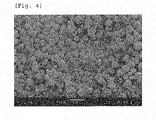
- the electron micrograph (1500 magnifications) of the unprocessed polyamide particle containing the zinc oxide particle is shown in Fig. 4 .
- each polyamide particle shown in Fig. 3 was in the form of a plate.
- the plate-like powder had an average thickness of 1.00 ⁇ m, an average diameter of 25 ⁇ m, a diameter distribution of 5 to 215 ⁇ m, a diameter showing the maximum frequency of 12 ⁇ m, and a proportion of a diameter showing the maximum frequency of 13%.
- Example 2 In the same manner as Example 1, the UV transmittance measured 0% at 300 nm, 4% at 330 nm, 6% at 360 nm, and 15% at 400 nm.
- the UV transmittance of the unprocessed polyamide particle containing the zinc oxide particle was measured in the same manner.
- the UV transmittance measured 10% at 300 nm, 20% at 330 nm, 22% at 360 nm, and 27% and 400 nm.
- a polyamide particle containing a titanium oxide particle was obtained (spherical form, average particle diameter: 4.5 ⁇ m, proportion of titanium oxide particle: 55% by weight) in the same manner as Example 1 except that the proportion of the polyamide resin was changed from 50 parts by weight to 40 parts by weight in Example 1.
- the resulting particle was deformed in the same manner as Example 1 to give a plate-like powder.
- the plate-like powder had an average thickness of 1.1 ⁇ m and an average diameter of 29 ⁇ m.
- Example 2 In the same manner as Example 1, the UV transmittance measured 28% at 300 nm, 28% at 330 nm, 28% at 360 nm, and 29% at 400 nm.
- the UV transmittance of the unprocessed polyamide particle containing the titanium oxide particle was measured in the same manner.
- the UV transmittance measured 42% at 300 nm, 42% at 330 nm, 40% at 360 nm, and 41% at 400 nm.
- a polyamide particle containing a titanium oxide particle was obtained (spherical form, average particle diameter: 5.7 ⁇ m, proportion of titanium oxide particle: 60% by weight) in the same manner as Example 1 except that the proportion of the titanium oxide particle was changed from 50 parts by weight to 60 parts by weight and that the proportion of the polyamide resin was changed from 50 parts by weight to 40 parts by weight in Example 1.
- the resulting particle was deformed in the same manner as Example 1 to give a plate-like powder.
- the plate-like powder had an average thickness of 1.1 ⁇ m and an average diameter of 24 ⁇ m.
- Example 2 In the same manner as Example 1, the UV transmittance measured 28% at 300 nm, 27% at 330 nm, 28% at 360 nm, and 26% at 400 nm.
- the UV transmittance of the unprocessed polyamide particle containing the titanium oxide particle was measured in the same manner.
- the UV transmittance measured 42% at 300 nm, 40% at 330 nm, 39% at 360 nm, and 38% at 400 nm.
- a polyamide particle containing a zinc oxide particle was obtained (spherical form, average particle diameter: 4.7 ⁇ m, proportion of zinc oxide particle: 55% by weight) in the same manner as Example 2 except that the proportion of the polyamide resin was changed from 50 parts by weight to 40 parts by weight in Example 2.
- the resulting particle was deformed in the same manner as Example 1 to give a plate-like powder.
- the plate-like powder had an average thickness of 1.0 ⁇ m and an average diameter of 33 ⁇ m.
- Example 2 In the same manner as Example 1, the UV transmittance measured 0% at 300 nm, 4% at 330 nm, 6% at 360 nm, and 11% at 400 nm.
- the UV transmittance of the unprocessed polyamide particle containing the zinc oxide particle was measured in the same manner.
- the UV transmittance measured 0% at 300 nm, 9% at 330 nm, 15% at 360 nm, and 15% at 400 nm.
- a polyamide particle containing a zinc oxide particle was obtained (spherical form, average particle diameter: 6.7 ⁇ m, proportion of zinc oxide particle: 60% by weight) in the same manner as Example 2 except that the proportion of the zinc oxide particle was changed from 50 parts by weight to 60 parts by weight and that the proportion of the polyamide resin was changed from 50 parts by weight to 40 parts by weight in Example 2.
- the resulting particle was deformed in the same manner as Example 1 to give a plate-like powder.
- the plate-like powder had an average thickness of 1.0 ⁇ m and an average diameter of 31 ⁇ m.
- Example 2 In the same manner as Example 1, the UV transmittance measured 0% at 300 nm, 2% at 330 nm, 4% at 360 nm, and 10% at 400 nm.
- the UV transmittance of the unprocessed polyamide particle containing the zinc oxide particle was measured in the same manner.
- the UV transmittance measured 0% at 300 nm, 8% at 330 nm, 14% at 360 nm, and 16% at 400 nm.
- the resin powder of the present invention has an ultraviolet scattering function and is usable for various purposes that require the ultraviolet scattering function.
- the resin powder is suitably useful for a cosmetic (particularly, skin cosmetic) application.
- the cosmetic (or cosmetic preparation) containing the resin powder of the present invention includes, but should not be limited to, a cream (such as a facial cream, a body-care cream, or a lip balm), a foundation, a powder (such as a face powder), an eye shadow, an eye liner, a mascara, a sunburn preventive, a skin lotion, a milky lotion (an emulsion), an essence, a facial scrub, and a facial pack.
- a cream such as a facial cream, a body-care cream, or a lip balm
- a powder such as a face powder
- an eye shadow such as a face powder
- an eye liner such as a mascara
- a sunburn preventive such as a skin lotion, a milky lotion (an emulsion), an essence, a facial scrub, and a facial pack.
Landscapes
- Health & Medical Sciences (AREA)
- Life Sciences & Earth Sciences (AREA)
- Animal Behavior & Ethology (AREA)
- General Health & Medical Sciences (AREA)
- Public Health (AREA)
- Veterinary Medicine (AREA)
- Birds (AREA)
- Epidemiology (AREA)
- Chemical & Material Sciences (AREA)
- Inorganic Chemistry (AREA)
- Dermatology (AREA)
- Mathematical Physics (AREA)
- Physics & Mathematics (AREA)
- Chemical Kinetics & Catalysis (AREA)
- Medicinal Chemistry (AREA)
- Polymers & Plastics (AREA)
- Organic Chemistry (AREA)
- Cosmetics (AREA)
- Compositions Of Macromolecular Compounds (AREA)
Description
- The present invention relates to resin powders including ultraviolet scattering agents (or ultraviolet protective agents), methods for producing the resin powders, and cosmetics containing the resin powders as defined in the claims.
- In order to protect the skin from ultraviolet rays, various cosmetics (e.g., sunscreens and UV foundation) have so far been developed. The most common technique is mixing of an ultraviolet scattering agent (such as titanium oxide or zinc oxide) as an additive in a cosmetic preparation.
- The ultraviolet scattering agent has a higher ultraviolet-scattering effect as the agent has a smaller particle diameter. An ultraviolet scattering agent to be used for a cosmetic generally has a nanometer-order particle diameter. However, the ultraviolet scattering agent having a nanometer-order particle diameter has not been inspected completely for the harmful effects arising from the contact with the skin. In a different field, lung cancer due to asbestos in the form of nanowhiskers, has developed into a large social problem. With this as a start, the current tendency is that attention to the effects of such fine particles on the human body cannot be overpaid. For zinc oxide, a large quantity of zinc oxide contained in a cosmetic produces zinc ions that pseudo-crosslink additives in the cosmetic, thereby disadvantageously increasing the viscosity of the cosmetic.
-
JP H08 269433 - Japanese Patent Application Laid-Open Publication No.
2013-56860 JP-2013-56860A - For the skin cosmetic disclosed in the document, since the zinc oxide is enclosed in the matrix component, direct contact of the zinc oxide with the skin can be prevented. Thus even if the zinc oxide is in the form of a nanoparticle, the skin cosmetic has an improved advantage in respect of the safety for the human body. Unfortunately, the zinc oxide enclosed in the matrix component tends to decrease in ultraviolet scattering function. In particular, the composite particle disclosed in the document tends to notably decreases in ultraviolet scattering function probably because the composite particle is in a spherical form and is easy to aggregate.
- Patent Document 1:
JP-2013-56860A - It is therefore an object of the present invention to provide a resin powder having an ultraviolet scattering function, a method for producing the resin powder, and a cosmetic containing the resin powder.
- Another object of the present invention is to provide a resin powder efficiently showing an ultraviolet scattering function even in a case where the resin powder comprises an ultraviolet scattering agent contained (or enclosed) in a resin, a method for producing the resin powder, and a cosmetic containing the resin powder.
- It is still another object of the present invention to provide a resin powder having both high safety for the human body and excellent ultraviolet scattering function, a method for producing the resin powder, and a cosmetic containing the resin powder.
- The inventors of the present invention made intensive studies to achieve the above objects and finally found that a composition (in particular, a particulate or granular resin composition) containing a resin (in particular, a thermoplastic resin) and an ultraviolet scattering agent surprisingly increases or improves in ultraviolet scattering function by deforming (e.g., crushing) the composition into a plate-like form. The present invention was accomplished based on the above findings.
- That is, an aspect of the present invention provides a resin powder containing an ultraviolet scattering agent [a resin powder containing an ultraviolet scattering agent and a resin (a resin as a binder or a matrix)] and having being in a plate-like (platelet) form as defined in the claims .
- The resin powder is a thermoplastic resin powder comprising a polyamide resin wherein the polyamide resin comprises an aliphatic homo- or co-polyamide having a C8 -16 alkylene chain.
- In the resin powder, the ultraviolet scattering agent comprises metal oxide particles. The particulate ultraviolet scattering agent may have an average particle diameter (or average particle size) of not more than 150 nm. A representative ultraviolet scattering agent may include at least one metal oxide particle having an average particle diameter of not more than 100 nm and being selected from a titanium oxide particle and a zinc oxide particle.
- In the resin powder, the ratio of the ultraviolet scattering agent is 50 to 150 parts by weight relative to 100 parts by weight of the polyamide resin forming the resin powder.
- The resin powder has an average thickness (an average thickness determined from an electron micrograph) of, not more than 2 µm. The resin powder has a ratio of an average thickness and an average diameter (a ratio of an average thickness and an average diameter determined from an electron micrograph) in the former/the latter of about 1/5 to 1/200.
- The resin powder is a powder (or a plate-like resin particle) obtainable by deforming (for example, crushing) a resin particle containing an ultraviolet scattering agent into a plate-like form. In the resin powder, the resin particle (the resin particle before deformation into a plate-like form) may have an average particle diameter of about 0.5 to 100 µm.
- The resin powder may be a resin powder (a cosmetic resin powder) used for a cosmetic (or a cosmetic preparation).
- Another aspect of the present invention provides a method for producing the resin powder (plate-like resin powder ), comprising: deforming a resin powder containing an ultraviolet scattering agent into a plate-like form.
- Another aspect of the present invention also provides a cosmetic (or a cosmetic preparation) containing the resin powder (plate-like resin powder).
- The resin powder of the present invention has an ultraviolet scattering function. In particular, the resin powder of the present invention efficiently shows an ultraviolet scattering function although the ultraviolet scattering agent is contained or enclosed (or is not exposed) in the resin (or the ultraviolet scattering agent is not exposed) . Thus even a small quantity of the ultraviolet scattering agent suitably shows a sufficient ultraviolet scattering function.
- Since the resin powder of the present invention contains the ultraviolet scattering agent enclosed in the resin, direct contact of the ultraviolet scattering agent with the skin is preventable or controllable. Further, as described above, the resin powder has an excellent the ultraviolet scattering function although the ultraviolet scattering agent is contained or dispersed in the resin. Thus the resin powder of the present invention has both high safety for the human body and excellent ultraviolet scattering function, and the resin powder is of much practical use and has a significant usefulness.
-
- [
Fig. 1] Fig. 1 is an electron micrograph of a plate-like powder (a plate-like resin powder containing a titanium oxide particle) obtained in Example 1. - [
Fig. 2] Fig. 2 is an electron micrograph of a particle (powder) before deformation into a plate-like form in Example 1. - [
Fig. 3] Fig. 3 is an electron micrograph of a plate-like powder (a plate-like resin powder containing a zinc oxide particle) obtained in Example 2. - [
Fig. 4] Fig. 4 is an electron micrograph of a particle (powder) before deformation into a plate-like form in Example 2. - The resin powder of the present invention contains an ultraviolet scattering agent (an ultraviolet protective agent). In other words, the resin powder of the present invention contains an ultraviolet scattering agent and a resin. The resin powder is in a plate-like form as described below.
- The resin powder of the present invention contains a resin which is a polyamide resin wherein the polyamide resin comprises an aliphatic homo- or co-polyamide having a C8 -16 alkylene chain, Specifically, the resin powder of the present invention contains a resin as a matrix (or binder) and an ultraviolet scattering agent contained (or dispersed) in the matrix (or binder).
- Also disclosed are a thermoplastic resin, a thermosetting resin (such as an epoxy resin, a silicone resin, or an unsaturated polyester resin) . In particular, the resin may at least comprise a thermoplastic resin.
- Also disclosed is that the thermoplastic resin may include, for example, a polyamide resin {for example, an aliphatic polyamide [e.g., a polyamide 6, a polyamide 66, a polyamide 610, a polyamide 612, a polyamide 912, a polyamide 1212, a polyamide 1012, a polyamide 1010, a polyamide 11, a polyamide 12, and a copolyamide (e.g., a copolyamide in which polyamide components as exemplified above are copolymerized, such as a polyamide 66/11 or a polyamide 66/12)], an alicyclic polyamide, and an aromatic polyamide}, a polyester resin {for example, an aliphatic polyester resin (e.g. , a polylactic acid) and an aromatic polyester resin [e.g., a poly(alkylene arylate) (e.g., a poly(ethylene terephthalate), a poly(butylene terephthalate), a poly(ethylene naphthalate), and a poly(1,4-cyclohexanedimethylene terephthalate)), a polyarylate, and a liquid crystal polyester]}, a polycarbonate resin (for example, an aromatic polycarbonate, such as a bisphenol Abased polycarbonate), a poly(phenylene ether) resin (e.g., a poly(phenylene ether) and a modified poly(phenylene ether)), a polyetherketone resin (e.g., a polyetheretherketone, a polyetherketoneketone, a polyether-diphenyl-ether-phenyl-ketone-phenyl, and a polyetherketoneetherketoneketone), a polyacetal resin, a polysulfone resin (e.g., a polysulfone and a polyethersulfone), a polyimide resin (e.g., a polyimide, a polyamideimide, and a polyetherimide), a poly (phenylene sulfide) resin (e.g., a poly(phenylene sulfide)), an acrylic resin (e.g., a poly(methyl methacrylate)), a styrene-series resin (e.g., a polystyrene, and a styrene copolymer, such as an AS resin), an olefin resin [for example, a chain olefin resin (e.g., a polyethylene, a polypropylene, and a polymethylpentene), and a cyclic olefin resin (e.g., what is called a COP or a COC)], a vinyl-series resin (e.g., a vinyl ester-series resin, such as a poly (vinyl acetate), and a vinyl alcohol-series resin), a halogen-containing resin (e.g., a chlorine-containing resin, such as a poly (vinyl chloride) or a poly(vinylidene chloride), and a fluororesin), a cellulose-series resin (e.g., a cellulose acylate, such as a cellulose acetate), a thermoplastic elastomer [for example, an elastomer having a hard segment and a soft segment in a molecule thereof, e.g., a polyamide-series elastomer (e.g., a polyamide elastomer containing a polyamide component (e.g., an aliphatic polyamide component, such as a polyamide 6 or a polyamide 12) as a hard segment and a polyether component (e.g., a polyetherdiol) as a soft segment), a polyester-series elastomer, a polyurethane-series elastomer, a polyolefin-series elastomer, a polystyrene-series elastomer, and a fluorine-series elastomer].
- These resins may be used alone or in combination.
- The resin may be a water-soluble resin or may usually be a hydrophobic resin.
- Among these resins, the thermoplastic resin is preferred. In particular, the polyamide resin may suitably be used. The polyamide resin is preferred in that the polyamide resin has a relatively high affinity with an ultraviolet scattering agent and that the polyamide powder seems to be efficiently and easily deformed into a plate-like particulate form by the after-mentioned deformation process. Among them, an aliphatic polyamide is widely used. In light of excellent formability or solvent resistance and easy deformation from a particulate form into a plate-like form, an aliphatic homo- or co-polyamide having a C8-16alkylene chain (in particular, an aliphatic homo- or co-polyamide having a C10-14alkylene chain, such as a polyamide 11 or a polyamide 12) is used in the present invention.
- Even in a case where the resin powder of the present invention contains other additives or contacts with other additives (for example, in a case where the resin powder is used for cosmetic or other applications, as described below), the resin powder is relatively hardly attacked by other additives. Thus the resin powder is preferred in light of easy maintenance of an ultraviolet scattering function thereof.
- The resin (a thermoplastic resin, in particular, a polyamide resin comprising an aliphatic homo- or co-polyamide having a C8 -16 alkylene chain,) may have a non-limiting number-average molecular weight to be selected according to the species of the resin or other factors. For example, the resin may have a number-average molecular weight of not less than 3000 (e.g., about 5000 to 1000000), preferably not less than 8000 (e.g., about 10000 to 500000), and more preferably not less than 15000 (e.g., about 20000 to 200000) in gel permeation chromatography (GPC) in terms of polystyrene.
- In a case where the thermoplastic resin has a melting point (or softening point), the melting point (or softening point) is not particularly limited to a specific one. In particular, from the point of view of efficient deformation into a plate-like form in the presence of an ultraviolet scattering agent, the thermoplastic resin (in particular, a polyamide resin, such as an aliphatic polyamide resin) may have a melting point (or softening point) of not higher than 300°C (e.g., about 50 to 280°C) and preferably about 80 to 250°C (e.g., about 100 to 220°C) .
- The ultraviolet scattering agent (ultraviolet protective agent) comprises metal oxide particles.
- Concrete examples of the ultraviolet scattering agent may include an oxide [for example, a metal oxide, such as a metal oxide at least containing a group 4 metal of the Periodic Table as a metal component (e.g. , titanium oxide and zirconium oxide) or zinc oxide], a sulfide (e.g., a metal sulfide, such as zinc sulfide), a carbonate (e.g., calcium carbonate and barium carbonate), and a sulfate (e.g., barium sulfate). These ultraviolet scattering agents may be used alone or in combination. The ultraviolet scattering agent may have a function as a filler or a function as a coloring agent.
- Among them, a metal oxide is preferred. A particularly preferred one includes titanium oxide and/or zinc oxide.
- The titanium oxide may include, for example, titanium monoxide (TiO), titanium dioxide (TiO2), and dititanium trioxide (Ti2O3). In particular, titanium dioxide is preferred. According to the present invention, different titanium oxides may be used in combination.
- The titanium oxide may have any crystal form, such as a rutile form, an anatase form, or a brookite form. In particular, according to the present invention, rutile titanium oxide may preferably be used.
- The ultraviolet scattering agent (for example, a metal oxide, such as titanium oxide) may be surface-treated with a surface-treating agent. The surface treatment allows the ultraviolet scattering agent (e.g., titanium oxide) to decrease in the reactivity (or activity) or to increase in the dispersibility to a resin and easily enables the ultraviolet scattering agent to function more efficiently.
- The surface-treating agent may include a metal oxide (for example, silica and alumina) and an organic surface-treating agent [for example, a coupling agent (e.g., a silane coupling agent and a titanium coupling agent), an organic acid, an alcohol, and a siloxane-series compound]. These surface-treating agents may be used alone or in combination. In a case where the ultraviolet scattering agent contains a metal oxide, a metal oxide to be selected as the surface-treating agent is different from the metal oxide contained in the ultraviolet scattering agent. For example, in a case where the ultraviolet scattering agent contains titanium oxide, a non-titanium metal oxide is used as the surface-treating agent. In particular, the surface-treating agent may contain at least a metal oxide (e.g., silica).
- For an ultraviolet scattering agent surface-treated (e.g., a titanium oxide surface-treated with a surface-treating agent), the proportion of the surface-treating agent in the ultraviolet scattering agent may be, for example, not more than 30% by weight (e.g., about 0.1 to 25% by weight), preferably not more than 20% by weight (e.g., about 0.5 to 18% by weight), and more preferably not more than 15% by weight (e.g., about 1 to 12% by weight) or may be about 1 to 20% by weight (e.g., about 2 to 15% by weight and preferably about 3 to 10% by weight).
- The ultraviolet scattering agent is not particularly limited to a specific form. The ultraviolet scattering agent may have a particulate (or granular) form (including a spherical form), a fiber form (or a needle form or a rod form), or a plate form. A preferred form includes a particulate form.
- The particulate ultraviolet scattering agent (for example, a metal oxide particle, such as a titanium oxide particle or a zinc oxide particle) may have an average particle diameter (or size) (an average primary particle diameter or an average dispersion particle diameter in a resin) selected from the range of, for example, about 1 to 1000 nm (e.g., about 2 to 800 nm) or may have an average particle diameter of about 3 to 500 nm, preferably about 5 to 400 nm (e.g., about 7 to 350 nm), and more preferably about 10 to 300 nm (e.g., about 15 to 250 nm). In particular, the particulate ultraviolet scattering agent may have an average particle diameter of not more than 200 nm (e.g., about 1 to 180 nm), preferably not more than 150 nm (e.g., about 5 to 120 nm), more preferably not more than 100 nm (e.g., about 10 to 80 nm), and particularly not more than 50 nm (e.g., about 20 to 50 nm). According to the present invention, even the ultraviolet scattering agent having such a small particle diameter is safe for the human body. Thus since the ultraviolet scattering agent has both relatively high transparency and high ultraviolet scattering characteristic and is safe for the human body, the ultraviolet scattering agent is preferred.
- The average particle diameter of the ultraviolet scattering agent can be measured by a conventional method. The average particle diameter may be measured by the same method as a method for measuring the average diameter of the resin powder described later.
- The ultraviolet scattering agent may be compatible with the resin. The ultraviolet scattering agent may usually be incompatible with the resin.
- The ratio of the ultraviolet scattering agent (in particular, a metal oxide, such as titanium oxide) relative to 100 parts by weight of the resin is 50 to 150 parts by weight.
- The volume proportion of the ultraviolet scattering agent (in particular, a metal oxide, such as titanium oxide) in the total volume of the resin and the ultraviolet scattering agent may be, for example, about 0.1 to 50% by volume (e.g. , about 0.5 to 45% by volume), preferably about 1 to 40% by volume (e.g., about 1.5 to 35% by volume), more preferably about 2 to 30% by volume (e.g., about 3 to 25% by volume), and usually about 3 to 50% by volume (e.g., about 5 to 45% by volume, preferably about 8 to 40% by volume, and more preferably about 10 to 35% by volume).
- The resin powder of the present invention may contain other additives (additives other than the ultraviolet scattering agent) if necessary. Other additives can suitably be selected as usage and, for example, may include a stabilizer (e.g., an ultraviolet absorber), a filler, a coloring agent, a dispersing agent, an emulsifier, a perfume, a preservative, an antioxidant, a medicinal component, an extender, a defoaming agent, a humectant, and a lubricant. These additives may be used alone or in combination.
- The ultraviolet absorber may include, for example, an organic compound, such as an aminobenzoic acid (e.g., p-aminobenzoic acid) or an ester thereof, an ester of salicylic acid, an ester of cinnamic acid (e.g., benzyl cinnamate and 2-ethylhexyl methoxycinnamate), an ester of a dialkylaminohydroxybenzoylbenzoic acid (e.g., hexyl diethylaminohydroxybenzoylbenzoate), a benzophenone-series compound (e.g., 2-hydroxy-4-methoxybenzophenone), a dibenzoylalkane (e.g., 4-tert-butyl-4-methoxydibenzoylmethane), a triazine derivative (e.g., 2,4-bis{[4-(2-ethylhexyloxy)-2-hydroxy]-phenyl}-6-(4-methoxyphenyl)-1,3,5-triazine), urocanic acid or an ester thereof, or β-carotene. These ultraviolet absorbers may be used alone or in combination.
- The filler may be an inorganic filler or an organic filler. The filler may have any form, such as a particulate form, a fiber form, or a needle form. Concrete examples of the filler may include a carbonate (such as calcium carbonate or magnesium carbonate), a sulfate (such as calcium sulfate or barium sulfate), a phosphate (such as calcium phosphate or titanium phosphate), a metal oxide (such as silica, alumina, iron oxide, magnesium oxide, strontium oxide, or cerium oxide), a hydroxyapatite, a silicate (such as mica, calcium silicate, wollastonite, bentonite, zeolite, maifan stone, talc, montmorillonite, clay, or kaolin), a mineral (such as quartz powder, diatomaceous earth, nepheline syenite, cristobalite, or dolomite), a metal nitride (such as silicon nitride, boron nitride, aluminum nitride, or titanium nitride), a metal hydroxide (such as aluminum hydroxide), a metal carbide (such as silicon carbide, boron carbide, titanium carbide, or tungsten carbide), a metal boride (such as titanium boride or zirconium boride), a metal [for example, gold, platinum, palladium, and a ferromagnetic metal or alloy (e.g., iron, cobalt, nickel, magnetite, and ferrite)], a carbon (such as carbon black, graphite, or carbon nanotube), a glass (such as glass powder, glass bulb, hollow glass bulb, or glass flake), a crosslinked resin (e.g., a crosslinked poly(methyl methacrylate)), a fiber (or fibrous) filler (e.g., a carbon fiber), and a filler to which a metal having an antibacterial function (such as silver, copper, or zinc) is supported (e.g., hydroxyapatite silver and zeolite silver). These fillers may be used alone or in combination.
- The coloring agent may be inorganic or organic. The coloring agent may also be a dye or a pigment (or a dye and pigment) . Concrete examples of the coloring agent may include an inorganic coloring agent (or an inorganic pigment, e.g., carbon black, ultramarine blue, Indian red (red iron oxide), black iron oxide, yellow iron oxide, chromium oxide, and a complex oxide pigment), and an organic coloring agent (e.g., an azo-series pigment, a phthalocyanine-series pigment (such as copper phthalocyanine blue or copper phthalocyanine green), an isoindolinone-series pigment, a perynone-perylene-series pigment, a thren-series pigment, a dioxazine pigment, an anthraquinone-series pigment, an indigo-series pigment, a thioindigo-series pigment, a diketopyrrolopyrrole-series pigment, a benzimidazolone-series pigment, a quinacridone-series pigment, an oil-based dye, and a disperse dye). The coloring agent may also include a tar dye (e.g., a tar dye for cosmetic preparation prescribed by Ordinance of the Ministry of Health, Labor and Welfare), and a lake pigment (such as an aluminum lake) . These coloring agents may be used alone or in combination.
- The resin powder of the present invention has a plate-like (flat-plate or platelet) form. The plate-like resin powder (plate-like primary particle) has an average thickness of not more than 2 µm (e.g. , about 0.1 to 1.8 µm), more preferably not more than 1.5 µm (e.g. , about 0.15 to 1.3 µm), and particularly not more than 1.2 µm (e.g., about 0.2 to 1.2 µm).
- The average thickness is determined from an electron micrograph.
- Specifically, the thickness (maximum thickness) of each of a plurality of [for example, not less than 10 (e.g. , 15 to 100, preferably 20 to 50)] resin powders randomly extracted (sampled) from an electron micrograph is measured, and the average of the resulting thickness values can be expressed as the average thickness. The average diameter of the resin powder [the average of a length in the plane direction (or the direction perpendicular to the thickness direction) of the plate-like primary particle] can be selected from the range of about 2 to 700 µm (e.g., about 5 to 600 µm). For example, the average diameter may be about 10 to 500 µm, preferably about 15 to 200 µm, and more preferably about 20 to 150 µm.
- The average diameter is determined from an electron micrograph in the same manner as the average thickness. Specifically, the diameter or length (maximum diameter or maximum length or major axis) of each of a plurality of resin powders randomly extracted (sampled) from an electron micrograph is measured, and the average of the resulting diameter or length values can be expressed as the average diameter (average length).
- For the plate-like resin powder, the ratio of the average thickness relative to the average diameter (the former/the latter) is from 1/5 to 1/200, and more preferably about 1/10 to 1/150 (e.g., 1/15 to 1/100) or may usually be about 1/5 to 1/100 (e.g., about 1/8 to 1/80, preferably about 1/10 to 1/60, and more preferably about 1/15 to 1/50) . The average thickness and the average diameter to be used in the ratio may be the values measured as described above.
- It is also disclosed that the diameter of the resin powder or the diameter distribution thereof can be determined (measured) by a light-scattering (dynamic light-scattering) method. For example, the diameter (the diameter distribution) of the resin powder determined by a light-scattering method may be, for example, about 0.01 to 700 µm (e.g., about 0.05 to 600 µm), preferably about 0.1 to 500 µm (e.g., about 0.2 to 400 µm), and more preferably 0.3 to 300 µm (e.g., about 0.5 to 200 µm).
- The proportion of the resin powder having a diameter showing the maximum frequency determined by a light-scattering method may be, for example, about 3 to 30%, preferably about 5 to 25%, and more preferably about 7 to 20% (e.g., about 10 to 15%).
- In particular, as described later, the resin powder of the present invention may be a powder (an aggregate of plate-like particles) obtainable by deforming a plurality of resin particles (an aggregate of resin particles, or an agglomerated resin particle; hereinafter may simply be referred to as a resin particle) containing (or enclosing) an ultraviolet scattering agent (and optionally other additives described above) into a plate-like form.
- For the powder, usually, the resin particle (each resin particle, single resin particle) may independently be deformed into a plate-like form (or may have a plate-like form). According to the resin powder of the present invention, a plurality of plate-like resin particles may be aggregated or agglomerated (or laminated or stacked). The resin particles usually have a weak cohesive force and are practically separated easily in synthesis or in use.
- The method for producing the resin powder (plate-like resin powder) of the present invention comprises (A) a method of deforming a resin powder containing an ultraviolet scattering agent (a resin powder that has not been deformed into a plate-like form; hereinafter may simply be referred to as a resin powder) into a plate-like form (or a plate-like powder). Also disclosed is (B) a method of pulverizing (or crushing) a film (or a sheet or a film-like product) composed of a resin containing an ultraviolet scattering agent. According to the present invention, the method (A) is used. In the method (A), it is not necessary to form a film, and a powder having relatively less variation in size (thickness or particle diameter) is efficiently obtainable.
- For the method (A), the resin powder containing an ultraviolet scattering agent may be obtainable by pulverizing (e.g., freeze-pulverizing) a resin composition (a pellet resin composition) containing an ultraviolet scattering agent. In particular, a resin particle containing an ultraviolet scattering agent may preferably be used.
- The resin particle to be used may be a commercially available product or may be produced by using or applying a known method. The known method may include, for example, a method (forced emulsification) of kneading a resin as a matrix, an ultraviolet scattering agent (and other additives), and a third component (for example, a sugar and a poly (ethylene glycol)) incompatible with the matrix (and the ultraviolet scattering agent) and easily removable by a medium, such as water, to give a composition composed of the third component and the resin particle containing the ultraviolet scattering agent, and removing the third component from the composition (for example, a method described in Japanese Patent Application Laid-Open Publication No.
2010-132811 - The form of the resin particle may include, but should not be limited to, a spherical form, an ellipsoidal form, and others. In particular, the form of the resin particle may be a substantially spherical form (particularly, a spherical form).
- The resin particle (the resin particle before deformation into a plate-like form) may have an average particle diameter selected from the range of about 0.1 to 500 µm, and, for example, may have an average particle diameter of about 0.2 to 300 µm (e.g., about 0.3 to 200 µm), preferably about 0.5 to 100 µm (e.g., about 1 to 70 µm), more preferably about 2 to 50 µm (e.g., about 3 to 40 µm), and usually about 4 to 30 µm. In particular, the resin particle may have an average particle diameter of not more than 50 µm, preferably not more than 30 µm, more preferably not more than 20 µm, and particularly preferably not more than 15 µm. The resin particle having such a particle diameter is easy to deform into a plate-like form efficiently.
- For the method (A), the method of deforming the resin powder into a plate-like form may include, but should not be limited to, crushing the resin powder (in particular, the resin particle) . According to the present invention, a plate-like product is obtainable surprisingly without cracks by crushing the resin powder (in particular, a resin particle, such as an aliphatic polyamide resin) . For the method, various apparatuses or means that can crush the resin powder by a physical force (an apparatus or means for deformation into a plate-like form) is utilizable. The apparatus or means may include a mill (a media dispersing machine), a roll [such as a mill roll (such as a two-roll mill or a three-roll mill)], and a media-less dispersing machine [for example, a high-pressure collision dispersing machine (such as a nanomizer or an artimizer) and an ultrasonic dispersing machine].
- Among them, the mill is user-friendly due to relatively excellent operationality.
- The mill (media mill) is classified broadly into two groups: what is called a wet media mill and a dry media mill; the wet media mill uses a medium including a liquid, and the dry media mill does not use a liquid. According to the present invention, both media mills are available.
- The wet media mill may include a ball mill, a side grinder, a dyno mill, a spike mill, a DCP mill, a basket mill, and a paint conditioner. The dry media mill may include a ball mill, a vibrating ball mill, an attritor, and a dry bead mill.
- The material of a container to be used for the media mill may include, but should not be limited to, a hardened steel, a stainless steel, a SUS chrome plating, an alumina ceramic, a silicon nitride ceramic, a zirconia ceramic, a silicon carbide ceramic, a zirconia-toughened alumina ceramic, and a Sialon.
- As a media particle to be used for the media mill, there may usually be employed a particle having a spherical form (shape). The material of the media particle may include a glass bead, a low-alkali glass bead, a no-alkali glass bead, an alumina bead, a zirconia bead, a zirconia yttria bead, a titania bead, a high-purity alumina bead, and a steel ball. The media particle (bead) may have a specific gravity of, for example, not less than 2.0, preferably not less than 2.5, and more preferably not less than 3.0.
- The size of the media particle (bead) can suitably be selected according to the size of the resin particle to be subjected to deformation into a plate-like form, or other factors. The media particle (bead) may have a size of, for example, about 0.05 to 5 mm (e.g., about 0.1 to 3 mm).
- For the wet media mill, water may usually be employed as the media (liquid) . The media (liquid) to be used may also include a mixed solvent containing water and an aqueous solvent [or a water-soluble solvent, for example, an alcohol (an alkanol, such as methanol, ethanol, or isopropyl alcohol; a diol, such as 1,2 -pentanediol or 1,2-hexanediol), a diol monoether (e.g., an alkylene glycol monoalkyl ether, such as ethylene glycol monomethyl ether or propylene glycol monobutyl ether; and a polyalkylene glycol monoalkyl ether, such as diethylene glycol monoethyl ether or triethylene glycol monobutyl ether)].
- The resin powder (plate-like resin powder) of the present invention can be used for various purposes that in need of an ultraviolet scattering function. In particular, the resin powder can preferably be used for a cosmetic (or a cosmetic preparation).
- Thus, the present invention also includes a cosmetic (or a cosmetic preparation) containing the resin powder. The cosmetic (in particular, a skin cosmetic) contains at least the resin powder and may further a known cosmetic component (for example, an oil, an alcohol, a thickener, and other additives as described above).
- Other additives may be contained in the resin powder as described above or may be contained in the cosmetic independently of the resin powder.
- The cosmetic may have any form, such as a liquid form (such as a lotion, an emulsion, a cream, or a gel), a semi-solid form (such as a cream, a gel, or a paste), or a solid form (such as a particle, a powder, a molded product having a desired form).
- The following examples are intended to describe this invention in further detail and should by no means be interpreted as defining the scope of the invention. Measurement methods of physical properties are as follows.
- A sample (9.5 g) was washed with 2L distilled water three times, filtered, and dried by a vacuum dryer.
- The powder adhering on the filter was sampled (collected) at random three points on the filter by a spatula and placed on an observation table. Gold was deposited onto the sample placed on the observation table .
- The resulting sample was measured and observed in a 3D mode at prescribed magnifications (1000, 2000, 3000, and 5000 magnifications) by a scanning electron microscope (SEM) VE-8800 manufactured by KEYENCE Corporation.
- From the resulting electron micrograph, 60 particles in the observation field were selected (30 particles which were easy to measure in the thickness direction, and 30 particles which were easy to measure in the longitudinal direction (plate surface direction)). The thickness (the maximum thickness) or the diameter (the maximum length in the longitudinal direction) of each particle was measured by an analysis mode. For particles before deformation into a plate-like form, only 30 particles were selected, and the particle diameter of each particle was measured.
- In some cases, the plate-like particles were apparently aggregated under the above-mentioned measurement conditions, and the thickness or diameter of each particle was hard to measure. Thus the magnification was suitably selected to facilitate the measurement.
- A sample was dispersed in water, and the diameter (diameter distribution) of the sample was measured by a laser diffraction/scattering particle diameter distribution measuring apparatus (LA920, manufactured by Horiba, Ltd.).
- Fifty (50) parts by weight of a titanium oxide particle [titanium dioxide, manufactured by Dupont, Ti-Pure(R) Titanium Dioxide Pigment - Paint Coatings-DryGrades R-105, surface-treated (silica, aluminadimethylsiloxane-treated) product] and 50 parts by weight of a polyamide resin (polyamide 12, manufactured by Daicel-Evonik Ltd.) were provided. In the same manner as Example 1 of Japanese Patent Application Laid-Open Publication No.
2005-179646 - The resulting particle was dispersed in water in a proportion of 10% by weight, and in this state the particle was crushed by a ball mill to give a plate-like powder. As the media species of the ball mill for this process, a high-purity alumina bead (particle diameter: 0.5 mm) was used. The volume of the dispersion and that of the media were the same.
- The electron micrograph (1500 magnifications) of the resulting plate-like powder is shown in
Fig. 1 . For comparison, the electron micrograph (1500 magnifications) of the unprocessed polyamide particle containing the titanium oxide particle (the polyamide particle before deformation into a plate-like form) is shown inFig. 2 . Apparent from these photographs, each polyamide particle shown inFig. 1 was in the form of a plate. - The plate-like powder had an average thickness of 0.94 µm, an average diameter of 32 µm, a diameter distribution of 7 to 110 µm, a diameter showing the maximum frequency of 26 µm, and a proportion of a diameter showing the maximum frequency of 12%.
- The resulting plate-like powder was dispersed in ethanol in a proportion of 5% by weight, and the resulting dispersion was applied on a slide glass by a bar coater.
- The ethanol was dried naturally, and then the ultraviolet (UV) transmittance was measured by an UV-measuring apparatus. The UV transmittance measured 40% at 300 nm, 38% at 330 nm, 38% at 360 nm, and 37% at 400 nm.
- The UV transmittance of the unprocessed polyamide particle containing the titanium oxide particle (polyamide particle before deformation into a plate-like form) was measured in the same manner. The UV transmittance measured 66% at 300 nm, 66% at 330 nm, 68% at 360 nm, and 65% at 400 nm.
- Thus it was found that the deformation into a plate-like form significantly reduced the UV transmittance of the polyamide particle and greatly improved the ultraviolet-preventing function of the polyamide particle.
- A polyamide particle containing a zinc oxide particle was obtained (spherical form, average particle diameter: 4.5 µm, proportion of zinc oxide particle: 50% by weight) in the same manner as Example 1 except that 50 parts by weight of a zinc oxide particle (average particle diameter: 20 nm, manufactured by Sakai Chemical Industry Co., Ltd., "FINEX-50S-LP2", surface-treated (organopolysiloxane) product) was used instead of the titanium oxide in Example 1.
- The resulting particle was deformed in the same manner as Example 1 to give a plate-like powder.
- The electron micrograph (1500 magnifications) of the resulting plate-like powder is shown in
Fig. 3 . For comparison, the electron micrograph (1500 magnifications) of the unprocessed polyamide particle containing the zinc oxide particle (the polyamide particle before deformation into a plate-like form) is shown inFig. 4 . Apparent from these photographs, each polyamide particle shown inFig. 3 was in the form of a plate. - The plate-like powder had an average thickness of 1.00 µm, an average diameter of 25 µm, a diameter distribution of 5 to 215 µm, a diameter showing the maximum frequency of 12 µm, and a proportion of a diameter showing the maximum frequency of 13%.
- In the same manner as Example 1, the UV transmittance measured 0% at 300 nm, 4% at 330 nm, 6% at 360 nm, and 15% at 400 nm.
- The UV transmittance of the unprocessed polyamide particle containing the zinc oxide particle (polyamide particle before deformation into a plate-like form) was measured in the same manner. The UV transmittance measured 10% at 300 nm, 20% at 330 nm, 22% at 360 nm, and 27% and 400 nm.
- Thus it was also found that the deformation into a plate-like form significantly reduced the UV transmittance of the polyamide particle containing the zinc oxide and greatly improved the ultraviolet-preventing function of the polyamide particle.
- A polyamide particle containing a titanium oxide particle was obtained (spherical form, average particle diameter: 4.5 µm, proportion of titanium oxide particle: 55% by weight) in the same manner as Example 1 except that the proportion of the polyamide resin was changed from 50 parts by weight to 40 parts by weight in Example 1.
- The resulting particle was deformed in the same manner as Example 1 to give a plate-like powder. The plate-like powder had an average thickness of 1.1 µm and an average diameter of 29 µm.
- In the same manner as Example 1, the UV transmittance measured 28% at 300 nm, 28% at 330 nm, 28% at 360 nm, and 29% at 400 nm.
- The UV transmittance of the unprocessed polyamide particle containing the titanium oxide particle (polyamide particle before deformation into a plate-like form) was measured in the same manner. The UV transmittance measured 42% at 300 nm, 42% at 330 nm, 40% at 360 nm, and 41% at 400 nm.
- A polyamide particle containing a titanium oxide particle was obtained (spherical form, average particle diameter: 5.7 µm, proportion of titanium oxide particle: 60% by weight) in the same manner as Example 1 except that the proportion of the titanium oxide particle was changed from 50 parts by weight to 60 parts by weight and that the proportion of the polyamide resin was changed from 50 parts by weight to 40 parts by weight in Example 1.
- The resulting particle was deformed in the same manner as Example 1 to give a plate-like powder. The plate-like powder had an average thickness of 1.1 µm and an average diameter of 24 µm.
- In the same manner as Example 1, the UV transmittance measured 28% at 300 nm, 27% at 330 nm, 28% at 360 nm, and 26% at 400 nm.
- The UV transmittance of the unprocessed polyamide particle containing the titanium oxide particle (polyamide particle before deformation into a plate-like form) was measured in the same manner. The UV transmittance measured 42% at 300 nm, 40% at 330 nm, 39% at 360 nm, and 38% at 400 nm.
- A polyamide particle containing a zinc oxide particle was obtained (spherical form, average particle diameter: 4.7 µm, proportion of zinc oxide particle: 55% by weight) in the same manner as Example 2 except that the proportion of the polyamide resin was changed from 50 parts by weight to 40 parts by weight in Example 2.
- The resulting particle was deformed in the same manner as Example 1 to give a plate-like powder. The plate-like powder had an average thickness of 1.0 µm and an average diameter of 33 µm.
- In the same manner as Example 1, the UV transmittance measured 0% at 300 nm, 4% at 330 nm, 6% at 360 nm, and 11% at 400 nm.
- The UV transmittance of the unprocessed polyamide particle containing the zinc oxide particle (polyamide particle before deformation into a plate-like form) was measured in the same manner. The UV transmittance measured 0% at 300 nm, 9% at 330 nm, 15% at 360 nm, and 15% at 400 nm.
- A polyamide particle containing a zinc oxide particle was obtained (spherical form, average particle diameter: 6.7 µm, proportion of zinc oxide particle: 60% by weight) in the same manner as Example 2 except that the proportion of the zinc oxide particle was changed from 50 parts by weight to 60 parts by weight and that the proportion of the polyamide resin was changed from 50 parts by weight to 40 parts by weight in Example 2.
- The resulting particle was deformed in the same manner as Example 1 to give a plate-like powder. The plate-like powder had an average thickness of 1.0 µm and an average diameter of 31 µm.
- In the same manner as Example 1, the UV transmittance measured 0% at 300 nm, 2% at 330 nm, 4% at 360 nm, and 10% at 400 nm.
- The UV transmittance of the unprocessed polyamide particle containing the zinc oxide particle (polyamide particle before deformation into a plate-like form) was measured in the same manner. The UV transmittance measured 0% at 300 nm, 8% at 330 nm, 14% at 360 nm, and 16% at 400 nm.
- The resin powder of the present invention has an ultraviolet scattering function and is usable for various purposes that require the ultraviolet scattering function. In particular, the resin powder is suitably useful for a cosmetic (particularly, skin cosmetic) application.
- The cosmetic (or cosmetic preparation) containing the resin powder of the present invention includes, but should not be limited to, a cream (such as a facial cream, a body-care cream, or a lip balm), a foundation, a powder (such as a face powder), an eye shadow, an eye liner, a mascara, a sunburn preventive, a skin lotion, a milky lotion (an emulsion), an essence, a facial scrub, and a facial pack.
Claims (8)
- A polyamide resin powder comprising a polyamide resin and an ultraviolet scattering agent, the polyamide resin powder being in a plate-like form and having an average thickness of not more than 2 µm determined from an electron micrograph and a ratio of an average thickness and an average diameter in the former/the latter of 1/5 to 1/200 determined from an electron micrograph,
wherein the polyamide resin comprises an aliphatic homo- or co-polyamide having a C8-16 alkylene chain,
wherein the ultraviolet scattering agent comprises metal oxide particles, and
wherein the ratio of the ultraviolet scattering agent is 50 to 150 parts by weight relative to 100 parts by weight of the polyamide resin. - The polyamide resin powder according to claim 1, wherein the ultraviolet scattering agent comprises particles having an average particle diameter of not more than 150 nm.
- The polyamide resin powder according to claim 1 or 2, wherein the ultraviolet scattering agent comprises metal oxide particles having an average particle diameter of not more than 100 nm, and the metal oxide particles comprise at least one member selected from the group consisting of titanium oxide particles and zinc oxide particles.
- The polyamide resin powder according to any one of claims 1 to 3, which is obtainable by deforming resin particles, each comprising an ultraviolet scattering agent, into plate-like forms.
- The polyamide resin powder according to claim 4, wherein the resin particles have an average particle diameter of 0.5 to 100 µm.
- The polyamide resin powder according to any one of claims 1 to 5, which is used for a cosmetic.
- A method for producing the polyamide resin powder according to any one of claims 1 to 6, comprising: deforming a polyamide resin powder comprising an ultraviolet scattering agent into a plate-like form.
- A cosmetic comprising the polyamide resin powder according to any one of claims 1 to 6.
Applications Claiming Priority (2)
| Application Number | Priority Date | Filing Date | Title |
|---|---|---|---|
| JP2013102534 | 2013-05-14 | ||
| PCT/JP2014/061596 WO2014185249A1 (en) | 2013-05-14 | 2014-04-24 | Resin powder including ultraviolet scattering agent, production method therefor, and cosmetic |
Publications (3)
| Publication Number | Publication Date |
|---|---|
| EP2997954A1 EP2997954A1 (en) | 2016-03-23 |
| EP2997954A4 EP2997954A4 (en) | 2016-10-05 |
| EP2997954B1 true EP2997954B1 (en) | 2020-01-22 |
Family
ID=51898229
Family Applications (1)
| Application Number | Title | Priority Date | Filing Date |
|---|---|---|---|
| EP14798119.5A Active EP2997954B1 (en) | 2013-05-14 | 2014-04-24 | Resin powder including ultraviolet scattering agent, production method therefor, and cosmetic |
Country Status (7)
| Country | Link |
|---|---|
| US (1) | US20160096946A1 (en) |
| EP (1) | EP2997954B1 (en) |
| JP (1) | JP6502254B2 (en) |
| KR (1) | KR102164862B1 (en) |
| CN (1) | CN105228578A (en) |
| TW (1) | TW201500457A (en) |
| WO (1) | WO2014185249A1 (en) |
Families Citing this family (13)
| Publication number | Priority date | Publication date | Assignee | Title |
|---|---|---|---|---|
| JP2016139506A (en) * | 2015-01-27 | 2016-08-04 | 三菱マテリアル電子化成株式会社 | Silver-covered resin particle and conductive material containing the particle |
| GB201607831D0 (en) * | 2016-05-05 | 2016-06-22 | Landa Labs 2012 Ltd | UV protective compositions and their use |
| RU2723750C2 (en) * | 2015-07-22 | 2020-06-17 | Ланда Лэбс (2012) Лтд. | Compositions for protection from uv radiation |
| CN106098233A (en) * | 2016-06-24 | 2016-11-09 | 浙江英美达电缆科技有限公司 | A kind of aluminium alloy power cable of fire-retardant anti-long-term ultraviolet ageing |
| CN106128618A (en) * | 2016-06-24 | 2016-11-16 | 浙江英美达电缆科技有限公司 | A kind of aluminum alloy wire of anti-long-term ultraviolet ageing |
| CN106098234A (en) * | 2016-06-24 | 2016-11-09 | 浙江英美达电缆科技有限公司 | A kind of aluminium alloy power cable of anti-long-term ultraviolet ageing |
| CN106046601A (en) * | 2016-06-24 | 2016-10-26 | 浙江英美达电缆科技有限公司 | Flame-retardant long-term ultraviolet aging resistant lapped aluminum alloy power cable |
| CN105895190A (en) * | 2016-06-24 | 2016-08-24 | 浙江英美达电缆科技有限公司 | Long-term ultraviolet aging resistant wrapped aluminium alloy power cable |
| CN105906992A (en) * | 2016-06-24 | 2016-08-31 | 浙江英美达电缆科技有限公司 | Flame retardant long-term ultraviolet aging resistant steel-tape armoured aluminium alloy power cable |
| CN106065138A (en) * | 2016-06-24 | 2016-11-02 | 浙江英美达电缆科技有限公司 | A kind of steel-tape armouring aluminium alloy power cable of anti-long-term ultraviolet ageing |
| JP7563880B2 (en) * | 2017-06-08 | 2024-10-08 | 株式会社 資生堂 | Water-in-oil emulsion cosmetics |
| CN109758416A (en) * | 2018-12-30 | 2019-05-17 | 滁州格锐矿业有限责任公司 | A kind of cosmetics filler and preparation method thereof |
| WO2023026817A1 (en) * | 2021-08-25 | 2023-03-02 | ポリプラ・エボニック株式会社 | Thermosetting resin composition and heat cured product |
Family Cites Families (16)
| Publication number | Priority date | Publication date | Assignee | Title |
|---|---|---|---|---|
| JPH0768112B2 (en) * | 1986-06-20 | 1995-07-26 | 住友精化株式会社 | Cosmetics |
| JPH04288010A (en) * | 1991-03-15 | 1992-10-13 | Max Fuakutaa Kk | Cosmetic |
| JPH08269433A (en) * | 1995-03-28 | 1996-10-15 | Kao Corp | Ultraviolet ray shielding plate-like composite fine particles and method for producing the same |
| JP3751565B2 (en) * | 2002-02-12 | 2006-03-01 | 株式会社ナリス化粧品 | Cosmetics |
| JP4175942B2 (en) * | 2002-10-29 | 2008-11-05 | 株式会社クラレ | Laminated structure |
| JP4648684B2 (en) | 2003-11-28 | 2011-03-09 | ダイセル化学工業株式会社 | Dispersion and method for producing colored organic solid particles |
| EP1690898B1 (en) * | 2003-11-28 | 2013-01-09 | Daicel Chemical Industries, Ltd. | Dispersion and process for producing colored organic solid particle |
| JP2005179249A (en) * | 2003-12-18 | 2005-07-07 | Kao Corp | Powder cosmetics |
| JP4986385B2 (en) * | 2004-08-11 | 2012-07-25 | 日揮触媒化成株式会社 | Scale-like composite particles and cosmetics containing the same |
| JP2008081455A (en) * | 2006-09-28 | 2008-04-10 | Fujicopian Co Ltd | Method for producing sunscreen platy particles and transfer sheet with ultraviolet light scattering layer |
| JP2008184435A (en) * | 2007-01-30 | 2008-08-14 | Trial Corp | Ultraviolet ray-shielding resin particles and cosmetic blended with them |
| JP5248045B2 (en) * | 2007-06-05 | 2013-07-31 | ダイセル・エボニック株式会社 | Method for producing resin particles |
| DE102008051007A1 (en) * | 2008-10-13 | 2010-04-15 | Beiersdorf Ag | Polyamide-5 compounds in cosmetic preparations |
| JP5558702B2 (en) | 2008-12-05 | 2014-07-23 | ダイセル・エボニック株式会社 | Spherical composite particles and method for producing the same |
| US20120148647A1 (en) * | 2009-08-21 | 2012-06-14 | Blueshift Pharma Gmbh | Photoresponsive Sunscreen Composition |
| JP2013056860A (en) | 2011-09-09 | 2013-03-28 | Daicel-Evonik Ltd | Skin cosmetic |
-
2014
- 2014-04-24 JP JP2015517017A patent/JP6502254B2/en not_active Expired - Fee Related
- 2014-04-24 EP EP14798119.5A patent/EP2997954B1/en active Active
- 2014-04-24 KR KR1020157032259A patent/KR102164862B1/en not_active Expired - Fee Related
- 2014-04-24 US US14/786,758 patent/US20160096946A1/en not_active Abandoned
- 2014-04-24 CN CN201480028050.9A patent/CN105228578A/en active Pending
- 2014-04-24 WO PCT/JP2014/061596 patent/WO2014185249A1/en not_active Ceased
- 2014-05-13 TW TW103116771A patent/TW201500457A/en unknown
Non-Patent Citations (1)
| Title |
|---|
| None * |
Also Published As
| Publication number | Publication date |
|---|---|
| EP2997954A4 (en) | 2016-10-05 |
| JPWO2014185249A1 (en) | 2017-02-23 |
| CN105228578A (en) | 2016-01-06 |
| US20160096946A1 (en) | 2016-04-07 |
| JP6502254B2 (en) | 2019-04-17 |
| EP2997954A1 (en) | 2016-03-23 |
| TW201500457A (en) | 2015-01-01 |
| KR20160007525A (en) | 2016-01-20 |
| WO2014185249A1 (en) | 2014-11-20 |
| KR102164862B1 (en) | 2020-10-13 |
Similar Documents
| Publication | Publication Date | Title |
|---|---|---|
| EP2997954A1 (en) | Resin powder including ultraviolet scattering agent, production method therefor, and cosmetic | |
| JP4869377B2 (en) | Lipophilic surface-treated powder having easy dispersibility and cosmetics containing the powder | |
| Vinod et al. | Inorganic nanoparticles in cosmetics | |
| KR101939604B1 (en) | Sheet-shaped cerium oxide and petal-shaped cerium oxide powder which is aggregate of the sheet-shaped cerium oxide, process for production of the sheet-shaped cerium oxide and the petal-shaped cerium oxide powder, coated sheet-shaped cerium oxide and petal-shaped cerium oxide powder which is aggregate of the coated sheet-shaped cerium oxide, and cosmetic | |
| EP3838254A1 (en) | Aqueous dispersion composition and use of same | |
| JP4596449B2 (en) | Sunscreen cosmetics | |
| JP2013034914A (en) | Method for dispersing fine particle and dispersion | |
| JP5794852B2 (en) | Titanium dioxide pigment for cosmetics and method for producing the same | |
| KR20150100638A (en) | Solid powder cosmetic | |
| JP2020075845A (en) | Hexagonal boron nitride powder | |
| JPH09132514A (en) | Flaky fine powder and cosmetic | |
| JP4797100B2 (en) | Composite particle manufacturing method and manufacturing apparatus thereof | |
| Stauch et al. | Burstable nanostructured micro-raspberries: Towards redispersible nanoparticles from dry powders | |
| JP5558061B2 (en) | Solid powder cosmetic | |
| WO2013161553A1 (en) | Surface modified inorganic oxide fine particles, and sunscreen cosmetic material containing same | |
| JP2012006893A (en) | Cosmetic containing surface processing powder and specific composite powder | |
| JP5682982B2 (en) | Hollow granules | |
| KR100835865B1 (en) | Fine dispersion of titanium dioxide and zinc oxide and external composition containing same | |
| JP5578572B2 (en) | Composite particles | |
| JP5594782B2 (en) | Method for producing aggregate | |
| JP2014009228A (en) | Cosmetic including aqueous dispersion of particulates | |
| JP3492790B2 (en) | Makeup cosmetics | |
| WO2014123111A1 (en) | Production method for surface-modified inorganic oxide microparticles | |
| JP2000327519A (en) | Cosmetics | |
| JP2011213670A (en) | Water-based solid cosmetic |
Legal Events
| Date | Code | Title | Description |
|---|---|---|---|
| PUAI | Public reference made under article 153(3) epc to a published international application that has entered the european phase |
Free format text: ORIGINAL CODE: 0009012 |
|
| 17P | Request for examination filed |
Effective date: 20151110 |
|
| AK | Designated contracting states |
Kind code of ref document: A1 Designated state(s): AL AT BE BG CH CY CZ DE DK EE ES FI FR GB GR HR HU IE IS IT LI LT LU LV MC MK MT NL NO PL PT RO RS SE SI SK SM TR |
|
| AX | Request for extension of the european patent |
Extension state: BA ME |
|
| DAX | Request for extension of the european patent (deleted) | ||
| A4 | Supplementary search report drawn up and despatched |
Effective date: 20160902 |
|
| RIC1 | Information provided on ipc code assigned before grant |
Ipc: C08K 3/22 20060101ALI20160829BHEP Ipc: A61K 8/27 20060101ALI20160829BHEP Ipc: A61K 8/29 20060101ALI20160829BHEP Ipc: A61Q 17/04 20060101ALI20160829BHEP Ipc: A61K 8/88 20060101ALI20160829BHEP Ipc: A61K 8/02 20060101AFI20160829BHEP |
|
| STAA | Information on the status of an ep patent application or granted ep patent |
Free format text: STATUS: EXAMINATION IS IN PROGRESS |
|
| 17Q | First examination report despatched |
Effective date: 20180807 |
|
| RAP1 | Party data changed (applicant data changed or rights of an application transferred) |
Owner name: DAICEL-EVONIK LTD. |
|
| GRAP | Despatch of communication of intention to grant a patent |
Free format text: ORIGINAL CODE: EPIDOSNIGR1 |
|
| STAA | Information on the status of an ep patent application or granted ep patent |
Free format text: STATUS: GRANT OF PATENT IS INTENDED |
|
| INTG | Intention to grant announced |
Effective date: 20190920 |
|
| GRAS | Grant fee paid |
Free format text: ORIGINAL CODE: EPIDOSNIGR3 |
|
| GRAA | (expected) grant |
Free format text: ORIGINAL CODE: 0009210 |
|
| STAA | Information on the status of an ep patent application or granted ep patent |
Free format text: STATUS: THE PATENT HAS BEEN GRANTED |
|
| AK | Designated contracting states |
Kind code of ref document: B1 Designated state(s): AL AT BE BG CH CY CZ DE DK EE ES FI FR GB GR HR HU IE IS IT LI LT LU LV MC MK MT NL NO PL PT RO RS SE SI SK SM TR |
|
| REG | Reference to a national code |
Ref country code: GB Ref legal event code: FG4D |
|
| REG | Reference to a national code |
Ref country code: CH Ref legal event code: EP |
|
| REG | Reference to a national code |
Ref country code: DE Ref legal event code: R096 Ref document number: 602014060391 Country of ref document: DE |
|
| REG | Reference to a national code |
Ref country code: AT Ref legal event code: REF Ref document number: 1226469 Country of ref document: AT Kind code of ref document: T Effective date: 20200215 |
|
| REG | Reference to a national code |
Ref country code: IE Ref legal event code: FG4D |
|
| REG | Reference to a national code |
Ref country code: NL Ref legal event code: MP Effective date: 20200122 |
|
| REG | Reference to a national code |
Ref country code: LT Ref legal event code: MG4D |
|
| PG25 | Lapsed in a contracting state [announced via postgrant information from national office to epo] |
Ref country code: RS Free format text: LAPSE BECAUSE OF FAILURE TO SUBMIT A TRANSLATION OF THE DESCRIPTION OR TO PAY THE FEE WITHIN THE PRESCRIBED TIME-LIMIT Effective date: 20200122 Ref country code: FI Free format text: LAPSE BECAUSE OF FAILURE TO SUBMIT A TRANSLATION OF THE DESCRIPTION OR TO PAY THE FEE WITHIN THE PRESCRIBED TIME-LIMIT Effective date: 20200122 Ref country code: NO Free format text: LAPSE BECAUSE OF FAILURE TO SUBMIT A TRANSLATION OF THE DESCRIPTION OR TO PAY THE FEE WITHIN THE PRESCRIBED TIME-LIMIT Effective date: 20200422 Ref country code: NL Free format text: LAPSE BECAUSE OF FAILURE TO SUBMIT A TRANSLATION OF THE DESCRIPTION OR TO PAY THE FEE WITHIN THE PRESCRIBED TIME-LIMIT Effective date: 20200122 Ref country code: PT Free format text: LAPSE BECAUSE OF FAILURE TO SUBMIT A TRANSLATION OF THE DESCRIPTION OR TO PAY THE FEE WITHIN THE PRESCRIBED TIME-LIMIT Effective date: 20200614 |
|
| PG25 | Lapsed in a contracting state [announced via postgrant information from national office to epo] |
Ref country code: HR Free format text: LAPSE BECAUSE OF FAILURE TO SUBMIT A TRANSLATION OF THE DESCRIPTION OR TO PAY THE FEE WITHIN THE PRESCRIBED TIME-LIMIT Effective date: 20200122 Ref country code: GR Free format text: LAPSE BECAUSE OF FAILURE TO SUBMIT A TRANSLATION OF THE DESCRIPTION OR TO PAY THE FEE WITHIN THE PRESCRIBED TIME-LIMIT Effective date: 20200423 Ref country code: LV Free format text: LAPSE BECAUSE OF FAILURE TO SUBMIT A TRANSLATION OF THE DESCRIPTION OR TO PAY THE FEE WITHIN THE PRESCRIBED TIME-LIMIT Effective date: 20200122 Ref country code: SE Free format text: LAPSE BECAUSE OF FAILURE TO SUBMIT A TRANSLATION OF THE DESCRIPTION OR TO PAY THE FEE WITHIN THE PRESCRIBED TIME-LIMIT Effective date: 20200122 Ref country code: IS Free format text: LAPSE BECAUSE OF FAILURE TO SUBMIT A TRANSLATION OF THE DESCRIPTION OR TO PAY THE FEE WITHIN THE PRESCRIBED TIME-LIMIT Effective date: 20200522 Ref country code: BG Free format text: LAPSE BECAUSE OF FAILURE TO SUBMIT A TRANSLATION OF THE DESCRIPTION OR TO PAY THE FEE WITHIN THE PRESCRIBED TIME-LIMIT Effective date: 20200422 |
|
| REG | Reference to a national code |
Ref country code: DE Ref legal event code: R097 Ref document number: 602014060391 Country of ref document: DE |
|
| PG25 | Lapsed in a contracting state [announced via postgrant information from national office to epo] |
Ref country code: CZ Free format text: LAPSE BECAUSE OF FAILURE TO SUBMIT A TRANSLATION OF THE DESCRIPTION OR TO PAY THE FEE WITHIN THE PRESCRIBED TIME-LIMIT Effective date: 20200122 Ref country code: SK Free format text: LAPSE BECAUSE OF FAILURE TO SUBMIT A TRANSLATION OF THE DESCRIPTION OR TO PAY THE FEE WITHIN THE PRESCRIBED TIME-LIMIT Effective date: 20200122 Ref country code: RO Free format text: LAPSE BECAUSE OF FAILURE TO SUBMIT A TRANSLATION OF THE DESCRIPTION OR TO PAY THE FEE WITHIN THE PRESCRIBED TIME-LIMIT Effective date: 20200122 Ref country code: LT Free format text: LAPSE BECAUSE OF FAILURE TO SUBMIT A TRANSLATION OF THE DESCRIPTION OR TO PAY THE FEE WITHIN THE PRESCRIBED TIME-LIMIT Effective date: 20200122 Ref country code: ES Free format text: LAPSE BECAUSE OF FAILURE TO SUBMIT A TRANSLATION OF THE DESCRIPTION OR TO PAY THE FEE WITHIN THE PRESCRIBED TIME-LIMIT Effective date: 20200122 Ref country code: SM Free format text: LAPSE BECAUSE OF FAILURE TO SUBMIT A TRANSLATION OF THE DESCRIPTION OR TO PAY THE FEE WITHIN THE PRESCRIBED TIME-LIMIT Effective date: 20200122 Ref country code: EE Free format text: LAPSE BECAUSE OF FAILURE TO SUBMIT A TRANSLATION OF THE DESCRIPTION OR TO PAY THE FEE WITHIN THE PRESCRIBED TIME-LIMIT Effective date: 20200122 Ref country code: DK Free format text: LAPSE BECAUSE OF FAILURE TO SUBMIT A TRANSLATION OF THE DESCRIPTION OR TO PAY THE FEE WITHIN THE PRESCRIBED TIME-LIMIT Effective date: 20200122 |
|
| REG | Reference to a national code |
Ref country code: AT Ref legal event code: MK05 Ref document number: 1226469 Country of ref document: AT Kind code of ref document: T Effective date: 20200122 |
|
| PLBE | No opposition filed within time limit |
Free format text: ORIGINAL CODE: 0009261 |
|
| STAA | Information on the status of an ep patent application or granted ep patent |
Free format text: STATUS: NO OPPOSITION FILED WITHIN TIME LIMIT |
|
| PG25 | Lapsed in a contracting state [announced via postgrant information from national office to epo] |
Ref country code: MC Free format text: LAPSE BECAUSE OF FAILURE TO SUBMIT A TRANSLATION OF THE DESCRIPTION OR TO PAY THE FEE WITHIN THE PRESCRIBED TIME-LIMIT Effective date: 20200122 |
|
| REG | Reference to a national code |
Ref country code: CH Ref legal event code: PL |
|
| 26N | No opposition filed |
Effective date: 20201023 |
|
| PG25 | Lapsed in a contracting state [announced via postgrant information from national office to epo] |
Ref country code: LU Free format text: LAPSE BECAUSE OF NON-PAYMENT OF DUE FEES Effective date: 20200424 Ref country code: IT Free format text: LAPSE BECAUSE OF FAILURE TO SUBMIT A TRANSLATION OF THE DESCRIPTION OR TO PAY THE FEE WITHIN THE PRESCRIBED TIME-LIMIT Effective date: 20200122 Ref country code: LI Free format text: LAPSE BECAUSE OF NON-PAYMENT OF DUE FEES Effective date: 20200430 Ref country code: CH Free format text: LAPSE BECAUSE OF NON-PAYMENT OF DUE FEES Effective date: 20200430 Ref country code: AT Free format text: LAPSE BECAUSE OF FAILURE TO SUBMIT A TRANSLATION OF THE DESCRIPTION OR TO PAY THE FEE WITHIN THE PRESCRIBED TIME-LIMIT Effective date: 20200122 |
|
| REG | Reference to a national code |
Ref country code: BE Ref legal event code: MM Effective date: 20200430 |
|
| PG25 | Lapsed in a contracting state [announced via postgrant information from national office to epo] |
Ref country code: SI Free format text: LAPSE BECAUSE OF FAILURE TO SUBMIT A TRANSLATION OF THE DESCRIPTION OR TO PAY THE FEE WITHIN THE PRESCRIBED TIME-LIMIT Effective date: 20200122 Ref country code: PL Free format text: LAPSE BECAUSE OF FAILURE TO SUBMIT A TRANSLATION OF THE DESCRIPTION OR TO PAY THE FEE WITHIN THE PRESCRIBED TIME-LIMIT Effective date: 20200122 Ref country code: BE Free format text: LAPSE BECAUSE OF NON-PAYMENT OF DUE FEES Effective date: 20200430 |
|
| GBPC | Gb: european patent ceased through non-payment of renewal fee |
Effective date: 20200424 |
|
| PG25 | Lapsed in a contracting state [announced via postgrant information from national office to epo] |
Ref country code: IE Free format text: LAPSE BECAUSE OF NON-PAYMENT OF DUE FEES Effective date: 20200424 Ref country code: GB Free format text: LAPSE BECAUSE OF NON-PAYMENT OF DUE FEES Effective date: 20200424 |
|
| PGFP | Annual fee paid to national office [announced via postgrant information from national office to epo] |
Ref country code: FR Payment date: 20210423 Year of fee payment: 8 Ref country code: DE Payment date: 20210420 Year of fee payment: 8 |
|
| PG25 | Lapsed in a contracting state [announced via postgrant information from national office to epo] |
Ref country code: TR Free format text: LAPSE BECAUSE OF FAILURE TO SUBMIT A TRANSLATION OF THE DESCRIPTION OR TO PAY THE FEE WITHIN THE PRESCRIBED TIME-LIMIT Effective date: 20200122 Ref country code: MT Free format text: LAPSE BECAUSE OF FAILURE TO SUBMIT A TRANSLATION OF THE DESCRIPTION OR TO PAY THE FEE WITHIN THE PRESCRIBED TIME-LIMIT Effective date: 20200122 Ref country code: CY Free format text: LAPSE BECAUSE OF FAILURE TO SUBMIT A TRANSLATION OF THE DESCRIPTION OR TO PAY THE FEE WITHIN THE PRESCRIBED TIME-LIMIT Effective date: 20200122 |
|
| PG25 | Lapsed in a contracting state [announced via postgrant information from national office to epo] |
Ref country code: MK Free format text: LAPSE BECAUSE OF FAILURE TO SUBMIT A TRANSLATION OF THE DESCRIPTION OR TO PAY THE FEE WITHIN THE PRESCRIBED TIME-LIMIT Effective date: 20200122 Ref country code: AL Free format text: LAPSE BECAUSE OF FAILURE TO SUBMIT A TRANSLATION OF THE DESCRIPTION OR TO PAY THE FEE WITHIN THE PRESCRIBED TIME-LIMIT Effective date: 20200122 |
|
| REG | Reference to a national code |
Ref country code: DE Ref legal event code: R119 Ref document number: 602014060391 Country of ref document: DE |
|
| PG25 | Lapsed in a contracting state [announced via postgrant information from national office to epo] |
Ref country code: FR Free format text: LAPSE BECAUSE OF NON-PAYMENT OF DUE FEES Effective date: 20220430 Ref country code: DE Free format text: LAPSE BECAUSE OF NON-PAYMENT OF DUE FEES Effective date: 20221103 |