EP2997019B1 - Sulphamoylthiophenamide derivatives and the use thereof as medicaments for the treatment of hepatitis b - Google Patents
Sulphamoylthiophenamide derivatives and the use thereof as medicaments for the treatment of hepatitis b Download PDFInfo
- Publication number
- EP2997019B1 EP2997019B1 EP14724109.5A EP14724109A EP2997019B1 EP 2997019 B1 EP2997019 B1 EP 2997019B1 EP 14724109 A EP14724109 A EP 14724109A EP 2997019 B1 EP2997019 B1 EP 2997019B1
- Authority
- EP
- European Patent Office
- Prior art keywords
- compound
- methyl
- mmol
- fluoro
- thiophene
- Prior art date
- Legal status (The legal status is an assumption and is not a legal conclusion. Google has not performed a legal analysis and makes no representation as to the accuracy of the status listed.)
- Active
Links
- 0 *c([s]c(S(N(*)*)(=O)=O)c1)c1C(Nc1cc(*)c(*)c(*)c1)=O Chemical compound *c([s]c(S(N(*)*)(=O)=O)c1)c1C(Nc1cc(*)c(*)c(*)c1)=O 0.000 description 4
- HFLUZPPLYMZMPU-UHFFFAOYSA-N CC(C)(C(F)(F)F)NS(c1cc(C(Nc2cc(C(F)(F)F)ccc2)O)c(C)[s]1)(=O)=O Chemical compound CC(C)(C(F)(F)F)NS(c1cc(C(Nc2cc(C(F)(F)F)ccc2)O)c(C)[s]1)(=O)=O HFLUZPPLYMZMPU-UHFFFAOYSA-N 0.000 description 1
- ZMYUKUJDOQOICJ-UHFFFAOYSA-N CC(C)(C)NS(c1cc(C(Nc(cc2C)ccc2F)=O)c(C)[s]1)(=O)=O Chemical compound CC(C)(C)NS(c1cc(C(Nc(cc2C)ccc2F)=O)c(C)[s]1)(=O)=O ZMYUKUJDOQOICJ-UHFFFAOYSA-N 0.000 description 1
- OHDLXOPPHDNQPN-UHFFFAOYSA-N CC(C)(C)NS(c1cc(C(Nc(cc2F)cc(C)c2F)=O)c(C)[s]1)(=O)=O Chemical compound CC(C)(C)NS(c1cc(C(Nc(cc2F)cc(C)c2F)=O)c(C)[s]1)(=O)=O OHDLXOPPHDNQPN-UHFFFAOYSA-N 0.000 description 1
- ROBSJQJLKKIOBG-UHFFFAOYSA-N CC1(COC1)NS(c1cc(C(Nc(cc2Cl)ccc2F)=O)c(C)[s]1)(=O)=O Chemical compound CC1(COC1)NS(c1cc(C(Nc(cc2Cl)ccc2F)=O)c(C)[s]1)(=O)=O ROBSJQJLKKIOBG-UHFFFAOYSA-N 0.000 description 1
- PYLODYQAIBKSOC-ZDUSSCGKSA-N Cc([s]c(C(Nc(cc1)cc(C)c1F)=O)c1)c1S(N[C@@H]1COCC1)(=O)=O Chemical compound Cc([s]c(C(Nc(cc1)cc(C)c1F)=O)c1)c1S(N[C@@H]1COCC1)(=O)=O PYLODYQAIBKSOC-ZDUSSCGKSA-N 0.000 description 1
- VIUCIPODOKVTCL-LBPRGKRZSA-N Cc(cc(cc1)NC(c2cc(S(N[C@@H]3COCC3)(=O)=O)c[s]2)=O)c1F Chemical compound Cc(cc(cc1)NC(c2cc(S(N[C@@H]3COCC3)(=O)=O)c[s]2)=O)c1F VIUCIPODOKVTCL-LBPRGKRZSA-N 0.000 description 1
Classifications
-
- C—CHEMISTRY; METALLURGY
- C07—ORGANIC CHEMISTRY
- C07D—HETEROCYCLIC COMPOUNDS
- C07D333/00—Heterocyclic compounds containing five-membered rings having one sulfur atom as the only ring hetero atom
- C07D333/02—Heterocyclic compounds containing five-membered rings having one sulfur atom as the only ring hetero atom not condensed with other rings
- C07D333/04—Heterocyclic compounds containing five-membered rings having one sulfur atom as the only ring hetero atom not condensed with other rings not substituted on the ring sulphur atom
- C07D333/26—Heterocyclic compounds containing five-membered rings having one sulfur atom as the only ring hetero atom not condensed with other rings not substituted on the ring sulphur atom with hetero atoms or with carbon atoms having three bonds to hetero atoms with at the most one bond to halogen, e.g. ester or nitrile radicals, directly attached to ring carbon atoms
- C07D333/38—Carbon atoms having three bonds to hetero atoms with at the most one bond to halogen, e.g. ester or nitrile radicals
-
- A—HUMAN NECESSITIES
- A61—MEDICAL OR VETERINARY SCIENCE; HYGIENE
- A61P—SPECIFIC THERAPEUTIC ACTIVITY OF CHEMICAL COMPOUNDS OR MEDICINAL PREPARATIONS
- A61P31/00—Antiinfectives, i.e. antibiotics, antiseptics, chemotherapeutics
- A61P31/12—Antivirals
-
- A—HUMAN NECESSITIES
- A61—MEDICAL OR VETERINARY SCIENCE; HYGIENE
- A61P—SPECIFIC THERAPEUTIC ACTIVITY OF CHEMICAL COMPOUNDS OR MEDICINAL PREPARATIONS
- A61P31/00—Antiinfectives, i.e. antibiotics, antiseptics, chemotherapeutics
- A61P31/12—Antivirals
- A61P31/20—Antivirals for DNA viruses
- A61P31/22—Antivirals for DNA viruses for herpes viruses
-
- A—HUMAN NECESSITIES
- A61—MEDICAL OR VETERINARY SCIENCE; HYGIENE
- A61P—SPECIFIC THERAPEUTIC ACTIVITY OF CHEMICAL COMPOUNDS OR MEDICINAL PREPARATIONS
- A61P43/00—Drugs for specific purposes, not provided for in groups A61P1/00-A61P41/00
-
- C—CHEMISTRY; METALLURGY
- C07—ORGANIC CHEMISTRY
- C07D—HETEROCYCLIC COMPOUNDS
- C07D409/00—Heterocyclic compounds containing two or more hetero rings, at least one ring having sulfur atoms as the only ring hetero atoms
- C07D409/02—Heterocyclic compounds containing two or more hetero rings, at least one ring having sulfur atoms as the only ring hetero atoms containing two hetero rings
- C07D409/12—Heterocyclic compounds containing two or more hetero rings, at least one ring having sulfur atoms as the only ring hetero atoms containing two hetero rings linked by a chain containing hetero atoms as chain links
Definitions
- the Hepatitis B virus is an enveloped, partially double-stranded DNA (dsDNA) virus of the Hepadnavirus family ( Hepadnaviridae ). Its genome contains 4 overlapping reading frames: the precore/core gene; the polymerase gene; the L, M, and S genes, which encode for the 3 envelope proteins; and the X gene.
- the partially double-stranded DNA genome (the relaxed circular DNA; rcDNA) is converted to a covalently closed circular DNA (cccDNA) in the nucleus of the host cell and the viral mRNAs are transcribed.
- the pregenomic RNA which also codes for core protein and Pol, serves as the template for reverse transcription, which regenerates the partially dsDNA genome (rcDNA) in the nucleocapsid.
- pgRNA pregenomic RNA
- HBV has caused epidemics in parts of Asia and Africa, and it is endemic in China. HBV has infected approximately 2 billion people worldwide of which approximately 350 million people have developed chronic infections. The virus causes the disease hepatitis B and chronic infection is correlated with a strongly increased risk for the development cirrhosis and hepatocellular carcinoma. Transmission of hepatitis B virus results from exposure to infectious blood or body fluids, while viral DNA has been detected in the saliva, tears, and urine of chronic carriers with high titer DNA in serum.
- heteroaryldihydropyrimidines were identified as a class of HBV inhibitors in tissue culture and animal models ( Weber et al., Antiviral Res. 54: 69-78 ).
- WO2013/006394 published on January 10, 2013 relates to a subclass of Sulphamoyl-arylamides active against HBV.
- WO2013/096744 published on June 26, also relates to relates to a subclass of Sulphamoyl-arylamides active against HBV.
- WO2014/033170 and WO2014/033176 published on March 6, 2014 relate further compounds active against HBV.
- problems which HBV direct antivirals may encounter are toxicity, mutagenicity, lack of selectivity, poor efficacy, poor bioavailability, and difficulty of synthesis.
- HBV inhibitors that may overcome at least one of these disadvantages or that have additional advantages such as increased potency or an increased safety window.
- the present invention relates to a compound of Formula (I) or a stereoisomer or tautomeric form thereof, wherein:
- the invention further relates to a pharmaceutical composition
- a pharmaceutical composition comprising a compound of Formula (I), and a pharmaceutically acceptable carrier.
- the invention also relates to the compounds of formula (I) for use as a medicament, preferably for use in the prevention or treatment of an HBV infection in a mammal.
- the invention relates to a combination of a compound of formula (I), and another HBV inhibitor.
- C 1-3 alkyl refers to a hydrocarbyl radical of Formula C n H 2n+1 wherein n is a number ranging from 1 to 3. In case C 1-3 alkyl is coupled to a further radical, it refers to a Formula C n H 2n. .
- C 1-3 alkyl groups comprise from 1 to 3 carbon atoms, more preferably 1 to 2 carbon atoms.
- C 1-3 alkyl includes all linear, or branched alkyl groups with between 1 and 3 carbon atoms, and thus includes such as for example methyl, ethyl, n-propyl, and i -propyl.
- C 1-4 alkyl as a group or part of a group defines straight or branched chain saturated hydrocarbon radicals having from 1 to 4 carbon atoms such as the group defined for C 1-3 alkyl and butyl.
- C 1-6 alkyl as a group or part of a group defines straight or branched chain saturated hydrocarbon radicals having from 1 to 6 carbon atoms such as the groups defined for C 1-4 alkyl and pentyl, hexyl, 2-methylbutyl.
- C 1-3 alkyloxy as a group or part of a group refers to a radical having the Formula-OR c wherein R c is C 1-3 alkyl.
- Non-limiting examples of suitable C 1-3 alkyloxy include methyloxy (also methoxy), ethyloxy (also ethoxy), propyloxy and isopropyloxy.
- the term "3-7 membered saturated ring” means saturated cyclic hydrocarbon with 3, 4, 5, 6 or 7 carbon atoms and is generic to cyclopropyl, cyclobutyl, cyclopentyl, cyclohexyl and cycloheptyl.
- Such saturated ring optionally contains one or more heteroatoms, such that at least one carbon atom is replaced by a heteroatom selected from N, O and S, in particular from N and O.
- Examples include oxetane, tetrahydro-2H-pyranyl, piperidinyl, tetrahydrofuranyl, morpholinyl, thiolane 1,1-dioxide and pyrrolidinyl. Preferred are saturated cyclic hydrocarbon with 3 or 4 carbon atoms and 1 oxygen atom. Examples include oxetane, and tetrahydrofuranyl.
- pyrrolyl may be 1H-pyrrolyl or 2H-pyrrolyl.
- halo and halogen are generic to Fluoro, Chloro, Bromo or Iodo. Preferred halogens are Fluoro and Chloro.
- radical positions on any molecular moiety used in the definitions may be anywhere on such moiety as long as it is chemically stable.
- pyridyl includes 2-pyridyl, 3-pyridyl and 4-pyridyl
- pentyl includes 1-pentyl, 2-pentyl and 3-pentyl.
- Positions indicated on phenyl are indicated relative to the bond connecting the phenyl to the main structure.
- An example with regard to the position of R 1 any location is indicated relative to the nitrogen (*) connected to the main structure:
- the salts of the compounds of formula (I) are those wherein the counter ion is pharmaceutically or physiologically acceptable.
- salts having a pharmaceutically unacceptable counter ion may also find use, for example, in the preparation or purification of a pharmaceutically acceptable compound of formula (I). All salts, whether pharmaceutically acceptable or not are included within the ambit of the present invention.
- the pharmaceutically acceptable or physiologically tolerable addition salt forms which the compounds of the present invention are able to form can conveniently be prepared using the appropriate acids, such as, for example, inorganic acids such as hydrohalic acids, e.g.
- hydrochloric or hydrobromic acid sulfuric; hemisulphuric, nitric; phosphoric and the like acids; or organic acids such as, for example, acetic, aspartic, dodecylsulphuric, heptanoic, hexanoic, nicotinic, propanoic, hydroxyacetic, lactic, pyruvic, oxalic, malonic, succinic, maleic, fumaric, malic, tartaric, citric, methanesulfonic, ethanesulfonic, benzenesulfonic, p -toluenesulfonic, cyclamic, salicylic, p -aminosalicylic, pamoic.
- organic acids such as, for example, acetic, aspartic, dodecylsulphuric, heptanoic, hexanoic, nicotinic, propanoic, hydroxyacetic, lactic,
- acid addition salt forms can be converted by treatment with an appropriate base into the free base form.
- salts also comprises the hydrates and the solvent addition forms that the compounds of the present invention are able to form. Examples of such forms are e.g . hydrates, alcoholates.
- stereochemically isomeric forms of compounds of the present invention defines all possible compounds made up of the same atoms bonded by the same sequence of bonds but having different three-dimensional structures which are not interchangeable, which the compounds of the present invention may possess.
- chemical designation of a compound encompasses the mixture of all possible stereochemically isomeric forms which said compound may possess. Said mixture may contain all diastereomers and/or enantiomers of the basic molecular structure of said compound.
- All stereochemically isomeric forms of the compounds of the present invention both in pure form or in admixture with each other are intended to be embraced within the scope of the present invention.
- stereoisomeric forms of the compounds and intermediates as mentioned herein are defined as isomers substantially free of other enantiomeric or diastereomeric forms of the same basic molecular structure of said compounds or intermediates.
- the term 'stereoisomerically pure' concerns compounds or intermediates having a stereoisomeric excess of at least 80% (i. e. minimum 90% of one isomer and maximum 10% of the other possible isomers) up to a stereoisomeric excess of 100% (i.e.
- Pure stereoisomeric forms of the compounds and intermediates of this invention may be obtained by the application of art-known procedures.
- enantiomers may be separated from each other by the selective crystallization of their diastereomeric salts with optically active acids or bases. Examples thereof are tartaric acid, dibenzoyltartaric acid, ditoluoyltartaric acid and camphosulfonic acid.
- enantiomers may be separated by chromatographic techniques using chiral stationary phases.
- Said pure stereochemically isomeric forms may also be derived from the corresponding pure stereochemically isomeric forms of the appropriate starting materials, provided that the reaction occurs stereospecifically.
- said compound will be synthesized by stereospecific methods of preparation. These methods will advantageously employ enantiomerically pure starting materials.
- the diastereomeric forms of formula (I) can be obtained separately by conventional methods.
- Appropriate physical separation methods that may advantageously be employed are, for example, selective crystallization and chromatography, e.g. column chromatography.
- the present invention is also intended to include all isotopes of atoms occurring on the present compounds.
- Isotopes include those atoms having the same atomic number but different mass numbers.
- isotopes of Hydrogen include tritium and deuterium.
- Isotopes of carbon include C-13 and C-14.
- the term "compounds of formula (I)”, or “the present compounds” or similar term is meant to include the compounds of general formula (I), (IA), (II), salts, stereoisomeric forms and racemic mixtures or any subgroups thereof.
- the invention provides compound of Formula (I) or a stereoisomer or tautomeric form thereof, wherein:
- R 1 is Methyl
- R 2 is Fluoro
- R 3- Hydrogen R 6 is not Methyl
- the invention provides compound of Formula (I) wherein:
- R 4 is selected from the group consisting of Hydrogen, halogen, C 1 -C 3 alkyl, cyclopropyl, CHF 2 , CH 2 F and CF 3 and the other substituents are as defined in this specification.
- Another embodiment of the present invention relates to those compounds of formula (I) or any subgroup thereof as mentioned in any of the other embodiments wherein one or more of the following restriction applies:
- Preferred compounds according to the invention are compounds or a stereoisomer or tautomeric form thereof with a formula selected from table 1.
- the present invention concerns a pharmaceutical composition
- a pharmaceutical composition comprising a therapeutically or prophylactically effective amount of a compound of formula (I) as specified herein, and a pharmaceutically acceptable carrier.
- a prophylactically effective amount in this context is an amount sufficient to prevent HBV infection in subjects being at risk of being infected.
- a therapeutically effective amount in this context is an amount sufficient to stabilize HBV infection, to reduce HBV infection, or to eradicate HBV infection, in infected subjects.
- this invention relates to a process of preparing a pharmaceutical composition as specified herein, which comprises intimately mixing a pharmaceutically acceptable carrier with a therapeutically or prophylactically effective amount of a compound of formula (I), as specified herein.
- compositions of the present invention may be formulated into various pharmaceutical forms for administration purposes.
- compositions there may be cited all compositions usually employed for systemically administering drugs.
- an effective amount of the particular compound, optionally in addition salt form, as the active ingredient is combined in intimate admixture with a pharmaceutically acceptable carrier, which carrier may take a wide variety of forms depending on the form of preparation desired for administration.
- a pharmaceutically acceptable carrier which carrier may take a wide variety of forms depending on the form of preparation desired for administration.
- These pharmaceutical compositions are desirable in unitary dosage form suitable, particularly, for administration orally, rectally, percutaneously, or by parenteral injection.
- any of the usual pharmaceutical media may be employed such as, for example, water, glycols, oils, alcohols and the like in the case of oral liquid preparations such as suspensions, syrups, elixirs, emulsions and solutions; or solid carriers such as starches, sugars, kaolin, lubricants, binders, disintegrating agents and the like in the case of powders, pills, capsules, and tablets.
- solid pharmaceutical carriers are employed.
- the carrier will usually comprise sterile water, at least in large part, though other ingredients, for example, to aid solubility, may be included.
- Injectable solutions may be prepared in which the carrier comprises saline solution, glucose solution or a mixture of saline and glucose solution.
- Injectable suspensions may also be prepared in which case appropriate liquid carriers, suspending agents and the like may be employed. Also included are solid form preparations intended to be converted, shortly before use, to liquid form preparations.
- the carrier optionally comprises a penetration enhancing agent and/or a suitable wetting agent, optionally combined with suitable additives of any nature in minor proportions, which additives do not introduce a significant deleterious effect on the skin.
- the compounds of the present invention may also be administered via oral inhalation or insufflation in the form of a solution, a suspension or a dry powder using any art-known delivery system.
- Unit dosage form refers to physically discrete units suitable as unitary dosages, each unit containing a predetermined quantity of active ingredient calculated to produce the desired therapeutic effect in association with the required pharmaceutical carrier.
- unit dosage forms are tablets (including scored or coated tablets), capsules, pills, suppositories, powder packets, wafers, injectable solutions or suspensions and the like, and segregated multiples thereof.
- the compounds of formula (I) are active as inhibitors of the HBV replication cycle and can be used in the treatment and prophylaxis of HBV infection or diseases associated with HBV.
- the latter include progressive liver fibrosis, inflammation and necrosis leading to cirrhosis, end-stage liver disease, and hepatocellular carcinoma. Due to their antiviral properties, particularly their anti-HBV properties, the compounds of formula (I) or any subgroup thereof, are useful in the inhibition of the HBV replication cycle, in particular in the treatment of warm-blooded animals, in particular humans, infected with HBV, and for the prophylaxis of HBV infections.
- the compounds of formula (I), as specified herein, may therefore be used as a medicine, in particular as medicine to treat or prevent HBV infection.
- Said use as a medicine comprises the systemic administration to HBV infected subjects or to subjects susceptible to HBV infection of an amount effective to combat the conditions associated with HBV infection or an amount effective to prevent HBV infection.
- the present invention also relates to the use of the present compounds in the manufacture of a medicament for the treatment or the prevention of HBV infection.
- an antiviral effective daily amount would be from about 0.01 to about 50 mg/kg, or about 0.01 to about 30 mg/kg body weight. It may be appropriate to administer the required dose as two, three, four or more sub-doses at appropriate intervals throughout the day.
- Said sub-doses may be formulated as unit dosage forms, for example, containing about 1 to about 500 mg, or about 1 to about 300 mg, or about 1 to about 100 mg, or about 2 to about 50 mg of active ingredient per unit dosage form.
- the present invention also concerns combinations of a compound of formula (I) or any subgroup thereof, as specified herein with other anti-HBV agents.
- the term "combination” may relate to a product or kit containing (a) a compound of formula (I), as specified above, and (b) at least one other compound capable of treating HBV infection (herein designated as anti-HBV agent), as a combined preparation for simultaneous, separate or sequential use in treatment of HBV infections.
- the invention concerns combination of a compound of formula (I) or any subgroup thereof with at least one anti-HBV agent. In a particular embodiment, the invention concerns combination of a compound of formula (I) or any subgroup thereof with at least two anti-HBV agents. In a particular embodiment, the invention concerns combination of a compound of formula (I) or any subgroup thereof with at least three anti-HBV agents. In a particular embodiment, the invention concerns combination of a compound of formula (I) or any subgroup thereof with at least four anti-HBV agents.
- anti-HBV agents such as interferon-a (IFN- ⁇ ), pegylated interferon-a, 3TC, adefovir or a combination thereof, and, a compound of formula (I) or any subgroup thereof can be used as a medicine in a combination therapy.
- IFN- ⁇ interferon-a
- 3TC pegylated interferon-a
- adefovir a compound of formula (I) or any subgroup thereof
- a compound of formula (I) or any subgroup thereof can be used as a medicine in a combination therapy.
- a possible synthesis of compound of general formula (I) is described in scheme 1 and 2.
- a carboxylic acid chloride of general formula (III) (for example synthesized according to chemical process of compound 1 or 2 or as described for the synthesis of 5-chlorosulfonyl-2-methylthiophene-3-carbonyl chloride) can be selectively reacted with an aniline of general formula (IV), for example by slow addition of aniline IV to a refluxing solution of compound III in toluene, resulting in compound V.
- the remaining sulfonic acid chloride functionality in compound V is further reacted with an amine of general formula (VI), resulting in a compound of general formula (I).
- a compound of general formula (I) might be obtained as described in scheme 2.
- the sulfonic acid chloride VII (for example synthesized according to chemical process of compound 2 or as described for 5-chlorosulfonyl-2-methyl-thiophene-3-carboxylic acid) is reacted with an amine of general formula (VI), for example in an organic solvent like CH 2 Cl 2 in the presence of an organic base like triethylamine or DIPEA.
- the formed compound VIII is coupled with aniline of general formula (IV) in the presence of an activating reagent like for example HATU and an organic base like triethylamine or DIPEA.
- HPLC High Performance Liquid Chromatography
- MS Mass Spectrometer
- the reported molecular ion corresponds to the [M+H] + (protonated molecule) and/or [M-H] - (deprotonated molecule).
- the type of adduct is specified (i.e. [M+NH 4 ] + , [M+HCOO] - , etc). All results were obtained with experimental uncertainties that are commonly associated with the method used.
- SQL Single Quadrupole Detector
- MSD Mass Selective Detector
- RT room temperature
- BEH bridged ethylsiloxane/silica hybrid
- DAD Diode Array Detector
- HSS High Strength silica.
- Q-Tof Quadrupole Time-of-flight mass spectrometers
- CLND ChemiLuminescent Nitrogen Detector
- ELSD Evaporative Light Scanning Detector
- a 10 mL microwave tube was loaded with a stirring bar, potassium cyclopropyl trifluoroborate (191 mg, 1.29 mmol), compound 4 (300 mg, 0.716 mmol), water (388 ⁇ L, 21.5 mmol) and 1,2-dimethoxyethane (3.72 mL, 35.8 mmol) and nitrogen gas was bubbled through for 10 minutes.
- cesium carbonate (16.2 mg, 0.0716 mmol
- palladium (II) acetate (16.2 mg, 0.0716 mmol)
- butyldi-1-adamantylphosphine 41.1 mg, 0.115 mmol
- the reaction mixture was cooled to room temperature. Nitrogen gas was bubbled through the reaction mixture for 10 minutes and Palladium (II) acetate (16.2 mg, 0.0716 mmol) and butyldi-1-adamantylphosphine (41.1 mg, 0.115 mmol) were added together and the reaction mixture was stirred at 140°C in microwave oven for 40 minutes. The reaction mixture was filtered and the filtrate was diluted with CH 2 Cl 2 (20 mL). The organic layer was separated and washed with saturated aqueous sodium carbonate solution and water, dried (Na 2 SO 4 ) and evaporated to afford a brown residue.
- Compound 13 was synthesized similar as described for compound 1, starting from 5-(chlorosulfonyl)-2-thiophenecarboxylic acid (commercial from Enamine: EN300-95666) instead of 5-(chlorosulfonyl)-3-thiophenecarboxylic acid. After removal of the volatiles of the reaction mixture, CH 2 Cl 2 (150 mL) was added and the mixture was washed with 1 M HCl (2 x 150 mL) and water (1 x 150 mL). Compound 13 precipitated from the organic layer and was filtered off. Compound 13 was recrystallised by slow addition of H 2 O to a solution in methanol (50 mL).
- 2-methylthiophene-3-carboxylic acid (15 g, 105.5 mmol) was added portion wise over a period of 15 minutes to chlorosulfonic acid (60 mL) and stirred 2 hours at 100°C. This mixture was allowed to cool 15 minutes and added drop wise during 30 minutes to an ice/water mixture (1500 mL) and stirred for 5 minutes. The brown precipitate was filtered off, rinsed with plenty of water and dried over weekend in a vacuum oven at 50°C, yielding 5-chlorosulfonyl-2-methylthiophene-3-carboxylic acid (20.15 g).
- Racemic N-(4-fluoro-3-methylphenyl)-2-methyl-5 -[(3 -methyltetrahydrofuran-3 yl)sulfamoyl]thiophene-3-carboxamide (366 mg) was separated in its two enantiomers by Preparative SFC (Stationary phase: Chiralpak Diacel AD 30 x 250 mm), Mobile phase: CO 2 , MeOH with 0.2% i PrNH 2 ), the desired fractions were collected, evaporated, dissolved in MeOH and evaporated again. Then this was dried in a vacuum oven at 50°C overnight yielding enantiomer 16a (166 mg). and enantiomer 16b (162 mg).
- Compound 31 was prepared similarly as described for compound 30 starting from 4-((4-fluoro-3-methylphenyl)carbamoyl)-5-methylthiophene-2-sulfonyl chloride instead of 4-((3,4-difluorophenyl)carbamoyl)-5-methylthiophene-2-sulfonyl chloride.
- Method C Rt: 5.17 min. m/z : 429 (M+H) + Exact mass: 428.1.
- 5-chlorosulfonyl-2-methyl-thiophene-3-carbonyl chloride (1.5 g, 5.79 mmol) was dissolved in toluene (30 mL) and brought to reflux.
- 5-amino-2-fluorobenzonitrile (790 mg, 5.8 mmol) dissolved in toluene was added drop wise in 10 minutes. After addition the reaction was refluxed for 1 hour.
- reaction mixture was concentrated in vacuum yielding a crude powder which was purified via silica gel chromatography using petroleumether:EtOAc 10:1 as eluent yielding 4-[(3-cyano-4-fluoro-phenyl)carbamoyl]-5-methyl-thiophene-2-sulfonyl chloride (1.2 g).
- Compound 45 (28.9 mg) was further prepared similarly as described for compound 41, using 100 mg of 4-[(3-cyano-4-fluoro-phenyl)carbamoyl]-5-methyl-thiophene-2-sulfonyl chloride instead of 5-methyl-4-[[3-(trifluoromethyl)phenyl]carbamoyl]thiophene-2-sulfonyl chloride and 2,2,2-trifluoro-1,1-dimethyl-ethylamine (40 mg, 0.31 mmol) instead of 3-(trifluoromethyl)tetrahydrofuran-3-amine. Purification by high performance liquid chromatography (Column: ASB C18 150*25mm.
- Compound 46 N-(3-cyano-4-fluoro-phenyl-2-methyl-5-[[(1S)-2,2,2-trifluoro-1-methyl-ethyl]sulfamoyl]thiophene-3-carboxamide.
- tert-butyl N-[(1S)-2-[methoxy(methyl)amino]-1-methyl-2-oxo-ethyl]carbamate 36 g
- tert-butyl N-[(1S)-2-[methoxy(methyl)amino]-1-methyl-2-oxo-ethyl]carbamate 35 g, 151 mmol
- Methylmagnesium bromide (3.0 M in diethyl ether, 140 mL) was added and the reaction mixture was stirred 16 hours at room temperature.
- Compound 47 5-[[(1S)-2,2-difluoro-1-methyl-propyl]sulfamoyl]-N-(3,4-difluorophenyl)-2-methyl-thiophene-3-carboxamide.
- Compound 48 N-(3-bromo-4-fluoro-phenyl)-2-methyl-5-[[(1R)-2,2,2-trifluoro-1-methyl-ethyl]sulfamoyl]thiophene-3-carboxamide.
- Compound 50 N-(3,4-difluorophenyl)-2-methyl-5-[(2,2,2-trifluoro-1,1-dimethyl-ethyl)sulfamoyl]thiophene-3-carboxamide.
- Compound 51 N-(3-cyano-4-fluoro-phenyl)-2-methyl-5-[[(1R)-2,2,2-trifluoro-1-methyl-ethyl]sulfamoyl]thiophene-3-carboxamide.
- Compound 52 N-(3,4-difluorophenyl)-5-[[2-fluoro-1-(fluoromethyl)ethyl]sulfamoyl]-2-methyl-thiophene-3-carboxamide.
- Compound 53 N-(3-cyano-4-fluoro-phenyl)-2-methyl-5-[[1-(trifluoromethyl)cyclo-propyllsulfamoyl]thiophene-3-carboxamide.
- Compound 54 N-(3-cyano-4-fluoro-phenyl)-2-methyl-5 [ [3-(trifluoromethyl)tetrahydrofuran-3-yl]sulfamoyl]thiophene-3-carboxamide.
- tert-butyl N-[(1R)-2-[methoxy(methyl)amino]-1-methyl-2-oxo-ethyl]carbamate (28.9 g).
- tert-butyl N-[(1R)-2-[methoxy(methyl)amino]-1-methyl-2-oxo-ethyl]carbamate was dissolved in THF (300 mL) and cooled to 0°C.
- the crude compound was purified by high-performance liquid chromatography (Column: ADIKMA Diamonsil(2) C18, 150*25*5um, Flow rate: 35mLl/min, Mobile Phase A: Purified water (containing 0.5% HCl), Mobile Phase B: CH 3 CN, Gradient: 53-83% (%B) and Supercritical Fluid Chromatography (Column: AD-250 ⁇ 30mm, , Flow rate: 60 mL/min, Mobile Phase A: CO 2 /EtOH (0.1% NH 3 .H 2 O) 30%).
- 1 H NMR 400MHz, DMSO- d 6 ) ⁇ : 10.34 (br. s, 1H), 8.44 (br.
- Compound 56 N-(3,4-difluorophenyl)-2-methyl-5-[[(1R)-2,2,2-trifluoro-1-methylethyl]sulfamoyl]thiophene-3-carboxamide.
- the anti-HBV activity was measured using a stable transfected cell line, HepG2.2.15. This cell line was described to secrete relatively consistent high levels of HBV virion particles, which have been shown to cause both acute and chronic infection and disease in chimpanzees.
- assay cells were treated twice for three days with serially diluted compound in 96-well plates in duplicate. After 6 days of treatment the antiviral activity was determined by quantification of purified HBV DNA from secreted virions using realtime PCR and an HBV specific primer set and probe.
- the anti HBV activity was also measured using the HepG2.117 cell line, a stable, inducibly HBV producing cell line, which replicates HBV in the absence of doxicycline (Tet-off system).
- HBV replication was induced, followed by a treatment with serially diluted compound in 96-well plates in duplicate. After 3 days of treatment, the antiviral activity was determined by quantification of intracellular HBV DNA using realtime PCR and an HBV specific primer set and probe. Cytotoxicity of the compounds was tested using HepG2 cells, incubated for 4 days in the presence of compounds. The viability of the cells was assessed using a Resazurin assay. Results are displayed in Table 1.
Landscapes
- Organic Chemistry (AREA)
- Chemical & Material Sciences (AREA)
- Health & Medical Sciences (AREA)
- Life Sciences & Earth Sciences (AREA)
- Virology (AREA)
- General Health & Medical Sciences (AREA)
- Veterinary Medicine (AREA)
- Nuclear Medicine, Radiotherapy & Molecular Imaging (AREA)
- General Chemical & Material Sciences (AREA)
- Pharmacology & Pharmacy (AREA)
- Chemical Kinetics & Catalysis (AREA)
- Animal Behavior & Ethology (AREA)
- Medicinal Chemistry (AREA)
- Public Health (AREA)
- Engineering & Computer Science (AREA)
- Communicable Diseases (AREA)
- Oncology (AREA)
- Bioinformatics & Cheminformatics (AREA)
- Biotechnology (AREA)
- Molecular Biology (AREA)
- Pharmaceuticals Containing Other Organic And Inorganic Compounds (AREA)
- Organic Low-Molecular-Weight Compounds And Preparation Thereof (AREA)
- Heterocyclic Compounds Containing Sulfur Atoms (AREA)
- Plural Heterocyclic Compounds (AREA)
- Medicines That Contain Protein Lipid Enzymes And Other Medicines (AREA)
Description
- The Hepatitis B virus (HBV) is an enveloped, partially double-stranded DNA (dsDNA) virus of the Hepadnavirus family (Hepadnaviridae). Its genome contains 4 overlapping reading frames: the precore/core gene; the polymerase gene; the L, M, and S genes, which encode for the 3 envelope proteins; and the X gene.
Upon infection, the partially double-stranded DNA genome (the relaxed circular DNA; rcDNA) is converted to a covalently closed circular DNA (cccDNA) in the nucleus of the host cell and the viral mRNAs are transcribed. Once encapsidated, the pregenomic RNA (pgRNA), which also codes for core protein and Pol, serves as the template for reverse transcription, which regenerates the partially dsDNA genome (rcDNA) in the nucleocapsid.
HBV has caused epidemics in parts of Asia and Africa, and it is endemic in China. HBV has infected approximately 2 billion people worldwide of which approximately 350 million people have developed chronic infections. The virus causes the disease hepatitis B and chronic infection is correlated with a strongly increased risk for the development cirrhosis and hepatocellular carcinoma.
Transmission of hepatitis B virus results from exposure to infectious blood or body fluids, while viral DNA has been detected in the saliva, tears, and urine of chronic carriers with high titer DNA in serum. - An effective and well-tolerated vaccine exists, but direct treatment options are currently limited to interferon and the following antivirals; tenofovir, lamivudine, adefovir, entecavir and telbivudine.
- In addition, heteroaryldihydropyrimidines (HAPs) were identified as a class of HBV inhibitors in tissue culture and animal models (Weber et al., Antiviral Res. 54: 69-78).
-
WO2013/006394, published on January 10, 2013 relates to a subclass of Sulphamoyl-arylamides active against HBV. -
WO2013/096744 , published on June 26, also relates to relates to a subclass of Sulphamoyl-arylamides active against HBV. - In addition,
WO2014/033170 andWO2014/033176, published on March 6, 2014 relate further compounds active against HBV.
Amongst the problems which HBV direct antivirals may encounter are toxicity, mutagenicity, lack of selectivity, poor efficacy, poor bioavailability, and difficulty of synthesis. - There is a need for additional HBV inhibitors that may overcome at least one of these disadvantages or that have additional advantages such as increased potency or an increased safety window.
- The present invention relates to a compound of Formula (I)

- One X is S and the other two X represent CR4;
- R2 is Fluoro or Hydrogen;
- R1 and R3 are independently selected from the group consisting of Hydrogen, Fluoro, Chloro, Bromo, CHF2, CH2F, CF3, -CN and methyl, wherein at least one of R1 and R3 is not Hydrogen and R1 and R3 are not ortho methyl or ortho Chloro;
- One R4 is Hydrogen, and the other R4 is selected from the group consisting of Hydrogen, halogen, C1-C3alkyl, cyclopropyl, CHF2, CH2F and CF3;
- R5 is Hydrogen;
- R6 is selected from the group consisting of C1-C6alkyl, C1-C3alkyl-R7 and a 3-7 membered saturated ring optionally containing one or more heteroatoms each independently selected from the group consisting of O, S and N, such 3-7 membered saturated ring or C1-C6alkyl optionally being substituted with one or more substituents each independently selected from the group consisting of Hydrogen, Fluoro, OH, CF3 and C1-C4alkyl;
- R7 is a 3-7 membered saturated ring optionally containing one or more heteroatoms each independently selected from the group consisting of O, S and N, or C(=O)-R8;
- R8 is selected from the group consisting of C1-C3alkoxy and -NH2;
- wherein if R1 is Methyl, R2 is Fluoro, and R3 is Hydrogen, R6 is not Methyl; or a pharmaceutically acceptable salt or a solvate thereof.
- The invention further relates to a pharmaceutical composition comprising a compound of Formula (I), and a pharmaceutically acceptable carrier.
- The invention also relates to the compounds of formula (I) for use as a medicament, preferably for use in the prevention or treatment of an HBV infection in a mammal.
- In a further aspect, the invention relates to a combination of a compound of formula (I), and another HBV inhibitor.
- The term "C1-3alkyl" as a group or part of a group refers to a hydrocarbyl radical of Formula CnH2n+1 wherein n is a number ranging from 1 to 3. In case C1-3alkyl is coupled to a further radical, it refers to a Formula CnH2n.. C1-3alkyl groups comprise from 1 to 3 carbon atoms, more preferably 1 to 2 carbon atoms. C1-3alkyl includes all linear, or branched alkyl groups with between 1 and 3 carbon atoms, and thus includes such as for example methyl, ethyl, n-propyl, and i-propyl.
C1-4alkyl as a group or part of a group defines straight or branched chain saturated hydrocarbon radicals having from 1 to 4 carbon atoms such as the group defined for C1-3alkyl and butyl. C1-6alkyl as a group or part of a group defines straight or branched chain saturated hydrocarbon radicals having from 1 to 6 carbon atoms such as the groups defined for C1-4alkyl and pentyl, hexyl, 2-methylbutyl. The term "C1-3alkyloxy" as a group or part of a group refers to a radical having the Formula-ORc wherein Rc is C1-3alkyl. Non-limiting examples of suitable C1-3alkyloxy include methyloxy (also methoxy), ethyloxy (also ethoxy), propyloxy and isopropyloxy.
As used herein, the term "3-7 membered saturated ring" means saturated cyclic hydrocarbon with 3, 4, 5, 6 or 7 carbon atoms and is generic to cyclopropyl, cyclobutyl, cyclopentyl, cyclohexyl and cycloheptyl.
Such saturated ring optionally contains one or more heteroatoms, such that at least one carbon atom is replaced by a heteroatom selected from N, O and S, in particular from N and O. Examples include oxetane, tetrahydro-2H-pyranyl, piperidinyl, tetrahydrofuranyl, morpholinyl, thiolane 1,1-dioxide and pyrrolidinyl. Preferred are saturated cyclic hydrocarbon with 3 or 4 carbon atoms and 1 oxygen atom. Examples include oxetane, and tetrahydrofuranyl. - It should be noted that different isomers of the various heterocycles may exist within the definitions as used throughout the specification. For example, pyrrolyl may be 1H-pyrrolyl or 2H-pyrrolyl.
- The term halo and halogen are generic to Fluoro, Chloro, Bromo or Iodo. Preferred halogens are Fluoro and Chloro.
- It should also be noted that the radical positions on any molecular moiety used in the definitions may be anywhere on such moiety as long as it is chemically stable. For instance pyridyl includes 2-pyridyl, 3-pyridyl and 4-pyridyl; pentyl includes 1-pentyl, 2-pentyl and 3-pentyl.
- The following graphical representationindicates a single or double bond in an aromatic or partially aromatic structure, as far as chemically feasible. As used herein,


- Positions indicated on phenyl (e.g. ortho, meta and/or para) are indicated relative to the bond connecting the phenyl to the main structure. An example with regard to the position of R1, any location is indicated relative to the nitrogen (*) connected to the main structure:

- When any variable (e.g. halogen or C1-4alkyl) occurs more than one time in any constituent, each definition is independent.
- For therapeutic use, the salts of the compounds of formula (I) are those wherein the counter ion is pharmaceutically or physiologically acceptable. However, salts having a pharmaceutically unacceptable counter ion may also find use, for example, in the preparation or purification of a pharmaceutically acceptable compound of formula (I). All salts, whether pharmaceutically acceptable or not are included within the ambit of the present invention.
The pharmaceutically acceptable or physiologically tolerable addition salt forms which the compounds of the present invention are able to form can conveniently be prepared using the appropriate acids, such as, for example, inorganic acids such as hydrohalic acids, e.g. hydrochloric or hydrobromic acid; sulfuric; hemisulphuric, nitric; phosphoric and the like acids; or organic acids such as, for example, acetic, aspartic, dodecylsulphuric, heptanoic, hexanoic, nicotinic, propanoic, hydroxyacetic, lactic, pyruvic, oxalic, malonic, succinic, maleic, fumaric, malic, tartaric, citric, methanesulfonic, ethanesulfonic, benzenesulfonic, p-toluenesulfonic, cyclamic, salicylic, p-aminosalicylic, pamoic. Conversely said acid addition salt forms can be converted by treatment with an appropriate base into the free base form.
The term "salts" also comprises the hydrates and the solvent addition forms that the compounds of the present invention are able to form. Examples of such forms are e.g. hydrates, alcoholates. The present compounds may also exist in their tautomeric forms For example, tautomeric forms of amide (-C(=O)-NH-) groups are iminoalcohols (-C(OH)=N-). Tautomeric forms, although not explicitly indicated in the structural formulae represented herein, are intended to be included within the scope of the present invention.
The term stereochemically isomeric forms of compounds of the present invention, as used hereinbefore, defines all possible compounds made up of the same atoms bonded by the same sequence of bonds but having different three-dimensional structures which are not interchangeable, which the compounds of the present invention may possess. Unless otherwise mentioned or indicated, the chemical designation of a compound encompasses the mixture of all possible stereochemically isomeric forms which said compound may possess. Said mixture may contain all diastereomers and/or enantiomers of the basic molecular structure of said compound. All stereochemically isomeric forms of the compounds of the present invention both in pure form or in admixture with each other are intended to be embraced within the scope of the present invention.
Pure stereoisomeric forms of the compounds and intermediates as mentioned herein are defined as isomers substantially free of other enantiomeric or diastereomeric forms of the same basic molecular structure of said compounds or intermediates. In particular, the term 'stereoisomerically pure' concerns compounds or intermediates having a stereoisomeric excess of at least 80% (i. e. minimum 90% of one isomer and maximum 10% of the other possible isomers) up to a stereoisomeric excess of 100% (i.e. 100% of one isomer and none of the other), more in particular, compounds or intermediates having a stereoisomeric excess of 90% up to 100%, even more in particular having a stereoisomeric excess of 94% up to 100% and most in particular having a stereoisomeric excess of 97% up to 100%. The terms 'enantiomerically pure' and 'diastereomerically pure' should be understood in a similar way, but then having regard to the enantiomeric excess, respectively the diastereomeric excess of the mixture in question. - Pure stereoisomeric forms of the compounds and intermediates of this invention may be obtained by the application of art-known procedures. For instance, enantiomers may be separated from each other by the selective crystallization of their diastereomeric salts with optically active acids or bases. Examples thereof are tartaric acid, dibenzoyltartaric acid, ditoluoyltartaric acid and camphosulfonic acid. Alternatively, enantiomers may be separated by chromatographic techniques using chiral stationary phases. Said pure stereochemically isomeric forms may also be derived from the corresponding pure stereochemically isomeric forms of the appropriate starting materials, provided that the reaction occurs stereospecifically. Preferably, if a specific stereoisomer is desired, said compound will be synthesized by stereospecific methods of preparation. These methods will advantageously employ enantiomerically pure starting materials.
- The diastereomeric forms of formula (I) can be obtained separately by conventional methods. Appropriate physical separation methods that may advantageously be employed are, for example, selective crystallization and chromatography, e.g. column chromatography.
- The present invention is also intended to include all isotopes of atoms occurring on the present compounds. Isotopes include those atoms having the same atomic number but different mass numbers. By way of general example and without limitation, isotopes of Hydrogen include tritium and deuterium. Isotopes of carbon include C-13 and C-14.
- Whenever used hereinafter, the term "compounds of formula (I)",


- One X is S and the other two X represent CR4;
- R2 is Fluoro or Hydrogen;
- R1 and R3 are independently selected from the group consisting of Hydrogen, Fluoro, Chloro, Bromo, CHF2, CH2F, CF3, -CN and methyl, wherein at least one of R1 and R3 is not Hydrogen and R1 and R3 are not ortho methyl or ortho Chloro;
- One R4 is Hydrogen, and the other R4 is selected from the group consisting of Hydrogen, halogen, C1-C3alkyl, cyclopropyl, CHF2, CH2F and CF3;
- R5 is Hydrogen;
- R6 is selected from the group consisting of C1-C6alkyl, C1-C3alkyl-R7 and a 3-7 membered saturated ring optionally containing one or more heteroatoms each independently selected from the group consisting of O, S and N, such 3-7 membered saturated ring or C1-C6alkyl optionally being substituted with one or more substituents each independently selected from the group consisting of Hydrogen, Fluoro, OH, CF3 and C1-C4alkyl;
- R7 is a 3-7 membered saturated ring optionally containing one or more heteroatoms each independently selected from the group consisting of O, S and N, or C(=O)-R8;
- R8 is selected from the group consisting of C1-C3alkoxy and -NH2;
- or a pharmaceutically acceptable salt or a solvate thereof.
- In one embodiment, if R1 is Methyl, R2 is Fluoro, and R3- Hydrogen, R6 is not Methyl;
In another embodiment, the invention provides compound of Formula (I) wherein: - One X is S and the other two X represent CR4;
- R2 is Fluoro or Hydrogen;
- R1 and R3 are independently selected from the group consisting of Hydrogen, Fluoro,Chloro, Bromo, CHF2, CH2F, CF3 and methyl, wherein at least one of R1 and R3 is not Hydrogen;
- One R4 is Hydrogen, and the other R4 is selected from the group consisting of Hydrogen, halogen, C1-C3alkyl, cyclopropyl, CHF2, CH2F and CF3;
- R5 is Hydrogen;
- R6 is selected from the group consisting of C1-C6alkyl, C1-C3alkyl-R7 and a 3-7 membered saturated ring optionally containing one or more heteroatoms each independently selected from the group consisting of O, S and N, such 3-7 membered saturated ring or C1-C6alkyl optionally being substituted with one or more substituents each independently selected from the group consisting of Hydrogen, Fluoro, OH and C1-C4alkyl;
- R7 is a 3-7 membered saturated ring optionally containing one or more heteroatoms each independently selected from the group consisting of O, S and N;
- wherein if R1 is Methyl, R2 is Fluoro, and R3- Hydrogen, R6 is not Methyl;
- or a pharmaceutically acceptable salt or a solvate thereof.
- Furthermore, the invention provides compounds of Formula (I) or a stereoisomer or tautomeric form thereof, wherein:
- One X is S and the other two X represent CR4;
- R2 is Fluoro or Hydrogen;
- R1 and R3 are independently selected from the group consisting of Hydrogen, Fluoro, Chloro, Bromo, CHF2, CH2F, CF3 and methyl, wherein at least one of R1 and R3 is not Hydrogen;
- One R4 is Hydrogen, and the other R4 is selected from the group consisting of Hydrogen, halogen, C1-C3alkyl, cyclopropyl, CHF2, CH2F and CF3;
- R5 is Hydrogen;
- R6 is selected from the group consisting of C1-C6alkyl and a 3-7 membered saturated ring optionally containing one or more heteroatoms each independently selected from the group consisting of O, S and N, such 3-7 membered saturated ring or C1-C6alkyl optionally being substituted with one or more substituents each independently selected from the group consisting of Hydrogen, OH and C1-C4alkyl;
- wherein if R1 is Methyl, R2 is Fluoro, and R3- Hydrogen, R6 is not Methyl.
- or a pharmaceutically acceptable salt or a solvate thereof.
- In another aspect compounds according to Formula (II) are provided:

- In another embodiment compounds according to Formula (I) (II) or (II), or a stereoisomer or tautomeric form thereof are provided


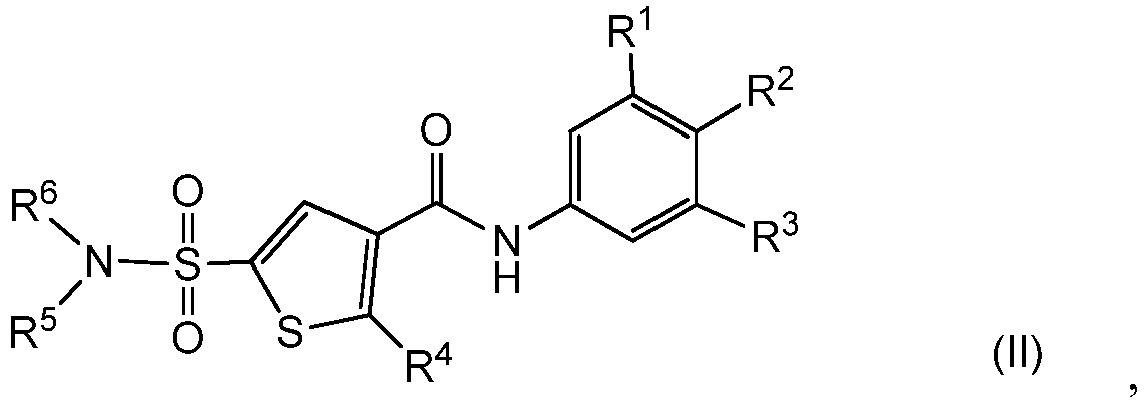
- One X is S and the other two X represent CR4;
- R2 is Fluoro or Hydrogen;
- R1 and R3 are independently selected from the group consisting of Hydrogen, Fluoro, Chloro, Bromo, CHF2, CH2F, CF3, -CN and methyl;
- One R4 is Hydrogen, and the other R4 is selected from the group consisting of Hydrogen, halogen, C1-C3alkyl, cyclopropyl, CHF2, CH2F and CF3;
- R5 is Hydrogen;
- R6 is selected from the group consisting of C1-C6alkyl, C1-C3alkyl-R7 and a 3-7 membered saturated ring optionally containing one or more heteroatoms each independently selected from the group consisting of O, S and N, such 3-7 membered saturated ring or C1-C6alkyl optionally being substituted with one or more substituents each independently selected from the group consisting of Hydrogen, Fluoro, OH, CF3 and C1-C4alkyl;
- R7 is a 3-7 membered saturated ring optionally containing one or more heteroatoms each independently selected from the group consisting of O, S and N, or C(=O)-R8;
- R8 is selected from the group consisting of C1-C3alkoxy and -NH2;
- or a pharmaceutically acceptable salt or a solvate thereof.
- Another embodiment of the present invention relates to those compounds of formula (I) or any subgroup thereof as mentioned in any of the other embodiments wherein one or more of the following restriction applies:
- a) R1 is selected from either Fluoro or methyl.
- b) at least 2 of R1 and R2 and R3 are Halogen. In a further embodiment, R1 is methyl and R2 is Fluoro.
- c) R6 is a branched C1-C6alkyl optionally substituted with one or more Fluoro.
- d) R6 contains a 3-7 membered saturated ring optionally containing one oxygen, preferably R6 is a 4 or 5 membered saturated ring containing one oxygen.
- Further combinations of any of the sub- or preferred embodiments are also envisioned to be in the scope of the present invention.
- Preferred compounds according to the invention are compounds or a stereoisomer or tautomeric form thereof with a formula selected from table 1.
- In a further aspect, the present invention concerns a pharmaceutical composition comprising a therapeutically or prophylactically effective amount of a compound of formula (I) as specified herein, and a pharmaceutically acceptable carrier. A prophylactically effective amount in this context is an amount sufficient to prevent HBV infection in subjects being at risk of being infected. A therapeutically effective amount in this context is an amount sufficient to stabilize HBV infection, to reduce HBV infection, or to eradicate HBV infection, in infected subjects. In still a further aspect, this invention relates to a process of preparing a pharmaceutical composition as specified herein, which comprises intimately mixing a pharmaceutically acceptable carrier with a therapeutically or prophylactically effective amount of a compound of formula (I), as specified herein.
- Therefore, the compounds of the present invention or any subgroup thereof may be formulated into various pharmaceutical forms for administration purposes. As appropriate compositions there may be cited all compositions usually employed for systemically administering drugs. To prepare the pharmaceutical compositions of this invention, an effective amount of the particular compound, optionally in addition salt form, as the active ingredient is combined in intimate admixture with a pharmaceutically acceptable carrier, which carrier may take a wide variety of forms depending on the form of preparation desired for administration. These pharmaceutical compositions are desirable in unitary dosage form suitable, particularly, for administration orally, rectally, percutaneously, or by parenteral injection. For example, in preparing the compositions in oral dosage form, any of the usual pharmaceutical media may be employed such as, for example, water, glycols, oils, alcohols and the like in the case of oral liquid preparations such as suspensions, syrups, elixirs, emulsions and solutions; or solid carriers such as starches, sugars, kaolin, lubricants, binders, disintegrating agents and the like in the case of powders, pills, capsules, and tablets. Because of their ease in administration, tablets and capsules represent the most advantageous oral dosage unit forms, in which case solid pharmaceutical carriers are employed. For parenteral compositions, the carrier will usually comprise sterile water, at least in large part, though other ingredients, for example, to aid solubility, may be included. Injectable solutions, for example, may be prepared in which the carrier comprises saline solution, glucose solution or a mixture of saline and glucose solution. Injectable suspensions may also be prepared in which case appropriate liquid carriers, suspending agents and the like may be employed. Also included are solid form preparations intended to be converted, shortly before use, to liquid form preparations. In the compositions suitable for percutaneous administration, the carrier optionally comprises a penetration enhancing agent and/or a suitable wetting agent, optionally combined with suitable additives of any nature in minor proportions, which additives do not introduce a significant deleterious effect on the skin. The compounds of the present invention may also be administered via oral inhalation or insufflation in the form of a solution, a suspension or a dry powder using any art-known delivery system.
It is especially advantageous to formulate the aforementioned pharmaceutical compositions in unit dosage form for ease of administration and uniformity of dosage. Unit dosage form as used herein refers to physically discrete units suitable as unitary dosages, each unit containing a predetermined quantity of active ingredient calculated to produce the desired therapeutic effect in association with the required pharmaceutical carrier. Examples of such unit dosage forms are tablets (including scored or coated tablets), capsules, pills, suppositories, powder packets, wafers, injectable solutions or suspensions and the like, and segregated multiples thereof.
The compounds of formula (I) are active as inhibitors of the HBV replication cycle and can be used in the treatment and prophylaxis of HBV infection or diseases associated with HBV. The latter include progressive liver fibrosis, inflammation and necrosis leading to cirrhosis, end-stage liver disease, and hepatocellular carcinoma.
Due to their antiviral properties, particularly their anti-HBV properties, the compounds of formula (I) or any subgroup thereof, are useful in the inhibition of the HBV replication cycle, in particular in the treatment of warm-blooded animals, in particular humans, infected with HBV, and for the prophylaxis of HBV infections. - The compounds of formula (I), as specified herein, may therefore be used as a medicine, in particular as medicine to treat or prevent HBV infection. Said use as a medicine comprises the systemic administration to HBV infected subjects or to subjects susceptible to HBV infection of an amount effective to combat the conditions associated with HBV infection or an amount effective to prevent HBV infection.
The present invention also relates to the use of the present compounds in the manufacture of a medicament for the treatment or the prevention of HBV infection.
In general it is contemplated that an antiviral effective daily amount would be from about 0.01 to about 50 mg/kg, or about 0.01 to about 30 mg/kg body weight. It may be appropriate to administer the required dose as two, three, four or more sub-doses at appropriate intervals throughout the day. Said sub-doses may be formulated as unit dosage forms, for example, containing about 1 to about 500 mg, or about 1 to about 300 mg, or about 1 to about 100 mg, or about 2 to about 50 mg of active ingredient per unit dosage form.
The present invention also concerns combinations of a compound of formula (I) or any subgroup thereof, as specified herein with other anti-HBV agents. The term "combination" may relate to a product or kit containing (a) a compound of formula (I), as specified above, and (b) at least one other compound capable of treating HBV infection (herein designated as anti-HBV agent), as a combined preparation for simultaneous, separate or sequential use in treatment of HBV infections. In an embodiment, the invention concerns combination of a compound of formula (I) or any subgroup thereof with at least one anti-HBV agent. In a particular embodiment, the invention concerns combination of a compound of formula (I) or any subgroup thereof with at least two anti-HBV agents. In a particular embodiment, the invention concerns combination of a compound of formula (I) or any subgroup thereof with at least three anti-HBV agents. In a particular embodiment, the invention concerns combination of a compound of formula (I) or any subgroup thereof with at least four anti-HBV agents.
The combination of previously known anti-HBV agents, such as interferon-a (IFN-α), pegylated interferon-a, 3TC, adefovir or a combination thereof, and, a compound of formula (I) or any subgroup thereof can be used as a medicine in a combination therapy. - The substituents in this general synthesis section are meant to include any substituent or reactive species that is suitable for transformation into any substituent according to the present invention without undue burden for the person skilled in the art.
- A possible synthesis of compound of general formula (I) is described in scheme 1 and 2. A carboxylic acid chloride of general formula (III) (for example synthesized according to chemical process of compound 1 or 2 or as described for the synthesis of 5-chlorosulfonyl-2-methylthiophene-3-carbonyl chloride) can be selectively reacted with an aniline of general formula (IV), for example by slow addition of aniline IV to a refluxing solution of compound III in toluene, resulting in compound V. The remaining sulfonic acid chloride functionality in compound V is further reacted with an amine of general formula (VI), resulting in a compound of general formula (I).

- Alternatively a compound of general formula (I) might be obtained as described in scheme 2. This time the sulfonic acid chloride VII (for example synthesized according to chemical process of compound 2 or as described for 5-chlorosulfonyl-2-methyl-thiophene-3-carboxylic acid) is reacted with an amine of general formula (VI), for example in an organic solvent like CH2Cl2 in the presence of an organic base like triethylamine or DIPEA. The formed compound VIII is coupled with aniline of general formula (IV) in the presence of an activating reagent like for example HATU and an organic base like triethylamine or DIPEA.

- The High Performance Liquid Chromatography (HPLC) measurement was performed using a LC pump, a diode-array (DAD) or a UV detector and a column as specified in the respective methods. If necessary, additional detectors were included (see table of methods below).
Flow from the column was brought to the Mass Spectrometer (MS) which was configured with an atmospheric pressure ion source. It is within the knowledge of the skilled person to set the tune parameters (e.g. scanning range, dwell time...) in order to obtain ions allowing the identification of the compound's nominal monoisotopic molecular weight (MW). Data acquisition was performed with appropriate software.
Compounds are described by their experimental retention times (Rt) and ions. If not specified differently in the table of data, the reported molecular ion corresponds to the [M+H]+ (protonated molecule) and/or [M-H]- (deprotonated molecule). In case the compound was not directly ionizable the type of adduct is specified (i.e. [M+NH4]+, [M+HCOO]-, etc...). All results were obtained with experimental uncertainties that are commonly associated with the method used. - Hereinafter, "SQD" means Single Quadrupole Detector, "MSD" Mass Selective Detector, "RT" room temperature, "BEH" bridged ethylsiloxane/silica hybrid, "DAD" Diode Array Detector, "HSS" High Strength silica., "Q-Tof" Quadrupole Time-of-flight mass spectrometers, "CLND", ChemiLuminescent Nitrogen Detector, "ELSD" Evaporative Light Scanning Detector,
- LCMS Methods (Flow expressed in mL/min; column temperature (T) in °C; Run time in minutes).
Method Instrument Column Mobile phase Gradient Flow Run time Col T A Waters: Acquity® UPLC® - DAD and SQD Waters : HSS T3 (1.8µm, 2.1*100mm) A: 10mM CH3COONH4 in 95% H2O + 5% CH3CN B: CH3CN From 100% A to 5% A in 2.10min, to 0% A in 0.90min, to 5% A in 0.5min 0.8 3.5 55 B Waters: Acquity® UPLC® - DAD and SQD Waters : BEH C18 (1.7µm, 2.1*50mm) A: 10mM CH3COONH4 in 95% H2O + 5% CH3CN B: CH3CN From 95% A to 5% A in 1.3 min, held for 0.7 min. 0.8 2 55 C Agilent: 1100/1200-DAD and MSD Agilent: TC-C18 (5µm, 2.1x50mm) A: CF3COOH 0.1% inwater,B: CF3COOH 0.05% in CH3CN 100% A for 1min, to 40% A in 4min, to 15% A in 2.5min, back to 100% A in 2min. 0.8 10.5 50 D Agilent: 1100/1200-DAD and MSD Agilent: TC-C18 (5µm, 2.1x50mm) A: CF3COOH 0.1% inwater,B: CF3COOH0.05% in CH3CN 90% A for 0.8min, to 20% A in 3.7min, held for 3min, back to 90% A in 2min. 0.8 10.5 E Agilent 1100-UV 220nm YMC-PACK ODS-AQ, 50×2.0mm 5µm A: 0.1% TFA in H2O B: 0.05 TFA in CH3CN 100% A held for 1min from 100% A to 40% A in 4 min, held for 2.5 min, to 100% A in 0.5 min held for 2min. 0.8 10.0 50 F Agilent 1100-UV 220nm YMC-PACK ODS-AQ, 50×2.0mm 5µm A: 0.1% TFA in H2O B: 0.05 TFA in CH3CN 90% A held for 0.8 min From 90% A to 20% A in 3.7 min, held for 3 min, to 90% A in 0.5 min held for 2min. 0.8 10.0 50 G Agilent: 1100/1200-DAD and MSD Waters: XBridge™ Shield RP18 (5µm, 2.1x50mm) A: NH4OH 0.05% in water, B: CH3CN 100% A for 1min, to 40% A in 4min, held for 2.5min, back to 100% A in 2min. 0.8 10.5 40 H Agilent: 1100/1200-DAD and MSD Agilent: TC-C18 (5µm, 2.1x50mm) A: CF3COOH 0.1% inwater,B: CF3COOH0.05% in CH3CN 100% A for 1min, to 40% A in 4min, to 15% A in 2.5min, back to 100% A in 2min. 0.8 10.5 50 -

- A solution of oxalyl chloride (4670 mg, 36.8 mmol) in dichloromethane (20 mL) was added to 5-(chlorosulfonyl)-3-thiophenecarboxylic acid (1668 mg, 7.36 mmol) and DMF (0.05 equiv) in dichloromethane (50 mL) and stirred overnight. The reaction mixture was concentrated yielding 5-chlorosulfonylthiophene-3-carbonyl chloride as a yellow resin (1845 mg) which was used as such in the next step. 1H NMR (400 MHz, CHLOROFORM-d) δ ppm 8.29 (d, J=1.0 Hz, 1 H), 8.69 (d, J=1.0 Hz, 1 H). 4-fluoro-3-methylaniline (939 mg, 7.51 mmol) dissolved in toluene (10 mL) was added dropwise to a solution of 5-chlorosulfonylthiophene-3-carbonyl chloride (1.84 g, 7.51mmol) in toluene (50 mL) at reflux over 5 minutes. The reaction mixture was refluxed 45 minutes and next allowed to reach room temperature. A solution of (S)-(-)-3-amino-tetrahydrofuran p-toluenesulfonate (2141 mg, 8.26 mmol) and DIPEA (3.75 mL, 21.8 mmol) in CH2Cl2 (25 mL) was added and the reaction mixture was stirred overnight. The mixture was washed with 1M HCl (100 mL). A light purple precipitate was filtered off. The layers were separated and the water layer was extracted with dichloromethane (150 mL). The organic layers were washed with 1M HCl (2 x), water, NaHCO3 (150 mL) solution, dried over sodium sulphate, filtered and concentrated. The obtained residue was purified by silica gel column chromatography using a gradient from 5 to 10% CH3OH in dichloromethane. The obtained residue was repurified using a gradient from 25 to 100% EtOAc. The product fractions were concentrated and dried yielding compound 1 as a white powder (1431 mg). Method A; Rt: 1.52 min. m/z : 385.0 (M+H)+ Exact mass: 384.1. 1H NMR (400 MHz, DMSO-d6) δ ppm 1.65 - 1.73 (m, 1 H), 1.95 - 2.04 (m, 1 H), 2.24 (d, J=1.6 Hz, 3 H), 3.44 (dd, J=8.9, 4.4 Hz, 1 H), 3.62 (td, J=8.1, 5.8 Hz, 1 H), 3.67 - 3.77 (m, 2 H), 3.80 - 3.88 (m, 1 H), 7.13 (t, J=9.3 Hz, 1 H), 7.56 (ddd, J=8.8, 4.5, 2.8 Hz, 1 H), 7.64 (dd, J=7.3, 2.4 Hz, 1 H), 8.14 (d, J=1.6 Hz, 1 H), 8.30 (d, J=4.8 Hz, 1 H), 8.62 (d, J=1.6 Hz, 1 H), 10.22 (s, 1 H).
-

- Synthesis of 2-bromo-5-chlorosulfonyl-thiophene-3-carboxylic acid: 2-bromo-3-thiophenecarboxylic acid (5000 mg, 24.15 mmol) was dissolved portion wise in chlorosulfonic acid (8 mL) in a microwave tube and heated at 95°C for 2 hours. The reaction mixture was carefully added dropwise to a, ice/water (300 mL) mixture and stirred for 5 minutes. The formed precipitate was filtered off, rinsed with water and dried in vacuo at 50°C, yielding 2-bromo-5-chlorosulfonyl-thiophene-3-carboxylic acid as a beige powder (5856 mg).) Compound 2 was synthesized similar as described for compound 1, starting from 2-bromo-5-chlorosulfonyl-thiophene-3-carboxylic acid instead of 5-(chlorosulfonyl)-3-thiophenecarboxylic acid. After work up, the compound was purified by silica gel column chromatography by gradient elution with 10 to 100 % EtOAc in heptanes. The obtained solid was recrystallized by adding water to a warm solution of crude compound 2 (11.4 g) in methanol (200 mL). After filtration and drying in vacuo at 50°C, compound 2 was obtained as a beige powder (9850 mg). Method B; Rt: 0.98 min. m/z : 482.0 (M+NH4)+ Exact mass: 464.0. 1H NMR (400 MHz, DMSO-d 6) δ ppm 1.65 - 1.78 (m, 1 H), 1.96 - 2.10 (m, 1 H), 2.24 (d, J=1.8 Hz, 3 H), 3.46 (dd, J=9.0, 4.2 Hz, 1 H), 3.63 (td, J=8.1, 5.7 Hz, 1 H), 3.69 - 3.78 (m, 2 H), 3.81 - 3.91 (m, 1 H), 7.13 (t, J=9.2 Hz, 1 H), 7.51 (dt, J=7.6, 4.0 Hz, 1 H), 7.62 (dd, J=6.8, 2.2 Hz, 1 H), 7.87 (s, 1 H), 8.42 (d, J=6.2 Hz, 1 H), 10.38 (s, 1 H).
-
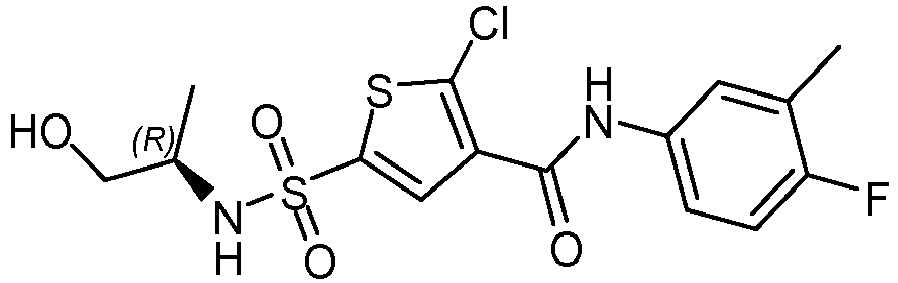
- 4-fluoro-3-methylaniline (2460 mg, 19.6 mmol) dissolved in toluene (5 mL) was added drop wise to a solution of 2-chloro-5-chlorosulfonyl-thiophene-3-carbonyl chloride (prepared from 2-chloro-5-chlorosulfonyl-thiophene-3-carboxylic acid similarly as described for the synthesis of 5-chlorosulfonylthiophene-3-carbonyl chloride from 5-(chlorosulfonyl)-3-thiophenecarboxylic acid, 5492 mg, 19.6 mmol) in toluene (25 mL) at reflux during 5 minutes. The reaction mixture was refluxed 30 minutes and allowed to reach room temperature. After stirring at room temperature for 2 hours the formed precipitate was filtered and the solids were dried in vacuo at 55°C, resulting in 5-chloro-4-[(4-fluoro-3-methyl-phenyl)carbamoyl]thiophene-2-sulfonyl chloride (5.94 g) as an off white powder. Method B; Rt: 1.18 min. m/z : 365.9 (M-H)- Exact mass: 366.9. 5-chloro-4-[(4-fluoro-3-methyl-phenyl)carbamoyl]thiophene-2-sulfonyl chloride (500 mg, 1.36 mmol) was dissolved in CH2Cl2 (5 mL) and D-alaninol (125 mg, 1.63 mmol) and Hunig's base (0.679 mL, 3.94 mmol) were added and the reaction mixture was stirred at room temperature for 30 minutes. The mixture was washed with 1M HCl (15 mL). The organic layer was dried over magnesium sulphate, filtered and concentrated to afford a brown sticky residue which was sonicated in CH2Cl2 (5 mL) and the white solid was filtered and washed with CH2Cl2 (3 mL) and dried in vacuo at 50°C, resulting in compound 3 as a white solid (351 mg). Method B; Rt: 0.91 min. m/z : 424.0 (M+NH4)+ Exact mass: 406.0. 1H NMR (400 MHz, DMSO-d6) δ ppm 1.01 (d, J=6.4 Hz, 3 H), 2.24 (d, J=1.5 Hz, 3 H), 3.12 - 3.39 (m, 3 H), 4.77 (t, J=5.5 Hz, 1 H), 7.13 (t, J=9.1 Hz, 1 H), 7.46 - 7.55 (m, 1 H), 7.62 (dd, J=6.9, 2.1 Hz, 1 H), 7.88 (s, 1 H), 8.05 (br. d, J=6.4 Hz, 1 H), 10.37 (br. s, 1 H).
-

- 5-chloro-4-[(4-fluoro-3-methyl-phenyl)carbamoyl]thiophene-2-sulfonyl chloride was dissolved in CH2Cl2 (20 mL) and (S)-(-)-3-aminotetrahydrofuran p-toluenesulfonate (1.94 g, 7.47 mmol) and Hunig's Base (3.39 mL, 19.7 mmol) were added and the reaction mixture was stirred at room temperature for 30 minutes. The mixture was washed with HCl (2 x 40 mL, 1M). Both layers were filtered and the obtained solid was washed with water (10 mL) and CH2Cl2 (10 mL) and dried overnight in vacuo at 50°C resulting in compound 4 as a white solid (739 mg). The organic layer was dried over magnesium sulphate, filtered and concentrated to afford a brown sticky oil which was sonicated in CH2Cl2 (5 mL) and the resulting white solid was filtered and washed with CH2Cl2 and dried in vacuo at 50°C resulting in more compound 4 (873 mg) as white solid. The filtrate was evaporated to dryness and the residue was further purified using silica gel column chromatography (ethyl acetate in heptane from 10 to 100%) resulting in more compound 4 (830 mg) as a white powder.Method B; Rt: 0.97 min. m/z : 416.9 (M-H)- Exact mass: 418.0. 1H NMR (400 MHz, DMSO-d 6) δ ppm 1.66 - 1.77 (m, 1 H), 1.98 - 2.10 (m, 1 H), 2.24 (d, J=2.0 Hz, 3 H), 3.46 (dd, J=9.1, 4.2 Hz, 1 H), 3.63 (td, J=8.1, 5.7 Hz, 1 H), 3.70 - 3.76 (m, 2 H), 3.81 - 3.91 (m, 1 H), 7.13 (t, J=9.3 Hz, 1 H), 7.45 - 7.55 (m, 1 H), 7.61 (dd, J=7.3, 2.4 Hz, 1 H), 7.92 (s, 1 H), 8.44 (s, 1 H), 10.38 (s, 1 H).
-

- Compound 2 (1000 mg, 2.16 mmol) was dissolved in a mixture of DMF (25 mL) and N-methylmorpholine (1.23 mL, 11.2 mmol) containing Copper(I)Iodide (448 mg, 2.35 mmol) and 2,2-difluoro-2-fluorosulfonyl acetic acid methyl ester (2073 mg, 10.8 mmol). After heating at 70°C, with vigorous stirring, for 2 hours, the mixture was allowed to reach room temperature. Saturated aqueous ammonium chloride solution was added to the reaction mixture. The mixture was stored at room temperature over weekend. The solids were filtered and washed with water (3 x 50 mL). The solids were purified using silica gel column chromatography (ethyl acetate in heptane from 10 to 100%). The desired fractions were combined and evaporated to keep 50 mL of the solvent. The formed precipitate was filtered and washed with petroleum ether resulting in compound 5 (168 mg) as a white solid after drying in vacuo at 50°C. Method B; Rt: 1.03 min. m/z : 470.1 (M+NH4)+ Exact mass: 452.1. 1H NMR (400 MHz, DMSO-d 6) δ ppm 1.68 - 1.79 (m, 1 H), 2.00 - 2.14 (m, 1 H), 2.24 (d, J=1.5 Hz, 3 H), 3.48 (dd, J=9.0, 4.2 Hz, 1 H), 3.64 (td, J=8.1, 5.9 Hz, 1 H), 3.70 - 3.80 (m, 2 H), 3.88 - 3.97 (m, 1 H), 7.14 (t, J=9.1 Hz, 1 H), 7.44 - 7.52 (m, 1 H), 7.61 (dd, J=7.0, 2.2 Hz, 1 H), 8.09 - 8.13 (m, 1 H), 8.66 (br. s., 1 H), 10.60 (br. s, 1 H).
-
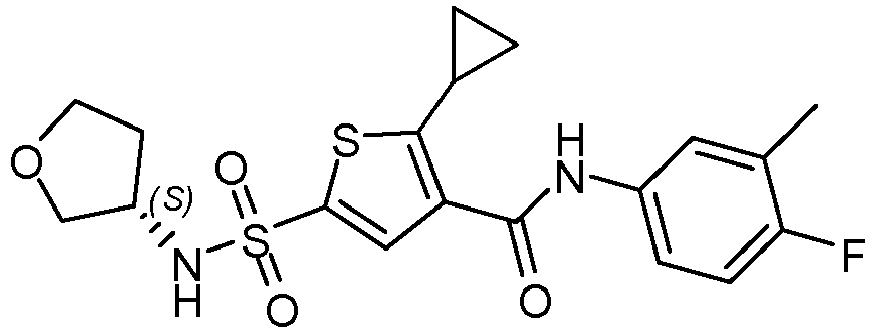
- A 10 mL microwave tube was loaded with a stirring bar, potassium cyclopropyl trifluoroborate (191 mg, 1.29 mmol), compound 4 (300 mg, 0.716 mmol), water (388 µL, 21.5 mmol) and 1,2-dimethoxyethane (3.72 mL, 35.8 mmol) and nitrogen gas was bubbled through for 10 minutes. Under a nitrogen atmosphere, cesium carbonate (16.2 mg, 0.0716 mmol), palladium (II) acetate (16.2 mg, 0.0716 mmol) and butyldi-1-adamantylphosphine (41.1 mg, 0.115 mmol) were added together and the reaction mixture was stirred under microwave irradiation at 140°C for 10 minutes. The reaction mixture was cooled to room temperature. Nitrogen gas was bubbled through the reaction mixture for 10 minutes and Palladium (II) acetate (16.2 mg, 0.0716 mmol) and butyldi-1-adamantylphosphine (41.1 mg, 0.115 mmol) were added together and the reaction mixture was stirred at 140°C in microwave oven for 40 minutes. The reaction mixture was filtered and the filtrate was diluted with CH2Cl2 (20 mL). The organic layer was separated and washed with saturated aqueous sodium carbonate solution and water, dried (Na2SO4) and evaporated to afford a brown residue. The obtained residue was purified using silica gel column chromatography (ethyl acetate in heptane from 10 to 100%) to afford crude compound 6 as off white solid. Crude compound 6 was dissolved in CH2Cl2 (20 mL) and heptane (50 mL) was added. The solution was evaporated until 50 mL solvent remained. The formed white precipitate was filtered and washed with petroleum ether (2 x 10 mL) resulting in compound 6 as white powder (174 mg) after drying in vacuo at 50°C. Method B; Rt: 1.00 min. m/z : 442.1 (M+NH4)+ Exact mass: 424.1. 1H NMR (400 MHz, DMSO-d6) δ ppm 0.73 - 0.82 (m, 2 H), 1.17 - 1.26 (m, 2 H), 1.63 - 1.74 (m, 1 H), 1.94 - 2.06 (m, 1 H), 2.23 (d, J=1.8 Hz, 3 H), 2.90 - 3.00 (m, 1 H), 3.42 (dd, J=9.0, 4.4 Hz, 1 H), 3.62 (td, J=8.1, 5.9 Hz, 1 H), 3.67 - 3.76 (m, 2 H), 3.76 - 3.84 (m, 1 H), 7.11 (t, J=9.1 Hz, 1 H), 7.49 - 7.57 (m, 1 H), 7.64 (dd, J=7.0, 2.2 Hz, 1 H), 7.90 (s, 1 H), 8.18 (br. s., 1 H), 10.15 (s, 1 H).
-

- Nitrogen was bubbled through a mixture of compound 2 (830 mg, 1.79 mmol) trimethylboroxine (50% in THF, 5.37 mmol), cesium carbonate (1751 mg, 5.37 mmol) in DME (12 mL) during 5 minutes. 1,1'-bis(diphenylphosphino)ferrocene-palladium(II)dichloride dichloromethane complex (147 mg, 0.179 mmol) was added and the reaction mixture heated by microwave irradiation at 150°C during 1 hour. The reaction mixture was concentrated and the obtained residue was partitioned between dichloromethane (50 mL) and water (50 mL). The organic layer was separated, dried over magnesium sulphate, filtered and concentrated. The obtained residue was purified by silica gel column chromatography using a gradient from 10 to 100% EtOAc in heptane. The product fractions were concentrated and dried in vacuo overnight at 50°C yielding compound 7 as a beige powder (208 mg). Method A; Rt: 1.68 min. m/z : 398.9 (M+H)+ Exact mass: 398.1. 1H NMR (400 MHz, DMSO-d6) δ ppm 1.65 - 1.76 (m, 1 H), 1.94 - 2.06 (m, 1 H), 2.23 (d, J=1.1 Hz, 3 H), 2.71 (s, 3 H), 3.44 (dd, J=8.9, 4.3 Hz, 1 H), 3.62 (td, J=8.1, 5.9 Hz, 1 H), 3.67 - 3.86 (m, 3 H), 7.11 (t, J=9.1 Hz, 1 H), 7.52 (dt, J=7.6, 4.0 Hz, 1 H), 7.63 (dd, J=6.9, 2.1 Hz, 1 H), 7.99 (s, 1 H), 8.21 (d, J=6.4 Hz, 1 H), 10.12 (s, 1 H).
-

- Compound 8 was synthesized similar as described for compound 1, starting from 4-chlorosulfonylthiophene-2-carboxylic acid (commercial from Enamine, EN300-40927) instead of 5-(chlorosulfonyl)-3-thiophenecarboxylic acid. After work up, the obtained residue containing compound 8, was crystallised from hot iPrOH (100 mL) by slow addition of water and stirring overnight. The dark purple crystals were filtered off and purified by silica gel column chromatography on silica using a gradient from 20 till 100% EtOAc in heptane. The product fractions were concentrated and dried in vacuo at 60°C yielding compound 8 as a beige powder (352.7 mg). Method A; Rt: 1.62 min. m/z : 385.0 (M+H)+ Exact mass: 384.1. 1H NMR (400 MHz, DMSO-d6) δ ppm 1.61 - 1.73 (m, 1 H), 1.93 - 2.05 (m, 1 H), 2.24 (d, J=1.8 Hz, 3 H), 3.40 (dd, J=8.9, 4.5 Hz, 1 H), 3.62 (td, J=8.0, 5.9 Hz, 1 H), 3.67 - 3.76 (m, 2 H), 3.77 - 3.86 (m, 1 H), 7.14 (t, J=9.1 Hz, 1 H), 7.50 - 7.58 (m, 1 H), 7.63 (dd, J=7.0, 2.4 Hz, 1 H), 8.02 (d, J=6.6 Hz, 1 H), 8.27 (d, J=1.3 Hz, 1 H), 8.40 (d, J=1.3 Hz, 1 H), 10.47 (s, 1 H).
-

- Compound 9 was synthesized similarly as described for compound 1, starting from 4-chlorosulfonyl-5-methyl-thiophene-2-carboxylic acid (commercial from Enamine, EN300-69759) instead of 5-(chlorosulfonyl)-3-thiophenecarboxylic acid. The volatiles of the reaction mixture were removed under reduced pressure and the obtained residue containing compound 9 was purified on silica by gradient elution with a heptane to EtOAc gradient. The product fractions were evaporated to dryness, resulting in compound 9 as a powder (389 mg). Method B; Rt: 0.94 min. m/z: 397.0 (M-H)- Exact mass: 398.1. 1 H NMR (400 MHz, DMSO-d6) ppm 1.61 - 1.74 (m, 1 H), 1.92 - 2.04 (m, 1 H), 2.24 (d, J=1.5 Hz, 3 H), 2.69 (s, 3 H), 3.41 (dd, J=9.0, 4.6 Hz, 1 H), 3.62 (td, J=8.1, 6.1 Hz, 1 H), 3.66 - 3.76 (m, 2 H), 3.76 - 3.85 (m, 1 H), 7.12 (t, J=9.2 Hz, 1 H), 7.51 - 7.59 (m, 1 H), 7.63 (dd, J=7.0, 2.4 Hz, 1 H), 8.04 (d, J=7.0 Hz, 1 H), 8.22 (s, 1 H), 10.39 (s, 1 H).
-

- Compound 10 was synthesized similarly as described for compound 9, using 3-methyl-3-oxetanamine hydrochloride (1:1) instead of (S)-(-)-3-aminotetrahydrofuran p-toluenesulfonate, resulting in compound 10 (420 mg) as a powder. Method B; Rt: 0.95 min. m/z : 416.2 (M+NH4)+ Exact mass: 398.1. 1H NMR (400 MHz, DMSO-d6) δ ppm 1.49 (s, 3 H), 2.24 (d, J=1.6 Hz, 3 H), 2.69 (s, 3 H), 4.19 (d, J=6.5 Hz, 2 H), 4.63 (d, J=6.5 Hz, 2 H), 7.12 (t, J=9.3 Hz, 1 H), 7.55 (ddd, J=8.8, 4.5, 2.8 Hz, 1 H), 7.62 (dd, J=7.1, 2.6 Hz, 1 H), 8.23 (s, 1 H), 8.40 (s, 1 H), 10.38 (s, 1 H).
-

- Compound 11 was synthesized similarly as described for compound 9, starting from 4-chlorosulfonyl-3-methyl-thiophene-2-carboxylic acid instead of 4-chlorosulfonyl-5-methylthiophene-2-carboxylic acid, resulting in compound 11 (523 mg). Method B; Rt: 0.90 min. m/z : 416.3 (M+NH4)+ Exact mass: 398.1. 1 H NMR (400 MHz, DMSO-d6) δ ppm 1.65 - 1.76 (m, 1 H), 1.91 - 2.03 (m, 1 H), 2.23 (d, J=1.8 Hz, 3 H), 2.53 (s, 3 H), 3.42 (dd, J=8.9, 4.5 Hz, 1 H), 3.57 - 3.69 (m, 2 H), 3.70-3.80 (m, 2 H), 7.12 (t, J=9.2 Hz, 1 H), 7.45 - 7.53 (m, 1 H), 7.58 (dd, J=7.0, 2.4 Hz, 1 H), 8.13 (d, J=5.7 Hz, 1 H), 8.31 (s, 1 H), 10.27 (s, 1 H).
-

- Compound 12 was synthesized similarly as described for compound 11, using 3-methyl-3-oxetanamine hydrochloride (1:1) instead of (S)-(-)-3-aminotetrahydrofuran p-toluenesulfonate, resulting in compound 12 (462 mg).Method B; Rt: 0.91 min. m/z : 416.3 (M+NH4)+ Exact mass: 398.1. 1H NMR (400 MHz, DMSO-d6) δ ppm 1.50 (s, 3 H), 2.24 (s, 3 H), 2.56 (s, 3 H), 4.18 (d, J=6.1 Hz, 2 H), 4.63 (d, J=6.1 Hz, 2 H), 7.12 (t, J=9.3 Hz, 1 H), 7.49 (ddd, J=8.8, 4.3, 2.6 Hz, 1 H), 7.59 (dd, J=6.9, 2.4 Hz, 1 H), 8.33 (s, 1 H), 8.44 (s, 1 H), 10.28 (s, 1 H).
-
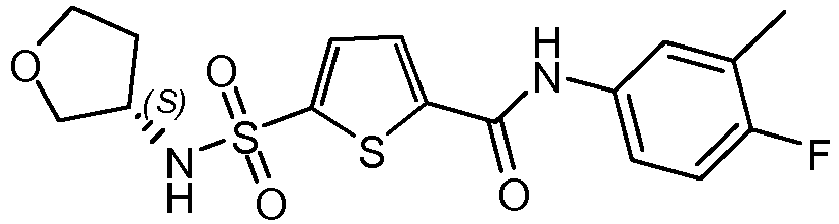
- Compound 13 was synthesized similar as described for compound 1, starting from 5-(chlorosulfonyl)-2-thiophenecarboxylic acid (commercial from Enamine: EN300-95666) instead of 5-(chlorosulfonyl)-3-thiophenecarboxylic acid. After removal of the volatiles of the reaction mixture, CH2Cl2 (150 mL) was added and the mixture was washed with 1 M HCl (2 x 150 mL) and water (1 x 150 mL). Compound 13 precipitated from the organic layer and was filtered off. Compound 13 was recrystallised by slow addition of H2O to a solution in methanol (50 mL). The crystals were filtered off and dried in vacuo at 50°C yielding compound 13 (781 mg) as a light grey powder. Method A; Rt: 1.64 min. m/z : 401.9 (M+NH4)+ Exact mass: 384.1. 1H NMR (400 MHz, DMSO-d6) δ ppm 1.62 - 1.74 (m, 1 H), 1.93 - 2.05 (m, 1 H), 2.25 (d, J=1.8 Hz, 3 H), 3.42 (dd, J=8.9, 4.3 Hz, 1 H), 3.62 (td, J=8.1, 5.7 Hz, 1 H), 3.66 - 3.78 (m, 2 H), 3.80 - 3.91 (m, 1 H), 7.15 (t, J=9.1 Hz, 1 H), 7.49 - 7.57 (m, 1 H), 7.62 (dd, J=7.0, 2.4 Hz, 1 H), 7.69 (d, J=4.0 Hz, 1 H), 8.00 (d, J=4.0 Hz, 1 H), 8.38 (d, J=6.6 Hz, 1 H), 10.46 (s, 1 H).
-
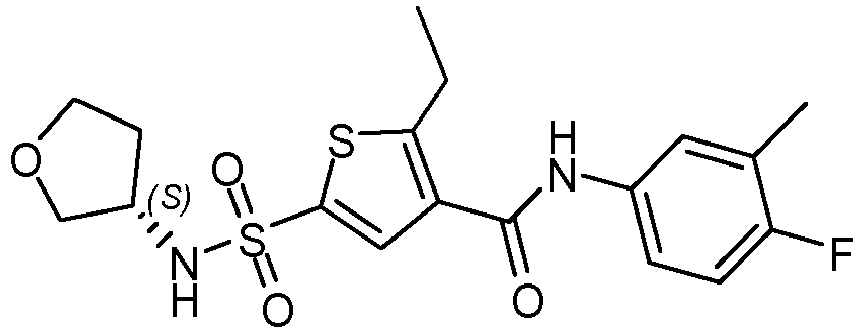
- Nitrogen was bubbled through compound 4 (1362 mg, 3.25 mmol), tetraethyltin (0.993 mL, 4.88 mmol), DMF (10 mL) during 5 minutes. 1,1'-bis(diphenylphosphino)ferrocene-palladium(II)dichloride dichloromethane complex (390 mg, 0.477 mmol) was added and the reaction mixture was heated by microwave irradiation at 140°C during 30 minutes. At room temperature, nitrogen was bubbled through the reaction mixture for 5 minutes, butyldi-1-adamantylphosphine (187 mg, 0.52 mmol) and palladium(II) acetate (73.7 mg, 0.325 mmol) were added and the reaction mixture was further heated by microwave irradiation at 140°C during 30 minutes and allowed to reach room temperature. The reaction mixture was poured into ice cold water (150 mL). The mixture was filtered and extracted with diethyl ether (3 x 50 mL). The combined organic layers were washed with Brine, dried (Na2SO4) and concentrated in vacuo, resulting in a dark sticky residue. The water layer was extracted with CH2Cl2 (3 x 50 mL) and ethyl acetate (3 x 50 mL). The combined organic layers were dried (Na2SO4) and evaporated to yield a purple liquid which was purified using silica gel column chromatography (ethyl acetate in heptane from 10 to 100%). The desired fractions were evaporated in vacuo until ∼20 mL of the solvent remained. The formed solids were filtered, washed with petroleum ether and dried in vacuo at 50°C resulting in compound 14 as white solid (111 mg). Method B; Rt: 1.00 min. m/z : 430.1 (M+NH4)+ Exact mass: 412.1; 1H NMR (400 MHz, DMSO-d6) δ ppm 1.27 (t, J=7.5 Hz, 3 H), 1.65 - 1.76 (m, 1 H), 1.94 - 2.08 (m, 1 H), 2.23 (d, J=1.3 Hz, 3 H), 3.18 (q, J=7.5 Hz, 2 H), 3.44 (dd, J=9.0, 4.4 Hz, 1 H), 3.62 (td, J=8.1, 5.8 Hz, 1 H), 3.67 - 3.77 (m, 2 H), 3.77 - 3.87 (m, 1 H), 7.11 (t, J=9.2 Hz, 1 H), 7.48 - 7.56 (m, 1 H), 7.63 (dd, J=6.9, 2.1 Hz, 1 H), 7.99 (s, 1 H), 8.21 (br. d, J=6.4 Hz, 1 H), 10.15 (br. s, 1 H).
-

- 2-methylthiophene-3-carboxylic acid (15 g, 105.5 mmol) was added portion wise over a period of 15 minutes to chlorosulfonic acid (60 mL) and stirred 2 hours at 100°C. This mixture was allowed to cool 15 minutes and added drop wise during 30 minutes to an ice/water mixture (1500 mL) and stirred for 5 minutes. The brown precipitate was filtered off, rinsed with plenty of water and dried over weekend in a vacuum oven at 50°C, yielding 5-chlorosulfonyl-2-methylthiophene-3-carboxylic acid (20.15 g). 1H NMR (400 MHz, acetonitrile-d3) δ ppm 2.80 (s, 3 H), 8.15 (s, 1 H). 5-chlorosulfonyl-2-methyl-thiophene-3-carboxylic acid (20.15 g, 83.72 mmol) was suspended in dichloromethane (500 mL). N,N-dimethylformamide (50 mg) was added followed by portion wise addition of oxalyl chloride (35.42 mL, 418.59 mmol) dissolved in dichloromethane (50 mL). The reaction mixture was stirred for 5 hours and concentrated in vacuo at 50°C yielding 5-chlorosulfonyl-2-methyl-thiophene-3-carbonyl chloride as a brown residue (21.7 g). 1H NMR (400 MHz, chloroform-d) δ ppm 2.84 (s, 3 H), 8.31 (s, 1 H). 4-fluoro-3-methylaniline (711.6 mg, 5.69 mmol) dissolved in toluene (10 mL) was added drop wise to a solution of 5-chlorosulfonyl-2-methyl-thiophene-3-carbonyl chloride (1473.5 mg, 5.69 mmol) in toluene (90 mL) at reflux during 5 minutes. The mixture was refluxed for 60 minutes and allowed to reach room temperature. A solution of 3-methyl-3-oxetanamine hydrochloride (1:1) (773 mg, 6.25 mmol), diisopropylethylamine (2.84 mL, 16.49 mmol) in dichloromethane (20 mL) was added and the mixture was stirred overnight. The mixture was concentrated in vacuo and the residue was dissolved in EtOAc (200 mL), washed twice with 1M HCl (2 x 300 mL), once with water (300 mL) and once with saturated NaHCO3 solution. The organic was dried over MgSO4, filtered and concentrated in vacuo. The residue was purified by column chromatography using a gradient from 20% to 100% EtOAc in heptanes. The product fractions were concentrated and the obtained residue crystallized from hot EtOAc (200 mL) upon addition of heptane. The white crystals were filtered off and dried at 50°C in vacuo yielding compound 15 (805 mg). Method A; Rt: 1.72 min. m/z : 396.9 (M-H)- Exact mass: 398.1; 1H NMR (400 MHz, DMSO-d 6) δ ppm 1.55 (s, 3 H), 2.23 (d, J=1.8 Hz, 3 H), 2.71 (s, 3 H), 4.19 (d, J=6.4 Hz, 2 H), 4.61 (d, J=5.9 Hz, 2 H), 7.11 (t, J=9.2 Hz, 1 H), 7.47 - 7.56 (m, 1 H), 7.63 (dd, J=7.0, 2.4 Hz, 1 H), 7.99 (s, 1 H), 8.61 (s, 1 H), 10.11 (s, 1 H).
-
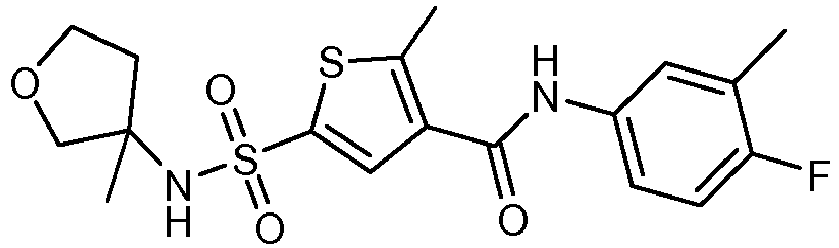
- 4-fluoro-3-methylaniline (304.98 mg, 2.44 mmol) dissolved in toluene (10 mL) was added drop wise to a solution of 5-chlorosulfonyl-2-methyl-thiophene-3-carbonyl chloride (631.5 mg, 2.44 mmol) in toluene (90 mL) at reflux over a period of 5 minutes. The mixture was refluxed for 60 minutes and allowed to reach room temperature. A solution of 3-methyloxolan-3-amine hydrochloride (368.9 mg, 2.68 mmol) and diisopropylethylamine (1.22 mL, 7.07 mmol) in dichloromethane (8 mL) was added and the mixture was stirred overnight. The mixture was concentrated in vacuo. The residue was dissolved in EtOAc (150 mL), washed twice with 1M HCl (150 mL), once with water (150 mL) and once with saturated NaHCO3 solution. The organic layer was dried over MgSO4, filtered and concentrated. The residue was purified by silicagel column chromatography using a gradient from 10% to 100% EtOAc in heptane. The residue was purified again by silicagel column chromatography using a gradient from 0% to 10% methanol in dichloromethane yielding compound 16 as a white resin. Method A; Rt: 1.78 min. m/z : 410.9 (M-H)- Exact mass: 412.1; 1H NMR (400 MHz, DMSO-d 6) δ ppm 1.31 (s, 3 H), 1.78 (dt, J=12.7, 7.6 Hz, 1 H), 2.14 - 2.22 (m, 1 H), 2.23 (d, J=1.5 Hz, 3 H), 2.70 (s, 3 H), 3.40 (d, J=8.8 Hz, 1 H), 3.67 - 3.81 (m, 3 H), 7.11 (t, J=9.2 Hz, 1 H), 7.47 - 7.56 (m, 1 H), 7.63 (dd, J=7.0, 2.2 Hz, 1 H), 7.98 (s, 1 H), 8.16 (s, 1 H), 10.10 (s, 1 H). Racemic N-(4-fluoro-3-methylphenyl)-2-methyl-5 -[(3 -methyltetrahydrofuran-3 yl)sulfamoyl]thiophene-3-carboxamide (366 mg) was separated in its two enantiomers by Preparative SFC (Stationary phase: Chiralpak Diacel AD 30 x 250 mm), Mobile phase: CO2, MeOH with 0.2% iPrNH2), the desired fractions were collected, evaporated, dissolved in MeOH and evaporated again. Then this was dried in a vacuum oven at 50°C overnight yielding enantiomer 16a (166 mg).
and enantiomer 16b (162 mg). Columns: AD-H 250 mm x 4.6 mm, Flow: 5 mL/min, Mobile phase: 40 % MeOH (containing 0.2% iPrNH2) hold 4.0, up to 50% in 1 min and hold for 2.0 min @ 50%, Rt: 16a:1.8 min, 16b: 3.4 min. -
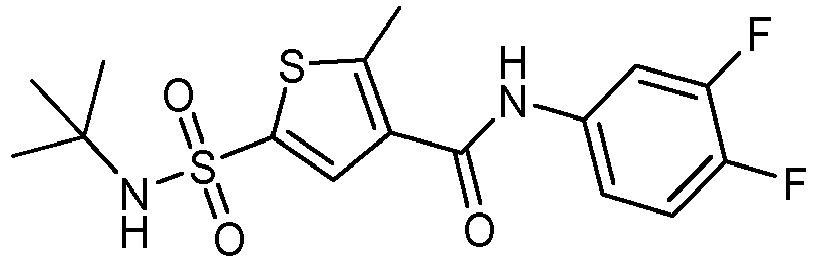
- 5-chlorosulfonyl-2-methyl-thiophene-3-carbonyl chloride (2.4 g, 9.26 mmol) was dissolved in toluene (75 mL) and brought to reflux. 3,4-difluoroaniline (1.2 g, 9.26 mmol) was added drop wise in 2 minutes. After addition the reaction was refluxed for 5 hours. The reaction mixture was allowed to reach room temperature and the formed precipitate was filtered off yielding 4-[(3,4-difluorophenyl)carbamoyl]-5-methyl-thiophene-2-sulfonyl chloride (2.1 g). The filtrate was evaporated to dryness yielding another crop of 4-[(3,4-difluorophenyl)carbamoyl]-5-methylthiophene-2-sulfonyl chloride (1.2 g). This crop (1.2 g) was dissolved in acetonitrile (10 mL) and treated with tert-butylamine (0.98 mL, 9.26 mmol). The reaction mixture was stirred overnight. The volatiles were removed under reduced pressure and the residue was purified on silica using a heptane to EtOAc gradient yielding compound 17 as a white powder (440.5 mg). Method B; Rt: 1.11 min. m/z : 387.2 (M-H)- Exact mass: 388.1; 1H NMR (400 MHz, DMSO-d 6) δ ppm 1.19 (s, 9 H), 2.70 (s, 3 H), 7.36 - 7.46 (m, 1 H), 7.46 - 7.51 (m, 1 H), 7.79 (s, 1 H), 7.87 (ddd, J=13.3, 7.5, 2.5 Hz, 1 H), 7.95 (s, 1 H), 10.32 (s, 1 H).
-
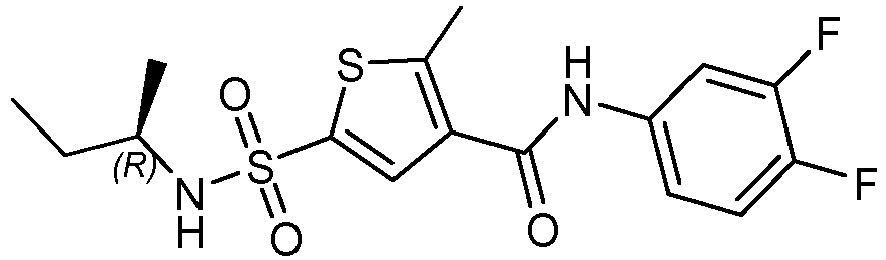
- 4-[(3,4-difluorophenyl)carbamoyl]-5-methyl-thiophene-2-sulfonyl chloride (500 mg, 1.29 mmol) was dissolved in acetonitrile (10 mL) together with (R)-(-)-2-aminobutane (169.3 mg, 2.32 mmol) and diisopropylethylamine (1.2 mL, 6.95 mmol). The reaction mixture was stirred overnight. The volatiles were removed under reduced pressure and the residue was purified on silicagel using a heptane to EtOAc gradient. The obtained fractions were purified again on silicagel using a heptane to EtOAc gradient yielding compound 18 as a white powder (225 mg). Method B; Rt: 1.11 min. m/z : 387.1 (M-H)- Exact mass: 388.1; 1H NMR (400 MHz, DMSO-d 6) δ ppm 0.77 (t, J=7.5 Hz, 3 H), 0.98 (d, J=6.6 Hz, 3 H), 1.37 (quin, J=7.2 Hz, 2 H), 2.71 (s, 3 H), 3.12 - 3.23 (m, 1 H), 7.36 - 7.46 (m, 1 H), 7.46 - 7.52 (m, 1 H), 7.78 - 7.92 (m, 2 H), 7.97 (s, 1 H), 10.32 (s, 1 H).
- 3-chloro-4,5-difluorobenzoic acid (1011 mg, 52.5 mmol) was dissolved in tert-butyl alcohol (200 mL). Triethylamine (8 mL, 57.8 mmol) was added followed by diphenylphosphoryl azide (14.74 g, 53.6 mmol) and the reaction mixture was refluxed overnight. The reaction mixture was concentrated and purified by column chromatography on silica using a gradient from 10 to 100% EtOAc in heptane and again with 10% CH2Cl2 in heptane to 100% CH2Cl2. The product fractions were concentrated in vacuo yielding tert-butyl N-(3-chloro-4,5-difluorophenyl)carbamate as a white powder (10.68 g). Method A. Rt: 2.09 min m/z: 262.0 (M-H) Exact mass: 263.1. 1H NMR (400 MHz, DMSO-d6) δ ppm 1.48 (s, 9 H), 7.37 - 7.57 (m, 2 H), 9.74 (s, 1 H). HCl (6 M in iPrOH) (20 mL, 120 mmol) was added to tert-butyl N-(3-chloro-4,5-difluorophenyl)carbamate (10.68 g, 40.5 mmol) dissolved in dichloromethane (200 mL) and stirred overnight. The reaction mixture was concentrated. The white solid residue was dissolved in water (100 mL), alkalanised with NaOH 1M and extracted with ether. The organic layer was dried over MgSO4, filtered and concentrated yielding 3-chloro-4,5-difluoro-aniline (6.53 g) as a colorless oil which was stored under nitrogen in the dark. 1H NMR (400 MHz, DMSO-d6) δ ppm 5.53 (s, 2 H), 6.34 - 6.61 (m, 2 H).
-
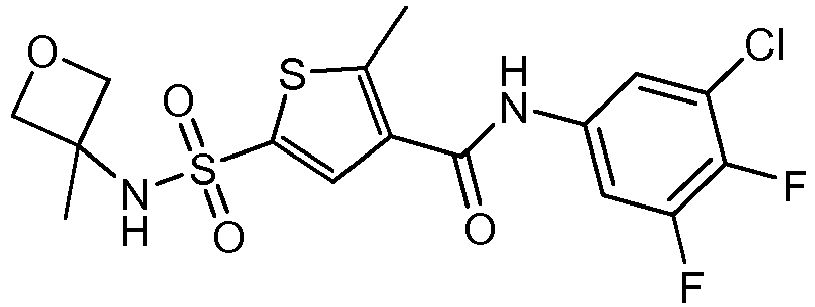
- 5-chlorosulfonyl-2-methyl-thiophene-3-carbonyl chloride (2.4 g, 9.26 mmol) was dissolved in toluene (75 mL) and brought to reflux. 3-chloro-4,5-difluoro-aniline (1.51 g, 9.26 mmol) was added drop wise in 2 minutes. After addition the reaction was refluxed for 5 hours. The reaction mixture was allowed to reach room temperature and the formed precipitate was filtered off yielding 4-[(3-chloro-4,5-difluoro-phenyl)carbamoyl]-5-methylthiophene-2-sulfonyl chloride (2.5 g).
The filtrate was evaporated to dryness yielding another crop of 4-[(3-chloro-4,5-difluorophenyl)carbamoyl]-5-methyl-thiophene-2-sulfonyl chloride (1.1 g).
4-[(3-chloro-4,5-difluoro-phenyl)carbamoyl]-5-methyl-thiophene-2-sulfonyl chloride (500mg) was dissolved in acetonitrile (10 mL) together with 3-methyl-3-oxetanamine (201.72 mg, 2.32 mmol) and diisopropylethylamine (1.2 mL, 6.95 mmol). The reaction mixture was stirred overnight. The volatiles were removed under reduced pressure and the residue was purified using silicagel column chromatography using a heptane to EtOAc gradient. The collected fractions were concentrated under reduced pressure and purified again using silicagel column chromatography using a heptane to EtOAc gradient yielding compound 19 (409 mg) as a white powder. Method B; Rt: 1.08 min. m/z : 435.1 (M-H)- Exact mass: 436.0; 1H NMR (400 MHz, DMSO-d 6) δ ppm 1.55 (s, 3 H), 2.72 (s, 3 H), 4.19 (d, J=6.4 Hz, 2 H), 4.61 (d, J=6.2 Hz, 2 H), 7.75 - 7.86 (m, 2 H), 8.01 (s, 1 H), 8.65 (s, 1 H), 10.40 (s, 1 H). -
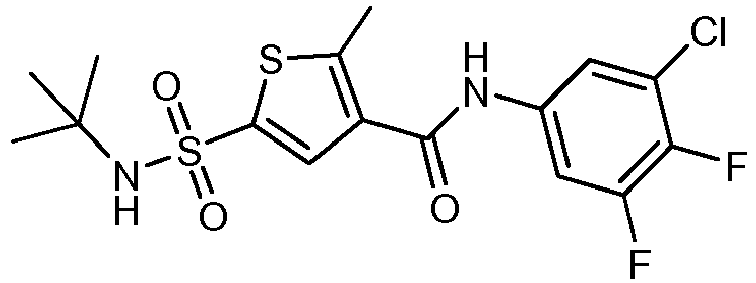
- 4-[(3-chloro-4,5-difluoro-phenyl)carbamoyl]-5-methyl-thiophene-2-sulfonyl chloride (1.1 g) was dissolved in of acetonitrile (10 mL). This was treated with tert-butylamine (0.98 mL, 9.26 mmol). The reaction mixture was stirred overnight. The volatiles were removed under reduced pressure and the residue was purified using silicagel column chromatography using a heptane to EtOAc gradient yielding compound 20 as a white powder (162 mg). Method B; Rt: 1.24 min. m/z : 421.1 (M-H)- Exact mass: 422.0; 1H NMR (400 MHz, DMSO-d 6) δ ppm 1.20 (s, 9 H), 2.71 (s, 3 H), 7.76 - 7.87 (m, 3 H), 7.97 (s, 1 H), 10.38 (br. s., 1 H).
-

- 5-chlorosulfonyl-2-methyl-thiophene-3-carbonyl chloride (2.4 g, 9.26 mmol) was dissolved in toluene (75 mL) and brought to reflux. 3-(trifluoromethyl) aniline (1.15 mL, 9.26 mmol) was added drop wise in 2 minutes. After addition the reaction was refluxed for 2 hours. The reaction mixture was allowed to reach room temperature and the formed precipitate was filtered off yielding 5-methyl-4-[[3-(trifluoromethyl)phenyl]carbamoyl]thiophene-2-sulfonyl chloride (2.87 g).
The filtrate was evaporated to dryness yielding another crop of 5-methyl-4-[[3-(trifluoromethyl)phenyl]carbamoyl]thiophene-2-sulfonyl chloride (0.5 g). This was dissolved in dichloromethane (20 mL) and tert-butylamine (677.4 mg, 9.26 mmol) was added and the reaction mixture was stirred for 15 minutes. The volatiles were removed under reduced pressure and the residue was purified using silicagel column chromatography using a heptane to EtOAc gradient. The collected fractions were concentrated under reduced pressure and purified again using silicagel column chromatography using a heptane to EtOAc yielding compound 21 as an off white powder (193 mg). Method A; Rt: 1.96 min. m/z : 419.1 (M-H)- Exact mass: 420.1; 1H NMR (400 MHz, DMSO-d 6) δ ppm 1.21 (s, 9 H), 2.73 (s, 3 H), 7.46 (d, J=7.7 Hz, 1 H), 7.59 (t, J=7.9 Hz, 1 H), 7.80 (s, 1 H), 7.97 - 8.04 (m, 2 H), 8.19 (s, 1 H), 10.42 (s, 1 H). -

- 5-methyl-4-[[3-(trifluoromethyl)phenyl]carbamoyl]thiophene-2-sulfonyl chloride (100 mg) was dissolved in dichloromethane (10 mL). 3-methyl-3-oxetanamine (34.05 mg, 0.39 mmol) and diisopropylethylamine (0.13 mL, 0.78 mmol) were added and the reaction mixture was stirred overnight at room temperature. The precipitate was filtered off, triturated with diisopropylether and dried in a vacuum oven at 50°C yielding compound 22 (58.5 mg)_as a white powder. Method B; Rt: 1.05 min. m/z : 433.1 (M-H)- Exact mass: 434.1; 1H NMR (400 MHz, DMSO-d 6) δ ppm 1.55 (s, 3 H), 2.73 (s, 3 H), 4.20 (d, J=6.4 Hz, 2 H), 4.61 (d, J=5.9 Hz, 2 H), 7.46 (d, J=7.9 Hz, 1 H), 7.59 (t, J=7.9 Hz, 1 H), 7.98 (d, J=8.6 Hz, 1 H), 8.04 (s, 1 H), 8.18 (s, 1 H), 8.63 (s, 1 H), 10.42 (s, 1 H).
- 3,4-difluoro-5-methylbenzoic acid (Alfa Aesar, H32313-03, 4.8 g, 26.9 mmol) was dissolved in t-BuOH (100 mL). NEt3 (4.1 mL, 29.6 mmol) was added followed by diphenylphosphoryl azide (7.5 g, 27.4 mmol) and the reaction mixture was refluxed overnight. The mixture was concentrated and the obtained residue was purified by silica gel column chromatography using a gradient from 30 to 100% EtOAc in heptane. The product fractions were concentrated in vacuo yielding tert-butyl N-(3,4-difluoro-5-methyl-phenyl)carbamate (4.15 g) as a white powder. 1H NMR (400 MHz, DMSO-d6) δ ppm 1.47 (s, 9 H), 2.22 (d, J=1.8 Hz, 3 H), 7.11 (d, J=5.1 Hz, 1 H), 7.26 - 7.38 (m, 1 H), 9.47 (br. s., 1 H). To a tert-butyl N-(3,4-difluoro-5-methylphenyl)carbamate (4.15 g) solution in CH2Cl2 (100 mL), HCl (6M in iPrOH, 13.7 mL) was added and the mixture was stirred for 3 hours. The reaction mixture was concentrated in vacuo. The white solid residue was dissolved in water (100 mL), alkalinized with 1M NaOH and extracted with ether. The organic layer was dried over MgSO4, filtered and concentrated yielding 3,4-difluoro-5-methyl-aniline as a colorless oil which was stored under nitrogen in the dark and used a such. 1H NMR (400 MHz, DMSO-d6) δ ppm 2.13 (d, J=2.2 Hz, 3 H), 5.11 (s, 2 H), 6.16 - 6.23 (m, 1 H), 6.31 (ddd, J=12.9, 6.5, 2.8 Hz, 1 H).
-

- Compound 23 (221 mg) was prepared similarly as described for compound 17, using 3,4-difluoro-5-methyl-aniline instead of 3,4-difluoroaniline. Method B; Rt: 1.17 min. m/z : 401.1 (M-H)- Exact mass: 402.1. 1 H NMR (400 MHz, DMSO-d6) δ ppm 1.19 (s, 9 H), 2.28 (d, J=2.0 Hz, 3 H), 2.70 (s, 3 H), 7.40 (d, J=5.9 Hz, 1 H), 7.67 (ddd, J=12.8, 7.0, 2.4 Hz, 1 H), 7.78 (br. s., 1 H), 7.95 (s, 1 H), 10.22 (br. s., 1 H).
-

- Compound 24 (223 mg) was prepared similarly as described for compound 23, using 5-amino-2-fluoro-benzonitrile instead of 3,4-difluoro-5-methyl-aniline. Method B; Rt: 1.06 min. m/z : 394 (M-H)- Exact mass: 395.1. 1 H NMR (400 MHz, DMSO-d6) δ ppm 1.20 (s, 9 H), 2.71 (s, 3 H), 7.54 (t, J=9.2 Hz, 1 H), 7.80 (s, 1 H), 7.98 (s, 1 H), 8.01 (ddd, J=9.2, 4.9, 2.9 Hz, 1 H), 8.22 (dd, J=5.8, 2.8 Hz, 1 H), 10.44 (s, 1 H).
-

- Compound 25 (158 mg) was prepared similarly as described for compound 23, using 4-fluoro-3-methyl-aniline instead of 3,4-difluoro-5-methyl-aniline. Recrystallized from a MeOH:water mixture, triturated with diisopropylether. Method B; Rt: 1.11 min. m/z : 383 (M-H)- Exact mass: 384.1. 1 H NMR (400 MHz, DMSO-d6) δ ppm 1.19 (s, 9 H), 2.23 (s, 3 H), 2.69 (s, 3 H), 7.10 (t, J=9.1 Hz, 1 H), 7.52 (br. s., 1 H), 7.63 (d, J=5.7 Hz, 1 H), 7.77 (s, 1 H), 7.94 (s, 1 H), 10.10 (s, 1 H).
-

- Compound 26 (358 mg) was prepared similarly as described for compound 23, using 3-chloro-4-fluoroaniline instead of 3,4-difluoro-5-methyl-aniline. Recrystallized from a MeOH:water mixture, triturated with diisopropylether. Method B; Rt: 1.17 min. m/z : 403 (M-H)- Exact mass: 404.0. 1 H NMR (400 MHz, DMSO-d6) δ ppm 1.20 (s, 9 H), 2.70 (s, 3 H), 7.41 (t, J=9.1 Hz, 1 H), 7.66 (ddd, J=8.9, 4.2, 2.8 Hz, 1 H), 7.79 (s, 1 H), 7.96 (s, 1 H), 8.02 (dd, J=6.8, 2.4 Hz, 1 H), 10.29 (s, 1 H).
-

- Compound 27 (237 mg) was prepared similarly as described for compound 23, using 3-bromo-4-fluoroaniline instead of 3,4-difluoro-5-methyl-aniline. Recrystallized from a MeOH:water mixture, triturated with diisopropylether. Method B; Rt: 1.18 min. m/z : 447 (M-H)- Exact mass: 448.0 1 H NMR (400 MHz, DMSO-d6) δ ppm 1.19 (s, 9 H), 2.70 (s, 3 H), 7.37 (t, J=8.9 Hz, 1 H), 7.71 (ddd, J=9.0, 4.5, 2.6 Hz, 1 H), 7.78 (s, 1 H), 7.96 (s, 1 H), 8.13 (dd, J=6.4, 2.6 Hz, 1 H), 10.27 (s, 1 H). DSC: From 30 to 300 °C at 10°C/min, peak: 192.2 °C.
-
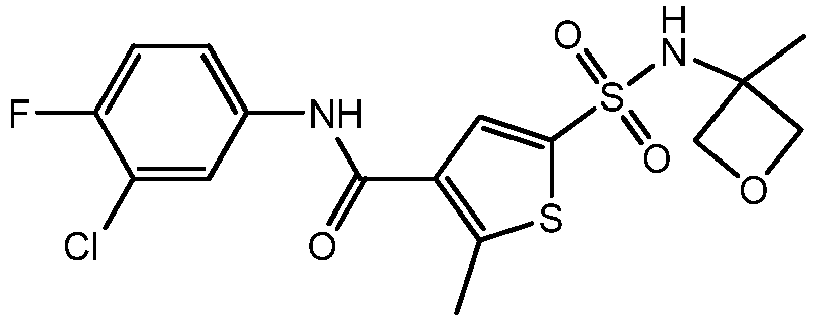
- Compound 28 (144 mg) was prepared similarly as described for compound 19, using 3-chloro-4-fluoroaniline instead of 3-chloro-4,5-difluoro-aniline. Method B; Rt: 1.01 min. m/z : 417 (M-H)-Exact mass: 418.0. 1 H NMR (400 MHz, DMSO-d6) δ ppm 1.55 (s, 3 H), 2.71 (s, 3 H), 4.19 (d, J=6.6 Hz, 2 H), 4.61 (d, J=6.2 Hz, 2 H), 7.41 (t, J=9.1 Hz, 1 H), 7.59 - 7.72 (m, 1 H), 7.95 - 8.06 (m, 2 H), 8.63 (s, 1 H), 10.31 (s, 1 H). DSC: From 30 to 300 °C at 10°C/min, peak: 209.9 °C.
-

- Compound 29 (146 mg) was prepared similarly as described for compound 19, using 3-bromo-4-fluoroaniline instead of 3-chloro-4,5-difluoro-aniline. Method B; Rt: 1.03 min. m/z: 461 (M-H)-Exact mass: 462.0. 1 H NMR (400 MHz, DMSO-d6) δ ppm 1.55 (s, 3 H), 2.72 (s, 3 H), 4.20 (d, J=6.4 Hz, 2 H), 4.61 (d, J=6.2 Hz, 2 H), 7.35 - 7.41 (m, 1 H), 7.70 (ddd, J=9.0, 4.4, 2.6 Hz, 1 H), 8.00 (s, 1 H), 8.10 - 8.15 (m, 1 H), 8.63 (s, 1 H), 10.29 (s, 1 H).
-

- 4-((3,4-difluorophenyl)carbamoyl)-5-methylthiophene-2-sulfonyl chloride (300 mg, 0.853 mmol) was dissolved in CH2Cl2(10 mL). Methyl 2-amino-2-methylpropanoate hydrochloride (158 mg, 1.03 mmol) and triethylamine (218 mg, 2.15 mmol) were added. The mixture was stirred at room temperature for 2 hours. The reaction mixture was poured into water, and the separated organic layer was washed with water, dried over Na2SO4 and evaporated to dryness resulting in an oil which was purified by preparative high performance liquid chromatography over RP-18 (eluent: CH3CN in H2O (0.1% HCl) from 20% to 60%, v/v). The pure fractions were collected and evaporated to dryness resulting in compound 30 (46.3 mg) as a white solid. Method C; Rt: 5.18 min. m/z : 433 (M+H)+ Exact mass: 432.1.
-

- Compound 31 was prepared similarly as described for compound 30 starting from 4-((4-fluoro-3-methylphenyl)carbamoyl)-5-methylthiophene-2-sulfonyl chloride instead of 4-((3,4-difluorophenyl)carbamoyl)-5-methylthiophene-2-sulfonyl chloride. Method C; Rt: 5.17 min. m/z : 429 (M+H)+ Exact mass: 428.1.
-

- Compound 30 (250 mg, 0.578 mmol) was dissolved in MeOH (5 mL) and H2O (5 mL), LiOH (46 mg, 1.92 mmol) was added. The mixture was stirred at room temperature for 12 hours. The reaction mixture was evaporated to dryness. The mixture was adjusted to pH 3-4 with HCl, and was poured into water (5mL), and was extracted with ethylacetate (10 mL) twice. The combined organic layers were washed with water and dried over Na2SO4. The organic layers was vaporated to dryness to provide a yellow oil (200 mg). This oil (200 mg, 0.478 mmol) HATU (272 mg, 0.715 mmol) and triethylamine (58 mg, 0.573 mmol) in DMF (5 mL) saturated with ammonia was stirred at room temperature for 2 hours. The reaction mixture was poured into water (3mL), and was extracted with ethylacetate (2 x 3 mL) . The combined organic layers were washed with water and dried over Na2SO4. The organic layers were evaporated to dryness to provide a yellow oil. The obtained residue was purified by preparative high performance liquid chromatography over RP-18 (eluent: CH3CN in H2O (0.1% FA) from 20% to 60%, v/v). The pure fractions were collected and evaporated to dryness to resulting in compound 32 (35 mg) as a white solid. Method C; Rt: 4.64 min. m/z : 418 (M+H)+ Exact mass: 417.1.
-

- Compound 33 (61 mg) was prepared similarly as described for compound 32, starting from compound 31 instead of compound 30.Method C; Rt: 4.64 min. m/z : 414 (M+H)+ Exact mass: 413.1. 1H NMR (400 MHz, DMSO-d6) δ ppm 1.34 (s, 6 H) 2.23 (d, J=1.8 Hz, 3 H) 2.69 (s, 3 H) 7.03-7.17 (m, 3 H) 7.45 - 7.55 (m, 1 H) 7.59 - 7.68 (m, 1 H) 7.90 - 8.03 (m, 2 H) 10.10 (s, 1 H)
-

- A mixture of 4-((3,4-difluorophenyl)carbamoyl)-5-methylthiophene-2-sulfonyl chloride (100 mg, 0.284 mmol), 1-(trifluoromethyl)cyclopropanamine (40 mg, 0.32 mmol) and pyridine (3 mL) was stirred at 30° C for 15 minutes. The mixture was concentrated in vacuo. The obtained residue was purified by high performance liquid chromatography (Column: ASBC18 150*25mm. HCl water B: MeCN.
The product fractions were collected and the organic solvent was evaporated. The fraction was neutralized by saturated NaHCO3. The mixture was extracted with dichloromethane (3 x 20 mL). The combined organic layers were dried over Na2SO4 and concentrated in vacuo resulting in compound 34 (36 mg). Method C; Rt: 5.51 min. m/z : 441 (M+H)+ Exact mass: 440.0. 1H NMR (400 MHz, DMSO-d6) δ ppm 1.06 - 1.33 (m, 4 H) 2.70 (s, 3 H) 7.31 - 7.56 (m, 2 H) 7.87 (ddd, J=13.2, 7.5, 2.1 Hz, 1 H) 7.99 (s, 1 H) 9.43 (s, 1 H) 10.37 (s, 1 H). -

- Compound 35 (15 mg) was prepared similarly as described for compound 34 starting from 4-((4-fluoro-3-methylphenyl)carbamoyl)-5-methylthiophene-2-sulfonyl chloride instead of 4-((3,4-difluorophenyl)carbamoyl)-5-methylthiophene-2-sulfonyl chloride. Method D; Rt: 4.17 min. m/z : 437 (M+H)+ Exact mass: 436.1. 1H NMR (400 MHz, DMSO-d6) δ ppm 1.09 - 1.30 (m, 4 H) 2.23 (d, J=1.5 Hz, 3 H) 2.70 (s, 3 H) 7.11 (t, J=9.2 Hz, 1 H) 7.47 - 7.57 (m, 1 H) 7.59 - 7.68 (m, 1 H) 7.98 (s, 1 H) 9.41 (s, 1 H) 10.14 (s, 1 H).
-

- 4-[(3-chloro-4,5-difluoro-phenyl)carbamoyl]-5-methyl-thiophene-2-sulfonyl chloride (400 mg, 1.036 mmol, purified via silica gel chromatography) was dispensed in acetonitrile (1 mL) and dried with molecular sieves 4A powder. (R)-1,1,1-trifluoro-2-propylamine (585.6 mg, 5.12 mmol was dissolved in acetonitrile (1 mL) and dried with molecular sieves 4A powder. The solutions were combined and stirred for 3 hours at 80°C. The reaction mixture was filtered and evaporated to dryness. The obtained residue was purified by silica gel chromatography using a heptane to EtOAc gradient resulting in compound 36 (372 mg) as a white powder. Method B; Rt: 1.19 min. m/z : 461 (M-H)- Exact mass: 462.0. 1H NMR (400 MHz, DMSO-d6) δ ppm 1.09 (d, J=7.0 Hz, 3 H), 2.73 (s, 3 H), 4.01 - 4.13 (m, 1 H), 7.75 - 7.86 (m, 2 H), 8.07 (s, 1 H), 8.86 (d, J=7.9 Hz, 1 H), 10.41 (s, 1 H).
-

- Compound 37 (48 mg) was prepared similarly as described for compound 36, using (S)-1,1,1-trifluoro-2-propylamine instead of (R)-1,1,1-trifluoro-2-propylamine.
Method B; Rt: 1.19 min. m/z : 461 (M-H)- Exact mass: 462.0. 1H NMR (400 MHz, DMSO-d6) δ ppm 1.09 (d, J=7.0 Hz, 3 H), 2.73 (s, 3 H), 3.98 - 4.14 (m, 1 H), 7.73 - 7.87 (m, 2 H), 8.07 (s, 1 H), 8.86 (d, J=8.6 Hz, 1 H), 10.41 (s, 1 H). -

- Compound 38 (223 mg) was prepared similarly as described for compound 36, using 4-[(3-chloro-4-fluoro-phenyl)carbamoyl]-5-methyl-thiophene-2-sulfonyl chloride instead of 4-[(3-chloro-4,5-difluoro-phenyl)carbamoyl]-5-methyl-thiophene-2-sulfonyl chloride, stirring overnight at 80°C. Method B; Rt: 1.13 min. m/z : 443 (M-H)- Exact mass: 444.0. 1H NMR (400 MHz, DMSO-d6) δ ppm 1.09 (d, J=6.8 Hz, 3 H), 2.72 (s, 3 H), 3.99 - 4.16 (m, 1 H), 7.42 (t, J=9.1 Hz, 1 H), 7.66 (ddd, J=9.0, 4.4, 2.6 Hz, 1 H), 8.02 (dd, J=6.9, 2.5 Hz, 1 H), 8.07 (s, 1 H), 8.84 (d, J=8.1 Hz, 1 H), 10.31 (s, 1 H).
-
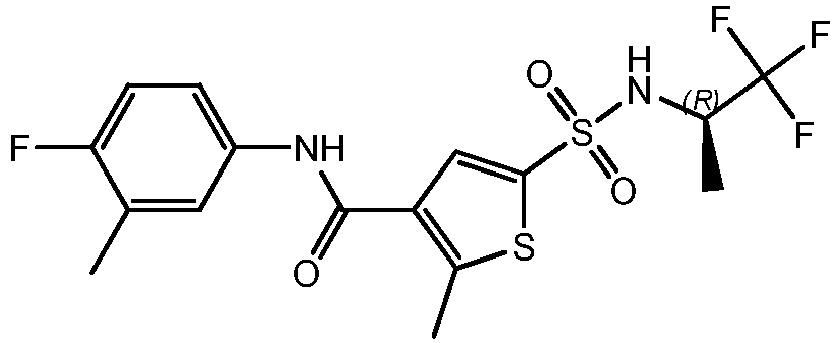
- Compound 39 (18 mg) was prepared similarly as described for compound 36, starting from 4-((4-fluoro-3-methylphenyl)carbamoyl)-5-methylthiophene-2-sulfonyl chloride instead of 4-[(3-chloro-4,5-difluoro-phenyl)carbamoyl]-5-methyl-thiophene-2-sulfonyl chloride. Method B; Rt: 1.09 min. m/z: 423 (M-H)- Exact mass: 424.1. 1H NMR (400 MHz, DMSO-d6) δ ppm 1.09 (d, J=6.8 Hz, 3 H), 2.24 (d, J=1.5 Hz, 3 H), 2.71 (s, 3 H), 4.07 (dt, J=14.5, 7.2 Hz, 1 H), 7.11 (t, J=9.1 Hz, 1 H), 7.48 - 7.56 (m, 1 H), 7.63 (dd, J=7.0, 2.4 Hz, 1 H), 8.05 (s, 1 H), 8.82 (br. s., 1 H), 10.11 (s, 1 H).
-

- Compound 40 (37 mg) was prepared similarly as described for compound 36, using 2,2,2-trifluoro-1,1-dimethyl-ethylamine instead of (R)-1,1,1-trifluoro-2-propylamine and stirring at 80°C overnight, followed by 15 hours more. Method B; Rt: 1.24 min. m/z: 475.0 (M-H)- Exact mass: 476.0. 1H NMR (400 MHz, DMSO-d6) δ ppm 1.39 (s, 6 H), 2.72 (s, 3 H), 7.75 - 7.86 (m, 2 H), 8.01 (s, 1 H), 8.73 (br. s., 1 H), 10.40 (s, 1 H).
- A mixture of 3-oxotetrahydrofuran (30 g, 348.5 mmol), benzylamine (39.2 g, 365.8 mmol), MgSO4 (21 g, 174.5 mmol) and CH2Cl2 (200 mL) was stirred at 28° C for 24 hours. The mixture was filtrated. The filtrate was concentrated in vacuo and the obtained residue (63.1 g) was used directly in the next step. The obtained residue (63 g) was dissolved in acetonitrile (600 mL). Trifluoroacetic acid (45 g, 394 mmol), potassium hydrogenfluoride (22.5 g, 288 mmol) and DMF (60 mL) were added to the mixture at 0°C. The mixture was stirred at 0° for 10 minutes. (trifluoromethyl)trimethylsilane (77 g, 541 mmol) was added to the reaction mixture and the mixture was stirred at ambient temperature for 12 h. Saturated aqueous Na2CO3 (200 mL) was added and the mixture was stirred for 5 min. The mixture was diluted with water (500 mL), and extracted with ethyl acetate (3 x 300 mL). The combined organic layers were washed with water and brine, dried over Na2SO4 and evaporated under reduced pressure. The obtained residue was dissolved in 2M HCl/MeOH and the solvent was evaporated. The resulting hydrochloride salt was crystallized from CH3CN to provide N-benzyl-3-(trifluoromethyl)tetrahydrofuran-3-amine (30.5 g). A mixture of N-benzyl-3-(trifluoromethyl)tetrahydrofuran-3-amine (30.5 g), palladium on alumina (1.5 g) and MeOH was stirred under H2 (20 psi) atmosphere at 28 °C for 12 hours. The mixture was filtered and the filtrate was concentrated in vacuo resulting in 3-(trifluoromethyl)tetrahydrofuran-3-amine hydrochloride (20.5 g). 1H NMR (400 MHz, DMSO-d6) δ ppm 2.21 - 2.43 (m, 2 H) 3.83 - 4.16 (m, 4 H) 9.68 (br. s., 3 H).
-

- A solution of 5-methyl-4-[[3-(trifluoromethyl)phenyl]carbamoyl]thiophene-2-sulfonyl chloride (800 mg, 2.08 mmol) in acetonitrile (10 mL) was sonicated for 10 minutes with molecular sieves 5A. A solution of 3-(trifluoromethyl)tetrahydrofuran-3-amine (420 mg) was also treated with molecular sieves in the same way. Both suspensions were then combined and heated 24 hours at 80°C. The mixture was filtered off and the filtrate was concentrated under vacuum. The residue was purified by high performance liquid chromatography (Column: Gemini C18 150*25mm*10 ul. A: base water B: MeCN. Flow Rate (mL/min): 25). The product fractions were collected and the organic solvent was evaporated. The aqueous layer was freeze-dried to give compound 41 (racemic, 24.1 mg). Method F; Rt: 4.59 min. m/z: 503.2 (M+H)+ Exact mass: 502.1. 1H NMR (400MHz, DMSO-d6) δ ppm 10.45 (s, 1H), 9.14 (br. s., 1H), 8.18 (s, 1H), 8.07 (s, 1H), 7.99 (d, J=8.8 Hz, 1H), 7.63 - 7.56 (m, 1H), 7.46 (d, J=7.8 Hz, 1H), 4.10 (d, J=10.8 Hz, 1H), 3.95 (d, J=10.3 Hz, 1H), 3.85 (m, J=4.5, 8.4 Hz, 1H), 3.61 (m, J=7.6 Hz, 1H), 2.73 (s, 3H), 2.45 (m, J=7.0 Hz, 1H), 2.30 - 2.20 (m, 1H).
-

- Compound 42 (23.4 mg) was prepared similarly as described for compound 41, using only 300 mg of 5-methyl-4-[[3-(trifluoromethyl)phenyl]carbamoyl]thiophene-2-sulfonyl chloride and 2,2,2-trifluoro-1,1-dimethyl-ethylamine (120 mg, 0.94 mmol) instead of 3-(trifluoromethyl)tetrahydrofuran-3-amine. Purification by high performance liquid chromatography (Column: ASB C18 150*25mm. A: HCl water B: MeCN. Flow Rate (mL/min): 25). Method D; Rt: 4.54 min. m/z: 475.0 (M+H)+ Exact mass: 474.1. 1H NMR (400MHz, DMSO-d6) δ ppm 10.48 (s, 1H), 8.74 (br. s., 1H), 8.19 (s, 1H), 8.06 (s, 1H), 7.99 (d, J=8.5 Hz, 1H), 7.59 (t, J=8.0 Hz, 1H), 7.46 (d, J=7.8 Hz, 1H), 2.73 (s, 3H), 1.39 (s, 6H).
-

- 5-chlorosulfonyl-2-methyl-thiophene-3-carbonyl chloride (2 g, 7.72 mmol) was dissolved in toluene (75 mL) and brought to reflux. 5-amino-2-fluorobenzonitrile (1.2 g, 6.41 mmol) was added portion wise in 2 minutes. After addition the reaction was refluxed for 1 hour. The reaction mixture was concentrated in vacuum yielding a crude powder (2.1 g) which was used as such. 4-((3-cyano-4-fluorophenyl)carbamoyl)-5-methylthiophene-2-sulfonyl chloride (500 mg, 1.39 mmol) was dissolved in CH2Cl2 (10 mL). 1,3-difluoro-2-propylamine hydrochloride (205 mg, 1.56 mmol) and triethylamine (350 mg, 3.46 mmol) were added and the mixture was stirred at room temperature for 2 hours. The reaction mixture was poured into water, and the separated organic layer was washed with water, dried over Na2SO4 and evaporated to dryness to provide an oil. The residue was purified by preparative high performance liquid chromatography over RP-18 (eluent: CH3CN in H2O (0.1% FA) from 20% to 60%, v/v). The pure fractions were collected and evaporated to dryness to provide compound 43 (133 mg) as a pale yellow solid. Method E; Rt: 5.23 min. m/z: 418.2 (M+H)+ Exact mass: 417.0. 1H NMR (400MHz, DMSO-d6) δ ppm 10.48 (s, 1H), 8.69 (br. s., 1H), 8.23 (dd, J=2.8, 5.8 Hz, 1H), 8.05 (s, 1H), 8.03-7.99 (m, 1H), 7.55 (t, J=9.2 Hz, 1H), 4.48 (dd, J=1.0, 5.3 Hz, 2H), 4.36 (dd, J=1.0, 5.3 Hz, 2H), 3.84 - 3.68 (m, 1H), 2.72 (s, 3H).
- 2-fluoro-3-methylbenzonitrile (18 g, 133 mmol) was added to a solution of potassium nitrate (13.5 g, 133 mmol) in sulfuric acid (250 mL) cooled at 0°C, the mixture was allowed to stir at room temperature for 40 minutes. The reaction mixture was poured into ice water and the pale yellow precipitate was filtered off and dried in the vacuum oven yielding crude 2-fluoro-3-methyl-5-nitro-benzonitrile (18 g). Crude 2-fluoro-3-methyl-5-nitro-benzonitrile (18 g) was stirred in MeOH (210 mL) and water (70 mL). Fe powder (16.7 g) and HCl (36 mL, 5 equiv) were added and the mixture was stirred at room temperature for 2 hours. The reaction mixture was then filtered through celite and after removal of organic solvent, the mixture was adjusted to pH 9 with saturated solution of sodium carbonate and extracted with CH2Cl2 twice. The combined organic layers were dried over sodium sulfate and evaporated to dryness to provide a yellow oil. The crude product was purified by column chromatography to provide 5-amino-2-fluoro-3-methyl-benzonitrile (5.1 g) as a pale yellow solid.
- 5-chlorosulfonyl-2-methyl-thiophene-3-carbonyl chloride (260 mg, 1 mmol) was dissolved in toluene (5 mL) and brought to reflux. 5-amino-2-fluoro-3-methyl-benzonitrile (150 mg, 1 mmol) was added. After addition the reaction was refluxed for 2 hours. The reaction mixture was concentrated in vacuum yielding a crude powder (400 mg) which was used as such.
-

- 4-[(3-cyano-4-fluoro-5-methyl-phenyl)carbamoyl]-5-methyl-thiophene-2-sulfonyl chloride (175 mg, 0.47 mmol) was dissolved in CH2Cl2 (10 mL). 3-methyloxetan-3-amine (52 mg, 0.6 mmol) and triethylamine (80 mg, 0.79 mmol) were added and the mixture was stirred at room temperature for 2 hours. The reaction mixture was poured into water, and the separated organic layer was washed with water, dried over Na2SO4 and evaporated to dryness to provide an oil. The residue was purified by preparative high performance liquid chromatography over RP-18 (eluent: CH3CN in H2O (0.1% FA) from 20% to 60%, v/v). The pure fractions were collected and evaporated to dryness to provide compound 44 (56.8 mg) as a white solid. Method G; Rt: 4.63 min. m/z: 441.1 (M+NH4)+ Exact mass: 423.1. 1H NMR (400MHz, DMSO-d6) δ ppm 10.37 (s, 1H), 8.65 (s, 1H), 8.04 - 7.88 (m, 3H), 4.61 (d, J=6.0 Hz, 2H), 4.19 (d, J=6.5 Hz, 2H), 2.72 (s, 3H), 2.30 (d, J=2.0 Hz, 3H), 1.55 (s, 3H).
-

- 5-chlorosulfonyl-2-methyl-thiophene-3-carbonyl chloride (1.5 g, 5.79 mmol) was dissolved in toluene (30 mL) and brought to reflux. 5-amino-2-fluorobenzonitrile (790 mg, 5.8 mmol) dissolved in toluene was added drop wise in 10 minutes. After addition the reaction was refluxed for 1 hour. The reaction mixture was concentrated in vacuum yielding a crude powder which was purified via silica gel chromatography using petroleumether:EtOAc 10:1 as eluent yielding 4-[(3-cyano-4-fluoro-phenyl)carbamoyl]-5-methyl-thiophene-2-sulfonyl chloride (1.2 g).
Compound 45 (28.9 mg) was further prepared similarly as described for compound 41, using 100 mg of 4-[(3-cyano-4-fluoro-phenyl)carbamoyl]-5-methyl-thiophene-2-sulfonyl chloride instead of 5-methyl-4-[[3-(trifluoromethyl)phenyl]carbamoyl]thiophene-2-sulfonyl chloride and 2,2,2-trifluoro-1,1-dimethyl-ethylamine (40 mg, 0.31 mmol) instead of 3-(trifluoromethyl)tetrahydrofuran-3-amine. Purification by high performance liquid chromatography (Column: ASB C18 150*25mm. A: HCl water B: MeCN. Flow Rate (mL/min): 25). Method E; Rt: 5.75 min. m/z: 450.2 (M+H)+ Exact mass: 449.1. 1H NMR (400MHz, DMSO-d6) δ ppm 10.53 (s, 1H), 8.76 (s, 1H), 8.23 (dd, J=2.5, 5.8 Hz, 1H), 8.05 - 7.98 (m, 2H), 7.54 (t, J=9.2 Hz, 1H), 2.72 (s, 3H), 1.38 (s, 6H). -

- Compound 46 (422.7 mg) was prepared similarly as described for compound 36, starting from 4-[(3-cyano-4-fluoro-phenyl)carbamoyl]-5-methyl-thiophene-2-sulfonyl chloride (500 mg, 1.39 mmol) and using (S)-1,1,1-trifluoro-2-propylamine (473 mg, 4.18 mmol) instead of (R)-1,1,1-trifluoro-2-propylamine. The obtained filtrate was evaporated to dryness and the residue was crystalized from CH2Cl2, triturated with diisopropylether and dried yielding compound 46 as a white powder. Method B; Rt: 1.03 min. m/z: 434 (M-H)- Exact mass: 435.0. 1H NMR (400 MHz, DMSO-d 6) δ ppm 1.09 (d, J=6.8 Hz, 3 H), 2.73 (s, 3 H), 4.01 - 4.13 (m, 1 H), 7.55 (t, J=9.1 Hz, 1 H), 8.01 (ddd, J=9.2, 4.9, 2.6 Hz, 1 H), 8.08 (s, 1 H), 8.22 (dd, J=5.8, 2.8 Hz, 1 H), 8.85 (d, J=8.8 Hz, 1 H), 10.46 (s, 1 H).
- 5-chlorosulfonyl-2-methyl-thiophene-3-carbonyl chloride (5 g, 19.3 mmol) was dissolved in toluene (20 mL) and brought to reflux. 3,4-difluoroaniline (2.5 g, 19.4 mmol) dissolved in toluene (1 mL) was drop wise during 1 minute. After addition the reaction was refluxed for 2 hours. The reaction mixture was concentrated in vacuum yielding 4-[(3,4-difluorophenyl)carbamoyl]-5-methyl-thiophene-2-sulfonyl chloride as a crude powder (6 g) which was used as such.
- (S)-2-((tert-butoxycarbonyl)amino)propanoic acid (39 g, 206 mmol), N,O-dimethylhydroxylamine hydrochloride (24 g, 246 mmol), HATU (117 g, 308 mmol) and N,N-diisopropylethylamine (66.3 g, 513 mmol) were dissolved in DMF (500 mL) and stirred at room temperature for 16 hours. The reaction mixture was poured into water (500 mL) and the formed precipitate was filtered off. The filter cake was washed with water (1 L) and dried to give tert-butyl N-[(1S)-2-[methoxy(methyl)amino]-1-methyl-2-oxo-ethyl]carbamate (36 g) as a white powder. tert-butyl N-[(1S)-2-[methoxy(methyl)amino]-1-methyl-2-oxo-ethyl]carbamate (35 g, 151 mmol) was dissolved in THF (500 mL) and cooled to 0°C. Methylmagnesium bromide (3.0 M in diethyl ether, 140 mL) was added and the reaction mixture was stirred 16 hours at room temperature. The reaction mixture was poored into water (100 mL) and evaporated to dryness. The residue was dissolved in EtOAc, washed with water, dried over Na2SO4, filtered and evaporated to dryness yielding tert-butyl N-[(1S)-1-methyl-2-oxopropyl]carbamate (22 g) as a white powder. To a cooled (-78°C) solution of tert-butyl N-[(1S)-1-methyl-2-oxo-propyl]carbamate (12 g, 64.1 mmol) in CH2Cl2 (200 mL) bis(2-methoxyethyl)-aminosulfur trifluoride (18.9 g, 117.5 mmol) was added. The reaction mixture was allowed to warm to room temperature and stirred overnight. The reaction mixture was poored into water and extracted with CH2Cl2. The organic layer was washed with water, dried over Na2SO4, filtered and evaporated to dryness. The obtained residue was purified by silica gel chromatography yielding tert-butyl N-[(1S)-2,2-difluoro-1-methyl-propyl]carbamate (5.8 g) as a pale yellow solid. Tert-butyl N-[(1S)-2,2-difluoro-1-methyl-propyl]carbamate (5.8 g, 27.7 mmol) was dissolved in EtOAc (100 mL). HCl (g) was bubbled through for 30 minutes and then the volatiles were removed under reduced pressure yielding (2S)-3,3-difluorobutan-2-amine hydrochloride (3.8 g) 1H NMR (400MHz, DMSO-d6) δ ppm 8.69 (br. s., 3H), 3.76 - 3.63 (m, 1H), 1.72 (t, J=19.7 Hz, 3H), 1.28 (d, J=6.8 Hz, 3H).
-

- To a solution of (S)-3,3-difluorobutan-2-amine hydrochloride (116.5mg, 0.8 mmol) and triethylamine (304 mg, 3 mmol) in CH2Cl2 (4 mL) was added drop wise a solution of 4-[(3,4-difluorophenyl)carbamoyl]-5-methyl-thiophene-2-sulfonyl chloride (250 mg, 0.71 mmol) in CH2Cl2 (4 mL). The reaction mixture was stirred for 12 hours at room temperature. The volatiles were removed under reduced pressure and the residue was purified by high performance liquid chromatography to give compound 47 (206 mg). Method F; Rt: 4.37 min. m/z: 425.0 (M+H)+ Exact mass: 424.1. 1H NMR (400MHz, DMSO-d6) δ ppm 10.35 (br. s, 1 H), 8.40 (br. s., 1 H), 8.04 (s, 1H), 7.92-7.86 (m, 1 H), 7.52 - 7.37 (m, 2 H), 3.68 - 3.52 (s., 1 H), 2.72 (s, 3 H), 1.59 (t, J = 19.2 Hz, 3 H), 0.98 (d, J = 6.8 Hz, 3 H).
- 5-chlorosulfonyl-2-methyl-thiophene-3-carbonyl chloride (1.66 g, 6.41 mmol) was dissolved in toluene (75 mL) and brought to reflux. 3-bromo-4-fluoroaniline (1.2 g, 6.41 mmol) was added portion wise in 2 minutes. After addition the reaction was refluxed for 2 hours. The reaction mixture was allowed to reach room temperature and the formed precipitate was filtered off yielding 4-[(3-bromo-4-fluoro-phenyl)carbamoyl]-5-methyl-thiophene-2-sulfonyl chloride as a brown powder (1.39g).
-

- Compound 48 (99.8 mg) was prepared similarly as described for compound 36, starting from 4-[(3-bromo-4-fluoro-phenyl)carbamoyl]-5-methyl-thiophene-2-sulfonyl chloride (250 mg, 0.61 mmol) instead of 4-[(3-chloro-4,5-difluoro-phenyl)carbamoyl]-5-methylthiophene-2-sulfonyl chloride and stirring overnight at 80°C. Method A; Rt: 2.06 min. m/z: 489 (M+H)+ Exact mass: 488.0. 1H NMR (400 MHz, DMSO-d6 ) δ ppm 1.09 (d, J=6.8 Hz, 3 H), 2.72 (s, 3 H), 4.00 - 4.14 (m, 1 H), 7.38 (t, J=8.8 Hz, 1 H), 7.70 (ddd, J=9.0, 4.4, 2.6 Hz, 1 H), 8.07 (s, 1 H), 8.13 (dd, J=6.4, 2.4 Hz, 1 H), 8.83 (d, J=8.6 Hz, 1 H), 10.30 (s, 1 H).
-

- Compound 49 (26.4 mg) was prepared similarly as described for compound 41, using 800 mg of 4-[(3,4-difluorophenyl)carbamoyl]-5-methyl-thiophene-2-sulfonyl chloride instead of 5-methyl-4-[[3-(trifluoromethyl)phenyl]carbamoyl]thiophene-2-sulfonyl chloride and 3-(trifluoromethyl)tetrahydrofuran-3-amine (460 mg). Purification by high performance liquid chromatography (Column: Gemini C18 150*25mm*10ul. A: base water B: MeCN. Flow Rate (mL/min): 25). Method E; Rt: 5.65 min. m/z: 471.2 (M+H)+ Exact mass: 470.0. 1H NMR (400MHz, DMSO-d6 ) δ ppm 10.35 (s, 1H), 9.14 (br. s., 1H), 8.01 (s, 1H), 7.88 (m, J=2.3, 7.6, 13.2 Hz, 1H), 7.50 - 7.38 (m, 2H), 4.09 (d, J=10.5 Hz, 1H), 3.95 (d, J=10.5 Hz, 1H), 3.85 (m, J=4.5, 8.5 Hz, 1H), 3.60 (m, J=7.8 Hz, 1H), 2.72 (s, 3H), 2.45 (m, J=7.0 Hz, 1H), 2.25 (m, J=8.1, 13.9 Hz, 1H).
-

- Compound 50 (62.9 mg) was prepared similarly as described for compound 42, using 4-[(3,4-difluorophenyl)carbamoyl]-5-methyl-thiophene-2-sulfonyl chloride (250 mg, 0.71 mmol) instead of 5-methyl-4-[[3-(trifluoromethyl)phenyl]carbamoyl]thiophene-2-sulfonyl chloride and 2,2,2-trifluoro-1,1-dimethyl-ethylamine (100 mg, 0.79 mmol). Method E; Rt: 5.92 min. m/z: 443.2 (M+H)+ Exact mass: 442.0. 1H NMR (400MHz, DMSO-d6 ) δ ppm 10.35 (s, 1H), 8.75 (br. s., 1H), 8.01 (s, 1H), 7.89 (ddd, J=2.5, 7.5, 13.3 Hz, 1H), 7.52 - 7.33 (m, 2H), 2.76 - 2.66 (m, 3H), 1.38 (s, 6H).
-

- Compound 51 (527.5 mg) was prepared similarly as described for compound 36, starting from 4-[(3-cyano-4-fluoro-phenyl)carbamoyl]-5-methyl-thiophene-2-sulfonyl chloride (500 mg, 1.39 mmol) and using (R)-1,1,1-trifluoro-2-propylamine (473 mg, 4.18 mmol). Method B; Rt: 1.03 min. m/z: 434 (M-H)- Exact mass: 435.0. 1H NMR (400 MHz, DMSO-d6 ) δ ppm 1.10 (d, J=7.0 Hz, 3 H), 2.74 (s, 3 H), 4.07 (dq, J=14.8, 7.4 Hz, 1 H), 7.55 (t, J=9.1 Hz, 1 H), 8.01 (ddd, J=9.2, 5.0, 2.8 Hz, 1 H), 8.08 (s, 1 H), 8.22 (dd, J=5.8, 2.8 Hz, 1 H), 8.86 (d, J=8.4 Hz, 1 H), 10.46 (s, 1 H).
-

- 4-[(3,4-difluorophenyl)carbamoyl]-5-methyl-thiophene-2-sulfonyl chloride (300 mg, 0.85 mmol) was dissolved in CH2Cl2 (10 mL). 1,3-difluoro-2-propylamine hydrochloride (124 mg, 0.94 mmol) and triethylamine (214 mg, 2.11 mmol) were added and the mixture was stirred at room temperature for 2 hours. The reaction mixture was poured into water, and the separated organic layer was washed with water, dried over Na2SO4 and evaporated to dryness to provide an oil. The residue was purified by preparative high performance liquid chromatography over RP-18 (eluent: CH3CN in H2O (0.1% FA) from 20% to 60%, v/v). The pure fractions were collected and evaporated to dryness to provide compound 52 (97.1 mg) as a white solid. Method E; Rt: 5.38 min. m/z: 411.1 (M+H)+ Exact mass: 410.0. 1H NMR (400MHz, DMSO-d6) δ ppm 10.35 (s, 1H), 8.67 (br. s, 1H), 8.03 (s, 1H), 7.91-7.86 (m, 1H), 7.52 - 7.36 (m, 2H), 4.48 (d, J=4.5 Hz, 2H), 4.36 (d, J=4.5 Hz, 2H), 3.84-3.69 (m, 1H), 2.71 (s, 3H).
-

- Compound 53 (39.6 mg) was prepared similarly as described for compound 36, starting from 4-[(3-cyano-4-fluoro-phenyl)carbamoyl]-5-methyl-thiophene-2-sulfonyl chloride (100 mg, 0.28 mmol) and 1-trifluoromethyl-1-cyclopropylamine (105 mg, 0.84 mmol) and additional heating for 16 hours at 100°C. Method A; Rt: 1.90 min. m/z: 448 (M+H)+ Exact mass: 447.0. 1H NMR (400 MHz, DMSO-d6 ) δ ppm 1.12 - 1.18 (m, 2 H), 1.21 - 1.29 (m, 2 H), 2.72 (s, 3 H), 7.55 (t, J=9.1 Hz, 1 H), 7.97 - 8.04 (m, 2 H), 8.22 (dd, J=5.9, 2.6 Hz, 1 H), 9.42 (s, 1 H), 10.46 (s, 1 H).
-

- Compound 54 (racemic, 46.5 mg) was prepared similarly as described for compound 41, using 4-[(3-cyano-4-fluoro-phenyl)carbamoyl]-5-methyl-thiophene-2-sulfonyl chloride (800 mg, 2.23 mmol) and 3-(trifluoromethyl)tetrahydrofuran-3-amine (460 mg). Purification by high performance liquid chromatography (Column: YMC-pack ODS-AQ 150*20mm*5um. A: base water B: MeCN. Flow Rate (mL/min): 25). Method G; Rt: 4.52 min. m/z: 495.0 (M+NH4)+ Exact mass: 477.0. 1H NMR (400MHz, DMSO-d6 ) δ ppm 10.47 (s, 1H), 9.15 (br. s., 1H), 8.22 (dd, J=2.5, 5.8 Hz, 1H), 8.07 - 7.97 (m, 2H), 7.55 (m, J=9.2 Hz, 1H), 4.09 (d, J=10.3 Hz, 1H), 3.95 (d, J=10.3 Hz, 1H), 3.85 (m, J=4.5, 8.3 Hz, 1H), 3.61 (m, J=7.5 Hz, 1H), 2.73 (s, 3H), 2.47 - 2.43 (m, 1H), 2.29 - 2.19 (m, 1H).
- (R)-2-((tert-butoxycarbonyl)amino)propanoic acid (30 g, 159 mmol), N,O-dimethylhydroxylamine hydrochloride (17.5 g, 178 mmol), HATU (74 g, 195 mmol) and N,N-diisopropylethylamine (30 g, 232 mmol) were dissolved in DMF (300 mL) and stirred at room temperature for 15 hours. The reaction mixture was concentrated under vacuum and the residue was dissolved in CH2Cl2 (500 mL) and washed with brine (3 x 200 mL). The organic layer was dried over Na2SO4 and concentrated in vacuo. The residue was purified via silica gel chromatography using petroleum ether:EtOAc 2:1 as eluent yielding tert-butyl N-[(1R)-2-[methoxy(methyl)amino]-1-methyl-2-oxo-ethyl]carbamate (28.9 g). tert-butyl N-[(1R)-2-[methoxy(methyl)amino]-1-methyl-2-oxo-ethyl]carbamate was dissolved in THF (300 mL) and cooled to 0°C. Methylmagnesium bromide 3.0 m in diethyl ether (85 mL, 255 mmol) was added drop wise and the reaction mixture was stirred 15 hours at room temperature. The reaction mixture was quenched with sat. NH4Cl and extracted with CH2Cl2 (3 x 100 mL). The combined organic layers were dried over Na2SO4, filtered and evaporated to dryness. The obtained residue was purified via silica gel chromatography yielding tert-butyl N-[(1R)-1-methyl-2-oxopropyl]carbamate (18.9 g). To a cooled (-78°C) solution of tert-butyl N-[(1R)-1-methyl-2-oxopropyl]carbamate (10 g, 53.4 mmol) in CH2Cl2 (200-mL) bis(2-methoxyethyl)aminosulfur trifluoride (18.9 g, 117.5 mmol) was added drop wise and stirring was continued for 2 hours at - 78°C. The reaction mixture was allowed to warm to room temperature and stirred overnight. The reaction mixture was quenched with sat. NaHCO3 and extracted with EtOAc. The combined organic layers were washed with brine, dried over MgSO4, filtered and evaporated to dryness.
- The residue was purified by silica gel chromatography using a gradient from petroleum ether to petroleum ether:EtOAc 1:1 yielding tert-butylN-[(1R)-2,2-difluoro-1-methyl-propyl]carbamate (6.77 g). Tert-butyl N-[(1R)-2,2-difluoro-1-methyl-propyl]carbamate (6.77 g) was dissolved in EtOAc (50 mL). HCl in EtOAc was added at 0°C and the reaction mixture was stirred for 4 hours at room temperature. The formed precipitate was filtered off and dried under high vacuum yielding (2R)-3,3-difluorobutan-2-amine hydrochloride (3.5 g).
-

- Compound 55 (186 mg) was prepared similarly as described for compound 47 using (2R)-3,3-difluorobutan-2-amine hydrochloride instead of (2S)-3,3-difluorobutan-2-amine hydrochloride and DIPEA instead of NEt3. The crude compound was purified by high-performance liquid chromatography (Column: ADIKMA Diamonsil(2) C18, 150*25*5um, Flow rate: 35mLl/min, Mobile Phase A: Purified water (containing 0.5% HCl), Mobile Phase B: CH3CN, Gradient: 53-83% (%B) and Supercritical Fluid Chromatography (Column: AD-250 ∼30mm, , Flow rate: 60 mL/min, Mobile Phase A: CO2/EtOH (0.1% NH3.H2O) 30%).1H NMR (400MHz, DMSO-d 6) δ : 10.34 (br. s, 1H), 8.44 (br. s., 1H), 8.03 (s, 1H), 7.92-7.82 (m, 1H), 7.52 - 7.37 (m, 2H), 3.68-3.52 (m., 1H), 2.72 (s,3H), 1.59 (t, J=19.0 Hz, 3H), 0.98 (d, J=6.8 Hz, 3H).
Method H; Rt: 5.23 min. m/z: 425.0 (M+H)+ Exact mass: 424.1. -

- Compound 56 (39.6 mg) was prepared similarly as described for compound 36, starting from 4-[(3,4-difluorophenyl)carbamoyl]-5-methyl-thiophene-2-sulfonyl chloride (130 mg, 0.37 mmol) instead of 4-[(3-chloro-4,5-difluoro-phenyl)carbamoyl]-5-methylthiophene-2-sulfonyl chloride and (R)-1,1,1-trifluoro-2-propylamine (125 mg, 1.11 mmol). Method B; Rt: 1.08 min. m/z: 427 (M-H)- Exact mass: 428.0. 1H NMR (400 MHz, DMSO-d6 ) δ ppm 1.09 (d, J=6.8 Hz, 3 H), 2.72 (s, 3 H), 4.02 - 4.13 (m, 1 H), 7.38 - 7.51 (m, 2 H), 7.88 (ddd, J=13.3, 7.5, 2.3 Hz, 1 H), 8.06 (s, 1 H), 8.83 (br. s., 1 H), 10.34 (s, 1 H).
- The anti-HBV activity was measured using a stable transfected cell line, HepG2.2.15. This cell line was described to secrete relatively consistent high levels of HBV virion particles, which have been shown to cause both acute and chronic infection and disease in chimpanzees.
For the antiviral, assay cells were treated twice for three days with serially diluted compound in 96-well plates in duplicate. After 6 days of treatment the antiviral activity was determined by quantification of purified HBV DNA from secreted virions using realtime PCR and an HBV specific primer set and probe.
The anti HBV activity was also measured using the HepG2.117 cell line, a stable, inducibly HBV producing cell line, which replicates HBV in the absence of doxicycline (Tet-off system). For the antiviral assay, HBV replication was induced, followed by a treatment with serially diluted compound in 96-well plates in duplicate. After 3 days of treatment, the antiviral activity was determined by quantification of intracellular HBV DNA using realtime PCR and an HBV specific primer set and probe.
Cytotoxicity of the compounds was tested using HepG2 cells, incubated for 4 days in the presence of compounds. The viability of the cells was assessed using a Resazurin assay. Results are displayed in Table 1.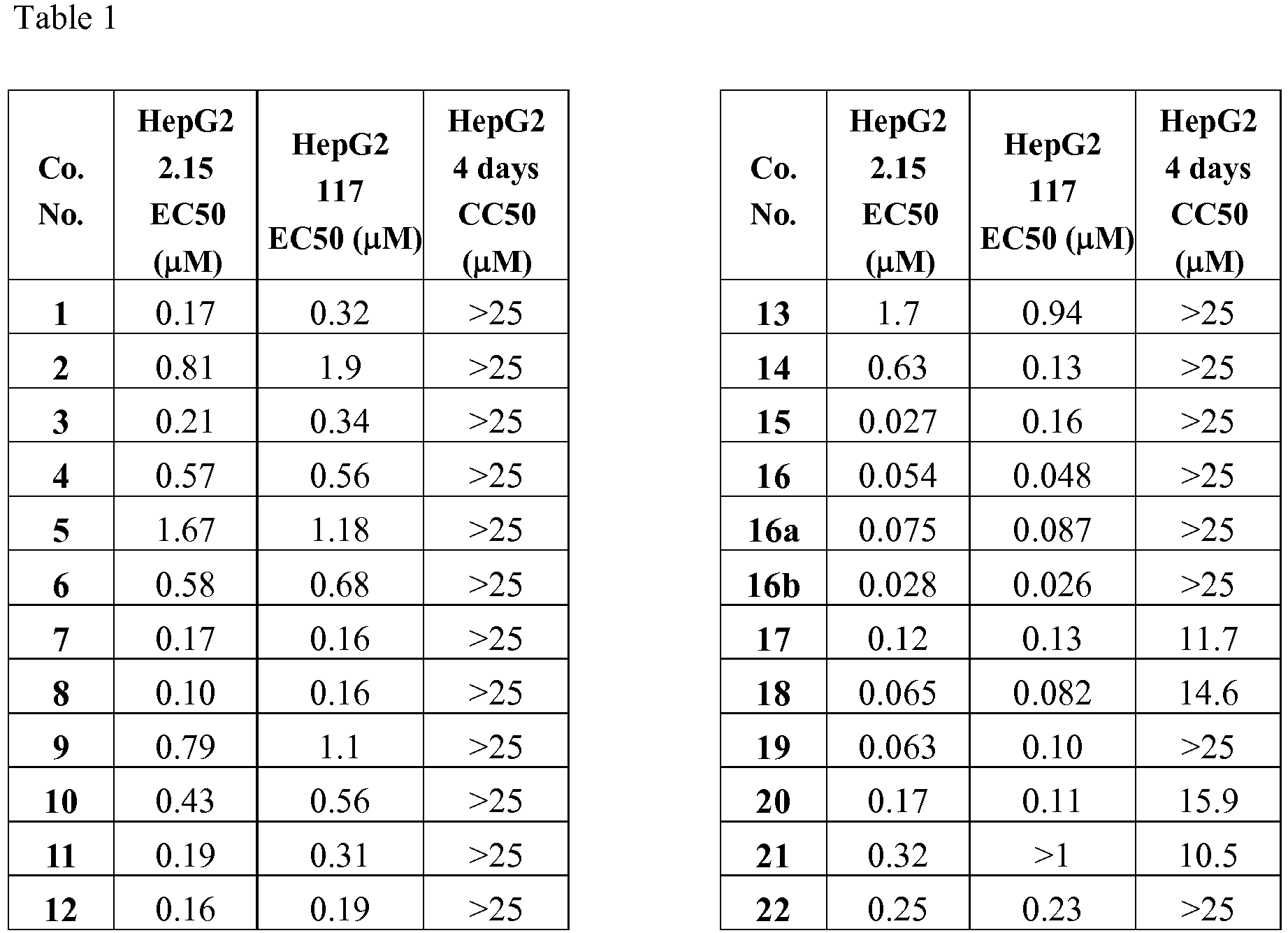

Claims (19)
- A compound of Formula (I)
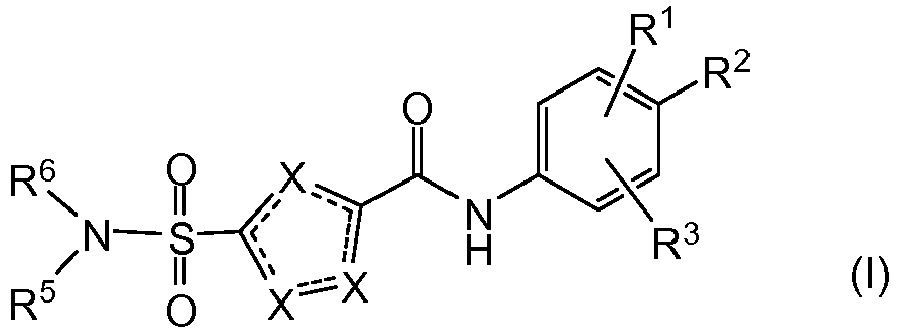 One X is S and the other two X represent CR4;R2 is Fluoro or Hydrogen;R1 and R3 are independently selected from the group consisting of Hydrogen, Fluoro, Chloro, Bromo, CHF2, CH2F, CF3, CN and methyl, wherein at least one of R1 and R3 is not Hydrogen and R1 and R3 are not ortho methyl or ortho Chloro;One R4 is Hydrogen, and the other R4 is selected from the group consisting of Hydrogen, halogen, C1-C3alkyl, cyclopropyl, CHF2, CH2F and CF3;R5 is Hydrogen;R6 is selected from the group consisting of C1-C6alkyl, C1-C3alkyl-R7 and a 3-7 membered saturated ring optionally containing one or more heteroatoms each independently selected from the group consisting of O, S and N, such 3-7 membered saturated ring or C1-C6alkyl optionally being substituted with one or more substituents each independently selected from the group consisting of Hydrogen, Fluoro, OH, CF3 and C1-C4alkyl;R7 is a 3-7 membered saturated ring optionally containing one or more heteroatoms each independently selected from the group consisting of O, S and N, or C(=O)-R8;R8 is selected from the group consisting of C1-C3alkoxy and-NH2;wherein if R1 is Methyl, R2 is Fluoro, and R3 is Hydrogen, R6 is not Methyl;or a pharmaceutically acceptable salt or a solvate thereof.
 - A compound according to claim 1, wherein R1 is selected from either Fluoro or methyl.
- A compound according to claim 1 or 2 according to Formula (II)

- A compound according to any one of the previous claims wherein at least 2 of R1 and R2 and R3 are Halogen.
- A compound according to any one of the previous claims wherein R1 is methyl and R2 is Fluoro.
- A compound according to any one of the previous claims wherein R6 contains a 3-7 membered saturated ring optionally containing one oxygen.
- A compound according to any one of the previous claims wherein R6 is a 4 or 5 membered saturated ring containing one oxygen.
- A compound according to any one of claims 1 to 5 wherein R6 is a branched C1-C6alkyl optionally substituted with one or more Fluoro.
- The compound according to claim 1, wherein the compound is


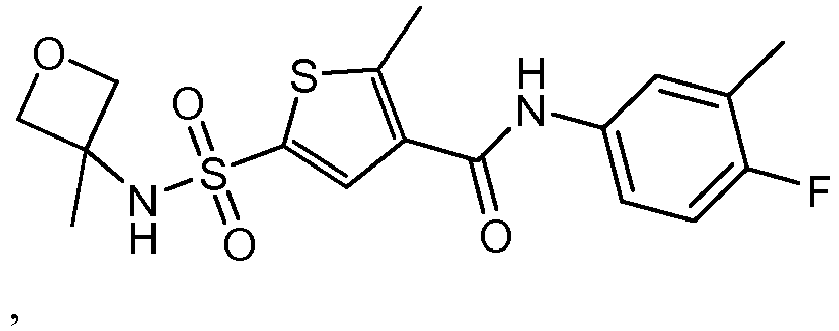

or an enantiomer thereof 


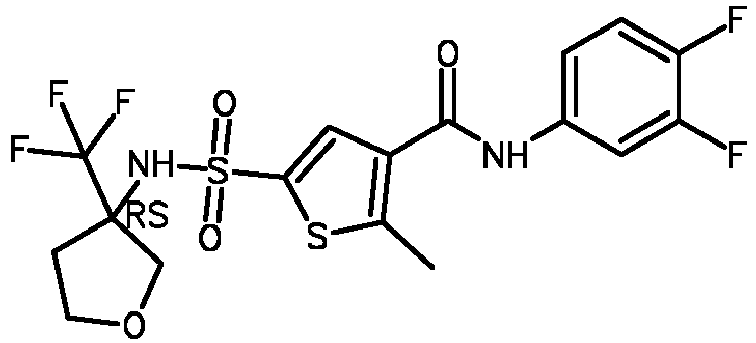
or an enantiomer thereof or an enantiomer thereof or - The compound according to claim 1, wherein the compound is

- The compound according to claim 1, wherein the compound is

- The compound according to claim 1, wherein the compound is

- The compound according to claim 1, wherein the compound is

- The compound according to claim 1, wherein the compound is

- The compound according to claim 1, wherein the compound is

- A compound according to any one of the previous claims for use as a medicament.
- A compound according to any one of claims 1 to 15 for use in the prevention or treatment of an HBV infection in a mammal.
- A pharmaceutical composition comprising a compound according to any of claims 1 to 15, and a pharmaceutically acceptable carrier.
- A product containing (a) a compound of formula (I) as defined in any one of claims 1 to 15, and (b) another HBV inhibitor, as a combined preparation for simultaneous, separate or sequential use in the treatment of HBV infections.
Priority Applications (7)
| Application Number | Priority Date | Filing Date | Title |
|---|---|---|---|
| PL14724109T PL2997019T3 (en) | 2013-05-17 | 2014-05-16 | Sulphamoylthiophenamide derivatives and the use thereof as medicaments for the treatment of hepatitis b |
| SM20180577T SMT201800577T1 (en) | 2013-05-17 | 2014-05-16 | Sulphamoylthiophenamide derivatives and the use thereof as medicaments for the treatment of hepatitis b |
| HRP20181863TT HRP20181863T1 (en) | 2013-05-17 | 2014-05-16 | Sulphamoylthiophenamide derivatives and the use thereof as medicaments for the treatment of hepatitis b |
| SI201430958T SI2997019T1 (en) | 2013-05-17 | 2014-05-16 | Sulphamoylthiophenamide derivatives and the use thereof as medicaments for the treatment of hepatitis b |
| RS20181358A RS57999B1 (en) | 2013-05-17 | 2014-05-16 | Sulphamoylthiophenamide derivatives and the use thereof as medicaments for the treatment of hepatitis b |
| EP14724109.5A EP2997019B1 (en) | 2013-05-17 | 2014-05-16 | Sulphamoylthiophenamide derivatives and the use thereof as medicaments for the treatment of hepatitis b |
| CY20181101182T CY1122337T1 (en) | 2013-05-17 | 2018-11-08 | SULPHAMOYLTHIOPHANAMIDE DERIVATIVES AND THEIR USE AS DRUGS FOR THE THERAPEUTIC TREATMENT OF HEPATITIS B |
Applications Claiming Priority (5)
| Application Number | Priority Date | Filing Date | Title |
|---|---|---|---|
| EP13168295 | 2013-05-17 | ||
| EP13185227 | 2013-09-19 | ||
| EP14157917 | 2014-03-05 | ||
| EP14724109.5A EP2997019B1 (en) | 2013-05-17 | 2014-05-16 | Sulphamoylthiophenamide derivatives and the use thereof as medicaments for the treatment of hepatitis b |
| PCT/EP2014/060132 WO2014184365A1 (en) | 2013-05-17 | 2014-05-16 | Sulphamoylthiophenamide derivatives and the use thereof as medicaments for the treatment of hepatitis b |
Publications (2)
| Publication Number | Publication Date |
|---|---|
| EP2997019A1 EP2997019A1 (en) | 2016-03-23 |
| EP2997019B1 true EP2997019B1 (en) | 2018-08-08 |
Family
ID=50729521
Family Applications (1)
| Application Number | Title | Priority Date | Filing Date |
|---|---|---|---|
| EP14724109.5A Active EP2997019B1 (en) | 2013-05-17 | 2014-05-16 | Sulphamoylthiophenamide derivatives and the use thereof as medicaments for the treatment of hepatitis b |
Country Status (22)
| Country | Link |
|---|---|
| US (1) | US10160743B2 (en) |
| EP (1) | EP2997019B1 (en) |
| JP (1) | JP6441315B2 (en) |
| CN (1) | CN105960400B (en) |
| AU (1) | AU2014267235B2 (en) |
| BR (1) | BR112015028538A2 (en) |
| CA (1) | CA2909742C (en) |
| CY (1) | CY1122337T1 (en) |
| DK (1) | DK2997019T3 (en) |
| EA (1) | EA035500B1 (en) |
| ES (1) | ES2695182T3 (en) |
| HR (1) | HRP20181863T1 (en) |
| HU (1) | HUE040446T2 (en) |
| IL (1) | IL242141B (en) |
| LT (1) | LT2997019T (en) |
| MX (1) | MX366787B (en) |
| PL (1) | PL2997019T3 (en) |
| PT (1) | PT2997019T (en) |
| RS (1) | RS57999B1 (en) |
| SI (1) | SI2997019T1 (en) |
| SM (1) | SMT201800577T1 (en) |
| WO (1) | WO2014184365A1 (en) |
Families Citing this family (123)
| Publication number | Priority date | Publication date | Assignee | Title |
|---|---|---|---|---|
| BR112014015197A8 (en) | 2011-12-21 | 2017-06-13 | Novira Therapeutics Inc | hepatitis b antiviral agents |
| KR102271574B1 (en) | 2012-08-28 | 2021-07-01 | 얀센 사이언시즈 아일랜드 언리미티드 컴퍼니 | Sulfamoyl-arylamides and the use thereof as medicaments for the treatment of hepatitis B |
| WO2014131847A1 (en) | 2013-02-28 | 2014-09-04 | Janssen R&D Ireland | Sulfamoyl-arylamides and the use thereof as medicaments for the treatment of hepatitis b |
| MX353412B (en) | 2013-04-03 | 2018-01-10 | Janssen Sciences Ireland Uc | N-phenyl-carboxamide derivatives and the use thereof as medicaments for the treatment of hepatitis b. |
| TWI733288B (en) | 2013-05-17 | 2021-07-11 | 愛爾蘭商健生科學愛爾蘭無限公司 | Sulphamoylpyrrolamide derivatives and the use thereof as medicaments for the treatment of hepatitis b |
| DK2997019T3 (en) | 2013-05-17 | 2018-12-03 | Janssen Sciences Ireland Uc | SULFAMOYLTHIOPHENAMIDE DERIVATIVES AND USE THEREOF AS MEDICINES FOR TREATING HEPATITIS B |
| HRP20180791T1 (en) | 2013-07-25 | 2018-09-07 | Janssen Sciences Ireland Uc | Glyoxamide substituted pyrrolamide derivatives and the use thereof as medicaments for the treatment of hepatitis b |
| CA2923712C (en) | 2013-10-23 | 2021-11-02 | Janssen Sciences Ireland Uc | Carboxamide derivatives and the use thereof as medicaments for the treatment of hepatitis b |
| US10392349B2 (en) | 2014-01-16 | 2019-08-27 | Novira Therapeutics, Inc. | Azepane derivatives and methods of treating hepatitis B infections |
| US9169212B2 (en) | 2014-01-16 | 2015-10-27 | Novira Therapeutics, Inc. | Azepane derivatives and methods of treating hepatitis B infections |
| CA2936947A1 (en) | 2014-02-05 | 2015-08-13 | Novira Therapeutics, Inc. | Combination therapy for treatment of hbv infections |
| TW201620893A (en) | 2014-02-06 | 2016-06-16 | 健生科學愛爾蘭無限公司 | Sulphamoylpyrrolamide derivatives and the use thereof as medicaments for the treatment of hepatitis B |
| ES2748029T3 (en) | 2014-03-13 | 2020-03-12 | Univ Indiana Res & Tech Corp | Allosteric modulators of hepatitis B core protein |
| JP2018510159A (en) | 2015-03-19 | 2018-04-12 | ノヴィラ・セラピューティクス・インコーポレイテッド | Azocan and azonan derivatives and methods for treating hepatitis B infection |
| US10442788B2 (en) | 2015-04-01 | 2019-10-15 | Enanta Pharmaceuticals, Inc. | Hepatitis B antiviral agents |
| WO2016183266A1 (en) | 2015-05-13 | 2016-11-17 | Enanta Pharmaceuticals, Inc. | Ehpatitis b antiviral agents |
| US10875876B2 (en) | 2015-07-02 | 2020-12-29 | Janssen Sciences Ireland Uc | Cyclized sulfamoylarylamide derivatives and the use thereof as medicaments for the treatment of hepatitis B |
| US10179131B2 (en) | 2015-07-13 | 2019-01-15 | Enanta Pharmaceuticals, Inc. | Hepatitis B antiviral agents |
| US10301255B2 (en) | 2015-07-22 | 2019-05-28 | Enanta Pharmaceuticals, Inc. | Hepatitis B antiviral agents |
| TWI721016B (en) | 2015-09-15 | 2021-03-11 | 美商艾森伯利生物科學公司 | Hepatitis b core protein modulators |
| TW201718496A (en) | 2015-09-29 | 2017-06-01 | 諾維拉治療公司 | Crystalline forms of a hepatitis B antiviral agent |
| WO2017136403A1 (en) | 2016-02-02 | 2017-08-10 | Enanta Pharmaceuticals, Inc. | Hepatitis b antiviral agents |
| KR102398439B1 (en) | 2016-03-07 | 2022-05-16 | 이난타 파마슈티칼스, 인코포레이티드 | Hepatitis B antiviral drugs |
| AU2017248828A1 (en) | 2016-04-15 | 2018-11-01 | Janssen Sciences Ireland Uc | Combinations and methods comprising a capsid assembly inhibitor |
| EA201892375A1 (en) | 2016-05-27 | 2019-08-30 | Джилид Сайэнс, Инк. | METHODS FOR TREATING INFECTIONS CAUSED BY HEPATITIS B VIRUS |
| CA3028228A1 (en) | 2016-06-10 | 2017-12-14 | Enanta Pharmaceuticals, Inc. | Hepatitis b antiviral agents |
| JOP20190024A1 (en) | 2016-08-26 | 2019-02-19 | Gilead Sciences Inc | Substituted pyrrolizine compounds and uses thereof |
| AU2017318601B2 (en) | 2016-09-02 | 2020-09-03 | Gilead Sciences, Inc. | Toll like receptor modulator compounds |
| WO2018045150A1 (en) | 2016-09-02 | 2018-03-08 | Gilead Sciences, Inc. | 4,6-diamino-pyrido[3,2-d]pyrimidine derivaties as toll like receptor modulators |
| AU2017326356A1 (en) | 2016-09-15 | 2019-04-11 | Assembly Biosciences, Inc. | Hepatitis B core protein modulators |
| KR20230010826A (en) | 2016-10-14 | 2023-01-19 | 프리시젼 바이오사이언시스 인코포레이티드 | Engineered meganucleases specific for recognition sequences in the hepatitis b virus genome |
| SG11201902944TA (en) | 2016-11-07 | 2019-05-30 | Arbutus Biopharma Corp | Substituted pyridinone-containing tricyclic compounds, and methods using same |
| TW202510891A (en) | 2017-01-31 | 2025-03-16 | 美商基利科學股份有限公司 | Crystalline forms of tenofovir alafenamide |
| CA3055194A1 (en) | 2017-03-02 | 2018-09-07 | Assembly Biosciences, Inc. | Cyclic sulfamide compounds and methods of using same |
| MA49014A (en) | 2017-03-21 | 2020-02-05 | Arbutus Biopharma Corp | DIHYDROINDENE-4-CARBOXAMIDES SUBSTITUTED, THEIR ANALOGUES AND PROCESSES FOR THEIR CORRESPONDING USE |
| BR102018007822A2 (en) | 2017-04-20 | 2018-11-06 | Gilead Sciences, Inc. | compound, methods for inhibiting pd-1, pd-11 and / or interaction of pd-1 / pd-11 and for cancer treatment, pharmaceutical composition, and kit for treating or preventing cancer or a disease or condition |
| SG11202001685TA (en) * | 2017-08-28 | 2020-03-30 | Enanta Pharm Inc | Hepatitis b antiviral agents |
| EA202091113A1 (en) | 2017-11-02 | 2020-08-28 | Айкурис Гмбх Унд Ко. Кг | NEW HIGHLY ACTIVE AMINOTHIAZOL SUBSTITUTED INDOL-2-CARBOXAMIDES ACTIVE AGAINST HEPATITIS B VIRUS (HBV) |
| KR20200083552A (en) | 2017-11-02 | 2020-07-08 | 아이쿠리스 게엠베하 운트 코. 카게 | New highly active pyrazolo-piperidine substituted indole-2-carboxamide active against hepatitis B virus (HBV) |
| WO2019113173A1 (en) | 2017-12-06 | 2019-06-13 | Enanta Pharmaceuticals, Inc. | Hepatitis b antiviral agents |
| WO2019113175A1 (en) | 2017-12-06 | 2019-06-13 | Enanta Pharmaceuticals, Inc. | Hepatitis b antiviral agents |
| WO2019123339A1 (en) | 2017-12-20 | 2019-06-27 | Institute Of Organic Chemistry And Biochemistry Ascr, V.V.I. | 2'3' cyclic dinucleotides with phosphonate bond activating the sting adaptor protein |
| EP3728283B1 (en) | 2017-12-20 | 2023-11-22 | Institute of Organic Chemistry and Biochemistry ASCR, V.V.I. | 3'3' cyclic dinucleotides with phosphonate bond activating the sting adaptor protein |
| US11058678B2 (en) | 2018-01-22 | 2021-07-13 | Enanta Pharmaceuticals, Inc. | Substituted heterocycles as antiviral agents |
| CR20200347A (en) | 2018-02-13 | 2020-09-23 | Gilead Sciences Inc | Pd-1/pd-l1 inhibitors |
| JP7050165B2 (en) | 2018-02-26 | 2022-04-07 | ギリアード サイエンシーズ, インコーポレイテッド | Substituted pyrrolidine compounds as HBV replication inhibitors |
| MX2020009531A (en) | 2018-03-14 | 2020-10-05 | Janssen Sciences Ireland Unlimited Co | Capsid assembly modulator dosing regimen. |
| WO2019191166A1 (en) | 2018-03-29 | 2019-10-03 | Enanta Pharmaceuticals, Inc. | Hepatitis b antiviral agents |
| US10870691B2 (en) | 2018-04-05 | 2020-12-22 | Gilead Sciences, Inc. | Antibodies and fragments thereof that bind hepatitis B virus protein X |
| TWI833744B (en) | 2018-04-06 | 2024-03-01 | 捷克科學院有機化學與生物化學研究所 | 3'3'-cyclic dinucleotides |
| TW202005654A (en) | 2018-04-06 | 2020-02-01 | 捷克科學院有機化學與生物化學研究所 | 2'2'-cyclic dinucleotides |
| TWI818007B (en) | 2018-04-06 | 2023-10-11 | 捷克科學院有機化學與生物化學研究所 | 2'3'-cyclic dinucleotides |
| US11142750B2 (en) | 2018-04-12 | 2021-10-12 | Precision Biosciences, Inc. | Optimized engineered meganucleases having specificity for a recognition sequence in the Hepatitis B virus genome |
| TWI712412B (en) | 2018-04-19 | 2020-12-11 | 美商基利科學股份有限公司 | Pd-1/pd-l1 inhibitors |
| US20190359645A1 (en) | 2018-05-03 | 2019-11-28 | Institute Of Organic Chemistry And Biochemistry Ascr, V.V.I. | 2'3'-cyclic dinucleotides comprising carbocyclic nucleotide |
| SG11202012425QA (en) | 2018-07-13 | 2021-01-28 | Gilead Sciences Inc | Pd-1/pd-l1 inhibitors |
| TWI826492B (en) | 2018-07-27 | 2023-12-21 | 加拿大商愛彼特生物製藥公司 | Substituted tetrahydrocyclopenta[c]pyrroles, substituted dihydropyrrolizines, analogues thereof, and methods using same |
| WO2020028097A1 (en) | 2018-08-01 | 2020-02-06 | Gilead Sciences, Inc. | Solid forms of (r)-11-(methoxymethyl)-12-(3-methoxypropoxy)-3,3-dimethyl-8-0x0-2,3,8,13b-tetrahydro-1h-pyrido[2,1-a]pyrrolo[1,2-c] phthalazine-7-c arboxylic acid |
| JP2022500466A (en) | 2018-09-21 | 2022-01-04 | エナンタ ファーマシューティカルズ インコーポレイテッド | Functionalized heterocycle as an antiviral agent |
| CA3117449A1 (en) * | 2018-10-22 | 2020-04-30 | Assembly Biosciences, Inc. | 5-membered heteroaryl carboxamide compounds for treatment of hbv |
| WO2020086556A1 (en) | 2018-10-24 | 2020-04-30 | Gilead Sciences, Inc. | Pd-1/pd-l1 inhibitors |
| US20210395751A1 (en) | 2018-10-31 | 2021-12-23 | The University Of Sydney | Compositions and methods for treating viral infections |
| US11203591B2 (en) | 2018-10-31 | 2021-12-21 | Gilead Sciences, Inc. | Substituted 6-azabenzimidazole compounds |
| WO2020092528A1 (en) | 2018-10-31 | 2020-05-07 | Gilead Sciences, Inc. | Substituted 6-azabenzimidazole compounds having hpk1 inhibitory activity |
| AR116946A1 (en) | 2018-11-02 | 2021-06-30 | Aicuris Gmbh & Co Kg | DERIVATIVES OF UREA 6,7-DIHIDRO-4H-PIRAZOLO [4,3-C] PYRIDINES ACTIVE AGAINST THE VIRUS OF HEPATITIS B (HBV) |
| PY1991611A (en) | 2018-11-02 | 2022-03-14 | Aicuris Gmbh & Co Kg | NEW UREA 6,7-DIHYDRO-4H-PYRAZOLE [1,5-A] PYRAZINES ACTIVE AGAINST HEPATITIS B VIRUS (HBV) |
| UY38437A (en) | 2018-11-02 | 2020-05-29 | Aicuris Gmbh & Co Kg | NEW UREA 6,7-DIHIDRO-4H-PIRAZOLO [1,5-A] PYRAZINES ACTIVE AGAINST THE HEPATITIS B VIRUS (HBV) |
| PY1991603A (en) | 2018-11-02 | 2020-09-17 | Aicuris Gmbh & Co Kg | NEW 6,7-DIHYDRO-4H-PYRAZOLE [1,5-A] PYRAZINE INDOLE -2-CARBOXAMIDES ACTIVE AGAINST HEPATITIS B VIRUS (HBV) |
| AR117189A1 (en) | 2018-11-02 | 2021-07-21 | Aicuris Gmbh & Co Kg | DERIVATIVES OF 6,7-DIHIDRO-4H-PIRAZOLO [1,5-A] PIRAZIN INDOL-2-CARBOXAMIDAS ACTIVE AGAINST THE VIRUS OF HEPATITIS B (HBV) |
| WO2020089460A1 (en) | 2018-11-02 | 2020-05-07 | Aicuris Gmbh & Co. Kg | Novel urea 6,7-dihydro-4h-thiazolo[5,4-c]pyridines active against the hepatitis b virus (hbv) |
| IL283190B2 (en) | 2018-11-21 | 2025-08-01 | Enanta Pharm Inc | Heterocyclics that function as antibiotic agents |
| TW202415643A (en) | 2018-12-12 | 2024-04-16 | 加拿大商愛彼特生物製藥公司 | Substituted arylmethylureas and heteroarylmethylureas, analogues thereof, and methods using same |
| WO2020169784A1 (en) | 2019-02-22 | 2020-08-27 | Janssen Sciences Ireland Unlimited Company | Amide derivatives useful in the treatment of hbv infection or hbv-induced diseases |
| EP3934757B1 (en) | 2019-03-07 | 2023-02-22 | Institute of Organic Chemistry and Biochemistry ASCR, V.V.I. | 2'3'-cyclic dinucleotides and prodrugs thereof |
| WO2020178770A1 (en) | 2019-03-07 | 2020-09-10 | Institute Of Organic Chemistry And Biochemistry Ascr, V.V.I. | 3'3'-cyclic dinucleotides and prodrugs thereof |
| WO2020178768A1 (en) | 2019-03-07 | 2020-09-10 | Institute Of Organic Chemistry And Biochemistry Ascr, V.V.I. | 3'3'-cyclic dinucleotide analogue comprising a cyclopentanyl modified nucleotide as sting modulator |
| TWI751516B (en) | 2019-04-17 | 2022-01-01 | 美商基利科學股份有限公司 | Solid forms of a toll-like receptor modulator |
| TW202212339A (en) | 2019-04-17 | 2022-04-01 | 美商基利科學股份有限公司 | Solid forms of a toll-like receptor modulator |
| BR112021021564A2 (en) | 2019-04-30 | 2022-01-04 | Aicuris Gmbh & Co Kg | Innovative indole-2-carboxamides active against hepatitis b virus (hbv) |
| JP2022533008A (en) | 2019-04-30 | 2022-07-21 | アイクリス ゲゼルシャフト ミット ベシュレンクテル ハフツング ウント コンパニー コマンディトゲゼルシャフト | A novel oxalyl piperazine that is active against hepatitis B virus (HBV) |
| US20220227785A1 (en) | 2019-04-30 | 2022-07-21 | Aicuris Gmbh & Co. Kg | Novel phenyl and pyridyl ureas active against the hepatitis b virus (hbv) |
| WO2020221824A1 (en) | 2019-04-30 | 2020-11-05 | Aicuris Gmbh & Co. Kg | Novel indolizine-2-carboxamides active against the hepatitis b virus (hbv) |
| AR119732A1 (en) | 2019-05-06 | 2022-01-05 | Janssen Sciences Ireland Unlimited Co | AMIDE DERIVATIVES USEFUL IN THE TREATMENT OF HBV INFECTION OR HBV-INDUCED DISEASES |
| EP3972695A1 (en) | 2019-05-23 | 2022-03-30 | Gilead Sciences, Inc. | Substituted exo-methylene-oxindoles which are hpk1/map4k1 inhibitors |
| BR112021023622A2 (en) | 2019-05-24 | 2022-04-19 | Assembly Biosciences Inc | Pharmaceutical compositions for the treatment of hbv |
| WO2020247444A1 (en) | 2019-06-03 | 2020-12-10 | Enanta Pharmaceuticals, Inc, | Hepatitis b antiviral agents |
| WO2020247561A1 (en) * | 2019-06-04 | 2020-12-10 | Enanta Pharmaceuticals, Inc, | Hepatitis b antiviral agents |
| WO2020247575A1 (en) | 2019-06-04 | 2020-12-10 | Enanta Pharmaceuticals, Inc. | Hepatitis b antiviral agents |
| WO2020263830A1 (en) | 2019-06-25 | 2020-12-30 | Gilead Sciences, Inc. | Flt3l-fc fusion proteins and methods of use |
| US11738019B2 (en) | 2019-07-11 | 2023-08-29 | Enanta Pharmaceuticals, Inc. | Substituted heterocycles as antiviral agents |
| US20220257619A1 (en) | 2019-07-18 | 2022-08-18 | Gilead Sciences, Inc. | Long-acting formulations of tenofovir alafenamide |
| WO2021034804A1 (en) | 2019-08-19 | 2021-02-25 | Gilead Sciences, Inc. | Pharmaceutical formulations of tenofovir alafenamide |
| CA3153358A1 (en) * | 2019-09-04 | 2021-03-11 | Taigen Biotechnology Co., Ltd. | Hepatitis b antiviral agents |
| US11236108B2 (en) | 2019-09-17 | 2022-02-01 | Enanta Pharmaceuticals, Inc. | Functionalized heterocycles as antiviral agents |
| DK4037708T3 (en) | 2019-09-30 | 2024-09-30 | Gilead Sciences Inc | HBV vaccines and methods of treating HBV |
| EP4245372A3 (en) * | 2019-11-13 | 2023-11-22 | Xi'An Xintong Pharmaceutical Research Co., Ltd. | Hbv inhibitor and use thereof |
| DK4069729T3 (en) | 2019-12-06 | 2025-04-07 | Prec Biosciences Inc | OPTIMIZED, MODIFIED MEGANUCLEASES WITH SPECIFICITY FOR A RECOGNITION SEQUENCE IN THE HEPATITIS B VIRUS GENOME |
| WO2021188414A1 (en) | 2020-03-16 | 2021-09-23 | Enanta Pharmaceuticals, Inc. | Functionalized heterocyclic compounds as antiviral agents |
| WO2021188959A1 (en) | 2020-03-20 | 2021-09-23 | Gilead Sciences, Inc. | Prodrugs of 4'-c-substituted-2-halo-2'-deoxyadenosine nucleosides and methods of making and using the same |
| WO2021216661A1 (en) | 2020-04-22 | 2021-10-28 | Assembly Biosciences, Inc. | Pyrazole carboxamide compounds for treatment of hbv |
| WO2021216660A1 (en) | 2020-04-22 | 2021-10-28 | Assembly Biosciences, Inc. | 5-membered heteroaryl carboxamide compounds for treatment of hbv |
| WO2021216642A1 (en) | 2020-04-22 | 2021-10-28 | Assembly Biosciences, Inc. | Pyrazole carboxamide compounds for treatment of hbv |
| CN121248511A (en) * | 2020-04-22 | 2026-01-02 | 组装生物科学股份有限公司 | 5-Membered heteroaryl carboxamides for the treatment of HBV |
| EP4192474B1 (en) | 2020-08-07 | 2025-09-10 | Gilead Sciences, Inc. | Prodrugs of phosphonamide nucleotide analogues and their pharmaceutical use |
| TW202406932A (en) | 2020-10-22 | 2024-02-16 | 美商基利科學股份有限公司 | Interleukin-2-fc fusion proteins and methods of use |
| WO2022241134A1 (en) | 2021-05-13 | 2022-11-17 | Gilead Sciences, Inc. | COMBINATION OF A TLR8 MODULATING COMPOUND AND ANTI-HBV siRNA THERAPEUTICS |
| JP7686091B2 (en) | 2021-06-23 | 2025-05-30 | ギリアード サイエンシーズ, インコーポレイテッド | Diacylglycerol kinase modulating compounds |
| JP7651018B2 (en) | 2021-06-23 | 2025-03-25 | ギリアード サイエンシーズ, インコーポレイテッド | Diacylglycerol kinase modulating compounds |
| AU2022299051B2 (en) | 2021-06-23 | 2025-03-13 | Gilead Sciences, Inc. | Diacylglyercol kinase modulating compounds |
| MX2023014762A (en) | 2021-06-23 | 2024-01-15 | Gilead Sciences Inc | DIACYL GLYCEROL KINASE MODULATING COMPOUNDS. |
| WO2023069544A1 (en) | 2021-10-20 | 2023-04-27 | Assembly Biosciences, Inc. | 5-membered heteroaryl carboxamide compounds for treatment of hbv |
| WO2023069545A1 (en) | 2021-10-20 | 2023-04-27 | Assembly Biosciences, Inc. | 5-membered heteroaryl carboxamide compounds for treatment of hbv |
| WO2023069547A1 (en) | 2021-10-20 | 2023-04-27 | Assembly Biosciences, Inc. | 5-membered heteroaryl carboxamide compounds for treatment of hbv |
| WO2023164179A1 (en) | 2022-02-25 | 2023-08-31 | Assembly Biosciences, Inc. | Benzothia(dia)zepine compounds for treatment of hbv and hdv |
| WO2023164186A1 (en) | 2022-02-25 | 2023-08-31 | Assembly Biosciences, Inc. | Benzothia(dia)zepine compounds for treatment of hbv and hdv |
| WO2023164181A1 (en) | 2022-02-25 | 2023-08-31 | Assembly Biosciences, Inc. | Benzothia(dia)zepine compounds for treatment of hbv and hdv |
| US20250163009A1 (en) | 2022-02-25 | 2025-05-22 | Assembly Biosciences, Inc. | Benzothia(dia)zepine compounds for treatment of hbv and hdv |
| WO2025043094A1 (en) | 2023-08-23 | 2025-02-27 | Assembly Biosciences, Inc. | Benzothia(dia)zepine compounds for treatment of hbv and hdv |
| WO2025240242A1 (en) | 2024-05-13 | 2025-11-20 | Gilead Sciences, Inc. | Combination therapies with ribavirin |
| WO2025240243A1 (en) | 2024-05-13 | 2025-11-20 | Gilead Sciences, Inc. | Combination therapies with bulevirtide and an inhibitory nucleic acid targeting hepatitis b virus |
| WO2025240246A1 (en) | 2024-05-13 | 2025-11-20 | Gilead Sciences, Inc. | Combination therapies with ribavirin |
| WO2025240244A1 (en) | 2024-05-13 | 2025-11-20 | Gilead Sciences, Inc. | Combination therapies comprising bulevirtide and lonafarnib for use in the treatment of hepatitis d virus infection |
| WO2026038156A1 (en) | 2024-08-15 | 2026-02-19 | Assembly Biosciences, Inc. | Novel crystalline forms |
Family Cites Families (146)
| Publication number | Priority date | Publication date | Assignee | Title |
|---|---|---|---|---|
| US3843662A (en) | 1971-12-09 | 1974-10-22 | Pfizer | 2-halo-5-(substituted piperidino sulfonyl)benzoic acids |
| AU1508183A (en) | 1982-06-04 | 1983-12-08 | Beecham Group Plc | Benzamide and anilide derivatives of 8-azabicyclo-(3.2.1)- -octane |
| JPS62142164A (en) | 1985-12-13 | 1987-06-25 | Ishihara Sangyo Kaisha Ltd | 4,5-dichloroimidazole based compound and pest controlling agent containing said compound |
| US5272167A (en) | 1986-12-10 | 1993-12-21 | Schering Corporation | Pharmaceutically active compounds |
| CA1339133C (en) | 1987-03-13 | 1997-07-29 | Rikuo Nasu | Imidazole compounds and biocidal composition comprising the same for controlling harmful organisms |
| US5571821A (en) | 1993-05-20 | 1996-11-05 | Texas Biotechnology Corporation | Sulfonamides and derivatives thereof that modulate the activity of endothelin |
| GB8904174D0 (en) | 1989-02-23 | 1989-04-05 | British Bio Technology | Compounds |
| US4962101A (en) | 1989-08-21 | 1990-10-09 | Merck & Co., Inc. | 2-(Heterocyclylalkyl)phenyl carbapenem antibacterial agents |
| GB9023082D0 (en) | 1990-10-24 | 1990-12-05 | Schering Agrochemicals Ltd | Fungicides |
| GB9109557D0 (en) | 1991-05-02 | 1991-06-26 | Wellcome Found | Chemical compounds |
| US5308826A (en) | 1993-04-22 | 1994-05-03 | Zeneca Limited | Herbicidal 4-substituted pyridyl-3-carbinols |
| GB9405347D0 (en) | 1994-03-18 | 1994-05-04 | Agrevo Uk Ltd | Fungicides |
| US5795907A (en) | 1994-05-27 | 1998-08-18 | James Black Foundation Limited | Gastin and CCK receptor ligands |
| DE69530081T2 (en) | 1994-05-27 | 2003-12-24 | James Black Foundation Ltd., London | GASTRIN AND CCK ANTAGONISTS |
| US5723411A (en) | 1995-10-31 | 1998-03-03 | E. I. Du Pont De Nemours And Company | Herbicidal pyridazinones |
| DE19540995A1 (en) | 1995-11-03 | 1997-05-07 | Hoechst Ag | Substituted sulfonimidamides, process for their preparation, their use as a medicament or diagnostic agent, and medicament containing them |
| GB9612884D0 (en) | 1996-06-20 | 1996-08-21 | Smithkline Beecham Plc | Novel compounds |
| EP0912550A1 (en) | 1996-06-25 | 1999-05-06 | Smithkline Beecham Plc | Sulfonamide derivatives as 5ht7 receptor antagonists |
| US5939423A (en) | 1997-04-16 | 1999-08-17 | Sciclone Pharmaceuticals, Inc. | Treatment of hepatitis B infection with thymosin alpha 1 and famciclovir |
| US5919970A (en) | 1997-04-24 | 1999-07-06 | Allergan Sales, Inc. | Substituted diaryl or diheteroaryl methanes, ethers and amines having retinoid agonist, antagonist or inverse agonist type biological activity |
| US5994396A (en) | 1997-08-18 | 1999-11-30 | Centaur Pharmaceuticals, Inc. | Furansulfonic acid derivatives and pharmaceutical compositions containing the same |
| TR200501553T2 (en) | 1999-01-15 | 2005-06-21 | Altana Pharma Ag | Phenylphenanthridines with PDE-IV inhibitory activity |
| ES2302697T3 (en) | 1999-08-10 | 2008-08-01 | The Chancellor, Masters And Scholars Of The University Of Oxford | LONG CHAIN N-ALQUILIC COMPOUNDS AND OXA DERIVATIVES OF THE SAME AND USE AS ANTIVIRAL COMPOSITIONS. |
| AR025884A1 (en) | 1999-10-01 | 2002-12-18 | Takeda Pharmaceutical | CYCLINE AMINE COMPOUNDS, ITS PRODUCTION AND USE |
| YU41202A (en) | 1999-12-28 | 2005-03-15 | Pfizer Products Inc. | Non-peptidyl inhibitors of vla-4 dependent cell binding useful in treating inflammatory, autoimmune and respiratory diseases |
| EP1193268A1 (en) | 2000-09-27 | 2002-04-03 | Applied Research Systems ARS Holding N.V. | Pharmaceutically active sulfonamide derivatives bearing both lipophilic and ionisable moieties as inhibitors of protein Junkinases |
| US7115595B2 (en) | 2000-12-27 | 2006-10-03 | Dainippon Sumitomo Pharma Co., Ltd. | Carbapenem compounds |
| AU2002248418A1 (en) | 2001-02-09 | 2002-08-28 | Massachusetts Institute Of Technology | Methods of identifying agents that mediate polypeptide aggregation |
| US6650463B2 (en) | 2001-03-13 | 2003-11-18 | Seiko Epson Corporation | Electrophoretic display device |
| NZ528820A (en) | 2001-04-19 | 2007-01-26 | Eisai Co Ltd | 2-iminopyrrolidine derivatives |
| KR100713137B1 (en) | 2001-06-28 | 2007-05-02 | 동화약품공업주식회사 | Novel 2,4-difluorobenzamide derivatives |
| DE10136043A1 (en) | 2001-07-25 | 2003-02-13 | Degussa | Process for the production of modified carbon black |
| US6956035B2 (en) | 2001-08-31 | 2005-10-18 | Inotek Pharmaceuticals Corporation | Isoquinoline derivatives and methods of use thereof |
| EP1512396A4 (en) | 2002-06-05 | 2008-12-31 | Inst Med Molecular Design Inc | INHIBITORS OF AP-1 AND NFAT ACTIVATION |
| AU2003243921B2 (en) | 2002-06-27 | 2009-05-07 | Novo Nordisk A/S | Aryl carbonyl derivatives as therapeutic agents |
| RU2340605C2 (en) | 2002-06-27 | 2008-12-10 | Ново Нордиск А/С | Arylcarbonyl derivatives as therapeutic agents |
| US7338956B2 (en) | 2002-08-07 | 2008-03-04 | Sanofi-Aventis Deutschland Gmbh | Acylamino-substituted heteroaromatic compounds and their use as pharmaceuticals |
| US7186735B2 (en) | 2002-08-07 | 2007-03-06 | Sanofi-Aventis Deutschland Gmbh | Acylated arylcycloalkylamines and their use as pharmaceuticals |
| EP1541172A1 (en) | 2002-08-09 | 2005-06-15 | Ajinomoto Co., Inc. | Remedy for intestinal diseases and visceral pain |
| US20040110802A1 (en) | 2002-08-23 | 2004-06-10 | Atli Thorarensen | Antibacterial benzoic acid derivatives |
| SE0202838D0 (en) | 2002-09-24 | 2002-09-24 | Astrazeneca Ab | Chemical compounds |
| US7320989B2 (en) | 2003-02-28 | 2008-01-22 | Encysive Pharmaceuticals, Inc. | Pyridine, pyrimidine, quinoline, quinazoline, and naphthalene urotensin-II receptor antagonists |
| EP1605752B1 (en) | 2003-03-27 | 2011-09-14 | Cytokinetics, Inc. | Sulfonamides for the treatment of congestive heart failure, their compositions and uses. |
| WO2004101562A2 (en) | 2003-05-13 | 2004-11-25 | Schering Corporation | Bridged n-arylsulfonylpiperidines as gamma-secretase inhibitors |
| EP1651595A2 (en) | 2003-05-30 | 2006-05-03 | Rigel Pharmaceuticals, Inc. | Ubiquitin ligase inhibitors |
| US20110275630A1 (en) | 2003-06-02 | 2011-11-10 | Abbott Laboratories | Isoindolinone kinase inhibitors |
| AR045047A1 (en) | 2003-07-11 | 2005-10-12 | Arena Pharm Inc | ARILO AND HETEROARILO DERIVATIVES TRISUSTITUIDOS AS MODULATORS OF METABOLISM AND PROFILAXIS AND TREATMENT OF DISORDERS RELATED TO THEMSELVES |
| US8084457B2 (en) | 2003-09-15 | 2011-12-27 | Lead Discovery Center Gmbh | Pharmaceutically active 4,6-disubstituted aminopyrimidine derivatives as modulators of protein kinases |
| US7498050B2 (en) | 2003-12-15 | 2009-03-03 | Kraft Foods Global Brands Llc | Edible spread composition and packaged product |
| DE102004009238A1 (en) | 2004-02-26 | 2005-09-08 | Merck Patent Gmbh | New aryl amide compounds are kinase inhibitors useful for the treatment and/or prophylaxis of e.g. tumors, psoriasis, rheumatoid arthritis, contact dermatitis, inflammations, endometriosis, scar and benign prostatic hyperplasia |
| WO2005087217A1 (en) | 2004-03-05 | 2005-09-22 | The General Hospital Corporation | Compositions and methods for modulating interaction between polypeptides |
| US20090105218A1 (en) | 2004-05-29 | 2009-04-23 | 7Tm Pharma A/S | CRTH2 Receptor Ligands For Therapeutic Use |
| MX2007000015A (en) | 2004-06-22 | 2007-03-07 | Schering Corp | Cannabinoid receptor ligands. |
| CA2573426C (en) | 2004-07-30 | 2015-11-17 | Exelixis, Inc. | Pyrrole derivatives as pharmaceutical agents |
| DE102004042441A1 (en) | 2004-08-31 | 2006-04-06 | Sanofi-Aventis Deutschland Gmbh | Amino acid substituted hexahydro-pyrazino (1,2-a) pyrimidine-4,7-dione derivatives, process for their preparation and their use as medicaments |
| JP2008515986A (en) | 2004-10-13 | 2008-05-15 | ワイス | N-benzenesulfonyl substituted anilino-pyrimidine analogues |
| EP2275412A1 (en) | 2004-10-19 | 2011-01-19 | Novartis Vaccines and Diagnostics, Inc. | Indole and benzimidazole derivatives |
| US20060122236A1 (en) | 2004-12-06 | 2006-06-08 | Wood Michael R | Substituted biaryl-carboxylate derivatives |
| US7790726B2 (en) | 2005-08-16 | 2010-09-07 | Chemocentryx, Inc. | Monocyclic and bicyclic compounds and methods of use |
| CA2633541A1 (en) | 2005-12-12 | 2007-06-21 | Genelabs Technologies, Inc. | N-(6-membered aromatic ring)-amido anti-viral compounds |
| AU2006331770A1 (en) | 2005-12-21 | 2007-07-05 | Schering Corporation | Treatment of nonalcoholic fatty liver disease using cholesterol lowering agents and H3 receptor antagonist/inverse agonist |
| EP1981849A1 (en) | 2005-12-29 | 2008-10-22 | LEK Pharmaceuticals D.D. | Heterocyclic compounds |
| EP2019830A4 (en) | 2006-05-04 | 2011-01-19 | Inst Hepatitis & Virus Res | INHIBITORS OF SECRETION OF HEPATITIS B VIRUS ANTIGENS FOR THE TREATMENT OF CHRONIC HEPATITIS VIRUS |
| US8153803B2 (en) | 2006-07-18 | 2012-04-10 | The General Hospital Corporation | Compositions and methods for modulating sirtuin activity |
| FR2903985B1 (en) | 2006-07-24 | 2008-09-05 | Sanofi Aventis Sa | N- (AMINO-HETEROARYL) -1H-INDOLE-2-CARBOXAMIDE DERIVATIVES, THEIR PREPARATION AND THEIR THERAPEUTIC USE |
| FR2904316B1 (en) | 2006-07-31 | 2008-09-05 | Sanofi Aventis Sa | N- (AMINO-HETEROARYL) -1H-INDOLE-2-CARBOXAMIDE DERIVATIVES, THEIR PREPARATION AND THEIR THERAPEUTIC USE. |
| WO2008022171A1 (en) | 2006-08-17 | 2008-02-21 | Boehringer Ingelheim International Gmbh | Methods of using aryl sulfonyl compounds effective as soluble epoxide hydrolase inhibitors |
| WO2008076270A2 (en) | 2006-12-13 | 2008-06-26 | Temple University-Of The Commonwealth System Of Higher Education | Sulfide, sulfoxide and sulfone chalcone analogues, derivatives thereof and therapeutic uses thereof |
| US8071779B2 (en) | 2006-12-18 | 2011-12-06 | Inspire Pharmaceuticals, Inc. | Cytoskeletal active rho kinase inhibitor compounds, composition and use |
| US20100022517A1 (en) | 2006-12-18 | 2010-01-28 | Richards Lori A | Ophthalmic formulation of rho kinase inhibitor compound |
| FR2910473B1 (en) | 2006-12-26 | 2009-02-13 | Sanofi Aventis Sa | N- (AMINO-HETEROARYL) -1H-PYRROLOPYRIDINE-2-CARBOXAMIDE DERIVATIVES, THEIR PREPARATION AND THEIR THERAPEUTIC USE. |
| CA2681162C (en) | 2007-03-15 | 2015-11-24 | Novartis Ag | Benzyl and pyridine derivatives as modulators of hedgehog pathway |
| US8097728B2 (en) | 2007-04-30 | 2012-01-17 | Philadelphia Health & Education Corporation | Iminosugar compounds with antiflavirus activity |
| WO2008154819A1 (en) | 2007-06-18 | 2008-12-24 | Zhang, Zhongneng | Carbethoxy-substituted thiazolyl dihydropyrimidines |
| US8597949B2 (en) | 2007-07-28 | 2013-12-03 | The University Of Chicago | Methods and compositions for modulating RAD51 and homologous recombination |
| CN101765425A (en) | 2007-08-02 | 2010-06-30 | 弗·哈夫曼-拉罗切有限公司 | Use of benzamide derivatives for the treatment of CNS disorders |
| WO2009086303A2 (en) | 2007-12-21 | 2009-07-09 | University Of Rochester | Method for altering the lifespan of eukaryotic organisms |
| FR2926554B1 (en) | 2008-01-22 | 2010-03-12 | Sanofi Aventis | AZABICYCLIC CARBOXAMIDE DERIVATIVES, THEIR PREPARATION AND THERAPEUTIC USE THEREOF |
| FR2926556B1 (en) | 2008-01-22 | 2010-02-19 | Sanofi Aventis | N-AZABICYCLIC CARBOXAMIDE DERIVATIVES, THEIR PREPARATION AND THEIR THERAPEUTIC APPLICATION |
| FR2926555B1 (en) | 2008-01-22 | 2010-02-19 | Sanofi Aventis | BICYCLIC DERIVATIVES OF AZABICYCLIC CARBOXAMIDES, THEIR PREPARATION AND THEIR THERAPEUTIC USE |
| FR2926553B1 (en) | 2008-01-23 | 2010-02-19 | Sanofi Aventis | SILANYL SUBSTITUTED INDOLE-2-CARBOXAMIDE AND AZAINDOLE-2-CARBOXAMIDE DERIVATIVES, THEIR PREPARATION AND THEIR THERAPEUTIC USE |
| CU20080028A6 (en) | 2008-02-29 | 2011-02-24 | Ct Ingenieria Genetica Biotech | CHEMICAL COMPOUNDS OBTAINED IN SILICO FOR THE PREPARATION OF PHARMACEUTICAL COMPOSITIONS TO ATTENE OR INHIBIT INFECTION BY DENGUE VIRUSES AND OTHER FLAVIVIRUS |
| ES2527589T3 (en) | 2008-04-24 | 2015-01-27 | Msd K.K. | Long chain fatty acid elongation enzyme inhibitor comprising an arylsulfonyl derivative as active ingredient |
| US20100008968A1 (en) | 2008-06-26 | 2010-01-14 | Lampe John W | Method for treating cardiovascular diseases using rho kinase inhibitor compounds |
| WO2009158587A1 (en) | 2008-06-26 | 2009-12-30 | Inspire Pharmaceuticals, Inc. | Method for treating pulmonary diseases using rho kinase inhibitor compounds |
| US20090325960A1 (en) | 2008-06-26 | 2009-12-31 | Fulcher Emilee H | Method for treating inflammatory diseases using rho kinase inhibitor compounds |
| US8207195B2 (en) | 2008-06-26 | 2012-06-26 | Inspire Pharmaceuticals, Inc. | Method for treating neurological and neuropathic diseases using rho kinase inhibitor compounds |
| US20090325959A1 (en) | 2008-06-26 | 2009-12-31 | Vittitow Jason L | Method for treating ophthalmic diseases using rho kinase inhibitor compounds |
| US8410147B2 (en) | 2008-06-26 | 2013-04-02 | Inspire Pharmaceuticals, Inc. | Method for treating diseases associated with alterations in cellular integrity using Rho kinase inhibitor compounds |
| WO2010027996A1 (en) | 2008-09-02 | 2010-03-11 | Institute For Hepatitis And Virus Research | Novel imino sugar derivatives demonstrate potent antiviral activity and reduced toxicity |
| US8143269B2 (en) | 2008-10-03 | 2012-03-27 | Calcimedica, Inc. | Inhibitors of store operated calcium release |
| AR074199A1 (en) | 2008-11-20 | 2010-12-29 | Glaxosmithkline Llc | COMPOSITE OF 6- (4-PYRIMIDINYL) -1H-INDAZOL, PHARMACEUTICAL COMPOSITIONS THAT INCLUDE IT AND ITS USE TO PREPARE A USEFUL MEDICINAL PRODUCT FOR THE TREATMENT OR DECREASE OF CANCER GRAVITY. |
| US20100204210A1 (en) | 2008-12-04 | 2010-08-12 | Scott Sorensen | Method for treating pulmonary diseases using rho kinase inhibitor compounds |
| US8273754B2 (en) | 2008-12-30 | 2012-09-25 | Arqule, Inc. | Substituted 1H-pyrazolo[3,4-D]pyrimidine-6-amine compounds |
| WO2010123139A1 (en) * | 2009-04-24 | 2010-10-28 | 持田製薬株式会社 | Arylcarboxamide derivative having sulfamoyl group |
| US8822700B2 (en) | 2009-09-11 | 2014-09-02 | Enanta Pharmaceuticals, Inc. | Hepatitis C virus inhibitors |
| US8703938B2 (en) | 2009-09-11 | 2014-04-22 | Enanta Pharmaceuticals, Inc. | Hepatitis C virus inhibitors |
| WO2011058766A1 (en) | 2009-11-16 | 2011-05-19 | Raqualia Pharma Inc. | Aryl carboxamide derivatives as ttx-s blockers |
| CN102206172B (en) | 2010-03-30 | 2015-02-25 | 中国医学科学院医药生物技术研究所 | Substituted diaryl compound and preparation method and antiviral application thereof |
| EA023788B1 (en) | 2010-05-07 | 2016-07-29 | ГЛЭКСОСМИТКЛАЙН ЭлЭлСи | Indole derivatives and pharmaceutical compositions based thereon |
| WO2011163593A2 (en) | 2010-06-25 | 2011-12-29 | Philadelphia Health & Education Corporation D/B/A Drexel | Induction of immune response |
| JP2013531063A (en) | 2010-07-19 | 2013-08-01 | インスパイアー ファーマシューティカルズ,インコーポレイティド | Bifunctional Rho kinase inhibitory compounds, compositions and uses thereof |
| EP2597953A4 (en) | 2010-07-27 | 2013-12-25 | Inspire Pharmaceuticals Inc | METHOD OF TREATING OPHTHALMIC DISEASES USING KIDNEY INHIBITOR COMPOUNDS AS DRUGS |
| US8921381B2 (en) | 2010-10-04 | 2014-12-30 | Baruch S. Blumberg Institute | Inhibitors of secretion of hepatitis B virus antigens |
| US8889716B2 (en) | 2011-05-10 | 2014-11-18 | Chdi Foundation, Inc. | Transglutaminase TG2 inhibitors, pharmaceutical compositions, and methods of use thereof |
| JP5977347B2 (en) * | 2011-07-01 | 2016-08-24 | バルーク エス.ブルームバーグ インスティテュート | Sulfamoylbenzamide derivatives as antiviral agents against HBV infection |
| BR112014015197A8 (en) | 2011-12-21 | 2017-06-13 | Novira Therapeutics Inc | hepatitis b antiviral agents |
| ES2575398T3 (en) | 2012-03-31 | 2016-06-28 | F. Hoffmann-La Roche Ag | Novel 4-Methyl-dihydropyrimidines for the treatment and prophylaxis of hepatitis B virus infection |
| US20130267517A1 (en) | 2012-03-31 | 2013-10-10 | Hoffmann-La Roche Inc. | Novel 4-methyl-dihydropyrimidines for the treatment and prophylaxis of hepatitis b virus infection |
| MX2014014323A (en) | 2012-05-25 | 2015-02-12 | Janssen R & D Ireland | Uracyl spirooxetane nucleosides. |
| JO3300B1 (en) | 2012-06-06 | 2018-09-16 | Novartis Ag | Compounds and compositions for modulating egfr activity |
| TW201408652A (en) | 2012-07-11 | 2014-03-01 | Hoffmann La Roche | Aryl sultam derivatives as RORc modulators |
| KR102271574B1 (en) * | 2012-08-28 | 2021-07-01 | 얀센 사이언시즈 아일랜드 언리미티드 컴퍼니 | Sulfamoyl-arylamides and the use thereof as medicaments for the treatment of hepatitis B |
| EA026957B1 (en) | 2012-08-28 | 2017-06-30 | Янссен Сайенсиз Айрлэнд Юси | Fused bicyclic sulfamoyl derivatives and the use thereof as medicaments for the treatment of hepatitis b |
| JP5654715B1 (en) | 2013-02-28 | 2015-01-14 | エーザイ・アール・アンド・ディー・マネジメント株式会社 | Tetrahydroimidazo [1,5-d] [1,4] oxazepine derivative (TETRAHYDROIMIDAZO [1,5-d] [1,4] OXAZEPINEDERIVEIVE) |
| WO2014131847A1 (en) | 2013-02-28 | 2014-09-04 | Janssen R&D Ireland | Sulfamoyl-arylamides and the use thereof as medicaments for the treatment of hepatitis b |
| US8993771B2 (en) | 2013-03-12 | 2015-03-31 | Novira Therapeutics, Inc. | Hepatitis B antiviral agents |
| MX353412B (en) | 2013-04-03 | 2018-01-10 | Janssen Sciences Ireland Uc | N-phenyl-carboxamide derivatives and the use thereof as medicaments for the treatment of hepatitis b. |
| BR112015028873A2 (en) | 2013-05-17 | 2017-07-25 | Hoffmann La Roche | 6-linked heteroaryl dihydropyrimidines for the treatment and prophylaxis of hepatitis B virus infection |
| DK2997019T3 (en) | 2013-05-17 | 2018-12-03 | Janssen Sciences Ireland Uc | SULFAMOYLTHIOPHENAMIDE DERIVATIVES AND USE THEREOF AS MEDICINES FOR TREATING HEPATITIS B |
| TWI733288B (en) | 2013-05-17 | 2021-07-11 | 愛爾蘭商健生科學愛爾蘭無限公司 | Sulphamoylpyrrolamide derivatives and the use thereof as medicaments for the treatment of hepatitis b |
| UY35590A (en) | 2013-05-28 | 2014-11-28 | Astrazeneca Ab | NEW COMPOUNDS FOR CANCER TREATMENT |
| PE20160026A1 (en) | 2013-05-28 | 2016-02-03 | Bayer Cropscience Ag | HETEROCYCLIC COMPOUNDS AS AGENTS FOR PEST CONTROL |
| HRP20180791T1 (en) | 2013-07-25 | 2018-09-07 | Janssen Sciences Ireland Uc | Glyoxamide substituted pyrrolamide derivatives and the use thereof as medicaments for the treatment of hepatitis b |
| WO2015057945A1 (en) | 2013-10-18 | 2015-04-23 | Indiana University Research And Technology Corporation | Hepatitis b viral assembly effectors |
| CA2923712C (en) | 2013-10-23 | 2021-11-02 | Janssen Sciences Ireland Uc | Carboxamide derivatives and the use thereof as medicaments for the treatment of hepatitis b |
| WO2015073774A1 (en) | 2013-11-14 | 2015-05-21 | Novira Therapeutics, Inc. | Azepane derivatives and methods of treating hepatitis b infections |
| JO3466B1 (en) | 2013-12-20 | 2020-07-05 | Takeda Pharmaceuticals Co | Tetrahydropyridopyrazines modulators of gpr6 |
| US9181288B2 (en) | 2014-01-16 | 2015-11-10 | Novira Therapeutics, Inc. | Azepane derivatives and methods of treating hepatitis B infections |
| US9169212B2 (en) | 2014-01-16 | 2015-10-27 | Novira Therapeutics, Inc. | Azepane derivatives and methods of treating hepatitis B infections |
| CA2936947A1 (en) | 2014-02-05 | 2015-08-13 | Novira Therapeutics, Inc. | Combination therapy for treatment of hbv infections |
| TW201620893A (en) | 2014-02-06 | 2016-06-16 | 健生科學愛爾蘭無限公司 | Sulphamoylpyrrolamide derivatives and the use thereof as medicaments for the treatment of hepatitis B |
| AU2015226206B2 (en) | 2014-03-07 | 2017-03-16 | F. Hoffmann-La Roche Ag | Novel 6-fused heteroaryldihydropyrimidines for the treatment and prophylaxis of Hepatitis B virus infection |
| ES2748029T3 (en) | 2014-03-13 | 2020-03-12 | Univ Indiana Res & Tech Corp | Allosteric modulators of hepatitis B core protein |
| US9400280B2 (en) | 2014-03-27 | 2016-07-26 | Novira Therapeutics, Inc. | Piperidine derivatives and methods of treating hepatitis B infections |
| CN104945395B (en) | 2014-03-28 | 2018-01-23 | 广东东阳光药业有限公司 | Dihydropyrimidines and its application in medicine |
| CN106459061B (en) | 2014-05-30 | 2020-01-21 | 齐鲁制药有限公司 | Dihydropyrimidocyclic derivatives as HBV inhibitors |
| CN107406378A (en) | 2014-12-02 | 2017-11-28 | 诺维拉治疗公司 | Sulfated alkyl compounds and pyridine trans-sulfonamide compounds for HBV treatment |
| WO2016109684A2 (en) | 2014-12-30 | 2016-07-07 | Novira Therapeutics, Inc. | Derivatives and methods of treating hepatitis b infections |
| MA41338B1 (en) | 2015-01-16 | 2019-07-31 | Hoffmann La Roche | Pyrazine compounds for the treatment of infectious diseases |
| JP2018510159A (en) | 2015-03-19 | 2018-04-12 | ノヴィラ・セラピューティクス・インコーポレイテッド | Azocan and azonan derivatives and methods for treating hepatitis B infection |
| US10442788B2 (en) | 2015-04-01 | 2019-10-15 | Enanta Pharmaceuticals, Inc. | Hepatitis B antiviral agents |
| CA2982811A1 (en) | 2015-04-17 | 2016-10-20 | Indiana University Research And Technology Corporation | Hepatitis b viral assembly effectors |
| WO2016183266A1 (en) | 2015-05-13 | 2016-11-17 | Enanta Pharmaceuticals, Inc. | Ehpatitis b antiviral agents |
| US10875876B2 (en) | 2015-07-02 | 2020-12-29 | Janssen Sciences Ireland Uc | Cyclized sulfamoylarylamide derivatives and the use thereof as medicaments for the treatment of hepatitis B |
| TW201718496A (en) | 2015-09-29 | 2017-06-01 | 諾維拉治療公司 | Crystalline forms of a hepatitis B antiviral agent |
-
2014
- 2014-05-16 DK DK14724109.5T patent/DK2997019T3/en active
- 2014-05-16 MX MX2015015771A patent/MX366787B/en active IP Right Grant
- 2014-05-16 PL PL14724109T patent/PL2997019T3/en unknown
- 2014-05-16 CN CN201480028318.9A patent/CN105960400B/en not_active Expired - Fee Related
- 2014-05-16 EP EP14724109.5A patent/EP2997019B1/en active Active
- 2014-05-16 SM SM20180577T patent/SMT201800577T1/en unknown
- 2014-05-16 HU HUE14724109A patent/HUE040446T2/en unknown
- 2014-05-16 LT LTEP14724109.5T patent/LT2997019T/en unknown
- 2014-05-16 WO PCT/EP2014/060132 patent/WO2014184365A1/en not_active Ceased
- 2014-05-16 EA EA201592198A patent/EA035500B1/en not_active IP Right Cessation
- 2014-05-16 RS RS20181358A patent/RS57999B1/en unknown
- 2014-05-16 SI SI201430958T patent/SI2997019T1/en unknown
- 2014-05-16 JP JP2016513394A patent/JP6441315B2/en not_active Expired - Fee Related
- 2014-05-16 ES ES14724109T patent/ES2695182T3/en active Active
- 2014-05-16 US US14/891,895 patent/US10160743B2/en not_active Expired - Fee Related
- 2014-05-16 AU AU2014267235A patent/AU2014267235B2/en not_active Ceased
- 2014-05-16 CA CA2909742A patent/CA2909742C/en not_active Expired - Fee Related
- 2014-05-16 HR HRP20181863TT patent/HRP20181863T1/en unknown
- 2014-05-16 BR BR112015028538A patent/BR112015028538A2/en not_active Application Discontinuation
- 2014-05-16 PT PT14724109T patent/PT2997019T/en unknown
-
2015
- 2015-10-18 IL IL242141A patent/IL242141B/en active IP Right Grant
-
2018
- 2018-11-08 CY CY20181101182T patent/CY1122337T1/en unknown
Non-Patent Citations (1)
| Title |
|---|
| THORNBER: "Isosterism and molecular modification in drug design", CHEM.SOC.REV., vol. 13, 1 January 1979 (1979-01-01), pages 563 - 580, XP001167283, DOI: doi:10.1039/cs9790800563 * |
Also Published As
| Publication number | Publication date |
|---|---|
| DK2997019T3 (en) | 2018-12-03 |
| IL242141B (en) | 2019-09-26 |
| SI2997019T1 (en) | 2018-12-31 |
| EA035500B1 (en) | 2020-06-25 |
| SMT201800577T1 (en) | 2019-01-11 |
| JP2016518437A (en) | 2016-06-23 |
| BR112015028538A2 (en) | 2017-07-25 |
| AU2014267235A1 (en) | 2015-11-12 |
| EP2997019A1 (en) | 2016-03-23 |
| US10160743B2 (en) | 2018-12-25 |
| AU2014267235B2 (en) | 2017-10-05 |
| HK1225387A1 (en) | 2017-09-08 |
| CA2909742C (en) | 2020-08-04 |
| PT2997019T (en) | 2018-11-21 |
| CY1122337T1 (en) | 2020-07-31 |
| CA2909742A1 (en) | 2014-11-20 |
| LT2997019T (en) | 2018-11-26 |
| US20160115149A1 (en) | 2016-04-28 |
| HUE040446T2 (en) | 2019-03-28 |
| JP6441315B2 (en) | 2018-12-19 |
| ES2695182T3 (en) | 2019-01-02 |
| RS57999B1 (en) | 2019-01-31 |
| CN105960400B (en) | 2019-05-31 |
| PL2997019T3 (en) | 2019-03-29 |
| MX2015015771A (en) | 2016-03-15 |
| CN105960400A (en) | 2016-09-21 |
| HRP20181863T1 (en) | 2018-12-28 |
| MX366787B (en) | 2019-07-23 |
| WO2014184365A1 (en) | 2014-11-20 |
| EA201592198A1 (en) | 2016-03-31 |
| AU2014267235A8 (en) | 2015-12-10 |
Similar Documents
| Publication | Publication Date | Title |
|---|---|---|
| EP2997019B1 (en) | Sulphamoylthiophenamide derivatives and the use thereof as medicaments for the treatment of hepatitis b | |
| EP3024819B1 (en) | Glyoxamide substituted pyrrolamide derivatives and the use thereof as medicaments for the treatment of hepatitis b | |
| US10941113B2 (en) | Sulfamoyl-arylamides and the use thereof as medicaments for the treatment of hepatitis B | |
| EP2997011B1 (en) | Sulphamoylpyrrolamide derivatives and the use thereof as medicaments for the treatment of hepatitis b | |
| CA2923712C (en) | Carboxamide derivatives and the use thereof as medicaments for the treatment of hepatitis b | |
| EP2890375B1 (en) | Sulfamoyl-arylamides and the use thereof as medicaments for the treatment of hepatitis b | |
| CA3099605A1 (en) | Dihydropyrimidine derivatives and uses thereof in the treatment of hbv infection or of hbv-induced diseases | |
| HK40020332A (en) | Preparation of sulphamoylpyrrolamide derivatives for the treatment of hepatitis b | |
| HK1225387B (en) | Sulphamoylthiophenamide derivatives and the use thereof as medicaments for the treatment of hepatitis b | |
| OA17199A (en) | Sulfamoyl-arylamides and the use thereof as medicaments for the treatment of hepatitis B. |
Legal Events
| Date | Code | Title | Description |
|---|---|---|---|
| PUAI | Public reference made under article 153(3) epc to a published international application that has entered the european phase |
Free format text: ORIGINAL CODE: 0009012 |
|
| 17P | Request for examination filed |
Effective date: 20151217 |
|
| AK | Designated contracting states |
Kind code of ref document: A1 Designated state(s): AL AT BE BG CH CY CZ DE DK EE ES FI FR GB GR HR HU IE IS IT LI LT LU LV MC MK MT NL NO PL PT RO RS SE SI SK SM TR |
|
| AX | Request for extension of the european patent |
Extension state: BA ME |
|
| 17Q | First examination report despatched |
Effective date: 20170406 |
|
| REG | Reference to a national code |
Ref country code: DE Ref legal event code: R079 Ref document number: 602014029939 Country of ref document: DE Free format text: PREVIOUS MAIN CLASS: C07D0333340000 Ipc: C07D0333380000 |
|
| GRAP | Despatch of communication of intention to grant a patent |
Free format text: ORIGINAL CODE: EPIDOSNIGR1 |
|
| RIC1 | Information provided on ipc code assigned before grant |
Ipc: C07D 333/38 20060101AFI20180223BHEP Ipc: C07D 409/12 20060101ALI20180223BHEP |
|
| INTG | Intention to grant announced |
Effective date: 20180323 |
|
| GRAS | Grant fee paid |
Free format text: ORIGINAL CODE: EPIDOSNIGR3 |
|
| GRAA | (expected) grant |
Free format text: ORIGINAL CODE: 0009210 |
|
| AK | Designated contracting states |
Kind code of ref document: B1 Designated state(s): AL AT BE BG CH CY CZ DE DK EE ES FI FR GB GR HR HU IE IS IT LI LT LU LV MC MK MT NL NO PL PT RO RS SE SI SK SM TR |
|
| AX | Request for extension of the european patent |
Extension state: BA ME |
|
| REG | Reference to a national code |
Ref country code: GB Ref legal event code: FG4D |
|
| REG | Reference to a national code |
Ref country code: AT Ref legal event code: REF Ref document number: 1026824 Country of ref document: AT Kind code of ref document: T Effective date: 20180815 Ref country code: CH Ref legal event code: EP |
|
| REG | Reference to a national code |
Ref country code: IE Ref legal event code: FG4D |
|
| REG | Reference to a national code |
Ref country code: DE Ref legal event code: R096 Ref document number: 602014029939 Country of ref document: DE |
|
| REG | Reference to a national code |
Ref country code: HR Ref legal event code: TUEP Ref document number: P20181863 Country of ref document: HR |
|
| REG | Reference to a national code |
Ref country code: RO Ref legal event code: EPE |
|
| REG | Reference to a national code |
Ref country code: PT Ref legal event code: SC4A Ref document number: 2997019 Country of ref document: PT Date of ref document: 20181121 Kind code of ref document: T Free format text: AVAILABILITY OF NATIONAL TRANSLATION Effective date: 20181106 Ref country code: NL Ref legal event code: FP |
|
| REG | Reference to a national code |
Ref country code: SE Ref legal event code: TRGR |
|
| REG | Reference to a national code |
Ref country code: DK Ref legal event code: T3 Effective date: 20181128 |
|
| REG | Reference to a national code |
Ref country code: EE Ref legal event code: FG4A Ref document number: E016252 Country of ref document: EE Effective date: 20181108 |
|
| REG | Reference to a national code |
Ref country code: HR Ref legal event code: T1PR Ref document number: P20181863 Country of ref document: HR |
|
| REG | Reference to a national code |
Ref country code: ES Ref legal event code: FG2A Ref document number: 2695182 Country of ref document: ES Kind code of ref document: T3 Effective date: 20190102 |
|
| REG | Reference to a national code |
Ref country code: NO Ref legal event code: T2 Effective date: 20180808 |
|
| REG | Reference to a national code |
Ref country code: SK Ref legal event code: T3 Ref document number: E 29106 Country of ref document: SK |
|
| REG | Reference to a national code |
Ref country code: HU Ref legal event code: AG4A Ref document number: E040446 Country of ref document: HU |
|
| REG | Reference to a national code |
Ref country code: GR Ref legal event code: EP Ref document number: 20180403254 Country of ref document: GR Effective date: 20190320 |
|
| REG | Reference to a national code |
Ref country code: HR Ref legal event code: ODRP Ref document number: P20181863 Country of ref document: HR Payment date: 20190415 Year of fee payment: 6 |
|
| REG | Reference to a national code |
Ref country code: DE Ref legal event code: R097 Ref document number: 602014029939 Country of ref document: DE |
|
| PLBE | No opposition filed within time limit |
Free format text: ORIGINAL CODE: 0009261 |
|
| STAA | Information on the status of an ep patent application or granted ep patent |
Free format text: STATUS: NO OPPOSITION FILED WITHIN TIME LIMIT |
|
| 26N | No opposition filed |
Effective date: 20190509 |
|
| REG | Reference to a national code |
Ref country code: AT Ref legal event code: UEP Ref document number: 1026824 Country of ref document: AT Kind code of ref document: T Effective date: 20180808 |
|
| REG | Reference to a national code |
Ref country code: HR Ref legal event code: ODRP Ref document number: P20181863 Country of ref document: HR Payment date: 20200422 Year of fee payment: 7 |
|
| REG | Reference to a national code |
Ref country code: HR Ref legal event code: ODRP Ref document number: P20181863 Country of ref document: HR Payment date: 20210514 Year of fee payment: 8 |
|
| PGFP | Annual fee paid to national office [announced via postgrant information from national office to epo] |
Ref country code: LU Payment date: 20210510 Year of fee payment: 8 |
|
| PGFP | Annual fee paid to national office [announced via postgrant information from national office to epo] |
Ref country code: FI Payment date: 20210511 Year of fee payment: 8 Ref country code: EE Payment date: 20210423 Year of fee payment: 8 Ref country code: CZ Payment date: 20210428 Year of fee payment: 8 Ref country code: CY Payment date: 20210514 Year of fee payment: 8 Ref country code: IT Payment date: 20210412 Year of fee payment: 8 Ref country code: LT Payment date: 20210421 Year of fee payment: 8 Ref country code: NL Payment date: 20210512 Year of fee payment: 8 Ref country code: MC Payment date: 20210430 Year of fee payment: 8 Ref country code: DE Payment date: 20210420 Year of fee payment: 8 Ref country code: GR Payment date: 20210413 Year of fee payment: 8 Ref country code: HR Payment date: 20210514 Year of fee payment: 8 Ref country code: FR Payment date: 20210412 Year of fee payment: 8 Ref country code: NO Payment date: 20210511 Year of fee payment: 8 Ref country code: SM Payment date: 20210430 Year of fee payment: 8 Ref country code: RO Payment date: 20210427 Year of fee payment: 8 Ref country code: SK Payment date: 20210413 Year of fee payment: 8 Ref country code: PT Payment date: 20210517 Year of fee payment: 8 |
|
| PGFP | Annual fee paid to national office [announced via postgrant information from national office to epo] |
Ref country code: PL Payment date: 20210414 Year of fee payment: 8 Ref country code: LV Payment date: 20210428 Year of fee payment: 8 Ref country code: IE Payment date: 20210511 Year of fee payment: 8 Ref country code: HU Payment date: 20210413 Year of fee payment: 8 Ref country code: ES Payment date: 20210609 Year of fee payment: 8 Ref country code: DK Payment date: 20210511 Year of fee payment: 8 Ref country code: BG Payment date: 20210416 Year of fee payment: 8 Ref country code: CH Payment date: 20210519 Year of fee payment: 8 Ref country code: GB Payment date: 20210421 Year of fee payment: 8 Ref country code: BE Payment date: 20210415 Year of fee payment: 8 Ref country code: AT Payment date: 20210426 Year of fee payment: 8 Ref country code: SE Payment date: 20210511 Year of fee payment: 8 Ref country code: SI Payment date: 20210415 Year of fee payment: 8 Ref country code: TR Payment date: 20210504 Year of fee payment: 8 |
|
| PGFP | Annual fee paid to national office [announced via postgrant information from national office to epo] |
Ref country code: MK Payment date: 20210412 Year of fee payment: 8 Ref country code: RS Payment date: 20210414 Year of fee payment: 8 Ref country code: IS Payment date: 20210408 Year of fee payment: 8 |
|
| PGFP | Annual fee paid to national office [announced via postgrant information from national office to epo] |
Ref country code: MT Payment date: 20210518 Year of fee payment: 8 |
|
| PGFP | Annual fee paid to national office [announced via postgrant information from national office to epo] |
Ref country code: AL Payment date: 20210506 Year of fee payment: 8 |
|
| REG | Reference to a national code |
Ref country code: DE Ref legal event code: R119 Ref document number: 602014029939 Country of ref document: DE |
|
| REG | Reference to a national code |
Ref country code: HR Ref legal event code: PBON Ref document number: P20181863 Country of ref document: HR Effective date: 20220516 |
|
| REG | Reference to a national code |
Ref country code: LT Ref legal event code: MM4D Effective date: 20220516 |
|
| REG | Reference to a national code |
Ref country code: EE Ref legal event code: MM4A Ref document number: E016252 Country of ref document: EE Effective date: 20220531 |
|
| REG | Reference to a national code |
Ref country code: DK Ref legal event code: EBP Effective date: 20220531 |
|
| REG | Reference to a national code |
Ref country code: NO Ref legal event code: MMEP |
|
| REG | Reference to a national code |
Ref country code: CH Ref legal event code: PL |
|
| REG | Reference to a national code |
Ref country code: SE Ref legal event code: EUG |
|
| REG | Reference to a national code |
Ref country code: NL Ref legal event code: MM Effective date: 20220601 |
|
| REG | Reference to a national code |
Ref country code: SK Ref legal event code: MM4A Ref document number: E 29106 Country of ref document: SK Effective date: 20220516 |
|
| REG | Reference to a national code |
Ref country code: AT Ref legal event code: MM01 Ref document number: 1026824 Country of ref document: AT Kind code of ref document: T Effective date: 20220516 |
|
| REG | Reference to a national code |
Ref country code: BE Ref legal event code: MM Effective date: 20220531 |
|
| GBPC | Gb: european patent ceased through non-payment of renewal fee |
Effective date: 20220516 |
|
| PG25 | Lapsed in a contracting state [announced via postgrant information from national office to epo] |
Ref country code: SM Free format text: LAPSE BECAUSE OF NON-PAYMENT OF DUE FEES Effective date: 20221216 Ref country code: SK Free format text: LAPSE BECAUSE OF NON-PAYMENT OF DUE FEES Effective date: 20220516 Ref country code: SE Free format text: LAPSE BECAUSE OF NON-PAYMENT OF DUE FEES Effective date: 20220517 Ref country code: RS Free format text: LAPSE BECAUSE OF NON-PAYMENT OF DUE FEES Effective date: 20220516 Ref country code: RO Free format text: LAPSE BECAUSE OF NON-PAYMENT OF DUE FEES Effective date: 20220516 Ref country code: PT Free format text: LAPSE BECAUSE OF NON-PAYMENT OF DUE FEES Effective date: 20221116 Ref country code: NO Free format text: LAPSE BECAUSE OF NON-PAYMENT OF DUE FEES Effective date: 20220531 Ref country code: MC Free format text: LAPSE BECAUSE OF NON-PAYMENT OF DUE FEES Effective date: 20220531 Ref country code: LV Free format text: LAPSE BECAUSE OF NON-PAYMENT OF DUE FEES Effective date: 20220516 Ref country code: LU Free format text: LAPSE BECAUSE OF NON-PAYMENT OF DUE FEES Effective date: 20220516 Ref country code: LT Free format text: LAPSE BECAUSE OF NON-PAYMENT OF DUE FEES Effective date: 20220516 Ref country code: LI Free format text: LAPSE BECAUSE OF NON-PAYMENT OF DUE FEES Effective date: 20220531 Ref country code: HU Free format text: LAPSE BECAUSE OF NON-PAYMENT OF DUE FEES Effective date: 20220517 Ref country code: FI Free format text: LAPSE BECAUSE OF NON-PAYMENT OF DUE FEES Effective date: 20220516 Ref country code: EE Free format text: LAPSE BECAUSE OF NON-PAYMENT OF DUE FEES Effective date: 20220531 Ref country code: CZ Free format text: LAPSE BECAUSE OF NON-PAYMENT OF DUE FEES Effective date: 20220516 Ref country code: CY Free format text: LAPSE BECAUSE OF NON-PAYMENT OF DUE FEES Effective date: 20220516 Ref country code: CH Free format text: LAPSE BECAUSE OF NON-PAYMENT OF DUE FEES Effective date: 20220531 Ref country code: AT Free format text: LAPSE BECAUSE OF NON-PAYMENT OF DUE FEES Effective date: 20220516 |
|
| PG25 | Lapsed in a contracting state [announced via postgrant information from national office to epo] |
Ref country code: SI Free format text: LAPSE BECAUSE OF NON-PAYMENT OF DUE FEES Effective date: 20220517 Ref country code: HR Free format text: LAPSE BECAUSE OF NON-PAYMENT OF DUE FEES Effective date: 20220516 Ref country code: GR Free format text: LAPSE BECAUSE OF NON-PAYMENT OF DUE FEES Effective date: 20221208 |
|
| PG25 | Lapsed in a contracting state [announced via postgrant information from national office to epo] |
Ref country code: IE Free format text: LAPSE BECAUSE OF NON-PAYMENT OF DUE FEES Effective date: 20220516 Ref country code: FR Free format text: LAPSE BECAUSE OF NON-PAYMENT OF DUE FEES Effective date: 20220531 Ref country code: DK Free format text: LAPSE BECAUSE OF NON-PAYMENT OF DUE FEES Effective date: 20220531 |
|
| PG25 | Lapsed in a contracting state [announced via postgrant information from national office to epo] |
Ref country code: GB Free format text: LAPSE BECAUSE OF NON-PAYMENT OF DUE FEES Effective date: 20220516 Ref country code: DE Free format text: LAPSE BECAUSE OF NON-PAYMENT OF DUE FEES Effective date: 20221201 Ref country code: BE Free format text: LAPSE BECAUSE OF NON-PAYMENT OF DUE FEES Effective date: 20220531 |
|
| PG25 | Lapsed in a contracting state [announced via postgrant information from national office to epo] |
Ref country code: NL Free format text: LAPSE BECAUSE OF NON-PAYMENT OF DUE FEES Effective date: 20220601 |
|
| REG | Reference to a national code |
Ref country code: ES Ref legal event code: FD2A Effective date: 20230706 |
|
| PG25 | Lapsed in a contracting state [announced via postgrant information from national office to epo] |
Ref country code: IT Free format text: LAPSE BECAUSE OF NON-PAYMENT OF DUE FEES Effective date: 20220516 Ref country code: ES Free format text: LAPSE BECAUSE OF NON-PAYMENT OF DUE FEES Effective date: 20220517 |
|
| PG25 | Lapsed in a contracting state [announced via postgrant information from national office to epo] |
Ref country code: PL Free format text: LAPSE BECAUSE OF NON-PAYMENT OF DUE FEES Effective date: 20220516 |
|
| PG25 | Lapsed in a contracting state [announced via postgrant information from national office to epo] |
Ref country code: BG Free format text: LAPSE BECAUSE OF NON-PAYMENT OF DUE FEES Effective date: 20220516 |
|
| PG25 | Lapsed in a contracting state [announced via postgrant information from national office to epo] |
Ref country code: MT Free format text: LAPSE BECAUSE OF NON-PAYMENT OF DUE FEES Effective date: 20220516 |
|
| PG25 | Lapsed in a contracting state [announced via postgrant information from national office to epo] |
Ref country code: AL Free format text: LAPSE BECAUSE OF NON-PAYMENT OF DUE FEES Effective date: 20220516 |
|
| PG25 | Lapsed in a contracting state [announced via postgrant information from national office to epo] |
Ref country code: IS Free format text: LAPSE BECAUSE OF NON-PAYMENT OF DUE FEES Effective date: 20221205 |