EP2994516B1 - Zusatzstoffe für auf öl basierende bohrflüssigkeiten - Google Patents
Zusatzstoffe für auf öl basierende bohrflüssigkeiten Download PDFInfo
- Publication number
- EP2994516B1 EP2994516B1 EP14719489.8A EP14719489A EP2994516B1 EP 2994516 B1 EP2994516 B1 EP 2994516B1 EP 14719489 A EP14719489 A EP 14719489A EP 2994516 B1 EP2994516 B1 EP 2994516B1
- Authority
- EP
- European Patent Office
- Prior art keywords
- fluid
- sulfonated asphalt
- treatment fluid
- less
- wellbore treatment
- Prior art date
- Legal status (The legal status is an assumption and is not a legal conclusion. Google has not performed a legal analysis and makes no representation as to the accuracy of the status listed.)
- Active
Links
Images


Classifications
-
- C—CHEMISTRY; METALLURGY
- C09—DYES; PAINTS; POLISHES; NATURAL RESINS; ADHESIVES; COMPOSITIONS NOT OTHERWISE PROVIDED FOR; APPLICATIONS OF MATERIALS NOT OTHERWISE PROVIDED FOR
- C09K—MATERIALS FOR MISCELLANEOUS APPLICATIONS, NOT PROVIDED FOR ELSEWHERE
- C09K8/00—Compositions for drilling of boreholes or wells; Compositions for treating boreholes or wells, e.g. for completion or for remedial operations
- C09K8/02—Well-drilling compositions
- C09K8/32—Non-aqueous well-drilling compositions, e.g. oil-based
- C09K8/34—Organic liquids
-
- C—CHEMISTRY; METALLURGY
- C09—DYES; PAINTS; POLISHES; NATURAL RESINS; ADHESIVES; COMPOSITIONS NOT OTHERWISE PROVIDED FOR; APPLICATIONS OF MATERIALS NOT OTHERWISE PROVIDED FOR
- C09K—MATERIALS FOR MISCELLANEOUS APPLICATIONS, NOT PROVIDED FOR ELSEWHERE
- C09K8/00—Compositions for drilling of boreholes or wells; Compositions for treating boreholes or wells, e.g. for completion or for remedial operations
- C09K8/02—Well-drilling compositions
- C09K8/03—Specific additives for general use in well-drilling compositions
- C09K8/035—Organic additives
-
- C—CHEMISTRY; METALLURGY
- C09—DYES; PAINTS; POLISHES; NATURAL RESINS; ADHESIVES; COMPOSITIONS NOT OTHERWISE PROVIDED FOR; APPLICATIONS OF MATERIALS NOT OTHERWISE PROVIDED FOR
- C09K—MATERIALS FOR MISCELLANEOUS APPLICATIONS, NOT PROVIDED FOR ELSEWHERE
- C09K8/00—Compositions for drilling of boreholes or wells; Compositions for treating boreholes or wells, e.g. for completion or for remedial operations
- C09K8/02—Well-drilling compositions
- C09K8/32—Non-aqueous well-drilling compositions, e.g. oil-based
- C09K8/36—Water-in-oil emulsions
-
- Y—GENERAL TAGGING OF NEW TECHNOLOGICAL DEVELOPMENTS; GENERAL TAGGING OF CROSS-SECTIONAL TECHNOLOGIES SPANNING OVER SEVERAL SECTIONS OF THE IPC; TECHNICAL SUBJECTS COVERED BY FORMER USPC CROSS-REFERENCE ART COLLECTIONS [XRACs] AND DIGESTS
- Y10—TECHNICAL SUBJECTS COVERED BY FORMER USPC
- Y10T—TECHNICAL SUBJECTS COVERED BY FORMER US CLASSIFICATION
- Y10T428/00—Stock material or miscellaneous articles
- Y10T428/29—Coated or structually defined flake, particle, cell, strand, strand portion, rod, filament, macroscopic fiber or mass thereof
- Y10T428/2982—Particulate matter [e.g., sphere, flake, etc.]
Definitions
- This disclosure relates to servicing an oil field. More specifically, this disclosure relates to wellbore treatment fluids and methods of making and using same.
- Subterranean deposits of natural resources such as gas, water, and crude oil are commonly recovered by drilling wells to tap subterranean formations or zones containing such deposits.
- Various fluids are employed in drilling a well and preparing the well and an adjacent subterranean formation for the recovery of material therefrom.
- a drilling fluid or mud is usually circulated through a wellbore as it is being drilled to cool the bit, keep deposits confined to their respective formations during the drilling process, and bring drill cuttings to the surface.
- One challenge to the recovery of natural resources from subterranean formations is the permeability of the formation in which these deposits reside. Particularly due to the presence of permeable zones, at least a portion of the fluids introduced to the subterranean formation during a wellbore servicing operation may be lost to the permeable zones of the formation.
- the loss of these wellbore servicing fluids to the subterranean formation can present a variety of challenges such as the cost of replacing the lost wellbore servicing fluids; the impact of the wellbore servicing fluids on the formation surrounding the wellbore; and the potential loss of function provided by the presence of a less than process-desired amount of fluid in the wellbore.
- US3089842 describes the production of sulfonated asphalt.
- WO2012/101456 describes a method for reducing the permeability of a subterranean reservoir.
- US3070165 describes fracturing formations in wells.
- US2002/0193256 discloses suspensions of particles in non-aqueous solvents.
- an additive for a wellbore treatment fluid comprising a sulfonated asphalt compound comprising particles having a D90 particle size of less than 215 ⁇ m, a D50 particle size of less than 50 ⁇ m and a D10 particle size of less than 30 ⁇ m.
- a wellbore treatment fluid comprising (i) an oleaginous component and (ii) a sulfonated asphalt wherein the sulfonated asphalt comprises particles having a D90 of less than 215 ⁇ m, a D50 particle size of less than 50 ⁇ m and a D10 particle size of less than 30 ⁇ m.
- a "wellbore treatment fluid” refers to a fluid that may be used to prepare a wellbore and/or a subterranean formation penetrated by the wellbore for the recovery of material from the formation, for the deposit of material into the formation, or both. It is to be understood that the WTF may be utilized in any operation designed to recover a natural resource from the formation and is not limited to the recovery of oil.
- the GSA when incorporated into a WTF may provide multiple functionalities including but not limited to (i) fluid loss reduction, (ii) shale stabilization (iii) rheology modification or (iv) combinations thereof.
- asphalt or “asphaltic material” refers to dark brown to black semisolid or solid cementitious hydrocarbon materials which are completely or substantially soluble in carbon disulfide and in which bitumens are the sole or predominant constituent. Asphalt occurs in nature or may be obtained by refining petroleum by distillation, precipitation, cracking, oxidation or similar operations. Asphaltic materials suitable for use in the present disclosure include without limitation asphaltenes, maltenes, blown asphalt, straight residual oils, distillation residues, still bottoms, cracking residues, asphaltic bitumens, or combinations thereof.
- the GSA may be characterized by ring and ball softening points in the range of about 115° F (46°C) to 475° F (246°C), or alternatively from about 315° F (157°C) to about 350° F (177°C).
- the ring and ball softening point refers to a method of determining the softening point of the asphalt.
- a specimen is cast or molded inside a ring of metal with dimensions 15.875 mm inside diameter by 2.38 mm thick by 6.35 mm deep. This ring is placed above a metal plate in a fluid heating bath, and a 9.5 mm diameter steel ball weighing 3.5 grams is placed in the center of the specimen.
- an asphalt suitable for use in the present disclosure may be characterized as having from about 0 to about 10 weight percent (wt.%) saturates based on the total weight of the materials, about 35 wt.% maximum resins, from about 30 wt.% to about 40 wt.% aromatics and from about 20 wt.% to about 30 wt.% asphaltenes.
- sulfonated asphalt as herein employed is intended to cover an asphalt that has been sulfonated with a sulfonation agent.
- sulfonation agents include without limitation fuming sulfuric acid, chlorosulfonic acid, concentrated sulfuric acid, sulfur trioxide or combinations thereof.
- Sulfonated asphalts are generally produced by mixing an asphaltic material, of the typed disclosed herein, with a solvent (e.g., hexane) to form a mixture which is subsequently contacted with the sulfonation agent. After the sulfonation process, the asphalt-sulfonic acid formed may be neutralized with a basic compound (e.g., sodium hydroxide) followed by separation from the solvent.
- a basic compound e.g., sodium hydroxide
- sulfonated asphalt refers to a mixture of materials. This is due to the sulfonation process itself and the fact that the degree of sulfonation may vary depending on the type of sulfonating agent utilized.
- a sulfonated asphalt suitable for use in the present disclosure comprises the sodium or potassium salt of a sulfonated asphalt.
- the sulfonated asphalt may comprise a calcium or lithium salt.
- the sulfonated asphalt is the free acid.
- GSA particles suitable for use in the present disclosure may be of any suitable shape.
- the GSA particles may be cylindrical, discoidal, spherical, tabular, ellipsoidal, equant, irregular or combinations thereof.
- the GSA may be characterized by a mean particle size of from about 10 microns (10 ⁇ m) to about 100 microns (100 ⁇ m), alternatively from about 10 microns (10 ⁇ m) to about 50 microns (50 ⁇ m), or alternatively from about 10 microns (10 ⁇ m) to about 30 microns (30 ⁇ m) and a median particle size of from about 10 microns (10 ⁇ m) to about 100 microns (100 ⁇ m), alternatively from about 10 microns (10 ⁇ m) to about 50 microns (50 ⁇ m), or alternatively from about 10 microns (10 ⁇ m) to about 20 microns (20 ⁇ m).
- a GSA suitable for use in the present disclosure has a particle size distribution wherein the D10 is less than about 30 microns (30 ⁇ m), alternatively less than about 20 microns (20 ⁇ m), or alternatively less than about 10 microns (10 ⁇ m); the D50 is less than about 50 microns (50 ⁇ m), alternatively less than about 30 microns (30 ⁇ m), or alternatively less than about 20 microns (20 ⁇ m); the D90 is less than about 215 microns (215 ⁇ m), alternatively less than about 150 microns (150 ⁇ m), or alternatively less than about 100 microns (100 ⁇ m).
- the D50 refers to the median particle size while the D10 and D90 refer to the cumulative undersize distribution which notes the percentage of particles (i.e., 10% or 90%) having sizes at or below the indicated value.
- the D10, D50, D90 may be determined by standard particle size measurements such as physically sifting the material and measuring the mass of each fraction and calculating that fraction as a percentage of the total.
- a GSA of the type disclosed herein has a particle size that is characterized by equal to or greater than about 95% of the particles being able to pass through a 70 mesh (212 ⁇ m) sieve. Alternatively greater than about 98% or alternatively about 100%. In an embodiment, a GSA of the type disclosed herein has a particle size that is characterized by equal to or greater than about 95% of the particles being able to pass through a 100 mesh (150 ⁇ m) sieve. Alternatively greater than about 98% or alternatively about 100%. In an embodiment, a GSA of the type disclosed herein has a particle size that is characterized by equal to or greater than about 95% of the particles being able to pass through a 170 mesh (90 ⁇ m) sieve. Alternatively greater than about 98% or alternatively about 100%.
- a GSA of the type disclosed herein may be incorporated into any suitable WTF.
- the WTF may be any fluid utilized in a wellbore servicing operation.
- the WTF may serve as, for example, a drilling fluid, a work-over fluid, a fracturing fluid, a completion fluid, or a sweeping fluid.
- the WTF is a drilling fluid. Drilling fluids, also termed drilling muds, are used to maintain pressure, cool drill bits and lift cuttings from the holes.
- the WTF comprising GSA, both of the type disclosed herein may advantageously display (i) reduced fluid loss; (ii) an increased level of shale stabilization (iii) desirable rheology modification, or combinations thereof.
- the WTF is an oil-based mud comprising an oleaginous component.
- the WTF comprises a water-in-oil emulsion, termed an invert emulsion, comprising an oleaginous continuous phase and a non-oleaginous discontinuous phase.
- the oleaginous fluid comprises a natural or synthetic oil, diesel oil, mineral oil, hydrogenated olefins, unhydrogenated olefins, polyalpha olefins, linear and branched olefins, polydiorganosiloxanes, siloxanes, organosiloxanes, esters of fatty acids such as straight chain, branched and cyclical alkyl ethers of fatty acids, or combinations thereof.
- the non-aqueous fluid is a synthetic hydrocarbon. Examples of synthetic hydrocarbons suitable for use in this disclosure include without limitation linear- ⁇ -olefins, polyalphaolefins (unhydrogenated or hydrogenated), internal olefins, esters, or combinations thereof.
- the concentration of the oleaginous fluid should be sufficient so that an invert emulsion forms and may be less than about 98% by volume of the invert emulsion. In one embodiment, the amount of oleaginous fluid is from about 30% to about 95% by volume, alternatively about 40% to about 90% by volume of the invert emulsion.
- the non-oleaginous fluid used in the formulation of a WTF of the type disclosed herein may comprise any aqueous liquid.
- the non-oleaginous liquid may comprise fresh water, sea water, a brine containing organic and/or inorganic dissolved salts, liquids containing water-miscible organic compounds or combinations thereof.
- the amount of the non-oleaginous fluid is typically less than the theoretical limit needed for forming an invert emulsion.
- the amount of non-oleaginous fluid comprises less that about 70% by volume of the invert emulsion fluid or alternatively from about 1% to about 70% by volume of the invert emulsion fluid.
- the non-oleaginous fluid comprises from about 5% to about 60% by volume of the invert emulsion fluid.
- the WTF is an invert emulsion and further comprises emulsifiers and emulsifier systems for stabilizing the emulsion.
- emulsifier, emulsifying agent, and surfactant are used interchangeably.
- the emulsifying agent serves to lower the interfacial tension of the liquids so that the non-oleaginous liquid may form a stable dispersion of fine droplets in the oleaginous liquid.
- Emulsifiers that may be used in the fluids disclosed herein include, for example, fatty acids, soaps of fatty acids, amidoamines, polyamides, polyamines, oleate esters, such as sorbitan monoleate, sorbitan dioleate, imidazoline derivatives or alcohol derivatives and combinations or derivatives of the above. Additionally, the fluid may also contain surfactants that may be characterized as wetting agents. Wetting agents that may be suitable for use in the fluids disclosed herein include crude tall oil, oxidized crude tall oil, organic phosphate esters, modified imidazolines and amidoamines, alkyl aromatic sulfates and sulfonates, and the like, and combinations or derivatives of these.
- the WTF comprises a reversible invert emulsion, whereby the invert emulsion may be converted from a water-in-oil type emulsion to an oil-in-water type emulsion upon exposure to a conversion agent (e.g., acid).
- a conversion agent e.g., acid
- Such reversible oil-based fluids include those described in U.S. Pat. Nos. 7,238,646 and 7,377,721 .
- the WTF may comprise additional additives as deemed appropriate by one skilled in the art for improving the properties of the fluid. Such additives may vary depending on the intended use of the fluid in the wellbore.
- the WTF is a cement slurry of the type disclosed herein and may include additives such as weighting agents, fluid loss agents, glass fibers, carbon fibers, hollow glass beads, ceramic beads, suspending agents, conditioning agents, retarders, dispersants, water softeners, oxidation and corrosion inhibitors, bactericides, thinners, and the like.
- the WTF is a drilling fluid of the type disclosed herein and may include clays, organic polymers, viscosifiers, scale inhibitors, fluid loss additives, friction reducers, thinners, dispersants, temperature stability agents, pH-control additives, calcium reducers, shale control materials, emulsifiers, surfactants, bactericides, defoamers, and the like. These additives may be included singularly or in combination. Any suitable methodology for introducing these additives and their effective amounts may be employed.
- the GSA is included in a WTF, both of the type disclosed herein, in an amount of from about 0.1 lbs/bbl (0.29 kg/m 3 ) to about 15 lbs/bbl (42.8 kg/m 3 ), alternatively from about 4 lbs/bbl (11.4 kg/m 3 ) to about 12 lbs/bbl (34.1 kg/m 3 ), alternatively from about 6 lbs/bbl (17.1 kg/m 3 ) to about 10 lbs/bbl (28.5 kg/m 3 ) or alternatively less than about 15 lbs/bbl (42.8 kg/m 3 ).
- the WTF comprises an oil based mud having diesel oil, mineral oil, synthetic oil, kerosene, fuel oil, crude oil, an olefin, an organic ester, a linear paraffin, a branched paraffin, an acetal, or derivatives thereof as the oleaginous component present in an amount of greater than about 40 wt%; a brine comprising CaCl 2 , NaCl, other Group 1 and Group 2 chloride or formate salts, or Zn salts as the nonoleaginous component present in an amount less than about 60 wt%; and GSA present in an amount less than about 15 ppb (42.8 kg/m 3 ), where the weight percent is based on the total weight of the WTF.
- an oil based mud having diesel oil, mineral oil, synthetic oil, kerosene, fuel oil, crude oil, an olefin, an organic ester, a linear paraffin, a branched paraffin, an acetal, or derivatives thereof as the oleagi
- the WTF comprises an invert emulsion having diesel oil, mineral oil, synthetic oil, kerosene, fuel oil, crude oil, an olefin, an organic ester, a linear paraffin, a branched paraffin, an acetal, or derivatives thereof as the oleaginous component present in an amount greater than about 50 wt.%; a brine comprising CaCl 2 , NaCl, other Group 1 and Group 2 chloride or formate salts, or Zn salts as the nonoleaginous component present in an amount less than about 50 wt.%; and GSA present in an amount less than about 15 ppb (42.8 kg/m 3 ), where the weight percent is based on the total weight of the WTF.
- the WTF comprises a reversible invert emulsion having diesel oil, mineral oil, synthetic oil, kerosene, fuel oil, crude oil, an olefin, an organic ester, a linear paraffin, a branched paraffin, an acetal, or derivatives thereof as the oleaginous component present in an amount greater than about 70 wt.%; a brine comprising CaCl 2 , NaCl, other Group 1 and Group 2 chloride or formate salts, or Zn salts as the nonoleaginous component present in an amount less than about 30 wt%; and GSA present in an amount less than about 15 ppb (42.8 kg/m 3 ), where the weight percent is based on the total weight of the WTF.
- a WTF comprising a GSA may display a reduced amount of fluid loss as compared to the fluid loss observed with a comparable WTF without the GSA additive.
- the WTF comprising a GSA may exhibit a fluid loss that is about 10% to about 90% less than the fluid loss observed in a comparable fluid without the GSA additive, alternatively from about 20% to about 80% less, or alternatively from about 30% to about 70% less.
- the fluid loss value may be determined using a standard high temperature high pressure (HTHP) fluid loss test, according to the specifications of the American Petroleum Institute (API), as described in "Recommended Practice Standard Procedure for Field Testing Oil-Based Drilling Fluids.”
- the test employs a pressurized cell fitted with a standard hardened filter paper as a filtration medium.
- the filtration behavior of the drilling mud is determined with a standard pressure differential across the filter paper of 500 psi (3.45 MPa).
- a filter cake is allowed to build up on the filter paper for 30 minutes and the volume of filtrate collected after this 30 minute period is then recorded.
- the test temperature is in the range from about 50 °C to about 200 °C.
- the WTF comprising a GSA may be characterized by a plastic viscosity of from about 1 cPs (1 mPa ⁇ s) to about 75 cPs (75 mPa ⁇ s), alternatively from about 15cPs (15 mPa ⁇ s) to about 60 cPs (60 mPa ⁇ s), or alternatively from about 20 cPs (20 mPa ⁇ s) to about 50 cPs (50 mPa ⁇ s); and a yield point of from about 1 lb f /100ft 2 (0.48 Pa) to about 50 lb f /100ft 2 (24 Pa), alternatively from about 1 lb f /100ft 2 (0.48 Pa) to about 25 lb f /100ft 2 (11.97 Pa), or alternatively from about 5 lb f /100ft 2 (2.39 Pa) to about 20 lb f /100ft 2 (9.58 Pa
- the plastic viscosity (PV) is an absolute flow property indicating the flow resistance of certain types of fluids and is a measure of shearing stress while the yield point (YP) refers to the resistance of the drilling fluid to initial flow, or represents the stress required to start fluid movement. Practically, the YP is related to the attractive force among colloidal particles in drilling mud.
- Gel Strength is a static measurement in that the measurement is determined after the fluids have been static for a defined time frame. During this time, a dynamic equilibrium based on diffusional interfacial interactions is reached which also determines the stability of the fluid or the ability to suspend cuttings.
- the plastic viscosity, yield point and gel strength may be determined by Fann 35 Rheometric analysis.
- the WTF is as a drilling fluid (e.g., OBM) which could be used in any suitable oil field operation occurring in a wellbore and/or subterranean formation.
- a drilling fluid e.g., OBM
- subterranean formation encompasses both area below exposed earth or areas below earth covered by water such as sea or ocean water.
- the drilling fluid comprising a GSA of the type disclosed herein can be displaced into a wellbore and used to service the wellbore in accordance with suitable procedures.
- the drilling fluid can be circulated down through a hollow drill stem or a drill string and out through a drill bit attached thereto while rotating the drill stem to thereby drill the wellbore.
- the WTF is an OBM comprising a GSA both of the type disclosed herein.
- the filtercake formed from the use of the WTF comprising a GSA of the type disclosed herein may be characterized by a reduction in thickness of equal to or greater than about 10%, alternatively a reduction in thickness of equal to or greater than about 50%, or alternatively a reduction in thickness of equal to or greater than about 90% as compared to a filtercake formed from a WTF that is an OBM not comprising a GSA of the type disclosed herein.
- the GSA may be included in the drilling fluid prior to the fluid being placed downhole in a single stream embodiment.
- the GSA may be mixed with the other components of the drilling fluid during placement into the wellbore for example in a two-stream process wherein one stream comprises the GSA and a second stream comprises the other components of the drilling fluid.
- the drilling fluid comprising the GSA is prepared at the wellsite.
- the GSA may be mixed with the other drilling fluid components and then placed downhole.
- the drilling fluid comprising the GSA is prepared offsite and transported to the use site before being placed downhole.
- a WTF comprising a GSA may advantageously display improved fluid loss properties, improved rheological properties, reduced torque, reduced gel strengths, and reduced drag. In such embodiments these properties may beneficially result in thinner, lighter filtercakes having a reduced potential for differential sticking. Such filtercakes may also beneficially reduce the loss of potentially damaging fluids to the formation.
- OWR oil-to-water ratio
- a suitable finely ground altered calcium montmorillinite clay is commercially available from Milwhite Inc. under the REV DUST brand.
- a 28 wt.% CaCl 2 brine was prepared and used as the aqueous component of the mud.
- Each component of the base fluid i.e., OBM
- the resultant fluid was mixed at 7000 rpm until the fluid's temperature reached 135 °F (57°C).
- the base fluid initial rheology and electrical stability were determined.
- An aliquot of the base fluid (1 BEQ) with the indicated additive was mixed for 10 minutes on a 2-speed mixer before the fluid's initial rheology and electrical stability were determined.
- a barrel equivalent (BEQ) represents a laboratory barrel, which is approximately 350 mls based on conversion factors. Additive amounts expressed in lbs/bbl are equal in concentration to g/BEQ (i.e. g/350mL).
- the sample was then hot rolled for 16 hours at 300 °F (149°C), followed by mixing for 5 minutes and determination of the HTHP fluid loss properties.
- the HTHP fluid loss on filter paper was determined as previously disclosed herein on 20 micron (20 ⁇ m) aloxite disks which had been saturated with an oleaginous fluid for a minimum of 16 hours.
- Fluid #1 The composition of an OBM used as the base fluid, designated Fluid #1, in the following examples is presented in Table 1.
- Table 1 Components of Fluid #1 Fluid Components Units Fluid #1 Mixing Time (min.) Volume bbl eqv 1.076 ESCAID 110 hydrocarbon fluid bbl (m 3 ) 0.609 (0.097) - Organophillic Clay ppb (kg/m 3 ) 4.92 (14.04) 5 Lime ppb (kg/m 3 ) 3.25 (9.27) 5 Emulsifier ppb (kg/m 3 ) 6.5 (18.54) 5 Wetting Agent ppb (kg/m 3 ) 3.25 (9.27) 5 Tap Water bbl (m 3 ) 0.149 (0.024) 10 CaCl 2 ppb (kg/m 3 ) 21.7 (61.91) - Uintaite ppb (kg/m 3 )
- the emulsifier used in the base mud was VERSACOAT NA available from Mi Swaco (a Schlumberger company); the wetting agent used was VERSAWET, also available from Mi Swaco.
- Uintaite is a natural asphalt mineral, and barite is a mineral of barium sulfate.
- ESCAID 110 hydrocarbon fluid is a petroleum distillate commercially available from EXXON-MOBIL Corp. Table 2 - Properties of Fluid #1 Sample Units Fluid #1 Fluid #1 Fluid #1 Fluid #1 Fluid #1 Fluid #1 Fluid Aged Initial Dynamic Initial Dynamic Fluid Aged hrs - 16 - 16 Temp.
- Fluid #1 were measured using a coaxial cylinder rotational (FANN 35 style) viscometer at 3, 6, 100, 200, 300, and 600 RPM.
- the viscosity spring deflection of a standard bob and sleeve at each mixing speed, plastic viscosity (centipoise), and yield point (lbs/100 ft 2 ) of Fluid #1 were measured in accordance with API Recommended Practices 10B, Bingham Plastic Model.
- the electrical stability refers to a measure of invert emulsion stability and may be measured in accordance with API 13B-2 (2005); the apparent viscosity refers to a rheological property of the fluid; the delta pressure refers to the pressure exerted on the fluid during the fluid loss test and may be measured in accordance with API 13B-2 (2005); and the spurt loss refers to the initial fluid loss that occurs while the filter cake is forming and may be measured in accordance with a field test method. The results provide information on the initial fluid flow into the formation prior to filter cake formation.
- a second fluid was prepared that contained the base mud (i.e., Fluid #1) and 6.0 ppb (17.12 kg/m 3 ) of sulfonated asphalt in the sodium salt form (SOLTEX E).
- SOLTEX E additive is a sodium asphalt sulfate commercially available from Chevron Phillips Chemical.
- the components of this second fluid, designated Fluid #2, are presented in Table 3.
- the fluid properties were measured as described for Fluid #1 and these results are presented in Table 4.
- Table 3 Components of Fluid #2 Fluid Components Units Fluid #2 Volume bbl eqv 1.0 Base Field Mud (Fluid #1) bbl (m 3 ) 0.985 (0.157) Sulfonated Asphalt ppb (kg/m 3 ) 6.0 (17.12)
- Table 4 - Properties of Fluid #2 Sample Units Fluid #2 Fluid #2 Fluid #2 Fluids Aged Initial Dynamic Initial Dynamic Fluids Aged hrs - 16 - 16 Temp.
- a third fluid was prepared that contained the base mud (i.e., Fluid #1) and 6.0 ppb (17.12 kg/m 3 ) of ground sulfonated asphalt in the sodium salt form (SOLTEX E) that had a particle size predominantly less than 100 mesh (150 ⁇ m), as shown in Figure 1 .
- the components of this third fluid, designated Fluid #3, are presented in Table 5.
- the fluid properties were measured as described for Fluid #1 and these results are presented in Table 6.
- Table 5 Components of Fluid #3 Fluid Components Units Fluid #3 Volume bbl eqv 1.0 Base Field Mud (Fluid #1) bbl (m 3 ) 0.985 (0.157) Ground Sulfonated Asphalt ppb (kg/m 3 ) 6.0 (17.12) Table 6 - Properties of Fluid #3 Sample Units Fluid #3 Fluid #3 Fluid #3 Fluids Aged Initial Dynamic Initial Dynamic Fluids Aged hrs - 16 - 16 Temp.
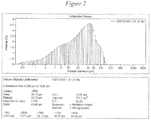
- the particle size distribution for the sulfonated asphalt particles was determined using a Beckman Coulter LS 13 320 LS Particle Size Analyzer. The D90, D50 and D10 values were measured for both the sulfonated asphalt utilized in Fluid #2 and the ground sulfonated asphalt utilized in Fluid #3. The comparison of particle size for Fluid #2 and Fluid #3 is shown in Table 7. The complete particle size distribution for the ground sulfonated asphalt particles is shown in Figure 1 . A comparison of the various properties of Fluid #1, Fluid #2, and Fluid #3 is presented in Table 8.
- Table 7 Particle Size Distribution of Sulfonated Asphalt D-90, ⁇ m D-50, ⁇ m D-10, ⁇ m Fluid #2 - Sulfonated Asphalt 646.2 330.8 80.31 Fluid #3 - Ground Sulfonated Asphalt ( ⁇ 100 mesh ( ⁇ 150 ⁇ m)) 74.87 15.63 2.41
- Table 8 Comparison of Properties for Fluids #1, #2 and #3 Sample Fluid #1 Fluid #2 Fluid #3 HTHP Fluid Loss °F (°C) 300 (149) 300 (149) 300 (149) Disk Size ⁇ m 20 20 20 20 20 20 20 Spurt Loss ml 0.2 0.1 0.5 HTHP Fluid Loss value ml x 2 2.9 2.4 0.9 % ⁇ Base Mud HTHP Fluid Loss - 17.2 68.9 Filtercake Thickness mm 1.25 1.38 1.3 Electrical Stability @ 150°F (66°C) volts 792 606 793 Rheology °F (°C) 150 (66) 150 (66) 150 (66) Yield Point
- Fluid #4 is a drilling fluid obtained from the field (i.e. a well being drilled), therefore, the exact composition is unknown.
- the drilling fluid was provided by Baroid, a division of Halliburton.
- Fluid # 4 also contained diesel fluid as the oleaginous component and was used as the OBM for Fluids #5 and #6.
- the base fluid (Fluid #4) had an OWR of 81:19.
- the properties of the base fluid are presented in Table 9. No solids settling was observed after the 30 minute gel tests, indicating that Fluid #4 behaves as a suitable drilling fluid.
- Table 9 - Properties of Fluid #4 Sample Units Fluid #4 Fluid #4 Fluids Aged Initial Dynamic Fluids Aged hrs - 16 Temp.
- Fluid #5 and Fluid #6 comprised Fluid #4 as well as sulfonated asphalt.
- Fluid #5 was prepared by adding to the base fluid (i.e., Fluid #4) 6.0 ppb (17.12 kg/m 3 ) of a ground sulfonated asphalt compound in the sodium salt form (SOLTEX E) of the type disclosed herein. As shown in Figure 1 , the particle size of the ground sulfonated asphalt was predominantly less than 100 mesh (150 ⁇ m).
- the composition and various properties of Fluid #5 are presented in Tables 10 and 11.
- Table 10 Components of Fluid #5 Fluid Components Units Fluid #5 Volume bbl eqv 1.0 Base Field Mud (Fluid #1) bbl (m 3 ) 0.985 (0.157) Ground Sulfonated Asphalt ppb (kg/m 3 ) 6.0 (17.12) Table 11 - Properties of Fluid #5 Sample Units Fluid #5 Fluid #5 Fluids Aged Initial Dynamic Fluids Aged hrs - 16 Temp.
- Fluid #6 was prepared by adding 6.0 ppb (17.12 kg/m 3 ) of sulfonated asphalt (SOLTEX E) to the OBM (i.e., Fluid #4).
- SOLTEX E sulfonated asphalt
- Table 12 Components of Fluid #6 Fluid Components Units Fluid #3 Volume bbl eqv 1.0 Base Field Mud (Fluid #1) bbl (m 3 ) 0.985 (0.157) Sulfonated Asphalt ppb (kg/m 3 ) 6.0 (17.12) Table 13 - Properties of Fluid #6 Sample Units Fluid #6 Fluid #6 Fluids Aged Initial Dynamic Fluids Aged hrs - 16 Temp.
- the particle size distribution for the sulfonated asphalt particles was determined using a Beckman Coulter LS 13 320 LS article Size Analyzer. The D90, D50 and D10 values were measured for both the sulfonated asphalt utilized in Fluid #5 and the GSA utilized in Fluid #6. The comparison of particle size for Fluid #5 and Fluid #6 is shown in Table 14. The complete particle size distribution for the ground sulfonated asphalt particles is shown in Figure 1 . A comparison of various properties of the Fluid #4, Fluid #5, and Fluid #6 is presented in Table 15.
- Table 14 Particle Size Distribution of Sulfonated Asphalt D-90, ⁇ m D-50, ⁇ m D-10, ⁇ m Fluid #6 - Sulfonated Asphalt 491.60 198.20 46.59 Fluid #5 - Ground Sulfonated Asphalt ( ⁇ 100 mesh ( ⁇ 150 ⁇ m)) 74.87 15.63 2.41 Table 15 - Comparison of Properties for Fluids #4, #5, and #6 Sample Fluid #4 Fluid #5 Fluid #6 HTHP Fluid Loss °F (°C) 300 (149) 300 (149) 300 (149) HTHP Fluid Loss value ml x 2 9.0 2.7 8.4 % ⁇ Base Mud HTHP Fluid Loss - 70.0 6.67 Filtercake Thickness mm 3.95 2.53 4.98 Electrical Stability @ 150°F (66°C) volts 696 782 697 Yield Point lb f /100 ft 2 (Pa) 13 (6.22) 14 (6.7) 11 (5.27) 6 rpm 6 5 5 3 rpm 5 4 3
Landscapes
- Chemical & Material Sciences (AREA)
- Organic Chemistry (AREA)
- Life Sciences & Earth Sciences (AREA)
- General Life Sciences & Earth Sciences (AREA)
- Engineering & Computer Science (AREA)
- Materials Engineering (AREA)
- Oil, Petroleum & Natural Gas (AREA)
- Emulsifying, Dispersing, Foam-Producing Or Wetting Agents (AREA)
- Compositions Of Macromolecular Compounds (AREA)
- Lubricants (AREA)
- Production Of Liquid Hydrocarbon Mixture For Refining Petroleum (AREA)
- Colloid Chemistry (AREA)
- Solid-Sorbent Or Filter-Aiding Compositions (AREA)
- Liquid Carbonaceous Fuels (AREA)
Claims (14)
- Additiv für ein Bohrlochbehandlungsfluid, umfassend eine sulfonierte Asphaltverbindung, umfassend Partikel, die eine D90-Partikelgröße von weniger als 215 µm, eine D50-Partikelgröße von weniger als 50 µm und eine D10-Partikelgröße von weniger als 30 µm aufweisen.
- Bohrlochbehandlungsfluid, umfassend (i) eine ölige Komponente und (ii) einen sulfonierten Asphalt, wobei der sulfonierte Asphalt Partikel umfasst, die eine D90 von weniger als 215 µm, eine D50-Partikelgröße von weniger als 50 µm und eine D10-Partikelgröße von weniger als 30 µm umfasst.
- Additiv nach Anspruch 1 und/oder Bohrlochbehandlungsfluid nach Anspruch 2, wobei der sulfonierte Asphalt eine oder mehrere Komponenten umfasst, die aus der Gruppe ausgewählt sind, die aus einer freien Säure, einem Ammoniumsalz, einem Alkalimetallsalz und einem Erdalkalimetallsalz besteht.
- Additiv nach Anspruch 1 oder 3 und/oder Bohrlochbehandlungsfluid nach Anspruch 2 oder 3, wobei der sulfonierte Asphalt ein Natriumsalz eines sulfonierten Asphalts und/oder ein Kaliumsalz eines sulfonierten Asphalts umfasst.
- Bohrlochbehandlungsfluid nach einem der Ansprüche 2-4, umfassend eine oder mehrere ölige Komponenten, die aus der Gruppe ausgewählt sind, die aus Dieselöl, Mineralöl, einem synthetischen Öl, Kerosin, Heizöl, Rohöl und Derivaten davon besteht; und/oderwobei die ölige Komponente ein Olefin umfasst; und/oder wobei die ölige Komponente einen organischen Ester umfasst; und/oderwobei die ölige Komponente eine oder mehrere ölige Komponenten umfasst, die aus der Gruppe ausgewählt sind, die aus einem linearen und einem verzweigten Paraffin besteht; und/oderwobei die ölige Komponente ein Acetal umfasst.
- Bohrlochbehandlungsfluid nach einem der Ansprüche 2-5, wobei der sulfonierte Asphalt in einer Konzentration von höchstens 15 ppb (42,8 kg/m3) vorliegt.
- Bohrlochbehandlungsfluid nach einem der Ansprüche 2-6, wobei die ölige Komponente in dem Bohrlochbehandlungsfluid in einer Menge von wenigstens 70 Vol.-% vorliegt.
- Verfahren, umfassend ein Einbringen eines Behandlungsfluids in ein Bohrloch, umfassend eine ölige Komponente, eine nicht-ölige Komponente und einen sulfonierten Asphalt, wobei der sulfonierte Asphalt Partikel umfasst, die eine D90 von weniger als 215 µm, eine D50-Partikelgröße von weniger als 50 µm und eine D10-Partikelgröße von weniger als 30 µm aufweisen.
- Additiv nach einem der Ansprüche 1, 3 oder 4, Bohrlochbehandlungsfluid nach einem der Ansprüche 2-7 und/oder Verfahren nach Anspruch 8, wobei wenigstens 95 % der Partikel ein Sieb mit 70 Maschen (212 µm) passieren, optional wobei wenigstens 95 % der Partikel aus sulfoniertem Asphalt ein Sieb mit 100 Maschen (150 µm) passieren, optional wobei wenigstens 95 % der Partikel aus sulfoniertem Asphalt ein Sieb mit 170 Maschen (90 µm) passieren.
- Bohrlochbehandlungsfluid nach einem der Ansprüche 2-7 oder 9, wobei der sulfonierte Asphalt gemahlener sulfonierter Asphalt ist und der gemahlene sulfonierte Asphalt in dem Bohrlochbehandlungsfluid in einer Menge von 0,1 lbs/bbl (0,29 kg/m3) bis 15 lbs/bbl (42,8 kg/m3) beinhaltet ist.
- Bohrlochbehandlungsfluid nach einem der Ansprüche 2-7 oder 9-10, das eine Fließgrenze (yield point - YP) von 1 lb/100ft2 (0,48 Pa) bis 50 lb/100ft2 (24 Pa) aufweist.
- Verfahren nach einem der Ansprüche 8-9, wobei ein Filterkuchen, der aus dem Bohrlochbehandlungsfluid ausgebildet wird, eine Dicke aufweist, die mindestens 20 % geringer ist als die Dicke des Filterkuchens, der aus einem Bohrlochbehandlungsfluid ausgebildet wird, das keinen sulfonierten Asphalt umfasst.
- Verfahren nach einem der Ansprüche 8-9 oder 12, wobei der sulfonierte Asphalt in einer Menge von höchstens 15 ppb (42,8 kg/m3) vorliegt.
- Bohrlochbehandlungsfluid nach Anspruch 2, wobei das Bohrlochbehandlungsfluid als ein Invertemulsionsbohrfluid formuliert ist.
Applications Claiming Priority (2)
| Application Number | Priority Date | Filing Date | Title |
|---|---|---|---|
| US13/889,940 US9328280B2 (en) | 2013-05-08 | 2013-05-08 | Additives for oil-based drilling fluids |
| PCT/US2014/031049 WO2014182375A1 (en) | 2013-05-08 | 2014-03-18 | Additives for oil-based drilling fluids |
Publications (2)
| Publication Number | Publication Date |
|---|---|
| EP2994516A1 EP2994516A1 (de) | 2016-03-16 |
| EP2994516B1 true EP2994516B1 (de) | 2021-09-29 |
Family
ID=50549483
Family Applications (1)
| Application Number | Title | Priority Date | Filing Date |
|---|---|---|---|
| EP14719489.8A Active EP2994516B1 (de) | 2013-05-08 | 2014-03-18 | Zusatzstoffe für auf öl basierende bohrflüssigkeiten |
Country Status (11)
| Country | Link |
|---|---|
| US (1) | US9328280B2 (de) |
| EP (1) | EP2994516B1 (de) |
| CN (1) | CN105189694B (de) |
| AR (1) | AR096231A1 (de) |
| AU (1) | AU2014263165B2 (de) |
| BR (1) | BR112015028145B1 (de) |
| CA (1) | CA2911229C (de) |
| DK (1) | DK2994516T3 (de) |
| MX (1) | MX382422B (de) |
| SA (1) | SA515370092B1 (de) |
| WO (1) | WO2014182375A1 (de) |
Families Citing this family (7)
| Publication number | Priority date | Publication date | Assignee | Title |
|---|---|---|---|---|
| US10000984B2 (en) * | 2012-07-09 | 2018-06-19 | M-I L.L.C. | Wellbore fluid used with oil-swellable elements |
| US9328280B2 (en) | 2013-05-08 | 2016-05-03 | Chevron Phillips Chemical Company Lp | Additives for oil-based drilling fluids |
| CN104629695B (zh) * | 2015-02-11 | 2016-02-03 | 中国石油大学(北京) | 储层保护剂组合物和广谱型钻井液及其应用 |
| CN104650829B (zh) * | 2015-02-11 | 2016-02-24 | 中国石油大学(北京) | 储层保护剂组合物和用于中渗透储层的钻井液及其应用 |
| CA2978361A1 (en) * | 2016-09-02 | 2018-03-02 | Owens Corning Intellectual Capital, Llc | Asphalt water-based drilling fluid additive |
| CA3056667A1 (en) * | 2018-10-22 | 2020-04-22 | Aes Drilling Fluids | Methods for treating a drilling fluid |
| US12435256B1 (en) * | 2024-08-22 | 2025-10-07 | Chevron Phillips Chemical Company Lp | Combination clay stabilizer having an alkali metal asphalt sulfonate and quaternary ammonium salt |
Family Cites Families (34)
| Publication number | Priority date | Publication date | Assignee | Title |
|---|---|---|---|---|
| US3028333A (en) * | 1958-04-03 | 1962-04-03 | Phillips Petroleum Co | Drilling fluid |
| US3089842A (en) * | 1959-12-14 | 1963-05-14 | Phillips Petroleum Co | Production of sulfonated asphalt |
| US3070165A (en) | 1959-12-14 | 1962-12-25 | Phillips Petroleum Co | Fracturing formations in wells |
| GB2055412A (en) | 1979-08-08 | 1981-03-04 | Clark N O | Heavy minerals for drilling fluids |
| US4519922A (en) | 1983-03-21 | 1985-05-28 | Halliburton Company | Environmentally compatible high density drill mud or blow-out control fluid |
| US4618433A (en) * | 1984-07-30 | 1986-10-21 | Phillips Petroleum Company | Drilling fluids and thinners therefor |
| US4741868A (en) | 1985-03-04 | 1988-05-03 | Phillips Petroleum Company | Production of sulfonated asphalt |
| US4584327A (en) | 1985-05-24 | 1986-04-22 | Halliburton Company | Environmentally compatable high density drilling mud, cement composition or blow-out fluid |
| GB2237303A (en) | 1989-10-28 | 1991-05-01 | Services Tech Sedco Forex | Method of quantitative analysis of drilling fluid products |
| US5541006A (en) | 1994-12-23 | 1996-07-30 | Kennametal Inc. | Method of making composite cermet articles and the articles |
| US5501277A (en) | 1995-03-06 | 1996-03-26 | Halliburton Company | Combating lost circulation during the drilling of wells |
| DE69614555T2 (de) | 1995-09-11 | 2002-04-11 | M-I L.L.C., Houston | Auf glykol basierende bohrflüssigkeit |
| US6806233B2 (en) | 1996-08-02 | 2004-10-19 | M-I Llc | Methods of using reversible phase oil based drilling fluid |
| US6036870A (en) * | 1998-02-17 | 2000-03-14 | Tuboscope Vetco International, Inc. | Method of wellbore fluid recovery using centrifugal force |
| US6514916B1 (en) | 2000-09-12 | 2003-02-04 | R. L. Clampitt & Associates, Inc. | Process for making sulfonated uintaite and well fluid additives including sulfonated uintaite |
| US6743756B2 (en) | 2001-01-26 | 2004-06-01 | Benchmark Research And Technology, Inc. | Suspensions of particles in non-aqueous solvents |
| US6821931B2 (en) | 2002-03-05 | 2004-11-23 | Alpine Mud Products Corporation | Water-based drilling fluid additive containing talc and carrier |
| US6968898B2 (en) | 2002-06-28 | 2005-11-29 | Halliburton Energy Services, Inc. | System and method for removing particles from a well bore penetrating a possible producing formation |
| US7066260B2 (en) * | 2002-08-26 | 2006-06-27 | Schlumberger Technology Corporation | Dissolving filter cake |
| US6989354B2 (en) | 2003-01-24 | 2006-01-24 | Halliburton Energy Services, Inc. | Invertible well bore servicing fluid |
| AU2005250481B2 (en) | 2004-06-03 | 2009-10-08 | M-I L.L.C. | The use of sized barite as a weighting agent for drilling fluids |
| US7290613B2 (en) | 2004-10-15 | 2007-11-06 | Halliburton Energy Services, Inc. | Cement compositions comprising aromatic sulfonated polymers and methods of using the same |
| US7488705B2 (en) | 2004-12-08 | 2009-02-10 | Halliburton Energy Services, Inc. | Oilwell sealant compositions comprising alkali swellable latex |
| US7325611B2 (en) | 2006-03-09 | 2008-02-05 | Halliburton Energy Services, Inc. | Cement compositions for reducing gas or water migration and methods of using the same |
| US7741250B2 (en) * | 2006-05-11 | 2010-06-22 | Chevron Phillips Chemical Company Lp | Wellbore servicing fluids comprising grafted homopolymers and methods of using same |
| CA2562651C (en) * | 2006-10-05 | 2009-10-13 | Paloverde Environmental Ltd. | Canola meal drilling fluid additive |
| US20090029878A1 (en) | 2007-07-24 | 2009-01-29 | Jozef Bicerano | Drilling fluid, drill-in fluid, completition fluid, and workover fluid additive compositions containing thermoset nanocomposite particles; and applications for fluid loss control and wellbore strengthening |
| CN102083936A (zh) * | 2008-05-09 | 2011-06-01 | M-I有限公司 | 含有定尺寸粘土材料的井筒流体及其使用方法 |
| US8795535B2 (en) | 2009-07-23 | 2014-08-05 | National Oilwell Varco, L.P. | Apparatus and method for drilling fluid density separator utilizing rotating disks |
| US8763695B2 (en) * | 2010-04-15 | 2014-07-01 | Halliburton Energy Services, Inc. | Electrically conductive oil-based drilling fluids |
| US9062241B2 (en) | 2010-09-28 | 2015-06-23 | Clearwater International Llc | Weight materials for use in cement, spacer and drilling fluids |
| GB201109446D0 (en) | 2011-06-06 | 2011-07-20 | M I Drilling Fluids Uk Ltd | Methods for reducing permeability of subterranean reservoirs |
| US20140094394A1 (en) | 2012-10-02 | 2014-04-03 | Chevron Phillips Chemical Company Lp | High Density Weight Materials for Oil Field Servicing Operations |
| US9328280B2 (en) | 2013-05-08 | 2016-05-03 | Chevron Phillips Chemical Company Lp | Additives for oil-based drilling fluids |
-
2013
- 2013-05-08 US US13/889,940 patent/US9328280B2/en active Active
-
2014
- 2014-03-18 AU AU2014263165A patent/AU2014263165B2/en active Active
- 2014-03-18 WO PCT/US2014/031049 patent/WO2014182375A1/en not_active Ceased
- 2014-03-18 MX MX2015015407A patent/MX382422B/es unknown
- 2014-03-18 EP EP14719489.8A patent/EP2994516B1/de active Active
- 2014-03-18 CN CN201480025777.1A patent/CN105189694B/zh not_active Expired - Fee Related
- 2014-03-18 CA CA2911229A patent/CA2911229C/en active Active
- 2014-03-18 BR BR112015028145-1A patent/BR112015028145B1/pt active IP Right Grant
- 2014-03-18 DK DK14719489.8T patent/DK2994516T3/da active
- 2014-05-08 AR ARP140101876A patent/AR096231A1/es active IP Right Grant
-
2015
- 2015-11-04 SA SA515370092A patent/SA515370092B1/ar unknown
Also Published As
| Publication number | Publication date |
|---|---|
| BR112015028145A2 (pt) | 2017-07-25 |
| SA515370092B1 (ar) | 2017-03-23 |
| DK2994516T3 (da) | 2021-12-20 |
| AU2014263165B2 (en) | 2017-06-22 |
| MX2015015407A (es) | 2016-03-15 |
| WO2014182375A1 (en) | 2014-11-13 |
| BR112015028145B1 (pt) | 2022-05-03 |
| CA2911229A1 (en) | 2014-11-13 |
| CA2911229C (en) | 2020-02-25 |
| EP2994516A1 (de) | 2016-03-16 |
| CN105189694A (zh) | 2015-12-23 |
| MX382422B (es) | 2025-03-13 |
| US20140336085A1 (en) | 2014-11-13 |
| AR096231A1 (es) | 2015-12-16 |
| CN105189694B (zh) | 2020-10-27 |
| US9328280B2 (en) | 2016-05-03 |
| AU2014263165A1 (en) | 2015-11-19 |
Similar Documents
| Publication | Publication Date | Title |
|---|---|---|
| EP2994516B1 (de) | Zusatzstoffe für auf öl basierende bohrflüssigkeiten | |
| AU2013216930B2 (en) | Compositions and methods for treatment of well bore tar | |
| CA2790724A1 (en) | Invert drilling fluids having enhanced rheology and methods of drilling boreholes | |
| US10526521B2 (en) | Invert emulsion drilling fluids with fatty acid and fatty diol rheology modifiers | |
| EP2885371B1 (de) | Solubilisierte polymerkonzentrate, herstellungsverfahren dafür sowie bohr- und wartungsflüssigkeiten damit | |
| US9528043B2 (en) | Compositions and methods for treatment of well bore tar | |
| NO20181172A1 (en) | Additive to enhance sag stability of drilling | |
| US10738230B2 (en) | Invert emulsion drilling fluids | |
| EP2800794A1 (de) | Invert-bohrflüssigkeiten mit verbesserter rheologie und verfahren zum bohren von bohrlöchern | |
| CA2920803C (en) | Invert emulsion drilling fluids with fumed silica and methods of drilling boreholes | |
| US12006468B2 (en) | Modified vegetable oil as fluid loss control additive | |
| US20250179343A1 (en) | Biodegradable surfactant fluid loss control additive | |
| HK1211613B (en) | Solubilized polymer concentrates, methods of preparation thereof, and well drilling and servicing fluids containing the same |
Legal Events
| Date | Code | Title | Description |
|---|---|---|---|
| PUAI | Public reference made under article 153(3) epc to a published international application that has entered the european phase |
Free format text: ORIGINAL CODE: 0009012 |
|
| 17P | Request for examination filed |
Effective date: 20151109 |
|
| AK | Designated contracting states |
Kind code of ref document: A1 Designated state(s): AL AT BE BG CH CY CZ DE DK EE ES FI FR GB GR HR HU IE IS IT LI LT LU LV MC MK MT NL NO PL PT RO RS SE SI SK SM TR |
|
| AX | Request for extension of the european patent |
Extension state: BA ME |
|
| DAX | Request for extension of the european patent (deleted) | ||
| STAA | Information on the status of an ep patent application or granted ep patent |
Free format text: STATUS: EXAMINATION IS IN PROGRESS |
|
| 17Q | First examination report despatched |
Effective date: 20190829 |
|
| GRAP | Despatch of communication of intention to grant a patent |
Free format text: ORIGINAL CODE: EPIDOSNIGR1 |
|
| STAA | Information on the status of an ep patent application or granted ep patent |
Free format text: STATUS: GRANT OF PATENT IS INTENDED |
|
| INTG | Intention to grant announced |
Effective date: 20210415 |
|
| GRAS | Grant fee paid |
Free format text: ORIGINAL CODE: EPIDOSNIGR3 |
|
| GRAA | (expected) grant |
Free format text: ORIGINAL CODE: 0009210 |
|
| STAA | Information on the status of an ep patent application or granted ep patent |
Free format text: STATUS: THE PATENT HAS BEEN GRANTED |
|
| AK | Designated contracting states |
Kind code of ref document: B1 Designated state(s): AL AT BE BG CH CY CZ DE DK EE ES FI FR GB GR HR HU IE IS IT LI LT LU LV MC MK MT NL NO PL PT RO RS SE SI SK SM TR |
|
| REG | Reference to a national code |
Ref country code: GB Ref legal event code: FG4D |
|
| REG | Reference to a national code |
Ref country code: CH Ref legal event code: EP Ref country code: AT Ref legal event code: REF Ref document number: 1434199 Country of ref document: AT Kind code of ref document: T Effective date: 20211015 |
|
| REG | Reference to a national code |
Ref country code: DE Ref legal event code: R096 Ref document number: 602014080363 Country of ref document: DE |
|
| REG | Reference to a national code |
Ref country code: IE Ref legal event code: FG4D |
|
| REG | Reference to a national code |
Ref country code: NL Ref legal event code: FP |
|
| REG | Reference to a national code |
Ref country code: DK Ref legal event code: T3 Effective date: 20211216 |
|
| REG | Reference to a national code |
Ref country code: LT Ref legal event code: MG9D |
|
| REG | Reference to a national code |
Ref country code: NO Ref legal event code: T2 Effective date: 20210929 |
|
| PG25 | Lapsed in a contracting state [announced via postgrant information from national office to epo] |
Ref country code: RS Free format text: LAPSE BECAUSE OF FAILURE TO SUBMIT A TRANSLATION OF THE DESCRIPTION OR TO PAY THE FEE WITHIN THE PRESCRIBED TIME-LIMIT Effective date: 20210929 Ref country code: SE Free format text: LAPSE BECAUSE OF FAILURE TO SUBMIT A TRANSLATION OF THE DESCRIPTION OR TO PAY THE FEE WITHIN THE PRESCRIBED TIME-LIMIT Effective date: 20210929 Ref country code: HR Free format text: LAPSE BECAUSE OF FAILURE TO SUBMIT A TRANSLATION OF THE DESCRIPTION OR TO PAY THE FEE WITHIN THE PRESCRIBED TIME-LIMIT Effective date: 20210929 Ref country code: FI Free format text: LAPSE BECAUSE OF FAILURE TO SUBMIT A TRANSLATION OF THE DESCRIPTION OR TO PAY THE FEE WITHIN THE PRESCRIBED TIME-LIMIT Effective date: 20210929 Ref country code: LT Free format text: LAPSE BECAUSE OF FAILURE TO SUBMIT A TRANSLATION OF THE DESCRIPTION OR TO PAY THE FEE WITHIN THE PRESCRIBED TIME-LIMIT Effective date: 20210929 Ref country code: BG Free format text: LAPSE BECAUSE OF FAILURE TO SUBMIT A TRANSLATION OF THE DESCRIPTION OR TO PAY THE FEE WITHIN THE PRESCRIBED TIME-LIMIT Effective date: 20211229 |
|
| REG | Reference to a national code |
Ref country code: AT Ref legal event code: MK05 Ref document number: 1434199 Country of ref document: AT Kind code of ref document: T Effective date: 20210929 |
|
| PG25 | Lapsed in a contracting state [announced via postgrant information from national office to epo] |
Ref country code: LV Free format text: LAPSE BECAUSE OF FAILURE TO SUBMIT A TRANSLATION OF THE DESCRIPTION OR TO PAY THE FEE WITHIN THE PRESCRIBED TIME-LIMIT Effective date: 20210929 Ref country code: GR Free format text: LAPSE BECAUSE OF FAILURE TO SUBMIT A TRANSLATION OF THE DESCRIPTION OR TO PAY THE FEE WITHIN THE PRESCRIBED TIME-LIMIT Effective date: 20211230 |
|
| PG25 | Lapsed in a contracting state [announced via postgrant information from national office to epo] |
Ref country code: AT Free format text: LAPSE BECAUSE OF FAILURE TO SUBMIT A TRANSLATION OF THE DESCRIPTION OR TO PAY THE FEE WITHIN THE PRESCRIBED TIME-LIMIT Effective date: 20210929 |
|
| PG25 | Lapsed in a contracting state [announced via postgrant information from national office to epo] |
Ref country code: IS Free format text: LAPSE BECAUSE OF FAILURE TO SUBMIT A TRANSLATION OF THE DESCRIPTION OR TO PAY THE FEE WITHIN THE PRESCRIBED TIME-LIMIT Effective date: 20220129 Ref country code: SK Free format text: LAPSE BECAUSE OF FAILURE TO SUBMIT A TRANSLATION OF THE DESCRIPTION OR TO PAY THE FEE WITHIN THE PRESCRIBED TIME-LIMIT Effective date: 20210929 Ref country code: RO Free format text: LAPSE BECAUSE OF FAILURE TO SUBMIT A TRANSLATION OF THE DESCRIPTION OR TO PAY THE FEE WITHIN THE PRESCRIBED TIME-LIMIT Effective date: 20210929 Ref country code: PT Free format text: LAPSE BECAUSE OF FAILURE TO SUBMIT A TRANSLATION OF THE DESCRIPTION OR TO PAY THE FEE WITHIN THE PRESCRIBED TIME-LIMIT Effective date: 20220131 Ref country code: PL Free format text: LAPSE BECAUSE OF FAILURE TO SUBMIT A TRANSLATION OF THE DESCRIPTION OR TO PAY THE FEE WITHIN THE PRESCRIBED TIME-LIMIT Effective date: 20210929 Ref country code: ES Free format text: LAPSE BECAUSE OF FAILURE TO SUBMIT A TRANSLATION OF THE DESCRIPTION OR TO PAY THE FEE WITHIN THE PRESCRIBED TIME-LIMIT Effective date: 20210929 Ref country code: EE Free format text: LAPSE BECAUSE OF FAILURE TO SUBMIT A TRANSLATION OF THE DESCRIPTION OR TO PAY THE FEE WITHIN THE PRESCRIBED TIME-LIMIT Effective date: 20210929 Ref country code: CZ Free format text: LAPSE BECAUSE OF FAILURE TO SUBMIT A TRANSLATION OF THE DESCRIPTION OR TO PAY THE FEE WITHIN THE PRESCRIBED TIME-LIMIT Effective date: 20210929 Ref country code: AL Free format text: LAPSE BECAUSE OF FAILURE TO SUBMIT A TRANSLATION OF THE DESCRIPTION OR TO PAY THE FEE WITHIN THE PRESCRIBED TIME-LIMIT Effective date: 20210929 |
|
| REG | Reference to a national code |
Ref country code: DE Ref legal event code: R097 Ref document number: 602014080363 Country of ref document: DE |
|
| PLBE | No opposition filed within time limit |
Free format text: ORIGINAL CODE: 0009261 |
|
| STAA | Information on the status of an ep patent application or granted ep patent |
Free format text: STATUS: NO OPPOSITION FILED WITHIN TIME LIMIT |
|
| 26N | No opposition filed |
Effective date: 20220630 |
|
| PG25 | Lapsed in a contracting state [announced via postgrant information from national office to epo] |
Ref country code: MC Free format text: LAPSE BECAUSE OF FAILURE TO SUBMIT A TRANSLATION OF THE DESCRIPTION OR TO PAY THE FEE WITHIN THE PRESCRIBED TIME-LIMIT Effective date: 20210929 |
|
| REG | Reference to a national code |
Ref country code: CH Ref legal event code: PL |
|
| PG25 | Lapsed in a contracting state [announced via postgrant information from national office to epo] |
Ref country code: SI Free format text: LAPSE BECAUSE OF FAILURE TO SUBMIT A TRANSLATION OF THE DESCRIPTION OR TO PAY THE FEE WITHIN THE PRESCRIBED TIME-LIMIT Effective date: 20210929 |
|
| REG | Reference to a national code |
Ref country code: BE Ref legal event code: MM Effective date: 20220331 |
|
| PG25 | Lapsed in a contracting state [announced via postgrant information from national office to epo] |
Ref country code: LU Free format text: LAPSE BECAUSE OF NON-PAYMENT OF DUE FEES Effective date: 20220318 Ref country code: LI Free format text: LAPSE BECAUSE OF NON-PAYMENT OF DUE FEES Effective date: 20220331 Ref country code: IT Free format text: LAPSE BECAUSE OF FAILURE TO SUBMIT A TRANSLATION OF THE DESCRIPTION OR TO PAY THE FEE WITHIN THE PRESCRIBED TIME-LIMIT Effective date: 20210929 Ref country code: IE Free format text: LAPSE BECAUSE OF NON-PAYMENT OF DUE FEES Effective date: 20220318 Ref country code: CH Free format text: LAPSE BECAUSE OF NON-PAYMENT OF DUE FEES Effective date: 20220331 |
|
| PG25 | Lapsed in a contracting state [announced via postgrant information from national office to epo] |
Ref country code: BE Free format text: LAPSE BECAUSE OF NON-PAYMENT OF DUE FEES Effective date: 20220331 |
|
| P01 | Opt-out of the competence of the unified patent court (upc) registered |
Effective date: 20230519 |
|
| PG25 | Lapsed in a contracting state [announced via postgrant information from national office to epo] |
Ref country code: HU Free format text: LAPSE BECAUSE OF FAILURE TO SUBMIT A TRANSLATION OF THE DESCRIPTION OR TO PAY THE FEE WITHIN THE PRESCRIBED TIME-LIMIT; INVALID AB INITIO Effective date: 20140318 |
|
| PGFP | Annual fee paid to national office [announced via postgrant information from national office to epo] |
Ref country code: NL Payment date: 20240220 Year of fee payment: 11 |
|
| PG25 | Lapsed in a contracting state [announced via postgrant information from national office to epo] |
Ref country code: SM Free format text: LAPSE BECAUSE OF FAILURE TO SUBMIT A TRANSLATION OF THE DESCRIPTION OR TO PAY THE FEE WITHIN THE PRESCRIBED TIME-LIMIT Effective date: 20210929 Ref country code: MK Free format text: LAPSE BECAUSE OF FAILURE TO SUBMIT A TRANSLATION OF THE DESCRIPTION OR TO PAY THE FEE WITHIN THE PRESCRIBED TIME-LIMIT Effective date: 20210929 Ref country code: CY Free format text: LAPSE BECAUSE OF FAILURE TO SUBMIT A TRANSLATION OF THE DESCRIPTION OR TO PAY THE FEE WITHIN THE PRESCRIBED TIME-LIMIT Effective date: 20210929 |
|
| PGFP | Annual fee paid to national office [announced via postgrant information from national office to epo] |
Ref country code: DE Payment date: 20240220 Year of fee payment: 11 Ref country code: GB Payment date: 20240220 Year of fee payment: 11 |
|
| PGFP | Annual fee paid to national office [announced via postgrant information from national office to epo] |
Ref country code: NO Payment date: 20240222 Year of fee payment: 11 Ref country code: DK Payment date: 20240220 Year of fee payment: 11 |
|
| PG25 | Lapsed in a contracting state [announced via postgrant information from national office to epo] |
Ref country code: TR Free format text: LAPSE BECAUSE OF FAILURE TO SUBMIT A TRANSLATION OF THE DESCRIPTION OR TO PAY THE FEE WITHIN THE PRESCRIBED TIME-LIMIT Effective date: 20210929 |
|
| PG25 | Lapsed in a contracting state [announced via postgrant information from national office to epo] |
Ref country code: MT Free format text: LAPSE BECAUSE OF FAILURE TO SUBMIT A TRANSLATION OF THE DESCRIPTION OR TO PAY THE FEE WITHIN THE PRESCRIBED TIME-LIMIT Effective date: 20210929 |
|
| PGFP | Annual fee paid to national office [announced via postgrant information from national office to epo] |
Ref country code: FR Payment date: 20250219 Year of fee payment: 12 |
|
| REG | Reference to a national code |
Ref country code: DE Ref legal event code: R119 Ref document number: 602014080363 Country of ref document: DE |
|
| REG | Reference to a national code |
Ref country code: DK Ref legal event code: EBP Effective date: 20250331 |
|
| REG | Reference to a national code |
Ref country code: NL Ref legal event code: MM Effective date: 20250401 |
|
| GBPC | Gb: european patent ceased through non-payment of renewal fee |
Effective date: 20250318 |
|
| PG25 | Lapsed in a contracting state [announced via postgrant information from national office to epo] |
Ref country code: NL Free format text: LAPSE BECAUSE OF NON-PAYMENT OF DUE FEES Effective date: 20250401 |
|
| PG25 | Lapsed in a contracting state [announced via postgrant information from national office to epo] |
Ref country code: DE Free format text: LAPSE BECAUSE OF NON-PAYMENT OF DUE FEES Effective date: 20251001 |
|
| PG25 | Lapsed in a contracting state [announced via postgrant information from national office to epo] |
Ref country code: GB Free format text: LAPSE BECAUSE OF NON-PAYMENT OF DUE FEES Effective date: 20250318 |
|
| PG25 | Lapsed in a contracting state [announced via postgrant information from national office to epo] |
Ref country code: NO Free format text: LAPSE BECAUSE OF NON-PAYMENT OF DUE FEES Effective date: 20250331 |