EP2993576A1 - Communication of external sourced information to a driver - Google Patents
Communication of external sourced information to a driver Download PDFInfo
- Publication number
- EP2993576A1 EP2993576A1 EP15182479.4A EP15182479A EP2993576A1 EP 2993576 A1 EP2993576 A1 EP 2993576A1 EP 15182479 A EP15182479 A EP 15182479A EP 2993576 A1 EP2993576 A1 EP 2993576A1
- Authority
- EP
- European Patent Office
- Prior art keywords
- data
- graphic
- vehicle
- client device
- module
- Prior art date
- Legal status (The legal status is an assumption and is not a legal conclusion. Google has not performed a legal analysis and makes no representation as to the accuracy of the status listed.)
- Withdrawn
Links
Images



Classifications
-
- G—PHYSICS
- G01—MEASURING; TESTING
- G01S—RADIO DIRECTION-FINDING; RADIO NAVIGATION; DETERMINING DISTANCE OR VELOCITY BY USE OF RADIO WAVES; LOCATING OR PRESENCE-DETECTING BY USE OF THE REFLECTION OR RERADIATION OF RADIO WAVES; ANALOGOUS ARRANGEMENTS USING OTHER WAVES
- G01S19/00—Satellite radio beacon positioning systems; Determining position, velocity or attitude using signals transmitted by such systems
- G01S19/01—Satellite radio beacon positioning systems transmitting time-stamped messages, e.g. GPS [Global Positioning System], GLONASS [Global Orbiting Navigation Satellite System] or GALILEO
- G01S19/03—Cooperating elements; Interaction or communication between different cooperating elements or between cooperating elements and receivers
- G01S19/10—Cooperating elements; Interaction or communication between different cooperating elements or between cooperating elements and receivers providing dedicated supplementary positioning signals
- G01S19/11—Cooperating elements; Interaction or communication between different cooperating elements or between cooperating elements and receivers providing dedicated supplementary positioning signals wherein the cooperating elements are pseudolites or satellite radio beacon positioning system signal repeaters
-
- B—PERFORMING OPERATIONS; TRANSPORTING
- B60—VEHICLES IN GENERAL
- B60W—CONJOINT CONTROL OF VEHICLE SUB-UNITS OF DIFFERENT TYPE OR DIFFERENT FUNCTION; CONTROL SYSTEMS SPECIALLY ADAPTED FOR HYBRID VEHICLES; ROAD VEHICLE DRIVE CONTROL SYSTEMS FOR PURPOSES NOT RELATED TO THE CONTROL OF A PARTICULAR SUB-UNIT
- B60W30/00—Purposes of road vehicle drive control systems not related to the control of a particular sub-unit, e.g. of systems using conjoint control of vehicle sub-units
- B60W30/08—Active safety systems predicting or avoiding probable or impending collision or attempting to minimise its consequences
-
- B—PERFORMING OPERATIONS; TRANSPORTING
- B60—VEHICLES IN GENERAL
- B60W—CONJOINT CONTROL OF VEHICLE SUB-UNITS OF DIFFERENT TYPE OR DIFFERENT FUNCTION; CONTROL SYSTEMS SPECIALLY ADAPTED FOR HYBRID VEHICLES; ROAD VEHICLE DRIVE CONTROL SYSTEMS FOR PURPOSES NOT RELATED TO THE CONTROL OF A PARTICULAR SUB-UNIT
- B60W50/00—Details of control systems for road vehicle drive control not related to the control of a particular sub-unit, e.g. process diagnostic or vehicle driver interfaces
- B60W50/08—Interaction between the driver and the control system
- B60W50/14—Means for informing the driver, warning the driver or prompting a driver intervention
-
- G—PHYSICS
- G01—MEASURING; TESTING
- G01S—RADIO DIRECTION-FINDING; RADIO NAVIGATION; DETERMINING DISTANCE OR VELOCITY BY USE OF RADIO WAVES; LOCATING OR PRESENCE-DETECTING BY USE OF THE REFLECTION OR RERADIATION OF RADIO WAVES; ANALOGOUS ARRANGEMENTS USING OTHER WAVES
- G01S5/00—Position-fixing by co-ordinating two or more direction or position line determinations; Position-fixing by co-ordinating two or more distance determinations
- G01S5/0009—Transmission of position information to remote stations
- G01S5/0072—Transmission between mobile stations, e.g. anti-collision systems
-
- G—PHYSICS
- G02—OPTICS
- G02B—OPTICAL ELEMENTS, SYSTEMS OR APPARATUS
- G02B27/00—Optical systems or apparatus not provided for by any of the groups G02B1/00 - G02B26/00, G02B30/00
- G02B27/01—Head-up displays
- G02B27/0179—Display position adjusting means not related to the information to be displayed
-
- G—PHYSICS
- G06—COMPUTING OR CALCULATING; COUNTING
- G06F—ELECTRIC DIGITAL DATA PROCESSING
- G06F3/00—Input arrangements for transferring data to be processed into a form capable of being handled by the computer; Output arrangements for transferring data from processing unit to output unit, e.g. interface arrangements
- G06F3/14—Digital output to display device ; Cooperation and interconnection of the display device with other functional units
- G06F3/147—Digital output to display device ; Cooperation and interconnection of the display device with other functional units using display panels
-
- G—PHYSICS
- G06—COMPUTING OR CALCULATING; COUNTING
- G06T—IMAGE DATA PROCESSING OR GENERATION, IN GENERAL
- G06T7/00—Image analysis
- G06T7/20—Analysis of motion
-
- G—PHYSICS
- G06—COMPUTING OR CALCULATING; COUNTING
- G06T—IMAGE DATA PROCESSING OR GENERATION, IN GENERAL
- G06T7/00—Image analysis
- G06T7/70—Determining position or orientation of objects or cameras
-
- G—PHYSICS
- G06—COMPUTING OR CALCULATING; COUNTING
- G06V—IMAGE OR VIDEO RECOGNITION OR UNDERSTANDING
- G06V20/00—Scenes; Scene-specific elements
- G06V20/50—Context or environment of the image
- G06V20/56—Context or environment of the image exterior to a vehicle by using sensors mounted on the vehicle
- G06V20/58—Recognition of moving objects or obstacles, e.g. vehicles or pedestrians; Recognition of traffic objects, e.g. traffic signs, traffic lights or roads
-
- G—PHYSICS
- G06—COMPUTING OR CALCULATING; COUNTING
- G06V—IMAGE OR VIDEO RECOGNITION OR UNDERSTANDING
- G06V20/00—Scenes; Scene-specific elements
- G06V20/50—Context or environment of the image
- G06V20/56—Context or environment of the image exterior to a vehicle by using sensors mounted on the vehicle
- G06V20/588—Recognition of the road, e.g. of lane markings; Recognition of the vehicle driving pattern in relation to the road
-
- B—PERFORMING OPERATIONS; TRANSPORTING
- B60—VEHICLES IN GENERAL
- B60R—VEHICLES, VEHICLE FITTINGS, OR VEHICLE PARTS, NOT OTHERWISE PROVIDED FOR
- B60R2300/00—Details of viewing arrangements using cameras and displays, specially adapted for use in a vehicle
- B60R2300/20—Details of viewing arrangements using cameras and displays, specially adapted for use in a vehicle characterised by the type of display used
- B60R2300/205—Details of viewing arrangements using cameras and displays, specially adapted for use in a vehicle characterised by the type of display used using a head-up display
-
- B—PERFORMING OPERATIONS; TRANSPORTING
- B60—VEHICLES IN GENERAL
- B60W—CONJOINT CONTROL OF VEHICLE SUB-UNITS OF DIFFERENT TYPE OR DIFFERENT FUNCTION; CONTROL SYSTEMS SPECIALLY ADAPTED FOR HYBRID VEHICLES; ROAD VEHICLE DRIVE CONTROL SYSTEMS FOR PURPOSES NOT RELATED TO THE CONTROL OF A PARTICULAR SUB-UNIT
- B60W50/00—Details of control systems for road vehicle drive control not related to the control of a particular sub-unit, e.g. process diagnostic or vehicle driver interfaces
- B60W50/08—Interaction between the driver and the control system
- B60W50/14—Means for informing the driver, warning the driver or prompting a driver intervention
- B60W2050/146—Display means
-
- B—PERFORMING OPERATIONS; TRANSPORTING
- B60—VEHICLES IN GENERAL
- B60W—CONJOINT CONTROL OF VEHICLE SUB-UNITS OF DIFFERENT TYPE OR DIFFERENT FUNCTION; CONTROL SYSTEMS SPECIALLY ADAPTED FOR HYBRID VEHICLES; ROAD VEHICLE DRIVE CONTROL SYSTEMS FOR PURPOSES NOT RELATED TO THE CONTROL OF A PARTICULAR SUB-UNIT
- B60W2556/00—Input parameters relating to data
- B60W2556/45—External transmission of data to or from the vehicle
-
- B—PERFORMING OPERATIONS; TRANSPORTING
- B60—VEHICLES IN GENERAL
- B60W—CONJOINT CONTROL OF VEHICLE SUB-UNITS OF DIFFERENT TYPE OR DIFFERENT FUNCTION; CONTROL SYSTEMS SPECIALLY ADAPTED FOR HYBRID VEHICLES; ROAD VEHICLE DRIVE CONTROL SYSTEMS FOR PURPOSES NOT RELATED TO THE CONTROL OF A PARTICULAR SUB-UNIT
- B60W2556/00—Input parameters relating to data
- B60W2556/45—External transmission of data to or from the vehicle
- B60W2556/50—External transmission of data to or from the vehicle of positioning data, e.g. GPS [Global Positioning System] data
-
- B—PERFORMING OPERATIONS; TRANSPORTING
- B60—VEHICLES IN GENERAL
- B60W—CONJOINT CONTROL OF VEHICLE SUB-UNITS OF DIFFERENT TYPE OR DIFFERENT FUNCTION; CONTROL SYSTEMS SPECIALLY ADAPTED FOR HYBRID VEHICLES; ROAD VEHICLE DRIVE CONTROL SYSTEMS FOR PURPOSES NOT RELATED TO THE CONTROL OF A PARTICULAR SUB-UNIT
- B60W2556/00—Input parameters relating to data
- B60W2556/45—External transmission of data to or from the vehicle
- B60W2556/55—External transmission of data to or from the vehicle using telemetry
-
- B—PERFORMING OPERATIONS; TRANSPORTING
- B60—VEHICLES IN GENERAL
- B60W—CONJOINT CONTROL OF VEHICLE SUB-UNITS OF DIFFERENT TYPE OR DIFFERENT FUNCTION; CONTROL SYSTEMS SPECIALLY ADAPTED FOR HYBRID VEHICLES; ROAD VEHICLE DRIVE CONTROL SYSTEMS FOR PURPOSES NOT RELATED TO THE CONTROL OF A PARTICULAR SUB-UNIT
- B60W2556/00—Input parameters relating to data
- B60W2556/45—External transmission of data to or from the vehicle
- B60W2556/65—Data transmitted between vehicles
-
- G—PHYSICS
- G02—OPTICS
- G02B—OPTICAL ELEMENTS, SYSTEMS OR APPARATUS
- G02B27/00—Optical systems or apparatus not provided for by any of the groups G02B1/00 - G02B26/00, G02B30/00
- G02B27/01—Head-up displays
- G02B27/0179—Display position adjusting means not related to the information to be displayed
- G02B2027/0187—Display position adjusting means not related to the information to be displayed slaved to motion of at least a part of the body of the user, e.g. head, eye
-
- G—PHYSICS
- G09—EDUCATION; CRYPTOGRAPHY; DISPLAY; ADVERTISING; SEALS
- G09G—ARRANGEMENTS OR CIRCUITS FOR CONTROL OF INDICATING DEVICES USING STATIC MEANS TO PRESENT VARIABLE INFORMATION
- G09G2380/00—Specific applications
- G09G2380/10—Automotive applications
Definitions
- the specification relates to generating object information for a heads-up display based on object-to-vehicle (X2V) data.
- X2V object-to-vehicle
- Vehicle safety applications rely on sensors to detect entities that may collide with the vehicle. While these safety applications are useful, they may cause delay in detecting the entities because they are dependent upon a visual detection of the entities. By the time the safety application visually detects the entities, it may be too late to prevent a collision.
- a system for generating spatial information for a heads-up display includes a processor and a memory storing instructions that, when executed, cause the system to: receive object-to-vehicle (X2V) data from a first processor-based mobile computing device that broadcasts an object's position, generate object data including an object path from a second processor-based computing device programmed to perform the generating, determine vehicle data including a vehicle path, estimate a danger index for the object based on the vehicle data and the object data, identify a graphic that is a representation of the object, and position the graphic to correspond to a user's eye frame.
- X2V object-to-vehicle
- X2V object-to-vehicle
- a first processor-based mobile computing device that broadcasts an object's position
- generating object data including an object path from a second processor-based computing device programmed to perform the generating
- determining vehicle data including a vehicle path estimating a danger index for the object based on the vehicle data and the object data
- identifying a graphic that is a representation of the object and positioning the graphic to correspond to a user's eye frame.
- the features include: the object being outside of the user's visual range; the X2V data being received through dedicated short-range communications (DSRC); the object being a wearable device, the object data including includes a position of the object, a speed of the object, and a type of object; and the graphic being a simplified representation of the object.
- DSRC dedicated short-range communications
- the operations can include: determining whether the danger index exceeds a predetermined threshold probability; determining a display modality for the graphic based on the danger index; determining whether the danger index exceeds a predetermined threshold probability; and positioning the graphic at a real position of the object so that the user maintains a substantially same eye focus when looking at the graphic and the object.
- the system can detect objects without needing the objects to be in visual range.
- the system can alert users to dangerous situations with graphics that are easy to understand.
- the heads-up display generates graphics that do not require the driver to change focus to switch between viewing the road and the graph. As a result, the user can react more quickly and possibly avoid a collision.
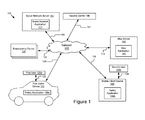
- Figure 1 illustrates a block diagram of one embodiment of a system 100 for generating object information for a heads-up display based on X2V data.
- the system 100 includes a first client device 103, a mobile client device 188, a broadcasting device 120, a social network server 101, a second server 198, and a map server 190.
- the first client device 103 and the mobile client device 188 can be accessed by users 125a and 125b (also referred to herein individually and collectively as user 125), via signal lines 122 and 124, respectively.
- these entities of the system 100 may be communicatively coupled via a network 105.
- the system 100 may include other servers or devices not shown in Figure 1 including, for example, a traffic server for providing traffic data, a weather server for providing weather data, and a power service server for providing power usage service (e.g., billing service).
- a traffic server for providing traffic data
- a weather server for providing weather data
- a power service server for providing power
- the first client device 103 and the mobile client device 188 in Figure 1 can be used by way of example. While Figure 1 illustrates two client devices 103 and 188, the disclosure applies to a system architecture having one or more client devices 103, 188. Furthermore, although Figure 1 illustrates multiple broadcasting devices 120, one broadcasting device 120 is possible. Although Figure 1 illustrates one network 105 coupled to the first client device 103, the mobile client device 188, the social network server 101, the second server 198, and the map server 190, in practice one or more networks 105 can be connected. While Figure 1 includes one social network server 101, one second server 198, and one map server 190, the system 100 could include one or more social network servers 101, one or more second servers 198, and one or more map servers 190.
- the network 105 can be a conventional type, wired or wireless, and may have numerous different configurations including a star configuration, token ring configuration, or other configurations. Furthermore, the network 105 may include a local area network (LAN), a wide area network (WAN) (e.g., the Internet), or other interconnected data paths across which multiple devices may communicate. In some embodiments, the network 105 may be a peer-to-peer network. The network 105 may also be coupled to or includes portions of a telecommunications network for sending data in a variety of different communication protocols.
- LAN local area network
- WAN wide area network
- the network 105 may also be coupled to or includes portions of a telecommunications network for sending data in a variety of different communication protocols.
- the network 105 includes Bluetooth® communication networks or a cellular communications network for sending and receiving data including via short messaging service (SMS), multimedia messaging service (MMS), hypertext transfer protocol (HTTP), direct data connection, WAP, e-mail, etc.
- SMS short messaging service
- MMS multimedia messaging service
- HTTP hypertext transfer protocol
- the network 105 may include a GPS satellite for providing GPS navigation to the first client device 103 or the mobile client device 188.
- the network 105 may be a mobile data network such as 3G, 4G, LTE, Voice-over-LTE ("VoLTE”), or any other mobile data network or combination of mobile data networks.
- VoIP Voice-over-LTE
- the broadcasting device 120 can be a mobile computing device that includes a processor and a memory.
- the broadcasting device 120 can be a wearable device, a smartphone, a mobile telephone, a personal digital assistant ("PDA"), a mobile e-mail device, a portable game player, a portable music player, or other portable electronic device capable of accessing the network 105.
- a wearable device includes, for example, jewelry that communicate over the network.
- the broadcasting device 120 may communicate using a dedicated short-range communications (DSRC) protocol.
- DSRC dedicated short-range communications
- the broadcasting device 120 provides information about an object.
- the object may include a pedestrian with a wearable device, a biker with a smartphone, another vehicle, etc.
- the broadcasting device 120 transmits X2V data to the safety application 199 as a dedicated short-range communication (DSRC).
- X2V data includes any type of object-to-vehicle data, such as vehicle-to-vehicle (V2V) data, infrastructure-to-vehicle (I2V) services, and data from other objects, such as pedestrians and bikers.
- X2V data is data that is sent from an object (X) sent to a vehicle (V) via so-called X2V communication.
- X2V data may be transmitted directly from the object to the vehicle, or transmitted from the object to vehicle via a relay device.
- X2V data includes information about the object's position.
- the object's position may be a position relative to the vehicle, or may be an absolute position.
- the X2V data includes one or more bits that are an indication of the source of the data.
- DSRC are one-way or two-way short-range to medium-range wireless communication channels that are designed for automotive use. DSRC uses the 5.9 GHz band for transmission.
- a safety application 199a can be operable on the first client device 103.
- the first client device 103 can be a mobile client device with a battery system.
- the first client device 103 can be one of a vehicle (e.g., an automobile, a bus), a bionic implant, or any other mobile system including non-transitory computer electronics and a battery system.
- the first client device 103 may include a computing device that includes a memory and a processor.
- the first client device 103 is communicatively coupled to the network 105 via signal line 108.
- a safety application 199b can be operable on the mobile client device 188.
- the mobile client device 188 may be a portable computing device that includes a memory and a processor, for example, an in-dash car device, a laptop computer, a tablet computer, a mobile telephone, a personal digital assistant ("PDA"), a mobile e-mail device, a portable game player, a portable music player, or other portable electronic device capable of accessing the network 105.
- the safety application 199b may act in part as a thin-client application that may be stored on the first client device 103 and in part as components that may be stored on the mobile client device 188.
- the mobile client device 188 is communicatively coupled to the network 105 via a signal line 118.
- the first user 125a and the second user 125b can be the same user 125 interacting with both the first client device 103 and the mobile client device 188.
- the user 125 can be a driver sitting in the first client device 103 (e.g., a vehicle) and operating the mobile client device 188 (e.g., a smartphone).
- the first user 125a and the second user 125b may be different users 125 that interact with the first client device 103 and the mobile client device 188, respectively.
- the first user 125a could be a drive that drives the first client device 103 and the second user 125b could be a passenger that interacts with the mobile client device 188.
- the safety application 199 can be software for generating object information for a heads-up display.
- the safety application 199 receives X2V data from the broadcasting device 120.
- the safety application 199 may receive the X2V data even though the object is not in the driver's visual range.
- the safety application 199 generates object data including an object path and vehicle data including a vehicle's path.
- the safety application 199 estimates a danger index for the object based on the vehicle data and the object data. For example, the safety application 199 determines whether the vehicle might collide with the object.
- the safety application 199 identifies a graphic that is a representation of the object, such as an icon of a bicycle to warn the user of an approaching bicycle.
- the safety application 199 transmits instructions to a heads-up display for positioning the graphic to correspond to the driver's eye frame.
- the safety application 199 can be implemented using hardware including a field-programmable gate array (“FPGA”) or an application-specific integrated circuit ("ASIC"). In some other embodiments, the safety application 199 can be implemented using a combination of hardware and software.
- the safety application 199 may be stored in a combination of the devices and servers, or in one of the devices or servers.
- the social network server 101 can be a hardware server that includes a processor, a memory, and network communication capabilities. In the illustrated embodiment, the social network server 101 is coupled to the network 105 via a signal line 104. The social network server 101 sends and receives data to and from other entities of the system 100 via the network 105.
- the social network server 101 includes a social network application 111.
- a social network can be a type of social structure where the user 125 may be connected by a common feature.
- the common feature includes relationships/connections, e.g., friendship, family, work, an interest, etc.
- the common features may be provided by one or more social networking systems including explicitly defined relationships and relationships implied by social connections with other online users, where the relationships form a social graph. In some examples, the social graph can reflect a mapping of these users and how they can be related.
- the social network application 111 generates a social network that may be used for generating object data.
- object data For example, other vehicles could be travelling a similar path as the first client device 103 and could identify information about objects that the first client device 103 is going to encounter.
- the object is a pedestrian
- the other vehicle could determine the speed and direction of the pedestrian from the X2V data. That object data can be used by the safety application 199 to more accurately determine a danger index for the pedestrian.
- the map server 190 can be a hardware server that includes a processor, a memory, and network communication capabilities. In the illustrated embodiment, the map server 190 is coupled to the network 105 via a signal line 114. The map server 190 sends and receives data to and from other objects of the system 100 via the network 105.
- the map server 190 includes a map application 191.
- the map application 191 may generate a map and directions for the user.
- the safety application 199 receives a request for directions from the user 125 to travel from point A to point B and transmits the request to the map server 190.
- the map application 191 generates directions and a map and transmits the directions and map to the safety application 199 for display to the user.
- the safety application 199 adds the directions to the vehicle data 293 because the directions can be used to determine the path of the first mobile device 103.
- the system 100 includes a second server 198 that is coupled to the network via signal line 197.
- the second server 198 may store additional information that is used by the safety application 199, such as infotainment, music, etc.
- the second server 198 receives a request for data from the safety application 199 (e.g., data for streaming a movie, music, etc.), generates the data, and transmits the data to the safety application 199.
- FIG. 2 is a block diagram of a first client device 103 that includes the safety application 199, a processor 225, a memory 227, a graphics database 229, a heads-up display 231, a camera 233, a communication unit 245, and a sensor 247 according to some examples.
- the components of the first client device 103 are communicatively coupled by a bus 240.
- Figure 2 includes the safety application 199 being stored on the first client device 103
- the safety application 199 can be stored on the mobile client device 188 where certain hardware would not be applicable.
- the mobile client device 188 would not include the heads-up display 231 or the camera 233.
- the safety application 199 may receive information from the sensors on the first client device 103 and use the information to determine the graphic for the heads-up display 231, and transmit the graphic to the heads-up display 231 on the first client device 103.
- the safety application 199 can be stored in part on the first client device 103 and in part on the mobile client device 188.
- the processor 225 includes an arithmetic logic unit, a microprocessor, a general-purpose controller, or some other processor array to perform computations and provide electronic display signals to a display device.
- the processor 225 is coupled to the bus 240 for communication with the other components via a signal line 236.
- the processor 225 processes data signals and may include various computing architectures including a complex instruction set computer (CISC) architecture, a reduced instruction set computer (RISC) architecture, or an architecture implementing a combination of instruction sets.
- Figure 2 includes a single processor 225, multiple processors 225 may be included. Other processors, operating systems, sensors, displays, and physical configurations may be possible.
- the memory 227 stores instructions or data that may be executed by the processor 225.
- the memory 227 is coupled to the bus 240 for communication with the other components via a signal line 238.
- the instructions or data may include code for performing the techniques described herein.
- the memory 227 may be a dynamic random access memory (DRAM) device, a static random access memory (SRAM) device, flash memory, or some other memory device.
- the memory 227 also includes a non-volatile memory or similar permanent storage device and media including a hard disk drive, a floppy disk drive, a CD-ROM device, a DVD-ROM device, a DVD-RAM device, a DVD-RW device, a flash memory device, or some other mass storage device for storing information on a more permanent basis.
- the memory 227 stores vehicle data 293, X2V data 295, object data 297, and journey data 298.
- the vehicle data 293 includes information about the first client device 103, such as the speed of the vehicle, whether the vehicle's lights are on or off, the intended route of the vehicle as provided by map server 190 or another application.
- the sensor 247 may include hardware for determining vehicle data 293.
- the vehicle data 293 is used by the danger assessment module 226 to determine a danger index for the object.
- the X2V data 295 includes position data for the broadcasting device 120.
- the categorization module 224 generates object data 297 from the X2V data 295 including the object's speed and type.
- the object data 297 also includes historical data about how different types of objects behave.
- the object data 297 may also be supplemented by information that the detection module 222 generates based on data from the sensor 247 and/or camera 233.
- the journey data 298 includes information about the user's journey, such as start points, destinations, durations, routes associated with historical journeys, etc.
- the journey data 298 could include a log of all locations visited by the first client device 103, all locations visited by the user 125 (e.g., locations associated with both the first client device 103 and the mobile client device 188), locations requested by the user 125, etc.
- the graphics database 229 includes a database for storing graphics information.
- the graphics database 229 contains a set of pre-constructed two-dimensional and three-dimensional graphics that represent different objects.
- the two-dimensional graphic may be a 2D pixel matrix
- the three-dimensional graphic may be a 3D voxel matrix.
- the graphics may be simplified representations of objects to decrease cognitive load on the user. For example, instead of representing a pedestrian as a realistic rendering, the graphic of the pedestrian includes a walking stick figure.
- the graphics database 229 is a relational database that responds to queries. For example, the graphics selection module 228 queries the graphics database 229 for graphics that match the object data 297.
- the heads-up display 231 includes hardware for displaying three-dimensional (3D) graphical data in front of a user such that they do not need to look away from the road to view the graphical data.
- the heads-up display 231 may include a physical screen or it may project the graphical data onto a transparent film that is part of the windshield of the first client device 103 or part of a reflector lens.
- the heads-up display 231 is included as part of the first client device 103 during the manufacturing process or is later installed.
- the heads-up display 231 is a removable device.
- the graphical data adjusts a level of brightness to account for environmental conditions, such as night, day, cloudy, brightness, etc.
- the heads-up display is coupled to the bus 240 via signal line 232.
- the heads-up display 231 receives graphical data for display from the safety application 199.
- the heads-up display 231 receives a graphic of a car from the safety application 199 with a transparent modality.
- the heads-up display 231 displays graphics as three-dimensional Cartesian coordinates (e.g., with x, y, z dimensions).
- the heads-up display 231 includes a projector 1001, a movable screen 1002, a screen driving unit 1003, an optical system (including lenses 1004, 1006, reflector 1005, etc.).
- the projector 1001 may be any kind of projector such as a digital mirror device (DMD) project, a liquid crystal projector.
- the projector 1001 projects an image (graphic) 1008 on the movable screen 1002
- the movable screen 1002 includes a transparent plate and so the projected image lights transmit through the movable screen 1002 to be projected on the windshield 1007 of a vehicle (first client device 103).
- the image projected on the windshield 1007 is perceived by a driver 1010 as if it is a real object (shown as 1011a, 1011b) that exists in the three-dimensional space of the real world, as opposed to an object that is projected on the windshield.]
- the heads-up display 231 is capable of controlling the direction of the image relative to the driver 1010 (in other words, the image position in the windshield) by adjusting the projection position on the screen 1002. Further the screen 1002 is movable by the screen-driving unit 1003 in the range between the positions 1003a and 1003b. Adjusting the position of the screen 1002 can vary the depth (distance) of the projected image from the driver 1010 in the real world. In one example, the movable range of the screen 1002 (distance between positions 1003a and 1003b) may be 5mm, which correspond to from 5m away to infinity in the real world. The use of the heads-up display 231 allows the driver 1010 to perceive the projected image exist in the real world (three-dimensional space).
- an image is projected at the same three-dimensional position (or substantially same depth at least) as a real object (such as a pedestrian, car, etc.)
- a real object such as a pedestrian, car, etc.
- the driver does not need to adjust eye focus in order to view the projected image, resulting in easy grasp of the projected image while looking at the real object.
- the heads-up display 231 depicted in Figure 5 is provided by way of example. Other examples are possible. These examples may include heads-up displays having more or less complexity than the heads-up display 231 depicted in Figure 5 . For example, it is anticipated that in the future there will be heads-up displays that do not require movable parts such as the movable screen 1002. For example, a static screen that does not move may be deployed.
- the content application 103 described above with reference to Figure 2B is designed to be operable with such components.
- the camera 233 is hardware for capturing images outside of the first client device 103 that are used by the detection module 222 to identify objects. In some embodiments, the camera 233 captures video recordings of the road. The camera 233 may be inside the first client device 103 or on the exterior of the first client device 103. In some embodiments, the camera 233 is positioned in the front part of the car and records objects on or near the road. For example, the camera 233 is positioned to record everything that the user can see. The camera 233 transmits the images to the safety application 199. Although only one camera 233 is illustrated, multiple cameras 233 may be used. In embodiments where multiple cameras 233 are used, the cameras 233 may be positioned to maximize the views of the road. For example, the cameras 233 could be positioned on each side of the grill. The camera is coupled to the bus 240 via signal line 234.
- the communication unit 245 transmits and receives data to and from at least one of the first client device 103 and the mobile client device 188, depending upon where the safety application 199 is stored.
- the communication unit 245 is coupled to the bus 240 via a signal line 246.
- the communication unit 245 includes a port for direct physical connection to the network 105 or to another communication channel.
- the communication unit 245 includes a USB, SD, CAT-5, or similar port for wired communication with the first client device 103.
- the communication unit 245 includes a wireless transceiver for exchanging data with the first client device 103 or other communication channels using one or more wireless communication methods, including IEEE 802.11, IEEE 802.16, BLUETOOTH®, or another suitable wireless communication method.
- the communication unit 245 includes a cellular communications transceiver for sending and receiving data over a cellular communications network including via short messaging service (SMS), multimedia messaging service (MMS), hypertext transfer protocol (HTTP), direct data connection, WAP, e-mail, or another suitable type of electronic communication.
- SMS short messaging service
- MMS multimedia messaging service
- HTTP hypertext transfer protocol
- the communication unit 245 includes a wired port and a wireless transceiver.
- the communication unit 245 also provides other conventional connections to the network 105 for distribution of files or media objects using standard network protocols including TCP/IP, HTTP, HTTPS, and SMTP, etc.
- the sensor 247 is any device that senses physical changes.
- the first client device 103 may have one type of sensor 247 or many types of sensors.
- the sensor 247 is coupled to the bus 220 via signal line 248.
- the sensor 247 includes hardware for receiving X2V data via short-range communications (DSRC), such as a 802.11p DSRC WAVE Communication Unit.
- DSRC short-range communications
- the sensor 247 transmits the X2V data to the communication module 221 or to the memory 227 for storage.
- the senor 247 includes a laser-powered sensor, such as light detection and ranging (lidar) that are used to generate a three-dimensional map of the environment surrounding the first client device 103.
- Lidar functions as the eyes of the first client device 103 by shooting bursts of energy at a target from lasers and measuring the return time to calculate the distance.
- the sensor 247 includes radar, which functions similar to lidar but uses microwave pulses to determine the distance and can detect smaller objects at longer distances.
- the senor 247 includes hardware for determining vehicle data 293 about the first client device 103.
- the sensor 247 is a motion detector, such as an accelerometer that is used to measure acceleration of the first client device 103.
- the sensor 247 includes location detection, such as a global positioning system (GPS), location detection through triangulation via a wireless network, etc.
- the sensor 247 includes hardware for determining the status of the first client device 103, such as hardware for determining whether the lights are on or off, whether the windshield wipers are on or off, etc.
- the sensor 247 transmits the vehicle data 293 to the detection module 222 or the danger assessment module 226 via the communication module 202.
- the sensor 247 stores the location information as part of the vehicle data 293 in the memory 227.
- the senor 247 may include a depth sensor.
- the depth sensor determines depth using structured light, such as a speckle pattern of infrared laser light.
- the depth sensor determines depth using time-of-flight technology that determines depth based on the time it takes a light signal to travel between the camera 233 and an object.
- the depth sensor is a laser rangefinder.
- the depth sensor transmits the depth information to the detection module 222 via the communication module 202 or the sensor 247 stores the depth information as part of the vehicle data 293 in the memory 227.
- the sensor 247 may include an infrared detector, a motion detector, a thermostat, a sound detector, and any other type of sensors.
- the first client device 103 may include sensors for measuring one or more of a current time, a location (e.g., a latitude, longitude, and altitude of a location), an acceleration of a vehicle, a velocity of a vehicle, a fuel tank level, and a battery level of a vehicle, etc.
- the sensors can be used to create vehicle data 293.
- the vehicle data 293 can also include any information obtained during travel or received from the social network server 101, the second server 198, the map server 190, or the mobile client device 188.
- the safety application 199 includes a communication module 221, a detection module 222, a categorization module 224, a danger assessment module 226, a graphics selection module 228, and a scene computation module 230.
- the communication module 221 can be software including routines for handling communications between the safety application 199 and other components of the first client device 103.
- the communication module 221 can be a set of instructions executable by the processor 235 to provide the functionality described below for handling communications between the safety application 199 and other components of the first client device 103.
- the communication module 221 can be stored in the memory 237 of the first client device 103 and can be accessible and executable by the processor 235.
- the communication module 221 sends and receives data, via the communication unit 245, to and from one or more of the first client device 103, the mobile client device 188, the broadcasting device 120, the map server 190, the social network server 101, and the second server 198 depending upon where the safety application 199 is stored.
- the communication module 221 receives, via the communication unit 245 X2V data 295 from the broadcasting device 120.
- the communication module 221 transmits the X2V data 295 to the memory 227 for storage and to the categorization module 224 for processing.
- the communication module 221 receives data from components of the safety application 199 and stores the data in the memory 237.
- the communication module 221 receives data from the sensors 247, and stores it as vehicle data 293 in the memory 237 as determined by the detection module 222.
- the communication module 221 may handle communications between components of the safety application 199. For example, the communication module 221 receives object data 297 from the categorization module 224 and transmits it to the danger assessment module 226.
- the detection module 222 can be software including routines for receiving data from the sensor 247 about an object.
- the detection module 222 can be a set of instructions executable by the processor 235 to provide the functionality described below for receiving sensor data from the sensor 247.
- the detection module 222 can be stored in the memory 237 of the first client device 103 and can be accessible and executable by the processor 235.
- the detection module 222 is an optional module that may supplement the information generated by the categorization module 224 about an object.
- the detection module 222 receives sensor data from at least one of the sensor 247 or the camera 233 and generates object data 297 about the objects. For example, the detection module 222 determines the position of the object relative to the sensor 247 or camera 233. In another example, the detection module 222 receives images or video from the camera 233 and identifies the location of objects, such as pedestrians or stationary objects including buildings, lane markers, obstacles, etc.
- the detection module 222 can use vehicle data 293 generated from the sensor 247, such as a location determined by GPS, to determine the distance between the object and the first client device 103.
- the sensor 247 includes lidar or radar that can be used to determine the distance between the first client device 103 and the object.
- the detection module 222 returns an n-tuple containing the position of the object in a sensor frame (x, y, z) s .
- the detection module 222 uses the position information to determine a path for the object.
- the detection module 222 adds the path to the object data 297.
- the detection module 222 may receive information from the social network server 101 about the object. For example, where a first client device 103 detects the object before another first client device 103 travels on the same or similar path, the social network server 101 may transmit information to the safety application 199 about the object. For example, the detection module 222 may receive information about the speed of the object from the social network server 101.
- the categorization module 224 can be software including routines for categorizing the object.
- the categorization module 224 can be a set of instructions executable by the processor 235 to provide the functionality described below for determining a speed of the object and a type of object.
- the categorization module 224 can be stored in the memory 237 of the first client device 103 and can be accessible and executable by the processor 235.
- the categorization module 224 receives X2V data 295 from the communication module 221 or the categorization module 224 retrieves the X2V data 295 from the memory.
- the categorization module 224 extracts the object's speed from the X2V data 295 and determines the object's speed based on the position data. For example, if the object is at position A at time T1, and position B at time T2, the distance over time is the object's speed.
- the categorization module 224 stores the speed information as object data 297.
- the categorization module 224 uses object data 297 determined by the detection module 222 to supplement the information obtained from the X2V data 295. This is an optional step, however, since the detection module 222 only works if the object is within visual range of the sensor 247 and/or camera 233.
- the categorization module 224 determines the type of object based on the object's speed. For example, if the object is moving four miles an hour, the object is most likely a person. If the object is moving 20 miles an hour, the object may be a bicycle or a vehicle. The categorization module 224 stores the type information as object data 297.
- the categorization module 224 determines the object's path based on the object data 297. For example, if the X2V data 295 indicates that the object is travelling in a straight line, the categorization module 224 determines that the path will likely continue in a straight line. The categorization module 224 stores the path as part of the object data 297.
- FIG. 3A is a graphic representation 300 of an example vehicle detecting X2V data.
- a first vehicle 301 broadcasts vehicle-to-vehicle (V2V) data 305 via DSRC using broadcasting hardware 302.
- a second vehicle 303 includes a sensor 304 for detecting the V2V data 305.
- the danger assessment module 226 can be software including routines for estimating a danger index for the object based on vehicle data 293 and object data 297.
- the danger assessment module 226 can be a set of instructions executable by the processor 235 to provide the functionality described below for estimating a danger index for the object.
- the danger assessment module 226 can be stored in the memory 237 of the first client device 103 and can be accessible and executable by the processor 235.
- the danger assessment module 226 estimates a danger index for an object based on vehicle data 293 and object data 297. For example, the danger assessment module 226 determines a vehicle path for the first client device 103 based on the object data 297 and compares the vehicle path to an object path to determine whether there is a likelihood of collision between the first client device 103 and the object. If the object is stationary, the danger assessment module 226 determines whether the vehicle's path will intersect with the stationary object.
- the vehicle data 293 may be supplemented by map data provided by the map server 190 and journey data 298 to determine historical behavior associated with the user.
- the danger assessment module 226 may use this information to determine a path for the first client device 103.
- the object data 207 includes historical information about the object's movement, which the danger assessment module 226 takes into account.
- the danger index is based on the condition of the first client device 103. For example, if the first client device's 103 windshield wipers are on, the danger assessment module 226 may assign a higher danger index because the windshield wipers suggest poor weather conditions. In some embodiments, the danger assessment module 226 also uses a predicted path for the object as a factor in determining the danger index.
- the danger index may be probabilistic and reflect a likelihood of collision.
- the danger index may be calculated as d/d max where d max is a 100. A score of 51/100 would reflect a 51% chance of collision.
- the danger index can be computed by analyzing the vehicle's and the object's directions to decide whether they intersect. If their estimated paths intersect then the system can look into their velocities to decide whether there is a collision risk, and whether the vehicle can stop given the road and weather conditions.
- the danger assessment module 226 divides the danger index into different levels, such as 0-40% being no threat, 41%-60% being moderate threat, 61%-80% being serious threat, and 81%-100% being imminent collision. As a result, if the danger index falls into certain categories, the danger assessment module 226 provides the danger index and the level to the graphics selection module 228 so that the graphics selection module 228 uses a corresponding modality.
- Figure 3B is a graphic representation 310 of an example object with a determined danger index.
- the danger assessment module 226 receives a path for the first vehicle 311 as determined by the categorization module 224.
- the danger assessment module 226 determines a path for the second vehicle 312. In this example, the danger assessment module 226 determines that the two paths were going to collide and result in danger 313 to the second vehicle 312.
- the graphics selection module 228 can be software including routines for selecting a graphic and a modality to represent the object.
- the graphics selection module 228 can be a set of instructions executable by the processor 235 to provide the functionality described below for selecting the graphic and the modality to represent the object.
- the graphics selection module 228 can be stored in the memory 237 of the first client device 103 and can be accessible and executable by the processor 235.
- the graphics selection module 228 queries the graphics database 229 for a matching graphic. In some embodiments, the graphics selection module 228 provides an identification of the object as determined by the detection module 222. For example, the graphics selection module 228 queries the graphics database 229 for a graphic of a bus. In another embodiment, the graphics selection module 228 queries the graphics database 229 based on multiple attributes, such as a mobile vehicle with eighteen tires.
- the graphics selection module 228 requests a modality where the modality is based on the danger index.
- the modality may be part of the graphic for the object or a separate graphic.
- the modality reflects the risk associated with the object.
- the graphics selection module 228 may request a flashing red outline for the object if the danger is imminent.
- the graphics selection module 228 may request a transparent image of the object if the danger is not imminent.
- the modality corresponds to the danger levels determined by the danger assessment module 226. For example, 0-40% corresponds to a transparent modality, 41%-60% corresponds to an orange modality, 61%-80% corresponds to a red and flashing modality, and 81%-100% corresponds to a solid red flashing modality.
- the graphics selection module 228 determines the modality based on the position of the object. For example, where the object is a pedestrian walking on a sidewalk along the road, the graphics selection module 228 determines that the modality is a light graphic. The graphics selection module 228 retrieves the graphic Gg from the graphics database 229.
- Figure 3C a graphic representation 320 example of a graphic selection process.
- the graphics selection module 228 selects a graphic 321 that is a simplified version of the vehicle and an arrow 323 to show the path of the vehicle.
- the simplified version of the vehicle is illustrated with a boxy looking car instead of a detailed example of a car.
- the graphic 321 could include a bright red modality to convey the significance of the graphic 321.
- the scene computation module 230 can be software including routines for positioning the graphic to correspond to a user's eye frame. In some embodiments, the scene computation module 230 can be a set of instructions executable by the processor 235 to position the graphic to correspond to the user's eye frame. In some embodiments, the scene computation module 230 can be stored in the memory 237 of the first client device 103 and can be accessible and executable by the processor 235.
- scene computation module 230 transforms the graphic and the modality to the driver's eye box.
- the eye box is an area with a projected image generated by the heads-up display 231 that is within the driver's field of view.
- the eye box frame is designed to be large enough that the driver can move his or her head and still see the graphics. If the driver's eyes are too far left or right of the eye box, the graphics will disappear off the edge. Because the eye box is within the driver's field of vision, the driver does not need to refocus in order to view the graphics.
- the scene computation module 230 generates a different eye box for each user during calibration to account for variations in height and interocular distance (i.e. distance between the eyes of the driver).
- the scene computation module 230 adjusts the graphics to the view of the driver and to the distance between the sensor and the driver's eye box.
- the scene computation module 230 computes the graphics in the eye frame G eye based on the spatial position relative to the first client device 103 (x, y, z) s and the graphics Gg.
- the spatial position of the first client device 103 could be based on a GPS sensor (e.g. (x, y, z) GPS ).
- the scene computation module 230 multiplies the T s-e by the transformation from graphics to sensor frame (Tg -s ), resulting in the transformation from graphics to eye frame (T g-e ).
- the scene computation module 230 computes the eye frame so that the driver does not have to refocus when switching the gaze between the road and the graphics.
- displaying graphics that keep the same focus for the driver may save between 0.5 and 1 second in reaction time, which for a first client device 103 is travelling at 90 km/h, results in 12.5 to 25 meters further to react to an object.
- the scene computation module 230 generates instructions for the heads-up display 231 to superimpose the graphics on the location of the object. In another embodiment, the scene computation module 230 generates instructions for the heads-up display 231 to display the graphics in another location, or in addition to superimposing the graphics on the real object. For example, the bottom or top of the heads-up display image could contain a summary of the graphics that the user should be looking for on the road.
- the scene computation module 230 determines the field of view for each eye to provide binocular vision. For example, the scene computation module 230 determines an overlapping binocular field of view, which is the maximum angular extent of the heads-up display 231 that is visible to both eyes simultaneously. In some embodiments, the scene computation module 230 calibrates the binocular FOV for each driver to account for variations in interocular distance and driver height.
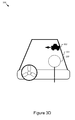
- Figure 3D is a graphic representation 330 example of a heads-up display 331.
- the scene computation module 230 computes the eye frame 332 based on the spatial position relative to the first client device 103 (x, y, z) s and generates a projected image into the eye position with embedded range information.
- the scene computation module 230 places the graphics 333 in 3D without requiring the driver's eyes to refocus.
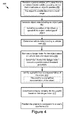
- Figure 4 is a flowchart of an example method for generating object information for a heads-up display based on object-to-vehicle (X2V) data.
- the method 400 may be performed by modules of the safety application 199 stored on the first client device 103 or the mobile client device 188.
- the safety system 199 may include a communication module 221, a categorization module 224, a danger assessment module 226, a graphics selection module 228, and a scene computation module 230.
- the communication module 221 receives 402 object-to-vehicle (X2V) data from a processor-based mobile computing device that broadcasts an object's position.
- the object includes, for example, a pedestrian, a bicycle, or a vehicle.
- the object may be outside of the driver's visual range.
- the categorization module 224 generates 404 object data including an object path.
- the object data may include a position of the object, a speed of the object, and a type of object.
- the danger assessment module 226 determines 406 vehicle data including a vehicle path.
- the danger assessment module 226 estimates 408 a danger index for the object based on the vehicle data and the object data.
- the danger assessment module 226 may also determine whether the danger index exceeds a predetermined threshold probability. This may correspond to a modality for the graphic. For example, where the danger index exceeds 80%, the graphic selection module 228 may select a red flashing modality for the graphic.
- the graphics selection module 228 identifies 410 a graphic that is a representation of the object.
- the graphic is a simplified representation of the object, such as a stick figure to represent a pedestrian.
- the graphics selection module 228 determines 412 a display modality for the graphic based on the danger index.
- the graphic may include a more noticeable display modality responsive to an increasing danger index.
- the modality may include bright colors, be bolded, include a flashing graphic, etc.
- the modality may be separate from the graphic or be part of the graphic.
- the scene computation module 230 positions 414 the graphic to correspond to a user's eye frame.
- the scene computation module 230 may position the graphic at a real position of the object so that the user maintains a substantially same eye focus when looking at the graphic and the object. This reduces response time because the user does not have to refocus when switching from looking at the object to the graphic.
- the method also includes a heads-up display 231 displaying the graphic as three-dimensional Cartesian coordinates.
- the embodiments of the specification can also relate to an apparatus for performing the operations herein.
- This apparatus may be specially constructed for the required purposes, or it may include a general-purpose computer selectively activated or reconfigured by a computer program stored in the computer.
- a computer program may be stored in a computer-readable storage medium, including, but is not limited to, any type of disk including floppy disks, optical disks, CD-ROMs, and magnetic disks, read-only memories (ROMs), random access memories (RAMs), EPROMs, EEPROMs, magnetic or optical cards, flash memories including USB keys with non-volatile memory, or any type of media suitable for storing electronic instructions, each coupled to a computer system bus.
- the specification can take the form of some entirely hardware embodiments, some entirely software embodiments, or some embodiments containing both hardware and software elements.
- the specification is implemented in software, which includes, but is not limited to, firmware, resident software, microcode, etc.
- a computer-usable or computer-readable medium can be any apparatus that can contain, store, communicate, propagate, or transport the program for use by or in connection with the instruction execution system, apparatus, or device.
- a data processing system suitable for storing or executing program code will include at least one processor coupled directly or indirectly to memory elements through a system bus.
- the memory elements can include local memory employed during actual execution of the program code, bulk storage, and cache memories which provide temporary storage of at least some program code in order to reduce the number of times code must be retrieved from bulk storage during execution.
- I/O devices including, but not limited to, keyboards, displays, pointing devices, etc.
- I/O controllers can be coupled to the system either directly or through intervening I/O controllers.
- Network adapters may also be coupled to the system to enable the data processing system to become coupled to other data processing systems or remote printers or storage devices through intervening private or public networks.
- Modems, cable modem, and Ethernet cards are just a few of the currently available types of network adapters.
- modules, routines, features, attributes, methodologies, and other aspects of the disclosure can be implemented as software, hardware, firmware, or any combination of the three.
- a component an example of which is a module, of the specification is implemented as software
- the component can be implemented as a standalone program, as part of a larger program, as a plurality of separate programs, as a statically or dynamically linked library, as a kernel-loadable module, as a device driver, or in every and any other way known now or in the future to those of ordinary skill in the art of computer programming.
- the disclosure is in no way limited to embodiment in any specific programming language, or for any specific operating system or environment.
- the disclosure includes a system and method for spatial information for a heads-up display.
- the system includes a processor and a memory storing instructions that, when executed, cause the system to: receive object-to-vehicle (X2V) data from a first processor-based mobile computing device that broadcasts an object's position, generate object data including an object path from a second processor-based computing device programmed to perform the generating, determine vehicle data including a vehicle path, estimate a danger index for the object based on the vehicle data and the object data, identify a graphic that is a representation of the object, and position the graphic to correspond to a user's eye frame.
- X2V object-to-vehicle
Landscapes
- Engineering & Computer Science (AREA)
- Physics & Mathematics (AREA)
- General Physics & Mathematics (AREA)
- Theoretical Computer Science (AREA)
- Radar, Positioning & Navigation (AREA)
- Remote Sensing (AREA)
- Automation & Control Theory (AREA)
- Transportation (AREA)
- Human Computer Interaction (AREA)
- Mechanical Engineering (AREA)
- Computer Vision & Pattern Recognition (AREA)
- Multimedia (AREA)
- General Engineering & Computer Science (AREA)
- Computer Networks & Wireless Communication (AREA)
- Optics & Photonics (AREA)
- Traffic Control Systems (AREA)
- Closed-Circuit Television Systems (AREA)
- User Interface Of Digital Computer (AREA)
Abstract
The disclosure includes a system and method for spatial information for a heads-up display. The system includes a processor and a memory storing instructions that, when executed, cause the system to: receive object-to-vehicle (X2V) data from a first processor-based mobile computing device that broadcasts an object's position, generate object data including an object path from a second processor-based computing device programmed to perform the generating, determine vehicle data including a vehicle path, estimate a danger index for the object based on the vehicle data and the object data, identify a graphic that is a representation of the object, and position the graphic to correspond to a user's eye frame.
Description
- The specification relates to generating object information for a heads-up display based on object-to-vehicle (X2V) data.
- Vehicle safety applications rely on sensors to detect entities that may collide with the vehicle. While these safety applications are useful, they may cause delay in detecting the entities because they are dependent upon a visual detection of the entities. By the time the safety application visually detects the entities, it may be too late to prevent a collision.
- According to one innovative aspect of the subject matter described in this disclosure, a system for generating spatial information for a heads-up display includes a processor and a memory storing instructions that, when executed, cause the system to: receive object-to-vehicle (X2V) data from a first processor-based mobile computing device that broadcasts an object's position, generate object data including an object path from a second processor-based computing device programmed to perform the generating, determine vehicle data including a vehicle path, estimate a danger index for the object based on the vehicle data and the object data, identify a graphic that is a representation of the object, and position the graphic to correspond to a user's eye frame.
- In general, another innovative aspect of the subject matter described in this disclosure may be embodied in methods that include: receiving object-to-vehicle (X2V) data from a first processor-based mobile computing device that broadcasts an object's position, generating object data including an object path from a second processor-based computing device programmed to perform the generating, determining vehicle data including a vehicle path, estimating a danger index for the object based on the vehicle data and the object data, identifying a graphic that is a representation of the object, and positioning the graphic to correspond to a user's eye frame.
- These and other embodiments may each optionally include one or more of the following operations and features. For instance, the features include: the object being outside of the user's visual range; the X2V data being received through dedicated short-range communications (DSRC); the object being a wearable device, the object data including includes a position of the object, a speed of the object, and a type of object; and the graphic being a simplified representation of the object.
- In some embodiments, the operations can include: determining whether the danger index exceeds a predetermined threshold probability; determining a display modality for the graphic based on the danger index; determining whether the danger index exceeds a predetermined threshold probability; and positioning the graphic at a real position of the object so that the user maintains a substantially same eye focus when looking at the graphic and the object.
- Other aspects include corresponding methods, systems, apparatus, and computer program products for these and other innovative aspects.
- The disclosure is particularly advantageous in a number of respects. For example, the system can detect objects without needing the objects to be in visual range. In addition, the system can alert users to dangerous situations with graphics that are easy to understand. In addition, the heads-up display generates graphics that do not require the driver to change focus to switch between viewing the road and the graph. As a result, the user can react more quickly and possibly avoid a collision.
- The disclosure is illustrated by way of example, and not by way of limitation in the figures of the accompanying drawings in which like reference numerals are used to refer to similar elements.
-
Figure 1 is a block diagram illustrating an example system for generating object information for a heads-up display. -
Figure 2 is a block diagram illustrating an example safety application for generating object information. -
Figure 3A is a graphic representation of an example vehicle detecting X2V data. -
Figure 3B is a graphic representation of an example object with a determined danger index. -
Figure 3C is a graphic representation example of a graphic selection process. -
Figure 3D is a graphic representation example of a heads-up display. -
Figure 4 is a flowchart of an example method for generating object information for a heads-up display. -
Figure 5 is a diagram illustrating an example configuration of a heads-up display. -
Figure 1 illustrates a block diagram of one embodiment of asystem 100 for generating object information for a heads-up display based on X2V data. Thesystem 100 includes afirst client device 103, amobile client device 188, abroadcasting device 120, asocial network server 101, asecond server 198, and amap server 190. Thefirst client device 103 and themobile client device 188 can be accessed by users 125a and 125b (also referred to herein individually and collectively as user 125), viasignal lines system 100 may be communicatively coupled via anetwork 105. Thesystem 100 may include other servers or devices not shown inFigure 1 including, for example, a traffic server for providing traffic data, a weather server for providing weather data, and a power service server for providing power usage service (e.g., billing service). - The
first client device 103 and themobile client device 188 inFigure 1 can be used by way of example. WhileFigure 1 illustrates twoclient devices more client devices Figure 1 illustratesmultiple broadcasting devices 120, onebroadcasting device 120 is possible. AlthoughFigure 1 illustrates onenetwork 105 coupled to thefirst client device 103, themobile client device 188, thesocial network server 101, thesecond server 198, and themap server 190, in practice one ormore networks 105 can be connected. WhileFigure 1 includes onesocial network server 101, onesecond server 198, and onemap server 190, thesystem 100 could include one or moresocial network servers 101, one or moresecond servers 198, and one ormore map servers 190. - The
network 105 can be a conventional type, wired or wireless, and may have numerous different configurations including a star configuration, token ring configuration, or other configurations. Furthermore, thenetwork 105 may include a local area network (LAN), a wide area network (WAN) (e.g., the Internet), or other interconnected data paths across which multiple devices may communicate. In some embodiments, thenetwork 105 may be a peer-to-peer network. Thenetwork 105 may also be coupled to or includes portions of a telecommunications network for sending data in a variety of different communication protocols. In some embodiments, thenetwork 105 includes Bluetooth® communication networks or a cellular communications network for sending and receiving data including via short messaging service (SMS), multimedia messaging service (MMS), hypertext transfer protocol (HTTP), direct data connection, WAP, e-mail, etc. In some embodiments, thenetwork 105 may include a GPS satellite for providing GPS navigation to thefirst client device 103 or themobile client device 188. Thenetwork 105 may be a mobile data network such as 3G, 4G, LTE, Voice-over-LTE ("VoLTE"), or any other mobile data network or combination of mobile data networks. - The
broadcasting device 120 can be a mobile computing device that includes a processor and a memory. For example, thebroadcasting device 120 can be a wearable device, a smartphone, a mobile telephone, a personal digital assistant ("PDA"), a mobile e-mail device, a portable game player, a portable music player, or other portable electronic device capable of accessing thenetwork 105. A wearable device includes, for example, jewelry that communicate over the network. Thebroadcasting device 120 may communicate using a dedicated short-range communications (DSRC) protocol. Thebroadcasting device 120 provides information about an object. The object may include a pedestrian with a wearable device, a biker with a smartphone, another vehicle, etc. - The
broadcasting device 120 transmits X2V data to thesafety application 199 as a dedicated short-range communication (DSRC). X2V data includes any type of object-to-vehicle data, such as vehicle-to-vehicle (V2V) data, infrastructure-to-vehicle (I2V) services, and data from other objects, such as pedestrians and bikers. X2V data is data that is sent from an object (X) sent to a vehicle (V) via so-called X2V communication. X2V data may be transmitted directly from the object to the vehicle, or transmitted from the object to vehicle via a relay device. X2V data includes information about the object's position. The object's position may be a position relative to the vehicle, or may be an absolute position. In one embodiment, the X2V data includes one or more bits that are an indication of the source of the data. DSRC are one-way or two-way short-range to medium-range wireless communication channels that are designed for automotive use. DSRC uses the 5.9 GHz band for transmission. - In some embodiments, a
safety application 199a can be operable on thefirst client device 103. Thefirst client device 103 can be a mobile client device with a battery system. For example, thefirst client device 103 can be one of a vehicle (e.g., an automobile, a bus), a bionic implant, or any other mobile system including non-transitory computer electronics and a battery system. In some embodiments, thefirst client device 103 may include a computing device that includes a memory and a processor. In the illustrated embodiment, thefirst client device 103 is communicatively coupled to thenetwork 105 viasignal line 108. - In other embodiments, a
safety application 199b can be operable on themobile client device 188. Themobile client device 188 may be a portable computing device that includes a memory and a processor, for example, an in-dash car device, a laptop computer, a tablet computer, a mobile telephone, a personal digital assistant ("PDA"), a mobile e-mail device, a portable game player, a portable music player, or other portable electronic device capable of accessing thenetwork 105. In some embodiments, thesafety application 199b may act in part as a thin-client application that may be stored on thefirst client device 103 and in part as components that may be stored on themobile client device 188. In the illustrated embodiment, themobile client device 188 is communicatively coupled to thenetwork 105 via asignal line 118. - In some embodiments, the first user 125a and the second user 125b can be the same user 125 interacting with both the
first client device 103 and themobile client device 188. For example, the user 125 can be a driver sitting in the first client device 103 (e.g., a vehicle) and operating the mobile client device 188 (e.g., a smartphone). In some other embodiments, the first user 125a and the second user 125b may be different users 125 that interact with thefirst client device 103 and themobile client device 188, respectively. For example, the first user 125a could be a drive that drives thefirst client device 103 and the second user 125b could be a passenger that interacts with themobile client device 188. - The
safety application 199 can be software for generating object information for a heads-up display. Thesafety application 199 receives X2V data from thebroadcasting device 120. Thesafety application 199 may receive the X2V data even though the object is not in the driver's visual range. Thesafety application 199 generates object data including an object path and vehicle data including a vehicle's path. Thesafety application 199 estimates a danger index for the object based on the vehicle data and the object data. For example, thesafety application 199 determines whether the vehicle might collide with the object. - The
safety application 199 identifies a graphic that is a representation of the object, such as an icon of a bicycle to warn the user of an approaching bicycle. Thesafety application 199 transmits instructions to a heads-up display for positioning the graphic to correspond to the driver's eye frame. - In some embodiments, the
safety application 199 can be implemented using hardware including a field-programmable gate array ("FPGA") or an application-specific integrated circuit ("ASIC"). In some other embodiments, thesafety application 199 can be implemented using a combination of hardware and software. Thesafety application 199 may be stored in a combination of the devices and servers, or in one of the devices or servers. - The
social network server 101 can be a hardware server that includes a processor, a memory, and network communication capabilities. In the illustrated embodiment, thesocial network server 101 is coupled to thenetwork 105 via asignal line 104. Thesocial network server 101 sends and receives data to and from other entities of thesystem 100 via thenetwork 105. Thesocial network server 101 includes asocial network application 111. A social network can be a type of social structure where the user 125 may be connected by a common feature. The common feature includes relationships/connections, e.g., friendship, family, work, an interest, etc. The common features may be provided by one or more social networking systems including explicitly defined relationships and relationships implied by social connections with other online users, where the relationships form a social graph. In some examples, the social graph can reflect a mapping of these users and how they can be related. - In some embodiments, the
social network application 111 generates a social network that may be used for generating object data. For example, other vehicles could be travelling a similar path as thefirst client device 103 and could identify information about objects that thefirst client device 103 is going to encounter. For example, where the object is a pedestrian, the other vehicle could determine the speed and direction of the pedestrian from the X2V data. That object data can be used by thesafety application 199 to more accurately determine a danger index for the pedestrian. - The
map server 190 can be a hardware server that includes a processor, a memory, and network communication capabilities. In the illustrated embodiment, themap server 190 is coupled to thenetwork 105 via asignal line 114. Themap server 190 sends and receives data to and from other objects of thesystem 100 via thenetwork 105. Themap server 190 includes amap application 191. Themap application 191 may generate a map and directions for the user. In one embodiment, thesafety application 199 receives a request for directions from the user 125 to travel from point A to point B and transmits the request to themap server 190. Themap application 191 generates directions and a map and transmits the directions and map to thesafety application 199 for display to the user. In some embodiments, thesafety application 199 adds the directions to thevehicle data 293 because the directions can be used to determine the path of the firstmobile device 103. - In some embodiments, the
system 100 includes asecond server 198 that is coupled to the network viasignal line 197. Thesecond server 198 may store additional information that is used by thesafety application 199, such as infotainment, music, etc. In some embodiments, thesecond server 198 receives a request for data from the safety application 199 (e.g., data for streaming a movie, music, etc.), generates the data, and transmits the data to thesafety application 199. - Referring now to
Figure 2 , an example of thesafety application 199 is shown in more detail.Figure 2 is a block diagram of afirst client device 103 that includes thesafety application 199, aprocessor 225, amemory 227, agraphics database 229, a heads-updisplay 231, acamera 233, acommunication unit 245, and asensor 247 according to some examples. The components of thefirst client device 103 are communicatively coupled by abus 240. - Although
Figure 2 includes thesafety application 199 being stored on thefirst client device 103, persons of ordinary skill in the art will recognize that some of the components thesafety application 199 can be stored on themobile client device 188 where certain hardware would not be applicable. For example, themobile client device 188 would not include the heads-updisplay 231 or thecamera 233. In embodiments where thesafety application 199 is stored on themobile client device 188, thesafety application 199 may receive information from the sensors on thefirst client device 103 and use the information to determine the graphic for the heads-updisplay 231, and transmit the graphic to the heads-updisplay 231 on thefirst client device 103. In some embodiments, thesafety application 199 can be stored in part on thefirst client device 103 and in part on themobile client device 188. - The
processor 225 includes an arithmetic logic unit, a microprocessor, a general-purpose controller, or some other processor array to perform computations and provide electronic display signals to a display device. Theprocessor 225 is coupled to thebus 240 for communication with the other components via asignal line 236. Theprocessor 225 processes data signals and may include various computing architectures including a complex instruction set computer (CISC) architecture, a reduced instruction set computer (RISC) architecture, or an architecture implementing a combination of instruction sets. AlthoughFigure 2 includes asingle processor 225,multiple processors 225 may be included. Other processors, operating systems, sensors, displays, and physical configurations may be possible. - The
memory 227 stores instructions or data that may be executed by theprocessor 225. Thememory 227 is coupled to thebus 240 for communication with the other components via asignal line 238. The instructions or data may include code for performing the techniques described herein. Thememory 227 may be a dynamic random access memory (DRAM) device, a static random access memory (SRAM) device, flash memory, or some other memory device. In some embodiments, thememory 227 also includes a non-volatile memory or similar permanent storage device and media including a hard disk drive, a floppy disk drive, a CD-ROM device, a DVD-ROM device, a DVD-RAM device, a DVD-RW device, a flash memory device, or some other mass storage device for storing information on a more permanent basis. - As illustrated in
Figure 2 , thememory 227stores vehicle data 293,X2V data 295,object data 297, andjourney data 298. Thevehicle data 293 includes information about thefirst client device 103, such as the speed of the vehicle, whether the vehicle's lights are on or off, the intended route of the vehicle as provided bymap server 190 or another application. In some embodiments, thesensor 247 may include hardware for determiningvehicle data 293. Thevehicle data 293 is used by thedanger assessment module 226 to determine a danger index for the object. - The
X2V data 295 includes position data for thebroadcasting device 120. Thecategorization module 224 generatesobject data 297 from theX2V data 295 including the object's speed and type. In some embodiments, theobject data 297 also includes historical data about how different types of objects behave. Theobject data 297 may also be supplemented by information that thedetection module 222 generates based on data from thesensor 247 and/orcamera 233. - The
journey data 298 includes information about the user's journey, such as start points, destinations, durations, routes associated with historical journeys, etc. For example, thejourney data 298 could include a log of all locations visited by thefirst client device 103, all locations visited by the user 125 (e.g., locations associated with both thefirst client device 103 and the mobile client device 188), locations requested by the user 125, etc. - The
graphics database 229 includes a database for storing graphics information. Thegraphics database 229 contains a set of pre-constructed two-dimensional and three-dimensional graphics that represent different objects. For example, the two-dimensional graphic may be a 2D pixel matrix, and the three-dimensional graphic may be a 3D voxel matrix. The graphics may be simplified representations of objects to decrease cognitive load on the user. For example, instead of representing a pedestrian as a realistic rendering, the graphic of the pedestrian includes a walking stick figure. In some embodiments, thegraphics database 229 is a relational database that responds to queries. For example, thegraphics selection module 228 queries thegraphics database 229 for graphics that match theobject data 297. - The heads-up
display 231 includes hardware for displaying three-dimensional (3D) graphical data in front of a user such that they do not need to look away from the road to view the graphical data. For example, the heads-updisplay 231 may include a physical screen or it may project the graphical data onto a transparent film that is part of the windshield of thefirst client device 103 or part of a reflector lens. In some embodiments, the heads-updisplay 231 is included as part of thefirst client device 103 during the manufacturing process or is later installed. In other embodiments, the heads-updisplay 231 is a removable device. In some embodiments, the graphical data adjusts a level of brightness to account for environmental conditions, such as night, day, cloudy, brightness, etc. The heads-up display is coupled to thebus 240 viasignal line 232. - The heads-up
display 231 receives graphical data for display from thesafety application 199. For example, the heads-updisplay 231 receives a graphic of a car from thesafety application 199 with a transparent modality. The heads-updisplay 231 displays graphics as three-dimensional Cartesian coordinates (e.g., with x, y, z dimensions). - Referring now to
Figure 5 , an example configuration of the heads-updisplay 231 is shown in detail. The heads-updisplay 231 includes aprojector 1001, amovable screen 1002, ascreen driving unit 1003, an optical system (includinglenses reflector 1005, etc.). Theprojector 1001 may be any kind of projector such as a digital mirror device (DMD) project, a liquid crystal projector. Theprojector 1001 projects an image (graphic) 1008 on themovable screen 1002 Themovable screen 1002 includes a transparent plate and so the projected image lights transmit through themovable screen 1002 to be projected on thewindshield 1007 of a vehicle (first client device 103). The image projected on thewindshield 1007 is perceived by adriver 1010 as if it is a real object (shown as 1011a, 1011b) that exists in the three-dimensional space of the real world, as opposed to an object that is projected on the windshield.] - The heads-up
display 231 is capable of controlling the direction of the image relative to the driver 1010 (in other words, the image position in the windshield) by adjusting the projection position on thescreen 1002. Further thescreen 1002 is movable by the screen-drivingunit 1003 in the range between thepositions screen 1002 can vary the depth (distance) of the projected image from thedriver 1010 in the real world. In one example, the movable range of the screen 1002 (distance betweenpositions display 231 allows thedriver 1010 to perceive the projected image exist in the real world (three-dimensional space). For example, when an image is projected at the same three-dimensional position (or substantially same depth at least) as a real object (such as a pedestrian, car, etc.), the driver does not need to adjust eye focus in order to view the projected image, resulting in easy grasp of the projected image while looking at the real object. - The heads-up
display 231 depicted inFigure 5 is provided by way of example. Other examples are possible. These examples may include heads-up displays having more or less complexity than the heads-updisplay 231 depicted inFigure 5 . For example, it is anticipated that in the future there will be heads-up displays that do not require movable parts such as themovable screen 1002. For example, a static screen that does not move may be deployed. Thecontent application 103 described above with reference toFigure 2B is designed to be operable with such components. - The
camera 233 is hardware for capturing images outside of thefirst client device 103 that are used by thedetection module 222 to identify objects. In some embodiments, thecamera 233 captures video recordings of the road. Thecamera 233 may be inside thefirst client device 103 or on the exterior of thefirst client device 103. In some embodiments, thecamera 233 is positioned in the front part of the car and records objects on or near the road. For example, thecamera 233 is positioned to record everything that the user can see. Thecamera 233 transmits the images to thesafety application 199. Although only onecamera 233 is illustrated,multiple cameras 233 may be used. In embodiments wheremultiple cameras 233 are used, thecameras 233 may be positioned to maximize the views of the road. For example, thecameras 233 could be positioned on each side of the grill. The camera is coupled to thebus 240 viasignal line 234. - The
communication unit 245 transmits and receives data to and from at least one of thefirst client device 103 and themobile client device 188, depending upon where thesafety application 199 is stored. Thecommunication unit 245 is coupled to thebus 240 via asignal line 246. In some embodiments, thecommunication unit 245 includes a port for direct physical connection to thenetwork 105 or to another communication channel. For example, thecommunication unit 245 includes a USB, SD, CAT-5, or similar port for wired communication with thefirst client device 103. In some embodiments, thecommunication unit 245 includes a wireless transceiver for exchanging data with thefirst client device 103 or other communication channels using one or more wireless communication methods, including IEEE 802.11, IEEE 802.16, BLUETOOTH®, or another suitable wireless communication method. - In some embodiments, the
communication unit 245 includes a cellular communications transceiver for sending and receiving data over a cellular communications network including via short messaging service (SMS), multimedia messaging service (MMS), hypertext transfer protocol (HTTP), direct data connection, WAP, e-mail, or another suitable type of electronic communication. In some embodiments, thecommunication unit 245 includes a wired port and a wireless transceiver. Thecommunication unit 245 also provides other conventional connections to thenetwork 105 for distribution of files or media objects using standard network protocols including TCP/IP, HTTP, HTTPS, and SMTP, etc. - The
sensor 247 is any device that senses physical changes. Thefirst client device 103 may have one type ofsensor 247 or many types of sensors. Thesensor 247 is coupled to the bus 220 viasignal line 248. - The
sensor 247 includes hardware for receiving X2V data via short-range communications (DSRC), such as a 802.11p DSRC WAVE Communication Unit. Thesensor 247 transmits the X2V data to thecommunication module 221 or to thememory 227 for storage. - In one embodiment, the
sensor 247 includes a laser-powered sensor, such as light detection and ranging (lidar) that are used to generate a three-dimensional map of the environment surrounding thefirst client device 103. Lidar functions as the eyes of thefirst client device 103 by shooting bursts of energy at a target from lasers and measuring the return time to calculate the distance. In another embodiment, thesensor 247 includes radar, which functions similar to lidar but uses microwave pulses to determine the distance and can detect smaller objects at longer distances. - In another embodiment, the
sensor 247 includes hardware for determiningvehicle data 293 about thefirst client device 103. For example, thesensor 247 is a motion detector, such as an accelerometer that is used to measure acceleration of thefirst client device 103. In another example, thesensor 247 includes location detection, such as a global positioning system (GPS), location detection through triangulation via a wireless network, etc. In yet another example, thesensor 247 includes hardware for determining the status of thefirst client device 103, such as hardware for determining whether the lights are on or off, whether the windshield wipers are on or off, etc. In some embodiments, thesensor 247 transmits thevehicle data 293 to thedetection module 222 or thedanger assessment module 226 via the communication module 202. In other embodiments, thesensor 247 stores the location information as part of thevehicle data 293 in thememory 227. - In some embodiments, the
sensor 247 may include a depth sensor. The depth sensor determines depth using structured light, such as a speckle pattern of infrared laser light. In another embodiment, the depth sensor determines depth using time-of-flight technology that determines depth based on the time it takes a light signal to travel between thecamera 233 and an object. For example, the depth sensor is a laser rangefinder. The depth sensor transmits the depth information to thedetection module 222 via the communication module 202 or thesensor 247 stores the depth information as part of thevehicle data 293 in thememory 227. - In other embodiments, the
sensor 247 may include an infrared detector, a motion detector, a thermostat, a sound detector, and any other type of sensors. For example, thefirst client device 103 may include sensors for measuring one or more of a current time, a location (e.g., a latitude, longitude, and altitude of a location), an acceleration of a vehicle, a velocity of a vehicle, a fuel tank level, and a battery level of a vehicle, etc. The sensors can be used to createvehicle data 293. Thevehicle data 293 can also include any information obtained during travel or received from thesocial network server 101, thesecond server 198, themap server 190, or themobile client device 188. - In some embodiments, the
safety application 199 includes acommunication module 221, adetection module 222, acategorization module 224, adanger assessment module 226, agraphics selection module 228, and ascene computation module 230. - The
communication module 221 can be software including routines for handling communications between thesafety application 199 and other components of thefirst client device 103. In some embodiments, thecommunication module 221 can be a set of instructions executable by the processor 235 to provide the functionality described below for handling communications between thesafety application 199 and other components of thefirst client device 103. In some embodiments, thecommunication module 221 can be stored in the memory 237 of thefirst client device 103 and can be accessible and executable by the processor 235. - The
communication module 221 sends and receives data, via thecommunication unit 245, to and from one or more of thefirst client device 103, themobile client device 188, thebroadcasting device 120, themap server 190, thesocial network server 101, and thesecond server 198 depending upon where thesafety application 199 is stored. For example, thecommunication module 221 receives, via thecommunication unit 245X2V data 295 from thebroadcasting device 120. Thecommunication module 221 transmits theX2V data 295 to thememory 227 for storage and to thecategorization module 224 for processing. - In some embodiments, the
communication module 221 receives data from components of thesafety application 199 and stores the data in the memory 237. For example, thecommunication module 221 receives data from thesensors 247, and stores it asvehicle data 293 in the memory 237 as determined by thedetection module 222. - In some embodiments, the
communication module 221 may handle communications between components of thesafety application 199. For example, thecommunication module 221 receivesobject data 297 from thecategorization module 224 and transmits it to thedanger assessment module 226. - The
detection module 222 can be software including routines for receiving data from thesensor 247 about an object. In some embodiments, thedetection module 222 can be a set of instructions executable by the processor 235 to provide the functionality described below for receiving sensor data from thesensor 247. In some embodiments, thedetection module 222 can be stored in the memory 237 of thefirst client device 103 and can be accessible and executable by the processor 235. - The
detection module 222 is an optional module that may supplement the information generated by thecategorization module 224 about an object. In some embodiments, thedetection module 222 receives sensor data from at least one of thesensor 247 or thecamera 233 and generatesobject data 297 about the objects. For example, thedetection module 222 determines the position of the object relative to thesensor 247 orcamera 233. In another example, thedetection module 222 receives images or video from thecamera 233 and identifies the location of objects, such as pedestrians or stationary objects including buildings, lane markers, obstacles, etc. - The
detection module 222 can usevehicle data 293 generated from thesensor 247, such as a location determined by GPS, to determine the distance between the object and thefirst client device 103. In another example, thesensor 247 includes lidar or radar that can be used to determine the distance between thefirst client device 103 and the object. Thedetection module 222 returns an n-tuple containing the position of the object in a sensor frame (x, y, z)s. In some embodiments, thedetection module 222 uses the position information to determine a path for the object. Thedetection module 222 adds the path to theobject data 297. - The
detection module 222 may receive information from thesocial network server 101 about the object. For example, where afirst client device 103 detects the object before anotherfirst client device 103 travels on the same or similar path, thesocial network server 101 may transmit information to thesafety application 199 about the object. For example, thedetection module 222 may receive information about the speed of the object from thesocial network server 101. - The
categorization module 224 can be software including routines for categorizing the object. In some embodiments, thecategorization module 224 can be a set of instructions executable by the processor 235 to provide the functionality described below for determining a speed of the object and a type of object. In some embodiments, thecategorization module 224 can be stored in the memory 237 of thefirst client device 103 and can be accessible and executable by the processor 235. - The
categorization module 224 receivesX2V data 295 from thecommunication module 221 or thecategorization module 224 retrieves theX2V data 295 from the memory. Thecategorization module 224 extracts the object's speed from theX2V data 295 and determines the object's speed based on the position data. For example, if the object is at position A at time T1, and position B at time T2, the distance over time is the object's speed. Thecategorization module 224 stores the speed information asobject data 297. - In some embodiments, the
categorization module 224 uses objectdata 297 determined by thedetection module 222 to supplement the information obtained from theX2V data 295. This is an optional step, however, since thedetection module 222 only works if the object is within visual range of thesensor 247 and/orcamera 233. - The
categorization module 224 determines the type of object based on the object's speed. For example, if the object is moving four miles an hour, the object is most likely a person. If the object is moving 20 miles an hour, the object may be a bicycle or a vehicle. Thecategorization module 224 stores the type information asobject data 297. - The
categorization module 224 determines the object's path based on theobject data 297. For example, if theX2V data 295 indicates that the object is travelling in a straight line, thecategorization module 224 determines that the path will likely continue in a straight line. Thecategorization module 224 stores the path as part of theobject data 297. -
Figure 3A is agraphic representation 300 of an example vehicle detecting X2V data. In this example, afirst vehicle 301 broadcasts vehicle-to-vehicle (V2V)data 305 via DSRC usingbroadcasting hardware 302. Asecond vehicle 303 includes asensor 304 for detecting theV2V data 305. - The
danger assessment module 226 can be software including routines for estimating a danger index for the object based onvehicle data 293 andobject data 297. In some embodiments, thedanger assessment module 226 can be a set of instructions executable by the processor 235 to provide the functionality described below for estimating a danger index for the object. In some embodiments, thedanger assessment module 226 can be stored in the memory 237 of thefirst client device 103 and can be accessible and executable by the processor 235. - In some embodiments, the
danger assessment module 226 estimates a danger index for an object based onvehicle data 293 andobject data 297. For example, thedanger assessment module 226 determines a vehicle path for thefirst client device 103 based on theobject data 297 and compares the vehicle path to an object path to determine whether there is a likelihood of collision between thefirst client device 103 and the object. If the object is stationary, thedanger assessment module 226 determines whether the vehicle's path will intersect with the stationary object. - In some embodiments, the
vehicle data 293 may be supplemented by map data provided by themap server 190 andjourney data 298 to determine historical behavior associated with the user. Thedanger assessment module 226 may use this information to determine a path for thefirst client device 103. - In some embodiments, the object data 207 includes historical information about the object's movement, which the
danger assessment module 226 takes into account. In some other embodiments, the danger index is based on the condition of thefirst client device 103. For example, if the first client device's 103 windshield wipers are on, thedanger assessment module 226 may assign a higher danger index because the windshield wipers suggest poor weather conditions. In some embodiments, thedanger assessment module 226 also uses a predicted path for the object as a factor in determining the danger index. - The danger index may be probabilistic and reflect a likelihood of collision. For example, the danger index may be calculated as d/dmax where dmax is a 100. A score of 51/100 would reflect a 51% chance of collision. In some embodiments, the
danger assessment module 226 uses a weighted calculation to determine the danger index. For example, thedanger assessment module 226 uses the following combination of information:
- where w1 is a first weight, w2 is a second weight, and w3 is a third weight. The danger index can be computed by analyzing the vehicle's and the object's directions to decide whether they intersect. If their estimated paths intersect then the system can look into their velocities to decide whether there is a collision risk, and whether the vehicle can stop given the road and weather conditions.
- In some embodiments, the
danger assessment module 226 divides the danger index into different levels, such as 0-40% being no threat, 41%-60% being moderate threat, 61%-80% being serious threat, and 81%-100% being imminent collision. As a result, if the danger index falls into certain categories, thedanger assessment module 226 provides the danger index and the level to thegraphics selection module 228 so that thegraphics selection module 228 uses a corresponding modality. -
Figure 3B is agraphic representation 310 of an example object with a determined danger index. Thedanger assessment module 226 receives a path for thefirst vehicle 311 as determined by thecategorization module 224. Thedanger assessment module 226 determines a path for thesecond vehicle 312. In this example, thedanger assessment module 226 determines that the two paths were going to collide and result indanger 313 to thesecond vehicle 312. - The
graphics selection module 228 can be software including routines for selecting a graphic and a modality to represent the object. In some embodiments, thegraphics selection module 228 can be a set of instructions executable by the processor 235 to provide the functionality described below for selecting the graphic and the modality to represent the object. In some embodiments, thegraphics selection module 228 can be stored in the memory 237 of thefirst client device 103 and can be accessible and executable by the processor 235. - In some embodiments, the
graphics selection module 228 queries thegraphics database 229 for a matching graphic. In some embodiments, thegraphics selection module 228 provides an identification of the object as determined by thedetection module 222. For example, thegraphics selection module 228 queries thegraphics database 229 for a graphic of a bus. In another embodiment, thegraphics selection module 228 queries thegraphics database 229 based on multiple attributes, such as a mobile vehicle with eighteen tires. - In some embodiments, the
graphics selection module 228 requests a modality where the modality is based on the danger index. The modality may be part of the graphic for the object or a separate graphic. The modality reflects the risk associated with the object. For example, thegraphics selection module 228 may request a flashing red outline for the object if the danger is imminent. Conversely, thegraphics selection module 228 may request a transparent image of the object if the danger is not imminent. In some embodiments, the modality corresponds to the danger levels determined by thedanger assessment module 226. For example, 0-40% corresponds to a transparent modality, 41%-60% corresponds to an orange modality, 61%-80% corresponds to a red and flashing modality, and 81%-100% corresponds to a solid red flashing modality. - In some embodiments, the
graphics selection module 228 determines the modality based on the position of the object. For example, where the object is a pedestrian walking on a sidewalk along the road, thegraphics selection module 228 determines that the modality is a light graphic. Thegraphics selection module 228 retrieves the graphic Gg from thegraphics database 229. -
Figure 3C agraphic representation 320 example of a graphic selection process. In this example, thegraphics selection module 228 selects a graphic 321 that is a simplified version of the vehicle and an arrow 323 to show the path of the vehicle. The simplified version of the vehicle is illustrated with a boxy looking car instead of a detailed example of a car. In some embodiments, the graphic 321 could include a bright red modality to convey the significance of the graphic 321. - The
scene computation module 230 can be software including routines for positioning the graphic to correspond to a user's eye frame. In some embodiments, thescene computation module 230 can be a set of instructions executable by the processor 235 to position the graphic to correspond to the user's eye frame. In some embodiments, thescene computation module 230 can be stored in the memory 237 of thefirst client device 103 and can be accessible and executable by the processor 235. - In one embodiment,
scene computation module 230 transforms the graphic and the modality to the driver's eye box. The eye box is an area with a projected image generated by the heads-updisplay 231 that is within the driver's field of view. The eye box frame is designed to be large enough that the driver can move his or her head and still see the graphics. If the driver's eyes are too far left or right of the eye box, the graphics will disappear off the edge. Because the eye box is within the driver's field of vision, the driver does not need to refocus in order to view the graphics. In some embodiments, thescene computation module 230 generates a different eye box for each user during calibration to account for variations in height and interocular distance (i.e. distance between the eyes of the driver). - The
scene computation module 230 adjusts the graphics to the view of the driver and to the distance between the sensor and the driver's eye box. In one embodiment, thescene computation module 230 computes the graphics in the eye frame Geye based on the spatial position relative to the first client device 103 (x, y, z)s and the graphics Gg. First the transformation from the sensor frame to the eye frame (Ts-e) is computed. The spatial position of thefirst client device 103, could be based on a GPS sensor (e.g. (x, y, z)GPS). Thescene computation module 230 multiplies the Ts-e by the transformation from graphics to sensor frame (Tg-s), resulting in the transformation from graphics to eye frame (Tg-e). Then the graphics Gg are projected into a viewport placed at a Tg-e pose. Thescene computation module 230 computes the eye frame so that the driver does not have to refocus when switching the gaze between the road and the graphics. As a result, displaying graphics that keep the same focus for the driver may save between 0.5 and 1 second in reaction time, which for afirst client device 103 is travelling at 90 km/h, results in 12.5 to 25 meters further to react to an object. - In some embodiments, the
scene computation module 230 generates instructions for the heads-updisplay 231 to superimpose the graphics on the location of the object. In another embodiment, thescene computation module 230 generates instructions for the heads-updisplay 231 to display the graphics in another location, or in addition to superimposing the graphics on the real object. For example, the bottom or top of the heads-up display image could contain a summary of the graphics that the user should be looking for on the road. - In some embodiments, the
scene computation module 230 determines the field of view for each eye to provide binocular vision. For example, thescene computation module 230 determines an overlapping binocular field of view, which is the maximum angular extent of the heads-updisplay 231 that is visible to both eyes simultaneously. In some embodiments, thescene computation module 230 calibrates the binocular FOV for each driver to account for variations in interocular distance and driver height. -
Figure 3D is agraphic representation 330 example of a heads-updisplay 331. In this example, thescene computation module 230 computes theeye frame 332 based on the spatial position relative to the first client device 103 (x, y, z)s and generates a projected image into the eye position with embedded range information. As a result, thescene computation module 230 places thegraphics 333 in 3D without requiring the driver's eyes to refocus. -
Figure 4 is a flowchart of an example method for generating object information for a heads-up display based on object-to-vehicle (X2V) data. In some embodiments, themethod 400 may be performed by modules of thesafety application 199 stored on thefirst client device 103 or themobile client device 188. For example, thesafety system 199 may include acommunication module 221, acategorization module 224, adanger assessment module 226, agraphics selection module 228, and ascene computation module 230. - The
communication module 221 receives 402 object-to-vehicle (X2V) data from a processor-based mobile computing device that broadcasts an object's position. The object includes, for example, a pedestrian, a bicycle, or a vehicle. The object may be outside of the driver's visual range. Thecategorization module 224 generates 404 object data including an object path. The object data may include a position of the object, a speed of the object, and a type of object. - The
danger assessment module 226 determines 406 vehicle data including a vehicle path. Thedanger assessment module 226 estimates 408 a danger index for the object based on the vehicle data and the object data. Thedanger assessment module 226 may also determine whether the danger index exceeds a predetermined threshold probability. This may correspond to a modality for the graphic. For example, where the danger index exceeds 80%, thegraphic selection module 228 may select a red flashing modality for the graphic. - The
graphics selection module 228 identifies 410 a graphic that is a representation of the object. For example, the graphic is a simplified representation of the object, such as a stick figure to represent a pedestrian. Thegraphics selection module 228 determines 412 a display modality for the graphic based on the danger index. The graphic may include a more noticeable display modality responsive to an increasing danger index. For example, the modality may include bright colors, be bolded, include a flashing graphic, etc. The modality may be separate from the graphic or be part of the graphic. Thescene computation module 230 positions 414 the graphic to correspond to a user's eye frame. Thescene computation module 230 may position the graphic at a real position of the object so that the user maintains a substantially same eye focus when looking at the graphic and the object. This reduces response time because the user does not have to refocus when switching from looking at the object to the graphic. In some embodiments, the method also includes a heads-updisplay 231 displaying the graphic as three-dimensional Cartesian coordinates. - The embodiments of the specification can also relate to an apparatus for performing the operations herein. This apparatus may be specially constructed for the required purposes, or it may include a general-purpose computer selectively activated or reconfigured by a computer program stored in the computer. Such a computer program may be stored in a computer-readable storage medium, including, but is not limited to, any type of disk including floppy disks, optical disks, CD-ROMs, and magnetic disks, read-only memories (ROMs), random access memories (RAMs), EPROMs, EEPROMs, magnetic or optical cards, flash memories including USB keys with non-volatile memory, or any type of media suitable for storing electronic instructions, each coupled to a computer system bus.
- The specification can take the form of some entirely hardware embodiments, some entirely software embodiments, or some embodiments containing both hardware and software elements. In some preferred embodiments, the specification is implemented in software, which includes, but is not limited to, firmware, resident software, microcode, etc.
- Furthermore, the description can take the form of a computer program product accessible from a computer-usable or computer-readable medium providing program code for use by or in connection with a computer or any instruction execution system. For the purposes of this description, a computer-usable or computer-readable medium can be any apparatus that can contain, store, communicate, propagate, or transport the program for use by or in connection with the instruction execution system, apparatus, or device.
- A data processing system suitable for storing or executing program code will include at least one processor coupled directly or indirectly to memory elements through a system bus. The memory elements can include local memory employed during actual execution of the program code, bulk storage, and cache memories which provide temporary storage of at least some program code in order to reduce the number of times code must be retrieved from bulk storage during execution.
- Input/output or I/O devices (including, but not limited to, keyboards, displays, pointing devices, etc.) can be coupled to the system either directly or through intervening I/O controllers.
- Network adapters may also be coupled to the system to enable the data processing system to become coupled to other data processing systems or remote printers or storage devices through intervening private or public networks. Modems, cable modem, and Ethernet cards are just a few of the currently available types of network adapters.
- Finally, the algorithms and displays presented herein are not inherently related to any particular computer or other apparatus. Various general-purpose systems may be used with programs in accordance with the teachings herein, or it may prove convenient to construct more specialized apparatus to perform the required method steps. The required structure for a variety of these systems will appear from the description below. In addition, the specification is not described with reference to any particular programming language. It will be appreciated that a variety of programming languages may be used to implement the teachings of the specification as described herein.
- The foregoing description of the embodiments of the specification has been presented for the purposes of illustration and description. It is not intended to be exhaustive or to limit the specification to the precise form disclosed. Many modifications and variations are possible in light of the above teaching. It is intended that the scope of the disclosure be limited not by this detailed description, but rather by the claims of this application. As will be understood by those familiar with the art, the specification may be embodied in other specific forms without departing from the spirit or essential characteristics thereof. Likewise, the particular naming and division of the modules, routines, features, attributes, methodologies, and other aspects are not mandatory or significant, and the mechanisms that implement the specification or its features may have different names, divisions, or formats. Furthermore, as will be apparent to one of ordinary skill in the relevant art, the modules, routines, features, attributes, methodologies, and other aspects of the disclosure can be implemented as software, hardware, firmware, or any combination of the three. Also, wherever a component, an example of which is a module, of the specification is implemented as software, the component can be implemented as a standalone program, as part of a larger program, as a plurality of separate programs, as a statically or dynamically linked library, as a kernel-loadable module, as a device driver, or in every and any other way known now or in the future to those of ordinary skill in the art of computer programming. Additionally, the disclosure is in no way limited to embodiment in any specific programming language, or for any specific operating system or environment. Accordingly, the disclosure is intended to be illustrative, but not limiting, of the scope of the specification, which is set forth in the following claims.
The disclosure includes a system and method for spatial information for a heads-up display. The system includes a processor and a memory storing instructions that, when executed, cause the system to: receive object-to-vehicle (X2V) data from a first processor-based mobile computing device that broadcasts an object's position, generate object data including an object path from a second processor-based computing device programmed to perform the generating, determine vehicle data including a vehicle path, estimate a danger index for the object based on the vehicle data and the object data, identify a graphic that is a representation of the object, and position the graphic to correspond to a user's eye frame.
Claims (11)
- A method performed by a processor-based computing device comprising:receiving object-to-vehicle (X2V) data from a device that broadcasts an object's position;generating object data including an object path;determining vehicle data including a vehicle path;estimating a danger index for the object based on the vehicle data and the object data;identifying a graphic that is a representation of the object; andpositioning the graphic to correspond to a user's eye frame.
- The method of claim 1, wherein the object is outside the user's visual range.
- The method of claim 1 or 2, wherein the X2V data is received through dedicated short-range communications (DSRC).
- The method of any one of claims 1 to 3, wherein the object is a wearable device.
- The method of any one of claims 1 to 4, wherein the object data includes a position of the object, a speed of the object, and a type of object.
- The method of any one of claims 1 to 5, wherein estimating the danger index further comprises determining whether the danger index exceeds a predetermined threshold probability.
- The method of any one of claims 1 to 6, wherein the graphic is a simplified representation of the object.
- The method of any one of claims 1 to 7, further comprising determining a display modality for the graphic based on the danger index.
- The method of any one of claims 1 to 8, wherein positioning the graphic to correspond to the user's eye frame further includes positioning the graphic at a real position of the object so that the user maintains a substantially same eye focus when looking at the graphic and the object.
- A computer program when executed on a computer causes the computer to execute steps of the method of any one of claims 1 to 9.
- A system comprising:a processor; anda tangible, non-transitory memory storing the computer program of claim 10.
Applications Claiming Priority (1)
| Application Number | Priority Date | Filing Date | Title |
|---|---|---|---|
| US14/470,844 US20160063332A1 (en) | 2014-08-27 | 2014-08-27 | Communication of external sourced information to a driver |
Publications (1)
| Publication Number | Publication Date |
|---|---|
| EP2993576A1 true EP2993576A1 (en) | 2016-03-09 |
Family
ID=54150217
Family Applications (1)
| Application Number | Title | Priority Date | Filing Date |
|---|---|---|---|
| EP15182479.4A Withdrawn EP2993576A1 (en) | 2014-08-27 | 2015-08-26 | Communication of external sourced information to a driver |
Country Status (3)
| Country | Link |
|---|---|
| US (1) | US20160063332A1 (en) |
| EP (1) | EP2993576A1 (en) |
| JP (1) | JP2016048552A (en) |
Families Citing this family (22)
| Publication number | Priority date | Publication date | Assignee | Title |
|---|---|---|---|---|
| US10133548B2 (en) * | 2014-01-27 | 2018-11-20 | Roadwarez Inc. | System and method for providing mobile personal security platform |
| US10049574B2 (en) * | 2014-09-01 | 2018-08-14 | Komatsu Ltd. | Transporter vehicle, dump truck, and transporter vehicle control method |
| US11356349B2 (en) | 2020-07-17 | 2022-06-07 | At&T Intellectual Property I, L.P. | Adaptive resource allocation to facilitate device mobility and management of uncertainty in communications |
| US10805222B2 (en) * | 2017-05-01 | 2020-10-13 | General Electric Company | Resilient network configuration for time sensitive traffic |
| US11072356B2 (en) | 2016-06-30 | 2021-07-27 | Transportation Ip Holdings, Llc | Vehicle control system |
| US10814893B2 (en) | 2016-03-21 | 2020-10-27 | Ge Global Sourcing Llc | Vehicle control system |
| US10659991B2 (en) | 2016-12-06 | 2020-05-19 | Nissan North America, Inc. | Bandwidth constrained image processing for autonomous vehicles |
| WO2019035177A1 (en) * | 2017-08-15 | 2019-02-21 | 三菱電機株式会社 | Vehicle-mounted display device, image processing device, and display control method |
| DE102017131264A1 (en) * | 2017-12-22 | 2019-06-27 | Liebherr-Hydraulikbagger Gmbh | Construction machine, in particular earthmoving machine with a control panel |
| KR102494865B1 (en) | 2018-02-20 | 2023-02-02 | 현대자동차주식회사 | Vehicle, and control method for the same |
| US10825241B2 (en) | 2018-03-16 | 2020-11-03 | Microsoft Technology Licensing, Llc | Using a one-dimensional ray sensor to map an environment |
| WO2020133451A1 (en) * | 2018-12-29 | 2020-07-02 | 驭势科技(北京)有限公司 | Vehicle information sharing system and method, and self-driving vehicle |
| CN110290503B (en) * | 2019-06-21 | 2020-12-18 | 北京邮电大学 | Method, apparatus, electronic device, and readable storage medium for vehicle data distribution |
| US11368991B2 (en) | 2020-06-16 | 2022-06-21 | At&T Intellectual Property I, L.P. | Facilitation of prioritization of accessibility of media |
| US11233979B2 (en) | 2020-06-18 | 2022-01-25 | At&T Intellectual Property I, L.P. | Facilitation of collaborative monitoring of an event |
| US11184517B1 (en) | 2020-06-26 | 2021-11-23 | At&T Intellectual Property I, L.P. | Facilitation of collaborative camera field of view mapping |
| US11037443B1 (en) | 2020-06-26 | 2021-06-15 | At&T Intellectual Property I, L.P. | Facilitation of collaborative vehicle warnings |
| US11411757B2 (en) | 2020-06-26 | 2022-08-09 | At&T Intellectual Property I, L.P. | Facilitation of predictive assisted access to content |
| US11768082B2 (en) | 2020-07-20 | 2023-09-26 | At&T Intellectual Property I, L.P. | Facilitation of predictive simulation of planned environment |
| DE102020126953B3 (en) * | 2020-10-14 | 2021-12-30 | Bayerische Motoren Werke Aktiengesellschaft | System and method for detecting a spatial orientation of a portable device |
| CN114967648B (en) * | 2022-05-27 | 2024-07-12 | 中国人民解放军海军工程大学 | Risk control evaluation method under equipment multitasking mode |
| WO2024177289A1 (en) * | 2023-02-20 | 2024-08-29 | 삼성전자주식회사 | Wearable device for placing virtual object corresponding to external object in virtual space, and method therefor |
Citations (4)
| Publication number | Priority date | Publication date | Assignee | Title |
|---|---|---|---|---|
| US20020022927A1 (en) * | 1993-08-11 | 2002-02-21 | Lemelson Jerome H. | GPS vehicle collision avoidance warning and control system and method |
| EP1964719A2 (en) * | 2007-02-28 | 2008-09-03 | Sanyo Electric Co., Ltd. | Apparatus and method for monitoring a vehicle's surroundings |
| CN102509474A (en) * | 2011-11-09 | 2012-06-20 | 深圳市伊爱高新技术开发有限公司 | System and method for automatically preventing collision between vehicles |
| DE102012214852A1 (en) * | 2012-08-21 | 2014-02-27 | Robert Bosch Gmbh | A method for supplementing object information associated with an object and method for selecting objects in an environment of a vehicle |
Family Cites Families (9)
| Publication number | Priority date | Publication date | Assignee | Title |
|---|---|---|---|---|
| US6370475B1 (en) * | 1997-10-22 | 2002-04-09 | Intelligent Technologies International Inc. | Accident avoidance system |
| JPH0935177A (en) * | 1995-07-18 | 1997-02-07 | Hitachi Ltd | Driving support method and driving support device |
| JP2006072830A (en) * | 2004-09-03 | 2006-03-16 | Aisin Aw Co Ltd | Operation supporting system and operation supporting module |
| KR100721560B1 (en) * | 2005-11-30 | 2007-05-23 | 한국전자통신연구원 | 3D vehicle information providing system and method therefor |
| JP2008129718A (en) * | 2006-11-17 | 2008-06-05 | Toyota Central R&D Labs Inc | Driving assistance device |
| JP2010122919A (en) * | 2008-11-19 | 2010-06-03 | Shimadzu Corp | Air position presentation device |
| US8564502B2 (en) * | 2009-04-02 | 2013-10-22 | GM Global Technology Operations LLC | Distortion and perspective correction of vector projection display |
| US9092984B2 (en) * | 2013-03-14 | 2015-07-28 | Microsoft Technology Licensing, Llc | Enriching driving experience with cloud assistance |
| US9349293B2 (en) * | 2014-02-07 | 2016-05-24 | Here Global B.V | Method and apparatus for providing vehicle synchronization to facilitate a crossing |
-
2014
- 2014-08-27 US US14/470,844 patent/US20160063332A1/en not_active Abandoned
-
2015
- 2015-08-25 JP JP2015165628A patent/JP2016048552A/en active Pending
- 2015-08-26 EP EP15182479.4A patent/EP2993576A1/en not_active Withdrawn
Patent Citations (4)
| Publication number | Priority date | Publication date | Assignee | Title |
|---|---|---|---|---|
| US20020022927A1 (en) * | 1993-08-11 | 2002-02-21 | Lemelson Jerome H. | GPS vehicle collision avoidance warning and control system and method |
| EP1964719A2 (en) * | 2007-02-28 | 2008-09-03 | Sanyo Electric Co., Ltd. | Apparatus and method for monitoring a vehicle's surroundings |
| CN102509474A (en) * | 2011-11-09 | 2012-06-20 | 深圳市伊爱高新技术开发有限公司 | System and method for automatically preventing collision between vehicles |
| DE102012214852A1 (en) * | 2012-08-21 | 2014-02-27 | Robert Bosch Gmbh | A method for supplementing object information associated with an object and method for selecting objects in an environment of a vehicle |
Non-Patent Citations (1)
| Title |
|---|
| ENSC, 1 January 2012 (2012-01-01), XP055244748, Retrieved from the Internet <URL:http://www2.ensc.sfu.ca/~ljilja/ENSC427/Spring12/Projects/team14/ensc427project.pdf> [retrieved on 20160126] * |
Also Published As
| Publication number | Publication date |
|---|---|
| US20160063332A1 (en) | 2016-03-03 |
| JP2016048552A (en) | 2016-04-07 |
Similar Documents
| Publication | Publication Date | Title |
|---|---|---|
| EP2993576A1 (en) | Communication of external sourced information to a driver | |
| EP2990936A1 (en) | Communication of spatial information based on driver attention assessment | |
| US9409519B2 (en) | Generating spatial information for a heads-up display | |
| EP3705846B1 (en) | Object location indicator system and method | |
| US20230319140A1 (en) | Smart car | |
| JP6428876B2 (en) | Shielding adjustment system for in-vehicle augmented reality system | |
| US10395433B2 (en) | Traffic situation awareness for an autonomous vehicle | |
| US10895465B2 (en) | Optimizing a route selection for a highly autonomous vehicle | |
| US10168174B2 (en) | Augmented reality for vehicle lane guidance | |
| US10328973B2 (en) | Assisting drivers with roadway lane changes | |
| EP2526508B1 (en) | Traffic signal mapping and detection | |
| US20180342107A1 (en) | Three Dimensional Graphical Overlays for a Three Dimensional Heads-up Display Unit of a Vehicle | |
| US20220063663A1 (en) | Conditional motion predictions | |
| CN111319628A (en) | Method and system for evaluating false threat detection | |
| US10366473B2 (en) | Providing traffic mirror content to a driver | |
| EP2991358A2 (en) | Communication of cloud-based content to a driver | |
| US12344264B2 (en) | Generating and depicting a graphic of a phantom vehicle | |
| US11257363B2 (en) | XR-based slot reservation system for connected vehicles traveling through intersections | |
| US20240080571A1 (en) | Managing Efficiency of Image Processing |
Legal Events
| Date | Code | Title | Description |
|---|---|---|---|
| PUAI | Public reference made under article 153(3) epc to a published international application that has entered the european phase |
Free format text: ORIGINAL CODE: 0009012 |
|
| 17P | Request for examination filed |
Effective date: 20150826 |
|
| AK | Designated contracting states |
Kind code of ref document: A1 Designated state(s): AL AT BE BG CH CY CZ DE DK EE ES FI FR GB GR HR HU IE IS IT LI LT LU LV MC MK MT NL NO PL PT RO RS SE SI SK SM TR |
|
| AX | Request for extension of the european patent |
Extension state: BA ME |
|
| STAA | Information on the status of an ep patent application or granted ep patent |
Free format text: STATUS: THE APPLICATION HAS BEEN WITHDRAWN |
|
| 18W | Application withdrawn |
Effective date: 20170505 |