EP2992575B1 - Amplificateur de fibre optique - Google Patents
Amplificateur de fibre optique Download PDFInfo
- Publication number
- EP2992575B1 EP2992575B1 EP14723408.2A EP14723408A EP2992575B1 EP 2992575 B1 EP2992575 B1 EP 2992575B1 EP 14723408 A EP14723408 A EP 14723408A EP 2992575 B1 EP2992575 B1 EP 2992575B1
- Authority
- EP
- European Patent Office
- Prior art keywords
- wavelength
- seed
- fiber
- pulses
- soliton
- Prior art date
- Legal status (The legal status is an assumption and is not a legal conclusion. Google has not performed a legal analysis and makes no representation as to the accuracy of the status listed.)
- Active
Links
Images
Classifications
-
- H—ELECTRICITY
- H01—ELECTRIC ELEMENTS
- H01S—DEVICES USING THE PROCESS OF LIGHT AMPLIFICATION BY STIMULATED EMISSION OF RADIATION [LASER] TO AMPLIFY OR GENERATE LIGHT; DEVICES USING STIMULATED EMISSION OF ELECTROMAGNETIC RADIATION IN WAVE RANGES OTHER THAN OPTICAL
- H01S3/00—Lasers, i.e. devices using stimulated emission of electromagnetic radiation in the infrared, visible or ultraviolet wave range
- H01S3/05—Construction or shape of optical resonators; Accommodation of active medium therein; Shape of active medium
- H01S3/06—Construction or shape of active medium
- H01S3/063—Waveguide lasers, i.e. whereby the dimensions of the waveguide are of the order of the light wavelength
- H01S3/067—Fibre lasers
- H01S3/06754—Fibre amplifiers
-
- H—ELECTRICITY
- H01—ELECTRIC ELEMENTS
- H01S—DEVICES USING THE PROCESS OF LIGHT AMPLIFICATION BY STIMULATED EMISSION OF RADIATION [LASER] TO AMPLIFY OR GENERATE LIGHT; DEVICES USING STIMULATED EMISSION OF ELECTROMAGNETIC RADIATION IN WAVE RANGES OTHER THAN OPTICAL
- H01S3/00—Lasers, i.e. devices using stimulated emission of electromagnetic radiation in the infrared, visible or ultraviolet wave range
- H01S3/30—Lasers, i.e. devices using stimulated emission of electromagnetic radiation in the infrared, visible or ultraviolet wave range using scattering effects, e.g. stimulated Brillouin or Raman effects
- H01S3/302—Lasers, i.e. devices using stimulated emission of electromagnetic radiation in the infrared, visible or ultraviolet wave range using scattering effects, e.g. stimulated Brillouin or Raman effects in an optical fibre
-
- H—ELECTRICITY
- H01—ELECTRIC ELEMENTS
- H01S—DEVICES USING THE PROCESS OF LIGHT AMPLIFICATION BY STIMULATED EMISSION OF RADIATION [LASER] TO AMPLIFY OR GENERATE LIGHT; DEVICES USING STIMULATED EMISSION OF ELECTROMAGNETIC RADIATION IN WAVE RANGES OTHER THAN OPTICAL
- H01S2301/00—Functional characteristics
- H01S2301/08—Generation of pulses with special temporal shape or frequency spectrum
- H01S2301/085—Generation of pulses with special temporal shape or frequency spectrum solitons
-
- H—ELECTRICITY
- H01—ELECTRIC ELEMENTS
- H01S—DEVICES USING THE PROCESS OF LIGHT AMPLIFICATION BY STIMULATED EMISSION OF RADIATION [LASER] TO AMPLIFY OR GENERATE LIGHT; DEVICES USING STIMULATED EMISSION OF ELECTROMAGNETIC RADIATION IN WAVE RANGES OTHER THAN OPTICAL
- H01S3/00—Lasers, i.e. devices using stimulated emission of electromagnetic radiation in the infrared, visible or ultraviolet wave range
- H01S3/05—Construction or shape of optical resonators; Accommodation of active medium therein; Shape of active medium
- H01S3/06—Construction or shape of active medium
- H01S3/063—Waveguide lasers, i.e. whereby the dimensions of the waveguide are of the order of the light wavelength
- H01S3/067—Fibre lasers
- H01S3/06708—Constructional details of the fibre, e.g. compositions, cross-section, shape or tapering
- H01S3/06716—Fibre compositions or doping with active elements
-
- H—ELECTRICITY
- H01—ELECTRIC ELEMENTS
- H01S—DEVICES USING THE PROCESS OF LIGHT AMPLIFICATION BY STIMULATED EMISSION OF RADIATION [LASER] TO AMPLIFY OR GENERATE LIGHT; DEVICES USING STIMULATED EMISSION OF ELECTROMAGNETIC RADIATION IN WAVE RANGES OTHER THAN OPTICAL
- H01S3/00—Lasers, i.e. devices using stimulated emission of electromagnetic radiation in the infrared, visible or ultraviolet wave range
- H01S3/05—Construction or shape of optical resonators; Accommodation of active medium therein; Shape of active medium
- H01S3/06—Construction or shape of active medium
- H01S3/063—Waveguide lasers, i.e. whereby the dimensions of the waveguide are of the order of the light wavelength
- H01S3/067—Fibre lasers
- H01S3/06708—Constructional details of the fibre, e.g. compositions, cross-section, shape or tapering
- H01S3/06725—Fibre characterized by a specific dispersion, e.g. for pulse shaping in soliton lasers or for dispersion compensating [DCF]
-
- H—ELECTRICITY
- H01—ELECTRIC ELEMENTS
- H01S—DEVICES USING THE PROCESS OF LIGHT AMPLIFICATION BY STIMULATED EMISSION OF RADIATION [LASER] TO AMPLIFY OR GENERATE LIGHT; DEVICES USING STIMULATED EMISSION OF ELECTROMAGNETIC RADIATION IN WAVE RANGES OTHER THAN OPTICAL
- H01S3/00—Lasers, i.e. devices using stimulated emission of electromagnetic radiation in the infrared, visible or ultraviolet wave range
- H01S3/09—Processes or apparatus for excitation, e.g. pumping
- H01S3/091—Processes or apparatus for excitation, e.g. pumping using optical pumping
- H01S3/094—Processes or apparatus for excitation, e.g. pumping using optical pumping by coherent light
- H01S3/094003—Processes or apparatus for excitation, e.g. pumping using optical pumping by coherent light the pumped medium being a fibre
- H01S3/094007—Cladding pumping, i.e. pump light propagating in a clad surrounding the active core
-
- H—ELECTRICITY
- H01—ELECTRIC ELEMENTS
- H01S—DEVICES USING THE PROCESS OF LIGHT AMPLIFICATION BY STIMULATED EMISSION OF RADIATION [LASER] TO AMPLIFY OR GENERATE LIGHT; DEVICES USING STIMULATED EMISSION OF ELECTROMAGNETIC RADIATION IN WAVE RANGES OTHER THAN OPTICAL
- H01S3/00—Lasers, i.e. devices using stimulated emission of electromagnetic radiation in the infrared, visible or ultraviolet wave range
- H01S3/14—Lasers, i.e. devices using stimulated emission of electromagnetic radiation in the infrared, visible or ultraviolet wave range characterised by the material used as the active medium
- H01S3/16—Solid materials
- H01S3/1601—Solid materials characterised by an active (lasing) ion
- H01S3/1603—Solid materials characterised by an active (lasing) ion rare earth
- H01S3/1616—Solid materials characterised by an active (lasing) ion rare earth thulium
-
- H—ELECTRICITY
- H01—ELECTRIC ELEMENTS
- H01S—DEVICES USING THE PROCESS OF LIGHT AMPLIFICATION BY STIMULATED EMISSION OF RADIATION [LASER] TO AMPLIFY OR GENERATE LIGHT; DEVICES USING STIMULATED EMISSION OF ELECTROMAGNETIC RADIATION IN WAVE RANGES OTHER THAN OPTICAL
- H01S3/00—Lasers, i.e. devices using stimulated emission of electromagnetic radiation in the infrared, visible or ultraviolet wave range
- H01S3/14—Lasers, i.e. devices using stimulated emission of electromagnetic radiation in the infrared, visible or ultraviolet wave range characterised by the material used as the active medium
- H01S3/16—Solid materials
- H01S3/17—Solid materials amorphous, e.g. glass
- H01S3/176—Solid materials amorphous, e.g. glass silica or silicate glass
Definitions
- the present invention relates to an optical system comprising a fiber amplifier, and in particular, an optical system for efficient generation of ultra-short high-energy pulses and/or high-power optical supercontinuum.
- Supercontinuum radiation is a phenomenon whereby narrowband light propagating through a non-linear medium is transformed into a signal with very broad spectrum.
- Optical fibers are a natural choice of non-linear media.
- US 2002/0168161 A1 teaches a source of optical pulses and methods of generating optical pulses, particularly tunable pulses, by use of the Soliton-self-frequency shifting effect in an optical amplifier based on doped holey fiber.
- the spectrum is extended above 2.4 ⁇ m by using a core-pumped thulium-doped fiber amplifier, and that radiation is then amplified in another section of thulium-doped fiber amplifier to produce the output supercontinuum. Increasing the pump power broadens the spectrum of the supercontinuum.
- an optical system as defined in claim 1 and a method as defined in claim 11 of operating an optical system.
- Embodiments are set out in the dependent claims.
- the optical system comprises a fiber amplifier comprising an optically active doped fiber; a source of seed pulses; and a pump source, wherein the doped fiber is doped with one or more active element(s) selected such that the seed pulses are amplified in intensity; the doped fiber has a negative (anomalous) group velocity dispersion in the region from the wavelength of the seed pulses to a threshold wavelength at which the magnitude of the optical loss of the doped fiber is greater than a gain due to stimulated Raman scattering, so that due to stimulated Raman scattering, formation of a Raman soliton occurs, the Raman soliton is further shifted in the wavelength domain, and the shifting of the soliton in the wavelength domain is stopped at the threshold wavelength; the fiber is doped with thulium (Tm), the fiber has a negative group velocity dispersion in the region of 1.8 to 2.6 ⁇ m; the pump source is arranged to pump at a wavelength from 0.77 to 0.82 ⁇ m; the source of seed pulses provides pulses having wavelength
- Raman soliton in use, formation of a Raman soliton occurs due to stimulated Raman scattering.
- the Raman soliton is then shifted in the wavelength domain.
- the shifting of the Raman soliton is stopped at the threshold wavelength.
- an optical system for outputting an optical output comprising: a fiber amplifier comprising an optically active doped fiber; a source of seed pulses; and a pump source; wherein the doped fiber has a negative (anomalous) group velocity dispersion in the region from the wavelength of the seed pulse to the desirable threshold wavelength and it is doped with one or more active element(s) selected such that the seed pulse is amplified in intensity so that due to stimulated Raman scattering a formation of a Raman soliton occurs and a further shift of the soliton in the wavelength domain which is preferably stopped at a threshold wavelength at which the magnitude of the optical loss of the doped fiber is greater than a gain due to the stimulated Raman scattering.
- an optical supercontinuum and/or a high-energy pulse shorter than the seed pulse and preferably comprising the predominant part of the output amplifier radiation without spectral filtering and spectrally shifted to the longer wavelength direction.
- the optical system is operable in a first and second mode, wherein in the first mode the optical system is operable to generate as the output a high-energy pulse shorter than the seed pulse and comprising the predominant part of the output amplifier radiation without spectral filtering and spectrally shifted to the longer wavelength direction, and wherein in the second mode the optical system is operable to generate as the output an optical supercontinuum.
- the duration of the seed optical pulses is less than 100 ps, in order to provide more efficient generation of the Raman soliton.
- the doped fiber has a steeply increasing optical loss at the threshold wavelength, the threshold wavelength being longer than the wavelength of the seed pulse.
- the magnitude of the optical loss is preferably chosen to overcome the gain due to stimulated Raman scattering at the peak intensity of the desired output pulse.
- the fiber is silica-based.
- the fiber may be a germanate glass fiber, or a fiber with high (preferably >50%) germanium oxide content, or any other fiber with negative (anomalous) dispersion in the desired wavelength range, including but not limited to fluorozirconate glasses (e.g. ZBLAN), phosphate glasses or chalcogenide glasses.
- fluorozirconate glasses e.g. ZBLAN
- phosphate glasses e.g. phosphate glasses or chalcogenide glasses.
- the doped fiber may be doped with at least one element producing optical loss at the threshold wavelength.
- the fiber is doped with thulium.
- the fiber is doped with at least one element chosen from the rare-earth group, for example Nd, Er, Yb and Ho.
- Thulium/holmium-doped fiber may be used in order to achieve broader gain which is preferable for supercontinuum generation.
- Holmium-doped fiber may be used in order to decrease the spectral band in order to provide more efficient energy transfer to the soliton comprising the most part of the amplifier output energy.
- the pump wavelengths are preferably chosen from the regions of 1.14-1.16 ⁇ m or 2-2.1 ⁇ m.
- the fiber is doped with thulium.
- an optical system comprising: a thulium doped fiber amplifier; a pump source arranged to pump at a wavelength from 0.77 to 0.82 ⁇ m; and a source of seed pulses, the seed pulses having wavelengths from 1.8-2.1 ⁇ m.
- soliton pulses in the region from the seed pulse wavelength to 2.6 ⁇ m. It is also possible to generate (in a first mode of operation) a soliton pulse in the 2.2-2.8 ⁇ m region comprising the predominant part of the amplifier output radiation, and (in a second mode of operation) supercontinuum radiation from 1.8-2.6 ⁇ m. Changing from one operational mode to another may be achieved by changing the input parameters of the pump source and seed pulses.
- a fiber laser comprising an amplification chain for amplification of optical pulses, which has at least one amplifier cascade realized with an optical fiber doped with an optically active element, the doped fiber having a steep rise of an optical loss at a wavelength longer than that of the seed pulse and having a negative (anomalous) group velocity dispersion in the wavelength region from the seed spectral position to the optical loss edge (referred to also as threshold wavelength, or absorption edge).
- the optical loss value is chosen so that the optical loss overcomes the Raman gain at the desired peak intensity of the output pulse.
- a fiber laser comprising an amplification chain for amplification of seed pulses with spectral intensity maximum in the region of 1.8-2.1 ⁇ m, which has at least one amplifier cascade realized on a thulium-doped optical glass fiber with a negative group velocity dispersion in the region of 1.8-2.6 ⁇ m pumped at the wavelengths chosen from the region of 0.77-0.82 ⁇ m.
- the amplifier can act as a supercontinuum light source in covering the region of 1.8-2.6 ⁇ m.
- the optical loss may be natural or introduced by several techniques, such as cut-off of a fundamental mode in a special fiber or doping with chemical elements or introducing bending losses in order to obtain a sharp absorption edge at a desirable wavelength.
- the operation principle of the amplifier is the shifting of the pulse in the wavelength domain due to stimulated Raman scattering which is stopped at a certain spectral point owing to the optical loss overcoming the Raman gain.
- the amplifier produces one or a series of the Raman solitons from each input pulse, whereas the first Raman soliton is spectrally shifted with respect to the pulse, the second Raman soliton is spectrally shifted with respect to the first Raman soliton, and so on.
- amplification in the 3 H 4 - 3 H 5 electronic transition band also plays a part in the wavelength shifting of the pulse.
- the pulse and the Raman solitons can be completely or partially separated in time.
- the Raman solitons are completely separated in time (the first mode of operation of the laser), it is possible to generate at a certain pump rate an optical supercontinuum covering the whole spectral region between the input seed and the absorption edge. Further increase in the pump rate will result in the increase of the power of the supercontinuum without broadening of its spectrum.
- the seed pulse will amplify the first Raman soliton at the expense of its own energy, the first Raman soliton will amplify the second Raman soliton, and so on.
- the energy transfer will stop at the last Raman soliton whose spectral position is determined by the position of the absorption edge. This Raman soliton will thus accumulate the energy supplied by the pump.
- the technical result is the realization of a high-brightness supercontinuum, and a high energy ultra-short seed pulse accumulating the predominant part of the amplifier output spectral energy, and a device which can switch between these two operational modes.
- Another advantage is the realization of a high-energy pulse comprising the predominant part of the laser output radiation.
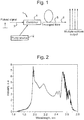
- the optical system 1 of Figure 1 comprises a pump source 2, a source of seed pulses (seed source) for providing seed pulses 3, a combiner 4 and a fiber amplifier 5.
- the pump source 2 provides pump radiation to the combiner 4, where it is coupled with seed pulses 3 from the seed pulse source.
- the multiplexed output from the combiner 4 is then input to the fiber amplifier 5, and is output as output pulses 6.
- Figure 2 shows a supercontinuum output spectrum generated by an optical system according to the present invention.
- the fiber amplifier used was a thulium doped fiber amplifier pumped with pump pulses with a wavelength of 795 nm.
- the wavelength of the seed pulse was 1970 nm.
- the preferred embodiment uses a silica-based thulium-doped optical fiber with OH- groups introduced into the fiber during manufacturing.
- OH- groups will be present to some extent in most optical fibers, but normally their concentration is reduced as much as possible. Leaving OH- in the fiber to some extent allows controlling the cut-off wavelength and loss (i.e., the more OH-, the shorter the cut-off wavelength and the higher the losses).
- OH- groups may exist in different optical glass fibers and thus can play the role providing the requisite optical loss, especially the intense absorption peak situated at the wavelength of 2.7-2.8 ⁇ m depending on the specific glass composition.
- a supercontinuum or the ultra-short pulses in the wavelength region of 1.8-2.7 ⁇ m can be generated by such an optical fiber.
- a germanate glass fiber or a fiber with high (preferably >50%) germanium oxide content can provide the extension of this spectral range up to 2.8 ⁇ m.
- the silica-based thulium-doped optical fiber is seeded by seed pulses in the region of 1.8-2.1 ⁇ m.
- the preferable pump method is clad-pumping. Clad pumping is important for reaching high output powers and for using direct diode-pumping which is more economical.
- the pump wavelength is selected from the regions of 0.77-0.82 ⁇ m, 1.5-1.65 ⁇ m, and 1.18-1.21 ⁇ m.
- Core-pumping method or any combination of the mentioned above pump possibilities can be used as well. It is possible to generate an ultra-short soliton pulse in the spectral range of 2.2-2.7 ⁇ m which carries the predominant part of the output amplifier radiation without applying a spectral filtering in any form.
- the invention can be used in industrial and scientific applications such as fine material processing, oil and gas sensing, environment monitoring, and medicine.
- the advantage of the amplifier is its natural simplicity and reliability as compared to the existing analogues.
Landscapes
- Physics & Mathematics (AREA)
- Electromagnetism (AREA)
- Engineering & Computer Science (AREA)
- Plasma & Fusion (AREA)
- Optics & Photonics (AREA)
- Lasers (AREA)
- Optical Modulation, Optical Deflection, Nonlinear Optics, Optical Demodulation, Optical Logic Elements (AREA)
Claims (14)
- Système optique comprenant :un amplificateur de fibre (5) comprenant une fibre dopée active d'un point de vue optique ;une source d'impulsions initiales (3) ; etune source de pompage (2), dans lequella fibre dopée est dopée avec un ou plusieurs éléments actifs sélectionnés de sorte que les impulsions initiales (3) sont amplifiées en intensité ;la fibre dopée a une dispersion négative de vitesse de groupe dans la région allant de la longueur d'onde des impulsions initiales (3) jusqu'à une longueur d'onde de seuil à laquelle l'amplitude de la perte optique de la fibre dopée est plus grande qu'un gain dû à une diffusion de Raman stimulée, de sorte qu'en fonctionnement en raison de la diffusion de Raman stimulée, la formation d'un soliton de Raman se produit, le soliton de Raman est en outre décalé dans le domaine de longueur d'onde, et le décalage du soliton dans le domaine de longueur d'onde est stoppé à la longueur d'onde de seuil ;la fibre est dopée avec du thulium Tm,la fibre a une dispersion négative de vitesse de groupe dans la région de 1,8 à 2,6 µm ;la source de pompage (2) est agencée pour pomper à une longueur d'onde allant de 0,77 à 0,82 µm ;la source d'impulsions initiales (3) fournit des impulsions ayant des longueurs d'onde allant de 1,8 à 2,1 µm ;la durée des impulsions optiques initiales est limitée à moins de 100 ps ;la longueur d'onde de seuil est plus longue que la longueur d'onde des impulsions initiales (3) ; etle système optique peut être mis en œuvre pour produire une série d'impulsions de soliton séparées d'un point de vue spectral dans la région allant de la longueur d'onde d'impulsion initiale à 2,6 µm.
- Système optique selon la revendication 1, dans lequel la fibre dopée a une perte optique augmentant rapidement à la longueur d'onde de seuil.
- Système optique selon la revendication 1 ou 2, dans lequel l'amplitude de ladite perte optique est choisie pour surmonter le gain dû à une diffusion de Raman stimulée à l'intensité maximale souhaitée du soliton de Raman.
- Système optique selon l'une quelconque des revendications précédentes, pouvant être mis en œuvre dans un premier et un second mode,
dans lequel dans le premier mode le système optique peut être mis en œuvre pour produire en tant que sa sortie une impulsion de haute énergie plus courte que l'impulsion initiale et comprenant la partie prédominante du rayonnement d'amplificateur de sortie sans filtrage spectral et décalé d'un point de vue spectral vers la direction de longueur d'onde plus longue,
et dans lequel dans le second mode le système optique peut être mis en œuvre pour produire en tant que sa sortie un supercontinuum optique. - Système optique selon la revendication 4, comprenant une unité de commande pour commander la source d'impulsions initiales (3), de préférence dans lequel l'unité de commande est configurée pour changer au moins l'une de la durée ou de l'intensité des impulsions initiales (3) afin de changer entre le premier mode opérationnel et le second mode opérationnel.
- Système optique selon la revendication 4 ou 5, comprenant en outre une unité de commande pour commander la source de pompage (2), dans lequel l'unité de commande est configurée pour changer le débit de pompage pour changer entre le premier mode opérationnel et le second mode opérationnel.
- Système optique selon l'une quelconque des revendications précédentes, dans lequel la fibre dopée est dopée avec au moins un élément produisant une perte optique à la longueur d'onde de seuil, ou dans lequel la longueur d'onde de seuil est fournie en coupant un mode fondamental ou en introduisant des pertes de courbures.
- Système optique selon l'une quelconque des revendications précédentes, dans lequel la fibre est à base de silice.
- Système optique selon l'une quelconque des revendications 1 à 7, dans lequel la fibre est une fibre de verre de germanate ou une fibre avec une teneur en oxyde de germanium supérieure à 50 %.
- Système optique selon la revendication 1, pouvant être mis en œuvredans un premier mode pour produire une impulsion de soliton dans la région de 2,2 à 2,8 µm comprenant la partie prédominante du rayonnement de sortie d'amplificateur et dans un second mode pour produire un rayonnement de supercontinuum de 1,8 à 2,6 µm, dans lequel il est possible de changer d'un mode opérationnel particulier à un autre en changeant les paramètres d'entrée de la source de pompage (2) et des impulsions initiales (3).
- Procédé de mise en œuvre d'un système optique comprenant :la fourniture d'un amplificateur de fibre (5) ayant une fibre dopée active d'un point de vue optique ;l'initialisation de l'amplificateur de fibre avec des impulsions initiales (3) ; etle pompage de l'amplificateur de fibre (5) ; dans lequella fibre dopée est dopée avec un ou plusieurs élément(s) actif(s) ; et la fibre dopée a une dispersion négative de vitesse de groupe dans la région allant de la longueur d'onde de l'impulsion initiale à une longueur d'onde de seuil souhaitable, de sorte qu'en fonctionnement en raison d'une diffusion de Raman stimulée, la formation d'un soliton de Raman se produit, le soliton de Raman est en outre décalé dans le domaine de longueur d'onde, et le décalage du soliton dans le domaine de longueur d'onde est stoppé à la longueur d'onde de seuil à laquelle l'amplitude de la perte optique de la fibre dopée est plus grande qu'un gain dû à la diffusion de Raman stimulée, et dans lequella fourniture de l'amplificateur de fibre (5) est la fourniture d'un amplificateur de fibre dopée au thulium, l'amplificateur de fibre dopée au thulium (5) ayant une dispersion négative de vitesse de groupe dans la région de 1,8 à 2,6 µm ;l'initialisation de l'amplificateur de fibre est l'initialisation de l'amplificateur de fibre dopée au thulium avec des impulsions initiales (3) ayant des longueurs d'onde de 1,8 à 2,1 µm ;le pompage de l'amplificateur de fibre (5) est le pompage de l'amplificateur de fibre dopée au thulium à n'importe quelles longueurs d'onde allant de 0,77 à 0,82 µm ;la durée des impulsions optiques initiales est limitée à moins de 100 ps ;la longueur d'onde de seuil est plus longue que la longueur d'onde des impulsions initiales (3) ; etle système optique peut être mis en œuvre pour produire une série d'impulsions de soliton séparées d'un point de vue spectral dans la région allant de la longueur d'onde d'impulsion initiale à 2,6 µm.
- Procédé selon la revendication 11 comprenant la production d'une impulsion de soliton avec une longueur d'onde de 2,2 à 2,5 µm, de sorte que l'impulsion de soliton produite porte la partie prédominante de la puissance de sortie d'amplificateur; et comprenant de préférence la production de la série d'impulsions de soliton séparées d'un point de vue spectral dans la région spectrale allant de la longueur d'onde d'impulsion initiale à 2,6 µm.
- Procédé selon la revendication 11, comprenant la production d'un rayonnement de supercontinuum couvrant la région de 1,8 à 2,6 µm.
- Procédé selon la revendication 11, comprenant la production de la série d'impulsions de soliton séparées d'un point de vue spectral dans la région spectrale allant de la longueur d'onde d'impulsion initiale à 2,6 µm dans un premier mode de mise en œuvre, et dans un second mode de mise en œuvre, la production d'un rayonnement de supercontinuum couvrant la région de 1,8 à 2,6 µm ; de préférence dans lequel dans le premier mode de mise en œuvre, la série consiste en au moins une impulsion de soliton dans la région de 2,2 à 2,5 µm portant la partie prédominante de la puissance de sortie d'amplificateur; et/ou de préférence dans lequel le mode opérationnel est changé entre les deux modes par changement des paramètres d'entrée de pompage et initiaux.
Priority Applications (1)
| Application Number | Priority Date | Filing Date | Title |
|---|---|---|---|
| PL14723408T PL2992575T3 (pl) | 2013-05-03 | 2014-05-06 | Wzmacniacz światłowodowy |
Applications Claiming Priority (3)
| Application Number | Priority Date | Filing Date | Title |
|---|---|---|---|
| US201361819165P | 2013-05-03 | 2013-05-03 | |
| GB201308096A GB201308096D0 (en) | 2013-05-03 | 2013-05-03 | Fiber amplifier |
| PCT/EP2014/059252 WO2014177724A1 (fr) | 2013-05-03 | 2014-05-06 | Amplificateur de fibre optique |
Publications (2)
| Publication Number | Publication Date |
|---|---|
| EP2992575A1 EP2992575A1 (fr) | 2016-03-09 |
| EP2992575B1 true EP2992575B1 (fr) | 2020-04-29 |
Family
ID=50693662
Family Applications (1)
| Application Number | Title | Priority Date | Filing Date |
|---|---|---|---|
| EP14723408.2A Active EP2992575B1 (fr) | 2013-05-03 | 2014-05-06 | Amplificateur de fibre optique |
Country Status (6)
| Country | Link |
|---|---|
| EP (1) | EP2992575B1 (fr) |
| JP (1) | JP6495247B2 (fr) |
| DK (1) | DK2992575T3 (fr) |
| LT (1) | LT2992575T (fr) |
| PL (1) | PL2992575T3 (fr) |
| WO (1) | WO2014177724A1 (fr) |
Families Citing this family (3)
| Publication number | Priority date | Publication date | Assignee | Title |
|---|---|---|---|---|
| CN105048259A (zh) * | 2015-07-28 | 2015-11-11 | 湖南大学 | 可选择性激发超连续谱的方法 |
| EP4343989A3 (fr) * | 2015-10-06 | 2024-07-31 | IPG Photonics Corporation | Amplificateur laser à passage unique à pompage pulsé |
| US20210026092A1 (en) * | 2018-04-03 | 2021-01-28 | Ofs Fitel, Llc | Suppressing stimulated brillouin scattering (sbs) |
Citations (1)
| Publication number | Priority date | Publication date | Assignee | Title |
|---|---|---|---|---|
| US20020168161A1 (en) * | 2001-04-11 | 2002-11-14 | Price Jonathan Hugh Vaughan | Sources of, and methods for generating, optical pulses |
Family Cites Families (3)
| Publication number | Priority date | Publication date | Assignee | Title |
|---|---|---|---|---|
| US7519253B2 (en) * | 2005-11-18 | 2009-04-14 | Omni Sciences, Inc. | Broadband or mid-infrared fiber light sources |
| JP4873645B2 (ja) * | 2007-08-15 | 2012-02-08 | 新日本製鐵株式会社 | 光ファイバラマンレーザ装置 |
| EP2430714A4 (fr) * | 2009-05-11 | 2013-07-03 | Ofs Fitel Llc | Fibre à filtre destinée à être utilisée dans des applications d'émission laser raman et ses techniques de fabrication |
-
2014
- 2014-05-06 LT LTEP14723408.2T patent/LT2992575T/lt unknown
- 2014-05-06 DK DK14723408.2T patent/DK2992575T3/da active
- 2014-05-06 JP JP2016512348A patent/JP6495247B2/ja active Active
- 2014-05-06 EP EP14723408.2A patent/EP2992575B1/fr active Active
- 2014-05-06 WO PCT/EP2014/059252 patent/WO2014177724A1/fr not_active Ceased
- 2014-05-06 PL PL14723408T patent/PL2992575T3/pl unknown
Patent Citations (1)
| Publication number | Priority date | Publication date | Assignee | Title |
|---|---|---|---|---|
| US20020168161A1 (en) * | 2001-04-11 | 2002-11-14 | Price Jonathan Hugh Vaughan | Sources of, and methods for generating, optical pulses |
Non-Patent Citations (1)
| Title |
|---|
| JIE JIANG ET AL: "Tunable coherent Raman soliton generation with a Tm-fiber system", LASERS AND ELECTRO-OPTICS (CLEO), LASER SCIENCE TO PHOTONIC APPLICATIONS)-CLEO: 2011 - LASER SCIENCE TO PHOTONIC APPLICATIONS- 1-6 MAY 2011, BALTIMORE, MD, USA, IEEE, US, 1 May 2011 (2011-05-01), pages 1 - 2, XP031891580, ISBN: 978-1-4577-1223-4 * |
Also Published As
| Publication number | Publication date |
|---|---|
| EP2992575A1 (fr) | 2016-03-09 |
| LT2992575T (lt) | 2020-10-12 |
| DK2992575T3 (da) | 2020-08-03 |
| WO2014177724A1 (fr) | 2014-11-06 |
| PL2992575T3 (pl) | 2021-01-25 |
| JP6495247B2 (ja) | 2019-04-03 |
| JP2016520868A (ja) | 2016-07-14 |
Similar Documents
| Publication | Publication Date | Title |
|---|---|---|
| Limpert et al. | High-power ultrafast fiber laser systems | |
| US8902495B2 (en) | Laser or amplifier optical device pumped or seeded with nonlinearly generated light | |
| Swiderski et al. | Over three-octave spanning supercontinuum generated in a fluoride fiber pumped by Er & Er: Yb-doped and Tm-doped fiber amplifiers | |
| KR101575729B1 (ko) | 광섬유 레이저 장치 및 광섬유 레이저 제공방법 | |
| Sobon et al. | High-power fiber-based femtosecond CPA system at 1560 nm | |
| Dvoyrin et al. | 6.8 W all-fiber supercontinuum source at 1.9–2.5 μ m | |
| Lin et al. | High-power noise-like pulse generation using a 1.56-µm all-fiber laser system | |
| US9871336B2 (en) | Fiber amplifier | |
| CN116742453A (zh) | 一种紫外-中红外波段的平坦型超连续谱全光纤激光器 | |
| Shaw et al. | All-fiber mid-IR supercontinuum source from 1.5 to 5 µm | |
| JP6495247B2 (ja) | 光ファイバ増幅器 | |
| CN106356702B (zh) | 超短脉冲光纤放大器 | |
| US20220278498A1 (en) | Nonlinear ultrafast fiber amplifiers | |
| Mahdi et al. | Numerical optimization and performance evaluation of Pr3+/Yb3+ doped all-fiber up-conversion visible fiber laser | |
| Chen et al. | Experimentally investigate the nonlinear amplifying process of high power picoseconds fiber amplifier | |
| Kotov et al. | Record peak power single-frequency erbium-doped fiber amplifiers | |
| Kotov et al. | Double-clad large mode area Er-doped fiber for high-energy and high-peak power amplifiers | |
| Oh et al. | Increased pulsed amplifier efficiency by manipulating the fiber dopant distribution | |
| Shamim et al. | Soliton self-frequency shift in a passive silica fiber with conversion efficiency of 84.6% | |
| Cheng et al. | Numerical analysis and characterization of fiber Bragg grating-based Q-switched ytterbium-doped double-clad fiber lasers | |
| Emami et al. | A theoretical study of double-pass thulium-doped fiber amplifiers | |
| Travers et al. | Fibre-Based Supercontinuum | |
| Xing et al. | Generation of high-brightness spectrally flat supercontinuum in 1900–2450 nm range inside a small core thulium-doped fiber amplifier | |
| Jansen et al. | Suppression of stimulated Raman scattering in high-power fiber laser systems by lumped spectral filters | |
| Limpert et al. | High repetition rate, high energy femtosecond fiber CPA system |
Legal Events
| Date | Code | Title | Description |
|---|---|---|---|
| PUAI | Public reference made under article 153(3) epc to a published international application that has entered the european phase |
Free format text: ORIGINAL CODE: 0009012 |
|
| 17P | Request for examination filed |
Effective date: 20151203 |
|
| AK | Designated contracting states |
Kind code of ref document: A1 Designated state(s): AL AT BE BG CH CY CZ DE DK EE ES FI FR GB GR HR HU IE IS IT LI LT LU LV MC MK MT NL NO PL PT RO RS SE SI SK SM TR |
|
| AX | Request for extension of the european patent |
Extension state: BA ME |
|
| DAX | Request for extension of the european patent (deleted) | ||
| STAA | Information on the status of an ep patent application or granted ep patent |
Free format text: STATUS: EXAMINATION IS IN PROGRESS |
|
| 17Q | First examination report despatched |
Effective date: 20181203 |
|
| GRAP | Despatch of communication of intention to grant a patent |
Free format text: ORIGINAL CODE: EPIDOSNIGR1 |
|
| STAA | Information on the status of an ep patent application or granted ep patent |
Free format text: STATUS: GRANT OF PATENT IS INTENDED |
|
| RIC1 | Information provided on ipc code assigned before grant |
Ipc: H01S 3/17 20060101ALN20190624BHEP Ipc: H01S 3/067 20060101AFI20190624BHEP Ipc: H01S 3/094 20060101ALN20190624BHEP Ipc: H01S 3/30 20060101ALI20190624BHEP Ipc: H01S 3/16 20060101ALN20190624BHEP |
|
| RIC1 | Information provided on ipc code assigned before grant |
Ipc: H01S 3/094 20060101ALN20190701BHEP Ipc: H01S 3/17 20060101ALN20190701BHEP Ipc: H01S 3/16 20060101ALN20190701BHEP Ipc: H01S 3/30 20060101ALI20190701BHEP Ipc: H01S 3/067 20060101AFI20190701BHEP |
|
| INTG | Intention to grant announced |
Effective date: 20190723 |
|
| RIN1 | Information on inventor provided before grant (corrected) |
Inventor name: SOROKINA, IRINA T. Inventor name: DVOYRIN, VLADISLAV VLADIMIROVICH |
|
| GRAJ | Information related to disapproval of communication of intention to grant by the applicant or resumption of examination proceedings by the epo deleted |
Free format text: ORIGINAL CODE: EPIDOSDIGR1 |
|
| STAA | Information on the status of an ep patent application or granted ep patent |
Free format text: STATUS: EXAMINATION IS IN PROGRESS |
|
| GRAP | Despatch of communication of intention to grant a patent |
Free format text: ORIGINAL CODE: EPIDOSNIGR1 |
|
| STAA | Information on the status of an ep patent application or granted ep patent |
Free format text: STATUS: GRANT OF PATENT IS INTENDED |
|
| INTC | Intention to grant announced (deleted) | ||
| INTG | Intention to grant announced |
Effective date: 20191220 |
|
| RIC1 | Information provided on ipc code assigned before grant |
Ipc: H01S 3/16 20060101ALN20191209BHEP Ipc: H01S 3/17 20060101ALN20191209BHEP Ipc: H01S 3/067 20060101AFI20191209BHEP Ipc: H01S 3/094 20060101ALN20191209BHEP Ipc: H01S 3/30 20060101ALI20191209BHEP |
|
| GRAS | Grant fee paid |
Free format text: ORIGINAL CODE: EPIDOSNIGR3 |
|
| GRAA | (expected) grant |
Free format text: ORIGINAL CODE: 0009210 |
|
| STAA | Information on the status of an ep patent application or granted ep patent |
Free format text: STATUS: THE PATENT HAS BEEN GRANTED |
|
| AK | Designated contracting states |
Kind code of ref document: B1 Designated state(s): AL AT BE BG CH CY CZ DE DK EE ES FI FR GB GR HR HU IE IS IT LI LT LU LV MC MK MT NL NO PL PT RO RS SE SI SK SM TR |
|
| REG | Reference to a national code |
Ref country code: GB Ref legal event code: FG4D |
|
| REG | Reference to a national code |
Ref country code: CH Ref legal event code: EP |
|
| REG | Reference to a national code |
Ref country code: DE Ref legal event code: R096 Ref document number: 602014064493 Country of ref document: DE |
|
| REG | Reference to a national code |
Ref country code: AT Ref legal event code: REF Ref document number: 1264712 Country of ref document: AT Kind code of ref document: T Effective date: 20200515 |
|
| REG | Reference to a national code |
Ref country code: IE Ref legal event code: FG4D |
|
| REG | Reference to a national code |
Ref country code: DK Ref legal event code: T3 Effective date: 20200731 |
|
| REG | Reference to a national code |
Ref country code: NL Ref legal event code: FP |
|
| REG | Reference to a national code |
Ref country code: CH Ref legal event code: NV Representative=s name: VALIPAT S.A. C/O BOVARD SA NEUCHATEL, CH |
|
| PGFP | Annual fee paid to national office [announced via postgrant information from national office to epo] |
Ref country code: NL Payment date: 20200729 Year of fee payment: 7 |
|
| PG25 | Lapsed in a contracting state [announced via postgrant information from national office to epo] |
Ref country code: NO Free format text: LAPSE BECAUSE OF FAILURE TO SUBMIT A TRANSLATION OF THE DESCRIPTION OR TO PAY THE FEE WITHIN THE PRESCRIBED TIME-LIMIT Effective date: 20200729 Ref country code: FI Free format text: LAPSE BECAUSE OF FAILURE TO SUBMIT A TRANSLATION OF THE DESCRIPTION OR TO PAY THE FEE WITHIN THE PRESCRIBED TIME-LIMIT Effective date: 20200429 Ref country code: PT Free format text: LAPSE BECAUSE OF FAILURE TO SUBMIT A TRANSLATION OF THE DESCRIPTION OR TO PAY THE FEE WITHIN THE PRESCRIBED TIME-LIMIT Effective date: 20200831 Ref country code: SE Free format text: LAPSE BECAUSE OF FAILURE TO SUBMIT A TRANSLATION OF THE DESCRIPTION OR TO PAY THE FEE WITHIN THE PRESCRIBED TIME-LIMIT Effective date: 20200429 Ref country code: IS Free format text: LAPSE BECAUSE OF FAILURE TO SUBMIT A TRANSLATION OF THE DESCRIPTION OR TO PAY THE FEE WITHIN THE PRESCRIBED TIME-LIMIT Effective date: 20200829 Ref country code: GR Free format text: LAPSE BECAUSE OF FAILURE TO SUBMIT A TRANSLATION OF THE DESCRIPTION OR TO PAY THE FEE WITHIN THE PRESCRIBED TIME-LIMIT Effective date: 20200730 |
|
| PGFP | Annual fee paid to national office [announced via postgrant information from national office to epo] |
Ref country code: LT Payment date: 20200804 Year of fee payment: 7 Ref country code: DK Payment date: 20200731 Year of fee payment: 7 |
|
| REG | Reference to a national code |
Ref country code: AT Ref legal event code: MK05 Ref document number: 1264712 Country of ref document: AT Kind code of ref document: T Effective date: 20200429 |
|
| PG25 | Lapsed in a contracting state [announced via postgrant information from national office to epo] |
Ref country code: BG Free format text: LAPSE BECAUSE OF FAILURE TO SUBMIT A TRANSLATION OF THE DESCRIPTION OR TO PAY THE FEE WITHIN THE PRESCRIBED TIME-LIMIT Effective date: 20200729 Ref country code: HR Free format text: LAPSE BECAUSE OF FAILURE TO SUBMIT A TRANSLATION OF THE DESCRIPTION OR TO PAY THE FEE WITHIN THE PRESCRIBED TIME-LIMIT Effective date: 20200429 Ref country code: LV Free format text: LAPSE BECAUSE OF FAILURE TO SUBMIT A TRANSLATION OF THE DESCRIPTION OR TO PAY THE FEE WITHIN THE PRESCRIBED TIME-LIMIT Effective date: 20200429 Ref country code: RS Free format text: LAPSE BECAUSE OF FAILURE TO SUBMIT A TRANSLATION OF THE DESCRIPTION OR TO PAY THE FEE WITHIN THE PRESCRIBED TIME-LIMIT Effective date: 20200429 |
|
| PGFP | Annual fee paid to national office [announced via postgrant information from national office to epo] |
Ref country code: CH Payment date: 20200819 Year of fee payment: 7 |
|
| PG25 | Lapsed in a contracting state [announced via postgrant information from national office to epo] |
Ref country code: AL Free format text: LAPSE BECAUSE OF FAILURE TO SUBMIT A TRANSLATION OF THE DESCRIPTION OR TO PAY THE FEE WITHIN THE PRESCRIBED TIME-LIMIT Effective date: 20200429 |
|
| PG25 | Lapsed in a contracting state [announced via postgrant information from national office to epo] |
Ref country code: AT Free format text: LAPSE BECAUSE OF FAILURE TO SUBMIT A TRANSLATION OF THE DESCRIPTION OR TO PAY THE FEE WITHIN THE PRESCRIBED TIME-LIMIT Effective date: 20200429 Ref country code: EE Free format text: LAPSE BECAUSE OF FAILURE TO SUBMIT A TRANSLATION OF THE DESCRIPTION OR TO PAY THE FEE WITHIN THE PRESCRIBED TIME-LIMIT Effective date: 20200429 Ref country code: SM Free format text: LAPSE BECAUSE OF FAILURE TO SUBMIT A TRANSLATION OF THE DESCRIPTION OR TO PAY THE FEE WITHIN THE PRESCRIBED TIME-LIMIT Effective date: 20200429 Ref country code: MC Free format text: LAPSE BECAUSE OF FAILURE TO SUBMIT A TRANSLATION OF THE DESCRIPTION OR TO PAY THE FEE WITHIN THE PRESCRIBED TIME-LIMIT Effective date: 20200429 Ref country code: CZ Free format text: LAPSE BECAUSE OF FAILURE TO SUBMIT A TRANSLATION OF THE DESCRIPTION OR TO PAY THE FEE WITHIN THE PRESCRIBED TIME-LIMIT Effective date: 20200429 Ref country code: ES Free format text: LAPSE BECAUSE OF FAILURE TO SUBMIT A TRANSLATION OF THE DESCRIPTION OR TO PAY THE FEE WITHIN THE PRESCRIBED TIME-LIMIT Effective date: 20200429 Ref country code: RO Free format text: LAPSE BECAUSE OF FAILURE TO SUBMIT A TRANSLATION OF THE DESCRIPTION OR TO PAY THE FEE WITHIN THE PRESCRIBED TIME-LIMIT Effective date: 20200429 |
|
| REG | Reference to a national code |
Ref country code: DE Ref legal event code: R097 Ref document number: 602014064493 Country of ref document: DE |
|
| PG25 | Lapsed in a contracting state [announced via postgrant information from national office to epo] |
Ref country code: SK Free format text: LAPSE BECAUSE OF FAILURE TO SUBMIT A TRANSLATION OF THE DESCRIPTION OR TO PAY THE FEE WITHIN THE PRESCRIBED TIME-LIMIT Effective date: 20200429 |
|
| PGFP | Annual fee paid to national office [announced via postgrant information from national office to epo] |
Ref country code: PL Payment date: 20200727 Year of fee payment: 7 |
|
| PLBE | No opposition filed within time limit |
Free format text: ORIGINAL CODE: 0009261 |
|
| STAA | Information on the status of an ep patent application or granted ep patent |
Free format text: STATUS: NO OPPOSITION FILED WITHIN TIME LIMIT |
|
| REG | Reference to a national code |
Ref country code: BE Ref legal event code: MM Effective date: 20200531 |
|
| PG25 | Lapsed in a contracting state [announced via postgrant information from national office to epo] |
Ref country code: LU Free format text: LAPSE BECAUSE OF NON-PAYMENT OF DUE FEES Effective date: 20200506 |
|
| 26N | No opposition filed |
Effective date: 20210201 |
|
| PG25 | Lapsed in a contracting state [announced via postgrant information from national office to epo] |
Ref country code: IE Free format text: LAPSE BECAUSE OF NON-PAYMENT OF DUE FEES Effective date: 20200506 |
|
| PG25 | Lapsed in a contracting state [announced via postgrant information from national office to epo] |
Ref country code: BE Free format text: LAPSE BECAUSE OF NON-PAYMENT OF DUE FEES Effective date: 20200531 Ref country code: SI Free format text: LAPSE BECAUSE OF FAILURE TO SUBMIT A TRANSLATION OF THE DESCRIPTION OR TO PAY THE FEE WITHIN THE PRESCRIBED TIME-LIMIT Effective date: 20200429 |
|
| REG | Reference to a national code |
Ref country code: LT Ref legal event code: MM4D Effective date: 20210506 |
|
| REG | Reference to a national code |
Ref country code: DK Ref legal event code: EBP Effective date: 20210531 |
|
| REG | Reference to a national code |
Ref country code: CH Ref legal event code: PL |
|
| REG | Reference to a national code |
Ref country code: NL Ref legal event code: MM Effective date: 20210601 |
|
| PG25 | Lapsed in a contracting state [announced via postgrant information from national office to epo] |
Ref country code: LT Free format text: LAPSE BECAUSE OF NON-PAYMENT OF DUE FEES Effective date: 20210506 Ref country code: LI Free format text: LAPSE BECAUSE OF NON-PAYMENT OF DUE FEES Effective date: 20210531 Ref country code: CH Free format text: LAPSE BECAUSE OF NON-PAYMENT OF DUE FEES Effective date: 20210531 |
|
| PG25 | Lapsed in a contracting state [announced via postgrant information from national office to epo] |
Ref country code: DK Free format text: LAPSE BECAUSE OF NON-PAYMENT OF DUE FEES Effective date: 20210531 |
|
| PG25 | Lapsed in a contracting state [announced via postgrant information from national office to epo] |
Ref country code: TR Free format text: LAPSE BECAUSE OF FAILURE TO SUBMIT A TRANSLATION OF THE DESCRIPTION OR TO PAY THE FEE WITHIN THE PRESCRIBED TIME-LIMIT Effective date: 20200429 Ref country code: NL Free format text: LAPSE BECAUSE OF NON-PAYMENT OF DUE FEES Effective date: 20210601 Ref country code: MT Free format text: LAPSE BECAUSE OF FAILURE TO SUBMIT A TRANSLATION OF THE DESCRIPTION OR TO PAY THE FEE WITHIN THE PRESCRIBED TIME-LIMIT Effective date: 20200429 Ref country code: CY Free format text: LAPSE BECAUSE OF FAILURE TO SUBMIT A TRANSLATION OF THE DESCRIPTION OR TO PAY THE FEE WITHIN THE PRESCRIBED TIME-LIMIT Effective date: 20200429 |
|
| PG25 | Lapsed in a contracting state [announced via postgrant information from national office to epo] |
Ref country code: MK Free format text: LAPSE BECAUSE OF FAILURE TO SUBMIT A TRANSLATION OF THE DESCRIPTION OR TO PAY THE FEE WITHIN THE PRESCRIBED TIME-LIMIT Effective date: 20200429 |
|
| PG25 | Lapsed in a contracting state [announced via postgrant information from national office to epo] |
Ref country code: PL Free format text: LAPSE BECAUSE OF NON-PAYMENT OF DUE FEES Effective date: 20210506 |
|
| PGFP | Annual fee paid to national office [announced via postgrant information from national office to epo] |
Ref country code: DE Payment date: 20250520 Year of fee payment: 12 |
|
| PGFP | Annual fee paid to national office [announced via postgrant information from national office to epo] |
Ref country code: IT Payment date: 20250528 Year of fee payment: 12 |
|
| PGFP | Annual fee paid to national office [announced via postgrant information from national office to epo] |
Ref country code: FR Payment date: 20250520 Year of fee payment: 12 |
|
| PGFP | Annual fee paid to national office [announced via postgrant information from national office to epo] |
Ref country code: GB Payment date: 20260326 Year of fee payment: 13 |