EP2990789A1 - Method for analysis for organic substance contained in solution to be examined - Google Patents
Method for analysis for organic substance contained in solution to be examined Download PDFInfo
- Publication number
- EP2990789A1 EP2990789A1 EP14787514.0A EP14787514A EP2990789A1 EP 2990789 A1 EP2990789 A1 EP 2990789A1 EP 14787514 A EP14787514 A EP 14787514A EP 2990789 A1 EP2990789 A1 EP 2990789A1
- Authority
- EP
- European Patent Office
- Prior art keywords
- solution
- organic substance
- activated carbon
- examined
- analysis
- Prior art date
- Legal status (The legal status is an assumption and is not a legal conclusion. Google has not performed a legal analysis and makes no representation as to the accuracy of the status listed.)
- Withdrawn
Links
- 239000000126 substance Substances 0.000 title claims abstract description 154
- 238000004458 analytical method Methods 0.000 title claims abstract description 100
- 238000000034 method Methods 0.000 title claims description 18
- OKTJSMMVPCPJKN-UHFFFAOYSA-N Carbon Chemical compound [C] OKTJSMMVPCPJKN-UHFFFAOYSA-N 0.000 claims abstract description 194
- 239000012488 sample solution Substances 0.000 claims abstract description 66
- 238000001179 sorption measurement Methods 0.000 claims abstract description 37
- 239000002904 solvent Substances 0.000 claims abstract description 34
- 230000002209 hydrophobic effect Effects 0.000 claims abstract description 23
- 238000002360 preparation method Methods 0.000 claims abstract description 20
- 238000000605 extraction Methods 0.000 claims abstract description 18
- 238000005070 sampling Methods 0.000 claims abstract description 14
- 239000000243 solution Substances 0.000 claims description 103
- 239000003792 electrolyte Substances 0.000 claims description 47
- 239000012086 standard solution Substances 0.000 claims description 10
- -1 phthalate ester Chemical class 0.000 claims description 5
- 238000009834 vaporization Methods 0.000 claims description 4
- 230000008016 vaporization Effects 0.000 claims description 4
- MQIUGAXCHLFZKX-UHFFFAOYSA-N Di-n-octyl phthalate Natural products CCCCCCCCOC(=O)C1=CC=CC=C1C(=O)OCCCCCCCC MQIUGAXCHLFZKX-UHFFFAOYSA-N 0.000 description 24
- BJQHLKABXJIVAM-UHFFFAOYSA-N bis(2-ethylhexyl) phthalate Chemical compound CCCCC(CC)COC(=O)C1=CC=CC=C1C(=O)OCC(CC)CCCC BJQHLKABXJIVAM-UHFFFAOYSA-N 0.000 description 24
- CSCPPACGZOOCGX-UHFFFAOYSA-N Acetone Chemical compound CC(C)=O CSCPPACGZOOCGX-UHFFFAOYSA-N 0.000 description 22
- UHOVQNZJYSORNB-UHFFFAOYSA-N Benzene Chemical compound C1=CC=CC=C1 UHOVQNZJYSORNB-UHFFFAOYSA-N 0.000 description 21
- 238000010438 heat treatment Methods 0.000 description 17
- LFQSCWFLJHTTHZ-UHFFFAOYSA-N Ethanol Chemical compound CCO LFQSCWFLJHTTHZ-UHFFFAOYSA-N 0.000 description 16
- 239000007788 liquid Substances 0.000 description 11
- 239000011491 glass wool Substances 0.000 description 10
- LEONUFNNVUYDNQ-UHFFFAOYSA-N vanadium atom Chemical compound [V] LEONUFNNVUYDNQ-UHFFFAOYSA-N 0.000 description 10
- 229910052720 vanadium Inorganic materials 0.000 description 9
- XLYOFNOQVPJJNP-UHFFFAOYSA-N water Chemical compound O XLYOFNOQVPJJNP-UHFFFAOYSA-N 0.000 description 8
- 238000002203 pretreatment Methods 0.000 description 7
- 230000007423 decrease Effects 0.000 description 6
- 238000011002 quantification Methods 0.000 description 5
- 239000012266 salt solution Substances 0.000 description 5
- 229910001456 vanadium ion Inorganic materials 0.000 description 5
- 239000012153 distilled water Substances 0.000 description 4
- 238000010248 power generation Methods 0.000 description 4
- 238000003756 stirring Methods 0.000 description 4
- XEEYBQQBJWHFJM-UHFFFAOYSA-N Iron Chemical compound [Fe] XEEYBQQBJWHFJM-UHFFFAOYSA-N 0.000 description 3
- QAOWNCQODCNURD-UHFFFAOYSA-L Sulfate Chemical compound [O-]S([O-])(=O)=O QAOWNCQODCNURD-UHFFFAOYSA-L 0.000 description 3
- 239000011149 active material Substances 0.000 description 3
- 238000006243 chemical reaction Methods 0.000 description 3
- 238000010586 diagram Methods 0.000 description 3
- 238000001035 drying Methods 0.000 description 3
- 239000012535 impurity Substances 0.000 description 3
- 150000002500 ions Chemical class 0.000 description 3
- 238000007747 plating Methods 0.000 description 3
- 238000003860 storage Methods 0.000 description 3
- HFDVRLIODXPAHB-UHFFFAOYSA-N 1-tetradecene Chemical compound CCCCCCCCCCCCC=C HFDVRLIODXPAHB-UHFFFAOYSA-N 0.000 description 2
- 239000002156 adsorbate Substances 0.000 description 2
- 238000009835 boiling Methods 0.000 description 2
- 239000011651 chromium Substances 0.000 description 2
- DIOQZVSQGTUSAI-UHFFFAOYSA-N decane Chemical compound CCCCCCCCCC DIOQZVSQGTUSAI-UHFFFAOYSA-N 0.000 description 2
- 230000003247 decreasing effect Effects 0.000 description 2
- 238000007599 discharging Methods 0.000 description 2
- 230000000694 effects Effects 0.000 description 2
- 238000003411 electrode reaction Methods 0.000 description 2
- 239000011521 glass Substances 0.000 description 2
- 229910017053 inorganic salt Inorganic materials 0.000 description 2
- 238000004519 manufacturing process Methods 0.000 description 2
- 239000011259 mixed solution Substances 0.000 description 2
- 239000000203 mixture Substances 0.000 description 2
- XNGIFLGASWRNHJ-UHFFFAOYSA-N phthalic acid Chemical class OC(=O)C1=CC=CC=C1C(O)=O XNGIFLGASWRNHJ-UHFFFAOYSA-N 0.000 description 2
- 238000005406 washing Methods 0.000 description 2
- 229910052804 chromium Inorganic materials 0.000 description 1
- UPHIPHFJVNKLMR-UHFFFAOYSA-N chromium iron Chemical compound [Cr].[Fe] UPHIPHFJVNKLMR-UHFFFAOYSA-N 0.000 description 1
- 230000000052 comparative effect Effects 0.000 description 1
- 239000012141 concentrate Substances 0.000 description 1
- 230000003750 conditioning effect Effects 0.000 description 1
- 238000011109 contamination Methods 0.000 description 1
- 238000001514 detection method Methods 0.000 description 1
- 230000005611 electricity Effects 0.000 description 1
- 238000003487 electrochemical reaction Methods 0.000 description 1
- 150000002148 esters Chemical class 0.000 description 1
- 239000000706 filtrate Substances 0.000 description 1
- 238000004817 gas chromatography Methods 0.000 description 1
- 238000009499 grossing Methods 0.000 description 1
- 238000007689 inspection Methods 0.000 description 1
- 229910052742 iron Inorganic materials 0.000 description 1
- 238000005259 measurement Methods 0.000 description 1
- 239000012528 membrane Substances 0.000 description 1
- 229910052751 metal Inorganic materials 0.000 description 1
- 239000007773 negative electrode material Substances 0.000 description 1
- 238000002414 normal-phase solid-phase extraction Methods 0.000 description 1
- KZCOBXFFBQJQHH-UHFFFAOYSA-N octane-1-thiol Chemical compound CCCCCCCCS KZCOBXFFBQJQHH-UHFFFAOYSA-N 0.000 description 1
- 239000003960 organic solvent Substances 0.000 description 1
- 230000033116 oxidation-reduction process Effects 0.000 description 1
- 230000002093 peripheral effect Effects 0.000 description 1
- 239000007774 positive electrode material Substances 0.000 description 1
- 239000000523 sample Substances 0.000 description 1
- 238000000926 separation method Methods 0.000 description 1
- 230000000087 stabilizing effect Effects 0.000 description 1
- 229940095068 tetradecene Drugs 0.000 description 1
- 230000007704 transition Effects 0.000 description 1
- 238000010792 warming Methods 0.000 description 1
Images

Classifications
-
- G—PHYSICS
- G01—MEASURING; TESTING
- G01N—INVESTIGATING OR ANALYSING MATERIALS BY DETERMINING THEIR CHEMICAL OR PHYSICAL PROPERTIES
- G01N30/00—Investigating or analysing materials by separation into components using adsorption, absorption or similar phenomena or using ion-exchange, e.g. chromatography or field flow fractionation
- G01N30/02—Column chromatography
- G01N30/04—Preparation or injection of sample to be analysed
- G01N30/06—Preparation
-
- G—PHYSICS
- G01—MEASURING; TESTING
- G01N—INVESTIGATING OR ANALYSING MATERIALS BY DETERMINING THEIR CHEMICAL OR PHYSICAL PROPERTIES
- G01N1/00—Sampling; Preparing specimens for investigation
- G01N1/28—Preparing specimens for investigation including physical details of (bio-)chemical methods covered elsewhere, e.g. G01N33/50, C12Q
- G01N1/40—Concentrating samples
- G01N1/405—Concentrating samples by adsorption or absorption
-
- G—PHYSICS
- G01—MEASURING; TESTING
- G01N—INVESTIGATING OR ANALYSING MATERIALS BY DETERMINING THEIR CHEMICAL OR PHYSICAL PROPERTIES
- G01N1/00—Sampling; Preparing specimens for investigation
- G01N1/02—Devices for withdrawing samples
- G01N1/10—Devices for withdrawing samples in the liquid or fluent state
-
- G—PHYSICS
- G01—MEASURING; TESTING
- G01N—INVESTIGATING OR ANALYSING MATERIALS BY DETERMINING THEIR CHEMICAL OR PHYSICAL PROPERTIES
- G01N30/00—Investigating or analysing materials by separation into components using adsorption, absorption or similar phenomena or using ion-exchange, e.g. chromatography or field flow fractionation
- G01N2030/009—Extraction
-
- G—PHYSICS
- G01—MEASURING; TESTING
- G01N—INVESTIGATING OR ANALYSING MATERIALS BY DETERMINING THEIR CHEMICAL OR PHYSICAL PROPERTIES
- G01N30/00—Investigating or analysing materials by separation into components using adsorption, absorption or similar phenomena or using ion-exchange, e.g. chromatography or field flow fractionation
- G01N30/02—Column chromatography
- G01N2030/022—Column chromatography characterised by the kind of separation mechanism
- G01N2030/027—Liquid chromatography
-
- G—PHYSICS
- G01—MEASURING; TESTING
- G01N—INVESTIGATING OR ANALYSING MATERIALS BY DETERMINING THEIR CHEMICAL OR PHYSICAL PROPERTIES
- G01N30/00—Investigating or analysing materials by separation into components using adsorption, absorption or similar phenomena or using ion-exchange, e.g. chromatography or field flow fractionation
- G01N30/02—Column chromatography
- G01N30/04—Preparation or injection of sample to be analysed
- G01N30/06—Preparation
- G01N30/08—Preparation using an enricher
- G01N2030/085—Preparation using an enricher using absorbing precolumn
Definitions
- the present invention relates to an analysis method for organic substances in a solution to be examined for determining the presence of a very small amount of an organic substance contained in the solution to be examined.
- Patent Literature 1 discloses an organic component analysis method for analyzing organic components (organic substances) contained in a high-concentration salt solution (solution to be examined), such as a plating solution or a battery electrolyte (analysis method for organic substances in a solution to be examined).
- the method includes a step of passing a sample solution sampled from a high-concentration salt solution containing organic components through activated carbon so that the organic components in the sample solution are adsorbed on the activated carbon; a step of passing a solvent through the activated carbon after the adsorption step so that the adsorbed organic components are eluted; a step of concentrating and drying the solvent into which the organic components have been eluted; and a step of performing an analysis with a chromatograph, using the organic components as a specimen after the concentration and drying step.
- Patent Literature 1 The analysis method of Patent Literature 1 is primarily intended to analyze organic substances in an amount by mass on the order of ppm (on the order of parts per million) contained in a plating solution, and is not assumed to analyze organic substances in an amount by mass on the order of ppb.
- the present invention has been achieved under these circumstances, and it is an object of the present invention to provide an analysis method for organic substances in a solution to be examined in which it is possible to perform an analysis to determine whether or not an organic substance in an amount on the order of 20 mass ppb or less is contained in the solution to be examined.
- an analysis method for organic substances in a solution to be examined includes a sampling step, an adsorption step, an extraction step, a specimen preparation step, and an analysis step.
- sampling step A sample solution in an amount of 500 ml or less is taken from a solution to be examined having an unknown content of an organic substance.
- Adsorption step A sample solution is passed through activated carbon so that the organic substance is adsorbed on the activated carbon.
- the activated carbon used in the adsorption step has a specific surface area of 800 m 2 /g or more, and the amount of the activated carbon is 0.025 g/ml or more relative to the amount of the sample solution.
- the sample solution is passed at a rate of 7.5 ml/min or less on the discharge side of the activated carbon.
- extraction step ...Ahydrophobic solvent is passed through the activated carbon on which the organic substance has been adsorbed so that the organic substance is extracted into the hydrophobic solvent.
- specimen preparation step Using the hydrophobic solvent into which the organic substance has been extracted, a specimen solution to be subjected to analysis for the organic substance is prepared.
- Analysis step ...By measuring components contained in the specimen solution with a chromatograph, an analysis is performed to determine whether or not the organic substance in an amount of 20 mass ppb or less is contained in the solution to be examined.
- each of the rate at which the sample solution passes in the adsorption step and the rate at which the hydrophobic solvent passes in the extraction step can be set substantially as configured, and each of the rates can be maintained substantially constant. Therefore, it is possible to improve stability and reliability of the analysis results for organic substances. Furthermore, the automation can suppress mixture (contamination) of organic substances into the sample solution, which also contributes to improvement in stability and reliability of the analysis results for organic substances.
- Embodiment 1 an example will be described in which organic substances contained in a vanadium RF electrolyte (solution to be examined) are analyzed (quantified).
- the RF electrolyte is an inorganic salt solution containing vanadium ions as an active material.
- the vanadium ion concentration may be 1 to 3 M
- the sulfate ion concentration may be 1 to 4 M.
- the average valence of the RF electrolyte is about 3.3 to 3.7.
- the concentrations of vanadium ions of different valences are well-balanced.
- the capacity of the RF battery can be markedly increased.
- the solution to be examined may be of course an iron-chromium RF electrolyte.
- organic substances will be mixed into the vanadium RF electrolyte (hereinafter simply referred to as the "RF electrolyte”) in the fabrication process thereof. Furthermore, there is also a possibility that, with the operation of an RF battery using the RF electrolyte, organic substances will be mixed into the RF electrolyte from the components of the RF battery or the atmosphere in contact with the RF electrolyte.
- the organic substances include tetradecene (C 14 H 28 ), octanethiol (C 8 H 18 S), n-decane (C 10 H 22 ), and esters including dioctyl phthalate (C 24 H 38 O 4 ) which is a kind of phthalate ester.
- the analysis method for organic substances in a solution to be examined used in Embodiment 1 includes a sampling step, an adsorption step, an extraction step, a specimen preparation step, and an analysis step. The individual steps will be described in order below.
- the sampling step 500 ml or less of a sample solution is taken from an RF electrolyte prepared.
- the amount of the sample solution to be taken may be set at 300 ml or less, 200 ml or less, or 100 ml or less.
- the sample solution is passed through activated carbon so that an organic substance contained in the sample solution is adsorbed on the activated carbon.
- the activated carbon used in the adsorption step has a specific surface area of 800 m 2 /g or more, and the amount of the activated carbon used is 0.025 g or more per 1 ml of the sample solution. Thereby, it is possible to secure a sufficient surface area of the activated carbon on which the organic substance contained in the sample solution is to be adsorbed.
- the liquid passing rate is adjusted to 7.5 ml/min or less on the discharge side of the activated carbon. Thereby, it is possible to secure a sufficient contact time between the sample solution and the activated carbon.
- the activated carbon may be divided into a plurality of units.
- the liquid passing rate can be adjusted to 7.5 ml/min or less.
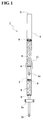
- the adsorber 1 shown in Fig. 1 includes a lower tube 2 provided with a cock 2c on the discharge side thereof, and an upper tube 3 which is fitted into an introduction port 2i of the lower tube 2.
- the introduction port 2i of the lower tube 2 is wide-mouthed, and the discharge port 3o side portion of the upper tube 3 is easily fitted into the introduction port 2i.
- the upper tube 3 is not provided with a cock on the discharge side thereof, and an introduction port 3i is not wide-mouthed. Glass wool 9, activated carbon 8, and glass wool 9 are charged in that order into each of the tubes 2 and 3.
- a sample solution is introduced from the introduction port 3i of the upper tube 3
- the sample solution is passed through the activated carbon 8 of the tube 3 and the activated carbon 8 of the tube 2 and is discharged from the discharge port 2o of the lower tube 2.
- the rate at which the sample solution passes is reduced in the upper tube 3, and the rate at which the sample solution passes is also reduced in the lower tube 2 provided with the cock 2c.
- the glass wool 9 prevents the fall-off of the activated carbon 8 from each of the tubes 2 and 3, and also has a function of reducing the rate at which the sample solution passes.
- the adsorber 1 is subjected to pre-treatment (conditioning), before use, for the purpose of washing out adsorbates adsorbed on the activated carbon and improving the hydrophilic property of the activated carbon.
- pre-treatment for the purpose of washing out adsorbates adsorbed on the activated carbon and improving the hydrophilic property of the activated carbon.
- a hydrophobic solvent such as benzene, and an alcohol such as ethanol, and distilled water are passed through the activated carbon in that order.
- the hydrophobic solvent can wash out adsorbates, the alcohol can wash out the hydrophobic solvent, and distilled water can improve the hydrophilic property of the activated carbon.
- a sample solution is introduced from the introduction port 3i of the upper tube 3 of the adsorber 1.
- a sufficient surface area of the activated carbon 8 on which an organic substance is to be adsorbed is secured, and moreover, a sufficient contact time between the activated carbon 8 and the sample solution is secured. Therefore, the organic substance contained in the sample solution is adsorbed on the activated carbon 8 in high yields.
- the organic substance adsorbed on the activated carbon is dissolved and extracted into the hydrophobic solvent.
- water in the activated carbon 8 is removed.
- an alcohol such as ethanol
- the alcohol also has a role of improving affinity between the activated carbon 8 and the hydrophobic solvent to be passed through the activated carbon 8 in the process of extracting the organic substance.
- hydrophobic solvent used in the extraction step examples include organic solvents, such as benzene. By passing the hydrophobic solvent, the organic substance adsorbed on the activated carbon 8 can be efficiently collected.
- a specimen solution to be subjected to organic substance analysis is prepared. Specifically, first, by drying the hydrophobic solvent into which the organic substance has been extracted, the organic substance is concentrated. A reduced pressure evaporator can be used to concentrate the organic substance. The concentration using the reduced pressure evaporator may be performed, for example, under the conditions at 0.08 to 0.1 MPa and at 65°C to 80°C for 15 to 30 minutes.
- a specimen solution in which the organic substance is dissolved in a constant volume of a solvent is prepared.
- a solvent used for the preparation of the specimen solution a low-boiling-point solvent (i.e., a solvent having a lower boiling point than the organic substance to be quantified), such as acetone, may be used.
- the volume of the specimen solution is preferably about 1.5 to 5.0 ml.
- the organic substance contained in the specimen solution is determined by analysis with a chromatograph (gas chromatograph).
- the specimen solution is introduced into the chromatograph using a programmed temperature vaporization technique (PTV technique).
- PTV technique the resolution of the components of the specimen solution can be improved.
- the temperature program may be appropriately changed depending on the component composition of the specimen solution.
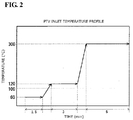
- the PTV inlet temperature program may include a first heating period in which heating is performed at 60°C to 70°C for 2.5 minutes or less, a second heating period in which heating is performed at 120°C to 150°C for 3.0 minutes or less, and a third heating period in which heating is performed at 300°C to 350°C for 5.0 minutes or less.
- the rate of temperature increase during transition from one heating period to another heating period is preferably set at 200°C/min to 300°C/min.
- the solvent (acetone) is vaporized, but substantially no organic substance (dioctyl phthalate) is vaporized.
- the vaporized acetone is not introduced into the chromatograph, but is discharged.
- the organic substance to be examined is vaporized. That is, dioctyl phthalate is vaporized.
- the vaporized dioctyl phthalate is introduced into a column installed in the chromatograph.
- the temperature of the column is increased, and components from the column are introduced into a detector of the chromatograph.
- the heating start temperature is set at 60°C to 100°C
- the column is heated to 350°C at a rate of temperature increase of about 20°C/min, and the column is held at 350°C for 20 minutes or less.
- the column temperature setting influences the peak separation, i.e., resolution of the components.
- Analysis for the organic substance i.e., quantification of the organic substance
- standard data is obtained, the standard data being obtained by analyzing, with a chromatograph, a standard solution having a known content of the organic substance, and quantification of the organic substance is performed on the basis of the standard data.
- An analysis may be performed to simply determine whether or not 20 mass ppb or less of the organic substance is contained in the solution to be examined.
- the organic substance contained in the solution to be examined can be quantified.
- the reason for this is mainly that, in the adsorption step of the analysis method, the organic substance contained in the sample solution can be adsorbed on the activated carbon in high yields.
- a vanadium RF electrolyte having a vanadium ion concentration of 1.8 M and a sulfate ion concentration of 3 M was prepared.
- Dioctyl phthalate (organic substance) had been intentionally added into the RF electrolyte, and the concentration thereof was 10.0 mass ppb. This concentration is only an example, and the same analysis is possible as long as the concentration is 0.5 mass ppb (detection limit) or more. Note that, according to the recent studies by the applicant, the permissible content of dioctyl phthalate in an RF electrolyte is 10.0 mass ppb or less.
- An adsorber 1 having a structure in which tubes are interconnected shown in Fig. 1 was prepared.
- a lower tube 2 and an upper tube 3 constituting the adsorber 1 were made of glass.
- glass wool 9 was charged, 3.5 g of bead-shaped activated carbon 8 was charged thereon, and glass wool 9 was further charged.
- glass wool 9 was charged, 4.5 g of bead-shaped activated carbon 8 was charged thereon, and glass wool 9 was further charged.
- the adsorber 1 was subjected to pre-treatment for the purpose of washing the activated carbon 8 and imparting a hydrophilic property to the activated carbon 8. Specifically, through the two-stage column, 5 ml of benzene was passed 10 times, then 5 ml of ethanol was passed three times, and finally, 20 ml of distilled water was passed three times.
- a sample solution (200 ml) sampled from the RF electrolyte was passed through the activated carbon 8 in the adsorber 1 subjected to pre-treatment. Specifically, the sample solution was introduced from the introduction port 3i of the upper tube 3 of the adsorber 1. At this time, by adjusting the cock 2c of the lower tube 2, the drip rate of the sample solution discharged from the discharge port 2o of the lower tube 2 was adjusted to 7.5 ml/min or less. The sample solution was disposed of.
- the recovered liquid was dried with a reduced pressure evaporator.
- the inside of the evaporator for receiving the recovered liquid had been washed in advance three times with acetone and once with benzene.
- benzene in the recovered liquid was concentrated to dryness. The concentration was performed under the conditions at 0.1 MPa and at 65°C ⁇ 20 min.
- the vial was placed in an autosampler for gas chromatography.
- the specimen solution was introduced into the chromatograph using the PTV technique, and the organic substance was determined by analysis.
- the PTV technique conditions for temperature programs for the PTV inlet and the chromatograph column were as described below.
- the temperature profiles of temperature programs for the PTV inlet and the column are shown in the schematic diagrams of Figs. 2 and 3 , respectively.
- First heating time 60 °C ⁇ 2.5 min
- Second heating time 120 °C ⁇ 3.0 min
- Third heating time 300 °C ⁇ 5.0 min
- Rate of temperature increase 300 °C / min
- a standard solution having a known content of dioctyl phthalate is also analyzed.
- concentration of the dioctyl phthalate contained in the vanadium RF electrolyte can be determined.
- accuracy of quantification was improved.
- One standard solution contained 2 ⁇ g of dioctyl phthalate per 1 ml of acetone, and the other standard solution contained 5 ⁇ g of dioctyl phthalate per 1 ml of acetone.
- the adsorber used in the adsorption step was configured to have a single-tube structure, and dioctyl phthalate in an RF electrolyte was quantified.
- the configuration other than the adsorber and the quantification procedure were the same as those in Experimental Example 1.
- the content of dioctyl phthalate in the RF electrolyte was, of course, 10.0 mass ppb as in Experimental Example 1.
- the adsorber in Experimental Example 2 was prepared by charging glass wool, activated carbon, glass wool in that order into a tube made of glass.
- the specific surface area of the activated carbon was 800 m 2 /g, and the total amount of the activated carbon was 8 g.
- the drip rate of the sample solution i.e., liquid passing rate on the discharge side of the activated carbon
- the most characteristic features of the embodiment described above are that a sufficient contact area between the activated carbon and the sample solution is secured and that a sufficient time during which the sample solution is in contact with the activated carbon is secured. From this viewpoint, there is a possibility that, by using the following analysis method for organic substances in a solution to be examined, an organic substance in an amount by mass on the order of ppb will be determined by analysis.
- an analysis method for organic substances in a solution to be examined includes a sampling step, an adsorption step, an extraction step, a specimen preparation step, and an analysis step.
- the sampling step, the specimen preparation step, and the analysis step may be performed as in Embodiment 1.
- the sample solution is placed in a container, such as a beaker, and the activated carbon is gradually added into the sample solution while stirring the sample solution with a stirrer or the like.
- the stirring time described above is a stirring time in which the point at which all the amount of activated carbon is charged is defined as the starting time.
- a mixed solution of the sample solution and activated carbon subjected to the adsorption step is charged into a column, a hydrophilic solution (ethanol or the like) is passed through the column to wash away the sample solution, and then a hydrophobic solvent is charged thereinto.
- the sample solution discharged from the column when the mixed solution is charged into the column may be disposed of.
- the hydrophilic solution, which is passed through for the purpose of removing the residue of the sample solution may be disposed of. The reason for this is that it is believed that the organic substance contained in the sample solution has been sufficiently adsorbed on the activated carbon in the adsorption step.
- the analysis method for organic substances in a solution to be examined according to the present invention is suitable for use in the analysis for an organic substance contained in the solution to be examined.
- the analysis method for organic substances in a solution to be examined according to the present invention can be suitably used for quality check of an electrolyte for a redox flow battery by analyzing organic substances contained in the electrolyte for a redox flow battery.
Landscapes
- Life Sciences & Earth Sciences (AREA)
- Physics & Mathematics (AREA)
- Health & Medical Sciences (AREA)
- Chemical & Material Sciences (AREA)
- Analytical Chemistry (AREA)
- Biochemistry (AREA)
- General Health & Medical Sciences (AREA)
- General Physics & Mathematics (AREA)
- Immunology (AREA)
- Pathology (AREA)
- Hydrology & Water Resources (AREA)
- Sampling And Sample Adjustment (AREA)
Abstract
Description
- The present invention relates to an analysis method for organic substances in a solution to be examined for determining the presence of a very small amount of an organic substance contained in the solution to be examined.
- In some cases, a very small amount of an organic substance contained in a solution to be examined may be determined by analysis. For example,
Patent Literature 1 discloses an organic component analysis method for analyzing organic components (organic substances) contained in a high-concentration salt solution (solution to be examined), such as a plating solution or a battery electrolyte (analysis method for organic substances in a solution to be examined). - In
Patent Literature 1, organic components are extracted from a high-concentration salt solution by solid phase extraction using activated carbon and an analysis is performed. More specifically, the method includes a step of passing a sample solution sampled from a high-concentration salt solution containing organic components through activated carbon so that the organic components in the sample solution are adsorbed on the activated carbon; a step of passing a solvent through the activated carbon after the adsorption step so that the adsorbed organic components are eluted; a step of concentrating and drying the solvent into which the organic components have been eluted; and a step of performing an analysis with a chromatograph, using the organic components as a specimen after the concentration and drying step. - PTL 1: Japanese Patent No.
3821000 - In recent years, there have been cases in which an analysis is required to determine whether or not a solution to be examined contains an organic substance in an amount by mass on the order of ppb (on the order of parts per billion). For example, recent studies by the applicant have shown that, in an electrolyte used for a redox flow battery, organic substances, even in a very small amount of 20 mass ppb or less, have a large effect on the performance of the redox flow battery. However, in the method for measuring organic substances in a solution to be examined according to
Patent Literature 1, it is difficult to analyze such a very small amount of organic substances. The analysis method ofPatent Literature 1 is primarily intended to analyze organic substances in an amount by mass on the order of ppm (on the order of parts per million) contained in a plating solution, and is not assumed to analyze organic substances in an amount by mass on the order of ppb. - The present invention has been achieved under these circumstances, and it is an object of the present invention to provide an analysis method for organic substances in a solution to be examined in which it is possible to perform an analysis to determine whether or not an organic substance in an amount on the order of 20 mass ppb or less is contained in the solution to be examined.
- According to an embodiment of the present invention, an analysis method for organic substances in a solution to be examined includes a sampling step, an adsorption step, an extraction step, a specimen preparation step, and an analysis step.
[Sampling step]...A sample solution in an amount of 500 ml or less is taken from a solution to be examined having an unknown content of an organic substance.
[Adsorption step]...The sample solution is passed through activated carbon so that the organic substance is adsorbed on the activated carbon. Here, the activated carbon used in the adsorption step has a specific surface area of 800 m2/g or more, and the amount of the activated carbon is 0.025 g/ml or more relative to the amount of the sample solution. Furthermore, in the adsorption step, the sample solution is passed at a rate of 7.5 ml/min or less on the discharge side of the activated carbon.
[Extraction step]...Ahydrophobic solvent is passed through the activated carbon on which the organic substance has been adsorbed so that the organic substance is extracted into the hydrophobic solvent.
[Specimen preparation step]...Using the hydrophobic solvent into which the organic substance has been extracted, a specimen solution to be subjected to analysis for the organic substance is prepared.
[Analysis step]...By measuring components contained in the specimen solution with a chromatograph, an analysis is performed to determine whether or not the organic substance in an amount of 20 mass ppb or less is contained in the solution to be examined. Advantageous Effects of Invention - In the analysis method for organic substances in a solution to be examined according to the present invention, it is possible to perform an analysis to determine the presence or absence of an organic substance in an amount of 20 mass ppb or less contained in the solution to be examined.
-
- [
Fig. 1] Figure 1 is a schematic view showing an example of an adsorber for organic substances used in an analysis method for organic substances in a solution to be examined. - [
Fig. 2] Figure 2 is a schematic diagram showing a temperature profile of a PTV inlet according to a temperature program in an experimental example. - [
Fig. 3] Figure 3 is a schematic diagram showing a temperature profile of a column installed in a chromatograph according to a temperature program in an experimental example. - First, contents of embodiments of the present invention are enumerated and described.
-
- <1> According to an embodiment, an analysis method for organic substances in a solution to be examined includes a sampling step, an adsorption step, an extraction step, a specimen preparation step, and an analysis step.
- In the sampling step, 500 ml or less of a sample solution is taken from a solution to be examined having an unknown content of an organic substance.
- In the adsorption step, the sample solution is passed through activated carbon so that the organic substance is adsorbed on the activated carbon. Here, the activated carbon used in the adsorption step has a specific surface area of 800 m2/g or more, and the amount of the activated carbon is 0.025 g/ml or more relative to the amount of the sample solution. Furthermore, in the adsorption step, the sample solution is passed at a rate of 7.5 ml/min or less on the discharge side of the activated carbon.
- In the specimen preparation step, using the hydrophobic solvent into which the organic substance has been extracted, a specimen solution to be subjected to analysis for the organic substance is prepared.
- In the analysis step, by measuring components contained in the specimen solution with a chromatograph, an analysis is performed to determine whether or not the organic substance in an amount of 20 mass ppb or less is contained in the solution to be examined.
By using the method described above, it is possible to perform an analysis to determine the presence or absence of an organic substance contained in a solution to be examined even if the amount of the organic substance is 20 mass ppb or less. The reasons for this are that, in the adsorption step, by using a predetermined amount or more of activated carbon having a predetermined specific surface area, it is possible to secure a sufficient contact area between the activated carbon and the sample solution; and that by passing the sample solution at a predetermined rate or less on the discharge side of the activated carbon, it is possible to secure a sufficient time during which the sample solution is in contact with the activated carbon (i.e., time during which the organic substance becomes adsorbed on the activated carbon). By securing the contact area and the contact time, even if the amount of an organic substance contained in the sample solution is very small, the organic substance can be adsorbed on the activated carbon in high yields. Furthermore, the analysis method for organic substances in a solution to be examined according to this embodiment can be of course used for analysis of a solution to be examined which has a possibility to contain an organic substance in an amount of more than 20 mass ppb. - <2> In the analysis method for organic substances in a solution to be examined according to this embodiment, in the analysis step, standard data is obtained, the standard data being obtained by measuring, with a chromatograph, components contained in a standard solution having a known content of the organic substance, and by comparing the analysis data obtained by measuring the specimen solution with the standard data, the content of the organic substance in the solution to be examined is quantified.
By using a standard solution having a known content of the organic substance for analysis, it is possible to obtain the standard data which shows a tendency for the kind of measurement result that will be obtained for a given degree of content of the organic substance. Accordingly, by comparing the standard data with the analysis data of the specimen solution, the content of the organic substance in the solution to be examined can be quantified with considerable accuracy. - <3> In the analysis method for organic substances in a solution to be examined according to this embodiment, in the analysis step, the specimen solution may be introduced into the chromatograph using a programmed temperature vaporization (PTV) technique.
The PTV technique is a method for introducing a specimen solution using a PTV inlet capable of increasing temperature, in which by heating the specimen solution in accordance with a predetermined temperature program, an organic substance contained in the specimen solution is vaporized and introduced into a chromatograph. When the PTV inlet is used, using the difference in vaporization temperature among components (including the organic substance) contained in the solution to be examined, the resolution of the components can be improved. As a result, the organic substance contained in the sample solution can be more accurately determined by analysis. - <4> In the analysis method for organic substances in a solution to be examined according to this embodiment, the solution to be examined may be an electrolyte for a redox flow battery (hereinafter referred to as the "RF electrolyte").
In recent years, as measures against global warming, power generation using natural energy (so-called renewable energy), such as solar power generation or wind power generation, has been actively conducted worldwide. Since the output of such power generation depends largely on natural conditions, such as weather, it has been taken into consideration to install large-capacity storage batteries in electrical power systems so that smoothing of variations in output, storage of surplus electricity, leveling of loads, and the like can be achieved. One of the large-capacity storage batteries is a redox flow battery (hereinafter referred to as the "RF battery"). The RF battery is a secondary battery in which a positive electrode, a negative electrode, and a separating membrane interposed therebetween are placed in a cell, and charging and discharging are performed by supplying a positive electrode electrolyte and a negative electrode electrolyte to the positive electrode and the negative electrode, respectively. In RF electrolytes used for such a RF battery, usually, metal elements whose valence is changed by oxidation-reduction are used as active materials. Examples of the RF battery include an iron (Fe2+/Fe3+)-chromium (Cr3+/Cr2+) RF battery in which Fe ions are used as the positive electrode active material and Cr ions are used as the negative electrode active material, and a vanadium (V2+/V3+-V4+/V5+) RF battery in which V ions are used as active materials for both electrodes.
In the RF battery, charging and discharging take place by means of electrochemical reactions (electrode reactions) on electrodes. Therefore, if the electrodes do not function in accordance with design specifications, battery characteristics will be degraded, for example, a decrease in battery output and a decrease in battery capacity will occur. For example, when impurities adhere to the surface of an electrode and reaction active sites on the electrode are covered with the impurities, the surface area of the electrode is substantially decreased, resulting in a decrease in battery output and a decrease in battery capacity. It has been found that, among such impurities, in particular, organic substances seriously affect and decrease electrode reactions. Therefore, by using the analysis method for organic substances in a specimen to be examined according to this embodiment in order to quantify organic substances in an RF electrolyte so that the presence or absence of an organic substance in an amount of 20 mass ppb or less is fully understood in advance, it is possible to fabricate an RF battery that provides stable performance. The analysis method according to this embodiment can be of course used for a sampling inspection for an RF electrolyte after an RF battery has been in operation.
Furthermore, the analysis method for organic substances in a solution to be examined according to this embodiment is of course not limited to be used for analysis for organic substances in an RF electrolyte. For example, the analysis method according to the embodiment can be used for analysis for organic substances in a high-concentration salt solution containing 50 g or more of an inorganic salt dissolved per 1,000 ml of a solvent, such as analysis for organic substances in a plating solution. - <5> In the analysis method for organic substances in a solution to be examined according to this embodiment, in the case where the solution to be examined is an RF electrolyte, the organic substance may be a phthalate ester.
Recent studies by the applicant have shown that inclusion of, in particular, phthalate esters, among organic substances, in an RF electrolyte seriously affects and decreases battery reactions. Even when the organic substance concentration of a phthalate ester in an RF electrolyte is a very small amount on the order of mass ppb, battery reactions are likely to be hindered. Therefore, analysis of phthalate esters in an RF electrolyte is important in terms of stabilizing the performance of the redox flow battery. - <6> In the analysis method for organic substances in a solution to be examined according to this embodiment, in the adsorption step, the activated carbon may be divided into a plurality of units, and the sample solution may be continuously passed through the individual units.
According to the embodiment described above, it is possible to easily adjust the rate at which the solution passes through the activated carbon to 7.5 ml/min or less on the discharge side. Specific examples of dividing the activated carbon into a plurality of units include a configuration in which a plurality of tubes, into each of which activated carbon is charged, are prepared, and the tubes are joined to each other in an axial direction.
Alternatively, a configuration may be used in which activated carbon is charged into a tube provided with at least one narrow section inside, i.e., a configuration in which an upper activated carbon portion and a lower activated carbon portion are separated by the narrow section. Another configuration may be used in which activated carbon is charged into each of a plurality of tubes to be installed in an automatic extractor. In this case, the sample solution discharged from the nth tube may be introduced into the (n + 1)th tube (where n is a natural number). - <7> In the analysis method for organic substances in a solution to be examined according to this embodiment, the adsorption step, the extraction step, and the specimen preparation step may be performed fully automatically.
- By fully automatically performing a series of steps of organic substance adsorption, organic substance extraction, and specimen solution preparation, each of the rate at which the sample solution passes in the adsorption step and the rate at which the hydrophobic solvent passes in the extraction step can be set substantially as configured, and each of the rates can be maintained substantially constant. Therefore, it is possible to improve stability and reliability of the analysis results for organic substances. Furthermore, the automation can suppress mixture (contamination) of organic substances into the sample solution, which also contributes to improvement in stability and reliability of the analysis results for organic substances.
- Embodiments of an analysis method for organic substances in a solution to be examined will be described below. It is intended that the present invention is not limited to the embodiments, but is determined by appended claims, and includes all variations of the equivalent meanings and ranges to the claims.
- In
Embodiment 1, an example will be described in which organic substances contained in a vanadium RF electrolyte (solution to be examined) are analyzed (quantified). The RF electrolyte is an inorganic salt solution containing vanadium ions as an active material. For example, the vanadium ion concentration may be 1 to 3 M, and the sulfate ion concentration may be 1 to 4 M. In this case, the average valence of the RF electrolyte is about 3.3 to 3.7. In the RF electrolyte having such an average valence, either as an electrolyte on the positive electrode side or as an electrolyte on the negative electrode side, the concentrations of vanadium ions of different valences are well-balanced. Accordingly, in the case where an RF battery is configured using an RF electrolyte having such an average valence, the capacity of the RF battery can be markedly increased. The solution to be examined may be of course an iron-chromium RF electrolyte. - There is a possibility that organic substances will be mixed into the vanadium RF electrolyte (hereinafter simply referred to as the "RF electrolyte") in the fabrication process thereof. Furthermore, there is also a possibility that, with the operation of an RF battery using the RF electrolyte, organic substances will be mixed into the RF electrolyte from the components of the RF battery or the atmosphere in contact with the RF electrolyte. Examples of the organic substances include tetradecene (C14H28), octanethiol (C8H18S), n-decane (C10H22), and esters including dioctyl phthalate (C24H38O4) which is a kind of phthalate ester. In the case where the content of these organic substances in an RF electrolyte is on the order of mass ppb, specifically, 20 mass ppb or less, in existing analysis methods, in order to quantify the organic substances in the RF electrolyte, it is necessary to sample a large amount (1,000 ml or more) of the RF electrolyte for quantitative determination. When such a large amount of a sample solution is used, it takes time to determine the quantity, and the amount of the RF electrolyte to be used for fabrication of an RF battery is largely decreased. Accordingly, in
Embodiment 1, the analysis method for organic substances in a solution to be examined described below is performed. - The analysis method for organic substances in a solution to be examined used in
Embodiment 1 includes a sampling step, an adsorption step, an extraction step, a specimen preparation step, and an analysis step. The individual steps will be described in order below. - In the sampling step, 500 ml or less of a sample solution is taken from an RF electrolyte prepared. Depending on the specifications of the adsorption step subsequent to the sampling step, the amount of the sample solution to be taken may be set at 300 ml or less, 200 ml or less, or 100 ml or less.
- In the adsorption step, the sample solution is passed through activated carbon so that an organic substance contained in the sample solution is adsorbed on the activated carbon. The activated carbon used in the adsorption step has a specific surface area of 800 m2/g or more, and the amount of the activated carbon used is 0.025 g or more per 1 ml of the sample solution. Thereby, it is possible to secure a sufficient surface area of the activated carbon on which the organic substance contained in the sample solution is to be adsorbed. Furthermore, in the adsorption step, the liquid passing rate is adjusted to 7.5 ml/min or less on the discharge side of the activated carbon. Thereby, it is possible to secure a sufficient contact time between the sample solution and the activated carbon.
- In order to set the liquid passing rate on the discharge side of the activated carbon to be 7.5 ml/min or less, the activated carbon may be divided into a plurality of units. For example, by using an
adsorber 1 shown inFig. 1 , the liquid passing rate can be adjusted to 7.5 ml/min or less. Theadsorber 1 shown inFig. 1 includes alower tube 2 provided with acock 2c on the discharge side thereof, and anupper tube 3 which is fitted into anintroduction port 2i of thelower tube 2. Theintroduction port 2i of thelower tube 2 is wide-mouthed, and the discharge port 3o side portion of theupper tube 3 is easily fitted into theintroduction port 2i. Theupper tube 3 is not provided with a cock on the discharge side thereof, and an introduction port 3i is not wide-mouthed.Glass wool 9, activatedcarbon 8, andglass wool 9 are charged in that order into each of thetubes upper tube 3, the sample solution is passed through the activatedcarbon 8 of thetube 3 and the activatedcarbon 8 of thetube 2 and is discharged from the discharge port 2o of thelower tube 2. In theadsorber 1 having such a structure in which tubes are interconnected, the rate at which the sample solution passes is reduced in theupper tube 3, and the rate at which the sample solution passes is also reduced in thelower tube 2 provided with thecock 2c. Therefore, it is possible to easily adjust the liquid passing rate to 7.5 ml/min or less on the discharge side of the activatedcarbon 8. Furthermore, theglass wool 9 prevents the fall-off of the activatedcarbon 8 from each of thetubes - Preferably, the
adsorber 1 is subjected to pre-treatment (conditioning), before use, for the purpose of washing out adsorbates adsorbed on the activated carbon and improving the hydrophilic property of the activated carbon. For example, a hydrophobic solvent such as benzene, and an alcohol such as ethanol, and distilled water are passed through the activated carbon in that order. The hydrophobic solvent can wash out adsorbates, the alcohol can wash out the hydrophobic solvent, and distilled water can improve the hydrophilic property of the activated carbon. - After the pre-treatment for the
adsorber 1 has been completed, a sample solution is introduced from the introduction port 3i of theupper tube 3 of theadsorber 1. At this time, a sufficient surface area of the activatedcarbon 8 on which an organic substance is to be adsorbed is secured, and moreover, a sufficient contact time between the activatedcarbon 8 and the sample solution is secured. Therefore, the organic substance contained in the sample solution is adsorbed on the activatedcarbon 8 in high yields. - In the extraction step, by passing a hydrophobic solvent through the activated
carbon 8 in theadsorber 1, the organic substance adsorbed on the activated carbon is dissolved and extracted into the hydrophobic solvent. Prior to the extraction, preferably, water in the activatedcarbon 8 is removed. For example, by passing an alcohol such as ethanol through the activatedcarbon 8, the water in the activated carbon can be removed. The alcohol also has a role of improving affinity between the activatedcarbon 8 and the hydrophobic solvent to be passed through the activatedcarbon 8 in the process of extracting the organic substance. - Examples of the hydrophobic solvent used in the extraction step include organic solvents, such as benzene. By passing the hydrophobic solvent, the organic substance adsorbed on the activated
carbon 8 can be efficiently collected. - In the specimen preparation step, using the hydrophobic solvent into which the organic substance has been extracted, a specimen solution to be subjected to organic substance analysis is prepared. Specifically, first, by drying the hydrophobic solvent into which the organic substance has been extracted, the organic substance is concentrated. A reduced pressure evaporator can be used to concentrate the organic substance. The concentration using the reduced pressure evaporator may be performed, for example, under the conditions at 0.08 to 0.1 MPa and at 65°C to 80°C for 15 to 30 minutes.
- After the organic substance has been concentrated, a specimen solution in which the organic substance is dissolved in a constant volume of a solvent is prepared. As the solvent used for the preparation of the specimen solution, a low-boiling-point solvent (i.e., a solvent having a lower boiling point than the organic substance to be quantified), such as acetone, may be used. The volume of the specimen solution is preferably about 1.5 to 5.0 ml.
- In the analysis step, the organic substance contained in the specimen solution is determined by analysis with a chromatograph (gas chromatograph).
- In the analysis step, preferably, the specimen solution is introduced into the chromatograph using a programmed temperature vaporization technique (PTV technique). By using the PTV technique, the resolution of the components of the specimen solution can be improved. The temperature program may be appropriately changed depending on the component composition of the specimen solution. For example, in the case where the organic substance is dioctyl phthalate, and the solvent for dissolving the organic substance is acetone, the PTV inlet temperature program may include a first heating period in which heating is performed at 60°C to 70°C for 2.5 minutes or less, a second heating period in which heating is performed at 120°C to 150°C for 3.0 minutes or less, and a third heating period in which heating is performed at 300°C to 350°C for 5.0 minutes or less. The rate of temperature increase during transition from one heating period to another heating period is preferably set at 200°C/min to 300°C/min.
- In the first heating period, mainly, the solvent of the specimen solution is vaporized. That is, acetone (boiling point = 56.5°C) is vaporized. In the first heating period, the solvent (acetone) is vaporized, but substantially no organic substance (dioctyl phthalate) is vaporized. The vaporized acetone is not introduced into the chromatograph, but is discharged. In the subsequent second heating period, mainly, the organic substance to be examined is vaporized. That is, dioctyl phthalate is vaporized. The vaporized dioctyl phthalate is introduced into a column installed in the chromatograph. In the third heating period, high-boiling-point components of the specimen solution are vaporized, and at the same time, the organic substance (dioctyl phthalate) is completely vaporized. The vaporized component is also introduced into the column of the chromatograph.
- After the specimen is introduced into the column installed in the chromatograph, the temperature of the column is increased, and components from the column are introduced into a detector of the chromatograph. For example, in a column temperature program, the heating start temperature is set at 60°C to 100°C, the column is heated to 350°C at a rate of temperature increase of about 20°C/min, and the column is held at 350°C for 20 minutes or less. The column temperature setting influences the peak separation, i.e., resolution of the components.
- Analysis for the organic substance, i.e., quantification of the organic substance, can be automatically performed by a computer which controls the chromatograph. For example, standard data is obtained, the standard data being obtained by analyzing, with a chromatograph, a standard solution having a known content of the organic substance, and quantification of the organic substance is performed on the basis of the standard data. An analysis may be performed to simply determine whether or not 20 mass ppb or less of the organic substance is contained in the solution to be examined.
- In the analysis method for organic substances in a solution to be examined described above, even when the amount of an organic substance contained in the solution to be examined is 20 mass ppb or less, and the amount of a sample solution sampled from the solution to be examined is 500 ml or less, the organic substance contained in the solution to be examined can be quantified. The reason for this is mainly that, in the adsorption step of the analysis method, the organic substance contained in the sample solution can be adsorbed on the activated carbon in high yields.
- In Experimental Example 1, an organic substance contained in a vanadium RF electrolyte was actually quantified as described below.
- A vanadium RF electrolyte having a vanadium ion concentration of 1.8 M and a sulfate ion concentration of 3 M was prepared. Dioctyl phthalate (organic substance) had been intentionally added into the RF electrolyte, and the concentration thereof was 10.0 mass ppb. This concentration is only an example, and the same analysis is possible as long as the concentration is 0.5 mass ppb (detection limit) or more. Note that, according to the recent studies by the applicant, the permissible content of dioctyl phthalate in an RF electrolyte is 10.0 mass ppb or less.
- An
adsorber 1 having a structure in which tubes are interconnected shown inFig. 1 was prepared. Alower tube 2 and anupper tube 3 constituting theadsorber 1 were made of glass. Into thelower tube 2,glass wool 9 was charged, 3.5 g of bead-shaped activatedcarbon 8 was charged thereon, andglass wool 9 was further charged. Furthermore, into theupper tube 3,glass wool 9 was charged, 4.5 g of bead-shaped activatedcarbon 8 was charged thereon, andglass wool 9 was further charged. The specific surface area of the activatedcarbon 8 charged into thetubes - The
adsorber 1 was subjected to pre-treatment for the purpose of washing the activatedcarbon 8 and imparting a hydrophilic property to the activatedcarbon 8. Specifically, through the two-stage column, 5 ml of benzene was passed 10 times, then 5 ml of ethanol was passed three times, and finally, 20 ml of distilled water was passed three times. - A sample solution (200 ml) sampled from the RF electrolyte was passed through the activated
carbon 8 in theadsorber 1 subjected to pre-treatment. Specifically, the sample solution was introduced from the introduction port 3i of theupper tube 3 of theadsorber 1. At this time, by adjusting thecock 2c of thelower tube 2, the drip rate of the sample solution discharged from the discharge port 2o of thelower tube 2 was adjusted to 7.5 ml/min or less. The sample solution was disposed of. - As pre-treatment for extracting dioctyl phthalate adsorbed on the activated
carbon 8, first, by passing 400 ml of distilled water through theadsorber 1, vanadium ions, sulfate ions, and the like attached to inner peripheral surfaces of thetubes carbon 8 were removed. Next, by passing 5 ml of ethanol through theadsorber 1 four times, water in theadsorber 1 was removed. The distill water and ethanol were disposed of. - After completion of the pre-treatment, 5 ml of benzene was passed through the
adsorber 1 four times to recover 20 ml of a recovered liquid into a flat-bottom flask, and this process was repeated five times. The total amount of the recovered liquid was about 100 ml. - The recovered liquid was dried with a reduced pressure evaporator. The inside of the evaporator for receiving the recovered liquid had been washed in advance three times with acetone and once with benzene. When the recovered liquid was dried, by rotating the flat-bottom flask while reducing the pressure inside the flat-bottom flask, benzene in the recovered liquid was concentrated to dryness. The concentration was performed under the conditions at 0.1 MPa and at 65°C × 20 min.
- By placing 2 ml of acetone into the flat-bottom flask after benzene had been concentrated, dioctyl phthalate was dissolved in acetone. The resulting acetone solution was recovered and transferred into a syringe equipped with a disk filter. A filtrate was transferred from the syringe through the disk filter into a vial and used as a specimen solution.
- The vial was placed in an autosampler for gas chromatography. The specimen solution was introduced into the chromatograph using the PTV technique, and the organic substance was determined by analysis. In the PTV technique, conditions for temperature programs for the PTV inlet and the chromatograph column were as described below. Just for reference, the temperature profiles of temperature programs for the PTV inlet and the column are shown in the schematic diagrams of
Figs. 2 and3 , respectively. -


-


- In the analysis for the organic substance, a standard solution having a known content of dioctyl phthalate is also analyzed. When standard data obtained from the standard solution is available, by comparing the standard data with the analysis data obtained from the specimen solution, the concentration of the dioctyl phthalate contained in the vanadium RF electrolyte can be determined. In this experimental example, by obtaining two types of standard data from two standard solutions having different contents of dioctyl phthalate, accuracy of quantification was improved. One standard solution contained 2 µg of dioctyl phthalate per 1 ml of acetone, and the other standard solution contained 5 µg of dioctyl phthalate per 1 ml of acetone.
- From the analysis data obtained by the gas chromatograph, it was possible to detect dioctyl phthalate. Furthermore, the comparison between the analysis data and the standard data obtained from the standard solutions showed that the concentration of dioctyl phthalate in the vanadium RF electrolyte was 9.8 mass ppb. Since the concentration of dioctyl phthalate intentionally added during preparation of the vanadium RF electrolyte was 10.0 mass ppb, it became obvious that it was possible to quantify dioctyl phthalate in the vanadium RF electrolyte with considerable accuracy.
- As a comparative example of Experimental Example 1, in Experimental Example 2, the adsorber used in the adsorption step was configured to have a single-tube structure, and dioctyl phthalate in an RF electrolyte was quantified. The configuration other than the adsorber and the quantification procedure were the same as those in Experimental Example 1. The content of dioctyl phthalate in the RF electrolyte was, of course, 10.0 mass ppb as in Experimental Example 1.
- The adsorber in Experimental Example 2 was prepared by charging glass wool, activated carbon, glass wool in that order into a tube made of glass. The specific surface area of the activated carbon was 800 m2/g, and the total amount of the activated carbon was 8 g. When 200 ml of the sample solution was passed through the adsorber having the single-tube structure, the drip rate of the sample solution (i.e., liquid passing rate on the discharge side of the activated carbon) was 10 ml/min.
- After that, according to the same procedure as that of Experimental Example 1, a specimen solution was prepared, and an analysis was performed for the organic substance contained in the specimen solution. It was not possible to obtain analysis data that could confirm the presence of dioctyl phthalate.
- The results of Experimental Example 2 showed that, in the case where the drip rate of the sample solution was high, it was difficult to quantify or even detect dioctyl phthalate in an amount by mass on the order of ppb contained in the RF electrolyte.
- The most characteristic features of the embodiment described above are that a sufficient contact area between the activated carbon and the sample solution is secured and that a sufficient time during which the sample solution is in contact with the activated carbon is secured. From this viewpoint, there is a possibility that, by using the following analysis method for organic substances in a solution to be examined, an organic substance in an amount by mass on the order of ppb will be determined by analysis.
- That is, an analysis method for organic substances in a solution to be examined includes a sampling step, an adsorption step, an extraction step, a specimen preparation step, and an analysis step.
- In the sampling step, 500 ml or less of a sample solution is taken from a solution to be examined which is suspected of containing an organic substance.
- In the adsorption step, the sample solution and activated carbon are stirred in the same container so that the organic substance is adsorbed on the activated carbon. Here, the activated carbon used in the adsorption step has a specific surface area of 800 m2/g or more, and the amount of the activated carbon is 0.025 g/ml or more relative to the amount of the sample solution. Furthermore, the stirring time in the adsorption step is 20 to 60 minutes.
- In the extraction step, a hydrophobic solvent is passed through the activated carbon on which the organic substance has been adsorbed so that the organic substance is extracted into the hydrophobic solvent.
- In the specimen preparation step, using the hydrophobic solvent into which the organic substance has been extracted, a specimen solution to be subjected to organic substance analysis is prepared.
- In the analysis step, by measuring components contained in the specimen solution with a chromatograph, an analysis is performed to determine whether or not the organic substance in an amount of 20 mass ppb or less is contained in the solution to be examined.
- The sampling step, the specimen preparation step, and the analysis step may be performed as in
Embodiment 1. - In the adsorption step, for example, the sample solution is placed in a container, such as a beaker, and the activated carbon is gradually added into the sample solution while stirring the sample solution with a stirrer or the like. Here, the stirring time described above is a stirring time in which the point at which all the amount of activated carbon is charged is defined as the starting time.
- In the extraction step, for example, a mixed solution of the sample solution and activated carbon subjected to the adsorption step is charged into a column, a hydrophilic solution (ethanol or the like) is passed through the column to wash away the sample solution, and then a hydrophobic solvent is charged thereinto. The sample solution discharged from the column when the mixed solution is charged into the column may be disposed of. Furthermore, the hydrophilic solution, which is passed through for the purpose of removing the residue of the sample solution, may be disposed of. The reason for this is that it is believed that the organic substance contained in the sample solution has been sufficiently adsorbed on the activated carbon in the adsorption step.
- The analysis method for organic substances in a solution to be examined according to the present invention is suitable for use in the analysis for an organic substance contained in the solution to be examined. In particular, the analysis method for organic substances in a solution to be examined according to the present invention can be suitably used for quality check of an electrolyte for a redox flow battery by analyzing organic substances contained in the electrolyte for a redox flow battery.
-
- 1
- adsorber
- 2
- lower tube
- 2i
- introduction port
- 2o
- discharge port
- 2c
- cock
- 3
- upper tube
- 3i
- introduction port
- 3o
- discharge port
- 8
- activated carbon
- 9
- glass wool
Claims (7)
- An analysis method for organic substances in a solution to be examined comprising:a sampling step in which 500 ml or less of a sample solution is taken from a solution to be examined having an unknown content of an organic substance;an adsorption step in which the sample solution is passed through activated carbon so that the organic substance is adsorbed on the activated carbon;an extraction step in which a hydrophobic solvent is passed through the activated carbon on which the organic substance has been adsorbed so that the organic substance is extracted into the hydrophobic solvent;a specimen preparation step in which, using the hydrophobic solvent into which the organic substance has been extracted, a specimen solution to be subjected to analysis for the organic substance is prepared; andan analysis step in which, by measuring components contained in the specimen solution with a chromatograph, an analysis is performed to determine whether or not the organic substance in an amount of 20 mass ppb or less is contained in the solution to be examined,wherein the activated carbon used in the adsorption step has a specific surface area of 800 m2/g or more, and the amount of the activated carbon is 0.025 g/ml or more relative to the amount of the sample solution; andwherein, in the adsorption step, the sample solution is passed at a rate of 7.5 ml/min or less on the discharge side of the activated carbon.
- The analysis method for organic substances in a solution to be examined according to Claim 1, wherein, in the analysis step, standard data is obtained, the standard data being obtained by measuring, with a chromatograph, components contained in a standard solution having a known content of the organic substance, and by comparing the analysis data obtained by measuring the specimen solution with the standard data, the content of the organic substance in the solution to be examined is quantified.
- The analysis method for organic substances in a solution to be examined according to Claim 1 or 2, wherein, in the analysis step, the specimen solution is introduced into the chromatograph using a programmed temperature vaporization technique.
- The analysis method for organic substances in a solution to be examined according to any one of Claims 1 to 3, wherein the solution to be examined is an electrolyte for a redox flow battery.
- The analysis method for organic substances in a solution to be examined according to Claim 4, wherein the organic substance is a phthalate ester.
- The analysis method for organic substances in a solution to be examined according to any one of Claims 1 to 5, wherein, in the adsorption step, the activated carbon is divided into a plurality of units, and the sample solution is continuously passed through the individual units.
- The analysis method for organic substances in a solution to be examined according to any one of Claims 1 to 6, wherein the adsorption step, the extraction step, and the specimen preparation step are performed fully automatically.
Applications Claiming Priority (2)
| Application Number | Priority Date | Filing Date | Title |
|---|---|---|---|
| JP2013094248 | 2013-04-26 | ||
| PCT/JP2014/061368 WO2014175307A1 (en) | 2013-04-26 | 2014-04-23 | Method for analysis for organic substance contained in solution to be examined |
Publications (2)
| Publication Number | Publication Date |
|---|---|
| EP2990789A1 true EP2990789A1 (en) | 2016-03-02 |
| EP2990789A4 EP2990789A4 (en) | 2016-05-04 |
Family
ID=51791877
Family Applications (1)
| Application Number | Title | Priority Date | Filing Date |
|---|---|---|---|
| EP14787514.0A Withdrawn EP2990789A4 (en) | 2013-04-26 | 2014-04-23 | METHOD FOR ANALYZING ORGANIC SUBSTANCE CONTAINED IN A SOLUTION FOR EXAMINATION |
Country Status (5)
| Country | Link |
|---|---|
| US (1) | US20160116446A1 (en) |
| EP (1) | EP2990789A4 (en) |
| JP (1) | JPWO2014175307A1 (en) |
| CN (1) | CN105164527A (en) |
| WO (1) | WO2014175307A1 (en) |
Families Citing this family (7)
| Publication number | Priority date | Publication date | Assignee | Title |
|---|---|---|---|---|
| US20160116466A1 (en) | 2014-10-27 | 2016-04-28 | Chembio Diagnostic Systems, Inc. | Rapid Screening Assay for Qualitative Detection of Multiple Febrile Illnesses |
| CN108362781A (en) * | 2018-01-29 | 2018-08-03 | 江苏理文化工有限公司 | A kind of analysis method of lithium battery electrolytes |
| KR102241870B1 (en) * | 2018-02-23 | 2021-04-16 | 주식회사 엘지화학 | High-speed Processing Gas Chromatography System for Analyzing Additives and Analysis Method Using the Same |
| CN108614061B (en) * | 2018-07-02 | 2021-04-02 | 山东师范大学 | A kind of method for removing plasticizer in absolute ethanol and cyclohexane |
| CN111257470B (en) * | 2020-03-03 | 2023-05-23 | 广州天赐高新材料股份有限公司 | Pretreatment method and detection method for detection of electrolyte organic solvent |
| CN114993754B (en) * | 2022-06-07 | 2026-01-16 | 中国科学院大连化学物理研究所 | An online detection device and an online detection method |
| CN115845652B (en) * | 2022-12-12 | 2025-05-30 | 四川中测标物科技有限公司 | A method for preparing a trace total organic carbon solution standard substance |
Family Cites Families (31)
| Publication number | Priority date | Publication date | Assignee | Title |
|---|---|---|---|---|
| GB1482747A (en) * | 1973-10-10 | 1977-08-10 | Bnf Metals Tech Centre | Chromium plating baths |
| US3967928A (en) * | 1974-03-22 | 1976-07-06 | The Dow Chemical Company | Method for quantitatively analyzing substances containing elements other than carbon, hydrogen and oxygen and volatile organic compounds |
| JP3669402B2 (en) * | 1997-06-23 | 2005-07-06 | 社団法人大阪府薬剤師会 | Gas chromatograph sample introduction method and sample introduction apparatus |
| TW486565B (en) * | 1998-01-23 | 2002-05-11 | Miura Kogyo Kk | Sampling apparatus for chlorinated organic compounds |
| JP3273796B2 (en) * | 1998-01-23 | 2002-04-15 | 三浦工業株式会社 | Chlorinated organic compound collector |
| US5954862A (en) * | 1998-01-29 | 1999-09-21 | Hewlett-Packard Company | Sample inlet liner |
| JP2001083052A (en) * | 1999-09-13 | 2001-03-30 | Miura Co Ltd | Chlorinated organic compound sampling device and chlorinated organic compound sampling method |
| JP2001162269A (en) * | 1999-12-10 | 2001-06-19 | Matsushita Electric Ind Co Ltd | Activated carbon filler and water purification cartridge using the same |
| JP4774141B2 (en) * | 2000-03-14 | 2011-09-14 | 大阪瓦斯株式会社 | Activated carbon and manufacturing method thereof |
| JP4701491B2 (en) * | 2000-11-20 | 2011-06-15 | 旭硝子株式会社 | Method for producing fluorinated ester compound using gas chromatography |
| JP3897544B2 (en) * | 2001-06-07 | 2007-03-28 | 住友電気工業株式会社 | Redox flow battery electrolyte and redox flow battery |
| US7092077B2 (en) * | 2001-09-24 | 2006-08-15 | Entegris, Inc. | System and method for monitoring contamination |
| JP2003130860A (en) * | 2001-10-19 | 2003-05-08 | Asahi Kasei Corp | Volatile substance automatic analyzer |
| WO2003041519A1 (en) * | 2001-11-09 | 2003-05-22 | Vector Tobacco Inc. | Extraction method for polyaromatic hydrocarbon analysis |
| JP3821000B2 (en) * | 2002-01-29 | 2006-09-13 | 住友電気工業株式会社 | Method for analyzing organic components in high-concentration salt solutions |
| KR100573358B1 (en) * | 2002-09-17 | 2006-04-24 | 가부시키가이샤 도모에가와 세이시쇼 | Separators for lithium ion secondary batteries and lithium ion secondary batteries including the same |
| CN1890562A (en) * | 2003-12-05 | 2007-01-03 | 财团法人杂贺技术研究所 | Method of analyzing organic chemical substance and apparatus for analysis |
| KR100750009B1 (en) * | 2003-12-24 | 2007-08-16 | 아사히 가세이 케미칼즈 가부시키가이샤 | Microporous membrane made from polyolefin |
| DE102004024070B3 (en) * | 2004-05-13 | 2005-11-03 | Bruker Biospin Gmbh | Drying of SPE cartridges |
| DE102004063633B4 (en) * | 2004-12-28 | 2011-12-15 | Polymerics Gmbh | Use of a sorbent for solid phase extraction (SPE) |
| US20070274867A1 (en) * | 2005-02-28 | 2007-11-29 | Honeywell International Inc. | Stationary phase for a micro fluid analyzer |
| JP2006284345A (en) * | 2005-03-31 | 2006-10-19 | Shimadzu Corp | Sample introduction device for gas chromatograph |
| JP5426065B2 (en) * | 2005-06-30 | 2014-02-26 | 住友電気工業株式会社 | Redox flow battery |
| ES2276622B1 (en) * | 2005-12-12 | 2008-03-01 | Univ Castilla La Mancha | GAS CHROMATOGRAPHY SYSTEM AND METHOD |
| US7742880B2 (en) * | 2006-06-20 | 2010-06-22 | Seer Technology, Inc. | Apparatus, system, and method for broad spectrum chemical detection |
| JP5330238B2 (en) * | 2007-06-18 | 2013-10-30 | ジーエルサイエンス株式会社 | Monolith adsorbent and sample adsorption method and apparatus using the same |
| CN102014945B (en) * | 2008-04-21 | 2013-05-15 | 赫伯尼斯股份公司 | Preparation and application of Solanum solanum plant extract with high content of 1,25-dihydroxyvitamin D3 glycoside and quercetin |
| WO2010087109A1 (en) * | 2009-01-29 | 2010-08-05 | 株式会社 日立ハイテクノロジーズ | Device for pretreating biological sample and mass spectrometer equipped with same |
| US9494496B2 (en) * | 2011-07-08 | 2016-11-15 | Hitachi High-Technologies Corporation | Solid-phase extraction apparatus and viscosity measurement apparatus |
| CN102580351A (en) * | 2012-01-12 | 2012-07-18 | 浙江大学 | Series solid-phase extraction (SPE) method for nitrosamine compounds in drinking water |
| US20130337477A1 (en) * | 2012-06-14 | 2013-12-19 | ChemiSensor LLP | Distributable Chemical Sampling and Sensing System Process |
-
2014
- 2014-04-23 EP EP14787514.0A patent/EP2990789A4/en not_active Withdrawn
- 2014-04-23 WO PCT/JP2014/061368 patent/WO2014175307A1/en not_active Ceased
- 2014-04-23 US US14/787,209 patent/US20160116446A1/en not_active Abandoned
- 2014-04-23 JP JP2015513783A patent/JPWO2014175307A1/en active Pending
- 2014-04-23 CN CN201480023640.2A patent/CN105164527A/en active Pending
Also Published As
| Publication number | Publication date |
|---|---|
| US20160116446A1 (en) | 2016-04-28 |
| EP2990789A4 (en) | 2016-05-04 |
| JPWO2014175307A1 (en) | 2017-02-23 |
| WO2014175307A1 (en) | 2014-10-30 |
| CN105164527A (en) | 2015-12-16 |
Similar Documents
| Publication | Publication Date | Title |
|---|---|---|
| US20160116446A1 (en) | Analysis method for organic substances in solution to be examined | |
| Li et al. | Determination of trace Cd and Pb in environmental and biological samples by ETV-ICP-MS after single-drop microextraction | |
| CN204154649U (en) | A kind of chromium Elemental Speciation Analysis device | |
| CN103308621A (en) | Method for detecting 25(hydroxyl)vitamin D by using high-pass liquid chromatography-tandem mass spectrometry | |
| Munoz et al. | Combination of ultrasonic extraction and stripping analysis: An effective and reliable way for the determination of Cu and Pb in lubricating oils | |
| Papurello et al. | Proton transfer reaction mass spectrometry technique for the monitoring of volatile sulfur compounds in a fuel cell quality clean-up system | |
| Cohen et al. | Liquid chromatographic methods for the determination of endogenous nucleotides and nucleotide analogs used in cancer therapy: a review | |
| CN113311086A (en) | Method for detecting residual NMP in pole piece | |
| Guo et al. | Solid-phase microextraction combined with electrochemistry | |
| CN112180008A (en) | Sample pretreatment method for determining content of chloride ions in lithium ion battery electrolyte | |
| CN107389847A (en) | A kind of method of lipid component in quick analysis Bee Pollen | |
| CN111413432B (en) | Method for detecting trace PFOA (perfluorooctanoic acid) in fluorine-containing polymer emulsion product | |
| CN111257455B (en) | Method for measuring acrylamide in edible oil | |
| Han et al. | Electrochemical measurements of uranyl ions in real nuclear wastewater using nanogold-modified electrodes | |
| CN103994914A (en) | Novel method for extracting trace heavy metal ion in environmental water sample | |
| Xiao et al. | Application of multiwalled carbon nanotubes treated by potassium permanganate for determination of trace cadmium prior to flame atomic absorption spectrometry | |
| CN112505190B (en) | Method for detecting acrylic acid in soil | |
| CN105092763A (en) | Electrochemical pre-reduction method and device for mercury speciation analysis by HPLC-AFS (high performance liquid chromatography and atomic fluorescence spectroscopy) | |
| Murakami et al. | Simple pretreatment and HILIC separation for LC-ESI-MS/MS determination of adenosine in human plasma | |
| CN103353412A (en) | Water sample pretreatment device and method | |
| CN104849383A (en) | Fast Solvent Extraction-Gel Chromatography Purification-LC/MS/MS Combination Method for Determination of Nitroimidazoles in Bee Pollen | |
| JP2011163890A (en) | Ion component analyzing method, and ion component analyzer | |
| Guo et al. | Spectrophotometric determination of trace heavy metal ions in water with the assistance of electrospun nanofiber membrane extraction and chemometrics calculation | |
| CN104237433A (en) | On-line pretreatment ion chromatogram column switching system for detecting conventional cations in biodiesel samples and detection method of on-line pretreatment ion chromatogram column switching system | |
| Kösters et al. | Online sample pretreatment for analysis of decomposition products in lithium ion battery by liquid chromatography hyphenated with ion trap-time of flight-mass spectrometry or inductively coupled plasma-sector field-mass spectrometry |
Legal Events
| Date | Code | Title | Description |
|---|---|---|---|
| PUAI | Public reference made under article 153(3) epc to a published international application that has entered the european phase |
Free format text: ORIGINAL CODE: 0009012 |
|
| 17P | Request for examination filed |
Effective date: 20151021 |
|
| AK | Designated contracting states |
Kind code of ref document: A1 Designated state(s): AL AT BE BG CH CY CZ DE DK EE ES FI FR GB GR HR HU IE IS IT LI LT LU LV MC MK MT NL NO PL PT RO RS SE SI SK SM TR |
|
| AX | Request for extension of the european patent |
Extension state: BA ME |
|
| A4 | Supplementary search report drawn up and despatched |
Effective date: 20160406 |
|
| RIC1 | Information provided on ipc code assigned before grant |
Ipc: G01N 30/88 20060101ALI20160331BHEP Ipc: G01N 1/10 20060101ALI20160331BHEP Ipc: G01N 30/06 20060101AFI20160331BHEP |
|
| DAX | Request for extension of the european patent (deleted) | ||
| STAA | Information on the status of an ep patent application or granted ep patent |
Free format text: STATUS: THE APPLICATION HAS BEEN WITHDRAWN |
|
| 18W | Application withdrawn |
Effective date: 20190913 |