EP2990416A1 - Universal chimeric antigen receptor expressing immune cells for targeting of diverse multiple antigens and method of manufacturing the same and use of the same for treatment of cancer, infections and autoimmune disorders - Google Patents
Universal chimeric antigen receptor expressing immune cells for targeting of diverse multiple antigens and method of manufacturing the same and use of the same for treatment of cancer, infections and autoimmune disorders Download PDFInfo
- Publication number
- EP2990416A1 EP2990416A1 EP14182945.7A EP14182945A EP2990416A1 EP 2990416 A1 EP2990416 A1 EP 2990416A1 EP 14182945 A EP14182945 A EP 14182945A EP 2990416 A1 EP2990416 A1 EP 2990416A1
- Authority
- EP
- European Patent Office
- Prior art keywords
- cell
- domain
- cells
- antigen
- seq
- Prior art date
- Legal status (The legal status is an assumption and is not a legal conclusion. Google has not performed a legal analysis and makes no representation as to the accuracy of the status listed.)
- Granted
Links
Images


Classifications
-
- C—CHEMISTRY; METALLURGY
- C07—ORGANIC CHEMISTRY
- C07K—PEPTIDES
- C07K14/00—Peptides having more than 20 amino acids; Gastrins; Somatostatins; Melanotropins; Derivatives thereof
- C07K14/435—Peptides having more than 20 amino acids; Gastrins; Somatostatins; Melanotropins; Derivatives thereof from animals; from humans
- C07K14/705—Receptors; Cell surface antigens; Cell surface determinants
- C07K14/70503—Immunoglobulin superfamily
- C07K14/7051—T-cell receptor (TcR)-CD3 complex
-
- A—HUMAN NECESSITIES
- A61—MEDICAL OR VETERINARY SCIENCE; HYGIENE
- A61K—PREPARATIONS FOR MEDICAL, DENTAL OR TOILETRY PURPOSES
- A61K40/00—Cellular immunotherapy
- A61K40/10—Cellular immunotherapy characterised by the cell type used
- A61K40/11—T-cells, e.g. tumour infiltrating lymphocytes [TIL] or regulatory T [Treg] cells; Lymphokine-activated killer [LAK] cells
-
- A—HUMAN NECESSITIES
- A61—MEDICAL OR VETERINARY SCIENCE; HYGIENE
- A61K—PREPARATIONS FOR MEDICAL, DENTAL OR TOILETRY PURPOSES
- A61K40/00—Cellular immunotherapy
- A61K40/30—Cellular immunotherapy characterised by the recombinant expression of specific molecules in the cells of the immune system
- A61K40/31—Chimeric antigen receptors [CAR]
-
- A—HUMAN NECESSITIES
- A61—MEDICAL OR VETERINARY SCIENCE; HYGIENE
- A61K—PREPARATIONS FOR MEDICAL, DENTAL OR TOILETRY PURPOSES
- A61K40/00—Cellular immunotherapy
- A61K40/40—Cellular immunotherapy characterised by antigens that are targeted or presented by cells of the immune system
- A61K40/41—Vertebrate antigens
- A61K40/42—Cancer antigens
-
- A—HUMAN NECESSITIES
- A61—MEDICAL OR VETERINARY SCIENCE; HYGIENE
- A61P—SPECIFIC THERAPEUTIC ACTIVITY OF CHEMICAL COMPOUNDS OR MEDICINAL PREPARATIONS
- A61P31/00—Antiinfectives, i.e. antibiotics, antiseptics, chemotherapeutics
-
- A—HUMAN NECESSITIES
- A61—MEDICAL OR VETERINARY SCIENCE; HYGIENE
- A61P—SPECIFIC THERAPEUTIC ACTIVITY OF CHEMICAL COMPOUNDS OR MEDICINAL PREPARATIONS
- A61P35/00—Antineoplastic agents
-
- A—HUMAN NECESSITIES
- A61—MEDICAL OR VETERINARY SCIENCE; HYGIENE
- A61P—SPECIFIC THERAPEUTIC ACTIVITY OF CHEMICAL COMPOUNDS OR MEDICINAL PREPARATIONS
- A61P37/00—Drugs for immunological or allergic disorders
- A61P37/02—Immunomodulators
-
- A—HUMAN NECESSITIES
- A61—MEDICAL OR VETERINARY SCIENCE; HYGIENE
- A61P—SPECIFIC THERAPEUTIC ACTIVITY OF CHEMICAL COMPOUNDS OR MEDICINAL PREPARATIONS
- A61P37/00—Drugs for immunological or allergic disorders
- A61P37/02—Immunomodulators
- A61P37/04—Immunostimulants
-
- A—HUMAN NECESSITIES
- A61—MEDICAL OR VETERINARY SCIENCE; HYGIENE
- A61P—SPECIFIC THERAPEUTIC ACTIVITY OF CHEMICAL COMPOUNDS OR MEDICINAL PREPARATIONS
- A61P37/00—Drugs for immunological or allergic disorders
- A61P37/02—Immunomodulators
- A61P37/06—Immunosuppressants, e.g. drugs for graft rejection
-
- C—CHEMISTRY; METALLURGY
- C07—ORGANIC CHEMISTRY
- C07K—PEPTIDES
- C07K16/00—Immunoglobulins [IG], e.g. monoclonal or polyclonal antibodies
- C07K16/18—Immunoglobulins [IG], e.g. monoclonal or polyclonal antibodies against material from animals or humans
-
- A—HUMAN NECESSITIES
- A61—MEDICAL OR VETERINARY SCIENCE; HYGIENE
- A61K—PREPARATIONS FOR MEDICAL, DENTAL OR TOILETRY PURPOSES
- A61K39/00—Medicinal preparations containing antigens or antibodies
- A61K2039/505—Medicinal preparations containing antigens or antibodies comprising antibodies
-
- A—HUMAN NECESSITIES
- A61—MEDICAL OR VETERINARY SCIENCE; HYGIENE
- A61K—PREPARATIONS FOR MEDICAL, DENTAL OR TOILETRY PURPOSES
- A61K2239/00—Indexing codes associated with cellular immunotherapy of group A61K40/00
- A61K2239/46—Indexing codes associated with cellular immunotherapy of group A61K40/00 characterised by the cancer treated
- A61K2239/48—Blood cells, e.g. leukemia or lymphoma
-
- C—CHEMISTRY; METALLURGY
- C07—ORGANIC CHEMISTRY
- C07K—PEPTIDES
- C07K2317/00—Immunoglobulins specific features
- C07K2317/30—Immunoglobulins specific features characterized by aspects of specificity or valency
- C07K2317/34—Identification of a linear epitope shorter than 20 amino acid residues or of a conformational epitope defined by amino acid residues
-
- C—CHEMISTRY; METALLURGY
- C07—ORGANIC CHEMISTRY
- C07K—PEPTIDES
- C07K2317/00—Immunoglobulins specific features
- C07K2317/60—Immunoglobulins specific features characterized by non-natural combinations of immunoglobulin fragments
- C07K2317/62—Immunoglobulins specific features characterized by non-natural combinations of immunoglobulin fragments comprising only variable region components
- C07K2317/622—Single chain antibody (scFv)
-
- C—CHEMISTRY; METALLURGY
- C07—ORGANIC CHEMISTRY
- C07K—PEPTIDES
- C07K2319/00—Fusion polypeptide
- C07K2319/01—Fusion polypeptide containing a localisation/targetting motif
- C07K2319/02—Fusion polypeptide containing a localisation/targetting motif containing a signal sequence
-
- C—CHEMISTRY; METALLURGY
- C07—ORGANIC CHEMISTRY
- C07K—PEPTIDES
- C07K2319/00—Fusion polypeptide
- C07K2319/01—Fusion polypeptide containing a localisation/targetting motif
- C07K2319/03—Fusion polypeptide containing a localisation/targetting motif containing a transmembrane segment
-
- C—CHEMISTRY; METALLURGY
- C07—ORGANIC CHEMISTRY
- C07K—PEPTIDES
- C07K2319/00—Fusion polypeptide
- C07K2319/33—Fusion polypeptide fusions for targeting to specific cell types, e.g. tissue specific targeting, targeting of a bacterial subspecies
Definitions
- the present invention relates to immune cell-based therapeutics and methods of using the therapeutics in the treatment of cancer, infections and autoimmune disorders.
- Chimeric antigen receptors are artificial receptors consisting of a binding moiety which provides the antigen-specificity and one or several signaling chains derived from immune receptors ( Cartellieri et al., J.Biomed.Biotechnol. doi: 10.1155/2010/956304 (2010 )). These two principal CAR domains are connected by a linking peptide chain including a transmembrane domain, which anchors the CAR in the cellular plasma membrane.
- Immune cells in particular T and NK lymphocytes, can be genetically modified to express CARs inserted into their plasma membrane.
- CAR modified immune cell encounters other cells or tissue structures expressing or being decorated with the appropriate target of the CAR binding moiety, upon binding of the CAR binding moiety to the target antigen the CAR modified immune cell is cross-linked to the target.
- Cross-linking leads to an induction of signal pathways via the CAR signaling chains, which will change the biologic properties of the CAR engrafted immune cell.
- CAR triggering in effector CD4+ and CD8+ T cells will activate typical effector functions like secretion of lytic compounds and cytokines which will eventually lead to the killing of the respective target cell.
- CARs chimeric antigen receptors
- WO 2012082841 A2 discloses universal anti-tag chimeric antigen receptor-expressing T cells and methods of treating cell related disorders, e.g. cancer.
- WO 2013044225 A1 discloses a universal immune receptor expressed byT cells for the targeting of diverse and multiple antigens.
- T cells expressing universal anti-tag immune receptors can be redirected to disease-related cell surface antigens by additionally applying modules binding these surface antigens and carrying the respective tag.
- the problem arising from the aforesaid methods is that a redirection of the genetically modified T cells using exogenous tags is likely to be immunogenic, which will put patients in danger and negatively affect efficacy of treatment.
- the present invention provides an universal, modular, anti-tag chimeric antigen receptor (UniCAR) system that allows a retargeting of UniCAR engrafted immune cells against multiple antigens.
- the system uses a gene therapy platform to generate immune cells capable of recognizing various antigens and that have broad and valuable clinical implications for the use of immune cell-based therapies, in particular T- and NK-cell based therapies.
- the present invention provides an isolated nucleic acid sequence encoding a universal chimeric antigen receptor, wherein the receptor comprises three domains, wherein the first domain is a tag-binding domain, the second domain is a linking peptide chain including an extracellular hinge and a transmembrane domain and the third domain is a signal transduction domain, wherein the tag-binding domain binds to a tag derived from any human nuclear protein.
- suitable tags are peptide sequences from nuclear antigens, which cannot be accessed and bound by the corresponding tag-binding domain in the context of the native protein under physiological conditions.
- the peptide sequence should not be the target of autoantibodies in autoimmune patients, thus making it unlikely that the tag is immunogenic in the context of the universal chimeric receptor.
- An optional fourth domain is a short peptide linker in the extracellular portion of UniCARs, which forms a linear epitope for a monoclonal antibody (mab) specifically binding to the fourth domain.
- This additional domain is not required for functionality of the UniCAR system, but may add additional clinical benefit to the invention.
- the present invention provides an isolated nucleic acid sequence encoding a universal chimeric antigen receptor according to the present invention, wherein the nucleic acid sequence encodes for an artificial chimeric fusion protein and wherein the nucleic acid sequence is provided as cDNA.
- the present invention provides a target module composed of a binding moiety specific for a certain human cell surface protein or protein complex and a tag, wherein the tag is derived from any human nuclear protein.
- the present invention provides a nucleic acid encoding a target module according to the present invention.
- the present invention provides an isolated nucleic acid sequence encoding a target module according to the present invention, wherein the isolated nucleic is provided as cDNA.
- the present invention provides a cell comprising a nucleic acid encoding an universal chimeric antigen receptor according to the present invention comprising three domains, wherein the first domain is a tag-binding domain, the second domain is a linking peptide chain including an extracellular hinge and a transmembrane domain and the third domain is a signal transduction domain and wherein the tag-binding domain binds to a tag derived from any human nuclear protein.
- the present invention provides a vector comprising a nucleic acid encoding a universal chimeric antigen receptor according to the present invention, wherein the universal chimeric antigen receptor comprises three domains, wherein the first domain is a tag-binding domain, the second domain is a linking peptide chain including an extracellular hinge and a transmembrane domain and the third domain is a signal transduction domain, wherein the tag-binding domain binds to a tag derived from any human nuclear protein.
- the present invention provides a kit comprising a vector according to the present invention comprising a nucleic acid sequence encoding a universal chimeric antigen receptor according to the present invention and a target module according to the present invention and/or a vector encoding an isolated nucleic acid sequence encoding a target module according to the present invention.
- the invention encompasses moreover a pharmaceutical composition that contains cells and target modules according to the invention in association with a pharmaceutically acceptable dilution agent or carrier.
- the pharmaceutical composition is present in a form suitable for intravenous administration.
- the composition comprises cells comrprising a nucleic acid encoding a universal chimeric antigen receptor according to the present invention and target modules according to the present invention.
- the pharmaceutical composition according to the invention comprises various administration forms.
- the pharmaceutical compositions are preferably administered parenterally, particularly preferred intravenously.
- the parenteral pharmaceutical composition exists in an administration form that is suitable for injection.
- Particularly preferred compositions are therefore solutions, emulsions, or suspensions of the cell and target module that are present in a pharmaceutically acceptable dilution agent or carrier.
- compositions As a carrier, preferably water, buffered water, 0.4 % saline solution, 0.3 % glycine and similar solvents are used.
- the solutions are sterile.
- the pharmaceutical compositions are sterilized by conventional well-known techniques.
- the compositions contain preferably pharmaceutically acceptable excipients, for example, those that are required in order to provide approximately physiological conditions and/or to increase the stability of the antibody, such as agents for adjusting the pH value and buffering agents, agents for adjusting the toxicity and the like, preferably selected from sodium acetate, sodium chloride, potassium chloride, calcium chloride and sodium lactate.
- concentrations of the antibodies according to the invention in these formulations are variable; they are preferably less than 0.01 % by weight, preferably at least 0.1 % by weight, further preferred between 1 and 5 % by weight and they are selected primarily on the basis of fluid volumes, viscosity etc. or in compliance with the respective administration mode.
- compositions must be sterile and stable under the manufacturing and storage conditions.
- the composition can be formulated as a solution, microemulsion, dispersion, in liposomes or in other ordered structures that are suitable for this purpose and know by the artesian.
- the cells and target module according to the invention are preferably introduced into a composition that is suitable for parenteral administration.
- the pharmaceutical composition is an injectable buffered solution that contains between 0.1 to 500 mg/ml of antibody, especially preferred between 0.1 to 250 mg/ml of antibody, in particular together with 1 to 500 mmol/l (mM) of a buffer.
- the injectable solution can be present in liquid form.
- the buffer can be preferably histidine (preferably 1 to 50 mM, especially preferred 5 to 10 mM) at a pH value of 5.0 to 7.0 (especially preferred at a pH of 6.0).
- buffers encompass, but are explicitly not limited to, sodium succinate, sodium citrate, sodium phosphate, or potassium phosphate.
- sodium chloride between 0 to 300 mM, especially preferred 150 mM, is used for a liquid administration form.
- stabilizers are preferably used, especially preferred between 1 to 50 mM of L-methionine (preferably between 5 and 10 mM).
- the pharmaceutical composition comprises the antibody in a dosage quantity of 0.1 mg/kg to 10 mg/kg per administration.
- Especially preferred dosage quantities comprise 1 mg/kg of body weight.
- the invention provides the use of cells according to the present invention comprising a nucleic acid encoding a universal chimeric antigen receptor according to the present invention and target modules according to the present invention for stimulating a universal chimeric antigen receptor mediated immune response in mammals.
- the invention provides the use of cells according to the present invention comprising a nucleic acid encoding a universal chimeric antigen receptor according to the present invention and target modules according to the present invention as a medication, more preferably as a medication for treatment of cancer or an autoimmune disease.
- An autoimmune disease arises from an abnormal immune response of the body against substances and tissues normally present in the body (autoimmunity).
- the invention comprises further the use of cells and target modules according to the invention for preparing a medication for therapeutic and/or diagnostic use in case of cancer or an autoimmune disease.
- the invention also encompasses a method for treatment of a human having cancer or an autoimmune disease by administration of cells and target modules according to the invention.
- a sterile pharmaceutical composition containing a pharmacologically effective quantity of cells and target module according to the invention, is administered to a patient in order to treat the aforementioned illnesses.
- effector cells used in the methods of the present invention may be autologous, syngeneic or allogeneic, with the selection dependent on the disease to be treated and the means available to do so.
- Suitable populations of effector cells that may be used in the methods include any immune cells with cytolytic, phagocytic or immunosuppressive activity, such as T cells, including regulatory T cells, NK cells and macrophages.
- effector cells are from a certain HLA background and utilized in an autologous or allogeneic system. Effector cells can be isolated from any source, including from a tumor explant of the subject being treated or intratumoral cells of the subject being treated.
- effector cell refers to any kind of aforementioned immune cells genetically altered to express UniCARs on their cell surface.
- the UniCAR expressed by effector cells used in the methods of the present invention allows for a modular, highly flexible and tightly controllable retargeting of UniCAR expressing immune cells in an antigen-specific manner.
- the sole requirements for the UniCARs used in the methods are (i) that the UniCAR has binding specificity for a particular tag that can be conjugated to a target module, which in turn binds to a cellular surface protein or an extracellular structure, and (ii) that immune cells can be engineered to express the UniCAR.
- the UniCAR comprises three domains ( Fig. 1 ).
- the first domain is the tag-binding domain. This domain is typically present at the amino terminal end of the polypeptide that comprises the UniCAR. Locating the tag-binding domain at the amino terminus permits the tag-binding domain unhampered access to the tagged target module that is bound to the target cell.
- the tag-binding domain is typically, but not restricted to, an antibody or an antigen-binding fragment thereof. The identity of the antibody or fragment is only limited by the identity of the tag of the tagged target module.
- the tag can be derived from any human nuclear protein, against which an antibody or other binding domain is available.
- the antibody may be obtained from any species of animal, though preferably from a mammal such as human, simian, mouse, rat, rabbit, guinea pig, horse, cow, sheep, goat, pig, dog or cat. Preferably the antibodies are human or humanized antibodies. Nor is there a limitation on the particular class of antibody that may be used, including IgGI, IgG2, IgG3, IgG4, IgM, IgAI, IgA2, IgD and IgE antibodies.
- Antibody fragments include single-chain variable fragment (scFv), single chain antibodies, F(ab')2 fragments, Fab fragments, and fragments produced by a Fab expression library, with the only limitation being that the antibody fragments retain the ability to bind the selected tag.
- the antibodies may also be polyclonal, monoclonal, or chimeric antibodies, such as where an antigen binding region (e.g., F(ab')2 or hypervariable region) of a non-human antibody is transferred into the framework of a human antibody by recombinant DNA techniques to produce a substantially human molecule.
- Antigen-binding fragments such as scFv, may be prepared therefrom.
- Antibodies to a selected tag may be produced by immunization of various hosts including, but not limited to, goats, rabbits, rats, mice, humans, through injection with a particular protein or any portion, fragment or oligopeptide that retains immunogenic properties of the protein.
- adjuvants can be used to increase the immunological response.
- adjuvants include, but are not limited to, detoxified heat labile toxin from E. coli, Freund's, mineral gels such as aluminum hydroxide, and surface active substances such as lysolecithin, pluronic polyols, polyanions, peptides, oil emulsions, keyhole limpet hemocyanin, and dinitrophenol.
- BCG Bacillus Calmette-Guerin
- Corynebacterium parvum are also potentially useful adjuvants.
- Antibodies and fragments thereof can be prepared using any technique that provides for the production of antibody molecules, such as by continuous cell lines in culture for monoclonal antibody production.
- Such techniques include, but are not limited to, the hybridoma technique originally described by Koehler and Milstein (Nature 256:495-497 (1975 )), the human B-cell hybridoma technique ( Kosbor et al., Immunol Today 4:72 (1983 ); Cote et al., Proc Natl. Acad. Sci 80:2026-2030 (1983 )), and the EBV-hybridoma technique ( Cole et al., Monoclonal Antibodies and Cancer Therapy, Alan R. Liss Inc, New York N.Y., pp 77-96 (1985 )).
- chimeric antibodies i.e., the splicing of mouse antibody genes to human antibody genes to obtain a molecule with appropriate antigen specificity and biological activity can also be used ( Morrison et al., Proc Natl. Acad. Sci 81:6851-6855 (1984 ); Neuberger et al., Nature 312:604-608 (1984 ); Takeda et al., Nature 314:452-454 (1985 )).
- techniques described for the production of single chain antibodies can be adapted to produce tag-specific single chain antibodies.
- the tag-binding domain is a single-chain variable fragment (scFv).
- a scFv comprises the variable regions of the heavy (VH) and light chains (VL) of an antibody, typically linked via a short peptide of ten to about 25 amino acids.
- the linker can either connect the N-terminus of the VH with the C-terminus of the VL, or vice versa.
- the binding specificity of the tag-binding domain will depend on the identity of the tag that is conjugated to the protein that is used to bind target structures.
- the tag is a short linear epitope from the human nuclear La protein (E5B9)
- the tag-binding domain may constitute an antibody or an antibody-derived antigen-binding fragment, e.g. a single-chain fragment variable (scFv) binding to the respective La epitope (5B9).
- scFv single-chain fragment variable
- cytokine storms referred to variously as cytokine storms or cytokine release syndrome (CRS).
- CRS cytokine release syndrome
- the second domain of the UniCAR is an extracellular hinge and a transmembrane (TM) domain.
- the hinge domain allows the UniCAR to protrude from the surface of the effector cell for optimal binding to its particular tag.
- the TM domain anchors the UniCAR into the cell membrane of the effector cell.
- Exemplary hinge and TM domains include, but are not limited to, the hinge and transmembrane regions of the human CD28 molecule, the CD8a chain, NK cell receptors like natural killer group 2D (NKG2D), or parts of the constant region of an antibody as well as combinations of various hinge and TM domains.
- the third domain when present, is the signal transduction domain.
- This domain transmits a cellular signal into the UniCAR carrying effector cell upon cross-linkage of the effector cell to a cell or extracellular structure.
- Cross-linkage between effector and target cell is mediated and depends on the presence of (i) a target module which binds to its particular binding moiety on the target cell or target extracellular structure and carries a tag and (ii) the UniCAR expressed on the surface of the effector cell can recognize and bind to the tag included in the target module.
- Effector cell activation includes induction of cytokines or chemokines as well as activation of cytolytic, phagocytic or suppressive activity of the effector cell.
- Exemplary effector cell signal transduction domains include, but are not limited to, the cytoplasmic regions of CD28, CD137 (41 BB), CD134 (OX40), DAP10 and CD27, which serve to enhance T cell survival and proliferation; inhibitory receptors as programmed cell death-1 (PD-1) and cytotoxic T-lymphocyte antigen 4 (CTLA-4) as well as cytoplasmic regions of the CD3 chains (e.g. CD3zeta), DAP12 and Fc receptors, which induce T and NK cell activation.
- One or more than one signal transduction domain may be included in the UniCAR, such as two, three, four or more immune cell activating or costimulatory domains.
- the UniCAR comprises a fourth domain which is a short peptide linker in the extracellular portion of the UniCAR ( Fig. 1 ). It is required for its functionality, that this fourth domain forms a linear epitope which allows the binding of a specific monoclonal antibody with reasonable affinity.
- One or more than one linear epitope may be included in the fourth domain and they may be located as linker in the tag-binding domain, in between the tag-binding domain and the extracellular linker or an integral part of the extracellular hinge domain.
- UniCAR engrafted immune cells can be specifically stimulated, so that UniCAR engrafted immune cells proliferate preferentially and persist longer compared to non-engrafted immune cells either in vitro or in vivo.
- the fourth domain may be also used to purify UniCAR engrafted immune cells from mixed cell populations. It may be also used to dampen UniCAR engrafted immune cell mediated immune response and to eliminate UniCAR engrafted immune cells in vivo.
- a signal peptide (sometimes also referred to as signal sequence, targeting signal, or leader peptide) is put in front of the tag-binding domain at the N-terminus of the UniCAR nuclide acid sequence.
- Signal peptides target proteins to the secretory pathway either co-translationally or post-translationally.
- signal peptides from proteins of various species can be utilized, however preferentially leader peptides from proteins like CD28, CD8alpha, IL-2 or the heavy or light chain of antibodies of human origin are used to avoid immunogenic reactions.
- Target modules are composed of a binding moiety specific for a certain human cell surface protein or protein complex and a tag. Target modules are administered to a subject prior to, or concurrent with, or after administration of the UniCAR-expressing effector cells. Alternatively, UniCAR expressing effector cells may be decorated with target modules prior to the infusion into the recipient.
- the binding moiety of target modules include, but are not limited to, antibodies or fragments thereof that bind to surface antigens like CD2, CD3, CD4, CD8, CD10, CD19, CD20, CD22, CD23, CD33, CD38, CD44, CD52, CD99, CD123, CD274 and TIM-3, members of the epidermal growth factor receptor family (erb1, erb2, erb3, erb4 and mutants thereof), members of the ephrin receptor family (EphA1-10, EphB1-6), so called prostate specific antigens (e.g. prostate stem cell antigen PSCA, prostate specific membrane antigen PSMA), embryonic antigens (e.g.
- prostate specific antigens e.g. prostate stem cell antigen PSCA, prostate specific membrane antigen PSMA
- embryonic antigens e.g.
- CEA carcinoembryonic antigen
- fetal acethylcholine receptor members of the vascular endothelia growth factor family (VEGFR 1-3), epithelia cell adhesion molecule EpCAM, alphafetoprotein AFP, members of the mucin protein family (e.g. MUC1, MUC16), follicle stimulating hormone receptor (FSHR), the human high molecular weight-melanoma-associated antigen (HMW-MAA), folate binding protein FBP, a-Folate receptor, ligands of the NKG2D receptor, members of the epithelia glycoprotein family (e.g. EGP-2, EGP-4), diasialogangliosides (e.g.
- the binding moiety of target modules include, but are not limited to, antibodies or fragments thereof that binds to cytoplasmic or nuclear antigens like the La/SSB antigen, members of the Rho family of GTPases, members of the high mobility group proteins and others.
- the binding moiety of a target module can be composed of the alpha and beta or the gamma and delta chains of a T cell receptor (TCR) or fragments thereof.
- TCR-derived binding moieties recognize and bind to peptides presented by human leukocyte antigen class (HLA) I and II protein complexes.
- HLA human leukocyte antigen class
- HLA human leukocyte antigen class
- the binding moiety of target modules can also comprise ligands to proteins and protein complexes, further on referred as receptors.
- ligands may bind to, but are not limited to, cytokine receptors (e.g. IL-13 receptor), ligands of the NKG2D receptor, ligands to the EGFR family members, or auto-reactive TCRs.
- Binding moieties of target modules may comprise single antigen specificity (monospecific), two, three or more antigen specificities (bi- and multispecific). Examples for bi- and multispecific antigen specificities include, but are not limited to, target modules binding to PSCA and PSMA antigen, CD19 and CD20 antigen, CD19, CD20, and CD22 antigen, CD33 and CD123 antigen, CD33 and CD99, CD33 and TIM-3, erb-1 and -2, PSCA and erb-2 and further combinations. Binding moieties of target modules may also comprise monovalent binding as well a bi- and multivalent binding sites.
- bi- and multivalent targeting strategies include, but are not limited to, target modules incorporating two scFvs recognizing different epitopes of PSCA, CD19 and CD33, and ligand-scFv combinations recognizing different epitopes of the erb1 receptor.
- Target modules may also carry additional ligands, which are not involved in the target antigen binding, further on referred to as payloads.
- payloads may comprise, but are not limited to, costimulatory ligands or cytokines fused to the N- or C-terminus of the target module, in particular the extracellular domain of CD28, CD137 (41 BB), CD134 (OX40), and CD27, as well as IL-2, IL-7, IL-12, IL-15, IL-17, and II-21, which all stimulate different kinds of immune cells.
- Other payloads may be radionuclides or chemical compounds which induce cell death in the target and neighboring cells.
- a method for stimulating a universal chimeric antigen receptor - mediated immune response in a mammal comprising:
- the effector cells and target module are administered to humans.
- immune cells may be genetically engineered to express UniCARs by various methods.
- a polynucleotide vector encoding the UniCAR and all necessary elements to ensure its expression in the genetically engineered immune cell is transferred into the cell.
- the transfer of the vector can be performed, but is not limited to, by electroporation or transfection of nucleid acids or the help of viral vector systems like, but not limited to, adeno-, adeno-associated, retro-, foamy- or lentiviral viral gene transfer.
- lentiviral gene transfer may be applied for stable expression of UniCARs in immune cells by first constructing a lentiviral vector encoding for a selected UniCAR.
- An exemplary lentiviral vector includes, but is not limited to, the vector pLVX-EF1alpha UniCAR 28/ ⁇ (Clontech, Takara Bio Group) as shown in Fig. 3 , in which the lentiviral parts of the vector are derived from the human immunodeficiency virus (HIV).
- Lentiviral particles are typically produced by transient transfection of Human Embryonal Kidney (HEK) 293T (ACC 635) cells with the UniCAR encoding lentiviral vector plasmid and cotransfection with a group specific antigen (gag) and Polymerase (pol) encoding plasmid (e.g. psPAX2, addgene plasmid 12260) as depicted in Fig. 4 plus a plasmid encoding for an envelope (e.g. pMD2.G, addgene plasmid 12259) as shown in Fig. 5 . After transfection the packaging plasmid expresses Gag and Pol protein of HIV-1. Abbrevation used in Fig.
- CMVenh CMV enhancer and promoter
- SD splice donor
- SA splice acceptor
- Gag Group-specific antigen
- Pro Precursor protein encoding the protease protein
- Pol Protein encoding the reverse transcriptase and integrase
- RRE rev responsive element
- Amp ampicillin.
- the plasmid MD2.G ( Fig. 5 ) encodes the glycoprotein of the Vesicular Stomatitis Virus (VSV-G).
- VSV-G protein is used to lentiviral vectors to transduce a broad range of mammalian cells.
- Lentiviral vectors can successfully pseudotype, but are not limited to, with the envelope glycoproteins (Env) of amphotropic murine leukemia virus (MLV) or the G protein of vesicular stomatitis virus (VSV-G), a modified envelope of the prototypic foamy virus (PFV) or chimeric envelope glycoprotein variants derived from gibbon ape leukemia virus (GaLV) and MLV.
- Env envelope glycoproteins
- MLV amphotropic murine leukemia virus
- VSV-G G protein of vesicular stomatitis virus
- PFV prototypic foamy virus
- GaLV gibbon ape leukemia virus
- MLV gibbon ape leukemia virus
- peripheral blood mononuclear cells PBMC
- isolated T cells can be activated with mab specific for the CD3 complex, e.g. clone OKT3 or UCHT1, either given in solution or coated to plastic cell culture dishes or magnetic beads.
- Activation of PBMC or isolated T cells can be further enhanced by stimulating costimulatory pathways with mabs or ligands specific for, but not limited to, CD27, CD28, CD134 or CD137 either alone or in various combinations and the supply with exogenous recombinant cytokines like, but not limited to, interleukin (IL)-2, IL-7, IL-12, IL-15 and IL-21.
- IL interleukin
- Concentrated or non-concentrated virus particles are added to PBMC or T cell cultures 24h to 96h after initial administration of activating CD3 antibodies and/or recombinant cytokines as single or multiple doses.
- Stable transduction of T cells may be determined flow cytometry after staining with tag-containing target modules for surface expression of UniCARs or mabs directed against the fourth domain of UniCARs from day 3 onwards after final administration of virus supernatant.
- UniCAR transduced T cells can be propagated in vitro by culturing them under supply of recombinant cytokines and activating anti-CD3 mabs.
- immune cells genetically modified to express UniCARs can be specifically propagated in vitro by coating a mab or antibody fragments thereof binding to the fourth UniCAR domain to the surface of culture dishes or to beads of any kind, which are added to the cell culture at a defined ratio of, but not limited to, 1 bead to 1-4 UniCAR engrafted effector cells.
- the binding of surface-coated mabs to the UniCAR peptide domain induces cross-linkage of cell-surface expressed UniCARs and formation of an immune synapse, which leads to the activation of signal pathways specifically triggered by the signal domain of the UniCAR.
- the optional fourth domain a peptide sequence forming a linear epitope for a mab, can be further utilized to enrich and purify UniCAR expressing immune cells from mixed populations. Enrichment and purification can be performed with the help of a mab or antibody fragments thereof binding to the fourth UniCAR domain to either mark UniCAR expressing cells for cell sorting or to transiently link the UniCAR expressing immune cell to small particles, which can be utilized for cell isolation.
- UniCAR engrafted immune cells are incubated with the mab recognizing the fourth domain.
- magnetic beads are added, which are conjugated with antibodies or fragment's thereof directed against the species-and isotype specific heavy and light chains of the mab binding to the optional fourth domain.
- UniCAR expressing immune cells and magnetic beads are linked and can be trapped and separated from other immune cells in a magnetic field.
- the optional fourth domain can be used for detection of UniCAR surface expression as shown in Fig. 6.
- Fig. 6(A) depicts that UniCAR surface expression can be detected by using a monoclonal antibody directed against the optional 4th domain and subsequently staining with a fluorochrome-conjugated anti-species secondary antibody.
- the optional 4th domain can be additionally used to purify UniCAR engrafted T cells to high purity as depicted in Fig. 6 ) in the UniCAR immune cell administration.
- Populations of UniCAR-expressing immune cells may be formulated for administration to a subject using techniques known to the skilled artisan.
- Formulations comprising populations of UniCAR-expressing immune cells may include pharmaceutically acceptable excipient(s).
- Excipients included in the formulations will have different purposes depending, for example, on the nature of the tag-binding domain comprising the UniCARs, the population of immune cells used, and the mode of administration.
- Examples of generally used excipients include, without limitation: saline, buffered saline, dextrose, water-for- infection, glycerol, ethanol, and combinations thereof, stabilizing agents, solubilizing agents and surfactants, buffers and preservatives, tonicity agents, bulking agents, and lubricating agents.
- the formulations comprising populations of UniCAR-expressing immune cells will typically have been prepared and cultured in the absence of any non-human components, such as animal serum (e.g., bovine serum albumin).
- a formulation may include one population or more than one, such as two, three, four, five, six or more populations of UniCAR-expressing immune cells.
- the different populations of UniCAR engrafted immune cells can vary based on the identity of the tag-binding domain, the identity of the signal transduction domain, the identity of the subpopulations, the mode of generation and cultivation or a combination thereof.
- a formulation may comprise populations of UniCAR-expressing T and NK cells that recognize and bind to one, or more than one, such as two, three, four, five, six or more different tagged proteins.
- the formulations comprising population(s) of UniCAR immune cells may be administered to a subject using modes and techniques known to the skilled artisan.
- Exemplary modes include, but are not limited to, intravenous injection.
- Other modes include, without limitation, intratumoral, intradermal, subcutaneous (s.c, s.q., sub-Q, Hypo), intramuscular (i.m.), intraperitoneal (i.p.), intra-arterial, intramedulary, intracardiac, intra- articular (joint), intrasynovial (joint fluid area), intracranial, intraspinal, and intrathecal (spinal fluids).
- Any known device useful for parenteral injection or infusion of the formulations can be used to effect such administration.
- Injections can be performed as bulk injections or continuous flow injections.
- the formulations comprising population(s) of UniCAR-expressing immune cells that are administered to a subject comprise a number of UniCAR-expressing immune cells that is effective for the treatment and/or prophylaxis of the specific indication or disease.
- therapeutically-effective populations of UniCAR-expressing immune cells are administered to subjects when the methods of the present invention are practiced.
- the number of UniCAR-expressing immune cells administered to a subject will vary between wide limits, depending upon the location, source, identity, extent and severity of the disease, the age and condition of the individual to be treated, etc. A physician will ultimately determine appropriate dosages to be used.
- UniCAR engrafted immune cells can be depleted from an individual by the administration of a mab directed against the peptide domain (fourth domain) of the UniCAR forming a linear epitope for the respective antibody.
- Target modules comprise two domains, a binding moiety specific for a certain human cell surface protein or protein complex and a tag, against which the tag-binding domain of the UniCAR is directed.
- Target modules can be manufactured by techniques known to the skilled artisan. These techniques include, but are not limited to, recombinant expression in pro- or eukaryotic cells or artificial synthesis of polypeptide chains.
- a target module may be expressed in Chinese ovarian hamster (CHO, ACC-110) cells, which are suitable for synthesizing high amount of recombinant proteins in their biologically active forms.
- a nucleic acid sequence coding for a target module can be transferred into CHO cells by established genetically engineering techniques like, but not limited to, naked nucleic acid transfection, electroporation or viral gene transfer.
- High productive single-cell clones may be selected from parental lines using, for example, the dihydrofolate reductase (DHFR) selection system. In this system, DHFR-deficient CHO cell mutants (e.g.
- CHO sub-line DXB11 or DG44 are genetically modified by co-transfection of a functional copy of the DHFR gene in addition to the nucleic acid sequence coding for a target module. Clonal selection is then performed by growth in media devoid of glycine, hypoxanthine and thymidine. High-productive clones can be further selected by culturing the cells in high levels of methotrexate (MTX), a folic acid analog that blocks DHFR activity. As gene modified cells must cope with the decrease in DHFR activity, which cannot be rescued by the mere presence of a single copy of the DHFR, clones with amplified copies of the DHFR gene are favored under these conditions.
- MTX methotrexate
- Target modules may be isolated from cell culture supernatants by established preparative protein purification methods including preliminary steps like precipitation or ultracentrifugation and various purification techniques like, but not limited to, size exclusion or ion exchange chromatography.
- the nucleic acid sequence of a target module carries a coding sequence for six to eight successive histidine amino acids which form a polyhistidine tag. The polyhistidine binds strongly to divalent metal ions such as nickel and cobalt.
- Cell culture supernatant can be passed through a column containing immobilized nickel ions, which binds the polyhistidine tag, whereas all untagged proteins pass through the column.
- the target module can be eluted with imidazole, which competes with the polyhistidine tag for binding to the column, or by a decrease in pH, which decreases the affinity of the tag for the resin.
- One target module or more than one, like two, three, four or more target modules may be formulated for administration to a subject using techniques known to the skilled artisan.
- Formulations containing one or more than one target module(s) may include pharmaceutically acceptable excipient(s).
- Excipients included in the formulations will have different purposes depending, for example, on the nature of the target modules and the mode of administration. Examples of generally used excipients include, without limitation: saline, buffered saline, dextrose, water-for- infection, glycerol, ethanol, and combinations thereof, stabilizing agents, solubilizing agents and surfactants, buffers and preservatives, tonicity agents, bulking agents, and lubricating agents.
- the formulations comprising target modules will typically have been prepared and cultured in the absence of any non-human components, such as animal serum (e.g., bovine serum albumin).
- a formulation may include one target module or more than one, such as two, three, four, five, six or more target modules.
- Target modules can vary based on the identity of the binding moiety, the identity of the tag, the mode of generation or a combination thereof.
- a formulation may comprise target modules that recognize and bind to one, or more than one, such as two, three, four, five, six or more different human cell surface proteins, protein complexes or extracellular matrix structures.
- Formulations comprising population(s) of UniCAR expressing immune cells may be incubated with a formulation including one or more target modules ex vivo, to decorate the UniCAR expressing immune cells with target modules before administration to a subject.
- formulations including one or more target modules can be administered directly to a subject or a combination of both strategies can be chosen.
- Route and dosage will vary between wide limits, depending upon the location, source, identity, extent and severity of the disease, the age and condition of the individual to be treated, etc. A physician will ultimately determine appropriate routes of application and dosages to be used.
- UniCAR genetically engineered T cells can be specifically redirected against tumor cells expressing PSCA and/or PSMA as frequently detected in biopsies e.g. from prostate, bladder, pancreatic and breast tumors ( Fig. 7 ).
- Human T cells were mock transduced (white bars) or transduced with lentiviral vectors encoding the UniCAR containing a dual CD28/CD3zeta signaling domain (black bars) or lacking any signaling domain (hatched bars) or expressing only EGFP marker protein (stripped bars).
- PC3-PSCA prostate stem cell antigen
- PC3-PSMA prostate membrane antigen
- T cells were incubated at an effector to target ratio (e:t) of 5:1 or 1:1 with 51Cr-loaded PC3 target cells.
- Target modules (TM) specific for PSCA ( ⁇ PSCA TM) or PSMA ( ⁇ PSMA TM) were added at a concentration of 15 nMol. After 20h cultivation target cell lysis (chromium release) was measured. Plots show mean and s.d. from experiments with three individual T cell donors ( Fig. 7A ).
- Fig. 8 shows concentration-response curves for UniCAR genetically modified human T cells in the presence of target modules binding to various antigens on the surface of tumor cells of different origins.
- Human T cells were transduced with lentiviral vectors encoding the UniCAR containing a dual CD28/CD3zeta signaling domain.
- UniCAR engrafted T cells were incubated at an e:t ratio of 5:1 with 51Cr-loaded PC3 target cells genetically engineered to either express PSCA or PSMA antigen.
- Target modules (TMs) specific for PSCA ( ⁇ PSCA TM) or PSMA ( ⁇ PSMA TM) were added at increasing concentrations ( Fig. 7A ).
- Half maximal effective dosis was determined to be approximately 12 pMol for both TMs. Additional experiments were performed as in Fig. 7A , but an e:t ratio of 1:1 was chosen and the acute myeloid leukemia cell line MOLM-13 was used as target tumor cells. TMs specific either for CD33 antigen ( ⁇ CD33 TM) or CD123 antigen ( ⁇ CD123 TM) were added at increasing concentrations and EC50 values of 137 pMol for ⁇ CD33 TM and 45 pMol for ⁇ CD123 TM were determined.
- Fig. 9 demonstrates that UniCAR engineered T cells can efficiently kill acute myeloid leukemia (AML) blasts.
- Human T cells were mock transduced (wt, rhombs) or transduced with lentiviral vectors encoding the U-CAR containing a dual CD28/CD3zeta signaling domain (CAR 28/ ⁇ , open and closed circles) or lacking any signaling domain (CAR Stop, up-pointing triangle) or expressing only EGFP marker protein (vc, down-pointing triangle).
- T cells were incubated with 2*10 4 Alexa eFluor 674 labeled target cells from 3 AML cell lines (MOLM-13, MV4-11, OCI-AML3) in the presence (+) or absence (-) of 0.1 nMol CD33-specific ( ⁇ CD33 TM, upper panel) or CD123-specific ( ⁇ CD123 TM, lower panel) target moduls (TM) at an e:t ratio of 1:1 for 24h ( Fig. 9A ). Number of living, propidiumiodid (PI) negative, but Alexa eFluor 674 positive target cells was determined by flow cytometry using a MACSQuant® Analyzer.
- the number of living leukemic target cells was normalized to a control sample with target cells but without any T cells.
- This experiment demonstrates that UniCAR engrafted T cells efficiently lyse AML blasts after cross-linkage with the corresponding TM independent of antigen density, which for CD33 is high on MOLM-13, intermediate on MV4-1,1 and low on OCI-AML3 whereas for CD123 antigen density is in the reverse order on the 3 cell lines.
- AML blast are eliminated by UniCAR engrafted T cells upon TM mediated cross-linkage even at low e:t ratios as typically found in patient samples ( Fig. 9B ).
- Experimental set-up was similar to Fig.
- a low e:t ratio of 1:5 was chosen.
- Number of living, PI negative T cells and target cells was determined by flow cytometry using a MACSQuant® Analyzer at the indicated time points. The number of living leukemic target cells was normalized to a control sample with target cells but lacking any T cells ( Fig. 9B ). Upon activation via CAR mediated signaling, UniCAR engrafted T cells start to proliferate as shown in Fig. 9C . Experimental set-up was as described for Fig. 9B and T cell numbers were determined by flow cytometry using a MACSQuant® Analyzer.
- T cell expansion was calculated as the ratio of T cells present in samples after 144h (d6) to the number seeded at start of the experiment (d0).
- Statistical analysis for Fig. 8A and B was performed using non-parametric one-way ANOVA (Kruskal-Wallis test) and post-hoc Dunn's Multiple Comparison test.
- Fig. 10 shows redirection of T cells engrafted with UniCARs against two antigens simultaneously. Due to its modular nature, the UniCAR technology allows a redirection of UniCAR engrafted immune cells (e.g. T cells) against two antigens simultaneously or consecutively using either two individual TMs (TM 1 + TM 2, Fig. 10A left side), or combined bi-specific TMs (TM1-2, Fig. 10A right side) arranged as bispecific single chain tandem constructs ( Fig. 10A ).
- T cells UniCAR engrafted immune cells
- Using a bispecific TM targeting two antigens can be even more efficient than using a combination of two single-antigen specific TMs, as demonstrated by concentration-response curves for combined CD33- and CD123-specific retargeting of UniCAR engrafted T cells against AML cell lines ( Fig. 10B ).
- Human T cells were transduced with a lentiviral vector encoding the UniCAR containing a dual CD28/CD3zeta signaling domain.
- UniCAR engrafted T cells were incubated at an e:t ratio of 1:1 with Cr51-labeled MOLM-13 (mean from experiments with T cells from 4 different healthy human donors, triangles) and OCI-AML3 (mean from experiments with T cells from 2 different healthy human donors, open circles) for 24h.
- Target modules (TM) specific for CD33 ( ⁇ CD33 TM), CD123 ( ⁇ CD123 TM) or bi-specific CD33-CD123 TM ( ⁇ CD123-CD33 TM) were added at increasing concentrations.
- T cells were incubated with 2*10 4 Alexa eFluor 674 labeled target cells from 3 AML cell lines (MOLM-13, MV4-11, OCI-AML3) in the presence (+) or absence (-) of total amount of 100 pMol TMs at an e:t ratio of 1:5 for 144h. TMs were refreshed after 48h. Number of living, PI negative but Alexa eFluor 674 positive target cells was determined by flow cytometry using a MACSQuant® Analyzer and compared to control samples with target cells but without any T cells ( Fig. 10C , open circles).
- T cell expansion was calculated as the ratio of T cells present in samples after 144h (d6) to the number seeded at start of the experiment (d0) in Fig. 10D . Results from experiments with 6 donors are shown, mean and s.d. are indicated.
- UniCAR genetically modified T cells from an AML patient are enabled to attack and lyse AML cells by adding AML antigen-specific TMs.
- Modified T cells were incubated with 2*10 4 Alexa eFluor 674 labeled target cells from 3 AML cell lines (MOLM-13, MV4-11, OCI-AML3) for 24h in the presence (+) or absence (-) of total amount of 0.5 nMol TM at an e:t ratio of 1:1. Number of living, PI negative but Alexa eFluor 674 positive target cells was determined by flow cytometry using a MACSQuant® Analyzer
- Fig. 11 depicts diagrams showing in vivo pharmokinetics of bispecific ⁇ CD123-CD33 target module.
- NSG mice NOD/SCID IL2R ⁇ -/-
- ⁇ CD123-CD33 TM either intravenously (i.v. in Fig. 11A ) or intraperitoneal (i.p. in Fig. 11 B) and serum samples were taken at indicated time points.
- Half-time decay was determined for the i.v. injection using an exponential one phase decay model (software GraphPad Prism).
- an isolated nucleic acid sequence encoding a universal chimeric antigen receptor according to SEQ. ID 1 is provided.
- the product of the protein expression of the isolated nucleic acid sequence according to SEQ. ID 1 can be obtained in SEQ. ID 27.
- the nucleic acid sequence of humanized anti-La 5B9 variable region heavy chain according to SEQ. ID 3 encodes for a protein according to SEQ. ID 33, whereas the humanized anti-La 5B9 variable region light chain according to SEQ. ID 4 encodes for a protein according to SEQ. ID 34.
- the nucleic acid sequence of human La 7B6 epitope according to SEQ. ID 5 encodes for a protein domain according to SEQ. ID 35.
- an isolated nucleic acid sequence encoding a target module with a binding moiety for prostate specific antigens PSCA is provided in SEQ. ID 10.
- the isolated nucleic acid sequence encoding a leader peptid IgGkappa according to SEQ. ID 11, a humanized light chain of an anti-PSCA scFv according to SEQ. ID 12, a humanized heavy chain of an anti-PSCA scFv according to SEQ. ID 13, a La 5B9 epitop according to SEQ. ID 14, a myc tag according to SEQ. ID 15 and a his tag according to SEQ. ID 16.
- the product of protein expression of the nucleic acid according to SEQ. ID 10 can be obtained from SEQ. ID 28.
- the nucleic acid sequence of the humanized light chain of an anti-PSCA scFv according to SEQ. ID 12 encodes for a protein domain according to SEQ. ID 36
- the humanized heavy chain of an anti-PSCA scFv according to SEQ. ID 13 encodes for a protein domain according to SEQ. ID 37
- the La 5B9 epitop according to SEQ. ID 14 encodes for a protein according to SEQ. ID 44.
- an isolated nucleic acid sequence encoding a target module with a binding moiety for prostate specific antigens PSMA is provided in SEQ. ID 17.
- the product of protein expression of the nucleic acid according to SEQ. ID 17 can be obtained from SEQ. ID 29.
- the nucleic acid sequence of the humanized heavy chain of an anti-PSMA scFv according to SEQ. ID 18 encodes for a protein domain according to SEQ. ID 38
- the humanized light chain of an anti-PSMA scFv according to SEQ. ID 19 encodes for a protein domain according to SEQ. ID 39.
- the La 5B9 epitop according to SEQ. ID 14 encodes for a protein according to SEQ. ID 44.
- an isolated nucleic acid sequence encoding a target module with a binding moiety for anti-CD33 antigen is provided in SEQ. ID 20.
- the product of protein expression of the nucleic acid according to SEQ. ID 20 can be obtained from SEQ. ID 30.
- the nucleic acid sequence of the humanized light chain of an anti-CD33 scFv according to SEQ. ID 21 encodes for a protein domain according to SEQ. ID 40
- the humanized heavy chain of an anti-CD33 scFv according to SEQ. ID 22 encodes for a protein domain according to SEQ. ID 41.
- the La 5B9 epitop according to SEQ. ID 14 encodes for a protein according to SEQ. ID 44.
- an isolated nucleic acid sequence encoding a target module with a binding moiety for anti-CD123 antigen is provided in SEQ. ID 23.
- the product of protein expression of the nucleic acid according to SEQ. ID 23 can be obtained from SEQ. ID 31.
- the nucleic acid sequence of the humanized heavy chain of an anti-CD123 scFv according to SEQ. ID 24 encodes for a protein domain according to SEQ. ID 42
- the humanized light chain of an anti-CD123 scFv according to SEQ. ID 25 encodes for a protein domain according to SEQ. ID 43
- the La 5B9 epitop according to SEQ. ID 14 encodes for a protein according to SEQ. ID 44.
- an isolated nucleic acid sequence encoding a target module with a binding moiety for anti-CD123-anti-CD33 antigen is provided in SEQ. ID 26.
- the product of protein expression of the nucleic acid according to SEQ. ID 26 can be obtained from SEQ. ID 32.
- the nucleic acid sequence of the humanized heavy chain of an anti-CD123 scFv according to SEQ. ID 24 encodes for a protein domain according to SEQ. ID 42
- the humanized light chain of an anti-CD123 scFv according to SEQ. ID 25 encodes for a protein domain according to SEQ. ID 43
- the La 5B9 epitop according to SEQ. ID 14 encodes for a protein according to SEQ. ID 44.
- the nucleic acid sequence of the humanized heavy chain of an anti-CD33 scFv according to SEQ. ID 22 encodes for a protein domain according to SEQ. ID 41
- the humanized light chain of an anti-CD33 scFv according to SEQ. ID 21 encodes for a protein domain according to SEQ. ID 40.
Landscapes
- Health & Medical Sciences (AREA)
- Life Sciences & Earth Sciences (AREA)
- Chemical & Material Sciences (AREA)
- Immunology (AREA)
- General Health & Medical Sciences (AREA)
- Organic Chemistry (AREA)
- Veterinary Medicine (AREA)
- Animal Behavior & Ethology (AREA)
- Public Health (AREA)
- Medicinal Chemistry (AREA)
- Epidemiology (AREA)
- Proteomics, Peptides & Aminoacids (AREA)
- Molecular Biology (AREA)
- Biochemistry (AREA)
- Biophysics (AREA)
- Genetics & Genomics (AREA)
- Nuclear Medicine, Radiotherapy & Molecular Imaging (AREA)
- Chemical Kinetics & Catalysis (AREA)
- General Chemical & Material Sciences (AREA)
- Pharmacology & Pharmacy (AREA)
- Engineering & Computer Science (AREA)
- Bioinformatics & Cheminformatics (AREA)
- Zoology (AREA)
- Toxicology (AREA)
- Gastroenterology & Hepatology (AREA)
- Cell Biology (AREA)
- Oncology (AREA)
- Communicable Diseases (AREA)
- Transplantation (AREA)
- Peptides Or Proteins (AREA)
- Micro-Organisms Or Cultivation Processes Thereof (AREA)
- Medicines Containing Material From Animals Or Micro-Organisms (AREA)
- Medicines That Contain Protein Lipid Enzymes And Other Medicines (AREA)
- Medicines Containing Antibodies Or Antigens For Use As Internal Diagnostic Agents (AREA)
Abstract
Description
- The present invention relates to immune cell-based therapeutics and methods of using the therapeutics in the treatment of cancer, infections and autoimmune disorders.
- Chimeric antigen receptors (CARs) are artificial receptors consisting of a binding moiety which provides the antigen-specificity and one or several signaling chains derived from immune receptors (Cartellieri et al., J.Biomed.Biotechnol. doi: 10.1155/2010/956304 (2010)). These two principal CAR domains are connected by a linking peptide chain including a transmembrane domain, which anchors the CAR in the cellular plasma membrane. Immune cells, in particular T and NK lymphocytes, can be genetically modified to express CARs inserted into their plasma membrane. If such a CAR modified immune cell encounters other cells or tissue structures expressing or being decorated with the appropriate target of the CAR binding moiety, upon binding of the CAR binding moiety to the target antigen the CAR modified immune cell is cross-linked to the target. Cross-linking leads to an induction of signal pathways via the CAR signaling chains, which will change the biologic properties of the CAR engrafted immune cell. For example, CAR triggering in effector CD4+ and CD8+ T cells will activate typical effector functions like secretion of lytic compounds and cytokines which will eventually lead to the killing of the respective target cell. The adoptive transfer of immune cells engineered with chimeric antigen receptors (CARs) is currently considered as a highly promising therapeutic option for treatment of otherwise incurable malignant, infectious or autoimmune diseases. First clinical trials demonstrated both the safety and the feasibility of this treatment strategy (Lamers et al. J.Clin.Oncol. 24 e20 - e22 (2006), Kershaw et al. Clin.Cancer Res. 12 6106-6115 (2006)). In recent ongoing trials, a majority of patients suffering from late-stage tumors of B cell origin showed complete or at least partial response to a treatment with autologous T cells equipped with a CD19-specific CAR, which lasted for several months (Brentjens et al. Blood. 118 4817-4828 (2011), Sci.Transl.Med. 20(5) doi: 10.1126/ scitranslmed.3005930 (2013)., Kalos et al. 2011 Sci.Transl.Med. 3(95) doi: 10.1126/scitranslmed.3002842, Grupp et al. N.Engl.J.Med. 368: 1509 - 1518 (2013)).
- However, the conventional CAR technology comes along with a number of critical issues which need to be solved before this treatment modality can be widely applied for clinical treatments. First of all, several safety issues have to be addressed. So far, immune responses of T cells engineered with conventional CARs are difficult to control after infusion into the patient Especially unexpected target gene expression on healthy tissue may provoke a rapid and rigorous immune reaction of engineered T cells against healthy cells, which can cause severe side effects (Lamers et al. J.Clin.Oncol. 24 e20 - e22 (2006), Morgan et al. Mol.Ther. 18: p.843 - 851 (2010). Another drawback of conventional CAR technology is the restriction of engineered T cell retargeting to a single antigen. Such a monotherapeutic approach implies the risk for development of tumor escape variants, which have lost the target antigen during treatment. The emergence of tumor escape variants under conventional CAR T cell therapy after several months was already observed in clinical trials, (Grupp et al. N.Engl.J.Med. 368: 1509 - 1518 (2013)).
-
WO 2012082841 A2 discloses universal anti-tag chimeric antigen receptor-expressing T cells and methods of treating cell related disorders, e.g. cancer. - In addition
WO 2013044225 A1 discloses a universal immune receptor expressed byT cells for the targeting of diverse and multiple antigens. - Both methods describe the use of modified T cells expressing universal anti-tag immune receptors. These T cells can be redirected to disease-related cell surface antigens by additionally applying modules binding these surface antigens and carrying the respective tag. The problem arising from the aforesaid methods is that a redirection of the genetically modified T cells using exogenous tags is likely to be immunogenic, which will put patients in danger and negatively affect efficacy of treatment.
- Therefore, it is an object of the present invention to provide a genetically modified immune cell that allows a redirection against diverse disorders in a safe and efficient manner using endogenous tags based on nuclear proteins. It is a further object of the present invention to provide a method of treatment of diverse cell related disorders, wherein the length and intensity of treatment is adjustable in a simple manner.
- The present invention provides an universal, modular, anti-tag chimeric antigen receptor (UniCAR) system that allows a retargeting of UniCAR engrafted immune cells against multiple antigens. The system uses a gene therapy platform to generate immune cells capable of recognizing various antigens and that have broad and valuable clinical implications for the use of immune cell-based therapies, in particular T- and NK-cell based therapies.
- In a first aspect the present invention provides an isolated nucleic acid sequence encoding a universal chimeric antigen receptor, wherein the receptor comprises three domains, wherein the first domain is a tag-binding domain, the second domain is a linking peptide chain including an extracellular hinge and a transmembrane domain and the third domain is a signal transduction domain, wherein the tag-binding domain binds to a tag derived from any human nuclear protein. In particular suitable tags are peptide sequences from nuclear antigens, which cannot be accessed and bound by the corresponding tag-binding domain in the context of the native protein under physiological conditions. In addition, the peptide sequence should not be the target of autoantibodies in autoimmune patients, thus making it unlikely that the tag is immunogenic in the context of the universal chimeric receptor. An optional fourth domain is a short peptide linker in the extracellular portion of UniCARs, which forms a linear epitope for a monoclonal antibody (mab) specifically binding to the fourth domain. This additional domain is not required for functionality of the UniCAR system, but may add additional clinical benefit to the invention. Preferably the present invention provides an isolated nucleic acid sequence encoding a universal chimeric antigen receptor according to the present invention, wherein the nucleic acid sequence encodes for an artificial chimeric fusion protein and wherein the nucleic acid sequence is provided as cDNA.
- In a further aspect the present invention provides a target module composed of a binding moiety specific for a certain human cell surface protein or protein complex and a tag, wherein the tag is derived from any human nuclear protein.
- In a further aspect the present invention provides a nucleic acid encoding a target module according to the present invention. Preferably the present invention provides an isolated nucleic acid sequence encoding a target module according to the present invention, wherein the isolated nucleic is provided as cDNA.
- In a further aspect the present invention provides a cell comprising a nucleic acid encoding an universal chimeric antigen receptor according to the present invention comprising three domains, wherein the first domain is a tag-binding domain, the second domain is a linking peptide chain including an extracellular hinge and a transmembrane domain and the third domain is a signal transduction domain and wherein the tag-binding domain binds to a tag derived from any human nuclear protein.
- In a further aspect the present invention provides a vector comprising a nucleic acid encoding a universal chimeric antigen receptor according to the present invention, wherein the universal chimeric antigen receptor comprises three domains, wherein the first domain is a tag-binding domain, the second domain is a linking peptide chain including an extracellular hinge and a transmembrane domain and the third domain is a signal transduction domain, wherein the tag-binding domain binds to a tag derived from any human nuclear protein.
- In a further aspect the present invention provides a kit comprising a vector according to the present invention comprising a nucleic acid sequence encoding a universal chimeric antigen receptor according to the present invention and a target module according to the present invention and/or a vector encoding an isolated nucleic acid sequence encoding a target module according to the present invention.
- The invention encompasses moreover a pharmaceutical composition that contains cells and target modules according to the invention in association with a pharmaceutically acceptable dilution agent or carrier. Preferably, the pharmaceutical composition is present in a form suitable for intravenous administration.
- Preferably, the composition comprises cells comrprising a nucleic acid encoding a universal chimeric antigen receptor according to the present invention and target modules according to the present invention.
- The pharmaceutical composition according to the invention comprises various administration forms. The pharmaceutical compositions are preferably administered parenterally, particularly preferred intravenously. In one embodiment of the invention, the parenteral pharmaceutical composition exists in an administration form that is suitable for injection. Particularly preferred compositions are therefore solutions, emulsions, or suspensions of the cell and target module that are present in a pharmaceutically acceptable dilution agent or carrier.
- As a carrier, preferably water, buffered water, 0.4 % saline solution, 0.3 % glycine and similar solvents are used. The solutions are sterile. The pharmaceutical compositions are sterilized by conventional well-known techniques. The compositions contain preferably pharmaceutically acceptable excipients, for example, those that are required in order to provide approximately physiological conditions and/or to increase the stability of the antibody, such as agents for adjusting the pH value and buffering agents, agents for adjusting the toxicity and the like, preferably selected from sodium acetate, sodium chloride, potassium chloride, calcium chloride and sodium lactate. The concentrations of the antibodies according to the invention in these formulations, depending on the application, are variable; they are preferably less than 0.01 % by weight, preferably at least 0.1 % by weight, further preferred between 1 and 5 % by weight and they are selected primarily on the basis of fluid volumes, viscosity etc. or in compliance with the respective administration mode.
- Pharmaceutical compositions must be sterile and stable under the manufacturing and storage conditions. The composition can be formulated as a solution, microemulsion, dispersion, in liposomes or in other ordered structures that are suitable for this purpose and know by the artesian.
- The cells and target module according to the invention are preferably introduced into a composition that is suitable for parenteral administration. Preferably, the pharmaceutical composition is an injectable buffered solution that contains between 0.1 to 500 mg/ml of antibody, especially preferred between 0.1 to 250 mg/ml of antibody, in particular together with 1 to 500 mmol/l (mM) of a buffer. The injectable solution can be present in liquid form. The buffer can be preferably histidine (preferably 1 to 50 mM, especially preferred 5 to 10 mM) at a pH value of 5.0 to 7.0 (especially preferred at a pH of 6.0).
- Other suitable buffers encompass, but are explicitly not limited to, sodium succinate, sodium citrate, sodium phosphate, or potassium phosphate. Preferably, sodium chloride between 0 to 300 mM, especially preferred 150 mM, is used for a liquid administration form. In liquid administration forms, stabilizers are preferably used, especially preferred between 1 to 50 mM of L-methionine (preferably between 5 and 10 mM).
- In a preferred embodiment, the pharmaceutical composition comprises the antibody in a dosage quantity of 0.1 mg/kg to 10 mg/kg per administration. Especially preferred dosage quantities comprise 1 mg/kg of body weight.
- In a further aspect the invention provides the use of cells according to the present invention comprising a nucleic acid encoding a universal chimeric antigen receptor according to the present invention and target modules according to the present invention for stimulating a universal chimeric antigen receptor mediated immune response in mammals. Preferably the invention provides the use of cells according to the present invention comprising a nucleic acid encoding a universal chimeric antigen receptor according to the present invention and target modules according to the present invention as a medication, more preferably as a medication for treatment of cancer or an autoimmune disease. An autoimmune disease arises from an abnormal immune response of the body against substances and tissues normally present in the body (autoimmunity).
- The invention comprises further the use of cells and target modules according to the invention for preparing a medication for therapeutic and/or diagnostic use in case of cancer or an autoimmune disease.
- The invention also encompasses a method for treatment of a human having cancer or an autoimmune disease by administration of cells and target modules according to the invention.
- For therapeutic applications, a sterile pharmaceutical composition, containing a pharmacologically effective quantity of cells and target module according to the invention, is administered to a patient in order to treat the aforementioned illnesses.
- The invention will be explained in more detail with the aid of the following figures and embodiments without limiting the invention to them.
-
- Fig. 1
- depicts a schematic illustration of the universal chimeric antigen receptor (UniCAR),
- Fig. 2
- shows a schematic illustration of the universal chimeric antigen receptor (UniCAR) platform for antigen-specific immune cell retargeting,
- Fig. 3
- shows a schematic map of the lentiviral vector pLVX-EF1α-IRES-ZsGreen1,
- Fig. 4
- shows a schematic map of the lentiviral packaging plasmid psPAX2,
- Fig. 5
- shows a schematic map of the envelope plasmid pMD2.G,
- Fig. 6
- depicts diagrams showing UniCAR surface expression detected by using a monoclonal antibody directed against the optional 4th domain,
- Fig. 7
- shows diagrams of effector functions of UniCAR engineered T cells against tumor cells expressing the prostate stem cell antigen and prostate membrane antigen.
- Fig. 8
- shows diagrams of concentration-response curves for different target moduls,
- Fig. 9
- shows diagrams of effector functions of UniCAR engineered T cells against acute myeloid leukemia,
- Fig. 10
- depicts diagrams showing redirection of T cells engrafted with UniCARs against two antigens simultaneously and
- Fig. 11
- depicts diagrams showing in vivo pharmokinetics of bispecific αCD123-CD33 target module.
- The effector cells used in the methods of the present invention may be autologous, syngeneic or allogeneic, with the selection dependent on the disease to be treated and the means available to do so. Suitable populations of effector cells that may be used in the methods include any immune cells with cytolytic, phagocytic or immunosuppressive activity, such as T cells, including regulatory T cells, NK cells and macrophages. In one aspect, effector cells are from a certain HLA background and utilized in an autologous or allogeneic system. Effector cells can be isolated from any source, including from a tumor explant of the subject being treated or intratumoral cells of the subject being treated. In the following, the term "effector cell" refers to any kind of aforementioned immune cells genetically altered to express UniCARs on their cell surface.
- The UniCAR expressed by effector cells used in the methods of the present invention allows for a modular, highly flexible and tightly controllable retargeting of UniCAR expressing immune cells in an antigen-specific manner. The sole requirements for the UniCARs used in the methods are (i) that the UniCAR has binding specificity for a particular tag that can be conjugated to a target module, which in turn binds to a cellular surface protein or an extracellular structure, and (ii) that immune cells can be engineered to express the UniCAR.
- The UniCAR comprises three domains (
Fig. 1 ). The first domain is the tag-binding domain. This domain is typically present at the amino terminal end of the polypeptide that comprises the UniCAR. Locating the tag-binding domain at the amino terminus permits the tag-binding domain unhampered access to the tagged target module that is bound to the target cell. The tag-binding domain is typically, but not restricted to, an antibody or an antigen-binding fragment thereof. The identity of the antibody or fragment is only limited by the identity of the tag of the tagged target module. The tag can be derived from any human nuclear protein, against which an antibody or other binding domain is available. The antibody may be obtained from any species of animal, though preferably from a mammal such as human, simian, mouse, rat, rabbit, guinea pig, horse, cow, sheep, goat, pig, dog or cat. Preferably the antibodies are human or humanized antibodies. Nor is there a limitation on the particular class of antibody that may be used, including IgGI, IgG2, IgG3, IgG4, IgM, IgAI, IgA2, IgD and IgE antibodies. Antibody fragments include single-chain variable fragment (scFv), single chain antibodies, F(ab')2 fragments, Fab fragments, and fragments produced by a Fab expression library, with the only limitation being that the antibody fragments retain the ability to bind the selected tag. The antibodies may also be polyclonal, monoclonal, or chimeric antibodies, such as where an antigen binding region (e.g., F(ab')2 or hypervariable region) of a non-human antibody is transferred into the framework of a human antibody by recombinant DNA techniques to produce a substantially human molecule. Antigen-binding fragments, such as scFv, may be prepared therefrom. Antibodies to a selected tag may be produced by immunization of various hosts including, but not limited to, goats, rabbits, rats, mice, humans, through injection with a particular protein or any portion, fragment or oligopeptide that retains immunogenic properties of the protein. - Depending on the host species, various adjuvants can be used to increase the immunological response. Such adjuvants include, but are not limited to, detoxified heat labile toxin from E. coli, Freund's, mineral gels such as aluminum hydroxide, and surface active substances such as lysolecithin, pluronic polyols, polyanions, peptides, oil emulsions, keyhole limpet hemocyanin, and dinitrophenol. BCG (Bacillus Calmette-Guerin) and Corynebacterium parvum are also potentially useful adjuvants. Antibodies and fragments thereof can be prepared using any technique that provides for the production of antibody molecules, such as by continuous cell lines in culture for monoclonal antibody production. Such techniques include, but are not limited to, the hybridoma technique originally described by Koehler and Milstein (Nature 256:495-497 (1975)), the human B-cell hybridoma technique (Kosbor et al., Immunol Today 4:72 (1983); Cote et al., Proc Natl. Acad. Sci 80:2026-2030 (1983)), and the EBV-hybridoma technique (Cole et al., Monoclonal Antibodies and Cancer Therapy, Alan R. Liss Inc, New York N.Y., pp 77-96 (1985)). Techniques developed for the production of "chimeric antibodies", i.e., the splicing of mouse antibody genes to human antibody genes to obtain a molecule with appropriate antigen specificity and biological activity can also be used (Morrison et al., Proc Natl. Acad. Sci 81:6851-6855 (1984); Neuberger et al., Nature 312:604-608 (1984); Takeda et al., Nature 314:452-454 (1985)). Alternatively, techniques described for the production of single chain antibodies can be adapted to produce tag-specific single chain antibodies.
- In one aspect, the tag-binding domain is a single-chain variable fragment (scFv). A scFv comprises the variable regions of the heavy (VH) and light chains (VL) of an antibody, typically linked via a short peptide of ten to about 25 amino acids. The linker can either connect the N-terminus of the VH with the C-terminus of the VL, or vice versa.
- As indicated above, the binding specificity of the tag-binding domain will depend on the identity of the tag that is conjugated to the protein that is used to bind target structures.
- In a preferred embodiment the tag is a short linear epitope from the human nuclear La protein (E5B9), the tag-binding domain may constitute an antibody or an antibody-derived antigen-binding fragment, e.g. a single-chain fragment variable (scFv) binding to the respective La epitope (5B9). The use of the 5B9 anti-La epitope in the UniCAR system is advantageous due to the fact that the anti-La epitope scFv does not interact with native La protein bound to the surface of cells under normal physiological conditions. Thus, undesired interaction of UniCAR expressing immune cells, e.g. T or NK cells, with 5B9 epitope on native La is impossible. This leads to minimization of risk of uncontrolled on-target off-site toxicities by UniCAR expressing immune cells like release of toxic levels of cytokines, referred to variously as cytokine storms or cytokine release syndrome (CRS). Reactivity of the respective mab with denatured La protein in a western blot, but not with native La protein in an immunoprecipitation experiment was confirmed (
Fig. 3 ). Moreover, while Sjogren's syndrome and systemic lupus erythematosus patients generate auto-antibodies against a variety of La epitopes, no auto-antibodies against E5B9 have been identified, which suggest that this epitope is not immunogenic (Yiannaki et al., Clin Exp Immunol., 112(1):152-8 (1998). - The second domain of the UniCAR is an extracellular hinge and a transmembrane (TM) domain. The hinge domain allows the UniCAR to protrude from the surface of the effector cell for optimal binding to its particular tag. The TM domain anchors the UniCAR into the cell membrane of the effector cell. Exemplary hinge and TM domains include, but are not limited to, the hinge and transmembrane regions of the human CD28 molecule, the CD8a chain, NK cell receptors like natural killer group 2D (NKG2D), or parts of the constant region of an antibody as well as combinations of various hinge and TM domains.
- The third domain, when present, is the signal transduction domain. This domain transmits a cellular signal into the UniCAR carrying effector cell upon cross-linkage of the effector cell to a cell or extracellular structure. Cross-linkage between effector and target cell is mediated and depends on the presence of (i) a target module which binds to its particular binding moiety on the target cell or target extracellular structure and carries a tag and (ii) the UniCAR expressed on the surface of the effector cell can recognize and bind to the tag included in the target module. Effector cell activation includes induction of cytokines or chemokines as well as activation of cytolytic, phagocytic or suppressive activity of the effector cell. Exemplary effector cell signal transduction domains include, but are not limited to, the cytoplasmic regions of CD28, CD137 (41 BB), CD134 (OX40), DAP10 and CD27, which serve to enhance T cell survival and proliferation; inhibitory receptors as programmed cell death-1 (PD-1) and cytotoxic T-lymphocyte antigen 4 (CTLA-4) as well as cytoplasmic regions of the CD3 chains (e.g. CD3zeta), DAP12 and Fc receptors, which induce T and NK cell activation. One or more than one signal transduction domain may be included in the UniCAR, such as two, three, four or more immune cell activating or costimulatory domains.
- In a further embodiment the UniCAR comprises a fourth domain which is a short peptide linker in the extracellular portion of the UniCAR (
Fig. 1 ). It is required for its functionality, that this fourth domain forms a linear epitope which allows the binding of a specific monoclonal antibody with reasonable affinity. One or more than one linear epitope may be included in the fourth domain and they may be located as linker in the tag-binding domain, in between the tag-binding domain and the extracellular linker or an integral part of the extracellular hinge domain. With the help of the optional fourth domain UniCAR engrafted immune cells can be specifically stimulated, so that UniCAR engrafted immune cells proliferate preferentially and persist longer compared to non-engrafted immune cells either in vitro or in vivo. The fourth domain may be also used to purify UniCAR engrafted immune cells from mixed cell populations. It may be also used to dampen UniCAR engrafted immune cell mediated immune response and to eliminate UniCAR engrafted immune cells in vivo. - For allow for expression on the cell surface of an effector cell, a signal peptide (sometimes also referred to as signal sequence, targeting signal, or leader peptide) is put in front of the tag-binding domain at the N-terminus of the UniCAR nuclide acid sequence. Signal peptides target proteins to the secretory pathway either co-translationally or post-translationally. For this purpose signal peptides from proteins of various species can be utilized, however preferentially leader peptides from proteins like CD28, CD8alpha, IL-2 or the heavy or light chain of antibodies of human origin are used to avoid immunogenic reactions.
- Target modules are composed of a binding moiety specific for a certain human cell surface protein or protein complex and a tag. Target modules are administered to a subject prior to, or concurrent with, or after administration of the UniCAR-expressing effector cells. Alternatively, UniCAR expressing effector cells may be decorated with target modules prior to the infusion into the recipient. The binding moiety of target modules include, but are not limited to, antibodies or fragments thereof that bind to surface antigens like CD2, CD3, CD4, CD8, CD10, CD19, CD20, CD22, CD23, CD33, CD38, CD44, CD52, CD99, CD123, CD274 and TIM-3, members of the epidermal growth factor receptor family (erb1, erb2, erb3, erb4 and mutants thereof), members of the ephrin receptor family (EphA1-10, EphB1-6), so called prostate specific antigens (e.g. prostate stem cell antigen PSCA, prostate specific membrane antigen PSMA), embryonic antigens (e.g. carcinoembryonic antigen CEA, fetal acethylcholine receptor), members of the vascular endothelia growth factor family (VEGFR 1-3), epithelia cell adhesion molecule EpCAM, alphafetoprotein AFP, members of the mucin protein family (e.g. MUC1, MUC16), follicle stimulating hormone receptor (FSHR), the human high molecular weight-melanoma-associated antigen (HMW-MAA), folate binding protein FBP, a-Folate receptor, ligands of the NKG2D receptor, members of the epithelia glycoprotein family (e.g. EGP-2, EGP-4), diasialogangliosides (e.g. GD2, GD3), members of the carbonic anhydrase family (e.g. CAIX), and members of the carbohydrate antigen family (e.g. Ley), including mutants of the named proteins and protein families. In addition, the binding moiety of target modules include, but are not limited to, antibodies or fragments thereof that binds to cytoplasmic or nuclear antigens like the La/SSB antigen, members of the Rho family of GTPases, members of the high mobility group proteins and others. Likewise, the binding moiety of a target module can be composed of the alpha and beta or the gamma and delta chains of a T cell receptor (TCR) or fragments thereof. Such TCR-derived binding moieties recognize and bind to peptides presented by human leukocyte antigen class (HLA) I and II protein complexes. Examples are, but are not limited to, TCRs specific for peptides derived from proteins like EGFR family, survivin, sry-like high motility group box (SOX) protein family, melanoma-associated antigens (e.g. autoimmunogenic cancer/testis antigen NY-ESO-1, members of the melanoma antigen family A MAGEA, the preferentially expressed antigen in melanoma PRAME), and leukemia-associated antigens (e.g. wilms
tumor gene 1 WT1). The binding moiety of target modules can also comprise ligands to proteins and protein complexes, further on referred as receptors. Such ligands may bind to, but are not limited to, cytokine receptors (e.g. IL-13 receptor), ligands of the NKG2D receptor, ligands to the EGFR family members, or auto-reactive TCRs. - Binding moieties of target modules may comprise single antigen specificity (monospecific), two, three or more antigen specificities (bi- and multispecific). Examples for bi- and multispecific antigen specificities include, but are not limited to, target modules binding to PSCA and PSMA antigen, CD19 and CD20 antigen, CD19, CD20, and CD22 antigen, CD33 and CD123 antigen, CD33 and CD99, CD33 and TIM-3, erb-1 and -2, PSCA and erb-2 and further combinations. Binding moieties of target modules may also comprise monovalent binding as well a bi- and multivalent binding sites. Examples for bi- and multivalent targeting strategies include, but are not limited to, target modules incorporating two scFvs recognizing different epitopes of PSCA, CD19 and CD33, and ligand-scFv combinations recognizing different epitopes of the erb1 receptor.
- Target modules may also carry additional ligands, which are not involved in the target antigen binding, further on referred to as payloads. Such payloads may comprise, but are not limited to, costimulatory ligands or cytokines fused to the N- or C-terminus of the target module, in particular the extracellular domain of CD28, CD137 (41 BB), CD134 (OX40), and CD27, as well as IL-2, IL-7, IL-12, IL-15, IL-17, and II-21, which all stimulate different kinds of immune cells. Other payloads may be radionuclides or chemical compounds which induce cell death in the target and neighboring cells.
- A method for stimulating a universal chimeric antigen receptor - mediated immune response in a mammal, the method comprising:
- administering to a mammal an effective amount of an effector cell genetically modified to express a universal chimeric antigen receptor, wherein the universal chimeric antigen receptor comprises three domains, wherein the first domain is a tag-binding domain, the second domain is an extracellular hinge and a transmembrane domain and the third domain is a signal transduction domain, wherein tag-binding domain binds to a tag derived from any human nuclear protein and
- administering a target module composed of a binding moiety specific for a certain human cell surface protein or protein complex and a tag, wherein the tag is derived from any human nuclear protein,
- In a preferred embodiment the effector cells and target module are administered to humans.
- In an embodiment of the invention, immune cells may be genetically engineered to express UniCARs by various methods. In general, a polynucleotide vector encoding the UniCAR and all necessary elements to ensure its expression in the genetically engineered immune cell is transferred into the cell. The transfer of the vector can be performed, but is not limited to, by electroporation or transfection of nucleid acids or the help of viral vector systems like, but not limited to, adeno-, adeno-associated, retro-, foamy- or lentiviral viral gene transfer.
- In a further embodiment, lentiviral gene transfer may be applied for stable expression of UniCARs in immune cells by first constructing a lentiviral vector encoding for a selected UniCAR. An exemplary lentiviral vector includes, but is not limited to, the vector pLVX-
EF1alpha UniCAR 28/ζ (Clontech, Takara Bio Group) as shown inFig. 3 , in which the lentiviral parts of the vector are derived from the human immunodeficiency virus (HIV). - For the described application, the MSC/IRES/ZxGreenl portion was replaced by the UniCAR construct. Regarding
Fig. 3 abbreviation used as following: - 5' LTR: 5' long terminal repeat, PBS: primer binding site, ψ: packaging signal, RRE: Rev-response element, cPPT/CTS: (central polypurine tract/central termination sequence, PEF1α:
human elongation factor 1 alpha promoter, MCS: multiple cloning site, IRES: internal ribosome entry site, ZsGreen1: human-codon-optimized, WPRE: woodchuck hepatitis virus posttranscriptional regulatory element, 3' LTR: 3' long terminal repeat, pUC: origin of replication, Ampr: ampicillin resistance gene; β-lactamase. - Lentiviral particles are typically produced by transient transfection of Human Embryonal Kidney (HEK) 293T (ACC 635) cells with the UniCAR encoding lentiviral vector plasmid and cotransfection with a group specific antigen (gag) and Polymerase (pol) encoding plasmid (e.g. psPAX2, addgene plasmid 12260) as depicted in
Fig. 4 plus a plasmid encoding for an envelope (e.g. pMD2.G, addgene plasmid 12259) as shown inFig. 5 . After transfection the packaging plasmid expresses Gag and Pol protein of HIV-1. Abbrevation used inFig. 4 as following: CMVenh: CMV enhancer and promoter, SD: splice donor, SA: splice acceptor, Gag: Group-specific antigen, Pro: Precursor protein encoding the protease protein, Pol: Protein encoding the reverse transcriptase and integrase, RRE: rev responsive element, Amp: ampicillin. - The plasmid MD2.G (
Fig. 5 ) encodes the glycoprotein of the Vesicular Stomatitis Virus (VSV-G). VSV-G protein is used to lentiviral vectors to transduce a broad range of mammalian cells. Abbrevation used inFig. 5 as following: CMV: CMV enhancer and promoter, beta-globin intror: beta-globin intron, beta-globin pA: beta-globin poly adenosine tail. - Various envelopes from different virus species can be utilized for this purpose. Lentiviral vectors can successfully pseudotype, but are not limited to, with the envelope glycoproteins (Env) of amphotropic murine leukemia virus (MLV) or the G protein of vesicular stomatitis virus (VSV-G), a modified envelope of the prototypic foamy virus (PFV) or chimeric envelope glycoprotein variants derived from gibbon ape leukemia virus (GaLV) and MLV. Supernatants from transfected HEK293T cells can be harvested 24h to 96h after transfection and virus particles may, but not necessarily have to, be concentrated from the supernatant by ultracentrifugation or other methods. For lentiviral transduction of immune cells various established protocols can be applied. In one aspect, peripheral blood mononuclear cells (PBMC) or isolated T cells can be activated with mab specific for the CD3 complex, e.g. clone OKT3 or UCHT1, either given in solution or coated to plastic cell culture dishes or magnetic beads. Activation of PBMC or isolated T cells can be further enhanced by stimulating costimulatory pathways with mabs or ligands specific for, but not limited to, CD27, CD28, CD134 or CD137 either alone or in various combinations and the supply with exogenous recombinant cytokines like, but not limited to, interleukin (IL)-2, IL-7, IL-12, IL-15 and IL-21. Concentrated or non-concentrated virus particles are added to PBMC or T cell cultures 24h to 96h after initial administration of activating CD3 antibodies and/or recombinant cytokines as single or multiple doses. Stable transduction of T cells may be determined flow cytometry after staining with tag-containing target modules for surface expression of UniCARs or mabs directed against the fourth domain of UniCARs from
day 3 onwards after final administration of virus supernatant. UniCAR transduced T cells can be propagated in vitro by culturing them under supply of recombinant cytokines and activating anti-CD3 mabs. - In case the UniCAR harbors the optional fourth domain, a peptide sequence forming a linear epitope for a mab, immune cells genetically modified to express UniCARs can be specifically propagated in vitro by coating a mab or antibody fragments thereof binding to the fourth UniCAR domain to the surface of culture dishes or to beads of any kind, which are added to the cell culture at a defined ratio of, but not limited to, 1 bead to 1-4 UniCAR engrafted effector cells. The binding of surface-coated mabs to the UniCAR peptide domain induces cross-linkage of cell-surface expressed UniCARs and formation of an immune synapse, which leads to the activation of signal pathways specifically triggered by the signal domain of the UniCAR. Depending on the signal pathways induced, this may leads to enhance proliferation and sustained resistance against activation-induced cell death of the UniCAR carrying immune cells and therefore enrichment of UniCAR genetically modified immune cells in a mixed population. The optional fourth domain, a peptide sequence forming a linear epitope for a mab, can be further utilized to enrich and purify UniCAR expressing immune cells from mixed populations. Enrichment and purification can be performed with the help of a mab or antibody fragments thereof binding to the fourth UniCAR domain to either mark UniCAR expressing cells for cell sorting or to transiently link the UniCAR expressing immune cell to small particles, which can be utilized for cell isolation. In one aspect, UniCAR engrafted immune cells are incubated with the mab recognizing the fourth domain. Next, magnetic beads are added, which are conjugated with antibodies or fragment's thereof directed against the species-and isotype specific heavy and light chains of the mab binding to the optional fourth domain. Thus, UniCAR expressing immune cells and magnetic beads are linked and can be trapped and separated from other immune cells in a magnetic field.
- In a further embodiment of the invention the optional fourth domain can be used for detection of UniCAR surface expression as shown in
Fig. 6. Fig. 6(A) depicts that UniCAR surface expression can be detected by using a monoclonal antibody directed against the optional 4th domain and subsequently staining with a fluorochrome-conjugated anti-species secondary antibody. The optional 4th domain can be additionally used to purify UniCAR engrafted T cells to high purity as depicted inFig. 6 ) in the UniCAR immune cell administration. - Populations of UniCAR-expressing immune cells may be formulated for administration to a subject using techniques known to the skilled artisan.
- Formulations comprising populations of UniCAR-expressing immune cells may include pharmaceutically acceptable excipient(s). Excipients included in the formulations will have different purposes depending, for example, on the nature of the tag-binding domain comprising the UniCARs, the population of immune cells used, and the mode of administration. Examples of generally used excipients include, without limitation: saline, buffered saline, dextrose, water-for- infection, glycerol, ethanol, and combinations thereof, stabilizing agents, solubilizing agents and surfactants, buffers and preservatives, tonicity agents, bulking agents, and lubricating agents. The formulations comprising populations of UniCAR-expressing immune cells will typically have been prepared and cultured in the absence of any non-human components, such as animal serum (e.g., bovine serum albumin).
- A formulation may include one population or more than one, such as two, three, four, five, six or more populations of UniCAR-expressing immune cells. The different populations of UniCAR engrafted immune cells can vary based on the identity of the tag-binding domain, the identity of the signal transduction domain, the identity of the subpopulations, the mode of generation and cultivation or a combination thereof. For example, a formulation may comprise populations of UniCAR-expressing T and NK cells that recognize and bind to one, or more than one, such as two, three, four, five, six or more different tagged proteins.
- The formulations comprising population(s) of UniCAR immune cells may be administered to a subject using modes and techniques known to the skilled artisan. Exemplary modes include, but are not limited to, intravenous injection. Other modes include, without limitation, intratumoral, intradermal, subcutaneous (s.c, s.q., sub-Q, Hypo), intramuscular (i.m.), intraperitoneal (i.p.), intra-arterial, intramedulary, intracardiac, intra- articular (joint), intrasynovial (joint fluid area), intracranial, intraspinal, and intrathecal (spinal fluids). Any known device useful for parenteral injection or infusion of the formulations can be used to effect such administration. Injections can be performed as bulk injections or continuous flow injections.
- The formulations comprising population(s) of UniCAR-expressing immune cells that are administered to a subject comprise a number of UniCAR-expressing immune cells that is effective for the treatment and/or prophylaxis of the specific indication or disease. Thus, therapeutically-effective populations of UniCAR-expressing immune cells are administered to subjects when the methods of the present invention are practiced. The number of UniCAR-expressing immune cells administered to a subject will vary between wide limits, depending upon the location, source, identity, extent and severity of the disease, the age and condition of the individual to be treated, etc. A physician will ultimately determine appropriate dosages to be used. In case of adverse events, UniCAR engrafted immune cells can be depleted from an individual by the administration of a mab directed against the peptide domain (fourth domain) of the UniCAR forming a linear epitope for the respective antibody.
- Target modules comprise two domains, a binding moiety specific for a certain human cell surface protein or protein complex and a tag, against which the tag-binding domain of the UniCAR is directed. Target modules can be manufactured by techniques known to the skilled artisan. These techniques include, but are not limited to, recombinant expression in pro- or eukaryotic cells or artificial synthesis of polypeptide chains.
- In one aspect, a target module may be expressed in Chinese ovarian hamster (CHO, ACC-110) cells, which are suitable for synthesizing high amount of recombinant proteins in their biologically active forms. A nucleic acid sequence coding for a target module can be transferred into CHO cells by established genetically engineering techniques like, but not limited to, naked nucleic acid transfection, electroporation or viral gene transfer. High productive single-cell clones may be selected from parental lines using, for example, the dihydrofolate reductase (DHFR) selection system. In this system, DHFR-deficient CHO cell mutants (e.g. CHO sub-line DXB11 or DG44) are genetically modified by co-transfection of a functional copy of the DHFR gene in addition to the nucleic acid sequence coding for a target module. Clonal selection is then performed by growth in media devoid of glycine, hypoxanthine and thymidine. High-productive clones can be further selected by culturing the cells in high levels of methotrexate (MTX), a folic acid analog that blocks DHFR activity. As gene modified cells must cope with the decrease in DHFR activity, which cannot be rescued by the mere presence of a single copy of the DHFR, clones with amplified copies of the DHFR gene are favored under these conditions. The genetic linkage between DHFR and the gene of interest ensures that the transgene is also co-amplified, thus enhancing chances of securing a high producing cell clone. Selected cell clones are grown under good manufacturing conditions preferential in the absence of any animal serum. Target modules may be isolated from cell culture supernatants by established preparative protein purification methods including preliminary steps like precipitation or ultracentrifugation and various purification techniques like, but not limited to, size exclusion or ion exchange chromatography. In one aspect, the nucleic acid sequence of a target module carries a coding sequence for six to eight successive histidine amino acids which form a polyhistidine tag. The polyhistidine binds strongly to divalent metal ions such as nickel and cobalt. Cell culture supernatant can be passed through a column containing immobilized nickel ions, which binds the polyhistidine tag, whereas all untagged proteins pass through the column. The target module can be eluted with imidazole, which competes with the polyhistidine tag for binding to the column, or by a decrease in pH, which decreases the affinity of the tag for the resin.
- One target module or more than one, like two, three, four or more target modules may be formulated for administration to a subject using techniques known to the skilled artisan.
- Formulations containing one or more than one target module(s) may include pharmaceutically acceptable excipient(s). Excipients included in the formulations will have different purposes depending, for example, on the nature of the target modules and the mode of administration. Examples of generally used excipients include, without limitation: saline, buffered saline, dextrose, water-for- infection, glycerol, ethanol, and combinations thereof, stabilizing agents, solubilizing agents and surfactants, buffers and preservatives, tonicity agents, bulking agents, and lubricating agents. The formulations comprising target modules will typically have been prepared and cultured in the absence of any non-human components, such as animal serum (e.g., bovine serum albumin).
- A formulation may include one target module or more than one, such as two, three, four, five, six or more target modules. Target modules can vary based on the identity of the binding moiety, the identity of the tag, the mode of generation or a combination thereof. For example, a formulation may comprise target modules that recognize and bind to one, or more than one, such as two, three, four, five, six or more different human cell surface proteins, protein complexes or extracellular matrix structures.
- Formulations comprising population(s) of UniCAR expressing immune cells may be incubated with a formulation including one or more target modules ex vivo, to decorate the UniCAR expressing immune cells with target modules before administration to a subject. Alternatively, formulations including one or more target modules can be administered directly to a subject or a combination of both strategies can be chosen. Route and dosage will vary between wide limits, depending upon the location, source, identity, extent and severity of the disease, the age and condition of the individual to be treated, etc. A physician will ultimately determine appropriate routes of application and dosages to be used.
- In an embodiment UniCAR genetically engineered T cells can be specifically redirected against tumor cells expressing PSCA and/or PSMA as frequently detected in biopsies e.g. from prostate, bladder, pancreatic and breast tumors (
Fig. 7 ). Human T cells were mock transduced (white bars) or transduced with lentiviral vectors encoding the UniCAR containing a dual CD28/CD3zeta signaling domain (black bars) or lacking any signaling domain (hatched bars) or expressing only EGFP marker protein (stripped bars). Specific lysis of prostate tumor cells (PC3) genetically engineered to express either the prostate stem cell antigen (PC3-PSCA) or prostate membrane antigen (PC3-PSMA) in presence of engineered human T cells and target modules was analyzed in a 51Cr-release assay. T cells were incubated at an effector to target ratio (e:t) of 5:1 or 1:1 with 51Cr-loaded PC3 target cells. Target modules (TM) specific for PSCA (αPSCA TM) or PSMA (αPSMA TM) were added at a concentration of 15 nMol. After 20h cultivation target cell lysis (chromium release) was measured. Plots show mean and s.d. from experiments with three individual T cell donors (Fig. 7A ). Likewise the killing capacities of UniCAR engineered T cells against LNCap-4-2B tumor stem cells expressing both PSCA and PSMA antigen was demonstrated in the presence of either PSCA- or PSMA TM (1 nMol) by 51Cr release assays at the indicated e:t ratios. Mean and s.d. from experiments with three individual T cell donors is shown (Fig. 7B ). The experiment fromFig 7B was repeated at lower e:t ratio of 1:2 adding either 1nMol PSCA- or PSMA specific TM or combining both TMs at a total concentration of 1 nMol. Specific lysis as determined by 51 Cr release was measured after 24h and 48h. Mean and s.d. from experiments with three individual healthy T cell donors is shown (Fig. 7C ). This experiment demonstrates, that the combination of two different TMs improves killing abilities of UniCAR redirected T cells against tumor cells in comparison to a single antigen retargeting strategy even if the total amount of both TMs in tie double targeting sample equals total amount of each TM in the single antigen retargeting control sample (Fig. 7C ). Moreover, human T cells armed with the UniCAR secret inflammatory and proliferative cytokines upon cross-linkage to antigen-expressing tumor cells in the presence of the corresponding TM (Fig. 7D ). Human T cells were incubated with PC3 cells expressing either PSCA or PSMA antigen in presence or absence of TMs specific for PSCA or PSMA. After 24h cultivation cell-free supernatant was harvested and subsequently analyzed for the release of T cell specific cytokines using commercially available ELISA kits. Statistical analysis forFig. 7C , D was performed using non-parametric one-way ANOVA (Kruskal-Wallis test) and post-hoc Dunn's Multiple Comparison test (**p < 0.01). - In a further embodiment
Fig. 8 shows concentration-response curves for UniCAR genetically modified human T cells in the presence of target modules binding to various antigens on the surface of tumor cells of different origins. Human T cells were transduced with lentiviral vectors encoding the UniCAR containing a dual CD28/CD3zeta signaling domain. UniCAR engrafted T cells were incubated at an e:t ratio of 5:1 with 51Cr-loaded PC3 target cells genetically engineered to either express PSCA or PSMA antigen. Target modules (TMs) specific for PSCA (αPSCA TM) or PSMA (αPSMA TM) were added at increasing concentrations (Fig. 7A ). Half maximal effective dosis (EC50) was determined to be approximately 12 pMol for both TMs. Additional experiments were performed as inFig. 7A , but an e:t ratio of 1:1 was chosen and the acute myeloid leukemia cell line MOLM-13 was used as target tumor cells. TMs specific either for CD33 antigen (αCD33 TM) or CD123 antigen (αCD123 TM) were added at increasing concentrations and EC50 values of 137 pMol for αCD33 TM and 45 pMol for αCD123 TM were determined. These experiments demonstrates, that UniCAR engrafted T cells are effective at very low concentrations of TMs, which are 10 to 100 fold lower of EC50 values experimentally determined for monoclonal antibody drugs approved for cancer therapy (e.g. Herter et al. Mol Cancer Ther 12(10): 2031-2042 (2013)). - In a further embodiment
Fig. 9 demonstrates that UniCAR engineered T cells can efficiently kill acute myeloid leukemia (AML) blasts. Human T cells were mock transduced (wt, rhombs) or transduced with lentiviral vectors encoding the U-CAR containing a dual CD28/CD3zeta signaling domain (CAR 28/ζ, open and closed circles) or lacking any signaling domain (CAR Stop, up-pointing triangle) or expressing only EGFP marker protein (vc, down-pointing triangle). T cells were incubated with 2*104 Alexa eFluor 674 labeled target cells from 3 AML cell lines (MOLM-13, MV4-11, OCI-AML3) in the presence (+) or absence (-) of 0.1 nMol CD33-specific (αCD33 TM, upper panel) or CD123-specific (αCD123 TM, lower panel) target moduls (TM) at an e:t ratio of 1:1 for 24h (Fig. 9A ). Number of living, propidiumiodid (PI) negative, but Alexa eFluor 674 positive target cells was determined by flow cytometry using a MACSQuant® Analyzer. The number of living leukemic target cells was normalized to a control sample with target cells but without any T cells. This experiment demonstrates that UniCAR engrafted T cells efficiently lyse AML blasts after cross-linkage with the corresponding TM independent of antigen density, which for CD33 is high on MOLM-13, intermediate on MV4-1,1 and low on OCI-AML3 whereas for CD123 antigen density is in the reverse order on the 3 cell lines. Moreover, AML blast are eliminated by UniCAR engrafted T cells upon TM mediated cross-linkage even at low e:t ratios as typically found in patient samples (Fig. 9B ). Experimental set-up was similar toFig. 9A , but a low e:t ratio of 1:5 was chosen. Number of living, PI negative T cells and target cells was determined by flow cytometry using a MACSQuant® Analyzer at the indicated time points. The number of living leukemic target cells was normalized to a control sample with target cells but lacking any T cells (Fig. 9B ). Upon activation via CAR mediated signaling, UniCAR engrafted T cells start to proliferate as shown inFig. 9C . Experimental set-up was as described forFig. 9B and T cell numbers were determined by flow cytometry using a MACSQuant® Analyzer. T cell expansion was calculated as the ratio of T cells present in samples after 144h (d6) to the number seeded at start of the experiment (d0). Statistical analysis forFig. 8A and B was performed using non-parametric one-way ANOVA (Kruskal-Wallis test) and post-hoc Dunn's Multiple Comparison test. ForFig. 9A significant statistic results are indicated, forFig. 9B results are given in the table below the figure (ns = non-significant, * p < 0.05, **p < 0.01, ***p < 0.001). - In a further embodiment
Fig. 10 shows redirection of T cells engrafted with UniCARs against two antigens simultaneously. Due to its modular nature, the UniCAR technology allows a redirection of UniCAR engrafted immune cells (e.g. T cells) against two antigens simultaneously or consecutively using either two individual TMs (TM 1 +TM 2,Fig. 10A left side), or combined bi-specific TMs (TM1-2,Fig. 10A right side) arranged as bispecific single chain tandem constructs (Fig. 10A ). Using a bispecific TM targeting two antigens can be even more efficient than using a combination of two single-antigen specific TMs, as demonstrated by concentration-response curves for combined CD33- and CD123-specific retargeting of UniCAR engrafted T cells against AML cell lines (Fig. 10B ). Human T cells were transduced with a lentiviral vector encoding the UniCAR containing a dual CD28/CD3zeta signaling domain. UniCAR engrafted T cells were incubated at an e:t ratio of 1:1 with Cr51-labeled MOLM-13 (mean from experiments with T cells from 4 different healthy human donors, triangles) and OCI-AML3 (mean from experiments with T cells from 2 different healthy human donors, open circles) for 24h. Target modules (TM) specific for CD33 (αCD33 TM), CD123 (αCD123 TM) or bi-specific CD33-CD123 TM (αCD123-CD33 TM) were added at increasing concentrations. EC50 values were determined to be: αCD33 + αCD123 TM: EC50 MOLM-13 = 70.2 pMol, EC50 OCI-AML3 = 80.2 pMol. αCD33-αCD123 TM: EC50 MOLM-13 = 2.9 pMol, EC50 OCI-AML3 = 11.7 pMol. Next it could be demonstrated, that UniCAR engrafted T cells from both healthy human donors and AML patients can be successfully redirected against AML cell lines as well as AML blasts isolated from patients in blast crisis (Fig. 10C , D, E, F). Human T cells were mock transduced (closed circles inFig. 10C , D, open bars inFig. 10E, F ) or transduced with lentiviral vectors encoding the UniCAR containing a dual CD28/CD3zeta signaling domain (triangles inFig. 10C , D, black bars inFig. 10E, F ) or lacking any signaling domain (rhombs inFig. 10C , D, grey bars in E, F). Highly efficient elimination of AML cells is mediated by UniCAR engrafted T cells in presence of either the combination of αCD33 TM and αCD123 TM or the dual targeting αCD123-CD33 TM, but not in the absence of the TMs, demonstrating again that for antigen specific redirection of UniCAR engrafted T cells the cross linkage via a TM is indispensable (Fig. 10C , D, E). T cells were incubated with 2*104 Alexa eFluor 674 labeled target cells from 3 AML cell lines (MOLM-13, MV4-11, OCI-AML3) in the presence (+) or absence (-) of total amount of 100 pMol TMs at an e:t ratio of 1:5 for 144h. TMs were refreshed after 48h. Number of living, PI negative but Alexa eFluor 674 positive target cells was determined by flow cytometry using a MACSQuant® Analyzer and compared to control samples with target cells but without any T cells (Fig. 10C , open circles). T cell expansion was calculated as the ratio of T cells present in samples after 144h (d6) to the number seeded at start of the experiment (d0) inFig. 10D . Results from experiments with 6 donors are shown, mean and s.d. are indicated. These results convincingly demonstrate, that activation via UniCAR signaling upon TM mediated cross linkage not only leads to target cell killing, but in addition UniCAR engrafted T cells receive an proliferative stimulus by the combined CD28/CD3ζ UniCAR signaling chain and start to divide. Next, genetically modified T cells from healthy donors were incubated with 5*104 Alexa eFluor 674 labeled leukemic cells from AML patients in the presence (+) or absence (-) of 0.5 nMol TMs at an e:t ratio of 1:1 (Fig. 10E ). Number of living, Alexa eFluor 674 positive target cells was determined by flow cytometry using a MACSQuant® Analyzer after 24h (left panel) and 48h (right panel). The number of living leukemic target cells was normalized to a control sample with target cells but without any T cells. Results from 5 pairing experiments in Fig. 9E demonstrate, that UniCAR engineered T cells are capable to lyse AML blast from patients over time. It could be also demonstrated, that UniCAR genetically modified T cells from an AML patient are enabled to attack and lyse AML cells by adding AML antigen-specific TMs. Modified T cells were incubated with 2*104 Alexa eFluor 674 labeled target cells from 3 AML cell lines (MOLM-13, MV4-11, OCI-AML3) for 24h in the presence (+) or absence (-) of total amount of 0.5 nMol TM at an e:t ratio of 1:1. Number of living, PI negative but Alexa eFluor 674 positive target cells was determined by flow cytometry using a MACSQuant® Analyzer - In a further embodiment
Fig. 11 depicts diagrams showing in vivo pharmokinetics of bispecific αCD123-CD33 target module. NSG mice (NOD/SCID IL2Rγ-/-) were injected with 250µg/g body weight αCD123-CD33 TM either intravenously (i.v. inFig. 11A ) or intraperitoneal (i.p. inFig. 11 B) and serum samples were taken at indicated time points. A capture ELISA was used to determine the concentration of TM in the samples. Result show mean and standard deviation (n = 3). Half-time decay was determined for the i.v. injection using an exponential one phase decay model (software GraphPad Prism). - In a further embodiment an isolated nucleic acid sequence encoding a universal chimeric antigen receptor according to SEQ.
ID 1 is provided. The isolated nucleic acid sequence encoding an human IL-2m leader peptide according to SEQ.ID 2, an humanized anti-La 5B9 variable region heavy chain according to SEQ.ID 3, an humanized anti-La 5B9 variable region light chain according to SEQ.ID 4, a La 7B6 epitope according to SEQ.ID 5, ahuman CD 28 according to SEQ.ID 6 to 8, including a human CD28 extracellular part with mutated binding motif according to SEQ.ID 6, a CD28 transmembrane domain according to SEQ. ID 7, and a human CD28 intracellular part including a mutated internalization motif according to SEQ.ID 8 and ahuman CD 3 zeta intracellular domain according to SEQ. ID 9. - The product of the protein expression of the isolated nucleic acid sequence according to SEQ.
ID 1 can be obtained in SEQ. ID 27. The nucleic acid sequence of humanized anti-La 5B9 variable region heavy chain according to SEQ.ID 3 encodes for a protein according to SEQ.ID 33, whereas the humanized anti-La 5B9 variable region light chain according to SEQ.ID 4 encodes for a protein according to SEQ. ID 34. - The nucleic acid sequence of human La 7B6 epitope according to SEQ.
ID 5 encodes for a protein domain according to SEQ. ID 35. - In a further embodiment of the invention an isolated nucleic acid sequence encoding a target module with a binding moiety for prostate specific antigens PSCA is provided in SEQ.
ID 10. - The isolated nucleic acid sequence encoding a leader peptid IgGkappa according to SEQ. ID 11, a humanized light chain of an anti-PSCA scFv according to SEQ.
ID 12, a humanized heavy chain of an anti-PSCA scFv according to SEQ.ID 13, a La 5B9 epitop according to SEQ. ID 14, a myc tag according to SEQ.ID 15 and a his tag according to SEQ. ID 16. - The product of protein expression of the nucleic acid according to SEQ.
ID 10 can be obtained from SEQ.ID 28. The nucleic acid sequence of the humanized light chain of an anti-PSCA scFv according to SEQ.ID 12 encodes for a protein domain according to SEQ. ID 36, whereas the humanized heavy chain of an anti-PSCA scFv according to SEQ.ID 13 encodes for a protein domain according to SEQ. ID 37. The La 5B9 epitop according to SEQ. ID 14 encodes for a protein according to SEQ.ID 44. - In a further embodiment of the invention an isolated nucleic acid sequence encoding a target module with a binding moiety for prostate specific antigens PSMA is provided in SEQ. ID 17. The isolated nucleic acid sequence encoding a leader peptid IgGkappa according to SEQ. ID 11, a humanized heavy chain of an anti-PSMA scFv according to SEQ. ID 18, a humanized light chain of an anti-PSMA scFv according to SEQ.
ID 19, a La 5B9 epitop according to SEQ. ID 14, a myc tag according to SEQ.ID 15 and a his tag according to SEQ. ID 16. - The product of protein expression of the nucleic acid according to SEQ. ID 17 can be obtained from SEQ. ID 29. The nucleic acid sequence of the humanized heavy chain of an anti-PSMA scFv according to SEQ. ID 18 encodes for a protein domain according to SEQ. ID 38, whereas the humanized light chain of an anti-PSMA scFv according to SEQ.
ID 19 encodes for a protein domain according to SEQ. ID 39. The La 5B9 epitop according to SEQ. ID 14 encodes for a protein according to SEQ.ID 44. - In a further embodiment of the invention an isolated nucleic acid sequence encoding a target module with a binding moiety for anti-CD33 antigen is provided in SEQ.
ID 20. The isolated nucleic acid sequence encoding a leader peptid IgGkappa according to SEQ. ID 11, a humanized light chain of an anti-CD33 scFv according to SEQ.ID 21, a humanized heavy chain of an anti-CD33 scFv according to SEQ. ID 22, a La 5B9 epitop according to SEQ. ID, 14 a myc tag according to SEQ.ID 15 and a his tag according to SEQ. ID 16. - The product of protein expression of the nucleic acid according to SEQ.
ID 20 can be obtained from SEQ.ID 30. The nucleic acid sequence of the humanized light chain of an anti-CD33 scFv according to SEQ.ID 21 encodes for a protein domain according to SEQ.ID 40, whereas the humanized heavy chain of an anti-CD33 scFv according to SEQ. ID 22 encodes for a protein domain according to SEQ. ID 41. The La 5B9 epitop according to SEQ. ID 14 encodes for a protein according to SEQ.ID 44. - In a further embodiment of the invention an isolated nucleic acid sequence encoding a target module with a binding moiety for anti-CD123 antigen is provided in SEQ. ID 23. The isolated nucleic acid sequence encoding a leader peptid IgGkappa according to SEQ. ID 11, a humanized heavy chain of an anti-CD123 scFv according to SEQ. ID 24, a humanized light chain of an anti-CD123 scFv according to SEQ. ID 25, a La 5B9 epitop according to SEQ. ID 14, a myc tag according to SEQ.
ID 15 and a his tag according to SEQ. ID 16. - The product of protein expression of the nucleic acid according to SEQ. ID 23 can be obtained from SEQ. ID 31. The nucleic acid sequence of the humanized heavy chain of an anti-CD123 scFv according to SEQ. ID 24 encodes for a protein domain according to SEQ. ID 42, whereas the humanized light chain of an anti-CD123 scFv according to SEQ. ID 25 encodes for a protein domain according to SEQ. ID 43. The La 5B9 epitop according to SEQ. ID 14 encodes for a protein according to SEQ.
ID 44. - In a further embodiment of the invention an isolated nucleic acid sequence encoding a target module with a binding moiety for anti-CD123-anti-CD33 antigen is provided in SEQ. ID 26. The isolated nucleic acid sequence encoding a leader peptid IgGkappa according to SEQ. ID 11, a humanized heavy chain of an anti-CD123 scFv according to SEQ. ID 24, a humanized light chain of an anti-CD123 scFv according to SEQ. ID 25, a La 5B9 epitop according to SEQ. ID 14, a humanized heavy chain of an anti-CD33 scFv according to SEQ. ID 22, a humanized light chain of an anti-CD33 scFv according to SEQ.
ID 21, a myc tag according to SEQ.ID 15 and a his tag according to SEQ. ID 16. - The product of protein expression of the nucleic acid according to SEQ. ID 26 can be obtained from SEQ. ID 32. The nucleic acid sequence of the humanized heavy chain of an anti-CD123 scFv according to SEQ. ID 24 encodes for a protein domain according to SEQ. ID 42, whereas the humanized light chain of an anti-CD123 scFv according to SEQ. ID 25 encodes for a protein domain according to SEQ. ID 43. The La 5B9 epitop according to SEQ. ID 14 encodes for a protein according to SEQ.
ID 44. The nucleic acid sequence of the humanized heavy chain of an anti-CD33 scFv according to SEQ. ID 22 encodes for a protein domain according to SEQ. ID 41, whereas the humanized light chain of an anti-CD33 scFv according to SEQ.ID 21 encodes for a protein domain according to SEQ.ID 40.


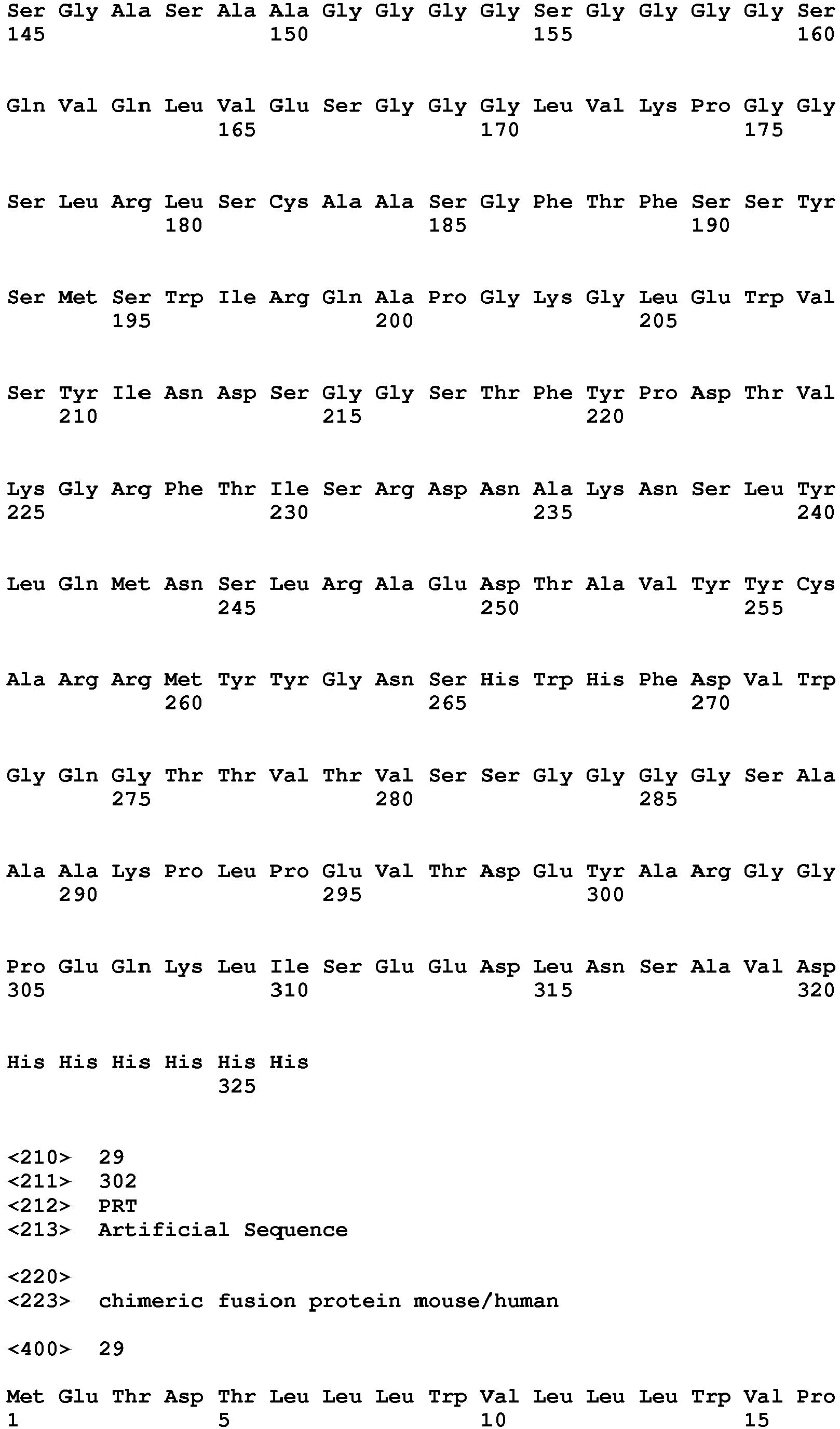


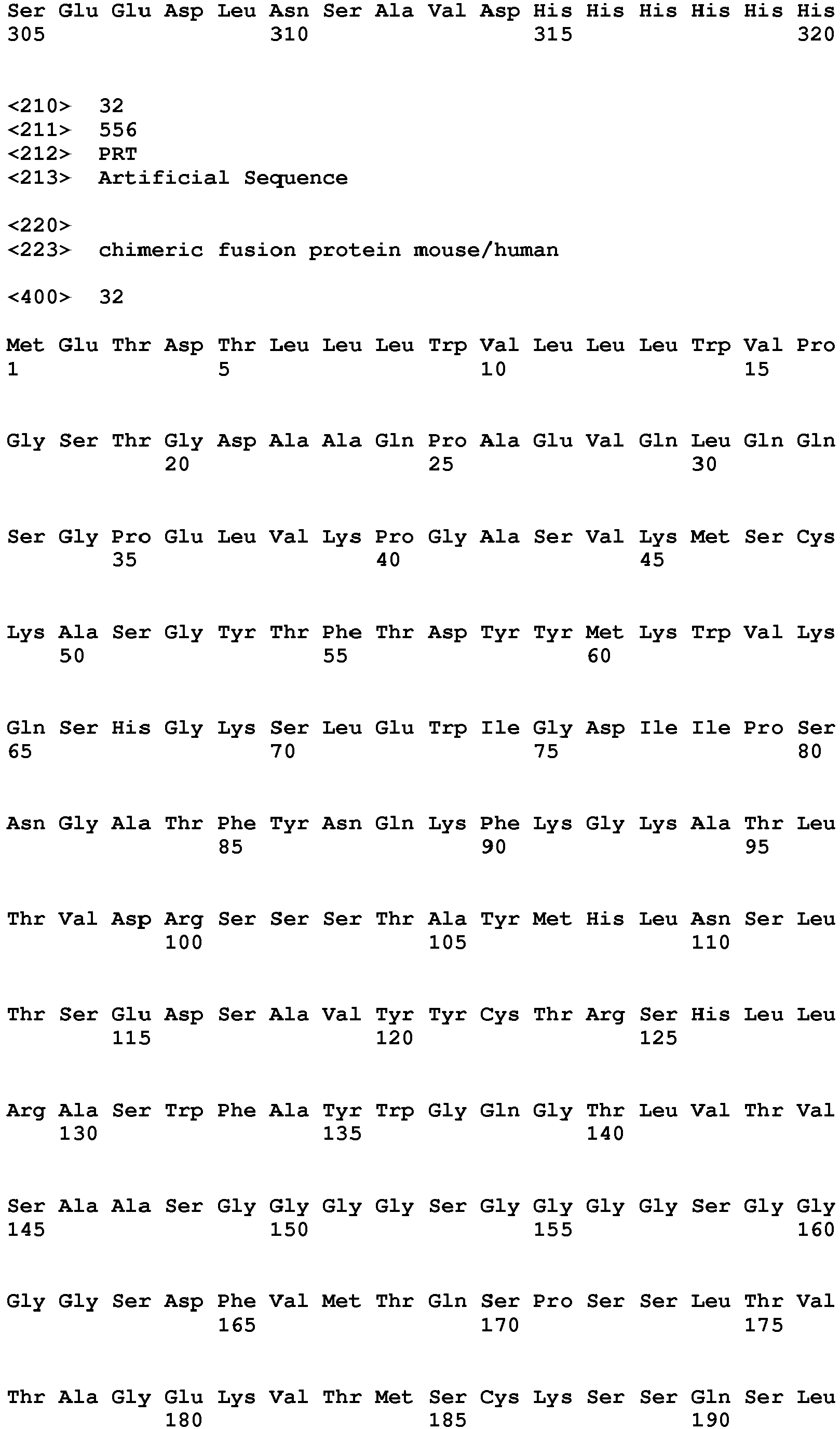


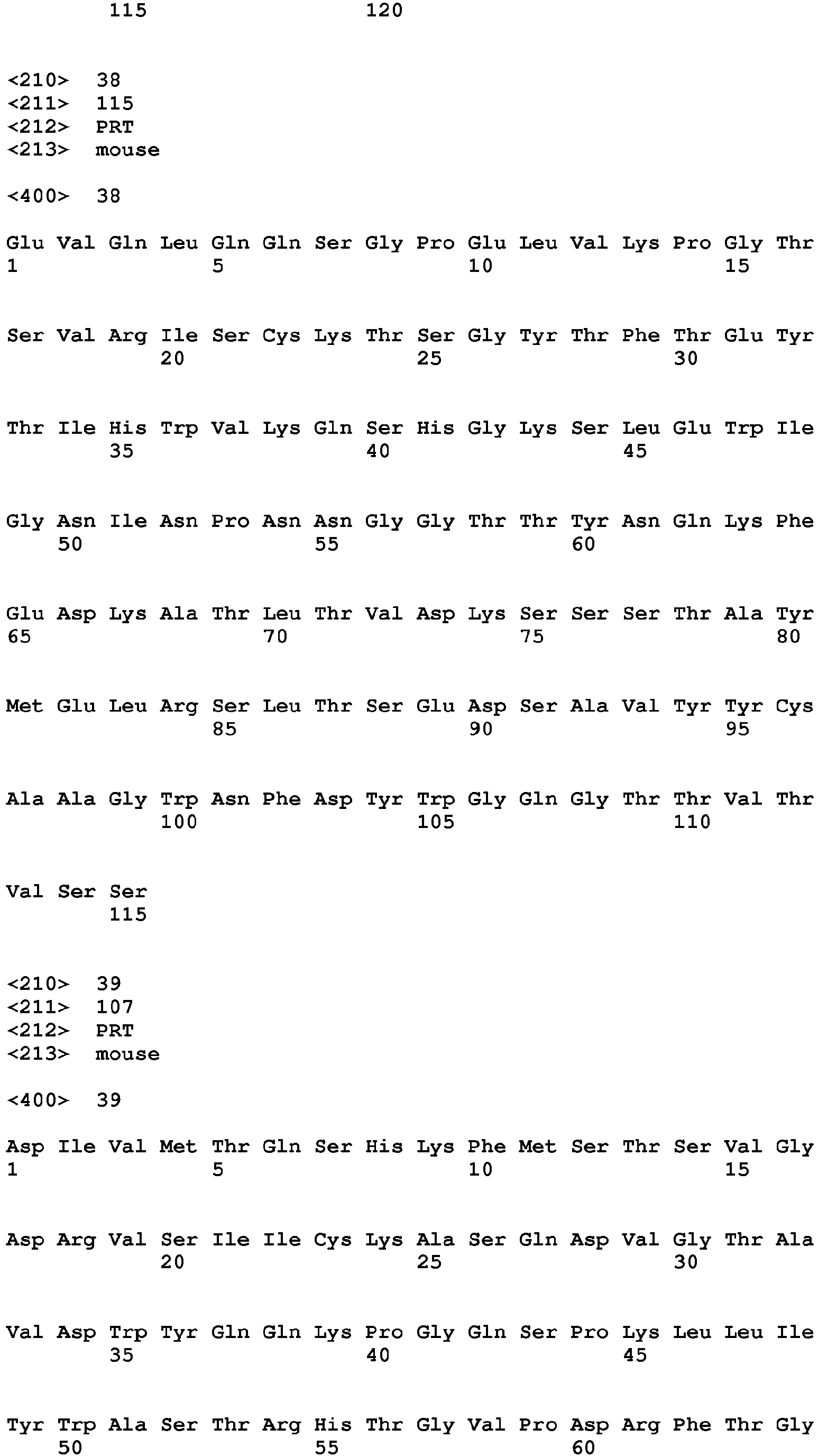


Claims (17)
- An nucleic acid encoding a universal chimeric antigen receptor, wherein the receptor comprises three domains, wherein- the first domain is a tag-binding domain,- the second domain is an extracellular hinge and a transmembrane domain and- the third domain is a signal transduction domain,wherein tag-binding domain binds to a tag derived from any human nuclear protein.
- The nucleic acid according to claim 1, wherein the tag is derived from human nuclear La protein.
- The nucleic acid according to any of claims 1 or 2, wherein the tag-binding domain is an antibody or an antigen-binding fragment thereof, whereas the tag-binding domain constitutes an anti-La epitope scFv, preferably an anti-La epitope scFv according to SEQ. ID 3 and 4.
- The nucleic acid according to any of claims 1 to 3, wherein the hinge and transmembrane region is selected from hinge and transmembrane regions of human CD28 molecule, CD8a chain, NK cell receptors, preferably natural killer group NKG2D, or parts of the constant region of an antibody as well as combinations of different hinge and transmembrane domains thereof.
- The nucleic acid according to any of claims 1 to 4, wherein the signal transduction domain is selected from cytoplasmic regions of CD28, CD137 (41 BB), CD134 (OX40), DAP10 and CD27, programmed cell death-1 (PD-1), cytotoxic T-lymphocyte antigen 4 (CTLA-4) and cytoplasmic regions CD3 chains, DAP12 and T cell activation inducing Fc receptors.
- The nucleic acid according to any of claims 1 to 5, wherein the receptor comprises a fourth domain which is a short peptide linker in the extracellular portion of the receptor.
- The nucleic acid according to any of claims 1 to 6 according to SEQ. ID 1.
- A target module composed of a binding moiety specific for a certain human cell surface protein or protein complex and a tag, wherein the tag is derived from any human nuclear protein, preferably from human nuclear La protein.
- The Target module according to any of claim 8, wherein binding moiety of target modules include antibodies or fragments thereof that binds to surface antigens CD2, CD3, CD4, CD8, CD10, CD19, CD20, CD22, CD23, CD33, CD38, CD44, CD52, CD99, CD123, CD274, TIM-3, members of the epidermal growth factor receptor family and mutants thereof, members of the ephrin receptor family, prostate specific antigens PSCA or PSMA, embryonic antigens, members of the vascular endothelia growth factor family, epithelia cell adhesion molecule EpCAM, alphafetoprotein AFP, members of the mucin protein family, follicle stimulating hormon receptor, human high molecular weight-melanoma-associated antigen, folate binding protein FBP, a-Folate receptor, ligands of the NKG2D receptor, members of the epithelia glycoprotein family, diasialogangliosides, members of the carbonic anhydrase family, members of the carbohydrate antigen family , members of the Rho family of GTPases, members of the high mobility group proteins and mutants thereof and wherein binding moiety of target modules is composed of the alpha and beta or the gamma and delta chains of a T cell receptor or fragments thereof, including auto-reactive T cell receptor-derived receptors, wherein such T cell receptor-derived binding moieties recognize and bind to peptides presented by human leukocyte antigen class I and II protein complexes.
- The Target module according to any of claims 8 or 9, wherein the binding moiety of target modules comprise ligands to proteins and protein complexes, which bind to, cytokine receptors, ligands of the NKG2D receptor or ligands to the EGFR family members.
- The Target module according to any of claims 8 to 10, wherein the binding moiety of target modules comprise bi- and multispecific antigen specificities include binding to PSCA and PSMA antigen, CD19 and CD20 antigen, CD19, CD20, and CD22 antigen, CD33 and CD123 antigen, CD33 and CD99, CD33 and TIM-3, erb-1 and -2, PSCA and erb-2.
- The Target module according to any of claims 8 to 11, wherein binding moiety of target modules include antibodies or fragments thereof that binds to the La/SSB antigen, preferably according to SEQ. ID 28, 29, 30, 31 and 32.
- An nucleic acid encoding a target module according to any of claims 8 to 12, preferably with a sequence according to SEQ. ID 10, 17, 20, 23 and 26.
- A cell or vector comprising a nucleic acid according to any of claims 1 to 7.
- The cell according to claim 14, wherein the cell is selected from the group of immune cells including T cell, a Natural Killer cell, a cytotoxic T lymphocyte, and a regulatory T cell.
- A kit comprising:- a vector according to claim 14 and- a target module according to any of claims 8 to 12 and/or a vector encoding an nucleic acid according to claim 13.
- Use of a cell according to any of claims 14 or 15 and a target module according to any of claims 8 to 12 for stimulating an universal chimeric antigen receptor mediated immune response in a mammal.
Priority Applications (17)
| Application Number | Priority Date | Filing Date | Title |
|---|---|---|---|
| ES14182945.7T ES2688035T3 (en) | 2014-08-29 | 2014-08-29 | Universal antigen receptor that expresses immune cells for addressing multiple multiple antigens, procedure for manufacturing it and using it for the treatment of cancer, infections and autoimmune diseases |
| EP14182945.7A EP2990416B1 (en) | 2014-08-29 | 2014-08-29 | Universal chimeric antigen receptor expressing immune cells for targeting of diverse multiple antigens and method of manufacturing the same and use of the same for treatment of cancer, infections and autoimmune disorders |
| CN201580043322.7A CN106574272B (en) | 2014-08-29 | 2015-08-26 | Universal Chimeric Antigen Receptor Expressing Immune Cells Targeting Diverse Multiple Antigens, Methods for Their Production, and Their Use in the Treatment of Cancer, Infections and Autoimmune Diseases |
| CN202110933891.6A CN114085855B (en) | 2014-08-29 | 2015-08-26 | Universal chimeric antigen receptor-expressing immune cells, their manufacturing methods and therapeutic uses |
| AU2015308499A AU2015308499B2 (en) | 2014-08-29 | 2015-08-26 | Universal chimeric antigen receptor expressing immune cells for targeting of diverse multiple antigens and method of manufacturing the same and use of the same for treatment of cancer, infections and autoimmune disorders |
| US15/504,012 US10611814B2 (en) | 2014-08-29 | 2015-08-26 | Universal chimeric antigen expressing immune cells for targeting of diverse multiple antigens and method of manufacturing the same and use of the same for treatment of cancer, infections and autoimmune disorders |
| JP2017530422A JP7215825B2 (en) | 2014-08-29 | 2015-08-26 | Immune Cells Expressing Universal Chimeric Antigen Receptors for Targeting Diverse Multiple Antigens, Methods of Making the Immune Cells, and Uses of the Immune Cells for the Treatment of Cancer, Infectious Diseases, and Autoimmune Diseases |
| CN202210415817.XA CN114774444A (en) | 2014-08-29 | 2015-08-26 | Universal chimeric antigen receptor expressing immune cells, methods of making and therapeutic uses thereof |
| EP15756392.5A EP3186275A1 (en) | 2014-08-29 | 2015-08-26 | Universal chimeric antigen receptor expressing immune cells for targeting of diverse multiple antigens and method of manufacturing the same and use of the same for treatment of cancer, infections and autoimmune disorders |
| PCT/EP2015/069527 WO2016030414A1 (en) | 2014-08-29 | 2015-08-26 | Universal chimeric antigen receptor expressing immune cells for targeting of diverse multiple antigens and method of manufacturing the same and use of the same for treatment of cancer, infections and autoimmune disorders |
| CA2953276A CA2953276C (en) | 2014-08-29 | 2015-08-26 | Universal chimeric antigen receptor expressing immune cells for targeting of diverse multiple antigens and method of manufacturing the same and use of the same for treatment of cancer, infections and autoimmune disorders |
| HK16103488.5A HK1215583A1 (en) | 2014-08-29 | 2016-03-24 | Universal chimeric antigen receptor expressing immune cells for targeting of diverse multiple antigens and method of manufacturing the same and use of the same for treatment of cancer, infections and autoimmune disorders |
| US16/513,672 US10766943B2 (en) | 2014-08-29 | 2019-07-16 | Universal chimeric antigen expressing immune cells for targeting of diverse multiple antigens and method of manufacturing the same and use of the same for treatment of cancer, infections and autoimmune disorders |
| AU2020200751A AU2020200751B2 (en) | 2014-08-29 | 2020-01-31 | Universal chimeric antigen receptor expressing immune cells for targeting of diverse multiple antigens and method of manufacturing the same and use of the same for treatment of cancer, infections and autoimmune disorders |
| US16/798,255 US20210206828A9 (en) | 2014-08-29 | 2020-02-21 | Universal chimeric antigen expressing immune cells for targeting of diverse multiple antigens and method of manufacturing the same and use of the same for treatment of cancer, infections and autoimmune disorders |
| JP2021012313A JP7660382B2 (en) | 2014-08-29 | 2021-01-28 | Immune cells expressing a universal chimeric antigen receptor for targeting multiple diverse antigens, a method for producing said immune cells, and use of said immune cells for the treatment of cancer, infectious diseases and autoimmune diseases |
| US19/294,884 US20260167694A1 (en) | 2014-08-29 | 2025-08-08 | Universal chimeric antigen expressing immune cells for targeting of diverse multiple antigens and method of manufacturing the same and use of the same for treatment of cancer, infections and autoimmune disorders |
Applications Claiming Priority (1)
| Application Number | Priority Date | Filing Date | Title |
|---|---|---|---|
| EP14182945.7A EP2990416B1 (en) | 2014-08-29 | 2014-08-29 | Universal chimeric antigen receptor expressing immune cells for targeting of diverse multiple antigens and method of manufacturing the same and use of the same for treatment of cancer, infections and autoimmune disorders |
Publications (2)
| Publication Number | Publication Date |
|---|---|
| EP2990416A1 true EP2990416A1 (en) | 2016-03-02 |
| EP2990416B1 EP2990416B1 (en) | 2018-06-20 |
Family
ID=51429114
Family Applications (2)
| Application Number | Title | Priority Date | Filing Date |
|---|---|---|---|
| EP14182945.7A Active EP2990416B1 (en) | 2014-08-29 | 2014-08-29 | Universal chimeric antigen receptor expressing immune cells for targeting of diverse multiple antigens and method of manufacturing the same and use of the same for treatment of cancer, infections and autoimmune disorders |
| EP15756392.5A Pending EP3186275A1 (en) | 2014-08-29 | 2015-08-26 | Universal chimeric antigen receptor expressing immune cells for targeting of diverse multiple antigens and method of manufacturing the same and use of the same for treatment of cancer, infections and autoimmune disorders |
Family Applications After (1)
| Application Number | Title | Priority Date | Filing Date |
|---|---|---|---|
| EP15756392.5A Pending EP3186275A1 (en) | 2014-08-29 | 2015-08-26 | Universal chimeric antigen receptor expressing immune cells for targeting of diverse multiple antigens and method of manufacturing the same and use of the same for treatment of cancer, infections and autoimmune disorders |
Country Status (9)
| Country | Link |
|---|---|
| US (4) | US10611814B2 (en) |
| EP (2) | EP2990416B1 (en) |
| JP (2) | JP7215825B2 (en) |
| CN (3) | CN106574272B (en) |
| AU (2) | AU2015308499B2 (en) |
| CA (1) | CA2953276C (en) |
| ES (1) | ES2688035T3 (en) |
| HK (1) | HK1215583A1 (en) |
| WO (1) | WO2016030414A1 (en) |
Cited By (38)
| Publication number | Priority date | Publication date | Assignee | Title |
|---|---|---|---|---|
| EP3283113A4 (en) * | 2015-04-15 | 2018-12-05 | The California Institute for Biomedical Research | Optimized pne-based chimeric receptor t cell switches and uses thereof |
| WO2018224660A1 (en) | 2017-06-09 | 2018-12-13 | Armin Ehninger | Targeting modules for universal chimeric antigen receptor expressing immune cells and use in the treatment of cancer infections and autoimmune disorders |
| CN109452229A (en) * | 2018-11-19 | 2019-03-12 | 北京百奥赛图基因生物技术有限公司 | The preparation method and application of dog source PD-1 genetic modification animal model |
| CN109503721A (en) * | 2016-05-31 | 2019-03-22 | 上海恒润达生生物科技有限公司 | Target the Chimeric antigen receptor and application thereof of CD19 |
| EP3517125A1 (en) * | 2018-01-24 | 2019-07-31 | Xuanwu Hospital of Capital Medical University | Chimeric antigen receptor for efficient targeted proliferation in vitro and uses thereof |
| JP2019534037A (en) * | 2016-09-04 | 2019-11-28 | ターグイミューン セラピューティクス アーゲー | Chimeric protein for targeting dsRNA |
| JP2020510646A (en) * | 2017-02-20 | 2020-04-09 | ドラゴンフライ セラピューティクス, インコーポレイテッド | Proteins that bind to CD33, NKG2D and CD16 |
| JP2021514396A (en) * | 2018-02-20 | 2021-06-10 | ドラゴンフライ セラピューティクス, インコーポレイテッド | Multispecific binding proteins that bind to CD33, NKG2D, and CD16, and how to use them. |
| WO2022058298A1 (en) * | 2020-09-15 | 2022-03-24 | BioNTech SE | Agents and methods for targeted delivery to cells |
| WO2022125982A1 (en) | 2020-12-11 | 2022-06-16 | Intellia Therapeutics, Inc. | Compositions and methods for reducing mhc class ii in a cell |
| WO2022133169A1 (en) * | 2020-12-18 | 2022-06-23 | Century Therapeutics, Inc. | Chimeric antigen receptor systems with adaptable receptor specificity |
| WO2022140586A2 (en) | 2020-12-23 | 2022-06-30 | Intellia Therapeutics, Inc. | Compositions and methods for reducing hla-a in a cell |
| WO2022258681A1 (en) * | 2021-06-08 | 2022-12-15 | Biontech Cell & Gene Therapies Gmbh | Agents and methods for activation and targeting of immune effector cells |
| US11834506B2 (en) | 2017-02-08 | 2023-12-05 | Dragonfly Therapeutics, Inc. | Multi-specific binding proteins that bind NKG2D, CD16, and a tumor-associated antigen for activation of natural killer cells and therapeutic uses thereof to treat cancer |
| WO2023245108A2 (en) | 2022-06-16 | 2023-12-21 | Intellia Therapeutics, Inc. | Compositions and methods for reducing mhc class i in a cell |
| EP4296281A1 (en) | 2022-06-23 | 2023-12-27 | AvenCell Therapeutics Inc. | Targeting modules against cd123 and a tag for use in a method for stimulating a universal chimeric antigen receptor-mediated immune response in a mammal |
| EP4295860A1 (en) | 2022-06-23 | 2023-12-27 | Armin Ehninger | Engineered human t cells comprising a switchable chimeric antigen cell surface receptor and methods for generating them |
| WO2023250433A2 (en) | 2022-06-23 | 2023-12-28 | Goel Surbhi | Engineered human t cells comprising a switchable chimeric antigen cell surface receptor and methods for generating them |
| WO2023250489A1 (en) | 2022-06-23 | 2023-12-28 | Avencell Therapeutics Inc. | Targeting modules against cd123 for use in a method for stimulating a chimeric antigen receptor-mediated immune response in a mammal |
| US11884733B2 (en) | 2018-02-08 | 2024-01-30 | Dragonfly Therapeutics, Inc. | Antibody variable domains targeting the NKG2D receptor |
| US11884732B2 (en) | 2017-02-20 | 2024-01-30 | Dragonfly Therapeutics, Inc. | Proteins binding HER2, NKG2D and CD16 |
| EP4342907A1 (en) | 2022-09-21 | 2024-03-27 | AvenCell Europe GmbH | Switchable chimeric antigen receptors and their use |
| EP4382119A1 (en) | 2022-12-09 | 2024-06-12 | AvenCell Europe GmbH | A kit for use in the treatment of hematological cancer |
| WO2024121297A1 (en) | 2022-12-09 | 2024-06-13 | Avencell Europe Gmbh | A kit for use in the treatment of hematological cancer |
| US12157771B2 (en) | 2020-05-06 | 2024-12-03 | Dragonfly Therapeutics, Inc. | Proteins binding NKG2D, CD16 and CLEC12A |
| WO2025010477A1 (en) * | 2023-07-13 | 2025-01-16 | Telix Pharmaceuticals (Innovations) Pty Ltd | Humanised antibodies and uses thereof |
| WO2025038637A1 (en) | 2023-08-14 | 2025-02-20 | Intellia Therapeutics, Inc. | Compositions and methods for genetically modifying transforming growth factor beta receptor type 2 (tgfβr2) |
| WO2025038648A1 (en) | 2023-08-14 | 2025-02-20 | Intellia Therapeutics, Inc. | Compositions and methods for genetically modifying transforming growth factor beta receptor type 2 (tgfβr2) |
| WO2025038642A1 (en) | 2023-08-14 | 2025-02-20 | Intellia Therapeutics, Inc. | Compositions and methods for genetically modifying cd70 |
| US12275791B2 (en) | 2018-08-08 | 2025-04-15 | Dragonfly Therapeutics, Inc. | Multi-specific binding proteins that bind HER2, NKG2D, and CD16, and methods of use |
| EP4566619A1 (en) | 2023-12-08 | 2025-06-11 | AvenCell Therapeutics Inc. | Targeting modules against cd19 and cd20 for use in a method for stimulating a reversed chimeric antigen receptor-mediated immune response in a mammal |
| EP4566620A1 (en) | 2023-12-08 | 2025-06-11 | AvenCell Therapeutics Inc. | Switchable universal chimeric antigen receptors and their use |
| US12377144B2 (en) | 2021-03-03 | 2025-08-05 | Dragonfly Therapeutics, Inc. | Methods of treating cancer using multi-specific binding proteins that bind NKG2D, CD16 and a tumor-associated antigen |
| US12378318B2 (en) | 2018-08-08 | 2025-08-05 | Dragonfly Therapeutics, Inc. | Proteins binding NKG2D, CD16 and a tumor-associated antigen |
| US12384851B2 (en) | 2018-08-08 | 2025-08-12 | Dragonfly Therapeutics, Inc. | Multi-specific binding proteins that bind BCMA, NKG2D and CD16, and methods of use |
| US12384847B2 (en) | 2018-02-08 | 2025-08-12 | Dragonfly Therapeutics, Inc. | Cancer therapy involving an anti-PD1 antibody and a multi-specific binding protein that binds NKG2D, CD16, and a tumor-associated antigen |
| EP4763223A1 (en) | 2024-12-23 | 2026-06-24 | AvenCell Therapeutics Inc. | An engineered cell comprising a chimeric antigen receptor and a switchable chimeric antigen receptor, a kit and their use |
| WO2026139826A1 (en) | 2024-12-23 | 2026-07-02 | Avencell Therapeutics Inc. | An engineered cell comprising a chimeric antigen receptor and a switchable chimeric antigen receptor, a kit and their use |
Families Citing this family (122)
| Publication number | Priority date | Publication date | Assignee | Title |
|---|---|---|---|---|
| ES2688035T3 (en) | 2014-08-29 | 2018-10-30 | Gemoab Monoclonals Gmbh | Universal antigen receptor that expresses immune cells for addressing multiple multiple antigens, procedure for manufacturing it and using it for the treatment of cancer, infections and autoimmune diseases |
| ES2717308T3 (en) * | 2014-12-06 | 2019-06-20 | Gemoab Monoclonals Gmbh | Pluri- or multi-potent genetically modified stem cells and their uses |
| EP3250602A1 (en) * | 2015-01-26 | 2017-12-06 | Cellectis | T cell receptor knock out engineered immune cells, endowed with chimeric antigen receptors binding to cd123 for the treatment of relapsed/refractory acute myeloid lymphoma or blastic plasmacytoid dendritic cell neoplasm |
| KR102157701B1 (en) | 2015-08-17 | 2020-09-21 | 서울대학교산학협력단 | Chimeric antibody receptor to which anti-cotinine antibody is linked and uses thereof |
| EP3315511A1 (en) | 2016-10-29 | 2018-05-02 | Miltenyi Biotec GmbH | Adapter chimeric antigen receptor expressing cells for targeting of multiple antigens |
| CN110352068A (en) | 2016-12-02 | 2019-10-18 | 南加利福尼亚大学 | The immunity receptor and its application method of synthesis |
| EP3559035A1 (en) | 2016-12-21 | 2019-10-30 | TeneoBio, Inc. | Anti-bcma heavy chain-only antibodies |
| CN108250301A (en) * | 2016-12-29 | 2018-07-06 | 天津天锐生物科技有限公司 | A kind of multiple target point Chimeric antigen receptor |
| CN110475857B (en) * | 2017-01-05 | 2023-07-18 | 韩国生命工学研究院 | Natural killer cells expressing anti-cotinine chimeric antigen receptor |
| KR102642385B1 (en) * | 2017-02-06 | 2024-03-04 | 오리오니스 바이오사이언시스 엔브이 | Targeted chimeric proteins and uses thereof |
| MX2019010171A (en) | 2017-02-27 | 2019-10-15 | Juno Therapeutics Inc | COMPOSITIONS, MANUFACTURING ARTICLES AND METHODS RELATED TO DOSAGE IN CELLULAR THERAPY. |
| US12024560B2 (en) | 2017-03-28 | 2024-07-02 | Lyvgen Biopharma Holdings Limited | Therapeutic agents and methods for enhancing immune responses in tumor microenvironment |
| MX2019012017A (en) | 2017-04-07 | 2020-02-12 | Juno Therapeutics Inc | Engineered cells expressing prostate-specific membrane antigen (psma) or a modified form thereof and related methods. |
| CN110709700A (en) | 2017-04-14 | 2020-01-17 | 朱诺治疗学股份有限公司 | Method for evaluating cell surface glycosylation |
| AU2018283319B2 (en) * | 2017-06-16 | 2023-11-09 | Mayo Foundation For Medical Education And Research | Materials and methods for increasing immune responses |
| CN110891971B (en) | 2017-06-20 | 2024-01-12 | 特尼奥生物股份有限公司 | Heavy chain-only anti-BCMA antibody |
| WO2018237341A1 (en) * | 2017-06-22 | 2018-12-27 | Development Center For Biotechnology | FC-SCFV HYBRID ANTIBODY FORMAT ASYMMETRICAL ACTIVATION HETERODIMER AND INVOLVING TARGET CELL DETECTOR T CELLS FOR CANCER THERAPY |
| CN107326014B (en) * | 2017-07-31 | 2019-09-24 | 时力生物科技(北京)有限公司 | A kind of T lymphocyte and its preparation method and application of bispecific chimeric antigen receptor modification |
| CN109468279A (en) * | 2017-09-08 | 2019-03-15 | 科济生物医药(上海)有限公司 | Immune effector cells targeting GPC3 and their applications |
| CA3076337A1 (en) | 2017-09-19 | 2019-03-28 | Massachusetts Institute Of Technology | Compositions for chimeric antigen receptor t cell therapy and uses thereof |
| KR102802061B1 (en) * | 2017-11-10 | 2025-05-02 | 주라 바이오, 인크. | Major histocompatibility complex-based chimeric receptors and their use in treating autoimmune diseases |
| CN107974433B (en) * | 2017-12-08 | 2020-12-01 | 新乡医学院 | An enhanced anti-tumor NK cell and its preparation method and application |
| CN108048404B (en) * | 2017-12-08 | 2020-12-01 | 新乡医学院 | A kind of anti-tumor NK cell and its preparation method and application |
| WO2019136305A1 (en) * | 2018-01-04 | 2019-07-11 | Neumedicines Inc. | Cell-based and immune checkpoint inhibitor therapies combined with il-12 for treating cancer |
| WO2019134950A1 (en) * | 2018-01-04 | 2019-07-11 | Miltenyi Biotec Gmbh | Chimeric antigen receptor specific for bdca2 antigen |
| US12036273B2 (en) * | 2018-01-08 | 2024-07-16 | H. Lee Moffitt Cancer Center And Research Institute, Inc. | Compositions and methods for targeting CD99-expressing cancers |
| WO2019147604A2 (en) * | 2018-01-23 | 2019-08-01 | Vanderbilt University | Self-antigen specific t-cells as vacines for augmenting engraftment and stability of autologous transfer |
| PT110526B (en) | 2018-01-26 | 2021-02-04 | Univ Nova De Lisboa | ANTIBODY, FUNCTIONAL FRAGMENT OR PROBE OF THE SAME AGAINST TUMORAL ANTIGENS |
| WO2019152957A1 (en) * | 2018-02-02 | 2019-08-08 | Arizona Board Of Regents On Behalf Of Arizona State University | Dna-chimeric antigen receptor t cells for immunotherapy |
| BR112020016570A2 (en) | 2018-02-17 | 2020-12-15 | Flagship Pioneering Innovations V, Inc. | COMPOSITIONS AND METHODS FOR MEMBRANE PROTEIN RELEASE |
| US20210079061A1 (en) | 2018-02-26 | 2021-03-18 | Fred Hutchinson Cancer Research Center | Compositions and methods for cellular immunotherapy |
| EP3759491A1 (en) * | 2018-03-01 | 2021-01-06 | H. Hoffnabb-La Roche Ag | Specificity assay for novel target antigen binding moieties |
| EP3773621A4 (en) * | 2018-03-27 | 2022-03-23 | Systimmune, Inc. | GUIDANCE AND NAVIGATION CONTROL PROTEINS AND METHODS OF PRODUCING AND USING THEM |
| US11945878B2 (en) | 2018-04-18 | 2024-04-02 | Abclon Inc. | Switch molecule and switchable chimeric antigen receptor |
| EP3790896A1 (en) * | 2018-05-07 | 2021-03-17 | Children's Hospital Medical Center | Chimeric polypeptides, nucleic acid molecules, cells, and related methods |
| WO2019222642A1 (en) * | 2018-05-18 | 2019-11-21 | Senti Biosciences, Inc. | Engineered immune cells and methods of use |
| AU2019275479B2 (en) * | 2018-05-21 | 2022-12-08 | Biosceptre (Aust) Pty Ltd | Chimeric antigen receptors with modified linker domains and uses thereof |
| EP3581200A1 (en) * | 2018-06-13 | 2019-12-18 | GEMoaB Monoclonals GmbH | Reversed universal chimeric antigen receptor expressing immune cells for targeting of diverse multiple antigens and method of manufacturing the same and use of the same for treatment of cancer, infections and autoimmune disorders |
| WO2019242632A1 (en) * | 2018-06-19 | 2019-12-26 | 1§1Nanjing Legend Biotech Co., Ltd. | Engineered cells and uses thereof |
| CN110623980A (en) * | 2018-06-25 | 2019-12-31 | 深圳宾德生物技术有限公司 | Application of chimeric antigen receptor T cell targeting CD38 in autoimmune diseases |
| WO2020010229A1 (en) * | 2018-07-06 | 2020-01-09 | Arizona Board Of Regents On Behalf Of The University Of Arizona | Car t cell therapy to target t cell specific cancers |
| KR102905569B1 (en) | 2018-07-26 | 2025-12-31 | 아라팅가 바이오 티엔피 | Aptamer-based CAR T-cell switch |
| BR112021002390A2 (en) | 2018-08-09 | 2021-05-11 | Juno Therapeutics Inc | processes to generate modified cells and their compositions |
| EP3620464A1 (en) | 2018-09-10 | 2020-03-11 | Miltenyi Biotec GmbH | Car cell having crosslinked disulfide bridge on antigen recognizing moiety |
| JP7504891B2 (en) | 2018-09-11 | 2024-06-24 | ジュノー セラピューティクス インコーポレイテッド | Methods for mass spectrometric analysis of engineered cell compositions - Patents.com |
| SG11202100935TA (en) | 2018-09-28 | 2021-02-25 | Massachusetts Inst Technology | Collagen-localized immunomodulatory molecules and methods thereof |
| CN110964112B (en) * | 2018-09-30 | 2023-05-02 | 重庆精准生物技术有限公司 | Humanized antibody for enhancing anti-PSCA chimeric antigen receptor activity and application thereof |
| SG11202104180WA (en) * | 2018-10-30 | 2021-05-28 | Peter Maccallum Cancer Inst | Bispecific polypeptides for engagement of car expressing immune cells with antigen presenting cells and uses thereof |
| WO2020089343A1 (en) | 2018-10-31 | 2020-05-07 | Juno Therapeutics Gmbh | Methods for selection and stimulation of cells and apparatus for same |
| KR20210131991A (en) | 2018-11-14 | 2021-11-03 | 플래그쉽 파이어니어링 이노베이션스 브이, 인크. | Compositions and methods for compartment-specific cargo delivery |
| WO2020102503A2 (en) | 2018-11-14 | 2020-05-22 | Flagship Pioneering Innovations V, Inc. | Fusosome compositions for t cell delivery |
| US12600971B2 (en) | 2019-02-13 | 2026-04-14 | Beam Therapeutics Inc. | Modified immune cells having adenosine deaminase base editors for modifying a nucleobase in a target sequence |
| WO2020201527A1 (en) | 2019-04-04 | 2020-10-08 | Umc Utrecht Holding B.V. | Modified immune receptor constructs |
| JP7711945B2 (en) | 2019-04-30 | 2025-07-23 | センティ バイオサイエンシズ インコーポレイテッド | Chimeric receptors and methods of use thereof |
| CA3136737A1 (en) | 2019-05-01 | 2020-11-05 | Juno Therapeutics, Inc. | Cells expressing a recombinant receptor from a modified tgfbr2 locus, related polynucleotides and methods |
| SG11202111372VA (en) | 2019-05-01 | 2021-11-29 | Juno Therapeutics Inc | Cells expressing a chimeric receptor from a modified cd247 locus, related polynucleotides and methods |
| US11162079B2 (en) | 2019-05-10 | 2021-11-02 | The Regents Of The University Of California | Blood type O Rh-hypo-immunogenic pluripotent cells |
| JP2022538974A (en) | 2019-06-26 | 2022-09-07 | マサチューセッツ インスチテュート オブ テクノロジー | Immunomodulatory fusion protein-metal hydroxide complexes and methods thereof |
| WO2021019297A1 (en) | 2019-07-26 | 2021-02-04 | Aratinga.Bio Tnp | Aptamer-based multispecific therapeutic agents |
| CN114502587A (en) * | 2019-07-30 | 2022-05-13 | 普瑞文森生物有限公司 | Methods and compositions for reducing immunogenicity via non-depleting B cell inhibitors |
| EP4010377A4 (en) * | 2019-08-09 | 2023-09-06 | A2 Biotherapeutics, Inc. | CELL SURFACE RECEPTORS SENSITIVE TO LOSS OF HETEROZYGOSITY |
| EP4025698A1 (en) | 2019-09-03 | 2022-07-13 | Sana Biotechnology, Inc. | Cd24-associated particles and related methods and uses thereof |
| WO2021047804A1 (en) | 2019-09-11 | 2021-03-18 | Miltenyi Biotec B.V. & Co. KG | In vitro method for transduction of t cells in the presence of malignant cells |
| WO2021061648A1 (en) | 2019-09-23 | 2021-04-01 | Massachusetts Institute Of Technology | Methods and compositions for stimulation of endogenous t cell responses |
| US12594301B2 (en) | 2019-09-27 | 2026-04-07 | Beam Therapeutics Inc. | Compositions and methods for treatment of liquid cancers |
| WO2021119489A1 (en) | 2019-12-11 | 2021-06-17 | A2 Biotherapeutics, Inc. | Lilrb1-based chimeric antigen receptor |
| US20230090117A1 (en) | 2020-01-28 | 2023-03-23 | Juno Therapeutics, Inc. | Methods for t cell transduction |
| CN115066249A (en) | 2020-02-04 | 2022-09-16 | 美天施生物科技有限两合公司 | Immune cells expressing aptamer chimeric antigen receptors for sensing soluble antigens |
| WO2021178975A1 (en) * | 2020-03-06 | 2021-09-10 | Albert Einstein College Of Medicine | A method to generate chimeric antigen receptor (car) t-cells (car-t cells) from pathogen-specific cytotoxic lymphocytes to enable the subsequent in vivo modulation of their functional activity |
| EP3878464A1 (en) | 2020-03-09 | 2021-09-15 | Miltenyi Biotec B.V. & Co. KG | Use of a car cell having crosslinked disulfide bridge on antigen recognizing moiety for targeting cancer cells |
| EP3881866A1 (en) | 2020-03-16 | 2021-09-22 | GEMoaB GmbH | A targeting module comprising pd-l1 and/or pd-l2 for use in a method for stimulating a chimeric antigen receptor mediated response in a mammal |
| AU2021248815A1 (en) | 2020-03-31 | 2022-10-13 | Flagship Pioneering Innovations V, Inc. | Targeted lipid particles and compositions and uses thereof |
| US12286465B2 (en) | 2020-05-28 | 2025-04-29 | Miltenyi Biotec B.V. & Co. KG | Chimeric antigen receptor with a spacer comprising C2-set Ig-like domains |
| EP4171616A1 (en) | 2020-06-26 | 2023-05-03 | Juno Therapeutics GmbH | Engineered t cells conditionally expressing a recombinant receptor, related polynucleotides and methods |
| IL299027A (en) | 2020-06-30 | 2023-02-01 | Teneobio Inc | Multi-specific antibodies binding to bcma |
| KR102297396B1 (en) * | 2020-07-29 | 2021-09-06 | (주)티카로스 | Immune Synapse-Stabilizing Chimeric Antigen Receptor(CAR) T Cell |
| AU2021325941A1 (en) | 2020-08-13 | 2023-03-09 | Sana Biotechnology, Inc. | Methods of treating sensitized patients with hypoimmunogenic cells, and associated methods and compositions |
| KR20230052279A (en) | 2020-08-19 | 2023-04-19 | 아스테라스 세이야쿠 가부시키가이샤 | Human non-naturally occurring modified FC region of IGG that specifically binds non-naturally occurring modified FC receptors |
| EP4210733B1 (en) | 2020-09-04 | 2024-11-06 | Miltenyi Biotec B.V. & Co. KG | System for inducible expression of an adapter in immune cells |
| AU2021347359A1 (en) * | 2020-09-25 | 2023-05-18 | Beam Therapeutics Inc. | Fratricide resistant modified immune cells and methods of using the same |
| JP2023549780A (en) | 2020-11-04 | 2023-11-29 | ジュノー セラピューティクス インコーポレイテッド | Cells expressing chimeric receptors from engineered invariant CD3 immunoglobulin superfamily chain loci and related polynucleotides and methods |
| AU2021385343A1 (en) * | 2020-11-24 | 2023-07-06 | City Of Hope | Compositions and uses of psca targeted chimeric antigen receptor modified cells |
| US11965022B2 (en) | 2020-12-31 | 2024-04-23 | Sana Biotechnology, Inc. | Methods and compositions for modulating CAR-T activity |
| KR20250152662A (en) | 2020-12-31 | 2025-10-23 | 사노피 | Multifunctional natural killer (nk) cell engagers binding to nkp46 and cd123 |
| KR20230151513A (en) | 2021-01-11 | 2023-11-01 | 사나 바이오테크놀로지, 인크. | Uses of CD8 Targeting Viral Vectors |
| US20240168012A1 (en) | 2021-03-22 | 2024-05-23 | Juno Therapeutics, Inc. | Methods of determining potency of a therapeutic cell composition |
| WO2022204071A1 (en) | 2021-03-22 | 2022-09-29 | Juno Therapeutics, Inc. | Method to assess potency of viral vector particles |
| AU2022277931A1 (en) | 2021-05-19 | 2023-11-30 | Sana Biotechnology, Inc. | Hypoimmunogenic rhd negative primary t cells |
| US20240226164A1 (en) | 2021-05-27 | 2024-07-11 | Sana Biotechnology, Inc. | Hypoimmunogenic cells comprising engineered hla-e or hla-g |
| IL308836A (en) | 2021-05-28 | 2024-01-01 | Sana Biotechnology Inc | Lipid particles containing a truncated baboon endogenous retrovirus (baev) envelope glycoprotein and related methods and uses |
| CA3225283A1 (en) | 2021-07-14 | 2023-01-19 | Sonja SCHREPFER | Altered expression of y chromosome-linked antigens in hypoimmunogenic cells |
| EP4381081A1 (en) | 2021-08-04 | 2024-06-12 | Sana Biotechnology, Inc. | Use of cd4-targeted viral vectors |
| US20260053851A1 (en) | 2021-08-11 | 2026-02-26 | Sana Biotechnology, Inc. | Inducible systems for altering gene expression in hypoimmunogenic cells |
| AU2022326565A1 (en) | 2021-08-11 | 2024-02-08 | Sana Biotechnology, Inc. | Genetically modified cells for allogeneic cell therapy |
| CA3227108A1 (en) | 2021-08-11 | 2023-02-16 | Xiaomeng HU | Genetically modified primary cells for allogeneic cell therapy |
| AU2022325955A1 (en) | 2021-08-11 | 2024-02-08 | Sana Biotechnology, Inc. | Genetically modified cells for allogeneic cell therapy to reduce instant blood mediated inflammatory reactions |
| AU2022325231A1 (en) | 2021-08-11 | 2024-02-08 | Sana Biotechnology, Inc. | Genetically modified cells for allogeneic cell therapy to reduce complement-mediated inflammatory reactions |
| EP4176895A1 (en) | 2021-11-08 | 2023-05-10 | AvenCell Europe GmbH | Targeting modules against il13ra2 or her2 for use in combination with a chimeric antigen receptor |
| EP4448775A1 (en) | 2021-12-17 | 2024-10-23 | Sana Biotechnology, Inc. | Modified paramyxoviridae attachment glycoproteins |
| US20250059239A1 (en) | 2021-12-17 | 2025-02-20 | Sana Biotechnology, Inc. | Modified paramyxoviridae fusion glycoproteins |
| WO2023122337A1 (en) | 2021-12-23 | 2023-06-29 | Sana Biotechnology, Inc. | Chimeric antigen receptor (car) t cells for treating autoimmune disease and associated methods |
| WO2023150518A1 (en) | 2022-02-01 | 2023-08-10 | Sana Biotechnology, Inc. | Cd3-targeted lentiviral vectors and uses thereof |
| EP4479084A1 (en) | 2022-02-14 | 2024-12-25 | Sana Biotechnology, Inc. | Methods of treating patients exhibiting a prior failed therapy with hypoimmunogenic cells |
| WO2023158836A1 (en) | 2022-02-17 | 2023-08-24 | Sana Biotechnology, Inc. | Engineered cd47 proteins and uses thereof |
| WO2023193015A1 (en) | 2022-04-01 | 2023-10-05 | Sana Biotechnology, Inc. | Cytokine receptor agonist and viral vector combination therapies |
| WO2023225569A1 (en) | 2022-05-17 | 2023-11-23 | Umoja Biopharma, Inc. | Manufacturing viral particles |
| WO2023227790A1 (en) | 2022-05-27 | 2023-11-30 | Sanofi | Natural killer (nk) cell engagers binding to nkp46 and bcma variants with fc-engineering |
| EP4602174A1 (en) | 2022-10-13 | 2025-08-20 | Sana Biotechnology, Inc. | Viral particles targeting hematopoietic stem cells |
| WO2024078995A1 (en) | 2022-10-15 | 2024-04-18 | Miltenyi Biotec B.V. & Co. KG | Transduction of gammadelta t cells with pseudotyped retroviral vectors |
| WO2024097313A1 (en) | 2022-11-02 | 2024-05-10 | Sana Biotechnology, Inc. | Methods for producing t cell therapy products |
| US20260176651A1 (en) | 2022-11-04 | 2026-06-25 | Umoja Biopharma, Inc. | Particles displaying adhesion-molecule fusions |
| WO2024220598A2 (en) | 2023-04-18 | 2024-10-24 | Sana Biotechnology, Inc. | Lentiviral vectors with two or more genomes |
| KR20250169631A (en) | 2023-04-18 | 2025-12-03 | 주노 쎄러퓨티크스 인코퍼레이티드 | Cytotoxicity assay to evaluate the efficacy of therapeutic cell compositions |
| WO2024220560A1 (en) | 2023-04-18 | 2024-10-24 | Sana Biotechnology, Inc. | Engineered protein g fusogens and related lipid particles and methods thereof |
| EP4698666A1 (en) | 2023-04-18 | 2026-02-25 | Sana Biotechnology, Inc. | Universal protein g fusogens and adapter systems thereof and related lipid particles and uses |
| EP4716851A2 (en) | 2023-05-23 | 2026-04-01 | Juno Therapeutics, Inc. | Activation markers of t cells and method for assessing t cell activation |
| EP4470555A1 (en) | 2023-05-31 | 2024-12-04 | Miltenyi Biotec B.V. & Co. KG | Anti-tag chimeric antigen receptors with specificity for mutated peptides derived from human fgfr2 |
| WO2025043172A1 (en) | 2023-08-23 | 2025-02-27 | Sana Biotechnology, Inc. | Modified cd47 proteins and their uses |
| WO2025054202A1 (en) | 2023-09-05 | 2025-03-13 | Sana Biotechnology, Inc. | Method of screening a sample comprising a transgene with a unique barcode |
| AU2025208175A1 (en) | 2024-01-12 | 2026-06-25 | Sana Biotechnology, Inc. | Safety switches to control in vitro and in vivo proliferation of cell therapy products |
| EP4635980A1 (en) * | 2024-04-19 | 2025-10-22 | Medigene Immunotherapies GmbH | Uni-tags specific antibody |
| WO2025231174A1 (en) | 2024-04-30 | 2025-11-06 | Umoja Biopharma, Inc. | Manufacturing viral particles |
Citations (4)
| Publication number | Priority date | Publication date | Assignee | Title |
|---|---|---|---|---|
| WO2012082841A2 (en) | 2010-12-14 | 2012-06-21 | University Of Maryland, Baltimore | Universal anti-tag chimeric antigen receptor-expressing t cells and methods of treating cancer |
| WO2013044225A1 (en) | 2011-09-22 | 2013-03-28 | The Trustees Of The University Of Pennsylvania | A universal immune receptor expressed by t cells for the targeting of diverse and multiple antigens |
| WO2013074916A1 (en) * | 2011-11-18 | 2013-05-23 | Board Of Regents, The University Of Texas System | Car+ t cells genetically modified to eliminate expression of t- cell receptor and/or hla |
| WO2013126712A1 (en) * | 2012-02-22 | 2013-08-29 | The Trustees Of The University Of Pennsylvania | Compositions and methods for generating a persisting population of t cells useful for the treatment of cancer |
Family Cites Families (48)
| Publication number | Priority date | Publication date | Assignee | Title |
|---|---|---|---|---|
| US4751181A (en) | 1984-12-31 | 1988-06-14 | Duke University | Methods and compositions useful in the diagnosis and treatment of autoimmune diseases |
| CA1313818C (en) | 1987-06-03 | 1993-02-23 | Ross Leon Coppel | Nuclear antigen la |
| US5912170A (en) | 1991-03-07 | 1999-06-15 | The General Hospital Corporation | Redirection of cellular immunity by protein-tyrosine kinase chimeras |
| US7049136B2 (en) | 1991-03-07 | 2006-05-23 | The General Hospital Corporation | Redirection of cellular immunity by receptor chimeras |
| US5843728A (en) | 1991-03-07 | 1998-12-01 | The General Hospital Corporation | Redirection of cellular immunity by receptor chimeras |
| US6887471B1 (en) | 1991-06-27 | 2005-05-03 | Bristol-Myers Squibb Company | Method to inhibit T cell interactions with soluble B7 |
| US6177078B1 (en) | 1995-12-29 | 2001-01-23 | Medvet Science Pty Limited | Monoclonal antibody antagonists to IL-3 |
| DE60042785D1 (en) | 1999-06-09 | 2009-10-01 | Immunomedics Inc | IMMUNOTHERAPY OF AUTOIMMUNE DISEASES THROUGH THE USE OF B-CELL SPECIFIC ANTIBODIES |
| ATE510855T1 (en) | 2000-03-06 | 2011-06-15 | Univ Kentucky Res Found | USE OF AN ANTIBODIES OR AN IMMUNOTOXIN THAT RESPECTIVELY THAT SELECTIVELY BINDS TO CD123 TO IMPAIR HEMATOLOGICAL CANCER PROGENIC CELLS |
| US7446179B2 (en) | 2000-11-07 | 2008-11-04 | City Of Hope | CD19-specific chimeric T cell receptor |
| CA2476166C (en) | 2002-02-14 | 2011-11-15 | Immunomedics, Inc. | Anti-cd20 antibodies and fusion proteins thereof and methods of use |
| US7446190B2 (en) | 2002-05-28 | 2008-11-04 | Sloan-Kettering Institute For Cancer Research | Nucleic acids encoding chimeric T cell receptors |
| JP4733635B2 (en) | 2003-07-31 | 2011-07-27 | イミューノメディクス、インコーポレイテッド | Anti-CD19 antibody |
| US7902338B2 (en) | 2003-07-31 | 2011-03-08 | Immunomedics, Inc. | Anti-CD19 antibodies |
| US7435596B2 (en) | 2004-11-04 | 2008-10-14 | St. Jude Children's Research Hospital, Inc. | Modified cell line and method for expansion of NK cell |
| US7235641B2 (en) | 2003-12-22 | 2007-06-26 | Micromet Ag | Bispecific antibodies |
| CA2606081C (en) | 2005-04-26 | 2013-09-17 | Markus M. Heiss | Combination of the application of antibodies for immunostimulation together with glucocorticoids |
| WO2007043103A1 (en) | 2005-09-30 | 2007-04-19 | Kansai Technology Licensing Organization Co., Ltd. | Method of diagnosing sjoegren’s syndrome and diagnosis kit |
| CA2753158A1 (en) | 2009-02-23 | 2010-08-26 | Glenmark Pharmaceuticals S.A. | Humanized antibodies that bind to cd19 and their uses |
| ES2550639T3 (en) * | 2009-04-27 | 2015-11-11 | Kyowa Hakko Kirin Co., Ltd. | Anti-IL-3Ralpha antibody for use in the treatment of a blood tumor |
| US8926976B2 (en) * | 2009-09-25 | 2015-01-06 | Xoma Technology Ltd. | Modulators |
| DE102009045006A1 (en) | 2009-09-25 | 2011-04-14 | Technische Universität Dresden | Anti-CD33 antibodies and their use for immuno-targeting in the treatment of CD33-associated diseases |
| AU2011267837B2 (en) | 2010-06-15 | 2016-06-23 | Csl Limited | Immunotherapeutic method involving CD123 (IL-3Ralpha) antibodies and immunostimulating complex |
| DE102010039018B4 (en) | 2010-08-06 | 2013-02-28 | Technische Universität Dresden | Anti-La antibodies and their use for immuno-targeting |
| DE102010039015A1 (en) | 2010-08-06 | 2012-02-09 | Technische Universität Dresden | Linker peptide and its use in fusion proteins |
| EP2418491A1 (en) | 2010-08-10 | 2012-02-15 | Bioftalmik, S.L. | Method for the diagnosis of dry eye and blepharitis |
| PH12013501201A1 (en) * | 2010-12-09 | 2013-07-29 | Univ Pennsylvania | Use of chimeric antigen receptor-modified t cells to treat cancer |
| DE102011118022B4 (en) | 2011-06-30 | 2018-01-18 | Gemoab Monoclonals Gmbh | Antibodies against the prostate-specific stem cell antigen and its use |
| WO2013151664A1 (en) | 2012-04-02 | 2013-10-10 | modeRNA Therapeutics | Modified polynucleotides for the production of proteins |
| EP2850106B1 (en) | 2012-05-18 | 2022-03-23 | Aptevo Research and Development LLC | Bispecific scfv immunofusion (bif) binding to cd123 and cd3 |
| MX382772B (en) | 2012-07-13 | 2025-03-11 | Univ Pennsylvania | COMPOSITION FOR USE TO PREVENT OR DELAY TRANSPLANT REJECTION OF A TRANSPLANTED TISSUE OR ORGAN IN A SUBJECT. |
| RU2729401C2 (en) * | 2012-10-02 | 2020-08-06 | Мемориал Слоан-Кеттеринг Кэнсер Сентер | Compositions and methods for immunotherapy |
| EP2934532B1 (en) | 2012-12-20 | 2019-10-23 | Purdue Research Foundation | Chimeric antigen receptor-expressing t cells as anti-cancer therapeutics |
| SG11201507026WA (en) * | 2013-02-06 | 2015-10-29 | Anthrogenesis Corp | Modified t lymphocytes having improved specificity |
| IL305629A (en) | 2013-02-15 | 2023-11-01 | Univ California | Chimeric antigen receptor and methods of use thereof |
| WO2014130635A1 (en) | 2013-02-20 | 2014-08-28 | Novartis Ag | Effective targeting of primary human leukemia using anti-cd123 chimeric antigen receptor engineered t cells |
| US9657105B2 (en) | 2013-03-15 | 2017-05-23 | City Of Hope | CD123-specific chimeric antigen receptor redirected T cells and methods of their use |
| AU2014337367B2 (en) | 2013-10-15 | 2020-04-30 | The Scripps Research Institute | Peptidic chimeric antigen receptor T cell switches and uses thereof |
| AU2014337385B2 (en) | 2013-10-15 | 2020-04-30 | The Scripps Research Institute | Chimeric antigen receptor T cell switches and uses thereof |
| US10144770B2 (en) | 2013-10-17 | 2018-12-04 | National University Of Singapore | Chimeric receptors and uses thereof in immune therapy |
| TR201910814T4 (en) | 2014-03-19 | 2019-08-21 | Cellectis | Cd123 specific chimeric antigen receptors for cancer immunotherapy. |
| WO2015143224A1 (en) | 2014-03-19 | 2015-09-24 | Ambrx, Inc. | Chimeric antigen receptor-modified t-cells |
| CN105194661B (en) | 2014-06-26 | 2019-05-03 | 科济生物医药(上海)有限公司 | A system for spatiotemporally tunable inhibition of pathological target cells |
| EP3712171A1 (en) | 2014-08-19 | 2020-09-23 | Novartis AG | Treatment of cancer using a cd123 chimeric antigen receptor |
| ES2688035T3 (en) | 2014-08-29 | 2018-10-30 | Gemoab Monoclonals Gmbh | Universal antigen receptor that expresses immune cells for addressing multiple multiple antigens, procedure for manufacturing it and using it for the treatment of cancer, infections and autoimmune diseases |
| WO2016168766A1 (en) | 2015-04-15 | 2016-10-20 | The California Institute For Biomedical Research | Optimized chimeric receptor t cell switches and uses thereof |
| EP3380602A4 (en) | 2015-11-23 | 2019-09-25 | Trustees of Boston University | METHODS AND COMPOSITIONS RELATING TO CHIMERIC ANTIGENIC RECEPTORS |
| CA3065133A1 (en) * | 2017-06-09 | 2018-12-13 | Gemoab Monoclonals Gmbh | Targeting modules for universal chimeric antigen receptor expressing immune cells and use in the treatment of cancer, infections and autoimmune disorders |
-
2014
- 2014-08-29 ES ES14182945.7T patent/ES2688035T3/en active Active
- 2014-08-29 EP EP14182945.7A patent/EP2990416B1/en active Active
-
2015
- 2015-08-26 CN CN201580043322.7A patent/CN106574272B/en active Active
- 2015-08-26 EP EP15756392.5A patent/EP3186275A1/en active Pending
- 2015-08-26 AU AU2015308499A patent/AU2015308499B2/en active Active
- 2015-08-26 US US15/504,012 patent/US10611814B2/en active Active
- 2015-08-26 CN CN202210415817.XA patent/CN114774444A/en active Pending
- 2015-08-26 JP JP2017530422A patent/JP7215825B2/en active Active
- 2015-08-26 CA CA2953276A patent/CA2953276C/en active Active
- 2015-08-26 WO PCT/EP2015/069527 patent/WO2016030414A1/en not_active Ceased
- 2015-08-26 CN CN202110933891.6A patent/CN114085855B/en active Active
-
2016
- 2016-03-24 HK HK16103488.5A patent/HK1215583A1/en unknown
-
2019
- 2019-07-16 US US16/513,672 patent/US10766943B2/en active Active
-
2020
- 2020-01-31 AU AU2020200751A patent/AU2020200751B2/en active Active
- 2020-02-21 US US16/798,255 patent/US20210206828A9/en active Pending
-
2021
- 2021-01-28 JP JP2021012313A patent/JP7660382B2/en active Active
-
2025
- 2025-08-08 US US19/294,884 patent/US20260167694A1/en active Pending
Patent Citations (4)
| Publication number | Priority date | Publication date | Assignee | Title |
|---|---|---|---|---|
| WO2012082841A2 (en) | 2010-12-14 | 2012-06-21 | University Of Maryland, Baltimore | Universal anti-tag chimeric antigen receptor-expressing t cells and methods of treating cancer |
| WO2013044225A1 (en) | 2011-09-22 | 2013-03-28 | The Trustees Of The University Of Pennsylvania | A universal immune receptor expressed by t cells for the targeting of diverse and multiple antigens |
| WO2013074916A1 (en) * | 2011-11-18 | 2013-05-23 | Board Of Regents, The University Of Texas System | Car+ t cells genetically modified to eliminate expression of t- cell receptor and/or hla |
| WO2013126712A1 (en) * | 2012-02-22 | 2013-08-29 | The Trustees Of The University Of Pennsylvania | Compositions and methods for generating a persisting population of t cells useful for the treatment of cancer |
Non-Patent Citations (18)
| Title |
|---|
| BRENTJENS ET AL., BLOOD, vol. 118, 2011, pages 4817 - 4828 |
| CARTELLIERI ET AL., J.BIOMED.BIOTECHNOL., 2010 |
| COLE ET AL.: "Monoclonal Antibodies and Cancer Therapy", 1985, ALAN R. LISS INC, pages: 77 - 96 |
| COTE ET AL., PROC NATL. ACAD. SCI, vol. 80, 1983, pages 2026 - 2030 |
| GRUPP ET AL., N.ENGI.J.MED., vol. 368, 2013, pages 1509 - 1518 |
| HERTER ET AL., MOL CANCER THER, vol. 12, no. 10, 2013, pages 2031 - 2042 |
| KALOS ET AL., SCI.TRANSI.MED., vol. 3, no. 95, 2011 |
| KERSHAW ET AL., CLIN.CANCER RES., vol. 12, 2006, pages 6106 - 6115 |
| KOEHLER; MILSTEIN, NATURE, vol. 256, 1975, pages 495 - 497 |
| KOSBOR ET AL., IMMUNOL TODAY, vol. 4, 1983, pages 72 |
| LAMERS ET AL., J.CLIN.ONCOL., vol. 24, 2006, pages E20 - E22 |
| MORGAN ET AL., MOL.THER., vol. 18, 2010, pages 843 - 851 |
| MORRISON ET AL., PROC NATL. ACAD. SCI, vol. 81, 1984, pages 6851 - 6855 |
| NEUBERGER ET AL., NATURE, vol. 312, 1984, pages 604 - 608 |
| PARK JAE H ET AL: "Adoptive immunotherapy for B-cell malignancies with autologous chimeric antigen receptor modified tumor targeted T cells", vol. 9, no. 47, 30 March 2010 (2010-03-30), pages 277 - 288, XP002690051, ISSN: 1944-7930, Retrieved from the Internet <URL:http://www.discoverymedicine.com/Jae-H-Park/2010/03/30/adoptive-immunotherapy-for-b-cell-malignancies-with-autologous-chimeric-antigen-receptor-modified-tumor-targeted-t-cells/> [retrieved on 20130110] * |
| SCI.TRANSL.MED., vol. 20, no. 5, 2013 |
| TAKEDA ET AL., NATURE, vol. 314, 1985, pages 452 - 454 |
| YIANNAKI ET AL., CLIN EXP IMMUNOL., vol. 112, no. 1, 1998, pages 152 - 8 |
Cited By (56)
| Publication number | Priority date | Publication date | Assignee | Title |
|---|---|---|---|---|
| EP3283113A4 (en) * | 2015-04-15 | 2018-12-05 | The California Institute for Biomedical Research | Optimized pne-based chimeric receptor t cell switches and uses thereof |
| CN109503721A (en) * | 2016-05-31 | 2019-03-22 | 上海恒润达生生物科技有限公司 | Target the Chimeric antigen receptor and application thereof of CD19 |
| CN109503721B (en) * | 2016-05-31 | 2023-03-07 | 上海恒润达生生物科技股份有限公司 | Chimeric antigen receptors targeting CD19 and uses thereof |
| JP2019534037A (en) * | 2016-09-04 | 2019-11-28 | ターグイミューン セラピューティクス アーゲー | Chimeric protein for targeting dsRNA |
| US11834506B2 (en) | 2017-02-08 | 2023-12-05 | Dragonfly Therapeutics, Inc. | Multi-specific binding proteins that bind NKG2D, CD16, and a tumor-associated antigen for activation of natural killer cells and therapeutic uses thereof to treat cancer |
| US11884732B2 (en) | 2017-02-20 | 2024-01-30 | Dragonfly Therapeutics, Inc. | Proteins binding HER2, NKG2D and CD16 |
| JP2023052214A (en) * | 2017-02-20 | 2023-04-11 | ドラゴンフライ セラピューティクス, インコーポレイテッド | Proteins binding cd33, nkg2d and cd16 |
| JP2020510646A (en) * | 2017-02-20 | 2020-04-09 | ドラゴンフライ セラピューティクス, インコーポレイテッド | Proteins that bind to CD33, NKG2D and CD16 |
| US11560426B2 (en) | 2017-06-09 | 2023-01-24 | Avencell Europe Gmbh | Targeting modules for universal chimeric antigen receptor expressing immune cells and use in the treatment of cancer infections and autoimmune disorders |
| US12173063B2 (en) | 2017-06-09 | 2024-12-24 | Avencell Europe Gmbh | Targeting modules for universal chimeric antigen receptor expressing immune cells and use in the treatment of cancer, infections and autoimmune disorders |
| JP2020525408A (en) * | 2017-06-09 | 2020-08-27 | ジェモアブ モノクローナルズ ゲゼルシャフト ミット ベシュレンクテル ハフツングGEMoaB Monoclonals GmbH | Targeting module for common chimeric antigen receptor expressing immune cells and use in the treatment of cancer, infections and autoimmune disorders |
| JP7755371B2 (en) | 2017-06-09 | 2025-10-16 | アヴェンセル ユーロップ ゲー・エム・ベー・ハー | Targeting modules for common chimeric antigen receptor-expressing immune cells and uses in the treatment of cancer, infection and autoimmune disorders |
| AU2018280856B2 (en) * | 2017-06-09 | 2024-10-10 | Avencell Europe Gmbh | Targeting modules for universal chimeric antigen receptor expressing immune cells and use in the treatment of cancer infections and autoimmune disorders |
| JP2023110028A (en) * | 2017-06-09 | 2023-08-08 | アヴェンセル ユーロップ ゲー・エム・ベー・ハー | Targeting Modules for Common Chimeric Antigen Receptor-Expressing Immune Cells and Use in Treatment of Cancer, Infectious and Autoimmune Disorders |
| WO2018224660A1 (en) | 2017-06-09 | 2018-12-13 | Armin Ehninger | Targeting modules for universal chimeric antigen receptor expressing immune cells and use in the treatment of cancer infections and autoimmune disorders |
| EP3517125A1 (en) * | 2018-01-24 | 2019-07-31 | Xuanwu Hospital of Capital Medical University | Chimeric antigen receptor for efficient targeted proliferation in vitro and uses thereof |
| US11939384B1 (en) | 2018-02-08 | 2024-03-26 | Dragonfly Therapeutics, Inc. | Antibody variable domains targeting the NKG2D receptor |
| US12129300B2 (en) | 2018-02-08 | 2024-10-29 | Dragonfly Therapeutics, Inc. | Antibody variable domains targeting the NKG2D receptor |
| US11884733B2 (en) | 2018-02-08 | 2024-01-30 | Dragonfly Therapeutics, Inc. | Antibody variable domains targeting the NKG2D receptor |
| US12384847B2 (en) | 2018-02-08 | 2025-08-12 | Dragonfly Therapeutics, Inc. | Cancer therapy involving an anti-PD1 antibody and a multi-specific binding protein that binds NKG2D, CD16, and a tumor-associated antigen |
| US12264200B2 (en) | 2018-02-08 | 2025-04-01 | Dragonfly Therapeutics, Inc. | Antibody variable domains targeting the NKG2D receptor |
| JP2021514396A (en) * | 2018-02-20 | 2021-06-10 | ドラゴンフライ セラピューティクス, インコーポレイテッド | Multispecific binding proteins that bind to CD33, NKG2D, and CD16, and how to use them. |
| JP2023164908A (en) * | 2018-02-20 | 2023-11-14 | ドラゴンフライ セラピューティクス, インコーポレイテッド | Multispecific binding proteins that bind to CD33, NKG2D, and CD16, and methods of use thereof |
| US12215157B2 (en) | 2018-02-20 | 2025-02-04 | Dragonfly Therapeutics, Inc. | Multi-specific binding proteins that bind CD33, NKG2D, and CD16, and methods of use |
| US12275791B2 (en) | 2018-08-08 | 2025-04-15 | Dragonfly Therapeutics, Inc. | Multi-specific binding proteins that bind HER2, NKG2D, and CD16, and methods of use |
| US12384851B2 (en) | 2018-08-08 | 2025-08-12 | Dragonfly Therapeutics, Inc. | Multi-specific binding proteins that bind BCMA, NKG2D and CD16, and methods of use |
| US12378318B2 (en) | 2018-08-08 | 2025-08-05 | Dragonfly Therapeutics, Inc. | Proteins binding NKG2D, CD16 and a tumor-associated antigen |
| CN109452229A (en) * | 2018-11-19 | 2019-03-12 | 北京百奥赛图基因生物技术有限公司 | The preparation method and application of dog source PD-1 genetic modification animal model |
| US12157771B2 (en) | 2020-05-06 | 2024-12-03 | Dragonfly Therapeutics, Inc. | Proteins binding NKG2D, CD16 and CLEC12A |
| WO2022058298A1 (en) * | 2020-09-15 | 2022-03-24 | BioNTech SE | Agents and methods for targeted delivery to cells |
| WO2022125982A1 (en) | 2020-12-11 | 2022-06-16 | Intellia Therapeutics, Inc. | Compositions and methods for reducing mhc class ii in a cell |
| US11883432B2 (en) | 2020-12-18 | 2024-01-30 | Century Therapeutics, Inc. | Chimeric antigen receptor system with adaptable receptor specificity |
| WO2022133169A1 (en) * | 2020-12-18 | 2022-06-23 | Century Therapeutics, Inc. | Chimeric antigen receptor systems with adaptable receptor specificity |
| WO2022140586A2 (en) | 2020-12-23 | 2022-06-30 | Intellia Therapeutics, Inc. | Compositions and methods for reducing hla-a in a cell |
| US12377144B2 (en) | 2021-03-03 | 2025-08-05 | Dragonfly Therapeutics, Inc. | Methods of treating cancer using multi-specific binding proteins that bind NKG2D, CD16 and a tumor-associated antigen |
| WO2022258681A1 (en) * | 2021-06-08 | 2022-12-15 | Biontech Cell & Gene Therapies Gmbh | Agents and methods for activation and targeting of immune effector cells |
| WO2022258711A1 (en) * | 2021-06-08 | 2022-12-15 | Biontech Cell & Gene Therapies Gmbh | Agents and methods for activation and targeting of immune effector cells |
| WO2023245108A2 (en) | 2022-06-16 | 2023-12-21 | Intellia Therapeutics, Inc. | Compositions and methods for reducing mhc class i in a cell |
| WO2023250433A2 (en) | 2022-06-23 | 2023-12-28 | Goel Surbhi | Engineered human t cells comprising a switchable chimeric antigen cell surface receptor and methods for generating them |
| WO2023247727A2 (en) | 2022-06-23 | 2023-12-28 | Ehninger Dr Armin | Engineered human t cells comprising a switchable chimeric antigen cell surface receptor and methods for generating them |
| WO2023250489A1 (en) | 2022-06-23 | 2023-12-28 | Avencell Therapeutics Inc. | Targeting modules against cd123 for use in a method for stimulating a chimeric antigen receptor-mediated immune response in a mammal |
| EP4296281A1 (en) | 2022-06-23 | 2023-12-27 | AvenCell Therapeutics Inc. | Targeting modules against cd123 and a tag for use in a method for stimulating a universal chimeric antigen receptor-mediated immune response in a mammal |
| EP4295860A1 (en) | 2022-06-23 | 2023-12-27 | Armin Ehninger | Engineered human t cells comprising a switchable chimeric antigen cell surface receptor and methods for generating them |
| EP4342907A1 (en) | 2022-09-21 | 2024-03-27 | AvenCell Europe GmbH | Switchable chimeric antigen receptors and their use |
| EP4382119A1 (en) | 2022-12-09 | 2024-06-12 | AvenCell Europe GmbH | A kit for use in the treatment of hematological cancer |
| WO2024121297A1 (en) | 2022-12-09 | 2024-06-13 | Avencell Europe Gmbh | A kit for use in the treatment of hematological cancer |
| WO2025010477A1 (en) * | 2023-07-13 | 2025-01-16 | Telix Pharmaceuticals (Innovations) Pty Ltd | Humanised antibodies and uses thereof |
| WO2025038648A1 (en) | 2023-08-14 | 2025-02-20 | Intellia Therapeutics, Inc. | Compositions and methods for genetically modifying transforming growth factor beta receptor type 2 (tgfβr2) |
| WO2025038642A1 (en) | 2023-08-14 | 2025-02-20 | Intellia Therapeutics, Inc. | Compositions and methods for genetically modifying cd70 |
| WO2025038637A1 (en) | 2023-08-14 | 2025-02-20 | Intellia Therapeutics, Inc. | Compositions and methods for genetically modifying transforming growth factor beta receptor type 2 (tgfβr2) |
| WO2025120560A1 (en) | 2023-12-08 | 2025-06-12 | Avencell Therapeutics Inc. | Targeting modules against cd19 and cd20 for use in a method for stimulating a reversed |
| WO2025120563A1 (en) | 2023-12-08 | 2025-06-12 | Avencell Therapeutics Inc. | Switchable universal chimeric antigen receptors and their use |
| EP4566620A1 (en) | 2023-12-08 | 2025-06-11 | AvenCell Therapeutics Inc. | Switchable universal chimeric antigen receptors and their use |
| EP4566619A1 (en) | 2023-12-08 | 2025-06-11 | AvenCell Therapeutics Inc. | Targeting modules against cd19 and cd20 for use in a method for stimulating a reversed chimeric antigen receptor-mediated immune response in a mammal |
| EP4763223A1 (en) | 2024-12-23 | 2026-06-24 | AvenCell Therapeutics Inc. | An engineered cell comprising a chimeric antigen receptor and a switchable chimeric antigen receptor, a kit and their use |
| WO2026139826A1 (en) | 2024-12-23 | 2026-07-02 | Avencell Therapeutics Inc. | An engineered cell comprising a chimeric antigen receptor and a switchable chimeric antigen receptor, a kit and their use |
Also Published As
| Publication number | Publication date |
|---|---|
| CN106574272A (en) | 2017-04-19 |
| JP7215825B2 (en) | 2023-01-31 |
| EP2990416B1 (en) | 2018-06-20 |
| AU2015308499A1 (en) | 2017-01-12 |
| CA2953276C (en) | 2023-08-29 |
| US20170240612A1 (en) | 2017-08-24 |
| US20260167694A1 (en) | 2026-06-18 |
| AU2020200751B2 (en) | 2021-07-29 |
| JP7660382B2 (en) | 2025-04-11 |
| CN114774444A (en) | 2022-07-22 |
| ES2688035T3 (en) | 2018-10-30 |
| US20200181228A1 (en) | 2020-06-11 |
| WO2016030414A1 (en) | 2016-03-03 |
| US20210206828A9 (en) | 2021-07-08 |
| CN106574272B (en) | 2022-04-29 |
| CA2953276A1 (en) | 2016-03-03 |
| AU2015308499B2 (en) | 2020-01-02 |
| US10611814B2 (en) | 2020-04-07 |
| AU2020200751A1 (en) | 2020-02-20 |
| JP2017530724A (en) | 2017-10-19 |
| CN114085855A (en) | 2022-02-25 |
| US20190352370A1 (en) | 2019-11-21 |
| HK1215583A1 (en) | 2016-09-02 |
| CN114085855B (en) | 2026-01-02 |
| EP3186275A1 (en) | 2017-07-05 |
| JP2021072831A (en) | 2021-05-13 |
| US10766943B2 (en) | 2020-09-08 |
Similar Documents
| Publication | Publication Date | Title |
|---|---|---|
| US10766943B2 (en) | Universal chimeric antigen expressing immune cells for targeting of diverse multiple antigens and method of manufacturing the same and use of the same for treatment of cancer, infections and autoimmune disorders | |
| AU2019286554B2 (en) | Reversed universal chimeric antigen receptor expressing immune cells for targeting of diverse multiple antigens and method of manufacturing the same and use of the same for treatment of cancer, infections and autoimmune disorders | |
| US20230357717A1 (en) | Cell secreted minibodies and uses thereof | |
| JP2023110028A (en) | Targeting Modules for Common Chimeric Antigen Receptor-Expressing Immune Cells and Use in Treatment of Cancer, Infectious and Autoimmune Disorders | |
| RU2824391C2 (en) | Immune cells expressing inverse universal chimeric antigen receptor, for targeting various multiple antigens and method for production and use thereof for treating cancer, infections and autoimmune diseases | |
| HK40068149A (en) | Universal chimeric antigen receptor expressing immune cells and method of manufacturing the same and the therapeutic use of the same | |
| HK40016216A (en) | Reversed universal chimeric antigen receptor expressing immune cells for targeting of diverse multiple antigens and method of manufacturing the same and use of the same for treatment of cancer, infections and autoimmune disorders | |
| HK40068149B (en) | Universal chimeric antigen receptor expressing immune cells and method of manufacturing the same and the therapeutic use of the same | |
| HK40077954A (en) | Universal chimeric antigen receptor expressing immune cells and method of manufacturing the same and the therapeutic use of the same | |
| HK1236225A1 (en) | Universal chimeric antigen receptor expressing immunecells for targeting of diverse multiple antigens and method of manufacturing the same and use of the same for treatment of cancer, infections and autoimmune disorders |
Legal Events
| Date | Code | Title | Description |
|---|---|---|---|
| PUAI | Public reference made under article 153(3) epc to a published international application that has entered the european phase |
Free format text: ORIGINAL CODE: 0009012 |
|
| 17P | Request for examination filed |
Effective date: 20150330 |
|
| AK | Designated contracting states |
Kind code of ref document: A1 Designated state(s): AL AT BE BG CH CY CZ DE DK EE ES FI FR GB GR HR HU IE IS IT LI LT LU LV MC MK MT NL NO PL PT RO RS SE SI SK SM TR |
|
| AX | Request for extension of the european patent |
Extension state: BA ME |
|
| REG | Reference to a national code |
Ref country code: HK Ref legal event code: DE Ref document number: 1215583 Country of ref document: HK |
|
| RBV | Designated contracting states (corrected) |
Designated state(s): AL AT BE BG CH CY CZ DE DK EE ES FI FR GB GR HR HU IE IS IT LI LT LU LV MC MK MT NL NO PL PT RO RS SE SI SK SM TR |
|
| RAP1 | Party data changed (applicant data changed or rights of an application transferred) |
Owner name: GEMOAB MONOCLONALS GMBH |
|
| REG | Reference to a national code |
Ref country code: DE Ref legal event code: R079 Ref document number: 602014027237 Country of ref document: DE Free format text: PREVIOUS MAIN CLASS: C07K0014725000 Ipc: C07K0016180000 |
|
| RIC1 | Information provided on ipc code assigned before grant |
Ipc: C07K 16/18 20060101AFI20171204BHEP Ipc: C07K 14/725 20060101ALI20171204BHEP |
|
| GRAP | Despatch of communication of intention to grant a patent |
Free format text: ORIGINAL CODE: EPIDOSNIGR1 |
|
| INTG | Intention to grant announced |
Effective date: 20180117 |
|
| GRAS | Grant fee paid |
Free format text: ORIGINAL CODE: EPIDOSNIGR3 |
|
| GRAA | (expected) grant |
Free format text: ORIGINAL CODE: 0009210 |
|
| AK | Designated contracting states |
Kind code of ref document: B1 Designated state(s): AL AT BE BG CH CY CZ DE DK EE ES FI FR GB GR HR HU IE IS IT LI LT LU LV MC MK MT NL NO PL PT RO RS SE SI SK SM TR |
|
| REG | Reference to a national code |
Ref country code: GB Ref legal event code: FG4D |
|
| REG | Reference to a national code |
Ref country code: IE Ref legal event code: FG4D |
|
| REG | Reference to a national code |
Ref country code: AT Ref legal event code: REF Ref document number: 1010528 Country of ref document: AT Kind code of ref document: T Effective date: 20180715 |
|
| REG | Reference to a national code |
Ref country code: DE Ref legal event code: R096 Ref document number: 602014027237 Country of ref document: DE |
|
| REG | Reference to a national code |
Ref country code: FR Ref legal event code: PLFP Year of fee payment: 5 |
|
| REG | Reference to a national code |
Ref country code: NL Ref legal event code: MP Effective date: 20180620 |
|
| REG | Reference to a national code |
Ref country code: ES Ref legal event code: FG2A Ref document number: 2688035 Country of ref document: ES Kind code of ref document: T3 Effective date: 20181030 |
|
| PG25 | Lapsed in a contracting state [announced via postgrant information from national office to epo] |
Ref country code: LT Free format text: LAPSE BECAUSE OF FAILURE TO SUBMIT A TRANSLATION OF THE DESCRIPTION OR TO PAY THE FEE WITHIN THE PRESCRIBED TIME-LIMIT Effective date: 20180620 Ref country code: FI Free format text: LAPSE BECAUSE OF FAILURE TO SUBMIT A TRANSLATION OF THE DESCRIPTION OR TO PAY THE FEE WITHIN THE PRESCRIBED TIME-LIMIT Effective date: 20180620 Ref country code: BG Free format text: LAPSE BECAUSE OF FAILURE TO SUBMIT A TRANSLATION OF THE DESCRIPTION OR TO PAY THE FEE WITHIN THE PRESCRIBED TIME-LIMIT Effective date: 20180920 Ref country code: SE Free format text: LAPSE BECAUSE OF FAILURE TO SUBMIT A TRANSLATION OF THE DESCRIPTION OR TO PAY THE FEE WITHIN THE PRESCRIBED TIME-LIMIT Effective date: 20180620 Ref country code: NO Free format text: LAPSE BECAUSE OF FAILURE TO SUBMIT A TRANSLATION OF THE DESCRIPTION OR TO PAY THE FEE WITHIN THE PRESCRIBED TIME-LIMIT Effective date: 20180920 |
|
| REG | Reference to a national code |
Ref country code: LT Ref legal event code: MG4D |
|
| PG25 | Lapsed in a contracting state [announced via postgrant information from national office to epo] |
Ref country code: GR Free format text: LAPSE BECAUSE OF FAILURE TO SUBMIT A TRANSLATION OF THE DESCRIPTION OR TO PAY THE FEE WITHIN THE PRESCRIBED TIME-LIMIT Effective date: 20180921 Ref country code: HR Free format text: LAPSE BECAUSE OF FAILURE TO SUBMIT A TRANSLATION OF THE DESCRIPTION OR TO PAY THE FEE WITHIN THE PRESCRIBED TIME-LIMIT Effective date: 20180620 Ref country code: RS Free format text: LAPSE BECAUSE OF FAILURE TO SUBMIT A TRANSLATION OF THE DESCRIPTION OR TO PAY THE FEE WITHIN THE PRESCRIBED TIME-LIMIT Effective date: 20180620 Ref country code: LV Free format text: LAPSE BECAUSE OF FAILURE TO SUBMIT A TRANSLATION OF THE DESCRIPTION OR TO PAY THE FEE WITHIN THE PRESCRIBED TIME-LIMIT Effective date: 20180620 |
|
| REG | Reference to a national code |
Ref country code: AT Ref legal event code: MK05 Ref document number: 1010528 Country of ref document: AT Kind code of ref document: T Effective date: 20180620 |
|
| PG25 | Lapsed in a contracting state [announced via postgrant information from national office to epo] |
Ref country code: NL Free format text: LAPSE BECAUSE OF FAILURE TO SUBMIT A TRANSLATION OF THE DESCRIPTION OR TO PAY THE FEE WITHIN THE PRESCRIBED TIME-LIMIT Effective date: 20180620 |
|
| PG25 | Lapsed in a contracting state [announced via postgrant information from national office to epo] |
Ref country code: AT Free format text: LAPSE BECAUSE OF FAILURE TO SUBMIT A TRANSLATION OF THE DESCRIPTION OR TO PAY THE FEE WITHIN THE PRESCRIBED TIME-LIMIT Effective date: 20180620 Ref country code: EE Free format text: LAPSE BECAUSE OF FAILURE TO SUBMIT A TRANSLATION OF THE DESCRIPTION OR TO PAY THE FEE WITHIN THE PRESCRIBED TIME-LIMIT Effective date: 20180620 Ref country code: IS Free format text: LAPSE BECAUSE OF FAILURE TO SUBMIT A TRANSLATION OF THE DESCRIPTION OR TO PAY THE FEE WITHIN THE PRESCRIBED TIME-LIMIT Effective date: 20181020 Ref country code: RO Free format text: LAPSE BECAUSE OF FAILURE TO SUBMIT A TRANSLATION OF THE DESCRIPTION OR TO PAY THE FEE WITHIN THE PRESCRIBED TIME-LIMIT Effective date: 20180620 Ref country code: SK Free format text: LAPSE BECAUSE OF FAILURE TO SUBMIT A TRANSLATION OF THE DESCRIPTION OR TO PAY THE FEE WITHIN THE PRESCRIBED TIME-LIMIT Effective date: 20180620 Ref country code: CZ Free format text: LAPSE BECAUSE OF FAILURE TO SUBMIT A TRANSLATION OF THE DESCRIPTION OR TO PAY THE FEE WITHIN THE PRESCRIBED TIME-LIMIT Effective date: 20180620 Ref country code: PL Free format text: LAPSE BECAUSE OF FAILURE TO SUBMIT A TRANSLATION OF THE DESCRIPTION OR TO PAY THE FEE WITHIN THE PRESCRIBED TIME-LIMIT Effective date: 20180620 |
|
| PG25 | Lapsed in a contracting state [announced via postgrant information from national office to epo] |
Ref country code: SM Free format text: LAPSE BECAUSE OF FAILURE TO SUBMIT A TRANSLATION OF THE DESCRIPTION OR TO PAY THE FEE WITHIN THE PRESCRIBED TIME-LIMIT Effective date: 20180620 |
|
| REG | Reference to a national code |
Ref country code: DE Ref legal event code: R097 Ref document number: 602014027237 Country of ref document: DE |
|
| PG25 | Lapsed in a contracting state [announced via postgrant information from national office to epo] |
Ref country code: MC Free format text: LAPSE BECAUSE OF FAILURE TO SUBMIT A TRANSLATION OF THE DESCRIPTION OR TO PAY THE FEE WITHIN THE PRESCRIBED TIME-LIMIT Effective date: 20180620 |
|
| REG | Reference to a national code |
Ref country code: CH Ref legal event code: PL |
|
| PLBE | No opposition filed within time limit |
Free format text: ORIGINAL CODE: 0009261 |
|
| STAA | Information on the status of an ep patent application or granted ep patent |
Free format text: STATUS: NO OPPOSITION FILED WITHIN TIME LIMIT |
|
| PG25 | Lapsed in a contracting state [announced via postgrant information from national office to epo] |
Ref country code: CH Free format text: LAPSE BECAUSE OF NON-PAYMENT OF DUE FEES Effective date: 20180831 Ref country code: LI Free format text: LAPSE BECAUSE OF NON-PAYMENT OF DUE FEES Effective date: 20180831 Ref country code: LU Free format text: LAPSE BECAUSE OF NON-PAYMENT OF DUE FEES Effective date: 20180829 |
|
| REG | Reference to a national code |
Ref country code: BE Ref legal event code: MM Effective date: 20180831 |
|
| 26N | No opposition filed |
Effective date: 20190321 |
|
| PG25 | Lapsed in a contracting state [announced via postgrant information from national office to epo] |
Ref country code: DK Free format text: LAPSE BECAUSE OF FAILURE TO SUBMIT A TRANSLATION OF THE DESCRIPTION OR TO PAY THE FEE WITHIN THE PRESCRIBED TIME-LIMIT Effective date: 20180620 |
|
| PG25 | Lapsed in a contracting state [announced via postgrant information from national office to epo] |
Ref country code: SI Free format text: LAPSE BECAUSE OF FAILURE TO SUBMIT A TRANSLATION OF THE DESCRIPTION OR TO PAY THE FEE WITHIN THE PRESCRIBED TIME-LIMIT Effective date: 20180620 Ref country code: BE Free format text: LAPSE BECAUSE OF NON-PAYMENT OF DUE FEES Effective date: 20180831 |
|
| PG25 | Lapsed in a contracting state [announced via postgrant information from national office to epo] |
Ref country code: AL Free format text: LAPSE BECAUSE OF FAILURE TO SUBMIT A TRANSLATION OF THE DESCRIPTION OR TO PAY THE FEE WITHIN THE PRESCRIBED TIME-LIMIT Effective date: 20180620 |
|
| PG25 | Lapsed in a contracting state [announced via postgrant information from national office to epo] |
Ref country code: MT Free format text: LAPSE BECAUSE OF NON-PAYMENT OF DUE FEES Effective date: 20180829 |
|
| PG25 | Lapsed in a contracting state [announced via postgrant information from national office to epo] |
Ref country code: TR Free format text: LAPSE BECAUSE OF FAILURE TO SUBMIT A TRANSLATION OF THE DESCRIPTION OR TO PAY THE FEE WITHIN THE PRESCRIBED TIME-LIMIT Effective date: 20180620 |
|
| PG25 | Lapsed in a contracting state [announced via postgrant information from national office to epo] |
Ref country code: PT Free format text: LAPSE BECAUSE OF FAILURE TO SUBMIT A TRANSLATION OF THE DESCRIPTION OR TO PAY THE FEE WITHIN THE PRESCRIBED TIME-LIMIT Effective date: 20180620 |
|
| PG25 | Lapsed in a contracting state [announced via postgrant information from national office to epo] |
Ref country code: HU Free format text: LAPSE BECAUSE OF FAILURE TO SUBMIT A TRANSLATION OF THE DESCRIPTION OR TO PAY THE FEE WITHIN THE PRESCRIBED TIME-LIMIT; INVALID AB INITIO Effective date: 20140829 Ref country code: MK Free format text: LAPSE BECAUSE OF NON-PAYMENT OF DUE FEES Effective date: 20180620 Ref country code: CY Free format text: LAPSE BECAUSE OF FAILURE TO SUBMIT A TRANSLATION OF THE DESCRIPTION OR TO PAY THE FEE WITHIN THE PRESCRIBED TIME-LIMIT Effective date: 20180620 Ref country code: IE Free format text: LAPSE BECAUSE OF NON-PAYMENT OF DUE FEES Effective date: 20180829 |
|
| REG | Reference to a national code |
Ref country code: DE Ref legal event code: R081 Ref document number: 602014027237 Country of ref document: DE Owner name: AVENCELL EUROPE GMBH, DE Free format text: FORMER OWNER: GEMOAB MONOCLONALS GMBH, 01307 DRESDEN, DE Ref country code: DE Ref legal event code: R082 Ref document number: 602014027237 Country of ref document: DE Representative=s name: KAILUWEIT & UHLEMANN PATENTANWAELTE PARTNERSCH, DE Ref country code: DE Ref legal event code: R081 Ref document number: 602014027237 Country of ref document: DE Owner name: GEMOAB GMBH, DE Free format text: FORMER OWNER: GEMOAB MONOCLONALS GMBH, 01307 DRESDEN, DE |
|
| REG | Reference to a national code |
Ref country code: DE Ref legal event code: R081 Ref document number: 602014027237 Country of ref document: DE Owner name: AVENCELL EUROPE GMBH, DE Free format text: FORMER OWNER: GEMOAB GMBH, 01307 DRESDEN, DE |
|
| REG | Reference to a national code |
Ref country code: HK Ref legal event code: WD Ref document number: 1215583 Country of ref document: HK |
|
| P01 | Opt-out of the competence of the unified patent court (upc) registered |
Effective date: 20230515 |
|
| REG | Reference to a national code |
Ref country code: ES Ref legal event code: PC2A Owner name: AVENCELL EUROPE GMBH Effective date: 20240412 |
|
| PGFP | Annual fee paid to national office [announced via postgrant information from national office to epo] |
Ref country code: ES Payment date: 20250917 Year of fee payment: 12 |
|
| PGFP | Annual fee paid to national office [announced via postgrant information from national office to epo] |
Ref country code: DE Payment date: 20250612 Year of fee payment: 12 |
|
| PGFP | Annual fee paid to national office [announced via postgrant information from national office to epo] |
Ref country code: IT Payment date: 20250829 Year of fee payment: 12 |
|
| PGFP | Annual fee paid to national office [announced via postgrant information from national office to epo] |
Ref country code: GB Payment date: 20250822 Year of fee payment: 12 |
|
| PGFP | Annual fee paid to national office [announced via postgrant information from national office to epo] |
Ref country code: FR Payment date: 20250821 Year of fee payment: 12 |