EP2986452B1 - Dispersible articles and methods of making the same - Google Patents
Dispersible articles and methods of making the same Download PDFInfo
- Publication number
- EP2986452B1 EP2986452B1 EP14785417.8A EP14785417A EP2986452B1 EP 2986452 B1 EP2986452 B1 EP 2986452B1 EP 14785417 A EP14785417 A EP 14785417A EP 2986452 B1 EP2986452 B1 EP 2986452B1
- Authority
- EP
- European Patent Office
- Prior art keywords
- article
- fibers
- web
- polyfunctional aldehyde
- binder
- Prior art date
- Legal status (The legal status is an assumption and is not a legal conclusion. Google has not performed a legal analysis and makes no representation as to the accuracy of the status listed.)
- Active
Links
Images
Classifications
-
- D—TEXTILES; PAPER
- D21—PAPER-MAKING; PRODUCTION OF CELLULOSE
- D21H—PULP COMPOSITIONS; PREPARATION THEREOF NOT COVERED BY SUBCLASSES D21C OR D21D; IMPREGNATING OR COATING OF PAPER; TREATMENT OF FINISHED PAPER NOT COVERED BY CLASS B31 OR SUBCLASS D21G; PAPER NOT OTHERWISE PROVIDED FOR
- D21H17/00—Non-fibrous material added to the pulp, characterised by its constitution; Paper-impregnating material characterised by its constitution
- D21H17/03—Non-macromolecular organic compounds
- D21H17/05—Non-macromolecular organic compounds containing elements other than carbon and hydrogen only
- D21H17/06—Alcohols; Phenols; Ethers; Aldehydes; Ketones; Acetals; Ketals
-
- D—TEXTILES; PAPER
- D21—PAPER-MAKING; PRODUCTION OF CELLULOSE
- D21H—PULP COMPOSITIONS; PREPARATION THEREOF NOT COVERED BY SUBCLASSES D21C OR D21D; IMPREGNATING OR COATING OF PAPER; TREATMENT OF FINISHED PAPER NOT COVERED BY CLASS B31 OR SUBCLASS D21G; PAPER NOT OTHERWISE PROVIDED FOR
- D21H17/00—Non-fibrous material added to the pulp, characterised by its constitution; Paper-impregnating material characterised by its constitution
- D21H17/20—Macromolecular organic compounds
- D21H17/33—Synthetic macromolecular compounds
- D21H17/34—Synthetic macromolecular compounds obtained by reactions only involving carbon-to-carbon unsaturated bonds
-
- D—TEXTILES; PAPER
- D21—PAPER-MAKING; PRODUCTION OF CELLULOSE
- D21H—PULP COMPOSITIONS; PREPARATION THEREOF NOT COVERED BY SUBCLASSES D21C OR D21D; IMPREGNATING OR COATING OF PAPER; TREATMENT OF FINISHED PAPER NOT COVERED BY CLASS B31 OR SUBCLASS D21G; PAPER NOT OTHERWISE PROVIDED FOR
- D21H17/00—Non-fibrous material added to the pulp, characterised by its constitution; Paper-impregnating material characterised by its constitution
- D21H17/20—Macromolecular organic compounds
- D21H17/33—Synthetic macromolecular compounds
- D21H17/34—Synthetic macromolecular compounds obtained by reactions only involving carbon-to-carbon unsaturated bonds
- D21H17/35—Polyalkenes, e.g. polystyrene
-
- D—TEXTILES; PAPER
- D21—PAPER-MAKING; PRODUCTION OF CELLULOSE
- D21H—PULP COMPOSITIONS; PREPARATION THEREOF NOT COVERED BY SUBCLASSES D21C OR D21D; IMPREGNATING OR COATING OF PAPER; TREATMENT OF FINISHED PAPER NOT COVERED BY CLASS B31 OR SUBCLASS D21G; PAPER NOT OTHERWISE PROVIDED FOR
- D21H17/00—Non-fibrous material added to the pulp, characterised by its constitution; Paper-impregnating material characterised by its constitution
- D21H17/20—Macromolecular organic compounds
- D21H17/33—Synthetic macromolecular compounds
- D21H17/34—Synthetic macromolecular compounds obtained by reactions only involving carbon-to-carbon unsaturated bonds
- D21H17/36—Polyalkenyalcohols; Polyalkenylethers; Polyalkenylesters
-
- D—TEXTILES; PAPER
- D21—PAPER-MAKING; PRODUCTION OF CELLULOSE
- D21H—PULP COMPOSITIONS; PREPARATION THEREOF NOT COVERED BY SUBCLASSES D21C OR D21D; IMPREGNATING OR COATING OF PAPER; TREATMENT OF FINISHED PAPER NOT COVERED BY CLASS B31 OR SUBCLASS D21G; PAPER NOT OTHERWISE PROVIDED FOR
- D21H17/00—Non-fibrous material added to the pulp, characterised by its constitution; Paper-impregnating material characterised by its constitution
- D21H17/20—Macromolecular organic compounds
- D21H17/33—Synthetic macromolecular compounds
- D21H17/34—Synthetic macromolecular compounds obtained by reactions only involving carbon-to-carbon unsaturated bonds
- D21H17/37—Polymers of unsaturated acids or derivatives thereof, e.g. polyacrylates
-
- D—TEXTILES; PAPER
- D21—PAPER-MAKING; PRODUCTION OF CELLULOSE
- D21H—PULP COMPOSITIONS; PREPARATION THEREOF NOT COVERED BY SUBCLASSES D21C OR D21D; IMPREGNATING OR COATING OF PAPER; TREATMENT OF FINISHED PAPER NOT COVERED BY CLASS B31 OR SUBCLASS D21G; PAPER NOT OTHERWISE PROVIDED FOR
- D21H17/00—Non-fibrous material added to the pulp, characterised by its constitution; Paper-impregnating material characterised by its constitution
- D21H17/20—Macromolecular organic compounds
- D21H17/33—Synthetic macromolecular compounds
- D21H17/34—Synthetic macromolecular compounds obtained by reactions only involving carbon-to-carbon unsaturated bonds
- D21H17/37—Polymers of unsaturated acids or derivatives thereof, e.g. polyacrylates
- D21H17/375—Poly(meth)acrylamide
-
- D—TEXTILES; PAPER
- D21—PAPER-MAKING; PRODUCTION OF CELLULOSE
- D21H—PULP COMPOSITIONS; PREPARATION THEREOF NOT COVERED BY SUBCLASSES D21C OR D21D; IMPREGNATING OR COATING OF PAPER; TREATMENT OF FINISHED PAPER NOT COVERED BY CLASS B31 OR SUBCLASS D21G; PAPER NOT OTHERWISE PROVIDED FOR
- D21H17/00—Non-fibrous material added to the pulp, characterised by its constitution; Paper-impregnating material characterised by its constitution
- D21H17/71—Mixtures of material ; Pulp or paper comprising several different materials not incorporated by special processes
- D21H17/72—Mixtures of material ; Pulp or paper comprising several different materials not incorporated by special processes of organic material
Definitions
- the present invention relates to dispersible articles.
- U.S. Patent No. 5,916,678 uses multicomponent water-dispersible fibers.
- U.S. Patent No. 5,935,880 discloses using a double recrepe (DRC) process to print a water-dispersible binder containing a divalent ion inhibiting agent.
- U.S. Patent No. 5,948,710 coforms a fibrous nonwoven composite using a water-degradable reinforcing fiber matrix (for example, water soluble poly(vinyl alcohol) copolymer and fluff wood pulp composite).
- U.S. Patent No. 5,500,281 and U.S. Patent No. 7,776,772 disclose the use of water soluble fibers such as polyvinyl alcohol as a blend with other fibers.
- U.S. Patent No. 5,252,332 uses a soluble binder such as polyvinyl alcohol.
- U.S. Patent No. 7,838,725 describes a mechanically weakened paper.
- the web contains two "mechanically weakened" layers that are joined by a water sensitive binder such as polyvinyl alcohol or starch.
- Salt sensitive polymeric ("ion trigger") binders are insoluble in aqueous salt solutions but soluble when the salt solution is diluted, allowing the production of dispersible paper and non-woven products.
- An issue is that salt solutions can be irritating to sensitive skin.
- these binders are relatively insensitive to calcium or magnesium ions.
- These salt sensitive binders are extensively disclosed; U.S. Patent No. 5,312,883 , U.S. Patent No. 5,317,063 , U.S. Patent No. 5,384,189 , U.S. Patent No.
- U.S. Patent No. 3,658,745 teaches crosslinking of polyvinyl alcohol with formaldehyde and glyoxal to provide a hydrogel.
- U.S. Patent No. 8,133,952 teaches that a blocked glyoxal and polyvinyl alcohol can provide a curable aqueous composition.
- U.S. Patent No. 4,279,959 teaches latex containing acrylamide functionality that is then modified with glyoxal that is useful for nonwovens.
- U.S. Patent No. 7,732,057 provides a laminated veneer product containing a paper backing with a curable formaldehyde-free latex polymer.
- U.S. Patent No. 7,189,307 teaches a fibrous sheet comprising a topically-applied network of a cured binder composition resulting essentially from the cross-linking reaction of a carboxylated vinyl acetate-ethylene terpolymer emulsion and an epoxy-functional polymer.
- Example 11 in this patent discloses a binder which also incorporated glyoxal as a crosslinking agent in the latex formulation, using Kymene® 2064 (an epoxy-functional polymer) and Airflex 426 (a carboxylated vinyl acetate-ethylene terpolymer emulsion).
- Epoxy-functional polymers provide permanent wet strength and do not provide a dispersible non-woven or paper product.
- U.S. Patent No. 7,229,529 describes a binder composition comprising 5-20 weight percent of glyoxal, glutaraldehyde or glyoxalated polyacrylamides as anti-blocking additives.
- U.S. Patent No. 7,678,228 describes a binder comprising a mixture of an azetidinium-reactive polymer, an azetidinium-functional cross-linking polymer and glyoxal, glutaraldehyde, waxes or sugars as anti-blocking additives.
- Azetidinium-functional cross-linking polymers provide permanent wet strength and do not provide a dispersible non-woven or paper product.
- U.S. Patent No. 7,678,856 also discloses polymers that provide permanent wet strength and does not provide a dispersible non-woven or paper product.
- U.S. Patent No. 7,767,059 describes bathroom tissue or facial tissue having strength regions and dispersability regions.
- U.S. Patent No. 7,303,650 discloses treating one side of the paper web with a bonding material according to a preselected pattern and creped from a creping surface. Through the process, a two-sided tissue web is formed having a smooth side and a textured side.
- U.S. Patent Application Publication No. 2003/0102096 discloses an ultra soft, bulky, multi-ply tissue having low overall sidedness and a geometric mean tensile strength of less than about 800 g/3" wherein an embossed ply has a TMI sidedness of at least about 0.45 and an embossed area of at least about 2 %, which is capable of being made from non-premium furnish, and method for making such products.
- an embossed ply has a TMI sidedness of at least about 0.45 and an embossed area of at least about 2 %, which is capable of being made from non-premium furnish, and method for making such products are also disclosed.
- U.S. Patent No. 7,678,232 discloses synthetic co-polymers having moieties capable of forming hydrogen bonds, ionic bonds, or covalent bonds with cellulose fibers and paper modifying moieties capable of modifying a paper sheet. These synthetic co-polymers are derived from the reaction of an aldehyde functional polymer and an aldehyde reactive paper modifying agent containing a non-hydroxyl aldehyde reactive functional group.
- U.S. Patent No. 6,165,319 discloses a soft, thick, single-ply, printed, absorbent paper product having a Yankee side and an air side wherein the absorbent paper is printed on before or after embossing on the Yankee side, air side, or both sides, said absorbent paper exhibiting a serpentine configuration.
- the disclosure also relates to a process for the manufacture of such absorbent paper product having a basis weight of at least about 12.5 lbs.
- tissue exhibiting: a specific total tensile strength of between 40 and 200 grams per 3 inches per pound per 3000 square foot ream, a cross direction specific wet tensile strength of between 2.75 and 20.0 grams per 3 inches per pound per 3000 square foot ream, the ratio of MD tensile to CD tensile of between 1.25 and 2.75, a specific geometric mean tensile stiffness of between 0.5 and 3.2 grams per inch per percent strain per pound per 3000 square foot ream, a friction deviation of less than 0.250, and a sidedness parameter of less than 0.30.
- the single-ply printed, absorbent paper products in the form of unembossed or embossed single-ply bathroom tissue, facial tissue, or napkin are useful articles of commerce.
- the single-ply absorbent paper products exhibit a printed sidedness value of ⁇ E of less than 2.
- WO 2013/016311 discloses a cellulose tissue including cellulosic fibers selected from the group consisting of chemically pulped fibers and mechanically pulped fibers, the cellulosic fibers have from about 10 % to about 50 % by weight eucalyptus fibers having a lignin content of at least about 20 % by weight, and from about 3 % to about 10 % by weight regenerated cellulose microfibers.
- U.S. Patent Application Publication No. 2004/0198114 discloses a dispensible fibrous structure having an in-use wet tensile strength of at least about 40 g/cm; a disposable wet tensile decay of at least about 35 %, and a method of making the structure.
- the structure has at least one property selected from a group consisting of a wet CD maximum slope of less than about 12 kg/7.62 cm, a wet CD Elongation of greater than about 50%, a low elongation CD modulus of less than about 5.0 kg/7.52 cm, and a wet CD Bending of less than about 0.05 gf cm/cm.
- flushable non-woven wet wipes are currently available that use a binder that can function when wet
- a dry wipe that is flushable there exists a need to have a dry wipe that is flushable.
- the non-woven wipes with a dry binder that are currently available provide wet tensile strength that is either too low initially to function effectively after aqueous saturation or too high to afford flushability.
- a flushable dry wipe having good dry and wet strength for at least 15 minutes upon aqueous saturation.
- a dry wipe or towel that can be used for cleaning using a cleaning agent or water, wherein the disintegration of the binder is controlled and would allow for enough time for the product to be useful. It would be beneficial for the item to have sufficient wet strength to be used for a period of time of 15 to 30 minutes and then be flushable in a toilet and of degradable material that would be safe for home sanitary and septic systems.
- a dispersible article including a web of fibers and a dried binder in contact with the fibers.
- the web of fibers has a basis weight of from about 10 gsm to about 150 gsm.
- the dried binder includes a polyfunctional aldehyde and a primary polymer.
- the primary polymer has at least one functional group that is reactive with the fibers or the polyfunctional aldehyde.
- the fibers have at least one functional group that is reactive with the polyfunctional aldehyde or the primary polymer.
- the at least one functional group of the primary polymer may be chemically reactive with the fibers or the polyfunctional aldehyde.
- the at least one functional group of the fibers may be chemically reactive with the polyfunctional aldehyde or the primary polymer.
- the article has a cross direction wet tensile strength after 15 minutes of aqueous saturation that is at least about 30% of an initial cross direction wet tensile strength.
- the cross direction wet tensile strength may be determined in accordance with the Association of the Nonwoven Fabrics Industry (INDA) WSP 110.4.R4 Strip Tensile Test, 2012 revision. The article is flushable.
- the primary polymer may comprise at least one polymeric segment selected from the group consisting of vinyl acetate, ethylene, vinyl alcohol, and combinations thereof.
- the polyfunctional aldehyde may be a polyfunctional aldehyde-containing polymer, a low molecular weight polyfunctional aldehyde, a protected polyfunctional aldehyde, a glyoxalated polyacrylamide, glyoxal, a methanol protected polyfunctional aldehyde, or any combination thereof.
- the polyfunctional aldehyde may be glyoxal.
- the dried binder may further comprise a secondary polymer comprising hydroxyl functionality.
- the ratio by dry weight of primary polymer to polyfunctional aldehyde in the dried binder may be from about 95:5 to about 50:50.
- the article may comprise dried binder in an amount from about 1 wt% to about 50 wt% of the total weight of the article.
- the web of fibers may comprise natural fibers, synthetic fibers, or a combination thereof.
- the natural fibers may be cellulosic fibers, for example.
- the natural cellulosic fibers may be pulped cellulosic fibers.
- the web of fibers may comprise recycled fibers.
- the article may have a pass through percentage value of at least about 50% through a 12.5 mm sieve.
- the initial cross direction wet tensile strength may be at least about 20% of an initial cross direction dry tensile strength.
- the dried binder that is in contact with the fibers may be formed by contacting the web with a binder composition using a spray process, a saturation process, a printing process, or a combination thereof or wherein the binder composition is applied and dried on the web.
- the binder composition may be dried on the web with a drying can, via air dryers, or other methods used for nonwoven or specialty paper processes.
- the binder composition may be dried to form a bonded web.
- the binder composition may be dried on the web in a double re-crepe process to form the dried binder.
- the binder composition may comprise formaldehyde in an amount of less than about 0.1 wt% or inorganic salt in an amount of less than about 0.1 wt%.
- a method of making a dispersible article including forming a web of fibers, contacting the web of fibers with a binder composition, and drying the binder composition to form a dried binder in contact with the web of fibers.
- the web of fibers has a basis weight of from about 10 gsm to about 150 gsm.
- the binder composition includes an aqueous polymer dispersion and a polyfunctional aldehyde.
- the article has a cross direction wet tensile strength after 15 minutes of aqueous saturation that is at least about 30% of an initial cross direction wet tensile strength.
- the cross direction wet tensile strength may be determined in accordance with the Association of the Nonwoven Fabrics Industry (INDA) WSP 110.4.R4 Strip Tensile Test, 2012 revision.
- the article is flushable.
- the article may have a pass through percentage value of at least about 50% through a 12.5 mm sieve.
- the aqueous polymer dispersion may comprise a primary polymer comprising at least one polymeric segment selected from the group consisting of vinyl acetate, ethylene, vinyl alcohol, and combinations thereof.
- the polyfunctional aldehyde may be selected from the group consisting of an aldehyde-containing polymer, a low molecular weight polyfunctional aldehyde, a protected polyfunctional aldehyde, a glyoxalated polyacrylamide, glyoxal, a methanol protected polyfunctional aldehyde, and combinations thereof.
- the primary polymer may have a glass transition temperature of less than about 60 °C.
- the web of fibers may be formed via wet forming, air laying, dry forming or a combination thereof.
- the contacting step may be performed using a spray process, a saturation process, a printing process, or a combination thereof.
- the contacting and drying steps may be performed as part of a double re-crepe process.
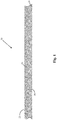
- Fig. 1 is a cross-sectional view of an article comprising a web of fibers and a dried binder in contact with the fibers, where the ratio of web of fibers to dried binder is not drawn to scale.
- any numerical range recited herein includes all values from the lower value to the upper value. For example, if a concentration range is stated as 1% to 50%, it is intended that values such as 2% to 40%, 10% to 30%, or 1% to 3%, etc., are expressly enumerated in this specification. These are only examples of what is specifically intended, and all possible combinations of numerical values between and including the lowest value and the highest value enumerated are to be considered to be expressly stated in this application.
- degradable shall indicate passing the American Society for Testing and Materials (ASTM) D6400-12 Standard Specification for Labeling of Plastics Designed to be Aerobically Composted in Municipal of Industrial Facilities.
- ASTM American Society for Testing and Materials
- dispersible and dispersable can be used interchangeably, and the terms dispersibility and dispersability can be used interchangeably.
- This disclosure provides dispersible articles and methods of making the same.
- the dispersible articles 10 disclosed herein include a web of fibers 20 and a dried binder 30 in contact with the fibers 20.
- the article or web of fibers includes a first side 22 and a second side 24.
- the web of fibers includes material capable of serving as a base for the dispersible article having the properties described herein, particularly the strength and flushability properties. In principle, this involves competing forces, as the web of fibers must be bound together strongly enough to provide sufficient wet strength to function as a wipe for some period of time after contacting water, but not bound together too strongly to impede flushability.
- the web of fibers includes degradable fibers and optionally includes nondegradable fibers.
- Degradable fibers include, but are not limited to, natural degradable fibers, such as scoured cotton and wool; pulped degradable fibers, such as pulped cellulosic fibers, including pulped wood fibers, pulped cotton fibers, pulped abaca fibers, pulped hemp fibers, pulped flax fibers and pulped jute fibers; and synthetic degradable fibers, such as synthetic cellulosic fibers, including rayon and lyocell.
- Nondegradable fibers include, but are not limited to, polyesters, such as polyethylene terephthalate, polybutylene terephthalate and polylactic acid; polyolefins, such as polypropylenes, polyethylenes and copolymers thereof; and polyamids, such as nylons.
- the web of fibers includes at least about 80% degradable fibers, at least about 85%, at least about 90%, at least about 95%, at least about 96%, at least about 97%, at least about 98%, at least about 99%, at least about 99.5% or at least about 99.9% degradable fibers. In some embodiments, the web of fibers includes at most about 100% degradable fibers, at most about 99.9% degradable fibers, at most about 99.5% degradable fibers, at most about 99% degradable fibers, at most about 98% degradable fibers, at most about 97% degradable fibers, at most about 97% degradable fibers, or at most about 95% degradable fibers. This includes embodiments where the web of fibers includes degradable fibers in amounts ranging from about 80% to about 100%, including but not limited to, amounts ranging from about 90% to about 99.9%, and amounts ranging from about 95% to about 99%.
- the web of fibers includes at least about 5% cellulosic fibers, at least about 10%, at least about 15%, at least about 20%, at least about 25%, at least about 30%, at least about 35%, at least about 40%, at least about 45%, at least about 50%, at least about 55%, at least about 60%, at least about 65%, at least about 70%, at least about 75%, at least about 80%, at least about 85%, at least about 90%, or at least about 95% cellulosic fibers.
- the web of fibers includes at most about 100% cellulosic fibers, at most about 95%, at most about 90%, at most about 85%, at most about 80%, at most about 75%, at most about 70%, at most about 65%, at most about 60%, at most about 55%, at most about 50%, at most about 45%, at most about 40%, at most about 35%, at most about 30%, at most about 25%, at most about 20%, at most about 15%, or at most about 10% cellulosic fibers.
- the web of fibers includes cellulosic fibers in amounts ranging from about 5% to about 100%, including but not limited to, amounts ranging from about 50% to about 99.9%, and amounts ranging from about 90% to about 99%.
- the web of fibers includes about 100% cellulosic fibers.
- the web of fibers includes at least about 50% cellulosic fibers.
- the web of fibers includes at least about 5% natural fibers, at least about 10%, at least about 15%, at least about 20%, at least about 25%, at least about 30%, at least about 35%, at least about 40%, at least about 45%, at least about 50%, at least about 55%, at least about 60%, at least about 65%, at least about 70%, at least about 75%, at least about 80%, at least about 85%, at least about 90%, or at least about 95% natural fibers.
- the web of fibers includes at most about 100% natural fibers, at most about 95%, at most about 90%, at most about 85%, at most about 80%, at most about 75%, at most about 70%, at most about 65%, at most about 60%, at most about 55%, at most about 50%, at most about 45%, at most about 40%, at most about 35%, at most about 30%, at most about 25%, at most about 20%, at most about 15%, or at most about 10% natural fibers.
- the web of fibers includes natural fibers in amounts ranging from about 5% to about 100%, including but not limited to, amounts ranging from about 50% to about 99.9%, and amounts ranging from about 90% to about 99%.
- the web of fibers includes about 100% natural fibers.
- the web of fibers includes at most about 20% nondegradable fibers, at most about 15%, at most about 10%, at most about 5%, at most about 4%, at most about 3%, at most about 2%, at most about 1%, at most about 0.5%, or at most about 0.1% nondegradable fibers. In certain embodiments, the web of fibers includes about 0% nondegradable fibers.
- the web of fibers includes recycled fibers. In some embodiments, the web of fibers includes at least about 1% recycled fibers, at least about 5%, at least about 10%, at least about 15%, at least about 20%, at least about 25%, at least about 30%, at least about 35%, at least about 40%, at least about 45%, at least about 50%, at least about 55%, at least about 60%, at least about 65%, at least about 70%, at least about 75%, at least about 80%, at least about 85%, at least about 90%, or at least about 95% recycled fibers.
- the web of fibers includes at most about 100% recycled fibers, at most about 95%, at most about 90%, at most about 85%, at most about 80%, at most about 75%, at most about 70%, at most about 65%, at most about 60%, at most about 55%, at most about 50%, at most about 45%, at most about 40%, at most about 35%, at most about 30%, at most about 25%, at most about 20%, at most about 15%, or at most about 10% recycled fibers.
- the web of fibers includes recycled fibers in amounts ranging from about 1% to about 100%, including but not limited to, amounts ranging from about 10% to about 80%, and amounts ranging from about 30% to about 50%.
- the web of fibers includes about 100% recycled fibers.
- the web of fibers may be formed by wet or dry techniques.
- wet processes include, but are not limited to, traditional or specialty papermaking processes capable of handling pulp or "short cut” synthetic fibers, use of traditional Fourdrinier machines, processes using cylinder or incline wire machines that can handle longer fiber furnishes, and the like.
- dry processes include, but are not limited to, forming an air laid web.
- the fibers include at least one functional group that is reactive with the polyfunctional aldehyde or the primary polymer. In certain embodiments, the fibers include at least one functional group that is reactive with the polyfunctional aldehyde.
- the fibers include cellulosic fibers.
- Suitable cellulosic fibers include, but are not limited to, wood pulp cellulosic fibers, synthetic cellulosic fibers, cotton fibers, linen fibers, jute fibers, hemp fibers, hardwood fiber furnishes, softwood fiber furnishes, and the like.
- the fibers may be pulped by chemical or mechanical means. In some embodiments, the fibers may be bleached or unbleached. In some embodiments, the fibers may be post treated. In some embodiments, the post treatment may include being mercerized, crosslinked or further chemically treated.
- the fibers may have an average length of at most about 40 mm, at most about 35 mm, at most about 30 mm, at most about 25 mm, at most about 20 mm, at most about 15 mm, at most about 10 mm, or at most about 5 mm. In some embodiments, the fibers may have an average length of at least about 0.01 mm, at least about 0.05 mm, at least about 0.1 mm, at least about 0.5 mm, at least about 1 mm, or at least about 5 mm.
- the dried binder includes material capable of serving as a binding agent for the dispersible article having the properties described herein, particularly the strength and flushability properties. In principle, this involves competing forces, as the binder must bind strongly enough to provide sufficient wet strength to function as a wipe for some period of time after contacting water, but does not bind too strongly to impede flushability.
- the dried binder includes a polyfunctional aldehyde and a primary polymer.
- the article includes a ratio by dry weight of primary polymer to polyfunctional aldehyde in the dried binder of at least about 1:99, at least about 5:95, at least about 10:90, at least about 20:80, at least about 30:70, at least about 40:60, at least about 50:50, at least about 55:45, at least about 60:40, at least about 65:35, at least about 70:30, at least about 75:25, at least about 80:20, at least about 85:15, or at least about 90:10.
- the article includes a ratio by dry weight of primary polymer to polyfunctional aldehyde in the dried binder of at most about 99:1, at most about 95:5, at most about 90:10, at most about 85:15, at most about 80:20, at most about 75:25, at most about 70:30, at most about 65:35, at most about 60:40, or at most about 55:45, at most about 50:50, at most about 40:60, at most about 30:70, at most about 20:80, at most about 10:90, or at most about 5:95.
- ratios by dry weight of primary polymer to polyfunctional aldehyde ranging from about 1:99 to about 99:1, such as ratios ranging from about 50:50 to about 95:5, ratios ranging from about 60:40 to about 92.5:7.5, and ratios ranging from about 70:30 to about 90:10.
- the dried binder may not include permanent wet strength agents.
- the dried binder may not include permanent wet strength agents that would provide permanent wet strength to an article.
- permanent wet strength agents include, but are not limited to, the Kymene® series (Ashland Inc., Covington, KY), which includes azetidinium-containing resins, such as Kymene® 557H, Kymene® 821, Kymene® 830, Kymene® G3 X-Cel, Kymene® GHP 20, and Kymene® 736, epoxide-containing resins, such as Kymene® 450, and the like.
- the dried binder may not include permanent wet strength agents that would provide permanent wet strength to an article with the proviso that the article has a CDWT, as measured by the INDA WSP 110.4.R4 Strip Tensile Test, 2012 revision, that is at most about 60% of the initial CDWT after at least 360 minutes of aqueous saturation, at least 240 minutes, at least 120 minutes, at least 60 minutes of aqueous saturation.
- the dried binder may not include permanent wet strength agents that would provide permanent wet strength to an article with the proviso that the article has a CDWT, as measured by the INDA WSP 110.4.R4 Strip Tensile Test, 2012 revision, that is at most about 50%, at most about 40%, at most about 30%, at most about 20%, or at most about 10% of the initial CDWT after 120 minutes of aqueous saturation.
- the dried binder is formed by contacting the web with a binder composition. In some embodiments, the dried binder is formed by drying the binder composition.
- the binder composition includes all components of the dried binder, as well as any solvents or excipients necessary to accommodate contacting the web with the binder composition and forming the dried binder. Generally, any component of the binder composition that is not a part of the dried binder may be removable by the contacting and drying process.
- the binder composition may have a pH of from 3 to 8.
- the pH of the binder composition may be from 4 to 7 or from 5 to 6.
- a lower pH may provide greater wet strength with a polyfunctional aldehyde.
- too low of a pH may negatively impact the flushability of the article.
- Stability of the binder composition can be achieved by the use of other small molecules that react with a polyfunctional aldehyde, generating a protected aldehyde and preventing reaction with polyhydroxyl containing polymers in the composition. These small molecules are chosen such that upon exposure to elevated temperatures the protected aldehyde reverts to its original constituent parts. Examples include reaction of urea and glyoxal to generate dihydroxyimidazolidinones. These materials can be reacted further with hydroxyl containing small molecules to generate substituted dihydroxyimidazolidinones. These materials have been used to prepare to stable binder formulations, however upon applying heat such materials have been found to not provide the necessary wet tensile performance.
- the binder composition is a stable formulation.
- a stable formulation would preferably not gel under typical storage conditions and would preferably not separate into phases.
- Stability can be improved by adding a secondary polymer, such as polyvinyl alcohol, or a low molecular weight polyhydroxyl component, such as sugar or a hydrolyzed starch, such as glucose.
- a secondary polymer such as polyvinyl alcohol, or a low molecular weight polyhydroxyl component, such as sugar or a hydrolyzed starch, such as glucose.
- polyhydroxyl components should be added in the minimum amount to provide the desired stability.
- low molecular weight polyhydroxyl components interact with the polyfunctional aldehyde to minimize its crosslinking with a polyvinyl alcohol stabilized polymer to improve stability, but the interaction will typically decrease the initial wet strength of the article.
- Polyfunctional aldehydes may serve as a crosslinker between a functional group on the fibers, such as a hydroxyl group, and other components of the dried binder.
- the polyfunctional aldehyde includes polyfunctional aldehydes capable of interacting with the various other components of the dispersible article in order to provide the properties described herein, particularly the strength and flushability properties.
- the polyfunctional aldehyde may be selected from the group consisting of an aldehyde-containing polymer, a low molecular weight polyfunctional aldehyde, protected polyfunctional aldehyde, and combinations thereof. In certain embodiments, the polyfunctional aldehyde may be selected from the group consisting of glyoxalated polyacrylamide, glyoxal, methanol protected polyfunctional aldehydes and combinations thereof. The polyfunctional aldehyde may be glyoxal.
- the primary polymer includes polymers capable of interacting with the other components of the dispersible article in order to provide the properties described herein, particularly the strength and flushability properties.
- the primary polymer includes at least one functional group that is reactive with the fibers or polyfunctional aldehyde. In certain embodiments, the primary polymer includes at least one functional group that is reactive with the polyfunctional aldehyde. In certain embodiments, the primary polymer may interact with the fibers via non-covalent interactions such as hydrogen bonds, Van der Waals forces, and the like.
- polymeric segments refers to some portion of the overall polymer structure.
- a vinyl acetate homopolymer has at least one polymeric segment that is vinyl acetate.
- a vinyl acetate ethylene copolymer has at least one polymeric segment that is vinyl acetate and at least one polymeric segment that is ethylene.
- a polymeric segment can be of any size smaller than the size of the polymer itself.
- the primary polymer includes hydrophobic polymeric segments, hydrophilic polymeric segments, water-soluble polymeric segments, and combinations thereof.
- the primary polymer includes at least one polymeric segment selected from the group consisting of vinyl acetate, ethylene, vinyl alcohol, styrene, butadiene, methyl methacrylate, methyl acrylate, ethyl methacrylate, ethyl acrylate, butyl methacrylate, butyl acrylate, isobutyl methacrylate, isobutyl acrylate, 2-ethylhexyl acrylate, lauryl methacrylate, lauryl acrylate, acrylic acid and its salts, methacrylic acid and its salts, itaconic acid and its salts, acrylamide, hydroxyethyl methacrylate, hydroxyethyl acrylate, partially and fully hydrolyzed polyvinyl alcohol, and polysaccharides (e.g., starch, hydroxyethylcellulose).
- polysaccharides e.g., starch, hydroxyethylcellulose
- the primary polymer include at least one polymeric segment selected from the group consisting of vinyl acetate, ethylene, and vinyl alcohol.
- the hydroxyl, amino, amido, sulfide, mercapto and sulfite functionality on the primary polymer may be reactive with the polyfunctional aldehyde.
- the primary polymer may be dispersible in water. In some embodiments, the primary polymer may be formed by emulsion polymerization. In certain embodiments, the primary polymer is a poly(vinyl alcohol) stabilized vinyl acetate-ethylene copolymer.
- the performance of the primary polymer may be impacted by its glass transition temperature. Without wishing to be bound by any particular theory, it is believed that the glass transition temperature may have an impact on forming a stable binder composition that can be brought into contact with a web of fibers. However, there is no particular limitation with respect to the glass transition temperature and the dried binder in contact with the fibers. Nonetheless, without wishing to be bound by any particular theory, use of a primary polymer having a lower glass transition temperature may yield a softer article.
- the primary polymer has a glass transition temperature of at most about 150 °C, at most about 140 °C, at most about 130 °C, at most about 120 °C, at most about 110 °C, at most about 100 °C, at most about 90 °C, at most about 80 °C, at most about 70 °C, at most about 60 °C, at most about 50 °C, or at most about 40 °C.
- the primary polymer has a glass transition temperature of at least about -50 °C, at least about -40 °C, at least about -30 °C, at least about -20 °C, at least about -10 °C, at least about 0 °C, at least about 10 °C, at least about 20 °C, or at least about 30 °C.
- the vinyl acetate content may be at least about 60%, at least about 65%, at least about 70%, at least about 75%, at least about 80%, at least about 85%, or at least about 90% by weight of the polymer. In embodiments where the primary polymer is a vinyl acetate ethylene copolymer, the vinyl acetate content may be at most about 95%, at most about 90%, at most about 85%, at most about 80%, at most about 75%, at most about 70%, or at most about 65% by weight of the polymer.
- the primary polymer is stabilized by a suitable stabilizer. In some embodiments, the primary polymer is stabilized by a surfactant, a stabilizing polymer, or a combination thereof. In certain embodiments, the stabilizing polymer is a polyhydroxyl containing polymer, such as polyvinyl alcohol, a carboxylate containing polymer, or combinations thereof.
- the polyvinyl alcohol may be at least 50% hydrolyzed, at least 75% hydrolyzed, at least 80% hydrolyzed, at least 85% hydrolyzed, at least 90% hydrolyzed, at least 95% hydrolyzed, or at least 99% hydrolyzed.
- the secondary polymer may have molecular weights ranging from about 10 kDa to about 500 kDa, including but not limited to, molecular weights ranging from about 31 kDa to about 50 kDa, 13 kDa to about 23 kDa, or 10 kDa to about 50 kDa.
- Examples of commercially available primary polymers include, but are not limited to, the VINNAPAS® series (Wacker Chemical Corporation, Allentown, PA), the ELEVATETM series (Westlake Chemical, Houston, TX), and the Elvax® series (DuPontTM, Wilmington, DE).
- the dried binder or binder composition includes a secondary polymer.
- the secondary polymer can be added to improve the flushability of an article, by altering the properties of the dried binder.
- the secondary polymer can also improve the properties of the binder composition as it relates to application to the web of fibers and drying to form the dried binder, for example improving the dryer process ( e.g., a double re-crepe process).
- Suitable secondary polymers include polymers capable of interacting with the other components described herein to provide the properties described herein.
- the secondary polymer includes hydroxyl, amino, amido, sulfide, mercapto or sulfite functionality. In certain embodiments, the secondary polymer includes hydroxyl functionality. In certain embodiments, the secondary polymer is polyvinyl alcohol, preferably a low-molecular weight polyvinyl alcohol. Without wishing to be bound by any particular theory, it is believed that the secondary polymer competes with the primary polymer to react with the polyfunctional aldehyde, thereby reducing the degree of crosslinking in the dried binder. Without wishing to be bound by any particular theory, it is believed that hydroxyl, amino, amido, sulfide, mercapto and sulfite functionality on the secondary polymer may be reactive with the polyfunctional aldehyde.
- Examples of commercially available secondary polymers include, but are not limited to, the SelvolTM series (Sekisui Specialty Chemicals America, LLC, Dallas, TX), the Elvanol® series (DupontTM, Wilmington DE), and the Mowiol® and Poval® series (Kuraray Europe GmbH, Hattersheim, Germany).
- the article includes a ratio by dry weight of primary polymer to dry weight of secondary polymer in the dried binder of at least about 50:50, at least about 60:40, at least about 70:30, at least about 80:20, at least about 90:10, at least about 95:5 or at least about 100:0. In some embodiments, the article includes a ratio by dry weight of primary polymer to dry weight of secondary polymer in the dried binder of at most about 100:0, at most about 95:5, at most about 90:10, at most about 80:20, at most about 70:30, at most about 60:40 or at most about 50:50.
- ratios by dry weight of primary polymer to dry weight of secondary polymer ranging from about 50:50 to about 100:0, such as ratios ranging from about 50:50 to about 95:5, ratios ranging from about 60:40 to about 92.5:7.5, and ratios ranging from about 70:30 to about 90:10.
- the binder composition may include other additives.
- additives are lubricants, including surfactants and oils.
- Preferred surfactants include, but are not limited to, polyethylene glycol dioleate, such as polyethylene glycol 400 dioleate, and polyethylene glycol monooleate, such as polyethylene glycol 400 monoleate.
- lubricating oil include vegetable oil, mineral oil, natural wax and synthetic oil.
- the lubricant may be mineral oil.
- An example of a commercially available lubricant is the Sunpar® series (Holly Refining & Marketing - Tulsa LLC, Tulsa, OK).
- Suitable additives include trihydroxymethypropyl trioleate, carnauba wax, the Hyprene series (Ergon Refining Inc., Jackson, MS), the SpectraSynTM series of polyalphaolefins (ExxonMobil Chemical Company, Beaumont, TX), and the like.
- articles described herein are flushable.
- Flushability of an article may be determined by tests known to those of skill in the art.
- flushability of an article may be determined by a series of tests, such as those set forth in the Association of the Nonwoven Fabrics Industry (INDA) and European Disposables and Nonwovens Association (EDANA) Guidance Document for Assessing the Flushability of Nonwoven Consumer Products, Second Edition, 2009 (INDA Guidance 2009), wherein the ability for an article to be disposed via modern plumbing and sewage systems is evaluated.
- INDA Association of the Nonwoven Fabrics Industry
- EDANA European Disposables and Nonwovens Association
- flushable indicates passing one, two, three, four or five of the following flushability tests: a) the article clearing a toilet bowl and trap on at least 90% of flushes and the article traveling greater than 10 m in a drainline over two flushes or traveling sufficient distance such that a distance traveled by a center of mass of the article does not show a downward trend over five flushes as measured by the INDA FG 510.1 Toilet Bowl and Drainline Clearance Test as recited in INDA Guidance 2009; b) the article settles all of the way to the bottom of a 115 cm column of water in less than 24 hours as measured by the INDA FG 512.1 Column Settling Test as recited in INDA Guidance 2009; c) more than 95% of the article passes through a 12 mm sieve after 3 hours of agitation in water as measured by the INDA FG 511.1 Dispersability Shake Flask Test as recited in INDA Guidance 2009 or after 240 cycles of rotating a cylinder containing water and the article
- the article may have a pass through percentage value of at least about 20%, at least about 30%, at least about 40%, at least about 50%, at least about 60%, at least about 70%, at least about 75%, at least about 80%, at least about 85%, at least about 90%, at least about 95%, or at least about 99% through a 12.5 mm sieve as measured by the INDA FG 522.2 Slosh Box Test as recited in INDA Guidance 2009.
- the article has a pass through percentage value of at least about 20%, at least about 30%, at least about 40%, at least about 50%, at least about 60%, at least about 70%, at least about 75%, at least about 80%, at least about 85%, at least about 90%, or at least about 95% through a 1.5 mm sieve as measured by the INDA FG 522.2 Slosh Box Test as recited in INDA Guidance 2009.
- Strength of an article may be determined by tests known to those of skill in the art. Preferably, strength of an article may be determined by a test, such as the INDA WSP 110.4.R4 Strip Tensile Test, 2012 revision.
- the decay of wet strength, preferably in a cross-machine direction, plotted versus time may be a measure of the functionality of the article. Various applications may require that articles remain usable for at least 1, 5, 10, 15, 30, 45, 60 or 90 minutes in a wet environment.
- Wet strength can be measured by any suitable method known to one of skill in the art. Suitable methods are described in INDA WSP 110.4.R4 Strip Tensile Test, 2012 revision or ASTM test method D5035-95.
- the wet strength in the cross machine direction, or cross direction wet tensile strength (CDWT) may be measured by the tensile testing of 2.5 cm (1 inch) x 15 cm (6 inch) samples that have been placed in water for a few seconds to 15 or 30 minutes.
- the decay of CDWT may be measured as a percentage of the initial CDWT, wherein the initial CDWT is measured within a few seconds of aqueous saturation.
- the article has a CDWT after at least 1 minute of aqueous saturation, at least 5 minutes, at least 10 minutes, at least 15 minutes, at least 20 minutes, at least 25 minutes, at least 30 minutes, at least 45 minutes, at least 60 minutes, or at least 90 minutes of aqueous saturation that is at least about 30% of the initial CDWT as measured by the INDA WSP 110.4.R4 Strip Tensile Test, 2012 revision.
- the article has a CDWT after 15 minutes to 30 minutes of aqueous saturation that is at least about 5%, at least about 10%, at least about 20%, at least about 30%, at least about 40%, or at least about 50% of the initial CDWT as measured by the INDA WSP 110.4.R4 Strip Tensile Test, 2012 revision. In certain embodiments, the article has a CDWT after 15 to 30 minutes of aqueous saturation that is at least about 30% of the initial CDWT as measured by the INDA WSP 110.4.R4 Strip Tensile Test, 2012 revision.
- the article has an initial CDWT that is at least about 5%, at least about 10%, at least about 20%, at least about 30%, at least about 40% or at least about 50% of an initial cross direction dry tensile strength as measured by the INDA WSP 110.4.R4 Strip Tensile Test, 2012 revision.
- the article has a CDWT, as measured by the INDA WSP 110.4.R4 Strip Tensile Test, 2012 revision, that is at most about 60% of the initial CDWT after at least 360 minutes of aqueous saturation, at least 240 minutes, at least 120 minutes, at least 60 minutes of aqueous saturation. In some embodiments, the article has a CDWT, as measured by the INDA WSP 110.4.R4 Strip Tensile Test, 2012 revision, that is at most about 50%, at most about 40%, at most about 30%, at most about 20%, or at most about 10% of the initial CDWT after 120 minutes of aqueous saturation.
- a method of making a dispersible article includes: forming a web of fibers; contacting the web of fibers with a binder composition; and drying the binder composition to form a dried binder in contact with the fibers.
- U.S. Patent No. 3,879,257 discloses a method of forming a web of fibers that is suitable for use with the methods described herein.
- Other suitable means of forming the web of fibers include, but are not limited to, wet forming, such as incline wire forming, Fourdrinier forming and cylinder forming; air forming, such as short fiber air forming and synthetic and/or wood pulp air forming; and dry forming, such as carding and bonding.
- U.S. Patent Application Pub. No. 2007/0044891 and U.S. Patent No. 8,282,777 disclose methods of single recreping and double recreping that are suitable for use with the present invention.
- the binder composition and dried binder of this invention do not require a curing step, but one can be used if so desired.
- Other suitable means of contacting the web of fibers with a binder composition and drying the binder composition to form a dried binder in contact with the fibers include, but are not limited to, printing and drying, spraying and drying, foam coating and drying, size press addition and drying, blade coating and drying.
- Vinnapas® 400 (“V-400”) is a polyvinyl alcohol stabilized vinyl acetate-ethylene copolymer dispersion.
- Vinnapas® 426 (“V-426”) is a polyvinyl alcohol stabilized vinyl acetate-ethylene-acrylic acid terpolymer dispersion.
- Vinnapas® 465 is a polyvinyl alcohol stabilized vinyl acetate-ethylene copolymer dispersion.
- SelvolTM 203 is a polyvinyl alcohol dispersion with about 88% hydrolysis.
- Sunpar® 150 is a highly refined paraffinic type oil.
- Kymene® 920A (“K920A”) is an azetidinium-containing wet-strength resin.
- DUR-O-SET®10A (“Duroset”) is a surfactant stabilized vinyl acetate-ethylene copolymer with crosslinking functionality to provide permanent wet strength.
- softwood webs of fibers having a basis weight of 50 gsm were produced without binder in a process similar to Example III of U.S. Patent No. 3,879,257 .
- DUR-O-SET®10A emulsion (Celenese Ltd. Irving, TX) was used with 1% ammonium chloride as a catalyst (dry ammonium chloride on dry emulsion), the composition was printed onto the web, and the article was cured for 15 minutes in a 150 °C oven.
- Comparative Examples 2-7 the compositions were adjusted to a pH of 7, the pH-adjusted compositions were printed onto the web, and the article was cured for 15 minutes in a 105 °C oven.
- Table 1 Dry Tensile Wet Tensile - Cross Direction (CD) MD CD 10 sec soak 1 min soak 5 min soak 15 min soak 30 min soak 120 min soak Comp. Ex. Binder Component 1 (%) (dry/dry) Binder Component 2 (%) (dry/dry) Peak Load g-f Peak Load g-f Peak Load g-f Peak Load g-f Peak Load g-f Peak Load g-f Peak Load g-f Peak Load g-f Peak Load g-f Peak Load g-f Peak Load g-f Peak Load g-f Peak Load g-f Peak Load g-f Peak Load g-f Peak Load g-f Peak Load g-f Mean Mean Mean Mean Mean Mean Mean Mean Mean Mean Mean Mean Mean Mean Mean Mean Mean Mean Mean Mean Mean Mean Mean Mean Mean Mean Mean Mean Mean Mean Mean Mean Mean Mean Mean Mean Mean Mean Mean Mean Mean Mean Mean Mean Mean Mean Mean Mean Mean Mean Mean Mean
- Comparative Examples 1-7 show the effect of using a permanent wet strength additive.
- the CDWT does not reduce over time, so the article will not be degradable or flushable.
- the binder composition was applied to a first side 22 of the web of fibers using an engraved roll with a crosshatched pattern.
- the article was transferred to a Yankee dryer for drying and creping upon exit from the dryer.
- a second application of binder composition was applied on a second side 24 using a second engraved roll with a crosshatched pattern.
- the article was transferred to a second Yankee dryer for drying and creping upon exit from the dryer.
- the solids in the binder composition were adjusted so that the web of fibers picked up binder composition in an amount to yield about 5% of the total weight of the article on each side, or a total of about 10% of the total weight of the article.
- the product was allowed to age for 7 days prior to the CDWT and Slosh Box testing described below.
- the binder composition had a pH of 3.77.
- the solids in the binder composition were adjusted so that the web of fibers picked up binder composition in an amount to yield about 5% of the total weight of the article on each side, or a total of about 10% of the total weight of the article.
- the product was allowed to age for 7 days prior to the CDWT and Slosh Box testing described below.
- the binder composition had a pH of 3.55.
- the solids in the binder composition were adjusted so that the web of fibers picked up binder composition in an amount to yield about 5% of the total weight of the article on each side, or a total of about 10% of the total weight of the article.
- the product was allowed to age for 7 days prior to the CDWT and Slosh Box testing described below.
- the binder composition had a pH of 4.59.
- the solids in the binder composition were adjusted so that the web of fibers picked up binder composition in an amount to yield about 5% of the total weight of the article on each side, or a total of about 10% of the total weight of the article.
- the product was allowed to age for 7 days prior to the CDWT and Slosh Box testing described below.
- Examples 1-3 and Comparative Example 8 were cut from the cross machine direction into 1" by 6" samples for testing the CDWT and the decrease of that strength over time.
- the samples were immersed in water, and the CDWT was measured within a few seconds to determine the initial CDWT.
- Other samples were immersed in water for 15 or 30 minutes and the CDWT was measured at each of those respective intervals. The results are shown in Table 2.
- Examples 1-3 and Comparative Example 8 were cut into 6" by 7" samples, having a mass of around 1.5 grams, immersed in water for three hours, and transferred to a slosh box for disintegration. After the samples disintegrated, the resulting fibrous mixture was passed through screens of 12.5 mm and 1.5 mm. The material trapped on each screen was washed for 2 minutes with water at a flow rate of 4 liters per minute. The trapped material was collected, dried and weighed. The difference between initial weight of the sample and the measured weight is divided by the initial weight of the sample to provide a percentage pass through value, which is shown in Table 2.
Landscapes
- Chemical & Material Sciences (AREA)
- Chemical Kinetics & Catalysis (AREA)
- Nonwoven Fabrics (AREA)
- Paper (AREA)
Priority Applications (1)
| Application Number | Priority Date | Filing Date | Title |
|---|---|---|---|
| PL14785417T PL2986452T3 (pl) | 2013-04-17 | 2014-04-17 | Wyroby ulegające rozpadowi i sposoby ich wytwarzania |
Applications Claiming Priority (2)
| Application Number | Priority Date | Filing Date | Title |
|---|---|---|---|
| US201361813092P | 2013-04-17 | 2013-04-17 | |
| PCT/US2014/034510 WO2014172546A1 (en) | 2013-04-17 | 2014-04-17 | Dispersible articles and methods of making the same |
Publications (3)
| Publication Number | Publication Date |
|---|---|
| EP2986452A1 EP2986452A1 (en) | 2016-02-24 |
| EP2986452A4 EP2986452A4 (en) | 2016-11-30 |
| EP2986452B1 true EP2986452B1 (en) | 2018-07-18 |
Family
ID=51728122
Family Applications (1)
| Application Number | Title | Priority Date | Filing Date |
|---|---|---|---|
| EP14785417.8A Active EP2986452B1 (en) | 2013-04-17 | 2014-04-17 | Dispersible articles and methods of making the same |
Country Status (9)
| Country | Link |
|---|---|
| US (1) | US9121137B2 (pl) |
| EP (1) | EP2986452B1 (pl) |
| BR (1) | BR112015026123B1 (pl) |
| CA (1) | CA2909690C (pl) |
| ES (1) | ES2691532T3 (pl) |
| MX (1) | MX359681B (pl) |
| PL (1) | PL2986452T3 (pl) |
| TR (1) | TR201815363T4 (pl) |
| WO (1) | WO2014172546A1 (pl) |
Cited By (2)
| Publication number | Priority date | Publication date | Assignee | Title |
|---|---|---|---|---|
| US11649590B2 (en) | 2019-03-29 | 2023-05-16 | Kimberly-Clark Worldwide, Inc. | Creped single ply tissue |
| US11905665B2 (en) | 2019-03-29 | 2024-02-20 | Kimberly-Clark Worldwide, Inc. | Durable and dispersible creped single ply tissue |
Families Citing this family (16)
| Publication number | Priority date | Publication date | Assignee | Title |
|---|---|---|---|---|
| US12281441B2 (en) | 2013-04-17 | 2025-04-22 | Evrnu, Spc | Methods and systems for forming composite fibers |
| US11034817B2 (en) | 2013-04-17 | 2021-06-15 | Evrnu, Spc | Methods and systems for processing mixed textile feedstock, isolating constituent molecules, and regenerating cellulosic and polyester fibers |
| US10065379B2 (en) | 2015-06-12 | 2018-09-04 | Hangsterfer's Laboratories, Inc. | Dispersible non-woven article and methods of making the same |
| CA3014869A1 (en) | 2016-02-16 | 2017-08-24 | Kemira Oyj | Method for improving the strength performance of aldehyde functionalised polymer in papermaking process. |
| US10435843B2 (en) | 2016-02-16 | 2019-10-08 | Kemira Oyj | Method for producing paper |
| WO2018125177A1 (en) | 2016-12-30 | 2018-07-05 | Kimberly-Clark Worldwide, Inc. | Dispersible wet wipes constructed with patterned binder |
| EP3645792A1 (en) * | 2017-06-30 | 2020-05-06 | Kemira Oyj | A method for measuring disintegration of a fibrous product |
| WO2019002691A1 (en) * | 2017-06-30 | 2019-01-03 | Kemira Oyj | METHOD FOR MEASURING DISINTEGRATION OF A FIBROUS PRODUCT |
| US11028538B2 (en) * | 2019-02-28 | 2021-06-08 | Solenis Technologies, L.P. | Composition and method for increasing wet and dry paper strength |
| KR102758418B1 (ko) | 2019-03-29 | 2025-01-23 | 킴벌리-클라크 월드와이드, 인크. | 내구성 및 분산성 있는 크레이핑된 다수 겹 티슈 |
| US11427968B2 (en) | 2019-03-29 | 2022-08-30 | Kimberly-Clark Worldwide, Inc. | Creped multi-ply tissue product |
| US11795626B2 (en) | 2019-06-03 | 2023-10-24 | Kimberly-Clark Worldwide, Inc. | Multi-ply tissue product |
| US20210381166A1 (en) * | 2020-06-09 | 2021-12-09 | Evrnu, Spc | Processing cellulose-containing materials for paper or packaging materials |
| EP4256131A4 (en) | 2020-12-04 | 2024-12-04 | AGC Chemicals Americas, Inc. | Treated article, methods of making the treated article, and dispersion for use in making the treated article |
| MX2023007978A (es) | 2021-01-04 | 2023-09-21 | Solenis Technologies Cayman Lp | Composiciones acuosas de poliacrilamida glioxalada. |
| CN114934404B (zh) * | 2022-05-31 | 2023-05-12 | 华南理工大学 | 一种易冲散的植物纤维面膜基布及其制备方法与应用 |
Family Cites Families (39)
| Publication number | Priority date | Publication date | Assignee | Title |
|---|---|---|---|---|
| US3658745A (en) | 1970-01-14 | 1972-04-25 | Massachusetts Inst Technology | Acetalated cross-linked polyvinyl alcohol hydrogels |
| US3879257A (en) | 1973-04-30 | 1975-04-22 | Scott Paper Co | Absorbent unitary laminate-like fibrous webs and method for producing them |
| US4279959A (en) | 1977-11-03 | 1981-07-21 | Rohm And Haas Company | Water-insoluble copolymers containing amide-polyaldehyde thermosettable system |
| JP3162696B2 (ja) | 1989-09-06 | 2001-05-08 | ライオン株式会社 | 水溶性で塩感応性のポリマー |
| JP3148307B2 (ja) | 1991-11-07 | 2001-03-19 | ライオン株式会社 | 塩感応性ポリマー |
| US5252332A (en) | 1992-07-24 | 1993-10-12 | Air Products And Chemicals, Inc. | Pre-moistened flushable towlette impregnated with polyvinyl alcohol containing binders |
| US5384189A (en) | 1993-01-27 | 1995-01-24 | Lion Corporation | Water-decomposable non-woven fabric |
| CA2128483C (en) | 1993-12-16 | 2006-12-12 | Richard Swee-Chye Yeo | Flushable compositions |
| US5500281A (en) | 1994-02-23 | 1996-03-19 | International Paper Company | Absorbent, flushable, bio-degradable, medically-safe nonwoven fabric with PVA binding fibers, and process for making the same |
| US5948710A (en) | 1995-06-30 | 1999-09-07 | Kimberly-Clark Worldwide, Inc. | Water-dispersible fibrous nonwoven coform composites |
| US5916678A (en) | 1995-06-30 | 1999-06-29 | Kimberly-Clark Worldwide, Inc. | Water-degradable multicomponent fibers and nonwovens |
| US5935880A (en) | 1997-03-31 | 1999-08-10 | Wang; Kenneth Y. | Dispersible nonwoven fabric and method of making same |
| US6127593A (en) * | 1997-11-25 | 2000-10-03 | The Procter & Gamble Company | Flushable fibrous structures |
| US6165319A (en) | 1998-05-11 | 2000-12-26 | Fort James Corporation | Printed, soft, bulky single-ply absorbent paper having a serpentine configuration and low sidedness and methods for its manufacture |
| US6423804B1 (en) | 1998-12-31 | 2002-07-23 | Kimberly-Clark Worldwide, Inc. | Ion-sensitive hard water dispersible polymers and applications therefor |
| US7276459B1 (en) | 2000-05-04 | 2007-10-02 | Kimberly-Clark Worldwide, Inc. | Ion-sensitive, water-dispersible polymers, a method of making same and items using same |
| US6548592B1 (en) | 2000-05-04 | 2003-04-15 | Kimberly-Clark Worldwide, Inc. | Ion-sensitive, water-dispersible polymers, a method of making same and items using same |
| US7101612B2 (en) | 2000-05-04 | 2006-09-05 | Kimberly Clark Worldwide, Inc. | Pre-moistened wipe product |
| US6749721B2 (en) | 2000-12-22 | 2004-06-15 | Kimberly-Clark Worldwide, Inc. | Process for incorporating poorly substantive paper modifying agents into a paper sheet via wet end addition |
| US6586529B2 (en) | 2001-02-01 | 2003-07-01 | Kimberly-Clark Worldwide, Inc. | Water-dispersible polymers, a method of making same and items using same |
| WO2002085272A1 (en) | 2001-04-20 | 2002-10-31 | The Procter & Gamble Company | Dispersible absorbent products having a multi-layered structure and methods of manufacture and use |
| US6896768B2 (en) | 2001-04-27 | 2005-05-24 | Fort James Corporation | Soft bulky multi-ply product and method of making the same |
| CA2489424C (en) | 2002-06-19 | 2012-08-07 | Bayer Chemicals Corporation | Strong and dispersible paper products |
| US6994865B2 (en) | 2002-09-20 | 2006-02-07 | Kimberly-Clark Worldwide, Inc. | Ion triggerable, cationic polymers, a method of making same and items using same |
| US6960371B2 (en) | 2002-09-20 | 2005-11-01 | Kimberly-Clark Worldwide, Inc. | Water-dispersible, cationic polymers, a method of making same and items using same |
| US7476631B2 (en) | 2003-04-03 | 2009-01-13 | The Procter & Gamble Company | Dispersible fibrous structure and method of making same |
| US7189307B2 (en) | 2003-09-02 | 2007-03-13 | Kimberly-Clark Worldwide, Inc. | Low odor binders curable at room temperature |
| US20050045293A1 (en) | 2003-09-02 | 2005-03-03 | Hermans Michael Alan | Paper sheet having high absorbent capacity and delayed wet-out |
| US7303650B2 (en) | 2003-12-31 | 2007-12-04 | Kimberly-Clark Worldwide, Inc. | Splittable cloth like tissue webs |
| US20060003654A1 (en) * | 2004-06-30 | 2006-01-05 | Lostocco Michael R | Dispersible alcohol/cleaning wipes via topical or wet-end application of acrylamide or vinylamide/amine polymers |
| US7297231B2 (en) | 2004-07-15 | 2007-11-20 | Kimberly-Clark Worldwide, Inc. | Binders curable at room temperature with low blocking |
| UA90901C2 (ru) | 2005-05-06 | 2010-06-10 | Дюнеа Ой | Отвердждаемая связующая композиция на основе поливинилового спирта, которая не содержит формальдегида, способ ее получения и способ получения нетканого материала |
| EP1937885A2 (en) | 2005-09-01 | 2008-07-02 | Sellars Absorbent Materials, Inc. | Method and device for forming non-woven, dry-laid, creped material |
| US7989545B2 (en) | 2006-01-25 | 2011-08-02 | Celanese International Corporations | Salt-sensitive binders for nonwoven webs and method of making same |
| US7732057B2 (en) | 2006-07-20 | 2010-06-08 | Neenah Paper, Inc. | Formaldehyde-free paper backed veneer products and methods of making the same |
| MX2010009630A (es) | 2008-03-03 | 2010-09-28 | Celanese Int Corp | Aglutinantes polimericos cationicos sensibles a sales para telas no tejidas, y metodo de fabricacion de los mismos. |
| US8282777B2 (en) | 2009-03-30 | 2012-10-09 | Sellars Absorbent Materials, Inc. | Disposable wipers and towels containing 40% or more post-consumer waste |
| EP3199682B1 (en) * | 2010-12-08 | 2024-01-31 | Glatfelter Corporation | Dispersible nonwoven wipe material |
| US9267240B2 (en) * | 2011-07-28 | 2016-02-23 | Georgia-Pacific Products LP | High softness, high durability bath tissue incorporating high lignin eucalyptus fiber |
-
2014
- 2014-04-17 EP EP14785417.8A patent/EP2986452B1/en active Active
- 2014-04-17 BR BR112015026123-0A patent/BR112015026123B1/pt active IP Right Grant
- 2014-04-17 PL PL14785417T patent/PL2986452T3/pl unknown
- 2014-04-17 US US14/255,369 patent/US9121137B2/en active Active
- 2014-04-17 CA CA2909690A patent/CA2909690C/en active Active
- 2014-04-17 TR TR2018/15363T patent/TR201815363T4/tr unknown
- 2014-04-17 ES ES14785417.8T patent/ES2691532T3/es active Active
- 2014-04-17 MX MX2015014446A patent/MX359681B/es active IP Right Grant
- 2014-04-17 WO PCT/US2014/034510 patent/WO2014172546A1/en not_active Ceased
Non-Patent Citations (1)
| Title |
|---|
| None * |
Cited By (4)
| Publication number | Priority date | Publication date | Assignee | Title |
|---|---|---|---|---|
| US11649590B2 (en) | 2019-03-29 | 2023-05-16 | Kimberly-Clark Worldwide, Inc. | Creped single ply tissue |
| US11905665B2 (en) | 2019-03-29 | 2024-02-20 | Kimberly-Clark Worldwide, Inc. | Durable and dispersible creped single ply tissue |
| US11959228B2 (en) | 2019-03-29 | 2024-04-16 | Kimberly-Clark Worldwide, Inc. | Creped single ply tissue |
| US12134861B2 (en) | 2019-03-29 | 2024-11-05 | Kimberly-Clark Worldwide, Inc. | Durable and dispersible creped single ply tissue |
Also Published As
| Publication number | Publication date |
|---|---|
| CA2909690C (en) | 2018-01-02 |
| US9121137B2 (en) | 2015-09-01 |
| BR112015026123B1 (pt) | 2021-07-27 |
| EP2986452A4 (en) | 2016-11-30 |
| EP2986452A1 (en) | 2016-02-24 |
| TR201815363T4 (tr) | 2018-11-21 |
| US20140311696A1 (en) | 2014-10-23 |
| WO2014172546A1 (en) | 2014-10-23 |
| ES2691532T3 (es) | 2018-11-27 |
| PL2986452T3 (pl) | 2019-05-31 |
| BR112015026123A2 (pt) | 2020-05-05 |
| MX359681B (es) | 2018-09-28 |
| CA2909690A1 (en) | 2014-10-23 |
| MX2015014446A (es) | 2016-06-21 |
Similar Documents
| Publication | Publication Date | Title |
|---|---|---|
| EP2986452B1 (en) | Dispersible articles and methods of making the same | |
| JP3558638B2 (ja) | 嵩高いセルロース繊維を用いているマルチプライセルロース製品 | |
| US9518364B2 (en) | Wet laid sheet material of a microfibrillated material composition | |
| JP3629034B2 (ja) | 嵩高いセルロース繊維を用いているセルロース製品 | |
| US20060037724A1 (en) | Bulky water-disintegratable cleaning article and process of producing water-disintergratable paper | |
| CN101326317A (zh) | 具有改善的分配的可分散湿擦布 | |
| ZA200106416B (en) | Oxidized cellulose-containing fibrous materials and products made therefrom. | |
| UA114782C2 (uk) | Волокнистий лист, який руйнується у воді, спосіб виготовлення згаданого волокнистого листа, застосування згаданого волокнистого листа для виготовлення сердечника | |
| CA2376741A1 (en) | Preparation of modified fluff pulp, fluff pulp products and use thereof | |
| CN101437997A (zh) | 可分散的湿纸巾 | |
| EP0972100A1 (en) | Dispersible nonwoven fabric and method of making same | |
| US10065379B2 (en) | Dispersible non-woven article and methods of making the same | |
| JP2001098489A (ja) | 水不溶性カルボキシメチルセルロースを含有する水解性の繊維シート | |
| JP3553348B2 (ja) | アルキルセルロースを用いた水解性の繊維シート | |
| CN114450450B (zh) | 包含粘胶纤维的湿法网 | |
| WO2019035022A1 (en) | SILK PAPER ARTICLES AND METHODS OF MAKING AND USING SAME | |
| US6494989B2 (en) | Absorbent paper and a method for production thereof | |
| JP7651554B2 (ja) | Cmc系結合剤を含む分散性不織布材料 | |
| US20040118534A1 (en) | Low formaldehyde creping composition and product and process incorporating same | |
| WO2025068638A1 (en) | Method for improving strength properties of nonwoven material, nonwoven material and use of strength composition | |
| JP2024010898A (ja) | 水解性清掃シート |
Legal Events
| Date | Code | Title | Description |
|---|---|---|---|
| PUAI | Public reference made under article 153(3) epc to a published international application that has entered the european phase |
Free format text: ORIGINAL CODE: 0009012 |
|
| 17P | Request for examination filed |
Effective date: 20151002 |
|
| AK | Designated contracting states |
Kind code of ref document: A1 Designated state(s): AL AT BE BG CH CY CZ DE DK EE ES FI FR GB GR HR HU IE IS IT LI LT LU LV MC MK MT NL NO PL PT RO RS SE SI SK SM TR |
|
| AX | Request for extension of the european patent |
Extension state: BA ME |
|
| DAX | Request for extension of the european patent (deleted) | ||
| A4 | Supplementary search report drawn up and despatched |
Effective date: 20161031 |
|
| RIC1 | Information provided on ipc code assigned before grant |
Ipc: B32B 27/02 20060101AFI20161025BHEP |
|
| GRAP | Despatch of communication of intention to grant a patent |
Free format text: ORIGINAL CODE: EPIDOSNIGR1 |
|
| STAA | Information on the status of an ep patent application or granted ep patent |
Free format text: STATUS: GRANT OF PATENT IS INTENDED |
|
| INTG | Intention to grant announced |
Effective date: 20180212 |
|
| GRAS | Grant fee paid |
Free format text: ORIGINAL CODE: EPIDOSNIGR3 |
|
| GRAA | (expected) grant |
Free format text: ORIGINAL CODE: 0009210 |
|
| STAA | Information on the status of an ep patent application or granted ep patent |
Free format text: STATUS: THE PATENT HAS BEEN GRANTED |
|
| AK | Designated contracting states |
Kind code of ref document: B1 Designated state(s): AL AT BE BG CH CY CZ DE DK EE ES FI FR GB GR HR HU IE IS IT LI LT LU LV MC MK MT NL NO PL PT RO RS SE SI SK SM TR |
|
| REG | Reference to a national code |
Ref country code: GB Ref legal event code: FG4D |
|
| REG | Reference to a national code |
Ref country code: CH Ref legal event code: EP |
|
| REG | Reference to a national code |
Ref country code: IE Ref legal event code: FG4D |
|
| REG | Reference to a national code |
Ref country code: AT Ref legal event code: REF Ref document number: 1018912 Country of ref document: AT Kind code of ref document: T Effective date: 20180815 |
|
| REG | Reference to a national code |
Ref country code: DE Ref legal event code: R096 Ref document number: 602014028784 Country of ref document: DE |
|
| REG | Reference to a national code |
Ref country code: SE Ref legal event code: TRGR |
|
| REG | Reference to a national code |
Ref country code: NL Ref legal event code: FP |
|
| REG | Reference to a national code |
Ref country code: ES Ref legal event code: FG2A Ref document number: 2691532 Country of ref document: ES Kind code of ref document: T3 Effective date: 20181127 |
|
| REG | Reference to a national code |
Ref country code: LT Ref legal event code: MG4D |
|
| REG | Reference to a national code |
Ref country code: AT Ref legal event code: MK05 Ref document number: 1018912 Country of ref document: AT Kind code of ref document: T Effective date: 20180718 |
|
| REG | Reference to a national code |
Ref country code: CH Ref legal event code: NV Representative=s name: SERVOPATENT GMBH, CH |
|
| PG25 | Lapsed in a contracting state [announced via postgrant information from national office to epo] |
Ref country code: FI Free format text: LAPSE BECAUSE OF FAILURE TO SUBMIT A TRANSLATION OF THE DESCRIPTION OR TO PAY THE FEE WITHIN THE PRESCRIBED TIME-LIMIT Effective date: 20180718 Ref country code: IS Free format text: LAPSE BECAUSE OF FAILURE TO SUBMIT A TRANSLATION OF THE DESCRIPTION OR TO PAY THE FEE WITHIN THE PRESCRIBED TIME-LIMIT Effective date: 20181118 Ref country code: RS Free format text: LAPSE BECAUSE OF FAILURE TO SUBMIT A TRANSLATION OF THE DESCRIPTION OR TO PAY THE FEE WITHIN THE PRESCRIBED TIME-LIMIT Effective date: 20180718 Ref country code: AT Free format text: LAPSE BECAUSE OF FAILURE TO SUBMIT A TRANSLATION OF THE DESCRIPTION OR TO PAY THE FEE WITHIN THE PRESCRIBED TIME-LIMIT Effective date: 20180718 Ref country code: NO Free format text: LAPSE BECAUSE OF FAILURE TO SUBMIT A TRANSLATION OF THE DESCRIPTION OR TO PAY THE FEE WITHIN THE PRESCRIBED TIME-LIMIT Effective date: 20181018 Ref country code: BG Free format text: LAPSE BECAUSE OF FAILURE TO SUBMIT A TRANSLATION OF THE DESCRIPTION OR TO PAY THE FEE WITHIN THE PRESCRIBED TIME-LIMIT Effective date: 20181018 Ref country code: GR Free format text: LAPSE BECAUSE OF FAILURE TO SUBMIT A TRANSLATION OF THE DESCRIPTION OR TO PAY THE FEE WITHIN THE PRESCRIBED TIME-LIMIT Effective date: 20181019 Ref country code: LT Free format text: LAPSE BECAUSE OF FAILURE TO SUBMIT A TRANSLATION OF THE DESCRIPTION OR TO PAY THE FEE WITHIN THE PRESCRIBED TIME-LIMIT Effective date: 20180718 |
|
| PG25 | Lapsed in a contracting state [announced via postgrant information from national office to epo] |
Ref country code: AL Free format text: LAPSE BECAUSE OF FAILURE TO SUBMIT A TRANSLATION OF THE DESCRIPTION OR TO PAY THE FEE WITHIN THE PRESCRIBED TIME-LIMIT Effective date: 20180718 Ref country code: LV Free format text: LAPSE BECAUSE OF FAILURE TO SUBMIT A TRANSLATION OF THE DESCRIPTION OR TO PAY THE FEE WITHIN THE PRESCRIBED TIME-LIMIT Effective date: 20180718 Ref country code: HR Free format text: LAPSE BECAUSE OF FAILURE TO SUBMIT A TRANSLATION OF THE DESCRIPTION OR TO PAY THE FEE WITHIN THE PRESCRIBED TIME-LIMIT Effective date: 20180718 |
|
| REG | Reference to a national code |
Ref country code: DE Ref legal event code: R097 Ref document number: 602014028784 Country of ref document: DE |
|
| PG25 | Lapsed in a contracting state [announced via postgrant information from national office to epo] |
Ref country code: RO Free format text: LAPSE BECAUSE OF FAILURE TO SUBMIT A TRANSLATION OF THE DESCRIPTION OR TO PAY THE FEE WITHIN THE PRESCRIBED TIME-LIMIT Effective date: 20180718 Ref country code: CZ Free format text: LAPSE BECAUSE OF FAILURE TO SUBMIT A TRANSLATION OF THE DESCRIPTION OR TO PAY THE FEE WITHIN THE PRESCRIBED TIME-LIMIT Effective date: 20180718 Ref country code: EE Free format text: LAPSE BECAUSE OF FAILURE TO SUBMIT A TRANSLATION OF THE DESCRIPTION OR TO PAY THE FEE WITHIN THE PRESCRIBED TIME-LIMIT Effective date: 20180718 |
|
| PLBE | No opposition filed within time limit |
Free format text: ORIGINAL CODE: 0009261 |
|
| STAA | Information on the status of an ep patent application or granted ep patent |
Free format text: STATUS: NO OPPOSITION FILED WITHIN TIME LIMIT |
|
| PG25 | Lapsed in a contracting state [announced via postgrant information from national office to epo] |
Ref country code: DK Free format text: LAPSE BECAUSE OF FAILURE TO SUBMIT A TRANSLATION OF THE DESCRIPTION OR TO PAY THE FEE WITHIN THE PRESCRIBED TIME-LIMIT Effective date: 20180718 Ref country code: SM Free format text: LAPSE BECAUSE OF FAILURE TO SUBMIT A TRANSLATION OF THE DESCRIPTION OR TO PAY THE FEE WITHIN THE PRESCRIBED TIME-LIMIT Effective date: 20180718 Ref country code: SK Free format text: LAPSE BECAUSE OF FAILURE TO SUBMIT A TRANSLATION OF THE DESCRIPTION OR TO PAY THE FEE WITHIN THE PRESCRIBED TIME-LIMIT Effective date: 20180718 |
|
| 26N | No opposition filed |
Effective date: 20190423 |
|
| PG25 | Lapsed in a contracting state [announced via postgrant information from national office to epo] |
Ref country code: SI Free format text: LAPSE BECAUSE OF FAILURE TO SUBMIT A TRANSLATION OF THE DESCRIPTION OR TO PAY THE FEE WITHIN THE PRESCRIBED TIME-LIMIT Effective date: 20180718 |
|
| REG | Reference to a national code |
Ref country code: BE Ref legal event code: MM Effective date: 20190430 |
|
| PG25 | Lapsed in a contracting state [announced via postgrant information from national office to epo] |
Ref country code: LU Free format text: LAPSE BECAUSE OF NON-PAYMENT OF DUE FEES Effective date: 20190417 Ref country code: MC Free format text: LAPSE BECAUSE OF FAILURE TO SUBMIT A TRANSLATION OF THE DESCRIPTION OR TO PAY THE FEE WITHIN THE PRESCRIBED TIME-LIMIT Effective date: 20180718 |
|
| PG25 | Lapsed in a contracting state [announced via postgrant information from national office to epo] |
Ref country code: BE Free format text: LAPSE BECAUSE OF NON-PAYMENT OF DUE FEES Effective date: 20190430 |
|
| PG25 | Lapsed in a contracting state [announced via postgrant information from national office to epo] |
Ref country code: IE Free format text: LAPSE BECAUSE OF NON-PAYMENT OF DUE FEES Effective date: 20190417 |
|
| REG | Reference to a national code |
Ref country code: CH Ref legal event code: PCAR Free format text: NEW ADDRESS: WANNERSTRASSE 9/1, 8045 ZUERICH (CH) |
|
| PG25 | Lapsed in a contracting state [announced via postgrant information from national office to epo] |
Ref country code: PT Free format text: LAPSE BECAUSE OF FAILURE TO SUBMIT A TRANSLATION OF THE DESCRIPTION OR TO PAY THE FEE WITHIN THE PRESCRIBED TIME-LIMIT Effective date: 20181118 |
|
| PG25 | Lapsed in a contracting state [announced via postgrant information from national office to epo] |
Ref country code: CY Free format text: LAPSE BECAUSE OF FAILURE TO SUBMIT A TRANSLATION OF THE DESCRIPTION OR TO PAY THE FEE WITHIN THE PRESCRIBED TIME-LIMIT Effective date: 20180718 |
|
| PG25 | Lapsed in a contracting state [announced via postgrant information from national office to epo] |
Ref country code: HU Free format text: LAPSE BECAUSE OF FAILURE TO SUBMIT A TRANSLATION OF THE DESCRIPTION OR TO PAY THE FEE WITHIN THE PRESCRIBED TIME-LIMIT; INVALID AB INITIO Effective date: 20140417 Ref country code: MT Free format text: LAPSE BECAUSE OF FAILURE TO SUBMIT A TRANSLATION OF THE DESCRIPTION OR TO PAY THE FEE WITHIN THE PRESCRIBED TIME-LIMIT Effective date: 20180718 |
|
| REG | Reference to a national code |
Ref country code: DE Ref legal event code: R082 Ref document number: 602014028784 Country of ref document: DE Representative=s name: ZACCO LEGAL RECHTSANWALTSGESELLSCHAFT MBH, DE |
|
| PG25 | Lapsed in a contracting state [announced via postgrant information from national office to epo] |
Ref country code: MK Free format text: LAPSE BECAUSE OF FAILURE TO SUBMIT A TRANSLATION OF THE DESCRIPTION OR TO PAY THE FEE WITHIN THE PRESCRIBED TIME-LIMIT Effective date: 20180718 |
|
| P01 | Opt-out of the competence of the unified patent court (upc) registered |
Effective date: 20230601 |
|
| PGFP | Annual fee paid to national office [announced via postgrant information from national office to epo] |
Ref country code: NL Payment date: 20250418 Year of fee payment: 12 |
|
| PGFP | Annual fee paid to national office [announced via postgrant information from national office to epo] |
Ref country code: PL Payment date: 20250403 Year of fee payment: 12 Ref country code: DE Payment date: 20250422 Year of fee payment: 12 |
|
| PGFP | Annual fee paid to national office [announced via postgrant information from national office to epo] |
Ref country code: GB Payment date: 20250423 Year of fee payment: 12 Ref country code: ES Payment date: 20250529 Year of fee payment: 12 |
|
| PGFP | Annual fee paid to national office [announced via postgrant information from national office to epo] |
Ref country code: IT Payment date: 20250424 Year of fee payment: 12 |
|
| PGFP | Annual fee paid to national office [announced via postgrant information from national office to epo] |
Ref country code: FR Payment date: 20250425 Year of fee payment: 12 |
|
| PGFP | Annual fee paid to national office [announced via postgrant information from national office to epo] |
Ref country code: CH Payment date: 20250501 Year of fee payment: 12 |
|
| REG | Reference to a national code |
Ref country code: DE Ref legal event code: R082 Ref document number: 602014028784 Country of ref document: DE |
|
| PGFP | Annual fee paid to national office [announced via postgrant information from national office to epo] |
Ref country code: TR Payment date: 20250408 Year of fee payment: 12 |
|
| PGFP | Annual fee paid to national office [announced via postgrant information from national office to epo] |
Ref country code: SE Payment date: 20250429 Year of fee payment: 12 |