EP2985997B1 - Low latency video encoder - Google Patents
Low latency video encoder Download PDFInfo
- Publication number
- EP2985997B1 EP2985997B1 EP15177493.2A EP15177493A EP2985997B1 EP 2985997 B1 EP2985997 B1 EP 2985997B1 EP 15177493 A EP15177493 A EP 15177493A EP 2985997 B1 EP2985997 B1 EP 2985997B1
- Authority
- EP
- European Patent Office
- Prior art keywords
- size
- image blocks
- group
- groups
- image
- Prior art date
- Legal status (The legal status is an assumption and is not a legal conclusion. Google has not performed a legal analysis and makes no representation as to the accuracy of the status listed.)
- Active
Links
Images


Classifications
-
- H—ELECTRICITY
- H04—ELECTRIC COMMUNICATION TECHNIQUE
- H04N—PICTORIAL COMMUNICATION, e.g. TELEVISION
- H04N19/00—Methods or arrangements for coding, decoding, compressing or decompressing digital video signals
- H04N19/10—Methods or arrangements for coding, decoding, compressing or decompressing digital video signals using adaptive coding
- H04N19/102—Methods or arrangements for coding, decoding, compressing or decompressing digital video signals using adaptive coding characterised by the element, parameter or selection affected or controlled by the adaptive coding
- H04N19/115—Selection of the code volume for a coding unit prior to coding
-
- H—ELECTRICITY
- H04—ELECTRIC COMMUNICATION TECHNIQUE
- H04N—PICTORIAL COMMUNICATION, e.g. TELEVISION
- H04N19/00—Methods or arrangements for coding, decoding, compressing or decompressing digital video signals
- H04N19/10—Methods or arrangements for coding, decoding, compressing or decompressing digital video signals using adaptive coding
- H04N19/134—Methods or arrangements for coding, decoding, compressing or decompressing digital video signals using adaptive coding characterised by the element, parameter or criterion affecting or controlling the adaptive coding
- H04N19/146—Data rate or code amount at the encoder output
-
- H—ELECTRICITY
- H04—ELECTRIC COMMUNICATION TECHNIQUE
- H04N—PICTORIAL COMMUNICATION, e.g. TELEVISION
- H04N19/00—Methods or arrangements for coding, decoding, compressing or decompressing digital video signals
- H04N19/10—Methods or arrangements for coding, decoding, compressing or decompressing digital video signals using adaptive coding
- H04N19/102—Methods or arrangements for coding, decoding, compressing or decompressing digital video signals using adaptive coding characterised by the element, parameter or selection affected or controlled by the adaptive coding
- H04N19/124—Quantisation
-
- H—ELECTRICITY
- H04—ELECTRIC COMMUNICATION TECHNIQUE
- H04N—PICTORIAL COMMUNICATION, e.g. TELEVISION
- H04N19/00—Methods or arrangements for coding, decoding, compressing or decompressing digital video signals
- H04N19/10—Methods or arrangements for coding, decoding, compressing or decompressing digital video signals using adaptive coding
- H04N19/134—Methods or arrangements for coding, decoding, compressing or decompressing digital video signals using adaptive coding characterised by the element, parameter or criterion affecting or controlling the adaptive coding
- H04N19/136—Incoming video signal characteristics or properties
- H04N19/137—Motion inside a coding unit, e.g. average field, frame or block difference
- H04N19/139—Analysis of motion vectors, e.g. their magnitude, direction, variance or reliability
-
- H—ELECTRICITY
- H04—ELECTRIC COMMUNICATION TECHNIQUE
- H04N—PICTORIAL COMMUNICATION, e.g. TELEVISION
- H04N19/00—Methods or arrangements for coding, decoding, compressing or decompressing digital video signals
- H04N19/10—Methods or arrangements for coding, decoding, compressing or decompressing digital video signals using adaptive coding
- H04N19/134—Methods or arrangements for coding, decoding, compressing or decompressing digital video signals using adaptive coding characterised by the element, parameter or criterion affecting or controlling the adaptive coding
- H04N19/142—Detection of scene cut or scene change
-
- H—ELECTRICITY
- H04—ELECTRIC COMMUNICATION TECHNIQUE
- H04N—PICTORIAL COMMUNICATION, e.g. TELEVISION
- H04N19/00—Methods or arrangements for coding, decoding, compressing or decompressing digital video signals
- H04N19/10—Methods or arrangements for coding, decoding, compressing or decompressing digital video signals using adaptive coding
- H04N19/134—Methods or arrangements for coding, decoding, compressing or decompressing digital video signals using adaptive coding characterised by the element, parameter or criterion affecting or controlling the adaptive coding
- H04N19/146—Data rate or code amount at the encoder output
- H04N19/149—Data rate or code amount at the encoder output by estimating the code amount by means of a model, e.g. mathematical model or statistical model
-
- H—ELECTRICITY
- H04—ELECTRIC COMMUNICATION TECHNIQUE
- H04N—PICTORIAL COMMUNICATION, e.g. TELEVISION
- H04N19/00—Methods or arrangements for coding, decoding, compressing or decompressing digital video signals
- H04N19/10—Methods or arrangements for coding, decoding, compressing or decompressing digital video signals using adaptive coding
- H04N19/169—Methods or arrangements for coding, decoding, compressing or decompressing digital video signals using adaptive coding characterised by the coding unit, i.e. the structural portion or semantic portion of the video signal being the object or the subject of the adaptive coding
- H04N19/17—Methods or arrangements for coding, decoding, compressing or decompressing digital video signals using adaptive coding characterised by the coding unit, i.e. the structural portion or semantic portion of the video signal being the object or the subject of the adaptive coding the unit being an image region, e.g. an object
- H04N19/174—Methods or arrangements for coding, decoding, compressing or decompressing digital video signals using adaptive coding characterised by the coding unit, i.e. the structural portion or semantic portion of the video signal being the object or the subject of the adaptive coding the unit being an image region, e.g. an object the region being a slice, e.g. a line of blocks or a group of blocks
-
- H—ELECTRICITY
- H04—ELECTRIC COMMUNICATION TECHNIQUE
- H04N—PICTORIAL COMMUNICATION, e.g. TELEVISION
- H04N19/00—Methods or arrangements for coding, decoding, compressing or decompressing digital video signals
- H04N19/60—Methods or arrangements for coding, decoding, compressing or decompressing digital video signals using transform coding
- H04N19/61—Methods or arrangements for coding, decoding, compressing or decompressing digital video signals using transform coding in combination with predictive coding
-
- H—ELECTRICITY
- H04—ELECTRIC COMMUNICATION TECHNIQUE
- H04N—PICTORIAL COMMUNICATION, e.g. TELEVISION
- H04N19/00—Methods or arrangements for coding, decoding, compressing or decompressing digital video signals
- H04N19/10—Methods or arrangements for coding, decoding, compressing or decompressing digital video signals using adaptive coding
- H04N19/134—Methods or arrangements for coding, decoding, compressing or decompressing digital video signals using adaptive coding characterised by the element, parameter or criterion affecting or controlling the adaptive coding
- H04N19/146—Data rate or code amount at the encoder output
- H04N19/152—Data rate or code amount at the encoder output by measuring the fullness of the transmission buffer
Definitions
- the present disclosure relates to the field of video encoding, and in particular to a low latency video encoder and method of video encoding.
- video frames captured by a camera are displayed almost instantaneously on a display positioned several meters or more from the camera.
- Such an arrangement could correspond to a visual aid for the driver of a vehicle to enable blind spots to be seen, for example when reversing the vehicle.
- Figure 1 schematically illustrates a video transmission system according to an example embodiment.
- the system comprises an encoder (ENCODER) 102, which receives frames of an uncompressed video signal (VIDEO), and encodes the frames based on a quantization parameter QP.
- the quantization parameter determines the compression rate used by the encoder for encoding at least some of the video data, and thus influences the number of bits of encoded data for a given number of bits of input data. The lower the QP, the greater will be the number of bits of each compressed frame, and thus the video signal that will be retrieved after decoding will generally be of a higher quality. Conversely, increasing the QP will cause the number of bits to be reduced, and will often lead to a reduction in video quality.
- the quantization parameter is a value of between 0 and 51, which determines the quantizer step size.
- the relation between the QP and the compression rate is logarithmic. In many cases, a general rule can be assumed according to which, when the QP reduces by 6 units, the number of bits of encoded data doubles.
- encoding standards may use other types of quantization parameters to determine, to at least some extent, the compression rate that is applied while encoding the video signal.
- the video signal to be encoded by the encoder 102 is received from a capture device (CAPTURE DEVICE) 104, for example a camera, on the transmission side.
- a capture device CAPTURE DEVICE
- the video data could be stored in a memory (not shown in Figure 1 ) on the transmission side and retrieved from the memory by the encoder 102.
- the encoder 102 for example provides a compressed output video stream to an output buffer (O/P BUFFER) 106 of the transmission side, which stores the data packets of compressed video until they can be transmitted over a transmission interface 107.
- the transmission interface 107 is for example a wired interface, such as a serial interface.
- the transmission interface 107 could be a wireless interface.
- the length of the transmission interface 107 in other words the distance separating the transmission and receive sides of the system, could be anything from a few tens of centimeters, for example 50 cm, to tens of meters or more, depending on the application.
- the transmission interface 107 could include one or more intermediate networks, including the internet.
- the video data stored in the output buffer 106 could be in the form of a file, which could be saved to a memory card before being transmitted.
- Transmission of the compressed video data is for example performed at a constant bitrate, determined by the capabilities of the transmission interface 107.
- the compressed video data is for example received by an input buffer (I/P BUFFER) 108.
- the compressed video data is then read from the input buffer 108 by a decoder (DECODER) 110, which decodes the video stream to provide an uncompressed video signal VIDEO', which will generally be a slightly degraded version of the original signal VIDEO.
- the decoded video is displayed on a display (DISPLAY) 112 on the receive side.
- Figure 2A is a timing diagram illustrating the timing of encoding, transmission and decoding of video frames of a video sequence according to an example in which no low latency rate control is implemented.
- the top part 202 of the timing diagram illustrates an example of the sequence of video frames to be encoded and stored in the output buffer 106 of Figure 1 .
- the frames are labelled from left to right I 0 , P 1 to P 6 , I 7 and P 8 , where the frames labelled I are shaded and for example correspond to intra-coded frames that can be decoded without using information from other frames, whereas the frames labelled P correspond to inter-predicted frames for which decoding relies heavily on one or more previous frames.
- Each frame is represented by a rectangle having a height that represents its size, in other words its number of bits.
- the intra frames I 0 and I 7 are for example the largest frames.
- the widths of the rectangles represent the capturing and encoding duration. This duration is the same for each rectangle, as the frames for example arrive at the encoder 102 from the capture device 104 at a constant frame-rate.
- the bottom part 204 of the timing diagram of Figure 2A illustrates an example of the transmission time of each frame, the frames being transmitted at a constant rate.
- the largest frames take the longest time to be transmitted.
- Decoding the first frame I 0 starts a time delay t T after the first part of this frame becomes available in the input buffer 108, due for example to the delay introduced by the physical transmission interface 107, which is for example in the order of a few milliseconds.
- the overall latency t L of the first frame is for example determined by the delay between the time that it is completely available in the output buffer 106 and the time that it has been completely read and decoded from the input buffer 108, this delay being labelled t L in Figure 2A .
- this overall latency is far greater than the latency due to physical transmission delays, and could be as high as 100 ms or more in some cases.
- Figure 2B is a timing diagram illustrating the timing of transmission and decoding of video frames of a video sequence according to an example in which rate control is implemented as will be described herein after.
- the top part 206 of the timing diagram is substantially the same as the top part 202 of Figure 2A , except that the size of at least some of the frames has been limited.
- the intra frames I 0 and I 7 and the predicted frames P 1 and P 8 have had their sizes limited to be much closer to the average frame size.
- limiting the frame size in this way is for example achieved by adapting the quantization parameter QP used during the encoding operation.
- the bottom part 208 of the timing diagram shows the result of limiting the size of the frames, which is that the time to transmit each frame to the input buffer 108 on the receive side becomes relatively constant, and substantially equal to the time that was taken to encode and load the frames into the output buffer 106 on the transmission side.
- the overall latency t L is thus not much higher than the delay t T representing physical transmission delays.
- Figure 3 schematically illustrates the transmission side of the video transmission system of Figure 1 in more detail according to an example embodiment.
- the encoder 102 for example processes the video frames in groups of image blocks.
- image block designates a block of pixels, for example corresponding to a macro block according to the H.264 standard, or to a coding unit according to the HEVC standard.
- Each group comprises a plurality of image blocks, and for example at least five image blocks.
- each group of image blocks is for example at most the size of one row of the image.
- a rate control block (RATE CONTROL) 302 is provided, for example implemented by a hardware circuit such as an ASIC (application specific integrated circuit) or FPGA (field-programmable integrated circuit).
- a hardware circuit such as an ASIC (application specific integrated circuit) or FPGA (field-programmable integrated circuit).
- the functions of the rate control block 302 could be implemented at least partially in software, in other words by a processing device under the control of instructions stored in an instruction memory.
- the rate control block 302 determines, based on the size of one or more encoded groups of image blocks and on an estimation of the size of one or more future groups to be encoded, the quantization parameter (QP) to be applied to a later group in order to prevent a frame size limit from being exceeded.
- the frame size limit is defined as being equal to the bitrate that data can be processed on the receive side, divided by the frame rate. For example, for a bit rate of 10 Mb/s, and a frame rate of 20 f/s, the frame size limit is for example 500 k bits.
- size as employed herein for example corresponds to a number of bits.
- the size estimation is performed for an image slice, which for example comprises at least one group of a plurality of image blocks, and at most the same number of groups of image blocks as a frame. There are for example an integer number of groups of image blocks in each line of the image.
- a size limit for the image slice can be determined based on the frame size limit.
- the quantization parameter is for example increased. If the image slice size limit is not exceeded, the quantization parameter is for example kept constant or reduced.
- the new quantization parameter is applied to an nth group (GROUP N), based on the size of a (n-2)th group (GROUP N-2). Indeed, once the (n-2)th group becomes available, the rate control block 302 determines the new QP while the (n-1)th group is being encoded, and applies it to the (n)th group.
- the new QP may be available earlier, in which case it could be determined based on the (n-1)th group and applied to the nth group.
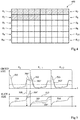
- Figure 4 illustrates an example of a video frame 400 formed of 60 image blocks, represented by squares, arranged in six rows and ten columns.
- the frame is divided into 12 groups of image blocks g1 to g12, each having the size of five consecutive image blocks.
- a first three groups g1, g2 and g3 of the frame have been already been encoded, and the other groups g4 to g12 remain to be encoded.
- the QP to be applied to the group g5 is for example determined based on an estimation of the size of an image slice, which for example corresponds to a video frame in the example of Figure 4 .
- the size of an image slice is for example estimated based on sizes of the groups that have already been encoded, e.g. the groups g1 to g3 in Figure 4 , and on an estimation of the size of each of the remaining groups in the slice, e.g. the groups g4 to g12 in Figure 4 .
- the estimation is based on the latest group to be encoded, which is likely to best reflect the size of the subsequent groups of the image.
- the size of the slice is estimated by estimating the size of the groups to be encoded based on corresponding groups in a previous frame.
- the corresponding group is for example identified as the one located in the same position in the previous frame as the group g in the current frame.
- the corresponding group is identified based on one or more motion vectors between image blocks of group g and image blocks of the previous frame.
- the corresponding group can be identified as the one that, after application of one or more motion vectors, is located at the location of group g in the current frame.
- Each image slice for example corresponds to a frame of the video signal.
- the image slice could be of a smaller size.
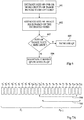
- Figure 5 is a timing diagram showing, in a top portion of the diagram, curves 501, 502 and 503 respectively representing sizes of groups of image blocks over three consecutive frames F i , F i+1 and F i+2 .
- the frames are of a similar scene without a scene change.
- the curves 501, 502 and 503 have relatively similar forms to each other.
- the dashed line curves 501', 502' and 503' illustrate predicted group sizes for the three frames respectively.
- a lower portion of the timing diagram in Figure 5 illustrates, for each frame, curves 504, 505 and 506 respectively representing the cumulative group sizes in the frames F i , F i+1 and F i+2 , equal to the sum of the sizes of the previous groups of image blocks in the frame that have already been encoded. Dashed line curves 504' and 505' illustrate the cumulative size based on the predicted group sizes for the frames F i and F i+1 .
- the quantization parameter QP is for example increased in order to reduce the remaining size of the groups of image blocks and bring the slice size back within the target slice size.
- the slice size based on the new QP is then predicted to be lower than the target slice size, as represented by the dashed line cumulative curve 505'.
- the QP is reduced to bring the slice size closer to the target level, as shown by the curve 505.
- Figure 6 is a flow diagram illustrating operations in a method of adapting the bit rate of a video encoder. It is assumed that the encoder receives uncompressed frames of a video signal, and that one or more groups of image blocks of a first frame are encoded based on a default quantization parameter, which is for example chosen to be relatively low.
- the sizes of one or more groups of image blocks of the image slice that are to be encoded are estimated, for example, based on an average of the previously encoded groups (equation 1 above), based on the size of the latest encoded group (equation 2 or 3 above), or based on corresponding groups of a previous frame (equation 4 and 5 above).
- the size of the image slice is estimated based on the estimate of the groups of image blocks to be encoded, and for example based on the size of any groups of the image slice that have already been encoded.
- the estimated size of the image slice is compared to a size limit.
- the size limit is for example determined based on the bitrate that data is processed on the receive side, and on the frame rate.
- the QP is increased in an operation 605. For example, the QP is incremented by a single unit, or increased by an amount based on how much the size limit was exceeded.
- the QP is maintained at its current level, or reduced. For example, if the slice size is within a certain percentage of the limit, the current QP is maintained, whereas if the slice size is lower than that, the QP is for example decremented by one or more units based on how far the size is from the limit.
- the method used in operation 601 to estimate the size of one or more groups of images may be based on the detection of a scene change between the previous frame and the current frame. Indeed, whereas the method of equation 4 above is particularly well adapted when consecutive frames of the video signal are relatively similar to each other, in the case of a scene change, another method may be better adapted.
- buffer overflow protection may be implemented in some embodiments, as will now be described with reference to Figures 7A and 7B .
- Figure 7A is a diagram representing an example embodiment in which the image slice corresponds to a sliding window 700 of image blocks is used to predict whether a buffer overflow will occur.
- the image slice thus for example has a size N G that remains constant irrespective of the number of groups of image blocks of a given frame that have already been encoded.
- an image slice may thus include groups of image blocks from two consecutive frames.
- the size N G is equal to the number N of groups of image blocks in each frame.
- a current frame F i comprises groups g1' to g12' of image blocks
- a subsequent frame F i+1 comprises groups g1 to g12. It is assumed that the last group g12' of the current frame F i has just been encoded, and the sliding window corresponds to the group g12', and to the groups g1 to g11 of the next frame.
- the occurrence of a buffer overflow is for example predicted by predicting the buffer level after each group of image blocks in the sliding window has been processed.
- the sliding window shifts forwards one group as shown by the window labelled 700', to comprise the groups g1 to g12 of the frame F i+1 .
- the sizes of the groups g1 to g12 of the sliding window 700' are for example estimated based on the sizes of the previously encoded groups g1' to g12' respectively, in accordance with equation 5 above.
- Figure 7B is timing diagram showing, in a top portion of the diagram, curves 701, 702 and 703 respectively representing sizes of groups of image blocks over three consecutive frames F i , F i+1 and F i+2 .
- Figure 7B also illustrates in a lower portion an example of the output buffer levels in the output buffer 106 over the three consecutive frames F i , F i+1 and F i+2 .
- the frames in Figure 7B are of a similar scene without a scene change.
- the curves 701, 702 and 703, which respectively represent the sizes of the groups of image blocks in the frames F i , F i+1 and F i+2 have relatively similar forms.
- Figure 7B also illustrates an example of a sliding window 705, and of an estimated buffer size shown by a dashed line 706.
- the buffer size is estimated to peak at a level that exceeds the size limit of the output buffer.
- the QP is increased at an early stage to reduce the sizes of the groups of image blocks, and thereby prevent the buffer overflow as shown by the curve 704 in Figure 7B , which peaks at a level below the size limit 710.
- using a sliding window permits the QP to be adjusted well in advance of any potential buffer overflow, avoiding sharp fluctuations in the QP.
- Figure 8 is a flow diagram illustrating an example of operations for detecting a scene change according to an example embodiment.
- high and low thresholds are determined for the size of a current group of image blocks, based on the size of a corresponding group in a previous frame.
- the corresponding group is the one having the same position in the previous frame as that of the current group in the current frame.
- the high and low thresholds are for example determined as a percentage of the size of the corresponding group, for example as Old_Size*(1+X) and Old_Size*(1-X), where X is the fraction representing the percentage. The percentage is for example in the range of 20 to 100 percent, and for example at around 50 percent, i.e. X is between 0.2 and 1, for example at around 0.5.
- the size of the current group is compared to the high and low thresholds.
- next operation is 803, in which a counter is for example decremented, if it has a count value of greater than zero. The method then returns to operation 801 where a next group is processed.
- the next operation is 804, in which the counter is incremented.
- the count value maintained by the counter is then compared to a limit, and if the limit is not reached, the method returns to operation 801 where a next group is processed.
- the limit is reached, it is determined in an operation 806 that a scene change has occurred.
- the counter limit is for example set to a value of between 2 and 10, depending on aspects such as the size of the groups of image blocks.
- the method of Figure 8 is for example performed for each group of image blocks to be processed.
- An advantage of the embodiments described herein is that, by updating the QP to be used for a group of image blocks based on an estimation of the size of one more groups that are still to be encoded, the QP can be adapted during a frame, and the latency can be maintained at a very low level. For example, by controlling the quantization parameter to limit the frame size as described herein, overall latency can be significantly reduced, for example to less than 30 ms, and generally to under 20 ms.
- a QP can be determined that is particularly well-adapted to the frame by basing the size estimation on the size of one or more previously encoded groups in a previous frame.
Landscapes
- Engineering & Computer Science (AREA)
- Multimedia (AREA)
- Signal Processing (AREA)
- Physics & Mathematics (AREA)
- Algebra (AREA)
- General Physics & Mathematics (AREA)
- Mathematical Analysis (AREA)
- Mathematical Optimization (AREA)
- Pure & Applied Mathematics (AREA)
- Compression Or Coding Systems Of Tv Signals (AREA)
Applications Claiming Priority (1)
| Application Number | Priority Date | Filing Date | Title |
|---|---|---|---|
| FR1457231A FR3024314B1 (fr) | 2014-07-25 | 2014-07-25 | Codeur de video a faible latence |
Publications (3)
| Publication Number | Publication Date |
|---|---|
| EP2985997A2 EP2985997A2 (en) | 2016-02-17 |
| EP2985997A3 EP2985997A3 (en) | 2016-05-11 |
| EP2985997B1 true EP2985997B1 (en) | 2020-11-25 |
Family
ID=52130346
Family Applications (1)
| Application Number | Title | Priority Date | Filing Date |
|---|---|---|---|
| EP15177493.2A Active EP2985997B1 (en) | 2014-07-25 | 2015-07-20 | Low latency video encoder |
Country Status (3)
| Country | Link |
|---|---|
| US (1) | US9706203B2 (enExample) |
| EP (1) | EP2985997B1 (enExample) |
| FR (1) | FR3024314B1 (enExample) |
Families Citing this family (19)
| Publication number | Priority date | Publication date | Assignee | Title |
|---|---|---|---|---|
| FR3024314B1 (fr) * | 2014-07-25 | 2017-12-08 | Allegro Dvt | Codeur de video a faible latence |
| FR3024313B1 (fr) * | 2014-07-25 | 2017-12-08 | Allegro Dvt | Codeur de video a debit variable |
| US10165272B2 (en) * | 2015-01-29 | 2018-12-25 | Arris Enterprises Llc | Picture-level QP rate control performance improvements for HEVC encoding |
| WO2016164459A1 (en) * | 2015-04-10 | 2016-10-13 | Red.Com, Inc. | Video camera with rate control video compression |
| CN107027027B (zh) * | 2016-01-31 | 2021-02-12 | 西安电子科技大学 | 图像的编码、解码方法及装置、以及图像的编解码系统 |
| AU2016203291A1 (en) * | 2016-05-20 | 2017-12-07 | Canon Kabushiki Kaisha | Method, apparatus and system for encoding and decoding video data |
| WO2018072675A1 (en) | 2016-10-18 | 2018-04-26 | Zhejiang Dahua Technology Co., Ltd. | Methods and systems for video processing |
| CN106572352B (zh) * | 2016-10-21 | 2019-09-17 | 浙江大华技术股份有限公司 | 一种关键帧大小控制方法及装置 |
| CN108235346B (zh) * | 2016-12-22 | 2021-03-16 | 上海诺基亚贝尔股份有限公司 | 一种用于在lte系统中监测不活动ue的方法和装置 |
| KR102620350B1 (ko) | 2017-07-05 | 2024-01-02 | 레드.컴, 엘엘씨 | 전자 디바이스에서의 비디오 이미지 데이터 처리 |
| KR102342051B1 (ko) | 2017-08-08 | 2021-12-22 | 삼성전자주식회사 | 영상 처리 장치, 영상 처리 방법 및 영상 디스플레이 시스템 |
| CN107864379B (zh) * | 2017-09-28 | 2021-07-02 | 珠海亿智电子科技有限公司 | 一种应用于视频编解码的压缩方法 |
| FR3078808B1 (fr) | 2018-03-08 | 2021-07-16 | Commissariat Energie Atomique | Procede de traitement d'image inter-trame et intra-trame |
| US20200137134A1 (en) * | 2018-10-31 | 2020-04-30 | Ati Technologies Ulc | Multi-session low latency encoding |
| US11330258B1 (en) * | 2019-05-21 | 2022-05-10 | Xilinx, Inc. | Method and system to enhance video quality in compressed video by manipulating bit usage |
| CN112004083B (zh) * | 2019-05-27 | 2022-04-01 | 北京君正集成电路股份有限公司 | 一种利用帧间预测特性优化码率控制方法及系统 |
| CN110278495B (zh) * | 2019-06-25 | 2020-02-07 | 重庆紫光华山智安科技有限公司 | 一种基于mpqm的视频传输网络控制方法及装置 |
| KR102897441B1 (ko) | 2021-04-19 | 2025-12-09 | 삼성전자주식회사 | 서버 및 그 제어 방법 |
| US11425423B1 (en) | 2022-03-10 | 2022-08-23 | Yendo Hu | Memory storage for motion estimation and visual artifact redcution |
Citations (1)
| Publication number | Priority date | Publication date | Assignee | Title |
|---|---|---|---|---|
| US20060233237A1 (en) * | 2005-04-15 | 2006-10-19 | Apple Computer, Inc. | Single pass constrained constant bit-rate encoding |
Family Cites Families (12)
| Publication number | Priority date | Publication date | Assignee | Title |
|---|---|---|---|---|
| US6151442A (en) * | 1996-07-08 | 2000-11-21 | Victor Company Of Japan, Ltd. | Signal compressing apparatus |
| US5949490A (en) * | 1997-07-08 | 1999-09-07 | Tektronix, Inc. | Distributing video buffer rate control over a parallel compression architecture |
| DE19946267C2 (de) * | 1999-09-27 | 2002-09-26 | Harman Becker Automotive Sys | Digitales Transcodiersystem |
| GB2365240B (en) * | 2000-07-19 | 2002-09-25 | Motorola Inc | Apparatus and method for image transmission |
| US7042941B1 (en) * | 2001-07-17 | 2006-05-09 | Vixs, Inc. | Method and apparatus for controlling amount of quantization processing in an encoder |
| US7046173B2 (en) * | 2001-12-26 | 2006-05-16 | Eads Telecom | Method and device for converting a quantized digital value |
| JP4113044B2 (ja) * | 2003-05-23 | 2008-07-02 | 松下電器産業株式会社 | 画像符号化装置 |
| CN101637026B (zh) * | 2007-09-12 | 2012-03-28 | 索尼株式会社 | 图像处理装置和方法 |
| US8200034B2 (en) * | 2008-04-14 | 2012-06-12 | New Jersey Institute Of Technology | Detecting double JPEG compression in images |
| EP2301251A4 (en) * | 2008-06-25 | 2012-12-26 | Ericsson Telefon Ab L M | LINES EVALUATION-RATE CONTROL |
| JP6234659B2 (ja) * | 2012-04-27 | 2017-11-22 | 富士通株式会社 | 動画像復号装置 |
| FR3024314B1 (fr) * | 2014-07-25 | 2017-12-08 | Allegro Dvt | Codeur de video a faible latence |
-
2014
- 2014-07-25 FR FR1457231A patent/FR3024314B1/fr active Active
-
2015
- 2015-07-20 EP EP15177493.2A patent/EP2985997B1/en active Active
- 2015-07-21 US US14/805,120 patent/US9706203B2/en active Active
Patent Citations (1)
| Publication number | Priority date | Publication date | Assignee | Title |
|---|---|---|---|---|
| US20060233237A1 (en) * | 2005-04-15 | 2006-10-19 | Apple Computer, Inc. | Single pass constrained constant bit-rate encoding |
Also Published As
| Publication number | Publication date |
|---|---|
| US20160029020A1 (en) | 2016-01-28 |
| FR3024314B1 (fr) | 2017-12-08 |
| EP2985997A3 (en) | 2016-05-11 |
| EP2985997A2 (en) | 2016-02-17 |
| US9706203B2 (en) | 2017-07-11 |
| FR3024314A1 (enExample) | 2016-01-29 |
Similar Documents
| Publication | Publication Date | Title |
|---|---|---|
| EP2985997B1 (en) | Low latency video encoder | |
| JP4901772B2 (ja) | 動画像符号化方法及び動画像符号化装置 | |
| US9179149B2 (en) | Video encoding control method, video encoding apparatus, and video encoding program | |
| US9014268B2 (en) | Video encoder and its decoder | |
| US20140376624A1 (en) | Scene change detection using sum of variance and estimated picture encoding cost | |
| US20010046263A1 (en) | Video encoding apparatus that adjusts code amount by skipping encoding of image data | |
| EP2907310B1 (en) | Autogressive pixel prediction in the neighborhood of image borders | |
| US20170099491A1 (en) | Apparatus, method and non-transitory medium storing program for encoding moving picture | |
| US20130287118A1 (en) | Video image encoding device, video image encoding method, video image decoding device, and video image decoding method | |
| US9179165B2 (en) | Video encoding control method, video encoding apparatus and video encoding program | |
| US20120002723A1 (en) | Stereo video coding apparatus and stereo video coding method | |
| EP2978219B1 (en) | Variable rate video encoder | |
| US8179961B2 (en) | Method and apparatus for adapting a default encoding of a digital video signal during a scene change period | |
| JP2001128179A (ja) | 動画像符号化装置および方法 | |
| JP4485996B2 (ja) | 画像符号化装置及び画像符号化プログラム | |
| KR101996775B1 (ko) | 영상 전환 장치를 구비한 부호화 장치 및 영상 전환 검지 방법을 포함하는 부호화 방법 | |
| EP1014726A1 (en) | Encoder and encoding method | |
| EP2787729A1 (en) | Video encoding method, device, and program | |
| EP1646246B1 (en) | Control of frame types in video compression | |
| JP6182888B2 (ja) | 画像符号化装置 | |
| US10027960B2 (en) | Coding method and coding device | |
| JP2011205476A (ja) | 動画像符号化装置及び動画像符号化方法 | |
| JP2010288070A (ja) | 画像符号化装置 | |
| KR20180101608A (ko) | 영상 전환 장치를 구비한 부호화 장치 및 영상 전환 검지 방법을 포함하는 부호화 방법 | |
| JP5298487B2 (ja) | 画像符号化装置、画像復号化装置、および画像符号化方法 |
Legal Events
| Date | Code | Title | Description |
|---|---|---|---|
| PUAI | Public reference made under article 153(3) epc to a published international application that has entered the european phase |
Free format text: ORIGINAL CODE: 0009012 |
|
| AK | Designated contracting states |
Kind code of ref document: A2 Designated state(s): AL AT BE BG CH CY CZ DE DK EE ES FI FR GB GR HR HU IE IS IT LI LT LU LV MC MK MT NL NO PL PT RO RS SE SI SK SM TR |
|
| AX | Request for extension of the european patent |
Extension state: BA ME |
|
| PUAL | Search report despatched |
Free format text: ORIGINAL CODE: 0009013 |
|
| AK | Designated contracting states |
Kind code of ref document: A3 Designated state(s): AL AT BE BG CH CY CZ DE DK EE ES FI FR GB GR HR HU IE IS IT LI LT LU LV MC MK MT NL NO PL PT RO RS SE SI SK SM TR |
|
| AX | Request for extension of the european patent |
Extension state: BA ME |
|
| RIC1 | Information provided on ipc code assigned before grant |
Ipc: H04N 19/152 20140101ALI20160406BHEP Ipc: H04N 19/142 20140101ALI20160406BHEP Ipc: H04N 19/146 20140101ALI20160406BHEP Ipc: H04N 19/124 20140101AFI20160406BHEP Ipc: H04N 19/174 20140101ALI20160406BHEP |
|
| STAA | Information on the status of an ep patent application or granted ep patent |
Free format text: STATUS: REQUEST FOR EXAMINATION WAS MADE |
|
| 17P | Request for examination filed |
Effective date: 20161110 |
|
| RBV | Designated contracting states (corrected) |
Designated state(s): AL AT BE BG CH CY CZ DE DK EE ES FI FR GB GR HR HU IE IS IT LI LT LU LV MC MK MT NL NO PL PT RO RS SE SI SK SM TR |
|
| R17P | Request for examination filed (corrected) |
Effective date: 20161110 |
|
| RAP1 | Party data changed (applicant data changed or rights of an application transferred) |
Owner name: ALLEGRO DVT2 |
|
| STAA | Information on the status of an ep patent application or granted ep patent |
Free format text: STATUS: EXAMINATION IS IN PROGRESS |
|
| 17Q | First examination report despatched |
Effective date: 20181213 |
|
| GRAP | Despatch of communication of intention to grant a patent |
Free format text: ORIGINAL CODE: EPIDOSNIGR1 |
|
| STAA | Information on the status of an ep patent application or granted ep patent |
Free format text: STATUS: GRANT OF PATENT IS INTENDED |
|
| INTG | Intention to grant announced |
Effective date: 20200629 |
|
| GRAS | Grant fee paid |
Free format text: ORIGINAL CODE: EPIDOSNIGR3 |
|
| GRAA | (expected) grant |
Free format text: ORIGINAL CODE: 0009210 |
|
| STAA | Information on the status of an ep patent application or granted ep patent |
Free format text: STATUS: THE PATENT HAS BEEN GRANTED |
|
| AK | Designated contracting states |
Kind code of ref document: B1 Designated state(s): AL AT BE BG CH CY CZ DE DK EE ES FI FR GB GR HR HU IE IS IT LI LT LU LV MC MK MT NL NO PL PT RO RS SE SI SK SM TR |
|
| REG | Reference to a national code |
Ref country code: GB Ref legal event code: FG4D |
|
| REG | Reference to a national code |
Ref country code: CH Ref legal event code: EP |
|
| REG | Reference to a national code |
Ref country code: AT Ref legal event code: REF Ref document number: 1339652 Country of ref document: AT Kind code of ref document: T Effective date: 20201215 |
|
| REG | Reference to a national code |
Ref country code: DE Ref legal event code: R096 Ref document number: 602015062430 Country of ref document: DE |
|
| REG | Reference to a national code |
Ref country code: IE Ref legal event code: FG4D |
|
| REG | Reference to a national code |
Ref country code: AT Ref legal event code: MK05 Ref document number: 1339652 Country of ref document: AT Kind code of ref document: T Effective date: 20201125 |
|
| REG | Reference to a national code |
Ref country code: NL Ref legal event code: MP Effective date: 20201125 |
|
| PG25 | Lapsed in a contracting state [announced via postgrant information from national office to epo] |
Ref country code: GR Free format text: LAPSE BECAUSE OF FAILURE TO SUBMIT A TRANSLATION OF THE DESCRIPTION OR TO PAY THE FEE WITHIN THE PRESCRIBED TIME-LIMIT Effective date: 20210226 Ref country code: FI Free format text: LAPSE BECAUSE OF FAILURE TO SUBMIT A TRANSLATION OF THE DESCRIPTION OR TO PAY THE FEE WITHIN THE PRESCRIBED TIME-LIMIT Effective date: 20201125 Ref country code: RS Free format text: LAPSE BECAUSE OF FAILURE TO SUBMIT A TRANSLATION OF THE DESCRIPTION OR TO PAY THE FEE WITHIN THE PRESCRIBED TIME-LIMIT Effective date: 20201125 Ref country code: PT Free format text: LAPSE BECAUSE OF FAILURE TO SUBMIT A TRANSLATION OF THE DESCRIPTION OR TO PAY THE FEE WITHIN THE PRESCRIBED TIME-LIMIT Effective date: 20210325 Ref country code: NO Free format text: LAPSE BECAUSE OF FAILURE TO SUBMIT A TRANSLATION OF THE DESCRIPTION OR TO PAY THE FEE WITHIN THE PRESCRIBED TIME-LIMIT Effective date: 20210225 |
|
| PG25 | Lapsed in a contracting state [announced via postgrant information from national office to epo] |
Ref country code: PL Free format text: LAPSE BECAUSE OF FAILURE TO SUBMIT A TRANSLATION OF THE DESCRIPTION OR TO PAY THE FEE WITHIN THE PRESCRIBED TIME-LIMIT Effective date: 20201125 Ref country code: LV Free format text: LAPSE BECAUSE OF FAILURE TO SUBMIT A TRANSLATION OF THE DESCRIPTION OR TO PAY THE FEE WITHIN THE PRESCRIBED TIME-LIMIT Effective date: 20201125 Ref country code: SE Free format text: LAPSE BECAUSE OF FAILURE TO SUBMIT A TRANSLATION OF THE DESCRIPTION OR TO PAY THE FEE WITHIN THE PRESCRIBED TIME-LIMIT Effective date: 20201125 Ref country code: IS Free format text: LAPSE BECAUSE OF FAILURE TO SUBMIT A TRANSLATION OF THE DESCRIPTION OR TO PAY THE FEE WITHIN THE PRESCRIBED TIME-LIMIT Effective date: 20210325 Ref country code: AT Free format text: LAPSE BECAUSE OF FAILURE TO SUBMIT A TRANSLATION OF THE DESCRIPTION OR TO PAY THE FEE WITHIN THE PRESCRIBED TIME-LIMIT Effective date: 20201125 Ref country code: BG Free format text: LAPSE BECAUSE OF FAILURE TO SUBMIT A TRANSLATION OF THE DESCRIPTION OR TO PAY THE FEE WITHIN THE PRESCRIBED TIME-LIMIT Effective date: 20210225 |
|
| REG | Reference to a national code |
Ref country code: LT Ref legal event code: MG9D |
|
| PG25 | Lapsed in a contracting state [announced via postgrant information from national office to epo] |
Ref country code: HR Free format text: LAPSE BECAUSE OF FAILURE TO SUBMIT A TRANSLATION OF THE DESCRIPTION OR TO PAY THE FEE WITHIN THE PRESCRIBED TIME-LIMIT Effective date: 20201125 |
|
| PG25 | Lapsed in a contracting state [announced via postgrant information from national office to epo] |
Ref country code: SM Free format text: LAPSE BECAUSE OF FAILURE TO SUBMIT A TRANSLATION OF THE DESCRIPTION OR TO PAY THE FEE WITHIN THE PRESCRIBED TIME-LIMIT Effective date: 20201125 Ref country code: EE Free format text: LAPSE BECAUSE OF FAILURE TO SUBMIT A TRANSLATION OF THE DESCRIPTION OR TO PAY THE FEE WITHIN THE PRESCRIBED TIME-LIMIT Effective date: 20201125 Ref country code: CZ Free format text: LAPSE BECAUSE OF FAILURE TO SUBMIT A TRANSLATION OF THE DESCRIPTION OR TO PAY THE FEE WITHIN THE PRESCRIBED TIME-LIMIT Effective date: 20201125 Ref country code: RO Free format text: LAPSE BECAUSE OF FAILURE TO SUBMIT A TRANSLATION OF THE DESCRIPTION OR TO PAY THE FEE WITHIN THE PRESCRIBED TIME-LIMIT Effective date: 20201125 Ref country code: SK Free format text: LAPSE BECAUSE OF FAILURE TO SUBMIT A TRANSLATION OF THE DESCRIPTION OR TO PAY THE FEE WITHIN THE PRESCRIBED TIME-LIMIT Effective date: 20201125 Ref country code: LT Free format text: LAPSE BECAUSE OF FAILURE TO SUBMIT A TRANSLATION OF THE DESCRIPTION OR TO PAY THE FEE WITHIN THE PRESCRIBED TIME-LIMIT Effective date: 20201125 |
|
| REG | Reference to a national code |
Ref country code: DE Ref legal event code: R097 Ref document number: 602015062430 Country of ref document: DE |
|
| PG25 | Lapsed in a contracting state [announced via postgrant information from national office to epo] |
Ref country code: DK Free format text: LAPSE BECAUSE OF FAILURE TO SUBMIT A TRANSLATION OF THE DESCRIPTION OR TO PAY THE FEE WITHIN THE PRESCRIBED TIME-LIMIT Effective date: 20201125 |
|
| PLBE | No opposition filed within time limit |
Free format text: ORIGINAL CODE: 0009261 |
|
| STAA | Information on the status of an ep patent application or granted ep patent |
Free format text: STATUS: NO OPPOSITION FILED WITHIN TIME LIMIT |
|
| PG25 | Lapsed in a contracting state [announced via postgrant information from national office to epo] |
Ref country code: NL Free format text: LAPSE BECAUSE OF FAILURE TO SUBMIT A TRANSLATION OF THE DESCRIPTION OR TO PAY THE FEE WITHIN THE PRESCRIBED TIME-LIMIT Effective date: 20201125 Ref country code: AL Free format text: LAPSE BECAUSE OF FAILURE TO SUBMIT A TRANSLATION OF THE DESCRIPTION OR TO PAY THE FEE WITHIN THE PRESCRIBED TIME-LIMIT Effective date: 20201125 Ref country code: IT Free format text: LAPSE BECAUSE OF FAILURE TO SUBMIT A TRANSLATION OF THE DESCRIPTION OR TO PAY THE FEE WITHIN THE PRESCRIBED TIME-LIMIT Effective date: 20201125 |
|
| 26N | No opposition filed |
Effective date: 20210826 |
|
| PG25 | Lapsed in a contracting state [announced via postgrant information from national office to epo] |
Ref country code: SI Free format text: LAPSE BECAUSE OF FAILURE TO SUBMIT A TRANSLATION OF THE DESCRIPTION OR TO PAY THE FEE WITHIN THE PRESCRIBED TIME-LIMIT Effective date: 20201125 Ref country code: ES Free format text: LAPSE BECAUSE OF FAILURE TO SUBMIT A TRANSLATION OF THE DESCRIPTION OR TO PAY THE FEE WITHIN THE PRESCRIBED TIME-LIMIT Effective date: 20201125 |
|
| REG | Reference to a national code |
Ref country code: CH Ref legal event code: PL |
|
| PG25 | Lapsed in a contracting state [announced via postgrant information from national office to epo] |
Ref country code: MC Free format text: LAPSE BECAUSE OF FAILURE TO SUBMIT A TRANSLATION OF THE DESCRIPTION OR TO PAY THE FEE WITHIN THE PRESCRIBED TIME-LIMIT Effective date: 20201125 |
|
| REG | Reference to a national code |
Ref country code: BE Ref legal event code: MM Effective date: 20210731 |
|
| PG25 | Lapsed in a contracting state [announced via postgrant information from national office to epo] |
Ref country code: LI Free format text: LAPSE BECAUSE OF NON-PAYMENT OF DUE FEES Effective date: 20210731 Ref country code: CH Free format text: LAPSE BECAUSE OF NON-PAYMENT OF DUE FEES Effective date: 20210731 |
|
| PG25 | Lapsed in a contracting state [announced via postgrant information from national office to epo] |
Ref country code: IS Free format text: LAPSE BECAUSE OF FAILURE TO SUBMIT A TRANSLATION OF THE DESCRIPTION OR TO PAY THE FEE WITHIN THE PRESCRIBED TIME-LIMIT Effective date: 20210325 Ref country code: LU Free format text: LAPSE BECAUSE OF NON-PAYMENT OF DUE FEES Effective date: 20210720 |
|
| PG25 | Lapsed in a contracting state [announced via postgrant information from national office to epo] |
Ref country code: IE Free format text: LAPSE BECAUSE OF NON-PAYMENT OF DUE FEES Effective date: 20210720 Ref country code: BE Free format text: LAPSE BECAUSE OF NON-PAYMENT OF DUE FEES Effective date: 20210731 |
|
| PG25 | Lapsed in a contracting state [announced via postgrant information from national office to epo] |
Ref country code: HU Free format text: LAPSE BECAUSE OF FAILURE TO SUBMIT A TRANSLATION OF THE DESCRIPTION OR TO PAY THE FEE WITHIN THE PRESCRIBED TIME-LIMIT; INVALID AB INITIO Effective date: 20150720 |
|
| PG25 | Lapsed in a contracting state [announced via postgrant information from national office to epo] |
Ref country code: CY Free format text: LAPSE BECAUSE OF FAILURE TO SUBMIT A TRANSLATION OF THE DESCRIPTION OR TO PAY THE FEE WITHIN THE PRESCRIBED TIME-LIMIT Effective date: 20201125 |
|
| PG25 | Lapsed in a contracting state [announced via postgrant information from national office to epo] |
Ref country code: MK Free format text: LAPSE BECAUSE OF FAILURE TO SUBMIT A TRANSLATION OF THE DESCRIPTION OR TO PAY THE FEE WITHIN THE PRESCRIBED TIME-LIMIT Effective date: 20201125 |
|
| PG25 | Lapsed in a contracting state [announced via postgrant information from national office to epo] |
Ref country code: MT Free format text: LAPSE BECAUSE OF FAILURE TO SUBMIT A TRANSLATION OF THE DESCRIPTION OR TO PAY THE FEE WITHIN THE PRESCRIBED TIME-LIMIT Effective date: 20201125 |
|
| PGFP | Annual fee paid to national office [announced via postgrant information from national office to epo] |
Ref country code: DE Payment date: 20250711 Year of fee payment: 11 |
|
| PGFP | Annual fee paid to national office [announced via postgrant information from national office to epo] |
Ref country code: GB Payment date: 20250723 Year of fee payment: 11 |
|
| PGFP | Annual fee paid to national office [announced via postgrant information from national office to epo] |
Ref country code: FR Payment date: 20250731 Year of fee payment: 11 |
|
| PG25 | Lapsed in a contracting state [announced via postgrant information from national office to epo] |
Ref country code: TR Free format text: LAPSE BECAUSE OF FAILURE TO SUBMIT A TRANSLATION OF THE DESCRIPTION OR TO PAY THE FEE WITHIN THE PRESCRIBED TIME-LIMIT Effective date: 20201125 |