EP2985286A1 - Midbody of ticagrelor and preparation method therefor, and preparation method for ticagrelor - Google Patents
Midbody of ticagrelor and preparation method therefor, and preparation method for ticagrelor Download PDFInfo
- Publication number
- EP2985286A1 EP2985286A1 EP14782391.8A EP14782391A EP2985286A1 EP 2985286 A1 EP2985286 A1 EP 2985286A1 EP 14782391 A EP14782391 A EP 14782391A EP 2985286 A1 EP2985286 A1 EP 2985286A1
- Authority
- EP
- European Patent Office
- Prior art keywords
- compound
- formula
- preparation
- group
- ticagrelor
- Prior art date
- Legal status (The legal status is an assumption and is not a legal conclusion. Google has not performed a legal analysis and makes no representation as to the accuracy of the status listed.)
- Granted
Links
- 238000002360 preparation method Methods 0.000 title claims abstract description 46
- OEKWJQXRCDYSHL-FNOIDJSQSA-N ticagrelor Chemical compound C1([C@@H]2C[C@H]2NC=2N=C(N=C3N([C@H]4[C@@H]([C@H](O)[C@@H](OCCO)C4)O)N=NC3=2)SCCC)=CC=C(F)C(F)=C1 OEKWJQXRCDYSHL-FNOIDJSQSA-N 0.000 title claims abstract description 42
- 229960002528 ticagrelor Drugs 0.000 title claims abstract description 42
- 150000001875 compounds Chemical class 0.000 claims abstract description 130
- 238000006243 chemical reaction Methods 0.000 claims abstract description 65
- ZMANZCXQSJIPKH-UHFFFAOYSA-N Triethylamine Chemical compound CCN(CC)CC ZMANZCXQSJIPKH-UHFFFAOYSA-N 0.000 claims description 39
- XEKOWRVHYACXOJ-UHFFFAOYSA-N Ethyl acetate Chemical compound CCOC(C)=O XEKOWRVHYACXOJ-UHFFFAOYSA-N 0.000 claims description 31
- YMWUJEATGCHHMB-UHFFFAOYSA-N Dichloromethane Chemical compound ClCCl YMWUJEATGCHHMB-UHFFFAOYSA-N 0.000 claims description 30
- ZMXDDKWLCZADIW-UHFFFAOYSA-N N,N-Dimethylformamide Chemical compound CN(C)C=O ZMXDDKWLCZADIW-UHFFFAOYSA-N 0.000 claims description 29
- LFQSCWFLJHTTHZ-UHFFFAOYSA-N Ethanol Chemical compound CCO LFQSCWFLJHTTHZ-UHFFFAOYSA-N 0.000 claims description 27
- 239000002904 solvent Substances 0.000 claims description 27
- BWHMMNNQKKPAPP-UHFFFAOYSA-L potassium carbonate Chemical compound [K+].[K+].[O-]C([O-])=O BWHMMNNQKKPAPP-UHFFFAOYSA-L 0.000 claims description 26
- -1 triethylsilyl Chemical group 0.000 claims description 24
- 125000002887 hydroxy group Chemical group [H]O* 0.000 claims description 22
- OKKJLVBELUTLKV-UHFFFAOYSA-N Methanol Chemical compound OC OKKJLVBELUTLKV-UHFFFAOYSA-N 0.000 claims description 21
- WYURNTSHIVDZCO-UHFFFAOYSA-N Tetrahydrofuran Chemical compound C1CCOC1 WYURNTSHIVDZCO-UHFFFAOYSA-N 0.000 claims description 20
- YXFVVABEGXRONW-UHFFFAOYSA-N Toluene Chemical compound CC1=CC=CC=C1 YXFVVABEGXRONW-UHFFFAOYSA-N 0.000 claims description 20
- WEVYAHXRMPXWCK-UHFFFAOYSA-N Acetonitrile Chemical compound CC#N WEVYAHXRMPXWCK-UHFFFAOYSA-N 0.000 claims description 18
- JUJWROOIHBZHMG-UHFFFAOYSA-N Pyridine Chemical compound C1=CC=NC=C1 JUJWROOIHBZHMG-UHFFFAOYSA-N 0.000 claims description 18
- 150000003839 salts Chemical class 0.000 claims description 17
- FYGHSUNMUKGBRK-UHFFFAOYSA-N 1,2,3-trimethylbenzene Chemical compound CC1=CC=CC(C)=C1C FYGHSUNMUKGBRK-UHFFFAOYSA-N 0.000 claims description 16
- JGFZNNIVVJXRND-UHFFFAOYSA-N N,N-Diisopropylethylamine (DIPEA) Chemical compound CCN(C(C)C)C(C)C JGFZNNIVVJXRND-UHFFFAOYSA-N 0.000 claims description 16
- CTQNGGLPUBDAKN-UHFFFAOYSA-N O-Xylene Chemical compound CC1=CC=CC=C1C CTQNGGLPUBDAKN-UHFFFAOYSA-N 0.000 claims description 16
- VEXZGXHMUGYJMC-UHFFFAOYSA-N Hydrochloric acid Chemical compound Cl VEXZGXHMUGYJMC-UHFFFAOYSA-N 0.000 claims description 13
- RYHBNJHYFVUHQT-UHFFFAOYSA-N 1,4-Dioxane Chemical compound C1COCCO1 RYHBNJHYFVUHQT-UHFFFAOYSA-N 0.000 claims description 12
- QAEDZJGFFMLHHQ-UHFFFAOYSA-N trifluoroacetic anhydride Chemical compound FC(F)(F)C(=O)OC(=O)C(F)(F)F QAEDZJGFFMLHHQ-UHFFFAOYSA-N 0.000 claims description 12
- LWIHDJKSTIGBAC-UHFFFAOYSA-K tripotassium phosphate Chemical compound [K+].[K+].[K+].[O-]P([O-])([O-])=O LWIHDJKSTIGBAC-UHFFFAOYSA-K 0.000 claims description 12
- DTQVDTLACAAQTR-UHFFFAOYSA-N Trifluoroacetic acid Chemical compound OC(=O)C(F)(F)F DTQVDTLACAAQTR-UHFFFAOYSA-N 0.000 claims description 10
- 239000003153 chemical reaction reagent Substances 0.000 claims description 10
- YLQBMQCUIZJEEH-UHFFFAOYSA-N tetrahydrofuran Natural products C=1C=COC=1 YLQBMQCUIZJEEH-UHFFFAOYSA-N 0.000 claims description 10
- JWUJQDFVADABEY-UHFFFAOYSA-N 2-methyltetrahydrofuran Chemical compound CC1CCCO1 JWUJQDFVADABEY-UHFFFAOYSA-N 0.000 claims description 9
- WMFOQBRAJBCJND-UHFFFAOYSA-M Lithium hydroxide Chemical compound [Li+].[OH-] WMFOQBRAJBCJND-UHFFFAOYSA-M 0.000 claims description 9
- BZLVMXJERCGZMT-UHFFFAOYSA-N Methyl tert-butyl ether Chemical compound COC(C)(C)C BZLVMXJERCGZMT-UHFFFAOYSA-N 0.000 claims description 9
- HEMHJVSKTPXQMS-UHFFFAOYSA-M Sodium hydroxide Chemical compound [OH-].[Na+] HEMHJVSKTPXQMS-UHFFFAOYSA-M 0.000 claims description 9
- HEDRZPFGACZZDS-UHFFFAOYSA-N Chloroform Chemical compound ClC(Cl)Cl HEDRZPFGACZZDS-UHFFFAOYSA-N 0.000 claims description 8
- FXHOOIRPVKKKFG-UHFFFAOYSA-N N,N-Dimethylacetamide Chemical compound CN(C)C(C)=O FXHOOIRPVKKKFG-UHFFFAOYSA-N 0.000 claims description 8
- CDBYLPFSWZWCQE-UHFFFAOYSA-L Sodium Carbonate Chemical compound [Na+].[Na+].[O-]C([O-])=O CDBYLPFSWZWCQE-UHFFFAOYSA-L 0.000 claims description 8
- 239000002253 acid Substances 0.000 claims description 8
- 229960001701 chloroform Drugs 0.000 claims description 8
- SKTCDJAMAYNROS-UHFFFAOYSA-N methoxycyclopentane Chemical compound COC1CCCC1 SKTCDJAMAYNROS-UHFFFAOYSA-N 0.000 claims description 8
- UMJSCPRVCHMLSP-UHFFFAOYSA-N pyridine Natural products COC1=CC=CN=C1 UMJSCPRVCHMLSP-UHFFFAOYSA-N 0.000 claims description 8
- SCYULBFZEHDVBN-UHFFFAOYSA-N 1,1-Dichloroethane Chemical compound CC(Cl)Cl SCYULBFZEHDVBN-UHFFFAOYSA-N 0.000 claims description 7
- FEWJPZIEWOKRBE-JCYAYHJZSA-L L-tartrate(2-) Chemical compound [O-]C(=O)[C@H](O)[C@@H](O)C([O-])=O FEWJPZIEWOKRBE-JCYAYHJZSA-L 0.000 claims description 6
- SJRJJKPEHAURKC-UHFFFAOYSA-N N-Methylmorpholine Chemical compound CN1CCOCC1 SJRJJKPEHAURKC-UHFFFAOYSA-N 0.000 claims description 6
- UIIMBOGNXHQVGW-DEQYMQKBSA-M Sodium bicarbonate-14C Chemical compound [Na+].O[14C]([O-])=O UIIMBOGNXHQVGW-DEQYMQKBSA-M 0.000 claims description 6
- QAOWNCQODCNURD-UHFFFAOYSA-N Sulfuric acid Chemical compound OS(O)(=O)=O QAOWNCQODCNURD-UHFFFAOYSA-N 0.000 claims description 6
- 125000004184 methoxymethyl group Chemical group [H]C([H])([H])OC([H])([H])* 0.000 claims description 6
- 229910000160 potassium phosphate Inorganic materials 0.000 claims description 6
- 235000011009 potassium phosphates Nutrition 0.000 claims description 6
- ILMRJRBKQSSXGY-UHFFFAOYSA-N tert-butyl(dimethyl)silicon Chemical group C[Si](C)C(C)(C)C ILMRJRBKQSSXGY-UHFFFAOYSA-N 0.000 claims description 6
- 125000000025 triisopropylsilyl group Chemical group C(C)(C)[Si](C(C)C)(C(C)C)* 0.000 claims description 6
- RYFMWSXOAZQYPI-UHFFFAOYSA-K trisodium phosphate Chemical compound [Na+].[Na+].[Na+].[O-]P([O-])([O-])=O RYFMWSXOAZQYPI-UHFFFAOYSA-K 0.000 claims description 6
- VCQURUZYYSOUHP-UHFFFAOYSA-N (2,3,4,5,6-pentafluorophenyl) 2,2,2-trifluoroacetate Chemical compound FC1=C(F)C(F)=C(OC(=O)C(F)(F)F)C(F)=C1F VCQURUZYYSOUHP-UHFFFAOYSA-N 0.000 claims description 5
- 150000003222 pyridines Chemical class 0.000 claims description 5
- 125000003718 tetrahydrofuranyl group Chemical group 0.000 claims description 5
- 125000001412 tetrahydropyranyl group Chemical group 0.000 claims description 5
- 238000005583 trifluoroacetylation reaction Methods 0.000 claims description 5
- ZAFNJMIOTHYJRJ-UHFFFAOYSA-N Diisopropyl ether Chemical compound CC(C)OC(C)C ZAFNJMIOTHYJRJ-UHFFFAOYSA-N 0.000 claims description 4
- 229910052739 hydrogen Inorganic materials 0.000 claims description 4
- 239000001257 hydrogen Substances 0.000 claims description 4
- 125000004435 hydrogen atom Chemical group [H]* 0.000 claims description 4
- 239000001488 sodium phosphate Substances 0.000 claims description 4
- 229910000162 sodium phosphate Inorganic materials 0.000 claims description 4
- 229940095064 tartrate Drugs 0.000 claims description 4
- MUBZPKHOEPUJKR-UHFFFAOYSA-N Oxalic acid Chemical compound OC(=O)C(O)=O MUBZPKHOEPUJKR-UHFFFAOYSA-N 0.000 claims description 3
- GVLHVURXKFYXJW-UHFFFAOYSA-N (2,5-dioxopyrrolidin-3-yl) 2,2,2-trifluoroacetate Chemical compound FC(F)(F)C(=O)OC1CC(=O)NC1=O GVLHVURXKFYXJW-UHFFFAOYSA-N 0.000 claims description 2
- IWYDHOAUDWTVEP-SSDOTTSWSA-M (R)-mandelate Chemical compound [O-]C(=O)[C@H](O)C1=CC=CC=C1 IWYDHOAUDWTVEP-SSDOTTSWSA-M 0.000 claims description 2
- IWYDHOAUDWTVEP-ZETCQYMHSA-N (S)-mandelic acid Chemical compound OC(=O)[C@@H](O)C1=CC=CC=C1 IWYDHOAUDWTVEP-ZETCQYMHSA-N 0.000 claims description 2
- YDSQCVFFKZIQJF-UHFFFAOYSA-N 1-(benzotriazol-1-yl)-2,2,2-trifluoroethanone 1-(benzotriazol-2-yl)-2,2,2-trifluoroethanone Chemical compound FC(F)(F)C(=O)n1nc2ccccc2n1.FC(F)(F)C(=O)n1nnc2ccccc12 YDSQCVFFKZIQJF-UHFFFAOYSA-N 0.000 claims description 2
- ZOWSJJBOQDKOHI-UHFFFAOYSA-N 2,2,2-trifluoroethyl acetate Chemical compound CC(=O)OCC(F)(F)F ZOWSJJBOQDKOHI-UHFFFAOYSA-N 0.000 claims description 2
- FEWJPZIEWOKRBE-LWMBPPNESA-L D-tartrate(2-) Chemical compound [O-]C(=O)[C@@H](O)[C@H](O)C([O-])=O FEWJPZIEWOKRBE-LWMBPPNESA-L 0.000 claims description 2
- QIAFMBKCNZACKA-UHFFFAOYSA-N N-benzoylglycine Chemical compound OC(=O)CNC(=O)C1=CC=CC=C1 QIAFMBKCNZACKA-UHFFFAOYSA-N 0.000 claims description 2
- 125000004432 carbon atom Chemical group C* 0.000 claims description 2
- 150000002191 fatty alcohols Chemical class 0.000 claims description 2
- VZCYOOQTPOCHFL-UPHRSURJSA-N maleic acid Chemical compound OC(=O)\C=C/C(O)=O VZCYOOQTPOCHFL-UPHRSURJSA-N 0.000 claims description 2
- BJCXMOBNIFBHBJ-UHFFFAOYSA-N pyridin-2-yl 2,2,2-trifluoroacetate Chemical compound FC(F)(F)C(=O)OC1=CC=CC=N1 BJCXMOBNIFBHBJ-UHFFFAOYSA-N 0.000 claims description 2
- VZCYOOQTPOCHFL-UHFFFAOYSA-N trans-butenedioic acid Natural products OC(=O)C=CC(O)=O VZCYOOQTPOCHFL-UHFFFAOYSA-N 0.000 claims description 2
- ITMCEJHCFYSIIV-UHFFFAOYSA-N triflic acid Chemical compound OS(=O)(=O)C(F)(F)F ITMCEJHCFYSIIV-UHFFFAOYSA-N 0.000 claims description 2
- RTZKZFJDLAIYFH-UHFFFAOYSA-N Diethyl ether Chemical compound CCOCC RTZKZFJDLAIYFH-UHFFFAOYSA-N 0.000 claims 9
- 125000000026 trimethylsilyl group Chemical group [H]C([H])([H])[Si]([*])(C([H])([H])[H])C([H])([H])[H] 0.000 claims 3
- AFVFQIVMOAPDHO-UHFFFAOYSA-N Methanesulfonic acid Chemical compound CS(O)(=O)=O AFVFQIVMOAPDHO-UHFFFAOYSA-N 0.000 claims 2
- XBDQKXXYIPTUBI-UHFFFAOYSA-M Propionate Chemical compound CCC([O-])=O XBDQKXXYIPTUBI-UHFFFAOYSA-M 0.000 claims 1
- KXKVLQRXCPHEJC-UHFFFAOYSA-N acetic acid trimethyl ester Natural products COC(C)=O KXKVLQRXCPHEJC-UHFFFAOYSA-N 0.000 claims 1
- 229940098779 methanesulfonic acid Drugs 0.000 claims 1
- 238000000034 method Methods 0.000 abstract description 26
- 238000003786 synthesis reaction Methods 0.000 abstract description 10
- 230000015572 biosynthetic process Effects 0.000 abstract description 9
- 230000008569 process Effects 0.000 abstract description 5
- 230000007547 defect Effects 0.000 abstract description 3
- 238000004519 manufacturing process Methods 0.000 abstract description 3
- 238000005265 energy consumption Methods 0.000 abstract description 2
- 239000002699 waste material Substances 0.000 abstract description 2
- 239000000243 solution Substances 0.000 description 48
- 239000000543 intermediate Substances 0.000 description 46
- XLYOFNOQVPJJNP-UHFFFAOYSA-N water Substances O XLYOFNOQVPJJNP-UHFFFAOYSA-N 0.000 description 26
- LPXPTNMVRIOKMN-UHFFFAOYSA-M sodium nitrite Chemical group [Na+].[O-]N=O LPXPTNMVRIOKMN-UHFFFAOYSA-M 0.000 description 16
- 238000004128 high performance liquid chromatography Methods 0.000 description 15
- 239000007787 solid Substances 0.000 description 14
- QTBSBXVTEAMEQO-UHFFFAOYSA-N Acetic acid Chemical compound CC(O)=O QTBSBXVTEAMEQO-UHFFFAOYSA-N 0.000 description 13
- 239000008367 deionised water Substances 0.000 description 12
- 229910021641 deionized water Inorganic materials 0.000 description 12
- 229910000027 potassium carbonate Inorganic materials 0.000 description 11
- 239000012074 organic phase Substances 0.000 description 10
- 239000002585 base Substances 0.000 description 9
- 229920006395 saturated elastomer Polymers 0.000 description 9
- XEEYBQQBJWHFJM-UHFFFAOYSA-N Iron Chemical compound [Fe] XEEYBQQBJWHFJM-UHFFFAOYSA-N 0.000 description 8
- 125000003277 amino group Chemical group 0.000 description 8
- 235000010288 sodium nitrite Nutrition 0.000 description 8
- 239000000047 product Substances 0.000 description 7
- 125000006239 protecting group Chemical group 0.000 description 7
- 239000000126 substance Substances 0.000 description 7
- IMNFDUFMRHMDMM-UHFFFAOYSA-N N-Heptane Chemical compound CCCCCCC IMNFDUFMRHMDMM-UHFFFAOYSA-N 0.000 description 6
- 230000002378 acidificating effect Effects 0.000 description 6
- 125000002485 formyl group Chemical group [H]C(*)=O 0.000 description 6
- 239000011541 reaction mixture Substances 0.000 description 6
- 229960000583 acetic acid Drugs 0.000 description 5
- 229910052783 alkali metal Inorganic materials 0.000 description 5
- 125000005843 halogen group Chemical group 0.000 description 5
- 238000000746 purification Methods 0.000 description 5
- 125000000714 pyrimidinyl group Chemical group 0.000 description 5
- 238000006467 substitution reaction Methods 0.000 description 5
- 238000005160 1H NMR spectroscopy Methods 0.000 description 4
- DDEDQHVHVPJFAC-UHFFFAOYSA-N 4,6-dichloro-5-nitro-2-propylsulfanylpyrimidine Chemical compound CCCSC1=NC(Cl)=C([N+]([O-])=O)C(Cl)=N1 DDEDQHVHVPJFAC-UHFFFAOYSA-N 0.000 description 4
- HEDRZPFGACZZDS-MICDWDOJSA-N Trichloro(2H)methane Chemical compound [2H]C(Cl)(Cl)Cl HEDRZPFGACZZDS-MICDWDOJSA-N 0.000 description 4
- 239000003146 anticoagulant agent Substances 0.000 description 4
- 229940127219 anticoagulant drug Drugs 0.000 description 4
- 125000001309 chloro group Chemical class Cl* 0.000 description 4
- 239000012043 crude product Substances 0.000 description 4
- 230000000694 effects Effects 0.000 description 4
- BDAGIHXWWSANSR-UHFFFAOYSA-N methanoic acid Natural products OC=O BDAGIHXWWSANSR-UHFFFAOYSA-N 0.000 description 4
- 238000010992 reflux Methods 0.000 description 4
- 238000001308 synthesis method Methods 0.000 description 4
- QVUBIQNXHRPJKK-IMTBSYHQSA-N (1r,2s)-2-(3,4-difluorophenyl)cyclopropan-1-amine Chemical compound N[C@@H]1C[C@H]1C1=CC=C(F)C(F)=C1 QVUBIQNXHRPJKK-IMTBSYHQSA-N 0.000 description 3
- 125000000008 (C1-C10) alkyl group Chemical group 0.000 description 3
- CJJLJBFJNXMANZ-UHFFFAOYSA-N 4,6-dichloro-2-propylsulfanylpyrimidin-5-amine Chemical compound CCCSC1=NC(Cl)=C(N)C(Cl)=N1 CJJLJBFJNXMANZ-UHFFFAOYSA-N 0.000 description 3
- XTWYTFMLZFPYCI-KQYNXXCUSA-N 5'-adenylphosphoric acid Chemical compound C1=NC=2C(N)=NC=NC=2N1[C@@H]1O[C@H](COP(O)(=O)OP(O)(O)=O)[C@@H](O)[C@H]1O XTWYTFMLZFPYCI-KQYNXXCUSA-N 0.000 description 3
- WFDIJRYMOXRFFG-UHFFFAOYSA-N Acetic anhydride Chemical compound CC(=O)OC(C)=O WFDIJRYMOXRFFG-UHFFFAOYSA-N 0.000 description 3
- XTWYTFMLZFPYCI-UHFFFAOYSA-N Adenosine diphosphate Natural products C1=NC=2C(N)=NC=NC=2N1C1OC(COP(O)(=O)OP(O)(O)=O)C(O)C1O XTWYTFMLZFPYCI-UHFFFAOYSA-N 0.000 description 3
- LYCAIKOWRPUZTN-UHFFFAOYSA-N Ethylene glycol Chemical compound OCCO LYCAIKOWRPUZTN-UHFFFAOYSA-N 0.000 description 3
- KWYUFKZDYYNOTN-UHFFFAOYSA-M Potassium hydroxide Chemical compound [OH-].[K+] KWYUFKZDYYNOTN-UHFFFAOYSA-M 0.000 description 3
- 239000008346 aqueous phase Substances 0.000 description 3
- 239000007864 aqueous solution Substances 0.000 description 3
- 239000003054 catalyst Substances 0.000 description 3
- 229910052801 chlorine Inorganic materials 0.000 description 3
- 239000012362 glacial acetic acid Substances 0.000 description 3
- 238000009776 industrial production Methods 0.000 description 3
- VRTQPVJTJNIZGE-UHFFFAOYSA-N n-(4,6-dichloro-2-propylsulfanylpyrimidin-5-yl)formamide Chemical compound CCCSC1=NC(Cl)=C(NC=O)C(Cl)=N1 VRTQPVJTJNIZGE-UHFFFAOYSA-N 0.000 description 3
- 230000001537 neural effect Effects 0.000 description 3
- 125000000449 nitro group Chemical group [O-][N+](*)=O 0.000 description 3
- 239000007858 starting material Substances 0.000 description 3
- 125000004044 trifluoroacetyl group Chemical group FC(C(=O)*)(F)F 0.000 description 3
- OSWFIVFLDKOXQC-UHFFFAOYSA-N 4-(3-methoxyphenyl)aniline Chemical compound COC1=CC=CC(C=2C=CC(N)=CC=2)=C1 OSWFIVFLDKOXQC-UHFFFAOYSA-N 0.000 description 2
- HTJDQJBWANPRPF-UHFFFAOYSA-N Cyclopropylamine Chemical compound NC1CC1 HTJDQJBWANPRPF-UHFFFAOYSA-N 0.000 description 2
- LCGLNKUTAGEVQW-UHFFFAOYSA-N Dimethyl ether Chemical compound COC LCGLNKUTAGEVQW-UHFFFAOYSA-N 0.000 description 2
- KFZMGEQAYNKOFK-UHFFFAOYSA-N Isopropanol Chemical compound CC(C)O KFZMGEQAYNKOFK-UHFFFAOYSA-N 0.000 description 2
- MZRVEZGGRBJDDB-UHFFFAOYSA-N N-Butyllithium Chemical compound [Li]CCCC MZRVEZGGRBJDDB-UHFFFAOYSA-N 0.000 description 2
- IOVCWXUNBOPUCH-UHFFFAOYSA-M Nitrite anion Chemical compound [O-]N=O IOVCWXUNBOPUCH-UHFFFAOYSA-M 0.000 description 2
- NBIIXXVUZAFLBC-UHFFFAOYSA-N Phosphoric acid Chemical compound OP(O)(O)=O NBIIXXVUZAFLBC-UHFFFAOYSA-N 0.000 description 2
- UIIMBOGNXHQVGW-UHFFFAOYSA-M Sodium bicarbonate Chemical compound [Na+].OC([O-])=O UIIMBOGNXHQVGW-UHFFFAOYSA-M 0.000 description 2
- 125000002777 acetyl group Chemical group [H]C([H])([H])C(*)=O 0.000 description 2
- 150000001414 amino alcohols Chemical class 0.000 description 2
- 150000005005 aminopyrimidines Chemical class 0.000 description 2
- 125000003118 aryl group Chemical group 0.000 description 2
- 230000031709 bromination Effects 0.000 description 2
- 238000005893 bromination reaction Methods 0.000 description 2
- 239000006227 byproduct Substances 0.000 description 2
- FJDQFPXHSGXQBY-UHFFFAOYSA-L caesium carbonate Chemical compound [Cs+].[Cs+].[O-]C([O-])=O FJDQFPXHSGXQBY-UHFFFAOYSA-L 0.000 description 2
- 229910000024 caesium carbonate Inorganic materials 0.000 description 2
- 239000012467 final product Substances 0.000 description 2
- 235000019253 formic acid Nutrition 0.000 description 2
- 239000005457 ice water Substances 0.000 description 2
- UKVIEHSSVKSQBA-UHFFFAOYSA-N methane;palladium Chemical compound C.[Pd] UKVIEHSSVKSQBA-UHFFFAOYSA-N 0.000 description 2
- 125000002924 primary amino group Chemical group [H]N([H])* 0.000 description 2
- 239000002994 raw material Substances 0.000 description 2
- 230000035484 reaction time Effects 0.000 description 2
- 229910000033 sodium borohydride Inorganic materials 0.000 description 2
- 239000012279 sodium borohydride Substances 0.000 description 2
- JHJLBTNAGRQEKS-UHFFFAOYSA-M sodium bromide Chemical compound [Na+].[Br-] JHJLBTNAGRQEKS-UHFFFAOYSA-M 0.000 description 2
- 229910000029 sodium carbonate Inorganic materials 0.000 description 2
- 235000011008 sodium phosphates Nutrition 0.000 description 2
- 238000003756 stirring Methods 0.000 description 2
- 208000024891 symptom Diseases 0.000 description 2
- 239000008399 tap water Substances 0.000 description 2
- 235000020679 tap water Nutrition 0.000 description 2
- 210000004509 vascular smooth muscle cell Anatomy 0.000 description 2
- TUIWICWAOCUWJD-FNOIDJSQSA-N (1s,2s,3r,5s)-3-[[3-[(1r,2s)-2-(3,4-difluorophenyl)cyclopropyl]-5-propylsulfanyltriazolo[4,5-d]pyrimidin-7-yl]amino]-5-(2-hydroxyethoxy)cyclopentane-1,2-diol Chemical compound C=12N=NN([C@H]3[C@@H](C3)C=3C=C(F)C(F)=CC=3)C2=NC(SCCC)=NC=1N[C@@H]1C[C@H](OCCO)[C@@H](O)[C@H]1O TUIWICWAOCUWJD-FNOIDJSQSA-N 0.000 description 1
- 125000004191 (C1-C6) alkoxy group Chemical group 0.000 description 1
- 125000004169 (C1-C6) alkyl group Chemical group 0.000 description 1
- XNWFRZJHXBZDAG-UHFFFAOYSA-N 2-METHOXYETHANOL Chemical compound COCCO XNWFRZJHXBZDAG-UHFFFAOYSA-N 0.000 description 1
- POAOYUHQDCAZBD-UHFFFAOYSA-N 2-butoxyethanol Chemical compound CCCCOCCO POAOYUHQDCAZBD-UHFFFAOYSA-N 0.000 description 1
- UQOKRDJILZMZKU-UHFFFAOYSA-N 2-nitropyrimidine Chemical compound [O-][N+](=O)C1=NC=CC=N1 UQOKRDJILZMZKU-UHFFFAOYSA-N 0.000 description 1
- 125000003903 2-propenyl group Chemical group [H]C([*])([H])C([H])=C([H])[H] 0.000 description 1
- QLZOWJNFLXSDSH-UHFFFAOYSA-N 4-methoxy-n-[[4-(trifluoromethyl)phenyl]methyl]butanamide Chemical compound COCCCC(=O)NCC1=CC=C(C(F)(F)F)C=C1 QLZOWJNFLXSDSH-UHFFFAOYSA-N 0.000 description 1
- NJDNDJPFOPBMTJ-UHFFFAOYSA-N 5-cyclopentyl-2h-triazolo[4,5-d]pyrimidine Chemical compound C1CCCC1C1=NC=C(NN=N2)C2=N1 NJDNDJPFOPBMTJ-UHFFFAOYSA-N 0.000 description 1
- 239000005552 B01AC04 - Clopidogrel Substances 0.000 description 1
- 125000000041 C6-C10 aryl group Chemical group 0.000 description 1
- 0 CCCSC(*C(C)=C1Cl)=NC(Cl)=C1NC(C(F)(F)F)=* Chemical compound CCCSC(*C(C)=C1Cl)=NC(Cl)=C1NC(C(F)(F)F)=* 0.000 description 1
- FYSSFHGIWDQQIE-MBPHKBIUSA-N CCCSc(nc1N[C@H]2[C@@H]3OC(C)(C)O[C@@H]3C(C)C2)nc(Cl)c1N Chemical compound CCCSc(nc1N[C@H]2[C@@H]3OC(C)(C)O[C@@H]3C(C)C2)nc(Cl)c1N FYSSFHGIWDQQIE-MBPHKBIUSA-N 0.000 description 1
- 201000004029 Immune dysregulation-polyendocrinopathy-enteropathy-X-linked syndrome Diseases 0.000 description 1
- 108010080192 Purinergic Receptors Proteins 0.000 description 1
- AZFNGPAYDKGCRB-XCPIVNJJSA-M [(1s,2s)-2-amino-1,2-diphenylethyl]-(4-methylphenyl)sulfonylazanide;chlororuthenium(1+);1-methyl-4-propan-2-ylbenzene Chemical compound [Ru+]Cl.CC(C)C1=CC=C(C)C=C1.C1=CC(C)=CC=C1S(=O)(=O)[N-][C@@H](C=1C=CC=CC=1)[C@@H](N)C1=CC=CC=C1 AZFNGPAYDKGCRB-XCPIVNJJSA-M 0.000 description 1
- 230000001154 acute effect Effects 0.000 description 1
- 125000002252 acyl group Chemical group 0.000 description 1
- 125000003545 alkoxy group Chemical group 0.000 description 1
- 229910000147 aluminium phosphate Inorganic materials 0.000 description 1
- 150000001413 amino acids Chemical class 0.000 description 1
- 238000004458 analytical method Methods 0.000 description 1
- 239000005557 antagonist Substances 0.000 description 1
- 230000006502 antiplatelets effects Effects 0.000 description 1
- 150000004982 aromatic amines Chemical class 0.000 description 1
- 125000004104 aryloxy group Chemical group 0.000 description 1
- RQPZNWPYLFFXCP-UHFFFAOYSA-L barium dihydroxide Chemical compound [OH-].[OH-].[Ba+2] RQPZNWPYLFFXCP-UHFFFAOYSA-L 0.000 description 1
- 229910001863 barium hydroxide Inorganic materials 0.000 description 1
- 230000008901 benefit Effects 0.000 description 1
- 125000003236 benzoyl group Chemical group [H]C1=C([H])C([H])=C(C([H])=C1[H])C(*)=O 0.000 description 1
- 125000001797 benzyl group Chemical group [H]C1=C([H])C([H])=C(C([H])=C1[H])C([H])([H])* 0.000 description 1
- AXCZMVOFGPJBDE-UHFFFAOYSA-L calcium dihydroxide Chemical compound [OH-].[OH-].[Ca+2] AXCZMVOFGPJBDE-UHFFFAOYSA-L 0.000 description 1
- 239000000920 calcium hydroxide Substances 0.000 description 1
- 229910001861 calcium hydroxide Inorganic materials 0.000 description 1
- 125000002915 carbonyl group Chemical group [*:2]C([*:1])=O 0.000 description 1
- 235000017168 chlorine Nutrition 0.000 description 1
- GKTWGGQPFAXNFI-HNNXBMFYSA-N clopidogrel Chemical compound C1([C@H](N2CC=3C=CSC=3CC2)C(=O)OC)=CC=CC=C1Cl GKTWGGQPFAXNFI-HNNXBMFYSA-N 0.000 description 1
- 229960003009 clopidogrel Drugs 0.000 description 1
- 239000000356 contaminant Substances 0.000 description 1
- 208000029078 coronary artery disease Diseases 0.000 description 1
- 229940125671 cyclopentyl-triazolopyrimidine Drugs 0.000 description 1
- 230000003247 decreasing effect Effects 0.000 description 1
- 230000002526 effect on cardiovascular system Effects 0.000 description 1
- 238000003912 environmental pollution Methods 0.000 description 1
- 125000005448 ethoxyethyl group Chemical group [H]C([H])([H])C([H])([H])OC([H])([H])C([H])([H])* 0.000 description 1
- 238000005984 hydrogenation reaction Methods 0.000 description 1
- 230000002401 inhibitory effect Effects 0.000 description 1
- 238000011031 large-scale manufacturing process Methods 0.000 description 1
- 125000002496 methyl group Chemical group [H]C([H])([H])* 0.000 description 1
- 239000000203 mixture Substances 0.000 description 1
- 230000004048 modification Effects 0.000 description 1
- 238000012986 modification Methods 0.000 description 1
- 208000010125 myocardial infarction Diseases 0.000 description 1
- 239000012434 nucleophilic reagent Substances 0.000 description 1
- 125000001181 organosilyl group Chemical group [SiH3]* 0.000 description 1
- 235000011118 potassium hydroxide Nutrition 0.000 description 1
- 239000004304 potassium nitrite Substances 0.000 description 1
- 235000010289 potassium nitrite Nutrition 0.000 description 1
- 230000002035 prolonged effect Effects 0.000 description 1
- 239000012264 purified product Substances 0.000 description 1
- 102000008344 purinergic nucleotide receptor activity proteins Human genes 0.000 description 1
- 230000009257 reactivity Effects 0.000 description 1
- 230000002441 reversible effect Effects 0.000 description 1
- 238000012216 screening Methods 0.000 description 1
- 229910000030 sodium bicarbonate Inorganic materials 0.000 description 1
- 235000017557 sodium bicarbonate Nutrition 0.000 description 1
- 235000011121 sodium hydroxide Nutrition 0.000 description 1
- 208000010110 spontaneous platelet aggregation Diseases 0.000 description 1
- 125000001424 substituent group Chemical group 0.000 description 1
- 125000000547 substituted alkyl group Chemical group 0.000 description 1
- 125000000472 sulfonyl group Chemical group *S(*)(=O)=O 0.000 description 1
- 238000001356 surgical procedure Methods 0.000 description 1
- 230000008685 targeting Effects 0.000 description 1
- 125000000999 tert-butyl group Chemical group [H]C([H])([H])C(*)(C([H])([H])[H])C([H])([H])[H] 0.000 description 1
- 238000002560 therapeutic procedure Methods 0.000 description 1
Classifications
-
- C—CHEMISTRY; METALLURGY
- C07—ORGANIC CHEMISTRY
- C07D—HETEROCYCLIC COMPOUNDS
- C07D487/00—Heterocyclic compounds containing nitrogen atoms as the only ring hetero atoms in the condensed system, not provided for by groups C07D451/00 - C07D477/00
- C07D487/02—Heterocyclic compounds containing nitrogen atoms as the only ring hetero atoms in the condensed system, not provided for by groups C07D451/00 - C07D477/00 in which the condensed system contains two hetero rings
- C07D487/04—Ortho-condensed systems
-
- C—CHEMISTRY; METALLURGY
- C07—ORGANIC CHEMISTRY
- C07D—HETEROCYCLIC COMPOUNDS
- C07D239/00—Heterocyclic compounds containing 1,3-diazine or hydrogenated 1,3-diazine rings
- C07D239/02—Heterocyclic compounds containing 1,3-diazine or hydrogenated 1,3-diazine rings not condensed with other rings
- C07D239/24—Heterocyclic compounds containing 1,3-diazine or hydrogenated 1,3-diazine rings not condensed with other rings having three or more double bonds between ring members or between ring members and non-ring members
- C07D239/28—Heterocyclic compounds containing 1,3-diazine or hydrogenated 1,3-diazine rings not condensed with other rings having three or more double bonds between ring members or between ring members and non-ring members with hetero atoms or with carbon atoms having three bonds to hetero atoms with at the most one bond to halogen, directly attached to ring carbon atoms
- C07D239/46—Two or more oxygen, sulphur or nitrogen atoms
- C07D239/47—One nitrogen atom and one oxygen or sulfur atom, e.g. cytosine
-
- C—CHEMISTRY; METALLURGY
- C07—ORGANIC CHEMISTRY
- C07D—HETEROCYCLIC COMPOUNDS
- C07D239/00—Heterocyclic compounds containing 1,3-diazine or hydrogenated 1,3-diazine rings
- C07D239/02—Heterocyclic compounds containing 1,3-diazine or hydrogenated 1,3-diazine rings not condensed with other rings
- C07D239/24—Heterocyclic compounds containing 1,3-diazine or hydrogenated 1,3-diazine rings not condensed with other rings having three or more double bonds between ring members or between ring members and non-ring members
- C07D239/28—Heterocyclic compounds containing 1,3-diazine or hydrogenated 1,3-diazine rings not condensed with other rings having three or more double bonds between ring members or between ring members and non-ring members with hetero atoms or with carbon atoms having three bonds to hetero atoms with at the most one bond to halogen, directly attached to ring carbon atoms
- C07D239/46—Two or more oxygen, sulphur or nitrogen atoms
- C07D239/48—Two nitrogen atoms
-
- C—CHEMISTRY; METALLURGY
- C07—ORGANIC CHEMISTRY
- C07D—HETEROCYCLIC COMPOUNDS
- C07D405/00—Heterocyclic compounds containing both one or more hetero rings having oxygen atoms as the only ring hetero atoms, and one or more rings having nitrogen as the only ring hetero atom
- C07D405/02—Heterocyclic compounds containing both one or more hetero rings having oxygen atoms as the only ring hetero atoms, and one or more rings having nitrogen as the only ring hetero atom containing two hetero rings
- C07D405/12—Heterocyclic compounds containing both one or more hetero rings having oxygen atoms as the only ring hetero atoms, and one or more rings having nitrogen as the only ring hetero atom containing two hetero rings linked by a chain containing hetero atoms as chain links
Definitions
- the present disclosure relates to novel synthesis methods for Ticagrelor, a selective anticoagulant and key intermediate thereof, and belongs to the technical field of pharmaceutical manufacturing.
- Ticagrelor a trade name, with the chemical name being (1S,2S,3R,5S)-3-(3-((1R,2S)-2-(3,4-difluorophenyl)cyclopropyl)-5-(propylthio)-3H-[1, 2,3]triazolo[4,5-d]pyrimidin-7-ylamino)-5-(2-hydroxyethoxy)cyclopentane-1,2-diol, is a chemical having the structural formula as shown in Formula ( I ) below:
- the chemical is a cyclopentyl-triazolo-pyrimidine, a novel and selective anticoagulant developed by AstraZeneca (UK), and the first reversibly binding adenosine diphosphate (ADP) antagonist targeting the P2Y12 receptor.
- the chemical is able to reversibly act on the purinoceptor 2 subtype P2Y12 on the vascular smooth muscle cell (VSMC).
- VSMC vascular smooth muscle cell
- the chemical has a significant inhibitory effect on platelet aggregation caused by ADP, and is able to improve the acute coronary disease symptoms effectively. Since this chemical's antiplatelet effect is reversible, it is particularly applicable to those patients who need anticoagulant therapy prior to surgery.
- Ticagrelor is superior in terms of apparently releasing symptoms of myocardial infarction, stroke or cardiovascular death, and is thus an anticoagulant with a promising future.
- the route of patent applications CN102149716A and WO0192263 is the existing industrial production process developed by the original research company to prepare bulk pharmaceutical chemicals of Ticagrelor.
- the synthesis of the key intermediate (1-2) is the key control point of the process.
- the reaction requires a high temperature, as well as an oxygen-free environment and a certain pressure condition for a long time, thus the reaction is limited due to certain equipment. Since the reaction is carried out under high temperature and pressure condition for a long time, there is a potential danger in terms of industrial production.
- the method has the same characteristics as those of the original research company's Patent Nos. CN102149716A and WO0192263 in terms of the synthesis strategy.
- the defects of the method lie in that the reaction still requires a high temperature, as well as an oxygen-free environment and a certain pressure condition for a long time; the resulting intermediate is of low purity and dark color, making it troublesome to purify the final product and difficult to remove the color; and the total yield of the process is quite low.
- Patent No. US6525060 discloses a synthesis route of preparing Ticagrelor ( I ), comprising the steps of reacting 4,6-dichloro-5-nitro-2-(propylthio)pyrimidine with (3AR, 4S, 6R, 6AS)-6-aminotetrahydro-2,2-dimethyl-4H-cyclopenta[d]-1,3-dioxolalkenyl-4-ol (III-1) to get an intermediate ( III-2 ); reducing the intermediate ( III-2 ) in an iron powder/acetic acid system; ring closing of the resulting product in the presence of a nitrite; and finally carrying out a series of reactions, including ammoniation, bromination and substitution reaction.
- the method has a prolonged route, wherein due to the strong electron-withdrawing effect of the nitro group, the chlorines on positions 4, 6 of 4,6-dichloro-5-nitro-2-(propylthio)pyrimidine are of high activity, and are readily reacted with the amino group and the hydroxyl group of the molecule of ( III-1 ).
- the reaction system is typically complicated, and the resulting intermediate is difficult to purify.
- the entire route involves many reactions under harsh conditions, such as bromination, ammoniation and the application of butyl lithium reagent. In view of all of these, together with other disadvantages, it is clear that the route is not suitable for production.
- Patent application No. CN102875537A discloses a synthesis route of preparing Ticagrelor of Formula ( I ), comprising the steps of that 4,6-dichloro-5-nitro-2-(propylthio)pyrimidine with a protected amino alcohol of Formula ( IV-2 ) to get an intermediate of Formula ( IV - 3 ); reducing the nitro group of the intermediate ( IV-3 ) under the catalyst of palladium-carbon to get an intermediate of Formula ( IV-4 ); ring closing of the intermediate ( IV-4 ) in the presence of a nitrite to get an intermediate of Formula ( IV - 5 ) ; reacting the intermediate ( IV - 5 ) with a chiral cyclopropylamine to get an intermediate of Formula ( IV-6 ); reducing the intermediate ( IV - 6 ) by sodium borohydride under the catalyst of sodium bromide to get an intermediate of Formula ( IV-7 ); and finally removing the propylidene protecting group under an acidic condition.
- the route has the similar problems as those of Patent No. US6525060 , It is difficult to control the selectivity of the reaction in the first step; in addition, the intermediate of Formula ( IV - 2 ), an amino-acid ester, is naturally of poor stability due to severe intermolecular amino-ester exchange reaction, resulting in less industrial feasibility; moreover, during the hydrogenation of the intermediate of Formula ( IV - 3 ) under the catalyst of palladium-carbon, the chlorine atom on the pyrimidine ring tends to be removed by hydrogeneration, and the resulting contaminant is difficult to be removed completely, but finally brought to the product, resulting in high diffcult purification of the product, low yield and high cost. Accordingly, the route is not suitable for industrial production.
- the international patent application No. WO2012138981 discloses a synthesis route of preparing Ticagrelor of Formula ( I ), comprising the steps of starting from 4,6-dichloro-5-nitro-2-(propylthio)pyrimidine by a classic aromatic amine protection method to get 4,6-dichloro-2-(propylthio)-5-formamidopyrimidine ( V-1 ); reacting V-1 with chiral amino acid of Formula ( V-2 ) in the presence of an appropriate base to get an intermediate of Formula ( V - 3 ) ; removing the formyl group and the hydroxyl protecting group on the side chain of the intermediate ( V-3 ) under an appropriate acidic condition to get an intermediate of Formula ( V - 4 ) ; reacting the intermediate ( V - 4 ) with an alkali metal nitrite to get an intermediate of Formula ( V - 5 ) ; reacting the intermediate ( V - 5 ) with a chiral cyclopropylamine to prepare an intermediate of Formula
- the route has an advantage of conciseness.
- the adoption of formyl group protection is able to activate the chlorine atom in the molecule of nitropyrimidine, thereby making a mild condition for the substitution reaction.
- the adoption of an acidic system to remove the formyl group in the subsequent process makes it inevitable to remove the propylidene protecting group on the side chain, resulting in great polarity of the subsequent intermediates, which is unfavorable to the purification of the intermediates.
- the presence of several exposed hydroxyl groups reduces the stability of the intermediate ( V-5 ), intermolecular autoreaction is easy to carry out, thereby making it difficult to purify the final product.
- the present disclosure provides a compound of Formula ( VI ): wherein R is hydrogen or a hydroxyl protecting group; and said hydroxyl protecting group is preferably selected from the group consisting of triethylsilyl, triisopropylsilyl, t-butyldimethylsilyl, t-butyldiphenylsilyl, methoxymethyl, tetrahydropyranyl and tetrahydrofuranyl.
- the compound of Formula ( VI ) can be easily used to prepare Ticagrelor.
- the present disclosure provides a preparation method for the compound of Formula ( VI ), comprising a step of reacting a compound of Formula ( VIII ) with a compound of Formula ( VII ) or a salt thereof: wherein R is as defined in the compound of Formula ( VI ).
- the compound ( VIII ) in a solvent is reacted with the compound ( VII ) or an appropriate salt thereof at 0-100°C to prepare the compound ( VI ).
- Said solvent is selected from the group consisting of methylbenzene, tetrahydrofuran, 2-methyltetrahydrofuran, dioxane, N,N-dimethyl formamide, N,N-dimethyl acetamide, acetonitrile, dichloromethane, trichloromethane, dichloroethane, dimethylbenzene, trimethylbenzene, methyl tertiary-butyl ether, cyclopentyl methyl ether and any combination thereof, preferably dioxane; said base is triethylamine, diisopropylethylamine (DIPEA), pyridine or 2,3,4-monoalkylated pyridine, preferably DIPEA; and the appropriate salt of said compound ( VII ) is L-
- the compound of Formula ( VIII ) can be prepared according to the following method: a compound of Formula ( IX ) is reacted with a trifluoroacetylation reagent to get the compound of Formula ( VIII ):
- said trifluoroacetylation reagent may be selected from the group consisting of trifluoroethyl acetate, trifluoroacetic anhydride, trifluoroacetoxy succinimide, (trifluoroacetyl)benzotriazole, pentafluorophenyl trifluoroacetate and 2-(trifluoroacetoxy)pyridine, preferably trifluoroacetic anhydride.
- the present disclosure provides a compound of Formula ( VIII ):
- the present disclosure provides a Ticagrelor preparation method, comprising the step of preparing the compound of Formula ( VI ) as mentioned above, and a further step of preparing Ticagrelor, from the compound of Formula ( VI ).
- the method of further preparing Ticagrelor from the compound of Formula ( VI ) comprises the following steps of: at first, reacting the compound ( VI ) with a base in water or an appropriate solvent at 0-150°C to prepare a compound ( V ), and then preparing Ticagrelor from the compound ( V ) according to a known method, for example, the method disclosed in Patent Application No. CN102149716A .
- said solvent is selected from the group consisting of water, C 1 -C 8 lower fatty monohydric alcohol, C 1 -C 8 lower fatty dihydric alcohol, methylbenzene, tetrahydrofuran, 2-methyltetrahydrofuran, dioxane, N,N-dimethyl formamide, N,N-dimethyl acetamide, acetonitrile, dichloromethane, trichloromethane, dichloroethane, dimethylbenzene, trimethylbenzene, methyl tertiary-butyl ether, cyclopentyl methyl ether and any combination thereof, preferably the mixture of ethanol and water; and said base is potassium carbonate, sodium carbonate, cesium carbonate, sodium bicarbonate, sodium phosphate, potassium phosphate, sodium hydroxide, potassium hydroxide, lithium hydroxide, calcium hydroxide or barium hydroxide,
- the entire route of the Ticagrelor preparation method of the present disclosure is as shown below: wherein the reactions of preparing Ticagrelor from the compound ( IV ) through the compound ( II ) are detailed as below:
- R is a hydroxyl protecting group, preferably selected from the group consisting of triethylsilyl, triisopropylsilyl, t-butyldimethylsilyl, t-butyldiphenylsilyl, methoxymethyl, tetrahydropyranyl and tetrahydrofuranyl.
- the hydroxyl protecting group R can also be removed in advance, namely the hydroxyl protecting group is removed from the resulting compound ( VI ) to get the compound of Formula ( VI '), which is then used to prepare Ticagrelor according to a similar method; alternatively, in the compound (VII), R is directly hydrogen, namely the compound ( VII' ) is used as starting material to prepare the compound ( VI' ), and then Ticagrelor is prepared according to a similar method of the route mentioned above.
- Ticagrelor is described as below: wherein in the reaction of preparing the compound of Formula ( IV' ) from the compound of Formula ( VI' ), said acid is selected from the group consisting of hydrochloric acid, methartesulfartic acid, trifluoromethanesulfonic acid, trifluoroacetic acid and sulfuric acid; or the base is selected from the group consisting of triethylamine, diisopropylethylaminc, pyridine, 2,3,4-monoalkylated pyridine, N-methylmorpholine, anhydrous potassium carbonate, anhydrous sodium carbonate, anhydrous sodium bicarbonate, anhydrous sodium phosphate, anhydrous potassium phosphate, sodium hydroxide and lithium hydroxide.
- said acid is selected from the group consisting of hydrochloric acid, methartesulfartic acid, trifluoromethanesulfonic acid, trifluoroacetic acid and sulfuric acid
- the base is selected from the group consisting of triethylamine
- the compound of said Formula ( IV' ) is reacted with a base in a solvent; and said solvent is selected from the group consisting of methylbenzene, tetrahydrofuran, 2-methyltetrahydrofuran, dioxane, N,N-dimethyl formamide, N,N-dimethyl acetamide, dichloromethane, trichloromethane, dichloroethane, ethyl acetate, dimethylbenzene, trimethylbenzene, dimethyl ether, isopropyl ether, methyl tertiary-butyl ether, cyclopentyl methyl ether and any combination thereof.
- said solvent is selected from the group consisting of methylbenzene, tetrahydrofuran, 2-methyltetrahydrofuran, dioxane, N,N-dimethyl formamide, N,N-dimethyl acetamide, dichloromethane, trichloromethane, dichloroe
- the compound of said Formula ( IV' ) is reacted with an acid in a solvent; and said solvent is selected from a fatty alcohol with the number of carbon atoms less than 6, preferably methanol or ethanol.
- the synthesis method for the intermediate ( VI ) provided by the present disclosure is simple.
- the trifluoroacetyl group is adopted to realize quantitative selective protection for aminopyrimidine, so that the reactivity of the chlorine atom of aminopyrimidine is greatly enhanced.
- the compound ( VIII ) is able to react with a chiral amino alcohol having the protected hydroxyl group ( VII ) or an appropriate salt thereof under a very mild condition, thereby avoiding the defect that longtime reaction under high temperature is required in the existing method.
- the method is suitable for industrial large-scale production, with the results of reducing the energy consumption, decreasing environmental pollution and reducing the discharge of three wastes effectively.
- hydroxyl protecting groups are known groups which are suitable to be used to protect the hydroxyl group within the technical field. See the hydroxyl protecting groups disclosed in "Protective Groups in Organic Synthesis", 5 th Ed., T. W. Greene & P. G. M. Wuts.
- said hydroxyl protecting group may be a (C 1-10 alkyl or aryl) 3 alkylsilyl group, for example, triethylsilyl, triisopropylsilyl, t-butyldimethylsilyl or t-butyldiphenylsilyl; may be a C 1-10 alkyl or substituted alkyl group, for example, methyl, t-butyl, allyl, benzyl, methoxymethyl, ethoxyethyl or 2-tetrahydropyranyl (THP); may be a (C 1-10 alkyl or aryl)acyl group, for example, formyl, acetyl or benzoyl; may be a (C 1-6 alkyl or C 6-10 aryl)sulfonyl group; or may also be a (C 1-6 alkoxy or C 6-10 aryloxy)carbonyl group.
- THP 2-tetrahydropyranyl
- the aqueous phase was extracted twice with 1.0 L dichloromethane, until there was no residual product in the aqueous phase.
- the organic phase was washed with 1.0 L saturated salt water, then dried for not less than 3 h, filtered and concentrated to get 645 g compound ( VIII ) in 96% yield.
- the resulting product was directly used in the next step.
- the crude product was dissolved in 300 mL ethyl acetate, and heated up to 50°C. After the crude product was completely dissolved, 500 mL n-heptane was added to the solution. The solution was cooled down slowly to 20°C, and then filtered to get 60 g white solid purified product of compound ( I ) with a purity up to 99% and in 85% yield.
- Method B Compound ( IX ) (150 g, 0.6 mole) (IX was purchased from Shanghai Haoyuan Chemexpress Co., Ltd.) was dissolved in 1.0 L N,N-dimethyl formamide (DMF). Pyridine (69.3 g, 1.0 mole) was added to the solution. The solution was cooled in ice water until a system internal temperature was below 10°C. Pentafluorophenyl trifluoroacetate (184.5 g, 0.66 mole) was slowly added dropwise to the solution. After pentafluorophenyl trifluoroacetate was added completely, the solution was allowed to warm naturally to room temperature, and was stirred for 5 h. The reaction was monitored by HPLC.
Landscapes
- Chemical & Material Sciences (AREA)
- Organic Chemistry (AREA)
- Pharmaceuticals Containing Other Organic And Inorganic Compounds (AREA)
- Nitrogen Condensed Heterocyclic Rings (AREA)
- Plural Heterocyclic Compounds (AREA)
- Organic Low-Molecular-Weight Compounds And Preparation Thereof (AREA)
Abstract
Description
- The present disclosure relates to novel synthesis methods for Ticagrelor, a selective anticoagulant and key intermediate thereof, and belongs to the technical field of pharmaceutical manufacturing.
- Ticagrelor, a trade name, with the chemical name being (1S,2S,3R,5S)-3-(3-((1R,2S)-2-(3,4-difluorophenyl)cyclopropyl)-5-(propylthio)-3H-[1, 2,3]triazolo[4,5-d]pyrimidin-7-ylamino)-5-(2-hydroxyethoxy)cyclopentane-1,2-diol, is a chemical having the structural formula as shown in Formula (I) below:

- The chemical is a cyclopentyl-triazolo-pyrimidine, a novel and selective anticoagulant developed by AstraZeneca (UK), and the first reversibly binding adenosine diphosphate (ADP) antagonist targeting the P2Y12 receptor. The chemical is able to reversibly act on the purinoceptor 2 subtype P2Y12 on the vascular smooth muscle cell (VSMC). The chemical has a significant inhibitory effect on platelet aggregation caused by ADP, and is able to improve the acute coronary disease symptoms effectively. Since this chemical's antiplatelet effect is reversible, it is particularly applicable to those patients who need anticoagulant therapy prior to surgery. Compared with Clopidogrel, a competitor, Ticagrelor is superior in terms of apparently releasing symptoms of myocardial infarction, stroke or cardiovascular death, and is thus an anticoagulant with a promising future.
- In the prior art, the patent literatures related to Ticagrelor synthesis methods include
US6525060 ,US20030148888 ,WO2011017108 ,CN102659815A ,CN102675321A ,CN102149716A ,WO2012085665 ,WO2012138981 ,WO2012138981 , etc.. These existing patents/patent applications have disclosed many synthesis methods and processes for preparing Ticagrelor. - Chinese patent application No.
CN102149716A (AstraZeneca, the original research company) discloses a synthesis route of preparing Ticagrelor (I), comprising the steps of using 2-[[(3AR, 4S, 6R, 6AS)-6-aminotetrahydro-2,2-dimethyl-4H-cyclopenta[d]-1,3-dioxolalkenyl-4-yl]oxy]et hanol of Formula (I-1) and 4,6-dichloro-2-propylthiopyrimidine-5-amine as the starting materials to get a key intermediate (I-2); ring closing of the intermediate (I-2) in the presence of an appropriate alkali metal nitrite to get an intermediate (I-3); reacting the intermediate (I-3) with an appropriate salt of (1R,2S)-REL-2-(3,4-difluorophenyl)cyclopropylamine; and finally removing the protecting group.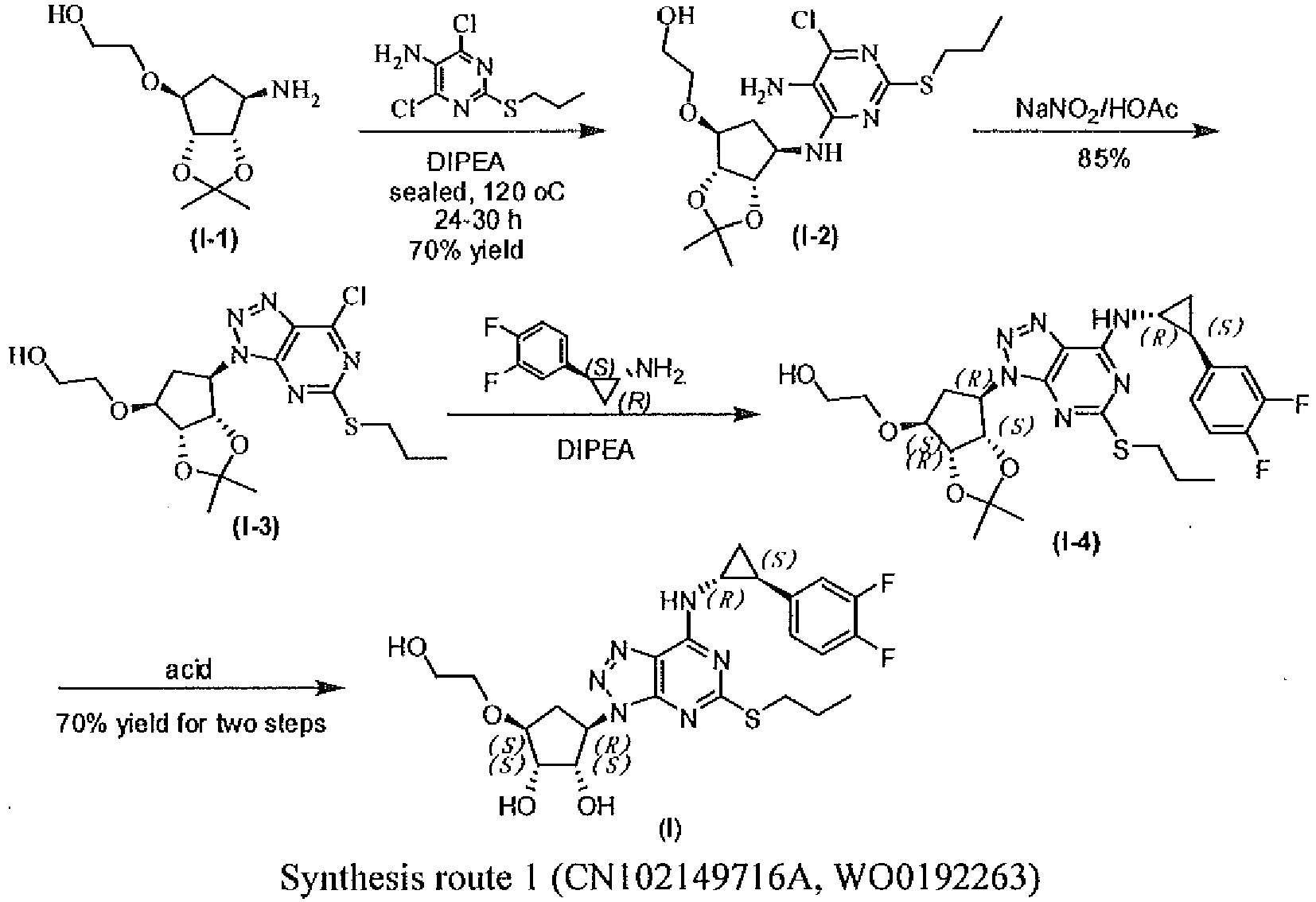
- According to the disclosure, the route of patent applications
CN102149716A andWO0192263 - Chinese patent application No.
CN102675321A discloses a synthesis route of preparing Ticagrelor, (I), comprising the steps of using 2-[[(3AR, 4S, 6R, 6AS)-6-aminotetrahydro-2,2-dimethyl-4H-cyclopenta[d]-1,3-dioxoialkenyl-4-yl]oxy]et hanol (II-1) protected by an alkoxy or a silyl reagent and 4,6-dichloro-2-propylthiopyrimidine-5-amine as the starting materials to prepare a key intermediate (II-2); ring closing of the intermediate (II-2) in the presence of an appropriate alkali metal nitrite to prepare an intermediate (II-3); reacting the intermediate (II-3) with an appropriate salt of (1R,2S)-REL-2-(3,4-difluorophenyl)cyclopropylamine; and finally removing the protecting group.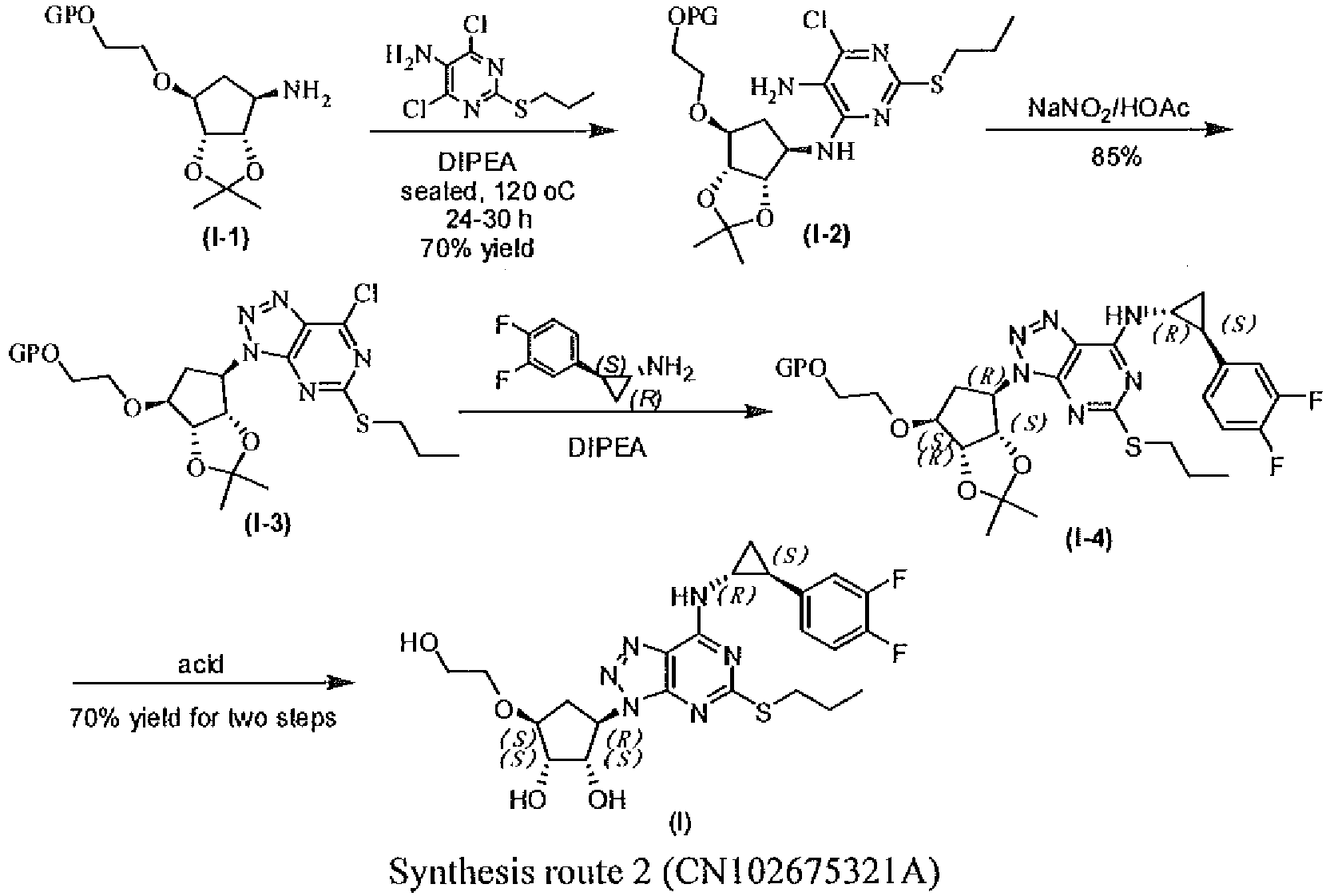
- The method has the same characteristics as those of the original research company's Patent Nos.
CN102149716A andWO0192263 - Patent No.
US6525060 discloses a synthesis route of preparing Ticagrelor (I), comprising the steps of reacting 4,6-dichloro-5-nitro-2-(propylthio)pyrimidine with (3AR, 4S, 6R, 6AS)-6-aminotetrahydro-2,2-dimethyl-4H-cyclopenta[d]-1,3-dioxolalkenyl-4-ol (III-1) to get an intermediate (III-2); reducing the intermediate (III-2) in an iron powder/acetic acid system; ring closing of the resulting product in the presence of a nitrite; and finally carrying out a series of reactions, including ammoniation, bromination and substitution reaction.
- The method has a prolonged route, wherein due to the strong electron-withdrawing effect of the nitro group, the chlorines on positions 4, 6 of 4,6-dichloro-5-nitro-2-(propylthio)pyrimidine are of high activity, and are readily reacted with the amino group and the hydroxyl group of the molecule of (III-1). The reaction system is typically complicated, and the resulting intermediate is difficult to purify. The entire route involves many reactions under harsh conditions, such as bromination, ammoniation and the application of butyl lithium reagent. In view of all of these, together with other disadvantages, it is clear that the route is not suitable for production.
- Patent application No.
CN102875537A discloses a synthesis route of preparing Ticagrelor of Formula (I), comprising the steps of that 4,6-dichloro-5-nitro-2-(propylthio)pyrimidine with a protected amino alcohol of Formula (IV-2) to get an intermediate of Formula (IV-3); reducing the nitro group of the intermediate (IV-3) under the catalyst of palladium-carbon to get an intermediate of Formula (IV-4); ring closing of the intermediate (IV-4) in the presence of a nitrite to get an intermediate of Formula (IV-5); reacting the intermediate (IV-5) with a chiral cyclopropylamine to get an intermediate of Formula (IV-6); reducing the intermediate (IV-6) by sodium borohydride under the catalyst of sodium bromide to get an intermediate of Formula (IV-7); and finally removing the propylidene protecting group under an acidic condition.
- The route has the similar problems as those of Patent No.
US6525060 , It is difficult to control the selectivity of the reaction in the first step; in addition, the intermediate of Formula (IV-2), an amino-acid ester, is naturally of poor stability due to severe intermolecular amino-ester exchange reaction, resulting in less industrial feasibility; moreover, during the hydrogenation of the intermediate of Formula (IV-3) under the catalyst of palladium-carbon, the chlorine atom on the pyrimidine ring tends to be removed by hydrogeneration, and the resulting contaminant is difficult to be removed completely, but finally brought to the product, resulting in high diffcult purification of the product, low yield and high cost. Accordingly, the route is not suitable for industrial production. - The international patent application No.
WO2012138981 discloses a synthesis route of preparing Ticagrelor of Formula (I), comprising the steps of starting from 4,6-dichloro-5-nitro-2-(propylthio)pyrimidine by a classic aromatic amine protection method to get 4,6-dichloro-2-(propylthio)-5-formamidopyrimidine (V-1); reacting V-1 with chiral amino acid of Formula (V-2) in the presence of an appropriate base to get an intermediate of Formula (V-3); removing the formyl group and the hydroxyl protecting group on the side chain of the intermediate (V-3) under an appropriate acidic condition to get an intermediate of Formula (V-4); reacting the intermediate (V-4) with an alkali metal nitrite to get an intermediate of Formula (V-5); reacting the intermediate (V-5) with a chiral cyclopropylamine to prepare an intermediate of Formula (V-6); and finally reducing the intermediate (V-6) by sodium borohydride.
- The route has an advantage of conciseness. The adoption of formyl group protection is able to activate the chlorine atom in the molecule of nitropyrimidine, thereby making a mild condition for the substitution reaction. However, the adoption of an acidic system to remove the formyl group in the subsequent process makes it inevitable to remove the propylidene protecting group on the side chain, resulting in great polarity of the subsequent intermediates, which is unfavorable to the purification of the intermediates. Moreover, the presence of several exposed hydroxyl groups reduces the stability of the intermediate (V-5), intermolecular autoreaction is easy to carry out, thereby making it difficult to purify the final product.
- On the basis of the analysis on the prior art of Ticagrelor synthesis, it is found that the electronic effect of substituent group at position 5 of the pyrimidine ring as the mother nucleus has a great influence on the leaving capability of the ortho halogen atom. When there is a nitro group with strong electron-withdrawing capability at position 5, the ortho halogen atom is readily substituted by a nucleophilic reagent, resulting in harsh reaction conditions (such as low-temperature, oxygen-free and anhydrous conditions), usually various byproducts and the difficult purification of the intermediates. On the contrary, when there is a free amino group at position 5, the strong electron donating effect of the amino group allows the leaving capability of the halogen atom on the pyrimidine ring to be passivated, resulting in the need of intensive conditions, such as high-temperature, high-pressure and long-time reaction to carry out the substitution reaction. Accordingly, it is necessary to select an appropriate amino protecting group and activate the leaving capability of the ortho halogen atom, thereby achieving mild conditions for the substitution reaction and easy purification of intermediates. By carefully screening of the amino protecting groups, it is found that when a trifluoroacetylation reagent is adopted to protect the amino group on the pyrimidine ring, not only the reaction for introducing trifluoroacetyl group is carried out under a mild condition (for example, when trifluoroacetic anhydride is adopted as the protecting reagent, it is able to get the protected intermediate quantitatively within 1 hour at room temperature), but also after trifluoroacetyl group is adopted to protect the amino group, the leaving capability of the ortho halogen atom is activated effectively, enabling the substitution reaction to carry out under mild conditions, for example, reaction temperature ranging from 30°C to 80°C, reaction time of 1 h to 5 h, no need of inert atmosphere protection for the reaction system and so on. Additionally, the inventor has also tried the method as mentioned in the international patent application No.
WO2012138981 , wherein formyl group is applied to protect the amino group. The experimental results showed that the reaction for selectively introducing the formyl group to the amino group on the pyrimidine ring should be carried out in the presence of greatly excessive anhydrous formic acid and acetic anhydride as the solvent system, the reaction time was long, and the resulting intermediate with the protected amino group was usually mixed with acetyl protected byproduct, resulting in difficult purification of the intermediate and typically in an around 70% yield. - In one aspect, the present disclosure provides a compound of Formula (VI):

- The compound of Formula (VI) can be easily used to prepare Ticagrelor.
- In another aspect, the present disclosure provides a preparation method for the compound of Formula (VI), comprising a step of reacting a compound of Formula (VIII) with a compound of Formula (VII) or a salt thereof:

- Specifically, with addition of an appropriate base, the compound (VIII) in a solvent is reacted with the compound (VII) or an appropriate salt thereof at 0-100°C to prepare the compound (VI). Said solvent is selected from the group consisting of methylbenzene, tetrahydrofuran, 2-methyltetrahydrofuran, dioxane, N,N-dimethyl formamide, N,N-dimethyl acetamide, acetonitrile, dichloromethane, trichloromethane, dichloroethane, dimethylbenzene, trimethylbenzene, methyl tertiary-butyl ether, cyclopentyl methyl ether and any combination thereof, preferably dioxane; said base is triethylamine, diisopropylethylamine (DIPEA), pyridine or 2,3,4-monoalkylated pyridine, preferably DIPEA; and the appropriate salt of said compound (VII) is L-tartrate, D-tartrate, L-dibenzoyl tartrate, D-dibenzoyl tartrate, L-mandelate, D-mandelate, oxalate, maleate or hippurate, preferably L-tartrate.
- In Formula (VI), when R is hydrogen, namely when the compound of Formula (VI) is specifically the compound of Formula (VI'), besides the direct preparation method mentioned above, it is available to apply the method mentioned above to prepare the compound of Formula (VI) with R being such hydroxyl protecting group, then remove the hydroxyl protecting group to get the compound of Formula (VI'):

- The compound of Formula (VIII) can be prepared according to the following method: a compound of Formula (IX) is reacted with a trifluoroacetylation reagent to get the compound of Formula (VIII):

- In the reaction mentioned above, said trifluoroacetylation reagent may be selected from the group consisting of trifluoroethyl acetate, trifluoroacetic anhydride, trifluoroacetoxy succinimide, (trifluoroacetyl)benzotriazole, pentafluorophenyl trifluoroacetate and 2-(trifluoroacetoxy)pyridine, preferably trifluoroacetic anhydride.
- In another aspect, the present disclosure provides a compound of Formula (VIII):
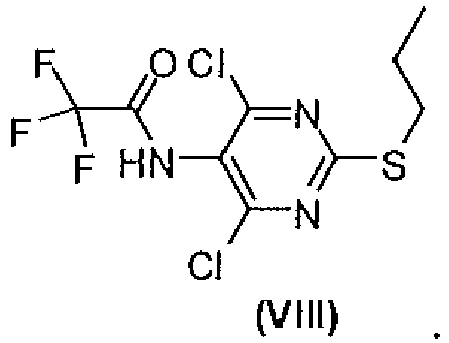
- In yet another aspect, the present disclosure provides a Ticagrelor preparation method, comprising the step of preparing the compound of Formula (VI) as mentioned above, and a further step of preparing Ticagrelor, from the compound of Formula (VI).
- The method of further preparing Ticagrelor from the compound of Formula (VI) comprises the following steps of: at first, reacting the compound (VI) with a base in water or an appropriate solvent at 0-150°C to prepare a compound (V), and then preparing Ticagrelor from the compound (V) according to a known method, for example, the method disclosed in Patent Application No.
CN102149716A .
- In a preferable embodiment, in the step of preparing the compound (V) from the compound (VI), said solvent is selected from the group consisting of water, C1-C8 lower fatty monohydric alcohol, C1-C8 lower fatty dihydric alcohol, methylbenzene, tetrahydrofuran, 2-methyltetrahydrofuran, dioxane, N,N-dimethyl formamide, N,N-dimethyl acetamide, acetonitrile, dichloromethane, trichloromethane, dichloroethane, dimethylbenzene, trimethylbenzene, methyl tertiary-butyl ether, cyclopentyl methyl ether and any combination thereof, preferably the mixture of ethanol and water; and said base is potassium carbonate, sodium carbonate, cesium carbonate, sodium bicarbonate, sodium phosphate, potassium phosphate, sodium hydroxide, potassium hydroxide, lithium hydroxide, calcium hydroxide or barium hydroxide, preferably potassium carbonate.
- In a preferable embodiment of the present disclosure, the entire route of the Ticagrelor preparation method of the present disclosure is as shown below:

- Preparation of compound (IV):
- In an appropriate acidic water, the compound (V) is reacted with an alkali metal nitrite at -10°C to 30°C to get the compound (IV).
Said acid is formic acid, acetic acid, diluted hydrochloric acid, diluted sulfuric acid, dilute phosphoric acid or any combination thereof, preferably acetic acid; and said alkali metal nitrite is sodium nitrite or potassium nitrite, preferably sodium nitrite. - Preparation of compound (II):
- With addition of an appropriate base, the compound (IV) in a solvent is reacted with (1R,2S)-2-(3,4-difluorophenyl)cyclopropylamine (III) to prepare the compound (II).
Said solvent is selected from the group consisting of C1-C8 lower fatty monohydric alcohol, C1-C8 lower fatty dihydric alcohol, methylbenzene, tetrahydrofuran, 2-methyltetrahydrofuran, dioxane, N,N-dimethyl formamide, N,N-dimethyl acetamide, acetonitrile, dichloromethane, trichloromethane, dichloroethane, dimethylbenzene, trimethylbenzene, methyl tertiary-butyl ether, cyclopentyl methyl ether and any combination thereof, preferably methylbenzene; and said base is triethylamine, diisopropylethylamine, pyridine, 2,3,4-monoalkylated pyridine, potassium carbonate, sodium carbonate, cesium carbonate, sodium bicarbonate, sodium phosphate and potassium phosphate, preferably triethylamine. - Preparation of compound (I) (Ticagrelor):
- In water or a solvent, and with addition of an appropriate acidic deprotecting reagent, the protecting group of the compound (II) is removed to prepare Ticagrelor (I);
- Said solvent is selected from the group consisting of methanol, ethanol, isopropanol, ethylene glycol, ethylene glycol monomethyl ether, ethylene glycol monobutyl ether, tetrahydrofuran, 2-methyltetrahydrofuran, dioxane, acetonitrile and any combination thereof; and the acidic deprotecting reagent is a certain concentration of hydrochloric acid or a certain concentration of trifluoroacetic acid, preferably hydrochloric acid.
- Wherein R is a hydroxyl protecting group, preferably selected from the group consisting of triethylsilyl, triisopropylsilyl, t-butyldimethylsilyl, t-butyldiphenylsilyl, methoxymethyl, tetrahydropyranyl and tetrahydrofuranyl.
- Besides the method mentioned above, the hydroxyl protecting group R can also be removed in advance, namely the hydroxyl protecting group is removed from the resulting compound (VI) to get the compound of Formula (VI'), which is then used to prepare Ticagrelor according to a similar method; alternatively, in the compound (VII), R is directly hydrogen, namely the compound (VII') is used as starting material to prepare the compound (VI'), and then Ticagrelor is prepared according to a similar method of the route mentioned above. The specific subsequent preparation method of Ticagrelor is described as below:

- The compound of said Formula (IV') is reacted with a base in a solvent; and said solvent is selected from the group consisting of methylbenzene, tetrahydrofuran, 2-methyltetrahydrofuran, dioxane, N,N-dimethyl formamide, N,N-dimethyl acetamide, dichloromethane, trichloromethane, dichloroethane, ethyl acetate, dimethylbenzene, trimethylbenzene, dimethyl ether, isopropyl ether, methyl tertiary-butyl ether, cyclopentyl methyl ether and any combination thereof.
- The compound of said Formula (IV') is reacted with an acid in a solvent; and said solvent is selected from a fatty alcohol with the number of carbon atoms less than 6, preferably methanol or ethanol.
- The synthesis method for the intermediate (VI) provided by the present disclosure is simple. The trifluoroacetyl group is adopted to realize quantitative selective protection for aminopyrimidine, so that the reactivity of the chlorine atom of aminopyrimidine is greatly enhanced. As a result, the compound (VIII) is able to react with a chiral amino alcohol having the protected hydroxyl group (VII) or an appropriate salt thereof under a very mild condition, thereby avoiding the defect that longtime reaction under high temperature is required in the existing method. The method is suitable for industrial large-scale production, with the results of reducing the energy consumption, decreasing environmental pollution and reducing the discharge of three wastes effectively.
- The "hydroxyl protecting groups" are known groups which are suitable to be used to protect the hydroxyl group within the technical field. See the hydroxyl protecting groups disclosed in "Protective Groups in Organic Synthesis", 5th Ed., T. W. Greene & P. G. M. Wuts. As an example, preferably, said hydroxyl protecting group may be a (C1-10 alkyl or aryl)3alkylsilyl group, for example, triethylsilyl, triisopropylsilyl, t-butyldimethylsilyl or t-butyldiphenylsilyl; may be a C1-10 alkyl or substituted alkyl group, for example, methyl, t-butyl, allyl, benzyl, methoxymethyl, ethoxyethyl or 2-tetrahydropyranyl (THP); may be a (C1-10 alkyl or aryl)acyl group, for example, formyl, acetyl or benzoyl; may be a (C1-6 alkyl or C6-10 aryl)sulfonyl group; or may also be a (C1-6 alkoxy or C6-10 aryloxy)carbonyl group.
- The present disclosure is described in detail with reference to the following specific embodiments so that the technicians in the art will understand the present disclosure in a more comprehensive manner. The specific embodiments are used only to illustrate the technical solution of the present disclosure, but not used to limit the scope of the present disclosure in any way.
-

- Method A: Compound (IX) (476.3 g, 2.0 mole) (IX was purchased from Shanghai Haoyuan Chemexpress Co., Ltd.) was dissolved in 4.0 L dichloromethane. Triethylamine (404 g, 4.0 mole) was added to the solution. The solution was cooled in ice water until a system internal temperature was below 10°C, and then trifluoroacetic anhydride (630 g, 3.0 mole) was slowly added dropwise to the solution. After trifluoroacetic anhydride was added completely, the solution was allowed to warm naturally to room temperature, and stirred for 1 hour. The reaction was monitored by HPLC. After the conversion of the raw material was complete, 2.0 L tap water was added to the reaction solution. The aqueous phase was extracted twice with 1.0 L dichloromethane, until there was no residual product in the aqueous phase. The organic phase was washed with 1.0 L saturated salt water, then dried for not less than 3 h, filtered and concentrated to get 645 g compound (VIII) in 96% yield. The resulting product was directly used in the next step.
- MS: m/z, (ESI): 335.2 [M+1]+
- 1H NMR (300 MHz, CDCl3) δ 3.10 (t, 2H, J = 4.8 Hz), 1.73 (m, 2H), 1.03 (t, 3H, J = 4.8 Hz);
-

- The L-tartrate of compound (VII-A) (662.3 g, 1.5 mole) (VII-A was purchased from Shanghai Haoyuan Chemexpress Co., Ltd.) and compound (VIII) (626.5 g, 1.75 mole) were dissolved in 12.5 L dioxane. Triethylamine (758 g, 7.5 mole) was added in batches. After triethylamine was completely added, the solution was heated to reflux for 12 h. The reaction was monitored by HPLC. After the reaction of compound (VII) was complete, most of the solvent was removed through concentration. 5 L deionized water was added to the reaction system under stirring to precipitate a pale yellow solid, and then it was filtered and dried to get 802 g compound (VI-A) in 85% yield.
- MS: m/z, (ESI): 629.2 [M+1]+
- 1H NMR (300 MHz, CDCl3) δ 7.10 (s, 1H), 6.19 (d, 1H, J = 6.0 Hz), 4.58 (t, 2H, J = 5.1 Hz), 4.48 (d, 1H, J = 3.9 Hz), 3.97 (d, 1H, J = 3.0 Hz), 3.75 (d, 2H, J = 3.0 Hz), 3.61-3.66 (m, 1H), 3.53-3.57 (m, 1H), 3.10-3.18 (m, 1H), 2.98-3.05 (m, 1H), 2.23-2.29 (m, 1H), 1.73-1.80 (m, 2H), 1.42 (s, 3H), 1.26 (s, 3H), 1.02-1.05 (t, 3H), 0.873 (s, 9H), 0.05 (s, 6H);
-

- Compound (VI-A) (500 g, 0.8 mole) was dissolved in 5.0 L ethanol. Solid potassium carbonate (220 g, 1.6 mole) was added to the solution in one batch. The solution was heated to reflux for 24 h. The reaction was monitored by HPLC. After the reaction was complete, ethanol was removed through concentration, and the residue was poured into 5 L deionized water. A large amount of pale yellow solid was precipitated from the system, and then it was filtered and dried under vacuum to get 405 g compound (V-A) in 95% yield.
-

- Compound (V-A) (400 g, 0.75 mole) was dissolved in 3.5 L glacial acetic acid. 600 mL deionized water was added to the solution. The solution was cooled in an ice-salt bath until a system internal temperature was below 10°C. 400 mL an aqueous solution of sodium nitrite (77.6 g, 1.13 mole) was slowly added dropwise to the reaction mixture. After sodium nitrite was added completely, the reaction mixture was allowed to warm naturally to room temperature. The reaction was monitored by HPLC. After the reaction was complete, solid potassium carbonate was added until the pH value of the solution was neural. The reaction solution was extracted twice with 3 L ethyl acetate. The organic phase was washed with saturated salt water, then dried and concentrated to get 367 g compound (IV-A) in 90% yield.
-

- Compound (IV-A) (350 g, 0.64 mole) and the oxalate of compound (III) (168.5 g, 0.65 mole) were dissolved in 2.0 L methylbenzene. Potassium carbonate (270 g, 1.95 mole) was added to the solution. The solution was stirred at room temperature for 24 h. The reaction was monitored by HPLC. After the reaction was complete, 500 mL deionized water was added to the system. The organic phase was washed with saturated salt water, then dried and concentrated to get 367 g compound (II-A) in 85% yield.
- Compound (II-A) (100 g, 0.15 mole) was dissolved in 3.0 L methanol. 1.0 L 3M hydrochloric acid solution was added to the reaction solution. The reaction solution was heated up to 30°C for 24 h. The reaction was monitored by HPLC. After the reaction was complete, most of the solvent was removed through concentration. 2.0 L ethyl acetate was added to the residual solution. The aqueous phase was separated, and then extracted with 1.0 L ethyl acetate. The organic phase was combined, and washed with saturated salt water. The washed organic phase was dried and concentrated to get 70.0 g crude product of compound (I) in 90% yield. The crude product was dissolved in 300 mL ethyl acetate, and heated up to 50°C. After the crude product was completely dissolved, 500 mL n-heptane was added to the solution. The solution was cooled down slowly to 20°C, and then filtered to get 60 g white solid purified product of compound (I) with a purity up to 99% and in 85% yield.
- [0061] MS: m/z, (ESI): 523.2 [M+1]
- 1H NMR (400 MHz, DMSO-d 6) δ 7.20-7.35 (m, 2H), 7.00-7.10 (m, 1H), 5.10 (d, 1H), 5.03 (d, 1H), 4.95 (dd, 1H), 4.50-4.60 (m, 2H), 3.90-4.00 (m, 1H), 3.75-3.85 (m, 1H), 3.45-3.55 (m, 4H), 3.10-3.20 (m, 1H), 2.75-3.00 (m, 2H), 2.55-2.70 (m, 1H), 2.10-2.20 (m, 1H), 1.95-2.05 (m, 1H), 1.65-1.75 (m, 0.5H), 1.30-1.60 (m, 4H), 1.20-1.30 (m, 0.5H), 0.81 (t, 3H).
-

- Method B: Compound (IX) (150 g, 0.6 mole) (IX was purchased from Shanghai Haoyuan Chemexpress Co., Ltd.) was dissolved in 1.0 L N,N-dimethyl formamide (DMF). Pyridine (69.3 g, 1.0 mole) was added to the solution. The solution was cooled in ice water until a system internal temperature was below 10°C. Pentafluorophenyl trifluoroacetate (184.5 g, 0.66 mole) was slowly added dropwise to the solution. After pentafluorophenyl trifluoroacetate was added completely, the solution was allowed to warm naturally to room temperature, and was stirred for 5 h. The reaction was monitored by HPLC. After the conversion of the raw material was complete, 2.0 L tap water was added to the reaction solution. The reaction solution was extracted twice with 1.0 L methyl tertiary-butyl ether. The organic phase was washed with 0.5 L saturated salt water, then dried for not less than 3 h, filtered and concentrated to get 186.2 g compound (VIII) in 93% yield. The resulting product was directly used in the next step.
-

- The L-tartrate of compound (VII-B) (200 g, 0.4 mole) (VII-B was purchased from Shanghai Haoyuan Chemexpress Co., Ltd.) and compound (VIII) (147 g, 0.44 mole) were dissolved in 3.5 L dioxane. Triethylamine (155.4 g, 1.4 mole) was added in batches. After triethylamine, was completely added, the solution was heated up to 80°C for 3 h. The reaction was monitored by HPLC. After the reaction of compound (VII) was complete, most of the solvent was removed through concentration. 1 L deionized water was added to the reaction system under stirring to precipitate a pale yellow solid, and then it was filtered and dried to get 196.2 g compound (VI-B) in 78% yield.
-

- Compound (VI-B) (100 g, 0.16 mole) was dissolved in 1.0 L methanol. Solid potassium carbonate (110 g, 0.8 mole) was added to the solution in one batch. The solution was heated to reflux for 24 h. The reaction was monitored by HPLC. After the reaction was complete, methanol was removed through concentration, and the residue was poured into 1 L deionized water. A large amount of pale yellow solid was precipitated from the system, and then it was filtered and dried under vacuum to get 72.4 g compound (V-B) in 85% yield.
-

- Compound (V-B) (50 g, 0.15 mole) was dissolved in 1.25 L glacial acetic acid. 600 mL deionized water was added to the solution. The solution was cooled in an ice-salt bath until a system internal temperature was below 10°C. 400 mL an aqueous solution of sodium nitrite (13.8 g, 0.2 mole) was slowly added dropwise to the reaction mixture. After sodium nitrite was added completely, the reaction mixture was allowed to warm naturally to room temperature. The reaction was monitored by HPLC. After the reaction was complete, solid potassium carbonate was added until the pH value of the solution was neural. The reaction solution was extracted twice with 1.5 L ethyl acetate. The organic phase was washed with saturated salt water, then dried and concentrated to get 63.6 g compound (IV-B) in 78% yield.
-

- Compound (IV-B) (54 g, 0.1 mole) and the hydrochloride of compound (III) (21 g, 0.105 mole) was dissolved in 1.0 L acetonitrile. Anhydrous sodium bicarbonate (32 g, 0.3 mole) was added to the solution, which was then stirred at room temperature for 16 h. The reaction was monitored by HPLC. After the reaction was complete, 500 mL deionized water was added to the system, and the system was extracted with 500 mL ethyl acetat. The organic phase was washed with saturated salt water, then dried and concentrated to get 57.5 g compound (II-B) in 85% yield.
- MS: m/z, (ESI): 677.91 [M+1]
-

- Compound (VI-A) (100 g, 0.16 mole) was dissolved in 1.0 L anhydrous methanol. Trifluoroacetic acid was added dropwise to the solution and the temperature was controlled below 50°C. After trifluoroacetic acid was added completely, the solution was stirred at room temperature for 24 h. The reaction was monitored by HPLC. After the reaction was complete, most of the solvent was removed through concentration, and 1 kg deionized water was added to the residual solution to precipitate a large amount of yellow solid, which was then filtered and dried under vacuum to get 73 g compound (V) in 96% yield.
- MS: m/z, (ESI): 475.91 [M+1]
-

- Compound (V) (50 g, 0.11 mole) was dissolved in 500 mL ethanol. Solid potassium carbonate (53 g, 0.385 mole) was added to the solution in one batch. The solution was heated to reflux for 24 h. The reaction was monitored by HPLC. After the reaction was complete, ethanol was removed through concentration, and the residue was poured into 1.0 L deionized water. Pale yellow solid was precipitated from the system, and then it was filtered and dried under vacuum to get 37 g compound (IV) in 90% yield.
- MS: m/z, (ESI): 379.87 [M+1]+
-

- Compound (IV) (50 g, 0.12 mole) was dissolved in 1.5 L glacial acetic acid. 600 mL deionized water was added to the solution. The solution was cooled in an ice-salt bath until a system internal temperature was below 10°C. 100 mL an aqueous solution of sodium nitrite (12.4 g, 0.18 mole) was slowly added dropwise to the reaction mixture. After sodium nitrite was added completely, the reaction mixture was allowed to warm naturally to room temperature. The reaction was monitored by HPLC. After the reaction was complete, solid potassium carbonate was added until the pH value of the solution was neural. The reaction solution was extracted twice with 3 L ethyl acetate. The organic phase was washed with saturated salt water, then dried and concentrated to get 44.5 g compound (III) in 95% yield.
- MS: m/z, (ESI): 390.87 [M+1]
-

- Compound (III) (40 g, 0.10 mole) and the hydrochloride of compound (II) (30.8 g, 0.15 mole) were dissolved in 1.0 L dry tetrahydrofuran. Potassium carbonate (42 g, 0.3 mole) was added to the solution. The solution was stirred at room temperature for 24 h. The reaction was monitored by HPLC. After the reaction was complete, 500 mL deionized water was added to the system. The organic phase was washed with saturated salt water, then dried and concentrated to get 46.5 g compound (I) in 89% yield. The crude product was dissolved in 150 mL ethyl acetate, and heated up to 50°C. After the product was completely dissolved, 300 mL n-heptane was added to the solution. The solution was cooled down slowly to 20°C, and then filtered to get 60 g purified white solid compound (I), namely Ticagrelor, with a purity up to 99% and in 95% yield.
- MS: m/z, (ESI): 523.2 [M+1]
- 1H NMR (400 MHz, DMSD-d 6) δ 7.20-7.35 (m, 2H), 7.00-7.10 (m, 1H), 5.10 (d, 1H), 5.03 (d, 1H), 4.95 (dd, 1H), 4.50-4.60 (m, 2H), 3.90-4.00 (m, 1H), 3.75-3.85 (m, 1H), 3.45-3.55 (m, 4H), 3.10-3.20 (m, 1H), 2.75-3.00 (m, 2H), 2.55-2.70 (m, 1H), 2.10-2.20 (m, 1H), 1.95-2.05 (m, 1H), 1.65-1.75 (m, 0.5H),1.30-1.60 (m, 4H), 1.20-1.30 (m, 0.5H), 0.81 (t, 3H).
- Since the present disclosure has been described based on the specific embodiments thereof, some modifications and equivalent variations that are apparent to those skilled in the art are also within the scope of the present disclosure.
Claims (21)
- A compound of Formula (VI),

- A preparation method for the compound of Formula (VI) according to claim 1, comprising a step of reacting a compound of Formula (VIII) with a compound of Formula (VII) or a salt thereof, wherein the salt of the compound of Formula (VII) is preferably L-tartrate, D-tartrate, L-dibenzoyl tartrate, D-dibenzoyl tartrate, L-mandelate, D-mandelate, oxalate, maleate or hippurate, and more preferably L-tartrate,

- The preparation method according to claim 2, characterized in that it further comprises a step of removing the hydroxyl protecting group from the compound of Formula (VI) in the presence of an acid to get a compound of Formula (VI'):

- The preparation method according to claim 2, characterized in that said reaction is carried out in the presence of a base; said base is preferably triethylamine, diisopropylethylamine, pyridine or 2,3,4-monoalkylated pyridine.
- The preparation method according to claim 2, characterized in that said reaction temperature ranges from 0°C to 100°C.
- The preparation method according to claim 2, characterized in that said reaction is carried out in a solvent; and said solvent is selected from the group consisting of methylbenzene, tetrahydrofuran, 2-methyltetrahydrofuran, dioxane, N,N-dimethyl formamide, N,N-dimethyl acetamide, acetonitrile, dichloromethane, trichloromethane, dichlocoethane, dimethylbenzene, trimethylbenzene, methyl tertiary-butyl ether, cyclopentyl methyl ether and any combination thereof.
- The preparation method according to claim 2, characterized in that it further comprises a step of reacting a compound of Formula (IX) with a trifluoroacetylation reagent to get the compound of Formula (VIII),

- The preparation method according to claim 7, characterized in that said reaction is carried out in the presence of a base; said base is preferably selected from the group consisting of triethylamine, diisopropylethylamine, pyridine, 2,3,4-monoalkylated pyridine, anhydrous potassium carbonate, anhydrous sodium carbonate, anhydrous sodium bicarbonate, anhydrous sodium phosphate and anhydrous potassium phosphate.
- The preparation method according to claim 7, characterized in that said reaction is carried out in a solvent; and said solvent is selected from the group consisting of methylbenzene, tetrahydrofuran, 2-methyltetrahydrofuran, dioxane, N,N-dimethyl formamide, N,N-dimethyl acetamide, dichloromethane, trichloromethane, dichloroethane, ethyl acetate, dimethylbenzene, trimethylbenzene, diethyl ether, isopropyl ether, methyl tertiary-butyl ether, cyclopentyl methyl ether and any combination thereof.
- A compound of Formula (VIII):

- A preparation method for Ticagrelor, characterized in that it comprises the step of preparing the compound of Formula (VI) according to any one of claims 2-9 and a step of preparing Ticagrelor from the compound of Formula (VI); wherein in Formula (VI), R is a hydroxyl protecting group; and said hydroxyl protecting group is preferably selected from the group consisting of trimethylsilyl, triethylsilyl, triisopropylsilyl, t-butyldimethylsilyl, t-butyldiphenylsilyl, methoxymethyl, tetrahydropyranyl and tetrahydrofuranyl.
- The preparation method according to claim 11, characterized in that said step of preparing Ticagrelor from the compound of Formula (VI) is multi-step, including a step of reacting the compound of Formula (VI) with a base to get a compound of Formula (V) and a further step of preparing Ticagrelor from the compound of Formula (V),

- The preparation method according to claim 12, wherein said base is selected from the group consisting of triethylamine, diisopropylethylamine, pyridine, 2,3,4-monoalkylated pyridine, anhydrous potassium carbonate, anhydrous sodium carbonate, anhydrous sodium bicarbonate, anhydrous sodium phosphate and anhydrous potassium phosphate.
- The preparation method according to claim 12, wherein said compound of Formula (VI) is reacted with the base in a solvent; and said solvent is selected from the group consisting of methylbenzene, tetrahydrofuran, 2-methyltetrahydrofuran, dioxane, N,N-dimethyl formamide, N,N-dimethyl acetamide, dichloromethane, trichloromethane, dichloroethane, ethyl acetate, dimethylbenzene, trimethylbenzene, diethyl ether, isopropyl ether, methyl tertiary-butyl ether, cyclopentyl methyl ether and any combination thereof.
- The preparation method according to claim 12, characterized in that said step of further preparing Ticagrelor from the compound of Formula (V) comprises the following steps:
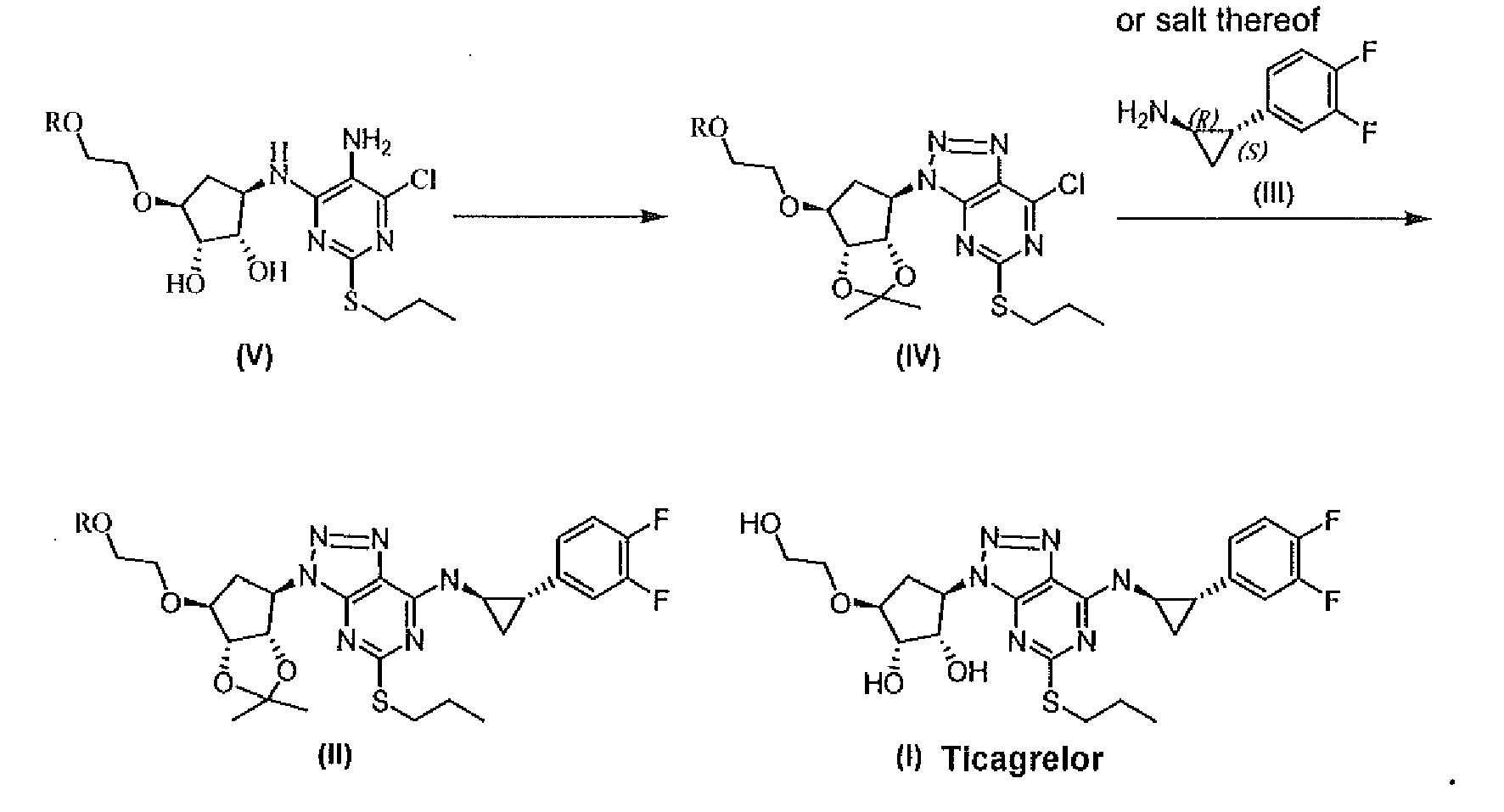
- A preparation method for Ticagrelor, characterized in that it comprises the step of preparing the compound of Formula (VI) according to any one of claims 2-9, or the step of preparing the compound of Formula (VI') according to claim 3, and the step of preparing Ticagrelor from the compound of Formula (VI'); wherein in the compound of Formula (VI), R is H.
- The preparation method according to claim 16, wherein said step of preparing Ticagrelor from the compound of Formula (VI') is multi-step, including a step of reacting the compound of Formula (VI') with a strong acid or a base to get the compound of Formula (IV'), and a further step of preparing Ticagrelor from the compound of Formula (IV'):
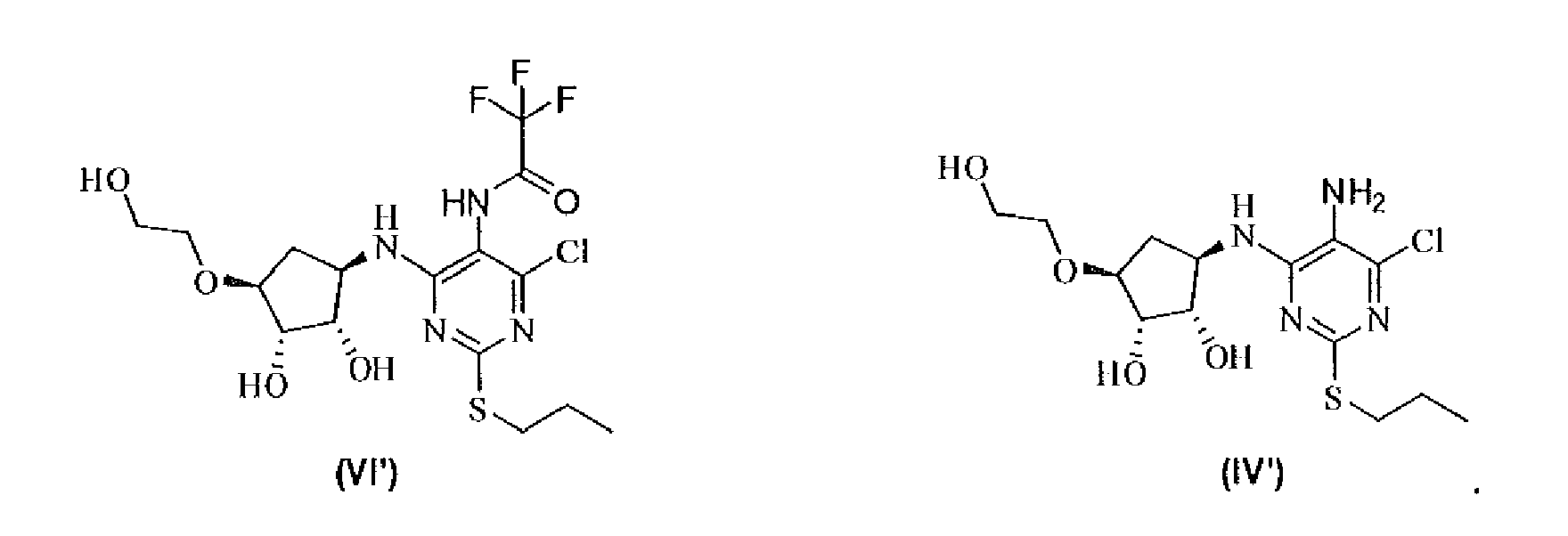
- The preparation method according to claim 17, wherein said strong acid is selected from the group consisting of hydrochloric acid, methanesulfonic acid, trifluoromethanesulfonic acid, trifluoroacetic acid and sulfuric acid; and said base is selected from the group consisting of triethylamine, diisopropylethylamine, pyridine, 2,3,4-monoalkylated pyridine, N-methylmorpholine, anhydrous potassium carbonate, anhydrous sodium carbonate, anhydrous sodium bicarbonate, anhydrous sodium phosphate, anhydrous potassium phosphate, sodium hydroxide and lithium hydroxide.
- The preparation method according to claim 17, wherein said compound of Formula (IV') is reacted with the base in a solvent; and said solvent is selected from the group consisting of methylbenzene, tetrahydrofuran, 2-methyltetrahydrofuran, dioxane, N,N-dimethyl formamide, N,N-dimethyl acetamide, dichloromethane, trichloromethane, dichloroethane, methyl acetate, dimethylbenzene, trimethylbenzene, diethyl ether, isopropyl ether, methyl tertiary-butyl ether, cyclopentyl methyl ether and any combination thereof.
- The preparation method according to claim 17, wherein said compound of Formula (IV') reacts with the strong acid in a solvent; and said solvent is selected from a fatty alcohol with the number of carbon atoms less than 6, preferably methanol or ethanol.
- The preparation method according to claim 17, wherein said further step of preparing Ticagrelor from the compound of Formula (IV') comprises the following steps:

Applications Claiming Priority (3)
| Application Number | Priority Date | Filing Date | Title |
|---|---|---|---|
| CN201310122613 | 2013-04-10 | ||
| CN201310383474.4A CN104098553B (en) | 2013-04-10 | 2013-08-28 | Intermediate of ticagrelor and preparation method thereof and preparation method of ticagrelor |
| PCT/CN2014/073388 WO2014166324A1 (en) | 2013-04-10 | 2014-03-13 | Midbody of ticagrelor and preparation method therefor, and preparation method for ticagrelor |
Publications (3)
| Publication Number | Publication Date |
|---|---|
| EP2985286A1 true EP2985286A1 (en) | 2016-02-17 |
| EP2985286A4 EP2985286A4 (en) | 2016-09-14 |
| EP2985286B1 EP2985286B1 (en) | 2017-10-11 |
Family
ID=51667139
Family Applications (1)
| Application Number | Title | Priority Date | Filing Date |
|---|---|---|---|
| EP14782391.8A Not-in-force EP2985286B1 (en) | 2013-04-10 | 2014-03-13 | Midbody of ticagrelor and preparation method therefor, and preparation method for ticagrelor |
Country Status (7)
| Country | Link |
|---|---|
| US (1) | US9359366B2 (en) |
| EP (1) | EP2985286B1 (en) |
| JP (1) | JP6332818B2 (en) |
| CN (2) | CN104098553B (en) |
| HK (1) | HK1202533A1 (en) |
| TW (1) | TWI634116B (en) |
| WO (1) | WO2014166324A1 (en) |
Families Citing this family (6)
| Publication number | Priority date | Publication date | Assignee | Title |
|---|---|---|---|---|
| TWI229674B (en) | 1998-12-04 | 2005-03-21 | Astra Pharma Prod | Novel triazolo[4,5-d]pyrimidine compounds, pharmaceutical composition containing the same, their process for preparation and uses |
| CZ2013866A3 (en) * | 2013-11-08 | 2015-05-20 | Zentiva, K.S. | Novel crystalline form of ticagrelor synthesis intermediate and process for preparing thereof |
| CN105801583A (en) * | 2014-12-31 | 2016-07-27 | 徐州万邦金桥制药有限公司 | Purification method of ticagrelor |
| CN105859720A (en) * | 2015-01-20 | 2016-08-17 | 上海方楠生物科技有限公司 | Method for preparing ticagrelor solution |
| CN105669681A (en) * | 2016-04-11 | 2016-06-15 | 成都华宇制药有限公司 | Synthesis method for ticagrelor |
| CN111848632A (en) * | 2020-09-07 | 2020-10-30 | 河南师范大学 | A kind of preparation method of platelet aggregation inhibitor ticagrelor |
Family Cites Families (17)
| Publication number | Priority date | Publication date | Assignee | Title |
|---|---|---|---|---|
| EP0577558A2 (en) * | 1992-07-01 | 1994-01-05 | Ciba-Geigy Ag | Carbocyclic nucleosides having bicyclic rings, oligonucleotides therefrom, process for their preparation, their use and intermediates |
| JP3398152B2 (en) * | 1993-10-12 | 2003-04-21 | ブリストル‐マイヤーズ・スクイブ・ファーマ・カンパニー | 1N-alkyl-N-arylpyrimidineamine and derivatives thereof |
| AR017014A1 (en) * | 1997-07-22 | 2001-08-22 | Astrazeneca Ab | TRIAZOL COMPOUNDS [4,5-D] PYRIMIDINE, PHARMACEUTICAL COMPOSITIONS, USE OF THE SAME TO PREPARE MEDICATIONS AND PROCESSES FOR THE PREPARATION OF SUCH COMPOUNDS |
| TWI229674B (en) * | 1998-12-04 | 2005-03-21 | Astra Pharma Prod | Novel triazolo[4,5-d]pyrimidine compounds, pharmaceutical composition containing the same, their process for preparation and uses |
| GB0013488D0 (en) * | 2000-06-02 | 2000-07-26 | Astrazeneca Ab | Chemical compound |
| GB0013407D0 (en) * | 2000-06-02 | 2000-07-26 | Astrazeneca Ab | Forms of a chemical compound |
| CN101148450A (en) * | 2007-11-02 | 2008-03-26 | 严红芳 | Preparation method of nucleoside compound |
| KR101669297B1 (en) * | 2008-09-09 | 2016-10-25 | 아스트라제네카 아베 | A process for preparing [1s-[1-alpha,2-alpha,3-beta(1s*,2r*),5-beta]]-3-[7-[2-(3,4-difluorophenyl)-cyclopropylamino]-5-(propylthio)-3h-1,2,3-triazolo[4,5-d]pyrimidin-3-yl]-5-(2-hydroxyethoxy)cyclopentane-1,2-diol and its intermediates |
| ES2605625T3 (en) | 2009-07-27 | 2017-03-15 | Auspex Pharmaceuticals, Inc. | P2Y12 receptor cyclopropyl modulators |
| CA2859743A1 (en) | 2010-12-20 | 2012-06-28 | Actavis Group Ptc Ehf | Novel processes for preparing triazolo[4,5-d]pyrimidine derivatives and intermediates thereof |
| US9056838B2 (en) * | 2011-04-06 | 2015-06-16 | Teva Pharmaceutical Industries Ltd. | Intermediates and processes for preparing Ticagrelor |
| HRP20180466T1 (en) * | 2011-10-27 | 2018-07-27 | Lek Pharmaceuticals D.D. | SYNTHESIS OF TRIAZOLOPYRIMIDINE COMPOUNDS |
| EP2794575B1 (en) * | 2011-12-23 | 2018-12-05 | LEK Pharmaceuticals d.d. | Synthesis of triazolopyrimidine compounds |
| US9233966B2 (en) * | 2012-04-05 | 2016-01-12 | Dr. Reddy's Laboratories Limited | Preparation of ticagrelor |
| CN102659815B (en) | 2012-05-04 | 2013-07-17 | 开原亨泰制药股份有限公司 | Method for preparing selective anticoagulant ticagrelor and intermediates thereof |
| CN102675321B (en) * | 2012-05-11 | 2014-12-10 | 上海皓元化学科技有限公司 | Preparation method of ticagrelor |
| CN102875537A (en) * | 2012-09-10 | 2013-01-16 | 常州制药厂有限公司 | Novel preparation method of antithrombosis medicine |
-
2013
- 2013-08-28 CN CN201310383474.4A patent/CN104098553B/en not_active Withdrawn - After Issue
- 2013-08-28 CN CN201710739212.5A patent/CN107573333B/en not_active Withdrawn - After Issue
-
2014
- 2014-03-13 EP EP14782391.8A patent/EP2985286B1/en not_active Not-in-force
- 2014-03-13 US US14/781,803 patent/US9359366B2/en not_active Expired - Fee Related
- 2014-03-13 WO PCT/CN2014/073388 patent/WO2014166324A1/en not_active Ceased
- 2014-03-13 JP JP2016506761A patent/JP6332818B2/en not_active Expired - Fee Related
- 2014-03-24 TW TW103110842A patent/TWI634116B/en not_active IP Right Cessation
-
2015
- 2015-03-24 HK HK15102985.6A patent/HK1202533A1/en unknown
Non-Patent Citations (2)
| Title |
|---|
| No further relevant documents disclosed * |
| See also references of WO2014166324A1 * |
Also Published As
| Publication number | Publication date |
|---|---|
| JP2016515635A (en) | 2016-05-30 |
| US9359366B2 (en) | 2016-06-07 |
| CN107573333B (en) | 2019-10-18 |
| EP2985286A4 (en) | 2016-09-14 |
| WO2014166324A1 (en) | 2014-10-16 |
| US20160052928A1 (en) | 2016-02-25 |
| JP6332818B2 (en) | 2018-05-30 |
| TW201439087A (en) | 2014-10-16 |
| CN104098553A (en) | 2014-10-15 |
| CN107573333A (en) | 2018-01-12 |
| TWI634116B (en) | 2018-09-01 |
| EP2985286B1 (en) | 2017-10-11 |
| CN104098553B (en) | 2017-11-28 |
| HK1202533A1 (en) | 2015-10-02 |
Similar Documents
| Publication | Publication Date | Title |
|---|---|---|
| EP2985286B1 (en) | Midbody of ticagrelor and preparation method therefor, and preparation method for ticagrelor | |
| KR101934096B1 (en) | Method for preparing idelalisib | |
| EP3398952B1 (en) | Synthesis process of ruxolitinib | |
| CA2861493A1 (en) | Methods and compounds useful in the synthesis of orexin-2 receptor antagonists | |
| ES2923278T3 (en) | Useful intermediates for the synthesis of aminopyrimidine derivatives, process for preparing the same and process for preparing aminopyrimidine derivatives using the same | |
| EP3152191B1 (en) | Improved process for making duocarmycin prodrugs | |
| RS64654B1 (en) | Process for preparing n-(5-((4-(4-((dimethylamino)methyl)-3-phenyl-1h-pyrazol-1-yl)pyrimidin-2-yl)amino)-4-methoxy-2-morpholinophenyl)acrylamide by reacting the corresponding amine with a 3-halo-propionyl chloride | |
| JP2021119142A (en) | Method for preparation of xanthine-based compound | |
| RS58428B1 (en) | Processes for the preparation of a diarylthiohydantoin compound | |
| WO2017163257A1 (en) | Process for preparing pure lh-pyrazolo[3,4-d] pyrimidine derivative | |
| EP3334735B1 (en) | Processes for preparing an fgfr inhibitor | |
| CN103980282A (en) | Method for synthesizing 3-oxo-pyrrol[2,3-b]indole compounds | |
| CN101107228A (en) | Method for producing (Z)-1-phenyl-1-(N,N-diethylaminocarbonyl)-2-phthalimidomethylcyclopropane | |
| Li et al. | A Concise Synthesis of (±)‐Yaequinolone A2 | |
| EP2674420A1 (en) | Method for producing aminophenyl pyrimidinyl alcohol derivative, and synthesis intermediate thereof | |
| CN113024471A (en) | Synthetic method of 4, 6-dichloro-2-propylmercapto-5-amino piperidine | |
| CN103562207B (en) | For preparing the preparation method of 2-amino-9-((2-phenyl-1,3-dioxane-5-base epoxide) methyl)-1H-purine-6 (9H) the-one compound of valganciclovir | |
| CN108623602A (en) | A method of prepare and purify and replaces Buddhist nun according to Shandong | |
| Feng et al. | First total synthesis of isoquinolinone alkaloid marinamide and its methyl ester | |
| EP1179532B1 (en) | Process for the production of indole derivatives and intermediates therefor | |
| KR101546713B1 (en) | Process for the preparation of pramipexole | |
| KR100563187B1 (en) | Process for preparing 7-substituted quinoline-5,8-dione derivatives | |
| CN102442947A (en) | Preparation method of Montelukast Sodium intermediate | |
| CN101215292A (en) | Synthetic method of dibenzyl biotin and its derivatives | |
| EP3498690A1 (en) | Method for preparing intermediate of 6-arylaminopyridonecarboxamide compound as mek inhibitor |
Legal Events
| Date | Code | Title | Description |
|---|---|---|---|
| PUAI | Public reference made under article 153(3) epc to a published international application that has entered the european phase |
Free format text: ORIGINAL CODE: 0009012 |
|
| 17P | Request for examination filed |
Effective date: 20151026 |
|
| AK | Designated contracting states |
Kind code of ref document: A1 Designated state(s): AL AT BE BG CH CY CZ DE DK EE ES FI FR GB GR HR HU IE IS IT LI LT LU LV MC MK MT NL NO PL PT RO RS SE SI SK SM TR |
|
| AX | Request for extension of the european patent |
Extension state: BA ME |
|
| DAX | Request for extension of the european patent (deleted) | ||
| A4 | Supplementary search report drawn up and despatched |
Effective date: 20160818 |
|
| RIC1 | Information provided on ipc code assigned before grant |
Ipc: C07D 405/12 20060101ALI20160811BHEP Ipc: C07D 239/47 20060101ALI20160811BHEP Ipc: C07D 487/04 20060101AFI20160811BHEP Ipc: C07D 317/44 20060101ALI20160811BHEP |
|
| GRAP | Despatch of communication of intention to grant a patent |
Free format text: ORIGINAL CODE: EPIDOSNIGR1 |
|
| INTG | Intention to grant announced |
Effective date: 20170512 |
|
| GRAS | Grant fee paid |
Free format text: ORIGINAL CODE: EPIDOSNIGR3 |
|
| GRAA | (expected) grant |
Free format text: ORIGINAL CODE: 0009210 |
|
| AK | Designated contracting states |
Kind code of ref document: B1 Designated state(s): AL AT BE BG CH CY CZ DE DK EE ES FI FR GB GR HR HU IE IS IT LI LT LU LV MC MK MT NL NO PL PT RO RS SE SI SK SM TR |
|
| REG | Reference to a national code |
Ref country code: GB Ref legal event code: FG4D |
|
| REG | Reference to a national code |
Ref country code: CH Ref legal event code: EP |
|
| REG | Reference to a national code |
Ref country code: IE Ref legal event code: FG4D |
|
| REG | Reference to a national code |
Ref country code: AT Ref legal event code: REF Ref document number: 935910 Country of ref document: AT Kind code of ref document: T Effective date: 20171115 |
|
| REG | Reference to a national code |
Ref country code: DE Ref legal event code: R096 Ref document number: 602014015743 Country of ref document: DE |
|
| REG | Reference to a national code |
Ref country code: NL Ref legal event code: MP Effective date: 20171011 |
|
| REG | Reference to a national code |
Ref country code: LT Ref legal event code: MG4D |
|
| REG | Reference to a national code |
Ref country code: AT Ref legal event code: MK05 Ref document number: 935910 Country of ref document: AT Kind code of ref document: T Effective date: 20171011 |
|
| PG25 | Lapsed in a contracting state [announced via postgrant information from national office to epo] |
Ref country code: NL Free format text: LAPSE BECAUSE OF FAILURE TO SUBMIT A TRANSLATION OF THE DESCRIPTION OR TO PAY THE FEE WITHIN THE PRESCRIBED TIME-LIMIT Effective date: 20171011 |
|
| PG25 | Lapsed in a contracting state [announced via postgrant information from national office to epo] |
Ref country code: SE Free format text: LAPSE BECAUSE OF FAILURE TO SUBMIT A TRANSLATION OF THE DESCRIPTION OR TO PAY THE FEE WITHIN THE PRESCRIBED TIME-LIMIT Effective date: 20171011 Ref country code: NO Free format text: LAPSE BECAUSE OF FAILURE TO SUBMIT A TRANSLATION OF THE DESCRIPTION OR TO PAY THE FEE WITHIN THE PRESCRIBED TIME-LIMIT Effective date: 20180111 Ref country code: LT Free format text: LAPSE BECAUSE OF FAILURE TO SUBMIT A TRANSLATION OF THE DESCRIPTION OR TO PAY THE FEE WITHIN THE PRESCRIBED TIME-LIMIT Effective date: 20171011 Ref country code: ES Free format text: LAPSE BECAUSE OF FAILURE TO SUBMIT A TRANSLATION OF THE DESCRIPTION OR TO PAY THE FEE WITHIN THE PRESCRIBED TIME-LIMIT Effective date: 20171011 Ref country code: FI Free format text: LAPSE BECAUSE OF FAILURE TO SUBMIT A TRANSLATION OF THE DESCRIPTION OR TO PAY THE FEE WITHIN THE PRESCRIBED TIME-LIMIT Effective date: 20171011 |
|
| PG25 | Lapsed in a contracting state [announced via postgrant information from national office to epo] |
Ref country code: RS Free format text: LAPSE BECAUSE OF FAILURE TO SUBMIT A TRANSLATION OF THE DESCRIPTION OR TO PAY THE FEE WITHIN THE PRESCRIBED TIME-LIMIT Effective date: 20171011 Ref country code: BG Free format text: LAPSE BECAUSE OF FAILURE TO SUBMIT A TRANSLATION OF THE DESCRIPTION OR TO PAY THE FEE WITHIN THE PRESCRIBED TIME-LIMIT Effective date: 20180111 Ref country code: AT Free format text: LAPSE BECAUSE OF FAILURE TO SUBMIT A TRANSLATION OF THE DESCRIPTION OR TO PAY THE FEE WITHIN THE PRESCRIBED TIME-LIMIT Effective date: 20171011 Ref country code: HR Free format text: LAPSE BECAUSE OF FAILURE TO SUBMIT A TRANSLATION OF THE DESCRIPTION OR TO PAY THE FEE WITHIN THE PRESCRIBED TIME-LIMIT Effective date: 20171011 Ref country code: IS Free format text: LAPSE BECAUSE OF FAILURE TO SUBMIT A TRANSLATION OF THE DESCRIPTION OR TO PAY THE FEE WITHIN THE PRESCRIBED TIME-LIMIT Effective date: 20180211 Ref country code: GR Free format text: LAPSE BECAUSE OF FAILURE TO SUBMIT A TRANSLATION OF THE DESCRIPTION OR TO PAY THE FEE WITHIN THE PRESCRIBED TIME-LIMIT Effective date: 20180112 Ref country code: LV Free format text: LAPSE BECAUSE OF FAILURE TO SUBMIT A TRANSLATION OF THE DESCRIPTION OR TO PAY THE FEE WITHIN THE PRESCRIBED TIME-LIMIT Effective date: 20171011 |
|
| REG | Reference to a national code |
Ref country code: DE Ref legal event code: R097 Ref document number: 602014015743 Country of ref document: DE |
|
| PG25 | Lapsed in a contracting state [announced via postgrant information from national office to epo] |
Ref country code: EE Free format text: LAPSE BECAUSE OF FAILURE TO SUBMIT A TRANSLATION OF THE DESCRIPTION OR TO PAY THE FEE WITHIN THE PRESCRIBED TIME-LIMIT Effective date: 20171011 Ref country code: DK Free format text: LAPSE BECAUSE OF FAILURE TO SUBMIT A TRANSLATION OF THE DESCRIPTION OR TO PAY THE FEE WITHIN THE PRESCRIBED TIME-LIMIT Effective date: 20171011 Ref country code: SK Free format text: LAPSE BECAUSE OF FAILURE TO SUBMIT A TRANSLATION OF THE DESCRIPTION OR TO PAY THE FEE WITHIN THE PRESCRIBED TIME-LIMIT Effective date: 20171011 Ref country code: CZ Free format text: LAPSE BECAUSE OF FAILURE TO SUBMIT A TRANSLATION OF THE DESCRIPTION OR TO PAY THE FEE WITHIN THE PRESCRIBED TIME-LIMIT Effective date: 20171011 |
|
| PLBE | No opposition filed within time limit |
Free format text: ORIGINAL CODE: 0009261 |
|
| STAA | Information on the status of an ep patent application or granted ep patent |
Free format text: STATUS: NO OPPOSITION FILED WITHIN TIME LIMIT |
|
| PG25 | Lapsed in a contracting state [announced via postgrant information from national office to epo] |
Ref country code: IT Free format text: LAPSE BECAUSE OF FAILURE TO SUBMIT A TRANSLATION OF THE DESCRIPTION OR TO PAY THE FEE WITHIN THE PRESCRIBED TIME-LIMIT Effective date: 20171011 Ref country code: SM Free format text: LAPSE BECAUSE OF FAILURE TO SUBMIT A TRANSLATION OF THE DESCRIPTION OR TO PAY THE FEE WITHIN THE PRESCRIBED TIME-LIMIT Effective date: 20171011 Ref country code: RO Free format text: LAPSE BECAUSE OF FAILURE TO SUBMIT A TRANSLATION OF THE DESCRIPTION OR TO PAY THE FEE WITHIN THE PRESCRIBED TIME-LIMIT Effective date: 20171011 Ref country code: PL Free format text: LAPSE BECAUSE OF FAILURE TO SUBMIT A TRANSLATION OF THE DESCRIPTION OR TO PAY THE FEE WITHIN THE PRESCRIBED TIME-LIMIT Effective date: 20171011 |
|
| 26N | No opposition filed |
Effective date: 20180712 |
|
| REG | Reference to a national code |
Ref country code: DE Ref legal event code: R119 Ref document number: 602014015743 Country of ref document: DE |
|
| REG | Reference to a national code |
Ref country code: CH Ref legal event code: PL |
|
| GBPC | Gb: european patent ceased through non-payment of renewal fee |
Effective date: 20180313 |
|
| PG25 | Lapsed in a contracting state [announced via postgrant information from national office to epo] |
Ref country code: MC Free format text: LAPSE BECAUSE OF FAILURE TO SUBMIT A TRANSLATION OF THE DESCRIPTION OR TO PAY THE FEE WITHIN THE PRESCRIBED TIME-LIMIT Effective date: 20171011 Ref country code: SI Free format text: LAPSE BECAUSE OF FAILURE TO SUBMIT A TRANSLATION OF THE DESCRIPTION OR TO PAY THE FEE WITHIN THE PRESCRIBED TIME-LIMIT Effective date: 20171011 |
|
| REG | Reference to a national code |
Ref country code: BE Ref legal event code: MM Effective date: 20180331 |
|
| REG | Reference to a national code |
Ref country code: IE Ref legal event code: MM4A |
|
| PG25 | Lapsed in a contracting state [announced via postgrant information from national office to epo] |
Ref country code: LU Free format text: LAPSE BECAUSE OF NON-PAYMENT OF DUE FEES Effective date: 20180313 |
|
| PG25 | Lapsed in a contracting state [announced via postgrant information from national office to epo] |
Ref country code: DE Free format text: LAPSE BECAUSE OF NON-PAYMENT OF DUE FEES Effective date: 20181002 Ref country code: IE Free format text: LAPSE BECAUSE OF NON-PAYMENT OF DUE FEES Effective date: 20180313 |
|
| PG25 | Lapsed in a contracting state [announced via postgrant information from national office to epo] |
Ref country code: GB Free format text: LAPSE BECAUSE OF NON-PAYMENT OF DUE FEES Effective date: 20180313 Ref country code: CH Free format text: LAPSE BECAUSE OF NON-PAYMENT OF DUE FEES Effective date: 20180331 Ref country code: LI Free format text: LAPSE BECAUSE OF NON-PAYMENT OF DUE FEES Effective date: 20180331 Ref country code: BE Free format text: LAPSE BECAUSE OF NON-PAYMENT OF DUE FEES Effective date: 20180331 |
|
| PG25 | Lapsed in a contracting state [announced via postgrant information from national office to epo] |
Ref country code: FR Free format text: LAPSE BECAUSE OF NON-PAYMENT OF DUE FEES Effective date: 20180331 |
|
| PG25 | Lapsed in a contracting state [announced via postgrant information from national office to epo] |
Ref country code: MT Free format text: LAPSE BECAUSE OF NON-PAYMENT OF DUE FEES Effective date: 20180313 |
|
| PG25 | Lapsed in a contracting state [announced via postgrant information from national office to epo] |
Ref country code: TR Free format text: LAPSE BECAUSE OF FAILURE TO SUBMIT A TRANSLATION OF THE DESCRIPTION OR TO PAY THE FEE WITHIN THE PRESCRIBED TIME-LIMIT Effective date: 20171011 |
|
| PG25 | Lapsed in a contracting state [announced via postgrant information from national office to epo] |
Ref country code: PT Free format text: LAPSE BECAUSE OF FAILURE TO SUBMIT A TRANSLATION OF THE DESCRIPTION OR TO PAY THE FEE WITHIN THE PRESCRIBED TIME-LIMIT Effective date: 20171011 |
|
| PG25 | Lapsed in a contracting state [announced via postgrant information from national office to epo] |
Ref country code: CY Free format text: LAPSE BECAUSE OF FAILURE TO SUBMIT A TRANSLATION OF THE DESCRIPTION OR TO PAY THE FEE WITHIN THE PRESCRIBED TIME-LIMIT Effective date: 20171011 Ref country code: HU Free format text: LAPSE BECAUSE OF FAILURE TO SUBMIT A TRANSLATION OF THE DESCRIPTION OR TO PAY THE FEE WITHIN THE PRESCRIBED TIME-LIMIT; INVALID AB INITIO Effective date: 20140313 Ref country code: MK Free format text: LAPSE BECAUSE OF NON-PAYMENT OF DUE FEES Effective date: 20171011 |
|
| PG25 | Lapsed in a contracting state [announced via postgrant information from national office to epo] |
Ref country code: AL Free format text: LAPSE BECAUSE OF FAILURE TO SUBMIT A TRANSLATION OF THE DESCRIPTION OR TO PAY THE FEE WITHIN THE PRESCRIBED TIME-LIMIT Effective date: 20171011 |