WO2012138981A2 - New intermediates and processes for preparing ticagrelor - Google Patents

New intermediates and processes for preparing ticagrelor Download PDF

Info

Publication number
WO2012138981A2
WO2012138981A2 PCT/US2012/032497 US2012032497W WO2012138981A2 WO 2012138981 A2 WO2012138981 A2 WO 2012138981A2 US 2012032497 W US2012032497 W US 2012032497W WO 2012138981 A2 WO2012138981 A2 WO 2012138981A2
Authority
WO
WIPO (PCT)
Prior art keywords
compound
alkyl
optionally substituted
formula
aryl
Prior art date
Legal status (The legal status is an assumption and is not a legal conclusion. Google has not performed a legal analysis and makes no representation as to the accuracy of the status listed.)
Ceased
Application number
PCT/US2012/032497
Other languages
French (fr)
Other versions
WO2012138981A3 (en
Inventor
Vinod Kumar Kansal
Dhirenkumar MISTRY
Sanjay Vasoya
Ghanshyam PANDEY
Amit Taneja
Pramod Kadappa SHINDEY
Current Assignee (The listed assignees may be inaccurate. Google has not performed a legal analysis and makes no representation or warranty as to the accuracy of the list.)
Teva Pharmaceutical Industries Ltd
Teva Pharmaceuticals USA Inc
Original Assignee
Teva Pharmaceutical Industries Ltd
Teva Pharmaceuticals USA Inc
Priority date (The priority date is an assumption and is not a legal conclusion. Google has not performed a legal analysis and makes no representation as to the accuracy of the date listed.)
Filing date
Publication date
Application filed by Teva Pharmaceutical Industries Ltd, Teva Pharmaceuticals USA Inc filed Critical Teva Pharmaceutical Industries Ltd
Priority to BR112013025680A priority Critical patent/BR112013025680A2/en
Priority to EP12723973.9A priority patent/EP2694514A2/en
Priority to CA2832570A priority patent/CA2832570A1/en
Priority to US14/009,788 priority patent/US9056838B2/en
Publication of WO2012138981A2 publication Critical patent/WO2012138981A2/en
Anticipated expiration legal-status Critical
Publication of WO2012138981A3 publication Critical patent/WO2012138981A3/en
Ceased legal-status Critical Current

Links

Classifications

    • CCHEMISTRY; METALLURGY
    • C07ORGANIC CHEMISTRY
    • C07DHETEROCYCLIC COMPOUNDS
    • C07D239/00Heterocyclic compounds containing 1,3-diazine or hydrogenated 1,3-diazine rings
    • C07D239/02Heterocyclic compounds containing 1,3-diazine or hydrogenated 1,3-diazine rings not condensed with other rings
    • C07D239/24Heterocyclic compounds containing 1,3-diazine or hydrogenated 1,3-diazine rings not condensed with other rings having three or more double bonds between ring members or between ring members and non-ring members
    • C07D239/28Heterocyclic compounds containing 1,3-diazine or hydrogenated 1,3-diazine rings not condensed with other rings having three or more double bonds between ring members or between ring members and non-ring members with hetero atoms or with carbon atoms having three bonds to hetero atoms with at the most one bond to halogen, directly attached to ring carbon atoms
    • C07D239/46Two or more oxygen, sulphur or nitrogen atoms
    • C07D239/47One nitrogen atom and one oxygen or sulfur atom, e.g. cytosine
    • BPERFORMING OPERATIONS; TRANSPORTING
    • B05SPRAYING OR ATOMISING IN GENERAL; APPLYING FLUENT MATERIALS TO SURFACES, IN GENERAL
    • B05BSPRAYING APPARATUS; ATOMISING APPARATUS; NOZZLES
    • B05B1/00Nozzles, spray heads or other outlets, with or without auxiliary devices such as valves, heating means
    • B05B1/14Nozzles, spray heads or other outlets, with or without auxiliary devices such as valves, heating means with multiple outlet openings; with strainers in or outside the outlet opening
    • B05B1/16Nozzles, spray heads or other outlets, with or without auxiliary devices such as valves, heating means with multiple outlet openings; with strainers in or outside the outlet opening having selectively- effective outlets
    • B05B1/1627Nozzles, spray heads or other outlets, with or without auxiliary devices such as valves, heating means with multiple outlet openings; with strainers in or outside the outlet opening having selectively- effective outlets with a selecting mechanism comprising a gate valve, a sliding valve or a cock
    • B05B1/1636Nozzles, spray heads or other outlets, with or without auxiliary devices such as valves, heating means with multiple outlet openings; with strainers in or outside the outlet opening having selectively- effective outlets with a selecting mechanism comprising a gate valve, a sliding valve or a cock by relative rotative movement of the valve elements
    • CCHEMISTRY; METALLURGY
    • C07ORGANIC CHEMISTRY
    • C07DHETEROCYCLIC COMPOUNDS
    • C07D239/00Heterocyclic compounds containing 1,3-diazine or hydrogenated 1,3-diazine rings
    • C07D239/02Heterocyclic compounds containing 1,3-diazine or hydrogenated 1,3-diazine rings not condensed with other rings
    • C07D239/24Heterocyclic compounds containing 1,3-diazine or hydrogenated 1,3-diazine rings not condensed with other rings having three or more double bonds between ring members or between ring members and non-ring members
    • C07D239/28Heterocyclic compounds containing 1,3-diazine or hydrogenated 1,3-diazine rings not condensed with other rings having three or more double bonds between ring members or between ring members and non-ring members with hetero atoms or with carbon atoms having three bonds to hetero atoms with at the most one bond to halogen, directly attached to ring carbon atoms
    • C07D239/46Two or more oxygen, sulphur or nitrogen atoms
    • C07D239/48Two nitrogen atoms
    • CCHEMISTRY; METALLURGY
    • C07ORGANIC CHEMISTRY
    • C07DHETEROCYCLIC COMPOUNDS
    • C07D405/00Heterocyclic compounds containing both one or more hetero rings having oxygen atoms as the only ring hetero atoms, and one or more rings having nitrogen as the only ring hetero atom
    • C07D405/02Heterocyclic compounds containing both one or more hetero rings having oxygen atoms as the only ring hetero atoms, and one or more rings having nitrogen as the only ring hetero atom containing two hetero rings
    • C07D405/12Heterocyclic compounds containing both one or more hetero rings having oxygen atoms as the only ring hetero atoms, and one or more rings having nitrogen as the only ring hetero atom containing two hetero rings linked by a chain containing hetero atoms as chain links
    • CCHEMISTRY; METALLURGY
    • C07ORGANIC CHEMISTRY
    • C07DHETEROCYCLIC COMPOUNDS
    • C07D487/00Heterocyclic compounds containing nitrogen atoms as the only ring hetero atoms in the condensed system, not provided for by groups C07D451/00 - C07D477/00
    • C07D487/02Heterocyclic compounds containing nitrogen atoms as the only ring hetero atoms in the condensed system, not provided for by groups C07D451/00 - C07D477/00 in which the condensed system contains two hetero rings
    • C07D487/04Ortho-condensed systems

Definitions

  • the invention encompasses improved processes for preparing Ticagrelor and new intermediates useful for manufacturing Ticagrelor.
  • Ticagrelor is currently marketed in Europe under the trade name BRILIQUE TI BRILIQUETM is purportedly a reversibly binding oral P2Y12 ADP receptor antagonist.
  • Ticagrelor can be obtained by a process as shown in the following scheme, as described in PCT Publication No. O00034283 :
  • This step has only about 40% conversion and produces a problematic triol byproduct, which can't be removed by crystallization because intermediate (12) is not a solid.
  • Another potential problem with this step is that the methyl 2-(trifluoiOmethylsulfonyloxy)acetate reagent used therein is not commercially available and must be prepared using a reagent such as triflic anhydride, which is both expensive and hazardous.
  • the final step of deprotection of the diol to produce Ticagrelor results in substantial racemization of the cyclopropyl amine.
  • the present invention provides improved processes for preparing Ticagrelor.
  • the invention also provides novel compounds. These compounds can be used as intermediates in the process for preparing Ticagrelor.
  • the present invention encompasses improved processes for the preparation of Ticagrelor.
  • acyl means a radical of the general formula -C(0)-R, wherein -R is hydrogen or hydrocarbyl.
  • R is alkyl
  • the acyl group may be, for example, acetyl (-C(0)CH 3 ), propionyl (-C(O)Et), benzoyl (-C(0)C 6 H 5 ), phenylacetyl (-C(0)CH 2 C 6 H 5 ).
  • alkoxy/aryloxycarbonyl means a radical of the general formula -OC(0)-R, wherein R is a hydrocarbyl group, such as a C1 alkyl or a C ⁇ -w aryl. or a C7 2 arylalkyl group for example carboethoxy (-C0 2 Et), carbomethoxy (-C0 2 Me) and benzyloxycarbonyl (-CO 2 BZ).
  • alkyl by itself or as part of another substituent means, unless otherwise stated, a straight, branched or cyclic chain hydrocarbon radical, including di- and multi-radicals, having the number of carbon atoms designated (i.e. Ci- means one to six carbons) and includes straight, branched chain or cyclic groups. Examples include: methyl, ethyl, propyl, isopropyl, butyl, isobutyl, tert-butyl, pentyl, neopentyl, hexyl, cyclohexyl and cyclopropylmethyl.
  • alkylene by itself or as part of another substituent means, unless otherwise stated, a divalent straight, branched or cyclic chain hydrocarbon radical.
  • alkoxy employed alone or in combination with other terms means, unless otherwise stated, an alkyl group having the designated number of carbon atoms, as defined above, connected to the rest of the molecule via an oxygen atom, such as, for example, methoxy, ethoxy, 1-propoxy, 2-propoxy (isopropoxy) and the higher homologs and isomers.
  • amine refers to radicals of the general formula -NRR', wherein R and R' are independently selected from hydrogen or a hydrocarbyl radical, or wherein R and R' combined form a heterocycle.
  • amino groups include: -NH 2 , methyl amino, diethyl amino, anilino, benzyl amino, piperidinyl, piperazinyl and indolinyl.
  • carbamyl means the group -C(0)NRR', wherein R and R 1 are independently selected from hydrogen or a hydrocarbyl radical, or wherein R and R' combined form a heterocycle.
  • Examples of carbamyl groups include: -C(0)NH2 and -C(0)N(CH 3 ) 2 .
  • cycloalkyl refers to rmg-containing alkyl radicals. Examples include cyclohexyl, cyclopentyl, cyclopropyl methyl and norbornyl
  • heteroalkyl by itself or in combination with another term means, unless otherwise stated, a stable straight or branched chain radical consisting of the stated number of carbon atoms and one or two heteroatoms selected from O, N, and S, and wherein the nitrogen and sulfur atoms may be optionally oxidized and the nitrogen heteroatom may be optionally quaternized.
  • the heteroatom(s) may be placed at any position of the heteroalkyl group, including between the rest of the heteroalkyl group and the fragment to which it is attached, as well as attached to the most distal carbon atom in the heteroalkyl group.
  • Examples include: -0-CH 2 -CH 2 -CH 3 , -CH 2 -CH 2 CH 2 -OH, -C3 ⁇ 4- CH2-NH-CH3, -CH 2 -S-CH 2 -CH 3 , and -CH 2 CH 2 -S(0)-CH 3 .
  • Up to two heteroatoms may be consecutive, such as, for example, -CH 2 -NH-OC3 ⁇ 4, or -CH 2 -CH 2 -S-S-C3 ⁇ 4.
  • halo or halogen by themselves or as part of another substituent mean, unless otherwise stated, a fluorine, chlorine, bromine, or iodine atom, preferably, fluorine, chlorine, or bromine.
  • aromatic refers to a carbocycle or heterocycle having one or more polyunsaturated rings having aromatic character (4n+2) delocalized ⁇ (pi) electrons).
  • aryl employed alone or in combination with other terms, means, unless otherwise stated, a carbocyclic aromatic system containing one or more rings (typically one, two or three rings) wherein such rings may be attached together in a pendent manner, such as, for example, a biphenyl, or may be fused, such as, for example, naphthalene. Examples include phenyl; anthracyl; and naphthyl.
  • aryl-(Ci-C3)alkyl means a radical wherein a C1-C3 alkylene chain is attached to an aryl group, e.g., -CH 2 CH2-phenyl.
  • substituted aryl-(Ci-C3)alkyl means an aryl-(Ci-C3)alkyl radical in which the aryl group is substituted.
  • heterocycle or “heterocyclyl” or “heterocyclic” by itself or as part of another substitiient means, unless otherwise stated, an unsubstituted or substituted, stable, mono- or multicyclic heterocyclic ring system which consists of carbon atoms and at least one heteroatom selected from N, O, and S, and wherein the nitrogen and sulfur heteroatoms may be optionally oxidized, and the nitrogen atom may be optionally quaternized.
  • the heterocyclic system may be attached, unless otherwise stated, at any heteroatom or carbon atom which affords a stable structure.
  • heteroaryl or “heteroaromatic” refers to a heterocycle having aromatic character.
  • a polycyclic heteroaryl may include one or more rings which are partially saturated. Examples include tetrahydroquinoline and 2,3-dmydrobenzofuryl.
  • non-aromatic heterocycles include monocyclic groups such as, for example: pyrrolidine, pyrroline, imidazoline, 2,3-dihydrofuran, 2,5-dihydrofi.iran, tetrahydrofuran, thiophane, piperidine, 1,2,3,6-tetrahydropyridine, 1,4-dihydropyridine, piperazine, morpholine, thiomorpholine, pyran, 2,3-dihydropyran, tetrahydropyran, 1,4- dioxane, 1,3-dioxane, homopiperazine, homopiperidine, 1,3-dioxepane, 4,7-dihydro-l,3- dioxepin and hexamethyleneoxide.
  • monocyclic groups such as, for example: pyrrolidine, pyrroline, imidazoline, 2,3-dihydrofuran, 2,5-dihydrofi.iran, t
  • heteroaryl groups mclude: Pyridyl, pyrazmyl, pyrimidinyl, particularly 2- and 4-pyrirmdinyl, pyridazinyl, thienyl, furyl, pyrrolyl, particularly 2- pyrrolyl, imidazolyl, thiazolyl, oxazolyl, pyrazolyl, particularly 3- and 5-pyrazolyl, isothiazolyl, 1,2,3-traizolyl, 1,2,4-triazolyl, 1,3,4-triazolyl, tetrazolyl, 1,2,3-thiadiazolyl, 1,2,3-oxadiazolyl, 1,3,4-thiadiazolyl and 1,3,4-oxadiazolyl.
  • polycyclic heterocycles include: Indolyl, particularly 3-, 4-, 5-, 6- and 7-indolyl, indolinyl, quinolyl, tetrahydroquinolyl, isoquinolyl, particularly 1- and 5- isoquinolyl, 1,2,3,4-tetrahydroisoquinolyl, cinnolinyl, quinoxalinyl, particularly 2- and 5- quinoxalinyl, quinazolinyl, phthalazinyl, 1,8-naphthyridinyl, 1,4-benzodioxanyl, coumarin, dihydrocoumarin, benzofuryl, particularly 3-, 4-, 1,5-naphthyridinyl, 5-, 6- and 7-benzofuryl, 2,3-dihydrobenzofiryl, 1,2-benzisoxazolyl, benzothienyl, particularly 3-, 4-, 5-, 6-and 7-benzothienyl, benzoxazolyl,
  • hydrocarbyl refers to any moiety comprising only hydrogen and carbon atoms.
  • Preferred hydrocarbyl groups are (Ci-Ci2)hydrocarbyl, e.g., (Ci-C7)hydro- carbyl such as, for example, benzyl and (Ci-Ce)alkyl.
  • substituted means that an atom or group of atoms has replaced hydrogen as the substituent attached to another group.
  • substituted refers to any level of substitution, namely mono-, di-, tri-, tetra-, or penta-substitution, where such substitution is permitted.
  • the substituents are independently selected, and substitution may be at any chemically accessible position.
  • the present invention provides a novel compound of the following formula:
  • X is a halogen atom
  • R 1 is -H, or -C1-C12 hydrocarbyl
  • R 2 and R 3 form, together with the oxygen atoms to which they are attached, a 5 to 10 membered heterocyclic ring, which heterocyclic ring is optionally substituted with 1, 2 or 3 substituents independently selected from a Ci straight-chain hydrocarbyl group, a C 3 . branched or cyclic hydrocarbyl group, and a carbocyclic ring A; wherein said carbocyclicring A is bonded to the 5 to 10 membered heterocyclic ring via:
  • carbocyclic ring A is optionally substituted by 1, 2 or three substituents independently selected from -Ci-Ce alkyl, such as, for example, methyl, ethyl, propyl, isopropyl, butyl, isobutyl, or t-butyl; -C6-C10 aryl, such as, for example, phenyl, tolyl or naphthyl and -Ce-Cio aryl-Ci-C3 alkyl, such as, for example, benzyl, 1-phenylethyl, 2- phenylethyl, or a or ⁇ naphthylmethyl.
  • -Ci-Ce alkyl such as, for example, methyl, ethyl, propyl, isopropyl, butyl, isobutyl, or t-butyl
  • -C6-C10 aryl such as, for example, phenyl, tolyl or naph
  • R 2 and R 3 can together with the oxygen atoms to which they are attached form a below:
  • R 4 and R 5 are independently selected from -H, -Cj-6 alkyl, and -Ce-io aryl; or R 4 and R 5 together with the carbon atom to which they are attached form a 5 to 6 membered spiro-fused carbocyclic ring, which is optionally substituted by 1, 2 or three substituents independently selected from -Ci-Ce alkyl, such as, for example, methyl, ethyl, propyl, isopropyl, butyl, isobutyl, or t-butyl; -Ce-Cio aryl, such as, for example, phenyl, tolyl or naphthyl and -Ce-Cio aryl-Ci-C3 alkyl, such as, for example, benzyl, 1-phenylethyl, 2- phenylethyl, or a or ⁇ naphthylmethyl.
  • R 2 and R 3 together with the atoms to which they are attached, form an alkylidene ring, such as, for example, a methylidene or isopropylidene ring, or an alkoxymethylidene ring such as, for example, ethoxymethylidene; each optionally substituted with 1, 2 or 3 substituents independently selected from -Ci-Cg alkyl or -C6-C 3 aryl.
  • R 2 and R 3 together can form an alkylidene group such as a methylidene or isopropylidene group, or an alkoxymethylidene group such as, for example, ethoxymethylidene; each optionally substituted with 1, 2 or 3 substituents independently selected from -Ci-Cs alkyl or -Ce-Cg aryl.
  • a spiro fused system formed by R 4 and R 5 can be, for example:
  • the two oxygen atoms are understood to correspond to the two oxygen atoms to which the R 2 and R 3 substkuents are attached.
  • R 1 is -H, a -C1-C6 alkyl group, such as, for example, methyl, ethyl, propyl, isopropyl, butyl, isobutyl, or t-butyl; a -Ce-Cio aryl group, such as, for example, phenyl, alpha naphthyl or beta naphthyl; or a -Cs-Cioar HCi- C2)alkyl, such as, for example, benzyl, phenylethyl or naphthylmethyl.
  • a -C1-C6 alkyl group such as, for example, methyl, ethyl, propyl, isopropyl, butyl, isobutyl, or t-butyl
  • a -Ce-Cio aryl group such as, for example, phenyl, alpha naphthyl or beta naphthyl
  • -C(O)OCH 2 (C 6 -C 10 )aryl such as -C(0)Obenzyl.
  • R 2 and R 3 are protecting groups
  • these groups can typically be added and removed using conventional protecting group methodology, for example, as described in "Protective Groups in Organic Chemistry,” edited by J W F McOmie, Plenum Press (1973), and “Protective Groups in Organic Synthesis", 2nd edition, T W Greene & P G M Wutz, Wiley-Interscience (1991).
  • the present invention provides the novel compounds, ethyl( 2-((3aR,4S,6R,6aS)-4-(6-cUoro-5-rn1ro-2-(propylmio)pyrimidin-4- ylamino)-tetrahydro-2,2-dimethyl-3aH-cyclopenta[d][l,3]dioxol-6-yloxy)acetate (Compound 7); ethyl (2-((lS,2S,3S,4R)-4-(6-cMoro-5-mtro-2-(propyltMo)pyrinudin-4-yl- ammo)-2,3-dihydroxycyclopentyloxy)acetate (Compound 7a); and ethyl 2- ((3aS,4R,6S,6aR)-4-(6-cMoro-5-mrro-2-(propyltMo)p
  • the present invention provides a novel compound 8 of the following formula:
  • X is a halogen atom
  • R 2 , and R 3 are defined as above.
  • the present invention provides the novel compounds, 2-( ⁇ 3aR, 4S, 6R, 6aS)-6- ⁇ [5-amino-6-cMoro-2-(propyltMo)-4-pyrimidinyl- amino ⁇ -2, 2-dhnethyltetrahydro-3aH-cyclopenta[d] [l,3]dioxol-4-yl)oxy]-l-acetic acid (Compound 8a); and 2-((3aR,4S,6R,6aS)-4-(5-amino-6-c oro-2-( ropyItluo)pyrinndin-4- ylammo)tetrahydro-3aH-spiro[cyclopenta[d][l,3]dioxole-2,l'-cyclopentane]-6- yloxy)acetic acid (Compound 8a'); shown in the structure diagrams below:
  • the present invention provides the novel compounds, 2-( ⁇ 3aR,4S,6R,6aS)-6-[7-chloro-5-(propyltbio)-3H-[l,2,3]triazolo[4,5- d]pyrimidin-3-yl]-2,2-dimemyltetrahydro-3aH-cyclopenta[d][l,3]dioxol-4-yl ⁇ oxy)-l- acetic acid (Compound 9a); and 2-((3aR,4S,6R, 6aS)-4-(7-chloro-5-(propylthio)-3H- [l,2,3]Mazolo[4,5-d]pyrirmdin-3-yl)tetr ⁇
  • the present invention provides an isolated compound and its salts, having the following formula:
  • R 1 , R 2 and R 3 are as defined as above.
  • the present invention provides isolated compounds ethyl 2-((3aR,4S,6R,6aS)-6-ammo-2,2-dimethyltetrahydro-3aH-cyclo- penta[d][l,3]dioxol-4-yloxy)acetate and ethyl 2 (3aR,4S,6R,6aS) ⁇ -aminotetrahydro- 3aH-spiro[cyclopenta[d][l,3]dioxole-2,l'-cyclopentane]-6-yloxy)acetate having the following two formulae:
  • e invention provides a novel compounds, having the follo
  • R 1 is as
  • the present invention provides the novel compounds, emyl (2-((lS,2S,3S,4R)-4-(7 Moro-5-( ropylthio)-3H-[l,2,3]triazolo[4,5- d]pyrimidin-3-yl)-2,3-dihydroxycyclopentyloxy)acetate (Compound 9b); and ethyl 2-
  • the present invention provides a novel compounds, having the fo
  • R 1 is defined as above.
  • the present invention provides the novel compounds, ethyl[3aR-[3aa,4a,6a(lR*,2S*),6aa]]-[[6-[7-[[2-(3,4-difluorophenyl)cyclo- propyl]ammo]-5-( ropylttoo)-3H-l,2,3-lria
  • the present invention encompasses a process for preparing Ticagrelor by preparing any one of the above mentioned compounds and further converting it to Ticagrelor, for example according to the process described below.
  • the present invention provides improved processes for preparing Ticagrelor, according to the following Schemes.
  • Ticagrelor can be obtained by a process as shown in Schemes 2 and 2a above.
  • the process is high yielding and several core intermediates, e.g., intermediates 8a, 9a and 10a are solid materials that are readily purified on commercially useful scales.
  • the invention provides novel compounds of Formula 8 a':
  • R 1 is as described above;
  • X is a leaving group that can be removed or substituted by conventional methods; and
  • R 2 and R 3 are as defined above.
  • the leaving group X is selected, for example, from halogens, such as, for example, -CI, -Br and -I.
  • the invention also provides compounds according to Formulae 9a and 9a':
  • the present invention provides the novel compounds, ethyl 2-((3aR,4S,6R,6aS)-6-(5-ammo-6-cMoro-2-(propylt o)pyrmiidm-4- ylamino)-2,2-dimethyltetrahydro-3aH-cyclopenta[d][l,3]dioxol-4-yloxy)acetate:
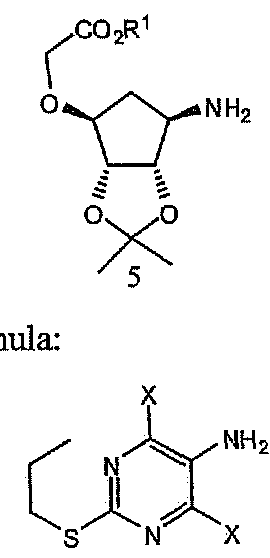
  • the invention provides a process of preparing Ticagrelor, said process comprising coupling the compound according to Formula 5 :
  • X is a leaving group, for example, 4,6-dicliloro-2-(propylthio)pyrimidin-5- amine, to form a compound of Formula 8a, as described above; wherein R 1 is as described above; and X is a leaving group;
  • ester compound 1 la ethyl 2- ((lS s 2S,3S,4R)-4-(7 (lR,2S)-2 3,4-difluorophenyl)cyclopropylammo)-5-(propylthio)- 3H-[l,2,3]triazolo[4,5-d]pyrimidin-3-yl)-2,3-dihydroxycyclopentyloxy)acetate:
  • the step of hydrolyzing a Formula XVb ester compound to a Formula 8a acid compound may be carried out using a suitable base, and is preferably carried out in a suitable solvent.
  • Suitable base can be alkali metal hydroxide or carbonates or bicarbonates
  • Suitable solvents include polar solvents, such as, for example Ci-Ce alcohols, e.g., methanol, ethanol, propanol and isopropanol, acetonitrile, tetrahydrofuran, NMP, mixtures of these solvents, and mixtures thereof with water.
  • the step of diazotizing the Formula 8a acid can be carried out, for example, by reacting the Formula 8a acid with a suitable diazotizing agent, preferably, in the presence of a suitable solvent.
  • suitable diazotizing agents include, for example sodium nitrite and isoamyl nitrite.
  • Suitable solvents for carrying out this reaction include polar organic solvents such as, for example, methanol, ethanol, or acetonitrile, mixtures thereof, and mixtures thereof with water and water alone.
  • the step of coupling the Formula 9a with (lR,2S)-2-(3,4-difluorophenyl)cyclo- propanamine can be carried out, for example, by reacting the two compounds in the presence of a suitable base, preferably in the presence of a suitable solvent.
  • suitable bases include organic bases, such as triethyl amine and diisopropyl ethyl amine and inorganic bases, such as, for example sodium bicarbonate, sodium carbonate, potassium bicarbonate and potassium carbonate.
  • Suitable solvents include solvents that are inert to the reaction conditions and in which the reagents are soluble.
  • the reaction can be carried out in a single phase in solvents including halogenated solvents such as, for example, dichloromethane or dichloroethane, ethers such as t-butylmethyl ether or THF, and other suitably inert organic solvents.
  • halogenated solvents such as, for example, dichloromethane or dichloroethane
  • ethers such as t-butylmethyl ether or THF
  • other suitably inert organic solvents e.g., a two-phase reaction, i.e., with water and a suitable organic solvent such as toluene or THF.
  • dimethyltetrahydro-3aH-cyclopenta[d][l,3]dioxol-4-yloxy)acetic acid (10a) to Ticagrelor can be carried out by a reaction with a suitable reducing agent.
  • suitable reducing agents include hydride reagents, for example LAH, NaBH 4 -BF 3 .OEt 2 or Redal; diborane or SmL, followed by deprotecting the acetonide in acidic conditions.
  • 10a is deprotected in acidic conditions to give the compoimd 11a, followed by the reduction of acid group using suitable reducing agents include, hydride reagents, for example LAH, NaBH 4 -BF 3 .OEt 2 or Redal; diborane or Sml 2 .
  • suitable reducing agents include, hydride reagents, for example LAH, NaBH 4 -BF 3 .OEt 2 or Redal; diborane or Sml 2 .
  • the present invention also provides the following process for preparation Ticagrelor, represented by two following reaction schemes 5a, 5b and 6:
  • Ticagrelor can be obtained by a process as shown in the above Schemes 5 A, 5B and 6; wherein R 1 is as described above
  • intermediates III/IIIa, IV/IVa, V/Va, IX/IXa, X/Xa, and XII XIIa are solid materials that are readily purified on commercially useful scales.
  • One significant advantage of the above process is observed in the coupling of intermediates Vl/VIa and IX/IXa to form intermediate X/Xa. In the above process, this step produces no dimer byproduct (resulting from couplmg of both aromatic chloro groups). This reaction can be accomplished in as little as 2-3 hrs.
  • the above process carries out the final coupling with (lR)-2-(3,4- chfluorophenyl)cyclopropanamine on the unprotected diol intermediate XII/XIIa.
  • This synthesis step is thus not subject to the significant amounts of isomerization of the cyclopropyl amine optical center that is a known problem associated with some other synthesis routes.
  • this process does not require any column chromatographic purification steps.
  • the invention provides novel compounds of formula (IX):
  • X is a leaving group that can be removed or substituted by conventional methods.
  • the leaving group X is selected, for example, from halogens, such as, for example, -CI, -Br and -I.
  • R a is -H and R b is an amino protecting group.
  • the amino protecting group may be selected from, for example, carboaryloxy (benzyloxy), p- alkoxybenzyloxy carbonyl , tert-butyloxycarbonyl , 9-fluorenylmethylcarbonyl, alkanoyl, such as, for example, Ci-Ce alkanoyl, benzoyl, a carbamate group, and sulfonamide groups.
  • the amino protecting group is selected from -C(0)OCi-C6 alkyl, such as, for example, carboethoxy, carbomethoxy and t-butoxy- carbonyl; optionally substituted - (0) aryl, such as, for example, benzyloxy- carbonyl and p-methoxybenzyloxycarbonyl; optionally substituted aryl(Ci- C3)alk L such as, for example, benzyl, phenethyl, p-methoxybenzyl, 2,3-dimethoxy- benzyl, 2,4-dimethoxybenzyl and 9-fluorenylmethyl; optionally substituted -C7 arylcarbonyl, such as, for example, benzoyl; -Ci-Q alkanoyl, such as, for example, formyl, acetyl, and propionyl; -C Ce alkylsulfonyl, such as, for example, mesyl
  • phenylsulfonyl such as, for example, benzenesulfonyl, toluenesulfonyl (tosyl) and 3-nitrobenzenesulfonyl; -Si(Ci-C6 alkyl such as, for example, iert-butyldimetliylsilyl; -C1-C6 alkylcarbamoyl, such as, for example, dimethylcarbamoyl; and optionally substituted -C7-C10 arylalkyl carbamoyl, such as, for example, benzyl carbamoyl.
  • phenylsulfonyl such as, for example, benzenesulfonyl, toluenesulfonyl (tosyl) and 3-nitrobenzenesulfonyl
  • -Si(Ci-C6 alkyl such as, for example, iert-butyldimetl
  • suitable amino protecting groups include tosyl, formyl, p- methoxybenzyl, acetyl, 3,4-dimethoxybenzyl, and p-methoxyphenyl.
  • benzyloxycarbonyl examples include benzyloxycarbonyl, benzyl, 2,4-dimethoxybenzyl, mesyl, tert-butyloxycarbonyl , 9-fluorenylmethyl, carboethoxy, and carbomethoxy.
  • R a is -H
  • R b is an amino protecting group as defined above.
  • R a is -H
  • R b is -C(0)H, acetyl, propionyl, benzoyl, carbobenzyloxy, carbomethoxy, carboethoxy, or t-Boc.
  • is a -C1-C6 alkyl group. According to some embodiments R° is methyl, ethyl, propyl or isopropyl. According to some embodiments R c is propyl.
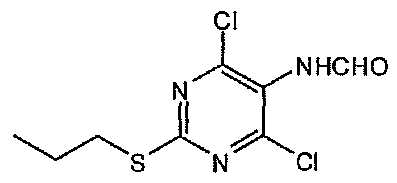
  • the present invention provides the novel compound, N-(4,6-dicUoro-2-(propylt o)p rirmdui-5-yl)formamide, having the following structure;
  • the present invention provides novel compounds of formula (X):
  • R 2 and R 3 have also been defined supra.
  • R 2 and R 3 form, together with the oxygen atoms to which they are attached, a hetero below:
  • R 2 and R 3 together can form an alkylidene group such as a metbylidene or isopropylidene group, or an alkoxymethylidene group such as, for example, ethoxymethylidene; each optionally substituted with 1, 2 or 3 substituents independently selected from -CrCg alkyl or -C6-Cs aryl.
  • R 2 and R 3 can, together with the oxygen atoms to which they are attached, form a hetero below:
  • R 4 and R 5 are independently selected from -H, -Ci-6 alkyl, and -Ce-w aryl; or R 4 and R 5 together with the carbon atom to which they are attached form a 5 to 6 membered spiro-fused carbocyclic ring, which is optionally substituted by 1, 2 or three substituents independently selected from -C1-C6 alkyl, such as, for example, methyl, ethyl, propyl, isopropyl, butyl, isobutyl, or t-butyl; -Ci-Cio aryl, such as, for example, phenyl, tolyl or naphthyl and -Cg-Cio aryl-Ci-C3 alkyl, such as, for example, benzyl, 1-phenylethyl, 2- phenylethyl, or a or ⁇ naphthylmethyl.
  • R 1 is -H, a -Ci-Ce alkyl group, such as, for example, methyl, ethyl, propyl, isopropyl, butyl, isobutyl, or t-butyl; a -Ce-Cio aryl group, such as, for example, phenyl, alpha naphthyl or beta naphthyl; or a -C6-Cioaryl-(Ci- C2)alkyl, such as, for example, benzyl, phenylethyl or naphthylmethyl.
  • one or both of R 2 and R 3 are protecting groups selected from -Si(C,.
  • -C(0)OCH 2 (C 6 -Cio)aryl such as -C(0)Obenzyl.
  • the spiro system can be, for example:
  • the two oxygen atoms are understood to correspond to the two oxygen atoms to which the R 2 and R 3 substituents are attached.
  • the present invention provides a novel compound, N-(4- cmoro-6-(((3aS,4R,6S,6aR)-6-(2-hydroxyethoxy)-2,2-dmiemyl tetrahydro-3aH-cyclo- penta[d][l,3]dioxol-4-yl)amino)-2-(propylthio) pyrirnidin-5-yl) formamide, having the following structure:
  • the present invention provides novel compounds of Formula XI wherein X is as defined above; such as, for example, (lS,2S,3R,5S)-3-((5-ammo-6-chloro-2-(propylthio)- pyrimidm-4-yl)amino)-5-(2-hydroxyethoxy)cyclopentane-l,2-diol; as shown below:
  • the present invention provides a novel compound, (1S,2S,3R, 5S)-3-(7-chloro-5-(propylsulfanyl-triazolo) [4,5-d]pyrimidin-3-yl) -5 -(2- hydroxyethoxy)cyclopentane-l,2-diol (XII-A) Via (lS,2S,3S,5R)-3-(2-hydroxyethoxy)-5- (5-aimno-6-c oro-2-( ropy iio)pyrirnidin-4-ylamino) cyclopentane-l,2-diol, having the following structure:
  • the invention provides a process of preparing process of preparing a compound according to Formula I:
  • R c is a -Ci-Cs allcyl group, said process comprising coupling a compound according to Formula VI:
  • the invention thus provides a process of preparing Ticagrelor, said process comprising said process comprising coupling a compound of Formula VI:
  • the invention provides a process of preparing Ticagrelor, said process comprising coupling the compound 2-((3aR,4S,6R,6aS)-6-amino- 2,2-dimethyltetrahydro-3aH-cyclopenta[d][l,3]dioxol-4-yloxy)ethanol (Formula VI-A):
  • the step of coupling a Formula VI compound with a Formula ⁇ (or formula IX 1 ) compound can be carried out, for example, by reacting the compounds, preferably, in the presence of base and in a suitable solvent.
  • Suitable bases include organic bases such as, for example, triethyl amine, and diisopropylemylamine, and also inorganic bases, such as, for example, sodium bicarbonate and potassium bicarbonate.
  • Suitable solvents include any solvent in which the reactants dissolve and are stable.
  • Preferred solvents include polar organic solvents such as Ci-Ce alcohols such as methanol, ethanol and propanol, ethers such as t- butylmethyl ether and tetrahydrofuran, glycol solvents such as propylene glycol, polar aprotic solvents such as dimethylformamide and N-methylpyrrolidinone, mixtures of these solvents and mixtures thereof with water.
  • polar organic solvents such as Ci-Ce alcohols such as methanol, ethanol and propanol
  • ethers such as t- butylmethyl ether and tetrahydrofuran
  • glycol solvents such as propylene glycol
  • polar aprotic solvents such as dimethylformamide and N-methylpyrrolidinone
  • the conversion of a compound of Formula X to a compound of Formula I, or of, a compound of Formula X a or Formula X-A to Ticagrelor can comprise: removing the N- protecting group represented by R a and R b , and in some embodiments by only R b ;
  • the step of removing the N-protecting group can be carried out, for example, by hydrolysis.
  • the hydrolysis reaction may be carried out using a suitable acid reagent and is preferably carried out in a suitable solvent.
  • Suitable acid reagents include, for example mineral acids, such as hydrochloric acid, sulfuric acid and methanesulfonic acid, and organic acids such as trifluoroacetic acid.
  • Suitable solvents include polar solvents, such as, for example Ci-Cs alcohols, e.g. , methanol, ethanol, propanol and isopropanol, aceto- nitrile, tetrahydrofuran, dioxane, mixtures of these solvents, and mixtures thereof with water.
  • the O-protect groups R 2 and R 3 may be removed under the same conditions and in the same reaction step as is employed to remove the N-protecting group.
  • the step of diazotizmg the intermediate of Formula XI or XI- A to produce the intermediate of Formula XII (or Xlla) can be carried out, for example, by reacting the Formula XI or XIa compound with a suitable diazotizing agent, preferably, in the presence of a suitable solvent.
  • suitable diazotizing agents include, for example sodium nitrite and isoamyl nitrite.
  • Suitable solvents for carrying out this reaction include polar organic solvents such as, for example, methanol, ethanol, or acetonitrile, mixtures thereof, and mixtures thereof with water.
  • the diazotization reaction can be carried out directly on the hydrolysis reaction mixture used to remove the N- protecting group to prepare the Formula XI (or XIa) compound.
  • the step of coupling the Formula XII (or Xlla) triazolopyrimidine compound with the compound of Formula XIII ((lR,2S)-2-(3,4-difluorophenyl)cyclopropanamine) can be carried out, for example, by reacting the two compounds in the presence of a suitable base, preferably in the presence of a suitable solvent.
  • suitable bases include organic bases, such as triethyl amine and diisopropyl ethyl amine and inorganic bases, such as, for example sodium bicarbonate, sodium carbonate, potassium bicarbonate and potassium carbonate.
  • Suitable solvents include solvents that are inert to the reaction conditions and in which the reagents are soluble.
  • the reaction can be carried out in a single phase in solvents including halogenated solvents such as, for example, dichloromethane or dichloroethane, ethers such as t-butylmethyl ether or TUF, and other suitably inert organic solvents.
  • halogenated solvents such as, for example, dichloromethane or dichloroethane
  • ethers such as t-butylmethyl ether or TUF
  • other suitably inert organic solvents e.g., a two-phase reaction, i.e., with water and a suitable organic solvent such as toluene or THF.
  • the invention also provides an alternative process for preparation of Ticagrelor according to the two schemes below:
  • R a , R b , R c , R z , R 3 and X are as defined above; and R 1 is selected from -H, Ci-C 6 straight or branched alkyl, Ce-Cio aryl, and C7-C12 arylalkyl.
  • R c is n-propyl.
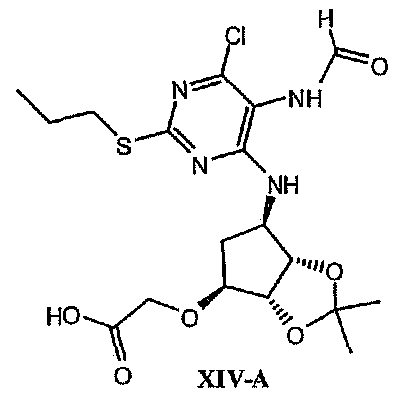
  • the invention provides a novel compound, 2-(((3aR,4S,6R, 6aS)-6-((6-chloro-5-form- amido-2-( ropyltmo)pyrirmdm-4-yl)am
  • the invention provides a process of preparing process of preparing a compound according to Formula I:
  • R c is a -Ci- alkyl group
  • the invention thus provides a process of preparing Ticagrelor when R c is n-propyl, said process comprising coupling a compound according to Formula V(a):
  • Formula XTV' compound (Formula XIV; R° is n-propyl) to Ticagrelor.
  • the invention provides a process of preparing Ticagrelor, the process comprising coupling the compound, 2-((3aR,4S,6R,6aS)-6-amino- 2,2-dimethyltetrahydro-3aH-cyclop l-4-yloxy)acetic acid:
  • the step of coupling a Formula V(a) compound with a Formula EX (or formula rX-b) compound can be carried out, for example, by reacting the compounds, preferably, in the presence of base and in a suitable solvent.
  • Suitable bases include organic bases such as, for example, triethyl amine, and diisopropylemylarnine, and also inorganic bases, such as, for example, sodium bicarbonate and potassium bicarbonate.
  • Suitable solvents include any solvent in which the reactants dissolve and are stable.
  • Preferred solvents include polar organic solvents such as Ci-Ce alcohols such as methanol, ethanol and propanol, ethers such as t- butylmethyl ether and tetrahydrofuran, glycol solvents such as propylene glycol, polar aprotic solvents such as dimethylfonnamide and N-methylpyrrolidinone, mixtures of these solvents and mixtures thereof with water.
  • polar organic solvents such as Ci-Ce alcohols such as methanol, ethanol and propanol
  • ethers such as t- butylmethyl ether and tetrahydrofuran
  • glycol solvents such as propylene glycol
  • polar aprotic solvents such as dimethylfonnamide and N-methylpyrrolidinone
  • the conversion of a compound of Formula XIV to a compound of Formula I, or of, a compound of XTV-A to Ticagrelor can comprise: removing the N-protecting group represented by R a and R b , and in some embodiments by only R b ; removing the O- protecting groups R 2 and R 3 ; diazotizing the intermediate of Formula XV or XVa to produce the intermediate of Formula XVI (or XVI-A) having the [1 ,2,3]triazolo[4,5- d]pyrirnidine ring system; coupling the triazolopyrimidine compound of Formula XVI (or XVI-A) with (lR)-2-(3,4-difluorophenyl)cyclopropananiine (Formula ⁇ ):
  • the step of removing the N-protecting group can be carried out, for example, by hydrolysis.
  • the hydrolysis reaction may be carried out using a suitable acid reagent and is preferably carried out in a suitable solvent.
  • Suitable acid reagents include, for example mineral acids, such as hydrochloric acid, sulfuric acid and organic acids such as metliaiiesiilfonic acid, and trifmoroacetic acid.
  • Suitable solvents include polar solvents, such as, for example Cj-C6 alcohols, e.g., metlianol, ethanol, propanol and isopropanol and other organic solvents such as acetonitrile, tetraliydiOfuran, mixtures of these solvents, and mixtures thereof with water.
  • the O-protect groups R 2 and R 3 may be removed under the same conditions and in the same reaction step as is employed to remove the N-protecting group.
  • the step of diazotizing the intermediate of Formula XV or XV-A to produce the intermediate of Formula XVI (or XVI- A) can be carried out, for example, by reacting the Formula XV or XV-A compound with a suitable diazotizing agent, preferably, in the presence of a suitable solvent.
  • suitable diazotizing agents include, for example sodium nitrite and isoamyl nitrite.
  • Suitable solvents for carrying out this reaction include polar organic solvents such as, for example, methanol, ethanol, or acetonitrile, mixtures thereof, and mixtures thereof with water.
  • the diazotization reaction can be carried out directly on the hydrolysis reaction mixture that was used to remove the N-protecting group to prepare die Formula XV (or XV-A) compound.
  • the step of coupling the Formula XVI (or XVI- A) triazolopyrimidine compound with the compound of Formula XIII ((lR)-2-(3,4-o3 ⁇ 4fluorophenyl)cyclopropanarnine) can be carried out, for example, by reacting the two compounds in the presence of a suitable base, preferably in the presence of a suitable solvent.
  • suitable bases include organic bases, such as triethyl amine and diisopropyl ethyl amine and inorganic bases, such as, for example sodium bicarbonate, sodium carbonate, potassium bicarbonate and potassium carbonate.
  • Suitable solvents include solvents that are inert to the reaction conditions and in which the reagents are soluble.
  • the reaction can be carried out in a single phase in solvents including halogenated solvents such as, for example, dichloromethane or dichloroethane, ethers such as t-butylmethyl ether or THF, and other suitably inert organic solvents.
  • halogenated solvents such as, for example, dichloromethane or dichloroethane
  • ethers such as t-butylmethyl ether or THF
  • other suitably inert organic solvents e.g., a two-phase reaction, i.e., with water and a suitable organic solvent such as toluene or THF.
  • the conversion of a compound of Formula XVII, or Formula XVII- A to Ticagrelor requires a functional group transformation of the carboxylic ester to a primary alcohol.
  • This transformation can be accomplished, for example by reduction of the ester using a suitable reducing agent.
  • suitable reducing agents are those that can selectively reduce the ester moiety, for example hydride reagents, such as sodium borohydride- BF3.0Et2, lithium borohydride, lithium triethylborohydride, LAH, L-selctride and diboraiie and its complexes
  • the reaction is preferably done in the presence of a suitable solvent, for example, THF or dioxane.
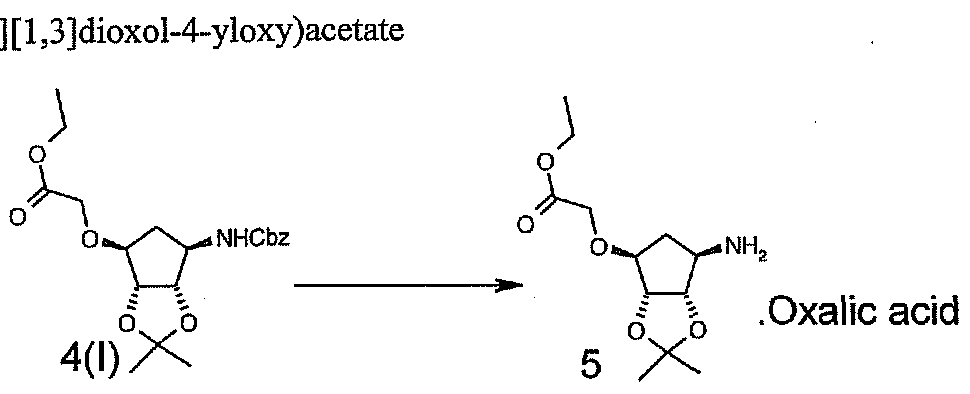
  • Example 3a Preparation of ethyl 2-((3aR,4S,6R,6aS)-6-(benzyloxycarbonylamino)-2,2- dimethyltetrahydro-3aH-cyclopenta[d][l,3]dioxol-4-yloxy)acetate (compound 4(1)
  • Example 4a Preparation of ethyl 2-((3aR,4S,6R,6aS)-6-(tert-butoxycarbonylamino)-2,2- drmethyltetrahydro-3aH-cyclopenta[d][l,3]dioxol-4-yloxy)acetate (compound 4).
  • Example 5a Preparation of ethyl 2-((3aR,4S,6R,6aS)-6-arnmo-2,2-dimethyltetrahydro- 3aH-cyclopenta[d][l,3]dioxol-4-yloxy)acetate
  • reaction mixture was then quenched with water (500 mL) and extracted with DCM (2 x 3 V). The DCM layer was distilled off. The thus obtained residue was suspended in ethanol (5V) and oxalic acid (13.68g) was added. This reaction mixture was heated to
  • Example 7a Preparation of ethyl 2-((3aR,4S,6R,6aS)-6-(6-cUoro-5-nitro-2-(propylthio)- pyrinn ⁇ in-4-ylammo)-2,2-dimethyltetrahydro-3 aH-cyclopenta[d] [1,3] dioxol-4-yloxy)- acetate (compound 7)
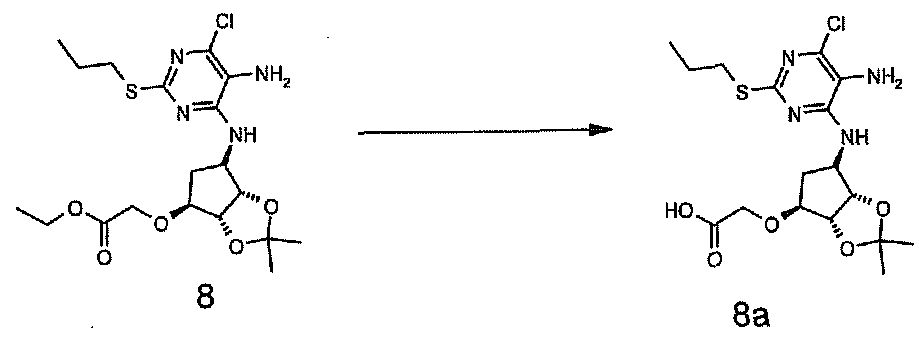
  • Example 8 Preparation of ethyl 2-((3aR,4S,6R,6aS)-6-(5-ammo-6-chloro-2-(propylthio)- pyrirmdm-4-ylamno)-2,2-dimethyltetrahy
  • Example 8a Preparation of ethyl 2-((3aR,4S,6R,6aS)-6-(5-amino-6-chloro-2- ( ropyltHo)pyrimidm-4-ylaimno)-2 ⁇
  • Iron powder (8.53g) was added to a solution of compound 7 (25 g) in methanol (5V) and acetic acid (76.37 mL). The reaction mixture was then stirred at 35° C for 2 hrs. The reaction was monitored by TLC. After the reaction was complete, the product was extracted with ethyl acetate. The extract was concentrated under reduced pressure to give compound 8 (8.0g), which was used for the next step without further purification.
  • Example 9a Preparation of ethyl 2-((3aR,4S,6R,6aS)-6-(7-chloro-5-(propylthio)-3H- [1,2,3 ]triazole[4,5-d]pyrirmdm-3-yl)-2,2-dimethyltetrahydro-3aH-cyclopenta[d][l,3]- dioxol-4-yloxy)acetate (compound 9) To a solution of compound 8 (20 g) in acetonitrile (10V) was added isoamylnitrite (7.77g). The reaction mixture was heated to 40°C for 2 hours. Then the reaction mixture was cooled to room temperature and concentrated at reduced pressure to give compound 9 (19.5g). The crude product was used for next step without further purification.
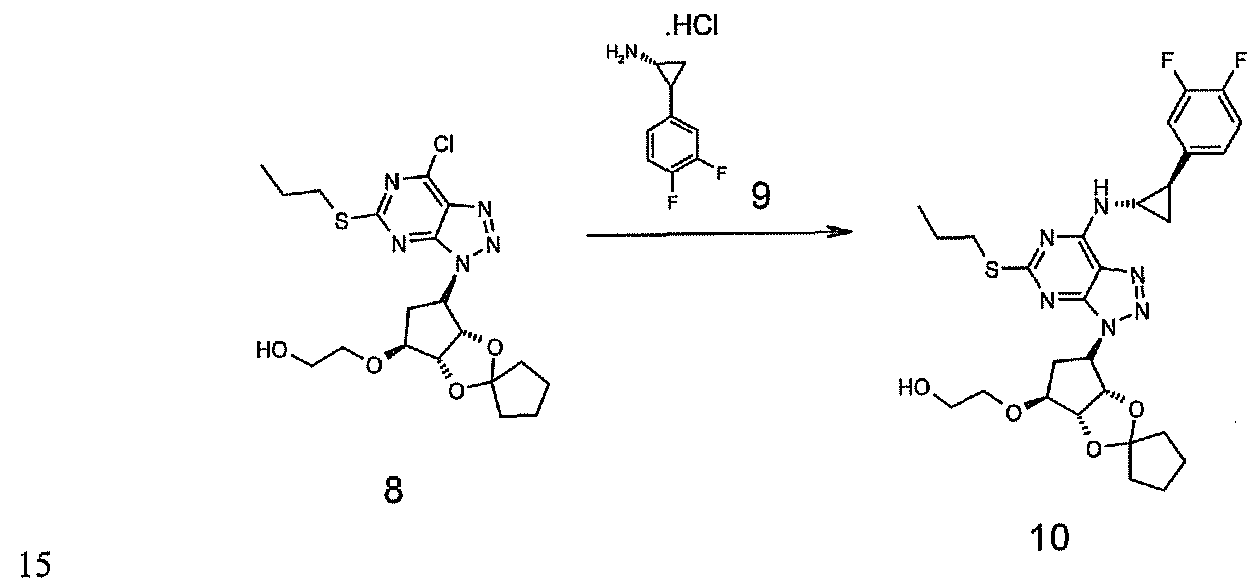
  • Example 10a Preparation of ethyl 2-((3aS,4R,6S,6aR)-4-(7-((lR,2S)-2-(3,4-difluoro- phenyl)cyclopropylammo)-5-(propyItido)-3H-[l,2,3]tri
  • Example 11a Preparation of 2-((3aS,4R,6S,6a )-4-(7-((lR,2S)-2-(3,4-difluorophenyl)- cyclopropylarrmo)-5-(propylthio)-3H- ⁇
  • reaction was monitored by TLC. After completion, the reaction was quenched with water (50 mL), and the THF was distilled off under reduced pressure to provide a residue.
  • Iron powder (15.62 g) was added to a solution of compound(16) in methanol (10 vol) and acetic acid (5.0 vol) at RT. The resulting reaction mixture was stirred for 3-5 hrs at 50°C. The reaction was monitored by TLC. The product was extracted by adding water (5.0vol). The resulting mixture was filtered and the filtrate was distilled off under reduced pressure at 40-50°C to form a residue. The obtained residue was extracted with ethyl acetate (500-600ml). The ethyl acetate extract was washed with aqueous sodium bicarbonate and then concentrated under reduced pressure. The thus obtained residue was crystallized. Isolated yield 90-95%.
  • the combined filtrate was concentrated do dryness under reduced pressure at 40-50 °C.
  • Example 17a Preparation of ethyl 2-((3aR,4S,6R,6aS)-6-(5-amino-6-chloro-2- (propyltMo)pyrimidin-4-ylamino)-2,2-dimethyltetrahydro-3aH-cyclopenta[d][l,3]dioxol- 4-yloxy)acetate
  • Example 19a 2-((3aR,4S,6R,6aS)-6-(7-chloro-5-(propylthio)-3H-[l ,2,3]triazolo[4,5- d]pyrimidm-3-yl)-2,2-dimethyltetrahydro-3aH-cyclopenta[d][l,3] hoxol-4-yloxy)aceti ⁇ acid (compound 9a)
  • Example 21a Preparation of 2-((3aR,4S,6R,6aS)-6-(7-((lR,2S)-2-(3,4-difluorophenyl)- cyclopropylamino)-5-( ropyltMo)-3H-[l,2,3]M
  • Example 24a Preparation of ethyl 2-((lS,2S,3S,4R)-4-(7-chloro-5-(propylthio)-3H- [l,2,3]1riazole[4,5-d]pyrimidm-3-yl)-2,3-dmydroxycyclopentyloxy)acetate (compound 9b)
  • compound 9b To a solution of compound 8b (4.5 g) in acetonitrile (lOvol) was added isoamylnitrite (1.87g) at 30°C. The reaction mixture was stirred at 60-65°C for 3-5h. The reaction was monitored by TLC.
  • Example 25 Preparation of ethyl 2-((lS,2S,3S,4R)-4-(7-((lR,2S)-2-(3,4-difluorophenyl)- cyclopropylamino)-5-(propyltWo)-3H-[l,2,3]triazolo[4,5-d]pyriniidin-3-yl)-2,3- dihydroxycyclopentyloxy)acetate (compound 11a)
  • Example 25a Preparation of ethyl 2-((lS ⁇ S,3S,4R)-4-(7-((lR,2S)-2- ⁇ 3,4-difluoro- phenyl)cyclopropylmmno)-5-(propyltlno)-3H-[l,2,3]triazolo[4,5-d]pyrimidm-3-yl)-2,3- dihydroxycyclopentyloxy)acetate (compound 11a)
  • Example 26 Preparation of methyl 2-((lS,2S,3S,4R)-4-(7-((lR,2S)-2-(3,4-difluoro- phenyl)cyclopropylammo)-5-( ropyltMo)-3H-[l,2,3]triazolo[4,5-d]pyrimidm-3-yl)- ⁇
  • Example 30 Preparation of ethyl 2-((3aS,4R,6S,6aR)-4-(benzyloxycarbonylamino)- te1rahy03 ⁇ 4o-3aH-spiro[cyclopenta[d][l,3]dioxole-2,r-cyclopentane]-6-yloxy)acetate
  • Example 31 Preparation of ethyl 2-((3aS,4R,6S,6aR)-4-(tert-butoxycarbonylamino)tetra- hydro-3aH-spiro[cyclopenta[d][l,3]dioxole-2,r-oyclopentane]-6-yloxy)acetate
  • Example 37 Preparation of 2-((3aS,4R,6S,6aR)-4-(7-cMoro-5-(propyltliio)-3H- [1 ,2,3]triazole[4,5-d]pyrirmdin-3-yl)tetrahydro-3aH-spiro[cyclopenta[d][l ,3]dioxole-2 , 1 '- cyclopentane]-6-yloxy)ethanol
  • Example 38 Preparation of 2-((3aS,4R,6S,6aR)-4-(7-((lR,2S)-2-(3,4-difiuorophenyI)- cyclopropylarmno)-5-( ropylthio)-3H-[l,2 ]triazolo[4,5-d]pyrimidm-3-yl)tetrahydro- 3aH-spiro[cyclopenta[d][l,3]dioxole-2, -cyclopentane]-6-yloxy)ethanol
  • Iron powder (15.62 g) was added to a solution of compound 6 in methanol (10 vol) and acetic acid (5.0 vol) at ⁇ 30°C, and the resulting reaction mixture was stirred for 3-5hrs at 50°C. The reaction was monitored by TLC. The reaction mixture was worked up by adding water (5.0 vol) and filtering. The filtrate was concentrated under reduced pressure at 40-50°C to produce a residue. The residue was extracted with ethyl acetate (500- 600ml) and the combined ethyl acetate fraction was washed with aqueous sodium bicarbonate and concentrated under reduced pressure. The thus obtained residue was crystallized from n-hexane. Isolated yield 90-95%.
  • Example 41a Preparation of benzyl (lR,2S,3S,4S)-2,3-dihydroxy-4-(2-hydroxyethoxy)- cyclopentylcarbamate
  • Example 42a Preparation of benzyl (3aR,4S,6R,6aS)-4-(2-hydroxyethoxy)tetrahydro- 3 aH-spiro [cyclopenta[d] [ 1 ,3]dioxole-2, 1 -cyclopentane] -6-ylcarbamate
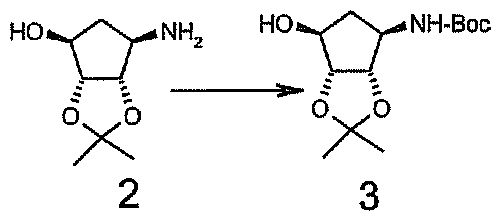
  • Example 45 Preparation of benzyl (3aR,4S,6R,6aS)-tetrahydro-4-hydroxy-2,2- dimethyl-3aH-cyclopenta[d] [1 ,3]dioxol-6-ylcarbamate
  • Compound II 50 g, 0.288 mol
  • MIBK 900 mL
  • Water (250 mL) and potassium carbonate 47.80 g, 0.346 mol
  • the reaction mixture was stirred at the same temperature for 30-min, and men added solution of benzyl chloroformate 50% in Toluene ( 54.16 g, 0.317 mol) was added slowly over 30 min at 25- 30°C.
  • reaction mixture was stirred at 25-30°C for 6h. Reaction progress was monitored by TLC. When the reaction was complete, the aqueous and organic layers were separated, and the aqueous layer was extracted with MIBK (250 mL). The combined organic fraction was dried over anhydrous Na 2 S04 and concentrated under reduced pressure at 40-50°C to provide a residue. The residue was mixed with n-hexane (500 mL) and stirred at 25-30°C for lh. A precipitate foimed and the solid was isolated by filtration and washed with n-hexane (100 mL). The collected compound 3(1) was dried under vacuum at 40°C over 12h, isolated.
  • Example 46 Preparation of ethyl 2-(((3aR,4S,6R,6aS)-6-(((benzyloxy)carbonyl)amino)- 2,2-dimethyltetraliydro-3aH-cyclopenta[d][l,3]dioxol-4yl)oxy)acetate
  • Example 48 Preparation of 2-(((3aR,4S,6R,6aS)-6-(((benzyloxy)carbonyl)amino)-2,2- dimethyl tetrahydro -3aH-cyclopenta[d][l,3]dioxol-4-yl)oxy)acetic acid (IV-a), via ethyl 2-(((3a R,4 S,6 R,6a.5)-6-(((benzyloxy)carbonyl)amino)-2,2-dimemyltetrahydro -3a ii-cyclopenta[ ⁇ fl[l,3]dioxol-4-yl)oxy)acetate (IV)
  • a suspension of sodium hydride 60% (3.9 g) in DMF (2-10V) is cooled to -50 to 0°C.
  • Compound ⁇ (20 g,) is dissolved in DMF (2-10V) and added to the reaction flask over 10 to 30 min.
  • the reaction mixture is stirred at the same temperature for 10 to 30 min.
  • a solution of ethylbromoacetate (13.04 g) in DMF (80 mL) is added dropwise.
  • the reaction mixture is stirred at the same temperature for l-2hrs.
  • the reaction progress is monitored by TLC.
  • the reaction is quenched by addition of acetic acid and water (600 mL).
  • the aqueous layer is extracted with ethyl acetate (400 mL).
  • the organic layer is concentrated to dryness.
  • the obtained residue is dissolved in THF (60 mL) and charged into a reaction flask.
  • the reaction flask is cooled to below 10°C and a solution of NaOH (7.8 g) in water (30 mL) is added.
  • the reaction mixture is stirred at RT for 2-6hrs.
  • the THF layer is distilled off and the aqueous layer is washed with ethyl acetate (80 mL).
  • the aqueous layer is acidified to pH 2-3 and extracted with ethyl acetate (3 x 100 mL).
  • the combined organic layer is dried over anhydrous sodium sulphate and concentrated to dryness to give compound IV-a.
  • Example 48a Preparation of 2-(((3aR,4S,6R,6aS)-6-(((benzyloxy)carbonyl)amino)-2,2- dimethyl tetrahydro -3aH-cyclopenta[d][l,3]dioxol-4-yl)oxy)acetic acid (IV-a), via ethyl 2-(((3a R,4 S,6 R,6n 5)-6-(( ⁇ enzyloxy)carbonyl)ammo)-2,2-drmethyltetrahydro -3a #-cyclopenta[ d ⁇ [ 1 ,3]dioxol-4-yl)oxy)acetate (TV)
  • Example 49 Preparation of 2-(((3aR,4S,6R,6aS)-6-(((berizyloxy)carbonyl)amino)-2,2- dimethyltetrahydiO-3aH-cyclopenta[d]fl,3]dioxol-4-yl)oxy)acetic acid (IV-a) - via ethyl 2-(((3aR,4S,6R,6a. 3 ⁇ 4-6-(((herizyloxy)carbonyl)ammo)-2,2-dimethyltetrahydro-3a -cyclopenta [l,3]dioxol-4-yr)oxy)acetate (IV).
  • Example 49a Preparation of 2-(((3aR,4S,6R,6aS)-6-(((benzyloxy)carbonyl)amino)-2,2- dimethyltetra hydro -3aH-cyclopenta [d][l,3]dioxol-4-yl)oxy)acetic acid (IV-a) - via ethyl 2-(((3a R,4 5,6 i?,6a 5)-6-(((benzyloxy)carbonyl)ainino)-2,2-dimethyltetraliydro - 3a ⁇ -cyclopentaf d][l,3]dioxol-4-yl)oxy)acetate (IV).
  • Example 50a Preparation of 2-((3aS,4R,6S,6aR)-4-amino-tetrahydro-2,2-dimethyl-3aH- cyclopenta[d][l,3]dioxol-6-yloxy)acetic acid:
  • Iron powder (15.62 g) was added portionwise to a solution of compound VII (25g) in methanol (5V) and acetic acid (3V) at ⁇ 30°C. The resulting reaction mixture was stirred for 3-5hrs at 35°C. The reaction mixture was then passed through a diatomaceous earth (Celite) pad. Water (400 mL) was added and the mixture was extracted with toluene (3 x 150 mL). The combined organic layer was washed with water (2 x 150 mL). The toluene layer was concentrated to half volume and added into a rb flask containing formic acid (51.5 mL). This mixture was cooled 0-5°C and acetic anhydride (57.11 g) was added dropwise.
  • Example 52 Preparation of 2-(((3a R,A S,6 R,6a S)-6-((6-chloro-5-formamido-2- (propylthio) pyriimdm-4-yl)arruno)-2,2-dimethyltetrahydro-3a /f-cyclopenta[ rf][l,3]dioxol-4-yl)oxy)acetic acid:
  • Example 53 methyl 2-(((l 5,25,3 5,4 ⁇ )-4-(7-chloro-5-(propylthio)-3 .ff- [l,2,3]triazolo[4,5-i/]pyrimidin-3-yl)-2,3-dihydroxycyclopentyl)oxy)acetate;
  • Example 54 Methyl 2-(((lS,2S,3S,4R)-4-(7-(((lR,2S)-2-(3,4-difluorophenyl)- cyclopropyl)amino)-5-(propylt o)-3H-[l,2,3]triazolo[4,5-d]pyriirjidin-3-yl)-2,3- dihydiOxycyclopentyl) oxy) acetate
  • Example 54a Methyl 2-(((lS,2S,3S,4R)-4-(7-(((lR,2S)-2-(3,4-difluo)
  • Example 55a Preparation of (lS,2S,3R,5S)-3-(7-((lR,2S)-2-(3,4-difluorophenyl)cyclo- propylamino)-5 (propylthio)-3H-[l ,2,3]triazolo[4,5-d]pyrirnidin-3-yl)-5-(2-hydroxy- ethoxy)cyclo pentane -1,2-diol (Ticagrelor).
  • Example 56a Preparation of benzyl (3aR, 4S,6R,6aS)-4-(2-hydroxyethoxy)-tetrahydro- 2,2-dimethyl-3aH-cyclopenta[d][l,3]dioxol-6-ylcarbamate
  • Example 57a Preparation of 2-((3aS,4R,6S,6aR)-4-amino-tetrahydro-2,2-dimethyl-3aH- cyclopenta[d][l,3]dioxol-6-yloxy)ethanol, oxalic acid salt (1 :1).
  • Example 58a Preparation of 2-((3aS,4R,6S,6aR)-4-ammo-tetrahydro-2 > 2-dimethyl-3aH- cyclopenta[d][l,3]dioxol-6-yloxy)ethanol.
  • Example 59 Preparation of N-(4-cliloiO-6-(((3aS,4R,6S,6aR)-6-(2-liydiOxyethoxy)-2,2- dimethyl tetrahydro-3aH-cyclopenta[d] [1 ,3]dioxol-4-yl)amino)-2-(propyltliio) pyrimidin- 5-yl) formamide
  • Example 59 Preparation of N-(4-chloro-6-(((3aS,4R,6S,6aR)-6-(2-hydroxyethoxy)-2,2- dimethyl tetrahydro-3aH-cyclopenta[d][l,3]dioxol-4-yl)ammo)-2-(jpropylthio) pyrimidin- 5-yl) formamide
  • Example 60 Preparation of N-(4-chloro-6-(((3aS,4R,6S,6aR)-6-(2-hydroxyethoxy)-2,2- dimethyl tetrahydro-3 aH-cyclopenta[d] [ 1 ,3] dioxol-4-yl)amino)-2-(propylthio) pyrimidin- 5-yl) formamide
  • Example 60a Preparation of N-(4-chloro-6-(((3aS,4R,6S,6aR)-6-(2-hydroxyethoxy)-2,2- dimethyl tetrahydro-3aH-cyclopenta[d] [1 ,3]dioxol-4-yl)amino)-2-(propylthio) pyrimidin- 5-yl) formamide
  • Example 62 Preparation of (lS > 2S,3R,5S)-3-(7-((lR,2S)-2-(3,4-difluorophenyl) cyclopropyl amino)-5 (propyltMo)-3H-[l,2,3]triazolo[4,5-d]pyrmiidin-3-yl)-5-(2- hydroxyethoxy) cyclopentane-l,2-diol (Ticagreior)
  • Example 62a Preparation of (lS,2S,3R,5S)-3-(7-((lR,2S)-2-(3,4-difluorophenyl) cyclopropyl arnino)-5 (propylthio)-3H-[l ,2,3]rriazolo[4,5-d]pyrimidin-3-yl)-5-(2- hydroxyethoxy) cyclopentane- 1 ,2-diol (Ticagrelor)
  • reaction mixture is then cooled to 0-5°C and sodium nitrite (5.89g) is dissolved in water (12 mL) and added to the reaction mixture slowly dropwise.
  • the reaction mixture is stirred at 0-5°C for lhr.
  • the reaction mixture is then diluted with water (100 mL) and extracted with ethyl acetate (250 mL).
  • the organic layer is washed with brine (100 mL), sodium bicarbonate solution (100 mL) and finally with brine (lOOmL).
  • the organic layer is concentrated under reduced pressure and the resulting residue is crystallized from MTBE to provide compound XII (22.46g, 81%).

Landscapes

  • Chemical & Material Sciences (AREA)
  • Organic Chemistry (AREA)
  • Pharmaceuticals Containing Other Organic And Inorganic Compounds (AREA)
  • Carbon And Carbon Compounds (AREA)
  • Nitrogen Condensed Heterocyclic Rings (AREA)

Abstract

The present invention is related to new intermediates and processes for preparing Ticagrelor disclosed in this patent application.

Description

NEW INTERMEDIATES AND PROCESSES FOR PREPARING TICAGRELOR
[0001] This patent application claims the benefits of U.S. Provisional Patent Application Nos. 61,472,412 filed April 6, 2011 and 61/490,371 filed May 26, 2011, the disclosures of which are incorporated by reference herein.
Field of the Invention
[0002] The invention encompasses improved processes for preparing Ticagrelor and new intermediates useful for manufacturing Ticagrelor.
Background of the Invention
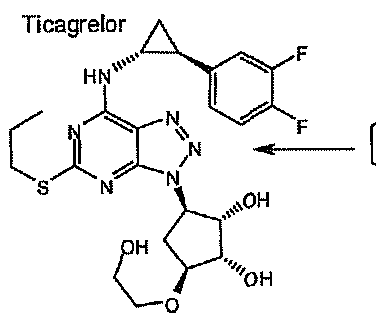
[0003] Ticagrelor, (lS,2S,3R,5S)-3-[7-[[(lR,2S)-2-(3,4-difluorophenyl)cyclopropyl]- ammo]-5-(propyltMo)-3H-l,2,34riazolo[4,5,d]pyrirmdme-3-yl]-5-(2-hy
cyclopentanediol, has the followin chemical structure:
Figure imgf000002_0001
[0004] Ticagrelor is currently marketed in Europe under the trade name BRILIQUETI BRILIQUE™ is purportedly a reversibly binding oral P2Y12 ADP receptor antagonist.
[0005] Ticagrelor can be obtained by a process as shown in the following scheme, as described in PCT Publication No. O00034283 :
Figure imgf000003_0001
[0005] Although the process shown above produces the desired Ticagrelor product, several of the process steps incur significant problems that adversely affect the cost, yield, safety and environmental impact of the process as a whole. For example, in the process above, intermediates (9), (10), (12), (13), (15) and (16) are isolated as oils/liquids, making these intermediates much more difficult to handle and purify on a commercially useful scale. In some steps in the above process the conversion is low. For example, the coupling of intermediates (6) and (7) to prepare intermediate 8, results in a product that contains about 25-30% of a dimer byproduct that results from reaction of both chloro groups on intermediate (7). Another process step which does not proceed to completion is the reaction to form intermediate (12). This step has only about 40% conversion and produces a problematic triol byproduct, which can't be removed by crystallization because intermediate (12) is not a solid. Another potential problem with this step is that the methyl 2-(trifluoiOmethylsulfonyloxy)acetate reagent used therein is not commercially available and must be prepared using a reagent such as triflic anhydride, which is both expensive and hazardous. In addition, the final step of deprotection of the diol to produce Ticagrelor results in substantial racemization of the cyclopropyl amine.
[0006] There is a need in the art for improved processes for synthesizing Ticagrelor which are suitable for industrial use. Summary of the Invention
[0007] The present invention provides improved processes for preparing Ticagrelor. The invention also provides novel compounds. These compounds can be used as intermediates in the process for preparing Ticagrelor.
Detailed Description of the Invention
[0008] The present invention encompasses improved processes for the preparation of Ticagrelor.
[0009] The term "acyl" means a radical of the general formula -C(0)-R, wherein -R is hydrogen or hydrocarbyl. When R is alkyl, the acyl group may be, for example, acetyl (-C(0)CH3), propionyl (-C(O)Et), benzoyl (-C(0)C6H5), phenylacetyl (-C(0)CH2C6H5).
[0010] The term "alkoxy/aryloxycarbonyl" means a radical of the general formula -OC(0)-R, wherein R is a hydrocarbyl group, such as a C1 alkyl or a C^-w aryl. or a C7 2 arylalkyl group for example carboethoxy (-C02Et), carbomethoxy (-C02Me) and benzyloxycarbonyl (-CO2BZ).
[0011] The term "alkyl", by itself or as part of another substituent means, unless otherwise stated, a straight, branched or cyclic chain hydrocarbon radical, including di- and multi-radicals, having the number of carbon atoms designated (i.e. Ci- means one to six carbons) and includes straight, branched chain or cyclic groups. Examples include: methyl, ethyl, propyl, isopropyl, butyl, isobutyl, tert-butyl, pentyl, neopentyl, hexyl, cyclohexyl and cyclopropylmethyl.
[0012] Substituted alkyl means alkyl, as defined above, substituted by one, two or three substitiients selected from halogen, =0, -OH, -0(Ci-C4)alkyl, -OC(0)(C,-C4)alkyl, -C(0)(Ci-C4)alkyl, =N(C1-C4)alkyl, =NOH, =NOC(0)(C,-C )alkyl, -NH2, -N(CH3)¾ NHC(0)(CrC4)allcyl, -C02H, -C02(Ci-C4)alkyl, -CF3, -CONH2, -S02NH2, -C(=NH)NH2, -CN, =S, -SH, -S(Ci-C4)alkyl, -SO(Ci-C4)alkyl, -S02(Ci-C4)alkyl and -N<¾. Examples of substituted alkyls include, but are not limited to, 2,2-difluoropropyl, methoxymethyl, 2- carboxycyclopentyl and 3-chloropropyl.
[0013] The term "alkylene", by itself or as part of another substituent means, unless otherwise stated, a divalent straight, branched or cyclic chain hydrocarbon radical.
[0014] The term "alkoxy" employed alone or in combination with other terms means, unless otherwise stated, an alkyl group having the designated number of carbon atoms, as defined above, connected to the rest of the molecule via an oxygen atom, such as, for example, methoxy, ethoxy, 1-propoxy, 2-propoxy (isopropoxy) and the higher homologs and isomers.
[0015] The term "amine" or "amino" refers to radicals of the general formula -NRR', wherein R and R' are independently selected from hydrogen or a hydrocarbyl radical, or wherein R and R' combined form a heterocycle. Examples of amino groups include: -NH2, methyl amino, diethyl amino, anilino, benzyl amino, piperidinyl, piperazinyl and indolinyl.
[0016] The term "carbamyl" means the group -C(0)NRR', wherein R and R1 are independently selected from hydrogen or a hydrocarbyl radical, or wherein R and R' combined form a heterocycle. Examples of carbamyl groups include: -C(0)NH2 and -C(0)N(CH3)2.
[0017] The term "cycloalkyl" refers to rmg-containing alkyl radicals. Examples include cyclohexyl, cyclopentyl, cyclopropyl methyl and norbornyl
[0018] The term "heteroalkyl" by itself or in combination with another term means, unless otherwise stated, a stable straight or branched chain radical consisting of the stated number of carbon atoms and one or two heteroatoms selected from O, N, and S, and wherein the nitrogen and sulfur atoms may be optionally oxidized and the nitrogen heteroatom may be optionally quaternized. The heteroatom(s) may be placed at any position of the heteroalkyl group, including between the rest of the heteroalkyl group and the fragment to which it is attached, as well as attached to the most distal carbon atom in the heteroalkyl group. Examples include: -0-CH2-CH2-CH3, -CH2-CH2CH2-OH, -C¾- CH2-NH-CH3, -CH2-S-CH2-CH3, and -CH2CH2-S(0)-CH3. Up to two heteroatoms may be consecutive, such as, for example, -CH2-NH-OC¾, or -CH2-CH2-S-S-C¾.
[0019] The terms "halo" or "halogen" by themselves or as part of another substituent mean, unless otherwise stated, a fluorine, chlorine, bromine, or iodine atom, preferably, fluorine, chlorine, or bromine.
[0020] The term "aromatic" refers to a carbocycle or heterocycle having one or more polyunsaturated rings having aromatic character (4n+2) delocalized π (pi) electrons).
[0021] The term "aryl" employed alone or in combination with other terms, means, unless otherwise stated, a carbocyclic aromatic system containing one or more rings (typically one, two or three rings) wherein such rings may be attached together in a pendent manner, such as, for example, a biphenyl, or may be fused, such as, for example, naphthalene. Examples include phenyl; anthracyl; and naphthyl. [0022] The term "aryl-(Ci-C3)alkyl" means a radical wherein a C1-C3 alkylene chain is attached to an aryl group, e.g., -CH2CH2-phenyl. The term "substituted aryl-(Ci-C3)alkyl" means an aryl-(Ci-C3)alkyl radical in which the aryl group is substituted.
[0023] The term "heterocycle" or "heterocyclyl" or "heterocyclic" by itself or as part of another substitiient means, unless otherwise stated, an unsubstituted or substituted, stable, mono- or multicyclic heterocyclic ring system which consists of carbon atoms and at least one heteroatom selected from N, O, and S, and wherein the nitrogen and sulfur heteroatoms may be optionally oxidized, and the nitrogen atom may be optionally quaternized. The heterocyclic system may be attached, unless otherwise stated, at any heteroatom or carbon atom which affords a stable structure.
[0024] The term "heteroaryl" or "heteroaromatic" refers to a heterocycle having aromatic character. A polycyclic heteroaryl may include one or more rings which are partially saturated. Examples include tetrahydroquinoline and 2,3-dmydrobenzofuryl.
[0025] Examples of non-aromatic heterocycles include monocyclic groups such as, for example: pyrrolidine, pyrroline, imidazoline, 2,3-dihydrofuran, 2,5-dihydrofi.iran, tetrahydrofuran, thiophane, piperidine, 1,2,3,6-tetrahydropyridine, 1,4-dihydropyridine, piperazine, morpholine, thiomorpholine, pyran, 2,3-dihydropyran, tetrahydropyran, 1,4- dioxane, 1,3-dioxane, homopiperazine, homopiperidine, 1,3-dioxepane, 4,7-dihydro-l,3- dioxepin and hexamethyleneoxide.
[0026] Examples of heteroaryl groups mclude: Pyridyl, pyrazmyl, pyrimidinyl, particularly 2- and 4-pyrirmdinyl, pyridazinyl, thienyl, furyl, pyrrolyl, particularly 2- pyrrolyl, imidazolyl, thiazolyl, oxazolyl, pyrazolyl, particularly 3- and 5-pyrazolyl, isothiazolyl, 1,2,3-traizolyl, 1,2,4-triazolyl, 1,3,4-triazolyl, tetrazolyl, 1,2,3-thiadiazolyl, 1,2,3-oxadiazolyl, 1,3,4-thiadiazolyl and 1,3,4-oxadiazolyl.
[0027] Examples of polycyclic heterocycles include: Indolyl, particularly 3-, 4-, 5-, 6- and 7-indolyl, indolinyl, quinolyl, tetrahydroquinolyl, isoquinolyl, particularly 1- and 5- isoquinolyl, 1,2,3,4-tetrahydroisoquinolyl, cinnolinyl, quinoxalinyl, particularly 2- and 5- quinoxalinyl, quinazolinyl, phthalazinyl, 1,8-naphthyridinyl, 1,4-benzodioxanyl, coumarin, dihydrocoumarin, benzofuryl, particularly 3-, 4-, 1,5-naphthyridinyl, 5-, 6- and 7-benzofuryl, 2,3-dihydrobenzofiryl, 1,2-benzisoxazolyl, benzothienyl, particularly 3-, 4-, 5-, 6-and 7-benzothienyl, benzoxazolyl, benzthiazolyl, particularly 2-benzothiazolyl and 5-benzothiazolyl, purinyl, benzimidazolyl, particularly 2-benzimidazolyl, benztriazolyl, tUoxanthinyl, carbazolyl, carbolinyl, acridinyl, pyrrolizidinyl, and quinolizidinyl. [0028] The aforementioned listing of heterocyclyl and heteroaryl moieties is intended to be representative and not limiting.
[0029] The term "hydrocarbyl" refers to any moiety comprising only hydrogen and carbon atoms. Preferred hydrocarbyl groups are (Ci-Ci2)hydrocarbyl, e.g., (Ci-C7)hydro- carbyl such as, for example, benzyl and (Ci-Ce)alkyl.
[0030] The term "substituted" means that an atom or group of atoms has replaced hydrogen as the substituent attached to another group. For aryl and heteroaryl groups, the term "substituted" refers to any level of substitution, namely mono-, di-, tri-, tetra-, or penta-substitution, where such substitution is permitted. The substituents are independently selected, and substitution may be at any chemically accessible position.
[0031] In one embodiment, the present invention provides a novel compound of the following formula:
Figure imgf000007_0001
wherein, X is a halogen atom;
R1 is -H, or -C1-C12 hydrocarbyl;
R2 and R3 are independently selected from -H, optionally substituted -Cj-Ce alkyl, optionally substituted -C6-C18 aryl, optionally substituted -C6-Ci2aryl-(Ci-C3)alkyl, optionally substituted -Si(Ci-6 alkylb, optionally substituted
Figure imgf000007_0002
and optionally substituted -C(=0)-OCi-6 alkyl; or
R2 and R3 form, together with the oxygen atoms to which they are attached, a 5 to 10 membered heterocyclic ring, which heterocyclic ring is optionally substituted with 1, 2 or 3 substituents independently selected from a Ci straight-chain hydrocarbyl group, a C3. branched or cyclic hydrocarbyl group, and a carbocyclic ring A; wherein said carbocyclicring A is bonded to the 5 to 10 membered heterocyclic ring via:
Figure imgf000007_0003
b) via a spiro fusion:
Figure imgf000008_0001
wherein the carbocyclic ring A is optionally substituted by 1, 2 or three substituents independently selected from -Ci-Ce alkyl, such as, for example, methyl, ethyl, propyl, isopropyl, butyl, isobutyl, or t-butyl; -C6-C10 aryl, such as, for example, phenyl, tolyl or naphthyl and -Ce-Cio aryl-Ci-C3 alkyl, such as, for example, benzyl, 1-phenylethyl, 2- phenylethyl, or a or β naphthylmethyl.
According to some embodiments, R2 and R3 are independently selected from -H, optionally substituted -Si(Ci.e alkyl)3, optionally substituted -C(=0)-Ci-6alkyl, and optionally substituted -C(=0)-OCi-6 alkyl; or
R2 and R3 can together with the oxygen atoms to which they are attached form a below:
Figure imgf000008_0002
wherein R4 and R5 are independently selected from -H, -Cj-6 alkyl, and -Ce-io aryl; or R4 and R5 together with the carbon atom to which they are attached form a 5 to 6 membered spiro-fused carbocyclic ring, which is optionally substituted by 1, 2 or three substituents independently selected from -Ci-Ce alkyl, such as, for example, methyl, ethyl, propyl, isopropyl, butyl, isobutyl, or t-butyl; -Ce-Cio aryl, such as, for example, phenyl, tolyl or naphthyl and -Ce-Cio aryl-Ci-C3 alkyl, such as, for example, benzyl, 1-phenylethyl, 2- phenylethyl, or a or β naphthylmethyl.
According to some embodiments, R2 and R3, together with the atoms to which they are attached, form an alkylidene ring, such as, for example, a methylidene or isopropylidene ring, or an alkoxymethylidene ring such as, for example, ethoxymethylidene; each optionally substituted with 1, 2 or 3 substituents independently selected from -Ci-Cg alkyl or -C6-C3 aryl. In some embodiments, R2 and R3 together can form an alkylidene group such as a methylidene or isopropylidene group, or an alkoxymethylidene group such as, for example, ethoxymethylidene; each optionally substituted with 1, 2 or 3 substituents independently selected from -Ci-Cs alkyl or -Ce-Cg aryl. According to some embodiments, a spiro fused system formed by R4 and R5 can be, for example:
Figure imgf000009_0001
wherein, in the partial structures above, the two oxygen atoms are understood to correspond to the two oxygen atoms to which the R2 and R3 substkuents are attached.
According to some embodiments, R1 is -H, a -C1-C6 alkyl group, such as, for example, methyl, ethyl, propyl, isopropyl, butyl, isobutyl, or t-butyl; a -Ce-Cio aryl group, such as, for example, phenyl, alpha naphthyl or beta naphthyl; or a -Cs-Cioar HCi- C2)alkyl, such as, for example, benzyl, phenylethyl or naphthylmethyl.
According to some embodiments, one or both of R2 and R3 are protecting groups selected from -Si(Ci.6alkyl)3, -C(=0)-Ci.6alkyl, -C(=O)-CM0 aryl, -C(=0)-OCl.6 alkyl, -C(0)OCH2(C6-Cio)aryl and substituted -C(0)OCH2(C6-Cio)aryl. -Si(Ci.6alkyl)3, such as, for example, trimethylsilyl and tert-butyldimethylsilyl; -C(=0)-Ci.6alkyl, such as, for example, acetyl and propionyl, -C(=0)-Ci_6 aryl, such as, for example, benzoyl; -C(=0)- OCi-6 alkyl, such as, for example, -C(=0)OCH3, -C(=0)OEt and -C(=0)Ot-Bu; and -C(O)OCH2(C6-C10)aryl such as -C(0)Obenzyl.
When R2 and R3 are protecting groups, these groups can typically be added and removed using conventional protecting group methodology, for example, as described in "Protective Groups in Organic Chemistry," edited by J W F McOmie, Plenum Press (1973), and "Protective Groups in Organic Synthesis", 2nd edition, T W Greene & P G M Wutz, Wiley-Interscience (1991).
[0032] In certain specific embodiments, the present invention provides the novel compounds, ethyl( 2-((3aR,4S,6R,6aS)-4-(6-cUoro-5-rn1ro-2-(propylmio)pyrimidin-4- ylamino)-tetrahydro-2,2-dimethyl-3aH-cyclopenta[d][l,3]dioxol-6-yloxy)acetate (Compound 7); ethyl (2-((lS,2S,3S,4R)-4-(6-cMoro-5-mtro-2-(propyltMo)pyrinudin-4-yl- ammo)-2,3-dihydroxycyclopentyloxy)acetate (Compound 7a); and ethyl 2- ((3aS,4R,6S,6aR)-4-(6-cMoro-5-mrro-2-(propyltMo)py^
spiro[cyclopenta[d][l,3]dioxole-2, -cyclopentane]-6-yloxy)acetate (Compound 7b); as depicted in the structure diagrams below:
[0033] In another embodiment, the present invention provides a novel compound 8 of the following formula:
Figure imgf000010_0001
wherein X is a halogen atom, and R2, and R3 are defined as above.
In certain other specific embodiments, the present invention provides the novel compounds, 2-({3aR, 4S, 6R, 6aS)-6-{[5-amino-6-cMoro-2-(propyltMo)-4-pyrimidinyl- amino}-2, 2-dhnethyltetrahydro-3aH-cyclopenta[d] [l,3]dioxol-4-yl)oxy]-l-acetic acid (Compound 8a); and 2-((3aR,4S,6R,6aS)-4-(5-amino-6-c oro-2-( ropyItluo)pyrinndin-4- ylammo)tetrahydro-3aH-spiro[cyclopenta[d][l,3]dioxole-2,l'-cyclopentane]-6- yloxy)acetic acid (Compound 8a'); shown in the structure diagrams below:
Figure imgf000010_0002
[0034] In other specific embodiments, the present invention provides the novel compounds, 2-({3aR,4S,6R,6aS)-6-[7-chloro-5-(propyltbio)-3H-[l,2,3]triazolo[4,5- d]pyrimidin-3-yl]-2,2-dimemyltetrahydro-3aH-cyclopenta[d][l,3]dioxol-4-yl}oxy)-l- acetic acid (Compound 9a); and 2-((3aR,4S,6R, 6aS)-4-(7-chloro-5-(propylthio)-3H- [l,2,3]Mazolo[4,5-d]pyrirmdin-3-yl)tetr^
cyclopentane]-6-yloxy)acetic acid (Compound 9a') shown below:
Figure imgf000011_0001
[0035] In one embodiment, the present invention provides an isolated compound and its salts, having the following formula:
Figure imgf000011_0002
wherein R1, R2 and R3 are as defined as above.
[0036] In another specific embodiment, the present invention provides isolated compounds ethyl 2-((3aR,4S,6R,6aS)-6-ammo-2,2-dimethyltetrahydro-3aH-cyclo- penta[d][l,3]dioxol-4-yloxy)acetate and ethyl 2 (3aR,4S,6R,6aS)^-aminotetrahydro- 3aH-spiro[cyclopenta[d][l,3]dioxole-2,l'-cyclopentane]-6-yloxy)acetate having the following two formulae:
Figure imgf000011_0003
[0005] In one em o ment, e invention provides a novel compounds, having the follo
wherein, R1 is as
Figure imgf000011_0004
[0006] In certain specific embodiments, the present invention provides the novel compounds, emyl (2-((lS,2S,3S,4R)-4-(7 Moro-5-( ropylthio)-3H-[l,2,3]triazolo[4,5- d]pyrimidin-3-yl)-2,3-dihydroxycyclopentyloxy)acetate (Compound 9b); and ethyl 2-
((3aS,4R,6S,6aR)-4<7-cHoro-5-(propylto^ tetraliydro-3aH-spiiO[cyclopenta[d][l,3]dioxole-2,l'-cyclopentaiie]-6-yloxy)acetate (Compound 9b'), as shown in the structure diagrams below:
Figure imgf000012_0001
[0007] In another embodiment, the present invention provides a novel compounds, having the fo
Figure imgf000012_0002
wherein, R1 is defined as above.
[0008] In certain specific embodiments, the present invention provides the novel compounds, ethyl[3aR-[3aa,4a,6a(lR*,2S*),6aa]]-[[6-[7-[[2-(3,4-difluorophenyl)cyclo- propyl]ammo]-5-( ropylttoo)-3H-l,2,3-lria
cyclopentyloxy) acetate (Compound 11a); and ethyl 2-((3aS,4R,6S,6aR)-4-(7-((lR,2S)-2- (3,4-difluorophenyl)cyclopropylammo)-5-(propyllMo)-3H-[l,2,3]triazolo[4,5-d]- pyrirmdin-3-yl)tetrahydro-3aH-spko[cyclopenta[d][l,3]dioxole-2,l'-cyclopentane] yloxy)acetate (Compound 1 lb), as shown in the structure diagrams below:
Figure imgf000012_0003
[0009] Any of the above mentioned compounds can be used as an intermediate in the process for preparing Ticagrelor. [0010] In another embodiment, the present invention encompasses a process for preparing Ticagrelor by preparing any one of the above mentioned compounds and further converting it to Ticagrelor, for example according to the process described below. In another embodiment, the present invention provides improved processes for preparing Ticagrelor, according to the following Schemes.
Scheme A
Figure imgf000014_0001
Figure imgf000015_0001

Figure imgf000016_0001
 According to certain specific embodiments, Ticagrelor can be obtained by a process as shown in Schemes 2 and 2a above. The process is high yielding and several core intermediates, e.g., intermediates 8a, 9a and 10a are solid materials that are readily purified on commercially useful scales.
The invention provides novel compounds of Formula 8 a':
Figure imgf000017_0001
wherein, R1 is as described above; X is a leaving group that can be removed or substituted by conventional methods; and R2 and R3 are as defined above.
According to some embodiments, the leaving group X is selected, for example, from halogens, such as, for example, -CI, -Br and -I.
The invention also provides compounds according to Formulae 9a and 9a':
Figure imgf000017_0002
In certain specific embodiments, the present invention provides the novel compounds, ethyl 2-((3aR,4S,6R,6aS)-6-(5-ammo-6-cMoro-2-(propylt o)pyrmiidm-4- ylamino)-2,2-dimethyltetrahydro-3aH-cyclopenta[d][l,3]dioxol-4-yloxy)acetate:
Figure imgf000017_0003
2-((3aR,4S,6R,6aS)-6-(5-anuno-6-cUoro-2-( ropyltMo)pyrimidm-4 dimethyltetrahydro-3aH-cyclopenta[d][l,3]dioxol-4-yloxy)acetic acid:
Figure imgf000018_0001
2-((3aR,4S,6R,6aS)-6-(7-cMoro-5-(propyl^
2,2-dimethyltetral ydro-3 aH-cyclopenta[d] [1,3] dioxol-4-yloxy)acetic acid:
Figure imgf000018_0002
2-((3aR,4S,6R,6aS)-6-(7-((lR,2S)-2-(3,4-difluorophenyl)cyclopropylamino)- (propylthio)-3H-[l,2,3] azolo[4,5-d]pyrirmdin-3-yl)-2,2-cum
cyclopenta[d] [1 ,3]dioxol-4-yloxy)acetic acid:
Figure imgf000018_0003
According to another embodiment, the invention provides a process of preparing Ticagrelor, said process comprising coupling the compound according to Formula 5 :
with a compound of the following form
Figure imgf000018_0004
wherein X is a leaving group, for example, 4,6-dicliloro-2-(propylthio)pyrimidin-5- amine, to form a compound of Formula 8a, as described above; wherein R1 is as described above; and X is a leaving group;
hydrolyzing the compound of Formula 8a, wherein R1 is -Cj-Cn hydrocarbyl, to produce a compound of Formula 8a, wherein R1 is -H;
diazotizing the compound of Formula 8a (wherein R1 is -H) to produce a compound of Formula 9a, as described above;
reacting the compound of Formula 9a with (lR,2S)-2-(3,4-difluorophenyl)cyclo- propanamine to produce the compound, 2-((3aR,4S,6R,6aS)-6-(7-((lR,2S)-2-(3,4- difluorophenyl)cyclopropylarnmo)-5-(pro^
yl)-2,2-dimethyltetrahydro-3aH-cyc [1 ,3]dioxol-4-yloxy)acetic acid:
Figure imgf000019_0001
reducing the compound above to produce the compound 16, 2-((3aR,4S,6R,6aS)-6-(7- ((lR,2S)-2-(3,4-difluorophenyl)cyclopropylammo)-5-(propylmio)-3H-[l,2,3]triazole[4,5- d]pyrimidin-3-yl)-2,2-
Figure imgf000019_0002
deprotecting compound 16 to produce Ticagrelor; or alternatively; deprotecting the compound 2-((3aR,4S,6R,6aS)-6-(7-((lR,2S)-2-(3,4-difluorophenyl)cyclopropylai3nno)-5- (propyltMo)-3H-[l,2,3]triazolo[4,5-d]pyrrniidin-3-yl)-2,2-dimemylteto
penta[d][l,3]dioxol-4-yloxy)acetic acid to produce the ester compound 1 la, ethyl 2- ((lSs2S,3S,4R)-4-(7 (lR,2S)-2 3,4-difluorophenyl)cyclopropylammo)-5-(propylthio)- 3H-[l,2,3]triazolo[4,5-d]pyrimidin-3-yl)-2,3-dihydroxycyclopentyloxy)acetate:
Figure imgf000020_0001
reducing that ester compound 1 la to produce Ticagrelor.
The step of hydrolyzing a Formula XVb ester compound to a Formula 8a acid compound, may be carried out using a suitable base, and is preferably carried out in a suitable solvent. Suitable base can be alkali metal hydroxide or carbonates or bicarbonates Suitable solvents include polar solvents, such as, for example Ci-Ce alcohols, e.g., methanol, ethanol, propanol and isopropanol, acetonitrile, tetrahydrofuran, NMP, mixtures of these solvents, and mixtures thereof with water.
The step of diazotizing the Formula 8a acid can be carried out, for example, by reacting the Formula 8a acid with a suitable diazotizing agent, preferably, in the presence of a suitable solvent. Suitable diazotizing agents include, for example sodium nitrite and isoamyl nitrite. Suitable solvents for carrying out this reaction include polar organic solvents such as, for example, methanol, ethanol, or acetonitrile, mixtures thereof, and mixtures thereof with water and water alone.
The step of coupling the Formula 9a with (lR,2S)-2-(3,4-difluorophenyl)cyclo- propanamine can be carried out, for example, by reacting the two compounds in the presence of a suitable base, preferably in the presence of a suitable solvent. Suitable bases include organic bases, such as triethyl amine and diisopropyl ethyl amine and inorganic bases, such as, for example sodium bicarbonate, sodium carbonate, potassium bicarbonate and potassium carbonate. Suitable solvents include solvents that are inert to the reaction conditions and in which the reagents are soluble. The reaction can be carried out in a single phase in solvents including halogenated solvents such as, for example, dichloromethane or dichloroethane, ethers such as t-butylmethyl ether or THF, and other suitably inert organic solvents. The reaction can also be carried out in a two-phase reaction, i.e., with water and a suitable organic solvent such as toluene or THF.
Conversion of the compound 2-((3aR,4S,6R,6aS)-6-(7-((lR,2S)-2-(3,4-difluorp- phenyl)cyclopropylarmno)-5-(propyll o)-3H-[l^
dimethyltetrahydro-3aH-cyclopenta[d][l,3]dioxol-4-yloxy)acetic acid (10a) to Ticagrelor can be carried out by a reaction with a suitable reducing agent. Suitable reducing agents include hydride reagents, for example LAH, NaBH4-BF3.OEt2 or Redal; diborane or SmL, followed by deprotecting the acetonide in acidic conditions. Alternatively, 10a is deprotected in acidic conditions to give the compoimd 11a, followed by the reduction of acid group using suitable reducing agents include, hydride reagents, for example LAH, NaBH4-BF3.OEt2 or Redal; diborane or Sml2.
Reaction Scheme 3:
Figure imgf000021_0001
Reaction Scheme 4:
Figure imgf000022_0001
The present invention also provides the following process for preparation Ticagrelor, represented by two following reaction schemes 5a, 5b and 6:
Figure imgf000022_0002
Figure imgf000023_0001
According to certain specific embodiments, Ticagrelor can be obtained by a process as shown in the above Schemes 5 A, 5B and 6; wherein R1 is as described above
The process shown above provides a high overall yield and high purity for the final product. Most of the synthetic intermediates in the above process, e.g., intermediates III/IIIa, IV/IVa, V/Va, IX/IXa, X/Xa, and XII XIIa are solid materials that are readily purified on commercially useful scales. One significant advantage of the above process is observed in the coupling of intermediates Vl/VIa and IX/IXa to form intermediate X/Xa. In the above process, this step produces no dimer byproduct (resulting from couplmg of both aromatic chloro groups). This reaction can be accomplished in as little as 2-3 hrs. In addition, the above process carries out the final coupling with (lR)-2-(3,4- chfluorophenyl)cyclopropanamine on the unprotected diol intermediate XII/XIIa. This synthesis step is thus not subject to the significant amounts of isomerization of the cyclopropyl amine optical center that is a known problem associated with some other synthesis routes. Furthermore, this process does not require any column chromatographic purification steps.
The invention provides novel compounds of formula (IX):
Figure imgf000024_0001
wherein, X is a leaving group that can be removed or substituted by conventional methods. According to some embodiments, the leaving group X is selected, for example, from halogens, such as, for example, -CI, -Br and -I.
Ra is -H and Rb is an amino protecting group. According to some embodiments, the amino protecting group may be selected from, for example, carboaryloxy (benzyloxy), p- alkoxybenzyloxy carbonyl , tert-butyloxycarbonyl , 9-fluorenylmethylcarbonyl, alkanoyl, such as, for example, Ci-Ce alkanoyl, benzoyl, a carbamate group, and sulfonamide groups.
According to some embodiments, the amino protecting group is selected from -C(0)OCi-C6 alkyl, such as, for example, carboethoxy, carbomethoxy and t-butoxy- carbonyl; optionally substituted - (0) aryl, such as, for example, benzyloxy- carbonyl and p-methoxybenzyloxycarbonyl; optionally substituted aryl(Ci- C3)alk L such as, for example, benzyl, phenethyl, p-methoxybenzyl, 2,3-dimethoxy- benzyl, 2,4-dimethoxybenzyl and 9-fluorenylmethyl; optionally substituted -C7 arylcarbonyl, such as, for example, benzoyl; -Ci-Q alkanoyl, such as, for example, formyl, acetyl, and propionyl; -C Ce alkylsulfonyl, such as, for example, mesyl;
optionally substituted phenylsulfonyl, such as, for example, benzenesulfonyl, toluenesulfonyl (tosyl) and 3-nitrobenzenesulfonyl; -Si(Ci-C6 alkyl such as, for example, iert-butyldimetliylsilyl; -C1-C6 alkylcarbamoyl, such as, for example, dimethylcarbamoyl; and optionally substituted -C7-C10 arylalkyl carbamoyl, such as, for example, benzyl carbamoyl.
Some examples of suitable amino protecting groups include tosyl, formyl, p- methoxybenzyl, acetyl, 3,4-dimethoxybenzyl, and p-methoxyphenyl.
Other examples include benzyloxycarbonyl, benzyl, 2,4-dimethoxybenzyl, mesyl, tert-butyloxycarbonyl , 9-fluorenylmethyl, carboethoxy, and carbomethoxy.
According to some embodiments: Ra is -H, and Rb is an amino protecting group as defined above. According to some embodiments, Ra is -H, and Rb is -C(0)H, acetyl, propionyl, benzoyl, carbobenzyloxy, carbomethoxy, carboethoxy, or t-Boc.
R°is a -C1-C6 alkyl group. According to some embodiments R° is methyl, ethyl, propyl or isopropyl. According to some embodiments Rc is propyl.
In one specific embodiment, the present invention provides the novel compound, N-(4,6-dicUoro-2-(propylt o)p rirmdui-5-yl)formamide, having the following structure;
Figure imgf000025_0001
IX-A
The present invention provides novel compounds of formula (X):
wherein, Ra, Rb, Rc, X
Figure imgf000025_0002
R2 and R3 have also been defined supra. R2 and 3 can be independently selected from -H, optionally substituted -CpCs alkyl, optionally substituted -C6-C18 aryl, optionally substituted -C6-Ci2aryl-(Ci-C3)alkyl, optionally substituted -Si(Ci-6 alkyl)3, optionally substituted
Figure imgf000026_0001
and optionally substituted -C(=0)-OC|.6 alkyl; or
R2 and R3 form, together with the oxygen atoms to which they are attached, a hetero below:
Figure imgf000026_0002
In some embodiments, R2 and R3 together can form an alkylidene group such as a metbylidene or isopropylidene group, or an alkoxymethylidene group such as, for example, ethoxymethylidene; each optionally substituted with 1, 2 or 3 substituents independently selected from -CrCg alkyl or -C6-Cs aryl.
According to some embodiments, R2 and R3 are independently selected from -H, optionally substituted -Si(Ci-6 alkylfe, optionally substituted -C(=0)-Ci.6alkyl, and optionally substituted -C(=0)-OCi-6 alkyl; or
R2 and R3 can, together with the oxygen atoms to which they are attached, form a hetero below:
Figure imgf000026_0003
wherein R4 and R5 are independently selected from -H, -Ci-6 alkyl, and -Ce-w aryl; or R4 and R5 together with the carbon atom to which they are attached form a 5 to 6 membered spiro-fused carbocyclic ring, which is optionally substituted by 1, 2 or three substituents independently selected from -C1-C6 alkyl, such as, for example, methyl, ethyl, propyl, isopropyl, butyl, isobutyl, or t-butyl; -Ci-Cio aryl, such as, for example, phenyl, tolyl or naphthyl and -Cg-Cio aryl-Ci-C3 alkyl, such as, for example, benzyl, 1-phenylethyl, 2- phenylethyl, or a or β naphthylmethyl.
According to some embodiments, R1 is -H, a -Ci-Ce alkyl group, such as, for example, methyl, ethyl, propyl, isopropyl, butyl, isobutyl, or t-butyl; a -Ce-Cio aryl group, such as, for example, phenyl, alpha naphthyl or beta naphthyl; or a -C6-Cioaryl-(Ci- C2)alkyl, such as, for example, benzyl, phenylethyl or naphthylmethyl. According to some embodiments, one or both of R2 and R3 are protecting groups selected from -Si(C,.salkyl)3, -C(=0)-Ci.6alkyl, -C(=0)-C6-io aryl, -C(=0)-OCi.6 alkyl, -C(0)OCH2(C6-Cio)aryl and substituted -C(O)OCH2(C6-Ci0)ai7l. -Si(Ci.6alkyl)3, such as, for example, trimethylsilyl and tert-butyldmiethylsilyl; -C(=0)-Ci_6alkyl, such as, for example, acetyl and propionyl, -C(=0)-Ci-6 aryl, such as, for example, benzoyl; -C(=0)- OCi-6 alkyl, such as, for example, -C(=0)OCH3, -C(=0)OEt and -C(=0)Ot-Bu; and -C(0)OCH2(C6-Cio)aryl such as -C(0)Obenzyl.
diments, the spiro system can be, for example:
Figure imgf000027_0001
wherein, in the partial structures above, the two oxygen atoms are understood to correspond to the two oxygen atoms to which the R2 and R3 substituents are attached.
In a specific embodiment, the present invention provides a novel compound, N-(4- cmoro-6-(((3aS,4R,6S,6aR)-6-(2-hydroxyethoxy)-2,2-dmiemyl tetrahydro-3aH-cyclo- penta[d][l,3]dioxol-4-yl)amino)-2-(propylthio) pyrirnidin-5-yl) formamide, having the following structure:
Figure imgf000027_0002
The present invention provides novel compounds of Formula XI wherein X is as defined above; such as, for example, (lS,2S,3R,5S)-3-((5-ammo-6-chloro-2-(propylthio)- pyrimidm-4-yl)amino)-5-(2-hydroxyethoxy)cyclopentane-l,2-diol; as shown below:
Figure imgf000027_0003
In a specific embodiment, the present invention provides a novel compound, (1S,2S,3R, 5S)-3-(7-chloro-5-(propylsulfanyl-triazolo) [4,5-d]pyrimidin-3-yl) -5 -(2- hydroxyethoxy)cyclopentane-l,2-diol (XII-A) Via (lS,2S,3S,5R)-3-(2-hydroxyethoxy)-5- (5-aimno-6-c oro-2-( ropy iio)pyrirnidin-4-ylamino) cyclopentane-l,2-diol, having the following structure:
Figure imgf000028_0001
The invention provides a process of preparing process of preparing a compound according to Formula I:
Figure imgf000028_0002
wherein Rcis a -Ci-Cs allcyl group, said process comprising coupling a compound according to Formula VI:
Figure imgf000028_0003
wherein R2 and R3 are defined as provided above; with a compound of Formula IX:
Figure imgf000028_0004
IX
wherein X, Ra, Rb and Rc are as defined above; to form a compound of Formula X:
Figure imgf000029_0001
converting said compound of Formula X to a compound according to Formula I.
When Rc is n-propyl, the invention thus provides a process of preparing Ticagrelor, said process comprising said process comprising coupling a compound of Formula VI:
R30 OR2
VI
wherein R2 and R3 are defined as provided above; with a compound of Formula ΓΧ1:
Figure imgf000029_0002
IX1
wherein X, Ra, and Rb are as defined above; to form a compound according to Formula Xa:
Figure imgf000029_0003
converting said compound according to Formula Xa to Ticagrelor.
According to another embodiment, the invention provides a process of preparing Ticagrelor, said process comprising coupling the compound 2-((3aR,4S,6R,6aS)-6-amino- 2,2-dimethyltetrahydro-3aH-cyclopenta[d][l,3]dioxol-4-yloxy)ethanol (Formula VI-A):
Figure imgf000029_0004
with the compound N-(456-dicliloro-2-(propyithio)pyi'imidin-5-yl)formamide (Formula
IX- A):
Figure imgf000030_0001
IX-A
to form the compound N-(4-cMoro-6-((3aS,4R,6S,6aR)-6-(2-hydroxyethoxy)-2,2- dimethyltetrahydro-3aH-cyclopenta[d][l,3]dioxol-4-ylammo)-2-(propylthio)pyrirmdin-5- yl)formamide (Formula X-A):
Figure imgf000030_0002
converting said compound according to Formula X-A to Ticagrelor.
The step of coupling a Formula VI compound with a Formula ΓΧ (or formula IX1) compound (or coupling a formula VI-A compound to a formula ΓΧ-Α compound) can be carried out, for example, by reacting the compounds, preferably, in the presence of base and in a suitable solvent. Suitable bases include organic bases such as, for example, triethyl amine, and diisopropylemylamine, and also inorganic bases, such as, for example, sodium bicarbonate and potassium bicarbonate. Suitable solvents include any solvent in which the reactants dissolve and are stable. Preferred solvents include polar organic solvents such as Ci-Ce alcohols such as methanol, ethanol and propanol, ethers such as t- butylmethyl ether and tetrahydrofuran, glycol solvents such as propylene glycol, polar aprotic solvents such as dimethylformamide and N-methylpyrrolidinone, mixtures of these solvents and mixtures thereof with water. The reaction is preferably carried out at temperatui'es from about 40° C up to about the reflux temperature of the reaction mixture; for example from about 40° C to about 150° C.
The conversion of a compound of Formula X to a compound of Formula I, or of, a compound of Formula Xa or Formula X-A to Ticagrelor, can comprise: removing the N- protecting group represented by Ra and Rb, and in some embodiments by only Rb;
removing the O-protecting groups R2 and R3; diazotizing the intermediate of Formula XI or XIa to produce the intermediate of Formula XII (or Xlla) having the [l,2,3]triazolo[4,5- d]pyrimidine ring system, and coupling the triazolopyrimidine compound of Formula XII (or Xlla) with (1R, 2S)-2-(3,4-difluorophenyl)cyclopropanamine (Formula XIII) to produce a Formula I compound, such as, when Rc is n-propyl, Ticagrelor.
The step of removing the N-protecting group can be carried out, for example, by hydrolysis. The hydrolysis reaction may be carried out using a suitable acid reagent and is preferably carried out in a suitable solvent. Suitable acid reagents include, for example mineral acids, such as hydrochloric acid, sulfuric acid and methanesulfonic acid, and organic acids such as trifluoroacetic acid. Suitable solvents include polar solvents, such as, for example Ci-Cs alcohols, e.g., methanol, ethanol, propanol and isopropanol, aceto- nitrile, tetrahydrofuran, dioxane, mixtures of these solvents, and mixtures thereof with water. According to some preferred embodiments, the O-protect groups R2 and R3 may be removed under the same conditions and in the same reaction step as is employed to remove the N-protecting group.
The step of diazotizmg the intermediate of Formula XI or XI- A to produce the intermediate of Formula XII (or Xlla) can be carried out, for example, by reacting the Formula XI or XIa compound with a suitable diazotizing agent, preferably, in the presence of a suitable solvent. Suitable diazotizing agents include, for example sodium nitrite and isoamyl nitrite. Suitable solvents for carrying out this reaction include polar organic solvents such as, for example, methanol, ethanol, or acetonitrile, mixtures thereof, and mixtures thereof with water. According to some embodiments, the diazotization reaction can be carried out directly on the hydrolysis reaction mixture used to remove the N- protecting group to prepare the Formula XI (or XIa) compound.
The step of coupling the Formula XII (or Xlla) triazolopyrimidine compound with the compound of Formula XIII ((lR,2S)-2-(3,4-difluorophenyl)cyclopropanamine) can be carried out, for example, by reacting the two compounds in the presence of a suitable base, preferably in the presence of a suitable solvent. Suitable bases include organic bases, such as triethyl amine and diisopropyl ethyl amine and inorganic bases, such as, for example sodium bicarbonate, sodium carbonate, potassium bicarbonate and potassium carbonate. Suitable solvents include solvents that are inert to the reaction conditions and in which the reagents are soluble. The reaction can be carried out in a single phase in solvents including halogenated solvents such as, for example, dichloromethane or dichloroethane, ethers such as t-butylmethyl ether or TUF, and other suitably inert organic solvents. The reaction can also be carried out in a two-phase reaction, i.e., with water and a suitable organic solvent such as toluene or THF.
The invention also provides an alternative process for preparation of Ticagrelor according to the two schemes below:
Figure imgf000032_0001
In a specific embodiment, the process for preparation of Ticagrelor is represented by the following systematic reaction scheme:
Figure imgf000033_0001
Figure imgf000033_0002
wherein, Ra, Rb, Rc, Rz, R3 and X are as defined above; and R1 is selected from -H, Ci-C6 straight or branched alkyl, Ce-Cio aryl, and C7-C12 arylalkyl. According to some embodiments of the Formula XrV compound, Rc is n-propyl. In a specific embodiment, the invention provides a novel compound, 2-(((3aR,4S,6R, 6aS)-6-((6-chloro-5-form- amido-2-( ropyltmo)pyrirmdm-4-yl)am
[d][l,3]dioxol-4-yl)oxy)acetic acid (Compound (XTV-A):
Figure imgf000033_0003
The invention provides a process of preparing process of preparing a compound according to Formula I:
Figure imgf000034_0001
wherein Rcis a -Ci- alkyl group; said process comprising coupling a compound of Formula V(a):
Figure imgf000034_0002
V(a)
wherein R1, R2 and R3 are defmed as provided above; with a compound of Formula DC-b:
Figure imgf000034_0003
wherein Ra, Rb, Rc and X are as defined above; to form a compound of Formula XV:
Figure imgf000034_0004
converting said compound according to Formula XV to a compound of Formula I.
The invention thus provides a process of preparing Ticagrelor when Rc is n-propyl, said process comprising coupling a compound according to Formula V(a):
Figure imgf000035_0001
V(a)
wherein R1, R2 and R3 are defined as provided above; with a compound of Formula DCb :
Figure imgf000035_0002
to form a compound according to Formula XIV :
Figure imgf000035_0003
converting the Formula XTV' compound (Formula XIV; R° is n-propyl) to Ticagrelor.
According to another embodiment, the invention provides a process of preparing Ticagrelor, the process comprising coupling the compound, 2-((3aR,4S,6R,6aS)-6-amino- 2,2-dimethyltetrahydro-3aH-cyclop l-4-yloxy)acetic acid:
Figure imgf000035_0004
V(a)' ;
with N-(4,6-dicUoro-2-( ropylmio)pyrimidm-5-yl)foOTamide (Formula IX-b'):
Figure imgf000035_0005
to form the compound 2-((3aR,4S,6R,6aS)-6-(6-cUoro-5-fonnamido-2-(propylthio)- pyrimidm-4-ylammo)-2,2-dimethyltetrahydro-3aH-cyclopenta[d][l,3]dioxol-4-yloxy)- acetic acid (Formula XV -A):
Figure imgf000036_0001
and converting said compound to Ticagrelor.
The step of coupling a Formula V(a) compound with a Formula EX (or formula rX-b) compound (or coupling a formula V(a)' compound to a formula K-b' compound) can be carried out, for example, by reacting the compounds, preferably, in the presence of base and in a suitable solvent. Suitable bases include organic bases such as, for example, triethyl amine, and diisopropylemylarnine, and also inorganic bases, such as, for example, sodium bicarbonate and potassium bicarbonate. Suitable solvents include any solvent in which the reactants dissolve and are stable. Preferred solvents include polar organic solvents such as Ci-Ce alcohols such as methanol, ethanol and propanol, ethers such as t- butylmethyl ether and tetrahydrofuran, glycol solvents such as propylene glycol, polar aprotic solvents such as dimethylfonnamide and N-methylpyrrolidinone, mixtures of these solvents and mixtures thereof with water. The reaction is preferably carried out at temperatures from about 40° C up to about the reflux temperature of the reaction mixture; for example from about 40° C to about 150° C.
The conversion of a compound of Formula XIV to a compound of Formula I, or of, a compound of XTV-A to Ticagrelor, can comprise: removing the N-protecting group represented by Ra and Rb, and in some embodiments by only Rb; removing the O- protecting groups R2 and R3; diazotizing the intermediate of Formula XV or XVa to produce the intermediate of Formula XVI (or XVI-A) having the [1 ,2,3]triazolo[4,5- d]pyrirnidine ring system; coupling the triazolopyrimidine compound of Formula XVI (or XVI-A) with (lR)-2-(3,4-difluorophenyl)cyclopropananiine (Formula ΧΙΠ):
to produce an ester compound of Formula XVII (or XVII- A), and converting the Formula XVII (or XVII- A) ester compound to a compound of Formula I, which, when R° is n- propyl, is the compound, Ticagrelor.
The step of removing the N-protecting group can be carried out, for example, by hydrolysis. The hydrolysis reaction may be carried out using a suitable acid reagent and is preferably carried out in a suitable solvent. Suitable acid reagents include, for example mineral acids, such as hydrochloric acid, sulfuric acid and organic acids such as metliaiiesiilfonic acid, and trifmoroacetic acid. Suitable solvents include polar solvents, such as, for example Cj-C6 alcohols, e.g., metlianol, ethanol, propanol and isopropanol and other organic solvents such as acetonitrile, tetraliydiOfuran, mixtures of these solvents, and mixtures thereof with water. According to some preferred embodiments, the O-protect groups R2 and R3 may be removed under the same conditions and in the same reaction step as is employed to remove the N-protecting group.
The step of diazotizing the intermediate of Formula XV or XV-A to produce the intermediate of Formula XVI (or XVI- A) can be carried out, for example, by reacting the Formula XV or XV-A compound with a suitable diazotizing agent, preferably, in the presence of a suitable solvent. Suitable diazotizing agents include, for example sodium nitrite and isoamyl nitrite. Suitable solvents for carrying out this reaction include polar organic solvents such as, for example, methanol, ethanol, or acetonitrile, mixtures thereof, and mixtures thereof with water. According to some embodiments, the diazotization reaction can be carried out directly on the hydrolysis reaction mixture that was used to remove the N-protecting group to prepare die Formula XV (or XV-A) compound.
The step of coupling the Formula XVI (or XVI- A) triazolopyrimidine compound with the compound of Formula XIII ((lR)-2-(3,4-o¾fluorophenyl)cyclopropanarnine) can be carried out, for example, by reacting the two compounds in the presence of a suitable base, preferably in the presence of a suitable solvent. Suitable bases include organic bases, such as triethyl amine and diisopropyl ethyl amine and inorganic bases, such as, for example sodium bicarbonate, sodium carbonate, potassium bicarbonate and potassium carbonate. Suitable solvents include solvents that are inert to the reaction conditions and in which the reagents are soluble. The reaction can be carried out in a single phase in solvents including halogenated solvents such as, for example, dichloromethane or dichloroethane, ethers such as t-butylmethyl ether or THF, and other suitably inert organic solvents. The reaction can also be carried out in a two-phase reaction, i.e., with water and a suitable organic solvent such as toluene or THF.
The conversion of a compound of Formula XVII, or Formula XVII- A to Ticagrelor, requires a functional group transformation of the carboxylic ester to a primary alcohol. This transformation can be accomplished, for example by reduction of the ester using a suitable reducing agent. Suitable reducing agents are those that can selectively reduce the ester moiety, for example hydride reagents, such as sodium borohydride- BF3.0Et2, lithium borohydride, lithium triethylborohydride, LAH, L-selctride and diboraiie and its complexes The reaction is preferably done in the presence of a suitable solvent, for example, THF or dioxane.
Having described the invention with reference to particular preferred embodiments and illustrative examples, those in the art can appreciate modifications to the invention as described and illustrated that do not depart from the spirit and scope of the invention as disclosed in the specification. The examples are set forth to aid in understanding the invention but are not intended to, and should not be construed to, limit its scope in any way. It will be apparent to those skilled in the art that many modifications, both to materials and methods, may be practiced without departing from the scope of the invention.
EXAMPLES
Example 1: Preparation of iert-butyl (3aS,4R,6S,6aR)-6-hydroxy-2,2-dimethyltetrahydro- 3aH-cyclopenta[d][l,3]diox -4-ylcarbamate (compound 3)
Figure imgf000038_0001
Compound 2 (100 g,) was dissolved in THF (2-15V). A solution of water (2-15V) and sodium carbonate (67.4 g) was added to the solution. The resulting mixture was stirred at room temperature, followed by dropwise addition of Boc-anhydride (138.77g) The reaction mixture was agitated for 1-3 hrs. Then the aqueous and organic layers were separated. The organic layer was concentrated to produce a residue, which was crystallized to produce compound 3 (149.1 g).
¾ NMR (400 MHz, CDC13 ): δ 5.44 (d, J = 8 Hz, 1H), 4.57-4.49 (m, 2H), 4.27 (t, J = 4Hz, 1H), 4.09 (brs, 1H), 2.55 (brs, 1H), 2.22 (brs, 1H), 1.68 (d, J = 16Hz, 1H), 1.45 (s, 9H), 1.41 (s, 3H), 1.26 (s, 3H). 13C NMR (100 MHz, CDC13) δ 155.20, 110.17, 86.23, 35.47, 28.44, 26.23, 23.85.
Example la: Preparation of iert-butyl (3aS,4R,6S,6aR)-6-hydroxy-2,2-dimethyltetrahydro- 3aH-cyclopenta[d][l,3]dioxol-4-ylcarbamate
Compound 2 (100 g,) was dissolved in THF (15V). A solution of water (15V) and sodium carbonate (67.4 g) was added to the solution. The resulting mixture was stirred at room temperature, followed by dropwise addition of Boc-anhydride (138.77g). The reaction mixture was agitated for 1 hr. Then the aqueous and organic layers were separated. The organic layer was concentrated to produce a residue, which was crystallized to produce compound 3 (149. lg).
¾ NMR (400 MHz, CDCI3 ): δ 5.44 (d, J = 8 Hz, 1H), 4.57-4.49 (m, 2H), 4.27 (t, J = 4Hz, 1H), 4.09 (brs, 1H), 2.55 (brs, 1H), 2.22 (brs, 1H), 1.68 (d, J = 16Hz, 1H), 1.45 (s, 9H), 1.41 (s, 3H), 1.26 (s, 3H). 13C NMR (100 MHz, CDC13) δ 155.20, 110.17, 86.23, 35.47, 28.44, 26.23, 23.85.
Example 2: Preparation of benzyl (3aS,4R,6S,6aR)-6-hydroxy-2,2-dimethyltetrahydro- 3aH-cyclopenta[d] [1 ,3]dioxol-4-ylcarbamate
Figure imgf000039_0001
Compound 2 (50 g) was dissolved in methylisobutylketone (MIBK) (900 mL). Water (1-5V mL) and potassium carbonate (47.80 g) were added, followed by dropwise addition of benzyl chloroformate (54.16 g). The reaction mixture was stirred at room temperature for 4-6 hours. The aqueous and organic layers were separated and the aqueous layer was extracted with MIBK. The combined organic layers were concentrated and the resulting residue was purified by crystallization in n-hexane give compound 2 (83.36g). ¾ NMR (400 MHz, CDCI3 ): δ 7.37-7.30 (m, 5H), 5.68 (brs, 1H), 5.11 (s, 2H), 4.60 (d, J = 4Hz, 1H), 4.49 (dd, J = 8Hz, J = 4Hz, lH), 4.28 (brs, 1H), 4.20 (t, J = 8Hz, 1H), 2.28- 2.06 (m, 2H), 1.73-1.69 (m, 2H), 1.42 (s, 3H), 1.29 (s, 3H). I3C NMR (100 MHz, CDC13) δ 155.58, 136.51, 128.53, 128.15, 110.30, 86.16, 86.05, 77.59, 66.74, 57.03, 35.33, 26.18, 23.80.
Example 2a: Preparation of benzyl (3aS,4R,6S,6aR)-6-hya^oxy-2,2-dimethyltetrahydro- 3aH-cyclopenta[d][l,3]dioxol-4-ylcarbamate (Compound 3(1))
Compound 2 (50 g) was dissolved in MIBK (900 mL). Water (5V mL) and potassium carbonate (47.80 g) were added, followed by dropwise addition of benzyl chloroformate (54.16 g). The reaction mixture was stirred at room temperature for 4-6 hours. The aqueous and organic layers were then separated. The aqueous layer was extracted with MIBK. The combined organic layers were concentrated and the resulting residue was purified by crystallization in n-hexane give the compound 3(1) (83.36g). 'Η NMR (400 MHz, CDCI3 ): δ 7.37-7.30 (m, 5H), 5.68 (brs, 1H), 5.11 (s, 2H), 4.60 (d, J = 4Hz, 1H), 4.49 (dd, J = 8Hz, J = 4Hz, 1H), 4.28 (brs, 1H), 4.20 (t, J = 8Hz, 1H), 2.28- 2.06 (m, 2H), 1.73-1.69 (m, 2H), 1.42 (s, 3H), 1.29 (s, 3H). 13C NMR (100 MHz, CDCI3) δ 155.58, 136.51, 128.53, 128.15, 110.30, 86.16, 86.05, 77.59, 66.74, 57.03, 35.33, 26.18, 23.80.
Example 3: Preparation of ethyl 2-((3aR,4S,6R,6aS)-6-(benzyloxycarbonylamino)-2,2- dimethyltetrahydro- (compound 4(1)
Figure imgf000040_0001
Compound 3 (70 g,) was dissolved in THF (10-20V) and potassium-fert-butoxide (30.66 g) was added. Then, ethylbromoacetate (45.64 g) in THF (170 mL) was added dropwise. The reaction mixture was stirred 0°C for 8-lOhrs. The reaction progress was monitored by TLC. The reaction was then quenched by addition of water (210 mL), and the THF phase was separated and concentrated. The thus obtained residue was taken up in water (150 mL), and this aqueous mixture was extracted with ethyl acetate. The ethyl acetate extract was concentrated to produce compound 4(1) (105 g), which was used for the next step without further purification.
¾ NMR (400 MHz, CDCI3 ): δ 7.37-7.28 (m, 5H), 5.96 (d, J = 8Hz, 1H), 5.10 (s, 2H), 4.57 (s, 2H), 4.22-3.90 (m, 6H), 3.91 (d, J = 4Hz, 1H), 2.24-2.18 (m, 1H), 1.82 (d, J = 12Hz, 1H), 1.40 (s, 3H), 1.26 (s, 3H), 1.23 (t, J = 8Hz, 3H). ). 13C NMR (100 MHz, CDCI3) δ 170.27, 155.68, 136.71, 128.45, 128.16, 128.00, 110.42, 86.28, 86.07, 85.69, 83.03, 66.95, 66.54, 61.31, 57.37, 56.67, 33.22, 31.94, 29.71, 26.16, 23.79, 14.12.
Example 3a: Preparation of ethyl 2-((3aR,4S,6R,6aS)-6-(benzyloxycarbonylamino)-2,2- dimethyltetrahydro-3aH-cyclopenta[d][l,3]dioxol-4-yloxy)acetate (compound 4(1)
Compound 3 (70 g,) was dissolved in THF (20V). Potassium-tert-butoxide (30.66 g) was added. Then, ethylbromoacetate (45.64 g) in THF (170 mL) was added dropwise. The reaction mixture was stirred 0°C for 8-10hrs. The reaction progress was monitored by TLC. The reaction was then quenched by addition of water (210 mL), and the THF phase was separated and concentrated. The thus obtained residue was taken up in water (150 mL), and this aqueous mixture was extracted with ethyl acetate. The ethyl acetate extract was concentrated to produce compound 4(1) (105 g), which was used for the next step without further purification.
Ή NMR (400 MHz, CDC13 ): δ 7.37-7.28 (m, 5H), 5.96 (d, J = 8Hz, 1H), 5.10 (s, 2H), 4.57 (s, 2H), 4.22-3.90 (m, 6H), 3.91 (d, J = 4Hz, 1H), 2.24-2.18 (m, 1H), 1.82 (d, J = 12Hz, 1H), 1.40 (s, 3H), 1.26 (s, 3H), 1.23 (t, J = 8Hz, 3H). ). 13C NMR (100 MHz, CDCI3) δ 170.27, 155.68, 136.71, 128.45, 128.16, 128.00, 110.42, 86.28, 86.07, 85.69, 83.03, 66.95, 66.54, 61.31, 57.37, 56.67, 33.22, 31.94, 29.71, 26.16, 23.79, 14.12.
Example 4: Preparation of ethyl 2-((3aR,4S,6R,6aS)-6-(tert-butoxycarbonylamino)-2,2- dimethyltetrahydro- (compound 4)_
Figure imgf000041_0001
Compound 3 (50 g) was dissolved in THF (5-20V). Potassium-fert-butoxide (30.80 g) was added, followed by a pre-prepared solution of ethylbromoacetate (45.88 g) in THF (200 mL), which was added dropwise. The resulting mixture was stirred at 0°C for 8-10 hours. The reaction was then quenched by addition of water (20 mL). The organic layer was concentrated and the resulting residue was purified by crystallization in n-hexane to give compound 4 (40 g).
¾ NMR (400 MHz, CDCI3 ): δ 5.56 (d, J = 8Hz, 1H), 4.59-4.57 (m, 2 H), 4.25 (q, J = 8Hz, 2H), 4.18-4.08 (m, 2H), 3.91 (d, J = 4Hz, 1H), 2.25-2.18 (m, 1H), 1.80 (d, J = 16 Hz, 1H), 1.74 (brs, 1H), 1.45 (s, 9H), 1.40 (s, 3H), 1.32 (t, J = 8 Hz, 3H), 1.22 (s, 3H). I3C NMR (100 MHz, CDC13) δ 1.70.19, 155.16, 110.38, 86.34, 85.89, 83.10, 79.20, 66.98, 61.24, 56.23, 33.34, 31.94, 29.71, 29.38, 28.44, 26.20, 23.84, 22.71, 14.21, 14.14.
Example 4a: Preparation of ethyl 2-((3aR,4S,6R,6aS)-6-(tert-butoxycarbonylamino)-2,2- drmethyltetrahydro-3aH-cyclopenta[d][l,3]dioxol-4-yloxy)acetate (compound 4).
Compound 3 (50 g) was dissolved in THF (20V). Potassium-iert-butoxide (30.80 g) was added, followed by a pre-prepared solution of ethylbromoacetate (45.88 g) in THF (200 mL), which was added drop wise. The resulting mixture was stirred at 0CC for 8-10 hours. The reaction was then quenched by addition of water (20 mL). The organic layer was concentrated and the resulting residue was purified by crystallization in n-hexane to give compound 4 (40 g).
Ή NMR (400 MHz, CDC13 ): δ 5.56 (d, J = 8Hz, 1H), 4.59-4.57 (m, 2 H), 4.25 (q, J = 8Hz, 2H), 4.18-4.08 (m, 2H), 3.91 (d, J = 4Hz, 1H), 2.25-2.18 (m, 1H), 1.80 (d, J = 16 Hz, 1H), 1.74 (brs, 1H), 1.45 (s, 9H), 1.40 (s, 3H), 1.32 (t, J = 8 Hz, 3H), 1.22 (s, 3H). 13C NMR (100 MHz, CDC¾) δ 1.70.19, 155.16, 110.38, 86.34, 85.89, 83.10, 79.20, 66.98, 61.24, 56.23, 33.34, 31.94, 29.71, 29.38, 28.44, 26.20, 23.84, 22.71, 14.21, 14.14.
Example 5: Preparation of ethyl 2-((3aR,4S,6R,6aS)-6-amino-2,2-dimethyltetrahydro-3aH- cyclopenta[d]
Figure imgf000042_0001
Compound 4 (85g) was dissolved in ethanol (5-10V). Ammonium formate (13.6 g) and 10% Pd/C were added. The reaction mixture was heated to 50-60°C for 1-3 hours. The reaction mixture was then filtered. The ethanol was distilled off leaving a residue. The residue was again dissolved in ethanol and oxalic acid (27.23 g) was added. The resulting reaction mixture was heated to 50-60°C for l-4 hours. The reaction mixture was then cooled to RT and stirred for 8-10 hrs. The ethanol was then distilled off and residue was suspended in diisopropylether. Compound 5 (66g) was isolated by filtration and drying.
¾ NMR (400 MHz, D20): δ 4.24 (d, J = 8Hz, 2H), 4.21 (q, J = 8Hz, 2H), 4.14 (d, J = 4Hz, 1H), 3.75-3.72 (m, 1H), 2.44-2.37 (m, 1H), 2.12 (dd, J = 12Hz, J = 4Hz, 1H), 1.45 (s, 3H), 1.33 (s, 3H), 1.25 (t, J = 4Hz, 3H). 13C MR (100 MHz, D20) δ 172.64, 165.71, 112.31, 83.97, 83.89, 82.27, 82.15, 67.06, 66.47, 62.41, 55.84, 32.26, 24.83, 22.86, 13.17.
Example 5a: Preparation of ethyl 2-((3aR,4S,6R,6aS)-6-arnmo-2,2-dimethyltetrahydro- 3aH-cyclopenta[d][l,3]dioxol-4-yloxy)acetate
Compound 4 (85g) was dissolved in ethanol (5V). Ammonium formate (13.6 g) and 10% Pd/C (8.5g) were added. The reaction mixture was heated to 50-60°C for 1-3 hours. The reaction mixture was then filtered. The ethanol was distilled off leaving a residue. The residue was again dissolved in ethanol and oxalic acid (27.23 g) was added. The resulting reaction mixture was heated to 50-60°C for 1-4 hours. The reaction mixture was then cooled to RT and stirred for 8-10 hrs. The ethanol was men distilled off and residue was suspended in diisopropylether. Compound 5 (66g) was isolated by filtration and drying.
Ή NMR (400 MHz, D20): δ 4.24 (d, J = 8Hz, 2H), 4.21 (q, J = 8Hz, 2H), 4.14 (d, J = 4Hz, 1H), 3.75-3.72 (m, 1H), 2.44-2.37 (m, 1H), 2.12 (dd, J = 12Hz, J = 4Hz, 1H), 1.45 (s, 3H), 1.33 (s, 3H), 1.25 (t, J = 4Hz, 3H). 13C NMR (100 MHz, D20) δ 172.64, 165.71, 112.31, 83.97, 83.89, 82.27, 82.15, 67.06, 66.47, 62.41, 55.84, 32.26, 24.83, 22.86, 13.17.
Example 6: Preparation of ethyl 2-((3aR,4S!6R,6aS)-6-ammo-2,2-dimethyltetrahydro-3aH- cyclopenta[d] [ 1 ,3] dioxol-4-yloxy)acetate
.Oxalic acid
Compound 4 (39g) was dissolved in ethanol (10-20V). Ceric ammonium nitrate (59.49 g) was added. The resulting reaction mixture was heated to 50-70°C for 10-12hrs. The reaction mixture was then quenched and extracted with dichloromethane (DCM). The DCM layer was distilled off. The resulting residue was suspended in ethanol (2-10V) and oxalic acid (13.68g) was added. This reaction mixture was heated to 30-70°C for 1-4 hours and then cooled to room temperature and stirred for 8-10 hours. The ethanol layer was distilled off and the resulting residue was purified and filtered to give compound 5 (25.2g).
Example 6a: Preparation of ethyl 2-((3aR,4S,6R,6aS)-6-ainmo-2!2-dimethyltetrahydro-
3aH-cyclopenta[d] [1 ,3]dioxol-4-yloxy)acetate
Compound 4 (39g) was dissolved in ethanol (20V). Ceric ammonium nitrate
(59.49 g) was added. The resulting reaction mixture was heated to 50-70°C for 10-12hrs.
The reaction mixture was then quenched with water (500 mL) and extracted with DCM (2 x 3 V). The DCM layer was distilled off. The thus obtained residue was suspended in ethanol (5V) and oxalic acid (13.68g) was added. This reaction mixture was heated to
65°C for 2 hours, and then cooled to room temperature and stirred for 8-10 hours. The ethanol layer was distilled off and the resulting residue was purified by crystallization from diisopropyl ether (400 mL) and filtered to give (25.2g).
Example 7: Preparation of ethyl 2-((3aR,4S,6 =6aS)-6-(6-cliloro-5-nitiO-2-(propylthio)- pyrirm^in-4-ylanimo)-2,2-dimettiyltetrahydro-3aH-cyclopenta[d][l,3]dioxol-4-yloxy)- acetate
Figure imgf000044_0001
A solution of compound 5 (25.0g) in water (10-30V) and NaHC<¾ (21.04g) was added dropwise to a solution of compound 6 (38.37 g) in THF (5-15V) at 0-35°C. The resulting reaction mixture was stirred at RT for 1-3 hours. The THF layer was then distilled off. The thus obtained residue was extracted with ethyl acetate (2 x 300 mL). The extract was concentrated and the resulting residue was purified by column
chromatography on silica to give compound 7 (28.6 g).
Ή NMR (400 MHz, CDC13): δ 4.74-4.57 (ID, 2H), 4.58 (d, J = 4Hz, 1H), 4.27-4.23 (m, 4H), 4.08 (d, J = 4Hz, 1H), 3.17-3.08 (m, 2H), 2.37-2.33 (m, 1H), 2.05 (d, J = 16Hz, 1H), 1.82-1.76 (m, 2H), 1.44 (s, 3H), 1.27 (s, 3H), 1.33-1.23 (m, 3H), 1.06 (t, J = 8Hz, 3H). ). 13C NMR (100 MHz, CDC13) δ 174.05, 170.04, 154.72, 153.97, 110.63, 86.18, 85.03, 82.76, 67.05, 61.27, 57.65, 33.70, 33.16, 31.94, 30.20, 29.71, 26.13, 23.81, 22.73, 14.19,
Example 7a: Preparation of ethyl 2-((3aR,4S,6R,6aS)-6-(6-cUoro-5-nitro-2-(propylthio)- pyrinn^in-4-ylammo)-2,2-dimethyltetrahydro-3 aH-cyclopenta[d] [1,3] dioxol-4-yloxy)- acetate (compound 7)
A solution of compound 5 (25.0g) in water (200 mL) and NaHC03 (21.04g) was added dropwise to a solution of compound 6 (38.37 g) in THF (8V) at 5°C. The resulting reaction mixture was stirred at RT for 1 hour. The THF layer was then distilled off. The thus obtained residue was extracted with ethyl acetate (2 x 300 mL). The extract was concentrated and the resulting residue was purified by column chromatography on silica to give compound 7 (28.6 g). 'Η NMR (400 MHz, CDC13): δ 4.74-4.57 (m, 2H), 4.58 (d, J = 4Hz, 1H), 4.27-4.23 (m, 4H), 4.08 (d, J = 4Hz, 1H), 3.17-3.08 (m, 2H), 2.37-2.33 (m, 1H), 2.05 (d, J = 16Hz, 1H), 1.82-1.76 (m, 2H), 1.44 (s, 3H), 1.27 (s, 3H), 1.33-1.23 (m, 3H), 1.06 (t, J = 8Hz, 3H). ). 13C NMR (100 MHz, CDC13) δ 174.05, 170.04, 154.72, 153.97, 110.63, 86.18, 85.03, 82.76, 67.05, 61.27, 57.65, 33.70, 33.16, 31.94, 30.20, 29.71, 26.13, 23.81, 22.73, 14.19, 13.43.
Example 8: Preparation of ethyl 2-((3aR,4S,6R,6aS)-6-(5-ammo-6-chloro-2-(propylthio)- pyrirmdm-4-ylamno)-2,2-dimethyltetrahy
acetate
Figure imgf000045_0001
Iron powder (3.07g) was added to a solution of compound 7 (9 g) in methanol (3- 10V) and acetic acid (28 mL). The reaction mixture was then stirred at 20-35° C for 1-4 hours. The reaction was monitored by TLC. After the reaction was complete, the product was extracted with ethyl acetate. The extract was concentrated under reduced pressure to give compound 8 (8.0g). The crude product was used for the next step without further purification.
¾ NMR (400 MHz, CDC13): δ 6.36 (d, J = 8Hz, 1H), 4.66 (t, J = 8Hz, 1H), 4.60-4.56 (m, 2H), 4.36-4.06 (m, 4H), 4.00 (d, J = 4Hz, 1H), 3.79 (brs, 2H), 3.19-3.12 (m, 1H), 3.05- 2.98 (m, 1H), 2.34-2.28 (m, 1H), 1.91 (d, J = 16Hz, 1H), 1.81-1.71 (m, 2H), 1.44 (s, 3H), 1.31 (t, J = 4Hz, 3H), 1.26 (s, 3H), 1.03 (t, J = 8Hz, 3H). 13C NMR (100 MHz, CDC13) δ 171.49, 159.59, 152.71, 141.74, 118.43, 110.36, 86.93, 84.80, 83.05, 67.07, 61.79, 56.80, 33.16, 32.70, 31.96, 29.73, 29.40, 26.18, 23.80, 23.33, 14.16, 13.58.
Example 8a: Preparation of ethyl 2-((3aR,4S,6R,6aS)-6-(5-amino-6-chloro-2- ( ropyltHo)pyrimidm-4-ylaimno)-2^
4-yloxy)acetate
Iron powder (8.53g) was added to a solution of compound 7 (25 g) in methanol (5V) and acetic acid (76.37 mL). The reaction mixture was then stirred at 35° C for 2 hrs. The reaction was monitored by TLC. After the reaction was complete, the product was extracted with ethyl acetate. The extract was concentrated under reduced pressure to give compound 8 (8.0g), which was used for the next step without further purification.
Ή NM (400 MHz, CDC13): δ 6.36 (d, J = 8Hz, 1H), 4.66 (t, J = 8Hz, 1H), 4.60-4.56 (m, 2H), 4.36-4.06 (m, 4H), 4.00 (d, J = 4Hz, 1H), 3.79 (brs, 2H), 3.19-3.12 (m, 1H), 3.05- 2.98 (m, 1H), 2.34-2.28 (m, 1H), 1.91 (d, J = 16Hz, lH), 1.81-1.71 (m, 2H), 1.44 (s, 3H), 1.31 (t, J = 4Hz, 3H), 1.26 (s, 3H), 1.03 (t, J = 8Hz, 3H). 13C NMR (100 MHz, CDC13) δ 171.49, 159.59, 152.71, 141.74, 118.43, 110.36, 86.93, 84.80, 83.05, 67.07, 61.79, 56.80, 33.16, 32.70, 31.96, 29.73, 29.40, 26.18, 23.80, 23.33, 14.16, 13.58.
Example 9: Preparation of ethyl 2-((3aR,4S,6R,6aS)-6-(7-cliloro-5-(propylthio)-3H-
Figure imgf000046_0001
dioxol-4-yloxy)acetate (compound 9)
Figure imgf000046_0002
To a solution of compound 8 (7.5 g) in acetonitrile (10-15V) was added isoamyl- nitrite (2.91g). The reaction mixture was heated to 50-70°C for l-5h. Then the reaction mixture was cooled to room temperature and concentrated at reduced pressure to give compound 9 (6.5g). The crude product was used for next step without further purification. ¾ NMR (400 MHz, CDC13): δ 5.54 (dd, J = 8Hz, J = 4Hz, 1H), 5.21-5.17 (m, 1H), 4.86 (dd, J = 8Hz, J = 4Hz, 1H), 4.25-4.03 (m, 5H), 3.25-3.16 (m, 2H), 2.82-2.71 (m, 2H), 1.87-1.79 (m, 2H), 1.41 (s, 3H), 1.32-1.20 (m, 6H), 1.10 (t, J = 8Hz, 3H). 13C NMR (100 MHz, CDC13) δ 171.52, 169.74, 166.85, 155.19, 153.14, 150.63, 132.10, 112.86, 103.67, 87.22, 83.88, 83.49, 82.40, 66.66, 62.92, 61.07, 42.99, 35.67, 33.74, 29.73, 26.79, 24.54, 22.73, 22.20, 18.05, 15.55.
Example 9a: Preparation of ethyl 2-((3aR,4S,6R,6aS)-6-(7-chloro-5-(propylthio)-3H- [1,2,3 ]triazole[4,5-d]pyrirmdm-3-yl)-2,2-dimethyltetrahydro-3aH-cyclopenta[d][l,3]- dioxol-4-yloxy)acetate (compound 9) To a solution of compound 8 (20 g) in acetonitrile (10V) was added isoamylnitrite (7.77g). The reaction mixture was heated to 40°C for 2 hours. Then the reaction mixture was cooled to room temperature and concentrated at reduced pressure to give compound 9 (19.5g). The crude product was used for next step without further purification.
Ή NMR (400 MHz, CDC13): δ 5.54 (dd, J = 8Hz, J = 4Hz, 1H), 5.21-5.17 (m, 1H), 4.86 (dd, J = 8Hz, J = 4Hz, 1H), 4.25-4.03 (m, 5H), 3.25-3.16 (m, 2H), 2.82-2.71 (m, 2H), 1.87-1.79 (m, 2H), 1.41 (s, 3H), 1.32-1.20 (m, 6H), 1.10 (t, J = 8Hz, 3H). 13C NMR (100 MHz, CDC13) δ 171.52, 169.74, 166.85, 155.19, 153.14, 150.63, 132.10, 112.86, 103.67, 87.22, 83.88, 83.49, 82.40, 66.66, 62.92, 61.07, 42.99, 35.67, 33.74, 29.73, 26.79, 24.54, 22.73, 22.20, 18.05, 15.55.
Example 10: Preparation of ethyl 2-((3aS,4R,6S,6aR)-4-(7-((lR,2S)-2-(3,4-difluoro- phenyl)cyclopropylamino)-5-(propyltMo)-3H-[l,2,3]rt
hydro-3aH-spiro[cyclopenta[d][l,3]dioxole-2,l'-cyclopentane]-6-yloxy)acetate (compound 11)
Figure imgf000047_0001
To a solution of compound 10 (3.35g) in DCM (5-15V) was added diisopropyl- ethylamine (DIPEA) (5.75 g). A solution of compound 9 (6.2 g) in DCM (10-15 V) was then added. The reaction mixture was stirred at 25-35°C for 1-5 hours and then the aqueous and organic layers were separated. The aqueous layer was extracted with DCM (100 mL). The combined organic layer was then concentrated to dryness. The crude product was purified by column chromatography to give compound 11 (3.5g).
¾ NMR (400 MHz, CDC13 ): δ 7.16-7.04 (m, 3H), 6.77 (brs, 1H), 5.46-5.43 (m, 1H), 5.14-5.09 (m, 1H), 4.81 (dd, J = 8Hz, J = 4Hz, 1H), 4.20 (q, J = 8Hz, 2H), 4.13-4.08 (m, 3H), 3.10-3.02 (m, 3H), 2.72 (t, J = 8Hz, 2H), 2.60 (brs, lH), 1.73-1.68 (m, 3H), 1.54 (s, 3H), 1.38-1.33 (m, 2H), 1.27 (t, J = 8Hz, 3H), 0.98 (t, J = 8Hz, 3H). BC NMR (100 MHz, CDCI3) δ 1.69.88, 150.35, 149.57, 149.06, 147.91, 140.90, 137.31, 123.56, 123.00, 117.13, 116.96, 115.89, 113.43, 113.08, 94.82, 84.05, 83.50, 76.72, 66.80, 61.78, 61.00, 45.73, 36.02, 33.26, 32.96, 25.03, 24.72, 22.72, 15.50, 14.19, 13.48.
Example 10a: Preparation of ethyl 2-((3aS,4R,6S,6aR)-4-(7-((lR,2S)-2-(3,4-difluoro- phenyl)cyclopropylammo)-5-(propyItido)-3H-[l,2,3]tri
hydro-3aH-spiro[cyclopenta[d][l,3]dioxole-2,r-cyclopentane]-6-yloxy)acetate (compound 11)
To a solution of compound 10 (7.75g) in DCM (5V) was added DIPEA (18.75 g). A solution of compound 9 (15 g) in DCM (5 V) was then added. The reaction mixture was stirred at 35°C for 4 hours and then the aqueous and organic layers were separated. The aqueous layer was extracted with DCM (200 mL). The combined organic layer was then concentrated to dryness. The crude product was purified by column chromatography (eluted with 5% methanol in DCM) to give compound 11 (24.87g).
Ή MR (400 MHz, CDC13 ): δ 7.16-7.04 (m, 3H), 6.77 (brs, 1H), 5.46-5.43 (m, 1H), 5.14-5.09 (m, 1H), 4.81 (dd, J = 8Hz, J = 4Hz, 1H), 4.20 (q, J = 8Hz, 2H), 4.13-4.08 (m, 3H), 3.10-3.02 (m, 3H), 2.72 (t, J = 8Hz, 2H), 2.60 (brs, 1H), 1.73-1.68 (m, 3H), 1.54 (s, 3H), 1.38-1.33 (m, 2H), 1.27 (t, J = 8Hz, 3H), 0.98 (t, J = 8Hz, 3H). 13C NMR (100 MHz, CDCI3) δ 1.69.88, 150.35, 149.57, 149.06, 147.91, 140.90, 137.31, 123.56, 123.00, 117.13, 116.96, 115.89, 113.43, 113.08, 94.82, 84.05, 83.50, 76.72, 66.80, 61.78, 61.00, 45.73, 36.02, 33.26, 32.96, 25.03, 24.72, 22.72, 15.50, 14.19, 13.48.
Example 11 : Preparation of 2-((3aS,4R,6S,6aR)-4-(7-((lR,2S)-2-(3,4-difluoroph cyclopropylammo)-5-(propyltmo)-3H-[l,2,3]rtazolo[4,5-d]p^
3aH-spiro[cyclopenta[d][l,3]dioxole-2, -cyclopentane]-6-yloxy)ethanol (compound 12)
Figure imgf000048_0001
Compound 11 (2.0 g) in THF (30 mL) was reduced in presence of lithium borohydride (0.216g) at 0 to 30°C. The reaction mixture was stirred at 0-30°C for 10- 12hrs. The reaction was monitored by TLC. After completion, the reaction was quenched with water (50 mL), and the THF was distilled off under reduced pressure to provide a residue. The residue was extracted with ethyl acetate (5.0 vol). The extract was washed with water (75 mL) and then concentrated at reduced pressure to provide the crude product as a viscous mass (1.59g, 95.72%). This crude product was used for next step without further purification.
Example 11a: Preparation of 2-((3aS,4R,6S,6a )-4-(7-((lR,2S)-2-(3,4-difluorophenyl)- cyclopropylarrmo)-5-(propylthio)-3H-^
3aH-spiro[cyclopenta[d] [l,3]dioxole-2,l'-cyclopentane]-6-yloxy)ethanol (compound 12) Compound 11 (20 g) in THF (200 mL) was reduced in presence of lithium borohydride (2.16g) at 25-30°C. The reaction mixture was stirred at 25-30°C for 4 hrs.
The reaction was monitored by TLC. After completion, the reaction was quenched with water (50 mL), and the THF was distilled off under reduced pressure to provide a residue.
The residue was extracted with ethyl acetate (5.0 vol). The extract was washed with water
(75 mL) and then concentrated at reduced pressure to provide the crude product as a viscous mass (20g, 95.72%). This crude product was used for next step without further purification.
Example 12:
Figure imgf000049_0001
Ticagrelor
To a solution of compound 12 (1.56 g) in methanol (10 vol) was added a solution of hydrochloric acid (1.24 ml) in water (2 mL) at 25-30°C. The reaction mixture was stirred at 25-30°C for 4-6 hrs. The reaction was monitored by TLC. After completion, the methanol was distilled off under reduced pressure. The obtained residue was taken up in water and extracted with ethyl acetate (100 mL). The extract was washed with aqueous sodium bicarbonate (50 mL) and then the ethyl acetate was removed by distillation to provide the crude product. The crude product was crystallized from a mixture of ethyl acetate and diisopropylether to provide a white solid.
Example 13: Preparation of 4,6-dichloro-2-(propylthio)pyrimidin-5-amine
Figure imgf000050_0001
6 6
Iron powder (15.62 g) was added to a solution of compound(16) in methanol (10 vol) and acetic acid (5.0 vol) at RT. The resulting reaction mixture was stirred for 3-5 hrs at 50°C. The reaction was monitored by TLC. The product was extracted by adding water (5.0vol). The resulting mixture was filtered and the filtrate was distilled off under reduced pressure at 40-50°C to form a residue. The obtained residue was extracted with ethyl acetate (500-600ml). The ethyl acetate extract was washed with aqueous sodium bicarbonate and then concentrated under reduced pressure. The thus obtained residue was crystallized. Isolated yield 90-95%. Ή NMR (400 MHz, CDC13): δ 4.22 (brs, 2H), 3.07 (t, J = 8Hz, 2H), 1.77-1.68 (m, 2H), 1.03 (t, J = 8Hz, 3H). "C NMR (100 MHz, CDC13) δ 158.60, 145.27, 131.48, 33.38, 22.42, 13.45.
Example 13a: Synthesis of 4,6-dicUoro-2-(propyltMo)pyrirnidin-5-amine
Iron powder (15.62 g) was added to a solution of compound 6 (25g) in methanol
(10 vol) and acetic acid (5.0 vol) at RT. The resulting reaction mixture was stirred for 4 hrs at 50°C. The reaction was monitored by TLC. After the reaction was complete, the reaction mixture was filtered and the collected solid was washed with methanol (10V).
The combined filtrate was concentrated do dryness under reduced pressure at 40-50 °C.
The thus-obtained residue was redissolved in ethyl acetate (600 mL). The ethyl acetate solution was washed with aqueous sodium bicarbonate and then concentrated under reduced pressure. The thus-obtained residue was crystallized from n-hexane (80 mL) at
-20"C to provide the product in 76% yield.
Ή NMR (400 MHz, CDC13): δ 4.22 (brs, 2H), 3.07 (t, J = 8Hz, 2H), 1.77-1.68 (m, 2H), 1.03 (t, J = 8Hz, 3H). 13C NMR (100 MHz, CDC13) δ 158.60, 145.27, 131.48, 33.38, 22.42, 13.45. Example 14: Preparation of ethyl 2-((3aR,4S,6R,6aS)-6-(5-amino-6-chloro-2-(propyl-
1liio)pyrimidm-4-ylammo)-2,2-dmiemy
yloxy)
Figure imgf000051_0001
Compound 5 (3.Og) and compound 6(1) (1.7g) were condensed in ethanol (69 mL) in presence of triethylamine (2.53g) in an autoclave. The autoclave was flushed with nitrogen and pressurized to 5kg/cm2 with nitrogen. The autoclave was then heated to 125°C. The reaction mixture was stirred for 36 hrs at this temperature. The reaction was monitored by TLC. When the reaction was complete, the solvent was distilled off to provide a residue. The residue was taken up in water (50 mL) and extracted with ethyl acetate (2 x 50 mL). The extract was then concentrated under reduced pressure. The thus obtained crude product was then purified.
Ή NMR (400 MHz, CDC13): δ 6.36 (d, J = 8Hz, 1H), 4.66 (t, J = 8Hz, 1H), 4.60-4.56 (m, 2H), 4.36-4.06 (m, 4H), 4.00 (d, J = 4Hz, 1H), 3.79 (brs, 2H), 3.19-3.12 (m, lH), 3.05- 2.98 (m, 1H), 2.34-2.28 (m, 1H), 1.91 (d, J = 16Hz, 1H), 1.81-1.71 (m, 2H), 1.44 (s, 3H), 1.31 (t, J = 4Hz, 3H), 1.26 (s, 3H), 1.03 (t, J = 8Hz, 3H). 13C MR (100 MHz, CDC13) δ 171.49, 159.59, 152.71, 141.74, 118.43, 110.36, 86.93, 84.80, 83.05, 67.07, 61.79, 56.80, 33.16, 32.70, 31.96, 29.73, 29.40, 26.18, 23.80, 23.33, 14.16, 13.58.
Example 15: Preparation of ethyl 2-((3aR,4S,6R,6aS)-6-(5-amino-6-chloro-2- ( ropyllMo)pyrimidm-4-ylarrm
-yloxy)acetate
Figure imgf000051_0002
To a mixture of Compound 5 (5.0 g), compound 6(1) (4.77g) and ethylene glycol (10 g) was added trietliylamine (5.99g). The resultmg reaction mixture was heated to 100 °C for 12h under an inert atmosphere. The reaction was monitored by TLC. After completion of reaction, the reaction mixture was quenched by addition of water (100 mL). The layers were separated and the aqueous layer was extracted with ethyl acetate (5.0vol). The combined organic fraction was then concentrated under reduced pressure. The obtained crude product used for next hydrolysis step.
Example 16: Preparation of ethyl 2-((3aR,4S,6R,6aS)-6-(5-amino-6-chloro-2- (propylthio)pyrimid -4-ylammo)-2,2^
4-yloxy)acetate
Figure imgf000052_0001
To a mixture of compound 5 (5.0 g), compound 6(1) (4.77g) and polyethylene glycol (10 g) was added triethylamine (5.99g) under an inert atmosphere. The resulting reaction mixture was heated to 100 °C for 6-10 hrs. The reaction was monitored by TLC and HPLC. After completion of the reaction, it was quenched by addition of water (100 mL). The layers were separated and the aqueous layer was extracted with ethyl acetate (100 mL). The combined organic fraction was then concentrated under reduced pressure to provide the crude product. The crude product was used for next hydrolysis.
Example 17: Preparation of ethyl 2-((3aR,4S,6R,6aS)-6-(5-amino-6-chloro-2- (propylthio)pyrimid -4-ylammo)-2,2-dim
Figure imgf000052_0002
Compound 5 (25.0 g), was condensed with compound 6(1) (23.85g) in N-methyl-2- pyrrolidinone (125 mL) and trietliylamine (29.98g) under an inert atmosphere. The reaction mixture was heated to 70-100 °C for 6-12 h. The reaction was monitored by TLC and HPLC. When the reaction was complete, it was quenched by addition of water (125 mL). The aqueous layer was separated and extracted with ethyl acetate (2 x 125 mL). The combined organic fraction was then concentrated under reduced pressure to provide the crude product, which was used for next step
Example 17a: Preparation of ethyl 2-((3aR,4S,6R,6aS)-6-(5-amino-6-chloro-2- (propyltMo)pyrimidin-4-ylamino)-2,2-dimethyltetrahydro-3aH-cyclopenta[d][l,3]dioxol- 4-yloxy)acetate
Compound 5 (25.0 g), was condensed with compound 6(1) (23.85g) in N-methyl-2- pyrrolidinone (125 mL) and triethylamine (29.98g) under an inert atmosphere. The reaction mixture was heated to 85 °C for 6 hours. The reaction was monitored by TLC and HPLC. When the reaction was complete, it was quenched by addition of water (125 mL). The aqueous layer was separated and extracted with ethyl acetate (2 x 125 mL). The combined organic fraction was then concentrated under reduced pressure to provide the crude product, which was used for next step.
Example 18: Preparation of 2-((3aR,4S,6R,6aS)-6-(5-amino-6-chloro-2-(propylthio)- pyrimidm-4-ylammo)-2,2-dimefliyltetrahydro-3aH-cyclopentatd][l,3]diox
acetic acid (compound 8a)
Figure imgf000053_0001
Crude compound 8 (20.0 g) was hydrolyzed in a methanol (100 mL) and water mixture in the presence of NaOH (4.34 g) at RT. The reaction mixture was stirred at 0- 30°C for 4-12 hrs. The reaction was monitored by TLC. After completion of the reaction, the methanol was distilled off under reduced pressure. The remaining aqueous layer was washed with ethyl acetate (3 x 50 mL) to recover compound 6(1), and the aqueous layer was then acidified with acetic acid. The aqueous layer was then extracted with ethyl acetate (200ml). The extract was concentrated under reduced pressure to provide compound 8a as a white solid (14g, 80-90%).
¾ NMR (400 MHz, DMSO-D6): δ 13.0 (brs, 1 H), 6.78 (d, J = 8Hz, 1H), 4.56-4.49(m, 2H), 4.28(brs, 1H), 4.20-4.02 (m, 2H), 3.96 (brs, 1H), 2.97 (t, J = 8Hz, 1H), 2.26-2.23 (m, 1H), 1.84 (d, J = 12Hz, 1H), 1.65-1.60 (m, 2H), 1.36 (s, 3H), 1.20 (s, 3H), 0.94 (t, J =8Hz, 3H);. 13C NMR (100 MHz, DMSO-D6) δ 172.93, 156.09, 152.36, 138.76, 120.33, 110.70, 84.87, 84.52, 83.57, 67.76, 66.63, 57.07, 33.87, 32.58, 26.90, 24.59, 23.41, m23.27, 13.79.
Example 18a: Preparation of 2-((3aR,4S,6R,6aS)-6-(5-arrrmo-6-chloro-2-(propylthio)- pyriirudm-4-ylarmno)-2,2-dmethyte
acetic acid (compound 8a)
Crude compound 8 (20.0 g) was dissolved in THF (100 mL). An aqueous NaOH solution (4.34 g NaOH in 50 mL water) was added dropwise at 25-30 °C. The resulting mixture was stirred at 25-30 °C for 2 hours. The reaction was monitored by TLC. After completion of the reaction, the mixture was concentrated under reduced pressure to remove the organic solvent. The remaining aqueous layer was washed with ethyl acetate (3 x 75 mL) to recover compound 6(1). The aqueous layer was then acidified with acetic acid. The aqueous layer was then extracted with ethyl acetate (3 x 75ml). The extract was concentrated under reduced pressure to provide compound 8a as a white solid ( 18.5g, 59.71% yield).
¾ NMR (400 MHz, DMSO-D6): δ 13.0 (brs, 1 H), 6.78 (d, J = 8Hz, 1H), 4.56-4.49(m, 2H), 4.28(brs, 1H), 4.20-4.02 (m, 2H), 3.96 (brs, 1H), 2.97 (t, J = 8Hz, 1H), 2.26-2.23 (m, 1H), 1.84 (d, J = 12Hz, lH), 1.65-1.60 (m, 2H), 1.36 (s, 3H), 1.20 (s, 3H), 0.94 (t, J =8Hz, 3H);. 13C NMR (100 MHz, DMSO-D6) δ 172.93, 156.09, 152.36, 138.76, 120.33, 110.70, 84.87, 84.52, 83.57, 67.76, 66.63, 57.07, 33.87, 32.58, 26.90, 24.59, 23.41, m23.27, 13.79. Example 19: 2-((3aR,4S,6R,6aS)-6-(7-cmoro-5-(propylthio)-3H-[l,2,3]triazolo[4,5- d]pyiimidm-3-yl)-2,2-dimethyltetrahydro-3aH-cyclopenta[d][l,3]dioxol-4-yloxy)acetk acid (compound 9a)
Figure imgf000054_0001
8a 9a To a solution of compound 8a (10 g) in acetonitrile (100 mL) was added isoamyl- nitrite (4.0g) at 10-30°C. The reaction mixture was stirred at 50-70°C for 3-5h. The reaction was monitored by TLC. After completion, the reaction was quenched with 10% aqueous NaHS(¾ (10 ml) and concentrated under reduced pressure. The obtained residue was extracted with ethyl acetate (10 vol). The extract was washed with water and then concentrated at reduced pressure to provide the product (9.5g, 92.68%).
Ή NMR (400 MHz, DMSO-D6): δ 12.5 (brs, 1 H), 5.37 (m, 3H), 4.10-3.93(m, 3H), 3.21- 3.13 (m, 2H), 2.74-2.49 (m, 2H), 1.80-1.71 (m, 2H), 1.47 (s, 3H), 1.27 (s, 3H), 1.01 (t, J =8Hz, 3H);. 13C NMR (100 MHz, DMSO-D6) δ 171.47, 170.19, 162.79, 152.30, 151.01, 132.29, 112.63, 83.91, 82.86, 82.34, 66.29, 36.26, 35.04, 33.35, 31.24, 27.16, 25.05, 22.30, 13.74.
Example 19a: 2-((3aR,4S,6R,6aS)-6-(7-chloro-5-(propylthio)-3H-[l ,2,3]triazolo[4,5- d]pyrimidm-3-yl)-2,2-dimethyltetrahydro-3aH-cyclopenta[d][l,3] hoxol-4-yloxy)aceti^ acid (compound 9a)
To a solution of compound 8a (18 g) in acetonitrile (150 mL) was added isoamylnitrite (7.45g) at 30°C. The reaction mixture was stirred at 25-30°C for 45 minutes. The reaction was monitored by TLC. After completion, the reaction was quenched with 10% NaHS<_>3 solution in water (10 ml) and concentrated under reduced pressure. The obtained residue was extracted with ethyl acetate (10 vol). The extract was washed with water and then concentrated at reduced pressure to provide the product (21 g, 92.68%).
¾ NMR (400 MHz, DMSO-Ds): δ 12.5 (brs, 1 H), 5.37 (m, 3H), 4.10-3.93(m, 3H), 3.21- 3.13 (m, 2H), 2.74-2.49 (m, 2H), 1.80-1.71 (m, 2H), 1.47 (s, 3H), 1.27 (s, 3H), 1.01 (t, J =8Hz, 3H);. 13C NMR (100 MHz, DMSO-D6) δ 171.47, 170.19, 162.79, 152.30, 151.01, 132.29, 112.63, 83.91, 82.86, 82.34, 66.29, 36.26, 35.04, 33.35, 31.24, 27.16, 25.05, 22.30, 13.74.
Example 20: Preparation of 2-((3aR,4S,6R,6aS)-6-(7-((lR,2S)-2-(3,4-difluorophenyl)- cyclopropylarmOo)-5-(propyltMo)-3H-[l,2,3]^
tetrahydro-3aH-cyclopenta[d][l,3]dioxol-4-yloxy)acetic acid (compound 1 la)
Figure imgf000056_0001
To a solution of compound 10 (4.63g) in DCM (30 mL) and diisopropylethylamine (4.37 g) at 25-30°C was added a solution of compound 9a (5 g) in DCM (5.0vol). The resulting reaction mixture was stirred at less than 30 °C for 10-12h. The reaction was monitored by TLC. After completion of the reaction, water (100 mL) was added. The organic layer was separated and then concentrated to dryness at 40°C to give a white solid (4.6g 70.87%).
lH NMR (400 MHz, CDC13): δ 7.14-7.00 (m, 3H), 5.44 (brs, IH), 5.23 (d, J = 4Hz, IH), 4.86 (d, J = 4Hz, IH), 4.22-4.15 (m, 2H), 4.18 (s, 2H), 3.11-3.04 (m, 2H), 2.65-2.75 (m, IH), 2.53 (m, IH), 2.11 (m, IH), 1.72-1.66 (m, 2H), 1.53 (s, 3H), 1.36 (s, 3H), 1.42-1.34 (m, IH), 1.26 (s, 2H)0.96 (t, J = 8Hz, 3H);. 13C NMR (100 MHz, CDC13) δ 1.72.67, 171.92, 153.91, 150.29, 149.61, 149.04, 147.71, 137.51, 122.97, 122.79, 117.10, 116.93, 115.89, 115.71, 112.26, 84.18, 83.88, 82.95, 66.31, 62.83, 34.73, 33.30, 33.21, 31.94, 29.72, 29.39, 26.62, 24.75, 24.32, 22.70, 15.22, 14.16, 13.45, 1.04.
Example 21: Preparation of 2-((3aR,4S,6R,6aS)-6-(7-((lR,2S)-2-(3,4-difluorophenyl)- cyclopropylarirmo)-5-(propyltMo)-3H-[l,2,3]triazolo[4,5-d]pvrhmdm^
tetrahydro (compound 12)
Figure imgf000056_0002
L1AIH4 (0.2g) was added to THF (10 vol) slowly at 0 to -10°C. To this mixture was added a solution of compound 11a (3g) in THF (15 mL) slowly over 30 min at 0 to -10°C. The reaction mixture was stirred at 0 to -10°C for 4-12 hrs. The reaction was monitored by TLC. When the reaction was complete, it was quenched and the product was isolated by routine work up. The filtrate was concentrated under reduced pressure, and compound 12 was isolated as an oily mass; yield 14g, 70-75%.
Example 21a: Preparation of 2-((3aR,4S,6R,6aS)-6-(7-((lR,2S)-2-(3,4-difluorophenyl)- cyclopropylamino)-5-( ropyltMo)-3H-[l,2,3]M
tetrahydro-3aH-cyclopenta[d][l,3]dioxol-4-yloxy)ethanol (compound 12)
LLA.IH4 (0.151g) was added to THF (35 mL) slowly at -10°C. To this mixture was added a solution of compound 11a (1.5g) in THF (15 mL) slowly over 30 rnin at 0 to -10°C. The reaction mixture was stirred at 0 to -10°C for 2 hrs. The reaction was monitored by TLC. When the reaction was complete, it was quenched by addition of aqueous saturated ammonium chloride (10 mL), followed by addition of ethyl acetate (20 mL). The phases were separated and the organic phase was concentrated. The residue was purified by column chromatography (eluting with 40% ethyl acetate in hexane). The fractions containing the product were concentrated under reduced pressure to provide compound 12 as an oily mass (0.7 g, 70-75% yield).
Example 22: Preparation of methyl (2-((lS,2S,3S,4R)-4-(6-chloro-5-nitro-2-(propylthio)- pyrimidin-4-ylammo)-2,3-dihydroxycyclopentyloxy)acetate (compound 7a)
Figure imgf000057_0001
A 50% solution of hydrochloric acid (5.5 mL) was added to a mixture of compound 7 in methanol (75ml) at room temperature with stirring. The resulting reaction mixture was heated to 50-70°C for 2-3 hrs. The reaction was monitored by TLC. After completion of the reaction, the mixture was extracted with ethyl acetate and the extract was concentrated to provide a white solid; yield 2.12g, 45.88 %.
¾ NMR (400 MHz, CDC13): δ 8.84(d, J = 4 Hz, 1H), 4.44-4.43 (m, 1H), 4.28 (s, 2H), 4.25-4.18 (m, 4H), 4.04 (m, 1H), 3.83 (s,3H); 3.24-3.15 (m, 2H); 2.87 -2.79 ( m, 1H); 1.89-1.81 ( m, 3H); 1.13 ( t, J = 8Hz, 3H); C NMR (100 MHz) δ 174.62, 171.01, 163.53, 156.61, 83.84, 67.18, 57.25, 55.57, 52.10, 34.88, 33.56, 22.74, 13.46.
Example-23: Preparation of methyl 2-((lS,2S,3S,4R)-4-(5-amino-6-c oro-2-(propylthio)- pyrimidin-4- lamino)-2 ,3 -diliydroxycy clopentyloxy)acetate (compound 8b)
Figure imgf000058_0001
Compound 7a (5g) was reduced in methanol (10.0 vol) and acetic acid (5.0vol) at 0-30°C. The reaction mixture was stirred at this temperature for 2-3h. After completion of the reaction by TLC, the product was extracted with ethyl acetate. The extract was concentrated under reduced pressure to give crude 8b, which was used for the next step directly. Example 23a: Preparation of methyl 2-((lS,2S,3S,4R)-4-(5-amino-6-chloro-2- (propyltWo)pyrirmdm-4-ylammo) (compound 8b)
Compound 7a (5g) was reduced in methanol (10.0 vol) and acetic acid (5.0vol) at 20-25°C. The reaction mixture was stirred at this temperature for 2-3h. After completion of the reaction by TLC, the product was extracted with ethyl acetate. The extract was concentrated under reduced pressure to give crude 8b, which was used for the next step directly.
Example 24: Preparation of methyl 2-((l S,2S,3S,4R)-4-(7-chloro-5-(propylthio)-3H- [l,2,3]triazole[4,5-d rimidm-3-yl)-2,3-dihydroxycyclopentyloxy)acetate (compound 9b)
Figure imgf000058_0002
To a solution of compound 8b (4.5 g) in acetonitrile (5-10vol) was added isoamyl- nitrite (1.87g) at 30°C. The reaction mixture was stirred at 40-60°C for 3-5h. The reaction was monitored by TLC. After completion, the reaction was quenched with NaHS03 solution in water (10 ml) and concentrated under reduced pressure to 80% of its total volume. The product was isolated as a viscous oil (4.2g, 91%) from ethyl acetate. This crude product was used for the next step without further purification.
Ή NMR (400 MHz, CDC13): δ 5.14(dd, J = 8 Hz, J = 12 Hz, 1H), 4.80 (dd, J = 8 Hz, J = 12 Hz, 1H), 4.48-4.46 (m, 1H), 4.38-4.24 (m, 4H), 4.16-4.12 (m, 1H), 3.85 (s,3H); 3.23 (t, J = 8Hz, 3H); 3.05 - 3.00 ( m, 1H); 2.62-2.54 ( m, 1H); 1.88 (q, J = 8Hz, 2H); 1.15 ( t, J = 8Hz, 3H); 13C NMR (100 MHz) δ 171.19, 160.49, 151.65, 124.15, 83.19, 75.01,67.13, 61.95, 55.09, 52.13, 33.50, 32.99, , 22.99, 14.00
Example 24a: Preparation of ethyl 2-((lS,2S,3S,4R)-4-(7-chloro-5-(propylthio)-3H- [l,2,3]1riazole[4,5-d]pyrimidm-3-yl)-2,3-dmydroxycyclopentyloxy)acetate (compound 9b) To a solution of compound 8b (4.5 g) in acetonitrile (lOvol) was added isoamylnitrite (1.87g) at 30°C. The reaction mixture was stirred at 60-65°C for 3-5h. The reaction was monitored by TLC. After completion, the reaction was quenched with NaHSOs solution in water (10 ml) and the acetonitrile was distilled off under reduced pressure to 80% of its total volume. The product was isolated as a viscous oil (4.2g, 91 %) from ethyl acetate. This crude product was used for the next step without further purification.
Example 25: Preparation of ethyl 2-((lS,2S,3S,4R)-4-(7-((lR,2S)-2-(3,4-difluorophenyl)- cyclopropylamino)-5-(propyltWo)-3H-[l,2,3]triazolo[4,5-d]pyriniidin-3-yl)-2,3- dihydroxycyclopentyloxy)acetate (compound 11a)
Figure imgf000059_0001
To a solution of compound 10 (3.70 g) in DCM (2-5 vol), was added diisopropyl- ethylamine (3.48 g) at RT. A solution of compound 9b (4g) in DCM (20 mL) was added. The reaction mixture was stirred at 25°C for 4-7h. The reaction was monitored by TLC. After completion of the reaction, the reaction mixture was worked up in DCM and the crude product was isolated and purified by column chromatography eluting with ethyl acetate and n-hexane on silica gel to provide the purified compound (3.5g, 70 %).
Example 25a: Preparation of ethyl 2-((lS^S,3S,4R)-4-(7-((lR,2S)-2-{3,4-difluoro- phenyl)cyclopropylmmno)-5-(propyltlno)-3H-[l,2,3]triazolo[4,5-d]pyrimidm-3-yl)-2,3- dihydroxycyclopentyloxy)acetate (compound 11a)
Figure imgf000060_0001
To a solution of compound 10 (3.70 g) in DCM (2 vol), was added diisopropylemylarnine (3.48 g) at RT. A solution of compound 9b (4g) in DCM (20 mL) was added. The reaction mixture was stirred at 25°C for 4h. The reaction was monitored by TLC. The reaction did not go to completion.
Example 26: Preparation of methyl 2-((lS,2S,3S,4R)-4-(7-((lR,2S)-2-(3,4-difluoro- phenyl)cyclopropylammo)-5-( ropyltMo)-3H-[l,2,3]triazolo[4,5-d]pyrimidm-3-yl)-^
Figure imgf000060_0002
To a suspension of Compound TCG-14 (5 g, 0.0086 mol) acid in methanol (100 ml) was added HCl (1.5 ml) at RT and this mixture was stirred for 16 hr. After the reaction was complete by TLC monitoring 200 ml of water was added, and the mixture was basified with sodium bicarbonate solution and extracted with ethyl acetate (2 x 200 ml). The extract was dried over anhydrous Na2SC-4, filtered and concentrated under vacuum below 45°C to provide the crude product. The crude product was crystallized using ethyl acetate and hexane. Isolated Yield was 3.35 g, 70.23%.
Example 27: Preparation of (lS,2S,3R,5S)-3-(7-((lR,2S)-2-(3,4-difluorophenyl)cyclo- propylammo)-5-(propylthio)-3H-[l,2 ]triazolo[4,5-d]pyrimidm-3-yl)-5-(2-hy ethoxy)cyclopentane-l ,2-diol
Figure imgf000061_0001
To a solution of TCG-15 DPT (3.5 g, 0.0063 mol) in THF (70 ml) was added L1BH4 (0.415 g, 0.019 mol) at -10°C. The mixture was stirred at RT for one hour. After the reaction was complete by TLC monitoring, 100 ml of water was added and the mixture was acidified with HCl solution and extracted with ethyl acetate (2 x 100 ml). The extract was dried over anhydrous NaaSC , filtered and concentrated under vacuum below 45°C to provide the crude product. The crude product was crystallized from a mixture of ethyl acetate and hexane to provide 1.80g (54.5%) of the pure product.
Example-28: Preparation of tert-butyl (3aR,4S,6R,6aS)-4-hydroxytetrahydro-3aH- spiro[cyclopenta[d][l,3
Figure imgf000061_0002
1 2
Compound 1 (10 g) is dissolved in THF (2-15V). A solution of water (2-15V)|and sodium carbonate (5.85 g) is added. The mixture is stirred at room temperature for 0-15 min followed by dropwise addition of Boc-anhydride (12.04g). The reaction mixture is then stirred at room temperature for 1-3 hrs. The aqueous and organic layers are separated. The aqueous layer is extracted with EtOAc (1-5V). The combined organic fraction is concentrated and the resulting residue is purified by crystallization to give compound 2 (13.21 g).
Example 29: Preparation of benzyl (3aR,4S,6R,6aS)-4-liydroxytetrahydro-3aH- spiro[cyclopenta[d] [1 ,3]dioxole-2,l '-cyclopentane]-6-ylcarbamate
Figure imgf000062_0001
1 20)
Compound 1 (10 g) is dissolved in MIBK (180 mL). Water (1-5V mL) and potassium carbonate (8.31 g) are added followed by dropwise addition of benzyl chloroformate (9.42 g). The reaction mixture is stirred at room temperature for 4-6 hours. The aqueous and organic layers are separated. The aqueous layer is extracted with MIBK (80 mL). The combined organic fraction is concentrated and the resulting residue is purified by crystalhzation in n-hexane give compound 2(i) (15.93g).
Example 30: Preparation of ethyl 2-((3aS,4R,6S,6aR)-4-(benzyloxycarbonylamino)- te1rahy0¾o-3aH-spiro[cyclopenta[d][l,3]dioxole-2,r-cyclopentane]-6-yloxy)acetate
Figure imgf000062_0002
Compound 2(i) (10 g) is dissolved in THF (15-25V), and the solution is cooled to 0 to -50°C. Potassium-tert-butoxide (4.04 g) is added at 0 to -50°C. Alter 10-30 min, ethyl- bromoacetate (6.01 g) in THF (40 mL) is added dropwise. The reaction mixture is stirred at 0 to -50°C for 8-10 hrs. The reaction progress is monitored by TLC. When complete, the reaction is quenched by addition of water (60 mL) and then is concentrated to produce a residue. The residue is taken up in water (150 mL) and extracted with ethyl acetate. The extract is concentrated to provide compound 3(i) (14.31g), which will be used for the next step without further purification. Example 31: Preparation of ethyl 2-((3aS,4R,6S,6aR)-4-(tert-butoxycarbonylamino)tetra- hydro-3aH-spiro[cyclopenta[d][l,3]dioxole-2,r-oyclopentane]-6-yloxy)acetate
Figure imgf000063_0001
2 3 Compound 2 (10 g) is dissolved in THF (15-25V) and cooled to 0 to -50°C. Potassium-feri-butoxide (4.49 g) is added at 0 to -50°C. After 10-30 min. a pre-made solution of ethylbromoacetate (6.69 g) in THF (40 mL) is added dropwise. The resulting reaction mixture is stirred at 0 to -50°C for 8-10 hours. When the reaction is complete, it is quenched by addition of water (60 mL) and concentrated to produce a residue. The residue is diluted with water (150 mL) and extracted with ethyl acetate. The extracts are concentrated to produce a residue which is purified by crystallization from n-hexane to give compound 3 (7.19 g).
Example 32: Preparation of benzyl (3aR,4S,6R,6aS)-4-(2-hydroxyethoxy)tetrahydro-3aH- spiro
Figure imgf000063_0002
Compound 3(i) (10 g) is dissolved in THF (5-10V). Lithium borohydride (1.81 g) is added portion wise at 25-30°C. The reaction mixture is stirred at room temperature for 8-12 hours. The reaction is quenched with acetic acid and then with water. Ethyl acetate (150 ml) is added and the aqueous and organic layers are separated. The aqueous layer is adjusted to neutral pH with saturated aqueous NaHC(¾ solution and then extracted with ethyl acetate (80 mL). The combined organic fraction is concentrated to provide compound 4(i) (7.48g), which is used for the next step without further purification.
Example 33: Preparation of tert-butyl (3aR,4S,6R,6aS)-4-(2-hydroxyethoxy)tetraliydro- 3aH-spiro[cyclopenta[d] [1 ,3]dioxole-2,l'-cyclopentane]-6-ylcarbamate
Figure imgf000064_0001
Compound 3 (10 g) is dissolved in THF (5-10V). Lithium borohydride (1.97 g) is added portion wise at 25-30°C. The reaction mixture is stirred at room temperature for 8- 12 hours. The reaction is quenched with acetic acid and then with water. Ethyl acetate (150 mL) is added and the aqueous and organic layers are separated. The aqueous fraction is neutralized with sat. NaHC<¾ solution and then extracted with ethyl acetate (80 mL). The combined organic layers are concentrated to provide compound 4 (7.63g), which is used for the next step without further purification.
Example 34: Preparation of 2-((3aS,4R,6S,6aR)-4-aminotetrahydro-3aH-spiro[cyclo- penta[d][l,3]dioxole-2,l'-cyclopentane]-6-yloxy)ethanol
Figure imgf000064_0002
4(i) 5
Compound 4(i) (lOg) is dissolved in ethanol (5-10V) Ammonium formate (1.68 g) and 10% Pd/C are added. The reaction mixture is heated to 30-70°C for 1-3 hours. The reaction mixture is filtered. The filtrate and oxalic acid (3.34 g) are charged into a 1L RB flask. The resulting reaction mixture is heated to 50-70°C for 1-4 hours. The reaction mixture is stirred at RT for 8-10hrs. The ethanol is distilled off and the resulting residue is suspended in hexane. The suspension is filtered and the collected solid is dried to give compound 5 (7.51g).
Example 35: Preparation of 2-((3aS,4R,6S,6aR)-4-aminotetrahydro-3aH-spiro[cyclo- penta[d][l,3]dioxole-2,l'-cyclopentane]-6-yloxy)ethanol
Figure imgf000065_0001
Compound 4 (lOg) is dissolved in ethanol (10-20V). Ceric ammonium nitrate (15.96 g) is added. The resulting reaction mixture is heated to 30-70°C for 10-12hrs. The reaction mixture is quenched and extracted with DCM. The DCM layer is distilled off. The thus obtained residue is suspended in ethanol (2-10V) followed by addition of oxalic acid (3.68g). The resulting mixture is heated to 30-70°C for 1-4 hours and at room temperature for 8-10 hours. The ethanol layer is distilled off and residue is purified and filtered to give compound 5 (5.43g).
Example 36: Preparation of 2-((3aS,4R,6S,6aR)-4-(5-amino-6-cliloro-2-(propyltliio)- pyrirmdin-4-ylairmio)teteahydro-3aH-sp
6-yloxy)ethanol
Figure imgf000065_0002
7
Compound 5 (lO.Og) and compound 6(1) (lO.Og) are condensed in NMP (50 mL) in the presence of triethylamine (12.56g). The reaction mixture is flushed with nitrogen and heated to 30-90°C. The reaction mixture is stirred for 6-12hrs at same temperature. The obtained residue is diluted with water (150 mL). The aqueous layer is extracted with ethyl acetate. The organic layer is concentrated and 1-2 vol ethyl acetate kept inside. The reduced-volume mixture is heated to 30-70°C, and 5-10 V heptane is charged dropwise. The resulting mixture is cooled to 0°C and stirred for 1-3 hrs and filtered to provide compound 7 (8.3 lg).
Example 37: Preparation of 2-((3aS,4R,6S,6aR)-4-(7-cMoro-5-(propyltliio)-3H- [1 ,2,3]triazole[4,5-d]pyrirmdin-3-yl)tetrahydro-3aH-spiro[cyclopenta[d][l ,3]dioxole-2 , 1 '- cyclopentane]-6-yloxy)ethanol
Figure imgf000066_0001
7 8
To a mixture of compound 7 (10.0 g), toluene (5-10V) and acetic acid (5-10V), is added sodium nitrite (1.74g) in water (1-5V). The reaction mixture is stirred for 1-5 hrs at 25-30°C. Potassium carbonate (9.32g) in water is added to the reaction mixture and it is stirred for 10-30 min., extracted and the organic layer was concentrated to provide crude compound 8, which is used for the next step.
Example 38: Preparation of 2-((3aS,4R,6S,6aR)-4-(7-((lR,2S)-2-(3,4-difiuorophenyI)- cyclopropylarmno)-5-( ropylthio)-3H-[l,2 ]triazolo[4,5-d]pyrimidm-3-yl)tetrahydro- 3aH-spiro[cyclopenta[d][l,3]dioxole-2, -cyclopentane]-6-yloxy)ethanol
Figure imgf000066_0002
To a solution of compound 8 in toluene, is added compound 9 (8.78 g) and potassium carbonate (45.96 g) in water (2-10V). The reaction mixture is stirred at 25-30°C for 2-8 hrs and the aqueous and organic layers are separated. The organic layer is washed with acetic acid (5.32 g) and sodium chloride (5.32 g) in 45 ml of water and washed a second time with acetic acid (1.78 g) and sodium chloride (1.22 g) in 53 ml water, and washed a third time with sodium chloride (5.3 g) in 48 ml water. The organic layer is then concentrated to provide crude compound 10, which is used for the next step.
Example 39: Preparation of (lS!2S,3 ,5S)-3-(7-((lR,2S)-2-(3,4-difluorophenyl)- cyclopropylammo)-5-(propyltlu^)-3H-[l,2,3]triazolo[4,5-d]pyriniidin-3-yl)-5-(2- hydroxy ethoxy)
Figure imgf000067_0001
Ticagrelor
Compound 10 in toluene is cooled to 0-20°C, and Cone. HC1 (26.24 g) and methanol (2- 10V) are added at 0-20°C. The reaction mixture is stirred at 0-20°C for 8-20 hrs. The reaction is monitored by TLC. After completion, the methanol is distilled off under reduced pressure. The obtained residue is diluted with water and the mixture is neutralized with saturated aqueous NaHC(¾ and extracted with ethyl acetate (2 x 150 mL). The organic fraction is washed with aqueous sodium bicarbonate (50 mL) and concentrated to provide the crude product, which is crystallized from a mixture of ethyl acetate and heptane to provide a white solid (8.23 g).
Example 40: Preparation of 4,6-dicUoro-2-(propylthio)pyrimidin-5-amine
Figure imgf000067_0002
6 6(1)
Iron powder (15.62 g) was added to a solution of compound 6 in methanol (10 vol) and acetic acid (5.0 vol) at <30°C, and the resulting reaction mixture was stirred for 3-5hrs at 50°C. The reaction was monitored by TLC. The reaction mixture was worked up by adding water (5.0 vol) and filtering. The filtrate was concentrated under reduced pressure at 40-50°C to produce a residue. The residue was extracted with ethyl acetate (500- 600ml) and the combined ethyl acetate fraction was washed with aqueous sodium bicarbonate and concentrated under reduced pressure. The thus obtained residue was crystallized from n-hexane. Isolated yield 90-95%.
Ή NMR (400 MHz, CDC13): δ 4.22 (brs, 2H), 3.07 (t, J = 8Hz, 2H), 1.77-1.68 (m, 2H), 1.03 (t, J = 8Hz, 3H). 13C NMR (100 MHz, CDC13) δ 158.60, 145.27, 131.48, 33.38, 22.42, 13.45.
Example 41 : Preparation of benzyl (lR,2S,3S,4S)-2,3-diliydroxy-4-(2-hydroxyethoxy)- cyclopentylcarb
Figure imgf000068_0001
4(i) 4(H) Compound 4(i) (20.0 g) was dissolved in Methanol (2-10V). Cone. HC1 (18.69 g) and water (2-8V) were added at 25-30°C. The reaction mixture was stirred for 8 -20 hrs. The reaction was monitored by TLC. After completion, the methanol was distilled off under reduced pressure. The obtained residue was diluted with water and the mixture was neutralized with saturated aqueous NaHC<¾ and extracted with ethyl acetate (2 x 200 mL). The organic layer was washed with aqueous sodium bicarbonate (120 mL) and concentrated to provide the product as a crude residue which was purified by crystallization give compound 4(ii) (2.83g).
Example 41a: Preparation of benzyl (lR,2S,3S,4S)-2,3-dihydroxy-4-(2-hydroxyethoxy)- cyclopentylcarbamate
Compound 4(i) (20.0 g) was dissolved in Methanol (5V). Cone. HC1 (18.69 g) and water (5V) were added at 25-30°C. The reaction mixture was stirred for 18 hrs. The reaction was monitored by TLC. After completion, the methanol was distilled off under reduced pressure. The obtained residue was diluted with water and the mixture was neutralized with saturated aqueous NaHCC and extracted with ethyl acetate (2 x 200 mL). The organic layer was washed with aqueous sodium bicarbonate (120 mL) and concentrated to provide the product as a crude residue which was purified by crystallization from MTBE to give compound 4(ii) (2.83g). Example 42: Preparation of benzyl (3aR,4S,6R,6aS)-4-(2-hydroxyethoxy)tetraliydi spiro[cyclopenta
Figure imgf000069_0001
4(ii) 4(iii) Compound 4(ii) (2.7 g) was dissolved in cyclopentanone (5-20V). PTSA (0.16 g) was added. The reaction mixture was stirred for 8-10 hrs. The reaction progress was monitored by TLC. Water was added (60 mL), and the mixture was extracted with ethyl acetate. The organic layer was concentrated to provide compound 4(iii) (3.14g).
Example 42a: Preparation of benzyl (3aR,4S,6R,6aS)-4-(2-hydroxyethoxy)tetrahydro- 3 aH-spiro [cyclopenta[d] [ 1 ,3]dioxole-2, 1 -cyclopentane] -6-ylcarbamate
Compound 4(ii) (2.7 g) was dissolved in cyclopentanone (7.4V). PTSA (0.16 g) was added. The reaction mixture was stirred for 8-10 hrs. The reaction progress was monitored by TLC. Water was added (60 mL), and the mixture was extracted with ethyl acetate. The organic layer was concentrated to provide compound 4(iii) (3.14g).
Example 43 : Preparation of ethyl 2-((l S,2S,3S,4R)-4-(5-amino-6-chloro-2-(propylthio)-
Figure imgf000069_0002
7a 8b
Compound 7a (5g, 0.011 mol) was added to methanol (25 mL) at 25-30°C. Acetic acid (15 mL) was added slowly to the reaction mixture over 30 min. The reaction mixture was stirred at 25-30°C for 2h. After 2hrs, the reaction was momtored by TLC and showed completion. The reaction mixture was passed through a diatomaceous earth (Celite) pad and the pad was washed with methanol (25 mL). The filtrate was concentrated under reduced pressure at 50°C. The thus obtained residue was mixed with water (50 mL) and basified with aqueous NaHC(¾ to pH 9.0. The aqueous layer was extracted with ethyl acetate (3 x 25 mL). The combined extract was washed with brine, dried over anhydrous Na2S0 , and concentrated under reduced pressure to provide the crude product (89 %), which was used for next step without further purification.
Example 44: Preparation of tert-butyl(3aR,4S,6R,6aS)-tetrahydro-4-hydroxy-2,2- dimethyl-3aH-cyclopenta[d][
Figure imgf000070_0001
II lll-a
Compound II (100 g, 0.578 mol) was dissolved in THF (1500 mL). Water (1500 mL) and sodium carbonate (67.4 g, 0.635 mol) were added at 25-30°C. The reaction mixture was stirred at the same temperature for next 10-15 min. Then Boc-anhydride was added slowly over Ih at 25-30°C. The reaction mixture was stirred at 25-30°C for lh. The reaction progress was monitored by TLC. When the reaction was complete, the aqueous and organic layers were separated, and the organic layer was washed with brine (500 mL) and water (500 mL) and the combined aqueous layer was extracted with EtOAc (500mL). The combined organic layer was dried over anhydrous Na2S0 , and then concentrated under reduced pressure at 35-40°C. The thus obtained residue was mixed with n-hexane (1500 mL) and stirred at 25-30°C for lh. Compound ΠΙ-a precipitated and was isolated by filtration and washed with n-hexane (100 mL). The isolated compound III- a was dried under vacuum at 40°C over 12h.
Ή NMR (400 MHz, CDC13 ): δ 5.44 (d, J = 8 Hz, 1H), 4.57-4.49 (m, 2H), 4.27 (t, J = 4Hz, 1H), 4.09 (brs, 1H), 2.55 (brs, 1H), 2.22 (brs, 1H), 1.68 (d, J = 16Hz, 1H), 1.45 (s, 9H), 1.41 (s, 3H), 1.26 (s, 3H). 13C NMR (100 MHz, CDC13) δ 155.20, 110.17, 86.23, 35.47, 28.44, 26.23, 23.85.
Example 45: Preparation of benzyl (3aR,4S,6R,6aS)-tetrahydro-4-hydroxy-2,2- dimethyl-3aH-cyclopenta[d] [1 ,3]dioxol-6-ylcarbamate
Figure imgf000070_0002
Compound II (50 g, 0.288 mol) was dissolved in MIBK (900 mL). Water (250 mL) and potassium carbonate (47.80 g, 0.346 mol) were added at 25-30°C. The reaction mixture was stirred at the same temperature for 30-min, and men added solution of benzyl chloroformate 50% in Toluene ( 54.16 g, 0.317 mol) was added slowly over 30 min at 25- 30°C. The reaction mixture was stirred at 25-30°C for 6h. Reaction progress was monitored by TLC. When the reaction was complete, the aqueous and organic layers were separated, and the aqueous layer was extracted with MIBK (250 mL). The combined organic fraction was dried over anhydrous Na2S04 and concentrated under reduced pressure at 40-50°C to provide a residue. The residue was mixed with n-hexane (500 mL) and stirred at 25-30°C for lh. A precipitate foimed and the solid was isolated by filtration and washed with n-hexane (100 mL). The collected compound 3(1) was dried under vacuum at 40°C over 12h, isolated.
Ή NMR (400 MHz, CDC13 ): δ 7.37-7.30 (m, 5H), 5.68 (brs, 1H), 5.11 (s, 2H), 4.60 (d, J = 4Hz, 1H), 4.49 (dd, J = 8Hz, J = 4Hz, 1H), 4.28 (brs, 1H), 4.20 (t, J = 8Hz, lH), 2.28- 2.06 (m, 2H), 1.73-1.69 (m, 2H), 1.42 (s, 3H), 1.29 (s, 3H). 13C NMR (100 MHz, CDC13) δ 155.58, 136.51, 128.53, 128.15, 110.30, 86.16, 86.05, 77.59, 66.74, 57.03, 35.33, 26.18, 23.80.
Example 46: Preparation of ethyl 2-(((3aR,4S,6R,6aS)-6-(((benzyloxy)carbonyl)amino)- 2,2-dimethyltetraliydro-3aH-cyclopenta[d][l,3]dioxol-4yl)oxy)acetate
Figure imgf000071_0001
IV
Compound ΠΙ (70 g, 0.288 mol) was dissolved in THF (1400 mL) at 25-30°C. The reaction mixture was cooled to -30 to -20°C. Potassium-tert-butoxide (30.66 g) was added in one lot. The reaction mixture was stirred at the same temperature for lh. Then a pre-made solution of ethylbromoacetate (45.64 g) in THF (170 mL) was added slowly to the reaction mixture over 2h at -30 to -20°C. The reaction mixture was stirred at the same temperature for 2h. Reaction progress was monitored by TLC. A second portion of ethylbromoacetate (30.43 g) in THF (110 mL) was added at -30 to -20°C to the reaction mixture over 1.5 h. The reaction mixture was stirred at -20°C for 16h. Water (210 mL) was added to the reaction mixture and the THF was distilled off under reduced pressure at 50°C. The thus obtained residue was diluted with water (150 mL). The aqueous layer was extracted with ethyl acetate (3 x 200mL). The combined organic layer was washed with brine (250 mL) and dried over anhydrous NajSO/i, and concentrated under reduced pressure at 40-50°C to provide crude compound IV (105 g), which was used, for next step without further purification.
Ή NMR (400 MHz, CDC13 ): δ 7.37-7.28 (m, 5H), 5.96 (d, J = 8Hz, 1H), 5.10 (s, 2H), 4.57 (s, 2H), 4.22-3.90 (m, 6H), 3.91 (d, J = 4Hz, 1H), 2.24-2.18 (m, 1H), 1.82 (d, J = 12Hz, 1H), 1.40 (s, 3H), 1.26 (s, 3H), 1.23 (t, J = 8Hz, 3H). ). 13C NMR (100 MHz, CDC13) δ 170.27, 155.68, 136.71, 128.45, 128.16, 128.00, 110.42, 86.28, 86.07, 85.69, 83.03, 66.95, 66.54, 61.31, 57.37, 56.67, 33.22, 31.94, 29.71, 26.16, 23.79, 14.12.
Example 47: Preparation of tert-butyl (3aR,4S,6R,6aS)-4-((ethoxycarbonyl)methoxy)- tetrahydro-2,2-dimethyl-3aH-cyclopenta[d][l,3]dioxol-6-ylcarbamate
Figure imgf000072_0001
Compound III (50 g) was dissolved in THF (1000 niL) at 25-30°C. The reaction mixture was cooled to -30 to -20°C. Potassium-fert-butoxide (30.80 g) was added in one lot. The reaction mixture was stirred at the same temperature for l . Then, a pre-made solution of ethylbromoacetate (45.88 g) in THF (200 mL) was added slowly to the reaction mixture over lhr at -30 to -20°C. The mixture was stirred at the same temperature for lh. Reaction progress was monitored by TLC and it showed the presence of starting material. Water (20 mL) was added to the reaction mixture and the mixture was warmed to 25-
30°C. The THF layer was distilled off under reduced pressure at 40°C. The thus obtained residue was diluted with water (500 mL), and this mixture was extracted with ethyl acetate (2 x 300mL). The combined organic layer was washed with brine (250 mL), dried over anhydrous NajSO/t, and concentrated under reduced pressure at 30-40°C. The thus isolated compound IV-c, was crystallized from n hexane to give 40 g as a white to off white solid. ¾ NMR (400 MHz, CDC13 ): δ 5.56 (d, J = 8Hz, 1H), 4.59-4.57 (m, 2 H), 4.25 (q, J = 8Hz, 2H), 4.18-4.08 (m, 2H), 3.91 (d, J = 4Hz, 1H), 2.25-2.18 (m, 1H), 1.80 (d, J = 16 Hz, 1H), 1.74 (brs, 1H), 1.45 (s, 9H), 1.40 (s, 3H), 1.32 (t, J = 8 Hz, 3H), 1.22 (s, 3H). 13C NMR (100 MHz, CDC13) δ 1.70.19, 155.16, 110.38, 86.34, 85.89, 83.10, 79.20, 66.98, 61.24, 56.23, 33.34, 31.94, 29.71, 29.38, 28.44, 26.20, 23.84, 22.71, 14.21, 14.14.
Example 48: Preparation of 2-(((3aR,4S,6R,6aS)-6-(((benzyloxy)carbonyl)amino)-2,2- dimethyl tetrahydro -3aH-cyclopenta[d][l,3]dioxol-4-yl)oxy)acetic acid (IV-a), via ethyl 2-(((3a R,4 S,6 R,6a.5)-6-(((benzyloxy)carbonyl)amino)-2,2-dimemyltetrahydro -3a ii-cyclopenta[ <fl[l,3]dioxol-4-yl)oxy)acetate (IV)
Figure imgf000073_0001
A suspension of sodium hydride 60% (3.9 g) in DMF (2-10V) is cooled to -50 to 0°C. Compound ΠΙ (20 g,) is dissolved in DMF (2-10V) and added to the reaction flask over 10 to 30 min. The reaction mixture is stirred at the same temperature for 10 to 30 min. A solution of ethylbromoacetate (13.04 g) in DMF (80 mL) is added dropwise. The reaction mixture is stirred at the same temperature for l-2hrs. The reaction progress is monitored by TLC. When the reaction is complete, the reaction is quenched by addition of acetic acid and water (600 mL). The aqueous layer is extracted with ethyl acetate (400 mL). The organic layer is concentrated to dryness. The obtained residue is dissolved in THF (60 mL) and charged into a reaction flask. The reaction flask is cooled to below 10°C and a solution of NaOH (7.8 g) in water (30 mL) is added. The reaction mixture is stirred at RT for 2-6hrs. The THF layer is distilled off and the aqueous layer is washed with ethyl acetate (80 mL). The aqueous layer is acidified to pH 2-3 and extracted with ethyl acetate (3 x 100 mL). The combined organic layer is dried over anhydrous sodium sulphate and concentrated to dryness to give compound IV-a.
Example 48a: Preparation of 2-(((3aR,4S,6R,6aS)-6-(((benzyloxy)carbonyl)amino)-2,2- dimethyl tetrahydro -3aH-cyclopenta[d][l,3]dioxol-4-yl)oxy)acetic acid (IV-a), via ethyl 2-(((3a R,4 S,6 R,6n 5)-6-((^enzyloxy)carbonyl)ammo)-2,2-drmethyltetrahydro -3a #-cyclopenta[ d\ [ 1 ,3]dioxol-4-yl)oxy)acetate (TV)
Compound III (20 g) and DMF (2.5V) were added to the reaction flask. A suspension of sodium hydride (3.38g) 60% in mineral oil was added under nitrogen at -25 °. The resulting reaction mixture was stirred at -25 °for 2 hr. A solution of ethylbromoacetate (14.12 g) in DMF (10 mL) was then added dropwise. The resulting reaction mixture was stirred at -25 °for 1-2 hrs. The reaction progress was monitored by TLC. When the reaction was complete, the reaction was quenched by addition of acetic acid and a solution of NaOH (2.6 g) in water (20 mL). The resulting mixture was stirred for 16 hrs at 25-30°C. Water (150 ML) was added to the reaction mixture. The aqueous layer was acidified to pH 2-3 and extracted with ethyl acetate (2 X 300 mL). The combined organic layer was dried over anhydrous sodium sulphate and concentrated to dryness to give compound IV-a 19.45 g
¾ NMR (400 MHz, DMSO-d6 ): δ 7.36-7.27 (m, 5H), 7.00 (d, J = 8Hz, 1H), 4.96 (s, 2H), 4.49-4.48 (m, 1H), 4.39-4.38 (m, lH), 4.13-3.99 (m, 4H), 2.11-2.04 (m, 1H), 1.73-1.69 (m, 2H), 1.31 (s, 3H), 1.17 (s, 3H). I3C NMR (100 MHz, CDC13) δ 172.79, 155.82, 137.36, 128.88, 128.34, 128.19, 110.77, 85.05, 84.78, 83.49, 66.63, 65.90, 56.42, 39.00, 33.70, 26.73, 24.43, 21.47.
Example 49: Preparation of 2-(((3aR,4S,6R,6aS)-6-(((berizyloxy)carbonyl)amino)-2,2- dimethyltetrahydiO-3aH-cyclopenta[d]fl,3]dioxol-4-yl)oxy)acetic acid (IV-a) - via ethyl 2-(((3aR,4S,6R,6a. ¾-6-(((herizyloxy)carbonyl)ammo)-2,2-dimethyltetrahydro-3a -cyclopenta [l,3]dioxol-4-yr)oxy)acetate (IV).
Figure imgf000074_0001
Compound III (70 g) was dissolved in THF (10-20V). Potassium-iert-butoxide (30.66 g) was added. After 10-30 min, ethyl bromoacetate (45.64 g) in THF (170 mL) was added dropwise over Ih. The reaction mixture was stirred at -40 to 0°C for 8-10 hrs. A solution of NaOH (7.8 g) in water (30 mL) was added and the reaction mixture was stirred at RT for 2-6 hrs. The THF layer was distilled off and the aqueous layer was washed with ethyl acetate (80 mL). The aqueous layer was acidified to pH 2-3 and extracted with ethyl acetate (3 x 100 mL). The combined organic fraction was dried over anhydrous sodium sulphate and concentrated to dryness to give compound IV-a.
Example 49a: Preparation of 2-(((3aR,4S,6R,6aS)-6-(((benzyloxy)carbonyl)amino)-2,2- dimethyltetra hydro -3aH-cyclopenta [d][l,3]dioxol-4-yl)oxy)acetic acid (IV-a) - via ethyl 2-(((3a R,4 5,6 i?,6a 5)-6-(((benzyloxy)carbonyl)ainino)-2,2-dimethyltetraliydro - 3a ίί-cyclopentaf d][l,3]dioxol-4-yl)oxy)acetate (IV).
Compound III (50 g) was dissolved in THF (10V). Potassium-tert-butoxide (21.90 g) was added at -25 to -20° C. After 30 min, ethyl bromoacetate (32.60 g) in THF (100 mL) was added dropwise over lh. The reaction mixture was stirred at -25°C for 8-10 hrs, and then warmed to 25-30°C. A solution of NaOH (19.52 g) in water (100 mL) was added and the reaction mixture was stirred at RT for 2 hrs. The THF layer was distilled off and water (500 mL) was added. The aqueous layer was washed with ethyl acetate (2 x 300 mL). The aqueous layer was acidified to pH 2-3 and extracted with ethyl acetate (2 x 500 mL). The combined organic fraction was dried over anhydrous sodium sulphate and concentrated to dryness to give compound IV-a (60 g).
Example 50: Preparation of 2-((3aS,4R,6S,6aR)-4-arnino-tetrahydro-2,2-dimethyl-3aH- cyclopenta[d] [1 ,3]dioxol-6-yloxy)acetic acid
Figure imgf000075_0001
Compound rV-a (lOg) was dissolved m ethanol (5-10V). Ammonium formate
(1.72 g) and 10% Pd/C (1.0 g) were added. The reaction mixture was heated to 30-70°C for 3-7 hours. The reaction mixture was filtered and the filtrate was concentrated to dryness at 40°C to give compound V-a (6.0 g).
¾ NM (400 MHz, D20): δ 4.96 (s, 2H), 4.04 (d, J = 4Hz, 1H), 3.97-3.88 (m, 2H), 3.64 (d, J = 8Hz, 1H), 2.31-2.25 (m, 1H), 2.04-2.00 (m, 1H), 1.85 (hrs, 1H), 1.36 (s, 3H), 1.25 (s, 3H). 13C NMR (100 MHz, D20) δ 178.10, 111.96, 83.32, 82.35, 81.89, 67.83, 55.98, 32.16, 24.79, 22.80.
Example 50a: Preparation of 2-((3aS,4R,6S,6aR)-4-amino-tetrahydro-2,2-dimethyl-3aH- cyclopenta[d][l,3]dioxol-6-yloxy)acetic acid:
Compound IV-a (lOg) was dissolved in ethanol (7V). Ammonium formate (1.72 g) and 10% Pd/C ( 1.0 g) were added. The reaction mixture was heated to 60-70°C for 4 hours. The reaction mixture was filtered and the filtrate was concentrated to dryness at 40°C to give compound V-a (6.0 g). Ή NMR (400 MHz, D20): δ 4.96 (s, 2H), 4.04 (d, J = 4Hz, 1H), 3.97-3.88 (m, 2H), 3.64 (d, J = 8Hz, 1H), 2.31-2.25 (m, 1H), 2.04-2.00 (m, 1H), 1.85 (brs, 1H), 1.36 (s, 3H), 1.25 (s, 3H). I3C NMR (100 MHz, D20) δ 178.10, 111.96, 83.32, 82.35, 81.89, 67.83, 55.98, 32.16, 24.79, 22.80.
Example 51 : Preparation of JV-[4,6-dicUoro-2-(propylthio)pyrimidm-5-yl]formarnide
Figure imgf000076_0001
Vl1 VIII IX
Iron powder (15.62 g) was added portionwise to a solution of compound VII (25g) in methanol (5V) and acetic acid (3V) at <30°C. The resulting reaction mixture was stirred for 3-5hrs at 35°C. The reaction mixture was then passed through a diatomaceous earth (Celite) pad. Water (400 mL) was added and the mixture was extracted with toluene (3 x 150 mL). The combined organic layer was washed with water (2 x 150 mL). The toluene layer was concentrated to half volume and added into a rb flask containing formic acid (51.5 mL). This mixture was cooled 0-5°C and acetic anhydride (57.11 g) was added dropwise. The reaction mixture was allowed to come at room temperature and stirred 4- 5hrs at this temperature. The toluene layer was distilled off and the thus obtained solid product was crystallized from a mixture of cyclohexane and methyl-fert-butyl ether to give compound ΓΧ (22g).
¾ NMR (400 MHz, CDC13): δ 8.40-8.31 (m, 1H), 7.10 (brs.lH), 3.13 (t, J = 8Hz, 2H), 1.82-1.71 (m, 2H), 1.06 (t, J = 8Hz, 3H). 1H NMR (400 MHz, DMSO-D6): δ 8.25(s, lH), 3.05 (t, J = 4Hz, 2H), 1.80-1.46 (m, 2H), 0.924 (t, J = 8Hz, 3H); C NMR (100 MHz, DMSO-D6) 6 170.11, 164.93,160.71, 159.71, 123.25, 33.33, 22.13, 13.53.
Example 52: Preparation of 2-(((3a R,A S,6 R,6a S)-6-((6-chloro-5-formamido-2- (propylthio) pyriimdm-4-yl)arruno)-2,2-dimethyltetrahydro-3a /f-cyclopenta[ rf][l,3]dioxol-4-yl)oxy)acetic acid:
Figure imgf000076_0002
Compound V-a (35g), compound IX (5.75g) and ethanol (400 mL) were combined to form a mixture. Triethylamine (23 g) was added under an inert atmosphere. The reaction mixture was heated to 50-60°C for 4-5hrs. The ethanol layer was distilled off and the obtained residue was diluted with water (350 mL) and acidified to pH 2-3. The aqueous layer was then extracted with ethyl acetate (2 x 250 mL). The organic layer was distilled off under reduced pressure. The obtained residue (54.0 g) was used for next step without further purification. ).
'HNMR (400 MHz, DMSO-d6 ): δ 9.49 (s, IH), 8.18 (s, IH), 6.94 (d, J = 8Hz, IH), 4.57- 4.38 (m, 3H), 4.22-3.97 (m, 3H), 3.11-2.98 (m, 2H), 2.24-2.10 (m, IH), 1.85-1.82 (m, IH), 1.74-1.63 (m, 2H)), 1.38 (s, 3H), 1.22 (s, 3H). 13C NM (100 MHz, DMSO-d6) δ 172.32, 168.70, 165.58, 161.21, 158.72, 155.31, 110.68, 108.29, 85.01, 84.59, 84.25, 83.30, 83.19, 66.75, 56.76, 33.89, 33.57, 32.87, 28.95, 26.77, 25.25, 24.57.
Example 53: methyl 2-(((l 5,25,3 5,4 ^)-4-(7-chloro-5-(propylthio)-3 .ff- [l,2,3]triazolo[4,5-i/]pyrimidin-3-yl)-2,3-dihydroxycyclopentyl)oxy)acetate;
via methyl 2-(((l 5,25,3 5,4 iJ)-4-((5-armno-6-cHoro-2-(propyltMo)pyrimidin-4- yl)
Figure imgf000077_0001
To a solution of compound XIV (54.0 g) and methanol (750 mL) was added aqueous hydrochloric acid (5M) solution (200 mL). The reaction mixture was stirred at 35°C for 4-5hrs. The reaction mixture was then cooled to 0-5°C and a solution of sodium nitrite in water was added slowly dropwise. The reaction mixture was stirred at 0-5°C for lhrs. The reaction mixture was then diluted with water (1500 mL) and extracted with ethyl acetate (500 mL). The organic layer was washed with brine n (300 mL), sodium bicarbonate solution (3 x 100 mL) and finally with brine (2 x lOOmL). The organic layer was then concentrated under reduced pressure to give compound XVI (41.0g, 84%). This crude product was used for the next step without further purification. Example 54: Methyl 2-(((lS,2S,3S,4R)-4-(7-(((lR,2S)-2-(3,4-difluorophenyl)- cyclopropyl)amino)-5-(propylt o)-3H-[l,2,3]triazolo[4,5-d]pyriirjidin-3-yl)-2,3- dihydiOxycyclopentyl) oxy) acetate
Figure imgf000078_0001
XVII
To a solution of compound XVI (40.0g) in acetonitrile (5-10V) was added diisopropylemylamine (27.01 g). A solution of compound XIII (19.68 g) in acetonitrile (3- 5 V) was added. The reaction mixture was stirred at 25-35 °C for 1-5 hours. The reaction was stopped by adding brine solution (250 mL) and the mixture was extracted with ethyl acetate (3 x 200 mL). The combined organic fraction was washed with brine (200 mL) and concentrated to dryness. The crude product was purified by crystallization from a mixture of MTBE and cyclohexane to give compound XVII (48 g, 91%).
Ή NMR (400 MHz, DMSO-d6 ): δ 7.33-7.26 (m, 2H), 7.06 (m, 1H), 5.21-5.15(m, 2H), 4.95-4.93 (m, 1H), 4.54(m, 1H), 4.20(s, 2H), 3.97 (brs, 1H), 3.82 (brs, lH), 3.64 (s, 3H), 3.13-3.12( m, 1H), 2.89-2.80 (m, 2H), 2.64-2.62(m, 1H), 2.09-2.06 (m, 2H), 1.54-1.35 (m, 4H), 0.78 (t, J = 8Hz, 3H).
Example 54a: Methyl 2-(((lS,2S,3S,4R)-4-(7-(((lR,2S)-2-(3,4-difluo
cyclopropyl)ammo)-5-(propylt o)-3H-[l,2,3]Mazolo[4,5-d]pyrimidin-3-yl)-2^ dihydroxycyclopentyl) oxy) acetate
To a solution of compound XVI (40.0g) in acetonitrile (2.5 V) was added diisopropylemylarnine (27.01 g). A solution of compound ΧΙΠ (19.68 g) in acetonitrile (2.5 V) was added. The reaction mixture was stirred at 25-35 °C for 1 hour. The reaction was stopped by adding brine solution (250 mL) and the mixture was extracted with ethyl acetate (3 x 200 mL). The combined organic fraction was washed with brine (200 mL) and concentrated to dryness. The crude product was purified by crystallization from a mixture of MTBE and cyclohexane to give compound XVII (48g, 91%).
¾ NMR (400 MHz, DMSO-d6 ): δ 7.33-7.26 (m, 2H), 7.06 (m, 1H), 5.21-5.15(m, 2H), 4.95-4.93 (m, 1H), 4.54(m, 1H), 4.20(s, 2H), 3.97 (brs, 1H), 3.82 (brs, 1H), 3.64 (s, 3H), 3.13-3.12( m, 1H), 2.89-2.80 (m, 2H), 2.64-2.62(m, 1H), 2.09-2.06 (m, 2H), 1.54-1.35 (m, 4H), 0.78 (t, J = 8Hz, 3H),
Example 55: Preparation of (lSJ2S,3R,5S)-3-(7-((lRJ2S)-2-(3,4-difluorophenyl)cyclo- propylamino)-5 (propylthio)-3H-[lJ2,3]triazolo[4,5-d]pyrimidin-3-yl)-5-(2- hydroxyethoxy)cyclo pentane -1 ,2-diol (Ticagrelor)
Figure imgf000079_0001
Compound XVII (5 g) was dissolved in THF (5-10V). LiBEL, (0.592 g) was added portionwise at 0-5 °C. The reaction mixture was stirred at room temperature for 4-8 hours, water (50 mL) was added. Ethyl acetate was added and the mixture was stirred for 10 min at RT. The aqueous and organic layers were separated and the aqueous layer was neutralized to pH 6-7. The aqueous layer was extracted with ethyl acetate (3 x 50 mL). The combined organic fraction was concentrated to dryness and the residue was purified by crystallization from MTBE/cyclohexane to give compound I, Ticagrelor (3.80g).
Example 55a: Preparation of (lS,2S,3R,5S)-3-(7-((lR,2S)-2-(3,4-difluorophenyl)cyclo- propylamino)-5 (propylthio)-3H-[l ,2,3]triazolo[4,5-d]pyrirnidin-3-yl)-5-(2-hydroxy- ethoxy)cyclo pentane -1,2-diol (Ticagrelor).
Compound XVII (5 g) was dissolved in THF (20V). LiBH (0.592 g) was added portionwise at 0-5 °C. The reaction mixture was stirred at room temperature for 2 hours.
Water (50 mL) was added. Ethyl acetate (2 x 100 mL) was added and the mixture was stirred for 10 min at RT. The aqueous and organic layers were separated and the aqueous layer was neutralized to pH 6-7. The aqueous layer was extracted with ethyl acetate (3 x
50 mL). The combined organic fraction was concentrated to dryness and the residue was purified by crystallization from MTBE/cyclohexane to give Ticagrelor (3.80g).
Example 56: Preparation of benzyl (3aR, 4S,6R,6aS)-4-(2-hydroxyethoxy)-tetrahydro-2,2- dimethyl-3 aH-cyclopenta[d] [ 1 ,3] dioxol-6-ylcarbamate
Figure imgf000080_0001
Compound IV (194 g) was dissolved in THF (5-10V). LiB¾ (37.58 g) was added portionwise at 0-5 °C. The reaction mixture was stirred at room temperature for 4-8 hours. The reaction was quenched hy adding a solution of acetic acid (388 mL) and water (970 mL). Then ethyl acetate was added and the mixture was stirred for 10 min at T. The aqueous and organic layers were separated. The aqueous layer was neutralized to pH 6-7 with sat. NaHC(¾ solution and extracted with ethyl acetate (3 x 500 mL). The combined organic fraction was concentrated to dryness to provide compound V (155g, 89%), which was used for the next step without further purification.
Example 56a: Preparation of benzyl (3aR, 4S,6R,6aS)-4-(2-hydroxyethoxy)-tetrahydro- 2,2-dimethyl-3aH-cyclopenta[d][l,3]dioxol-6-ylcarbamate
Compound IV (194 g) was dissolved in THF (5V). Lithium borohydride (37.58 g) was added portionwise at 0-5 °C. The reaction mixture was stirred at room temperature for 4 hours. The reaction was quenched by adding a solution of acetic acid (388 mL) and water (970 mL). Then ethyl acetate (500 mL) was added and the mixture was stirred for 10 min at RT. The aqueous and organic layers were separated. The aqueous layer was neutralized to pH 6-7 with sat. NaHCC solution and extracted with ethyl acetate (3 x 500 mL). The combined organic fraction was concentrated to dryness to provide compound V (155g, 89%), which was used for the next step without further purification.
Example 57: Preparation of 2-((3aS,4R,6S,6aR)-4-arnino-tetrahydro-2,2-dimethyl-3aH- cyclopenta[ (1:1).
Figure imgf000080_0002
v Compound V (70g) was dissolved in ethanol (5-10V). Ammonium formate (12.56 g) and 10% Pd/C (7.0 g) were added. The reaction mixture was heated to 30-70°C for 1-3 hours. The reaction mixture was filtered. The resulting filtrate and oxalic acid (25.11 g) was charged into a 1-liter RB flask. The resulting reaction mixture was heated to 50-70°C for 1-4 hours. The reaction mixture was stirred at RT for 8-10hrs. The ethanol was distilled off and THE residue was suspended in hexane. The suspension was filtered and the collected solid was dried to provide compound VI (60.23g, 98%).
Example 57a: Preparation of 2-((3aS,4R,6S,6aR)-4-amino-tetrahydro-2,2-dimethyl-3aH- cyclopenta[d][l,3]dioxol-6-yloxy)ethanol, oxalic acid salt (1 :1).
Compound V (70g) was dissolved in ethanol (5V). Ammonium formate (12.56 g) and 10% Pd/C (7.0 g) were added. The reaction mixture was heated to 60-65°C for 2.5 hours. The reaction mixture was filtered. The resulting filtrate and oxalic acid (25.11 g) was charged into a 1-liter RB flask. The resulting reaction mixture was heated to 60-65°C for 16 hours. The reaction mixture was stirred at RT for 8-10hrs. The ethanol was distilled off and THE residue was suspended in hexane. The suspension was filtered and the collected solid was dried to provide compound VI (60.23g, 98%).
Example 58: Preparation of 2-((3aS,4R,6S,6aR)-4-amino-tetrahydro-2,2-dimethyl-3aH- cyclopenta[d][l,3]
Figure imgf000081_0001
v VI Compound V (70g) was dissolved in ethanol (5- 10V). Ammonium formate (12.56 g) and 10% Pd/C (7.0 g) were added. The reaction mixture was heated to 30-70°C for 1-3 hours. The reaction mixture was filtered. The ethanol was distilled off and the resultmg residue was isolated as dense oil as the free base (39.0g, 90%).
Example 58a: Preparation of 2-((3aS,4R,6S,6aR)-4-ammo-tetrahydro-2>2-dimethyl-3aH- cyclopenta[d][l,3]dioxol-6-yloxy)ethanol.
Compound V (90g) was dissolved in ethanol (5V). Ammonium formate (16.5 g) and 10% Pd/C (9.0 g) were added. The reaction mixture was heated to 60-65°C for 3 hours. The reaction mixture was filtered. The ethanol was distilled off and the resulting residue was isolated as dense oil as the free base (55 g).
Example 59: Preparation of N-(4-cliloiO-6-(((3aS,4R,6S,6aR)-6-(2-liydiOxyethoxy)-2,2- dimethyl tetrahydro-3aH-cyclopenta[d] [1 ,3]dioxol-4-yl)amino)-2-(propyltliio) pyrimidin- 5-yl) formamide
Figure imgf000082_0001
x
To a mixture of compound VI oxalic acid salt (20.0 g), compound IX (17.3 lg) and ethanol (100 mL), was added triethylamine (26.34g) under an inert atmosphere. The resulting reaction mixture was heated to 40-80 °C for 3-6hrs. The reaction was monitored by TLC and HPLC. After completion of reaction, the ethanol was distilled off under reduced pressure. Water (280 mL) was added and the layers were separated. The aqueous layer was extracted with ethyl acetate (3 x 100 mL). The organic layer was distilled off at 40 °C under reduced pressure. The thus obtained residue was crystallized from a mixture of methyl-ferf-butyl ether and diisopropyl ether to give compound X (25. Og, 86%). 'H NM (400 MHz, CDC13 ): δ 8.31 (s, lH), 7.51 (s, 1H), 6.57-6.14 (m, 1H), 4.58-4.48 (m, 1H), 3.94-3.88 (m, 1H), 3.79-3.68( m, 4H), 3.61-3.57( m, 1H), 3.39 (brs, 1H), 3.16- 3.11(m, 1H), 3.06-2.99 (m, 1H), 2.29-2.24 (m, 1H), 1.92-1.72 (m, 3H), 1.43 (s, 3H), 1.27 (s, 3H), 1.03 (t, J = 8Hz, 3H).
Example 59: Preparation of N-(4-chloro-6-(((3aS,4R,6S,6aR)-6-(2-hydroxyethoxy)-2,2- dimethyl tetrahydro-3aH-cyclopenta[d][l,3]dioxol-4-yl)ammo)-2-(jpropylthio) pyrimidin- 5-yl) formamide
To a mixture of compound VI oxalic acid salt (20.0 g), compound ΓΧ (17.3 lg) and ethanol (100 mL), was added ethylarnine (26.34g) under an inert atmosphere. The resulting reaction mixture was heated to 60 °C for 4 hrs. The reaction was monitored by TLC and HPLC. After completion of reaction, the ethanol was distilled off under reduced pressure. Water (280 mL) was added and the layers were separated. The aqueous layer was extracted with ethyl acetate (3 x 100 mL). The organic layer was distilled off at 40 °C under reduced pressure. The thus obtained residue was crystallized from a mixture of methyl-iert-butyl ether and diisopropyl ether to give compound X (25. Og, 86%).
¾ NMR (400 MHz, CDCI3 ): 5 8.31 (s, 1H), 7.51 (s, 1H), 6.57-6.14 (m, 1H), 4.58-4.48 (m, 1H), 3.94-3.88 (m, 1H), 3.79-3.68( m, 4H), 3.61-3.57( m, lH), 3.39 (brs, 1H), 3.16- 3.11(m, 1H), 3.06-2.99 (m, 1H), 2.29-2.24 (m, 1H), 1..92-1.72 (m, 3H), 1.43 (s, 3H), 1.27 (s, 3H), 1.03 (t, J = 8Hz, 3H).
Example 60: Preparation of N-(4-chloro-6-(((3aS,4R,6S,6aR)-6-(2-hydroxyethoxy)-2,2- dimethyl tetrahydro-3 aH-cyclopenta[d] [ 1 ,3] dioxol-4-yl)amino)-2-(propylthio) pyrimidin- 5-yl) formamide
Figure imgf000083_0001
*
To a mixture of compound VI free base (20.0 g), compound ΓΧ (24.49g) and ethanol (240 mL) was added triethylamine (9.31 g) under an inert atmosphere. The resulting reaction mixture was heated to 40-80 °C for 3-6hrs. The reaction was monitored by TLC and HPLC. After completion of reaction, ethanol was distilled off under reduced pressure. Water (280 mL) was added and the layers were separated. The aqueous layer was extracted with ethyl acetate (3 x 100 mL). The organic layer was distilled off at 40 "C under reduced pressure. The thus obtained residue was crystallized from a mixture of methyl-iert-butyl ether and diisopropyl ether to give compound X (35.0g).
Example 60a: Preparation of N-(4-chloro-6-(((3aS,4R,6S,6aR)-6-(2-hydroxyethoxy)-2,2- dimethyl tetrahydro-3aH-cyclopenta[d] [1 ,3]dioxol-4-yl)amino)-2-(propylthio) pyrimidin- 5-yl) formamide
To a mixture of compound VI free base (50.0 g), compound ΓΧ (58.17g) and ethanol (500 mL) was added triemylamine (34.93g) under an inert atmosphere. The resulting reaction mixture was heated to 60 °C for 5 hrs. The reaction was monitored by TLC and HPLC. After completion of reaction, ethanol was distilled off under reduced pressure. Water (500 mL) was added and the layers were separated. The aqueous layer was extracted with ethyl acetate (3 x 250 mL). The organic layer was distilled off at 40 °C under reduced pressure. The thus obtained residue was crystallized from a mixture of methyl-fwf-butyl ether and diisopropyl ether to give compound X (69.82g).
Example 61: Prepai-ation of (lSJ2S,3R,5S)-3-(7-chloro-5-(propylsulfanyl-triazolo) [4,5- d]pyrimidin-3-yl) -5 -(2-hydroxyethoxy)cyclopentane-l,2-diol (XII) via
(lS,2S,3S,5R)-3-(2-hydiOxyemoxy)-5-(5-amino-6-cUoro-2-(propylthio)pyrhiiidin-4- yl
Figure imgf000084_0001
To a solution of compound X (31.0g) in methanol (250 mL) was added aqueous hydrochloric acid (5M) solution (124 mL). The reaction mixture was stirred at 35°C for 4- 5hrs. The reaction mixture was cooled to 0-5°C and sodium nitrite (6.13g) was dissolved in water (11 mL) and added to the reaction mixture slowly dropwise. The reaction mixture was stirred at 0-5 °C for l r. The reaction mixture was diluted with water (100 mL) and extracted with ethyl acetate (250 mL). The organic layer was washed with brine (100 mL), sodium bicarbonate solution (100 mL) and finally with brine (lOOmL). The organic layer was distilled off under reduced pressure and the resulting residue was crystallized from MTBE to give compound XII (24.5. g, 90%).
'H NlVIR (400 MHz, DMSC>-d6): 6 5.11 (q, J = 8Hz, lH), 3.96 (d, J = 4Hz, 1H), 3.78-3.76 (m, 1H), 3.53-3.43 (m, 4H), 3.25-3.14 (m, 2H), 2.75-2.67( m, 1H), 1.78-1.69( rn, 2H), 0.99 (t, J = 8Hz, 3H). 13C NMR (100 MHz, DMSO-d6) 517010, 152.27, 151.21, 132.33, 82.13, 75.03, 74.09, 71.32, 62.48, 60.75, 33.51, 33.35, 22.20, 13.62.
Example 62: Preparation of (lS>2S,3R,5S)-3-(7-((lR,2S)-2-(3,4-difluorophenyl) cyclopropyl amino)-5 (propyltMo)-3H-[l,2,3]triazolo[4,5-d]pyrmiidin-3-yl)-5-(2- hydroxyethoxy) cyclopentane-l,2-diol (Ticagreior)
Figure imgf000084_0002
To a solution of compound XIII (5.80g) in acetonitrile (5-10V) was added diisopropyletliylamine (7.63 g). A solution of compound XII (10 g) in acetonitrile (3-5 V) was added. The reaction mixture was stirred at 25-35 °C for 1-5 hours. The reaction was stopped by adding brine solution (250 mL) and the resulting mixture was extracted with ethyl acetate (3 x 200 mL). The combined organic fraction was washed with brine (200 mL) and concentrated to dryness. The crude product was purified by crystallization from a mixture of MTBE and cyclohexane to give the product (12.8g, 95.5%).
Example 62a: Preparation of (lS,2S,3R,5S)-3-(7-((lR,2S)-2-(3,4-difluorophenyl) cyclopropyl arnino)-5 (propylthio)-3H-[l ,2,3]rriazolo[4,5-d]pyrimidin-3-yl)-5-(2- hydroxyethoxy) cyclopentane- 1 ,2-diol (Ticagrelor)
To a solution of compound XIII (5.80g) in acetonitrile (5V) was added diisopropylemylamine (7.63 g). A solution of compound XII (10 g) in acetonitrile (5 V) was added. The reaction mixture was stirred at 25-35 °C for 1 hour. The reaction was stopped by adding brine solution (250 mL) and the resulting mixture was extracted with ethyl acetate (3 x 200 mL). The combined organic fraction was washed with brine (200 mL) and concentrated to dryness. The crude product was purified by crystallization from a mixture of MTBE and cyclohexane to give the product (12.8g, 95.5%).
Example 63: Preparation of (lS,2S,3R,5S)-3-(7-((lR,2S)-2-(3,4-difluorophenyl)cyclo- propylamino)-5 ^ropylmio)-3H-[lJ2 ]triazolo[4,5-d]pyrimidin-3-yl)-5-(2-
Figure imgf000085_0001
Compound V (25g) is dissolved in ethanol (5-10V). Ammonium formate (4.48 g) and 10% Pd/C (2.5 g) are added. The reaction mixture is heated to 30-70°C for 1-3 hours. The reaction mixture is filtered and the filtrate is added to a 1 -Litre rb flask. Compound ΓΧ (15.15g) and triemylamine (7.20g) are added under an inert atmosphere. The resulting reaction mixture is heated to 40-80 °C for 3-6hrs. The reaction is monitored by TLC and HPLC. When the reaction is complete, aqueous hydrochloric acid (5M) solution (60 mL) is added. The reaction mixture is stirred at 35°C for 4-5hrs. The reaction mixture is then cooled to 0-5°C and sodium nitrite (5.89g) is dissolved in water (12 mL) and added to the reaction mixture slowly dropwise. The reaction mixture is stirred at 0-5°C for lhr. The reaction mixture is then diluted with water (100 mL) and extracted with ethyl acetate (250 mL). The organic layer is washed with brine (100 mL), sodium bicarbonate solution (100 mL) and finally with brine (lOOmL). The organic layer is concentrated under reduced pressure and the resulting residue is crystallized from MTBE to provide compound XII (22.46g, 81%).

Claims

Claims We claim:
1. A process of preparing Ticagrelor according to Formula I:
Figure imgf000087_0001
I
said process comprising coupling a compound according to Formula VI:
Figure imgf000087_0002
wherein R2 and R3 are independently selected from -H, optionally substituted -Si(Ci_5 alkyl)3, optionally substituted -C(=0)-C1-6alkyl, and optionally substituted -C(=0)-OC1-6 alkyl; alternatively, R2 and R3 together form an alkylidene group, or an alkoxymethylidene group, each optionally substituted with 1, 2 or 3 substituents independently selected from -Cj-Cs alkyl or -C6-C8 aryl; or R2 and R3 together with the attached oxygen atoms and the carbon atoms to which the oxygen atoms attached form a heterocyclic ring:
Figure imgf000087_0003
wherein R4 and R5 are independently selected from -H, -C1-6 alkyl, and -Οβ-ιο aryl; or R4 and R5 together form a 5 to 6 membered spiro-fused carbocyclic ring, which is optionally substituted by 1, 2 or three substituents independently selected from -Q-Q alkyl; -C6-C10 aryl and -C6-C10 aryl-Q-Cs alkyl; wherein said carbocyclic ring is optionally substituted by 1, 2 or 3 substituents independently selected from -Cj-C6 alkyl, C6-Cno aryl, and C6-C10 aryl-C1-C3 alkyl;
with a compound according to Formula IX:
Figure imgf000088_0001
IX
wherein each X is independently a halogen; Ra is -H; and Rb is an amino protecting group; to produce a compound according to Formula X:
Figure imgf000088_0002
converting the compound of Formula X to a compound according to Formula I.
2. The process according to claim 1, wherein the compound of Formula X is N-(4-chloro- 6-(((3aS,4R,6S,6aR)-6-(2-hydroxyethoxy)-2,2-dimethyl tetrahydro-3aH-cyclopenta- [d][l,3]dioxol-4-yl)amino)-2-(propylthio) pyrimidin-5-yl) formamide, or
N-(4-cUoro-6-((3aR,4S,6R,6aS)-4-(2-hydroxyethoxy)tetral ydro-3aH-spiro[cyclopenta- [d] [1 ,3]dioxole-2, 1 '-cyclopentane]-6-ylamino)-2-( ropyltWo)pyrimidm-5-yl)formamide.
3. The process according to claim 1, wherein converting the compound of Formula X to a compound of Formula I comprises a step of coupling a compound of Formula XII:
Figure imgf000088_0003
XII
wherein X is a leaving group, with ((lR,2S)-2-(3,4-difluorophenyl)cyclopropanamine) to produce the compound Ticagrelor.
4. The process of claim 3, wherein X is a halogen.
5. A process of preparing Ticagrelor, comprising:
a. coupling compound of Formula V:
Figure imgf000089_0001
wherein R2 and R3 are independently selected from -H, optionally substituted -Si(C1-6 alkyl)3, optionally substituted
Figure imgf000089_0002
and optionally substituted -C(=0)-OC1-6 alkyl; alternatively, R2 and R3 together form an alkylidene group, or an alkoxymethylidene group, each optionally substituted with 1, 2 or 3 substituents independently selected from -C Cs alkyl or -C6-C8 aryl; or R 2 and R 3 together with the attached oxygen atoms and the carbon atoms to which the oxygen atoms attached form a heterocyclic ring:
Figure imgf000089_0003
wherein R4 and R5 are independently selected from -H, -C1-6 alkyl, and -C6-10 aryl; or R4 and R5 together form a 5 to 6 membered spiro-fused carbocyclic ring, which is optionally substituted by 1, 2 or three substituents independently selected from -C!-C6 alkyl; -Ce-Cio aryl and -C6-C10 aryl-C Cs alkyl; wherein said carbocyclic ring is optionally substituted by 1, 2 or 3 substituents independently selected from -Ci-Ce allcyl, C6-C10 aryl, and C6-C10 aryl-Ci-C3 alkyl;
with a compound of Formula IX:
Figure imgf000089_0004
IX
wherein X is a leaving group; Ra is -H; and Rb is an amino protecting group;
to produce a compound of Formula X; b) hydro ound to produce a compound of Formula XI:
Figure imgf000090_0001
c) diazotizing the Formula XI compound to produce a compound of Formula XII:
Figure imgf000090_0002
d) reacting the Formula XII compound with (lR,2S)-2-(3,4-difluorophenyl)cyclo- propanamine, to produce Ticagrelor.
6. A compound according to Formula X:
Figure imgf000090_0003
wherein X is a leaving group;
Ra is -H; Rb is an amino protecting group; R° is a C!-C6 alkyl group; and wherein R and R are independently selected from -H, optionally substituted -Si(C1-6 alkyl)3, optionally substituted -C(=0)-C1-6alkyl, and optionally substituted -C(=0)-OC1_6 alkyl; alternatively, R and R together form an alkylidene group, or an alkoxymethylidene group, each optionally substituted with 1, 2 or 3 substituents independently selected from -Ci-C8 alkyl or -C6-C8 aryl; or
R2 and R3 together with the attached oxygen atoms and the carbon atoms to which the oxygen atoms attached form a heterocyclic ring as shown below:
Figure imgf000091_0001
wherein R4 and R5 are independently selected from -H, -C1-6 alkyl, and -C6-1o aryl; or R4 and R5 together form a 5 to 6 membered spiro-fused carbocyclic ring, which is optionally substituted by 1, 2 or three substituents independently selected from -Q-C6 alkyl; -C6-C10 aryl and -Ce-Qo aryl-C1-C3 alkyl; wherein said carbocyclic ring is optionally substituted by 1, 2 or 3 substituents independently selected from -CrC6 alkyl, C6-C10 aryl, and C6-Ci[o aryl-Ci-Cj alkyl.
7. A compound according to claim 6, wherein:
X is a halogen;
Rb is an amino protecting group selected from optionally substituted , acyl, formyl carboaryoxy, -d-Ce alkoxycarbonyl, optionally substituted -C7-C14 arylalkyl, optionally substituted -C7-Cn aroyl, -Ci-C6 alkanoyl, -Q-Q alkylsulfonyl, optionally substituted phenylsulfonyl, -(Ci-C6 alkyl)3Si; -Ci-C alkylcarbamoyl, optionally substituted phenylcarbamoyl, and optionally substituted -C7-C10 arylalkyl carbamoyl; and
R2 and R3, together with the atoms to which they are attached, form an alkylidene ring, an alkoxymethylidene ring or a spi -fused ring selected from:
Figure imgf000091_0002
8. A compound according to claim 7, wherein R is selected from benzyloxycarbonyl, optionally substituted at the 4-position with -Cj-C6 alkoxy; benzyloxy, optionally substituted with 1 or 2 substituents independently selected from -C!-C3 alkoxy; -Ci-Ce alkoxycarbonyl, -C -C14 arylalkyl, optionally substituted benzoyl, -Ci-C6 alkanoyl, -C!-C6 alkylsulfonyl, optionally alkyl substituted phenylsulfonyl, Ci-C6 alkylcarbamoyl, phenylcarbamoyl, and optionally substituted benzyl carbamoyl.
9. A compound according to claim 8, wherein:
Rb is selected from benzyloxycarbonyl, 4-methoxybenzyloxycarbonyl, benzyl, 4- methoxybenzyl, 2,4-dimethoxybenzyl, 2,3-dimethoxybenzyl, formyl, acetyl, propionyl, mesyl, tosyl, 9-fluorenylmethyl, t-butyldimethylsilyl, tert-butyloxycarbonyl,
carbomethoxy, and carboethoxy; and
R2 and R3 together with the atoms to which they are attached form a heterocyclic ring selected from a methylidene ring, an isopropylidene ring, an ethoxy methylidene and a spiro-fused ring selected from:
Figure imgf000092_0001
10. The compound according to claim 6, which is N-(4-chloro-6-(((3aS,4R,6S,6aR)-6-(2- hydroxyethoxy)-2,2-dimethyl tetrahydro-3aH-cyclopenta[d][l,3]dioxol-4-yl)amino)-2- (propylthio) pyrimidin-5-yl) formamide; or N-(4-chloro-6-((3aR,4S,6R,6aS)-4-(2- hydroxyethoxy)tetrahydro-3aH-spiro[cyclopenta[d] [1 ,3]dioxole-2, 1 '-cyclopentane]-6- ylmnmo)-2-(propyltMo)pyrimidin-5-yl)formamide, having the following structures:
Figure imgf000092_0002
11. A compound according to Formula IX:
Figure imgf000092_0003
IX
wherein X is a leaving group; Ra is -H; Rb is an amino protecting group; and R° is -Q-Ce alkyl.
12. A compound according to claim 11, wherein the compound is N-(4,6-dichloro-2- (propylthio)pyrimidin-5-yl)formamide.
13. A process of preparing Ticagrelor, said process comprising:
a) coupling a compound according to Formula 5":
Figure imgf000093_0001
with a compound of the following formula:
of Formula XV(b)':
Figure imgf000093_0002
wherein in the compound according to Formula 5", R1 is a -Ci-C12 hydrocarbyl group; R2 and R3 are independently selected from -H, optionally substituted
-Si(C1-6 alkyl)3, optionally substituted -C(=0)-C1-6alkyl, and optionally substituted -C(=0)-OC1-6 alkyl; alternatively, R2 and R3 together form an alkylidene group, or an alkoxymethylidene group, each optionally substituted with 1, 2 or 3 substituents independently selected from -Ci-C8 alkyl or -C6-C8 aryl; or R2 and R3 together with the attached oxygen atoms and the carbon atoms to which the oxygen atoms attached form a heterocyclic ring as shown below:
Figure imgf000093_0003
wherein R and R are independently selected from -H, -Q-6 alkyl, and -C6-i0 aryl; or R4 and Rs together form a 5 to 6 membered spiro-fused carbocyclic ring, which is optionally substituted by 1, 2 or three substituents independently selected from -Ci-C6 alkyl; -C6-Cio aryl and -C6-Ci0 aryl-Cj-C3 alkyl; wherein said carbocyclic ring is optionally substituted by 1 , 2 or 3 substituents independently selected from -Ci-C6 alkyl, C6-Ci0 aryl, and C6-CJO aryl-Ci-Q} all yl;
b) hydrolyzing the compound formed in step a) in order to convert the R102C- group to a H02C- group, so that the R1 group is converted to -H; and
c) converting the compound formed in step b) to Ticagrelor.
14. The process according to claim 13, wherein X is a halogen.
15. The process according to claim 14, wherein the compound formed in step b) is:
Figure imgf000094_0001
and step c) of converting the compound formed in step b) to Ticagrelor comprises:
i) diazotizing the compound formed in step b) to produce a compound of the following formula:
Figure imgf000094_0002
ii) reacting the compound formed in step i) with (lR,2S)-2-(3,4-difluorophenyl)- cyclopropanamine to produce 2-((3aR,4S,6R,6aS)-6-(7-((lR,2S)-2-(3,4-difluoro- phenyl)cyclopropylamino)-5-( ropyltM^
dimethyltetraliydro-3aH-cyclopenta[d][l,3]dioxol-4-yloxy)acetic acid of the following formula:
Figure imgf000095_0001
iii) (A) reducing the compound formed in step ii) to produce 16, 2- ((3aR,4S,6R,6aS)-6-(7-((lR,2S)-2-(3,4-difluorophenyl)cyclopropylamino)-5-(propylt o)- 3H-[l,2,3]triazolo[4,5-d]pyrimidin-3-yl)-2,2-dimethyltetrahydro-3aH-cyclopenta[d][l,3]- dioxol-4-yloxy)ethanol of the following formula:
Figure imgf000095_0002
deprotecting the 16, 2-((3aR,4S,6R,6aS)-6-(7-((lR,2S)-2-(3,4- difluorophenyl)cyclopropylammo)-5-(propy^
yl)-2,2-dimethyltetrahydro-3aH-cyclopenta[d] [1 ,3]dioxol-4-yloxy)ethanol compound to produce Ticagrelor; or
iii) (B) deprotecting the compound formed in step ii) to produce the ester compound 11a, ethyl 2-((lS,2S,3S,4R)-4-(7-((lR,2S)-2-(3,4- difluorophenyl)cyclopropylamino)-5-(propylthio)-3H-[l,2,3] azolo[4,5-d]pyrirni yl)-2,3-diliydroxycyclopentyloxy)acetate, of the following formula:
Figure imgf000095_0003
reducing the ester compound 1 la to produce Ticagrelor.
16. A compound of Formula 8a' :
Figure imgf000096_0001
wherein, R1 is -H or -C1-C12 hydrocarbyl; X is a leaving group; and
wherein R2 and R3 are independently selected from -H, optionally substituted -Si(C1-6 alkyl)3, optionally substituted -C(=0)-C1-6alkyl, and optionally substituted -C(=0)-OC1-6 alkyl; alternatively, R2 and R3 together form an alkylidene group, or an alkoxymethylidene group, each optionally substituted with 1, 2 or 3 substituents independently selected from -C Cs allcyl or -C6-C8 aryl; or R and R together with the atoms heterocyclic ring of the following formula:
Figure imgf000096_0002
wherein R4 and R5 are independently selected from -H, -C1-6 alkyl, and -C6-10 aryl; or R4 and R5 together fomi a 5 to 6 membered spiro-fused carbocyclic ring, wliich is optionally substituted by 1, 2 or three substituents independently selected from -Ci-C6 allcyl; -C6-C10 aryl and -C6-Q0 aryl-d-C3 alkyl; wherein said carbocyclic ring is optionally substituted by 1, 2 or 3 substituents independently selected from -Ci-C6 alkyl, C6-Ci0 aryl, and C6-C10 aryl-Q-Cs alkyl.
17. A compound according to claim 16, wherein R1 is -H and X is a halogen. 9a'
Figure imgf000096_0003
a leaving group.
19. The compound, 2-((3aR,4S,6R,6aS)-6-(7-((lR,2S)-2-(3,4- difluorophenyl)cyclopropylamino)-5-( ropyltWo)-3H-[l,2,3]triazolo[4,5-d]pyrimidin-3- yl)-2,2-dimethyltetraliydro-3aH-cyclopenta[d][l,3]dioxol-4-yloxy)acetic acid, of the following formula:
Figure imgf000097_0001
PCT/US2012/032497 2011-04-06 2012-04-06 New intermediates and processes for preparing ticagrelor Ceased WO2012138981A2 (en)

Priority Applications (4)

Application Number Priority Date Filing Date Title
BR112013025680A BR112013025680A2 (en) 2011-04-06 2012-04-06 NEW INTERMEDIATES AND PROCESSES TO PREPARE TICAGRELOR
EP12723973.9A EP2694514A2 (en) 2011-04-06 2012-04-06 New intermediates and processes for preparing ticagrelor
CA2832570A CA2832570A1 (en) 2011-04-06 2012-04-06 New intermediates and processes for preparing ticagrelor
US14/009,788 US9056838B2 (en) 2011-04-06 2012-04-06 Intermediates and processes for preparing Ticagrelor

Applications Claiming Priority (4)

Application Number Priority Date Filing Date Title
US201161472412P 2011-04-06 2011-04-06
US61/472,412 2011-04-06
US201161490371P 2011-05-26 2011-05-26
US61/490,371 2011-05-26

Publications (2)

Publication Number Publication Date
WO2012138981A2 true WO2012138981A2 (en) 2012-10-11
WO2012138981A3 WO2012138981A3 (en) 2014-03-06

Family

ID=46172878

Family Applications (1)

Application Number Title Priority Date Filing Date
PCT/US2012/032497 Ceased WO2012138981A2 (en) 2011-04-06 2012-04-06 New intermediates and processes for preparing ticagrelor

Country Status (5)

Country Link
US (1) US9056838B2 (en)
EP (1) EP2694514A2 (en)
BR (1) BR112013025680A2 (en)
CA (1) CA2832570A1 (en)
WO (1) WO2012138981A2 (en)

Cited By (55)

* Cited by examiner, † Cited by third party
Publication number Priority date Publication date Assignee Title
CN102875537A (en) * 2012-09-10 2013-01-16 常州制药厂有限公司 Novel preparation method of antithrombosis medicine
CN103130726A (en) * 2013-02-07 2013-06-05 许学农 Preparation method of Ticagrelor intermediate 4,6-dichloro-2-(pyridinecarboxylic)-5- aminopyrimidine
CN103288836A (en) * 2013-06-27 2013-09-11 苏州明锐医药科技有限公司 Preparation method of ticagrelor
WO2013163892A1 (en) * 2012-05-02 2013-11-07 Sunshine Lake Pharma Co., Ltd. Novel triazolo pyrimidine compounds and a process of preparation thereof
CN103524429A (en) * 2013-09-28 2014-01-22 银杏树药业(苏州)有限公司 Preparation method of ticagrelor and novel intermediates of ticagrelor
CN103848836A (en) * 2012-12-07 2014-06-11 天津市汉康医药生物技术有限公司 Ticagrelor sesquihydrate and preparation method thereof
CN103848834A (en) * 2012-12-06 2014-06-11 博瑞生物医药技术(苏州)有限公司 Method for preparing ticagrelor and intermediate of ticagrelor
WO2014086291A1 (en) * 2012-12-06 2014-06-12 博瑞生物医药技术(苏州)有限公司 Method for preparing ticagrelor and intermediates thereof
CN103864794A (en) * 2012-12-07 2014-06-18 上海科胜药物研发有限公司 Method for preparing ticagrelor medicine for resisting platelet aggregation
CN103965198A (en) * 2013-02-05 2014-08-06 郝聪梅 Ticagrelor intermediate, preparation method of intermediate and method for preparing ticagrelor by using intermediate
CN103965158A (en) * 2013-02-06 2014-08-06 上海医药工业研究院 Preparation method for intermediate used for synthesis of triazolo[4,5-d]pyrimidine cyclopentane compound
WO2014139489A1 (en) 2013-03-14 2014-09-18 Zentiva K.S. Method for the preparation of ticagrelor and intermediates suitable therefore
WO2014150258A1 (en) * 2013-03-15 2014-09-25 Global Blood Therapeutics, Inc. Compounds and uses thereof for the modulation of hemoglobin
ITMI20130487A1 (en) * 2013-03-29 2014-09-30 Chemo Res S L SELECTIVE ALCHILATION OF CYCLOPENTILALCULES
CN104098553A (en) * 2013-04-10 2014-10-15 江苏恒瑞医药股份有限公司 Intermediate of ticagrelor and preparation method thereof and preparation method of ticagrelor
CN104193748A (en) * 2014-08-14 2014-12-10 严白双 Method for synthesizing ticagrelor
CN104250251A (en) * 2013-06-25 2014-12-31 上海京新生物医药有限公司 Preparation method for ticagrelor
WO2014155389A3 (en) * 2013-03-25 2015-01-15 Glenmark Pharmaceuticals Limited; Glenmark Generics Limited Process for preparation of ticagrelor
CN104341402A (en) * 2013-07-23 2015-02-11 博瑞生物医药技术(苏州)有限公司 Preparation method of intermediate ticagrelor
WO2015067230A1 (en) 2013-11-08 2015-05-14 Zentiva, K.S. A production method and a new crystalline form of an intermediate of synthesis of ticagrelor
WO2015037016A3 (en) * 2013-09-10 2015-06-04 Laurus Labs Private Limited An improved process for the preparation of ticagrelor and intermediates thereof
CN104744424A (en) * 2013-12-27 2015-07-01 博瑞生物医药技术(苏州)有限公司 Preparation method of ticagrelor intermediate
WO2015162630A1 (en) 2014-04-25 2015-10-29 Anlon Chemical Research Organization Novel processes for preparing triazolo [4,5-d]- pyrimidines, including ticagrelor, vianew intermediates and new route of synthesis.
EP2834247A4 (en) * 2012-04-05 2016-03-30 Reddys Lab Ltd Dr Preparation of ticagrelor
CN105669681A (en) * 2016-04-11 2016-06-15 成都华宇制药有限公司 Synthesis method for ticagrelor
WO2016116942A1 (en) 2015-01-20 2016-07-28 Anlon Chemical Research Organization Novel pharmaceutical compounds comprising ticagrelor with salts of aspirin
WO2016117852A3 (en) * 2015-01-22 2016-10-27 동아에스티 주식회사 Method for preparing ticagrelor and novel intermediates therefor
US9604991B2 (en) 2013-06-24 2017-03-28 Suzhou Miracpharma Technology Co., Ltd. Preparation method of ticagrelor and intermediates thereof
US9604999B2 (en) 2013-03-15 2017-03-28 Global Blood Therapeutics, Inc. Compounds and uses thereof for the modulation of hemoglobin
WO2017118633A1 (en) * 2016-01-05 2017-07-13 Amneal Pharmaceuticals Company Gmbh Crystalline form of ticagrelor
US9776960B2 (en) 2013-03-15 2017-10-03 Global Blood Therapeutics, Inc. Compounds and uses thereof for the modulation of hemoglobin
US9802900B2 (en) 2013-03-15 2017-10-31 Global Blood Therapeutics, Inc. Bicyclic heteroaryl compounds and uses thereof for the modulation of hemoglobin
CN108084145A (en) * 2017-12-12 2018-05-29 南通常佑药业科技有限公司 Ticagrelor midbody and preparation method thereof
US9981939B2 (en) 2013-03-15 2018-05-29 Global Blood Therapeutics, Inc. Compounds and uses thereof for the modulation of hemoglobin
US10011605B2 (en) 2014-06-18 2018-07-03 Flamma Spa Process for the preparation of triazolo[4,5-D] pyrimidine cyclopentane compounds
US10017491B2 (en) 2013-03-15 2018-07-10 Global Blood Therapeutics, Inc. Compounds and uses thereof for the modulation of hemoglobin
US10034879B2 (en) 2011-12-28 2018-07-31 Global Blood Therapeutics, Inc. Substituted benzaldehyde compounds and methods for their use in increasing tissue oxygenation
US10077249B2 (en) 2016-05-12 2018-09-18 Global Blood Therapeutics, Inc. Process for synthesizing 2-hydroxy-6-((2-(1-isopropyl-1H-pyrazol-5-yl)-pyridin-3-yl)methoxy)benzaldehyde
US10100040B2 (en) 2013-03-15 2018-10-16 Global Blood Therapeutics, Inc. Compounds and uses thereof for the modulation of hemoglobin
US10100043B2 (en) 2013-03-15 2018-10-16 Global Blood Therapeutics, Inc. Substituted aldehyde compounds and methods for their use in increasing tissue oxygenation
US10137118B2 (en) 2014-02-07 2018-11-27 Global Blood Therapeutics, Inc. Crystalline polymorphs of the free base of 2-hydroxy-6-((2-(1-isopropyl-1H-pyrazol-5-yl)pyridin-3-yl)methoxy)benzaldehyde
EP2794575B1 (en) * 2011-12-23 2018-12-05 LEK Pharmaceuticals d.d. Synthesis of triazolopyrimidine compounds
US10266551B2 (en) 2013-03-15 2019-04-23 Global Blood Therapeutics, Inc. Compounds and uses thereof for the modulation of hemoglobin
US10377741B2 (en) 2011-12-28 2019-08-13 Global Blood Therapeutics, Inc. Substituted heteroaryl aldehyde compounds and methods for their use in increasing tissue oxygenation
US10450269B1 (en) 2013-11-18 2019-10-22 Global Blood Therapeutics, Inc. Compounds and uses thereof for the modulation of hemoglobin
US10493035B2 (en) 2016-10-12 2019-12-03 Global Blood Therapeutics, Inc. Tablets comprising 2-hydroxy-6-((2-(1-isopropyl-1H-pyrazol-5-yl)pyridin-3-yl)methoxy)benzaldehyde
CN110627765A (en) * 2019-10-14 2019-12-31 浙江乐普药业股份有限公司 Preparation method of ticagrelor key intermediate
CN111574494A (en) * 2020-05-20 2020-08-25 黑龙江鑫创生物科技开发有限公司 Method for synthesizing ticagrelor intermediate by using microchannel reactor
CN111848632A (en) * 2020-09-07 2020-10-30 河南师范大学 A kind of preparation method of platelet aggregation inhibitor ticagrelor
CN112724119A (en) * 2020-12-30 2021-04-30 江苏恒沛药物科技有限公司 Synthesis method of ticagrelor key intermediate
US11014884B2 (en) 2018-10-01 2021-05-25 Global Blood Therapeutics, Inc. Modulators of hemoglobin
US11020382B2 (en) 2015-12-04 2021-06-01 Global Blood Therapeutics, Inc. Dosing regimens for 2-hydroxy-6-((2-(1-isopropyl-1h-pyrazol-5-yl)pyridin-3-yl)methoxy)benzaldehyde
US11053195B2 (en) 2013-03-15 2021-07-06 Global Blood Therapeutics, Inc. Compounds and uses thereof for the modulation of hemoglobin
CN115894430A (en) * 2022-11-24 2023-04-04 四川青木制药有限公司 Preparation method of key intermediate of ticagrelor
CN116535384A (en) * 2023-04-17 2023-08-04 重庆普佑生物医药有限公司 The preparation method of ticagrelor intermediate

Families Citing this family (3)

* Cited by examiner, † Cited by third party
Publication number Priority date Publication date Assignee Title
TWI229674B (en) 1998-12-04 2005-03-21 Astra Pharma Prod Novel triazolo[4,5-d]pyrimidine compounds, pharmaceutical composition containing the same, their process for preparation and uses
WO2016038520A1 (en) * 2014-09-08 2016-03-17 Sun Pharmaceutical Industries Limited Processes for the preparation of ticagrelor and its intermediates
CN119080782A (en) * 2024-10-10 2024-12-06 重庆普佑生物医药有限公司 Synthesis method of ticagrelor

Citations (1)

* Cited by examiner, † Cited by third party
Publication number Priority date Publication date Assignee Title
WO2000034283A1 (en) 1998-12-04 2000-06-15 Astrazeneca Ab Novel triazolo(4,5-d)pyrimidine compounds

Family Cites Families (4)

* Cited by examiner, † Cited by third party
Publication number Priority date Publication date Assignee Title
GB0013488D0 (en) 2000-06-02 2000-07-26 Astrazeneca Ab Chemical compound
CN102098918A (en) * 2008-05-13 2011-06-15 帕纳德制药公司 Bioactive compounds for treatment of cancer and neurodegenerative diseases
CA2734454C (en) * 2008-09-09 2016-09-13 Astrazeneca Ab A process for preparing [1s-[1-alpha,2-alpha,3-beta(1s*,2r*)5-beta]]-3-[7-[2-(3,4-difluorophenyl)-cyclopropylamino]-5-(propylthio)-3h-1,2,3-triazolo[4,5-d]pyrimidin-3-yl]-5-(2-hydroxyethoxy)cyclopentane-1,2-diol and to its intermediates
ES2605625T3 (en) * 2009-07-27 2017-03-15 Auspex Pharmaceuticals, Inc. P2Y12 receptor cyclopropyl modulators

Patent Citations (1)

* Cited by examiner, † Cited by third party
Publication number Priority date Publication date Assignee Title
WO2000034283A1 (en) 1998-12-04 2000-06-15 Astrazeneca Ab Novel triazolo(4,5-d)pyrimidine compounds

Non-Patent Citations (2)

* Cited by examiner, † Cited by third party
Title
"Protective Groups in Organic Chemistry", 1973, PLENUM PRESS
T W GREENE; P G M WUTZ: "Protective Groups in Organic Synthesis", 1991, WILEY-INTERSCIENCE

Cited By (84)

* Cited by examiner, † Cited by third party
Publication number Priority date Publication date Assignee Title
EP2794575B1 (en) * 2011-12-23 2018-12-05 LEK Pharmaceuticals d.d. Synthesis of triazolopyrimidine compounds
US10377741B2 (en) 2011-12-28 2019-08-13 Global Blood Therapeutics, Inc. Substituted heteroaryl aldehyde compounds and methods for their use in increasing tissue oxygenation
US10822326B2 (en) 2011-12-28 2020-11-03 Global Blood Therapeutics, Inc. Substituted heteroaryl aldehyde compounds and methods for their use in increasing tissue oxygenation
US10034879B2 (en) 2011-12-28 2018-07-31 Global Blood Therapeutics, Inc. Substituted benzaldehyde compounds and methods for their use in increasing tissue oxygenation
US10806733B2 (en) 2011-12-28 2020-10-20 Global Blood Therapeutics, Inc. Substituted benzaldehyde compounds and methods for their use in increasing tissue oxygenation
EP2834247A4 (en) * 2012-04-05 2016-03-30 Reddys Lab Ltd Dr Preparation of ticagrelor
WO2013163892A1 (en) * 2012-05-02 2013-11-07 Sunshine Lake Pharma Co., Ltd. Novel triazolo pyrimidine compounds and a process of preparation thereof
WO2014036823A1 (en) * 2012-09-10 2014-03-13 常州制药厂有限公司 Novel preparation method of antithrombosis medicine
CN102875537A (en) * 2012-09-10 2013-01-16 常州制药厂有限公司 Novel preparation method of antithrombosis medicine
WO2014086291A1 (en) * 2012-12-06 2014-06-12 博瑞生物医药技术(苏州)有限公司 Method for preparing ticagrelor and intermediates thereof
CN103848834A (en) * 2012-12-06 2014-06-11 博瑞生物医药技术(苏州)有限公司 Method for preparing ticagrelor and intermediate of ticagrelor
CN103864794A (en) * 2012-12-07 2014-06-18 上海科胜药物研发有限公司 Method for preparing ticagrelor medicine for resisting platelet aggregation
CN103848836B (en) * 2012-12-07 2016-08-03 天津市汉康医药生物技术有限公司 Ticagrelor times semihydrate and preparation method thereof
CN103848836A (en) * 2012-12-07 2014-06-11 天津市汉康医药生物技术有限公司 Ticagrelor sesquihydrate and preparation method thereof
CN103965198A (en) * 2013-02-05 2014-08-06 郝聪梅 Ticagrelor intermediate, preparation method of intermediate and method for preparing ticagrelor by using intermediate
CN103965158A (en) * 2013-02-06 2014-08-06 上海医药工业研究院 Preparation method for intermediate used for synthesis of triazolo[4,5-d]pyrimidine cyclopentane compound
CN103130726A (en) * 2013-02-07 2013-06-05 许学农 Preparation method of Ticagrelor intermediate 4,6-dichloro-2-(pyridinecarboxylic)-5- aminopyrimidine
WO2014139489A1 (en) 2013-03-14 2014-09-18 Zentiva K.S. Method for the preparation of ticagrelor and intermediates suitable therefore
CZ307217B6 (en) * 2013-03-14 2018-04-04 Zentiva, K.S. An improved manufacturing process and new intermediates for synthesis of ticagrelor
US10858317B2 (en) 2013-03-15 2020-12-08 Global Blood Therapeutics, Inc. Compounds and uses thereof for the modulation of hemoglobin
US10100043B2 (en) 2013-03-15 2018-10-16 Global Blood Therapeutics, Inc. Substituted aldehyde compounds and methods for their use in increasing tissue oxygenation
US10017491B2 (en) 2013-03-15 2018-07-10 Global Blood Therapeutics, Inc. Compounds and uses thereof for the modulation of hemoglobin
US11053195B2 (en) 2013-03-15 2021-07-06 Global Blood Therapeutics, Inc. Compounds and uses thereof for the modulation of hemoglobin
US10100040B2 (en) 2013-03-15 2018-10-16 Global Blood Therapeutics, Inc. Compounds and uses thereof for the modulation of hemoglobin
US10829470B2 (en) 2013-03-15 2020-11-10 Global Blood Therapeutics, Inc. Compounds and uses thereof for the modulation of hemoglobin
US11236109B2 (en) 2013-03-15 2022-02-01 Global Blood Therapeutics, Inc. Compounds and uses thereof for the modulation of hemoglobin
US9981939B2 (en) 2013-03-15 2018-05-29 Global Blood Therapeutics, Inc. Compounds and uses thereof for the modulation of hemoglobin
US9776960B2 (en) 2013-03-15 2017-10-03 Global Blood Therapeutics, Inc. Compounds and uses thereof for the modulation of hemoglobin
US10266551B2 (en) 2013-03-15 2019-04-23 Global Blood Therapeutics, Inc. Compounds and uses thereof for the modulation of hemoglobin
US11530191B2 (en) 2013-03-15 2022-12-20 Global Blood Therapeutics, Inc. Compounds and uses thereof for the modulation of hemoglobin
WO2014150258A1 (en) * 2013-03-15 2014-09-25 Global Blood Therapeutics, Inc. Compounds and uses thereof for the modulation of hemoglobin
US10435393B2 (en) 2013-03-15 2019-10-08 Global Blood Therapeutics, Inc. Compounds and uses thereof for the modulation of hemoglobin
US9604999B2 (en) 2013-03-15 2017-03-28 Global Blood Therapeutics, Inc. Compounds and uses thereof for the modulation of hemoglobin
US9802900B2 (en) 2013-03-15 2017-10-31 Global Blood Therapeutics, Inc. Bicyclic heteroaryl compounds and uses thereof for the modulation of hemoglobin
US10315991B2 (en) 2013-03-15 2019-06-11 Global Blood Therapeutics, Inc. Compounds and uses thereof for the modulation of hemoglobin
WO2014155389A3 (en) * 2013-03-25 2015-01-15 Glenmark Pharmaceuticals Limited; Glenmark Generics Limited Process for preparation of ticagrelor
ITMI20130487A1 (en) * 2013-03-29 2014-09-30 Chemo Res S L SELECTIVE ALCHILATION OF CYCLOPENTILALCULES
WO2014154908A1 (en) * 2013-03-29 2014-10-02 Chemo Research, S.L. Selective alkylation of cyclopentyl alcohols
CN104098553A (en) * 2013-04-10 2014-10-15 江苏恒瑞医药股份有限公司 Intermediate of ticagrelor and preparation method thereof and preparation method of ticagrelor
CN104098553B (en) * 2013-04-10 2017-11-28 江苏恒瑞医药股份有限公司 Intermediate of ticagrelor and preparation method thereof and preparation method of ticagrelor
CN107573333A (en) * 2013-04-10 2018-01-12 江苏恒瑞医药股份有限公司 The preparation method of intermediate of ticagrelor and preparation method thereof and ticagrelor
CN107573333B (en) * 2013-04-10 2019-10-18 江苏恒瑞医药股份有限公司 Intermediate of ticagrelor and preparation method thereof and preparation method of ticagrelor
US9359366B2 (en) 2013-04-10 2016-06-07 Jiangsu Hengrui Medicine Co., Ltd. Intermediate of Ticagrelor and preparation method therefor, and preparation method for Ticagrelor
JP2016515635A (en) * 2013-04-10 2016-05-30 ジエンス ヘンルイ メデイシンカンパニー リミテッドJiangsu Hengrui Medicine Co.,Ltd. Intermediate of ticagrelor and method for producing the same, and method for producing ticagrelor
WO2014166324A1 (en) 2013-04-10 2014-10-16 江苏恒瑞医药股份有限公司 Midbody of ticagrelor and preparation method therefor, and preparation method for ticagrelor
TWI634116B (en) * 2013-04-10 2018-09-01 江蘇恆瑞醫藥股份有限公司 An intermediate of ticagrelor and a preparation method thereof and a preparation method of ticagrelor
US9604991B2 (en) 2013-06-24 2017-03-28 Suzhou Miracpharma Technology Co., Ltd. Preparation method of ticagrelor and intermediates thereof
CN104250251B (en) * 2013-06-25 2017-05-17 上海京新生物医药有限公司 Preparation method for ticagrelor
CN104250251A (en) * 2013-06-25 2014-12-31 上海京新生物医药有限公司 Preparation method for ticagrelor
CN103288836A (en) * 2013-06-27 2013-09-11 苏州明锐医药科技有限公司 Preparation method of ticagrelor
CN104341402A (en) * 2013-07-23 2015-02-11 博瑞生物医药技术(苏州)有限公司 Preparation method of intermediate ticagrelor
CN104341402B (en) * 2013-07-23 2018-04-27 博瑞生物医药(苏州)股份有限公司 A kind of method for preparing ticagrelor midbody
WO2015037016A3 (en) * 2013-09-10 2015-06-04 Laurus Labs Private Limited An improved process for the preparation of ticagrelor and intermediates thereof
CN103524429B (en) * 2013-09-28 2015-08-19 银杏树药业(苏州)有限公司 The preparation method of a kind of ticagrelor and new intermediate thereof
CN103524429A (en) * 2013-09-28 2014-01-22 银杏树药业(苏州)有限公司 Preparation method of ticagrelor and novel intermediates of ticagrelor
CN105940003A (en) * 2013-11-08 2016-09-14 赞蒂瓦有限合伙公司 Preparation method and novel crystalline form of ticagrelor synthetic intermediate
WO2015067230A1 (en) 2013-11-08 2015-05-14 Zentiva, K.S. A production method and a new crystalline form of an intermediate of synthesis of ticagrelor
US10450269B1 (en) 2013-11-18 2019-10-22 Global Blood Therapeutics, Inc. Compounds and uses thereof for the modulation of hemoglobin
CN104744424B (en) * 2013-12-27 2018-12-25 博瑞生物医药(苏州)股份有限公司 A kind of preparation method of ticagrelor midbody
CN104744424A (en) * 2013-12-27 2015-07-01 博瑞生物医药技术(苏州)有限公司 Preparation method of ticagrelor intermediate
US11452720B2 (en) 2014-02-07 2022-09-27 Global Blood Therapeutics, Inc. Crystalline polymorphs of the free base of 2-hydroxy-6-((2-(1-isopropyl-1H-pyrazol-5-yl)pyridin-3-yl)methoxy)benzaldehyde
US10137118B2 (en) 2014-02-07 2018-11-27 Global Blood Therapeutics, Inc. Crystalline polymorphs of the free base of 2-hydroxy-6-((2-(1-isopropyl-1H-pyrazol-5-yl)pyridin-3-yl)methoxy)benzaldehyde
US10722502B2 (en) 2014-02-07 2020-07-28 Global Blood Therapeutics, Inc. Crystalline polymorphs of the free base of 2-hydroxy-6-((2-(1-isopropyl-1H-pyrazol-5-yl)pyridin-3-yl)methoxy)benzaldehyde
WO2015162630A1 (en) 2014-04-25 2015-10-29 Anlon Chemical Research Organization Novel processes for preparing triazolo [4,5-d]- pyrimidines, including ticagrelor, vianew intermediates and new route of synthesis.
US10011605B2 (en) 2014-06-18 2018-07-03 Flamma Spa Process for the preparation of triazolo[4,5-D] pyrimidine cyclopentane compounds
CN104193748A (en) * 2014-08-14 2014-12-10 严白双 Method for synthesizing ticagrelor
WO2016116942A1 (en) 2015-01-20 2016-07-28 Anlon Chemical Research Organization Novel pharmaceutical compounds comprising ticagrelor with salts of aspirin
WO2016117852A3 (en) * 2015-01-22 2016-10-27 동아에스티 주식회사 Method for preparing ticagrelor and novel intermediates therefor
US11020382B2 (en) 2015-12-04 2021-06-01 Global Blood Therapeutics, Inc. Dosing regimens for 2-hydroxy-6-((2-(1-isopropyl-1h-pyrazol-5-yl)pyridin-3-yl)methoxy)benzaldehyde
US11944612B2 (en) 2015-12-04 2024-04-02 Global Blood Therapeutics, Inc. Dosing regimens for 2-hydroxy-6-((2-(1-isopropyl-1H-pyrazol-5-yl)pyridin-3-yl)methoxy)benzaldehyde
WO2017118633A1 (en) * 2016-01-05 2017-07-13 Amneal Pharmaceuticals Company Gmbh Crystalline form of ticagrelor
CN105669681A (en) * 2016-04-11 2016-06-15 成都华宇制药有限公司 Synthesis method for ticagrelor
US10577345B2 (en) 2016-05-12 2020-03-03 Global Blood Therapeutics, Inc. Process for synthesizing 2-hydroxy-6-((2-(1-isopropyl-1H-pyrazol-5-yl)-pyridin-3-yl)methoxy)benzaldehyde
US10077249B2 (en) 2016-05-12 2018-09-18 Global Blood Therapeutics, Inc. Process for synthesizing 2-hydroxy-6-((2-(1-isopropyl-1H-pyrazol-5-yl)-pyridin-3-yl)methoxy)benzaldehyde
US10493035B2 (en) 2016-10-12 2019-12-03 Global Blood Therapeutics, Inc. Tablets comprising 2-hydroxy-6-((2-(1-isopropyl-1H-pyrazol-5-yl)pyridin-3-yl)methoxy)benzaldehyde
CN108084145A (en) * 2017-12-12 2018-05-29 南通常佑药业科技有限公司 Ticagrelor midbody and preparation method thereof
US11014884B2 (en) 2018-10-01 2021-05-25 Global Blood Therapeutics, Inc. Modulators of hemoglobin
CN110627765A (en) * 2019-10-14 2019-12-31 浙江乐普药业股份有限公司 Preparation method of ticagrelor key intermediate
CN111574494A (en) * 2020-05-20 2020-08-25 黑龙江鑫创生物科技开发有限公司 Method for synthesizing ticagrelor intermediate by using microchannel reactor
CN111848632A (en) * 2020-09-07 2020-10-30 河南师范大学 A kind of preparation method of platelet aggregation inhibitor ticagrelor
CN112724119B (en) * 2020-12-30 2022-05-03 江苏恒沛药物科技有限公司 Synthesis method of ticagrelor key intermediate
CN112724119A (en) * 2020-12-30 2021-04-30 江苏恒沛药物科技有限公司 Synthesis method of ticagrelor key intermediate
CN115894430A (en) * 2022-11-24 2023-04-04 四川青木制药有限公司 Preparation method of key intermediate of ticagrelor
CN116535384A (en) * 2023-04-17 2023-08-04 重庆普佑生物医药有限公司 The preparation method of ticagrelor intermediate

Also Published As

Publication number Publication date
US9056838B2 (en) 2015-06-16
US20140094604A1 (en) 2014-04-03
CA2832570A1 (en) 2012-10-11
BR112013025680A2 (en) 2017-01-03
EP2694514A2 (en) 2014-02-12
WO2012138981A3 (en) 2014-03-06

Similar Documents

Publication Publication Date Title
WO2012138981A2 (en) New intermediates and processes for preparing ticagrelor
EP0352953B1 (en) Process for the preparation of purine derivatives
PH26562A (en) Bis-(hydroxymethyl) cyclo-butyl/purines and pyrimidines
BRPI0918038B1 (en) PROCESS FOR PREPARING A COMPOUND
NZ227431A (en) Purinyl and pyrimidinyl cyclobutane derivatives and pharmaceutical compositions
EP3152191B1 (en) Improved process for making duocarmycin prodrugs
WO2013037942A1 (en) Synthesis of triazolopyrimidine compounds
WO2013163892A1 (en) Novel triazolo pyrimidine compounds and a process of preparation thereof
EP1131323B1 (en) Synthesis of acyclic nucleoside derivatives
KR20040107812A (en) 2-amino-9-(2-substituted ethyl)purines and preparing methods for 9-[4-acetoxy-3-(acetoxymethyl)but-1-yl]-2- aminopurine using the same
IE903465A1 (en) Novel process
KR20040007978A (en) A process for preparing 9-[4-acetoxy-3-(acetoxymethyl)but-1-yl]-2-aminopurine
EP0464769B1 (en) Purinyl and pyrimidinyl tetrahydrofurans
EP1776367A1 (en) Synthesis of 6,7-dihydro-5h-imidazoý1,2-a¨imidazole-3-sulfonic acid amides
US20150322071A1 (en) Process for preparing triazole pyrimidine compounds and intermediates thereof
US5272152A (en) Purinyl and pyrimidinyl tetrahydrofurans
CN103709167A (en) Novel method used for preparing ticagrelor capable of inhibiting platelet aggregation
JP4066223B2 (en) Eudistomin synthesis intermediate and synthesis method thereof
KR100631324B1 (en) Method for preparing 2-amino-9- (2-substituted ethyl) purine
Girard et al. Synthesis of enantiomerically pure carbocyclic α-l-isomeric homonucleosides
JPH0469386A (en) Bicyclic gamma-lactam derivative
HK1012355B (en) Process for the preparation of purine derivatives
WO2015193165A1 (en) Process for the preparation of triazolo[4,5-d] pyrimidine cyclopentane compounds

Legal Events

Date Code Title Description
121 Ep: the epo has been informed by wipo that ep was designated in this application
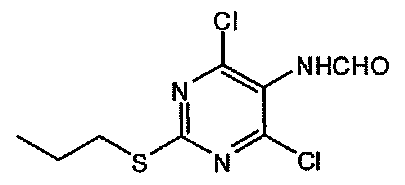
Ref document number: 12723973

Country of ref document: EP

Kind code of ref document: A2

WWE Wipo information: entry into national phase

Ref document number: 2012723973

Country of ref document: EP

ENP Entry into the national phase

Ref document number: 2832570

Country of ref document: CA

WWE Wipo information: entry into national phase

Ref document number: 14009788

Country of ref document: US

REG Reference to national code

Ref country code: BR

Ref legal event code: B01A

Ref document number: 112013025680

Country of ref document: BR

ENP Entry into the national phase

Ref document number: 112013025680

Country of ref document: BR

Kind code of ref document: A2

Effective date: 20131004