EP2982075B1 - Physical broadcast channel (pbch) coverage enhancements for machine type communications (mtc) - Google Patents
Physical broadcast channel (pbch) coverage enhancements for machine type communications (mtc) Download PDFInfo
- Publication number
- EP2982075B1 EP2982075B1 EP14720463.0A EP14720463A EP2982075B1 EP 2982075 B1 EP2982075 B1 EP 2982075B1 EP 14720463 A EP14720463 A EP 14720463A EP 2982075 B1 EP2982075 B1 EP 2982075B1
- Authority
- EP
- European Patent Office
- Prior art keywords
- pbch
- mtc
- transmitted
- subframe
- aspects
- Prior art date
- Legal status (The legal status is an assumption and is not a legal conclusion. Google has not performed a legal analysis and makes no representation as to the accuracy of the status listed.)
- Active
Links
Images



Classifications
-
- H—ELECTRICITY
- H04—ELECTRIC COMMUNICATION TECHNIQUE
- H04L—TRANSMISSION OF DIGITAL INFORMATION, e.g. TELEGRAPHIC COMMUNICATION
- H04L5/00—Arrangements affording multiple use of the transmission path
- H04L5/003—Arrangements for allocating sub-channels of the transmission path
- H04L5/0053—Allocation of signalling, i.e. of overhead other than pilot signals
-
- H—ELECTRICITY
- H04—ELECTRIC COMMUNICATION TECHNIQUE
- H04W—WIRELESS COMMUNICATION NETWORKS
- H04W72/00—Local resource management
- H04W72/04—Wireless resource allocation
Definitions
- Certain aspects of the present disclosure generally relate to wireless communications and, more particularly, to techniques for physical broadcast channel (PBCH) coverage enhancements for machine type communications (MTC).
- PBCH physical broadcast channel
- MTC machine type communications
- Wireless communication systems are widely deployed to provide various types of communication content such as voice, data, and so on. These systems may be multiple-access systems capable of supporting communication with multiple users by sharing the available system resources (e.g., bandwidth and transmit power). Examples of such multiple-access systems include code division multiple access (CDMA) systems, time division multiple access (TDMA) systems, frequency division multiple access (FDMA) systems, 3rd Generation Partnership Project (3GPP) Long Term Evolution (LTE) including LTE-Advanced systems and orthogonal frequency division multiple access (OFDMA) systems.
- CDMA code division multiple access
- TDMA time division multiple access
- FDMA frequency division multiple access
- 3GPP 3rd Generation Partnership Project
- LTE Long Term Evolution
- OFDMA orthogonal frequency division multiple access
- a wireless multiple-access communication system can simultaneously support communication for multiple wireless terminals.
- Each terminal communicates with one or more base stations via transmissions on the forward and reverse links.
- the forward link (or downlink) refers to the communication link from the base stations to the terminals
- the reverse link (or uplink) refers to the communication link from the terminals to the base stations.
- This communication link may be established via a single-input single-output, multiple-input single-output or a multiple-input multiple-output (MIMO) system.
- MIMO multiple-input multiple-output
- Wireless devices may include user equipments (UEs). Some examples of UEs may include cellular phones, smart phones, personal digital assistants (PDAs), wireless modems, handheld devices, laptop computers, netbooks, etc. Some UEs may be considered machine type communication (MTC) UEs, which may include remote devices such as sensors, meters, location tags, etc. A remote device may communicate with a base station, another remote device, or some other entity. Machine type communication (MTC) may refer to communication involving at least one remote device on at least one end of the communication.
- MTC machine type communication
- PBCH physical broadcast channel
- MTC machine type communications
- Certain aspects of the present disclosure provide a method for wireless communications, as defined in claim 1.
- Certain aspects of the present disclosure provide an apparatus for wireless communications, as defined in claim 2.
- aspects of the present disclosure provide techniques and apparatus for enhancing physical broadcast channel (PBCH) coverage for certain user equipments (e.g., low cost, low data rate UEs).
- PBCH physical broadcast channel
- certain types of UEs may have limited coverage relative to other types of UEs.
- some types of low cost UEs may have only a single receive chain, thereby limiting downlink (DL) coverage, while other types of UEs benefit from multiple receive chains.
- transmit power on a downlink may be limited, and/or a relatively narrow bandwidth may be used to communicate with these types of UEs, reducing frequency diversity gains. Techniques presented herein, however, may help enhance coverage to such UEs.
- CDMA Code Division Multiple Access
- TDMA Time Division Multiple Access
- FDMA Frequency Division Multiple Access
- OFDMA Orthogonal FDMA
- SC-FDMA Single-Carrier FDMA
- a CDMA network may implement a radio technology such as Universal Terrestrial Radio Access (UTRA), cdma2000, etc.
- UTRA includes Wideband-CDMA (W-CDMA), Time Division Synchronous CDMA (TD-SCDMA), and other variants of CDMA.
- cdma2000 covers IS-2000, IS-95 and IS-856 standards.
- a TDMA network may implement a radio technology such as Global System for Mobile Communications (GSM).
- GSM Global System for Mobile Communications
- An OFDMA network may implement a radio technology such as Evolved UTRA (E-UTRA), Ultra Mobile Broadband (UMB), IEEE 802.11 (Wi-Fi), IEEE 802.16 (WiMAX), IEEE 802.20, Flash-OFDM ® , etc.
- E-UTRA Evolved UTRA
- UMB Ultra Mobile Broadband
- IEEE 802.11 Wi-Fi
- WiMAX IEEE 802.16
- IEEE 802.20 Flash-OFDM ®
- UTRA and E-UTRA are part of Universal Mobile Telecommunication System (UMTS).
- 3GPP Long Term Evolution (LTE) and LTE-Advanced (LTE-A), in both frequency division duplex (FDD) and time division duplex (TDD), are new releases of UMTS that use E-UTRA, which employs OFDMA on the downlink and SC-FDMA on the uplink.
- UTRA, E-UTRA, UMTS, LTE, LTE-A and GSM are described in documents from an organization named "3rd Generation Partnership Project” (3GPP).
- cdma2000 and UMB are described in documents from an organization named “3rd Generation Partnership Project 2" (3GPP2).
- the techniques described herein may be used for the wireless networks and radio technologies mentioned above as well as other wireless networks and radio technologies. For clarity, certain aspects of the techniques are described below for LTE/LTE-A, and LTE/LTE-A terminology is used in much of the description below.
- FIG. 1 shows a wireless communication network 100, which may be an LTE network or some other wireless network.
- Wireless network 100 may include a number of evolved Node Bs (eNBs) 110 and other network entities.
- An eNB is an entity that communicates with user equipments (UEs) and may also be referred to as a base station, a Node B, an access point (AP), etc.
- UEs user equipments
- AP access point
- Each eNB may provide communication coverage for a particular geographic area.
- the term "cell" can refer to a coverage area of an eNB and/or an eNB subsystem serving this coverage area, depending on the context in which the term is used.
- An eNB may provide communication coverage for a macro cell, a pico cell, a femto cell, and/or other types of cell.
- a macro cell may cover a relatively large geographic area (e.g., several kilometers in radius) and may allow unrestricted access by UEs with service subscription.
- a pico cell may cover a relatively small geographic area and may allow unrestricted access by UEs with service subscription.
- a femto cell may cover a relatively small geographic area (e.g., a home) and may allow restricted access by UEs having association with the femto cell (e.g., UEs in a closed subscriber group (CSG)).
- An eNB for a macro cell may be referred to as a macro eNB.
- An eNB for a pico cell may be referred to as a pico eNB.
- An eNB for a femto cell may be referred to as a femto eNB or a home eNB (HeNB).
- HeNB home eNB
- an eNB 110a may be a macro eNB for a macro cell 102a
- an eNB 110b may be a pico eNB for a pico cell 102b
- an eNB 110c may be a femto eNB for a femto cell 102c.
- An eNB may support one or multiple (e.g., three) cells.
- the terms "eNB", “base station,” and “cell” may be used interchangeably herein.
- Wireless network 100 may also include relay stations.
- a relay station is an entity that can receive a transmission of data from an upstream station (e.g., an eNB or a UE) and send a transmission of the data to a downstream station (e.g., a UE or an eNB).
- a relay station may also be a UE that can relay transmissions for other UEs.
- a relay station 110d may communicate with macro eNB 110a and a UE 120d in order to facilitate communication between eNB 110a and UE 120d.
- a relay station may also be referred to as a relay eNB, a relay base station, a relay, etc.
- Wireless network 100 may be a heterogeneous network that includes eNBs of different types, e.g., macro eNBs, pico eNBs, femto eNBs, relay eNBs, etc. These different types of eNBs may have different transmit power levels, different coverage areas, and different impact on interference in wireless network 100.
- macro eNBs may have a high transmit power level (e.g., 5 to 40 W) whereas pico eNBs, femto eNBs, and relay eNBs may have lower transmit power levels (e.g., 0.1 to 2 W).
- a network controller 130 may couple to a set of eNBs and may provide coordination and control for these eNBs.
- Network controller 130 may communicate with the eNBs via a backhaul.
- the eNBs may also communicate with one another, e.g., directly or indirectly via a wireless or wireline backhaul.
- UEs 120 may be dispersed throughout wireless network 100, and each UE may be stationary or mobile.
- a UE may also be referred to as an access terminal, a terminal, a mobile station (MS), a subscriber unit, a station (STA), etc.
- a UE may be a cellular phone, a personal digital assistant (PDA), a wireless modem, a wireless communication device, a handheld device, a laptop computer, a cordless phone, a wireless local loop (WLL) station, a tablet, a smart phone, a netbook, a smartbook, etc.
- PDA personal digital assistant
- WLL wireless local loop
- FIG. 2 is a block diagram of a design of base station/eNB 110 and UE 120, which may be one of the base stations/eNBs and one of the UEs in FIG. 1 .
- Base station 110 may be equipped with T antennas 234a through 234t
- UE 120 may be equipped with R antennas 252a through 252r, where in general T ⁇ 1 and R ⁇ 1.
- a transmit processor 220 may receive data from a data source 212 for one or more UEs, select one or more modulation and coding schemes (MCSs) for each UE based on channel quality indicators (CQIs) received from the UE, process (e.g., encode and modulate) the data for each UE based on the MCS(s) selected for the UE, and provide data symbols for all UEs. Transmit processor 220 may also process system information (e.g., for semi-static resource partitioning information (SRPI), etc.) and control information (e.g., CQI requests, grants, upper layer signaling, etc.) and provide overhead symbols and control symbols.
- system information e.g., for semi-static resource partitioning information (SRPI), etc.
- control information e.g., CQI requests, grants, upper layer signaling, etc.
- Processor 220 may also generate reference symbols for reference signals (e.g., the common reference signal (CRS)) and synchronization signals (e.g., the primary synchronization signal (PSS) and secondary synchronization signal (SSS)).
- a transmit (TX) multiple-input multiple-output (MIMO) processor 230 may perform spatial processing (e.g., precoding) on the data symbols, the control symbols, the overhead symbols, and/or the reference symbols, if applicable, and may provide T output symbol streams to T modulators (MODs) 232a through 232t. Each modulator 232 may process a respective output symbol stream (e.g., for OFDM, etc.) to obtain an output sample stream.
- TX multiple-input multiple-output
- MIMO multiple-input multiple-output
- Each modulator 232 may process a respective output symbol stream (e.g., for OFDM, etc.) to obtain an output sample stream.
- Each modulator 232 may further process (e.g., convert to analog, amplify, filter, and upconvert) the output sample stream to obtain a downlink signal.
- T downlink signals from modulators 232a through 232t may be transmitted via T antennas 234a through 234t, respectively.
- antennas 252a through 252r may receive the downlink signals from base station 110 and/or other base stations and may provide received signals to demodulators (DEMODs) 254a through 254r, respectively.
- Each demodulator 254 may condition (e.g., filter, amplify, downconvert, and digitize) its received signal to obtain input samples.
- Each demodulator 254 may further process the input samples (e.g., for OFDM, etc.) to obtain received symbols.
- a MIMO detector 256 may obtain received symbols from all R demodulators 254a through 254r, perform MIMO detection on the received symbols if applicable, and provide detected symbols.
- a receive processor 258 may process (e.g., demodulate and decode) the detected symbols, provide decoded data for UE 120 to a data sink 260, and provide decoded control information and system information to a controller/processor 280.
- a channel processor may determine reference signal received power (RSRP), received signal strength indicator (RSSI), reference signal received quality (RSRQ), CQI, etc.
- a transmit processor 264 may receive and process data from a data source 262 and control information (e.g., for reports comprising RSRP, RSSI, RSRQ, CQI, etc.) from controller/processor 280. Processor 264 may also generate reference symbols for one or more reference signals. The symbols from transmit processor 264 may be precoded by a TX MIMO processor 266 if applicable, further processed by modulators 254a through 254r (e.g., for SC-FDM, OFDM, etc.), and transmitted to base station 110.
- control information e.g., for reports comprising RSRP, RSSI, RSRQ, CQI, etc.
- Processor 264 may also generate reference symbols for one or more reference signals.
- the symbols from transmit processor 264 may be precoded by a TX MIMO processor 266 if applicable, further processed by modulators 254a through 254r (e.g., for SC-FDM, OFDM, etc.), and transmitted to base station 110.
- the uplink signals from UE 120 and other UEs may be received by antennas 234, processed by demodulators 232, detected by a MIMO detector 236 if applicable, and further processed by a receive processor 238 to obtain decoded data and control information sent by UE 120.
- Processor 238 may provide the decoded data to a data sink 239 and the decoded control information to controller/processor 240.
- Base station 110 may include communication unit 244 and communicate to network controller 130 via communication unit 244.
- Network controller 130 may include communication unit 294, controller/processor 290, and memory 292.
- Controllers/processors 240 and 280 may direct the operation at base station 110 and UE 120, respectively.
- Processor 240 and/or other processors and modules at base station 110, and/or processor 280 and/or other processors and modules at UE 120, may perform or direct processes for the techniques described herein.
- Memories 242 and 282 may store data and program codes for base station 110 and UE 120, respectively.
- a scheduler 246 may schedule UEs for data transmission on the downlink and/or uplink.
- the base station 110 may be configured to determine a bundling size based at least in part on a data allocation size and precode data in bundled contiguous resource blocks of the determined bundling size, wherein resource blocks in each bundle may be precoded with a common precoding matrix. That is, reference signals (RSs) such as UE-RS and/or data in the resource blocks may be precoded using the same precoder.
- RSs reference signals
- the power level used for the UE-RS in each resource block (RB) of the bundled RBs may also be the same.
- the UE 120 may be configured to perform complementary processing to decode data transmitted from the base station 110. For example, the UE 120 may be configured to determine a bundling size based on a data allocation size of received data transmitted from a base station in bundles of contiguous RBs, wherein at least one reference signal in resource blocks in each bundle are precoded with a common precoding matrix, estimate at least one precoded channel based on the determined bundling size and one or more RSs transmitted from the base station, and decode the received bundles using the estimated precoded channel.
- FIG. 3 shows an exemplary frame structure 300 for FDD in LTE.
- the transmission timeline for each of the downlink and uplink may be partitioned into units of radio frames.
- Each radio frame may have a predetermined duration (e.g., 10 milliseconds (ms)) and may be partitioned into 10 subframes with indices of 0 through 9.
- Each subframe may include two slots.
- Each radio frame may thus include 20 slots with indices of 0 through 19.
- Each slot may include L symbol periods, e.g., seven symbol periods for a normal cyclic prefix (as shown in FIG. 2 ) or six symbol periods for an extended cyclic prefix.
- the 2 L symbol periods in each subframe may be assigned indices of 0 through 2 L -1.
- an eNB may transmit a primary synchronization signal (PSS) and a secondary synchronization signal (SSS) on the downlink in the center 1.08 MHz of the system bandwidth for each cell supported by the eNB.
- PSS and SSS may be transmitted in symbol periods 6 and 5, respectively, in subframes 0 and 5 of each radio frame with the normal cyclic prefix, as shown in FIG. 3 .
- the PSS and SSS may be used by UEs for cell search and acquisition.
- the eNB may transmit a cell-specific reference signal (CRS) across the system bandwidth for each cell supported by the eNB.
- the CRS may be transmitted in certain symbol periods of each subframe and may be used by the UEs to perform channel estimation, channel quality measurement, and/or other functions.
- the eNB may also transmit a physical broadcast channel (PBCH) in symbol periods 0 to 3 in slot 1 of certain radio frames.
- PBCH physical broadcast channel
- the PBCH may carry some system information.
- the eNB may transmit other system information such as system information blocks (SIBs) on a physical downlink shared channel (PDSCH) in certain subframes.
- SIBs system information blocks
- PDSCH physical downlink shared channel
- the eNB may transmit control information/data on a physical downlink control channel (PDCCH) in the first B symbol periods of a subframe, where B may be configurable for each subframe.
- the eNB may transmit traffic data and/or other data on the PDSCH in the remaining symbol periods of each subframe.
- E-UTRA Evolved Universal Terrestrial Radio Access
- FIG. 4 shows two example subframe formats 410 and 420 for the downlink with a normal cyclic prefix.
- the available time frequency resources for the downlink may be partitioned into resource blocks.
- Each resource block may cover 12 subcarriers in one slot and may include a number of resource elements.
- Each resource element may cover one subcarrier in one symbol period and may be used to send one modulation symbol, which may be a real or complex value.
- Subframe format 410 may be used for an eNB equipped with two antennas.
- a CRS may be transmitted from antennas 0 and 1 in symbol periods 0, 4, 7, and 11.
- a reference signal is a signal that is known a priori by a transmitter and a receiver and may also be referred to as pilot.
- a CRS is a reference signal that is specific for a cell, e.g., generated based on a cell identity (ID).
- ID cell identity
- Subframe format 420 may be used for an eNB equipped with four antennas.
- a CRS may be transmitted from antennas 0 and 1 in symbol periods 0, 4, 7, and 11 and from antennas 2 and 3 in symbol periods 1 and 8.
- a CRS may be transmitted on evenly spaced subcarriers, which may be determined based on cell ID. Different eNBs may transmit their CRSs on the same or different subcarriers, depending on their cell IDs.
- resource elements not used for the CRS may be used to transmit data (e.g., traffic data, control data, and/or other data).
- An interlace structure may be used for each of the downlink and uplink for FDD in LTE.
- Q interlaces with indices of 0 through Q -1 may be defined, where Q may be equal to 4, 6, 8, 10, or some other value.
- Each interlace may include subframes that are spaced apart by Q frames.
- interlace q may include subframes q , q + Q , q +2 Q , etc., where q ⁇ ⁇ 0,..., Q - 1 ⁇ .
- the wireless network may support hybrid automatic retransmission request (HARQ) for data transmission on the downlink and uplink.
- HARQ hybrid automatic retransmission request
- a transmitter e.g., an eNB 110
- a receiver e.g., a UE 120
- all transmissions of the packet may be sent in subframes of a single interlace.
- each transmission of the packet may be sent in any subframe.
- a UE may be located within the coverage of multiple eNBs. One of these eNBs may be selected to serve the UE. The serving eNB may be selected based on various criteria such as received signal strength, received signal quality, path loss, etc. Received signal quality may be quantified by a signal-to-interference-plus-noise ratio (SINR), or a reference signal received quality (RSRQ), or some other metric.
- SINR signal-to-interference-plus-noise ratio
- RSRQ reference signal received quality
- the UE may operate in a dominant interference scenario in which the UE may observe high interference from one or more interfering eNBs.
- legacy physical broadcast channel is transmitted with a 40-bit payload size.
- the 40-bit payload consists of an 8-bit system frame number (SFN), a 3-bit physical hybrid automatic repeat request (HARQ) indicator channel (PHICH) information (including the size of PHICH region and whether PHICH is of an extended duration or not), a 4-bit system bandwidth, 9 reserved bits, and a 16-bit cyclic redundancy check (CRC).
- the payload conveys cell-specific reference signal (CRS) antenna configuration via different CRC masks; 3 CRC masks are defined to convey information about 1, 2, or 4 CRS antenna ports.
- PBCH is transmitted every 10ms, but the same information is transmitted in four consecutive transmission opportunities, resulting in a 40ms periodicity for PBCH information update (40ms PBCH transmission time interval (TTI)).
- TTI 40ms PBCH transmission time interval
- FIG. 5 illustrates an example PBCH format 500.
- PBCH is transmitted using the first four symbols 502, 504, 506, 508 in the second slot 510 of subframe 0 512 in the center 6 resource blocks (RBs), excluding the resource elements (REs) potentially used by CRS (assuming 4-port CRS, irrespective of the actual CRS port configuration).
- RBs resource blocks
- REs resource elements
- NCT New Carrier Type
- LCT legacy carrier type
- RSRP reference signal received power
- PBCH for NCT in carrier aggregation as secondary carriers are not deemed as necessary, since the relevant information in PBCH can be tunneled to the user equipment (UE) via dedicated signaling.
- UE user equipment
- PBCH for standalone NCT may still be necessary.
- PBCH for NCT may be generally referred to as enhanced PBCH or EPBCH for convenience.
- EPBCH may occupy 4 symbols in center 6 RBs and may have a similar number of REs as legacy PBCH.
- the EPBCH payload size may be different from the PBCH payload size, allowing additional information to be conveyed in EPBCH.
- the same modulation and coding as PBCH can be used for EPBCH (e.g., quadrature phase-shift keying (QPSK) and tail-biting convolutional coding (TBCC)).
- TTI period for EPBCH can be the same as legacy PBCH (e.g., 40ms) or may be different (e.g., 80ms).
- TTI (or subframe) bundling may be configured on a per-UE basis.
- the subframe bundling is configured by the parameter ttiBundling , which is provided by higher layers.
- TTI bundling is performed by sending data from a UE in an uplink shared channel over multiple TTIs to the base station, and bundling is not applied to other uplink signals/traffic (e.g., uplink control information).
- the bundling size may be fixed at 4 TTIs (subframes), that is, the physical uplink shared channel (PUSCH) is transmitted in four consecutive subframes. The same HARQ process number is used in each of the bundled subframes.
- the resource allocation size may be restricted to no more than three resource blocks (RBs).
- the modulation order may be set to 2 (i.e., quadrature phase-shift keying (QPSK)).
- QPSK quadrature phase-shift keying
- Each bundle may be treated as a single resource so that, for example, a single grant and a single HARQ acknowledgment (ACK) may be used for each bundle, reducing signaling overhead.
- TTI bundling is typically used in situations where higher layer segmentation of data packets may introduce unnecessary overhead, such as for low rate traffic.
- VoIP voice over internet protocol
- L2 Layer 2
- L2 Layer 2
- a VoIP packet may be segmented into four radio link control (RLC) protocol data units (PDUs) that are transmitted in four consecutive TTIs. Two to three HARQ retransmission may be targeted to achieve sufficient coverage.
- RLC radio link control
- each additional segment introduces a 1 byte RLC, 1 byte medium access control (MAC), and 3 byte L1 cyclic redundancy check (CRC) overhead. This may amount to, for example, a 15% overhead assuming a 33 byte RLC service data unit (SDU) size. In the case of 4 segments, there is an additional L1/L2 overhead of 45%.
- HARQ transmissions/retransmissions for every segment may use grants on PDCCH, consuming significant PDCCH resources. Additionally, each HARQ transmission or retransmission is followed by HARQ feedback on PHICH. Assuming a negative acknowledgment-acknowledgment (NACK-ACK) error ratio of 10 -3 (0.001) the large number of HARQ feedback signals leads to high packet loss probabilities. For example, if 12 HARQ feedback signals are sent, the HARQ feedback error ratio may be on the order of 1.2 ⁇ 10 -2 (0.012). Packet loss rates of more than 10 -2 (0.01) may be unacceptable for VoIP traffic.
- NACK-ACK negative acknowledgment-acknowledgment
- LTE long term evolution
- DL down link
- UL uplink
- MTC machine type communications
- maximum bandwidth may be reduced
- RF radio frequency
- peak rate may be reduced
- transmit power may be reduced
- half duplex operation may be performed.
- MTC devices e.g., MTC devices
- these devices may have power supply, while others (e.g., gas meters) may operate on battery.
- Link budget requirements may be increased for these devices.
- a 20 dB coverage enhancement may be desirable to cover devices in the basement.
- large transmission time interval (TTI) bundling may be implemented (e.g., bundling by 100 times for data channels) to achieve a 20 dB link budget gain.
- TTI bundling may be used for physical broadcast channel (PBCH), physical downlink control channel (PDCCH), enhanced PDCCH, physical hybrid automatic repeat request (HARQ) indicator channel (PHICH), and physical downlink shared channel (PDSCH).
- PBCH physical broadcast channel
- PDCCH physical downlink control channel
- HARQ physical hybrid automatic repeat request
- PHICH physical hybrid automatic repeat request indicator channel
- PUSCH physical downlink shared channel
- RACH random access channel
- PUCCH physical uplink control channel
- PUSCH physical uplink shared channel
- PBCH coverage enhancement repeated transmissions of PBCH content over a long duration may be insufficient because PBCH content is updated every 40ms (e.g., with system frame number (SFN) change). Accordingly, what is needed is a new design for PBCH with better coverage for some devices, such as MTC devices, while maintaining normal operation of other devices, such as legacy UEs or non-MTC devices.
- SFN system frame number
- a base station may determine resources for a new physical broadcast channel (PBCH) with and communicate with a user equipment (UE) based on the new PBCH.
- PBCH physical broadcast channel
- UE user equipment
- the new PBCH may be a machine type communications (MTC) PBCH.
- MTC machine type communications
- the new PBCH may be used by non-MTC devices.
- the term "new" PBCH generally refers to a PBCH with extended coverage relative to a legacy PBCH which is described in further detail herein.
- legacy PBCH generally refers to a PBCH transmitted in accordance with a previous version of a standard (e.g., LTE rel. 10 or earlier), relative to the new PBCH described herein.
- a legacy PBCH may include a PBCH as shown in FIG. 3 .
- a legacy PBCH is typically transmitted in symbols 0-3 of Slot 1 in a subframe, using the center 6 RBs.
- a legacy PBCH typically transmitted with a 40 ms or 80 ms period.
- the new PBCH may have different characteristics or design than the legacy PBCH.
- FIG. 6 illustrates time division multiplexing (TDM) of PBCH 604 and PBCH for communication with MTC devices (MTC_PBCH) 606 on MTC subframes 602, in accordance with certain aspects of the present disclosure.
- MTC_PBCH 606 may be densely transmitted in subframes allocated for MTC communications (MTC subframes) 602 and may not be transmitted at all in other subframes (e.g., regular subframes).
- the transmission periodicity for MTC_PBCH 606 may be much larger than for regular PBCH 604 (e.g., 40ms).
- MTC_PBCH 606 may be transmitted at a narrower bandwidth than PBCH 604, which is typically transmitted at 6 RBs.
- MTC_PBCH 606 may be transmitted at a bandwidth of 1-2 RBs.
- MTC_PBCH 606 may be transmitted at a 6 RB bandwidth, but with reduced TTIs.
- the transmission bandwidth for MTC_PBCH may be in a continuous frequency location or with hopping.
- FIG. 7A illustrates frequency division multiplexing (FDM) structure 700A of MTC_PBCH 702A with legacy carrier type (LCT), in accordance with certain aspects of the present disclosure.
- FDM frequency division multiplexing
- MTC_PBCH 702A may be transmitted at 1-2 RBs across less than the entire subframe, with symbols remaining for control 704A.
- FIG. 7B illustrates FDM structure 700B of MTC_PBCH 702B with new carrier type (NCT), in accordance with certain aspects of the present disclosure.
- NCT new carrier type
- MTC_PBCH 702B may span the entire subframe and use FDM with EPDCCH 706B and PDSCH 708B.
- MTC_PBCH may span the entire subframe, with rate matching around legacy signals/channels.
- MTC_PBCH may span the entire subframe and may be punctured by legacy signals (e.g., primary synchronization signal (PSS), secondary synchronization signal (SSS), PBCH, cell-specific reference signal (CRS), channel state information reference signal (CSI-RS), and positioning reference signal (PRS)) and/or channels (e.g., physical downlink control channel (PDCCH), physical control format indicator channel (PCFICH), and physical HARQ indicator channel (PHICH)).
- legacy signals e.g., primary synchronization signal (PSS), secondary synchronization signal (SSS), PBCH, cell-specific reference signal (CRS), channel state information reference signal (CSI-RS), and positioning reference signal (PRS)
- legacy signals e.g., primary synchronization signal (PSS), secondary synchronization signal (SSS), PBCH, cell-specific reference signal (CRS), channel state information reference signal (CSI-RS), and positioning
- MTC_PBCH may be carrier type dependent or carrier type independent (e.g., legacy carrier type or new carrier type).
- MTC_PBCH may span symbols 4-14 or 5-14 in LCT by excluding the PDCCH and rate matched around CRS in every subframe.
- MTC_PBCH may span the entire subframe and may be rate matched around CRS only every 5 subframes.
- MTC_PBCH is carrier type agnostic, and only one format is supported.
- MTC_PBCH may span the entire subframe and may be punctured by legacy signals.
- MTC_PBCH may span symbols 5-14 and may be rate matched around CRS on all subframes. This may be desirable for simple MTC operation, for example.
- MTC_PBCH may span symbols 4-14.
- MTC_PBCH may not be transmitted in subframe 0 and subframe 5.
- MTC_PBCH may be transmitted in subframes 0 and 5, and is rate matched around PSS/SSS/PBCH.
- the legacy control region may be excluded, leaving only 4 symbols.
- MTC_PBCH may be punctured by PSS/SSS/PBCH.
- MTC_PBCH may be transmitted in a different frequency location outside the center 6 RBs.
- MTC_PSS and MTC_SSS may be introduced with MTC_PBCH in the same frequency location.
- EPDCCH handling of MTC_PBCH may ensure that EPDCCH does not collide with resources allocated for MTC_PBCH.
- EPDCCH may be MTC agnostic. In other words, if EPDCCH does collide with MTC_PBCH, then EPDCCH may puncture MTC_PBCH. Alternatively, if EPDCCH collides with MTC_PBCH, MTC_PBCH may be rate matched around EPDCCH.
- common search space (CSS) and/or UE-specific search space (USS) EPDCCH resource locations may be such that in subframes with MTC_PBCH, a different set of resource locations may be used than in regular subframes in order to avoid collisions.
- the set of resources may be a punctured (e.g., by MTC_PBCH) version of the set used for regular subframes.
- the set of resources in the MTC subframe may be defined based on the set used in regular subframes, but not mapped to the MTC_PBCH REs.
- EPDCCH may be defined based on the set of resources in the MTC subframes.
- the eNB may transmit both PBCH and MTC_PBCH.
- a non-MTC UE may monitor only PBCH.
- MTC_PBCH is similar to a scheduled PDSCH to other users.
- an MTC UE may monitor only MTC_PBCH and ignore regular PBCH.
- PBCH coverage enhancement may be achieved using other features.
- MTC_PBCH may be power boosted-transmitted with higher power spectral density (PSD) than other DL signals.
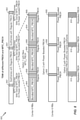
- FIG. 8 illustrates example time division multiplexing 800 of PBCH and MTC_PBCH with power boosting, in accordance with certain aspects of the present disclosure.
- MTC_PBCH may be transmitted in MTC subframes 802 densely, as described above with respect to FIGs. 6 , 7A, and 7B , or with power boost in MTC subframes 802 but transmitted with regular power outside of the MTC subframes 802. For example, as shown in FIG.
- Option 1 bundled MTC_PBCH 804 may be densely transmitted in the center 6 RBs and regular PBCH 806 may be transmitted.
- Option 2 PBCH 808 may be transmitted with power boosts within the MTC subframes 802.
- Option 3 repeated power boosted PBCH 810 may be transmitted within the same subframe 802.
- PSS/SSS may be power boosted in MTC subframes 802, but transmitted at regular power in all other subframes.
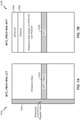
- FIG. 9 illustrates a subframe structure 900 with repeated PBCH, in accordance with the invention.
- PBCH is power boosted and has a repeated PBCH transmitted, for example, in the remaining 4 symbols.
- current PBCH may occupy 4 symbols.
- PSS/SSS and legacy control regions may be excluded.
- PBCH may be repeated in the four remaining symbols (e.g., symbols 4 of slot 0 and symbols 4, 5, and 6 of slot 1 804) in the same subframe 900 as shown in FIG. 9 .
- the repeated PBCH 906 and the PBCH 908 may have the same payload content.
- the PBCH may be repeated only in MTC subframes, and the payload may be different than the payload content of the first regular PBCH.
- power boosting may be applied to any of PSS, SSS, PBCH, or repeated PBCH.
- the power boosting for PBCH is different than the power boosting for the repeated PBCH (e.g., PBCH and repeated PBCH are transmitted at different PSD).
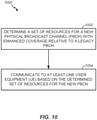
- FIG. 10 illustrates example operations 1000 for wireless communications, in accordance with certain aspects of the present disclosure.
- the operations may be performed, for example, by a base station (e.g., eNB 110).
- the operations 1000 may begin, at 1002, by determining a set of resources for a new (e.g., MTC) physical broadcast channel (PBCH) with enhanced coverage relative to a legacy PBCH.
- MTC physical broadcast channel
- the BS may communicate to at least one user equipment (UE) based on the determined set of resources for the new (e.g., MTC) PBCH.
- the new PBCH may be transmitted on subframes allocated for communicating with MTC devices (MTC subframes).
- the new PBCH may have higher density than regular (e.g., legacy) PBCH, for example, as a result of longer transmission time within a subframe than a transmission time for a regular PBCH and increased periodicity of the MTC_PBCH burst coupled with, in some aspects, narrower bandwidth (e.g., 1 or 2 RBs) than a regular PBCH (e.g., 6 RBs).
- narrower bandwidth e.g., 1 or 2 RBs
- a regular PBCH e.g., 6 RBs
- the bandwidth for the new PBCH may be at a continuous frequency location or may at locations based on frequency hopping.
- new PBCH may span the entire MTC subframe.
- the length of the MTC PBCH is different for LCT and NCT.
- New PBCH may span symbols 4-14 in LCT and may be rate matched around CRS in every subframe.
- new PBCH may span the entire MTC subframe in NCT and may be rate matched around CRS every 5 subframes.
- new PBCH may be the same for LCT and NCT.
- New PBCH may span the entire subframe and may be punctured by PSS, SSS, regular PBCH, CRS, channel state information reference signal (CSI-RS), or positioning reference signal (PRS).
- new PBCH may span symbols 5-14 and may be rate matched around CRS on all subframes.
- MTC PBCH may not be transmitted in subframes 0 and 5.
- new PBCH may be transmitted in subframe 0 and subframe 5 and may be rate matched around PSS, SSS, and regular PBCH.
- new PBCH may be transmitted in a different frequency location than the center 6 RBs.
- the BS determine whether EPDCCH collides with resources allocated to the new PBCH. In aspects, if the BS determines EPDCCH collides with the new PBCH, REs of at least some of the new PBCH may be punctured, new PBCH may be rate matched around EPDCCH, or EPDCCH uses a first set of CSS and USS resource locations. In aspects, if the BS determines EPDCCH does not collide with the new PBCH, EPDCCH uses a second set of CSS and USS resource locations. In aspects, the first set of CSS resource locations may be a punctured version of the second set.
- the BS may transmit new PBCH at higher PSD than other DL transmission signals. In aspects, the BS may transmit regular PBCH at higher PSD than other DL transmission signals on the subframes allocated for communicating with MTC devices. In aspects, the BS may transmit PSS, SSS, and/or SIB for MTC at higher PSD than other DL transmission signals on the subframes allocated for communicating with the MTC devices.
- regular PBCH may be repeated at least once in the subframe.
- regular PBCH and repeated PBCH transmissions in the subframe have the same payload content.
- regular PBCH may be repeated at least once in each subframe allocated for communicating with the MTC devices.
- PSS, SSS, and legacy control region symbols may be excluded and the regular PBCH may be repeated in four remaining symbols.
- repeated PBCH transmissions in a subframe may have different payload content and the regular PBCH has legacy payload content.
- regular PBCH are transmitted in a subframe at different PSD.
- new PDCH may not be transmitted in subframes where regular PBCH is transmitted.
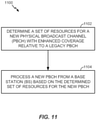
- FIG. 11 illustrates example operations 1100 for wireless communications, in accordance with certain aspects of the present disclosure.
- the operations 1100 may be performed, for example, by a UE (e.g., UE 120).
- the operations 1100 may begin, at 1102, by determining a set of resources for a new (e.g., MTC) physical broadcast channel (PBCH) with enhanced coverage relative to a legacy PBCH.
- MTC physical broadcast channel
- the UE may process a new PBCH from a base station (BS) based on the determined set of resources for the new PBCH.
- BS base station
- the new PBCH may have higher density than regular PBCH, for example, as a result of narrower bandwidth (e.g., 1, 2, or 6 RBs) and increased periodicity of the MTC_PBCH burst.
- the bandwidth may be at a continuous frequency location or may be frequency hopping.
- new PBCH may span the entire MTC subframe. In aspects, the length of the new PBCH is different for LCT and NCT. New PBCH may span symbols 4-14 in LCT and may be rate matched around CRS in every subframe. Alternatively, new PBCH may span the entire MTC subframe in NCT and may be rate matched around CRS every 5 subframes.
- new PBCH may be the same for LCT and NCT.
- New PBCH may span the entire subframe and may be punctured by PSS, SSS, regular PBCH, CRS, channel state information reference signal (CSI-RS), or positioning reference signal (PRS).
- new PBCH may spans symbols 5-14 and may be rate matched around CRS on all subframes.
- new PBCH may not be received in subframes 0 and 5.
- new PBCH may be received in subframe 0 and subframe 5 and may be rate matched around PSS, SSS, and regular PBCH.
- new PBCH may be received in a different frequency location than the center 6 RBs.
- the UE determine whether EPDCCH collides with resources allocated to the new PBCH. In aspects, if the UE determines EPDCCH collides with the new PBCH, REs of at least some of the new PBCH may be punctured, new PBCH may be rate matched around EPDCCH, or EPDCCH uses a first set of CSS and USS resource locations. In aspects, if the UE determines EPDCCH does not collide with the new PBCH, EPDCCH uses a second set of CSS and USS resource locations. In aspects, the first set of CSS resource locations may be a punctured version of the second set.
- the UE may transmit new PBCH at higher PSD than other DL transmission signals. In aspects, the UE may transmit regular PBCH at higher PSD than other DL transmission signals on the subframes allocated for communicating with MTC devices. In aspects, the UE may transmit PSS, SSS, and/or SIB for MTC at higher PSD than other DL transmission signals on the subframes allocated for communicating with the MTC devices.
- the above described techniques may be used for non-machine type communications.
- a new PBCH may be designed using the above techniques for a non-MTC device or smartphone.
- regular PBCH may be repeated at least once in the subframe.
- regular PBCH and repeated PBCH transmissions in the subframe have the same payload content.
- regular PBCH may be repeated at least once in each subframe allocated for communicating with the MTC devices.
- PSS, SSS, and legacy control region symbols may be excluded and the regular PBCH may be repeated in four remaining symbols.
- repeated PBCH transmissions in a subframe may have different payload content and the regular PBCH has legacy payload content.
- regular PBCH are transmitted in a subframe at different PSD.
- MTC_PDCH may not be transmitted in subframes where regular PBCH is transmitted.
- the various operations of methods described above may be performed by any suitable means capable of performing the corresponding functions.
- the means may include various hardware and/or software/firmware component(s) and/or module(s), including, but not limited to a circuit, an application specific integrated circuit (ASIC), or processor.
- ASIC application specific integrated circuit
- those operations may be performed by any suitable corresponding counterpart means-plus-function components.
- DSP digital signal processor
- ASIC application specific integrated circuit
- FPGA field programmable gate array
- PLD programmable logic device
- a general-purpose processor may be a microprocessor, but in the alternative, the processor may be any conventional processor, controller, microcontroller, or state machine.
- a processor may also be implemented as a combination of computing devices, e.g., a combination of a DSP and a microprocessor, a plurality of microprocessors, one or more microprocessors in conjunction with a DSP core, or any other such configuration.
- a software/firmware module may reside in RAM memory, flash memory, ROM memory, EPROM memory, EEPROM memory, registers, hard disk, a removable disk, a CD-ROM, or any other form of storage medium known in the art.
- An exemplary storage medium is coupled to the processor such that the processor can read information from, and write information to, the storage medium.
- the storage medium may be integral to the processor.
- the processor and the storage medium may reside in an ASIC.
- the ASIC may reside in a user terminal.
- the processor and the storage medium may reside as discrete components in a user terminal.
- the functions described may be implemented in hardware, software/firmware, or combinations thereof. If implemented in software, the functions may be stored on or transmitted over as one or more instructions or code on a computer-readable medium.
- Computer-readable media include both computer storage media and communication media including any medium that facilitates transfer of a computer program from one place to another.
- a storage medium may be any available medium that can be accessed by a general purpose or special purpose computer.
- such computer-readable media can comprise RAM, ROM, EEPROM, CD-ROM or other optical disk storage, magnetic disk storage or other magnetic storage devices, or any other medium that can be used to carry or store desired program code means in the form of instructions or data structures and that can be accessed by a general-purpose or special-purpose computer, or a general-purpose or special-purpose processor. Also, any connection is properly termed a computer-readable medium.
- Disk and disc includes compact disc (CD), laser disc, optical disc, digital versatile disc (DVD), floppy disk and Blu-ray disc where disks usually reproduce data magnetically, while discs reproduce data optically with lasers.
- computer-readable media may comprise non-transitory computer-readable media (e.g., tangible media).
- computer-readable media may comprise transitory computer-readable media (e.g., a signal). Combinations of the above should also be included within the scope of computer-readable media.
- a phrase referring to "at least one of" a list of items refers to any combination of those items, including single members.
- "at least one of a, b, or c" is intended to cover a, b, c, a-b, a-c, b-c, and a-b-c.
Landscapes
- Engineering & Computer Science (AREA)
- Signal Processing (AREA)
- Computer Networks & Wireless Communication (AREA)
- Mobile Radio Communication Systems (AREA)
Applications Claiming Priority (3)
| Application Number | Priority Date | Filing Date | Title |
|---|---|---|---|
| US201361809232P | 2013-04-05 | 2013-04-05 | |
| US14/245,370 US9735942B2 (en) | 2013-04-05 | 2014-04-04 | Physical broadcast channel (PBCH) coverage enhancements for machine type communications (MTC) |
| PCT/US2014/033107 WO2014165838A2 (en) | 2013-04-05 | 2014-04-05 | Physical broadcast channel (pbch) coverage enhancements for machine type communications (mtc) |
Publications (2)
| Publication Number | Publication Date |
|---|---|
| EP2982075A2 EP2982075A2 (en) | 2016-02-10 |
| EP2982075B1 true EP2982075B1 (en) | 2022-03-02 |
Family
ID=51654400
Family Applications (1)
| Application Number | Title | Priority Date | Filing Date |
|---|---|---|---|
| EP14720463.0A Active EP2982075B1 (en) | 2013-04-05 | 2014-04-05 | Physical broadcast channel (pbch) coverage enhancements for machine type communications (mtc) |
Country Status (6)
| Country | Link |
|---|---|
| US (1) | US9735942B2 (enExample) |
| EP (1) | EP2982075B1 (enExample) |
| JP (1) | JP6279709B2 (enExample) |
| KR (1) | KR101840862B1 (enExample) |
| CN (1) | CN105122715B (enExample) |
| WO (1) | WO2014165838A2 (enExample) |
Families Citing this family (80)
| Publication number | Priority date | Publication date | Assignee | Title |
|---|---|---|---|---|
| EP3806375B1 (en) * | 2013-04-05 | 2023-06-07 | Telefonaktiebolaget Lm Ericsson (Publ) | Broadcast of information for new carrier type |
| US9924376B2 (en) * | 2013-06-21 | 2018-03-20 | Lg Electronics Inc. | Method for enhancing coverage of user equipment and an apparatus using the same |
| US9374151B2 (en) | 2013-08-08 | 2016-06-21 | Intel IP Corporation | Coverage extension level for coverage limited device |
| US10165455B2 (en) * | 2013-08-22 | 2018-12-25 | Telefonaktiebolaget Lm Ericsson (Publ) | Coordination for PBCH |
| US9516541B2 (en) | 2013-09-17 | 2016-12-06 | Intel IP Corporation | Congestion measurement and reporting for real-time delay-sensitive applications |
| WO2015060646A1 (ko) * | 2013-10-22 | 2015-04-30 | 엘지전자 주식회사 | 기계타입통신을 지원하는 무선접속시스템에서 방송채널 송신 방법 및 이를 지원하는 장치 |
| US9572171B2 (en) | 2013-10-31 | 2017-02-14 | Intel IP Corporation | Systems, methods, and devices for efficient device-to-device channel contention |
| CN104602226A (zh) * | 2013-10-31 | 2015-05-06 | 中兴通讯股份有限公司 | 一种发送、接收系统信息的方法及装置 |
| GB2522482A (en) | 2014-01-28 | 2015-07-29 | Nec Corp | Communication system |
| CN107027095B (zh) | 2014-01-30 | 2020-10-02 | 日本电气株式会社 | 机器对机器(m2m)终端、基站和方法 |
| US20150341858A1 (en) * | 2014-05-21 | 2015-11-26 | Qualcomm Incorporated | Apparatus, methods, and computer program products providing power savings in sps-configured volte with c-drx |
| US10880883B2 (en) * | 2014-09-02 | 2020-12-29 | Qualcomm Incorporated | Low-latency, low-bandwidth and low duty cycle operation in a wireless communication system |
| US9930539B2 (en) * | 2014-11-11 | 2018-03-27 | Qualcomm Incorporated | Physical broadcast channel for coverage enhancement |
| US10555331B2 (en) | 2014-12-09 | 2020-02-04 | Qualcomm Incorporated | Nested system operation |
| US10306439B2 (en) | 2015-01-16 | 2019-05-28 | Lg Electronics Inc. | Method and device for transmitting and receiving shared control message in wireless access system supporting machine type communication |
| RU2669778C1 (ru) * | 2015-01-29 | 2018-10-16 | Панасоник Интеллекчуал Проперти Корпорэйшн оф Америка | Способ и устройство беспроводной связи |
| US10200977B2 (en) * | 2015-01-30 | 2019-02-05 | Qualcomm Incorporated | System information block channel design for enhanced machine type communication with coverage enhancements |
| WO2016119244A1 (zh) * | 2015-01-30 | 2016-08-04 | 华为技术有限公司 | 网络设备、用户设备和系统消息传输方法 |
| US10098123B2 (en) * | 2015-02-11 | 2018-10-09 | Qualcomm Incorporated | Service type indicator in master information block (MIB) |
| CN107439020B (zh) * | 2015-03-30 | 2020-12-01 | 索尼公司 | 用于增加移动通信系统中的ue定位精度的系统和方法 |
| EP3278483B1 (en) | 2015-03-31 | 2021-09-29 | Panasonic Intellectual Property Corporation of America | Wireless communication method, user equipment and enode-b |
| WO2016159696A1 (en) * | 2015-03-31 | 2016-10-06 | Lg Electronics Inc. | Method and apparatus for performing frequency hopping for mtc ue in wireless communication system |
| US10321417B2 (en) * | 2015-04-03 | 2019-06-11 | Qualcomm Incorporated | Enhanced cell acquisition for enhanced machine type communications |
| US10827485B2 (en) * | 2015-04-17 | 2020-11-03 | Qualcomm Incorporated | Narrowband dependent subframe availability for MTC |
| US10652768B2 (en) * | 2015-04-20 | 2020-05-12 | Qualcomm Incorporated | Control channel based broadcast messaging |
| US10057815B2 (en) * | 2015-05-14 | 2018-08-21 | Qualcomm Incorporated | Physical broadcast channel repetition for evolved machine type communication |
| US10506591B2 (en) | 2015-05-15 | 2019-12-10 | Qualcomm Incorporated | Narrowband definition for enhanced machine type communication |
| JP6765369B2 (ja) * | 2015-05-15 | 2020-10-07 | シャープ株式会社 | 端末装置、基地局装置および方法 |
| US10454521B2 (en) * | 2015-06-24 | 2019-10-22 | Lg Electronics Inc. | Method and apparatus for randomization of interference in cellular internet of things (IOT) system |
| HK1252828A1 (zh) | 2015-07-30 | 2019-06-06 | 苹果公司 | 物理广播信道设计 |
| US10790952B2 (en) | 2015-09-08 | 2020-09-29 | Lg Electronics Inc. | Method and apparatus for receiving downlink physical broadcasting channel in radio access system that supports narrow band internet of things |
| US11212760B2 (en) * | 2015-09-24 | 2021-12-28 | Qualcomm Incorporated | Common synchronization channel design for narrowband communications |
| EP3353924B1 (en) * | 2015-09-24 | 2021-12-01 | Apple Inc. | Mapping of physical broadcast channel (pbch) repetition symbols for machine-type communication (mtc) |
| CN106604325B (zh) * | 2015-10-16 | 2019-11-19 | 上海诺基亚贝尔股份有限公司 | 毫米波通信系统中的基站及其执行的方法 |
| CN106936756B (zh) * | 2015-12-31 | 2019-04-12 | 中兴通讯股份有限公司 | 同步信号的传输方法、装置及系统 |
| CN106961315B (zh) * | 2016-01-11 | 2020-03-17 | 电信科学技术研究院 | 一种窄带pbch传输方法及装置 |
| GB201602150D0 (en) * | 2016-02-05 | 2016-03-23 | Nec Corp | Communication system |
| US10736113B2 (en) * | 2016-02-16 | 2020-08-04 | Qualcomm Incorporated | Positioning signal techniques for narrowband devices |
| US10477540B2 (en) * | 2016-03-11 | 2019-11-12 | Qualcomm Incorporated | Relay for enhanced machine type communication and narrow band-internet of things |
| WO2017171365A2 (ko) * | 2016-03-31 | 2017-10-05 | 엘지전자(주) | 6ghz 이하 대역을 지원하는 무선 통신 시스템에서 신호를 송수신하기 위한 방법 및 이를 위한 장치 |
| US10368329B2 (en) * | 2016-04-11 | 2019-07-30 | Qualcomm Incorporated | Synchronization for standalone LTE broadcast |
| CN108886770B (zh) * | 2016-04-12 | 2023-06-30 | 上海诺基亚贝尔股份有限公司 | 通信系统中用于发送和接收控制信令的方法和装置 |
| WO2017196406A1 (en) * | 2016-05-09 | 2017-11-16 | Intel IP Corporation | Extended physical broadcast channel design for 5g standalone system |
| WO2017196083A1 (ko) * | 2016-05-13 | 2017-11-16 | 한국전자통신연구원 | 제어 채널을 위한 자원의 설정 정보를 전송하는 방법 및 장치, 상향링크 drs를 위한 자원의 설정 정보를 전송하는 방법 및 장치, 서브프레임/슬롯의 타입을 지시하는 지시자를 전송하는 방법 및 장치, 그리고 하향링크 심볼의 개수를 전송하는 방법 및 장치 |
| US10887035B2 (en) * | 2016-06-01 | 2021-01-05 | Qualcomm Incorporated | Time division multiplexing of synchronization channels |
| US11044111B2 (en) | 2016-07-14 | 2021-06-22 | Qualcomm Incorporated | Subframe validity and system information reception for machine type communication |
| CN107690189B (zh) * | 2016-08-05 | 2019-12-20 | 电信科学技术研究院 | 控制短tti的下行控制信道传输的方法及设备 |
| EP3484225A4 (en) | 2016-08-09 | 2020-02-26 | Samsung Electronics Co., Ltd. | METHOD AND DEVICE FOR TRANSMITTING CHANNELS IN A WIRELESS CELLULAR COMMUNICATION SYSTEM |
| KR102355797B1 (ko) | 2016-08-09 | 2022-01-26 | 삼성전자 주식회사 | 무선 셀룰라 통신 시스템에서 채널 전송 방법 및 장치 |
| WO2018042295A1 (en) * | 2016-09-01 | 2018-03-08 | Telefonaktiebolaget Lm Ericsson (Publ) | Npbch design and decoding for nb-iot-u |
| MY195951A (en) * | 2016-09-26 | 2023-02-27 | Fraunhofer Ges Forschung | Physically Separated Channels for Narrowband, Low Complexity Receivers |
| EP3536040B1 (en) * | 2016-11-04 | 2021-10-27 | Telefonaktiebolaget LM Ericsson (PUBL) | System information for narrowband |
| US10638444B2 (en) * | 2016-12-01 | 2020-04-28 | Qualcomm Incorporated | Positioning techniques for wireless communications devices using shared radio frequency spectrum |
| US10470191B2 (en) * | 2016-12-09 | 2019-11-05 | Samsung Electronics Co., Ltd. | Method and apparatus of broadcast signals and channels for system information transmission |
| US11943724B2 (en) | 2017-02-03 | 2024-03-26 | Interdigital Patent Holdings, Inc. | Broadcast channel transmission and demodulation |
| EP4060925A3 (en) * | 2017-02-06 | 2022-12-14 | Motorola Mobility LLC | Transmitting and receiving a synchronization signal block |
| US10958337B2 (en) | 2017-02-14 | 2021-03-23 | Qualcomm Incorporated | Narrowband time-division duplex frame structure for narrowband communications |
| US10542538B2 (en) | 2017-02-15 | 2020-01-21 | Qualcomm Incorporated | Narrowband time-division duplex frame structure for narrowband communications |
| CN108632178B (zh) * | 2017-03-23 | 2020-06-12 | 维沃移动通信有限公司 | 同步接入信号组的发送方法、接收方法、相关设备和系统 |
| US10285147B2 (en) * | 2017-04-10 | 2019-05-07 | Qualcomm Incorporated | Reference signal schemes in wireless communications |
| US11071073B2 (en) | 2017-04-14 | 2021-07-20 | Qualcomm Incorporated | Radio synchronization configuration in different operation modes |
| CN108738137B (zh) * | 2017-04-14 | 2021-08-03 | 普天信息技术有限公司 | 一种发送pbch的处理方法及装置 |
| US10904845B2 (en) * | 2017-05-15 | 2021-01-26 | Qualcomm Incorporated | Synchronization channel for a wake-up receiver (WUR) in a communication device |
| AU2018283292A1 (en) * | 2017-06-15 | 2020-01-30 | FG Innovation Company Limited | Method and apparatus for generating and using reference signal for broadcast channel for radio system |
| WO2018236393A1 (en) * | 2017-06-23 | 2018-12-27 | Intel Corporation | On the design of narrow band control in the long range transmission |
| WO2019010655A1 (zh) * | 2017-07-12 | 2019-01-17 | 华为技术有限公司 | 一种信息发送、接收方法及设备 |
| US10477340B2 (en) * | 2017-07-31 | 2019-11-12 | Qualcomm Incorporated | Methods and systems for on-demand resource allocation for location determination of a mobile device |
| CN110710243B (zh) * | 2017-08-10 | 2022-05-24 | 华为技术有限公司 | 一种信号发送、接收方法及装置 |
| US10694480B2 (en) | 2017-08-11 | 2020-06-23 | Lenovo (Singapore) Pte. Ltd. | Determining synchronization signal block positions |
| WO2019074337A1 (ko) * | 2017-10-15 | 2019-04-18 | 엘지전자 주식회사 | 무선 통신 시스템에서 초기 접속을 수행하는 방법 및 장치 |
| WO2019095188A1 (en) | 2017-11-16 | 2019-05-23 | Qualcomm Incorporated | Techniques and apparatuses for carrier management |
| JP7358392B2 (ja) * | 2018-05-10 | 2023-10-10 | インターデイジタル パテント ホールディングス インコーポレイテッド | Nr-uにおけるssb送信のメカニズム |
| CN110474705B (zh) * | 2018-05-11 | 2021-09-24 | 锐迪科(重庆)微电子科技有限公司 | 一种物理广播信道接收方法及装置 |
| CN108781349B (zh) * | 2018-06-21 | 2021-08-10 | 北京小米移动软件有限公司 | 传输mtc系统信息的方法、装置、基站及终端 |
| CN110708700B (zh) * | 2018-07-10 | 2021-09-14 | 上海华为技术有限公司 | 终端覆盖方法、通信装置及计算机可读存储介质 |
| CN111865841B (zh) * | 2019-04-30 | 2022-03-29 | 华为技术有限公司 | 一种通信方法及通信装置 |
| US11950259B2 (en) | 2020-02-12 | 2024-04-02 | Apple Inc. | Physical broadcast channel extension in wireless communications |
| US12426019B2 (en) | 2020-03-31 | 2025-09-23 | Ntt Docomo, Inc. | Terminal, radio communication method, and base station |
| WO2022125540A1 (en) | 2020-12-07 | 2022-06-16 | Ofinno, Llc | Power saving operation for multicast and broadcast services |
| WO2023130296A1 (en) * | 2022-01-06 | 2023-07-13 | Qualcomm Incorporated | Coverage recovery for punctured physical broadcast channel |
Family Cites Families (11)
| Publication number | Priority date | Publication date | Assignee | Title |
|---|---|---|---|---|
| CN102239647A (zh) | 2009-02-01 | 2011-11-09 | 华为技术有限公司 | 发送参考信号的方法 |
| US8824387B2 (en) * | 2010-03-19 | 2014-09-02 | Qualcomm Incorporated | Resource mapping for multicarrier operation |
| US9219571B2 (en) * | 2010-04-13 | 2015-12-22 | Qualcomm Incorporated | Aperiodic CQI reporting in a wireless communication network |
| ES2609076T3 (es) * | 2011-02-11 | 2017-04-18 | Interdigital Patent Holdings, Inc. | Dispositivo y método para un canal de control mejorado (E-PDCCH) |
| EP2742638A2 (en) | 2011-08-12 | 2014-06-18 | Interdigital Patent Holdings, Inc. | Flexible bandwidth operation in wireless systems |
| WO2013044948A1 (en) * | 2011-09-28 | 2013-04-04 | Nokia Siemens Networks Oy | Configuring a communication with user equipments operating with a different system bandwidth |
| CN104025494B (zh) * | 2011-11-04 | 2017-09-22 | 瑞典爱立信有限公司 | 网络节点、用户设备及其方法 |
| US9232520B2 (en) * | 2011-11-16 | 2016-01-05 | Electronics And Telecommunications Research Institute | Machine type communication support method and apparatus |
| US20130250878A1 (en) * | 2012-03-23 | 2013-09-26 | Samsung Electronics Co., Ltd | Apparatus and method for machine-type communications |
| TWI637603B (zh) * | 2012-10-05 | 2018-10-01 | 內數位專利控股公司 | 增強機器類型通訊(mtc)裝置涵蓋的方法和裝置 |
| CN104937866B (zh) * | 2012-11-01 | 2018-03-23 | Lg 电子株式会社 | 在无线通信系统中收发参考信号的方法和设备 |
-
2014
- 2014-04-04 US US14/245,370 patent/US9735942B2/en active Active
- 2014-04-05 CN CN201480019160.9A patent/CN105122715B/zh active Active
- 2014-04-05 EP EP14720463.0A patent/EP2982075B1/en active Active
- 2014-04-05 JP JP2016506676A patent/JP6279709B2/ja active Active
- 2014-04-05 KR KR1020157031250A patent/KR101840862B1/ko active Active
- 2014-04-05 WO PCT/US2014/033107 patent/WO2014165838A2/en not_active Ceased
Also Published As
| Publication number | Publication date |
|---|---|
| EP2982075A2 (en) | 2016-02-10 |
| WO2014165838A3 (en) | 2014-11-27 |
| JP6279709B2 (ja) | 2018-02-14 |
| CN105122715B (zh) | 2018-06-05 |
| US20140301305A1 (en) | 2014-10-09 |
| WO2014165838A2 (en) | 2014-10-09 |
| JP2016519892A (ja) | 2016-07-07 |
| CN105122715A (zh) | 2015-12-02 |
| KR20150140321A (ko) | 2015-12-15 |
| US9735942B2 (en) | 2017-08-15 |
| KR101840862B1 (ko) | 2018-03-21 |
Similar Documents
| Publication | Publication Date | Title |
|---|---|---|
| US9735942B2 (en) | Physical broadcast channel (PBCH) coverage enhancements for machine type communications (MTC) | |
| US12308955B2 (en) | Enhanced transmission time interval bundling design for machine type communications | |
| US12445822B2 (en) | Control-less operation for coverage limited machine-type-communications | |
| EP3528576B1 (en) | Downlink coverage enhancements | |
| CN106911444B (zh) | 用于在无线系统中实现半双工和双工通信的共存的方法 | |
| US9608774B2 (en) | Opportunistic HARQ repetition for coverage enhancement | |
| EP3045006B1 (en) | Uplink channel design with coverage enhancements | |
| EP2915392B1 (en) | Uplink coverage enhancements | |
| US10728914B2 (en) | Physical uplink control chanel (PUCCH) configuration for machine type communications (MTC) |
Legal Events
| Date | Code | Title | Description |
|---|---|---|---|
| PUAI | Public reference made under article 153(3) epc to a published international application that has entered the european phase |
Free format text: ORIGINAL CODE: 0009012 |
|
| 17P | Request for examination filed |
Effective date: 20151104 |
|
| AK | Designated contracting states |
Kind code of ref document: A2 Designated state(s): AL AT BE BG CH CY CZ DE DK EE ES FI FR GB GR HR HU IE IS IT LI LT LU LV MC MK MT NL NO PL PT RO RS SE SI SK SM TR |
|
| AX | Request for extension of the european patent |
Extension state: BA ME |
|
| DAX | Request for extension of the european patent (deleted) | ||
| STAA | Information on the status of an ep patent application or granted ep patent |
Free format text: STATUS: EXAMINATION IS IN PROGRESS |
|
| 17Q | First examination report despatched |
Effective date: 20161202 |
|
| GRAP | Despatch of communication of intention to grant a patent |
Free format text: ORIGINAL CODE: EPIDOSNIGR1 |
|
| STAA | Information on the status of an ep patent application or granted ep patent |
Free format text: STATUS: GRANT OF PATENT IS INTENDED |
|
| INTG | Intention to grant announced |
Effective date: 20211027 |
|
| GRAS | Grant fee paid |
Free format text: ORIGINAL CODE: EPIDOSNIGR3 |
|
| GRAA | (expected) grant |
Free format text: ORIGINAL CODE: 0009210 |
|
| STAA | Information on the status of an ep patent application or granted ep patent |
Free format text: STATUS: THE PATENT HAS BEEN GRANTED |
|
| AK | Designated contracting states |
Kind code of ref document: B1 Designated state(s): AL AT BE BG CH CY CZ DE DK EE ES FI FR GB GR HR HU IE IS IT LI LT LU LV MC MK MT NL NO PL PT RO RS SE SI SK SM TR |
|
| REG | Reference to a national code |
Ref country code: GB Ref legal event code: FG4D |
|
| REG | Reference to a national code |
Ref country code: CH Ref legal event code: EP Ref country code: AT Ref legal event code: REF Ref document number: 1473133 Country of ref document: AT Kind code of ref document: T Effective date: 20220315 |
|
| REG | Reference to a national code |
Ref country code: DE Ref legal event code: R096 Ref document number: 602014082673 Country of ref document: DE |
|
| REG | Reference to a national code |
Ref country code: IE Ref legal event code: FG4D |
|
| REG | Reference to a national code |
Ref country code: NL Ref legal event code: FP |
|
| REG | Reference to a national code |
Ref country code: LT Ref legal event code: MG9D |
|
| PG25 | Lapsed in a contracting state [announced via postgrant information from national office to epo] |
Ref country code: SE Free format text: LAPSE BECAUSE OF FAILURE TO SUBMIT A TRANSLATION OF THE DESCRIPTION OR TO PAY THE FEE WITHIN THE PRESCRIBED TIME-LIMIT Effective date: 20220302 Ref country code: RS Free format text: LAPSE BECAUSE OF FAILURE TO SUBMIT A TRANSLATION OF THE DESCRIPTION OR TO PAY THE FEE WITHIN THE PRESCRIBED TIME-LIMIT Effective date: 20220302 Ref country code: NO Free format text: LAPSE BECAUSE OF FAILURE TO SUBMIT A TRANSLATION OF THE DESCRIPTION OR TO PAY THE FEE WITHIN THE PRESCRIBED TIME-LIMIT Effective date: 20220602 Ref country code: LT Free format text: LAPSE BECAUSE OF FAILURE TO SUBMIT A TRANSLATION OF THE DESCRIPTION OR TO PAY THE FEE WITHIN THE PRESCRIBED TIME-LIMIT Effective date: 20220302 Ref country code: HR Free format text: LAPSE BECAUSE OF FAILURE TO SUBMIT A TRANSLATION OF THE DESCRIPTION OR TO PAY THE FEE WITHIN THE PRESCRIBED TIME-LIMIT Effective date: 20220302 Ref country code: ES Free format text: LAPSE BECAUSE OF FAILURE TO SUBMIT A TRANSLATION OF THE DESCRIPTION OR TO PAY THE FEE WITHIN THE PRESCRIBED TIME-LIMIT Effective date: 20220302 Ref country code: BG Free format text: LAPSE BECAUSE OF FAILURE TO SUBMIT A TRANSLATION OF THE DESCRIPTION OR TO PAY THE FEE WITHIN THE PRESCRIBED TIME-LIMIT Effective date: 20220602 |
|
| REG | Reference to a national code |
Ref country code: AT Ref legal event code: MK05 Ref document number: 1473133 Country of ref document: AT Kind code of ref document: T Effective date: 20220302 |
|
| PG25 | Lapsed in a contracting state [announced via postgrant information from national office to epo] |
Ref country code: PL Free format text: LAPSE BECAUSE OF FAILURE TO SUBMIT A TRANSLATION OF THE DESCRIPTION OR TO PAY THE FEE WITHIN THE PRESCRIBED TIME-LIMIT Effective date: 20220302 Ref country code: LV Free format text: LAPSE BECAUSE OF FAILURE TO SUBMIT A TRANSLATION OF THE DESCRIPTION OR TO PAY THE FEE WITHIN THE PRESCRIBED TIME-LIMIT Effective date: 20220302 Ref country code: GR Free format text: LAPSE BECAUSE OF FAILURE TO SUBMIT A TRANSLATION OF THE DESCRIPTION OR TO PAY THE FEE WITHIN THE PRESCRIBED TIME-LIMIT Effective date: 20220603 Ref country code: FI Free format text: LAPSE BECAUSE OF FAILURE TO SUBMIT A TRANSLATION OF THE DESCRIPTION OR TO PAY THE FEE WITHIN THE PRESCRIBED TIME-LIMIT Effective date: 20220302 |
|
| PG25 | Lapsed in a contracting state [announced via postgrant information from national office to epo] |
Ref country code: SM Free format text: LAPSE BECAUSE OF FAILURE TO SUBMIT A TRANSLATION OF THE DESCRIPTION OR TO PAY THE FEE WITHIN THE PRESCRIBED TIME-LIMIT Effective date: 20220302 Ref country code: SK Free format text: LAPSE BECAUSE OF FAILURE TO SUBMIT A TRANSLATION OF THE DESCRIPTION OR TO PAY THE FEE WITHIN THE PRESCRIBED TIME-LIMIT Effective date: 20220302 Ref country code: RO Free format text: LAPSE BECAUSE OF FAILURE TO SUBMIT A TRANSLATION OF THE DESCRIPTION OR TO PAY THE FEE WITHIN THE PRESCRIBED TIME-LIMIT Effective date: 20220302 Ref country code: PT Free format text: LAPSE BECAUSE OF FAILURE TO SUBMIT A TRANSLATION OF THE DESCRIPTION OR TO PAY THE FEE WITHIN THE PRESCRIBED TIME-LIMIT Effective date: 20220704 Ref country code: EE Free format text: LAPSE BECAUSE OF FAILURE TO SUBMIT A TRANSLATION OF THE DESCRIPTION OR TO PAY THE FEE WITHIN THE PRESCRIBED TIME-LIMIT Effective date: 20220302 Ref country code: CZ Free format text: LAPSE BECAUSE OF FAILURE TO SUBMIT A TRANSLATION OF THE DESCRIPTION OR TO PAY THE FEE WITHIN THE PRESCRIBED TIME-LIMIT Effective date: 20220302 Ref country code: AT Free format text: LAPSE BECAUSE OF FAILURE TO SUBMIT A TRANSLATION OF THE DESCRIPTION OR TO PAY THE FEE WITHIN THE PRESCRIBED TIME-LIMIT Effective date: 20220302 |
|
| PG25 | Lapsed in a contracting state [announced via postgrant information from national office to epo] |
Ref country code: IS Free format text: LAPSE BECAUSE OF FAILURE TO SUBMIT A TRANSLATION OF THE DESCRIPTION OR TO PAY THE FEE WITHIN THE PRESCRIBED TIME-LIMIT Effective date: 20220702 Ref country code: AL Free format text: LAPSE BECAUSE OF FAILURE TO SUBMIT A TRANSLATION OF THE DESCRIPTION OR TO PAY THE FEE WITHIN THE PRESCRIBED TIME-LIMIT Effective date: 20220302 |
|
| REG | Reference to a national code |
Ref country code: CH Ref legal event code: PL |
|
| REG | Reference to a national code |
Ref country code: DE Ref legal event code: R097 Ref document number: 602014082673 Country of ref document: DE |
|
| REG | Reference to a national code |
Ref country code: BE Ref legal event code: MM Effective date: 20220430 |
|
| PLBE | No opposition filed within time limit |
Free format text: ORIGINAL CODE: 0009261 |
|
| STAA | Information on the status of an ep patent application or granted ep patent |
Free format text: STATUS: NO OPPOSITION FILED WITHIN TIME LIMIT |
|
| PG25 | Lapsed in a contracting state [announced via postgrant information from national office to epo] |
Ref country code: MC Free format text: LAPSE BECAUSE OF FAILURE TO SUBMIT A TRANSLATION OF THE DESCRIPTION OR TO PAY THE FEE WITHIN THE PRESCRIBED TIME-LIMIT Effective date: 20220302 Ref country code: LU Free format text: LAPSE BECAUSE OF NON-PAYMENT OF DUE FEES Effective date: 20220405 Ref country code: LI Free format text: LAPSE BECAUSE OF NON-PAYMENT OF DUE FEES Effective date: 20220430 Ref country code: DK Free format text: LAPSE BECAUSE OF FAILURE TO SUBMIT A TRANSLATION OF THE DESCRIPTION OR TO PAY THE FEE WITHIN THE PRESCRIBED TIME-LIMIT Effective date: 20220302 Ref country code: CH Free format text: LAPSE BECAUSE OF NON-PAYMENT OF DUE FEES Effective date: 20220430 |
|
| 26N | No opposition filed |
Effective date: 20221205 |
|
| PG25 | Lapsed in a contracting state [announced via postgrant information from national office to epo] |
Ref country code: SI Free format text: LAPSE BECAUSE OF FAILURE TO SUBMIT A TRANSLATION OF THE DESCRIPTION OR TO PAY THE FEE WITHIN THE PRESCRIBED TIME-LIMIT Effective date: 20220302 Ref country code: BE Free format text: LAPSE BECAUSE OF NON-PAYMENT OF DUE FEES Effective date: 20220430 |
|
| PG25 | Lapsed in a contracting state [announced via postgrant information from national office to epo] |
Ref country code: IE Free format text: LAPSE BECAUSE OF NON-PAYMENT OF DUE FEES Effective date: 20220405 |
|
| PG25 | Lapsed in a contracting state [announced via postgrant information from national office to epo] |
Ref country code: IT Free format text: LAPSE BECAUSE OF FAILURE TO SUBMIT A TRANSLATION OF THE DESCRIPTION OR TO PAY THE FEE WITHIN THE PRESCRIBED TIME-LIMIT Effective date: 20220302 |
|
| PG25 | Lapsed in a contracting state [announced via postgrant information from national office to epo] |
Ref country code: HU Free format text: LAPSE BECAUSE OF FAILURE TO SUBMIT A TRANSLATION OF THE DESCRIPTION OR TO PAY THE FEE WITHIN THE PRESCRIBED TIME-LIMIT; INVALID AB INITIO Effective date: 20140405 |
|
| PG25 | Lapsed in a contracting state [announced via postgrant information from national office to epo] |
Ref country code: MK Free format text: LAPSE BECAUSE OF FAILURE TO SUBMIT A TRANSLATION OF THE DESCRIPTION OR TO PAY THE FEE WITHIN THE PRESCRIBED TIME-LIMIT Effective date: 20220302 Ref country code: CY Free format text: LAPSE BECAUSE OF FAILURE TO SUBMIT A TRANSLATION OF THE DESCRIPTION OR TO PAY THE FEE WITHIN THE PRESCRIBED TIME-LIMIT Effective date: 20220302 |
|
| PG25 | Lapsed in a contracting state [announced via postgrant information from national office to epo] |
Ref country code: TR Free format text: LAPSE BECAUSE OF FAILURE TO SUBMIT A TRANSLATION OF THE DESCRIPTION OR TO PAY THE FEE WITHIN THE PRESCRIBED TIME-LIMIT Effective date: 20220302 |
|
| PG25 | Lapsed in a contracting state [announced via postgrant information from national office to epo] |
Ref country code: MT Free format text: LAPSE BECAUSE OF FAILURE TO SUBMIT A TRANSLATION OF THE DESCRIPTION OR TO PAY THE FEE WITHIN THE PRESCRIBED TIME-LIMIT Effective date: 20220302 |
|
| PGFP | Annual fee paid to national office [announced via postgrant information from national office to epo] |
Ref country code: GB Payment date: 20260320 Year of fee payment: 13 |
|
| PGFP | Annual fee paid to national office [announced via postgrant information from national office to epo] |
Ref country code: NL Payment date: 20260323 Year of fee payment: 13 |
|
| PGFP | Annual fee paid to national office [announced via postgrant information from national office to epo] |
Ref country code: FR Payment date: 20260317 Year of fee payment: 13 |
|
| PGFP | Annual fee paid to national office [announced via postgrant information from national office to epo] |
Ref country code: DE Payment date: 20260319 Year of fee payment: 13 |