EP2981925B1 - Systeme, verfahren und vorrichtungen zum schutz einer antivirensoftware - Google Patents
Systeme, verfahren und vorrichtungen zum schutz einer antivirensoftware Download PDFInfo
- Publication number
- EP2981925B1 EP2981925B1 EP14724155.8A EP14724155A EP2981925B1 EP 2981925 B1 EP2981925 B1 EP 2981925B1 EP 14724155 A EP14724155 A EP 14724155A EP 2981925 B1 EP2981925 B1 EP 2981925B1
- Authority
- EP
- European Patent Office
- Prior art keywords
- virtual machine
- operating system
- antivirus
- software program
- memory
- Prior art date
- Legal status (The legal status is an assumption and is not a legal conclusion. Google has not performed a legal analysis and makes no representation as to the accuracy of the status listed.)
- Active
Links
Images
Classifications
-
- G—PHYSICS
- G06—COMPUTING OR CALCULATING; COUNTING
- G06F—ELECTRIC DIGITAL DATA PROCESSING
- G06F21/00—Security arrangements for protecting computers, components thereof, programs or data against unauthorised activity
- G06F21/50—Monitoring users, programs or devices to maintain the integrity of platforms, e.g. of processors, firmware or operating systems
- G06F21/55—Detecting local intrusion or implementing counter-measures
- G06F21/56—Computer malware detection or handling, e.g. anti-virus arrangements
- G06F21/568—Computer malware detection or handling, e.g. anti-virus arrangements eliminating virus, restoring damaged files
-
- G—PHYSICS
- G06—COMPUTING OR CALCULATING; COUNTING
- G06F—ELECTRIC DIGITAL DATA PROCESSING
- G06F9/00—Arrangements for program control, e.g. control units
- G06F9/06—Arrangements for program control, e.g. control units using stored programs, i.e. using an internal store of processing equipment to receive or retain programs
- G06F9/44—Arrangements for executing specific programs
- G06F9/455—Emulation; Interpretation; Software simulation, e.g. virtualisation or emulation of application or operating system execution engines
- G06F9/45533—Hypervisors; Virtual machine monitors
-
- G—PHYSICS
- G06—COMPUTING OR CALCULATING; COUNTING
- G06F—ELECTRIC DIGITAL DATA PROCESSING
- G06F2221/00—Indexing scheme relating to security arrangements for protecting computers, components thereof, programs or data against unauthorised activity
- G06F2221/03—Indexing scheme relating to G06F21/50, monitoring users, programs or devices to maintain the integrity of platforms
- G06F2221/033—Test or assess software
Definitions
- Antivirus software applications play an important role in protecting modern operating systems.
- modern antivirus software applications need not only to detect viruses, but also need to protect themselves against viruses.
- zero-day attacks may occur during a vulnerability window that exists in the time between when a vulnerability is first exploited and when software developers start to develop and publish a counter to that threat.
- Embodiments according to the present disclosure may prevent an antivirus software application from being circumvented or stopped by viruses.
- these embodiments may reduce the attack window for an update process when a zero-day attack is found and announced.
- US 2013/0179971 A1 relates to a virtual machines and describes a computerized method for detecting a threat by observing multiple behaviors of a computer system in program execution from outside of a host virtual machine, including mapping a portion of physical memory of the system to a forensic virtual machine to determine the presence of a first signature of the threat; and, on the basis of the determination deploying multiple further forensic virtual machines to determine the presence of multiple other signatures of the threat.
- US 2002/0169987 A1 discloses a device for and method of secure computing using virtual machines that includes a computer system having a processor; an operating-system software program loaded onto the processor; a type-II virtual machine monitor software program loaded onto the operating-system software program; a user-definable number of non-sensitive virtual-machines; a user-definable number of sensitive virtual-machines, where each sensitive virtual-machine has a user-definable sensitivity level; a user-definable number of encryption virtual-machines, where each encryption virtual-machine is connected to one of said user-definable number of sensitive virtual-machines, and where each encryption virtual-machine includes at least one encryption algorithm capable of encrypting information from the corresponding sensitive virtual-machine according to the corresponding sensitivity level;; and a router virtual-machine connected to each non-sensitive virtual-machine and each encryption virtual-machine.
- US 2009/0089879 A1 relates to systems and methods that secure anti-virus software through virtualization.
- Anti-virus systems can be maintained separate from user applications and operating system through virtualization.
- the user applications and operating system run in a guest virtual machine while anti-virus systems are isolated in a secure virtual machine.
- the virtual machines are partially interdependent such that the anti-virus systems can monitor user applications and operating systems while the anti-virus systems remain free from possible malicious attack originating from a user environment.
- the anti-virus system is secured against zero-day attacks so that detection and recovery may occur post zero-day.
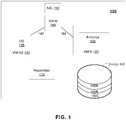
- Fig 1 shows an exemplary embodiment of the computer system 100 according to present disclosure.
- the computer system 100 may be, for example, a server or desktop computer, and also may be a smartphone, a tablet or PDA.
- the computer system 100 may comprise a computer processor configured to run a hypervisor 110 and a plurality of virtual machines (VMs) on the computer system 100.
- the plurality of VMs may be initialized and monitored by the hypervisor 110, and may include a VM-NS 130, a VM-A 120 and a VM-N 140.
- the VM-NS 130 may run an operating system OS 135, which may be, for example, a traditional OS, such as WINDOWS, LINUX, UNIX, ANDROID, etc.
- the VM-A 120 may run an antivirus software application 125, which may be referred to as antivirus 125 hereinafter.
- the antivirus 125 may run within a traditional OS or a special OS, or without any OS.
- the VM-N 140 may be configured to handle network communications for the computer system 100 and may be connected to a network interface card (NIC) 150 of the computer system 100. In some embodiments, the VM-N 140 may be in control of the NIC 150.
- NIC network interface card
- the computer system 100 may further comprise a storage 160.
- the storage 160 may be an internal or external redundant array of independent disks (RAID) array, hard disk drive (HDD), solid state drive (SSD), storage area network (SAN), flash memory, etc.
- RAID redundant array of independent disks
- HDD hard disk drive
- SSD solid state drive
- SAN storage area network
- flash memory etc.
- the storage 160 may physically reside outside of an enclosure of the computer system 100.
- the storage 160 may be logically separated into logical volumes 160A and 160B, and an optional logical volume 160C. Such separation may be achieved, for example, at RAID controller level, which may provide, for example, separate SCSI devices for the logical volumes 160A, 160B and 160C.
- existing virtualization techniques may be used to provide logical volumes on top of one or more underlying file systems and/or partitions.
- the volume 160A may be used outside of the VM-NS 130 (i.e., not available as a storage for the VM-NS 130), and the volume 160B may be used to form a virtual drive for the VM-NS 130 and OS 135.
- the VM-NS 130 and VM-A 120 may be coupled to the VM-N 140 by the links 142 and 144 respectively.
- the links 142 and 144 may be virtual network links and the VM-N 140 may run a virtual router for other VMs of the computer system 100 to communicate with external computer systems via the NIC 150. That is, from the point of view of the antivirus 125 and OS 135, the communication with the VM-N 140 may be a network communication. If a network link used by a VM is a virtual network connection, the VM using the virtual network may implement drivers for the virtual network card, for example, similar to the way how virtual network is implemented in a VMWARE® Workstation product.
- the VM-N 140 may contain the network stack, which may, in some embodiments, include a TCP/IP stack, to handle communications on behalf of other VMs of the computer system 100.
- the link 144 may be implemented as a shared memory block between the VM-A 120 and VM-N 140.
- the hypervisor 110 may allocate one or more segments of the physical memory of the computer system 100 and grant both VM-A 120 and VM-N 140 access to these allocated memory segments. These memory segments may thus form a shared memory block (i.e., the link 144) between the VM-A 120 and VM-N 140.
- the access to the shared memory block may be concurrent or interleaved, and each of the VM-A 120 and VM-N 140 may write to and read from the memory block when it has been granted access to the memory block.
- This approach may allow the network stack (or some parts of it) to be removed from the VM-A 120 and thus, reduce the attack surface of the antivirus 125.
- the link 142 between the VM-NS 130 and VM-N 140 may be implemented as a shared memory block shared by both the VM-NS 130 and VM-N 140 as well to allow the network stack (or some parts of it) be removed from the VM-NS 130.
- the link 144 may be implemented as a shared memory block as described above, and the link 142 may be implemented as a network link (with VM-N 150 acting as a virtual router for the link 142).
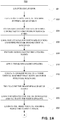
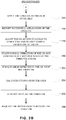
- Figs. 2A and 2B illustrate an exemplary process 200 according to the present disclosure.
- hypervisor 110 may be launched within a computer system 100 (for example, boot or reboot of computer system 100 may be performed, resulting in launch of hypervisor 110).
- a first virtual machine running an antivirus application may be created in the computer system 100.
- the hypervisor 110 may create the VM-A 120 with the antivirus 125 running within it (without any peripheral devices attached).
- a second virtual machine connected to a network interface card may be established.
- the hypervisor 110 may create the VM-N 140 and attach it to the NIC 150 (such attaching may be done using usual virtual machine device handling techniques, which in some cases may involve using IOMMU or VT-d technology).
- an update for either the antivirus or software running on the second virtual machine may be looked for.
- the antivirus 125 may look for an update on the Internet via the link 144, VM-N 140, and NIC 150.
- the term update may refer to a number of updates collectively and thus may includes more than one piece of update.
- any update found may be downloaded. For example, if an update to either antivirus 125, or software running within VM-N 140, is found, the antivirus 125 may initiate downloading it, for example, to the volume 160A. Then at block 210, the downloaded update may be applied. In some embodiments, after the download is completed, the downloaded update may be validated before being applied. In some embodiments, applying the update may be implemented by requesting the hypervisor 110 to restart the appropriate VM with a completely new downloaded image. This may require that the downloaded update include a full image of the appropriate VM and allow all malware in the existing instance of the VM to be removed (as the image is completely new). In other embodiments, the downloaded update may be passed to the appropriate VM for the update to be applied. It should be noted that the blocks 206-210 may be optional in some embodiments.
- the process 200 may then proceed to an optional block 220, at which the antivirus may check a current image of a third virtual machine that hosts an OS for potential malware.
- the third virtual machine that hosts an OS may be the VM-NS 130 and antivirus 125 may check the current image of the VM-NS 130 for potential malware (on the OS 135 or any software applications running on the OS 135).
- the VM-NS 130 is not running at this point, the check may be done in a manner simpler than that of a running system.
- the antivirus may attempt to cure the image, for example, by trying to remove the malware.
- the antivirus 125 may optionally ask for instructions from a user (for example, via keyboard/mouse/screen, etc.).
- the antivirus e.g., antivirus 125
- the antivirus may look for an update for the OS (e.g., the OS 135), and download and validate the found update.
- the hypervisor 110 may launch the VM-NS 130 using the current image checked in block 220, with attached peripheral devices which may include video card, keyboard, volume 160B, other storage, etc. (not shown).
- the image may contain a current image of the OS and may include any modifications made in block 222 in an attempt to remove malware.
- the VM-A 120 may obtain (e.g., request and be given) access to all the memory of the VM-NS 130 at this stage (in some embodiments access may be restricted to read-only access), and the VM-NS 130 may have access to volumes 160B and 160C but not access to the link 142. Absence of access to the link 142 may ensure that if there is an existing network attack on the OS 135, the attackers may not reach the OS 135 until the update is applied.
- the update may be applied to the OS 135.
- the OS 135 may find out about the update (for example, by detecting that the volume 160C is present and/or contains an update, or receiving a notification from the hypervisor 110, or by other ways), and apply it.
- the OS 135 may report about it to the hypervisor 110.
- the antivirus 125 may optionally check (for example, by obtaining and using access to the memory of the VM-NS 130) that the update is indeed successfully applied and report it to the hypervisor 110.
- the hypervisor 110 may allow the VM-NS 130 to access the link 142 and enable the normal operation of the VM-NS 130.
- the normal operation of the OS 135 may start.
- the antivirus 125 may continue to monitor the state of the VM-NS 130 and OS 135 (e.g., via access to the memory of the VM-NS 130), and to detect if malware is present within the OS 135. If malware is detected, the antivirus 125 may react accordingly.
- the antivirus 125 may implement operations in blocks 252, 254, 256 and 258.
- the antivirus 125 may request the hypervisor 110 to stop the VM-NS 130 and to temporarily re-attach a video card and a keyboard (not shown) to VM-A 120.
- the antivirus 125 may also store the current image of the VM-NS 130, for example, in the volume 160A. Then, at block 254, the antivirus 125 may ask for instructions from a user via a screen and keyboard/mouse. At block 256, the antivirus 125 may attempt to remove the found malware from the current image of the VM-NS 130. At block 258, the antivirus 125 may request the hypervisor 110 to resume the VM-NS 130 from (potentially cured) current image of VM-NS 130.
- the antivirus 125 may attempt to remove the malware while the VM-NS 130 is running, or request to stop it and manipulate its memory directly, without storing the VM-NS 130 as a current image. In these alternative embodiments, the antivirus 125 may need write access to the memory of the VM-NS 130. Such write access may be granted by the hypervisor 110 to the antivirus 125 at all the times, or may be granted only when explicitly requested by the antivirus 125.
- the antivirus 125 may additionally look for information about update(s) to the antivirus 125, and/or software of the VM-N 140, and/or OS 135. This may be implemented, for example, via polling (for example, via link 144, VM-N 140, and network card 150), or via subscription to a "push" notification. If an update to the antivirus 125 or VM-N 140 is detected, the update may be downloaded and applied in a manner similar to that described with respect to blocks 208-210. In some embodiments, the update lookup and application may be done without disrupting the operation of the VM-NS 130. If a security-critical update to the OS 135 is detected, the antivirus 125 may request the hypervisor 110 to disable the link 142 while the update is downloaded and applied, to reduce the vulnerability window of the OS 135.
- the antivirus 125 during the block 250 may have access not only to the memory of the VM-NS 130, but also to CPU registers of the VM-NS 130. Such access may be implemented, for example, via a request to the hypervisor 110.
- the hypervisor 110 may temporarily pause the VM-NS 130, read the state of the CPU registers of the VM-NS 130, report the state of the CPU registers to the antivirus 125, and then resume the VM-NS 130.
- the hypervisor 110 may additionally create a temporary snapshot of the VM-NS 130 at this point, thereby allowing the antivirus 125 to work with a consistent temporary image of the VM-NS 130.
- Such a snapshot may be implemented, for example, based on a copy-on-write technique, so pages which are about to be written by the VM-NS 130, may be copied to another location (for example, in RAM, or within the volume 160A) accessible to the antivirus 125.
- an additional antivirus agent (not shown), running within the OS 135.
- the additional antivirus agent may be, for example, a program somewhat similar to a usual antivirus program.
- the antivirus agent may be used, for example, for real-time protection from attacks (for example, when data is about to be loaded, such as when inserting a CD, or browsing the web, or when a file already within the OS 135 is about to be opened or executed).
- the antivirus 125 may monitor that the antivirus agent is running and/or is not modified during the block 250. If the antivirus 125 detects that the antivirus agent is not running and/or is modified - which might indicate that an attack is in progress, the antivirus 125 may take any appropriate actions.
- the antivirus 125 may request the hypervisor 110 to pause the VM-NS 130, to report the problem to a user, and if the user allows - to communicate with an antivirus response team (potentially including snapshot of VM-NS 130 in the communication), to wait for an update to the antivirus 125 to be provided, to download and apply the update to the antivirus 125, and then to attempt to cure the OS 135.
- all or part of functionality of the antivirus 125 may be implemented as a part of the hypervisor 110.
- the system described on Fig 1 may be implemented on top of a system described in U.S. Provisional Patent Application Nos. 61/791,632 (the '632 Application), filed on March 15, 2013, and/or 61/808,774, filed on April 05, 2013 , both of which are entitled "Secure Zone on a Virtual Machine for Digital Communications," the contents of both of which are incorporated by reference in their entirety herein.
- some or all of functionality of the antivirus 125 may be implemented within a supervisor as described therein.
- any known or future-developed techniques to ensure the validity of the image and/or update may be applied before the image and/or update is used.
- the known techniques may include, but are not limited to, checksums, cryptographic hashes, signatures, public-key infrastructure (PKI), etc.
- the described functionality can be implemented in varying ways for each particular applicationsuch as by using any combination of microprocessors, microcontrollers, field programmable gate arrays (FPGAs), application specific integrated circuits (ASICs), and/or System on a Chip (SoC)--but such implementation decisions should not be interpreted as causing a departure from the scope of the present invention.
- FPGAs field programmable gate arrays
- ASICs application specific integrated circuits
- SoC System on a Chip
- a software module may reside in RAM memory, flash memory, ROM memory, EPROM memory, EEPROM memory, registers, hard disk, a removable disk, a CD-ROM, or any other form of storage medium known in the art.
Landscapes
- Engineering & Computer Science (AREA)
- Software Systems (AREA)
- Theoretical Computer Science (AREA)
- Computer Security & Cryptography (AREA)
- General Engineering & Computer Science (AREA)
- Health & Medical Sciences (AREA)
- Virology (AREA)
- Computer Hardware Design (AREA)
- Physics & Mathematics (AREA)
- General Physics & Mathematics (AREA)
- General Health & Medical Sciences (AREA)
- Stored Programmes (AREA)
Claims (15)
- Berechnungssystem (100), umfassend:einen Speicher; undeinen Computerprozessor, der kommunikativ mit dem Speicher gekoppelt und ausgestaltet ist zum:Initialisieren eines Hypervisors (110);Einrichten einer ersten virtuellen Maschine (120) unter der Steuerung des Hypervisors;Laden eines Antiviren-Softwareprogramms von einem nichtflüchtigen Speicher (160);Ausführen des Antiviren-Softwareprogramms (125) auf der ersten virtuellen Maschine;Einrichten einer zweiten virtuellen Maschine (130) unter der Steuerung des Hypervisors;Laden und Ausführen eines Computer-Betriebssystems (135) auf der zweiten virtuellen Maschine;Ausführen eines Antiviren-Agenten auf der zweiten virtuellen Maschine, wobei das Antiviren-Softwareprogramm einen Betriebszustand des Antiviren-Agenten überwacht; undGewähren dem Antiviren-Softwareprogramm eines Zugriffs auf einen Bereich des Speichers, der der zweiten virtuellen Maschine zugeordnet ist, die das Betriebssystem ausführt, wobei das Antiviren-Softwareprogramm den Zugriff auf den Bereich des Speichers, der der zweiten virtuellen Maschine zugeordnet ist, verwendet, um einen Zustand der zweiten virtuellen Maschine zu überwachen und um eine Korrekturaktion durchzuführen, und wobei das Antiviren-Softwareprogramm eine Korrekturaktion durchführt, wenn erfasst wird, dass der Antiviren-Agent nicht ausgeführt wird oder auf der zweiten virtuellen Maschine modifiziert ist.
- Berechnungssystem (100) nach Anspruch 1, wobei das Überwachen des Zustands der zweiten virtuellen Maschine das Zugreifen auf den Bereich des Speichers umfasst, der der zweiten virtuellen Maschine zugeordnet ist, um Schadsoftware zu erfassen, und, optional,
wobei das Durchführen der Korrekturaktion eines von umfasst: Versuchen, die erfasste Schadsoftware zu entfernen, während das Computer-Betriebssystem ausgeführt wird, oder Versuchen, die erfasste Schadsoftware zu entfernen, indem erzwungen wird, das Computer-Betriebssystem anzuhalten und dessen Speicher direkt zu manipulieren. - Berechnungssystem (100) nach Anspruch 1, wobei das Überwachen des Zustands der zweiten virtuellen Maschine und das Durchführen der Korrekturaktion das Unterbrechen der Ausführung des Computer-Betriebssystems und das Gewähren eines Zugriffs auf Register der zweiten virtuellen Maschine durch das Antiviren-Softwareprogramm umfasst.
- Berechnungssystem (100) nach Anspruch 1, wobei das Computer-Betriebssystem von einem Bild geladen wird und der Computerprozessor dazu ausgestaltet ist, das Bild unter Verwendung des Antiviren-Softwareprogramms auf Schadsoftware zu prüfen, bevor das Computer-Betriebssystem auf der zweiten virtuellen Maschine ausgeführt wird.
- Berechnungssystem (100) nach Anspruch 1, außerdem mit einer Netzwerk-Schnittstellenkarte (NIC), wobei der Computerprozessor außerdem ausgestaltet ist zum:
Einrichten einer dritten virtuellen Maschine (140) unter der Steuerung des Hypervisors, um eine Netzwerk-Kommunikation durch die NIC (150) zu handhaben. - Berechnungssystem (100) nach Anspruch 5, wobei der Computerprozessor außerdem ausgestaltet ist zum:Suchen nach einer Aktualisierung für das Computer-Betriebssystem durch die Netzwerk-Kommunikation über die dritte virtuelle Maschine; undHerunterladen und Validieren der Aktualisierung für das Computer-Betriebssystem.
- Verfahren zum Ausführen eines Antiviren-Softwareprogramms (125) auf einem Berechnungssystem (100), umfassend:Einrichten einer ersten virtuellen Maschine (120) auf dem Computersystem;Laden und Ausführen des Antiviren-Softwareprogramms auf der ersten virtuellen Maschine;Einrichten einer zweiten virtuellen Maschine (130) auf dem Computersystem;Laden und Ausführen eines Computer-Betriebssystems (135) auf der zweiten virtuellen Maschine;Ausführen eines Antiviren-Agenten auf der zweiten virtuellen Maschine;Gewähren dem Antiviren-Softwareprogramm eines Zugriffs auf den Speicher der zweiten virtuellen Maschine, die das Betriebssystem ausführt; undÜberwachen eines Zustands der zweiten virtuellen Maschine und Durchführen einer Korrekturaktion unter Verwendung des Antiviren-Softwareprogramms; undÜberwachen eines Betriebszustands des Antiviren-Agenten unter Verwendung des Antiviren-Softwareprogramms und Durchführen einer Korrekturaktion, wenn erfasst wird, dass der Antiviren-Agent nicht ausgeführt wird oder auf der zweiten virtuellen Maschine modifiziert ist.
- Verfahren nach Anspruch 7, wobei das Überwachen des Zustands der zweiten virtuellen Maschine das Zugreifen auf den Bereich des Speichers umfasst, der der zweiten virtuellen Maschine zugeordnet ist, um Schadsoftware zu erfassen, und, optional,
wobei das Durchführen der Korrekturaktion eines von umfasst: Versuchen, die erfasste Schadsoftware zu entfernen, während das Computer-Betriebssystem ausgeführt wird, oder Versuchen, die erfasste Schadsoftware zu entfernen, indem erzwungen wird, das Computer-Betriebssystem anzuhalten und dessen Speicher direkt zu manipulieren, oder
wobei das Überwachen des Zustands der zweiten virtuellen Maschine und das Durchführen der Korrekturaktion das Unterbrechen der Ausführung des Computer-Betriebssystems und das Gewähren eines Zugriffs auf Register der zweiten virtuellen Maschine durch das Antiviren-Softwareprogramm umfasst. - Verfahren nach Anspruch 7, außerdem umfassend das Prüfen eines Bildes des Computer-Betriebssystems auf Schadsoftware unter Verwendung des Antiviren-Softwareprogramms, bevor das Computer-Betriebssystem auf der zweiten virtuellen Maschine ausgeführt wird.
- Verfahren nach Anspruch 7, außerdem umfassend:
Einrichten einer dritten virtuellen Maschine (140), um auf eine Netzwerk-Schnittstellenkarte (150) zuzugreifen und um die Netzwerk-Kommunikation für die erste und zweite virtuelle Maschine zu handhaben. - Nichtflüchtiges, computerlesbares Medium, das ein Antiviren-Softwareprogramm (125) enthält, das, wenn es in einer ersten virtuellen Maschine (120) von einem Computerprozessor ausgeführt wird, der mehrere virtuelle Maschinen unterstützt, ausgestaltet ist, um:Zugriff auf einen Speicher einer zweiten virtuellen Maschine (130) auf dem Computerprozessor zu erhalten, der mehrere virtuelle Maschinen unterstützt; undden Zugriff auf den Speicher der zweiten virtuellen Maschine zu verwenden, um:den Speicher der zweiten virtuellen Maschine zu überwachen;den Betriebszustand eines Antiviren-Agenten zu überwachen, der auf der zweiten virtuellen Maschine ausgeführt wird; undeine Korrekturaktion durchgeführt wird, wenn erfasst wird, das der Antiviren-Agent nicht ausgeführt wird oder auf der zweiten virtuellen Maschine modifiziert ist;wobei das Antiviren-Softwareprogramm ausgestaltet ist, um eine dritte virtuelle Maschine (140) zu verwenden, um eine Netzwerk-Kommunikation zu handhaben.
- Nichtflüchtiges, computerlesbares Medium nach Anspruch 11, wobei das Überwachen des Speichers der zweiten virtuellen Maschine das Überwachen eines Speichers eines Computer-Betriebssystems umfasst, das durch den Computerprozessor auf die zweite virtuelle Maschine geladen und ausgeführt wird; und, optional,
wobei das Antiviren-Softwareprogramm ausgestaltet ist, um ein Bild des Computer-Betriebssystems auf Schadsoftware zu prüfen, bevor das Computer-Betriebssystem auf der zweiten virtuellen Maschine ausgeführt wird. - Nichtflüchtiges, computerlesbares Medium nach Anspruch 12, wobei das Durchführen der Korrekturaktion eines von umfasst: Versuchen, die erfasste Schadsoftware zu entfernen, während das Computer-Betriebssystem ausgeführt wird, und Versuchen, die erfasste Schadsoftware zu entfernen, indem erzwungen wird, das Computer-Betriebssystem anzuhalten und dessen Speicher direkt zu manipulieren; und, optional,
wobei das Überwachen des Speichers der zweiten virtuellen Maschine und das Entfernen von Schadsoftware, die auf dem Computer-Betriebssystem gefunden wurde, das Erzwingen einer Unterbrechung der Ausführung des Computer-Betriebssystems und das Gewähren eines Zugriffs auf Register der zweiten virtuellen Maschine durch das Antiviren-Softwareprogramm umfasst. - Nichtflüchtiges, computerlesbares Medium nach Anspruch 11, wobei die Korrekturaktion das Entfernen von erfasster Schadsoftware umfasst, und das Überwachen des Speichers der zweiten virtuellen Maschine sowie das Entfernen von erfasster Schadsoftware das Erzwingen einer Unterbrechung der Ausführung der zweiten virtuellen Maschine und das Erhalten eines Zugriffs auf Register der zweiten virtuellen Maschine durch das Antiviren-Softwareprogramm umfasst.
- Nichtflüchtiges, computerlesbares Medium nach Anspruch 11, wobei das Überwachen des Zustands der zweiten virtuellen Maschine das Zugreifen auf den Speicher der zweiten virtuellen Maschine umfasst, um Schadsoftware zu erfassen.
Applications Claiming Priority (2)
| Application Number | Priority Date | Filing Date | Title |
|---|---|---|---|
| US201361808931P | 2013-04-05 | 2013-04-05 | |
| PCT/IB2014/060445 WO2014162302A1 (en) | 2013-04-05 | 2014-04-04 | Systems, methods and apparatuses for protection of antivirus software |
Publications (2)
| Publication Number | Publication Date |
|---|---|
| EP2981925A1 EP2981925A1 (de) | 2016-02-10 |
| EP2981925B1 true EP2981925B1 (de) | 2019-08-28 |
Family
ID=50729738
Family Applications (1)
| Application Number | Title | Priority Date | Filing Date |
|---|---|---|---|
| EP14724155.8A Active EP2981925B1 (de) | 2013-04-05 | 2014-04-04 | Systeme, verfahren und vorrichtungen zum schutz einer antivirensoftware |
Country Status (4)
| Country | Link |
|---|---|
| US (1) | US9443083B2 (de) |
| EP (1) | EP2981925B1 (de) |
| CA (1) | CA2908206C (de) |
| WO (1) | WO2014162302A1 (de) |
Families Citing this family (18)
| Publication number | Priority date | Publication date | Assignee | Title |
|---|---|---|---|---|
| US9756074B2 (en) * | 2013-12-26 | 2017-09-05 | Fireeye, Inc. | System and method for IPS and VM-based detection of suspicious objects |
| RU2568282C2 (ru) * | 2014-04-18 | 2015-11-20 | Закрытое акционерное общество "Лаборатория Касперского" | Система и способ обеспечения отказоустойчивости антивирусной защиты, реализуемой в виртуальной среде |
| RU2580030C2 (ru) | 2014-04-18 | 2016-04-10 | Закрытое акционерное общество "Лаборатория Касперского" | Система и способ распределения задач антивирусной проверки между виртуальными машинами в виртуальной сети |
| US9537738B2 (en) * | 2014-06-27 | 2017-01-03 | Intel Corporation | Reporting platform information using a secure agent |
| CN105592114A (zh) * | 2014-10-22 | 2016-05-18 | 北京云巢动脉科技有限公司 | 一种在虚拟桌面环境下的应用软件发布方法 |
| US10417031B2 (en) * | 2015-03-31 | 2019-09-17 | Fireeye, Inc. | Selective virtualization for security threat detection |
| US10216927B1 (en) | 2015-06-30 | 2019-02-26 | Fireeye, Inc. | System and method for protecting memory pages associated with a process using a virtualization layer |
| US10642753B1 (en) | 2015-06-30 | 2020-05-05 | Fireeye, Inc. | System and method for protecting a software component running in virtual machine using a virtualization layer |
| US10726127B1 (en) | 2015-06-30 | 2020-07-28 | Fireeye, Inc. | System and method for protecting a software component running in a virtual machine through virtual interrupts by the virtualization layer |
| US10395029B1 (en) | 2015-06-30 | 2019-08-27 | Fireeye, Inc. | Virtual system and method with threat protection |
| US11113086B1 (en) | 2015-06-30 | 2021-09-07 | Fireeye, Inc. | Virtual system and method for securing external network connectivity |
| US10033759B1 (en) | 2015-09-28 | 2018-07-24 | Fireeye, Inc. | System and method of threat detection under hypervisor control |
| CN108289032B (zh) * | 2017-01-09 | 2022-05-13 | 腾讯科技(深圳)有限公司 | 一种数据传输方法及装置 |
| US10496378B2 (en) | 2017-05-04 | 2019-12-03 | Microsoft Technology Licensing, Llc | Generating and executing multi-entry point functions |
| US11875187B2 (en) * | 2020-03-06 | 2024-01-16 | Rubrik, Inc. | Secure runtime for virtual machines |
| US11640461B2 (en) | 2020-03-06 | 2023-05-02 | Rubrik, Inc. | Secure runtime for virtual machines |
| US20210279087A1 (en) * | 2020-03-06 | 2021-09-09 | Rubrik, Inc. | Secure runtime for virtual machines |
| US12223347B2 (en) * | 2021-01-28 | 2025-02-11 | Microsoft Technology Licensing, Llc | Volatile memory acquisition |
Family Cites Families (5)
| Publication number | Priority date | Publication date | Assignee | Title |
|---|---|---|---|---|
| US6922774B2 (en) | 2001-05-14 | 2005-07-26 | The United States Of America As Represented By The National Security Agency | Device for and method of secure computing using virtual machines |
| US8380987B2 (en) * | 2007-01-25 | 2013-02-19 | Microsoft Corporation | Protection agents and privilege modes |
| JP5446167B2 (ja) * | 2008-08-13 | 2014-03-19 | 富士通株式会社 | ウイルス対策方法、コンピュータ、及びプログラム |
| CN103154961A (zh) | 2010-09-30 | 2013-06-12 | 惠普发展公司,有限责任合伙企业 | 用于病毒扫描的虚拟机 |
| US20140095822A1 (en) * | 2012-10-01 | 2014-04-03 | Trend Micro Incorporated | Secure removable mass storage devices |
-
2014
- 2014-04-04 EP EP14724155.8A patent/EP2981925B1/de active Active
- 2014-04-04 WO PCT/IB2014/060445 patent/WO2014162302A1/en not_active Ceased
- 2014-04-04 US US14/245,578 patent/US9443083B2/en active Active
- 2014-04-04 CA CA2908206A patent/CA2908206C/en active Active
Non-Patent Citations (1)
| Title |
|---|
| None * |
Also Published As
| Publication number | Publication date |
|---|---|
| WO2014162302A1 (en) | 2014-10-09 |
| CA2908206A1 (en) | 2014-10-09 |
| US20140304819A1 (en) | 2014-10-09 |
| CA2908206C (en) | 2023-08-29 |
| EP2981925A1 (de) | 2016-02-10 |
| US9443083B2 (en) | 2016-09-13 |
Similar Documents
| Publication | Publication Date | Title |
|---|---|---|
| CA2908206C (en) | Systems, methods and apparatuses for protection of antivirus software | |
| TWI470471B (zh) | 保護作業系統資源 | |
| US9087199B2 (en) | System and method for providing a secured operating system execution environment | |
| US10630643B2 (en) | Dual memory introspection for securing multiple network endpoints | |
| US8621620B2 (en) | System and method for protecting and securing storage devices using below-operating system trapping | |
| EP1674965B1 (de) | Computersicherheitsmanagement bei einer virtuellen maschine oder einem gehärteten betriebssystem | |
| CN101589364B (zh) | 保护代理和特权模式 | |
| US20190042781A1 (en) | Secure Storage Device | |
| JP5164285B2 (ja) | アンチマルウェアを有するコンピュータシステム | |
| US20200012803A1 (en) | Protection system and method against unauthorized data alteration | |
| CN107949846B (zh) | 恶意线程挂起的检测 | |
| US20140282539A1 (en) | Wrapped nested virtualization | |
| US9396329B2 (en) | Methods and apparatus for a safe and secure software update solution against attacks from malicious or unauthorized programs to update protected secondary storage | |
| Nguyen et al. | Delusional boot: securing hypervisors without massive re-engineering | |
| Wueest | Threats to virtual environments | |
| Bacs et al. | Slick: an intrusion detection system for virtualized storage devices | |
| RU2460133C1 (ru) | Система и способ защиты компьютерных приложений | |
| ES3064406T3 (en) | Securely persisting information across system reboots | |
| US12099862B2 (en) | Hypervisor-assisted secured memory sharing among host and guest operating system | |
| RU2585978C2 (ru) | Способ вызова системных функций в условиях использования средств защиты ядра операционной системы | |
| Fukai et al. | Bmcarmor: A hardware protection scheme for bare-metal clouds | |
| EP2720170B1 (de) | Automatischer Schutz vor Computernutzungen | |
| RU2538286C9 (ru) | Способ запуска гипервизора в компьютерной системе на ранней стадии загрузки компьютера | |
| EP3663947B1 (de) | Geschützte peripherieanschlüsse | |
| Mahapatra et al. | An online cross view difference and behavior based kernel rootkit detector |
Legal Events
| Date | Code | Title | Description |
|---|---|---|---|
| PUAI | Public reference made under article 153(3) epc to a published international application that has entered the european phase |
Free format text: ORIGINAL CODE: 0009012 |
|
| 17P | Request for examination filed |
Effective date: 20151021 |
|
| AK | Designated contracting states |
Kind code of ref document: A1 Designated state(s): AL AT BE BG CH CY CZ DE DK EE ES FI FR GB GR HR HU IE IS IT LI LT LU LV MC MK MT NL NO PL PT RO RS SE SI SK SM TR |
|
| AX | Request for extension of the european patent |
Extension state: BA ME |
|
| DAX | Request for extension of the european patent (deleted) | ||
| GRAP | Despatch of communication of intention to grant a patent |
Free format text: ORIGINAL CODE: EPIDOSNIGR1 |
|
| STAA | Information on the status of an ep patent application or granted ep patent |
Free format text: STATUS: GRANT OF PATENT IS INTENDED |
|
| RIC1 | Information provided on ipc code assigned before grant |
Ipc: G06F 9/455 20180101ALI20181116BHEP Ipc: G06F 21/56 20130101AFI20181116BHEP |
|
| INTG | Intention to grant announced |
Effective date: 20181212 |
|
| GRAJ | Information related to disapproval of communication of intention to grant by the applicant or resumption of examination proceedings by the epo deleted |
Free format text: ORIGINAL CODE: EPIDOSDIGR1 |
|
| STAA | Information on the status of an ep patent application or granted ep patent |
Free format text: STATUS: REQUEST FOR EXAMINATION WAS MADE |
|
| RAP1 | Party data changed (applicant data changed or rights of an application transferred) |
Owner name: OLOGN TECHNOLOGIES AG |
|
| GRAS | Grant fee paid |
Free format text: ORIGINAL CODE: EPIDOSNIGR3 |
|
| STAA | Information on the status of an ep patent application or granted ep patent |
Free format text: STATUS: GRANT OF PATENT IS INTENDED |
|
| GRAP | Despatch of communication of intention to grant a patent |
Free format text: ORIGINAL CODE: EPIDOSNIGR1 |
|
| INTC | Intention to grant announced (deleted) | ||
| INTG | Intention to grant announced |
Effective date: 20190430 |
|
| GRAA | (expected) grant |
Free format text: ORIGINAL CODE: 0009210 |
|
| STAA | Information on the status of an ep patent application or granted ep patent |
Free format text: STATUS: THE PATENT HAS BEEN GRANTED |
|
| AK | Designated contracting states |
Kind code of ref document: B1 Designated state(s): AL AT BE BG CH CY CZ DE DK EE ES FI FR GB GR HR HU IE IS IT LI LT LU LV MC MK MT NL NO PL PT RO RS SE SI SK SM TR |
|
| REG | Reference to a national code |
Ref country code: GB Ref legal event code: FG4D |
|
| REG | Reference to a national code |
Ref country code: CH Ref legal event code: EP |
|
| REG | Reference to a national code |
Ref country code: AT Ref legal event code: REF Ref document number: 1173287 Country of ref document: AT Kind code of ref document: T Effective date: 20190915 |
|
| REG | Reference to a national code |
Ref country code: IE Ref legal event code: FG4D |
|
| REG | Reference to a national code |
Ref country code: DE Ref legal event code: R096 Ref document number: 602014052503 Country of ref document: DE |
|
| REG | Reference to a national code |
Ref country code: NL Ref legal event code: MP Effective date: 20190828 |
|
| REG | Reference to a national code |
Ref country code: LT Ref legal event code: MG4D |
|
| PG25 | Lapsed in a contracting state [announced via postgrant information from national office to epo] |
Ref country code: NO Free format text: LAPSE BECAUSE OF FAILURE TO SUBMIT A TRANSLATION OF THE DESCRIPTION OR TO PAY THE FEE WITHIN THE PRESCRIBED TIME-LIMIT Effective date: 20191128 Ref country code: HR Free format text: LAPSE BECAUSE OF FAILURE TO SUBMIT A TRANSLATION OF THE DESCRIPTION OR TO PAY THE FEE WITHIN THE PRESCRIBED TIME-LIMIT Effective date: 20190828 Ref country code: NL Free format text: LAPSE BECAUSE OF FAILURE TO SUBMIT A TRANSLATION OF THE DESCRIPTION OR TO PAY THE FEE WITHIN THE PRESCRIBED TIME-LIMIT Effective date: 20190828 Ref country code: PT Free format text: LAPSE BECAUSE OF FAILURE TO SUBMIT A TRANSLATION OF THE DESCRIPTION OR TO PAY THE FEE WITHIN THE PRESCRIBED TIME-LIMIT Effective date: 20191230 Ref country code: BG Free format text: LAPSE BECAUSE OF FAILURE TO SUBMIT A TRANSLATION OF THE DESCRIPTION OR TO PAY THE FEE WITHIN THE PRESCRIBED TIME-LIMIT Effective date: 20191128 Ref country code: LT Free format text: LAPSE BECAUSE OF FAILURE TO SUBMIT A TRANSLATION OF THE DESCRIPTION OR TO PAY THE FEE WITHIN THE PRESCRIBED TIME-LIMIT Effective date: 20190828 Ref country code: FI Free format text: LAPSE BECAUSE OF FAILURE TO SUBMIT A TRANSLATION OF THE DESCRIPTION OR TO PAY THE FEE WITHIN THE PRESCRIBED TIME-LIMIT Effective date: 20190828 Ref country code: SE Free format text: LAPSE BECAUSE OF FAILURE TO SUBMIT A TRANSLATION OF THE DESCRIPTION OR TO PAY THE FEE WITHIN THE PRESCRIBED TIME-LIMIT Effective date: 20190828 |
|
| PG25 | Lapsed in a contracting state [announced via postgrant information from national office to epo] |
Ref country code: AL Free format text: LAPSE BECAUSE OF FAILURE TO SUBMIT A TRANSLATION OF THE DESCRIPTION OR TO PAY THE FEE WITHIN THE PRESCRIBED TIME-LIMIT Effective date: 20190828 Ref country code: GR Free format text: LAPSE BECAUSE OF FAILURE TO SUBMIT A TRANSLATION OF THE DESCRIPTION OR TO PAY THE FEE WITHIN THE PRESCRIBED TIME-LIMIT Effective date: 20191129 Ref country code: RS Free format text: LAPSE BECAUSE OF FAILURE TO SUBMIT A TRANSLATION OF THE DESCRIPTION OR TO PAY THE FEE WITHIN THE PRESCRIBED TIME-LIMIT Effective date: 20190828 Ref country code: IS Free format text: LAPSE BECAUSE OF FAILURE TO SUBMIT A TRANSLATION OF THE DESCRIPTION OR TO PAY THE FEE WITHIN THE PRESCRIBED TIME-LIMIT Effective date: 20191228 Ref country code: LV Free format text: LAPSE BECAUSE OF FAILURE TO SUBMIT A TRANSLATION OF THE DESCRIPTION OR TO PAY THE FEE WITHIN THE PRESCRIBED TIME-LIMIT Effective date: 20190828 Ref country code: ES Free format text: LAPSE BECAUSE OF FAILURE TO SUBMIT A TRANSLATION OF THE DESCRIPTION OR TO PAY THE FEE WITHIN THE PRESCRIBED TIME-LIMIT Effective date: 20190828 |
|
| REG | Reference to a national code |
Ref country code: AT Ref legal event code: MK05 Ref document number: 1173287 Country of ref document: AT Kind code of ref document: T Effective date: 20190828 |
|
| PG25 | Lapsed in a contracting state [announced via postgrant information from national office to epo] |
Ref country code: TR Free format text: LAPSE BECAUSE OF FAILURE TO SUBMIT A TRANSLATION OF THE DESCRIPTION OR TO PAY THE FEE WITHIN THE PRESCRIBED TIME-LIMIT Effective date: 20190828 |
|
| PG25 | Lapsed in a contracting state [announced via postgrant information from national office to epo] |
Ref country code: IT Free format text: LAPSE BECAUSE OF FAILURE TO SUBMIT A TRANSLATION OF THE DESCRIPTION OR TO PAY THE FEE WITHIN THE PRESCRIBED TIME-LIMIT Effective date: 20190828 Ref country code: RO Free format text: LAPSE BECAUSE OF FAILURE TO SUBMIT A TRANSLATION OF THE DESCRIPTION OR TO PAY THE FEE WITHIN THE PRESCRIBED TIME-LIMIT Effective date: 20190828 Ref country code: DK Free format text: LAPSE BECAUSE OF FAILURE TO SUBMIT A TRANSLATION OF THE DESCRIPTION OR TO PAY THE FEE WITHIN THE PRESCRIBED TIME-LIMIT Effective date: 20190828 Ref country code: AT Free format text: LAPSE BECAUSE OF FAILURE TO SUBMIT A TRANSLATION OF THE DESCRIPTION OR TO PAY THE FEE WITHIN THE PRESCRIBED TIME-LIMIT Effective date: 20190828 Ref country code: EE Free format text: LAPSE BECAUSE OF FAILURE TO SUBMIT A TRANSLATION OF THE DESCRIPTION OR TO PAY THE FEE WITHIN THE PRESCRIBED TIME-LIMIT Effective date: 20190828 Ref country code: PL Free format text: LAPSE BECAUSE OF FAILURE TO SUBMIT A TRANSLATION OF THE DESCRIPTION OR TO PAY THE FEE WITHIN THE PRESCRIBED TIME-LIMIT Effective date: 20190828 |
|
| PG25 | Lapsed in a contracting state [announced via postgrant information from national office to epo] |
Ref country code: CZ Free format text: LAPSE BECAUSE OF FAILURE TO SUBMIT A TRANSLATION OF THE DESCRIPTION OR TO PAY THE FEE WITHIN THE PRESCRIBED TIME-LIMIT Effective date: 20190828 Ref country code: SK Free format text: LAPSE BECAUSE OF FAILURE TO SUBMIT A TRANSLATION OF THE DESCRIPTION OR TO PAY THE FEE WITHIN THE PRESCRIBED TIME-LIMIT Effective date: 20190828 Ref country code: IS Free format text: LAPSE BECAUSE OF FAILURE TO SUBMIT A TRANSLATION OF THE DESCRIPTION OR TO PAY THE FEE WITHIN THE PRESCRIBED TIME-LIMIT Effective date: 20200224 Ref country code: SM Free format text: LAPSE BECAUSE OF FAILURE TO SUBMIT A TRANSLATION OF THE DESCRIPTION OR TO PAY THE FEE WITHIN THE PRESCRIBED TIME-LIMIT Effective date: 20190828 |
|
| REG | Reference to a national code |
Ref country code: DE Ref legal event code: R097 Ref document number: 602014052503 Country of ref document: DE |
|
| PLBE | No opposition filed within time limit |
Free format text: ORIGINAL CODE: 0009261 |
|
| STAA | Information on the status of an ep patent application or granted ep patent |
Free format text: STATUS: NO OPPOSITION FILED WITHIN TIME LIMIT |
|
| PG2D | Information on lapse in contracting state deleted |
Ref country code: IS |
|
| 26N | No opposition filed |
Effective date: 20200603 |
|
| PG25 | Lapsed in a contracting state [announced via postgrant information from national office to epo] |
Ref country code: SI Free format text: LAPSE BECAUSE OF FAILURE TO SUBMIT A TRANSLATION OF THE DESCRIPTION OR TO PAY THE FEE WITHIN THE PRESCRIBED TIME-LIMIT Effective date: 20190828 |
|
| PG25 | Lapsed in a contracting state [announced via postgrant information from national office to epo] |
Ref country code: MC Free format text: LAPSE BECAUSE OF FAILURE TO SUBMIT A TRANSLATION OF THE DESCRIPTION OR TO PAY THE FEE WITHIN THE PRESCRIBED TIME-LIMIT Effective date: 20190828 |
|
| PG25 | Lapsed in a contracting state [announced via postgrant information from national office to epo] |
Ref country code: LU Free format text: LAPSE BECAUSE OF NON-PAYMENT OF DUE FEES Effective date: 20200404 |
|
| REG | Reference to a national code |
Ref country code: BE Ref legal event code: MM Effective date: 20200430 |
|
| PG25 | Lapsed in a contracting state [announced via postgrant information from national office to epo] |
Ref country code: BE Free format text: LAPSE BECAUSE OF NON-PAYMENT OF DUE FEES Effective date: 20200430 |
|
| PG25 | Lapsed in a contracting state [announced via postgrant information from national office to epo] |
Ref country code: IE Free format text: LAPSE BECAUSE OF NON-PAYMENT OF DUE FEES Effective date: 20200404 |
|
| PG25 | Lapsed in a contracting state [announced via postgrant information from national office to epo] |
Ref country code: MT Free format text: LAPSE BECAUSE OF FAILURE TO SUBMIT A TRANSLATION OF THE DESCRIPTION OR TO PAY THE FEE WITHIN THE PRESCRIBED TIME-LIMIT Effective date: 20190828 Ref country code: CY Free format text: LAPSE BECAUSE OF FAILURE TO SUBMIT A TRANSLATION OF THE DESCRIPTION OR TO PAY THE FEE WITHIN THE PRESCRIBED TIME-LIMIT Effective date: 20190828 |
|
| PG25 | Lapsed in a contracting state [announced via postgrant information from national office to epo] |
Ref country code: MK Free format text: LAPSE BECAUSE OF FAILURE TO SUBMIT A TRANSLATION OF THE DESCRIPTION OR TO PAY THE FEE WITHIN THE PRESCRIBED TIME-LIMIT Effective date: 20190828 |
|
| P01 | Opt-out of the competence of the unified patent court (upc) registered |
Effective date: 20230525 |
|
| REG | Reference to a national code |
Ref country code: GB Ref legal event code: 732E Free format text: REGISTERED BETWEEN 20240509 AND 20240515 |
|
| REG | Reference to a national code |
Ref country code: DE Ref legal event code: R082 Ref document number: 602014052503 Country of ref document: DE Representative=s name: PETERREINS SCHLEY PATENT- UND RECHTSANWAELTE P, DE Ref country code: DE Ref legal event code: R081 Ref document number: 602014052503 Country of ref document: DE Owner name: FINGON LLC, NEWTON, US Free format text: FORMER OWNER: OLOGN TECHNOLOGIES AG, TRIESEN, LI Ref country code: DE Ref legal event code: R081 Ref document number: 602014052503 Country of ref document: DE Owner name: FINGON LLC, HAMDEN, US Free format text: FORMER OWNER: OLOGN TECHNOLOGIES AG, TRIESEN, LI |
|
| REG | Reference to a national code |
Ref country code: CH Ref legal event code: U11 Free format text: ST27 STATUS EVENT CODE: U-0-0-U10-U11 (AS PROVIDED BY THE NATIONAL OFFICE) Effective date: 20260501 |
|
| REG | Reference to a national code |
Ref country code: DE Ref legal event code: R081 Ref document number: 602014052503 Country of ref document: DE Owner name: FINGON LLC, HAMDEN, US Free format text: FORMER OWNER: FINGON LLC, NEWTON, CT, US |
|
| REG | Reference to a national code |
Ref country code: CH Ref legal event code: R18 Free format text: ST27 STATUS EVENT CODE: U-0-0-R10-R18 (AS PROVIDED BY THE NATIONAL OFFICE) Effective date: 20260626 |
|
| PGFP | Annual fee paid to national office [announced via postgrant information from national office to epo] |
Ref country code: GB Payment date: 20260421 Year of fee payment: 13 |
|
| PGFP | Annual fee paid to national office [announced via postgrant information from national office to epo] |
Ref country code: DE Payment date: 20260421 Year of fee payment: 13 |
|
| PGFP | Annual fee paid to national office [announced via postgrant information from national office to epo] |
Ref country code: CH Payment date: 20260501 Year of fee payment: 13 |
|
| PGFP | Annual fee paid to national office [announced via postgrant information from national office to epo] |
Ref country code: FR Payment date: 20260423 Year of fee payment: 13 |