EP2980602B1 - Anpassung des gewicht der intensität in einem phd-filter auf basis einer sensor-track-id - Google Patents
Anpassung des gewicht der intensität in einem phd-filter auf basis einer sensor-track-id Download PDFInfo
- Publication number
- EP2980602B1 EP2980602B1 EP15176942.9A EP15176942A EP2980602B1 EP 2980602 B1 EP2980602 B1 EP 2980602B1 EP 15176942 A EP15176942 A EP 15176942A EP 2980602 B1 EP2980602 B1 EP 2980602B1
- Authority
- EP
- European Patent Office
- Prior art keywords
- track
- intensity
- predicted
- ids
- weight
- Prior art date
- Legal status (The legal status is an assumption and is not a legal conclusion. Google has not performed a legal analysis and makes no representation as to the accuracy of the status listed.)
- Active
Links
- TWARFNMZHLVGMX-UHFFFAOYSA-N [O-][N+](CCC1CCC1)=O Chemical compound [O-][N+](CCC1CCC1)=O TWARFNMZHLVGMX-UHFFFAOYSA-N 0.000 description 1
Images


Classifications
-
- G—PHYSICS
- G01—MEASURING; TESTING
- G01S—RADIO DIRECTION-FINDING; RADIO NAVIGATION; DETERMINING DISTANCE OR VELOCITY BY USE OF RADIO WAVES; LOCATING OR PRESENCE-DETECTING BY USE OF THE REFLECTION OR RERADIATION OF RADIO WAVES; ANALOGOUS ARRANGEMENTS USING OTHER WAVES
- G01S13/00—Systems using the reflection or reradiation of radio waves, e.g. radar systems; Analogous systems using reflection or reradiation of waves whose nature or wavelength is irrelevant or unspecified
- G01S13/66—Radar-tracking systems; Analogous systems
-
- G—PHYSICS
- G01—MEASURING; TESTING
- G01N—INVESTIGATING OR ANALYSING MATERIALS BY DETERMINING THEIR CHEMICAL OR PHYSICAL PROPERTIES
- G01N21/00—Investigating or analysing materials by the use of optical means, i.e. using sub-millimetre waves, infrared, visible or ultraviolet light
-
- G—PHYSICS
- G01—MEASURING; TESTING
- G01S—RADIO DIRECTION-FINDING; RADIO NAVIGATION; DETERMINING DISTANCE OR VELOCITY BY USE OF RADIO WAVES; LOCATING OR PRESENCE-DETECTING BY USE OF THE REFLECTION OR RERADIATION OF RADIO WAVES; ANALOGOUS ARRANGEMENTS USING OTHER WAVES
- G01S13/00—Systems using the reflection or reradiation of radio waves, e.g. radar systems; Analogous systems using reflection or reradiation of waves whose nature or wavelength is irrelevant or unspecified
- G01S13/66—Radar-tracking systems; Analogous systems
- G01S13/72—Radar-tracking systems; Analogous systems for two-dimensional [2D] tracking, e.g. combination of angle and range tracking, track-while-scan radar
- G01S13/723—Radar-tracking systems; Analogous systems for two-dimensional [2D] tracking, e.g. combination of angle and range tracking, track-while-scan radar by using numerical data
- G01S13/726—Multiple target tracking
-
- G—PHYSICS
- G01—MEASURING; TESTING
- G01S—RADIO DIRECTION-FINDING; RADIO NAVIGATION; DETERMINING DISTANCE OR VELOCITY BY USE OF RADIO WAVES; LOCATING OR PRESENCE-DETECTING BY USE OF THE REFLECTION OR RERADIATION OF RADIO WAVES; ANALOGOUS ARRANGEMENTS USING OTHER WAVES
- G01S13/00—Systems using the reflection or reradiation of radio waves, e.g. radar systems; Analogous systems using reflection or reradiation of waves whose nature or wavelength is irrelevant or unspecified
- G01S13/86—Combinations of radar systems with non-radar systems, e.g. sonar, direction finder
-
- G—PHYSICS
- G01—MEASURING; TESTING
- G01S—RADIO DIRECTION-FINDING; RADIO NAVIGATION; DETERMINING DISTANCE OR VELOCITY BY USE OF RADIO WAVES; LOCATING OR PRESENCE-DETECTING BY USE OF THE REFLECTION OR RERADIATION OF RADIO WAVES; ANALOGOUS ARRANGEMENTS USING OTHER WAVES
- G01S13/00—Systems using the reflection or reradiation of radio waves, e.g. radar systems; Analogous systems using reflection or reradiation of waves whose nature or wavelength is irrelevant or unspecified
- G01S13/86—Combinations of radar systems with non-radar systems, e.g. sonar, direction finder
- G01S13/865—Combination of radar systems with lidar systems
-
- G—PHYSICS
- G01—MEASURING; TESTING
- G01S—RADIO DIRECTION-FINDING; RADIO NAVIGATION; DETERMINING DISTANCE OR VELOCITY BY USE OF RADIO WAVES; LOCATING OR PRESENCE-DETECTING BY USE OF THE REFLECTION OR RERADIATION OF RADIO WAVES; ANALOGOUS ARRANGEMENTS USING OTHER WAVES
- G01S13/00—Systems using the reflection or reradiation of radio waves, e.g. radar systems; Analogous systems using reflection or reradiation of waves whose nature or wavelength is irrelevant or unspecified
- G01S13/86—Combinations of radar systems with non-radar systems, e.g. sonar, direction finder
- G01S13/867—Combination of radar systems with cameras
-
- G—PHYSICS
- G01—MEASURING; TESTING
- G01S—RADIO DIRECTION-FINDING; RADIO NAVIGATION; DETERMINING DISTANCE OR VELOCITY BY USE OF RADIO WAVES; LOCATING OR PRESENCE-DETECTING BY USE OF THE REFLECTION OR RERADIATION OF RADIO WAVES; ANALOGOUS ARRANGEMENTS USING OTHER WAVES
- G01S13/00—Systems using the reflection or reradiation of radio waves, e.g. radar systems; Analogous systems using reflection or reradiation of waves whose nature or wavelength is irrelevant or unspecified
- G01S13/88—Radar or analogous systems specially adapted for specific applications
- G01S13/93—Radar or analogous systems specially adapted for specific applications for anti-collision purposes
- G01S13/933—Radar or analogous systems specially adapted for specific applications for anti-collision purposes of aircraft or spacecraft
-
- G—PHYSICS
- G01—MEASURING; TESTING
- G01S—RADIO DIRECTION-FINDING; RADIO NAVIGATION; DETERMINING DISTANCE OR VELOCITY BY USE OF RADIO WAVES; LOCATING OR PRESENCE-DETECTING BY USE OF THE REFLECTION OR RERADIATION OF RADIO WAVES; ANALOGOUS ARRANGEMENTS USING OTHER WAVES
- G01S17/00—Systems using the reflection or reradiation of electromagnetic waves other than radio waves, e.g. lidar systems
- G01S17/66—Tracking systems using electromagnetic waves other than radio waves
Definitions
- the objective of see-and-avoid or sense-and-avoid is to provide an unmanned aircraft system (UAS) with the capability to perform self-separation and collision avoidance against all air traffic, with or without active, transponder based collision avoidance systems.
- SAA requires the UAS to detect and track intruder aircraft in the operating vicinity of the ownship aircraft to identify guidance maneuvers required to perform self-separation and collision avoidance.
- the detect and track functions are key enablers for UAS SAA capability because the UAS cannot perform self-separation or collision avoidance maneuvers for undetected, untracked intruder aircraft.
- the detect function refers to using surveillance sensors to measure the position of intruder aircraft relative to the ownship UAS.
- the track function refers to fusing the surveillance sensor measurements together to estimate the trajectory statistics (also referred to herein as the track) of the intruder aircraft relative to the ownship UAS.
- the surveillance sensors provide measurements with corresponding measurement IDs that can be correlated across time or random across time.
- the track function estimates the tracks of the intruder aircraft using a data association algorithm to assign measurements to a current track, a filter to fuse sensor measurements with the current estimates of the track statistics, and a trajectory manager that oversees the sensor fusion operation, initiates tracks, maintains tracks, and deletes tracks.
- One tracking system uses random finite sets (RFS) to track multiple intruder aircraft (IA) for UAS SAA, with the RFS being an implementation of a multi-hypothesis testing (MHT) approach.
- RFS casts the multiple IA tracking problem into a set-valued state space where the statistics of the set-valued state vector and set-valued measurement vector are approximated using their first-order moments (also referred to herein as an intensity), and applied in a Bayesian filter framework to estimate the IA track statistics using Gaussian mixtures.
- the resulting filter is referred to as a probabilistic hypothesis density (PHD) filter.
- An intensity refers to a weight, a state mean vector, and a state covariance matrix of an element of the set-valued state space where this element corresponds to the statistics of a track.
- Patent document number US2013/229298A1 describes a system, method, and computer program product for determining a trajectory of an item which includes segmenting surveillance point data of sensors, by sensor, into track segments for the item, associating the track segments for the item in a segment group for the item, and fusing the track segments in the segment group for the item into a synthetic threaded track for the item.
- the fusing may include filtering of the track segments for the item across track segments.
- the filtering across track segments may be based on a weighting of the point track data of the track segments for the item.
- a system for determining a trajectory of an item may includes a processing device configured to execute a threaded track process to convert a data set of surveillance point data into a synthetic threaded track for the item
- a method for tracking multiple objects with a probabilistic hypothesis density filter includes obtaining a plurality of measurements corresponding to a first object with at least one sensor, the at least one sensor providing one or more first track IDs for the plurality of measurements.
- a T k track intensity is generated for the first object based on the plurality of measurements, the T k track intensity including a weight, a state mean vector, and a state covariance matrix of statistics of a track of the first object at time T k .
- a T k+1 predicted intensity is generated for the first object based on the T k track intensity, the T k+1 predicted intensity corresponding to time T k+1 , wherein the T k+1 predicted intensity includes a predicted weight based on the weight of the T k track intensity.
- a plurality of measurements is obtained from a plurality of sensors, wherein the plurality of sensors include the at least one sensor, wherein the plurality of sensors provide a plurality of second track IDs for the plurality of measurements, wherein the plurality of measurements correspond to time T k+1 .
- the plurality of second track IDs is compared to the one or more first track IDs.
- the predicted weight is multiplied by a first value. If less than all of the one or more first track IDs match any of the plurality of second track IDs, the predicted weight is multiplied by a second value, wherein the second value is greater than the first value.
- the method determines whether to prune the T k+1 predicted intensity based on the predicted weight after multiplying with either the first value or the second value. If the T k+1 predicted intensity is not pruned, a T k+1 track intensity is generated for the first object at time T k+1 based on the T k+1 predicted intensity, the T k+1 track intensity having an updated weight based on the multiplying of the predicted weight.
- a track ID is an identifier provided by a sensor, wherein the identifier is correlated across time to a series of measurements.
- One type of track ID is an international civil aviation organization (ICAO) aircraft address that is transmitted by an aircraft along with corresponding measurement information and is received by a sensor along with the corresponding measurement information. Examples of sensors that are able to receive such ICAO aircraft addresses include an automatic dependent surveillance-broadcast (ADS-B) sensor and a traffic collision avoidance system (TCAS) mode S sensor.
- ADS-B automatic dependent surveillance-broadcast
- TCAS traffic collision avoidance system
- Another type of track ID is an identifier from a sensor that correlates measurements over time.
- such sensors identify tracks of objects by correlating measurements over time and assigning an ID to those tracks.
- These IDs are provided by the sensor along with the measurements. Since these IDs are generated by a sensor that correlates its own measurements over time, these IDs are sensor specific. That is, even though a first sensor and a second sensor may be obtaining measurements of the same object, the first sensor and second sensor correlate their own measurements, not the measurements of the other sensor; therefore, the track ID provided by each sensor is different and corresponds to the measurements from that sensor not the other sensor.
- Examples of a sensor that provides such a track ID for correlated measurements include a TCAS mode C sensor, certain LiDARs, and certain radars. The subject matter described herein utilizes these track IDs to improve the accuracy and efficiency with which multiple objects can be tracked in a PHD filter.
- FIG 1 is a block diagram of an example environment in which a PHD filter based tracking system 102 may be used.
- the tracking system 102 is installed within an aircraft 104, however, the tracking system 102 can be installed within any vehicle or can be a standalone system.
- the tracking system 102 is configured to detect and track other objects in the environment.
- the tracking system 102 is configured to detect objects in the air such as intruder aircraft (IA) 106, 108.
- IA intruder aircraft
- the tracking system 102 is part of a sense-and-avoid (SAA) system and the aircraft 104 is an unmanned aircraft system (UAS).
- SAA sense-and-avoid
- UAS unmanned aircraft system
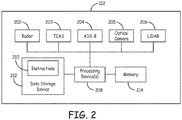
- FIG. 2 is a block diagram of an example tracking system 102.
- the tracking system 102 includes a plurality of sensors 202-206 configured to detect objects in the environment around the sensors 202-206.
- the plurality of sensors 202-206 can include any suitable sensor such as a radar 202, TCAS sensor 203, ADS-B sensor 204, optical camera 205, and a LiDAR 206. Other sensors may be used as well. Additionally, any number of sensors including multiple of the same type of sensors may be used.
- the sensors 202-206 are coupled to one or more processing devices 208.
- the sensors 202-206 are configured to obtain measurements and send the measurements to the one or more processing devices 208. As mentioned above, some or all of the sensors 202-206 can be configured to send a track ID along with a measurement to the one or more processing devices 208.
- the one or more processing devices 208 are configured to track a plurality of objects (such as intruder aircraft 106, 108) based on the measurements received from the sensors 202-206. To track the objects, the one or more processing devices 208 are configured to execute instructions 210 stored on one or more data storage devices 212 coupled to the one or more processing devices 208. The instructions 210, when executed by the one or more processing devices 208, cause the one or more processing devices 208 to implement the actions to track objects based on the measurements from the sensors 202-206.
- the one or more processing devices 208 can include a central processing unit (CPU), microcontroller, microprocessor, (e.g., a digital signal processor), field programmable gate array (FPGA), application specific integrated circuit (ASIC), or other processing device.
- CPU central processing unit
- microcontroller microprocessor
- FPGA field programmable gate array
- ASIC application specific integrated circuit
- the one or more data storage devices 212 include a non-volatile electronic hardware device for storing machine readable data and instructions.
- the one or more data storage devices 212 store information on any appropriate computer readable medium used for storage of computer readable instructions or data structures.
- the computer readable medium can be implemented as any available media that can be accessed by the one or more processing devices 208.
- Suitable computer readable media may include storage media such as magnetic or optical media.
- storage media can include a conventional hard disk, Compact Disk - Read Only Memory (CD-ROM), solid state drive (SSD), other flash memory, Read Only Memory (ROM), and Electrically Erasable Programmable ROM (EEPROM).
- the one or more processing devices 208 are also coupled to memory 214 that is configured to store data and instructions during execution by the one or more processing devices 208.
- the memory 214 can include volatile or non-volatile media such as Random Access Memory (RAM) (including, but not limited to, Synchronous Dynamic Random Access Memory (SDRAM), Double Data Rate (DDR) RAM, RAMBUS Dynamic RAM (RDRAM), and Static RAM (SRAM), etc.).
- RAM Random Access Memory
- SDRAM Synchronous Dynamic Random Access Memory
- DDR Double Data Rate
- RDRAM RAMBUS Dynamic RAM
- SRAM Static RAM
- the one or more processing devices 208 are configured to output information regarding the tracks of the objects to an output device such as a display device.
- the one or more processing devices 208 provide the track information to a larger SAA system for controlling movement of an unmanned aircraft system.
- FIG. 3 is a flow diagram of an example method 300 for tracking a plurality of objects with the tracking system 102.
- the tracking system 102 implements a loop that computes a plurality of intensities and updates the intensities during each loop based on newly obtained measurements from the sensors 202-206.
- the loop operates in real time to track a plurality of objects that are measured by the sensors 202-206.
- the loop implements a probabilistic hypothesis density (PHD) filter to update the intensities.
- PHD filter loop attempts to maintain a single intensity for each object being tracked.
- the PHD filter loop attempts to maintain a single intensity for each intruder aircraft 106, 108, and/or other airborne objects within a field-of-view of a sensor 202-206.
- one or more intensities are maintained corresponding to the number of objects being tracked at that time.
- Each iteration through the loop updates each intensity being maintained to the next time step unless the particular intensity is deleted (no longer tracked).
- the tracking method 300 operates on measurements that have a track ID associated therewith that was provided by a sensor 202-206. Accordingly, one or more measurements and their associated track IDs are provided by the sensors 202-206 (block 302). The one or more measurements each have a single respective track ID associated therewith. In some examples, other measurements that do not have a track ID associated therewith are also obtained by the sensors 202-206. These other measurements can also be used to update intensities maintained by the loop of method 300 in a manner known to those skilled in the art. Actions to update intensities with such other measurements are not shown in Figure 3 .
- the tracking method 300 utilizes the track IDs provided by the sensors 202-206 to determine whether and/or how to adjust a weight of an intensity during the update loop.
- the weight of an intensity corresponds to the likelihood that an intensity is tracking an actual object being sensed by the sensors 202-206.
- the more measurements obtained by the sensors 202-206 that correspond to an intensity the more likely it is that the intensity corresponds to an actual object.
- the weight can be used to manage the intensities operated on by the tracking method 300.
- an intensity that is more accurate than another intensity can be given a higher weight that the other intensity in order to increase the likelihood that the more accurate intensity is used and decrease the likelihood that the less accurate intensity is used.
- the tracking method 300 utilizes the track IDs provided with the measurements as a quick and effective way to estimate when a measurement has been obtained that corresponds to a given intensity. This information can be used to determine whether and/or how much to update the given intensity. In order to do this, the tracking method 300 associates one or more track IDs with a currently maintained intensity. In some examples, all currently maintained intensities have at least one track ID associated therewith, however, in other examples one or more of the currently maintained intensities may not have a track ID associated therewith. In any case, the intensities that do have a track ID associated therewith can proceed through the method 300 as described herein. Any intensity that does not have a track ID associated therewith can be updated in any suitable manner including in a manner known to those skilled in the art. Actions to update an intensity that does not have a track ID associated therewith are not shown in Figure 3 .
- each loop of method 300 updates each intensity (that is not deleted) to the next time step.
- time steps are referred to as T k , T k+1 for the time step that immediately follows time step T k , T k+2 for the time step that immediately follows time step T k+1 , etc.
- the length of time corresponding to a time step can be determined in any suitable manner, such as based on the frequency of measurements provided by one or more of the sensors 202-206.
- the one or more measurements provided by the sensors 202-206 correspond to the time step at which the one or more intensities are being updated.
- the one or more intensities input into the loop correspond to time step T k and the one or more measurements input into the loop (block 302) correspond to time step T k+1 .
- the one or more intensities are predicted to time step T k+1 and updated to time step T k+1 using the one or more measurements that correspond to time step T k+1 .
- one or more T k intensities are provided (block 304) from the previous iteration of the loop.
- the one or more T k intensities are the one or more intensities that were output from the previous iteration of the loop.
- the one or more T k intensities are output to the SAA system as the tracks for time step T k .
- Each intensity progresses through multiple intermediate stages during updating by method 300.
- An intensity that has completed updating for a given time step and is output (e.g., to an SAA system) is referred to herein as a "track intensity".
- the one or more T k intensities input into the loop of method 300 are also referred to herein as one or more T k "track” intensities.
- each of one or more T k track intensities has a respective one or more track IDs associated therewith.
- Each of these track IDs corresponds to one or more measurements from a sensor 202-206 that have been used to update (in a previous time step) the T k track intensity.
- the one or more track IDs can correspond to measurements that have been used to update the T k track intensity at any time step including and previous to the T k time step.
- the respective one or more track IDs can correspond to measurements that have been used to update the corresponding T k track intensity at the T k time step, the T k-1 time step, the T k-2 time step, etc. More detail regarding the process of associating one or more track IDs with a track intensity is provided below.
- Each of the one or more T k track intensities is propagated forward in time by first generating a predicted intensity for time step T k+1 (a T k+1 predicted intensity) (block 306) for each of the one or more T k+1 track intensities.
- These one or more T k+1 predicted intensities can be computed in any suitable manner including in ways known to those skilled in the art.
- Computing the one or more T k+1 predicted intensities includes computing a predicted weight for each T k+1 predicted intensity.
- the predicted weight can be computed in any suitable manner, and is a weight prediction for the corresponding T k track intensity during the T k+1 time step.
- the one or more track IDs that are associated with a given T k track intensity are associated with the T k+1 predicted intensity corresponding to that T k track intensity.
- the predicted weight for a T k+1 predicted intensity is computed without considering whether any measurements from the one or more measurements (block 302) for time step T k+1 correspond to the T k+1 predicted intensity. Then the predicted weight for each T k+1 predicted intensity is adjusted (block 308) based on whether any of a first one or more track IDs from the one or more measurements match the one or more track IDs for that respective T k+1 predicted intensity as explained below.
- any of the track IDs provided by a sensor 202-206 for a given time step match a track ID associated with a predicted intensity
- the weight of that predicted intensity is adjusted downwards as compared to if no track IDs provided by the sensors 202-206 match.
- the track IDs are used as an estimation of when a measurement is associated with an intensity. If a track ID from the sensors 202-206 matches a track ID associated with a predicted intensity, it is more likely that the measurement corresponding to that track ID corresponds to that predicted intensity, which justifies adjusting the weight of that intensity downwards as compared to predicted intensities that do not have such a matching track ID.
- the one or more measurements (block 302) from the sensors 202-206 collectively have a first one or more track IDs provided therewith.
- measurement-to-track associations are computed (block 310).
- Computing a measurement-to-track association results in generating a measurement-to-track intensity by updating a predicted or new intensity with one of the measurements such that the resulting measurement-to-track intensity is the predicted/new intensity adjusted to incorporate the (new) measurement.
- the predicted/new intensities are updated based on the track IDs associated therewith.
- the first one or more track IDs are compared with the one or more track IDs associated with each respective T k+1 predicted intensity to determine whether any of the first one or more track IDs match any of the one or more track IDs associated with each respective T k+1 predicted intensity.
- each track ID from the first one or more track IDs is compared with each track ID of the one or more track IDs associated with the T k+1 predicted intensity.
- a match occurs when a track ID from the first one or more track IDs is the same as a track ID from the one or more track IDs associated with a respective T k+1 predicted intensity.
- Measurement-to-track intensities are generated based on whether there is a match between a track ID of a measurement and a track ID of a T k+1 predicted intensity.
- a statistical distance test can also be used to determine whether to generate a measurement-to-track intensity.
- the statistical distance test includes computing a statistical distance between an intensity and a measurement. Any suitable distance test can be used, such as a Malhanobis distance test. In an example, the statistical distance is compared to a threshold.
- the T k+1 predicted intensity is updated with the measurement to generate a measurement-to-track intensity. If there is not a matching track ID or the statistical distance is above the threshold for a given pair of a measurement and a T k+1 predicted intensity, then that T k+1 predicted intensity is not updated with that measurement; therefore, no measurement-to-track intensity is generated for that pair.
- the measurement-to-track intensity When a measurement-to-track intensity is generated, it is more desirable to proceed in the loop with the measurement-to-track intensity than with the T k+1 predicted intensity from which that measurement-to-track intensity was created, because the measurement-to-track intensity includes the information from the most recent measurement, which is not included in the T k+1 predicted intensity. This is true unless the T k+1 predicted intensity has other track IDs associated with it that do not have corresponding measurement-to-track intensities. In such a situation, it is desirable to keep the T K+1 predicted intensity as well as the measurement-to-track intensity.
- the method 300 adjusts downward the weight of the T k+1 predicted intensity from which the measurement-to-track intensity was created such that the T k+1 predicted intensity is pruned (no longer maintained).
- the weight of the measurement-to-track intensity is adjusted to a level such that the measurement-to-track intensity survives pruning (is not pruned) and, therefore, is maintained. Since when a measurement-to-track intensity is generated there is a track ID that matches the T K+1 predicted intensity, the track ID match is used to determine how to adjust the weight of the predicted intensity.
- the predicted weight of a T k+1 predicted intensity is adjusted downward (block 308) by multiplying the predicted weight by a first value, if all of the track IDs associated with the T k+1 predicted intensity have a matching track ID in the first one or more track IDs corresponding to the measurements obtained by the sensors 202-206 (block 302).
- the first value is selected such that the weight of the T k+1 predicted intensity after multiplying is near zero.
- the first value can be less than 0.2.
- the first value is 0.01. If less than all of the track IDs associated with the Tk+1 predicted intensity have a matching track ID in the first one or more track IDs, then the weight of the predicted intensity can be multiplied by a second value.
- This second value can be the value of 1 such that the weight does not change or can be a different value such as 0.8. This process can be repeated for each T k+1 predicted intensity such that the predicted weight for each T k+1 predicted intensity is adjusted based on the track ID comparison.
- the weight of a T k+1 predicted intensity can be adjusted again after being reduced by being multiplied by the first value. For example, if the weight of a T k+1 predicted intensity is reduced by multiplying it by the first value as described above, but a measurement-to-track intensity corresponding to that T k+1 predicted intensity is not created (e.g., because the statistical distance between the measurement and the T k+1 predicted intensity was above the threshold), then the weight for the T k+1 predicted intensity is re-adjusted upwards so that the T k+1 predicted intensity is not pruned.
- re-adjusting the weight of the T k+1 predicted intensity includes multiplying the weight by the inverse of the first value such that the weight is reset back to where it was before being multiplied by the first value.
- the weight for the measurement-to-track intensity can be set based on the statistical distance between the corresponding measurement and the T k+1 predicted intensity and the weight of the T k+1 predicted intensity prior to being adjusted by the first value.
- one or more new intensities can also be created for time step T k+1 (block 309).
- These new intensities can be created in any suitable manner including in ways known to those skilled in the art.
- Measurement-to-track intensities can be generated for the new intensities by comparing the track IDs and statistical distances as described above with respect to the T k+1 predicted intensities.
- Each of the one or more new intensities also has a predicted weight corresponding thereto. The predicted weight of each of the one or more new intensities can also be adjusted based on the track ID comparison in the same manner as described above with respect to the T k+1 predicted intensities.
- the one or more predicted intensities, any new intensities, and any measurement-to-track intensities are then further processed by pruning (block 312). Pruning includes analyzing the one or more predicted intensities, any new intensities, and any measurement-to-track intensities to determine whether to delete any of the intensities. Among other things, pruning attempts to delete intensities that are not tracking an actual object.
- intensities are pruned based on their weight.
- the weight of an intensity is compared to a threshold. If the weight is lower than the threshold the intensity is deleted, and if the weight is higher than the threshold, the intensity is maintained (not deleted).
- the threshold is dynamically set for each intensity based on the track IDs associated with that intensity. Pruning intensities based on dynamically setting the threshold based on the track IDs is part of a process to manage the track IDs that are maintained with the intensities. In particular, this process is used to delete intensities having track IDs from a sensor that is no longer tracking the object.
- Each of the predicted intensities, new intensities, and measurement-to-track intensities that is processed by method 300 has one or more track IDs associated therewith.
- the one or more track IDs associated with a predicted intensity are the same one or more track IDs that were associated with the track intensity from which the predicted intensity was created.
- the one or more track IDs associated therewith can be one or more track IDs from any measurements used to create the new intensity.
- a new intensity can be created based on a measurement from the one or more measurements (302) that is not used for a measurement-to-track association. Such a measurement can be determined to correspond to a possible new object and, therefore, can be used to create a new intensity based thereon.
- a track ID for the new intensity therefore, can correspond to the measurement that was used to create the intensity.
- the track ID associated therewith is the track ID from the measurement of the one or more measurements in the current time step that was used to update the predicted intensity to generate the measurement-to-track intensity.
- the track intensity maintains all track IDs from any intensity used to create the track intensity. For example, if no intensities are merged with a given track intensity as it is updated to the next time step, the updated track intensity maintains the same track ID(s) as the previous corresponding track intensity. If, however, a first intensity is merged (block 314) with a second one or more intensities to create an updated track intensity, the updated track intensity has associated therewith all the track IDs from the first intensity and the second one or more intensities.
- the first intensity and the second one or more intensities can be any type of intensity including a predicted intensity, a measurement-to-track intensity, and a new intensity. Accordingly, if a predicted intensity and a measurement-to-track intensity are merged to form a track intensity, that track intensity has associated therewith, all the track ID(s) associated with the predicted intensity and the track ID associated with the measurement-to-track intensity.
- a predicted intensity can have one track ID or multiple track IDs associated therewith, while a new intensity and a measurement-to-track intensity can have only one intensity associated therewith.
- one or more of the track IDs associated with a track intensity may come from a sensor that can no longer track the corresponding object. In such a situation, it is desirable to no longer maintain that track ID as associated with that track intensity.
- Dynamically setting the threshold accomplishes this by setting the threshold higher for intensities have more track IDs associated therewith. With a higher threshold, an intensity having multiple track IDs needs to have a higher weight to be maintained.
- the lack of a measurement corresponding to one of the track IDs associated with the intensity will, over relatively few iterations of the loop, cause the weight to drop low enough to be below the (elevated) threshold.
- the object corresponding to the loop may still be tracked via a measurement-to-track intensity that may be maintained since it will likely have a lower threshold because a measurement-to-track intensity only has a single track ID associated therewith.
- a measurement-to-track intensity is an updated version of a predicted intensity, even if the predicted intensity is deleted, the information embodied by the predicted intensity can still be maintained via the measurement-to-track intensity.
- each sensor has a respective sensor threshold
- the threshold for comparing a weight against is set to the sum of the sensor thresholds for each sensor having a track ID associated with the intensity.
- the sensor threshold is selected based on the accuracy of the sensor. In this way, sensors that are more accurate, which typically results in a higher weighted intensity, have a higher threshold which provides a more strict exclusion of erroneous measurements from such a sensor.
- the threshold for comparing against the weight is the sum of the sensor thresholds of the sensors corresponding to the three track IDs.
- the threshold for comparing against the weight for that intensity is the sum of the sensor threshold for the TCAS mode S sensor, the sensor threshold for the first radar, and the sensor threshold for the second radar.
- the process of computing the threshold and then comparing the weight to the threshold is repeated for each of the one or more predicted intensities, any new intensities, and any measurement-to-track intensities. Any such intensity that has a weight below its respective threshold is deleted (block 312), while any intensity having a weight above its respective threshold is maintained and analyzed to be merged.
- the intensities that are not pruned are analyzed to be merged (block 314). Any suitable process of merging intensities can be used, including processes known to those skilled in the art.
- the resulting one or more T k+1 track intensities provided from the merge intensity step (block 314) can be output for display and/or further analysis, such as by a SAA system (block 316).
- the one or more T k+1 track intensities are also provided as input into the next iteration of the loop for updating based on one or more measurements for time step T k+2 .
Landscapes
- Engineering & Computer Science (AREA)
- Radar, Positioning & Navigation (AREA)
- Remote Sensing (AREA)
- Physics & Mathematics (AREA)
- General Physics & Mathematics (AREA)
- Computer Networks & Wireless Communication (AREA)
- Electromagnetism (AREA)
- Aviation & Aerospace Engineering (AREA)
- Health & Medical Sciences (AREA)
- Life Sciences & Earth Sciences (AREA)
- Chemical & Material Sciences (AREA)
- Analytical Chemistry (AREA)
- Biochemistry (AREA)
- General Health & Medical Sciences (AREA)
- Immunology (AREA)
- Pathology (AREA)
- Radar Systems Or Details Thereof (AREA)
Claims (10)
- Verfahren (300) zum Verfolgen mehrerer Objekte mit einem Wahrscheinlichkeitshypothese-Dichtefilter, das Verfahren umfassend:Erzeugen einer Tk-Spurintensität (304) für ein Objekt, wobei die Tk-Spurintensität ein Gewicht, einen Zustandsmittelvektor und eine Zustandskovarianzmatrix von statistischen Werten einer Spur des Objekts zur Zeit Tk enthält, wobei die Tk-Spurintensität eine oder mehrere erste Spurkennungen, IDs, aufweist, die damit assoziiert sind, wobei jede Spurkennung, ID, die mit der Tk-Spurintensität assoziiert ist, mit einer oder mehreren Messungen korrespondiert, die zu der Tk-Spurintensität beigetragen haben;Erzeugen einer vorhergesagten Tk+1-Intensität (306) für das auf der Tk-Spurintensität basierende Objekt, wobei die vorhergesagte Tk+1-Intensität mit der Zeit Tk+1 korrespondiert, wobei die vorhergesagte Tk+1-Intensität ein vorhergesagtes Gewicht basierend auf dem Gewicht der Tk-Spurintensität enthält;Erlangen einer Vielzahl von Messungen (302) von einer Vielzahl von Sensoren, wobei die Vielzahl von Sensoren eine Vielzahl von zweiten Spur-IDs bereitstellt, jede jeweils mit der Vielzahl von Messungen assoziiert, wobei die Vielzahl von Messungen mit der Zeit Tk+1 korrespondiert;Vergleichen der Vielzahl zweiter Spur-IDs mit jeder ersten Spur-ID, assoziiert mit jeder Tk-Spurintensität;wenn alle der einen oder mehreren ersten Spur-IDs beliebigen der Vielzahl zweiter Spur-IDs entsprechen, Multiplizieren des vorhergesagten Gewichts (308) mit einem ersten Wert;wenn weniger als alle der einen oder mehreren ersten Spur-IDs beliebigen der Vielzahl zweiter Spur-IDs entsprechen, Multiplizieren des vorhergesagten Gewichts (308) mit einem zweiten Wert, wobei der zweite Wert größer ist als der erste Wert;Bestimmen, ob die vorhergesagte Tk+1-Intensität (312) basierend auf dem vorhergesagten Gewicht nach Multiplizieren mit entweder dem ersten Wert oder dem zweiten Wert zu beschneiden ist; undwenn die vorhergesagte Tk+1-Intensität nicht beschnitten wird, Erzeugen einer Tk+1-Spurintensität (304) für das Objekt zur Zeit Tk+1 basierend auf der vorhergesagten Tk+1-Intensität, wobei die Tk+1-Spurintensität ein aktualisiertes Gewicht basierend auf dem Multiplizieren des vorhergesagten Gewichts aufweist.
- Verfahren nach Anspruch 1, wobei der erste Wert kleiner als 0,2 ist.
- Verfahren nach einem der Ansprüche 1 oder 2, wobei Bestimmen, ob die vorhergesagte Tk+1-Intensität (312) zu beschneiden ist, Folgendes enthält:Vergleichen des vorhergesagten Gewichts nach Multiplizieren mit einem Schwellenwert; undwenn das vorhergesagte Gewicht nach dem Multiplizieren unter dem Schwellenwert ist, Löschen der vorhergesagten Tk+1-Intensität.
- Verfahren nach Anspruch 3, umfassend:Auswählen des Schwellenwerts basierend auf einer oder mehreren ersten Spur-IDs.
- Verfahren nach Anspruch 4, wobei jeder der Vielzahl von Sensoren einen korrespondierenden Sensorschwellenwert aufweist,
wobei Auswählen des Schwellenwerts enthält, den Schwellenwert als eine Summe der Sensorschwellenwerte der Sensoren, die eine Spur-ID in der einen oder den mehreren ersten Spur-IDs aufweisen, einzustellen. - Verfahren nach Anspruch 5, wobei der Sensorschwellenwert für einen Sensor der Vielzahl von Sensoren auf der Genauigkeit dieses Sensors basiert.
- Verfahren nach einem der Ansprüche 5 oder 6, wobei Einstellen des Schwellenwerts enthält, den Schwellenwert höher einzustellen, wenn mehr der Vielzahl von Sensoren eine Spur-ID in der einen oder den mehreren Spur-IDs aufweisen, und niedriger einzustellen, wenn weniger der Vielzahl von Sensoren eine Spur-ID in der einen oder den mehreren Spur-IDs aufweisen.
- Verfahren nach einem der Ansprüche 1-7, wobei jede Spur-ID der einen oder mehreren ersten Spur-IDs und der Vielzahl zweiter Spur-IDs eine einer Kennung ist, die von einem Sensor einem Satz von Messungen, die von dem Sensor erlangt wurden, die über die Zeit korreliert sind, oder einer Luftfahrzeugadresse der Internationalen Zivilluftfahrtorganisation (ICAO), die von einem Sensor empfangen wurde und mit einer jeweiligen Messung für diesen Sensor korrespondiert, zugewiesen wurde.
- Verfolgungssystem (102), umfassend:eine oder mehrere Verarbeitungsvorrichtungen (208); undeine oder mehrere Datenspeichervorrichtungen (212), die Anweisungen (210) enthalten, die, wenn sie von der einen oder den mehreren Verarbeitungsvorrichtungen (208) ausgeführt werden, bewirken, dass die eine oder mehreren Verarbeitungsvorrichtungen (208) mehrere Objekte mit einem Wahrscheinlichkeitshypothese-Dichtefilter verfolgen, wobei die Anweisungen (210) bewirken, dass die eine oder mehreren Verarbeitungsvorrichtungen (208) Folgendes ausführen:Erzeugen einer Vielzahl von Tk-Spurintensitäten (304), wobei jede Tk-Spurintensität der Vielzahl von Tk-Spurintensitäten ein Gewicht, einen Zustandsmittelvektor und eine Zustandskovarianzmatrix von statistischen Werten einer Spur eines jeweiligen Objekts zur Zeit Tk enthält, wobei jede Tk-Spurintensität eine oder mehrere erste Spurkennungen, IDs, aufweist, die damit assoziiert sind, wobei jede Spurkennung, ID, die mit einer jeweiligen Tk-Spurintensität assoziiert ist, mit einer Messung korrespondiert, die zu der jeweiligen Tk-Spurintensität beigetragen hat;Erzeugen einer Vielzahl von vorhergesagten Tk+1-Intensitäten basierend auf den Tk-Spurintensitäten (306), wobei die Vielzahl vorhergesagter Tk+1-Intensitäten mit der Zeit Tk+1 korrespondiert, wobei jede der Vielzahl vorhergesagter Tk+1-Intensitäten ein vorhergesagtes Gewicht basierend auf dem Gewicht der jeweiligen Tk-Spurintensität enthält;Erlangen einer Vielzahl von Messungen von einer Vielzahl von Sensoren (202-206), wobei die Vielzahl von Sensoren (202-206) eine Vielzahl zweiter Spur-IDs für die Vielzahl von Messungen (302) bereitstellt, wobei die Vielzahl von Messungen mit der Zeit Tk+1 korrespondiert;Vergleichen der Vielzahl zweiter Spur-IDs mit jeder Spur-ID, assoziiert mit jeder Tk-Spurintensität;wenn alle der mit einer gegebenen Tk-Spurintensität assoziierten Spur-IDs beliebigen der Vielzahl zweiter Spur-IDs entsprechen, Multiplizieren des vorhergesagten Gewichts der mit der gegebenen Tk-Spurintensität korrespondierenden vorhergesagten Tk+1-Intensität mit einem ersten Wert (308);wenn weniger als alle der mit einer gegebenen Tk-Spurintensität assoziierten Spur-IDs beliebigen der Vielzahl zweiter Spur-IDs entsprechen, Multiplizieren des vorhergesagten Gewichts der mit der gegebenen Tk-Spurintensität korrespondierenden vorhergesagten Tk+1-Intensität mit einem zweiten Wert (308), wobei der zweite Wert größer ist als der erste Wert;Beschneiden der Vielzahl von vorhergesagten Tk+1-Intensitäten basierend auf ihrem jeweiligen vorhergesagten Gewicht nach Multiplizieren mit dem ersten Wert oder dem zweiten Wert (312); undErzeugen einer Vielzahl von Tk+1-Spurintensitäten basierend auf den vorhergesagten Tk+1-Intensitäten, die nicht beschnitten wurden (304), wobei jede Tk+1-Spurintensität der Vielzahl von Tk+1-Spurintensitäten mit der Zeit Tk+1 korrespondiert und ein aktualisiertes Gewicht basierend auf dem vorhergesagten Gewicht der jeweiligen vorhergesagten Tk+1-Intensität nach dem Multiplizieren aufweist.
- Verfolgungssystem nach Anspruch 9, wobei das Beschneiden der Vielzahl von vorhergesagten Tk+1-Intensitäten enthält:Vergleichen des vorhergesagten Gewichts jeder vorhergesagten Tk+1-Intensität der Vielzahl von vorhergesagten Tk+1-Intensitäten nach dem Multiplizieren mit einem jeweiligen Schwellenwert für diese vorhergesagte Tk+1-Intensität; undwenn das vorhergesagte Gewicht nach dem Multiplizieren unter seinem jeweiligen Schwellenwert ist, Löschen dieser vorhergesagten Tk+1-Intensität;wobei die Anweisungen (210) bewirken, dass die eine oder mehreren Verarbeitungsvorrichtungen (208) jeden jeweiligen Schwellenwert basierend auf einer oder mehreren Spur-IDs auswählen, die mit der Tk-Spurintensität, die mit dem jeweiligen Schwellenwert korrespondiert, assoziiert sind;
wobei jeder der Vielzahl von Sensoren (202-206) einen korrespondierenden Sensorschwellenwert aufweist, wobei der jeweilige Schwellenwert für eine gegebene vorhergesagte Tk+1-Intensität als eine Summe der Sensorschwellenwerte, die eine Spur-ID aufweisen, die mit der Tk-Spurintensität assoziiert ist, die mit der gegebenen vorhergesagten Tk+1-Intensität korrespondiert, eingestellt wird.
Applications Claiming Priority (1)
| Application Number | Priority Date | Filing Date | Title |
|---|---|---|---|
| US14/448,813 US9851437B2 (en) | 2014-07-31 | 2014-07-31 | Adjusting weight of intensity in a PHD filter based on sensor track ID |
Publications (2)
| Publication Number | Publication Date |
|---|---|
| EP2980602A1 EP2980602A1 (de) | 2016-02-03 |
| EP2980602B1 true EP2980602B1 (de) | 2017-02-08 |
Family
ID=53673790
Family Applications (1)
| Application Number | Title | Priority Date | Filing Date |
|---|---|---|---|
| EP15176942.9A Active EP2980602B1 (de) | 2014-07-31 | 2015-07-15 | Anpassung des gewicht der intensität in einem phd-filter auf basis einer sensor-track-id |
Country Status (4)
| Country | Link |
|---|---|
| US (1) | US9851437B2 (de) |
| EP (1) | EP2980602B1 (de) |
| CN (1) | CN105321381B (de) |
| IL (1) | IL240074B (de) |
Families Citing this family (4)
| Publication number | Priority date | Publication date | Assignee | Title |
|---|---|---|---|---|
| US10605607B2 (en) | 2014-07-31 | 2020-03-31 | Honeywell International Inc. | Two step pruning in a PHD filter |
| US11175142B2 (en) * | 2014-07-31 | 2021-11-16 | Honeywell International Inc. | Updating intensities in a PHD filter based on a sensor track ID |
| US12265150B2 (en) * | 2022-01-25 | 2025-04-01 | Intel Corporation | Apparatus, system and method of radar tracking |
| CN115712113A (zh) * | 2022-09-13 | 2023-02-24 | 河海大学 | 新生未知自适应噪声协方差tphd滤波的目标跟踪方法 |
Family Cites Families (15)
| Publication number | Priority date | Publication date | Assignee | Title |
|---|---|---|---|---|
| US4816833A (en) | 1987-06-16 | 1989-03-28 | Westinghouse Electric Corp. | Pulse doppler surveillance post signal processing and scan to scan correlation |
| US5390133A (en) * | 1992-09-30 | 1995-02-14 | Martin Marietta Corporation | Image processor for target detection and tracking |
| US5414643A (en) * | 1993-06-14 | 1995-05-09 | Hughes Aircraft Company | Method and apparatus for continuous time representation of multiple hypothesis tracking data |
| US6799114B2 (en) | 2001-11-20 | 2004-09-28 | Garmin At, Inc. | Systems and methods for correlation in an air traffic control system of interrogation-based target positional data and GPS-based intruder positional data |
| DE10231712A1 (de) | 2002-07-13 | 2004-01-29 | Stn Atlas Elektronik Gmbh | Verfahren zur Beobachtung einer Vielzahl von Objekten |
| EP1533628B1 (de) * | 2003-11-19 | 2012-10-24 | Saab Ab | Methode zur Korrelation und Nummerierung von Zielspuren aus mehreren Quellen |
| US7626535B2 (en) | 2006-11-09 | 2009-12-01 | Raytheon Company | Track quality based multi-target tracker |
| US7864096B2 (en) | 2008-01-23 | 2011-01-04 | Aviation Communication & Surveillance Systems Llc | Systems and methods for multi-sensor collision avoidance |
| US8330810B2 (en) | 2008-02-27 | 2012-12-11 | Honeywell International Inc. | Systems and method for dynamic stabilization of target data detected from a moving platform |
| US8378881B2 (en) | 2010-10-18 | 2013-02-19 | Raytheon Company | Systems and methods for collision avoidance in unmanned aerial vehicles |
| JP5306389B2 (ja) * | 2011-02-25 | 2013-10-02 | 株式会社東芝 | 目標追跡装置 |
| US8515881B2 (en) | 2011-03-11 | 2013-08-20 | Raytheon Company | Multiple hypothesis tracking |
| US20130229298A1 (en) | 2012-03-02 | 2013-09-05 | The Mitre Corporation | Threaded Track Method, System, and Computer Program Product |
| US8970429B2 (en) | 2012-06-14 | 2015-03-03 | Raytheon Company | Systems and methods for tracking targets by a through-the-wall radar using multiple hypothesis tracking |
| CN103345577B (zh) * | 2013-06-27 | 2016-05-18 | 江南大学 | 变分贝叶斯概率假设密度多目标跟踪方法 |
-
2014
- 2014-07-31 US US14/448,813 patent/US9851437B2/en active Active
-
2015
- 2015-07-15 EP EP15176942.9A patent/EP2980602B1/de active Active
- 2015-07-21 IL IL240074A patent/IL240074B/en active IP Right Grant
- 2015-07-30 CN CN201510628780.9A patent/CN105321381B/zh active Active
Non-Patent Citations (1)
| Title |
|---|
| None * |
Also Published As
| Publication number | Publication date |
|---|---|
| IL240074B (en) | 2020-08-31 |
| US9851437B2 (en) | 2017-12-26 |
| EP2980602A1 (de) | 2016-02-03 |
| CN105321381B (zh) | 2020-02-07 |
| CN105321381A (zh) | 2016-02-10 |
| US20160033633A1 (en) | 2016-02-04 |
Similar Documents
| Publication | Publication Date | Title |
|---|---|---|
| EP3859389B1 (de) | Zusammenführung von intensitäten in einem phd-filter auf basis einer sensor-track-id | |
| CN104035439B (zh) | 用多个激光雷达传感器利用扫描点追踪物体的贝叶斯网络 | |
| US9946935B2 (en) | Object tracking device, object tracking method, and object tracking program | |
| KR101402206B1 (ko) | 운동학 및 형상 정보를 활용한 다중 표적 추적 방법 | |
| EP2881755A1 (de) | Initialisierung der Verfolgung der Erfassungs- und Vermeidungssensorfusion für unbemannte Luftfahrzeugsysteme | |
| CN105093212B (zh) | 利用雷达的目标检测装置及方法 | |
| EP2980603B1 (de) | Zweistufiges beschneiden in einem phd-filter | |
| EP2980605B1 (de) | Aktualisierung der intensitäten in einem phd-filter auf basis einer sensor-track-id | |
| CN105182291A (zh) | 自适应目标新生强度的phd平滑器的多目标跟踪方法 | |
| KR101372390B1 (ko) | 마코브 체인 방식의 다중스캔 추적 기법을 이용한 표적 추적방법 및 이를 이용한 표적 추적장치 | |
| US9851437B2 (en) | Adjusting weight of intensity in a PHD filter based on sensor track ID | |
| Attari et al. | An SVSF-based generalized robust strategy for target tracking in clutter | |
| KR101813790B1 (ko) | 특징 기반 다중 센서 정보 융합 장치 및 방법 | |
| US11555913B2 (en) | Object recognition device and object recognition method | |
| CN103383451B (zh) | 基于恒边长梯度加权图切的优化雷达微弱目标检测方法 | |
| Sung et al. | Algorithm for searching and tracking an unknown and varying number of mobile targets using a limited fov sensor | |
| KR20190090604A (ko) | V2v 통신과 레이다 센서 객체 번호 일치 방법 및 장치 | |
| KR102296470B1 (ko) | 멀티스태틱 pcl 순차적 표적 위치 추정 시스템 및 방법 | |
| KR20160077814A (ko) | 레이더 신호 처리 장치 및 방법 | |
| KR20220113509A (ko) | 교통 관제 시스템을 감독하기 위한 방법 및 디바이스 | |
| Liu et al. | Sequential measurement-driven multi-target Bayesian filter | |
| Khutortsev | Local optimization of trajectory control of observations for mobile digital direction-finder in the location of discrete sources of radiation system | |
| US20220172379A1 (en) | Object tracking system, tracking parameter setting method, and non-transitory computer readable medium | |
| Schubert et al. | Performance evaluation of multiple target tracking in the absence of reference data | |
| Abd Rahman et al. | Dynamic track management in MHT for pedestrian tracking using laser range finder |
Legal Events
| Date | Code | Title | Description |
|---|---|---|---|
| PUAI | Public reference made under article 153(3) epc to a published international application that has entered the european phase |
Free format text: ORIGINAL CODE: 0009012 |
|
| 17P | Request for examination filed |
Effective date: 20150715 |
|
| AK | Designated contracting states |
Kind code of ref document: A1 Designated state(s): AL AT BE BG CH CY CZ DE DK EE ES FI FR GB GR HR HU IE IS IT LI LT LU LV MC MK MT NL NO PL PT RO RS SE SI SK SM TR |
|
| AX | Request for extension of the european patent |
Extension state: BA ME |
|
| GRAP | Despatch of communication of intention to grant a patent |
Free format text: ORIGINAL CODE: EPIDOSNIGR1 |
|
| RIC1 | Information provided on ipc code assigned before grant |
Ipc: G01S 17/66 20060101ALI20160909BHEP Ipc: G01S 13/93 20060101ALI20160909BHEP Ipc: G01S 13/72 20060101ALI20160909BHEP Ipc: G01S 13/86 20060101AFI20160909BHEP |
|
| INTG | Intention to grant announced |
Effective date: 20161004 |
|
| GRAS | Grant fee paid |
Free format text: ORIGINAL CODE: EPIDOSNIGR3 |
|
| GRAA | (expected) grant |
Free format text: ORIGINAL CODE: 0009210 |
|
| AK | Designated contracting states |
Kind code of ref document: B1 Designated state(s): AL AT BE BG CH CY CZ DE DK EE ES FI FR GB GR HR HU IE IS IT LI LT LU LV MC MK MT NL NO PL PT RO RS SE SI SK SM TR |
|
| REG | Reference to a national code |
Ref country code: GB Ref legal event code: FG4D |
|
| REG | Reference to a national code |
Ref country code: CH Ref legal event code: EP Ref country code: AT Ref legal event code: REF Ref document number: 867112 Country of ref document: AT Kind code of ref document: T Effective date: 20170215 |
|
| REG | Reference to a national code |
Ref country code: IE Ref legal event code: FG4D |
|
| REG | Reference to a national code |
Ref country code: DE Ref legal event code: R096 Ref document number: 602015001469 Country of ref document: DE |
|
| REG | Reference to a national code |
Ref country code: LT Ref legal event code: MG4D |
|
| REG | Reference to a national code |
Ref country code: NL Ref legal event code: MP Effective date: 20170208 |
|
| REG | Reference to a national code |
Ref country code: AT Ref legal event code: MK05 Ref document number: 867112 Country of ref document: AT Kind code of ref document: T Effective date: 20170208 |
|
| REG | Reference to a national code |
Ref country code: FR Ref legal event code: PLFP Year of fee payment: 3 |
|
| PG25 | Lapsed in a contracting state [announced via postgrant information from national office to epo] |
Ref country code: HR Free format text: LAPSE BECAUSE OF FAILURE TO SUBMIT A TRANSLATION OF THE DESCRIPTION OR TO PAY THE FEE WITHIN THE PRESCRIBED TIME-LIMIT Effective date: 20170208 Ref country code: GR Free format text: LAPSE BECAUSE OF FAILURE TO SUBMIT A TRANSLATION OF THE DESCRIPTION OR TO PAY THE FEE WITHIN THE PRESCRIBED TIME-LIMIT Effective date: 20170509 Ref country code: FI Free format text: LAPSE BECAUSE OF FAILURE TO SUBMIT A TRANSLATION OF THE DESCRIPTION OR TO PAY THE FEE WITHIN THE PRESCRIBED TIME-LIMIT Effective date: 20170208 Ref country code: NO Free format text: LAPSE BECAUSE OF FAILURE TO SUBMIT A TRANSLATION OF THE DESCRIPTION OR TO PAY THE FEE WITHIN THE PRESCRIBED TIME-LIMIT Effective date: 20170508 Ref country code: LT Free format text: LAPSE BECAUSE OF FAILURE TO SUBMIT A TRANSLATION OF THE DESCRIPTION OR TO PAY THE FEE WITHIN THE PRESCRIBED TIME-LIMIT Effective date: 20170208 |
|
| PG25 | Lapsed in a contracting state [announced via postgrant information from national office to epo] |
Ref country code: NL Free format text: LAPSE BECAUSE OF NON-PAYMENT OF DUE FEES Effective date: 20170208 Ref country code: SE Free format text: LAPSE BECAUSE OF FAILURE TO SUBMIT A TRANSLATION OF THE DESCRIPTION OR TO PAY THE FEE WITHIN THE PRESCRIBED TIME-LIMIT Effective date: 20170208 Ref country code: AT Free format text: LAPSE BECAUSE OF FAILURE TO SUBMIT A TRANSLATION OF THE DESCRIPTION OR TO PAY THE FEE WITHIN THE PRESCRIBED TIME-LIMIT Effective date: 20170208 Ref country code: ES Free format text: LAPSE BECAUSE OF FAILURE TO SUBMIT A TRANSLATION OF THE DESCRIPTION OR TO PAY THE FEE WITHIN THE PRESCRIBED TIME-LIMIT Effective date: 20170208 Ref country code: PT Free format text: LAPSE BECAUSE OF FAILURE TO SUBMIT A TRANSLATION OF THE DESCRIPTION OR TO PAY THE FEE WITHIN THE PRESCRIBED TIME-LIMIT Effective date: 20170608 Ref country code: LV Free format text: LAPSE BECAUSE OF FAILURE TO SUBMIT A TRANSLATION OF THE DESCRIPTION OR TO PAY THE FEE WITHIN THE PRESCRIBED TIME-LIMIT Effective date: 20170208 Ref country code: RS Free format text: LAPSE BECAUSE OF FAILURE TO SUBMIT A TRANSLATION OF THE DESCRIPTION OR TO PAY THE FEE WITHIN THE PRESCRIBED TIME-LIMIT Effective date: 20170208 Ref country code: BG Free format text: LAPSE BECAUSE OF FAILURE TO SUBMIT A TRANSLATION OF THE DESCRIPTION OR TO PAY THE FEE WITHIN THE PRESCRIBED TIME-LIMIT Effective date: 20170508 |
|
| PG25 | Lapsed in a contracting state [announced via postgrant information from national office to epo] |
Ref country code: IT Free format text: LAPSE BECAUSE OF FAILURE TO SUBMIT A TRANSLATION OF THE DESCRIPTION OR TO PAY THE FEE WITHIN THE PRESCRIBED TIME-LIMIT Effective date: 20170208 Ref country code: EE Free format text: LAPSE BECAUSE OF FAILURE TO SUBMIT A TRANSLATION OF THE DESCRIPTION OR TO PAY THE FEE WITHIN THE PRESCRIBED TIME-LIMIT Effective date: 20170208 Ref country code: SK Free format text: LAPSE BECAUSE OF FAILURE TO SUBMIT A TRANSLATION OF THE DESCRIPTION OR TO PAY THE FEE WITHIN THE PRESCRIBED TIME-LIMIT Effective date: 20170208 Ref country code: RO Free format text: LAPSE BECAUSE OF FAILURE TO SUBMIT A TRANSLATION OF THE DESCRIPTION OR TO PAY THE FEE WITHIN THE PRESCRIBED TIME-LIMIT Effective date: 20170208 Ref country code: CZ Free format text: LAPSE BECAUSE OF FAILURE TO SUBMIT A TRANSLATION OF THE DESCRIPTION OR TO PAY THE FEE WITHIN THE PRESCRIBED TIME-LIMIT Effective date: 20170208 |
|
| REG | Reference to a national code |
Ref country code: DE Ref legal event code: R097 Ref document number: 602015001469 Country of ref document: DE |
|
| PG25 | Lapsed in a contracting state [announced via postgrant information from national office to epo] |
Ref country code: PL Free format text: LAPSE BECAUSE OF FAILURE TO SUBMIT A TRANSLATION OF THE DESCRIPTION OR TO PAY THE FEE WITHIN THE PRESCRIBED TIME-LIMIT Effective date: 20170208 Ref country code: SM Free format text: LAPSE BECAUSE OF FAILURE TO SUBMIT A TRANSLATION OF THE DESCRIPTION OR TO PAY THE FEE WITHIN THE PRESCRIBED TIME-LIMIT Effective date: 20170208 Ref country code: DK Free format text: LAPSE BECAUSE OF FAILURE TO SUBMIT A TRANSLATION OF THE DESCRIPTION OR TO PAY THE FEE WITHIN THE PRESCRIBED TIME-LIMIT Effective date: 20170208 |
|
| PLBE | No opposition filed within time limit |
Free format text: ORIGINAL CODE: 0009261 |
|
| STAA | Information on the status of an ep patent application or granted ep patent |
Free format text: STATUS: NO OPPOSITION FILED WITHIN TIME LIMIT |
|
| 26N | No opposition filed |
Effective date: 20171109 |
|
| PG25 | Lapsed in a contracting state [announced via postgrant information from national office to epo] |
Ref country code: SI Free format text: LAPSE BECAUSE OF FAILURE TO SUBMIT A TRANSLATION OF THE DESCRIPTION OR TO PAY THE FEE WITHIN THE PRESCRIBED TIME-LIMIT Effective date: 20170208 |
|
| REG | Reference to a national code |
Ref country code: IE Ref legal event code: MM4A |
|
| PG25 | Lapsed in a contracting state [announced via postgrant information from national office to epo] |
Ref country code: IE Free format text: LAPSE BECAUSE OF NON-PAYMENT OF DUE FEES Effective date: 20170715 |
|
| REG | Reference to a national code |
Ref country code: BE Ref legal event code: MM Effective date: 20170731 |
|
| PG25 | Lapsed in a contracting state [announced via postgrant information from national office to epo] |
Ref country code: LU Free format text: LAPSE BECAUSE OF NON-PAYMENT OF DUE FEES Effective date: 20170715 |
|
| REG | Reference to a national code |
Ref country code: FR Ref legal event code: PLFP Year of fee payment: 4 |
|
| PG25 | Lapsed in a contracting state [announced via postgrant information from national office to epo] |
Ref country code: BE Free format text: LAPSE BECAUSE OF NON-PAYMENT OF DUE FEES Effective date: 20170731 |
|
| PG25 | Lapsed in a contracting state [announced via postgrant information from national office to epo] |
Ref country code: MT Free format text: LAPSE BECAUSE OF NON-PAYMENT OF DUE FEES Effective date: 20170715 |
|
| REG | Reference to a national code |
Ref country code: CH Ref legal event code: PL |
|
| PG25 | Lapsed in a contracting state [announced via postgrant information from national office to epo] |
Ref country code: CH Free format text: LAPSE BECAUSE OF NON-PAYMENT OF DUE FEES Effective date: 20180731 Ref country code: LI Free format text: LAPSE BECAUSE OF NON-PAYMENT OF DUE FEES Effective date: 20180731 |
|
| PG25 | Lapsed in a contracting state [announced via postgrant information from national office to epo] |
Ref country code: MC Free format text: LAPSE BECAUSE OF FAILURE TO SUBMIT A TRANSLATION OF THE DESCRIPTION OR TO PAY THE FEE WITHIN THE PRESCRIBED TIME-LIMIT Effective date: 20170208 Ref country code: HU Free format text: LAPSE BECAUSE OF FAILURE TO SUBMIT A TRANSLATION OF THE DESCRIPTION OR TO PAY THE FEE WITHIN THE PRESCRIBED TIME-LIMIT; INVALID AB INITIO Effective date: 20150715 |
|
| PG25 | Lapsed in a contracting state [announced via postgrant information from national office to epo] |
Ref country code: CY Free format text: LAPSE BECAUSE OF FAILURE TO SUBMIT A TRANSLATION OF THE DESCRIPTION OR TO PAY THE FEE WITHIN THE PRESCRIBED TIME-LIMIT Effective date: 20170208 |
|
| PG25 | Lapsed in a contracting state [announced via postgrant information from national office to epo] |
Ref country code: MK Free format text: LAPSE BECAUSE OF FAILURE TO SUBMIT A TRANSLATION OF THE DESCRIPTION OR TO PAY THE FEE WITHIN THE PRESCRIBED TIME-LIMIT Effective date: 20170208 |
|
| PG25 | Lapsed in a contracting state [announced via postgrant information from national office to epo] |
Ref country code: TR Free format text: LAPSE BECAUSE OF FAILURE TO SUBMIT A TRANSLATION OF THE DESCRIPTION OR TO PAY THE FEE WITHIN THE PRESCRIBED TIME-LIMIT Effective date: 20170208 |
|
| PG25 | Lapsed in a contracting state [announced via postgrant information from national office to epo] |
Ref country code: AL Free format text: LAPSE BECAUSE OF FAILURE TO SUBMIT A TRANSLATION OF THE DESCRIPTION OR TO PAY THE FEE WITHIN THE PRESCRIBED TIME-LIMIT Effective date: 20170208 Ref country code: IS Free format text: LAPSE BECAUSE OF FAILURE TO SUBMIT A TRANSLATION OF THE DESCRIPTION OR TO PAY THE FEE WITHIN THE PRESCRIBED TIME-LIMIT Effective date: 20170608 |
|
| P01 | Opt-out of the competence of the unified patent court (upc) registered |
Effective date: 20230525 |
|
| PGFP | Annual fee paid to national office [announced via postgrant information from national office to epo] |
Ref country code: DE Payment date: 20250728 Year of fee payment: 11 |
|
| PGFP | Annual fee paid to national office [announced via postgrant information from national office to epo] |
Ref country code: GB Payment date: 20250722 Year of fee payment: 11 |
|
| PGFP | Annual fee paid to national office [announced via postgrant information from national office to epo] |
Ref country code: FR Payment date: 20250725 Year of fee payment: 11 |