EP2980096B1 - 2 ,3 ,5 -trihydroxy-androst-6-one and preparation methods and use thereof - Google Patents
2 ,3 ,5 -trihydroxy-androst-6-one and preparation methods and use thereof Download PDFInfo
- Publication number
- EP2980096B1 EP2980096B1 EP14774834.7A EP14774834A EP2980096B1 EP 2980096 B1 EP2980096 B1 EP 2980096B1 EP 14774834 A EP14774834 A EP 14774834A EP 2980096 B1 EP2980096 B1 EP 2980096B1
- Authority
- EP
- European Patent Office
- Prior art keywords
- compound
- mixture
- added
- reaction
- androst
- Prior art date
- Legal status (The legal status is an assumption and is not a legal conclusion. Google has not performed a legal analysis and makes no representation as to the accuracy of the status listed.)
- Active
Links
- 238000002360 preparation method Methods 0.000 title description 12
- 150000001875 compounds Chemical class 0.000 claims description 154
- 210000002569 neuron Anatomy 0.000 claims description 22
- 210000003994 retinal ganglion cell Anatomy 0.000 claims description 20
- 238000000034 method Methods 0.000 claims description 15
- 239000012453 solvate Substances 0.000 claims description 12
- 230000003647 oxidation Effects 0.000 claims description 11
- 238000007254 oxidation reaction Methods 0.000 claims description 11
- 239000008194 pharmaceutical composition Substances 0.000 claims description 8
- 239000003223 protective agent Substances 0.000 claims description 6
- 206010028980 Neoplasm Diseases 0.000 claims description 3
- 239000002246 antineoplastic agent Substances 0.000 claims description 3
- 229940041181 antineoplastic drug Drugs 0.000 claims description 3
- 239000003937 drug carrier Substances 0.000 claims description 3
- 238000003379 elimination reaction Methods 0.000 claims description 2
- 230000007062 hydrolysis Effects 0.000 claims description 2
- 238000006460 hydrolysis reaction Methods 0.000 claims description 2
- 239000000203 mixture Substances 0.000 description 74
- CSCPPACGZOOCGX-UHFFFAOYSA-N Acetone Chemical compound CC(C)=O CSCPPACGZOOCGX-UHFFFAOYSA-N 0.000 description 63
- 238000006243 chemical reaction Methods 0.000 description 61
- 239000007787 solid Substances 0.000 description 46
- XLYOFNOQVPJJNP-UHFFFAOYSA-N water Substances O XLYOFNOQVPJJNP-UHFFFAOYSA-N 0.000 description 43
- 239000000243 solution Substances 0.000 description 37
- HEDRZPFGACZZDS-MICDWDOJSA-N Trichloro(2H)methane Chemical compound [2H]C(Cl)(Cl)Cl HEDRZPFGACZZDS-MICDWDOJSA-N 0.000 description 36
- OKKJLVBELUTLKV-UHFFFAOYSA-N Methanol Chemical class OC OKKJLVBELUTLKV-UHFFFAOYSA-N 0.000 description 31
- 230000007935 neutral effect Effects 0.000 description 28
- MHAJPDPJQMAIIY-UHFFFAOYSA-N Hydrogen peroxide Chemical compound OO MHAJPDPJQMAIIY-UHFFFAOYSA-N 0.000 description 26
- 239000011541 reaction mixture Substances 0.000 description 25
- 239000012065 filter cake Substances 0.000 description 23
- CDBYLPFSWZWCQE-UHFFFAOYSA-L Sodium Carbonate Chemical compound [Na+].[Na+].[O-]C([O-])=O CDBYLPFSWZWCQE-UHFFFAOYSA-L 0.000 description 22
- BDAGIHXWWSANSR-UHFFFAOYSA-N methanoic acid Natural products OC=O BDAGIHXWWSANSR-UHFFFAOYSA-N 0.000 description 22
- XEKOWRVHYACXOJ-UHFFFAOYSA-N Ethyl acetate Chemical compound CCOC(C)=O XEKOWRVHYACXOJ-UHFFFAOYSA-N 0.000 description 18
- VEXZGXHMUGYJMC-UHFFFAOYSA-N Hydrochloric acid Chemical compound Cl VEXZGXHMUGYJMC-UHFFFAOYSA-N 0.000 description 18
- KWYUFKZDYYNOTN-UHFFFAOYSA-M Potassium hydroxide Chemical compound [OH-].[K+] KWYUFKZDYYNOTN-UHFFFAOYSA-M 0.000 description 18
- ZMXDDKWLCZADIW-UHFFFAOYSA-N N,N-Dimethylformamide Chemical compound CN(C)C=O ZMXDDKWLCZADIW-UHFFFAOYSA-N 0.000 description 16
- 230000006378 damage Effects 0.000 description 15
- 239000008187 granular material Substances 0.000 description 15
- YMWUJEATGCHHMB-UHFFFAOYSA-N Dichloromethane Chemical compound ClCCl YMWUJEATGCHHMB-UHFFFAOYSA-N 0.000 description 13
- LFQSCWFLJHTTHZ-UHFFFAOYSA-N Ethanol Chemical compound CCO LFQSCWFLJHTTHZ-UHFFFAOYSA-N 0.000 description 13
- 230000002490 cerebral effect Effects 0.000 description 12
- 208000014674 injury Diseases 0.000 description 12
- AMXOYNBUYSYVKV-UHFFFAOYSA-M lithium bromide Chemical compound [Li+].[Br-] AMXOYNBUYSYVKV-UHFFFAOYSA-M 0.000 description 12
- GEHJYWRUCIMESM-UHFFFAOYSA-L sodium sulfite Chemical compound [Na+].[Na+].[O-]S([O-])=O GEHJYWRUCIMESM-UHFFFAOYSA-L 0.000 description 12
- OSWFIVFLDKOXQC-UHFFFAOYSA-N 4-(3-methoxyphenyl)aniline Chemical compound COC1=CC=CC(C=2C=CC(N)=CC=2)=C1 OSWFIVFLDKOXQC-UHFFFAOYSA-N 0.000 description 11
- 208000027418 Wounds and injury Diseases 0.000 description 11
- 235000019253 formic acid Nutrition 0.000 description 11
- 229910000029 sodium carbonate Inorganic materials 0.000 description 11
- LYFPAZBMEUSVNA-FZFXZXLVSA-N (8s,9s,10r,13s,14s)-10,13-dimethyl-2,3,4,7,8,9,11,12,14,15,16,17-dodecahydro-1h-cyclopenta[a]phenanthren-3-ol Chemical compound C1C=C2CC(O)CC[C@]2(C)[C@@H]2[C@@H]1[C@@H]1CCC[C@@]1(C)CC2 LYFPAZBMEUSVNA-FZFXZXLVSA-N 0.000 description 10
- PCLIMKBDDGJMGD-UHFFFAOYSA-N N-bromosuccinimide Chemical compound BrN1C(=O)CCC1=O PCLIMKBDDGJMGD-UHFFFAOYSA-N 0.000 description 10
- JUJWROOIHBZHMG-UHFFFAOYSA-N Pyridine Chemical compound C1=CC=NC=C1 JUJWROOIHBZHMG-UHFFFAOYSA-N 0.000 description 10
- 210000004027 cell Anatomy 0.000 description 10
- NLFBCYMMUAKCPC-KQQUZDAGSA-N ethyl (e)-3-[3-amino-2-cyano-1-[(e)-3-ethoxy-3-oxoprop-1-enyl]sulfanyl-3-oxoprop-1-enyl]sulfanylprop-2-enoate Chemical compound CCOC(=O)\C=C\SC(=C(C#N)C(N)=O)S\C=C\C(=O)OCC NLFBCYMMUAKCPC-KQQUZDAGSA-N 0.000 description 10
- 238000001644 13C nuclear magnetic resonance spectroscopy Methods 0.000 description 9
- 238000005160 1H NMR spectroscopy Methods 0.000 description 9
- NHQDETIJWKXCTC-UHFFFAOYSA-N 3-chloroperbenzoic acid Chemical compound OOC(=O)C1=CC=CC(Cl)=C1 NHQDETIJWKXCTC-UHFFFAOYSA-N 0.000 description 9
- 210000001508 eye Anatomy 0.000 description 9
- 239000012044 organic layer Substances 0.000 description 9
- 238000010992 reflux Methods 0.000 description 9
- 238000003756 stirring Methods 0.000 description 9
- YYROPELSRYBVMQ-UHFFFAOYSA-N 4-toluenesulfonyl chloride Chemical compound CC1=CC=C(S(Cl)(=O)=O)C=C1 YYROPELSRYBVMQ-UHFFFAOYSA-N 0.000 description 8
- WHUUTDBJXJRKMK-VKHMYHEASA-N L-glutamic acid Chemical compound OC(=O)[C@@H](N)CCC(O)=O WHUUTDBJXJRKMK-VKHMYHEASA-N 0.000 description 8
- 229930195712 glutamate Natural products 0.000 description 8
- 208000028867 ischemia Diseases 0.000 description 8
- 241000699670 Mus sp. Species 0.000 description 7
- 208000037265 diseases, disorders, signs and symptoms Diseases 0.000 description 7
- 210000001328 optic nerve Anatomy 0.000 description 7
- HTSGKJQDMSTCGS-UHFFFAOYSA-N 1,4-bis(4-chlorophenyl)-2-(4-methylphenyl)sulfonylbutane-1,4-dione Chemical compound C1=CC(C)=CC=C1S(=O)(=O)C(C(=O)C=1C=CC(Cl)=CC=1)CC(=O)C1=CC=C(Cl)C=C1 HTSGKJQDMSTCGS-UHFFFAOYSA-N 0.000 description 6
- ZLMJMSJWJFRBEC-UHFFFAOYSA-N Potassium Chemical compound [K] ZLMJMSJWJFRBEC-UHFFFAOYSA-N 0.000 description 6
- HEMHJVSKTPXQMS-UHFFFAOYSA-M Sodium hydroxide Chemical compound [OH-].[Na+] HEMHJVSKTPXQMS-UHFFFAOYSA-M 0.000 description 6
- QAOWNCQODCNURD-UHFFFAOYSA-N Sulfuric acid Chemical compound OS(O)(=O)=O QAOWNCQODCNURD-UHFFFAOYSA-N 0.000 description 6
- 239000007864 aqueous solution Substances 0.000 description 6
- 201000010099 disease Diseases 0.000 description 6
- XGZVUEUWXADBQD-UHFFFAOYSA-L lithium carbonate Chemical compound [Li+].[Li+].[O-]C([O-])=O XGZVUEUWXADBQD-UHFFFAOYSA-L 0.000 description 6
- 229910052808 lithium carbonate Inorganic materials 0.000 description 6
- 229910052700 potassium Inorganic materials 0.000 description 6
- 239000011591 potassium Substances 0.000 description 6
- 239000007858 starting material Substances 0.000 description 6
- FCSKOFQQCWLGMV-UHFFFAOYSA-N 5-{5-[2-chloro-4-(4,5-dihydro-1,3-oxazol-2-yl)phenoxy]pentyl}-3-methylisoxazole Chemical compound O1N=C(C)C=C1CCCCCOC1=CC=C(C=2OCCN=2)C=C1Cl FCSKOFQQCWLGMV-UHFFFAOYSA-N 0.000 description 5
- FKLJPTJMIBLJAV-UHFFFAOYSA-N Compound IV Chemical compound O1N=C(C)C=C1CCCCCCCOC1=CC=C(C=2OCCN=2)C=C1 FKLJPTJMIBLJAV-UHFFFAOYSA-N 0.000 description 5
- 241000700159 Rattus Species 0.000 description 5
- UIIMBOGNXHQVGW-UHFFFAOYSA-M Sodium bicarbonate Chemical class [Na+].OC([O-])=O UIIMBOGNXHQVGW-UHFFFAOYSA-M 0.000 description 5
- 210000005252 bulbus oculi Anatomy 0.000 description 5
- 239000012153 distilled water Substances 0.000 description 5
- 239000003814 drug Substances 0.000 description 5
- 229940079593 drug Drugs 0.000 description 5
- 230000000694 effects Effects 0.000 description 5
- UMJSCPRVCHMLSP-UHFFFAOYSA-N pyridine Natural products COC1=CC=CN=C1 UMJSCPRVCHMLSP-UHFFFAOYSA-N 0.000 description 5
- 239000002904 solvent Substances 0.000 description 5
- 230000004083 survival effect Effects 0.000 description 5
- KFZMGEQAYNKOFK-UHFFFAOYSA-N Isopropanol Chemical compound CC(C)O KFZMGEQAYNKOFK-UHFFFAOYSA-N 0.000 description 4
- PMZURENOXWZQFD-UHFFFAOYSA-L Sodium Sulfate Chemical compound [Na+].[Na+].[O-]S([O-])(=O)=O PMZURENOXWZQFD-UHFFFAOYSA-L 0.000 description 4
- WQDUMFSSJAZKTM-UHFFFAOYSA-N Sodium methoxide Chemical compound [Na+].[O-]C WQDUMFSSJAZKTM-UHFFFAOYSA-N 0.000 description 4
- 239000002253 acid Substances 0.000 description 4
- 230000002378 acidificating effect Effects 0.000 description 4
- 230000000259 anti-tumor effect Effects 0.000 description 4
- 238000003475 lamination Methods 0.000 description 4
- 230000001575 pathological effect Effects 0.000 description 4
- 230000001681 protective effect Effects 0.000 description 4
- 238000010898 silica gel chromatography Methods 0.000 description 4
- RYHBNJHYFVUHQT-UHFFFAOYSA-N 1,4-Dioxane Chemical compound C1COCCO1 RYHBNJHYFVUHQT-UHFFFAOYSA-N 0.000 description 3
- QTBSBXVTEAMEQO-UHFFFAOYSA-N Acetic acid Chemical compound CC(O)=O QTBSBXVTEAMEQO-UHFFFAOYSA-N 0.000 description 3
- IAZDPXIOMUYVGZ-UHFFFAOYSA-N Dimethylsulphoxide Chemical compound CS(C)=O IAZDPXIOMUYVGZ-UHFFFAOYSA-N 0.000 description 3
- 239000003810 Jones reagent Substances 0.000 description 3
- 230000007423 decrease Effects 0.000 description 3
- 231100000673 dose–response relationship Toxicity 0.000 description 3
- 238000000338 in vitro Methods 0.000 description 3
- 210000000056 organ Anatomy 0.000 description 3
- 230000000144 pharmacologic effect Effects 0.000 description 3
- 238000001953 recrystallisation Methods 0.000 description 3
- 235000010265 sodium sulphite Nutrition 0.000 description 3
- 210000003462 vein Anatomy 0.000 description 3
- 208000024827 Alzheimer disease Diseases 0.000 description 2
- LWEKKDXYHXLBSL-FMTCCJAOSA-N C[C@](CCC1)(CC2)C1C(CC1=N)C2[C@@](C)(C[C@@H]([C@H](C2)O)O)[C@@]12O Chemical compound C[C@](CCC1)(CC2)C1C(CC1=N)C2[C@@](C)(C[C@@H]([C@H](C2)O)O)[C@@]12O LWEKKDXYHXLBSL-FMTCCJAOSA-N 0.000 description 2
- 201000009030 Carcinoma Diseases 0.000 description 2
- 241001492222 Epicoccum Species 0.000 description 2
- 239000004593 Epoxy Substances 0.000 description 2
- DHMQDGOQFOQNFH-UHFFFAOYSA-N Glycine Chemical compound NCC(O)=O DHMQDGOQFOQNFH-UHFFFAOYSA-N 0.000 description 2
- 208000023105 Huntington disease Diseases 0.000 description 2
- 208000030768 Optic nerve injury Diseases 0.000 description 2
- 208000018737 Parkinson disease Diseases 0.000 description 2
- 206010060862 Prostate cancer Diseases 0.000 description 2
- 208000000236 Prostatic Neoplasms Diseases 0.000 description 2
- 230000002159 abnormal effect Effects 0.000 description 2
- -1 acidolysis Chemical compound 0.000 description 2
- 239000003513 alkali Substances 0.000 description 2
- 238000005904 alkaline hydrolysis reaction Methods 0.000 description 2
- 206010002026 amyotrophic lateral sclerosis Diseases 0.000 description 2
- 230000003115 biocidal effect Effects 0.000 description 2
- 230000015572 biosynthetic process Effects 0.000 description 2
- RNFNDJAIBTYOQL-UHFFFAOYSA-N chloral hydrate Chemical compound OC(O)C(Cl)(Cl)Cl RNFNDJAIBTYOQL-UHFFFAOYSA-N 0.000 description 2
- 229960002327 chloral hydrate Drugs 0.000 description 2
- 239000012043 crude product Substances 0.000 description 2
- 230000003247 decreasing effect Effects 0.000 description 2
- 150000004677 hydrates Chemical class 0.000 description 2
- 238000001727 in vivo Methods 0.000 description 2
- 238000011534 incubation Methods 0.000 description 2
- 239000003112 inhibitor Substances 0.000 description 2
- 210000003734 kidney Anatomy 0.000 description 2
- 150000002632 lipids Chemical class 0.000 description 2
- 210000004185 liver Anatomy 0.000 description 2
- 210000004072 lung Anatomy 0.000 description 2
- VMGAPWLDMVPYIA-HIDZBRGKSA-N n'-amino-n-iminomethanimidamide Chemical compound N\N=C\N=N VMGAPWLDMVPYIA-HIDZBRGKSA-N 0.000 description 2
- 238000010899 nucleation Methods 0.000 description 2
- KHIWWQKSHDUIBK-UHFFFAOYSA-N periodic acid Chemical compound OI(=O)(=O)=O KHIWWQKSHDUIBK-UHFFFAOYSA-N 0.000 description 2
- BOLDJAUMGUJJKM-LSDHHAIUSA-N renifolin D Natural products CC(=C)[C@@H]1Cc2c(O)c(O)ccc2[C@H]1CC(=O)c3ccc(O)cc3O BOLDJAUMGUJJKM-LSDHHAIUSA-N 0.000 description 2
- 208000032253 retinal ischemia Diseases 0.000 description 2
- 238000010186 staining Methods 0.000 description 2
- 150000003431 steroids Chemical class 0.000 description 2
- 238000003786 synthesis reaction Methods 0.000 description 2
- 210000001519 tissue Anatomy 0.000 description 2
- 238000002691 topical anesthesia Methods 0.000 description 2
- 210000004881 tumor cell Anatomy 0.000 description 2
- DJTOLSNIKJIDFF-SXYMXEISSA-N (3r,8s,9s,10s,13s,14s)-10,13-dimethyl-2,3,4,5,6,7,8,9,11,12,14,15,16,17-tetradecahydro-1h-cyclopenta[a]phenanthren-3-ol Chemical compound C1CC2C[C@H](O)CC[C@]2(C)[C@@H]2[C@@H]1[C@@H]1CCC[C@@]1(C)CC2 DJTOLSNIKJIDFF-SXYMXEISSA-N 0.000 description 1
- IFRIPYPBJCUNAG-OTMXHXQLSA-N (3s,5r,6r,8s,9s,10r,13s,14s)-10,13-dimethyl-1,2,3,4,6,7,8,9,11,12,14,15,16,17-tetradecahydrocyclopenta[a]phenanthrene-3,5,6-triol Chemical compound C([C@]1(O)[C@H](O)C2)[C@@H](O)CC[C@]1(C)[C@@H]1[C@@H]2[C@@H]2CCC[C@@]2(C)CC1 IFRIPYPBJCUNAG-OTMXHXQLSA-N 0.000 description 1
- 206010005003 Bladder cancer Diseases 0.000 description 1
- 206010006187 Breast cancer Diseases 0.000 description 1
- 208000026310 Breast neoplasm Diseases 0.000 description 1
- 206010009944 Colon cancer Diseases 0.000 description 1
- 208000001333 Colorectal Neoplasms Diseases 0.000 description 1
- 229920000858 Cyclodextrin Polymers 0.000 description 1
- 102000004190 Enzymes Human genes 0.000 description 1
- 108090000790 Enzymes Proteins 0.000 description 1
- 201000008808 Fibrosarcoma Diseases 0.000 description 1
- 208000010412 Glaucoma Diseases 0.000 description 1
- 239000004471 Glycine Substances 0.000 description 1
- 241000700588 Human alphaherpesvirus 1 Species 0.000 description 1
- 208000008839 Kidney Neoplasms Diseases 0.000 description 1
- 238000012449 Kunming mouse Methods 0.000 description 1
- 208000018142 Leiomyosarcoma Diseases 0.000 description 1
- 206010025323 Lymphomas Diseases 0.000 description 1
- 208000035719 Maculopathy Diseases 0.000 description 1
- 241000699666 Mus <mouse, genus> Species 0.000 description 1
- 208000028389 Nerve injury Diseases 0.000 description 1
- 206010033128 Ovarian cancer Diseases 0.000 description 1
- 206010061535 Ovarian neoplasm Diseases 0.000 description 1
- 206010061902 Pancreatic neoplasm Diseases 0.000 description 1
- 208000037273 Pathologic Processes Diseases 0.000 description 1
- 206010038389 Renal cancer Diseases 0.000 description 1
- 201000007737 Retinal degeneration Diseases 0.000 description 1
- 206010057430 Retinal injury Diseases 0.000 description 1
- 206010038926 Retinopathy hypertensive Diseases 0.000 description 1
- 206010041067 Small cell lung cancer Diseases 0.000 description 1
- 208000020339 Spinal injury Diseases 0.000 description 1
- 208000005718 Stomach Neoplasms Diseases 0.000 description 1
- 208000006011 Stroke Diseases 0.000 description 1
- 238000000692 Student's t-test Methods 0.000 description 1
- 102000019259 Succinate Dehydrogenase Human genes 0.000 description 1
- 108010012901 Succinate Dehydrogenase Proteins 0.000 description 1
- 208000007097 Urinary Bladder Neoplasms Diseases 0.000 description 1
- 206010046799 Uterine leiomyosarcoma Diseases 0.000 description 1
- 230000005856 abnormality Effects 0.000 description 1
- 230000009471 action Effects 0.000 description 1
- 230000001154 acute effect Effects 0.000 description 1
- 239000002671 adjuvant Substances 0.000 description 1
- 238000010171 animal model Methods 0.000 description 1
- 210000002159 anterior chamber Anatomy 0.000 description 1
- 230000000118 anti-neoplastic effect Effects 0.000 description 1
- 230000009286 beneficial effect Effects 0.000 description 1
- 230000004071 biological effect Effects 0.000 description 1
- 210000000988 bone and bone Anatomy 0.000 description 1
- 210000004556 brain Anatomy 0.000 description 1
- 208000029028 brain injury Diseases 0.000 description 1
- 150000001647 brassinosteroids Chemical class 0.000 description 1
- 210000000481 breast Anatomy 0.000 description 1
- 239000000872 buffer Substances 0.000 description 1
- 201000011510 cancer Diseases 0.000 description 1
- 230000006369 cell cycle progression Effects 0.000 description 1
- 230000010261 cell growth Effects 0.000 description 1
- 230000004663 cell proliferation Effects 0.000 description 1
- 239000006285 cell suspension Substances 0.000 description 1
- 210000003169 central nervous system Anatomy 0.000 description 1
- 208000015114 central nervous system disease Diseases 0.000 description 1
- 239000003795 chemical substances by application Substances 0.000 description 1
- 230000001684 chronic effect Effects 0.000 description 1
- 229940121657 clinical drug Drugs 0.000 description 1
- 210000000795 conjunctiva Anatomy 0.000 description 1
- 210000004087 cornea Anatomy 0.000 description 1
- 239000013078 crystal Substances 0.000 description 1
- 238000012258 culturing Methods 0.000 description 1
- 230000001419 dependent effect Effects 0.000 description 1
- 206010012601 diabetes mellitus Diseases 0.000 description 1
- 239000003085 diluting agent Substances 0.000 description 1
- 208000035475 disorder Diseases 0.000 description 1
- 238000004090 dissolution Methods 0.000 description 1
- 238000012377 drug delivery Methods 0.000 description 1
- 210000005069 ears Anatomy 0.000 description 1
- 239000004060 excitotoxin Substances 0.000 description 1
- 238000002474 experimental method Methods 0.000 description 1
- 239000003889 eye drop Substances 0.000 description 1
- 229940012356 eye drops Drugs 0.000 description 1
- 239000003885 eye ointment Substances 0.000 description 1
- 206010017758 gastric cancer Diseases 0.000 description 1
- 230000002496 gastric effect Effects 0.000 description 1
- 208000005017 glioblastoma Diseases 0.000 description 1
- 210000002216 heart Anatomy 0.000 description 1
- 230000002440 hepatic effect Effects 0.000 description 1
- 230000003054 hormonal effect Effects 0.000 description 1
- 229910052739 hydrogen Inorganic materials 0.000 description 1
- 239000001257 hydrogen Substances 0.000 description 1
- 201000001948 hypertensive retinopathy Diseases 0.000 description 1
- 230000036039 immunity Effects 0.000 description 1
- 238000013198 immunometric assay Methods 0.000 description 1
- 230000006872 improvement Effects 0.000 description 1
- 208000015181 infectious disease Diseases 0.000 description 1
- 230000005764 inhibitory process Effects 0.000 description 1
- 239000007924 injection Substances 0.000 description 1
- 238000002347 injection Methods 0.000 description 1
- 210000000936 intestine Anatomy 0.000 description 1
- 230000004410 intraocular pressure Effects 0.000 description 1
- 238000002955 isolation Methods 0.000 description 1
- 201000010982 kidney cancer Diseases 0.000 description 1
- 208000032839 leukemia Diseases 0.000 description 1
- 208000002780 macular degeneration Diseases 0.000 description 1
- 230000003211 malignant effect Effects 0.000 description 1
- 208000015486 malignant pancreatic neoplasm Diseases 0.000 description 1
- 201000006512 mast cell neoplasm Diseases 0.000 description 1
- 201000001441 melanoma Diseases 0.000 description 1
- 206010061289 metastatic neoplasm Diseases 0.000 description 1
- 238000000386 microscopy Methods 0.000 description 1
- 210000000214 mouth Anatomy 0.000 description 1
- 230000008764 nerve damage Effects 0.000 description 1
- 230000004693 neuron damage Effects 0.000 description 1
- 208000002154 non-small cell lung carcinoma Diseases 0.000 description 1
- 231100000252 nontoxic Toxicity 0.000 description 1
- 230000003000 nontoxic effect Effects 0.000 description 1
- 210000001331 nose Anatomy 0.000 description 1
- 238000001543 one-way ANOVA Methods 0.000 description 1
- 230000003287 optical effect Effects 0.000 description 1
- 239000003960 organic solvent Substances 0.000 description 1
- 239000007800 oxidant agent Substances 0.000 description 1
- 230000001590 oxidative effect Effects 0.000 description 1
- 210000000496 pancreas Anatomy 0.000 description 1
- 201000002528 pancreatic cancer Diseases 0.000 description 1
- 208000008443 pancreatic carcinoma Diseases 0.000 description 1
- 239000002245 particle Substances 0.000 description 1
- 230000009054 pathological process Effects 0.000 description 1
- 230000010412 perfusion Effects 0.000 description 1
- 239000000546 pharmaceutical excipient Substances 0.000 description 1
- 230000035790 physiological processes and functions Effects 0.000 description 1
- 230000002265 prevention Effects 0.000 description 1
- 210000002307 prostate Anatomy 0.000 description 1
- 230000004850 protein–protein interaction Effects 0.000 description 1
- 238000000746 purification Methods 0.000 description 1
- 230000010076 replication Effects 0.000 description 1
- 230000002207 retinal effect Effects 0.000 description 1
- 230000028327 secretion Effects 0.000 description 1
- 210000003491 skin Anatomy 0.000 description 1
- 208000000587 small cell lung carcinoma Diseases 0.000 description 1
- 238000003797 solvolysis reaction Methods 0.000 description 1
- 210000000952 spleen Anatomy 0.000 description 1
- 210000002784 stomach Anatomy 0.000 description 1
- 201000011549 stomach cancer Diseases 0.000 description 1
- 239000000126 substance Substances 0.000 description 1
- 239000006228 supernatant Substances 0.000 description 1
- 238000001356 surgical procedure Methods 0.000 description 1
- 238000012353 t test Methods 0.000 description 1
- 238000012360 testing method Methods 0.000 description 1
- 231100000331 toxic Toxicity 0.000 description 1
- 230000002588 toxic effect Effects 0.000 description 1
- 231100000419 toxicity Toxicity 0.000 description 1
- 230000001988 toxicity Effects 0.000 description 1
- 231100000041 toxicology testing Toxicity 0.000 description 1
- 230000008733 trauma Effects 0.000 description 1
- 230000004565 tumor cell growth Effects 0.000 description 1
- 208000029729 tumor suppressor gene on chromosome 11 Diseases 0.000 description 1
- 201000005112 urinary bladder cancer Diseases 0.000 description 1
- 230000000007 visual effect Effects 0.000 description 1
Images



Classifications
-
- C—CHEMISTRY; METALLURGY
- C07—ORGANIC CHEMISTRY
- C07J—STEROIDS
- C07J1/00—Normal steroids containing carbon, hydrogen, halogen or oxygen, not substituted in position 17 beta by a carbon atom, e.g. estrane, androstane
- C07J1/0003—Androstane derivatives
- C07J1/0007—Androstane derivatives not substituted in position 17
-
- A—HUMAN NECESSITIES
- A61—MEDICAL OR VETERINARY SCIENCE; HYGIENE
- A61K—PREPARATIONS FOR MEDICAL, DENTAL OR TOILETRY PURPOSES
- A61K31/00—Medicinal preparations containing organic active ingredients
- A61K31/56—Compounds containing cyclopenta[a]hydrophenanthrene ring systems; Derivatives thereof, e.g. steroids
- A61K31/565—Compounds containing cyclopenta[a]hydrophenanthrene ring systems; Derivatives thereof, e.g. steroids not substituted in position 17 beta by a carbon atom, e.g. estrane, estradiol
- A61K31/568—Compounds containing cyclopenta[a]hydrophenanthrene ring systems; Derivatives thereof, e.g. steroids not substituted in position 17 beta by a carbon atom, e.g. estrane, estradiol substituted in positions 10 and 13 by a chain having at least one carbon atom, e.g. androstanes, e.g. testosterone
-
- A—HUMAN NECESSITIES
- A61—MEDICAL OR VETERINARY SCIENCE; HYGIENE
- A61K—PREPARATIONS FOR MEDICAL, DENTAL OR TOILETRY PURPOSES
- A61K45/00—Medicinal preparations containing active ingredients not provided for in groups A61K31/00 - A61K41/00
- A61K45/06—Mixtures of active ingredients without chemical characterisation, e.g. antiphlogistics and cardiaca
-
- A—HUMAN NECESSITIES
- A61—MEDICAL OR VETERINARY SCIENCE; HYGIENE
- A61P—SPECIFIC THERAPEUTIC ACTIVITY OF CHEMICAL COMPOUNDS OR MEDICINAL PREPARATIONS
- A61P25/00—Drugs for disorders of the nervous system
-
- A—HUMAN NECESSITIES
- A61—MEDICAL OR VETERINARY SCIENCE; HYGIENE
- A61P—SPECIFIC THERAPEUTIC ACTIVITY OF CHEMICAL COMPOUNDS OR MEDICINAL PREPARATIONS
- A61P27/00—Drugs for disorders of the senses
- A61P27/02—Ophthalmic agents
-
- A—HUMAN NECESSITIES
- A61—MEDICAL OR VETERINARY SCIENCE; HYGIENE
- A61P—SPECIFIC THERAPEUTIC ACTIVITY OF CHEMICAL COMPOUNDS OR MEDICINAL PREPARATIONS
- A61P35/00—Antineoplastic agents
-
- C—CHEMISTRY; METALLURGY
- C07—ORGANIC CHEMISTRY
- C07J—STEROIDS
- C07J1/00—Normal steroids containing carbon, hydrogen, halogen or oxygen, not substituted in position 17 beta by a carbon atom, e.g. estrane, androstane
- C07J1/0051—Estrane derivatives
- C07J1/0066—Estrane derivatives substituted in position 17 beta not substituted in position 17 alfa
- C07J1/007—Estrane derivatives substituted in position 17 beta not substituted in position 17 alfa the substituent being an OH group free esterified or etherified
-
- C—CHEMISTRY; METALLURGY
- C07—ORGANIC CHEMISTRY
- C07J—STEROIDS
- C07J31/00—Normal steroids containing one or more sulfur atoms not belonging to a hetero ring
- C07J31/006—Normal steroids containing one or more sulfur atoms not belonging to a hetero ring not covered by C07J31/003
-
- C—CHEMISTRY; METALLURGY
- C07—ORGANIC CHEMISTRY
- C07J—STEROIDS
- C07J71/00—Steroids in which the cyclopenta(a)hydrophenanthrene skeleton is condensed with a heterocyclic ring
- C07J71/0005—Oxygen-containing hetero ring
- C07J71/001—Oxiranes
Definitions
- the present invention relates to a polyhydric sterone, in particular 2 ⁇ ,3 ⁇ ,5 ⁇ -trihydroxy-androst-6-one, and its preparation methods and medical uses.
- Polyhydric sterones are a group of important compounds that are widely naturally occurred. Many polyhydric sterones isolated from marine organisms and terrestrial plants have important physiological functions such as antineoplastic and immunity enhancement effects. For example, ecdysterones and brassinosteroids are growth-promoting compounds for plants.
- WO 2012/003802 discloses a 5 ⁇ -androstane-3 ⁇ ,5,6 ⁇ -triol having significant protective effects on neuron injuries.
- Suarez et al. Biochim. Biophys. Act. Mol. Cell. Biol. Lipid Vol. 1734(2) pp 203-213 (2005-05-15 ) discloses a compound 5 ⁇ -androstane-3 ⁇ -ol as a regulator of cell proliferation and cell cycle progression.
- WO 2006/002907 discloses a compound 10ai (androstane-3 ⁇ -ol) for the prevention or treatment and/or amelioration of disorders relating to pathological processes in lipid rafts.
- FR 2,967,914 discloses a compound 5 ⁇ -androstane-3 ⁇ -ol for use as an inhibitor for protein-protein interactions.
- Ramirez et al. (Steroids Vol 65(6) pp 329-337 (2000-06-01 )) discloses a compound (22R, 23R, 24S)-2 ⁇ ,3 ⁇ ,5 ⁇ ,22,23-pentahydroxy-5 ⁇ -stigmastan-6-one as an inhibitor for suppressing replication of HSV-1 virus. None of the above compounds has the 2 ⁇ ,3 ⁇ ,5 ⁇ -trihydroxy and 6-ketone pattern of oxidation on rings A and B of the steroid structure.
- the present invention provides a novel polyhydric sterone, i.e., 2 ⁇ ,3 ⁇ ,5 ⁇ -trihydroxy-androst-6-one (hereinafter referred to as YC-10, compound (I), compound I, as used interchangeably herein), having the structure of formula (I):
- the compound of formula (I) was synthesized by the present inventors.
- the compound has relatively simple structure compared to many naturally occurring polyhydric sterones. For example, it does not contain long or complex side chains, allowing for easy synthesis.
- reduced molecular weight and relatively simple stereochemical structure are beneficial to drug delivery.
- the removal of side chains decreases the possibility that the compound interacts with other substances.
- the absence of side chain at 17-position of the compound (I) may improve in vivo bioavailability of the compound and eliminate hormone-like effects thereof.
- a unique spatial configuration may improve stereoselectivity of the compound, achieving better biological activity.
- the compound of formula (I) has proven to posses specific pharmacological effects. In one aspect, the compound is proved to have anti-tumor activity. In another aspect, the compound is proved to have neuron-protective effect, especially for retinal ganglion cells.
- the present invention provides a pharmaceutical composition comprising therapeutically effective amount of a compound having structure of formula (I), and pharmaceutically acceptable carriers.
- therapeutically effective amount means the amount of a compound that, when administered to a subject for treating a disease, is sufficient to effect such treatment for the disease.
- the “therapeutically effective amount” can vary depending on the compound, the disease and its severity, and the age, weight, etc., of the subject to be treated.
- “Pharmaceutically acceptable carriers” refers to a diluent, adjuvant, excipient or carrier with which the compound of the invention is administered.
- the present invention provides a pharmaceutical composition comprising therapeutically effective amount of a compound having structure of formula (I), and a second neuron-protective agent.
- the second neuron-protective agent is different from, but can be used in combination with, the compounds provided by the present invention for neuron-protective purpose.
- the second neuron-protective agent is an agent protecting retinal ganglion cells.
- the present invention provides a pharmaceutical composition comprising therapeutically effective amount of a compound having structure of formula (I), and a second anti-tumor drug.
- the second anti-tumor drug is different from, but can be used in combination with, the compounds provided by the present invention for anti-tumor applications.
- tumor means malignant or benign growth of cells in skin or body organs, for example, but not limited to breast, prostate, lung, kidney, pancreas, stomach or intestines. Malignant tumors are prone to invade into adjacent tissues and diffuse (metastasize) to far organs such as bones, liver, lung or brain.
- tumor includes metastatic tumor cell type, for example, but not limited to melanoma, lymphoma, leukemia, fibrosarcoma, leiomyosarcoma and mast cell tumor, and tissue carcinoma type, for example, but not limited to colorectal cancer, prostate cancer, small cell lung cancer and non-small cell lung cancer, breast cancer, pancreatic cancer, bladder cancer, kidney cancer, stomach cancer, glioblastoma, primary hepatic carcinoma, ovarian cancer, prostate cancer and uterine leiomyosarcoma.
- tissue carcinoma type for example, but not limited to colorectal cancer, prostate cancer, small cell lung cancer and non-small cell lung cancer, breast cancer, pancreatic cancer, bladder cancer, kidney cancer, stomach cancer, glioblastoma, primary hepatic carcinoma, ovarian cancer, prostate cancer and uterine leiomyosarcoma.
- the present invention provides a use of a compound having structure of formula (I) in the preparation of neuron-protective medicines or anti-tumor medicines.
- the compounds provided by the present invention have been demonstrated to inhibit tumor cell growth in a does-dependent manner, together with significant neuron-protective effect.
- the present invention provides the compound of formula I for use in a method for treating or alleviating a disease or condition such as diseases or conditions related to retinal nerve injury or neuron damage of central nervous system caused by multiple factors, including ophthalmic diseases, such as retinal ischemia, trauma and optic nerve injury resulting from acute or chronic glaucoma, hypertensive retinopathy, diabetic retinal damage, retinal pigment degeneration and maculopathy, and central nervous system diseases, such as stroke, brain injury, spinal injury, Parkinson's disease (PD), Alzheimer's disease (AD), Huntington disease (HD), and amyotrophic lateral sclerosis (ALS).
- the method comprises administering to a subject therapeutically effective amount of the compound of formula (I), a solvate thereof, or the pharmaceutical compositions provided by the present invention.
- Solidvate refers to forms of the compound that are associated with a solvent, usually by a solvolysis reaction. This physical association includes hydrogen bonding.
- Conventional solvents include water, ethanol, acetic acid and the like.
- the compounds of the invention may be prepared e.g. in crystalline form and may be solvated or hydrated. Suitable solvates include pharmaceutically acceptable solvates, such as hydrates, and further include both stoichiometric solvates and non-stoichiometric solvates.
- solvate will be capable of isolation, for example when one or more solvent molecules are incorporated in the crystal lattice of the crystalline solid.
- solvent encompasses both solution-phase and isolable solvates.
- Representative solvates include hydrates, ethanolates and methanolates.
- a method for preparing the compound of formula (I) uses androst-5-en-3-ol as starting material to obtain compound VI, i.e., 3 ⁇ - p -toluensulfonyloxy-5 ⁇ -hydroxy-androst-6-one; Compound VI is then subject to elimination reaction to obtain compound IX, i.e., 5 ⁇ -hydroxy-androst-2-en-6-one; Compound IX is then subject to oxidation at 2-position double bond and hydrolysis to obtain compound I.
- the compound VI can be prepared by a plurality of methods which are exemplified in the following.
- the method comprises following steps.
- compound IX is for example prepared as follows. To a reaction flask is added compound VI, DMF, Li 2 CO 3 and LiBr. The reaction mixture is heated to reflux and poured into icy aqueous hydrochloric acid solution. The mixture is stirred, filtered, washed to neutral, and dried to give compound IX as a white solid.
- compound VI: DMF is 1 : 3 ⁇ 15(w : v); compound VI: Li 2 CO 3 : LiBr is 1 : 4 ⁇ 12: 4 ⁇ 12(M : M : M).
- compound I can also be prepared from compound IX by methods exemplified as follows.
- Step 1 To a 2 L of reaction flask was added compound androst-5-en-3-ol (54.5 g) and formic acid (1 L, 88%). The reaction mixture was cooled to 25 °C, and hydrogen peroxide (82.5 mL, 30%) was slowly added. After reaction was completed as evidenced by TLC, the mixture was heated to 75 °C to remove excess hydrogen peroxide. Water (1 L) was added and stirred to disperse. The mixture was filtered to obtain a white filter cake. The cake was immersed into saturated NaHCO 3 solution and filtered. Filter cake was washed to neutral and dried to provide compound II (62.4 g) as a white solid.
- Step 3 To a 1 L of reaction flask was added compound III (49 g), dioxane (600 mL) and water (200 mL). After compound III was completely dissolved, N-bromo-succinimide (42.5 g) was added in four batches. After compound III was depleted as evidenced by TLC, the reaction was stopped. Sodium sulfite (11 g) was added to reduce excess oxidant. The mixture is dispersed in water (4 L) and filtered. Filter cake was washed to neutral and dried to provide compound V (47.8 g) as a white solid.
- Step 5 To a 1 L of reaction flask was added N,N-dimethylformamide (325 mL), compound VI (54 g), Li 2 CO 3 (52.1 g) and LiBr (60.5 g). The mixture is heated to reflux. After compound VI is depleted as evidenced by TLC, the reaction is stopped. The mixture was poured into icy aqueous hydrochloric acid solution (2 L, 1:1(V:V)), stirred and filtered. Filter cake was washed to neutral and dried to provide compound IX (32 g) as a white solid.
- Step 6 To a 500 mL of reaction flask was added compound IX (30 g) and formic acid (600 mL, 88%). The mixture was heated to dissolve the solid compound and then cooled to below 25 °C. Hydrogen peroxide (24 mL, 30%) was slowly added. After compound IX was depleted as evidenced by TLC, the mixture was heated to 75 °C for 10 minutes to remove excess hydrogen peroxide. Water (3 L) was added and stirred to disperse. The mixture was filtered to obtain a white filter cake. The cake was immersed into saturated NaHCO 3 solution and filtered. Filter cake was washed to neutral and dried to provide compound X (26 g) as a white solid.
- Step 1 To a 2 L of reaction flask was added compound androst-5-en-3-ol (70 g) and CH 2 Cl 2 (1200 mL). To the mixture was added m -chloroperoxybenzoic acid (105 g, m CPBA) in batch while stirring. The reaction mixture is further stirred in ice bath for 5 h. After the reaction was completed, the mixture was washed with saturated sodium sulphite solution, sodium carbonate solution and distilled water. The organic layer was collected, dried, and concentrated to provide compound IV (62 g) as a yellow solid.
- Step 2 Compound IV (60 g) was dissolved in acetone (3 L). To the solution was added 1 N H 2 SO 4 (400 mL) solution. The mixture was stirred at room temperature for 3 h. After the reaction was completed, the mixture was adjusted to neutral with Na 2 CO 3 solution and concentrated under reduced pressure to remove acetone. The mixture was extracted with ethyl acetate, and organic layer was collected and dried over anhydrous sodium sulfate to give a yellow solid (48 g). The solid was recrystallized in acetone to provide compound III (30.5 g).
- Steps 3 to 7 were identical with steps 3 to 7 in Example 1.
- Steps 1 to 5 were identical to steps 1 to 5 of Example 1.
- Step 6 In a 500 mL of reaction flask, compound IX (23 g) was dissolved in CH 2 Cl 2 (600 mL). To the mixture was added m-chloroperoxybenzoic acid (34.6 g, m CPBA) in batch while stirring. The reaction mixture is further stirred in ice bath for 5 h. After the reaction was completed, the mixture was washed with saturated sodium sulphite solution, sodium carbonate solution and distilled water. The organic layer was collected, dried, and concentrated to provide compound XI (20.7 g) as a yellow solid.
- m-chloroperoxybenzoic acid 34.6 g, m CPBA
- Step 7 In a 2 L of reaction flask, compound XI (17.4 g) was dissolved in acetone (900 mL). To the mixture was added 1 N H 2 SO 4 solution (180 mL). The mixture was stirred at room temperature for 3 h. After the reaction was completed, the mixture was adjusted to neutral with Na 2 CO 3 solution and concentrated under reduced pressure to remove acetone. The mixture was extracted with ethyl acetate, and organic layer was collected and dried over anhydrous sodium sulfate to give a yellow solid (14.4 g). The solid was recrystallized in acetone to provide compound I as a white solid.
- Step 1 To a 250 mL of reaction flask was added androst-5-en-3-ol (14.64 g) and anhydrous pyridine (125 mL). To the mixture was added in batch p -toluensulfonyl chloride (26.05 g). The mixture was allowed to react at room temperature for 24 h. After starting materials were depleted as evidenced by TLC, the reaction was stopped. The mixture was poured into icy HCI solution (2000 mL, 17%) under vigorous stirring, and filtered. Filter cake was washed to neutral and dried under vacuum to provide compound VII (22.48 g) as a white solid.
- icy HCI solution 2000 mL, 17%) under vigorous stirring, and filtered. Filter cake was washed to neutral and dried under vacuum to provide compound VII (22.48 g) as a white solid.
- Step 2 To a 250 mL of reaction flask was added compound VII (15.00 g) and CH 2 Cl 2 (200 mL). To the mixture was added m -chloroperoxybenzoic acid (15.12 g, m CPBA) in batch while stirring. The reaction mixture is further stirred in ice bath for 5 h. After the reaction was completed, the mixture was washed with saturated sodium sulphite solution, sodium carbonate solution and distilled water. The organic layer was collected and dried over anhydrous sodium sulfate. Organic solvents were evaporated. The residue was dried under vacuum to provide crude product (14.07 g). The crude product was purified by silica-gel column chromatography to provide compound VIII (12.3 g) as a white solid.
- Step 3 To a 1000 mL of reaction flask was added compound VIII (14.07 g) and acetone (750 mL). To the mixture was added Jones reagent (30 mL) while stirring. The mixture was allowed to react at room temperature for 2 h. After the reaction was completed as evidenced by TLC, the mixture is quenched with isopropanol and adjusted to neutral with Na 2 CO 3 solution. The mixture is concentrated under reduced pressure to remove acetone, and extracted with ethyl acetate. The organic layer was collected and washed with distilled water several times, dried over anhydrous sodium sulfate, and concentrated to give a pale green solid. The solid is purified by silica-gel column chromatography to provide compound VI (12.89 g) as a white solid.
- Steps 4 to 6 were identical to steps 5 to 7 of Example 1.
- Steps 1 to 4 were identical to steps 1 to 4 in Example 1.
- Step 5 To a 1 L of reaction flask was added anhydrous N,N-dimethylformamide (325 mL), compound VI (54 g), dry Li 2 CO 3 (69.5 g), and LiBr (80.6 g). The mixture was heated to reflux. After the compound VI was consumed as evidenced by TLC, the reaction was stopped. The mixture was added to icy HCI aqueous solution (2 L, 1:1(V:V)), stirred, and filtered. Filter cake was washed with water to neutral and dried to provide compound IX (32.5 g) as a white solid.
- Steps 6 to 7 were identical to steps 6 to 7 in Example 1.
- Steps 1 to 4 were identical to steps 1 to 4 in Example 1.
- Step 5 To a 1 L of reaction flask was added anhydrous N,N-dimethylformamide (325 mL), compound VI (54 g), dry Li 2 CO 3 (34.7 g), and LiBr (40.3 g). The mixture was heated to reflux. After the compound VI was consumed as evidenced by TLC, the reaction was stopped. The mixture was added to icy HCI aqueous solution (2 L, 1:1(V:V)), stirred, and filtered. Filter cake was washed with water to neutral and dried to provide compound IX (30.2 g) as a white solid.
- Steps 6 to 7 were identical to steps 6 to 7 in Example 1.
- Steps 1 to 4 were identical to steps 1 to 4 in Example 1.
- Step 5 To a 1 L of reaction flask was added anhydrous N,N-dimethylformamide (432 mL), compound VI (54 g), dry Li 2 CO 3 (52.1 g), and LiBr (60.5 g). The mixture was heated to reflux. After the compound VI was consumed as evidenced by TLC, the reaction was stopped. The mixture was added to icy HCI aqueous solution (2 L, 1:1(V:V)), stirred, and filtered. Filter cake was washed with water to neutral and dried to provide compound IX (30.5 g) as a white solid.
- Step 6 To a 500 mL of reaction flask was added compound IX (30 g) and formic acid (600 mL, 88%). The mixture was heated to dissolve the solid compound and then cooled to below 25 °C. Hydrogen peroxide (20 mL, 30%) was slowly added. After compound IX was depleted as evidenced by TLC, the mixture was heated to 75 °C for 10 minutes to remove excess hydrogen peroxide. Water (3 L) was added and stirred to disperse. The mixture was filtered to obtain a white filter cake. The cake was immersed into saturated NaHCO 3 solution and filtered. Filter cake was washed to neutral and dried to provide compound X (28 g) as a white solid.
- Steps 1 to 5 were identical to steps 1 to 5 in Example 7.
- Step 6 To a 500 mL of reaction flask was added compound IX (30 g) and formic acid (600 mL, 88%). The mixture was heated to dissolve the solid compound and then cooled to below 25 °C. Hydrogen peroxide (36 mL, 30%) was slowly added. After compound IX was depleted as evidenced by TLC, the mixture was heated to 75 °C for 10 minutes to remove excess hydrogen peroxide. Water (3 L) was added and stirred to disperse. The mixture was filtered to obtain a white filter cake. The cake was immersed into saturated NaHCO 3 solution until free of bubbles and then filtered. Filter cake was washed to neutral and dried to provide compound X (24 g) as a white solid.
- Step 7 is identical to step 7 in Example 7.
- Steps 1 to 5 were identical to steps 1 to 5 in Example 7.
- Step 6 To a 500 mL of reaction flask was added compound IX (30 g) and formic acid (600 mL, 88%). The mixture was heated to dissolve the solid compound and then cooled to below 25 °C. Hydrogen peroxide (45 mL, 30%) was slowly added. After compound IX was depleted as evidenced by TLC, the mixture was heated to 75 °C for 10 minutes to remove excess hydrogen peroxide. Water (3 L) was added and stirred to disperse. The mixture was filtered to obtain a white filter cake. The cake was immersed into saturated NaHCO 3 solution until free of bubbles and then filtered. Filter cake was washed to neutral and dried to provide compound X (23 g) as a white solid.
- Formazan particle dissolution Supernatant was carefully discharged. To the wells was added DMSO at 100 ⁇ l/well to dissolve the crystalline. The mixture was vibrated on a mini oscillator for 5 min and measured for optical density (OD value) at 570 nm for each well by enzyme-linked immunometric assay.
- YC-10 The in vivo and in vitro toxicity and pharmacological functions of YC-10 were studied to evaluate its neuron protective activity and possibility to become potential clinical drug. In summary, results showed that no obvious abnormality was observed in mice administered large doses of YC-10 (250 mg/kg). Studies showed YC-10 was significantly effective in improvement of survival rate of cerebellar granule neurons in both glutamate-induced and low potassium induced injury models. YC-10 was also shown to significantly improve survival rate of retinal ganglion cells in an animal model suffering from both optic nerve injury and retinal ischemia. Those results showed that YC-10 had neuron protective activity, without obvious toxic or side effects.
- YC-10 injections at concentration of 25 mg/mL were prepared with 40% hydroxypropyl cyclodextrin, and were injected through tail vein to 30 KM mice (half males and half females, weighted 18-22 g) at does of 0.1 mL/10 g.
- mice were continuously observed. All mice behaved and ate as usual, with bright coat color and fine fur. No abnormal secretions in mouth, eyes, nose, or ears were observed. Mice defecated normally. Mice weights were slighted increase. No mice died. Mice were sacrificed after 14 days, dissected and visual examined on important organs such as heart, liver, spleen, kidney, and gastrointestinal. No abnormal changes were observed. Those results showed that YC-10 was nontoxic to mouse at 250mg/kg.
- Cerebellar granule neurons cultured in vitro for 8 days were grouped.
- Treatment groups received MK801 or YC-10 at various concentrations, followed by incubation for 30 min. Following that, model group and all treatment groups were replaced with Mg 2+ -free Locke buffer, and added with glutamate (100 ⁇ M final concentration), Glycine (10 ⁇ M final concentration) and drugs at respective concentrations. Cells were incubated at 37 °C for 30 minutes, replaced with original medium, incubated for further 24 h, followed by FDA staining. Results were shown in Figure 2 .
- MK801 was able to prevent cerebella granule neurons from glutamate-induced injury.
- YC-10 was also effective in preventing glutamate-induced excitotoxin damage of cerebellar granule neurons in a dose-dependent manner. YC-10 protected cerebellar granule neurons against glutamate-induced damage ( Fig. 3 ).
- 2.2 YC-10 protected cerebellar granule neurons from low potassium-induced death
- Cerebellar granule neurons were cultured in vitro for 8 days. Treatment groups received YC-10 at various concentrations and incubated for 30 min. Following that, model group and all treatment groups were replaced with 5K (i.e., 5mM KCI) BME medium (25K BME for control group), and added with YC-10 at respective concentrations. Cells were incubated at 37 °C for 24 h, followed by FDA staining. Results were shown in Figure 4 .
- low potassium medium can reduce death of cerebellar granule neurons.
- YC-10 50 ⁇ M
- YC-10 protected cerebellar granule neurons from low potassium-induced death.
- 2.3 YC-10 protected retinal ganglion cell from optic nerve clamping injury-induced death
- YC-10 retinal ganglion cell
- 2.4 YC-10 protected retinal ganglion cell from eye high pressure and ischemia injury-induced death
- YC-10 retinal ganglion cell
Landscapes
- Health & Medical Sciences (AREA)
- Chemical & Material Sciences (AREA)
- Organic Chemistry (AREA)
- General Health & Medical Sciences (AREA)
- Veterinary Medicine (AREA)
- Medicinal Chemistry (AREA)
- Pharmacology & Pharmacy (AREA)
- Life Sciences & Earth Sciences (AREA)
- Animal Behavior & Ethology (AREA)
- Public Health (AREA)
- Epidemiology (AREA)
- General Chemical & Material Sciences (AREA)
- Chemical Kinetics & Catalysis (AREA)
- Nuclear Medicine, Radiotherapy & Molecular Imaging (AREA)
- Engineering & Computer Science (AREA)
- Bioinformatics & Cheminformatics (AREA)
- Ophthalmology & Optometry (AREA)
- Neurology (AREA)
- Neurosurgery (AREA)
- Biomedical Technology (AREA)
- Pharmaceuticals Containing Other Organic And Inorganic Compounds (AREA)
- Steroid Compounds (AREA)
- Medicines That Contain Protein Lipid Enzymes And Other Medicines (AREA)
- Acyclic And Carbocyclic Compounds In Medicinal Compositions (AREA)
Description
- The present invention relates to a polyhydric sterone, in particular 2β,3α,5α-trihydroxy-androst-6-one, and its preparation methods and medical uses.
- Polyhydric sterones are a group of important compounds that are widely naturally occurred. Many polyhydric sterones isolated from marine organisms and terrestrial plants have important physiological functions such as antineoplastic and immunity enhancement effects. For example, ecdysterones and brassinosteroids are growth-promoting compounds for plants.
- However, naturally occurring polyhydric sterones are contained in plants at an extremely low level, the purification procedures of which are thus complicated and time-consuming. In addition, due to structural complexities for example relatively longer and complicated side chains, most compounds of this group are not synthesizable, which restricts their applications. It will be of great significance with respect to the ranges of applications if those naturally occurring compounds are structurally optimized such that they substantially maintain inherent pharmaceutical properties, while having simplified structures to facilitate synthesis.
-
WO 2012/003802 discloses a 5α-androstane-3β,5,6β-triol having significant protective effects on neuron injuries. Suarez et al. (Biochim. Biophys. Act. Mol. Cell. Biol. Lipid Vol. 1734(2) pp 203-213 (2005-05-15)) discloses a compound 5α-androstane-3α-ol as a regulator of cell proliferation and cell cycle progression.WO 2006/002907 discloses a compound 10ai (androstane-3α-ol) for the prevention or treatment and/or amelioration of disorders relating to pathological processes in lipid rafts.FR 2,967,914 - The present invention provides a novel polyhydric sterone, i.e., 2β,3α,5α-trihydroxy-androst-6-one (hereinafter referred to as YC-10, compound (I), compound I, as used interchangeably herein), having the structure of formula (I):

- The compound of formula (I) was synthesized by the present inventors. The compound has relatively simple structure compared to many naturally occurring polyhydric sterones. For example, it does not contain long or complex side chains, allowing for easy synthesis. In addition, reduced molecular weight and relatively simple stereochemical structure are beneficial to drug delivery. Furthermore, the removal of side chains decreases the possibility that the compound interacts with other substances. Moreover, the absence of side chain at 17-position of the compound (I) may improve in vivo bioavailability of the compound and eliminate hormone-like effects thereof. Further, a unique spatial configuration may improve stereoselectivity of the compound, achieving better biological activity.
- The compound of formula (I) has proven to posses specific pharmacological effects. In one aspect, the compound is proved to have anti-tumor activity. In another aspect, the compound is proved to have neuron-protective effect, especially for retinal ganglion cells.
- Therefore, in one aspect, the present invention provides a pharmaceutical composition comprising therapeutically effective amount of a compound having structure of formula (I), and pharmaceutically acceptable carriers. "Therapeutically effective amount" means the amount of a compound that, when administered to a subject for treating a disease, is sufficient to effect such treatment for the disease. The "therapeutically effective amount" can vary depending on the compound, the disease and its severity, and the age, weight, etc., of the subject to be treated. "Pharmaceutically acceptable carriers" refers to a diluent, adjuvant, excipient or carrier with which the compound of the invention is administered.
- In another aspect, the present invention provides a pharmaceutical composition comprising therapeutically effective amount of a compound having structure of formula (I), and a second neuron-protective agent. The second neuron-protective agent is different from, but can be used in combination with, the compounds provided by the present invention for neuron-protective purpose. In preferred embodiments, the second neuron-protective agent is an agent protecting retinal ganglion cells.
- In a further aspect, the present invention provides a pharmaceutical composition comprising therapeutically effective amount of a compound having structure of formula (I), and a second anti-tumor drug. The second anti-tumor drug is different from, but can be used in combination with, the compounds provided by the present invention for anti-tumor applications.
- As used herein, "tumor" means malignant or benign growth of cells in skin or body organs, for example, but not limited to breast, prostate, lung, kidney, pancreas, stomach or intestines. Malignant tumors are prone to invade into adjacent tissues and diffuse (metastasize) to far organs such as bones, liver, lung or brain. The term "tumor" as used herein includes metastatic tumor cell type, for example, but not limited to melanoma, lymphoma, leukemia, fibrosarcoma, leiomyosarcoma and mast cell tumor, and tissue carcinoma type, for example, but not limited to colorectal cancer, prostate cancer, small cell lung cancer and non-small cell lung cancer, breast cancer, pancreatic cancer, bladder cancer, kidney cancer, stomach cancer, glioblastoma, primary hepatic carcinoma, ovarian cancer, prostate cancer and uterine leiomyosarcoma.
- In a yet another aspect, the present invention provides a use of a compound having structure of formula (I) in the preparation of neuron-protective medicines or anti-tumor medicines. The compounds provided by the present invention have been demonstrated to inhibit tumor cell growth in a does-dependent manner, together with significant neuron-protective effect.
- In a further yet aspect, the present invention provides the compound of formula I for use in a method for treating or alleviating a disease or condition such as diseases or conditions related to retinal nerve injury or neuron damage of central nervous system caused by multiple factors, including ophthalmic diseases, such as retinal ischemia, trauma and optic nerve injury resulting from acute or chronic glaucoma, hypertensive retinopathy, diabetic retinal damage, retinal pigment degeneration and maculopathy, and central nervous system diseases, such as stroke, brain injury, spinal injury, Parkinson's disease (PD), Alzheimer's disease (AD), Huntington disease (HD), and amyotrophic lateral sclerosis (ALS). The method comprises administering to a subject therapeutically effective amount of the compound of formula (I), a solvate thereof, or the pharmaceutical compositions provided by the present invention.
- "Solvate" refers to forms of the compound that are associated with a solvent, usually by a solvolysis reaction. This physical association includes hydrogen bonding. Conventional solvents include water, ethanol, acetic acid and the like. The compounds of the invention may be prepared e.g. in crystalline form and may be solvated or hydrated. Suitable solvates include pharmaceutically acceptable solvates, such as hydrates, and further include both stoichiometric solvates and non-stoichiometric solvates.
- In certain instances the solvate will be capable of isolation, for example when one or more solvent molecules are incorporated in the crystal lattice of the crystalline solid. "Solvate" encompasses both solution-phase and isolable solvates. Representative solvates include hydrates, ethanolates and methanolates.
- In a further aspect, a method for preparing the compound of formula (I) is provided. The method uses androst-5-en-3-ol as starting material to obtain compound VI, i.e., 3β-p-toluensulfonyloxy-5α-hydroxy-androst-6-one; Compound VI is then subject to elimination reaction to obtain compound IX, i.e., 5α-hydroxy-androst-2-en-6-one; Compound IX is then subject to oxidation at 2-position double bond and hydrolysis to obtain compound I.
- The compound VI can be prepared by a plurality of methods which are exemplified in the following.
- (1) Starting material: androst-5-en-3-ol, followed by H2O2/formic acid oxidation, alkaline hydrolysis, NBS oxidation, and p-toluensulfonyl chloride protection.
Specifically, the method comprises following steps.- (1a) To a reaction flask is added androst-5-en-3-ol and formic acid, and then H2O2 is added dropwise at low temperature. The reaction mixture is allowed to react for 1 to 2 hours and then heated. To the reaction mixture is added water and stirred to disperse. The mixture is filtered and dried to give compound II as a white solid. The starting material: formic acid: H2O2 is 1:10∼30:0.5∼3 (w : v : v);
- (1b) To a reaction flask is added alkaline methanol solution and compound II. The reaction mixture is heated at refluxed for 1-2 h, and poured into water to disperse. The mixture is filtered and dried to provide compound III as a white solid. The alkaline methanol solution is selected from a solution of potassium hydroxide, sodium hydroxide or sodium methoxide in methanol. The alkali concentration of the reaction mixture is 2-10 %;
- (1c) To a reaction flask is added compound III, dioxane and water. NBS is added in batch. The mixture is reacted for 2-4 h, followed by addition of sodium sulfite. The mixture is filtered, washed with water to neutral, and dried to give compound V as a white solid; and
- (1d) To a reaction flask is added compound V, pyridine and p-toluensulfonyl chloride. The reaction mixture is stirred for 24-36 h at room temperature and then added to icy hydrochloric acid solution. The mixture is filtered, washed with water to neutral, and dried to give compound VI as a white solid.
- (2) Starting material: androst-5-en-3-ol, followed by oxidation with m-chloroperoxybenzoic acid, acidolysis, NBS oxidation and p-toluensulfonyl chloride protection.
Specifically, the method comprises following steps.- (2a) To a reaction flask is added androst-5-en-3-ol and CH2Cl2. m-Chloroperoxybenzoic acid is added in batch while stirring. The mixture is further stirred for 2-5 h in ice bath. After the reaction was completed, the mixture is washed with Na2CO3, Na2SO3 and water, dried and concentrated to give compound IV;
- (2b) To a reaction flask is added compound IV and acidic acetone aqueous solution and stirred at room temperature for hours. After the reaction was completed, the reaction solution is adjusted to neutral with Na2CO3 solution. The acetone is removed and residue is extracted with ethyl acetate. The organic layer is collected, dried and concentrated to provide compound III. The acid in the acidic acetone aqueous solution is sulfuric acid or periodic acid. Compound IV: acetone: 1N acid is 1:20∼30:5∼10(w : v : v);
- (2c) To a reaction flask is added compound III, dioxane and water. NBS is added in batch. The mixture is reacted for 2-4 h, followed by addition of sodium sulfite. The mixture is filtered, washed with water to neutral, and dried to give compound V as a white solid; and
- (2d) To a reaction flask is added compound V, pyridine and p-toluensulfonyl chloride. The reaction mixture is stirred for 24-36 h at room temperature and then added to icy hydrochloric acid solution. The mixture is filtered, washed with water to neutral, and dried to give compound VI as a white solid.
- (3) Starting material: androst-5-en-3-ol, followed by p-toluensulfonyl chloride protection, oxidation with m-chloroperoxybenzoic acid, and Jones reagent oxidation.
- Specifically, the method comprises following steps.
- (3a) To a reaction flask is added androst-5-en-3-ol, anhydrous pyridine and p-toluensulfonyl chloride. The reaction mixture is stirred at room temperature. After the reaction was completed, the mixture is poured into icy hydrochloric acid solution, sitrred, filtered, washed with water to neutral, and dried to provide compound VII as a white solid;
- (3b) To a reaction flask is added compound VII and dichloromethane, and m-chloroperoxybenzoic acid is added in batch while stirring. The reaction mixture is further stirred in ice bath. After the reaction is complete, the mixture is washed with saturated sodium sulphite solution, sodium carbonate solution and distilled water. The organic layer is collected, dried, concentrated and purified by silica-gel column chromatography, providing compound VIII as a white solid;
- (3c) To a reaction flask is added compound VIII and acetone, followed by addition of Jones reagent while stirring. The mixture is allowed to react for hours at room temperature. After the reaction is completed, the mixture is quenched with isopropanol and adjusted to neutral. The mixture is concentrated under reduced pressure to remove acetone, extracted with ethyl acetate, washed, dried, and concentrated to give a pale green solid. The solid is purified by silica-gel column chromatography to provide compound VI as a white solid.
- In the methods of the present invention, compound IX is for example prepared as follows. To a reaction flask is added compound VI, DMF, Li2CO3 and LiBr. The reaction mixture is heated to reflux and poured into icy aqueous hydrochloric acid solution. The mixture is stirred, filtered, washed to neutral, and dried to give compound IX as a white solid. Preferably, compound VI: DMF is 1 : 3∼15(w : v); compound VI: Li2CO3: LiBr is 1 : 4∼12: 4∼12(M : M : M).
- In the methods of the present invention, compound I can also be prepared from compound IX by methods exemplified as follows.
- (1) Compound I is prepared from compound IX by H2O2/formic acid oxidation and alkaline hydrolysis.
Specifically, the method comprises the following steps.- (1a) To a reaction flask is added compound IX and formic acid, and then H2O2 is added dropwise at low temperature. The reaction mixture is allowed to react for 1 to 2 hours and then heated. To the reaction mixture is added water and stirred to disperse. The mixture is filtered to obtain a white filter cake. The cake is dried to give compound X as a white solid. The compound X: formic acid: H2O2 is 1:10∼30:0.5∼3 (w : v : v);
- (1b) To a reaction flask is added alkaline methanol solution and compound X. The reaction mixture is heated at refluxed for 1-2 h, and poured into water to disperse. The mixture is filtered and dried to provide compound of formula (I) as a white solid. The alkaline methanol solution is selected from a solution of potassium hydroxide, sodium hydroxide or sodium methoxide in methanol. The alkali concentration of the reaction mixture is 2-10 %.
- (2) Compound I is prepared from compound IX by oxidation with m-chloroperoxybenzoic acid and acidolysis.
Specifically, the method comprises the following steps.- (2a) To a reaction flask is added compound IX and CH2Cl2. m-Chloroperoxybenzoic acid is added in batch while stirring. The mixture is further stirred for 2-5 h in ice bath. After the reaction was completed, the mixture is washed with Na2CO3, Na2SO3 and water, dried and concentrated to give compound XI;
- (2b) To a reaction flask is added compound XI and acidic acetone solution and stirred at room temperature for hours. After the reaction was completed, the reaction solution is adjusted to neutral with Na2CO3 solution. The acetone is removed and residue is extracted with ethyl acetate. The organic layer is collected, dried and concentrated to provide compound I. The acid in the acidic acetone aqueous solution is sulfuric acid or periodic acid. Compound XI: acetone: 1N acid is 1:20∼30:5∼10 (w : v : v).
-
-
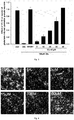
Figure 1 shows the inhibition of LN18 and DBTRG-50MG cells of compound I of the present invention (n=3 *, p< 0.05). -
Figure 2 shows compound I protects cerebellar granule neurons from glutamate-induced damage. -
Figure 3 shows that compound I improves survival of cerebellar granule neurons in a dose-dependent manner. -
Figure 4 shows compound I protects cerebellar granule neurons from low potassium induced death. -
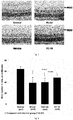
Figure 5 shows that RGC is significantly decreased in an optic nerve clamping injury model, while compound I is shown to prevent from RGC decrease. -
Figure 6 is a graph showing RGC statistics in different groups of samples in an optic nerve clamping injury model. -
Figure 7 shows that RGC is significantly decreased in an eye high pressure and ischemia model, while compound I is shown to prevent from RGC decrease. -
Figure 8 a graph showing RGC statistics in different groups of samples in an eye high pressure and ischemia model. - The following is provided for illustrative purpose only. It is understood that the scope of the invention shall not be limited to the examples provided below. In the following examples, compound I refers to 2β,3α,5α-trihydroxy-androst-6-one; compound II refers to 3β,6β-diformyloxy-5β-androst-5-ol; compound III refers to androst-3β,5α,6β-triol; compound IV refers to 3β-hydroxy-androst-5β,6β-epoxy; compound V refers to 3β,5α-dihydroxy-androst-6-one; compound VI refers to 3β-p-toluensulfonyloxy-5α-hydroxy-androst-6-one; compound VII refers to 3β-p-toluensulfonyloxy-androst-5-en; compound VIII refers to 3β-p-toluensulfonyloxy-androst-5β,6β-epoxy; compound IX refers to 5α-hydroxy-androst-2-en-6-one; compound X refers to 2β,3α-diformyloxy-5α-hydroxy-androst-6-one; and compound XI refers to 2β,3β-epoxy-5α-hydroxy-androst-6-one.
- Step 1 - To a 2 L of reaction flask was added compound androst-5-en-3-ol (54.5 g) and formic acid (1 L, 88%). The reaction mixture was cooled to 25 °C, and hydrogen peroxide (82.5 mL, 30%) was slowly added. After reaction was completed as evidenced by TLC, the mixture was heated to 75 °C to remove excess hydrogen peroxide. Water (1 L) was added and stirred to disperse. The mixture was filtered to obtain a white filter cake. The cake was immersed into saturated NaHCO3 solution and filtered. Filter cake was washed to neutral and dried to provide compound II (62.4 g) as a white solid.
- Step 2 - To a 2 L of reaction flask was added potassium hydroxide (45 g), methanol (1500 mL), water (300 mL) and compound II (60 g). The reaction mixture was heated to reflux. TLC confirmed no residual compound II. The reaction mixture was cooled to room temperature, and poured into water (3 L) to disperse. The mixture was adjusted to pH=7 by concentrated hydrochloric acid and allowed for settlement lamination. The mixture was filtered and filter cake was washed to neutral and dried to obtain compound III (49.6 g) as a white solid.
- Step 3 - To a 1 L of reaction flask was added compound III (49 g), dioxane (600 mL) and water (200 mL). After compound III was completely dissolved, N-bromo-succinimide (42.5 g) was added in four batches. After compound III was depleted as evidenced by TLC, the reaction was stopped. Sodium sulfite (11 g) was added to reduce excess oxidant. The mixture is dispersed in water (4 L) and filtered. Filter cake was washed to neutral and dried to provide compound V (47.8 g) as a white solid.
- Step 4 - To a 500 mL of reaction flask was added pyridine (135 mL), compound V (44.3 g) and p-toluensulfonyl chloride (45 g). The mixture was stirred at room temperature. After compound V was depleted as evidenced by TLC, the reaction was stopped. The mixture was poured into icy aqueous hydrochloric acid solution (300 mL, 1:1(V:V)), stirred, and filtered. Filter cake was washed to pH=7 and filtered. Filter cake was washed to neutral and dried to provide compound VI (61.7 g) as a white solid.
- Step 5 - To a 1 L of reaction flask was added N,N-dimethylformamide (325 mL), compound VI (54 g), Li2CO3 (52.1 g) and LiBr (60.5 g). The mixture is heated to reflux. After compound VI is depleted as evidenced by TLC, the reaction is stopped. The mixture was poured into icy aqueous hydrochloric acid solution (2 L, 1:1(V:V)), stirred and filtered. Filter cake was washed to neutral and dried to provide compound IX (32 g) as a white solid.
- Step 6 - To a 500 mL of reaction flask was added compound IX (30 g) and formic acid (600 mL, 88%). The mixture was heated to dissolve the solid compound and then cooled to below 25 °C. Hydrogen peroxide (24 mL, 30%) was slowly added. After compound IX was depleted as evidenced by TLC, the mixture was heated to 75 °C for 10 minutes to remove excess hydrogen peroxide. Water (3 L) was added and stirred to disperse. The mixture was filtered to obtain a white filter cake. The cake was immersed into saturated NaHCO3 solution and filtered. Filter cake was washed to neutral and dried to provide compound X (26 g) as a white solid.
- Step 7 - To a 500 mL of reaction flask was added potassium hydroxide (27 g), methanol (600 mL), water (72 mL) and compound X (23.4 g). The reaction mixture was heated to reflux. TLC confirmed no residual compound X. The reaction mixture was cooled to room temperature, and poured into water (3 L) to disperse. The mixture was adjusted to pH=7 by concentrated hydrochloric acid and allowed for settlement lamination. The mixture was filtered and filter cake was washed to neutral, followed by recrystallization in acetone, and dried to obtain compound I (16 g) as a white solid.
- m.p:197∼201 °C; specific rotation:-50°(2mg/mL, absolute ethanol); 1H NMR(CDCl3, 400MHz)δ:0.65(s, 3H, 18-CH3), 0.87(s, 3H, 19-CH3), 3.76∼3.83(d, J=28Hz, 2H, 2-CH and 3-CH);13C NMR(CDCl3, 400MHz)δ: 15.52 (CH3), 17.27(CH3), 19.94(CH2), 20.53(CH2), 24.68(CH2), 26.90(CH2), 33.02(CH2), 36.45(CH), 39.72(CH2), 40.92(C), 41.26(CH2), 42.54(C), 44.99(CH), 54.04(CH), 68.94(CH), 70.19(CH), 79.71(C), 210.65(C); IR(KBr, cm-1) v:3296, 2937, 1726, 1064; MS(APCI)m/z: 319(M-3).
- Step 1 - To a 2 L of reaction flask was added compound androst-5-en-3-ol (70 g) and CH2Cl2 (1200 mL). To the mixture was added m-chloroperoxybenzoic acid (105 g, mCPBA) in batch while stirring. The reaction mixture is further stirred in ice bath for 5 h. After the reaction was completed, the mixture was washed with saturated sodium sulphite solution, sodium carbonate solution and distilled water. The organic layer was collected, dried, and concentrated to provide compound IV (62 g) as a yellow solid.
- Step 2 - Compound IV (60 g) was dissolved in acetone (3 L). To the solution was added 1 N H2SO4 (400 mL) solution. The mixture was stirred at room temperature for 3 h. After the reaction was completed, the mixture was adjusted to neutral with Na2CO3 solution and concentrated under reduced pressure to remove acetone. The mixture was extracted with ethyl acetate, and organic layer was collected and dried over anhydrous sodium sulfate to give a yellow solid (48 g). The solid was recrystallized in acetone to provide compound III (30.5 g).
- Steps 3 to 7 were identical with steps 3 to 7 in Example 1.
- m.p:197∼201 °C; specific rotation:-50°(2mg/mL, absolute ethanol); 1H NMR(CDCl3, 400MHz)δ:0.65(s, 3H, 18-CH3), 0.87(s, 3H, 19-CH3), 3.76∼3.83(d, J=28Hz, 2H, 2-CH and 3-CH);13C NMR(CDCl3, 400MHz)δ: 15.52 (CH3), 17.27(CH3), 19.94(CH2), 20.53(CH2), 24.68(CH2), 26.90(CH2), 33.02(CH2), 36.45(CH), 39.72(CH2), 40.92(C), 41.26(CH2), 42.54(C), 44.99(CH), 54.04(CH), 68.94(CH), 70.19(CH), 79.71(C), 210.65(C); IR(KBr, cm-1) v:3296, 2937, 1726, 1064; MS(APCI)m/z: 319(M-3).
- Steps 1 to 5 were identical to steps 1 to 5 of Example 1.
- Step 6 - In a 500 mL of reaction flask, compound IX (23 g) was dissolved in CH2Cl2 (600 mL). To the mixture was added m-chloroperoxybenzoic acid (34.6 g, mCPBA) in batch while stirring. The reaction mixture is further stirred in ice bath for 5 h. After the reaction was completed, the mixture was washed with saturated sodium sulphite solution, sodium carbonate solution and distilled water. The organic layer was collected, dried, and concentrated to provide compound XI (20.7 g) as a yellow solid.
- Step 7 - In a 2 L of reaction flask, compound XI (17.4 g) was dissolved in acetone (900 mL). To the mixture was added 1 N H2SO4 solution (180 mL). The mixture was stirred at room temperature for 3 h. After the reaction was completed, the mixture was adjusted to neutral with Na2CO3 solution and concentrated under reduced pressure to remove acetone. The mixture was extracted with ethyl acetate, and organic layer was collected and dried over anhydrous sodium sulfate to give a yellow solid (14.4 g). The solid was recrystallized in acetone to provide compound I as a white solid.
- m.p:197∼201°C; specific rotation:-50°(2mg/mL, absolute ethanol); 1H NMR(CDCl3, 400MHz)δ:0.65(s, 3H, 18-CH3), 0.87(s, 3H, 19-CH3), 3.76∼3.83(d, J=28Hz, 2H, 2-CH and 3-CH);13C NMR(CDCl3, 400MHz)δ: 15.52 (CH3), 17.27(CH3), 19.94(CH2), 20.53(CH2), 24.68(CH2), 26.90(CH2), 33.02(CH2), 36.45(CH), 39.72(CH2), 40.92(C), 41.26(CH2), 42.54(C), 44.99(CH), 54.04(CH), 68.94(CH), 70.19(CH), 79.71(C), 210.65(C); IR(KBr, cm-1) v:3296, 2937, 1726, 1064; MS(APCI)m/z: 319(M-3).
- Step 1 - To a 250 mL of reaction flask was added androst-5-en-3-ol (14.64 g) and anhydrous pyridine (125 mL). To the mixture was added in batch p-toluensulfonyl chloride (26.05 g). The mixture was allowed to react at room temperature for 24 h. After starting materials were depleted as evidenced by TLC, the reaction was stopped. The mixture was poured into icy HCI solution (2000 mL, 17%) under vigorous stirring, and filtered. Filter cake was washed to neutral and dried under vacuum to provide compound VII (22.48 g) as a white solid.
- Step 2 - To a 250 mL of reaction flask was added compound VII (15.00 g) and CH2Cl2 (200 mL). To the mixture was added m-chloroperoxybenzoic acid (15.12 g, mCPBA) in batch while stirring. The reaction mixture is further stirred in ice bath for 5 h. After the reaction was completed, the mixture was washed with saturated sodium sulphite solution, sodium carbonate solution and distilled water. The organic layer was collected and dried over anhydrous sodium sulfate. Organic solvents were evaporated. The residue was dried under vacuum to provide crude product (14.07 g). The crude product was purified by silica-gel column chromatography to provide compound VIII (12.3 g) as a white solid.
- Step 3 - To a 1000 mL of reaction flask was added compound VIII (14.07 g) and acetone (750 mL). To the mixture was added Jones reagent (30 mL) while stirring. The mixture was allowed to react at room temperature for 2 h. After the reaction was completed as evidenced by TLC, the mixture is quenched with isopropanol and adjusted to neutral with Na2CO3 solution. The mixture is concentrated under reduced pressure to remove acetone, and extracted with ethyl acetate. The organic layer was collected and washed with distilled water several times, dried over anhydrous sodium sulfate, and concentrated to give a pale green solid. The solid is purified by silica-gel column chromatography to provide compound VI (12.89 g) as a white solid.
- Steps 4 to 6 were identical to
steps 5 to 7 of Example 1. - m.p:197∼201°C; specific rotation:-50°(2mg/mL, absolute ethanol); 1H NMR(CDCl3, 400MHz)δ:0.65(s, 3H, 18-CH3), 0.87(s, 3H, 19-CH3), 3.76∼3.83(d, J=28Hz, 2H, 2-CH and 3-CH);13C NMR(CDCl3, 400MHz)δ: 15.52 (CH3), 17.27(CH3), 19.94(CH2), 20.53(CH2), 24.68(CH2), 26.90(CH2), 33.02(CH2), 36.45(CH), 39.72(CH2), 40.92(C), 41.26(CH2), 42.54(C), 44.99(CH), 54.04(CH), 68.94(CH), 70.19(CH), 79.71(C), 210.65(C); IR(KBr, cm-1) v:3296, 2937, 1726, 1064; MS(APCI)m/z: 319(M-3).
- Steps 1 to 4 were identical to steps 1 to 4 in Example 1.
- Step 5 - To a 1 L of reaction flask was added anhydrous N,N-dimethylformamide (325 mL), compound VI (54 g), dry Li2CO3 (69.5 g), and LiBr (80.6 g). The mixture was heated to reflux. After the compound VI was consumed as evidenced by TLC, the reaction was stopped. The mixture was added to icy HCI aqueous solution (2 L, 1:1(V:V)), stirred, and filtered. Filter cake was washed with water to neutral and dried to provide compound IX (32.5 g) as a white solid.
-
Steps 6 to 7 were identical tosteps 6 to 7 in Example 1. - m.p:197∼201°C; specific rotation:-50°(2mg/mL, absolute ethanol); 1H NMR(CDCl3, 400MHz)δ:0.65(s, 3H, 18-CH3), 0.87(s, 3H, 19-CH3), 3.76∼3.83(d, J=28Hz, 2H, 2-CH and 3-CH);13C NMR(CDCl3, 400MHz)δ: 15.52 (CH3), 17.27(CH3), 19.94(CH2), 20.53(CH2), 24.68(CH2), 26.90(CH2), 33.02(CH2), 36.45(CH), 39.72(CH2), 40.92(C), 41.26(CH2), 42.54(C), 44.99(CH), 54.04(CH), 68.94(CH), 70.19(CH), 79.71(C), 210.65(C); IR(KBr, cm-1) v:3296, 2937, 1726, 1064; MS(APCI)m/z: 319(M-3).
- Steps 1 to 4 were identical to steps 1 to 4 in Example 1.
- Step 5 - To a 1 L of reaction flask was added anhydrous N,N-dimethylformamide (325 mL), compound VI (54 g), dry Li2CO3 (34.7 g), and LiBr (40.3 g). The mixture was heated to reflux. After the compound VI was consumed as evidenced by TLC, the reaction was stopped. The mixture was added to icy HCI aqueous solution (2 L, 1:1(V:V)), stirred, and filtered. Filter cake was washed with water to neutral and dried to provide compound IX (30.2 g) as a white solid.
-
Steps 6 to 7 were identical tosteps 6 to 7 in Example 1. - m.p:197∼201°C; specific rotation:-50°(2mg/mL, absolute ethanol); 1H NMR(CDCl3, 400MHz)δ:0.65(s, 3H, 18-CH3), 0.87(s, 3H, 19-CH3), 3.76∼3.83(d, J=28Hz, 2H, 2-CH and 3-CH);13C NMR(CDCl3, 400MHz)δ: 15.52 (CH3), 17.27(CH3), 19.94(CH2), 20.53(CH2), 24.68(CH2), 26.90(CH2), 33.02(CH2), 36.45(CH), 39.72(CH2), 40.92(C), 41.26(CH2), 42.54(C), 44.99(CH), 54.04(CH), 68.94(CH), 70.19(CH), 79.71(C), 210.65(C); IR(KBr, cm-1) v:3296, 2937, 1726, 1064; MS(APCI)m/z: 319(M-3).
- Steps 1 to 4 were identical to steps 1 to 4 in Example 1.
- Step 5 - To a 1 L of reaction flask was added anhydrous N,N-dimethylformamide (432 mL), compound VI (54 g), dry Li2CO3 (52.1 g), and LiBr (60.5 g). The mixture was heated to reflux. After the compound VI was consumed as evidenced by TLC, the reaction was stopped. The mixture was added to icy HCI aqueous solution (2 L, 1:1(V:V)), stirred, and filtered. Filter cake was washed with water to neutral and dried to provide compound IX (30.5 g) as a white solid.
- Step 6 - To a 500 mL of reaction flask was added compound IX (30 g) and formic acid (600 mL, 88%). The mixture was heated to dissolve the solid compound and then cooled to below 25 °C. Hydrogen peroxide (20 mL, 30%) was slowly added. After compound IX was depleted as evidenced by TLC, the mixture was heated to 75 °C for 10 minutes to remove excess hydrogen peroxide. Water (3 L) was added and stirred to disperse. The mixture was filtered to obtain a white filter cake. The cake was immersed into saturated NaHCO3 solution and filtered. Filter cake was washed to neutral and dried to provide compound X (28 g) as a white solid.
- Step 7 - To a 500 mL of reaction flask was added potassium hydroxide (18 g), methanol (600 mL), water (72 mL) and compound X (25 g). The reaction mixture was heated to reflux. TLC confirmed no residual compound X. The reaction mixture was cooled to room temperature, and poured into water (3 L) to disperse. The mixture was adjusted to pH=7 by concentrated hydrochloric acid and allowed for settlement lamination. The mixture was filtered and filter cake was washed to neutral, followed by recrystallization in acetone, and dried to obtain compound I (8.8 g) as a white solid.
- m.p:197∼201°C; specific rotation:-50°(2mg/mL, absolute ethanol); 1H NMR(CDCl3, 400MHz)δ:0.65(s, 3H, 18-CH3), 0.87(s, 3H, 19-CH3), 3.76∼3.83(d, J=28Hz, 2H, 2-CH and 3-CH);13C NMR(CDCl3, 400MHz)δ: 15.52 (CH3), 17.27(CH3), 19.94(CH2), 20.53(CH2), 24.68(CH2), 26.90(CH2), 33.02(CH2), 36.45(CH), 39.72(CH2), 40.92(C), 41.26(CH2), 42.54(C), 44.99(CH), 54.04(CH), 68.94(CH), 70.19(CH), 79.71(C), 210.65(C); IR(KBr, cm-1) v:3296, 2937, 1726, 1064; MS(APCI)m/z: 319(M-3).
- Steps 1 to 5 were identical to steps 1 to 5 in Example 7.
- Step 6 - To a 500 mL of reaction flask was added compound IX (30 g) and formic acid (600 mL, 88%). The mixture was heated to dissolve the solid compound and then cooled to below 25 °C. Hydrogen peroxide (36 mL, 30%) was slowly added. After compound IX was depleted as evidenced by TLC, the mixture was heated to 75 °C for 10 minutes to remove excess hydrogen peroxide. Water (3 L) was added and stirred to disperse. The mixture was filtered to obtain a white filter cake. The cake was immersed into saturated NaHCO3 solution until free of bubbles and then filtered. Filter cake was washed to neutral and dried to provide compound X (24 g) as a white solid.
-
Step 7 is identical to step 7 in Example 7. - m.p:197∼201°C; specific rotation:-50°(2mg/mL, absolute ethanol); 1H NMR(CDCl3, 400MHz)δ:0.65(s, 3H, 18-CH3), 0.87(s, 3H, 19-CH3), 3.76∼3.83(d, J=28Hz, 2H, 2-CH and 3-CH);13C NMR(CDCl3, 400MHz)δ: 15.52 (CH3), 17.27(CH3), 19.94(CH2), 20.53(CH2), 24.68(CH2), 26.90(CH2), 33.02(CH2), 36.45(CH), 39.72(CH2), 40.92(C), 41.26(CH2), 42.54(C), 44.99(CH), 54.04(CH), 68.94(CH), 70.19(CH), 79.71(C), 210.65(C); IR(KBr, cm-1) v:3296, 2937, 1726, 1064; MS(APCI)m/z: 319(M-3).
- Steps 1 to 5 were identical to steps 1 to 5 in Example 7.
- Step 6 - To a 500 mL of reaction flask was added compound IX (30 g) and formic acid (600 mL, 88%). The mixture was heated to dissolve the solid compound and then cooled to below 25 °C. Hydrogen peroxide (45 mL, 30%) was slowly added. After compound IX was depleted as evidenced by TLC, the mixture was heated to 75 °C for 10 minutes to remove excess hydrogen peroxide. Water (3 L) was added and stirred to disperse. The mixture was filtered to obtain a white filter cake. The cake was immersed into saturated NaHCO3 solution until free of bubbles and then filtered. Filter cake was washed to neutral and dried to provide compound X (23 g) as a white solid.
- Step 7 - To a 500 mL of reaction flask was added potassium hydroxide (27 g), methanol (300 mL), water (36 mL) and compound X (12.5 g). The reaction mixture was heated to reflux. TLC confirmed no residual compound X. The reaction mixture was cooled to room temperature, and poured into water (3 L) to disperse. The mixture was adjusted to pH=7 by HCI and allowed for settlement lamination. The mixture was filtered and filter cake was washed to neutral, followed by recrystallization in acetone, and dried to obtain compound I (8.0 g) as a white solid.
- m.p:197∼201°C; specific rotation:-50°(2mg/mL, absolute ethanol); 1H NMR(CDCl3, 400MHz)δ:0.65(s, 3H, 18-CH3), 0.87(s, 3H, 19-CH3), 3.76∼3.83(d, J=28Hz, 2H, 2-CH and 3-CH);13C NMR(CDCl3, 400MHz)δ: 15.52 (CH3), 17.27(CH3), 19.94(CH2), 20.53(CH2), 24.68(CH2), 26.90(CH2), 33.02(CH2), 36.45(CH), 39.72(CH2), 40.92(C), 41.26(CH2), 42.54(C), 44.99(CH), 54.04(CH), 68.94(CH), 70.19(CH), 79.71(C), 210.65(C); IR(KBr, cm-1) v:3296, 2937, 1726, 1064; MS(APCI)m/z: 319(M-3).
- Cell seeding and treatment: Logarithmic phase of LN18 and DBTRG-50MG cells were prepared to cell suspensions with complete medium. Cells were seeded into a 96-well plate at a density of 100 µl per well, 3×10⁴/ml. 12 h post seeding, full cell adherence was observed. To the wells was added YC-10 to a final concentration of YC-10 being 250, 500, and 1000 µM, with each concentration group having 5 repeats.
- Reaction of MTT with succinate dehydrogenase: At 24th h of culturing, 10 µl (5mg/ml) of MTT was added to each well, followed by 4 h incubation. At this time, granulate violet formazan crystalline can be observed in live cells by microscopy.
- Formazan particle dissolution: Supernatant was carefully discharged. To the wells was added DMSO at 100 µl/well to dissolve the crystalline. The mixture was vibrated on a mini oscillator for 5 min and measured for optical density (OD value) at 570 nm for each well by enzyme-linked immunometric assay.
- Each group of experiments was repeated 3 times.
- Survival (%) = OD value in treatment group / OD value in control group * 100%.
- All data was presented as mean ± SD. SPSS 13.0 statistics package software was used. One-Way ANOVA and t-test were used to analyze the data. Sigmaplot software was used to give
Figure 1 . As can be seen fromFigure 1 , 24 h post treatment with 250, 500, 1000 µM of YC-10, cell survival rates of treatment group were statistically significant in comparison with control group (P<0. 05). YC-10 killed tumor cells in a dose-dependent manner. - The in vivo and in vitro toxicity and pharmacological functions of YC-10 were studied to evaluate its neuron protective activity and possibility to become potential clinical drug. In summary, results showed that no obvious abnormality was observed in mice administered large doses of YC-10 (250 mg/kg). Studies showed YC-10 was significantly effective in improvement of survival rate of cerebellar granule neurons in both glutamate-induced and low potassium induced injury models. YC-10 was also shown to significantly improve survival rate of retinal ganglion cells in an animal model suffering from both optic nerve injury and retinal ischemia. Those results showed that YC-10 had neuron protective activity, without obvious toxic or side effects.
- YC-10 injections at concentration of 25 mg/mL were prepared with 40% hydroxypropyl cyclodextrin, and were injected through tail vein to 30 KM mice (half males and half females, weighted 18-22 g) at does of 0.1 mL/10 g.
- The mice were continuously observed. All mice behaved and ate as usual, with bright coat color and fine fur. No abnormal secretions in mouth, eyes, nose, or ears were observed. Mice defecated normally. Mice weights were slighted increase. No mice died. Mice were sacrificed after 14 days, dissected and visual examined on important organs such as heart, liver, spleen, kidney, and gastrointestinal. No abnormal changes were observed. Those results showed that YC-10 was nontoxic to mouse at 250mg/kg.
- Cerebellar granule neurons cultured in vitro for 8 days were grouped. Treatment groups received MK801 or YC-10 at various concentrations, followed by incubation for 30 min. Following that, model group and all treatment groups were replaced with Mg2+-free Locke buffer, and added with glutamate (100µM final concentration), Glycine (10µM final concentration) and drugs at respective concentrations. Cells were incubated at 37 °C for 30 minutes, replaced with original medium, incubated for further 24 h, followed by FDA staining. Results were shown in
Figure 2 . - The results showed that glutamate can induce injury and death of cerebella granule neurons. MK801 was able to prevent cerebella granule neurons from glutamate-induced injury. YC-10 was also effective in preventing glutamate-induced excitotoxin damage of cerebellar granule neurons in a dose-dependent manner. YC-10 protected cerebellar granule neurons against glutamate-induced damage (
Fig. 3 ). - Cerebellar granule neurons were cultured in vitro for 8 days. Treatment groups received YC-10 at various concentrations and incubated for 30 min. Following that, model group and all treatment groups were replaced with 5K (i.e., 5mM KCI) BME medium (25K BME for control group), and added with YC-10 at respective concentrations. Cells were incubated at 37 °C for 24 h, followed by FDA staining. Results were shown in
Figure 4 . - As shown in
Fig. 4 , low potassium medium can reduce death of cerebellar granule neurons. YC-10 (50µM) could prevent neuron from low potassium-induced death. YC-10 protected cerebellar granule neurons from low potassium-induced death. - 10% chloral hydrate was used to anesthetize rats. YC-10 (20mg/kg) or solvents were administered via
tail vein 20 min before surgery. Eyes were subject to topical anesthesia. Conjunctiva was cut along limbus cornea with corneal scissors and intraocular microforceps. Lateral rectus was bluntly dissected to fully expose optic nerve. A cross action forceps was used to clamp the optic nerve for 5 seconds at 2 mm posterior to the eyeball, and then released. Antibiotic eye ointment was applied post operation to prevent infection. Drugs were administered at 2 h post operation, Day 2, and Day 3. Eyeballs were obtained for pathological examination atDay 7.
As shown inFig. 5 , pathological examination showed that optic nerve clamping injury can induce death of retinal ganglion cell (RGC). YC-10 was shown to slow down or prevent from clamping injury-induced death, i.e., YC-10 can protect retinal ganglion cell from optic nerve clamping injury-induced death. RGC counts in each group were recorded and reported inFig. 6 . - 10% chloral hydrate was used to anesthetize rats. Eyes were subject to topical anesthesia. Perfusion apparatus was placed 176 cm above rats' eyeballs (resulting in 130 mmHg intra-ocular pressure). 30G 1/2 syringe needle was carefully inserted into anterior chamber. The eyeballs became white and starting time of ischemia was recorded. 1 h post ischemia, the syringe needle was quickly withdrawn and eyes were cared by antibiotic eyedrops. Rats were raised back to cage. Drugs were administered 20 before modeling for solvent group and YC-10 group (20mg/kg). At 2h, Day 2 and Day 3 post modeling, rats were treated with YC-10 via tail vein. At
Day 7 post modeling, eyeballs were obtained for pathological examination. - As shown in
Fig. 7 , pathological examination showed that eye high pressure and ischemia can induce death of retinal ganglion cell (RGC). YC-10 was shown to reduce or prevent from ischemia -induced death, i.e., YC-10 can protect retinal ganglion cell from eye high pressure and ischemia-induced death. RGC counts in each group were recorded and reported inFig. 8 .
Claims (8)
- Compound 2β,3α,5α-trihydroxy-androst-6-one, having structure of formula I, or a solvate thereof:
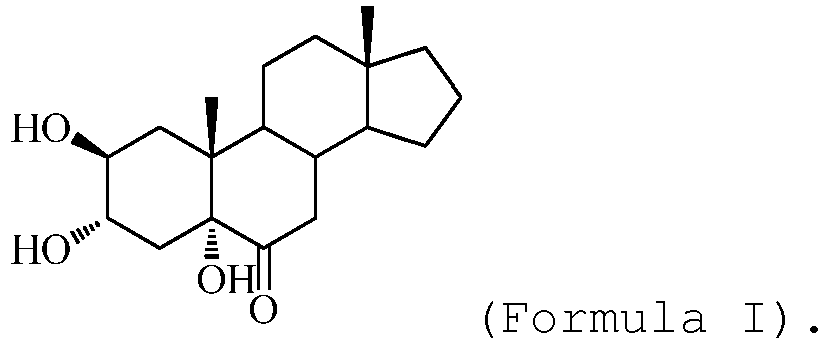
- A pharmaceutical composition, comprising therapeutically effective amount of the compound of claim 1, or a solvate thereof, and a pharmaceutically acceptable carrier.
- The pharmaceutical composition of claim 2, further comprising a second neuron protective agent.
- The pharmaceutical composition of claim 3, wherein the second neuron protective agent is a retinal ganglion cell protective agent.
- The pharmaceutical composition of claim 2, further comprising a second anti-tumor drug.
- The compound of claim 1 for use in the protection of neuron cells.
- The compound of claim 1 for use in the treatment of tumor.
- A method for preparing the compound I of claim 1, wherein the method comprises:(a) subjecting compound VI, i.e., 3β-p-toluensulfonyloxy-5α-hydroxy-androst-6-one, to an elimination reaction to obtain compound IX, i.e., 5α-hydroxy-androst-2-en-6-one; and(b) subjecting compound IX to oxidation at 2-position double bond and hydrolysis to obtain compound I.
Applications Claiming Priority (2)
| Application Number | Priority Date | Filing Date | Title |
|---|---|---|---|
| CN201310104162.5A CN104072564B (en) | 2013-03-28 | 2013-03-28 | 2 β, 3 α, 5 α-trihydroxy-androstane-6-ketone and preparation method thereof and purposes |
| PCT/CN2014/074318 WO2014154179A1 (en) | 2013-03-28 | 2014-03-28 | 2β,3α,5α-TRIHYDROXY-ANDROST-6-ONE AND PREPARATION METHODS AND USE THEREOF |
Publications (3)
| Publication Number | Publication Date |
|---|---|
| EP2980096A1 EP2980096A1 (en) | 2016-02-03 |
| EP2980096A4 EP2980096A4 (en) | 2016-11-16 |
| EP2980096B1 true EP2980096B1 (en) | 2018-08-15 |
Family
ID=51594205
Family Applications (1)
| Application Number | Title | Priority Date | Filing Date |
|---|---|---|---|
| EP14774834.7A Active EP2980096B1 (en) | 2013-03-28 | 2014-03-28 | 2 ,3 ,5 -trihydroxy-androst-6-one and preparation methods and use thereof |
Country Status (14)
| Country | Link |
|---|---|
| US (1) | US9428539B2 (en) |
| EP (1) | EP2980096B1 (en) |
| JP (1) | JP6106328B2 (en) |
| KR (1) | KR101771192B1 (en) |
| CN (2) | CN104072564B (en) |
| AU (1) | AU2014243510B2 (en) |
| CA (1) | CA2908088C (en) |
| ES (1) | ES2691530T3 (en) |
| IL (1) | IL241768B (en) |
| PT (1) | PT2980096T (en) |
| RU (1) | RU2629929C2 (en) |
| SG (1) | SG11201507877QA (en) |
| TW (1) | TWI504396B (en) |
| WO (1) | WO2014154179A1 (en) |
Families Citing this family (3)
| Publication number | Priority date | Publication date | Assignee | Title |
|---|---|---|---|---|
| CN104561218B (en) * | 2014-11-09 | 2019-01-11 | 浙江仙居君业药业有限公司 | It is a kind of to prepare 3 β, 7 α, the method for 15 α-trihydroxyandrost -5- alkene -17- ketone using gibberella |
| CN109985048B (en) * | 2017-12-29 | 2021-06-29 | 广州市赛普特医药科技股份有限公司 | 2 beta, 3 alpha, 5 alpha-trihydroxyandrost-6-one for the treatment of inflammatory reactions |
| CN109985046B (en) * | 2017-12-29 | 2021-07-27 | 广州市赛普特医药科技股份有限公司 | 5 alpha-androst-3 beta, 5,6 beta-triol for the treatment of inflammation mediated optic neuropathy |
Family Cites Families (7)
| Publication number | Priority date | Publication date | Assignee | Title |
|---|---|---|---|---|
| US6046185A (en) * | 1996-07-11 | 2000-04-04 | Inflazyme Pharmaceuticals Ltd. | 6,7-oxygenated steroids and uses related thereto |
| ATE259825T1 (en) | 1999-03-23 | 2004-03-15 | Hollis Eden Pharmaceuticals | HEMIHYDRATE OF 16.ALPHA.-BROMOEPIANDROSTERONE |
| CA2571440A1 (en) * | 2004-06-29 | 2006-01-12 | Jadolabs Gmbh | Use of steroid-derived pharmaceutical compositions for treating disorders relating to pathological processes in lipid rafts |
| CN102482315A (en) * | 2009-07-29 | 2012-05-30 | 芝加哥大学 | Liver x receptor agonists |
| US9447139B2 (en) * | 2010-04-09 | 2016-09-20 | The Research Foundation Of State University Of New York | Ship inhibitors and uses thereof |
| CN101884638B (en) * | 2010-07-09 | 2011-11-09 | 中山大学 | Application of 5alpha-androstane-3beta,5,6beta-triol in preparing neuro-protective medicaments |
| FR2967914A1 (en) * | 2010-11-29 | 2012-06-01 | Centre Nat Rech Scient | New 3alpha-amino-5alpha-androstane derivatives are protein cyclin-dependent kinase 5/p25 interaction inhibitors useful to treat e.g. stroke, Alzheimer's disease, Parkinson's disease, amyotrophic lateral sclerosis and diabetes |
-
2013
- 2013-03-28 CN CN201310104162.5A patent/CN104072564B/en active Active
-
2014
- 2014-03-28 RU RU2015141335A patent/RU2629929C2/en not_active IP Right Cessation
- 2014-03-28 CN CN201480017073.XA patent/CN105189528B/en active Active
- 2014-03-28 PT PT14774834T patent/PT2980096T/en unknown
- 2014-03-28 JP JP2016504473A patent/JP6106328B2/en not_active Expired - Fee Related
- 2014-03-28 ES ES14774834.7T patent/ES2691530T3/en active Active
- 2014-03-28 TW TW103111715A patent/TWI504396B/en not_active IP Right Cessation
- 2014-03-28 KR KR1020157031029A patent/KR101771192B1/en not_active Expired - Fee Related
- 2014-03-28 CA CA2908088A patent/CA2908088C/en not_active Expired - Fee Related
- 2014-03-28 EP EP14774834.7A patent/EP2980096B1/en active Active
- 2014-03-28 SG SG11201507877QA patent/SG11201507877QA/en unknown
- 2014-03-28 AU AU2014243510A patent/AU2014243510B2/en not_active Ceased
- 2014-03-28 US US14/780,464 patent/US9428539B2/en not_active Expired - Fee Related
- 2014-03-28 WO PCT/CN2014/074318 patent/WO2014154179A1/en not_active Ceased
-
2015
- 2015-09-21 IL IL241768A patent/IL241768B/en active IP Right Grant
Non-Patent Citations (1)
| Title |
|---|
| None * |
Also Published As
| Publication number | Publication date |
|---|---|
| US20160039862A1 (en) | 2016-02-11 |
| CA2908088A1 (en) | 2014-10-02 |
| RU2629929C2 (en) | 2017-09-05 |
| AU2014243510B2 (en) | 2016-08-04 |
| JP6106328B2 (en) | 2017-03-29 |
| IL241768B (en) | 2019-07-31 |
| AU2014243510A1 (en) | 2015-10-15 |
| CN105189528A (en) | 2015-12-23 |
| WO2014154179A1 (en) | 2014-10-02 |
| JP2016514729A (en) | 2016-05-23 |
| EP2980096A1 (en) | 2016-02-03 |
| CA2908088C (en) | 2017-02-07 |
| RU2015141335A (en) | 2017-05-16 |
| KR101771192B1 (en) | 2017-08-24 |
| TW201436796A (en) | 2014-10-01 |
| CN104072564A (en) | 2014-10-01 |
| TWI504396B (en) | 2015-10-21 |
| EP2980096A4 (en) | 2016-11-16 |
| PT2980096T (en) | 2018-11-20 |
| US9428539B2 (en) | 2016-08-30 |
| CN105189528B (en) | 2017-04-12 |
| KR20160021083A (en) | 2016-02-24 |
| ES2691530T3 (en) | 2018-11-27 |
| SG11201507877QA (en) | 2015-10-29 |
| CN104072564B (en) | 2016-08-17 |
Similar Documents
| Publication | Publication Date | Title |
|---|---|---|
| AU2003284808B2 (en) | The derivatives of pyridone and the use of them | |
| CN101624414B (en) | Nitrate medicament for inhibiting angiogenesis | |
| WO2019129249A1 (en) | Triterpenoid-containing pharmaceutical composition and use thereof | |
| US9428539B2 (en) | 2β,3α,5α-trihydroxy-androst-6-one and preparation methods and use thereof | |
| CN102653522B (en) | Diphenyl thiourea compounds of ω-carboxyl substituted and its production and use | |
| WO2018196861A1 (en) | Guanidine derivative | |
| WO2017101789A1 (en) | Compound having anti-cancer effect, and method for preparation thereof and application thereof | |
| JP2017095419A (en) | Triarylmethane composition, and dyeing composition for dyeing eye membrane | |
| CN114072381B (en) | The use of aminothiol compounds as brain nerve or cardioprotective agents | |
| CN101434631B (en) | Estra nitrate ester medicament for inhibiting angiogenesis | |
| CN104250247B (en) | Novel sophoridine analog derivative Chinese scholartree determines acid, Chinese scholartree determines alcohol, Chinese scholartree determines ester, Chinese scholartree determines ether and its production and use | |
| JP5350630B2 (en) | Novel derivatives of 3,5-seco-4-norcholestane and uses thereof | |
| US12428443B2 (en) | Abiraterone precursor compound and preparation method and use thereof | |
| CA2395652C (en) | New derivatives of benzo[b]pyrano[3,2-h]acridin-7-one, process for preparing them, and pharmaceutical compounds containing them | |
| JP2005075834A (en) | Treatment of neurodegenerative diseases | |
| EP1674101B1 (en) | Cinnamates of Benzo[b]pyrano[3,2-h]acridin-7-one, process for preparation thereof and their pharmaceutical composition | |
| CN120289552A (en) | A steroidal phosphate compound and its application | |
| WO2015180549A1 (en) | I-type crystal of l-alanine-(14-oridonin) ester trifluoroacetate and preparation method therefor | |
| CN103204897B (en) | 3,12 the soladulcine derivatives modified, its preparation method, preparation and medicinal uses thereof | |
| HK40060534A (en) | Use of aminothiol compounds as cerebral nerve or heart protective agent | |
| WO2021016954A1 (en) | 3-acetyl-5-hydroxy-b-norcholesterol-6-(n-methyl)thiosemicarbazone, and preparation method therefor and use thereof |
Legal Events
| Date | Code | Title | Description |
|---|---|---|---|
| PUAI | Public reference made under article 153(3) epc to a published international application that has entered the european phase |
Free format text: ORIGINAL CODE: 0009012 |
|
| 17P | Request for examination filed |
Effective date: 20151023 |
|
| AK | Designated contracting states |
Kind code of ref document: A1 Designated state(s): AL AT BE BG CH CY CZ DE DK EE ES FI FR GB GR HR HU IE IS IT LI LT LU LV MC MK MT NL NO PL PT RO RS SE SI SK SM TR |
|
| AX | Request for extension of the european patent |
Extension state: BA ME |
|
| RAP1 | Party data changed (applicant data changed or rights of an application transferred) |
Owner name: GUANGZHOU CELLPROTEK PHARMACEUTICAL CO., LTD. |
|
| DAX | Request for extension of the european patent (deleted) | ||
| A4 | Supplementary search report drawn up and despatched |
Effective date: 20161018 |
|
| RIC1 | Information provided on ipc code assigned before grant |
Ipc: C07J 31/00 20060101ALI20161012BHEP Ipc: C07J 71/00 20060101ALI20161012BHEP Ipc: A61P 35/00 20060101ALI20161012BHEP Ipc: A61K 31/568 20060101ALI20161012BHEP Ipc: C07J 1/00 20060101AFI20161012BHEP Ipc: A61P 25/00 20060101ALI20161012BHEP |
|
| GRAP | Despatch of communication of intention to grant a patent |
Free format text: ORIGINAL CODE: EPIDOSNIGR1 |
|
| STAA | Information on the status of an ep patent application or granted ep patent |
Free format text: STATUS: GRANT OF PATENT IS INTENDED |
|
| RIC1 | Information provided on ipc code assigned before grant |
Ipc: A61P 25/00 20060101ALI20180202BHEP Ipc: C07J 31/00 20060101ALI20180202BHEP Ipc: C07J 1/00 20060101AFI20180202BHEP Ipc: C07J 71/00 20060101ALI20180202BHEP Ipc: A61K 31/568 20060101ALI20180202BHEP Ipc: A61P 35/00 20060101ALI20180202BHEP |
|
| INTG | Intention to grant announced |
Effective date: 20180228 |
|
| GRAS | Grant fee paid |
Free format text: ORIGINAL CODE: EPIDOSNIGR3 |
|
| GRAA | (expected) grant |
Free format text: ORIGINAL CODE: 0009210 |
|
| STAA | Information on the status of an ep patent application or granted ep patent |
Free format text: STATUS: THE PATENT HAS BEEN GRANTED |
|
| RIN1 | Information on inventor provided before grant (corrected) |
Inventor name: XIE, MINYU Inventor name: ZHANG, JINGXIA Inventor name: LIN, SUIZHEN |
|
| AK | Designated contracting states |
Kind code of ref document: B1 Designated state(s): AL AT BE BG CH CY CZ DE DK EE ES FI FR GB GR HR HU IE IS IT LI LT LU LV MC MK MT NL NO PL PT RO RS SE SI SK SM TR |
|
| REG | Reference to a national code |
Ref country code: CH Ref legal event code: EP Ref country code: GB Ref legal event code: FG4D Ref country code: AT Ref legal event code: REF Ref document number: 1029631 Country of ref document: AT Kind code of ref document: T Effective date: 20180815 |
|
| REG | Reference to a national code |
Ref country code: IE Ref legal event code: FG4D |
|
| REG | Reference to a national code |
Ref country code: DE Ref legal event code: R096 Ref document number: 602014030509 Country of ref document: DE |
|
| REG | Reference to a national code |
Ref country code: NL Ref legal event code: FP |
|
| REG | Reference to a national code |
Ref country code: SE Ref legal event code: TRGR |
|
| REG | Reference to a national code |
Ref country code: PT Ref legal event code: SC4A Ref document number: 2980096 Country of ref document: PT Date of ref document: 20181120 Kind code of ref document: T Free format text: AVAILABILITY OF NATIONAL TRANSLATION Effective date: 20181105 |
|
| REG | Reference to a national code |
Ref country code: ES Ref legal event code: FG2A Ref document number: 2691530 Country of ref document: ES Kind code of ref document: T3 Effective date: 20181127 |
|
| REG | Reference to a national code |
Ref country code: LT Ref legal event code: MG4D |
|
| REG | Reference to a national code |
Ref country code: AT Ref legal event code: MK05 Ref document number: 1029631 Country of ref document: AT Kind code of ref document: T Effective date: 20180815 |
|
| PG25 | Lapsed in a contracting state [announced via postgrant information from national office to epo] |
Ref country code: LT Free format text: LAPSE BECAUSE OF FAILURE TO SUBMIT A TRANSLATION OF THE DESCRIPTION OR TO PAY THE FEE WITHIN THE PRESCRIBED TIME-LIMIT Effective date: 20180815 Ref country code: FI Free format text: LAPSE BECAUSE OF FAILURE TO SUBMIT A TRANSLATION OF THE DESCRIPTION OR TO PAY THE FEE WITHIN THE PRESCRIBED TIME-LIMIT Effective date: 20180815 Ref country code: BG Free format text: LAPSE BECAUSE OF FAILURE TO SUBMIT A TRANSLATION OF THE DESCRIPTION OR TO PAY THE FEE WITHIN THE PRESCRIBED TIME-LIMIT Effective date: 20181115 Ref country code: AT Free format text: LAPSE BECAUSE OF FAILURE TO SUBMIT A TRANSLATION OF THE DESCRIPTION OR TO PAY THE FEE WITHIN THE PRESCRIBED TIME-LIMIT Effective date: 20180815 Ref country code: GR Free format text: LAPSE BECAUSE OF FAILURE TO SUBMIT A TRANSLATION OF THE DESCRIPTION OR TO PAY THE FEE WITHIN THE PRESCRIBED TIME-LIMIT Effective date: 20181116 Ref country code: RS Free format text: LAPSE BECAUSE OF FAILURE TO SUBMIT A TRANSLATION OF THE DESCRIPTION OR TO PAY THE FEE WITHIN THE PRESCRIBED TIME-LIMIT Effective date: 20180815 Ref country code: IS Free format text: LAPSE BECAUSE OF FAILURE TO SUBMIT A TRANSLATION OF THE DESCRIPTION OR TO PAY THE FEE WITHIN THE PRESCRIBED TIME-LIMIT Effective date: 20181215 Ref country code: NO Free format text: LAPSE BECAUSE OF FAILURE TO SUBMIT A TRANSLATION OF THE DESCRIPTION OR TO PAY THE FEE WITHIN THE PRESCRIBED TIME-LIMIT Effective date: 20181115 |
|
| PG25 | Lapsed in a contracting state [announced via postgrant information from national office to epo] |
Ref country code: HR Free format text: LAPSE BECAUSE OF FAILURE TO SUBMIT A TRANSLATION OF THE DESCRIPTION OR TO PAY THE FEE WITHIN THE PRESCRIBED TIME-LIMIT Effective date: 20180815 Ref country code: LV Free format text: LAPSE BECAUSE OF FAILURE TO SUBMIT A TRANSLATION OF THE DESCRIPTION OR TO PAY THE FEE WITHIN THE PRESCRIBED TIME-LIMIT Effective date: 20180815 Ref country code: AL Free format text: LAPSE BECAUSE OF FAILURE TO SUBMIT A TRANSLATION OF THE DESCRIPTION OR TO PAY THE FEE WITHIN THE PRESCRIBED TIME-LIMIT Effective date: 20180815 |
|
| PG25 | Lapsed in a contracting state [announced via postgrant information from national office to epo] |
Ref country code: PL Free format text: LAPSE BECAUSE OF FAILURE TO SUBMIT A TRANSLATION OF THE DESCRIPTION OR TO PAY THE FEE WITHIN THE PRESCRIBED TIME-LIMIT Effective date: 20180815 Ref country code: EE Free format text: LAPSE BECAUSE OF FAILURE TO SUBMIT A TRANSLATION OF THE DESCRIPTION OR TO PAY THE FEE WITHIN THE PRESCRIBED TIME-LIMIT Effective date: 20180815 Ref country code: RO Free format text: LAPSE BECAUSE OF FAILURE TO SUBMIT A TRANSLATION OF THE DESCRIPTION OR TO PAY THE FEE WITHIN THE PRESCRIBED TIME-LIMIT Effective date: 20180815 Ref country code: CZ Free format text: LAPSE BECAUSE OF FAILURE TO SUBMIT A TRANSLATION OF THE DESCRIPTION OR TO PAY THE FEE WITHIN THE PRESCRIBED TIME-LIMIT Effective date: 20180815 |
|
| REG | Reference to a national code |
Ref country code: DE Ref legal event code: R097 Ref document number: 602014030509 Country of ref document: DE |
|
| PG25 | Lapsed in a contracting state [announced via postgrant information from national office to epo] |
Ref country code: SK Free format text: LAPSE BECAUSE OF FAILURE TO SUBMIT A TRANSLATION OF THE DESCRIPTION OR TO PAY THE FEE WITHIN THE PRESCRIBED TIME-LIMIT Effective date: 20180815 Ref country code: DK Free format text: LAPSE BECAUSE OF FAILURE TO SUBMIT A TRANSLATION OF THE DESCRIPTION OR TO PAY THE FEE WITHIN THE PRESCRIBED TIME-LIMIT Effective date: 20180815 Ref country code: SM Free format text: LAPSE BECAUSE OF FAILURE TO SUBMIT A TRANSLATION OF THE DESCRIPTION OR TO PAY THE FEE WITHIN THE PRESCRIBED TIME-LIMIT Effective date: 20180815 |
|
| PLBE | No opposition filed within time limit |
Free format text: ORIGINAL CODE: 0009261 |
|
| STAA | Information on the status of an ep patent application or granted ep patent |
Free format text: STATUS: NO OPPOSITION FILED WITHIN TIME LIMIT |
|
| 26N | No opposition filed |
Effective date: 20190516 |
|
| PG25 | Lapsed in a contracting state [announced via postgrant information from national office to epo] |
Ref country code: SI Free format text: LAPSE BECAUSE OF FAILURE TO SUBMIT A TRANSLATION OF THE DESCRIPTION OR TO PAY THE FEE WITHIN THE PRESCRIBED TIME-LIMIT Effective date: 20180815 |
|
| PG25 | Lapsed in a contracting state [announced via postgrant information from national office to epo] |
Ref country code: MC Free format text: LAPSE BECAUSE OF FAILURE TO SUBMIT A TRANSLATION OF THE DESCRIPTION OR TO PAY THE FEE WITHIN THE PRESCRIBED TIME-LIMIT Effective date: 20180815 |
|
| REG | Reference to a national code |
Ref country code: CH Ref legal event code: PL |
|
| PG25 | Lapsed in a contracting state [announced via postgrant information from national office to epo] |
Ref country code: LU Free format text: LAPSE BECAUSE OF NON-PAYMENT OF DUE FEES Effective date: 20190328 |
|
| REG | Reference to a national code |
Ref country code: BE Ref legal event code: MM Effective date: 20190331 |
|
| PG25 | Lapsed in a contracting state [announced via postgrant information from national office to epo] |
Ref country code: CH Free format text: LAPSE BECAUSE OF NON-PAYMENT OF DUE FEES Effective date: 20190331 Ref country code: LI Free format text: LAPSE BECAUSE OF NON-PAYMENT OF DUE FEES Effective date: 20190331 Ref country code: IE Free format text: LAPSE BECAUSE OF NON-PAYMENT OF DUE FEES Effective date: 20190328 |
|
| PG25 | Lapsed in a contracting state [announced via postgrant information from national office to epo] |
Ref country code: BE Free format text: LAPSE BECAUSE OF NON-PAYMENT OF DUE FEES Effective date: 20190331 |
|
| PGFP | Annual fee paid to national office [announced via postgrant information from national office to epo] |
Ref country code: DE Payment date: 20200311 Year of fee payment: 7 Ref country code: SE Payment date: 20200327 Year of fee payment: 7 Ref country code: PT Payment date: 20200212 Year of fee payment: 7 Ref country code: GB Payment date: 20200323 Year of fee payment: 7 |
|
| PG25 | Lapsed in a contracting state [announced via postgrant information from national office to epo] |
Ref country code: MT Free format text: LAPSE BECAUSE OF NON-PAYMENT OF DUE FEES Effective date: 20190328 |
|
| PGFP | Annual fee paid to national office [announced via postgrant information from national office to epo] |
Ref country code: TR Payment date: 20200218 Year of fee payment: 7 |
|
| PGFP | Annual fee paid to national office [announced via postgrant information from national office to epo] |
Ref country code: FR Payment date: 20200331 Year of fee payment: 7 Ref country code: ES Payment date: 20200423 Year of fee payment: 7 Ref country code: NL Payment date: 20200313 Year of fee payment: 7 |
|
| PGFP | Annual fee paid to national office [announced via postgrant information from national office to epo] |
Ref country code: IT Payment date: 20200313 Year of fee payment: 7 |
|
| PG25 | Lapsed in a contracting state [announced via postgrant information from national office to epo] |
Ref country code: CY Free format text: LAPSE BECAUSE OF FAILURE TO SUBMIT A TRANSLATION OF THE DESCRIPTION OR TO PAY THE FEE WITHIN THE PRESCRIBED TIME-LIMIT Effective date: 20180815 |
|
| PG25 | Lapsed in a contracting state [announced via postgrant information from national office to epo] |
Ref country code: HU Free format text: LAPSE BECAUSE OF FAILURE TO SUBMIT A TRANSLATION OF THE DESCRIPTION OR TO PAY THE FEE WITHIN THE PRESCRIBED TIME-LIMIT; INVALID AB INITIO Effective date: 20140328 |
|
| REG | Reference to a national code |
Ref country code: DE Ref legal event code: R119 Ref document number: 602014030509 Country of ref document: DE |
|
| REG | Reference to a national code |
Ref country code: NL Ref legal event code: MM Effective date: 20210401 |
|
| GBPC | Gb: european patent ceased through non-payment of renewal fee |
Effective date: 20210328 |
|
| PG25 | Lapsed in a contracting state [announced via postgrant information from national office to epo] |
Ref country code: PT Free format text: LAPSE BECAUSE OF NON-PAYMENT OF DUE FEES Effective date: 20210928 |
|
| PG25 | Lapsed in a contracting state [announced via postgrant information from national office to epo] |
Ref country code: NL Free format text: LAPSE BECAUSE OF NON-PAYMENT OF DUE FEES Effective date: 20210401 Ref country code: DE Free format text: LAPSE BECAUSE OF NON-PAYMENT OF DUE FEES Effective date: 20211001 Ref country code: SE Free format text: LAPSE BECAUSE OF NON-PAYMENT OF DUE FEES Effective date: 20210329 Ref country code: GB Free format text: LAPSE BECAUSE OF NON-PAYMENT OF DUE FEES Effective date: 20210328 Ref country code: FR Free format text: LAPSE BECAUSE OF NON-PAYMENT OF DUE FEES Effective date: 20210331 |
|
| PG25 | Lapsed in a contracting state [announced via postgrant information from national office to epo] |
Ref country code: IT Free format text: LAPSE BECAUSE OF NON-PAYMENT OF DUE FEES Effective date: 20210328 |
|
| PG25 | Lapsed in a contracting state [announced via postgrant information from national office to epo] |
Ref country code: MK Free format text: LAPSE BECAUSE OF FAILURE TO SUBMIT A TRANSLATION OF THE DESCRIPTION OR TO PAY THE FEE WITHIN THE PRESCRIBED TIME-LIMIT Effective date: 20180815 |
|
| REG | Reference to a national code |
Ref country code: ES Ref legal event code: FD2A Effective date: 20220630 |
|
| PG25 | Lapsed in a contracting state [announced via postgrant information from national office to epo] |
Ref country code: ES Free format text: LAPSE BECAUSE OF NON-PAYMENT OF DUE FEES Effective date: 20210329 |