EP2980079A1 - Method of manufacturing pyridazinone compound - Google Patents
Method of manufacturing pyridazinone compound Download PDFInfo
- Publication number
- EP2980079A1 EP2980079A1 EP14776160.5A EP14776160A EP2980079A1 EP 2980079 A1 EP2980079 A1 EP 2980079A1 EP 14776160 A EP14776160 A EP 14776160A EP 2980079 A1 EP2980079 A1 EP 2980079A1
- Authority
- EP
- European Patent Office
- Prior art keywords
- atom
- formula
- compound
- compound represented
- hydrogen atom
- Prior art date
- Legal status (The legal status is an assumption and is not a legal conclusion. Google has not performed a legal analysis and makes no representation as to the accuracy of the status listed.)
- Granted
Links
- 0 CC(C)C(CCC(C(C)(C(C)C([*+][C@@]1C)(C1I)[O+]C1=O)C1C(C1)=C(C)C=C(*)C=C1C(C)=C)=CC)=C Chemical compound CC(C)C(CCC(C(C)(C(C)C([*+][C@@]1C)(C1I)[O+]C1=O)C1C(C1)=C(C)C=C(*)C=C1C(C)=C)=CC)=C 0.000 description 2
Classifications
-
- C—CHEMISTRY; METALLURGY
- C07—ORGANIC CHEMISTRY
- C07D—HETEROCYCLIC COMPOUNDS
- C07D237/00—Heterocyclic compounds containing 1,2-diazine or hydrogenated 1,2-diazine rings
- C07D237/02—Heterocyclic compounds containing 1,2-diazine or hydrogenated 1,2-diazine rings not condensed with other rings
- C07D237/06—Heterocyclic compounds containing 1,2-diazine or hydrogenated 1,2-diazine rings not condensed with other rings having three double bonds between ring members or between ring members and non-ring members
- C07D237/10—Heterocyclic compounds containing 1,2-diazine or hydrogenated 1,2-diazine rings not condensed with other rings having three double bonds between ring members or between ring members and non-ring members with hetero atoms or with carbon atoms having three bonds to hetero atoms with at the most one bond to halogen, e.g. ester or nitrile radicals, directly attached to ring carbon atoms
- C07D237/14—Oxygen atoms
-
- C—CHEMISTRY; METALLURGY
- C07—ORGANIC CHEMISTRY
- C07D—HETEROCYCLIC COMPOUNDS
- C07D237/00—Heterocyclic compounds containing 1,2-diazine or hydrogenated 1,2-diazine rings
- C07D237/02—Heterocyclic compounds containing 1,2-diazine or hydrogenated 1,2-diazine rings not condensed with other rings
- C07D237/06—Heterocyclic compounds containing 1,2-diazine or hydrogenated 1,2-diazine rings not condensed with other rings having three double bonds between ring members or between ring members and non-ring members
- C07D237/10—Heterocyclic compounds containing 1,2-diazine or hydrogenated 1,2-diazine rings not condensed with other rings having three double bonds between ring members or between ring members and non-ring members with hetero atoms or with carbon atoms having three bonds to hetero atoms with at the most one bond to halogen, e.g. ester or nitrile radicals, directly attached to ring carbon atoms
- C07D237/14—Oxygen atoms
- C07D237/16—Two oxygen atoms
-
- C—CHEMISTRY; METALLURGY
- C07—ORGANIC CHEMISTRY
- C07D—HETEROCYCLIC COMPOUNDS
- C07D307/00—Heterocyclic compounds containing five-membered rings having one oxygen atom as the only ring hetero atom
- C07D307/02—Heterocyclic compounds containing five-membered rings having one oxygen atom as the only ring hetero atom not condensed with other rings
- C07D307/34—Heterocyclic compounds containing five-membered rings having one oxygen atom as the only ring hetero atom not condensed with other rings having two or three double bonds between ring members or between ring members and non-ring members
- C07D307/56—Heterocyclic compounds containing five-membered rings having one oxygen atom as the only ring hetero atom not condensed with other rings having two or three double bonds between ring members or between ring members and non-ring members with hetero atoms or with carbon atoms having three bonds to hetero atoms with at the most one bond to halogen, e.g. ester or nitrile radicals, directly attached to ring carbon atoms
- C07D307/60—Two oxygen atoms, e.g. succinic anhydride
Definitions
- the present invention relates to a method for producing a pyridazinone compound and an intermediate thereof.
- the present invention provides an effective method for producing a compound represented by the formula (1).
- the present invention is as described below.
- the present invention comprises a step of reacting compound (2) with a brominating agent and a lower alkanol in the presence of a base (Step 1), and a step of reacting the reaction product obtained in Step 1 with hydrazine (Step 2).
- Compound (3) that is the reaction product obtained in Step 1 may be isolated and then reacted with hydrazine to produce compound (1), and may be reacted with hydrazine to produce compound (1) without isolation.
- Step 1 will be described.
- Step 1 is usually carried out in a solvent.
- the solvent include hydrocarbons such as toluene and xylene, halogenated hydrocarbons such as chlorobenzene and dichlorobenzene, and mixtures thereof.
- the lower alkanol is an alkanol having 1 to 6 carbon atoms represented by formula ROH wherein R represents the same meaning as described above, and a primary or secondary alkanol is usually used.
- ROH alkanol having 1 to 6 carbon atoms represented by formula ROH wherein R represents the same meaning as described above, and a primary or secondary alkanol is usually used.
- Specific examples thereof are methanol, ethanol, propanol, butanol, pentanol, hexanol, 2-propanol, sec-butyl alcohol, pentan-2-ol and hexan-2-ol, and methanol is preferred.
- the use amount of the lower alkanol is usually at a ratio of 2 to 3 mol, based on 1 mol of the compound (2).
- a lower alkanol such as methanol may be used as a solvent, and in that case, the amount of the lower alkanol is usually 2 to 200 mols per mol of the compound (2).
- brominating agent used in the present invention examples include bromine, N-bromosuccinimide, sodium bromoisocyanurate, dibromoisocyanuric acid, and 1,3-dibromo-5,5-dimethylhydantoin.
- the use amount of the brominating agent is usually 0.5 to 3 mols, and preferably 1 to 1.2 mols, per mol of the compound (2).
- Examples of the base include carbonates such as potassium carbonate and sodium carbonate, and the use amount thereof is usually 2 to 3 mols per mol of the compound (2).
- the reaction temperature is usually within the range of -30 to 30°C, and the reaction time is usually within the range of 1 to 10 hours.
- Step 1 is usually carried out by a method of preliminarily mixing the compound (2), a base and a lower alkanol, and then adding a brominating agent thereto.
- the reaction mixture is mixed with water or ice water, and an organic layer obtained by extracting the mixture with an organic solvent is subjected to operations such as drying and concentration, whereby compound (3) can be isolated.
- the isolated compound (3) also can be further purified by chromatography, recrystallization, or the like.
- Step 2 will be described.
- Step 2 is usually carried out in a solvent.
- the solvent include alcohols such as butanol, propanol, 2-propanol, ethanol and methanol, hydrocarbons such as toluene and xylene, halogenated hydrocarbons such as chlorobenzene and dichlorobenzene, water and mixtures thereof.
- Hydrazine is usually used as a hydrate, and the amount thereof is usually 1 to 10 mols, and preferably 1 to 3 mols per mol of the compound (3).
- the reaction temperature is usually within the range of 0 to 120°C, and the reaction time is usually within the range of 1 to 100 hours.
- the reaction mixture is subjected to operations such as collecting the produced solid by filtration, whereby the compound (1) can be isolated.
- the isolated compound (1) also can be further purified by chromatography, recrystallization, or the like.
- the compound (2) which is a raw material can be obtained, according to the following method.
- the compound (2) can be obtained by reacting a compound represented by formula (4) (hereinafter, referred to as compound (4)) with a base.
- the reaction is usually carried out in a solvent.
- the solvent include nitriles such as acetonitrile, hydrocarbons such as toluene and xylene, halogenated hydrocarbons such as chlorobenzene and dichlorobenzene, and mixtures thereof.
- Examples of the base include cyclic amines such as 1,8-diazabicyclo[5.4.0]undec-7-ene (hereinafter, referred to as DBU), tertiary amines such as triethylamine and diisopropylethylamine, and inorganic bases such as potassium carbonate and sodium carbonate, and the use amount thereof is usually at a ratio of 1 to 3 mol, and preferably 1 to 1.5 mol, based on 1 mol of the compound (4).
- DBU 1,8-diazabicyclo[5.4.0]undec-7-ene
- tertiary amines such as triethylamine and diisopropylethylamine
- inorganic bases such as potassium carbonate and sodium carbonate
- the reaction temperature depends on the kind of base to be used, and is usually within the range of -10 to 60°C, and the reaction time is usually within the range of 1 to 20 hours.
- the reaction mixture is mixed with water or ice water, and an organic layer obtained by extracting the mixture with an organic solvent is subjected to operations such as drying and concentration, whereby the compound (2) can be isolated.
- the isolated compound (2) also can be further purified by chromatography, recrystallization, or the like.
- the compound (4) can be obtained, according to the following method.
- the compound (4) can be obtained by reacting a compound represented by formula (5) (hereinafter, referred to as compound (5)) with a compound represented by formula (6) (hereinafter, referred to as compound (6)) in the presence of a base.
- the reaction is usually carried out in a solvent.
- the solvent include nitriles such as acetonitrile, hydrocarbons such as toluene and xylene, halogenated hydrocarbons such as chlorobenzene and dichlorobenzene, and mixtures thereof.
- the base examples include tertiary amines such as triethylamine and diisopropylethylamine, and inorganic bases such as potassium carbonate, sodium carbonate, sodium hydroxide and potassium hydroxide, and the use amount thereof is usually 1 to 1.5 mols per mol of the compound (5).
- tertiary amines such as triethylamine and diisopropylethylamine
- inorganic bases such as potassium carbonate, sodium carbonate, sodium hydroxide and potassium hydroxide, and the use amount thereof is usually 1 to 1.5 mols per mol of the compound (5).
- the amount of the compound (6) used in the reaction is usually 0.8 to 1.1 mols pre mol of the compound (5).
- the reaction temperature depends on the kind of base to be used, and is usually within the range of -10 to 30°C, and the reaction time is usually within the range of 1 to 20 hours.
- the reaction mixture is mixed with water or ice water, and the mixture is extracted with an organic solvent, washed with sodium bicarbonate water or the like, if necessary, and then subjected to operations such as drying and concentration, whereby the compound (4) can be isolated.
- the isolated compound (4) also can be further purified by chromatography, recrystallization, or the like.
- the compound (5) and the compound (6) those commercially available can be used, and the compound also can be produced by a known method.
- Examples of the embodiments of the compound (3) include the following compounds.
- a compound represented by formula (1) useful as the production intermediate of a fungicide can be produced.
Landscapes
- Chemical & Material Sciences (AREA)
- Organic Chemistry (AREA)
- Plural Heterocyclic Compounds (AREA)
- Organic Low-Molecular-Weight Compounds And Preparation Thereof (AREA)
- Furan Compounds (AREA)
- Low-Molecular Organic Synthesis Reactions Using Catalysts (AREA)
- Pharmaceuticals Containing Other Organic And Inorganic Compounds (AREA)
Abstract
Description
- The present invention relates to a method for producing a pyridazinone compound and an intermediate thereof.
-
US 7,569,518 describes that a compound represented by formula (1)
and the like are useful as a production intermediate of a fungicide. - The present invention provides an effective method for producing a compound represented by the formula (1).
- The present invention is as described below.
- [1] A method for producing a compound represented by formula (1)

(hereinafter, referred to as compound (1)), the method comprising:- reacting a compound represented by formula (2)

- (hereinafter, referred to as compound (2)) with a brominating agent and a lower alkanol in the presence of a base; and
- reacting the reaction product with hydrazine.
- reacting a compound represented by formula (2)
- [2] A method for producing a compound represented by formula (3)

(hereinafter, referred to as compound (3)), the method comprising:- reacting a compound represented by formula (2)

- with a brominating agent and a lower alkanol in the presence of a base.
- reacting a compound represented by formula (2)
- [3] A method for producing a compound represented by formula (1)

the method comprising:- reacting a compound represented by formula (3)

- reacting a compound represented by formula (3)
- [4] A compound represented by formula (3)

- The method of the present invention will be described in detail below.

- The present invention comprises a step of reacting compound (2) with a brominating agent and a lower alkanol in the presence of a base (Step 1), and a step of reacting the reaction product obtained in Step 1 with hydrazine (Step 2).
- Compound (3) that is the reaction product obtained in Step 1 may be isolated and then reacted with hydrazine to produce compound (1), and may be reacted with hydrazine to produce compound (1) without isolation.
- First, Step 1 will be described.

- Step 1 is usually carried out in a solvent. Examples of the solvent include hydrocarbons such as toluene and xylene, halogenated hydrocarbons such as chlorobenzene and dichlorobenzene, and mixtures thereof.
- In the present invention, the lower alkanol is an alkanol having 1 to 6 carbon atoms represented by formula
ROH
wherein R represents the same meaning as described above,
and a primary or secondary alkanol is usually used. Specific examples thereof are methanol, ethanol, propanol, butanol, pentanol, hexanol, 2-propanol, sec-butyl alcohol, pentan-2-ol and hexan-2-ol, and methanol is preferred. - The use amount of the lower alkanol is usually at a ratio of 2 to 3 mol, based on 1 mol of the compound (2). A lower alkanol such as methanol may be used as a solvent, and in that case, the amount of the lower alkanol is usually 2 to 200 mols per mol of the compound (2).
- Examples of the brominating agent used in the present invention include bromine, N-bromosuccinimide, sodium bromoisocyanurate, dibromoisocyanuric acid, and 1,3-dibromo-5,5-dimethylhydantoin.
- The use amount of the brominating agent is usually 0.5 to 3 mols, and preferably 1 to 1.2 mols, per mol of the compound (2).
- Examples of the base include carbonates such as potassium carbonate and sodium carbonate, and the use amount thereof is usually 2 to 3 mols per mol of the compound (2).
- The reaction temperature is usually within the range of -30 to 30°C, and the reaction time is usually within the range of 1 to 10 hours.
- Step 1 is usually carried out by a method of preliminarily mixing the compound (2), a base and a lower alkanol, and then adding a brominating agent thereto.
- After completion of the reaction, for example, the reaction mixture is mixed with water or ice water, and an organic layer obtained by extracting the mixture with an organic solvent is subjected to operations such as drying and concentration, whereby compound (3) can be isolated. The isolated compound (3) also can be further purified by chromatography, recrystallization, or the like.
- Next, Step 2 will be described.
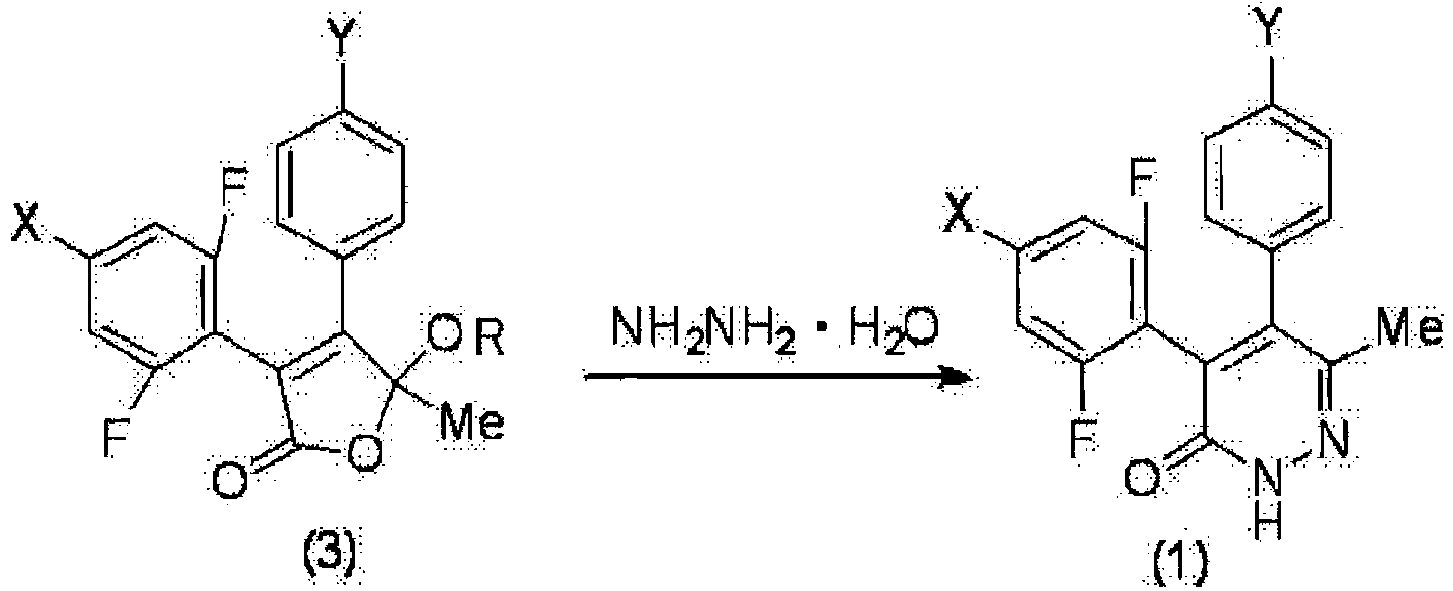
- Step 2 is usually carried out in a solvent. Examples of the solvent include alcohols such as butanol, propanol, 2-propanol, ethanol and methanol, hydrocarbons such as toluene and xylene, halogenated hydrocarbons such as chlorobenzene and dichlorobenzene, water and mixtures thereof.
- Hydrazine is usually used as a hydrate, and the amount thereof is usually 1 to 10 mols, and preferably 1 to 3 mols per mol of the compound (3).
- The reaction temperature is usually within the range of 0 to 120°C, and the reaction time is usually within the range of 1 to 100 hours.
- After completion of the reaction, for example, the reaction mixture is subjected to operations such as collecting the produced solid by filtration, whereby the compound (1) can be isolated. The isolated compound (1) also can be further purified by chromatography, recrystallization, or the like.
- The compound (2) which is a raw material can be obtained, according to the following method.

- Namely, the compound (2) can be obtained by reacting a compound represented by formula (4) (hereinafter, referred to as compound (4)) with a base.
- The reaction is usually carried out in a solvent. Examples of the solvent include nitriles such as acetonitrile, hydrocarbons such as toluene and xylene, halogenated hydrocarbons such as chlorobenzene and dichlorobenzene, and mixtures thereof.
- Examples of the base include cyclic amines such as 1,8-diazabicyclo[5.4.0]undec-7-ene (hereinafter, referred to as DBU), tertiary amines such as triethylamine and diisopropylethylamine, and inorganic bases such as potassium carbonate and sodium carbonate, and the use amount thereof is usually at a ratio of 1 to 3 mol, and preferably 1 to 1.5 mol, based on 1 mol of the compound (4).
- The reaction temperature depends on the kind of base to be used, and is usually within the range of -10 to 60°C, and the reaction time is usually within the range of 1 to 20 hours.
- After completion of the reaction, for example, the reaction mixture is mixed with water or ice water, and an organic layer obtained by extracting the mixture with an organic solvent is subjected to operations such as drying and concentration, whereby the compound (2) can be isolated. The isolated compound (2) also can be further purified by chromatography, recrystallization, or the like.
- The compound (4) can be obtained, according to the following method.

- Namely, the compound (4) can be obtained by reacting a compound represented by formula (5) (hereinafter, referred to as compound (5)) with a compound represented by formula (6) (hereinafter, referred to as compound (6)) in the presence of a base.
- The reaction is usually carried out in a solvent. Examples of the solvent include nitriles such as acetonitrile, hydrocarbons such as toluene and xylene, halogenated hydrocarbons such as chlorobenzene and dichlorobenzene, and mixtures thereof.
- Examples of the base include tertiary amines such as triethylamine and diisopropylethylamine, and inorganic bases such as potassium carbonate, sodium carbonate, sodium hydroxide and potassium hydroxide, and the use amount thereof is usually 1 to 1.5 mols per mol of the compound (5).
- The amount of the compound (6) used in the reaction is usually 0.8 to 1.1 mols pre mol of the compound (5).
- The reaction temperature depends on the kind of base to be used, and is usually within the range of -10 to 30°C, and the reaction time is usually within the range of 1 to 20 hours.
- After completion of the reaction, for example, the reaction mixture is mixed with water or ice water, and the mixture is extracted with an organic solvent, washed with sodium bicarbonate water or the like, if necessary, and then subjected to operations such as drying and concentration, whereby the compound (4) can be isolated. The isolated compound (4) also can be further purified by chromatography, recrystallization, or the like.
- As the compound (5) and the compound (6), those commercially available can be used, and the compound also can be produced by a known method.
- Examples of the embodiments of the compound (3) include the following compounds.
- In the formula (3), compounds wherein R is a methyl group;
- In the formula (3), compounds wherein X is a hydrogen atom;
- In the formula (3), compounds wherein Y is a hydrogen atom;
- In the formula (3), compounds wherein X and Y are a hydrogen atom;
- In the formula (3), compounds wherein R is a methyl group, and X and Y are a hydrogen atom;
- In the formula (3), compounds wherein X is a hydrogen atom, and Y is a chlorine atom;
- In the formula (3), compounds wherein X is a fluorine atom, and Y is a hydrogen atom; and
- In the formula (3), compounds wherein X is a fluorine atom, and Y is a chlorine atom.
- Hereinbelow, the present invention will be described in more detail by examples. However, the present invention is not limited to these examples.
-

- 2.86 g of 3-(2,6-Difluorophenyl)-5-methyl-4-phenyl-2 (5H) -furanone was dissolved in 54 mL of methanol, and 2.76 g of potassium carbonate was added at -20°C under a nitrogen atmosphere. Subsequently, a solution of 1.60 g of bromine dissolved in 10 ml of methanol was added dropwise thereto at -20°C over 40 minutes, and stirred at the same temperature for 1 hour and then at 20°C for 1 hour. The reaction liquid was filtered, and the filtrate was concentrated under reduced pressure. Water and tert-butyl methyl ether (hereinafter, referred to as MTBE) were added to the residue, and the mixture was separated. The organic layer was washed with water, dried over anhydrous sodium sulfate, and then concentrated under reduced pressure to give 3.04 g of residue. 1.52 g of the residue was subjected to a silica gel column chromatography (elution solvent: hexane-ethyl acetate) to obtain 1.30 g of 3-(2,6-difluorophenyl)-5-methoxy-5-methyl-4-phenyl-2(5H)-furanone (hereinafter, referred to as compound (i)). Yield: 82%
- 1H-NMR (CDCl3, TMS) δ (ppm) : 1.77 (3H, s), 3.42 (3H, s), 6.85-6.90 (1H, m), 7.05-7.10 (1H, m), 7.32-7.49 (6H, m)
-

- 0.32 g of the compound (i) was suspended in 1.6 g of butanol, 0.06 g of hydrazine monohydrate was added thereto, and then the mixture was stirred under heat-refluxing for 5 hours. Thereafter, 0.06 g of hydrazine monohydrate and 1. 6 g of butanol were added, and the mixture was stirred under heat-reflux for further 3 hours. After cooling, the precipitated solid was collected by filtration, and washed with a solution of a mixture of MTBE-hexane (1 : 1), to obtain 0.28 g of 4-(2,6-difluorophenyl)-6-methyl-5-phenyl-2H-pyridazin-3-one (hereinafter, referred to as compound (I)). Yield: 94% Compound (I)
1H-NMR (CDCl3, TMS) δ(ppm): 2.14 (3H, s), 6.74-6.79 (2H, m), 7.09-7.31 (6H, m), 11.26 (1H, br s) -

- 2.86 g of 3-(2,6-Difluorophenyl)-5-methyl-4-phenyl-2 (5H) -furanone was dissolved in 54 mL of methanol, and 2.76 g of potassium carbonate was added at -20°C under a nitrogen atmosphere. Subsequently, a solution of 1.60 g of bromine dissolved in 10 ml of methanol was added dropwise thereto at -20°C over 40 minutes, and stirred at the same temperature for 1 hour and then at 20°C for 1 hour. The reaction liquid was filtered, and the filtrate was concentrated under reduced pressure. Water and MTBE were added to the residue, and the mixture was separated. The organic layer was washed with water, dried over anhydrous sodium sulfate, and then concentrated under reduced pressure give 3.04 g of residue. 1.52 g of the residue was suspended in 9 ml of butanol, 0.30 g of hydrazine monohydride was added thereto, and then the mixture was stirred under heat-refluxing for 5 hours. Thereafter, 0.30 g of hydrazine monohydride was added, and the mixture was stirred under heat-reflux for further 3 hours. After ice cooling for 1 hour, the precipitated solid was collected by filtration, and washed with a solution of a mixture of MTBE-hexane (1 : 1), to obtain 1.14 g of the compound (I). Yield: 76%
-

- 15.21 g of 1-(Benzoyl)ethyl 2,6-difluorophenylacetate was dissolved in 100 mL of acetonitrile, 7. 61 g of DBU was added dropwise over 5 minutes while stirring under ice cooling, and then the mixture was stirred at 21°C for 1 hour. 49 ml of 5% Hydrochloric acid was added dropwise to the reaction liquid under ice cooling, then water and MTBE were added, and the mixture was separated. The organic layer was washed with water and dried over anhydrous magnesium sulfate, and then concentrated under reduced pressure to obtain 14.06 g of 3-(2,6-difluorophenyl)-5-methyl-4-phenyl-2(5H)-furanone as a yellow solid.
1H-NMR (CDCl3, TMS) δ(ppm):1.54 (3H, d, J = 6.8 Hz), 5.68 (1H, q, J = 6.8 Hz) 6.82-6.86 (1H, m), 7.01-7.07 (1H, m), 7.22-7.47 (6H, m) -

- 1. 52 g of 1- (Benzoyl) ethyl 2, 6-difluorophenylacetate was dissolved in 10 ml of acetonitrile, and 0.83 g of potassium carbonate was added while stirring. The mixture was stirred at 50 to 55°C for 9 hours, and then 7.8 ml of 5% hydrochloric acid was added dropwise to the reaction liquid under ice cooling. Water and MTBE were added and the mixture was separated, then the organic layer was washed with water and dried over anhydrous magnesium sulfate, and then concentrated under reduced pressure. 1.46 g of the residue was subjected to a silica gel column chromatography (elution solvent: hexane-ethyl acetate) to obtain 1.10 g of 3-(2,6-difluorophenyl)-5-methyl-4-phenyl-2(5H)-furanone as a white solid.
1H-NMR matched with the data in Reference Production Example 1. -

- 18.07 g of 2, 6-Difluorophenyl acetic acid was dissolved in 40 ml of acetonitrile, and 21.31 g of α-bromopropiophenone and 40 ml of acetonitrile were added thereto. 13.15 g of Triethylamine was added dropwise while stirring under ice cooling, and the mixture was washed with 20 ml of acetonitrile. 0.86 g of 2,6-Difluorophenyl acetic acid and 1.01 g of triethylamine were added to the reaction liquid stirred at room temperature for 5 hours, and the mixture was further stirred at room temperature for 1 hour. About 70 g of acetonitrile was distilled off under reduced pressure, and water and ethyl acetate were added, and then separated. Separated organic phase was sequentially washed with sodium bicarbonate water and water, dried over anhydrous magnesium sulfate, and then concentrated under reduced pressure to obtain 28.37 g of 1-(benzoyl)ethyl 2,6-difluorophenylacetate as a light brown solid.
1H-NMR (CDCl3, TMS) δ(ppm):1.58 (3H, d, J = 7.3 Hz), 3.82 (2H, s), 6.01 (1H, q, J = 7.3 Hz) 6.85-6.91 (2H, m), 7.19-7.25 (1H, m), 7.43-7.59 (3H, m), 7.87-7.96 (2H, m) - According to the method of the present invention, a compound represented by formula (1) useful as the production intermediate of a fungicide can be produced.
Claims (12)
- A method for producing a compound represented by formula (1)

the method comprising:reacting a compound represented by formula (2)wherein X and Y represent the same meaning as described above,
with a brominating agent and an alkanol having 1 to 6 carbon atoms represented by formula
ROH
wherein R represents a C1 to C6 alkyl group,
in the presence of a base; and
reacting the reaction product with hydrazine. - The method according to claim 1, wherein the brominating agent is bromine.
- The method according to claim 1, wherein the brominating agent is bromine, and the alkanol is methanol.
- The method according to claim 3, wherein the base is potassium carbonate or sodium carbonate.
- A method for producing a compound represented by formula (3)

the method comprising:reacting a compound represented by formula (2)wherein X and Y represent the same meaning as described above,
with a brominating agent and an alkanol having 1 to 6 carbon atoms represented by formula
ROH
wherein R represents the same meaning as described above, in the presence of a base. - A method for producing a compound represented by formula (1)

the method comprising:reacting a compound represented by formula (3)wherein R represents a C1 to C6 alkyl group, and X and Y represent the same meaning as described above,
with hydrazine. - A compound represented by formula (3)

- The compound according to claim 7, wherein R is a methyl group.
- The compound according to claim 7, wherein X is a hydrogen atom.
- The compound according to claim 7, wherein Y is a hydrogen atom.
- The compound according to claim 7, wherein X and Y are a hydrogen atom.
- The compound according to claim 7, wherein R is a methyl group, and X and Y are a hydrogen atom.
Priority Applications (1)
| Application Number | Priority Date | Filing Date | Title |
|---|---|---|---|
| PL14776160T PL2980079T3 (en) | 2013-03-26 | 2014-03-17 | Method of manufacturing pyridazinone compound |
Applications Claiming Priority (2)
| Application Number | Priority Date | Filing Date | Title |
|---|---|---|---|
| JP2013063493 | 2013-03-26 | ||
| PCT/JP2014/057953 WO2014157021A1 (en) | 2013-03-26 | 2014-03-17 | Method of manufacturing pyridazinone compound |
Publications (3)
| Publication Number | Publication Date |
|---|---|
| EP2980079A1 true EP2980079A1 (en) | 2016-02-03 |
| EP2980079A4 EP2980079A4 (en) | 2016-08-31 |
| EP2980079B1 EP2980079B1 (en) | 2017-10-25 |
Family
ID=51623996
Family Applications (1)
| Application Number | Title | Priority Date | Filing Date |
|---|---|---|---|
| EP14776160.5A Not-in-force EP2980079B1 (en) | 2013-03-26 | 2014-03-17 | Method of manufacturing pyridazinone compound |
Country Status (9)
| Country | Link |
|---|---|
| US (1) | US9533956B2 (en) |
| EP (1) | EP2980079B1 (en) |
| JP (1) | JP6197868B2 (en) |
| CN (1) | CN105189467B (en) |
| BR (1) | BR112015024291A2 (en) |
| ES (1) | ES2649168T3 (en) |
| HU (1) | HUE035883T2 (en) |
| PL (1) | PL2980079T3 (en) |
| WO (1) | WO2014157021A1 (en) |
Cited By (1)
| Publication number | Priority date | Publication date | Assignee | Title |
|---|---|---|---|---|
| US9732042B2 (en) | 2013-05-24 | 2017-08-15 | Sumitomo Chemical Company, Limited | Method for producing pyridazine compound |
Families Citing this family (2)
| Publication number | Priority date | Publication date | Assignee | Title |
|---|---|---|---|---|
| JP6311719B2 (en) | 2013-02-21 | 2018-04-18 | 住友化学株式会社 | Process for producing pyridazinone compound and production intermediate thereof |
| PY2167565A (en) * | 2020-08-14 | 2022-08-08 | Syngenta Crop Protection Ag | CHEMICAL PROCESS |
Family Cites Families (12)
| Publication number | Priority date | Publication date | Assignee | Title |
|---|---|---|---|---|
| ES454136A1 (en) | 1976-12-10 | 1977-12-01 | Patronato De Investigacion Cie | Procedure for the preparation of 3 (2H) -piridazinones. (Machine-translation by Google Translate, not legally binding) |
| US5691374A (en) * | 1995-05-18 | 1997-11-25 | Merck Frosst Canada Inc. | Diaryl-5-oxygenated-2-(5H) -furanones as COX-2 inhibitors |
| DE602005014359D1 (en) | 2004-06-09 | 2009-06-18 | Sumitomo Chemical Co | PYRIDAZINE COMPOUND AND ITS USE |
| JP4792816B2 (en) * | 2004-06-09 | 2011-10-12 | 住友化学株式会社 | Pyridazine compounds and uses thereof |
| KR20110059652A (en) * | 2008-09-24 | 2011-06-02 | 이 아이 듀폰 디 네모아 앤드 캄파니 | Fungicide pyridazine |
| CN102548969A (en) | 2009-08-07 | 2012-07-04 | 杜邦公司 | Fungicidal diphenyl-substituted pyridazines |
| JP5857512B2 (en) | 2010-08-10 | 2016-02-10 | 住友化学株式会社 | Plant disease control composition and use thereof |
| JP5857513B2 (en) | 2010-08-10 | 2016-02-10 | 住友化学株式会社 | Plant disease control composition and use thereof |
| JP5857511B2 (en) | 2010-08-10 | 2016-02-10 | 住友化学株式会社 | Plant disease control composition and use thereof |
| JP2012036142A (en) | 2010-08-10 | 2012-02-23 | Sumitomo Chemical Co Ltd | Plant disease control composition, and application for same |
| JP6311719B2 (en) | 2013-02-21 | 2018-04-18 | 住友化学株式会社 | Process for producing pyridazinone compound and production intermediate thereof |
| EP3004065B1 (en) | 2013-05-24 | 2017-10-18 | Sumitomo Chemical Company, Limited | Method for producing pyridazine compound |
-
2014
- 2014-03-17 HU HUE14776160A patent/HUE035883T2/en unknown
- 2014-03-17 WO PCT/JP2014/057953 patent/WO2014157021A1/en not_active Ceased
- 2014-03-17 BR BR112015024291A patent/BR112015024291A2/en not_active Application Discontinuation
- 2014-03-17 PL PL14776160T patent/PL2980079T3/en unknown
- 2014-03-17 EP EP14776160.5A patent/EP2980079B1/en not_active Not-in-force
- 2014-03-17 JP JP2015508446A patent/JP6197868B2/en active Active
- 2014-03-17 US US14/779,383 patent/US9533956B2/en not_active Expired - Fee Related
- 2014-03-17 ES ES14776160.5T patent/ES2649168T3/en active Active
- 2014-03-17 CN CN201480017719.4A patent/CN105189467B/en active Active
Cited By (1)
| Publication number | Priority date | Publication date | Assignee | Title |
|---|---|---|---|---|
| US9732042B2 (en) | 2013-05-24 | 2017-08-15 | Sumitomo Chemical Company, Limited | Method for producing pyridazine compound |
Also Published As
| Publication number | Publication date |
|---|---|
| BR112015024291A2 (en) | 2017-07-18 |
| EP2980079B1 (en) | 2017-10-25 |
| JPWO2014157021A1 (en) | 2017-02-16 |
| EP2980079A4 (en) | 2016-08-31 |
| CN105189467A (en) | 2015-12-23 |
| ES2649168T3 (en) | 2018-01-10 |
| HUE035883T2 (en) | 2018-05-28 |
| CN105189467B (en) | 2017-06-23 |
| US9533956B2 (en) | 2017-01-03 |
| JP6197868B2 (en) | 2017-09-20 |
| PL2980079T3 (en) | 2018-01-31 |
| WO2014157021A1 (en) | 2014-10-02 |
| US20160060225A1 (en) | 2016-03-03 |
Similar Documents
| Publication | Publication Date | Title |
|---|---|---|
| CN102791694B (en) | Preparation method of alkyl 2-alkoxymethylene-4,4-difluoro-3-oxobutyrate | |
| US9533956B2 (en) | Method of manufacturing pyridazinone compound | |
| EP0990647B1 (en) | Process for producing quinolone derivatives | |
| US20040199002A1 (en) | Process for producing(2-nitrophenyl)acetonitrile derivative and intermediate therefor | |
| EP2474536B1 (en) | Process for preparation of pyrimidinylacetonitrile derivatives and intermediates for synthesis thereof | |
| EP2456749B1 (en) | Indane derivatives for use as intermediates | |
| JP5001144B2 (en) | Process for producing 2-isopropenyl-5-methyl-4-hexen-1-yl 3-methyl-2-butenoate | |
| KR100466079B1 (en) | A preparing process of phenoxyacetamide derivative | |
| JP5205971B2 (en) | Method for producing tetrahydropyran compound | |
| EP1873145A1 (en) | Method for producing nicotinic acid derivative or salt thereof | |
| JP6771775B2 (en) | Method for producing 2-aminonicotinic acid benzyl ester derivative | |
| EP4696674A1 (en) | Method for producing 3-hydroxybiphenyl compound and derivative thereof | |
| KR100466693B1 (en) | A preparing process of phenoxyacetamide derivative | |
| JP4356917B2 (en) | Process for producing bisaminomethyl-1,4-dithianes and intermediates thereof | |
| RU2301801C2 (en) | Method for preparing sulfonulaminopyrimidine compounds (variants), intermediate substances and methods for their preparing | |
| JP4864328B2 (en) | Process for producing α-ketoester compound | |
| JP2007254293A (en) | Process for producing α-methylene-β-alkyl-γ-butyrolactone | |
| JP2003342267A (en) | Method for producing epoxybutanoic acid esters | |
| JPH07179433A (en) | Process for producing phenoxymethylpyrimidine derivative | |
| JPH11171855A (en) | Method for producing optically active N-substituted α-amino-γ-halogenobutyrate | |
| JP2002201169A (en) | Method for producing 4-cyano-3-oxobutanoic acid ester | |
| JP2000136177A (en) | Production of n-alkyl-alpha-dialkylaminoaceto- hydroxamic acid compound | |
| JP2006321788A (en) | Process for producing nicotinic acid derivative or salt thereof | |
| JP2008174452A (en) | Method for producing 2,2-dichloro-12- (4-halophenyl) dodecanoate | |
| EP2719684A1 (en) | Method of manufacturing benzylamine compound |
Legal Events
| Date | Code | Title | Description |
|---|---|---|---|
| PUAI | Public reference made under article 153(3) epc to a published international application that has entered the european phase |
Free format text: ORIGINAL CODE: 0009012 |
|
| 17P | Request for examination filed |
Effective date: 20151019 |
|
| AK | Designated contracting states |
Kind code of ref document: A1 Designated state(s): AL AT BE BG CH CY CZ DE DK EE ES FI FR GB GR HR HU IE IS IT LI LT LU LV MC MK MT NL NO PL PT RO RS SE SI SK SM TR |
|
| AX | Request for extension of the european patent |
Extension state: BA ME |
|
| DAX | Request for extension of the european patent (deleted) | ||
| A4 | Supplementary search report drawn up and despatched |
Effective date: 20160801 |
|
| RIC1 | Information provided on ipc code assigned before grant |
Ipc: C07D 237/14 20060101AFI20160726BHEP Ipc: C07D 307/60 20060101ALI20160726BHEP |
|
| GRAP | Despatch of communication of intention to grant a patent |
Free format text: ORIGINAL CODE: EPIDOSNIGR1 |
|
| STAA | Information on the status of an ep patent application or granted ep patent |
Free format text: STATUS: GRANT OF PATENT IS INTENDED |
|
| INTG | Intention to grant announced |
Effective date: 20170323 |
|
| RAP1 | Party data changed (applicant data changed or rights of an application transferred) |
Owner name: SUMITOMO CHEMICAL COMPANY, LIMITED |
|
| GRAJ | Information related to disapproval of communication of intention to grant by the applicant or resumption of examination proceedings by the epo deleted |
Free format text: ORIGINAL CODE: EPIDOSDIGR1 |
|
| GRAP | Despatch of communication of intention to grant a patent |
Free format text: ORIGINAL CODE: EPIDOSNIGR1 |
|
| INTG | Intention to grant announced |
Effective date: 20170609 |
|
| INTG | Intention to grant announced |
Effective date: 20170619 |
|
| GRAS | Grant fee paid |
Free format text: ORIGINAL CODE: EPIDOSNIGR3 |
|
| GRAA | (expected) grant |
Free format text: ORIGINAL CODE: 0009210 |
|
| STAA | Information on the status of an ep patent application or granted ep patent |
Free format text: STATUS: THE PATENT HAS BEEN GRANTED |
|
| AK | Designated contracting states |
Kind code of ref document: B1 Designated state(s): AL AT BE BG CH CY CZ DE DK EE ES FI FR GB GR HR HU IE IS IT LI LT LU LV MC MK MT NL NO PL PT RO RS SE SI SK SM TR |
|
| REG | Reference to a national code |
Ref country code: GB Ref legal event code: FG4D |
|
| REG | Reference to a national code |
Ref country code: CH Ref legal event code: NV Representative=s name: SERVOPATENT GMBH, CH Ref country code: CH Ref legal event code: EP |
|
| REG | Reference to a national code |
Ref country code: AT Ref legal event code: REF Ref document number: 939778 Country of ref document: AT Kind code of ref document: T Effective date: 20171115 |
|
| REG | Reference to a national code |
Ref country code: IE Ref legal event code: FG4D |
|
| REG | Reference to a national code |
Ref country code: DE Ref legal event code: R096 Ref document number: 602014016345 Country of ref document: DE |
|
| REG | Reference to a national code |
Ref country code: RO Ref legal event code: EPE |
|
| REG | Reference to a national code |
Ref country code: NL Ref legal event code: FP |
|
| REG | Reference to a national code |
Ref country code: ES Ref legal event code: FG2A Ref document number: 2649168 Country of ref document: ES Kind code of ref document: T3 Effective date: 20180110 |
|
| REG | Reference to a national code |
Ref country code: FR Ref legal event code: PLFP Year of fee payment: 5 |
|
| REG | Reference to a national code |
Ref country code: LT Ref legal event code: MG4D |
|
| REG | Reference to a national code |
Ref country code: AT Ref legal event code: MK05 Ref document number: 939778 Country of ref document: AT Kind code of ref document: T Effective date: 20171025 |
|
| PG25 | Lapsed in a contracting state [announced via postgrant information from national office to epo] |
Ref country code: SE Free format text: LAPSE BECAUSE OF FAILURE TO SUBMIT A TRANSLATION OF THE DESCRIPTION OR TO PAY THE FEE WITHIN THE PRESCRIBED TIME-LIMIT Effective date: 20171025 Ref country code: FI Free format text: LAPSE BECAUSE OF FAILURE TO SUBMIT A TRANSLATION OF THE DESCRIPTION OR TO PAY THE FEE WITHIN THE PRESCRIBED TIME-LIMIT Effective date: 20171025 Ref country code: LT Free format text: LAPSE BECAUSE OF FAILURE TO SUBMIT A TRANSLATION OF THE DESCRIPTION OR TO PAY THE FEE WITHIN THE PRESCRIBED TIME-LIMIT Effective date: 20171025 Ref country code: NO Free format text: LAPSE BECAUSE OF FAILURE TO SUBMIT A TRANSLATION OF THE DESCRIPTION OR TO PAY THE FEE WITHIN THE PRESCRIBED TIME-LIMIT Effective date: 20180125 |
|
| PGFP | Annual fee paid to national office [announced via postgrant information from national office to epo] |
Ref country code: NL Payment date: 20180314 Year of fee payment: 5 Ref country code: CH Payment date: 20180314 Year of fee payment: 5 |
|
| REG | Reference to a national code |
Ref country code: HU Ref legal event code: AG4A Ref document number: E035883 Country of ref document: HU |
|
| PG25 | Lapsed in a contracting state [announced via postgrant information from national office to epo] |
Ref country code: IS Free format text: LAPSE BECAUSE OF FAILURE TO SUBMIT A TRANSLATION OF THE DESCRIPTION OR TO PAY THE FEE WITHIN THE PRESCRIBED TIME-LIMIT Effective date: 20180225 Ref country code: GR Free format text: LAPSE BECAUSE OF FAILURE TO SUBMIT A TRANSLATION OF THE DESCRIPTION OR TO PAY THE FEE WITHIN THE PRESCRIBED TIME-LIMIT Effective date: 20180126 Ref country code: LV Free format text: LAPSE BECAUSE OF FAILURE TO SUBMIT A TRANSLATION OF THE DESCRIPTION OR TO PAY THE FEE WITHIN THE PRESCRIBED TIME-LIMIT Effective date: 20171025 Ref country code: AT Free format text: LAPSE BECAUSE OF FAILURE TO SUBMIT A TRANSLATION OF THE DESCRIPTION OR TO PAY THE FEE WITHIN THE PRESCRIBED TIME-LIMIT Effective date: 20171025 Ref country code: HR Free format text: LAPSE BECAUSE OF FAILURE TO SUBMIT A TRANSLATION OF THE DESCRIPTION OR TO PAY THE FEE WITHIN THE PRESCRIBED TIME-LIMIT Effective date: 20171025 Ref country code: RS Free format text: LAPSE BECAUSE OF FAILURE TO SUBMIT A TRANSLATION OF THE DESCRIPTION OR TO PAY THE FEE WITHIN THE PRESCRIBED TIME-LIMIT Effective date: 20171025 |
|
| PGFP | Annual fee paid to national office [announced via postgrant information from national office to epo] |
Ref country code: IT Payment date: 20180321 Year of fee payment: 5 |
|
| REG | Reference to a national code |
Ref country code: DE Ref legal event code: R097 Ref document number: 602014016345 Country of ref document: DE |
|
| PG25 | Lapsed in a contracting state [announced via postgrant information from national office to epo] |
Ref country code: CZ Free format text: LAPSE BECAUSE OF FAILURE TO SUBMIT A TRANSLATION OF THE DESCRIPTION OR TO PAY THE FEE WITHIN THE PRESCRIBED TIME-LIMIT Effective date: 20171025 Ref country code: SK Free format text: LAPSE BECAUSE OF FAILURE TO SUBMIT A TRANSLATION OF THE DESCRIPTION OR TO PAY THE FEE WITHIN THE PRESCRIBED TIME-LIMIT Effective date: 20171025 Ref country code: CY Free format text: LAPSE BECAUSE OF FAILURE TO SUBMIT A TRANSLATION OF THE DESCRIPTION OR TO PAY THE FEE WITHIN THE PRESCRIBED TIME-LIMIT Effective date: 20171025 Ref country code: EE Free format text: LAPSE BECAUSE OF FAILURE TO SUBMIT A TRANSLATION OF THE DESCRIPTION OR TO PAY THE FEE WITHIN THE PRESCRIBED TIME-LIMIT Effective date: 20171025 Ref country code: DK Free format text: LAPSE BECAUSE OF FAILURE TO SUBMIT A TRANSLATION OF THE DESCRIPTION OR TO PAY THE FEE WITHIN THE PRESCRIBED TIME-LIMIT Effective date: 20171025 |
|
| PGFP | Annual fee paid to national office [announced via postgrant information from national office to epo] |
Ref country code: ES Payment date: 20180402 Year of fee payment: 5 |
|
| PG25 | Lapsed in a contracting state [announced via postgrant information from national office to epo] |
Ref country code: SM Free format text: LAPSE BECAUSE OF FAILURE TO SUBMIT A TRANSLATION OF THE DESCRIPTION OR TO PAY THE FEE WITHIN THE PRESCRIBED TIME-LIMIT Effective date: 20171025 |
|
| PLBE | No opposition filed within time limit |
Free format text: ORIGINAL CODE: 0009261 |
|
| STAA | Information on the status of an ep patent application or granted ep patent |
Free format text: STATUS: NO OPPOSITION FILED WITHIN TIME LIMIT |
|
| 26N | No opposition filed |
Effective date: 20180726 |
|
| PG25 | Lapsed in a contracting state [announced via postgrant information from national office to epo] |
Ref country code: SI Free format text: LAPSE BECAUSE OF FAILURE TO SUBMIT A TRANSLATION OF THE DESCRIPTION OR TO PAY THE FEE WITHIN THE PRESCRIBED TIME-LIMIT Effective date: 20171025 Ref country code: MC Free format text: LAPSE BECAUSE OF FAILURE TO SUBMIT A TRANSLATION OF THE DESCRIPTION OR TO PAY THE FEE WITHIN THE PRESCRIBED TIME-LIMIT Effective date: 20171025 |
|
| REG | Reference to a national code |
Ref country code: BE Ref legal event code: MM Effective date: 20180331 |
|
| REG | Reference to a national code |
Ref country code: IE Ref legal event code: MM4A |
|
| PG25 | Lapsed in a contracting state [announced via postgrant information from national office to epo] |
Ref country code: LU Free format text: LAPSE BECAUSE OF NON-PAYMENT OF DUE FEES Effective date: 20180317 |
|
| PG25 | Lapsed in a contracting state [announced via postgrant information from national office to epo] |
Ref country code: IE Free format text: LAPSE BECAUSE OF NON-PAYMENT OF DUE FEES Effective date: 20180317 |
|
| PGFP | Annual fee paid to national office [announced via postgrant information from national office to epo] |
Ref country code: PL Payment date: 20181219 Year of fee payment: 6 |
|
| PG25 | Lapsed in a contracting state [announced via postgrant information from national office to epo] |
Ref country code: BE Free format text: LAPSE BECAUSE OF NON-PAYMENT OF DUE FEES Effective date: 20180331 |
|
| PGFP | Annual fee paid to national office [announced via postgrant information from national office to epo] |
Ref country code: FR Payment date: 20190322 Year of fee payment: 6 Ref country code: RO Payment date: 20190212 Year of fee payment: 6 Ref country code: BG Payment date: 20190125 Year of fee payment: 6 |
|
| PGFP | Annual fee paid to national office [announced via postgrant information from national office to epo] |
Ref country code: HU Payment date: 20190131 Year of fee payment: 6 Ref country code: FR Payment date: 20190213 Year of fee payment: 6 |
|
| REG | Reference to a national code |
Ref country code: CH Ref legal event code: PL |
|
| REG | Reference to a national code |
Ref country code: NL Ref legal event code: MM Effective date: 20190401 |
|
| PG25 | Lapsed in a contracting state [announced via postgrant information from national office to epo] |
Ref country code: LI Free format text: LAPSE BECAUSE OF NON-PAYMENT OF DUE FEES Effective date: 20190331 Ref country code: NL Free format text: LAPSE BECAUSE OF NON-PAYMENT OF DUE FEES Effective date: 20190401 Ref country code: MT Free format text: LAPSE BECAUSE OF NON-PAYMENT OF DUE FEES Effective date: 20180317 Ref country code: CH Free format text: LAPSE BECAUSE OF NON-PAYMENT OF DUE FEES Effective date: 20190331 |
|
| PG25 | Lapsed in a contracting state [announced via postgrant information from national office to epo] |
Ref country code: IT Free format text: LAPSE BECAUSE OF NON-PAYMENT OF DUE FEES Effective date: 20190317 |
|
| PG25 | Lapsed in a contracting state [announced via postgrant information from national office to epo] |
Ref country code: TR Free format text: LAPSE BECAUSE OF FAILURE TO SUBMIT A TRANSLATION OF THE DESCRIPTION OR TO PAY THE FEE WITHIN THE PRESCRIBED TIME-LIMIT Effective date: 20171025 |
|
| PGFP | Annual fee paid to national office [announced via postgrant information from national office to epo] |
Ref country code: DE Payment date: 20200303 Year of fee payment: 7 |
|
| PG25 | Lapsed in a contracting state [announced via postgrant information from national office to epo] |
Ref country code: PT Free format text: LAPSE BECAUSE OF FAILURE TO SUBMIT A TRANSLATION OF THE DESCRIPTION OR TO PAY THE FEE WITHIN THE PRESCRIBED TIME-LIMIT Effective date: 20171025 |
|
| PG25 | Lapsed in a contracting state [announced via postgrant information from national office to epo] |
Ref country code: MK Free format text: LAPSE BECAUSE OF NON-PAYMENT OF DUE FEES Effective date: 20171025 |
|
| REG | Reference to a national code |
Ref country code: ES Ref legal event code: FD2A Effective date: 20200727 |
|
| PG25 | Lapsed in a contracting state [announced via postgrant information from national office to epo] |
Ref country code: AL Free format text: LAPSE BECAUSE OF FAILURE TO SUBMIT A TRANSLATION OF THE DESCRIPTION OR TO PAY THE FEE WITHIN THE PRESCRIBED TIME-LIMIT Effective date: 20171025 |
|
| PG25 | Lapsed in a contracting state [announced via postgrant information from national office to epo] |
Ref country code: ES Free format text: LAPSE BECAUSE OF NON-PAYMENT OF DUE FEES Effective date: 20190318 Ref country code: RO Free format text: LAPSE BECAUSE OF NON-PAYMENT OF DUE FEES Effective date: 20200317 |
|
| PG25 | Lapsed in a contracting state [announced via postgrant information from national office to epo] |
Ref country code: BG Free format text: LAPSE BECAUSE OF NON-PAYMENT OF DUE FEES Effective date: 20201130 Ref country code: FR Free format text: LAPSE BECAUSE OF NON-PAYMENT OF DUE FEES Effective date: 20200331 Ref country code: HU Free format text: LAPSE BECAUSE OF NON-PAYMENT OF DUE FEES Effective date: 20200318 |
|
| GBPC | Gb: european patent ceased through non-payment of renewal fee |
Effective date: 20200317 |
|
| PG25 | Lapsed in a contracting state [announced via postgrant information from national office to epo] |
Ref country code: GB Free format text: LAPSE BECAUSE OF NON-PAYMENT OF DUE FEES Effective date: 20200317 |
|
| REG | Reference to a national code |
Ref country code: DE Ref legal event code: R119 Ref document number: 602014016345 Country of ref document: DE |
|
| PG25 | Lapsed in a contracting state [announced via postgrant information from national office to epo] |
Ref country code: DE Free format text: LAPSE BECAUSE OF NON-PAYMENT OF DUE FEES Effective date: 20211001 |
|
| PG25 | Lapsed in a contracting state [announced via postgrant information from national office to epo] |
Ref country code: PL Free format text: LAPSE BECAUSE OF NON-PAYMENT OF DUE FEES Effective date: 20200317 |