EP2979690B1 - Method for manufacturing emulsion bead by low-temperature cooling, and emulsion bead yielded thereby - Google Patents
Method for manufacturing emulsion bead by low-temperature cooling, and emulsion bead yielded thereby Download PDFInfo
- Publication number
- EP2979690B1 EP2979690B1 EP13880306.9A EP13880306A EP2979690B1 EP 2979690 B1 EP2979690 B1 EP 2979690B1 EP 13880306 A EP13880306 A EP 13880306A EP 2979690 B1 EP2979690 B1 EP 2979690B1
- Authority
- EP
- European Patent Office
- Prior art keywords
- emulsion
- oil
- liquid
- beads
- water
- Prior art date
- Legal status (The legal status is an assumption and is not a legal conclusion. Google has not performed a legal analysis and makes no representation as to the accuracy of the status listed.)
- Active
Links
Images


Classifications
-
- A—HUMAN NECESSITIES
- A61—MEDICAL OR VETERINARY SCIENCE; HYGIENE
- A61K—PREPARATIONS FOR MEDICAL, DENTAL OR TOILETRY PURPOSES
- A61K8/00—Cosmetics or similar toiletry preparations
- A61K8/02—Cosmetics or similar toiletry preparations characterised by special physical form
- A61K8/04—Dispersions; Emulsions
- A61K8/06—Emulsions
- A61K8/064—Water-in-oil emulsions, e.g. Water-in-silicone emulsions
-
- A—HUMAN NECESSITIES
- A61—MEDICAL OR VETERINARY SCIENCE; HYGIENE
- A61Q—SPECIFIC USE OF COSMETICS OR SIMILAR TOILETRY PREPARATIONS
- A61Q19/00—Preparations for care of the skin
-
- A—HUMAN NECESSITIES
- A61—MEDICAL OR VETERINARY SCIENCE; HYGIENE
- A61K—PREPARATIONS FOR MEDICAL, DENTAL OR TOILETRY PURPOSES
- A61K8/00—Cosmetics or similar toiletry preparations
- A61K8/02—Cosmetics or similar toiletry preparations characterised by special physical form
-
- A—HUMAN NECESSITIES
- A61—MEDICAL OR VETERINARY SCIENCE; HYGIENE
- A61J—CONTAINERS SPECIALLY ADAPTED FOR MEDICAL OR PHARMACEUTICAL PURPOSES; DEVICES OR METHODS SPECIALLY ADAPTED FOR BRINGING PHARMACEUTICAL PRODUCTS INTO PARTICULAR PHYSICAL OR ADMINISTERING FORMS; DEVICES FOR ADMINISTERING FOOD OR MEDICINES ORALLY; BABY COMFORTERS; DEVICES FOR RECEIVING SPITTLE
- A61J3/00—Devices or methods specially adapted for bringing pharmaceutical products into particular physical or administering forms
-
- A—HUMAN NECESSITIES
- A61—MEDICAL OR VETERINARY SCIENCE; HYGIENE
- A61K—PREPARATIONS FOR MEDICAL, DENTAL OR TOILETRY PURPOSES
- A61K8/00—Cosmetics or similar toiletry preparations
- A61K8/02—Cosmetics or similar toiletry preparations characterised by special physical form
- A61K8/0216—Solid or semisolid forms
-
- A—HUMAN NECESSITIES
- A61—MEDICAL OR VETERINARY SCIENCE; HYGIENE
- A61K—PREPARATIONS FOR MEDICAL, DENTAL OR TOILETRY PURPOSES
- A61K8/00—Cosmetics or similar toiletry preparations
- A61K8/02—Cosmetics or similar toiletry preparations characterised by special physical form
- A61K8/04—Dispersions; Emulsions
- A61K8/06—Emulsions
-
- A—HUMAN NECESSITIES
- A61—MEDICAL OR VETERINARY SCIENCE; HYGIENE
- A61K—PREPARATIONS FOR MEDICAL, DENTAL OR TOILETRY PURPOSES
- A61K8/00—Cosmetics or similar toiletry preparations
- A61K8/02—Cosmetics or similar toiletry preparations characterised by special physical form
- A61K8/11—Encapsulated compositions
-
- A—HUMAN NECESSITIES
- A61—MEDICAL OR VETERINARY SCIENCE; HYGIENE
- A61K—PREPARATIONS FOR MEDICAL, DENTAL OR TOILETRY PURPOSES
- A61K8/00—Cosmetics or similar toiletry preparations
- A61K8/18—Cosmetics or similar toiletry preparations characterised by the composition
- A61K8/30—Cosmetics or similar toiletry preparations characterised by the composition containing organic compounds
- A61K8/31—Hydrocarbons
-
- A—HUMAN NECESSITIES
- A61—MEDICAL OR VETERINARY SCIENCE; HYGIENE
- A61K—PREPARATIONS FOR MEDICAL, DENTAL OR TOILETRY PURPOSES
- A61K8/00—Cosmetics or similar toiletry preparations
- A61K8/18—Cosmetics or similar toiletry preparations characterised by the composition
- A61K8/30—Cosmetics or similar toiletry preparations characterised by the composition containing organic compounds
- A61K8/33—Cosmetics or similar toiletry preparations characterised by the composition containing organic compounds containing oxygen
- A61K8/34—Alcohols
- A61K8/342—Alcohols having more than seven atoms in an unbroken chain
-
- A—HUMAN NECESSITIES
- A61—MEDICAL OR VETERINARY SCIENCE; HYGIENE
- A61K—PREPARATIONS FOR MEDICAL, DENTAL OR TOILETRY PURPOSES
- A61K8/00—Cosmetics or similar toiletry preparations
- A61K8/18—Cosmetics or similar toiletry preparations characterised by the composition
- A61K8/30—Cosmetics or similar toiletry preparations characterised by the composition containing organic compounds
- A61K8/33—Cosmetics or similar toiletry preparations characterised by the composition containing organic compounds containing oxygen
- A61K8/34—Alcohols
- A61K8/345—Alcohols containing more than one hydroxy group
-
- A—HUMAN NECESSITIES
- A61—MEDICAL OR VETERINARY SCIENCE; HYGIENE
- A61K—PREPARATIONS FOR MEDICAL, DENTAL OR TOILETRY PURPOSES
- A61K8/00—Cosmetics or similar toiletry preparations
- A61K8/18—Cosmetics or similar toiletry preparations characterised by the composition
- A61K8/30—Cosmetics or similar toiletry preparations characterised by the composition containing organic compounds
- A61K8/33—Cosmetics or similar toiletry preparations characterised by the composition containing organic compounds containing oxygen
- A61K8/36—Carboxylic acids; Salts or anhydrides thereof
- A61K8/361—Carboxylic acids having more than seven carbon atoms in an unbroken chain; Salts or anhydrides thereof
-
- A—HUMAN NECESSITIES
- A61—MEDICAL OR VETERINARY SCIENCE; HYGIENE
- A61K—PREPARATIONS FOR MEDICAL, DENTAL OR TOILETRY PURPOSES
- A61K8/00—Cosmetics or similar toiletry preparations
- A61K8/18—Cosmetics or similar toiletry preparations characterised by the composition
- A61K8/30—Cosmetics or similar toiletry preparations characterised by the composition containing organic compounds
- A61K8/33—Cosmetics or similar toiletry preparations characterised by the composition containing organic compounds containing oxygen
- A61K8/37—Esters of carboxylic acids
- A61K8/375—Esters of carboxylic acids the alcohol moiety containing more than one hydroxy group
-
- A—HUMAN NECESSITIES
- A61—MEDICAL OR VETERINARY SCIENCE; HYGIENE
- A61K—PREPARATIONS FOR MEDICAL, DENTAL OR TOILETRY PURPOSES
- A61K8/00—Cosmetics or similar toiletry preparations
- A61K8/18—Cosmetics or similar toiletry preparations characterised by the composition
- A61K8/30—Cosmetics or similar toiletry preparations characterised by the composition containing organic compounds
- A61K8/40—Cosmetics or similar toiletry preparations characterised by the composition containing organic compounds containing nitrogen
- A61K8/41—Amines
-
- A—HUMAN NECESSITIES
- A61—MEDICAL OR VETERINARY SCIENCE; HYGIENE
- A61K—PREPARATIONS FOR MEDICAL, DENTAL OR TOILETRY PURPOSES
- A61K8/00—Cosmetics or similar toiletry preparations
- A61K8/18—Cosmetics or similar toiletry preparations characterised by the composition
- A61K8/30—Cosmetics or similar toiletry preparations characterised by the composition containing organic compounds
- A61K8/40—Cosmetics or similar toiletry preparations characterised by the composition containing organic compounds containing nitrogen
- A61K8/44—Aminocarboxylic acids or derivatives thereof, e.g. aminocarboxylic acids containing sulfur; Salts; Esters or N-acylated derivatives thereof
-
- A—HUMAN NECESSITIES
- A61—MEDICAL OR VETERINARY SCIENCE; HYGIENE
- A61K—PREPARATIONS FOR MEDICAL, DENTAL OR TOILETRY PURPOSES
- A61K8/00—Cosmetics or similar toiletry preparations
- A61K8/18—Cosmetics or similar toiletry preparations characterised by the composition
- A61K8/72—Cosmetics or similar toiletry preparations characterised by the composition containing organic macromolecular compounds
- A61K8/73—Polysaccharides
-
- A—HUMAN NECESSITIES
- A61—MEDICAL OR VETERINARY SCIENCE; HYGIENE
- A61K—PREPARATIONS FOR MEDICAL, DENTAL OR TOILETRY PURPOSES
- A61K8/00—Cosmetics or similar toiletry preparations
- A61K8/18—Cosmetics or similar toiletry preparations characterised by the composition
- A61K8/72—Cosmetics or similar toiletry preparations characterised by the composition containing organic macromolecular compounds
- A61K8/84—Cosmetics or similar toiletry preparations characterised by the composition containing organic macromolecular compounds obtained by reactions otherwise than those involving only carbon-carbon unsaturated bonds
- A61K8/86—Polyethers
-
- A—HUMAN NECESSITIES
- A61—MEDICAL OR VETERINARY SCIENCE; HYGIENE
- A61P—SPECIFIC THERAPEUTIC ACTIVITY OF CHEMICAL COMPOUNDS OR MEDICINAL PREPARATIONS
- A61P17/00—Drugs for dermatological disorders
-
- F—MECHANICAL ENGINEERING; LIGHTING; HEATING; WEAPONS; BLASTING
- F25—REFRIGERATION OR COOLING; COMBINED HEATING AND REFRIGERATION SYSTEMS; HEAT PUMP SYSTEMS; MANUFACTURE OR STORAGE OF ICE; LIQUEFACTION SOLIDIFICATION OF GASES
- F25D—REFRIGERATORS; COLD ROOMS; ICE-BOXES; COOLING OR FREEZING APPARATUS NOT OTHERWISE PROVIDED FOR
- F25D31/00—Other cooling or freezing apparatus
-
- A—HUMAN NECESSITIES
- A61—MEDICAL OR VETERINARY SCIENCE; HYGIENE
- A61K—PREPARATIONS FOR MEDICAL, DENTAL OR TOILETRY PURPOSES
- A61K2800/00—Properties of cosmetic compositions or active ingredients thereof or formulation aids used therein and process related aspects
- A61K2800/40—Chemical, physico-chemical or functional or structural properties of particular ingredients
- A61K2800/41—Particular ingredients further characterized by their size
- A61K2800/412—Microsized, i.e. having sizes between 0.1 and 100 microns
-
- A—HUMAN NECESSITIES
- A61—MEDICAL OR VETERINARY SCIENCE; HYGIENE
- A61K—PREPARATIONS FOR MEDICAL, DENTAL OR TOILETRY PURPOSES
- A61K2800/00—Properties of cosmetic compositions or active ingredients thereof or formulation aids used therein and process related aspects
- A61K2800/40—Chemical, physico-chemical or functional or structural properties of particular ingredients
- A61K2800/60—Particulates further characterized by their structure or composition
- A61K2800/61—Surface treated
- A61K2800/62—Coated
- A61K2800/622—Coated by organic compounds
-
- A—HUMAN NECESSITIES
- A61—MEDICAL OR VETERINARY SCIENCE; HYGIENE
- A61K—PREPARATIONS FOR MEDICAL, DENTAL OR TOILETRY PURPOSES
- A61K2800/00—Properties of cosmetic compositions or active ingredients thereof or formulation aids used therein and process related aspects
- A61K2800/40—Chemical, physico-chemical or functional or structural properties of particular ingredients
- A61K2800/60—Particulates further characterized by their structure or composition
- A61K2800/61—Surface treated
- A61K2800/62—Coated
- A61K2800/624—Coated by macromolecular compounds
-
- A—HUMAN NECESSITIES
- A61—MEDICAL OR VETERINARY SCIENCE; HYGIENE
- A61K—PREPARATIONS FOR MEDICAL, DENTAL OR TOILETRY PURPOSES
- A61K2800/00—Properties of cosmetic compositions or active ingredients thereof or formulation aids used therein and process related aspects
- A61K2800/80—Process related aspects concerning the preparation of the cosmetic composition or the storage or application thereof
- A61K2800/805—Corresponding aspects not provided for by any of codes A61K2800/81 - A61K2800/95
Definitions
- the present invention relates to a method for preparing round emulsion beads using low temperature cooling.
- emulsion refers to a system where oil phase and water phase are evenly dispersed by emulsion technology.
- factors that affect the physical and chemical properties of such emulsion can include the type of surfactant, internal/external phase ratio, emulsion type ⁇ oil/water (O/W), water/oil (W/O), water/oil/water (W/O/W) and the like>, thickener, particle size and the like;
- O/W emulsion normally applied in cosmetics is composed of particles of approximately 0.5-10 ⁇ m in size.
- compositions currently used for make-up or skin are generally provided in the form of oil-in-water type emulsions (i.e., excipients constituted of a continuous aqueous dispersion phase and a non-continuous oil dispersion phase) or water-in-oil emulsions (i.e., excipients constituted of a continuous oil dispersion phase and a non-continuous aqueous dispersion phase).
- oil-in-water type emulsions i.e., excipients constituted of a continuous aqueous dispersion phase and a non-continuous oil dispersion phase
- water-in-oil emulsions i.e., excipients constituted of a continuous oil dispersion phase and a non-continuous aqueous dispersion phase
- water-in-oil emulsions contain a continuous oil phase. It allows to prevent the loss of water passing through the epithelium at the surface of the skin and form a lipid membrane that protects the skin from stimulation from the outside. Such emulsions are particularly suitable to protect the skin, supply it with nourishment, and for the treatment of dry skin. Oil-in-water emulsions provide smoother skin, are less oily and give a lighter feeling than when a water-in-oil emulsion is used.
- Korea Patent Application No. 10-2007-0137515 (published on July 1, 2009 ) teaches a method for obtaining semi-transparent or translucent polymer gel beads of about 1 - 2 mm.
- a solution of a pigment, carrageenan, agar and polyhydric alcohol is simply cooled to form a gel phase followed by extruding the gel phase through fine nozzles.
- the beads manufactured through this method do not have any regulated round shape, but are in the form of amorphous soft gel capsule.
- the cosmetics containing these beads look like a pomegranate, thereby providing joyous makeup.
- the semi-transparent or translucent polymer gel beads disclosed by the patent application have almost no cosmetic function but merely decorate the appearance of the cosmetics containing the beads.
- Korean Patent Application No. 10-2006-004420 (published on November 15, 2007 ) teaches an emulsion composition containing macro-sized (0.01-5 mm) lipid capsule particles.
- the lipid capsule particle consists of an outer shell lipid capsule, which is formed with lipid or lipid-like material solid at room temperature, and oil collected therein.
- stability improves by providing outer shell lipid to oil phase particles of o/w type emulsion.
- beads formulations known are oil phase particles enlarged in o/w emulsion ( Korean Patent Application No. 10-1995-0012596 ), oil phase particles protected by outer shell ( Korean Patent Application No. 10-2006-004420 ), or oil phase itself in a gel that is not dissolved in an aqueous solution and can be destructed by external force ( Korean Patent Application No. 10-2007-0137515 ). It is not disclosed having an emulsion composition itself as beads formulation.
- Ice cream raw material is liquid at room temperature.
- the ice cream raw material liquid is dropped into a cryogenic refrigerant, such as liquid nitrogen, so as to be solidified in bead shape.
- the bead shape ice cream manufactured by this method should be stored at a low temperature to maintain the bead shape, as it can revert to be liquid at room temperature.
- US 6214394 B1 describes a method for the production of two-component ice cream, in which a core of ice cream, the surface of which is cooled to at least about -15°C, is dipped into a fast containing coating solution, in order to form a coating layer, and to the two-component ice cream which can be obtained with the method.
- WO 2013/002783 A1 relates to a composition comprising a powder coated particulate ice cream product, wherein the particulate ice cream product is cryogenically formed.
- the particulate ice cream product may further comprise a plurality of coatings including one or more powder coatings.
- WO 2005/039303 A1 describes an apparatus and method for combining beaded and traditional conventional ice cream.
- US 5401502 A describes shelf stable plant extract containing pellets, formed by a dispersion of plant extract or extracts in a matrix principally comprising a skeleton builder namely collagen, gelatin, fractionated gelatin, a collagen hydrolysate, gelatin derivative plant proteins, or plant protein hydrolysates, produced by a simple process in which a solution of the skeleton former is mixed with liquid plant extract or emulsified with solid extracts, dissolved or suspended, the dispersion of the skeleton former and the plant extract dropped into a very cold inert fluid, suitably liquid nitrogen, to form the pellets and the thus formed pellets dried.
- a skeleton builder namely collagen, gelatin, fractionated gelatin, a collagen hydrolysate, gelatin derivative plant proteins, or plant protein hydrolysates
- WO 03049489 A2 describes a process for producing and shaping shaped bodies, in particular heterogeneous catalysts, by means of low-temperature cooling processes, characterized in that a settable and flowable composition, preferably inorganic in nature, for example a suspension of solids, is introduced as droplets of the desired shape and size into a low-temperature coolant and the frozen droplets are then converted by means of drying and/or calcination processes into the corresponding mechanically stable, solid shaped body.
- a settable and flowable composition preferably inorganic in nature, for example a suspension of solids
- the present inventors studied and provide a method for manufacturing solid round emulsion beads by applying a low temperature or cryogenic freezing method to liquid emulsion.
- the present inventors also studied and provide various methods how to maintain the solid round emulsion beads prepared by the same at room temperature.
- the present inventors employed a cryogenic method of dropping liquid emulsion into the cryogenic refrigerant for freezing to form solid round emulsion beads.
- the solid emulsion beads can be stored or used at a low temperature as it is.
- the solid round emulsion beads can be coated with a solution containing a material which is solid at room temperature or which can form gel.
- the emulsion beads can be prepared by using liquid emulsion containing additional material, which is solid at room temperature or can form gel, in the water phase of oil-in-water (O/W) emulsion or the oil phase of oil-in-water (W/O) emulsion.
- the emulsion beads can maintain its shape without swelling and/or damage but with stability and does not give any grainy feeling when the liquid emulsion was applied on the skin.
- Solid round emulsion beads of the present invention prepared by a cryogenic freezing method, can be stored and used as it is, at a low temperature.
- the liquid bead emulsion beads can be obtained using a material which is solid or can form gel at room temperature. These beads can maintain the shape stably for a long time period without swelling and/or damage at room temperature.
- the beads When withdrawn from the container or applied on the skin, the beads can be destructed easily to work as a liquid emulsion. The destructed emulsion is applied on the skin without giving unpleasant foreign substance feeling.
- the first object of the invention to provide a method for preparing emulsion beads by dropping liquid emulsion to a freezing solvent at a temperature no higher than 0 °C to produce a solid phase emulsion beads.
- the above-described freezing refrigerant is refrigerant maintaining low temperature to freeze the liquid emulsion beads to form solid phase emulsion beads.
- the temperature of coolant (coolant temperature), for example, is at or below 0 °C, specifically at a temperature of 0 °C ⁇ -200 °C, preferably at a temperature of -10 °C ⁇ -200 °C, more preferably at a temperature of -15 °C ⁇ -150 °C, specifically it may be selected at a temperature of -20 °C ⁇ -100 °C.
- the low-temperature refrigerant is selected from the group consisting of: silicon oil or mineral oil;.
- Th oil such as silicon and mineral oils are liquid at a low temperature and can be used as a low temperature refrigerant by using cooler, liquid gas, or other cooling method (for example, a mixture of dry ice and acetone, a mixture of ice and ethanol, etc.) to make it as cold as needed.
- cooler liquid gas, or other cooling method (for example, a mixture of dry ice and acetone, a mixture of ice and ethanol, etc.) to make it as cold as needed.
- the freezing refrigerant is a liquid or liquid mixture having a fluidity in the freezing temperature.
- the fluidity of the liquid is about 30 centipoise or less at freezing temperature, specifically 20 centipoise or lower, preferably 10 centipoise or less, and more preferably a viscosity of less than 5 centipoise .
- cryogenic refrigerant which may be used as the freezing refrigerant in the present invention can remain in liquid phase at a temperature at or lower than 0 °C and can maintain a temperature at or lower than 0 °C by itself and the example include liquid nitrogen, liquid oxygen or liquid air and also can include liquid hydrocarbons.
- the freezing refrigerant is a liquid oil having fluidity at or lower than 0°C, for example, a silicone oil or mineral oil.
- Silicone oils and mineral oils can be preferably used because it can maintain sufficient fluidity in the freezing temperature above because the viscosity does not change by the temperature changes.
- silicone oil include dimethyl silicone oil, methylphenyl silicone oil, methyl hydrogen silicone oil, methylhydroxy-silicone oil, silicone flow oil, polyoxyethylene ether copolymer, alkyl modified silicone oil, higher fatty acid-modified silicone oil, amino-modified silicone. It can also refer to the oil and the epoxy-modified silicone oil.
- the mineral oil is a by-product produced in the process referred to as liquid oil, or a mineral oil, obtained during purification of the crude oil, and the main component is an alkane and paraffin.
- cryogenic freezing means freezing at temperature like -200°C like liquid nitrogen or liquid air, but in the present invention this separation is not critical.
- freezing temperature is below 0 °C, especially from -10 °C or less, preferably -15 °C or less, more preferably -20 °C or less but -100 °C or higher, especially less than -80 °C, preferably -60 °C or higher, more preferably be selected -50 °C or higher.
- the above-mentioned silicone oil and mineral oil is liquid at a low temperature of less than 0 °C as oil cooler, liquefied gas or other cooling techniques (for example, a mixture of dry ice and acetone, ice and ethanol mixture) use can be used as the low temperature coolant to cool to the desired low temperature, and the above-mentioned liquid nitrogen, liquid oxygen, liquid air or liquefied gas, such as may be used by itself as a low-temperature refrigerant. In some cases, it is also possible to use a liquid hydrocarbon with a low temperature refrigerant.
- the size of the emulsion bead is 0.5 - 20mm, preferably 1 - 10mm, particularly 2 - 6mm.
- One embodiment of the method of the present invention may further comprises coating the solid round emulsion bead with a solution containing a lipid material or a gel-forming material which is solid at room temperature.
- the liquid emulsion can be water-in-oil (W/O), oil-in-water (O/W), water-in-oil-in-water (W / O / W), or oil-in-water-in-oil (O / W / O) type emulsion.
- the liquid emulsion may contain a lipid material which is continuous phase and solid at room temperature or a gel-forming material.
- the lipid material which is a solid at room temperature can be selected from the group consisting of behenyl alcohol, cetyl alcohol, stearyl alcohol, glyceryl monostearate, cetostearyl alcohol or polyalcohol such as batyl alcohol, fatty acid, lipid peptide and a mixture thereof.
- the gel-forming material can be selected from the group consisting of a gel-forming polymer such as a cationic polymer, a gum material such as Indiana gum, guar gum or Traganth gum, carrageenan, agar, and a mixture thereof.
- a gel-forming polymer such as a cationic polymer
- a gum material such as Indiana gum, guar gum or Traganth gum, carrageenan, agar, and a mixture thereof.
- the emulsion beads resulting from the method can also be an angulated shape, rod shape, cylindrical shape, rugby ball shape, or chain shape.
- the droplet size (diameter or longest distance) of the emulsion is 0.5 - 20mm, specifically, 1 - 10 mm, and preferably 2 - 8mm, especially from 3 - 6mm.
- the droplet of the emulsion can be controlled by modifying the emulsion viscosity, the nozzle diameter, or the spray pressure. A person of ordinary skill in the art can adjust the emulsion viscosity, the nozzle diameter, or the spray pressure to obtain desirably sized droplet.
- the solution (hereafter "coating solution”) used for coating the solid round emulsion beads can contain a lipid material solid at room temperature or a gel-forming material.
- the coating solution can be dispersed liquid or may have be in emulsion form.
- the coating can be performed by spraying the coating solution, or dipping in the coating solution, or by rolling on a film of the coating solution.
- the temperature of coating process or coating solution is not limited specifically, but any temperature is allowable as long as the solid round emulsion beads do not dissolve during the coating process.
- the coating temperature can be no higher than 0°C, preferably no higher than -10°C, more preferably no higher than - 20°C.
- the coating solution can be at the temperature similar to the process temperature or at 5 - 10°C lower than the process temperature.
- the round emulsion beads of the present invention can be prepared by use of an oil-in-water (O / W) type emulsion, as follows.
- the coating solution is prepared by dissolving or dispersing lipid material, which is solid at room temperature (for example, behenyl ICE or glyceryl monostearate), in ethanol, and cooling it to -10°C.
- the coating solution is sprayed to the solid round emulsion beads, and ethanol is removed under reduced pressure to form a film on the surface of the solid round emulsion beads. Then, the temperature is increased to reach room temperature.
- the liquid emulsion is collected within the lipid film and obtain it as round beads.
- the lipid material solid at room temperature is included in about 0.1 - 10 wt%, specifically 0.2 - 7 wt%, preferably 0.3 - 5 wt%, more preferably 0.5 - 5 wt% of the total weight of the solid round emulsion beads.
- amount of the lipid material is no more than 0.1 wt%, it may be difficult to maintain the shapes of the resultant round emulsion beads at room temperature. If it is no less than 10 wt%, the round emulsion beads cannot be easily cracked, or grainy feelings may increase when applied on the skin.
- the gel-forming material is selected from a group consisting of a gel-forming polymer, such as a cationic polymer; a gum material, such as Indian gum or guar gum; carrageenan; agar and a mixture thereof.
- plant extract such as Tragacanth gum or Arabian gum
- plant materials such as locust bean gum seed gum, guar gum, and
- semisynthetic rubber-like material such as CMC (carboxymethyl cellulose), hydroxypropyl cellulose and methyl cellulose
- seaweed extract such as alginate
- fermentation products such as Xanthan gum and dextran
- low methoxy pectin low methoxy pectin.
- the gel-forming material is included in the round emulsion beads in 0.1 to 5% by weight, especially from 0.2 to 4% by weight, preferably 0.4 to 3% by weight, more preferably from 0.5 to 2% by weight of the total weight of the beads. If the amount is no more than 0.1 wt%, it is difficult to maintain the shapes of the resultant round emulsion beads at room temperature. If it is no less than 5 wt%, the round emulsion beads cannot be easily cracked, or grainy feelings may increase when applied on the skin.
- a single bead where two different emulsions co-exist can be produced by making emulsions having a same or different compositions as a liquid droplet, and dropping and freezing the liquid droplet at a low temperature.
- the method for preparing the liquid droplet with two or more emulsions is not limited.
- it can be prepared using Y-shape type tip, which has two or more branches for supply of raw material within a single nozzle, or a hollow type tip having the supply branch in another supply branch.
- the ratio of the emulsion feeding can be controlled by modifying the diameter of the supply branch for the Y-shape type tip or the hollow type tip, the speed of the raw material feeding, and /or the diameter of the nozzle tip.
- the round emulsion beads having emulsions layered with the same core wherein the multiple emulsions can have a same or different compositions.
- one emulsion is used to produce solid round emulsion beads by a low-temperature freezing method, and additional emulsion is either sprayed or coated on top of the beads and they are treated with a low-temperature freezing process to provide multi-layered round emulsion beads.
- the hollow tip can be used for the liquid droplets to control the emulsion feeding speed to provide the multi-layered liquid droplets.
- each bead can contain two or more layered emulsions having different functions (e.g., color, fragrance), or compositions (different compositions, different ratios).
- the method for preparing the round emulsion beads having two or more layered emulsions having different functions can be used for preparing cosmetic compositions using color transferring system.
- the present invention can prepare a round bead-form emulsion or an emulsion having a round bead form from any emulsion having water phase as the continuous phase, including O/W emulsion.
- any emulsion having water phase as the continuous phase including O/W emulsion.
- cosmetic raw material for Visual Carrier System is provided in bead shape.
- STARPHERE a marketed product by KTP
- Unisphere products a marketed product by INDU Chem
- cosmetic raw material for Visual Carrier System is provided in bead shape.
- they do not swell in oil phase and thus, can be used only in cosmetics having water continuous phase, such as O/W emulsion.
- the round emulsion beads of the present invention are already swollen and can deliver the unique emulsion feeling for application, they can offer very distinct and superior application feeling compared to the conventional simple shaped arginic acid beads of agar beads.
- the emulsion beads of the present invention can be utilized for compositions having oily continuous phase (e.g. W/O emulsion) or water continuous phase (e.g. O/W emulsion).
- a water in oil emulsion was prepared based on the compositions in Table 1 by the steps of (a) to (d). The composition of each ingredient in Table 1 is weight %. Table 1.
- Example 1 Oil Phase Stearyl alcohol 2.20 Stearic acid 1.00 Glyceryl stearate 2.00 Mineral oil 30.00 Water Phase 1 Purified water To 100 Disodium EDTA 0.02 Triethanolamine 0.2 Propylene glycol 3.00 Water Phase 2 Purified Water 10 Carbomer 0.05
- Mineral Oil is cooled to -78 °C using dry ice and acetone.
- the water-in-oil liquid emulsion obtained from (1) was dropped through tip of 1 mm diameter to the mineral oil, so as to form a liquid droplet having diameter of 2-3 mm.
- the round emulsion beads are isolated and stored in a refrigerator at -10°C. Even after storing a long time period, no change in shape or aggregation was observed.
- Example 1 Except that the mineral oil is cooled to -20 °C in a low temperature refrigeration circulator, the same procedure described in Example 1 was used to prepare solid round emulsion beads.
- the solid round emulsion beads obtained from (2) were filled into a clear container. Thereto was added a mineral oil, and the resulting mixture was warmed up to room temperature to convert the round emulsion beads to liquid phase.
- liquid round emulsion beads in a clear container were allowed to stand for a long period time at room temperature, no damage by swelling, aggregation, or compression, or no change in shape was observed in the beads. There was no change in the transparency and/or color in the medium observed.
- a sprayer was installed on the clear container filled with the liquid round emulsion beads. Pressing the sprayer broke the liquid emulsion beads around the injecting tube and the liquid emulsion was ejected through the outlet of the sprayer.
- the ingredients in the Water Phase 1 were mixed, heated to 90 °C and dissolved to make the Water Phase 1.
- the resultant Water Phase 1 was delivered to a main mixer.
- the Raw Material 1, 2 and 3 were emulsified.
- a thickening agent e.g. carbopol 941 (Raw Material 5) was dispersed in purified water (Raw Material 4) to prepare the Water Phase 2.
- the Water Phase 2 was delivered to the main mixer and emulsified again.
- the obtained emulsion was dropped into mineral oil at -20°C through a nozzle tip and isolated upon freezing to obtain solid round emulsion beads with milk white color, i.e. characteristic color of an emulsion.
- the obtained solid round emulsion beads have about 2-3 mm size and composition of Table 2.
- Fig. 1 shows the product obtained in Example 3.
- the shape change or breakage was not observed even after the solid round emulsion beads were converted to liquid at room temperature.
- the obtained round emulsion beads can be used as liquid emulsion by applying on the skin and rubbing. Upon application, all ingredients in the emulsion beads did not leave any grainy feeling or leaving any residue and provide the same or similar touch and utility feeling from those emulsions prepared without these ingredients.
- Example 3 Except that different pigments (single or mixture) were added to the Water Phase 1, the process of Example 3 was repeated to prepare round emulsion beads with different colors except milk white. The obtained round emulsion beads were about 2-3 mm size.
- Example 3 Except that a variety of pearl was added to the Water Phase 1, the process of Example 3 was repeated to prepare round emulsion beads with pearl color.
- the obtained round emulsion beads were about 2-3 mm size.
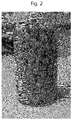
- Fig. 2 shows the obtained product from Example 5.
- Example 3 Using a similar procedure as described in Example 3, the milk white Water Phase 1a and the Water Phase 1b prepared by adding green pigments were fed through the Y-shaped nozzle tip (top has two nozzle tip which are combined downfall to form a single tip at the end) simultaneously to drop to form round emulsion beads having two colors.
- Fig. 3 shows the obtained product from Example 6 as magnified 10 times.
- the round emulsion beads prepared from Examples 4-6 were filled into the spray equipped container. No other external pressure or force was added to allow the round emulsion beads to be filled naturally by gravity.
- the round emulsion beads were thawed from solid to liquid while they were stored at room temperature, the beads maintained its bead shape without swelling, changes of shape or color, or damage.
- the emulsion beads maintained the bead shape without swelling, changes of shape or color, or damage after a long period storage, but also the medium where the beads were stored did not change color due to leaking or diffusion.
- the component used to form the bead shape did not leave any residue on the skin or leave any grainy feeling, and gave an emulsion with the same or a similar texture and feeling prepared without these ingredients.
- the invention can be used in the cosmetic industry.
Landscapes
- Health & Medical Sciences (AREA)
- Life Sciences & Earth Sciences (AREA)
- Public Health (AREA)
- Veterinary Medicine (AREA)
- Animal Behavior & Ethology (AREA)
- General Health & Medical Sciences (AREA)
- Epidemiology (AREA)
- Birds (AREA)
- Chemical & Material Sciences (AREA)
- Engineering & Computer Science (AREA)
- Emergency Medicine (AREA)
- Dispersion Chemistry (AREA)
- Dermatology (AREA)
- Medicinal Chemistry (AREA)
- Pharmacology & Pharmacy (AREA)
- Oil, Petroleum & Natural Gas (AREA)
- Combustion & Propulsion (AREA)
- Physics & Mathematics (AREA)
- Mechanical Engineering (AREA)
- Thermal Sciences (AREA)
- General Engineering & Computer Science (AREA)
- Bioinformatics & Cheminformatics (AREA)
- Chemical Kinetics & Catalysis (AREA)
- General Chemical & Material Sciences (AREA)
- Nuclear Medicine, Radiotherapy & Molecular Imaging (AREA)
- Organic Chemistry (AREA)
- Cosmetics (AREA)
Description
- The present invention relates to a method for preparing round emulsion beads using low temperature cooling.
- In recent years, unless products themselves are "remarkable" (differentiated enough to be remembered), they are not sold well. In addition to the excellent performance of a product itself, a "see-tech-marketing" or "Visual Technology Strategy," i.e., sparking visual pleasure from the appearance of the product to attract consumer attention, has been used as a differentiation strategy for cutting through the competition. The color and shape of the product packaging or container as well as the product itself have been specially designed in the cosmetics industry, with the attempt of providing visual pleasure and aesthetic sense when the product is seen or used.
- As one of the most typically employed formulation systems in the cosmetics industry, "emulsion" refers to a system where oil phase and water phase are evenly dispersed by emulsion technology. Examples of factors that affect the physical and chemical properties of such emulsion can include the type of surfactant, internal/external phase ratio, emulsion type <oil/water (O/W), water/oil (W/O), water/oil/water (W/O/W) and the like>, thickener, particle size and the like; O/W emulsion normally applied in cosmetics is composed of particles of approximately 0.5-10 µm in size.
- Compositions currently used for make-up or skin are generally provided in the form of oil-in-water type emulsions (i.e., excipients constituted of a continuous aqueous dispersion phase and a non-continuous oil dispersion phase) or water-in-oil emulsions (i.e., excipients constituted of a continuous oil dispersion phase and a non-continuous aqueous dispersion phase).
- Thus, water-in-oil emulsions contain a continuous oil phase. It allows to prevent the loss of water passing through the epithelium at the surface of the skin and form a lipid membrane that protects the skin from stimulation from the outside. Such emulsions are particularly suitable to protect the skin, supply it with nourishment, and for the treatment of dry skin. Oil-in-water emulsions provide smoother skin, are less oily and give a lighter feeling than when a water-in-oil emulsion is used.
- Reflecting the latest trends in cosmetics, i.e., sparking fun and emotion, there have been many attempts to transform the unique form, the color and/or texture of emulsion formulation, so as to provide users with visual pleasure, aesthetic sense and pleasure of make-up in addition to the effects derived when the emulsion cosmetics themselves are used.
- In
Korea Patent Application No. 10-1995-0012596 (published on 17 December, 1996 -
Korea Patent Application No. 10-2007-0137515 (published on July 1, 2009 -
Korean Patent Application No. 10-2006-004420 (published on November 15, 2007 - As such, beads formulations known are oil phase particles enlarged in o/w emulsion (
Korean Patent Application No. 10-1995-0012596 Korean Patent Application No. 10-2006-004420 Korean Patent Application No. 10-2007-0137515 - Meanwhile, it was known in the food industry to manufacture bead shape ice cream using a cryogenic freezing method. Ice cream raw material is liquid at room temperature. The ice cream raw material liquid is dropped into a cryogenic refrigerant, such as liquid nitrogen, so as to be solidified in bead shape. The bead shape ice cream manufactured by this method, however, should be stored at a low temperature to maintain the bead shape, as it can revert to be liquid at room temperature.
-
US 6214394 B1 describes a method for the production of two-component ice cream, in which a core of ice cream, the surface of which is cooled to at least about -15°C, is dipped into a fast containing coating solution, in order to form a coating layer, and to the two-component ice cream which can be obtained with the method.WO 2013/002783 A1 relates to a composition comprising a powder coated particulate ice cream product, wherein the particulate ice cream product is cryogenically formed. The particulate ice cream product may further comprise a plurality of coatings including one or more powder coatings.WO 2005/039303 A1 describes an apparatus and method for combining beaded and traditional conventional ice cream.US 5401502 A describes shelf stable plant extract containing pellets, formed by a dispersion of plant extract or extracts in a matrix principally comprising a skeleton builder namely collagen, gelatin, fractionated gelatin, a collagen hydrolysate, gelatin derivative plant proteins, or plant protein hydrolysates, produced by a simple process in which a solution of the skeleton former is mixed with liquid plant extract or emulsified with solid extracts, dissolved or suspended, the dispersion of the skeleton former and the plant extract dropped into a very cold inert fluid, suitably liquid nitrogen, to form the pellets and the thus formed pellets dried.WO 03049489 A2 - The present inventors studied and provide a method for manufacturing solid round emulsion beads by applying a low temperature or cryogenic freezing method to liquid emulsion. The present inventors also studied and provide various methods how to maintain the solid round emulsion beads prepared by the same at room temperature.
- There was a need for not only a method for preparing bead type emulsion, but also a method for maintaining the emulsion in the bead shape for a long period of time at room temperature without swelling and/or disintegration, wherein the bead type emulsion, upon being released from the container and/or being applied on the skin, should easily disintegrate to be applied as a liquid emulsion without any unpleasant foreign substance feeling upon application on the skin.
- The present inventors employed a cryogenic method of dropping liquid emulsion into the cryogenic refrigerant for freezing to form solid round emulsion beads. The solid emulsion beads can be stored or used at a low temperature as it is. The solid round emulsion beads can be coated with a solution containing a material which is solid at room temperature or which can form gel. The emulsion beads can be prepared by using liquid emulsion containing additional material, which is solid at room temperature or can form gel, in the water phase of oil-in-water (O/W) emulsion or the oil phase of oil-in-water (W/O) emulsion. The emulsion beads can maintain its shape without swelling and/or damage but with stability and does not give any grainy feeling when the liquid emulsion was applied on the skin.
- Solid round emulsion beads of the present invention, prepared by a cryogenic freezing method, can be stored and used as it is, at a low temperature. The liquid bead emulsion beads can be obtained using a material which is solid or can form gel at room temperature. These beads can maintain the shape stably for a long time period without swelling and/or damage at room temperature. When withdrawn from the container or applied on the skin, the beads can be destructed easily to work as a liquid emulsion. The destructed emulsion is applied on the skin without giving unpleasant foreign substance feeling.
-
-
Figure 1 is a photograph of a vessel filled with the white emulsion beads prepared without a pigment as described in Example 3, -
Figure 2 is a photograph of a vessel filled with the emulsion beads prepared with a pigment as described in Example 4, -
Figure 3 is a photograph of the emulsion beads having two colors, prepared as described in Example 6. - The first object of the invention to provide a method for preparing emulsion beads by dropping liquid emulsion to a freezing solvent at a temperature no higher than 0 °C to produce a solid phase emulsion beads.
- In the present invention, the above-described freezing refrigerant is refrigerant maintaining low temperature to freeze the liquid emulsion beads to form solid phase emulsion beads. The temperature of coolant (coolant temperature), for example, is at or below 0 °C, specifically at a temperature of 0 °C ∼ -200 °C, preferably at a temperature of -10 °C ∼ -200 °C, more preferably at a temperature of -15 °C ∼ -150 °C, specifically it may be selected at a temperature of -20 °C ∼ -100 °C. The low-temperature refrigerant is selected from the group consisting of: silicon oil or mineral oil;. Th oil such as silicon and mineral oils are liquid at a low temperature and can be used as a low temperature refrigerant by using cooler, liquid gas, or other cooling method (for example, a mixture of dry ice and acetone, a mixture of ice and ethanol, etc.) to make it as cold as needed.
- On the other hand, in the present invention the freezing refrigerant is a liquid or liquid mixture having a fluidity in the freezing temperature. The fluidity of the liquid is about 30 centipoise or less at freezing temperature, specifically 20 centipoise or lower, preferably 10 centipoise or less, and more preferably a viscosity of less than 5 centipoise .
- Conventional cryogenic refrigerant which may be used as the freezing refrigerant in the present invention can remain in liquid phase at a temperature at or lower than 0 °C and can maintain a temperature at or lower than 0 °C by itself and the example include liquid nitrogen, liquid oxygen or liquid air and also can include liquid hydrocarbons.
- In the present invention, the freezing refrigerant is a liquid oil having fluidity at or lower than 0°C, for example, a silicone oil or mineral oil. Silicone oils and mineral oils can be preferably used because it can maintain sufficient fluidity in the freezing temperature above because the viscosity does not change by the temperature changes. Examples of silicone oil include dimethyl silicone oil, methylphenyl silicone oil, methyl hydrogen silicone oil, methylhydroxy-silicone oil, silicone flow oil, polyoxyethylene ether copolymer, alkyl modified silicone oil, higher fatty acid-modified silicone oil, amino-modified silicone. It can also refer to the oil and the epoxy-modified silicone oil. The mineral oil is a by-product produced in the process referred to as liquid oil, or a mineral oil, obtained during purification of the crude oil, and the main component is an alkane and paraffin.
- In general, the cryogenic freezing means freezing at temperature like -200°C like liquid nitrogen or liquid air, but in the present invention this separation is not critical.
- When using an oil in the liquid state at or below 0 °C, such as silicone oil or mineral oil, as the refrigerant freezing, freezing temperature is below 0 °C, especially from -10 °C or less, preferably -15 °C or less, more preferably -20 °C or less but -100 °C or higher, especially less than -80 °C, preferably -60 °C or higher, more preferably be selected -50 °C or higher.
- According to one embodiment, the above-mentioned silicone oil and mineral oil is liquid at a low temperature of less than 0 °C as oil cooler, liquefied gas or other cooling techniques (for example, a mixture of dry ice and acetone, ice and ethanol mixture) use can be used as the low temperature coolant to cool to the desired low temperature, and the above-mentioned liquid nitrogen, liquid oxygen, liquid air or liquefied gas, such as may be used by itself as a low-temperature refrigerant. In some cases, it is also possible to use a liquid hydrocarbon with a low temperature refrigerant.
- According to one embodiment, the size of the emulsion bead is 0.5 - 20mm, preferably 1 - 10mm, particularly 2 - 6mm.
- One embodiment of the method of the present invention may further comprises coating the solid round emulsion bead with a solution containing a lipid material or a gel-forming material which is solid at room temperature.
- According to one embodiment, the liquid emulsion can be water-in-oil (W/O), oil-in-water (O/W), water-in-oil-in-water (W / O / W), or oil-in-water-in-oil (O / W / O) type emulsion.
- According to one preferred embodiment, the liquid emulsion may contain a lipid material which is continuous phase and solid at room temperature or a gel-forming material.
- According to one embodiment, the lipid material which is a solid at room temperature can be selected from the group consisting of behenyl alcohol, cetyl alcohol, stearyl alcohol, glyceryl monostearate, cetostearyl alcohol or polyalcohol such as batyl alcohol, fatty acid, lipid peptide and a mixture thereof.
- According to one embodiment, the gel-forming material can be selected from the group consisting of a gel-forming polymer such as a cationic polymer, a gum material such as Indiana gum, guar gum or Traganth gum, carrageenan, agar, and a mixture thereof.
- The emulsion beads resulting from the method can also be an angulated shape, rod shape, cylindrical shape, rugby ball shape, or chain shape.
- In the present invention, the droplet size (diameter or longest distance) of the emulsion is 0.5 - 20mm, specifically, 1 - 10 mm, and preferably 2 - 8mm, especially from 3 - 6mm. The droplet of the emulsion can be controlled by modifying the emulsion viscosity, the nozzle diameter, or the spray pressure. A person of ordinary skill in the art can adjust the emulsion viscosity, the nozzle diameter, or the spray pressure to obtain desirably sized droplet.
- In the present invention, the solution (hereafter "coating solution") used for coating the solid round emulsion beads can contain a lipid material solid at room temperature or a gel-forming material. The coating solution can be dispersed liquid or may have be in emulsion form. The coating can be performed by spraying the coating solution, or dipping in the coating solution, or by rolling on a film of the coating solution. The temperature of coating process or coating solution is not limited specifically, but any temperature is allowable as long as the solid round emulsion beads do not dissolve during the coating process. For example, the coating temperature can be no higher than 0°C, preferably no higher than -10°C, more preferably no higher than - 20°C. The coating solution can be at the temperature similar to the process temperature or at 5 - 10°C lower than the process temperature. Preferably, it would be beneficial to consistently coating and adjusting coating thickness, if the coating solution remains liquid during the process or at the process temperature.
- For example, the round emulsion beads of the present invention can be prepared by use of an oil-in-water (O / W) type emulsion, as follows. The coating solution is prepared by dissolving or dispersing lipid material, which is solid at room temperature (for example, behenyl alcool or glyceryl monostearate), in ethanol, and cooling it to -10°C. The coating solution is sprayed to the solid round emulsion beads, and ethanol is removed under reduced pressure to form a film on the surface of the solid round emulsion beads. Then, the temperature is increased to reach room temperature. The liquid emulsion is collected within the lipid film and obtain it as round beads. The lipid material solid at room temperature is included in about 0.1 - 10 wt%, specifically 0.2 - 7 wt%, preferably 0.3 - 5 wt%, more preferably 0.5 - 5 wt% of the total weight of the solid round emulsion beads. When the amount of the lipid material is no more than 0.1 wt%, it may be difficult to maintain the shapes of the resultant round emulsion beads at room temperature. If it is no less than 10 wt%, the round emulsion beads cannot be easily cracked, or grainy feelings may increase when applied on the skin.
- In the present invention, the gel-forming material is selected from a group consisting of a gel-forming polymer, such as a cationic polymer; a gum material, such as Indian gum or guar gum; carrageenan; agar and a mixture thereof. In addition, plant extract such as Tragacanth gum or Arabian gum; plant materials such as locust bean gum seed gum, guar gum, and; semisynthetic rubber-like material, such as CMC (carboxymethyl cellulose), hydroxypropyl cellulose and methyl cellulose; seaweed extract such as alginate; fermentation products such as Xanthan gum and dextran; and low methoxy pectin. The gel-forming material is included in the round emulsion beads in 0.1 to 5% by weight, especially from 0.2 to 4% by weight, preferably 0.4 to 3% by weight, more preferably from 0.5 to 2% by weight of the total weight of the beads. If the amount is no more than 0.1 wt%, it is difficult to maintain the shapes of the resultant round emulsion beads at room temperature. If it is no less than 5 wt%, the round emulsion beads cannot be easily cracked, or grainy feelings may increase when applied on the skin.
- According to a particular embodiment of the present invention, a single bead where two different emulsions co-exist can be produced by making emulsions having a same or different compositions as a liquid droplet, and dropping and freezing the liquid droplet at a low temperature. The method for preparing the liquid droplet with two or more emulsions is not limited. For example, it can be prepared using Y-shape type tip, which has two or more branches for supply of raw material within a single nozzle, or a hollow type tip having the supply branch in another supply branch. The ratio of the emulsion feeding can be controlled by modifying the diameter of the supply branch for the Y-shape type tip or the hollow type tip, the speed of the raw material feeding, and /or the diameter of the nozzle tip.
- According to another particular embodiment of the present invention, it is also possible to prepare the round emulsion beads having emulsions layered with the same core, wherein the multiple emulsions can have a same or different compositions. First, one emulsion is used to produce solid round emulsion beads by a low-temperature freezing method, and additional emulsion is either sprayed or coated on top of the beads and they are treated with a low-temperature freezing process to provide multi-layered round emulsion beads. Or, the hollow tip can be used for the liquid droplets to control the emulsion feeding speed to provide the multi-layered liquid droplets. Alternatively, it is also possible to use any method for producing liquid droplets with a core-shell structure.
- According to the method, each bead can contain two or more layered emulsions having different functions (e.g., color, fragrance), or compositions (different compositions, different ratios). The method for preparing the round emulsion beads having two or more layered emulsions having different functions, for example, can be used for preparing cosmetic compositions using color transferring system.
- On the other hand, the present invention can prepare a round bead-form emulsion or an emulsion having a round bead form from any emulsion having water phase as the continuous phase, including O/W emulsion. Up to now, making the emulsion itself in a round bead shape or impregnated in the form of capsules, i.e., the beads or the capsules containing emulsion as it is were not known, and thus, the present invention provides new fields and application potential in cosmetic formulation industry.
- In addition, in the bead shape products such as STARPHERE (a marketed product by KTP) and Unisphere products (a marketed product by INDU Chem), cosmetic raw material for Visual Carrier System is provided in bead shape. However, they do not swell in oil phase and thus, can be used only in cosmetics having water continuous phase, such as O/W emulsion.
- On the other hand, because the round emulsion beads of the present invention are already swollen and can deliver the unique emulsion feeling for application, they can offer very distinct and superior application feeling compared to the conventional simple shaped arginic acid beads of agar beads. In addition, the emulsion beads of the present invention can be utilized for compositions having oily continuous phase (e.g. W/O emulsion) or water continuous phase (e.g. O/W emulsion).
- The present invention is described below in more details by the following examples.
- A water in oil emulsion was prepared based on the compositions in Table 1 by the steps of (a) to (d). The composition of each ingredient in Table 1 is weight %.
Table 1. Example 1 Oil Phase Stearyl alcohol 2.20 Stearic acid 1.00 Glyceryl stearate 2.00 Mineral oil 30.00 Water Phase 1 Purified water To 100 Disodium EDTA 0.02 Triethanolamine 0.2 Propylene glycol 3.00 Water Phase 2 Purified Water 10 Carbomer 0.05 - (a) All ingredients for the Oil Phase in Table 1 were mixed evenly with heating (70-75 °C).
- (b) All ingredients for the Water Phase 1 in Table 1 were dissolved and mixed evenly with heating (70-75 °C).
- (c) The mixture of (a) was added to the solution (b) at the temperature of 70-75 °C with stirring to obtain an emulsion.
- (d) The Water Phase 2 was added to increase the viscosity and cooled to about 30 °C.
- Mineral Oil is cooled to -78 °C using dry ice and acetone. The water-in-oil liquid emulsion obtained from (1) was dropped through tip of 1 mm diameter to the mineral oil, so as to form a liquid droplet having diameter of 2-3 mm. The round emulsion beads are isolated and stored in a refrigerator at -10°C. Even after storing a long time period, no change in shape or aggregation was observed.
- Except adding 1 wt% of carrageenan to the Water Phase 1, the same procedure was used as described in Example 1 to form water-in-oil emulsion.
- Except that the mineral oil is cooled to -20 °C in a low temperature refrigeration circulator, the same procedure described in Example 1 was used to prepare solid round emulsion beads.
- The solid round emulsion beads obtained from (2) were filled into a clear container. Thereto was added a mineral oil, and the resulting mixture was warmed up to room temperature to convert the round emulsion beads to liquid phase.
- Although the liquid round emulsion beads in a clear container were allowed to stand for a long period time at room temperature, no damage by swelling, aggregation, or compression, or no change in shape was observed in the beads. There was no change in the transparency and/or color in the medium observed.
- A sprayer was installed on the clear container filled with the liquid round emulsion beads. Pressing the sprayer broke the liquid emulsion beads around the injecting tube and the liquid emulsion was ejected through the outlet of the sprayer.
- According to the composition shown in Table 2, the ingredients in the Water Phase 1 (Raw Material 3) were mixed, heated to 90 °C and dissolved to make the Water Phase 1. The resultant Water Phase 1 was delivered to a main mixer.
- Next, according to the composition shown in Table 2, ingredients for the Oil Phase (Raw Material 1) were mixed and heated to 72 - 74 °C to prepare an oil phase. To the oil phase, Silicon 244 (Raw Material 2) was added at 68 - 70 °C and the resultant mixture was delivered to the main mixer.
- The Raw Material 1, 2 and 3 were emulsified.
- In a gum mixer, a thickening agent (e.g. carbopol 941) (Raw Material 5) was dispersed in purified water (Raw Material 4) to prepare the Water Phase 2. The Water Phase 2 was delivered to the main mixer and emulsified again.
- When the temperature of the produced emulsion is reduced to 48 - 50 °C, a solution of preservatives (e.g. GERMALL 115), MPC (milk protein concentrates), and Fragrance (components 6-8) dissolved in a small amount of water was added to the main mixer and the mixture was heated to about 70 °C. The product emulsion was prepared at the temperature.
- The obtained emulsion was dropped into mineral oil at -20°C through a nozzle tip and isolated upon freezing to obtain solid round emulsion beads with milk white color, i.e. characteristic color of an emulsion. The obtained solid round emulsion beads have about 2-3 mm size and composition of Table 2.
Fig. 1 shows the product obtained in Example 3.[Table 2] Phase Raw Material Ingredients or Commercial Product name Content (Wt%) Oil Phase 1 Lanetto-O 0.67 Arlacel-165 0.84 W4kEM-205 1.01 Prophyl Paraben 0.06 Isocetylmyristate (ICM-R) 5.04 Octyldodecyl myristate (EUTANOL GM) 1.68 Emusifier (TEGO CARE PS) 1.26 2 Silicon 244 (SILICONE 244) 0.84 Water Phase 1 3 Purified water 55.94 P.G 2.52 Glycerin (98%_) 3.36 Preservative (DANISOL-M) 0.17 Disodium EDTA 0.02 Agar 1.00 TEA-PURE 0.10 Water Phase 2 4 Purified Water 10.08 5 Emulsifier (CARBOPOL 941) 0.10 Excipients 6 Preservative (GERMALL 115) 0.17 7 MPC 0.02 8 Fragrance 0.13 - The shape change or breakage was not observed even after the solid round emulsion beads were converted to liquid at room temperature. The obtained round emulsion beads can be used as liquid emulsion by applying on the skin and rubbing. Upon application, all ingredients in the emulsion beads did not leave any grainy feeling or leaving any residue and provide the same or similar touch and utility feeling from those emulsions prepared without these ingredients.
- Except that different pigments (single or mixture) were added to the Water Phase 1, the process of Example 3 was repeated to prepare round emulsion beads with different colors except milk white. The obtained round emulsion beads were about 2-3 mm size.
- Except that a variety of pearl was added to the Water Phase 1, the process of Example 3 was repeated to prepare round emulsion beads with pearl color. The obtained round emulsion beads were about 2-3 mm size.
Fig. 2 shows the obtained product from Example 5. - Using a similar procedure as described in Example 3, the milk white Water Phase 1a and the Water Phase 1b prepared by adding green pigments were fed through the Y-shaped nozzle tip (top has two nozzle tip which are combined downfall to form a single tip at the end) simultaneously to drop to form round emulsion beads having two colors.
- The obtained two colored round emulsion beads were about 2-3 mm size.
Fig. 3 shows the obtained product from Example 6 as magnified 10 times. - The round emulsion beads prepared from Examples 4-6 were filled into the spray equipped container. No other external pressure or force was added to allow the round emulsion beads to be filled naturally by gravity.
- Even though the round emulsion beads were thawed from solid to liquid while they were stored at room temperature, the beads maintained its bead shape without swelling, changes of shape or color, or damage. In addition, not only the emulsion beads maintained the bead shape without swelling, changes of shape or color, or damage after a long period storage, but also the medium where the beads were stored did not change color due to leaking or diffusion.
- In the discharge test with a sprayer, the liquid round emulsion beads in the container were drawn into the spray tubing without any resistance and it was also observed that consistent emulsion was released as liquid through the releasing outlet.
- Also by applying a liquid emulsion discharged on the skin, the component used to form the bead shape did not leave any residue on the skin or leave any grainy feeling, and gave an emulsion with the same or a similar texture and feeling prepared without these ingredients.
- The invention can be used in the cosmetic industry.
Claims (8)
- A method for preparing a round emulsion bead comprising: dropping liquid emulsion to a cryogenic refrigerant at a temperature of no higher than 0 °C to prepare a solid round emulsion bead, wherein the liquid emulsion further comprises a lipid material which is solid at room temperature or a gel-forming material, wherein the cryogenic refrigerant is selected from the group consisting of silicone oil and mineral oil.
- The method of claim 1, wherein the cryogenic refrigerant is at -10 to - 200 °C.
- The method of claim 1, wherein the liquid emulsion is water-in-oil (W / O), oil-in-water (O / W), water-in-oil-in-water (W / O / W), or oil-in water-in-oil (O / W / O) type emulsion.
- The method of claim 1, further comprising coating the solid round emulsion bead with a solution comprising a lipid material which is solid at room temperature or a gel-forming material.
- The method of claims 4, wherein the lipid material which is solid at room temperature is selected from the group consisting of behenyl alcohol, cetyl alcohol, stearyl alcohol, glyceryl monostearate, cetostearyl alcohol, poly alcohols such as batyl alcohol, fatty acid, lipid peptides and a mixture thereof.
- The method of claim 4, wherein the gel-forming material is selected from the group consisting of a gel-forming polymer such as a cationic polymer, a gum material such as Indiana gum, guar gum or Traganth gum, carrageenan, agar, and a mixture thereof.
- The method of claim 1, comprising preparing a liquid droplet by mixing two or more liquid emulsions and dropping the liquid droplet to form a round emulsion bead.
- The method of claim 1, wherein two or more different liquid emulsions are combined using a Y-shaped or hollow-shaped tip to form a liquid droplet.
Applications Claiming Priority (1)
| Application Number | Priority Date | Filing Date | Title |
|---|---|---|---|
| PCT/KR2013/002592 WO2014157752A1 (en) | 2013-03-28 | 2013-03-28 | Method for manufacturing emulsion bead by low-temperature cooling, and emulsion bead yielded thereby |
Publications (3)
| Publication Number | Publication Date |
|---|---|
| EP2979690A1 EP2979690A1 (en) | 2016-02-03 |
| EP2979690A4 EP2979690A4 (en) | 2016-08-10 |
| EP2979690B1 true EP2979690B1 (en) | 2021-08-25 |
Family
ID=51624704
Family Applications (1)
| Application Number | Title | Priority Date | Filing Date |
|---|---|---|---|
| EP13880306.9A Active EP2979690B1 (en) | 2013-03-28 | 2013-03-28 | Method for manufacturing emulsion bead by low-temperature cooling, and emulsion bead yielded thereby |
Country Status (5)
| Country | Link |
|---|---|
| US (2) | US9662282B2 (en) |
| EP (1) | EP2979690B1 (en) |
| KR (1) | KR101553233B1 (en) |
| CN (1) | CN105101954B (en) |
| WO (1) | WO2014157752A1 (en) |
Cited By (2)
| Publication number | Priority date | Publication date | Assignee | Title |
|---|---|---|---|---|
| US12171848B2 (en) | 2018-12-31 | 2024-12-24 | Lvmh Recherche | Solid cosmetic composition containing anhydrous spheroids dispersed in a solid continuous aqueous phase |
| US12409108B2 (en) | 2018-12-31 | 2025-09-09 | Lvmh Recherche | Solid cosmetic composition containing aqueous spheroids dispersed in a solid continuous anhydrous phase |
Families Citing this family (16)
| Publication number | Priority date | Publication date | Assignee | Title |
|---|---|---|---|---|
| KR102440320B1 (en) * | 2015-06-08 | 2022-09-05 | 주식회사 엘지생활건강 | Perfume beads and toothpaste comprising the same, and the preparation method thereof |
| KR101814152B1 (en) | 2015-07-09 | 2018-01-03 | (주)케이피티 | Cosmetic which are combined with bead typed liquid foundation cosmetic composition and net constructional cosmetic container |
| KR101669653B1 (en) * | 2016-03-21 | 2016-10-26 | (주)바이오제닉스 | Emulsion beads and manufacturing method thereof |
| WO2017195913A1 (en) * | 2016-05-11 | 2017-11-16 | (주)케이피티 | Solid emulsion beads containing titanium dioxide, and immediate whitening cosmetic composition using same |
| KR102224314B1 (en) * | 2017-07-31 | 2021-03-09 | (주)아모레퍼시픽 | Dispersion formulation cosmetic composition comprising spherical particle |
| CN107823139B (en) * | 2017-11-03 | 2021-01-08 | 西安科艺诗生物技术有限公司 | Anti-freezing multiple emulsified gel composition and application thereof |
| FR3075635B1 (en) * | 2017-12-22 | 2019-12-06 | Lvmh Recherche | PROCESS FOR THE PREPARATION OF ANHYDROUS SPHEROIDS BY CRYOGENIA |
| KR102060421B1 (en) | 2018-03-15 | 2019-12-30 | 서울대학교산학협력단 | Wax oil beads encapsulated with poorly soluble antifungal agent and processes for preparing the same |
| KR20190126015A (en) | 2018-04-30 | 2019-11-08 | 주식회사 케이피티 | Process for preparing color change soft emulsion beads containing pearl pigment |
| KR102130298B1 (en) | 2018-09-11 | 2020-07-08 | 코스맥스 주식회사 | Method for producing solid beads comprising oil-soluble pastes and gel-type oils |
| KR102750723B1 (en) * | 2019-05-31 | 2025-01-08 | (주)아모레퍼시픽 | Cosmetic composition for freezing storage |
| KR102833503B1 (en) * | 2019-12-30 | 2025-07-14 | 주식회사 케이피티 | Bead-type cosmetic compositions having ceramide-based capsules |
| KR20210122385A (en) * | 2020-03-31 | 2021-10-12 | 주식회사 케이피티 | Cosmetic composition containing the natural extracts for improving or preventing acne |
| KR102296304B1 (en) | 2020-11-30 | 2021-09-01 | 조광용 | A production method of hyaluronic acid bead gel having high swelling characteristics |
| KR102366394B1 (en) | 2021-01-05 | 2022-02-23 | 조광용 | A hyaluronic acid bead gel having high swelling characteristics |
| US20240239996A1 (en) * | 2023-01-17 | 2024-07-18 | Aradhita Ajaykumar Parasrampuria | Composition and method for forming beads |
Family Cites Families (15)
| Publication number | Priority date | Publication date | Assignee | Title |
|---|---|---|---|---|
| US5019400A (en) * | 1989-05-01 | 1991-05-28 | Enzytech, Inc. | Very low temperature casting of controlled release microspheres |
| DE4201179A1 (en) * | 1992-01-17 | 1993-07-22 | Alfatec Pharma Gmbh | Granulates or pellets comprising dispersion of active agent in hydrophilic macromolecules - are e.g. for treatment of depression, hypertension, rheumatism, etc. |
| DE19713191A1 (en) * | 1997-03-27 | 1998-10-01 | Schoeller Lebensmittel | Ice cream with fatty coating |
| US6209329B1 (en) * | 1998-04-24 | 2001-04-03 | Dippin' Dots, Inc. | Cryogenic processor for liquid feed preparation of a free-flowing frozen product |
| AU2002366616A1 (en) * | 2001-12-10 | 2003-06-23 | Hte Aktiengesellschaft The High Throughput Experimentation Company | Production and shaping of shaped bodies by means of low-temperature cooling and drying processes |
| US6858666B2 (en) * | 2002-03-04 | 2005-02-22 | Aveka, Inc. | Organogel particles |
| GB2399084B (en) * | 2002-07-30 | 2007-01-31 | Univ Liverpool | Porous beads and method of production thereof |
| MXPA05012940A (en) * | 2003-10-07 | 2006-02-13 | Dippin Dots Inc | Combined particulate and traditional ice cream. |
| GB0401947D0 (en) * | 2004-01-28 | 2004-03-03 | Unilever Plc | Porous bodies and method of production thereof |
| KR100537266B1 (en) * | 2004-03-12 | 2005-12-19 | 주식회사 엘지생활건강 | Solid cosmetic composition in the form of water-in-oil emulsion |
| GB0501833D0 (en) | 2005-01-28 | 2005-03-09 | Unilever Plc | Carrier liquids and methods of production thereof |
| KR100786194B1 (en) | 2006-04-24 | 2007-12-21 | 박교훈 | Assembly structure of the pallet for goods packaging |
| KR100787328B1 (en) | 2006-05-11 | 2007-12-18 | (주)아모레퍼시픽 | Emulsion composition having macro-sized lipid capsule particles and skin cosmetic composition using same |
| AU2011341738B2 (en) | 2010-12-15 | 2015-08-20 | Speximo Ab | New particle stabilized emulsions and foams |
| WO2013002783A1 (en) * | 2011-06-29 | 2013-01-03 | Dippin' Dots, Inc. | Improved method and system of powder coating particulate ice cream |
-
2013
- 2013-03-28 US US14/443,228 patent/US9662282B2/en active Active
- 2013-03-28 EP EP13880306.9A patent/EP2979690B1/en active Active
- 2013-03-28 KR KR1020147030858A patent/KR101553233B1/en active Active
- 2013-03-28 WO PCT/KR2013/002592 patent/WO2014157752A1/en not_active Ceased
- 2013-03-28 CN CN201380075175.2A patent/CN105101954B/en active Active
-
2017
- 2017-04-14 US US15/488,045 patent/US10080709B2/en active Active
Non-Patent Citations (1)
| Title |
|---|
| None * |
Cited By (2)
| Publication number | Priority date | Publication date | Assignee | Title |
|---|---|---|---|---|
| US12171848B2 (en) | 2018-12-31 | 2024-12-24 | Lvmh Recherche | Solid cosmetic composition containing anhydrous spheroids dispersed in a solid continuous aqueous phase |
| US12409108B2 (en) | 2018-12-31 | 2025-09-09 | Lvmh Recherche | Solid cosmetic composition containing aqueous spheroids dispersed in a solid continuous anhydrous phase |
Also Published As
| Publication number | Publication date |
|---|---|
| EP2979690A1 (en) | 2016-02-03 |
| US9662282B2 (en) | 2017-05-30 |
| KR20140144264A (en) | 2014-12-18 |
| KR101553233B1 (en) | 2015-09-15 |
| US10080709B2 (en) | 2018-09-25 |
| CN105101954B (en) | 2019-06-04 |
| WO2014157752A1 (en) | 2014-10-02 |
| EP2979690A4 (en) | 2016-08-10 |
| CN105101954A (en) | 2015-11-25 |
| US20170216159A1 (en) | 2017-08-03 |
| US20150297474A1 (en) | 2015-10-22 |
Similar Documents
| Publication | Publication Date | Title |
|---|---|---|
| US10080709B2 (en) | Method for preparing round emulsion beads using low temperature cooling and the product thereof | |
| US6572892B1 (en) | Cosmetic or dermopharmaceutical composition in the form of beads and methods for preparing same | |
| CN101606901B (en) | Lipstick with high water content and preparation method thereof | |
| EP1904024B1 (en) | Encapsulated cosmetic compositions | |
| JP2003530996A (en) | Temperature-controlled microcapsules exhibiting zero-order release and methods for their preparation | |
| JP5955225B2 (en) | How to prepare cosmetic powder beads | |
| JPH04346909A (en) | Gel-like cosmetic containing oily substance and method for manufacturing same | |
| JP5676134B2 (en) | Freeze-dried molded product, method of using the same, and parts kit product thereof | |
| CN105166094A (en) | Preparation method of microcapsules composited by evening primrose oil and rosehip oil | |
| KR101663141B1 (en) | Cosmetic compositions having skin moisturizing containing capsule, and method for producing the same | |
| ES2587016T5 (en) | New compositions of fat-soluble substances | |
| TW201811296A (en) | Agar film capsule | |
| CN114209600B (en) | Preparation method and application of powder | |
| KR101494100B1 (en) | Method of preparing heat-soluble macrocapsules | |
| CN107823139B (en) | Anti-freezing multiple emulsified gel composition and application thereof | |
| CN115400033A (en) | A kind of microcapsule shell material and microcapsule preparation method | |
| US20230147292A1 (en) | Improved formulations of lipophilic subtances for cosmetic uses | |
| CN102858187A (en) | Novel coating system | |
| KR101180867B1 (en) | Bioactive substance stabilized semipermeable microcapsule using polylysine and the process for preparation thereof, and the cosmetic composition containing thereof | |
| CN121622479A (en) | A color-changing foundation stick with high water content and its preparation method | |
| JP2003238351A (en) | Capsule-containing skin care composition | |
| JP2025185999A (en) | Method for producing composite particles | |
| JP2025186000A (en) | composite particles | |
| KR20200036305A (en) | Capsule containing natural porous polymer, manufacturing method for manufacturing the same, and cosmetic composition containing the same |
Legal Events
| Date | Code | Title | Description |
|---|---|---|---|
| PUAI | Public reference made under article 153(3) epc to a published international application that has entered the european phase |
Free format text: ORIGINAL CODE: 0009012 |
|
| 17P | Request for examination filed |
Effective date: 20150922 |
|
| AK | Designated contracting states |
Kind code of ref document: A1 Designated state(s): AL AT BE BG CH CY CZ DE DK EE ES FI FR GB GR HR HU IE IS IT LI LT LU LV MC MK MT NL NO PL PT RO RS SE SI SK SM TR |
|
| AX | Request for extension of the european patent |
Extension state: BA ME |
|
| DAX | Request for extension of the european patent (deleted) | ||
| A4 | Supplementary search report drawn up and despatched |
Effective date: 20160711 |
|
| RIC1 | Information provided on ipc code assigned before grant |
Ipc: A61K 8/06 20060101ALI20160705BHEP Ipc: A61P 17/00 20060101ALI20160705BHEP Ipc: A61K 9/16 20060101AFI20160705BHEP Ipc: A61Q 19/00 20060101ALI20160705BHEP Ipc: A61K 8/02 20060101ALI20160705BHEP |
|
| STAA | Information on the status of an ep patent application or granted ep patent |
Free format text: STATUS: EXAMINATION IS IN PROGRESS |
|
| 17Q | First examination report despatched |
Effective date: 20170609 |
|
| GRAP | Despatch of communication of intention to grant a patent |
Free format text: ORIGINAL CODE: EPIDOSNIGR1 |
|
| STAA | Information on the status of an ep patent application or granted ep patent |
Free format text: STATUS: GRANT OF PATENT IS INTENDED |
|
| INTG | Intention to grant announced |
Effective date: 20210420 |
|
| GRAS | Grant fee paid |
Free format text: ORIGINAL CODE: EPIDOSNIGR3 |
|
| GRAA | (expected) grant |
Free format text: ORIGINAL CODE: 0009210 |
|
| STAA | Information on the status of an ep patent application or granted ep patent |
Free format text: STATUS: THE PATENT HAS BEEN GRANTED |
|
| AK | Designated contracting states |
Kind code of ref document: B1 Designated state(s): AL AT BE BG CH CY CZ DE DK EE ES FI FR GB GR HR HU IE IS IT LI LT LU LV MC MK MT NL NO PL PT RO RS SE SI SK SM TR |
|
| REG | Reference to a national code |
Ref country code: GB Ref legal event code: FG4D |
|
| REG | Reference to a national code |
Ref country code: CH Ref legal event code: EP |
|
| REG | Reference to a national code |
Ref country code: IE Ref legal event code: FG4D Ref country code: AT Ref legal event code: REF Ref document number: 1423067 Country of ref document: AT Kind code of ref document: T Effective date: 20210915 |
|
| REG | Reference to a national code |
Ref country code: DE Ref legal event code: R096 Ref document number: 602013079010 Country of ref document: DE |
|
| REG | Reference to a national code |
Ref country code: GR Ref legal event code: EP Ref document number: 20210402799 Country of ref document: GR Effective date: 20211111 |
|
| REG | Reference to a national code |
Ref country code: LT Ref legal event code: MG9D |
|
| REG | Reference to a national code |
Ref country code: NL Ref legal event code: MP Effective date: 20210825 |
|
| REG | Reference to a national code |
Ref country code: AT Ref legal event code: MK05 Ref document number: 1423067 Country of ref document: AT Kind code of ref document: T Effective date: 20210825 |
|
| PG25 | Lapsed in a contracting state [announced via postgrant information from national office to epo] |
Ref country code: RS Free format text: LAPSE BECAUSE OF FAILURE TO SUBMIT A TRANSLATION OF THE DESCRIPTION OR TO PAY THE FEE WITHIN THE PRESCRIBED TIME-LIMIT Effective date: 20210825 Ref country code: SE Free format text: LAPSE BECAUSE OF FAILURE TO SUBMIT A TRANSLATION OF THE DESCRIPTION OR TO PAY THE FEE WITHIN THE PRESCRIBED TIME-LIMIT Effective date: 20210825 Ref country code: HR Free format text: LAPSE BECAUSE OF FAILURE TO SUBMIT A TRANSLATION OF THE DESCRIPTION OR TO PAY THE FEE WITHIN THE PRESCRIBED TIME-LIMIT Effective date: 20210825 Ref country code: LT Free format text: LAPSE BECAUSE OF FAILURE TO SUBMIT A TRANSLATION OF THE DESCRIPTION OR TO PAY THE FEE WITHIN THE PRESCRIBED TIME-LIMIT Effective date: 20210825 Ref country code: BG Free format text: LAPSE BECAUSE OF FAILURE TO SUBMIT A TRANSLATION OF THE DESCRIPTION OR TO PAY THE FEE WITHIN THE PRESCRIBED TIME-LIMIT Effective date: 20211125 Ref country code: AT Free format text: LAPSE BECAUSE OF FAILURE TO SUBMIT A TRANSLATION OF THE DESCRIPTION OR TO PAY THE FEE WITHIN THE PRESCRIBED TIME-LIMIT Effective date: 20210825 Ref country code: PT Free format text: LAPSE BECAUSE OF FAILURE TO SUBMIT A TRANSLATION OF THE DESCRIPTION OR TO PAY THE FEE WITHIN THE PRESCRIBED TIME-LIMIT Effective date: 20211227 Ref country code: NO Free format text: LAPSE BECAUSE OF FAILURE TO SUBMIT A TRANSLATION OF THE DESCRIPTION OR TO PAY THE FEE WITHIN THE PRESCRIBED TIME-LIMIT Effective date: 20211125 Ref country code: FI Free format text: LAPSE BECAUSE OF FAILURE TO SUBMIT A TRANSLATION OF THE DESCRIPTION OR TO PAY THE FEE WITHIN THE PRESCRIBED TIME-LIMIT Effective date: 20210825 Ref country code: ES Free format text: LAPSE BECAUSE OF FAILURE TO SUBMIT A TRANSLATION OF THE DESCRIPTION OR TO PAY THE FEE WITHIN THE PRESCRIBED TIME-LIMIT Effective date: 20210825 |
|
| PG25 | Lapsed in a contracting state [announced via postgrant information from national office to epo] |
Ref country code: PL Free format text: LAPSE BECAUSE OF FAILURE TO SUBMIT A TRANSLATION OF THE DESCRIPTION OR TO PAY THE FEE WITHIN THE PRESCRIBED TIME-LIMIT Effective date: 20210825 Ref country code: LV Free format text: LAPSE BECAUSE OF FAILURE TO SUBMIT A TRANSLATION OF THE DESCRIPTION OR TO PAY THE FEE WITHIN THE PRESCRIBED TIME-LIMIT Effective date: 20210825 |
|
| PG25 | Lapsed in a contracting state [announced via postgrant information from national office to epo] |
Ref country code: NL Free format text: LAPSE BECAUSE OF FAILURE TO SUBMIT A TRANSLATION OF THE DESCRIPTION OR TO PAY THE FEE WITHIN THE PRESCRIBED TIME-LIMIT Effective date: 20210825 |
|
| PG25 | Lapsed in a contracting state [announced via postgrant information from national office to epo] |
Ref country code: DK Free format text: LAPSE BECAUSE OF FAILURE TO SUBMIT A TRANSLATION OF THE DESCRIPTION OR TO PAY THE FEE WITHIN THE PRESCRIBED TIME-LIMIT Effective date: 20210825 |
|
| REG | Reference to a national code |
Ref country code: DE Ref legal event code: R097 Ref document number: 602013079010 Country of ref document: DE |
|
| PG25 | Lapsed in a contracting state [announced via postgrant information from national office to epo] |
Ref country code: SM Free format text: LAPSE BECAUSE OF FAILURE TO SUBMIT A TRANSLATION OF THE DESCRIPTION OR TO PAY THE FEE WITHIN THE PRESCRIBED TIME-LIMIT Effective date: 20210825 Ref country code: SK Free format text: LAPSE BECAUSE OF FAILURE TO SUBMIT A TRANSLATION OF THE DESCRIPTION OR TO PAY THE FEE WITHIN THE PRESCRIBED TIME-LIMIT Effective date: 20210825 Ref country code: RO Free format text: LAPSE BECAUSE OF FAILURE TO SUBMIT A TRANSLATION OF THE DESCRIPTION OR TO PAY THE FEE WITHIN THE PRESCRIBED TIME-LIMIT Effective date: 20210825 Ref country code: EE Free format text: LAPSE BECAUSE OF FAILURE TO SUBMIT A TRANSLATION OF THE DESCRIPTION OR TO PAY THE FEE WITHIN THE PRESCRIBED TIME-LIMIT Effective date: 20210825 Ref country code: CZ Free format text: LAPSE BECAUSE OF FAILURE TO SUBMIT A TRANSLATION OF THE DESCRIPTION OR TO PAY THE FEE WITHIN THE PRESCRIBED TIME-LIMIT Effective date: 20210825 Ref country code: AL Free format text: LAPSE BECAUSE OF FAILURE TO SUBMIT A TRANSLATION OF THE DESCRIPTION OR TO PAY THE FEE WITHIN THE PRESCRIBED TIME-LIMIT Effective date: 20210825 |
|
| PLBE | No opposition filed within time limit |
Free format text: ORIGINAL CODE: 0009261 |
|
| STAA | Information on the status of an ep patent application or granted ep patent |
Free format text: STATUS: NO OPPOSITION FILED WITHIN TIME LIMIT |
|
| 26N | No opposition filed |
Effective date: 20220527 |
|
| PG25 | Lapsed in a contracting state [announced via postgrant information from national office to epo] |
Ref country code: SI Free format text: LAPSE BECAUSE OF FAILURE TO SUBMIT A TRANSLATION OF THE DESCRIPTION OR TO PAY THE FEE WITHIN THE PRESCRIBED TIME-LIMIT Effective date: 20210825 |
|
| PG25 | Lapsed in a contracting state [announced via postgrant information from national office to epo] |
Ref country code: MC Free format text: LAPSE BECAUSE OF FAILURE TO SUBMIT A TRANSLATION OF THE DESCRIPTION OR TO PAY THE FEE WITHIN THE PRESCRIBED TIME-LIMIT Effective date: 20210825 |
|
| REG | Reference to a national code |
Ref country code: CH Ref legal event code: PL |
|
| GBPC | Gb: european patent ceased through non-payment of renewal fee |
Effective date: 20220328 |
|
| REG | Reference to a national code |
Ref country code: BE Ref legal event code: MM Effective date: 20220331 |
|
| PG25 | Lapsed in a contracting state [announced via postgrant information from national office to epo] |
Ref country code: LU Free format text: LAPSE BECAUSE OF NON-PAYMENT OF DUE FEES Effective date: 20220328 Ref country code: LI Free format text: LAPSE BECAUSE OF NON-PAYMENT OF DUE FEES Effective date: 20220331 Ref country code: IE Free format text: LAPSE BECAUSE OF NON-PAYMENT OF DUE FEES Effective date: 20220328 Ref country code: GB Free format text: LAPSE BECAUSE OF NON-PAYMENT OF DUE FEES Effective date: 20220328 Ref country code: CH Free format text: LAPSE BECAUSE OF NON-PAYMENT OF DUE FEES Effective date: 20220331 |
|
| PG25 | Lapsed in a contracting state [announced via postgrant information from national office to epo] |
Ref country code: BE Free format text: LAPSE BECAUSE OF NON-PAYMENT OF DUE FEES Effective date: 20220331 |
|
| PG25 | Lapsed in a contracting state [announced via postgrant information from national office to epo] |
Ref country code: HU Free format text: LAPSE BECAUSE OF FAILURE TO SUBMIT A TRANSLATION OF THE DESCRIPTION OR TO PAY THE FEE WITHIN THE PRESCRIBED TIME-LIMIT; INVALID AB INITIO Effective date: 20130328 |
|
| PG25 | Lapsed in a contracting state [announced via postgrant information from national office to epo] |
Ref country code: MK Free format text: LAPSE BECAUSE OF FAILURE TO SUBMIT A TRANSLATION OF THE DESCRIPTION OR TO PAY THE FEE WITHIN THE PRESCRIBED TIME-LIMIT Effective date: 20210825 Ref country code: CY Free format text: LAPSE BECAUSE OF FAILURE TO SUBMIT A TRANSLATION OF THE DESCRIPTION OR TO PAY THE FEE WITHIN THE PRESCRIBED TIME-LIMIT Effective date: 20210825 |
|
| PG25 | Lapsed in a contracting state [announced via postgrant information from national office to epo] |
Ref country code: TR Free format text: LAPSE BECAUSE OF FAILURE TO SUBMIT A TRANSLATION OF THE DESCRIPTION OR TO PAY THE FEE WITHIN THE PRESCRIBED TIME-LIMIT Effective date: 20210825 |
|
| PG25 | Lapsed in a contracting state [announced via postgrant information from national office to epo] |
Ref country code: MT Free format text: LAPSE BECAUSE OF FAILURE TO SUBMIT A TRANSLATION OF THE DESCRIPTION OR TO PAY THE FEE WITHIN THE PRESCRIBED TIME-LIMIT Effective date: 20210825 |
|
| PGFP | Annual fee paid to national office [announced via postgrant information from national office to epo] |
Ref country code: DE Payment date: 20260216 Year of fee payment: 14 |
|
| PGFP | Annual fee paid to national office [announced via postgrant information from national office to epo] |
Ref country code: IT Payment date: 20260223 Year of fee payment: 14 |
|
| PGFP | Annual fee paid to national office [announced via postgrant information from national office to epo] |
Ref country code: FR Payment date: 20260223 Year of fee payment: 14 |
|
| PGFP | Annual fee paid to national office [announced via postgrant information from national office to epo] |
Ref country code: GR Payment date: 20260323 Year of fee payment: 14 |