EP2979413B1 - Netzwerkunterstützte interferenzunterdrückung und unterdrückung in bezug auf interferierende steuerkanalübertragungen - Google Patents
Netzwerkunterstützte interferenzunterdrückung und unterdrückung in bezug auf interferierende steuerkanalübertragungen Download PDFInfo
- Publication number
- EP2979413B1 EP2979413B1 EP14776328.8A EP14776328A EP2979413B1 EP 2979413 B1 EP2979413 B1 EP 2979413B1 EP 14776328 A EP14776328 A EP 14776328A EP 2979413 B1 EP2979413 B1 EP 2979413B1
- Authority
- EP
- European Patent Office
- Prior art keywords
- interfering
- circuitry
- pdcch
- power boosting
- epdcch
- Prior art date
- Legal status (The legal status is an assumption and is not a legal conclusion. Google has not performed a legal analysis and makes no representation as to the accuracy of the status listed.)
- Active
Links
Images




Classifications
-
- H—ELECTRICITY
- H04—ELECTRIC COMMUNICATION TECHNIQUE
- H04W—WIRELESS COMMUNICATION NETWORKS
- H04W8/00—Network data management
- H04W8/02—Processing of mobility data, e.g. registration information at HLR [Home Location Register] or VLR [Visitor Location Register]; Transfer of mobility data, e.g. between HLR, VLR or external networks
- H04W8/08—Mobility data transfer
- H04W8/082—Mobility data transfer for traffic bypassing of mobility servers, e.g. location registers, home PLMNs or home agents
-
- H—ELECTRICITY
- H04—ELECTRIC COMMUNICATION TECHNIQUE
- H04W—WIRELESS COMMUNICATION NETWORKS
- H04W24/00—Supervisory, monitoring or testing arrangements
- H04W24/10—Scheduling measurement reports ; Arrangements for measurement reports
-
- H—ELECTRICITY
- H04—ELECTRIC COMMUNICATION TECHNIQUE
- H04L—TRANSMISSION OF DIGITAL INFORMATION, e.g. TELEGRAPHIC COMMUNICATION
- H04L1/00—Arrangements for detecting or preventing errors in the information received
- H04L1/12—Arrangements for detecting or preventing errors in the information received by using return channel
- H04L1/16—Arrangements for detecting or preventing errors in the information received by using return channel in which the return channel carries supervisory signals, e.g. repetition request signals
- H04L1/18—Automatic repetition systems, e.g. Van Duuren systems
- H04L1/1829—Arrangements specially adapted for the receiver end
- H04L1/1864—ARQ related signaling
-
- H—ELECTRICITY
- H04—ELECTRIC COMMUNICATION TECHNIQUE
- H04B—TRANSMISSION
- H04B7/00—Radio transmission systems, i.e. using radiation field
- H04B7/02—Diversity systems; Multi-antenna system, i.e. transmission or reception using multiple antennas
- H04B7/04—Diversity systems; Multi-antenna system, i.e. transmission or reception using multiple antennas using two or more spaced independent antennas
- H04B7/0413—MIMO systems
- H04B7/0452—Multi-user MIMO systems
-
- H—ELECTRICITY
- H04—ELECTRIC COMMUNICATION TECHNIQUE
- H04B—TRANSMISSION
- H04B1/00—Details of transmission systems, not covered by a single one of groups H04B3/00 - H04B13/00; Details of transmission systems not characterised by the medium used for transmission
- H04B1/38—Transceivers, i.e. devices in which transmitter and receiver form a structural unit and in which at least one part is used for functions of transmitting and receiving
- H04B1/40—Circuits
- H04B1/54—Circuits using the same frequency for two directions of communication
- H04B1/56—Circuits using the same frequency for two directions of communication with provision for simultaneous communication in two directions
-
- H—ELECTRICITY
- H04—ELECTRIC COMMUNICATION TECHNIQUE
- H04B—TRANSMISSION
- H04B7/00—Radio transmission systems, i.e. using radiation field
- H04B7/02—Diversity systems; Multi-antenna system, i.e. transmission or reception using multiple antennas
- H04B7/04—Diversity systems; Multi-antenna system, i.e. transmission or reception using multiple antennas using two or more spaced independent antennas
- H04B7/0413—MIMO systems
- H04B7/0417—Feedback systems
-
- H—ELECTRICITY
- H04—ELECTRIC COMMUNICATION TECHNIQUE
- H04B—TRANSMISSION
- H04B7/00—Radio transmission systems, i.e. using radiation field
- H04B7/02—Diversity systems; Multi-antenna system, i.e. transmission or reception using multiple antennas
- H04B7/04—Diversity systems; Multi-antenna system, i.e. transmission or reception using multiple antennas using two or more spaced independent antennas
- H04B7/06—Diversity systems; Multi-antenna system, i.e. transmission or reception using multiple antennas using two or more spaced independent antennas at the transmitting station
- H04B7/0613—Diversity systems; Multi-antenna system, i.e. transmission or reception using multiple antennas using two or more spaced independent antennas at the transmitting station using simultaneous transmission
- H04B7/0615—Diversity systems; Multi-antenna system, i.e. transmission or reception using multiple antennas using two or more spaced independent antennas at the transmitting station using simultaneous transmission of weighted versions of same signal
- H04B7/0617—Diversity systems; Multi-antenna system, i.e. transmission or reception using multiple antennas using two or more spaced independent antennas at the transmitting station using simultaneous transmission of weighted versions of same signal for beam forming
-
- H—ELECTRICITY
- H04—ELECTRIC COMMUNICATION TECHNIQUE
- H04B—TRANSMISSION
- H04B7/00—Radio transmission systems, i.e. using radiation field
- H04B7/02—Diversity systems; Multi-antenna system, i.e. transmission or reception using multiple antennas
- H04B7/04—Diversity systems; Multi-antenna system, i.e. transmission or reception using multiple antennas using two or more spaced independent antennas
- H04B7/06—Diversity systems; Multi-antenna system, i.e. transmission or reception using multiple antennas using two or more spaced independent antennas at the transmitting station
- H04B7/0613—Diversity systems; Multi-antenna system, i.e. transmission or reception using multiple antennas using two or more spaced independent antennas at the transmitting station using simultaneous transmission
- H04B7/0615—Diversity systems; Multi-antenna system, i.e. transmission or reception using multiple antennas using two or more spaced independent antennas at the transmitting station using simultaneous transmission of weighted versions of same signal
- H04B7/0619—Diversity systems; Multi-antenna system, i.e. transmission or reception using multiple antennas using two or more spaced independent antennas at the transmitting station using simultaneous transmission of weighted versions of same signal using feedback from receiving side
-
- H—ELECTRICITY
- H04—ELECTRIC COMMUNICATION TECHNIQUE
- H04B—TRANSMISSION
- H04B7/00—Radio transmission systems, i.e. using radiation field
- H04B7/02—Diversity systems; Multi-antenna system, i.e. transmission or reception using multiple antennas
- H04B7/04—Diversity systems; Multi-antenna system, i.e. transmission or reception using multiple antennas using two or more spaced independent antennas
- H04B7/06—Diversity systems; Multi-antenna system, i.e. transmission or reception using multiple antennas using two or more spaced independent antennas at the transmitting station
- H04B7/0613—Diversity systems; Multi-antenna system, i.e. transmission or reception using multiple antennas using two or more spaced independent antennas at the transmitting station using simultaneous transmission
- H04B7/0615—Diversity systems; Multi-antenna system, i.e. transmission or reception using multiple antennas using two or more spaced independent antennas at the transmitting station using simultaneous transmission of weighted versions of same signal
- H04B7/0619—Diversity systems; Multi-antenna system, i.e. transmission or reception using multiple antennas using two or more spaced independent antennas at the transmitting station using simultaneous transmission of weighted versions of same signal using feedback from receiving side
- H04B7/0621—Feedback content
- H04B7/063—Parameters other than those covered in groups H04B7/0623 - H04B7/0634, e.g. channel matrix rank or transmit mode selection
-
- H—ELECTRICITY
- H04—ELECTRIC COMMUNICATION TECHNIQUE
- H04B—TRANSMISSION
- H04B7/00—Radio transmission systems, i.e. using radiation field
- H04B7/02—Diversity systems; Multi-antenna system, i.e. transmission or reception using multiple antennas
- H04B7/04—Diversity systems; Multi-antenna system, i.e. transmission or reception using multiple antennas using two or more spaced independent antennas
- H04B7/06—Diversity systems; Multi-antenna system, i.e. transmission or reception using multiple antennas using two or more spaced independent antennas at the transmitting station
- H04B7/0686—Hybrid systems, i.e. switching and simultaneous transmission
- H04B7/0695—Hybrid systems, i.e. switching and simultaneous transmission using beam selection
-
- H—ELECTRICITY
- H04—ELECTRIC COMMUNICATION TECHNIQUE
- H04B—TRANSMISSION
- H04B7/00—Radio transmission systems, i.e. using radiation field
- H04B7/02—Diversity systems; Multi-antenna system, i.e. transmission or reception using multiple antennas
- H04B7/04—Diversity systems; Multi-antenna system, i.e. transmission or reception using multiple antennas using two or more spaced independent antennas
- H04B7/08—Diversity systems; Multi-antenna system, i.e. transmission or reception using multiple antennas using two or more spaced independent antennas at the receiving station
- H04B7/0868—Hybrid systems, i.e. switching and combining
- H04B7/088—Hybrid systems, i.e. switching and combining using beam selection
-
- H—ELECTRICITY
- H04—ELECTRIC COMMUNICATION TECHNIQUE
- H04L—TRANSMISSION OF DIGITAL INFORMATION, e.g. TELEGRAPHIC COMMUNICATION
- H04L25/00—Baseband systems
- H04L25/02—Details ; arrangements for supplying electrical power along data transmission lines
- H04L25/0202—Channel estimation
- H04L25/0204—Channel estimation of multiple channels
-
- H—ELECTRICITY
- H04—ELECTRIC COMMUNICATION TECHNIQUE
- H04L—TRANSMISSION OF DIGITAL INFORMATION, e.g. TELEGRAPHIC COMMUNICATION
- H04L25/00—Baseband systems
- H04L25/02—Details ; arrangements for supplying electrical power along data transmission lines
- H04L25/03—Shaping networks in transmitter or receiver, e.g. adaptive shaping networks
- H04L25/03006—Arrangements for removing intersymbol interference
- H04L25/03178—Arrangements involving sequence estimation techniques
- H04L25/03305—Joint sequence estimation and interference removal
-
- H—ELECTRICITY
- H04—ELECTRIC COMMUNICATION TECHNIQUE
- H04L—TRANSMISSION OF DIGITAL INFORMATION, e.g. TELEGRAPHIC COMMUNICATION
- H04L47/00—Traffic control in data switching networks
- H04L47/70—Admission control; Resource allocation
- H04L47/80—Actions related to the user profile or the type of traffic
- H04L47/803—Application aware
-
- H—ELECTRICITY
- H04—ELECTRIC COMMUNICATION TECHNIQUE
- H04L—TRANSMISSION OF DIGITAL INFORMATION, e.g. TELEGRAPHIC COMMUNICATION
- H04L47/00—Traffic control in data switching networks
- H04L47/70—Admission control; Resource allocation
- H04L47/83—Admission control; Resource allocation based on usage prediction
-
- H—ELECTRICITY
- H04—ELECTRIC COMMUNICATION TECHNIQUE
- H04L—TRANSMISSION OF DIGITAL INFORMATION, e.g. TELEGRAPHIC COMMUNICATION
- H04L5/00—Arrangements affording multiple use of the transmission path
- H04L5/003—Arrangements for allocating sub-channels of the transmission path
- H04L5/0048—Allocation of pilot signals, i.e. of signals known to the receiver
-
- H—ELECTRICITY
- H04—ELECTRIC COMMUNICATION TECHNIQUE
- H04L—TRANSMISSION OF DIGITAL INFORMATION, e.g. TELEGRAPHIC COMMUNICATION
- H04L5/00—Arrangements affording multiple use of the transmission path
- H04L5/003—Arrangements for allocating sub-channels of the transmission path
- H04L5/0048—Allocation of pilot signals, i.e. of signals known to the receiver
- H04L5/0051—Allocation of pilot signals, i.e. of signals known to the receiver of dedicated pilots, i.e. pilots destined for a single user or terminal
-
- H—ELECTRICITY
- H04—ELECTRIC COMMUNICATION TECHNIQUE
- H04L—TRANSMISSION OF DIGITAL INFORMATION, e.g. TELEGRAPHIC COMMUNICATION
- H04L5/00—Arrangements affording multiple use of the transmission path
- H04L5/003—Arrangements for allocating sub-channels of the transmission path
- H04L5/0053—Allocation of signalling, i.e. of overhead other than pilot signals
-
- H—ELECTRICITY
- H04—ELECTRIC COMMUNICATION TECHNIQUE
- H04L—TRANSMISSION OF DIGITAL INFORMATION, e.g. TELEGRAPHIC COMMUNICATION
- H04L5/00—Arrangements affording multiple use of the transmission path
- H04L5/003—Arrangements for allocating sub-channels of the transmission path
- H04L5/0053—Allocation of signalling, i.e. of overhead other than pilot signals
- H04L5/0057—Physical resource allocation for CQI
-
- H—ELECTRICITY
- H04—ELECTRIC COMMUNICATION TECHNIQUE
- H04L—TRANSMISSION OF DIGITAL INFORMATION, e.g. TELEGRAPHIC COMMUNICATION
- H04L5/00—Arrangements affording multiple use of the transmission path
- H04L5/003—Arrangements for allocating sub-channels of the transmission path
- H04L5/0078—Timing of allocation
- H04L5/0085—Timing of allocation when channel conditions change
-
- H—ELECTRICITY
- H04—ELECTRIC COMMUNICATION TECHNIQUE
- H04L—TRANSMISSION OF DIGITAL INFORMATION, e.g. TELEGRAPHIC COMMUNICATION
- H04L5/00—Arrangements affording multiple use of the transmission path
- H04L5/14—Two-way operation using the same type of signal, i.e. duplex
- H04L5/1469—Two-way operation using the same type of signal, i.e. duplex using time-sharing
-
- H—ELECTRICITY
- H04—ELECTRIC COMMUNICATION TECHNIQUE
- H04L—TRANSMISSION OF DIGITAL INFORMATION, e.g. TELEGRAPHIC COMMUNICATION
- H04L65/00—Network arrangements, protocols or services for supporting real-time applications in data packet communication
- H04L65/60—Network streaming of media packets
- H04L65/61—Network streaming of media packets for supporting one-way streaming services, e.g. Internet radio
- H04L65/613—Network streaming of media packets for supporting one-way streaming services, e.g. Internet radio for the control of the source by the destination
-
- H—ELECTRICITY
- H04—ELECTRIC COMMUNICATION TECHNIQUE
- H04L—TRANSMISSION OF DIGITAL INFORMATION, e.g. TELEGRAPHIC COMMUNICATION
- H04L65/00—Network arrangements, protocols or services for supporting real-time applications in data packet communication
- H04L65/60—Network streaming of media packets
- H04L65/65—Network streaming protocols, e.g. real-time transport protocol [RTP] or real-time control protocol [RTCP]
-
- H—ELECTRICITY
- H04—ELECTRIC COMMUNICATION TECHNIQUE
- H04L—TRANSMISSION OF DIGITAL INFORMATION, e.g. TELEGRAPHIC COMMUNICATION
- H04L65/00—Network arrangements, protocols or services for supporting real-time applications in data packet communication
- H04L65/60—Network streaming of media packets
- H04L65/70—Media network packetisation
-
- H—ELECTRICITY
- H04—ELECTRIC COMMUNICATION TECHNIQUE
- H04L—TRANSMISSION OF DIGITAL INFORMATION, e.g. TELEGRAPHIC COMMUNICATION
- H04L65/00—Network arrangements, protocols or services for supporting real-time applications in data packet communication
- H04L65/60—Network streaming of media packets
- H04L65/75—Media network packet handling
-
- H—ELECTRICITY
- H04—ELECTRIC COMMUNICATION TECHNIQUE
- H04L—TRANSMISSION OF DIGITAL INFORMATION, e.g. TELEGRAPHIC COMMUNICATION
- H04L65/00—Network arrangements, protocols or services for supporting real-time applications in data packet communication
- H04L65/60—Network streaming of media packets
- H04L65/75—Media network packet handling
- H04L65/752—Media network packet handling adapting media to network capabilities
-
- H—ELECTRICITY
- H04—ELECTRIC COMMUNICATION TECHNIQUE
- H04L—TRANSMISSION OF DIGITAL INFORMATION, e.g. TELEGRAPHIC COMMUNICATION
- H04L65/00—Network arrangements, protocols or services for supporting real-time applications in data packet communication
- H04L65/60—Network streaming of media packets
- H04L65/75—Media network packet handling
- H04L65/756—Media network packet handling adapting media to device capabilities
-
- H—ELECTRICITY
- H04—ELECTRIC COMMUNICATION TECHNIQUE
- H04L—TRANSMISSION OF DIGITAL INFORMATION, e.g. TELEGRAPHIC COMMUNICATION
- H04L65/00—Network arrangements, protocols or services for supporting real-time applications in data packet communication
- H04L65/60—Network streaming of media packets
- H04L65/75—Media network packet handling
- H04L65/762—Media network packet handling at the source
-
- H—ELECTRICITY
- H04—ELECTRIC COMMUNICATION TECHNIQUE
- H04L—TRANSMISSION OF DIGITAL INFORMATION, e.g. TELEGRAPHIC COMMUNICATION
- H04L65/00—Network arrangements, protocols or services for supporting real-time applications in data packet communication
- H04L65/60—Network streaming of media packets
- H04L65/75—Media network packet handling
- H04L65/764—Media network packet handling at the destination
-
- H—ELECTRICITY
- H04—ELECTRIC COMMUNICATION TECHNIQUE
- H04L—TRANSMISSION OF DIGITAL INFORMATION, e.g. TELEGRAPHIC COMMUNICATION
- H04L65/00—Network arrangements, protocols or services for supporting real-time applications in data packet communication
- H04L65/80—Responding to QoS
-
- H—ELECTRICITY
- H04—ELECTRIC COMMUNICATION TECHNIQUE
- H04M—TELEPHONIC COMMUNICATION
- H04M1/00—Substation equipment, e.g. for use by subscribers
- H04M1/72—Mobile telephones; Cordless telephones, i.e. devices for establishing wireless links to base stations without route selection
- H04M1/724—User interfaces specially adapted for cordless or mobile telephones
- H04M1/72448—User interfaces specially adapted for cordless or mobile telephones with means for adapting the functionality of the device according to specific conditions
- H04M1/72457—User interfaces specially adapted for cordless or mobile telephones with means for adapting the functionality of the device according to specific conditions according to geographic location
-
- H—ELECTRICITY
- H04—ELECTRIC COMMUNICATION TECHNIQUE
- H04N—PICTORIAL COMMUNICATION, e.g. TELEVISION
- H04N21/00—Selective content distribution, e.g. interactive television or video on demand [VOD]
- H04N21/20—Servers specifically adapted for the distribution of content, e.g. VOD servers; Operations thereof
- H04N21/23—Processing of content or additional data; Elementary server operations; Server middleware
- H04N21/24—Monitoring of processes or resources, e.g. monitoring of server load, available bandwidth, upstream requests
- H04N21/2402—Monitoring of the downstream path of the transmission network, e.g. bandwidth available
-
- H—ELECTRICITY
- H04—ELECTRIC COMMUNICATION TECHNIQUE
- H04N—PICTORIAL COMMUNICATION, e.g. TELEVISION
- H04N21/00—Selective content distribution, e.g. interactive television or video on demand [VOD]
- H04N21/80—Generation or processing of content or additional data by content creator independently of the distribution process; Content per se
- H04N21/83—Generation or processing of protective or descriptive data associated with content; Content structuring
- H04N21/845—Structuring of content, e.g. decomposing content into time segments
- H04N21/8456—Structuring of content, e.g. decomposing content into time segments by decomposing the content in the time domain, e.g. in time segments
-
- H—ELECTRICITY
- H04—ELECTRIC COMMUNICATION TECHNIQUE
- H04N—PICTORIAL COMMUNICATION, e.g. TELEVISION
- H04N21/00—Selective content distribution, e.g. interactive television or video on demand [VOD]
- H04N21/80—Generation or processing of content or additional data by content creator independently of the distribution process; Content per se
- H04N21/85—Assembly of content; Generation of multimedia applications
- H04N21/854—Content authoring
- H04N21/8543—Content authoring using a description language, e.g. Multimedia and Hypermedia information coding Expert Group [MHEG], eXtensible Markup Language [XML]
-
- H—ELECTRICITY
- H04—ELECTRIC COMMUNICATION TECHNIQUE
- H04W—WIRELESS COMMUNICATION NETWORKS
- H04W24/00—Supervisory, monitoring or testing arrangements
-
- H—ELECTRICITY
- H04—ELECTRIC COMMUNICATION TECHNIQUE
- H04W—WIRELESS COMMUNICATION NETWORKS
- H04W24/00—Supervisory, monitoring or testing arrangements
- H04W24/02—Arrangements for optimising operational condition
-
- H—ELECTRICITY
- H04—ELECTRIC COMMUNICATION TECHNIQUE
- H04W—WIRELESS COMMUNICATION NETWORKS
- H04W24/00—Supervisory, monitoring or testing arrangements
- H04W24/04—Arrangements for maintaining operational condition
-
- H—ELECTRICITY
- H04—ELECTRIC COMMUNICATION TECHNIQUE
- H04W—WIRELESS COMMUNICATION NETWORKS
- H04W28/00—Network traffic management; Network resource management
- H04W28/02—Traffic management, e.g. flow control or congestion control
-
- H—ELECTRICITY
- H04—ELECTRIC COMMUNICATION TECHNIQUE
- H04W—WIRELESS COMMUNICATION NETWORKS
- H04W28/00—Network traffic management; Network resource management
- H04W28/02—Traffic management, e.g. flow control or congestion control
- H04W28/0226—Traffic management, e.g. flow control or congestion control based on location or mobility
-
- H—ELECTRICITY
- H04—ELECTRIC COMMUNICATION TECHNIQUE
- H04W—WIRELESS COMMUNICATION NETWORKS
- H04W28/00—Network traffic management; Network resource management
- H04W28/02—Traffic management, e.g. flow control or congestion control
- H04W28/0289—Congestion control
-
- H—ELECTRICITY
- H04—ELECTRIC COMMUNICATION TECHNIQUE
- H04W—WIRELESS COMMUNICATION NETWORKS
- H04W28/00—Network traffic management; Network resource management
- H04W28/16—Central resource management; Negotiation of resources or communication parameters, e.g. negotiating bandwidth or QoS [Quality of Service]
- H04W28/18—Negotiating wireless communication parameters
- H04W28/20—Negotiating bandwidth
-
- H—ELECTRICITY
- H04—ELECTRIC COMMUNICATION TECHNIQUE
- H04W—WIRELESS COMMUNICATION NETWORKS
- H04W36/00—Hand-off or reselection arrangements
- H04W36/0005—Control or signalling for completing the hand-off
- H04W36/0011—Control or signalling for completing the hand-off for data sessions of end-to-end connection
-
- H—ELECTRICITY
- H04—ELECTRIC COMMUNICATION TECHNIQUE
- H04W—WIRELESS COMMUNICATION NETWORKS
- H04W36/00—Hand-off or reselection arrangements
- H04W36/0005—Control or signalling for completing the hand-off
- H04W36/0011—Control or signalling for completing the hand-off for data sessions of end-to-end connection
- H04W36/0022—Control or signalling for completing the hand-off for data sessions of end-to-end connection for transferring data sessions between adjacent core network technologies
-
- H—ELECTRICITY
- H04—ELECTRIC COMMUNICATION TECHNIQUE
- H04W—WIRELESS COMMUNICATION NETWORKS
- H04W36/00—Hand-off or reselection arrangements
- H04W36/12—Reselecting a serving backbone network switching or routing node
- H04W36/125—Reselecting a serving backbone network switching or routing node involving different types of service backbones
-
- H—ELECTRICITY
- H04—ELECTRIC COMMUNICATION TECHNIQUE
- H04W—WIRELESS COMMUNICATION NETWORKS
- H04W36/00—Hand-off or reselection arrangements
- H04W36/16—Performing reselection for specific purposes
- H04W36/22—Performing reselection for specific purposes for handling the traffic
-
- H—ELECTRICITY
- H04—ELECTRIC COMMUNICATION TECHNIQUE
- H04W—WIRELESS COMMUNICATION NETWORKS
- H04W36/00—Hand-off or reselection arrangements
- H04W36/24—Reselection being triggered by specific parameters
- H04W36/26—Reselection being triggered by specific parameters by agreed or negotiated communication parameters
-
- H—ELECTRICITY
- H04—ELECTRIC COMMUNICATION TECHNIQUE
- H04W—WIRELESS COMMUNICATION NETWORKS
- H04W4/00—Services specially adapted for wireless communication networks; Facilities therefor
- H04W4/02—Services making use of location information
- H04W4/021—Services related to particular areas, e.g. point of interest [POI] services, venue services or geofences
-
- H—ELECTRICITY
- H04—ELECTRIC COMMUNICATION TECHNIQUE
- H04W—WIRELESS COMMUNICATION NETWORKS
- H04W48/00—Access restriction; Network selection; Access point selection
- H04W48/02—Access restriction performed under specific conditions
- H04W48/06—Access restriction performed under specific conditions based on traffic conditions
-
- H—ELECTRICITY
- H04—ELECTRIC COMMUNICATION TECHNIQUE
- H04W—WIRELESS COMMUNICATION NETWORKS
- H04W48/00—Access restriction; Network selection; Access point selection
- H04W48/16—Discovering, processing access restriction or access information
-
- H—ELECTRICITY
- H04—ELECTRIC COMMUNICATION TECHNIQUE
- H04W—WIRELESS COMMUNICATION NETWORKS
- H04W48/00—Access restriction; Network selection; Access point selection
- H04W48/18—Selecting a network or a communication service
-
- H—ELECTRICITY
- H04—ELECTRIC COMMUNICATION TECHNIQUE
- H04W—WIRELESS COMMUNICATION NETWORKS
- H04W56/00—Synchronisation arrangements
- H04W56/001—Synchronization between nodes
-
- H—ELECTRICITY
- H04—ELECTRIC COMMUNICATION TECHNIQUE
- H04W—WIRELESS COMMUNICATION NETWORKS
- H04W72/00—Local resource management
- H04W72/04—Wireless resource allocation
- H04W72/044—Wireless resource allocation based on the type of the allocated resource
- H04W72/0446—Resources in time domain, e.g. slots or frames
-
- H—ELECTRICITY
- H04—ELECTRIC COMMUNICATION TECHNIQUE
- H04W—WIRELESS COMMUNICATION NETWORKS
- H04W72/00—Local resource management
- H04W72/50—Allocation or scheduling criteria for wireless resources
- H04W72/54—Allocation or scheduling criteria for wireless resources based on quality criteria
- H04W72/541—Allocation or scheduling criteria for wireless resources based on quality criteria using the level of interference
-
- H—ELECTRICITY
- H04—ELECTRIC COMMUNICATION TECHNIQUE
- H04W—WIRELESS COMMUNICATION NETWORKS
- H04W76/00—Connection management
- H04W76/10—Connection setup
- H04W76/15—Setup of multiple wireless link connections
-
- H—ELECTRICITY
- H04—ELECTRIC COMMUNICATION TECHNIQUE
- H04W—WIRELESS COMMUNICATION NETWORKS
- H04W8/00—Network data management
- H04W8/02—Processing of mobility data, e.g. registration information at HLR [Home Location Register] or VLR [Visitor Location Register]; Transfer of mobility data, e.g. between HLR, VLR or external networks
-
- H—ELECTRICITY
- H04—ELECTRIC COMMUNICATION TECHNIQUE
- H04W—WIRELESS COMMUNICATION NETWORKS
- H04W8/00—Network data management
- H04W8/02—Processing of mobility data, e.g. registration information at HLR [Home Location Register] or VLR [Visitor Location Register]; Transfer of mobility data, e.g. between HLR, VLR or external networks
- H04W8/06—Registration at serving network Location Register, VLR or user mobility server
-
- H—ELECTRICITY
- H04—ELECTRIC COMMUNICATION TECHNIQUE
- H04L—TRANSMISSION OF DIGITAL INFORMATION, e.g. TELEGRAPHIC COMMUNICATION
- H04L25/00—Baseband systems
- H04L25/02—Details ; arrangements for supplying electrical power along data transmission lines
- H04L25/03—Shaping networks in transmitter or receiver, e.g. adaptive shaping networks
- H04L25/03006—Arrangements for removing intersymbol interference
- H04L2025/0335—Arrangements for removing intersymbol interference characterised by the type of transmission
- H04L2025/03426—Arrangements for removing intersymbol interference characterised by the type of transmission transmission using multiple-input and multiple-output channels
-
- H—ELECTRICITY
- H04—ELECTRIC COMMUNICATION TECHNIQUE
- H04L—TRANSMISSION OF DIGITAL INFORMATION, e.g. TELEGRAPHIC COMMUNICATION
- H04L5/00—Arrangements affording multiple use of the transmission path
- H04L5/0001—Arrangements for dividing the transmission path
- H04L5/0003—Two-dimensional division
- H04L5/0005—Time-frequency
- H04L5/0007—Time-frequency the frequencies being orthogonal, e.g. OFDM(A) or DMT
-
- H—ELECTRICITY
- H04—ELECTRIC COMMUNICATION TECHNIQUE
- H04L—TRANSMISSION OF DIGITAL INFORMATION, e.g. TELEGRAPHIC COMMUNICATION
- H04L5/00—Arrangements affording multiple use of the transmission path
- H04L5/003—Arrangements for allocating sub-channels of the transmission path
- H04L5/0053—Allocation of signalling, i.e. of overhead other than pilot signals
- H04L5/0055—Physical resource allocation for ACK/NACK
-
- H—ELECTRICITY
- H04—ELECTRIC COMMUNICATION TECHNIQUE
- H04W—WIRELESS COMMUNICATION NETWORKS
- H04W28/00—Network traffic management; Network resource management
- H04W28/02—Traffic management, e.g. flow control or congestion control
- H04W28/08—Load balancing or load distribution
- H04W28/082—Load balancing or load distribution among bearers or channels
-
- H—ELECTRICITY
- H04—ELECTRIC COMMUNICATION TECHNIQUE
- H04W—WIRELESS COMMUNICATION NETWORKS
- H04W36/00—Hand-off or reselection arrangements
- H04W36/0005—Control or signalling for completing the hand-off
- H04W36/0055—Transmission or use of information for re-establishing the radio link
- H04W36/0072—Transmission or use of information for re-establishing the radio link of resource information of target access point
-
- H—ELECTRICITY
- H04—ELECTRIC COMMUNICATION TECHNIQUE
- H04W—WIRELESS COMMUNICATION NETWORKS
- H04W36/00—Hand-off or reselection arrangements
- H04W36/08—Reselecting an access point
-
- H—ELECTRICITY
- H04—ELECTRIC COMMUNICATION TECHNIQUE
- H04W—WIRELESS COMMUNICATION NETWORKS
- H04W48/00—Access restriction; Network selection; Access point selection
- H04W48/08—Access restriction or access information delivery, e.g. discovery data delivery
- H04W48/12—Access restriction or access information delivery, e.g. discovery data delivery using downlink control channel
-
- H—ELECTRICITY
- H04—ELECTRIC COMMUNICATION TECHNIQUE
- H04W—WIRELESS COMMUNICATION NETWORKS
- H04W72/00—Local resource management
- H04W72/04—Wireless resource allocation
- H04W72/044—Wireless resource allocation based on the type of the allocated resource
- H04W72/046—Wireless resource allocation based on the type of the allocated resource the resource being in the space domain, e.g. beams
-
- H—ELECTRICITY
- H04—ELECTRIC COMMUNICATION TECHNIQUE
- H04W—WIRELESS COMMUNICATION NETWORKS
- H04W84/00—Network topologies
- H04W84/02—Hierarchically pre-organised networks, e.g. paging networks, cellular networks, WLAN [Wireless Local Area Network] or WLL [Wireless Local Loop]
- H04W84/04—Large scale networks; Deep hierarchical networks
- H04W84/042—Public Land Mobile systems, e.g. cellular systems
-
- H—ELECTRICITY
- H04—ELECTRIC COMMUNICATION TECHNIQUE
- H04W—WIRELESS COMMUNICATION NETWORKS
- H04W84/00—Network topologies
- H04W84/02—Hierarchically pre-organised networks, e.g. paging networks, cellular networks, WLAN [Wireless Local Area Network] or WLL [Wireless Local Loop]
- H04W84/04—Large scale networks; Deep hierarchical networks
- H04W84/042—Public Land Mobile systems, e.g. cellular systems
- H04W84/045—Public Land Mobile systems, e.g. cellular systems using private Base Stations, e.g. femto Base Stations, home Node B
-
- H—ELECTRICITY
- H04—ELECTRIC COMMUNICATION TECHNIQUE
- H04W—WIRELESS COMMUNICATION NETWORKS
- H04W84/00—Network topologies
- H04W84/02—Hierarchically pre-organised networks, e.g. paging networks, cellular networks, WLAN [Wireless Local Area Network] or WLL [Wireless Local Loop]
- H04W84/10—Small scale networks; Flat hierarchical networks
- H04W84/12—WLAN [Wireless Local Area Networks]
-
- H—ELECTRICITY
- H04—ELECTRIC COMMUNICATION TECHNIQUE
- H04W—WIRELESS COMMUNICATION NETWORKS
- H04W88/00—Devices specially adapted for wireless communication networks, e.g. terminals, base stations or access point devices
- H04W88/02—Terminal devices
-
- H—ELECTRICITY
- H04—ELECTRIC COMMUNICATION TECHNIQUE
- H04W—WIRELESS COMMUNICATION NETWORKS
- H04W88/00—Devices specially adapted for wireless communication networks, e.g. terminals, base stations or access point devices
- H04W88/08—Access point devices
-
- H—ELECTRICITY
- H04—ELECTRIC COMMUNICATION TECHNIQUE
- H04W—WIRELESS COMMUNICATION NETWORKS
- H04W88/00—Devices specially adapted for wireless communication networks, e.g. terminals, base stations or access point devices
- H04W88/08—Access point devices
- H04W88/10—Access point devices adapted for operation in multiple networks, e.g. multi-mode access points
-
- Y—GENERAL TAGGING OF NEW TECHNOLOGICAL DEVELOPMENTS; GENERAL TAGGING OF CROSS-SECTIONAL TECHNOLOGIES SPANNING OVER SEVERAL SECTIONS OF THE IPC; TECHNICAL SUBJECTS COVERED BY FORMER USPC CROSS-REFERENCE ART COLLECTIONS [XRACs] AND DIGESTS
- Y02—TECHNOLOGIES OR APPLICATIONS FOR MITIGATION OR ADAPTATION AGAINST CLIMATE CHANGE
- Y02D—CLIMATE CHANGE MITIGATION TECHNOLOGIES IN INFORMATION AND COMMUNICATION TECHNOLOGIES [ICT], I.E. INFORMATION AND COMMUNICATION TECHNOLOGIES AIMING AT THE REDUCTION OF THEIR OWN ENERGY USE
- Y02D30/00—Reducing energy consumption in communication networks
- Y02D30/70—Reducing energy consumption in communication networks in wireless communication networks
Definitions
- Embodiments of the present disclosure generally relate to the field of wireless communication, and more particularly, to interference mitigation.
- Downlink coordinated multi-point was introduced in Release 11 of the 3 rd Generation Partnership Project (3GPP) Long Term Evolution (LTE) standard to address the issue of throughput performance for cell-edge users. While DL CoMP may increase throughput performance for cell-edge users, these users may still face interference from the neighboring cells.
- 3GPP 3 rd Generation Partnership Project
- LTE Long Term Evolution
- US 2012/0113844 A1 relates to a wireless communication terminal.
- the terminal includes a transceiver coupled to a processor configured to determine that a subset of a plurality of REs must be excluded from demodulation, the plurality of resource elements (REs) received in a signal from a first base station, to estimate a hypothetical block error rate (BLER) based on the signal received from the first base station by excluding the subset of the plurality of REs, and to estimate channel state information based on the hypothetical block error rate (BLER).
- BLER block error rate
- the phrase “A and/or B” means (A), (B), or (A and B).
- the phrase “A, B, and/or C” means (A), (B), (C), (A and B), (A and C), (B and C), or (A, B and C).
- the description may use the phrases “in an embodiment,” or “in embodiments,” which may each refer to one or more of the same or different embodiments.
- the terms “comprising,” “including,” “having,” and the like, as used with respect to embodiments of the present disclosure are synonymous.
- circuitry may refer to, be part of, or include an Application Specific Integrated Circuit (ASIC), an electronic circuit, a processor (shared, dedicated, or group) and/or memory (shared, dedicated, or group) that execute one or more software or firmware programs, a combinational logic circuit, and/or other suitable hardware components that provide the described functionality.
- ASIC Application Specific Integrated Circuit
- Embodiments of the present disclosure describe provision, to a user equipment (UE), control channel information related to an interfering control channel.
- the UE may use this information to estimate an interference profile associated with the interfering control channel. This interference profile estimation may then be used by the UE for interference mitigation.
- UE user equipment
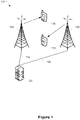
- FIG. 1 schematically illustrates a wireless communication network 100 in accordance with various embodiments.
- Wireless communication network 100 may be an access network of a 3rd Generation Partnership Project (3GPP) long-term evolution (LTE) network (or an LTE-Advanced (LTE-A) network) such as an evolved universal terrestrial radio access network (E-UTRAN).
- the network 100 may include access nodes, for example, enhanced node base station (eNB) 104 and eNB 108, configured to wirelessly communicate with user equipment (UE), such as UE 112 and UE 116.
- UE user equipment
- the eNBs 104 and 108 may be connected with core network equipment 120 through respective backhaul links 124 and 128.
- the backhaul links may be, for example, high speed X2 interfaces. While the present embodiment describes the access nodes as eNBs, other embodiments may include other types of access nodes such as, but not limited to, remote radio heads (RRHs), base stations, or other transmission points.
- RRHs remote radio heads
- the eNBs 104 and 108 may provide radio coverage for respective cells.
- the cell size may be based on, for example, transmission power capabilities of the eNBs 104 and 108.
- the eNBs 104 and 108 may each have generally the same transmission power capabilities as one another or, alternatively, one of the eNBs may have relatively lower transmission power capabilities.
- the eNB 104 may be a relatively high-power access node such as a macro eNB, while the eNB 108 may be relatively low-power access node, for example, a pico eNB and/or a femto eNB.
- the network 100 may be a heterogeneous network (for example, having macro-, pico-, and/or femto-eNBs) to achieve cell-splitting gains and/or may use multiple user multiple input multiple output (MIMO) communications.
- MIMO multiple user multiple input multiple output
- co-channel interference either from inter-cell or co-scheduled, intra-cell users, may be a dominant limiting factor for achieving higher network capacity.
- co-channel interference may be mitigated at the network side by, for example, using CoMP to avoid interference at the transmitting eNB.
- Interference mitigation may additionally/alternatively be employed at the UE side by accounting for spatial and signal properties of the interference, which may provide promising gains in spectral efficiency.
- interference mitigation may include interference cancellation and/or suppression.
- the present disclosure further describes further enhancements for interference mitigation at the UE side that may be achieved through advanced receiver algorithms.
- the receiver algorithms may be supported by providing the UE 112 with additional information about interference structure.
- receiver circuitry of a UE may be provided with side knowledge of a control channel that causes interference such as, but not limited to, power boosting information, RE loading and mapping information, antenna port information, etc. With such information, the receiver circuitry may improve performance of various physical control channels such as physical downlink control channel (PDCCH), enhanced physical downlink control channel (EPDCCH), physical hybrid-ARQ indicator channel (PHICH), physical control format indicator channel (PCFICH), etc.
- PDCCH physical downlink control channel
- EPDCCH enhanced physical downlink control channel
- PHICH physical hybrid-ARQ indicator channel
- PCFICH physical control format indicator channel
- the UE 112 may be provided with control channel information to facilitate measurement of channels on which interfering signals are received in addition to measuring channels on which the useful signal is received. This may, for example, facilitate the use of advanced receivers, for example, maximum likelihood detection (ML) MIMO receivers, used in network-assisted interference cancellation and suppression (NAICS) systems.
- ML maximum likelihood detection
- NAICS network-assisted interference cancellation and suppression
- LTE Long Term Evolution
- Various transmission modes have been defined in LTE to allow for the ability to adjust the type of multi-antenna technique to use according to, for example, a particular radio environment.
- the different transmission modes vary in number of layers, antenna ports used, type of reference signal, and precoding type.
- 3GPP TS 36.213 a relationship is defined between channel energy per resource element (EPRE) and UE-specific RS EPRE only for the physical downlink shared channel (PDSCH).
- EPRE channel energy per resource element
- PDSCH physical downlink shared channel
- the PDCCH/EPDCCH may be scheduled with EPRE different from EPRE of CRS/UE-specific RS.
- PDCCH/EPDCCH regions may be partially loaded so they may not create any interference on some of the REs of the PDCCH/EPDCCH of the victim UEs, e.g., a UE whose communication with a serving access node suffers from interference from the interfering PDCCH/EPDCCH.
- present embodiments describe advanced receiver structures and corresponding signaling assistance to account for such variances and to facilitate effectiveness of NAICS systems.
- FIG. 2 illustrates a UE 200 in accordance with some embodiments.
- the UE 200 may be similar to, and substantially interchangeable with, UEs 112 or 116 of Figure 1 .
- the UE 200 may include transmitter circuitry 204, receiver circuitry 208, communication circuitry 212, and one or more antennas 216 coupled with each other at least as shown.
- the communication circuitry 212 may be coupled with the antennas 216 to facilitate over-the-air communication of signals to/from the UE 200.
- Operations of the communication circuitry 212 may include, but is not limited to, filtering, amplifying, storing, modulating, demodulating, transforming, etc.
- the transmitter circuitry 204 may be coupled with the communication circuitry 212 and may be configured to provide signals to the communication circuitry 212 for transmission by the antennas 216. In various embodiments, the transmitter circuitry 204 may be configured to provide various signal processing operations on the signal to provide the signal to the communication circuitry with appropriate characteristics.
- the receiver circuitry 208 may be coupled with the communication circuitry 212 and may be configured to receive signals from the communication circuitry 212 for transmission to other components of the UE 200 and/or for internal processing by the receiver circuitry 208.
- the receiver circuitry 208 may include NAICS circuitry 220 for determining an interference profile associated with an interfering control channel and mitigate interference on a received signal based on the interference profile.
- Some or all of the communication circuitry 212, transmitter circuitry 204, and/or the receiver circuitry 208 may be included in, for example, radio frequency (RF) circuitry or baseband circuitry as described below with respect to Figure 9 .
- RF radio frequency
- Figure 3 illustrates an exemplary access node 300.
- the access node 300 is for example similar to and substantially interchangeable with eNBs 104 or 108.
- the access node 300 may include one or more antennas 304, communication circuitry 308, and configuration and control circuitry 312 coupled with each other at least as shown.
- communication circuitry 308 may be coupled with the antennas 304 to facilitate over-the-air communication of signals to/from the access node 300.
- the configuration and control circuitry 312 may transmit configuration and control information to UEs of a serving cell.
- the configuration and control information may include, for example, downlink channel information, downlink control information (DCI), radio resource control (RRC) configuration information, etc.
- the configuration and control circuitry 312 may further transmit configuration and control information to other access nodes over backhaul links. This may be done to facilitate CoMP operation.
- Some or all of the communication circuitry 308 and/or the configuration and control circuitry 312 may be included in, for example, RF circuitry or baseband circuitry as described below with respect to Figure 9 .
- Figure 4 illustrates a method 400 in accordance with some embodiments.
- the method 400 may be performed by a UE such as UE 200.
- the UE may include and/or have access to one or more computer-readable media having instructions stored thereon, that, when executed, cause the UE to perform the method 400.
- the UE may additionally/alternatively have circuitry configured to perform some or all of the operations described with respect to the method 400.
- the method 400 may include, at 404, receiving interfering control channel information (also referred to a power boosting information or power boosting set herein below) related to the PDCCH/EPDCCH of an interfering cell.
- interfering control channel information also referred to a power boosting information or power boosting set herein below
- the receiving at 404 may be done by communication circuitry of the UE and may then be provided to the receiver circuitry and, in particular, to the NAICS circuitry.
- the interference channel information related to an interfering PDCCH/EPDCCH may be received in a semi-static configuration operation in which a serving access node configures a UE by transmitting configuration information using higher layer signaling, such as radio resource signaling (RRC) signaling.
- RRC radio resource signaling
- the interfering control channel information may originate from a neighbor access node (also referred to as an "interfering access node"), which transmits the interfering control channel information to the serving access node, which then relays the information to the UE.
- the UE may also receive serving control channel information from the serving access node.
- the method may include, at 408, estimating an interference profile associated with the interfering control channel.
- the estimating of the interference profile may be done by the NAICS circuitry 220 of the receiver of the UE.
- the interference profile may be estimated based on the interfering control channel information received at 404.
- the method may further include, at 412, decoding a received signal based on the interference profile.
- the receiver circuitry 208 will subtract interfering signals from a received signal in order to recover a desired signal, for example, a serving control channel signal.
- the decoding of the received signal is described in further detail herein with respect to various embodiments.
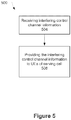
- Figure 5 illustrates a method 500 in that may be performed by an access node 300 such as eNB 104 or 108.
- the access node may include and/or have access to one or more computer-readable media having instructions stored thereon, that, when executed, cause the access node to perform the method 500.
- the access node may additionally/alternatively have circuitry configured to perform some or all of the operations described with respect to the method 500.
- the method 500 may include, at 504, receiving interfering control channel information.
- the receiving at 504 may be done by communication circuitry of the access node and provided to the control and configuration circuitry.
- the interfering control channel information may be received by a serving access node from an interfering access node over a backhaul link.
- the interfering control channel information may be received in a semi-static configuration operation.
- the method 500 may further include, at 508, providing the interfering control channel information to UEs of a serving cell.
- the providing may be done as part of a semi-static configuration operation by, for example, radio resource signaling between the serving access node and the UE.
- the serving access node may additionally provide serving control channel information to the UEs of the serving cell.
- control channel information is explained below with respect to various example implementations.
- the control channel information may allow for receiver circuitry, for example, receiver circuitry 208, to use ML techniques for PDCCH/EPDDCH.
- Receiver circuitry employing ML techniques which may be referred to as an ML receiver, may determine an estimate of a transmitted signal by scanning all possible signal combinations on serving and interfering cells in an attempt to minimize a squared distance between a received signal and hypothetically transmitted signals. The signal combination that minimizes the squared distance may then be considered to be the transmitted signals on the serving and interfering cells.
- a UE may estimate serving and interfering channels, it does not know boosting values used by the serving and interfering access nodes. Thus, ML operation may be complicated.
- a serving access node may provide a UE in a serving cell with a power boosting set including one or more boosting values.
- the boosting values are provided as EPRE ratios between PDCCH/EPDCCH and reference signals of PDCCH/EPDCCH (CRS and UE-specific RS) for both serving and interfering cells.
- a power boosting set may include one or more power boosting values that may be used for PDCCH/EPDCCH.
- a power boosting set may be provided for a PDCCH/EPDCCH of a serving cell and for a PDCCH/EPDCCH of an interfering cell.
- the power boosting sets may be the same or different in the serving and interfering cells. Power boosting sets may additionally apply to other control channels.
- a power boosting set may also be provided for PHICH and PCFICH of the serving cell; and power boosting sets may also be provided for corresponding control channels of interfering cell, such as PCFICH, and PHICH.
- NAICS circuitry uses these boosting sets to determine an extended quadrature phase shift keying (QPSK) constellation for selection of optimal combinations for the PDCCH/EPDCCH signals from serving and interfering access nodes.
- QPSK quadrature phase shift keying
- Figure 6 illustrates an extended QPSK constellation 600 in accordance with some embodiments.
- the QPSK constellation 600 illustrates possible signal points that can be used on serving or interfering PDCCH/EPDCCH given signaled power boosting values of ⁇ 0,3,6 ⁇ dB relative to reference signals of PDCCH/EPDCCH.
- a spare point (with zero power) is possible for an interfering signal.
- the receiver circuitry may then jointly decode serving and interfering control channels based on the extended QPSK constellation. For example, the receiver circuitry utilizes an ML decoding algorithm to perform a search over the discrete signals of the extended QPSK constellation for the serving and interfering signals.
- the power boosting information may include an indication that power boosting is not used on PDCCH/EPDCCH of serving and/or interfering cells.
- the power boosting values may be selected from a list that includes: -6, -4.77, - 3, -1.77, 0, 1, 2, and 3 dB relative to reference signals of PDCCH/EPDCCH. Other embodiments may use other power boosting values.
- PHICH physical hybrid-automatic repeat request indicator channel
- PCFICH physical control format indicator channel
- the number of used resource elements may be larger on the first ODFM symbol than on other OFDM symbols of the PDCCH of the serving cell.
- Figure 7 depicts a radio frame 700 with resource elements for different downlink physical control channels.
- a first OFDM symbol 704 includes REs having CRS, PHICH, PCFICH, and PDCCH, with only four REs that are not loaded.
- OFDM symbols 708 and 712 each have eight REs not loaded.
- some embodiments may include, in the power boosting information, two or more PDCCH power boosting sets that may be used on different OFDM symbols of the control region for the serving and/or interference cells.
- the power boosting information may include a first boosting set that may be used on a first OFDM symbol of the control region and a second boosting set, which is different from the first boosting set, that may be used on a second OFDM symbol of the control region.
- the control channel information may facilitate the receiver circuitry in calculation of optimized log-likelihood ratios (LLR) for mismatched PDCCH/EPDCCH receivers.
- Interference power may be difficult to estimate on the REs used for PDCCH/EPDCCH. This may be due, in part, to the fact that some of the REs of the interfering control channel are not loaded; therefore, the interference hit from the interfering cell becomes somewhat random. Because the estimation of interference power is difficult, the weighting of LLR bits by signal to interference plus noise ratio (SINR) before decoding, by a convolutional decoder in the case of control channels, may become inaccurate. Therefore, the present disclosure also encompasses a redesign the LLR calculation procedure for the PDCCH/EPDCCH signals to account for the potential receiver mismatch.
- SINR signal to interference plus noise ratio
- Figure 8 exemplarily illustrates three LLR calculation functions.
- Figure 8 illustrates functions 804, 808, and 812.
- Functions 804, 808, and 812 which graphically represent LLR values as a function of real-to-imaginary values of an equalized received signal r, may be performed by a first receiver, a second receiver, and a third receiver, respectively.
- the first receiver may be a conventional receiver
- the second and third receivers may be optimized receivers to mismatched interference assumptions.
- an optimized receiver to mismatched interference assumption may refer to a receiver unable to perform a sufficiently accurate estimation of interference power.
- control channel information may include control region loading information of the interfering cell. This may be, for example, an indication of an average number of REs within a control region of a radio frame that are used for control channel or reference signal transmissions, or an average ratio of the number of used REs to the total number of REs in the control region.
- control region loading information may be, for example, an indication of an average number of REs within a control region of a radio frame that are used for control channel or reference signal transmissions, or an average ratio of the number of used REs to the total number of REs in the control region.
- the receiver circuitry may determine an interference profile associated with the control channel based on the loading information.
- the receiver circuitry may then decode a received signal by selecting a receiver that provides a desired LLR function, for example, the first, second, or third receiver, in order to provide decoding robustness in light of the probability of random interference hits given the present loading conditions.
- the receiver circuitry may jointly estimate the power boosting and the serving/interfering signals of PDCCH/EPDCCH without relying on the control channel information related to the interfering cell. This may be done in two ways.
- the first way the receiver circuitry may jointly estimate the power boosting and the serving/interfering signals of PDCCH/EPDCCH without relying on the control channel information related to the interfering cell may be described as follows.
- the second way the receiver circuitry may jointly estimate the power boosting and the serving/interfering signals of PDCCH/EPDCCH without relying on the control channel information related to the interfering cell may be described as follows.
- antenna port cycling may be used for a distributed EPDCCH.
- the EPDCCH may be transmitted using either antenna port 107 or 109 depending on REs selected for EPDCCH transmission. Therefore, when distributed EPDCCH regions of two neighboring cells overlap with each other, the antenna ports 107 and 109 of different cells will collide. Interference randomization in this case may only be achieved by using different scrambling codes for UE-specific RS. However, due to non-orthogonal UE-specific RS of different cells, the channel estimation for serving and/or interfering cells might be inaccurate.
- UE-specific RS and corresponding EPDCCH may be transmitted on an additional antenna-port pair, for example, antenna ports 108 and 110, which are orthogonal to antenna ports 107 and 109, respectively.
- a serving cell may transmit its UE-specific and corresponding EPDCCH on a first antenna-port pair, e.g., AP pair 107/109
- an interfering cell may transmit its UE-specific and corresponding EPDCCH on a second antenna-port pair, e.g., AP pair 108/110. Both cells may use the same scrambling code. Transmitting these signals on orthogonal APs, and using the same scrambling code, may provide an orthogonality between the serving and interfering signals that will facilitate cancellation of interference.
- a UE may for example determine whether UE-specific RS and corresponding EPDCCH of the serving and/or interfering cells is transmitted on a first antenna port pair, for example, antenna port pair 107/109, or a second antenna port pair, for example, antenna-port pair 108/110.
- the control channel information may include an indication of the antenna-port pair, e.g., 107/109 or 108/110, used for UE-specific RS and EPDCCH transmission of the serving and/or interfering cells. It is also possible that the receiver circuitry blindly detects the appropriate antenna-port pair during reception of an EPDCCH.
- the UE may estimate serving and interfering channels and jointly decode a serving and interfering EPDCCH based on the estimated channels, as described above.
- operation of the receiver circuitry may be facilitated by signaling of PHICH resource elements of interfering cells.
- PDCCH may be used to convey UL/DL scheduling assignments
- PCFICH may be used to indicate the size of the control region (or, equivalently, the PDSCH starting symbol)
- PHICH may be used for the acknowledgment/negative acknowledgment feedback for physical uplink shared channel (PUSCH) transmissions.
- PUSCH physical uplink shared channel
- the resource elements of the first L OFDM symbols that do not carry CRSs may be allocated to the control channels in the following order: PCFICH, PHICH, and PDCCH.
- the signals used to modulate control channels may be based on the QPSK constellation (note that the PHICH may use two out of four symbols in QPSK).
- Such modulation structure of the control channel signals can be leveraged by the receiver circuitry for better suppression of the interference from the neighboring cell(s).
- multiple PHICHs messages can be mapped on the same resource elements (or REGs). Therefore, the resulting PHICH signal (after multiplexing of multiple PHICHs) transmitted by a given cell may not be described by the QPSK constellation anymore.
- the control channel information may provide an indication of mapping parameters of an interfering PHICH.
- the receiver circuitry may use these mapping parameters to determine the resource elements (resource element groups within first L OFDM symbols of the downlink subframes) that can be used for PHICH transmissions by an interfering cell.
- the receiver circuitry may then know to use a non-QPSK constellation in the estimation of the interference profile of the REs associated with the interfering PHICH.
- the mapping parameters may include a PHICH duration parameter that defines a number of OFDM symbols used to carry the PHICH.
- the PHICH duration may be either normal or extended. A normal PHICH duration causes the PHICH to be present in only the first OFDM symbol. An extended PHICH duration causes the PHICH to be present in the first two or three OFDM symbols.
- the PHICH duration may depend on whether a subframe has a multicast-broadcast single-frequency network (MBSFN) subframe configuration or non-MBSFN subframe configuration. Therefore, in some implementations the mapping parameters may further include an MBSFN subframe configuration parameter. In some implementations, the PHICH duration may be configurable by higher layer signaling, for example, RRC signaling, according to Table 1. Table 1 PHICH duration Non-MBSFN subframes MBSFN subframes on a carrier supporting PDSCH Subframes 1 and 6 in case of frame structure type 2 All other cases Normal 1 1 1 Extended 2 3 2
- the mapping parameters may additionally/alternatively include a number of PHICH groups for the interfering PHICH.
- the number of PHICH groups may be configurable by parameters N g .
- the index n PHICH group may range from 0 to N PHICH group ⁇ 1.
- the number of PHICH groups may vary between downlink subframes and may be given by m i ⁇ N PHICH group where m i is given by Table 2 and N PHICH group by Equation 7.
- the index n PHICH group in a downlink subframe with non-zero PHICH resources may range from 0 to m i ⁇ N PHICH group ⁇ 1.
- PHICH groups may be mapped to the resource elements based on a physical cell identifier (ID) N ID cell .
- the mapping parameters may additionally/alternatively include CRS parameters of an interfering cell such as physical cell ID and number of antenna ports so that the UE may be able to determine the REs that can be occupied by the PHICH.
- mapping parameters may be derived by overhearing PBCH transmissions from the interfering cell and detecting physical cell ID N ID cell and number of antenna ports from the CRS transmitted by interfering cell.
- FIG. 9 illustrates, for one embodiment, an example system 900 comprising radio frequency (RF) circuitry 904, baseband circuitry 908, application circuitry 912, memory/storage 916, display 920, camera 924, sensor 928, and input/output (I/O) interface 932, coupled with each other at least as shown.
- RF radio frequency
- the application circuitry 912 may include circuitry such as, but not limited to, one or more single-core or multi-core processors.
- the processor(s) may include any combination of general-purpose processors and dedicated processors (e.g., graphics processors, application processors, etc.).
- the processors may be coupled with memory/storage 916 and configured to execute instructions stored in the memory/storage 916 to enable various applications and/or operating systems running on the system 900.
- the baseband circuitry 908 may include circuitry such as, but not limited to, one or more single-core or multi-core processors such.
- the processor(s) may include a baseband processor.
- the baseband circuitry 908 may handle various radio control functions that enables communication with one or more radio networks via the RF circuitry.
- the radio control functions may include, but are not limited to, signal modulation, encoding, decoding, radio frequency shifting, etc.
- the baseband circuitry 908 may provide for communication compatible with one or more radio technologies.
- the baseband circuitry 908 may support communication with an evolved universal terrestrial radio access network (EUTRAN) and/or other wireless metropolitan area networks (WMAN), a wireless local area network (WLAN), a wireless personal area network (WPAN).
- EUTRAN evolved universal terrestrial radio access network
- WMAN wireless metropolitan area networks
- WLAN wireless local area network
- WPAN wireless personal area network
- multi-mode baseband circuitry Embodiments in which the baseband circuitry 908 is configured to support radio communications of more than one wireless protocol.
- baseband circuitry 908 may include circuitry to operate with signals that are not strictly considered as being in a baseband frequency.
- baseband circuitry 908 may include circuitry to operate with signals having an intermediate frequency, which is between a baseband frequency and a radio frequency.
- RF circuitry 904 may enable communication with wireless networks using modulated electromagnetic radiation through a non-solid medium.
- the RF circuitry 904 may include switches, filters, amplifiers, etc. to facilitate the communication with the wireless network.
- RF circuitry 904 may include circuitry to operate with signals that are not strictly considered as being in a radio frequency.
- RF circuitry 904 may include circuitry to operate with signals having an intermediate frequency, which is between a baseband frequency and a radio frequency.
- some or all of the constituent components of the baseband circuitry 908, the application circuitry 912, and/or the memory/storage 916 may be implemented together on a system on a chip (SOC).
- SOC system on a chip
- the communication circuitry of the access node may be implemented in the RF circuitry 904 and/or the baseband circuitry 908 and the configuration and control circuitry may be implemented in the baseband circuitry 908 and/or application circuitry 912.
- the components of the UE may be implemented in the RF circuitry 904 and/or the baseband circuitry 908.
- Memory/storage 916 may be used to load and store data and/or instructions, for example, for system 900.
- Memory/storage 916 for one embodiment may include any combination of suitable volatile memory (e.g., dynamic random access memory (DRAM)) and/or non-volatile memory (e.g., Flash memory).
- suitable volatile memory e.g., dynamic random access memory (DRAM)
- non-volatile memory e.g., Flash memory
- the I/O interface 932 may include one or more user interfaces designed to enable user interaction with the system 900 and/or peripheral component interfaces designed to enable peripheral component interaction with the system 900.
- User interfaces may include, but are not limited to a physical keyboard or keypad, a touchpad, a speaker, a microphone, etc.
- Peripheral component interfaces may include, but are not limited to, a non-volatile memory port, a universal serial bus (USB) port, an audio jack, and a power supply interface.
- USB universal serial bus
- sensor 928 may include one or more sensing devices to determine environmental conditions and/or location information related to the system 900.
- the sensors may include, but are not limited to, a gyro sensor, an accelerometer, a proximity sensor, an ambient light sensor, and a positioning unit.
- the positioning unit may also be part of, or interact with, the baseband circuitry 908 and/or RF circuitry 904 to communicate with components of a positioning network, e.g., a global positioning system (GPS) satellite.
- GPS global positioning system
- the display 920 may include a display (e.g., a liquid crystal display, a touch screen display, etc.).
- a display e.g., a liquid crystal display, a touch screen display, etc.
- system 900 may be a mobile computing device such as, but not limited to, a laptop computing device, a tablet computing device, a netbook, an ultrabook, a smartphone, etc.
- system 900 may have more or less components, and/or different architectures.
Landscapes
- Engineering & Computer Science (AREA)
- Signal Processing (AREA)
- Computer Networks & Wireless Communication (AREA)
- Multimedia (AREA)
- Computer Security & Cryptography (AREA)
- Databases & Information Systems (AREA)
- Mathematical Physics (AREA)
- Physics & Mathematics (AREA)
- Quality & Reliability (AREA)
- Power Engineering (AREA)
- Environmental & Geological Engineering (AREA)
- Human Computer Interaction (AREA)
- Mobile Radio Communication Systems (AREA)
Claims (7)
- Vorrichtung zur Verwendung in einer Benutzereinrichtung (200), wobei die Vorrichtung umfasst:Kommunikationsschaltungsanordnung (212), die so konfiguriert ist, dass sie Leistungsverstärkungsinformationen, die einen oder mehrere Leistungsverstärkungswerte in Bezug auf einen physikalischen Downlink-Steuerkanal, PDCCH, oder einen erweiterten physikalischen Downlink-Steuerkanal, EPDCCH, einer versorgenden und einer interferierenden Zelle umfassen, von einem Zugangsknoten (104, 106; 300) empfängt, wobei der eine oder die mehreren Leistungsverstärkungswerte Energie-pro-Ressourcenelement, EPRE,-Verhältnisse zwischen PDCCH oder EPDCCH zu Referenzsignalen von PDCCH oder EPDCCH für die versorgende Zelle und die interferierende Zelle angeben; undEmpfängerschaltungsanordnung (208, 220), die mit der Kommunikationsschaltungsanordnung (212) gekoppelt ist, wobei die Empfängerschaltungsanordnung (208) konfiguriert ist zum:Bestimmen einer Quadratur-Phasenumtastungs, QPSK,-Konstellation, wobei die Leistung der Signalpunkte der QSPK auf dem einen oder den mehreren Leistungsverstärkungswerten basiert; undgemeinsamen Decodieren von PDCCHs oder EPDCCHs der versorgenden Zelle und der interferierenden Zelle unter Verwendung eines Maximum-Likelihood-Decodierungsalgorithmus, um eine Suche über diskrete Signale der QPSK-Konstellation nach Signalen der versorgenden Zelle und Signalen der interferierenden Zelle durchzuführen.
- Vorrichtung nach Anspruch 1, zum gemeinsamen Decodieren der versorgenden und interferierenden PDCCHs oder EPDCCHs die Empfängerschaltungsanordnung (208) konfiguriert ist zum:Schätzen eines Interferenzprofils, das mit dem interferierenden Steuerkanal assoziiert ist; undVerarbeiten eines empfangenen Signals basierend auf dem Interferenzprofil.
- Vorrichtung nach Anspruch 1, wobei die Kommunikationsschaltungsanordnung (212) zum Empfangen von Leistungsverstärkungsinformationen von einem Zugangsknoten (300) der versorgenden Zelle konfiguriert ist.
- Vorrichtung nach Anspruch 1, wobei die Kommunikationsschaltungsanordnung (212) zum Empfangen der Leistungsverstärkungsinformationen unter Verwendung von Funkressourcensteuerungs, RRC,-Signalen ist.
- Vorrichtung nach einem der Ansprüche 1 bis 5, wobei die Leistungsverstärkungsinformationen einen ersten Verstärkungssatz eines oder mehrerer Leistungsverstärkungswerte für ein erstes OFDM (orthogonales Frequenzmultiplex)-Symbol einer PDCCH-oder EPDCCH-Region der versorgenden Zelle und/oder der interferierenden Zelle und einen zweiten Verstärkungssatz eines oder mehrerer Leistungsverstärkungswerte für ein zweites OFDM-Symbol der PDCCH- oder EPDCCH-Region der versorgenden Zelle und/oder der interferierenden Zelle umfassen.
- Benutzereinrichtung (200), umfassend eine Vorrichtung nach einem der Ansprüche 1 bis 5.
- Ein oder mehrere computerlesbare Medien mit Anweisungen, die bei Ausführung durch eine Vorrichtung zur Verwendung in einer Benutzereinrichtung (200) die Vorrichtung zum Durchführen von Folgendem veranlassen:Empfangen von Leistungsverstärkungsinformationen von einem Zugangsknoten (104, 106; 300), die einen oder mehrere Leistungsverstärkungswerte in Bezug auf PDCCH oder EPDCCH einer versorgenden und einer interferierenden Zelle umfassen, wobei der eine oder die mehreren Leistungsverstärkungswerte EPRE-Verhältnisse zwischen PDCCH oder EPDCCH zu Referenzsignalen von PDCCH oder EPDCCH für die versorgende Zelle und die interferierende Zelle angeben;Bestimmen einer QPSK-Konstellation, wobei die Leistung der Signalpunkte der QSPK auf dem einen oder den mehreren Leistungsverstärkungswerten basiert; undgemeinsamen Decodieren von PDCCHs oder EPDCCHs der versorgenden Zelle und der interferierenden Zelle unter Verwendung eines Maximum-Likelihood-Decodierungsalgorithmus, um eine Suche über diskrete Signale der QPSK-Konstellation nach Signalen der versorgenden Zelle und Signalen der interferierenden Zelle durchzuführen.
Applications Claiming Priority (3)
| Application Number | Priority Date | Filing Date | Title |
|---|---|---|---|
| US201361806821P | 2013-03-29 | 2013-03-29 | |
| US14/141,220 US9380090B2 (en) | 2013-03-29 | 2013-12-26 | Network assisted interference cancellation and suppression with respect to interfering control channel transmissions |
| PCT/US2014/032266 WO2014160984A1 (en) | 2013-03-29 | 2014-03-28 | Network assisted interference cancellation and suppression with respect to interfering control channel transmissions |
Publications (3)
| Publication Number | Publication Date |
|---|---|
| EP2979413A1 EP2979413A1 (de) | 2016-02-03 |
| EP2979413A4 EP2979413A4 (de) | 2017-02-15 |
| EP2979413B1 true EP2979413B1 (de) | 2018-03-14 |
Family
ID=90354810
Family Applications (1)
| Application Number | Title | Priority Date | Filing Date |
|---|---|---|---|
| EP14776328.8A Active EP2979413B1 (de) | 2013-03-29 | 2014-03-28 | Netzwerkunterstützte interferenzunterdrückung und unterdrückung in bezug auf interferierende steuerkanalübertragungen |
Country Status (5)
| Country | Link |
|---|---|
| US (1) | US9380090B2 (de) |
| EP (1) | EP2979413B1 (de) |
| ES (1) | ES2673246T3 (de) |
| HU (1) | HUE037791T2 (de) |
| WO (1) | WO2014160984A1 (de) |
Families Citing this family (21)
| Publication number | Priority date | Publication date | Assignee | Title |
|---|---|---|---|---|
| US9479298B2 (en) * | 2013-07-08 | 2016-10-25 | Intel IP Corporation | Demodulation reference signals (DMRS)for side information for interference cancellation |
| US9735818B2 (en) * | 2013-10-28 | 2017-08-15 | Lg Electronics Inc. | Method and apparatus for cancelling interference and receiving signal in wireless communication system |
| JP6461825B2 (ja) * | 2014-01-15 | 2019-01-30 | シャープ株式会社 | 端末装置 |
| CN105745953B (zh) * | 2014-01-15 | 2021-02-19 | 夏普株式会社 | 终端装置、基站装置以及通信方法 |
| JPWO2015137112A1 (ja) * | 2014-03-13 | 2017-04-06 | シャープ株式会社 | 端末装置、基地局装置、および集積回路 |
| WO2015142106A1 (ko) * | 2014-03-20 | 2015-09-24 | 엘지전자 주식회사 | 무선 통신 시스템에서 간섭을 제거하고 신호를 수신하는 방법 및 장치 |
| JP6791752B2 (ja) * | 2014-03-20 | 2020-11-25 | シャープ株式会社 | 端末装置、基地局装置、および集積回路 |
| US9955487B2 (en) * | 2014-03-28 | 2018-04-24 | Samsung Electronics Co., Ltd. | Method and apparatus for receiving downlink data in wireless communication system |
| US9544085B2 (en) | 2014-11-14 | 2017-01-10 | Nokia Solutions And Networks Oy | Method and apparatus for interference cancellation |
| CN106162774B (zh) | 2015-04-09 | 2020-10-23 | 中兴通讯股份有限公司 | 跨MeNB切换方法、装置及基站 |
| US9985700B2 (en) * | 2015-05-12 | 2018-05-29 | Mediatek Inc. | Channel state feedback enhancement in downlink multiuser superposition transmission |
| CN106713193B (zh) * | 2015-07-20 | 2021-11-12 | 北京三星通信技术研究有限公司 | 一种多用户复用传输的方法和设备 |
| US10375531B2 (en) * | 2015-08-28 | 2019-08-06 | Lg Electronics Inc. | Method for transmitting/receiving MBMS signal in wireless communication system and device for performing same |
| WO2017060183A1 (en) | 2015-10-05 | 2017-04-13 | Telefonaktiebolaget Lm Ericsson (Publ) | Communication device, network node, method and computer |
| US10582397B2 (en) * | 2016-11-09 | 2020-03-03 | Qualcomm Incorporated | Beam refinement reference signal transmissions during control symbol |
| EP3541002B1 (de) * | 2016-11-09 | 2023-09-06 | LG Electronics Inc. | Verfahren zur bestimmung des leistungsverstärkungsniveaus von ptrs zur entfernung von phasenrauschen in einem drahtloskommunikationssystem und vorrichtung dafür |
| WO2018121839A1 (en) | 2016-12-27 | 2018-07-05 | Telecom Italia S.P.A. | Method and system for providing variable quality streaming video services in mobile communication networks |
| US10038489B2 (en) | 2017-01-05 | 2018-07-31 | Ceva D.S.P. Ltd. | System and method for adaptive demodulation of cellular device communications |
| US10334515B2 (en) | 2017-01-13 | 2019-06-25 | ENK Wireless, Inc. | Conveying information via auxiliary device selection |
| US10743201B2 (en) | 2017-01-25 | 2020-08-11 | Ceva D.S.P. Ltd. | System and method for blind detection of transmission parameters of an interfering cell |
| US10299221B1 (en) * | 2017-05-18 | 2019-05-21 | Sprint Spectrum L.P. | Systems and methods for managing channel quality for relay wireless devices |
Family Cites Families (8)
| Publication number | Priority date | Publication date | Assignee | Title |
|---|---|---|---|---|
| US8085834B2 (en) | 2008-04-30 | 2011-12-27 | Infineon Technologies Ag | System partitioning for multi-mobile devices |
| EP2894925B1 (de) * | 2008-12-02 | 2021-07-14 | Samsung Electronics Co., Ltd. | Übertragung von planungszuweisungen in mehrfachen operationsbandbreiten |
| US9143955B2 (en) | 2010-05-07 | 2015-09-22 | Qualcomm Incorporated | Detecting and reporting physical-layer cell identifier collisions in wireless networks |
| US20120113961A1 (en) | 2010-11-08 | 2012-05-10 | Motorola Mobility, Inc. | Interference Measurements in Enhanced Inter-Cell Interference Coordination Capable Wireless Terminals |
| US8537862B2 (en) * | 2011-06-30 | 2013-09-17 | Blackberry Limited | Transmit downlink control information with higher order modulation |
| US8781400B2 (en) | 2011-06-30 | 2014-07-15 | Telefonaktiebolaget L M Ericsson (Publ) | Method and apparatus for reducing co-channel interference |
| EP2807763B1 (de) * | 2012-01-27 | 2019-05-08 | Samsung Electronics Co., Ltd. | Verfahren und vorrichtung zur bereitstellung eines datendienstes mittels rundfunksignalen |
| US8761109B2 (en) * | 2012-08-03 | 2014-06-24 | Motorola Mobility Llc | Method and apparatus for receiving a control channel |
-
2013
- 2013-12-26 US US14/141,220 patent/US9380090B2/en active Active
-
2014
- 2014-03-28 ES ES14776328.8T patent/ES2673246T3/es active Active
- 2014-03-28 HU HUE14776328A patent/HUE037791T2/hu unknown
- 2014-03-28 WO PCT/US2014/032266 patent/WO2014160984A1/en not_active Ceased
- 2014-03-28 EP EP14776328.8A patent/EP2979413B1/de active Active
Non-Patent Citations (1)
| Title |
|---|
| None * |
Also Published As
| Publication number | Publication date |
|---|---|
| HUE037791T2 (hu) | 2018-09-28 |
| EP2979413A4 (de) | 2017-02-15 |
| US9380090B2 (en) | 2016-06-28 |
| ES2673246T3 (es) | 2018-06-20 |
| US20140293890A1 (en) | 2014-10-02 |
| WO2014160984A1 (en) | 2014-10-02 |
| EP2979413A1 (de) | 2016-02-03 |
Similar Documents
| Publication | Publication Date | Title |
|---|---|---|
| US9380090B2 (en) | Network assisted interference cancellation and suppression with respect to interfering control channel transmissions | |
| CN104982063B (zh) | 用于网络辅助的干扰抑制的准同位和pdsch资源元素映射信令 | |
| US10439664B2 (en) | Information signalling for network assisted interference mitigation | |
| US11064379B2 (en) | Method and apparatus for measuring D2D signal or selecting relay in wireless communication system | |
| EP3140969B1 (de) | Nicht-orthogonaler mehrfach-zugang und interferenzunterdrückung | |
| US9331826B2 (en) | Method and apparatus for transmitting control information in a wireless communication system | |
| EP3031152B1 (de) | Verfahren und system zur verbesserten interferenzunterdrückung in pdsch auf einer benutzervorrichtung | |
| EP3571793B1 (de) | Strahlkombinationsschema mit broadcaststrahlablenkung und strahlindexanzeige | |
| WO2024074081A1 (en) | Method and apparatus of supporting beam reporting | |
| US9794004B2 (en) | Signaling to enable serving cell interference suppression | |
| US10356723B2 (en) | Method and device for receiving signal in wireless access system supporting FDR transmission | |
| US20150257130A1 (en) | Method and device for transmitting and receiving downlink signal in wireless communication system | |
| US20160099802A1 (en) | Method and apparatus for transmitting/receiving signal in wireless access system which supports fdr transmission | |
| US20150282192A1 (en) | Method and apparatus for receiving downlink data in wireless communication system | |
| US20180213366A1 (en) | Method for transmitting/receiving mbms signal in wireless communication system and device for performing same | |
| US11569957B2 (en) | Method and apparatus for transmitting and receiving downlink control channel in shortened transmission time intervals | |
| CN106664147A (zh) | 用于在支持fdr传输的无线接入系统中接收信号的方法和装置 | |
| US9906328B2 (en) | Method and apparatus for decoding a signal distorted by interference | |
| EP3123682B1 (de) | Verfahren und vorrichtung zum empfangen von downlink-daten in drahtloskommunikationssystem | |
| US20220385406A1 (en) | Method for decoding codeword in wireless communication system and terminal therefor |
Legal Events
| Date | Code | Title | Description |
|---|---|---|---|
| PUAI | Public reference made under article 153(3) epc to a published international application that has entered the european phase |
Free format text: ORIGINAL CODE: 0009012 |
|
| 17P | Request for examination filed |
Effective date: 20150826 |
|
| AK | Designated contracting states |
Kind code of ref document: A1 Designated state(s): AL AT BE BG CH CY CZ DE DK EE ES FI FR GB GR HR HU IE IS IT LI LT LU LV MC MK MT NL NO PL PT RO RS SE SI SK SM TR |
|
| AX | Request for extension of the european patent |
Extension state: BA ME |
|
| RAP1 | Party data changed (applicant data changed or rights of an application transferred) |
Owner name: INTEL IP CORPORATION |
|
| RIN1 | Information on inventor provided before grant (corrected) |
Inventor name: HAN, SEUNGHEE Inventor name: MOROZOV, GREGORY Inventor name: DAVYDOV, ALEXEI |
|
| DAX | Request for extension of the european patent (deleted) | ||
| RIC1 | Information provided on ipc code assigned before grant |
Ipc: H04L 25/03 20060101AFI20160916BHEP |
|
| REG | Reference to a national code |
Ref country code: DE Ref legal event code: R079 Ref document number: 602014022375 Country of ref document: DE Free format text: PREVIOUS MAIN CLASS: H04L0027260000 Ipc: H04L0025030000 |
|
| A4 | Supplementary search report drawn up and despatched |
Effective date: 20170117 |
|
| RIC1 | Information provided on ipc code assigned before grant |
Ipc: H04L 25/03 20060101AFI20170111BHEP |
|
| GRAP | Despatch of communication of intention to grant a patent |
Free format text: ORIGINAL CODE: EPIDOSNIGR1 |
|
| GRAJ | Information related to disapproval of communication of intention to grant by the applicant or resumption of examination proceedings by the epo deleted |
Free format text: ORIGINAL CODE: EPIDOSDIGR1 |
|
| GRAP | Despatch of communication of intention to grant a patent |
Free format text: ORIGINAL CODE: EPIDOSNIGR1 |
|
| INTG | Intention to grant announced |
Effective date: 20171012 |
|
| INTG | Intention to grant announced |
Effective date: 20171024 |
|
| GRAS | Grant fee paid |
Free format text: ORIGINAL CODE: EPIDOSNIGR3 |
|
| GRAA | (expected) grant |
Free format text: ORIGINAL CODE: 0009210 |
|
| AK | Designated contracting states |
Kind code of ref document: B1 Designated state(s): AL AT BE BG CH CY CZ DE DK EE ES FI FR GB GR HR HU IE IS IT LI LT LU LV MC MK MT NL NO PL PT RO RS SE SI SK SM TR |
|
| REG | Reference to a national code |
Ref country code: GB Ref legal event code: FG4D |
|
| REG | Reference to a national code |
Ref country code: CH Ref legal event code: EP Ref country code: AT Ref legal event code: REF Ref document number: 979879 Country of ref document: AT Kind code of ref document: T Effective date: 20180315 |
|
| REG | Reference to a national code |
Ref country code: FR Ref legal event code: PLFP Year of fee payment: 5 |
|
| REG | Reference to a national code |
Ref country code: IE Ref legal event code: FG4D |
|
| REG | Reference to a national code |
Ref country code: DE Ref legal event code: R096 Ref document number: 602014022375 Country of ref document: DE |
|
| REG | Reference to a national code |
Ref country code: ES Ref legal event code: FG2A Ref document number: 2673246 Country of ref document: ES Kind code of ref document: T3 Effective date: 20180620 Ref country code: NL Ref legal event code: FP |
|
| REG | Reference to a national code |
Ref country code: EE Ref legal event code: FG4A Ref document number: E015537 Country of ref document: EE Effective date: 20180531 |
|
| REG | Reference to a national code |
Ref country code: LT Ref legal event code: MG4D |
|
| PG25 | Lapsed in a contracting state [announced via postgrant information from national office to epo] |
Ref country code: HR Free format text: LAPSE BECAUSE OF FAILURE TO SUBMIT A TRANSLATION OF THE DESCRIPTION OR TO PAY THE FEE WITHIN THE PRESCRIBED TIME-LIMIT Effective date: 20180314 Ref country code: LT Free format text: LAPSE BECAUSE OF FAILURE TO SUBMIT A TRANSLATION OF THE DESCRIPTION OR TO PAY THE FEE WITHIN THE PRESCRIBED TIME-LIMIT Effective date: 20180314 Ref country code: FI Free format text: LAPSE BECAUSE OF FAILURE TO SUBMIT A TRANSLATION OF THE DESCRIPTION OR TO PAY THE FEE WITHIN THE PRESCRIBED TIME-LIMIT Effective date: 20180314 Ref country code: NO Free format text: LAPSE BECAUSE OF FAILURE TO SUBMIT A TRANSLATION OF THE DESCRIPTION OR TO PAY THE FEE WITHIN THE PRESCRIBED TIME-LIMIT Effective date: 20180614 Ref country code: CY Free format text: LAPSE BECAUSE OF FAILURE TO SUBMIT A TRANSLATION OF THE DESCRIPTION OR TO PAY THE FEE WITHIN THE PRESCRIBED TIME-LIMIT Effective date: 20180314 |
|
| PG25 | Lapsed in a contracting state [announced via postgrant information from national office to epo] |
Ref country code: SE Free format text: LAPSE BECAUSE OF FAILURE TO SUBMIT A TRANSLATION OF THE DESCRIPTION OR TO PAY THE FEE WITHIN THE PRESCRIBED TIME-LIMIT Effective date: 20180314 Ref country code: LV Free format text: LAPSE BECAUSE OF FAILURE TO SUBMIT A TRANSLATION OF THE DESCRIPTION OR TO PAY THE FEE WITHIN THE PRESCRIBED TIME-LIMIT Effective date: 20180314 Ref country code: RS Free format text: LAPSE BECAUSE OF FAILURE TO SUBMIT A TRANSLATION OF THE DESCRIPTION OR TO PAY THE FEE WITHIN THE PRESCRIBED TIME-LIMIT Effective date: 20180314 Ref country code: BG Free format text: LAPSE BECAUSE OF FAILURE TO SUBMIT A TRANSLATION OF THE DESCRIPTION OR TO PAY THE FEE WITHIN THE PRESCRIBED TIME-LIMIT Effective date: 20180614 |
|
| REG | Reference to a national code |
Ref country code: HU Ref legal event code: AG4A Ref document number: E037791 Country of ref document: HU |
|
| PG25 | Lapsed in a contracting state [announced via postgrant information from national office to epo] |
Ref country code: AL Free format text: LAPSE BECAUSE OF FAILURE TO SUBMIT A TRANSLATION OF THE DESCRIPTION OR TO PAY THE FEE WITHIN THE PRESCRIBED TIME-LIMIT Effective date: 20180314 Ref country code: IT Free format text: LAPSE BECAUSE OF FAILURE TO SUBMIT A TRANSLATION OF THE DESCRIPTION OR TO PAY THE FEE WITHIN THE PRESCRIBED TIME-LIMIT Effective date: 20180314 Ref country code: PL Free format text: LAPSE BECAUSE OF FAILURE TO SUBMIT A TRANSLATION OF THE DESCRIPTION OR TO PAY THE FEE WITHIN THE PRESCRIBED TIME-LIMIT Effective date: 20180314 Ref country code: RO Free format text: LAPSE BECAUSE OF FAILURE TO SUBMIT A TRANSLATION OF THE DESCRIPTION OR TO PAY THE FEE WITHIN THE PRESCRIBED TIME-LIMIT Effective date: 20180314 |
|
| PG25 | Lapsed in a contracting state [announced via postgrant information from national office to epo] |
Ref country code: SM Free format text: LAPSE BECAUSE OF FAILURE TO SUBMIT A TRANSLATION OF THE DESCRIPTION OR TO PAY THE FEE WITHIN THE PRESCRIBED TIME-LIMIT Effective date: 20180314 Ref country code: CZ Free format text: LAPSE BECAUSE OF FAILURE TO SUBMIT A TRANSLATION OF THE DESCRIPTION OR TO PAY THE FEE WITHIN THE PRESCRIBED TIME-LIMIT Effective date: 20180314 |
|
| REG | Reference to a national code |
Ref country code: DE Ref legal event code: R097 Ref document number: 602014022375 Country of ref document: DE |
|
| PG25 | Lapsed in a contracting state [announced via postgrant information from national office to epo] |
Ref country code: PT Free format text: LAPSE BECAUSE OF FAILURE TO SUBMIT A TRANSLATION OF THE DESCRIPTION OR TO PAY THE FEE WITHIN THE PRESCRIBED TIME-LIMIT Effective date: 20180716 Ref country code: LU Free format text: LAPSE BECAUSE OF NON-PAYMENT OF DUE FEES Effective date: 20180328 |
|
| PLBE | No opposition filed within time limit |
Free format text: ORIGINAL CODE: 0009261 |
|
| STAA | Information on the status of an ep patent application or granted ep patent |
Free format text: STATUS: NO OPPOSITION FILED WITHIN TIME LIMIT |
|
| REG | Reference to a national code |
Ref country code: GR Ref legal event code: EP Ref document number: 20180401629 Country of ref document: GR Effective date: 20190109 |
|
| PG25 | Lapsed in a contracting state [announced via postgrant information from national office to epo] |
Ref country code: DK Free format text: LAPSE BECAUSE OF FAILURE TO SUBMIT A TRANSLATION OF THE DESCRIPTION OR TO PAY THE FEE WITHIN THE PRESCRIBED TIME-LIMIT Effective date: 20180314 Ref country code: MC Free format text: LAPSE BECAUSE OF FAILURE TO SUBMIT A TRANSLATION OF THE DESCRIPTION OR TO PAY THE FEE WITHIN THE PRESCRIBED TIME-LIMIT Effective date: 20180314 |
|
| 26N | No opposition filed |
Effective date: 20181217 |
|
| PG25 | Lapsed in a contracting state [announced via postgrant information from national office to epo] |
Ref country code: SI Free format text: LAPSE BECAUSE OF FAILURE TO SUBMIT A TRANSLATION OF THE DESCRIPTION OR TO PAY THE FEE WITHIN THE PRESCRIBED TIME-LIMIT Effective date: 20180314 |
|
| REG | Reference to a national code |
Ref country code: AT Ref legal event code: UEP Ref document number: 979879 Country of ref document: AT Kind code of ref document: T Effective date: 20180314 |
|
| PG25 | Lapsed in a contracting state [announced via postgrant information from national office to epo] |
Ref country code: MT Free format text: LAPSE BECAUSE OF NON-PAYMENT OF DUE FEES Effective date: 20180328 |
|
| REG | Reference to a national code |
Ref country code: EE Ref legal event code: GB1A Ref document number: E015537 Country of ref document: EE |
|
| PG25 | Lapsed in a contracting state [announced via postgrant information from national office to epo] |
Ref country code: TR Free format text: LAPSE BECAUSE OF FAILURE TO SUBMIT A TRANSLATION OF THE DESCRIPTION OR TO PAY THE FEE WITHIN THE PRESCRIBED TIME-LIMIT Effective date: 20180314 |
|
| PG25 | Lapsed in a contracting state [announced via postgrant information from national office to epo] |
Ref country code: MK Free format text: LAPSE BECAUSE OF NON-PAYMENT OF DUE FEES Effective date: 20180314 |
|
| REG | Reference to a national code |
Ref country code: CH Ref legal event code: PUE Owner name: APPLE, INC., US Free format text: FORMER OWNER: INTEL IP CORPORATION, US |
|
| REG | Reference to a national code |
Ref country code: DE Ref legal event code: R081 Ref document number: 602014022375 Country of ref document: DE Owner name: APPLE INC., CUPERTINO, US Free format text: FORMER OWNER: INTEL IP CORP., SANTA CLARA, CALIF., US |
|
| REG | Reference to a national code |
Ref country code: CH Ref legal event code: PK Free format text: BERICHTIGUNG INHABER |
|
| PG25 | Lapsed in a contracting state [announced via postgrant information from national office to epo] |
Ref country code: IS Free format text: LAPSE BECAUSE OF FAILURE TO SUBMIT A TRANSLATION OF THE DESCRIPTION OR TO PAY THE FEE WITHIN THE PRESCRIBED TIME-LIMIT Effective date: 20180714 |
|
| REG | Reference to a national code |
Ref country code: HU Ref legal event code: GB9C Owner name: APPLE INC., US Free format text: FORMER OWNER(S): INTEL IP CORPORATION, US; INTEL CORPORATION, US |
|
| REG | Reference to a national code |
Ref country code: NL Ref legal event code: PD Owner name: APPLE INC.; US Free format text: DETAILS ASSIGNMENT: CHANGE OF OWNER(S), ASSIGNMENT; FORMER OWNER NAME: INTEL IP CORPORATION Effective date: 20200917 |
|
| REG | Reference to a national code |
Ref country code: SK Ref legal event code: PC4A Ref document number: E 27454 Country of ref document: SK Owner name: INTEL CORPORATION, SANTA CLARA, CA, US Free format text: FORMER OWNER: INTEL IP CORPORATION, SANTA CLARA, CA, US Effective date: 20201001 Ref country code: SK Ref legal event code: PC4A Ref document number: E 27454 Country of ref document: SK Owner name: APPLE INC., CUPERTINO, CA, US Free format text: FORMER OWNER: INTEL CORPORATION, SANTA CLARA, CA, US Effective date: 20201001 |
|
| REG | Reference to a national code |
Ref country code: GB Ref legal event code: 732E Free format text: REGISTERED BETWEEN 20201029 AND 20201104 |
|
| REG | Reference to a national code |
Ref country code: AT Ref legal event code: PC Ref document number: 979879 Country of ref document: AT Kind code of ref document: T Owner name: APPLE INC., US Effective date: 20201110 |
|
| REG | Reference to a national code |
Ref country code: BE Ref legal event code: PD Owner name: INTEL CORPORATION; US Free format text: DETAILS ASSIGNMENT: CHANGE OF OWNER(S), CESSION; FORMER OWNER NAME: INTEL CORPORATION Effective date: 20200512 Ref country code: BE Ref legal event code: PD Owner name: APPLE INC.; US Free format text: DETAILS ASSIGNMENT: CHANGE OF OWNER(S), CESSION Effective date: 20200512 |
|
| REG | Reference to a national code |
Ref country code: ES Ref legal event code: PC2A Owner name: APPLE INC. Effective date: 20210803 |
|
| P01 | Opt-out of the competence of the unified patent court (upc) registered |
Effective date: 20230526 |
|
| PGFP | Annual fee paid to national office [announced via postgrant information from national office to epo] |
Ref country code: ES Payment date: 20250411 Year of fee payment: 12 |
|
| PGFP | Annual fee paid to national office [announced via postgrant information from national office to epo] |
Ref country code: CH Payment date: 20250401 Year of fee payment: 12 |
|
| PGFP | Annual fee paid to national office [announced via postgrant information from national office to epo] |
Ref country code: FR Payment date: 20251231 Year of fee payment: 13 |
|
| PGFP | Annual fee paid to national office [announced via postgrant information from national office to epo] |
Ref country code: NL Payment date: 20260106 Year of fee payment: 13 |
|
| REG | Reference to a national code |
Ref country code: CH Ref legal event code: U11 Free format text: ST27 STATUS EVENT CODE: U-0-0-U10-U11 (AS PROVIDED BY THE NATIONAL OFFICE) Effective date: 20260401 |
|
| PGFP | Annual fee paid to national office [announced via postgrant information from national office to epo] |
Ref country code: GB Payment date: 20260106 Year of fee payment: 13 |
|
| PGFP | Annual fee paid to national office [announced via postgrant information from national office to epo] |
Ref country code: DE Payment date: 20260102 Year of fee payment: 13 Ref country code: IE Payment date: 20260102 Year of fee payment: 13 |
|
| PGFP | Annual fee paid to national office [announced via postgrant information from national office to epo] |
Ref country code: AT Payment date: 20260225 Year of fee payment: 13 |
|
| PGFP | Annual fee paid to national office [announced via postgrant information from national office to epo] |
Ref country code: BE Payment date: 20260105 Year of fee payment: 13 |
|
| PGFP | Annual fee paid to national office [announced via postgrant information from national office to epo] |
Ref country code: HU Payment date: 20260303 Year of fee payment: 13 |
|
| PGFP | Annual fee paid to national office [announced via postgrant information from national office to epo] |
Ref country code: GR Payment date: 20260211 Year of fee payment: 13 |
|
| PGFP | Annual fee paid to national office [announced via postgrant information from national office to epo] |
Ref country code: SK Payment date: 20260212 Year of fee payment: 13 Ref country code: EE Payment date: 20260227 Year of fee payment: 13 |