EP2978484B1 - Nasal prong and patient interface device including the same - Google Patents
Nasal prong and patient interface device including the same Download PDFInfo
- Publication number
- EP2978484B1 EP2978484B1 EP14719099.5A EP14719099A EP2978484B1 EP 2978484 B1 EP2978484 B1 EP 2978484B1 EP 14719099 A EP14719099 A EP 14719099A EP 2978484 B1 EP2978484 B1 EP 2978484B1
- Authority
- EP
- European Patent Office
- Prior art keywords
- nostril
- patient
- outer casing
- casing
- nasal prong
- Prior art date
- Legal status (The legal status is an assumption and is not a legal conclusion. Google has not performed a legal analysis and makes no representation as to the accuracy of the status listed.)
- Active
Links
Images




Classifications
-
- A—HUMAN NECESSITIES
- A61—MEDICAL OR VETERINARY SCIENCE; HYGIENE
- A61M—DEVICES FOR INTRODUCING MEDIA INTO, OR ONTO, THE BODY; DEVICES FOR TRANSDUCING BODY MEDIA OR FOR TAKING MEDIA FROM THE BODY; DEVICES FOR PRODUCING OR ENDING SLEEP OR STUPOR
- A61M16/00—Devices for influencing the respiratory system of patients by gas treatment, e.g. ventilators; Tracheal tubes
- A61M16/06—Respiratory or anaesthetic masks
- A61M16/0605—Means for improving the adaptation of the mask to the patient
- A61M16/0616—Means for improving the adaptation of the mask to the patient with face sealing means comprising a flap or membrane projecting inwards, such that sealing increases with increasing inhalation gas pressure
- A61M16/0622—Means for improving the adaptation of the mask to the patient with face sealing means comprising a flap or membrane projecting inwards, such that sealing increases with increasing inhalation gas pressure having an underlying cushion
-
- A—HUMAN NECESSITIES
- A61—MEDICAL OR VETERINARY SCIENCE; HYGIENE
- A61F—FILTERS IMPLANTABLE INTO BLOOD VESSELS; PROSTHESES; DEVICES PROVIDING PATENCY TO, OR PREVENTING COLLAPSING OF, TUBULAR STRUCTURES OF THE BODY, e.g. STENTS; ORTHOPAEDIC, NURSING OR CONTRACEPTIVE DEVICES; FOMENTATION; TREATMENT OR PROTECTION OF EYES OR EARS; BANDAGES, DRESSINGS OR ABSORBENT PADS; FIRST-AID KITS
- A61F5/00—Orthopaedic methods or devices for non-surgical treatment of bones or joints; Nursing devices ; Anti-rape devices
- A61F5/01—Orthopaedic devices, e.g. long-term immobilising or pressure directing devices for treating broken or deformed bones such as splints, casts or braces
- A61F5/30—Pressure pads
- A61F5/34—Pressure pads filled with air or liquid
-
- A—HUMAN NECESSITIES
- A61—MEDICAL OR VETERINARY SCIENCE; HYGIENE
- A61M—DEVICES FOR INTRODUCING MEDIA INTO, OR ONTO, THE BODY; DEVICES FOR TRANSDUCING BODY MEDIA OR FOR TAKING MEDIA FROM THE BODY; DEVICES FOR PRODUCING OR ENDING SLEEP OR STUPOR
- A61M16/00—Devices for influencing the respiratory system of patients by gas treatment, e.g. ventilators; Tracheal tubes
- A61M16/06—Respiratory or anaesthetic masks
-
- A—HUMAN NECESSITIES
- A61—MEDICAL OR VETERINARY SCIENCE; HYGIENE
- A61M—DEVICES FOR INTRODUCING MEDIA INTO, OR ONTO, THE BODY; DEVICES FOR TRANSDUCING BODY MEDIA OR FOR TAKING MEDIA FROM THE BODY; DEVICES FOR PRODUCING OR ENDING SLEEP OR STUPOR
- A61M16/00—Devices for influencing the respiratory system of patients by gas treatment, e.g. ventilators; Tracheal tubes
- A61M16/06—Respiratory or anaesthetic masks
- A61M16/0605—Means for improving the adaptation of the mask to the patient
-
- A—HUMAN NECESSITIES
- A61—MEDICAL OR VETERINARY SCIENCE; HYGIENE
- A61M—DEVICES FOR INTRODUCING MEDIA INTO, OR ONTO, THE BODY; DEVICES FOR TRANSDUCING BODY MEDIA OR FOR TAKING MEDIA FROM THE BODY; DEVICES FOR PRODUCING OR ENDING SLEEP OR STUPOR
- A61M16/00—Devices for influencing the respiratory system of patients by gas treatment, e.g. ventilators; Tracheal tubes
- A61M16/06—Respiratory or anaesthetic masks
- A61M16/0605—Means for improving the adaptation of the mask to the patient
- A61M16/0616—Means for improving the adaptation of the mask to the patient with face sealing means comprising a flap or membrane projecting inwards, such that sealing increases with increasing inhalation gas pressure
-
- A—HUMAN NECESSITIES
- A61—MEDICAL OR VETERINARY SCIENCE; HYGIENE
- A61M—DEVICES FOR INTRODUCING MEDIA INTO, OR ONTO, THE BODY; DEVICES FOR TRANSDUCING BODY MEDIA OR FOR TAKING MEDIA FROM THE BODY; DEVICES FOR PRODUCING OR ENDING SLEEP OR STUPOR
- A61M16/00—Devices for influencing the respiratory system of patients by gas treatment, e.g. ventilators; Tracheal tubes
- A61M16/06—Respiratory or anaesthetic masks
- A61M16/0666—Nasal cannulas or tubing
-
- A—HUMAN NECESSITIES
- A61—MEDICAL OR VETERINARY SCIENCE; HYGIENE
- A61M—DEVICES FOR INTRODUCING MEDIA INTO, OR ONTO, THE BODY; DEVICES FOR TRANSDUCING BODY MEDIA OR FOR TAKING MEDIA FROM THE BODY; DEVICES FOR PRODUCING OR ENDING SLEEP OR STUPOR
- A61M16/00—Devices for influencing the respiratory system of patients by gas treatment, e.g. ventilators; Tracheal tubes
- A61M16/06—Respiratory or anaesthetic masks
- A61M16/0683—Holding devices therefor
-
- A—HUMAN NECESSITIES
- A61—MEDICAL OR VETERINARY SCIENCE; HYGIENE
- A61M—DEVICES FOR INTRODUCING MEDIA INTO, OR ONTO, THE BODY; DEVICES FOR TRANSDUCING BODY MEDIA OR FOR TAKING MEDIA FROM THE BODY; DEVICES FOR PRODUCING OR ENDING SLEEP OR STUPOR
- A61M2205/00—General characteristics of the apparatus
- A61M2205/02—General characteristics of the apparatus characterised by a particular materials
- A61M2205/0216—Materials providing elastic properties, e.g. for facilitating deformation and avoid breaking
Definitions
- the present invention pertains to patient interface devices for delivering a flow of breathing gas to a patient during, for example, respiratory therapy, and, in particular, to nasal prongs adapted for use with patient interface devices.
- OSA Obstructive sleep apnea
- OSA is a condition that affects millions of people from around the world.
- OSA is characterized by disturbances or cessation in breathing during sleep.
- OSA episodes result from partial or complete blockage of airflow during sleep that lasts at least 10 seconds and often as long as 1 to 2 minutes.
- people with moderate to severe apnea may experience complete or partial breathing disruptions as high as 200-500 per night. Because their sleep is constantly disrupted, they are deprived of the restorative sleep necessary for efficient functioning of body and mind.
- This sleep disorder has also been linked with hypertension, depression, stroke, cardiac arrhythmias, myocardial infarction and other cardiovascular disorders. OSA also causes excessive tiredness.
- PAP positive airway pressure
- CPAP continuous positive airway pressure
- variable airway pressure wherein the pressure provided to the airway of the patient is varied with the patient's respiratory cycle.
- Such therapies are typically provided to the patient at night while the patient is sleeping.
- Non-invasive ventilation and pressure support therapies as just described involve the placement of a patient interface device, which is typically a nasal or nasal/oral mask, on the face of a patient to interface the ventilator or pressure support system with the airway of the patient so that a flow of breathing gas can be delivered from the pressure/flow generating device to the airway of the patient.
- a patient interface device which is typically a nasal or nasal/oral mask
- patient interface devices are typically worn for an extended period of time, a variety of concerns must be taken into consideration. For example, in providing CPAP to treat OSA, the patient normally wears the patient interface device all night long while he or she sleeps. One concern in such a situation is that the patient interface device is as comfortable as possible, otherwise the patient may avoid wearing the interface device, defeating the purpose of the prescribed pressure support therapy. Another concern is that an improperly fitted patient interface device can include gaps between the patient interface device and the patient that cause unwanted leakage. Thus, it is desirable to select a patient interface device that properly fits a patient.
- nasal pillows masks use a silicone sealing cushion having silicone nasal prongs that are received within the patient's nares to seal in and around the opening of the nares.
- silicone nasal prongs may not provide optimal comfort for the patient.
- a nasal prong for a cushion member adapted for use with a patient interface device, according to the preamble of claim 1 is known from US 2012/0318271 A1 , US 2012/0318274 A1 or EP2022528A2 .
- a nasal prong for a cushion member adapted for use with a patient interface device according to claim 1, wherein the nasal prong advantageously deforms to form a seal with a nostril of the patient.
- a nasal prong for a cushion member adapted for use with a patient interface device includes a casing, a flap extending from the casing and being adapted to be inserted into a nostril of a patient, a bottom cap, wherein the casing and the bottom cap define a space, and a fill material disposed in the space defined by the casing and the bottom cap, wherein the casing is structured to deform and conform to a shape of a portion of the nostril when the nostril applies pressure to the casing.
- a nasal prong for a cushion member adapted for use with a patient interface device includes a casing, a first flap extending from the casing and being adapted to be inserted into a nostril of a patient, a bottom cap, wherein the casing and the bottom cap define a space, a fill material disposed in the space defined by the casing and the bottom cap, and a second flap disposed between the casing and the nostril of the patient, wherein the casing is structured to deform and conform to a shape of a portion of the nostril and press against the second flap when the nostril applies pressure to the casing causing the second flap to conform to and to form a seal with the nostril of the patient.
- FIG. 1 A system 2 adapted to provide a regimen of respiratory therapy to a patient according to one exemplary embodiment of the invention is generally shown in FIG. 1 .
- "fixed" means that two components are coupled so as to move as one while maintaining a constant orientation relative to each other.
- FIG. 1 A system 2 adapted to provide a regimen of respiratory therapy to a patient according to one exemplary embodiment of the invention is generally shown in FIG. 1 .
- System 2 includes a pressure generating device 4, a delivery conduit 6, and a patient interface device 8 including an elbow conduit 10.
- Pressure generating device 4 is structured to generate a flow of breathing gas and may include, without limitation, ventilators, constant pressure support devices (such as a continuous positive airway pressure device, or CPAP device), variable pressure devices (e.g., BiPAP®, Bi-Flex®, or C-FlexTM devices manufactured and distributed by Philips Respironics of Murrysville, Pennsylvania), and auto-titration pressure support devices.
- Delivery conduit 6 is structured to communicate the flow of breathing gas from pressure generating device 4 to patient interface device 8. Delivery conduit 6 and patient interface device 8 are typically collectively referred to as a patient circuit.
- patient interface device 8 comprises a pillows style nasal cushion having nasal prongs that are received within the patient's nares in order to deliver breathing gas to the airway of the patient through the patient's nose.
- patient interface device 8 includes a cushion member 12 and a frame member 14 having a faceplate portion 16 and arms 18a and 18b.
- Cushion member 12 is coupled to a rear side of frame member 14.
- Frame member 14 is made of a rigid or semi-rigid material, such as, without limitation, an injection molded thermoplastic or silicone. Straps (not shown) of a headgear component may be attached to arms 18a and 18b to secure patient interface device 8 to the patient's head.
- An opening 20 in faceplate portion 16 to which elbow conduit 10 is coupled allows the flow of breathing gas from pressure generating device 4 to be communicated to an interior space defined by cushion member 12, and then, to the airway of a patient. Opening 20 in faceplate portion 16 also allows the flow of exhalation gas (from the airway of such a patient) to be communicated to exhaust vent 22 provided in elbow conduit 10.
- cushion member 12 includes a main body portion 24 and two nasal prongs 26a,26b coupled to main body portion 24.
- the structure of nasal prongs 26a,26b and main body portion 24 will be discussed in further detail below in conjunction with a number of exemplary embodiments of the disclosed concept.
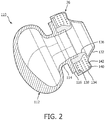
- FIG. 2 illustrates a cross-section of cushion member 12 according to an exemplary embodiment.
- cushion member 12 includes main body portion 24 that comprises a base 112, two stems 114, and two platforms 116 (only one such stem 114 and platform 116 is shown in the cross-section of FIG. 2 ).
- Base 112, stems 114, and platforms 116 are integrally formed together.
- Main body portion 24 of cushion member 12 can be made from any suitable material, such as gel, silicone, foam, rubber, or a combination of materials.
- Nasal prongs 26a,26b are coupled to corresponding platforms 116 of cushion member 12.
- Apertures formed by nasal prongs 26a,26b allow air to flow from a patient into a chamber formed inside cushion member 12. Air flow between the hollow area inside cushion member 12 and delivery conduit 6 is facilitated by an opening 111 (see FIG. 7 ) formed in cushion member 12.
- nasal prong 26 (26a or 26b) includes a flap 132, outer casing 134, inner casing 136, and bottom cap 138.
- Flap 132, outer casing 134, inner casing 136, and bottom cap 138 can each be made from any suitable material, such as gel, silicone, foam, rubber, or a combination of materials.
- flap 132 is made from silicone. Flap 132 is adapted to be inserted into a nostril of the user.
- Outer casing 134 is disposed on an outer portion of nasal prong 26 and inner casing 136 is disposed on an inner portion of nasal prong 26.
- Outer casing 134, inner casing 136, and bottom cap 138 form a space which is filled with a fill material 140.
- Fill material 140 generally consists of a gel or other suitable material that generally conforms to the space formed by outer casing 134, inner casing 136, and bottom cap 138.
- Fill material 140 may be a viscoelastic material, such as a gel substance comprising a viscoelastic polyurethane polymer, or an elastic material. Fill material 140 may also be liquid or air.
- viscoelastic material shall mean a material that exhibits both viscous and elastic characteristics when undergoing deformation, and as a result exhibits time dependent strain. A viscoelastic material will thus deform under the influence of an applied stress, and when the stress is removed from the material, the material will slowly and not instantaneously recover from at least a portion of the deformation.
- the term elastic material shall mean a material that exhibits elastic but not viscous characteristics when undergoing deformation. Elastic materials deform under the influence of an applied stress and return instantaneously to their original state once the stress is removed, thereby recovering from all of the deformation.
- Cushion member 12 is adapted such that when the user wears patient interface device 8, the user's nostril presses against outer casing 134. In turn, interaction between base 112 and stem 114 creates a spring force which presses nasal prong 26 back against the user's nostril. The amount of spring force generated increases the further stems 114 are depressed into base 112. Base 112 and stems 114 generate a spring force in a range of about 20 to 250 grams. The spring force assists with allowing nasal prong 26 to conform to the user's nostril and create a seal.
- base 112 and stems 114 have a durometer in a range of about 10 shA to 50 shA. Referring now to FIGS. 3A and 3B , the variable thickness of base 112 and stems 114 is described in more detail.
- base 112 and stems 114 are divided into a first region 113 and a second region 115.
- First region 113 begins at an end of stems 114 adjacent to platforms 116 and extends partially into base 112. The remaining portion of base 112 forms second region 115.
- First region 113 is thinnest in the area adjacent to platforms 116 and thickest in the area adjacent to second region 115.
- the thicknesses of cushion member 12 in first region 113 are within a range of about 0.4-1.8 mm thick. In some embodiments of the disclosed concept, the thicknesses of cushion member 12 in second region 115 are within a range of about 0.8-5.0 mm thick.
- Cushion member 12 incorporates an arched structure that transfers compressive load through its sidewalls to its outside perimeter and away from sensitive areas of the user's philtrum and septum as well as away from the airpath through cushion member 12. Greater thicknesses in second region 115 provides structural support for cushion member 12 which increases resistance to a complete collapse of cushion member 12. A complete collapse of cushion member 12 happens when stem 114 collapses into base 112 far enough to block airflow through cushion member 12. Thicknesses of the walls of cushion member 12 gradually decrease from in the direction from second region 115 to first region 113 which avoids an abrupt transition in the modulus of cushion member 12. The gradual transition in thicknesses mitigates the potential for pressure points and aids in controlling conformance of cushion member 12. The transition to thinner walls also helps enhance the stability of cushion member 12.
- a depression 142 is formed in an area of outer casing 134.
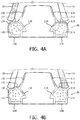
- Depression 142 is operable to facilitate deformation of outer casing 134 allowing to conform to a shape of the user's nostril when pressure is applied to outer casing 134 by the user's nostril, as will be described in more detail hereinafter with respect to FIGS. 4A and 4B .
- FIGS. 4A and 4B illustrate cross-sections of a nasal prong 26 in accordance with an embodiment of the disclosed concept.
- nasal prong 26 is illustrated when a nostril 50 of a user is not applying pressure to nasal prong 26.
- nostril 50 is applying pressure to the nasal prong 26, such as, for example, when the user is wearing patient interface device 8.
- depression 142 is formed in an area of outer casing 134 adjacent to an area where the nostril 50 applies pressure to outer casing 134.
- Depression 142 may be, for example and without limitation, a sink or divot formed in outer casing 134 which makes outer casing 134.
- Depression 142 increases the perimeter of the space formed by outer casing 134, inner casing 136, and bottom cap 138 relative to its cross-sectional area, which increases the ability of the outer casing 134 deform when pressure is applied to it without immediately putting it in tension.
- outer casing 134 In contrast, if the outer casing 134, inner casing 136, and bottom cap 138 formed a semi-circular shape which minimized the perimeter of the space with respect to its cross-sectional area, the outer casing 134 would be resistant to deformation and would be immediately put in tension when pressure is applied to it.
- nostril 50 is applying pressure to nasal prong 26, and more specifically, to outer casing 134.
- outer casing 134 deforms and conforms to the shape of nostril 50 when nostril 50 applies pressure.
- outer casing 134 collapses in the area where nostril 50 applies pressure, which causes a portion of fill material 140 to be displaced.
- Outer casing 134 expands in the area of depression 142 to accommodate the displaced fill material 140.
- outer casing 134 conforms to the shape of nostril 50, as shown in FIG. 4B , thereby creating an improved seal between nasal prong 26 and nostril 50.
- Nostrils 50 of users can vary in size and shape, as well as where they apply pressure to outer casing 134.
- the amount of pressure applied by nostril 50 can also vary. These variations can change the manner in which outer casing 134 deforms. Despite these variations, outer casing 134 deforms to conform to the shape of nostril 50 and forms a seal with nostril 50.
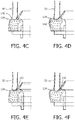
- FIGS. 4C-F illustrate alternative styles of deformation of outer casing 134. Referring to FIGS. 4C and 4D , nostril 50 applies pressure to the area of outer casing 134 where depression 142 is formed. Depression 142 becomes a pocket for nostril 50 to sit in and outer casing 134 deforms to conform to the shape of inner and outer sides of nostril 50, as shown in FIG.
- nostril 50 applies pressure to an area just outside depression 142.
- outer casing 134 deforms to conform to the shape of inner and outer sides of nostril 50, as shown in FIG. 4F .
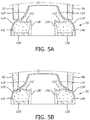
- FIGS. 5A and 5B illustrate cross-sections of a nasal prong 26' in accordance with an alternative exemplary embodiment of the disclosed concept. It will be appreciated by those having ordinary skill in the art that nasal prong 26' may be adapted for use with patient interface device 8 without departing from the scope of the disclosed concept.
- nasal prong 26' is illustrated when nostril 50 is not applying pressure to nasal prong 26'.
- nostril 50 is applying pressure to nasal prong 26'.
- depression 142' is formed in an area of inner casing 136' adjacent to an area of outer casing 134' that nostril 50 will apply pressure to.
- Depression 142' may be, for example and without limitation, a sink or divot formed in inner casing 136' which makes inner casing 136'.
- nostril 50 is applying pressure to nasal prong 26', and more specifically, to an area of outer casing 134'.
- outer casing 134' deforms by collapsing in the area where nostril 50 applies pressure, which causes a portion of fill material 140 to be displaced.
- Inner casing 136' expands in the area of depression 142' to accommodate the displaced fill material 140.
- outer casing 134' conforms to the shape of nostril 50.
- Inner casing 136' also conforms to the shape of nostril 50 and presses against flap 132' causing flap 132' to also conform to the shape of nostril 50, thereby creating an improved seal between nasal prong 26' and nostril 50.
- FIGS. 6A and 6B illustrate cross-sections of a nasal prong 26" in accordance with yet another alternative exemplary embodiment of the disclosed concept. It will be appreciated by those having ordinary skill in the art that nasal prong 26" may be adapted for use with patient interface device 8 without departing from the scope of the disclosed concept.
- nasal prong 26" is illustrated when nostril 50 is not applying pressure to nasal prong 26".
- nostril 50 is applying pressure to nasal prong 26".
- nasal prong 26" includes a second flap 144 formed between outer casing 134" and nostril 50.
- second flap 144 is made of silicone, but it is appreciated that second flap 144 may be made of any suitable material without departing from the scope of the disclosed concept.
- Depression 142" is formed in an area of outer casing 134" adjacent to an area where nostril 50 will apply pressure. Depression 142" may be, for example and without limitation, a sink or divot formed in outer casing 134" which makes outer casing 134".
- nostril 50 is applying pressure to nasal prong 26", and more specifically, to outer casing 134" through second flap 144.
- second flap 144 is pressed by nostril 50 against outer casing 134" causing outer casing 134" to deform by collapsing in the area where pressure is applied, thus causing a portion of fill material 140 to be displaced.
- outer casing 134" expands to accommodate the displaced fill material 140.
- outer casing 134" in the area of depression 142" causes outer casing 134" to conform to the shape of nostril 50 and to press against second flap 144 and cause second flap 144 to conform to the shape of nostril 50, thereby creating an improved seal between nasal prong 26" and nostril 50.
- nasal prongs 26,26',26 include depressions 142,142',142"
- other variations in geometry may be used to increase the perimeter of the spaces defined by outer casing 134,134',134", inner casing 136,136',136", and bottom caps 138,138',138" relative to their cross-sectional areas to increase the deformability of the outer casings 134,134',134" without departing from the scope of the disclosed concept.
- FIG. 7 illustrates a cross section of a portion of a nasal prong 26'" in accordance with another embodiment of the disclosed concept.
- nasal prong 26" may be adapted for use with patient interface device 8 without departing from the scope of the disclosed concept.
- Inner casing 136'" and/or outer casing 134'" of nasal prong 26'" are formed of a material that can be elongated under tension.
- outer casing 134'" deforms to conform to the shape of nostril 50 to form a seal with nostril 50.
- Inner casing 136'" and/or outer casing 134'" elongate to accommodate fill material 140 displaced due to the deformation.
- outer casing 134'" is able to conform to the shape of and form a seal with nostril 50 without having a depression formed therein.
- Variations in thickness of inner casing 136'" and outer casing 134'" influence where deformation occurs as well as provide structural support.
- inner casing 136'" and outer casing 134'" are divided into regions A, B, C, and D.
- Region A is the thinnest and deformation is most likely to occur in region A.
- Regions B and D are slightly thicker than Region A.
- Region C is thickest and provides structural support to outer casing 134'".
- the thickness of Region A is in a range of about 0.2-0.3 mm
- the thickness of Regions B and D are in a range of about 0.2-0.4 mm
- the thickness of Region C is in a range of about 0.4-0.6 mm. It will be appreciated by one having ordinary skill in the art that variations in thickness can also be applied to any of nasal prongs 26,26',26" without departing from the scope of the disclosed concept.
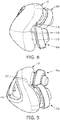
- FIG. 8 is a view illustrating a bottom side of cushion member 12.
- the bottom side of cushion member 12 is adapted to conform to and rest on the user's upper lip when the user wears patient interface device 8.
- cushion member 12 includes upper lip contacting portions 118 and upper lip relief portion 120.
- Cushion member 12 is adapted such that upper lip contacting portions 118 contact the user's upper lip in areas outside the middle area of the user's upper lip.
- Upper relief portion 120 is curved to relieve pressure applied to the middle area of the user's upper lip and conforms to the user's Philtrum (i.e., the section between the upper lip and Septum).
- the middle area of the upper lip is a more sensitive area of the upper lip, and relieving pressure to this area increases comfort for the user.
- the conformance of the cushion member 12 also provides a low profile design that contours to the user and increases stability.
- the conformance of cushion member 12 to the user's upper lip further aids, in conjunction with the variations in thickness of cushion member 12 previously described, in preventing cushion member 12 from collapsing and blocking the air path through cushion member 12 when the user tightens the headgear assembly on patient interface device 8.
- upper lip contacting portions 118 and upper lip relief portion 120 are thinner than other areas of cushion member 12.
- the thinner thickness of upper lip contacting portions 118 and upper lip relief portion 120 provide additional comfort for the user by having more compliance in the structure, which is thinner, thereby decreasing modulus and allowing it to be more flexible.
- FIG. 9 is a view illustrating a top side of cushion member 12.
- the top side of cushion member 12 is disposed near the tip of the user's nose when the user wears patient interface device 8.
- the tip of the user's nose is a sensitive area and undue pressure can cause discomfort for the user.
- the top side of cushion member 12 includes a nose relief portion 122 which is curved so as to prevent or relieve the pressure applied to the user's nose, thus increasing the user's comfort.
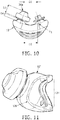
- FIG. 10 illustrates a top view of cushion member 12.
- D1 is a distance between the centers of the tips of nasal prongs 26a,26b (nasal prong 26b is not shown in FIG. 10 ).
- D1 is in a range of about 15-20 mm, and is preferably selected from one of about 16 mm, 17.5 mm, 19.5 mm.
- D2 is a distance between the centers of the tips of platforms 416.
- D2 is in a range of about 20-25 mm, and is preferably selected from one of about 20.5 mm, 22 mm, and 24 mm.
- D3 is a height of nasal prongs 26a,26b.
- D3 is in a range of about 9-12 mm, and is preferably about 10.6 mm.
- D4 is a height of stem 114. In some embodiments of the disclosed concept, D4 is in a range of about 2-4 mm, and is preferably about 3 mm.
- ⁇ 1 is an angle between an axis of one of nasal prongs 26a,26b and a line parallel to a center line of cushion member 12. In some embodiments of the disclosed concept, ⁇ 1 is in a range of about 20-24°, and is preferably about 22°.
- the overall stem height (i.e., a distance from the base of the stem to the tip of the nasal prong 26a or 26b) is in a range of about 14-16 mm, and is preferably about 15.1 mm.
- FIG. 11 illustrates a side view of cushion member 12' in accordance with an exemplary embodiment of the disclosed concept.
- Cushion member 12' includes a first portion 124 made of a first material (e.g., without limitation, silicone having a durometer of about 75 shA) and a second portion 126 made of a second material (e.g., without limitation, silicone having a durometer of about 20 shA).
- the durometer of the first material is higher than the durometer of the second material.
- First portion 124 of cushion member 12' forms a portion of cushion member 12' that couples to frame member 14.
- first portion 124 of cushion member 12' allows for better audible and tactile feedback during assembly of patient interface device 8 which makes it more obvious to the user when cushion member 12' and frame member 14 are properly coupled together.
- the higher durometer material also creates a more robust seal between cushion member 12' and frame member 14.
- the higher durometer material helps opening 111 of cushion member 12' retain its shape. Opening 111 may have a distinctive shape, such as, for example, a triangle, which only allows cushion member 12' and frame member 14 to be coupled when they are properly aligned with each other.
- Second portion 126 of cushion member 12' forms a portion of cushion member 12' that contacts the user's face.
- Using a lower durometer material for second portion 126 of cushion member 12' provides increased comfort for the user and also allows cushion member 12' to better conform to the user's face such as, for example, during static and dynamic moments of sleep.
- Cushion member 12' having materials with different durometers may be manufactured using any suitable method without departing from the scope of the disclosed concept.
- the higher durometer portion of the cushion member 12' is molded first and then the lower durometer portion of cushion member 12' is overmolded onto the higher durometer portion.
- both the higher durometer and lower durometer portions of cushion member 12' are simultaneously formed using a two-shot molding process.
- any reference signs placed between parentheses shall not be construed as limiting the claim.
- the word “comprising” or “including” does not exclude the presence of elements or steps other than those listed in a claim.
- several of these means may be embodied by one and the same item of hardware.
- the word “a” or “an” preceding an element does not exclude the presence of a plurality of such elements.
- any device claim enumerating several means several of these means may be embodied by one and the same item of hardware.
- the mere fact that certain elements are recited in mutually different dependent claims does not indicate that these elements cannot be used in combination.
Landscapes
- Health & Medical Sciences (AREA)
- Pulmonology (AREA)
- General Health & Medical Sciences (AREA)
- Public Health (AREA)
- Veterinary Medicine (AREA)
- Biomedical Technology (AREA)
- Heart & Thoracic Surgery (AREA)
- Engineering & Computer Science (AREA)
- Life Sciences & Earth Sciences (AREA)
- Animal Behavior & Ethology (AREA)
- Hematology (AREA)
- Emergency Medicine (AREA)
- Anesthesiology (AREA)
- Otolaryngology (AREA)
- Nursing (AREA)
- Orthopedic Medicine & Surgery (AREA)
- Vascular Medicine (AREA)
- Orthopedics, Nursing, And Contraception (AREA)
- Surgical Instruments (AREA)
- Infusion, Injection, And Reservoir Apparatuses (AREA)
Applications Claiming Priority (2)
| Application Number | Priority Date | Filing Date | Title |
|---|---|---|---|
| US201361805605P | 2013-03-27 | 2013-03-27 | |
| PCT/IB2014/060208 WO2014155329A2 (en) | 2013-03-27 | 2014-03-27 | Nasal prong and patient interface device including the same |
Publications (2)
| Publication Number | Publication Date |
|---|---|
| EP2978484A2 EP2978484A2 (en) | 2016-02-03 |
| EP2978484B1 true EP2978484B1 (en) | 2018-05-16 |
Family
ID=50543631
Family Applications (1)
| Application Number | Title | Priority Date | Filing Date |
|---|---|---|---|
| EP14719099.5A Active EP2978484B1 (en) | 2013-03-27 | 2014-03-27 | Nasal prong and patient interface device including the same |
Country Status (6)
| Country | Link |
|---|---|
| US (1) | US10398868B2 (enExample) |
| EP (1) | EP2978484B1 (enExample) |
| JP (1) | JP6363694B2 (enExample) |
| CN (1) | CN105102049B (enExample) |
| RU (1) | RU2690458C2 (enExample) |
| WO (1) | WO2014155329A2 (enExample) |
Families Citing this family (43)
| Publication number | Priority date | Publication date | Assignee | Title |
|---|---|---|---|---|
| USD637279S1 (en) * | 2008-01-11 | 2011-05-03 | Resmed Limited | Strap and yoke for mask |
| USD691257S1 (en) | 2010-08-23 | 2013-10-08 | Fisher & Paykel Healthcare Limited | Seal for a patient interface |
| USD692554S1 (en) | 2011-09-08 | 2013-10-29 | Fisher & Paykel Healthcare Limited | Patient interface assembly |
| US10039894B2 (en) | 2013-11-27 | 2018-08-07 | Fisher & Paykel Healthcare Limited | Headgear assembly for breathing interface |
| USD770036S1 (en) | 2013-11-27 | 2016-10-25 | Fisher & Paykel Healthcare Limited | Breathing interface assembly |
| USD771238S1 (en) * | 2014-01-16 | 2016-11-08 | Resmed Limited | Combined plenum, seal and clip module for patient interface |
| USD760379S1 (en) * | 2014-01-31 | 2016-06-28 | Resmed Limited | Headgear connector for patient interface |
| EP3169408A4 (en) | 2014-07-18 | 2018-01-03 | Silverbow Development, LLC | Conforming nasal pillow |
| USD797921S1 (en) | 2014-11-07 | 2017-09-19 | Fisher & Paykel Healthcare Limited | Breathing apparatus |
| CN106999686B (zh) * | 2014-12-08 | 2021-12-21 | 人类设计医疗有限公司 | 用于与通风和空气正压系统一起使用的混合气道正压接口系统 |
| EP3756717B1 (en) | 2015-03-27 | 2023-08-16 | Fisher & Paykel Healthcare Limited | Patient interface and aspects thereof |
| US20180071474A1 (en) * | 2015-03-30 | 2018-03-15 | Bespoke Medical Innovations Pty Ltd | Improved sleep apnoea mask adapter |
| NZ740229A (en) | 2015-09-23 | 2023-07-28 | ResMed Pty Ltd | Patient interface with foam seal-forming structure |
| US10799661B2 (en) | 2015-09-23 | 2020-10-13 | ResMed Pty Ltd | Patient interface with a seal-forming structure having varying thickness |
| EP4043057B1 (en) * | 2015-09-23 | 2024-01-03 | ResMed Pty Ltd | Patient interface with a seal-forming structure having varying thickness |
| AU2017252762B2 (en) | 2016-04-22 | 2022-04-21 | Fisher & Paykel Healthcare Limited | Patient interface and aspects thereof |
| WO2018009080A1 (en) * | 2016-07-08 | 2018-01-11 | Fisher & Paykel Healthcare Limited | A vent for a component of a respiratory therapy system |
| USD884151S1 (en) * | 2016-10-24 | 2020-05-12 | ResMed Pty Ltd | Patient interface |
| USD865158S1 (en) * | 2016-11-23 | 2019-10-29 | ResMed Pty Ltd | Respiratory mask |
| USD882757S1 (en) * | 2016-11-30 | 2020-04-28 | ResMed Pty Ltd | Respiratory mask air delivery adapter assembly |
| USD863545S1 (en) * | 2016-11-30 | 2019-10-15 | ResMed Pty Ltd | Air delivery adapter for respiratory mask |
| USD851749S1 (en) | 2017-08-01 | 2019-06-18 | Fisher & Paykel Healthcare Limited | Seal for a direct nasal mask assembly |
| USD863541S1 (en) * | 2017-11-15 | 2019-10-15 | Innomed Healthscience, Inc. | Respiratory mask |
| USD863538S1 (en) * | 2017-11-15 | 2019-10-15 | Innomed Healthscience, Inc. | Respiratory mask |
| USD859639S1 (en) * | 2017-11-15 | 2019-09-10 | Innomed Healthscience, Inc. | Respiratory mask |
| USD863540S1 (en) * | 2017-11-15 | 2019-10-15 | Innomed Healthscience, Inc. | Respiratory mask |
| USD864377S1 (en) * | 2017-11-15 | 2019-10-22 | Innomed Healthscience, Inc. | Respiratory mask |
| USD859641S1 (en) * | 2017-11-15 | 2019-09-10 | Innomed Healthscience, Inc. | Respiratory mask |
| USD859640S1 (en) * | 2017-11-15 | 2019-09-10 | Innomed Healthscience, Inc. | Respiratory mask |
| USD863542S1 (en) * | 2017-11-15 | 2019-10-15 | Innomed Healthscience, Inc. | Respiratory mask |
| USD863539S1 (en) * | 2017-11-15 | 2019-10-15 | Innomed Healthscience, Inc. | Respiratory mask |
| USD901003S1 (en) * | 2018-04-09 | 2020-11-03 | Fisher & Paykel Healthcare Limited | Direct nasal mask assembly |
| USD986410S1 (en) * | 2018-07-27 | 2023-05-16 | Cooltech, Llc | Mask |
| USD930150S1 (en) | 2019-08-21 | 2021-09-07 | ResMed Asia Pte Ltd | Patient interface |
| USD941993S1 (en) * | 2019-08-23 | 2022-01-25 | ResMed Pty Ltd | Tube headgear for patient interface |
| USD933814S1 (en) | 2019-08-23 | 2021-10-19 | ResMed Pty Ltd | Patient interface |
| USD1061868S1 (en) | 2019-10-16 | 2025-02-11 | Fisher & Paykel Healthcare Limited | Headgear |
| CA3161556C (en) | 2019-12-20 | 2023-09-19 | Robin YEW | Patient interface with foam cushion |
| US11844901B2 (en) * | 2020-04-08 | 2023-12-19 | Koninklijke Philips N.V. | System and method for detecting agitation, discomfort and/or self-extubation during intubation |
| USD1003428S1 (en) * | 2020-05-01 | 2023-10-31 | ResMed Asia Pte. Ltd. | Respiratory mask with air delivery adapter |
| JP1731322S (ja) * | 2021-09-30 | 2022-12-05 | マスク用フレーム | |
| USD1018837S1 (en) * | 2023-05-22 | 2024-03-19 | Riesiger Sternenhimmel, Inc. | Breathing apparatus |
| USD1033632S1 (en) * | 2023-11-03 | 2024-07-02 | Dcstar Inc | Frame |
Citations (1)
| Publication number | Priority date | Publication date | Assignee | Title |
|---|---|---|---|---|
| EP2022528A2 (en) * | 2007-07-30 | 2009-02-11 | Resmed Limited | Patient interface |
Family Cites Families (25)
| Publication number | Priority date | Publication date | Assignee | Title |
|---|---|---|---|---|
| US4660555A (en) * | 1984-09-21 | 1987-04-28 | Payton Hugh W | Oxygen delivery and administration system |
| US4782832A (en) * | 1987-07-30 | 1988-11-08 | Puritan-Bennett Corporation | Nasal puff with adjustable sealing means |
| US5269296A (en) | 1991-10-29 | 1993-12-14 | Landis Robert M | Nasal continuous positive airway pressure apparatus and method |
| US5533506A (en) * | 1995-01-13 | 1996-07-09 | Medlife, Inc. | Nasal tube assembly |
| US7219669B1 (en) | 1999-06-08 | 2007-05-22 | Sleepnet Corporation | Nose mask |
| US7156096B2 (en) * | 2002-07-15 | 2007-01-02 | Landis Robert M | Dynamic infant nasal CPAP system and method |
| CN100479879C (zh) | 2003-02-21 | 2009-04-22 | 雷斯梅德有限公司 | 鼻组件 |
| US20050011524A1 (en) * | 2003-07-17 | 2005-01-20 | Marguerite Thomlinson | Nasal interface apparatus |
| EP1651158B1 (en) * | 2003-07-28 | 2018-11-07 | Salter Labs | Respiratory therapy system including a nasal cannula assembly |
| US8522782B2 (en) * | 2005-09-12 | 2013-09-03 | Mergenet Medical, Inc. | High flow therapy device utilizing a non-sealing respiratory interface and related methods |
| KR20080108085A (ko) * | 2006-01-19 | 2008-12-11 | 존 시. 제퍼슨 디엠디 인코포레이션 | 수면무호흡증 치료기구 및 치료방법 |
| US20090301499A1 (en) * | 2006-06-06 | 2009-12-10 | Robert Chalk | Device for alleviating snoring |
| US20080289633A1 (en) | 2007-04-11 | 2008-11-27 | Resmed Limited | Mask with gel component |
| US8833372B2 (en) | 2007-05-29 | 2014-09-16 | Carefusion 207, Inc. | Integrated mask and prongs for nasal CPAP |
| US20090095303A1 (en) | 2007-10-16 | 2009-04-16 | Bruce Sher | Nasal prongs |
| EP2481438B1 (en) | 2007-11-19 | 2015-09-23 | Koninklijke Philips N.V. | A patient interface device including a coating adhesive layer |
| EP2247331B1 (en) * | 2008-01-25 | 2017-05-10 | Salter Labs | Respiratory therapy system including a nasal cannula assembly |
| DE102008010475A1 (de) * | 2008-02-21 | 2009-08-27 | Seleon Gmbh | Applikatoren für eine Luftbrille |
| WO2009151344A1 (en) | 2008-06-12 | 2009-12-17 | Fisher & Paykel Healthcare Limited | Respiratory nasal interface with sealing cap portions |
| US8434485B2 (en) | 2008-12-30 | 2013-05-07 | Carefusion 2200, Inc. | Respiratory mask |
| CN111991669B (zh) * | 2009-05-12 | 2023-11-17 | 费雪派克医疗保健有限公司 | 病人接口及其多个方面 |
| CN102725018A (zh) * | 2010-01-15 | 2012-10-10 | 皇家飞利浦电子股份有限公司 | 可更换的鼻枕 |
| JP5913129B2 (ja) | 2010-01-15 | 2016-04-27 | コーニンクレッカ フィリップス エヌ ヴェKoninklijke Philips N.V. | 取り替え可能な鼻枕のキット |
| US9387300B2 (en) * | 2010-03-25 | 2016-07-12 | Respcare, Inc. | Adjustable nasal prong and headgear assembly |
| US8720444B2 (en) * | 2012-01-20 | 2014-05-13 | Hsiner Co., Ltd. | Breathing assistance apparatus having floating function |
-
2014
- 2014-03-27 RU RU2015145967A patent/RU2690458C2/ru not_active IP Right Cessation
- 2014-03-27 US US14/779,625 patent/US10398868B2/en active Active
- 2014-03-27 CN CN201480018232.8A patent/CN105102049B/zh active Active
- 2014-03-27 WO PCT/IB2014/060208 patent/WO2014155329A2/en not_active Ceased
- 2014-03-27 EP EP14719099.5A patent/EP2978484B1/en active Active
- 2014-03-27 JP JP2016504839A patent/JP6363694B2/ja active Active
Patent Citations (1)
| Publication number | Priority date | Publication date | Assignee | Title |
|---|---|---|---|---|
| EP2022528A2 (en) * | 2007-07-30 | 2009-02-11 | Resmed Limited | Patient interface |
Also Published As
| Publication number | Publication date |
|---|---|
| US20160051784A1 (en) | 2016-02-25 |
| JP6363694B2 (ja) | 2018-07-25 |
| US10398868B2 (en) | 2019-09-03 |
| CN105102049B (zh) | 2017-11-28 |
| EP2978484A2 (en) | 2016-02-03 |
| RU2015145967A3 (enExample) | 2018-03-19 |
| CN105102049A (zh) | 2015-11-25 |
| RU2015145967A (ru) | 2017-05-04 |
| WO2014155329A2 (en) | 2014-10-02 |
| RU2690458C2 (ru) | 2019-06-03 |
| JP2016514534A (ja) | 2016-05-23 |
| WO2014155329A3 (en) | 2014-12-31 |
Similar Documents
| Publication | Publication Date | Title |
|---|---|---|
| US10398868B2 (en) | Nasal prong and patient interface device including the same | |
| US10828449B2 (en) | Patient interface device | |
| US9604023B2 (en) | Respiratory mask with ribbed contacting surface | |
| CN105188820B (zh) | 稳定面罩 | |
| US8127764B2 (en) | Respiratory mask cushion and mask using same | |
| US7975694B2 (en) | Non-intrusive mask interface with nasal support | |
| EP3233169B1 (en) | Adaptive buckling member in a patient interface | |
| AU2011234068A1 (en) | Respiratory mask with ribbed contacting surface | |
| JP2013533085A (ja) | 動的な自己調節機構を有する患者インタフェース装置 | |
| US20180200468A1 (en) | Patient interface device fabric support sleeve | |
| WO2014091360A1 (en) | Mask with red mark alleviating pocket | |
| US10821252B2 (en) | Nasal pillow and patient interface including the same | |
| CN113926039B (zh) | 鼻衬垫及患者接口装置 | |
| JP7145939B2 (ja) | カスタマイズ可能なマスク及びそのサイズを合わせる方法 |
Legal Events
| Date | Code | Title | Description |
|---|---|---|---|
| PUAI | Public reference made under article 153(3) epc to a published international application that has entered the european phase |
Free format text: ORIGINAL CODE: 0009012 |
|
| 17P | Request for examination filed |
Effective date: 20151027 |
|
| AK | Designated contracting states |
Kind code of ref document: A2 Designated state(s): AL AT BE BG CH CY CZ DE DK EE ES FI FR GB GR HR HU IE IS IT LI LT LU LV MC MK MT NL NO PL PT RO RS SE SI SK SM TR |
|
| AX | Request for extension of the european patent |
Extension state: BA ME |
|
| DAX | Request for extension of the european patent (deleted) | ||
| STAA | Information on the status of an ep patent application or granted ep patent |
Free format text: STATUS: EXAMINATION IS IN PROGRESS |
|
| 17Q | First examination report despatched |
Effective date: 20170227 |
|
| GRAP | Despatch of communication of intention to grant a patent |
Free format text: ORIGINAL CODE: EPIDOSNIGR1 |
|
| STAA | Information on the status of an ep patent application or granted ep patent |
Free format text: STATUS: GRANT OF PATENT IS INTENDED |
|
| INTG | Intention to grant announced |
Effective date: 20171103 |
|
| GRAS | Grant fee paid |
Free format text: ORIGINAL CODE: EPIDOSNIGR3 |
|
| GRAA | (expected) grant |
Free format text: ORIGINAL CODE: 0009210 |
|
| STAA | Information on the status of an ep patent application or granted ep patent |
Free format text: STATUS: THE PATENT HAS BEEN GRANTED |
|
| AK | Designated contracting states |
Kind code of ref document: B1 Designated state(s): AL AT BE BG CH CY CZ DE DK EE ES FI FR GB GR HR HU IE IS IT LI LT LU LV MC MK MT NL NO PL PT RO RS SE SI SK SM TR |
|
| REG | Reference to a national code |
Ref country code: GB Ref legal event code: FG4D |
|
| REG | Reference to a national code |
Ref country code: CH Ref legal event code: EP |
|
| REG | Reference to a national code |
Ref country code: IE Ref legal event code: FG4D |
|
| REG | Reference to a national code |
Ref country code: DE Ref legal event code: R096 Ref document number: 602014025532 Country of ref document: DE |
|
| REG | Reference to a national code |
Ref country code: AT Ref legal event code: REF Ref document number: 998985 Country of ref document: AT Kind code of ref document: T Effective date: 20180615 |
|
| REG | Reference to a national code |
Ref country code: NL Ref legal event code: MP Effective date: 20180516 |
|
| REG | Reference to a national code |
Ref country code: LT Ref legal event code: MG4D |
|
| PG25 | Lapsed in a contracting state [announced via postgrant information from national office to epo] |
Ref country code: SE Free format text: LAPSE BECAUSE OF FAILURE TO SUBMIT A TRANSLATION OF THE DESCRIPTION OR TO PAY THE FEE WITHIN THE PRESCRIBED TIME-LIMIT Effective date: 20180516 Ref country code: NO Free format text: LAPSE BECAUSE OF FAILURE TO SUBMIT A TRANSLATION OF THE DESCRIPTION OR TO PAY THE FEE WITHIN THE PRESCRIBED TIME-LIMIT Effective date: 20180816 Ref country code: ES Free format text: LAPSE BECAUSE OF FAILURE TO SUBMIT A TRANSLATION OF THE DESCRIPTION OR TO PAY THE FEE WITHIN THE PRESCRIBED TIME-LIMIT Effective date: 20180516 Ref country code: LT Free format text: LAPSE BECAUSE OF FAILURE TO SUBMIT A TRANSLATION OF THE DESCRIPTION OR TO PAY THE FEE WITHIN THE PRESCRIBED TIME-LIMIT Effective date: 20180516 Ref country code: FI Free format text: LAPSE BECAUSE OF FAILURE TO SUBMIT A TRANSLATION OF THE DESCRIPTION OR TO PAY THE FEE WITHIN THE PRESCRIBED TIME-LIMIT Effective date: 20180516 Ref country code: BG Free format text: LAPSE BECAUSE OF FAILURE TO SUBMIT A TRANSLATION OF THE DESCRIPTION OR TO PAY THE FEE WITHIN THE PRESCRIBED TIME-LIMIT Effective date: 20180816 |
|
| PG25 | Lapsed in a contracting state [announced via postgrant information from national office to epo] |
Ref country code: HR Free format text: LAPSE BECAUSE OF FAILURE TO SUBMIT A TRANSLATION OF THE DESCRIPTION OR TO PAY THE FEE WITHIN THE PRESCRIBED TIME-LIMIT Effective date: 20180516 Ref country code: RS Free format text: LAPSE BECAUSE OF FAILURE TO SUBMIT A TRANSLATION OF THE DESCRIPTION OR TO PAY THE FEE WITHIN THE PRESCRIBED TIME-LIMIT Effective date: 20180516 Ref country code: LV Free format text: LAPSE BECAUSE OF FAILURE TO SUBMIT A TRANSLATION OF THE DESCRIPTION OR TO PAY THE FEE WITHIN THE PRESCRIBED TIME-LIMIT Effective date: 20180516 Ref country code: NL Free format text: LAPSE BECAUSE OF FAILURE TO SUBMIT A TRANSLATION OF THE DESCRIPTION OR TO PAY THE FEE WITHIN THE PRESCRIBED TIME-LIMIT Effective date: 20180516 Ref country code: GR Free format text: LAPSE BECAUSE OF FAILURE TO SUBMIT A TRANSLATION OF THE DESCRIPTION OR TO PAY THE FEE WITHIN THE PRESCRIBED TIME-LIMIT Effective date: 20180817 |
|
| REG | Reference to a national code |
Ref country code: AT Ref legal event code: MK05 Ref document number: 998985 Country of ref document: AT Kind code of ref document: T Effective date: 20180516 |
|
| PG25 | Lapsed in a contracting state [announced via postgrant information from national office to epo] |
Ref country code: AT Free format text: LAPSE BECAUSE OF FAILURE TO SUBMIT A TRANSLATION OF THE DESCRIPTION OR TO PAY THE FEE WITHIN THE PRESCRIBED TIME-LIMIT Effective date: 20180516 Ref country code: DK Free format text: LAPSE BECAUSE OF FAILURE TO SUBMIT A TRANSLATION OF THE DESCRIPTION OR TO PAY THE FEE WITHIN THE PRESCRIBED TIME-LIMIT Effective date: 20180516 Ref country code: SK Free format text: LAPSE BECAUSE OF FAILURE TO SUBMIT A TRANSLATION OF THE DESCRIPTION OR TO PAY THE FEE WITHIN THE PRESCRIBED TIME-LIMIT Effective date: 20180516 Ref country code: PL Free format text: LAPSE BECAUSE OF FAILURE TO SUBMIT A TRANSLATION OF THE DESCRIPTION OR TO PAY THE FEE WITHIN THE PRESCRIBED TIME-LIMIT Effective date: 20180516 Ref country code: EE Free format text: LAPSE BECAUSE OF FAILURE TO SUBMIT A TRANSLATION OF THE DESCRIPTION OR TO PAY THE FEE WITHIN THE PRESCRIBED TIME-LIMIT Effective date: 20180516 Ref country code: RO Free format text: LAPSE BECAUSE OF FAILURE TO SUBMIT A TRANSLATION OF THE DESCRIPTION OR TO PAY THE FEE WITHIN THE PRESCRIBED TIME-LIMIT Effective date: 20180516 Ref country code: CZ Free format text: LAPSE BECAUSE OF FAILURE TO SUBMIT A TRANSLATION OF THE DESCRIPTION OR TO PAY THE FEE WITHIN THE PRESCRIBED TIME-LIMIT Effective date: 20180516 |
|
| REG | Reference to a national code |
Ref country code: DE Ref legal event code: R097 Ref document number: 602014025532 Country of ref document: DE |
|
| PG25 | Lapsed in a contracting state [announced via postgrant information from national office to epo] |
Ref country code: SM Free format text: LAPSE BECAUSE OF FAILURE TO SUBMIT A TRANSLATION OF THE DESCRIPTION OR TO PAY THE FEE WITHIN THE PRESCRIBED TIME-LIMIT Effective date: 20180516 Ref country code: IT Free format text: LAPSE BECAUSE OF FAILURE TO SUBMIT A TRANSLATION OF THE DESCRIPTION OR TO PAY THE FEE WITHIN THE PRESCRIBED TIME-LIMIT Effective date: 20180516 |
|
| PLBE | No opposition filed within time limit |
Free format text: ORIGINAL CODE: 0009261 |
|
| STAA | Information on the status of an ep patent application or granted ep patent |
Free format text: STATUS: NO OPPOSITION FILED WITHIN TIME LIMIT |
|
| 26N | No opposition filed |
Effective date: 20190219 |
|
| PG25 | Lapsed in a contracting state [announced via postgrant information from national office to epo] |
Ref country code: SI Free format text: LAPSE BECAUSE OF FAILURE TO SUBMIT A TRANSLATION OF THE DESCRIPTION OR TO PAY THE FEE WITHIN THE PRESCRIBED TIME-LIMIT Effective date: 20180516 |
|
| PG25 | Lapsed in a contracting state [announced via postgrant information from national office to epo] |
Ref country code: MC Free format text: LAPSE BECAUSE OF FAILURE TO SUBMIT A TRANSLATION OF THE DESCRIPTION OR TO PAY THE FEE WITHIN THE PRESCRIBED TIME-LIMIT Effective date: 20180516 |
|
| REG | Reference to a national code |
Ref country code: CH Ref legal event code: PL |
|
| GBPC | Gb: european patent ceased through non-payment of renewal fee |
Effective date: 20190327 |
|
| PG25 | Lapsed in a contracting state [announced via postgrant information from national office to epo] |
Ref country code: AL Free format text: LAPSE BECAUSE OF FAILURE TO SUBMIT A TRANSLATION OF THE DESCRIPTION OR TO PAY THE FEE WITHIN THE PRESCRIBED TIME-LIMIT Effective date: 20180516 Ref country code: LU Free format text: LAPSE BECAUSE OF NON-PAYMENT OF DUE FEES Effective date: 20190327 |
|
| REG | Reference to a national code |
Ref country code: BE Ref legal event code: MM Effective date: 20190331 |
|
| PG25 | Lapsed in a contracting state [announced via postgrant information from national office to epo] |
Ref country code: GB Free format text: LAPSE BECAUSE OF NON-PAYMENT OF DUE FEES Effective date: 20190327 Ref country code: IE Free format text: LAPSE BECAUSE OF NON-PAYMENT OF DUE FEES Effective date: 20190327 Ref country code: CH Free format text: LAPSE BECAUSE OF NON-PAYMENT OF DUE FEES Effective date: 20190331 Ref country code: LI Free format text: LAPSE BECAUSE OF NON-PAYMENT OF DUE FEES Effective date: 20190331 |
|
| PG25 | Lapsed in a contracting state [announced via postgrant information from national office to epo] |
Ref country code: BE Free format text: LAPSE BECAUSE OF NON-PAYMENT OF DUE FEES Effective date: 20190331 |
|
| PG25 | Lapsed in a contracting state [announced via postgrant information from national office to epo] |
Ref country code: TR Free format text: LAPSE BECAUSE OF FAILURE TO SUBMIT A TRANSLATION OF THE DESCRIPTION OR TO PAY THE FEE WITHIN THE PRESCRIBED TIME-LIMIT Effective date: 20180516 |
|
| PG25 | Lapsed in a contracting state [announced via postgrant information from national office to epo] |
Ref country code: MT Free format text: LAPSE BECAUSE OF NON-PAYMENT OF DUE FEES Effective date: 20190327 Ref country code: PT Free format text: LAPSE BECAUSE OF FAILURE TO SUBMIT A TRANSLATION OF THE DESCRIPTION OR TO PAY THE FEE WITHIN THE PRESCRIBED TIME-LIMIT Effective date: 20180917 |
|
| PG25 | Lapsed in a contracting state [announced via postgrant information from national office to epo] |
Ref country code: CY Free format text: LAPSE BECAUSE OF FAILURE TO SUBMIT A TRANSLATION OF THE DESCRIPTION OR TO PAY THE FEE WITHIN THE PRESCRIBED TIME-LIMIT Effective date: 20180516 |
|
| PG25 | Lapsed in a contracting state [announced via postgrant information from national office to epo] |
Ref country code: IS Free format text: LAPSE BECAUSE OF FAILURE TO SUBMIT A TRANSLATION OF THE DESCRIPTION OR TO PAY THE FEE WITHIN THE PRESCRIBED TIME-LIMIT Effective date: 20180916 |
|
| PG25 | Lapsed in a contracting state [announced via postgrant information from national office to epo] |
Ref country code: HU Free format text: LAPSE BECAUSE OF FAILURE TO SUBMIT A TRANSLATION OF THE DESCRIPTION OR TO PAY THE FEE WITHIN THE PRESCRIBED TIME-LIMIT; INVALID AB INITIO Effective date: 20140327 |
|
| PG25 | Lapsed in a contracting state [announced via postgrant information from national office to epo] |
Ref country code: MK Free format text: LAPSE BECAUSE OF FAILURE TO SUBMIT A TRANSLATION OF THE DESCRIPTION OR TO PAY THE FEE WITHIN THE PRESCRIBED TIME-LIMIT Effective date: 20180516 |
|
| PGFP | Annual fee paid to national office [announced via postgrant information from national office to epo] |
Ref country code: DE Payment date: 20260320 Year of fee payment: 13 |
|
| PGFP | Annual fee paid to national office [announced via postgrant information from national office to epo] |
Ref country code: FR Payment date: 20260323 Year of fee payment: 13 |