EP2970207B1 - Substituted piperidine compounds and their use as orexin receptor modulators - Google Patents
Substituted piperidine compounds and their use as orexin receptor modulators Download PDFInfo
- Publication number
- EP2970207B1 EP2970207B1 EP14727268.6A EP14727268A EP2970207B1 EP 2970207 B1 EP2970207 B1 EP 2970207B1 EP 14727268 A EP14727268 A EP 14727268A EP 2970207 B1 EP2970207 B1 EP 2970207B1
- Authority
- EP
- European Patent Office
- Prior art keywords
- methyl
- methanone
- pyridin
- trifluoromethyl
- phenyl
- Prior art date
- Legal status (The legal status is an assumption and is not a legal conclusion. Google has not performed a legal analysis and makes no representation as to the accuracy of the status listed.)
- Active
Links
- LBLBKHYDUJYKHT-OXJNMPFZSA-N C[C@@H]([C@@H](CCC1)Nc2nccc(-c3ccccc3)n2)N1C(c(cccc1F)c1OC)=O Chemical compound C[C@@H]([C@@H](CCC1)Nc2nccc(-c3ccccc3)n2)N1C(c(cccc1F)c1OC)=O LBLBKHYDUJYKHT-OXJNMPFZSA-N 0.000 description 3
- OQRWWFFSUBHUOV-WIYYLYMNSA-N CCOc(cccc1)c1C(N(CCC1)[C@H](C)[C@@H]1Nc1nccc(-c2ccccc2)n1)=O Chemical compound CCOc(cccc1)c1C(N(CCC1)[C@H](C)[C@@H]1Nc1nccc(-c2ccccc2)n1)=O OQRWWFFSUBHUOV-WIYYLYMNSA-N 0.000 description 2
- WBNDJIUHFUOZRK-GOEBONIOSA-N CCOc1c(C(N(CCC2)[C@@H](C)[C@@H]2Nc2ncc(C(F)(F)F)cc2)=O)nc(C)cc1 Chemical compound CCOc1c(C(N(CCC2)[C@@H](C)[C@@H]2Nc2ncc(C(F)(F)F)cc2)=O)nc(C)cc1 WBNDJIUHFUOZRK-GOEBONIOSA-N 0.000 description 2
- RVXWHYNMQPNUKM-ZDUSSCGKSA-N C[C@@H](/C(/CCC1)=[O]/c2ncc(C(F)(F)F)nc2)N1C(c1cccc(F)c1-c1ncccn1)=O Chemical compound C[C@@H](/C(/CCC1)=[O]/c2ncc(C(F)(F)F)nc2)N1C(c1cccc(F)c1-c1ncccn1)=O RVXWHYNMQPNUKM-ZDUSSCGKSA-N 0.000 description 2
- SJFIWVQBOPVOBS-MAUKXSAKSA-N C[C@@H]([C@@H](CCC1)Nc2ccc(C(F)(F)F)cn2)N1C(c(cccc1C)c1-[n]1nccn1)=O Chemical compound C[C@@H]([C@@H](CCC1)Nc2ccc(C(F)(F)F)cn2)N1C(c(cccc1C)c1-[n]1nccn1)=O SJFIWVQBOPVOBS-MAUKXSAKSA-N 0.000 description 2
- UCUHFNPDSIOOIZ-WMLDXEAASA-N C[C@@H]([C@@H](CCC1)Nc2cnc(cccc3)c3n2)N1C(c(cccc1F)c1OC)=O Chemical compound C[C@@H]([C@@H](CCC1)Nc2cnc(cccc3)c3n2)N1C(c(cccc1F)c1OC)=O UCUHFNPDSIOOIZ-WMLDXEAASA-N 0.000 description 2
- HKZPAQNNMSEXPQ-DOTOQJQBSA-N C[C@@H]([C@@H](CCC1)Nc2nc(C)cc(C)n2)N1C(c(c(F)ccc1)c1-[n]1nccn1)=O Chemical compound C[C@@H]([C@@H](CCC1)Nc2nc(C)cc(C)n2)N1C(c(c(F)ccc1)c1-[n]1nccn1)=O HKZPAQNNMSEXPQ-DOTOQJQBSA-N 0.000 description 2
- MGKAPAIPNKGNLB-FUHWJXTLSA-N C[C@@H]([C@@H](CCC1)Nc2nc(C)cc(C)n2)N1C(c(cccc1)c1-[n]1nccn1)=O Chemical compound C[C@@H]([C@@H](CCC1)Nc2nc(C)cc(C)n2)N1C(c(cccc1)c1-[n]1nccn1)=O MGKAPAIPNKGNLB-FUHWJXTLSA-N 0.000 description 2
- ZRBIBMLFZDCZSU-MAUKXSAKSA-N C[C@@H]([C@@H](CCC1)Nc2ncc(C(F)(F)F)cc2)N1C(c(ccc(C)c1)c1-[n]1nccn1)=O Chemical compound C[C@@H]([C@@H](CCC1)Nc2ncc(C(F)(F)F)cc2)N1C(c(ccc(C)c1)c1-[n]1nccn1)=O ZRBIBMLFZDCZSU-MAUKXSAKSA-N 0.000 description 2
- GWTJUSKJAFQABG-APPDUMDISA-N C[C@@H]([C@@H](CCC1)Nc2ncc(C(F)(F)F)cn2)N1C(c(c(-c1nc(C)n[o]1)c1)ccc1F)=O Chemical compound C[C@@H]([C@@H](CCC1)Nc2ncc(C(F)(F)F)cn2)N1C(c(c(-c1nc(C)n[o]1)c1)ccc1F)=O GWTJUSKJAFQABG-APPDUMDISA-N 0.000 description 2
- JTVBTTLMGGYEPR-XJKSGUPXSA-N C[C@@H]([C@@H](CCC1)Nc2ncc(C(F)(F)F)cn2)N1C(c1c(-[n]2nccn2)nc(C)cc1)=O Chemical compound C[C@@H]([C@@H](CCC1)Nc2ncc(C(F)(F)F)cn2)N1C(c1c(-[n]2nccn2)nc(C)cc1)=O JTVBTTLMGGYEPR-XJKSGUPXSA-N 0.000 description 2
- RBFKXEHKWIZIKN-WMLDXEAASA-N C[C@@H]([C@@H](CCC1)Nc2ncc(C(F)(F)F)cn2)N1C(c1nc(C)ccc1-c1ncccn1)=O Chemical compound C[C@@H]([C@@H](CCC1)Nc2ncc(C(F)(F)F)cn2)N1C(c1nc(C)ccc1-c1ncccn1)=O RBFKXEHKWIZIKN-WMLDXEAASA-N 0.000 description 2
- SRCNADXBVVDOOZ-BLLLJJGKSA-N C[C@@H]([C@@H](CCC1)Oc(nc2)ncc2F)N1C(c(c(F)ccc1)c1-[n]1nccn1)=O Chemical compound C[C@@H]([C@@H](CCC1)Oc(nc2)ncc2F)N1C(c(c(F)ccc1)c1-[n]1nccn1)=O SRCNADXBVVDOOZ-BLLLJJGKSA-N 0.000 description 2
- DRWCBUCUCHOVIY-WMLDXEAASA-N C[C@@H]([C@@H](CCC1)Oc2ccc(C(F)(F)F)cn2)N1C(c1nc(C)ccc1-[n]1nccn1)=O Chemical compound C[C@@H]([C@@H](CCC1)Oc2ccc(C(F)(F)F)cn2)N1C(c1nc(C)ccc1-[n]1nccn1)=O DRWCBUCUCHOVIY-WMLDXEAASA-N 0.000 description 2
- UDVCQFHKJXMPAW-WMLDXEAASA-N C[C@@H]([C@@H](CCC1)Oc2cnc(C(F)(F)F)cn2)N1C(c(ccc(C)c1)c1-[n]1nccn1)=O Chemical compound C[C@@H]([C@@H](CCC1)Oc2cnc(C(F)(F)F)cn2)N1C(c(ccc(C)c1)c1-[n]1nccn1)=O UDVCQFHKJXMPAW-WMLDXEAASA-N 0.000 description 2
- UFJOGOXGPFKSKK-HNAYVOBHSA-N C[C@@H]([C@@H](CCC1)Oc2nc3ccccc3[o]2)N1C(c(cccc1F)c1-c1ncccn1)=O Chemical compound C[C@@H]([C@@H](CCC1)Oc2nc3ccccc3[o]2)N1C(c(cccc1F)c1-c1ncccn1)=O UFJOGOXGPFKSKK-HNAYVOBHSA-N 0.000 description 2
- GKWZFXJEPUXNKD-IFXJQAMLSA-N C[C@@H]([C@@H](CCC1)Oc2ncc(C(F)(F)F)cc2)N1C(c(c(-c1ncccn1)c1)ccc1F)=O Chemical compound C[C@@H]([C@@H](CCC1)Oc2ncc(C(F)(F)F)cc2)N1C(c(c(-c1ncccn1)c1)ccc1F)=O GKWZFXJEPUXNKD-IFXJQAMLSA-N 0.000 description 2
- XGEFTTBCWFRPGV-HNAYVOBHSA-N C[C@@H]([C@@H](CCC1)Oc2ncc(C(F)(F)F)cc2)N1C(c(ccc(C)c1)c1-[n]1nccn1)=O Chemical compound C[C@@H]([C@@H](CCC1)Oc2ncc(C(F)(F)F)cc2)N1C(c(ccc(C)c1)c1-[n]1nccn1)=O XGEFTTBCWFRPGV-HNAYVOBHSA-N 0.000 description 2
- FCEAUETXOHAUPY-IFXJQAMLSA-N C[C@@H]([C@@H](CCC1)Oc2ncc(C(F)(F)F)cc2)N1C(c1cc(F)ccc1-c1ncccn1)=O Chemical compound C[C@@H]([C@@H](CCC1)Oc2ncc(C(F)(F)F)cc2)N1C(c1cc(F)ccc1-c1ncccn1)=O FCEAUETXOHAUPY-IFXJQAMLSA-N 0.000 description 2
- XIYPJKVOOSGFDY-MAUKXSAKSA-N C[C@@H]([C@@H](CCC1)Oc2ncc(C(F)(F)F)cc2)N1C(c1cccc(C)c1-[n]1nccn1)=O Chemical compound C[C@@H]([C@@H](CCC1)Oc2ncc(C(F)(F)F)cc2)N1C(c1cccc(C)c1-[n]1nccn1)=O XIYPJKVOOSGFDY-MAUKXSAKSA-N 0.000 description 2
- BRQJMVDPWOHTPF-XJKSGUPXSA-N C[C@@H]([C@@H](CCC1)Oc2ncc(C(F)(F)F)nc2)N1C(c(c(-c1ncccn1)ccc1)c1F)=O Chemical compound C[C@@H]([C@@H](CCC1)Oc2ncc(C(F)(F)F)nc2)N1C(c(c(-c1ncccn1)ccc1)c1F)=O BRQJMVDPWOHTPF-XJKSGUPXSA-N 0.000 description 2
- MNMZAYJVVZRVBJ-SWLSCSKDSA-N C[C@@H]([C@@H](CCC1)Oc2ncc(C(F)(F)F)nc2)N1C(c(c(F)ccc1)c1-[n]1nccn1)=O Chemical compound C[C@@H]([C@@H](CCC1)Oc2ncc(C(F)(F)F)nc2)N1C(c(c(F)ccc1)c1-[n]1nccn1)=O MNMZAYJVVZRVBJ-SWLSCSKDSA-N 0.000 description 2
- OINBAOCGCFMUJR-RHSMWYFYSA-N C[C@H]([C@@H](CCC1)Nc2nc(cc(cc3)Cl)c3[o]2)N1C(c(cccc1)c1-[n]1nccn1)=O Chemical compound C[C@H]([C@@H](CCC1)Nc2nc(cc(cc3)Cl)c3[o]2)N1C(c(cccc1)c1-[n]1nccn1)=O OINBAOCGCFMUJR-RHSMWYFYSA-N 0.000 description 2
- 0 C[C@]([C@](*c1ncc(C(F)(F)F)cc1)CCC1)N1C(c1c(-[n]2nccn2)nc(C)cc1)=O Chemical compound C[C@]([C@](*c1ncc(C(F)(F)F)cc1)CCC1)N1C(c1c(-[n]2nccn2)nc(C)cc1)=O 0.000 description 2
- NGXHARKQFYURDS-UHFFFAOYSA-N CCCCCN(C)CCNC Chemical compound CCCCCN(C)CCNC NGXHARKQFYURDS-UHFFFAOYSA-N 0.000 description 1
- IOFVLWDJTIMEEM-WMLDXEAASA-N CCOc(cccc1)c1C(N(CCC1)[C@@H](C)[C@@H]1Nc(cc1)ncc1Br)=O Chemical compound CCOc(cccc1)c1C(N(CCC1)[C@@H](C)[C@@H]1Nc(cc1)ncc1Br)=O IOFVLWDJTIMEEM-WMLDXEAASA-N 0.000 description 1
- UBUCZGCYZIJFBC-FUHWJXTLSA-N CCOc(cccc1)c1C(N(CCC1)[C@@H](C)[C@@H]1Nc1nc2ccccc2nc1)=O Chemical compound CCOc(cccc1)c1C(N(CCC1)[C@@H](C)[C@@H]1Nc1nc2ccccc2nc1)=O UBUCZGCYZIJFBC-FUHWJXTLSA-N 0.000 description 1
- OQRWWFFSUBHUOV-GHTZIAJQSA-N CCOc(cccc1)c1C(N(CCC1)[C@@H](C)[C@@H]1Nc1nccc(-c2ccccc2)n1)=O Chemical compound CCOc(cccc1)c1C(N(CCC1)[C@@H](C)[C@@H]1Nc1nccc(-c2ccccc2)n1)=O OQRWWFFSUBHUOV-GHTZIAJQSA-N 0.000 description 1
- BPRKVMQRRVCEFQ-DZGCQCFKSA-N CCOc1ccc(C)nc1C(N(CCC1)[C@@H](C)[C@@H]1Nc1ncc(C(F)(F)F)cn1)=O Chemical compound CCOc1ccc(C)nc1C(N(CCC1)[C@@H](C)[C@@H]1Nc1ncc(C(F)(F)F)cn1)=O BPRKVMQRRVCEFQ-DZGCQCFKSA-N 0.000 description 1
- JOYFOFMKDOGCEJ-GFCCVEGCSA-N COc1ccc(C(N(CCC2)C[C@@H]2Nc2ncc(C(F)(F)F)cc2)=O)c(Cl)n1 Chemical compound COc1ccc(C(N(CCC2)C[C@@H]2Nc2ncc(C(F)(F)F)cc2)=O)c(Cl)n1 JOYFOFMKDOGCEJ-GFCCVEGCSA-N 0.000 description 1
- DBWAUVSSBWSQSM-HNNXBMFYSA-N C[C@@H](/C(/CCC1)=[O]/c(cc2)ncc2Cl)N1C(c1ncc(C)cc1-c1ncccn1)=O Chemical compound C[C@@H](/C(/CCC1)=[O]/c(cc2)ncc2Cl)N1C(c1ncc(C)cc1-c1ncccn1)=O DBWAUVSSBWSQSM-HNNXBMFYSA-N 0.000 description 1
- QMUNMRHSAWYPLR-ZDUSSCGKSA-N C[C@@H](/C(/CCC1)=[O]/c(nc2)ncc2Cl)N1C(c1nc(C)ccc1-[n]1nccn1)=O Chemical compound C[C@@H](/C(/CCC1)=[O]/c(nc2)ncc2Cl)N1C(c1nc(C)ccc1-[n]1nccn1)=O QMUNMRHSAWYPLR-ZDUSSCGKSA-N 0.000 description 1
- WKUQYTZQHZRLGZ-AWEZNQCLSA-N C[C@@H](/C(/CCC1)=[O]/c2ncc(C(F)(F)F)cc2)N1C(c(c(-c1ncccn1)ccc1)c1F)=O Chemical compound C[C@@H](/C(/CCC1)=[O]/c2ncc(C(F)(F)F)cc2)N1C(c(c(-c1ncccn1)ccc1)c1F)=O WKUQYTZQHZRLGZ-AWEZNQCLSA-N 0.000 description 1
- CAIYNEIQRQZSLY-XLEXHMCLSA-N C[C@@H](/C(/CCC1)=[O]/c2ncc(C(F)(F)F)cc2)N1C(c1cccc(F)c1-c1ncccn1)O Chemical compound C[C@@H](/C(/CCC1)=[O]/c2ncc(C(F)(F)F)cc2)N1C(c1cccc(F)c1-c1ncccn1)O CAIYNEIQRQZSLY-XLEXHMCLSA-N 0.000 description 1
- ANSCRGCEURMDDQ-AWEZNQCLSA-N C[C@@H](/C(/CCC1)=[O]/c2ncc(C(F)(F)F)cn2)N1C(c1cccc(C)c1-c(nc1)ncc1F)=O Chemical compound C[C@@H](/C(/CCC1)=[O]/c2ncc(C(F)(F)F)cn2)N1C(c1cccc(C)c1-c(nc1)ncc1F)=O ANSCRGCEURMDDQ-AWEZNQCLSA-N 0.000 description 1
- WRWUTJMGGFGWKY-KNVGNIICSA-N C[C@@H](C(CCC1)Nc2cnc(C(F)(F)F)cn2)N1C(c(ccc(OC)c1)c1-[n]1nccn1)=O Chemical compound C[C@@H](C(CCC1)Nc2cnc(C(F)(F)F)cn2)N1C(c(ccc(OC)c1)c1-[n]1nccn1)=O WRWUTJMGGFGWKY-KNVGNIICSA-N 0.000 description 1
- WAVFTCZXODJVLZ-FUHWJXTLSA-N C[C@@H]([C@@H](CCC1)N(C)c2nc3ccccc3[o]2)N1C(c(ncc(C)c1)c1-[n]1nccn1)=O Chemical compound C[C@@H]([C@@H](CCC1)N(C)c2nc3ccccc3[o]2)N1C(c(ncc(C)c1)c1-[n]1nccn1)=O WAVFTCZXODJVLZ-FUHWJXTLSA-N 0.000 description 1
- VMIHTVAQWFTSLP-MAUKXSAKSA-N C[C@@H]([C@@H](CCC1)N(C)c2ncc(C(F)(F)F)cc2)N1C(c1c(-[n]2nccn2)nc(C)cc1)=O Chemical compound C[C@@H]([C@@H](CCC1)N(C)c2ncc(C(F)(F)F)cc2)N1C(c1c(-[n]2nccn2)nc(C)cc1)=O VMIHTVAQWFTSLP-MAUKXSAKSA-N 0.000 description 1
- DWCUIOSJUIMPEX-GOEBONIOSA-N C[C@@H]([C@@H](CCC1)Nc(nc2)ccc2Br)N1C(c(ncc(C)c1)c1-[n]1nccn1)=O Chemical compound C[C@@H]([C@@H](CCC1)Nc(nc2)ccc2Br)N1C(c(ncc(C)c1)c1-[n]1nccn1)=O DWCUIOSJUIMPEX-GOEBONIOSA-N 0.000 description 1
- HQTAMVKTQPVNSA-BLLLJJGKSA-N C[C@@H]([C@@H](CCC1)Nc(nc2)ccc2Br)N1C(c1cccc(F)c1OC)=O Chemical compound C[C@@H]([C@@H](CCC1)Nc(nc2)ccc2Br)N1C(c1cccc(F)c1OC)=O HQTAMVKTQPVNSA-BLLLJJGKSA-N 0.000 description 1
- MJGKUUKCLJOFTN-WMLDXEAASA-N C[C@@H]([C@@H](CCC1)Nc(nc2)ccc2Cl)N1C(c(cccc1)c1-[n]1nccn1)=O Chemical compound C[C@@H]([C@@H](CCC1)Nc(nc2)ccc2Cl)N1C(c(cccc1)c1-[n]1nccn1)=O MJGKUUKCLJOFTN-WMLDXEAASA-N 0.000 description 1
- ONPJSNNLVSNPPJ-WMLDXEAASA-N C[C@@H]([C@@H](CCC1)Nc(nc2)ccc2Cl)N1C(c1ncc(C)cc1-c1ncc[o]1)=O Chemical compound C[C@@H]([C@@H](CCC1)Nc(nc2)ccc2Cl)N1C(c1ncc(C)cc1-c1ncc[o]1)=O ONPJSNNLVSNPPJ-WMLDXEAASA-N 0.000 description 1
- DEBQONUHOGBODP-WMLDXEAASA-N C[C@@H]([C@@H](CCC1)Nc(nc2)ccc2Cl)N1C(c1ncccc1-c1ncccn1)=O Chemical compound C[C@@H]([C@@H](CCC1)Nc(nc2)ccc2Cl)N1C(c1ncccc1-c1ncccn1)=O DEBQONUHOGBODP-WMLDXEAASA-N 0.000 description 1
- ONTCCATZGRMXGS-DZGCQCFKSA-N C[C@@H]([C@@H](CCC1)Nc(nc2)cnc2Cl)N1C(c1ncc(C)cc1-c1ncc[o]1)=O Chemical compound C[C@@H]([C@@H](CCC1)Nc(nc2)cnc2Cl)N1C(c1ncc(C)cc1-c1ncc[o]1)=O ONTCCATZGRMXGS-DZGCQCFKSA-N 0.000 description 1
- SHDCXWPXJQDFIY-DZGCQCFKSA-N C[C@@H]([C@@H](CCC1)Nc(nc2)ncc2Cl)N1C(c1ncc(C)cc1-[n]1nccn1)=O Chemical compound C[C@@H]([C@@H](CCC1)Nc(nc2)ncc2Cl)N1C(c1ncc(C)cc1-[n]1nccn1)=O SHDCXWPXJQDFIY-DZGCQCFKSA-N 0.000 description 1
- LPMWBTIXEXCDLD-XJKSGUPXSA-N C[C@@H]([C@@H](CCC1)Nc(nc2)ncc2F)N1C(c(cccc1)c1-[n]1nccn1)=O Chemical compound C[C@@H]([C@@H](CCC1)Nc(nc2)ncc2F)N1C(c(cccc1)c1-[n]1nccn1)=O LPMWBTIXEXCDLD-XJKSGUPXSA-N 0.000 description 1
- ZXXHKQAXSJEIEL-QFBILLFUSA-N C[C@@H]([C@@H](CCC1)Nc2cc(C)nc(C(F)(F)F)n2)N1C(c1cc(C)ccc1-c1ncccn1)=O Chemical compound C[C@@H]([C@@H](CCC1)Nc2cc(C)nc(C(F)(F)F)n2)N1C(c1cc(C)ccc1-c1ncccn1)=O ZXXHKQAXSJEIEL-QFBILLFUSA-N 0.000 description 1
- HSXKCWMBEOZEAA-SUMWQHHRSA-N C[C@@H]([C@@H](CCC1)Nc2ccc(C(F)(F)F)cn2)N1C(c(cc(cc1)Cl)c1-[n]1nccn1)=O Chemical compound C[C@@H]([C@@H](CCC1)Nc2ccc(C(F)(F)F)cn2)N1C(c(cc(cc1)Cl)c1-[n]1nccn1)=O HSXKCWMBEOZEAA-SUMWQHHRSA-N 0.000 description 1
- PMSRTIVUCJNCGM-KBXCAEBGSA-N C[C@@H]([C@@H](CCC1)Nc2ccc(C(F)(F)F)cn2)N1C(c(cc(cc1)OC)c1-[n]1nccn1)=O Chemical compound C[C@@H]([C@@H](CCC1)Nc2ccc(C(F)(F)F)cn2)N1C(c(cc(cc1)OC)c1-[n]1nccn1)=O PMSRTIVUCJNCGM-KBXCAEBGSA-N 0.000 description 1
- ZILMUNRLMDJIDQ-BLLLJJGKSA-N C[C@@H]([C@@H](CCC1)Nc2ccc(C(F)(F)F)cn2)N1C(c(cccc1F)c1OC)=O Chemical compound C[C@@H]([C@@H](CCC1)Nc2ccc(C(F)(F)F)cn2)N1C(c(cccc1F)c1OC)=O ZILMUNRLMDJIDQ-BLLLJJGKSA-N 0.000 description 1
- YZZVLIMBMFSRPD-DOTOQJQBSA-N C[C@@H]([C@@H](CCC1)Nc2ccc(C(F)(F)F)cn2)N1C(c1nccc(C)c1-c1ncccn1)=O Chemical compound C[C@@H]([C@@H](CCC1)Nc2ccc(C(F)(F)F)cn2)N1C(c1nccc(C)c1-c1ncccn1)=O YZZVLIMBMFSRPD-DOTOQJQBSA-N 0.000 description 1
- NOOSYTJNKUXOMV-WMLDXEAASA-N C[C@@H]([C@@H](CCC1)Nc2ccc(C(F)(F)F)cn2)N1C(c1ncccc1-c1ncccn1)=O Chemical compound C[C@@H]([C@@H](CCC1)Nc2ccc(C(F)(F)F)cn2)N1C(c1ncccc1-c1ncccn1)=O NOOSYTJNKUXOMV-WMLDXEAASA-N 0.000 description 1
- RBHRSQXVNUFXSN-DZGCQCFKSA-N C[C@@H]([C@@H](CCC1)Nc2ccc(C(F)(F)F)nn2)N1C(c(cccc1)c1-[n]1nccn1)=O Chemical compound C[C@@H]([C@@H](CCC1)Nc2ccc(C(F)(F)F)nn2)N1C(c(cccc1)c1-[n]1nccn1)=O RBHRSQXVNUFXSN-DZGCQCFKSA-N 0.000 description 1
- FSJKTNCHWPGSBK-SWLSCSKDSA-N C[C@@H]([C@@H](CCC1)Nc2cnc(C(F)(F)F)cn2)N1C(c(cc(cc1)F)c1-[n]1nccn1)=O Chemical compound C[C@@H]([C@@H](CCC1)Nc2cnc(C(F)(F)F)cn2)N1C(c(cc(cc1)F)c1-[n]1nccn1)=O FSJKTNCHWPGSBK-SWLSCSKDSA-N 0.000 description 1
- WTIKCHCKZINZAY-DZGCQCFKSA-N C[C@@H]([C@@H](CCC1)Nc2cnc(C(F)(F)F)cn2)N1C(c1c(-[n]2nncc2)nc(C)cc1)=O Chemical compound C[C@@H]([C@@H](CCC1)Nc2cnc(C(F)(F)F)cn2)N1C(c1c(-[n]2nncc2)nc(C)cc1)=O WTIKCHCKZINZAY-DZGCQCFKSA-N 0.000 description 1
- PGWRQUUZMGZTCL-GOEBONIOSA-N C[C@@H]([C@@H](CCC1)Nc2cnc(C(F)(F)F)cn2)N1C(c1nc(C)ccc1-c1ncccn1)=O Chemical compound C[C@@H]([C@@H](CCC1)Nc2cnc(C(F)(F)F)cn2)N1C(c1nc(C)ccc1-c1ncccn1)=O PGWRQUUZMGZTCL-GOEBONIOSA-N 0.000 description 1
- UBXSVMVSYOQWOF-FUHWJXTLSA-N C[C@@H]([C@@H](CCC1)Nc2cnc(cccc3)c3n2)N1C(c(cccc1)c1-[n]1nccn1)=O Chemical compound C[C@@H]([C@@H](CCC1)Nc2cnc(cccc3)c3n2)N1C(c(cccc1)c1-[n]1nccn1)=O UBXSVMVSYOQWOF-FUHWJXTLSA-N 0.000 description 1
- QUQAVBRFCYCLKE-GHTZIAJQSA-N C[C@@H]([C@@H](CCC1)Nc2nc(C)cc(C)n2)N1C(c1cc(C)ccc1-c1ncccn1)=O Chemical compound C[C@@H]([C@@H](CCC1)Nc2nc(C)cc(C)n2)N1C(c1cc(C)ccc1-c1ncccn1)=O QUQAVBRFCYCLKE-GHTZIAJQSA-N 0.000 description 1
- MGZTZBWQPVLRAQ-JKSUJKDBSA-N C[C@@H]([C@@H](CCC1)Nc2nc(cccc3)c3[o]2)N1C(c(ncc(C)c1)c1-[n]1nccn1)=O Chemical compound C[C@@H]([C@@H](CCC1)Nc2nc(cccc3)c3[o]2)N1C(c(ncc(C)c1)c1-[n]1nccn1)=O MGZTZBWQPVLRAQ-JKSUJKDBSA-N 0.000 description 1
- WEGDYXSJMGOBHY-DOTOQJQBSA-N C[C@@H]([C@@H](CCC1)Nc2nc(cccc3)c3[o]2)N1C(c1c(-[n]2nncc2)nc(C)cc1)=O Chemical compound C[C@@H]([C@@H](CCC1)Nc2nc(cccc3)c3[o]2)N1C(c1c(-[n]2nncc2)nc(C)cc1)=O WEGDYXSJMGOBHY-DOTOQJQBSA-N 0.000 description 1
- OINBAOCGCFMUJR-WMLDXEAASA-N C[C@@H]([C@@H](CCC1)Nc2nc3cc(Cl)ccc3[o]2)N1C(c(cccc1)c1-[n]1nccn1)=O Chemical compound C[C@@H]([C@@H](CCC1)Nc2nc3cc(Cl)ccc3[o]2)N1C(c(cccc1)c1-[n]1nccn1)=O OINBAOCGCFMUJR-WMLDXEAASA-N 0.000 description 1
- NYRCHCPBPDEEDQ-HNAYVOBHSA-N C[C@@H]([C@@H](CCC1)Nc2nc3ccccc3[o]2)N1C(c(c(-c1ncccn1)c1)ccc1F)=O Chemical compound C[C@@H]([C@@H](CCC1)Nc2nc3ccccc3[o]2)N1C(c(c(-c1ncccn1)c1)ccc1F)=O NYRCHCPBPDEEDQ-HNAYVOBHSA-N 0.000 description 1
- CGORZWTZFXBGPK-DOTOQJQBSA-N C[C@@H]([C@@H](CCC1)Nc2nc3ccccc3[o]2)N1C(c1c(-[n]2nccn2)nc(C)cc1)=O Chemical compound C[C@@H]([C@@H](CCC1)Nc2nc3ccccc3[o]2)N1C(c1c(-[n]2nccn2)nc(C)cc1)=O CGORZWTZFXBGPK-DOTOQJQBSA-N 0.000 description 1
- FKULETLRSXORAQ-KPZWWZAWSA-N C[C@@H]([C@@H](CCC1)Nc2ncc(C(F)(F)F)cc2)N1C(c(c(-c1nc(C)n[o]1)c1)ccc1F)=O Chemical compound C[C@@H]([C@@H](CCC1)Nc2ncc(C(F)(F)F)cc2)N1C(c(c(-c1nc(C)n[o]1)c1)ccc1F)=O FKULETLRSXORAQ-KPZWWZAWSA-N 0.000 description 1
- TZDIVYDRGPZCLA-SUMWQHHRSA-N C[C@@H]([C@@H](CCC1)Nc2ncc(C(F)(F)F)cn2)N1C(c(ccc(OC)c1)c1-[n]1nccn1)=O Chemical compound C[C@@H]([C@@H](CCC1)Nc2ncc(C(F)(F)F)cn2)N1C(c(ccc(OC)c1)c1-[n]1nccn1)=O TZDIVYDRGPZCLA-SUMWQHHRSA-N 0.000 description 1
- GJNMWMFMBLUHOI-DZGCQCFKSA-N C[C@@H]([C@@H](CCC1)Nc2ncc(C(F)(F)F)cn2)N1C(c1ncc(C)cc1-[n]1nccn1)=O Chemical compound C[C@@H]([C@@H](CCC1)Nc2ncc(C(F)(F)F)cn2)N1C(c1ncc(C)cc1-[n]1nccn1)=O GJNMWMFMBLUHOI-DZGCQCFKSA-N 0.000 description 1
- CWGRWPJFZUVTEE-SUMWQHHRSA-N C[C@@H]([C@@H](CCC1)Nc2ncc(C(F)(F)F)nc2)N1C(c(ccc(F)c1)c1-c1ncccn1)=O Chemical compound C[C@@H]([C@@H](CCC1)Nc2ncc(C(F)(F)F)nc2)N1C(c(ccc(F)c1)c1-c1ncccn1)=O CWGRWPJFZUVTEE-SUMWQHHRSA-N 0.000 description 1
- FIOCWYORYODYRN-QFBILLFUSA-N C[C@@H]([C@@H](CCC1)Nc2ncc(cccc3)c3n2)N1C(c(cccc1)c1-[n]1nccn1)=O Chemical compound C[C@@H]([C@@H](CCC1)Nc2ncc(cccc3)c3n2)N1C(c(cccc1)c1-[n]1nccn1)=O FIOCWYORYODYRN-QFBILLFUSA-N 0.000 description 1
- YSLIGIMYMIKHMK-QFBILLFUSA-N C[C@@H]([C@@H](CCC1)Oc(nc2)ccc2Br)N1C(c(cccc1C)c1-c1ncccn1)=O Chemical compound C[C@@H]([C@@H](CCC1)Oc(nc2)ccc2Br)N1C(c(cccc1C)c1-c1ncccn1)=O YSLIGIMYMIKHMK-QFBILLFUSA-N 0.000 description 1
- KONDAZRHNIOPGM-IFXJQAMLSA-N C[C@@H]([C@@H](CCC1)Oc(nc2)ccc2Br)N1C(c1ccccc1-c(nc1)ncc1F)=O Chemical compound C[C@@H]([C@@H](CCC1)Oc(nc2)ccc2Br)N1C(c1ccccc1-c(nc1)ncc1F)=O KONDAZRHNIOPGM-IFXJQAMLSA-N 0.000 description 1
- MUGZGTVRZWVFKU-WMLDXEAASA-N C[C@@H]([C@@H](CCC1)Oc(nc2)ccc2Br)N1C(c1nc(C)ccc1-[n]1nccn1)=O Chemical compound C[C@@H]([C@@H](CCC1)Oc(nc2)ccc2Br)N1C(c1nc(C)ccc1-[n]1nccn1)=O MUGZGTVRZWVFKU-WMLDXEAASA-N 0.000 description 1
- FAQIHYLWSWZJAK-MAUKXSAKSA-N C[C@@H]([C@@H](CCC1)Oc(nc2)ccc2Br)N1C(c1nc(C)ccc1-c1ncccn1)=O Chemical compound C[C@@H]([C@@H](CCC1)Oc(nc2)ccc2Br)N1C(c1nc(C)ccc1-c1ncccn1)=O FAQIHYLWSWZJAK-MAUKXSAKSA-N 0.000 description 1
- ADRDHBCYKGSPRX-SCLBCKFNSA-N C[C@@H]([C@@H](CCC1)Oc(nc2)ccc2Cl)N1C(c(cccc1F)c1-c(nc1)ncc1F)=O Chemical compound C[C@@H]([C@@H](CCC1)Oc(nc2)ccc2Cl)N1C(c(cccc1F)c1-c(nc1)ncc1F)=O ADRDHBCYKGSPRX-SCLBCKFNSA-N 0.000 description 1
- SXYYXMYLRVWOGP-WMLDXEAASA-N C[C@@H]([C@@H](CCC1)Oc(nc2)ncc2Cl)N1C(c1cccc(C)c1-[n]1nccn1)=O Chemical compound C[C@@H]([C@@H](CCC1)Oc(nc2)ncc2Cl)N1C(c1cccc(C)c1-[n]1nccn1)=O SXYYXMYLRVWOGP-WMLDXEAASA-N 0.000 description 1
- OWKKEQNIOAZQBU-BLLLJJGKSA-N C[C@@H]([C@@H](CCC1)Oc(nc2)ncc2Cl)N1C(c1cccc(F)c1-[n]1nccn1)=O Chemical compound C[C@@H]([C@@H](CCC1)Oc(nc2)ncc2Cl)N1C(c1cccc(F)c1-[n]1nccn1)=O OWKKEQNIOAZQBU-BLLLJJGKSA-N 0.000 description 1
- LGHQUVVIVUJIIH-SUMWQHHRSA-N C[C@@H]([C@@H](CCC1)Oc(nc2)ncc2F)N1C(c1cccc(F)c1-c1ncccn1)=O Chemical compound C[C@@H]([C@@H](CCC1)Oc(nc2)ncc2F)N1C(c1cccc(F)c1-c1ncccn1)=O LGHQUVVIVUJIIH-SUMWQHHRSA-N 0.000 description 1
- WDOMLTVEPCZHPI-SUMWQHHRSA-N C[C@@H]([C@@H](CCC1)Oc(ncc(C(F)(F)F)c2)c2Cl)N1C(c1c(-[n]2nccn2)nc(C)cc1)=O Chemical compound C[C@@H]([C@@H](CCC1)Oc(ncc(C(F)(F)F)c2)c2Cl)N1C(c1c(-[n]2nccn2)nc(C)cc1)=O WDOMLTVEPCZHPI-SUMWQHHRSA-N 0.000 description 1
- KFDYYSSSZATULY-SUMWQHHRSA-N C[C@@H]([C@@H](CCC1)Oc(ncc(C(F)(F)F)c2)c2F)N1C(c1c(-[n]2nccn2)nc(C)cc1)=O Chemical compound C[C@@H]([C@@H](CCC1)Oc(ncc(C(F)(F)F)c2)c2F)N1C(c1c(-[n]2nccn2)nc(C)cc1)=O KFDYYSSSZATULY-SUMWQHHRSA-N 0.000 description 1
- CGYASCADFAYDML-KPZWWZAWSA-N C[C@@H]([C@@H](CCC1)Oc(ncc(C(F)(F)F)c2)c2F)N1C(c1cccc(F)c1-c(nc1)ncc1F)=O Chemical compound C[C@@H]([C@@H](CCC1)Oc(ncc(C(F)(F)F)c2)c2F)N1C(c1cccc(F)c1-c(nc1)ncc1F)=O CGYASCADFAYDML-KPZWWZAWSA-N 0.000 description 1
- UACXPBUFMSLLPD-KBXCAEBGSA-N C[C@@H]([C@@H](CCC1)Oc(ncc(C(F)(F)F)c2)c2F)N1C(c1ncc(C)cc1-c1ncccn1)=O Chemical compound C[C@@H]([C@@H](CCC1)Oc(ncc(C(F)(F)F)c2)c2F)N1C(c1ncc(C)cc1-c1ncccn1)=O UACXPBUFMSLLPD-KBXCAEBGSA-N 0.000 description 1
- MANDRXPKDQUWHT-KBXCAEBGSA-N C[C@@H]([C@@H](CCC1)Oc2ccc(C(F)(F)F)cn2)N1C(c(cccc1)c1-[n]1nccn1)=O Chemical compound C[C@@H]([C@@H](CCC1)Oc2ccc(C(F)(F)F)cn2)N1C(c(cccc1)c1-[n]1nccn1)=O MANDRXPKDQUWHT-KBXCAEBGSA-N 0.000 description 1
- PUBIAPWPALTDAT-SUMWQHHRSA-N C[C@@H]([C@@H](CCC1)Oc2ccc(C(F)(F)F)cn2)N1C(c1c(-c2ncc[o]2)c(F)ccc1)=O Chemical compound C[C@@H]([C@@H](CCC1)Oc2ccc(C(F)(F)F)cn2)N1C(c1c(-c2ncc[o]2)c(F)ccc1)=O PUBIAPWPALTDAT-SUMWQHHRSA-N 0.000 description 1
- VQBXJIDRLVEPIY-KBXCAEBGSA-N C[C@@H]([C@@H](CCC1)Oc2nc(cccc3)c3[o]2)N1C(c(c(F)ccc1)c1-[n]1nccn1)=O Chemical compound C[C@@H]([C@@H](CCC1)Oc2nc(cccc3)c3[o]2)N1C(c(c(F)ccc1)c1-[n]1nccn1)=O VQBXJIDRLVEPIY-KBXCAEBGSA-N 0.000 description 1
- WYODUPBUNOMCSV-SCLBCKFNSA-N C[C@@H]([C@@H](CCC1)Oc2ncc(C(F)(F)F)cc2)N1C(c1cccc(F)c1-c(nc1)ncc1F)=O Chemical compound C[C@@H]([C@@H](CCC1)Oc2ncc(C(F)(F)F)cc2)N1C(c1cccc(F)c1-c(nc1)ncc1F)=O WYODUPBUNOMCSV-SCLBCKFNSA-N 0.000 description 1
- JPAPUPPGEJYFCC-KBXCAEBGSA-N C[C@@H]([C@@H](CCC1)Oc2ncc(C(F)(F)F)cc2)N1C(c1cccc(F)c1-c1ncccn1)=O Chemical compound C[C@@H]([C@@H](CCC1)Oc2ncc(C(F)(F)F)cc2)N1C(c1cccc(F)c1-c1ncccn1)=O JPAPUPPGEJYFCC-KBXCAEBGSA-N 0.000 description 1
- QXXMPXNHRJWCKM-HNAYVOBHSA-N C[C@@H]([C@@H](CCC1)Oc2ncc(C(F)(F)F)cc2)N1C(c1ccccc1-c1ncccn1)=O Chemical compound C[C@@H]([C@@H](CCC1)Oc2ncc(C(F)(F)F)cc2)N1C(c1ccccc1-c1ncccn1)=O QXXMPXNHRJWCKM-HNAYVOBHSA-N 0.000 description 1
- SHZWQZQIIDBRSM-MAUKXSAKSA-N C[C@@H]([C@@H](CCC1)Oc2ncc(C(F)(F)F)cc2)N1C(c1nc(C)ccc1-c1ncccn1)=O Chemical compound C[C@@H]([C@@H](CCC1)Oc2ncc(C(F)(F)F)cc2)N1C(c1nc(C)ccc1-c1ncccn1)=O SHZWQZQIIDBRSM-MAUKXSAKSA-N 0.000 description 1
- AQPXMCWTNDCUHB-SUMWQHHRSA-N C[C@@H]([C@@H](CCC1)Oc2ncc(C(F)(F)F)cc2F)N1C(c1c(-[n]2nccn2)ncc(C)c1)=O Chemical compound C[C@@H]([C@@H](CCC1)Oc2ncc(C(F)(F)F)cc2F)N1C(c1c(-[n]2nccn2)ncc(C)c1)=O AQPXMCWTNDCUHB-SUMWQHHRSA-N 0.000 description 1
- HCYBIZNIGOXZIS-BLLLJJGKSA-N C[C@@H]([C@@H](CCC1)Oc2ncc(C(F)(F)F)cn2)N1C(c(c(F)ccc1)c1-[n]1nccn1)=O Chemical compound C[C@@H]([C@@H](CCC1)Oc2ncc(C(F)(F)F)cn2)N1C(c(c(F)ccc1)c1-[n]1nccn1)=O HCYBIZNIGOXZIS-BLLLJJGKSA-N 0.000 description 1
- JFXDJLHQJPZLSN-KBXCAEBGSA-N C[C@@H]([C@@H](CCC1)Oc2ncc(C(F)(F)F)cn2)N1C(c(ccc(C)c1)c1-[n]1nccn1)=O Chemical compound C[C@@H]([C@@H](CCC1)Oc2ncc(C(F)(F)F)cn2)N1C(c(ccc(C)c1)c1-[n]1nccn1)=O JFXDJLHQJPZLSN-KBXCAEBGSA-N 0.000 description 1
- NQFPRKQLTPRXHL-BLLLJJGKSA-N C[C@@H]([C@@H](CCC1)Oc2ncc(C(F)(F)F)cn2)N1C(c1cccc(F)c1-[n]1nccn1)=O Chemical compound C[C@@H]([C@@H](CCC1)Oc2ncc(C(F)(F)F)cn2)N1C(c1cccc(F)c1-[n]1nccn1)=O NQFPRKQLTPRXHL-BLLLJJGKSA-N 0.000 description 1
- SQTSDJCRSYAZAM-SUMWQHHRSA-N C[C@@H]([C@@H](CCC1)Oc2ncc(C(F)(F)F)cn2)N1C(c1cccc(F)c1-c1ncccn1)=O Chemical compound C[C@@H]([C@@H](CCC1)Oc2ncc(C(F)(F)F)cn2)N1C(c1cccc(F)c1-c1ncccn1)=O SQTSDJCRSYAZAM-SUMWQHHRSA-N 0.000 description 1
- AFKOCZBBWOZKGZ-XJKSGUPXSA-N C[C@@H]([C@@H](CCC1)Oc2ncc(C(F)(F)F)nc2)N1C(c(cccc1)c1-[n]1nccn1)=O Chemical compound C[C@@H]([C@@H](CCC1)Oc2ncc(C(F)(F)F)nc2)N1C(c(cccc1)c1-[n]1nccn1)=O AFKOCZBBWOZKGZ-XJKSGUPXSA-N 0.000 description 1
- VCNLKQQOZNGPNK-IRXDYDNUSA-N C[C@@H]([C@H](CNc1ccc(C(F)(F)F)cn1)CCC1)N1C(c1nc(C)ccc1-c1ncccn1)=O Chemical compound C[C@@H]([C@H](CNc1ccc(C(F)(F)F)cn1)CCC1)N1C(c1nc(C)ccc1-c1ncccn1)=O VCNLKQQOZNGPNK-IRXDYDNUSA-N 0.000 description 1
- SHTDRSIRNXJRAB-HOTGVXAUSA-N C[C@@H]([C@H](COc(cc1)ncc1Cl)CCC1)N1C(c1c(-[n]2nccn2)ncc(C)c1)=O Chemical compound C[C@@H]([C@H](COc(cc1)ncc1Cl)CCC1)N1C(c1c(-[n]2nccn2)ncc(C)c1)=O SHTDRSIRNXJRAB-HOTGVXAUSA-N 0.000 description 1
- HQTAMVKTQPVNSA-MLGOLLRUSA-N C[C@H]([C@@H](CCC1)Nc(cc2)ncc2Br)N1C(c1cccc(F)c1OC)=O Chemical compound C[C@H]([C@@H](CCC1)Nc(cc2)ncc2Br)N1C(c1cccc(F)c1OC)=O HQTAMVKTQPVNSA-MLGOLLRUSA-N 0.000 description 1
- PYUYCSLCNNECGP-RHSMWYFYSA-N C[C@H]([C@@H](CCC1)Nc(nc2)ccc2Br)N1C(c(cccc1)c1-[n]1nccn1)=O Chemical compound C[C@H]([C@@H](CCC1)Nc(nc2)ccc2Br)N1C(c(cccc1)c1-[n]1nccn1)=O PYUYCSLCNNECGP-RHSMWYFYSA-N 0.000 description 1
- ZILMUNRLMDJIDQ-MLGOLLRUSA-N C[C@H]([C@@H](CCC1)Nc2ccc(C(F)(F)F)cn2)N1C(c1cccc(F)c1OC)=O Chemical compound C[C@H]([C@@H](CCC1)Nc2ccc(C(F)(F)F)cn2)N1C(c1cccc(F)c1OC)=O ZILMUNRLMDJIDQ-MLGOLLRUSA-N 0.000 description 1
- UBXSVMVSYOQWOF-SJLPKXTDSA-N C[C@H]([C@@H](CCC1)Nc2cnc(cccc3)c3n2)N1C(c(cccc1)c1-[n]1nccn1)=O Chemical compound C[C@H]([C@@H](CCC1)Nc2cnc(cccc3)c3n2)N1C(c(cccc1)c1-[n]1nccn1)=O UBXSVMVSYOQWOF-SJLPKXTDSA-N 0.000 description 1
- HOWJQPCLOHNPKV-OZHLYMNESA-N C[C@H]([C@@H](CCC1)Nc2cnc(cccc3)c3n2)N1C(c(cccc1)c1-[n]1nccn1)O Chemical compound C[C@H]([C@@H](CCC1)Nc2cnc(cccc3)c3n2)N1C(c(cccc1)c1-[n]1nccn1)O HOWJQPCLOHNPKV-OZHLYMNESA-N 0.000 description 1
- ZRBIBMLFZDCZSU-QAPCUYQASA-N C[C@H]([C@H](CCC1)Nc2ccc(C(F)(F)F)cn2)N1C(c(ccc(C)c1)c1-[n]1nccn1)=O Chemical compound C[C@H]([C@H](CCC1)Nc2ccc(C(F)(F)F)cn2)N1C(c(ccc(C)c1)c1-[n]1nccn1)=O ZRBIBMLFZDCZSU-QAPCUYQASA-N 0.000 description 1
- WXJMICYBRJHVIU-UHFFFAOYSA-N C[O]1c(cccc2)c2nc1 Chemical compound C[O]1c(cccc2)c2nc1 WXJMICYBRJHVIU-UHFFFAOYSA-N 0.000 description 1
- HCODXSJJYMFXNK-OAHLLOKOSA-N Cc(cc1)nc(-[n]2nncc2)c1C(N(CCC1)C[C@@H]1Nc1ccc(C(F)(F)F)cn1)=O Chemical compound Cc(cc1)nc(-[n]2nncc2)c1C(N(CCC1)C[C@@H]1Nc1ccc(C(F)(F)F)cn1)=O HCODXSJJYMFXNK-OAHLLOKOSA-N 0.000 description 1
- RDOFZTRTPMRTIP-UHFFFAOYSA-N OC(c(nccc1)c1-c1ncccn1)=O Chemical compound OC(c(nccc1)c1-c1ncccn1)=O RDOFZTRTPMRTIP-UHFFFAOYSA-N 0.000 description 1
- SSDOPBMPVFZPFN-UHFFFAOYSA-N OC(c1cc(Cl)ccc1-[n]1nccn1)=O Chemical compound OC(c1cc(Cl)ccc1-[n]1nccn1)=O SSDOPBMPVFZPFN-UHFFFAOYSA-N 0.000 description 1
Images

Classifications
-
- C—CHEMISTRY; METALLURGY
- C07—ORGANIC CHEMISTRY
- C07D—HETEROCYCLIC COMPOUNDS
- C07D401/00—Heterocyclic compounds containing two or more hetero rings, having nitrogen atoms as the only ring hetero atoms, at least one ring being a six-membered ring with only one nitrogen atom
- C07D401/02—Heterocyclic compounds containing two or more hetero rings, having nitrogen atoms as the only ring hetero atoms, at least one ring being a six-membered ring with only one nitrogen atom containing two hetero rings
- C07D401/12—Heterocyclic compounds containing two or more hetero rings, having nitrogen atoms as the only ring hetero atoms, at least one ring being a six-membered ring with only one nitrogen atom containing two hetero rings linked by a chain containing hetero atoms as chain links
-
- A—HUMAN NECESSITIES
- A61—MEDICAL OR VETERINARY SCIENCE; HYGIENE
- A61P—SPECIFIC THERAPEUTIC ACTIVITY OF CHEMICAL COMPOUNDS OR MEDICINAL PREPARATIONS
- A61P1/00—Drugs for disorders of the alimentary tract or the digestive system
- A61P1/04—Drugs for disorders of the alimentary tract or the digestive system for ulcers, gastritis or reflux esophagitis, e.g. antacids, inhibitors of acid secretion, mucosal protectants
-
- A—HUMAN NECESSITIES
- A61—MEDICAL OR VETERINARY SCIENCE; HYGIENE
- A61P—SPECIFIC THERAPEUTIC ACTIVITY OF CHEMICAL COMPOUNDS OR MEDICINAL PREPARATIONS
- A61P1/00—Drugs for disorders of the alimentary tract or the digestive system
- A61P1/08—Drugs for disorders of the alimentary tract or the digestive system for nausea, cinetosis or vertigo; Antiemetics
-
- A—HUMAN NECESSITIES
- A61—MEDICAL OR VETERINARY SCIENCE; HYGIENE
- A61P—SPECIFIC THERAPEUTIC ACTIVITY OF CHEMICAL COMPOUNDS OR MEDICINAL PREPARATIONS
- A61P1/00—Drugs for disorders of the alimentary tract or the digestive system
- A61P1/12—Antidiarrhoeals
-
- A—HUMAN NECESSITIES
- A61—MEDICAL OR VETERINARY SCIENCE; HYGIENE
- A61P—SPECIFIC THERAPEUTIC ACTIVITY OF CHEMICAL COMPOUNDS OR MEDICINAL PREPARATIONS
- A61P15/00—Drugs for genital or sexual disorders; Contraceptives
-
- A—HUMAN NECESSITIES
- A61—MEDICAL OR VETERINARY SCIENCE; HYGIENE
- A61P—SPECIFIC THERAPEUTIC ACTIVITY OF CHEMICAL COMPOUNDS OR MEDICINAL PREPARATIONS
- A61P19/00—Drugs for skeletal disorders
- A61P19/02—Drugs for skeletal disorders for joint disorders, e.g. arthritis, arthrosis
-
- A—HUMAN NECESSITIES
- A61—MEDICAL OR VETERINARY SCIENCE; HYGIENE
- A61P—SPECIFIC THERAPEUTIC ACTIVITY OF CHEMICAL COMPOUNDS OR MEDICINAL PREPARATIONS
- A61P25/00—Drugs for disorders of the nervous system
-
- A—HUMAN NECESSITIES
- A61—MEDICAL OR VETERINARY SCIENCE; HYGIENE
- A61P—SPECIFIC THERAPEUTIC ACTIVITY OF CHEMICAL COMPOUNDS OR MEDICINAL PREPARATIONS
- A61P25/00—Drugs for disorders of the nervous system
- A61P25/04—Centrally acting analgesics, e.g. opioids
-
- A—HUMAN NECESSITIES
- A61—MEDICAL OR VETERINARY SCIENCE; HYGIENE
- A61P—SPECIFIC THERAPEUTIC ACTIVITY OF CHEMICAL COMPOUNDS OR MEDICINAL PREPARATIONS
- A61P25/00—Drugs for disorders of the nervous system
- A61P25/14—Drugs for disorders of the nervous system for treating abnormal movements, e.g. chorea, dyskinesia
- A61P25/16—Anti-Parkinson drugs
-
- A—HUMAN NECESSITIES
- A61—MEDICAL OR VETERINARY SCIENCE; HYGIENE
- A61P—SPECIFIC THERAPEUTIC ACTIVITY OF CHEMICAL COMPOUNDS OR MEDICINAL PREPARATIONS
- A61P25/00—Drugs for disorders of the nervous system
- A61P25/18—Antipsychotics, i.e. neuroleptics; Drugs for mania or schizophrenia
-
- A—HUMAN NECESSITIES
- A61—MEDICAL OR VETERINARY SCIENCE; HYGIENE
- A61P—SPECIFIC THERAPEUTIC ACTIVITY OF CHEMICAL COMPOUNDS OR MEDICINAL PREPARATIONS
- A61P25/00—Drugs for disorders of the nervous system
- A61P25/20—Hypnotics; Sedatives
-
- A—HUMAN NECESSITIES
- A61—MEDICAL OR VETERINARY SCIENCE; HYGIENE
- A61P—SPECIFIC THERAPEUTIC ACTIVITY OF CHEMICAL COMPOUNDS OR MEDICINAL PREPARATIONS
- A61P25/00—Drugs for disorders of the nervous system
- A61P25/22—Anxiolytics
-
- A—HUMAN NECESSITIES
- A61—MEDICAL OR VETERINARY SCIENCE; HYGIENE
- A61P—SPECIFIC THERAPEUTIC ACTIVITY OF CHEMICAL COMPOUNDS OR MEDICINAL PREPARATIONS
- A61P25/00—Drugs for disorders of the nervous system
- A61P25/24—Antidepressants
-
- A—HUMAN NECESSITIES
- A61—MEDICAL OR VETERINARY SCIENCE; HYGIENE
- A61P—SPECIFIC THERAPEUTIC ACTIVITY OF CHEMICAL COMPOUNDS OR MEDICINAL PREPARATIONS
- A61P25/00—Drugs for disorders of the nervous system
- A61P25/28—Drugs for disorders of the nervous system for treating neurodegenerative disorders of the central nervous system, e.g. nootropic agents, cognition enhancers, drugs for treating Alzheimer's disease or other forms of dementia
-
- A—HUMAN NECESSITIES
- A61—MEDICAL OR VETERINARY SCIENCE; HYGIENE
- A61P—SPECIFIC THERAPEUTIC ACTIVITY OF CHEMICAL COMPOUNDS OR MEDICINAL PREPARATIONS
- A61P25/00—Drugs for disorders of the nervous system
- A61P25/30—Drugs for disorders of the nervous system for treating abuse or dependence
-
- A—HUMAN NECESSITIES
- A61—MEDICAL OR VETERINARY SCIENCE; HYGIENE
- A61P—SPECIFIC THERAPEUTIC ACTIVITY OF CHEMICAL COMPOUNDS OR MEDICINAL PREPARATIONS
- A61P25/00—Drugs for disorders of the nervous system
- A61P25/30—Drugs for disorders of the nervous system for treating abuse or dependence
- A61P25/36—Opioid-abuse
-
- A—HUMAN NECESSITIES
- A61—MEDICAL OR VETERINARY SCIENCE; HYGIENE
- A61P—SPECIFIC THERAPEUTIC ACTIVITY OF CHEMICAL COMPOUNDS OR MEDICINAL PREPARATIONS
- A61P3/00—Drugs for disorders of the metabolism
- A61P3/04—Anorexiants; Antiobesity agents
-
- A—HUMAN NECESSITIES
- A61—MEDICAL OR VETERINARY SCIENCE; HYGIENE
- A61P—SPECIFIC THERAPEUTIC ACTIVITY OF CHEMICAL COMPOUNDS OR MEDICINAL PREPARATIONS
- A61P3/00—Drugs for disorders of the metabolism
- A61P3/06—Antihyperlipidemics
-
- A—HUMAN NECESSITIES
- A61—MEDICAL OR VETERINARY SCIENCE; HYGIENE
- A61P—SPECIFIC THERAPEUTIC ACTIVITY OF CHEMICAL COMPOUNDS OR MEDICINAL PREPARATIONS
- A61P3/00—Drugs for disorders of the metabolism
- A61P3/08—Drugs for disorders of the metabolism for glucose homeostasis
- A61P3/10—Drugs for disorders of the metabolism for glucose homeostasis for hyperglycaemia, e.g. antidiabetics
-
- A—HUMAN NECESSITIES
- A61—MEDICAL OR VETERINARY SCIENCE; HYGIENE
- A61P—SPECIFIC THERAPEUTIC ACTIVITY OF CHEMICAL COMPOUNDS OR MEDICINAL PREPARATIONS
- A61P43/00—Drugs for specific purposes, not provided for in groups A61P1/00-A61P41/00
-
- A—HUMAN NECESSITIES
- A61—MEDICAL OR VETERINARY SCIENCE; HYGIENE
- A61P—SPECIFIC THERAPEUTIC ACTIVITY OF CHEMICAL COMPOUNDS OR MEDICINAL PREPARATIONS
- A61P9/00—Drugs for disorders of the cardiovascular system
- A61P9/06—Antiarrhythmics
-
- A—HUMAN NECESSITIES
- A61—MEDICAL OR VETERINARY SCIENCE; HYGIENE
- A61P—SPECIFIC THERAPEUTIC ACTIVITY OF CHEMICAL COMPOUNDS OR MEDICINAL PREPARATIONS
- A61P9/00—Drugs for disorders of the cardiovascular system
- A61P9/10—Drugs for disorders of the cardiovascular system for treating ischaemic or atherosclerotic diseases, e.g. antianginal drugs, coronary vasodilators, drugs for myocardial infarction, retinopathy, cerebrovascula insufficiency, renal arteriosclerosis
-
- A—HUMAN NECESSITIES
- A61—MEDICAL OR VETERINARY SCIENCE; HYGIENE
- A61P—SPECIFIC THERAPEUTIC ACTIVITY OF CHEMICAL COMPOUNDS OR MEDICINAL PREPARATIONS
- A61P9/00—Drugs for disorders of the cardiovascular system
- A61P9/12—Antihypertensives
-
- C—CHEMISTRY; METALLURGY
- C07—ORGANIC CHEMISTRY
- C07D—HETEROCYCLIC COMPOUNDS
- C07D401/00—Heterocyclic compounds containing two or more hetero rings, having nitrogen atoms as the only ring hetero atoms, at least one ring being a six-membered ring with only one nitrogen atom
- C07D401/14—Heterocyclic compounds containing two or more hetero rings, having nitrogen atoms as the only ring hetero atoms, at least one ring being a six-membered ring with only one nitrogen atom containing three or more hetero rings
-
- C—CHEMISTRY; METALLURGY
- C07—ORGANIC CHEMISTRY
- C07D—HETEROCYCLIC COMPOUNDS
- C07D413/00—Heterocyclic compounds containing two or more hetero rings, at least one ring having nitrogen and oxygen atoms as the only ring hetero atoms
- C07D413/02—Heterocyclic compounds containing two or more hetero rings, at least one ring having nitrogen and oxygen atoms as the only ring hetero atoms containing two hetero rings
- C07D413/12—Heterocyclic compounds containing two or more hetero rings, at least one ring having nitrogen and oxygen atoms as the only ring hetero atoms containing two hetero rings linked by a chain containing hetero atoms as chain links
-
- C—CHEMISTRY; METALLURGY
- C07—ORGANIC CHEMISTRY
- C07D—HETEROCYCLIC COMPOUNDS
- C07D413/00—Heterocyclic compounds containing two or more hetero rings, at least one ring having nitrogen and oxygen atoms as the only ring hetero atoms
- C07D413/14—Heterocyclic compounds containing two or more hetero rings, at least one ring having nitrogen and oxygen atoms as the only ring hetero atoms containing three or more hetero rings
-
- C—CHEMISTRY; METALLURGY
- C07—ORGANIC CHEMISTRY
- C07D—HETEROCYCLIC COMPOUNDS
- C07D417/00—Heterocyclic compounds containing two or more hetero rings, at least one ring having nitrogen and sulfur atoms as the only ring hetero atoms, not provided for by group C07D415/00
- C07D417/14—Heterocyclic compounds containing two or more hetero rings, at least one ring having nitrogen and sulfur atoms as the only ring hetero atoms, not provided for by group C07D415/00 containing three or more hetero rings
Definitions
- the present invention is directed to substituted piperidine compounds, pharmaceutical compositions comprising them, and their use for the modulation of the orexin receptor for the treatment of disease states, disorders, and conditions mediated by orexin receptor activity.
- Orexin/hypocretin signaling is mediated by two receptors and two peptide agonists.
- the peptides (orexin-A and orexin-B) are cleavage products of the same gene, pre-pro orexin.
- neurons producing pre-pro orexin are found solely in the perifornical nucleus, the dorsal hypothalamus, and the lateral hypothalamus ( Peyron et al., 1998, J. Neurosci. 18: 9996-10015 ). Orexigenic cells in these regions project to many areas of the brain, extending rostrally to the olfactory bulbs and caudally to the spinal cord ( Van den Pol, 1999, J. Neurosci. 19: 3171-3182 ).
- Orexin-1 and orexin-2 receptors are G-protein-coupled, seven transmembrane receptors that share over 64% amino acid sequence identity with one another. Both receptors are generally excitatory, the common cellular response to orexin-induced receptor activation being increases in intracellular calcium. Homology between the species orthologs is high and there are no known pharmacological differences.
- Orexin-A and -B are usually considered equal ligands for orexin-2 receptor but orexin-B is reported to be 5- to 100-fold weaker ligand than orexin-A at the orexin-1 receptor ( Sakurai et al., 1998, Cell 92: 573-585 ; Ammoun et al., 2003, J. Pharmacol. Exp. Ther. 305: 507-514 ).
- Orexin-1 receptors are relatively selective for the limbic system (bed nucleus of the stria terminalis and amygdala), cingulate cortex and noradrenergic neurons in the locus coeruleus.
- the orexin-2 receptor is almost the exclusive orexin receptor in the histaminergic neurons in the tuberomammilary nucleus which play a critical role in wake promotion; in paraventricular neurons and the parabrachial nucleus.
- the ventral tegmental area or the prefontal cortex both receptors are coexpressed.
- Orexin signaling as a target for sleep-promoting therapies was further validated clinically by findings of attenuated orexin levels and loss of orexinergic neurons in human narcoleptic patients ( Mignot et al., 2001, Am. J. Hum. Genet. 68: 686-699 ; Minot & Thorsby, 2001, New England J. Med. 344: 692 ) ( Peyron et al., 2000, Nature Med. 6: 991-997 ). Disorders of the sleep-wake cycle are therefore likely targets for orexin-2 receptor modulator activity.
- sleep-wake disorders that may be treated by agonists or other modulators that up-regulate orexin-2 receptor-mediated processes include narcolepsy, jet lag (sleepiness) and sleep disorders secondary to neurological disorders such as depression.
- disorders that may be treated by antagonists or other modulators that down-regulate orexin-2 receptor-mediated processes include insomnia, restless leg syndrome, jet lag (wakefulness) and sleep disorders secondary to neurological disorders such as mania, schizophrenia, pain syndromes and the like.
- Orexin-1 receptor antagonists mediate reward behavior, and antagonizing these effects with a selective orexin-1 receptor antagonist in various preclinical model of addiction has suggested that these actions are mediated through orexin-1 receptor.
- a selective orexin-1 antagonist attenuates morphine conditioned place preference and reinstatement ( Harris et al., 2005, Nature, 437, 556-5599 ; Narita et al., 2006, J Neurosci., 26, 398-405 ; Harris et al., 2007, Behav Brain Res, 183, 43-51 ), stress-induced cocaine reinstatement, cocaine-induced behavioral and synaptic plasticity ( Borgland et al., 2006, Neuron, 49, 589-601 ), and intake and cue and stress-induced reinstatement of ethanol ( Lawrence et al., 2006, Br J Pharmacol, 148, 752-759 ), in addition to attenuating precipitated morphine withdrawal ( Sharf et al., 2008, Biol Psychiatry, 64, 175-183 ) and nicotine self-administration ( Hollander et al., 2008, Proc Natl Acad Sci USA., 105, 19480-19485 ). Another recent study has also suggested a
- Cerebral spinal fluid (CSF) levels of orexin are lower in depressed or suicidal patients, and the level of orexin inversely correlates with illness severity ( Brundin et al., 2007, European Neuropsychopharmacology, 17, 573-579 ; Salomon et al., 2003, Biol Psychiatry, 54, 96-104 ).
- CSF Cerebral spinal fluid
- orexin receptor modulators may be useful to treat various neurological disorders; e.g., agonists or up-regulators to treat catatonia, antagonists or down-regulators to treat Parkinson's disease, Tourette's syndrome, anxiety, delerium and dementias.
- Orexins and their receptors have been found in both the myenteric and submucosal plexus of the enteric nervous system, where orexins have been shown to increase motility in vitro ( Kirchgessner & Liu, 1999, Neuron 24: 941-951 ) and to stimulate gastric acid secretion in vitro ( Takahashi et al., 1999, Biochem. Biophys. Res. Comm. 254: 623-627 ).
- Orexin effects on the gut may be driven by a projection via the vagus nerve (van den Pol, 1999, supra ), as vagotomy or atropine prevent the effect of an intracerebroventricular injection of orexin on gastric acid secretion (Takahashi et al., 1999, supra ) .
- Orexin receptor antagonists or other down-regulators of orexin receptor-mediated systems are therefore potential treatments for ulcers, irritable bowel syndrome, diarrhea and gastroesophageal reflux.
- Body weight may also be affected by orexin-mediated regulation of appetite and metabolism.
- Some effects of orexin on metabolism and appetite may be mediated in the gut, where, as mentioned, orexins alter gastric motility and gastric acid secretion.
- Orexin antagonists therefore are likely to be useful in treatment of overweight or obesity and conditions related to overweight or obesity, such as insulin resistance/type II diabetes, hyperlipidemia, gallstones, angina, hypertension, breathlessness, tachycardia, infertility, sleep apnea, back and joint pain, varicose veins and osteoarthritis.
- orexin agonists are likely to be useful in treatment of underweight and related conditions such as hypotension, bradycardia, ammenorrhea and related infertility, and eating disorders such as anorexia and bulimia.
- Intracerebroventricularly administered orexins have been shown to increase mean arterial pressure and heart rate in freely moving (awake) animals ( Samson et al., 1999, Brain Res. 831: 248-253 ; Shirasaka et al., 1999, Am. J. Physiol. 277: R1780-R1785 ) and in urethane-anesthetized animals ( Chen et al., 2000, Am. J. Physiol. 278: R692-R697 ), with similar results.
- Orexin receptor agonists may therefore be candidates for treatment of hypotension, bradycardia and heart failure related thereto, while orexin receptor antagonists may be useful for treatment of hypertension, tachycardia and other arrhythmias, angina pectoris and acute heart failure.
- the disclosure generally relates to compounds of Formula I: wherein X is CR 1 or N; Y is CR 2 or N; Z is NH, N-CH 3 , or O; R 1 is H, alkoxy, triazolyl, oxazolyl, isoxazolyl, oxadiazolyl, or pyrimidinyl, wherein triazolyl, oxazolyl, isoxazolyl, oxadiazolyl, or pyrimidinyl is optionally substituted with up to two substituents selected from halo and alkyl; R 2 is H, alkyl, or halo; R 3 is H, alkyl, alkoxy, halo, triazolyl, oxazolyl, or pyrimidinyl, wherein triazolyl, oxazolyl, or pyrimidinyl are optionally substituted with up to two substituents selected from halo and alkyl; R 4 is alkyl; R 5 is pyri
- the disclosure also generally relates to a compound of Formula IA: wherein
- the invention provides the compounds of claims 1-6.
- the invention also provides an enantiomer, diastereomer, tautomer, isotopic variant, or a pharmaceutically acceptable salt or solvate of a compound of the invention, as provided in claim 7.
- the invention also provides pharmaceutical compositions according to claim 8, and compounds for use according to claims 9-16.
- Figure 1 depicts a Powder X-Ray Diffraction (PXRD) pattern for for one embodiment of the invention, Example 108.
- PXRD Powder X-Ray Diffraction
- alkyl refers to a straight- or branched-chain alkyl group having from 1 to 12 carbon atoms in the chain. In some embodiments, an alkyl group is a C 1 -C 6 alkyl group. In some embodiments, an alkyl group is a C 1 -C 4 alkyl group.
- alkyl groups examples include methyl (Me) ethyl (Et), n-propyl, isopropyl, butyl, isobutyl, sec-butyl, tert-butyl (tBu), pentyl, isopentyl, tert-pentyl, hexyl, isohexyl, and groups that in light of the ordinary skill in the art and the teachings provided herein would be considered equivalent to any one of the foregoing examples.
- Alkyl groups of the invention can be substituted with, for example, halogen atoms.
- One exemplary substitutent is fluoro.
- Preferred substituted alkyl groups of the invention include trihalogenated alkyl groups such as trifluoromethyl groups.
- Alkyl groups of the invention can also refer to "cycloalkyl" moieties.
- Cycloalkyl refers to monocyclic, non-aromatic hydrocarbon groups having from 3 to 7 carbon atoms.
- Examples of cycloalkyl groups include, for example, cyclopropyl, cyclobutyl, cyclopentyl, cyclohexyl, 1-methylcyclopropyl, 2-methylcyclopentyl, and the like.
- alkoxy includes a straight chain or branched alkyl group with a terminal oxygen linking the alkyl group to the rest of the molecule.
- an alkoxy group is a C 1 -C 6 alkoxy group.
- an alkoxy group is a C 1 -C 4 alkoxy group.
- Alkoxy includes methoxy, ethoxy, propoxy, isopropoxy, butoxy, t-butoxy, pentoxy and so on.
- benoxazolyl represents the following moiety:
- the benoxazolyl moiety can be attached through any one of the 2-, 4-, 5-, 6-, or 7-position carbon atoms.
- halogen represents chlorine, fluorine, bromine, or iodine.
- halo represents chloro, fluoro, bromo, or iodo.
- isoxazolyl represents the following moiety:
- the isoxazolyl moiety can be attached through any one of the 3-, 4-, or 5-position carbon atoms.
- Isoxazolyl groups of the invention can be optionally substituted with, for example, one or two alkyl groups, for example, one or two methyl groups.
- oxazolyl represents the following moiety: The oxazolyl moiety can be attached through any one of the carbon atoms.
- oxadiazolyl represents a 1,2,3-oxadiazole, 1,2,4-oxadiazole, 1,2,5-oxadiazole, or 1,3,4-oxadiazole moiety:
- the oxadiazolyl moieties can be attached through any one of the carbon or nitrogen atoms.
- "oxadiazolyl” groups can be substituted with an alkyl group, preferably a methyl group.
- phenyl represents the following moiety: and may be substituted with for example, alkyl or halo groups.
- pyridyl represents the following moiety:
- the pyridyl moiety can be attached through any one of the 2-, 3-, 4-, 5-, or 6-position carbon atoms and may be substituted with for example, alkyl or halo groups, for example methyl or trifluoromethyl or fluorine.
- pyrimidinyl represents the following moiety: The pyrimidinyl moiety can be attached through any one of the 2-, 4-, 5-, or 6-position carbon atoms. Within the scope of the invention, "pyrimidinyl” groups of the invention can be substituted with halogen, for example fluoro.
- pyrazinyl represents the following moiety:
- the pyrazinyl moiety can be attached through any one of the 2-, 3-, 5-, or 6-position carbon atoms and may be substituted with for example, alkyl or halo groups, for example methyl or trifluoromethyl or fluorine.
- pyridazinyl represents the following moiety:
- the pyridazinyl moiety can be attached through any one of the 3-, 4-, 5-, or 6-position carbon atoms and may be substituted with for example, alkyl or halo groups, for example methyl or trifluoromethyl or fluorine.
- pyrazolyl represents the following moiety:
- the pyrazolyl moiety can be attached through any one of the 1-, 2-, 3-, 4-, or 5-position carbon atoms.
- Pyrazolyl groups of the invention can be optionally substituted with, for example, one or two alkyl groups, for example, one or two methyl groups.
- quinoxalinyl represents the following moiety:
- the quinoxalinyl moiety can be attached through any one of the 2-, 3-, 5-, 6-, 7-, or 8-position carbon atoms and may be substituted with for example, alkyl or halo groups, for example methyl or trifluoromethyl or fluorine.
- quinazolinyl represents the following moiety:
- the quinoxalinyl moiety can be attached through any one of the 2-, 4-, 5-, 6-, 7-, or 8-position carbon atoms and may be substituted with for example, alkyl or halo groups, for example methyl or trifluoromethyl or fluorine.
- triazolyl represents a 1,2,3-triazole or a 1,2,4-triazole moiety: The triazolyl moieties can be attached through any one of their atoms.
- thiadiazolyl represents a 1,2,3-thiadiazole, 1,2,4-thiadiazole, 1,2,5-thiadiazole, or 1,3,4-thiadiazole moiety:
- thiadiazolyl moieties can be attached through any one of the carbon or nitrogen atoms.
- "thiadiazolyl" groups can be substituted with an alkyl group, preferably a methyl group.
- “Pharmaceutically acceptable” means approved or approvable by a regulatory agency of the Federal or a state government or the corresponding agency in countries other than the United States, or that is listed in the U.S. Pharmacopoeia or other generally recognized pharmacopoeia for use in animals, and more particularly, in humans.
- “Pharmaceutically acceptable salt” refers to a salt of a compound of the invention that is pharmaceutically acceptable and that possesses the desired pharmacological activity of the parent compound.
- such salts are non-toxic may be inorganic or organic acid addition salts and base addition salts.
- such salts include: (1) acid addition salts, formed with inorganic acids such as hydrochloric acid, hydrobromic acid, sulfuric acid, nitric acid, phosphoric acid, and the like; or formed with organic acids such as acetic acid, propionic acid, hexanoic acid, cyclopentanepropionic acid, glycolic acid, pyruvic acid, lactic acid, malonic acid, succinic acid, malic acid, maleic acid, fumaric acid, tartaric acid, citric acid, benzoic acid, 3-(4-hydroxybenzoyl)benzoic acid, cinnamic acid, mandelic acid, methanesulfonic acid, ethanesulfonic acid, 1,2-ethane-disulfonic acid, 2-hydroxyethanesulfonic acid, benzenesulfonic acid, 4-chlorobenzenesulfonic acid, 2-naphthalenesulfonic acid, 4-toluenesulfonic acid
- Salts further include, by way of example only, sodium, potassium, calcium, magnesium, ammonium, tetraalkylammonium, and the like; and when the compound contains a basic functionality, salts of non toxic organic or inorganic acids, such as hydrochloride, hydrobromide, tartrate, mesylate, acetate, maleate, oxalate and the like.
- non toxic organic or inorganic acids such as hydrochloride, hydrobromide, tartrate, mesylate, acetate, maleate, oxalate and the like.
- “Pharmaceutically acceptable vehicle” refers to a diluent, adjuvant, excipient or carrier with which a compound of the invention is administered.
- a “pharmaceutically acceptable excipient” refers to a substance that is non-toxic, biologically tolerable, and otherwise biologically suitable for administration to a subject, such as an inert substance, added to a pharmacological composition or otherwise used as a vehicle, carrier, or diluent to facilitate administration of a agent and that is compatible therewith.
- excipients include calcium carbonate, calcium phosphate, various sugars and types of starch, cellulose derivatives, gelatin, vegetable oils, and polyethylene glycols.
- Subject includes humans.
- the terms “human,” “patient,” and “subject” are used interchangeably herein.
- Treating” or “treatment” of any disease or disorder refers, in one embodiment, to ameliorating the disease or disorder (i.e., arresting or reducing the development of the disease or at least one of the clinical symptoms thereof). In another embodiment “treating” or “treatment” refers to ameliorating at least one physical parameter, which may not be discernible by the subject. In yet another embodiment, “treating” or “treatment” refers to modulating the disease or disorder, either physically, (e.g., stabilization of a discernible symptom), physiologically, (e.g., stabilization of a physical parameter), or both. In yet another embodiment, “treating” or “treatment” refers to delaying the onset of the disease or disorder.
- a therapeutically effective amountof a pharmaceutical agent according to the invention is administered to a subject suffering from or diagnosed as having such a disease, disorder, or condition.
- a "therapeutically effective amount” means an amount or dose sufficient to generally bring about the desired therapeutic or prophylactic benefit in patients in need of such treatment for the designated disease, disorder, or condition.
- Effective amounts or doses of the compounds of the present invention may be ascertained by routine methods such as modeling, dose escalation studies or clinical trials, and by taking into consideration routine factors, e.g., the mode or route of administration or drug delivery, the pharmacokinetics of the compound, the severity and course of the disease, disorder, or condition, the subject's previous or ongoing therapy, the subject's health status and response to drugs, and the judgment of the treating physician.
- An example of a dose is in the range of from about 0.001 to about 200 mg of compound per kg of subject's body weight per day, preferably about 0.05 to 100 mg/kg/day, or about 1 to 35 mg/kg/day, in single or divided dosage units (e.g., BID, TID, QID).
- an illustrative range for a suitable dosage amount is from about 0.05 to about 7 g/day, or about 0.2 to about 2.5 g/day.
- isotopic variant refers to a compound that contains unnatural proportions of isotopes at one or more of the atoms that constitute such compound.
- an "isotopic variant" of a compound can be radiolabeled, that is, contain one or more nonradioactive isotopes, such as for example, deuterium ( 2 H or D), carbon-13 ( 13 C), nitrogen-15 ( 15 N), or the like.
- the following atoms, where present, may vary, so that for example, any hydrogen may be 2 H/D, any carbon may be 13 C, or any nitrogen may be 15 N, and that the presence and placement of such atoms may be determined within the skill of the art.
- the invention may include the preparation of isotopic variants with radioisotopes, in the instance for example, where the resulting compounds may be used for drug and/or substrate tissue distribution studies.
- Radiolabeled compounds of the invention can be used in diagnostic methods such as Single-photon emission computed tomography (SPECT).
- SPECT Single-photon emission computed tomography
- the radioactive isotopes tritium, i.e. 3 H, and carbon-14, i.e.
- positron emitting isotopes such as 11 C, 18 F, 15 O and 13 N, and would be useful in Positron Emission Topography (PET) studies for examining substrate receptor occupancy.
- PET Positron Emission Topography
- enantiomers Stereoisomers that are not mirror images of one another are termed “diastereomers” and those that are non-superimposable mirror images of each other are termed “enantiomers.”
- a compound When a compound has an asymmetric center, for example, it is bonded to four different groups, a pair of enantiomers is possible.
- An enantiomer can be characterized by the absolute configuration of its asymmetric center and is described by the R-and S -sequencing rules of Cahn and Prelog, or by the manner in which the molecule rotates the plane of polarized light and designated as dextrorotatory or levorotatory ( i.e., as (+) or (-)-isomers respectively).
- a chiral compound can exist as either individual enantiomer or as a mixture thereof. A mixture containing equal proportions of the enantiomers is called a "racemic mixture.”
- Tautomers refer to compounds that are interchangeable forms of a particular compound structure, and that vary in the displacement of hydrogen atoms and electrons. Thus, two structures may be in equilibrium through the movement of ⁇ electrons and an atom (usually H). For example, enols and ketones are tautomers because they are rapidly interconverted by treatment with either acid or base. Another example of tautomerism is the aci-and nitro-forms of phenyl nitromethane, that are likewise formed by treatment with acid or base.
- Tautomeric forms may be relevant to the attainment of the optimal chemical reactivity and biological activity of a compound of interest.
- the compounds of this invention may possess one or more asymmetric centers; such compounds can therefore be produced as individual ( R )-or ( S )-stereoisomers or as mixtures thereof.
- Enantiomers and diastereomers of the compounds of provided in the claims are also within the scope of the invention. Also within the scope of the invention are the pharmaceutically acceptable salts of the compounds provided in the claims, as well as the pharmaceutically acceptable salts of the enantiomers and diastereomers of the compounds provided in the claims. Also within the scope of the invention are isotopic variants of compounds provided in the claims, such as, for example, deuterated compounds of the compounds provided in the claims.
- the invention relates to the compounds of the invention for use to treat subjects diagnosed with or suffering from a disease, disorder, or condition mediated by orexin receptor activity. These methods are accomplished by administering to the subject a compound of the invention.
- the compounds described herein are selective for orexin-1 receptor activity. In some embodiments, the compounds described herein are selective for orexin-1 receptor activity over orexin-2 receptor activity.
- Diseases, disorders, and conditions mediated by orexin receptor activity include disorders of the sleep-wake cycle, insomnia, restless legs syndrome, jet-lag, disturbed sleep, sleep disorders secondary to neurological disorders, mania, depression, manic depression, schizophrenia, pain syndromes, fibromyalgia, neuropathic pain, catatonia, Parkinson's disease, Tourette's syndrome, anxiety, delirium, dementia, overweight, obesity, or conditions related to overweight or obesity, insulin resistance, type II diabetes, hyperlipidemia, gallstones, angina, hypertension, breathlessness, tachycardia, infertility, sleep apnea, back and joint pain, varicose veins, osteoarthritis, hypertension, tachycardia, arrhythmias, angina pectoris, acute heart failure, ulcers, irritable bowel syndrome, diarrhea gastroesophageal reflux, mood disorders, post-traumatic stress disorder, panic disorders, attention deficit disorders, cognitive deficiencies, or substance abuse.
- compounds of the invention are particularly suited for the treatment of mood disorders.
- mood disorders include anxiety-related mood disorders, depression, panic-related mood disorders, stress related mood disorders and the like.
- compounds of the invention are suitable for the treatment of post-traumatic stress disorder, panic disorders, attention deficit disorders, cognitive deficiencies, or substance abuse (e.g., morphine abuse, cocaine abuse, alcohol abuse and the like).
- substance abuse e.g., morphine abuse, cocaine abuse, alcohol abuse and the like.
- certain disorders such as, for example, depression and/or schizophrenia and/or substance abuse and/or cognitive impairments also have elements of anxiety and/or panic and/or stress associated with them and the treatment of such conditions and/or combinations of conditions are also contemplated within the scope of embodiments presented herein.
- compounds of the invention treat a mood disorder (e.g., anxiety) with reduced concomitant sedation and/or with reduced effect on sleep (e.g. attenuated arousal effects).
- a mood disorder e.g., anxiety
- compounds of the invention are particularly suited for the treatment of anxious depression.
- compounds of the invention are particularly suited for the treatment of panic, schizophrenia, and substance abuse.
- Sleep disorders include, but are not limited to, sleep-wake transition disorders, insomnia, restless legs syndrome, jet-lag, disturbed sleep, and sleep disorders secondary to neurological disorders (e.g., manias, depressions, manic depression, schizophrenia, and pain syndromes (e.g., fibromyalgia, neuropathic).
- neurological disorders e.g., manias, depressions, manic depression, schizophrenia, and pain syndromes (e.g., fibromyalgia, neuropathic).
- Metabolic disorders include, but are not limited to, overweight or obesity and conditions related to overweight or obesity, such as insulin resistance, type II diabetes, hyperlipidemia, gallstones, angina, hypertension, breathlessness, tachycardia, infertility, sleep apnea, back and joint pain, varicose veins and osteoarthritis.
- Neurological disorders include, but are not limited to, Parkinson's disease, Alzheimer's disease, Tourette's Syndrome, catatonia, anxiety, delirium and dementias.
- a therapeutically effective amount of a pharmaceutical agent according to the invention is administered to a subject suffering from or diagnosed as having such a disease, disorder, or condition.
- a "therapeutically effective amount” means an amount or dose sufficient to generally bring about the desired therapeutic or prophylactic benefit in patients in need of such treatment for the designated disease, disorder, or condition.
- Effective amounts or doses of the compounds of the present invention may be ascertained by routine methods such as modeling, dose escalation studies or clinical trials, and by taking into consideration routine factors, e.g., the mode or route of administration or drug delivery, the pharmacokinetics of the compound, the severity and course of the disease, disorder, or condition, the subject's previous or ongoing therapy, the subject's health status and response to drugs, and the judgment of the treating physician.
- An example of a dose is in the range of from about 0.001 to about 200 mg of compound per kg of subject's body weight per day, preferably about 0.05 to 100 mg/kg/day, or about 1 to 35 mg/kg/day, in single or divided dosage units (e.g., BID, TID, QID).
- an illustrative range for a suitable dosage amount is from about 0.05 to about 7 g/day, or about 0.2 to about 2.5 g/day.
- the dose may be adjusted for preventative or maintenance treatment.
- the dosage or the frequency of administration, or both may be reduced as a function of the symptoms, to a level at which the desired therapeutic or prophylactic effect is maintained.
- treatment may cease. Patients may, however, require intermittent treatment on a long-term basis upon any recurrence of symptoms.
- the compounds of the invention may be used in combination with additional active ingredients in the treatment of the above conditions.
- the additional active ingredients may be coadministered separately with a compound of the invention or included with such an agent in a pharmaceutical composition according to the invention.
- additional active ingredients are those that are known or discovered to be effective in the treatment of conditions, disorders, or diseases mediated by orexin activity, such as another orexin modulator or a compound active against another target associated with the particular condition, disorder, or disease.
- the combination may serve to increase efficacy (e.g., by including in the combination a compound potentiating the potency or effectiveness of an active agent according to the invention), decrease one or more side effects, or decrease the required dose of the active agent according to the invention.
- a pharmaceutical composition of the invention comprises: (a) an effective amount of at least one compound in accordance with the invention; and (b) a pharmaceutically acceptable excipient.
- compositions containing one or more dosage units of the active agents may be prepared using suitable pharmaceutical excipients and compounding techniques known or that become available to those skilled in the art.
- the compositions may be administered in the inventive methods by a suitable route of delivery, e.g., oral, parenteral, rectal, topical, or ocular routes, or by inhalation.
- the preparation may be in the form of tablets, capsules, sachets, dragees, powders, granules, lozenges, powders for reconstitution, liquid preparations, or suppositories.
- the compositions are formulated for intravenous infusion, topical administration, or oral administration.
- the compounds of the invention can be provided in the form of tablets or capsules, or as a solution, emulsion, or suspension.
- the compounds may be formulated to yield a dosage of, e.g., from about 0.05 to about 100 mg/kg daily, or from about 0.05 to about 35 mg/kg daily, or from about 0.1 to about 10 mg/kg daily.
- a total daily dosage of about 5 mg to 5 g daily may be accomplished by dosing once, twice, three, or four times per day.
- Oral tablets may include a compound according to the invention mixed with pharmaceutically acceptable excipients such as inert diluents, disintegrating agents, binding agents, lubricating agents, sweetening agents, flavoring agents, coloring agents and preservative agents.
- suitable inert fillers include sodium and calcium carbonate, sodium and calcium phosphate, lactose, starch, sugar, glucose, methyl cellulose, magnesium stearate, mannitol, sorbitol, and the like.
- Exemplary liquid oral excipients include ethanol, glycerol, water, and the like.
- Starch, polyvinylpyrrolidone (PVP), sodium starch glycolate, microcrystalline cellulose, and alginic acid are suitable disintegrating agents.
- Binding agents may include starch and gelatin.
- the lubricating agent if present, may be magnesium stearate, stearic acid or talc. If desired, the tablets may be coated with a material such as glyceryl monostearate or glyceryl distearate to delay absorption in the gastrointestinal tract, or may be coated with an enteric coating.
- Capsules for oral administration include hard and soft gelatin capsules.
- compounds of the invention may be mixed with a solid, semi-solid, or liquid diluent.
- Soft gelatin capsules may be prepared by mixing the compound of the invention with water, an oil such as peanut oil or olive oil, liquid paraffin, a mixture of mono and di-glycerides of short chain fatty acids, polyethylene glycol 400, or propylene glycol.
- Liquids for oral administration may be in the form of suspensions, solutions, emulsions or syrups or may be lyophilized or presented as a dry product for reconstitution with water or other suitable vehicle before use.
- Such liquid compositions may optionally contain: pharmaceutically-acceptable excipients such as suspending agents (for example, sorbitol, methyl cellulose, sodium alginate, gelatin, hydroxyethylcellulose, carboxymethylcellulose, aluminum stearate gel and the like); non-aqueous vehicles, e.g., oil (for example, almond oil or fractionated coconut oil), propylene glycol, ethyl alcohol, or water; preservatives (for example, methyl or propyl p-hydroxybenzoate or sorbic acid); wetting agents such as lecithin; and, if desired, flavoring or coloring agents.
- suspending agents for example, sorbitol, methyl cellulose, sodium alginate, gelatin, hydroxyethylcellulose, carboxymethylcellulose,
- the active agents of this invention may also be administered by non-oral routes.
- the compositions may be formulated for rectal administration as a suppository.
- parenteral use including intravenous, intramuscular, intraperitoneal, or subcutaneous routes, the compounds of the invention may be provided in sterile aqueous solutions or suspensions, buffered to an appropriate pH and isotonicity or in parenterally acceptable oil.
- Suitable aqueous vehicles include Ringer's solution and isotonic sodium chloride.
- Such forms will be presented in unit-dose form such as ampules or disposable injection devices, in multi-dose forms such as vials from which the appropriate dose may be withdrawn, or in a solid form or pre-concentrate that can be used to prepare an injectable formulation.
- Illustrative infusion doses may range from about 1 to 1000 .mu.g/kg/minute of compound, admixed with a pharmaceutical carrier over a period ranging from several minutes to several days.
- the compounds may be mixed with a pharmaceutical carrier at a concentration of about 0.1% to about 10% of drug to vehicle.
- a pharmaceutical carrier for topical administration, may be mixed with a pharmaceutical carrier at a concentration of about 0.1% to about 10% of drug to vehicle.
- Another mode of administering the compounds of the invention may utilize a patch formulation to affect transdermal delivery.
- Compounds of the invention may alternatively be administered by inhalation, via the nasal or oral routes, e.g., in a spray formulation also containing a suitable carrier.
- Compounds of formula (VIII) are obtained by reacting a compound of formula (VI) with commercially available (VII) in the presence of a catalyst such as 1,1'-Bis(di-tert-butylphosphino)ferrocene palladium dichloride and a base such as Na 2 CO 3 in a solvent such as 2-MeTHF or THF at temperatures ranging from about 60 °C to about 90 °C.
- a catalyst such as 1,1'-Bis(di-tert-butylphosphino)ferrocene palladium dichloride and a base such as Na 2 CO 3
- a solvent such as 2-MeTHF or THF
- Intermediate compound (XIV) is prepared, as outlined in Scheme 4, from commercially available compound (X).
- Compound (XI) is obtained by reacting compound (X) with commercially available acrolein in a solvent such as 1,4-dioxane at temperatures of about 200°C in, for example, a microwave reactor.
- Compound (XII) can be prepared from compound (XI) by treatment with an acid such as HBr in a solvent such as toluene at a temperature of about 90°C.
- Compound (XIII) can be obtained by treatment of compound (XII) with, for example, commercially available iodoethane and a base such as K 2 CO 3 in a solvent such as DMF at temperatures ranging from about 45°C to about 65°C.
- Compound (XIV) is obtained by treating compound (XIII) with a base such as NaOH in a solvent such as MeOH at temperatures ranging from about 80°C to about 100°C.
- provided herein is a compound of Formula I of Examples 1-172, 174-177, 179-273 with structures and names as set forth in the Examples section below.
- a compound of Formula I of Examples 1-146 with structures and names as set forth in the Examples section below.
- a compound of Formula I or Formula IA having structures and names as set forth in Table 2 below.
- provided herein is a compound of Formula IA of Examples 173 and 178 with structures and names as set forth in the Examples section below.
- reaction mixtures were magnetically stirred at room temperature (rt) under a nitrogen atmosphere. Where solutions were “dried,” they were generally dried over a drying agent such as Na 2 SO 4 or MgSO 4 , filtered and concentrated. Where mixtures, solutions, and extracts were “concentrated”, they were typically concentrated on a rotary evaporator under reduced pressure. Reactions under microwave irradiation conditions were carried out in a Biotage Initiator or CEM Discover instrument.
- Melting point determinations were performed in open capillary tubes on a FP62 or MP50 apparatus (Mettler-Toledo). Melting points were measured with a temperature gradient of 10 °C/minute. Maximum temperature was 300 °C. The melting point was read from a digital display.
- Analytical chromatography data was acquired using an Agilent 1100 HPLC, with an Inertsil ODS-3 3mm 4.6 x 50mm column, purchased from GL Sciences (Part # 1010L050W046). Samples were run using a gradient profile of 10 - 99% acetonitrile (ACN) in water, each containing 0.05% trifluoroacetic acid (TFA) over 1.6 minutes, then holding at 99% acetonitrile for 0.3 minutes. Flow rate was 5 mL/min and column temperature was set to 50 °C (Method A).
- Mass spectra were obtained on an Agilent series 1100 MSD using electrospray ionization (ESI) in positive mode unless otherwise indicated. Calculated (calcd.) mass corresponds to the exact mass.
- NMR Nuclear magnetic resonance
- 1H NMR data was obtained on Bruker model DRX spectrometers.
- 1H NMR data may be reported for only the major rotamer as indicated, or the data may be reported for one or more rotamers such that the total is less than 1. It will be understood that for compounds comprising an exchangeable proton, said proton may or may not be visible on an NMR spectrum depending on the choice of solvent used for running the NMR spectrum and the concentration of the compound in the solution.
- Examples 114-115, 117-123, 126-127, 140, 141, 144-146, 225-264, 266-273 are suitable for preparation using methods analogous to the methods described in the synthetic schemes and in the Examples section.
- A-3 3-fluoro-2-(2H-1,2,3-triazol-2-yl)benzoic acid WO 2011/050198 Intermediate 5.
- A-4 2-(2H-1,2,3-triazol-2-yl)benzoic acid WO 2011/050198 Intermediate 2.
- A-5 5-methyl-2-(pyrimidin-2-yl)benzoic acid WO 2011/050198 Intermediate 50.
- A-7 5-fluoro-2-(pyrimidin-2-yl)benzoic acid WO 2011/050198 Intermediate 13.
- A-8 6-methyl-2-(2H-1,2,3-triazol-2-yl)nicotinic acid WO 2011/050198 Intemediate 70
- A-9 6-methyl-2-(1H-1,2,3-triazol-1-yl)nicotinic acid WO 2011/050198 Intemediate 71
- A-10 4-methoxy-2-(2H-1,2,3-triazol-2-yl)benzoic acid WO 2011/050198 Intemediate 54
- A-11 4-methyl-2-(2H-1,2,3-triazol-2-yl)benzoic acid Analogous Intermediate A-4 using 2-bromo-4-methylbenzoic acid A-12 3-ethoxy-6-methylpicolinic acid WO 2010/063663 Description 39
- A-13 5-chloro-2-(2H-1,2,3-triazol-2-yl)
- A-17 5-methyl-3-(oxazol-2-yl)picolinic acid Prepared analogous to intermediate A-18 A-18 6-methyl-3-(oxazol-2-yl)picolinic acid Prepared as described below A-19 6-methyl-3-(pyrimidin-2-yl)picolinic acid WO 2010/063663 Description 69 A-20 5-methyl-3-(pyrimidin-2-yl)picolinic acid Prepared analogous to intermediate A-19 using 3-bromo-5-methylpicolinonitrile
- Step A 3-bromo-6-methylpicolinic acid.
- aqueous 4M NaOH 15 mL.
- the reaction was heated at 90 °C for 24h. Additional aqueous 4M NaOH was added and heating continued at 90 °C for 24h.
- Step B Methyl 3-bromo-6-methylpicolinate.
- thionyl chloride 4.4 mL, 60 mmol.
- the reaction was heated at reflux overnight, cooled to rt and concentrated. Purification via silica gel chromatography (0-15% EtOAc in heptane) gave the title compound (1.9g, 40%).
- MS (ESI) mass calcd. for C 8 H 8 BrNO 2 , 230.1; m/z found 232 [M+H] + .
- Step C Methyl 6-methyl-3-(oxazol-2-yl)picolinate.
- the title compound of step B 185 mg, 0.8 mmol
- 2-(tributylstannyl)oxazole (0.22 mL, 1 mmol) in PhCH 3 (2.4 mL).
- the solution was degassed with N 2 and Pd(PPh 3 ) 4 (92 mg, 0.1 mmol) were added.
- the reaction was purged with N 2 and heated at 120 °C for 20 min using microwave irradiation.
- Step D 6-methyl-3-(oxazol-2-yl)picolinic acid.
- MeOH 0.6 mL
- 2M NaOH 0.6 mL
- 1M HCl aq
- Step A 5-methyl-3-(2H-1,2,3-triazol-2-yl)picolinonitrile.
- 2-bromo-5-methyl-3-(2H-1,2,3-triazol-2-yl)pyridine 1.5 g, 7.6 mmol
- DMF dimethyl methoxycarbonate
- K 2 CO 3 1.2 g, 8.4 mmol
- 2H-1,2,3-triazole 440 ⁇ L, 7.6 mmol.
- the mixture was heated to 100 °C for 16 h, cooled to rt and extracted with EtOAc (2X). The combined organics were dried (Na2SO4) and concentrated.
- Step B (sodium 5-methyl-3-(2H-1,2,3-triazol-2-yl)picolinate).
- EtOH 7 mL
- 4 N NaOH 660 ⁇ L, 2.6 mmol
- the reaction mixture was heated at 100°C for 24 h.
- the reaction mixture was concentrated in vacuo to a white solid which was used without further purification in subsequent steps.
- Step A 6-methyl-3-(2H-1,2,3-triazol-2-yl)picolinonitrile.
- K 2 CO 3 1.7 g, 12 mmol
- 2H-1,2,3-triazole 650 ⁇ L, 11 mmol.
- the mixture was heated to 100 °C for 36 h, cooled to rt and extracted with EtOAc. The combined organics were dried (Na2SO4) and concentrated. Purification via silica gel chromatography (10-100% EtOAc in hexanes) gave the title compound (1g, 48%).
- Step B 6-methyl-3-(2H-1,2,3-triazol-2-yl)picolinic acid.
- EtOH 10 mL
- 4 N NaOH 1 mL, 4 mmol
- the reaction mixture was heated at 100°C for 24 h.
- the reaction mixture was concentrated in vacuo to a white solid which was used without further purification in subsequent steps.
- A-23 2-fluoro-6-(2H-1,2,3-triazol-2-yl)benzoic acid Prepared according to WO 2011/050198 Intermediate 12
- A-24 5-fluoro-2-(2H-1,2,3-triazol-2-yl)benzoic acid WO 2011/050198 Intermediate 1
- Step A 5-fluoro-2-iodopyrimidine.
- 2-chloro-5-fluoropyrimidine (4 mL, 32 mmol) in propionitrile (33 mL) was added chlorotrimethylsilane (12 mL, 97 mmol) and sodium iodide (15 g, 97 mmol), and the reaction mixture was heated to 150 °C for 1 h.
- the reaction mixture was cooled to room temperature and the solvent removed.
- the residue was taken up in EtOAc and a solution of saturated NaHCO 3 .
- the organic layer was dried over MgSO 4 , filtered and evaporated. Purification via silica gel chromatography (0-20% EtOAc in hexanes) gave the title compound (2.82 g, 39%).
- Step B 2-(5-fluoropyrimidin-2-yl)benzonitrile.
- cyanophenylboronic acid 500 mg, 3.40 mmol
- THF 15 mL
- the reaction mixture was degassed with N 2 .
- the title compound of step A 915 mg, 4.08 mmol
- Na 2 CO 3 (1.08 g, 10.2 mmol
- water 5 mL
- PdCl 2 CAS 95408-45-0
- Step C 2-(5-fluoropyrimidin-2-yl)benzoic acid.
- a solution of the title compound of step B (1.24 g, 6.22 mmol) in H 2 SO 4 (6 mL) and water (6 mL) was stirred at 80 °C for 1 h. Then, the reaction mixture was cooled to 0 °C and the aqueous phase extracted with DCM (2X). A solution of 20 M NaOH (11 mL) was added to the aqueous layer until pH ⁇ 3-4. The aqueous layer was extracted again with EtOAc and DCM. The combined organic layers were dried over MgSO 4 , filtered and concentrated to afford the title compound (672 mg, 50%).
- Step A methyl 3-methyl-2-(pyrimidin-2-yl)benzoate.
- methyl 3-methyl-2-(4,4,5,5-tetramethyl-1,3,2-dioxaborolan-2-yl)benzoate (619 mg, 2.24 mmol) and 2-chloropyrimidine (314 mg, 2.69 mmol) in 2-MeTHF (10 mL).
- Na 2 CO 3 (713 mg, 6.73 mmol) was then added followed by water (3.4 mL) and the reaction mixture was degassed with N 2 for 45 minutes.
- Pd(dppf)Cl 2 66 mg, 0.09 mmol
- Step B 3-methyl-2-(pyrimidin-2-yl)benzoic acid.
- MeOH 21 mL
- 10 M NaOH 2 mL
- the aqueous layer was saturated with solid NaCl and extracted with 20% i PrOH in CHCl 3 (3X).
- the combined organic layers were dried over MgSO 4 , filtered and concentrated to afford the title compound (892 mg, 96%).
- Step A 2-bromo-N-(2,2-dimethoxyethyl)-6-fluorobenzamide.
- 2-bromo-6-fluorobenzoic acid (2 g, 9.1 mmol) in DMF (27 mL) was added HBTU (5.20 g, 13.7 mmol) and DIPEA (4.7 mL, 27 mmol), and the reaction mixture was stirred for 10 min.
- 2,2-dimethoxyethylamine 1.3 mL, 11.9 mmol
- the reaction mixture was diluted with EtOAc and washed with saturated aqueous NaHCO 3 .
- the combined organic layers were dried over MgSO 4 , filtered and concentrated. Purification via silica gel chromatography (0-25% EtOAc in hexanes) gave the title compound (2.3 g, 82%).
- Step B 2-(2-bromo-6-fluorophenyl)oxazole.
- methanesulfonic acid 52 mL, 801 mmol
- the title compound of step A 2.3 g, 7.54 mmol
- DCM was added and the mixture was slowly poured into a saturated solution of aqueous NaHCO 3 on ice.
- the mixture was extracted with DCM.
- the combined organic layers were dried over MgSO 4 , filtered and concentrated.
- Step C Methyl 3-fluoro-2-(oxazol-2-yl)benzoate.
- a solution of the title compound of step B (2.18 g, 8.99 mmol), Pd(OAc) 2 (40 mg, 0.18 mmol), 1,1'-bis(diphenylphosphino)ferrocene (199 mg, 0.36 mmol), and Et 3 N (3.7 mL, 27 mmol) in 1:1 MeOH/1,4-dioxane (36 mL) was degassed with N 2 for 15 min. Then, the mixture was stirred at 95 °C under an atmosphere of carbon monoxide overnight. The reaction mixture was diluted with EtOAc and washed with a solution of NaHCO 3 .
- Step D 3-fluoro-2-(oxazol-2-yl)benzoic acid.
- MeOH 22 mL
- 2 M NaOH 7.5 mL
- the reaction mixture was acidified with 1 M HCl (aq) and the solvents evaporated in vacuo.
- the mixture was diluted with water and extracted with DCM. The combined organic were dried over MgSO 4 , filtered and concentrated to afford the title compound (905 mg, 58%).
- MS (ESI) mass calcd. for C 10 H 6 FNO 3 , 207.0; m/z found 208.0 [M+H] + . MP 182 °C.
- Step A Methyl 5-fluoro-2-(oxazol-2-yl)benzoate.
- methyl 2-bromo-5-fluorobenzoate 1.1 g, 4.8 mmol
- 2-(tri-n-butylstannyl)oxazole 1.3 mL, 6.2 mmol
- Pd(PPh 3 ) 4 550 mg, 0.476 mmol
- the reaction mixture was heated via microwave heating to 150 °C for 30 min.
- the reaction mixture was diluted with water and extracted with EtOAc. The combined organic layers were dried over MgSO 4 , filtered and concentrated.
- Step B 5-fluoro-2-(oxazol-2-yl)benzoic acid. Prepared analogous to intermediate 34, step D, to give the title compound (858 mg, 99%). MS (ESI) mass calcd. for C 10 H 6 FNO 3 , 207.0; m/z found 208.1 [M+H] + .
- Step A 5-(2-bromo-5-fluorophenyl)-3-methyl-1,2,4-oxadiazole.
- 2-bromo-5-fluorobenzoyl chloride (2.17 g, 9.13 mmol) in THF (18 mL) was added DIPEA (1.7 mL, 10 mmol).
- acetamide oxime (676 mg, 9.13 mmol) was added portionwise, and the reaction mixture was stirred at 70 °C for 16 h.
- the reaction mixture was diluted with EtOAc and washed with a saturated solution of NaHCO 3 .
- the combined organic layers were dried over MgSO 4 , filtered and concentrated.
- Step B 4-fluoro-2-(3-methyl-1,2,4-oxadiazol-5-yl)benzoic acid. Prepared analogous to intermediate 34, steps C and D, to give the title compound. MS (ESI) mass calcd. for C 10 H 7 FN 2 O 3 , 222.0; m/z found 223.0 [M+H] + .
- Intermediate Name Structure Reference A-37 4-fluoro-2-(pyrimidin-2-yl)benzoic acid Prepared according to WO 2011/050198 Intermediate 87 A-38 3-(pyrimidin-2-yl)picolinic acid WO 2010/122151 Intermediate D105
- Step A Methyl 5-methyl-2-(pyrimidin-2-yl)nicotinate.
- methyl 2-chloro-5-methylnicotinate CAS 65169-43-9
- CuI 38 mg, 0.2 mmol
- LiCl 169 mg, 4.01 mmol
- Pd(PPh 3 ) 4 231 mg, 0.2 mmol
- 2-(tributylstannyl)pyrimidine 1.5 mL, 4.4 mmol
- Step B 5-methyl-2-(pyrimidin-2-yl)nicotinic acid.
- MeOH MeOH
- 10 M NaOH 10 M NaOH
- the reaction mixture was stirred at room temperature for 2 h.
- the aqueous layer was saturated with solid NaCl and extracted with 20% i PrOH in CHCl 3 (3X).
- the combined organic layers were dried over MgSO 4 , filtered and concentrated to afford the title compound (432 mg, 99%).
- Step A trans-( ⁇ )-1-(tert-butoxycarbonyl)-2-methylpiperidine-3-carboxylic acid.
- Methyl 2-methylnicotinate (28.6 g, 190 mmol) and PtO 2 (430 mg) in AcOH (500 mL) was stirred under an atmosphere of H 2 for 48h. Additional PtO 2 was added and the reaction continued for an additional 24h. Then the reaction mixture was filtered through a pad of celite and the filtrate concentrated. The resulting residue was partitioned between 2M NaOH (aq) and DCM. The organic layer was extracted with DCM (2X). The combined organic layers were dried (MgSO 4 ) and concentrated to give 27.2 g of a residue.
- Step B trans-( ⁇ )-tert-butyl 3-(((benzyloxy)carbonyl)amino)-2-methylpiperidine-1-carboxylate.
- Example B-2 (2R*,3S*)-tert-butyl 3-(((benzyloxy)carbonyl)amino)-2-methylpiperidine-1-carboxylate.
- Step A cis -( ⁇ )-1-(tert-butoxycarbonyl)-2-methylpiperidine-3-carboxylic acid.
- Methyl 2-methylnicotinate (100 g, 662 mmol) and PtO 2 (1.5 g) in AcOH (300 mL) was stirred under an atmosphere of H 2 for 7 days.
- the reaction mixture was filtered and the filtrate concentrated.
- the resulting residue was partitioned between saturated NaHCO 3 (aq) and DCM.
- the organic layer was extracted with DCM (4X200 mL).
- the combined organic layers were dried (Na 2 SO 4 ) and concentrated to give 80 g of a residue.
- Step B cis-( ⁇ )-tert-butyl 3-(((benzyloxy)carbonyl)amino)-2-methylpiperidine-1-carboxylate.
- DIPEA 4.3 mL, 26 mmol
- DPPA 7.2 g, 26 mmol
- the mixture was heated at reflux overnight, cooled to rt, concentrated and treated with 20% KOH (aq).
- the mixture was heated at 100 °C for 2h, cooled to rt and extracted with DCM (2X).
- the combined organics were dried (Na2SO4), concentrated and purified via silica gel chromatography (10% MeOH in DCM) to give the title compound (1.5g).
- Example 1 ( ⁇ )- trans -(3-((4,6-dimethylpyrimidin-2-yl)amino)-2-methylpiperidin-1-yl)(4-fluoro-2-(2H-1,2,3-triazol-2-yl)phenyl)methanone.
- Step A ( ⁇ )- tert -butyl-3-((4,6-dimethylpyrimidin-2-yl)amino)-2-methylpiperidine-1-carboxylate.
- To a microwave vial was weighed intermediate B-3 (260 mg, 1.2 mmol), 2-chloro-4,6-dimethylpyrimidine (208 mg, 1.5 mmol), Pd(dba) 2 (17 mg, 0.03 mmol), CTC-Q-Phos (27 mg, 0.06 mmol) and sodium tert-butoxide (175 mg, 1.8 mmol).
- the vial was capped, evacuated, refilled with N 2 (2X) and PhCH 3 was added. The reaction was then heated in the microwave at 150 °C for 120 min.
- Step B ( ⁇ )- trans -4,6-dimethyl-N-(2-methylpiperidin-3-yl)pyrimidin-2-amine.
- TFA 4 mL
- the reaction was concentrated, neutralized with 5% Na 2 CO 3 (aq) and extracted with DCM (3X). The combined organics were dried (Na 2 SO 4 ) to give the title compound (52 mg) which was used without further purification.
- MS (ESI) mass calcd. for C 12 H 20 N 4 ,220.2; m/z found 221.1 [M+H] + .
- Step C ( ⁇ )- trans -(3-((4,6-dimethylpyrimidin-2-yl)amino)-2-methylpiperidin-1-yl)(4-fluoro-2-(2H-1,2,3-triazol-2-yl)phenyl)methanone.
- TEA 0.022 mL, 0.16 mmol
- intermediate A-1 30 mg, 0.14 mmol
- HATU 55 mg, 0.14 mmol
- HPLC R t 0.85 (Analytical Method A).
- Example 2 ( ⁇ )- trans -(3-((4,6-dimethylpyrimidin-2-yl)amino)-2-methylpiperidin-1-yl)(2-fluoro-6-(pyrimidin-2-yl)phenyl)methanone.
- Example 3 ( ⁇ )- trans -(3-((4,6-dimethylpyrimidin-2-yl)amino)-2-methylpiperidin-1-yl)(2-fluoro-6-(2H-1,2,3-triazol-2-yl)phenyl)methanone.
- Example 4 ( ⁇ )- trans -(2-(2H-1,2,3-triazol-2-yl)phenyl)(3-((4,6-dimethylpyrimidin-2-yl)amino)-2-methylpiperidin-1-yl)methanone.
- Example 5 ( ⁇ )- trans -(3-((4,6-dimethylpyrimidin-2-yl)amino)-2-methylpiperidin-1-yl)(5-fluoro-2-(2H-1,2,3-triazol-2-yl)phenyl)methanone.
- Example 6 ( ⁇ )- trans -(3-((4,6-dimethylpyrimidin-2-yl)amino)-2-methylpiperidin-1-yl)(5-methyl-2-(pyrimidin-2-yl)phenyl)methanone.
- Example 7 ( ⁇ )- trans- (5-methyl-2-(pyrimidin-2-yl)phenyl)(2-methyl-3-((6-methyl-2-(trifluoromethyl)pyrimidin-4-yl)amino)piperidin-1-yl)methanone.
- Step A ( ⁇ )- tert -butyl-2-methyl-3-((6-methyl-2-(trifluoromethyl)pyrimidin-4-yl)amino)piperidine-1-carboxylate.
- Cs 2 CO 3 (308 mg, 0.95 mmol)
- 4-chloro-6-methyl-2-(trifluoromethyl)pyrimidine 149 mg, 0.76 mmol.
- the flask was then heated with an oil bath at 70 °C for 18h. The reaction was allowed to cool to rt, diluted with H 2 O and extracted with EtOAc (2X).
- Step B ( ⁇ )- trans -6-methyl-N-(2-methylpiperidin-3-yl)-2-(trifluoromethyl)pyrimidin-4-amine.
- the title compound was prepared analogous to example 1, Step B substituting ( ⁇ )- tert- butyl-3-((4,6-dimethylpyrimidin-2-yl)amino)-2-methylpiperidine-1-carboxylate with the title compound from Step A.
- Step C ( ⁇ )- trans -(5-methyl-2-(pyrimidin-2-yl)phenyl)(2-methyl-3-((6-methyl-2-(trifluoromethyl)pyrimidin-4-yl)amino)piperidin-1-yl)methanone.
- the title compound was prepared analogous to example 1, Step C substituting intermediate A-1 with intermediate A-5 and ( ⁇ )-4,6-dimethyl-N-(2-methylpiperidin-3-yl)pyrimidin-2-amine with the title compound of Step B.
- Example 8 ( ⁇ )- trans -(5-methyl-2-(2H-1,2,3-triazol-2-yl)phenyl)(2-methyl-3-((6-methyl-2-(trifluoromethyl)pyrimidin-4-yl)amino)piperidin-1-yl)methanone.
- Example 9 ( ⁇ )- trans -(5-fluoro-2-(pyrimidin-2-yl)phenyl)(2-methyl-3-((6-methyl-2-(trifluoromethyl)pyrimidin-4-yl)amino)piperidin-1-yl)methanone.
- Example 10 ( ⁇ )- trans -(2-fluoro-6-(2H-1,2,3-triazol-2-yl)phenyl)(2-methyl-3-((4-(trifluoromethyl)pyrimidin-2-yl)amino)piperidin-1-yl)methanone.
- Example 11 ( ⁇ )- trans -(6-methyl-2-(1H-1,2,3-triazol-1-yl)pyridin-3-yl)(2-methyl-3-((4-(trifluoromethyl)pyrimidin-2-yl)amino)piperidin-1-yl)methanone.
- Example 12 ( ⁇ )- trans -(2-(2H-1,2,3-triazol-2-yl)phenyl)(2-methyl-3-((5-(trifluoromethyl)pyridin-2-yl)amino)piperidin-1 -yl)methanone.
- Step A trans -( ⁇ )- tert -butyl-2-methyl-3-((5-(trifluoromethyl)pyridin-2-yl)amino)piperidine-1-carboxylate.
- 2-fluoro-5-(trifluoromethyl)pyridine 3.4 g, 21 mmol
- DIPEA 4.8 mL, 28 mmol
- the reaction was then heated at 100 °C for 4h.
- the reaction was allowed to cool to rt, diluted with saturated NaHCO 3 (aq) and extracted with DCM.
- the combined organics were washed with brine and dried (MgSO 4 ).
- Step B trans -( ⁇ )-2-methylpiperidin-3-yl)-5-(trifluoromethyl)pyridin-2-amine.
- Prepared analogous to Example 1 substituting ( ⁇ )- tert -butyl-3-((4,6-dimethylpyrimidin-2-yl)amino)-2-methylpiperidine-1-carboxylate with the title compound from Step A.
- Step C ( ⁇ )- trans-tert -butyl-2-methyl-3-((5-(trifluoromethyl)pyridin-2-yl)amino)piperidine-1-carboxylate.
- ( ⁇ ) -trans- (3-((4,6-dimethylpyrimidin-2-yl)amino)-2-methylpiperidin-1-yl)(4-fluoro-2-(2H-1,2,3-triazol-2-yl)phenyl)methanone with the title compound from Step B, intermediate A-1 with intermediate A-4 and HATU with HBTU.
- Example 13 ( ⁇ )- trans -(4-methyl-2-(2H-1,2,3-triazol-2-yl)phenyl)(2-methyl-3-((5-(trifluoromethyl)pyridin-2-yl)amino)piperidin-1 -yl)methanone.
- Example 14 (4-methyl-2-(2H-1,2,3-triazol-2-yl)phenyl)((2S,3R)-2-methyl-3-((5-(trifluoromethyl)pyridin-2-yl)amino)piperidin-1 -yl)methanone.
- Example 15 (4-methyl-2-(2H-1,2,3-triazol-2-yl)phenyl)((2R,3S)-2-methyl-3-((5-(trifluoromethyl)pyridin-2-yl)amino)piperidin-1 -yl)methanone.
- Example 16 ( ⁇ )- trans -(3-ethoxy-6-methylpyridin-2-yl)(2-methyl-3-((5-(trifluoromethyl)pyridin-2-yl)amino)piperidin-1 -yl)methanone.
- Example 17 ( ⁇ )- trans -(5-chloro-2-(2H-1,2,3-triazol-2-yl)phenyl)(2-methyl-3-((5-(trifluoromethyl)pyridin-2-yl)amino)piperidin-1 -yl)methanone.
- Example 18 ( ⁇ )- trans -(2-methyl-3-((5-(trifluoromethyl)pyridin-2-yl)amino)piperidin-1-yl)(6-methyl-3-(2H-1,2,3-triazol-2-yl)pyridin-2-yl)methanone.
- Example 19 ( ⁇ )- trans -(5-methoxy-2-(2H-1,2,3-triazol-2-yl)phenyl)(2-methyl-3-((5-(trifluoromethyl)pyridin-2-yl)amino)piperidin-1 -yl)methanone.
- Example 20 ( ⁇ )- trans -(3-methyl-2-(2H-1,2,3-triazol-2-yl)phenyl)(2-methyl-3-((5-(trifluoromethyl)pyridin-2-yl)amino)piperidin-1 -yl)methanone.
- Example 21 ( ⁇ )- trans -(3-(2H-1,2,3-triazol-2-yl)pyridin-2-yl)(2-methyl-3-((5-(trifluoromethyl)pyridin-2-yl)amino)piperidin-1 -yl)methanone.
- Example 22 ( ⁇ )- trans -(2-methyl-3-((5-(trifluoromethyl)pyridin-2-yl)amino)piperidin-1-yl)(6-methyl-3-(oxazol-2-yl)pyridin-2-yl)methanone hydrochloride.
- Example 23 ( ⁇ )- trans -(2-methyl-3-((5-(trifluoromethyl)pyridin-2-yl)amino)piperidin-1-yl)(6-methyl-3-(pyrimidin-2-yl)pyridin-2-yl)methanone hydrochloride.
- Example 25 ((2S,3R)-2-methyl-3-((5-(trifluoromethyl)pyridin-2-yl)amino)piperidin-1-yl)(6-methyl-3-(oxazol-2-yl)pyridin-2-yl)methanone hydrochloride.
- Example 26 ((2S,3R)-2-methyl-3-((5-(trifluoromethyl)pyridin-2-yl)amino)piperidin-1-yl)(5-methyl-3-(2H-1,2,3-triazol-2-yl)pyridin-2-yl)methanone.
- Example 27 ((2S,3R)-2-methyl-3-((5-(trifluoromethyl)pyridin-2-yl)amino)piperidin-1-yl)(5-methyl-3-(pyrimidin-2-yl)pyridin-2-yl)methanone.
- Example 28 ( ⁇ )- trans -(3-fluoro-2-methoxyphenyl)(2-methyl-3-((5-(trifluoromethyl)pyridin-2-yl)amino)piperidin-1-yl)methanone.
- Example 29 ( ⁇ )- trans -(2-ethoxyphenyl)(2-methyl-3-((5-(trifluoromethyl)pyridin-2-yl)amino)piperidin-1-yl)methanone.
- Example 30 ( ⁇ )- trans -(2-(2H-1,2,3-triazol-2-yl)phenyl)(3-((5-chloropyrimidin-2-yl)amino)-2-methylpiperidin-1-yl)methanone.
- Step A ( ⁇ )- trans - tert -butyl-3-((5-chloropyrimidin-2-yl)amino)-2-methylpiperidine-1-carboxylate.
- intermediate B-3 300 mg, 1.4 mmol
- n -BuOH 5 mL
- 2,5-dichloropyrimidine 210 mg, 1.4 mmol
- DIPEA 480 ⁇ L, 2.8 mmol
- Step B trans -( ⁇ )-5-chloro-N-(2-methylpiperidin-3-yl)pyrimidin-2-amine.
- Step B trans -( ⁇ )-5-chloro-N-(2-methylpiperidin-3-yl)pyrimidin-2-amine.
- Step C ( ⁇ )- trans - tert -butyl-3-((5-chloropyrimidin-2-yl)amino)-2-methylpiperidine-1-carboxylate.
- Step B MS (ESI) mass calcd. for C 19 H 20 ClN 7 O,397.2; m/z found 398.2 [M+H] + .
- MP 200.5 °C.
- the product is present as a mixture of conformers (ratio ca.
- Example 31 ( ⁇ )- trans -(2-(2H-1,2,3-triazol-2-yl)phenyl)(2-methyl-3-((5-methylpyrimidin-2-yl)amino)piperidin-1-yl)methanone.
- Example 32 ( ⁇ )- trans -(2-(2H-1,2,3-triazol-2-yl)phenyl)(3-((5-chloropyridin-2-yl)amino)-2-methylpiperidin-1-yl)methanone.
- Step A trans-( ⁇ )-tert-butyl-3-((5-chloropyridin-2-yl)amino)-2-methylpiperidine-1-carboxylate.
- 5-chloro-2-iodopyridine (246 mg, 1 mmol) in THF 10 mL) was added Pd 2 (dba) 3 (30 mg, 0.03 mmol), Xantphos (38 mg, 0.07 mmol) and sodium tert-butoxide (180 mg, 1.9 mmol). Then N 2 was bubbled through the solution for 10 min and intermediate B-3 (200 mg, 0.9 mmol) was added.
- Step B trans-( ⁇ )-5-chloro-N-(2-methylpiperidin-3-yl)pyridin-2-amine. Prepared analogous to Example 1 substituting ( ⁇ )- tert -butyl-3-((4,6-dimethylpyrimidin-2-yl)amino)-2-methylpiperidine-1-carboxylate with the title compound from Step A.
- Step C ( ⁇ )- trans -(2-(2H-1,2,3-triazol-2-yl)phenyl)(3-((5-chloropyridin-2-yl)amino)-2-methylpiperidin-1-yl)methanone.
- Step C ( ⁇ )- trans -(2-(2H-1,2,3-triazol-2-yl)phenyl)(3-((5-chloropyridin-2-yl)amino)-2-methylpiperidin-1-yl)methanone.
- MP 128.0 °C.
- the product is present as a mixture of conformers (12:13:35:40).
- Example 33 ( ⁇ )- trans -(2-(2H-1,2,3-triazol-2-yl)phenyl)(2-methyl-3-((6-(trifluoromethyl)pyridazin-3-yl)amino)piperidin-1-yl)methanone hydrochloride.
- Example 34 (2-(2H-1,2,3-triazol-2-yl)phenyl)((2S,3R)-3-((5-fluoropyridin-2-yl)amino)-2-methylpiperidin-1-yl)methanone.
- Example 35 ( ⁇ )- trans -(2-(2H-1,2,3-triazol-2-yl)phenyl)(2-methyl-3-((5-(trifluoromethyl)pyrimidin-2-yl)amino)piperidin-1-yl)methanone.
- Example 36 ( ⁇ )- trans -(2-(2H-1,2,3-triazol-2-yl)phenyl)(2-methyl-3-(pyridin-2-ylamino)piperidin-1-yl)methanone.
- Example 37 ( ⁇ )- trans -(2-(2H-1,2,3-triazol-2-yl)phenyl)(2-methyl-3-((5-methylpyridin-2-yl)amino)piperidin-1-yl)methanone.
- Example 38 ( ⁇ )- trans -(2-(2H-1,2,3-triazol-2-yl)phenyl)(2-methyl-3-((5-(trifluoromethyl)pyrazin-2-yl)amino)piperidin-1-yl)methanone.
- Example 39 ( ⁇ )- trans -(2-(2H-1,2,3-triazol-2-yl)phenyl)(2-methyl-3-(quinazolin-2-ylamino)piperidin-1-yl)methanone.
- Example 40 ( ⁇ )- trans -(2-(2H-1,2,3-triazol-2-yl)phenyl)(3-((5-fluoropyrimidin-2-yl)amino)-2-methylpiperidin-1-yl)methanone.
- Example 41 ( ⁇ )- trans -(2-(2H-1,2,3-triazol-2-yl)phenyl)(3-(benzo[d]oxazol-2-ylamino)-2-methylpiperidin-1-yl)methanone.
- Step A ( ⁇ )-tert-butyl 3-(benzo[d]oxazol-2-ylamino)-2-methylpiperidine-1-carboxylate.
- intermediate B-3 1. g, 6.6 mmol
- DIPEA 2.3 mL, 13.2 mmol
- 2-(methylsulfinyl)benzo[d]oxazole 2.4 g, 13.2 mmol
- the mixture was cooled to rt and saturated NaHCO3 (aq) was added.
- the aqueous layer was extracted with EtOAc (3X).
- the combined organics were dried (MgSO 4 ). Purification via silica gel chromatography (0-50% EtOAc in hexanes) gave the title compound (1.7 g, 77%).
- Step B ( ⁇ )-N-(-2-methylpiperidin-3-yl)benzo[d]oxazol-2-amine. Prepared analogous to Example 1 substituting ( ⁇ )- tert -butyl-3-((4,6-dimethylpyrimidin-2-yl)amino)-2-methylpiperidine-1-carboxylate with the title compound from step A.
- Step C ( ⁇ )- trans -(2-(2H-1,2,3-triazol-2-yl)phenyl)(3-(benzo[d]oxazol-2-ylamino)-2-methylpiperidin-1-yl)methanone.
- Step C ( ⁇ )- trans -(2-(2H-1,2,3-triazol-2-yl)phenyl)(3-(benzo[d]oxazol-2-ylamino)-2-methylpiperidin-1-yl)methanone.
- Example 42 ( ⁇ )- trans -(2-(2H-1,2,3-triazol-2-yl)phenyl)(3-((5-bromopyridin-2-yl)amino)-2-methylpiperidin-1-yl)methanone.
- Step A ( ⁇ )-trans-tert-butyl 3-((5-bromopyridin-2-yl)amino)-2-methylpiperidine-1-carboxylate.
- Intermediate B-3 (1.6 g, 7.5 mmol), 5-bromo-2-fluoropyridine (2.9 g, 15 mmol) and K 2 CO 3 (4.1 g, 30 mmol) were heated in NMP (50 mL) at 100 °C for 8h. The reaction was allowed to cool to rt then concentrated and purified via silica gel chromatography (50% EtOAc in petroleum ethers).
- Step B ( ⁇ )-trans-5-bromo-N-(2-methylpiperidin-3-yl)pyridin-2-amine.
- DCM dimethylethyl sulfoxide
- Step C ( ⁇ )- trans -(2-(2H-1,2,3-triazol-2-yl)phenyl)(3-((5-bromopyridin-2-yl)amino)-2-methylpiperidin-1-yl)methanone.
- the title compound from Step B 50 mg
- intermediate A-4 100 mg
- HATU 200 mg
- purification was performed using preparative HPLC to give the title compound (20 mg, 55% yield).
- Example 43 ( ⁇ )- trans -(3-((5-bromopyridin-2-yl)amino)-2-methylpiperidin-1-yl)(3-fluoro-2-methoxyphenyl)methanone.
- Example 44 ( ⁇ )- trans -(3-(5-bromopyridin-2-yl)amino)-2-methylpiperidin-1-yl)(2-ethoxyphenyl)methanone.
- Example 45 ( ⁇ )- trans -(2-(2H-1,2,3-triazol-2-yl)phenyl)(3-((5-chlorobenzo[d]oxazol-2-yl)amino)-2-methylpiperidin-1-yl)methanone.
- Example 46 ( ⁇ )- trans -(3-((5-chlorobenzo[d]oxazol-2-yl)amino)-2-methylpiperidin-1-yl)(2-ethoxyphenyl)methanone.
- Example 47 ( ⁇ )- trans -(3-((5-chlorobenzo[d]oxazol-2-yl)amino)-2-methylpiperidin-1-yl)(3-fluoro-2-methoxyphenyl)methanone.
- Example 48 ( ⁇ )- trans -(2-(2H-1,2,3-triazol-2-yl)phenyl)(2-methyl-3-(quinoxalin-2-ylamino)piperidin-1-yl)methanone.
- Example 49 ( ⁇ )- trans -(2-ethoxyphenyl)(2-methyl-3-(quinoxalin-2-ylamino)piperidin-1-yl)methanone.
- Example 50 ( ⁇ )- trans -(3-fluoro-2-methoxyphenyl)(2-methyl-3-(quinoxalin-2-ylamino)piperidin-1-yl)methanone.
- Example 51 ( ⁇ )- trans -(2-(2H-1,2,3-triazol-2-yl)phenyl)(2-methyl-3-((4-phenylpyrimidin-2-yl)amino)piperidin-1-yl)methanone.
- Example 52 ( ⁇ )- trans -(3-fluoro-2-methoxyphenyl)(2-methyl-3-((4-phenylpyrimidin-2-yl)amino)piperidin-1-yl)methanone.
- Example 53 ( ⁇ )- trans -(2-ethoxyphenyl)(2-methyl-3-((4-phenylpyrimidin-2-yl)amino)piperidin-1-yl)methanone.
- Example 54 ( ⁇ )- cis -(3-fluoro-2-methoxyphenyl)(2-methyl-3-((5-(trifluoromethyl)pyridin-2-yl)amino)piperidin-1-yl)methanone.
- Example 55 ( ⁇ )- cis -(2-ethoxyphenyl)(2-methyl-3-((5-(trifluoromethyl)pyridin-2-yl)amino)piperidin-1-yl)methanone.
- Example 56 ( ⁇ )- cis -(2-(2H-1,2,3-triazol-2-yl)phenyl)(2-methyl-3-((5-(trifluoromethyl)pyridin-2-yl)amino)piperidin-1-yl)methanone.
- Example 57 ( ⁇ )- cis -(2-(2H-1,2,3-triazol-2-yl)phenyl)(3-((5-bromopyridin-2-yl)amino)-2-methylpiperidin-1-yl)methanone.
- Example 58 ( ⁇ )- cis -(3-(5-bromopyridin-2-yl)amino)-2-methylpiperidin-1-yl)(3-fluoro-2-methoxyphenyl)methanone.
- Example 59 ( ⁇ )- cis -(3-(5-bromopyridin-2-yl)amino)-2-methylpiperidin-1-yl)(2-ethoxyphenyl)methanone.
- Example 60 ( ⁇ )- cis -((2-(2H-1,2,3-triazol-2-yl)phenyl)(3-((5-chlorobenzo[d]oxazol-2-yl)amino)-2-methylpiperidin-1-yl)methanone.
- Example 61 ( ⁇ )- cis -(3-((5-chlorobenzo[d]oxazol-2-yl)amino)-2-methylpiperidin-1-yl)(2-ethoxyphenyl)methanone.
- Example 62 ( ⁇ )- cis -(3-((5-chlorobenzo[d]oxazol-2-yl)amino)-2-methylpiperidin-1-yl)(3-fluoro-2-methoxyphenyl)methanone.
- Example 63 ( ⁇ )- cis -(2-(2H-1,2,3-triazol-2-yl)phenyl)(2-methyl-3-(quinoxalin-2-ylamino)piperidin-1-yl)methanone.
- Example 64 ( ⁇ )- cis -(3-fluoro-2-methoxyphenyl)(2-methyl-3-(quinoxalin-2-ylamino)piperidin-1-yl)methanone.
- Example 65 ( ⁇ )- cis -(2-ethoxyphenyl)(2-methyl-3-(quinoxalin-2-ylamino)piperidin-1-yl)methanone.
- Example 66 ( ⁇ )- cis -(2-(2H-1,2,3-triazol-2-yl)phenyl)(2-methyl-3-((4-phenylpyrimidin-2-yl)amino)piperidin-1-yl)methanone.
- Example 67 ( ⁇ )- cis -(3-fluoro-2-methoxyphenyl)(2-methyl-3-((4-phenylpyrimidin-2-yl)amino)piperidin-1-yl)methanone.
- Example 68 ( ⁇ )- cis -(2-ethoxyphenyl)(2-methyl-3-((4-phenylpyrimidin-2-yl)amino)piperidin-1-yl)methanone.
- Example 69 (6-methyl-2-(2H-1,2,3-triazol-2-yl)pyridin-3-yl)((2S,3R)-2-methyl-3-((5-(trifluoromethyl)pyrimidin-2-yl)amino)piperidin-1-yl)methanone.
- Step A (2S,3R)-tert-butyl 2-methyl-3-((5-(trifluoromethyl)pyrimidin-2-yl)amino)piperidine-1-carboxylate.
- a solution of intermediate B-4 (1g), 2-chloro-5-(trifluoromethyl)pyrimidine (850 mg) and DIPEA (1.6 mL) in n-BuOH (15 mL) was heated to 100 °C for 1h. The mixture was diluted with H 2 O and extracted with EtOAc. The combined organics were dried (MgSO 4 ). Purification via silica gel chromatography (0-30% EtOAc in heptane) gave the title compound (1.5 g, 89%).
- Step B N-((2S,3R)-2-methylpiperidin-3-yl)-5-(trifluoromethyl)pyrimidin-2-amine.
- TFA 4 mL
- the reaction was diluted with saturated Na 2 CO 3 (aq) and extracted with DCM.
- the organic layers were dried (MgSO4) and concentrated to give the title compound (1.03 g) that was used without further purification.
- Step C (6-methyl-2-(2H-1,2,3-triazol-2-yl)pyridin-3-yl)((2S,3R)-2-methyl-3-((5-(trifluoromethyl)pyrimidin-2-yl)amino)piperidin-1-yl)methanone.
- intermediate A-8 118 mg
- DIPEA 0.2 mL
- HBTU 218 mg
- EtOAc 2.3
- the organic layer was separated and dried (MgSO4). Purification via silica gel chromatography (0-30% EtOAc in heptane) gave the title compound (86 mg, 47%).
- Example 70 (6-methyl-2-(1H-1,2,3-triazol-1-yl)pyridin-3-yl)((2S,3R)-2-methyl-3-((5-(trifluoromethyl)pyrimidin-2-yl)amino)piperidin-1-yl)methanone.
- Example 71 (4-methyl-2-(2H-1,2,3-triazol-2-yl)phenyl)((2S,3R)-2-methyl-3-((5-(trifluoromethyl)pyrimidin-2-yl)amino)piperidin-1-yl)methanone.
- Example 72 ((2S,3R)-2-methyl-3-((5-(trifluoromethyl)pyrazin-2-yl)amino)piperidin-1-yl)(5-methyl-3-(2H-1,2,3-triazol-2-yl)pyridin-2-yl)methanone.
- Step A (2S,3R)-tert-butyl 2-methyl-3-((5-(trifluoromethyl)pyrazin-2-yl)amino)piperidine-1-carboxylate.
- 2-chloro-5-(trifluoromethyl)pyrazine (326 ⁇ L) in DMSO (8 mL) was added intermediate B-4 (600 mg) and K 2 CO 3 (658 mg).
- the reaction was heated in a microwave reactor at 120 °C for 5 min.
- the mixture was diluted with saturated NaHCO 3 (aq) and extracted with DCM.
- the combined organics were washed with brine and dried (MgSO 4 ).
- Step B N-((2S,3R)-2-methylpiperidin-3-yl)-5-(trifluoromethyl)pyrazin-2-amine. Prepared analogous to example 69 Step B substituting the title compound of Step A example 69 with the title compound of Step A. MS (ESI) mass calcd. for C 11 H 15 F 3 N 4 , 260.2; m/z found 261 [M+H] + .
- Step C ((2S,3R)-2-methyl-3-((5-(trifluoromethyl)pyrazin-2-yl)amino)piperidin-1-yl)(5-methyl-3-(2H-1,2,3-triazol-2-yl)pyridin-2-yl)methanone.
- Intermediate A-8 ((2S,3R)-2-methyl-3-((5-(trifluoromethyl)pyrazin-2-yl)amino)piperidin-1-yl)(5-methyl-3-(2H-1,2,3-triazol-2-yl)pyridin-2-yl)methanone.
- MS (ESI) mass mass calcd. for C 20 H 21 F 3 N 8 O, 446.2; m/z found 447 [M+H] + .
- the product is present as a mixture of conformers (ratio ca.
- Example 73 ((2S,3R)-3-(benzo[d]oxazol-2-ylamino)-2-methylpiperidin-1-yl)(5-methyl-3-(2H-1,2,3-triazol-2-yl)pyridin-2-yl)methanone.
- Example 74 (6-methyl-2-(2H-1,2,3-triazol-2-yl)pyridin-3-yl)((2S,3R)-2-methyl-3-((5-(trifluoromethyl)pyrazin-2-yl)amino)piperidin-1 -yl)methanone.
- Example 75 ((2S,3R)-3-(benzo[d]oxazol-2-ylamino)-2-methylpiperidin-1-yl)(6-methyl-2-(2H-1,2,3-triazol-2-yl)pyridin-3-yl)methanone.
- Example 76 ((2S,3R)-3-(benzo[d]oxazol-2-ylamino)-2-methylpiperidin-1-yl)(6-methyl-2-(1H-1,2,3-triazol-1-yl)pyridin-3-yl)methanone.
- Example 78 ((2S,3R)-2-methyl-3-((5-(trifluoromethyl)pyrimidin-2-yl)amino)piperidin-1-yl)(6-methyl-3-(pyrimidin-2-yl)pyridin-2-yl)methanone.
- Example 79 (4-methyl-2-(2H-1,2,3-triazol-2-yl)phenyl)((2S,3R)-2-methyl-3-((5-(trifluoromethyl)pyrazin-2-yl)amino)piperidin-1-yl)methanone.
- Example 80 ((2S,3R)-3-((5-bromopyridin-2-yl)amino)-2-methylpiperidin-1-yl)(5-methyl-3-(oxazol-2-yl)pyridin-2-yl)methanone.
- Example 82 (4-methoxy-2-(2H-1,2,3-triazol-2-yl)phenyl)((2S,3R)-2-methyl-3-((5-(trifluoromethyl)pyrazin-2-yl)amino)piperidin-1-yl)methanone.
- Example 83 ((2S,3R)-2-methyl-3-((5-(trifluoromethyl)pyrazin-2-yl)amino)piperidin-1-yl)(5-methyl-3-(oxazol-2-yl)pyridin-2-yl)methanone.
- Example 84 ((2S,3R)-2-methyl-3-((5-(trifluoromethyl)pyrazin-2-yl)amino)piperidin-1-yl)(6-methyl-3-(pyrimidin-2-yl)pyridin-2-yl)methanone.
- Example 85 (2-(2H-1,2,3-triazol-2-yl)phenyl)((2S,3R)-2-methyl-3-((5-(trifluoromethyl)pyrazin-2-yl)amino)piperidin-1-yl)methanone.
- Example 86 ((2S,3R)-3-((5-chloropyrazin-2-yl)amino)-2-methylpiperidin-1-yl)(5-methyl-3-(oxazol-2-yl)pyridin-2-yl)methanone.
- Example 87 ((2S,3R)-2-methyl-3-((5-(trifluoromethyl)pyridin-2-yl)amino)piperidin-1-yl)(6-methyl-3-(2H-1,2,3-triazol-2-yl)pyridin-2-yl)methanone.
- Example 88 ((2S,3R)-3-(benzo[d]oxazol-2-ylamino)-2-methylpiperidin-1-yl)(5-methyl-3-(oxazol-2-yl)pyridin-2-yl)methanone.
- Example 90 (5-fluoro-2-(2H-1,2,3-triazol-2-yl)phenyl)((2S,3R)-2-methyl-3-((5-(trifluoromethyl)pyrazin-2-yl)amino)piperidin-1-yl)methanone.
- Example 91 ((2S,3R)-3-((5-chloropyrimidin-2-yl)amino)-2-methylpiperidin-1-yl)(4-methyl-2-(2H-1,2,3-triazol-2-yl)phenyl)methanone.
- Example 92 ((2S,3R)-3-((5-bromopyridin-2-yl)amino)-2-methylpiperidin-1-yl)(5-methyl-3-(2H-1,2,3-triazol-2-yl)pyridin-2-yl)methanone.
- Example 93 (6-methyl-2-(1H-1,2,3-triazol-1-yl)pyridin-3-yl)((2S,3R)-2-methyl-3-((5-(trifluoromethyl)pyridin-2-yl)amino)piperidin-1 -yl)methanone.
- Example 96 (6-methyl-2-(1H-1,2,3-triazol-1-yl)pyridin-3-yl)((2S,3R)-2-methyl-3-((5-(trifluoromethyl)pyrazin-2-yl)amino)piperidin-1-yl)methanone.
- Example 97 (4-methoxy-2-(2H-1,2,3-triazol-2-yl)phenyl)((2S,3R)-2-methyl-3-((5-(trifluoromethyl)pyridin-2-yl)amino)piperidin-1 -yl)methanone.
- Example 98 (6-methyl-2-(2H-1,2,3-triazol-2-yl)pyridin-3-yl)((2S,3R)-2-methyl-3-((5-(trifluoromethyl)pyridin-2-yl)amino)piperidin-1 -yl)methanone.
- Example 101 ((2S,3R)-2-methyl-3-((5-(trifluoromethyl)pyrimidin-2-yl)oxy)piperidin-1-yl)(5-methyl-3-(2H-1,2,3-triazol-2-yl)pyridin-2-yl)methanone.
- Step A (2S,3R)-tert-butyl 2-methyl-3-((5-(trifluoromethyl)pyrimidin-2-yl)oxy)piperidine-1-carboxylate.
- (2S,3R)-tert-butyl 3-hydroxy-2-methylpiperidine-1-carboxylate (670 mg, prepared according to J. Org. Chem. 2008, 73, 2898 ) in THF (15 mL) at 0 °C was added NaH (60 wt%, 188 mg). After 15 min, 2-chloro-5-(trifluoromethyl)pyrimidine (570 mg) was added and the reaction allowed to proceed at rt overnight. The reaction was diluted with H 2 O and extracted with DCM. The organic layers were dried (MgSO 4 ). Purification via silica gel chromatography (0-40% EtOAc in heptane) gave the title compound (813 mg, 72%).
- Step B 2-(((2S,3R)-2-methylpiperidin-3-yl)oxy)-5-(trifluoromethyl)pyrimidine.
- TFA 2 mL
- the reaction was diluted with saturated Na 2 CO 3 (aq) and extracted with DCM.
- the organic layers were dried (MgSO 4 ) and concentrated to give the title compound (452 mg) that was used without further purification.
- Step C ((2S,3R)-2-methyl-3-((5-(trifluoromethyl)pyrimidin-2-yl)oxy)piperidin-1-yl)(5-methyl-3-(2H-1,2,3-triazol-2-yl)pyridin-2-yl)methanone.
- intermediate A-21 118 mg
- DIPEA 0.2 mL
- HBTU 218 mg
- H 2 O and EtOAc were added.
- the organic layer was separated and dried (MgSO 4 ). Purification via prep HPLC gave the title compound (62 mg, 36%).
- MS (ESI) mass calcd. for C 20 H 20 F 3 N 7 O 2 , 447.2; m/z found 448.2 [M+H] + . MP 214.9 °C.
- Example 102 (4-methyl-2-(2H-1,2,3-triazol-2-yl)phenyl)((2S,3R)-2-methyl-3-((5-(trifluoromethyl)pyrimidin-2-yl)oxy)piperidin-1 -yl)methanone.
- Example 103 (2-(2H-1,2,3-triazol-2-yl)phenyl)((2S,3R)-2-methyl-3-((5-(trifluoromethyl)pyrimidin-2-yl)oxy)piperidin-1 -yl)methanone.
- Example 104 ((2S,3R)-2-methyl-3-((5-(trifluoromethyl)pyrimidin-2-yl)oxy)piperidin-1-yl)(6-methyl-3-(2H-1,2,3-triazol-2-yl)pyridin-2-yl)methanone
- Example 105 ((2S,3R)-2-methyl-3-((5-(trifluoromethyl)pyrazin-2-yl)oxy)piperidin-1-yl)(5-methyl-3-(2H-1,2,3-triazol-2-yl)pyridin-2-yl)methanone.
- Example 106 (2-(2H-1,2,3-triazol-2-yl)phenyl)((2S,3R)-2-methyl-3-((5-(trifluoromethyl)pyrazin-2-yl)oxy)piperidin-1-yl)methanone.
- Example 107 ((2S,3R)-2-methyl-3-((5-(trifluoromethyl)pyrazin-2-yl)oxy)piperidin-1-yl)(6-methyl-3-(2H-1,2,3-triazol-2-yl)pyridin-2-yl)methanone.
- Example 108 ((2S,3R)-2-methyl-3-((5-(trifluoromethyl)pyridin-2-yl)oxy)piperidin-1-yl)(6-methyl-3-(2H-1,2,3-triazol-2-yl)pyridin-2-yl)methanone.
- Step A (2S,3R)-tert-butyl 2-methyl-3-((5-(trifluoromethyl)pyridin-2-yl)oxy)piperidine-1-carboxylate.
- (2S,3R)-tert-butyl 3-hydroxy-2-methylpiperidine-1-carboxylate (1.5 g, 6.97 mmol, prepared according to J. Org. Chem. 2008, 73, 2898 ) in THF (20 mL) at 0 °C was added NaH (60 wt%, 418 mg, 10.5 mmol). After 15 min, 2-chloro-5-(trifluoromethyl)pyridine (1.33 g, 7.32 mmol) was added and the reaction allowed to proceed at rt overnight.
- Step B 2-(((2S,3R)-2-methylpiperidin-3-yl)oxy)-5-(trifluoromethyl)pyridine.
- TFA 12 mL
- the crude reaction was diluted with saturated Na 2 CO 3 (aq) and extracted with DCM.
- the organic layers were dried (MgSO 4 ) and concentrated to give the title compound (2.34 g) that was used without further purification.
- MS (ESI) mass mass calcd. for C 12 H 15 F 3 N 2 O, 260.1; m/z found 261 [M+H] + .
- Step C ((2S,3R)-2-methyl-3-((5-(trifluoromethyl)pyridin-2-yl)oxy)piperidin-1-yl)(6-methyl-3-(2H-1,2,3-triazol-2-yl)pyridin-2-yl)methanone.
- intermediate A-22 (4.58 g, 10.8 mmol) and DIPEA (4.6 mL, 27 mmol) in DMF (27 mL) was added HBTU (5.10 g, 13.5 mmol). After 1h, a solution of saturated NaHCO 3 (aq) and EtOAc were added. The reaction mixture was extracted with EtOAc (3X).
- Example 110 (2-(2H-1,2,3-triazol-2-yl)phenyl)((2S,3R)-2-methyl-3-((5-(trifluoromethyl)pyridin-2-yl)oxy)piperidin-1-yl)methanone.
- Example 111 ((2S,3R)-2-methyl-3-((5-(trifluoromethyl)pyridin-2-yl)oxy)piperidin-1-yl)(5-methyl-3-(2H-1,2,3-triazol-2-yl)pyridin-2-yl)methanone.
- Example 112 (4-methyl-2-(2H-1,2,3-triazol-2-yl)phenyl)((2S,3R)-2-methyl-3-((5-(trifluoromethyl)pyridin-2-yl)oxy)piperidin-1-yl)methanone.
- Example 113 (4-methyl-2-(2H-1,2,3-triazol-2-yl)phenyl)((2S,3R)-2-methyl-3-((5-(trifluoromethyl)pyrazin-2-yl)oxy)piperidin-1-yl)methanone.
- Example 114 (3-fluoro-2-(pyrimidin-2-yl)phenyl)((2S,3R)-3-((5-fluoropyridin-2-yl)oxy)-2-methylpiperidin-1-yl)methanone.
- Example 115 (3-fluoro-2-(pyrimidin-2-yl)phenyl)((2S,3R)-3-((5-fluoropyrimidin-2-yl)oxy)-2-methylpiperidin-1-yl)methanone.
- Example 116 (3-fluoro-2-(pyrimidin-2-yl)phenyl)((2S,3R)-2-methyl-3-((5-(trifluoromethyl)pyridin-2-yl)oxy)piperidin-1-yl)methanone.
- Example 117 (3-fluoro-2-(pyrimidin-2-yl)phenyl)((2S,3R)-2-methyl-3-((5-(trifluoromethyl)pyrimidin-2-yl)oxy)piperidin-1 -yl)methanone.
- Example 118 (3-fluoro-2-(pyrimidin-2-yl)phenyl)((2S,3R)-2-methyl-3-((5-(trifluoromethyl)pyrazin-2-yl)oxy)piperidin-1-yl)methanone.
- Example 119 ((2S,3R)-3-(benzo[d]oxazol-2-yloxy)-2-methylpiperidin-1-yl)(3-fluoro-2-(pyrimidin-2-yl)phenyl)methanone.
- Example 120 ((2S,3R)-3-(benzo[d]oxazol-2-yloxy)-2-methylpiperidin-1-yl)(3-fluoro-2-(2H-1,2,3-triazol-2-yl)phenyl)methanone.
- Example 121 (3-fluoro-2-(2H-1,2,3-triazol-2-yl)phenyl)((2S,3R)-3-((5-fluoropyridin-2-yl)oxy)-2-methylpiperidin-1-yl)methanone.
- Example 122 (3-fluoro-2-(2H-1,2,3-triazol-2-yl)phenyl)((2S,3R)-3-((5-fluoropyrimidin-2-yl)oxy)-2-methylpiperidin-1-yl)methanone.
- Example 123 (3-fluoro-2-(2H-1,2,3-triazol-2-yl)phenyl)((2S,3R)-2-methyl-3-((5-(trifluoromethyl)pyrimidin-2-yl)oxy)piperidin-1 -yl)methanone.
- Example 124 (3-fluoro-2-(2H-1,2,3-triazol-2-yl)phenyl)((2S,3R)-2-methyl-3-((5-(trifluoromethyl)pyridin-2-yl)oxy)piperidin-1-yl)methanone.
- Example 125 (3-fluoro-2-(2H-1,2,3-triazol-2-yl)phenyl)((2S,3R)-2-methyl-3-((5-(trifluoromethyl)pyrazin-2-yl)oxy)piperidin-1-yl)methanone.
- Example 126 ((2S,3R)-3-(benzo[d]oxazol-2-yloxy)-2-methylpiperidin-1-yl)(3-fluoro-2-(2H-1,2,3-triazol-2-yl)phenyl)methanone.
- Example 127 ((2S,3R)-3-(benzo[d]oxazol-2-yloxy)-2-methylpiperidin-1-yl)(2-fluoro-6-(2H-1,2,3-triazol-2-yl)phenyl)methanone.
- Example 128 (2-fluoro-6-(2H-1,2,3-triazol-2-yl)phenyl)((2S,3R)-3-((5-fluoropyridin-2-yl)oxy)-2-methylpiperidin-1-yl)methanone.
- Example 129 (2-fluoro-6-(2H-1,2,3-triazol-2-yl)phenyl)((2S,3R)-3-((5-fluoropyrimidin-2-yl)oxy)-2-methylpiperidin-1-yl)methanone.
- Example 130 (2-fluoro-6-(2H-1,2,3-triazol-2-yl)phenyl)((2S,3R)-2-methyl-3-((5-(trifluoromethyl)pyrimidin-2-yl)oxy)piperidin-1 -yl)methanone.
- Example 131 (2-fluoro-6-(2H-1,2,3-triazol-2-yl)phenyl)((2S,3R)-2-methyl-3-((5-(trifluoromethyl)pyridin-2-yl)oxy)piperidin-1-yl)methanone.
- Example 132 (2-fluoro-6-(2H-1,2,3-triazol-2-yl)phenyl)((2S,3R)-2-methyl-3-((5-(trifluoromethyl)pyrazin-2-yl)oxy)piperidin-1-yl)methanone.
- Example 133 (2-fluoro-6-(pyrimidin-2-yl)phenyl)((2S,3R)-2-methyl-3-((5-(trifluoromethyl)pyrazin-2-yl)oxy)piperidin-1-yl)methanone.
- Example 134 (2-fluoro-6-(pyrimidin-2-yl)phenyl)((2S,3R)-2-methyl-3-((5-(trifluoromethyl)pyridin-2-yl)oxy)piperidin-1-yl)methanone.
- Example 13 (2-fluoro-6-(pyrimidin-2-yl)phenyl)((2S,3R)-2-methyl-3-((5-(trifluoromethyl)pyrimidin-2-yl)oxy)piperidin-1 -yl)methanone.
- Example 136 (2-fluoro-6-(pyrimidin-2-yl)phenyl)((2S,3R)-3-((5-fluoropyrimidin-2-yl)oxy)-2-methylpiperidin-1-yl)methanone.
- Example 137 (2-fluoro-6-(pyrimidin-2-yl)phenyl)((2S,3R)-3-((5-fluoropyridin-2-yl)oxy)-2-methylpiperidin-1-yl)methanone.
- Example 138 (5-fluoro-2-(pyrimidin-2-yl)phenyl)((2S,3R)-2-methyl-3-((5-(trifluoromethyl)pyridin-2-yl)oxy)piperidin-1-yl)methanone.
- Example 139 (4-fluoro-2-(pyrimidin-2-yl)phenyl)((2S,3R)-2-methyl-3-((5-(trifluoromethyl)pyridin-2-yl)oxy)piperidin-1-yl)methanone.
- Example 140 (4-fluoro-2-(pyrimidin-2-yl)phenyl)((2S,3R)-2-methyl-3-((5-(trifluoromethyl)pyridin-2-yl)oxy)piperidin-1-yl)methanone.
- Example 141 (2-(5-fluoropyrimidin-2-yl)phenyl)((2S,3R)-2-methyl-3-((5-(trifluoromethyl)pyridin-2-yl)oxy)piperidin-1-yl)methanone.
- Example 143 ((2S,3R)-2-methyl-3-((5-(trifluoromethyl)pyridin-2-yl)oxy)piperidin-1-yl)(2-(pyrimidin-2-yl)phenyl)methanone.
- Step C ((2S,3R)-2-methyl-3-((5-(trifluoromethyl)pyridin-2-yl)oxy)piperidin-1-yl)(2-(pyrimidin-2-yl)phenyl)methanone.
- Example 144 (2-(3-methyl-1,2,4-oxadiazol-5-yl)phenyl)((2S,3R)-2-methyl-3-((5-(trifluoromethyl)pyridin-2-yl)amino)piperidin-1 -yl)methanone.
- Example 145 (4-fluoro-2-(3-methyl-1,2,4-oxadiazol-5-yl)phenyl)((2S,3R)-2-methyl-3-((5-(trifluoromethyl)pyridin-2-yl)amino)piperidin-1 -yl)methanone.
- Example 146 (3-fluoro-2-(3-methyl-1,2,4-oxadiazol-5-yl)phenyl)((2S,3R)-2-methyl-3-((5-(trifluoromethyl)pyrazin-2-yl)amino)piperidin-1-yl)methanone.
- Example 147 (4-fluoro-2-(2H-1,2,3-triazol-2-yl)phenyl)((2S,3R)-2-methyl-3-((5-(trifluoromethyl)pyridin-2-yl)oxy)piperidin-1-yl)methanone.
- Step C (4-fluoro-2-(2H-1,2,3-triazol-2-yl)phenyl)((2S,3R)-2-methyl-3-((5-(trifluoromethyl)pyridin-2-yl)oxy)piperidin-1-yl)methanone.
- Example 148 (2-(2H-1,2,3-triazol-2-yl)pyridin-3-yl)((2S,3R)-2-methyl-3-((5-(trifluoromethyl)pyrazin-2-yl)oxy)piperidin-1-yl)methanone.
- Example 149 (5-methyl-2-(2H-1,2,3-triazol-2-yl)pyridin-3-yl)((2S,3R)-2-methyl-3-((5-(trifluoromethyl)pyridin-2-yl)oxy)piperidin-1-yl)methanone.
- Example 150 (6-methyl-2-(2H-1,2,3-triazol-2-yl)pyridin-3-yl)((2S,3R)-2-methyl-3-((5-(trifluoromethyl)pyridin-2-yl)oxy)piperidin-1-yl)methanone.
- Example 151 (3-methyl-2-(pyrimidin-2-yl)phenyl)((2S,3R)-2-methyl-3-((5-(trifluoromethyl)pyridin-2-yl)oxy)piperidin-1-yl)methanone.
- Example 152 (3-methyl-2-(2H-1,2,3-triazol-2-yl)phenyl)((2S,3R)-2-methyl-3-((5-(trifluoromethyl)pyridin-2-yl)oxy)piperidin-1-yl)methanone.
- Example 153 (2-(2H-1,2,3-triazol-2-yl)pyridin-3-yl)((2S,3R)-2-methyl-3-((5-(trifluoromethyl)pyridin-2-yl)oxy)piperidin-1-yl)methanone.
- Example 154 ((2S,3R)-3-((3-fluoro-5-(trifluoromethyl)pyridin-2-yl)oxy)-2-methylpiperidin-1-yl)(2-(pyrimidin-2-yl)phenyl)methanone.
- Example 155 (3-fluoro-2-(pyrimidin-2-yl)phenyl)((2S,3R)-3-((3-fluoro-5-(trifluoromethyl)pyridin-2-yl)oxy)-2-methylpiperidin-1-yl)methanone.
- Example 156 ((2S,3R)-3-((3-fluoro-5-(trifluoromethyl)pyridin-2-yl)oxy)-2-methylpiperidin-1-yl)(2-(5-fluoropyrimidin-2-yl)phenyl)methanone.
- Example 157 ((2S,3R)-3-((3-fluoro-5-(trifluoromethyl)pyridin-2-yl)oxy)-2-methylpiperidin-1-yl)(5-methyl-2-(2H-1,2,3-triazol-2-yl)pyridin-3-yl)methanone.
- Example 158 ((2S,3R)-3-((3-fluoro-5-(trifluoromethyl)pyridin-2-yl)oxy)-2-methylpiperidin-1-yl)(3-methyl-2-(2H-1,2,3-triazol-2-yl)phenyl)methanone.
- Example 159 (3-fluoro-2-(2H-1,2,3-triazol-2-yl)phenyl)((2S,3R)-3-((3-fluoro-5-(trifluoromethyl)pyridin-2-yl)oxy)-2-methylpiperidin-1-yl)methanone.
- Example 160 ((2S,3R)-3-((3-fluoro-5-(trifluoromethyl)pyridin-2-yl)oxy)-2-methylpiperidin-1-yl)(6-methyl-3-(2H-1,2,3-triazol-2-yl)pyridin-2-yl)methanone.
- Example 161 ((2S,3R)-3-((5-chloropyrimidin-2-yl)oxy)-2-methylpiperidin-1-yl)(3-fluoro-2-(2H-1,2,3-triazol-2-yl)phenyl)methanone.
- Example 162 ((2S,3R)-3-((5-chloropyrimidin-2-yl)oxy)-2-methylpiperidin-1-yl)(5-methyl-2-(2H-1,2,3-triazol-2-yl)pyridin-3-yl)methanone.
- Example 163 ((2S,3R)-3-((5-chloropyrimidin-2-yl)oxy)-2-methylpiperidin-1-yl)(3-methyl-2-(2H-1,2,3-triazol-2-yl)phenyl)methanone.
- Example 164 ((2S,3R)-3-((5-chloropyrimidin-2-yl)oxy)-2-methylpiperidin-1-yl)(6-methyl-3-(2H-1,2,3-triazol-2-yl)pyridin-2-yl)methanone.
- Example 165 (2-(5-fluoropyrimidin-2-yl)phenyl)((2S,3R)-2-methyl-3-((5-(trifluoromethyl)pyrimidin-2-yl)oxy)piperidin-1 -yl)methanone.
- Example 166 (2-(5-fluoropyrimidin-2-yl)phenyl)((2S,3R)-2-methyl-3-((5-(trifluoromethyl)pyrazin-2-yl)oxy)piperidin-1-yl)methanone.
- Example 167 (3-methyl-2-(pyrimidin-2-yl)phenyl)((2S,3R)-2-methyl-3-((5-(trifluoromethyl)pyrimidin-2-yl)oxy)piperidin-1 -yl)methanone.
- Example 168 ((2S,3R)-2-methyl-3-((5-(trifluoromethyl)pyrazin-2-yl)oxy)piperidin-1-yl)(2-(pyrimidin-2-yl)phenyl)methanone.
- Example 169 ((2S,3R)-2-methyl-3-((5-(trifluoromethyl)pyrimidin-2-yl)oxy)piperidin-1-yl)(2-(pyrimidin-2-yl)phenyl)methanone.
- Example 170 (2-(5-fluoropyrimidin-2-yl)-3-methylphenyl)((2S,3R)-2-methyl-3-((5-(trifluoromethyl)pyrimidin-2-yl)oxy)piperidin-1 -yl)methanone.
- Example 171 (3-methyl-2-(pyrimidin-2-yl)phenyl)((2S,3R)-2-methyl-3-((5-(trifluoromethyl)pyrazin-2-yl)oxy)piperidin-1-yl)methanone.
- Example 172 (4-methoxy-2-(2H-1,2,3-triazol-2-yl)phenyl)((2S,3R)-2-methyl-3-((5-(trifluoromethyl)pyrazin-2-yl)oxy)piperidin-1-yl)methanone.
- Example 173 ((2S,3R)-2-methyl-3-((5-(trifluoromethyl)pyrazin-2-yl)oxy)piperidin-1-yl)(3-phenylpyrazin-2-yl)methanone.
- Example 174 (4-methoxy-2-(2H-1,2,3-triazol-2-yl)phenyl)((2S,3R)-2-methyl-3-((5-(trifluoromethyl)pyrimidin-2-yl)oxy)piperidin-1 -yl)methanone.
- Example 175 (5-fluoro-2-(oxazol-2-yl)phenyl)((2S,3R)-2-methyl-3-((5-(trifluoromethyl)pyrimidin-2-yl)oxy)piperidin-1 -yl)methanone.
- Example 176 (5-methyl-2-(2H-1,2,3-triazol-2-yl)pyridin-3-yl)((2S,3R)-2-methyl-3-((5-(trifluoromethyl)pyrimidin-2-yl)oxy)piperidin-1 -yl)methanone.
- Example 177 (5-methyl-2-(2H-1,2,3-triazol-2-yl)pyridin-3-yl)((2S,3R)-2-methyl-3-((5-(trifluoromethyl)pyrazin-2-yl)oxy)piperidin-1-yl)methanone.
- Example 178 ((2S,3R)-2-methyl-3-((5-(trifluoromethyl)pyrimidin-2-yl)oxy)piperidin-1-yl)(3-phenylpyrazin-2-yl)methanone.
- Example 179 (5-fluoro-2-(oxazol-2-yl)phenyl)((2S,3R)-2-methyl-3-((5-(trifluoromethyl)pyrazin-2-yl)oxy)piperidin-1-yl)methanone.
- Example 180 ((2S*,3R*)-3-((5-chloropyrazin-2-yl)amino)-2-methylpiperidin-1-yl)(4-methyl-2-(2H-1,2,3-triazol-2-yl)phenyl)methanone.
- Example 181 ((2S*,3R*)-3-((5-chloropyridin-2-yl)amino)-2-methylpiperidin-1-yl)(4-methoxy-2-(2H-1,2,3-triazol-2-yl)phenyl)methanone.
- Example 182 ((2S*,3R*)-3-((5-chloropyrazin-2-yl)amino)-2-methylpiperidin-1-yl)(5-methyl-3-(2H-1,2,3-triazol-2-yl)pyridin-2-yl)methanone.
- Example 183 ((2S*,3R*)-3-((5-chloropyrimidin-2-yl)amino)-2-methylpiperidin-1-yl)(5-methyl-3-(2H-1,2,3-triazol-2-yl)pyridin-2-yl)methanone.
- Example 184 (5-methoxy-2-(2H-1,2,3-triazol-2-yl)phenyl)((2S*,3R*)-2-methyl-3-((5-(trifluoromethyl)pyrazin-2-yl)amino)piperidin-1-yl)methanone.
- Example 185 ((2S*,3R*)-3-((5-chloropyrimidin-2-yl)amino)-2-methylpiperidin-1-yl)(4-methoxy-2-(2H-1,2,3-triazol-2-yl)phenyl)methanone.
- Example 186 ((2S*,3R*)-3-((5-chloropyrazin-2-yl)amino)-2-methylpiperidin-1-yl)(4-methoxy-2-(2H-1,2,3-triazol-2-yl)phenyl)methanone.
- Example 187 ((2S*,3R*)-3-(benzo[d]oxazol-2-yl(methyl)amino)-2-methylpiperidin-1-yl)(5-methyl-3-(2H-1,2,3-triazol-2-yl)pyridin-2-yl)methanone.
- Step D ((2S*,3R*)-3-(benzo[d]oxazol-2-yl(methyl)amino)-2-methylpiperidin-1-yl)(5-methyl-3-(2H-1,2,3-triazol-2-yl)pyridin-2-yl)methanone.
- Example 188 (6-methyl-2-(2H-1,2,3-triazol-2-yl)pyridin-3-yl)((2S*,3R*)-2-methyl-3-(methyl(5-(trifluoromethyl)pyridin-2-yl)amino)piperidin-1-yl)methanone.
- Example 189 (3-fluoro-2-(pyrimidin-2-yl)phenyl)((2S*,3R*)-2-methyl-3-((5-(trifluoromethyl)pyridin-2-yl)amino)piperidin-1 -yl)methanone.
- Example 190 (4-fluoro-2-(3-methyl-1,2,4-oxadiazol-5-yl)phenyl)((2S*,3R*)-2-methyl-3-((5-(trifluoromethyl)pyridin-2-yl)amino)piperidin-1 -yl)methanone.
- Example 191 (4-fluoro-2-(pyrimidin-2-yl)phenyl)((2S*,3R*)-2-methyl-3-((5-(trifluoromethyl)pyridin-2-yl)amino)piperidin-1 -yl)methanone.
- Example 192 (4-fluoro-2-(2H-1,2,3-triazol-2-yl)phenyl)((2S*,3R*)-2-methyl-3-((5-(trifluoromethyl)pyridin-2-yl)amino)piperidin-1 -yl)methanone.
- Example 193 (2-chloro-6-methoxypyridin-3-yl)((2S*, 3R*)-2-methyl-3-((5-(trifluoromethyl)pyridin-2-yl)amino)piperidin-1 -yl)methanone.
- Example 194 (3-ethoxy-6-methylpyridin-2-yl)((2S*,3R*)-2-methyl-3-((5-(trifluoromethyl)pyridin-2-yl)amino)piperidin-1 -yl)methanone.
- Example 195 ((2S*,3R*)-2-methyl-3-((5-(trifluoromethyl)-1,3,4-thiadiazol-2-yl)amino)piperidin-1-yl)(5-methyl-3-(2H-1,2,3-triazol-2-yl)pyridin-2-yl)methanone.
- Step A (2S*,3R*)-tert-butyl 2-methyl-3-((5-(trifluoromethyl)-1,3,4-thiadiazol-2-yl)amino)piperidine-1-carboxylate.
- intermediate B-4 58 mg, 0.27 mmol
- ACN 0.7 mL
- 2-Chloro-5-(trifluoromethyl)-1,3,4-thiadiazole (0.59 mg, 0.30 mmol) was added followed by DIPEA (0.12 mL, 0.68 mmol).
- the microwave vial was capped and the reaction mixture was heated at 120 °C for 30 minutes using microwave and was then diluted with EtOAc.
- Step B and C ((2S*,3R*)-2-methyl-3-((5-(trifluoromethyl)-1,3,4-thiadiazol-2-yl)amino)piperidin-1-yl)(5-methyl-3-(2H-1,2,3-triazol-2-yl)pyridin-2-yl)methanone.
- the title compound was prepared analogous to Example 1, steps B and C, substituting intermediate A-1 with intermediate A-21.
- Example 196 (6-methyl-2-(2H-1,2,3-triazol-2-yl)pyridin-3-yl)((2S*,3R*)-2-methyl-3-((5-(trifluoromethyl)-1,3,4-thiadiazol-2-yl)amino)piperidin-1-yl)methanone.
- Example 197 (4-fluoro-2-(3-methyl-1,2,4-oxadiazol-5-yl)phenyl)((2S*,3R*)-2-methyl-3-((5-(trifluoromethyl)pyrimidin-2-yl)amino)piperidin-1-yl)methanone.
- Example 198 (4-fluoro-2-(2H-1,2,3-triazol-2-yl)phenyl)((2S*,3R*)-2-methyl-3-((5-(trifluoromethyl)pyrimidin-2-yl)amino)piperidin-1-yl)methanone.
- Example 199 (3-ethoxy-6-methylpyridin-2-yl)((2S*,3R*)-2-methyl-3-((5-(trifluoromethyl)pyrimidin-2-yl)amino)piperidin-1-yl)methanone.
- Example 200 (3-fluoro-2-(pyrimidin-2-yl)phenyl)((2S*,3R*)-2-methyl-3-((5-(trifluoromethyl)pyrimidin-2-yl)amino)piperidin-1-yl)methanone.
- Example 201 (2-chloro-6-methoxypyridin-3-yl)((2S*,3R*)-2-methyl-3-((5-(trifluoromethyl)pyrimidin-2-yl)amino)piperidin-1-yl)methanone.
- Example 202 (4-fluoro-2-(pyrimidin-2-yl)phenyl)((2S*,3R*)-2-methyl-3-((5-(trifluoromethyl)pyrimidin-2-yl)amino)piperidin-1-yl)methanone.
- Example 203 (4-fluoro-2-(oxazol-2-yl)phenyl)((2S*,3R*)-2-methyl-3-((5-(trifluoromethyl)pyridin-2-yl)amino)piperidin-1 -yl)methanone.
- Example 204 ((2S*,3R*)-3-(benzo[d]oxazol-2-ylamino)-2-methylpiperidin-1-yl)(3-fluoro-2-(pyrimidin-2-yl)phenyl)methanone.
- Example 205 (4-fluoro-2-(oxazol-2-yl)phenyl)((2S*,3R*)-2-methyl-3-((5-(trifluoromethyl)pyrimidin-2-yl)amino)piperidin-1-yl)methanone.
- Example 206 ((2S*,3R*)-3-(benzo[d]oxazol-2-ylamino)-2-methylpiperidin-1-yl)(4-fluoro-2-(pyrimidin-2-yl)phenyl)methanone.
- Example 207 (3-fluoro-2-(pyrimidin-2-yl)phenyl)((2S*,3R*)-2-methyl-3-((5-(trifluoromethyl)pyrazin-2-yl)amino)piperidin-1-yl)methanone.
- Example 208 (4-fluoro-2-(oxazol-2-yl)phenyl)((2S*,3R*)-2-methyl-3-((5-(trifluoromethyl)pyrazin-2-yl)amino)piperidin-1-yl)methanone.
- Example 209 (4-fluoro-2-(pyrimidin-2-yl)phenyl)((2S*,3R*)-2-methyl-3-((5-(trifluoromethyl)pyrazin-2-yl)amino)piperidin-1-yl)methanone.
- Example 210 ((2S*,3R*)-2-methyl-3-((5-(trifluoromethyl)pyridin-2-yl)oxy)piperidin-1-yl)(3-(pyrimidin-2-yl)pyridin-2-yl)methanone.
- Example 211 (5-methyl-2-(pyrimidin-2-yl)pyridin-3-yl)((2S,3R)-2-methyl-3-((5-(trifluoromethyl)pyridin-2-yl)oxy)piperidin-1-yl)methanone.
- Example 212 (2-fluoro-6-(pyrimidin-2-yl)phenyl)((2S,3R)-2-methyl-3-((5-(trifluoromethyl)pyridin-2-yl)oxy)piperidin-1-yl)methanone.
- Example 213 ((2S,3R)-2-methyl-3-((5-(trifluoromethyl)pyridin-2-yl)oxy)piperidin-1-yl)(6-methyl-3-(pyrimidin-2-yl)pyridin-2-yl)methanone.
- Example 214 ((2S,3R)-3-((5-chloropyridin-2-yl)oxy)-2-methylpiperidin-1-yl)(5-methyl-2-(2H-1,2,3-triazol-2-yl)pyridin-3-yl)methanone.
- Example 215 ((2S,3R)-3-((5-chloropyridin-2-yl)oxy)-2-methylpiperidin-1-yl)(6-methyl-3-(2H-1,2,3-triazol-2-yl)pyridin-2-yl)methanone.
- Example 216 ((2S,3R)-3-((5-chloropyridin-2-yl)oxy)-2-methylpiperidin-1-yl)(5-methyl-3-(pyrimidin-2-yl)pyridin-2-yl)methanone.
- Example 217 ((2S,3R)-3-((5-chloropyridin-2-yl)oxy)-2-methylpiperidin-1-yl)(5-methyl-2-(pyrimidin-2-yl)pyridin-3-yl)methanone.
- Example 218 ((2S,3R)-3-((5-chloropyridin-2-yl)oxy)-2-methylpiperidin-1-yl)(3-(pyrimidin-2-yl)pyridin-2-yl)methanone.
- Example 219 (3-ethoxy-6-methylpyridin-2-yl)((2S,3R)-2-methyl-3-((5-(trifluoromethyl)pyridin-2-yl)oxy)piperidin-1-yl)methanone.
- Example 220 ((2S,3R)-3-((3-fluoro-5-(trifluoromethyl)pyridin-2-yl)oxy)-2-methylpiperidin-1-yl)(3-methyl-2-(pyrimidin-2-yl)phenyl)methanone.
- Example 221 (5-fluoro-2-(pyrimidin-2-yl)phenyl)((2S,3R)-3-((3-fluoro-5-(trifluoromethyl)pyridin-2-yl)oxy)-2-methylpiperidin-1-yl)methanone.
- Example 222 (4-fluoro-2-(pyrimidin-2-yl)phenyl)((2S,3R)-3-((3-fluoro-5-(trifluoromethyl)pyridin-2-yl)oxy)-2-methylpiperidin-1-yl)methanone.
- Example 223 ((2S,3R)-3-((3-fluoro-5-(trifluoromethyl)pyridin-2-yl)oxy)-2-methylpiperidin-1-yl)(6-methyl-3-(pyrimidin-2-yl)pyridin-2-yl)methanone.
- Example 224 (2-(2H-1,2,3-triazol-2-yl)phenyl)((2S,3R)-3-((3-fluoro-5-(trifluoromethyl)pyridin-2-yl)oxy)-2-methylpiperidin-1 -yl)methanone.
- Example 225 (3-fluoro-2-(5-fluoropyrimidin-2-yl)phenyl)((2S,3R)-2-methyl-3-((5-(trifluoromethyl)pyridin-2-yl)oxy)piperidin-1-yl)methanone.
- Example 226 ((2S,3R)-2-methyl-3-((5-(trifluoromethyl)pyridin-2-yl)oxy)piperidin-1-yl)(5-methyl-3-(pyrimidin-2-yl)pyridin-2-yl)methanone.
- Example 227 (3-fluoro-2-(oxazol-2-yl)phenyl)((2S,3R)-2-methyl-3-((5-(trifluoromethyl)pyridin-2-yl)oxy)piperidin-1-yl)methanone.
- Example 228 ((2S,3R)-3-((3-fluoro-5-(trifluoromethyl)pyridin-2-yl)oxy)-2-methylpiperidin-1-yl)(6-methyl-2-(2H-1,2,3 -triazol-2-yl)pyridin-3 -yl)methanone.
- Example 229 ((2S,3R)-3-((3-fluoro-5-(trifluoromethyl)pyridin-2-yl)oxy)-2-methylpiperidin-1-yl)(5-methyl-2-(pyrimidin-2-yl)pyridin-3-yl)methanone.
- Example 230 (3-fluoro-2-(5-fluoropyrimidin-2-yl)phenyl)((2S,3R)-3-((3-fluoro-5-(trifluoromethyl)pyridin-2-yl)oxy)-2-methylpiperidin-1-yl)methanone.
- Example 231 ((2S,3R)-3-((3-fluoro-5-(trifluoromethyl)pyridin-2-yl)oxy)-2-methylpiperidin-1-yl)(5-methyl-3-(pyrimidin-2-yl)pyridin-2-yl)methanone.
- Example 232 (3-fluoro-2-(oxazol-2-yl)phenyl)((2S,3R)-3-((3-fluoro-5-(trifluoromethyl)pyridin-2-yl)oxy)-2-methylpiperidin-1 -yl)methanone.
- Example 233 ((2S,3R)-3-((3-fluoro-5-(trifluoromethyl)pyridin-2-yl)oxy)-2-methylpiperidin-1-yl)(3-(pyrimidin-2-yl)pyridin-2-yl)methanone.
- Example 234 ((2S,3R)-2-methyl-3-((5-(trifluoromethyl)pyridin-2-yl)oxy)piperidin-1-yl)(4-methyl-3-(pyrimidin-2-yl)pyridin-2-yl)methanone.
- Example 235 ((2S,3R)-3-((3-chloro-5-(trifluoromethyl)pyridin-2-yl)oxy)-2-methylpiperidin-1-yl)(6-methyl-2-(2H-1,2,3-triazol-2-yl)pyridin-3-yl)methanone.
- Example 236 ((2S,3R)-3-((3-chloro-5-(trifluoromethyl)pyridin-2-yl)oxy)-2-methylpiperidin-1-yl)(5-methyl-2-(2H-1,2,3-triazol-2-yl)pyridin-3-yl)methanone.
Landscapes
- Health & Medical Sciences (AREA)
- Chemical & Material Sciences (AREA)
- Organic Chemistry (AREA)
- Engineering & Computer Science (AREA)
- Bioinformatics & Cheminformatics (AREA)
- General Health & Medical Sciences (AREA)
- Veterinary Medicine (AREA)
- General Chemical & Material Sciences (AREA)
- Medicinal Chemistry (AREA)
- Nuclear Medicine, Radiotherapy & Molecular Imaging (AREA)
- Chemical Kinetics & Catalysis (AREA)
- Pharmacology & Pharmacy (AREA)
- Life Sciences & Earth Sciences (AREA)
- Animal Behavior & Ethology (AREA)
- Public Health (AREA)
- Neurosurgery (AREA)
- Neurology (AREA)
- Biomedical Technology (AREA)
- Psychiatry (AREA)
- Diabetes (AREA)
- Hematology (AREA)
- Addiction (AREA)
- Cardiology (AREA)
- Obesity (AREA)
- Heart & Thoracic Surgery (AREA)
- Endocrinology (AREA)
- Hospice & Palliative Care (AREA)
- Pain & Pain Management (AREA)
- Emergency Medicine (AREA)
- Otolaryngology (AREA)
- Psychology (AREA)
- Vascular Medicine (AREA)
- Anesthesiology (AREA)
- Urology & Nephrology (AREA)
- Reproductive Health (AREA)
- Child & Adolescent Psychology (AREA)
- Immunology (AREA)
- Orthopedic Medicine & Surgery (AREA)
- Rheumatology (AREA)
- Physical Education & Sports Medicine (AREA)
Description
- The present invention is directed to substituted piperidine compounds, pharmaceutical compositions comprising them, and their use for the modulation of the orexin receptor for the treatment of disease states, disorders, and conditions mediated by orexin receptor activity.
- Orexin/hypocretin signaling is mediated by two receptors and two peptide agonists. The peptides (orexin-A and orexin-B) are cleavage products of the same gene, pre-pro orexin. In the central nervous system, neurons producing pre-pro orexin are found solely in the perifornical nucleus, the dorsal hypothalamus, and the lateral hypothalamus (Peyron et al., 1998, J. Neurosci. 18: 9996-10015). Orexigenic cells in these regions project to many areas of the brain, extending rostrally to the olfactory bulbs and caudally to the spinal cord (Van den Pol, 1999, J. Neurosci. 19: 3171-3182).
- The orexins bind to two high affinity receptors, referred to as orexin-1 and orexin-2 receptors. Orexin-1 and orexin-2 receptors are G-protein-coupled, seven transmembrane receptors that share over 64% amino acid sequence identity with one another. Both receptors are generally excitatory, the common cellular response to orexin-induced receptor activation being increases in intracellular calcium. Homology between the species orthologs is high and there are no known pharmacological differences. Orexin-A and -B are usually considered equal ligands for orexin-2 receptor but orexin-B is reported to be 5- to 100-fold weaker ligand than orexin-A at the orexin-1 receptor (Sakurai et al., 1998, Cell 92: 573-585; Ammoun et al., 2003, J. Pharmacol. Exp. Ther. 305: 507-514).
- Many regions of the brain have fairly selective expression of the orexin-1 or orexin-2 receptors (Marcus et al., 2001, J. Comp Neurology 435, 6-25; Trivedi et al., 1998, FEBS Letters, 438, 71-75). Orexin-1 receptors are relatively selective for the limbic system (bed nucleus of the stria terminalis and amygdala), cingulate cortex and noradrenergic neurons in the locus coeruleus. Conversely, the orexin-2 receptor is almost the exclusive orexin receptor in the histaminergic neurons in the tuberomammilary nucleus which play a critical role in wake promotion; in paraventricular neurons and the parabrachial nucleus. In other brain regions like the dorsal raphe, the ventral tegmental area or the prefontal cortex both receptors are coexpressed.
- The broad CNS distribution of cells producing orexin, as well as cells expressing the orexin receptors, suggests involvement of orexin in a number of physiological functions, including feeding and metabolism, regulation of wakefulness and sleep, sympathetic activation and stress response (de Lecea, 2012, Progress in Brain Research, 198, 15-24; Kukkonen, 2013, Am J. Physiol. Cell Physiol., 304, C2-C32). Orexin also plays a key role regulating motivation and reward associated with food intake and with drugs of abuse (Mahler et al., 2012, Progress in Brain Research, 198, 79-121).
- Several lines of evidence indicate that the orexin system is an important modulator of arousal. Rodents administered orexin intracerebroventricularly spend more time awake (Piper et al., 2000, J. Neurosci. 12: 726-730. Orexin-mediated effects on arousal have been linked to orexin neuronal projections to histaminergic neurons in the tuberomammillary nucleus (Yamanaka et al., 2002, Biochem. Biophys. Res. Comm. 290: 1237-1245). Rodents whose pre-pro orexin gene has been knocked out, or whose orexigenic neurons have been killed, display altered sleep/wake cycles similar to narcolepsy (Chemelli et al., 1999, Cell 98: 437-451; Hara et al., 2001, Neuron 30: 345-354). Dog models of narcolepsy have been shown to have mutant or non-functional orexin-2 receptors (Lin et al., 1999, Cell 98: 365-376). Orexin signaling as a target for sleep-promoting therapies was further validated clinically by findings of attenuated orexin levels and loss of orexinergic neurons in human narcoleptic patients (Mignot et al., 2001, Am. J. Hum. Genet. 68: 686-699; Minot & Thorsby, 2001, New England J. Med. 344: 692) (Peyron et al., 2000, Nature Med. 6: 991-997). Disorders of the sleep-wake cycle are therefore likely targets for orexin-2 receptor modulator activity. Examples of sleep-wake disorders that may be treated by agonists or other modulators that up-regulate orexin-2 receptor-mediated processes include narcolepsy, jet lag (sleepiness) and sleep disorders secondary to neurological disorders such as depression. Examples of disorders that may be treated by antagonists or other modulators that down-regulate orexin-2 receptor-mediated processes include insomnia, restless leg syndrome, jet lag (wakefulness) and sleep disorders secondary to neurological disorders such as mania, schizophrenia, pain syndromes and the like.
- Evidence has accumulated to demonstrate a clear involvement of orexin signaling in reward pathways associated with drug dependence (Mahler et al., 2012, Progress in Brain Research, 198, 79-121). Orexinergic neurons send projections to the ventral tegmental area and other brain regions involved in reward processing. Orexin ligands mediate reward behavior, and antagonizing these effects with a selective orexin-1 receptor antagonist in various preclinical model of addiction has suggested that these actions are mediated through orexin-1 receptor. Specifically, a selective orexin-1 antagonist attenuates morphine conditioned place preference and reinstatement (Harris et al., 2005, Nature, 437, 556-5599; Narita et al., 2006, J Neurosci., 26, 398-405; Harris et al., 2007, Behav Brain Res, 183, 43-51), stress-induced cocaine reinstatement, cocaine-induced behavioral and synaptic plasticity (Borgland et al., 2006, Neuron, 49, 589-601), and intake and cue and stress-induced reinstatement of ethanol (Lawrence et al., 2006, Br J Pharmacol, 148, 752-759), in addition to attenuating precipitated morphine withdrawal (Sharf et al., 2008, Biol Psychiatry, 64, 175-183) and nicotine self-administration (Hollander et al., 2008, Proc Natl Acad Sci USA., 105, 19480-19485). Another recent study has also suggested a role for the orexin-2 receptor (Shoblock et al., 2011, Psychopharmacology, 215, 191-203).
- Orexin's role in more complex emotional behavior is also emerging (Johnson et al., 2012, Progress in Brain Research, 198, 133-161). Changes in orexin levels in patients with panic and posttraumatic stress disorders have been noted (Johnson et al., 2010, Nature Medicine, 16, 111-115; Fortuyn et al., 2010, General Hospital Psychiatry, 32, 49-56; Strawn et al., 2010, Psychoneuroendocrinology, 35, 1001-1007). Lactate infusion or acute hypercapnia , which causes panic in humans, and are used as an animal model of panic, activates orexin neurons in the perifornical hypothalamus. This activation correlates with anxiety in the social interaction test or open field test. Blocking orexin signaling with either siRNA or selective orexin-1 receptor antagonists attenuates panic-like responses to lactate (Johnson et al., 2010, Nature Medicine, 16, 111-115; Johnson et al., 2012, Neuropsychopharmacology, 37, 1911, 1922).
- Cerebral spinal fluid (CSF) levels of orexin are lower in depressed or suicidal patients, and the level of orexin inversely correlates with illness severity (Brundin et al., 2007, European Neuropsychopharmacology, 17, 573-579; Salomon et al., 2003, Biol Psychiatry, 54, 96-104). A positive correlation between orexin-1 receptor mRNA in the amygdala and depressive behavior in the forced swim test in mice has been reported (Arendt, 2013, Behavioral Neuroscience, 127, 86-94).
- The orexin system also interacts with brain dopamine systems. Intracerebroventricular injections of orexin in mice increase locomotor activity, grooming and stereotypy; these behavioral effects are reversed by administration of D2 dopamine receptor antagonists (Nakamura et al., 2000, Brain Res. 873: 181-187). Therefore, orexin receptor modulators may be useful to treat various neurological disorders; e.g., agonists or up-regulators to treat catatonia, antagonists or down-regulators to treat Parkinson's disease, Tourette's syndrome, anxiety, delerium and dementias.
- Orexins and their receptors have been found in both the myenteric and submucosal plexus of the enteric nervous system, where orexins have been shown to increase motility in vitro (Kirchgessner & Liu, 1999, Neuron 24: 941-951) and to stimulate gastric acid secretion in vitro (Takahashi et al., 1999, Biochem. Biophys. Res. Comm. 254: 623-627). Orexin effects on the gut may be driven by a projection via the vagus nerve (van den Pol, 1999, supra), as vagotomy or atropine prevent the effect of an intracerebroventricular injection of orexin on gastric acid secretion (Takahashi et al., 1999, supra). Orexin receptor antagonists or other down-regulators of orexin receptor-mediated systems are therefore potential treatments for ulcers, irritable bowel syndrome, diarrhea and gastroesophageal reflux.
- Body weight may also be affected by orexin-mediated regulation of appetite and metabolism. Some effects of orexin on metabolism and appetite may be mediated in the gut, where, as mentioned, orexins alter gastric motility and gastric acid secretion. Orexin antagonists therefore are likely to be useful in treatment of overweight or obesity and conditions related to overweight or obesity, such as insulin resistance/type II diabetes, hyperlipidemia, gallstones, angina, hypertension, breathlessness, tachycardia, infertility, sleep apnea, back and joint pain, varicose veins and osteoarthritis. Conversely, orexin agonists are likely to be useful in treatment of underweight and related conditions such as hypotension, bradycardia, ammenorrhea and related infertility, and eating disorders such as anorexia and bulimia.
- Intracerebroventricularly administered orexins have been shown to increase mean arterial pressure and heart rate in freely moving (awake) animals (Samson et al., 1999, Brain Res. 831: 248-253; Shirasaka et al., 1999, Am. J. Physiol. 277: R1780-R1785) and in urethane-anesthetized animals (Chen et al., 2000, Am. J. Physiol. 278: R692-R697), with similar results. Orexin receptor agonists may therefore be candidates for treatment of hypotension, bradycardia and heart failure related thereto, while orexin receptor antagonists may be useful for treatment of hypertension, tachycardia and other arrhythmias, angina pectoris and acute heart failure.
- From the foregoing discussion, it can be seen that the identification of orexin receptor modulators, will be of great advantage in the development of therapeutic agents for the treatment of a wide variety of disorders that are mediated through these receptor systems..
- The disclosure generally relates to compounds of Formula I:

- Methods of making the compounds of Formula I are also described.
- The disclosure also generally relates to a compound of Formula IA:

- ring A is a heteroaryl ring;
- Z is NH, N-CH3, or O;
- R1 is H, alkoxy, phenyl, triazolyl, oxazolyl, isoxazolyl, oxadiazolyl, or pyrimidinyl, wherein triazolyl, oxazolyl, isoxazolyl, oxadiazolyl, or pyrimidinyl is optionally substituted with up to two substituents selected from halo and alkyl;
- R2 is H, alkyl, or halo;
- R3 is H, alkyl, alkoxy, halo, triazolyl, oxazolyl, or pyrimidinyl, wherein triazolyl, oxazolyl, or pyrimidinyl is optionally substituted with up to two substituents selected from halo and alkyl;
- R4 is alkyl;
- R5 is pyridyl; benzoxazolyl; pyrimidinyl; pyridazinyl; quinoxalinyl; pyrazinyl; thiadiazolyl; or quinazolinyl;
wherein the pyridyl; benzoxazolyl; pyrimidinyl; pyridazinyl; quinoxalinyl; pyrazinyl; or quinazolinyl is optionally substituted with one or two substituents independently selected from the group consisting of alkyl, halo, or phenyl; and - R6 is H or alkyl.
- The presently claimed invention is described in the claims. In particular, the invention provides the compounds of claims 1-6. The invention also provides an enantiomer, diastereomer, tautomer, isotopic variant, or a pharmaceutically acceptable salt or solvate of a compound of the invention, as provided in claim 7. The invention also provides pharmaceutical compositions according to claim 8, and compounds for use according to claims 9-16.
-
Figure 1 depicts a Powder X-Ray Diffraction (PXRD) pattern for for one embodiment of the invention, Example 108. - The invention may be more fully appreciated by reference to the following description, including the following glossary of terms and the concluding examples.
- The term "alkyl" refers to a straight- or branched-chain alkyl group having from 1 to 12 carbon atoms in the chain. In some embodiments, an alkyl group is a C1-C6 alkyl group. In some embodiments, an alkyl group is a C1-C4 alkyl group. Examples of alkyl groups include methyl (Me) ethyl (Et), n-propyl, isopropyl, butyl, isobutyl, sec-butyl, tert-butyl (tBu), pentyl, isopentyl, tert-pentyl, hexyl, isohexyl, and groups that in light of the ordinary skill in the art and the teachings provided herein would be considered equivalent to any one of the foregoing examples. Alkyl groups of the invention can be substituted with, for example, halogen atoms. One exemplary substitutent is fluoro. Preferred substituted alkyl groups of the invention include trihalogenated alkyl groups such as trifluoromethyl groups.
- Alkyl groups of the invention can also refer to "cycloalkyl" moieties. Cycloalkyl refers to monocyclic, non-aromatic hydrocarbon groups having from 3 to 7 carbon atoms. Examples of cycloalkyl groups include, for example, cyclopropyl, cyclobutyl, cyclopentyl, cyclohexyl, 1-methylcyclopropyl, 2-methylcyclopentyl, and the like.
- The term "alkoxy" includes a straight chain or branched alkyl group with a terminal oxygen linking the alkyl group to the rest of the molecule. In some embodiments, an alkoxy group is a C1-C6 alkoxy group. In some embodiments, an alkoxy group is a C1-C4 alkoxy group. Alkoxy includes methoxy, ethoxy, propoxy, isopropoxy, butoxy, t-butoxy, pentoxy and so on.
- The term "benzoxazolyl" represents the following moiety:

- The term "halogen" represents chlorine, fluorine, bromine, or iodine. The term "halo" represents chloro, fluoro, bromo, or iodo.
- The term "isoxazolyl" represents the following moiety:

- The term "oxazolyl" represents the following moiety:

- The term "oxadiazolyl" represents a 1,2,3-oxadiazole, 1,2,4-oxadiazole, 1,2,5-oxadiazole, or 1,3,4-oxadiazole moiety:

- The term "phenyl" represents the following moiety:

- The term "pyridyl" represents the following moiety:

- The term "pyrimidinyl" represents the following moiety:

- The term "pyrazinyl" represents the following moiety:

- The term "pyridazinyl" represents the following moiety:

- The term "pyrazolyl" represents the following moiety:

- The term "quinoxalinyl" represents the following moiety:

- The term "quinazolinyl" represents the following moiety:

- The term "triazolyl" represents a 1,2,3-triazole or a 1,2,4-triazole moiety:

- The term "thiadiazolyl" represents a 1,2,3-thiadiazole, 1,2,4-thiadiazole, 1,2,5-thiadiazole, or 1,3,4-thiadiazole moiety:

- The thiadiazolyl moieties can be attached through any one of the carbon or nitrogen atoms. Within the scope of the invention, "thiadiazolyl" groups can be substituted with an alkyl group, preferably a methyl group.
- "Pharmaceutically acceptable" means approved or approvable by a regulatory agency of the Federal or a state government or the corresponding agency in countries other than the United States, or that is listed in the U.S. Pharmacopoeia or other generally recognized pharmacopoeia for use in animals, and more particularly, in humans.
- "Pharmaceutically acceptable salt" refers to a salt of a compound of the invention that is pharmaceutically acceptable and that possesses the desired pharmacological activity of the parent compound. In particular, such salts are non-toxic may be inorganic or organic acid addition salts and base addition salts. Specifically, such salts include: (1) acid addition salts, formed with inorganic acids such as hydrochloric acid, hydrobromic acid, sulfuric acid, nitric acid, phosphoric acid, and the like; or formed with organic acids such as acetic acid, propionic acid, hexanoic acid, cyclopentanepropionic acid, glycolic acid, pyruvic acid, lactic acid, malonic acid, succinic acid, malic acid, maleic acid, fumaric acid, tartaric acid, citric acid, benzoic acid, 3-(4-hydroxybenzoyl)benzoic acid, cinnamic acid, mandelic acid, methanesulfonic acid, ethanesulfonic acid, 1,2-ethane-disulfonic acid, 2-hydroxyethanesulfonic acid, benzenesulfonic acid, 4-chlorobenzenesulfonic acid, 2-naphthalenesulfonic acid, 4-toluenesulfonic acid, camphorsulfonic acid, 4-methylbicyclo[2.2.2]-oct-2-ene-1-carboxylic acid, glucoheptonic acid, 3-phenylpropionic acid, trimethylacetic acid, tertiary butylacetic acid, lauryl sulfuric acid, gluconic acid, glutamic acid, hydroxynaphthoic acid, salicylic acid, stearic acid, muconic acid, and the like; or (2) salts formed when an acidic proton present in the parent compound either is replaced by a metal ion, e.g., an alkali metal ion, an alkaline earth ion, or an aluminum ion; or coordinates with an organic base such as ethanolamine, diethanolamine, triethanolamine, N-methylglucamine and the like. Salts further include, by way of example only, sodium, potassium, calcium, magnesium, ammonium, tetraalkylammonium, and the like; and when the compound contains a basic functionality, salts of non toxic organic or inorganic acids, such as hydrochloride, hydrobromide, tartrate, mesylate, acetate, maleate, oxalate and the like.
- "Pharmaceutically acceptable vehicle" refers to a diluent, adjuvant, excipient or carrier with which a compound of the invention is administered. A "pharmaceutically acceptable excipient" refers to a substance that is non-toxic, biologically tolerable, and otherwise biologically suitable for administration to a subject, such as an inert substance, added to a pharmacological composition or otherwise used as a vehicle, carrier, or diluent to facilitate administration of a agent and that is compatible therewith. Examples of excipients include calcium carbonate, calcium phosphate, various sugars and types of starch, cellulose derivatives, gelatin, vegetable oils, and polyethylene glycols.
- "Subject" includes humans. The terms "human," "patient," and "subject" are used interchangeably herein.
- "Treating" or "treatment" of any disease or disorder refers, in one embodiment, to ameliorating the disease or disorder (i.e., arresting or reducing the development of the disease or at least one of the clinical symptoms thereof). In another embodiment "treating" or "treatment" refers to ameliorating at least one physical parameter, which may not be discernible by the subject. In yet another embodiment, "treating" or "treatment" refers to modulating the disease or disorder, either physically, (e.g., stabilization of a discernible symptom), physiologically, (e.g., stabilization of a physical parameter), or both. In yet another embodiment, "treating" or "treatment" refers to delaying the onset of the disease or disorder.
- In aspects of the invention relating to compounds for use in treatment methods, a therapeutically effective amountof a pharmaceutical agent according to the invention is administered to a subject suffering from or diagnosed as having such a disease, disorder, or condition. A "therapeutically effective amount" means an amount or dose sufficient to generally bring about the desired therapeutic or prophylactic benefit in patients in need of such treatment for the designated disease, disorder, or condition. Effective amounts or doses of the compounds of the present invention may be ascertained by routine methods such as modeling, dose escalation studies or clinical trials, and by taking into consideration routine factors, e.g., the mode or route of administration or drug delivery, the pharmacokinetics of the compound, the severity and course of the disease, disorder, or condition, the subject's previous or ongoing therapy, the subject's health status and response to drugs, and the judgment of the treating physician. An example of a dose is in the range of from about 0.001 to about 200 mg of compound per kg of subject's body weight per day, preferably about 0.05 to 100 mg/kg/day, or about 1 to 35 mg/kg/day, in single or divided dosage units (e.g., BID, TID, QID). For a 70-kg human, an illustrative range for a suitable dosage amount is from about 0.05 to about 7 g/day, or about 0.2 to about 2.5 g/day.
- "Compounds of the present invention," and equivalent expressions, are meant to embrace compounds of the Formula (I) as described herein, which expression includes the pharmaceutically acceptable salts, and the solvates, e.g., hydrates, where the context so permits. Similarly, reference to intermediates, whether or not they themselves are claimed, is meant to embrace their salts, and solvates, where the context so permits.
- As used herein, the term "isotopic variant" refers to a compound that contains unnatural proportions of isotopes at one or more of the atoms that constitute such compound. For example, an "isotopic variant" of a compound can be radiolabeled, that is, contain one or more nonradioactive isotopes, such as for example, deuterium (2H or D), carbon-13 (13C), nitrogen-15 (15N), or the like. It will be understood that, in a compound where such isotopic substitution is made, the following atoms, where present, may vary, so that for example, any hydrogen may be 2H/D, any carbon may be 13C, or any nitrogen may be 15N, and that the presence and placement of such atoms may be determined within the skill of the art. Likewise, the invention may include the preparation of isotopic variants with radioisotopes, in the instance for example, where the resulting compounds may be used for drug and/or substrate tissue distribution studies. Radiolabeled compounds of the invention can be used in diagnostic methods such as Single-photon emission computed tomography (SPECT). The radioactive isotopes tritium, i.e. 3H, and carbon-14, i.e. 14C, are particularly useful for their ease of incorporation and ready means of detection. Further, compounds may be prepared that are substituted with positron emitting isotopes, such as 11C, 18F, 15O and 13N, and would be useful in Positron Emission Topography (PET) studies for examining substrate receptor occupancy.
- All isotopic variants of the compounds of the invention, radioactive or not, are intended to be encompassed within the scope of the invention.
- It is also to be understood that compounds that have the same molecular formula but differ in the nature or sequence of bonding of their atoms or the arrangement of their atoms in space are termed "isomers." Isomers that differ in the arrangement of their atoms in space are termed "stereoisomers."
- Stereoisomers that are not mirror images of one another are termed "diastereomers" and those that are non-superimposable mirror images of each other are termed "enantiomers." When a compound has an asymmetric center, for example, it is bonded to four different groups, a pair of enantiomers is possible. An enantiomer can be characterized by the absolute configuration of its asymmetric center and is described by the R-and S-sequencing rules of Cahn and Prelog, or by the manner in which the molecule rotates the plane of polarized light and designated as dextrorotatory or levorotatory (i.e., as (+) or (-)-isomers respectively). A chiral compound can exist as either individual enantiomer or as a mixture thereof. A mixture containing equal proportions of the enantiomers is called a "racemic mixture."
- "Tautomers" refer to compounds that are interchangeable forms of a particular compound structure, and that vary in the displacement of hydrogen atoms and electrons. Thus, two structures may be in equilibrium through the movement of π electrons and an atom (usually H). For example, enols and ketones are tautomers because they are rapidly interconverted by treatment with either acid or base. Another example of tautomerism is the aci-and nitro-forms of phenyl nitromethane, that are likewise formed by treatment with acid or base.
- Tautomeric forms may be relevant to the attainment of the optimal chemical reactivity and biological activity of a compound of interest.
- The compounds of this invention may possess one or more asymmetric centers; such compounds can therefore be produced as individual (R)-or (S)-stereoisomers or as mixtures thereof.
- Unless indicated otherwise, the description or naming of a particular compound in the specification and claims is intended to include both individual enantiomers and mixtures, racemic or otherwise, thereof. The methods for the determination of stereochemistry and the separation of stereoisomers are well-known in the art.
- The present invention is described in the claims.
- Enantiomers and diastereomers of the compounds of provided in the claims are also within the scope of the invention. Also within the scope of the invention are the pharmaceutically acceptable salts of the compounds provided in the claims, as well as the pharmaceutically acceptable salts of the enantiomers and diastereomers of the compounds provided in the claims. Also within the scope of the invention are isotopic variants of compounds provided in the claims, such as, for example, deuterated compounds of the compounds provided in the claims.
- The invention relates to the compounds of the invention for use to treat subjects diagnosed with or suffering from a disease, disorder, or condition mediated by orexin receptor activity. These methods are accomplished by administering to the subject a compound of the invention. In some embodiments, the compounds described herein are selective for orexin-1 receptor activity. In some embodiments, the compounds described herein are selective for orexin-1 receptor activity over orexin-2 receptor activity.
- Diseases, disorders, and conditions mediated by orexin receptor activity include disorders of the sleep-wake cycle, insomnia, restless legs syndrome, jet-lag, disturbed sleep, sleep disorders secondary to neurological disorders, mania, depression, manic depression, schizophrenia, pain syndromes, fibromyalgia, neuropathic pain, catatonia, Parkinson's disease, Tourette's syndrome, anxiety, delirium, dementia, overweight, obesity, or conditions related to overweight or obesity, insulin resistance, type II diabetes, hyperlipidemia, gallstones, angina, hypertension, breathlessness, tachycardia, infertility, sleep apnea, back and joint pain, varicose veins, osteoarthritis, hypertension, tachycardia, arrhythmias, angina pectoris, acute heart failure, ulcers, irritable bowel syndrome, diarrhea gastroesophageal reflux, mood disorders, post-traumatic stress disorder, panic disorders, attention deficit disorders, cognitive deficiencies, or substance abuse.
- In one aspect, compounds of the invention are particularly suited for the treatment of mood disorders. Non-limiting examples of mood disorders include anxiety-related mood disorders, depression, panic-related mood disorders, stress related mood disorders and the like. In another aspect, compounds of the invention are suitable for the treatment of post-traumatic stress disorder, panic disorders, attention deficit disorders, cognitive deficiencies, or substance abuse (e.g., morphine abuse, cocaine abuse, alcohol abuse and the like). It will be understood that certain disorders such as, for example, depression and/or schizophrenia and/or substance abuse and/or cognitive impairments also have elements of anxiety and/or panic and/or stress associated with them and the treatment of such conditions and/or combinations of conditions are also contemplated within the scope of embodiments presented herein. In some embodiments, advantageously, compounds of the invention treat a mood disorder (e.g., anxiety) with reduced concomitant sedation and/or with reduced effect on sleep (e.g. attenuated arousal effects). In one embodiment, compounds of the invention are particularly suited for the treatment of anxious depression. In another embodiment, compounds of the invention are particularly suited for the treatment of panic, schizophrenia, and substance abuse.
- Sleep disorders include, but are not limited to, sleep-wake transition disorders, insomnia, restless legs syndrome, jet-lag, disturbed sleep, and sleep disorders secondary to neurological disorders (e.g., manias, depressions, manic depression, schizophrenia, and pain syndromes (e.g., fibromyalgia, neuropathic).
- Metabolic disorders include, but are not limited to, overweight or obesity and conditions related to overweight or obesity, such as insulin resistance, type II diabetes, hyperlipidemia, gallstones, angina, hypertension, breathlessness, tachycardia, infertility, sleep apnea, back and joint pain, varicose veins and osteoarthritis.
- Neurological disorders include, but are not limited to, Parkinson's disease, Alzheimer's disease, Tourette's Syndrome, catatonia, anxiety, delirium and dementias.
- In aspects of the invention relating to compounds for use in treatment methods, a therapeutically effective amount of a pharmaceutical agent according to the invention is administered to a subject suffering from or diagnosed as having such a disease, disorder, or condition. A "therapeutically effective amount" means an amount or dose sufficient to generally bring about the desired therapeutic or prophylactic benefit in patients in need of such treatment for the designated disease, disorder, or condition. Effective amounts or doses of the compounds of the present invention may be ascertained by routine methods such as modeling, dose escalation studies or clinical trials, and by taking into consideration routine factors, e.g., the mode or route of administration or drug delivery, the pharmacokinetics of the compound, the severity and course of the disease, disorder, or condition, the subject's previous or ongoing therapy, the subject's health status and response to drugs, and the judgment of the treating physician. An example of a dose is in the range of from about 0.001 to about 200 mg of compound per kg of subject's body weight per day, preferably about 0.05 to 100 mg/kg/day, or about 1 to 35 mg/kg/day, in single or divided dosage units (e.g., BID, TID, QID). For a 70-kg human, an illustrative range for a suitable dosage amount is from about 0.05 to about 7 g/day, or about 0.2 to about 2.5 g/day.
- Once improvement of the patient's disease, disorder, or condition has occurred, the dose may be adjusted for preventative or maintenance treatment. For example, the dosage or the frequency of administration, or both, may be reduced as a function of the symptoms, to a level at which the desired therapeutic or prophylactic effect is maintained. Of course, if symptoms have been alleviated to an appropriate level, treatment may cease. Patients may, however, require intermittent treatment on a long-term basis upon any recurrence of symptoms.
- In addition, the compounds of the invention may be used in combination with additional active ingredients in the treatment of the above conditions. The additional active ingredients may be coadministered separately with a compound of the invention or included with such an agent in a pharmaceutical composition according to the invention. In an exemplary embodiment, additional active ingredients are those that are known or discovered to be effective in the treatment of conditions, disorders, or diseases mediated by orexin activity, such as another orexin modulator or a compound active against another target associated with the particular condition, disorder, or disease. The combination may serve to increase efficacy (e.g., by including in the combination a compound potentiating the potency or effectiveness of an active agent according to the invention), decrease one or more side effects, or decrease the required dose of the active agent according to the invention.
- The compounds of the invention are used, alone or in combination with one or more additional active ingredients, to formulate pharmaceutical compositions of the invention. A pharmaceutical composition of the invention comprises: (a) an effective amount of at least one compound in accordance with the invention; and (b) a pharmaceutically acceptable excipient.
- Delivery forms of the pharmaceutical compositions containing one or more dosage units of the active agents may be prepared using suitable pharmaceutical excipients and compounding techniques known or that become available to those skilled in the art. The compositions may be administered in the inventive methods by a suitable route of delivery, e.g., oral, parenteral, rectal, topical, or ocular routes, or by inhalation.
- The preparation may be in the form of tablets, capsules, sachets, dragees, powders, granules, lozenges, powders for reconstitution, liquid preparations, or suppositories. Preferably, the compositions are formulated for intravenous infusion, topical administration, or oral administration.
- For oral administration, the compounds of the invention can be provided in the form of tablets or capsules, or as a solution, emulsion, or suspension. To prepare the oral compositions, the compounds may be formulated to yield a dosage of, e.g., from about 0.05 to about 100 mg/kg daily, or from about 0.05 to about 35 mg/kg daily, or from about 0.1 to about 10 mg/kg daily. For example, a total daily dosage of about 5 mg to 5 g daily may be accomplished by dosing once, twice, three, or four times per day.
- Oral tablets may include a compound according to the invention mixed with pharmaceutically acceptable excipients such as inert diluents, disintegrating agents, binding agents, lubricating agents, sweetening agents, flavoring agents, coloring agents and preservative agents. Suitable inert fillers include sodium and calcium carbonate, sodium and calcium phosphate, lactose, starch, sugar, glucose, methyl cellulose, magnesium stearate, mannitol, sorbitol, and the like. Exemplary liquid oral excipients include ethanol, glycerol, water, and the like. Starch, polyvinylpyrrolidone (PVP), sodium starch glycolate, microcrystalline cellulose, and alginic acid are suitable disintegrating agents. Binding agents may include starch and gelatin. The lubricating agent, if present, may be magnesium stearate, stearic acid or talc. If desired, the tablets may be coated with a material such as glyceryl monostearate or glyceryl distearate to delay absorption in the gastrointestinal tract, or may be coated with an enteric coating.
- Capsules for oral administration include hard and soft gelatin capsules. To prepare hard gelatin capsules, compounds of the invention may be mixed with a solid, semi-solid, or liquid diluent. Soft gelatin capsules may be prepared by mixing the compound of the invention with water, an oil such as peanut oil or olive oil, liquid paraffin, a mixture of mono and di-glycerides of short chain fatty acids, polyethylene glycol 400, or propylene glycol.
- Liquids for oral administration may be in the form of suspensions, solutions, emulsions or syrups or may be lyophilized or presented as a dry product for reconstitution with water or other suitable vehicle before use. Such liquid compositions may optionally contain: pharmaceutically-acceptable excipients such as suspending agents (for example, sorbitol, methyl cellulose, sodium alginate, gelatin, hydroxyethylcellulose, carboxymethylcellulose, aluminum stearate gel and the like); non-aqueous vehicles, e.g., oil (for example, almond oil or fractionated coconut oil), propylene glycol, ethyl alcohol, or water; preservatives (for example, methyl or propyl p-hydroxybenzoate or sorbic acid); wetting agents such as lecithin; and, if desired, flavoring or coloring agents.
- The active agents of this invention may also be administered by non-oral routes. For example, the compositions may be formulated for rectal administration as a suppository. For parenteral use, including intravenous, intramuscular, intraperitoneal, or subcutaneous routes, the compounds of the invention may be provided in sterile aqueous solutions or suspensions, buffered to an appropriate pH and isotonicity or in parenterally acceptable oil. Suitable aqueous vehicles include Ringer's solution and isotonic sodium chloride. Such forms will be presented in unit-dose form such as ampules or disposable injection devices, in multi-dose forms such as vials from which the appropriate dose may be withdrawn, or in a solid form or pre-concentrate that can be used to prepare an injectable formulation. Illustrative infusion doses may range from about 1 to 1000 .mu.g/kg/minute of compound, admixed with a pharmaceutical carrier over a period ranging from several minutes to several days.
- For topical administration, the compounds may be mixed with a pharmaceutical carrier at a concentration of about 0.1% to about 10% of drug to vehicle. Another mode of administering the compounds of the invention may utilize a patch formulation to affect transdermal delivery.
- Compounds of the invention may alternatively be administered by inhalation, via the nasal or oral routes, e.g., in a spray formulation also containing a suitable carrier.
- Exemplary compounds of the invention will now be described by reference to the illustrative synthetic schemes for their general preparation below and the specific examples that follow. Artisans will recognize that, to obtain the various compounds herein, starting materials may be suitably selected so that the ultimately desired substituents will be carried through the reaction scheme with or without protection as appropriate to yield the desired product. Alternatively, it may be necessary or desirable to employ, in the place of the ultimately desired substituent, a suitable group that may be carried through the reaction scheme and replaced as appropriate with the desired substituent. Unless otherwise specified, the variables are as defined above in reference to Formula (I). Reactions may be performed between the melting point and the reflux temperature of the solvent, and preferably between 0 °C and the reflux temperature of the solvent. Reactions may be heated employing conventional heating or microwave heating. Reactions may also be conducted in sealed pressure vessels above the normal reflux temperature of the solvent.
- Schemes 1-6 below and the Examples section below (Intermediates A1 - A-39) provide methods for the synthesis of certain exemplary intermediates having the structure


- Intermediate compounds of formulas (IIIa) and (IIIb) are prepared, as outlined in Scheme 1, from commercially available or synthetically accessible compounds of formula (A). X and Y are as defined in Formula I above. Compounds of formulas (IIa) and (IIb), are obtained by reacting a compound of formula (A), where R3A is -H, -alkyl,or -alkoxy, with commercially available 1,2,3-triazole, in the presence of, for example, K2CO3 in DMF or dioxane, at temperatures ranging from about 60 °C to about 100 °C. Compounds of formulas (IIIa) and (IIIb) are obtained by reacting compounds of formula (II) in the presence of a base such as NaOH in a solvent such as EtOH at temperatures ranging from about 80 °C to about 100 °C. One skilled in the art will recognize that 1,2,3-triazole can exist in two tautomeric forms defined as 2H-[1,2,3]triazole and 1H-[1,2,3]triazole thus accounting for the formation of (IIIa) and (IIIb).

- Intermediate compounds of formula (III) can be prepared, as outlined in Scheme 2, from commercially available or synthetically accessible compounds of formula (IVa-c). Compounds of formulas (Va), (Vb) and (III) are obtained by reacting compounds of formula (IVa), (IVb) and (IVc) where Hal is -Br, or -I; W is CO2H, CO2Alkyl, or CN and R3A and R4A are -H, halo, -C1-4alkyl, -C1-4alkoxy or R3A and R4A, together with the atoms to which they are attached, form a 6-membered aryl or 6-membered heteroaryl ring, with commercially available 1,2,3-triazole, in the presence of, for example, copper(I)iodide, Cs2CO3 and trans-N,N'-dimethyl-1,2-cyclohexanediamine in for example, DMF or 1,4-dioxane, at temperatures ranging from about 60 °C to about 120 °C. Compounds of formula (IVc) can be converted to the corresponding esters (Vb) by treatment with, for example, alkyl iodide in the presence of a base such as K2CO3 in a solvent such as DMF. Compounds of formula (III) are also obtained by reacting compounds of formula (Va) and (Vb) in the presence of a base such as NaOH in a solvent such as EtOH at temperatures ranging from about 80°C to about 100°C. It will be understood that the heterocycle in (Va) and (Vb) is not limited to triazole and may be any other suitable heterocycle.

- Intermediate compounds of formula (IX) are prepared, as outlined in Scheme 3, from commercially available or synthetically accessible compounds of formula (VI) where X is CR1 or N, Y is CR2 or N, R1 and R2 are H, alkyl, halo or alkoxy, R3A is -H, halo, -alkyl, -alkoxy and R6 is H or alkyl, G is SnBu3 or 4,4,5,5 tetramethyl-1,dioxaboralane and Hal is Cl, or Br, preferably Br in this case. Compounds of formula (VIII) are obtained by reacting a compound of formula (VI) with commercially available (VII) in the presence of a catalyst such as 1,1'-Bis(di-tert-butylphosphino)ferrocene palladium dichloride and a base such as Na2CO3 in a solvent such as 2-MeTHF or THF at temperatures ranging from about 60 °C to about 90 °C. Compounds of formula (IX) are obtained by reacting a compound of formula (VIII) in the presence of a base such as NaOH in a solvent such as MeOH at temperatures ranging from about 80 °C to about 100 °C or acids such as H2SO4 in solvents such as H2O at temparatures ranging from 80 °C to 100 °C. It will be understood that the heterocycle in (VII) is not limited to pyrimidine and may be any other suitable heterocycle.

- Intermediate compound (XIV) is prepared, as outlined in Scheme 4, from commercially available compound (X). Compound (XI) is obtained by reacting compound (X) with commercially available acrolein in a solvent such as 1,4-dioxane at temperatures of about 200°C in, for example, a microwave reactor. Compound (XII) can be prepared from compound (XI) by treatment with an acid such as HBr in a solvent such as toluene at a temperature of about 90°C. Compound (XIII) can be obtained by treatment of compound (XII) with, for example, commercially available iodoethane and a base such as K2CO3 in a solvent such as DMF at temperatures ranging from about 45°C to about 65°C. Compound (XIV) is obtained by treating compound (XIII) with a base such as NaOH in a solvent such as MeOH at temperatures ranging from about 80°C to about 100°C.

- Intermediate compounds of formula (XVI) are prepared, as outlined in Scheme 5, from a commercially available or synthetically accessible compounds of formula (XIV) where R3 is -H, -alkyl,or -alkoxy and Hal is Cl or Br. Compounds of formula (XV) are obtained by reacting a compound of formula (XIV) with commercially available (VII) in the presence of a catalyst such as Pd(dppf)Cl2 and a base such as Na2CO3 in a solvent such as 2-MeTHF at temperatures ranging from about 75 °C to about 150 °C. Compounds of formula (XVI) are obtained by reacting a compound of formula (XV) in the presence of a base such as NaOH in a solvent such as MeOH at temperatures ranging from about 80 °C to about 100 °C.

- Intermediate compounds of formula (XXI) can be prepared, as outlined in Scheme 6, from a commercially available or synthetically accessible compounds of formula (XVII) where Hal is Br or I; and where R3A is -H, halo, -alkyl, -alkoxy and R6 is H or alkyl. Compounds of formula (XVIIIa) can be converted to the corresponding ester (XVIIIb) by treatment with, for example, thionyl chloride in a solvent such as MeOH. Compounds of the formula (XX) are obtained by reacting compounds of formula (XVIIIb) with commercially available compounds of the formula XIX where L is a heterocyle such as pyrazole, pyridyl, or oxazole; G is SnBu3 or 4,4,5,5 tetramethyl-1,dioxaboralane and R1A and R2A are -H, -alkyl,or -alkoxy; or R1A and R2A are -H, halo, -alkyl,or -alkoxy; in the presence of a catalyst such as Pd(Ph3P)4 and a base such as Na2CO3 in a mixture of solvents such as DME and H2O at temperatures ranging from about 100 °C to about 150 °C. Compounds of formula (XXI) are obtained by reacting a compound of formula (XX) in the presence of a base such as NaOH in a solvent such as MeOH at temperatures ranging from about 80 °C to about 100 °C.

- Referring to Scheme 7, compounds of formula (+)-(XXXVIa) and (-)-(XXXVIb) were synthesized from compounds of formula (XXII) where PG1 is, for example, a Boc protecting group, R4 is alkyl and Bn represents a benzyl group, -CH2Ph. Treatment of compounds of formula (XXII) with hydrogen in the presence of, for example, a metal catalyst such as PtO2, Pd/C, or Pd(OH)2 in solvents such as AcOH provide compounds of formula (±)-(XXIII) as a mixture of diastereomers favoring the cis diastereomer of formula (±)-(XXIII). Compounds of formula (±)-(XXXIV) were synthesized from compounds of formula (±)-(XXIII) upon treatment with a base such as sodium methoxide in solvents such as methanol at reflux temperature. The amine in these compounds was protected as PG1 using reagents such as Boc2O in the presence of bases such as Na2CO3 in solvents such as THF and water. Compounds of formula (±)-(XXXV) were synthesized from compounds of formula (±)-(XXXIV) by treatment with bases such as sodium hydroxide, lithum hydroxide or potassium hydroxide in solvents such as water, THF or methanol. Compounds of formula (±)-(XXXVI) were synthesized from compounds of formula (±)-(XXXV) by treatment with, for example, DPPA in solvents such as toluene in the presence of bases such as TEA at temperatures ranging from about 70-110 °C followed by, for example, benzyl alcohol followed by continued heating to temperatures ranging from about 70-110 °C. Compounds of formula (±)-(XXXVI) were resolved into individual enantiomers using SFC chromatography on a chiral SFC (CHIRALPAK AD-H 5 mM 250 X 30mm) column to provide compounds of formula (+)-(XXXVIa) and (-)-(XXXVIb).

- Referring to Scheme 8, compounds of formula (±)-(XXXVIII) were synthesized from compounds of formula (±)-(XXIII) where PG1 is, for example, a Boc protecting group, R4 is alkyl and Bn represents a benzyl group, -CH2Ph. The amine in compounds of formula (±)-(XXIII) was protected as PG1 using reagents such as Boc2O in the presence of bases such as Na2CO3 in solvents such as THF and water. Compounds of formula (±)-(XXXVII) were synthesized from compounds of formula (±)-(XXIII) by treatment with bases such as sodium hydroxide, lithum hydroxide, or potassium hydroxide in solvents such as water, THF, or methanol after protection with PG1 as described. Compounds of formula (±)-(XXXVIII) were synthesized from compounds of formula (±)-(XXXVII) by treatment with, for example, DPPA in solvents such as toluene in the presence of bases such as TEA at temperatures ranging from about 70-110 °C followed by benzyl alcohol followed by continued heating to temperatures ranging from about 70-110 °C.

- Referring to Scheme 9 , compounds of formula XLII were synthesized from compounds of formula (±)-(XXXVIa) where PG1 is, for example, a Boc protecting group, R4 is alkyl, LG is Cl, OH or OC(O)Alk, W is Cl, Br, F or I and Bn represents a benzyl group, -CH2Ph. Compounds of formula (XXXIX) were obtained from compounds of formula (±)-(XXXVIa) by treatment with, for example, Pd catalysts such as 10 wt% Pd/C wet Degussa under an atmosphere of H2 in a solvent such as EtOH to give compound of formula (XXXIX). Compounds of formula (XL) were obtained from compounds of formula (XXXIX) using compounds R5-W in a suitable solvent such as DMSO or DMF in the presence of a base such as K2CO3 at a temperature of about 70 °C. Compounds of formula (XL) were also obtained when compounds of formula (XXXIX) and R5-W were treated with, for example, Pd catalysts such as Pd(OAc)2 or Pd(dba)2, ligands such as racemic BINAP or Q-PHOS, a base such as sodium tert-butoxide in a solvent such as toluene at a temperature of about 70 °C. Compounds of formula (XLI) were obtained from compounds of formula (XL) when treated with an acid such as HCl or TFA in a suitable solvent such as EtOAc or DCM at room temperature. Compounds of formula (XLII) were obtained from compounds of formula (XLI) using compounds of formula (XLIII) in a suitable solvent such as DMF or DCM in the presence of a peptide coupling reagent such as HATU, HBTU or T3P, a base such as DIPEA, a solvent such as DMF, ACN, THF or DCM at a temperature ranging from rt to about 45 °C. One skilled in the art will recognize similar chemistry can be done with compounds of formula (±)-XXXVI to give compounds of formula (±)-XLII.

- Referring to
Scheme 10 compounds of formula (±)-XLIV were synthesized from compounds of formula (±)-XXXVIII using similar chemistry as described for the compounds in Scheme 9.
- Referring to Scheme 11 compounds of formula (±)-XLV were synthesized from compounds of formula (±)-XLVI (J. Org. Chem. 2008, 73, 2898) using similar chemistry as described for the compounds in Scheme 9.
- In one group of embodiments, provided herein is a compound of Formula I of Examples 1-172, 174-177, 179-273 with structures and names as set forth in the Examples section below. In another group of embodiments, provided herein is a compound of Formula I of Examples 1-146 with structures and names as set forth in the Examples section below. In yet another embodiment, provided herein is a compound of Formula I of Examples 147-172, 174-177, 179-273 with structures and names as set forth in the Examples section below. In one group of embodiments, provided herein is a compound of Formula I or Formula IA having structures and names as set forth in Table 2 below. In a further group of embodiments, provided herein is a compound of Formula IA of Examples 173 and 178 with structures and names as set forth in the Examples section below.
-
Abbreviations Term Acronym High-pressure liquid chromatography HPLC Thin layer chromatography TLC Diis opropylethylamine DIPEA Tetrahydrofuran THF Dimethyl sulfoxide DMSO Benzyl alcohol BnOH n-Butyl alcohol nBuOH tert-Butylcarbamoyl Boc Di-tert-butyl dicarbonate BOC2O Dichloromethane DCM Trifluoroacetic acid TFA Acetic Acid HOAc, AcOH N,N-Dimethylformamide DMF Methanol MeOH Ethanol EtOH Acetonitrile ACN Ethyl Acetate EtOAc, or EA Triethylamine TEA Methanesulfonyl chloride MsCl 2-(1H-9-Azobenzotriazole-1-yl)-1,1,3,3-tetramethylaminium hexafluorophosphate HATU N,N,N',N'-Tetramethyl-O-(1H-benzotriazol-1-yl)uronium hexafluorophosphate HBTU 1-Ethyl-3-(3-dimethylaminopropyl)carbodiimide EDCI Hydroxybenzotriazole HOBt Methyl Tertiary Butyl Ether MTBE Diisopropyl azodicarboxylate DIAD Diphenylphosphoryl azide DPPA Toluene PhCH3 N-Methyl-2-pyrrolidone NMP 4,5-Bis(diphenylphosphino)-9,9-dimethylxanthene Xantphos 1,2,3,4,5-Pentaphenyl-1'-(di-t-butylphosphino)ferrocene CTC-Q-Phos or QPHos Bis(dibenzylideneacetone)palladium(0) Pd(dba)2 Tris(dibenzylideneacetone)dipalladium(0) Pd2(dba)3 1,1'-Bis(di-tert-butylphosphino)ferrocene palladium dichloride PdCl2(dtbpf) 1-Propanephosphonic anhydride or 2,4,6-Tripropyl-1,3,5,2,4,6-trioxatriphosphorinane-2,4,6-trioxide T3P Supercritical fluid chromatography SFC Room temperature rt - In obtaining the compounds described in the examples below and the corresponding analytical data, the following experimental and analytical protocols were followed unless otherwise indicated.
- Unless otherwise stated, reaction mixtures were magnetically stirred at room temperature (rt) under a nitrogen atmosphere. Where solutions were "dried," they were generally dried over a drying agent such as Na2SO4 or MgSO4, filtered and concentrated. Where mixtures, solutions, and extracts were "concentrated", they were typically concentrated on a rotary evaporator under reduced pressure. Reactions under microwave irradiation conditions were carried out in a Biotage Initiator or CEM Discover instrument.
- Melting point determinations were performed in open capillary tubes on a FP62 or MP50 apparatus (Mettler-Toledo). Melting points were measured with a temperature gradient of 10 °C/minute. Maximum temperature was 300 °C. The melting point was read from a digital display.
- Normal-phase flash column chromatography (FCC) was performed on silica gel (SiO2) using prepackaged cartridges, eluting with the indicated solvents.
- Where compounds were purified by "Prep HPLC" the method employed was either:
- Preparative reverse-phase high performance liquid chromatography (HPLC) was performed on a Gilson HPLC with an Xterra Prep RP18 (5 µm, 30 x 100 mm, or 50 X 150 mm) column, and a gradient of 10 to 99% acetonitrile/water (20 mM NH4OH) over 12 to 18 min, and a flow rate of 30 mL/min.
or - Preparative reverse-phase high performance liquid chromatography (HPLC) was performed on a Agilent 1100 Series HPLC with an XBridge C18 column (5 µm, 30 x 100mm), mobile phase of 5%ACN in 20mM NH4OH (hold for 2min) then ramp 5-99%ACN over 15 min, hold at 99% ACN for 5 min. and a flow rate of 40 mL/min.
or - Preparative reverse-phase high performance liquid chromatography (HPLC) was performed on a Agilent 1100 Series HPLC with an XBridge C18 column (5 µm, 50 x 100mm), mobile phase of 5%ACN in 20mM NH4OH (hold for 2min) then ramp 5-99%ACN over 15 min, hold at 99% ACN for 5 min. and a flow rate of 80 mL/min.
or - Preparative reverse-phase high performance liquid chromatography (HPLC) was performed on a Gilson HPLC with an Xterra Prep RP18 (5 µm, 30 x 100 mm, or 50 X 150 mm) column, and a gradient of 10 to 99% acetonitrile/water (20 mM NH4OH) over 12 to 18 min, and a flow rate of 30 mL/min.
- Analytical chromatography data was acquired using an Agilent 1100 HPLC, with an Inertsil ODS-3 3mm 4.6 x 50mm column, purchased from GL Sciences (Part # 1010L050W046). Samples were run using a gradient profile of 10 - 99% acetonitrile (ACN) in water, each containing 0.05% trifluoroacetic acid (TFA) over 1.6 minutes, then holding at 99% acetonitrile for 0.3 minutes. Flow rate was 5 mL/min and column temperature was set to 50 °C (Method A).
- Mass spectra (MS) were obtained on an Agilent series 1100 MSD using electrospray ionization (ESI) in positive mode unless otherwise indicated. Calculated (calcd.) mass corresponds to the exact mass.
- Nuclear magnetic resonance (NMR) spectra were obtained on Bruker model DRX spectrometers. The format of the 1H NMR data below is: chemical shift in ppm downfield of the tetramethylsilane reference (multiplicity, coupling constant J in Hz, integration). Definitions for multiplicity are as follows: s = singlet, d = doublet, t= triplet, q = quartet, m = multiplet, br = broad. For compounds that are present as a mixture of rotamers the ratio is represented so that the total is 1, e.g. 0.80:0.20. Alternatively, 1H NMR data may be reported for only the major rotamer as indicated, or the data may be reported for one or more rotamers such that the total is less than 1. It will be understood that for compounds comprising an exchangeable proton, said proton may or may not be visible on an NMR spectrum depending on the choice of solvent used for running the NMR spectrum and the concentration of the compound in the solution.
- Chemical names were generated using ChemDraw Ultra 12.0 (CambridgeSoft Corp., Cambridge, MA) or ACD/Name Version 10.01 (Advanced Chemistry).
- Where compounds were purified by "SFC Chromatography" the method employed was either:
- on a preparative APS 1010 system with autoprep motion from Berger instrument, consisted of two varian SD-1 pumps (walnut creek, CA, USA), one of which was extensively modified to pump CO2, a special pump head heat exchanger, a julabo FT 401 chiller (labortechnik GmbH, Sellback, Germany), a model SCM 2500 phase separator (berger instruments) with selection valve and set of collection vessels in a Bodan robot. A model Knauer 2500 UV detector with high pressure flow cell (berlin, germany). Samples were applied using a six-port injection valve (Valco, Houston, TX, USA)) with a 5 mL sample loop and a model YP-300 syringue pump (cavro, san Jose, CA).
or - On a SFC-PICLAB-PREP 200 (PIC SOLUTION, Avignon, France). Modifier was pump with a model K1800 Knauer (Berlin, germany), with 100 mL Pump Head. The CO2 was pump with 2 lewa pumps (Leonberg Germany). Cooling of the pump head and the CO2 line was achieved by a coil alimented by a Huber chiller (Offenburg / Germany). Sample injections were made using 6 switching valves (Valco, Houston, TX, USA) and a 5 mL sample loop. The system is managed by a PLC automation system.
- Examples 114-115, 117-123, 126-127, 140, 141, 144-146, 225-264, 266-273 are suitable for preparation using methods analogous to the methods described in the synthetic schemes and in the Examples section.
- All stereochemistries depicted above and in Table 1 and Table 2 and in the Examples section are relative. A notation of (±) or R/S indicates that the product is a racemic mixture of diastereomers. A notation of, for example, (2S, 3R) indicates that the starting material was optically pure and the product stereochemistry depicted is based on the known stereochemistry of the starting material. A notation of, for example, (2S*, 3R*) indicates that the product is a pure and single diastereomer but the absolute stereochemistry is not established and relative stereochemistry is shown.
INTERMEDIATES Intermediate Name Structure Reference A-1 4-fluoro-2-(2H-1,2,3-triazol-2-yl)benzoic acid 
Prepared according to WO 2011/050198 Intermediate 4.A-2 2-fluoro-6-(pyrimidin-2-yl)benzoic acid 
WO 2011/050198 Intermediate 14.A-3 3-fluoro-2-(2H-1,2,3-triazol-2-yl)benzoic acid 
WO 2011/050198 Intermediate 5.A-4 2-(2H-1,2,3-triazol-2-yl)benzoic acid 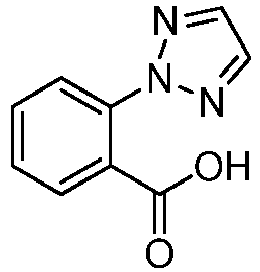
WO 2011/050198 Intermediate 2.A-5 5-methyl-2-(pyrimidin-2-yl)benzoic acid 
WO 2011/050198 Intermediate 50.A-6 5-methyl-2-(2H-1,2,3-triazol-2-yl)benzoic acid 
WO 2011/050198 Intermediate 8.A-7 5-fluoro-2-(pyrimidin-2-yl)benzoic acid 
WO 2011/050198 Intermediate 13.A-8 6-methyl-2-(2H-1,2,3-triazol-2-yl)nicotinic acid 
WO 2011/050198 Intemediate 70A-9 6-methyl-2-(1H-1,2,3-triazol-1-yl)nicotinic acid 
WO 2011/050198 Intemediate 71A-10 4-methoxy-2-(2H-1,2,3-triazol-2-yl)benzoic acid 
WO 2011/050198 Intemediate 54A-11 4-methyl-2-(2H-1,2,3-triazol-2-yl)benzoic acid 
Analogous Intermediate A-4 using 2-bromo-4-methylbenzoic acid A-12 3-ethoxy-6-methylpicolinic acid 
WO 2010/063663 Description 39A-13 5-chloro-2-(2H-1,2,3-triazol-2-yl)benzoic acid 
WO 2011/050198 Intermediate 9.A-14 5-methoxy-2-(2H-1,2,3-triazol-2-yl)benzoic acid 
WO 2011/050198 Intermediate 10.A-15 3-methyl-2-(2H-1,2,3-triazol-2-yl)benzoic acid 
WO 2011/050198 Intermediate 82.A-16 3-(2H-1,2,3-triazol-2-yl)picolinic acid 
WO 2011/050198 Intermediate 72.A-17 5-methyl-3-(oxazol-2-yl)picolinic acid 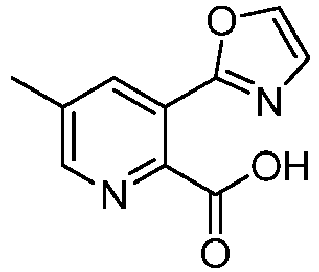
Prepared analogous to intermediate A-18 A-18 6-methyl-3-(oxazol-2-yl)picolinic acid 
Prepared as described below A-19 6-methyl-3-(pyrimidin-2-yl)picolinic acid 
WO 2010/063663 Description 69A-20 5-methyl-3-(pyrimidin-2-yl)picolinic acid 
Prepared analogous to intermediate A-19 using 3-bromo-5-methylpicolinonitrile -

- Step A: 3-bromo-6-methylpicolinic acid. To 3-bromo-6-methylpicolinonitrile (4g, 20.3 mmol) in EtOH (40 mL) in a sealed tube was added aqueous 4M NaOH (15 mL). The reaction was heated at 90 °C for 24h. Additional aqueous 4M NaOH was added and heating continued at 90 °C for 24h. The reaction was cooled to rt, acidified to pH=3 with IN HCl (aq), concentrated and used without further purification in subsequent steps. MS (ESI) mass calcd. for C7H6BrNO2, 216.0; m/z found 218 [M+H]+.
- Step B: Methyl 3-bromo-6-methylpicolinate. To the title compound of step A (10.3 g, 20 mmol) in MeOH (50 mL) was added thionyl chloride (4.4 mL, 60 mmol). The reaction was heated at reflux overnight, cooled to rt and concentrated. Purification via silica gel chromatography (0-15% EtOAc in heptane) gave the title compound (1.9g, 40%). MS (ESI) mass calcd. for C8H8BrNO2, 230.1; m/z found 232 [M+H]+.
- Step C: Methyl 6-methyl-3-(oxazol-2-yl)picolinate. In a microwave vial was dissolved the title compound of step B (185 mg, 0.8 mmol) and 2-(tributylstannyl)oxazole (0.22 mL, 1 mmol) in PhCH3 (2.4 mL). The solution was degassed with N2 and Pd(PPh3)4 (92 mg, 0.1 mmol) were added. The reaction was purged with N2 and heated at 120 °C for 20 min using microwave irradiation. The reaction was cooled to rt, filtered through a pad of celite and purified via silica gel chromatography (0-40% EtOAc in hexanes) to give the title compound of step A (333 mg, 67%). The mixture was diluted with H2O and extracted with EtOAc. The combined organics were dried (MgSO4) and purified via silica gel chromatography (0-50% EtOAc in heptane) to give the title compound (56 mg, 32%). MS (ESI) mass calcd. for C11H10N2O3, 218.2; m/z found 219.1 [M+H]+.
- Step D: 6-methyl-3-(oxazol-2-yl)picolinic acid. To the title compound of step C (56 mg, 0.3 mmol) was added MeOH (0.6 mL) and 2M NaOH(aq) (0.6 mL). After 1h at rt, 1M HCl(aq) was added. The reaction mixture was concentrated to give the title compound (52 mg) that was used without further purification in subsequent steps. MS (ESI) mass calcd. for C10H8N2O3, 204.2; m/z found 205.1 [M+H]+.
-

- Step A: 5-methyl-3-(2H-1,2,3-triazol-2-yl)picolinonitrile. To 2-bromo-5-methyl-3-(2H-1,2,3-triazol-2-yl)pyridine (1.5 g, 7.6 mmol) in DMF (19 mL) was added K2CO3 (1.2 g, 8.4 mmol) and 2H-1,2,3-triazole (440 µL, 7.6 mmol). The mixture was heated to 100 °C for 16 h, cooled to rt and extracted with EtOAc (2X). The combined organics were dried (Na2SO4) and concentrated. Purification via silica gel chromatography (5-60% EtOAc in hexanes) gave the title compound (490 mg, 35%) and 5-methyl-3-(1H-1,2,3-triazol-1-yl)picolinonitrile (387 mg, 27%).
- Step B: (sodium 5-methyl-3-(2H-1,2,3-triazol-2-yl)picolinate). To a solution of the the title compound of Step A (489 mg, 2.6 mmol) in EtOH (7 mL) was added 4 N NaOH (660 µL, 2.6 mmol). The mixture was heated at 100°C for 24 h. The reaction mixture was concentrated in vacuo to a white solid which was used without further purification in subsequent steps.
-

- Step A: 6-methyl-3-(2H-1,2,3-triazol-2-yl)picolinonitrile. To 3-bromo-6-methylpicolinonitrile (2.2 g, 11 mmol) in DMF (28 mL) was added K2CO3 (1.7 g, 12 mmol) and 2H-1,2,3-triazole (650 µL, 11 mmol). The mixture was heated to 100 °C for 36 h, cooled to rt and extracted with EtOAc. The combined organics were dried (Na2SO4) and concentrated. Purification via silica gel chromatography (10-100% EtOAc in hexanes) gave the title compound (1g, 48%).
- Step B: 6-methyl-3-(2H-1,2,3-triazol-2-yl)picolinic acid. To a solution of the the title compound of Step A (730 mg, 4 mmol) in EtOH (10 mL) was added 4 N NaOH (1 mL, 4 mmol). The mixture was heated at 100°C for 24 h. The reaction mixture was concentrated in vacuo to a white solid which was used without further purification in subsequent steps.
A-23 2-fluoro-6-(2H-1,2,3-triazol-2-yl)benzoic acid 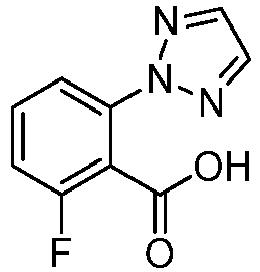
Prepared according to WO 2011/050198 Intermediate 12A-24 5-fluoro-2-(2H-1,2,3-triazol-2-yl)benzoic acid 
WO 2011/050198 Intermediate 1 -

- Step A: 5-fluoro-2-iodopyrimidine. To a solution of 2-chloro-5-fluoropyrimidine (4 mL, 32 mmol) in propionitrile (33 mL) was added chlorotrimethylsilane (12 mL, 97 mmol) and sodium iodide (15 g, 97 mmol), and the reaction mixture was heated to 150 °C for 1 h. Upon completion of the reaction, the reaction mixture was cooled to room temperature and the solvent removed. The residue was taken up in EtOAc and a solution of saturated NaHCO3. The organic layer was dried over MgSO4, filtered and evaporated. Purification via silica gel chromatography (0-20% EtOAc in hexanes) gave the title compound (2.82 g, 39%).
- Step B: 2-(5-fluoropyrimidin-2-yl)benzonitrile. In a microwave vial was dissolved cyanophenylboronic acid (500 mg, 3.40 mmol) in THF (15 mL), and the reaction mixture was degassed with N2. Then, the title compound of step A (915 mg, 4.08 mmol), Na2CO3 (1.08 g, 10.2 mmol), water (5 mL), and PdCl2(dtbpf) (CAS 95408-45-0) (89 mg, 0.14 mmol) were added, and the reaction mixture was stirred at room temperature for 1 h and then heated via microwave heating to 75 °C for 2 h. The mixture was cooled to room temperature and water and EtOAc added. The reaction mixture was extracted with EtOAc. The combined organic layers were dried over MgSO4, filtered and concentrated. The crude was purified via silica gel chromatography (0-30% EtOAc in hexanes) to afford the title compound (280 mg, 41%). MS (ESI) mass calcd. for C11H6FN3, 199.1; m/z found 200.0 [M+H]+.
- Step C: 2-(5-fluoropyrimidin-2-yl)benzoic acid. A solution of the title compound of step B (1.24 g, 6.22 mmol) in H2SO4 (6 mL) and water (6 mL) was stirred at 80 °C for 1 h. Then, the reaction mixture was cooled to 0 °C and the aqueous phase extracted with DCM (2X). A solution of 20 M NaOH (11 mL) was added to the aqueous layer until pH ∼3-4. The aqueous layer was extracted again with EtOAc and DCM. The combined organic layers were dried over MgSO4, filtered and concentrated to afford the title compound (672 mg, 50%). MS (ESI) mass calcd. for C11H7FN2O2, 218.1; m/z found 219.1 [M+H]+.
-

- Prepared analogous to Intermediate A-25, substituting cyanophenylboronic acid with (2-cyano-6-fluorophenyl)boronic acid (CAS 656235-44-8). MS (ESI) mass calcd. for C11H6F2N2O2, 236.0; m/z found 237.1 [M+H]+.
-

- Step A: methyl 3-methyl-2-(pyrimidin-2-yl)benzoate. In a microwave vial was dissolved methyl 3-methyl-2-(4,4,5,5-tetramethyl-1,3,2-dioxaborolan-2-yl)benzoate (619 mg, 2.24 mmol) and 2-chloropyrimidine (314 mg, 2.69 mmol) in 2-MeTHF (10 mL). Na2CO3 (713 mg, 6.73 mmol) was then added followed by water (3.4 mL) and the reaction mixture was degassed with N2 for 45 minutes. Pd(dppf)Cl2 (66 mg, 0.09 mmol) and the reaction mixture was heated at 75 °C for 28h. More Pd(dppf)Cl2 (33 mg, 0.045 mmol) was added and the reaction mixture was heated at 150 °C for 3.5h. The mixture was filtered through a pad of celite and the fileter cake rinsed with EtOAc and water. The layers were separated and the aqueous was extracted once with EtOAc. The combined organic layers were dried over MgSO4, filtered and evaporated. The crude was purified via silica gel chromatography (0-50% EtOAc in hexanes) to afford the title compound (116 mg, 23%). MS (ESI) mass calcd. for C13H12N2O2, 228.1; m/z found 229.1 [M+H]+. 1H NMR (500 MHz, CDCl3) 8.95 - 8.76 (m, 2H), 7.99 - 7.75 (m, 1H), 7.50 - 7.44 (m, 1H), 7.43 - 7.37 (m, 1H), 7.32 - 7.24 (m, 1H), 3.64 (s, 3H), 2.15 (s, 3H).
- Step B: 3-methyl-2-(pyrimidin-2-yl)benzoic acid. To a solution of the title compound of step A (980 mg, 4.29 mmol) in MeOH (21 mL) was added 10 M NaOH (2 mL), and the reaction mixture was stirred at 50 °C for 48 h. The solvent was removed and the crude was diluted with water and acidified with 6 M HCl(aq) until pH = 3. The aqueous layer was saturated with solid NaCl and extracted with 20% iPrOH in CHCl3 (3X). The combined organic layers were dried over MgSO4, filtered and concentrated to afford the title compound (892 mg, 96%). MS (ESI) mass calcd. for C12H10N2O2, 214.1; m/z found 215.1 [M+H]+.
Intermediate Name Structure Reference A-28 3-fluoro-2-(pyrimidin-2-yl)benzoic acid 
Prepared according to WO 2011/050198 Intermediate 50A-29 2-(pyrimidin-2-yl)benzoic acid 
Commercially available, CAS 400892-62-8 A-30 5-methyl-2-(2H-1,2,3-triazol-2-yl)nicotinic acid 
Prepared analogous to WO 2011/050200 Intermediate 47, Example 160A-31 2-(2H-1,2,3-triazol-2-yl)nicotinic acid 
Commercially available, CAS 1369497-44-8 A-32 2-chloro-6-methoxynicotinic acid 
Commercially available, CAS 1227515-71-0 A-33 3 -phenylpyrazine-2-carboxylic acid 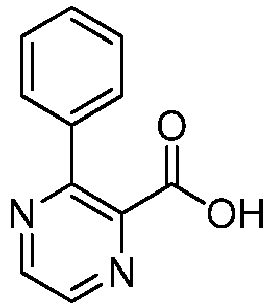
Commercially available, CAS 2881-85-8 -

- To a solution of 3-fluoro-2-(4,4,5,5-tetramethyl-1,3,2-dioxaborolan-2-yl)benzonitrile (4.98 g, 19.1 mmol) and 2-bromopyrimidine (3.85 g, 23 mmol) in THF (96 mL) was added Na2CO3 (6 g, 57.4 mmol) followed by water (43 mL). The reaction mixture was degassed with N2 for 10 minutes. PdCl2(dtbpf) (374 mg, 0.57 mmol) was added and the reaction mixture was stirred at 80 °C for 5h. The solution was cooled to room temperature and a mixture of EtOAc and water was added. The aqueous was extracted twice with EtOAc and the combined organic layers were dried over MgSO4, filtered and evaporated. The title compound was precipitated by dissolving the residue in a minimum amount of EtOAc and then adding hexanes. The solid was filtered, washed with hexanes and dried to afford the title compound (2.46 g, 64%). MS (ESI) mass calcd. for C11H6FN3, 199.1; m/z found 200.1 [M+H]+. 1H NMR (400 MHz, Chloroform-d) δ 9.02 - 8.91 (m, 2H), 7.65 (dt, J = 7.7, 1.0 Hz, 1H), 7.60 - 7.52 (m, 1H), 7.51 - 7.43 (m, 1H), 7.41 (t, J = 4.9 Hz, 1H).
-

- Step A: 2-bromo-N-(2,2-dimethoxyethyl)-6-fluorobenzamide. To a solution of 2-bromo-6-fluorobenzoic acid (2 g, 9.1 mmol) in DMF (27 mL) was added HBTU (5.20 g, 13.7 mmol) and DIPEA (4.7 mL, 27 mmol), and the reaction mixture was stirred for 10 min. Then, 2,2-dimethoxyethylamine (1.3 mL, 11.9 mmol) was added and the reaction mixture stirred at room temperature for 12 h. The reaction mixture was diluted with EtOAc and washed with saturated aqueous NaHCO3. The combined organic layers were dried over MgSO4, filtered and concentrated. Purification via silica gel chromatography (0-25% EtOAc in hexanes) gave the title compound (2.3 g, 82%).
- Step B: 2-(2-bromo-6-fluorophenyl)oxazole. To P2O5 (6.4 g, 22.6 mmol) was added methanesulfonic acid (52 mL, 801 mmol), and the reaction mixture was stirred at room temperature for 1 h. Then, the title compound of step A (2.3 g, 7.54 mmol) was added to the reaction mixture, and the mixture heated to 140 °C for 2 h. DCM was added and the mixture was slowly poured into a saturated solution of aqueous NaHCO3 on ice. The mixture was extracted with DCM. The combined organic layers were dried over MgSO4, filtered and concentrated. Purification via silica gel chromatography (0-10% EtOAc in hexanes) gave the title compound (1.5 g, 82%). MS (ESI) mass calcd. for C9H5BrFNO, 240.95; m/z found 242.0 [M+H]+.
- Step C: Methyl 3-fluoro-2-(oxazol-2-yl)benzoate. A solution of the title compound of step B (2.18 g, 8.99 mmol), Pd(OAc)2 (40 mg, 0.18 mmol), 1,1'-bis(diphenylphosphino)ferrocene (199 mg, 0.36 mmol), and Et3N (3.7 mL, 27 mmol) in 1:1 MeOH/1,4-dioxane (36 mL) was degassed with N2 for 15 min. Then, the mixture was stirred at 95 °C under an atmosphere of carbon monoxide overnight. The reaction mixture was diluted with EtOAc and washed with a solution of NaHCO3. The organic layer was separated, dried over MgSO4, filtered, and concentrated. Purification via silica gel chromatography (0-12% EtOAc in hexanes) gave the title compound (1.7 g, 83%). MS (ESI) mass calcd. for C11H8FNO3, 221.1; m/z found 222.0 [M+H]+.
- Step D: 3-fluoro-2-(oxazol-2-yl)benzoic acid. To a solution of the title compound of step C (1.65 g, 7.46 mmol) in MeOH (22 mL) was added 2 M NaOH (7.5 mL), and the reaction mixture was stirred at room temperature overnight. The reaction mixture was acidified with 1 M HCl(aq) and the solvents evaporated in vacuo. The mixture was diluted with water and extracted with DCM. The combined organic were dried over MgSO4, filtered and concentrated to afford the title compound (905 mg, 58%). MS (ESI) mass calcd. for C10H6FNO3, 207.0; m/z found 208.0 [M+H]+. MP = 182 °C.
-

- Step A: Methyl 5-fluoro-2-(oxazol-2-yl)benzoate. To a solution of methyl 2-bromo-5-fluorobenzoate (1.1 g, 4.8 mmol) and 2-(tri-n-butylstannyl)oxazole (1.3 mL, 6.2 mmol) in toluene (14 mL) was added Pd(PPh3)4 (550 mg, 0.476 mmol), and the reaction mixture was heated via microwave heating to 150 °C for 30 min. The reaction mixture was diluted with water and extracted with EtOAc. The combined organic layers were dried over MgSO4, filtered and concentrated. Purification via silica gel chromatography (0-40% EtOAc in hexanes, followed by a second column 0-10% EtOAc in hexanes) gave the title compound (553 mg, 52%). MS (ESI) mass calcd. for C11H6FNO3, 221.1; m/z found 222.1 [M+H]+.
- Step B: 5-fluoro-2-(oxazol-2-yl)benzoic acid. Prepared analogous to intermediate 34, step D, to give the title compound (858 mg, 99%). MS (ESI) mass calcd. for C10H6FNO3, 207.0; m/z found 208.1 [M+H]+.
-

- Step A: 5-(2-bromo-5-fluorophenyl)-3-methyl-1,2,4-oxadiazole. To a solution of 2-bromo-5-fluorobenzoyl chloride (2.17 g, 9.13 mmol) in THF (18 mL) was added DIPEA (1.7 mL, 10 mmol). Then, acetamide oxime (676 mg, 9.13 mmol) was added portionwise, and the reaction mixture was stirred at 70 °C for 16 h. The reaction mixture was diluted with EtOAc and washed with a saturated solution of NaHCO3. The combined organic layers were dried over MgSO4, filtered and concentrated. Purification via silica gel chromatography (0-20% EtOAc in hexanes) gave the title compound (2.35 g, 57%). MS (ESI) mass calcd. for C9H6BrFN2O, 255.96; m/z found 257.0 [M+H]+.
- Step B: 4-fluoro-2-(3-methyl-1,2,4-oxadiazol-5-yl)benzoic acid. Prepared analogous to intermediate 34, steps C and D, to give the title compound. MS (ESI) mass calcd. for C10H7FN2O3, 222.0; m/z found 223.0 [M+H]+.
Intermediate Name Structure Reference A-37 4-fluoro-2-(pyrimidin-2-yl)benzoic acid 
Prepared according to WO 2011/050198 Intermediate 87A-38 3-(pyrimidin-2-yl)picolinic acid 
WO 2010/122151 Intermediate D105 -

- Step A: Methyl 5-methyl-2-(pyrimidin-2-yl)nicotinate. To a sealed tube containing methyl 2-chloro-5-methylnicotinate (CAS 65169-43-9) (745 mg, 4.01 mmol), CuI (38 mg, 0.2 mmol), LiCl (169 mg, 4.01 mmol), and Pd(PPh3)4 (231 mg, 0.2 mmol) in toluene (15 mL) was added 2-(tributylstannyl)pyrimidine (1.5 mL, 4.4 mmol), and the reaction mixture was heated at 120 °C overnight. The reaction mixture was diluted with water and extracted with DCM. The combined organic layers were dried over MgSO4, filtered and evaporated. Purification via silica gel chromatography (0-50% EtOAc in hexanes) gave the title compound (494 mg, 52%). MS (ESI) mass calcd. for C12H11N3O2, 229.1; m/z found 229.99.
- Step B: 5-methyl-2-(pyrimidin-2-yl)nicotinic acid. To a solution of the title compound of step A (466 mg, 2.03 mmol) in MeOH (10 mL) was added 10 M NaOH (1 mL), and the reaction mixture was stirred at room temperature for 2 h. The solvent was removed and the crude was diluted with water and acidified with 6 M HCl(aq) until pH = 3. The aqueous layer was saturated with solid NaCl and extracted with 20% iPrOH in CHCl3 (3X). The combined organic layers were dried over MgSO4, filtered and concentrated to afford the title compound (432 mg, 99%). MS (ESI) mass calcd. for C11H9N3O2, 215.1; m/z found 216.1 [M+H]+. 1H NMR (500 MHz, Methanol-d4) δ 8.90 (br. s, 2H), 8.64 (br. s, 1H), 8.17 (s, 1H), 7.55 (br. s, 1H), 2.51 (s, 3H).
Intermediate Name Structure Reference A-40 2-fluoro-6-(pyrimidin-2-yl)benzoic acid 
Prepared according to WO 2011/050198 Intermediate 14A-41 5-methyl-2-(2H-1,2,3-triazol-2-yl)nicotinic acid 
Prepared analogous to WO 2011/050200 Intermediate 47, Example 160 -

- Step A: trans-(±)-1-(tert-butoxycarbonyl)-2-methylpiperidine-3-carboxylic acid. Methyl 2-methylnicotinate (28.6 g, 190 mmol) and PtO2 (430 mg) in AcOH (500 mL) was stirred under an atmosphere of H2 for 48h. Additional PtO2 was added and the reaction continued for an additional 24h. Then the reaction mixture was filtered through a pad of celite and the filtrate concentrated. The resulting residue was partitioned between 2M NaOH (aq) and DCM. The organic layer was extracted with DCM (2X). The combined organic layers were dried (MgSO4) and concentrated to give 27.2 g of a residue.
- To this residue in MeOH (450 mL) was added sodium methoxide (4.5 M in MeOH, 56 mL, 260 mmol). The reaction was heated at reflux for 15h, then cooled to rt, concentrated, H2O was added and the mixture extracted with DCM. The combined organics were dried (MgSO4) and concentrated to give 23.9 g of product that was dissolved in THF (300 mL) and H2O (60 mL). Then, Na2CO3 (38.3g, 456 mmol) was added followed by Boc2O (33.2 g, 152 mmol). After stirring overnight, the mixture was diluted with H2O and extracted with DCM. The combined organics were dried (MgSO4) and concentrated to give 39.2g of material (9:1 trans:cis isomers).
- To this material in THF (300 mL) and H2O (100 mL) was added LiOH (7.3 g, 305 mmol). After stirring overnight, the mixture was diluted with H2O and extracted with DCM. The organic extract was discarded. The aqueous layer was acidified with HCl and extracted with DCM. The combined organics were dried (MgSO4) and concentrated. Purification via silica gel chromatography (0-100% EtOAc in heptane) gave the title compound (30.2 g) as a ∼86:13 mixture of trans:cis diastereomers. MS (ESI) mass calcd. for C12H21NO4, 243.2; m/z found 188.1 [M-55]+.
- Step B: trans-(±)-tert-butyl 3-(((benzyloxy)carbonyl)amino)-2-methylpiperidine-1-carboxylate. To the title compound of step A (10 g, 41 mmol) in PhCH3 (60 mL) was added DIPEA (7.4 mL, 43 mmol) and the mixture heated at 50 °C for 1h. Then DPPA (8.9 mL, 41 mmol) in PhCH3 was added dropwise and the mixture heated at 75 °C for 2h and BnOH (4.5 mL, 43 mmol) and the mixture stirred at 80 °C for 20h. The reaction was allowed to cool to rt, diluted with saturated NaHCO3 (aq) and extracted with PhCH3. The combined organics were dried (MgSO4). Purification via silica gel chromatography (0-20% EtOAc in hexanes) gave the title compound (2.6 g, 18%). MS (ESI) mass calcd. for C19H28N2O4, 348.2; m/z found 249.2 [M-100]+, 293.2 [M-55]+. 1H NMR (400 MHz, CDCl3) δ 7.39 - 7.30 (m, 5H), 5.24 - 5.00 (m, 3H), 4.35 - 4.22 (m, 1H), 4.01 - 3.85 (m, 1H), 3.74 - 3.51 (m, 1H), 2.89 - 2.71 (m, 1H), 1.87 - 1.30 (m, 13H), 1.19 (d, J = 7.0 Hz, 3H).
-


- Enantiomer A: [α]D 20 -31.9° (c 0.7, DMF). MS (ESI) mass calcd. for C19H28N2O4, 348.2; m/z found 349.2 [M+H]+. 1H NMR consistent with intermediate B-1.
- Enantiomer B: [α]D 20+28.0° (c 0.96, DMF). MS (ESI) mass calcd. for C19H28N2O4, 348.2; m/z found 349.2 [M+H]+. 1H NMR consistent with intermediate B-1.
-
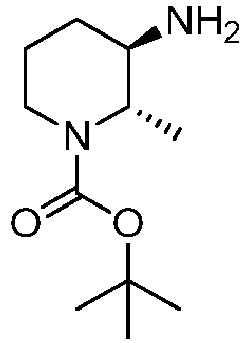
- Intermediate B-1 (8.9 g, 25.4 mmol) and wet 10 wt% Pd/C (880 mg) in MeOH (200 mL) was stirred under an atmosphere of H2 overnight. The reaction mixture was filtered through a pad of celite and the filtrate concentrated to give the title compound (5.7 g) that was used without further purification. MS (ESI) mass calcd. for C11H22N2O2, 214.3; m/z found 159.1 [M-55]+. 1H NMR (400 MHz, CDCl3) 4.19 - 4.08 (m, 1H), 4.00 - 3.88 (m, 1H), 2.91 - 2.72 (m, 2H), 1.86 - 1.61 (m, 1H), 1.61 - 1.33 (m, 12H), 1.15 (d, J = 7.0 Hz, 3H).
-
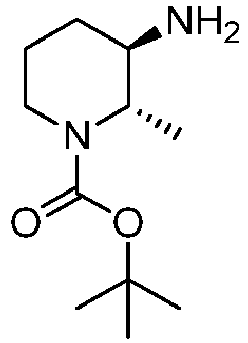
- Prepared analogous to Intermediate B-3 substituting intermediate B-1 with intermediate (+)-B-2 (enantiomer B).
-

- Prepared analogous to Intermediate B-3 substituting intermediate B-1 with intermediate (-)-B-2 (enantiomer A).
-

- Step A: cis-(±)-1-(tert-butoxycarbonyl)-2-methylpiperidine-3-carboxylic acid. Methyl 2-methylnicotinate (100 g, 662 mmol) and PtO2 (1.5 g) in AcOH (300 mL) was stirred under an atmosphere of H2 for 7 days. The reaction mixture was filtered and the filtrate concentrated. The resulting residue was partitioned between saturated NaHCO3 (aq) and DCM. The organic layer was extracted with DCM (4X200 mL). The combined organic layers were dried (Na2SO4) and concentrated to give 80 g of a residue.
- To this residue in THF (200 mL) was added DIPEA (37 mL, 200 mmol) and Boc2O (32g, 150 mmol). After stirring overnight, the mixture was concentrated, diluted with H2O and extracted with EtOAc. The combined organics were dried (NaSO4) and concentrated. Purification via silica gel chromatography (10% EtOAc in petroleum ethers) gave cis-(±)-1-tert-butyl 3-methyl 2-methylpiperidine-1,3-dicarboxylate.
- To the crude mixture of cis-(±)-1-tert-butyl 3-methyl-2-methylpiperidine-1,3-dicarboxylate from above in MeOH (150 mL) was added 2M NaOH (aq.). The reaction was heated at 70 °C for 2h, cooled to rt, concentrated, treated with H2O (400 mL) and extracted with MTBE (100 mL). The aqueous layer was then acidified to pH=6 with IN HCl (aq) and concentrated. To this was added MeOH (400 mL) and concentrated to give the title compound (5g) as a white solid.
- Step B: cis-(±)-tert-butyl 3-(((benzyloxy)carbonyl)amino)-2-methylpiperidine-1-carboxylate. To the title compound of step A (5.3 g, 21 mmol) in PhCH3 was added DIPEA (4.3 mL, 26 mmol) and DPPA (7.2 g, 26 mmol). The mixture was heated at reflux overnight, cooled to rt, concentrated and treated with 20% KOH (aq). The mixture was heated at 100 °C for 2h, cooled to rt and extracted with DCM (2X). The combined organics were dried (Na2SO4), concentrated and purified via silica gel chromatography (10% MeOH in DCM) to give the title compound (1.5g).
-

- Step A: (±)-tert-butyl-3-((4,6-dimethylpyrimidin-2-yl)amino)-2-methylpiperidine-1-carboxylate. To a microwave vial was weighed intermediate B-3 (260 mg, 1.2 mmol), 2-chloro-4,6-dimethylpyrimidine (208 mg, 1.5 mmol), Pd(dba)2 (17 mg, 0.03 mmol), CTC-Q-Phos (27 mg, 0.06 mmol) and sodium tert-butoxide (175 mg, 1.8 mmol). The vial was capped, evacuated, refilled with N2 (2X) and PhCH3 was added. The reaction was then heated in the microwave at 150 °C for 120 min. The mixture was then cooled to rt, directly applied to and purified via silica gel chromatography (1-7% 2M NH3/MeOH in CH2Cl2) to give the title compound (205 mg, 53%) as a brown oil. MS (ESI) mass calcd. for C17H28N4O2, 320.2; m/z found 321.2 [M+H]+. 1H (CDCl3): 6.30 (s, 1H), 5.39 - 5.25 (m, 1H), 4.46 - 4.31 (m, 1H), 4.10 - 3.85 (m, 2H), 2.94 - 2.71 (m, 1H), 2.34 - 2.20 (m, 6H), 1.87 - 1.62 (m, 3H), 1.52 - 1.33 (m, 10H), 1.22 (d, J= 7.0 Hz, 2.5H), 1.09 - 1.01 (m, 0.5H).
- Step B: (±)-trans-4,6-dimethyl-N-(2-methylpiperidin-3-yl)pyrimidin-2-amine. To the title compound from Step A (75 mg, 0.23 mmol) in DCM (4 mL) was added TFA (4 mL). Upon completion (∼3h), the reaction was concentrated, neutralized with 5% Na2CO3 (aq) and extracted with DCM (3X). The combined organics were dried (Na2SO4) to give the title compound (52 mg) which was used without further purification. MS (ESI) mass calcd. for C12H20N4,220.2; m/z found 221.1 [M+H]+.
- Step C: (±)-trans-(3-((4,6-dimethylpyrimidin-2-yl)amino)-2-methylpiperidin-1-yl)(4-fluoro-2-(2H-1,2,3-triazol-2-yl)phenyl)methanone. To the title compound from Step B (29 mg, 0.13 mmol) in DMF (1.3 mL) was added TEA (0.022 mL, 0.16 mmol), intermediate A-1 (30 mg, 0.14 mmol) and HATU (55 mg, 0.14 mmol). Upon completion of the reaction, purification was performed using Agilent prep method A to give the title compound (29 mg, 55% yield). MS (ESI) mass calcd. for C21H24FN7O,409.2; m/z found 410.0 [M+H]+. HPLC Rt=0.85 (Analytical Method A).
-

- The title compound was prepared analogous to Example 1 substituting intermediate A-1 with intermediate A-2. MS (ESI) mass calcd. for C23H25FN6O,420.2; m/z found 421.2 [M+H]+.
-

- The title compound was prepared analogous to example 1 substituting intermediate A-1 with intermediate A-23. MS (ESI) mass calcd. for C21H22FN7O,407.5; m/z found 408.2 [M+H]+. HPLC Rt=0.85 (Analytical Method A).
-

- The title compound was prepared analogous to example 1 substituting intermediate A-1 with intermediate A-4. MS (ESI) mass calcd. for C21H25N7O,391.2; m/z found 392.2 [M+H]+.
-

- The title compound was prepared analogous to Example 1 substituting intermediate A-1 with intermediate A-24. MS (ESI) mass calcd. for C21H24FN7O,409.2; m/z found 410.2 [M+H]+.
-

- The title compound was prepared analogous to Example 1 substituting intermediate A-1 with intermediate A-5. MS (ESI) mass calcd. for C24H28N6O,416.2; m/z found 417.2 [M+H]+.
-

- Step A: (±)-tert-butyl-2-methyl-3-((6-methyl-2-(trifluoromethyl)pyrimidin-4-yl)amino)piperidine-1-carboxylate. To intermediate B-3 (135 mg, 0.63 mmol) in DMF (1.5 mL) was added Cs2CO3 (308 mg, 0.95 mmol) and 4-chloro-6-methyl-2-(trifluoromethyl)pyrimidine (149 mg, 0.76 mmol). The flask was then heated with an oil bath at 70 °C for 18h. The reaction was allowed to cool to rt, diluted with H2O and extracted with EtOAc (2X). The combined organics were washed with brine and dried (Na2SO4). Silica gel chromatography (EtOAc in hexanes) gave the title compound (111 mg, 47%). MS (ESI) mass calcd. for C17H25F3N4O2, 374.2; m/z found 275.2 [M+H-100]+. 1H NMR (CDCl3): 6.24 (s, 1H), 5.44 (s, 1H), 4.48 - 4.31 (m, 1H), 4.15 - 3.60 (m, 2H), 2.97 - 2.78 (m, 1H), 2.42 (s, 3H), 1.85 (s, 2H), 1.74 - 1.32 (m, 10H), 1.26 (d, J = 7.0 Hz, 3H).
- Step B: (±)-trans-6-methyl-N-(2-methylpiperidin-3-yl)-2-(trifluoromethyl)pyrimidin-4-amine. The title compound was prepared analogous to example 1, Step B substituting (±)-tert-butyl-3-((4,6-dimethylpyrimidin-2-yl)amino)-2-methylpiperidine-1-carboxylate with the title compound from Step A.
- Step C: (±)-trans-(5-methyl-2-(pyrimidin-2-yl)phenyl)(2-methyl-3-((6-methyl-2-(trifluoromethyl)pyrimidin-4-yl)amino)piperidin-1-yl)methanone. The title compound was prepared analogous to example 1, Step C substituting intermediate A-1 with intermediate A-5 and (±)-4,6-dimethyl-N-(2-methylpiperidin-3-yl)pyrimidin-2-amine with the title compound of Step B. MS (ESI) mass calcd. for C24H25F3N6O,470.2; m/z found 471.2 [M+H]+.
-

- The title compound was prepared analogous to Example 7 substituting intermediate A-5 with intermediate A-6. MS (ESI) mass calcd. for C22H24F3N7O, 459.2; m/z found 460.2 [M+H]+.
-

- The title compound was prepared analogous to Example 7 substituting intermediate A-5 with intermediate A-7. MS (ESI) mass calcd. for C23H22F4N6O, 474.2; m/z found 475.2 [M+H]+.
-

- The title compound was prepared analogous to Example 7 substituting 4-chloro-6-methyl-2-(trifluoromethyl)pyrimidine with 2-chloro-4-(trifluoromethyl)pyrimidine and intermediate A-5 with intermediate A-23. MS (ESI) mass calcd. for C20H19F4N7O,449.2; m/z found 450.2 [M+H]+.
-
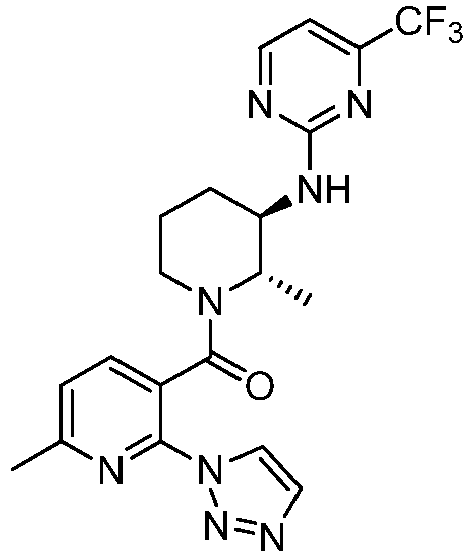
- The title compound was prepared analogous to Example 10 substituting intermediate A-23 with intermediate A-9. MS (ESI) mass calcd. for C20H21F3N8O,446.2; m/z found 447.2 [M+H]+.
-
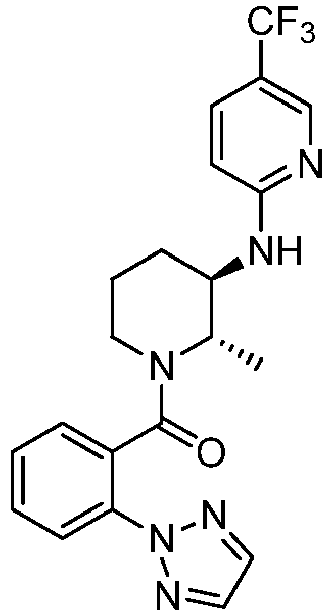
- Step A: trans-(±)-tert-butyl-2-methyl-3-((5-(trifluoromethyl)pyridin-2-yl)amino)piperidine-1-carboxylate. To intermediate B-3 (3 g, 14 mmol) in DMSO (100 mL) was added 2-fluoro-5-(trifluoromethyl)pyridine (3.4 g, 21 mmol) and DIPEA (4.8 mL, 28 mmol). The reaction was then heated at 100 °C for 4h. The reaction was allowed to cool to rt, diluted with saturated NaHCO3 (aq) and extracted with DCM. The combined organics were washed with brine and dried (MgSO4). Silica gel chromatography (EtOAc in heptane) gave the title compound (2.7 g, 54%). MS (ESI) mass calcd. for C17H24F3N3O2,359.2; m/z found 360.2 [M+H]+.
- Step B. trans-(±)-2-methylpiperidin-3-yl)-5-(trifluoromethyl)pyridin-2-amine. Prepared analogous to Example 1 substituting (±)-tert-butyl-3-((4,6-dimethylpyrimidin-2-yl)amino)-2-methylpiperidine-1-carboxylate with the title compound from Step A. MS (ESI) mass calcd. for C12H16F3N3, 259.1; m/z found 260.2 [M+H]+.
- Step C. (±)-trans-tert-butyl-2-methyl-3-((5-(trifluoromethyl)pyridin-2-yl)amino)piperidine-1-carboxylate. Prepared analogous to Example 1 substituting (±)-trans-(3-((4,6-dimethylpyrimidin-2-yl)amino)-2-methylpiperidin-1-yl)(4-fluoro-2-(2H-1,2,3-triazol-2-yl)phenyl)methanone with the title compound from Step B, intermediate A-1 with intermediate A-4 and HATU with HBTU. MS (ESI) mass calcd. for C21H21F3N6O,430.2; m/z found 431.2 [M+H]+. MP=154.7 °C. (Mixture of 4 isomers, undefined ratio). 1H NMR (300 MHz, DMSO) δ 8.36 (d, J = 21.8 Hz, 0.44H), 8.24 (d, J = 12.9 Hz, 0.36H), 8.08 (d, J = 1.3 Hz, 1.62H), 7.97 (s, 0.47H), 7.91 (d, J = 8.2 Hz, 0.41H), 7.83 - 7.32 (m, 4.20H), 7.32 - 7.21 (m, 0.48H), 7.06 - 6.96 (m, 0.47H), 6.82 (d, J = 8.9 Hz, 0.76H), 6.71 (dd, J = 13.9, 7.0 Hz, 0.59H), 6.60 (s, 0.10H), 6.15 (d, J = 8.8 Hz, 0.10H), 4.93 (d, J = 6.0 Hz, 0.12H), 4.68 (q, J = 6.8 Hz, 0.39H), 4.41 (t, J = 13.4 Hz, 0.65H), 4.17 - 3.83 (m, 0.78H), 3.81 - 3.61 (m, 0.73H), 3.20 (d, J = 14.4 Hz, 0.35H), 2.94 (t, J = 11.7 Hz, 0.52H), 2.85 - 2.66 (m, 0.46H), 2.19 - 1.49 (m, 3.53H), 1.49 - 1.22 (m, 2.07H), 0.74 (d, J = 6.9 Hz, 1.40H).
-

- Prepared analogously to Example 12 substituting intermediate A-4 with intermediate A-11. MS (ESI) mass calcd. for C22H23F3N6O,444.2; m/z found 445.2 [M+H]+. MP=136.4 °C. (Mixture of 4 isomers, undefined ratio). 1H NMR (300 MHz, DMSO) δ 8.41 (d, J = 20.3 Hz, 0.34H), 8.28 (d, J = 13.4 Hz, 0.34H), 8.21 - 7.94 (m, 2.16H), 7.88 - 7.67 (m, 1.27H), 7.60 (dd, J = 12.3, 7.4 Hz, 0.92H), 7.53 - 7.21 (m, 1.81H), 6.96 - 6.72 (m, 1.41H), 6.60 (s, 0.11H), 6.51 (d, J = 7.4 Hz, 0.53H), 6.17 (s, 0.11H), 4.96 (s, 0.11H), 4.72 (d, J = 7.3 Hz, 0.34H), 4.42 (d, J = 14.1 Hz, 0.68H), 4.11 (s, 0.45H), 3.98 (s, 0.20H), 3.77 (d, J = 6.8 Hz, 0.56H), 3.67 (dd, J = 12.1, 6.0 Hz, 0.68H), 3.26 (d, J = 13.4 Hz, 0.34H), 2.96 (t, J = 11.7 Hz, 0.50H), 2.86 - 2.71 (m, 0.50H), 2.49 (s, 1.07H), 2.43 (s, 0.33H), 2.26 (s, 1.24H), 2.18 - 1.52 (m, 3.57H), 1.53 - 1.33 (m, 0.90H), 1.30 (d, J = 7.0 Hz, 0.94H), 0.76 (d, J = 6.9 Hz, 1.57H).
-

- Prepared analogously to Example 13 substituting intermediate B-3 with intermediate B-4. MS (ESI) mass calcd. for C22H23F3N6O,444.2; m/z found 445.2 [M+H]+. MP=119.4 °C.
-

- Prepared analogously to Example 13 substituting intermediate B-3 with intermediate B-5. MS (ESI) mass calcd. for C22H23F3N6O,444.2; m/z found 445.2 [M+H]+. MP=130.4 °C. (Mixture of 4 isomers, undefined ratio). 1H NMR (300 MHz, CDCl3) δ 8.38 (s, 0.2H), 8.33 (s, 0.10H), 8.21 (s, 0.35H), 8.09 (s, 0.45H), 7.96 (s, 0.70H), 7.92 (s, 0.30H), 7.86 - 7.68 (m, 0.70H), 7.70 - 7.43 (m, 0.50H), 7.44 - 7.09 (m, 3.40H), 6.84 (d, J = 7.7 Hz, 0.10H), 6.52 (d, J = 7.7 Hz, 0.10H), 6.47 - 6.33 (m, 0.30H), 6.24 (d, J = 9.0 Hz, 0.10H), 6.08 (d, J = 8.8 Hz, 0.70H), 5.31 - 5.08 (m, 0.35H), 5.08 - 4.82 (m, 0.20H), 4.70 (br d, J = 13.7 Hz, 0.50H), 4.26 - 4.05 (m, 0.90H), 3.99 (br s, 0.40H), 3.93 - 3.80 (m, 0.20H), 3.60 (br s, 0.10H), 3.49 (br d, J = 9.6 Hz, 0.30H), 3.34 - 3.12 (m, 0.35H), 3.02 - 2.70 (m, 0.70H), 2.45 (d, J = 7.4 Hz, 2.00H), 2.14 - 1.73 (m, 2.00H), 1.73 - 1.01 (m, 3.80H), 1.01 - 0.76 (m, 2.00H), 0.71 (d, J = 7.0 Hz, 0.20H). The signal corresponding to the NH group was not observed.
-

- Prepared analogously to Example 12 substituting intermediate A-4 with intermediate A-12. MS (ESI) mass calcd. for C21H25F3N4O2,422.2; m/z found 423.2 [M+H]+. MP=153.6 °C. The product is present as a mixture of conformers (ratio ca. 70:30) 1H NMR (300 MHz, DMSO) δ 8.34 (s, 0.3H), 7.97 (s, 0.7H), 7.65 (dd, J = 8.9, 2.4 Hz, 0.3H), 7.59 (dd, J = 8.9, 2.5 Hz, 0.7H), 7.39 (d, J = 8.6 Hz, 0.3H), 7.27 - 7.12 (m, 2H), 6.96 (d, J = 8.6 Hz, 0.7H), 6.75 (d, J = 8.9 Hz, 0.3H), 6.69 (d, J = 8.9 Hz, 0.7H), 4.85 (q, J = 6.9 Hz, 0.3H), 4.48 - 4.33 (m, 0.7H), 4.11 - 3.72 (m, 3H), 3.59 (d, J = 2.4 Hz, 0.7H), 3.22 - 3.08 (m, 0.3H), 3.07 - 2.96 (m, 0.3H), 2.96 - 2.82 (m, 0.7H), 2.38 (s, 0.9H), 2.10 - 1.54 (m, 6.1H), 1.32- 1.22 (m, 6H).
-

- Prepared analogous to Example 12 substituting intermediate A-4 with intermediate A-13. MS (ESI) mass calcd. for C21H20ClF3N6O,464.2; m/z found 465.1 [M+H]+. MP=224.4 °C. (Mixture of 4 isomers, undefined ratio). 1H NMR (300 MHz, DMSO) δ 8.42 - 8.24 (m, 0.64H), 8.20 (s, 0.12H), 8.11 (d, J = 3.7 Hz, 1.64H), 8.04 (s, 0.48H), 7.96 (dd, J = 8.7, 5.0 Hz, 0.41H), 7.85 - 7.53 (m, 2.49H), 7.53 - 7.27 (m, 1.57H), 7.24 (s, 0.08H), 7.13 (d, J = 2.4 Hz, 0.50H), 6.89 - 6.69 (m, 0.91H), 6.63 (s, 0.08H), 6.12 (s, 0.08H), 4.91 (d, J = 6.7 Hz, 0.08H), 4.64 (d, J = 7.2 Hz, 0.41H), 4.37 (d, J = 13.0 Hz, 0.63H), 4.11 (s, 0.38H), 4.01 (s, 0.08H), 3.90 (d, J = 18.5 Hz, 0.24H), 3.68 (dd, J = 23.6, 6.5 Hz, 0.76H), 3.21 (d, J = 16.3 Hz, 0.41H), 3.05 - 2.91 (m, 0.41H), 2.78 (t, J = 11.7 Hz, 0.6H), 2.15 - 1.46 (m, 3.56H), 1.45 - 1.15 (m, 1.92H), 0.70 (d, J = 6.9 Hz, 1.52H).
-

- Prepared analogous to Example 12 substituting intermediate A-4 with intermediate A-22. MS (ESI) mass calcd. for C21H22F3N7O,445.2; m/z found 446.0 [M+H]+. MP=105.7 °C. (Mixture of 4 isomers, undefined ratio). 1H NMR (300 MHz, CDCl3) δ 8.39 - 8.22 (m, 1.15H), 8.17 (d, J = 8.4 Hz, 0.74H), 8.05 (s, 0.33H), 7.92 (s, 1.23H), 7.64 - 7.51 (m, 0.23H), 7.45 (d, J = 8.7 Hz, 0.74H), 7.38 - 7.29 (m, 1.15H), 6.96 (br s, 0.74H), 6.44 (d, J = 8.8 Hz, 0.23H), 6.33 (br s, 0.23H), 6.17 (br s, 0.23H), 5.11 (q, J = 7.2 Hz, 0.23H), 4.65 (br d, J = 13.3 Hz, 0.74H), 4.13 - 3.85 (m, 1.35H), 3.49 (br s, 0.47H), 3.42 - 3.17 (m, 0.47H), 3.11 - 2.92 (m, 0.74H), 2.82 (s, 0.47H), 2.72 - 2.53 (m, 2.53H), 2.14 - 1.74 (m, 2.30H), 1.54 - 1.03 (m, 2.53H), 1.00 - 0.75 (m, 2.17H). The signal corresponding to the NH group was not observed.
-

- Prepared analogous to Example 12 substituting intermediate A-4 with intermediate A-14. MS (ESI) mass calcd. for C22H23F3N6O2,460.2; m/z found 461.0 [M+H]+. MP=170.8 °C. (Mixture of 4 isomers, undefined ratio). 1H NMR (300 MHz, CDCl3) δ 8.41 - 8.29 (m, 0.33H), 8.28 - 8.11 (m, 0.55H), 8.05 (s, 0.45H), 7.99 (d, J = 9.0 Hz, 0.27H), 7.93 (s, 0.90H), 7.90 - 7.65 (m, 1.00H), 7.59 (dd, J = 8.7, 2.2 Hz, 0.33H), 7.54 - 7.38 (m, 0.59H), 7.35 (dd, J = 8.8, 2.3 Hz, 0.5H), 7.11 - 6.94 (m, 1.00H), 6.83 (d, J = 2.7 Hz, 0.45H), 6.77 (d, J = 2.8 Hz, 0.33H), 6.61 (d, J = 2.7 Hz, 0.10H), 6.41 (t, J = 9.1 Hz, 0.33H), 6.23 (d, J = 8.7 Hz, 0.10H), 6.13 (d, J = 8.8 Hz, 0.50H), 5.99 (br s, 0.27H), 5.26 - 5.09 (m, 0.37H), 5.07 - 4.90 (m, 0.20H), 4.68 (br d, J = 13.5 Hz, 0.60H), 4.25 - 4.04 (m, 1.06H), 3.98 (s, 0.41H), 3.93 - 3.78 (m, 2.48H), 3.57 (s, 0.25H), 3.54 - 3.39 (m, 0.72H), 3.22 (td, J = 13.4, 3.2 Hz, 0.39H), 2.93 (td, J = 13.1, 3.0 Hz, 0.52H), 2.13 - 1.59 (m, 3.30H), 1.52 (d, J = 6.9 Hz, 1.51H), 1.42 (d, J = 7.1 Hz, 0.78H), 1.37 - 1.19 (m, 0.78H), 1.00 - 0.62 (m, 0.63H). The signal corresponding to the NH group was not observed..
-

- Prepared analogous to Example 12 substituting intermediate A-4 with intermediate A-15. MS (ESI) mass calcd. for C22H23F3N6O,444.2; m/z found 445.2 [M+H]+. MP=153.0. (Mixture of 4 isomers, undefined ratio). 1H NMR (300 MHz, CDCl3) δ 8.41 - 8.31 (m, 0.19H), 8.26 (s, 0.56H), 8.07 (s, 0.19H), 7.98 (s, 1.09H), 7.90 - 7.70 (m, 0.76H), 7.64 - 7.52 (m, 0.19H), 7.52 - 7.33 (m, 2.15H), 7.25 - 7.09 (m, 0.75H), 6.76 (br d, J = 26.3 Hz, 0.19H), 6.49 (d, J = 8.8 Hz, 0.56H), 6.43 (d, J = 9.0 Hz, 0.19H), 6.30 (d, J = 8.8 Hz, 0.19H), 5.17 (br d, J = 6.9 Hz, 0.19H), 5.00 - 4.76 (m, 0.19H), 4.53 (br d, J = 13.4 Hz, 0.56H), 4.20 - 4.00 (m, 1.09H), 3.94 (br s, 0.19H), 3.64 - 3.55 (m, 0.19H), 3.51 (d, J = 5.3 Hz, 0.35H), 3.40 (br d, J = 14.7 Hz, 0.19H), 3.22 (s, 0.19H), 2.96 (s, 0.19H), 2.86 (td, J = 13.2, 3.4 Hz, 0.66H), 2.32 (s, 1.75H), 2.28 (s, 0.35H), 2.22 (s, 0.19H), 2.13 (br s, 0.19H), 2.09 - 1.77 (m, 2.15H), 1.77 - 1.63 (m, 1.74H), 1.51 (d, J = 7.0 Hz, 2.15H), 1.38 (d, J = 7.1 Hz, 0.56H), 1.33 - 1.21 (m, 0.19H), 1.15 (d, J = 6.1 Hz, 0.19H), 1.07 (d, J = 6.9 Hz, 0.19H), 1.02 - 0.82 (m, 0.35H). The signal corresponding to the NH group was not observed.
-

- Prepared analogous to Example 12 substituting intermediate A-4 with intermediate A-16. MS (ESI) mass calcd. for C20H20F3N7O,431.2; m/z found 432.2 [M+H]+. MP=79.6 °C. (Mixture of 4 isomers, undefined ratio). 1H NMR (300 MHz, CDCl3) δ 8.64 (dd, J = 4.7, 1.3 Hz, 0.3H), 8.57 (d, J = 3.6 Hz, 0.7H), 8.45 (d, J = 8.4 Hz, 0.3H), 8.38 (s, 0.3H), 8.31 (d, J = 8.2 Hz, 0.7H), 8.24 (s, 0.3H), 8.12 (s, 0.7H), 7.95 (s, 1.0H), 7.59 (d, J = 8.4 Hz, 0.3H), 7.55 - 7.34 (m, 1.4H), 6.99 (br d, J = 6.9 Hz, 0.7H), 6.43 (d, J = 8.9 Hz, 0.3H), 6.32 (br s, 0.7H), 6.10 (br s, 0.3H), 5.15 (br d, J = 7.2 Hz, 0.3H), 4.66 (br d, J = 13.4 Hz, 0.7H), 4.20 - 3.83 (m, 0.9H), 3.49 (d, J = 5.0 Hz, 0.7H), 3.44 - 3.26 (m, 0.7H), 3.14 - 2.94 (m, 0.7H), 2.13 - 1.76 (m, 2.7H), 1.75 - 1.61 (m, 1.20H), 1.48 (dd, J = 6.9, 4.2 Hz, 2.5H), 0.99 - 0.93 (m, 0.3H), 0.82 - 0.76 (m, 0.3H). The signal corresponding to the NH group was not observed..
-

- Prepared analogous to Example 12 substituting intermediate A-4 with intermediate A-18. MS (ESI) mass calcd. for C22H22F3N5O2,445.2; m/z found 446.2 [M+H]+. (Mixture of 4 isomers, undefined ratio). 1H NMR (300 MHz, DMSO) δ 8.46 (s, 0.31H), 8.37 (d, J = 6.2 Hz, 0.58H), 8.31 (s, 0.58H), 8.24 - 8.02 (m, 0.47H), 7.82 (d, J = 7.4 Hz, 0.76H), 7.73 - 7.44 (m, 3.35H), 7.37 (d, J = 8.2 Hz, 0.76H), 6.89 (d, J = 9.0 Hz, 0.47H), 6.59 (br s, 0.72H), 4.94 (d, J = 6.7 Hz, 0.58H), 4.51 (d, J = 12.1 Hz, 0.76H), 3.86 (d, J = 6.8 Hz, 0.66H), 3.76 (br s, 0.58H), 3.30 - 3.08 (m, 0.66H), 3.00 (t, J = 11.7 Hz, 0.76H), 2.63 (s, 1.27H), 2.36 (s, 1.73H), 2.19 - 1.89 (m, 1.73H), 1.88 - 1.56 (m, 2.27H), 1.41 (d, J = 6.6 Hz, 1.27H), 1.21 (d, J = 6.5 Hz, 1.73H)..
-

- Prepared analogous to Example 12 substituting intermediate A-4 with intermediate A-19. MS (ESI) mass calcd. for C23H23F3N6O,456.2; m/z found 457.2 [M+H]+. (Mixture of 4 isomers, undefined ratio). 1H NMR (300 MHz, DMSO) δ 9.00 (d, J = 4.9 Hz, 1.90H), 8.86 (d, J = 8.2 Hz, 0.45H), 8.45 - 8.36 (m, 1.00H), 8.53 - 8.08 (m, 0.67H), 8.21 (s, 0.55H), 7.85 (dd, J = 27.3, 8.5 Hz, 1.33H), 7.69 (d, J = 8.4 Hz, 0.55H), 7.60 (dt, J = 11.9, 4.9 Hz, 1.00H), 7.44 (d, J = 8.2 Hz, 0.55H), 7.22 (d, J = 9.0 Hz, 0.45H), 6.62 (br s, 0.55H), 4.77 (br d, J = 7.2 Hz, 0.67H), 4.46 (br d, J = 13.3 Hz, 0.67H), 4.00 - 3.80 (m, 1.15H), 3.29 (br s, 0.78H), 2.99 (t, J = 12.3 Hz, 0.78H), 2.81 (s, 1.40H), 2.44 (s, 1.60H), 2.17 - 1.73 (m, 3.18H), 1.66 (br d, J = 12.3 Hz, 0.67H), 1.59 - 1.25 (m, 3.15H).
-

- Prepared analogous to Example 14 substituting intermediate A-11 with intermediate A-24. MS (ESI) mass calcd. for C21H20F4N6O, 448.2; m/z found 449.2 [M+H]+. MP=168.1 °C. The product is present as a mixture of conformers (ratio ca. 60:40) 1H NMR (300 MHz, DMSO) δ 8.32 (s, 0.4H), 8.08 (s, 1.2H), 8.07 (s, 0.8H), 8.00 (s, 0.6H), 7.94 (dd, J = 9.0, 4.9 Hz, 0.4H), 7.77 - 7.56 (m, 2H), 7.54 - 7.28 (m, 1.6H), 7.10 (td, J = 8.5, 2.9 Hz, 0.6H), 6.87 - 6.76 (m, 1.4H), 4.62 (q, J = 7.0 Hz, 0.4H), 4.43 - 4.23 (m, 0.6H), 3.79 - 3.56 (m, 1.6H), 3.23 (d, J = 15.9 Hz, 0.4H), 3.08 - 2.93 (m, 0.4H), 2.85 - 2.68 (m, 0.6H), 2.13 - 1.29 (m, 4H), 1.25 (d, J = 7.0 Hz, 1.2H), 0.67 (d, J = 6.9 Hz, 1.8H).
-

- Prepared analogous to Example 14 substituting intermediate A-11 with intermediate A-18. MS (ESI) mass calcd. for C22H22F3N5O2,445.2; m/z found 446.2 [M+H]+. The product is present as a mixture of conformers (ratio ca. 70:30) 1H NMR (300 MHz, CDCl3) δ 8.36 (s, 0.3H), 8.29 - 8.20 (m, 1H), 8.14 (d, J = 8.2 Hz, 0.7H), 7.81 (s, 1H), 7.65 - 7.49 (m, 0.6H), 7.41 (d, J = 7.0 Hz, 0.7H), 7.36 (s, 0.7H), 7.32 - 7.22 (m, 1H), 7.12 (br s, 0.7H), 6.84 (br s, 0.3H), 6.46 (d, J = 8.8 Hz, 0.3H), 6.24 (d, J = 8.4 Hz, 0.7H), 5.20 (q, J = 7.8 Hz, 0.3H), 4.82 - 4.64 (m, 0.7H), 4.12 (d, J = 6.3 Hz, 0.3H), 4.02 (d, J = 5.6 Hz, 0.7H), 3.76 (q, J = 6.7 Hz, 0.7H), 3.36 - 3.14 (m, 0.6H), 3.11 - 2.94 (m, 0.7H), 2.63 (s, 0.9H), 2.60 (s, 2.1H), 2.09 - 1.52 (m, 4H), 1.49 (d, J = 7.1 Hz, 0.9H), 1.43 (d, J = 6.9 Hz, 2.1H).
-

- Prepared analogous to Example 14 substituting intermediate A-11 with intermediate A-21. MS (ESI) mass calcd. for C21H22F3N7O,445.2; m/z found 446.2 [M+H]+. MP=116.2 °C. The product is present as a mixture of conformers (ratio ca. 70:30) 1H NMR (300 MHz, CDCl3) δ 8.45 (s, 0.3H), 8.38 (s, 1.1H), 8.24 (s, 1.1H), 8.15 - 8.04 (m, 1.1H), 7.93 (s, 1.1H), 7.58 (dd, J = 8.8, 2.1 Hz, 1.4H), 7.45 (d, J = 7.1 Hz, 0.3H), 6.99 (d, J = 7.2 Hz, 0.7H), 6.43 (d, J = 8.8 Hz, 0.3H), 6.31 (d, J = 8.4 Hz, 0.7H), 6.15 (d, J = 7.7 Hz, 0.3H), 5.13 (q, J = 6.7 Hz, 0.3H), 4.64 (d, J = 12.6 Hz, 0.7H), 4.09 - 3.85 (m, 1.7H), 3.45 - 3.21 (m, 0.6H), 3.11 - 2.92 (m, 0.7H), 2.48 (s, 0.9H), 2.44 (s, 2.1H), 2.10 - 1.72 (m, 3.3H), 1.65 - 1.58 (m, 0.7H), 1.52 - 1.41 (m, 3H).
-

- Prepared analogous to Example 14 substituting intermediate A-11 with intermediate A-20. MS (ESI) mass calcd. for C21H22F3N7O,445.2; m/z found 446.2 [M+H]+. MP=111.4 °C. The product is present as a mixture of conformers (ratio ca. 80:20) 1H NMR (300 MHz, CDCl3) δ 8.93 - 8.74 (m, 2H), 8.59 (d, J = 8.2 Hz, 0.2H), 8.38 (d, J = 8.1 Hz, 0.8H), 8.28 (s, 0.2H), 8.20 (s, 0.8H), 7.52 - 7.13 (m, 2.8H), 6.48 (d, J = 8.8 Hz, 0.4H), 6.17 (d, J = 5.9 Hz, 0.8H), 5.06 - 4.88 (m, 0.2H), 4.62 (d, J = 13.3 Hz, 0.8H), 4.12 (d, J = 7.0 Hz, 0.2H), 4.04 - 3.79 (m, 1.8H), 3.32 - 3.11 (m, 0.2H), 3.08 - 2.86 (m, 0.8H), 2.60 (s, 0.6H), 2.57 (s, 2.4H), 2.10 - 1.54 (m, 4H), 1.50 - 1.41 (m, 3H).
-

- Prepared analogous to Example 42 substituting intermediate A-4 with 3-fluoro-2-methoxybenzoic acid and 5-bromo-2-fluoropyridine with 2-chloro-5-(trifluoromethyl)pyridine. MS (ESI) mass calcd. for C20H21F4N3O2,411.2; m/z found 412.2 [M+H]+. 1H NMR (CDCl3): 8.35-8.05 (m, 1H), 7.76-7.39 (m, 1H), 7.17-5.95 (m, 4H), 5.26-4.63 (m, 1H), 4.29-2.75 (m, 6H), 2.17-1.56 (m, 4H), 1.48-1.23 (m, 3H).
-

- Prepared analogous to Example 42 substituting intermediate A-4 with 2-ethoxybenzoic acid and 5-bromo-2-fluoropyridine with 2-chloro-5-(trifluoromethyl)pyridine. MS (ESI) mass calcd. for C21H24F3N3O2,407.2; m/z found 408.2 [M+H]+. 1H NMR (CDCl3): 8.32-8.04 (m, 1H), 7.85-7.27 (m, 2H), 7.21-6.23 (m, 4H), 5.25-2.83 (m, 5H), 2.07-1.24 (m, 11H).
-

- Step A: (±)-trans-tert-butyl-3-((5-chloropyrimidin-2-yl)amino)-2-methylpiperidine-1-carboxylate. To intermediate B-3 (300 mg, 1.4 mmol) in n-BuOH (5 mL) was added 2,5-dichloropyrimidine (210 mg, 1.4 mmol) and DIPEA (480 µL, 2.8 mmol). The reaction was then heated at 120 °C overnight. The reaction was allowed to cool to rt, diluted with H2O and extracted with EtOAc. The combined organics were dried (MgSO4). Silica gel chromatography (EtOAc in heptane) gave the title compound (237 mg, 43%). MS (ESI) mass calcd. for C15H23ClN4O2, 326.2, m/z found 327.0 [M+H]+.
- Step B. trans-(±)-5-chloro-N-(2-methylpiperidin-3-yl)pyrimidin-2-amine. Prepared analogous to Example 1 substituting (±)-tert-butyl-3-((4,6-dimethylpyrimidin-2-yl)amino)-2-methylpiperidine-1-carboxylate with the title compound from Step A.
- Step C. (±)-trans-tert-butyl-3-((5-chloropyrimidin-2-yl)amino)-2-methylpiperidine-1-carboxylate. Prepared analogous to Example 12 substituting trans-(±)-2-methylpiperidin-3-yl)-5-(trifluoromethyl)pyridin-2-amine with the title compound from Step B. MS (ESI) mass calcd. for C19H20ClN7O,397.2; m/z found 398.2 [M+H]+. MP=200.5 °C. The product is present as a mixture of conformers (ratio ca. 60:40) 1H NMR (300 MHz, CDCl3) δ 8.31 - 7.77 (m, 5H), 7.62 - 7.24 (m, 3.4H), 6.60 (d, J = 8.4 Hz, 0.6H), 5.25 (q, J = 6.9 Hz, 0.6H), 4.80 - 4.68 (m, 0.4H), 4.26 - 4.03 (m, 1H), 3.93 (d, J = 7.4 Hz, 0.4H), 3.51 (dd, J = 13.7, 3.9 Hz, 0.6H), 3.25 (td, J = 13.4, 3.3 Hz, 0.6H), 3.08 - 2.84 (m, 0.4H), 1.96 - 1.59 (m, 4H), 1.50 (d, J = 6.9 Hz, 1.2H), 1.44 (d, J = 7.1 Hz, 1.8H).
-

- Prepared analogous to Example 30 substituting 2,5-dichloropyrimidine with 2-chloro-5-methylpyrimidine and n-BuOH with DMSO. MS (ESI) mass calcd. for C20H23N7O, 377.2; m/z found 378.2 [M+H]+. MP=153.0 °C.
-

- Step A: trans-(±)-tert-butyl-3-((5-chloropyridin-2-yl)amino)-2-methylpiperidine-1-carboxylate. To 5-chloro-2-iodopyridine (246 mg, 1 mmol) in
THF 10 mL) was added Pd2(dba)3 (30 mg, 0.03 mmol), Xantphos (38 mg, 0.07 mmol) and sodium tert-butoxide (180 mg, 1.9 mmol). Then N2 was bubbled through the solution for 10 min and intermediate B-3 (200 mg, 0.9 mmol) was added. The reaction was then heated at 90 °C overnight, cooled to rt and saturated NaHCO3 (aq) was added followed by extraction with EtOAc. The combined organics were dried and purified via silica gel chromatography (EtOAc in heptane) to give the title compound (98 mg, 32%). MS (ESI) mass calcd. for C16H24ClN3O2, 325.2; m/z found 326.0 [M+H]+. - Step B: trans-(±)-5-chloro-N-(2-methylpiperidin-3-yl)pyridin-2-amine.
Prepared analogous to Example 1 substituting (±)-tert-butyl-3-((4,6-dimethylpyrimidin-2-yl)amino)-2-methylpiperidine-1-carboxylate with the title compound from Step A. - Step C: (±)-trans-(2-(2H-1,2,3-triazol-2-yl)phenyl)(3-((5-chloropyridin-2-yl)amino)-2-methylpiperidin-1-yl)methanone. Prepared analogous to Example 30 substituting trans-(±)-2-methylpiperidin-3-yl)-5-(trifluoromethyl)pyridin-2-amine with the title compound from Step B. MS (ESI) mass calcd. for C20H21ClN6O, 396.2; m/z found 397.0 [M+H]+. MP=128.0 °C. The product is present as a mixture of conformers (12:13:35:40). 1H NMR (300 MHz, DMSO) 8.25 (d, J = 12.3 Hz, 0.37H), 8.07 (s, 1.48H), 7.98 (d, J = 2.6 Hz, 0.25H), 7.97 - 7.86 (m, 0.48H), 7.86 - 7.77 (m, 0.25H), 7.73 (d, J = 8.1 Hz, 0.48H), 7.70 - 7.40 (m, 2.76H), 7.34 (t, J = 7.1 Hz, 0.75H), 7.26 (d, J = 11.5 Hz, 0.13H), 7.07 (d, J = 6.5 Hz, 0.40H), 6.93 (d, J = 6.8 Hz, 0.53H), 6.87 (d, J = 7.7 Hz, 0.40H), 6.78 (t, J = 7.1 Hz, 0.48H), 6.72 (d, J = 9.0 Hz, 0.88H), 6.62 (d, J = 9.1 Hz, 0.12H), 6.08 (d, J = 9.0 Hz, 0.12H), 6.03 (d, J = 7.9 Hz, 0.12H), 4.95 - 4.82 (m, 0.13H), 4.66 (q, J = 7.5 Hz, 0.37H), 4.38 (br d, J = 13.9 Hz, 0.41H), 4.01 - 3.89 (m, 0.25H), 3.89 - 3.77 (m, 0.40H), 3.70 (d, J = 7.4 Hz, 0.48H), 3.19 (br d, J = 14.4 Hz, 0.48H), 2.92 (br t, J = 11.7 Hz, 0.48H), 2.84 - 2.65 (m, 1H), 2.13 - 1.47 (m, 4H), 1.43 (d, J = 6.9 Hz, 0.36H), 1.31 (d, J = 7.0 Hz, 0.39H), 1.24 (d, J = 7.0 Hz, 1.05H), 0.77 (d, J = 7.0 Hz, 1.20H).
-

- Prepared analogous to Example 31 substituting 2-chloro-5-methylpyrimidine with 3-chloro-6-(trifluoromethyl)pyridazine. MS (ESI) mass calcd. for C20H20F3N7O, 431.2; m/z found 432.0 [M+H]+. MP=167.0 °C. (Mixture of 4 isomers, undefined ratio). 1H NMR (300 MHz, DMSO) δ 8.33 - 7.98 (m, J = 25.2, 1.88H), 7.91 (d, J = 8.0 Hz, 0.43H), 7.85 - 7.31 (m, 4.06H), 7.31 - 7.03 (m, 1.49H), 6.97 (d, J = 6.5 Hz, 0.50H), 6.72 (t, J = 7.2 Hz, 0.50H), 6.50 (s, 0.14H), 5.14 - 4.93 (m, 0.14H), 4.77 (q, J = 7.0 Hz, 0.43H), 4.52 - 4.30 (m, 0.70H), 4.26 - 4.05 (m, 0.58H), 3.38 - 3.10 (m, 0.83H), 3.06 - 2.87 (m, 0.63H), 2.79 (t, J = 11.8 Hz, 0.69H), 2.20 - 1.50 (m, 3.64H), 1.50 - 1.17 (m, 2.07H), 0.73 (d, J = 6.9 Hz, 1.29H).
-

- Prepared analogous to Example 32 substituting 5-chloro-2-iodopyridine with 5-fluoro-2-iodopyridine. MS (ESI) mass calcd. for C20H21FN6O, 380.2; m/z found 381.2 [M+H]+. MP=189.4 °C. (Mixture of 4 isomers, undefined ratio). 1H NMR (300 MHz, DMSO) δ 8.25 (d, J = 11.1 Hz, 0.44H), 8.15 - 7.99 (m, 1.77H), 7.90 (d, J = 8.1 Hz, 0.52H), 7.84 - 7.42 (m, 4.24H), 7.35 (t, J = 7.8 Hz, 0.65H), 7.12 (d, J = 7.7 Hz, 0.71H), 7.06 - 6.91 (m, 0.51H), 6.91 - 6.77 (m, 0.78H), 6.76 - 6.67 (m, 0.16H), 6.21 - 6.07 (m, 0.22H), 4.93 - 4.76 (m, 0.35H), 4.66 (q, J = 6.9 Hz, 0.61H), 4.38 (d, J = 12.7 Hz, 0.83H), 3.30 - 3.11 (m, 0.85H), 3.03 - 2.85 (m, 0.86H), 2.84 - 2.71 (m, 0.5H), 2.12 - 1.47 (m, 3.52H), 1.48 - 1.14 (m, 2.50H), 0.79 (d, J = 6.9 Hz, 0.98H).
-

- Prepared analogous to Example 30 substituting 2,5-dichloropyrimidine with 2-chloro-5-(trifluoromethyl)pyrimidine. MS (ESI) mass calcd. for C20H20F3N7O, 431.2; m/z found 432.2 [M+H]+. MP=204.4 °C. (Mixture of 4 isomers, undefined ratio). 1H NMR (300 MHz, CDCl3) δ 8.60 - 8.45 (m, 1.37H), 8.45 - 8.23 (m, 1.95H), 8.23 - 8.11 (m, 0.63H), 8.12 - 8.00 (m, 0.58H), 7.96 (d, J = 7.3 Hz, 0.27H), 7.88 (d, J = 8.3 Hz, 0.09H), 7.82 (d, J = 6.5 Hz, 0.27H), 7.56 (td, J = 7.9, 1.5 Hz, 0.89H), 7.51 - 7.33 (m, 1.45H), 7.30 (d, J = 1.4 Hz, 0.78H), 7.07 (dd, J = 7.7, 1.3 Hz, 0.08H), 6.97 (t, J = 10.4 Hz, 0.56H), 6.81 (t, J = 7.5 Hz, 0.08H), 5.88 (d, J = 7.3 Hz, 0.08H), 5.72 (d, J = 6.2 Hz, 0.08H), 5.28 (q, J = 6.9 Hz, 0.48H), 5.05 (d, J = 7.1 Hz, 0.08H), 4.76 (d, J = 13.6 Hz, 0.38H), 4.40 - 4.24 (m, 0.48H), 4.14 (q, J = 7.1 Hz, 0.38H), 4.04 (d, J = 7.5 Hz, 0.22H), 3.97 - 3.83 (m, 0.08H), 3.68 (s, 0.08H), 3.53 (dd, J = 15.5, 4.7 Hz, 0.7H), 3.27 (td, J = 13.4, 3.3 Hz, 0.58H), 3.14 - 2.76 (m, 0.38H), 2.16 - 1.21 (m, 6.56H), 1.15 (d, J = 6.1 Hz, 0.08H), 1.05 - 0.93 (m, 0.08H), 0.93 - 0.82 (m, 0.12H), 0.73 (d, J = 7.0 Hz, 0.16H).
-

- Prepared analogous to Example 32 substituting 5-chloro-2-iodopyridine with 2-iodopyridine. MS (ESI) mass calcd. for C20H22N6O, 362.2; m/z found 363.2 [M+H]+. MP=277.1 °C. (Mixture of 4 isomers, undefined ratio). 1H NMR (300 MHz, DMSO) δ 8.99 - 8.49 (m, 0.83H), 8.40 (d, J = 5.3 Hz, 0.15H), 8.22 (br s, 0.32H), 8.18 - 7.73 (m, 4.79H), 7.70 - 7.43 (m, 1.78H), 7.42 - 7.03 (m, 1.68H), 7.03 - 6.77 (m, 1.25H), 6.77 - 6.67 (m, 0.10H), 6.67 - 6.51 (m, 0.10H), 4.92 - 4.77 (m, 0.15H), 4.68 (q, J = 6.8 Hz, 0.60H), 4.43 (br d, J = 13.9 Hz, 0.42H), 4.06 (br s, 0.60H), 3.92 (br s, 0.32H), 3.86 - 3.67 (m, 0.60H), 3.24 (br s, 0.29H), 2.99 (t, J = 11.9 Hz, 0.60H), 2.83 (t, J = 11.5 Hz, 0.42H), 2.24 - 1.54 (m, 3.04H), 1.54 - 1.12 (m, 3.13H), 0.88 (d, J = 6.6 Hz, 0.83H).
-

- Prepared analogous to Example 32 substituting 5-chloro-2-iodopyridine with 2-chloro-5-methylpyridine. MS (ESI) mass calcd. for C21H24N6O, 376.2; m/z found 377.2 [M+H]+. MP=148.0 °C. (Mixture of 4 isomers, undefined ratio). 1H NMR (300 MHz, DMSO) δ 8.66 (d, J = 8.0 Hz, 0.64H), 8.57 (br s, 0.34H), 8.25 (d, J = 8.1 Hz, 0.41H), 8.14 (d, J = 9.9 Hz, 1.66H), 8.05 - 7.76 (m, 3.39H), 7.76 - 7.52 (m, 1.66H), 7.45 (t, J = 8.2 Hz, 0.34H), 7.35 (d, J = 9.7 Hz, 0.64H), 7.28 (d, J = 7.1 Hz, 0.34H), 7.23 - 7.13 (m, 0.16H), 6.99 (t, J = 7.5 Hz, 0.34H), 6.60 (br s, 0.08H), 4.86 (br s, 0.16H), 4.72 (q, J = 6.9 Hz, 0.64H), 4.47 (br d, J = 12.9 Hz, 0.41H), 4.07 (br s, 0.64H), 3.95 (br s, 0.34H), 3.76 (br s, 0.64H), 3.27 (br s, 0.11H), 3.01 (dd, J = 21.0, 8.4 Hz, 0.64H), 2.92 - 2.81 (m, 0.34H), 2.74 (s, 0.41H), 2.72 - 2.67 (m, 0.08H), 2.25 (s, 2.59H), 2.19 - 1.57 (m, 3.30H), 1.56 - 1.40 (m, 1.14H), 1.37 (d, J = 7.0 Hz, 1.57H), 1.29 (s, 0.16H), 0.90 (d, J = 6.8 Hz, 0.83H).
-

- Prepared analogous to Example 31 substituting 2-chloro-5-methylpyrimidine with 2-chloro-5-(trifluoromethyl)pyrazine and DIPEA with K2CO3. MS (ESI) mass calcd. for C20H20F3N7O, 431.2; m/z found 432.2 [M+H]+. 1H NMR (300 MHz, DMSO) δ 8.42 (br s, 0.5H), 8.27 - 8.17 (m, 1.09H), 8.15 (s, 0.26H), 8.10 (s, 1.31H), 8.08 (s, 0.62H), 8.06 - 7.99 (m, 0.62H), 7.99 - 7.91 (m, 0.62H), 7.90 (s, 0.26H), 7.80 - 7.39 (m, 2.14H), 7.27 (t, J = 7.1 Hz, 0.50H), 7.11 (s, 0.09H), 7.07 (d, J = 7.7 Hz, 0.45H), 6.94 (s, 0.09H), 6.66 (t, J = 7.6 Hz, 0.45H), 4.72 (q, J = 6.6 Hz, 0.50H), 4.41 (br d, J = 12.7 Hz, 0.70H), 4.04 (br s, 0.50H), 3.98 - 3.90 (m, 0.45H), 3.31 - 3.27 (m, 0.28H), 3.18 (br s, 0.62H), 3.03 - 2.91 (m, 0.50H), 2.84 - 2.76 (m, 0.45H), 2.31 - 2.25 (m, 0.26H), 2.15 - 1.84 (m, 1.81H), 1.84 - 1.67 (m, 1.09H), 1.67 - 1.49 (m, 1.09H), 1.39 (d, J = 7.2 Hz, 0.62H), 1.32 (s, 0.09H), 1.27 (d, J = 7.0 Hz, 0.95H), 0.66 (d, J = 6.9 Hz, 1.09H).
-

- Prepared analogous to Example 30 substituting 2,5-dichloropyrimidine with 2-chloroquinazoline. MS (ESI) mass calcd. for C23H23N7O, 413.2; m/z found 414.2 [M+H]+. (Mixture of 4 isomers, undefined ratio). 1H NMR (300 MHz, CDCl3) δ 9.02 (s, 0.44H), 8.83 (s, 0.15H), 8.35 (s, 0.61H), 8.14 (d, J = 8.1 Hz, 0.44H), 8.08 (s, 0.28H), 8.00 (d, J = 7.6 Hz, 0.33H), 7.91 (d, J = 7.9 Hz, 0.33H), 7.86 - 7.10 (m, 7.45H), 7.10 - 6.94 (m, 0.23H), 6.82 (br s, 0.15H), 6.64 (d, J = 8.0 Hz, 0.44H), 6.30 (br s, 0.15H), 5.77 (br s, 0.15H), 5.54 (br s, 0.15H), 5.29 (br d, J = 5.5 Hz, 0.61H), 5.18 - 5.03 (m, 0.15H), 4.84 - 4.61 (m, 0.33H), 4.41 (d, J = 7.9 Hz, 0.44H), 4.30 (br s, 0.15H), 4.25 - 3.97 (m, 0.61H), 3.91 - 3.68 (m, 0.15H), 3.50 (d, J = 10.1 Hz, 0.44H), 3.25 (t, J = 11.9 Hz, 0.49H), 3.09 - 2.69 (m, 0.39H), 2.39 - 1.81 (m, 1.13H), 1.81 - 1.56 (m, 1.30H), 1.52 (d, J = 6.8 Hz, 0.80H), 1.44 (dd, J = 13.1, 6.7 Hz, 1.94H), 1.02 - 0.62 (m, 1.83H). The signal corresponding to the NH group was not observed.
-

- Prepared analogous to Example 31 substituting 2-chloro-5-methylpyrimidine with 2-chloro-5-fluoropyrimidine. MS (ESI) mass calcd. for C19H20FN7O, 381.2; m/z found 382.1 [M+H]+. (Mixture of 4 isomers, undefined ratio). 1H NMR (300 MHz, DMSO) δ 8.48 (s, 0.47H), 8.39 (d, J = 7.6 Hz, 1.01H), 8.24 (s, 0.61H), 8.17 (s, 0.47H), 8.07 (d, J = 3.7 Hz, 1.01H), 8.02 (d, J = 8.4 Hz, 0.37H), 7.88 (d, J = 7.0 Hz, 0.47H), 7.73 (d, J = 7.8 Hz, 0.58H), 7.69 - 7.28 (m, 2.90H), 7.00 (d, J = 6.4 Hz, 0.37H), 6.83 (t, J = 7.1 Hz, 0.37H), 6.42 (d, J = 8.5 Hz, 0.37H), 4.94 (dd, J = 13.8, 7.1 Hz, 0.37H), 4.68 (dd, J = 13.4, 6.2 Hz, 0.37H), 4.44 (d, J = 12.4 Hz, 0.20H), 4.34 (d, J = 11.9 Hz, 0.37H), 4.04 (d, J = 8.5 Hz, 0.37H), 3.94 (t, J = 10.0 Hz, 0.37H), 3.77 (dd, J = 14.2, 7.0 Hz, 0.37H), 3.47 - 3.38 (m, 0.47H), 3.20 (d, J = 13.7 Hz, 0.37H), 3.01 - 2.82 (m, 0.37H), 2.82 - 2.67 (m, 0.37H), 2.12 - 1.79 (m, 1.74H), 1.76 - 1.47 (m, 1.55H), 1.44 (d, J = 6.9 Hz, 0.52H), 1.35 (d, J = 7.2 Hz, 0.86H), 1.33 - 1.26 (m, 0.61H), 1.23 (d, J = 7.0 Hz, 0.86H), 0.77 (d, J = 7.0 Hz, 0.86H).
-

- Step A: (±)-tert-butyl 3-(benzo[d]oxazol-2-ylamino)-2-methylpiperidine-1-carboxylate. To intermediate B-3 (1.4 g, 6.6 mmol) in 1,4-dioxane (20 mL) was added DIPEA (2.3 mL, 13.2 mmol) and 2-(methylsulfinyl)benzo[d]oxazole (2.4 g, 13.2 mmol). After heating at 80 °C for 4h, the mixture was cooled to rt and saturated NaHCO3 (aq) was added. The aqueous layer was extracted with EtOAc (3X). The combined organics were dried (MgSO4). Purification via silica gel chromatography (0-50% EtOAc in hexanes) gave the title compound (1.7 g, 77%).
- Step B: (±)-N-(-2-methylpiperidin-3-yl)benzo[d]oxazol-2-amine. Prepared analogous to Example 1 substituting (±)-tert-butyl-3-((4,6-dimethylpyrimidin-2-yl)amino)-2-methylpiperidine-1-carboxylate with the title compound from step A.
- Step C: (±)-trans-(2-(2H-1,2,3-triazol-2-yl)phenyl)(3-(benzo[d]oxazol-2-ylamino)-2-methylpiperidin-1-yl)methanone. Prepared analogous to Example 30 substituting trans-(±)-5-chloro-N-(2-methylpiperidin-3-yl)pyrimidin-2-amine with the title compound from step B. MS (ESI) mass calcd. for C22H22N6O2,402.2; m/z found 403.2 [M+H]+. (Mixture of 4 isomers, undefined ratio). 1H NMR (300 MHz, DMSO) δ 8.03 (dd, J = 12.9, 10.4 Hz, 0.82H), 7.91 (d, J = 6.3 Hz, 0.36H), 7.84 (d, J = 2.8 Hz, 1.27H), 7.81 - 7.70 (m, 0.36H), 7.66 (d, J = 7.8 Hz, 0.46H), 7.59 - 7.47 (m, 0.82H), 7.47 - 7.23 (m, 1.79H), 7.24 - 7.08 (m, 1.27H), 7.08 - 6.95 (m, 0.61H), 6.95 - 6.65 (m, 2.88H), 6.16 (t, J = 7.8 Hz, 0.36H), 4.90 - 4.76 (m, 0.36H), 4.57 (q, J = 7.1 Hz, 0.46H), 4.25 - 4.06 (m, 0.46H), 3.91 - 3.78 (m, 0.36H), 3.75 - 3.56 (m, 0.82H), 3.56 - 3.44 (m, 0.36H), 3.32 - 3.19 (m, 0.36H), 2.97 (br d, J = 14.4 Hz, 0.36H), 2.82 - 2.63 (m, 0.46H), 2.06 - 2.00 (m, 0.18H), 1.91 - 1.18 (m, 4.56H), 1.18 - 1.08 (m, 0.82H), 0.80 (d, J = 6.1 Hz, 0.36H), 0.58 (d, J = 6.9 Hz, 1.08H).
-

- Step A: (±)-trans-tert-butyl 3-((5-bromopyridin-2-yl)amino)-2-methylpiperidine-1-carboxylate. Intermediate B-3 (1.6 g, 7.5 mmol), 5-bromo-2-fluoropyridine (2.9 g, 15 mmol) and K2CO3 (4.1 g, 30 mmol) were heated in NMP (50 mL) at 100 °C for 8h. The reaction was allowed to cool to rt then concentrated and purified via silica gel chromatography (50% EtOAc in petroleum ethers).
- Step B: (±)-trans-5-bromo-N-(2-methylpiperidin-3-yl)pyridin-2-amine.
To the title compound from step A in DCM (10 mL) was added TFA (1 mL). After 1h, the reaction was concentrated to give the title compound that was used without further purification. - Step C: (±)-trans-(2-(2H-1,2,3-triazol-2-yl)phenyl)(3-((5-bromopyridin-2-yl)amino)-2-methylpiperidin-1-yl)methanone. The title compound from Step B (50 mg), DIPEA (1 mL), intermediate A-4 (100 mg) and HATU (200 mg) were stirred in THF at rt for 3h. Upon completion of the reaction, purification was performed using preparative HPLC to give the title compound (20 mg, 55% yield). MS (ESI) mass calcd. for C20H2,BrN6O,440.2; m/z found 441.1 [M+H]+. 1H NMR (CDC13): 8.11-7.26 (m, 8H), 7.11-5.91 (m, 1H), 5.19-4.55 (m, 1H), 4.26-2.68 (m, 3H), 2.11-0.71 (m, 7H).
-

- Prepared analogous to Example 42 substituting intermediate A-4 with 3-fluoro-2-methoxybenzoic acid. MS (ESI) mass calcd. for C19H21BrFN3O2,421.2; m/z found 422.1 [M+H]+. 1H NMR (CDCl3): 8.03-7.50 (m, 2H), 7.33-6.09 (m, 4H), 5.24-4.61 (m, 1H), 4.02-3.33 (m, 5H), 3.30-2.84 (m, 1H), 2.24-1.16 (m, 7H).
-

- Prepared analogous to Example 42 substituting intermediate A-4 with 2-ethoxybenzoic acid. MS (ESI) mass calcd. for C20H24BrN3O2,417.2; m/z found 418.1 [M+H]+. 1H NMR (CDC13): 7.93-6.19 (m, 7H), 5.20-4.52 (m, 1H), 4.32-3.87 (m, 2H), 3.81-2.83 (m, 3H), 2.22-1.76 (m, 3H), 1.52-1.21 (m, 7H).
-

- Prepared analogous to Example 42 substituting 5-bromo-2-fluoropyridine with 2,5-dichlorobenzo[d]oxazole. MS (ESI) mass calcd. for C22H2ClN6O2,436.2; m/z found 437.2 [M+H]+. 1H NMR (CDC13): 11.55 (s, 1H), 8.14-7.71 (m, 4H), 7.60-7.28 (m, 4H), 7.23-6.98 (m, 1H), 5.42-4.67 (m, 1H), 4.27-3.94 (m, 1H), 3.50-3.45 (m, 1H), 3.07-2.94 (m, 1H), 2.18-1.80 (m, 3H), 1.7-1.39 (m, 4H).
-

- Prepared analogous to Example 45 substituting intermediate A-4 with 2-ethoxybenzoic acid. MS (ESI) mass calcd. for C22H24ClN3O3,413.2; m/z found 414.2 [M+H]+. 1H NMR (CDC13): 7.47-6.19 (m, 7H), 5.85-4.57 (m, 1H), 4.57-2.68 (m, 5H), 2.25-0.99 (m, 10H).
-

- Prepared analogous to Example 45 substituting intermediate A-4 with 3-fluoro-2-methoxybenzoic acid. MS (ESI) mass calcd. for C21H21ClFN3O3,417.2; m/z found 418.1 [M+H]+. 1H NMR (CDC13): 7.37-7.25 (m, 1H), 7.23-6.52 (m, 5H), 5.26-4.62 (m, 1H), 4.24-3.85 (m, 3H), 3.83-3.60 (m, 1H), 3.41-3.09 (m, 1H), 2.97-2.88 (m, 1H), 2.32-1.57 (m, 4H), 1.56-1.05 (m, 3H).
-

- Prepared analogous to Example 42 substituting 5-bromo-2-fluoropyridine with 2-chloroquinoxaline. MS (ESI) mass calcd. for C23H23N7O, 413.2; m/z found 414.2 [M+H]+. 1H NMR (CDC13): 8.40-7.95 (m, 2H), 7.95-7.70 (m, 3H), 7.70-7.26 (m, 6H), 5.36-4.56 (m, 1H), 4.42-2.77 (m, 3H), 2.16-0.68 (m, 7H).
-

- Prepared analogous to Example 48 substituting intermediate A-4 with 2-ethoxybenzoic acid. MS (ESI) mass calcd. for C23H26N4O2,390.2; m/z found 391.2 [M+H]+. 1H NMR (CDC13): 8.72-8.36 (m, 1H), 7.98-7.29 (m, 5H), 7.24-6.57 (m, 3H), 5.27-2.90 (m, 6H), 2.13-1.76 (m, 3H), 1.62-1.30 (m, 7H).
-

- Prepared analogous to Example 48 substituting intermediate A-4 with 3-fluoro-2-methoxybenzoic acid. MS (ESI) mass calcd. for C22H23FN4O2, 394.2; m/z found 395.2 [M+H]+. 1H NMR (CDC13): 8.75-8.26 (m, 1H), 7.96 (d, J = 8.5 Hz, 1H), 7.84 (t, J = 9.2 Hz, 1H), 7.71 (t, J = 7.6 Hz, 1H), 7.55 (t, J = 7.7 Hz, 1H), 7.37-6.08 (m, 3H), 5.32-4.60 (m, 1H), 4.31-3.80 (m, 4H), 3.77-2.91 (m, 2H), 2.29-1.51 (m, 4H), 1.51-1.29 (m, 3H).
-

- Prepared analogous to Example 42 substituting 5-bromo-2-fluoropyridine with 2-chloro-4-phenylpyrimidine. MS (ESI) mass calcd. for C25H25N7O, 439.2; m/z found 440.2 [M+H]+.
-

- Prepared analogous to Example 51 substituting intermediate A-4 with 3-fluoro-2-methoxybenzoic acid. MS (ESI) mass calcd. for C24H2sFN4O2, 420.2; m/z found 421.2 [M+H]+. 1H NMR (CDC13): 10.31-9.49 (m, 1H), 8.18-8.09 (m, 2H), 7.81-6.43 (m, 8H), 5.57-4.67 (m, 1H), 4.60-4.13 (m, 1H), 4.13-2.77 (m, 5H), 2.38-1.88 (m, 3H), 1.88-1.09 (m, 4H).
-

- Prepared analogous to Example 51 substituting intermediate A-4 with 2-ethoxybenzoic acid. MS (ESI) mass calcd. for C25H28N4O2, 416.2; m/z found 417.2 [M+H]+. 1H NMR (CDC13): 10.37-9.49 (m, 1H), 8.29-6.29 (m, 11H), 5.58-4.61 (m, 1H), 4.61-4.25 (m, 1H), 4.25-2.84 (m, 4H), 2.22-1.89 (m, 3H), 1.80-1.07 (m, 7H).
-

- Prepared analogous to Example 28 substituting intermediate B-3 for intermediate B-6. MS (ESI) mass calcd. for C20H21F4N3O2, 411.2; m/z found 412.1 [M+H]+. 1H NMR (CDC13): 8.38-7.38 (m, 2H), 7.23-5.71 (m, 4H), 5.68-3.74 (m, 6H), 3.35-2.78 (m, 1H), 2.03-1.39 (m, 4H), 1.36-1.02 (m, 3H).
-

- Prepared analogous to Example 54 substituting 3-fluoro-2-methoxybenzoic acid with 2-ethoxybenzoic acid. MS (ESI) mass calcd. for C21H24F3N3O2,407.2; m/z found 408.1 [M+H]+. 1H NMR (CDC13): 8.37-7.27 (m, 3H), 7.25-6.18 (m, 4H), 6.01-3.98 (m, 4H), 3.97-2.68 (m, 2H), 1.95-1.65 (m, 3H), 1.59-1.32 (m, 4H), 1.29-0.98 (m, 3H).
-

- Prepared analogous to Example 54 substituting 3-fluoro-2-methoxybenzoic acid with intermediate A-4. MS (ESI) mass calcd. for C2H2F3N6O,430.2; m/z found 431.2 [M+H]+. 1H NMR (CDC13): 8.14-7.72 (m, 4H), 7.64-7.30 (m, 3H), 7.24-6.41 (m, 2H), 5.32-2.70 (m, 4H), 2.06-1.35 (m, 4H), 1.33-1.16 (m, 3H).
-

- Prepared analogous to Example 42 substituting Intermediate B-3 with Intermediate B-6. MS (ESI) mass calcd. for C20H21BrN6O,440.2; m/z found 441.1 [M+H]+. 1H NMR (CDC13): 9.69 (brs, 1H), 8.10-7.67 (m, 4H), 7.65-7.38 (m, 3H), 7.36-6.01 (m, 2H), 5.35-4.43 (m, 1H), 4.03-2.60 (m, 3H), 2.03-1.77 (m, 2H), 1.76-0.76 (m, 5H).
-

- Prepared analogous to Example 57 substituting intermediate A-4 with 3-fluoro-2-methoxybenzoic acid. MS (ESI) mass calcd. for C19H21BrFN3O2,421.2; m/z found 421.9 [M+H]+. 1H NMR (CDC13): 8.10-7.27 (m, 2H), 7.23-6.72 (m, 3H), 6.71-5.94 (m, 1H), 5.41-4.52 (m, 1H), 4.19-3.53 (m, 4H), 3.35-2.77 (m, 3H), 2.08-0.99 (m, 7H).
-

- Prepared analogous to Example 57 substituting intermediate A-4 with 2-ethoxybenzoic acid. MS (ESI) mass calcd. for C20H24BrN3O2,417.2; m/z found 418.0 [M+H]+. 1H NMR (CDC13): 8.01-7.29 (m, 3H), 7.24-6.81 (m, 3H), 6.51-5.76 (m, 1H), 5.36-4.64 (m, 1H), 4.35-3.78 (m, 3H), 3.77-2.76 (m, 2H), 2.11-0.83 (m, 10H).
-

- Prepared analogous to Example 45 substituting intermediate B-3 with intermediate B-6. MS (ESI) mass calcd. for C22H21ClN6O2,436.2; m/z found 437.1 [M+H]+. 1H NMR (CDC13): 11.37-10.92 (m, 1H), 8.21-7.97 (m, 1H), 7.90-7.88 (m, 1H), 7.81-7.80 (m, 1H), 7.61-7.27 (m, 5H), 7.24-7.10 (m, 1H), 5.47-4.04 (m, 1H), 4.01-3.46 (m, 1H), 3.41-2.74 (m, 2H), 2.06-0.96 (m, 7H).
-

- Prepared analogous to Example 60 substituting intermediate A-4 with 2-ethoxybenzoic acid. MS (ESI) mass calcd. for C22H24ClN3O3,413.2; m/z found 414.0 [M+H]+. 1H NMR (CDC13): 7.42-7.27 (m, 3H), 7.21-6.84 (m, 4H), 5.39-4.70 (m, 1H), 4.27-3.68 (m, 4H), 3.41-2.74 (m, 1H), 2.07-1.61 (m, 3H), 1.60-1.04 (m, 7H).
-

- Prepared analogous to Example 60 substituting intermediate A-4 with 3-fluoro-2-methoxybenzoic acid. MS (ESI) mass calcd. for C21H21ClFN3O3,417.2; m/z found 417.9 [M+H]+. 1H NMR (CDC13): 7.35-6.88 (m, 6H), 5.54-3.57 (m, 5H), 3.39-2.72 (m, 3H), 2.12-1.37 (m, 4H), 1.33-1.00 (m, 3H).
-

- Prepared analogous to Example 48 substituting intermediate B-3 with intermediate B-6. MS (ESI) mass calcd. for C23H23N7O, 413.2; m/z found 414.2 [M+H]+. 1H NMR (CDC13): 11.03 (s, 1H), 8.97-8.37 (m, 1H), 8.14-7.28 (m, 10H), 5.41-3.90 (m, 2H), 3.74-2.57 (m, 2H), 2.20-1.82 (m, 2H), 1.80-0.85 (m, 5H).
-

- Prepared analogous to Example 63 substituting intermediate A-4 with 3-fluoro-2-methoxybenzoic acid. MS (ESI) mass calcd. for C22H23FN4O2, 394.2; m/z found 395.2 [M+H]+. 1H NMR (CDC13): 8.96-8.11 (m, 1H), 8.08-7.64 (m, 3H), 7.55 (s, 1H), 7.22-6.85 (m, 3H), 5.45-4.59 (m, 1H), 4.41-2.79 (m, 6H), 2.30-1.06 (m, 7H).
-
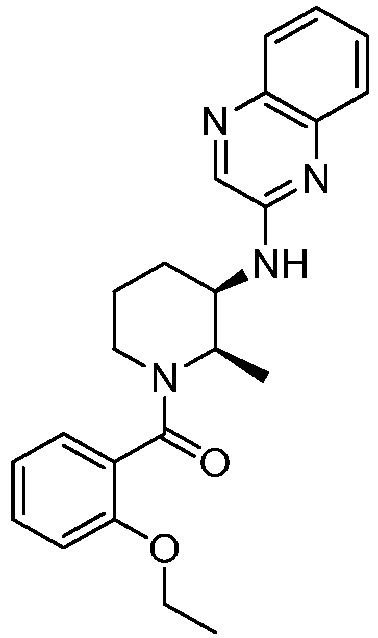
- Prepared analogous to Example 63 substituting intermediate A-4 with 2-ethoxybenzoic acid. MS (ESI) mass calcd. for C23H26N4O2,390.2; m/z found 391.2 [M+H]+. 1H NMR (CDC13): 8.96-8.35 (m, 1H), 8.01-7.29 (m, 5H), 7.25-6.59 (m, 3H), 5.43-5.16 (m, 1H), 4.81-2.64 (m, 5H), 2.26-1.71 (m, 3H), 1.71-1.12 (m, 7H).
-

- Prepared analogous to Example 51 substituting intermediate B-3 with intermediate B-6. MS (ESI) mass calcd. for C25H25N7O, 439.2; m/z found 440.2 [M+H]+. 1H NMR (CDC13): 9.88-9.51 (m, 1H), 8.35-7.93 (m, 3H), 7.92-7.27 (m, 8H), 7.24-5.46 (m, 2H), 4.98-3.88 (m, 2H), 3.49-2.73 (m, 2H), 2.09-0.84 (m, 7H).
-

- Prepared analogous to Example 66 substituting intermediate A-4 with 3-fluoro-2-methoxybenzoic acid. MS (ESI) mass calcd. for C24H25FN4O2, 420.2; m/z found 421.2 [M+H]+. 1H NMR (CDC13): 10.18-9.91 (m, 1H), 8.42-7.48 (m, 6H), 7.24-5.53 (m, 4H), 4.76-3.81 (m, 5H), 3.79-2.77 (m, 2H), 2.13-1.41 (m, 4H), 1.38-0.97 (m, 3H).
-

- Prepared analogous to Example 66 substituting intermediate A-4 with 2-ethoxybenzoic acid. MS (ESI) mass calcd. for C25H28N4O2, 416.2; m/z found 417.2 [M+H]+. 1H NMR (CDC13): 9.34 (s, 1H), 8.32-7.89 (m, 3H), 7.74-7.46 (m, 3H), 7.37-7.31 (m, 1H), 7.23-6.73 (m, 3H), 6.29-5.49 (m, 1H), 4.82-3.76 (m, 4H), 3.41-2.76 (m, 2H), 1.99-1.63 (m, 3H), 1.61-1.10 (m, 7H).
-

- Step A: (2S,3R)-tert-butyl 2-methyl-3-((5-(trifluoromethyl)pyrimidin-2-yl)amino)piperidine-1-carboxylate. A solution of intermediate B-4 (1g), 2-chloro-5-(trifluoromethyl)pyrimidine (850 mg) and DIPEA (1.6 mL) in n-BuOH (15 mL) was heated to 100 °C for 1h. The mixture was diluted with H2O and extracted with EtOAc. The combined organics were dried (MgSO4). Purification via silica gel chromatography (0-30% EtOAc in heptane) gave the title compound (1.5 g, 89%). MS (ESI) mass calcd. for C16H23F3N4O2, 360.24; m/z found 305.1 [M-55]+.
- Step B: N-((2S,3R)-2-methylpiperidin-3-yl)-5-(trifluoromethyl)pyrimidin-2-amine. To the title compound of step A (1.5 g) in DCM (12 mL) was added TFA (4 mL). After 1h, the reaction was diluted with saturated Na2CO3 (aq) and extracted with DCM. The organic layers were dried (MgSO4) and concentrated to give the title compound (1.03 g) that was used without further purification.
- Step C: (6-methyl-2-(2H-1,2,3-triazol-2-yl)pyridin-3-yl)((2S,3R)-2-methyl-3-((5-(trifluoromethyl)pyrimidin-2-yl)amino)piperidin-1-yl)methanone. To a solution of the title compound from Step B (100 mg), intermediate A-8 (118 mg) and DIPEA (0.2 mL) in DMF (5 mL) was added HBTU (218 mg). After 1h, H2O and EtOAc were added. The organic layer was separated and dried (MgSO4). Purification via silica gel chromatography (0-30% EtOAc in heptane) gave the title compound (86 mg, 47%). MS (ESI) mass calcd. for C20H21F3N8O, 446.2; m/z found 447.2 [M+H]+. MP=245.2 °C. (Mixture of 4 isomers, undefined ratio). 1H NMR (300 MHz, CDCl3) δ 8.52 (br d, J = 11.5 Hz, 1.51H), 8.35 (s, 1.27H), 8.18 (br s, 0.10H), 8.09 (s, 0.46H), 7.87 (d, J = 5.3 Hz, 0.46H), 7.80 (d, J = 7.7 Hz, 0.10H), 7.74 - 7.49 (m, 0.87H), 7.43 - 7.14 (m, 1.73H), 6.87 (d, J = 8.3 Hz, 0.46H), 6.61 (d, J = 7.7 Hz, 0.10H), 5.85 (d, J = 7.0 Hz, 0.10H), 5.69 (d, J = 5.5 Hz, 0.10H), 5.34 - 5.16 (m, 0.46H), 5.01 (q, J = 6.6 Hz, 0.10H), 4.73 (br d, J = 14.3 Hz, 0.30H), 4.29 (br d, J = 6.5 Hz, 0.46H), 4.19 - 3.95 (m, 0.46H), 3.83 (br d, J = 7.0 Hz, 0.15H), 3.65 (br s, 0.15H), 3.47 (dd, J = 13.7, 4.2 Hz, 0.46H), 3.26 (td, J = 13.4, 3.1 Hz, 0.60H), 3.05 - 2.83 (m, 0.46H), 2.80 (s, 0.26H), 2.78 - 2.64 (m, 2.16H), 2.61 (s, 0.52H), 2.52 (s, 0.26H), 1.95 - 1.81 (m, 1.73H), 1.80 - 1.70 (m, 0.26H), 1.71 - 1.54 (m, 1.13H), 1.53 - 1.19 (m, 3.37H), 1.08 (dd, J = 14.4, 6.7 Hz, 0.10H), 1.00 - 0.84 (m, 0.15H), 0.74 (d, J = 6.9 Hz, 0.26H).
-

- Prepared analogous to Example 69 substituting intermediate A-8 with intermediate A-9. MS (ESI) mass calcd. for C20H21F3N8O, 446.2; m/z found 447.2 [M+H]+. MP=181.6 °C. (Mixture of 4 isomers, undefined ratio). 1H NMR (300 MHz, CDCl3) δ 8.66 - 8.15 (m, 2.14H), 7.90 (d, J = 10.8 Hz, 0.45H), 7.83 - 7.67 (m, 0.68H), 7.60 (dd, J = 7.7, 2.6 Hz, 0.45H), 7.41 - 7.14 (m, 1.53H), 6.79 (d, J= 8.6 Hz, 0.26H), 6.61 (d, J= 7.8 Hz, 0.16H), 5.82 (dd, J= 26.8, 6.6 Hz, 0.33H), 5.17 (q, J= 6.8 Hz, 0.33H), 5.05 - 4.86 (m, 0.26H), 4.71 (t, J= 15.1 Hz, 0.33H), 4.35 (br d, J= 7.7 Hz, 0.45H), 4.25 - 4.00 (m, 0.78H), 3.87 (q, J= 6.9 Hz, 0.26H), 3.73 (br s, 0.26H), 3.54 - 3.37 (m, 0.33H), 3.36 - 3.05 (m, 0.62H), 3.03 - 2.75 (m, 0.45H), 2.62 (s, 1.14H), 2.59 (s, 0.76H), 2.46 (s, 0.50H), 2.18 - 1.83 (m, 1.62H), 1.81 - 1.55 (m, 1.41H), 1.53 - 0.79 (m, 4.57H). The signal corresponding to the NH group was not observed.
-

- Prepared analogous to Example 69 substituting intermediate A-8 with intermediate A-11. MS (ESI) mass calcd. for C21H22F3N7O, 445.2; m/z found 446.2 [M+H]+. The product is present as a mixture of conformers (ratio ca. 60:40) 1H NMR (300 MHz, CDCl3) δ 8.51 (d, J = 10.7 Hz, 1.4H), 8.40 - 8.28 (m, 0.9H), 8.25 (s, 1.2H), 8.00 (s, 0.6H), 7.96 (s, 0.6H), 7.86 - 7.71 (m, 0.9H), 7.24 - 7.11 (m, 1.8H), 7.02 - 6.88 (m, 0.6H), 5.24 (q, J = 7.1 Hz, 0.6H), 4.73 (d, J = 13.1 Hz, 0.4H), 4.33 - 4.23 (m, 0.6H), 4.14 (q, J = 6.6 Hz, 0.4H), 4.00 (d, J = 6.6 Hz, 0.4H), 3.59 - 3.48 (m, 0.6H), 3.31 - 3.13 (m, 0.6H), 3.01 - 2.88 (m, 0.4H), 2.46 (s, 1.8H), 2.43 (s, 1.2H), 2.07 - 1.53 (m, 4H), 1.48 (d, J = 6.9 Hz, 1.2H), 1.42 (d, J = 7.1 Hz, 1.8H).
-

- Step A: (2S,3R)-tert-butyl 2-methyl-3-((5-(trifluoromethyl)pyrazin-2-yl)amino)piperidine-1-carboxylate. To 2-chloro-5-(trifluoromethyl)pyrazine (326 µL) in DMSO (8 mL) was added intermediate B-4 (600 mg) and K2CO3 (658 mg). The reaction was heated in a microwave reactor at 120 °C for 5 min. The mixture was diluted with saturated NaHCO3 (aq) and extracted with DCM. The combined organics were washed with brine and dried (MgSO4). Purification via silica gel chromatography (0-16% EtOAc in heptane) gave the title compound (459 mg, 46%). MS (ESI) mass calcd. for C16H23F3N4O2, 360.24; m/z found 305.1 [M-55]+.
- Step B: N-((2S,3R)-2-methylpiperidin-3-yl)-5-(trifluoromethyl)pyrazin-2-amine. Prepared analogous to example 69 Step B substituting the title compound of Step A example 69 with the title compound of Step A. MS (ESI) mass calcd. for C11H15F3N4, 260.2; m/z found 261 [M+H]+.
- Step C: ((2S,3R)-2-methyl-3-((5-(trifluoromethyl)pyrazin-2-yl)amino)piperidin-1-yl)(5-methyl-3-(2H-1,2,3-triazol-2-yl)pyridin-2-yl)methanone. Prepared analogous to example 69 substituting intermediate A-8 with intermediate A-21. MS (ESI) mass calcd. for C20H21F3N8O, 446.2; m/z found 447 [M+H]+. The product is present as a mixture of conformers (ratio ca. 70:30) 1H NMR (300 MHz, CDCl3) 8.46 (s, 0.3H), 8.39 (s, 0.7H), 8.34 (s, 0.3H), 8.25 (s, 0.3H), 8.22 (s, 0.7H), 8.13 (s, 0.7H), 8.03 - 7.76 (m, 3H), 7.48 (d, J = 6.6 Hz, 0.7H), 6.47 (d, J = 7.9 Hz, 0.3H), 5.20 - 5.05 (m, 0.3H), 4.72 - 4.58 (m, 0.7H), 4.16 (br s, 0.3H), 4.08 - 3.87 (m, 1.7H), 3.43 - 3.25 (m, 0.3H), 3.12 - 2.95 (m, 0.7H), 2.49 (s, 0.9H), 2.46 (s, 2.1H), 2.08 - 1.63 (m, 4H), 1.50 - 1.47 (m, 3H).
-

- Prepared analogous to example 41 substituting intermediate B-3 with intermediate B-4 and intermediate A-4 with intermediate A-21. MS (ESI) mass calcd. for C22H23N7O2, 417.2; m/z found 418.2 [M+H]+. MP=112.9 °C. The product is present as a mixture of conformers (ratio ca. 60:40) 1H NMR (300 MHz, CDCl3) δ 8.46 (s, 0.4H), 8.42 (s, 0.6H), 8.29 (s, 0.4H), 8.18 (s, 0.6H), 8.09 (s, 0.8H), 7.99 (s, 1.2H), 7.72 (d, J = 7.1 Hz, 0.6H), 7.38 (d, J = 7.8 Hz, 0.4H), 7.33 - 7.27 (m, 1H), 7.23 - 6.95 (m, 2.6H), 6.64 (d, J = 8.8 Hz, 0.4H), 5.34 - 5.16 (m, 0.4H), 4.66 (d, J = 12.2 Hz, 0.6H), 4.26 - 4.2 (m, 0.4H), 4.03 (q, J = 6.8 Hz, 0.6H), 3.92 (d, J = 6.7 Hz, 0.6H), 3.50 - 3.34 (m, 0.8H), 3.12 - 2.94 (m, 0.6H), 2.49 (s, 1.2H), 2.43 (s, 1.8H), 2.30 - 1.62 (m, 4H), 1.54 - 1.45 (m, 3H).
-

- Prepared analogous to example 72 substituting intermediate A-21 with intermediate A-8. MS (ESI) mass calcd. for C20H21F3N8O, 446.2; m/z found 447 [M+H]+. MP=172.8 °C. (Mixture of 4 isomers, undefined ratio). 1H NMR (300 MHz, CDCl3) δ 8.37 (br s, 0.21H), 8.32 (s, 0.11H), 8.21 (s, 0.40H), 8.15 - 7.97 (m, 1.26H), 7.97 - 7.84 (m, 0.66H), 7.78 (d, J = 7.7 Hz, 0.14H), 7.74 - 7.53 (m, 1.46H), 7.40 - 7.14 (m, 1.35H), 6.54 (d, J = 7.8 Hz, 0.11H), 6.18 (br s, 0.30H), 5.47 (s, 0.14H), 5.28 - 5.09 (m, 0.39H), 5.08 - 4.90 (m, 0.18H), 4.70 (br d, J = 13.3 Hz, 0.66H), 4.22 - 3.94 (m, 1.59H), 3.80 (br s, 0.21H), 3.64 (br s, 0.21H), 3.55 - 3.39 (m, 0.30H), 3.38 - 3.17 (m, 0.40H), 3.05 - 2.90 (m, 0.66H), 2.89 - 2.79 (m, 0.18H), 2.71 (s, J = 3.7 Hz, 0.92H), 2.70 (s, 1.04H), 2.26 - 1.12 (m, 6.39H), 0.88 (t, J = 6.8 Hz, 0.40H), 0.69 (d, J = 6.9 Hz, 0.21H). The signal corresponding to the NH group was not observed.
-

- Prepared analogous to example 73 substituting intermediate A-21 with intermediate A-8. MS (ESI) mass calcd. for C22H23N7O2, 417.2; m/z found 418.2 [M+H]+. MP=136.3 °C. The product is present as a mixture of conformers (ratio ca. 50:50) 1H NMR (300 MHz, CDCl3) δ 8.25 (s, 1H), 8.09 (s, 1H), 7.69 - 7.52 (m, 1H), 7.42 - 6.91 (m, 5.5H), 6.44 (d, J = 8.6 Hz, 0.5H), 5.39 - 5.22 (m, 0.5H), 4.81 - 4.63 (m, 0.5H), 4.27 - 3.91 (m, 1.5H), 3.54 - 3.40 (m, 0.5H), 3.39 - 3.22 (m, 0.5H), 3.06 - 2.83 (m, 0.5H), 2.72 (s, 1.5H), 2.67 (s, 1.5H), 2.24 - 1.64 (m, 4H), 1.51 (d, J = 7.0 Hz, 1.5H), 1.45 (d, J = 7.2 Hz, 1.5H).
-

- Prepared analogous to example 73 substituting intermediate A-21 with intermediate A-9. MS (ESI) mass calcd. for C22H23N7O2, 417.2; m/z found 418.2 [M+H]+. MP=206.3 °C. The product is present as a mixture of conformers (ratio ca. 50:50) 1H NMR (300 MHz, CDCl3) δ 8.60 (s, 0.5H), 8.41 (s, 0.5H), 7.94 (s, 1H), 7.66 - 7.50 (m, 1H), 7.40 - 6.87 (m, 5.5H), 6.55 (d, J = 9.5 Hz, 0.5H), 5.28 - 5.17 (m, 0.5H), 4.79 - 4.68 (m, 0.5H), 4.34 - 4.22 (m, 0.5H), 4.22 - 4.11 (m, 0.5H), 4.10 - 3.94 (m, 0.5H), 3.73 - 3.39 (m, 0.5H), 3.37 - 3.23 (m, 0.5H), 3.04 - 2.89 (m, 0.5H), 2.63 (s, 1.5H), 2.56 (s, 1.5H), 2.15 - 1.70 (m, 4H), 1.50 (d, J = 7.0 Hz, 1.5H), 1.44 (d, J = 7.0 Hz, 1.5H).
-

- Prepared analogous to example 32 substituting intermediate B-3 with intermediate B-4 and intermediate A-4 with intermediate A-17. MS (ESI) mass calcd. for C21H22ClN5O2, 411.1; m/z found 412.1 [M+H]+. MP=206.3 °C. The product is present as a mixture of conformers (ratio ca. 70:30) 1H NMR (300 MHz, CDCl3) δ 8.46 (s, 0.3H), 8.38 (s, 0.7H), 8.24 (s, 0.3H), 8.13 - 8.02 (m, 1.7H), 7.96 - 7.89 (m, 2H), 7.36 (dd, J = 8.9, 2.6 Hz, 0.3H), 7.23 (dd, J = 8.9, 2.5 Hz, 0.7H), 6.56 (d, J = 7.2 Hz, 0.7H), 6.36 (d, J = 8.9 Hz, 0.3H), 6.22 (d, J = 8.8 Hz, 0.7H), 5.72 (d, J = 7.2 Hz, 0.3H), 5.17 - 5.03 (m, 0.3H), 4.69 - 4.56 (m, 0.7H), 3.99 - 3.81 (m, 1.6H), 3.32 (q, J = 13.8 Hz, 0.7H), 3.11 - 2.87 (m, 0.7H), 2.48 (s, 0.9H), 2.45 (s, 2.1H), 2.08 - 1.73 (m, 3H), 1.69 - 1.61 (m, 1H), 1.51 - 1.39 (m, 3H).
-

- Prepared analogous to Example 69 substituting intermediate A-8 with intermediate A-19. MS (ESI) mass calcd. for C22H22F3N7O, 457.2; m/z found 458.2 [M+H]+. MP=116.9 °C.
-

- Prepared analogous to example 72 substituting intermediate A-21 with intermediate A-11. MS (ESI) mass calcd. for C21H22F3N7O, 445.2; m/z found 446.2 [M+H]+. MP=116.2 °C.
-

- Prepared analogous to example 42 substituting intermediate B-3 with intermediate B-4 and intermediate A-4 with intermediate A-17. MS (ESI) mass calcd. for C21H22BrN5O2, 455.1; m/z found 457 [M+H]+. MP=135.6 °C.
-

- Prepared analogous to example 73 substituting intermediate A-21 with intermediate A-19. MS (ESI) mass calcd. for C24H24N6O2, 428.2; m/z found 429.2 [M+H]+. MP=143.9 °C.
-

- Prepared analogous to example 72 substituting intermediate A-21 with intermediate A-10. MS (ESI) mass calcd. for C21H22F3N7O2, 461.2; m/z found 462.2 [M+H]+. MP=112.7 °C.
-

- Prepared analogous to example 72 substituting intermediate A-21 with intermediate A-17. MS (ESI) mass calcd. for C21H21F3N6O2, 446.2; m/z found 447.2 [M+H]+. MP=122.9 °C.
-

- Prepared analogous to example 72 substituting intermediate A-21 with intermediate A-19. MS (ESI) mass calcd. for C22H22F3N7O, 457.2; m/z found 458.2 [M+H]+. MP=120.6 °C.
-
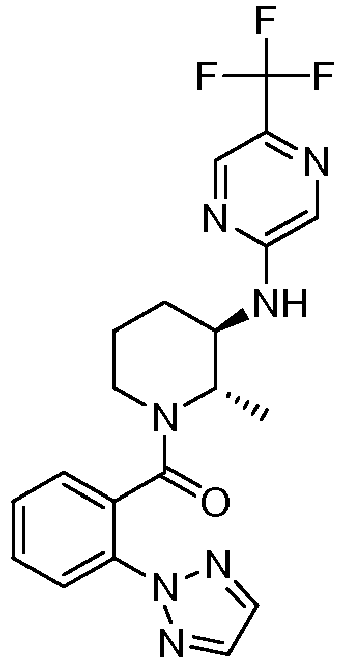
- Prepared analogous to example 72 substituting intermediate A-21 with intermediate A-4. MS (ESI) mass calcd. for C20H20F3N7O, 431.2; m/z found 432 [M+H]+. MP=202.4 °C.
-

- Prepared analogous to example 77 substituting 5-chloro-2-iodopyridine with 2-chloro-5-iodopyrazine. MS (ESI) mass calcd. for C20H21ClN6O2, 412.1; m/z found 413.1 [M+H]+.
-

- Prepared analogous to example 12 substituting intermediate B-3 with intermediate B-4 and intermediate A-4 with intermediate A-22. MS (ESI) mass calcd. for C21H22F3N7O, 445.2; m/z found 446 [M+H]+.
-

- Prepared analogous to example 73 substituting intermediate A-21 with intermediate A-17. MS (ESI) mass calcd. for C23H23N5O3, 417.2; m/z found 418.2 [M+H]+. MP=196.8 °C.
-

- Prepared analogous to Example 69 substituting intermediate A-8 with intermediate A-14. MS (ESI) mass calcd. for C21H22F3N7O2, 461.2; m/z found 462.2 [M+H]+.
-

- Prepared analogous to Example 72 substituting intermediate A-21 with intermediate A-24. MS (ESI) mass calcd. for C20H19F4N7O, 449.2; m/z found 450 [M+H]+. MP=106.2 °C.
-

- Prepared analogous to Example 30 substituting intermediate B-3 with intermediate B-4 and intermediate A-4 with intermediate A-11. MS (ESI) mass calcd. for C20H22ClN7O, 411.2; m/z found 412.2 [M+H]+. MP=166.3 °C.
-

- Prepared analogous to example 42 substituting intermediate B-3 with intermediate B-4 and intermediate A-4 with intermediate A-21. MS (ESI) mass calcd. for C20H22BrN7O, 455.2; m/z found 457 [M+H]+.
-

- Prepared analogous to Example 87 substituting intermediate A-22 with intermediate A-9. MS (ESI) mass calcd. for C21H22F3N7O, 445.2; m/z found 446.2[M+H]+. MP=159.8 °C.
-

- Prepared analogous to Example 69 substituting intermediate A-8 with intermediate A-21. MS (ESI) mass calcd. for C20H21F3N8O, 446.2; m/z found 447 [M+H]+. MP=101.2 °C.
-

- Prepared analogous to Example 69 substituting intermediate A-8 with intermediate A-10. MS (ESI) mass calcd. for C21H22F3N7O2, 461.2; m/z found 462.2 [M+H]+. The product is present as a mixture of conformers (ratio ca. 60:40) 1H NMR (300 MHz, CDCl3) δ 8.51 (d, J = 10.0 Hz, 1.4H), 8.37 (d, J = 10.3 Hz, 0.6H), 8.25 (s, 1.4H), 8.00 (s, 0.4H), 7.78 (d, J = 4.4 Hz, 0.4H), 7.67 (d, J = 2.3 Hz, 0.6H), 7.46 (d, J = 2.3 Hz, 0.4H), 7.24 (d, J = 9.3 Hz, 0.6H), 7.17 (d, J = 8.5 Hz, 0.6H), 7.03 - 6.85 (m, 1.6H), 5.24 (q, J = 6.7 Hz, 0.6H), 4.72 (d, J = 13.2 Hz, 0.4H), 4.27 (d, J = 6.7 Hz, 0.6H), 4.22 - 4.08 (m, 0.4H), 4.01 (d, J = 6.4 Hz, 0.4H), 3.91 (s, 1.8H), 3.87 (s, 1.2H), 3.55 (dd, J = 13.6, 3.7 Hz, 0.6H), 3.23 (td, J = 13.4, 3.0 Hz, 0.6H), 2.99 - 2.90 (m, 0.4H), 2.09 - 1.52 (m, 4H), 1.48 (d, J = 6.9 Hz, 1.2H), 1.42 (d, J = 7.1 Hz, 1.8H).
-

- Prepared analogous to Example 72 substituting intermediate A-21 with intermediate A-9. MP=149.6 °C.
-

- Prepared analogous to Example 87 substituting intermediate A-22 with intermediate A-10. MS (ESI) mass calcd. for C22H23F3N6O2, 460.2; m/z found [M+H]+.
-

- Prepared analogous to Example 87 substituting intermediate A-22 with intermediate A-8. MS (ESI) mass calcd. for C21H22F3N7O, 445.2; m/z found 446 [M+H]+.
-

- Prepared analogous to Example 32 substituting intermediate B-3 with intermediate B-4 and intermediate A-4 with intermediate A-11. MS (ESI) mass calcd. for C21H23ClN6O, 410.2; m/z found 411.2 [M+H]+.
-

- Prepared analogous to Example 32 substituting intermediate B-3 with intermediate B-4. MS (ESI) mass calcd. for C20H21ClN6O, 396.1; m/z found 397 [M+H]+. MP=140.1 °C.
-

- Step A: (2S,3R)-tert-butyl 2-methyl-3-((5-(trifluoromethyl)pyrimidin-2-yl)oxy)piperidine-1-carboxylate. To (2S,3R)-tert-butyl 3-hydroxy-2-methylpiperidine-1-carboxylate (670 mg, prepared according to J. Org. Chem. 2008, 73, 2898) in THF (15 mL) at 0 °C was added NaH (60 wt%, 188 mg). After 15 min, 2-chloro-5-(trifluoromethyl)pyrimidine (570 mg) was added and the reaction allowed to proceed at rt overnight. The reaction was diluted with H2O and extracted with DCM. The organic layers were dried (MgSO4). Purification via silica gel chromatography (0-40% EtOAc in heptane) gave the title compound (813 mg, 72%).
- Step B: 2-(((2S,3R)-2-methylpiperidin-3-yl)oxy)-5-(trifluoromethyl)pyrimidine. To the title compound of step A (813 mg) in DCM (6 mL) was added TFA (2 mL). After 1h, the reaction was diluted with saturated Na2CO3 (aq) and extracted with DCM. The organic layers were dried (MgSO4) and concentrated to give the title compound (452 mg) that was used without further purification.
- Step C: ((2S,3R)-2-methyl-3-((5-(trifluoromethyl)pyrimidin-2-yl)oxy)piperidin-1-yl)(5-methyl-3-(2H-1,2,3-triazol-2-yl)pyridin-2-yl)methanone. To a solution of the title compound from Step B (100 mg), intermediate A-21 (118 mg) and DIPEA (0.2 mL) in DMF (5 mL) was added HBTU (218 mg). After 1h, H2O and EtOAc were added. The organic layer was separated and dried (MgSO4). Purification via prep HPLC gave the title compound (62 mg, 36%). MS (ESI) mass calcd. for C20H20F3N7O2, 447.2; m/z found 448.2 [M+H]+. MP=214.9 °C.
-

- Prepared analogous to Example 101 substituting intermediate A-21 with intermediate A-11. MS (ESI) mass calcd. for C21H21F3N6O2, 446.2; m/z found 447.2 [M+H]+. MP=163.7 °C.
-

- Prepared analogous to Example 101 substituting intermediate A-21 with intermediate A-4. MS (ESI) mass calcd. for C20H19F3N6O2, 432.2; m/z found 433 [M+H]+.
-

- Prepared analogous to Example 101 substituting intermediate A-21 with intermediate A-22. MS (ESI) mass calcd. for C20H20F3N7O2, 447.2; m/z found 448 [M+H]+. MP=161.5 °C.
-

- Prepared analogous to Example 101 substituting 2-chloro-5-(trifluoromethyl)pyrimidine with 2-chloro-5-(trifluoromethyl)pyrazine. MS (ESI) mass calcd. for C20H20F3N7O2, 447.2; m/z found 448 [M+H]+. MP=149.7 °C.
-
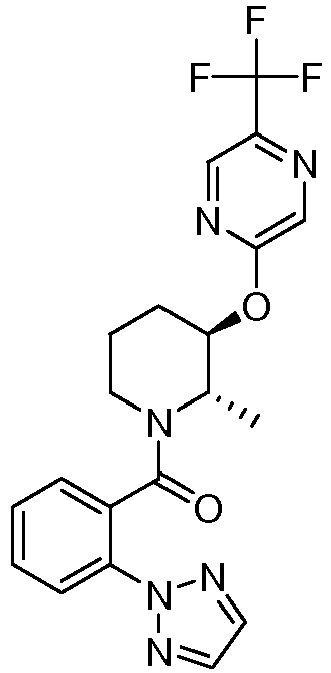
- Prepared analogous to Example 105 substituting intermediate A-21 with intermediate A-4. MS (ESI) mass calcd. for C20H19F3N6O2, 432.2; m/z found 433.2 [M+H]+. MP=111.2 °C.
-

- Prepared analogous to Example 105 substituting intermediate A-21 with intermediate A-22. MS (ESI) mass calcd. for C20H20F3N7O2, 447.2; m/z found 448 [M+H]+. MP=161.5 °C.
-

- Step A: (2S,3R)-tert-butyl 2-methyl-3-((5-(trifluoromethyl)pyridin-2-yl)oxy)piperidine-1-carboxylate. To (2S,3R)-tert-butyl 3-hydroxy-2-methylpiperidine-1-carboxylate (1.5 g, 6.97 mmol, prepared according to J. Org. Chem. 2008, 73, 2898) in THF (20 mL) at 0 °C was added NaH (60 wt%, 418 mg, 10.5 mmol). After 15 min, 2-chloro-5-(trifluoromethyl)pyridine (1.33 g, 7.32 mmol) was added and the reaction allowed to proceed at rt overnight. The reaction was diluted with H2O and extracted with EtOAc. The combined organic layers were dried (MgSO4), filtered and concentrated. Purification via silica gel chromatography (0-25% EtOAc in heptane) gave the title compound (2.37 g, 94%, 97% purity). MS (ESI) mass calcd. for C17H23F3N2O3, 360.2; m/z found 361.0 [M+H]+.
- Step B: 2-(((2S,3R)-2-methylpiperidin-3-yl)oxy)-5-(trifluoromethyl)pyridine. To the title compound of step A (3.45 g, 9.57 mmol) in DCM (37 mL) was added TFA (12 mL), and the reaction mixture was stirred at rt for 1 h. Then, the crude reaction was diluted with saturated Na2CO3 (aq) and extracted with DCM. The organic layers were dried (MgSO4) and concentrated to give the title compound (2.34 g) that was used without further purification. MS (ESI) mass calcd. for C12H15F3N2O, 260.1; m/z found 261 [M+H]+.
- Step C: ((2S,3R)-2-methyl-3-((5-(trifluoromethyl)pyridin-2-yl)oxy)piperidin-1-yl)(6-methyl-3-(2H-1,2,3-triazol-2-yl)pyridin-2-yl)methanone. To a solution of the title compound from Step B (2.34 g), intermediate A-22 (4.58 g, 10.8 mmol) and DIPEA (4.6 mL, 27 mmol) in DMF (27 mL) was added HBTU (5.10 g, 13.5 mmol). After 1h, a solution of saturated NaHCO3 (aq) and EtOAc were added. The reaction mixture was extracted with EtOAc (3X). The combined organic layer was dried (MgSO4), filtered and concentrated. Purification via prep silica gel chromatography (0-50% EtOAc in heptane) gave the title compound as crystalline material (3.43 g, 70%, 98% purity). MS (ESI) mass calcd. for C21H21F3N6O2, 446.2; m/z found 447 [M+H]+. 1H NMR (500 MHz, Chloroform-d) δ 8.45 - 8.36 (m, 0.45H), 8.16 (d, J = 8.4 Hz, 0.45H), 8.15 - 8.13 (m, 0.55H), 8.07 (d, J = 8.4 Hz, 0.55H), 7.81 (s, 1.1H), 7.80 (s, 0.9H), 7.77 (dd, J = 8.7, 2.6 Hz, 0.45H), 7.68 (dd, J = 8.7, 2.6 Hz, 0.55H), 7.30 (d, J = 8.4 Hz, 0.45H), 7.11 (d, J = 8.5 Hz, 0.55H), 6.96 - 6.88 (m, 0.45H), 6.68 (d, J = 8.7 Hz, 0.55H), 5.31 - 5.25 (m, 0.45H), 5.15 - 5.08 (m, 0.45H), 4.89 - 4.82 (m, 0.55H), 4.79 - 4.72 (m, 0.55H), 4.08 - 3.99 (m, 0.55H), 3.38 - 3.29 (m, 0.45H), 3.13 - 3.03 (m, 0.45H), 2.94 (td, J = 13.4, 3.2 Hz, 0.55H), 2.65 (s, 1.3H), 2.25 (s, 1.7H), 2.19 - 1.86 (m, 3H), 1.67 - 1.61 (m, 0.55H), 1.47 - 1.32 (m, 1.8H), 1.06 (d, J = 7.0 Hz, 1.65H).
-

- Prepared analogous to Example 108 using (±)-trans-tert-butyl 3-hydroxy-2-methylpiperidine-1-carboxylate. MS (ESI) mass calcd. for C21H21F3N6O2, 446.2; m/z found 447.2 [M+H]+. MP=161.3 °C.
-
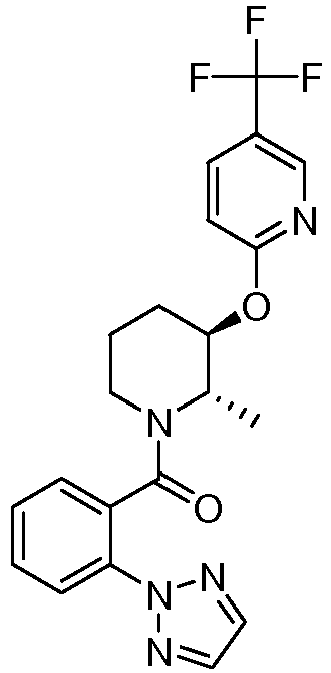
- Prepared analogous to Example 108 substituting intermediate A-22 with intermediate A-4. MS (ESI) mass calcd. for C21H20F3N5O2, 431.2; m/z found 432.2 [M+H]+. MP=159.7 °C.
-

- Prepared analogous to Example 108 substituting intermediate A-22 with intermediate A-21. MP=281.7 °C.
-

- Prepared analogous to example 108 substituting intermediate A-22 with intermediate A-11. MS (ESI) mass calcd. for C21H21F3N6O2, 446.2; m/z found 447 [M+H]+. MP=167.1 °C.
-

- Prepared analogous to Example 105 substituting intermediate A-21 with intermediate A-11.MS (ESI) mass calcd. for C21H21F3N6O2, 446.2; m/z found 447 [M+H]+. MP=167.1 °C
- The following compounds are also within the scope of the invention. They can be prepared using methods known in the art, in combination with the experimental details and schemes provided herein.
-

-

-

- The title compound was prepared analogous to Example 147 substituting intermediate A-1 with intermediate A-28. MS (ESI): mass calcd. for C23H20F4N4O2, 460.2; m/z found, 460.9 [M+H]+. 1H NMR (400 MHz, CDCl3) δ 8.82 (d, J = 5.0 Hz, 2H), 8.39 (s, 0.6H), 8.21 (s, 0.4H), 7.90 - 7.70 (m, 1H), 7.55 - 7.40 (m, 0.6H), 7.25 - 7.17 (m, 2H), 7.07 - 6.98 (m, 0.4H), 6.95 - 6.74 (m, 2H), 5.22 (s, 0.6H), 5.05 - 4.87 (m, 1H), 4.63 - 4.47 (m, 0.4H), 4.25 - 4.08 (m, 0.4H), 3.62 - 3.44 (m, 0.6H), 3.10 (td, J = 13.2, 3.3 Hz, 0.6H), 2.75 (t, J = 13.1 Hz, 0.4H), 2.14 - 1.78 (m, 3H), 1.62 - 1.54 (m, 0.6H), 1.49 - 1.36 (m, 0.4H), 1.25 - 1.12 (m, 1.6H), 1.06 - 0.94 (m, 1.4H).
-

-

-

-

-
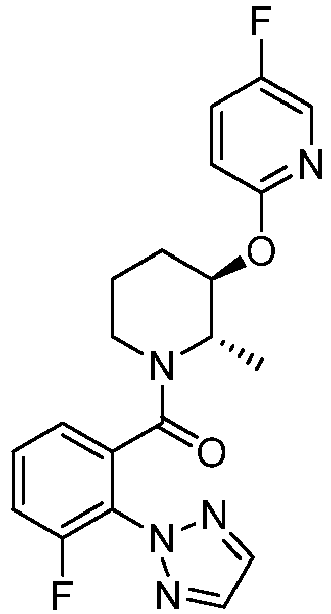
-

-

-

- The title compound was prepared analogous to Example 147 substituting intermediate A-1 with intermediate A-3. MS (ESI): mass calcd. for C21H19F4N5O2, 449.1; m/z found, 449.9 [M+H]+. 1H NMR (400 MHz, CDCl3) δ 8.42 - 8.36 (m, 0.55H), 8.23 - 8.18 (m, 0.45H), 7.96 - 7.72 (m, 3H), 7.57 - 7.46 (m, 0.55H), 7.40 - 7.27 (m, 1H), 7.18 - 7.08 (m, 0.45H), 6.96 - 6.76 (m, 2H), 5.26 - 5.19 (m, 0.55H), 5.05 - 4.88 (m, 1H), 4.61 - 4.52 (m, 0.45H), 4.15 - 4.01 (m, 0.55H), 3.49 - 3.36 (m, 0.45H), 3.03 - 2.90 (m, 0.55H), 2.82 - 2.68 (m, 0.45H), 2.08 - 1.76 (m, 3H), 1.46 - 1.21 (m, 1H), 1.15 (d, J = 7.1 Hz, 1.45H), 0.98 (d, J = 7.0 Hz, 1.55H).
-

- The title compound was prepared analogous to Example 147 substituting 2-chloro-5-(trifluoromethyl)pyridine with 2-chloro-5-(trifluoromethyl)pyrazine, and intermediate A-1 with intermediate A-3. MS (ESI): mass calcd. for C20H18F4N6O2, 450.1; m/z found, 450.9 [M+H]+. 1H NMR (400 MHz, CDCl3) δ 8.44 - 8.38 (m, 0.6H), 8.30 (s, 0.4H), 8.26 (s, 0.6H), 8.21 (s, 0.4H), 7.87 (s, 1H), 7.85 (s, 1H), 7.58 - 7.47 (m, 0.6H), 7.38 - 7.26 (m, 1.4H), 7.17 - 7.07 (m, 0.4H), 6.97 - 6.85 (m, 0.6H), 5.24 - 5.14 (m, 0.6H), 5.07 - 4.97 (m, 0.6H), 4.95 - 4.82 (m, 0.4H), 4.65 - 4.51 (m, 0.4H), 4.04 - 3.87 (m, 0.6H), 3.47 - 3.37 (m, 0.6H), 3.05 - 2.89 (m, 0.4H), 2.82 - 2.64 (m, 0.4H), 2.15 - 1.78 (m, 3H), 1.65 - 1.56 (m, 0.4H), 1.51 - 1.40 (m, 0.6H), 1.14 (d, J = 7.1 Hz, 2H), 0.90 (d, J = 7.0 Hz, 1H).
-

-

-

-

-
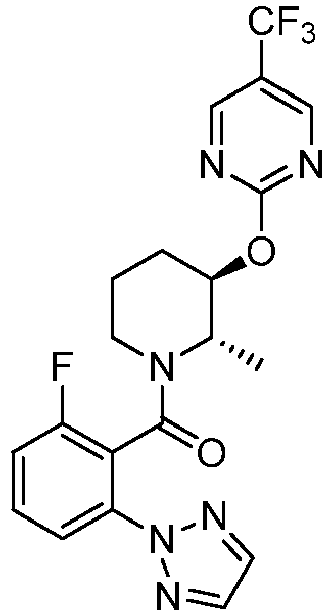
-
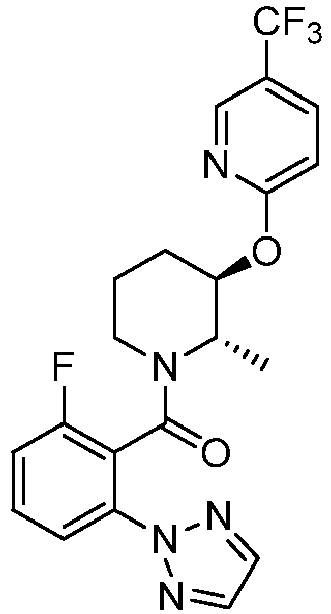
-

-

-

-

-

-

-

- The title compound was prepared analogous to Example 143 substituting intermediate A-29 with intermediate A-7. MS (ESI): mass calcd. for C23H20F4N4O2, 460.2; m/z found, 461.2 [M+H]+. 1H NMR (400 MHz, CDCl3) δ 8.76 (d, J = 4.8 Hz, 1H), 8.72 (d, J = 4.9 Hz, 1H), 8.50 - 8.35 (m, 1H), 8.23 (dd, J = 8.8, 5.6 Hz, 0.5H), 8.17 (s, 0.5H), 7.84 (dd, J = 8.7, 2.5 Hz, 0.5H), 7.79 (dd, J = 8.8, 2.5 Hz, 0.5H), 7.24 - 7.15 (m, 1.5H), 7.10 (dd, J = 8.5, 2.7 Hz, 0.5H), 6.96 (td, J = 8.4, 2.7 Hz, 0.5H), 6.90 - 6.84 (m, 1H), 6.81 (dd, J = 8.5, 2.7 Hz, 0.5H), 5.34 - 5.30 (m, 0.5H), 5.15 - 5.05 (m, 0.5H), 4.93 - 4.85 (m, 0.5H), 4.79 - 4.71 (m, 0.5H), 4.11 - 4.00 (m, 0.5H), 3.44 - 3.33 (m, 0.5H), 3.18 - 3.04 (m, 0.6H), 2.95 - 2.89 (m, 0.4H), 2.16 - 1.84 (m, 3H), 1.70 - 1.60 (m, 0.5H), 1.48 - 1.33 (m, 2H), 0.90 (d, J = 7.0 Hz, 1.5H).
-

- The title compound was prepared analogous to Example 143 substituting intermediate A-29 with intermediate A-37. MS (ESI): mass calcd. for C23H20F4N4O2, 460.2; m/z found, 461.2 [M+H]+. 1H NMR (400 MHz, CDCl3) δ 8.78 (d, J = 4.8 Hz, 0.9H), 8.75 (d, J = 4.8 Hz, 1.1H), 8.42 (s, 0.6H), 8.19 (s, 0.4H), 8.11 (dd, J = 10.2, 2.7 Hz, 0.4H), 7.95 (d, J = 10.1 Hz, 0.6H), 7.84 (d, J = 8.7 Hz, 0.4H), 7.78 (dd, J = 8.8, 2.6 Hz, 0.6H), 7.38 (dd, J = 8.4, 5.5 Hz, 0.6H), 7.25 - 7.17 (m, 1.6H), 7.09 - 7.01 (m, 0.4H), 6.86 (d, J = 8.7 Hz, 1H), 6.64 - 6.55 (m, 0.4H), 5.35 - 5.28 (m, 0.6H), 5.17 - 5.07 (m, 0.6H), 4.89 (s, 0.4H), 4.82 - 4.67 (m, 0.4H), 4.10 - 4.01 (m, 0.4H), 3.44 - 3.31 (m, 0.6H), 3.15 - 3.00 (m, 0.6H), 2.94 - 2.89 (m, 0.4H), 2.13 - 1.81 (m, 3H), 1.70 - 1.61 (m, 0.4H), 1.47 - 1.32 (m, 2.2H), 0.91 (d, J = 7.0 Hz, 1.4H).
-

-

- The title compound was prepared analogous to Example 143 substituting intermediate A-29 with intermediate A-25. MS (ESI): mass calcd. for C23H20F4N4O2, 460.2; m/z found, 461.2 [M+H]+. 1H NMR (500 MHz, CDCl3) δ 8.72 - 8.56 (m, 2H), 8.45 - 8.40 (m, 0.4H), 8.34 - 8.28 (m, 0.4H), 8.22 - 8.10 (m, 1.2H), 7.88 - 7.81 (m, 0.4H), 7.80 - 7.74 (m, 0.4H), 7.55 - 7.45 (m, 1.2H), 7.45 - 7.36 (m, 0.4H), 7.33 - 7.26 (m, 0.6H), 7.11 - 7.00 (m, 0.4H), 6.92 - 6.82 (m, 1.6H), 5.38 - 5.28 (m, 0.6H), 5.17 - 5.07 (m, 0.4H), 4.89 (s, 0.4H), 4.81 - 4.71 (m, 0.4H), 4.15 - 4.03 (m, 0.6H), 3.50 - 3.37 (m, 0.6H), 3.16 - 3.03 (m, 0.6H), 2.98 - 2.84 (m, 0.4H), 2.18 - 1.83 (m, 3H), 1.78 - 1.60 (m, 0.6H), 1.47 - 1.31 (m, 2.2H), 0.94 (d, J = 7.0 Hz, 1.2H).
-

-
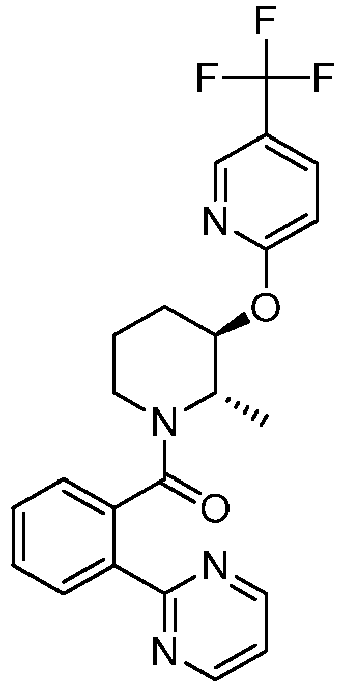
- The title compound was prepared analogous to Example 101 steps A and B, substituting 2-chloro-5-(trifluoromethyl)pyrimidine with 2-chloro-5-(trifluoromethyl)pyridine. Step C: ((2S,3R)-2-methyl-3-((5-(trifluoromethyl)pyridin-2-yl)oxy)piperidin-1-yl)(2-(pyrimidin-2-yl)phenyl)methanone. To 2-(((2S,3R)-2-methylpiperidin-3-yl)oxy)-5-(trifluoromethyl)pyridine (48 mg, 0.181 mmol) and intermediate A-29 (43 mg, 0.217 mmol) was added DCM (1 mL) and DIPEA (0.04 mL, 0.235 mmol). T3P (0.325 mL, 0.542 mmol, 50% solution in DMF) was then added dropwise and the mixture heated to 45 °C. Upon completion the reaction was quenched with saturated NaHCO3 solution and the aqueous layer extracted with EtOAc (3X). The combined organics were washed saturated NaHCO3 solution, brine, dried with MgSO4, filtered, and concentrated. Purification via silica gel chromatography (0-100 % EtOAc in hexanes) gave the title compound (67.2 mg, 84 %). MS (ESI): mass calcd. for C23H21F3N4O2, 442.2; m/z found 443.2 [M+H]+. 1H NMR (400 MHz, CDCl3) δ 8.78 (d, J = 4.8 Hz, 1.1H), 8.74 (d, J = 4.9 Hz, 0.9H), 8.42 (s, 0.5H), 8.39 - 8.33 (m, 0.5H), 8.20 (d, J = 8.0 Hz, 0.5H), 8.13 (s, 0.5H), 7.86 - 7.81 (m, 0.5H), 7.78 (dd, J = 8.8, 2.6 Hz, 0.5H), 7.54 - 7.47 (m, 1H), 7.44 - 7.38 (m, 0.5H), 7.31 - 7.27 (m, 0.5H), 7.18 (t, J = 4.8 Hz, 1H), 7.05 (d, J = 7.5 Hz, 0.5H), 6.91 - 6.83 (m, 1.5H), 5.35 - 5.28 (m, 0.5H), 5.18 - 5.08 (m, 0.5H), 4.94 - 4.83 (m, 0.5H), 4.82 - 4.72 (m, 0.5H), 4.13 - 4.01 (m, 0.5H), 3.49 - 3.34 (m, 0.5H), 3.17 - 3.02 (m, 0.5H), 2.94 - 2.8 (m, 0.5H), 2.17 - 1.81 (m, 3H), 1.68 - 1.61 (m, 0.5H), 1.45 - 1.32 (m, 2H), 0.88 (d, J = 7.0 Hz, 1.5H).
-

-

-

-

- The title compound was prepared analogous to Example 101 steps A and B, substituting 2-chloro-5-(trifluoromethyl)pyrimidine with 2-chloro-5-(trifluoromethyl)pyridine. Step C: (4-fluoro-2-(2H-1,2,3-triazol-2-yl)phenyl)((2S,3R)-2-methyl-3-((5-(trifluoromethyl)pyridin-2-yl)oxy)piperidin-1-yl)methanone. To 2-(((2S,3R)-2-methylpiperidin-3-yl)oxy)-5-(trifluoromethyl)pyridine (50 mg, 0.169 mmol) in DCM (5 mL) was intermediate A-1 (38 mg, 0.185 mmol), HOBt (38 mg, 0.279 mmol), EDCI (53 mg, 0.279 mmol) and DIPEA (72 µL, 0.418 mmol). After stirring at room temperature for 2 h, saturated NaHCO3 (aq.) was added and the mixture was extracted with DCM (3X). The combined organics were dried (Na2SO4), filtered and concentrated. Purification via silica gel chromatography (0-100 % EtOAc in hexanes) gave the title compound (66.6 mg, 88 %). MS (ESI): mass calcd. for C21H19F4N5O2, 449.1; m/z found, 449.9 [M+H]+. 1H NMR (400 MHz, CDCl3) δ 8.42 - 8.41 (m, 0.5H), 8.23 - 8.16 (m, 0.5H), 7.89 - 7.75 (m, 3.6H), 7.65 (dd, J = 9.5, 2.5 Hz, 0.5H), 7.44 (dd, J = 8.5, 5.8 Hz, 0.4H), 7.15 (td, J = 8.2, 2.5 Hz, 0.5H), 7.05 (dd, J = 8.5, 5.8 Hz, 0.5H), 6.84 (d, J = 8.7 Hz, 1H), 6.56 - 6.48 (m, 0.5H), 5.32 - 5.24 (m, 0.5H), 5.16 - 5.09 (m, 0.5H), 4.91 - 4.84 (m, 0.5H), 4.77 - 4.68 (m, 0.5H), 4.05 - 3.94 (m, 0.5H), 3.37 - 3.28 (m, 0.5H), 2.99 - 2.81 (m, 1H), 2.18 - 1.80 (m, 3H), 1.68 - 1.61 (m, 0.6H), 1.42 - 1.34 (m, 1.9H), 0.83 (d, J = 7.0 Hz, 1.5H).
-

- The title compound was prepared analogous to Example 125 substituting intermediate A-3 with intermediate A-31. MS (ESI): mass calcd. for C19H18F3N7O2, 433.1; m/z found, 433.9 [M+H]+. 1H NMR (400 MHz, CDCl3) δ 8.66 (dd, J = 4.8, 1.8 Hz, 0.5H), 8.48 - 8.44 (m, 0.5H), 8.42 (dd, J = 4.8, 1.8 Hz, 0.5H), 8.31 - 8.26 (m, 1H), 8.20 - 8.14 (m, 0.5H), 7.95 - 7.83 (m, 2.5H), 7.50 (dd, J = 7.6, 1.8 Hz, 0.5H), 7.45 (dd, J = 7.7, 4.8 Hz, 0.5H), 6.82 (dd, J = 7.6, 4.7 Hz, 0.5H), 5.31 - 5.24 (m, 0.5H), 5.20 - 5.09 (m, 0.5H), 4.86 - 4.80 (m, 0.5H), 4.80 - 4.69 (m, 0.5H), 3.90 - 3.79 (m, 0.5H), 3.33 - 3.24 (m, 0.5H), 3.03 - 2.86 (m, 1H), 2.11 - 1.65 (m, 3.5H), 1.48 - 1.34 (m, 2.5H), 0.82 (d, J = 7.0 Hz, 1H).
-

- The title compound was prepared analogous to Example 147 substituting intermediate A-1 with intermediate A-30. MS (ESI): mass calcd. for C21H21F3N6O2, 446.2; m/z found, 446.9 [M+H]+. 1H NMR (400 MHz, CDCl3) δ 8.49 - 8.44 (m, 0.4H), 8.43 - 8.41 (m, 0.4H), 8.27 - 8.22 (m, 0.6H), 8.21 - 8.19 (m, 0.6H), 7.87 (s, 1.2H), 7.86 - 7.81 (m, 1.4H), 7.78 (dd, J = 8.8, 2.6 Hz, 0.4H), 7.67 - 7.63 (m, 0.4H), 7.31 (dd, J = 2.3, 0.8 Hz, 0.6H), 6.87 - 6.80 (m, 1H), 5.30 - 5.26 (m, 0.4H), 5.17 - 5.07 (m, 0.4H), 4.88 - 4.82 (m, 0.6H), 4.78 - 4.69 (m, 0.6H), 4.05 - 3.95 (m, 0.6H), 3.30 - 3.21 (m, 0.4H), 2.97 - 2.85 (m, 1H), 2.46 (s, 1.2H), 2.11 - 1.83 (m, 4.8H), 1.73 - 1.62 (m, 0.6H), 1.38 (d, J = 7.3 Hz, 1.6H), 0.83 (d, J = 7.0 Hz, 1.8H).
-

- The title compound was prepared analogous to Example 147 substituting intermediate A-1 with intermediate A-8. MS (ESI): mass calcd. for C21H21F3N6O2, 446.2; m/z found, 446.9 [M+H]+. 1H NMR (400 MHz, CDCl3) δ 8.43 - 8.39 (m, 0.4H), 8.15 - 8.10 (m, 0.6H), 7.87 (s, 1H), 7.86 - 7.81 (m, 1.4H), 7.80 - 7.73 (m, 1H), 7.32 - 7.27 (m, 1H), 6.86 - 6.79 (m, 1H), 6.58 (d, J = 7.8 Hz, 0.6H), 5.30 - 5.25 (m, 0.4H), 5.16 - 5.06 (m, 0.4H), 4.85 - 4.77 (m, 0.6H), 4.77 - 4.67 (m, 0.6H), 4.03 - 3.89 (m, 0.6H), 3.33 - 3.25 (m, 0.4H), 2.97 - 2.83 (m, 1H), 2.70 (s, 1.2H), 2.52 (s, 1.8H), 2.13 - 1.70 (m, 3.6H), 1.42 - 1.34 (m, 1.6H), 0.79 (d, J = 7.0 Hz, 1.8H).
-

- The title compound was prepared analogous to Example 143 substituting intermediate A-29 with intermediate A-27. MS (ESI): mass calcd. for C24H23F3N4O2, 456.2; m/z found, 457.2 [M+H]+. 1H NMR (400 MHz, CDCl3) δ 8.91 - 8.71 (m, 2H), 8.37 (s, 0.6H), 8.24 (s, 0.4H), 7.89 - 7.80 (m, 0.4H), 7.75 (d, J = 8.8 Hz, 0.6H), 7.41 - 7.09 (m, 3.4H), 6.94 (dd, J = 38.0, 8.2 Hz, 0.6H), 6.88 - 6.72 (m, 1H), 5.19 (s, 0.6H), 5.00 (s, 0.4H), 4.98 - 4.87 (m, 0.6H), 4.55 - 4.43 (m, 0.4H), 4.35 - 4.23 (m, 0.4H), 3.67 - 3.53 (m, 0.6H), 3.13 - 3.01 (m, 0.6H), 2.95 (s, 1.8H), 2.88 (s, 1.2H), 2.79 - 2.66 (m, 0.4H), 2.27 (s, 1H), 2.04 - 1.79 (m, 2.4H), 1.51 - 1.35 (m, 0.6H), 1.22 - 1.00 (m, 3H).
-

- The title compound was prepared analogous to Example 147 substituting intermediate A-1 with intermediate A-25. MS (ESI): mass calcd. for C22H22F3N5O2, 445.2; m/z found, 446.2 [M+H]+. 1H NMR (500 MHz, CDCl3) δ 8.38 (s, 0.6H), 8.24 (s, 0.4H), 7.95 - 7.78 (m, 3.4H), 7.75 (dd, J = 8.8, 2.4 Hz, 0.6H), 7.58 - 7.30 (m, 1H), 7.20 - 7.16 (m, 0.5H), 6.97 (d, J = 7.6 Hz, 0.5H), 6.88 (d, J = 8.7 Hz, 0.4H), 6.84 - 6.78 (m, 0.6H), 5.21 - 5.16 (m, 0.6H), 5.01 - 4.98 (m, 0.4H), 4.97 - 4.89 (m, 0.6H), 4.56 - 4.46 (m, 0.4H), 4.17 - 4.10 (m, 0.4H), 3.49 - 3.41 (m, 0.6H), 3.03 - 2.95 (m, 0.6H), 2.79 - 2.65 (m, 0.4H), 2.20 (s, 1.6H), 2.12 (s, 1.4H), 2.03 - 1.76 (m, 3H), 1.44 - 1.23 (m, 1H), 1.14 (d, J = 7.0 Hz, 1.2H), 1.04 (d, J = 7.1 Hz, 1.8H).
-

- The title compound was prepared analogous to Example 147 substituting intermediate A-1 with intermediate A-31. MS (ESI): mass calcd. for C20H19F3N6O2, 432.2; m/z found, 433.2 [M+H]+. 1H NMR (500 MHz, CDCl3) δ 8.66 (dd, J = 4.7, 1.8 Hz, 0.4H), 8.47 - 8.38 (m, 1.1H), 8.19 - 8.11 (m, 0.5H), 7.89 (s, 1H), 7.89 - 7.86 (m, 1.6H), 7.84 (dd, J = 8.8, 2.7 Hz, 0.4H), 7.78 (dd, J = 8.8, 2.5 Hz, 0.4H), 7.49 - 7.42 (m, 1.2H), 6.85 - 6.82 (m, 0.9H), 6.77 (dd, J = 7.6, 4.8 Hz, 0.5H), 5.36 - 5.28 (m, 0.4H), 5.16 - 5.06 (m, 0.4H), 4.87 - 4.81 (m, 0.6H), 4.77 - 4.70 (m, 0.6H), 4.01 - 3.90 (m, 0.6H), 3.30 - 3.24 (m, 0.4H), 3.05 - 2.87 (m, 1H), 2.14 - 1.79 (m, 3H), 1.70 - 1.62 (m, 0.6H), 1.41 - 1.33 (m, 1.9H), 0.86 (d, J = 7.0 Hz, 1.5H).
-

- The title compound was prepared analogous to Example 143 substituting 2-chloro-5-(trifluoromethyl)pyridine with 2-chloro-3-fluoro-5-(trifluoromethyl)pyridine. MS (ESI): mass calcd. for C23H20F4N4O2, 460.2; m/z found, 460.9 [M+H]+. 1H NMR (400 MHz, CDCl3) δ 8.78 (d, J = 4.8 Hz, 0.8H), 8.74 (d, J = 4.9 Hz, 1.2H), 8.39 - 8.32 (m, 0.6H), 8.27 - 8.17 (m, 1H), 7.95 (s, 0.4H), 7.62 - 7.45 (m, 2H), 7.45 - 7.38 (m, 0.5H), 7.33 - 7.25 (m, 1H), 7.22 - 7.15 (m, 1H), 7.05 - 6.98 (m, 0.5H), 5.41 - 5.36 (m, 0.6H), 5.22 - 5.11 (m, 0.6H), 4.97 - 4.93 (m, 0.4H), 4.85 - 4.75 (m, 0.4H), 4.09 - 3.99 (m, 0.4H), 3.48 - 3.36 (m, 0.6H), 3.17 - 3.04 (m, 0.6H), 2.95 - 2.90 (m, 0.4H), 2.14 - 1.91 (m, 3H), 1.72 - 1.59 (m, 0.5H), 1.46 - 1.35 (m, 2.3H), 0.93 (d, J = 7.0 Hz, 1.2H).
-

- The title compound was prepared analogous to Example 154 substituting intermediate A-29 with intermediate A-28. MS (ESI): mass calcd. for C23H19F5N4O2, 478.1; m/z found, 478.9 [M+H]+. Analytical HPLC was obtained on a Agilent 1100 Series using a Zorbax SB-C18 column (3.5 µm, 150 x 4.6 mm), mobile phase of 5-99% ACN in 0.05% TFA over 7 min and then hold at 99% ACN for 3 min, at a flow rate of 2 mL/min (Temperature = 50 °C). Rt = 6.32 min at 254 nm.
-

- The title compound was prepared analogous to Example 154 substituting intermediate A-29 with intermediate A-25. MS (ESI): mass calcd. for C23H19F5N4O2, 478.1; m/z found, 478.9 [M+H]+. Analytical HPLC was obtained on a Agilent 1100 Series using a Zorbax SB-C18 column (3.5 µm, 150 x 4.6 mm), mobile phase of 5-99% ACN in 0.05% TFA over 7 min and then hold at 99% ACN for 3 min, at a flow rate of 2 mL/min (Temperature = 50 °C). Rt = 6.85 min at 254 nm.
-

- The title compound was prepared analogous to Example 147 substituting 2-chloro-5-(trifluoromethyl)pyridine with 2-chloro-3-fluoro-5-(trifluoromethyl)pyridine, and substituting intermediate A-1 with intermediate A-30. MS (ESI): mass calcd. for C21H20F4N6O2, 464.2; m/z found, 465.0 [M+H]+. 1H NMR (400 MHz, CDCl3) δ 8.51 - 8.40 (m, 0.5H), 8.34 - 8.26 (m, 0.5H), 8.25 - 8.18 (m, 0.5H), 8.11 - 8.03 (m, 0.5H), 7.87 (s, 1.2H), 7.84 (s, 0.8H), 7.69 - 7.65 (m, 1H), 7.63 - 7.53 (m, 1H), 5.43 - 5.36 (m, 0.4H), 5.21 - 5.11 (m, 0.4H), 5.06 - 4.96 (m, 0.6H), 4.84 - 4.68 (m, 0.6H), 4.01 - 3.89 (m, 0.6H), 3.34 - 3.24 (m, 0.4H), 3.05 - 2.88 (m, 1H), 2.46 (s, 1.2H), 2.19 (s, 1.8H), 2.14 - 1.92 (m, 3H), 1.69 - 1.61 (m, 0.5H), 1.50 - 1.33 (m, 1.7H), 0.91 (d, J = 7.0 Hz, 1.8H).
-

- The title compound was prepared analogous to Example 157 substituting intermediate A-30 with intermediate A-15. MS (ESI): mass calcd. for C22H21F4N5O2, 463.2; m/z found, 463.9 [M+H]+. 1H NMR (400 MHz, CDCl3) δ 8.18 - 8.15 (m, 0.6H), 8.09 - 8.05 (m, 0.4H), 7.82 (s, 0.8H), 7.79 (s, 1.2H), 7.65 - 7.59 (m, 0.4H), 7.51 (dd, J = 9.4, 2.1 Hz, 0.6H), 7.45 - 7.31 (m, 2H), 7.27 - 7.18 (m, 0.6H), 7.02 - 6.95 (m, 0.4H), 5.28 - 5.23 (m, 0.6H), 5.09 - 5.05 (m, 0.4H), 5.04 - 4.91 (m, 0.6H), 4.57 - 4.49 (m, 0.4H), 4.26 - 4.07 (m, 0.4H), 3.52 - 3.40 (m, 0.6H), 3.11 - 2.94 (m, 0.6H), 2.79 - 2.68 (m, 0.4H), 2.20 (s, 1.8H), 2.13 (s, 1.2H), 2.04 - 1.85 (m, 3H), 1.48 - 1.25 (m, 1H), 1.16 (d, J = 7.0 Hz, 1.2H), 1.07 (d, J = 7.2 Hz, 1.8H).
-

- The title compound was prepared analogous to Example 157 substituting intermediate A-30 with intermediate A-3. MS (ESI): mass calcd. for C21H18F5N5O2, 467.1; m/z found, 467.9 [M+H]+. 1H NMR (400 MHz, CDCl3) δ 8.18 (s, 0.6H), 8.05 (s, 0.4H), 7.87 (s, 0.8H), 7.84 (s, 1.2H), 7.64 - 7.43 (m, 2H), 7.37 - 7.28 (m, 1H), 7.25 - 7.04 (m, 1H), 5.35 - 5.27 (m, 0.6H), 5.09 - 4.97 (m, 1H), 4.64 - 4.56 (m, 0.4H), 4.12 - 3.98 (m, 0.4H), 3.47 - 3.38 (m, 0.6H), 3.07 - 2.96 (m, 0.6H), 2.86 - 2.71 (m, 0.4H), 2.10 - 1.90 (m, 3H), 1.16 (d, J = 7.1 Hz, 1.8H), 1.02 (d, J = 7.0 Hz, 1.2H). * 1H buried under water peak.
-

- The title compound was prepared analogous to Example 157 substituting intermediate A-30 with intermediate A-22. MS (ESI): mass calcd. for C21H20F4N6O2, 464.2; m/z found, 465.0 [M+H]+. 1H NMR (400 MHz, CDCl3) δ 8.24 - 8.19 (m, 0.5H), 8.16 (d, J = 8.4 Hz, 0.5H), 8.05 (d, J = 8.4 Hz, 0.5H), 7.91 - 7.87 (m, 0.5H), 7.81 (s, 1H), 7.77 (s, 1H), 7.53 (dd, J = 9.7, 2.2 Hz, 0.5H), 7.39 (dd, J = 9.6, 2.1 Hz, 0.5H), 7.28 (d, J = 8.5 Hz, 0.5H), 7.13 (d, J = 8.5 Hz, 0.5H), 5.36 - 5.31 (m, 0.5H), 5.24 - 5.15 (m, 0.5H), 4.92 - 4.84 (m, 0.5H), 4.80 - 4.71 (m, 0.5H), 4.23 - 4.13 (m, 0.5H), 3.39 - 3.30 (m, 0.5H), 3.20 - 3.09 (m, 0.5H), 2.98 (td, J = 13.4, 3.2 Hz, 0.5H), 2.63 (s, 1.6H), 2.30 (s, 1.4H), 2.12 - 1.98 (m, 3H), 1.76 - 1.66 (m, 0.5H), 1.46 - 1.37 (m, 2H), 1.17 (d, J = 7.0 Hz, 1.5H).
-

- The title compound was prepared analogous to Example 147 substituting 2-chloro-5-(trifluoromethyl)pyridine with 2,5-dichloropyrimidine, and substituting intermediate A-1 with intermediate A-3. MS (ESI): mass calcd. for C19H18ClFN6O2, 416.1; m/z found, 417.0 [M+H]+. 1H NMR contains a mixture of more than two rotamers. Analytical HPLC was obtained on a Agilent 1100 Series using a Zorbax SB-C18 column (3.5 µm, 150 x 4.6 mm), mobile phase of 5-99% ACN in 0.05% TFA over 7 min and then hold at 99% ACN for 3 min, at a flow rate of 2 mL/min (Temperature = 50 °C). Rt = 6.44 min at 254 nm.
-

- The title compound was prepared analogous to Example 161 substituting intermediate A-3 with intermediate A-30. MS (ESI): mass calcd. for C19H20ClN7O2, 413.1; m/z found, 414.0 [M+H]+. 1H NMR (400 MHz, CDCl3, multiple rotamers present, two major rotamers reported) δ 8.45 (s, 1H), 8.42 (d, J = 2.1 Hz, 0.5H), 8.35 (s, 1H), 8.26 (d, J = 2.1 Hz, 0.5H), 7.86 (s, 1H), 7.82 (s, 1H), 7.70 (dd, J = 2.2, 0.9 Hz, 0.5H), 7.61 (dd, J = 2.2, 0.9 Hz, 0.5H), 5.20 - 5.14 (m, 0.5H), 5.12 - 5.08 (m, 0.5H), 4.79 - 4.66 (m, 1H), 4.02 - 3.88 (m, 0.5H), 3.36 - 3.21 (m, 0.5H), 2.91 (td, J = 13.3, 3.1 Hz, 1H), 2.42 (s, 1.5H), 2.16 (s, 1.5H), 2.03 - 1.83 (m, 3H), 1.44 - 1.35 (m, 2.5H), 0.89 (d, J = 7.0 Hz, 1.5H).
-

- The title compound was prepared analogous to Example 161 substituting intermediate A-3 with intermediate A-15. MS (ESI): mass calcd. for C20H21ClN6O2, 412.1; m/z found, 412.9 [M+H]+. 1H NMR (400 MHz, CDCl3, multiple rotamers present, two major rotamers reported) δ 8.42 - 8.36 (m, 2H), 7.84 - 7.74 (m, 2H), 7.45 - 7.33 (m, 2H), 7.22 - 7.13 (m, 0.7H), 6.90 (t, J = 7.6 Hz, 0.3H), 5.09 - 4.92 (m, 1.4H), 4.85 - 4.77 (m, 0.3H), 4.55 - 4.44 (m, 0.3H), 4.18 - 4.10 (m, 0.3H), 3.53 - 3.37 (m, 0.7H), 3.09 - 2.93 (m, 0.7H), 2.78 - 2.65 (m, 0.3H), 2.19 (s, 2.1H), 2.11 (s, 0.9H), 2.10 - 1.77 (m, 3H), 1.49 - 1.28 (m, 1H), 1.16 (d, J = 7.0 Hz, 0.9H), 1.05 (d, J = 7.1 Hz, 2.1H).
-

- The title compound was prepared analogous to Example 161 substituting intermediate A-3 with intermediate A-22. MS (ESI): mass calcd. for C19H20ClN7O2, 413.1; m/z found, 414.0 [M+H]+. 1H NMR (400 MHz, CDCl3) δ 8.45 (s, 1.4H), 8.23 (s, 0.6H), 8.17 (d, J = 8.4 Hz, 0.7H), 8.08 (d, J = 8.5 Hz, 0.3H), 7.93 (s, 1.4H), 7.79 (s, 0.6H), 7.28 (d, J = 8.7 Hz, 0.7H), 7.16 (d, J = 8.5 Hz, 0.3H), 5.26 - 5.16 (m, 0.7H), 5.14 - 5.04 (m, 0.7H), 4.81 - 4.68 (m, 0.3H), 4.69 - 4.60 (m, 0.3H), 4.19 - 4.09 (m, 0.3H), 3.40 - 3.27 (m, 0.7H), 3.19 - 3.05 (m, 0.7H), 2.97 (td, J = 13.5, 3.3 Hz, 0.3H), 2.63 (s, 2.1H), 2.34 (s, 0.9H), 2.11 - 1.89 (m, 3H), 1.40 (d, J = 7.2 Hz, 2.1H), 1.37 - 1.28 (m, 1H), 1.18 (d, J = 7.0 Hz, 0.9H).
-

- The title compound was prepared analogous to Example 101, steps A and B, and Example 143 step C, substituting intermediate A-29 with intermediate A-25. MS (ESI): mass calcd. for C22H19F4N5O2, 461.1; m/z found, 462.0 [M+H]+. 1H NMR (400 MHz, CDCl3) δ 9.04 (s, 1H), 8.80 - 8.75 (m, 2H), 8.63 (s, 1H), 8.59 (s, 1H), 8.32 - 8.23 (m, 1H), 7.56 - 7.41 (m, 2H), 5.40 - 5.30 (m, 0.5H), 5.29 - 5.24 (m, 0.7H), 5.24 - 5.16 (m, 0.5H), 4.87 - 4.81 (m, 0.3H), 4.82 - 4.72 (m, 0.3H), 3.51 - 3.38 (m, 0.7H), 3.23 - 2.84 (m, 1H), 2.15 - 1.89 (m, 3H), 1.43 (d, J = 7.1 Hz, 1.5H), 1.39 (d, J = 7.3 Hz, 1.5H), 1.36 - 1.27 (m, 1H).
-
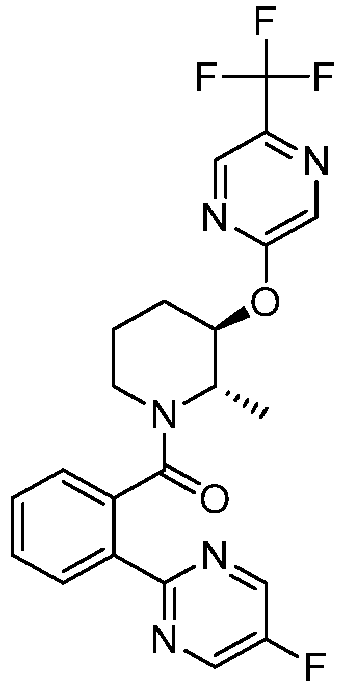
- The title compound was prepared analogous to Example 143 substituting 2-chloro-5-(trifluoromethyl)pyridine with 2-chloro-5-(trifluoromethyl)pyrazine, and intermediate A-29 with intermediate A-25. MS (ESI): mass calcd. for C22H19F4N5O2, 461.1; m/z found, 461.9 [M+H]+. Analytical HPLC was obtained on a Agilent 1100 Series using a Zorbax SB-C18 column (3.5 µm, 150 x 4.6 mm), mobile phase of 5-99% ACN in 0.05% TFA over 7 min and then hold at 99% ACN for 3 min, at a flow rate of 2 mL/min (Temperature = 50 °C). Rt = 6.34 min at 254 nm.
-

- The title compound was prepared analogous to Example 165 substituting intermediate A-25 with intermediate A-27. MS (ESI): mass calcd. for C23H22F3N5O2, 457.2; m/z found, 457.9 [M+H]+. Analytical HPLC was obtained on a Agilent 1100 Series using a Zorbax SB-C18 column (3.5 µm, 150 x 4.6 mm), mobile phase of 5-99% ACN in 0.05% TFA over 7 min and then hold at 99% ACN for 3 min, at a flow rate of 2 mL/min (Temperature = 50 °C). Rt = 5.69 min at 254 nm.
-

- The title compound was prepared analogous to Example 166 substituting intermediate A-25 with intermediate A-29. MS (ESI): mass calcd. for C22H20F3N5O2, 443.2; m/z found, 443.95 [M+H]+. 1H NMR (400 MHz, CDCl3) δ 8.64 (s, 0.8H), 8.59 (s, 1.2H), 8.45 (s, 0.8H), 8.35 - 8.27 (m, 1.2H), 8.16 - 8.11 (m, 1H), 7.58 - 7.36 (m, 2H), 7.33 - 7.26 (m, 1.2H)*, 7.10 - 6.99 (m, 0.4H), 6.87 (t, J = 7.5 Hz, 0.4H), 5.30 (s, 0.6), 5.24 - 5.08 (m, 0.5H), 4.90 - 4.82 (m, 0.4H), 4.82 - 4.74 (m, 0.4H), 4.06 - 3.92 (m, 0.5H), 3.55 - 3.33 (m, 0.6H), 3.22 - 3.05 (m, 0.6H), 2.98 - 2.82 (m, 0.4H), 2.21 - 1.81 (m, 3H), 1.77 - 1.63 (m, 0.4H), 1.43 (d, J = 7.2 Hz, 2.4H), 0.89 (d, J = 6.9 Hz, 1.2H). *Peak is partially buried under CDCl3 peak.
-

- The title compound was prepared analogous to Example 165 substituting intermediate A-25 with intermediate A-29. MS (ESI): mass calcd. for C22H20F3N5O2, 443.2; m/z found, 444.0 [M+H]+. Analytical HPLC was obtained on a Agilent 1100 Series using a Zorbax SB-C18 column (3.5 µm, 150 x 4.6 mm), mobile phase of 5-99% ACN in 0.05% TFA over 7 min and then hold at 99% ACN for 3 min, at a flow rate of 2 mL/min (Temperature = 50 °C). Rt = 5.63 min at 254 nm.
-

- The title compound was prepared analogous to Example 165 substituting intermediate A-25 with intermediate A-38. MS (ESI): mass calcd. for C23H21F4N5O2, 475.2; m/z found, 475.9 [M+H]+. Analytical HPLC was obtained on a Agilent 1100 Series using a Zorbax SB-C18 column (3.5 µm, 150 x 4.6 mm), mobile phase of 5-99% ACN in 0.05% TFA over 7 min and then hold at 99% ACN for 3 min, at a flow rate of 2 mL/min (Temperature = 50 °C). Rt = 6.30 min at 254 nm.
-

- The title compound was prepared analogous to Example 166 substituting intermediate A-25 with intermediate A-27. MS (ESI): mass calcd. for C23H22F3N5O2, 457.2; m/z found, 458.0 [M+H]+. Analytical HPLC was obtained on a Agilent 1100 Series using a Zorbax SB-C18 column (3.5 µm, 150 x 4.6 mm), mobile phase of 5-99% ACN in 0.05% TFA over 7 min and then hold at 99% ACN for 3 min, at a flow rate of 2 mL/min (Temperature = 50 °C). Rt = 6.04 min at 254 nm.
-

- The title compound was prepared analogous to Example 125 substituting intermediate A-3 with intermediate A-10. MS (ESI): mass calcd. for C21H21F3N6O3, 462.2; m/z found, 463.0 [M+H]+. 1H NMR (400 MHz, CDCl3) δ 8.44 (s, 0.4H), 8.29 (s, 1.2H), 8.18 (s, 0.4H), 7.80 (s, 1.2H), 7.78 (s, 0.8H), 7.52 (d, J = 2.5 Hz, 0.4H), 7.40 - 7.35 (m, 1.1H), 7.03 - 6.94 (m, 1.1H), 6.36 (dd, J = 8.5, 2.5 Hz, 0.4H), 5.27 - 5.23 (m, 0.4H), 5.22 - 5.11 (m, 0.6H), 4.86 - 4.82 (m, 0.6H), 4.79 - 4.69 (m, 0.6H), 4.01 - 3.92 (m, 0.4H), 3.91 (s, 1.8H), 3.77 (s, 1.2H), 3.45 - 3.30 (m, 0.4H), 2.93 - 2.77 (m, 1H), 2.13 - 1.85 (m, 3H), 1.70 - 1.62 (m, 0.4H), 1.44 - 1.27 (m, 2.4H), 0.76 (d, J = 7.0 Hz, 1.2H).
-

- The title compound was prepared analogous to Example 125 substituting intermediate A-3 with intermediate A-33. MS (ESI): mass calcd. for C22H20F3N5O2, 443.2; m/z found, 443.9 [M+H]+. Analytical HPLC was obtained on a Agilent 1100 Series using a Zorbax SB-C18 column (3.5 µm, 150 x 4.6 mm), mobile phase of 5-99% ACN in 0.05% TFA over 7 min and then hold at 99% ACN for 3 min, at a flow rate of 2 mL/min (Temperature = 50 °C). Rt = 6.07 and 6.18 min at 254 nm.
-

- The title compound was prepared analogous to Example 161 substituting 2,5-dichloropyrimidine with 2-chloro-5-(trifluoromethyl)pyrimidine, and substituting intermediate A-3 with intermediate A-10.MS (ESI): mass calcd. for C21H21F3N6O3, 462.2; m/z found, 464.1 [M+H]+. 1H NMR (400 MHz, CDCl3) δ 8.78 (s, 0.3H), 8.75 (s, 0.7H), 8.65 (s, 0.7H), 8.09 (s, 0.3H), 7.80 (s, 1H), 7.77 (s, 1H), 7.50 (d, J = 2.6 Hz, 0.5H), 7.40 (d, J = 8.5 Hz, 0.5H), 7.38 (d, J = 2.5 Hz, 0.5H), 7.12 (d, J = 8.5 Hz, 0.5H), 6.95 (dd, J = 8.5, 2.5 Hz, 0.5H), 6.37 (dd, J = 8.5, 2.6 Hz, 0.5H), 5.25 - 5.12 (m, 1H), 4.85 - 4.80 (m, 0.5H), 4.79 - 4.71 (m, 0.5H), 4.10 - 4.01 (m, 0.5H), 3.89 (s, 2H), 3.77 (s, 1H), 3.43 - 3.31 (m, 0.5H), 2.92 - 2.80 (m, 1H), 2.07 - 1.87 (m, 3H), 1.69 - 1.61 (m, 0.5H), 1.44 - 1.31 (m, 2H), 0.86 (d, J = 7.0 Hz, 1.5H).
-

- The title compound was prepared analogous to Example 174 substituting intermediate A-10 with intermediate A-35. MS (ESI): mass calcd. for C21H18F4N4O3, 450.1; m/z found, 452.0 [M+H]+. 1HNMR contains a mixture of more than two rotamers. Analytical HPLC was obtained on a Agilent 1100 Series using a Zorbax SB-C18 column (3.5 µm, 150 x 4.6 mm), mobile phase of 5-99% ACN in 0.05% TFA over 7 min and then hold at 99% ACN for 3 min, at a flow rate of 2 mL/min (Temperature = 50 °C). Rt = 5.73 min at 254 nm.
-

- The title compound was prepared analogous to Example 174 substituting intermediate A-10 with intermediate A-30. MS (ESI): mass calcd. for C20H20F3N7O2, 447.2; m/z found, 448.1 [M+H]+. 1H NMR (400 MHz, CDCl3) δ 8.77 (s, 1H), 8.68 (s, 1H), 8.44 (d, J = 2.2 Hz, 0.7H), 8.25 (d, J = 2.2 Hz, 0.3H), 7.87 (s, 1H), 7.83 (s, 1H), 7.71 (d, J = 2.2 Hz, 0.5H), 7.66 (d, J = 2.2 Hz, 0.5H), 5.28 - 5.24 (m, 0.5H), 5.24 - 5.15 (m, 0.5H), 4.89 - 4.84 (m, 0.5H), 4.82 - 4.70 (m, 0.5H), 3.99 - 3.90 (m, 0.5H), 3.31 - 3.22 (m, 0.5H), 2.93 (td, J = 13.2, 3.1 Hz, 1H), 2.43 (s, 1.8H), 2.14 (s, 1.2H), 2.12 - 1.86 (m, 3H), 1.74 - 1.64 (m, 0.5H), 1.49 - 1.37 (m, 2H), 0.92 (d, J = 7.0 Hz, 1.5H).
-

- The title compound was prepared analogous to Example 125 substituting intermediate A-3 with intermediate A-30. MS (ESI): mass calcd. for C20H20F3N7O2, 447.2; m/z found, 448.0 [M+H]+. 1H NMR (400 MHz, CDCl3) δ 8.49 - 8.44 (m, 1H), 8.31 (d, J = 1.4 Hz, 0.5H), 8.28 (d, J = 1.3 Hz, 0.5H), 8.25 - 8.20 (m, 1H), 7.88 (s, 1H), 7.85 (s, 1H), 7.68 - 7.64 (m, 0.5H), 7.38 - 7.34 (m, 0.5H), 5.29 - 5.25 (m, 0.5H), 5.19 - 5.10 (m, 0.5H), 4.89 - 4.80 (m, 0.5H), 4.81 - 4.70 (m, 0.5H), 3.94 - 3.82 (m, 0.5H), 3.33 - 3.23 (m, 0.5H), 2.91 (td, J = 13.2, 3.1 Hz, 1H), 2.47 (s, 1.5H), 2.05 (s, 1.5H), 2.04 - 1.77 (m, 3H), 1.49 - 1.34 (m, 2.5H), 0.81 (d, 1.5H).
-

- The title compound was prepared analogous to Example 174 substituting intermediate A-10 with intermediate A-33. MS (ESI): mass calcd. for C22H20F3N5O2, 443.2; m/z found, 0-521-4 [M+H]+. 1H NMR (400 MHz, CDCl3) δ 8.78 (d, J = 0.9 Hz, 1.3H), 8.68 (d, J = 2.4 Hz, 0.65H), 8.61 (d, J = 0.9 Hz, 0.7H), 8.55 (d, J = 2.4 Hz, 0.65H), 8.50 (d, J = 2.4 Hz, 0.35H), 8.09 (d, J = 2.4 Hz, 0.35H), 7.94 - 7.76 (series of m, 2H), 7.62 - 7.43 (series of m, 3H), 5.30 - 5.22 (m, 0.65H), 5.19-5.11 (m, 0.65H), 4.89 - 4.79 (m, 0.35H), 4.81 - 4.69 (m, 0.35H), 4.01 - 3.90 (m, 0.35H), 3.32 - 3.15 (m, 0.65H), 3.09 - 2.94 (m, 0.65H), 2.88 (td, J = 13.4, 3.3 Hz, 0.35H), 2.19 - 1.82 (m, 3H), 1.39 - 1.30 (m, 1H), 1.29 - 1.21 (m, 3H).
-

- The title compound was prepared analogous to Example 125 substituting intermediate A-3 with intermediate A-35. MS (ESI): mass calcd. for C21H18F4N4O3, 450.1; m/z found, 451.0 [M+H]+. 1HNMR contains a mixture of more than two rotamers. Analytical HPLC was obtained on a Agilent 1100 Series using a Zorbax SB-C18 column (3.5 µm, 150 x 4.6 mm), mobile phase of 5-99% ACN in 0.05% TFA over 7 min and then hold at 99% ACN for 3 min, at a flow rate of 2 mL/min (Temperature = 50 °C). Rt = 6.04 min at 254 nm.
-

- The title compound was prepared analogous to Example 86 substituting intermediate A-17 with intermediate A-11. MS (ESI): mass calcd. for C20H22ClN7O, 411.2; m/z found, 412.2 [M+H]+. MP=111.1 °C.
-

- The title compound was prepared analogous to Example 77 substituting intermediate A-17 with intermediate A-10. MS (ESI): mass calcd. for C21H23ClN6O2, 426.2; m/z found, 427.2 [M+H]+. MP=115.4 °C.
-

- The title compound was prepared analogous to Example 86 substituting intermediate A-17 with intermediate A-21. MS (ESI): mass calcd. for C19H21ClN8O, 412.2; m/z found, 413.1 [M+H]+. MP=84.4 °C.
-

- The title compound was prepared analogous to Example 30 substituting intermediate A-4 with intermediate A-21. MP=112.9 °C.
-

- The title compound was prepared analogous to Example 38 substituting intermediate A-4 with intermediate A-14. MP=148.5 °C.
-

- The title compound was prepared analogous to Example 30 substituting intermediate A-4 with intermediate A-10. MP=99.5 °C.
-

- The title compound was prepared analogous to Example 86 substituting intermediate A-17 with intermediate A-10. MS (ESI): mass calcd. for C20H22ClN7O2, 427.2; m/z found, 428.1 [M+H]+. MP=112.8 °C.
-

- Step D: ((2S*,3R*)-3-(benzo[d]oxazol-2-yl(methyl)amino)-2-methylpiperidin-1-yl)(5-methyl-3-(2H-1,2,3-triazol-2-yl)pyridin-2-yl)methanone. To a solution of compound of Example 73 (20 mg, 0.047 mmol) in DMF (0.47 mL) was added sodium tert-butoxide (6 mg, 0.06 mmol) followed by iodomethane (3 µL, 0.049 mmol). The reaction mixture was stirred at room temperature for 16h. Solvent was evaporated and purification via prep HPLC gave the title compound (14 mg, 69%). MS (ESI): mass calcd. for C23H25N7O2, 431.2; m/z found, 432.0 [M+H]+. 1H NMR (500 MHz, CDCl3) δ 8.47 (s, 1H), 8.18 (s, 1H), 7.90 - 7.75 (m, 2H), 7.37 (d, J = 7.7 Hz, 1H), 7.27 (d, J = 8.9 Hz, 1H), 7.19 - 7.14 (m, 1H), 7.04 - 6.98 (m, 1H), 5.05 - 4.92 (m, 1H), 4.44 - 4.32 (m, 1H), 3.43 - 3.33 (m, 4H), 3.34 - 3.21 (m, 1H), 2.48 (s, 3H), 2.18 - 2.04 (m, 1H), 1.99 - 1.76 (m, 2H), 1.62 - 1.53 (m, 1H), 1.47 (d, J = 6.8 Hz, 3H).
-

- The title compound was prepared analogous to Example 14 substituting intermediate A-11 with intermediate A-8, followed by step D of Example 187. MS (ESI): mass calcd. for C22H24F3N7O, 459.2; m/z found, 460.0 [M+H]+. 1H NMR (500 MHz, CDCl3) δ 8.38 (s, 1H), 7.90 - 7.85 (m, 2H), 7.70 (d, J = 7.7 Hz, 1H), 7.64 (dd, J = 9.1, 2.6 Hz, 1H), 7.30 (d, J = 7.5 Hz, 1H), 6.54 (d, J = 9.0 Hz, 1H), 4.92 - 4.74 (m, 2H), 3.29 - 3.19 (m, 1H), 3.09 (s, 3H), 3.02 - 2.89 (m, 1H), 2.70 (s, 3H), 1.92 - 1.74 (m, 2H), 1.72 - 1.62 (m, 1H), 1.59 - 1.43 (m, 1H), 1.39 - 1.29 (m, 3H).
-

- The title compound was prepared analogous to Example 14 substituting intermediate A-11 with intermediate A-28. MS (ESI): mass calcd. for C23H21F4N5O, 459.2; m/z found, 460.0 [M+H]+. 1H NMR (500 MHz, CDCl3) δ 8.94 (d, J = 4.9 Hz, 2H), 8.32 - 8.15 (m, 2H), 7.53 - 7.33 (m, 3H), 7.13 (d, J = 7.2 Hz, 1H), 6.24 (d, J = 8.8 Hz, 1H), 4.56 (d, J = 13.5 Hz, 1H), 4.25 - 4.12 (m, 1H), 4.04 (s, 1H), 2.97 - 2.80 (m, 1H), 2.11 - 1.90 (m, 2H), 1.77 - 1.62 (m, 2H), 1.52 (d, J = 6.9 Hz, 3H). 1H buried under CDCl3 peak.
-

- The title compound was prepared analogous to Example 14 substituting intermediate A-11 with intermediate A-36. MS (ESI): mass calcd. for C22H21F4N5O2, 463.2; m/z found, 464.0 [M+H]+. Analytical HPLC was obtained on a Agilent 1100 Series using an Inertsil ODS-3 column (3µm, 50 x 3 mm), mobile phase of 5-99% ACN in 0.05% TFA over 1.6 min and then hold at 99% ACN for 0.4 min, at a flow rate of 2.2 mL/min (Temperature = 50 °C).Rt = 1.37 min (major rotamer) at 254 nm.
-

- The title compound was prepared analogous to Example 14 substituting intermediate A-11 with intermediate A-37. MS (ESI): mass calcd. for C23H21F4N5O, 459.2; m/z found, 460.0 [M+H]+. 1H NMR (500 MHz, CDCl3) δ 8.94 (d, J = 4.9 Hz, 2H), 8.21 (s, 1H), 7.89 (dd, J = 9.5, 2.7 Hz, 1H), 7.87 - 7.79 (m, 1H), 7.40 (t, J = 4.9 Hz, 1H), 7.36 - 7.28 (m, 2H), 7.23 - 7.16 (m, 2H), 6.01 - 5.84 (m, 1H), 4.77 - 4.64 (m, 1H), 4.24 - 4.13 (m, 1H), 3.01 - 2.90 (m, 1H), 2.08 - 1.77 (m, 4H), 1.52 (d, J = 6.9 Hz, 3H).
-

- The title compound was prepared analogous to Example 14 substituting intermediate A-11 with intermediate A-1. MS (ESI): mass calcd. for C21H20F4N6O, 448.2; m/z found, 448.9 [M+H]+. Analytical HPLC was obtained on a Agilent 1100 Series using an Inertsil ODS-3 column (3µmm, 50 x 3 mm), mobile phase of 5-99% ACN in 0.05% TFA over 1.6 min and then hold at 99% ACN for 0.4 min, at a flow rate of 2.2 mL/min (Temperature = 50 °C).Rt = 1.34 min (major rotamer) at 254 nm.
-

- The title compound was prepared analogous to Example 14 substituting intermediate A-11 with intermediate A-32. MS (ESI): mass calcd. for C19H20ClF3N4O2, 428.1; m/z found, 428.9 [M+H]+. Analytical HPLC was obtained on a Agilent 1100 Series using an Inertsil ODS-3 column (3µm, 50 x 3 mm), mobile phase of 5-99% ACN in 0.05% TFA over 1.6 min and then hold at 99% ACN for 0.4 min, at a flow rate of 2.2 mL/min (Temperature = 50 °C).Rt = 1.34 min (major rotamer) at 254 nm.
-

- The title compound was prepared analogous to Example 14 substituting intermediate A-11 with intermediate A-12. MS (ESI): mass calcd. for C21H25F3N4O2, 422.2; m/z found, 423.0 [M+H]+. 1H NMR (500 MHz, CDCl3) δ 8.35 - 8.19 (m, 1H), 7.58 - 7.47 (m, 1H), 7.20 - 7.02 (m, 2H), 6.59 - 6.44 (m, 1H), 6.37 (s, 1H), 4.78 - 4.61 (m, 1H), 4.14 - 3.97 (m, 2H), 3.88 (s, 1H), 3.78 - 3.63 (m, 1H), 2.97 (td, J = 13.2, 3.3 Hz, 1H), 2.52 - 2.37 (m, 3H), 2.05 - 1.95 (m, 1H), 1.94 - 1.73 (m, 2H), 1.64 - 1.55 (m, 1H), 1.49 - 1.38 (m, 3H), 1.33 (d, J = 6.9 Hz, 3H).
-

- Step A: (2S*,3R*)-tert-butyl 2-methyl-3-((5-(trifluoromethyl)-1,3,4-thiadiazol-2-yl)amino)piperidine-1-carboxylate. In a microwave vial was dissolved intermediate B-4 (58 mg, 0.27 mmol) in ACN (0.7 mL). 2-Chloro-5-(trifluoromethyl)-1,3,4-thiadiazole (0.59 mg, 0.30 mmol) was added followed by DIPEA (0.12 mL, 0.68 mmol). The microwave vial was capped and the reaction mixture was heated at 120 °C for 30 minutes using microwave and was then diluted with EtOAc. The organic phase was washed with a saturated solution of NaHCO3, NaCl, dried over MgSO4, filtered and evaporated. Purification via silica gel chromatography (0-40% EtOAc in hexanes) gave the title compound (87 mg, 88%). MS (ESI): mass calcd. for C14H21F3N4O2S, 366.1; m/z found, 367.0 [M+H]+. Analytical HPLC was obtained on a Agilent 1100 Series using an Inertsil ODS-3 column (3µm, 50 x 3 mm), mobile phase of 5-99% ACN in 0.05% TFA over 1.6 min and then hold at 99% ACN for 0.4 min, at a flow rate of 2.2 mL/min (Temperature = 50 °C). Rt = 1.409 min at 254 nm.
- Step B and C: ((2S*,3R*)-2-methyl-3-((5-(trifluoromethyl)-1,3,4-thiadiazol-2-yl)amino)piperidin-1-yl)(5-methyl-3-(2H-1,2,3-triazol-2-yl)pyridin-2-yl)methanone. The title compound was prepared analogous to Example 1, steps B and C, substituting intermediate A-1 with intermediate A-21. MS (ESI): mass calcd. for C18H19F3N8OS, 452.1; m/z found, 452.9 [M+H]+. 1H NMR (500 MHz, CDCl3) δ 8.45 (s, 1H), 8.27 - 8.18 (m, 1H), 8.11 (s, 1H), 7.96 (s, 2H), 4.68 - 4.60 (m, 1H), 4.08 - 4.00 (m, 1H), 3.99 - 3.92 (m, 1H), 3.04 (td, J = 13.4, 3.3 Hz, 1H), 2.48 (s, 3H), 2.21 (d, J = 14.0 Hz, 1H), 2.09 - 1.93 (m, 2H), 1.92 - 1.79 (m, 1H), 1.56 - 1.47 (m, 3H).
-

- The title compound was prepared analogous to Example 195 substituting intermediate A-21 with intermediate A-8. MS (ESI): mass calcd. for C18H19F3N8OS, 452.1; m/z found, 452.9 [M+H]+. 1H NMR (500 MHz, CDCl3) δ 8.33 (d, J = 8.1 Hz, 0.6H), 8.30 (s, 0.8H), 8.04 (s, 1.2H), 7.61 (d, J = 7.8 Hz, 0.6H), 7.57 (d, J = 7.7 Hz, 0.4H), 7.33 (d, J = 7.8 Hz, 0.6H), 7.28 (d, J = 8.0 Hz, 0.4H), 7.02 (d, J = 8.5 Hz, 0.4H), 5.38 - 5.29 (m, 0.4H), 4.74 - 4.62 (m, 0.6H), 4.20 - 4.11 (m, 0.6H), 4.11 - 4.05 (m, 0.6H), 3.83 - 3.69 (m, 0.4H), 3.60 - 3.42 (m, 0.4H), 3.31 (td, J = 13.5, 3.3 Hz, 0.4H), 2.96 (td, J = 13.4, 3.3 Hz, 0.6H), 2.71 (s, 1.2H), 2.70 (s, 1.8H), 2.23 - 1.67 (series of m, 4H), 1.52 (d, J = 6.9 Hz, 1.8H), 1.45 (d, J = 7.1 Hz, 1.2H).
-

- The title compound was prepared analogous to Example 69 substituting intermediate A-21 with intermediate A-36. MS (ESI): mass calcd. for C21H20F4N6O2, 464.2; m/z found, 464.9 [M+H]+. Analytical HPLC was obtained on a Agilent 1100 Series using an Inertsil ODS-3 column (3µm, 50 x 3 mm), mobile phase of 5-99% ACN in 0.05% TFA over 1.6 min and then hold at 99% ACN for 0.4 min, at a flow rate of 2.2 mL/min (Temperature = 50 °C).Rt = 1.42 min (major rotamer) at 254 nm.
-

- The title compound was prepared analogous to Example 69 substituting intermediate A-21 with intermediate A-1. MS (ESI): mass calcd. for C20H19F4N7O, 449.2; m/z found, 449.9 [M+H]+. Analytical HPLC was obtained on a Agilent 1100 Series using an Inertsil ODS-3 column (3µm, 50 x 3 mm), mobile phase of 5-99% ACN in 0.05% TFA over 1.6 min and then hold at 99% ACN for 0.4 min, at a flow rate of 2.2 mL/min (Temperature = 50 °C).Rt = 1.43 min (major rotamer) at 254 nm.
-

- The title compound was prepared analogous to Example 69 substituting intermediate A-21 with intermediate A-12. MS (ESI): mass calcd. for C20H24F3N5O2, 423.2; m/z found, 424.0 [M+H]+. 1H NMR (400 MHz, CDCl3) δ 8.50 - 8.42 (m, 2H), 8.39 (s, 1H), 7.20 - 7.03 (m, 2H), 4.76 - 4.62 (m, 1H), 4.18 - 4.02 (m, 2H), 3.90 - 3.81 (m, 1H), 3.79 - 3.64 (m, 1H), 2.97 (td, J = 13.2, 3.3 Hz, 1H), 2.49 (s, 3H), 2.11 - 2.01 (m, 1H), 1.99 - 1.74 (m, 3H), 1.67 - 1.56 (m, 1H), 1.46 - 1.42 (m, 2H), 1.33 (d, J = 7.0 Hz, 3H).
-

- The title compound was prepared analogous to Example 69 substituting intermediate A-21 with intermediate A-28. MS (ESI): mass calcd. for C22H20F4N6O, 460.2; m/z found, 460.9 [M+H]+. 1H NMR (400 MHz, CDCl3) δ 9.21 (d, J = 7.0 Hz, 1H), 9.03 (d, J = 5.0 Hz, 2H), 8.43 (s, 1H), 8.37 (s, 1H), 7.50 - 7.41 (m, 1H), 7.37 (t, J = 5.0 Hz, 1H), 7.15 (d, J = 7.6 Hz, 1H), 4.68 - 4.54 (m, 1H), 4.25 - 4.13 (m, 1H), 4.09 - 3.94 (m, 1H), 2.90 (td, J = 13.4, 3.3 Hz, 1H), 2.16 - 2.04 (m, 1H), 1.98 - 1.86 (m, 1H), 1.81 - 1.56 (m, 2H), 1.52 (d, J = 6.9 Hz, 3H). 1H buried under CDCl3 peak.
-

- The title compound was prepared analogous to Example 69 substituting intermediate A-21 with intermediate A-32. MS (ESI): mass calcd. for C18H19ClF3N5O2, 429.1; m/z found, 429.9 [M+H]+. 1H NMR (400 MHz, CDCl3, multiple rotamers present, only major rotamer reported) δ 8.49 (broad s, 2H), 7.63 (d, J = 8.2 Hz, 1H), 7.07 (d, J = 8.3 Hz, 1H), 6.10 (d, J = 8.3 Hz, 1H), 5.71 (d, J = 6.3 Hz, 1H), 5.18 - 4.98 (m, 1H), 4.69 (d, J = 13.5 Hz, 1H), 3.87 (s, 3H), 3.48 - 3.26 (m, 1H), 1.99 - 1.72 (m, 4H), 1.48 - 1.39 (m, 3H).
-

- The title compound was prepared analogous to Example 69 substituting intermediate A-21 with intermediate A-37. MS (ESI): mass calcd. for C22H20F4N6O, 460.2; m/z found, 460.9 [M+H]+. 1H NMR (400 MHz, CDCl3) δ 9.18 (d, J = 4.9 Hz, 0.6H), 8.98 (d, J = 4.9 Hz, 1.4H), 8.82 (d, J = 7.4 Hz, 0.7H), 8.52 (s, 0.6H), 8.44 - 8.35 (m, 0.7H), 8.30 - 8.24 (m, 0.7H), 8.21 - 8.16 (m, 0.3H), 7.89 (dd, J = 9.6, 2.6 Hz, 0.7H), 7.37 - 7.29 (m, 1.3H), 7.21 - 7.15 (m, 1H), 5.30 - 5.21 (m, 0.3H), 4.72 (d, J = 13.5 Hz, 0.7H), 4.34 - 4.23 (m, 0.3H), 4.23 - 4.12 (m, 0.7H), 4.08 - 3.98 (m, 0.7H), 3.54 - 3.44 (m, 0.3H), 3.23 (td, J = 13.3, 3.2 Hz, 0.3H), 2.95 (td, J = 13.3, 3.1 Hz, 0.7H), 2.14 - 1.63 (m, 4H), 1.52 (d, J = 6.9 Hz, 2.1H), 1.44 (d, J = 7.1 Hz, 0.9H).
-

- The title compound was prepared analogous to Example 14 substituting intermediate A-11 with intermediate A-34. MS (ESI): mass calcd. for C22H20F4N4O2, 448.2; m/z found, 448.9 [M+H]+. 1H NMR (400 MHz, CDCl3) δ 8.36 (s, 0.5H), 8.19 (s, 0.5H), 7.89 - 7.86 (m, 0.5H), 7.85 - 7.80 (m, 0.5H), 7.79 (dd, J = 9.6, 2.5 Hz, 0.5H), 7.61 (dd, J = 9.2, 2.5 Hz, 0.5H), 7.57 (dd, J = 8.9, 2.5 Hz, 0.5H), 7.41 - 7.27 (m, 1.5H), 7.25 - 7.14 (m, 2H), 6.98 - 6.88 (m, 1H), 6.45 (d, J = 9.1 Hz, 0.5H), 5.97 (d, J = 8.8 Hz, 0.5H), 5.34 - 5.19 (m, 0.5H), 4.83 - 4.70 (m, 0.5H), 4.18 - 4.05 (m, 1H), 3.93 - 3.82 (m, 0.5H), 3.36 - 3.27 (m, 0.5H), 3.20 (td, J= 13.3, 3.2 Hz, 0.5H), 2.97 (td, J= 13.3, 12.7, 3.3 Hz, 0.5H), 1.99 - 1.65 (m, 4H), 1.46 - 1.39 (m, 3H).
-

- The title compound was prepared analogous to Example 73 substituting intermediate A-21 with intermediate A-28. MS (ESI): mass calcd. for C24H22FN5O2, 431.2; m/z found, 432.0 [M+H]+. 1H NMR (400 MHz, CDCl3) δ 9.17 (d, J = 7.3 Hz, 1H), 9.01 (d, J = 5.0 Hz, 2H), 7.54 - 7.41 (m, 2H), 7.33 - 7.26 (m, 2H), 7.19 - 7.07 (m, 3H), 6.96 (td, J = 7.8, 1.3 Hz, 1H), 4.64 - 4.52 (m, 1H), 4.26 - 4.17 (m, 1H), 4.01 - 3.93 (m, 1H), 2.91 (td, J = 13.4, 3.2 Hz, 1H), 2.32 - 2.19 (m, 1H), 2.05 - 1.91 (m, 1H), 1.84 - 1.57 (m, 2H), 1.52 (d, J = 6.9 Hz, 3H).
-

- The title compound was prepared analogous to Example 69 substituting intermediate A-21 with intermediate A-34. MS (ESI): mass calcd. for C21H19F4N5O2, 449.1; m/z found, 449.9 [M+H]+. 1H NMR (400 MHz, CDCl3) δ 8.55 - 8.47 (m, 2H), 8.07 (d, J = 0.8 Hz, 1H), 7.97 (d, J = 8.7 Hz, 1H), 7.84 - 7.75 (m, 2H), 7.25 - 7.13 (m, 2H), 5.37 - 5.23 (m, 1H), 4.42 - 4.28 (m, 1H), 3.45 - 3.30 (m, 1H), 3.21 (td, J = 13.4, 3.3 Hz, 1H), 2.06 - 1.64 (m, 4H), 1.43 (d, J = 7.3 Hz, 3H).
-

- The title compound was prepared analogous to Example 73 substituting intermediate A-21 with intermediate A-37. MS (ESI): mass calcd. for C24H22FN5O2, 431.2; m/z found, 432.0 [M+H]+. 1H NMR (400 MHz, CDCl3) δ 8.99 (d, J = 4.9 Hz, 2H), 8.80 (d, J = 7.6 Hz, 1H), 7.88 (dd, J = 9.5, 2.7 Hz, 1H), 7.44 (t, J = 4.9 Hz, 1H), 7.33 - 7.27 (m, 2H), 7.24 - 7.16 (m, 1H), 7.14 - 7.02 (m, 2H), 6.97 - 6.91 (m, 1H), 4.79 - 4.63 (m, 1H), 4.31 - 4.19 (m, 1H), 4.03 - 3.90 (m, 1H), 2.97 (td, J = 13.4, 3.1 Hz, 1H), 2.22 (d, J = 14.0 Hz, 1H), 2.06 - 1.95 (m, 1H), 1.94 - 1.78 (m, 1H), 1.74 - 1.66 (m, 1H), 1.53 (d, J = 6.9 Hz, 3H).
-

- The title compound was prepared analogous to Example 38 substituting intermediate A-4 with intermediate A-28. MS (ESI): mass calcd. for C22H20F4N6O, 460.2; m/z found, 460.9 [M+H]+. 1H NMR (500 MHz, CDCl3) δ 8.92 (d, J = 5.0 Hz, 2H), 8.69 (d, J = 7.6 Hz, 1H), 8.22 (s, 1H), 7.73 (s, 1H), 7.52 - 7.44 (m, 1H), 7.42 (t, J = 5.0 Hz, 1H), 7.29 (d, J = 9.4 Hz, 1H), 7.13 (d, J = 7.6 Hz, 1H), 4.63 - 4.52 (m, 1H), 4.23 - 4.14 (m, 1H), 4.13 - 4.00 (m, 1H), 2.99 - 2.81 (m, 1H), 2.10 - 1.88 (m, 2H), 1.76 - 1.63 (m, 2H), 1.53 (d, J = 6.9 Hz, 3H).
-

- The title compound was prepared analogous to Example 38 substituting intermediate A-4 with intermediate A-34. MS (ESI): mass calcd. for C21H19F4N5O2, 449.1; m/z found, 449.9 [M+H]+. 1H NMR (500 MHz, CDCl3) δ 8.34 (s, 0.4H), 8.18 (s, 0.6H), 8.04 - 7.95 (m, 1H), 7.87 (s, 0.6H), 7.83 - 7.76 (m, 0.8H), 7.62 (dd, J = 9.0, 2.6 Hz, 0.6H), 7.54 - 7.47 (m, 0.4H), 7.41 (s, 0.6H), 7.33 - 7.28 (m, 0.6H), 7.25 - 7.17 (m, 1.4H), 5.33 - 5.18 (m, 0.4H), 4.84 - 4.68 (m, 0.6H), 4.37 - 4.21 (m, 0.4H), 4.16 - 4.04 (m, 0.6H), 3.96 - 3.83 (m, 0.6H), 3.43 - 3.30 (m, 0.4H), 3.24 (td, J = 13.4, 3.2 Hz, 0.4H), 2.98 (td, J = 13.2, 3.1 Hz, 0.6H), 2.05 - 1.67 (m, 4H), 1.51-1.41 m, 3H).
-

- The title compound was prepared analogous to Example 38 substituting intermediate A-4 with intermediate A-37. MS (ESI): mass calcd. for C22H20F4N6O, 460.2; m/z found, 460.9 [M+H]+. 1H NMR (500 MHz, CDCl3) δ 8.91 (d, J = 4.9 Hz, 2H), 8.31 (d, J = 7.9 Hz, 1H), 8.20 (s, 1H), 7.90 (dd, J = 9.4, 2.6 Hz, 1H), 7.40 (t, J = 4.9 Hz, 1H), 7.37 (s, 1H), 7.30 (dd, J = 8.5, 5.3 Hz, 1H), 7.20 (td, J = 8.1, 2.7 Hz, 1H), 4.79 - 4.66 (m, 1H), 4.25 - 4.16 (m, 1H), 4.15 - 4.01 (m, 1H), 2.97 (td, J = 13.3, 3.2 Hz, 1H), 2.09 - 1.92 (m, 2H), 1.88 - 1.63 (m, 2H), 1.54 (d, J = 6.9 Hz, 3H).
-

- The title compound was prepared analogous to Example 143 substituting intermediate A-29 with intermediate A-38. MS (ESI): mass calcd. for C22H20F3N5O2, 443.2; m/z found, 444.1 [M+H]+. 1H NMR (400 MHz, CDCl3) δ 8.82 - 8.75 (m, 2H), 8.72 (dd, J = 4.8, 1.7 Hz, 0.5H), 8.64 (dd, J = 8.0, 1.7 Hz, 0.5H), 8.50 (dd, J = 8.0, 1.7 Hz, 0.4H), 8.44 - 8.40 (m, 0.6H), 8.09 - 8.03 (m, 0.4H), 8.00 (dd, J = 4.8, 1.7 Hz, 0.6H), 7.76 (dd, J = 8.8, 2.6 Hz, 0.6H), 7.69 (dd, J = 8.8, 2.6 Hz, 0.4H), 7.44 (dd, J = 8.0, 4.7 Hz, 0.5H), 7.29 - 7.14 (m, 1.5H), 6.92 (d, J = 8.8 Hz, 0.6H), 6.69 (d, J = 8.7 Hz, 0.4H), 5.35 - 5.30 (m, 0.6H), 5.17 - 5.08 (m, 0.6H), 4.88 - 4.80 (m, 0.4H), 4.80 - 4.70 (m, 0.4H), 4.10 - 3.97 (m, 0.4H), 3.47 - 3.34 (m, 0.6H), 3.21 (td, J = 12.9, 3.0 Hz, 0.6H), 2.98 (td, J = 13.3, 3.2 Hz, 0.4H), 2.25 - 1.91 (m, 3H), 1.76 - 1.48 (m, 1H), 1.44 (d, J = 7.2 Hz, 1.8H), 1.14 (d, J = 7.0 Hz, 1.2H).
-

- The title compound was prepared analogous to Example 143 substituting intermediate A-29 with intermediate A-39. MS (ESI): mass calcd. for C23H22F3N5O2, 457.2; m/z found, 458.2 [M+H]+. 1H NMR (400 MHz, CDCl3) δ 8.87 (d, J = 4.8 Hz, 1H), 8.84 (d, J = 4.8 Hz, 1H), 8.71 - 8.67 (m, 0.5H), 8.50 - 8.46 (m, 0.5H), 8.45 - 8.41 (m, 0.5H), 8.24 - 8.15 (m, 0.5H), 7.87 - 7.81 (m, 0.5H), 7.79 (dd, J = 8.6, 2.6 Hz, 0.5H), 7.59 - 7.53 (m, 0.5H), 7.32 - 7.24 (m, 1.5H), 6.89 - 6.82 (m, 1H), 5.36 - 5.31 (m, 0.5H), 5.17 - 5.08 (m, 0.5H), 4.92 - 4.85 (m, 0.5H), 4.81 - 4.74 (m, 0.5H), 4.08 - 4.01 (m, 0.5H), 3.45 - 3.26 (m, 0.5H), 3.16 - 3.01 (m, 0.5H), 2.97 - 2.85 (m, 0.5H), 2.47 (s, 1.5H), 2.15 - 1.80 (m, 4.5H), 1.76 - 1.60 (m, 0.5H), 1.52 - 1.35 (m, 2H), 0.88 (d, J = 7.0 Hz, 1.5H).
-

- The title compound was prepared analogous to Example 143 substituting intermediate A-29 with intermediate A-40. MS (ESI): mass calcd. for C23H20F4N4O2, 460.2; m/z found, 461.0 [M+H]+. 1HNMR contains a mixture of more than two rotamers. Analytical HPLC was obtained on a Agilent 1100 Series using a Zorbax SB-C18 column (3.5 µm, 150 x 4.6 mm), mobile phase of 5-99% ACN in 0.05% TFA over 7 min and then hold at 99% ACN for 3 min, at a flow rate of 2 mL/min (Temperature = 50 °C). Rt = 6.79 min at 254 nm.
-

- The title compound was prepared analogous to Example 143 substituting intermediate A-29 with intermediate A-19. MS (ESI): mass calcd. for C23H22F3N5O2, 457.2; m/z found, 457.9 [M+H]+. 1H NMR (400 MHz, CDCl3) δ 8.76 (d, J = 3.4 Hz, 1H), 8.75 (d, J = 3.5 Hz, 1H), 8.53 (d, J = 8.1 Hz, 0.5H), 8.45 - 8.38 (m, 1H), 8.16 - 8.09 (m, 0.5H), 7.78 (dd, J = 8.8, 2.6 Hz, 0.5H), 7.62 (dd, J = 8.7, 2.5 Hz, 0.5H), 7.30 - 7.27 (m, 0.5H), 7.23 - 7.16 (m, 1H), 7.10 (d, J = 8.2 Hz, 0.5H), 6.94 (d, J = 8.7 Hz, 0.5H), 6.54 (d, J = 8.7 Hz, 0.5H), 5.33 - 5.28 (m, 0.5H), 5.19 - 5.08 (m, 0.5H), 4.87 - 4.83 (m, 0.5H), 4.82 - 4.76 (m, 0.5H), 4.09 - 4.00 (m, 0.5H), 3.41 - 3.31 (m, 0.5H), 3.14 (td, J = 13.0, 3.0 Hz, 0.5H), 2.96 (td, J = 13.3, 3.2 Hz, 0.5H), 2.65 (s, 1.5H), 2.27 (s, 1.5H), 2.21 - 1.90 (m, 3H), 1.71 - 1.62 (m, 0.5H), 1.44 (d, J = 7.1 Hz, 1.5H), 1.41 - 1.32 (m, 0.5H), 1.11 (d, J = 7.0 Hz, 1.5H).
-

- The title compound was prepared analogous to Example 147 substituting 2-chloro-5-(trifluoromethyl)pyridine with 2-bromo-5-chloropyridine and substituting A-1 with A-41. MS (ESI): mass calcd. for C20H21ClN6O2, 412.1; m/z found, 412.9 [M+H]+. 1H NMR (400 MHz, CDCl3) δ 8.45 (d, J = 2.3 Hz, 0.4H), 8.28 (d, J = 2.2 Hz, 0.6H), 8.07 (d, J = 2.8 Hz, 0.4H), 7.86 (s, 1.2H), 7.85 - 7.82 (m, 1.4H), 7.66 - 7.63 (m, 0.4H), 7.57 (dd, J = 8.8, 2.7 Hz, 0.6H), 7.53 (dd, J = 8.8, 2.6 Hz, 0.4H), 7.32 - 7.29 (m, 0.6H), 6.76 - 6.68 (m, 1H), 5.19 - 5.14 (m, 0.4H), 5.13 - 5.04 (m, 0.4H), 4.77 - 4.67 (m, 1.2H), 4.05 - 3.93 (m, 0.6H), 3.30 - 3.19 (m, 0.4H), 2.96 - 2.83 (m, 1H), 2.44 (s, 1.2H), 2.13 - 1.77 (m, 4.8H), 1.67 - 1.60 (m, 0.6H), 1.36 (d, J = 7.1 Hz, 1.2H), 1.33 - 1.18 (m, 0.4H), 0.82 (d, J = 7.0 Hz, 1.8H).
-

- The title compound was prepared analogous to Example 214 substituting intermediate A-41 with intermediate A-22. MS (ESI): mass calcd. for C20H21ClN6O2, 412.1; m/z found, 412.9 [M+H]+. 1H NMR (400 MHz, CDCl3) δ 8.15 (d, J = 8.3 Hz, 0.5H), 8.08 (d, J = 8.4 Hz, 0.5H), 8.05 (d, J = 2.7 Hz, 0.5H), 7.80 (s, 1H), 7.79 (s, 1H), 7.78 (d, J = 2.7 Hz, 0.5H), 7.51 (dd, J = 8.8, 2.7 Hz, 0.5H), 7.42 (dd, J = 8.8, 2.7 Hz, 0.5H), 7.29 (d, J = 8.4 Hz, 0.5H), 7.14 (d, J = 8.5 Hz, 0.5H), 6.79 (d, J = 8.8 Hz, 0.5H), 6.54 (d, J = 8.8 Hz, 0.5H), 5.17 - 5.13 (m, 0.5H), 5.11 - 5.03 (m, 0.5H), 4.80 - 4.68 (m, 1H), 4.03 - 3.93 (m, 0.5H), 3.34 - 3.27 (m, 0.5H), 3.06 (td, J = 13.0, 3.1 Hz, 0.5H), 2.92 (td, J = 13.4, 3.3 Hz, 0.5H), 2.64 (s, 1.5H), 2.31 (s, 1.5H), 2.24 - 1.77 (m, 3H), 1.68 - 1.54 (m, 0.5H), 1.42 - 1.28 (m, 2H), 1.02 (d, J = 6.9 Hz, 1.5H).
-

- The title compound was prepared analogous to Example 143 substituting 2 -chloro-5-(trifluoromethyl)pyridine with 2-bromo-5-chloropyridine, and substituting A-29 with A-20. MS (ESI): mass calcd. for C22H22ClN5O2, 423.1; m/z found, 424.1 [M+H]+. 1H NMR (400 MHz, CDCl3) δ 8.81 - 8.74 (m, 2H), 8.57 - 8.51 (m, 0.6H), 8.46 - 8.39 (m, 0.6H), 8.33 - 8.28 (m, 0.4H), 8.10 - 8.04 (m, 0.6H), 7.94 - 7.88 (m, 0.4H), 7.75 - 7.68 (m, 0.4H), 7.51 (dd, J = 8.8, 2.7 Hz, 0.6H), 7.45 (dd, J = 8.8, 2.7 Hz, 0.4H), 7.24 - 7.18 (m, 1H), 6.79 (d, J = 8.8 Hz, 0.6H), 6.55 (d, J = 8.8 Hz, 0.4H), 5.23 - 5.14 (m, 0.6H), 5.12 - 5.03 (m, 0.6H), 4.79 - 4.71 (m, 0.4H), 4.69 - 4.66 (m, 0.4H), 4.01 - 3.90 (m, 0.4H), 3.43 - 3.34 (m, 0.6H), 3.17 (td, J = 12.9, 3.0 Hz, 0.6H), 2.93 (td, J = 13.3, 3.2 Hz, 0.4H), 2.44 (s, 1.8H), 2.32 (s, 1.2H), 2.18 - 1.81 (m, 3H), 1.68 - 1.57 (m, 0.6H), 1.41 (d, J = 7.1 Hz, 1.8H), 1.39 - 1.32 (m, 0.4H), 1.07 (d, J = 7.0 Hz, 1.2H).
-

- The title compound was prepared analogous to Example 216 substituting A-20 with A-19. MS (ESI): mass calcd. for C22H22ClN5O2, 423.1; m/z found, 424.2 [M+H]+. Analytical HPLC was obtained on a Agilent 1100 Series using a Zorbax SB-C18 column (3.5 µm, 150 x 4.6 mm), mobile phase of 5-99% ACN in 0.05% TFA over 7 min and then hold at 99% ACN for 3 min, at a flow rate of 2 mL/min (Temperature = 50 °C). Rt = 4.90 min at 254 nm.
-
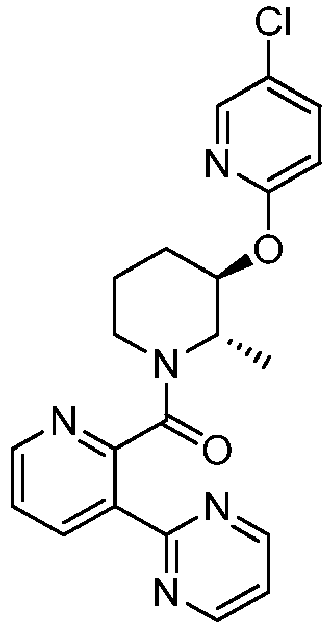
- The title compound was prepared analogous to Example 216 substituting A-20 with A-38. MS (ESI): mass calcd. for C21H20ClN5O2, 409.1; m/z found, 410.1 [M+H]+. 1H NMR (400 MHz, CDCl3) δ 8.81 - 8.76 (m, 2.4H), 8.73 (dd, J = 4.8, 1.7 Hz, 0.6H), 8.64 (dd, J = 8.0, 1.7 Hz, 0.6H), 8.53 (dd, J = 8.0, 1.7 Hz, 0.4H), 8.14 (dd, J = 4.7, 1.7 Hz, 0.4H), 8.07 (d, J = 2.7 Hz, 0.6H), 7.73 (d, J = 2.8 Hz, 0.4H), 7.52 (dd, J = 8.8, 2.7 Hz, 0.6H), 7.49 - 7.39 (m, 1H), 7.25 - 7.19 (m, 1H), 6.80 (d, J = 8.7 Hz, 0.6H), 6.52 (d, J = 8.9 Hz, 0.4H), 5.24 - 5.17 (m, 0.6H), 5.15 - 5.03 (m, 0.6H), 4.80 - 4.70 (m, 0.8H), 4.02 - 3.92 (m, 0.4H), 3.44 - 3.31 (m, 0.6H), 3.20 (td, J = 13.0, 3.1 Hz, 0.6H), 2.97 (td, J = 13.3, 3.2 Hz, 0.4H), 2.25 - 1.57 (m, 3.4H), 1.47 - 1.34 (m, 2.4H), 1.13 (d, J = 7.1 Hz, 1.2H).
-

- The title compound was prepared analogous to Example 143 substituting intermediate A-29 with intermediate A-12. MS (ESI): mass calcd. for C21H24F3N3O3, 423.2; m/z found, 424.0 [M+H]+. 1H NMR (400 MHz, CDCl3) δ 8.45 - 8.40 (m, 0.4H), 8.16 - 8.04 (m, 0.6H), 7.85 - 7.67 (m, 1H), 7.16 - 7.03 (m, 1H), 6.97 - 6.83 (m, 2H), 5.32 - 5.25 (m, 0.4H), 5.23 - 5.12 (m, 0.4H), 4.90 - 4.83 (m, 0.6H), 4.81 - 4.69 (m, 0.6H), 4.02 - 3.80 (m, 2.6H), 3.34 - 3.17 (m, 0.8H), 2.97 (td, J = 13.4, 12.9, 3.0 Hz, 0.6H), 2.51 (s, 1.2H), 2.16 (s, 1.8H), 2.14 - 1.89 (m, 3H), 1.69 - 1.61 (m, 0.4H), 1.43 - 1.32 (m, 6H). *0.6H buried under solvent peak.
-

- The title compound was prepared analogous to Example 143 substituting 2-chloro-5-(trifluoromethyl)pyridine with 2-chloro-3-fluoro-5-(trifluoromethyl)pyridine, and substituting intermediate A-29 with intermediate A-27. MS (ESI): mass calcd. for C24H22F4N4O2, 474.2; m/z found, 475.1 [M+H]+. Analytical HPLC was obtained on a Agilent 1100 Series using a Zorbax SB-C18 column (3.5 µm, 150 x 4.6 mm), mobile phase of 5-99% ACN in 0.05% TFA over 7 min and then hold at 99% ACN for 3 min, at a flow rate of 2 mL/min (Temperature = 50 °C). Rt = 6.60 min at 254 nm.
-

- Prepared analogous to Example 220 substituting intermediate A-27 with intermediate A-7. MS (ESI): mass calcd. for C23H19F5N4O2, 478.1; m/z found, 479.1 [M+H]+. 1H NMR (400 MHz, CDCl3) δ 8.76 (d, J = 4.8 Hz, 1H), 8.72 (d, J = 4.8 Hz, 1H), 8.40 (dd, J = 8.8, 5.6 Hz, 0.5H), 8.26 - 8.20 (m, 1H), 7.99 - 7.95 (m, 0.5H), 7.65 - 7.57 (m, 0.5H), 7.56 (dd, J = 9.5, 2.1 Hz, 0.5H), 7.23 - 7.15 (m, 1.5H), 7.12 (dd, J = 8.5, 2.7 Hz, 0.5H), 7.04 - 6.94 (m, 1H), 5.42 - 5.37 (m, 0.5H), 5.19 - 5.09 (m, 0.5H), 5.04 - 4.94 (m, 0.5H), 4.82 - 4.72 (m, 0.5H), 4.07 - 3.96 (m, 0.5H), 3.41 - 3.33 (m, 0.5H), 3.18 - 3.06 (m, 0.5H), 2.99 - 2.84 (m, 0.5H), 2.15 - 1.89 (m, 3H), 1.70 - 1.63 (m, 0.5H), 1.47 - 1.37 (m, 2H), 0.93 (d, J = 7.0 Hz, 1.5H).
-

- Prepared analogous to Example 220 substituting intermediate A-27 with intermediate A-37. MS (ESI): mass calcd. C23H19F5N4O2, 478.1; m/z found, 479.1 [M+H]+. Analytical HPLC was obtained on a Agilent 1100 Series using a Zorbax SB-C18 column (3.5 µm, 150 x 4.6 mm), mobile phase of 5-99% ACN in 0.05% TFA over 7 min and then hold at 99% ACN for 3 min, at a flow rate of 2 mL/min (Temperature = 50 °C). Rt = 6.72 min at 254 nm.
-

- Prepared analogous to Example 220 substituting intermediate A-27 with intermediate A-19. MS (ESI): mass calcd. for C23H21F4N5O2, 475.2; m/z found, 476.1 [M+H]+. 1H NMR (400 MHz, CDCl3) δ 8.77 (d, J = 4.8 Hz, 1H), 8.72 (d, J = 4.9 Hz, 1H), 8.49 (d, J = 8.1 Hz, 0.5H), 8.39 (d, J = 8.1 Hz, 0.5H), 8.25 - 8.16 (m, 0.5H), 7.90 - 7.81 (m, 0.5H), 7.53 (dd, J = 9.7, 2.1 Hz, 0.5H), 7.32 - 7.22 (m, 1H), 7.21 - 7.17 (m, 0.5H), 7.16 - 7.10 (m, 1H), 5.39 - 5.32 (m, 0.5H), 5.25 - 5.16 (m, 0.5H), 4.87 - 4.76 (m, 1H), 4.23 - 4.15 (m, 0.5H), 3.43 - 3.31 (m, 0.5H), 3.25 - 3.10 (m, 0.5H), 2.99 (td, J = 13.3, 3.2 Hz, 0.5H), 2.62 (s, 1.7H), 2.35 (s, 1.3H), 2.13 - 1.96 (m, 3H), 1.76 - 1.66 (m, 0.5H), 1.45 (d, J = 7.2 Hz, 1.7H), 1.43 - 1.37 (m, 0.5H), 1.24 (d, J = 7.0 Hz, 1.3H).
-

- Prepared analogous to Example 220 substituting intermediate A-27 with intermediate A-4. MS (ESI): mass calcd. for C21H19F4N5O2, 449.2 m/z found, 450.1 [M+H]+. Analytical HPLC was obtained on a Agilent 1100 Series using a Zorbax SB-C18 column (3.5 µm, 150 x 4.6 mm), mobile phase of 5-99% ACN in 0.05% TFA over 7 min and then hold at 99% ACN for 3 min, at a flow rate of 2 mL/min (Temperature = 50 °C). Rt = 6.61 min at 254 nm.
-

-

-
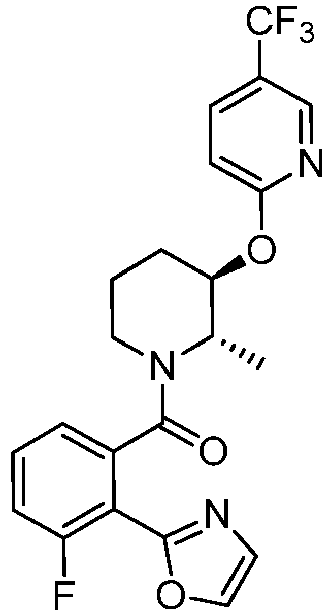
-

-
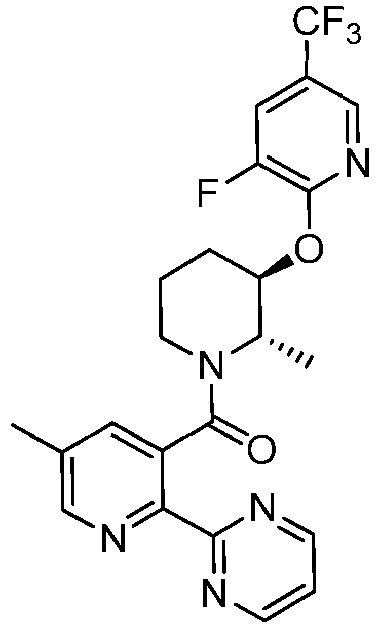
-

-

-

-

-
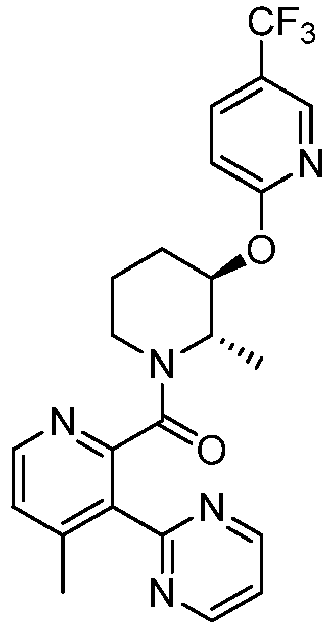
-

-

-
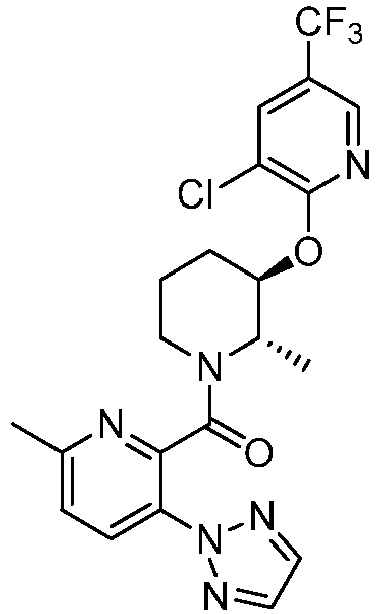
-

-

-

-

-

-

-

-

-

-

-

-

-

-

-

-

-

-

-

-

-

-
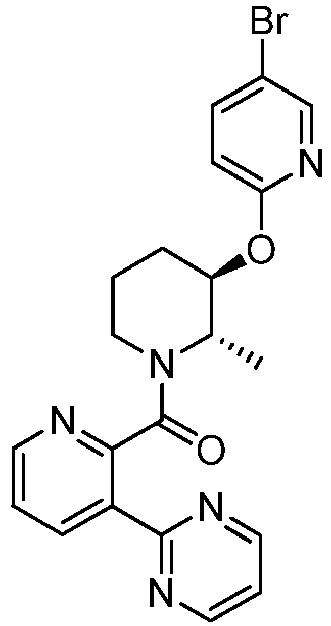
-

-

-

-

-

-

- The title compound was prepared analogous to Example 14 substituting intermediate A-11 with intermediate A-38. MS (ESI): mass calcd. for C22H21F3N6O, 442.2; m/z found, 443.2 [M+H]+. Analytical HPLC was obtained on a Agilent 1100 Series using a XBridge C18 column (5µm, 100 x 4.6mm), mobile phase of 10-100% ACN in 20 mM NH4OH over 8 min and then hold at 100% ACN for 3 min, at a flow rate of 1 mL/min (Temperature = 30 °C). Rt = 6.71 min at 280 nm.
-

-
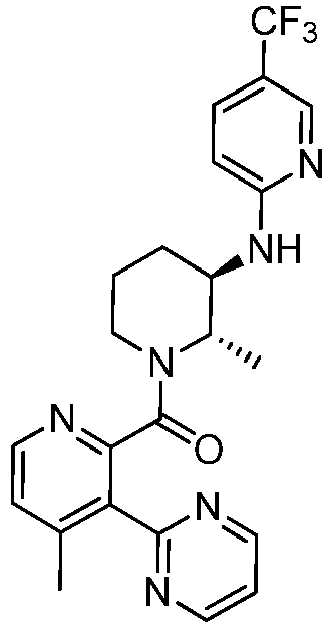
-

-

-

-

-

-

- The in vitro affinity of the compounds of the invention for the rat/human orexin 1 and human orexin 2 receptors was determined by competitive radioligand binding using [3H] (1-(5-(2-fluoro-phenyl)-2-methyl-thiazol-4-yl)-1-((S)-2-(5-phenyl-(1,3,4)oxadiazol-2-ylmethyl)-pyrrolidin-1-yl)-methanone)(Langmead et al., 2004) and [3H]EMPA (n-ethyl-2[96-methoxy-pyridin-3-yl)-(toluene-2-sulfonyl)-amino]-N-pyridin-3-ylmethyl acetamide), respectively (Langmead et al., 2004, British Journal of Pharmacology 141:340-346; Malherbe et al., 2004, British Journal of Pharmacology 156:1326-41).
- The in vitro functional antagonism of the compounds on the human orexin 1 and orexin 2 receptors was determined using fluorometric imaging plate reader (FLIPR) based calcium assays.
- Data are analyzed using pc-Sandy macro and graphed on Graphpad Prism 5. For analysis, each concentration point is averaged from triplicate values and the averaged values are plotted on Graphpad Prism. The IC50 was determined by applying the following equation (GraphPad Prism 5.0, SanDiego) for one site competition where X=log (concentration) and Y=specific binding. Top denotes the total [3H]-(1-(5-(2-fluoro-phenyl)-2-methyl-thiazol-4-yl)-1-((S)-2-(5-phenyl-(1,3,4)oxadiazol-2-ylmethyl)-pyrrolidin-1-yl)-methanone) binding, bottom denotes the nonspecific [3H]-(1-(5-(2-fluoro-phenyl)-2-methyl-thiazol-4-yl)-1-((S)-2-(5-phenyl-(1,3,4)oxadiazol-2-ylmethyl)-pyrrolidin-1-yl)-methanone) binding. Graphpad Prism calculates Ki value from IC50 and the pre-determined Kd values for [3H]-(1-(5-(2-fluoro-phenyl)-2-methyl-thiazol-4-yl)-1-((S)-2-(5-phenyl-(1,3,4)oxadiazol-2-ylmethyl)-pyrrolidin-1-yl)-methanone) and [3H]-EMPA. The Ki for each compound is then uploaded into 3DX. Each run comprises individual compounds in triplicate. The data in Table 1 and Table 2 represent averages from between 2-20 runs.
- Human Embryonic Kidney 293 cells (HEK293) stably expressing rat orexin 1 receptor (Genebank accession number NM_001525) or Chinese ovary cells (CHO) stably expressing human orexin 1 receptor (Genebank accession number NM_001526) were grown to confluency in DMEM (Hyclone, cat # SH30022), 10% FBS, 1X Pen/Strep, 1X sodium pyruvate, 10 mM HEPES, 600 µg/mL G418 and DMEM/F12 (Gibco, Cat #11039), 10%FBS, 1X Pen/Strep, 600 µg/mL G418 media, respectively on 150 cm2 tissue culture plates, washed with 5 mM EDTA in PBS (HyClone Dulbecco's Phoshpate Buffered Saline 1X with Calcium and Magnesium, Cat # SH30264.01, hereafter referred to simply as PBS) and scraped into 50 ml tubes. After centrifugation (2K xG, 5 min at 4 °C), the supernatant was aspirated and the pellets frozen and stored at -80°C. Cells were resuspended in PBS in the presence of 1 tablet of protease inhibitor cocktail (Roche, Cat. #11836145001) per 50 mL. Each cell pellet from a 15 cm plate was resuspended in 10 mL, stored on ice, and homogenized for 45 sec prior to addition to the reactions. Competition binding experiments in 96 well polypropylene plates were performed using [3H]-(1-(5-(2-fluoro-phenyl)-2-methyl-thiazol-4-yl)-1-((S)-2-(5-phenyl-(1,3,4)oxadiazol-2-ylmethyl)-pyrrolidin-1-yl)-methanone) (Moraveck Corporation, specific activity = 35.3 Ci/mmol), diluted to a 10 nM concentration in PBS (4 nM final). Compounds were solubilized in 100% DMSO (Acros Organics, Cat. #61042-1000) and tested over a range of 7 concentrations (from 0.1 nM to 10 µM). The final concentration of DMSO in the reactions is equal to or less than 0.1%. Total and nonspecific binding was determined in the absence and presence of 10 µM almorexant. The total volume of each reaction is 200 µL (20 µL of diluted compounds, 80 µL of [3H]-(1-(5-(2-fluoro-phenyl)-2-methyl-thiazol-4-yl)-1-((S)-2-(5-phenyl-(1,3,4)oxadiazol-2-ylmethyl)-pyrrolidin-1-yl)-methanone) diluted in PBS and 100 µL of the cell suspension). Reactions were run for 60 min at room temperature and terminated by filtration through GF/C filter plates (PerkinElmer, Cat. #6005174) presoaked in 0.3% polyethylenimine using the cell harvester (PerkinElmer Filtermate). The plates were washed 3 times by aspirating 30 ml PBS through the plates. Plates were dried in 55 °C oven for 60 min, scintillation fluid was added, and the radioactivity was counted on a Topcount (Packard).
- IC50 values (i.e. concentration of unlabelled compound required to compete for 50% of specific binding to the radioligand) was calculated using the GraphPad Prism software (GraphPad Prism Software Inc., San Diego, CA) with a fit to a sigmoidal dose-response curve. Apparent Ki values were calculated as Ki = IC50/(1+C/Kd), where C is concentration of radioligand and Kd = 4 nM for rat orexin 1 receptor and 6 nM for human orexin 1 receptor.
- HEK293 stably expressing human orexin 2 receptor (Genebank accession number NM_001526) were grown to confluency in DMEM (Hyclone, cat # SH30022), 10%FBS, 1X Pen/Strep, 1X NaPyruvate, 10 mM HEPES, 600 ug/ml G418 media on 150 cm2 tissue culture plates, washed with 5 mM EDTA in PBS (HyClone Dulbecco's Phoshpate Buffered Saline 1X with Calcium and Magnesium, Cat # SH30264.01, hereafter referred to simply as PBS) and scraped into 50 ml tubes. After centrifugation (2K xG, 5 min at 4°C), the supernatant was aspirated and the pellets frozen and stored at -80°C. Cells were resuspended in PBS in the presence of 1 tablet of protease inhibitor cocktail (Roche, Cat. #11836145001) per 50 mL. Each cell pellet from a 15 cm plate was resuspended in 10 mL, stored on ice, and homogenized for 45 sec just prior to addition to the reactions. Competition binding experiments in 96 well polypropylene plates were performed using [3H]-EMPA (Moraveck Corporation, specific activity = 29.6 Ci/mmol), diluted to a 5 nM concentration in PBS (2 nM final concentration). Compounds were solubilized in 100% DMSO (Acros Organics, Cat. #61042-1000) and tested over a range of 7 concentration (from 0.1 nM to 10 µM). The final concentration of DMSO in the reactions is equal to or less than 0.1%. Total and nonspecific binding was determined in the absence and presence of 10 µM almorexant. The total volume of each reaction is 200 µL (20 µL of diluted compounds, 80 µL of [3H]-EMPA diluted in PBS and 100 µL of the cell suspension). Reactions were run for 60 min at room temperature and terminated by filtration through GF/C filter plates (PerkinElmer, Cat. #6005174) presoaked in 0.3% polyethylenimine using the cell harvester (PerkinElmer Filtermate). The plates were washed 3 times by aspirating 30 ml PBS through the plates. Plates were dried in 55°C oven for 60 min, scintillation fluid was added, and the radioactivity was counted on a Topcount (Packard).
- IC50 values (i.e. concentration of unlabelled compound required to compete for 50% of specific binding to the radioligand) was calculated using the GraphPad Prism software (GraphPad Prism Software Inc., San Diego, CA) with a fit to a sigmoidal dose-response curve. Apparent Ki values were calculated as Ki = IC50/(1+C/Kd), where C is concentration of radioligand and Kd = 2 nM.
- CHO cells stably transfected with the human orexin 1 receptor (Genebank accession number NM_001526) were grown to confluency in DMEM/F12, 10% FBS, 1X pen-strep, 400 µg/ml G418. Cells were seeded on to 384-well Packard viewplates at a density of 10,000 cells/well and incubated overnight at 37°C, 5% CO2. The cells were dye-loaded with BD Calcium Assay kit (BD, cat # 640178) in HBSS (Gibco, cat# 14025-092) with 2.5 mM probenecid and incubated at 37°C, 5% CO2 for 45 min. Cells were pre-incubated with compounds (diluted in DMEM/F-12) for 15-30 minutes before agonist (orexin A, 10 nM) stimulation. Ligand-induced Ca2+ release was measured using a Fluorometric Imaging Plate Reader (FLIPR, Molecular Devices, Sunnyvale, CA). Functional responses were measured as peak fluorescence intensity minus basal. The concentration of agonist that produced a half-maximal response is represented by the EC50 value. Antagonistic potency values were converted to apparent pKB values using a modified Cheng-Prusoff correction. Apparent pKB = - log IC50/1+[conc agonist/EC50].
- PFSK-1 cells endogenously expressing the human orexin 2 receptor were grown to confluency in RPMI1640 (Hyclone, cat# 30027.02), 10% FBS, 1X pen-strep. Cells were seeded on to 384-well Packard viewplates at a density of 5,000 cells/well and incubated overnight at 37°C, 5% CO2. The cells were dye-loaded with BD Calcium Assay kit (BD, cat # 640178) in HBSS (Gibco, cat# 14025-092) with 2.5 mM probenecid and incubated at 37°C, 5% CO2 for 45 min. Cells were pre-incubated with compounds (diluted in DMEM/F-12) for 15-30 minutes before agonist (orexin B, 100 nM) stimulation. Ligand-induced Ca2+ release was measured using a Fluorometric Imaging Plate Reader (FLIPR, Molecular Devices, Sunnyvale, CA). Functional responses were measured as peak fluorescence intensity minus basal. The concentration of agonist that produced a half-maximal response is represented by the EC50 value. Antagonistic potency values were converted to apparent pKB values using a modified Cheng-Prusoff correction. Apparent pKB = - log IC50/1+[conc agonist/EC50].
- Preferred compounds of the invention are set forth in Table 1 below. Orexin receptor activity of certain compounds of the invention is also set forth in the below table.
Table 1 Ex. Structure rOX1 Ki (nM) hOX1 Ki (nM) hOX2 Ki (nM) Compound Name 1 
1034 290 (±)-trans-(3-((4,6-dimethylpyrimidin-2-yl)amino)-2-methylpiperidin-1-yl)(4-fluoro-2-(2H-1,2,3-triazol-2-yl)phenyl)methanone 2 
400 217 (±)-trans-(3-((4,6-dimethylpyrimidin-2-yl)amino)-2-methylpiperidin-1-yl)(2-fluoro-6-(pyrimidin-2-yl)phenyl)methanone 3 
1065 260 (±)-trans-(3-((4,6-dimethylpyrimidin-2-yl)amino)-2-methylpiperidin-1-yl)(2-fluoro-6-(2H-1,2,3-triazol-2-yl)phenyl)methanone 4 
78 40 (±)-trans-(2-(2H-1,2,3-triazol-2-yl)phenyl)(3-((4,6-dimethylpyrimidin-2-yl)amino)-2-methylpiperidin-1-yl)methanone 5 
560 116 (±)-trans-(3-((4,6-dimethylpyrimidin-2-yl)amino)-2-methylpiperidin-1-yl)(5-fluoro-2-(2H-1,2,3-triazol-2-yl)phenyl)methanone 6 
25 40 25 (±)-trans-(3-((4,6-dimethylpyrimidin-2-yl)amino)-2-methylpiperidin-1-yl)(5-methyl-2-(pyrimidin-2-yl)pheny l)methanone 7 
126 228 (±)-trans-(5-methyl-2-(pyrimidin-2-yl)phenyl)(2-methyl-3-((6-methyl-2-(trifluoromethyl)pyrimidin-4-yl)amino)piperidin-1-yl)methanone 8 
462 587 (±)-trans-(5-methyl-2-(2H-1,2,3-triazol-2-yl)phenyl)(2-methyl-3-((6-methyl-2-(trifluoromethyl)pyrimidin-4-yl)amino)piperidin-1-yl)methanone 9 
6708 2054 (±)-trans-(5-fluoro-2-(pyrimidin-2-yl)phenyl)(2-methyl-3-((6-methyl-2-(trifluoromethyl)pyrimidin-4-yl)amino)piperidin-1-yl)methanone 10 
315 144 (±)-trans-(2-fluoro-6-(2H-1,2,3-triazol-2-yl)phenyl)(2-methyl-3-((4-(trifluoromethyl)pyrimidin-2-yl)amino)piperidin-1-yl)methanone 11 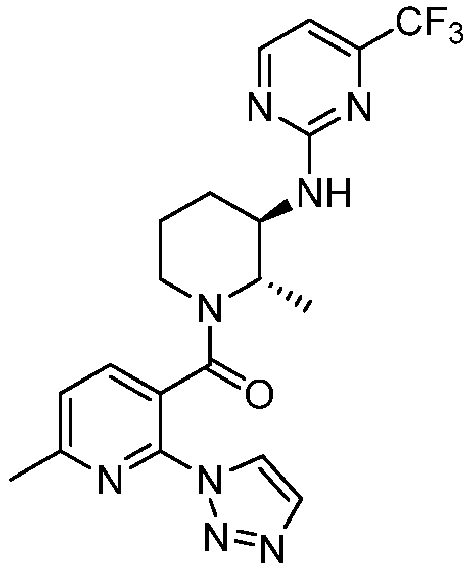
8999 634 (±)-trans-(6-methyl-2-(1H-1,2,3-triazol-1-yl)pyridin-3-yl)(2-methyl-3-((4-(trifluoromethyl)pyrimidin-2-yl)amino)piperidin-1-yl)methanone 12 
14 11 332 (±)-trans-(2-(2H-1,2,3-triazol-2-yl)phenyl)(2-methyl-3-((5-(trifluoromethyl)pyridin-2-yl)amino)piperidin-1-yl)methanone 13 
15 9 920 (±)-trans-(4-methyl-2-(2H-1,2,3-triazol-2-yl)phenyl)(2-methyl-3-((5-(trifluoromethyl)pyridin-2-yl)amino)piperidin-1-yl)methanone 14 
9 7 681 (4-methyl-2-(2H-1,2,3-triazol-2-yl)phenyl)((2S,3R)-2-methyl-3-((5-(trifluoromethyl)pyridin-2-yl)amino)piperidin-1-yl)methanone 15 
8200 >10000 (4-methyl-2-(2H-1,2,3-triazol-2-yl)phenyl)((2R,3S)-2-methyl-3-((5-(trifluoromethyl)pyridin-2-yl)amino)piperidin-1-yl)methanone 16 
35 38 680 (±)-trans-(3-ethoxy-6-methylpyridin-2-yl)(2-methyl-3-((5-(trifluoromethyl)pyridin-2-yl)amino)piperidin-1-yl)methanone 17 
11 8 221 (±)-trans-(5-chloro-2-(2H-1,2,3-triazol-2-yl)phenyl)(2-methyl-3-((5-(trifluoromethyl)pyridin-2-yl)amino)piperidin-1-yl)methanone 18 
13 10 272 (±)-trans-(2-methyl-3-((5-(trifluoromethyl)pyridin-2-yl)amino)piperidin-1-yl)(6-methyl-3-(2H-1,2,3-triazol-2-yl)pyridin-2-yl)methanone 19 
10 10 238 (±)-trans-(5-methoxy-2-(2H-1,2,3-triazol-2-yl)phenyl)(2-methyl-3-((5-(trifluoromethyl)pyridin-2-yl)amino)piperidin-1-yl)methanone 20 
14 8 150 (±)-trans-(3-methyl-2-(2H-1,2,3-triazol-2-yl)phenyl)(2-methyl-3-((5-(trifluoromethyl)pyridin-2-yl)amino)piperidin-1-yl)methanone 21 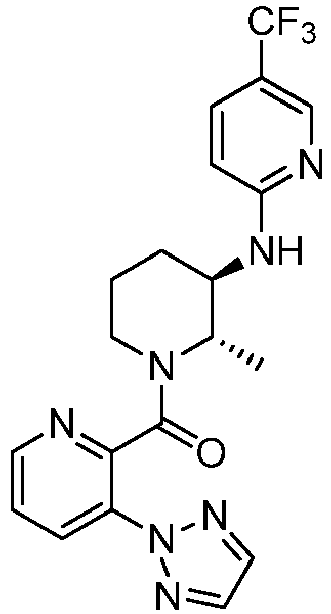
19 25 595 (±)-trans-(3-(2H-1,2,3-triazol-2-yl)pyridin-2-yl)(2-methyl-3-((5-(trifluoromethyl)pyridin-2-yl)amino)piperidin-1-yl)methanone 22 
33 19 422 (±)-trans-(2-methyl-3-((5-(trifluoromethyl)pyridin-2-yl)amino)piperidin-1-yl)(6-methyl-3-(oxazol-2-yl)pyridin-2-yl)methanone 23 
36 23 208 (±)-trans-(2-methyl-3-((5-(trifluoromethyl)pyridin-2-yl)amino)piperidin-1-yl)(6-methyl-3-(pyrimidin-2-yl)pyridin-2-yl)methanone 24 
8 16 324 (±)-trans-(5-fluoro-2-(2H-1,2,3-triazol-2-yl)phenyl)(2-methyl-3-((5-(trifluoromethyl)pyridin-2-yl)amino)piperidin-1-yl)methanone 25 
11 19 190 ((2S,3R)-2-methyl-3-((5-(trifluoromethyl)pyridin-2-yl)amino)piperidin-1-yl)(6-methyl-3-(oxazol-2-yl)pyridin-2-yl)methanone 26 
11 14 2035 ((2S,3R)-2-methyl-3-((5-(trifluoromethyl)pyridin-2-yl)amino)piperidin-1-yl)(5-methyl-3-(2H-1,2,3-triazol-2-yl)pyridin-2-yl)methanone 27 
19 26 91 ((2S,3R)-2-methyl-3-((5-(trifluoromethyl)pyridin-2-yl)amino)piperidin-1-yl)(5-methyl-3-(pyrimidin-2-yl)pyridin-2-yl)methanone 28 
496 3900 (±)-trans-(3-fluoro-2-methoxyphenyl)(2-methyl-3-((5-(trifluoromethyl)pyridin-2-yl)amino)piperidin-1-yl)methanone 29 
97 90 1400 (±)-trans-(2-ethoxyphenyl)(2-methyl-3-((5-(trifluoromethyl)pyridin-2-yl)amino)piperidin-1-yl)methanone 30 
55 54 656 (±)-trans-(2-(2H-1,2,3-triazol-2-yl)phenyl)(3-((5-chloropyrimidin-2-yl)amino)-2-methylpiperidin-1-yl)methanone 31 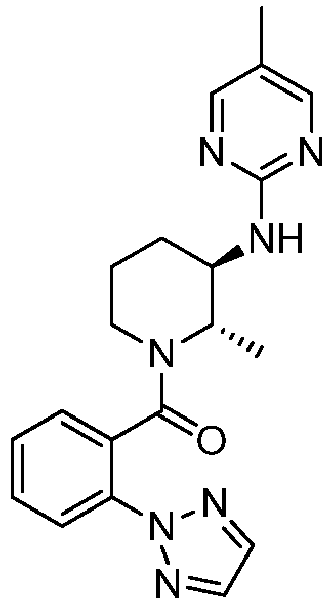
131 120 508 (±)-trans-(2-(2H-1,2,3-triazol-2-yl)phenyl)(2-methyl-3-((5-methylpyrimidin-2-yl)amino)piperidin-1-yl)methanone 32 
34 12 286 (±)-trans-(2-(2H-1,2,3-triazol-2-yl)phenyl)(3-((5-chloropyridin-2-yl)amino)-2-methylpiperidin-1-yl)methanone 33 
199 160 4800 (±)-trans-(2-(2H-1,2,3-triazol-2-yl)phenyl)(2-methyl-3-((6-(trifluoromethyl)pyridazin-3- yl)amino)piperidin-1-yl)methanone 34 
355 700 (2-(2H-1,2,3-triazol-2-yl)phenyl)((2S,3R)-3-((5-fluoropyridin-2-yl)amino)-2-methylpiperidin-1-yl)methanone 35 
20 29 738 (±)-trans-(2-(2H-1,2,3-triazol-2-yl)phenyl)(2-methyl-3 -((5-(trifluoromethyl)pyrimidin-2-yl)amino)piperidin-1-yl)methanone 36 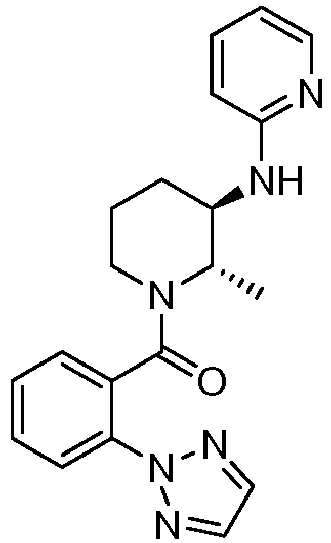
690 1500 (±)-trans-(2-(2H-1,2,3-triazol-2-yl)phenyl)(2-methyl-3-(pyridin-2-ylamino)piperidin-1-yl)methanone 37 
76 71 824 (±)-trans-(2-(2H-1,2,3-triazol-2-yl)phenyl)(2-methyl-3-((5-methylpyridin-2-yl)amino)piperidin-1-yl)methanone 38 
18 25 529 (±)-trans-(2-(2H-1,2,3-triazol-2-yl)phenyl)(2-methyl-3-((5-(trifluoromethyl)pyrazin-2-yl)amino)piperidin-1-yl)methanone 39 
32 12 189 (±)-trans-(2-(2H-1,2,3-triazol-2-yl)phenyl)(2-methyl-3-(quinazolin-2-ylamino)piperidin-1-yl)methanone 40 
870 822 (±)-trans-(2-(2H-1,2,3-triazol-2-yl)phenyl)(3-((5-fluoropyrimidin-2-yl)amino)-2-methylpiperidin-1-yl)methanone 41 
9 9 284 (±)-trans-(2-(2H-1,2,3-triazol-2-yl)phenyl)(3-(benzo[d]oxazol-2-ylamino)-2-methylpiperidin-1-yl)methanone 42 
11 10 410 (±)-trans-(2-(2H-1,2,3-triazol-2-yl)phenyl)(3-((5-bromopyridin-2-yl)amino)-2-methylpiperidin-1-yl)methanone 43 
715 4600 (±)-trans-(3-((5-bromopyridin-2-yl)amino)-2-methylpiperidin-1-yl)(3-fluoro-2-methoxyphenyl)methanone 44 
82 72 1600 (±)-trans-(3-(5-bromopyridin-2-yl)amino)-2-methylpiperidin-1-yl)(2-ethoxyphenyl)methanone 45 
28 26 281 (±)-trans-(2-(2H-1,2,3-triazol-2-yl)phenyl)(3-((5-chlorobenzo[d]oxazol-2-yl)amino)-2-methylpiperidin-1-yl)methanone 46 
185 153 489 (±)-trans-(3-((5-chlorobenzo[d]oxazol-2-yl)amino)-2-methylpiperidin-1-yl)(2-ethoxyphenyl)methanone 47 
373 1300 (±)-trans-(3-((5-chlorobenzo[d]oxazol-2-yl)amino)-2-methylpiperidin-1-yl)(3-fluoro-2-methoxyphenyl)methanone 48 
14 11 96 (±)-trans-(2-(2H-1,2,3-triazol-2-yl)phenyl)(2-methyl-3-(quinoxalin-2-ylamino)piperidin-1-yl)methanone 49 
95 70 89 (±)-trans-((2-ethoxyphenyl)(2-methyl-3-(quinoxalin-2-ylamino)piperidin-1-yl)methanone 50 
396 353 (±)-trans-(3-fluoro-2-methoxyphenyl)(2-methyl-3-(quinoxalin-2-ylamino)piperidin-1-yl)methanone 51 
341 2100 (±)-trans-(2-(2H-1,2,3-triazol-2-yl)phenyl)(2-methyl-3-((4-phenylpyrimidin-2-yl)amino)piperidin-1-yl)methanone 52 
6200 2700 (±)-trans-(3-fluoro-2-methoxyphenyl)(2-methyl-3-((4-phenylpyrimidin-2-yl)amino)piperidin-1-yl)methanone 53 
715 58 (±)-trans-(2-ethoxyphenyl)(2-methyl-3-((4-phenylpyrimidin-2-yl)amino)piperidin-1-yl)methanone 54 
4500 >10000 (±)-cis-(3-fluoro-2-methoxyphenyl)(2-methyl-3-((5-(trifluoromethyl)pyridin-2-yl)amino)piperidin-1-yl)methanone 55 
1200 >10000 (±)-cis-(2-ethoxyphenyl)(2-methyl-3-((5-(trifluoromethyl)pyridin-2-yl)amino)piperidin-1-yl)methanone 56 
128 112 3600 (±)-cis-(2-(2H-1,2,3-triazol-2-yl)phenyl)(2-methyl-3-((5-(trifluoromethyl)pyridin-2-yl)amino)piperidin-1-yl)methanone 57 
720 >10000 (±)-cis-(2-(2H-1,2,3-triazol-2-yl)phenyl)(3-((5-bromopyridin-2-yl)amino)-2-methylpiperidin-1-yl)methanone 58 
>10000 >10000 (±)-cis-(3-(5-bromopyridin-2-yl)amino)-2-methylpiperidin-1-yl)(3-fluoro-2-methoxyphenyl)methanone 59 
1800 >10000 (±)-cis-(3-(5-bromopyridin-2-yl)amino)-2-methylpiperidin-1-yl)(2-ethoxyphenyl)methanone 60 
>10000 >10000 (±)-cis-((2-(2H-1,2,3-triazol-2-yl)phenyl)(3-((5-chlorobenzo[d]oxazol-2-yl)amino)-2-methylpiperidin-1-yl)methanone 61 
1100 2500 (±)-cis-(3-((5-chlorobenzo[d]oxazol-2-yl)amino)-2-methylpiperidin-1-yl)(2-ethoxyphenyl)methanone 62 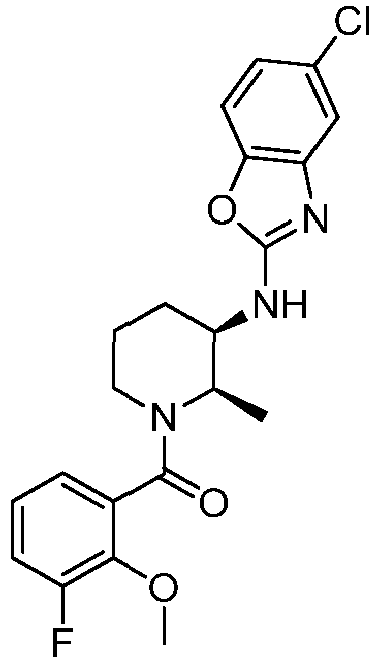
1800 5700 (±)-cis-(3-((5-chlorobenzo[d]oxazol-2-yl)amino)-2-methylpiperidin-1-yl)(3-fluoro-2-methoxyphenyl)methanone 63 
3300 >10000 (±)-cis-(2-(2H-1,2,3-triazol-2-yl)phenyl)(2-methyl-3-(quinoxalin-2-ylamino)piperidin-1-yl)methanone 64 
1100 1300 (±)-cis-(3-fluoro-2-methoxyphenyl)(2-methyl-3-(quinoxalin-2-ylamino)piperidin-1-yl)methanone 65 
314 295 (±)-cis-(2-ethoxyphenyl)(2-methyl-3-(quinoxalin-2-ylamino)piperidin-1-yl)methanone 66 
570 1800 (±)-cis-(2-(2H-1,2,3-triazol-2-yl)phenyl)(2-methyl-3-((4-phenylpyrimidin-2-yl)amino)piperidin-1-yl)methanone 67 
840 >10000 (±)-cis-(3-fluoro-2-methoxyphenyl)(2-methyl-3-((4-phenylpyrimidin-2-yl)amino)piperidin-1-yl)methanone 68 
1400 >10000 (±)-cis-(2-ethoxyphenyl)(2-methyl-3-((4-phenylpyrimidin-2-yl)amino)piperidin-1-yl)methanone 69 
70 112 >10000 (6-methyl-2-(2H-1,2,3-triazol-2-yl)pyridin-3-yl)((2S,3R)-2-methyl-3-((5-(trifluoromethyl)pyrimidin-2-yl)amino)piperidin-1-yl)methanone 70 
170 165 7501 (6-methyl-2-(1H-1,2,3-triazol-1-yl)pyridin-3-yl)((2S,3R)-2-methyl-3-((5-(trifluoromethyl)pyrimidin-2-yl)amino)piperidin-1-yl)methanone 71 
10 12 1500 (4-methyl-2-(2H-1,2,3-triazol-2-yl)phenyl)((2S,3R)-2-methyl-3-((5-(trifluoromethyl)pyrimidin-2-yl)amino)piperidin-1-yl)methanone 72 
24 33 4025 ((2S,3R)-2-methyl-3-((5-(trifluoromethyl)pyrazin-2-yl)amino)piperidin-1-yl)(5-methyl-3-(2H-1,2,3-triazol-2-yl)pyridin-2-yl)methanone 73 
7 21 1889 ((2S,3R)-3-(benzo[d]oxazol-2-ylamino)-2-methylpiperidin-1-yl)(5-methyl-3-(2H-1,2,3-triazol-2-yl)pyridin-2-yl)methanone 74 
40 52 >10000 (6-methyl-2-(2H-1,2,3-triazol-2-yl)pyridin-3-yl)((2S,3R)-2-methyl-3-((5-(trifluoromethyl)pyrazin-2-yl)amino)piperidin-1-yl)methanone 75 
23 40 9499 ((2S,3R)-3-(benzo[d]oxazol-2-ylamino)-2-methylpiperidin-1-yl)(6-methyl-2-(2H-1,2,3-triazol-2-yl)pyridin-3-yl)methanone 76 
54 62 1300 ((2S,3R)-3-(benzo[d]oxazol-2-ylamino)-2-methylpiperidin-1-yl)(6-methyl-2-(1H-1,2,3-triazol-1-yl)pyridin-3-yl)methanone 77 
36 55 4018 ((2S,3R)-3-((5-chloropyridin-2-yl)amino)-2-methylpiperidin-1-yl)(5-methyl-3-(oxazol-2-yl)pyridin-2-yl)methanone 78 
30 57 436 ((2S,3R)-2-methyl-3-((5-(trifluoromethyl)pyrimidin-2-yl)amino)piperidin-1-yl)(6-methyl-3-(pyrimidin-2-yl)pyridin-2-yl)methanone 79 
8 7 1300 (4-methyl-2-(2H-1,2,3-triazol-2-yl)phenyl)((2S,3R)-2-methyl-3-((5-(trifluoromethyl)pyrazin-2-yl)amino)piperidin-1-yl)methanone 80 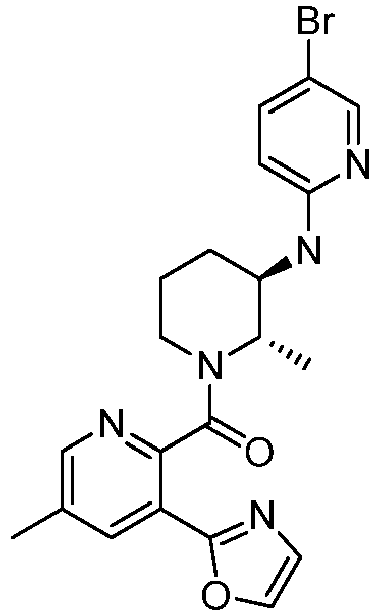
29 24 4900 ((2S,3R)-3-((5-bromopyridin-2-yl)amino)-2-methylpiperidin-1-yl)(5-methyl-3-(oxazol-2-yl)pyridin-2-yl)methanone 81 
14 23 100 ((2S,3R)-3-(benzo[d]oxazol-2-ylamino)-2-methylpiperidin-1-yl)(6-methyl-3-(pyrimidin-2-yl)pyridin-2-yl)methanone 82 
53 58 6400 (4-methoxy-2-(2H-1,2,3-triazol-2-yl)phenyl)((2S,3R)-2-methyl-3-((5-(trifluoromethyl)pyrazin-2-yl)amino)piperidin-1-yl)methanone 83 
57 53 7000 ((2S,3R)-2-methyl-3-((5-(trifluoromethyl)pyrazin-2-yl)amino)piperidin-1-yl)(5-methyl-3-(oxazol-2-yl)pyridin-2-yl)methanone 84 
23 28 173 ((2S,3R)-2-methyl-3-((5-(trifluoromethyl)pyrazin-2-yl)amino)piperidin-1-yl)(6-methyl-3-(pyrimidin-2-yl)pyridin-2-yl)methanone 85 
8 10 210 (2-(2H-1,2,3-triazol-2-yl)phenyl)((2S,3R)-2-methyl-3-((5-(trifluoromethyl)pyrazin-2-yl)amino)piperidin-1-yl)methanone 86 
213 249 >10000 ((2S,3R)-3-((5-chloropyrazin-2-yl)amino)-2-methylpiperidin-1-yl)(5-methyl-3-(oxazol-2-yl)pyridin-2-yl)methanone 87 
7 12 154 ((2S,3R)-2-methyl-3-((5-(trifluoromethyl)pyridin-2-yl)amino)piperidin-1-yl)(6-methyl-3-(2H-1,2,3-triazol-2-yl)pyridin-2-yl)methanone 88 
13 25 3300 ((2S,3R)-3-(benzo[d]oxazol-2-ylamino)-2-methylpiperidin-1-yl)(5-methyl-3-(oxazol-2-yl)pyridin-2-yl)methanone 89 
14 10 371 (5-methoxy-2-(2H-1,2,3-triazol-2-yl)phenyl)((2S,3R)-2-methyl-3-((5-(trifluoromethyl)pyrimidin-2-yl)amino)piperidin-1-yl)methanone 90 
20 19 486 (5-fluoro-2-(2H-1,2,3-triazol-2-yl)phenyl)((2S,3R)-2-methyl-3-((5-(trifluoromethyl)pyrazin-2-yl)amino)piperidin-1-yl)methanone 91 
32 48 2100 ((2S,3R)-3-((5-chloropyrimidin-2-yl)amino)-2-methylpiperidin-1-yl)(4-methyl-2-(2H-1,2,3-triazol-2-yl)phenyl)methanone 92 
19 18 4200 ((2S,3R)-3-((5-bromopyridin-2-yl)amino)-2-methylpiperidin-1-yl)(5-methyl-3-(2H-1,2,3-triazol-2-yl)pyridin-2-yl)methanone 93 
52 38 2700 (6-methyl-2-(1H-1,2,3-triazol-1-yl)pyridin-3-yl)((2S,3R)-2-methyl-3-((5-(trifluoromethyl)pyridin -2-yl)amino)piperidin-1-yl)methanone 94 
38 25 >10000 ((2S,3R)-2-methyl-3-((5-(trifluoromethyl)pyrimidin-2-yl)amino)piperidin-1-yl)(5-methyl-3-(2H-1,2,3-triazol-2-yl)pyridin-2-yl)methanone 95 
81 103 >10000 (4-methoxy-2-(2H-1,2,3-triazol-2-yl)phenyl)((2S,3R)-2-methyl-3-((5-(trifluoromethyl)pyrimidin-2-yl)amino)piperidin-1-yl)methanone 96 
81 47 3900 (6-methyl-2-(1H-1,2,3-triazol-1-yl)pyridin-3-yl)((2S,3R)-2-methyl-3-((5-(trifluoromethyl)pyrazin -2-yl)amino)piperidin-1-yl)methanone 97 
44 32 6100 (4-methoxy-2-(2H-1,2,3-triazol-2-yl)phenyl)((2S,3R)-2-methyl-3-((5-(trifluoromethyl)pyridin-2-yl)amino)piperidin-1-yl)methanone 98 
26 12 >10000 (6-methyl-2-(2H-1,2,3-triazol-2-yl)pyridin-3-yl)((2S,3R)-2-methyl-3-((5-(trifluoromethyl)pyridin -2-yl)amino)piperidin-1-yl)methanone 99 
23 15 1400 ((2S,3R)-3-((5-chloropyridin-2-yl)amino)-2-methylpiperidin-1-yl)(4-methyl-2-(2H-1,2,3-triazol-2-yl)phenyl)methanone 100 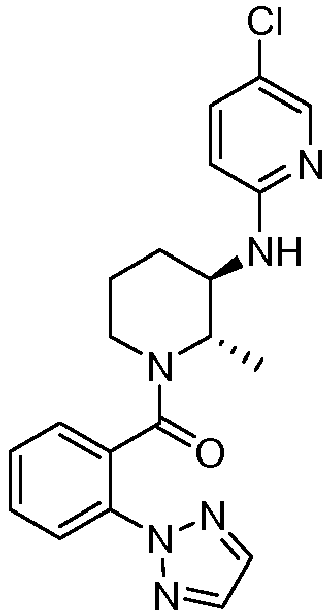
8 12 207 (2-(2H-1,2,3-triazol-2-yl)phenyl)((2S,3R)-3-((5-chloropyridin-2-yl)amino)-2-methylpiperidin-1-yl)methanone 101 
215 446 >10000 ((2S,3R)-2-methyl-3-((5-(trifluoromethyl)pyrimidin-2-yl)oxy)piperidin-1-yl)(5-methyl-3-(2H-1,2,3-triazol-2-yl)pyridin-2-yl)methanone 102 
28 25 5200 (4-methyl-2-(2H-1,2,3-triazol-2-yl)phenyl)((2S,3R)-2-methyl-3-((5-(trifluoromethyl)pyrimidin-2-yl)oxy)piperidin-1-yl)methanone 103 
44 97 2300 (2-(2H-1,2,3-triazol-2-yl)phenyl)((2S,3R)-2-methyl-3-((5-(trifluoromethyl)pyrimidin-2-yl)oxy)piperidin-1-yl)methanone 104 
119 173 >10000 ((2S,3R)-2-methyl-3-((5-(trifluoromethyl)pyrimidin-2-yl)oxy)piperidin-1-yl)(6-methyl-3-(2H-1,2,3-triazol-2-yl)pyridin-2-yl)methanone 105 
((2S,3R)-2-methyl-3-((5-(trifluoromethyl)pyrazin-2-yl)oxy)piperidin-1-yl)(5-methyl-3-(2H-1,2,3-triazol-2-yl)pyridin-2-yl)methanone 106 
(2-(2H-1,2,3-triazol-2-yl)phenyl)((2S,3R)-2-methyl-3-((5-(trifluoromethyl)pyrazin-2-yl)oxy)piperidin-1-yl)methanone 107 
((2S,3R)-2-methyl-3-((5-(trifluoromethyl)pyrazin-2-yl)oxy)piperidin-1-yl)(6-methyl-3-(2H-1,2,3-triazol-2-yl)pyridin-2-yl)methanone 108 
((2S,3R)-2-methyl-3-((5-(trifluoromethyl)pyridin-2-yl)oxy)piperidin-1-yl)(6-methyl-3-(2H-1,2,3-triazol-2-yl)pyridin-2-yl)methanone 109 
(±)-trans-(2-methyl-3-((5-(trifluoromethyl)pyridin -2-yl)oxy)piperidin-1-yl)(6-methyl-3-(2H-1,2,3-triazol-2-yl)pyridin-2-yl)methanone 110 
(2-(2H-1,2,3-triazol-2-yl)phenyl)((2S,3R)-2-methyl-3-((5-(trifluoromethyl)pyridin-2-yl)oxy)piperidin-1-yl)methanone 111 
((2S,3R)-2-methyl-3-((5-(trifluoromethyl)pyridin -2-yl)oxy)piperidin-1-yl)(5-methyl-3-(2H-1,2,3-triazol-2-yl)pyridin-2-yl)methanone 112 
8 12 562 (4-methyl-2-(2H-1,2,3-triazol-2-yl)phenyl)((2S,3R)-2-methyl-3-((5-(trifluoromethyl)pyridin-2-yl)oxy)piperidin-1-yl)methanone 113 
(4-methyl-2-(2H-1,2,3-triazol-2-yl)phenyl)((2S,3R)-2-methyl-3-((5-(trifluoromethyl)pyrazin-2-yl)oxy)piperidin-1-yl)methanone 114 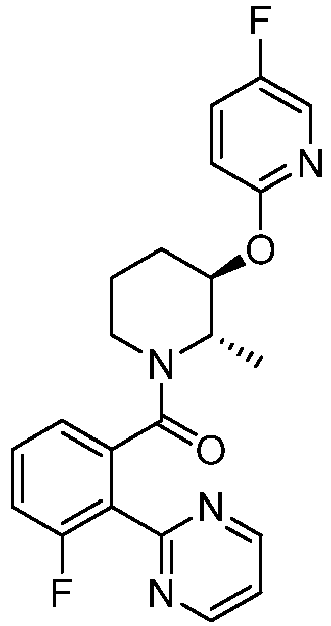
(3-fluoro-2-(pyrimidin-2-yl)phenyl)((2S,3R)-3-((5-fluoropyridin-2-yl)oxy)-2-methylpiperidin-1-yl)methanone 115 
(3-fluoro-2-(pyrimidin-2-yl)phenyl)((2S,3R)-3-((5-fluoropyrimidin-2-yl)oxy)- 2-methylpiperidin-1-yl)methanone 116 
(3-fluoro-2-(pyrimidin-2-yl)phenyl)((2S,3R)-2-methyl-3-((5-(trifluoromethyl)pyridin-2-yl)oxy)piperidin-1-yl)methanone 117 
(3-fluoro-2-(pyrimidin-2-yl)phenyl)((2S,3R)-2-methyl-3-((5-(trifluoromethyl)pyrimidin-2-yl)oxy)piperidin-1-yl)methanone 118 
(3-fluoro-2-(pyrimidin-2-yl)phenyl)((2S,3R)-2-methyl-3-((5-(trifluoromethyl)pyrazin- 2-yl)oxy)piperidin-1-yl)methanone 119 
((2S,3R)-3-(benzo[d]oxazol-2-yloxy)-2-methylpiperidin-1-yl)(3-fluoro-2-(pyrimidin-2-yl)phenyl)methanone 120 
((2S,3R)-3-(benzo[d]oxazol-2-yloxy)-2-methylpiperidin-1-yl)(3-fluoro-2-(2H-1,2,3-triazol-2-yl)phenyl)methanone 121 
(3-fluoro-2-(2H-1,2,3-triazol-2-yl)phenyl)((2S,3R)-3-((5-fluoropyridin-2-yl)oxy)-2-methylpiperidin-1-yl)methanone 122 
(3-fluoro-2-(2H-1,2,3-triazol-2-yl)phenyl)((2S,3R)-3-((5-fluoropyrimidin-2-yl)oxy)-2-methylpiperidin-1-yl)methanone 123 
(3-fluoro-2-(2H-1,2,3-triazol-2-yl)phenyl)((2S,3R)-2-methyl-3-((5 -(trifluoromethyl)pyrimidin-2-yl)oxy)piperidin-1-yl)methanone 124 
(3-fluoro-2-(2H-1,2,3-triazol-2-yl)phenyl)((2S,3R)-2-methyl-3-((5-(trifluoromethyl)pyridin-2-yl)oxy)piperidin-1-yl)methanone 125 
(3-fluoro-2-(2H-1,2,3-triazol-2-yl)phenyl)((2S,3R)-2-methyl-3-((5-(trifluoromethyl)pyrazin-2-yl)oxy)piperidin-1-yl)methanone 126 
((2S,3R)-3-(benzo[d]oxazol-2-yloxy)-2-methylpiperidin-1-yl)(3-fluoro-2-(2H-1,2,3-triazol-2-yl)phenyl)methanone 127 
((2S,3R)-3-(benzo[d]oxazol-2-yloxy)-2-methylpiperidin-1-yl)(2-fluoro-6-(2H-1,2,3-triazol-2-yl)phenyl)methanone 128 
(2-fluoro-6-(2H-1,2,3-triazol-2-yl)phenyl)((2S,3R)-3-((5-fluoropyridin-2-yl)oxy)-2-methylpiperidin-1-yl)methanone 129 
(2-fluoro-6-(2H-1,2,3-triazol-2-yl)phenyl)((2S,3R)-3-((5-fluoropyrimidin-2-yl)oxy)-2-methylpiperidin-1-yl)methanone 130 
(2-fluoro-6-(2H-1,2,3-triazol-2-yl)phenyl)((2S,3R)-2-methyl-3-((5-(trifluoromethyl)pyrimidin-2-yl)oxy)piperidin-1-yl)methanone 131 
(2-fluoro-6-(2H-1,2,3-triazol-2-yl)phenyl)((2S,3R)-2-methyl-3-((5-(trifluoromethyl)pyridin-2-yl)oxy)piperidin-1-yl)methanone 132 
(2-fluoro-6-(2H-1,2,3-triazol-2-yl)phenyl)((2S,3R)-2-methyl-3-((5-(trifluoromethyl)pyrazin- 2-yl)oxy)piperidin-1-yl)methanone 133 
(2-fluoro-6-(pyrimidin-2-yl)phenyl)((2S,3R)-2-methyl-3-((5-(trifluoromethyl)pyrazin-2-yl)oxy)piperidin-1-yl)methanone 134 
(2-fluoro-6-(pyrimidin-2-yl)phenyl)((2S,3R)-2-methyl-3-((5-(trifluoromethyl)pyridin-2-yl)oxy)piperidin-1-yl)methanone 135 
(2-fluoro-6-(pyrimidin-2-yl)phenyl)((2S,3R)-2-methyl-3-((5-(trifluoromethyl)pyrimidin-2-yl)oxy)piperidin-1-yl)methanone 136 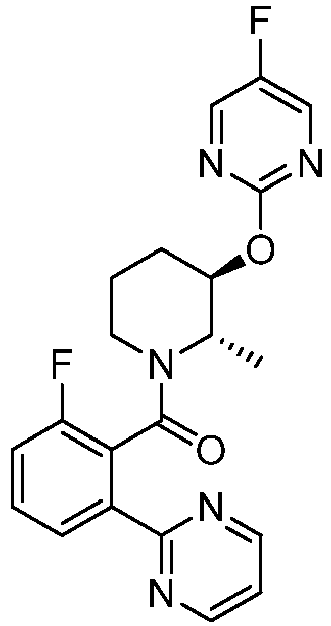
(2-fluoro-6-(pyrimidin-2-yl)phenyl)((2S,3R)-3-((5-fluoropyrimidin-2-yl)oxy)-2-methylpiperidin-1-yl)methanone 137 
(2-fluoro-6-(pyrimidin-2-yl)phenyl)((2S,3R)-3-((5-fluoropyridin-2-yl)oxy)-2-methylpiperidin-1-yl)methanone 138 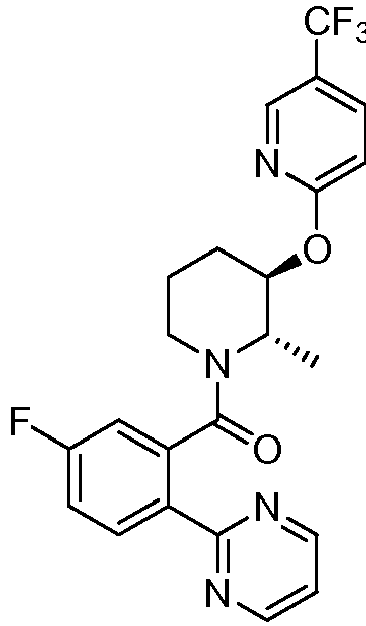
(5 -fluoro-2-(pyrimidin-2-yl)phenyl)((2S,3R)-2-methyl-3-((5-(trifluoromethyl)pyridin-2-yl)oxy)piperidin-1-yl)methanone 139 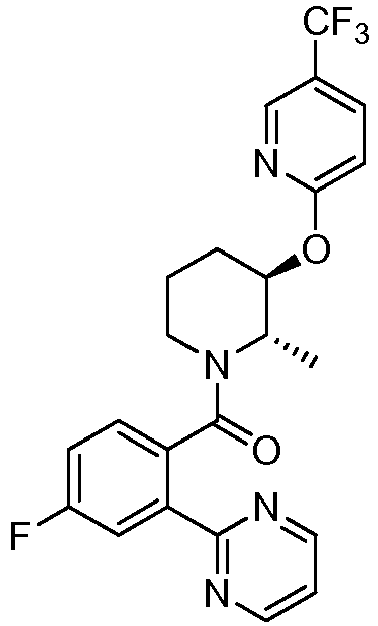
(4-fluoro-2-(pyrimidin-2-yl)phenyl)((2S,3R)-2-methyl-3-((5-(trifluoromethyl)pyridin-2-yl)oxy)piperidin-1-yl)methanone 140 
(4-fluoro-2-(pyrimidin-2-yl)phenyl)((2S,3R)-2-methyl-3-((5-(trifluoromethyl)pyridin-2-yl)oxy)piperidin-1-yl)methanone 141 
(4-fluoro-2-(pyrimidin-2-yl)phenyl)((2S,3R)-3-((5-fluoropyridin-2-yl)oxy)-2-methylpiperidin-1-yl)methanone 142 
(3-fluoro-2-(5-fluoropyrimidin-2-yl)phenyl)((2S,3R)-2-methyl-3-((5-(trifluoromethyl)pyridin-2-yl)oxy)piperidin-1-yl)methanone 143 
((2S,3R)-2-methyl-3-((5-(trifluoromethyl)pyridin-2-yl)oxy)piperidin-1-yl)(2-(pyrimidin-2-yl)phenyl)methanone 144 
(2-(3-methyl-1,2,4-oxadiazol-5-yl)phenyl)((2S,3R)-2-methyl-3-((5-(trifluoromethyl)pyridin-2-yl)amino)piperidin-1-yl)methanone 145 
(4-fluoro-2-(3-methyl-1,2,4-oxadiazol-5-yl)phenyl)((2S,3R)-2-methyl-3-((5-(trifluoromethyl)pyridin-2-yl)amino)piperidin-1-yl)methanone 146 
(3-fluoro-2-(3-methyl-1,2,4-oxadiazol-5-yl)phenyl)((2S,3R)-2-methyl-3-((5-(trifluoromethyl)pyrazin-2-yl)amino)piperidin-1-yl)methanone - Preferred compounds of the invention are set forth in Table 2 below. Data for Orexin receptor activity additional testing of certain compounds of the invention is also set forth in Table 2.
Table 2 Ex. Structure rOX1 Ki (nM) hOX1 Ki (nM) hOX2 Ki (nM) Compound Name 1 
1034 290 (±)-trans-(3-((4,6-dimethylpyrimidin-2-yl)amino)-2-methylpiperidin-1-yl)(4-fluoro-2-(2H-1,2,3-triazol-2-yl)phenyl)methanone 2 
400 217 (±)-trans-(3-((4,6-dimethylpyrimidin-2-yl)amino)-2-methylpiperidin-1-yl)(2-fluoro-6-(pyrimidin-2-yl)phenyl)methanone 3 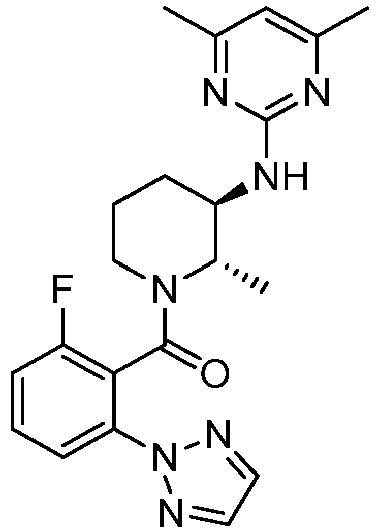
1065 260 (±)-trans-(3-((4,6-dimethylpyrimidin-2-yl)amino)-2-methylpiperidin-1-yl)(2-fluoro-6-(2H-1,2,3-triazol-2-yl)phenyl)methanone 4 
78 40 (±)-trans-(2-(2H-1,2,3-triazol-2-yl)phenyl)(3-((4,6-dimethylpyrimidin-2-yl)amino)-2-methylpiperidin-1-yl)methanone 5 
560 116 (±)-trans-(3-((4,6-dimethylpyrimidin-2-yl)amino)-2-methylpiperidin-1-yl)(5-fluoro-2-(2H-1,2,3-triazol-2-yl)phenyl)methanone 6 
25 40 27 (±)-trans-(3-((4,6-dimethylpyrimidin-2-yl)amino)-2-methylpiperidin-1-yl)(5-methyl-2-(pyrimidin-2-yl)phenyl)methanone 7 
127 243 (±)-trans-(5-methyl-2-(pyrimidin-2-yl)phenyl)(2-methyl-3-((6-methyl-2-(trifluoromethyl)pyrimidin-4-yl)amino)piperidin-1-yl)methanone 8 
466 590 (±)-trans-(5-methyl-2-(2H-1,2,3-triazol-2-yl)phenyl)(2-methyl-3-((6-methyl-2-(trifluoromethyl)pyrimidin-4-yl)amino)piperidin-1-yl)methanone 9 
7000 2256 (±)-trans-(5-fluoro-2-(pyrimidin-2-yl)phenyl)(2-methyl-3-((6-methyl-2-(trifluoromethyl)pyrimidin-4-yl)amino)piperidin-1-yl)methanone 10 
315 144 (±)-trans-(2-fluoro-6-(2H-1,2,3-triazol-2-yl)phenyl)(2-methyl-3-((4-(trifluoromethyl)pyrimidin-2-yl)amino)piperidin-1-yl)methanone 11 
9000 634 (±)-trans-(6-methyl-2-(1H-1,2,3-triazol-1-yl)pyridin-3-yl)(2-methyl-3-((4-(trifluoromethyl)pyrimidin-2-yl)amino)piperidin-1-yl)methanone 12 
16 16 437 (±)-trans-(2-(2H-1,2,3-triazol-2-yl)phenyl)(2-methyl-3-((5-(trifluoromethyl)pyridin-2-yl)amino)piperidin-1-yl)methanone 13 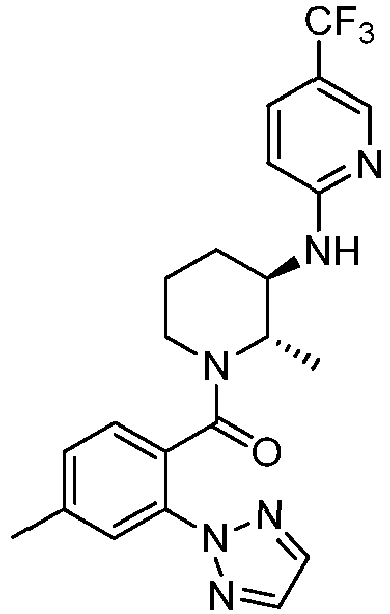
16 9 923 (±)-trans-(4-methyl-2-(2H-1,2,3-triazol-2-yl)phenyl)(2-methyl-3-((5-(trifluoromethyl)pyridin-2-yl)amino)piperidin-1-yl)methanone 14 
9 7 687 (4-methyl-2-(2H-1,2,3-triazol-2-yl)phenyl)((2S,3R)-2-methyl-3-((5-(trifluoromethyl)pyridin-2-yl)amino)piperidin-1-yl)methanone 15 
8200 >10000 (4-methyl-2-(2H-1,2,3-triazol-2-yl)phenyl)((2R,3S)-2-methyl-3-((5-(trifluoromethyl)pyridin-2-yl)amino)piperidin-1-yl)methanone 16 
35 38 680 (±)-trans-(3-ethoxy-6-methylpyridin-2-yl)(2-methyl-3-((5-(trifluoromethyl)pyridin-2-yl)amino)piperidin-1-yl)methanone 17 
11 8 221 (±)-trans-(5-chloro-2-(2H-1,2,3-triazol-2-yl)phenyl)(2-methyl-3-((5-(trifluoromethyl)pyridin-2-yl)amino)piperidin-1-yl)methanone 18 
13 10 272 (±)-trans-(2-methyl-3-((5-(trifluoromethyl)pyridin-2-yl)amino)piperidin-1-yl)(6-methyl-3-(2H-1,2,3-triazol-2-yl)pyridin-2-yl)methanone 19 
10 10 239 (±)-trans-(5-methoxy-2-(2H-1,2,3-triazol-2-yl)phenyl)(2-methyl-3-((5-(trifluoromethyl)pyridin-2-yl)amino)piperidin-1-yl)methanone 20 
14 8 150 (±)-trans-(3-methyl-2-(2H-1,2,3-triazol-2-yl)phenyl)(2-methyl-3-((5-(trifluoromethyl)pyridin-2-yl)amino)piperidin-1-yl)methanone 21 
19 25 595 (±)-trans-(3-(2H-1,2,3-triazol-2-yl)pyridin-2-yl)(2-methyl-3-((5-(trifluoromethyl)pyridin-2-yl)amino)piperidin-1-yl)methanone 22 
36 21 422 (±)-trans-(2-methyl-3-((5-(trifluoromethyl)pyridin-2-yl)amino)piperidin-1-yl)(6-methyl-3-(oxazol-2-yl)pyridin-2-yl)methanone 23 
36 23 208 (±)-trans-(2-methyl-3-((5-(trifluoromethyl)pyridin-2-yl)amino)piperidin-1-yl)(6-methyl-3-(pyrimidin-2-yl)pyridin-2-yl)methanone 24 
8 16 324 (±)-trans-(5-fluoro-2-(2H-1,2,3-triazol-2-yl)phenyl)(2-methyl-3-((5-(trifluoromethyl)pyridin-2-yl)amino)piperidin-1-yl)methanone 25 
12 19 191 ((2S,3R)-2-methyl-3-((5-(trifluoromethyl)pyridin-2-yl)amino)piperidin-1-yl)(6-methyl-3-(oxazol-2-yl)pyridin-2-yl)methanone 26 
12 16 2367 ((2S,3R)-2-methyl-3-((5-(trifluoromethyl)pyridin-2-yl)amino)piperidin-1-yl)(5-methyl-3-(2H-1,2,3-triazol-2-yl)pyridin-2-yl)methanone 27 
19 26 91 ((2S,3R)-2-methyl-3-((5-(trifluoromethyl)pyridin-2-yl)amino)piperidin-1-yl)(5-methyl-3-(pyrimidin-2-yl)pyridin-2-yl)methanone 28 
496 3900 (±)-trans-(3-fluoro-2-methoxyphenyl)(2-methyl-3-((5-(trifluoromethyl)pyridin-2-yl)amino)piperidin-1-yl)methanone 29 
97 90 1400 (±)-trans-(2-ethoxyphenyl)(2-methyl-3-((5-(trifluoromethyl)pyridin-2-yl)amino)piperidin-1-yl)methanone 30 
55 54 656 (±)-trans-(2-(2H-1,2,3-triazol-2-yl)phenyl)(3-((5-chloropyrimidin-2-yl)amino)-2-methylpiperidin-1-yl)methanone 31 
131 120 508 (±)-trans-(2-(2H-1,2,3-triazol-2-yl)phenyl)(2-methyl-3-((5-methylpyrimidin-2-yl)amino)piperidin-1-yl)methanone 32 
34 12 286 (±)-trans-(2-(2H-1,2,3-triazol-2-yl)phenyl)(3-((5-chloropyridin-2-yl)amino)-2-methylpiperidin-1-yl)methanone 33 
199 160 4800 (±)-trans-(2-(2H-1,2,3-triazol-2-yl)phenyl)(2-methyl-3-((6-(trifluoromethyl)pyridazin-3-yl)amino)piperidin-1-yl)methanone 34 
355 700 (2-(2H-1,2,3-triazol-2-yl)phenyl)((2S,3R)-3-((5-fluoropyridin-2-yl)amino)-2-methylpiperidin-1-yl)methanone 35 
20 29 738 (±)-trans-(2-(2H-1,2,3-triazol-2-yl)phenyl)(2-methyl-3-((5-(trifluoromethyl)pyrimidin-2-yl)amino)piperidin-1-yl)methanone 36 
690 1500 (±)-trans-(2-(2H-1,2,3-triazol-2-yl)phenyl)(2-methyl-3-(pyridin-2-ylamino)piperidin-1-yl)methanone 37 
76 71 824 (±)-trans-(2-(2H-1,2,3-triazol-2-yl)phenyl)(2-methyl-3-((5-methylpyridin-2-yl)amino)piperidin-1-yl)methanone 38 
18 25 529 (±)-trans-(2-(2H-1,2,3-triazol-2-yl)phenyl)(2-methyl-3-((5-(trifluoromethyl)pyrazin-2-yl)amino)piperidin-1-yl)methanone 39 
32 12 189 (±)-trans-(2-(2H-1,2,3-triazol-2-yl)phenyl)(2-methyl-3-(quinazolin-2-ylamino)piperidin-1-yl)methanone 40 
870 822 (±)-trans-(2-(2H-1,2,3-triazol-2-yl)phenyl)(3-((5-fluoropyrimidin-2-yl)amino)-2-methylpiperidin-1-yl)methanone 41 
9 9 284 (±)-trans-(2-(2H-1,2,3-triazol-2-yl)phenyl)(3-(benzo[d]oxazol-2-ylamino)-2-methylpiperidin-1-yl)methanone 42 
11 10 410 (±)-trans-(2-(2H-1,2,3-triazol-2-yl)phenyl)(3-((5-bromopyridin-2-yl)amino)-2-methylpiperidin-1-yl)methanone 43 
715 4600 (±)-trans-(3-((5-bromopyridin-2-yl)amino)-2-methylpiperidin-1-yl)(3-fluoro-2-methoxyphenyl)methanone 44 
82 72 1600 (±)-trans-(3-(5-bromopyridin-2-yl)amino)-2-methylpiperidin-1-yl)(2-ethoxyphenyl)methanone 45 
28 26 281 (±)-trans-(2-(2H-1,2,3-triazol-2-yl)phenyl)(3-((5-chlorobenzo[d]oxazol-2-yl)amino)-2-methylpiperidin-1-yl)methanone 46 
185 153 489 (±)-trans-(3-((5-chlorobenzo[d]oxazol-2-yl)amino)-2-methylpiperidin-1-yl)(2-ethoxyphenyl)methanone 47 
373 1300 (±)-trans-(3-((5-chlorobenzo[d]oxazol-2-yl)amino)-2-methylpiperidin-1-yl)(3-fluoro-2-methoxyphenyl)methanone 48 
14 11 96 (±)-trans-(2-(2H-1,2,3-triazol-2-yl)phenyl)(2-methyl-3-(quinoxalin-2-ylamino)piperidin-1-yl)methanone 49 
95 70 89 (±)-trans-((2-ethoxyphenyl)(2-methyl-3-(quinoxalin-2-ylamino)piperidin-1-yl)methanone 50 
396 353 (±)-trans-(3-fluoro-2-methoxyphenyl)(2-methyl-3-(quinoxalin-2-ylamino)piperidin-1-yl)methanone 51 
341 2100 (±)-trans-(2-(2H-1,2,3-triazol-2-yl)phenyl)(2-methyl-3-((4-phenylpyrimidin-2-yl)amino)piperidin-1-yl)methanone 52 
6200 2700 (±)-trans-(3-fluoro-2-methoxyphenyl)(2-methyl-3-((4-phenylpyrimidin-2-yl)amino)piperidin-1-yl)methanone 53 
715 58 (±)-trans-(2-ethoxyphenyl)(2-methyl-3-((4-phenylpyrimidin-2-yl)amino)piperidin-1-yl)methanone 54 
4500 >10000 (±)-cis-(3-fluoro-2-methoxyphenyl)(2-methyl-3-((5-(trifluoromethyl)pyridin-2-yl)amino)piperidin-1-yl)methanone 55 
1200 >10000 (±)-cis-(2-ethoxyphenyl)(2-methyl-3-((5-(trifluoromethyl)pyridin-2-yl)amino)piperidin-1-yl)methanone 56 
128 112 3600 (±)-cis-(2-(2H-1,2,3-triazol-2-yl)phenyl)(2-methyl-3-((5-(trifluoromethyl)pyridin-2-yl)amino)piperidin-1-yl)methanone 57 
720 >10000 (±)-cis-(2-(2H-1,2,3-triazol-2-yl)phenyl)(3-((5-bromopyridin-2-yl)amino)-2-methylpiperidin-1-yl)methanone 58 
>10000 >10000 (±)-cis-(3-(5-bromopyridin-2-yl)amino)-2-methylpiperidin-1-yl)(3-fluoro-2-methoxyphenyl)methanone 59 
1800 >10000 (±)-cis-(3-(5-bromopyridin-2-yl)amino)-2-methylpiperidin-1-yl)(2-ethoxyphenyl)methanone 60 
>10000 >10000 (±)-cis-((2-(2H-1,2,3-triazol-2-yl)phenyl)(3-((5-chlorobenzo[d]oxazol-2-yl)amino)-2-methylpiperidin-1-yl)methanone 61 
1100 2500 (±)-cis-(3-((5-chlorobenzo[d]oxazol-2-yl)amino)-2-methylpiperidin-1-yl)(2-ethoxyphenyl)methanone 62 
1800 5700 (±)-cis-(3-((5-chlorobenzo[d]oxazol-2-yl)amino)-2-methylpiperidin-1-yl)(3-fluoro-2-methoxyphenyl)methanone 63 
3300 >10000 (±)-cis-(2-(2H-1,2,3-triazol-2-yl)phenyl)(2-methyl-3-(quinoxalin-2-ylamino)piperidin-1-yl)methanone 64 
1100 1300 (±)-cis-(3-fluoro-2-methoxyphenyl)(2-methyl-3-(quinoxalin-2-ylamino)piperidin-1-yl)methanone 65 
314 295 (±)-cis-(2-ethoxyphenyl)(2-methyl-3-(quinoxalin-2-ylamino)piperidin-1-yl)methanone 66 
570 1800 (±)-cis-(2-(2H-1,2,3-triazol-2-yl)phenyl)(2-methyl-3-((4-phenylpyrimidin-2-yl)amino)piperidin-1-yl)methanone 67 
840 >10000 (±)-cis-(3-fluoro-2-methoxyphenyl)(2-methyl-3-((4-phenylpyrimidin-2-yl)amino)piperidin-1-yl)methanone 68 
1400 >10000 (±)-cis-(2-ethoxyphenyl)(2-methyl-3-((4-phenylpyrimidin-2-yl)amino)piperidin-1-yl)methanone 69 
70 112 >10000 (6-methyl-2-(2H-1,2,3-triazol-2-yl)pyridin-3-yl)((2S,3R)-2-methyl-3-((5-(trifluoromethyl)pyrimidin-2-yl)amino)piperidin-1-yl)methanone 70 
170 165 7500 (6-methyl-2-(1H-1,2,3-triazol-1-yl)pyridin-3-yl)((2S,3R)-2-methyl-3-((5-(trifluoromethyl)pyrimidin-2-yl)amino)piperidin-1-yl)methanone 71 
10 12 1500 (4-methyl-2-(2H-1,2,3-triazol-2-yl)phenyl)((2S,3R)-2-methyl-3-((5-(trifluoromethyl)pyrimidin-2-yl)amino)piperidin-1-yl)methanone 72 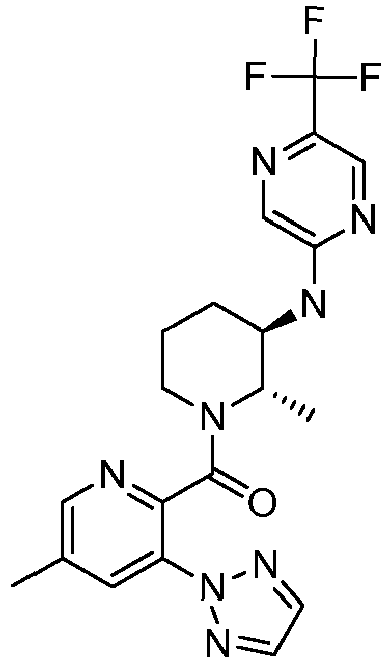
24 33 4050 ((2S,3R)-2-methyl-3-((5-(trifluoromethyl)pyrazin-2-yl)amino)piperidin-1-yl)(5-methyl-3-(2H-1,2,3-triazol-2-yl)pyridin-2-yl)methanone 73 
8 22 2267 ((2S,3R)-3-(benzo[d]oxazol-2-ylamino)-2-methylpiperidin-1-yl)(5-methyl-3-(2H-1,2,3-triazol-2-yl)pyridin-2-yl)methanone 74 
40 52 >10000 (6-methyl-2-(2H-1,2,3-triazol-2-yl)pyridin-3-yl)((2S,3R)-2-methyl-3-((5-(trifluoromethyl)pyrazin-2-yl)amino)piperidin-1-yl)methanone 75 
22 42 8950 ((2S,3R)-3-(benzo[d]oxazol-2-ylamino)-2-methylpiperidin-1-yl)(6-methyl-2-(2H-1,2,3-triazol-2-yl)pyridin-3-yl)methanone 76 
54 62 1300 ((2S,3R)-3-(benzo[d]oxazol-2-ylamino)-2-methylpiperidin-1-yl)(6-methyl-2-(1H-1,2,3-triazol-1-yl)pyridin-3-yl)methanone 77 
41 60 4233 ((2S,3R)-3-((5-chloropyridin-2-yl)amino)-2-methylpiperidin-1-yl)(5-methyl-3-(oxazol-2-yl)pyridin-2-yl)methanone 78 
30 57 436 ((2S,3R)-2-methyl-3-((5-(trifluoromethyl)pyrimidin-2-yl)amino)piperidin-1-yl)(6-methyl-3-(pyrimidin-2-yl)pyridin-2-yl)methanone 79 
8 7 1300 (4-methyl-2-(2H-1,2,3-triazol-2-yl)phenyl)((2S,3R)-2-methyl-3-((5-(trifluoromethyl)pyrazin-2-yl)amino)piperidin-1-yl)methanone 80 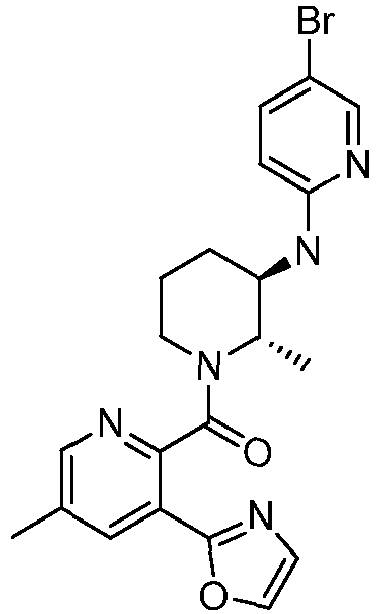
29 24 4900 ((2S,3R)-3-((5-bromopyridin-2-yl)amino)-2-methylpiperidin-1- yl)(5-methyl-3-(oxazol-2-yl)pyridin-2-yl)methanone 81 
14 23 100 ((2S,3R)-3-(benzo[d]oxazol-2-ylammo)-2-methylpiperidin-1 - yl)(6-methyl-3-(pyrimidin-2-yl)pyridin-2-yl)methanone 82 
53 58 6400 (4-methoxy-2-(2H-1,2,3-triazol-2-yl)phenyl)((2S,3R)-2-methyl-3-((5-(trifluoromethyl)pyrazin-2-yl)amino)piperidin-1-yl)methanone 83 
57 53 7000 ((2S,3R)-2-methyl-3-((5-(trifluoromethyl)pyrazin-2-yl)amino)piperidin-1-yl)(5-methyl-3-(oxazol-2-yl)pyridin-2-yl)methanone 84 
23 28 173 ((2S,3R)-2-methyl-3-((5-(trifluoromethyl)pyrazin-2-yl)amino)piperidin-1-yl)(6-methyl-3-(pyrimidin-2-yl)pyridin- 2-yl)methanone 85 
8 10 210 (2-(2H-1,2,3-triazol-2-yl)phenyl)((2S,3R)-2-methyl-3-((5-(trifluoromethyl)pyrazin-2-yl)amino)piperidin-1-yl)methanone 86 
213 249 >10000 ((2S,3R)-3-((5-chloropyrazin-2-yl)amino)-2-methylpiperidin-1- yl)(5-methyl-3-(oxazol-2-yl)pyridin-2-yl)methanone 87 
7 12 154 ((2S,3R)-2-methyl-3-((5-(trifluoromethyl)pyridin-2-yl)amino)piperidin-1-yl)(6-methyl-3-(2H-1,2,3-triazol-2-yl)pyridin-2-yl)methanone 88 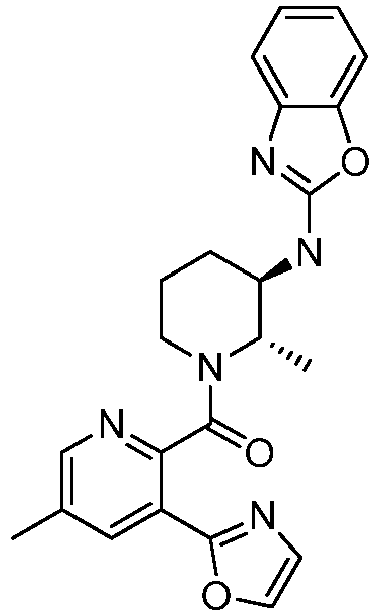
13 25 3300 ((2S,3R)-3-(benzo[d]oxazol-2-ylamino)-2-methylpiperidin-1 - yl)(5-methyl-3-(oxazol-2-yl)pyridin-2-yl)methanone 89 
11 9 422 (5-methoxy-2-(2H-1,2,3-triazol-2-yl)phenyl)((2S,3R)-2-methyl-3-((5-(trifluoromethyl)pyrimidin-2-yl)amino)piperidin-1-yl)methanone 90 
20 19 486 (5-fluoro-2-(2H-1,2,3-triazol-2-yl)phenyl)((2S,3R)-2-methyl-3-((5-(trifluoromethyl)pyrazin-2-yl)amino)piperidin-1-yl)methanone 91 
32 48 2100 ((2S,3R)-3-((5-chloropyrimidin-2-yl)amino)-2-methylpiperidin-1 - yl)(4-methyl-2-(2H-1,2,3-triazol-2-yl)phenyl)methanone 92 
19 18 4200 ((2S,3R)-3-((5-bromopyridin-2-yl)amino)-2-methylpiperidin-1- yl)(5-methyl-3-(2H-1,2,3-triazol-2-yl)pyridin-2-yl)methanone 93 
52 38 2700 (6-methyl-2-(1H-1,2,3-triazol-1-yl)pyridin-3-yl)((2S,3R)-2-methyl-3-((5-(trifluoromethyl)pyridin-2-yl)amino)piperidin-1-yl)methanone 94 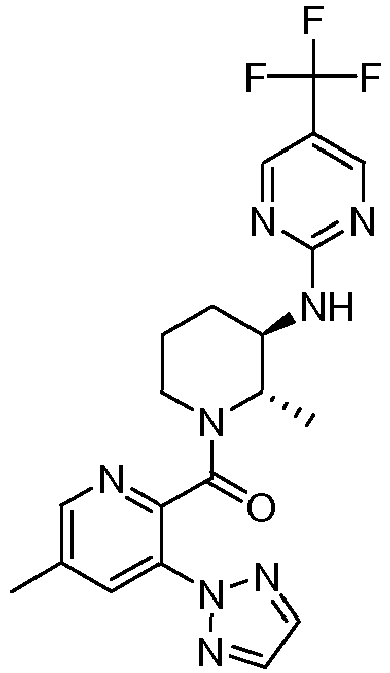
38 25 >10000 ((2S,3R)-2-methyl-3-((5-(trifluoromethyl)pyrimidin-2-yl)amino)piperidin-1-yl)(5-methyl-3-(2H-1,2,3-triazol-2-yl)pyridin-2-yl)methanone 95 
81 103 >10000 (4-methoxy-2-(2H-1,2,3-triazol-2-yl)phenyl)((2S,3R)-2-methyl-3-((5-(trifluoromethyl)pyrimidin-2-yl)amino)piperidin-1-yl)methanone 96 
81 47 3900 (6-methyl-2-(1H-1,2,3-triazol-1-yl)pyridin-3-yl)((2S,3R)-2-methyl-3-((5-(trifluoromethyl)pyrazin-2-yl)amino)piperidin-1-yl)methanone 97 
33 34 4900 (4-methoxy-2-(2H-1,2,3-triazol-2-yl)phenyl)((2S,3R)-2-methyl-3-((5-(trifluoromethyl)pyridin-2-yl)amino)piperidin-1-yl)methanone 98 
24 21 >10000 (6-methyl-2-(2H-1,2,3-triazol-2-yl)pyridin-3-yl)((2S,3R)-2-methyl-3-((5-(trifluoromethyl)pyridin-2-yl)amino)piperidin-1-yl)methanone 99 
23 15 1400 ((2S,3R)-3-((5-chloropyridin-2-yl)amino)-2-methylpiperidin-1- yl)(4-methyl-2-(2H-1,2,3-triazol-2-yl)phenyl)methanone 100 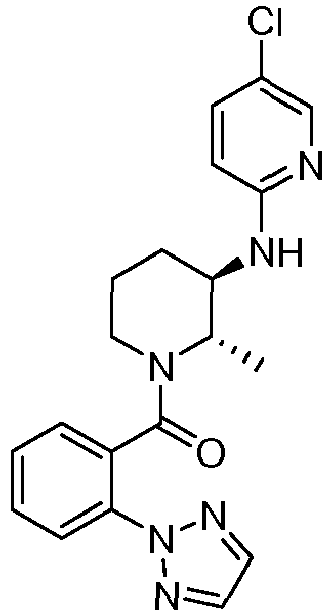
6 9 190 (2-(2H-1,2,3-triazol-2-yl)phenyl)((2S,3R)-3-((5-chloropyridin-2-yl)amino)-2-methylpiperidin-1-yl)methanone 101 
215 446 >10000 ((2S,3R)-2-methyl-3-((5-(trifluoromethyl)pyrimidin-2-yl)oxy)piperidin-1-yl)(5-methyl-3-(2H-1,2,3-triazol-2-yl)pyridin-2-yl)methanone 102 
28 25 5200 (4-methyl-2-(2H-1,2,3-triazol-2-yl)phenyl)((2S,3R)-2-methyl-3-((5-(trifluoromethyl)pyrimidin-2-yl)oxy)piperidin-1-yl)methanone 103 
44 97 2300 (2-(2H-1,2,3-triazol-2-yl)phenyl)((2S,3R)-2-methyl-3-((5-(trifluoromethyl)pyrimidin-2-yl)oxy)piperidin-1-yl)methanone 104 
119 173 >10000 ((2S,3R)-2-methyl-3-((5-(trifluoromethyl)pyrimidin-2-yl)oxy)piperidin-1-yl)(6-methyl-3-(2H-1,2,3-triazol-2-yl)pyridin-2-yl)methanone 105 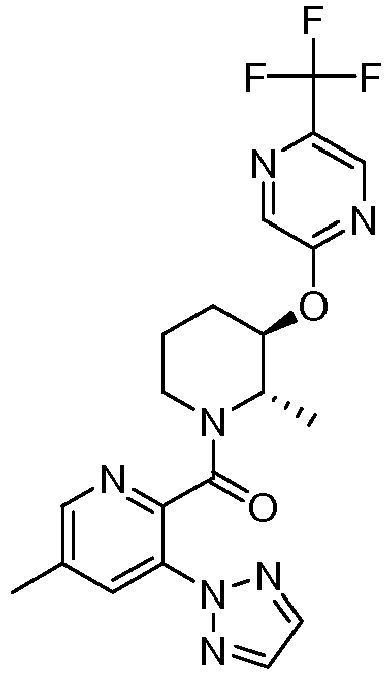
192 269 >10000 ((2S,3R)-2-methyl-3-((5-(trifluoromethyl)pyrazin-2-yl)oxy)piperidin-1-yl)(5-methyl-3-(2H-1,2,3-triazol-2-yl)pyridin-2-yl)methanone 106 
44 45 912 (2-(2H-1,2,3-triazol-2-yl)phenyl)((2S,3R)-2-methyl-3-((5-(trifluoromethyl)pyrazin-2-yl)oxy)piperidin-1-yl)methanone 107 
34 38 2300 ((2S,3R)-2-methyl-3-((5-(trifluoromethyl)pyrazin-2-yl)oxy)piperidin-1-yl)(6-methyl-3 - (2H-1,2,3-triazol-2-yl)pyridin-2-yl)methanone 108 
9 7 301 ((2S,3R)-2-methyl-3-((5-(trifluoromethyl)pyridin-2-yl)oxy)piperidin-1-yl)(6-methyl-3- (2H-1,2,3-triazol-2-yl)pyridin-2-yl)methanone 109 
18 22 463 (±)-trans-(2-methyl-3-((5-(trifluoromethyl)pyridin-2-yl)oxy)piperidin-1-yl)(6-methyl-3- (2H-1,2,3-triazol-2-yl)pyridin-2-yl)methanone 110 
12 11 246 (2-(2H-1,2,3-triazol-2-yl)phenyl)((2S,3R)-2-methyl-3-((5-(trifluoromethyl)pyridin-2-yl)oxy)piperidin-1-yl)methanone 111 
22 31 5100 ((2S,3R)-2-methyl-3-((5-(trifluoromethyl)pyridin-2-yl)oxy)piperidin-1-yl)(5-methyl-3-(2H-1,2,3-triazol-2-yl)pyridin-2-yl)methanone 112 
7 11 664 (4-methyl-2-(2H-1,2,3-triazol-2-yl)phenyl)((2S,3R)-2-methyl-3-((5-(trifluoromethyl)pyridin-2-yl)oxy)piperidin-1-yl)methanone 113 
25 43 3900 (4-methyl-2-(2H-1,2,3-triazol-2-yl)phenyl)((2S,3R)-2-methyl-3-((5-(trifluoromethyl)pyrazin-2-yl)oxy)piperidin-1-yl)methanone 116 
15 18 598 (3-fluoro-2-(pyrimidin-2-yl)phenyl)((2S,3R)-2-methyl-3-((5-(trifluoromethyl)pyridin-2-yl)oxy)piperidin-1-yl)methanone 124 
21 13 460 (3-fluoro-2-(2H-1,2,3-triazol-2-yl)phenyl)((2S,3R)-2-methyl-3-((5-(trifluoromethyl)pyridin-2-yl)oxy)piperidin-1-yl)methanone 125 
117 138 2500 (3-fluoro-2-(2H-1,2,3-triazol-2-yl)phenyl)((2S,3R)-2-methyl-3-((5-(trifluoromethyl)pyrazin-2-yl)oxy)piperidin-1-yl)methanone 138 
20 18 544 (5-fluoro-2-(pyrimidin-2-yl)phenyl)((2S,3R)-2-methyl-3-((5-(trifluoromethyl)pyridin-2-yl)oxy)piperidin-1-yl)methanone 139 
51 51 1200 (4-fluoro-2-(pyrimidin-2-yl)phenyl)((2S,3R)-2-methyl-3-((5-(trifluoromethyl)pyridin-2-yl)oxy)piperidin-1-yl)methanone 141 
31 22 676 (2-(5-fluoropyrimidin-2-yl)phenyl)((2S,3R)-2-methyl-3-((5-(trifluoromethyl)pyridin-2-yl)oxy)piperidin-1-yl)methanone 143 
25 15 473 ((2S,3R)-2-methyl-3-((5-(trifluoromethyl)pyridin-2-yl)oxy)piperidin-1-yl)(2-(pyrimidin-2-yl)phenyl)methanone 147 
50 31 765 (4-fluoro-2-(2H-1,2,3-triazol-2-yl)phenyl)((2S,3R)-2-methyl-3-((5-(trifluoromethyl)pyridin-2-yl)oxy)piperidin-1-yl)methanone 148 
3400 >1000 0 (2-(2H-1,2,3-triazol-2-yl)pyridin-3- yl)((2S,3R)-2-methyl-3-((5-(trifluoromethyl)pyrazin-2-yl)oxy)piperidin-1-yl)methanone 149 
24 18 5600 (5-methyl-2-(2H-1,2,3-triazol-2-yl)pyridin-3-yl)((2S,3R)-2-methyl-3-((5-(trifluoromethyl)pyridin-2-yl)oxy)piperidin-1-yl)methanone 150 
32 39 >10000 (6-methyl-2-(2H- 1,2,3 -triazol-2-yl)pyridin-3-yl)((2S,3R)-2-methyl-3-((5-(trifluoromethyl)pyridin-2-yl)oxy)piperidin-1-yl)methanone 151 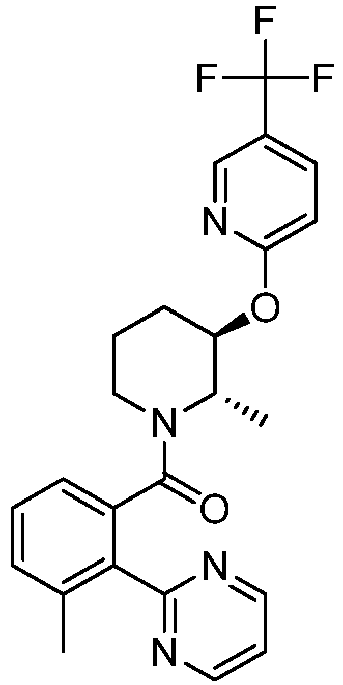
35 31 537 (3-methyl-2-(pyrimidin-2-yl)phenyl)((2S,3R)-2-methyl-3-((5-(trifluoromethyl)pyridin-2-yl)oxy)piperidin-1-yl)methanone 152 
28 20 412 (3-methyl-2-(2H-1,2,3-triazol-2-yl)phenyl)((2S,3R)-2-methyl-3-((5-(trifluoromethyl)pyridin-2-yl)oxy)piperidin-1-yl)methanone 153 
353 >10000 (2-(2H-1,2,3-triazol-2-yl)pyridin-3 - yl)((2S,3R)-2-methyl-3-((5-(trifluoromethyl)pyridin- 2-yl)oxy)piperidin-1-yl)methanone 154 
46 22 526 ((2S,3R)-3-((3-fluoro-5-(trifluoromethyl)pyridin-2-yl)oxy)-2-methylpiperidin-1-yl)(2-(pyrimidin-2-yl)phenyl)methanone 155 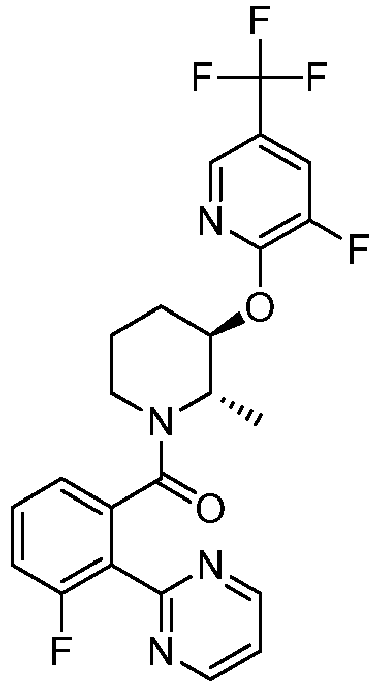
28 16 1100 (3-fluoro-2-(pyrimidin-2-yl)phenyl)((2S,3R)-3-((3-fluoro-5-(trifluoromethyl)pyridin-2-yl)oxy)-2-methylpiperidin-1-yl)methanone 156 
47 30 1300 ((2S,3R)-3-((3-fluoro-5-(trifluoromethyl)pyridin-2-yl)oxy)-2-methylpiperidin-1-yl)(2-(5-fluoropyrimidin-2-yl)phenyl)methanone 157 
49 27 >10000 ((2S,3R)-3-((3-fluoro-5-(trifluoromethyl)pyridin-2-yl)oxy)-2-methylpiperidin-1-yl)(5-methyl-2-(2H-1,2,3-triazol-2-yl)pyridin-3-yl)methanone 158 
36 34 575 ((2S,3R)-3-((3-fluoro-5-(trifluoromethyl)pyridin-2-yl)oxy)-2-methylpiperidin-1-yl)(3-methyl-2-(2H-1,2,3-triazol-2-yl)phenyl)methanone 159 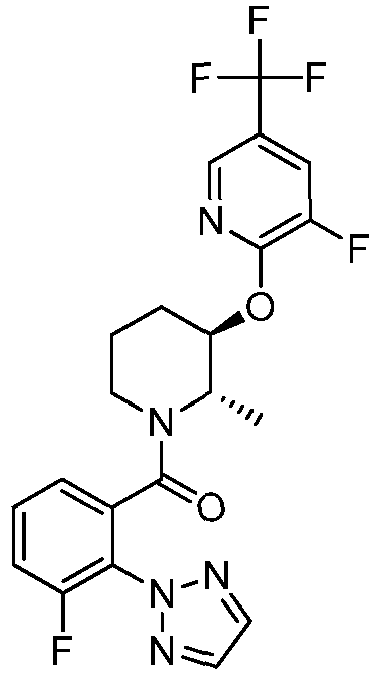
60 14 1550 (3-fluoro-2-(2H-1,2,3-triazol-2-yl)phenyl)((2S,3R)-3-((3-fluoro-5-(trifluoromethyl)pyridin-2-yl)oxy)-2-methylpiperidin-1-yl)methanone 160 
23 22 620 ((2S,3R)-3-((3-fluoro-5-(trifluoromethyl)pyridin-2-yl)oxy)-2-methylpiperidin-1-yl)(6-methyl-3-(2H-1,2,3-triazol-2-yl)pyridin-2-yl)methanone 161 
226 395 3200 ((2S,3R)-3-((5-chloropyrimidin-2-yl)oxy)-2-methylpiperidin-1-yl)(3-fluoro-2-(2H-1,2,3-triazol-2-yl)phenyl)methanone 162 
621 >10000 ((2S,3R)-3-((5-chloropyrimidin-2-yl)oxy)-2-methylpiperidin-1-yl)(5-methyl-2-(2H-1,2,3-triazol-2-yl)pyridin-3-yl)methanone 163 
100 224 1050 ((2S,3R)-3-((5-chloropyrimidin-2-yl)oxy)-2-methylpiperidin-1-yl)(3-methyl-2-(2H-1,2,3-triazol-2-yl)phenyl)methanone 164 
144 230 3800 ((2S,3R)-3-((5-chloropyrimidin-2-yl)oxy)-2-methylpiperidin-1-yl)(6-methyl-3-(2H-1,2,3-triazol-2-yl)pyridin-2-yl)methanone 165 
59 77 4400 (2-(5-fluoropyiimidin-2-yl)phenyl)((2S,3R)-2-methyl-3-((5-(trifluoromethyl)pyrimidin-2-yl)oxy)piperidin-1-yl)methanone 166 
97 124 3100 (2-(5-fluoropyiimidin-2-yl)phenyl)((2S,3R)-2-methyl-3-((5-(trifluoromethyl)pyrazin-2-yl)oxy)piperidin-1-yl)methanone 167 
30 28 1800 (3-methyl-2-(pyrimidin-2-yl)phenyl)((2S,3R)-2-methyl-3-((5-(trifluoromethyl)pyrimidin-2-yl)oxy)piperidin-1-yl)methanone 168 
29 25 951 ((2S,3R)-2-methyl-3-((5-(trifluoromethyl)pyrazin-2-yl)oxy)piperidin-1-yl)(2-(pyrimidin-2-yl)phenyl)methanone 169 
32 23 1200 ((2S,3R)-2-methyl-3-((5-(trifluoromethyl)pyrimidin-2-yl)oxy)piperidin-1-yl)(2-(pyrimidin-2-yl)phenyl)methanone 170 
48 49 2800 (2-(5-fluoropyrimidin-2-yl)-3-methylphenyl)((2S,3R)-2-methyl-3-((5-(trifluoromethyl)pyrimidin-2-yl)oxy)piperidin-1-yl)methanone 171 
34 29 1100 (3-methyl-2-(pyrimidin-2-yl)phenyl)((2S,3R)-2-methyl-3-((5-(trifluoromethyl)pyrazin-2-yl)oxy)piperidin-1-yl)methanone 172 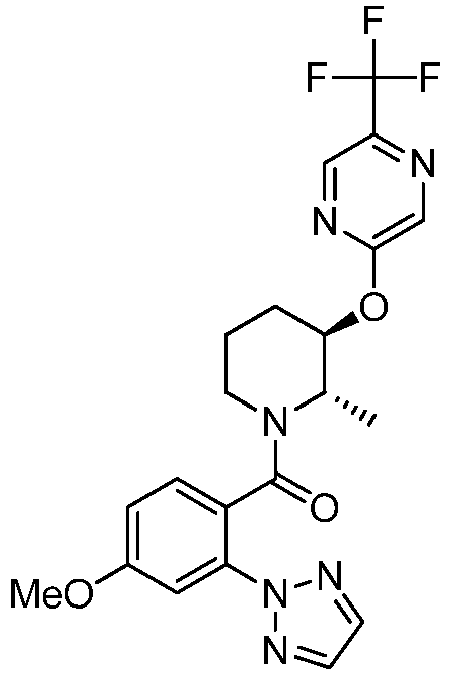
447 >10000 (4-methoxy-2-(2H-1,2,3-triazol-2-yl)phenyl)((2S,3R)-2-methyl-3-((5-(trifluoromethyl)pyrazin-2-yl)oxy)piperidin-1-yl)methanone 173 
423 8200 ((2S,3R)-2-methyl-3-((5-(trifluoromethyl)pyrazin-2-yl)oxy)piperidin-1-yl)(3- phenylpyrazin-2-yl)methanone 174 
504 >10000 (4-methoxy-2-(2H-1,2,3-triazol-2-yl)phenyl)((2S,3R)-2-methyl-3-((5-(trifluoromethyl)pyrimidin-2-yl)oxy)piperidin-1-yl)methanone 175 
124 188 4400 (5-fluoro-2-(oxazol-2-yl)phenyl)((2S,3R)-2-methyl-3-((5-(trifluoromethyl)pyrimidin-2-yl)oxy)piperidin-1-yl)methanone 176 
374 >10000 (5-methyl-2-(2H-1,2,3-triazol-2-yl)pyridin-3-yl)((2S,3R)-2-methyl-3-((5-(trifluoromethyl)pyrimidin-2-yl)oxy)piperidin-1-yl)methanone 177 
238 166 >10000 (5-methyl-2-(2H-1,2,3-triazol-2-yl)pyridin-3-yl)((2S,3R)-2-methyl-3-((5-(trifluoromethyl)pyrazin-2-yl)oxy)piperidin-1-yl)methanone 178 
679 >10000 ((2S,3R)-2-methyl-3-((5-(trifluoromethyl)pyrimidin-2-yl)oxy)piperidin-1-yl)(3-phenylpyrazin-2-yl)methanone 179 
100 68 1900 (5-fluoro-2-(oxazol-2-yl)phenyl)((2S,3R)-2-methyl-3-((5-(trifluoromethyl)pyrazin-2-yl)oxy)piperidin-1-yl)methanone 180 
31 27 1900 ((2S*,3R*)-3-((5-chloropyrazin-2-yl)amino)-2-methylpiperidin-1-yl)(4-methyl-2-(2H-1,2,3-triazol-2-yl)phenyl)methanone 181 
93 176 5200 ((2S*,3R*)-3-((5-chloropyridin-2-yl)amino)-2-methylpiperidin-1-yl)(4-methoxy-2-(2H-1,2,3-triazol-2-yl)phenyl)methanone 182 
93 148 10000 ((2S*,3R*)-3-((5-chloropyrazin-2-yl)amino)-2-methylpiperidin-1-yl)(5-methyl-3-(2H-1 yl)pyridin-2-yl)methanone 183 
103 224 8900 ((2S*,3R*)-3-((5-chloropyrimidin-2-yl)amino)-2-methylpiperidin-1-yl)(5-methyl-3-(2H-1,2,3-triazol-2-yl)pyridin-2-yl)methanone 184 
7 6 191 (5-methoxy-2-(2H-1,2,3-triazol-2-yl)phenyl)((2S*,3R*)-2-methyl-3-((5-(trifluoromethyl)pyrazin-2-yl)amino)piperidin-1-yl)methanone 185 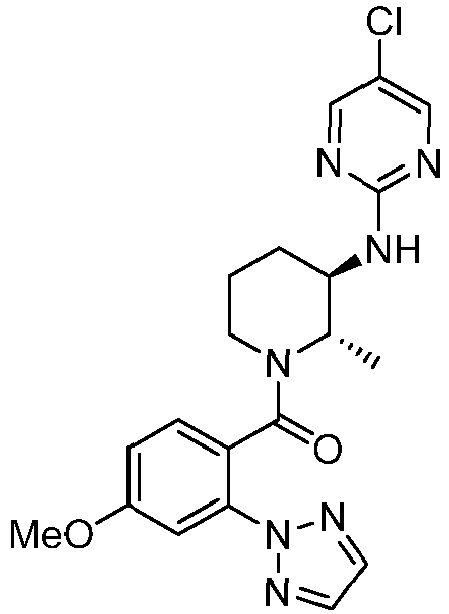
259 8600 ((2S*,3R*)-3-((5-chloropyrimidin-2-yl)amino)-2-methylpiperidin-1-yl)(4-methoxy-2-(2H-1,2,3-triazol-2-yl)phenyl)methanone 186 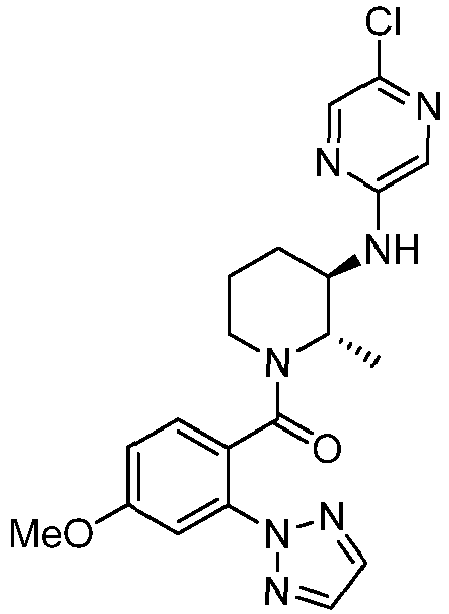
278 9400 ((2S*,3R*)-3-((5-chloropyrazin-2-yl)amino)-2-methylpiperidin-1- yl)(4-methoxy-2-(2H-1,2,3-triazol-2-yl)phenyl)methanone 187 
20 39 2500 ((2S*,3R*)-3-(benzo[d]oxazol-2-yl(methyl)amino)-2-methylpiperidin-1-yl)(5-methyl-3-(2H-1,2,3-triazol-2-yl)pyridin-2-yl)methanone 188 
92 100 >10000 (6-methyl-2-(2H-1,2,3-triazol-2-yl)pyridin-3-yl)((2S*,3R*)-2-methyl-3-(methyl(5-(trifluoromethyl)pyridin-2-yl)amino)piperidin-1-yl)methanone 189 
7 5 175 (3-fluoro-2-(pyrimidin-2-yl)phenyl)((2S*,3R*)-2-methyl-3-((5-(trifluoromethyl)pyridin-2-yl)amino)piperidin-1-yl)methanone 190 
26 18 1200 (4-fluoro-2-(3-methyl-1,2,4-oxadiazol-5-yl)phenyl)((2S*,3R*)-2-methyl-3-((5-(trifluoromethyl)pyridin-2-yl)amino)piperidin-1-yl)methanone 191 
12 9 421 (4-fluoro-2-(pyrimidin-2-yl)phenyl)((2S*,3R*)-2-methyl-3-((5-(trifluoromethyl)pyridin-2-yl)amino)piperidin-1-yl)methanone 192 
27 25 543 (4-fluoro-2-(2H-1,2,3-triazol-2-yl)phenyl)((2S*,3R*)-2-methyl-3-((5-(trifluoromethyl)pyridin-2-yl)amino)piperidin-1-yl)methanone 193 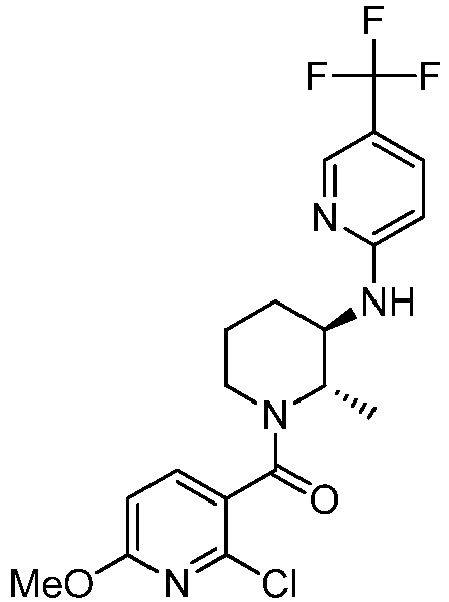
1100 >10000 (2-chloro-6-methoxypyridin-3-yl)((2S*,3R*)-2-methyl-3-((5-(trifluoromethyl)pyridin-2-yl)amino)piperidin-1-yl)methanone 194 
24 24 315 (3-ethoxy-6-methylpyridin-2-yl)((2S*,3R*)-2-methyl-3-((5-(trifluoromethyl)pyridin-2-yl)amino)piperidin-1-yl)methanone 195 
357 10000 ((2S*,3R*)-2-methyl-3-((5-(trifluoromethyl)-1,3,4-thiadiazol-2-yl)amino)piperidin-1-yl)(5-methyl-3-(2H-1,2,3-triazol-2-yl)pyridin-2-yl)methanone 196 
1800 >10000 (6-methyl-2-(2H-1,2,3-triazol-2-yl)pyridin-3-yl)((2S*,3R*)-2-methyl-3-((5-(trifluoromethyl)-1,3,4-thiadiazol-2-yl)amino)piperidin-1-yl)methanone 197 
332 6600 (4-fluoro-2-(3-methyl-1,2,4-oxadiazol-5-yl)phenyl)((2S*,3R*)-2-methyl-3-((5-(trifluoromethyl)pyrimidin-2-yl)amino)piperidin-1-yl)methanone 198 
119 92 2500 (4-fluoro-2-(2H-1,2,3-triazol-2-yl)phenyl)((2S* ,3R*)-2-methyl-3 - ((5-(trifluoromethyl)pyrimidin-2-yl)amino)piperidin-1-yl)methanone 199 
154 206 2400 (3-ethoxy-6-methylpyridin-2-yl)((2S*,3R*)-2-methyl-3-((5-(trifluoromethyl)pyrimidin-2-yl)amino)piperidin-1-yl)methanone 200 
35 27 985 (3-fluoro-2-(pyrimidin-2-yl)phenyl)((2S* ,3R*)-2-methyl-3 - ((5-(trifluoromethyl)pyrimidin-2-yl)amino)piperidin-1-yl)methanone 201 
>10000 >10000 (2-chloro-6-methoxypyridin-3 - yl)((2S*,3R*)-2-methyl-3-((5-(trifluoromethyl)pyrimidin-2-yl)amino)piperidin-1-yl)methanone 202 
35 65 1500 (4-fluoro-2-(pyrimidin-2-yl)phenyl)((2S* ,3R*)-2-methyl-3 - ((5-(trifluoromethyl)pyrimidin-2-yl)amino)piperidin-1-yl)methanone 203 
34 28 755 (4-fluoro-2-(oxazol-2-yl)phenyl)((2S*,3R*)-2-methyl-3-((5-(trifluoromethyl)pyridin-2-yl)amino)piperidin-1-yl)methanone 204 
14 16 292 ((2S*,3R*)-3-(benzo[d]oxazol-2-ylamino)-2-methylpiperidin-1- yl)(3-fluoro-2-(pyrimidin-2-yl)phenyl)methanone 205 
411 5800 (4-fluoro-2-(oxazol-2-yl)phenyl)((2S*,3R*)-2-methyl-3-((5-(trifluoromethyl)pyrimidin-2-yl)amino)piperidin-1-yl)methanone 206 
16 16 564 ((2S*,3R*)-3-(benzo[d]oxazol-2-ylamino)-2-methylpiperidin-1- yl)(4-fluoro-2-(pyrimidin-2-yl)phenyl)methanone 207 
15 12 385 (3-fluoro-2-(pyrimidin-2-yl)phenyl)((2S *,3R*)-2-methyl-3-((5-(trifluoromethyl)pyrazin-2-yl)amino)piperidin-1-yl)methanone 208 
67 34 1100 (4-fluoro-2-(oxazol-2-yl)phenyl)((2S*,3R*)-2-methyl-3-((5-(trifluoromethyl)pyrazin-2-yl)amino)piperidin-1-yl)methanone 209 
16 25 944 (4-fluoro-2-(pyrimidin-2-yl)phenyl)((2S*,3R*)-2-methyl-3-((5-(trifluoromethyl)pyrazin-2-yl)amino)piperidin-1-yl)methanone 210 
25 32 742 ((2S*,3R*)-2-methyl-3-((5-(trifluoromethyl)pyridin-2-yl)oxy)piperidin-1-yl)(3-(pyrimidin-2-yl)pyridin-2-yl)methanone 211 
120 124 >10000 (5-methyl-2-(pyrimidin-2-yl)pyridin-3-yl)((2S,3R)-2-methyl-3-((5-(trifluoromethyl)pyridin-2-yl)oxy)piperidin-1-yl)methanone 212 
45 132 915 (2-fluoro-6-(pyrimidin-2-yl)phenyl)((2S,3R)-2-methyl-3-((5-(trifluoromethyl)pyridin-2-yl)oxy)piperidin-1-yl)methanone 213 
23 68 217 ((2S,3R)-2-methyl-3-((5-(trifluoromethyl)pyridin-2-yl)oxy)piperidin-1-yl)(6-methyl-3-(pyrimidin-2-yl)pyridin-2-yl)methanone 214 
38 78 5400 ((2S,3R)-3-((5-chloropyridin-2-yl)oxy)-2-methylpipeiidin-1-yl)(5-methyl-2-(2H-1,2,3-triazol-2-yl)pyridin-3-yl)methanone 215 
12 35 374 ((2S,3R)-3-((5-chloropyridin-2-yl)oxy)-2-methylpiperidin-1-yl)(6-methyl-3-(2H-1,2,3-triazol-2-yl)pyridin-2-yl)methanone 216 
52 89 8200 ((2S,3R)-3-((5-chloropyridin-2-yl)oxy)-2-methylpiperidin-1-yl)(5-methyl-3-(pyrimidin-2-yl)pyridin-2-yl)methanone 217 
177 154 8900 ((2S,3R)-3-((5-chloropyridin-2-yl)oxy)-2-methylpiperidin-1-yl)(5-methyl-2-(pyrimidin-2-yl)pyridin-3-yl)methanone 218 
26 29 495 ((2S,3R)-3-((5-chloropyridin-2-yl)oxy)-2-methylpiperidin-1-yl)(3-(pyrimidin-2-yl)pyridin-2-yl)methanone 219 
51 55 1300 (3-ethoxy-6-methylpyridin-2-yl)((2S,3R)-2-methyl-3-((5-(trifluoromethyl)pyridin-2-yl)oxy)piperidin-1-yl)methanone 220 
23 25 393 ((2S,3R)-3-((3-fluoro-5-(trifluoromethyl)pyridin-2-yl)oxy)-2-methylpiperidin-1-yl)(3-methyl-2-(pyrimidin-2-yl)phenyl)methanone 221 
32 44 533 (5-fluoro-2-(pyrimidin-2-yl)phenyl)((2S,3R)-3-((3-fluoro-5-(trifluoromethyl)pyridin-2-yl)oxy)-2-methylpiperidin-1-yl)methanone 222 
55 91 1300 (4-fluoro-2-(pyrimidin-2-yl)phenyl)((2S,3R)-3-((3-fluoro-5-(trifluoromethyl)pyridin-2-yl)oxy)-2-methylpiperidin-1-yl)methanone 223 
35 45 370 ((2S,3R)-3-((3-fluoro-5-(trifluoromethyl)pyridin-2-yl)oxy)-2-methylpiperidin-1-yl)(6-methyl-3-(pyrimidin-2-yl)pyridin-2-yl)methanone 224 
33 47 576 (2-(2H-1,2,3-triazol-2-yl)phenyl)((2S,3R)-3-((3-fluoro-5-(trifluoromethyl)pyridin-2-yl)oxy)-2-methylpiperidin-1-yl)methanone 265 
16 24 293 ((2S*,3R*)-2-methyl-3-((5-(trifluoromethyl)pyridin-2-yl)amino)piperidin-1-yl)(3-(pyrimidin-2-yl)pyridin-2-yl)methanone
Claims (16)
- A compound selected from the group consisting of

(±)-trans-(3-((4,6-dimethylpyrimidin-2-yl)amino)-2-methylpiperidin-1-yl)(4-fluoro-2-(2H-1,2,3-triazol-2-yl)phenyl)methanone 
(±)-trans-(3-((4,6-dimethylpyrimidin-2-yl)amino)-2-methylpiperidin-1-yl)(2-fluoro-6-(pyrimidin-2-yl)phenyl)methanone 
(±)-trans-(3-((4,6-dimethylpyrimidin-2-yl)amino)-2-methylpiperidin-1-yl)(2-fluoro-6-(2H-1,2,3-triazol-2-yl)phenyl)methanone 
(±)-trans-(2-(2H-1,2,3-triazol-2-yl)phenyl)(3-((4,6-dimethylpyrimidin-2-yl)amino)-2-methylpiperidin-1-yl)methanone 
(±)-trans-(3-((4,6-dimethylpyrimidin-2-yl)amino)-2-methylpiperidin-1-yl)(5-fluoro-2-(2H-1,2,3-triazol-2-yl)phenyl)methanone 
(±)-trans-(3-((4,6-dimethylpyrimidin-2-yl)amino)-2-methylpiperidin-1-yl)(5-methyl-2-(pyrimidin-2-yl)phenyl)methanone 
(±)-trans-(5-methyl-2-(pyrimidin-2-yl)phenyl)(2-methyl-3-((6-methyl-2-(trifluoromethyl)pyrimidin-4-yl)amino)piperidin-1-yl)methanone 
(±)-trans-(5-methyl-2-(2H-1,2,3-triazol-2-yl)phenyl)(2-methyl-3-((6-methyl-2-(trifluoromethyl)pyrimidin-4-yl)amino)piperidin-1-yl)methanone 
(±)-trans-(5-fluoro-2-(pyrimidin-2-yl)phenyl)(2-methyl-3-((6-methyl-2-(trifluoromethyl)pyrimidin-4-yl)amino)piperidin-1-yl)methanone 
(±)-trans-(2-fluoro-6-(2H-1,2,3-triazol-2-yl)phenyl)(2-methyl-3-((4-(trifluoromethyl)pyrimidin-2-yl)amino)piperidin-1-yl)methanone 
(±)-trans-(6-methyl-2-(1H-1,2,3-triazol-1-yl)pyridin-3-yl)(2-methyl-3-((4-(trifluoromethyl)pyrimidin-2-yl)amino)piperidin-1-yl)methanone 
(±)-trans-(2-(2H-1,2,3-triazol-2-yl)phenyl)(2-methyl-3-((5-(trifluoromethyl)pyridin-2-yl)amino)piperidin-1-yl)methanone 
(±)-trans-(4-methyl-2-(2H-1,2,3-triazol-2-yl)phenyl)(2-methyl-3-((5-(trifluoromethyl)pyridin-2-yl)amino)piperidin-1-yl)methanone 
(4-methyl-2-(2H-1,2,3-triazol-2-yl)phenyl)((2S,3R)-2-methyl-3-((5-(trifluoromethyl)pyridin-2-yl)amino)piperidin-1-yl)methanone 
(4-methyl-2-(2H-1,2,3-triazol-2-yl)phenyl)((2R,3 S)-2-methyl-3-((5-(trifluoromethyl)pyridin-2-yl)amino)piperidin-1-yl)methanone 
(±)-trans-(3-ethoxy-6-methylpyridin-2-yl)(2-methyl-3-((5-(trifluoromethyl)pyridin-2-yl)amino)piperidin-1-yl)methanone 
(±)-trans-(5-chloro-2-(2H-1,2,3-triazol-2-yl)phenyl)(2-methyl-3-((5-(trifluoromethyl)pyridin-2-yl)amino)piperidin-1-yl)methanone 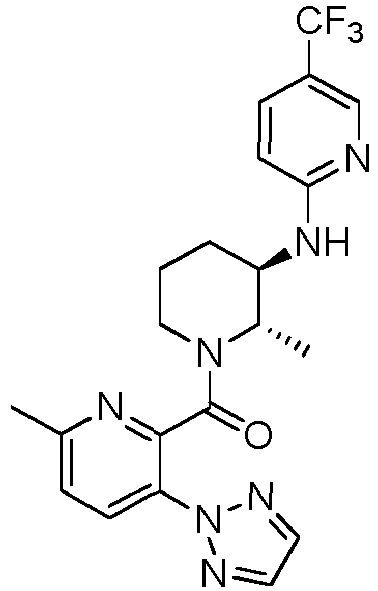
(±)-trans-(2-methyl-3-((5-(trifluoromethyl)pyridin-2-yl)amino)piperidin-1-yl)(6-methyl-3-(2H-1,2,3-triazol-2-yl)pyridin-2-yl)methanone 
(±)-trans-(5-methoxy-2-(2H-1,2,3-triazol-2-yl)phenyl)(2-methyl-3-((5-(trifluoromethyl)pyridin-2-yl)amino)piperidin-1-yl)methanone 
(±)-trans-(3-methyl-2-(2H-1,2,3-triazol-2-yl)phenyl)(2-methyl-3-((5-(trifluoromethyl)pyridin-2-yl)amino)piperidin-1-yl)methanone 
(±)-trans-(3-(2H-1,2,3-triazol-2-yl)pyridin-2-yl)(2-methyl-3-((5-(trifluoromethyl)pyridin-2-yl)amino)piperidin-1-yl)methanone 
(±)-trans-(2-methyl-3-((5-(trifluoromethyl)pyridin-2-yl)amino)piperidin-1-yl)(6-methyl-3-(oxazol-2-yl)pyridin-2-yl)methanone 
(±)-trans-(2-methyl-3-((5-(trifluoromethyl)pyridin-2-yl)amino)piperidin-1-yl)(6-methyl-3-(pyrimidin-2-yl)pyridin-2-yl)methanone 
(±)-trans-(5-fluoro-2-(2H-1,2,3-triazo1-2-yl)phenyl)(2-methyl-3-((5-(trifluoromethyl)pyridin-2-yl)amino)piperidin-1-yl)methanone 
((2S,3R)-2-methyl-3-((5-(trifluoromethyl)pyridin-2-yl)amino)piperidin-1-yl)(6-methyl-3-(oxazol-2-yl)pyridin-2-yl)methanone 
((2S,3R)-2-methyl-3-((5-(trifluoromethyl)pyridin-2-yl)amino)piperidin-1-yl)(5-methyl-3-(2H-1,2,3-triazol-2-yl)pyridin-2-yl)methanone 
((2S,3R)-2-methyl-3-((5-(trifluoromethyl)pyridin-2-yl)amino)piperidin-1-yl)(5-methyl-3-(pyrimidin-2-yl)pyridin-2-yl)methanone 
(±)-trans-(3-fluoro-2-methoxyphenyl)(2-methyl-3-((5-(trifluoromethyl)pyridin-2-yl)amino)piperidin-1-yl)methanone 
(±)-trans-(2-ethoxyphenyl)(2-methyl-3-((5-(trifluoromethyl)pyridin-2-yl)amino)piperidin-1 - yl)methanone 
(±)-trans-(2-(2H-1,2,3-triazol-2-yl)phenyl)(3-((5-chloropyrimidin-2-yl)amino)-2-methylpiperidin-1-yl)methanone 
(±)-trans-(2-(2H-1,2,3-triazol-2-yl)phenyl)(2-methyl-3-((5-methylpyrimidin-2-yl)amino)piperidin-1-yl)methanone 
(±)-trans-(2-(2H-1,2,3-triazol-2-yl)phenyl)(3-((5-chloropyridin-2-yl)amino)-2-methylpiperidin-1-yl)methanone 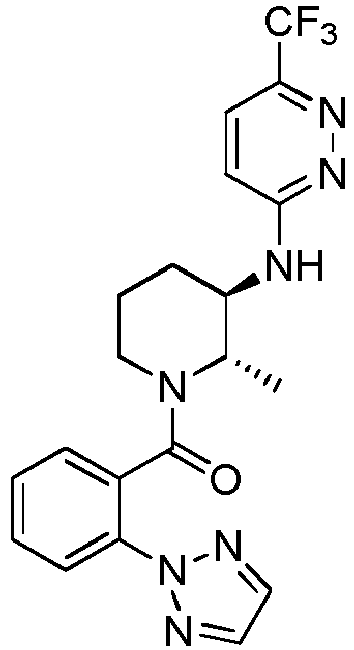
(±)-trans-(2-(2H-1,2,3-triazol-2-yl)phenyl)(2-methyl-3-((6-(trifluoromethyl)pyridazin-3-yl)amino)piperidin-1-yl)methanone 
(2-(2H-1,2,3-triazol-2-yl)phenyl)((2S,3R)-3-((5-fluoropyridin-2-yl)amino)-2-methylpiperidin-1-yl)methanone 
(±)-trans-(2-(2H-1,2,3-triazol-2-yl)phenyl)(2-methyl-3-((5-(trifluoromethyl)pyrimidin-2-yl)amino)piperidin-1-yl)methanone 
(±)-trans-(2-(2H-1,2,3-triazol-2-yl)phenyl)(2-methyl-3-(pyridin-2-ylamino)piperidin-1-yl)methanone 
(±)-trans-(2-(2H-1,2,3-triazol-2-yl)phenyl)(2-methyl-3-((5-methylpyridin-2-yl)amino)piperidin-1-yl)methanone 
(±)-trans-(2-(2H-1,2,3-triazol-2-yl)phenyl)(2-methyl-3-((5-(trifluoromethyl)pyrazin-2-yl)amino)piperidin-1-yl)methanone 
(±)-trans-(2-(2H-1,2,3-triazol-2-yl)phenyl)(2-methyl-3-(quinazolin-2-ylamino)piperidin-1-yl)methanone 
(±)-trans-(2-(2H-1,2,3-triazol-2-yl)phenyl)(3-((5-fluoropyrimidin-2-yl)amino)-2-methylpiperidin-1-yl)methanone 
(±)-trans-(2-(2H-1,2,3-triazol-2-yl)phenyl)(3-(benzo[d]oxazol-2-ylamino)-2-methylpiperidin-1-yl)methanone 
(±)-trans-(2-(2H-1,2,3-triazol-2-yl)phenyl)(3-((5-bromopyridin-2-yl)amino)-2-methylpiperidin-1-yl)methanone 
(±)-trans-(3-((5-bromopyridin-2-yl)amino)-2-methylpiperidin-1-yl)(3-fluoro-2-methoxyphenyl)methanone 
(±)-trans-(3-(5-bromopyridin-2-yl)amino)-2-methylpiperidin-1-yl)(2-ethoxyphenyl)methanone 
(±)-trans-(2-(2H-1,2,3-triazol-2-yl)phenyl)(3-((5-chlorobenzo[d]oxazol-2-yl)amino)-2-methylpiperidin-1-yl)methanone 
(±)-trans-(3-((5-chlorobenzo[d]oxazol-2-yl)amino)-2-methylpiperidin-1-yl)(2-ethoxyphenyl)methanone 
(±)-trans-(3-((5-chlorobenzo[d]oxazol-2-yl)amino)-2-methylpiperidin-1-yl)(3-fluoro-2-methoxyphenyl)methanone 
(±)-trans-(2-(2H-1,2,3-triazol-2-yl)phenyl)(2-methyl-3-(quinoxalin-2-ylamino)piperidin-1-yl)methanone 
(±)-trans-((2-ethoxyphenyl)(2-methyl-3-(quinoxalin-2-ylamino)piperidin-1-yl)methanone 
(±)-trans-(3-fluoro-2-methoxyphenyl)(2-methyl-3-(quinoxalin-2-ylamino)piperidin-1-yl)methanone 
(±)-trans-(2-(2H-1,2,3-triazol-2-yl)phenyl)(2-methyl-3-((4-phenylpyrimidin-2-yl)amino)piperidin-1-yl)methanone 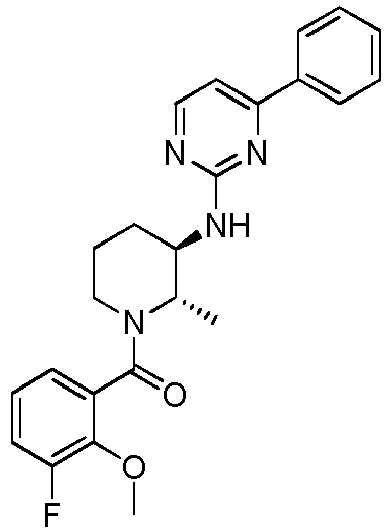
(±)-trans-(3-fluoro-2-methoxyphenyl)(2-methyl-3-((4-phenylpyrimidin-2-yl)amino)piperidin-1-yl)methanone 
(±)-trans-(2-ethoxyphenyl)(2-methyl-3-((4-phenylpyrimidin-2-yl)amino)piperidin-1-yl)methanone 
(±)-cis-(3-fluoro-2-methoxyphenyl)(2-methyl-3-((5-(trifluoromethyl)pyridin-2-yl)amino)piperidin-1-yl)methanone 
(±)-cis-(2-ethoxyphenyl)(2-methyl-3-((5-(trifluoromethyl)pyridin-2-yl)amino)piperidin-1-yl)methanone 
(±)-cis-(2-(2H-1,2,3-triazol-2-yl)phenyl)(2-methyl-3-((5-(trifluoromethyl)pyridin-2-yl)amino)piperidin-1-yl)methanone 
(±)-cis-(2-(2H-1,2,3-triazol-2-yl)phenyl)(3-((5-bromopyridin-2-yl)amino)-2-methylpiperidin-1-yl)methanone 
(±)-cis-(3-(5-bromopyridin-2-yl)amino)-2-methylpiperidin-1-yl)(3-fluoro-2-methoxyphenyl)methanone 
(±)-cis-(3-(5-bromopyridin-2-yl)amino)-2-methylpiperidin-1-yl)(2-ethoxyphenyl)methanone 
(±)-cis-((2-(2H-1,2,3-triazol-2-yl)phenyl)(3-((5-chlorobenzo[d]oxazol-2-yl)amino)-2-methylpiperidin-1-yl)methanone 
(±)-cis-(3-((5-chlorobenzo[d]oxazol-2-yl)amino)-2-methylpiperidin-1-yl)(2-ethoxyphenyl)methanone 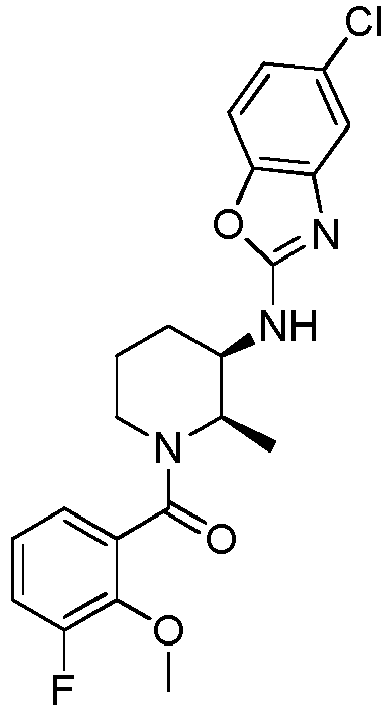
(±)-cis-(3-((5-chlorobenzo[d]oxazol-2-yl)amino)-2-methylpiperidin-1-yl)(3-fluoro-2-methoxyphenyl)methanone 
(±)-cis-(2-(2H-1,2,3-triazol-2-yl)phenyl)(2-methyl-3-(quinoxalin-2-ylamino)piperidin-1-yl)methanone 
(±)-cis-(3-fluoro-2-methoxyphenyl)(2-methyl-3-(quinoxalin-2-ylamino)piperidin-1-yl)methanone 
(±)-cis-(2-ethoxyphenyl)(2-methyl-3-(quinoxalin-2-ylamino)piperidin-1-yl)methanone 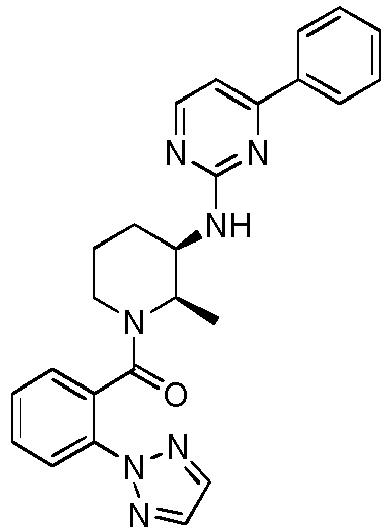
(±)-cis-(2-(2H-1,2,3-triazol-2-yl)phenyl)(2-methyl-3-((4-phenylpyrimidin-2-yl)amino)piperidin-1-yl)methanone 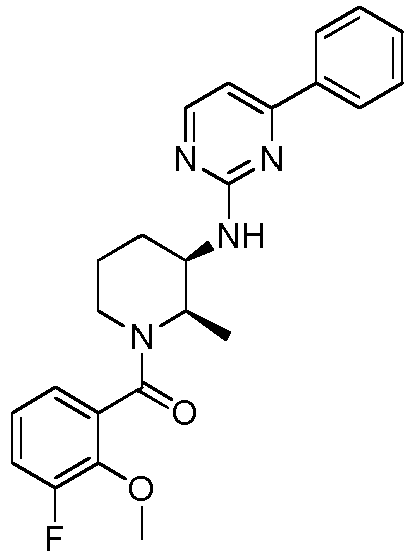
(±)-cis-(3-fluoro-2-methoxyphenyl)(2-methyl-3-((4-phenylpyrimidin-2-yl)amino)piperidin-1-yl)methanone 
(±)-cis-(2-ethoxyphenyl)(2-methyl-3-((4-phenylpyrimidin-2-yl)amino)piperidin-1-yl)methanone 
(6-methyl-2-(2H-1,2,3-triazol-2-yl)pyridin-3-yl)((2S,3R)-2-methyl-3-((5-(trifluoromethyl)pyrimidin-2-yl)amino)piperidin-1-yl)methanone 
(6-methyl-2-(1H-1,2,3-triazol-1-yl)pyridin-3-yl)((2S,3R)-2-methyl-3-((5-(trifluoromethyl)pyrimidin-2-yl)amino)piperidin-1-yl)methanone 
(4-methyl-2-(2H-1,2,3-triazol-2-yl)phenyl)((2S,3R)-2-methyl-3-((5-(trifluoromethyl)pyrimidin-2-yl)amino)piperidin-1-yl)methanone 
((2S,3R)-2-methyl-3-((5-(trifluoromethyl)pyrazin-2-yl)amino)piperidin-1-yl)(5-methyl-3-(2H-1,2,3-triazol-2-yl)pyridin-2-yl)methanone 
((2S,3R)-3-(benzo[d]oxazol-2-ylamino)-2-methylpiperidin-1-yl)(5-methyl-3-(2H-1,2,3-triazol-2-yl)pyridin-2-yl)methanone 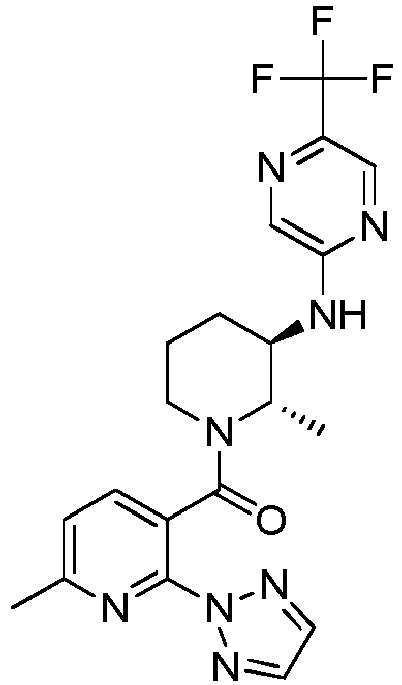
(6-methyl-2-(2H-1,2,3-triazol-2-yl)pyridin-3-yl)((2S,3R)-2-methyl-3-((5-(trifluoromethyl)pyrazin-2-yl)amino)piperidin-1-yl)methanone 
((2S,3R)-3-(benzo[d]oxazol-2-ylamino)-2-methylpiperidin-1-yl)(6-methyl-2-(2H-1,2,3-triazol-2-yl)pyridin-3-yl)methanone 
((2S,3R)-3-(benzo[d]oxazol-2-ylamino)-2-methylpiperidin-1-yl)(6-methyl-2-(1H-1,2,3-triazol-1-yl)pyridin-3-yl)methanone 
((2S,3R)-3-((5-chloropyridin-2-yl)amino)-2-methylpiperidin-1-yl)(5-methyl-3-(oxazol-2-yl)pyridin-2-yl)methanone 
((2S,3R)-2-methyl-3-((5-(trifluoromethyl)pyrimidin-2-yl)amino)piperidin-1-yl)(6-methyl-3-(pyrimidin-2-yl)pyridin-2-yl)methanone 
(4-methyl-2-(2H-1,2,3-triazol-2-yl)phenyl)((2S,3R)-2-methyl-3-((5-(trifluoromethyl)pyrazin-2-yl)amino)piperidin-1-yl)methanone 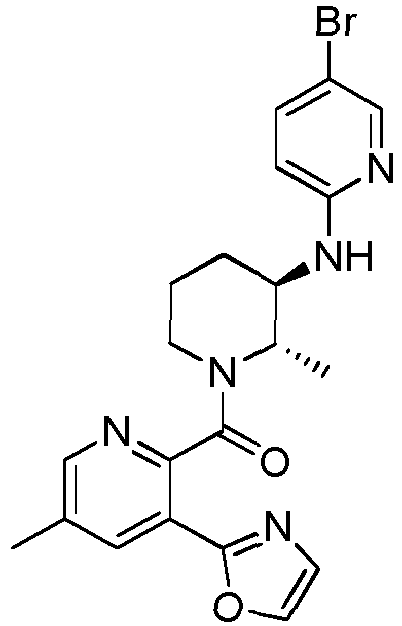
((2S,3R)-3-((5-bromopyridin-2-yl)amino)-2-methylpiperidin-1-yl)(5-methyl-3-(oxazol-2-yl)pyridin-2-yl)methanone 
((2S,3R)-3-(benzo[d]oxazol-2-ylamino)-2-methylpiperidin-1-yl)(6-methyl-3-(pyrimidin-2-yl)pyridin-2-yl)methanone 
(4-methoxy-2-(2H-1,2,3-triazol-2-yl)phenyl)((2S,3R)-2-methyl-3-((5-(trifluoromethyl)pyrazin-2-yl)amino)piperidin-1-yl)methanone 
((2S,3R)-2-methyl-3-((5-(trifluoromethyl)pyrazin-2-yl)amino)piperidin-1-yl)(5-methyl-3-(oxazol-2-yl)pyridin-2-yl)methanone 
((2S,3R)-2-methyl-3-((5-(trifluoromethyl)pyrazin-2-yl)amino)piperidin-1-yl)(6-methyl-3-(pyrimidin-2-yl)pyridin-2-yl)methanone 
(2-(2H-1,2,3-triazol-2-yl)phenyl)((2S,3R)-2-methyl-3-((5-(trifluoromethyl)pyrazin-2-yl)amino)piperidin-1-yl)methanone 
((2S,3R)-3-((5-chloropyrazin-2-yl)amino)-2-methylpiperidin-1-yl)(5-methyl-3-(oxazol-2-yl)pyridin-2-yl)methanone 
((2S,3R)-2-methyl-3-((5-(trifluoromethyl)pyridin-2-yl)amino)piperidin-1-yl)(6-methyl-3-(2H-1,2,3-triazol-2-yl)pyridin-2-yl)methanone 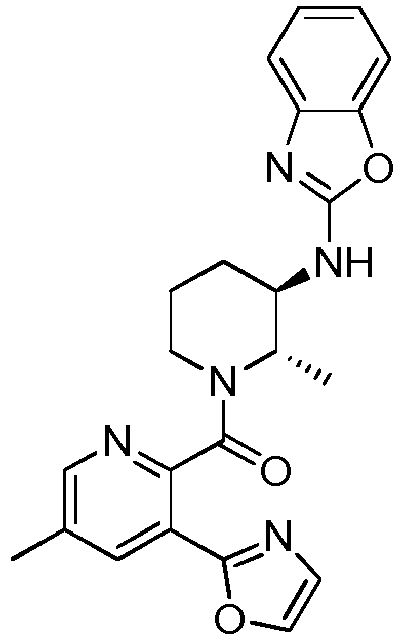
((2S,3R)-3-(benzo[d]oxazol-2-ylamino)-2-methylpiperidin-1-yl)(5-methyl-3-(oxazol-2-yl)pyridin-2-yl)methanone 
(5-methoxy-2-(2H-1,2,3-triazol-2-yl)phenyl)((2S,3R)-2-methyl-3-((5-(trifluoromethyl)pyrimidin-2-yl)amino)piperidin-1-yl)methanone 
(5-fluoro-2-(2H-1,2,3-triazol-2-yl)phenyl)((2S,3R)-2-methyl-3-((5-(trifluoromethyl)pyrazin-2-yl)amino)piperidin-1-yl)methanone 
((2S,3R)-3-((5-chloropyrimidin-2-yl)amino)-2-methylpiperidin-1-yl)(4-methyl-2-(2H-1,2,3-triazol-2-yl)phenyl)methanone 
((2S,3R)-3-((5-bromopyridin-2-yl)amino)-2-methylpiperidin-1-yl)(5-methyl-3-(2H-1,2,3-triazol-2-yl)pyridin-2-yl)methanone 
(6-methyl-2-(1H-1,2,3-triazol-1-yl)pyridin-3-yl)((2S,3R)-2-methyl-3-((5-(trifluoromethyl)pyridin-2-yl)amino)piperidin-1-yl)methanone 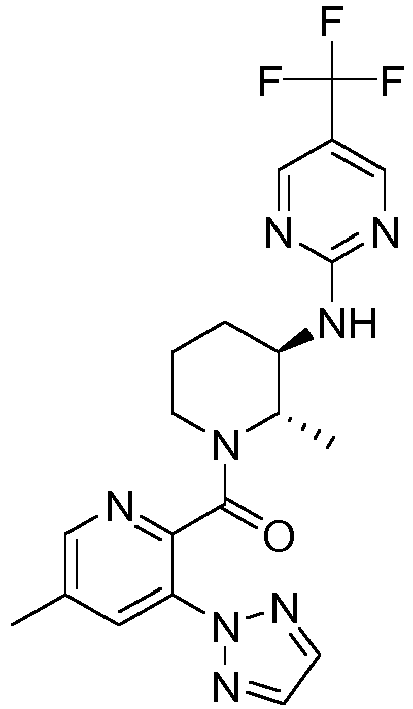
((2S,3R)-2-methyl-3-((5-(trifluoromethyl)pyrimidin-2-yl)amino)piperidin-1-yl)(5-methyl-3-(2H-1,2,3-triazol-2-yl)pyridin-2-yl)methanone 
(4-methoxy-2-(2H-1,2,3-triazol-2-yl)phenyl)((2S,3R)-2-methyl-3-((5-(trifluoromethyl)pyrimidin-2-yl)amino)piperidin-1-yl)methanone 
(6-methyl-2-(1H-1,2,3-triazol-1-yl)pyridin-3-yl)((2S,3R)-2-methyl-3-((5-(trifluoromethyl)pyrazin-2-yl)amino)piperidin-1-yl)methanone 
(4-methoxy-2-(2H-1,2,3-triazol-2-yl)phenyl)((2S,3R)-2-methyl-3-((5-(trifluoromethyl)pyridin-2-yl)amino)piperidin-1-yl)methanone 
(6-methyl-2-(2H-1,2,3-triazol-2-yl)pyridin-3-yl)((2S,3R)-2-methyl-3-((5-(trifluoromethyl)pyridin-2-yl)amino)piperidin-1-yl)methanone 
((2S,3R)-3-((5-chloropyridin-2-yl)amino)-2-methylpiperidin-1-yl)(4-methyl-2-(2H-1,2,3-triazol-2-yl)phenyl)methanone 
(2-(2H-1,2,3-triazol-2-yl)phenyl)((2S,3R)-3-((5-chloropyridin-2-yl)amino)-2-methylpiperidin-1-yl)methanone 
((2S,3R)-2-methyl-3-((5-(trifluoromethyl)pyrimidin-2-yl)oxy)piperidin-1-yl)(5-methyl-3-(2H-1,2,3-triazol-2-yl)pyridin-2-yl)methanone 
(4-methyl-2-(2H-1,2,3-triazol-2-yl)phenyl)((2S,3R)-2-methyl-3-((5-(trifluoromethyl)pyrimidin-2-yl)oxy)piperidin-1-yl)methanone 
(2-(2H-1,2,3-triazol-2-yl)phenyl)((2S,3R)-2-methyl-3-((5-(trifluoromethyl)pyrimidin-2-yl)oxy)piperidin-1-yl)methanone 
((2S,3R)-2-methyl-3-((5-(trifluoromethyl)pyrimidin-2-yl)oxy)piperidin-1-yl)(6-methyl-3-(2H-1,2,3-triazol-2-yl)pyridin-2-yl)methanone 
((2S,3R)-2-methyl-3-((5-(trifluoromethyl)pyrazin-2-yl)oxy)piperidin-1-yl)(5-methyl-3-(2H-1,2,3-triazol-2-yl)pyridin-2-yl)methanone 
(2-(2H-1,2,3-triazol-2-yl)phenyl)((2S,3R)-2-methyl-3-((5-(trifluoromethyl)pyrazin-2-yl)oxy)piperidin-1-yl)methanone 
((2S,3R)-2-methyl-3-((5-(trifluoromethyl)pyrazin-2-yl)oxy)piperidin-1-yl)(6-methyl-3-(2H-1,2,3-triazol-2-yl)pyridin-2-yl)methanone 
((2S,3R)-2-methyl-3-((5-(trifluoromethyl)pyridin-2-yl)oxy)piperidin-1-yl)(6-methyl-3-(2H-1,2,3-triazol-2-yl)pyridin-2-yl)methanone 
(±)-trans-(2-methyl-3-((5-(trifluoromethyl)pyridin-2-yl)oxy)piperidin-1-yl)(6-methyl-3-(2H-1,2,3-triazol-2-yl)pyridin-2-yl)methanone 
(2-(2H-1,2,3-triazol-2-yl)phenyl)((2S,3R)-2-methyl-3-((5-(trifluoromethyl)pyridin-2-yl)oxy)piperidin-1-yl)methanone 
((2S,3R)-2-methyl-3-((5-(trifluoromethyl)pyridin-2-yl)oxy)piperidin-1-yl)(5-methyl-3-(2H-1,2,3-triazol-2-yl)pyridin-2-yl)methanone 
(4-methyl-2-(2H-1,2,3-triazol-2-yl)phenyl)((2S,3R)-2-methyl-3-((5-(trifluoromethyl)pyridin-2-yl)oxy)piperidin-1-yl)methanone 
(4-methyl-2-(2H-1,2,3-triazol-2-yl)phenyl)((2S,3R)-2-methyl-3-((5-(trifluoromethyl)pyrazin-2-yl)oxy)piperidin-1-yl)methanone 
(3-fluoro-2-(pyrimidin-2-yl)phenyl)((2S,3R)-3-((5-fluoropyridin-2-yl)oxy)-2-methylpiperidin-1-yl)methanone 
(3-fluoro-2-(pyrimidin-2-yl)phenyl)((2S,3R)-3-((5-fluoropyrimidin-2-yl)oxy)-2-methylpiperidin-1-yl)methanone 
(3-fluoro-2-(pyrimidin-2-yl)phenyl)((2S,3R)-2-methyl-3-((5-(trifluoromethyl)pyridin-2-yl)oxy)piperidin-1-yl)methanone 
(3-fluoro-2-(pyrimidin-2-yl)phenyl)((2S,3R)-2-methyl-3-((5-(trifluoromethyl)pyrimidin-2-yl)oxy)piperidin-1-yl)methanone 
(3-fluoro-2-(pyrimidin-2-yl)phenyl)((2S,3R)-2-methyl-3-((5-(trifluoromethyl)pyrazin-2-yl)oxy)piperidin-1-yl)methanone 
((2S,3R)-3-(benzo[d]oxazol-2-yloxy)-2-methylpiperidin-1-yl)(3-fluoro-2-(pyrimidin-2-yl)phenyl)methanone 
((2S,3R)-3-(benzo[d]oxazol-2-yloxy)-2-methylpiperidin-1-yl)(3-fluoro-2-(2H-1,2,3-triazol-2-yl)phenyl)methanone 
(3-fluoro-2-(2H-1,2,3-triazol-2-yl)phenyl)((2S,3R)-3-((5-fluoropyridin-2-yl)oxy)-2-methylpiperidin-1-yl)methanone 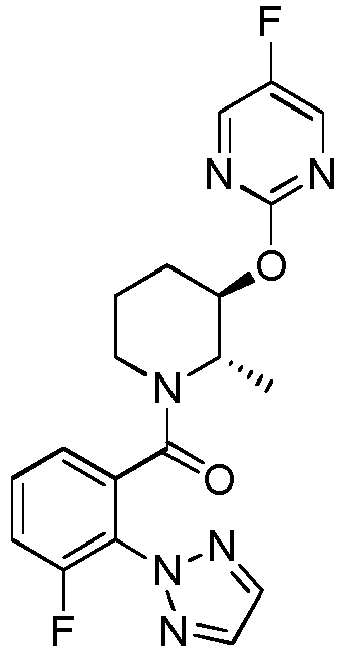
(3-fluoro-2-(2H-1,2,3-triazol-2-yl)phenyl)((2S,3R)-3-((5-fluoropyrimidin-2-yl)oxy)-2-methylpiperidin-1-yl)methanone 
(3-fluoro-2-(2H-1,2,3-triazol-2-yl)phenyl)((2S,3R)-2-methyl-3-((5-(trifluoromethyl)pyrimidin-2-yl)oxy)piperidin-1-yl)methanone 
(3-fluoro-2-(2H-1,2,3-triazol-2-yl)phenyl)((2S,3R)-2-methyl-3-((5-(trifluoromethyl)pyridin-2-yl)oxy)piperidin-1-yl)methanone 
(3-fluoro-2-(2H-1,2,3-triazol-2-yl)phenyl)((2S,3R)-2-methyl-3-((5-(trifluoromethyl)pyrazin-2-yl)oxy)piperidin-1-yl)methanone 
((2S,3R)-3-(benzo[d]oxazol-2-yloxy)-2-methylpiperidin-1-yl)(3-fluoro-2-(2H-1,2,3-triazol-2-yl)phenyl)methanone 
((2S,3R)-3-(benzo[d]oxazol-2-yloxy)-2-methylpiperidin-1-yl)(2-fluoro-6-(2H-1,2,3-triazol-2-yl)phenyl)methanone 
(2-fluoro-6-(2H-1,2,3-triazol-2-yl)phenyl)((2S,3R)-3-((5-fluoropyridin-2-yl)oxy)-2-methylpiperidin-1-yl)methanone 
(2-fluoro-6-(2H-1 ,2,3-triazol-2-yl)phenyl)((2S,3R)-3-((5-fluoropyrimidin-2-yl)oxy)-2-methylpiperidin-1-yl)methanone 
(2-fluoro-6-(2H-1,2,3-triazol-2-yl)phenyl)((2S,3R)-2-methyl-3-((5-(trifluoromethyl)pyrimidin-2-yl)oxy)piperidin-1-yl)methanone 
(2-fluoro-6-(2H-1,2,3-triazol-2-yl)phenyl)((2S,3R)-2-methyl-3-((5-(trifluoromethyl)pyridin-2-yl)oxy)piperidin-1-yl)methanone 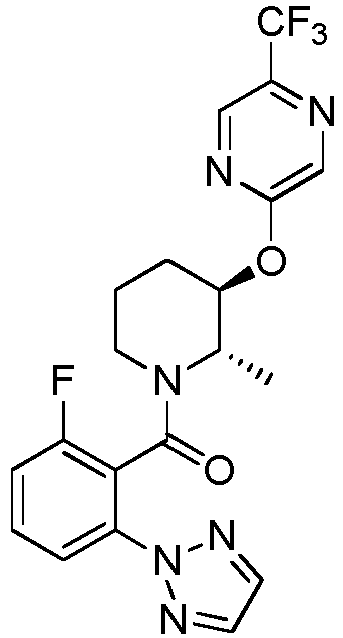
(2-fluoro-6-(2H-1,2,3-triazol-2-yl)phenyl)((2S,3R)-2-methyl-3-((5-(trifluoromethyl)pyrazin-2-yl)oxy)piperidin-1-yl)methanone 
(2-fluoro-6-(pyrimidin-2-yl)phenyl)((2S,3R)-2-methyl-3-((5-(trifluoromethyl)pyrazin-2-yl)oxy)piperidin-1-yl)methanone 
(2-fluoro-6-(pyrimidin-2-yl)phenyl)((2S,3R)-2-methyl-3-((5-(trifluoromethyl)pyridin-2-yl)oxy)piperidin-1-yl)methanone 
(2-fluoro-6-(pyrimidin-2-yl)phenyl)((2S,3R)-2-methyl-3-((5-(trifluoromethyl)pyrimidin-2-yl)oxy)piperidin-1-yl)methanone 
(2-fluoro-6-(pyrimidin-2-yl)phenyl)((2S,3R)-3-((5-fluoropyrimidin-2-yl)oxy)-2-methylpiperidin-1-yl)methanone 
(2-fluoro-6-(pyrimidin-2-yl)phenyl)((2S,3R)-3-((5-fluoropyridin-2-yl)oxy)-2-methylpiperidin-1-yl)methanone 
(5-fluoro-2-(pyrimidin-2-yl)phenyl)((2S,3R)-2-methyl-3-((5-(trifluoromethyl)pyridin-2-yl)oxy)piperidin-1-yl)methanone 
(4-fluoro-2-(pyrimidin-2-yl)phenyl)((2S,3R)-2-methyl-3-((5-(trifluoromethyl)pyridin-2-yl)oxy)piperidin-1-yl)methanone 
(4-fluoro-2-(pyrimidin-2-yl)phenyl)((2S,3R)-2-methyl-3-((5-(trifluoromethyl)pyridin-2-yl)oxy)piperidin-1-yl)methanone 
(4-fluoro-2-(pyrimidin-2-yl)phenyl)((2S,3R)-3-((5-fluoropyridin-2-yl)oxy)-2-methylpiperidin-1-yl)methanone 
(3-fluoro-2-(5-fluoropyrimidin-2-yl)phenyl)((2S,3R)-2-methyl-3-((5-(trifluoromethyl)pyridin-2-yl)oxy)piperidin-1-yl)methanone 
((2S,3R)-2-methyl-3-((5-(trifluoromethyl)pyridin-2-yl)oxy)piperidin-1-yl)(2-(pyrimidin-2-yl)phenyl)methanone 
(2-(3-methyl-1,2,4-oxadiazol-5-yl)phenyl)((2S,3R)-2-methyl-3-((5-(trifluoromethyl)pyridin-2-yl)amino)piperidin-1-yl)methanone 
(4-fluoro-2-(3-methyl-1,2,4-oxadiazol-5-yl)phenyl)((2S,3R)-2-methyl-3-((5-(trifluoromethyl)pyridin-2-yl)amino)piperidin-1-yl)methanone 
(3-fluoro-2-(3-methyl-1,2,4-oxadiazol-5-yl)phenyl)((2S,3R)-2-methyl-3-((5-(trifluoromethyl)pyrazin-2-yl)amino)piperidin-1-yl)methanone 
(4-fluoro-2-(2H-1,2,3-triazol-2-yl)phenyl)((2S,3R)-2-methyl-3-((5-(trifluoromethyl)pyridin-2-yl)oxy)piperidin-1-yl)methanone 
(2-(2H-1,2,3-triazol-2-yl)pyridin-3-yl)((2S,3R)-2-methyl-3-((5-(trifluoromethyl)pyrazin-2-yl)oxy)piperidin-1-yl)methanone 
(5-methyl-2-(2H-1,2,3-triazol-2-yl)pyridin-3-yl)((2S,3R)-2-methyl-3-((5-(trifluoromethyl)pyridin-2-yl)oxy)piperidin-1-yl)methanone 
(6-methyl-2-(2H-1,2,3-triazol-2-yl)pyridin-3-yl)((2S,3R)-2-methyl-3-((5-(trifluoromethyl)pyridin-2-yl)oxy)piperidin-1-yl)methanone 
(3-methyl-2-(pyrimidin-2-yl)phenyl)((2S,3R)-2-methyl-3-((5-(trifluoromethyl)pyridin-2-yl)oxy)piperidin-1-yl)methanone 
(3-methyl-2-(2H-1,2,3-triazol-2-yl)phenyl)((2S,3R)-2-methyl-3-((5-(trifluoromethyl)pyridin-2-yl)oxy)piperidin-1-yl)methanone 
(2-(2H-1,2,3-triazol-2-yl)pyridin-3-yl)((2S,3R)-2-methyl-3-((5-(trifluoromethyl)pyridin-2-yl)oxy)piperidin-1-yl)methanone 
((2S,3R)-3-((3-fluoro-5-(trifluoromethyl)pyridin-2-yl)oxy)-2-methylpiperidin-1-yl)(2-(pyrimidin-2-yl)phenyl)methanone 
(3-fluoro-2-(pyrimidin-2-yl)phenyl)((2S,3R)-3-((3-fluoro-5-(trifluoromethyl)pyridin-2-yl)oxy)-2-methylpiperidin-1-yl)methanone 
((2S,3R)-3-((3-fluoro-5-(trifluoromethyl)pyridin-2-yl)oxy)-2-methylpiperidin-1-yl)(2-(5-fluoropyrimidin-2-yl)phenyl)methanone 
((2S,3R)-3-((3-fluoro-5-(trifluoromethyl)pyridin-2-yl)oxy)-2-methylpiperidin-1-yl)(5-methyl-2-(2H-1,2,3-triazol-2-yl)pyridin-3-yl)methanone 
((2S,3R)-3-((3-fluoro-5-(trifluoromethyl)pyridin-2-yl)oxy)-2-methylpiperidin-1-yl)(3-methyl-2-(2H-1,2,3-triazol-2-yl)phenyl)methanone 
(3-fluoro-2-(2H-1,2,3-triazol-2-yl)phenyl)((2S,3R)-3-((3-fluoro-5-(trifluoromethyl)pyridin-2-yl)oxy)-2-methylpiperidin-1-yl)methanone 
((2S,3R)-3-((3-fluoro-5-(trifluoromethyl)pyridin-2-yl)oxy)-2-methylpiperidin-1-yl)(6-methyl-3-(2H-1,2,3-triazol-2-yl)pyridin-2-yl)methanone 
((2S,3R)-3-((5-chloropyrimidin-2-yl)oxy)-2-methylpiperidin-1-yl)(3-fluoro-2-(2H-1,2,3-triazol-2-yl)phenyl)methanone 
((2S,3R)-3-((5-chloropyrimidin-2-yl)oxy)-2-methylpiperidin-1-yl)(5-methyl-2-(2H-1,2,3-triazol-2-yl)pyridin-3-yl)methanone 
((2S,3R)-3-((5-chloropyrimidin-2-yl)oxy)-2-methylpiperidin-1-yl)(3-methyl-2-(2H-1,2,3-triazol-2-yl)phenyl)methanone 
((2S,3R)-3-((5-chloropyrimidin-2-yl)oxy)-2-methylpiperidin-1-yl)(6-methyl-3-(2H-1,2,3-triazol-2-yl)pyridin-2-yl)methanone 
(2-(5-fluoropyrimidin-2-yl)phenyl)((2S,3R)-2-methyl-3-((5-(trifluoromethyl)pyrimidin-2-yl)oxy)piperidin-1-yl)methanone 
(2-(5-fluoropyrimidin-2-yl)phenyl)((2S,3R)-2-methyl-3-((5-(trifluoromethyl)pyrazin-2-yl)oxy)piperidin-1-yl)methanone 
(3-methyl-2-(pyrimidin-2-yl)phenyl)((2S,3R)-2-methyl-3-((5-(trifluoromethyl)pyrimidin-2-yl)oxy)piperidin-1-yl)methanone 
((2S,3R)-2-methyl-3-((5-(trifluoromethyl)pyrazin-2-yl)oxy)piperidin-1-yl)(2-(pyrimidin-2-yl)phenyl)methanone 
((2S,3R)-2-methyl-3-((5-(trifluoromethyl)pyrimidin-2-yl)oxy)piperidin-1-yl)(2-(pyrimidin-2-yl)phenyl)methanone 
(2-(5-fluoropyrimidin-2-yl)-3-methylphenyl)((2S,3R)-2-methyl-3-((5-(trifluoromethyl)pyrimidin-2-yl)oxy)piperidin-1-yl)methanone 
(3-methyl-2-(pyrimidin-2-yl)phenyl)((2S,3R)-2-methyl-3-((5-(trifluoromethyl)pyrazin-2-yl)oxy)piperidin-1-yl)methanone 
(4-methoxy-2-(2H-1,2,3-triazol-2-yl)phenyl)((2S,3R)-2-methyl-3-((5-(trifluoromethyl)pyrazin-2-yl)oxy)piperidin-1-yl)methanone 
(4-methoxy-2-(2H-1,2,3-triazol-2-yl)phenyl)((2S,3R)-2-methyl-3-((5-(trifluoromethyl)pyrimidin-2-yl)oxy)piperidin-1-yl)methanone 
(5-fluoro-2-(oxazol-2-yl)phenyl)((2S,3R)-2-methyl-3-((5-(trifluoromethyl)pyrimidin-2-yl)oxy)piperidin-1-yl)methanone 
(5-methyl-2-(2H-1,2,3-triazol-2-yl)pyridin-3-yl)((2S,3R)-2-methyl-3-((5-(trifluoromethyl)pyrimidin-2-yl)oxy)piperidin-1-yl)methanone 
(5-methyl-2-(2H-1,2,3-triazol-2-yl)pyridin-3-yl)((2S,3R)-2-methyl-3-((5-(trifluoromethyl)pyrazin-2-yl)oxy)piperidin-1-yl)methanone 
(5-fluoro-2-(oxazol-2-yl)phenyl)((2S,3R)-2-methyl-3-((5-(trifluoromethyl)pyrazin-2-yl)oxy)piperidin-1-yl)methanone 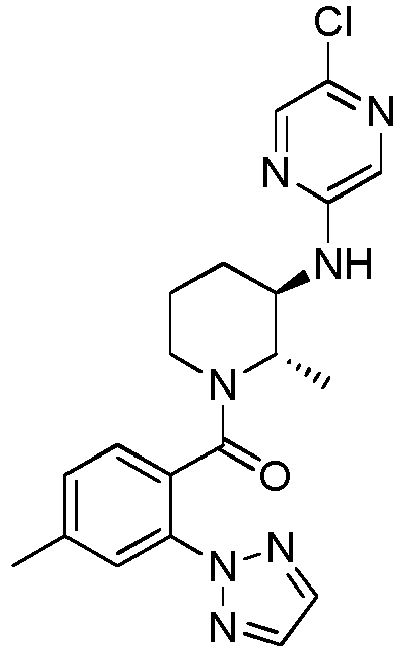
((2S*,3R*)-3-((5-chloropyrazin-2-yl)amino)-2-methylpiperidin-1-yl)(4-methyl-2-(2H-1,2,3-triazol-2-yl)phenyl)methanone 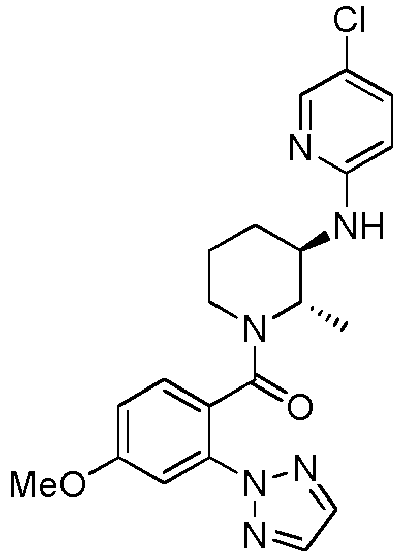
((2S*,3R*)-3-((5-chloropyridin-2-yl)amino)-2-methylpiperidin-1-yl)(4-methoxy-2-(2H-1,2,3-triazol-2-yl)phenyl)methanone 
((2S*,3R*)-3-((5-chloropyrazin-2-yl)amino)-2-methylpiperidin-1-yl)(5-methyl-3-(2H-1,2,3-triazol-2-yl)pyridin-2-yl)methanone 
((2S*,3R*)-3-((5-chloropyrimidin-2-yl)amino)-2-methylpiperidin-1-yl)(5-methyl-3-(2H-1,2,3-triazol-2-yl)pyridin-2-yl)methanone 
(5-methoxy-2-(2H-1,2,3-triazol-2-yl)phenyl)((2S*,3R*)-2-methyl-3-((5-(trifluoromethyl)pyrazin-2-yl)amino)piperidin-1-yl)methanone 
((2S*,3R*)-3-((5-chloropyrimidin-2-yl)amino)-2-methylpiperidin-1-yl)(4-methoxy-2-(2H-1,2,3-triazol-2-yl)phenyl)methanone 
((2S*,3R*)-3-((5-chloropyrazin-2-yl)amino)-2-methylpiperidin-1-yl)(4-methoxy-2-(2H-1,2,3-triazol-2-yl)phenyl)methanone 
((2S*,3R*)-3-(benzo[d]oxazol-2-yl(methyl)amino)-2-methylpiperidin-1-yl)(5-methyl-3-(2H-1,2,3-triazol-2-yl)pyridin-2-yl)methanone 
(6-methyl-2-(2H-1,2,3-triazol-2-yl)pyridin-3-yl)((2S*,3R*)-2-methyl-3-(methyl(5-(trifluoromethyl)pyridin-2-yl)amino)piperidin-1-yl)methanone 
(3-fluoro-2-(pyrimidin-2-yl)phenyl)((2S*,3R*)-2-methyl-3-((5-(trifluoromethyl)pyridin-2-yl)amino)piperidin-1-yl)methanone 
(4-fluoro-2-(3-methyl-1,2,4-oxadiazol-5-yl)phenyl)((2S*,3R*)-2-methyl-3-((5-(trifluoromethyl)pyridin-2-yl)amino)piperidin-1-yl)methanone 
(4-fluoro-2-(pyrimidin-2-yl)phenyl)((2S*,3R*)-2-methyl-3-((5-(trifluoromethyl)pyridin-2-yl)amino)piperidin-1-yl)methanone 
(4-fluoro-2-(2H-1,2,3-triazol-2-yl)phenyl)((2S*,3R*)-2-methyl-3-((5-(trifluoromethyl)pyridin-2-yl)amino)piperidin-1-yl)methanone 
(2-chloro-6-methoxypyridin-3-yl)((2S*,3R*)-2-methyl-3-((5-(trifluoromethyl)pyridin-2-yl)amino)piperidin-1-yl)methanone 
(3-ethoxy-6-methylpyridin-2-yl)((2S*,3R*)-2-methyl-3-((5-(trifluoromethyl)pyridin-2-yl)amino)piperidin-1-yl)methanone 
((2S*,3R*)-2-methyl-3-((5-(trifluoromethyl)-1,3,4-thiadiazol-2-yl)amino)piperidin-1-yl)(5-methyl-3-(2H-1,2,3-triazol-2-yl)pyridin-2-yl)methanone 
(6-methyl-2-(2H-1,2,3-triazol-2-yl)pyridin-3-yl)((2S*,3R*)-2-methyl-3-((5-(trifluoromethyl)-1,3,4-thiadiazo1-2-yl)amino)piperidin-1-yl)methanone 
(4-fluoro-2-(3-methyl-1,2,4-oxadiazol-5-yl)phenyl)((2S*,3R*)-2-methyl-3-((5-(trifluoromethyl)pyrimidin-2-yl)amino)piperidin-1-yl)methanone 
(4-fluoro-2-(2H-1,2,3-triazol-2-yl)phenyl)((2S*,3R*)-2-methyl-3-((5-(trifluoromethyl)pyrimidin-2-yl)amino)piperidin-1-yl)methanone 
(3-ethoxy-6-methylpyridin-2-yl)((2S*,3R*)-2-methyl-3-((5-(trifluoromethyl)pyrimidin-2-yl)amino)piperidin-1-yl)methanone 
(3-fluoro-2-(pyrimidin-2-yl)phenyl)((2S*,3R*)-2-methyl-3-((5-(trifluoromethyl)pyrimidin-2-yl)amino)piperidin-1-yl)methanone 
(2-chloro-6-methoxypyridin-3-yl)((2S*,3R*)-2-methyl-3-((5-(trifluoromethyl)pyrimidin-2-yl)amino)piperidin-1-yl)methanone 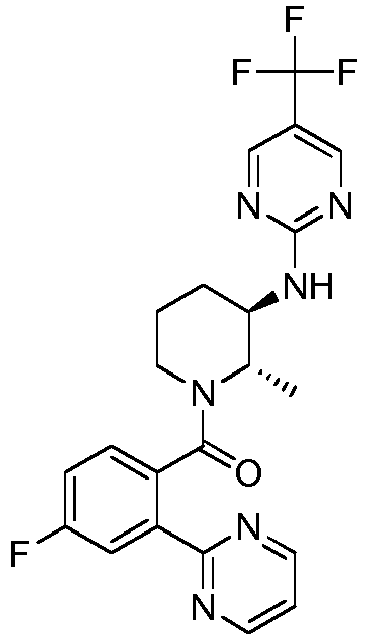
(4-fluoro-2-(pyrimidin-2-yl)phenyl)((2S*,3R*)-2-methyl-3-((5-(trifluoromethyl)pyrimidin-2-yl)amino)piperidin-1-yl)methanone 
(4-fluoro-2-(oxazol-2-yl)phenyl)((2S*,3R*)-2-methyl-3-((5-(trifluoromethyl)pyridin-2-yl)amino)piperidin-1-yl)methanone 
((2S*,3R*)-3-(benzo[d]oxazol-2-ylamino)-2-methylpiperidin-1-yl)(3-fluoro-2-(pyrimidin-2-yl)phenyl)methanone 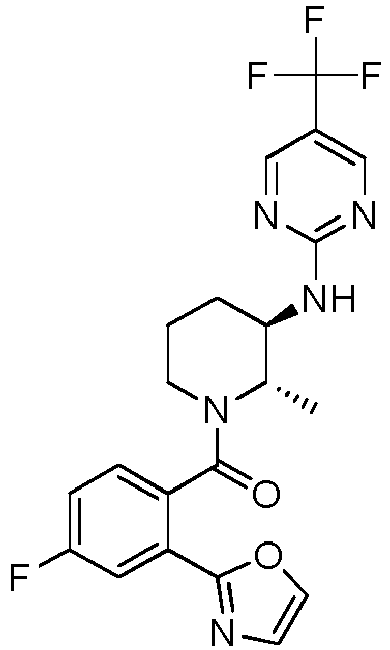
(4-fluoro-2-(oxazol-2-yl)phenyl)((2S*,3R*)-2-methyl-3-((5-(trifluoromethyl)pyrimidin-2-yl)amino)piperidin-1-yl)methanone 
((2S*,3R*)-3-(benzo[d]oxazol-2-ylamino)-2-methylpiperidin-1-yl)(4-fluoro-2-(pyrimidin-2-yl)phenyl)methanone 
(3-fluoro-2-(pyrimidin-2-yl)phenyl)((2S*,3R*)-2-methyl-3-((5-(trifluoromethyl)pyrazin-2-yl)amino)piperidin-1-yl)methanone 
(4-fluoro-2-(oxazol-2-yl)phenyl)((2S*,3R*)-2-methyl-3-((5-(trifluoromethyl)pyrazin-2-yl)amino)piperidin-1-yl)methanone 
(4-fluoro-2-(pyrimidin-2-yl)phenyl)((2S*,3R*)-2-methyl-3-((5-(trifluoromethyl)pyrazin-2-yl)amino)piperidin-1-yl)methanone 
((2S*,3R*)-2-methyl-3-((5-(trifluoromethyl)pyridin-2-yl)oxy)piperidin-1-yl)(3-(pyrimidin-2-yl)pyridin-2-yl)methanone 
(5-methyl-2-(pyrimidin-2-yl)pyridin-3-yl)((2S,3R)-2-methyl-3-((5-(trifluoromethyl)pyridin-2-yl)oxy)piperidin-1-yl)methanone 
(2-fluoro-6-(pyrimidin-2-yl)phenyl)((2S,3R)-2-methyl-3-((5-(trifluoromethyl)pyridin-2-yl)oxy)piperidin-1-yl)methanone 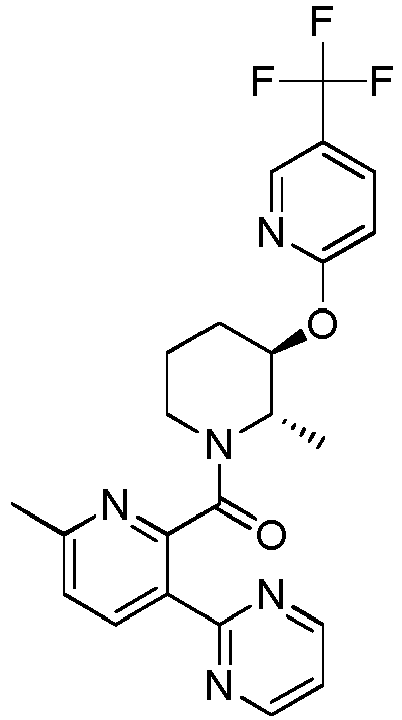
((2S,3R)-2-methyl-3-((5-(trifluoromethyl)pyridin-2-yl)oxy)piperidin-1-yl)(6-methyl-3-(pyrimidin-2-yl)pyridin-2-yl)methanone 
((2S,3R)-3-((5-chloropyridin-2-yl)oxy)-2-methylpiperidin-1-yl)(5-methyl-2-(2H-1,2,3-triazol-2-yl)pyridin-3-yl)methanone 
((2S,3R)-3-((5-chloropyridin-2-yl)oxy)-2-methylpiperidin-1-yl)(6-methyl-3-(2H-1,2,3-triazol-2-yl)pyridin-2-yl)methanone 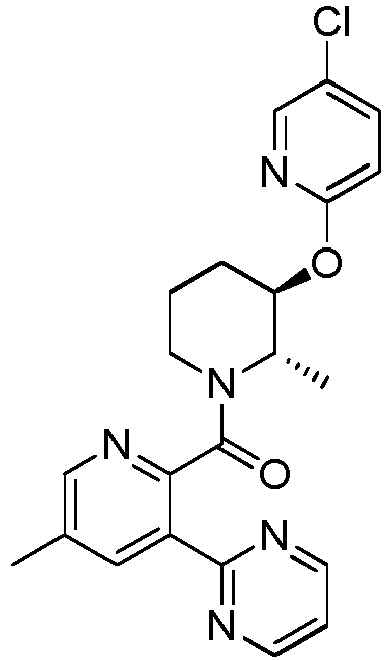
((2S,3R)-3-((5-chloropyridin-2-yl)oxy)-2-methylpiperidin-1-yl)(5-methyl-3-(pyrimidin-2-yl)pyridin-2-yl)methanone 
((2S,3R)-3-((5-chloropyridin-2-yl)oxy)-2-methylpiperidin-1-yl)(5-methyl-2-(pyrimidin-2-yl)pyridin-3-yl)methanone 
((2S,3R)-3-((5-chloropyridin-2-yl)oxy)-2-methylpiperidin-1-yl)(3-(pyrimidin-2-yl)pyridin-2-yl)methanone 
(3-ethoxy-6-methylpyridin-2-yl)((2S,3R)-2-methyl-3-((5-(trifluoromethyl)pyridin-2-yl)oxy)piperidin-1-yl)methanone 
((2S,3R)-3-((3-fluoro-5-(trifluoromethyl)pyridin-2-yl)oxy)-2-methylpiperidin-1-yl)(3-methyl-2-(pyrimidin-2-yl)phenyl)methanone 
(5-fluoro-2-(pyrimidin-2-yl)phenyl)((2S,3R)-3-((3-fluoro-5-(trifluoromethyl)pyridin-2-yl)oxy)-2-methylpiperidin-1-yl)methanone 
(4-fluoro-2-(pyrimidin-2-yl)phenyl)((2S,3R)-3-((3-fluoro-5-(trifluoromethyl)pyridin-2-yl)oxy)-2-methylpiperidin-1-yl)methanone 
((2S,3R)-3-((3-fluoro-5-(trifluoromethyl)pyridin-2-yl)oxy)-2-methylpiperidin-1-yl)(6-methyl-3-(pyrimidin-2-yl)pyridin-2-yl)methanone 
(2-(2H-1,2,3-triazol-2-yl)phenyl)((2S,3R)-3-((3-fluoro-5-(trifluoromethyl)pyridin-2-yl)oxy)-2-methylpiperidin-1-yl)methanone 
(3-fluoro-2-(5-fluoropyrimidin-2-yl)phenyl)((2S,3R)-2-methyl-3-((5-(trifluoromethyl)pyridin-2-yl)oxy)piperidin-1-yl)methanone 
((2S,3R)-2-methyl-3-((5-(trifluoromethyl)pyridin-2-yl)oxy)piperidin-1-yl)(5-methyl-3-(pyrimidin-2-yl)pyridin-2-yl)methanone 
(3-fluoro-2-(oxazol-2-yl)phenyl)((2S,3R)-2-methyl-3-((5-(trifluoromethyl)pyridin-2-yl)oxy)piperidin-1-yl)methanone 
((2S,3R)-3-((3-fluoro-5-(trifluoromethyl)pyridin-2-yl)oxy)-2-methylpiperidin-1-yl)(6-methyl-2-(2H-1,2,3-triazol-2-yl)pyridin-3-yl)methanone 
((2S,3R)-3-((3-fluoro-5-(trifluoromethyl)pyridin-2-yl)oxy)-2-methylpiperidin-1-yl)(5-methyl-2-(pyrimidin-2-yl)pyridin-3-yl)methanone 
(3 -fluoro-2-(5-fluoropyrimidin-2-yl)phenyl)((2S,3R)-3-((3-fluoro-5-(trifluoromethyl)pyridin-2-yl)oxy)-2-methylpiperidin-1-yl)methanone 
((2S,3R)-3-((3-fluoro-5-(trifluoromethyl)pyridin-2-yl)oxy)-2-methylpiperidin-1-yl)(5-methyl-3-(pyrimidin-2-yl)pyridin-2-yl)methanone 
(3-fluoro-2-(oxazol-2-yl)phenyl)((2S,3R)-3-((3-fluoro-5-(trifluoromethyl)pyridin-2-yl)oxy)-2-methylpiperidin-1-yl)methanone 
((2S,3R)-3-((3-fluoro-5-(trifluoromethyl)pyridin-2-yl)oxy)-2-methylpiperidin-1-yl)(3-(pyrimidin-2-yl)pyridin-2-yl)methanone 
((2S,3R)-2-methyl-3-((5-(trifluoromethyl)pyridin-2-yl)oxy)piperidin-1-yl)(4-methyl-3-(pyrimidin-2-yl)pyridin-2-yl)methanone 
((2S,3R)-3-((3-chloro-5-(trifluoromethyl)pyridin-2-yl)oxy)-2-methylpiperidin-1-yl)(6-methyl-2-(2H-1,2,3-triazol-2-yl)pyridin-3-yl)methanone 
((2S,3R)-3-((3-chloro-5-(trifluoromethyl)pyridin-2-yl)oxy)-2-methylpiperidin-1-yl)(5-methyl-2-(2H-1,2,3-triazol-2-yl)pyridin-3-yl)methanone 
((2S,3R)-3-((3-chloro-5-(trifluoromethyl)pyridin-2-yl)oxy)-2-methylpiperidin-1-yl)(6-methyl-3-(2H-1,2,3-triazol-2-yl)pyridin-2-yl)methanone 
((2S,3R)-3-((3-chloro-5-(trifluoromethyl)pyridin-2-yl)oxy)-2-methylpiperidin-1-yl)(2-(pyrimidin-2-yl)phenyl)methanone 
((2S,3R)-3-((3-chloro-5-(trifluoromethyl)pyridin-2-yl)oxy)-2-methylpiperidin-1-yl)(3-methyl-2-(pyrimidin-2-yl)phenyl)methanone 
((2S,3R)-3-((3-chloro-5-(trifluoromethyl)pyridin-2-yl)oxy)-2-methylpiperidin-1-yl)(2-(5-fluoropyrimidin-2-yl)phenyl)methanone 
((2S,3R)-3-((3-chloro-5-(trifluoromethyl)pyridin-2-yl)oxy)-2-methylpiperidin-1-yl)(3-(pyrimidin-2-yl)pyridin-2-yl)methanone 
((2S,3R)-3-((3-chloro-5-(trifluoromethyl)pyridin-2-yl)oxy)-2-methylpiperidin-1-yl)(6-methyl-3-(pyrimidin-2-yl)pyridin-2-yl)methanone 
((2S,3R)-3-((3-chloro-5-(trifluoromethyl)pyridin-2-yl)oxy)-2-methylpiperidin-1-yl)(5-methyl-2-(pyrimidin-2-yl)pyridin-3-yl)methanone 
((2S,3R)-3-((3-chloro-5-(trifluoromethyl)pyridin-2-yl)oxy)-2-methylpiperidin-1-yl)(3-fluoro-2-(5-fluoropyrimidin-2-yl)phenyl)methanone 
((2S,3R)-3-((3-chloro-5-(trifluoromethyl)pyridin-2-yl)oxy)-2-methylpiperidin-1-yl)(5-methyl-3-(pyrimidin-2-yl)pyridin-2-yl)methanone 
((2S,3R)-3-((3-chloro-5-(trifluoromethyl)pyridin-2-yl)oxy)-2-methylpiperidin-1-yl)(3-fluoro-2-(oxazol-2-yl)phenyl)methanone 
((2S,3R)-3-((5-chloropyridin-2-yl)oxy)-2-methylpiperidin-1-yl)(3-fluoro-2-(oxazol-2-yl)phenyl)methanone 
((2S,3R)-3-((5-chloropyridin-2-yl)oxy)-2-methylpiperidin-1-yl)(3-fluoro-2-(5-fluoropyrimidin-2-yl)phenyl)methanone 
((2S,3R)-3-((5-chloropyridin-2-yl)oxy)-2-methylpiperidin-1-yl)(6-methyl-2-(2H-1,2,3-triazol-2-yl)pyridin-3-yl)methanone 
((2S,3R)-3-((5-chloropyridin-2-yl)oxy)-2-methylpiperidin-1-yl)(2-(pyrimidin-2-yl)phenyl)methanone 
((2S,3R)-3-((5-chloropyridin-2-yl)oxy)-2-methylpiperidin-1-yl)(3-methyl-2-(pyrimidin-2-yl)phenyl)methanone 
((2S,3R)-3-((5-chloropyridin-2-yl)oxy)-2-methylpiperidin-1-yl)(2-(5-fluoropyrimidin-2-yl)phenyl)methanone 
((2S,3R)-3-((5-bromopyridin-2-yl)oxy)-2-methylpiperidin-1-yl)(6-methyl-2-(2H-1,2,3-triazol-2-yl)pyridin-3-yl)methanone 
((2S,3R)-3-((5-bromopyridin-2-yl)oxy)-2-methylpiperidin-1-yl)(5-methyl-2-(2H-1,2,3-triazol-2-yl)pyridin-3-yl)methanone 
((2S,3R)-3-((5-bromopyridin-2-yl)oxy)-2-methylpiperidin-1-yl)(6-methyl-3-(2H-1,2,3-triazol-2-yl)pyridin-2-yl)methanone 
((2S,3R)-3-((5-bromopyridin-2-yl)oxy)-2-methylpiperidin-1-yl)(2-(pyrimidin-2-yl)phenyl)methanone 
((2S,3R)-3-((5-bromopyridin-2-yl)oxy)-2-methylpiperidin-1-yl)(3-methyl-2-(pyrimidin-2-yl)phenyl)methanone 
((2S,3R)-3-((5-bromopyridin-2-yl)oxy)-2-methylpiperidin-1-yl)(2-(5-fluoropyrimidin-2-yl)phenyl)methanone 
((2S,3R)-3-((5-bromopyridin-2-yl)oxy)-2-methylpiperidin-1-yl)(3-(pyrimidin-2-yl)pyridin-2-yl)methanone 
((2S,3R)-3-((5-bromopyridin-2-yl)oxy)-2-methylpiperidin-1-yl)(6-methyl-3-(pyrimidin-2-yl)pyridin-2-yl)methanone 
((2S,3R)-3-((5-bromopyridin-2-yl)oxy)-2-methylpiperidin-1-yl)(5-methyl-2-(pyrimidin-2-yl)pyridin-3-yl)methanone 
((2S,3R)-3-((5-bromopyridin-2-yl)oxy)-2-methylpiperidin-1-yl)(3-fluoro-2-(5-fluoropyrimidin-2-yl)phenyl)methanone 
((2S,3R)-3-((5-bromopyridin-2-yl)oxy)-2-methylpiperidin-1-yl)(5-methyl-3-(pyrimidin-2-yl)pyridin-2-yl)methanone 
((2S,3R)-3-((5-bromopyridin-2-yl)oxy)-2-methylpiperidin-1-yl)(3-fluoro-2-(oxazol-2-yl)phenyl)methanone 
((2S*,3R*)-2-methyl-3-((5-(trifluoromethyl)pyridin-2-yl)amino)piperidin-1-yl)(3-(pyrimidin-2-yl)pyridin-2-yl)methanone 
((2S,3R)-2-methyl-3-((5-(trifluoromethyl)pyridin-2-yl)amino)piperidin-1-yl)(5-methyl-3-(pyrimidin-2-yl)pyridin-2-yl)methanone 
((2S,3R)-2-methyl-3-((5-(trifluoromethyl)pyridin-2-yl)amino)piperidin-1-yl)(4-methyl-3-(pyrimidin-2-yl)pyridin-2-yl)methanone 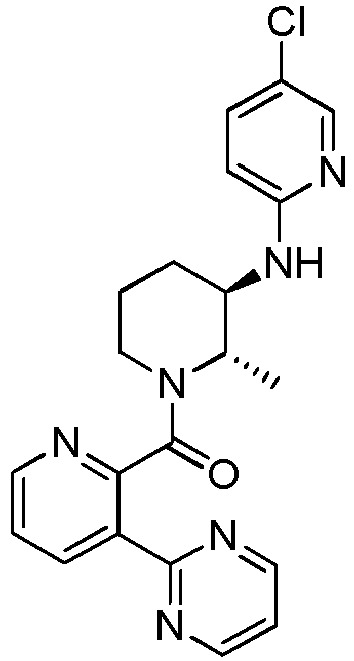
((2S,3R)-3-((5-chloropyridin-2-yl)amino)-2-methylpiperidin-1-yl)(3-(pyrimidin-2-yl)pyridin-2-yl)methanone 
((2S,3R)-3-((5-chloropyridin-2-yl)amino)-2-methylpiperidin-1-yl)(5-methyl-3-(pyrimidin-2-yl)pyridin-2-yl)methanone 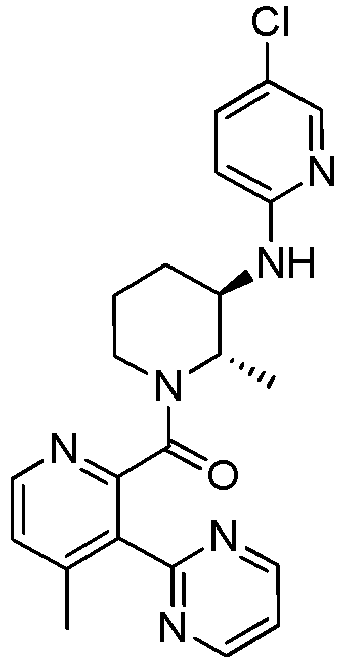
((2S,3R)-3-((5-chloropyridin-2-yl)amino)-2-methylpiperidin-1-yl)(4-methyl-3-(pyrimidin-2-yl)pyridin-2-yl)methanone 
((2S,3R)-3-((3-fluoro-5-(trifluoromethyl)pyridin-2-yl)amino)-2-methylpiperidin-1-yl)(2-fluoro-6-(pyrimidin-2-yl)phenyl)methanone 
(2-fluoro-6-(pyrimidin-2-yl)phenyl)((2S,3R)-2-methyl-3-((5-(trifluoromethyl)pyridin-2-yl)amino)piperidin-1-yl)methanone 
((2S,3R)-3-((5-chloropyridin-2-yl)amino)-2-methylpiperidin-1-yl)(2-fluoro-6-(pyrimidin-2-yl)phenyl)methanone 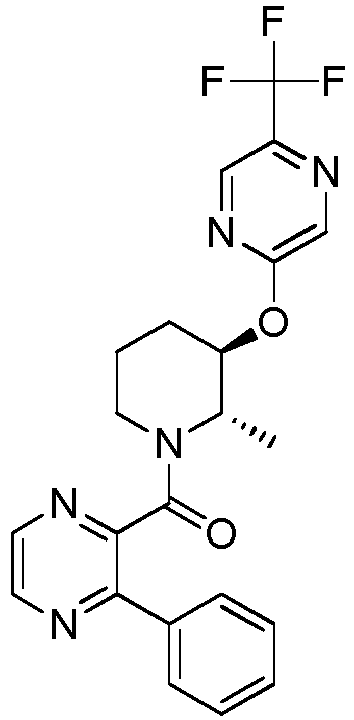
((2S,3R)-2-methyl-3-((5-(trifluoromethyl)pyrazin-2-yl)oxy)piperidin-1-yl)(3-phenylpyrazin-2-yl)methanone and 
((2S,3R)-2-methyl-3-((5-(trifluoromethyl)pyrimidin-2-yl)oxy)piperidin-1-yl)(3-phenylpyrazin-2-yl)methanone. - A compound of claim 1 which is
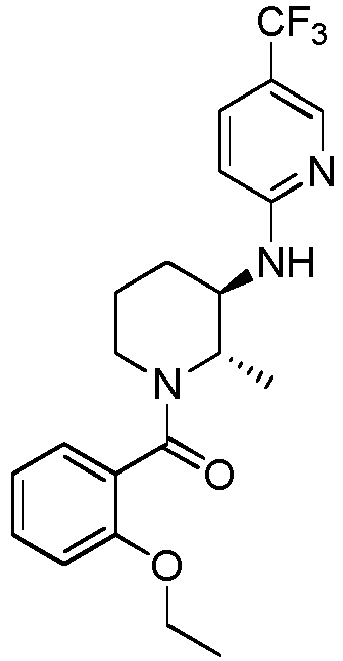
(±)-trans-(2-ethoxyphenyl)(2-methyl-3-((5-(trifluoromethyl)pyridin-2-yl)amino)piperidin-1-yl)methanone. - A compound of claim 1 which is

((2S,3R)-3-((5-bromopyridin-2-yl)amino)-2-methylpiperidin-1-yl)(5-methyl-3-(oxazol-2-yl)pyridin-2-yl)methanone. - A compound of claim 1 which is

((2S*,3R*)-3-(benzo[d]oxazol-2-yl(methyl)amino)-2-methylpiperidin-1-yl)(5-methyl-3-(2H-1,2,3-triazol-2-yl)pyridin-2-yl)methanone. - A compound of claim 1 which is

((2S,3R)-3-((5-chloropyridin-2-yl)oxy)-2-methylpiperidin-1-yl)(3-(pyrimidin-2-yl)pyridin-2-yl)methanone. - A compound of claim 1 which is
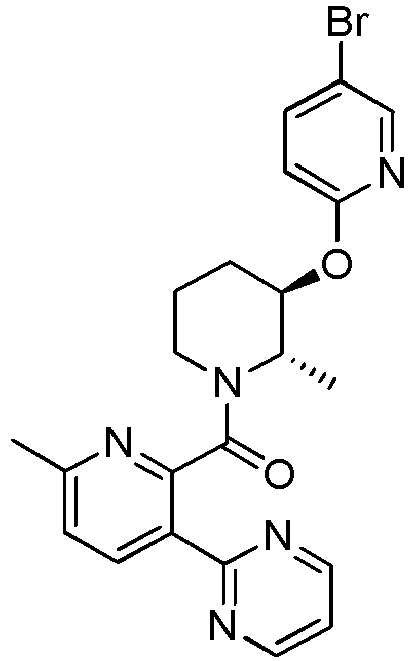
((2S,3R)-3-((5-bromopyridin-2-yl)oxy)-2-methylpiperidin-1-yl)(6-methyl-3-(pyrimidin-2-yl)pyridin-2-yl)methanone. - An enantiomer, diastereomer, tautomer, isotopic variant, or a pharmaceutically acceptable salt or solvate of a compound of any one of claims 1-6.
- A pharmaceutical composition comprising a therapeutically effective amount of a compound according to any one of the preceding claims and at least one pharmaceutically acceptable excipient.
- A compound of any one of claims 1 to 7 for use in treating a disease, disorder, or medical condition, wherein the disease, disorder, or medical condition is a sleep disorder, a metabolic disorder, a neurological disorder, arrhythmias, acute heart failure, ulcers, irritable bowel syndrome, diarrhea, gastroesophageal reflux, a mood disorder, post-traumatic stress disorder, a panic disorder, an attention deficit disorder, cognitive deficiencies, or substance abuse.
- The compound for use of claim 9, wherein the disease, disorder, or medical condition is a mood disorder, post-traumatic stress disorder, a panic disorder, an attention deficit disorder, cognitive deficiencies, or substance abuse.
- The compound for use of claim 9, wherein the disease, disorder, or medical condition is a sleep disorder.
- The compound for use of claim 11, wherein the sleep disorder is a sleep-wake transition disorder, insomnia, restless legs syndrome, jet-lag, disturbed sleep, or a sleep disorder secondary to neurological disorders.
- The compound for use of claim 9, wherein the disease, disorder, or medical condition is a metabolic disorder.
- The compound for use of claim 13, wherein the metabolic disorder is overweight, obesity, insulin resistance, type II diabetes, hyperlipidemia, gallstones, angina, hypertension, breathlessness, tachycardia, infertility, sleep apnea, back and joint pain, varicose veins, or osteoarthritis.
- The compound for use of claim 9, wherein the disease, disorder, or medical condition is a neurological disorder.
- The compound for use of claim 15, wherein the neurological disorder is Parkinson's disease, Alzheimer's disease, Tourette's syndrome, catatonia, anxiety, delirium, or dementias.
Applications Claiming Priority (2)
| Application Number | Priority Date | Filing Date | Title |
|---|---|---|---|
| US201361780302P | 2013-03-13 | 2013-03-13 | |
| PCT/US2014/024284 WO2014165065A1 (en) | 2013-03-13 | 2014-03-12 | Substituted piperidine compounds and their use as orexin receptor modulators |
Publications (2)
| Publication Number | Publication Date |
|---|---|
| EP2970207A1 EP2970207A1 (en) | 2016-01-20 |
| EP2970207B1 true EP2970207B1 (en) | 2018-05-16 |
Family
ID=50842314
Family Applications (1)
| Application Number | Title | Priority Date | Filing Date |
|---|---|---|---|
| EP14727268.6A Active EP2970207B1 (en) | 2013-03-13 | 2014-03-12 | Substituted piperidine compounds and their use as orexin receptor modulators |
Country Status (9)
| Country | Link |
|---|---|
| US (2) | US9611251B2 (en) |
| EP (1) | EP2970207B1 (en) |
| JP (1) | JP6275814B2 (en) |
| CN (1) | CN105228995B (en) |
| AR (1) | AR095422A1 (en) |
| AU (2) | AU2014248763B2 (en) |
| TW (1) | TW201444821A (en) |
| UY (1) | UY35410A (en) |
| WO (1) | WO2014165065A1 (en) |
Families Citing this family (17)
| Publication number | Priority date | Publication date | Assignee | Title |
|---|---|---|---|---|
| EP2937345B1 (en) | 2009-12-29 | 2018-03-21 | Dana-Farber Cancer Institute, Inc. | Type ii raf kinase inhibitors |
| WO2016095204A1 (en) * | 2014-12-19 | 2016-06-23 | Merck Sharp & Dohme Corp. | Pyrrolidine orexin receptor antagonists |
| AU2015371251B2 (en) | 2014-12-23 | 2020-06-11 | Dana-Farber Cancer Institute, Inc. | Inhibitors of cyclin-dependent kinase 7 (CDK7) |
| CN107427521B (en) | 2015-03-27 | 2021-08-03 | 达纳-法伯癌症研究所股份有限公司 | Inhibitors of cyclin-dependent kinases |
| WO2017012502A1 (en) | 2015-07-17 | 2017-01-26 | Sunshine Lake Pharma Co., Ltd. | Substituted quinazoline compounds and preparation and uses thereof |
| SG11201804223TA (en) | 2015-11-23 | 2018-06-28 | Sunshine Lake Pharma Co Ltd | OCTAHYDROPYRROLO [3, 4-c] PYRROLE DERIVATIVES AND USES THEREOF |
| GB201601703D0 (en) * | 2016-01-29 | 2016-03-16 | C4X Discovery Ltd | Therapeutic compounds |
| WO2017223474A1 (en) | 2016-06-23 | 2017-12-28 | St. Jude Children's Research Hospital | Small molecule modulators of pantothenate kinases |
| CN106045902A (en) * | 2016-06-30 | 2016-10-26 | 苏州健雄职业技术学院 | Preparation method of 3-bromo-6-methyl-2-pyridylaldehyde |
| EP3544971B1 (en) | 2016-11-22 | 2022-07-06 | Dana-Farber Cancer Institute, Inc. | Inhibitors of cyclin-dependent kinase 12 (cdk12) and uses thereof |
| KR102582197B1 (en) | 2017-05-03 | 2023-09-22 | 이도르시아 파마슈티컬스 리미티드 | Preparation of 2-([1,2,3]triazol-2-yl)-benzoic acid derivatives |
| JP7527967B2 (en) | 2017-12-27 | 2024-08-05 | セント ジュード チルドレンズ リサーチ ホスピタル,インコーポレイティド | Methods of Treating CASTOR-Related Disorders |
| MX2020006754A (en) | 2017-12-27 | 2021-01-29 | St Jude Childrens Res Hospital Inc | SMALL MOLECULE MODULATORS OF PANTOTHENATO-KINASES. |
| JP7590185B2 (en) | 2018-06-25 | 2024-11-26 | ダナ-ファーバー キャンサー インスティテュート, インコーポレイテッド | TAIRE FAMILY KINASE INHIBITORS AND USES THEREOF - Patent application |
| WO2020140098A1 (en) | 2018-12-28 | 2020-07-02 | Dana-Farber Cancer Institute, Inc. | Inhibitors of cyclin-dependent kinase 7 and uses thereof |
| WO2020198526A2 (en) | 2019-03-27 | 2020-10-01 | St. Jude Children's Research Hospital | Small molecule modulators of pank |
| WO2024148210A1 (en) * | 2023-01-05 | 2024-07-11 | Allianthera (Suzhou) Biopharmaceutical Co., Ltd. | Cyclin-dependent kinase 12 modulators and therapeutic uses thereof |
Family Cites Families (37)
| Publication number | Priority date | Publication date | Assignee | Title |
|---|---|---|---|---|
| US3674793A (en) | 1967-03-29 | 1972-07-04 | Sterling Drug Inc | 6-hydroxy-2-azabicyclo(2.2.2)octan-3-ones and 2-azabicyclo(2.2.2.)octane-3,6-diones |
| US6505492B2 (en) | 2001-04-11 | 2003-01-14 | Bethlehem Steel Corporation | Method and apparatus for forming deep-drawn articles |
| EP1396488A1 (en) | 2001-05-23 | 2004-03-10 | Mitsubishi Pharma Corporation | Fused heterocyclic compound and medicinal use thereof |
| WO2004069816A1 (en) | 2003-02-07 | 2004-08-19 | Ranbaxy Laboratories Limited | Oxazolidinone derivatives as antimicrobials |
| BRPI0407714A (en) | 2003-02-21 | 2006-02-14 | Pharmacia & Up John Company Ll | "exo-2r (+) - t-butyl 2-amino-7-azabicyclo [2.2.1] heptane-7-carboxylate, intermediate, and process for preparing and isolating them |
| AR058554A1 (en) | 2005-12-20 | 2008-02-13 | Novartis Ag | HITEROCICLIC COMPOUNDS NITROGENATED OF 6 SUBSTITUTED MEMBERS, METHODS FOR THEIR PREPARATION, PHARMACEUTICAL COMPOSITIONS CONTAINING THEM AND THEIR USE IN THE TREATMENT OF DISEASES MEDIATED BY MGLUR5. |
| EP2272509A1 (en) | 2006-09-11 | 2011-01-12 | Novartis AG | New Uses of metabotropic glutamate receptors |
| US8133901B2 (en) * | 2006-12-01 | 2012-03-13 | Actelion Pharmaceuticals Ltd. | 3-heteroaryl (amino or amido)-1-(biphenyl or phenylthiazolyl) carbonylpiperidine derivatives as orexin receptor inhibitors |
| TW200833328A (en) | 2006-12-28 | 2008-08-16 | Actelion Pharmaceuticals Ltd | 2-aza-bicyclo[3.1.0]hexane derivatives |
| US8030495B2 (en) | 2007-05-23 | 2011-10-04 | Coleman Paul J | Cyclopropyl pyrrolidine orexin receptor antagonists |
| TW200904440A (en) | 2007-07-17 | 2009-02-01 | Bristol Myers Squibb Co | Method for modulating GPR119 G protein-coupled receptor and selected compounds |
| CA2705411A1 (en) * | 2007-12-21 | 2009-07-02 | F. Hoffmann-La Roche Ag | Heteroaryl derivatives as orexin receptor antagonists |
| BRPI0908096A2 (en) | 2008-02-21 | 2015-08-25 | Actelion Pharmaceuticals Ltd | 2-aza-bicyclo derivative [2.2.1] heptane |
| CN102015645B (en) | 2008-04-30 | 2012-11-14 | 埃科特莱茵药品有限公司 | Piperidine and pyrrolidine compounds |
| MX2011000664A (en) | 2008-07-16 | 2011-02-24 | Schering Corp | Bicyclic heterocycle derivatives and use thereof as gpr119 modulators. |
| WO2010048016A1 (en) | 2008-10-21 | 2010-04-29 | Merck Sharp & Dohme Corp. | 2,3-disubstituted piperidine orexin receptor antagonists |
| JP2012506375A (en) * | 2008-10-21 | 2012-03-15 | メルク・シャープ・エンド・ドーム・コーポレイション | 2,5-disubstituted piperidine orexin receptor antagonist |
| CA2745433A1 (en) | 2008-12-02 | 2010-06-10 | Glaxo Group Ltd. | N-{[(ir,4s,6r-3-(2-pyridinylcarbonyl)-3-azabicyclo [4.1.0]hept-4-yl] methyl}-2-heteroarylamine derivatives and uses thereof |
| AR076024A1 (en) | 2009-04-03 | 2011-05-11 | Schering Corp | DERIVATIVES OF BRIDGED BICYCLIC HETEROCICLES AND METHODS OF USE OF THE SAME |
| US20120040991A1 (en) | 2009-04-24 | 2012-02-16 | Glaxo Group Limited | 3-azabicyclo [4.1.0] heptanes used as orexin antagonists |
| WO2011050202A1 (en) | 2009-10-23 | 2011-04-28 | Janssen Pharmaceutica Nv | Fused heterocyclic compounds as orexin receptor modulators |
| EP2491034B1 (en) | 2009-10-23 | 2013-12-18 | Janssen Pharmaceutica, N.V. | Fused heterocyclic compounds as orexin receptor modulators |
| ES2585806T3 (en) | 2009-10-23 | 2016-10-10 | Janssen Pharmaceutica N.V. | Octahydropyrrolo [3,4-c] disubstituted pyrroles as orexin receptor modulators |
| CA2778684A1 (en) | 2009-10-29 | 2011-05-05 | Schering Corporation | Bridged bicyclic piperidine derivatives and methods of use thereof |
| WO2011066137A1 (en) | 2009-11-24 | 2011-06-03 | Schering Corporation | Substituted biaryl derivatives and methods of use thereof |
| AU2010332010A1 (en) | 2009-12-14 | 2012-08-02 | Inspire Pharmaceuticals, Inc. | Bridged bicyclic Rho kinase inhibitor compounds, composition and use |
| WO2011087812A1 (en) | 2009-12-21 | 2011-07-21 | Vanderbilt University | Alkyl 3-((2-amidoethyl)amino)-8-azabicyclo[3.2.1]octane-8-carboxylate analogs as selective m1 agonists and methods of making and using same |
| UY33227A (en) | 2010-02-19 | 2011-09-30 | Novartis Ag | PIRROLOPIRIMIDINE COMPOUNDS AS INHIBITORS OF THE CDK4 / 6 |
| US20130096141A1 (en) | 2010-06-18 | 2013-04-18 | Bernard R. Neustadt | Bicyclic heterocycle derivatives and methods of use thereof |
| WO2012089606A1 (en) | 2010-12-28 | 2012-07-05 | Glaxo Group Limited | Azabicyclo [4.1.0] hept - 4 - yl derivatives as human orexin receptor antagonists |
| WO2012145581A1 (en) | 2011-04-20 | 2012-10-26 | Janssen Pharmaceutica Nv | Disubstituted octahy-dropyrrolo [3,4-c] pyrroles as orexin receptor modulators |
| AR088352A1 (en) | 2011-10-19 | 2014-05-28 | Merck Sharp & Dohme | ANTAGONISTS OF THE RECEIVER OF 2-PIRIDILOXI-4-NITRILE OREXINE |
| WO2014066196A1 (en) * | 2012-10-23 | 2014-05-01 | Merck Sharp & Dohme Corp. | 2-pyridyloxy-3-substituted-4-nitrile orexin receptor antagonists |
| MX2015006191A (en) | 2012-11-16 | 2015-08-10 | Merck Sharp & Dohme | Purine inhibitors of human phosphatidylinositol 3-kinase delta. |
| TW201444849A (en) | 2013-03-13 | 2014-12-01 | Janssen Pharmaceutica Nv | Substituted 7-azabicycles and their use as orexin receptor modulators |
| TWI621618B (en) | 2013-03-13 | 2018-04-21 | 比利時商健生藥品公司 | Substituted 2-azabicyclics and their use as orexin receptor modulators |
| JP6532474B2 (en) | 2014-02-06 | 2019-06-19 | アッヴィ・インコーポレイテッド | 6-heteroaryloxy- and 6-aryloxy-quinoline-2-carboxamides and their use |
-
2014
- 2014-03-11 TW TW103108298A patent/TW201444821A/en unknown
- 2014-03-12 US US14/774,529 patent/US9611251B2/en active Active
- 2014-03-12 WO PCT/US2014/024284 patent/WO2014165065A1/en not_active Ceased
- 2014-03-12 EP EP14727268.6A patent/EP2970207B1/en active Active
- 2014-03-12 US US14/206,662 patent/US9115117B2/en active Active
- 2014-03-12 CN CN201480027361.3A patent/CN105228995B/en active Active
- 2014-03-12 JP JP2016501463A patent/JP6275814B2/en active Active
- 2014-03-12 AU AU2014248763A patent/AU2014248763B2/en active Active
- 2014-03-13 AR ARP140100966A patent/AR095422A1/en unknown
- 2014-03-13 UY UY0001035410A patent/UY35410A/en unknown
-
2018
- 2018-09-12 AU AU2018229449A patent/AU2018229449A1/en not_active Abandoned
Non-Patent Citations (1)
| Title |
|---|
| None * |
Also Published As
| Publication number | Publication date |
|---|---|
| CN105228995B (en) | 2018-12-25 |
| AU2018229449A1 (en) | 2018-10-04 |
| JP6275814B2 (en) | 2018-02-07 |
| WO2014165065A1 (en) | 2014-10-09 |
| EP2970207A1 (en) | 2016-01-20 |
| UY35410A (en) | 2014-09-30 |
| JP2016512534A (en) | 2016-04-28 |
| US20160046599A1 (en) | 2016-02-18 |
| AU2014248763A1 (en) | 2015-08-27 |
| CN105228995A (en) | 2016-01-06 |
| US9115117B2 (en) | 2015-08-25 |
| US20140275095A1 (en) | 2014-09-18 |
| AR095422A1 (en) | 2015-10-14 |
| AU2014248763B2 (en) | 2018-08-30 |
| US9611251B2 (en) | 2017-04-04 |
| TW201444821A (en) | 2014-12-01 |
Similar Documents
| Publication | Publication Date | Title |
|---|---|---|
| US9611251B2 (en) | Substituted piperidine compounds and their use as orexin receptor modulators | |
| US9695183B2 (en) | Substituted 7-azabicycles and their use as orexin receptor modulators | |
| US9611277B2 (en) | Substituted 2-azabicycles and their use as orexin receptor modulators | |
| EP3191468B1 (en) | Substituted 2-azabicycles and their use as orexin receptor modulators | |
| NZ793902A (en) | Substituted 2-azabicycles and their use as orexin receptor modulators | |
| HK1219726B (en) | Substituted 7-azabicycles and their use as orexin receptor modulators | |
| HK1240934B (en) | Substituted 2-azabicycles and their use as orexin receptor modulators | |
| HK1240934A1 (en) | Substituted 2-azabicycles and their use as orexin receptor modulators | |
| NZ710872B2 (en) | Substituted 2-azabicycles and their use as orexin receptor modulators |
Legal Events
| Date | Code | Title | Description |
|---|---|---|---|
| PUAI | Public reference made under article 153(3) epc to a published international application that has entered the european phase |
Free format text: ORIGINAL CODE: 0009012 |
|
| 17P | Request for examination filed |
Effective date: 20150821 |
|
| AK | Designated contracting states |
Kind code of ref document: A1 Designated state(s): AL AT BE BG CH CY CZ DE DK EE ES FI FR GB GR HR HU IE IS IT LI LT LU LV MC MK MT NL NO PL PT RO RS SE SI SK SM TR |
|
| AX | Request for extension of the european patent |
Extension state: BA ME |
|
| DAX | Request for extension of the european patent (deleted) | ||
| STAA | Information on the status of an ep patent application or granted ep patent |
Free format text: STATUS: EXAMINATION IS IN PROGRESS |
|
| 17Q | First examination report despatched |
Effective date: 20161027 |
|
| GRAP | Despatch of communication of intention to grant a patent |
Free format text: ORIGINAL CODE: EPIDOSNIGR1 |
|
| STAA | Information on the status of an ep patent application or granted ep patent |
Free format text: STATUS: GRANT OF PATENT IS INTENDED |
|
| INTG | Intention to grant announced |
Effective date: 20170529 |
|
| GRAJ | Information related to disapproval of communication of intention to grant by the applicant or resumption of examination proceedings by the epo deleted |
Free format text: ORIGINAL CODE: EPIDOSDIGR1 |
|
| GRAJ | Information related to disapproval of communication of intention to grant by the applicant or resumption of examination proceedings by the epo deleted |
Free format text: ORIGINAL CODE: EPIDOSDIGR1 |
|
| STAA | Information on the status of an ep patent application or granted ep patent |
Free format text: STATUS: EXAMINATION IS IN PROGRESS |
|
| RAP1 | Party data changed (applicant data changed or rights of an application transferred) |
Owner name: JANSSEN PHARMACEUTICA NV |
|
| INTC | Intention to grant announced (deleted) | ||
| GRAP | Despatch of communication of intention to grant a patent |
Free format text: ORIGINAL CODE: EPIDOSNIGR1 |
|
| STAA | Information on the status of an ep patent application or granted ep patent |
Free format text: STATUS: GRANT OF PATENT IS INTENDED |
|
| INTG | Intention to grant announced |
Effective date: 20171123 |
|
| GRAS | Grant fee paid |
Free format text: ORIGINAL CODE: EPIDOSNIGR3 |
|
| GRAA | (expected) grant |
Free format text: ORIGINAL CODE: 0009210 |
|
| STAA | Information on the status of an ep patent application or granted ep patent |
Free format text: STATUS: THE PATENT HAS BEEN GRANTED |
|
| AK | Designated contracting states |
Kind code of ref document: B1 Designated state(s): AL AT BE BG CH CY CZ DE DK EE ES FI FR GB GR HR HU IE IS IT LI LT LU LV MC MK MT NL NO PL PT RO RS SE SI SK SM TR |
|
| REG | Reference to a national code |
Ref country code: GB Ref legal event code: FG4D |
|
| REG | Reference to a national code |
Ref country code: CH Ref legal event code: EP Ref country code: CH Ref legal event code: NV Representative=s name: E. BLUM AND CO. AG PATENT- UND MARKENANWAELTE , CH |
|
| REG | Reference to a national code |
Ref country code: IE Ref legal event code: FG4D |
|
| REG | Reference to a national code |
Ref country code: DE Ref legal event code: R096 Ref document number: 602014025545 Country of ref document: DE |
|
| REG | Reference to a national code |
Ref country code: AT Ref legal event code: REF Ref document number: 999420 Country of ref document: AT Kind code of ref document: T Effective date: 20180615 |
|
| REG | Reference to a national code |
Ref country code: NL Ref legal event code: MP Effective date: 20180516 |
|
| REG | Reference to a national code |
Ref country code: LT Ref legal event code: MG4D |
|
| PG25 | Lapsed in a contracting state [announced via postgrant information from national office to epo] |
Ref country code: BG Free format text: LAPSE BECAUSE OF FAILURE TO SUBMIT A TRANSLATION OF THE DESCRIPTION OR TO PAY THE FEE WITHIN THE PRESCRIBED TIME-LIMIT Effective date: 20180816 Ref country code: NO Free format text: LAPSE BECAUSE OF FAILURE TO SUBMIT A TRANSLATION OF THE DESCRIPTION OR TO PAY THE FEE WITHIN THE PRESCRIBED TIME-LIMIT Effective date: 20180816 Ref country code: FI Free format text: LAPSE BECAUSE OF FAILURE TO SUBMIT A TRANSLATION OF THE DESCRIPTION OR TO PAY THE FEE WITHIN THE PRESCRIBED TIME-LIMIT Effective date: 20180516 Ref country code: SE Free format text: LAPSE BECAUSE OF FAILURE TO SUBMIT A TRANSLATION OF THE DESCRIPTION OR TO PAY THE FEE WITHIN THE PRESCRIBED TIME-LIMIT Effective date: 20180516 Ref country code: ES Free format text: LAPSE BECAUSE OF FAILURE TO SUBMIT A TRANSLATION OF THE DESCRIPTION OR TO PAY THE FEE WITHIN THE PRESCRIBED TIME-LIMIT Effective date: 20180516 Ref country code: LT Free format text: LAPSE BECAUSE OF FAILURE TO SUBMIT A TRANSLATION OF THE DESCRIPTION OR TO PAY THE FEE WITHIN THE PRESCRIBED TIME-LIMIT Effective date: 20180516 |
|
| PG25 | Lapsed in a contracting state [announced via postgrant information from national office to epo] |
Ref country code: NL Free format text: LAPSE BECAUSE OF FAILURE TO SUBMIT A TRANSLATION OF THE DESCRIPTION OR TO PAY THE FEE WITHIN THE PRESCRIBED TIME-LIMIT Effective date: 20180516 Ref country code: HR Free format text: LAPSE BECAUSE OF FAILURE TO SUBMIT A TRANSLATION OF THE DESCRIPTION OR TO PAY THE FEE WITHIN THE PRESCRIBED TIME-LIMIT Effective date: 20180516 Ref country code: LV Free format text: LAPSE BECAUSE OF FAILURE TO SUBMIT A TRANSLATION OF THE DESCRIPTION OR TO PAY THE FEE WITHIN THE PRESCRIBED TIME-LIMIT Effective date: 20180516 Ref country code: GR Free format text: LAPSE BECAUSE OF FAILURE TO SUBMIT A TRANSLATION OF THE DESCRIPTION OR TO PAY THE FEE WITHIN THE PRESCRIBED TIME-LIMIT Effective date: 20180817 Ref country code: RS Free format text: LAPSE BECAUSE OF FAILURE TO SUBMIT A TRANSLATION OF THE DESCRIPTION OR TO PAY THE FEE WITHIN THE PRESCRIBED TIME-LIMIT Effective date: 20180516 |
|
| REG | Reference to a national code |
Ref country code: AT Ref legal event code: MK05 Ref document number: 999420 Country of ref document: AT Kind code of ref document: T Effective date: 20180516 |
|
| PG25 | Lapsed in a contracting state [announced via postgrant information from national office to epo] |
Ref country code: EE Free format text: LAPSE BECAUSE OF FAILURE TO SUBMIT A TRANSLATION OF THE DESCRIPTION OR TO PAY THE FEE WITHIN THE PRESCRIBED TIME-LIMIT Effective date: 20180516 Ref country code: PL Free format text: LAPSE BECAUSE OF FAILURE TO SUBMIT A TRANSLATION OF THE DESCRIPTION OR TO PAY THE FEE WITHIN THE PRESCRIBED TIME-LIMIT Effective date: 20180516 Ref country code: DK Free format text: LAPSE BECAUSE OF FAILURE TO SUBMIT A TRANSLATION OF THE DESCRIPTION OR TO PAY THE FEE WITHIN THE PRESCRIBED TIME-LIMIT Effective date: 20180516 Ref country code: RO Free format text: LAPSE BECAUSE OF FAILURE TO SUBMIT A TRANSLATION OF THE DESCRIPTION OR TO PAY THE FEE WITHIN THE PRESCRIBED TIME-LIMIT Effective date: 20180516 Ref country code: CZ Free format text: LAPSE BECAUSE OF FAILURE TO SUBMIT A TRANSLATION OF THE DESCRIPTION OR TO PAY THE FEE WITHIN THE PRESCRIBED TIME-LIMIT Effective date: 20180516 Ref country code: AT Free format text: LAPSE BECAUSE OF FAILURE TO SUBMIT A TRANSLATION OF THE DESCRIPTION OR TO PAY THE FEE WITHIN THE PRESCRIBED TIME-LIMIT Effective date: 20180516 Ref country code: SK Free format text: LAPSE BECAUSE OF FAILURE TO SUBMIT A TRANSLATION OF THE DESCRIPTION OR TO PAY THE FEE WITHIN THE PRESCRIBED TIME-LIMIT Effective date: 20180516 |
|
| REG | Reference to a national code |
Ref country code: DE Ref legal event code: R097 Ref document number: 602014025545 Country of ref document: DE |
|
| PG25 | Lapsed in a contracting state [announced via postgrant information from national office to epo] |
Ref country code: SM Free format text: LAPSE BECAUSE OF FAILURE TO SUBMIT A TRANSLATION OF THE DESCRIPTION OR TO PAY THE FEE WITHIN THE PRESCRIBED TIME-LIMIT Effective date: 20180516 Ref country code: IT Free format text: LAPSE BECAUSE OF FAILURE TO SUBMIT A TRANSLATION OF THE DESCRIPTION OR TO PAY THE FEE WITHIN THE PRESCRIBED TIME-LIMIT Effective date: 20180516 |
|
| PLBE | No opposition filed within time limit |
Free format text: ORIGINAL CODE: 0009261 |
|
| STAA | Information on the status of an ep patent application or granted ep patent |
Free format text: STATUS: NO OPPOSITION FILED WITHIN TIME LIMIT |
|
| 26N | No opposition filed |
Effective date: 20190219 |
|
| PG25 | Lapsed in a contracting state [announced via postgrant information from national office to epo] |
Ref country code: SI Free format text: LAPSE BECAUSE OF FAILURE TO SUBMIT A TRANSLATION OF THE DESCRIPTION OR TO PAY THE FEE WITHIN THE PRESCRIBED TIME-LIMIT Effective date: 20180516 |
|
| PG25 | Lapsed in a contracting state [announced via postgrant information from national office to epo] |
Ref country code: MC Free format text: LAPSE BECAUSE OF FAILURE TO SUBMIT A TRANSLATION OF THE DESCRIPTION OR TO PAY THE FEE WITHIN THE PRESCRIBED TIME-LIMIT Effective date: 20180516 |
|
| PG25 | Lapsed in a contracting state [announced via postgrant information from national office to epo] |
Ref country code: AL Free format text: LAPSE BECAUSE OF FAILURE TO SUBMIT A TRANSLATION OF THE DESCRIPTION OR TO PAY THE FEE WITHIN THE PRESCRIBED TIME-LIMIT Effective date: 20180516 Ref country code: LU Free format text: LAPSE BECAUSE OF NON-PAYMENT OF DUE FEES Effective date: 20190312 |
|
| PG25 | Lapsed in a contracting state [announced via postgrant information from national office to epo] |
Ref country code: TR Free format text: LAPSE BECAUSE OF FAILURE TO SUBMIT A TRANSLATION OF THE DESCRIPTION OR TO PAY THE FEE WITHIN THE PRESCRIBED TIME-LIMIT Effective date: 20180516 |
|
| PG25 | Lapsed in a contracting state [announced via postgrant information from national office to epo] |
Ref country code: PT Free format text: LAPSE BECAUSE OF FAILURE TO SUBMIT A TRANSLATION OF THE DESCRIPTION OR TO PAY THE FEE WITHIN THE PRESCRIBED TIME-LIMIT Effective date: 20180917 Ref country code: MT Free format text: LAPSE BECAUSE OF NON-PAYMENT OF DUE FEES Effective date: 20190312 |
|
| PG25 | Lapsed in a contracting state [announced via postgrant information from national office to epo] |
Ref country code: CY Free format text: LAPSE BECAUSE OF FAILURE TO SUBMIT A TRANSLATION OF THE DESCRIPTION OR TO PAY THE FEE WITHIN THE PRESCRIBED TIME-LIMIT Effective date: 20180516 |
|
| PG25 | Lapsed in a contracting state [announced via postgrant information from national office to epo] |
Ref country code: IS Free format text: LAPSE BECAUSE OF FAILURE TO SUBMIT A TRANSLATION OF THE DESCRIPTION OR TO PAY THE FEE WITHIN THE PRESCRIBED TIME-LIMIT Effective date: 20180916 |
|
| PG25 | Lapsed in a contracting state [announced via postgrant information from national office to epo] |
Ref country code: HU Free format text: LAPSE BECAUSE OF FAILURE TO SUBMIT A TRANSLATION OF THE DESCRIPTION OR TO PAY THE FEE WITHIN THE PRESCRIBED TIME-LIMIT; INVALID AB INITIO Effective date: 20140312 |
|
| PG25 | Lapsed in a contracting state [announced via postgrant information from national office to epo] |
Ref country code: MK Free format text: LAPSE BECAUSE OF FAILURE TO SUBMIT A TRANSLATION OF THE DESCRIPTION OR TO PAY THE FEE WITHIN THE PRESCRIBED TIME-LIMIT Effective date: 20180516 |
|
| PGFP | Annual fee paid to national office [announced via postgrant information from national office to epo] |
Ref country code: CH Payment date: 20250401 Year of fee payment: 12 |
|
| REG | Reference to a national code |
Ref country code: CH Ref legal event code: U11 Free format text: ST27 STATUS EVENT CODE: U-0-0-U10-U11 (AS PROVIDED BY THE NATIONAL OFFICE) Effective date: 20260401 |
|
| PGFP | Annual fee paid to national office [announced via postgrant information from national office to epo] |
Ref country code: GB Payment date: 20260202 Year of fee payment: 13 |
|
| PGFP | Annual fee paid to national office [announced via postgrant information from national office to epo] |
Ref country code: DE Payment date: 20260204 Year of fee payment: 13 Ref country code: IE Payment date: 20260211 Year of fee payment: 13 |
|
| PGFP | Annual fee paid to national office [announced via postgrant information from national office to epo] |
Ref country code: BE Payment date: 20260216 Year of fee payment: 13 |
|
| PGFP | Annual fee paid to national office [announced via postgrant information from national office to epo] |
Ref country code: FR Payment date: 20260209 Year of fee payment: 13 |