EP2966718A1 - Battery cell comprising stepped structure - Google Patents
Battery cell comprising stepped structure Download PDFInfo
- Publication number
- EP2966718A1 EP2966718A1 EP14759637.3A EP14759637A EP2966718A1 EP 2966718 A1 EP2966718 A1 EP 2966718A1 EP 14759637 A EP14759637 A EP 14759637A EP 2966718 A1 EP2966718 A1 EP 2966718A1
- Authority
- EP
- European Patent Office
- Prior art keywords
- electrode
- battery cell
- cell according
- receiving part
- rolls
- Prior art date
- Legal status (The legal status is an assumption and is not a legal conclusion. Google has not performed a legal analysis and makes no representation as to the accuracy of the status listed.)
- Granted
Links
Images


Classifications
-
- H—ELECTRICITY
- H01—ELECTRIC ELEMENTS
- H01M—PROCESSES OR MEANS, e.g. BATTERIES, FOR THE DIRECT CONVERSION OF CHEMICAL ENERGY INTO ELECTRICAL ENERGY
- H01M10/00—Secondary cells; Manufacture thereof
- H01M10/04—Construction or manufacture in general
- H01M10/0431—Cells with wound or folded electrodes
-
- H—ELECTRICITY
- H01—ELECTRIC ELEMENTS
- H01M—PROCESSES OR MEANS, e.g. BATTERIES, FOR THE DIRECT CONVERSION OF CHEMICAL ENERGY INTO ELECTRICAL ENERGY
- H01M10/00—Secondary cells; Manufacture thereof
- H01M10/05—Accumulators with non-aqueous electrolyte
- H01M10/052—Li-accumulators
-
- H—ELECTRICITY
- H01—ELECTRIC ELEMENTS
- H01M—PROCESSES OR MEANS, e.g. BATTERIES, FOR THE DIRECT CONVERSION OF CHEMICAL ENERGY INTO ELECTRICAL ENERGY
- H01M10/00—Secondary cells; Manufacture thereof
- H01M10/05—Accumulators with non-aqueous electrolyte
- H01M10/052—Li-accumulators
- H01M10/0525—Rocking-chair batteries, i.e. batteries with lithium insertion or intercalation in both electrodes; Lithium-ion batteries
-
- H—ELECTRICITY
- H01—ELECTRIC ELEMENTS
- H01M—PROCESSES OR MEANS, e.g. BATTERIES, FOR THE DIRECT CONVERSION OF CHEMICAL ENERGY INTO ELECTRICAL ENERGY
- H01M10/00—Secondary cells; Manufacture thereof
- H01M10/05—Accumulators with non-aqueous electrolyte
- H01M10/058—Construction or manufacture
- H01M10/0587—Construction or manufacture of accumulators having only wound construction elements, i.e. wound positive electrodes, wound negative electrodes and wound separators
-
- H—ELECTRICITY
- H01—ELECTRIC ELEMENTS
- H01M—PROCESSES OR MEANS, e.g. BATTERIES, FOR THE DIRECT CONVERSION OF CHEMICAL ENERGY INTO ELECTRICAL ENERGY
- H01M50/00—Constructional details or processes of manufacture of the non-active parts of electrochemical cells other than fuel cells, e.g. hybrid cells
- H01M50/10—Primary casings; Jackets or wrappings
- H01M50/102—Primary casings; Jackets or wrappings characterised by their shape or physical structure
-
- H—ELECTRICITY
- H01—ELECTRIC ELEMENTS
- H01M—PROCESSES OR MEANS, e.g. BATTERIES, FOR THE DIRECT CONVERSION OF CHEMICAL ENERGY INTO ELECTRICAL ENERGY
- H01M50/00—Constructional details or processes of manufacture of the non-active parts of electrochemical cells other than fuel cells, e.g. hybrid cells
- H01M50/10—Primary casings; Jackets or wrappings
- H01M50/102—Primary casings; Jackets or wrappings characterised by their shape or physical structure
- H01M50/103—Primary casings; Jackets or wrappings characterised by their shape or physical structure prismatic or rectangular
-
- H—ELECTRICITY
- H01—ELECTRIC ELEMENTS
- H01M—PROCESSES OR MEANS, e.g. BATTERIES, FOR THE DIRECT CONVERSION OF CHEMICAL ENERGY INTO ELECTRICAL ENERGY
- H01M50/00—Constructional details or processes of manufacture of the non-active parts of electrochemical cells other than fuel cells, e.g. hybrid cells
- H01M50/10—Primary casings; Jackets or wrappings
- H01M50/102—Primary casings; Jackets or wrappings characterised by their shape or physical structure
- H01M50/105—Pouches or flexible bags
-
- H—ELECTRICITY
- H01—ELECTRIC ELEMENTS
- H01M—PROCESSES OR MEANS, e.g. BATTERIES, FOR THE DIRECT CONVERSION OF CHEMICAL ENERGY INTO ELECTRICAL ENERGY
- H01M50/00—Constructional details or processes of manufacture of the non-active parts of electrochemical cells other than fuel cells, e.g. hybrid cells
- H01M50/10—Primary casings; Jackets or wrappings
- H01M50/116—Primary casings; Jackets or wrappings characterised by the material
- H01M50/117—Inorganic material
- H01M50/119—Metals
-
- H—ELECTRICITY
- H01—ELECTRIC ELEMENTS
- H01M—PROCESSES OR MEANS, e.g. BATTERIES, FOR THE DIRECT CONVERSION OF CHEMICAL ENERGY INTO ELECTRICAL ENERGY
- H01M50/00—Constructional details or processes of manufacture of the non-active parts of electrochemical cells other than fuel cells, e.g. hybrid cells
- H01M50/10—Primary casings; Jackets or wrappings
- H01M50/116—Primary casings; Jackets or wrappings characterised by the material
- H01M50/121—Organic material
-
- H—ELECTRICITY
- H01—ELECTRIC ELEMENTS
- H01M—PROCESSES OR MEANS, e.g. BATTERIES, FOR THE DIRECT CONVERSION OF CHEMICAL ENERGY INTO ELECTRICAL ENERGY
- H01M50/00—Constructional details or processes of manufacture of the non-active parts of electrochemical cells other than fuel cells, e.g. hybrid cells
- H01M50/10—Primary casings; Jackets or wrappings
- H01M50/116—Primary casings; Jackets or wrappings characterised by the material
- H01M50/124—Primary casings; Jackets or wrappings characterised by the material having a layered structure
-
- H—ELECTRICITY
- H01—ELECTRIC ELEMENTS
- H01M—PROCESSES OR MEANS, e.g. BATTERIES, FOR THE DIRECT CONVERSION OF CHEMICAL ENERGY INTO ELECTRICAL ENERGY
- H01M50/00—Constructional details or processes of manufacture of the non-active parts of electrochemical cells other than fuel cells, e.g. hybrid cells
- H01M50/10—Primary casings; Jackets or wrappings
- H01M50/131—Primary casings; Jackets or wrappings characterised by physical properties, e.g. gas permeability, size or heat resistance
-
- H—ELECTRICITY
- H01—ELECTRIC ELEMENTS
- H01M—PROCESSES OR MEANS, e.g. BATTERIES, FOR THE DIRECT CONVERSION OF CHEMICAL ENERGY INTO ELECTRICAL ENERGY
- H01M50/00—Constructional details or processes of manufacture of the non-active parts of electrochemical cells other than fuel cells, e.g. hybrid cells
- H01M50/10—Primary casings; Jackets or wrappings
- H01M50/131—Primary casings; Jackets or wrappings characterised by physical properties, e.g. gas permeability, size or heat resistance
- H01M50/133—Thickness
-
- H—ELECTRICITY
- H01—ELECTRIC ELEMENTS
- H01M—PROCESSES OR MEANS, e.g. BATTERIES, FOR THE DIRECT CONVERSION OF CHEMICAL ENERGY INTO ELECTRICAL ENERGY
- H01M50/00—Constructional details or processes of manufacture of the non-active parts of electrochemical cells other than fuel cells, e.g. hybrid cells
- H01M50/10—Primary casings; Jackets or wrappings
- H01M50/172—Arrangements of electric connectors penetrating the casing
- H01M50/174—Arrangements of electric connectors penetrating the casing adapted for the shape of the cells
- H01M50/178—Arrangements of electric connectors penetrating the casing adapted for the shape of the cells for pouch or flexible bag cells
-
- H—ELECTRICITY
- H01—ELECTRIC ELEMENTS
- H01M—PROCESSES OR MEANS, e.g. BATTERIES, FOR THE DIRECT CONVERSION OF CHEMICAL ENERGY INTO ELECTRICAL ENERGY
- H01M50/00—Constructional details or processes of manufacture of the non-active parts of electrochemical cells other than fuel cells, e.g. hybrid cells
- H01M50/50—Current conducting connections for cells or batteries
- H01M50/531—Electrode connections inside a battery casing
- H01M50/538—Connection of several leads or tabs of wound or folded electrode stacks
-
- H—ELECTRICITY
- H01—ELECTRIC ELEMENTS
- H01M—PROCESSES OR MEANS, e.g. BATTERIES, FOR THE DIRECT CONVERSION OF CHEMICAL ENERGY INTO ELECTRICAL ENERGY
- H01M50/00—Constructional details or processes of manufacture of the non-active parts of electrochemical cells other than fuel cells, e.g. hybrid cells
- H01M50/50—Current conducting connections for cells or batteries
- H01M50/543—Terminals
- H01M50/547—Terminals characterised by the disposition of the terminals on the cells
-
- H—ELECTRICITY
- H01—ELECTRIC ELEMENTS
- H01M—PROCESSES OR MEANS, e.g. BATTERIES, FOR THE DIRECT CONVERSION OF CHEMICAL ENERGY INTO ELECTRICAL ENERGY
- H01M50/00—Constructional details or processes of manufacture of the non-active parts of electrochemical cells other than fuel cells, e.g. hybrid cells
- H01M50/50—Current conducting connections for cells or batteries
- H01M50/543—Terminals
- H01M50/547—Terminals characterised by the disposition of the terminals on the cells
- H01M50/55—Terminals characterised by the disposition of the terminals on the cells on the same side of the cell
-
- H—ELECTRICITY
- H01—ELECTRIC ELEMENTS
- H01M—PROCESSES OR MEANS, e.g. BATTERIES, FOR THE DIRECT CONVERSION OF CHEMICAL ENERGY INTO ELECTRICAL ENERGY
- H01M50/00—Constructional details or processes of manufacture of the non-active parts of electrochemical cells other than fuel cells, e.g. hybrid cells
- H01M50/50—Current conducting connections for cells or batteries
- H01M50/543—Terminals
- H01M50/552—Terminals characterised by their shape
- H01M50/553—Terminals adapted for prismatic, pouch or rectangular cells
- H01M50/557—Plate-shaped terminals
-
- H—ELECTRICITY
- H01—ELECTRIC ELEMENTS
- H01M—PROCESSES OR MEANS, e.g. BATTERIES, FOR THE DIRECT CONVERSION OF CHEMICAL ENERGY INTO ELECTRICAL ENERGY
- H01M2220/00—Batteries for particular applications
- H01M2220/10—Batteries in stationary systems, e.g. emergency power source in plant
-
- H—ELECTRICITY
- H01—ELECTRIC ELEMENTS
- H01M—PROCESSES OR MEANS, e.g. BATTERIES, FOR THE DIRECT CONVERSION OF CHEMICAL ENERGY INTO ELECTRICAL ENERGY
- H01M2220/00—Batteries for particular applications
- H01M2220/20—Batteries in motive systems, e.g. vehicle, ship, plane
-
- H—ELECTRICITY
- H01—ELECTRIC ELEMENTS
- H01M—PROCESSES OR MEANS, e.g. BATTERIES, FOR THE DIRECT CONVERSION OF CHEMICAL ENERGY INTO ELECTRICAL ENERGY
- H01M2220/00—Batteries for particular applications
- H01M2220/30—Batteries in portable systems, e.g. mobile phone, laptop
-
- H—ELECTRICITY
- H01—ELECTRIC ELEMENTS
- H01M—PROCESSES OR MEANS, e.g. BATTERIES, FOR THE DIRECT CONVERSION OF CHEMICAL ENERGY INTO ELECTRICAL ENERGY
- H01M2300/00—Electrolytes
- H01M2300/0017—Non-aqueous electrolytes
- H01M2300/0065—Solid electrolytes
- H01M2300/0082—Organic polymers
-
- Y—GENERAL TAGGING OF NEW TECHNOLOGICAL DEVELOPMENTS; GENERAL TAGGING OF CROSS-SECTIONAL TECHNOLOGIES SPANNING OVER SEVERAL SECTIONS OF THE IPC; TECHNICAL SUBJECTS COVERED BY FORMER USPC CROSS-REFERENCE ART COLLECTIONS [XRACs] AND DIGESTS
- Y02—TECHNOLOGIES OR APPLICATIONS FOR MITIGATION OR ADAPTATION AGAINST CLIMATE CHANGE
- Y02E—REDUCTION OF GREENHOUSE GAS [GHG] EMISSIONS, RELATED TO ENERGY GENERATION, TRANSMISSION OR DISTRIBUTION
- Y02E60/00—Enabling technologies; Technologies with a potential or indirect contribution to GHG emissions mitigation
- Y02E60/10—Energy storage using batteries
-
- Y—GENERAL TAGGING OF NEW TECHNOLOGICAL DEVELOPMENTS; GENERAL TAGGING OF CROSS-SECTIONAL TECHNOLOGIES SPANNING OVER SEVERAL SECTIONS OF THE IPC; TECHNICAL SUBJECTS COVERED BY FORMER USPC CROSS-REFERENCE ART COLLECTIONS [XRACs] AND DIGESTS
- Y02—TECHNOLOGIES OR APPLICATIONS FOR MITIGATION OR ADAPTATION AGAINST CLIMATE CHANGE
- Y02P—CLIMATE CHANGE MITIGATION TECHNOLOGIES IN THE PRODUCTION OR PROCESSING OF GOODS
- Y02P70/00—Climate change mitigation technologies in the production process for final industrial or consumer products
- Y02P70/50—Manufacturing or production processes characterised by the final manufactured product
-
- Y—GENERAL TAGGING OF NEW TECHNOLOGICAL DEVELOPMENTS; GENERAL TAGGING OF CROSS-SECTIONAL TECHNOLOGIES SPANNING OVER SEVERAL SECTIONS OF THE IPC; TECHNICAL SUBJECTS COVERED BY FORMER USPC CROSS-REFERENCE ART COLLECTIONS [XRACs] AND DIGESTS
- Y02—TECHNOLOGIES OR APPLICATIONS FOR MITIGATION OR ADAPTATION AGAINST CLIMATE CHANGE
- Y02T—CLIMATE CHANGE MITIGATION TECHNOLOGIES RELATED TO TRANSPORTATION
- Y02T10/00—Road transport of goods or passengers
- Y02T10/60—Other road transportation technologies with climate change mitigation effect
- Y02T10/70—Energy storage systems for electromobility, e.g. batteries
Definitions
- the present invention relates to a battery cell including a stepped structure, and more particularly to a battery cell including an electrode assembly configured to have a structure in which two or more electrode rolls are stacked in a height direction on the basis of a plane, wherein the electrode rolls have the same size or at least two of the electrode rolls have different sizes, and the electrode rolls having different sizes are stacked to form one or more stepped structures in width and/or height.
- Secondary batteries are very important to realize such a ubiquitous society. Specifically, secondary batteries, which can be charged and discharged, have been widely used as an energy source for wireless mobile devices. In addition, the secondary batteries have also been used as an energy source for electric vehicles and hybrid electric vehicles, which have been proposed to solve problems, such as air pollution, caused by existing gasoline and diesel vehicles using fossil fuel.
- the secondary batteries As devices, to which the secondary batteries are applicable, are diversified as described above, the secondary batteries have also been diversified such that the secondary batteries can provide outputs and capacities suitable for devices to which the secondary batteries are applied. In addition, there is a strong need to reduce the size and weight of the secondary batteries.
- the secondary batteries may be classified into a cylindrical battery having an electrode assembly mounted in a cylindrical metal can, a prismatic battery having an electrode assembly mounted in a prismatic metal can, and a pouch-shaped battery having an electrode assembly mounted in a pouch-shaped case made of an aluminum laminate sheet.
- the electrode assembly mounted in the battery case functions as a power generating element, having a positive electrode/separator/negative electrode stack structure, which can be charged and discharged.
- the electrode assembly may be classified as a jelly-roll type electrode assembly configured to have a structure in which a long sheet type positive electrode and a long sheet type negative electrode, to which active materials are applied, are wound in a state in which a separator is disposed between the positive electrode and the negative electrode, or a stacked type electrode assembly configured to have a structure in which a plurality of positive electrodes having a predetermined size and a plurality of negative electrodes having a predetermined size are sequentially stacked in a state in which separators are disposed respectively between the positive electrodes and the negative electrodes.
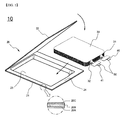
- FIG. 1 is a view showing a general structure of a pouch-shaped battery cell including a stacked type electrode assembly.
- a pouch-shaped battery cell 10 may be configured to have a structure in which an electrode assembly 30, including positive electrodes, negative electrodes, and separators disposed respectively between the positive electrodes and the negative electrodes, each separator being coated with a solid electrolyte, is mounted in a pouch-shaped battery case 20 in a sealed state such that two electrode leads 40 and 41 electrically connected to positive electrode and negative electrode tabs 31 and 32 of the electrode assembly 30 are exposed to the outside.
- the battery case 20 includes a case body 21 having a depressed receiving part 23, in which the electrode assembly 30 is located, and a cover 22 integrally connected to the case body 21.
- the battery case 20 is made of a laminate sheet including an outer resin layer 20A constituting the outermost layer of the laminate sheet, an isolation metal layer 20B for preventing penetration of materials, and an inner resin layer 20C for sealing.
- the positive electrode tabs 31 and the negative electrode tabs 32 of the stacked type electrode assembly 30 are respectively coupled to the electrode leads 40 and 41 by welding.
- insulative films 50 are attached to the top and bottom of each of the electrode leads 40 and 41 to prevent the occurrence of a short circuit between a thermal welding device (not shown) and the electrode leads 40 and 41 and to secure sealing between the electrode leads 40 and 41 and the battery case 20 when the upper end 24 of the case body 21 and the upper end of the cover 22 are thermally welded to each other using the thermal welding device.
- sides of a smartphone may be curved to improve grip.
- a battery cell having the rectangular parallelepiped shape or a battery pack having the rectangular parallelepiped shape is mounted in a device designed so as to have such curved portions, however, space utilization of the device may be lowered.
- the curved portions of the device have dead spaces, in which the battery cell cannot be mounted. Such dead spaces lower the capacity of the device per volume.
- a battery cell configured to have a structure that is capable of reducing dead spaces in devices having various shapes such that the battery cell can be efficiently mounted in the devices while having maximized capacity.
- the present invention has been made to solve the above problems and other technical problems that have yet to be resolved.
- a battery cell configured to have a structure in which the battery cell can be mounted in various spaces of a device, whereby it is possible to maximally utilize an internal space of the device, and the battery cell can be efficiently mounted in various shapes of the device in addition to a rectangular parallelepiped shape of the device.
- a battery cell including an electrode assembly configured to have a structure in which two or more electrode rolls are stacked in a height direction on the basis of a plane, wherein the electrode rolls have the same size or at least two of the electrode rolls have different sizes, and the electrode rolls having different sizes are stacked to form one or more stepped structures in width and/or height.
- the battery cell according to the present invention is based on the specific structure as described above. Consequently, it is possible to manufacture battery cells having various capacities and sizes based on the battery cell according to the present invention. Furthermore, the battery cell according to the present invention may be efficiently mounted in various spaces of a device in which the battery cell is mounted. Consequently, it is possible to maximally utilize an internal space of the device.
- a battery case of the battery cell has a shape corresponding to an external shape of the electrode assembly. Consequently, it is possible to increase the capacity of the battery cell and, in addition, to improve utilization of a surplus space of the battery cell based on a compact structure of the battery cell.
- a jelly-roll type electrode assembly which is manufactured by winding electrodes, generally has a cylindrical structure or a plate-shaped structure having an elliptical shape in section. For this reason, it is difficult to receive the jelly-roll type electrode assembly in battery cases configured to have various shapes, such as an asymmetric shape and a stair shape.
- the electrode assembly is configured to have a structure in which two or more electrode rolls having different sizes are stacked. Consequently, it is possible to manufacture a battery cell having a stepped structure without greatly remodeling conventional equipment.
- each elliptically wound electrode roll may be an electrode roll which is wound to have an elliptical structure in which the width is greater than the height.
- Each elliptically wound electrode roll may be manufactured by winding an assembly electrode sheet into an elliptical shape or winding the assembly electrode sheet into a circular shape in vertical section and pressing the circularly wound assembly electrode sheet.
- the electrode rolls may each have various shapes, such as a polygonal shape, a circular shape, an elliptical shape, and an arc shape.
- the electrode rolls may each have a rectangular planar shape.
- the present invention is not limited thereto. Some of the electrode rolls may each have a rectangular planar shape, and the rest of the electrode rolls may each have a planar shape other than the rectangular planar shape.
- At least two of the electrode rolls may have different structures.
- an upper one of the electrode rolls and a lower one of the electrode rolls may be different from each other in terms of at least one selected from among a thickness, a breadth (horizontal length), and a width (vertical length).
- the upper electrode roll and the lower electrode roll may have different planar sizes.
- the upper electrode roll may have a smaller planar size than the lower electrode roll.
- the electrode rolls may be stacked in a state in which one sides of the electrode rolls are aligned in a straight line. That is, one sides of the electrode rolls may be adjacent to each other in a vertical direction. At this time, the electrode tabs may be located at the aligned sides of the electrode rolls. Consequently, the electrode tabs may be easily connected to each other.
- two of the electrode rolls which are stacked up and down may be configured to have a structure in which a first electrode roll and a second electrode roll, which are formed by respectively winding one end and the other end of an assembly electrode sheet including a positive electrode sheet, a negative electrode sheet, a first separation sheet disposed between the negative electrode sheet and the positive electrode sheet, and a second separation sheet facing the first separation sheet in a state in which the negative electrode sheet or the positive electrode sheet is disposed between the second separation sheet and the first separation sheet, are stacked.
- the first electrode roll and the second electrode roll may each be formed by winding the assembly electrode sheet in a clockwise direction or in a counterclockwise direction. That is, the first electrode roll and the second electrode roll may each be formed by winding the assembly electrode sheet in the same direction or in opposite directions. Specifically, both the first electrode roll and the second electrode roll are configured to have a structure in which the assembly electrode sheet is wound in the clockwise direction or wound in the counterclockwise direction. Alternatively, one of the first electrode roll and the second electrode roll may be configured to have a structure in which the assembly electrode sheet is wound in the clockwise direction, and the other of the first electrode roll and the second electrode roll may be configured to have a structure in which the assembly electrode sheet is wound in the counterclockwise direction.
- the battery cell may be a pouch-shaped battery cell configured to have a structure in which the electrode rolls are received in a pouch-shaped battery case, the electrode rolls are impregnated with an electrolyte, and the battery case is sealed.
- the battery cell may be configured to have a structure in which the electrode assembly is received in a pouch-shaped battery case, the electrode assembly is impregnated with an electrolyte, and the battery case is sealed by thermal welding in a state in which a positive electrode terminal and a negative electrode terminal protrude outward from the battery case.
- the battery case may be a pouch-shaped battery case made of a laminate sheet including a metal layer and a resin layer.
- the laminate sheet may be configured to have a structure in which resin layers are applied to opposite major surfaces of a metal blocking layer.
- the laminate sheet may be configured to have a structure in which an outer resin layer exhibiting high durability is attached to one major surface (outer surface) of the metal blocking layer and a resin sealant layer exhibiting a high thermal bonding property is attached to the other major surface (inner surface) of the metal blocking layer.
- the metal blocking layer may be made of aluminum exhibiting a gas intercepting property and sufficient ductility to configure in the form of a thin film.
- the outer resin layer may be made of a polymer resin, such as polyethylene terephthalate (PET) or oriented nylon film, exhibiting more than predetermined tensile strength and weather resistance.
- PET polyethylene terephthalate
- oriented nylon film exhibiting more than predetermined tensile strength and weather resistance.
- the resin sealant layer may be made of a cast polypropylene (CPP) resin which exhibits a high thermal welding property (thermal adhesive property) and a low hygroscopic property, which is necessary to restrain permeation of an electrolyte, and is neither expanded nor corroded by the electrolyte.
- CPP cast polypropylene
- the battery case may be configured to have a structure having a receiving part corresponding to the outside of the electrode assembly.
- the battery case may be provided with a receiving part having a stepped structure in width and height.
- the battery case may include one or more receiving parts having different widths and heights.
- the receiving parts having different sizes may be different from each other in terms of a horizontal length and/or a vertical length.
- a region of the battery case at which the stepped structure is formed is not particularly restricted.
- the stepped structure may be formed at a region of the battery case at which the electrode terminals are not formed or at a region of the battery case at which the electrode terminals are formed.
- the stepped structure may be formed not only at a region of the battery case at which the electrode terminals are not formed but also at a region of the battery case at which the electrode terminals are formed.
- the battery case is provided with a first receiving part and a second receiving part for receiving the first electrode roll and the second electrode roll having different sizes, respectively.
- the first receiving part and the second receiving part are configured to have structures corresponding to external shapes of the first electrode roll and the second electrode roll, respectively. Consequently, the first receiving part and the second receiving part may have different sizes.
- the first receiving part and the second receiving part may be different from each other in terms of at least one selected from among a thickness, a breadth (horizontal length), and a width (vertical length).
- the first receiving part may have a larger depth that the second receiving part.
- the first receiving part may have a larger planar area than the second receiving part.
- one side of the first receiving part and one side of the second receiving part may be adjacent to each other in a vertical direction.
- the electrode terminals may be located at one side of the first receiving part and one side of the second receiving part adjacent to each other.
- the battery case may include an upper case, at which the first receiving part is formed, and a lower case, at which the second receiving part is formed, and the electrode rolls having different sizes may be received in the first receiving part and the second receiving part.
- the first receiving part and the second receiving part may have different sizes such that the electrode rolls having different sizes can be received in the first receiving part and the second receiving part.
- the battery cell may be a lithium ion battery cell or a lithium ion polymer battery cell.
- the present invention is not limited thereto.
- a device including the battery cell with the above-stated construction as a power source.
- the device may be any one selected from a group consisting of a mobile phone, a portable computer, a smart phone, a tablet PC, a smart pad, a netbook computer, a light electronic vehicle (LEV), an electric vehicle, a hybrid electric vehicle, a plug-in hybrid electric vehicle, and a power storage device.
- LEV light electronic vehicle
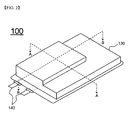
- FIG. 2 is a perspective view showing a battery cell according to an embodiment of the present invention
- FIG. 3 is a vertical sectional view taken along line A-A of FIG. 2 .
- a battery cell 100 is configured to have a structure including an electrode assembly including a first electrode roll 110 and a second electrode roll 120, and a battery case 130 for receiving the electrode assembly.
- the battery cell 100 is configured to have a structure in which the electrode rolls 110 and 120, each of which has an elliptical shape in vertical section, are mounted in the pouch-shaped battery case 130, which is made of a laminate sheet, and electrode leads 140 electrically connected to the first electrode roll 110 and the second electrode roll 120 protrude outward from the battery case 130.
- the battery case 130 includes an upper case 132 and a lower case 134.
- the upper case 132 is provided with receiving parts 136a and 136b for receiving the first electrode roll 110 and the second electrode roll 120.
- the receiving parts 136a and 136b are formed to have shapes corresponding to outer surfaces of the first electrode roll 110 and the second electrode roll 120.
- the first electrode roll 110 and the second electrode roll 120 which have different sizes, constituting the electrode assembly are stacked in a height direction on the basis of a plane.
- the first electrode roll 110 and the second electrode roll 120 are located in the first receiving part 136a and the second receiving part 136b of the battery case 130, respectively.
- the first receiving part 136a and the second receiving part 136b each are configured to have a rectangular shape when viewed from above.
- the planar area and the vertical sectional thickness of the second receiving part 136b are less than those of the first receiving part 136a.
- the battery cell 100 has a step in vertical section. Consequently, a margin space is defined at the outside of the step.
- the margin space is provided to cope with various conditions, such as irregular internal space of a device, to which the battery cell is applied, and interference with other parts.
- the receiving parts 136a and 136b of the battery case 130 and the electrode rolls 110 and 120 may be flexibly changed into various shapes based on conditions applied to the battery cell.
- the battery cell 100 has the above-described structure, it is possible to manufacture the battery cell such that the battery cell has various capacities and sizes, to easily mount the battery cell even in a space, in which a conventional battery cell is difficult to be mounted, and to mount the battery cell while having a larger capacity in a limited space according to the internal structure of a device, thereby maximizing utilization of the internal space of the device.
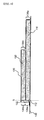
- FIG. 4 is a vertical sectional view taken along line B-B of FIG. 2 .
- the first electrode roll 110 and the second electrode roll 120 are stacked in a state in which one side of the first electrode roll 110 and one side of the second electrode roll 120 are aligned in a straight line S.
- Electrode tabs 112 and 122 are located at one side of the first electrode roll 110 and one side of the second electrode roll 120, respectively.
- the electrode tabs 112 and 122 are coupled to electrode leads 140.
- One end of each of the electrode leads 140 protrudes outward from the battery case 130 to form an electrode terminal.
- the first receiving part 136a and the second receiving part 136b, in which the first electrode roll 110 and the second electrode roll 120 are received, respectively, are adjacent to each other in a vertical direction at one side of the first receiving part 136a at which one of the electrode terminals 140 is located and at one side of the second receiving part 136b at which the other of the electrode terminals 140 is located.
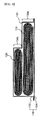
- FIG. 5 is a vertical sectional view showing a battery cell according to another embodiment of the present invention.
- a battery cell 200 is configured to have a structure including an electrode assembly including a first electrode roll 210 and a second electrode roll 220, and a battery case 230 for receiving the electrode assembly.
- the first electrode roll 210 and the second electrode roll 220 are manufactured by winding one end and the other end of an assembly electrode sheet 215 including a positive electrode sheet, a first separation sheet, a negative electrode sheet, and a second separation sheet, which are stacked.
- the first electrode roll 210 and the second electrode roll 220 are stacked in a vertical direction.
- a length L 2 of the second electrode roll 220 is less than a length L 1 of the first electrode roll 210.
- the battery cell has a stair-shaped structure due to a length difference between the first electrode roll 210 and the second electrode roll 220.
- the first electrode roll 210 and the second electrode roll 220 each are configured to have a structure in which the assembly electrode sheet 215 is wound approximately in an elliptical shape in vertical section.
- the first electrode roll 210 is configured to have a structure in which one end of the assembly electrode sheet 215 is wound in a counterclockwise direction
- the second electrode roll 220 is configured to have a structure in which the other end of the assembly electrode sheet 215 is wound in a clockwise direction.
- the battery case 230 is configured to have a stepped structure corresponding to the stacked structure of the first electrode roll 210 and the second electrode roll 220 such that the first electrode roll 210 and the second electrode roll 220 can be efficiently mounted in the battery case 230.
- FIG. 6 is a perspective view showing a battery cell according to a further embodiment of the present invention
- FIG. 7 is a vertical sectional view taken along line C-C of FIG. 6 .
- a battery cell 300 is configured to have a structure in which an electrode assembly including a first electrode roll 310 and a second electrode roll 320 is mounted in a battery case 330 made of a laminate sheet, and electrode leads 340 electrically connected to the electrode rolls 310 and 320 protrude outward from the battery case 330.
- the battery case 330 includes an upper case 332 and a lower case 334.
- the upper case 332 and the lower case 334 are provided with a second receiving part 333 and a first receiving part 335 for receiving the second electrode roll 320 and the first electrode roll 310, respectively.
- the first receiving part 335 and the second receiving part 335 of the battery case 330 are configured in the form of rectangles having different planar sizes.
- the receiving parts 335 and 333 have internal shapes corresponding to external shapes of the first electrode roll 310 and the second electrode roll 320.
- the first electrode roll 310 and the second electrode roll 320 have different planar lengths and planar widths.
- the first electrode roll 310 and the second electrode roll 320 are stacked in a height direction on the basis of a plane.
- the first electrode roll 310 and the second electrode roll 320 are received in the first receiving part 335 and the second receiving part 333 of the battery case 330, respectively.
- first electrode roll 310 and the second electrode roll 320 are stacked such that electrode tabs 312 and 322 are arranged in the same direction.
- the electrode tabs 312 and 322 are electrically connected to each other such that the electrode tabs 312 and 322 have the same polarities.
- one side of the first electrode roll 310 from which the electrode tabs 312 protrude and one side of the second electrode roll 320 from which the electrode tabs 322 protrude are adjacent to each other in a vertical direction such that the electrode tabs 312 and 322 can be easily connected to each other.
- the battery cell includes two electrode rolls.
- the present invention is not limited thereto.
- a battery cell configured to have a structure in which three or more electrode rolls are received in a battery case, and the electrode rolls are stacked in a state in which at least two of the electrode rolls have different sizes may be applied as an embodiment of the present invention.
- a battery cell according to the present invention is configured such that electrode rolls having different sizes are stacked to form a stepped structure, whereby it is possible to easily secure a battery cell installation space, to maximally utilize an internal space of a device by utilizing a dead space defined in the device, to mount a high-capacity battery cell in the device, and to more miniaturize the device.
Landscapes
- Chemical & Material Sciences (AREA)
- Chemical Kinetics & Catalysis (AREA)
- Electrochemistry (AREA)
- General Chemical & Material Sciences (AREA)
- Engineering & Computer Science (AREA)
- Manufacturing & Machinery (AREA)
- Inorganic Chemistry (AREA)
- Secondary Cells (AREA)
- Materials Engineering (AREA)
- Sealing Battery Cases Or Jackets (AREA)
- Connection Of Batteries Or Terminals (AREA)
- Battery Mounting, Suspending (AREA)
Abstract
Description
- The present invention relates to a battery cell including a stepped structure, and more particularly to a battery cell including an electrode assembly configured to have a structure in which two or more electrode rolls are stacked in a height direction on the basis of a plane, wherein the electrode rolls have the same size or at least two of the electrode rolls have different sizes, and the electrode rolls having different sizes are stacked to form one or more stepped structures in width and/or height.
- With remarkable development of information technology (IT), a great variety of portable information communication devices has been popularized. As a result, in the 21st century, we are moving toward a ubiquitous society in which high-quality information service is possible regardless of time and place.
- Secondary batteries are very important to realize such a ubiquitous society. Specifically, secondary batteries, which can be charged and discharged, have been widely used as an energy source for wireless mobile devices. In addition, the secondary batteries have also been used as an energy source for electric vehicles and hybrid electric vehicles, which have been proposed to solve problems, such as air pollution, caused by existing gasoline and diesel vehicles using fossil fuel.
- As devices, to which the secondary batteries are applicable, are diversified as described above, the secondary batteries have also been diversified such that the secondary batteries can provide outputs and capacities suitable for devices to which the secondary batteries are applied. In addition, there is a strong need to reduce the size and weight of the secondary batteries.
- Based on the shape of a battery case, the secondary batteries may be classified into a cylindrical battery having an electrode assembly mounted in a cylindrical metal can, a prismatic battery having an electrode assembly mounted in a prismatic metal can, and a pouch-shaped battery having an electrode assembly mounted in a pouch-shaped case made of an aluminum laminate sheet.
- The electrode assembly mounted in the battery case functions as a power generating element, having a positive electrode/separator/negative electrode stack structure, which can be charged and discharged. The electrode assembly may be classified as a jelly-roll type electrode assembly configured to have a structure in which a long sheet type positive electrode and a long sheet type negative electrode, to which active materials are applied, are wound in a state in which a separator is disposed between the positive electrode and the negative electrode, or a stacked type electrode assembly configured to have a structure in which a plurality of positive electrodes having a predetermined size and a plurality of negative electrodes having a predetermined size are sequentially stacked in a state in which separators are disposed respectively between the positive electrodes and the negative electrodes.
-
FIG. 1 is a view showing a general structure of a pouch-shaped battery cell including a stacked type electrode assembly. - Referring to
FIG. 1 , a pouch-shaped battery cell 10 may be configured to have a structure in which anelectrode assembly 30, including positive electrodes, negative electrodes, and separators disposed respectively between the positive electrodes and the negative electrodes, each separator being coated with a solid electrolyte, is mounted in a pouch-shaped battery case 20 in a sealed state such that two electrode leads 40 and 41 electrically connected to positive electrode andnegative electrode tabs electrode assembly 30 are exposed to the outside. - The
battery case 20 includes acase body 21 having a depressed receivingpart 23, in which theelectrode assembly 30 is located, and acover 22 integrally connected to thecase body 21. - The
battery case 20 is made of a laminate sheet including anouter resin layer 20A constituting the outermost layer of the laminate sheet, anisolation metal layer 20B for preventing penetration of materials, and aninner resin layer 20C for sealing. - The
positive electrode tabs 31 and thenegative electrode tabs 32 of the stackedtype electrode assembly 30 are respectively coupled to the electrode leads 40 and 41 by welding. In addition,insulative films 50 are attached to the top and bottom of each of the electrode leads 40 and 41 to prevent the occurrence of a short circuit between a thermal welding device (not shown) and the electrode leads 40 and 41 and to secure sealing between the electrode leads 40 and 41 and thebattery case 20 when theupper end 24 of thecase body 21 and the upper end of thecover 22 are thermally welded to each other using the thermal welding device. - In recent years, however, new types of battery cells have been required in accordance with a trend change for a slim type design or various other designs. Specifically, there are needed battery cells that can be efficiently mounted even in devices which do not have a sufficient battery cell receiving space according to the reduction in size and thickness of the devices.
- In addition, conventional devices were manufactured so as to have an approximately rectangular parallelepiped shape. In recent years, however, there have been developed devices having various other shapes. Battery cells having a rectangular parallelepiped shape or a cylindrical shape may not be efficiently mounted in the devices having various other shapes as described above.
- For example, sides of a smartphone may be curved to improve grip. In a case in which a battery cell having the rectangular parallelepiped shape or a battery pack having the rectangular parallelepiped shape is mounted in a device designed so as to have such curved portions, however, space utilization of the device may be lowered.
- That is, the curved portions of the device have dead spaces, in which the battery cell cannot be mounted. Such dead spaces lower the capacity of the device per volume.
- Therefore, there is a high necessity for a battery cell configured to have a structure that is capable of reducing dead spaces in devices having various shapes such that the battery cell can be efficiently mounted in the devices while having maximized capacity.
- The present invention has been made to solve the above problems and other technical problems that have yet to be resolved.
- Specifically, it is an object of the present invention to provide a battery cell configured to have a structure in which the battery cell can be mounted in various spaces of a device, whereby it is possible to maximally utilize an internal space of the device, and the battery cell can be efficiently mounted in various shapes of the device in addition to a rectangular parallelepiped shape of the device.
- In accordance with one aspect of the present invention, the above and other objects can be accomplished by the provision of a battery cell including an electrode assembly configured to have a structure in which two or more electrode rolls are stacked in a height direction on the basis of a plane, wherein the electrode rolls have the same size or at least two of the electrode rolls have different sizes, and the electrode rolls having different sizes are stacked to form one or more stepped structures in width and/or height.
- The battery cell according to the present invention is based on the specific structure as described above. Consequently, it is possible to manufacture battery cells having various capacities and sizes based on the battery cell according to the present invention. Furthermore, the battery cell according to the present invention may be efficiently mounted in various spaces of a device in which the battery cell is mounted. Consequently, it is possible to maximally utilize an internal space of the device.
- In addition, a battery case of the battery cell has a shape corresponding to an external shape of the electrode assembly. Consequently, it is possible to increase the capacity of the battery cell and, in addition, to improve utilization of a surplus space of the battery cell based on a compact structure of the battery cell.
- Meanwhile, a jelly-roll type electrode assembly, which is manufactured by winding electrodes, generally has a cylindrical structure or a plate-shaped structure having an elliptical shape in section. For this reason, it is difficult to receive the jelly-roll type electrode assembly in battery cases configured to have various shapes, such as an asymmetric shape and a stair shape.
- In the battery cell according to the present invention, on the other hand, the electrode assembly is configured to have a structure in which two or more electrode rolls having different sizes are stacked. Consequently, it is possible to manufacture a battery cell having a stepped structure without greatly remodeling conventional equipment.
- The electrode rolls each are configured to have a circularly or elliptically wound structure in vertical section in a direction in which electrode tabs protrude. For example, each elliptically wound electrode roll may be an electrode roll which is wound to have an elliptical structure in which the width is greater than the height. Each elliptically wound electrode roll may be manufactured by winding an assembly electrode sheet into an elliptical shape or winding the assembly electrode sheet into a circular shape in vertical section and pressing the circularly wound assembly electrode sheet.
- The electrode rolls may each have various shapes, such as a polygonal shape, a circular shape, an elliptical shape, and an arc shape. For example, the electrode rolls may each have a rectangular planar shape. However, the present invention is not limited thereto. Some of the electrode rolls may each have a rectangular planar shape, and the rest of the electrode rolls may each have a planar shape other than the rectangular planar shape.
- As described above, at least two of the electrode rolls may have different structures. For example, in the stacked structure of the electrode rolls, an upper one of the electrode rolls and a lower one of the electrode rolls may be different from each other in terms of at least one selected from among a thickness, a breadth (horizontal length), and a width (vertical length).
- For example, the upper electrode roll and the lower electrode roll may have different planar sizes. In this case, the upper electrode roll may have a smaller planar size than the lower electrode roll.
- In a concrete example, the electrode rolls may be stacked in a state in which one sides of the electrode rolls are aligned in a straight line. That is, one sides of the electrode rolls may be adjacent to each other in a vertical direction. At this time, the electrode tabs may be located at the aligned sides of the electrode rolls. Consequently, the electrode tabs may be easily connected to each other.
- In a concrete example, two of the electrode rolls which are stacked up and down may be configured to have a structure in which a first electrode roll and a second electrode roll, which are formed by respectively winding one end and the other end of an assembly electrode sheet including a positive electrode sheet, a negative electrode sheet, a first separation sheet disposed between the negative electrode sheet and the positive electrode sheet, and a second separation sheet facing the first separation sheet in a state in which the negative electrode sheet or the positive electrode sheet is disposed between the second separation sheet and the first separation sheet, are stacked.
- The first electrode roll and the second electrode roll may each be formed by winding the assembly electrode sheet in a clockwise direction or in a counterclockwise direction. That is, the first electrode roll and the second electrode roll may each be formed by winding the assembly electrode sheet in the same direction or in opposite directions. Specifically, both the first electrode roll and the second electrode roll are configured to have a structure in which the assembly electrode sheet is wound in the clockwise direction or wound in the counterclockwise direction. Alternatively, one of the first electrode roll and the second electrode roll may be configured to have a structure in which the assembly electrode sheet is wound in the clockwise direction, and the other of the first electrode roll and the second electrode roll may be configured to have a structure in which the assembly electrode sheet is wound in the counterclockwise direction.
- The battery cell may be a pouch-shaped battery cell configured to have a structure in which the electrode rolls are received in a pouch-shaped battery case, the electrode rolls are impregnated with an electrolyte, and the battery case is sealed. Specifically, the battery cell may be configured to have a structure in which the electrode assembly is received in a pouch-shaped battery case, the electrode assembly is impregnated with an electrolyte, and the battery case is sealed by thermal welding in a state in which a positive electrode terminal and a negative electrode terminal protrude outward from the battery case.
- The battery case may be a pouch-shaped battery case made of a laminate sheet including a metal layer and a resin layer.
- The laminate sheet may be configured to have a structure in which resin layers are applied to opposite major surfaces of a metal blocking layer. For example, the laminate sheet may be configured to have a structure in which an outer resin layer exhibiting high durability is attached to one major surface (outer surface) of the metal blocking layer and a resin sealant layer exhibiting a high thermal bonding property is attached to the other major surface (inner surface) of the metal blocking layer.
- In a concrete example, the metal blocking layer may be made of aluminum exhibiting a gas intercepting property and sufficient ductility to configure in the form of a thin film.
- It is required for the outer resin layer to exhibit high resistance against external environment. For this reason, the outer resin layer may be made of a polymer resin, such as polyethylene terephthalate (PET) or oriented nylon film, exhibiting more than predetermined tensile strength and weather resistance.
- In addition, the resin sealant layer may be made of a cast polypropylene (CPP) resin which exhibits a high thermal welding property (thermal adhesive property) and a low hygroscopic property, which is necessary to restrain permeation of an electrolyte, and is neither expanded nor corroded by the electrolyte.
- Meanwhile, the battery case may be configured to have a structure having a receiving part corresponding to the outside of the electrode assembly. For example, the battery case may be provided with a receiving part having a stepped structure in width and height.
- Specifically, the battery case may include one or more receiving parts having different widths and heights. The receiving parts having different sizes may be different from each other in terms of a horizontal length and/or a vertical length.
- A region of the battery case at which the stepped structure is formed is not particularly restricted. Specifically, the stepped structure may be formed at a region of the battery case at which the electrode terminals are not formed or at a region of the battery case at which the electrode terminals are formed. Alternatively, the stepped structure may be formed not only at a region of the battery case at which the electrode terminals are not formed but also at a region of the battery case at which the electrode terminals are formed.
- In a concrete example, the battery case is provided with a first receiving part and a second receiving part for receiving the first electrode roll and the second electrode roll having different sizes, respectively.
- The first receiving part and the second receiving part are configured to have structures corresponding to external shapes of the first electrode roll and the second electrode roll, respectively. Consequently, the first receiving part and the second receiving part may have different sizes.
- For example, the first receiving part and the second receiving part may be different from each other in terms of at least one selected from among a thickness, a breadth (horizontal length), and a width (vertical length).
- In addition, the first receiving part may have a larger depth that the second receiving part.
- On the other hand, the first receiving part may have a larger planar area than the second receiving part.
- Meanwhile, one side of the first receiving part and one side of the second receiving part may be adjacent to each other in a vertical direction. At this time, the electrode terminals may be located at one side of the first receiving part and one side of the second receiving part adjacent to each other.
- In addition, the battery case may include an upper case, at which the first receiving part is formed, and a lower case, at which the second receiving part is formed, and the electrode rolls having different sizes may be received in the first receiving part and the second receiving part. Specifically, the first receiving part and the second receiving part may have different sizes such that the electrode rolls having different sizes can be received in the first receiving part and the second receiving part.
- When the upper case and the lower case are coupled to each other, therefore, a step may be formed at the battery case due to the difference in size between the receiving parts.
- The battery cell may be a lithium ion battery cell or a lithium ion polymer battery cell. However, the present invention is not limited thereto.
- In accordance with another aspect of the present invention, there is provided a device including the battery cell with the above-stated construction as a power source. The device may be any one selected from a group consisting of a mobile phone, a portable computer, a smart phone, a tablet PC, a smart pad, a netbook computer, a light electronic vehicle (LEV), an electric vehicle, a hybrid electric vehicle, a plug-in hybrid electric vehicle, and a power storage device.
- The structure and manufacturing method of the device are well known in the art to which the present invention pertains, and therefore a detailed description thereof will be omitted.
- The above and other objects, features and other advantages of the present invention will be more clearly understood from the following detailed description taken in conjunction with the accompanying drawings, in which:
-
FIG. 1 is an exploded perspective view showing a conventional pouch-shaped battery cell; -
FIG. 2 is a perspective view showing a battery cell according to an embodiment of the present invention; -
FIG. 3 is a vertical sectional view taken along line A-A ofFIG. 2 ; -
FIG. 4 is a vertical sectional view taken along line B-B ofFIG. 2 ; -
FIG. 5 is a vertical sectional view showing a battery cell according to another embodiment of the present invention; -
FIG. 6 is a perspective view showing a battery cell according to a further embodiment of the present invention; and -
FIG. 7 is a vertical sectional view taken along line C-C ofFIG. 6 . - Now, exemplary embodiments of the present invention will be described in detail with reference to the accompanying drawings. It should be noted, however, that the scope of the present invention is not limited by the illustrated embodiments.
-
FIG. 2 is a perspective view showing a battery cell according to an embodiment of the present invention, andFIG. 3 is a vertical sectional view taken along line A-A ofFIG. 2 . - Referring to
FIGS. 2 and3 , abattery cell 100 is configured to have a structure including an electrode assembly including afirst electrode roll 110 and asecond electrode roll 120, and abattery case 130 for receiving the electrode assembly. - The
battery cell 100 is configured to have a structure in which the electrode rolls 110 and 120, each of which has an elliptical shape in vertical section, are mounted in the pouch-shapedbattery case 130, which is made of a laminate sheet, and electrode leads 140 electrically connected to thefirst electrode roll 110 and thesecond electrode roll 120 protrude outward from thebattery case 130. Thebattery case 130 includes anupper case 132 and alower case 134. Theupper case 132 is provided with receivingparts first electrode roll 110 and thesecond electrode roll 120. The receivingparts first electrode roll 110 and thesecond electrode roll 120. - The
first electrode roll 110 and thesecond electrode roll 120, which have different sizes, constituting the electrode assembly are stacked in a height direction on the basis of a plane. Thefirst electrode roll 110 and thesecond electrode roll 120 are located in the first receivingpart 136a and the second receivingpart 136b of thebattery case 130, respectively. - The
first receiving part 136a and the second receivingpart 136b each are configured to have a rectangular shape when viewed from above. The planar area and the vertical sectional thickness of the second receivingpart 136b are less than those of the first receivingpart 136a. - In this structure, the
battery cell 100 has a step in vertical section. Consequently, a margin space is defined at the outside of the step. The margin space is provided to cope with various conditions, such as irregular internal space of a device, to which the battery cell is applied, and interference with other parts. The receivingparts battery case 130 and the electrode rolls 110 and 120 may be flexibly changed into various shapes based on conditions applied to the battery cell. - In a case in which the
battery cell 100 has the above-described structure, it is possible to manufacture the battery cell such that the battery cell has various capacities and sizes, to easily mount the battery cell even in a space, in which a conventional battery cell is difficult to be mounted, and to mount the battery cell while having a larger capacity in a limited space according to the internal structure of a device, thereby maximizing utilization of the internal space of the device. -
FIG. 4 is a vertical sectional view taken along line B-B ofFIG. 2 . Referring toFIG. 4 , thefirst electrode roll 110 and thesecond electrode roll 120 are stacked in a state in which one side of thefirst electrode roll 110 and one side of thesecond electrode roll 120 are aligned in a straight lineS. Electrode tabs first electrode roll 110 and one side of thesecond electrode roll 120, respectively. Theelectrode tabs battery case 130 to form an electrode terminal. - The
first receiving part 136a and the second receivingpart 136b, in which thefirst electrode roll 110 and thesecond electrode roll 120 are received, respectively, are adjacent to each other in a vertical direction at one side of the first receivingpart 136a at which one of theelectrode terminals 140 is located and at one side of the second receivingpart 136b at which the other of theelectrode terminals 140 is located. -
FIG. 5 is a vertical sectional view showing a battery cell according to another embodiment of the present invention. - Referring to
FIG. 5 , abattery cell 200 is configured to have a structure including an electrode assembly including afirst electrode roll 210 and asecond electrode roll 220, and abattery case 230 for receiving the electrode assembly. - The
first electrode roll 210 and thesecond electrode roll 220 are manufactured by winding one end and the other end of anassembly electrode sheet 215 including a positive electrode sheet, a first separation sheet, a negative electrode sheet, and a second separation sheet, which are stacked. Thefirst electrode roll 210 and thesecond electrode roll 220 are stacked in a vertical direction. A length L2 of thesecond electrode roll 220 is less than a length L1 of thefirst electrode roll 210. When thefirst electrode roll 210 and thesecond electrode roll 220 are stacked in the vertical direction, the battery cell has a stepped structure. - That is, the battery cell has a stair-shaped structure due to a length difference between the
first electrode roll 210 and thesecond electrode roll 220. - The
first electrode roll 210 and thesecond electrode roll 220 each are configured to have a structure in which theassembly electrode sheet 215 is wound approximately in an elliptical shape in vertical section. Thefirst electrode roll 210 is configured to have a structure in which one end of theassembly electrode sheet 215 is wound in a counterclockwise direction, and thesecond electrode roll 220 is configured to have a structure in which the other end of theassembly electrode sheet 215 is wound in a clockwise direction. - The
battery case 230 is configured to have a stepped structure corresponding to the stacked structure of thefirst electrode roll 210 and thesecond electrode roll 220 such that thefirst electrode roll 210 and thesecond electrode roll 220 can be efficiently mounted in thebattery case 230. -
FIG. 6 is a perspective view showing a battery cell according to a further embodiment of the present invention, andFIG. 7 is a vertical sectional view taken along line C-C ofFIG. 6 . - Referring to
FIGS. 6 and7 , abattery cell 300 is configured to have a structure in which an electrode assembly including afirst electrode roll 310 and asecond electrode roll 320 is mounted in abattery case 330 made of a laminate sheet, and electrode leads 340 electrically connected to the electrode rolls 310 and 320 protrude outward from thebattery case 330. Thebattery case 330 includes anupper case 332 and alower case 334. Theupper case 332 and thelower case 334 are provided with asecond receiving part 333 and a first receivingpart 335 for receiving thesecond electrode roll 320 and thefirst electrode roll 310, respectively. - The
first receiving part 335 and the second receivingpart 335 of thebattery case 330 are configured in the form of rectangles having different planar sizes. The receivingparts first electrode roll 310 and thesecond electrode roll 320. Thefirst electrode roll 310 and thesecond electrode roll 320 have different planar lengths and planar widths. Thefirst electrode roll 310 and thesecond electrode roll 320 are stacked in a height direction on the basis of a plane. Thefirst electrode roll 310 and thesecond electrode roll 320 are received in the first receivingpart 335 and the second receivingpart 333 of thebattery case 330, respectively. - In addition, the
first electrode roll 310 and thesecond electrode roll 320 are stacked such thatelectrode tabs electrode tabs electrode tabs first electrode roll 310 from which theelectrode tabs 312 protrude and one side of thesecond electrode roll 320 from which theelectrode tabs 322 protrude are adjacent to each other in a vertical direction such that theelectrode tabs - In the above-described embodiments of the present invention, the battery cell includes two electrode rolls. However, the present invention is not limited thereto. A battery cell configured to have a structure in which three or more electrode rolls are received in a battery case, and the electrode rolls are stacked in a state in which at least two of the electrode rolls have different sizes may be applied as an embodiment of the present invention.
- Although the preferred embodiments of the present invention have been disclosed for illustrative purposes, those skilled in the art will appreciate that various modifications, additions and substitutions are possible, without departing from the scope and spirit of the invention as disclosed in the accompanying claims.
- As is apparent from the above description, a battery cell according to the present invention is configured such that electrode rolls having different sizes are stacked to form a stepped structure, whereby it is possible to easily secure a battery cell installation space, to maximally utilize an internal space of a device by utilizing a dead space defined in the device, to mount a high-capacity battery cell in the device, and to more miniaturize the device.
Claims (25)
- A battery cell comprising an electrode assembly configured to have a structure in which two or more electrode rolls are stacked in a height direction on the basis of a plane, wherein
the electrode rolls have the same size or at least two of the electrode rolls have different sizes, and
the electrode rolls having different sizes are stacked to form one or more stepped structures in width and/or height. - The battery cell according to claim 1, wherein the electrode rolls each are configured to have an elliptically wound structure in vertical section in a direction in which electrode tabs protrude.
- The battery cell according to claim 1, wherein the electrode rolls each have a rectangular planar shape.
- The battery cell according to claim 1, wherein, in the structure in which the electrode rolls having different sizes are stacked, an upper one of the electrode rolls and a lower one of the electrode rolls are different from each other in terms of at least one selected from among a thickness, a breadth (horizontal length), and a width (vertical length).
- The battery cell according to claim 4, wherein the electrode rolls having different sizes are different from each other in terms of a planar size.
- The battery cell according to claim 1, wherein the electrode rolls are stacked in a state in which one sides of the electrode rolls are aligned in a straight line.
- The battery cell according to claim 6, wherein electrode tabs are located at the aligned sides of the electrode rolls.
- The battery cell according to claim 1, wherein electrode tabs of the electrode rolls are coupled to each other to form electrode terminals of the battery cell.
- The battery cell according to claim 1, wherein two of the electrode rolls which are stacked up and down are configured to have a structure in which a first electrode roll and a second electrode roll, which are formed by respectively winding one end and the other end of an assembly electrode sheet comprising a positive electrode sheet, a negative electrode sheet, a first separation sheet disposed between the negative electrode sheet and the positive electrode sheet, and a second separation sheet facing the first separation sheet in a state in which the negative electrode sheet or the positive electrode sheet is disposed between the second separation sheet and the first separation sheet, are stacked.
- The battery cell according to claim 9, wherein the first electrode roll and the second electrode roll each are configured to have a structure in which the assembly electrode sheet is wound in a clockwise direction or in a counterclockwise direction.
- The battery cell according to claim 9, wherein one of the first electrode roll and the second electrode roll is configured to have a structure in which the assembly electrode sheet is wound in the clockwise direction, and the other of the first electrode roll and the second electrode roll is configured to have a structure in which the assembly electrode sheet is wound in the counterclockwise direction.
- The battery cell according to claim 1, wherein the battery cell is a pouch-shaped battery cell configured to have a structure in which the electrode rolls are received in a battery case, the electrode rolls are impregnated with an electrolyte, the battery case is sealed by thermal welding, and a positive electrode terminal and a negative electrode terminal protrude outward from the battery case.
- The battery cell according to claim 12, wherein the battery case is made of a laminate sheet comprising a metal layer and a resin layer.
- The battery cell according to claim 12, wherein the battery case is provided with a receiving part having a stepped structure in width and height.
- The battery cell according to claim 14, wherein the stepped structure is formed at a region of the battery case at which the electrode terminals are not formed.
- The battery cell according to claim 12, wherein the battery case is provided with a first receiving part and a second receiving part for receiving a first electrode roll and a second electrode roll having different sizes, respectively.
- The battery cell according to claim 16, wherein the first receiving part and the second receiving part are different from each other in terms of at least one selected from among a thickness, a breadth (horizontal length), and a width (vertical length).
- The battery cell according to claim 16, wherein the first receiving part has a larger depth that the second receiving part.
- The battery cell according to claim 16, wherein the first receiving part has a larger planar area than the second receiving part.
- The battery cell according to claim 16, wherein one side of the first receiving part and one side of the second receiving part are adjacent to each other in a vertical direction.
- The battery cell according to claim 20, wherein the electrode terminals are located at one side of the first receiving part and one side of the second receiving part adjacent to each other.
- The battery cell according to claim 16, wherein the battery case comprises an upper case, at which the first receiving part is formed, and a lower case, at which the second receiving part is formed, and the electrode rolls having different sizes are received in the first receiving part and the second receiving part.
- The battery cell according to claim 1, wherein the battery cell is a lithium ion battery cell or a lithium ion polymer battery cell.
- A device comprising a battery cell according to any one of claims 1 to 23 as a power source.
- The device according to claim 24, wherein the device is selected from a group consisting of a mobile phone, a portable computer, a smart phone, a tablet PC, a smart pad, a netbook computer, a light electronic vehicle (LEV), an electric vehicle, a hybrid electric vehicle, a plug-in hybrid electric vehicle, and a power storage device.
Applications Claiming Priority (2)
| Application Number | Priority Date | Filing Date | Title |
|---|---|---|---|
| KR20130022640 | 2013-03-04 | ||
| PCT/KR2014/001714 WO2014137112A1 (en) | 2013-03-04 | 2014-03-03 | Battery cell comprising stepped structure |
Publications (3)
| Publication Number | Publication Date |
|---|---|
| EP2966718A1 true EP2966718A1 (en) | 2016-01-13 |
| EP2966718A4 EP2966718A4 (en) | 2016-11-16 |
| EP2966718B1 EP2966718B1 (en) | 2018-05-02 |
Family
ID=51491580
Family Applications (1)
| Application Number | Title | Priority Date | Filing Date |
|---|---|---|---|
| EP14759637.3A Active EP2966718B1 (en) | 2013-03-04 | 2014-03-03 | Battery cell comprising stepped structure |
Country Status (6)
| Country | Link |
|---|---|
| US (1) | US10629940B2 (en) |
| EP (1) | EP2966718B1 (en) |
| JP (1) | JP6339592B2 (en) |
| KR (1) | KR101572836B1 (en) |
| CN (1) | CN104871358B (en) |
| WO (1) | WO2014137112A1 (en) |
Cited By (4)
| Publication number | Priority date | Publication date | Assignee | Title |
|---|---|---|---|---|
| EP3800686A4 (en) * | 2018-12-29 | 2021-11-24 | Contemporary Amperex Technology Co., Limited | SECONDARY BATTERY AND BATTERY MODULE |
| EP3916878A4 (en) * | 2020-03-31 | 2022-05-11 | Ningde Amperex Technology Ltd. | Cell, battery, and electronic device |
| EP3937294A4 (en) * | 2019-01-31 | 2023-07-05 | Dongguan Amperex Technology Limited | BATTERY PACK |
| EP4258438A4 (en) * | 2021-03-30 | 2024-09-04 | BYD Company Limited | BATTERY AND ELECTRONIC DEVICE COMPRISING SAME |
Families Citing this family (19)
| Publication number | Priority date | Publication date | Assignee | Title |
|---|---|---|---|---|
| KR101192619B1 (en) * | 2012-03-23 | 2012-10-18 | 주식회사 엘지화학 | Battery case |
| KR101725901B1 (en) * | 2014-10-07 | 2017-04-11 | 주식회사 엘지화학 | Battery Cell Comprising Battery Case of Shape Corresponding to Electrode Assembly of Stair-like Structure |
| KR101800932B1 (en) * | 2015-03-16 | 2017-11-23 | 주식회사 엘지화학 | Stepped battery |
| KR102002315B1 (en) * | 2015-08-17 | 2019-10-01 | 주식회사 엘지화학 | Electrode Assembly of Irregular Structure Comprising Unit Cells with Different Capacity and Size and Battery Cell Having the Same |
| US10777784B2 (en) * | 2015-10-16 | 2020-09-15 | Robert Bosch Battery Systems Llc | Deep format pouch for battery cell |
| CN108885946A (en) * | 2016-03-28 | 2018-11-23 | 株式会社村田制作所 | Electric energy storage device and its manufacturing method |
| JP6547906B2 (en) * | 2016-05-31 | 2019-07-24 | 株式会社村田製作所 | Power storage device |
| KR102016643B1 (en) * | 2016-09-19 | 2019-08-30 | 주식회사 엘지화학 | Rechargeable battery |
| CN110036501B (en) * | 2016-12-06 | 2022-05-13 | 株式会社村田制作所 | Secondary battery |
| US10505232B2 (en) * | 2016-12-30 | 2019-12-10 | Microsoft Licensing Technology, LLC | Stacked, rolled-electrode battery cell with y-axis bending |
| JP6828751B2 (en) * | 2017-01-12 | 2021-02-10 | 株式会社村田製作所 | Rechargeable battery |
| WO2018154989A1 (en) * | 2017-02-22 | 2018-08-30 | 株式会社村田製作所 | Secondary battery and method for producing same |
| CN110021777B (en) * | 2018-01-08 | 2021-03-26 | 比亚迪股份有限公司 | Pole cores, battery cells, battery modules and automobiles |
| DE102018101530A1 (en) * | 2018-01-24 | 2019-07-25 | Jungheinrich Aktiengesellschaft | Battery for a truck |
| CN108777321A (en) * | 2018-05-16 | 2018-11-09 | 东莞市壮凌自动化科技有限公司 | Double-station cuts laminating machine |
| CN110061282A (en) * | 2019-05-21 | 2019-07-26 | 宁德新能源科技有限公司 | Battery core component and electrochemical appliance |
| CN113809382B (en) * | 2021-08-24 | 2023-09-19 | 广东利元亨智能装备股份有限公司 | Adhesive components and adhesive equipment having the same |
| CN115966816B (en) * | 2021-10-12 | 2025-02-21 | 宁德时代新能源科技股份有限公司 | Battery cell, battery and electricity utilization device |
| CN115275326A (en) * | 2022-09-02 | 2022-11-01 | 重庆太蓝新能源有限公司 | Battery cell, preparation method thereof and battery |
Family Cites Families (16)
| Publication number | Priority date | Publication date | Assignee | Title |
|---|---|---|---|---|
| JPH10270069A (en) * | 1997-03-27 | 1998-10-09 | Mitsubishi Cable Ind Ltd | Rectangular battery and its manufacture |
| JP3611765B2 (en) | 1999-12-09 | 2005-01-19 | シャープ株式会社 | Secondary battery and electronic device using the same |
| KR100440934B1 (en) * | 2002-02-06 | 2004-07-21 | 삼성에스디아이 주식회사 | Secondary battery |
| JP3680797B2 (en) * | 2002-02-08 | 2005-08-10 | 日本電池株式会社 | Non-aqueous electrolyte battery |
| DE602006020980D1 (en) * | 2005-01-20 | 2011-05-12 | Oticon As | HEARING DEVICE WITH RECHARGEABLE BATTERY AND RECHARGEABLE BATTERY |
| KR100942986B1 (en) * | 2006-03-21 | 2010-02-17 | 주식회사 엘지화학 | Battery module with adhesive member attached between battery cells |
| WO2007114542A1 (en) * | 2006-03-30 | 2007-10-11 | Lg Chem, Ltd. | Secondary battery of improved safety |
| KR100998301B1 (en) | 2007-11-08 | 2010-12-03 | 삼성에스디아이 주식회사 | Battery pack and electronic device having same |
| KR101136205B1 (en) * | 2009-11-02 | 2012-04-17 | 삼성에스디아이 주식회사 | Electrode assembly for secondary battery and secondary battery with the electrode assembly |
| ATE554508T1 (en) | 2009-11-23 | 2012-05-15 | Research In Motion Ltd | BATTERY WITH REDUCED MAGNETIC LOSS |
| US9331358B2 (en) | 2010-01-26 | 2016-05-03 | Apple Inc. | Battery with multiple jelly rolls in a single pouch |
| US20110183183A1 (en) * | 2010-01-26 | 2011-07-28 | Grady Steven C | Battery arrays, constructions and method |
| US8940429B2 (en) * | 2010-07-16 | 2015-01-27 | Apple Inc. | Construction of non-rectangular batteries |
| US9276287B2 (en) * | 2011-10-28 | 2016-03-01 | Apple Inc. | Non-rectangular batteries for portable electronic devices |
| US9401502B2 (en) * | 2012-04-11 | 2016-07-26 | Nokia Technologies Oy | Battery pack |
| CN103918106B (en) | 2012-05-30 | 2017-06-13 | Lg 化学株式会社 | Method with the internuncial electrode assemblie of excellent electrode tab, the battery unit including electrode assemblie and device and manufacture electrode assemblie |
-
2014
- 2014-02-27 KR KR1020140023277A patent/KR101572836B1/en active Active
- 2014-03-03 EP EP14759637.3A patent/EP2966718B1/en active Active
- 2014-03-03 US US14/647,228 patent/US10629940B2/en active Active
- 2014-03-03 CN CN201480003560.0A patent/CN104871358B/en active Active
- 2014-03-03 JP JP2015552596A patent/JP6339592B2/en active Active
- 2014-03-03 WO PCT/KR2014/001714 patent/WO2014137112A1/en not_active Ceased
Cited By (4)
| Publication number | Priority date | Publication date | Assignee | Title |
|---|---|---|---|---|
| EP3800686A4 (en) * | 2018-12-29 | 2021-11-24 | Contemporary Amperex Technology Co., Limited | SECONDARY BATTERY AND BATTERY MODULE |
| EP3937294A4 (en) * | 2019-01-31 | 2023-07-05 | Dongguan Amperex Technology Limited | BATTERY PACK |
| EP3916878A4 (en) * | 2020-03-31 | 2022-05-11 | Ningde Amperex Technology Ltd. | Cell, battery, and electronic device |
| EP4258438A4 (en) * | 2021-03-30 | 2024-09-04 | BYD Company Limited | BATTERY AND ELECTRONIC DEVICE COMPRISING SAME |
Also Published As
| Publication number | Publication date |
|---|---|
| CN104871358B (en) | 2018-03-20 |
| KR101572836B1 (en) | 2015-12-01 |
| WO2014137112A1 (en) | 2014-09-12 |
| US20150372337A1 (en) | 2015-12-24 |
| EP2966718B1 (en) | 2018-05-02 |
| KR20140109283A (en) | 2014-09-15 |
| JP2016517610A (en) | 2016-06-16 |
| CN104871358A (en) | 2015-08-26 |
| JP6339592B2 (en) | 2018-06-06 |
| EP2966718A4 (en) | 2016-11-16 |
| US10629940B2 (en) | 2020-04-21 |
Similar Documents
| Publication | Publication Date | Title |
|---|---|---|
| EP2966718B1 (en) | Battery cell comprising stepped structure | |
| EP2919312B1 (en) | Battery cell comprising electrode assembly having alternating alignment structure | |
| EP2927986B1 (en) | Battery cell having missing portion and battery pack comprising same | |
| EP2955768B1 (en) | Battery cell including stepped structure | |
| EP3107142B1 (en) | Battery cell having asymmetric and indented structure | |
| US9786874B2 (en) | Electrode having round corner | |
| US20150086842A1 (en) | Battery pack of irregular structure | |
| US10553905B2 (en) | Battery cell of novel structure with improved safety | |
| US10026994B2 (en) | Stepped electrode assembly | |
| KR20170030782A (en) | Pouch-typed Battery Cell Having Battery Case of Sheet Structure | |
| KR101462043B1 (en) | Battery Cell Having Electrode Assembly of Stair-like Structure | |
| KR101723035B1 (en) | Battery Cell Having Gas Sensor |
Legal Events
| Date | Code | Title | Description |
|---|---|---|---|
| PUAI | Public reference made under article 153(3) epc to a published international application that has entered the european phase |
Free format text: ORIGINAL CODE: 0009012 |
|
| 17P | Request for examination filed |
Effective date: 20150612 |
|
| AK | Designated contracting states |
Kind code of ref document: A1 Designated state(s): AL AT BE BG CH CY CZ DE DK EE ES FI FR GB GR HR HU IE IS IT LI LT LU LV MC MK MT NL NO PL PT RO RS SE SI SK SM TR |
|
| AX | Request for extension of the european patent |
Extension state: BA ME |
|
| DAX | Request for extension of the european patent (deleted) | ||
| A4 | Supplementary search report drawn up and despatched |
Effective date: 20161018 |
|
| RIC1 | Information provided on ipc code assigned before grant |
Ipc: H01M 10/0587 20100101ALI20161012BHEP Ipc: H01M 10/04 20060101AFI20161012BHEP Ipc: H01M 10/052 20100101ALI20161012BHEP Ipc: H01M 2/02 20060101ALI20161012BHEP |
|
| STAA | Information on the status of an ep patent application or granted ep patent |
Free format text: STATUS: EXAMINATION IS IN PROGRESS |
|
| 17Q | First examination report despatched |
Effective date: 20170804 |
|
| GRAP | Despatch of communication of intention to grant a patent |
Free format text: ORIGINAL CODE: EPIDOSNIGR1 |
|
| STAA | Information on the status of an ep patent application or granted ep patent |
Free format text: STATUS: GRANT OF PATENT IS INTENDED |
|
| INTG | Intention to grant announced |
Effective date: 20180123 |
|
| GRAS | Grant fee paid |
Free format text: ORIGINAL CODE: EPIDOSNIGR3 |
|
| GRAA | (expected) grant |
Free format text: ORIGINAL CODE: 0009210 |
|
| STAA | Information on the status of an ep patent application or granted ep patent |
Free format text: STATUS: THE PATENT HAS BEEN GRANTED |
|
| AK | Designated contracting states |
Kind code of ref document: B1 Designated state(s): AL AT BE BG CH CY CZ DE DK EE ES FI FR GB GR HR HU IE IS IT LI LT LU LV MC MK MT NL NO PL PT RO RS SE SI SK SM TR |
|
| REG | Reference to a national code |
Ref country code: GB Ref legal event code: FG4D |
|
| REG | Reference to a national code |
Ref country code: CH Ref legal event code: EP Ref country code: AT Ref legal event code: REF Ref document number: 996215 Country of ref document: AT Kind code of ref document: T Effective date: 20180515 |
|
| REG | Reference to a national code |
Ref country code: IE Ref legal event code: FG4D |
|
| REG | Reference to a national code |
Ref country code: DE Ref legal event code: R096 Ref document number: 602014024898 Country of ref document: DE |
|
| REG | Reference to a national code |
Ref country code: NL Ref legal event code: MP Effective date: 20180502 |
|
| REG | Reference to a national code |
Ref country code: LT Ref legal event code: MG4D |
|
| PG25 | Lapsed in a contracting state [announced via postgrant information from national office to epo] |
Ref country code: LT Free format text: LAPSE BECAUSE OF FAILURE TO SUBMIT A TRANSLATION OF THE DESCRIPTION OR TO PAY THE FEE WITHIN THE PRESCRIBED TIME-LIMIT Effective date: 20180502 Ref country code: ES Free format text: LAPSE BECAUSE OF FAILURE TO SUBMIT A TRANSLATION OF THE DESCRIPTION OR TO PAY THE FEE WITHIN THE PRESCRIBED TIME-LIMIT Effective date: 20180502 Ref country code: SE Free format text: LAPSE BECAUSE OF FAILURE TO SUBMIT A TRANSLATION OF THE DESCRIPTION OR TO PAY THE FEE WITHIN THE PRESCRIBED TIME-LIMIT Effective date: 20180502 Ref country code: BG Free format text: LAPSE BECAUSE OF FAILURE TO SUBMIT A TRANSLATION OF THE DESCRIPTION OR TO PAY THE FEE WITHIN THE PRESCRIBED TIME-LIMIT Effective date: 20180802 Ref country code: NO Free format text: LAPSE BECAUSE OF FAILURE TO SUBMIT A TRANSLATION OF THE DESCRIPTION OR TO PAY THE FEE WITHIN THE PRESCRIBED TIME-LIMIT Effective date: 20180802 Ref country code: FI Free format text: LAPSE BECAUSE OF FAILURE TO SUBMIT A TRANSLATION OF THE DESCRIPTION OR TO PAY THE FEE WITHIN THE PRESCRIBED TIME-LIMIT Effective date: 20180502 |
|
| PG25 | Lapsed in a contracting state [announced via postgrant information from national office to epo] |
Ref country code: LV Free format text: LAPSE BECAUSE OF FAILURE TO SUBMIT A TRANSLATION OF THE DESCRIPTION OR TO PAY THE FEE WITHIN THE PRESCRIBED TIME-LIMIT Effective date: 20180502 Ref country code: RS Free format text: LAPSE BECAUSE OF FAILURE TO SUBMIT A TRANSLATION OF THE DESCRIPTION OR TO PAY THE FEE WITHIN THE PRESCRIBED TIME-LIMIT Effective date: 20180502 Ref country code: HR Free format text: LAPSE BECAUSE OF FAILURE TO SUBMIT A TRANSLATION OF THE DESCRIPTION OR TO PAY THE FEE WITHIN THE PRESCRIBED TIME-LIMIT Effective date: 20180502 Ref country code: GR Free format text: LAPSE BECAUSE OF FAILURE TO SUBMIT A TRANSLATION OF THE DESCRIPTION OR TO PAY THE FEE WITHIN THE PRESCRIBED TIME-LIMIT Effective date: 20180803 Ref country code: NL Free format text: LAPSE BECAUSE OF FAILURE TO SUBMIT A TRANSLATION OF THE DESCRIPTION OR TO PAY THE FEE WITHIN THE PRESCRIBED TIME-LIMIT Effective date: 20180502 |
|
| REG | Reference to a national code |
Ref country code: AT Ref legal event code: MK05 Ref document number: 996215 Country of ref document: AT Kind code of ref document: T Effective date: 20180502 |
|
| PG25 | Lapsed in a contracting state [announced via postgrant information from national office to epo] |
Ref country code: DK Free format text: LAPSE BECAUSE OF FAILURE TO SUBMIT A TRANSLATION OF THE DESCRIPTION OR TO PAY THE FEE WITHIN THE PRESCRIBED TIME-LIMIT Effective date: 20180502 Ref country code: PL Free format text: LAPSE BECAUSE OF FAILURE TO SUBMIT A TRANSLATION OF THE DESCRIPTION OR TO PAY THE FEE WITHIN THE PRESCRIBED TIME-LIMIT Effective date: 20180502 Ref country code: SK Free format text: LAPSE BECAUSE OF FAILURE TO SUBMIT A TRANSLATION OF THE DESCRIPTION OR TO PAY THE FEE WITHIN THE PRESCRIBED TIME-LIMIT Effective date: 20180502 Ref country code: RO Free format text: LAPSE BECAUSE OF FAILURE TO SUBMIT A TRANSLATION OF THE DESCRIPTION OR TO PAY THE FEE WITHIN THE PRESCRIBED TIME-LIMIT Effective date: 20180502 Ref country code: CZ Free format text: LAPSE BECAUSE OF FAILURE TO SUBMIT A TRANSLATION OF THE DESCRIPTION OR TO PAY THE FEE WITHIN THE PRESCRIBED TIME-LIMIT Effective date: 20180502 Ref country code: EE Free format text: LAPSE BECAUSE OF FAILURE TO SUBMIT A TRANSLATION OF THE DESCRIPTION OR TO PAY THE FEE WITHIN THE PRESCRIBED TIME-LIMIT Effective date: 20180502 Ref country code: AT Free format text: LAPSE BECAUSE OF FAILURE TO SUBMIT A TRANSLATION OF THE DESCRIPTION OR TO PAY THE FEE WITHIN THE PRESCRIBED TIME-LIMIT Effective date: 20180502 |
|
| REG | Reference to a national code |
Ref country code: DE Ref legal event code: R097 Ref document number: 602014024898 Country of ref document: DE |
|
| PG25 | Lapsed in a contracting state [announced via postgrant information from national office to epo] |
Ref country code: SM Free format text: LAPSE BECAUSE OF FAILURE TO SUBMIT A TRANSLATION OF THE DESCRIPTION OR TO PAY THE FEE WITHIN THE PRESCRIBED TIME-LIMIT Effective date: 20180502 Ref country code: IT Free format text: LAPSE BECAUSE OF FAILURE TO SUBMIT A TRANSLATION OF THE DESCRIPTION OR TO PAY THE FEE WITHIN THE PRESCRIBED TIME-LIMIT Effective date: 20180502 |
|
| PLBE | No opposition filed within time limit |
Free format text: ORIGINAL CODE: 0009261 |
|
| STAA | Information on the status of an ep patent application or granted ep patent |
Free format text: STATUS: NO OPPOSITION FILED WITHIN TIME LIMIT |
|
| 26N | No opposition filed |
Effective date: 20190205 |
|
| PG25 | Lapsed in a contracting state [announced via postgrant information from national office to epo] |
Ref country code: SI Free format text: LAPSE BECAUSE OF FAILURE TO SUBMIT A TRANSLATION OF THE DESCRIPTION OR TO PAY THE FEE WITHIN THE PRESCRIBED TIME-LIMIT Effective date: 20180502 |
|
| PG25 | Lapsed in a contracting state [announced via postgrant information from national office to epo] |
Ref country code: MC Free format text: LAPSE BECAUSE OF FAILURE TO SUBMIT A TRANSLATION OF THE DESCRIPTION OR TO PAY THE FEE WITHIN THE PRESCRIBED TIME-LIMIT Effective date: 20180502 |
|
| REG | Reference to a national code |
Ref country code: CH Ref legal event code: PL |
|
| PG25 | Lapsed in a contracting state [announced via postgrant information from national office to epo] |
Ref country code: LU Free format text: LAPSE BECAUSE OF NON-PAYMENT OF DUE FEES Effective date: 20190303 Ref country code: AL Free format text: LAPSE BECAUSE OF FAILURE TO SUBMIT A TRANSLATION OF THE DESCRIPTION OR TO PAY THE FEE WITHIN THE PRESCRIBED TIME-LIMIT Effective date: 20180502 |
|
| REG | Reference to a national code |
Ref country code: BE Ref legal event code: MM Effective date: 20190331 |
|
| PG25 | Lapsed in a contracting state [announced via postgrant information from national office to epo] |
Ref country code: CH Free format text: LAPSE BECAUSE OF NON-PAYMENT OF DUE FEES Effective date: 20190331 Ref country code: IE Free format text: LAPSE BECAUSE OF NON-PAYMENT OF DUE FEES Effective date: 20190303 Ref country code: LI Free format text: LAPSE BECAUSE OF NON-PAYMENT OF DUE FEES Effective date: 20190331 |
|
| PG25 | Lapsed in a contracting state [announced via postgrant information from national office to epo] |
Ref country code: BE Free format text: LAPSE BECAUSE OF NON-PAYMENT OF DUE FEES Effective date: 20190331 |
|
| PG25 | Lapsed in a contracting state [announced via postgrant information from national office to epo] |
Ref country code: TR Free format text: LAPSE BECAUSE OF FAILURE TO SUBMIT A TRANSLATION OF THE DESCRIPTION OR TO PAY THE FEE WITHIN THE PRESCRIBED TIME-LIMIT Effective date: 20180502 |
|
| PG25 | Lapsed in a contracting state [announced via postgrant information from national office to epo] |
Ref country code: MT Free format text: LAPSE BECAUSE OF NON-PAYMENT OF DUE FEES Effective date: 20190303 Ref country code: PT Free format text: LAPSE BECAUSE OF FAILURE TO SUBMIT A TRANSLATION OF THE DESCRIPTION OR TO PAY THE FEE WITHIN THE PRESCRIBED TIME-LIMIT Effective date: 20180903 |
|
| PG25 | Lapsed in a contracting state [announced via postgrant information from national office to epo] |
Ref country code: CY Free format text: LAPSE BECAUSE OF FAILURE TO SUBMIT A TRANSLATION OF THE DESCRIPTION OR TO PAY THE FEE WITHIN THE PRESCRIBED TIME-LIMIT Effective date: 20180502 |
|
| PG25 | Lapsed in a contracting state [announced via postgrant information from national office to epo] |
Ref country code: IS Free format text: LAPSE BECAUSE OF FAILURE TO SUBMIT A TRANSLATION OF THE DESCRIPTION OR TO PAY THE FEE WITHIN THE PRESCRIBED TIME-LIMIT Effective date: 20180902 |
|
| PG25 | Lapsed in a contracting state [announced via postgrant information from national office to epo] |
Ref country code: HU Free format text: LAPSE BECAUSE OF FAILURE TO SUBMIT A TRANSLATION OF THE DESCRIPTION OR TO PAY THE FEE WITHIN THE PRESCRIBED TIME-LIMIT; INVALID AB INITIO Effective date: 20140303 |
|
| PG25 | Lapsed in a contracting state [announced via postgrant information from national office to epo] |
Ref country code: MK Free format text: LAPSE BECAUSE OF FAILURE TO SUBMIT A TRANSLATION OF THE DESCRIPTION OR TO PAY THE FEE WITHIN THE PRESCRIBED TIME-LIMIT Effective date: 20180502 |
|
| P01 | Opt-out of the competence of the unified patent court (upc) registered |
Effective date: 20230408 |
|
| REG | Reference to a national code |
Ref country code: DE Ref legal event code: R081 Ref document number: 602014024898 Country of ref document: DE Owner name: LG ENERGY SOLUTION, LTD., KR Free format text: FORMER OWNER: LG CHEM. LTD., SEOUL, KR |
|
| REG | Reference to a national code |
Ref country code: GB Ref legal event code: 732E Free format text: REGISTERED BETWEEN 20230824 AND 20230831 |
|
| PGFP | Annual fee paid to national office [announced via postgrant information from national office to epo] |
Ref country code: GB Payment date: 20260224 Year of fee payment: 13 |
|
| PGFP | Annual fee paid to national office [announced via postgrant information from national office to epo] |
Ref country code: DE Payment date: 20260220 Year of fee payment: 13 |
|
| PGFP | Annual fee paid to national office [announced via postgrant information from national office to epo] |
Ref country code: FR Payment date: 20260224 Year of fee payment: 13 |