EP2966150A1 - Nematic liquid crystal composition and liquid crystal display element using same - Google Patents
Nematic liquid crystal composition and liquid crystal display element using same Download PDFInfo
- Publication number
- EP2966150A1 EP2966150A1 EP14760588.5A EP14760588A EP2966150A1 EP 2966150 A1 EP2966150 A1 EP 2966150A1 EP 14760588 A EP14760588 A EP 14760588A EP 2966150 A1 EP2966150 A1 EP 2966150A1
- Authority
- EP
- European Patent Office
- Prior art keywords
- group
- liquid crystal
- general formula
- formula
- carbon atoms
- Prior art date
- Legal status (The legal status is an assumption and is not a legal conclusion. Google has not performed a legal analysis and makes no representation as to the accuracy of the status listed.)
- Granted
Links
- 0 CCCC(CC1)CCC1C(CC1)CCC1C(CCC(*)C1*)C1(CCC)F Chemical compound CCCC(CC1)CCC1C(CC1)CCC1C(CCC(*)C1*)C1(CCC)F 0.000 description 2
Classifications
-
- C—CHEMISTRY; METALLURGY
- C09—DYES; PAINTS; POLISHES; NATURAL RESINS; ADHESIVES; COMPOSITIONS NOT OTHERWISE PROVIDED FOR; APPLICATIONS OF MATERIALS NOT OTHERWISE PROVIDED FOR
- C09K—MATERIALS FOR MISCELLANEOUS APPLICATIONS, NOT PROVIDED FOR ELSEWHERE
- C09K19/00—Liquid crystal materials
- C09K19/04—Liquid crystal materials characterised by the chemical structure of the liquid crystal components, e.g. by a specific unit
- C09K19/06—Non-steroidal liquid crystal compounds
- C09K19/08—Non-steroidal liquid crystal compounds containing at least two non-condensed rings
- C09K19/30—Non-steroidal liquid crystal compounds containing at least two non-condensed rings containing saturated or unsaturated non-aromatic rings, e.g. cyclohexane rings
- C09K19/3001—Cyclohexane rings
-
- C—CHEMISTRY; METALLURGY
- C09—DYES; PAINTS; POLISHES; NATURAL RESINS; ADHESIVES; COMPOSITIONS NOT OTHERWISE PROVIDED FOR; APPLICATIONS OF MATERIALS NOT OTHERWISE PROVIDED FOR
- C09K—MATERIALS FOR MISCELLANEOUS APPLICATIONS, NOT PROVIDED FOR ELSEWHERE
- C09K19/00—Liquid crystal materials
- C09K19/04—Liquid crystal materials characterised by the chemical structure of the liquid crystal components, e.g. by a specific unit
- C09K19/06—Non-steroidal liquid crystal compounds
- C09K19/08—Non-steroidal liquid crystal compounds containing at least two non-condensed rings
- C09K19/30—Non-steroidal liquid crystal compounds containing at least two non-condensed rings containing saturated or unsaturated non-aromatic rings, e.g. cyclohexane rings
- C09K19/3001—Cyclohexane rings
- C09K19/3066—Cyclohexane rings in which the rings are linked by a chain containing carbon and oxygen atoms, e.g. esters or ethers
-
- C—CHEMISTRY; METALLURGY
- C09—DYES; PAINTS; POLISHES; NATURAL RESINS; ADHESIVES; COMPOSITIONS NOT OTHERWISE PROVIDED FOR; APPLICATIONS OF MATERIALS NOT OTHERWISE PROVIDED FOR
- C09K—MATERIALS FOR MISCELLANEOUS APPLICATIONS, NOT PROVIDED FOR ELSEWHERE
- C09K19/00—Liquid crystal materials
- C09K19/02—Liquid crystal materials characterised by optical, electrical or physical properties of the components, in general
- C09K19/0216—Super Birefringence Effect (S.B.E.); Electrically Controlled Birefringence (E.C.B.)
-
- C—CHEMISTRY; METALLURGY
- C09—DYES; PAINTS; POLISHES; NATURAL RESINS; ADHESIVES; COMPOSITIONS NOT OTHERWISE PROVIDED FOR; APPLICATIONS OF MATERIALS NOT OTHERWISE PROVIDED FOR
- C09K—MATERIALS FOR MISCELLANEOUS APPLICATIONS, NOT PROVIDED FOR ELSEWHERE
- C09K19/00—Liquid crystal materials
- C09K19/04—Liquid crystal materials characterised by the chemical structure of the liquid crystal components, e.g. by a specific unit
- C09K19/06—Non-steroidal liquid crystal compounds
- C09K19/08—Non-steroidal liquid crystal compounds containing at least two non-condensed rings
- C09K19/10—Non-steroidal liquid crystal compounds containing at least two non-condensed rings containing at least two benzene rings
- C09K19/20—Non-steroidal liquid crystal compounds containing at least two non-condensed rings containing at least two benzene rings linked by a chain containing carbon and oxygen atoms as chain links, e.g. esters or ethers
- C09K19/2007—Non-steroidal liquid crystal compounds containing at least two non-condensed rings containing at least two benzene rings linked by a chain containing carbon and oxygen atoms as chain links, e.g. esters or ethers the chain containing -COO- or -OCO- groups
- C09K19/2014—Non-steroidal liquid crystal compounds containing at least two non-condensed rings containing at least two benzene rings linked by a chain containing carbon and oxygen atoms as chain links, e.g. esters or ethers the chain containing -COO- or -OCO- groups containing additionally a linking group other than -COO- or -OCO-, e.g. -CH2-CH2-, -CH=CH-, -C=C-; containing at least one additional carbon atom in the chain containing -COO- or -OCO- groups, e.g. -(CH2)m-COO-(CH2)n-
-
- C—CHEMISTRY; METALLURGY
- C09—DYES; PAINTS; POLISHES; NATURAL RESINS; ADHESIVES; COMPOSITIONS NOT OTHERWISE PROVIDED FOR; APPLICATIONS OF MATERIALS NOT OTHERWISE PROVIDED FOR
- C09K—MATERIALS FOR MISCELLANEOUS APPLICATIONS, NOT PROVIDED FOR ELSEWHERE
- C09K19/00—Liquid crystal materials
- C09K19/04—Liquid crystal materials characterised by the chemical structure of the liquid crystal components, e.g. by a specific unit
- C09K19/06—Non-steroidal liquid crystal compounds
- C09K19/08—Non-steroidal liquid crystal compounds containing at least two non-condensed rings
- C09K19/30—Non-steroidal liquid crystal compounds containing at least two non-condensed rings containing saturated or unsaturated non-aromatic rings, e.g. cyclohexane rings
- C09K19/3001—Cyclohexane rings
- C09K19/3003—Compounds containing at least two rings in which the different rings are directly linked (covalent bond)
-
- C—CHEMISTRY; METALLURGY
- C09—DYES; PAINTS; POLISHES; NATURAL RESINS; ADHESIVES; COMPOSITIONS NOT OTHERWISE PROVIDED FOR; APPLICATIONS OF MATERIALS NOT OTHERWISE PROVIDED FOR
- C09K—MATERIALS FOR MISCELLANEOUS APPLICATIONS, NOT PROVIDED FOR ELSEWHERE
- C09K19/00—Liquid crystal materials
- C09K19/04—Liquid crystal materials characterised by the chemical structure of the liquid crystal components, e.g. by a specific unit
- C09K19/42—Mixtures of liquid crystal compounds covered by two or more of the preceding groups C09K19/06 - C09K19/40
- C09K19/44—Mixtures of liquid crystal compounds covered by two or more of the preceding groups C09K19/06 - C09K19/40 containing compounds with benzene rings directly linked
-
- C—CHEMISTRY; METALLURGY
- C09—DYES; PAINTS; POLISHES; NATURAL RESINS; ADHESIVES; COMPOSITIONS NOT OTHERWISE PROVIDED FOR; APPLICATIONS OF MATERIALS NOT OTHERWISE PROVIDED FOR
- C09K—MATERIALS FOR MISCELLANEOUS APPLICATIONS, NOT PROVIDED FOR ELSEWHERE
- C09K19/00—Liquid crystal materials
- C09K19/52—Liquid crystal materials characterised by components which are not liquid crystals, e.g. additives with special physical aspect: solvents, solid particles
- C09K19/54—Additives having no specific mesophase characterised by their chemical composition
- C09K19/542—Macromolecular compounds
-
- C—CHEMISTRY; METALLURGY
- C09—DYES; PAINTS; POLISHES; NATURAL RESINS; ADHESIVES; COMPOSITIONS NOT OTHERWISE PROVIDED FOR; APPLICATIONS OF MATERIALS NOT OTHERWISE PROVIDED FOR
- C09K—MATERIALS FOR MISCELLANEOUS APPLICATIONS, NOT PROVIDED FOR ELSEWHERE
- C09K19/00—Liquid crystal materials
- C09K19/04—Liquid crystal materials characterised by the chemical structure of the liquid crystal components, e.g. by a specific unit
- C09K19/06—Non-steroidal liquid crystal compounds
- C09K19/08—Non-steroidal liquid crystal compounds containing at least two non-condensed rings
- C09K19/10—Non-steroidal liquid crystal compounds containing at least two non-condensed rings containing at least two benzene rings
- C09K19/12—Non-steroidal liquid crystal compounds containing at least two non-condensed rings containing at least two benzene rings at least two benzene rings directly linked, e.g. biphenyls
- C09K2019/121—Compounds containing phenylene-1,4-diyl (-Ph-)
- C09K2019/122—Ph-Ph
-
- C—CHEMISTRY; METALLURGY
- C09—DYES; PAINTS; POLISHES; NATURAL RESINS; ADHESIVES; COMPOSITIONS NOT OTHERWISE PROVIDED FOR; APPLICATIONS OF MATERIALS NOT OTHERWISE PROVIDED FOR
- C09K—MATERIALS FOR MISCELLANEOUS APPLICATIONS, NOT PROVIDED FOR ELSEWHERE
- C09K19/00—Liquid crystal materials
- C09K19/04—Liquid crystal materials characterised by the chemical structure of the liquid crystal components, e.g. by a specific unit
- C09K19/06—Non-steroidal liquid crystal compounds
- C09K19/08—Non-steroidal liquid crystal compounds containing at least two non-condensed rings
- C09K19/10—Non-steroidal liquid crystal compounds containing at least two non-condensed rings containing at least two benzene rings
- C09K19/12—Non-steroidal liquid crystal compounds containing at least two non-condensed rings containing at least two benzene rings at least two benzene rings directly linked, e.g. biphenyls
- C09K2019/121—Compounds containing phenylene-1,4-diyl (-Ph-)
- C09K2019/123—Ph-Ph-Ph
-
- C—CHEMISTRY; METALLURGY
- C09—DYES; PAINTS; POLISHES; NATURAL RESINS; ADHESIVES; COMPOSITIONS NOT OTHERWISE PROVIDED FOR; APPLICATIONS OF MATERIALS NOT OTHERWISE PROVIDED FOR
- C09K—MATERIALS FOR MISCELLANEOUS APPLICATIONS, NOT PROVIDED FOR ELSEWHERE
- C09K19/00—Liquid crystal materials
- C09K19/04—Liquid crystal materials characterised by the chemical structure of the liquid crystal components, e.g. by a specific unit
- C09K19/06—Non-steroidal liquid crystal compounds
- C09K19/08—Non-steroidal liquid crystal compounds containing at least two non-condensed rings
- C09K19/30—Non-steroidal liquid crystal compounds containing at least two non-condensed rings containing saturated or unsaturated non-aromatic rings, e.g. cyclohexane rings
- C09K19/3001—Cyclohexane rings
- C09K19/3003—Compounds containing at least two rings in which the different rings are directly linked (covalent bond)
- C09K2019/3004—Cy-Cy
-
- C—CHEMISTRY; METALLURGY
- C09—DYES; PAINTS; POLISHES; NATURAL RESINS; ADHESIVES; COMPOSITIONS NOT OTHERWISE PROVIDED FOR; APPLICATIONS OF MATERIALS NOT OTHERWISE PROVIDED FOR
- C09K—MATERIALS FOR MISCELLANEOUS APPLICATIONS, NOT PROVIDED FOR ELSEWHERE
- C09K19/00—Liquid crystal materials
- C09K19/04—Liquid crystal materials characterised by the chemical structure of the liquid crystal components, e.g. by a specific unit
- C09K19/06—Non-steroidal liquid crystal compounds
- C09K19/08—Non-steroidal liquid crystal compounds containing at least two non-condensed rings
- C09K19/30—Non-steroidal liquid crystal compounds containing at least two non-condensed rings containing saturated or unsaturated non-aromatic rings, e.g. cyclohexane rings
- C09K19/3001—Cyclohexane rings
- C09K19/3003—Compounds containing at least two rings in which the different rings are directly linked (covalent bond)
- C09K2019/3009—Cy-Ph
-
- C—CHEMISTRY; METALLURGY
- C09—DYES; PAINTS; POLISHES; NATURAL RESINS; ADHESIVES; COMPOSITIONS NOT OTHERWISE PROVIDED FOR; APPLICATIONS OF MATERIALS NOT OTHERWISE PROVIDED FOR
- C09K—MATERIALS FOR MISCELLANEOUS APPLICATIONS, NOT PROVIDED FOR ELSEWHERE
- C09K19/00—Liquid crystal materials
- C09K19/04—Liquid crystal materials characterised by the chemical structure of the liquid crystal components, e.g. by a specific unit
- C09K19/06—Non-steroidal liquid crystal compounds
- C09K19/08—Non-steroidal liquid crystal compounds containing at least two non-condensed rings
- C09K19/30—Non-steroidal liquid crystal compounds containing at least two non-condensed rings containing saturated or unsaturated non-aromatic rings, e.g. cyclohexane rings
- C09K19/3001—Cyclohexane rings
- C09K19/3003—Compounds containing at least two rings in which the different rings are directly linked (covalent bond)
- C09K2019/301—Cy-Cy-Ph
-
- C—CHEMISTRY; METALLURGY
- C09—DYES; PAINTS; POLISHES; NATURAL RESINS; ADHESIVES; COMPOSITIONS NOT OTHERWISE PROVIDED FOR; APPLICATIONS OF MATERIALS NOT OTHERWISE PROVIDED FOR
- C09K—MATERIALS FOR MISCELLANEOUS APPLICATIONS, NOT PROVIDED FOR ELSEWHERE
- C09K19/00—Liquid crystal materials
- C09K19/04—Liquid crystal materials characterised by the chemical structure of the liquid crystal components, e.g. by a specific unit
- C09K19/06—Non-steroidal liquid crystal compounds
- C09K19/08—Non-steroidal liquid crystal compounds containing at least two non-condensed rings
- C09K19/30—Non-steroidal liquid crystal compounds containing at least two non-condensed rings containing saturated or unsaturated non-aromatic rings, e.g. cyclohexane rings
- C09K19/3001—Cyclohexane rings
- C09K19/3003—Compounds containing at least two rings in which the different rings are directly linked (covalent bond)
- C09K2019/3016—Cy-Ph-Ph
-
- C—CHEMISTRY; METALLURGY
- C09—DYES; PAINTS; POLISHES; NATURAL RESINS; ADHESIVES; COMPOSITIONS NOT OTHERWISE PROVIDED FOR; APPLICATIONS OF MATERIALS NOT OTHERWISE PROVIDED FOR
- C09K—MATERIALS FOR MISCELLANEOUS APPLICATIONS, NOT PROVIDED FOR ELSEWHERE
- C09K19/00—Liquid crystal materials
- C09K19/52—Liquid crystal materials characterised by components which are not liquid crystals, e.g. additives with special physical aspect: solvents, solid particles
- C09K19/54—Additives having no specific mesophase characterised by their chemical composition
- C09K19/542—Macromolecular compounds
- C09K2019/548—Macromolecular compounds stabilizing the alignment; Polymer stabilized alignment
Definitions
- the present invention relates to a nematic liquid crystal composition with negative dielectric anisotropy ( ⁇ ) useful as a liquid crystal display material, and to a liquid crystal display device using the composition.
- Liquid crystal display devices are being used in watches, calculators, various home electrical appliances, measurement instruments, automobile panels, word processors, electronic organizers, printers, computers, televisions, etc.
- Representative examples of the liquid crystal display modes include a TN (twisted nematic) mode, a STN (super twisted nematic) mode, a DS (dynamic scattering) mode, a GH (guest-host) mode, an IPS (in-plane switching) mode, an OCB (optical compensation birefringence) mode, an ECB (electrically controlled birefringence) mode, a VA (vertical alignment) mode, a CSH (color super homeotropic) mode, and FLC (ferroelectric liquid crystal).
- Examples of the driving mode include static driving, multiplex driving, single matrix mode, and active matrix (AM) mode with which TFTs (thin film transistors), TFDs (thin film diodes), etc., are used for driving.
- the IPS mode, the ECB mode, the VA mode, the CSH mode, and the like are characterized in that they use liquid crystal materials with negative ⁇ .
- the VA display mode that involves AM driving is employed in display devices that require high speed and wide viewing angles, such as televisions, for example.
- Nematic liquid crystal compositions used in such display modes as the VA mode are required to achieve low-voltage driving, high-speed response, and a wide operation temperature range.
- negative ⁇ with a large absolute value, low viscosity, and a high nematic phase-isotropic liquid phase transition temperature (T ni ) are required.
- refractive index anisotropy ( ⁇ n) of the liquid crystal material must be adjusted within an appropriate range with respect to the cell gap (d) due to the setting of the product ⁇ n x d. Since high-speed response is important in order for the liquid crystal display devices to be used in televisions and the like, liquid crystal materials desirably have low viscosity ( ⁇ ).
- This liquid crystal composition uses liquid crystal compounds (C) and (D) as the compounds having approximately zero ⁇ but fails to achieve viscosity sufficiently low for liquid crystal compositions that offer high-speed response such as one required by liquid crystal televisions and the like:
- Liquid crystal compositions that use a compound represented by formula (E) have been disclosed; one such liquid crystal composition (refer to PTL 2) contains the liquid crystal compound (D) described above and has small ⁇ n and another such liquid crystal composition (refer to PTL 3) contains a compound (alkenyl compound) intramolecularly having an alkenyl group such as a liquid crystal compound (F) for improving response speed.
- a compound (alkenyl compound) intramolecularly having an alkenyl group such as a liquid crystal compound (F) for improving response speed.
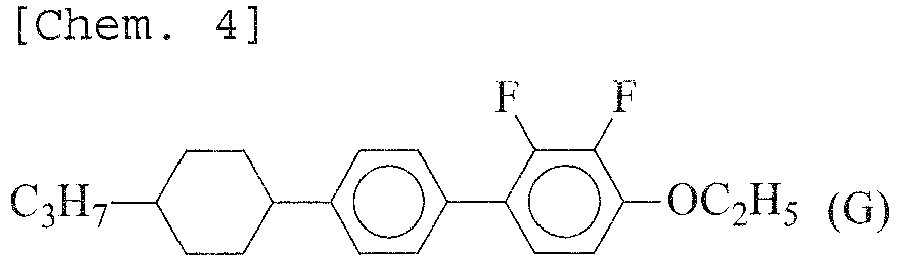
- a liquid crystal composition that uses a compound represented by formula (G) has already been disclosed (refer to PTL 4).
- This liquid crystal composition also contains an alkenyl-compound-containing compound as the liquid crystal compound (F) described above, and thus an issue of likelihood of display failures such as ghosting and display nonuniformity remains.
- a liquid crystal composition required to have high-speed response for use in liquid crystal televisions and the like has also been required to achieve sufficiently low viscosity ( ⁇ ), sufficiently low rotational viscosity ( ⁇ 1), and high elastic modulus (K 33 ) without decreasing the refractive index anisotropy ( ⁇ n) and nematic phase-isotropic liquid phase transition temperature (T ni ).
- An object of the present invention is to provide a liquid crystal composition that has sufficiently low viscosity ( ⁇ ), sufficiently low rotational viscosity ( ⁇ 1), high elastic modulus (K 33 ), and negative dielectric anisotropy ( ⁇ ) with a large absolute value without decreasing the refractive index anisotropy ( ⁇ n) and nematic phase-isotropic liquid phase transition temperature (T ni ), and to also provide a high-display-quality, high-response-speed liquid crystal display device of a VA mode or the like that uses the liquid crystal composition and undergoes no or less display failures.
- the inventors of the present invention have studied various compounds and found that the issues described above can be resolved by combining particular compounds. Thus, the present invention has been made.
- the present invention provides a liquid crystal composition that contains a compound represented by formula (I-1) as a first component:
- a liquid crystal display device using the liquid crystal composition is also provided.
- liquid crystal composition of the present invention has sufficiently low viscosity ( ⁇ ), sufficiently low rotational viscosity ( ⁇ 1), high elastic modulus (K 33 ), and negative dielectric anisotropy ( ⁇ ) with a large absolute value without decreasing the refractive index anisotropy ( ⁇ n) and nematic phase-isotropic liquid phase transition temperature (T ni ), a liquid crystal display device such as a VA mode device that uses the liquid crystal composition undergoes no or less display failures and exhibits high display quality and high response speed.
- the liquid crystal composition of the present invention contains, as a first component, 3% to 25% by mass, preferably 5% to 20% by mass, and most preferably 5% to 15% by mass of a compound represented by general formula (I-1).
- the first component content is preferably 10% to 25% by mass in order to obtain low viscosity or low rotational viscosity, and is preferably 3% to 15% by mass if suppression of precipitation at low temperature is important.
- the second component 3% to 20% by mass, preferably 5% to 15% by mass, and most preferably 5% to 10% by mass of the compound represented by general formula (I-2) is contained.
- the second component content is preferably 10% to 20% by mass in order to obtain low viscosity or low rotational viscosity, and is preferably 3% to 10% by mass if suppression of precipitation at low temperature is important.
- a compound having negative dielectric anisotropy ( ⁇ ) with an absolute value greater than 3 is contained as the third component.
- Specific examples thereof are compounds represented by general formula (II-1) and general formula (II-2).
- R 1 and R 2 each independently represent an alkyl group having 1 to 10 carbon atoms, an alkoxyl group having 1 to 10 carbon atoms, an alkenyl group having 2 to 10 carbon atoms, or an alkenyloxy group having 2 to 10 carbon atoms; one -CH 2 - or two or more nonadjacent -CH 2 - in R 1 and R 2 may each independently be substituted with -O- and/or -S-; one or more hydrogen atoms in R 1 and R 2 may each independently be substituted with a fluorine atom or a chlorine atom; R 1 preferably represents an alkyl group having 1 to 5 carbon atoms, an alkoxyl group having 1 to 5 carbon atoms, an alkenyl group having 2 to 5 carbon atoms, or an alkenyloxy group having 2 to 5 carbon atoms, more preferably represents an alkyl group having 1 to 5 carbon atoms or an alkenyl group having 2 to 5 carbon atoms, and
- ring A and ring B each independently represent a trans-1,4-cyclohexylene group, a 1,4-phenylene group, a 2-fluoro-1,4-phenylene group, a 3-fluoro-1,4-phenylene group, a 3,5-difluoro-1,4-phenylene group, a 2,3-difluoro-1,4-phenylene group, a 1,4-cyclohexenylene group, a 1,4-bicyclo[2.2.2]octylene group, a piperidine-1,4-diyl group, a naphthalene-2,6-diyl group, a decahydronaphthalene-2,6-diyl group, or a 1,2,3,4-tetrahydronaphthalene-2,6-diyl group and more preferably each independently represent a trans-1,4-cyclohexylene group or a 1,4-phenylene group.
- Z 1 and Z 2 each independently represent -OCH 2 -,-CH 2 O-, -CF 2 O-, -OCF 2 -, -CH 2 CH 2 -, -CF 2 CF 2 -, or a single bond, preferably each independently represent -CH 2 O-, -CF 2 O-,-CH 2 CH 2 -, -CF 2 CF 2 -, or a single bond, more preferably each independently represent -CH 2 O-, -CH 2 CH 2 -, or a single bond, and most preferably each independently represent -CH 2 O- or a single bond.
- the number of compounds represented by general formula (II-1) and general formula (II-2) contained is 1 or more and is preferably 2 to 10.
- the content thereof is preferably 10% to 90% by mass, more preferably 20% to 80% by mass, and yet more preferably 30% to 70% by mass.
- the liquid crystal composition of the present invention preferably simultaneously contains a compound represented by general formula (II-1) and a compound represented by general formula (II-2).
- the compound represented by general formula (II-1) is specifically preferably a compound selected from the compounds represented by general formula (II-A1) to general formula (II-A4):
- R 3 and R 4 are each independently the same as R 1 and R 2 ).
- a compound represented by general formula (II-A1), a compound represented by general formula (II-A3), and a compound represented by general formula (II-A4) are preferable.
- a compound represented by general formula (II-A1) and a compound represented by general formula (II-A4) are more preferable.
- the compound represented by general formula (II-2) is a compound selected from compounds represented by general formula (II-B1) to general formula (II-B6)
- R 3 and R 4 are each independently the same as R 1 and R 2 ).
- a compound represented by general formula (II-B1), general formula (II-B3), general formula (II-B4), general formula (II-B5), or general formula (II-B6) is more preferable.
- a compound represented by general formula (II-B1) is most preferable.
- the third component is preferably a combination of general formula (II-A1) and general formula (II-B1), more preferably a combination of general formula (II-A1), general formula (II-B1), and general formula (II-A3), and yet more preferably a combination of general formula (II-A1), general formula (II-B1), and general formula (II-A4).
- the third component is preferably a combination of general formula (II-A3) and general formula (II-B4), more preferably a combination of general formula (II-A3), general formula (II-B4), and general formula (II-B5), and yet more preferably a combination of general formula (II-A3), general formula (II-B4), and general formula (II-B1).
- the third component is preferably a combination of general formula (II-A4) and general formula (II-B4), more preferably a combination of general formula (II-A4) and general formula (II-B1), yet more preferably a combination of general formula (II-A4), general formula (II-B1), and general formula (II-B5), and most preferably a combination of general formula (II-A4), general formula (II-B1), and general formula (II-B3).
- the liquid crystal composition of the present invention preferably contains, as a fourth component, one or more compounds selected from general formula (III-A) to general formula (III-J):
- R 5 represents an alkyl group having 1 to 5 carbon atoms or an alkenyl group having 2 to 5 carbon atoms
- R 6 represents an alkyl group having 1 to 5 carbon atoms, an alkoxyl group having 1 to 5 carbon atoms, an alkenyl group having 2 to 5 carbon atoms, or an alkenyloxy group having 2 to 5 carbon atoms
- compounds represented by general formula (III-A) do not include the same compounds as those represented by formula (I-1) and formula (I-2).
- the fourth component is preferably a compound selected from general formula (III-A), general formula (III-D), general formula (III-F), general formula (III-G), and general formula (III-H), more preferably a compound selected from general formula (III-A), general formula (III-F), general formula (III-G), and general formula (III-H), yet more preferably a compound selected from general formula (III-A), general formula (III-G), and general formula (III-H), yet more preferably a compound selected from general formula (III-A), general formula (III-F), and general formula (III-H), and most preferably a compound selected from general formula (III-A) and general formula (III-F).
- R 5 preferably represents an alkyl group having 1 to 5 carbon atoms or an alkenyl group having 2 to 5 carbon atoms
- R 6 preferably represents an alkyl group having 1 to 5 carbon atoms or an alkoxy group having 1 to 5 carbon atoms.
- R 5 more preferably represents an alkenyl group having 2 to 5 carbon atoms and yet more preferably represents an alkenyl group having 2 or 3 carbon atoms.
- R 5 and R 6 preferably each independently represent an alkyl group having 1 to 5 carbon atoms or an alkenyl group having 2 to 5 carbon atoms.
- the liquid crystal composition of the present invention preferably contains a compound represented by general formula (III-A), which is a fourth component.
- the liquid crystal composition of the present invention preferably contains a compound represented by general formula (III-F), which is a fourth component.
- the liquid crystal composition of the present invention preferably simultaneously contains a compound represented by general formula (III-A) and a compound represented by general formula (III-F) which are fourth components.
- the compound represented by general formula (III-A) preferably has R 5 representing an alkenyl group having 2 carbon atoms and R 6 representing an alkyl group having 3 carbon atoms.
- the fourth component content is preferably 1% by mass to 40% by mass, preferably 5% by mass to 40% by mass, preferably 10% by mass to 40% by mass, and more preferably 20% by mass to 40% by mass.
- the compound represented by general formula (III-F) preferably has R 5 representing an alkyl group having 2 to 5 carbon atoms and R 6 representing an alkyl group having 1 to 3 carbon atoms.
- the fourth component content is preferably 1% by mass to 40% by mass and preferably 5% by mass to 40% by mass.
- One or more compounds represented by general formula (V) may also be contained as additional components.
- R 21 and R 22 each independently represent an alkyl group having 1 to 8 carbon atoms, an alkoxyl group having 1 to 8 carbon atoms, an alkenyl group having 2 to 8 carbon atoms, or an alkenyloxy group having 2 to 8 carbon atoms.
- An alkyl group having 1 to 5 carbon atoms or an alkenyl group having 2 to 5 carbon atoms is preferable.
- One or more compounds represented by general formula (VIII-a), general formula (VIII-c), or general formula (VIII-d) may be contained as additional components.
- R 51 and R 52 each independently represent an alkyl group having 1 to 5 carbon atoms, an alkenyl group having 2 to 5 carbon atoms, or an alkoxy group having 1 to 4 carbon atoms.
- R 51 and R 52 each independently represent an alkyl group having 1 to 5 carbon atoms, an alkenyl group having 2 to 5 carbon atoms, or an alkoxy group having 1 to 4 carbon atoms;
- X 51 and X 52 each independently represent a fluorine atom or a hydrogen atom; and at least one selected from X 51 and X 52 represents a fluorine atom).
- R 51 and R 52 each independently represent an alkyl group having 1 to 5 carbon atoms, an alkenyl group having 2 to 5 carbon atoms, or an alkoxy group having 1 to 4 carbon atoms;
- X 51 and X 52 each independently represent a fluorine atom or a hydrogen atom; and at least one selected from X 51 and X 52 represents a fluorine atom).
- One or more compounds represented by general formula (V-9.1) to general formula (V-9.3) may be contained as additional components.
- the liquid crystal composition of the present invention preferably simultaneously contains compounds represented by formula (I-1), formula (I-2), general formula (II-A1), and general formula (III-A), preferably simultaneously contains compounds represented by formula (I-1), formula (I-2), general formula (II-A3), and general formula (III-A), preferably simultaneously contains compounds represented by formula (I-1), formula (I-2), general formula (II-A4), and general formula (III-A), preferably simultaneously contains compounds represented by formula (I-1), formula (I-2), general formula (II-B1), and general formula (III-A), preferably simultaneously contains compounds represented by formula (I-1), formula (I-2), general formula (II-B3), and general formula (III-A), preferably simultaneously contains compounds represented by formula (I-1), formula (I-2), general formula (II-B4), and general formula (III-A), and preferably simultaneously contains compounds represented by formula (I-1), formula (I-2), general formula (II-B5), and general formula (III-A).
- the liquid crystal composition of the present invention more preferably simultaneously contains compounds represented by formula (I-1), formula (I-2), general formula (II-A1), general formula (II-B1), and general formula (III-A), more preferably simultaneously contains compounds represented by formula (I-1), formula (I-2), general formula (II-A3), general formula (II-B5), and general formula (III-A), more preferably simultaneously contains compounds represented by formula (I-1), formula (I-2), general formula (II-A1), general formula (II-B4), and general formula (III-A), and more preferably simultaneously contains compounds represented by formula (I-1), formula (I-2), general formula (II-A1), general formula (II-B5), and general formula (III-A).
- the liquid crystal composition of the present invention more preferably simultaneously contains compounds represented by formula (I-1), formula (I-2), general formula (II-A4), general formula (II-B5), and general formula (III-H), more preferably simultaneously contains compounds represented by formula (I-1), formula (I-2), general formula (II-A1), general formula (II-B1), and general formula (III-H), and more preferably simultaneously contains compounds represented by formula (I-1), formula (I-2), general formula (II-A1), general formula (II-B1), general formula (II-B3), and general formula (III-H).
- the total content of the first component, the second component, the third component, and the fourth component in the liquid crystal composition of the present invention is preferably 70% to 100% by mass, more preferably 80% to 100% by mass, and most preferably 85% to 100% by mass.
- the dielectric anisotropy ( ⁇ ) of the liquid crystal composition of the present invention at 25°C is -2.0 to -8.0, preferably -2.0 to -6.0, more preferably -2.0 to -5.0, and most preferably -2.5 to -4.0.
- the refractive index anisotropy ( ⁇ n) of the liquid crystal composition of the present invention at 20°C is 0.08 to 0.14, preferably 0.09 to 0.13, and more preferably 0.09 to 0.12. Specifically, the refractive index anisotropy ( ⁇ n) is preferably 0.10 to 0.13 for a small cell gap and 0.08 to 0.10 for a large cell gap.
- the viscosity ( ⁇ ) of the liquid crystal composition of the present invention at 20°C is 10 to 30 mPa ⁇ s, preferably 10 to 25 mPa ⁇ s, and more preferably 10 to 22 mPa ⁇ s.
- the rotational viscosity ( ⁇ 1 ) of the liquid crystal composition of the present invention at 20°C is 60 to 130 mPa ⁇ s, more preferably 60 to 110 mPa ⁇ s, and most preferably 60 to 100 mPa ⁇ s.
- the nematic phase-isotropic liquid phase transition temperature (T ni ) of the liquid crystal composition of the present invention is 60°C to 120°C, more preferably 70°C to 100°C, and yet more preferably 70°C to 85°C.
- the liquid crystal composition of the present invention may contain, in addition to the compounds described above, a common nematic liquid crystal, a smectic liquid crystal, a cholesteric liquid crystal, an antioxidant, an ultraviolet light absorber, a light stabilizer (HALS), an infrared absorber, a polymerizable monomer, and the like.
- a common nematic liquid crystal a smectic liquid crystal, a cholesteric liquid crystal
- an antioxidant an ultraviolet light absorber, a light stabilizer (HALS), an infrared absorber, a polymerizable monomer, and the like.
- HALS light stabilizer
- the liquid crystal composition may contain 0.01% to 2% by mass of a polymerizable compound, such as a biphenyl derivative or a terphenyl derivative, as a polymerizable monomer. More specifically, one or more polymerizable compounds represented by general formula (M):
- liquid crystal composition may be contained in the liquid crystal composition.
- X 201 and X 202 each independently represent a hydrogen atom, a methyl group, or a -CF 3 group.
- a diacrylate derivative with X 201 and X 202 both representing a hydrogen atom and a dimethacrylate derivative with X 201 and X 202 both representing a methyl group are preferable.
- a compound in which one represents a hydrogen atom and the other represents a methyl group is also preferable. While suitable compounds may be used according to the usage, the polymerizable compound represented by general formula (M) preferably has at least one methacrylate derivative or two methacrylate derivatives if the usage is for PSA display devices.
- Sp 201 and Sp 202 each independently represent a single bond, an alkylene group having 1 to 8 carbon atoms, or -O-(CH 2 ) s - (where s represents an integer of 2 to 7 and the oxygen atom is to bond to a ring).
- At least one selected from Sp 201 and Sp 202 preferably represents a single bond for PSA mode liquid crystal display devices, a compound in which both Sp 201 and Sp 202 represent a single bond is preferable, and a compound with one of Sp 201 and Sp 202 representing a single bond and the other representing an alkylene group having 1 to 8 carbon atoms or -O-(CH 2 ) s - is preferable.
- an alkylene group having 1 to 4 carbon atoms is preferable and s is preferably 1 to 4.
- n 201 represents 0, 1, or 2 and preferably represents 0 or 1. However, when there are two or more rings M 202 and two or more Z 202 , they may each be the same or different.
- At least one polymerizable compound represented by general formula (M) may be contained.
- the compounds represented by general formula (M) are preferably contained in an amount of 0.01% to 2.00% by mass, more preferably 0.05% to 1.00% by mass, and yet more preferably 0.10% to 0.50% by mass.
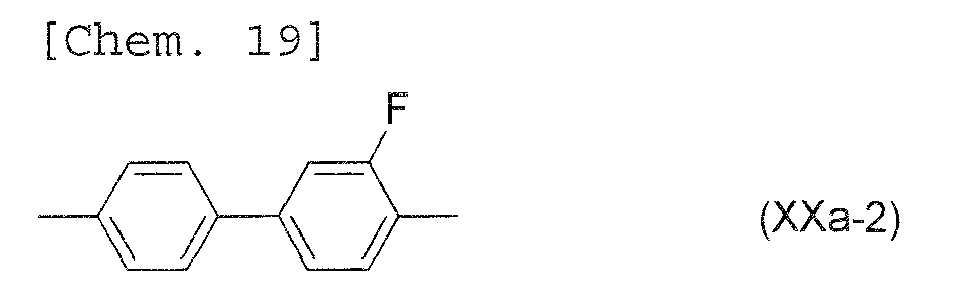
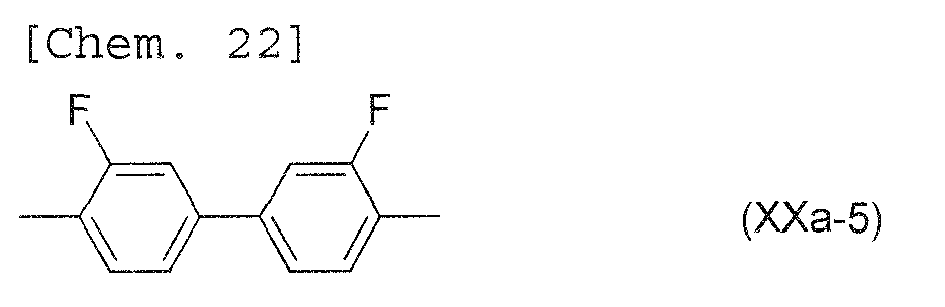
- the ring structure between Sp 201 and Sp 202 is preferably one represented by any one of formula (XXa-1) to formula (XXa-5), more preferably formula (XXa-1) to formula (XXa-3), and yet more preferably formula (XXa-1) and formula (XXa-2).
- Each of the two ends in each formula is to bond to Sp 201 or Sp 202 .
- the polymerizable compounds represented by general formula (M) including these skeletons exhibit optimum anchoring force for PSA-mode liquid crystal display devices after polymerization and a satisfactory alignment state is yielded. Thus, display nonuniformity is suppressed or prevented.
- Sp xx represents an alkylene group having 1 to 8 carbon atoms or - O-(CH 2 ) s - (in the formula, s represents an integer of 2 to 7 and the oxygen atom is to bond to a ring).
- Hydrogen atoms in the 1,4-phenylene groups in formula (XX-1) to general formula (XX-10) may each be substituted with any one selected from -F, -Cl, -CF 3 , -CH 3 , and formula (R-1) to formula (R-15).
- n 201 in general formula (M) is 1, polymerizable compounds represented by formula (M31) to formula (M48) are preferable, for example.
- Hydrogen atoms in the 1,4-phenylene groups and naphthalene groups in formula (M31) to formula (M48) may each be substituted with any one selected from -F, -Cl, -CF 3 , -CH 3 , and formula (R-1) to formula (R-15).
- the polymerizable compounds represented by general formula (M) including these skeletons exhibit optimum anchoring force for PSA-mode liquid crystal display devices after polymerization and a satisfactory alignment state is yielded. Thus, display nonuniformity is suppressed or prevented.
- n 201 in general formula (M) is 1 and two or more compounds represented by formula (R-1) or formula (R-2) are contained, polymerizable compounds represented by formula (M301) to formula (M316) are preferable, for example.
- Hydrogen atoms in the 1,4-phenylene groups and naphthalene groups in formula (M301) to formula (M316) may each be substituted with any one selected from -F, -Cl, -CF 3 , and -CH 3 .
- Polymerizable compounds represented by formula (Ia-1) to formula (Ia-31) are preferable as the polymerizable compound represented by general formula (M), for example.
- the liquid crystal composition of the present invention more preferably contains one or more polymerizable monomers selected from those described above as the polymerizable monomer. Yet more preferably, the liquid crystal composition contains one or more polymerizable monomers represented by general formula (XX-1), general formula (XX-2), general formula (XX-4), general formula (M-302), and general formula (M31).
- the liquid crystal composition of the present invention can contain an antioxidant.
- Hindered phenol compounds represented by general formula (H-1) to general formula (H-4) are preferable.
- R H1 represents an alkyl group having 1 to 10 carbon atoms, an alkoxyl group having 1 to 10 carbon atoms, an alkenyl group having 2 to 10 carbon atoms, or an alkenyloxy group having 2 to 10 carbon atoms; one -CH 2 - or two or more nonadjacent-CH 2 - in the group may each independently be substituted with -O- or -S-; and one or more hydrogen atoms in the group may each independently be substituted with a fluorine atom or a chlorine atom.
- an alkyl group having 2 to 7 carbon atoms, an alkoxyl group having 2 to 7 carbon atoms, an alkenyl group having 2 to 7 carbon atoms, or an alkenyloxy group having 2 to 7 carbon atoms is preferable, and an alkyl group having 3 to 7 carbon atoms or an alkenyl group having 2 to 7 carbon atoms is more preferable.
- M H4 preferably represents an alkylene group having 1 to 14 carbon atoms.
- the number of carbon atoms is preferably 2 to 12, more preferably 3 to 10, yet more preferably 4 to 10, yet more preferably 5 to 10, and most preferably 6 to 10 since the number of carbon atoms is preferably large in view of volatility but not excessively large in view of viscosity.
- the hydrogen atoms in the 1,4-phenylene group may each independently be substituted with a fluorine atom or a chlorine atom.
- one -CH 2 - or two or more nonadjacent -CH 2 - in the 1,4-phenylene group may each independently be substituted with -O- or -S-.
- the hydrogen atoms in the 1,4-cyclohexylene group may each independently be substituted with a fluorine atom or a chlorine atom.
- the liquid crystal composition of the present invention contains one or more antioxidants represented by formula (H-11) to formula (H-15) as the antioxidants.
- the liquid crystal composition of the present invention may contain 1 ppm by mass or more, preferably 10 ppm by mass or more, preferably 20 ppm by mass or more, and preferably 50 ppm by mass or more of the antioxidant.
- the upper limit of the antioxidant content is 10000 ppm by mass, preferably 1000 ppm by mass, preferably 500 ppm by mass, and preferably 100 ppm by mass.
- the liquid crystal display device that uses the liquid crystal composition of the present invention has no or less display failures, high display quality, and high response speed.
- the liquid crystal display device can be used in active-matrix-drive VA mode, PSVA mode, PSA mode, IPS mode, FFS mode, or ECB mode.
- T ni nematic phase-isotropic liquid phase transition temperature (°C) ⁇ n: refractive index anisotropy at 20°C ⁇ : dielectric anisotropy at 25°C ⁇ : viscosity at 20°C (mPa ⁇ s) ⁇ 1 : rotational viscosity (mPa ⁇ s) at 20°C K 33 : elastic modulus K 33 (pN) at 20°C
- Liquid crystal compositions LC-A (Comparative Example 1), LC-1 (Example 1), LC-2 (Example 2), and LC-3 (Example 3) were prepared and physical properties thereof were measured. The constitutions of the liquid crystal compositions and the observed physical properties are shown in Table 1.
- liquid crystal compositions LC-1, LC-2, and LC-3 of the present invention had low viscosity ( ⁇ ), low rotational viscosity ( ⁇ 1 ), high elastic modulus (K 33 ), and ⁇ 1 /K 33 of 7.9, 7.4, and 6.9, respectively, which were smaller than that of liquid crystal composition LC-A of Comparative Example.
- LC-1, LC-2, and LC-3 exhibited sufficiently high response speed, which was faster than LC-A by at least 10%.
- the cell thickness was 3.5 ⁇ m
- the alignment film was JALS2096
- the measurement conditions for response speed were Von: 5.5 V, Voff: 1.0 V
- DMS301 produced by AUTRONIC-MELCHERS was used in measurement.
- a PSVA-mode liquid crystal display device was produced by using a liquid crystal composition containing 99.6% by mass of LC-1 and 0.4% by mass of a polymerizable monomer represented by formula (XX-2). The device had no display failures but sufficiently high response speed.
- a PSVA-mode liquid crystal display device was produced by using a liquid crystal composition containing 99.6% by mass of LC-1 and 0.4% by mass of a polymerizable monomer represented by formula (XX-4). The device had no display failures but sufficiently high response speed.
- a PSVA-mode liquid crystal display device was produced by using a liquid crystal composition containing 99.6% by mass of LC-1 and 0.4% by mass of a polymerizable monomer represented by formula (M-302). The device had no display failures but sufficiently high response speed.
- a PSVA-mode liquid crystal display device was produced by using a liquid crystal composition containing 99.6% by mass of LC-1, 0.3% by mass of a polymerization monomer represented by formula (XX-4), and 0.1% by mass of a polymerization monomer represented by formula (Ia-31). The device had no display failures but sufficiently high response speed.
- PSVA-mode liquid crystal display devices were prepared in the same manner as described above by using LC-2 and LC-3 and polymerizable monomers. The devices had no display failures but sufficiently high response speed.
- Liquid crystal compositions LC-B (Comparative Example 2), LC-4 (Example 4), and LC-5 (Example 5) were prepared and physical properties thereof were measured. The constitutions of the liquid crystal compositions and the physical properties are shown in Table 2. [Table 2] Comparative Example 2 Example 4 Example 5 LC-B LC-4 LC-5 3-Cy-Cy-2 Formula (1-1) 18 14 9 3-Cy-Cy-V1 Formula(I-2) - 8 11 3-Cy-1O-Ph5-O2 General formula (II-A1) - - 3 3-Cy-Ph5-O2 General formula (II-A3) 3 8 7 3-Ph-Ph5-02 General formula (II-A4) 3 3 - 2-Cy-Cy-10-Ph5-02 General formula (II-B1) - - 3 2-Cy-Cy-Ph5-O1 General formula (II-B4) 11 10 10 2-Cy-Cy-Ph5-O2 General formula (II-B4) 11
- liquid crystal compositions LC-4 and LC-5 of the present invention had low viscosity ( ⁇ ), low rotational viscosity ( ⁇ 1 ), high elastic modulus (K 33 ), and ⁇ 1 /K 33 of 7.6 and 7.4, respectively, which were smaller than that of liquid crystal composition LC-B of Comparative Example.
- LC-4 and LC-5 exhibited sufficiently high response speed, which was faster than LC-B by at least 15%.
- the cell thickness was 3.3 ⁇ m
- the alignment film was JALS2096
- the measurement conditions for response speed were Von: 5.5 V, Voff: 1.0 V
- DMS301 produced by AUTRONIC-MELCHERS was used in measurement.
- a PSVA-mode liquid crystal display device was produced by using a liquid crystal composition containing 99.6% by mass of LC-4 and 0.4% by mass of a polymerizable monomer represented by formula (XX-1). The device had no display failures but sufficiently high response speed.
- a PSVA-mode liquid crystal display device was produced by using a liquid crystal composition containing 99.6% by mass of LC-4 and 0.4% by mass of a polymerizable monomer represented by formula (XX-2). The device had no display failures but sufficiently high response speed.
- a PSVA-mode liquid crystal display device was produced by using a liquid crystal composition containing 99.5% by mass of LC-4 and 0.5% by mass of a polymerizable monomer represented by formula (M-302). The device had no display failures but sufficiently high response speed.
- a PSVA-mode liquid crystal display device was produced by using a liquid crystal composition containing 99.6% by mass of LC-4, 0.2% by mass of a polymerization monomer represented by formula (XX-1), and 0.2% by mass of a polymerization monomer represented by formula (XX-2).
- the device had no display failures but sufficiently high response speed.
- a PSVA-mode liquid crystal display device was produced by using a liquid crystal composition containing 99.7% by mass of LC-5 and 0.3% by mass of a polymerizable monomer represented by formula (M31). The device had no display failures but sufficiently high response speed.
- a PSVA-mode liquid crystal display device was produced by using a liquid crystal composition containing 99.65% by mass of LC-5 and 0.35% by mass of a polymerizable monomer represented by formula (M33). The device had no display failures but sufficiently high response speed.
- liquid crystal compositions of the present invention exhibit sufficiently low viscosity ( ⁇ ), sufficiently low rotational viscosity ( ⁇ 1 ), high elastic modulus (K 33 ), and negative dielectric anisotropy ( ⁇ ) with a large absolute value without decreasing refractive index anisotropy ( ⁇ n) and nematic phase-isotropic liquid phase transition temperature (T ni ), and that the liquid crystal display devices of VA-mode, PSVA-mode, and PSA-mode that use the liquid crystal composition have high display quality and high response speed.
Landscapes
- Chemical & Material Sciences (AREA)
- Crystallography & Structural Chemistry (AREA)
- Engineering & Computer Science (AREA)
- Materials Engineering (AREA)
- Organic Chemistry (AREA)
- Liquid Crystal Substances (AREA)
- Physics & Mathematics (AREA)
- Nonlinear Science (AREA)
- General Physics & Mathematics (AREA)
- Optics & Photonics (AREA)
Abstract
Description
- The present invention relates to a nematic liquid crystal composition with negative dielectric anisotropy (Δε) useful as a liquid crystal display material, and to a liquid crystal display device using the composition.
- Liquid crystal display devices are being used in watches, calculators, various home electrical appliances, measurement instruments, automobile panels, word processors, electronic organizers, printers, computers, televisions, etc. Representative examples of the liquid crystal display modes include a TN (twisted nematic) mode, a STN (super twisted nematic) mode, a DS (dynamic scattering) mode, a GH (guest-host) mode, an IPS (in-plane switching) mode, an OCB (optical compensation birefringence) mode, an ECB (electrically controlled birefringence) mode, a VA (vertical alignment) mode, a CSH (color super homeotropic) mode, and FLC (ferroelectric liquid crystal). Examples of the driving mode include static driving, multiplex driving, single matrix mode, and active matrix (AM) mode with which TFTs (thin film transistors), TFDs (thin film diodes), etc., are used for driving.
- Among the display modes, the IPS mode, the ECB mode, the VA mode, the CSH mode, and the like are characterized in that they use liquid crystal materials with negative Δε. In particular, the VA display mode that involves AM driving is employed in display devices that require high speed and wide viewing angles, such as televisions, for example.
- Nematic liquid crystal compositions used in such display modes as the VA mode are required to achieve low-voltage driving, high-speed response, and a wide operation temperature range. In other words, negative Δε with a large absolute value, low viscosity, and a high nematic phase-isotropic liquid phase transition temperature (Tni) are required. Furthermore, refractive index anisotropy (Δn) of the liquid crystal material must be adjusted within an appropriate range with respect to the cell gap (d) due to the setting of the product Δn x d. Since high-speed response is important in order for the liquid crystal display devices to be used in televisions and the like, liquid crystal materials desirably have low viscosity (η).
- Heretofore, properties of liquid crystal compositions have been improved by studying various compounds with negative Δε having a large absolute value.
- There has been disclosed (refer to PTL 1) a liquid crystal composition with negative Δε using the following liquid crystal compounds (A) and (B) having a 2,3-difluorophenylene skeleton:

- This liquid crystal composition uses liquid crystal compounds (C) and (D) as the compounds having approximately zero Δε but fails to achieve viscosity sufficiently low for liquid crystal compositions that offer high-speed response such as one required by liquid crystal televisions and the like:

- Liquid crystal compositions that use a compound represented by formula (E) have been disclosed; one such liquid crystal composition (refer to PTL 2) contains the liquid crystal compound (D) described above and has small Δn and another such liquid crystal composition (refer to PTL 3) contains a compound (alkenyl compound) intramolecularly having an alkenyl group such as a liquid crystal compound (F) for improving response speed. Thus, further studies have been needed to simultaneously achieve high Δn and high reliability.

- A liquid crystal composition that uses a compound represented by formula (G) has already been disclosed (refer to PTL 4). This liquid crystal composition also contains an alkenyl-compound-containing compound as the liquid crystal compound (F) described above, and thus an issue of likelihood of display failures such as ghosting and display nonuniformity remains.
- Influence of the liquid crystal composition containing an alkenyl compound on display failures has already been disclosed (refer to PTL 5). Generally, the decrease in the alkenyl compound content increases η of the liquid crystal composition and makes it difficult to achieve high-speed response. Thus, it has been difficult to achieve suppression of display failures and high-speed response simultaneously.
- As discussed above, merely combining a compound that has negative Δε and liquid crystal compounds (C), (D), and (F) has not readily led to development of a liquid crystal composition having negative Δε, with which high Δn and low η are achieved simultaneously and display failures are prevented or suppressed.
- Although PTL 6 discloses that response speed of a homeotropic liquid crystal cell can be improved by using a liquid crystal material having a large index represented by (formula 1), the improvement has not been sufficient.
- [Math. 1]

K33: elastic modulus
Δn: refractive index anisotropy
γ1: rotational viscosity - In sum, a liquid crystal composition required to have high-speed response for use in liquid crystal televisions and the like has also been required to achieve sufficiently low viscosity (η), sufficiently low rotational viscosity (γ1), and high elastic modulus (K33) without decreasing the refractive index anisotropy (Δn) and nematic phase-isotropic liquid phase transition temperature (Tni).
-
- PTL 1:
Japanese Unexamined Patent Application Publication No. 8-104869 - PTL 2:
EP Patent Application Publication No. 0474062 - PTL 3:
Japanese Unexamined Patent Application Publication No. 2006-37054 - PTL 4:
Japanese Unexamined Patent Application Publication No. 2001-354967 - PTL 5:
Japanese Unexamined Patent Application Publication No. 2008-144135 - PTL 6:
Japanese Unexamined Patent Application Publication No. 2006-301643 - An object of the present invention is to provide a liquid crystal composition that has sufficiently low viscosity (η), sufficiently low rotational viscosity (γ1), high elastic modulus (K33), and negative dielectric anisotropy (Δε) with a large absolute value without decreasing the refractive index anisotropy (Δn) and nematic phase-isotropic liquid phase transition temperature (Tni), and to also provide a high-display-quality, high-response-speed liquid crystal display device of a VA mode or the like that uses the liquid crystal composition and undergoes no or less display failures.
- The inventors of the present invention have studied various compounds and found that the issues described above can be resolved by combining particular compounds. Thus, the present invention has been made.
- The present invention provides a liquid crystal composition that contains a compound represented by formula (I-1) as a first component:

- a compound represented by formula (I-2) as a second component:

- and a compound having negative dielectric anisotropy (Δε) whose absolute value is greater than 3 as a third component. A liquid crystal display device using the liquid crystal composition is also provided.
- Since the liquid crystal composition of the present invention has sufficiently low viscosity (η), sufficiently low rotational viscosity (γ1), high elastic modulus (K33), and negative dielectric anisotropy (Δε) with a large absolute value without decreasing the refractive index anisotropy (Δn) and nematic phase-isotropic liquid phase transition temperature (Tni), a liquid crystal display device such as a VA mode device that uses the liquid crystal composition undergoes no or less display failures and exhibits high display quality and high response speed. Description of Embodiments
- The liquid crystal composition of the present invention contains, as a first component, 3% to 25% by mass, preferably 5% to 20% by mass, and most preferably 5% to 15% by mass of a compound represented by general formula (I-1). Specifically, the first component content is preferably 10% to 25% by mass in order to obtain low viscosity or low rotational viscosity, and is preferably 3% to 15% by mass if suppression of precipitation at low temperature is important.
- As the second component, 3% to 20% by mass, preferably 5% to 15% by mass, and most preferably 5% to 10% by mass of the compound represented by general formula (I-2) is contained. Specifically, the second component content is preferably 10% to 20% by mass in order to obtain low viscosity or low rotational viscosity, and is preferably 3% to 10% by mass if suppression of precipitation at low temperature is important.
- A compound having negative dielectric anisotropy (Δε) with an absolute value greater than 3 is contained as the third component. Specific examples thereof are compounds represented by general formula (II-1) and general formula (II-2).

- In the formulae, R1 and R2 each independently represent an alkyl group having 1 to 10 carbon atoms, an alkoxyl group having 1 to 10 carbon atoms, an alkenyl group having 2 to 10 carbon atoms, or an alkenyloxy group having 2 to 10 carbon atoms; one -CH2- or two or more nonadjacent -CH2- in R1 and R2 may each independently be substituted with -O- and/or -S-; one or more hydrogen atoms in R1 and R2 may each independently be substituted with a fluorine atom or a chlorine atom; R1 preferably represents an alkyl group having 1 to 5 carbon atoms, an alkoxyl group having 1 to 5 carbon atoms, an alkenyl group having 2 to 5 carbon atoms, or an alkenyloxy group having 2 to 5 carbon atoms, more preferably represents an alkyl group having 1 to 5 carbon atoms or an alkenyl group having 2 to 5 carbon atoms, and yet more preferably represents an alkyl group having 1 to 3 carbon atoms or an alkenyl group having 3 carbon atoms (propenyl group); R2 preferably represents an alkyl group having 1 to 5 carbon atoms, an alkoxyl group having 1 to 5 carbon atoms, or an alkenyloxy group and more preferably represents an alkyl group having 1 or 2 carbon atoms or an alkoxy group having 1 or 2 carbon atoms. In the formulae, ring A and ring B each independently represent a trans-1,4-cyclohexylene group, a 1,4-phenylene group, a 2-fluoro-1,4-phenylene group, a 3-fluoro-1,4-phenylene group, a 3,5-difluoro-1,4-phenylene group, a 2,3-difluoro-1,4-phenylene group, a 1,4-cyclohexenylene group, a 1,4-bicyclo[2.2.2]octylene group, a piperidine-1,4-diyl group, a naphthalene-2,6-diyl group, a decahydronaphthalene-2,6-diyl group, or a 1,2,3,4-tetrahydronaphthalene-2,6-diyl group and more preferably each independently represent a trans-1,4-cyclohexylene group or a 1,4-phenylene group. In the formulae, Z1 and Z2 each independently represent -OCH2-,-CH2O-, -CF2O-, -OCF2-, -CH2CH2-, -CF2CF2-, or a single bond, preferably each independently represent -CH2O-, -CF2O-,-CH2CH2-, -CF2CF2-, or a single bond, more preferably each independently represent -CH2O-, -CH2CH2-, or a single bond, and most preferably each independently represent -CH2O- or a single bond.
- The number of compounds represented by general formula (II-1) and general formula (II-2) contained is 1 or more and is preferably 2 to 10. The content thereof is preferably 10% to 90% by mass, more preferably 20% to 80% by mass, and yet more preferably 30% to 70% by mass.
- The liquid crystal composition of the present invention preferably simultaneously contains a compound represented by general formula (II-1) and a compound represented by general formula (II-2).
- The compound represented by general formula (II-1) is specifically preferably a compound selected from the compounds represented by general formula (II-A1) to general formula (II-A4):


- (In the formulae, R3 and R4 are each independently the same as R1 and R2). A compound represented by general formula (II-A1), a compound represented by general formula (II-A3), and a compound represented by general formula (II-A4) are preferable. A compound represented by general formula (II-A1) and a compound represented by general formula (II-A4) are more preferable.
- The compound represented by general formula (II-2) is a compound selected from compounds represented by general formula (II-B1) to general formula (II-B6)


- (In the formulae, R3 and R4 are each independently the same as R1 and R2). A compound represented by general formula (II-B1), general formula (II-B3), general formula (II-B4), general formula (II-B5), or general formula (II-B6) is more preferable. A compound represented by general formula (II-B1) is most preferable.
- Specifically, the third component is preferably a combination of general formula (II-A1) and general formula (II-B1), more preferably a combination of general formula (II-A1), general formula (II-B1), and general formula (II-A3), and yet more preferably a combination of general formula (II-A1), general formula (II-B1), and general formula (II-A4).
- More specifically, the third component is preferably a combination of general formula (II-A3) and general formula (II-B4), more preferably a combination of general formula (II-A3), general formula (II-B4), and general formula (II-B5), and yet more preferably a combination of general formula (II-A3), general formula (II-B4), and general formula (II-B1).
- More specifically, the third component is preferably a combination of general formula (II-A4) and general formula (II-B4), more preferably a combination of general formula (II-A4) and general formula (II-B1), yet more preferably a combination of general formula (II-A4), general formula (II-B1), and general formula (II-B5), and most preferably a combination of general formula (II-A4), general formula (II-B1), and general formula (II-B3).
- The liquid crystal composition of the present invention preferably contains, as a fourth component, one or more compounds selected from general formula (III-A) to general formula (III-J):

- (In the formulae, R5 represents an alkyl group having 1 to 5 carbon atoms or an alkenyl group having 2 to 5 carbon atoms, R6 represents an alkyl group having 1 to 5 carbon atoms, an alkoxyl group having 1 to 5 carbon atoms, an alkenyl group having 2 to 5 carbon atoms, or an alkenyloxy group having 2 to 5 carbon atoms). However, compounds represented by general formula (III-A) do not include the same compounds as those represented by formula (I-1) and formula (I-2).
- The fourth component is preferably a compound selected from general formula (III-A), general formula (III-D), general formula (III-F), general formula (III-G), and general formula (III-H), more preferably a compound selected from general formula (III-A), general formula (III-F), general formula (III-G), and general formula (III-H), yet more preferably a compound selected from general formula (III-A), general formula (III-G), and general formula (III-H), yet more preferably a compound selected from general formula (III-A), general formula (III-F), and general formula (III-H), and most preferably a compound selected from general formula (III-A) and general formula (III-F).
- In the compounds represented by general formula (III-D), general formula (III-G), and general formula (III-H), R5 preferably represents an alkyl group having 1 to 5 carbon atoms or an alkenyl group having 2 to 5 carbon atoms, and R6 preferably represents an alkyl group having 1 to 5 carbon atoms or an alkoxy group having 1 to 5 carbon atoms. R5 more preferably represents an alkenyl group having 2 to 5 carbon atoms and yet more preferably represents an alkenyl group having 2 or 3 carbon atoms. In the compound represented by general formula (III-F), R5 and R6 preferably each independently represent an alkyl group having 1 to 5 carbon atoms or an alkenyl group having 2 to 5 carbon atoms.
- The liquid crystal composition of the present invention preferably contains a compound represented by general formula (III-A), which is a fourth component.
- The liquid crystal composition of the present invention preferably contains a compound represented by general formula (III-F), which is a fourth component.
- The liquid crystal composition of the present invention preferably simultaneously contains a compound represented by general formula (III-A) and a compound represented by general formula (III-F) which are fourth components.
- The compound represented by general formula (III-A) preferably has R5 representing an alkenyl group having 2 carbon atoms and R6 representing an alkyl group having 3 carbon atoms.
- The fourth component content is preferably 1% by mass to 40% by mass, preferably 5% by mass to 40% by mass, preferably 10% by mass to 40% by mass, and more preferably 20% by mass to 40% by mass.
- The compound represented by general formula (III-F) preferably has R5 representing an alkyl group having 2 to 5 carbon atoms and R6 representing an alkyl group having 1 to 3 carbon atoms.
- The fourth component content is preferably 1% by mass to 40% by mass and preferably 5% by mass to 40% by mass.
- One or more compounds represented by general formula (V) may also be contained as additional components.

- In the formula R21 and R22 each independently represent an alkyl group having 1 to 8 carbon atoms, an alkoxyl group having 1 to 8 carbon atoms, an alkenyl group having 2 to 8 carbon atoms, or an alkenyloxy group having 2 to 8 carbon atoms. An alkyl group having 1 to 5 carbon atoms or an alkenyl group having 2 to 5 carbon atoms is preferable.
- One or more compounds represented by general formula (VIII-a), general formula (VIII-c), or general formula (VIII-d) may be contained as additional components.

- (In the formula, R51 and R52 each independently represent an alkyl group having 1 to 5 carbon atoms, an alkenyl group having 2 to 5 carbon atoms, or an alkoxy group having 1 to 4 carbon atoms.)

- (In the formula, R51 and R52 each independently represent an alkyl group having 1 to 5 carbon atoms, an alkenyl group having 2 to 5 carbon atoms, or an alkoxy group having 1 to 4 carbon atoms; X51 and X52 each independently represent a fluorine atom or a hydrogen atom; and at least one selected from X51 and X52 represents a fluorine atom).

- (In the formula, R51 and R52 each independently represent an alkyl group having 1 to 5 carbon atoms, an alkenyl group having 2 to 5 carbon atoms, or an alkoxy group having 1 to 4 carbon atoms; X51 and X52 each independently represent a fluorine atom or a hydrogen atom; and at least one selected from X51 and X52 represents a fluorine atom).
- One or more compounds represented by general formula (V-9.1) to general formula (V-9.3) may be contained as additional components.


- The liquid crystal composition of the present invention preferably simultaneously contains compounds represented by formula (I-1), formula (I-2), general formula (II-A1), and general formula (III-A), preferably simultaneously contains compounds represented by formula (I-1), formula (I-2), general formula (II-A3), and general formula (III-A), preferably simultaneously contains compounds represented by formula (I-1), formula (I-2), general formula (II-A4), and general formula (III-A), preferably simultaneously contains compounds represented by formula (I-1), formula (I-2), general formula (II-B1), and general formula (III-A), preferably simultaneously contains compounds represented by formula (I-1), formula (I-2), general formula (II-B3), and general formula (III-A), preferably simultaneously contains compounds represented by formula (I-1), formula (I-2), general formula (II-B4), and general formula (III-A), and preferably simultaneously contains compounds represented by formula (I-1), formula (I-2), general formula (II-B5), and general formula (III-A).
- The liquid crystal composition of the present invention more preferably simultaneously contains compounds represented by formula (I-1), formula (I-2), general formula (II-A1), general formula (II-B1), and general formula (III-A), more preferably simultaneously contains compounds represented by formula (I-1), formula (I-2), general formula (II-A3), general formula (II-B5), and general formula (III-A), more preferably simultaneously contains compounds represented by formula (I-1), formula (I-2), general formula (II-A1), general formula (II-B4), and general formula (III-A), and more preferably simultaneously contains compounds represented by formula (I-1), formula (I-2), general formula (II-A1), general formula (II-B5), and general formula (III-A).
- The liquid crystal composition of the present invention more preferably simultaneously contains compounds represented by formula (I-1), formula (I-2), general formula (II-A4), general formula (II-B5), and general formula (III-H), more preferably simultaneously contains compounds represented by formula (I-1), formula (I-2), general formula (II-A1), general formula (II-B1), and general formula (III-H), and more preferably simultaneously contains compounds represented by formula (I-1), formula (I-2), general formula (II-A1), general formula (II-B1), general formula (II-B3), and general formula (III-H).
- The total content of the first component, the second component, the third component, and the fourth component in the liquid crystal composition of the present invention is preferably 70% to 100% by mass, more preferably 80% to 100% by mass, and most preferably 85% to 100% by mass.
- The dielectric anisotropy (Δε) of the liquid crystal composition of the present invention at 25°C is -2.0 to -8.0, preferably -2.0 to -6.0, more preferably -2.0 to -5.0, and most preferably -2.5 to -4.0.
- The refractive index anisotropy (Δn) of the liquid crystal composition of the present invention at 20°C is 0.08 to 0.14, preferably 0.09 to 0.13, and more preferably 0.09 to 0.12. Specifically, the refractive index anisotropy (Δn) is preferably 0.10 to 0.13 for a small cell gap and 0.08 to 0.10 for a large cell gap.
- The viscosity (η) of the liquid crystal composition of the present invention at 20°C is 10 to 30 mPa·s, preferably 10 to 25 mPa·s, and more preferably 10 to 22 mPa·s.
- The rotational viscosity (γ1) of the liquid crystal composition of the present invention at 20°C is 60 to 130 mPa·s, more preferably 60 to 110 mPa·s, and most preferably 60 to 100 mPa·s.
- The nematic phase-isotropic liquid phase transition temperature (Tni) of the liquid crystal composition of the present invention is 60°C to 120°C, more preferably 70°C to 100°C, and yet more preferably 70°C to 85°C.
- The liquid crystal composition of the present invention may contain, in addition to the compounds described above, a common nematic liquid crystal, a smectic liquid crystal, a cholesteric liquid crystal, an antioxidant, an ultraviolet light absorber, a light stabilizer (HALS), an infrared absorber, a polymerizable monomer, and the like.
- For example, the liquid crystal composition may contain 0.01% to 2% by mass of a polymerizable compound, such as a biphenyl derivative or a terphenyl derivative, as a polymerizable monomer. More specifically, one or more polymerizable compounds represented by general formula (M):
- [Chem. 16]

- may be contained in the liquid crystal composition.
- In general formula (M), X201 and X202 each independently represent a hydrogen atom, a methyl group, or a -CF3 group. A diacrylate derivative with X201 and X202 both representing a hydrogen atom and a dimethacrylate derivative with X201 and X202 both representing a methyl group are preferable. A compound in which one represents a hydrogen atom and the other represents a methyl group is also preferable. While suitable compounds may be used according to the usage, the polymerizable compound represented by general formula (M) preferably has at least one methacrylate derivative or two methacrylate derivatives if the usage is for PSA display devices.
- In general formula (M), Sp201 and Sp202 each independently represent a single bond, an alkylene group having 1 to 8 carbon atoms, or -O-(CH2)s- (where s represents an integer of 2 to 7 and the oxygen atom is to bond to a ring). At least one selected from Sp201 and Sp202 preferably represents a single bond for PSA mode liquid crystal display devices, a compound in which both Sp201 and Sp202 represent a single bond is preferable, and a compound with one of Sp201 and Sp202 representing a single bond and the other representing an alkylene group having 1 to 8 carbon atoms or -O-(CH2)s- is preferable. In such a case, an alkylene group having 1 to 4 carbon atoms is preferable and s is preferably 1 to 4.
- In general formula (M), ring M201, ring M202, and ring M203 each independently represent a trans-1,4-cyclohexylene group (one -CH2- or two or more nonadjacent -CH2- in the group may each be substituted with -0- or -S-), a 1,4-phenylene group (one -CH= or two or more nonadjacent -CH= in the group may each be substituted with -N=), a 1,4-cyclohexenylene group, a 1,4-bicyclo[2.2.2]octylene group, a piperidine-1,4-diyl group, a naphthalene-2,6-diyl group, a decahydronaphthalene-2,6-diyl group, or a 1,2,3,4-tetrahydronaphthalene-2,6-diyl group, and hydrogen atoms in the group may be each independently substituted with a fluorine atom, a -CF3 group, an alkyl group having 1 to 10 carbon atoms, an alkoxyl group having 1 to 10 carbon atoms, or any one of groups represented by formula (R-1) to formula (R-15):

- In general formula (M), Z201 and Z202 each independently represent -OCH2-, -CH2O-, -COO-, -OCO-, -CF2O-, -OCF2-,-CH2CH2-, -CF2CF2-, -CH=CH-COO-, -CH=CH-OCO-, -COO-CH=CH-,-OCO-CH=CH-, -COO-CH2CH2-, -OCO-CH2CH2-, -CH2CH2-COO-, -CH2CH2-OCO-, -COO-CH2-, -OCO-CH2-, -CH2-COO-, -CH2-OCO-, -CY1=CY2-(in the formula, Y1 and Y2 each independently represent a fluorine atom or a hydrogen atom), -C≡C-, or a single bond but preferably each independently represent -COO-, -OCO-,-CH=CH-COO-, -CH=CH-OCO-, -COO-CH=CH-, -OCO-CH=CH-, -COO-CH2CH2-, -OCO-CH2CH2-, -CH2CH2-COO-, -CH2CH2-OCO-, -C≡C-, or a single bond, and more preferably each independently represent -COO-, -OCO-, -CH=CH-COO-, -CH=CH-OCO-, -COO-CH=CH-, -OCO-CH=CH-, -COO-CH2CH2-, -OCO-CH2CH2-, -CH2CH2-COO-, -CH2CH2-OCO-, or a single bond.
- In general formula (M), n201 represents 0, 1, or 2 and preferably represents 0 or 1. However, when there are two or more rings M202 and two or more Z202, they may each be the same or different.
- At least one polymerizable compound represented by general formula (M) may be contained. Preferably one to five and more preferably one to three polymerizable compounds represented by general formula (M) are contained.
- The compounds represented by general formula (M) are preferably contained in an amount of 0.01% to 2.00% by mass, more preferably 0.05% to 1.00% by mass, and yet more preferably 0.10% to 0.50% by mass.
- More specifically, when n201 in general formula (M) is 0, the ring structure between Sp201 and Sp202 is preferably one represented by any one of formula (XXa-1) to formula (XXa-5), more preferably formula (XXa-1) to formula (XXa-3), and yet more preferably formula (XXa-1) and formula (XXa-2). Each of the two ends in each formula is to bond to Sp201 or Sp202.

-
-

-

-
- The polymerizable compounds represented by general formula (M) including these skeletons exhibit optimum anchoring force for PSA-mode liquid crystal display devices after polymerization and a satisfactory alignment state is yielded. Thus, display nonuniformity is suppressed or prevented.
- In view of the above, compounds represented by formula (XX-1) to general formula (XX-10) are preferable as the polymerizable monomer. Compounds represented by formula (XX-1) to formula (XX-4) are more preferable.

- In formula (XX-1) to general formula (XX-10), Spxx represents an alkylene group having 1 to 8 carbon atoms or - O-(CH2)s- (in the formula, s represents an integer of 2 to 7 and the oxygen atom is to bond to a ring).
- Hydrogen atoms in the 1,4-phenylene groups in formula (XX-1) to general formula (XX-10) may each be substituted with any one selected from -F, -Cl, -CF3, -CH3, and formula (R-1) to formula (R-15).
- When n201 in general formula (M) is 1, polymerizable compounds represented by formula (M31) to formula (M48) are preferable, for example.


- Hydrogen atoms in the 1,4-phenylene groups and naphthalene groups in formula (M31) to formula (M48) may each be substituted with any one selected from -F, -Cl, -CF3, -CH3, and formula (R-1) to formula (R-15).
- The polymerizable compounds represented by general formula (M) including these skeletons exhibit optimum anchoring force for PSA-mode liquid crystal display devices after polymerization and a satisfactory alignment state is yielded. Thus, display nonuniformity is suppressed or prevented.
- When n201 in general formula (M) is 1 and two or more compounds represented by formula (R-1) or formula (R-2) are contained, polymerizable compounds represented by formula (M301) to formula (M316) are preferable, for example.


- Hydrogen atoms in the 1,4-phenylene groups and naphthalene groups in formula (M301) to formula (M316) may each be substituted with any one selected from -F, -Cl, -CF3, and -CH3.
- Polymerizable compounds represented by formula (Ia-1) to formula (Ia-31) are preferable as the polymerizable compound represented by general formula (M), for example.


- The liquid crystal composition of the present invention more preferably contains one or more polymerizable monomers selected from those described above as the polymerizable monomer. Yet more preferably, the liquid crystal composition contains one or more polymerizable monomers represented by general formula (XX-1), general formula (XX-2), general formula (XX-4), general formula (M-302), and general formula (M31).
- The liquid crystal composition of the present invention can contain an antioxidant. Hindered phenol compounds represented by general formula (H-1) to general formula (H-4) are preferable.


- In general formula (H-1) to general formula (H-4), RH1 represents an alkyl group having 1 to 10 carbon atoms, an alkoxyl group having 1 to 10 carbon atoms, an alkenyl group having 2 to 10 carbon atoms, or an alkenyloxy group having 2 to 10 carbon atoms; one -CH2- or two or more nonadjacent-CH2- in the group may each independently be substituted with -O- or -S-; and one or more hydrogen atoms in the group may each independently be substituted with a fluorine atom or a chlorine atom. In particular, an alkyl group having 2 to 7 carbon atoms, an alkoxyl group having 2 to 7 carbon atoms, an alkenyl group having 2 to 7 carbon atoms, or an alkenyloxy group having 2 to 7 carbon atoms is preferable, and an alkyl group having 3 to 7 carbon atoms or an alkenyl group having 2 to 7 carbon atoms is more preferable. In general formula (H-4), MH4 represents an alkylene group having 1 to 15 carbon atoms (one or more -CH2- in the alkylene group may be substituted with -O-, -CO-, -COO-, or -OCO- provided that the oxygen atoms are not directly adjacent to each other), -OCH2-, -CH2O-, -COO-, -OCO-, -CF2O-, -OCF2-, -CF2CF2-, -CH=CH-COO-, -CH=CH-OCO-, -COO-CH=CH-,-OCO-CH=CH-, -CH=CH-, -C≡C-, a single bond, a 1,4-phenylene group (any hydrogen atom in the 1,4-phenylene group may be substituted with a fluorine atom), or a trans-1,4-cyclohexylene group. MH4 preferably represents an alkylene group having 1 to 14 carbon atoms. The number of carbon atoms is preferably 2 to 12, more preferably 3 to 10, yet more preferably 4 to 10, yet more preferably 5 to 10, and most preferably 6 to 10 since the number of carbon atoms is preferably large in view of volatility but not excessively large in view of viscosity.
- In general formula (H-1) to general formula (H-4), one -CH= or two or more nonadjacent -CH= in the 1,4-phenylene group may each be substituted with -N=. The hydrogen atoms in the 1,4-phenylene group may each independently be substituted with a fluorine atom or a chlorine atom.
- In general formula (H-1) to general formula (H-4), one -CH2- or two or more nonadjacent -CH2- in the 1,4-phenylene group may each independently be substituted with -O- or -S-. The hydrogen atoms in the 1,4-cyclohexylene group may each independently be substituted with a fluorine atom or a chlorine atom.
- Specific examples thereof are those represented by formula (H-11) to formula (H-15).

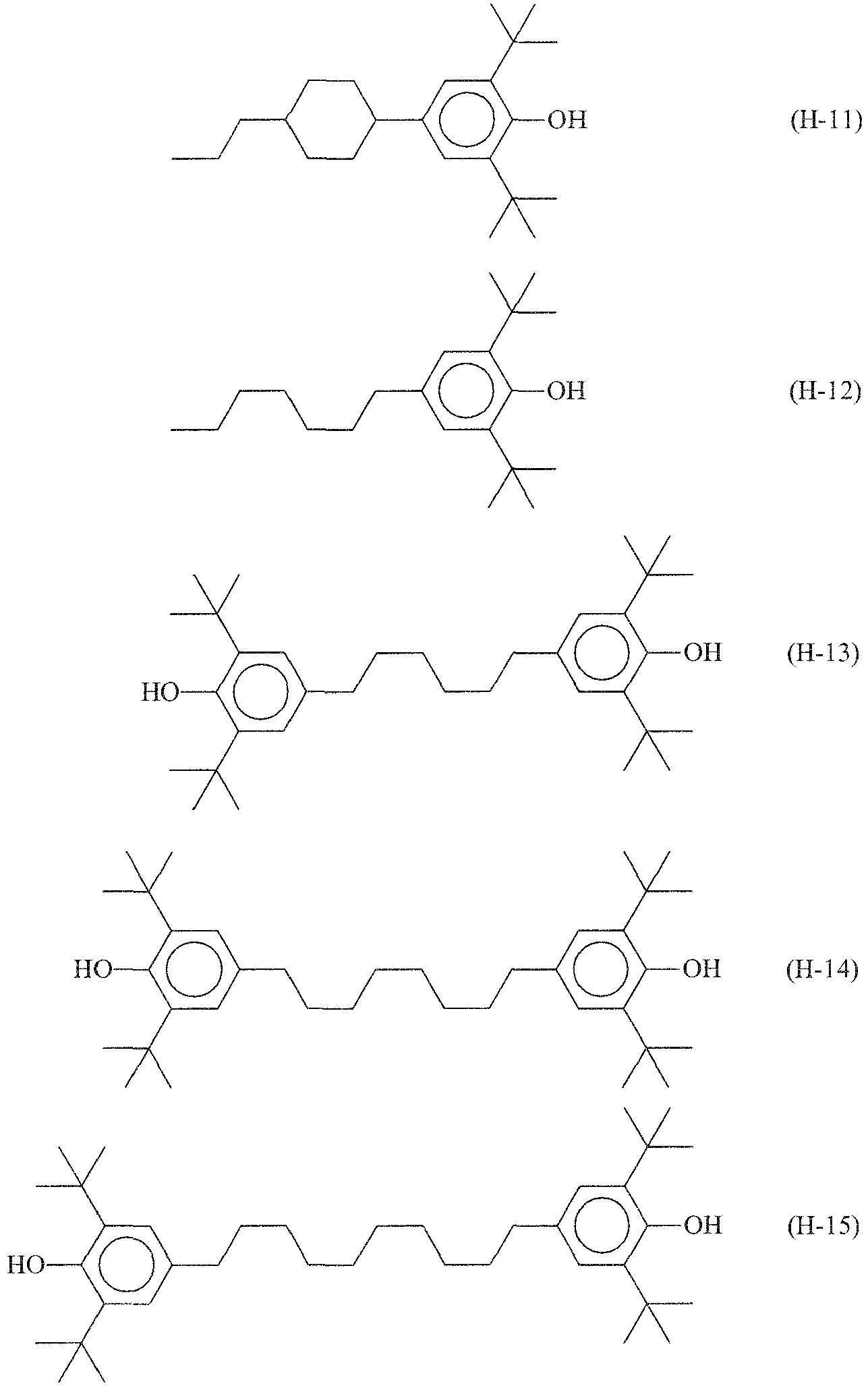
- More preferably, the liquid crystal composition of the present invention contains one or more antioxidants represented by formula (H-11) to formula (H-15) as the antioxidants.
- The liquid crystal composition of the present invention may contain 1 ppm by mass or more, preferably 10 ppm by mass or more, preferably 20 ppm by mass or more, and preferably 50 ppm by mass or more of the antioxidant. The upper limit of the antioxidant content is 10000 ppm by mass, preferably 1000 ppm by mass, preferably 500 ppm by mass, and preferably 100 ppm by mass.
- The liquid crystal display device that uses the liquid crystal composition of the present invention has no or less display failures, high display quality, and high response speed. In particular, the liquid crystal display device can be used in active-matrix-drive VA mode, PSVA mode, PSA mode, IPS mode, FFS mode, or ECB mode.
- The present invention will now be described in further detailed through examples below which do not limit the present invention. In the compositions of Examples and Comparative Examples below, % means % by mass.
- In Examples, following abbreviations are used to describe compounds:
- -n: -CnH2n+1 straight-chain alkyl group having n carbon atoms
n-: CnH2n+1- straight-chain alkyl group having n carbon atoms
-On: -OCnH2n+1 straight-chain alkoxyl group having n carbon atoms
nO-: CnH2n+1O- straight-chain alkoxyl group having n carbon atoms
-V: -CH=CH2
V-: CH2=CH-
-V1: -CH=CH-CH3 1V-: CH3-CH=CH-
-2V: -CH2-CH2-CH=CH3 V2-: CH3=CH-CH2-CH2-
-2V1: -CH2-CH2-CH=CH-CH3
1V2-: CH3-CH=CH-CH2-CH2 - -CF2O-: -CF2-O-
-OCF2-: -O-CF2-
-1O-: -CH2-O-
-O1-: -O-CH2-
-COO-: -COO- - [Chem. 32]

- Following properties were measured in Examples.
- Tni: nematic phase-isotropic liquid phase transition temperature (°C)
Δn: refractive index anisotropy at 20°C
Δε: dielectric anisotropy at 25°C
η: viscosity at 20°C (mPa·s)
γ1: rotational viscosity (mPa·s) at 20°C
K33: elastic modulus K33 (pN) at 20°C - Liquid crystal compositions LC-A (Comparative Example 1), LC-1 (Example 1), LC-2 (Example 2), and LC-3 (Example 3) were prepared and physical properties thereof were measured. The constitutions of the liquid crystal compositions and the observed physical properties are shown in Table 1.
[Table 1] Comparative Example 1 Example 1 Example 2 Example 3 LC-A LC-1 LC-2 LC-3 3-Cy-Cy-2 Formula (1-1) 13 9 9 3-Cy-Cy-V1 Formula(I-2) 10 10 10 3-Cy-Cy-V General formula (III-A) 12 10 12 3-Cy-Cy-4 General formula (III-A) 8 5 3-Cy-Ph-O1 General formula (III-D) 6 3-Cy-Ph-O2 General formula (III-D) 4 3-Ph-Ph-1 General formula (III-F) 10 3 8 11 5-Ph-Ph-1 General formula (III-F) 5 14 7 2 3-Cy-Cy-Ph-1 General formula (III-G) 7 3 4 5 3-Cy-Ph-Ph-2 General formula (III-H) 2 2 V-Cy-Ph-Ph-3 General formula (III-H) 3 6 5 5 3-Cy-1O-Ph5-O1 General formula (II-A1) 2 3-Cy-1O-Ph5-O2 General formula (II-A1) 6 11 12 4 1V-Cy-1O-Ph5-O2 General formula (II-A1) 4 2-Cy-Cy-10-Ph5-O2 General formula (II-B1) 12 12 12 12 3-Cy-Cy-1O-Ph5-O2 General formula (II-B1) 12 12 12 12 4-Cy-Cy-1O-Ph5-O2 General formula (II-B1) 2 2 V-Cy-Cy-1O-Ph5-O2 General formula (II-B1) 6 3 3 3 1V-Cy-Cy-1O-Ph5-O2 General formula (II-B1) 3 6 6 3 3-Cy-Ph5-O2 General formula (II-A3) 2 3-Ph-Ph5-O2 General formula (II-A4) 2 1V3-Ph-Ph5-Ph-3V1 General formula (V) 2 3-Ph-Ph5-Ph-2 General formula (V) 2 Total 100 100 100 100 Tni [°C] 75.8 75.5 75.1 75.9 Δn 0.100 0.100 0.100 0.101 η[mPa·s] 17.8 15.8 14.7 14.5 γ1 [mPa·s] 126 113 107 105 Δε -3.0 -3.1 -3.0 -3.0 K33 [pN] 14.1 14.3 14.5 15.2 γ1/K33 8.9 7.9 7.4 6.9 - The liquid crystal compositions LC-1, LC-2, and LC-3 of the present invention had low viscosity (η), low rotational viscosity (γ1), high elastic modulus (K33), and γ1/K33 of 7.9, 7.4, and 6.9, respectively, which were smaller than that of liquid crystal composition LC-A of Comparative Example.
- Response speed of the liquid crystal display devices that used these liquid crystal compositions was measured. LC-1, LC-2, and LC-3 exhibited sufficiently high response speed, which was faster than LC-A by at least 10%. The cell thickness was 3.5 µm, the alignment film was JALS2096, and the measurement conditions for response speed were Von: 5.5 V, Voff: 1.0 V, measurement temperature: 20°C. DMS301 produced by AUTRONIC-MELCHERS was used in measurement.
- A PSVA-mode liquid crystal display device was produced by using a liquid crystal composition containing 99.6% by mass of LC-1 and 0.4% by mass of a polymerizable monomer represented by formula (XX-2). The device had no display failures but sufficiently high response speed.
- A PSVA-mode liquid crystal display device was produced by using a liquid crystal composition containing 99.6% by mass of LC-1 and 0.4% by mass of a polymerizable monomer represented by formula (XX-4). The device had no display failures but sufficiently high response speed.
- A PSVA-mode liquid crystal display device was produced by using a liquid crystal composition containing 99.6% by mass of LC-1 and 0.4% by mass of a polymerizable monomer represented by formula (M-302). The device had no display failures but sufficiently high response speed.
- A PSVA-mode liquid crystal display device was produced by using a liquid crystal composition containing 99.6% by mass of LC-1, 0.3% by mass of a polymerization monomer represented by formula (XX-4), and 0.1% by mass of a polymerization monomer represented by formula (Ia-31). The device had no display failures but sufficiently high response speed.
- PSVA-mode liquid crystal display devices were prepared in the same manner as described above by using LC-2 and LC-3 and polymerizable monomers. The devices had no display failures but sufficiently high response speed.
- Liquid crystal compositions LC-B (Comparative Example 2), LC-4 (Example 4), and LC-5 (Example 5) were prepared and physical properties thereof were measured. The constitutions of the liquid crystal compositions and the physical properties are shown in Table 2.
[Table 2] Comparative Example 2 Example 4 Example 5 LC-B LC-4 LC-5 3-Cy-Cy-2 Formula (1-1) 18 14 9 3-Cy-Cy-V1 Formula(I-2) - 8 11 3-Cy-1O-Ph5-O2 General formula (II-A1) - - 3 3-Cy-Ph5-O2 General formula (II-A3) 3 8 7 3-Ph-Ph5-02 General formula (II-A4) 3 3 - 2-Cy-Cy-10-Ph5-02 General formula (II-B1) - - 3 2-Cy-Cy-Ph5-O1 General formula (II-B4) 11 10 10 2-Cy-Cy-Ph5-O2 General formula (II-B4) 11 10 10 3-Cy-Cy-Ph5-O2 General formula (II-B4) 11 10 6 3-Cy-Ph-Ph5-O2 General formula (II-B5) 3 4 4 3-Cy-Ph-Ph5-O3 General formula (II-B5) 3 4 4 3-Cy-Cy-4 General formula (III-A) 8 4 - 3-Cy-Cy-V General formula (III-A) 3 6 9 5-Cy-Cy-V General formula (III-A) 3 - - 3-Cy-Cy-V1 General formula (III-A) - - 3 3-Ph-Ph-1 General formula (III-F) 5 3 3 5-Ph-Ph-1 General formula (III-F) - - - 3-Cy-Cy-Ph-1 General formula (III-G) - - 2 3-Ph-Ph5-Ph-1 General formula (V) 6 4 5 3-Ph-Ph5-Ph-2 General formula (V) 10 10 6 1V2-Ph-Ph5-Ph-2V1 General formula (V) 2 2 5 Total 100 100 100 Tni [°C] 82 82 85 Δn 0.112 0.113 0.114 η [mPa·s] 21.6 19.5 18.9 γ1 [mPa·s] 117 110 107 Δε -2.7 -2.8 -2.7 K33 [pN] 12.1 14.5 14.5 γ1/K33 9.7 7.6 7.4 - The liquid crystal compositions LC-4 and LC-5 of the present invention had low viscosity (η), low rotational viscosity (γ1), high elastic modulus (K33), and γ1/K33 of 7.6 and 7.4, respectively, which were smaller than that of liquid crystal composition LC-B of Comparative Example.
- Response speed of the liquid crystal display devices that used these liquid crystal compositions was measured. LC-4 and LC-5 exhibited sufficiently high response speed, which was faster than LC-B by at least 15%. The cell thickness was 3.3 µm, the alignment film was JALS2096, and the measurement conditions for response speed were Von: 5.5 V, Voff: 1.0 V, measurement temperature: 20°C. DMS301 produced by AUTRONIC-MELCHERS was used in measurement.
- A PSVA-mode liquid crystal display device was produced by using a liquid crystal composition containing 99.6% by mass of LC-4 and 0.4% by mass of a polymerizable monomer represented by formula (XX-1). The device had no display failures but sufficiently high response speed.
- A PSVA-mode liquid crystal display device was produced by using a liquid crystal composition containing 99.6% by mass of LC-4 and 0.4% by mass of a polymerizable monomer represented by formula (XX-2). The device had no display failures but sufficiently high response speed.
- A PSVA-mode liquid crystal display device was produced by using a liquid crystal composition containing 99.5% by mass of LC-4 and 0.5% by mass of a polymerizable monomer represented by formula (M-302). The device had no display failures but sufficiently high response speed.
- A PSVA-mode liquid crystal display device was produced by using a liquid crystal composition containing 99.6% by mass of LC-4, 0.2% by mass of a polymerization monomer represented by formula (XX-1), and 0.2% by mass of a polymerization monomer represented by formula (XX-2). The device had no display failures but sufficiently high response speed.
- A PSVA-mode liquid crystal display device was produced by using a liquid crystal composition containing 99.7% by mass of LC-5 and 0.3% by mass of a polymerizable monomer represented by formula (M31). The device had no display failures but sufficiently high response speed.
- A PSVA-mode liquid crystal display device was produced by using a liquid crystal composition containing 99.65% by mass of LC-5 and 0.35% by mass of a polymerizable monomer represented by formula (M33). The device had no display failures but sufficiently high response speed.
- The results described above confirm that the liquid crystal compositions of the present invention exhibit sufficiently low viscosity (η), sufficiently low rotational viscosity (γ1), high elastic modulus (K33), and negative dielectric anisotropy (Δε) with a large absolute value without decreasing refractive index anisotropy (Δn) and nematic phase-isotropic liquid phase transition temperature (Tni), and that the liquid crystal display devices of VA-mode, PSVA-mode, and PSA-mode that use the liquid crystal composition have high display quality and high response speed.
Claims (12)
- A liquid crystal composition comprising:a compound represented by formula (I-1) as a first component
 a compound represented by formula (1-2) as a second component
 a compound having negative dielectric anisotropy (Δε) whose absolute value is greater than 3 as a third component.
 - The liquid crystal composition according to Claim 1, wherein the liquid crystal composition has a dielectric anisotropy (Δε) in the range of -2.0 to -8.0 at 25°C, a refractive index anisotropy (Δn) in the range of 0.08 to 0.14 at 20°C, a viscosity (η) in the range of 10 to 30 mPa·s at 20°C, a rotational viscosity (γ1) in the range of 60 to 130 mPa·s at 20°C, and a nematic phase-isotropic liquid phase transition temperature (Tni) in the range of 60°C to 120°C.
- The liquid crystal composition according to Claim 1 or 2, wherein one or more compounds selected from the group consisting of compounds represented by general formula (II-1) and general formula (II-2) are contained as the third component:

- The liquid crystal composition according to any one of Claims 1 to 3, comprising, as a fourth component, one or more compounds selected from the group consisting of compounds represented by general formula (III-A) to general formula (III-J):

- The liquid crystal composition according to Claim 3 or 4, wherein a compound represented by general formula (II-1) and a compound represented by general formula (II-2) are contained simultaneously.
- The liquid crystal composition according to any one of Claims 3 to 5, wherein general formula (II-1) is general formula (II-A1) to general formula (II-A4):


- The liquid crystal composition according to any one of Claims 3 to 6, comprising one or more compounds selected from the group consisting of compounds represented by general formula (II-1) and general formula (II-2) with R1 representing a propenyl group.
- The liquid crystal composition according to any one of Claims 1 to 7, comprising one or more polymerizable compounds.
- The liquid crystal composition according to Claim 8, wherein the polymerizable compounds are represented by general formula (M):


- A liquid crystal display device that uses the liquid crystal composition according to any one of Claims 1 to 9.
- An active-matrix-driving liquid crystal display device that uses the liquid crystal composition according to any one of Claims 1 to 9.
- A VA-mode, PSA-mode, PSVA-mode, IPS-mode, or ECB-mode liquid crystal display device that uses the liquid crystal composition according to any one of Claims 1 to 9.
Applications Claiming Priority (2)
| Application Number | Priority Date | Filing Date | Title |
|---|---|---|---|
| JP2013043990 | 2013-03-06 | ||
| PCT/JP2014/054921 WO2014136654A1 (en) | 2013-03-06 | 2014-02-27 | Nematic liquid crystal composition and liquid crystal display element using same |
Publications (3)
| Publication Number | Publication Date |
|---|---|
| EP2966150A1 true EP2966150A1 (en) | 2016-01-13 |
| EP2966150A4 EP2966150A4 (en) | 2016-12-28 |
| EP2966150B1 EP2966150B1 (en) | 2020-08-05 |
Family
ID=51491173
Family Applications (1)
| Application Number | Title | Priority Date | Filing Date |
|---|---|---|---|
| EP14760588.5A Active EP2966150B1 (en) | 2013-03-06 | 2014-02-27 | Nematic liquid crystal composition and liquid crystal display element using same |
Country Status (7)
| Country | Link |
|---|---|
| US (1) | US20160075947A1 (en) |
| EP (1) | EP2966150B1 (en) |
| JP (2) | JP6128660B2 (en) |
| KR (1) | KR20150116448A (en) |
| CN (1) | CN105026520B (en) |
| TW (1) | TWI623609B (en) |
| WO (1) | WO2014136654A1 (en) |
Cited By (1)
| Publication number | Priority date | Publication date | Assignee | Title |
|---|---|---|---|---|
| EP3235894A3 (en) * | 2016-04-21 | 2017-11-08 | Merck Patent GmbH | Liquid crystalline medium |
Families Citing this family (10)
| Publication number | Priority date | Publication date | Assignee | Title |
|---|---|---|---|---|
| JP2015199900A (en) * | 2014-04-02 | 2015-11-12 | Jnc株式会社 | Liquid crystal composition and liquid crystal display element |
| KR102287833B1 (en) * | 2014-11-14 | 2021-08-10 | 삼성디스플레이 주식회사 | Method of driving display panel and display apparatus for performing the same |
| KR102301504B1 (en) * | 2015-01-12 | 2021-09-14 | 삼성디스플레이 주식회사 | Liquid crystal composition and liquid crystal display device comprising the same |
| WO2017068875A1 (en) * | 2015-10-23 | 2017-04-27 | Jnc株式会社 | Liquid crystal composition and liquid crystal display element |
| JP6848140B2 (en) * | 2016-03-31 | 2021-03-24 | Jnc株式会社 | Liquid crystal composition and liquid crystal display element |
| JP6296321B1 (en) * | 2016-06-10 | 2018-03-20 | Dic株式会社 | Composition and liquid crystal display element |
| JP6308414B1 (en) * | 2016-10-25 | 2018-04-11 | Dic株式会社 | Liquid crystal composition and liquid crystal display element |
| CN108219801B (en) * | 2016-12-15 | 2021-05-25 | 江苏和成显示科技有限公司 | Liquid crystal composition with negative dielectric anisotropy and application thereof |
| CN113122271A (en) * | 2019-12-30 | 2021-07-16 | 石家庄诚志永华显示材料有限公司 | Liquid crystal composition, liquid crystal display element and liquid crystal display |
| CN113913196B (en) * | 2021-10-12 | 2024-04-09 | 重庆汉朗精工科技有限公司 | Quick response liquid crystal composition and application thereof |
Family Cites Families (36)
| Publication number | Priority date | Publication date | Assignee | Title |
|---|---|---|---|---|
| DE4027981A1 (en) | 1990-09-04 | 1992-04-30 | Merck Patent Gmbh | MATRIX liquid-crystal display |
| US5599480A (en) | 1994-07-28 | 1997-02-04 | Merck Patent Gesellschaft Mit Beschrankter Haftung | Liquid-crystalline medium |
| DE10112955B4 (en) | 2000-04-14 | 2010-09-09 | Merck Patent Gmbh | Liquid-crystalline medium and its use |
| JP4883336B2 (en) | 2004-07-30 | 2012-02-22 | Dic株式会社 | Nematic liquid crystal composition and liquid crystal display device using the same |
| US20060238696A1 (en) | 2005-04-20 | 2006-10-26 | Chien-Hui Wen | Method of aligning negative dielectric anisotropic liquid crystals |
| US7595100B2 (en) * | 2006-06-29 | 2009-09-29 | Chisso Corporation | Liquid crystal composition and liquid crystal display device |
| JP5391528B2 (en) * | 2006-06-29 | 2014-01-15 | Jnc株式会社 | Liquid crystal composition and liquid crystal display element |
| KR101422870B1 (en) * | 2006-08-07 | 2014-07-23 | 제이엔씨 주식회사 | Liquid-crystal composition and liquid-crystal display element |
| KR101373734B1 (en) | 2006-12-11 | 2014-03-14 | 삼성디스플레이 주식회사 | Liquid crystal composition and liquid crystal display comprising the same |
| WO2009030318A1 (en) * | 2007-08-29 | 2009-03-12 | Merck Patent Gmbh | Liquid crystal display |
| JP5309789B2 (en) * | 2007-09-12 | 2013-10-09 | Jnc株式会社 | Liquid crystal composition and liquid crystal display element |
| WO2009150966A1 (en) * | 2008-06-09 | 2009-12-17 | チッソ株式会社 | Tetracyclic liquid crystalline compound having lateral fluorine, liquid crystal composition and liquid crystal display element |
| US8496850B2 (en) * | 2008-09-01 | 2013-07-30 | Jnc Corporation | Liquid crystal composition and liquid crystal display device |
| US8206795B2 (en) * | 2008-09-09 | 2012-06-26 | Jnc Corporation | Liquid crystal composition and liquid crystal display device |
| WO2010032612A1 (en) * | 2008-09-22 | 2010-03-25 | チッソ株式会社 | Liquid crystal composition and liquid crystal display element |
| JP5444723B2 (en) * | 2009-01-16 | 2014-03-19 | Jnc株式会社 | Liquid crystal composition and liquid crystal display element |
| TW201028460A (en) * | 2009-01-20 | 2010-08-01 | Chisso Corp | Liquid crystal composition and liquid crystal display device |
| JP5531632B2 (en) * | 2010-01-15 | 2014-06-25 | Jnc株式会社 | Liquid crystal composition and liquid crystal display element |
| JP5729384B2 (en) * | 2010-06-16 | 2015-06-03 | Jnc株式会社 | Liquid crystal composition and liquid crystal display element |
| US9389462B2 (en) * | 2010-09-28 | 2016-07-12 | Dic Corporation | Liquid crystal display device and useful liquid crystal composition |
| JP5928338B2 (en) * | 2010-11-15 | 2016-06-01 | Jnc株式会社 | Liquid crystal composition and liquid crystal display element |
| JP5849664B2 (en) * | 2011-01-31 | 2016-02-03 | Jnc株式会社 | Liquid crystal compound, liquid crystal composition, and liquid crystal display device |
| WO2012144321A1 (en) * | 2011-04-18 | 2012-10-26 | Jnc株式会社 | Liquid crystal composition and liquid crystal display element |
| KR101522949B1 (en) * | 2011-09-27 | 2015-05-26 | 디아이씨 가부시끼가이샤 | Nematic liquid crystal composition and liquid crystal display element using same |
| TWI586645B (en) * | 2011-10-12 | 2017-06-11 | Jnc Corp | Polymerizable compound, liquid crystal composition, and liquid crystal display element |
| TW201333174A (en) * | 2012-02-14 | 2013-08-16 | Jnc Corp | Liquid crystal composition and use thereof, and liquid crystal display element |
| WO2013161096A1 (en) * | 2012-04-26 | 2013-10-31 | Dic株式会社 | Nematic liquid crystal composition and liquid crystal display element using same |
| CN104321409B (en) * | 2012-06-15 | 2016-05-04 | Dic株式会社 | Nematic liquid-crystal composition and use its liquid crystal display cells |
| TWI565790B (en) * | 2012-08-08 | 2017-01-11 | 捷恩智股份有限公司 | Liquid crystal composition, liquid crystal display device and use of liquid crystal composition |
| TWI535828B (en) * | 2012-09-11 | 2016-06-01 | Dainippon Ink & Chemicals | A nematic liquid crystal composition, and a liquid crystal display device using the same |
| JP5668895B2 (en) * | 2012-10-24 | 2015-02-12 | Dic株式会社 | Nematic liquid crystal composition and liquid crystal display device using the same |
| TWI597352B (en) * | 2012-11-08 | 2017-09-01 | Dainippon Ink & Chemicals | Nematic liquid crystal composition and liquid crystal display device using the same |
| TWI621699B (en) * | 2013-01-21 | 2018-04-21 | Dainippon Ink & Chemicals | Nematic liquid crystal composition and liquid crystal display element using same |
| WO2014155534A1 (en) * | 2013-03-26 | 2014-10-02 | Dic株式会社 | Liquid crystal composition and liquid crystal display element using this composition |
| US9441158B2 (en) * | 2013-05-28 | 2016-09-13 | Dic Corporation | Liquid crystal display device |
| CN105518105B (en) * | 2013-09-06 | 2017-06-16 | Dic株式会社 | Nematic liquid crystal composition and liquid crystal display element using the nematic liquid crystal composition |
-
2014
- 2014-02-26 TW TW103106443A patent/TWI623609B/en active
- 2014-02-27 JP JP2014543696A patent/JP6128660B2/en active Active
- 2014-02-27 WO PCT/JP2014/054921 patent/WO2014136654A1/en not_active Ceased
- 2014-02-27 KR KR1020157023623A patent/KR20150116448A/en not_active Ceased
- 2014-02-27 US US14/773,019 patent/US20160075947A1/en not_active Abandoned
- 2014-02-27 CN CN201480012325.XA patent/CN105026520B/en active Active
- 2014-02-27 EP EP14760588.5A patent/EP2966150B1/en active Active
-
2015
- 2015-04-15 JP JP2015083364A patent/JP2015180729A/en active Pending
Cited By (2)
| Publication number | Priority date | Publication date | Assignee | Title |
|---|---|---|---|---|
| EP3235894A3 (en) * | 2016-04-21 | 2017-11-08 | Merck Patent GmbH | Liquid crystalline medium |
| US11453824B2 (en) | 2016-04-21 | 2022-09-27 | Merck Patent Gmbh | Liquid-crystalline medium |
Also Published As
| Publication number | Publication date |
|---|---|
| KR20150116448A (en) | 2015-10-15 |
| TW201502250A (en) | 2015-01-16 |
| JPWO2014136654A1 (en) | 2017-02-09 |
| JP6128660B2 (en) | 2017-05-17 |
| CN105026520B (en) | 2018-06-08 |
| EP2966150B1 (en) | 2020-08-05 |
| JP2015180729A (en) | 2015-10-15 |
| TWI623609B (en) | 2018-05-11 |
| EP2966150A4 (en) | 2016-12-28 |
| US20160075947A1 (en) | 2016-03-17 |
| CN105026520A (en) | 2015-11-04 |
| WO2014136654A1 (en) | 2014-09-12 |
Similar Documents
| Publication | Publication Date | Title |
|---|---|---|
| EP2966150B1 (en) | Nematic liquid crystal composition and liquid crystal display element using same | |
| EP2695929B1 (en) | Nematic liquid crystal composition, liquid crystal display element using same | |
| EP2883935B1 (en) | Nematic liquid crystal composition and liquid crystal display device using same | |
| JP5678587B2 (en) | Nematic liquid crystal composition and liquid crystal display device using the same | |
| KR101574157B1 (en) | Nematic liquid crystal composition and liquid crystal display element using same | |
| EP2933308B1 (en) | Nematic liquid crystal composition and liquid crystal display device using same | |
| KR101794737B1 (en) | Nematic liquid crystal composition and liquid crystal display element using same | |
| US9593281B2 (en) | Nematic liquid crystal composition and liquid crystal display device | |
| TWI626301B (en) | Nematic liquid crystal composition and liquid crystal display element using same | |
| JP6024950B2 (en) | Nematic liquid crystal composition and liquid crystal display device using the same |
Legal Events
| Date | Code | Title | Description |
|---|---|---|---|
| PUAI | Public reference made under article 153(3) epc to a published international application that has entered the european phase |
Free format text: ORIGINAL CODE: 0009012 |
|
| 17P | Request for examination filed |
Effective date: 20151005 |
|
| AK | Designated contracting states |
Kind code of ref document: A1 Designated state(s): AL AT BE BG CH CY CZ DE DK EE ES FI FR GB GR HR HU IE IS IT LI LT LU LV MC MK MT NL NO PL PT RO RS SE SI SK SM TR |
|
| AX | Request for extension of the european patent |
Extension state: BA ME |
|
| DAX | Request for extension of the european patent (deleted) | ||
| A4 | Supplementary search report drawn up and despatched |
Effective date: 20161125 |
|
| RIC1 | Information provided on ipc code assigned before grant |
Ipc: C09K 19/30 20060101AFI20161121BHEP Ipc: C09K 19/38 20060101ALI20161121BHEP Ipc: C09K 19/34 20060101ALI20161121BHEP Ipc: G02F 1/13 20060101ALI20161121BHEP Ipc: C09K 19/20 20060101ALI20161121BHEP Ipc: C09K 19/12 20060101ALI20161121BHEP Ipc: C09K 19/54 20060101ALI20161121BHEP Ipc: C09K 19/42 20060101ALI20161121BHEP Ipc: C09K 19/44 20060101ALI20161121BHEP Ipc: C09K 19/02 20060101ALI20161121BHEP |
|
| STAA | Information on the status of an ep patent application or granted ep patent |
Free format text: STATUS: EXAMINATION IS IN PROGRESS |
|
| 17Q | First examination report despatched |
Effective date: 20180212 |
|
| GRAP | Despatch of communication of intention to grant a patent |
Free format text: ORIGINAL CODE: EPIDOSNIGR1 |
|
| STAA | Information on the status of an ep patent application or granted ep patent |
Free format text: STATUS: GRANT OF PATENT IS INTENDED |
|
| INTG | Intention to grant announced |
Effective date: 20200320 |
|
| GRAS | Grant fee paid |
Free format text: ORIGINAL CODE: EPIDOSNIGR3 |
|
| GRAA | (expected) grant |
Free format text: ORIGINAL CODE: 0009210 |
|
| STAA | Information on the status of an ep patent application or granted ep patent |
Free format text: STATUS: THE PATENT HAS BEEN GRANTED |
|
| AK | Designated contracting states |
Kind code of ref document: B1 Designated state(s): AL AT BE BG CH CY CZ DE DK EE ES FI FR GB GR HR HU IE IS IT LI LT LU LV MC MK MT NL NO PL PT RO RS SE SI SK SM TR |
|
| REG | Reference to a national code |
Ref country code: GB Ref legal event code: FG4D |
|
| REG | Reference to a national code |
Ref country code: CH Ref legal event code: EP |
|
| REG | Reference to a national code |
Ref country code: AT Ref legal event code: REF Ref document number: 1298712 Country of ref document: AT Kind code of ref document: T Effective date: 20200815 |
|
| REG | Reference to a national code |
Ref country code: DE Ref legal event code: R096 Ref document number: 602014068591 Country of ref document: DE |
|
| REG | Reference to a national code |
Ref country code: IE Ref legal event code: FG4D |
|
| REG | Reference to a national code |
Ref country code: LT Ref legal event code: MG4D |
|
| REG | Reference to a national code |
Ref country code: NL Ref legal event code: MP Effective date: 20200805 |
|
| REG | Reference to a national code |
Ref country code: AT Ref legal event code: MK05 Ref document number: 1298712 Country of ref document: AT Kind code of ref document: T Effective date: 20200805 |
|
| PG25 | Lapsed in a contracting state [announced via postgrant information from national office to epo] |
Ref country code: PT Free format text: LAPSE BECAUSE OF FAILURE TO SUBMIT A TRANSLATION OF THE DESCRIPTION OR TO PAY THE FEE WITHIN THE PRESCRIBED TIME-LIMIT Effective date: 20201207 Ref country code: ES Free format text: LAPSE BECAUSE OF FAILURE TO SUBMIT A TRANSLATION OF THE DESCRIPTION OR TO PAY THE FEE WITHIN THE PRESCRIBED TIME-LIMIT Effective date: 20200805 Ref country code: FI Free format text: LAPSE BECAUSE OF FAILURE TO SUBMIT A TRANSLATION OF THE DESCRIPTION OR TO PAY THE FEE WITHIN THE PRESCRIBED TIME-LIMIT Effective date: 20200805 Ref country code: NO Free format text: LAPSE BECAUSE OF FAILURE TO SUBMIT A TRANSLATION OF THE DESCRIPTION OR TO PAY THE FEE WITHIN THE PRESCRIBED TIME-LIMIT Effective date: 20201105 Ref country code: GR Free format text: LAPSE BECAUSE OF FAILURE TO SUBMIT A TRANSLATION OF THE DESCRIPTION OR TO PAY THE FEE WITHIN THE PRESCRIBED TIME-LIMIT Effective date: 20201106 Ref country code: SE Free format text: LAPSE BECAUSE OF FAILURE TO SUBMIT A TRANSLATION OF THE DESCRIPTION OR TO PAY THE FEE WITHIN THE PRESCRIBED TIME-LIMIT Effective date: 20200805 Ref country code: BG Free format text: LAPSE BECAUSE OF FAILURE TO SUBMIT A TRANSLATION OF THE DESCRIPTION OR TO PAY THE FEE WITHIN THE PRESCRIBED TIME-LIMIT Effective date: 20201105 Ref country code: AT Free format text: LAPSE BECAUSE OF FAILURE TO SUBMIT A TRANSLATION OF THE DESCRIPTION OR TO PAY THE FEE WITHIN THE PRESCRIBED TIME-LIMIT Effective date: 20200805 Ref country code: HR Free format text: LAPSE BECAUSE OF FAILURE TO SUBMIT A TRANSLATION OF THE DESCRIPTION OR TO PAY THE FEE WITHIN THE PRESCRIBED TIME-LIMIT Effective date: 20200805 Ref country code: LT Free format text: LAPSE BECAUSE OF FAILURE TO SUBMIT A TRANSLATION OF THE DESCRIPTION OR TO PAY THE FEE WITHIN THE PRESCRIBED TIME-LIMIT Effective date: 20200805 |
|
| PG25 | Lapsed in a contracting state [announced via postgrant information from national office to epo] |
Ref country code: IS Free format text: LAPSE BECAUSE OF FAILURE TO SUBMIT A TRANSLATION OF THE DESCRIPTION OR TO PAY THE FEE WITHIN THE PRESCRIBED TIME-LIMIT Effective date: 20201205 Ref country code: PL Free format text: LAPSE BECAUSE OF FAILURE TO SUBMIT A TRANSLATION OF THE DESCRIPTION OR TO PAY THE FEE WITHIN THE PRESCRIBED TIME-LIMIT Effective date: 20200805 Ref country code: NL Free format text: LAPSE BECAUSE OF FAILURE TO SUBMIT A TRANSLATION OF THE DESCRIPTION OR TO PAY THE FEE WITHIN THE PRESCRIBED TIME-LIMIT Effective date: 20200805 Ref country code: RS Free format text: LAPSE BECAUSE OF FAILURE TO SUBMIT A TRANSLATION OF THE DESCRIPTION OR TO PAY THE FEE WITHIN THE PRESCRIBED TIME-LIMIT Effective date: 20200805 Ref country code: LV Free format text: LAPSE BECAUSE OF FAILURE TO SUBMIT A TRANSLATION OF THE DESCRIPTION OR TO PAY THE FEE WITHIN THE PRESCRIBED TIME-LIMIT Effective date: 20200805 |
|
| PG25 | Lapsed in a contracting state [announced via postgrant information from national office to epo] |
Ref country code: RO Free format text: LAPSE BECAUSE OF FAILURE TO SUBMIT A TRANSLATION OF THE DESCRIPTION OR TO PAY THE FEE WITHIN THE PRESCRIBED TIME-LIMIT Effective date: 20200805 Ref country code: SM Free format text: LAPSE BECAUSE OF FAILURE TO SUBMIT A TRANSLATION OF THE DESCRIPTION OR TO PAY THE FEE WITHIN THE PRESCRIBED TIME-LIMIT Effective date: 20200805 Ref country code: CZ Free format text: LAPSE BECAUSE OF FAILURE TO SUBMIT A TRANSLATION OF THE DESCRIPTION OR TO PAY THE FEE WITHIN THE PRESCRIBED TIME-LIMIT Effective date: 20200805 Ref country code: DK Free format text: LAPSE BECAUSE OF FAILURE TO SUBMIT A TRANSLATION OF THE DESCRIPTION OR TO PAY THE FEE WITHIN THE PRESCRIBED TIME-LIMIT Effective date: 20200805 Ref country code: EE Free format text: LAPSE BECAUSE OF FAILURE TO SUBMIT A TRANSLATION OF THE DESCRIPTION OR TO PAY THE FEE WITHIN THE PRESCRIBED TIME-LIMIT Effective date: 20200805 |
|
| REG | Reference to a national code |
Ref country code: DE Ref legal event code: R097 Ref document number: 602014068591 Country of ref document: DE |
|
| PG25 | Lapsed in a contracting state [announced via postgrant information from national office to epo] |
Ref country code: AL Free format text: LAPSE BECAUSE OF FAILURE TO SUBMIT A TRANSLATION OF THE DESCRIPTION OR TO PAY THE FEE WITHIN THE PRESCRIBED TIME-LIMIT Effective date: 20200805 |
|
| PLBE | No opposition filed within time limit |
Free format text: ORIGINAL CODE: 0009261 |
|
| STAA | Information on the status of an ep patent application or granted ep patent |
Free format text: STATUS: NO OPPOSITION FILED WITHIN TIME LIMIT |
|
| PG25 | Lapsed in a contracting state [announced via postgrant information from national office to epo] |
Ref country code: SK Free format text: LAPSE BECAUSE OF FAILURE TO SUBMIT A TRANSLATION OF THE DESCRIPTION OR TO PAY THE FEE WITHIN THE PRESCRIBED TIME-LIMIT Effective date: 20200805 |
|
| 26N | No opposition filed |
Effective date: 20210507 |
|
| PG25 | Lapsed in a contracting state [announced via postgrant information from national office to epo] |
Ref country code: IT Free format text: LAPSE BECAUSE OF FAILURE TO SUBMIT A TRANSLATION OF THE DESCRIPTION OR TO PAY THE FEE WITHIN THE PRESCRIBED TIME-LIMIT Effective date: 20200805 |
|
| PG25 | Lapsed in a contracting state [announced via postgrant information from national office to epo] |
Ref country code: SI Free format text: LAPSE BECAUSE OF FAILURE TO SUBMIT A TRANSLATION OF THE DESCRIPTION OR TO PAY THE FEE WITHIN THE PRESCRIBED TIME-LIMIT Effective date: 20200805 |
|
| PG25 | Lapsed in a contracting state [announced via postgrant information from national office to epo] |
Ref country code: MC Free format text: LAPSE BECAUSE OF FAILURE TO SUBMIT A TRANSLATION OF THE DESCRIPTION OR TO PAY THE FEE WITHIN THE PRESCRIBED TIME-LIMIT Effective date: 20200805 |
|
| GBPC | Gb: european patent ceased through non-payment of renewal fee |
Effective date: 20210227 |
|
| REG | Reference to a national code |
Ref country code: BE Ref legal event code: MM Effective date: 20210228 |
|
| PG25 | Lapsed in a contracting state [announced via postgrant information from national office to epo] |
Ref country code: LI Free format text: LAPSE BECAUSE OF NON-PAYMENT OF DUE FEES Effective date: 20210228 Ref country code: LU Free format text: LAPSE BECAUSE OF NON-PAYMENT OF DUE FEES Effective date: 20210227 Ref country code: CH Free format text: LAPSE BECAUSE OF NON-PAYMENT OF DUE FEES Effective date: 20210228 |
|
| PG25 | Lapsed in a contracting state [announced via postgrant information from national office to epo] |
Ref country code: GB Free format text: LAPSE BECAUSE OF NON-PAYMENT OF DUE FEES Effective date: 20210227 Ref country code: IE Free format text: LAPSE BECAUSE OF NON-PAYMENT OF DUE FEES Effective date: 20210227 Ref country code: FR Free format text: LAPSE BECAUSE OF NON-PAYMENT OF DUE FEES Effective date: 20210228 |
|
| PG25 | Lapsed in a contracting state [announced via postgrant information from national office to epo] |
Ref country code: BE Free format text: LAPSE BECAUSE OF NON-PAYMENT OF DUE FEES Effective date: 20210228 |
|
| PG25 | Lapsed in a contracting state [announced via postgrant information from national office to epo] |
Ref country code: HU Free format text: LAPSE BECAUSE OF FAILURE TO SUBMIT A TRANSLATION OF THE DESCRIPTION OR TO PAY THE FEE WITHIN THE PRESCRIBED TIME-LIMIT; INVALID AB INITIO Effective date: 20140227 |
|
| P01 | Opt-out of the competence of the unified patent court (upc) registered |
Effective date: 20230324 |
|
| PG25 | Lapsed in a contracting state [announced via postgrant information from national office to epo] |
Ref country code: CY Free format text: LAPSE BECAUSE OF FAILURE TO SUBMIT A TRANSLATION OF THE DESCRIPTION OR TO PAY THE FEE WITHIN THE PRESCRIBED TIME-LIMIT Effective date: 20200805 |
|
| PG25 | Lapsed in a contracting state [announced via postgrant information from national office to epo] |
Ref country code: MK Free format text: LAPSE BECAUSE OF FAILURE TO SUBMIT A TRANSLATION OF THE DESCRIPTION OR TO PAY THE FEE WITHIN THE PRESCRIBED TIME-LIMIT Effective date: 20200805 |
|
| PG25 | Lapsed in a contracting state [announced via postgrant information from national office to epo] |
Ref country code: TR Free format text: LAPSE BECAUSE OF FAILURE TO SUBMIT A TRANSLATION OF THE DESCRIPTION OR TO PAY THE FEE WITHIN THE PRESCRIBED TIME-LIMIT Effective date: 20200805 |
|
| REG | Reference to a national code |
Ref country code: DE Ref legal event code: R082 Ref document number: 602014068591 Country of ref document: DE Representative=s name: WEIDNER STERN JESCHKE PATENTANWAELTE PARTNERSC, DE Ref country code: DE Ref legal event code: R081 Ref document number: 602014068591 Country of ref document: DE Owner name: SHIJIAZHUANG CHENGZHI YONGHUA DISPLAY MATERIAL, CN Free format text: FORMER OWNER: DIC CORPORATION, TOKYO, JP |
|
| PG25 | Lapsed in a contracting state [announced via postgrant information from national office to epo] |
Ref country code: MT Free format text: LAPSE BECAUSE OF FAILURE TO SUBMIT A TRANSLATION OF THE DESCRIPTION OR TO PAY THE FEE WITHIN THE PRESCRIBED TIME-LIMIT Effective date: 20200805 |
|
| PGFP | Annual fee paid to national office [announced via postgrant information from national office to epo] |
Ref country code: DE Payment date: 20251217 Year of fee payment: 13 |