EP2963864B1 - Rechnersystem und Verfahren zur Identifizierung von an ein externes Netzwerk übertragenen Dateien - Google Patents
Rechnersystem und Verfahren zur Identifizierung von an ein externes Netzwerk übertragenen Dateien Download PDFInfo
- Publication number
- EP2963864B1 EP2963864B1 EP14175818.5A EP14175818A EP2963864B1 EP 2963864 B1 EP2963864 B1 EP 2963864B1 EP 14175818 A EP14175818 A EP 14175818A EP 2963864 B1 EP2963864 B1 EP 2963864B1
- Authority
- EP
- European Patent Office
- Prior art keywords
- data file
- computing device
- external computing
- file
- external
- Prior art date
- Legal status (The legal status is an assumption and is not a legal conclusion. Google has not performed a legal analysis and makes no representation as to the accuracy of the status listed.)
- Active
Links
Images


Classifications
-
- H—ELECTRICITY
- H04—ELECTRIC COMMUNICATION TECHNIQUE
- H04L—TRANSMISSION OF DIGITAL INFORMATION, e.g. TELEGRAPHIC COMMUNICATION
- H04L67/00—Network arrangements or protocols for supporting network services or applications
- H04L67/01—Protocols
- H04L67/06—Protocols specially adapted for file transfer, e.g. file transfer protocol [FTP]
-
- H—ELECTRICITY
- H04—ELECTRIC COMMUNICATION TECHNIQUE
- H04L—TRANSMISSION OF DIGITAL INFORMATION, e.g. TELEGRAPHIC COMMUNICATION
- H04L63/00—Network architectures or network communication protocols for network security
- H04L63/14—Network architectures or network communication protocols for network security for detecting or protecting against malicious traffic
- H04L63/1408—Network architectures or network communication protocols for network security for detecting or protecting against malicious traffic by monitoring network traffic
-
- G—PHYSICS
- G06—COMPUTING OR CALCULATING; COUNTING
- G06F—ELECTRIC DIGITAL DATA PROCESSING
- G06F21/00—Security arrangements for protecting computers, components thereof, programs or data against unauthorised activity
- G06F21/60—Protecting data
- G06F21/62—Protecting access to data via a platform, e.g. using keys or access control rules
- G06F21/6218—Protecting access to data via a platform, e.g. using keys or access control rules to a system of files or objects, e.g. local or distributed file system or database
-
- H—ELECTRICITY
- H04—ELECTRIC COMMUNICATION TECHNIQUE
- H04L—TRANSMISSION OF DIGITAL INFORMATION, e.g. TELEGRAPHIC COMMUNICATION
- H04L43/00—Arrangements for monitoring or testing data switching networks
- H04L43/12—Network monitoring probes
-
- H—ELECTRICITY
- H04—ELECTRIC COMMUNICATION TECHNIQUE
- H04L—TRANSMISSION OF DIGITAL INFORMATION, e.g. TELEGRAPHIC COMMUNICATION
- H04L51/00—User-to-user messaging in packet-switching networks, transmitted according to store-and-forward or real-time protocols, e.g. e-mail
- H04L51/07—User-to-user messaging in packet-switching networks, transmitted according to store-and-forward or real-time protocols, e.g. e-mail characterised by the inclusion of specific contents
- H04L51/18—Commands or executable codes
-
- H—ELECTRICITY
- H04—ELECTRIC COMMUNICATION TECHNIQUE
- H04L—TRANSMISSION OF DIGITAL INFORMATION, e.g. TELEGRAPHIC COMMUNICATION
- H04L51/00—User-to-user messaging in packet-switching networks, transmitted according to store-and-forward or real-time protocols, e.g. e-mail
- H04L51/21—Monitoring or handling of messages
- H04L51/234—Monitoring or handling of messages for tracking messages
-
- G—PHYSICS
- G06—COMPUTING OR CALCULATING; COUNTING
- G06F—ELECTRIC DIGITAL DATA PROCESSING
- G06F2221/00—Indexing scheme relating to security arrangements for protecting computers, components thereof, programs or data against unauthorised activity
- G06F2221/21—Indexing scheme relating to G06F21/00 and subgroups addressing additional information or applications relating to security arrangements for protecting computers, components thereof, programs or data against unauthorised activity
- G06F2221/2141—Access rights, e.g. capability lists, access control lists, access tables, access matrices
-
- H—ELECTRICITY
- H04—ELECTRIC COMMUNICATION TECHNIQUE
- H04L—TRANSMISSION OF DIGITAL INFORMATION, e.g. TELEGRAPHIC COMMUNICATION
- H04L51/00—User-to-user messaging in packet-switching networks, transmitted according to store-and-forward or real-time protocols, e.g. e-mail
- H04L51/07—User-to-user messaging in packet-switching networks, transmitted according to store-and-forward or real-time protocols, e.g. e-mail characterised by the inclusion of specific contents
- H04L51/08—Annexed information, e.g. attachments
Definitions
- the present invention is defined in the independent claims 1 and 11 and it relates to a computing system, and more particularly to a computing system and a method for identifying files transmitted from an internal computing device within an internal network to an external computing device within an external network.
- a method for detecting unauthorized access to resources is known in the prior art as “honeypots” or “canary honeypots”.
- the resources are prepared such that any unauthorized access can be detected.
- the such prepared resource is intentionally used to attract unauthorized access (hence the name “honeypot”). Further information on the described method is disclosed in “ Chapter 12: Using Canary Honeypots for Detection” of the book “Applied Network Security Monitoring: Collection, Detection, and Analysis” by Chris Sanders and Jason Smith, Syngress, 2014 .
- WO 2009/032379 A1 teaches an example of a honeypot defense for a communications network.
- a decoy information with an embedded beacon is placed into a computing environment.
- the embedded beacon provides an indication that the decoy information has been accessed by an attacker.
- US 7,076,533 B1 discloses a method for monitoring e-mail and website behavior of an e-mail recipient.
- a method for detecting access to computer files is offered publicly under the name "HoneyDocs" at the internet address http://www.honeydocs.com. Users can upload a file in certain file formats to said website, where an object is then inserted into the file and the modified file is sent back to the user. When the modified file is opened, the software used to open the file is triggered by the inserted object to download an image file from an internet server controlled by HoneyDocs. The access to the file can thus be detected and the user can be informed that the file was accessed.
- traps e.g. "honeypots”
- any such file must be manually selected and prepared in order to detect any unauthorized access to it.
- a primary object of the present invention is to provide a computing system and a method for identifying files transmitted from an internal network to an external network that can be automatized and applied to a large number of files.
- a computing system comprises one or more internal computing devices which are connectable by an internal network.
- Such computing devices may be general-purpose computers configured to be operable for one or several different purposes or that such computing devices may be specific computers configured to be operable only for a particular purpose.
- At least one of the internal computing devices is configured to be operable as a workstation or as a file server, wherein the workstation or the file server is capable of generating, storing and/or transmitting a data file.
- At least one of the internal computing devices is configured to be operable as an insertion device.
- the insertion device is capable of inserting a data file element into the data file to generate a tagged data file.
- the insertion device may be any computing device, e.g. a workstation or a file server, or it may be a dedicated computing device (e.g., a server) serving only the purpose of inserting a data file element into the data file to generate a tagged data file.
- the insertion device In order to create the tagged data file, the insertion device must have permission to read and write the data file.
- the data files to be tagged may be stored directly on the insertion device or the insertion device may have access to the data files over the internal network.
- internal network is not restricted to physically connected contiguous networks.
- the person skilled in the art will be aware of various known methods for forming internal networks including computing devices that are physically connected only by means of an external network.
- a virtual private network VPN
- secure communication channels can be established between computing devices over an external network.
- the insertion device may be connected to the internal network by means of a VPN connection.
- the VPN connection could for example be set up between the insertion device and a gateway, as described below, wherein the physical communication channel between the insertion device and the gateway is provided by the external network.
- At least one of the internal computing devices is configured to be operable as a gateway.
- the gateway is capable of connecting the internal network to an external network. Hence, it connects the internal network to any external network or computer.
- a common configuration of an internal network is to have exactly one gateway connecting the internal network to the internet.
- an internal network can have more than one gateway, and it can be connected to more than one external network and to external networks other than the internet.
- large enterprise networks often consist of multiple internal networks that are connected internally by internal gateways.
- the term "internal network” shall comprise such a structure of multiple interconnected internal networks.
- the term "gateway" shall refer to the device that connects the internal network to one or more external networks.
- the same computing device serves as insertion device and as gateway.
- this configuration facilitates the tagging of all data files or a selected subset of data files.
- At least one computing device is configured to be operable as a monitoring server.
- the monitoring server is either an internal computing device or an external computing device.
- the monitoring server is capable of receiving information transmitted by an external computing device connected to the external network upon opening, reading and/or processing the tagged data file.
- the external computing device is caused to transmit information to the monitoring server.
- This information can be sent to the monitoring server either directly or indirectly via other devices within the external and/or internal network.
- the monitoring server may be a dedicated device serving only the purpose of receiving said information.
- the monitoring server is provided by a computing device serving a different additional purpose.
- the same computing device serves as monitoring server and as gateway.
- a single computing device serves as insertion device, as monitoring server and as gateway.
- This concentration of functions onto a single device facilitates the practical realization of the present invention, because only one single device must be configured in order to implement the invention.
- the monitoring server is a server in the external network that does not require any connection to the internal network.
- the monitoring server may be an internet server.
- the insertion or injection device is configured to generate a tagged data file from at least a subset of data files transmitted from the internal network to the external network through the gateway.
- the inventors have observed that the majority of data files are transmitted from an internal (e.g., enterprise) network to an external network by means of network connections, most notably via e-mail. Alternative transmission paths, such as transmission on a physical memory media such as USB sticks, are possible, but occur less frequently in practice.
- network policies may be enforced that prevent saving files to physical memory media.
- An example for a commonly used policy is known as Microsoft Active Directory Group Policy.
- the exchange of information over network connections is often a working requirement and can hardly be restricted.
- the present embodiment utilizes the fact that all data files that are transmitted to an external destination (i.e., to a destination outside of the internal network) are funneled through the gateway.
- not all data files that pass the gateway are tagged, but only a subset of these data files.
- the subset of data files that are tagged may be selected according to at least one of the following criteria, which may be contained in or associated with each data file:
- all data files that are transmitted over encrypted connections may be exempt from tagging.
- the person skilled in the art will be able to extend and adapt the mentioned criteria according to his or her security needs without leaving the scope of the claimed invention.
- the insertion device is configured to generate tagged data files from at least a subset of data files saved and/or located on at least one of a pre-defined group of internal computing devices.
- a pre-defined group of internal computing devices may not occur randomly on computing devices within the internal network, but may be stored and/or located on certain selected internal computing devices. For example, such files are likely to be stored and/or located on workstations that belong to users who work with confidential information.
- the pre-defined group of internal computing devices may comprise all workstations belonging to users with access to information of at least a certain confidentiality level.
- security-relevant files may be stored on particular file servers. These servers may then form the pre-defined group of internal computing devices.
- the invention comprises two different insertion or injection methods.
- data files transmitted through the gateway are tagged.
- data files that are saved and/or located on one or more internal computing devices are tagged.
- the invention also encompasses any combination of the two embodiments.
- a data file that is transmitted through the gateway may have already been tagged.
- the insertion device may be configured to detect that the tagged data file already contains a data file element and the tagged data file is transmitted over the gateway without additional tagging.
- the insertion device is configured to generate tagged data files from at least a subset of data files owned, controlled and/or accessible by a pre-defined group of users of the internal network.
- the group of users with access to confidential information may be a subset of all users.
- every file is owned by a particular user, i.e., every file is marked with an attribute that refers to the user that created and/or saved and/or modified the file.
- the number of files to be tagged may be limited to those files that are owned by those users with access to confidential information.
- all files may be tagged that are accessible (rather that actually owned) by a pre-defined user group.
- the advantage of this embodiment is that it is not required to determine the actual location of the file. However, it is also possible to make the file selection for tagging based on both locations of the file and ownership of and/or access to the file.
- the format and content of the inventive data file element can be chosen freely and must only satisfy the condition that the data file element causes an external computing device to transmit information to the monitoring server upon opening, reading and/or processing the tagged data file.
- the data file element comprises at least one element of the group of
- Computer programs executable by the external computing device upon opening, reading and/or processing the tagged data file may comprise binary, i.e., compiled, machine-readable, objects that are automatically executed upon opening, reading and/or processing the tagged data.
- An example for such computer programs could be Java applets.
- Certain file formats provide for the insertion of other binary software objects.
- Portable Document Format (PDF) files can host binary objects such as the so-called "Action" object.
- An action object triggers a certain action when a certain condition is met.
- the data file element may be an action object that causes the external computing device to contact a certain network address (namely the monitoring server's address) upon opening of the PDF data file.
- a suitable type of Action object that achieves this task is "ImportData" as defined in the PDF file format.
- Computer programs executable by the external computing device upon opening, reading and/or processing the tagged data file may also comprise text-based software scripts that are automatically executed upon opening, reading and/or processing the tagged data.
- Any scripting language that is understood by the software program with which the tagged data file is opened, read and/or processed is suitable for the purpose of the invention.
- An example for a suitable scripting language is JavaScript.
- the data file element may be an electronically signed element containing a Certificate Authority's network address to be contacted by the external computing device upon opening, reading and/or processing the tagged data file.
- Certain file formats provide for the file to be electronically signed.
- asymmetric (often called "public-private key") encryption scheme a first user can sign a file using his private key. A second user can verify the signature using the first user's public key and thus verify that the file was really signed by the first user.
- keys may be revoked before their expiry date and a database may contain an up-to-date list of revoked keys. This database may be accessed at the Certificate Authority's (CA) network address.
- CA Certificate Authority's
- a preferred embodiment of the invention may be implemented by a data file element that is either an electronically signed element or that is an electronic signature itself.
- the external computing device Upon opening, reading and/or processing the tagged data file, the external computing device will contact the CA to inquire whether the user's key used for the electronic signature has been revoked.
- the monitoring server is used as a CA (or the monitoring server is connected to the CA). In order not to provoke any security alerts by the external computing device, it is preferable to respond positively to the described request, i.e., to confirm that the respective key has not been revoked.
- the data file element may be a reference to a network address of a content element to be downloaded by the external computing device upon opening, reading and/or processing the tagged data file.
- Many file formats allow references to elements to be embedded in a file. Then, the element itself is not embedded in the file but is obtained from the address pointed to by the reference when needed.
- the types of elements that can be embedded by reference include images, other files and templates.
- other files can be included by reference using "Object linking and embedding" (OLE).
- OLE Object linking and embedding
- the data file elements do not become visible upon opening the tagged data file.
- This can e.g. be achieved by small or zero-sized images, i.e., by images having one or zero pixel height and width.
- the object of the invention is achieved by reference to a network address of a content element that does not exist. Then, upon opening, reading and/or processing the tagged data file, the external computing device will contact the given network address (namely the monitoring server's address) and receive the information that the requested element does not exist.
- the data file element should be chosen such that the software that is (presumably) used on the external computing device to open the tagged data file does not issue any user notifications, alerts or warnings when an embedded object does not exist and cannot be obtained from its network address.
- Certain file formats provide for the insertion of certain elements.
- the data file element to be inserted into a file of a particular file type is chosen from the group of elements that this file type provides for. This has the advantage that when the tagged data file is opened, read and/or processed by the external computing device, the data file element will be an expected part of the tagged data file and the external computing device will react to it in a predictable way.
- using data file elements that are not provided for in the file format's definition may cause the external computing device to react unpredictably.
- the external computing device may react by prompting a security warning to its user.
- the insertion or injection device is configured to process information associated with the data file to generate an adaptive data file element for insertion into the data file to generate the tagged data file.
- varying data file elements are used to tag different data files. Hence, it becomes possible to embed information about a particular data file in the corresponding tagged data file.
- the information transmitted by the external computing device upon opening, reading and/or processing the tagged data file, which is received by the monitoring device is limited to the information that a file from the internal network has been opened or read. It may also include information about the environment (computer and network) in which the file was opened, read and/or processed. In a typical internet communication, such information may include the IP address and/or the user agent. However, only very limited information about the file itself can be conveyed.
- the embedded data file element can include a variety of information associated with the data file. This information may then be transmitted to the monitoring server upon opening, reading and/or processing the tagged data file.
- the information associated with the data file comprises at least one element of the group of
- the insertion device Being an internal computing device, the insertion device has access to the above-mentioned information elements and can easily be configured to include in the adaptive data file element those elements of information that are considered relevant for a later analysis of a potential network security leak.
- the person skilled in the art will be able to add additional elements of information to the foregoing list without leaving the scope of the claimed invention.
- the monitoring server is configured to process the information transmitted by the external computing device.
- This knowledge may include at least one element from the following list:
- a network address may be an IP address.
- a user name may include various information about the user and/or host of the external computing device or of its operating system and/or other software.
- a geographical location of the external computing device may be transmitted explicitly to the monitoring server. The monitoring server may also implicitly extract the geographical location from other information. The geographical location may be obtained from so-called geolocation databases, from which the geographical location can be retrieved for a given network address. Alternatively or additionally, the network round-trip time (RTT) can be used to estimate the distance from the external computing device.
- RTT network round-trip time
- the monitoring server can be further configured to extract from the information transmitted by the external computing device at least one element of the above-described group of information associated with the data file used to generate the adaptive data file element.
- Tagged data file may be opened, read and/or processed within the internal network. In this case, too, information will be transmitted to the monitoring server.
- the monitoring server is capable of receiving such information transmitted by an internal computing device upon opening, reading and/or processing the tagged data file.
- the monitoring server is further configured to identify a computing device as being either external or internal based on the information transmitted by the computing device. If the information is identified as coming from an internal computing device, it may be instantly discarded. This embodiment allows a large number of files within the internal network to be tagged without disrupting the receptiveness of the monitoring server for information sent from external computing devices.
- the monitoring server is configured to generate a warning signal upon identification of an external computing device.
- the warning signal may comprise an entry into a list or database that contains all information sent from external computing devices upon opening, reading and/or processing a tagged data file (and/or all knowledge extracted from such information). It may further comprise an optical and/or acoustic warning signal to a network administrator.
- the monitoring server can store and process a list (or "whitelist") of external computing devices that are entitled to access tagged data files.
- a list or "whitelist”
- the information received by the monitoring server was sent from an external computing device on the whitelist, it may be instantly discarded.
- certain external computing devices may be excluded from the security leak monitoring. For example, users of the internal network who work on data files using external computing devices (such as their home computer) will no longer trigger false security leak alarms if their external device is put on the whitelist.
- the whitelist may be adapted ("personalized") to each tagged file, such that for example a file created by user A would not generate an alert in the monitoring server if opened in the home computer of user A but would generate a warning signal if opened in the home computer of user B, and vice versa.
- the present invention further comprises a method for identifying files transmitted from an internal computing device within an internal network to an external computing device within an external network, the method comprising the steps of
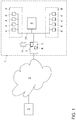
- FIG. 1 shows a network including a computing system according to one embodiment of the present invention.
- the depicted computing system 1 comprises several computing devices (4, 4', 5, 6, 7, 8). Some computing devices (4, 4') are configured to be operable as workstations. One computing device is configured to be operable as a gateway (5). A computing device according to the invention may be configured to be operable in more than one function. In the depicted exemplary embodiment, the computing device that is configured to be operable as a gateway (5) is additionally configured to be operable as an insertion device (6) and as a monitoring server (7). It is understood that the gateway (5), insertion device (6) and monitoring server (7) may also be incorporated by separate computing devices. The monitoring server (7) is coupled to a warning signal device (11). All computing devices of the internal network are connected by a network connection (10). Not shown in Fig.
- the computing system further comprises a file server (8). Some workstations (4) are grouped in one sub network (9), other workstations (4') are grouped in a different sub network (9').
- Fig. 1 further shows an external network (2), to which the internal network is connected by means of the gateway (5).
- the external network (2) may be the internet.
- an external computing device (3) that is connected or connectable to the external network (2).
- Different users of the internal network may have different levels of access to confidential data.
- the users of workstations (4) of sub network (9) may have access to confidential information
- users of workstations (4') of sub network (9') may have access only to publicly available, non-confidential information.
- Data files containing confidential information may be stored on the workstations (4) and/or may be stored on the file server (8).
- Data files containing confidential information may be stored in dedicated sections of the file server (8).
- the data files containing confidential information may contain meta-information that contains their confidentiality level, information about their owner and/or information about the users having access to the file.
- the insertion device (6) scans all possible locations at which confidential data files may be located and tags them.
- only those files are tagged that are sent to an external computing device (3), for example by e-mail.
- all e-mails go through the gateway (5).
- the gateway (5) scans every e-mail for data file attachments. If a data file is detected, it is stripped from the e-mail, tagged and re-attached to the e-mail. The e-mail is then dispatched to its recipient.
- all outgoing e-mails are scanned for attached data files (20), an example of which is shown in Fig. 2A .
- This scan can be done by the gateway (5) or by the insertion device (6).
- the gateway (5), the insertion device (6) and the monitoring server (7) into one single computing device.
- the gateway (5) detects that an e-mail with an attached data file (20) is being sent, it initiates the inventive method.
- all outgoing files are tagged, irrespective of their owner, confidentiality level or other information.
- the insertion device (6) generates a data file element (21), depicted in Fig. 2B .
- This data file element may be an adaptive data file element (21) containing information about the data file (20) such as its name (25), its document ID and/or its owner.
- the adaptive data file element may also contain information about the e-mail to which the data file (20) is attached. This information may include the name and address of the e-mail's sender, the name and address of the e-mail's recipient, and/or a date and time (26) at which the e-mail was sent.
- the data file (20) is a file in PDF format.
- the data file element (21) is an Action object.
- the data file element (21) is inserted into the data file (20) to generate a tagged data file (22), shown in Fig. 2C .
- the tagged data file (22) is then re-attached to the e-mail and the e-mail is sent by the gateway (5) over the external network (2) to its recipient at an external computing device (3).
- the external user at external computing device (3) receives the e-mail with the attached data file (22). He opens the attached file (22) using the software program commonly used for this purpose. Upon opening the tagged data file (22), the software program automatically executes the attached Action object (21).
- the exemplary Action object (21) contains a "RemoteData" command which prompts the software program to download content from a specific network address (URL) given in the Action object.
- the network address is a network address of the monitoring server (7). It may also be a network address of the gateway (5), which would then receive the download request and convey it to the monitoring server (7).
- the network address may be a URL.
- the URL may point to a specific file, i.e., it may include a specific file name.
- the file name contains information associated with the data file.
- the URL placed in the Action object (21) may be http://someUrl.com/Document.pdf-date-time-further_information”.
- "someUrl.com” is the address of the monitoring server (7). If the request for "Document.pdf-date-time-further_information" reaches the monitoring server (7), it can extract the following information about the opened file:
- Fig. 2D An example of the compound of information transmitted by the external computing device (3) to the monitoring server (7) upon opening the tagged data file (22) is depicted in Fig. 2D .
- the Action object can be configured to transmit further information.
- the compound (23) may include information that is transmitted with every IP packet. Such information includes the sender's IP address.
- the compound of information (23) includes
- the monitoring device (7) may evaluate the importance of the information (23). For example, it may check whether the IP address (24) is listed on a whitelist of trusted external computing devices. If this is the case, no further action is taken. If the monitoring device (7) determines that the information (23) is indeed relevant, or if the monitoring device (7) is not configured to undertake any determination or assessment of the relevance of the information (23), the monitoring device (7) generates a warning signal using warning signal device (11) to alert a network administrator or security officer. Additionally or alternatively, the monitoring server (7) may write an entry into a list or database that contains all information (23) sent from external computing devices and/or all knowledge extracted from such information.
Landscapes
- Engineering & Computer Science (AREA)
- Computer Networks & Wireless Communication (AREA)
- Signal Processing (AREA)
- Computer Security & Cryptography (AREA)
- Computer Hardware Design (AREA)
- General Engineering & Computer Science (AREA)
- Theoretical Computer Science (AREA)
- Computing Systems (AREA)
- Health & Medical Sciences (AREA)
- Bioethics (AREA)
- General Health & Medical Sciences (AREA)
- Software Systems (AREA)
- Physics & Mathematics (AREA)
- General Physics & Mathematics (AREA)
- Databases & Information Systems (AREA)
- Data Exchanges In Wide-Area Networks (AREA)
Claims (18)
- Rechnersystem (1) zum Identifizieren von Dateien, die von einer internen Rechenvorrichtung innerhalb eines internen Netzwerks an eine externe Rechenvorrichtung (3) innerhalb eines externen Netzwerks (2) gesendet werden, wobei das Rechnersystem (1) eine oder mehrere interne Rechenvorrichtungen umfasst, wobei die internen Rechenvorrichtungen durch ein internes Netzwerk verbindbar sind,
wobei mindestens eine der internen Rechenvorrichtungen so konfiguriert ist, dass sie als Workstation (4, 4') oder als ein Dateiserver (8) betrieben werden kann, wobei die Workstation (4,4') oder der Dateiserver (8) zum Erzeugen, Speichern und/oder Senden einer Datendatei (20) konfiguriert ist,
wobei mindestens eine der internen Rechenvorrichtungen so konfiguriert ist, dass sie als ein Gateway (5) betrieben werden kann, wobei das Gateway (5) zum Verbinden des internen Netzwerks mit dem externen Netzwerk (2) konfiguriert ist,
wobei mindestens eine der internen Rechenvorrichtungen so konfiguriert ist, dass sie als eine Einfügungsvorrichtung (6) betrieben werden kann, wobei die Einfügungsvorrichtung (6) konfiguriert ist zum:Bestimmen einer Datendatei (20), die verarbeitet werden soll, wobei die Datendatei (20) auf der Workstation (4, 4') oder dem Dateiserver (8) gespeichert ist oder im Begriff steht, durch das Gateway (5) gesendet zu werden;Bestimmen, ob ein Datendateielement (21) in die Datendatei (20) eingefügt werden muss, basierend auf Kriterien, die mit der Datendatei (20) assoziiert sind;falls ein Datendateielement (21) in die Datendatei (20) eingefügt werden muss:und wobei mindestens eine Rechenvorrichtung so konfiguriert ist, dass sie als ein Überwachungsserver (7) betrieben werden kann, wobei der mindestens eine Überwachungsserver (7) so konfiguriert ist, dass er Informationen empfängt, die durch die externe Rechenvorrichtung (3) nach dem Öffnen, Lesen und/oder Verarbeiten der getaggten Datendatei (22) gesendet werden, wobei der mindestens eine Überwachungsserver (7) eine interne Rechenvorrichtung und/oder eine externe Rechenvorrichtung ist.- Erzeugen des Datendateielements (21);- Einfügen des Datendateielements (21) in die Datendatei (20), um eine getaggte Datendatei (22) zu erzeugen; und- Senden der getaggten Datendatei (22) durch das Gateway (5) an die externe Rechenvorrichtung (3), falls kein Datendateielement (21) in die Datendatei (20) eingefügt werden muss:- Senden der Datendatei (20) durch das Gateway (5) an die externe Rechenvorrichtung (3), - Rechnersystem (1) nach Anspruch 1, wobei die mit der Datendatei (20) assoziierten Kriterien, die durch die Einfügungsvorrichtung (6) verwendet werden, um zu bestimmen, ob ein Datendateielement (21) in die Datendatei (20) eingefügt werden muss, mindestens ein Element umfassen aus der Gruppe von:einem Dateiformat der Datendatei (20);einer Vertraulichkeitsstufe der Datendatei (20);einem Sender oder Empfänger der Datendatei (20);einem Quell- oder Speicherort der Datendatei (20);einem Besitzer der Daten (20); undeiner Person mit Zugriff auf die Datendatei (20).
- Rechnersystem (1) nach einem der vorhergehenden Ansprüche, wobei die Einfügungsvorrichtung (6) so konfiguriert ist, dass sie getaggte Datendateien (22) aus mindestens einem Teilsatz von Dateidateien (20) erzeugt, die auf mindestens einer von einer vordefinierten Gruppe von internen Rechenvorrichtungen gespeichert und/oder angeordnet sind.
- Rechnersystem (1) nach einem der vorhergehenden Ansprüche, wobei die Einfügungsvorrichtung (6) so konfiguriert ist, dass sie getaggte Datendateien (22) aus mindestens einem Teilsatz von Dateidateien (20) erzeugt, auf die durch eine vordefinierte Gruppe von Benutzern des internen Netzwerks zugegriffen werden kann und/oder die von dieser besessen und/oder kontrolliert werden.
- Rechnersystem (1) nach einem der vorhergehenden Ansprüche, wobei das Datendateielement (21) mindestens ein Element umfasst aus der Gruppe von:einem Computerprogramm, das durch die externe Rechenvorrichtung (3) nach dem Öffnen, Lesen und/oder Verarbeiten der getaggten Datendatei (22) ausgeführt werden kann;einem elektronisch signierten Element, das eine Netzwerkadresse einer Zertifizierungsstelle enthält, die durch die externe Rechenvorrichtung (3) nach dem Öffnen, Lesen und/oder Verarbeiten der getaggten Datendatei (22) kontaktiert werden soll; undeinem Verweis auf eine Netzwerkadresse eines Inhaltselements, das durch die externe Rechenvorrichtung (3) nach dem Öffnen, Lesen und/oder Verarbeiten der getaggten Datendatei (22) heruntergeladen werden soll.
- Rechnersystem (1) nach einem der vorhergehenden Ansprüche, wobei die Einfügungsvorrichtung (6) so konfiguriert ist, dass sie mit der Datendatei (20) assoziierte Informationen verarbeitet, um ein adaptives Datendateielement (21) zur Einfügung in die Datendatei zu erzeugen, um die getaggte Datendatei (22) zu erzeugen, wobei die mit der Datendatei (20) assoziierten Informationen mindestens ein Element umfassen aus der Gruppe von:einem Dateinamen der Datendatei (20);einem Namen eines Benutzers, der die Datendatei (20) besitzt, kontrolliert und/oder Zugriff darauf hat;einem Namen und/oder eine E-Mail-Adresse und/oder einer Kennung eines Senders einer E-Mail, an welche die Datendatei (20) angehängt ist;einem Datentyp der Datendatei (20);einer Inhaltsbeschreibung der Datendatei (20);einer unterscheidenden Dokumentkennung; undeinem Datum und/oder einer Zeit, die mit der Datendatei (20) assoziiert sind.
- Rechnersystem (1) nach einem der vorhergehenden Ansprüche, wobei der Überwachungsserver (7) so konfiguriert ist, dass er die Informationen verarbeitet, die durch die externe Rechenvorrichtung (3) gesendet werden, wobei der Überwachungsserver (7) so konfiguriert ist, dass er aus den durch die externe Rechenvorrichtung (3) gesendeten Informationen mindestens ein Element extrahiert aus der Gruppe von:einer Netzwerkadresse der externen Rechenvorrichtung (3);einem Benutzernamen eines Benutzers der externen Rechenvorrichtung (3);einem geografischen Standort der externen Rechenvorrichtung (3);Informationen in Bezug auf einen Netzwerkanbieter der externen Rechenvorrichtung (3);Informationen in Bezug auf ein Betriebssystem der externen Rechenvorrichtung (3); undInformationen in Bezug auf Software, die in der externen Rechenvorrichtung (3) verwendet wird und/oder installiert ist.
- Rechnersystem (1) nach Anspruch 6 und 7, wobei der Überwachungsserver (7) so konfiguriert ist, dass er aus den Informationen, die durch die externe Rechenvorrichtung (3) gesendet werden, mindestens ein Element aus der Gruppe von mit der Datendatei (20) assoziierten Informationen extrahiert, die zum Erzeugen des adaptiven Datendateielements (21) verwendet werden.
- Rechnersystem (1) nach Anspruch 7 oder 8, wobei der Überwachungsserver (7) so konfiguriert ist, dass er Informationen empfängt, die durch eine interne Rechenvorrichtung nach dem Öffnen, Lesen und/oder Verarbeiten der getaggten Datendatei (22) gesendet werden, und wobei der Überwachungsserver (7) so konfiguriert ist, dass er eine Rechenvorrichtung basierend auf den durch die Rechenvorrichtung gesendeten Informationen entweder als extern oder intern identifiziert.
- Rechnersystem (1) nach Anspruch 9, wobei der Überwachungsserver (7) so konfiguriert ist, dass er bei Identifizierung einer externen Rechenvorrichtung (3) ein Warnsignal erzeugt.
- Verfahren zur Identifizierung von Dateien, die von einer internen Rechenvorrichtung innerhalb eines internen Netzwerks an eine externe Rechenvorrichtung (3) innerhalb eines externen Netzwerks (2) gesendet werden, wobei das Verfahren umfasst:Bestimmen einer Datendatei (20), die verarbeitet werden soll, wobei die Datendatei (20) auf einer Workstation (4, 4') oder einem Dateiserver (8) gespeichert ist oder im Begriff steht, durch ein Gateway (5) des internen Netzwerks gesendet zu werden;Bestimmen, ob ein Datendateielement (21) in die Datendatei (20) eingefügt werden muss, basierend auf Kriterien, die mit der Datendatei (20) assoziiert sind;falls ein Datendateielement (21) in die Datendatei (20) eingefügt werden muss:- Erzeugen des Datendateielements (21);- Einfügen des Datendateielements (21) in die Datendatei (20), um eine getaggte Datendatei (22) zu erzeugen;- Senden der getaggten Datendatei (22) von der internen Rechenvorrichtung durch ein Gateway (5) an die externe Rechenvorrichtung (3), und- Empfangen von Informationen, die durch die externe Rechenvorrichtung (3) nach dem Öffnen, Lesen und/oder Verarbeiten der getaggten Datendatei (22) gesendet werden;falls kein Datendateielement (21) in die Datendatei (20) eingefügt werden muss:- Senden der Datendatei (20) durch das Gateway (5) an die externe Rechenvorrichtung (3).
- Verfahren nach Anspruch 11, wobei die mit der Datendatei (20) assoziierten Kriterien, die verwendet werden, um zu bestimmen, ob ein Datendateielement (21) in die Datendatei (20) eingefügt werden muss, mindestens ein Element umfassen aus der Gruppe von:einem Dateiformat der Datendatei (20);einer Vertraulichkeitsstufe der Datendatei (20);einem Sender oder Empfänger der Datendatei (20);einem Quell- oder Speicherort der Datendatei (20);einem Besitzer der Daten (20); undeiner Person mit Zugriff auf die Datendatei (20).
- Verfahren nach Anspruch 11 oder 12, wobei das Datendateielement (21) mindestens ein Element umfasst aus der Gruppe von:einem Computerprogramm, das durch die externe Rechenvorrichtung (3) nach dem Öffnen, Lesen und/oder Verarbeiten der getaggten Datendatei (22) ausgeführt werden kann;einem elektronisch signierten Element, das eine Netzwerkadresse einer Zertifizierungsstelle enthält, die durch die externe Rechenvorrichtung (3) nach dem Öffnen, Lesen und/oder Verarbeiten der getaggten Datendatei (22) kontaktiert werden soll; undeinem Verweis auf eine Netzwerkadresse eines Inhaltselements, das durch die externe Rechenvorrichtung (3) nach dem Öffnen, Lesen und/oder Verarbeiten der getaggten Datendatei (22) heruntergeladen werden soll.
- Verfahren nach einem Ansprüche 11 bis 13, ferner umfassend ein Verarbeiten von mit der Datendatei (20) assoziierten Informationen, um ein adaptives Datendateielement (21) zur Einfügung in die Datendatei (20) zu erzeugen, um die getaggte Datendatei (22) zu erzeugen, wobei die mit der Datendatei (20) assoziierten Informationen mindestens ein Element umfassen aus der Gruppe von:einem Dateinamen der Datendatei (20);einem Namen eines Benutzers, der die Datendatei (20) besitzt, kontrolliert und/oder Zugriff darauf hat;einem Namen und/oder eine E-Mail-Adresse und/oder einer Kennung eines Senders einer E-Mail, an welche die Datendatei (20) angehängt ist;einem Datentyp der Datendatei (20);einer Inhaltsbeschreibung der Datendatei (20);einer unterscheidenden Dokumentkennung; undeinem Datum und/oder einer Zeit, die mit der Datendatei (20) assoziiert sind.
- Verfahren nach einem der Ansprüche 11 bis 14, ferner umfassend ein Extrahieren aus den Informationen, die durch die externe Rechenvorrichtung (3) gesendet werden, mindestens eines Elements aus der Gruppe von:einer Netzwerkadresse der externen Rechenvorrichtung (3);einem Benutzernamen eines Benutzers der externen Rechenvorrichtung (3);einem geografischen Standort der externen Rechenvorrichtung (3);Informationen in Bezug auf einen Netzwerkanbieter der externen Rechenvorrichtung (3);Informationen in Bezug auf ein Betriebssystem der externen Rechenvorrichtung (3); undInformationen in Bezug auf Software, die in der externen Rechenvorrichtung (3) verwendet wird und/oder installiert ist.
- Verfahren nach Anspruch 14 und 15, ferner umfassend ein Extrahieren aus den Informationen, die durch die externe Rechenvorrichtung (3) gesendet werden, mindestens eines Elements aus der Gruppe von mit der Datendatei (20) assoziierten Informationen, die zum Erzeugen des adaptiven Datendateielements (21) verwendet werden.
- Verfahren nach Anspruch 15 oder 16, ferner umfassend ein Identifizieren einer Rechenvorrichtung entweder als extern oder intern basierend auf den durch die Rechenvorrichtung gesendeten Informationen.
- Verfahren nach Anspruch 17, ferner umfassend ein Erzeugen eines Warnsignals bei Identifizierung einer externen Rechenvorrichtung (3).
Priority Applications (3)
| Application Number | Priority Date | Filing Date | Title |
|---|---|---|---|
| EP14175818.5A EP2963864B1 (de) | 2014-07-04 | 2014-07-04 | Rechnersystem und Verfahren zur Identifizierung von an ein externes Netzwerk übertragenen Dateien |
| IL237512A IL237512B (en) | 2014-07-04 | 2015-03-02 | Computing system and method for identifying files transmitted to an external network |
| US14/707,751 US10038738B2 (en) | 2014-07-04 | 2015-05-08 | Computing system and method for identifying files transmitted to an external network |
Applications Claiming Priority (1)
| Application Number | Priority Date | Filing Date | Title |
|---|---|---|---|
| EP14175818.5A EP2963864B1 (de) | 2014-07-04 | 2014-07-04 | Rechnersystem und Verfahren zur Identifizierung von an ein externes Netzwerk übertragenen Dateien |
Publications (2)
| Publication Number | Publication Date |
|---|---|
| EP2963864A1 EP2963864A1 (de) | 2016-01-06 |
| EP2963864B1 true EP2963864B1 (de) | 2019-04-24 |
Family
ID=51178702
Family Applications (1)
| Application Number | Title | Priority Date | Filing Date |
|---|---|---|---|
| EP14175818.5A Active EP2963864B1 (de) | 2014-07-04 | 2014-07-04 | Rechnersystem und Verfahren zur Identifizierung von an ein externes Netzwerk übertragenen Dateien |
Country Status (3)
| Country | Link |
|---|---|
| US (1) | US10038738B2 (de) |
| EP (1) | EP2963864B1 (de) |
| IL (1) | IL237512B (de) |
Families Citing this family (4)
| Publication number | Priority date | Publication date | Assignee | Title |
|---|---|---|---|---|
| US9934475B2 (en) * | 2015-05-13 | 2018-04-03 | Bank Of America Corporation | Managing enterprise data movement using a heuristic data movement detection engine |
| EP3786826B1 (de) * | 2019-08-30 | 2025-09-17 | Barclays Execution Services Limited | Sichere validierungspipeline in einer cloud-umgebung von drittanbietern |
| CN113542264B (zh) * | 2021-07-13 | 2022-08-26 | 杭州安恒信息技术股份有限公司 | 一种文件传输控制方法、装置、设备及可读存储介质 |
| CN116010365A (zh) * | 2023-01-04 | 2023-04-25 | 上海通联金融服务有限公司 | 一种多系统并行的文件交换机制 |
Citations (1)
| Publication number | Priority date | Publication date | Assignee | Title |
|---|---|---|---|---|
| US20070094394A1 (en) * | 2005-10-26 | 2007-04-26 | Mona Singh | Methods, systems, and computer program products for transmission control of sensitive application-layer data |
Family Cites Families (6)
| Publication number | Priority date | Publication date | Assignee | Title |
|---|---|---|---|---|
| US8868914B2 (en) * | 1999-07-02 | 2014-10-21 | Steven W. Teppler | System and methods for distributing trusted time |
| US7076533B1 (en) * | 2001-11-06 | 2006-07-11 | Ihance, Inc. | Method and system for monitoring e-mail and website behavior of an e-mail recipient |
| US7877409B2 (en) * | 2005-12-29 | 2011-01-25 | Nextlabs, Inc. | Preventing conflicts of interests between two or more groups using applications |
| WO2009032379A1 (en) | 2007-06-12 | 2009-03-12 | The Trustees Of Columbia University In The City Of New York | Methods and systems for providing trap-based defenses |
| US11461785B2 (en) * | 2008-07-10 | 2022-10-04 | Ron M. Redlich | System and method to identify, classify and monetize information as an intangible asset and a production model based thereon |
| US9438488B2 (en) * | 2012-11-09 | 2016-09-06 | Citrix Systems, Inc. | Systems and methods for appflow for datastream |
-
2014
- 2014-07-04 EP EP14175818.5A patent/EP2963864B1/de active Active
-
2015
- 2015-03-02 IL IL237512A patent/IL237512B/en active IP Right Grant
- 2015-05-08 US US14/707,751 patent/US10038738B2/en active Active
Patent Citations (1)
| Publication number | Priority date | Publication date | Assignee | Title |
|---|---|---|---|---|
| US20070094394A1 (en) * | 2005-10-26 | 2007-04-26 | Mona Singh | Methods, systems, and computer program products for transmission control of sensitive application-layer data |
Also Published As
| Publication number | Publication date |
|---|---|
| EP2963864A1 (de) | 2016-01-06 |
| IL237512B (en) | 2019-02-28 |
| US20160006792A1 (en) | 2016-01-07 |
| US10038738B2 (en) | 2018-07-31 |
Similar Documents
| Publication | Publication Date | Title |
|---|---|---|
| US7752269B2 (en) | Adhoc secure document exchange | |
| US9501639B2 (en) | Methods, systems, and media for baiting inside attackers | |
| US7412487B2 (en) | Method and system for tracking receipt of electronic message | |
| US8181250B2 (en) | Personalized honeypot for detecting information leaks and security breaches | |
| US8990573B2 (en) | System and method for using variable security tag location in network communications | |
| US7096200B2 (en) | System and method for evaluating and enhancing source anonymity for encrypted web traffic | |
| US8024568B2 (en) | Method and system for verification of an endpoint security scan | |
| US8336108B2 (en) | Method and system for collaboration involving enterprise nodes | |
| KR101387600B1 (ko) | 전자 파일 전달 방법 | |
| US20130246537A1 (en) | System and method for monitoring social engineering in a computer network environment | |
| US20120167215A1 (en) | System and method of facilitating the identification of a computer on a network | |
| US20240015182A1 (en) | Device for providing protective service against email security-based zero-day url attack and method for operating same | |
| KR102093274B1 (ko) | 콘텐트 스캐닝 에이전트, 콘텐트 스캐닝 방법 및 그 방법을 수행하는 프로그램을 기록한 컴퓨터 판독 가능 기록매체 | |
| US10038738B2 (en) | Computing system and method for identifying files transmitted to an external network | |
| US11128588B2 (en) | Apparatus, method and computer-readable recording medium storing computer program for restricting electronic file viewing utilizing antivirus software | |
| CN111181831A (zh) | 通信数据处理方法和装置、存储介质及电子装置 | |
| CN114172721A (zh) | 恶意数据防护方法、装置、电子设备及存储介质 | |
| KR101487476B1 (ko) | 악성도메인을 검출하기 위한 방법 및 장치 | |
| CN111935123B (zh) | 一种检测dns欺骗攻击的方法、设备、存储介质 | |
| Bistarelli et al. | A TCP-based covert channel with integrity check and retransmission | |
| Blasco et al. | A framework for avoiding steganography usage over HTTP | |
| Saračević et al. | Some specific examples of attacks on information systems and smart cities applications | |
| CN115567307A (zh) | 蜜罐防护方法以及装置 | |
| KR101934516B1 (ko) | 메일열람시 보안을 위한 전자메일처리시스템 | |
| Mohtasebi et al. | A mitigation approach to the privacy and malware threats of social network services |
Legal Events
| Date | Code | Title | Description |
|---|---|---|---|
| PUAI | Public reference made under article 153(3) epc to a published international application that has entered the european phase |
Free format text: ORIGINAL CODE: 0009012 |
|
| AK | Designated contracting states |
Kind code of ref document: A1 Designated state(s): AL AT BE BG CH CY CZ DE DK EE ES FI FR GB GR HR HU IE IS IT LI LT LU LV MC MK MT NL NO PL PT RO RS SE SI SK SM TR |
|
| AX | Request for extension of the european patent |
Extension state: BA ME |
|
| 17P | Request for examination filed |
Effective date: 20160706 |
|
| RBV | Designated contracting states (corrected) |
Designated state(s): AL AT BE BG CH CY CZ DE DK EE ES FI FR GB GR HR HU IE IS IT LI LT LU LV MC MK MT NL NO PL PT RO RS SE SI SK SM TR |
|
| STAA | Information on the status of an ep patent application or granted ep patent |
Free format text: STATUS: EXAMINATION IS IN PROGRESS |
|
| 17Q | First examination report despatched |
Effective date: 20170102 |
|
| GRAP | Despatch of communication of intention to grant a patent |
Free format text: ORIGINAL CODE: EPIDOSNIGR1 |
|
| STAA | Information on the status of an ep patent application or granted ep patent |
Free format text: STATUS: GRANT OF PATENT IS INTENDED |
|
| INTG | Intention to grant announced |
Effective date: 20181120 |
|
| GRAS | Grant fee paid |
Free format text: ORIGINAL CODE: EPIDOSNIGR3 |
|
| GRAA | (expected) grant |
Free format text: ORIGINAL CODE: 0009210 |
|
| STAA | Information on the status of an ep patent application or granted ep patent |
Free format text: STATUS: THE PATENT HAS BEEN GRANTED |
|
| AK | Designated contracting states |
Kind code of ref document: B1 Designated state(s): AL AT BE BG CH CY CZ DE DK EE ES FI FR GB GR HR HU IE IS IT LI LT LU LV MC MK MT NL NO PL PT RO RS SE SI SK SM TR |
|
| REG | Reference to a national code |
Ref country code: GB Ref legal event code: FG4D |
|
| REG | Reference to a national code |
Ref country code: CH Ref legal event code: EP |
|
| REG | Reference to a national code |
Ref country code: AT Ref legal event code: REF Ref document number: 1125443 Country of ref document: AT Kind code of ref document: T Effective date: 20190515 Ref country code: IE Ref legal event code: FG4D |
|
| REG | Reference to a national code |
Ref country code: DE Ref legal event code: R096 Ref document number: 602014045211 Country of ref document: DE |
|
| REG | Reference to a national code |
Ref country code: NL Ref legal event code: MP Effective date: 20190424 |
|
| REG | Reference to a national code |
Ref country code: LT Ref legal event code: MG4D |
|
| PG25 | Lapsed in a contracting state [announced via postgrant information from national office to epo] |
Ref country code: NL Free format text: LAPSE BECAUSE OF FAILURE TO SUBMIT A TRANSLATION OF THE DESCRIPTION OR TO PAY THE FEE WITHIN THE PRESCRIBED TIME-LIMIT Effective date: 20190424 |
|
| PG25 | Lapsed in a contracting state [announced via postgrant information from national office to epo] |
Ref country code: SE Free format text: LAPSE BECAUSE OF FAILURE TO SUBMIT A TRANSLATION OF THE DESCRIPTION OR TO PAY THE FEE WITHIN THE PRESCRIBED TIME-LIMIT Effective date: 20190424 Ref country code: PT Free format text: LAPSE BECAUSE OF FAILURE TO SUBMIT A TRANSLATION OF THE DESCRIPTION OR TO PAY THE FEE WITHIN THE PRESCRIBED TIME-LIMIT Effective date: 20190824 Ref country code: ES Free format text: LAPSE BECAUSE OF FAILURE TO SUBMIT A TRANSLATION OF THE DESCRIPTION OR TO PAY THE FEE WITHIN THE PRESCRIBED TIME-LIMIT Effective date: 20190424 Ref country code: LT Free format text: LAPSE BECAUSE OF FAILURE TO SUBMIT A TRANSLATION OF THE DESCRIPTION OR TO PAY THE FEE WITHIN THE PRESCRIBED TIME-LIMIT Effective date: 20190424 Ref country code: FI Free format text: LAPSE BECAUSE OF FAILURE TO SUBMIT A TRANSLATION OF THE DESCRIPTION OR TO PAY THE FEE WITHIN THE PRESCRIBED TIME-LIMIT Effective date: 20190424 Ref country code: AL Free format text: LAPSE BECAUSE OF FAILURE TO SUBMIT A TRANSLATION OF THE DESCRIPTION OR TO PAY THE FEE WITHIN THE PRESCRIBED TIME-LIMIT Effective date: 20190424 Ref country code: NO Free format text: LAPSE BECAUSE OF FAILURE TO SUBMIT A TRANSLATION OF THE DESCRIPTION OR TO PAY THE FEE WITHIN THE PRESCRIBED TIME-LIMIT Effective date: 20190724 Ref country code: HR Free format text: LAPSE BECAUSE OF FAILURE TO SUBMIT A TRANSLATION OF THE DESCRIPTION OR TO PAY THE FEE WITHIN THE PRESCRIBED TIME-LIMIT Effective date: 20190424 |
|
| PG25 | Lapsed in a contracting state [announced via postgrant information from national office to epo] |
Ref country code: PL Free format text: LAPSE BECAUSE OF FAILURE TO SUBMIT A TRANSLATION OF THE DESCRIPTION OR TO PAY THE FEE WITHIN THE PRESCRIBED TIME-LIMIT Effective date: 20190424 Ref country code: GR Free format text: LAPSE BECAUSE OF FAILURE TO SUBMIT A TRANSLATION OF THE DESCRIPTION OR TO PAY THE FEE WITHIN THE PRESCRIBED TIME-LIMIT Effective date: 20190725 Ref country code: LV Free format text: LAPSE BECAUSE OF FAILURE TO SUBMIT A TRANSLATION OF THE DESCRIPTION OR TO PAY THE FEE WITHIN THE PRESCRIBED TIME-LIMIT Effective date: 20190424 Ref country code: BG Free format text: LAPSE BECAUSE OF FAILURE TO SUBMIT A TRANSLATION OF THE DESCRIPTION OR TO PAY THE FEE WITHIN THE PRESCRIBED TIME-LIMIT Effective date: 20190724 Ref country code: RS Free format text: LAPSE BECAUSE OF FAILURE TO SUBMIT A TRANSLATION OF THE DESCRIPTION OR TO PAY THE FEE WITHIN THE PRESCRIBED TIME-LIMIT Effective date: 20190424 |
|
| REG | Reference to a national code |
Ref country code: AT Ref legal event code: MK05 Ref document number: 1125443 Country of ref document: AT Kind code of ref document: T Effective date: 20190424 |
|
| PG25 | Lapsed in a contracting state [announced via postgrant information from national office to epo] |
Ref country code: IS Free format text: LAPSE BECAUSE OF FAILURE TO SUBMIT A TRANSLATION OF THE DESCRIPTION OR TO PAY THE FEE WITHIN THE PRESCRIBED TIME-LIMIT Effective date: 20190824 |
|
| REG | Reference to a national code |
Ref country code: DE Ref legal event code: R097 Ref document number: 602014045211 Country of ref document: DE |
|
| PG25 | Lapsed in a contracting state [announced via postgrant information from national office to epo] |
Ref country code: AT Free format text: LAPSE BECAUSE OF FAILURE TO SUBMIT A TRANSLATION OF THE DESCRIPTION OR TO PAY THE FEE WITHIN THE PRESCRIBED TIME-LIMIT Effective date: 20190424 Ref country code: DK Free format text: LAPSE BECAUSE OF FAILURE TO SUBMIT A TRANSLATION OF THE DESCRIPTION OR TO PAY THE FEE WITHIN THE PRESCRIBED TIME-LIMIT Effective date: 20190424 Ref country code: EE Free format text: LAPSE BECAUSE OF FAILURE TO SUBMIT A TRANSLATION OF THE DESCRIPTION OR TO PAY THE FEE WITHIN THE PRESCRIBED TIME-LIMIT Effective date: 20190424 Ref country code: RO Free format text: LAPSE BECAUSE OF FAILURE TO SUBMIT A TRANSLATION OF THE DESCRIPTION OR TO PAY THE FEE WITHIN THE PRESCRIBED TIME-LIMIT Effective date: 20190424 Ref country code: CZ Free format text: LAPSE BECAUSE OF FAILURE TO SUBMIT A TRANSLATION OF THE DESCRIPTION OR TO PAY THE FEE WITHIN THE PRESCRIBED TIME-LIMIT Effective date: 20190424 Ref country code: SK Free format text: LAPSE BECAUSE OF FAILURE TO SUBMIT A TRANSLATION OF THE DESCRIPTION OR TO PAY THE FEE WITHIN THE PRESCRIBED TIME-LIMIT Effective date: 20190424 |
|
| PG25 | Lapsed in a contracting state [announced via postgrant information from national office to epo] |
Ref country code: SM Free format text: LAPSE BECAUSE OF FAILURE TO SUBMIT A TRANSLATION OF THE DESCRIPTION OR TO PAY THE FEE WITHIN THE PRESCRIBED TIME-LIMIT Effective date: 20190424 Ref country code: IT Free format text: LAPSE BECAUSE OF FAILURE TO SUBMIT A TRANSLATION OF THE DESCRIPTION OR TO PAY THE FEE WITHIN THE PRESCRIBED TIME-LIMIT Effective date: 20190424 Ref country code: MC Free format text: LAPSE BECAUSE OF FAILURE TO SUBMIT A TRANSLATION OF THE DESCRIPTION OR TO PAY THE FEE WITHIN THE PRESCRIBED TIME-LIMIT Effective date: 20190424 |
|
| PLBE | No opposition filed within time limit |
Free format text: ORIGINAL CODE: 0009261 |
|
| REG | Reference to a national code |
Ref country code: CH Ref legal event code: PL |
|
| STAA | Information on the status of an ep patent application or granted ep patent |
Free format text: STATUS: NO OPPOSITION FILED WITHIN TIME LIMIT |
|
| PG25 | Lapsed in a contracting state [announced via postgrant information from national office to epo] |
Ref country code: TR Free format text: LAPSE BECAUSE OF FAILURE TO SUBMIT A TRANSLATION OF THE DESCRIPTION OR TO PAY THE FEE WITHIN THE PRESCRIBED TIME-LIMIT Effective date: 20190424 |
|
| 26N | No opposition filed |
Effective date: 20200127 |
|
| REG | Reference to a national code |
Ref country code: BE Ref legal event code: MM Effective date: 20190731 |
|
| PG25 | Lapsed in a contracting state [announced via postgrant information from national office to epo] |
Ref country code: LI Free format text: LAPSE BECAUSE OF NON-PAYMENT OF DUE FEES Effective date: 20190731 Ref country code: LU Free format text: LAPSE BECAUSE OF NON-PAYMENT OF DUE FEES Effective date: 20190704 Ref country code: CH Free format text: LAPSE BECAUSE OF NON-PAYMENT OF DUE FEES Effective date: 20190731 Ref country code: SI Free format text: LAPSE BECAUSE OF FAILURE TO SUBMIT A TRANSLATION OF THE DESCRIPTION OR TO PAY THE FEE WITHIN THE PRESCRIBED TIME-LIMIT Effective date: 20190424 Ref country code: BE Free format text: LAPSE BECAUSE OF NON-PAYMENT OF DUE FEES Effective date: 20190731 |
|
| PG25 | Lapsed in a contracting state [announced via postgrant information from national office to epo] |
Ref country code: CY Free format text: LAPSE BECAUSE OF FAILURE TO SUBMIT A TRANSLATION OF THE DESCRIPTION OR TO PAY THE FEE WITHIN THE PRESCRIBED TIME-LIMIT Effective date: 20190424 |
|
| PG25 | Lapsed in a contracting state [announced via postgrant information from national office to epo] |
Ref country code: MT Free format text: LAPSE BECAUSE OF FAILURE TO SUBMIT A TRANSLATION OF THE DESCRIPTION OR TO PAY THE FEE WITHIN THE PRESCRIBED TIME-LIMIT Effective date: 20190424 Ref country code: HU Free format text: LAPSE BECAUSE OF FAILURE TO SUBMIT A TRANSLATION OF THE DESCRIPTION OR TO PAY THE FEE WITHIN THE PRESCRIBED TIME-LIMIT; INVALID AB INITIO Effective date: 20140704 |
|
| REG | Reference to a national code |
Ref country code: DE Ref legal event code: R079 Ref document number: 602014045211 Country of ref document: DE Free format text: PREVIOUS MAIN CLASS: H04L0012580000 Ipc: H04L0051000000 |
|
| PG25 | Lapsed in a contracting state [announced via postgrant information from national office to epo] |
Ref country code: MK Free format text: LAPSE BECAUSE OF FAILURE TO SUBMIT A TRANSLATION OF THE DESCRIPTION OR TO PAY THE FEE WITHIN THE PRESCRIBED TIME-LIMIT Effective date: 20190424 |
|
| P01 | Opt-out of the competence of the unified patent court (upc) registered |
Effective date: 20230523 |
|
| PGFP | Annual fee paid to national office [announced via postgrant information from national office to epo] |
Ref country code: DE Payment date: 20250731 Year of fee payment: 12 |
|
| PGFP | Annual fee paid to national office [announced via postgrant information from national office to epo] |
Ref country code: GB Payment date: 20250722 Year of fee payment: 12 |
|
| PGFP | Annual fee paid to national office [announced via postgrant information from national office to epo] |
Ref country code: FR Payment date: 20250725 Year of fee payment: 12 |
|
| PGFP | Annual fee paid to national office [announced via postgrant information from national office to epo] |
Ref country code: IE Payment date: 20250718 Year of fee payment: 12 |