EP2963705A1 - Cathode active material for lithium secondary battery - Google Patents
Cathode active material for lithium secondary battery Download PDFInfo
- Publication number
- EP2963705A1 EP2963705A1 EP14756796.0A EP14756796A EP2963705A1 EP 2963705 A1 EP2963705 A1 EP 2963705A1 EP 14756796 A EP14756796 A EP 14756796A EP 2963705 A1 EP2963705 A1 EP 2963705A1
- Authority
- EP
- European Patent Office
- Prior art keywords
- active material
- sulfate
- particle
- cathode active
- prepared
- Prior art date
- Legal status (The legal status is an assumption and is not a legal conclusion. Google has not performed a legal analysis and makes no representation as to the accuracy of the status listed.)
- Withdrawn
Links
Images


Classifications
-
- H—ELECTRICITY
- H01—ELECTRIC ELEMENTS
- H01M—PROCESSES OR MEANS, e.g. BATTERIES, FOR THE DIRECT CONVERSION OF CHEMICAL ENERGY INTO ELECTRICAL ENERGY
- H01M4/00—Electrodes
- H01M4/02—Electrodes composed of, or comprising, active material
- H01M4/36—Selection of substances as active materials, active masses, active liquids
- H01M4/362—Composites
- H01M4/366—Composites as layered products
-
- C—CHEMISTRY; METALLURGY
- C01—INORGANIC CHEMISTRY
- C01G—COMPOUNDS CONTAINING METALS NOT COVERED BY SUBCLASSES C01D OR C01F
- C01G53/00—Compounds of nickel
- C01G53/40—Complex oxides containing nickel and at least one other metal element
- C01G53/42—Complex oxides containing nickel and at least one other metal element containing alkali metals, e.g. LiNiO2
-
- C—CHEMISTRY; METALLURGY
- C01—INORGANIC CHEMISTRY
- C01G—COMPOUNDS CONTAINING METALS NOT COVERED BY SUBCLASSES C01D OR C01F
- C01G53/00—Compounds of nickel
- C01G53/40—Complex oxides containing nickel and at least one other metal element
- C01G53/42—Complex oxides containing nickel and at least one other metal element containing alkali metals, e.g. LiNiO2
- C01G53/44—Complex oxides containing nickel and at least one other metal element containing alkali metals, e.g. LiNiO2 containing manganese
- C01G53/50—Complex oxides containing nickel and at least one other metal element containing alkali metals, e.g. LiNiO2 containing manganese of the type (MnO2)n-, e.g. Li(NixMn1-x)O2 or Li(MyNixMn1-x-y)O2
-
- H—ELECTRICITY
- H01—ELECTRIC ELEMENTS
- H01M—PROCESSES OR MEANS, e.g. BATTERIES, FOR THE DIRECT CONVERSION OF CHEMICAL ENERGY INTO ELECTRICAL ENERGY
- H01M4/00—Electrodes
- H01M4/02—Electrodes composed of, or comprising, active material
- H01M4/13—Electrodes for accumulators with non-aqueous electrolyte, e.g. for lithium-accumulators; Processes of manufacture thereof
- H01M4/131—Electrodes based on mixed oxides or hydroxides, or on mixtures of oxides or hydroxides, e.g. LiCoOx
-
- H—ELECTRICITY
- H01—ELECTRIC ELEMENTS
- H01M—PROCESSES OR MEANS, e.g. BATTERIES, FOR THE DIRECT CONVERSION OF CHEMICAL ENERGY INTO ELECTRICAL ENERGY
- H01M4/00—Electrodes
- H01M4/02—Electrodes composed of, or comprising, active material
- H01M4/36—Selection of substances as active materials, active masses, active liquids
- H01M4/362—Composites
-
- H—ELECTRICITY
- H01—ELECTRIC ELEMENTS
- H01M—PROCESSES OR MEANS, e.g. BATTERIES, FOR THE DIRECT CONVERSION OF CHEMICAL ENERGY INTO ELECTRICAL ENERGY
- H01M4/00—Electrodes
- H01M4/02—Electrodes composed of, or comprising, active material
- H01M4/36—Selection of substances as active materials, active masses, active liquids
- H01M4/48—Selection of substances as active materials, active masses, active liquids of inorganic oxides or hydroxides
- H01M4/485—Selection of substances as active materials, active masses, active liquids of inorganic oxides or hydroxides of mixed oxides or hydroxides for inserting or intercalating light metals, e.g. LiTi2O4 or LiTi2OxFy
-
- H—ELECTRICITY
- H01—ELECTRIC ELEMENTS
- H01M—PROCESSES OR MEANS, e.g. BATTERIES, FOR THE DIRECT CONVERSION OF CHEMICAL ENERGY INTO ELECTRICAL ENERGY
- H01M4/00—Electrodes
- H01M4/02—Electrodes composed of, or comprising, active material
- H01M4/36—Selection of substances as active materials, active masses, active liquids
- H01M4/48—Selection of substances as active materials, active masses, active liquids of inorganic oxides or hydroxides
- H01M4/50—Selection of substances as active materials, active masses, active liquids of inorganic oxides or hydroxides of manganese
- H01M4/505—Selection of substances as active materials, active masses, active liquids of inorganic oxides or hydroxides of manganese of mixed oxides or hydroxides containing manganese for inserting or intercalating light metals, e.g. LiMn2O4 or LiMn2OxFy
-
- H—ELECTRICITY
- H01—ELECTRIC ELEMENTS
- H01M—PROCESSES OR MEANS, e.g. BATTERIES, FOR THE DIRECT CONVERSION OF CHEMICAL ENERGY INTO ELECTRICAL ENERGY
- H01M4/00—Electrodes
- H01M4/02—Electrodes composed of, or comprising, active material
- H01M4/36—Selection of substances as active materials, active masses, active liquids
- H01M4/48—Selection of substances as active materials, active masses, active liquids of inorganic oxides or hydroxides
- H01M4/52—Selection of substances as active materials, active masses, active liquids of inorganic oxides or hydroxides of nickel, cobalt or iron
- H01M4/525—Selection of substances as active materials, active masses, active liquids of inorganic oxides or hydroxides of nickel, cobalt or iron of mixed oxides or hydroxides containing iron, cobalt or nickel for inserting or intercalating light metals, e.g. LiNiO2, LiCoO2 or LiCoOxFy
-
- C—CHEMISTRY; METALLURGY
- C01—INORGANIC CHEMISTRY
- C01P—INDEXING SCHEME RELATING TO STRUCTURAL AND PHYSICAL ASPECTS OF SOLID INORGANIC COMPOUNDS
- C01P2006/00—Physical properties of inorganic compounds
- C01P2006/40—Electric properties
-
- H—ELECTRICITY
- H01—ELECTRIC ELEMENTS
- H01M—PROCESSES OR MEANS, e.g. BATTERIES, FOR THE DIRECT CONVERSION OF CHEMICAL ENERGY INTO ELECTRICAL ENERGY
- H01M10/00—Secondary cells; Manufacture thereof
- H01M10/05—Accumulators with non-aqueous electrolyte
- H01M10/052—Li-accumulators
-
- H—ELECTRICITY
- H01—ELECTRIC ELEMENTS
- H01M—PROCESSES OR MEANS, e.g. BATTERIES, FOR THE DIRECT CONVERSION OF CHEMICAL ENERGY INTO ELECTRICAL ENERGY
- H01M4/00—Electrodes
- H01M4/02—Electrodes composed of, or comprising, active material
- H01M2004/026—Electrodes composed of, or comprising, active material characterised by the polarity
- H01M2004/028—Positive electrodes
-
- Y—GENERAL TAGGING OF NEW TECHNOLOGICAL DEVELOPMENTS; GENERAL TAGGING OF CROSS-SECTIONAL TECHNOLOGIES SPANNING OVER SEVERAL SECTIONS OF THE IPC; TECHNICAL SUBJECTS COVERED BY FORMER USPC CROSS-REFERENCE ART COLLECTIONS [XRACs] AND DIGESTS
- Y02—TECHNOLOGIES OR APPLICATIONS FOR MITIGATION OR ADAPTATION AGAINST CLIMATE CHANGE
- Y02E—REDUCTION OF GREENHOUSE GAS [GHG] EMISSIONS, RELATED TO ENERGY GENERATION, TRANSMISSION OR DISTRIBUTION
- Y02E60/00—Enabling technologies; Technologies with a potential or indirect contribution to GHG emissions mitigation
- Y02E60/10—Energy storage using batteries
Definitions
- the present invention relates to a cathode active material for a lithium secondary battery, and in particular, to a cathode active material for a lithium secondary battery in which the concentration of the transition metal changes gradually in accordance with particle growth, thus changing the oxidation number of the transition metal and improving the stability of the crystalline structure, and thereby notably improving the high-rate charging and discharging characteristics.
- lithium secondary batteries having high energy density and voltage, long cycle span and low self-discharge are commercially available and widely used.
- the lithium secondary batteries generally use lithium-containing cobalt composite oxide (LiCoO 2 ) as a cathode active material.
- lithium-containing manganese composite oxides e.g., LiMnO 2 having a layered crystal structure and LiMn 2 O 4 having a spinel crystal structure
- lithium-containing nickel composite oxide e.g., LiNiO 2
- LiCoO 2 is the most generally used owing to its superior physical properties such as long lifespan and good charge/discharge characteristics, but has low structural stability and is costly due to natural resource limitations of cobalt used as a source material, thus disadvantageously having limited price competiveness.
- Lithium manganese oxides such as LiMnO 2 and LiMn 2 O 4 have advantages of superior thermal stability and low costs, but have disadvantages of low capacity and bad low-temperature characteristics.
- LiMnO 2 -based cathode active materials are relatively cheap and exhibit battery characteristics of superior discharge capacity, but are disadvantageously difficult to synthesize and are unstable.
- the present invention provides a low-cost highly functional cathode active material including lithium transition metal composite oxide, in which constituent elements are contained to have a predetermined composition and oxidation number, as mentioned below.
- U.S. Pat. No. 6,964,828 discloses a lithium transition metal oxide having a structure of Li(M1 (1-x) -Mn x )O 2 , where M1 is a metal other than Cr and, when M1 is Ni or Co, Ni has an oxidation number of +2, Co has an oxidation number of +3, and Mn has an oxidation number of +4.
- Korean Patent Laid-open No. 2005-0047291 discloses a lithium transition metal oxide, where Ni and Mn are present in equivalents amounts and have an oxidation number of +2 and +4, respectively.
- Korean Patent No. 543,720 discloses a lithium transition metal oxide, where Ni and Mn are present in substantially equivalent amounts, Ni has an oxidation number ranging from 2.0 to 2.5 and Mn has an oxidation number ranging from 3.5 to 4.0.
- This patent discloses that Ni and Mn should substantially have oxidation numbers of +2 and +4, respectively, and shows through comparison between example embodiments and comparative embodiments that the lithium batteries have deteriorated properties, unless Ni and Mn have the oxidation numbers of +2 and +4, respectively.
- Japanese Patent Application Publication No. 2001-0083610 discloses a lithium transition metal oxide which is represented by a chemical formula of Li((Li(Ni 1/2 Mn 1/2 ) (1-n )O 2 or Li((Li x (Ni y Mn y Co P ) (1-x) )O 2 and contains Ni and Mn in equivalent amounts. According to the application, when Ni and Mn are present in identical amounts, Ni and Mn form Ni 2+ and Mn 4+ , respectively, realizing structural stability and thus providing the desired layered structure.
- the average oxidation number of transition metals should be +3, and an example of such transition metals is disclosed in U.S. Pat. No. 7,314,682 .
- Example embodiments of the inventive concept provide a new structure of a cathode active material for a lithium secondary battery.
- a nickel-containing transition metal is provided to have a controlled oxidation number, allowing for a uniform and stable layered structure.
- a cathode active material for a lithium secondary battery may be provided.
- the cathode active material may contain a nickel-containing lithium transition metal oxide, in which nickel consists of Ni 2+ and Ni 3+ , and in which an oxidation number represented by the following equation has a continuously-increasing gradient in a direction from a center of a particle to a surface of the particle. m(Ni 2+ ) / ⁇ m(Ni 2+ )+m(Ni 3+ ) ⁇ m(Ni 3+ ) / ⁇ m(Ni 2+ )+m(Ni 3+ ) ⁇
- the nickel-containing lithium transition metal oxide may include a core portion, whose composition is represented by Chemical Formula 1, and a surface portion, whose composition is represented by Chemical Formula 2.
- Chemical Formula 1 Li a1 M1 x1 M2 y1 M3 z1 M4 w O 2+ ⁇
- Chemical Formula 2 Li a2 M1 x2 M2 y2 M3 z2 M4 w O 2+ ⁇ where a concentration of at least one of M1, M2 and M3 have a continuously-varying concentration gradient, from the core portion to the surface portion.
- M1, M2, and M3 are selected from the group consisting of Ni, Co, Mn, and a combination thereof
- M4 is selected from the group consisting of Fe, Na, Mg, Ca, Ti, V, Cr, Cu, Zn, Ge, Sr, Ag, Ba, Zr, Nb, Mo, Al, Ga, B, and a combination thereof, 0 ⁇ a1 ⁇ 1.1, 0 ⁇ a2 ⁇ 1.1, 0 ⁇ x1 ⁇ 1, 0 ⁇ x2 ⁇ 1, 0 ⁇ y1 ⁇ 1, 0 ⁇ y2 ⁇ 1, 0 ⁇ z1 ⁇ 1, 0 ⁇ z2 ⁇ 1, 0 ⁇ w ⁇ 0.1, 0.0 ⁇ 0.02, 0 ⁇ x1+y1+z1 ⁇ 1, 0 ⁇ x2+y2+z2 ⁇ 1, x1 ⁇ x2, y1 ⁇ y2, and z2 ⁇ z1.
- the core portion may be the innermost portion of the particle with a radius of 0.2 ⁇ m or less, and the surface portion may be the outermost portion of the particle with a thickness of 0.2 ⁇ m or less.
- the core portion may have a thickness ranging from 10% to 70 % of a total size of the particle, and the surface portion may have a thickness ranging from 1% to 5 % of the total size of the particle.
- an average oxidation number of the nickel may range from 2.0 to 2.8.
- a particle is grown in such a way that a concentration of its transition metal are gradually changed and an oxidation number of its transition metal are changed. This makes it possible to improve perfectness in crystal structure of the particle and thereby to realize a highly-efficient charge/discharge property of the secondary battery.
- an aqueous metal salt solution for forming a core portion and an aqueous metal salt solution for forming a surface portion were respectively prepared; the former was prepared to contain nickel sulfate, cobalt sulfate, and manganese sulfate, which were mixed to have a mole ratio of about 60:0:40, and to have a concentration of 2.4M, and the latter contained nickel sulfate, cobalt sulfate, and manganese sulfate mixed to have a mole ratio of about 40:20:40.
- Distilled water of 4 liters was provided in a co-precipitation reactor (capacity: 4L, power output of rotary motor: 80W), nitrogen gas was supplied into the reactor at a rate of 0.5 liter/minute to remove dissolved oxygen from the distilled water, and the distilled water was stirred at a speed of 1000 rpm, while maintaining the temperature of the reactor at 50°C.
- the aqueous metal salt solution for forming the core portion and the aqueous metal salt solution for forming the surface portion were mixed to each other at a predetermined ratio and were provided to the reactor at a rate of 0.3 liter/hour. Also, an ammonia solution (with a concentration of 3.6 M) was continuously provided into the reactor at a rate of 0.03 liter/hour. In addition, an aqueous NaOH solution (having a concentration of 4.8M) was supplied into the reactor to maintain the pH value of 11. Thereafter, the reactor was controlled to have an impeller speed of 1000 rpm, and the solution was dried for 15 hours in a warm air dryer to obtain an active material precursor.
- LiNO 3 serving as the lithium salt was added into the active material precursor obtained, and the resulting material was heated at a heating rate of 2°C/min, was preserved for 10 hours at a temperature of 280°C as a preliminary burning process, and was preserved for 15 hours at a temperature of 750°C to finally obtain particles of the active material.
- an aqueous metal salt solution for forming a core portion and an aqueous metal salt solution for forming a surface portion were respectively prepared; the former was prepared to contain nickel sulfate, cobalt sulfate, and manganese sulfate, which were mixed to have a mole ratio of about 70:30:0, and the latter was prepared to contain nickel sulfate, cobalt sulfate, and manganese sulfate, which were mixed to have a mole ratio of about 40:30:30. Except for the above difference, the active material according to the present embodiment was fabricated in the same manner as that of the embodiment 1.
- an aqueous metal salt solution for forming a core portion and an aqueous metal salt solution for forming a surface portion were respectively prepared; the former was prepared to contain nickel sulfate, cobalt sulfate, and manganese sulfate, which were mixed to have a mole ratio of about 50:30:20, and the latter was prepared to contain nickel sulfate, cobalt sulfate, and manganese sulfate, which were mixed to have a mole ratio of about 50:20:30. Except for the above difference, the active material according to the present embodiment was fabricated in the same manner as that of the embodiment 1.
- an aqueous metal salt solution for forming a core portion and an aqueous metal salt solution for forming a surface portion were respectively prepared; the former was prepared to contain nickel sulfate, cobalt sulfate, and manganese sulfate, which were mixed to have a mole ratio of about 70:0:30, and the latter was prepared to contain nickel sulfate, cobalt sulfate, and manganese sulfate, which were mixed to have a mole ratio of about 50:20:30. Except for the above difference, the active material according to the present embodiment was fabricated in the same manner as that of the embodiment 1.
- an aqueous metal salt solution for forming a core portion and an aqueous metal salt solution for forming a surface portion were respectively prepared; the former was prepared to contain nickel sulfate, cobalt sulfate, and manganese sulfate, which were mixed to have a mole ratio of about 70:15:15, and the latter was prepared to contain nickel sulfate, cobalt sulfate, and manganese sulfate, which were mixed to have a mole ratio of about 50:20:30. Except for the above difference, the active material according to the present embodiment was fabricated in the same manner as that of the embodiment 1.
- an aqueous metal salt solution for forming a core portion and an aqueous metal salt solution for forming a surface portion were respectively prepared; the former was prepared to contain nickel sulfate, cobalt sulfate, and manganese sulfate, which were mixed to have a mole ratio of about 80:10:10, and the latter was prepared to contain nickel sulfate, cobalt sulfate, and manganese sulfate, which were mixed to have a mole ratio of about 50:20:30. Except for the above difference, the active material according to the present embodiment was fabricated in the same manner as that of the embodiment 1.
- an aqueous metal salt solution for forming a core portion and an aqueous metal salt solution for forming a surface portion were respectively prepared; the former was prepared to contain nickel sulfate, cobalt sulfate, and manganese sulfate, which were mixed to have a mole ratio of about 75:0:25, and the latter was prepared to contain nickel sulfate, cobalt sulfate, and manganese sulfate, which were mixed to have a mole ratio of about 55:20:25. Except for the above difference, the active material according to the present embodiment was fabricated in the same manner as that of the embodiment 1.
- an aqueous metal salt solution for forming a core portion and an aqueous metal salt solution for forming a surface portion were respectively prepared; the former was prepared to contain nickel sulfate, cobalt sulfate, and manganese sulfate, which were mixed to have a mole ratio of about 70:10:20, and to form the core portion, and the latter was prepared to contain nickel sulfate, cobalt sulfate, and manganese sulfate, which were mixed to have a mole ratio of about 50:20:30. Except for the above difference, the active material according to the present embodiment was fabricated in the same manner as that of the embodiment 1.
- an aqueous metal salt solution for forming a core portion and an aqueous metal salt solution for forming a surface portion were respectively prepared; the former was prepared to contain nickel sulfate, cobalt sulfate, and manganese sulfate, which were mixed to have a mole ratio of about 80:0:20, and the latter was prepared to contain nickel sulfate, cobalt sulfate, and manganese sulfate, which were mixed to have a mole ratio of about 60:20:20. Except for the above difference, the active material according to the present embodiment was fabricated in the same manner as that of the embodiment 1.
- an aqueous metal salt solution for forming a core portion and an aqueous metal salt solution for forming a surface portion were respectively prepared; the former was prepared to contain nickel sulfate, cobalt sulfate, and manganese sulfate, which were mixed to have a mole ratio of about 80:10:10, and to form the core portion, and the latter was prepared to contain nickel sulfate, cobalt sulfate, and manganese sulfate, which were mixed to have a mole ratio of about 40:25:35. Except for the above difference, the active material according to the present embodiment was fabricated in the same manner as that of the embodiment 1.
- an aqueous metal salt solution for forming a core portion and an aqueous metal salt solution for forming a surface portion were respectively prepared; the former was prepared to contain nickel sulfate, cobalt sulfate, and manganese sulfate, which were mixed to have a mole ratio of about 85:15:0, and the latter was prepared to contain nickel sulfate, cobalt sulfate, and manganese sulfate, which were mixed to have a mole ratio of about 60:15:25. Except for the above difference, the active material according to the present embodiment was fabricated in the same manner as that of the embodiment 1.
- an aqueous metal salt solution for forming a core portion and an aqueous metal salt solution for forming a surface portion were respectively prepared; the former was prepared to contain nickel sulfate, cobalt sulfate, and manganese sulfate, which were mixed to have a mole ratio of about 90:5:5, and the latter was prepared to contain nickel sulfate, cobalt sulfate, and manganese sulfate, which were mixed to have a mole ratio of about 70:5:25. Except for the above difference, the active material according to the present embodiment was fabricated in the same manner as that of the embodiment 1.
- an aqueous metal salt solution for forming a core portion and an aqueous metal salt solution for forming a surface portion were respectively prepared; the former was prepared to contain nickel sulfate, cobalt sulfate, and manganese sulfate, which were mixed to have a mole ratio of about 95:0:5, and the latter was prepared to contain nickel sulfate, cobalt sulfate, and manganese sulfate, which were mixed to have a mole ratio of about 78:6:16. Except for the above difference, the active material according to the present embodiment was fabricated in the same manner as that of the embodiment 1.
- an aqueous metal salt solution for forming a core portion and an aqueous metal salt solution for forming a surface portion were respectively prepared; the former was prepared to contain nickel sulfate, cobalt sulfate, and manganese sulfate, which were mixed to have a mole ratio of about 80:20:0, and the latter was prepared to contain nickel sulfate, cobalt sulfate, and manganese sulfate, which were mixed to have a mole ratio of about 80:1:19. Except for the above difference, the active material according to the present embodiment was fabricated in the same manner as that of the embodiment 1.
- an aqueous metal salt solution for forming a core portion an aqueous metal salt solution for forming a first surface portion, and an aqueous metal salt solution for forming a second surface portion were respectively prepared; the first was prepared to contain nickel sulfate, cobalt sulfate, and manganese sulfate, which were mixed to have a mole ratio of about 98:0:2, the second was prepared to contain nickel sulfate, cobalt sulfate, and manganese sulfate, which were mixed to have a mole ratio of about 85:3:12, and the third was prepared to contain nickel sulfate, cobalt sulfate, and manganese sulfate, which were mixed to have a mole ratio of about 70:8:22. Except for the above difference, the active material according to the present embodiment was fabricated in the same manner as that of the embodiment 1.
- an aqueous metal salt solution for forming a core portion and an aqueous metal salt solution for forming a surface portion were respectively prepared; the former was prepared to contain nickel sulfate, cobalt sulfate, and manganese sulfate, which were mixed to have a mole ratio of about 95:0:5, and to form the core portion, and the latter was prepared to contain nickel sulfate, cobalt sulfate, and manganese sulfate, which were mixed to have a mole ratio of about 58:13:29. Except for the above difference, the active material according to the present embodiment was fabricated in the same manner as that of the embodiment 1.
- an aqueous metal salt solution for forming a core portion an aqueous metal salt solution for forming a first surface portion, and an aqueous metal salt solution for forming a second surface portion were respectively prepared; the first was prepared to contain nickel sulfate, cobalt sulfate, and manganese sulfate, which were mixed to have a mole ratio of about 98:0:2, the second was prepared to contain nickel sulfate, cobalt sulfate, and manganese sulfate, which were mixed to have a mole ratio of about 90:3:7, and the third was prepared to contain nickel sulfate, cobalt sulfate, and manganese sulfate, which were mixed to have a mole ratio of about 70:5:25. Except for the above difference, the active material according to the present embodiment was fabricated in the same manner as that of the embodiment 1.
- Particles made of active materials were fabricated using metal aqueous solutions containing nickel sulfate, cobalt sulfate, and manganese sulfate, which were contained at mole ratios of the following Table 1. Each of the particles was fabricated to include a transition metal, whose concentration was uniform over the entire region of the particle.
- Table 2 shows that, for the active materials fabricated by the embodiments of the inventive concept, the mole of Ni 2+ is higher than that of Ni 3+ , when compared to the active materials, whose average compositions are substantially equal to those of the active materials of the embodiments, according to the comparative examples.
- FIGS. 1 and 2 show XPS curves measured from the resulting structures.
- FIGS. 1 through 2 show that, for the active materials fabricated by the embodiments of the inventive concept, a value of m(Ni 2+ ) / m(Ni 2+ ) + m(Ni 3+ ) and a value of m(Ni 3+ ) / m(Ni 2+ ) + m(Ni 3+ ) have a continuously-varying concentration gradient in an internal region of a particle.
- Cathode active materials fabricated according to the embodiments 1 to 17 and the comparative examples 1 to 12, a conductive material made of SuperP, and a binder made of polyvinylidene fluoride (PVdF) were mixed to form slurries.
- the cathode active material, the conductive material, and the binder were mixed to have a weight ratio of 85:7.5:7.5.
- Each of the slurries was coated on an aluminum layer having a thickness of 20 ⁇ m, and the resulting structure was dried at a temperature of 120°C and under a vacuum condition to fabricate a cathode. Thereafter, coin cells including such cathodes were fabricated by a conventional fabrication process.
- the cathode and a lithium foil were used as opposite electrodes of the coin cell, and a porous polyethylene layer (Celgard 2300 having a thickness of 25 ⁇ m, made by Celgard LLC) was used as a separator of the coin cell. Furthermore, a liquid electrolyte of the coin cell was prepared to contain solvent, in which ethylene carbonate and ethyl methyl carbonate volume ratio were mixed at a ratio of 3:7, and LiPF 6 , which was dissolved to have a concentration of 1.2M.
- a charge/discharge test was performed on the battery fabricated according to the fabrication example.
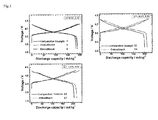
- the charge/discharge test was performed within a voltage range of 2.7 - 4.5 V and under a condition of 0.1C to measure capacity characteristics of the battery, and FIG. 3 and Table 2 show the results obtained in the charge/discharge test.
- FIG. 3 and Table 2 show that, if the cathode active materials according to example embodiments of the inventive concept are used for a battery, it is possible to achieve improvement in capacity characteristics of the battery.
- a particle is grown in such a way that a concentration of its transition metal are gradually changed and an oxidation number of its transition metal are changed. This makes it possible to improve perfectness in crystal structure of the particle and thereby to realize a highly-efficient charge/discharge property of the secondary battery.
Landscapes
- Chemical & Material Sciences (AREA)
- Chemical Kinetics & Catalysis (AREA)
- Electrochemistry (AREA)
- General Chemical & Material Sciences (AREA)
- Inorganic Chemistry (AREA)
- Organic Chemistry (AREA)
- Composite Materials (AREA)
- Engineering & Computer Science (AREA)
- Materials Engineering (AREA)
- Battery Electrode And Active Subsutance (AREA)
- Inorganic Compounds Of Heavy Metals (AREA)
Abstract
Description
- The present invention relates to a cathode active material for a lithium secondary battery, and in particular, to a cathode active material for a lithium secondary battery in which the concentration of the transition metal changes gradually in accordance with particle growth, thus changing the oxidation number of the transition metal and improving the stability of the crystalline structure, and thereby notably improving the high-rate charging and discharging characteristics.
- Technological development and increased demand for mobile equipment have led to a rapid increase in the demand for secondary batteries as energy sources. Among these secondary batteries, lithium secondary batteries having high energy density and voltage, long cycle span and low self-discharge are commercially available and widely used.
- The lithium secondary batteries generally use lithium-containing cobalt composite oxide (LiCoO2) as a cathode active material. Also, lithium-containing manganese composite oxides (e.g., LiMnO2 having a layered crystal structure and LiMn2O4 having a spinel crystal structure) and lithium-containing nickel composite oxide (e.g., LiNiO2) have been considered as the cathode active material.
- Among these cathode active materials, LiCoO2 is the most generally used owing to its superior physical properties such as long lifespan and good charge/discharge characteristics, but has low structural stability and is costly due to natural resource limitations of cobalt used as a source material, thus disadvantageously having limited price competiveness.
- Lithium manganese oxides such as LiMnO2 and LiMn2O4 have advantages of superior thermal stability and low costs, but have disadvantages of low capacity and bad low-temperature characteristics.
- In addition, LiMnO2-based cathode active materials are relatively cheap and exhibit battery characteristics of superior discharge capacity, but are disadvantageously difficult to synthesize and are unstable.
- To solve the afore-mentioned problems, the present invention provides a low-cost highly functional cathode active material including lithium transition metal composite oxide, in which constituent elements are contained to have a predetermined composition and oxidation number, as mentioned below.
- In this regard,
U.S. Pat. No. 6,964,828 discloses a lithium transition metal oxide having a structure of Li(M1(1-x)-Mnx)O2, where M1 is a metal other than Cr and, when M1 is Ni or Co, Ni has an oxidation number of +2, Co has an oxidation number of +3, and Mn has an oxidation number of +4. - In addition,
Korean Patent Laid-open No. 2005-0047291 - As another example,
Korean Patent No. 543,720 - Also,
Japanese Patent Application Publication No. 2001-0083610 - According to the related arts described above, the average oxidation number of transition metals should be +3, and an example of such transition metals is disclosed in
U.S. Pat. No. 7,314,682 . - However, there has not been a study on a structure, in which an oxidation number of the conventional transition metal is continuously changed from a center of a particle to a surface of the particle.
- Example embodiments of the inventive concept provide a new structure of a cathode active material for a lithium secondary battery. According to the new structure of the cathode active material, a nickel-containing transition metal is provided to have a controlled oxidation number, allowing for a uniform and stable layered structure.
- According to example embodiments of the inventive concept, a cathode active material for a lithium secondary battery may be provided. The cathode active material may contain a nickel-containing lithium transition metal oxide, in which nickel consists of Ni2+ and Ni3+, and in which an oxidation number represented by the following equation has a continuously-increasing gradient in a direction from a center of a particle to a surface of the particle.
m(Ni2+) / {m(Ni2+)+m(Ni3+)}
m(Ni3+) / {m(Ni2+)+m(Ni3+)}
- In example embodiments, the nickel-containing lithium transition metal oxide may include a core portion, whose composition is represented by Chemical Formula 1, and a surface portion, whose composition is represented by Chemical Formula 2.
[Chemical Formula 1] Lia1M1x1M2y1M3z1M4wO2+δ
[Chemical Formula 2] Lia2M1x2M2y2M3z2M4wO2+δ
where a concentration of at least one of M1, M2 and M3 have a continuously-varying concentration gradient, from the core portion to the surface portion. - Further, in the
Chemical Formulas - In example embodiments, the core portion may be the innermost portion of the particle with a radius of 0.2 µm or less, and the surface portion may be the outermost portion of the particle with a thickness of 0.2 µm or less.
- In example embodiments, the core portion may have a thickness ranging from 10% to 70 % of a total size of the particle, and the surface portion may have a thickness ranging from 1% to 5 % of the total size of the particle.
- In example embodiments, an average oxidation number of the nickel may range from 2.0 to 2.8.
- In the case of the cathode active material for a lithium secondary battery according to example embodiments of the inventive concept, a particle is grown in such a way that a concentration of its transition metal are gradually changed and an oxidation number of its transition metal are changed. This makes it possible to improve perfectness in crystal structure of the particle and thereby to realize a highly-efficient charge/discharge property of the secondary battery.
-
-
FIGS. 1 through 2 are graphs illustrating XPS curves according to example embodiments of the inventive concept. -
FIG. 3 is a graph illustrating capacity characteristics of a battery, in which a compound according to example embodiments of the inventive concept is contained. - Hereinafter, the inventive concept will be described in more detail with reference to example embodiments. However, the inventive concept is not limited to the following example embodiments.
- Firstly, to fabricate an active material, in which one metal had a uniform concentration and the other metal had a varying (or gradient) concentration over the entire region of a particle, an aqueous metal salt solution for forming a core portion and an aqueous metal salt solution for forming a surface portion were respectively prepared; the former was prepared to contain nickel sulfate, cobalt sulfate, and manganese sulfate, which were mixed to have a mole ratio of about 60:0:40, and to have a concentration of 2.4M, and the latter contained nickel sulfate, cobalt sulfate, and manganese sulfate mixed to have a mole ratio of about 40:20:40.
- Distilled water of 4 liters was provided in a co-precipitation reactor (capacity: 4L, power output of rotary motor: 80W), nitrogen gas was supplied into the reactor at a rate of 0.5 liter/minute to remove dissolved oxygen from the distilled water, and the distilled water was stirred at a speed of 1000 rpm, while maintaining the temperature of the reactor at 50°C.
- The aqueous metal salt solution for forming the core portion and the aqueous metal salt solution for forming the surface portion were mixed to each other at a predetermined ratio and were provided to the reactor at a rate of 0.3 liter/hour. Also, an ammonia solution (with a concentration of 3.6 M) was continuously provided into the reactor at a rate of 0.03 liter/hour. In addition, an aqueous NaOH solution (having a concentration of 4.8M) was supplied into the reactor to maintain the pH value of 11. Thereafter, the reactor was controlled to have an impeller speed of 1000 rpm, and the solution was dried for 15 hours in a warm air dryer to obtain an active material precursor.
- LiNO3 serving as the lithium salt was added into the active material precursor obtained, and the resulting material was heated at a heating rate of 2°C/min, was preserved for 10 hours at a temperature of 280°C as a preliminary burning process, and was preserved for 15 hours at a temperature of 750°C to finally obtain particles of the active material.
- To fabricate an active material, in which one metal had a uniform concentration and the other metal had a varying (or gradient) concentration over the entire region of a particle, an aqueous metal salt solution for forming a core portion and an aqueous metal salt solution for forming a surface portion were respectively prepared; the former was prepared to contain nickel sulfate, cobalt sulfate, and manganese sulfate, which were mixed to have a mole ratio of about 70:30:0, and the latter was prepared to contain nickel sulfate, cobalt sulfate, and manganese sulfate, which were mixed to have a mole ratio of about 40:30:30. Except for the above difference, the active material according to the present embodiment was fabricated in the same manner as that of the
embodiment 1. - To fabricate an active material, in which one metal had a uniform concentration and the other metal had a varying (or gradient) concentration over the entire region of a particle, an aqueous metal salt solution for forming a core portion and an aqueous metal salt solution for forming a surface portion were respectively prepared; the former was prepared to contain nickel sulfate, cobalt sulfate, and manganese sulfate, which were mixed to have a mole ratio of about 50:30:20, and the latter was prepared to contain nickel sulfate, cobalt sulfate, and manganese sulfate, which were mixed to have a mole ratio of about 50:20:30. Except for the above difference, the active material according to the present embodiment was fabricated in the same manner as that of the
embodiment 1. - To fabricate an active material, in which one metal had a uniform concentration and the other metal had a varying (or gradient) concentration over the entire region of a particle, an aqueous metal salt solution for forming a core portion and an aqueous metal salt solution for forming a surface portion were respectively prepared; the former was prepared to contain nickel sulfate, cobalt sulfate, and manganese sulfate, which were mixed to have a mole ratio of about 70:0:30, and the latter was prepared to contain nickel sulfate, cobalt sulfate, and manganese sulfate, which were mixed to have a mole ratio of about 50:20:30. Except for the above difference, the active material according to the present embodiment was fabricated in the same manner as that of the
embodiment 1. - To fabricate an active material, in which metal ion had a varying (or gradient) concentration over the entire region of a particle, an aqueous metal salt solution for forming a core portion and an aqueous metal salt solution for forming a surface portion were respectively prepared; the former was prepared to contain nickel sulfate, cobalt sulfate, and manganese sulfate, which were mixed to have a mole ratio of about 70:15:15, and the latter was prepared to contain nickel sulfate, cobalt sulfate, and manganese sulfate, which were mixed to have a mole ratio of about 50:20:30. Except for the above difference, the active material according to the present embodiment was fabricated in the same manner as that of the
embodiment 1. - To fabricate an active material, in which metal ion had a varying (or gradient) concentration over the entire region of a particle, an aqueous metal salt solution for forming a core portion and an aqueous metal salt solution for forming a surface portion were respectively prepared; the former was prepared to contain nickel sulfate, cobalt sulfate, and manganese sulfate, which were mixed to have a mole ratio of about 80:10:10, and the latter was prepared to contain nickel sulfate, cobalt sulfate, and manganese sulfate, which were mixed to have a mole ratio of about 50:20:30. Except for the above difference, the active material according to the present embodiment was fabricated in the same manner as that of the
embodiment 1. - To fabricate an active material, in which one metal had a uniform concentration and the other metal had a varying (or gradient) concentration over the entire region of a particle, an aqueous metal salt solution for forming a core portion and an aqueous metal salt solution for forming a surface portion were respectively prepared; the former was prepared to contain nickel sulfate, cobalt sulfate, and manganese sulfate, which were mixed to have a mole ratio of about 75:0:25, and the latter was prepared to contain nickel sulfate, cobalt sulfate, and manganese sulfate, which were mixed to have a mole ratio of about 55:20:25. Except for the above difference, the active material according to the present embodiment was fabricated in the same manner as that of the
embodiment 1. - To fabricate an active material including a core portion having a uniform metal concentration and a shell portion having a varying (or gradient) concentration, an aqueous metal salt solution for forming a core portion and an aqueous metal salt solution for forming a surface portion were respectively prepared; the former was prepared to contain nickel sulfate, cobalt sulfate, and manganese sulfate, which were mixed to have a mole ratio of about 70:10:20, and to form the core portion, and the latter was prepared to contain nickel sulfate, cobalt sulfate, and manganese sulfate, which were mixed to have a mole ratio of about 50:20:30. Except for the above difference, the active material according to the present embodiment was fabricated in the same manner as that of the
embodiment 1. - To fabricate an active material, in which one metal had a uniform concentration and the other metal had a varying (or gradient) concentration over the entire region of a particle, an aqueous metal salt solution for forming a core portion and an aqueous metal salt solution for forming a surface portion were respectively prepared; the former was prepared to contain nickel sulfate, cobalt sulfate, and manganese sulfate, which were mixed to have a mole ratio of about 80:0:20, and the latter was prepared to contain nickel sulfate, cobalt sulfate, and manganese sulfate, which were mixed to have a mole ratio of about 60:20:20. Except for the above difference, the active material according to the present embodiment was fabricated in the same manner as that of the
embodiment 1. - To fabricate an active material including a core portion having a uniform metal concentration and a shell portion having a varying (or gradient) concentration, an aqueous metal salt solution for forming a core portion and an aqueous metal salt solution for forming a surface portion were respectively prepared; the former was prepared to contain nickel sulfate, cobalt sulfate, and manganese sulfate, which were mixed to have a mole ratio of about 80:10:10, and to form the core portion, and the latter was prepared to contain nickel sulfate, cobalt sulfate, and manganese sulfate, which were mixed to have a mole ratio of about 40:25:35. Except for the above difference, the active material according to the present embodiment was fabricated in the same manner as that of the
embodiment 1. - To fabricate an active material, in which one metal had a uniform concentration and the other metal had a varying (or gradient) concentration over the entire region of a particle, an aqueous metal salt solution for forming a core portion and an aqueous metal salt solution for forming a surface portion were respectively prepared; the former was prepared to contain nickel sulfate, cobalt sulfate, and manganese sulfate, which were mixed to have a mole ratio of about 85:15:0, and the latter was prepared to contain nickel sulfate, cobalt sulfate, and manganese sulfate, which were mixed to have a mole ratio of about 60:15:25. Except for the above difference, the active material according to the present embodiment was fabricated in the same manner as that of the
embodiment 1. - To fabricate an active material, in which one metal had a uniform concentration and the other metal had a varying (or gradient) concentration over the entire region of a particle, an aqueous metal salt solution for forming a core portion and an aqueous metal salt solution for forming a surface portion were respectively prepared; the former was prepared to contain nickel sulfate, cobalt sulfate, and manganese sulfate, which were mixed to have a mole ratio of about 90:5:5, and the latter was prepared to contain nickel sulfate, cobalt sulfate, and manganese sulfate, which were mixed to have a mole ratio of about 70:5:25. Except for the above difference, the active material according to the present embodiment was fabricated in the same manner as that of the
embodiment 1. - To fabricate an active material, in which metal ion had a varying (or gradient) concentration over the entire region of a particle, an aqueous metal salt solution for forming a core portion and an aqueous metal salt solution for forming a surface portion were respectively prepared; the former was prepared to contain nickel sulfate, cobalt sulfate, and manganese sulfate, which were mixed to have a mole ratio of about 95:0:5, and the latter was prepared to contain nickel sulfate, cobalt sulfate, and manganese sulfate, which were mixed to have a mole ratio of about 78:6:16. Except for the above difference, the active material according to the present embodiment was fabricated in the same manner as that of the
embodiment 1. - To fabricate an active material, in which one metal had a uniform concentration and the other metal had a varying (or gradient) concentration over the entire region of a particle, an aqueous metal salt solution for forming a core portion and an aqueous metal salt solution for forming a surface portion were respectively prepared; the former was prepared to contain nickel sulfate, cobalt sulfate, and manganese sulfate, which were mixed to have a mole ratio of about 80:20:0, and the latter was prepared to contain nickel sulfate, cobalt sulfate, and manganese sulfate, which were mixed to have a mole ratio of about 80:1:19. Except for the above difference, the active material according to the present embodiment was fabricated in the same manner as that of the
embodiment 1. - To fabricate an active material with two gradients in metal concentration, an aqueous metal salt solution for forming a core portion, an aqueous metal salt solution for forming a first surface portion, and an aqueous metal salt solution for forming a second surface portion were respectively prepared; the first was prepared to contain nickel sulfate, cobalt sulfate, and manganese sulfate, which were mixed to have a mole ratio of about 98:0:2, the second was prepared to contain nickel sulfate, cobalt sulfate, and manganese sulfate, which were mixed to have a mole ratio of about 85:3:12, and the third was prepared to contain nickel sulfate, cobalt sulfate, and manganese sulfate, which were mixed to have a mole ratio of about 70:8:22. Except for the above difference, the active material according to the present embodiment was fabricated in the same manner as that of the
embodiment 1. - To fabricate an active material including a core portion having a uniform metal concentration and a shell portion having a varying (or gradient) concentration, an aqueous metal salt solution for forming a core portion and an aqueous metal salt solution for forming a surface portion were respectively prepared; the former was prepared to contain nickel sulfate, cobalt sulfate, and manganese sulfate, which were mixed to have a mole ratio of about 95:0:5, and to form the core portion, and the latter was prepared to contain nickel sulfate, cobalt sulfate, and manganese sulfate, which were mixed to have a mole ratio of about 58:13:29. Except for the above difference, the active material according to the present embodiment was fabricated in the same manner as that of the
embodiment 1. - To fabricate an active material with two gradients in metal concentration, an aqueous metal salt solution for forming a core portion, an aqueous metal salt solution for forming a first surface portion, and an aqueous metal salt solution for forming a second surface portion were respectively prepared; the first was prepared to contain nickel sulfate, cobalt sulfate, and manganese sulfate, which were mixed to have a mole ratio of about 98:0:2, the second was prepared to contain nickel sulfate, cobalt sulfate, and manganese sulfate, which were mixed to have a mole ratio of about 90:3:7, and the third was prepared to contain nickel sulfate, cobalt sulfate, and manganese sulfate, which were mixed to have a mole ratio of about 70:5:25. Except for the above difference, the active material according to the present embodiment was fabricated in the same manner as that of the
embodiment 1. - Particles made of active materials were fabricated using metal aqueous solutions containing nickel sulfate, cobalt sulfate, and manganese sulfate, which were contained at mole ratios of the following Table 1. Each of the particles was fabricated to include a transition metal, whose concentration was uniform over the entire region of the particle.
Table 1 Ni Co Mn Comparative Example 1 44 16 40 Average composition of Embodiment 1Comparative Example 2 45 30 25 Average composition of Embodiment 2Comparative Example 3 50 22 28 Average composition of Embodiment 3Comparative Example 4 54 16 30 Average composition of Embodiment 4 Comparative Example 5 55 19 26 Average composition of Embodiment 5 Comparative Example 6 58 17 25 Average composition of Embodiment 6 Comparative Example 7 60 15 25 Average composition of Embodiments 7, 8Comparative Example 8 64 16 20 Average composition of Embodiments 9, 10 Comparative Example 9 64 15 21 Average composition of Embodiment 11Comparative Example 10 74 5 21 Average composition of Embodiment 12Comparative Example 11 80 5 15 Average composition of Embodiments 13, 14, 15, 16Comparative Example 12 85 4 11 Average composition of Embodiment 17 - XPS of each of active materials, which were fabricated according to the
embodiments 1 to 17 and the comparative examples 1 to 12, was measured to calculate mole numbers of Ni2+ and Ni3+, and the following Table 2 showed the result.Table 2 Capacity (mAh/g) Ni Average Oxidation Number Ni2+ (mol) Ni3+ (mol) Mole ratio (Ni3+/Ni2+) Embodiment 1172.2 2.0012 0.4395 0.0005 0.0012 Comparative Example 1 161.2 2.0909 0.4000 0.0400 0.1000 Embodiment 2178.1 2.3241 0.3042 0.1458 0.4795 Comparative Example 2 163.1 2.4444 0.2500 0.2000 0.8000 Embodiment 3184.2 2.3628 0.3186 0.1814 0.5695 Comparative Example 3 173.5 2.4400 0.2800 0.2200 0.7857 Embodiment 4 183.7 2.3571 0.3472 0.1928 0.5553 Comparative Example 4 170.6 2.4444 0.3000 0.2400 0.8000 Embodiment 5 183.1 2.5128 0.2679 0.2821 1.0527 Comparative Example 5 180.9 2.5273 0.2600 0.2900 1.1154 Embodiment 6 186.7 2.5186 0.2792 0.3008 1.0771 Comparative Example 6 178.6 2.5690 0.2500 0.3300 1.3200 Embodiment 7191.1 2.5273 0.2836 0.3164 1.1155 Embodiment 8 188.9 2.5346 0.2792 0.3208 1.1487 Comparative Example 7 183.2 2.5833 0.2500 0.3500 1.4000 Embodiment 9 195.3 2.6248 0.2401 0.3999 1.6651 Embodiment 10 193.1 2.6517 0.2229 0.4171 1.8711 Comparative Example 8 184.2 2.6875 0.2000 0.4400 2.2000 Embodiment 11193.8 2.6227 0.2414 0.3986 1.6507 Comparative Example 9 185.1 2.6719 0.2100 0.4300 2.0476 Embodiment 12201.2 2.6869 0.2317 0.5083 2.1940 Comparative Example 10 195.2 2.7162 0.2100 0.5300 2.5238 Embodiment 13 211.7 2.7309 0.2153 0.5847 2.7161 Embodiment 14211.3 2.7397 0.2082 0.5918 2.8417 Embodiment 15 210.2 2.7512 0.1990 0.6010 3.0193 Embodiment 16 207.9 2.7591 0.1927 0.6073 3.1511 Comparative Example 11 200.3 2.8125 0.1500 0.6500 4.3333 Embodiment 17218.6 2.7608 0.1914 0.6086 3.1806 Comparative Example 12 205.7 2.8706 0.1100 0.7400 6.7273 - Table 2 shows that, for the active materials fabricated by the embodiments of the inventive concept, the mole of Ni2+ is higher than that of Ni3+, when compared to the active materials, whose average compositions are substantially equal to those of the active materials of the embodiments, according to the comparative examples.
- A surface etching process was performed on the active materials fabricated by the
embodiments FIGS. 1 and2 show XPS curves measured from the resulting structures. -
FIGS. 1 through 2 show that, for the active materials fabricated by the embodiments of the inventive concept, a value of m(Ni2+) / m(Ni2+) + m(Ni3+) and a value of m(Ni3+) / m(Ni2+) + m(Ni3+) have a continuously-varying concentration gradient in an internal region of a particle. - Cathode active materials fabricated according to the
embodiments 1 to 17 and the comparative examples 1 to 12, a conductive material made of SuperP, and a binder made of polyvinylidene fluoride (PVdF) were mixed to form slurries. In each of the slurries, the cathode active material, the conductive material, and the binder were mixed to have a weight ratio of 85:7.5:7.5. Each of the slurries was coated on an aluminum layer having a thickness of 20 µm, and the resulting structure was dried at a temperature of 120°C and under a vacuum condition to fabricate a cathode. Thereafter, coin cells including such cathodes were fabricated by a conventional fabrication process. For example, the cathode and a lithium foil were used as opposite electrodes of the coin cell, and a porous polyethylene layer (Celgard 2300 having a thickness of 25 µm, made by Celgard LLC) was used as a separator of the coin cell. Furthermore, a liquid electrolyte of the coin cell was prepared to contain solvent, in which ethylene carbonate and ethyl methyl carbonate volume ratio were mixed at a ratio of 3:7, and LiPF6, which was dissolved to have a concentration of 1.2M. - A charge/discharge test was performed on the battery fabricated according to the fabrication example. The charge/discharge test was performed within a voltage range of 2.7 - 4.5 V and under a condition of 0.1C to measure capacity characteristics of the battery, and
FIG. 3 and Table 2 show the results obtained in the charge/discharge test. -
FIG. 3 and Table 2 show that, if the cathode active materials according to example embodiments of the inventive concept are used for a battery, it is possible to achieve improvement in capacity characteristics of the battery. - In the case of the cathode active material for a lithium secondary battery according to example embodiments of the inventive concept, a particle is grown in such a way that a concentration of its transition metal are gradually changed and an oxidation number of its transition metal are changed. This makes it possible to improve perfectness in crystal structure of the particle and thereby to realize a highly-efficient charge/discharge property of the secondary battery.
Claims (5)
- A cathode active material for a lithium secondary battery, wherein the cathode active material contains a nickel-containing lithium transition metal oxide, in which nickel consists of Ni2+ and Ni3+, and in which an oxidation number represented by the following equation has a continuously-increasing gradient in a direction from a center of a particle to a surface of the particle.
m(Ni2+) / {m(Ni2+)+ m(Ni3+)}
m(Ni3+) / {m(Ni2+)+ m(Ni3+)}
- The cathode active material of claim 1, wherein the nickel-containing lithium transition metal oxide comprises:a core portion, whose composition is represented by Chemical Formula 1; anda surface portion, whose composition is represented by Chemical Formula 2,
[Chemical Formula 1] Lia1M1x1M2y1M3z1M4wO2+δ
[Chemical Formula 2] Lia2M1x2M2y2M3z2M4wO2+δ
wherein a concentration of at least one of M1, M2 and M3 have a continuously-varying concentration gradient, from the core portion to the surface portion,in Chemical Formulas 1 and 2, M1, M2, and M3 are selected from the group consisting of Ni, Co, Mn, and a combination thereof, M4 is selected from the group consisting of Fe, Na, Mg, Ca, Ti, V, Cr, Cu, Zn, Ge, Sr, Ag, Ba, Zr, Nb, Mo, Al, Ga, B, and a combination thereof, 0<a1≤1.1, 0<a2≤1.1, 0≤x1≤1, 0≤x2≤1, 0≤z1≤1, 0≤y2≤1, 0≤z1≤1, 0≤z2≤1, 0≤w≤0.1, 0.0≤δ≤0.02, 0≤x1+y1+z1≤1, 0<x2+y2+z2≤1, x1≤x2, y1≤y2, and z2≤z1. - The cathode active material of claim 2, wherein the core portion is the innermost portion of the particle with a radius of 0.2 µm or less, and the surface portion is the outermost portion of the particle with a thickness of 0.2 µm or less.
- The cathode active material of claim 2, wherein the core portion has a thickness ranging from 10% to 70 % of a total size of the particle, and
the surface portion has a thickness ranging from 1% to 5 % of the total size of the particle. - The cathode active material of claim 1, wherein an average oxidation number of the nickel ranges from 2.0 to 2.8.
Applications Claiming Priority (2)
| Application Number | Priority Date | Filing Date | Title |
|---|---|---|---|
| KR20130022293 | 2013-02-28 | ||
| PCT/KR2014/001705 WO2014133370A1 (en) | 2013-02-28 | 2014-02-28 | Cathode active material for lithium secondary battery |
Publications (2)
| Publication Number | Publication Date |
|---|---|
| EP2963705A1 true EP2963705A1 (en) | 2016-01-06 |
| EP2963705A4 EP2963705A4 (en) | 2016-09-07 |
Family
ID=51755615
Family Applications (1)
| Application Number | Title | Priority Date | Filing Date |
|---|---|---|---|
| EP14756796.0A Withdrawn EP2963705A4 (en) | 2013-02-28 | 2014-02-28 | ACTIVE CATHODE MATERIAL FOR LITHIUM SECONDARY BATTERY |
Country Status (5)
| Country | Link |
|---|---|
| US (1) | US20160006025A1 (en) |
| EP (1) | EP2963705A4 (en) |
| KR (1) | KR101612601B1 (en) |
| CN (1) | CN105229830A (en) |
| WO (1) | WO2014133370A1 (en) |
Cited By (1)
| Publication number | Priority date | Publication date | Assignee | Title |
|---|---|---|---|---|
| EP3439081A4 (en) * | 2017-01-31 | 2019-08-14 | LG Chem, Ltd. | CATHODE ACTIVE MATERIAL FOR LITHIUM SECONDARY BATTERY, COMPRISING LITHIUM OXIDE AND COBALT HAVING A CURORARY STRUCTURE, PREPARATION METHOD THEREFOR, AND CATHODE AND SECONDARY BATTERY COMPRISING AN ACTIVE CATHODE MATERIAL |
Families Citing this family (23)
| Publication number | Priority date | Publication date | Assignee | Title |
|---|---|---|---|---|
| KR102296854B1 (en) * | 2014-11-14 | 2021-09-01 | 에스케이이노베이션 주식회사 | Lithium ion secondary Battery |
| US11870068B2 (en) | 2014-11-14 | 2024-01-09 | Sk On Co., Ltd. | Lithium ion secondary battery |
| WO2017160856A1 (en) * | 2016-03-14 | 2017-09-21 | Apple Inc. | Cathode active materials for lithium-ion batteries |
| WO2018057584A1 (en) | 2016-09-20 | 2018-03-29 | Apple Inc. | Cathode active materials having improved particle morphologies |
| JP2019530630A (en) | 2016-09-21 | 2019-10-24 | アップル インコーポレイテッドApple Inc. | Surface-stabilized cathode material for lithium ion battery and synthesis method thereof |
| JP7049551B2 (en) | 2017-11-21 | 2022-04-07 | エルジー エナジー ソリューション リミテッド | Positive electrode material for secondary batteries and lithium secondary batteries containing them |
| KR102159243B1 (en) | 2017-11-22 | 2020-09-23 | 주식회사 에코프로비엠 | Cathode active material of lithium secondary battery |
| KR102174720B1 (en) * | 2017-11-23 | 2020-11-05 | 주식회사 에코프로비엠 | Lithium metal complex oxide and manufacturing method of the same |
| EP3499611A3 (en) | 2017-11-23 | 2019-11-06 | Ecopro Bm Co., Ltd. | Lithium metal complex oxide and manufacturing method of the same |
| US11695108B2 (en) | 2018-08-02 | 2023-07-04 | Apple Inc. | Oxide mixture and complex oxide coatings for cathode materials |
| US11749799B2 (en) | 2018-08-17 | 2023-09-05 | Apple Inc. | Coatings for cathode active materials |
| CN109713281B (en) * | 2018-12-29 | 2021-12-17 | 蜂巢能源科技有限公司 | Positive electrode material of lithium ion battery and preparation method thereof |
| WO2020175782A1 (en) * | 2019-02-28 | 2020-09-03 | 주식회사 에스엠랩 | Positive active material, method for manufacturing same and lithium secondary battery comprising positive electrode comprising positive active material |
| US12206100B2 (en) | 2019-08-21 | 2025-01-21 | Apple Inc. | Mono-grain cathode materials |
| US11757096B2 (en) | 2019-08-21 | 2023-09-12 | Apple Inc. | Aluminum-doped lithium cobalt manganese oxide batteries |
| US12074321B2 (en) | 2019-08-21 | 2024-08-27 | Apple Inc. | Cathode active materials for lithium ion batteries |
| CN116325224A (en) * | 2020-12-04 | 2023-06-23 | Ecopro Bm 有限公司 | Positive electrode active material for lithium secondary battery, preparation method thereof, and lithium secondary battery comprising same |
| KR102689933B1 (en) * | 2020-12-04 | 2024-07-30 | 주식회사 에코프로비엠 | Positive electrode active material for lithium secondary battery, method for preparing the same, and lithium secondary battery including the same |
| KR102732918B1 (en) * | 2021-11-24 | 2024-11-25 | 주식회사 엘지에너지솔루션 | Preparing method of positive electrode active material for lithium secondary battery and positive electrode active material thereby |
| KR102777965B1 (en) * | 2021-12-02 | 2025-03-11 | 연세대학교 산학협력단 | positive electrode active material for lithium-Rich secondary battery and method for manufacturing the same |
| JP2025515814A (en) * | 2022-05-20 | 2025-05-20 | エルジー・ケム・リミテッド | Positive electrode active material and method for producing same |
| KR102926867B1 (en) * | 2025-05-20 | 2026-02-13 | 닝보 론바이 뉴 에너지 테크놀로지 씨오., 엘티디. | Cathode active material for lithium secondary battery, fabrication method thereof, cathode having the same and lithium secondary battery having the same |
| KR102926868B1 (en) * | 2025-05-22 | 2026-02-13 | 닝보 론바이 뉴 에너지 테크놀로지 씨오., 엘티디. | Cathode active material for lithium secondary battery, fabrication method thereof, cathode having the same and lithium secondary battery having the same |
Family Cites Families (22)
| Publication number | Priority date | Publication date | Assignee | Title |
|---|---|---|---|---|
| US6103422A (en) * | 1995-12-26 | 2000-08-15 | Kao Corporation | Cathode active material and nonaqueous secondary battery containing the same |
| JP2001083610A (en) | 1999-09-14 | 2001-03-30 | Fuji Photo Optical Co Ltd | Negative carrier positioning device |
| US6730435B1 (en) * | 1999-10-26 | 2004-05-04 | Sumitomo Chemical Company, Limited | Active material for non-aqueous secondary battery, and non-aqueous secondary battery using the same |
| US6964828B2 (en) | 2001-04-27 | 2005-11-15 | 3M Innovative Properties Company | Cathode compositions for lithium-ion batteries |
| US6921609B2 (en) * | 2001-06-15 | 2005-07-26 | Kureha Chemical Industry Co., Ltd. | Gradient cathode material for lithium rechargeable batteries |
| US8658125B2 (en) | 2001-10-25 | 2014-02-25 | Panasonic Corporation | Positive electrode active material and non-aqueous electrolyte secondary battery containing the same |
| JP2004002141A (en) | 2002-03-07 | 2004-01-08 | Tosoh Corp | Lithium-nickel-manganese composite oxide, method for producing the same, and lithium ion secondary battery using the same |
| KR100809847B1 (en) * | 2002-10-31 | 2008-03-04 | 주식회사 엘지화학 | Lithium transition metal oxide with gradient of metal composition |
| US7314682B2 (en) | 2003-04-24 | 2008-01-01 | Uchicago Argonne, Llc | Lithium metal oxide electrodes for lithium batteries |
| KR20050047291A (en) | 2003-11-17 | 2005-05-20 | 브이케이 주식회사 | Cathode material for lithium secondary battery and method for preparing the same |
| EP3432392B1 (en) * | 2003-12-31 | 2023-03-29 | LG Energy Solution, Ltd. | Electrode active material powder with size dependent composition and method to prepare the same |
| KR100822012B1 (en) * | 2006-03-30 | 2008-04-14 | 한양대학교 산학협력단 | Cathode active material for lithium battery, manufacturing method thereof, and lithium secondary battery comprising same |
| KR100744759B1 (en) * | 2006-06-07 | 2007-08-01 | 한양대학교 산학협력단 | The manufacturing method of the positive electrode active material for lithium secondary batteries |
| EP2214234B1 (en) * | 2007-11-12 | 2014-01-08 | Toda Kogyo Corporation | Li-ni-based composite oxide particle powder for rechargeable battery with nonaqueous elctrolyte, process for producing the powder, and rechargeable battery with nonaqueous electrolyte |
| KR20110002132A (en) * | 2009-07-01 | 2011-01-07 | 제갑호 | Turbine flowmeter |
| KR101185366B1 (en) * | 2010-01-14 | 2012-09-24 | 주식회사 에코프로 | A method of preparing positive active material precursor and positive active material for lithium battery with concentration grandients using batch reactor |
| US8911902B2 (en) * | 2010-07-06 | 2014-12-16 | Samsung Sdi Co., Ltd. | Nickel-based positive electrode active material, method of preparing the same, and lithium battery using the nickel-based positive electrode active material |
| KR101215829B1 (en) * | 2010-07-22 | 2012-12-27 | 주식회사 에코프로 | Manufacturing method of positive active material for lithium secondary battery, positive active material manufactured by the same and lithium secondary battery using positive active material |
| HRP20160974T1 (en) * | 2010-09-22 | 2016-10-07 | Freeport Cobalt Oy | MIXTURE OF OXIDATED METAL HYDROXIDE AND PROCEDURE FOR PRODUCTION |
| KR101292756B1 (en) * | 2011-01-05 | 2013-08-02 | 한양대학교 산학협력단 | Cathod active material, method for preparing the same, lithium secondary battery comprising the same |
| KR101127554B1 (en) * | 2011-07-20 | 2012-03-23 | 한화케미칼 주식회사 | Single phase lithium-deficient multi-component transition metal oxides having a layered crystal structure and a method of producing the same |
| EP2940761B1 (en) * | 2012-12-26 | 2019-12-18 | IUCF-HYU (Industry-University Cooperation Foundation Hanyang University) | Cathode active material for lithium secondary batteries |
-
2014
- 2014-02-28 CN CN201480010955.3A patent/CN105229830A/en active Pending
- 2014-02-28 US US14/771,007 patent/US20160006025A1/en not_active Abandoned
- 2014-02-28 WO PCT/KR2014/001705 patent/WO2014133370A1/en not_active Ceased
- 2014-02-28 KR KR1020140024560A patent/KR101612601B1/en not_active Expired - Fee Related
- 2014-02-28 EP EP14756796.0A patent/EP2963705A4/en not_active Withdrawn
Cited By (2)
| Publication number | Priority date | Publication date | Assignee | Title |
|---|---|---|---|---|
| EP3439081A4 (en) * | 2017-01-31 | 2019-08-14 | LG Chem, Ltd. | CATHODE ACTIVE MATERIAL FOR LITHIUM SECONDARY BATTERY, COMPRISING LITHIUM OXIDE AND COBALT HAVING A CURORARY STRUCTURE, PREPARATION METHOD THEREFOR, AND CATHODE AND SECONDARY BATTERY COMPRISING AN ACTIVE CATHODE MATERIAL |
| US11038159B2 (en) | 2017-01-31 | 2021-06-15 | Lg Chem, Ltd. | Positive electrode active material for lithium secondary battery including lithium cobalt oxide having core-shell structure, method for producing the same, and positive electrode and secondary battery including the positive electrode active material |
Also Published As
| Publication number | Publication date |
|---|---|
| KR101612601B1 (en) | 2016-04-14 |
| EP2963705A4 (en) | 2016-09-07 |
| KR20140108615A (en) | 2014-09-12 |
| WO2014133370A1 (en) | 2014-09-04 |
| CN105229830A (en) | 2016-01-06 |
| US20160006025A1 (en) | 2016-01-07 |
Similar Documents
| Publication | Publication Date | Title |
|---|---|---|
| EP2963705A1 (en) | Cathode active material for lithium secondary battery | |
| KR101849719B1 (en) | Precursor for cathod active material of lithium secondary battery, cathode active materials made by the same, and lithium secondary battery containing the same | |
| KR101812517B1 (en) | Positive-electrode active material for lithium rechargeable battery | |
| EP3007253B1 (en) | Cathode active material for lithium cell and method for manufacturing same | |
| CN107681151B (en) | Lithium composite oxide for lithium secondary battery and preparation method thereof | |
| KR101650230B1 (en) | Cathod active material for lithium rechargeable battery, preparing method thereof and lithium rechargeable battery containing the same | |
| US9493365B2 (en) | Cathode active material with whole particle concentration gradient for lithium secondary battery, method for preparing same, and lithium secondary battery having same | |
| KR101577180B1 (en) | Positive electrode active material with improved energy density | |
| JP2021059492A (en) | Lithium complex oxide for lithium secondary battery, and method of preparing the same | |
| CN107681150B (en) | Lithium composite oxide for lithium secondary battery and method for preparing same | |
| KR101970201B1 (en) | Manufacturing method of cathod active material for lithium rechargeable battery and cathod active material made by the same | |
| EP3399579B1 (en) | Method for preparing a positive electrode active material | |
| KR101934853B1 (en) | Lithium complex oxide for lithium rechargeable battery positive active material and preparing method of the same | |
| US11677065B2 (en) | Cathode active material of lithium secondary battery | |
| CN108807928B (en) | Synthesis of metal oxide and lithium ion battery | |
| KR101874340B1 (en) | Lithium complex oxide for lithium secondary battery positive active material and a method of preparing the same | |
| KR20190055729A (en) | Cathode active material and manufacturing method thereof | |
| KR20140148269A (en) | Cathod active material for lithium rechargeable battery | |
| KR101912202B1 (en) | Lithium complex oxide for lithium secondary battery positive active material and a method of preparing the same | |
| WO2018068702A1 (en) | Positive electrode tab and lithium-ion battery having electrode tab | |
| CN116161715A (en) | Active substance precursor, method for producing same, and active substance formed therefrom | |
| KR101762282B1 (en) | High capacity cathode material improved thermal stability for lithium ion battery and a method of manufacturing the same | |
| EP3486220A1 (en) | Cathode active material for lithium secondary battery and lithium secondary battery including the same | |
| KR101934848B1 (en) | Lithium complex oxide for lithium secondary battery positive active material and a method of preparing the same | |
| KR101609244B1 (en) | Positive active material for rechargeable lithium battery, method for manufacturing the same, and rechargeable lithium battery including the same |
Legal Events
| Date | Code | Title | Description |
|---|---|---|---|
| PUAI | Public reference made under article 153(3) epc to a published international application that has entered the european phase |
Free format text: ORIGINAL CODE: 0009012 |
|
| 17P | Request for examination filed |
Effective date: 20150825 |
|
| AK | Designated contracting states |
Kind code of ref document: A1 Designated state(s): AL AT BE BG CH CY CZ DE DK EE ES FI FR GB GR HR HU IE IS IT LI LT LU LV MC MK MT NL NO PL PT RO RS SE SI SK SM TR |
|
| AX | Request for extension of the european patent |
Extension state: BA ME |
|
| DAX | Request for extension of the european patent (deleted) | ||
| A4 | Supplementary search report drawn up and despatched |
Effective date: 20160808 |
|
| RIC1 | Information provided on ipc code assigned before grant |
Ipc: H01M 4/485 20100101ALI20160802BHEP Ipc: H01M 4/505 20100101ALI20160802BHEP Ipc: H01M 4/36 20060101ALI20160802BHEP Ipc: H01M 4/131 20100101ALI20160802BHEP Ipc: H01M 10/052 20100101ALI20160802BHEP Ipc: H01M 4/02 20060101ALI20160802BHEP Ipc: C01G 53/00 20060101ALI20160802BHEP Ipc: H01M 4/525 20100101AFI20160802BHEP |
|
| 17Q | First examination report despatched |
Effective date: 20180308 |
|
| STAA | Information on the status of an ep patent application or granted ep patent |
Free format text: STATUS: THE APPLICATION IS DEEMED TO BE WITHDRAWN |
|
| 18D | Application deemed to be withdrawn |
Effective date: 20200901 |