EP2963112B1 - Erweiterung der Halohydrindehalogenaseenzymfamilie: Identifizierung neuartiger Enzyme durch Datenbank-Mining - Google Patents
Erweiterung der Halohydrindehalogenaseenzymfamilie: Identifizierung neuartiger Enzyme durch Datenbank-Mining Download PDFInfo
- Publication number
- EP2963112B1 EP2963112B1 EP14175165.1A EP14175165A EP2963112B1 EP 2963112 B1 EP2963112 B1 EP 2963112B1 EP 14175165 A EP14175165 A EP 14175165A EP 2963112 B1 EP2963112 B1 EP 2963112B1
- Authority
- EP
- European Patent Office
- Prior art keywords
- alkyl
- cycloalkyl
- cyclic
- formula
- halohydrin
- Prior art date
- Legal status (The legal status is an assumption and is not a legal conclusion. Google has not performed a legal analysis and makes no representation as to the accuracy of the status listed.)
- Not-in-force
Links
- 0 Cc1c(C2(OC2(*)I)I)cccc1 Chemical compound Cc1c(C2(OC2(*)I)I)cccc1 0.000 description 2
- DSXDXISGLXIYSS-UHFFFAOYSA-N COCC1([N]#C)OC1(I)I Chemical compound COCC1([N]#C)OC1(I)I DSXDXISGLXIYSS-UHFFFAOYSA-N 0.000 description 1
Images

Classifications
-
- C—CHEMISTRY; METALLURGY
- C12—BIOCHEMISTRY; BEER; SPIRITS; WINE; VINEGAR; MICROBIOLOGY; ENZYMOLOGY; MUTATION OR GENETIC ENGINEERING
- C12N—MICROORGANISMS OR ENZYMES; COMPOSITIONS THEREOF; PROPAGATING, PRESERVING, OR MAINTAINING MICROORGANISMS; MUTATION OR GENETIC ENGINEERING; CULTURE MEDIA
- C12N9/00—Enzymes; Proenzymes; Compositions thereof; Processes for preparing, activating, inhibiting, separating or purifying enzymes
- C12N9/88—Lyases (4.)
Definitions
- Halohydrin dehalogenases also called haloalcohol dehalogenases, haloalcohol/halohydrin epoxidases, or hydrogen-halide lyases; EC 4.5.1.-) (HHDHs) are biotechnologically relevant enzymes that catalyze the reversible dehalogenation of ⁇ -haloalcohols under epoxide formation (1-3). Besides being useful for the production of enantiopure haloalcohols (4-6) and epoxides (5, 7-9), these enzymes can also be applied in the formation of novel carbon-carbon, carbon-nitrogen, or carbon-oxygen bonds.
- HHDH epoxide ring-opening activity accepting also other nucleophiles (e.g. cyanide, azide, or nitrite) beside halides which leads to a diverse range of products (10).
- nucleophiles e.g. cyanide, azide, or nitrite
- Examples of relevant HHDH applications are the production of optically pure C3 or C4 fine chemical precursors (5, 8, 11, 12), including the multi-ton scale production of enantiopure ( R )-4-cyano-3-hydroxybutyrate esters for statin drugs (13) or the production of chiral tertiary alcohols (14-17) for which conventional organic synthesis is rather challenging.
- HHDHs have been made available. Although many bacterial species have been reported to possess HHDH activity, only six HHDH genes have been cloned and expressed recombinantly, namely hheA from Corynebacterium sp. strain N-1074 (18), hheA2 from Arthrobacter sp . strain AD2 (19), hheB from Corynebacterium sp. strain N-1074 (18), hheB2 from Mycobacterium sp. strain GP1 (19), and two identical hheC sequences from Agrobacterium radiobacter AD1 (19) and Rhizobium sp. strain NHG3 (20).
- All of the cloned HHDHs belong to the short-chain dehydrogenase/reductase (SDR) superfamily and exhibit several major features of this diverse enzyme class (19, 21, 22).
- SDR short-chain dehydrogenase/reductase
- all known HHDHs make use of a catalytic triad of Ser-Tyr-Arg, share the commonly found homomultimeric quarternary assembly and both crystallized HHDHs, namely HheA2 (23) and HheC (24), possess a tertiary structure similar to other Rossmann-fold proteins.
- HheA2 2
- HheC HheC
- a spacious anion binding pocket is present in the structures of HheA2 and HheC (23, 24).
- all known HHDH sequences form only a minute but well-defined fraction within the SDR superfamily.
- a method for the identification of enzymes having potential halohydrin dehalogenase activity from sequences disclosed in a biomolecule database - which is not covered by the present invention- comprises the following steps:
- sequences are always indicated from N- to C-terminus for proteins or in case of DNA from 5' to 3'-terminus.
- the indication of amino acids within square brackets [] means that the amino acids within the brackets are interchangeable.
- [FY] means that F can be replaced by Y.
- the wordings "motif” and "sequence pattern" are used synonymously.
- the one-letter-abbreviation as well as the three-letter-abbreviation of amino acids complies with the standard.
- a biomolecule database is a source of biomolecules itself or a collection of sequence data of biomolecules, in particular polynucleotide or polypeptide sequence data.
- a biomolecule is preferably a polynucleotide molecule carrying genetic information, in particular a DNA molecule.
- a biomolecule is a polypeptide, in particular a protein, comprising a number of amino acids (protein ⁇ 100 amino acids).
- a biomolecule database may either be a physical source of biomolecules, in particular may be a gene bank, in particular a cDNA- or genomic library or is a collection of information about said biomolecules, in particular a collection of sequence data, in particular amino acid sequences or polynucleotide sequences, in particular DNA sequences.
- An additional motiv(3) can be present anywhere in the target biomolecule sequence, wherein amino acid Glycine (G) is followed by six variable amino acids (x(6)), followed by two Glycines (G) "G-x(6)-G-G"
- the method for the identification of enzymes having potential halohydrin dehalogenase activity from sequences disclosed in a biomolecule database comprises an additional step
- halo chloro, bromo, iodo, preferably 1,3-dichloro-2-propan
- a biomolecule being or coding at least partially a protein means preferably that the biomolecule may either be a protein with the activity of a halohydrin dehalogenase or, in case the biomolecule is a nucleotide sequence, at least a part of said nucleotide sequence codes said protein, preferably a full-length protein. Accordingly, in case the provided biomolecule is a nucleotide sequence molecule, at least a part of said nucleotide sequence molecule codes a protein with the activity of a halohydrin dehalogenase, whereby possibly a further part of said nucleotide molecule has some other function, for instance regulatory or replicative function.
- the term "providing a biomolecule having the target biomolecule sequence identified in step b) and being or coding at least partially a protein with the activity of a halohydrin dehalogenase” is preferably equivalent to the term "providing a biomolecule having the target biomolecule sequence identified in step b) which may be a protein with the activity of a halohydrin dehalogenase or which may be a nucleotide sequence molecule which includes a sequence coding said protein as long as the protein has the activity of a halohdrin dehalogenase".
- motif (1) and motif (2) are spaced from each other by 1 to 250 variable amino acids (x(1,250)) "T-x(4)-[FY]-x-G-x(1,250)-S-x(12)-Y-x(3)-R", more preferably by 50 to 200 variable amino acids (x(50,200)), most preferably by 93 to 131 variable amino acids (x(93,131)), wherein variable amino acids (x) can be the same or different and are selected from natural and synthetic amino acids.
- motifs (1), (2) follow each other from N- to C-terminus or in case of DNA from 5' to 3'-terminus.
- variable amino acids (x(1,250)) S-x(12)-Y-x(3)-R-x(1,250)-G-x(6)-G-G” more preferably by 50 to 200 variable amino acids (x(50,200)), most preferably by 76 to 84 variable amino acids (x(76,84)), wherein variable amino acids (x) can be the same or different and are selected from natural and synthetic amino acids.
- motifs (1), (2), (3) follow each other from N- to C-terminus or in case of DNA from 5' to 3'-terminus: "T-x(4)-[FY]-x-G-x(1,250)-S-x(12)-Y-x(3)-R-x(1,250)-G-x(6)-G-G", wherein preferred variants of the spacing amino acids x(1,250) between motifs (1) and (2) and between (2) and (3) are both as defined above.
- Motif (3) is of special use to ensure that the enzyme is functional, i.e. that the sequence is complete at the C-terminus. Without being bound to this theory: motif (3) might be essential for the formation of oligomers.
- motif (1) also ensures that the enzyme is functional, i.e. that the sequence is complete at the N- terminus. It is possible that motif (3) is followed by 0-40 amino acids, more preferred by 1-30 amino acids. Additionally, 0-40 amino acids, more preferred 1-30 amino acids may precede motif (1).
- biomolecules are proteins or DNA molecules and the biomolecule sequences are amino acid sequences or DNA sequences. Proteins and thus amino acid sequences are preferred. Possible with respect to the identification method is that step a) consists of two steps a1) and a2)
- the identification method may be in its steps a) to b) applicable to a biomolecule database being a collection of sequence data of polynucleotide sequences, in particular DNA sequences or amino acid sequences, both of which are searched in a step b1) with sequence alignment tools.
- BLAST B asic L ocal A lignment S earch T ool
- BLASTp protein
- Other suitable programs/tools include pairwise sequence alignment and multiple sequence alignment programs such as MAFFT, GAP, BESTFIT, MUSCLE, CLUSTALW (and successors), T-COFFEE (and flavors), PRANK and FASTA.
- said sequence is preferably an open reading frame (ORF) of the query biomolecule coding sequence or a characteristic part thereof.
- ORF open reading frame
- said sequence is preferably the ORF-amino acid sequence itself or a characteristic part thereof.
- the above-defined special variant of the identification method is related to the use of a query biomolecule sequence as starting point for the search within a biomolecule database.
- alternative variants of the identification method are possible where a biomolecule bank is searched merely based on the motifs (1) and (2) and if needed (3).
- Such motif-only searches are available, for example, via ScanProsite and MAST (included in the MEME suite).
- the group of pre-target biomolecules mentioned in steps b1), b2) might also consist of only one biomolecule, i.e. the target biomolecule. If there is only one pre-target biomolecule, no selection from a group is necessary.
- HHDH enzyme family (Hhe) is done on the basis of their clustering to any of the phylogenetic subtypes A through G (HheA-HheG) and, if necessary, additional phylogenetic subtypes. Then, numbering of enzymes within each subtype was done consecutive according to the time of submission to any of the public databases.
- HheA, HheA2, HheB, HheB2, HheC are excluded as pre-target biomolecule sequences or target biomolecule sequences .
- HheA, HheA2, HheB, HheB2, HheC are known HHDHs and their activity as HHDH is proven.
- HheA4 has a sequence identity on amino acid level of 99% with HheA, even if there is no proof of HHDH activity or naming as HHDH in literature for HheA4.
- a special variant thus excludes HheA, HheA2, HheA4, HheB, HheB2, HheC (group 2a) as pre-target biomolecule sequences or target biomolecule sequences.
- HheA5 is merely named as HHDH in biomolecule databases without reliable proof of real HHDH activity.
- HheA3 belongs to an automatically annotated cluster of HHDH-like sequences (CDD, conserved domain database) without reliable proof of real HHDH activity.
- a more special variant thus excludes HheA, HheA2, HheA3, HheA4, HheA5, HheB, HheB2, HheC (group 3a) as pre-target biomolecule sequences or target biomolecule sequences.
- the most special variant additionally excludes HheGx and HheBx, i.e. overall excludes HheA, HheA2, HheA3, HheA4, HheA5, HheB, HheB2, HheBx, HheC, HheGx (group 4a) as pre-target biomolecule sequences or target biomolecule sequences, because HheGx has an M instead of a T in motif (1) and the annotated sequence ABC25271 (GenBank), which corresponds partially to the HheBx sequence, is void of motif (1) (which leads to an enzyme without HHDH activity) but the latter is merely named as HHDH in biomolecule databases without reliable proof of real HHDH activity.
- One possible variant excludes as the at least one query biomolecule sequence and/or as pre-target biomolecule sequence and/ or target biomolecule sequence sequences having less or coding for less than or equal to 186 amino acids.
- the at least one query biomolecule sequence and/or pre-target biomolecule sequence and/ or target biomolecule sequence has to have more than 186 amino acids or has to code for more than 186 amino acids.
- Another possible variant excludes as the at least one query biomolecule sequence and/or as pre-target biomolecule sequence and/ or target biomolecule sequences having less or coding for less than or equal to 201 amino acids.
- the at least one query biomolecule sequence and/or pre-target biomolecule sequence and/ or target biomolecule sequence has to have more than 201 amino acids or has to code for more than 201 amino acids.
- the identification method where at least one query biomolecule sequence of at least one halohydrin dehalogenase is used, i.e.
- the at least one query biomolecule sequence of at least one halohydrin dehalogenase is selected from protein sequences or coding DNA sequences of HheA, HheA2, HheA3, HheA4, HheA5, HheB, HheB2, HheBx, HheC, HheGx (group 4a), preferably from protein sequences or coding DNA sequences of HheA, HheA2, HheA3, HheA4, HheA5, HheB, HheB2, HheC (group 3a), more preferred from protein sequences or coding DNA sequences of HheA, HheA2, HheA4, HheB, HheB2, HheC (group 2a), most preferred from protein sequences or coding DNA sequences of HheA, HheA2, HheB, HheB2, HheC (group 1a).
- the at least one query biomolecule sequence of at least one halohydrin dehalogenase is selected from protein sequences or coding DNA sequences of HheA3, HheA4, HheA5, HheA6, HheB3, HheB4, HheB5, HheB6, HheB7, HheBx, HheD, HheD2, HheD3, HheD4, HheD5, HheD6, HheD7, HheD8, HheD9, HheD10, HheD11, HheD12, HheD13, HheD14, HheD15, HheD16, HheD17, HheE, HheE2, HheE3, HheE4, HheE5, HheEx, HheEx2, HheEx3, HheF, HheG, HheGx
- pre-target biomolecule sequences have a degree of sequence identity of at least 15%, preferably 20% to the at least one query biomolecule sequence, calculated on amino acid level. Also preferred is it when the pre-target biomolecule sequences have a degree of sequence identity of at most 80%, preferably of at most 70%, more preferably of at most 60% to the at least one query biomolecule sequence, calculated on amino acid level. Especially, if the sequences excluded as pre-target biomolecules or target biomolecules are used as query biomolecule, all sequences with more than 80% sequence identity to these query biomolecules, calculated on amino acid level, are excluded as pre-target biomolecules or target biomolecules.
- the method pre- or target biomolecule sequences having more or coding for more than 350 amino acids, more preferred having more or coding for more than 280 amino acids, more preferred having more or coding for more than 262 amino acids are excluded.
- amino acids in each of the motifs (1)-(3) might be replaced without losing the HHDH function. This applies, for example, if the replacement-amino-acid has a similar structure, similar properties etc. as the replaced amino acid.
- the identified target biomolecule sequences are usable as HHDHs in the conversion from halohydrins to epoxides and/or in the ring-opening of epoxides to ⁇ -substituted alcohols.
- a biomolecule having the protein sequence or coding DNA sequence of HheG is used as halohydrin dehalogenase.
- biomolecule having the protein sequence or coding DNA sequence of HheG is used as halohydrin dehalogenase in the conversion of at least a part of the amount of a halohydrin of formula (I) into an epoxide of formula (II) wherein
- alkene/alkenyl, cylcoalkene/cylcoalkenyl refer to hydrocarbons containing at least one carbon-carbon double bond.
- alkine/alkinyl, cylcoalkine/cylcoalkinyl refer to hydrocarbons containing at least one carbon-carbon triple bond.
- each of R 1 , R 2 , R 3 , R 4 which does not form a cyclic structure with another of R 1 , R 2 , R 3 , R 4 , i.e. each of these residues R 1 , R 2 , R 3 , R 4 , which is not is covalently bounded to another of these residues R 1 , R 2 , R 3 , R 4 , may have at least one carbon atom replaced by a hetero atom.
- each R 1 , R 2 , R 3 , R 4 being a hydrocarbon, i.e.
- C1-C12-alkyl, C2-C12-alkenyl, C2-C12-alkinyl, C1-C12-alkoxy, C3-C12-cycloalkyl, C3-C12-cycloalkenyl, C6-C12-cycloalkinyl or C5-C12-aryl may have at least one carbon atom replaced by a hetero atom.
- hetero or “hetero atom” preferably means a hetero atom selected from nitrogen (N), sulfur (S), oxygen (O), selen (Se) or phosphor (P), more preferably a hetero atom selected from N, S or O.
- halohydrin of formula (I) is preferably selected from wherein Hal is Cl or Br and is in case of more than one Hal preferably identical per substance, and R7 is selected from halogen (F, Cl, Br, I) or C1-C3-alkyl and each ----- independently represents a double or single bond and n is zero or an integer between 1 and 4, preferably 0, 1 or 2.
- biomolecule having the protein sequence or coding DNA sequence of HheG is also used as halohydrin dehalogenase in the conversion of at least a part of an epoxide of formula (II) into an alcohol of formula (III) wherein
- Nu is selected from N 3 , NO 2 , SCN, OCN, CN, halogen (Cl, Br, I) and R"CO 2 , i.e. R'NO 2 is excluded.
- R'NO 2 halogen (Cl, Br, I) and R"CO 2 , i.e. R'NO 2 is excluded.
- the hydrocarbons in R' and/or in R" are linear/unbranched.
- alkene/alkenyl, cylcoalkene/cylcoalkenyl refer to hydrocarbons containing at least one carbon-carbon double bond as already explained above.
- alkine/alkinyl, cylcoalkine/cylcoalkinyl refer to hydrocarbons containing at least one carbon-carbon triple bond.
- each of R 1 , R 2 , R 3 , R 4 which does not form a cyclic structure with another of R 1 , R 2 , R 3 , R 4 , i.e. each of these residues R 1 , R 2 , R 3 , R 4 , which is not is covalently bounded to another of these residues R 1 , R 2 , R 3 , R 4 , may have at least one carbon atom replaced by a hetero atom.
- each R 1 , R 2 , R 3 , R 4 being a hydrocarbon, i.e.
- C1-C12-alkyl, C2-C12-alkenyl, C2-C12-alkinyl, C1-C12-alkoxy, C3-C12-cycloalkyl, C3-C12-cycloalkenyl, C6-C12-cycloalkinyl or C5-C12-aryl may have at least one carbon atom replaced by a hetero atom.
- hetero or “hetero atom” preferably means a hetero atom selected from nitrogen (N), sulfur (S), oxygen (O), selen (Se) or phosphor (P), more preferably a hetero atom selected from N, S or O.
- the C-atoms forming the epoxide ring are always sp 3 hybridized. Additionally, the C-atoms bearing the OH and Nu in formula (III) are always sp 3 hybridized.
- the epoxide of formula (II) is preferably selected from wherein Hal is Cl or Br and is in case of more than one Hal preferably identical per substance, and R7 is selected from hydrogen, halogen (F, Cl, Br, I) or C1-C3-alkyl and eachindependently represents a double or single bond and n is zero or an integer between 1 and 4, preferably 0, 1 or 2.
- R1, R2, R3, R4 are preferably hydrogen or-CH 3 , more preferred one of R1, R2 and one of R3, R4 are hydrogen. This applies to the separate reactions described above and to the combined reaction explained below.
- the biomolecule having protein sequence or coding DNA sequence of HheG is used as halohydrin dehalogenase in the conversion of at least a part of the amount of halohydrin of formula (I) into an epoxide of formula (II) and in the conversion of at least a part of the epoxide of formula (II) into an alcohol of formula (III).
- this is done as one-vessel-reaction, one-pot synthesis, meaning that the initial substance of formula (I) is subjected to successive reactions, finally resulting in substances of formula (III) in just one reactor.
- the at least one biomolecule is a protein selected from HheA6, HheB3, HheB4, HheB5, HheB6, HheB7, HheD, HheD2, HheD3, HheD4, HheD5, HheD6, HheD7, HheD8, HheD9, HheD10, HheD11, HheD12, HheD13, HheD14, HheD15, HheD16, HheD17, HheE, HheE2, HheE3, HheE4, HheE5, HheEx, HheEx2, HheEx3, HheF, HheG, wherein only HheG is covered by the present invention.
- HheA2 (23) and HheC (24) show that both HHDHs possess a spacious anion binding pocket which is formed in part by residues that align with residues of a Gly-rich motif responsible for nucleotide cofactor binding in Rossman-fold enzymes such as SDR enzymes.
- the large residue F12 in both HheA2 and HheC is essential for the formation of the HHDH anion binding pocket and replaces a small Gly or Ala in the "T-G-x(3)-[GA]-x-G" nucleotide binding motif of classical SDR enzymes (22-24).
- a Tyr residue aligns with the Phe of the other known HHDHs.
- motif (1) the large aromatic amino acids Phe (F) or Tyr (Y) disturb the commonly observed Gly-rich cofactor binding motif of SDR enzymes.
- the inventors claim that the presence of both the HHDH catalytic triad (resembled by motif (2), see below) and the aromatic Phe/Tyr (included in motif (1), see below) indicates sequences with HHDH activity.
- motif (1) with an aromatic amino acid instead of the normal Gly-rich motif, is new and has not been made before.
- motif (1) is sufficient to discriminate true HHDH sequences from unrelated SDR sequences.
- BLASTp searches were initiated to collect homologous sequences from GenBank which could then be assessed for the presence of conserved HHDH sequence features.
- Rim28 SEQ ID NO.6 HheD11 Curvibacter lanceolatus SEQ ID NO.7 HheD12 Thiothrix disciformis WP_020394200 HheD13 Pseudomonas pelagia WP_022962804 HheD14 Betaproteobacteria bacterium ESS13801 HheD15 Gammaproteobacteria bacterium ETN91936 HheD16 accomplishus Competibacter CDI00977 HheD17 Methylibium sp.
- HheB3 EBL02020 1 HheB5 ECR06649 2 HheB6 EDB56284 3 HheB7 EDD65701 4 HheBx ABC25271 15 HheD4 ECY18578 5 HheD10 WP_019427705 6 HheD11 WP_019574066 7 HheE3 EDF62577 8 HheE4 EDH34310 9 HheE5 EGG28524 10 HheEx EAW33023 11 HheEx2 EBC61576 12 HheEx3 EBF34592 13 HheF BAH89601 14
- HheBx is only functional with an amino acid sequence according to SEQ ID NO. 15.
- the database listed variation ABC25271 is not functional since motif (1) is missing.
- a colorimetric activity assay for halide release from chloroalcohols 1,3-dichloro-2-propanol, 2-chlorophenylethanol and 1,3-dibromo-2-propanol was performed with cell-free extract (CFE) of cells containing the recombinantly expressed enzymes. Afterwards, gas chromatography analysis was used to confirm formation of the corresponding epoxides. For all selected HHDHs, halide release as well as epoxide formation could be detected for at least one of the substrates.
- CFE cell-free extract
- PHI-BLAST can be used to detect more distantly related sequences which match a user-defined pattern (25). To recognize such pattern, the MAFFT alignment of all known and novel HHDH sequences was inspected for the presence of conserved motifs.
- the new (HHDH amino acid sequence) motif (1) is thus (1) "T-x(4)-[FY]-x-G” and the new (HHDH amino acid sequence) motif (2) is thus (2) "S-x(12)-Y-x(3)-R",
- sequences of each phylogenetic HHDH type namely HheB, HheC, HheD, HheE, HheF and HheG, were used to query the nr database.
- SDR enzymes were included but also all experimentally verified HHDHs which had been identified earlier.
- each pattern alone is sufficient to recover the available HHDH sequences independent of the query sequence.
- both patterns can be combined in pattern "T-x(4)-[FY]-x-G-x(93,131)-S-x(12)-Y-x(3)-R", or, more general "T-x(4)-[FY]-x-G-x(1,250)-S-x(12)-Y-x(3)-R".
- pattern (3) is separated by 76 to 84 residues in the experimentally verified HHDHs, all three motifs can be combined in pattern "T-x(4)-[FY]-x-G-x(93,131)-S-x(12)-Y-x(3)-R-x(76,84)-G-x(6)-G-G", or, more general "T-x(4)-[FY]-x-G-x(1,250)-S-x(12)-Y-x(3)-R-x(1,250)-G-x(6)-G-G".
- HheA, HheB and HheC were used as queries for BLASTp searches (26) of the nr and env_nr database of GenBank (release 200) (27). For each query, 20,000 sequences were retrieved and used together with HheA, HheB and HheC for the construction of multiple sequence alignments (MSAs) with MAFFT (FFT-NS-2) (28).
- the synthetic genes were excised from received plasmids by restriction with Ndel and either Hindlll or Xhol followed by ligation with T4 DNA ligase (all DNA modifying enzymes from New England Biolabs, Frankfurt, Germany) into linearized pET-28a (Merck, Darmstadt, Germany). After transformation into E. coli DH5 ⁇ (Life Technologies), recombinant plasmid DNA was prepared with the NucleoSpin Plasmid kit (Macherey Nagel, Düren, Germany) and was sent for sequencing at GATC Biotech (Konstanz, Germany).
- Plasmids containing the different HHDH genes were either transformed into E. coli BL21 (DE3) (Life Technologies), or C43(DE3) (Lucigen Corporation, Middleton, WI, USA) for heterologous protein expression.
- E. coli BL21 DE3
- C43(DE3) Lucigen Corporation, Middleton, WI, USA
- Each 20 mL TB medium containing 50 mg L -1 kanamycin and 0.2 mM IPTG were inoculated with 10% v/v of a respective E. coli pre-culture and incubated at 20, 30 or 37°C for 7 to 24 h. Afterwards, cultures were centrifuged and pellets were stored at -20°C.
- known enzymes HheA2, HheB2 and HheC were recombinantly expressed in E.
- CFEs cell free extracts
- cell pellets were resuspended in 1.2 mL 25 mM Tris ⁇ SO 4 buffer, pH 8.0, and disrupted by sonication. After centrifugation, each 200 ⁇ L of these CFEs were added to 600 ⁇ L 25 mM Tris ⁇ SO 4 buffer containing one of the substrates 1,3-dichloro-2-propanol, 2-chlorophenylethanol or 1,3-dibromo-2-propanol in 10 mM final concentration for activity assays.
- HHDH fingerprinting conserved residues were deduced from MAFFT alignments of either all HHDH or with homologous SDR sequences. Patterns "T-x(4)-[FY]-x-G" (motif 1), "S-x(12)-Y-x(3)-R” (motif 2), or combinations thereof were used as seeds in PHI-BLAST (25) searches of the GenBank nr and env_nr database (release 200). Here, HheB, HheC, HheD, HheE, HheF, and HheG were used as queries with an E threshold of 10.
Landscapes
- Life Sciences & Earth Sciences (AREA)
- Chemical & Material Sciences (AREA)
- Health & Medical Sciences (AREA)
- Genetics & Genomics (AREA)
- Organic Chemistry (AREA)
- Engineering & Computer Science (AREA)
- Bioinformatics & Cheminformatics (AREA)
- Zoology (AREA)
- Wood Science & Technology (AREA)
- Molecular Biology (AREA)
- Microbiology (AREA)
- Biotechnology (AREA)
- Biomedical Technology (AREA)
- Biochemistry (AREA)
- General Engineering & Computer Science (AREA)
- General Health & Medical Sciences (AREA)
- Medicinal Chemistry (AREA)
- Enzymes And Modification Thereof (AREA)
- Medicines That Contain Protein Lipid Enzymes And Other Medicines (AREA)
Claims (5)
- Verwendung eines Biomoleküls mit der Proteinsequenz oder codierenden DNA-Sequenz von HheG als Halohydrindehalogenase bei der Umwandlung mindestens eines Teils der Menge eines Halohydrins der Formel (I) in ein Epoxid der Formel (II)
 X für ein aus Cl, Br und I ausgewähltes Halogenatom steht,R1, R2, R3, R4 unabhängig voneinander für Wasserstoff, Halogen (F, Cl, Br, I) oder substituiertes oder unsubstituiertes C1-C12-Alkyl, C2-C12-Alkenyl, C2-C12-Alkinyl, C1-C12-Alkoxy, C3-C12-Cycloalkyl, C3-C12-Cycloalkenyl, C6-C12-Cycloalkinyl oder C5-C12-Aryl oder C1-C3-Alkyl-C(=O)-O-R5 oder -C1-C3-Alkyl-O-R5 stehen, wobei R5 aus Wasserstoff, C1-C6-Alkyl, C2-C6-Alkenyl, C2-C6-Alkinyl, C1-C6-Alkoxy, C5-C13-Alkylaryl, C5-C13-Arylalkyl, C5-C13-Aryloxy, C5-C13-Arylalkoxy, C5-C13-Heteroalkyl, C5-C13-Aryl, C5-C13-Heteroaryl, C3-C12-Cycloalkyl, C3-C12-Cycloalkenyl, C6-C12-Cycloalkinyl oder cyclischem C5-C13-Heteroalkyl ausgewählt ist, wobei im Fall von mehr als einem aliphatischen oder aromatischen Ringsystem die Ringsysteme kondensiert oder getrennt sind und R5 mindestens einen weiteren Substituenten R6 aufweisen kann, wobeiR6 aus Wasserstoff, Hydroxy, -C(=O)-NH2, Halogen (F, Cl, Br, I), -C1-C3-Alkyl, -C(=)O-C1-C3-Alkyl, -C(=)O-C1-C3-Alkyl, -NH-C(=)O-C1-C3-Alkyl, -C1-C3-Alkyl-O-C1-C3-alkyl, C2-C3-Alkenyl, -O-C2-C3-Alkenyl, C5-C7-Cycloalkyl, cyclischem C5-C7-Heteroalkyl, C5-C7-Aryl oder C5-C7-Heteroaryl ausgewählt ist
und/oderzwei der Reste R1, R2, R3, R4 zusammen eine aus C3-C12-Cycloalkyl, C4-C12-Cycloalkenyl, C6-C12-Cycloalkinyl, cyclischem C3-C12-Heteroalkyl, cyclischem C4-C12-Heteroalkenyl oder cyclischem C6-C12-Heteroalkinyl ausgewählte cyclische Struktur, vorzugsweise eine C4-C8-Cycloalkyl- oder C4-C8-Cycloalkenylgruppe, besonders bevorzugt eine C5-C7-Cycloalkyl- oder C5-C7-Cycloalkenylgruppe, am meisten bevorzugt eine C5-C6-Cycloalkyl- oder C5-C6-Cycloalkenylgruppe bilden, wobei im Fall von mehr als einem Ringsystem die Ringsysteme kondensiert oder getrennt sind und wobei die Anzahl an für die cyclische Struktur angegebenen C-Atomen immer die 2 C-Atome der Halohydrinstruktur, die das OH und das X tragen, einschließt, undwobei cyclische Gruppen in R1, R2, R3, R4 oder die durch zwei der Reste R1, R2, R3, R4 gebildete cyclische Struktur jeweils gegebenenfalls mindestens einen weiteren, von Wasserstoff verschiedenen Substituenten, vorzugsweise ausgewählt aus R6, besonders bevorzugt Halogen (F, Cl, Br, I) oder C1-C3-Alkyl (R7), aufweisen. - Verwendung eines Biomoleküls mit der Proteinsequenz oder codierenden DNA-Sequenz von HheG als Halohydrindehalogenase bei der Umwandlung mindestens eines Teils eines Epoxids der Formel (II) in einen Alkohol der Formel (III)
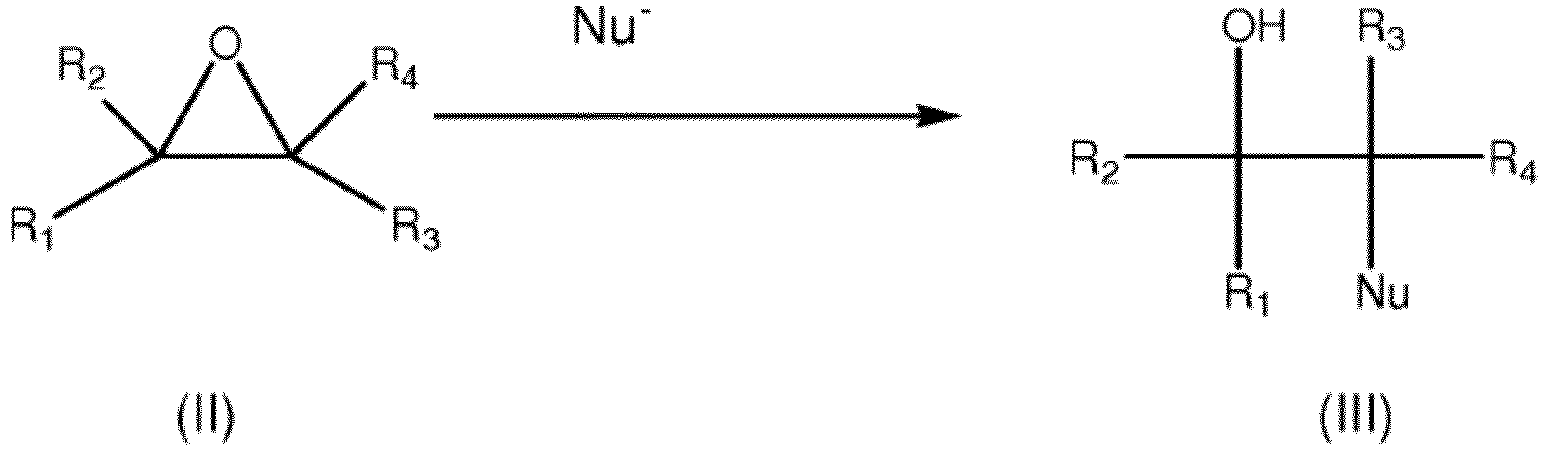 R1, R2, R3, R4 unabhängig voneinander für Wasserstoff, Halogen (F, Cl, Br, I) oder substituiertes oder unsubstituiertes C1-C12-Alkyl, C2-C12-Alkenyl, C2-C12-Alkinyl, C1-C12-Alkoxy, C3-C12-Cycloalkyl, C3-C12-Cycloalkenyl, C6-C12-Cycloalkinyl oder C5-C12-Aryl oder-C1-C3-Alkyl-C(=O)-O-R5 oder-C1-C3-Alkyl-O-R5 stehen, wobei R5 aus Wasserstoff, C1-C6-Alkyl, C2-C6-Alkenyl, C2-C6-Alkinyl, C1-C6-Alkoxy, C5-C13-Alkylaryl, C5-C13-Arylalkyl, C5-C13-Aryloxy, C5-C13-Arylalkoxy, C5-C13-Heteroalkyl, C5-C13-Aryl, C5-C13-Heteroaryl, C3-C12-Cycloalkyl, C3-C12-Cycloalkenyl, C6-C12-Cycloalkinyl oder cyclischem C5-C13-Heteroalkyl ausgewählt ist, wobei im Fall von mehr als einem aliphatischen oder aromatischen Ringsystem die Ringsysteme kondensiert oder getrennt sind und R5 mindestens einen weiteren Substituenten R6 aufweisen kann, wobeiR6 aus Wasserstoff, Hydroxy, -C(=O)-NH2, Halogen (F, Cl, Br, I), -C1-C3-Alkyl, -C(=)O-C1-C3-Alkyl, -C(=)O-C1-C3-Alkyl, -NH-C(=)O-C1-C3-Alkyl, -C1-C3-Alkyl-O-C1-C3-alkyl, C2-C3-Alkenyl, -O-C2-C3-Alkenyl, C5-C7-Cycloalkyl, cyclischem C5-C7-Heteroalkyl, C5-C7-Aryl oder C5-C7-Heteroaryl ausgewählt ist
und/oderzwei der Reste R1, R2, R3, R4 zusammen eine aus C3-C12-Cycloalkyl, C4-C12-Cycloalkenyl, C6-C12-Cycloalkinyl, cyclischem C3-C12-Heteroalkyl, cyclischem C4-C12-Heteroalkenyl oder cyclischem C6-C12-Heteroalkinyl ausgewählte cyclische Struktur, vorzugsweise eine C4-C8-Cycloalkyl- oder C4-C8-Cycloalkenylgruppe, besonders bevorzugt eine C5-C7-Cycloalkyl- oder C5-C7-Cycloalkenylgruppe, am meisten bevorzugt eine C5-C6-Cycloalkyl- oder C5-C6-Cycloalkenylgruppe bilden, wobei im Fall von mehr als einem Ringsystem die Ringsysteme kondensiert oder getrennt sind und wobei die Anzahl an für die cyclische Struktur angegebenen C-Atomen immer die 2 C-Atome der Halohydrinstruktur, die das OH und das X tragen, einschließt, und
wobei cyclische Gruppen in R1, R2, R3, R4 oder die durch zwei der Reste R1, R2, R3, R4 gebildete cyclische Struktur jeweils gegebenenfalls mindestens einen weiteren, von Wasserstoff verschiedenen Substituenten, vorzugsweise ausgewählt aus R6, besonders bevorzugt Halogen (F, Cl, Br, I) oder C1-C3-Alkyl (R7), aufweisen
undNu aus R'NO2, N3, NO2, SCN, OCN, CN, Halogen (F, Cl, Br, I) und R"CO2 ausgewählt ist, wobeiR' aus C1-C4-Alkyl, -Alkenyl, vorzugsweise CH3, ausgewählt ist,R" aus Wasserstoff, C1-C4-Alkyl, -Alkenyl, vorzugsweise Wasserstoff, ausgewählt ist,wobei Nu- ein Anion von Nu ist. - Verwendung des Biomoleküls als Halohydrindehalogenase bei der Umwandlung mindestens eines Teils der Menge an Halohydrin der Formel (I) in ein Epoxid der Formel (II) und/oder bei der Umwandlung mindestens eines Teils eines Epoxids der Formel (II) in einen Alkohol der Formel (III) nach Anspruch 1 oder 2, dadurch gekennzeichnet, dass bei den Resten R1, R2, R3, R4, die nicht mit einem anderen der Reste R1, R2, R3, R4 eine cyclische Struktur bilden, jeweils mindestens ein Kohlenstoffatom durch ein Heteroatom ersetzt sein kann.
- Verwendung des Biomoleküls als Halohydrindehalogenase bei der Umwandlung mindestens eines Teils der Menge an Halohydrin der Formel (I) in ein Epoxid der Formel (II) nach Anspruch 1, wobei das Halohydrin der Formel (I) ausgewählt ist aus


- Verwendung des Biomoleküls als Halohydrindehalogenase bei der Umwandlung mindestens eines Teils des Epoxids der Formel (II) in einen Alkohol der Formel (III) nach Anspruch 2, wobei das Epoxid der Formel (II) ausgewählt ist aus


Priority Applications (5)
| Application Number | Priority Date | Filing Date | Title |
|---|---|---|---|
| EP18182700.7A EP3404097B1 (de) | 2014-07-01 | 2014-07-01 | Erweiterung der halohydrindehalogenaseenzymfamilie: identifizierung neuartiger enzyme durch datenbank-mining |
| ES18182700T ES2832451T3 (es) | 2014-07-01 | 2014-07-01 | Expansión de la familia de enzimas de halohidrina deshalogenasa: identificación de nuevas enzimas por extracción de base de datos |
| DK18182700.7T DK3404097T3 (da) | 2014-07-01 | 2014-07-01 | Udvidelse af halohydrindehalogenase-enzymfamilien: identifikation af nye enzymer med database-mining |
| PL18182700.7T PL3404097T3 (pl) | 2014-07-01 | 2014-07-01 | Rozszerzanie rodziny enzymów dehalogenaz halohydrynowych: identyfikacja nowych enzymów poprzez eksplorację baz danych |
| EP14175165.1A EP2963112B1 (de) | 2014-07-01 | 2014-07-01 | Erweiterung der Halohydrindehalogenaseenzymfamilie: Identifizierung neuartiger Enzyme durch Datenbank-Mining |
Applications Claiming Priority (1)
| Application Number | Priority Date | Filing Date | Title |
|---|---|---|---|
| EP14175165.1A EP2963112B1 (de) | 2014-07-01 | 2014-07-01 | Erweiterung der Halohydrindehalogenaseenzymfamilie: Identifizierung neuartiger Enzyme durch Datenbank-Mining |
Related Child Applications (2)
| Application Number | Title | Priority Date | Filing Date |
|---|---|---|---|
| EP18182700.7A Division EP3404097B1 (de) | 2014-07-01 | 2014-07-01 | Erweiterung der halohydrindehalogenaseenzymfamilie: identifizierung neuartiger enzyme durch datenbank-mining |
| EP18182700.7A Division-Into EP3404097B1 (de) | 2014-07-01 | 2014-07-01 | Erweiterung der halohydrindehalogenaseenzymfamilie: identifizierung neuartiger enzyme durch datenbank-mining |
Publications (2)
| Publication Number | Publication Date |
|---|---|
| EP2963112A1 EP2963112A1 (de) | 2016-01-06 |
| EP2963112B1 true EP2963112B1 (de) | 2018-09-05 |
Family
ID=51224682
Family Applications (2)
| Application Number | Title | Priority Date | Filing Date |
|---|---|---|---|
| EP18182700.7A Active EP3404097B1 (de) | 2014-07-01 | 2014-07-01 | Erweiterung der halohydrindehalogenaseenzymfamilie: identifizierung neuartiger enzyme durch datenbank-mining |
| EP14175165.1A Not-in-force EP2963112B1 (de) | 2014-07-01 | 2014-07-01 | Erweiterung der Halohydrindehalogenaseenzymfamilie: Identifizierung neuartiger Enzyme durch Datenbank-Mining |
Family Applications Before (1)
| Application Number | Title | Priority Date | Filing Date |
|---|---|---|---|
| EP18182700.7A Active EP3404097B1 (de) | 2014-07-01 | 2014-07-01 | Erweiterung der halohydrindehalogenaseenzymfamilie: identifizierung neuartiger enzyme durch datenbank-mining |
Country Status (4)
| Country | Link |
|---|---|
| EP (2) | EP3404097B1 (de) |
| DK (1) | DK3404097T3 (de) |
| ES (1) | ES2832451T3 (de) |
| PL (1) | PL3404097T3 (de) |
-
2014
- 2014-07-01 EP EP18182700.7A patent/EP3404097B1/de active Active
- 2014-07-01 ES ES18182700T patent/ES2832451T3/es active Active
- 2014-07-01 PL PL18182700.7T patent/PL3404097T3/pl unknown
- 2014-07-01 EP EP14175165.1A patent/EP2963112B1/de not_active Not-in-force
- 2014-07-01 DK DK18182700.7T patent/DK3404097T3/da active
Also Published As
| Publication number | Publication date |
|---|---|
| EP3404097B1 (de) | 2020-09-02 |
| EP2963112A1 (de) | 2016-01-06 |
| EP3404097A1 (de) | 2018-11-21 |
| PL3404097T3 (pl) | 2021-02-22 |
| DK3404097T3 (da) | 2020-12-07 |
| ES2832451T3 (es) | 2021-06-10 |
Similar Documents
| Publication | Publication Date | Title |
|---|---|---|
| Schallmey et al. | Expanding the halohydrin dehalogenase enzyme family: identification of novel enzymes by database mining | |
| JP5546870B2 (ja) | 1,2−プロパンジオールおよびアセトールの製造のための微生物および方法 | |
| Liu et al. | Identification of ketone reductase ChKRED20 from the genome of Chryseobacterium sp. CA49 for highly efficient anti-Prelog reduction of 3, 5-bis (trifluoromethyl) acetophenone | |
| Beller et al. | Discovery of enzymes for toluene synthesis from anoxic microbial communities | |
| Koopmeiners et al. | Biochemical and biocatalytic characterization of 17 novel halohydrin dehalogenases | |
| US20110165644A1 (en) | Production of alkenes by enzymatic decarboxylation of 3-hydroxyalkanoic acids | |
| Su et al. | Discovery and characterization of a novel C-terminal peptide carboxyl methyltransferase in a lassomycin-like lasso peptide biosynthetic pathway | |
| JP2011515083A (ja) | グリオキサラーゼiii活性を有するポリペプチド、それをコードするポリヌクレオチドおよびその使用 | |
| US20170233713A1 (en) | Hydrocarbon synthase gene and use thereof | |
| Itoh et al. | Efficient PCR-based amplification of diverse alcohol dehydrogenase genes from metagenomes for improving biocatalysis: screening of gene-specific amplicons from metagenomes | |
| Yang et al. | Biosynthesis of L-sorbose and L-psicose based on C—C bond formation catalyzed by aldolases in an engineered Corynebacterium glutamicum strain | |
| Xue et al. | Biochemical characterization and biosynthetic application of a halohydrin dehalogenase from Tistrella mobilis ZJB1405 | |
| Isotani et al. | Gene cloning and characterization of two NADH-dependent 3-quinuclidinone reductases from Microbacterium luteolum JCM 9174 | |
| US10184138B2 (en) | Bacteria engineered for conversion of ethylene to ethanol | |
| EP2963112B1 (de) | Erweiterung der Halohydrindehalogenaseenzymfamilie: Identifizierung neuartiger Enzyme durch Datenbank-Mining | |
| EP3830281A1 (de) | Verfahren zur herstellung von fructose-6-phosphat aus dihydroxyacetonphosphat und glycerinaldehyd-3-phosphat | |
| Zhang et al. | Efficient biosynthesis of enantiopure tolvaptan by utilizing alcohol dehydrogenase-catalyzed enantioselective reduction | |
| WO2024257686A1 (ja) | クロチルアルコールを生成するヒドロゲノフィラス属細菌形質転換体 | |
| WO2018101403A1 (ja) | L-スレオニン脱水素用タンパク質(酵素)、目的活性を有するタンパク質のスクリーニング方法及び調製方法 | |
| EP3649246A1 (de) | Verfahren zur herstellung von aminen aus aldehyden und ketonen durch biokatalyse | |
| US11078499B2 (en) | Host cells and methods for producing toluene biochemically | |
| Huang et al. | Enantioconvergent hydrolysis of racemic 1, 2-epoxypentane and 1, 2-epoxyhexane by an engineered Escherichia coli strain overexpressing a novel Streptomyces fradiae epoxide hydrolase | |
| ES3057554T3 (en) | Processes to prepare elongated 2-ketoacids and c-5-c10 compounds therefrom via genetic modifications to microbial metabolic pathways | |
| US12618050B2 (en) | Engineered polypeptides that exhibit increased catalytic efficiency for unnatural cofactors and uses thereof | |
| WO2025142753A1 (ja) | クロトンアルデヒド-クロチルアルコールデヒドロゲナーゼ変異体 |
Legal Events
| Date | Code | Title | Description |
|---|---|---|---|
| PUAI | Public reference made under article 153(3) epc to a published international application that has entered the european phase |
Free format text: ORIGINAL CODE: 0009012 |
|
| AK | Designated contracting states |
Kind code of ref document: A1 Designated state(s): AL AT BE BG CH CY CZ DE DK EE ES FI FR GB GR HR HU IE IS IT LI LT LU LV MC MK MT NL NO PL PT RO RS SE SI SK SM TR |
|
| AX | Request for extension of the european patent |
Extension state: BA ME |
|
| 17P | Request for examination filed |
Effective date: 20160705 |
|
| RBV | Designated contracting states (corrected) |
Designated state(s): AL AT BE BG CH CY CZ DE DK EE ES FI FR GB GR HR HU IE IS IT LI LT LU LV MC MK MT NL NO PL PT RO RS SE SI SK SM TR |
|
| 17Q | First examination report despatched |
Effective date: 20160801 |
|
| STAA | Information on the status of an ep patent application or granted ep patent |
Free format text: STATUS: EXAMINATION IS IN PROGRESS |
|
| GRAP | Despatch of communication of intention to grant a patent |
Free format text: ORIGINAL CODE: EPIDOSNIGR1 |
|
| STAA | Information on the status of an ep patent application or granted ep patent |
Free format text: STATUS: GRANT OF PATENT IS INTENDED |
|
| INTG | Intention to grant announced |
Effective date: 20180314 |
|
| GRAS | Grant fee paid |
Free format text: ORIGINAL CODE: EPIDOSNIGR3 |
|
| GRAA | (expected) grant |
Free format text: ORIGINAL CODE: 0009210 |
|
| STAA | Information on the status of an ep patent application or granted ep patent |
Free format text: STATUS: THE PATENT HAS BEEN GRANTED |
|
| AK | Designated contracting states |
Kind code of ref document: B1 Designated state(s): AL AT BE BG CH CY CZ DE DK EE ES FI FR GB GR HR HU IE IS IT LI LT LU LV MC MK MT NL NO PL PT RO RS SE SI SK SM TR |
|
| REG | Reference to a national code |
Ref country code: GB Ref legal event code: FG4D |
|
| REG | Reference to a national code |
Ref country code: CH Ref legal event code: EP |
|
| REG | Reference to a national code |
Ref country code: AT Ref legal event code: REF Ref document number: 1037835 Country of ref document: AT Kind code of ref document: T Effective date: 20180915 |
|
| REG | Reference to a national code |
Ref country code: IE Ref legal event code: FG4D |
|
| REG | Reference to a national code |
Ref country code: DE Ref legal event code: R096 Ref document number: 602014031630 Country of ref document: DE |
|
| REG | Reference to a national code |
Ref country code: DE Ref legal event code: R081 Ref document number: 602014031630 Country of ref document: DE Owner name: ENZYMICALS AG, DE Free format text: FORMER OWNERS: ENZYMICALS AG, 17489 GREIFSWALD, DE; RHEINISCH-WESTFAELISCHE TECHNISCHE HOCHSCHULE (RWTH) AACHEN, KOERPERSCHAFT DES OEFFENTLICHEN RECHTS, 52062 AACHEN, DE Ref country code: DE Ref legal event code: R081 Ref document number: 602014031630 Country of ref document: DE Owner name: ENZYMICALS AG, DE Free format text: FORMER OWNERS: ENZYMICALS AG, 17489 GREIFSWALD, DE; RHEINISCH-WESTFAELISCHE TECHNISCHE HOCHSCHULE (RWTH) AACHEN, 52062 AACHEN, DE |
|
| REG | Reference to a national code |
Ref country code: CH Ref legal event code: NV Representative=s name: SCHMAUDER AND PARTNER AG PATENT- UND MARKENANW, CH |
|
| RAP2 | Party data changed (patent owner data changed or rights of a patent transferred) |
Owner name: ENZYMICALS AG |
|
| REG | Reference to a national code |
Ref country code: NL Ref legal event code: FP |
|
| REG | Reference to a national code |
Ref country code: LT Ref legal event code: MG4D |
|
| PG25 | Lapsed in a contracting state [announced via postgrant information from national office to epo] |
Ref country code: LT Free format text: LAPSE BECAUSE OF FAILURE TO SUBMIT A TRANSLATION OF THE DESCRIPTION OR TO PAY THE FEE WITHIN THE PRESCRIBED TIME-LIMIT Effective date: 20180905 Ref country code: RS Free format text: LAPSE BECAUSE OF FAILURE TO SUBMIT A TRANSLATION OF THE DESCRIPTION OR TO PAY THE FEE WITHIN THE PRESCRIBED TIME-LIMIT Effective date: 20180905 Ref country code: NO Free format text: LAPSE BECAUSE OF FAILURE TO SUBMIT A TRANSLATION OF THE DESCRIPTION OR TO PAY THE FEE WITHIN THE PRESCRIBED TIME-LIMIT Effective date: 20181205 Ref country code: FI Free format text: LAPSE BECAUSE OF FAILURE TO SUBMIT A TRANSLATION OF THE DESCRIPTION OR TO PAY THE FEE WITHIN THE PRESCRIBED TIME-LIMIT Effective date: 20180905 Ref country code: GR Free format text: LAPSE BECAUSE OF FAILURE TO SUBMIT A TRANSLATION OF THE DESCRIPTION OR TO PAY THE FEE WITHIN THE PRESCRIBED TIME-LIMIT Effective date: 20181206 Ref country code: SE Free format text: LAPSE BECAUSE OF FAILURE TO SUBMIT A TRANSLATION OF THE DESCRIPTION OR TO PAY THE FEE WITHIN THE PRESCRIBED TIME-LIMIT Effective date: 20180905 Ref country code: BG Free format text: LAPSE BECAUSE OF FAILURE TO SUBMIT A TRANSLATION OF THE DESCRIPTION OR TO PAY THE FEE WITHIN THE PRESCRIBED TIME-LIMIT Effective date: 20181205 |
|
| REG | Reference to a national code |
Ref country code: AT Ref legal event code: MK05 Ref document number: 1037835 Country of ref document: AT Kind code of ref document: T Effective date: 20180905 |
|
| PG25 | Lapsed in a contracting state [announced via postgrant information from national office to epo] |
Ref country code: HR Free format text: LAPSE BECAUSE OF FAILURE TO SUBMIT A TRANSLATION OF THE DESCRIPTION OR TO PAY THE FEE WITHIN THE PRESCRIBED TIME-LIMIT Effective date: 20180905 Ref country code: AL Free format text: LAPSE BECAUSE OF FAILURE TO SUBMIT A TRANSLATION OF THE DESCRIPTION OR TO PAY THE FEE WITHIN THE PRESCRIBED TIME-LIMIT Effective date: 20180905 Ref country code: LV Free format text: LAPSE BECAUSE OF FAILURE TO SUBMIT A TRANSLATION OF THE DESCRIPTION OR TO PAY THE FEE WITHIN THE PRESCRIBED TIME-LIMIT Effective date: 20180905 |
|
| REG | Reference to a national code |
Ref country code: GB Ref legal event code: 732E Free format text: REGISTERED BETWEEN 20190207 AND 20190213 |
|
| REG | Reference to a national code |
Ref country code: NL Ref legal event code: PD Owner name: ENZYMICALS AG; DE Free format text: DETAILS ASSIGNMENT: CHANGE OF OWNER(S), ASSIGNMENT; FORMER OWNER NAME: RHEINISCH-WESTFAELISCHE TECHNISCHE HOCHSCHULE (RWTH) AACHEN Effective date: 20190116 |
|
| PG25 | Lapsed in a contracting state [announced via postgrant information from national office to epo] |
Ref country code: IT Free format text: LAPSE BECAUSE OF FAILURE TO SUBMIT A TRANSLATION OF THE DESCRIPTION OR TO PAY THE FEE WITHIN THE PRESCRIBED TIME-LIMIT Effective date: 20180905 Ref country code: RO Free format text: LAPSE BECAUSE OF FAILURE TO SUBMIT A TRANSLATION OF THE DESCRIPTION OR TO PAY THE FEE WITHIN THE PRESCRIBED TIME-LIMIT Effective date: 20180905 Ref country code: CZ Free format text: LAPSE BECAUSE OF FAILURE TO SUBMIT A TRANSLATION OF THE DESCRIPTION OR TO PAY THE FEE WITHIN THE PRESCRIBED TIME-LIMIT Effective date: 20180905 Ref country code: ES Free format text: LAPSE BECAUSE OF FAILURE TO SUBMIT A TRANSLATION OF THE DESCRIPTION OR TO PAY THE FEE WITHIN THE PRESCRIBED TIME-LIMIT Effective date: 20180905 Ref country code: AT Free format text: LAPSE BECAUSE OF FAILURE TO SUBMIT A TRANSLATION OF THE DESCRIPTION OR TO PAY THE FEE WITHIN THE PRESCRIBED TIME-LIMIT Effective date: 20180905 Ref country code: IS Free format text: LAPSE BECAUSE OF FAILURE TO SUBMIT A TRANSLATION OF THE DESCRIPTION OR TO PAY THE FEE WITHIN THE PRESCRIBED TIME-LIMIT Effective date: 20190105 Ref country code: PL Free format text: LAPSE BECAUSE OF FAILURE TO SUBMIT A TRANSLATION OF THE DESCRIPTION OR TO PAY THE FEE WITHIN THE PRESCRIBED TIME-LIMIT Effective date: 20180905 Ref country code: EE Free format text: LAPSE BECAUSE OF FAILURE TO SUBMIT A TRANSLATION OF THE DESCRIPTION OR TO PAY THE FEE WITHIN THE PRESCRIBED TIME-LIMIT Effective date: 20180905 |
|
| PG25 | Lapsed in a contracting state [announced via postgrant information from national office to epo] |
Ref country code: SK Free format text: LAPSE BECAUSE OF FAILURE TO SUBMIT A TRANSLATION OF THE DESCRIPTION OR TO PAY THE FEE WITHIN THE PRESCRIBED TIME-LIMIT Effective date: 20180905 Ref country code: SM Free format text: LAPSE BECAUSE OF FAILURE TO SUBMIT A TRANSLATION OF THE DESCRIPTION OR TO PAY THE FEE WITHIN THE PRESCRIBED TIME-LIMIT Effective date: 20180905 Ref country code: PT Free format text: LAPSE BECAUSE OF FAILURE TO SUBMIT A TRANSLATION OF THE DESCRIPTION OR TO PAY THE FEE WITHIN THE PRESCRIBED TIME-LIMIT Effective date: 20190105 |
|
| REG | Reference to a national code |
Ref country code: DE Ref legal event code: R097 Ref document number: 602014031630 Country of ref document: DE |
|
| PLBE | No opposition filed within time limit |
Free format text: ORIGINAL CODE: 0009261 |
|
| STAA | Information on the status of an ep patent application or granted ep patent |
Free format text: STATUS: NO OPPOSITION FILED WITHIN TIME LIMIT |
|
| PG25 | Lapsed in a contracting state [announced via postgrant information from national office to epo] |
Ref country code: DK Free format text: LAPSE BECAUSE OF FAILURE TO SUBMIT A TRANSLATION OF THE DESCRIPTION OR TO PAY THE FEE WITHIN THE PRESCRIBED TIME-LIMIT Effective date: 20180905 |
|
| 26N | No opposition filed |
Effective date: 20190606 |
|
| PG25 | Lapsed in a contracting state [announced via postgrant information from national office to epo] |
Ref country code: SI Free format text: LAPSE BECAUSE OF FAILURE TO SUBMIT A TRANSLATION OF THE DESCRIPTION OR TO PAY THE FEE WITHIN THE PRESCRIBED TIME-LIMIT Effective date: 20180905 |
|
| PGFP | Annual fee paid to national office [announced via postgrant information from national office to epo] |
Ref country code: NL Payment date: 20190722 Year of fee payment: 6 |
|
| PGFP | Annual fee paid to national office [announced via postgrant information from national office to epo] |
Ref country code: FR Payment date: 20190724 Year of fee payment: 6 Ref country code: DE Payment date: 20190723 Year of fee payment: 6 |
|
| PGFP | Annual fee paid to national office [announced via postgrant information from national office to epo] |
Ref country code: GB Payment date: 20190725 Year of fee payment: 6 |
|
| PGFP | Annual fee paid to national office [announced via postgrant information from national office to epo] |
Ref country code: CH Payment date: 20190725 Year of fee payment: 6 |
|
| PG25 | Lapsed in a contracting state [announced via postgrant information from national office to epo] |
Ref country code: MC Free format text: LAPSE BECAUSE OF FAILURE TO SUBMIT A TRANSLATION OF THE DESCRIPTION OR TO PAY THE FEE WITHIN THE PRESCRIBED TIME-LIMIT Effective date: 20180905 |
|
| PG25 | Lapsed in a contracting state [announced via postgrant information from national office to epo] |
Ref country code: TR Free format text: LAPSE BECAUSE OF FAILURE TO SUBMIT A TRANSLATION OF THE DESCRIPTION OR TO PAY THE FEE WITHIN THE PRESCRIBED TIME-LIMIT Effective date: 20180905 |
|
| REG | Reference to a national code |
Ref country code: BE Ref legal event code: MM Effective date: 20190731 |
|
| PG25 | Lapsed in a contracting state [announced via postgrant information from national office to epo] |
Ref country code: BE Free format text: LAPSE BECAUSE OF NON-PAYMENT OF DUE FEES Effective date: 20190731 Ref country code: LU Free format text: LAPSE BECAUSE OF NON-PAYMENT OF DUE FEES Effective date: 20190701 |
|
| PG25 | Lapsed in a contracting state [announced via postgrant information from national office to epo] |
Ref country code: IE Free format text: LAPSE BECAUSE OF NON-PAYMENT OF DUE FEES Effective date: 20190701 |
|
| REG | Reference to a national code |
Ref country code: DE Ref legal event code: R119 Ref document number: 602014031630 Country of ref document: DE |
|
| REG | Reference to a national code |
Ref country code: CH Ref legal event code: PL |
|
| REG | Reference to a national code |
Ref country code: NL Ref legal event code: MM Effective date: 20200801 |
|
| GBPC | Gb: european patent ceased through non-payment of renewal fee |
Effective date: 20200701 |
|
| PG25 | Lapsed in a contracting state [announced via postgrant information from national office to epo] |
Ref country code: CH Free format text: LAPSE BECAUSE OF NON-PAYMENT OF DUE FEES Effective date: 20200731 Ref country code: LI Free format text: LAPSE BECAUSE OF NON-PAYMENT OF DUE FEES Effective date: 20200731 Ref country code: GB Free format text: LAPSE BECAUSE OF NON-PAYMENT OF DUE FEES Effective date: 20200701 Ref country code: NL Free format text: LAPSE BECAUSE OF NON-PAYMENT OF DUE FEES Effective date: 20200801 Ref country code: FR Free format text: LAPSE BECAUSE OF NON-PAYMENT OF DUE FEES Effective date: 20200731 |
|
| PG25 | Lapsed in a contracting state [announced via postgrant information from national office to epo] |
Ref country code: CY Free format text: LAPSE BECAUSE OF FAILURE TO SUBMIT A TRANSLATION OF THE DESCRIPTION OR TO PAY THE FEE WITHIN THE PRESCRIBED TIME-LIMIT Effective date: 20180905 Ref country code: DE Free format text: LAPSE BECAUSE OF NON-PAYMENT OF DUE FEES Effective date: 20210202 |
|
| PG25 | Lapsed in a contracting state [announced via postgrant information from national office to epo] |
Ref country code: HU Free format text: LAPSE BECAUSE OF FAILURE TO SUBMIT A TRANSLATION OF THE DESCRIPTION OR TO PAY THE FEE WITHIN THE PRESCRIBED TIME-LIMIT; INVALID AB INITIO Effective date: 20140701 Ref country code: MT Free format text: LAPSE BECAUSE OF FAILURE TO SUBMIT A TRANSLATION OF THE DESCRIPTION OR TO PAY THE FEE WITHIN THE PRESCRIBED TIME-LIMIT Effective date: 20180905 |
|
| PG25 | Lapsed in a contracting state [announced via postgrant information from national office to epo] |
Ref country code: MK Free format text: LAPSE BECAUSE OF FAILURE TO SUBMIT A TRANSLATION OF THE DESCRIPTION OR TO PAY THE FEE WITHIN THE PRESCRIBED TIME-LIMIT Effective date: 20180905 |